
The Stranger and the Woman: Rethinking Borders and the Homeland in Bahrām Bayzā’ī’s Cinema




Introduction
Scholarship on Bayzā’ī’s work has established him as a pivotal figure in Iranian cinema and theater, engaging with key concepts including feminism and gender representation, as exemplified in studies of his progressive female characters as cultural memory-bearers.1S. Lahiji, Sīmā-yi Zan dar Āsār-i Bahrām Bayzā’ī [The Image of Women in the Works of Bahrām Bayzā’ī] (Tehran: Rushangarān va Mutāli‛āt-i Zanān, 1993); S. Talajooy, ed., The Plays and Films of Bahram Beyzai: Origins, Forms and Functions (London: I.B. Tauris/Bloomsbury, 2024). His work is also associated with modernization and urbanization—analyzing the psychological impact of urban transformation through cityscapes.2N. Pak-Shiraz, “Exploring the City in the Cinema of Bahram Bayzaie,” Iranian Studies 46, no. 5 (2013): 811–28. Another, recurring theme in Bayzā’ī’s films are national identity and belonging—which is revealed in his archaeological approach to Iranian identity through performance and ritual; mythology and literary heritage.3S. Talajooy, “Reformulation of Shahnameh Legends in Bahram Bayzaie’s Plays,” Iranian Studies 46, no. 5 (2013): 695–719; S. Talajooy, Iranian Culture in Bahram Bayzaie’s Cinema and Theatre: Paradigms of Being and Belonging (1959–1979) (London: I.B. Tauris/Bloomsbury, 2023), 696-698. Bayzā’ī synthesizes indigenous theatrical forms with modern dramaturgy, refunctionalizing tradition to produce counter-hegemonic meanings — a strategy that may be described as a form of critical traditionalism.”4S. Talajooy, “Reformulation of Shahnameh Legends in Bahram Beyzaie’s Plays.” Iranian Studies 46, no. 5 (September 2013): Special Issue: Bahram Beyzaie’s Cinema and Theatre. Cambridge: Cambridge University Press, 2013, 696. This critical traditionalism provides him with a political critique to authoritarianism and an allegorical resistance to power structures.
Scholars have also addressed the figure of the stranger in Bayzā’ī’s work. Its significance is further emphasized by the title of Muhammad ‛Abdī’s biography, Gharībah-yi Buzurg (The Great Stranger, 2015), which positions Bayzā’ī himself as a stranger within Iranian culture. Saeed Talajooy explores how these strangers embody marginalized outsiders—figures who are often initially accepted by women but ultimately rejected or alienated by society.5H. Abedini, “Iranian Culture in Bahram Beyzaie’s Cinema and Theatre: Paradigms of Being and Belonging (1959–79),” The Journal of Religion and Film 29, no. 2 (2025): 1A–9. In other words, across Bayzā’ī’s cinema, the encounter between the stranger and the community is almost consistently mediated through a female protagonist. However, a critical gap in the research remains. There has been little to no analysis of how gender, otherness, and nationalism intersect in Bayzā’ī’s cinema. While scholars have examined gender relations and nationalism as separate themes, no study has yet offered a rigorous theorization of how these three dimensions converge through the figure of the stranger.
To illuminate the intricate processes of belonging, boundary-making, and national identity formation in Bahrām Bayzā’ī’s cinema, this article will examine how women are the first to recognize, shelter, or engage with the outsider whose presence unsettles the established symbolic and social/patriarchal order. We argue that this recurrent narrative structure positions femininity as a relational and ethical force that interrupts patriarchal norms of belonging, exclusion, and control. Whether through acts of care, desire, protection, or alliance, female characters open a space in which the stranger’s presence becomes thinkable, even if only temporarily. In doing so, they expose the fragility of communal boundaries and reveal how norms of belonging are maintained through gendered forms of violence and exclusion. The woman’s engagement with the stranger thus functions not merely as a personal or emotional gesture, but as a political intervention that destabilizes reactionary social orders and foregrounds the gendered foundations of community, homeland, and national identity.
This recurring narrative structure can be observed throughout much of Bayzā’ī’s broader body of work. For example, in Downpour (Ragbār, 1972), Parvīz Fannīzādah, playing a middle-class teacher named Hikmatī, enters a traditional neighborhood where ‛Atifah (Parvānah Ma‛sūmī), the female protagonist, welcomes him. Through a love story she facilitates Hikmatī’s inner transformation, leading him into a symbolic struggle against the misogynistic patriarchy of the community—epitomized in his confrontation with Āqā Rahīm, the butcher and his romantic rival, who embodies reactionary male dominance. In Killing Mad Dogs (Sagkushī, 2001), by contrast, it is the female protagonist herself who appears as the stranger, bearing the burden of confronting patriarchal corruption and moral decay.
However, among Bayzā’ī’s works, this article focuses specifically on The Stranger and the Fog (1974), The Ballad of Tārā (1979), and Bāshū, the Little Stranger (1986), as these films most clearly foreground the intersection of strangeness, gender, and nation. While the figure of the stranger recurs throughout his oeuvre, these three films provide particularly rich examples in which the motifs of otherness, national belonging, and femininity converge, revealing how encounters with the stranger simultaneously disrupt patriarchal norms, negotiate communal boundaries, and explore the gendered construction of national identity. Drawing on insights from Sara Ahmed,6S. Ahmed, Strange Encounters: Embodied Others in Post-Coloniality (London: Routledge, 2000), 7-9. we argue that strangeness in Bahrām Bayzā’ī’s work is also depicted through embodied encounters that simultaneously create proximity and distance, enforcing boundaries between “us” and “them.” This feminist approach offers significant analytical potential for examining how Bayzā’ī’s cinema engages with the production of communal boundaries through encounters with strange bodies. As we build on how women are playing mediating roles in these gendered-national demarcations, we analyze the racialization of the male protagonist as the stranger, how his body is pre-recognized as “not belonging” and how his eventual acceptance is portrayed not as a neutral accident but an active negotiation of Iran’s ethno-national boundaries.
Home, Homeland, and the Stranger Within
George Simmel describes the stranger as someone who is simultaneously part of a group and yet detached from it, bringing characteristics that are not native to the group and thereby creating new meanings through interaction.7G. Simmel, Guzīdah-yi maqālāt [The Stranger: Selected Essays], trans. Sh. Bihiyān (Tehran: Dunyā-yi Iqtisād, 2016; originally published in 1908), 109. Y. Fu, “Towards Relational Spatiality: Space, Relation and Simmel’s Modernity,” Sociology 56, no. 3 (2021): 591–607; L. Koefoed and K. Simonsen, “‘The Stranger,’ the City and the Nation: On the Possibilities of Identification and Belonging,” European Urban and Regional Studies 18, no. 4 (2011): 343–57. Sara Ahmed further extends this definition by emphasizing how strangerhood is shaped by gendered, racialized, and nationalized markers, demonstrating that recognition of the stranger is never neutral but always embedded in relations of power, proximity, and social boundary-making. In Strange Encounters: Embodied Others in Post‑Coloniality (2000), she provides a critical framework that theorizes the stranger not as someone entirely unknown, but as a body already recognized through gendered, racialized, and nationalized markers that determine who belongs and who is “out of place.” Strangerhood, for Ahmed, emerges through relations of proximity and distance that organize social space, including the space of the home. The stranger is not outside the nation but produced through encounters that simultaneously invite and expel. Ahmed’s distinction between the stranger who may be incorporated and the “stranger” who must be expelled illuminates how national narratives differentiate between others within the same territorial space.8S. Ahmed, Strange Encounters: Embodied Others in Post-Coloniality (London: Routledge, 2000), 106.
Within patriarchal nationalist discourse, the homeland is frequently endowed with qualities conventionally associated with femininity and motherhood, protection, warmth, emotional care, and reproductive continuity, while political authority and territorial defense are coded as masculine.9T. Mayer, “Embodied Nationalisms,” in Mapping Women, Making Politics: Feminist Perspectives on Political Geography, ed. Lynn Staeheli et al. (London: Taylor & Francis, 2004), 165-167. The national resonance of “homeland” is perhaps most clearly illustrated through Farsi words such as ‘Mām-i Mīhan’ which is linguistically and symbolically feminized as Iran itself is a woman’s name, and where territory is imagined as something to be protected, possessed, and defended by men. Borders are often metaphorized through the language of honor and virginity, with invasion framed as “rape,” revealing how women’s bodies function as metonyms for the nation itself.
This gendered division renders women symbolically central yet politically subordinate to the national project. Geographers such as Gillian Rose further demonstrate that territory itself is historically produced through masculinist violence, conquest, and ownership, with women’s bodies serving as key sites upon which national struggles are inscribed.10G. Rose, Feminism and Geography: The Limits of Geographical Knowledge (Cambridge: Polity Press, 1993), 88-90. Feminist interventions into nationalism have also foregrounded how nationalist identities often emerge through social relations structured by unequal power and an entrenched us/them logic that is forged the regulation of women and domestic space.11T. Mayer, “Embodied Nationalisms,” in Mapping Women, Making Politics: Feminist Perspectives on Political Geography, ed. Lynn Staeheli et al. (London: Taylor & Francis, 2004), 165–168. Recent scholarship on migration and borders extends this insight by demonstrating how people can be enacted as migrants without crossing physical borders.12Stephan Scheel and Martina Tazzioli, “Who Is a Migrant? Abandoning the Nation-State Point of View in the Study of Migration,” Migration Studies 1, no. 2 (2022), https://scipost.org/MigPol.1.1.002/pdf. Alison Mountz and Nancy Hiemstrafurther show how discourses of crisis recast particular bodies as security threats across transnational contexts, reproducing geographies of fear and exclusion.13A. Mountz and N. Hiemstra, “Chaos and Crisis: Dissecting the Spatiotemporal Logics of Contemporary Migrations and State Practices,” Annals of the Association of American Geographers 104, no. 2 (2014): 382–90.
This theoretical constellation provides a critical lens for reading Bahrām Bayzā’ī’s The Stranger and the Fog, The Ballad of Tārā, and Bāshū, the Little Stranger. Across these films, home and homeland are not stable sites of belonging but contested spaces where gendered encounters with the stranger unfold. Women emerge as mediators of proximity and distance, recognition and refusal, shelter and expulsion. Bayzā’ī’s cinematic strangers—racialized, displaced, and marked as “out of place”—are not external intruders but figures through whom the nation negotiates its boundaries from within. Drawing on feminist theories of nationalism and Ahmed’s articulation of strangerhood, this framework allows us to read Bayzā’ī’s films as critiques of how gendered bodies are mobilized to produce, police, and occasionally rupture the borders of home and nation.
The Stranger and the Fog; The Stranger as a Traveler from Nowhere
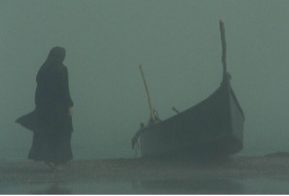
A boat from nowhere appears on the seashore — a nowhere the fog fills the frame, as a symbolic boundary separating “us” and “them,” while the sea—long associated in history with ambiguity and fear, brings an unfamiliar boat to shore. The village men gather to inspect it, and on the shore stands a veiled woman: Ra‛nā (Parvānah Ma‛sūmī). She is standing between the sea and the land, between hope and despair. She hopes that the boat might carry some trace of her husband who disappeared into the sea a year earlier.
She speaks with an old white-haired woman—her sister-in-law—who accuses Ra‛nā of bringing bad luck, linking her brother’s disappearance to Ra‛nā’s ill omen. The men, acting as guardians of the boundary, inspect the boat and discover an injured man inside. The old woman declares, “It’s not him. My brothers didn’t recognize him.” Soon we learn she is right: the man is not Ra‛nā’s husband but a wounded stranger the sea has carried to the shore. His name is Āyat. When he regains consciousness, he speaks of men who are after him. Soon after, the stranger’s presence, disturbs the stillness and the social order of the village. Yet, a condition is set for Āyat to be accepted into the village: he must marry one of the village women. Here, marriage becomes a mechanism of “the economy of the stranger”; the stranger must pay a price, and that price is negotiated through the female body as intermediary.14S. Ahmed, Strange Encounters: Embodied Others in Post-Coloniality (London: Routledge, 2000), 139. In other words, the stranger can only be integrated into the village through the acceptance of femininity — passing from alienation to belonging. The village men try to prevent this union; this is the moment when the boundary between homeland andhonor is summoned against the stranger. Sara Ahmed often distinguishes between fear and unknowing: the stranger is not someone we do not know, but someone we refuse to acknowledge.15S. Ahmed, Strange Encounters: Embodied Others in Post-Coloniality (London: Routledge, 2000), 55-56. As she explains, the stranger is not unknownbut already known—a body pre-inscribed in a network of signs and rendered outside within the logic of belonging. To the village men, Āyat embodies exactly that: placelessness, a threat to kinship and familiar order. As one of the village men says, “Our kin come before strangers.” This value reinforces the dividing line between “us” and “the other.”
In a frenzied scene, Āyat runs through the muddy rice fields, screaming, smearing mud across his face. Ra‛nā happens to pass by. Āyat runs after her, shouting: “No one wants me, do you understand? I’m not permitted!” Āyat exists in aspatial ambiguity; he is near yet distant, present yet non-intimate.16G. Simmel, Guzīdah-yi maqālāt [The Stranger: Selected Essays], trans. Sh. Bihiyān (Tehran: Dunyā-yi Iqtisād, 2016; originally published in 1908), 145. Ra‛nā responds, “Who are you?” and Āyat answers, “I’m the one who’s always brought you bad luck whenever I saw you!” (Figure 1).

Figure 1: Parvānah Ma‛sūmī as Ra‛nā in The Stranger and the Fog (Gharībah va Mih), directed by Bahrām Bayzā’ī, 1974.
Later, on a wooden bridge, Āyat follows Ra‛nā and says, “You don’t have to be afraid of me.” Ra‛nā replies, “I’m not afraid of you; I just don’t know you.” Āyat throws himself into the river; the mud washes from his face, and in a trembling voice he asks, “This is me—do you recognize me?” The bridge becomes a liminal space where the stranger undergoes an epistemological transformation and becomes knowable. Ra‛nā responds, “Maybe you don’t know it yourself, but you’re really crazy!” Āyat is transformed into a friend through Ra‛nā’s acceptance. Yet, Ra‛nā aware of the fragility of the bond between the two strangers, hides Āyat’s boat beneath the sand, as if she is composing an elegy for an inevitable separation (Figure 2).
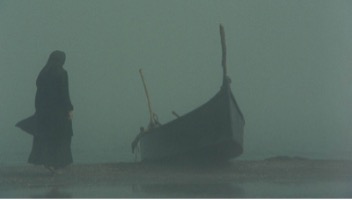
Figure 2: Parvānah Ma‛sūmī standing beside the boat which carried Āyat in a scene from The Stranger and the Fog (Gharībah va Mih), directed by Bahrām Bayzā’ī, 1974.
The return of Ra‛nā’s former husband—hailed as the mythical hero of the village—appears to restore the familiar order, the very structure that the presence of the stranger had unsettled. Yet when Āyat confronts and kills him, the sea reclaims his body, initiating a cycle of arrival and disappearance in which the husband and Āyat seem to echo one another, alternating between presence and absence on the shore. This recurring rhythm of emergence and vanishing underscores the provisional nature of belonging and the fragility of communal boundaries. In the final act, black-clad men—messengers of death—emerge from the fog to erase the stranger once more, yet Āyat and Ra‛nā resist. Wounded and solitary, Āyat boards the boat again, returning to the sea and dissolving into the horizon of mist, as if seeking a new encounter in which the strangeness that once provoked fear might become a site of recognition, transformation, and self-knowledge.
While Āyat is marked as a stranger through mobility, placelessness, and the threat he poses to the village’s social order, Ra‛nā is already positioned as a stranger from within. Her unveiled body renders her “out of place” in the moral geography of the village, a relation of proximity without belonging.17S. Ahmed, Strange Encounters: Embodied Others in Post-Coloniality (London: Routledge, 2000), 53-56. Ra‛nā repeatedly says throughout the film: “My choices are my own,” a statement of feminine agency and self-determination, showing that her acceptance of the stranger is not submission but an act of resistance against the village’s patriarchal order. Her refusal to obey her husband’s family—particularly her rejection of their authority to determine whom she may shelter, desire, or mourn—positions her outside the moral economy of the village. Ra‛nā’s body in this sense, functions as contested territory: it is policed, blamed, and symbolically occupied by communal anxieties about honor, loss, and disorder. The accusation that she brings bad luck, and the attribution of her husband’s disappearance to her presence, reveal how her body is already inscribed as a national liability—an internal stranger whose behavior threatens the stability of home. Unlike Āyat, whose strangerhood must be negotiated through incorporation or expulsion, Ra‛nā’s strangeness is managed through containment and moral surveillance. Yet it is precisely through this shared condition of strangerhood—Āyat as the displaced outsider and Ra‛nā as the gendered internal exile—that a fragile alliance becomes possible. Their encounter exposes how the boundaries of home and homeland are not fixed at the shoreline but reproduced on and through women’s bodies, where nationalism, patriarchy, and fear converge. Ra‛nā’s disobedinece thus does not merely mediate the stranger’s entry; it reveals how the nation’s borders are already fractured from within.
The Stranger Between Ritual and Ruins: Forgotten Histories in The Ballad of Tārā
In the opening scene of The Ballad of Tārā, Tārā (Sūsan Taslīmī) appears proudly riding a carriage through the village, under the watchful gaze of men. She soon learns that her grandfather has passed away. In a subsequent scene, Tārā returns home and finds a bundle her grandfather left her as a keepsake. She opens the bundle and starts to give away its contents to the villagers. At the bottom there is a peculiar sword. She gives it to an old man, he happily asks, “Is it mine?” and says, “I’ll attach it to my plow!”
The next day, the same old man runs back in panic, places the sword on Tārā’s porch, and flees immediately as if the sword carried an ominous curse. Tārā tries to make some use of it but soon becomes clear that the sword is entirely useless: it serves no purpose in farming, chopping wood, or even cutting vegetables. No one at the market is willing to buy it either. Finally, Tārā throws the sword into the river to rid herself of it.

Figure 3: Sūsan Taslīmī holding the iconic sword in an early scene from The Ballad of Tārā (Charīkah-yi Tārā), directed by Bahrām Bayzā’ī, 1979.
On her way home, she encounters an armored man — someone she remembers from a distant vision. The Historical Man or the Guerrier (Manūchihr Farīd), approaches Tārā and tells her that he is searching for the sword that belongs to his tribe. When Tārā nervously points to his wounds, he replies:
I am a man descended from history. My entire lineage lived and died in battle. Which battle? There is no sign of us anywhere. Everything slowly disappeared; all traces were lost. Nothing remains of us on earth — except of a sword.
If in The Stranger and the Fog the figure of Āyat was a stranger by the virtue of his appearance from “nowhere” — from an unfamiliar geography —, the Guerrier appears to be a forgotten stranger — one erased by time. His estrangement arises from historical oblivion, from the fact that he and his soldiers belong to a history that no one remembers anymore. The Guerrier exists as a spectral presence, visible only to Tārā, as if conjured within the realm of her perception—a vision emerging from the shadowy threshold of death. He returns to reclaim a vanished past, wielding the sword that embodies his tribe’s lost honor and glory. In his appearance, memory and history are rendered as liminal forces, where the past intrudes upon the present and the work of recognition unfolds in the delicate space between life and death, presence and absence. The Guerrier explains that he needs the sword to return to his people. At that moment, someone calls Tārā’s name. She turns to see who it is, but when she looks back, the man has vanished. Yet his presence lingers around her — as he can no longer leave because he has fallen in love with her.
In another scene, as the two speak near an ancient fortress, the Guerrier laments the forgotten past, attempting to revive a history of oppression erased from collective memory of the people (Figure 4). Wounded, carrying a banner and pierced by arrows, and walking through the ruins of the fortress emerging from the mist, he says:
This is where my skull was split open. This is where an unknown dagger tore through my armor. This stone is where our hopes were broken. Oh woman, what can I tell you? This is where my seven brothers — sons of the same father — disappeared in the battle. This is the gate that collapsed, the opening through which we were driven to the shore.
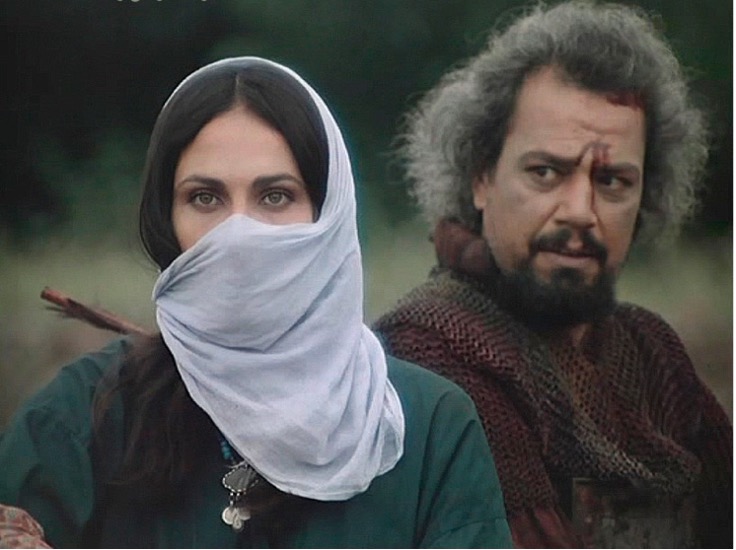
Figure 4: Sūsan Taslīmī and Manūchihr Farīd in The Ballad of Tārā (Charīkah-yi Tārā), directed by Bahrām Bayzā’ī, 1979.
Tārā, still skeptical of his story, accuses him of lying. She says she has told his tribe’s story to a book reader who did not recognize the name. The historical man grows agitated and replies: “The story of my tribe is not in a book. It’s in the soil, the wind, and the plants. My story lives, step by step, right here.”
Taʿziyah, or shabīh’khānī, has long occupied a central place in Bahrām Bayzā’ī’s aesthetic and political imagination, functioning as a ritual form through which history is not merely represented but continually re-enacted. As a performative archive, Taʿziyah sustains the memory of ‛Āshūrā within Shiʿi culture, preserving a history of martyrdom, loss, and ethical struggle through repetition, embodiment, and collective witnessing. In The Ballad of Tārā, this ritual logic is mobilized to stage a tension between histories that endure and those that have been erased. When Tārā converses with the memory of her grandfather, the bloodied horse—first seen fleeing the Taʿziyah performance—reappears, now subdued and guided by her. The horse, once part of ritualized remembrance, is revealed to belong to the warrior whose history has been excluded from the written archive. In this moment, Tārā emerges as a mediator between competing regimes of memory. Her skepticism toward the historical man—her insistence that his tribe’s name cannot be found in any book—exposes the limits of textual history, to which he responds by locating memory in the land itself: in soil, wind, and the body. Through this encounter, Taʿziyah is not simply invoked as religious tradition but reworked as a cinematic device that juxtaposes a history kept alive through ritual performance with another consigned to disappearance, suggesting that remembrance is always selective, embodied, and unevenly sustained across time.
The Guerrier’s words thus function not merely as testimony but as an embodied memory of suffering, one that re-enters the present through narration and movement across space.
In giving voice to a past excluded from written history, his speech performs what Aleida Assmann describes as the activation of cultural memory, where storytelling summons forgotten histories into contemporary consciousness.18Aleida Assmann, Shadows of Trauma: Memory and the Politics of Postwar Identity (New York: Fordham University Press, 2016), 40-45. What unfolds here is a form of critical historical practice—a “history of compensation”—through which erased figures are momentarily restored by re-inscribing their presence onto the landscape itself. This act of remembrance requires a re-mapping of geography, a process that Saurabh Dube and Ishita Banerjee identify as central to rethinking subalternity in a transforming world, wherein marginalized subjects articulate modes of existence that exceed archival recognition. 19See, e.g., Saurabh Dube and Ishita Banerjee, eds., The Routledge Handbook of Subalterns across History (London: Routledge, 2025). Forgotten history, in this sense, is not lost but displaced, preserved within the material and affective textures of space. As Katherine McKittrick suggests, “space and place give black lives meaning in a world that has, for the most part, incorrectly deemed black populations and their attendant geographies as ‘ungeographic.’ 20Katherine McKittrick, Demonic Grounds: Black Women and the Cartographies of Struggle (Minneapolis: University of Minnesota Press, 2006), 14. Read through this lens, the historical man emerges not simply as a narrator of a vanished past but as a living cartographic trace—one whose return reactivates the earth, wind, and terrain as sites where history endures and speaks again beyond the limits of the written archive.
Bāshū, the Little Stranger: The Stranger as a Silent Refugee
Stepping away from the epic and historical atmospheres that shape The Stranger and the Fog and The Ballad of Tārā,Bāshū, the Little Stranger introduces a markedly different figure of the stranger—one no longer anchored in myth, ritual, or forgotten histories, but formed within the immediacy of modern war. Set during the ongoing Iran–Iraq War in 1985, the film displaces the stranger from the realm of legend to that of lived trauma, urging attention not to battles erased by time but to the war’s surviving victims and their unfinished stories. The film thus reconfigures earlier concerns with home and homeland, grounding them in modern conditions of displacement, ethnic and racial difference, and linguistic estrangement. Yet a familiar narrative structure remains. Once again, the encounter with the stranger is mediated through a woman, whose willingness to shelter Bāshū places her in conflict with the surrounding community.
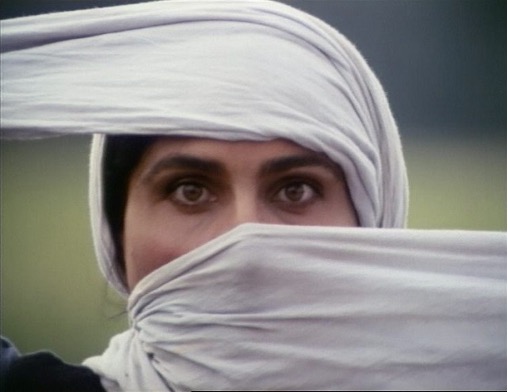
Figure 5: Sūsan Taslīmī in an iconic close-up from Bāshū, the Little Stranger (Bāshū, gharībah-yi kūchak), directed by Bahrām Bayzā’ī, 1986.
The film opens amid scenes of bombardment in southern Iran, where the violence of war ruptures everyday life. Amid this chaos, a young boy escapes by hiding in a cargo truck, only to find himself transported hundreds of kilometers away to northern Iran. When the truck stops along a roadside, the boy—deeply traumatized and marked by the aftershocks of war—is startled by the sound of explosions from a nearby construction site. Mistaking them for shelling, he leaps from the vehicle and runs screaming into the forest. His flight ends in a rice field, where he encounters two children and a local woman.
Nā’ī repeatedly attempts to teach him her words, yet language resists easy transmission, marking the limits of verbal communication in the face of trauma. The villagers, too, respond with suspicion, insisting that the boy must either leave or justify his presence through labor. Difference is thus immediately translated into obligation. In one unsettling scene, villagers gather inside Nā’ī’s home as a child rubs Bāshū’s skin, testing whether its darkness might be wiped away. In another, Nā’ī washes him in the river, while local children also mock and bully him. These moments expose how racialized otherness is negotiated through the body, touched, examined, and disciplined before it can be accepted. On the other hand, Bāshū’s body remains saturated with the aftershocks of war. The fire of the stove recalls bombardment, the cries of eagles echo the battlefield; for him, trauma persists not as memory alone but as an involuntary bodily response.
The villagers’ continued hostility toward Bāshū repeats the reactionary refusal of the stranger seen in Bayzā’ī’s earlier films, where alterity is perceived as threat rather than relation. When Nā’ī strikes village children with a stick to defend Bāshū, their parents confront her angrily, one woman accusing, “You hit our children for the sake of a stranger?” Yet the very next scene shows Bāshū and the children reconciled, playing together without tension. The rapid dissolution of conflict exposes the arbitrariness of the boundaries that adults so fiercely police, revealing the constructed nature of exclusion.
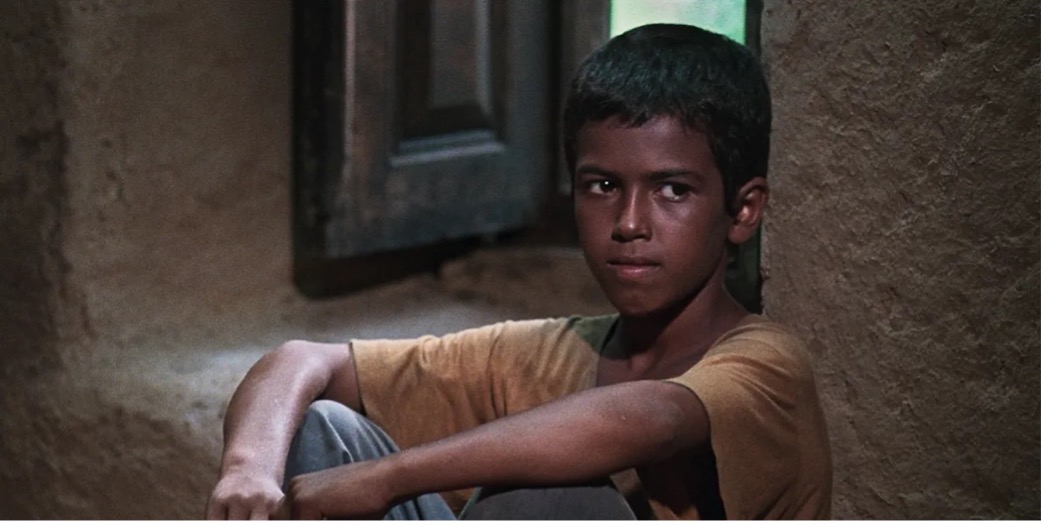
Figure 6: ‛Adnān Afrāviyān as Bāshū in Bāshū, the Little Stranger (Bāshū, gharībah-yi kūchak), directed by Bahrām Bayzā’ī, 1986.
When Nā’ī later falls ill, the film’s ethical axis subtly shifts. Bāshū assumes responsibility for the household, and in his concern for her well-being, he drums in the rhythms of his southern homeland to soothe her. In a letter to her absent husband, Nā’ī writes that she has accepted Bāshū as her son and will share her bread with him—a declaration that redefines kinship beyond blood or origin. Upon the husband’s return, visibly marked by war and missing his right hand, he encounters Bāshū without suspicion. In a quiet but powerful gesture, he tells the boy that he will be his “right hand,” binding them through mutual incompleteness. Together, the reconstituted family drives the wild boar from their fields, transforming survival into collective action.
Judith Butler argues that shared vulnerability can ground ethical relationality, and this scene crystallizes that claim.21Judith Butler, Precarious Life: The Powers of Mourning and Violence (London: Verso, 2004), 20. Nā’ī’s illness and Bāshū’s displacement render both bodies exposed and dependent, allowing care to emerge as an ethical practice rather than a moral abstraction. Bāshū’s acceptance is not secured through assimilation or resemblance, but through embodied presence and affective labor. His recognition as the husband’s “right hand” signals a form of solidarity forged through difference, where connection arises not despite vulnerability but through it—a mode of relation that aligns with Sara Ahmed’s understanding of emotional contact as the groundwork of social bonds. 22S. Ahmed, Strange Encounters: Embodied Others in Post-Coloniality (London: Routledge, 2000), 11. In Bāshū, the Little Stranger, the stranger is no longer mythic or historical, but fully contemporary, reminding us that the ethics of belonging are always negotiated in the fragile space between fear and care.
Conclusion: Re-articulating the Concept of Homeland through a Feminine Lens
In Bayzā’ī’s cinema, the stranger is never simply an external other; he is produced within the intimate spaces where women negotiate loss, vulnerability, and responsibility. Through these encounters, Bayzā’ī situates women not at the margins but at the ethical core of his narratives, transforming the stranger from a figure of threat into a site where alternative forms of relation, memory, and solidarity can emerge. Across The Stranger and the Fog, The Ballad of Tārā, and Bāshū, the Little Stranger, Bahrām Bayzā’ī repeatedly returns to the figure of the stranger, yet through the female protagonists—Ra‛nā, Tārā, and Nā’ī—is that this figure gains narrative and ethical significance. Although Āyat, the Guerrier, and Bāshū appear as strangers who disrupt the social order, the true centers of these films are the women who encounter them, refuse patriarchal demands, and reconfigure the meanings of home, belonging, and care.
Ra‛nā’s defiance of familial authority, Tārā’s mediation between ritual memory and forgotten history, and Nā’ī’s maternal acceptance of a war-displaced child each expose how nationalist and patriarchal structures depend upon women’s compliance—and how they begin to unravel through women’s refusal. In all three films, the women’s husbands are absent, lost at sea or displaced by war, leaving Ra‛nā, Tārā, and Nā’ī to inhabit roles of care, decision-making, and moral authority in their stead. Each woman is also figured as a mother—biological or chosen—through whom life is sustained in the face of loss. Bayzā’ī marks their refusals visually as well: in pivotal moments, each woman tears at or removes her veil, a gesture that signals not merely resistance to custom but a rupture with the patriarchal order that seeks to discipline women’s bodies as sites of honor, nation, and belonging.
Drawing on Sara Ahmed’s theorization of the stranger, the figures of Ra‛nā, Tārā, and Nā’ī emerge as central agents through whom strangeness is produced, negotiated, and transformed. For Sara Ahmed, the stranger is never simply an unknown outsider, but a figure already constituted through prior histories of encounter, recognition, and exclusion.23S. Ahmed, Strange Encounters: Embodied Others in Post-Coloniality (London: Routledge, 2000), 3. In Bayzā’ī’s cinema, it is precisely through women’s ethical and affective engagements with such marked bodies that the boundaries of belonging are unsettled. Ra‛nā’s sheltering of Āyat, Tārā’s insistence on recalling a history erased from the archive, and Nā’ī’s decision to claim Bāshū as her son do more than accommodate the stranger; they reveal how homeland itself is continuously made and unmade through repeated acts of inclusion and expulsion. The feminine body becomes the site where these boundaries are felt, contested, and reconfigured, exposing the violence embedded in regimes that seek to stabilize the stranger as threat or excess.
These gestures of care and refusal illuminate a process of subject formation that unfolds not through compliance with patriarchal norms but through their subtle and sustained reworking. In this sense, Bayzā’ī’s women resonate with Judith Butler’s understanding of subjectivity as constituted through reiteration and resistance, while also complicating any singular model of oppositional politics.24See, e.g., Judith Butler, Gender Trouble: Feminism and the Subversion of Identity (New York: Routledge, 1990). As Saba Mahmood reminds us, feminine agency does not always take the form of overt defiance; it may instead reside in the persistent redefinition of one’s conditions of existence.25Mahmood, Saba. Politics of Piety: The Islamic Revival and the Feminist Subject. Princeton, NJ: Princeton University Press, 2005, 15–18, 31–34. By reorienting belonging around vulnerability, proximity, and ethical attachment, Ra‛nā, Tārā, and Nā’ī also enact what Nira Yuval-Davis describes as a rethinking of national belonging from within.26See, e.g., Nira Yuval-Davis, The Politics of Belonging: Intersectional Contestations (London: SAGE Publications, 2011). Across these three films, homeland is no longer imagined as a closed or homogeneous territory, but as a relational and porous space shaped by encounters with those already designated as strangers. Bayzā’ī thus offers a vision of a feminine homeland—one grounded not in exclusion or denial, but in the refusal of stranger fetishism and the recognition of difference, where erased histories and marginalized lives may re-enter the present and speak again.
Acknowledgment
This article is written in honor of the memory of Bahrām Bayzā’ī, whose passing marks an immeasurable loss for Iranian cinema, theater, and critical thought. Bayzā’ī’s work continues to shape how histories are remembered, how strangers are encountered, and how women emerge as central figures of ethical and narrative possibility. His films remain enduring sites of resistance against erasure, inviting us to reimagine belonging, memory, and justice through care, refusal, and imagination. This work is offered in gratitude for his lasting intellectual and artistic legacy.
Cite this article

Abstract
This article examines the recurring figure of the stranger in Bahrām Bayzā’ī’s cinema through Sara Ahmed’sconceptualization of stranger fetishism with particular attention to the central role of female protagonists in mediating encounters between self and other. We focus on how national identity and belonging are constructed through processes of encounters with embodied others. Focusing on three of Bayzā’ī’s films—Bāshū, the Little Stranger (Bāshū, gharībah-yi kūchak), The Ballad of Tārā (Charīkah-yi Tārā), and The Stranger and the Fog (Gharībah va Mih)—the article explores how national identity and belonging are produced through embodied relations with figures already marked as strangers. Rather than treating the stranger as an unfamiliar outsider, Bayzā’ī presents strangeness as a relational effect of prior histories of recognition, exclusion, and displacement. These encounters are organized around women—Ra‛nā, Tārā, and Nā’ī—whose acts of care, refusal, and ethical attachment unsettle patriarchal and nationalist boundaries. The article argues that Bayzā’ī’s work challenges fixed notions of identity and belonging by revealing how the boundaries of bodies, communities, and homelands are constituted through processes of inclusion and expulsion that unfold through the feminine body. Themes of movement and displacement intersect with questions of home, homeland, and nationality, reopening suppressed histories of encounter that underwrite dominant narratives of the Iranian nation-state. This framework offers new insights into national imaginaries in pre- and post-revolutionary Iranian cinema, contributing to broader debates on identity formation through encounters with embodied others.
Keywords: Bahrām Bayzā’ī; Iranian Cinema; The Stranger; Women; Sara Ahmed.