
Iranian Cinema Through the Eyes of the Press: 1950s–1990s (Case Study: Khurāsān Newspaper)



Introduction
From its early beginnings to the present, Iranian cinema has continually experienced major shifts, and the press has chronicled every turn. In the three decades between 1950 and 1980, leading up to the 1979 Revolution, the industry moved through three defining phases: identity formation, diversification, and thematic and stylistic deepening. In the decades that followed, it underwent further transformations, including periods of stagnation, revolutionary reorientation, and continued efforts at recovery and renewal. During this period, silent film shifted to sound film, and commercial popular cinema emerged. Fīlm-fārsī developed its own identity, and film criticism appeared and gradually became more serious. The Iranian New Wave also took shape and influenced film criticism. Over time, intellectual critiques replaced moral critiques, and cinema shifted from popular entertainment to a medium for social and artistic expression.
On the eve of the Islamic Revolution, criticism returned to moral concerns. After the Revolution, Iranian cinema first entered a period of stagnation, and at the same time a new cinematic discourse with a religious–revolutionary character (committed cinema) was formed. With the decline of the revolutionary atmosphere in the second half of the 1980s, a movement emerged among Iranian filmmakers that transformed Iranian cinema, but it soon faced government intervention and once again fell into stagnation. During the Reform period (dawrah-yi islāhāt) in the mid-1990s, limited openings emerged in Iranian filmmaking.
In this context, the media in general, and newspapers in particular, played not only an informational role but also promotional, supportive, and even guiding roles. Accordingly, Khurāsān newspaper, as the oldest continuously published newspaper in one of Iran’s most populous and culturally diverse cities—Mashhad—served as an important source for reflecting these transformations. Therefore, this article examines the trajectory of Iranian cinema over a forty-year period as reflected in Khurāsān newspaper.
Given the nature of the subject, this study adopts a primarily descriptive approach, with the data set derived from systematic searches of the indexed archive of Khurāsān newspaper using the keywords “film” and “cinema.” On this basis, no subjective selection criteria were applied. At the same time, it is acknowledged that the newspaper’s coverage itself was shaped by the prominence of filmmakers and the historical significance of particular films within Iranian cinema. Nevertheless, every effort has been made to present as comprehensive a picture as possible.
The 1950s
In the 1950s, Iran’s commercial popular cinema flourished, a trend that later came to be known as Fīlm-fārsī cinema. At the same time, film criticism began to appear more regularly in newspapers. Earlier examples were limited but notable: the newspaper Ittilā‛āt published a review in 1931 of the first Persian sound film, Dukhtar-i Lur; Īrān newspaper reviewed the same film in 1933, as well as Hājī Āqā Aktur-i Sīnimā; and in 1948, Kayhān printed a review of Tūfān-i Zindagī.1“Tārīkhchah-yi Naqd-i Fīlm‑nivīsī dar Īrān” [The History of Film Criticism in Iran], Khurāsān, no. 11361, October 17, 1988, 6.
Khurāsān newspaper began its dedicated cinema section in 1954. One of the first films covered was Mīhan’parast (The Patriot), produced with the army’s budget and recognized as the first action and war film in Iranian cinema. The film was directed by Major Muhammad Diram-Bakhsh, a military officer, who employed ten thousand members of the Iranian army in its production. In August 1954, the film premiered in Mashhad in the presence of Mustafā Qulī Rām, Governor of Khurāsān, and Lieutenant General ʿAbd al-Rizā Afkham, Commander of the Khurāsān Division; the event was reported in Khurāsān newspaper.2“Namāyish-i Fīlm-i Mīhān’parast” [Screening of the film Patriot], Khurāsān, no. 1469, August 3, 1954, 4.
Six months after this report, the first film critique appeared in Khurāsān newspaper. A writer using the pen name “Nāzim” published a note on the state of Iranian cinema, which can be considered the newspaper’s first film critique.3Nāzim, “Bahs-i Sīnimāʾī / Az Fīlm’hā-yi Dirām-i Fārsī tā Fīlm’hā-yi Tārīkhī” [Cinema Discussion: From Persian Drama Films to Historical Films], Khurāsān, no. 1623, February 12, 1955, 3. In this note, the author criticized Western cinema’s influence on Persian films, called on filmmakers to address the real issues of Iranian life and history, and judged the only historical film of the period, Khāb’hā-yi Talā’ī (Golden Dreams), to be weak.4The film Khāb’hā-yi Talāʾī [Golden Dreams] is one of the early works of Iranian cinema, produced in 1951, by Muʿiz’dīvān Fikrī (GhulāmʿAlī Fikrī Arshād). Its story follows a young boy who, in a dream, travels to the court of Shah ʿAbbās of the Safavid dynasty and experiences a series of imaginative and historical adventures.
Two weeks later, in the same column (Cinema Discussion), another critic, ‛Abbās Mustawfī, praised Nusratallāh Muhtasham’s first film, Āqā Muhammad Khān Qājār (1954), as well as his own performance in the lead role, recognizing Muhtasham as a skilled artist in his field.5ʿAbbās Mustawfī, “Bahs-i Sīnimāʾī / Āqā Muhammad Khān” [Cinema Discussion: Āqā Muhammad Khān], Khurāsān, no. 1635, February 27, 1955, 4. The film, which depicted the life of Āqā Muhammad Khan, the founder of the Qājār dynasty, from before his accession to the throne until his assassination in Georgia, continued to be screened in Iranian cinemas for up to a decade afterward.
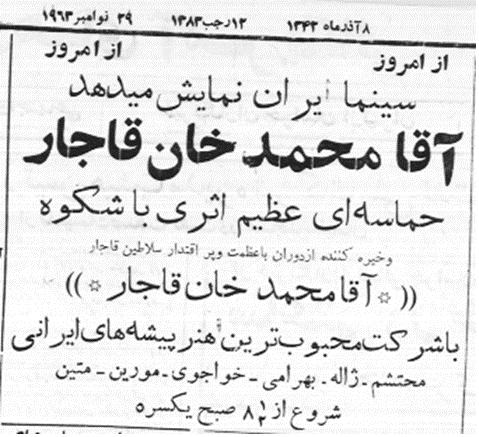
Figure 1: Advertisement published in Khurāsān newspaper (November 29, 1963) promoting the film Āqā Muhammad Khān Qājār, directed by Nusratallāh Muhtasham, 1954.
From that point on, the column “Bahs-i Sīnimāʾī” (Cinema Discussion) continued as a weekly feature in the newspaper Khurāsān. In 1955, a person using the pen name Shahrzād wrote an article titled “Cinema Is a School of Education,” addressing the philosophy of cinema for the first time in Khurāsān.6Shahrzād, “Sīnimā Maktab-i Tarbiyat Ast” [Cinema Is a School of Education], Khurāsān, no. 1818, October 20, 1955, 3. In this piece, the author criticized vulgar films and the public’s enthusiastic reception of them. From that point forward, the issue of vulgarity in Iranian cinema sparked daily debates for the following two decades, particularly in the years preceding the Revolution.
In 1955, the first Iranian film festival was held, and Khurāsān’s expanded “Cinematic Discussion” column on page 2 published a report titled “A Reportage from the First Iranian Film Festival.”7“Bahs-i Sīnimāʾī / Ripurtāzhī az Avvalīn Fistīvāl-i Sīnimāʾī-i Īrān” [Cinema Discussion: A Report from the First Iranian Film Festival], Khurāsān, no. 1829, November 6, 1955, 2. After introducing the guests, the report briefly presented the festival films. About two weeks later, another report referred to the closing ceremony of the festival and to the selection of the films Chahār’rāh-i Havādis (Crossroads of Accidents), directed by Samuel Khāchīkiyān, and Pāyān-i Ranj’hā (The End of Sufferings), written and directed by Mahdī Raʾīs-Fīrūz.8“Bahs-i Sīnimāʾī / Barandigān-i javāʾiz-i buzurg-i avvalīn fistīvāl-i fīlm’hā-yi fārsī” [Cinematic Discussion / Winners of the Major Prizes of the First Persian Film Festival], Khurāsān, no. 1840, November 18, 1955, 1.
In the following year, the “Cinematic Discussion” column focused more on Western cinema, introducing it along with Western cinematic figures and concepts, and provided information about film dubbing and the history of the formation of the Oscar award, as well as cinema industry in other countries. In 1956, a critique by a certain Īraj condemned movie theater owners for neglecting their social responsibility and ignoring artistic and intellectual films.9Īraj, “Bahs-i Sīnimāʾī / Būsah bar dast’hā-yi khūnīn” [Cinematic Discussion / A Kiss upon Bloody Hands], Khurāsān, no. 2011, June 18, 1956, 2. That same year, additional reviews appeared for films such as Zindagī Shīrīn Ast (Life Is Sweet) by Majīd Muhsinī and Yūsuf va Zulaykhā (Joseph and Zulaykha) by Siyāmāk Yāsamī.10“Bahs-i Sīnimāʾī / Zindagī shīrīn ast” [Cinematic Discussion / Life Is Sweet], Khurāsān, no. 2140, November 26 1956, 1–2; “Bahs-i Sīnimāʾī” [Cinematic Discussion], Khurāsān, no. 2204, February 10, 1957, 2.
In 1957, the film Bulbul-i Mazraʿah (The Farm Nightingale) was reviewed in the newspaper Khurāsān. An anonymous critic criticized the director, Majīd Muhsinī, for technical flaws but still described the film as a national work because it drew on Iranian folklore and culture and avoided vulgarity.11“Bahs-i sīnimāʾī /” [Cinematic Discussion / The Nightingale of the Farm], Khurāsān, no. 2320, July 7, 1957, 20. In October 1958, the film Bulbul-i mazraʿah was screened at a Soviet film festival. This was the first Iranian film to be dubbed in the Soviet Union. Majīd Muhsinī, the film’s director and lead actor, was also invited, not only to attend the ceremonies but additionally to visit cultural and social circles in the Soviet Union. See “Fīlm-i Bulbul-i mazraʿah rūsī dūblah shud” [The Film the Nightingale of the Farm Was Dubbed into Russian], Khurāsān, no. 2683, October 14, 1958, 1.
Another film praised by the newspaper was Tūfān dar Shahr-i Mā (Storm in Our City), made by Samuel Khāchīkiyān, which was screened in two cinemas in Mashhad in 1957. The Khurāsān columnist, writing under the name Farīdūn, attributed part of the film’s success to Āzhīr Studio, which he regarded as one of Iran’s well-equipped studios, established by a group of Tehran notables and, despite high costs, distinguished by avoiding vulgar and populist productions—something he considered a source of pride.12Farīdūn, “Bahs-i sīnimāʾī / Tūfān dar shahr-i mā” [Cinematic Discussion / A Storm in Our City], Khurāsān, no. 2578, June 2, 1958, 2.
Although Khurāsān newspaper tried to guide public taste by criticizing purely entertaining films and praising noble and national works, changing popular preferences was not easy. At the same time, Indian films became a serious rival to Iranian cinema, and Khurāsān’s critics sometimes—even ironically—presented certain Indian films as models for Iranian filmmakers. Thus, in 1957, an anonymous critic in Khurāsān praised the Indian film Boot Polish (1954), by Raj Kapoor, and stressed the importance of paying critical attention to the lives of ordinary people in filmmaking.13The use of pseudonyms and anonymity became widespread after the 1953 coup in order to prevent the identification of left-leaning journalists and writers who claimed to seek moral and social reform. Writers of such pieces sought to express their ideas indirectly by publishing analytical, cultural, or literary articles in more general, non-partisan outlets. The anonymous critics of Khurāsān newspaper cannot, however, be definitively linked to any specific political current. Yet, since Khurāsān at times adopted positions sympathetic to the Left, such speculation cannot be entirely dismissed. This practice eventually became an established convention at the newspaper and continued into the 1990s; “Bahs-i sīnimāʾī / Vāksī” [Cinematic Discussion / Boot Polish], Khurāsān, no. 2382, September 27, 1957, 2. At the same time, Khurāsān also noted the public reception of Italian films in Mashhad cinemas, describing them as “artistic and moral” works.14“Bahs-i sīnimāʾī / Gurg-i shahr” [Cinematic Discussion / The City Wolf], Khurāsān, no. 2437, December 5, 1957, 1; Italian cinema was so influential that the Iranian film Bāzgasht bih Zindagī, directed by ʿAtāʾ Allāh Zāhid, opened with scenes of Italy. This annoyed a critic in Khurāsān newspaper, who called it irrelevant. At the same time, the critic was pleased that in the film, “Mahvash” danced in a more dignified way. See “Bahs-i sīnimāʾī / Bāzgasht bih zindagī” [Cinematic Discussion / Return to Life], Khurāsān, no. 2455, December 27, 1957, 4.
In 1958, Khurāsān reviewed the film Nardibān-i Taraqqī, (Ladder of Progress, 1957), directed by Parvīz Khatībī. Although the review criticized the complexity of the story and screenplay, it ultimately judged the film positively, describing it as instructive and humorously engaging, and noting that audiences left the cinema satisfied.15“Bahs-i sīnimāʾī / Nardibān-i taraqqī” [Cinematic Discussion / The Ladder of Progress], Khurāsān, no. 2682, October 13, 1958, 5.
By the late 1950s, the first generation of Iranian cinema celebrities had emerged, and as cinema expanded in Iran—including in Mashhad—popular figures occasionally traveled to the city. In 1959, several Iranian actors visited Mashhad. In June, Majīd Muhsinī, a director and accomplished actor, traveled to the city for the opening of the film Lāt-i Javānmard.16“Hunarpīshah-yi sīnimā-yi Īrān dar Mashhad” [Iranian Film Actor in Mashhad], Khurāsān, no. 2880, April 5, 1959, 8. In September, Mashhad hosted another actor from the same film, Taqī Zuhūrī, whom Khurāsānintroduced as “the father of Persian films.”17“Pidar-i fīlm’hā-yi Fārsī dar Mashhad” [Father of Persian Films in Mashhad], Khurāsān, no. 2939, June 19, 1959, 2.
![Figure 2: Taqī Zuhūrī with his two daughters in Mashhad.[18]](https://cinema.iranicaonline.org/wp-content/uploads/2026/03/Picture1-1.png)
Figure 2: Taqī Zuhūrī with his two daughters in Mashhad.
18“Pidar-i fīlm’hā-yi Fārsī dar Mashhad” [Father of Persian Films in Mashhad], Khurāsān, no. 2939, June 19, 1959, 2.
During these trips, reporters from Khurāsān conducted interviews with cinema professionals about the state of Iranian cinema, sometimes adopting a critical tone. For example, in one such interview, Taqī Zuhūrī offered the following critique:
As long as producers and actors have different tastes, the situation will not change, and Iranian cinema will not make real progress. At present, there are more than fifty large and small studios in Tehran, each producing films every year. Because most of these studios lack proper technical equipment, they face many problems, and their films have little artistic value. If studio owners were to cooperate and share their equipment, Iranian films could compete with foreign productions.19“Dard-u-dil-i Zuhūrī, hunarpīshah-yi fīlm’hā-yi Fārsī” [Interview with Zuhūrī, Persian Film Actor], Khurāsān, no. 3219, August 17, 1960, 4.
In April 1960, the well-known comedian Nusratallāh Vahdat visited Mashhad for the opening of his film Āsmūn’jul, which received strong public attention.20“Bahs-i hunarī / Bā Vahdat, hunarmand-i arzandah-yi sīnimā va t’ātr-i Īrān, āshnā shavīd” [Artistic Discussion / Get to Know Vahdat, Esteemed Artist of Iranian Cinema and Theatre], Khurāsān, no. 3116, April 14, 1960, 6. Despite this, Khurāsān’s cinema critic complained about the general lack of audience interest in Persian-language films. In May of the same year, the anonymous critic interviewed ʿAtāʾallāh Zāhid, a director visiting Mashhad, asking why the public paid more attention to Western films and showed little interest in Persian cinema. In response, Zāhid compared making a good film in Iran to raising a whale in a household pond and said:
Another reason for the success of cinema in European countries is that reading newspapers and watching films are not seen just as entertainment, but as part of everyday life. As a result, directors and filmmakers are encouraged to create works that reflect people’s lives.21“Yak Musāhibah-yi Jālib bā Kārgardān-i Sīnimā-yi Fārsī” [An Interesting Interview with a Persian Cinema Director], Khurāsān, no. 3141, May 13, 1960, 4.
Zāhed then addressed moral issues in Iranian cinema, which seemed to be a main concern for Khurāsān’s critics. In articles such as “A Few Words about Iranian Films,” “The Role of Film in the Morale of Youth,” and other cinema discussions in 1960, topics like morality in cinema, protecting young audiences, and purifying Iranian films from corruption were repeatedly debated.22“Sukhanī Chand Darbārah-yi Fīlm’hā-yi Īrānī” [A Few Words about Iranian Films], Khurāsān, no. 3257, October 3, 1960, 2; “Naqsh-i Fīlm Dar Rūhiyah-yi Javānān” [The Role of Film in the Morale of Youth], Khurāsān, no. 3287, November 10, 1960, 7.
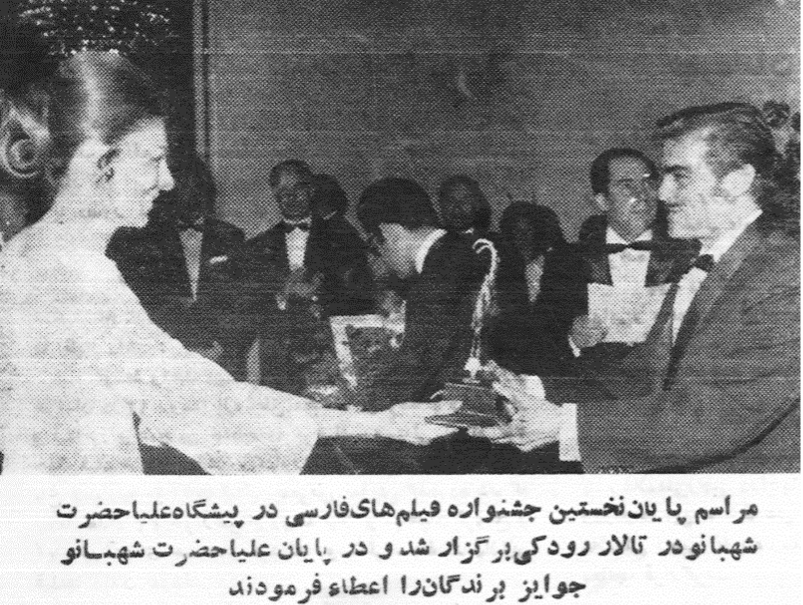
Figure 3: Pictorial report in Khurāsān of the closing ceremony of the inaugural Persian Film Festival, attended by Empress Farah Pahlavī, held at Rūdakī Hall, 1970.23“Marāsim-i pāyān-i nakhustīn jashnvārah-yi fīlm’hā-yi Fārsī dar pīshgāh-i hazrat-i Shahbānū dar Tālar-i Rūdakī barguzār shud va dar pāyān ʿAlā-hazrat Shahbānū javāyiz-i barandigān rā iʿtāʾ farmūdand,” [The Closing Ceremony of the First Persian Film Festival Was Held before Her Imperial Highness the Empress at Rūdakī Hall, and at the end Her Imperial Highness Presented the Winners’ Awards], Khurāsān, no. 6055, May 1, 1970, 1.
The 1960s
In the 1960s, the column “Cinematic Discussion” was discontinued, and Khurāsān published film reviews only occasionally. During this decade, new filmmakers and ideas emerged, and the Iranian New Wave began to take shape. Cinema criticism in Khurāsān became more in-depth, but moral concerns remained the main focus in the first half of the decade.
The 1960s began with several cinema restrictions. In September 1961, Khurāsān reported that the governor of Khurāsān, Shams al-Dīn Jazāyirī, had ordered cinema owners to censor immoral parts of films.24“Az Namāyish-i Fīlm’hā-yi Munāfī-i ‘Iffat Jilawgīrī Mī’shavad” [The Screening of Films Contrary to Public Morals Is Prevented], Khurāsān, no. 3520, September 4, 1961, 2. In October of the same year, the newspaper published an article titled “Cinema Is Highly Effective in the Progress of Culture and the Moral Refinement of the People.”25“Sīnimā Dar Pīshraft-i Farhang va Tahzīb-i Akhlāq-i Mardum Bisiyār Muʾassir Ast” [Cinema Is Highly Effective in the Advancement of Culture and the Moral Refinement of the People], Khurāsān, no. 3552, October 11, 1961, 7. One month later, a nationwide regulation was issued, showing that these concerns were not limited to Mashhad but were being addressed across the country. According to this regulation, it was forbidden to screen films that opposed religion, the constitutional monarchy, or national traditions, promoted illegal ideologies, encouraged rebellion or prison uprisings, or incited workers, students, farmers, and other social groups.26“According to the New Cinema Regulations, the Screening of Films Opposed to Religion, the Constitutional Monarchy, and National Traditions, and the Promotion of Illegal Ideologies, Riot and Revolution in Prisons, and the Incitement of Workers, Students, Farmers, and Other Social Classes Is Prohibited.” See Khurāsān, no. 3586, November 21, 1961, 4.
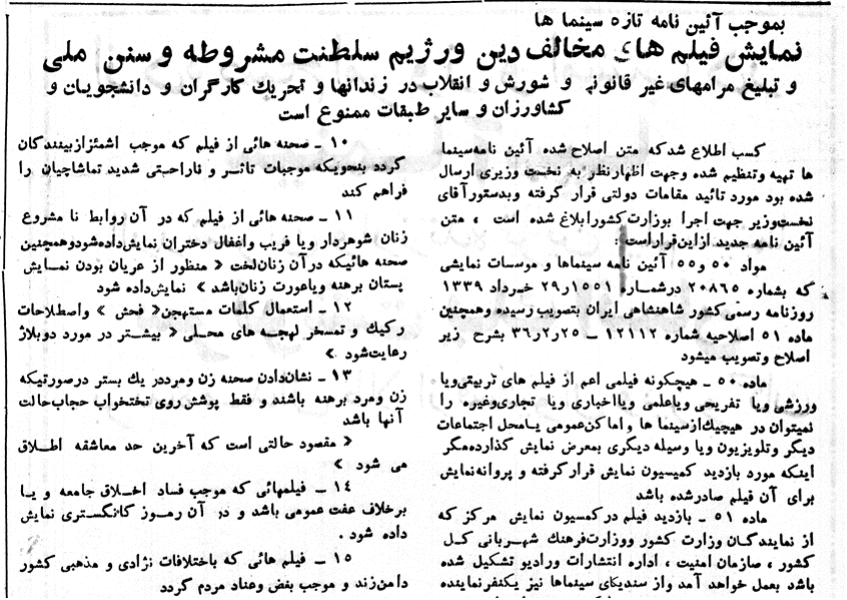
Figure 4: New cinema regulations published in Khurāsān newspaper (1961).
From the 1960s onward, government involvement in cinema became increasingly visible, reflecting the consolidation of the Shah’s regime following the 1953 coup.
In 1962, Prime Minister ‛Alī Amīnī and several cabinet members attended a gathering of Persian film producers and actors, stating: “The government will fully support this profession because, with leadership and supervision over film production, we can use it to benefit the people.”27“Dr. Amini, the Prime Minister, and Several Members of the Cabinet attended a gathering of producers and actors of Persian films and delivered remarks.” See Khurāsān, no. 3701, April 20, 1962, 3; In 1963, the Ministry of Culture issued a directive for the classification of films according to age groups. See “Fīlm’hā Tabaqah’bandī Mī’shavad: Afrādī kih sinnishān kamtar az hijdah sāl bāshad hamah-yi fīlm’hā rā nabāyad bibīnand” [Films Are to Be Classified: Persons under Eighteen Years of Age Should Not Watch All Films], Khurāsān, no. 4225, February 8, 1964, 8.
At the same time, moral and social issues in cinema continued to draw attention. For example, a German magazine article was translated into Persian, emphasizing that in every film, good should lead to good consequences and evil to evil; otherwise, the film would be deemed unsuitable.28“Mardūd būdan-i fīlm’hāyī kih fāqid-i natāyij-i āmūzandah mī’bāshand” [The Rejection of Films That Lack Educational Outcomes], Khurāsān, no. 4179, December 11, 1963, 4.
In February 1964, Khurāsān published a positive review. A writer using the name F. Shuʿlah, reviewing the film Parastū’hā bih Lānah Bar’mī’gardand (The Swallows Return to their Nest), directed by Majīd Muhsinī, noted the lack of development in Iran’s film industry. The reviewer described the film as a hopeful work compared to earlier Fīlm-fārsī productions and as a humane effort that honored human dignity.29F. Shuʿlah, “Dar hāshiyah-yi Fīlm-i Parastū’hā bih Lānah Bar’mī’gardand” [On the Margins of the Film The Swallows Return to Their Nest], Khurāsān, no. 4234, February 21, 1964, 5. Nevertheless, it appears that audiences still preferred entertaining films. For example, one week after this review, when the actors of the film Talāq (Divorce), directed by Gurjī ʿIbādiyā, traveled to Mashhad, they were warmly welcomed by the public.30“Hunarpīshahgān-i fīlm-i Talāq vārid-i Mashhad shudand,” [Actors of the Film Divorce Arrived in Mashhad], Khurāsān, no. 4241, February 29, 1964, 2.
In 1964, Khurāsān generally took a passive stance toward Iranian cinema. However, in April 1965, the newspaper published a harsh critique of Āqā-yi Qarn-i Bīstum (Mr. Twentieth Century) and Qahramān-i Qahramānān (The Champion of Champions), both directed by Siyāmak Yāsamī. Writing under the name “Prince,” the critic emphasized the importance of authentic art and suitable Iranian stories, while condemning the films’ promotion of alcohol, bullying, and moral laxity.31Prince, “Sīnimā / Qahramān-i Qahramānān” [Cinema / The Champion of Champions], Khurāsān, no. 4558, February 11, 1965, 15. Even at the time, such one-sided critiques were being questioned. In May of the same year, Khurāsān’s film critic admitted that earlier reviews were more personal opinions than true criticism. These opinions had sparked opposition and even hostility, while the real goal should have been to cultivate an understanding of cinema. He also emphasized that Iranian cinema was in a seriously problematic state.32“Intiqād-i fīlm / sīnimā,” [Film / Cinema Criticism], Khurāsān, no. 4574, March 2, 1965, 14.
Pessimism toward Iranian cinema reached a peak in 1966, when a Khurāsān critic, writing under the name M. Gulistān, disregarded professional journalistic standards and personally attacked female actors. Among those targeted were Parvīn Khayrbakhsh, known as Furūzān, and Surayyā Bakiyāsā, known as Suhaylā.33M. Gulistān, “Īn sīnimā-yi nifrīn’shudah,” [This Accursed Cinema], Khurāsān, no. 4857, April 24, 1966, 5.
Another harsh critique by Manūchihr Jān’nisārī in 1966 targeted the film Hāshim Khān, directed by Muhammad Zarrīndast. He not only accused the film of moral vulgarity but also criticized it politically, calling its exploitation of the abolition of the landlord–peasant system a “betrayal of the Shah and the nation.”34Manūchihr Jān’nisārī, “Hāshim Khān: yak fīlm-i kasīf,” [Hashim Khan: A Dirty Film], Khurāsān, no. 5010, October 25, 1966, 4. This was despite the fact that Hāshim Khān was primarily a commercial, entertaining film, and any political content actually opposed the landlord–peasant system rather than supporting it.35The film Hāshim Khān is in fact made as a critique of the landlord–peasant (feudal) system and presents a negative image of it. In this film, Hāshim Khān is portrayed as a powerful and oppressive khan (played by Nāsir Malak’mutīʿī) who collaborates with foreign powers (outsiders) to sell Iran’s oil secrets to them and uses coercion and oppression against the local people to maintain his power. This narrative, shaped under the influence of the Land Reform and the White Revolution (1963–1979), presents the khan as a symbol of corruption, treason, and oppression of the peasantry, and emphasizes the contrast between good (the state and the people) and evil (the feudal khan). It in no way justifies the traditional khan-based system. See: Mahnāz Muhammadī and Farīshtah Sādāt Ittifāqfar, “Bāztāb-i tahavvul-i nizām-i arbāb va raʿyatī dar partaw-i inqilāb-i sifīd dar sīnimā-yi Īrān (1341–1357)” [The Transformation of the Feudal System in the Context of the White Revolution as reflected in Iranian Cinema (1962–1978)], Siyāsat-i Jahānī, no. 39 (Spring 2022): 207–27. Such criticism was itself questioned within Khurāsān:
“Film criticism in our press is in a pathological state, where the purpose of criticism is no longer evaluation. Instead, because of personal friendships or rivalries with the film’s producer or the movie theater showing it—or for other reasons—criticism becomes either uncritical praise or outright insult, neither supported by proper reasoning.”36Prince, “Yaddāsht-i kūtāh pīrāmūn-i naqd-i fīlm” [A Short Note on Film Criticism], Khurāsān, no. 5039, December 2, 1966, 8.
Nonetheless, in early February 1967, a review similar to earlier critiques was published about the film Gidāyān-i Tihrān(The Beggars of Tehran), directed by Muhammad-ʿAlī Fardīn. Writing under the name Mīm Jīm Shitāb, the critic described the film as lacking value.37Mīm Jīm Shitāb, “Bāz ham sīnimā va masā’il-i mubtalā-yi bih ān dar shahr-i mā” [Cinema Again and Its Related Issues in Our City], Khurāsān, no. 5089, February 4, 1967, 4.
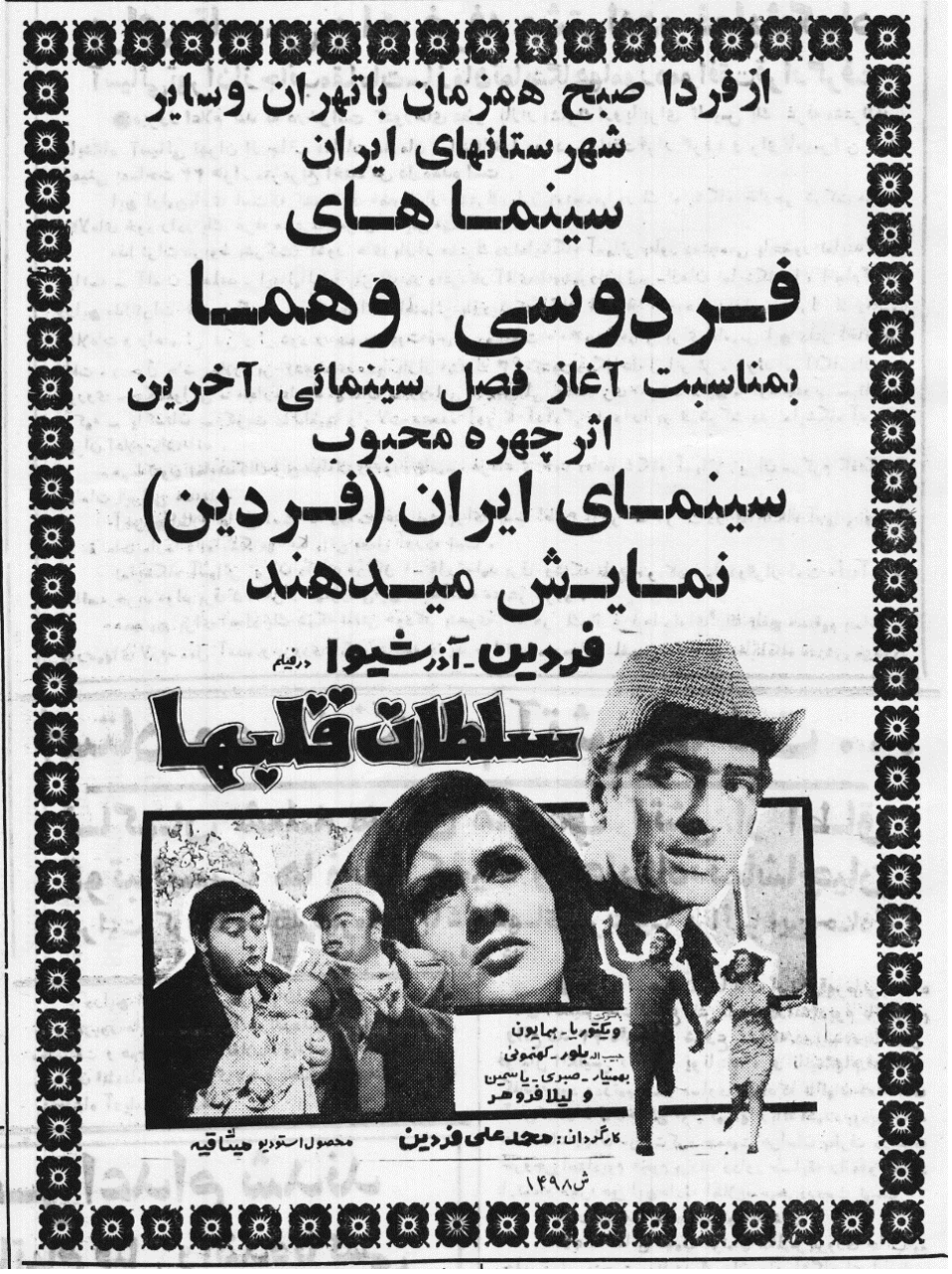
Figure 5: Advertisement for the film Sultān-i Ghalb’hā (King of the Hearts), directed by Muhammad ‛Alī Fardīn, 1968.38“Āz fardā subh hamzamān bā Tihrān va sāyir-i shahristān’hā-yi Īrān sīnimā’hā-yi Firdawsī va Humā, bi munāsibat-i āghāz-i fasl-i sīnimāʾī-I, ākharīn asar-i chihrah-yi mahbūb-i sīnimā-yi Īrān (Fardīn) rā namāyish mī’dahand,” [From Tomorrow Morning, simultaneously in Tehran and Other Cities, the Ferdowsi and Homa Cinemas Will Screen the Latest Film of Iran’s Beloved Cinema Star (Fardīn)], Khurāsān, no. 5541, August 27, 1968, 11.
These critiques often approached Iranian cinema from an intellectualist perspective, failing to consider the larger segment of society that did not share this viewpoint. They overlooked the fact that methods for conveying moral and human messages differ for non-elite audiences, and that Fīlm-fārsī could instead serve as an effective tool for doing so.39Ādil Tabrīzī (director) believes that “Persian films were unfairly criticized, because as we looked further, we realized what an influence Muhammad‑ʿAlī Fardīn had on Iranian cinema, and even in his films — where themes like justice‑seeking, chivalry, masculinity, love for family, respect for one’s mother, respect for one’s beloved, and positive social values can be observed.” (Source: cinemapress.ir). For a case study on the intellectual attitude toward cinema, see Āshūbī et al., “Tahlīl-i guftimān-i rushanfikrī dar sīnimā-yi Īrān (Mutāla‘ah-yi murdī-i fīlm-i Bānū)” [Analysis of Intellectual Discourse in Iranian Cinema: A Case Study of the Film Bānū], Jāmi‘ah, Farhang va Rasānah, no. 52, Fall 2024, 171–202.
In 1968, Khurāsān, under the headline “Outstanding Iranian Cinematic Works to Be Screened at the Central Youth Palace,” highlighted two films by Nusratallāh Karīmī: Dil-i Mūsh, Pūst-i Palang (the first Iranian puppet film) and the animated film Malik Jamshīd (the first Iranian animated film). At the end of its report, the newspaper wrote: “By organizing a film week, the Central Palace seeks to introduce outstanding works of Iranian cinema and to carry out examinations of the value of cinematic art.”40Khurāsān, “Āsār-i barjastah-yi sīnimā-yi Īrān dar Kākh-i Markazī-i Javānān namāyish dādah mīshavad” [Outstanding Iranian Cinematic Works to Be Shown at the Central Youth Palace], Khurāsān, no. 5376, February 1, 1968, 12.
Throughout the years that the newspaper Khurāsān criticized Fīlm-fārsī, educational and documentary films were consistently praised. Khurāsān published numerous reports on the screening of these documentaries across Iran, particularly for children and rural communities, and this coverage continued until 1979.
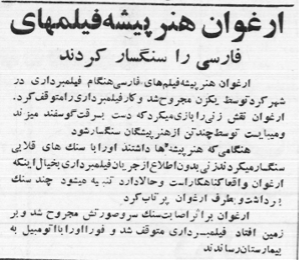
Figure 6: Gossip on Iranian cinema in Khurāsān.41“Arghavān, hunar’pīshah-yi fīlm’hā-yi Fārsī rā sangsār kardand,” [Arghavān, a fīlm-fārsī Actress, was stoned], Khurāsān, no. 6638, May 24, 1972, 8.
In 1968, continuing the earlier harsh critiques, a new critic named Akbarī (Sāghar) published a piece titled “Nonsense Called Fīlm-Fārsī,” in which he fiercely attacked the Fīlm-fārsī genre, using terms such as “lower-body display” and “filthy.”42Akbarī (Sāghar), “Bahsī dar zamīnah-yi sīnimā-yi millī / khuzaʿbalātī binām-i fīlmfārsī” [A Discussion on National Cinema / Nonsense Called fīlmfārsī], Khurāsān, no. 5492, June 29, 1968, 5.
Later in the same year, Khurāsān published a report on the burning of movie theaters in the capital. From the beginning of the year, within less than two weeks, three cinemas in Tehran were set on fire. The report did not address the causes of these incidents; however, the paper’s harsh critiques of the vulgarity of fīlm-fārsī may have provided extremist groups with a pretext for such acts. The trend culminated in the burning of Cinema Rex in Ābādān on August 19, 1978. Khurāsān asked: “What has happened that recently a kind of ‘cinema burning,’ occurring at such short and ever-shorter intervals, has become prevalent?”43“Sīnimā’sūzī” [Cinema Burning], Khurāsān, no. 5728, April 19, 1969, 10. Concern over this issue rose to such a level that, beginning in October 1968, authorities stationed fire department personnel in Mashhad’s cinemas and required the General Office of Labor and Social Affairs, together with the Mashhad Fire Department, to inspect and monitor workshops and shops surrounding the cinemas.44“Mā’mūrān-i ātash’nishānī dar sīnimā’hā” [Firefighters in Cinemas], Khurāsān, no. 5871, October 5, 1969, 2.
These events coincided with the implementation of censorship policies in the production of Iranian films by supervisory authorities. Accordingly, in April 1969, Khurāsān published an article titled “The Issue of Oversight in the Production of Iranian Films Has Received Increased Attention.”45“Mas’alah-yi murāqibat dar tahiyyah-yi fīlm’hā-yi Īrānī bish az pīsh murid-i tavajjuh vāqi‘ shudah” [The Issue of Supervision in the Production of Iranian Films Has Gained Increased Attention], Khurāsān, no. 5725, April 16, 1969, 1.
The year 1969 was also significant from another perspective: it marked the release of two films that became landmarks in the history of Iranian cinema—Gāv (The Cow), directed by Dāryūsh Mihrjūyī, and Qaysar, directed by Masʿūd Kīmiyāʾī. Both films are widely regarded as initiators of the Iranian New Wave, and together they shaped this cinematic movement. Qaysar, with its emphasis on popular culture and the construction of heroic figures, resonated more strongly with general audiences, whereas Gāv offered a more intellectual and artistically oriented approach. Accordingly, the Iranian New Wave is often seen as beginning with both films, though Gāv is commonly regarded as its more official starting point due to its artistic depth.
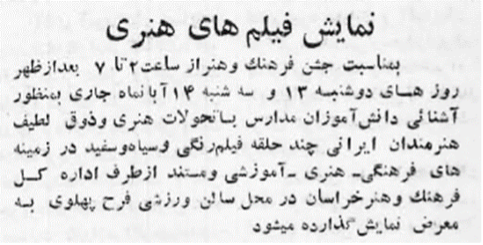
Figure 7: Newspaper advertisement announcing the screening of art films at the Farah Pahlavī Sports Hall, November 1968.46“Namāyish-i fīlm’hā-yi hunarī” [Screening of Art Films], Khurāsān, no. 5597, November 4, 1968, 2.
In the same year, Khurāsān published an article titled “A Review of Iranian Cinema in the Year 48,” in which Mahmūd Ahmadmīrī criticized Qaysar and praised Gāv. A noteworthy aspect of this critique is that, whereas earlier complaints had focused on vulgarity in Iranian cinema, Ahmadmīrī now reacted negatively to the newly introduced censorship, which the government had implemented in part for political reasons. He used expressions such as “being torn to pieces” to describe the films and observed that, as a result of this policy, the number of films produced had fallen from seventy-seven in 1968 to thirty-nine in 1969.47Mahmūd Ahmadmīrī, “Barrisi-yi sīnimā-yi Īrān dar sāl-i 1348” [A Review of Iranian Cinema in the Year 1348], Khurāsān, no. 6006, April 2, 1970, 5.
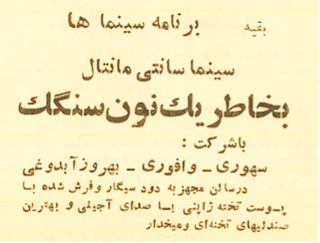
Figure 8: Satirical commentary on fīlm-fārsī and the cinemas of Mashhad, as featured in Khurāsān, 1969.48“Barnāmah-yi sīnimā’hā” [Cinema Listings], Khurāsān, no. 5864, September 28, 1969, 6.
Nevertheless, alongside the aforementioned critiques, the newspaper also conveyed more hopeful news about Iranian cinema. Among these reports was the opening of the House of Cinema Artists (Khānah-yi hunarmandān-i sīnimā) in 1970, which was attended by Empress Farah Pahlavī, along with the publication of excerpts from her remarks delivered at the ceremony.49Farah Pahlavī, “Khānah-yi hunarmandān-i sīnimā gushāyish yāft” [The House of Cinema Artists Opened], Khurāsān, no. 6180, October 30, 1970, 4.
Overall, by the end of the 1960s, critiques expressing a negative view of Iranian cinema had gained the upper hand. In 1970, Khurāsān published remarks by the film actress Āzar Shīvā, in which she described the “deceptive nature of Iranian cinema,” along with the subsequent responses to her statements.50Āzar Shīvā, “Vizārat-i Farhang va Hunar bih i‘tirāz-i Āzar Shīvā risīdigī mī’kunad — Āzar Shīvā dar jalasah-ī kih bā huzūr-i fīlm’sāzān va hunar’pīshigān-i sīnimā-yi Īrān bih hamīn manzūr tashkil mī-gardad, harf’hā-yi tāzah-ī irāʾah khāhad dād” [The Ministry of Culture and Art Will Address Āzar Shīvā’s claim—Āzar Shīvā Will Present New Statements at a Meeting Convened for This Purpose with the Presence of Iranian Filmmakers and Cinema Performers], Khurāsān, no. 6213, December 11, 1970, 8.
A critic named Rāmīn Āzarmihr, citing Āzar Shīvā’s remarks, once again criticized Iranian cinema for issues such as sex, violence, and imitation. He argued that Iranian filmmakers did not even deserve to produce a proper imitation of Indian films and claimed that actors such as Muhammad-ʿAlī Fardīn and Manūchihr Vusūq relied more on their physical appearance than on their talent. At the same time, he praised films such as Qaysar and Rizā Muturī (both directed by Masʿūd Kīmiyāʾī), Gāv and Āqāy-i Hālū (directed by Dāryūsh Mihrjūyī), and Hasan Kachal (directed by ʿAlī Hātamī).51Rāmīn Āzarmihr, “Harf’hā-ī darbārah-yi fīlm-i fārsī va … janjāl-i sīnimāʾī” [Remarks on Film-e Fārsi and … a Cinematic Controversy], Khurāsān, no. 6222, December 22, 1970, 4.
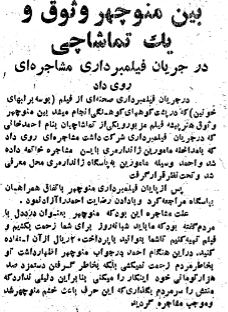
Figure 9: Gossip on Iranian cinema in Khurāsān.52“Bayn-i Manūchihr Vusūq va yak tamāshāchī dar jariyān-i fīlm’bardārī mushājirah-ī rūy dād,” [An Argument Occurred between Manūchihr Vusūq and a film viewer during filming], Khurāsān, no. 6973, July 15, 1973, 2.
In a later review, Āzarmihr gave a class-based reading of Rizā Muturī, arguing that Iranian society was completely divided by class and that trying to rise above one’s social class was similar to death.53Rāmīn Āzarmihr, “Naqd-i fīlm-i Rizā Muturī: āmīzah-ī az tazād’hā va tanāquz’hā” [Review of the Film Rizā Muturī: A Mixture of Contradictions and Paradoxes], Khurāsān, no. 6212, December 10, 1970, 5. In another article, he directed his criticism toward the critics of Qaysar themselves. He described the critics of Qaysar—including some of his own colleagues at Khurāsān—as insincere and corrupt. Regarding the film’s sexual scene and the character of Suhaylā, a cabaret dancer, he did not offer a moral critique; rather, he viewed it as the result of crafting a character type that, unlike other dancers in Iranian cinema, was not merely intended to attract audiences.54Rāmīn Āzarmihr, “Dukkān-ī binām-i naqd-i sīnimāʾī” [A Shop Called a Cinematic Review], Khurāsān, no. 6224, December 24, 1970, 5.
By this time, Āzarmihr had become the newspaper’s main film critic, praising some films while dismissing others as worthless. For example, he described Hasan Kachal (directed by ʿAlī Hātamī) as “a return to traditions and history,” but labeled Mard-i Jangalī (directed by Kamāl Dānish) as “garbage, vulgar, and repulsive.”55Rāmīn Āzarmihr, “Naqd-i fīlm-i Hasan Kachal: bāzgasht-ī bih sunnat’hā va tārīkh” [Review of the Film Hasan Kachal: A Return to Traditions and History], Khurāsān, no. 6213, December 11, 1970, 5. He described certain Iranian filmmakers as “money-worshipping, ugly, thuggish, and worthless,” asserting that the production of such films was unsurprising given the absence of competent oversight in the system.56Rāmīn Āzarmihr, “Naqd-i fīlm-i Mard-i Jangal: nawzād-i nāqis al-khilqah-yi sīnimā-yi fārsī” [Review of the Film Mard-i Jangal: The Malformed Infant of Persian Cinema], Khurāsān, no. 6276, February 27, 1971, 5. The last film he praised was Khānah-yi Kinār-i Daryā (A House by the Sea), directed by Hūshang Kāvūsī, which he regarded as an Iranian film that embodied human values.57Rāmīn Āzarmihr, “Naqd-i fīlm-i Khānah-ī dar Kinār-i Daryā” [Review of the Film A House by the Sea]. Khurāsān, no. 6265, February 12, 1971, 4.
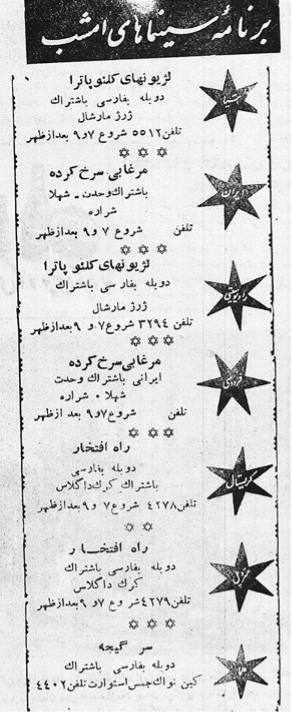 Figure 10: Cinema programs in Mashhad, September 1961.58“Barnāmah-yi sīnimā’hā-yi imshab” [Tonight’s Cinema Listings], Khurāsān, no. 3520, September 4, 1961, 2.
The 1970s
The 1970s began with encouraging news for Iranian cinema, which was also reflected in Khurāsān. In September 1971, the film Gāv won the award of the International Federation of Film Critics at the 32nd Venice International Film Festival. In November 1971, ʿIzzatallāh Intizāmī received the first international acting award in the history of Iranian cinema for his leading performance in this film.59“Mujassamah-yi Murghābī-i Nuqrah-ī barāyi Hunar’pīshah-yi Avval-i Fīlm-i Gāv” [Silver Duck Statue for the Leading Actor of the Film Gāv], Khurāsān, no. 6490, November 19, 1971, 4.
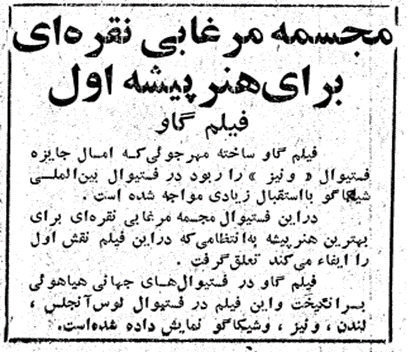
Figure 11: International award coverage for the film Gāv (The Cow), directed by Dāryūsh Mihrjūyī, 1968.60“Mujassamah-yi Murghābī-i Nuqrah-ī barāyi Hunar’pīshah-yi Avval-i Fīlm-i Gāv” [Silver Duck Statue for the Leading Actor of the Film Gāv], Khurāsān, no. 6490, November 19, 1971, 4.
The second news item concerned the Venice Film Festival award received by the short film Rahāʾī (1971), directed by Nāsir Taqvā’ī, produced by the Institute for the Intellectual Development of Children and Young Adults (Kānūn-i Parvarish-i Fikrī-i Kudakān va Nawjavānān).61The foremost patron of the Institute for Children, Young Adults, and Children’s Cinema was Empress Farah Pahlavī. The institute not only produced books and educational materials for children but was also active in creating feature films and animations, producing lasting works for this age group. Taqvā’ī won first prize at the 13th edition of the festival. According to Khurāsān, the film was deemed worthy of this distinction because of its noble human emotions and poetic tone.62“Fīlm-i Īrānī jāʾizah-yi avval rā rubūd” [An Iranian Film Took First Prize], Khurāsān, no. 6612, April 24, 1972, 8.
A few months later, in 1972, Nāsir Taqvāʾī also received the Best First Work award at the Venice Film Festival for his film Ārāmish dar Huzūr-i Dīgarān (Tranquility in the Presence of Others), marking another honor for Iranian cinema.63“Fīlm-i Īrānī dar Festivāl-i Vinīz yak luh-ī zarrīn girift” [An Iranian Film Received a Golden Plaque at the Venice Festival], Khurāsān, no. 6804, December 14, 1972, 8.
In addition to Nāsir Taqvāʾī, another young filmmaker, Bahrām Bayzāʾī, entered the Iranian New Wave in 1971. In January 1973, Khurāsān published a laudatory review of Bayzāʾī’s film Ragbār (Downpour), praising both its form and content.64Majīd Qavāmzādah, “Tafsīr-i fīlm: Ragbār” [Film Analysis: Downpour], Khurāsān, no. 6826, January 11, 1973, 3. The newspaper’s new critic, Majīd Qavāmzādah, expressed hope that Bayzāʾī would soon create another masterpiece. This prediction proved accurate, and one year later Bayzāʾī stood out at the 9th Chicago International Film Festival, where his film Safar (Journey), produced by the Kānūn, won first prize in the short film section.65“Fīlm-i Īrānī barandah shud” [An Iranian Film Won], Khurāsān, no. 7091, December 6, 1973, 8.
After a few years, Iranian children’s and youth cinema was able to participate in international festivals and win awards. For example, the film Tars dar kūchah, directed by Parvīz Mahdavī, won a prize at the 10th Milan International Short Film Festival for Children and Youth in 1972. Three hundred films from around the world competed at this festival.66“Pīrūzī-i fīlm-i Īrānī” [Victory of an Iranian Film], Khurāsān, no. 6794, September 30, 1972, 1.
Another notable achievement was the film Dār, produced by the Kānūn and directed by Rizā ʿAllāmahzādah. The film that won first prize at the 12th International Film Festival in Spain is set in a village in northern Iran, and its music is based on local melodies.67“Fīlm-i Dār barandah-yi jāʾizah-yi avval dar Ispāniyā” [The Film Dār Won First Prize in Spain], Khurāsān, no. 7029, September 21, 1973, 5.
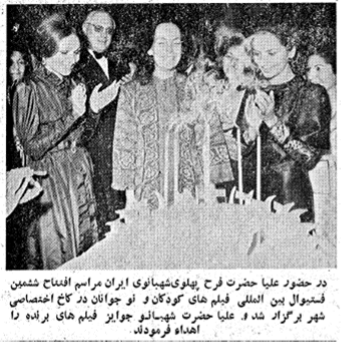
Figure 12: Opening of the 6th International Children’s and Youth Film Festival in Mashhad, attended by Empress Farah Pahlavī.68“Dar huzūr-i ‘Uliyāh-hazrat Farah Pahlavī, shahbānū-yi Īrān, marāsim-i iftitāh-i shishumīn fistivāl-i bayn-al-Milalī-i fīlm’hā-yi kūdakān va nawjavānān dar kākh-i ikhtisāsī-i shahr barguzār shud” [In the Presence of Her Imperial Highness Farah Pahlavī, Empress of Iran, the Opening Ceremony of the Sixth International Festival of Children’s and Youth Films Was Held at the City’s Private Palace], Khurāsān, no. 6497, November 30, 1971, 1.
While children’s and youth cinema had received much praise in the early 1970s, films considered “vulgar” continued to face criticism. By the end of 1973, this issue had once again drawn attention in Khurāsān newspaper. At the same time, Italian Westerns—called “bankrupt European films” by one critic—were also criticized by an anonymous critic in the newspaper: “According to the newspaper, the officials of the Union of Cinemas of the Holy City of Mashhad, by screening vulgar and warehouse-stock films, have normalized every form of indecency. This is not cinema; it is blatant vulgarity and propaganda promoting the corruptions affecting our young generation.”69“Yaddāsht: Sīnimā va Ibtizāl!” [Note: Cinema and Vulgarity!], Khurāsān, no. 6875, March 12, 1973, 1, 5.
Such critiques continued throughout the 1970s and up to the revolution of 1978–1979. In May 1973, a review entitled “Is This What Cinema Means?” appeared in Khurāsān, opening with the statement: “For a long time, the screening of vulgar and superficial films has exhausted cinema lovers in Mashhad.” The review went on to criticize theater owners, arguing that “they have accustomed audiences to watching vulgar films to such an extent that a good film no longer has any meaning for them.”70“Bahs-ī dar zamīnah-yi fīlm va sīnimā / Sīnimā yaʿnī hamīn?!” [A Discussion on Film and Cinema / Is This What Cinema Means?!], Khurāsān, no. 6926, May 21, 1973, 6.
In December of the same year, a critic named Mahdī Ghafūrī published a review titled “A Discussion on Film and Cinema, the Agents and Transmitters of Spiritual and Moral Cancer in Society,” in which he discouraged audiences from watching sexualized films while praising Dāryūsh Mihrjūyī’s films, such as Gāv, Pustchī (The Postman), and Āqā-yi Hālū, as exemplary works of national cinema.71Mahdī Ghafūrī, “Bahs-ī dar zamīnah-yi fīlm va sīnimā / ‘Āmilīn va nāqilīn-i saratān’hā-yi rūhī va akhlāqī-i jāmiʿah” [A Discussion on Film and Cinema / Perpetrators and Carriers of the Spiritual and Moral Cancers of Society], Khurāsān, no. 7088, December 8, 1973, 3.
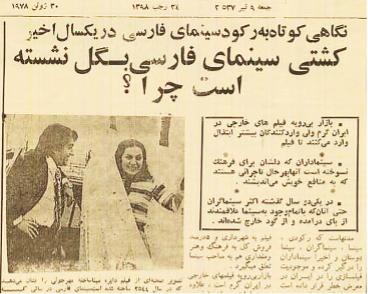
Figure 13: A page of film criticism from Khurāsān, featuring an image from Dāyirah-yi Mīnā (The Cycle), directed by Dāryūsh Mihrjūyī, 1974.72“Nigāh-ī kūtāh bih rikurd-i sīnimā-yi Fārsī dar yak sāl-i ākhar / Kishtī-i sīnimā-yi Fārsī bih gil nishastah ast, chirā?” [A Brief Look at the Record of Persian Cinema in the Past Year / Why Has the Ship of Persian Cinema Run Aground?], Khurāsān, no. 8434, June 29, 1978, 9.
These critiques were not limited to Khurāsān or to the city of Mashhad; newspapers in other cities also addressed similar issues to varying degrees. The pressure generated by such criticism grew to the point that, in 1973, the Union of Iranian Film Producers imposed a two-year ban on the production of “vulgar” films—a measure that a columnist in Khurāsān regarded as a step toward the moral improvement of Iranian cinema.73“Du sāl mahrūmiyat barāyi fīlm’sāzān-i mubtazal’sāz” [Two-Year Ban for Vulgar Filmmakers], Khurāsān, no. 7105, December 22, 1973, 4.
While moral criticism persisted, Iranian cinema in the early 1970s experienced notable innovations and transformations—developments that were likewise reflected in Khurāsān. In 1973, two notable auteur films were produced:74Auteur cinema refers to a type of filmmaking in which the director plays the central role in creating the work, and the film reflects the director’s personal vision, style, and worldview. In this form of cinema, the director not only creates the scenes but often also participates directly in screenwriting, casting, editing, and even the visual design of the film. See: “Mu’allif kīst? Āshināʾī bā ti’urī-i mu’allif” [Who Is the Author? An Introduction to Auteur Theory], Sīnimā Schools, published April 23, 2022 (https://CinemaSchools.ir/مولف-کیست؟-آشنایی-با-تئوری-مولف/). Yak Ittifāq-i Sādah (A Simple Event), directed by Suhrāb Shahīd-Sālis, and Mughūl’hā (The Mongols), directed by Parvīz Kīmiyāvī. These films formed part of the continuation of Iranian auteur cinema, which had begun in the 1950s with Farrukh Ghafārī’s Junūb-i Shahr (South of the City) and continued in the 1960s with Dāryūsh Mihrjūyī’s Gāv.Khurāsān published a laudatory review of Mughūl’hā, describing the film as innovative.75“Hunar va Sīnimā / Bāzgasht-i Mughūl’hā” [Art and Cinema / The Return of the Mongols], Khurāsān, no. 7022, September 11, 1973, 5. For information and analysis of this film, see: Javad Abbasi and Ghasem Gharib, “From Mongols to Television and Cinema,” Cinema Iranica(Encyclopaedia Iranica Foundation, 2025), https://cinema.iranicaonline.org/article/from-mongols-to-television-and-cinema-the-mongols-mughulha-parviz-kimiyavi/?utm_source=chatgpt.com.
It appears that, despite sustained criticism, Iranian cinema was flourishing overall and had begun to attract attention beyond Iran’s borders. In this context, the “Iran Film Week in Moscow” in 1974 also received coverage in Khurāsān, which reported on the screening of a documentary about the 2,500-year celebration of the Persian Empire, held in Persepolis in 1971.76“Haftah-yi Fīlm-i Īrān dar Muskū” [Iran Film Week in Moscow], Khurāsān, no. 7403, January 3, 1975, 8. In 1973, Shiraz witnessed the first Young Filmmakers Festival, attended by representatives from various countries.
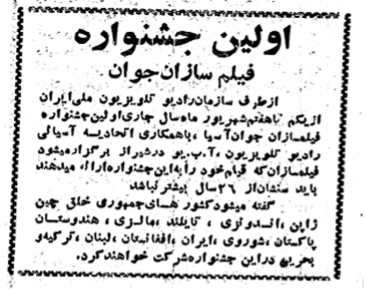
Figure 14: The first Young Filmmakers Festival in 1973, held in Shiraz, with participation from representatives of various countries.77“Avvalīn Jashn’vārah-yi Fīlm’sāzān-i Javān” [The First Young Filmmakers Festival], Khurāsān, no. 6972, July 23, 1973, 5.
In 1975, Khurāsān devoted little attention to cinema. The following year, it published a review of Ghazal (1975), directed by Masʿūd Kīmiyāʾī. An anonymous critic, writing under the title “A Sad and Regrettable Voice,” praised the film’s formal qualities but argued that its content reflected the same vulgar perspective. The critic employed terms such as “prostitute” and “brothel” to express disapproval.78“Naqd-i Fīlm-i Ghazal / Āvāʾī Ghamnāk va Ta’assuf’zā!!” [Review of the Film Ghazal: A Sad and Regrettable Voice!], Khurāsān, no. 7876, August 14, 1976, 4.
Although the new generation of film critics also paid attention to form and content—for example in a 1976 review by a critic named Musāfir of the film Shīr-i Khuftah (The Sleeping Lion, 1976), directed by Mahmūd Kūshān79“Naqd-i Fīlm-i Shīr-i Khuftah” [Review of the Film The Sleeping Lion], Khurāsān, no. 8043, March 7, 1977, 4.—moral criticism was still very important. As noted earlier, this form of criticism became increasingly prominent in the years leading up to the 1979 Revolution. During this period, a critic named Mahdī Ahmadī published an article entitled “Where Is Our National Cinema Going?”, in which he argued that from the outset of cinema in Iran, filmmaking lacked a clear plan, institutional structure, and solid foundation. He further criticized the limited number of Iranian films achieving success at international festivals and maintained that appropriate institutional structures should have been created to foster and support national films with the capacity for global recognition.80Mahdī Ahmadī Naqdī, “Sīnimā-yi millī-i mā bih kujā mīravad?” [Where Is Our National Cinema Going?], Khurāsān, no. 8083, April 29, 1977, 5.
One month later, Ahmadī wrote about Parvīz Kīmiyāvī’s film The Mongols, clearly describing what he believed to be an ideal film. He saw The Mongols as both a continuation of the French New Wave and, at the same time, a truly national film.81Mahdī Ahmadī Naqdī, “Dar Hāshiyah-yi Fīlm-i Mughūl’hā” [On the Margins of the Film The Mongols], Khurāsān, no. 8113, June 4, 1977, 5.
In March 1978, two reviews of ʿAlī Hātamī’s film Sūtah Dilān (Burnt Hearts, 1977) were published ten days apart in the newspaper Khūrāsān. Both reviews adopted a laudatory tone. In the first, Musāfir wrote that all the film’s dialogue was inspired by Iranian traditions.82Musāfir, “Dar Hāshiyah-yi Fīlm-i Sūtah Dilān / Qissah-yi Ān’hā-ī Kih Hamīshah Dir Mī’risand” [On the Margins of the Film Burnt Hearts/ The Story of Those Who Are Always Late], Khurāsān, no. 8330, February 24, 1978, 7. A newly appointed critic at the newspaper, ʿAlī ʿArab, identified rhythm as the defining characteristic of Hātamī’s films and described each of his works as a brief yet profound pause in the past.83ʿAlī ʿArab, “Naqd-i Fīlm-i Sūtah Dilān” [Review of the Film Burnt Hearts], Khurāsān, no. 8338, March 5, 1978, 4.
In 1977, Masʿūd Kīmiyā’ī made Safar-i Sang (The Journey of the Stone, 1977). Later, some commentators argued that the film anticipated the 1979 Revolution, citing its strong symbolic structure: it depicts a conflict between a landlord and peasants that culminates in an uprising against the landlord and was produced at a moment when revolutionary tensions were already intensifying in Iran.84The Journey of the Stone (1977) can be considered the most important pre-Revolution film about the Revolution, notable for its prophetic tone and its direct depiction of a religious uprising—remarkable for a film made before the Revolution took place. See “Safar-i Sang; Arbāb Raftanī Ast!” [The Journey of the Stone; The Master Is Leaving!], Hamshahri online, February 8, 2015, https://hamshahrionline.ir/x4srx. ʿAlī ʿArab wrote an article in Khurāsān entitled “In Memory of Men Who Carry the Weight of the Earth,” in which he argued that Kīmiyā’ī’s heroes create a hopeful space for cooperation and collective action leading to victory.85ʿAlī ʿArab, “Naqd-i Fīlm-i Safar-i Sang / Yādī az Sharāfat-i Mardān-ī Kih Bar Gurdah-yi Zamīn Sangīnī Mī’kunand” [Review of the Film The Journey of the Stone / In Memory of Men Who Carry the Weight of the Earth], Khurāsān, no. 8451, July 10, 1978, 9. The newspaper regarded the film as sufficiently significant to warrant the publication of an additional review by Hasan Zahīrī, which reflected leftist ideals.86Hasan Zahīrī, “Yāddāshtī Bar Safar-i Sang / Jahishī Bisū-yi Qalamru-yi Ānsū-yi Vāqiʿiyyat” [A Note on The Journey of the Stone / A Leap into the Realm Beyond Reality], Khurāsān, no. 8451, July 10, 1978, 9.
Three years earlier in 1974, Kīmiyā’ī had already generated considerable controversy with his film Gavazn’hā (The Deer, 1974). The publication of a renewed review of the film in Khurāsān in 1977 was thus significant. In this review, ʿAlī ʿArab characterized the film as a record of the lives of a specific social group during a particular historical period and portrayed Kīmiyā’ī as a filmmaker who utilized cinema as a serious and effective medium for engaging with the public.87ʿAlī ʿArab, “Sīnimā / Gavazn’hā” [Cinema / The Deer], Khurāsān, no. 8224, October 13, 1977, 4. At the same time, ʿAlī ʿArab criticized films such as Bū-yi Gandum (Scent of Wheat, 1977), by Amīr Mujāhid, and Yārān (Companions, 1974), by Farzān Diljū, subjecting them to mockery and censure.88ʿAlī ʿArab, “Hāmī-i Nasl-i Javān Yāʿnī Īn? Sīnimā-yi Mutiʿahhid Yāʿnī Īn?!” [Supporting the Young Generation—Is This What It Means? Committed Cinema—Is This What It Means?!], Khurāsān, no. 8434, July 19, 1978, 9.
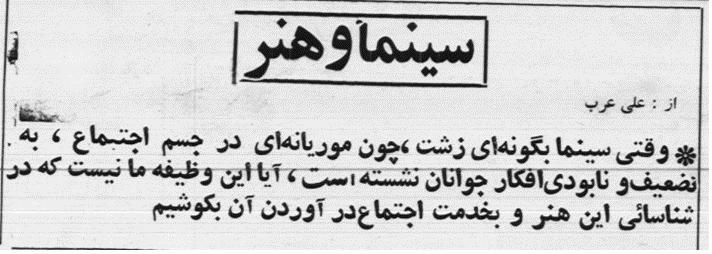
Figure 15: Excerpts from ʿAlī ʿArab’s revolutionary reviews in Khurāsān.
In 1978, Khurāsān published a note titled “It Was Not Meant to Support a Vulgar Film,” criticizing Parvīz Sayyād’s Dar Imtidād-i Shab (Along the Night, 1977). An anonymous critic noted that although rules governing morality in cinema had been established, they were not enforced, and described the film as follows: “It cunningly presents sexual content under the guise of an apparently human story to the public.”89“Qarār Nabūd Kih Az Fīlm-i Mubtazal Himāyat Shavad” [It Was Not Meant to Support a Vulgar Film], Khurāsān, no. 8368, April 15, 1978, 8. In the months leading up to the 1979 Revolution, moral criticism against the perceived vulgarity in cinemas grew increasingly intense, and revolutionary fervor began to outweigh critical judgment. Amid this climate, the Āryā Cinema was set on fire by extremist groups, resulting in the deaths of three workers and further heightening tensions. A newspaper described the incident as an act of “sabotage.”90“Mashhad: dar ātash’sūzī-i mahīb-i Sīnimā Āryā sih javān kushtah shudand” [Mashhad: Three Young Men Were Killed in a Massive Fire at the Arya Cinema], Khurāsān, no. 8475, August 19, 1978, 1. This event occurred just one day before the Cinema Rex tragedy in Abadan, where 377 people lost their lives. Coverage of the incident, along with a separate arson attack at the Paramount Cinema in Shiraz, was reported by Khurāsān newspaper.91“Millat az khūn-i ʿazīzān-i khud āsān nakhāhad guzasht / 377 insān-i bī’khabar va bī’gunāh dar Sīnimā Riks-i Ābādān kushtah shudand” [The Nation Will Not Easily Forgive the Blood of Its Loved Ones / 377 unsuspecting and Innocent People Were Killed at the Rex Cinema in Abadan], Khurāsān, no. 8476, August 20, 1978, 1.
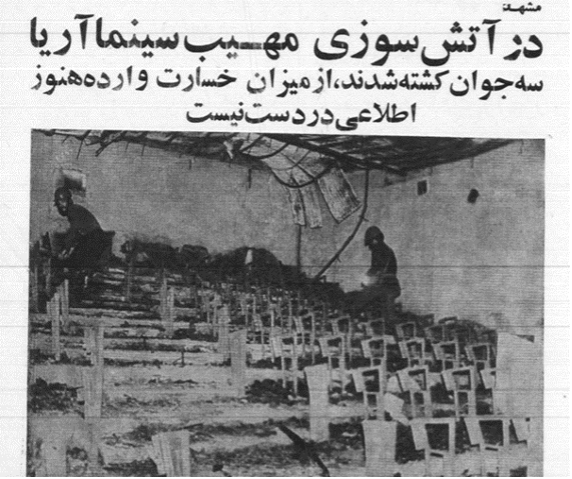 Figure 16: Report in Khurāsān newspaper on the arson of the Āryā Cinema in 1978.92“Mashhad: dar ātash’sūzī-i mahīb-i Sīnimā Āryā sih javān kushtah shudand” [Mashhad: Three Young Men Were Killed in a Massive Fire at the Arya Cinema], Khurāsān, no. 8475, August 19, 1978, 1.
Following the Revolution, efforts aimed at revolutionary reform and combating vulgarity escalated, with authorities implementing more tangible measures. Sādiq Husaynī Shīrāzī, one of the city’s prominent religious leaders, stated in a meeting with the Governor of Khorasan that cinema must observe sharia requirements and be fully Islamic, in line with the foundations of the faith. He emphasized that cinema and other media must abandon their former, colonial form and instead promote religious truths and Islamic morality.93Sādiq Husaynī Shīrāzī, “Dar Mulāqāt-i Ustāndār-i Khurāsān bā Āyatallāh al-ʿUzmā Shīrāzī: Lāzim Ast Rādiyu va Tilivīziyun va Sīnimā Jahāt-i Sharʿī rā Murāʿāt Nimūdah, bih Sūrat-ī Kāmilan Islāmī va Muntabiq bā Mabānī-i Mazhab Bāshad” [In a Meeting of the Governor of Khurāsān with Ayatollah al-ʿUzmā Shīrāzī: Radio, Television, and Cinema Must Observe Sharia, Be Fully Islamic, and Align with the Principles of the Faith], Khurāsān, no. 8615, April 7, 1979, 8. On April 30, 1979, the Deputy for Culture and Arts, Parvīz Varjāvand, said the following in an interview:
We have established a provisional Film and Cinema Council made up of reputable figures with recognized expertise in technical fields and cultural affairs. We hope that, with resources secured from the Plan and Budget Organization, we can create the conditions for cinema—one of society’s most significant instruments of cultural communication—to fulfill its proper cultural role. Our objective is to empower cinema while preventing the resurgence of a vulgar form of filmmaking.94Parvīz Varjāvand, “Qāʾim Maqām-i Farhang va Hunar dar Musāhabah-ʾī Izhār Dāsht: Talāsh-i Mā bar Īn Ast Kih bih Sīnimā Tavān Bakhshīm va az Pā’giriftan-i Yak Sīnimā-yi Mubtazal Jilugīrī Kunīm” [The Deputy of Culture and Arts Stated in an Interview: Our Effort Is to Empower Cinema and Prevent the Rise of a Vulgar Cinema], Khurāsān, no. 8635, April 30, 1979, 4.
On May 8, 1979, Muhammad ‛Alī Najafī, head of the Office for Film Supervision and Exhibition, stated:
Cinema must gradually become nationalized so that it can genuinely reflect the role of the people in shaping this culture. We do not practice censorship in a general sense, but we take a firm stand against vulgarity. What censorship means in this context is that we evaluate directors and screenplays from a cultural and popular perspective. We cannot allow just anyone who wishes to become a director to do so. 95Muhammad ʿAlī Najafī, “Faʿāliyyat-i Sīnimā-yi Īrān dar Barnamah-yi Jadīd-i Farhang va Hunar bi’sūrat-i Nīmah Millī dar Khāhad Āmad” [Iranian Cinema’s Activity in the New Culture and Arts Program Will Become Semi-National], Khurāsān, no. 8640, May 8, 1979, 2.
Due to the new circumstances, film criticism in the Khurāsān newspaper slowed down for a while. Only in July 1979 was an article published under the headline “The Disordered State of Cinema in Mashhad: mass-produced Karate Films and Old Testament Movies Have Taken Over Mashhad’s Screens!”, in which criticism of vulgar films gave way to criticism of karate (martial arts) films. According to an anonymous critic, “preventing the screening of karate films should be regarded as one of the most important measures toward the advancement of film exhibition in Iran.”96“Vazʿ-i Bī Sarusāmān-i Sīnimā dar Mashhad / Fīlm’hā-yi Kīlūyī-i Kārātah va ʿAhd-i ʿAtīq Ikrān-i Sīnimā’hā-yi Mashhad rā Fath Kardah’and!” [The Disordered State of Cinema in Mashhad: mass-produced Karate Films and Old Testament Movies Have Taken Over Mashhad’s Screens!], Khurāsān, no. 8700, July 18, 1979, 4.
In August 1979, the newspaper’s film critic, ‛Abdalsamad Kāzirūnī, reflected on his pre-revolutionary cinema visits in a memoir recounting his viewing of the film Ganj-i Qārūn (Qarun’s Treasure, 1965). Adopting a revolutionary perspective and drawing on the ideas of ‛Alī Shari‛atī, he concluded that the film’s ultimate message was discouraging for the underprivileged.97ʿAbdalsamad Kāzirūnī, “Risālat-i Yak Sīnimāgar” [The Mission of a Filmmaker], Khurāsān, no. 8712, July 31, 1979, 4. In fact, Ganj-i Qārūn, directed by Siyāmak Yāsamī, showed the poor as having higher moral values than the rich and ultimately showed the rich being attracted to them.98In a column titled “Tārīkh bih Ravāyat-i Ganj-i Qārūn” [History as Told by Ganj-i Qārūn], written by Muhsin Āzmūdah, Iʿtimādnewspaper uses the term “class understanding” (tafhīm-i tabaqātī) to describe the film Ganj-i Qārūn. See Muhsni Āzmūdah, “Tārīkh bih Ravāyat-i Ganj-i Qārūn” [History as Told by Ganj-i Qārūn], Iʿtimād, no. 4991, August 3, 2021. Shahrigān Online also uses the term “class reconciliation” (āshtī-i tabaqāt) to describe the content of the film. See Muhsin Khaymahdūz, “Āyandah, Sāzandah-yi Guzashtah: Nigāhī Tahlīlī bih Fīlm-i Guzashtah,” [The Future as the Maker of the Past: An Analytical Look at the Film Gozashteh], Shahrigān Online, March 26, 2014. https://shahrgon.com/2014/25731/.
As revolutionary measures were gradually implemented, by April 1980 several actors, including Rizā Karam Rizāʾī, Masʿūd Asadallāhī, Zhālah ʿUluv, ʿAlī Tābish, Asghar Simsārzādah, and Farīshtah Jinābī, had been summoned to court.99“19 Hunarpīshah-yi Rādiyu va Sīnimā bih Dādgāh-i Inqilāb ihzār shudand” [19 Radio and Cinema Actors Were Summoned to the Revolutionary Court], Khurāsān, no. 8906, April 19, 1980, 8. In June of the same year, ‛Alī ‛Arab resumed writing film criticism in Khurāsān newspaper. In his first post-revolution column, he highlighted a few revolutionary films he considered satisfactory but criticized the Film Supervision Committee’s actions as insufficient, since they were limited to removing certain scenes.100ʿAlī ʿArab, “Sīnimā va Farhang / Kārnāmah-yi Sīnimā’hā baʿd az Inqilāb” [Cinema and Culture / The Record of Cinemas After the Revolution], Khurāsān, no. 8953, June 17, 1980, 3.
The 1970s concluded with the closure of the country’s cinemas, which remained shut until a dedicated organization for overseeing film and cinema was established on June 22, 1980.101“Tā taʾyīn-i yak sāzmān-i mushakhkhas barāyi kuntrul-i fīlm va sīnimā, kull-i sīnimā’hā-yi kishvar taʿtīl shud!” [All the Country’s Cinemas Were Closed Until a Specific Organization for Controlling Film and Cinema Was Established], Khurāsān, no. 8958, June 23, 1980, 1.
The 1980s
Figure 17: The logo of Khurāsān newspaper after its confiscation by the Bunyād-i Mustazʿafān.
After the Islamic Revolution, Khurāsān newspaper, like many other institutions, was also confiscated by the Bunyād-i Mustazʿafān (the Foundation of the Oppressed).
In June 1981, a review titled “An Analysis of the Film Dānah’hā-yi Gandum: The Story of the Village Uprising Against the Lord’s Oppression” was published by the Cinema Affairs of the Foundation of the Oppressed (Umūr-i Sīnimāʾī-i Bunyād-i Mustazʿafān), emphasizing the greater importance of content over technique in revolutionary cinema.102Umūr-i Sīnimāʾī-i Bunyād-i Mustazʿafān, “Tahlīlī bar Fīlm-i Dānah’hā-yi Gandum: Rivāyat-i Qiyām-i Rūstā bar ʿAlāyh-i Zulm-i Arbāb” [An Analysis of the Film Dānah’hā-yi Gandum: The Story of the Village Uprising Against the Lord’s Oppression], Khurāsān, no. 9244, June 23, 1981, 5. The film Dānah’hā-yi Gandum (1980), directed by Hasan Rafīʿī, tells the story of a young villager who revolts against the local lord and is subsequently imprisoned. According to the critic’s analysis, the protagonist symbolizes the struggles of the people during the pre-revolutionary years. He then kills a police officer, takes his weapon, engages in armed resistance, and, as the critic notes, confronts the tyrannical feudal lord of his village, delivers him to the villagers, and opens the grain storage to them.103Umūr-i Sīnimāʾī-i Bunyād-i Mustazʿafān, “Tahlīlī bar Fīlm-i Dānah’hā-yi Gandum: Rivāyat-i Qiyām-i Rūstā bar ʿAlāyh-i Zulm-i Arbāb” [An Analysis of the Film Dānah’hā-yi Gandum: The Story of the Village Uprising Against the Lord’s Oppression], Khurāsān, no. 9244, June 23, 1981, 5.
Other similar films were also produced, and their reviews by the Cinema Affairs of the Bunyād-i Mustazʿafān appeared in Khurāsān newspaper. However, these films apparently did not gain much popular support, and in a column in Khurāsān, the Cinema Affairs criticized the public’s “Tāghūt-influenced” culture in response to criticisms regarding the quality of these cinematic productions.104Umūr-i Sīnimāʾī-i Bunyād-i Mustazʿafān, “Sukhan-i Rūz / Kambūd-i Fīlm-i Khūb… Mushkil-i Dīrūz, Imrūz?!” [Daily Word / The Shortage of Good Films… Yesterday’s Problem, today?], Khurāsān, no. 9246, June 25, 1981, 1–2.
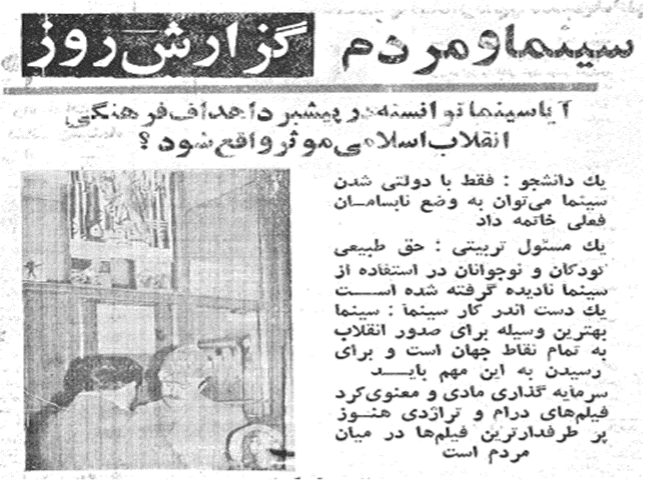 Figure 18: Film critique column in Khurāsān newspaper on post-Revolutionary cinema.105Umūr-i Sīnimāʾī-i Bunyād-i Mustazʿafān, “Guzārish-i Rūz / Sīnimā va Mardum” [Daily Report / Cinema and the People], Khurāsān, no. 9675, December 22, 1982, 5.
In 1983, it was announced that “Cinema Jihad” would be implemented in the Bunyād-i Mustazʿafān centers across the country’s provinces. Khurāsān newspaper reported that this Jihad aimed at full alignment with the “line of the Supreme Leader.”106“Dar Marākiz-i Bunyād-i Mustazʿafān-i Ustān’hā-yi Kishvar Jihād-i Sīnimāʾī Ījād Khāhad Shud” [Cinema Jihad Will Be Established in the Foundation of the Oppressed Centers across the Country’s Provinces], Khurāsān, no. 9689, January 9, 1983, 8. On February 28, 1983, the Friday Imam of Mashhad, during a meeting with a group of cinema staff from Khorasan’s Bunyād-i Mustazʿafān, stated: “When a country’s cinema is aligned with Islamic and human values, it is clear that the culture of that society is alive.” In this meeting, the head of the cinema department of the Foundation referred to pre-revolutionary films such as Muhallil (by Nusrat Karīmī) and Khar-i Dajjāl (by Kamāl Dānish) as works intended to distort the religion of Islam and the beliefs of Muslims. He also described pre-revolutionary cinema as a plot by imperialism to exploit and deceive the oppressed masses.107Abū’l-Hasan Shīrāzī, “Imām-i Jumʿah-yi Mashhad dar Dīdār bā Gurūhī az Kārkunān-i Umūr-i Sīnimāʾī-i Bunyād-i Mustazʿafān-i Inqilāb-i Islāmī-i Khurāsān: ‘Vaqtī Sīnimā-yi Yak Kishvar dar Khatt-i Islāmī va Insānī Bāshad, Mushakhkhas Ast Kih Farhang-i Ān Jāmiʿah Zindah Ast’” [The Friday Imam of Mashhad in a Meeting with a Group of Cinema Staff from the Foundation of the Oppressed of Khorasan: “When a Country’s Cinema Is in Line with Islamic and Human Values, It Is Clear That Its Culture Is Alive”], Khurāsān, no. 9733, March 1, 1983, 8.
On April 20, 1983, with the publication of a review in the newspaper Khurāsān entitled “The Film Tawbah-yi Nasūh: The Beginning of a Committed and Islamic Cinema,” focusing on a single film. The newspaper’s new critic, Hamīdrizā Suhaylī, in his review, adopted a tone close to a manifesto than a conventional review, first attacking several post-revolutionary films—among them Barzakhī-hā (Īraj Qādirī), Sarbāz-i Islām (Amān Mantiqī), and ʿUsyāngarān (Jahāngīr Jahāngīrī)—which he dismissed as vulgar. He then turned to praise Tawbah-yi Nasūh, directed by Muhsin Makhmalbāf, describing it as a forceful slap in the face of those who, through employing “tāghūtī” actors, sought to undermine the art of cinema in the eyes of hizballāhī audiences.108Hamīdrizā Suhaylī, “Fīlm-i Tawbah-yi Nasūh: Sarāghāzī bar sīnimā-yi mutiʿahhid va islāmī” [The Film Tawbah-yi Nasūh: The Beginning of a Committed and Islamic Cinema], Khurāsān, no. 9770, April 21, 1983, 4.
In the later years of the 1980s, filmmaking focused on the early history of Islam began to gain prominence. Safīr(1982), directed by Farīburz Sālih, is widely regarded as the starting point of this trend. The film received a favorable review in the newspaper Khurāsān, where it was described as a work that “gives off the scent of a new approach.”109“Naqd-i Fīlm: ‘Safīr, Yak Harakat’” [Film Review: Safīr, A Move], Khurāsān, no. 9765, April 15, 1983, 7. Safīr was also the first film produced by the Cultural Department of the Bunyād-i Mustazʿafān. The foundation’s second production, Parvandah (The Case, 1983) continued the cycle of films centered on themes of lordship and peasantry—depictions of oppressors and the oppressed—and was warmly received by Khurāsān’s revolutionary critic, Hamīdrizā Suhaylī.110Hamīdrizā Suhaylī, “Naqdī bar Fīlm-i Parvandah” [A Review of the Film Parvandah], Khurāsān, no. 9941, November 18, 1983, 5.
In the 1980s, revolutionary and anti-Pahlavī film reviews continued to shape the Iranian cinema landscape. Films such as Mīrzā Kūchak Khān (Amīr Qavīdil) and Shīlāt (Rizā Mīrlawhī) received praise in Khurāsān, though explicitly anti-Pahlavi works like Sinātur (Mahdī Sabbāghzādah) were judged negatively.111“Naqd-i film-i Sinātur” [Film Review of Sinātur], Khurāsān, no. 10276, January 16, 1985, 3.
As filmmakers such as Sīrūs Alvand and Rasūl Sadrʿāmilī entered the scene with socially themed films, critics began paying closer attention to their work. In 1985, the newspaper’s new critic, Hūshang Jāvīd, reviewed Gulhā-yi Dāvūdī(Rasūl Sadrʿāmilī), noting that while it partially filled the gap left by Indian films, it lacked substance and a clear message.112Hūshang Jāvīd, “Naqd-i film-i Gul’hā-yi Dāvūdī: fīlmī kih sar tā pāyash rā āb girifteah ast” [Film Review of Gul’hā-yi Dāvūdī: A Film Drenched from Head to Toe], Khurāsān, no. 10491, October 14, 1985, 3.
The release of Davandah (The Runner, 1984), directed by Amīr Nādirī, which evoked the pre-revolutionary New Wave, prompted positive coverage in Khurāsān. In December 1985, film critic Amīr Kumaylī described the film as “breaking the barrier of repetition,” praising its vitality and depiction of real life, while reviewing Nādirī’s artistic career.113Amīr Kumaylī, “Naqd-i fīlm (Davandah): Dar’ham’shikanandah-yi hisār-i takrār” [Film Review (Davandah): Breaking the Barrier of Repetition], Khurāsān, no. 10524, November 27, 1985, 3. Before the Revolution, Amīr Nādirī won critical praise for films such as Tangnā,Sāz’dahānī, Tang’sīr, and Intizār, and after the Revolution he made Just-u-Jū, but these films received little attention in Khurāsān. Davandah’s first-prize win at the 1985 Nantes Film Festival, among 60 films from Asia, Latin America, and Africa, also drew attention from the newspaper.114“Fīlm-i Īrānī-yi Davandah barandah-yi jāyizah-yi avval-i fistīvāl-i Nānt shud” [The Iranian Film Davandah Won First Prize at the Nantes Festival], Khurāsān, no. 10531, December 6, 1985, 7.
Despite these developments, concerns over vulgarity in Iranian cinema persisted. In 1987, a review of Samandar(Muhammad Kūshān) labeled the director “an elder of vulgarity” and a founder of “a cinema without identity and impartiality.”115“Naqd-i fīlm-i Samandar: Ihyā-yi sīnimā-yi khunsā va bī’huviyyat” [Film Review of Samandar: The Revival of an Impartial and Identity-less Cinema], Khurāsān, no. 11020, July 11, 1987, 6.
The decade also saw the rise of films centered on the Iran-Iraq War (the Sacred Defense Cinema). The first in this genre, Marz (The Border, 1980), directed by Jamshīd Haydarī, premiered in 1981, and over the following six years more than 20 similar films were produced. In a two-part note in 1987, Khurāsān examined Iranian war cinema, criticizing works that focused solely on action while emphasizing that the front was not only about killing, but also about elevating spirituality.
An anonymous critic described Diyār-i ʿĀshiqān, directed by Hasan Kārbakhsh, as the best Iranian war film produced up to that point (1987).116“Sīnimā-yi Īrān va Jang-i Tahmīlī” [Iranian Cinema and the Imposed War], Khurāsān, no. 11047, September 13, 1987, 3. In 1990, Khurāsān published another review of war cinema, this time focusing on Parvāz dar Shab (Rasūl Mullāqulīpūr), noting that the director had reached a high standing in the genre by making everything fit together naturally and maintaining a steady rhythm, achieving what the review called “an inward exploration of war.”117“Nīm’nigāhī bih film-i Parvāz dar Shab va sīnimā-yi jang” [A Look at the Film Parvāz dar Shab and War Cinema], Khurāsān, no. 11863, July 16, 1990, 3. From the perspective of Khurāsān’s critic Muhammadrizā Sabbāgh, such an inward exploration reached its peak with Muhājir (Ibrāhīm Hātamīkiyā), where, in his view, the film’s subject ultimately took precedence over its form.118Muhammadrizā Sabbāgh, “Naqd-i fīlm / Muhājir: Safīr-i Safar-i Vasl” [Film Review / Muhājir: The Ambassador of the Journey of Union], Khurāsān, no. 11932, October 10, 1990, 6.
In the 1980s, veteran filmmakers gradually stepped back from Iranian cinema. Though some continued making films after the Revolution, their work largely went unnoticed. New restrictions and rising pessimism took their toll on these directors. Even Samuel Khāchīkiyān, who directed the well-known war film ‛Uqāb’hā (The Eagles, 1984) about the Iran-Iraq War, failed to draw critical attention, though the film achieved popular success.119“Sīnimā-yi Īrān va Jang-i Tahmīlī” [Iranian Cinema and the Imposed War], Khurāsān, no. 11047, September 13, 1987, 3. Khāchīkiyān’s son told a Tasnim reporter that his father made ‛Uqāb’hā for the Mazīnānī brothers, whom he considered like his own children. He gained nothing from the film except its popular success and the public’s appreciation. His main achievement was that the film remained the most widely viewed film in the history of Iranian cinema. Shāhpūr Gharīb also continued making socially themed films, but Khurāsān’s critic dismissed him as a “Fīlm-Fārsī maker of the old days,” producing work aimed solely at general audiences.120“Sāyah’hā-yi Gham / Fīlm-i Hindī-i Sīnimā-yi Fārsī” [Shadows of Sorrow / The Indian Film in Fīlm-Fārsī Cinema], Khurāsān, no. 12066, March 29, 1991, 3.
Among the pre-Revolution New Wave filmmakers, the situation was largely the same. For example, Bāshū, Gharībah-yi Kūchak (Bahram Bayzā’ī) was banned for four years. This repression led to the decline of New Wave cinema in Iran. The most notable filmmaker to experience a steady fall in the years immediately following the Revolution was Mas‛ūd Kīmiyā’ī. In 1987, Khurāsān characterized Kīmīyā’ī’s film Tīgh va Abrīsham (The Blade and the Silk, 1987) as comparatively less cohesive than his pre-Revolution works, such as Qaysar and Dāsh Ākal.121Ahmad Chītgarān, “Naqd va Barrasī-i Fīlm (Na Tīgh, Na Abrīsham), Sākhtah-yi Masʿūd Kīmiyā’ī” [Review of the Film (No Blade, No Silk), Directed by Masʿūd Kīmiyā’ī], Khurāsān, no. 10991, July 5, 1987, 3. Nevertheless, most New Wave filmmakers sought to remain creatively vibrant despite the prevailing restrictions. In 1988, Nākhudā Khurshīd (Nāsir Taghvā’ī) won an award at the Swiss International Film Festival.122“Nākhudā Khurshīd Barandah-yi Jāyizah-yi Jashnvārah-yi Bayn al-Millalī-yi Fīlm-i Sū’īs Shud” [Nākhudā Khurshīd Wins Award at the Swiss International Film Festival], Khurāsān, no. 11312, August 14, 1988, 1. Dāryūsh Mihrjūyī’s Hāmūnreceived the Bronze Prize at the Houston International Film Festival, and Hājī Vāshīngtun (ʿAlī Hātamī) was both well received and positively reviewed.123“Hāmūn Barandah-yi Jāyizah-yi Birunz-i Jashnvārah-yi Bayn al-Millalī-i Fīlm-i Hūstun [Hāmūn Wins Bronze Prize at the Houston International Film Festival], Khurāsān, no. 12129, June 19, 1991, 7; Muhammad-Taqī Farahmandniyā, “Naqd-i Fīlm / Naqd-i Khānandigān: Nigāhī bih Fīlm-i Hājī Vāshīngtun” [Film Review / Readers’ Reviews: A Look at the Film Haji Washington], Khurāsān, no. 11971, November 27, 1990, 9.
Meanwhile, the Revolution ushered in a wave of new filmmakers who approached cinema ideologically, seeking to dominate the New Wave and establish a new cinema aimed at shaping the ideal human. In 1987, an interview with Muhsin Makhmalbāf in Khurāsān highlighted a new generation of filmmakers—aligned with the Islamic regime and, in some cases, even more radical, a trait the newspaper’s critic called “genius” (Figure 19).
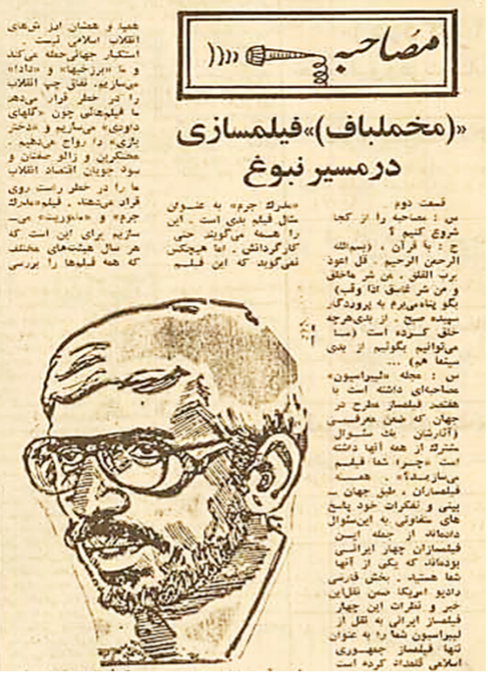 Figure 19: Interview with Muhsin Makhmalbāf in Khurāsān (1987) with a painted portrait.124Muhsin Makhmalbāf, “Musāhibah (Makhmalbāf), Fīlm’sāzī dar Masīr-i Nubūgh” [Interview (Makhmalbāf): Filmmaking on the Path of Genius], Khurāsān, no. 11014, August 3, 1987, 3. In the introduction to this interview, Libération is cited, noting that Makhmalbāf is the only filmmaker of the Islamic Republic.
In 1988, the newspaper Khurāsān, in a review of the film Dastfurūsh (The Peddler), directed by Muhsin Makhmalbāf, praised the work and focused on its philosophical dimensions.125“Naqd-i Fīlm: Dastfurūsh, Fīlmī Bi’yād Māndanī va Bartar” [Film Review: Dastfurūsh, a Memorable and Superior Film], Khurāsān, no. 11385, November 15, 1988, 7. Another critic, identified as M–S, likewise described the film as one of the most symbolic and allegorical works in Iranian cinema.126M–S, “Naqd-i Fīlm / Dīdgāhī Tahlīlī bar Fīlm: Dastfurūsh” [Film Review / An Analytical Perspective on the Film: Dastfurūsh], Khurāsān, no. 11410, December 14, 1988, 6.
Another event reported in Khurāsān during the same year was a protest by the Khorasan nursing community against the screening of Parastār-i Shab (The Night Nurse), directed by Muhammad-ʿAlī Najafī. The nurses described the film—whose plot centers on a patient falling in love with his nurse—as deviant. In a petition, they wrote that the production of such films should involve consultation with professionals in the field; otherwise, the films would lack credibility.127“Iʿtirāz-i Shadīd-i Jāmiʿah-yi Parastārī-i Khurāsān bih Namāyish-i Fīlm-i Parastār-i Shab” [Strong Protest by the Khorasan Nursing Community Against the Screening of the Film The Night Nurse], Khurāsān, no. 11411, December 15, 1988, 6.
Another cinematic milestone covered by Khurāsān in 1989 was the long-anticipated opening of the Mashhad Film House (Khānah-yi Fīlm-i Mashhad), an event preceded by months of public expectation. The ceremony, held at Quds Cinema in Mashhad and attended by members of the Film House alongside invited guests, concluded with a screening of Bāysīkil’rān (The Cyclist), directed by Muhsin Makhmalbāf. The film was warmly received by the audience, and the event continued with a critical discussion and review of the screening.128S–L, “Muʿarrafī-i Fīlm: Bāysīkil’rān” [Introducing the Film: The Cyclist], Khurāsān, no. 11585, July 28, 1989, 7.
In September 1989, Khurāsān published an interview with one of the few female directors working in Iran at the time. In this conversation, Rakhshān Banī-iʿtimād—then regarded as a novice filmmaker—addressed the role of women in Iranian cinema, observing that “the women we see on the screen are a reflection of the dominant current’s perception of female character in cinema—a portrayal that shows women not as they are, but as they are thought to be better.”129“Musāhibah / Guftugū bā Rakhshān Banī-iʿtimād, Kārgar-i Fīlm’hā-yi Khārij az Mahdūdah and Zard-i Qanārī” [Interview / Conversation with Rakhshān Banī-iʿtimād, Director of the Films Khārij az Mahdūdah and Zard-i Qanārī], Khurāsān, no. 11615, September 4, 1989, 3.
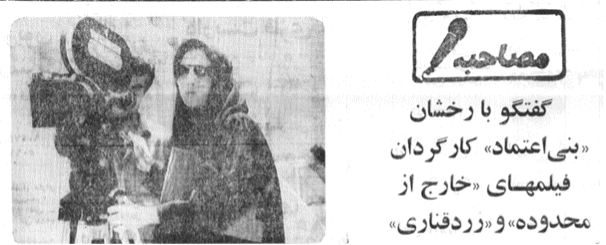
Figure 20: An image of Rakhshān Banī-iʿtimād published in Khurāsān (1989).
In the late 1980s, Iranian cinema witnessed the emergence of another defining phenomenon: ʿAbbās Kiyārustamī. Having begun his artistic career in 1970 with the short film Nān va Kūchah (Bread and Alley) and having produced nearly all his works—apart from the feature-length Guzārish (The Report, 1977)—within the Institute for the Intellectual Development of Children and Young Adults (Kānūn-i Parvārish-i Fikrī-i Kūdakān va Nawjavānān), Kiyārustamī was by this time entering the broader public sphere of Iranian cinema. In 1989, Khurāsān, in its review of Khānah-yi Dūst Kujāst? (Where Is the Friend’s House?, 1987), published a report on Kiyārustamī’s career, characterizing him as an auteur filmmaker and a realist.130“Muʿarrifī-i Fīlm: Khānah-yi Dūst Kujāst? dar Khānah-yi Fīlm-i Mashhad” [Introducing the Film Where Is the Friend’s House? at the Mashhad Film House], Khurāsān, no. 11627, September 18, 1989, 1, 7.
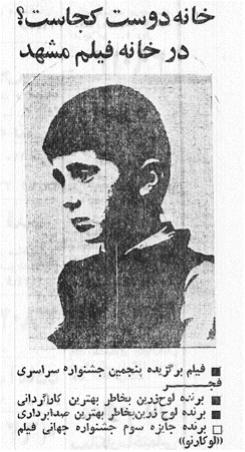
Figure 21: Muhammad-Rizā Niʿmatzādah, played by Bābak Ahmadpūr, in Khānah-yi Dūst Kujāst? (Where Is the Friend’s House?), directed by ʿAbbās Kiyārustamī, 1987. The film was screened at the Mashhad Film House in 1989.
The international successes of Iranian films in the late 1980s also drew the attention of Khurāsān. Khānah-yi Dūst Kujāst? won third prize at the 42nd Locarno Film Festival (1989) and, in late 1990, received an award at the Cannes Film Festival in France.131“Muʿarrifī-i Fīlm: Khānah-yi Dūst Kujāst? dar Khānah-yi Fīlm-i Mashhad” [Introducing the Film Where Is the Friend’s House? at the Mashhad Film House], Khurāsān, no. 11627, September 18, 1989, 1; “Fīlm-i Khānah-yi Dūst Kujāst?) bih Daryāft-i Jāyizah az Jashnvārah-yi Kan, Farānsah Nāʾil Shud” [The Film Where Is the Friend’s House? Succeeds in Receiving an Award from the Cannes Film Festival in France], Khurāsān, no. 11760, January 31, 1990, 7. In the same period, Nār va Nay (Pomegranate and Cane, 1988), directed by Saʿīd Ibrāhīmīfar, won second prize at the Mannheim Festival in West Germany and, in 1990, was awarded the Golden Tulip at the Istanbul Film Festival.132“Fīlm-i Īrānī (Nār va Nay) Barandah-yi Duvvumīn Jāyizah-yi Jashnvārah-yi Manhāym, Ālmān-i Gharbī, Shud” [The Iranian Film (Pomegranate and Cane) Wins Second Prize at the Mannheim Festival in West Germany], Khurāsān, no. 11644, October 9, 1989, 7; “Jāyizah-yi Lālah-yi Talāʾī-i Jashnvārah-yi Fīlm-i Istānbul bih Fīlm-i Īrānī-i Nār va Nay Ikhtisās Yāft” [The Golden Tulip Award of the Istanbul Film Festival Awarded to the Iranian Film Pomegranate and Cane], Khurāsān, no. 11792, April 17, 1990, 2.
Despite their international achievements, these films were not well received by revolutionary filmmakers and critics. For example, actor and director Majīd Majīdī, in an interview with Khurāsān in 1990, stressed in reference to Nār va Nay that art must serve the people, the revolution, and the values and ideals of society.133“Musāhibah / Pāy-i Suhbat bā Majīd Majīdī, Bāzīgar-i Sīnimā” [Interview / In Conversation with Majīd Majīdī, Cinema Actor], Khurāsān, no. 11875, July 30, 1990, 8. This divergence between domestic and international reception can be seen as a prelude to the increasing international visibility of Iranian cinema—a development that would later foster the flourishing of Iranian cinema in exile.134Amīr Nādirī, a prominent figure of the Iranian New Wave, left Iran for the United States in 1990 after several of his films were banned. His departure, along with those of other filmmakers, inspired the creation of the Exile Film Festival, which was initially dedicated to Iranian filmmakers abroad and, from 1993, expanded to include all exiled filmmakers or films addressing exile. See Bahrām Rahmānī, Dunyā: Khānah-yi Man Ast [The World Is My Home], sapidadam, https://sapidadam.com/posts/jahan/9019.
In 1990, Close-Up by ʿAbbās Kiyārostamī once again drew international attention, winning an award at the Montreal Film Festival. The film, which blended documentary and narrative forms, received critical acclaim for dissolving the boundary between reality and fiction.135“Fīlm-i Close-Up barandah-yi jāyizah-yi jashnvārah-yi sīnimā-yi Muntriāl shud” [Close-Up Wins Award at the Montreal Film Festival],Khurāsān, no. 11949, October 31, 1990, 7. In the same year, Parandah-yi Kūchak-i Khushbakhtī (The Little Bird of Happiness), directed by Pūrān Dirakhshandah, won a Golden Award at the North Korean Film Festival, as reported in Khurāsān. This festival was the second gathering of Non-Aligned and developing countries, and its awards were presented by the Prime Minister of North Korea.136“Yak fīlm-i Īrānī barandah-yi jāyizah-yi talā’ī-i fistīvāl-i Kurah-yi Shumālī [An Iranian Film Wins Gold Award at the North Korean Festival], Khurāsān, no. 11915, September 18, 1990, 9.
Overall, the final two years of the 1980s, following the end of the war with Iraq, proved productive for Iranian cinema. Nevertheless, many films screened in Iran during this period drew sharp criticism from Khurāsān’s reviewers. Kafsh’hā-yi Mīrzā Nawrūz (Mirza Norooz’s Shoes), directed by Muhammad Mutavassilānī, was dismissed as a shallow and discredited work.137“Naqd-i Fīlm-i Kafsh’hā-yi Mīrzā Nawrūz, Sathī va Bī’iʿtibār [Review of Mirzā Nawrūz’s Shoes as Shallow and Discredited], Khurāsān, no. 11775, March 18, 1990, 3. In a review of Grand Cinema (1989), directed by Hasan Hidāyat, critics lamented, “What a waste of the subject, and what a waste of the talent of ʿIzzatallāh Intizāmī,”138“Naqd-i Fīlm-i Grand Cinema / Hayf az Sūzhah va Ḥayf az ‘Izzatallāh Intizāmī [Review of Grand Cinema: What a Waste of the Subject and What a Waste of the talent of ʿIzzatallāh Intizāmī], Khurāsān, no. 11665, November 6, 1989, 3. while Duzd-i ʿArūsak’hā (Thief of Dolls, 1990), directed by Muhammad-Rizā Hunarmand, was condemned as a pickpocket of its audience.139“Naqd-i Fīlm-i Duzd-i ʿArūsak’hā yā Duzd-i Jīb’hā-yi Tamāshāgarān [Review of Thief of Dolls or the Pickpocket of Its Audience], Khurāsān, no. 11965, November 19, 1990, 3.
The dynamism of Iranian cinema and efforts to move beyond a strictly revolutionary outlook at the end of the 1980s also sparked controversy. In 1990, the head of the cultural division of the Fārābī Cinema Foundation spoke of the possibility of exploring freedom of hijab in Iranian cinema—a statement that raised a response from Khurāsān, as illustrated in the image below.
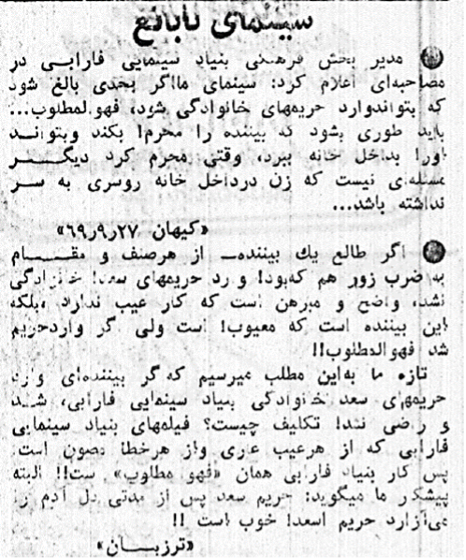 Figure 22: Immature Cinema / A Discussion on Hijab in Iranian Cinema.140“Taʾammul! Sīnimā-yi Nā’bāligh [Contemplate! Immature Cinema], Khurāsān, no. 12000, December 31, 1990, 7.
The 1990s
In 1991, Khurāsān published an interview with screenwriter Farīdūn Jayrānī, in which post-revolutionary cinema was praised as ethical and idealistic. He urged young people not to be swayed by the false attractions of cinema and, at the conclusion of the interview, commended filmmakers such as Sīrūs Taslīmī and Kiyānūsh ʿAyyārī for creating Parandah-yi Kūchak-i Khushbakhtī (The Little Bird of Happiness) and Ānsū-yi Ātash (Beyond the Fire).141Farīdūn Jayrānī, “Musāhabah / Guftugū bā Farīdūn Jayrānī, Fīlmnāmah’nivīs [Interview / Conversation with Farīdūn Jayrānī, Screenwriter], Khurāsān, no. 12109, May 26, 1991, 3.
Nevertheless, alternative perspectives also emerged. In 1992, Khurāsān published an interview with actor Bihrūz Baqāʾī, in which he reflected on other dimensions of Iranian cinema. He emphasized the direct relationship between art and culture and the economic, political, and social conditions of the country. Baqāʾī described the state of Iranian cinema in these terms as rudimentary—an environment that encouraged “easygoing” tendencies and “simplistic” thinking in filmmaking.142Bihrūz Baqāʾī, “Musāhabah: Sīnimā-yi Irān, Sīnimā-yi ‘Ganj-i Qārūn’ Ast [Interview: Iranian Cinema Is the Cinema of Ganj-i Qārūn], Khurāsān, no. 12368, April 21, 1992, 3. Existing evidence in Khurāsān points to a stagnation in Iranian cinema at the beginning of the 1990s. In 1992, the newspaper published a full-page report titled “Noticeable Stagnation in Cinema,” directly addressing this issue.
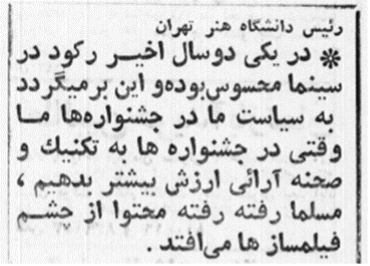
Figure 23: Statement by the President of the University of Art, Tehran, in 1992 on the Stagnation of Iranian Cinema.143“Rukūd-i Mahsūs-i Sīnimā [Noticeable Stagnation in Cinema], Khurāsān, no. 12378, May 02, 1992, 3.
Despite the circumstances, Khurāsān’s cinema column continued to flourish. In August 1992, the paper interviewed the actor Ahmad Najafī, who had played in Mas‛ūd Kīmiyā’ī’s film Gurūhbān (The Sergeant, 1992). Najafī criticized the film’s censorship, noting that “this was not our gurūhbān,” and revealed that 17 minutes of key scenes had been cut. When asked about the future of Iranian cinema, he simply replied: “None.”144“Musāhabah: Guftugū bā Ahmad Najafī, Bāzīgar-i Naqsh-i “Gurūhbān” dar Fīlm-i Kīmiyā’ī [Interview: Ahmad Najafī, Actor in Mas‛ūd Kīmiyā’ī’s Gurūhbān], Khurāsān, no. 12456, August 5, 1992, 5. Later that year, in December, Khurāsān published a review referencing Khānah-yi Dūst Kujāst, arguing that a film’s screening at festivals does not justify its broadcast on the Islamic Republic’s television.145“Khānah-yi Dūst Kujāst Fīlmī Mardumī Nabūd” [Where Is the Friend’s House? Was Not a Popular Film], Khurāsān, no. 12546, November 24, 1992, 3.
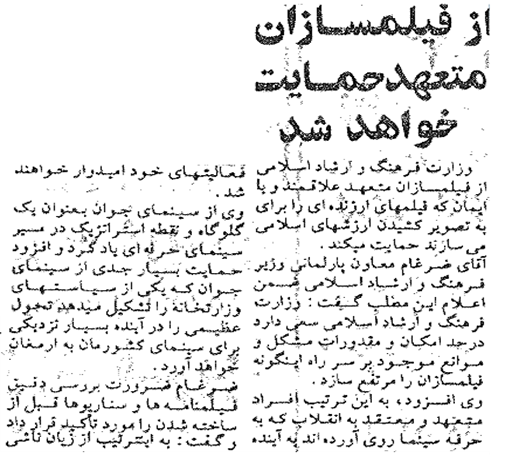 Figure 24: Support for filmmakers promoting Islamic values (1992).146“Az Fīlm’sāzān-i Muta‘ahhid Himāyat Khāhad Shud” [Filmmakers Committed to Islamic Values Will Be Supported], Khurāsān, no. 12546, November 24, 1992, 3.
In January 1993, Abu’lfazl Āhanchiyān, a screenwriter from Mashhad, said: “The problem of cinema in Iran is weak screenwriting.”147Abu’lfazl Āhanchiyān, “Musāhabah: Mushkil-i Sīnimā dar Īrān az Za‘f-i Fīlm’nāmah Ast” [Interview: The Problem of Cinema in Iran Is Weak Screenwriting], Khurāsān, no. 12593, January 19, 1993, 3. In February 1993, Rakhshān Banī-iʿtimād, in an interview with Khurāsān about the film Nargis, noted: “Nargis is the result of all the films that were never made and the screenplays that were rejected one after another.”148Rakhshān Banī-iʿtimād, “Musāhabah: ‘Nargis’ dar Khānah-yi Fīlm-i Mashhad” [Interview: Nargis at the Film House of Mashhad], Khurāsān, no. 12614, February 17, 1993, 4. Finally, in March 1993, the headline “Chaotic Economy in the Film Industry Reduces Art to Vulgarity,” quoting Ghulāmrīzā Mūsavī, head of the Central Council of the Iranian Film Producers and Distributors Association, drew attention in Khurāsān. The article criticized the neglect of specialized producers.149Ghulāmrizā Mūsavī, “Iqtisād-i Āshuftah dar Sanʿat-i Sīnimā Hunar-i Fīlm rā bih Ibtizāl Mi’kishānad” [Chaotic Economy in the Film Industry Reduces Art to Vulgarity], Khurāsān, no. 12626, March 1, 1993, 5.
In 1993, the film Sārā (Dāryūsh Mihrjūyī), while receiving generally positive reviews from Khurāsān critic Bihrūz Tāhirniyā, was simultaneously considered inferior to Mihrjūyī’s previous works.150Bihrūz Tāhirniyā, “ʿIshq-i Tijāratī / Naqdī bar Fīlm-i (Sārā)” [Commercial Love: A Review of the Film Sara], Khurāsān, no. 12775, September 12, 1993, 4. At the same time, Khurāsānreported on the film receiving the Golden Shell (Concha de Oro) award at the San Sebastián International Film Festival in Spain. However, the reporter expressed dissatisfaction with the way some Spanish media outlets covered the film, concluding: “The differing positions of Spanish media on this matter demonstrate how even the artistic success of the Islamic Republic is painful and indigestible for Western audiences.”151“Fīlm-i Sārā Sayyād-i Jashnvārah-yi Jahānī-i San Sibāstiyan” [The Film Sara winner at the San Sebastián International Festival], Khurāsān, no. 12799, October 10, 1993, 4. In reality, the Islamic Republic’s policy has been to impose restrictions on filmmakers and their works at home, while appropriating their achievements abroad under its own name.152For example, the state’s response to ʿAbbās Kiyārustamī was ambivalent: it promoted him in official media as a symbol of national pride while simultaneously imposing restrictions and, in some cases, confiscating his works.
In 1993, an article titled “Types of Film Criticism in Iranian Cinema” addressed the subject of film criticism, categorizing different types of reviews and highlighting the fundamental problem of criticism and analysis in Iran.153“Gūnah’hā-yi Naqd-i Fīlm dar Sīnimā-yi Īrān” [Types of Film Criticism in Iranian Cinema], Khurāsān, no. 12840, November 29, 1993, 1. This can be seen as confirming the earlier claim that film criticism was regarded as having its own ups and downs alongside the film production itself. Nevertheless, this did not imply a lack of serious criticism in Khurāsān. For example, in 1994, a review titled “A Look at Bahrām Bayzā’ī’s Dramatic Works in Iranian Cinema” was published, in which the author, identified as A. Rūhpūr, offered a detailed analysis of Bayzā’ī’s works and discussed the constraints on filmmaking in Iran and their role in undermining the status of filmmakers.
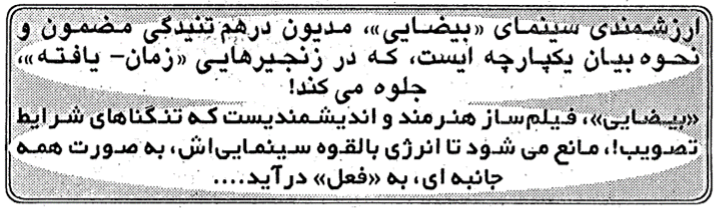 Figure 25: Excerpts from Khurāsān critics’ views on the works of Bahrām Bayzā’ī.154A. Rūhpūr, “Naqd-i Yak Fīlm’sāz / Nigāhī bih Āsār-i Namāyishī-i Bahrām Bayzā’ī dar Ravand-i Sīnimā-yi Īrān” [Critique of a Filmmaker: A Look at Bahrām Bayzā’ī’s Dramatic Works in Iranian Cinema], Khurāsān, no. 12930, March 15, 1994, 10.
In 1994 Khurāsān devoted an entire page to celebrating the works of Mas‘ūd Kīmiyā’ī, reflecting his own complaints.155“Zindagī yak tīgh-i kāmil ast” [Life is a Perfect Blade], Khurāsān, no. 13116, November 09, 1994, 5. In 1996, Khurāsān’s cinema column published a note by Bīzhan Ashtarī on Kīmiyā’ī’s film Ziyāfat (The Feast, 1995), which echoed the director’s own viewpoint:
“Life held a grudge against me
I smiled at life
The earth was my enemy
I lay upon the earth”156Bīzhan Ashtarī, “Yaddāshtī bar Fīlm ‘Ziyāfat’ Sākhtah-yi Masʿūd Kīmiyā’ī va Man Sitārah’am rā Yāftam…” [A Note on the Film ‘The Feast’ by Masʿūd Kīmiyā’ī and I Found My Star…], Khurāsān, no. 13515, April 5, 1996, 12.
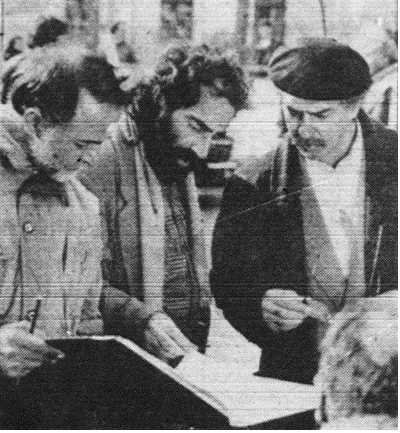
Figure 26: Mas‘ūd Kīmiyā’ī (center) on a dedicated page of Khurāsān, behind the scenes of Radd-i’pā-yi Gurg (The Wolf’s Trail, 1994).157“Zindagī yak tīgh-i kāmil ast” [Life is a Perfect Blade], Khurāsān, no. 13116, November 09, 1994, 5.
In January 1995, during a meeting with artists and cultural officials, ʿAlī Khāmanah’ī, the Supreme Leader of the Islamic Republic, characterized film and cinema as a powerful medium for “presenting the truth of religion,” a session that Khurāsān reported in full.158“Maqām-i Mu‘azzam-i Rahbarī dar Dīdār-i Hunarmandān va Dast’andarkārān-i Umūr-i Farhangī: Fīlm va Sīnimā Vasīlah-ī Balīgh barā-yi Irā’ah-yi Haqīqat-i Dīn Bi’shumār Mī’ravad” [The Supreme Leader in a Meeting with Artists and Cultural Figures: Film and Cinema as a Persuasive Means to Convey Religious Truth], Khurāsān, no. 13179, January 25, 1995, 10. Three weeks after this speech, the newspaper wrote: “Our cinema follows a wave / We have not yet reached ideal cinema.”159“Sīnimā-yi Mā Tābi‘-i Yak Mawj Ast / Hanūz bih Sīnimā-yi Ārmānī Dast Nayāftah’īm” [Our Cinema Follows a Wave / We Have Not Yet Reached Ideal Cinema], Khurāsān, no. 13198, February 18, 1995, 5. The goal of cinema in the Islamic Republic, like that of the revolution itself, was to shape an ideal human being—an ideal that increasingly seemed out of reach. The article featured several interviews, including one with actress Afsānah Bāyigān, who discussed both the uncertainty surrounding Iranian cinema’s future and the need to reduce censorship, giving the “children of the revolution” greater freedom in creative initiative.160“Guzārish-i Khurāsān az Sizdahumīn Jashnvārah-yi Fīlm-i Fajr va Guftugū bā Hunarmandān” [Khurāsān Report on the 13th Fajr Film Festival and Interviews with Artists], Khurāsān, no. 13198, February 18, 1995, 5.
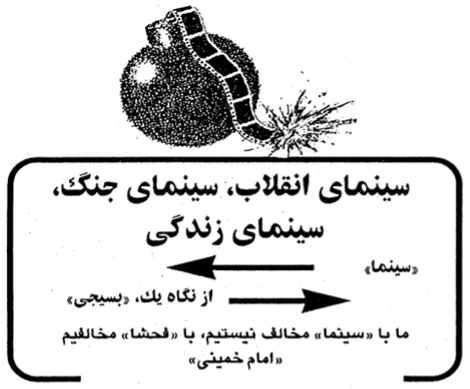
Figure 27: A page from the cinema section of Khurāsān (1993).161“Sīnimā-yi Inqilāb, Sīnimā-yi Jang, Sīnimā-yi Zindagī” [Revolution Cinema, War Cinema, Life Cinema], Khurāsān, no. 12818, November 3, 1993, 9.
Khurāsān reported several achievements in Iranian cinema in 1994, including ʿAbbās Kiyārustamī’s first prize at the Valladolid International Film Festival in Spain for Zīr‑i Dirakhtān‑i Zaytūn (Through the Olive Trees) and Ibrāhīm Furūzish’s Grand Prix at the Ciné Junior Festival in France for Khumrah (The Jar). That year also saw the emergence of a new figure in Iranian cinema: Ja‛far Panāhī, who won first prize at the Tokyo International Film Festival in 1995 for his film Bādkunak‑i Sifīd (The White Balloon).162“Kiyārustamī Jāyizah-yi Avval-i Jashnvārah-yi Fīlm-i Ispāniyā rā Bi’dast Āvard” [Kiyārustamī Wins First Prize at Spanish Film Festival], Khurāsān, no. 3520, October 31, 1994, 2; “Rūydād’hā-yi Farhangī, Hunarī / Fīlm-i Īrānī-i ‘Khumrah’ Barandah-yi Jāyizah-yi Buzurg-i Jashnvārah-yi Farānsah Shud” [Cultural and Artistic Events: Iranian Film ‘The Jar’ Wins Grand Prize at French Festival], Khurāsān, no. 13142, December 9, 1994, 10; “Yak fīlm-i Irānī barandah-yi jāyizah-yi avval-i Jashnvārah-yi Baynalmilalī Zhāpun shud” [An Iranian film won first prize at the Japan International Festival], Khurāsān, no. 13384, October 17, 1995, 2. That same year, this film won the Caméra d’Or at the Cannes Film Festival in France. Khurāsān republished the news, citing Le Monde: “The White Balloon is one of those compelling, understated films that transforms a child’s tale into a story both real and universal.”163“Akhbār-i Farhangī, Hunarī va Adabī / Dirakhshish-i Fīlm-i Bādkunak-i Sifid dar Farānsah” [Cultural, Artistic, and Literary News / The White Balloon Shines in France], Khurāsān, no. 13430, December 13, 1995, 4.
Coverage in Khurāsān and other outlets at the time reveals two distinct cinematic currents in Iran during the 1990s. One current operated without government backing and found its primary recognition at international festivals. The other, despite enjoying official support, attracted less enthusiasm at home and abroad. In 1995, Khurāsān ran a report headlined “The Dominant Atmosphere in Iranian Cinema Is Not a Cultural One,” featuring comments by the revolutionary filmmaker Farajallāh Salahshūr. He argued that contemporary audiences had grown accustomed to formulaic, superficial, commercial, and action-driven films, showing little interest in war films and value-oriented cinema. He called for a state-led effort, supported by revolutionary forces, to reshape public taste.164Farajallāh Salahshūr, “Dar Guftugū bā Du Tan az Sīnimā’garān-i ‘Sīnimā-yi Difā‘-i Muqaddas’: Fāzā-yi Ḥākim bar Sīnimā-yi Īrān Yak Fāzā-yi Farhangī Nīst!” [In an Interview with Two ‘Sacred Defense Cinema’ Filmmakers: The Atmosphere in Iranian Cinema Is Not Cultural!], Khurāsān, no. 13235, April 18, 1995, 5.
In July 1995, another article appeared under the title “The Crisis of Cinema Lies in Behind-the-Scenes Games.” Quoting the war documentarian Murtazā Āvīnī, it stated: “Cinema is not particularly ‘Islamizable,’ but it can be placed in the service of Islam.” The unnamed critic went on to lament the state of Iranian cinema, attacking commercial, popular, and action genres and denouncing nepotism among actors and artists as a sign of ongoing vulgarity.165“Buhrān-i Sīnimā dar Bāzī’hā-yi Pusht-i Pardah Ast!” [The Crisis of Cinema Lies in Behind-the-Scenes Games], Khurāsān, no. 13296, July 2, 1995, 5.
On the same page, in an interview with filmmaker Kayūmars Pūrahmad described contemporary Iranian cinema as little more than the old Fīlm-Fārsī—minus its sexual content. Another filmmaker, Ahmad Ṭālibī-Nizhād, remarked: “In our country, cinema is treated less as a cultural instrument than as a form of entertainment, a way to fill leisure time.” Director Muhammad-ʿAlī Najafī added: “Until 1990, our cinema followed an astonishing and unparalleled trajectory. After that, however, the economy and its impact on cultural outlooks became somewhat troubling. At present, we are at a midpoint—it could move toward decline or toward progress.” Production manager Habīballāh Kāsah’sāz concluded: “If policymaking undergoes transformation, then one can say cinema has undergone transformation.”166Kayūmars Pūrahmad, Muhammad-‘Alī Najafī, Ahmad Tālibī Nizhād, Habīballāh Kāsah’sāz, “Sīnimā-yi Sīnimā’garān / Bā Hirfah’ī’hā-yi Sīnimā-yi Diyār-i’mān” [Cinema of the Filmmakers / With the Professionals of Our Local Cinema], Khurāsān, no. 13296, July 2, 1995, 5.
While some commentators focused on what they viewed as a stagnant, state-backed cinema and criticized popular films, others continued making socially focused works based on artistic standards, largely ignoring these attacks—and gained recognition at international festivals. In 1995, Rakhshān Banī-iʿtimād won the Bronze Leopard at the Locarno Festival for Rūsarī-i Ābī (The Blue Veil). Reporting extensively on the festival, Khurāsān concluded: “We can discern a clear line and policy in the selection of Iranian films. A film that seriously expresses the nature of the system and the Revolution, and that stands in defense of its values, does not make its way into such festivals.”167“Dirakhshish-i Sīnimā-yi Īrān dar Jahān az Zabān-i Mudīr-i Jashnvārah-yi Lukārnaw” [Iranian Cinema Shines Abroad, according to the Director of the Locarno Festival], Khurāsān, no. 13334, August 20, 1995, 4.
Figure 28: Conceptual depiction of cinema as an art form in Khurāsān, 1995.168“Sīnimāʾ-yi Sīnimā’garān / Bā hirfahʾ-ī’hā-yi sīnimā-yi diyār-i’mān,” [“Cinema” of “Filmmakers” / With the Professionals of Our Country’s Cinema], Khurāsān, no. 13296, June 2, 1995, 5.
Official frustration soon escalated. Early the following year, the Iranian government announced a boycott of the Academy Awards. According to Khurāsān, the Deputy for Cinematic Affairs at the Ministry of Culture and Islamic Guidance, ‛Izzatallāh Zarghāmī, condemned the U.S. Congress’s approval of a $20 million budget bill against Iran and declared: “In light of this action by America, the Islamic Republic of Iran will boycott the Academy Awards film festival.” The announcement came even as festival organizers had selected, from among 45 non-American films, Jaʿfar Panāhī’s The White Balloon for Oscar consideration.169‛Izzatallāh Zarghāmī, “Īrān Jashnvārah-yi Sīnamā’ī-i Uskār rā Tahrīm Kard” [Iran Boycotts the Academy Awards], Khurāsān, no. 13446, January 3, 1996, 4. The film was ultimately barred from participation, despite ranking seventh among the highest-grossing films in London cinemas that year, according to Khurāsān, and being widely considered a strong contender for the award.170“Akhbār-i Farhangī, Hunarī va Adabī / Bādkunak-i Sifīd dar Rutbah-yi Haftum-i Pur’furūsh’tarīn Fīlm’hā-yi Sīnimā’ī-i Landan Qarār Girift” [Cultural, Artistic, and Literary News / The White Balloon Ranks Seventh Among the Top-Grossing Films in London], Khurāsān, no. 13457, January 17, 1996, 4.
In 1996, another significant cinematic controversy dominated the pages of Khurāsān. Īraj Qādirī—an actor before the Revolution who later turned to directing—had secured a production permit for his film Āvā-yi Kūhistān (Sound of the Mountain). Production, however, was abruptly suspended after authorities invoked a rule barring director from making more than one film per year. Khurāsān called the decision unprecedented, emphasizing that once a production permit had been granted, it was ordinarily considered irrevocable.171“Īraj Qādirī: Faqat Yak Fīlm dar Har Sāl” [Īraj Qādirī: Only One Film Per Year], Khurāsān, no. 13709, December 31, 1996, 15. This episode, along with growing revolutionary criticism of the film industry, highlighted the rising influence of hardliners in Iranian cinema. Cultural figures from before the Revolution continued to face unofficial restrictions.172This situation persisted even during the Reform Period. In 1999, when Īraj Qādirī’s Tūtiyā became the most popular—and in fact the highest-grossing—film of the spring season, rumors circulated that the awards ceremony for the season’s top films might be canceled. Majallah-yi Fīlm wrote: “For many, it was hard to believe that Īraj Qādirī and his film could receive a recognition award at an official and serious ceremony from the cinema authorities. These skeptics argue that the greatest favor the Ministry of Culture and Islamic Guidance can—and indeed has—done for Īraj Qādirī is simply to allow him to continue making films.” See Māh’nāmah-yi Sīnimā’ī-i Fīlm, no 238 (1999): 25. One of the most prominent was Muhammad-ʿAlī Fardīn, a major star of pre-Revolution cinema. In 1996, a source at the Ministry of Culture and Islamic Guidance said that Fardīn had not submitted a formal request to return to acting.173“Shāyi‘ah-yi Bāzīgarī-i Fardīn Takzīb Shud” [Rumors of Fardīn Acting Denied], Khurāsān, no. 13697, November 15, 1996, 4.
Two years later, amid early policy shifts following the election of moderate President Muhammad Khātamī, Khurāsānreported that Fardīn had sought permission to appear on screen one final time.174“Fardīn: Bugzārīd Faqat Yak Bār Dīgar Jilu-yi Dūrbīn Zāhir Shavam!!!” [Fardīn: Let Me Appear Before the Camera Just One More Time!!!], Khurāsān, no. 14300, December 21, 1998, 8. The request was denied. Sixteen months later, he died. News of his death appeared not in the arts section but on the sports page of Khurāsān, under the headline: “Fardīn, former national team wrestler, dies.”175“Fardīn, Kushtī’gīr-i Sābiq-i Tīm-i Millī-i Īrān Dar’guzasht” [Fardīn, Former National Team Wrestler, Dies], Khurāsān, no. 14667, April 10, 2000, 14. Only two days later—on April 10, 2000—did coverage of his funeral describe him as both a former national team wrestler and a film actor. The newspaper reported that the ceremony drew officials from the Physical Education Organization—the state body overseeing sports—as well as veteran wrestlers and coaches, athletes, artists, and large crowds of mourners.176“Guzārishī az Marāsim-i Tashyī‘-janāzah-yi Muhammad-‘Alī Fardīn, Kushtī’gīr-i Asbāq-i Tīm-i Millī va Hunar’pīshah-yi Sīnimā-yi Īrān” [Report on the Funeral of Muhammad-‘Alī Fardīn, Former National Team Wrestler and Iranian Cinema Actor], Khurāsān, no. 14669, April 12, 2000, 15.
In June of that year, the Deputy Minister of Culture for Cinematic Affairs, Sayfallāh Dād, effectively closed the door on a broader return of pre-Revolution stars. “A system based on star-centered filmmaking, or a type of film that connected only with the lower strata of society, is not viable under current conditions,” he said.177Sayfallāh Dād, “Mu‘āvin-i Sīnimā’ī-i Vazīr-i Irshād: Bāzgasht-i Bāzīgarān-i Qadīmī bih ‘Arsah-yi Sīnimā Muntafī Ast” [Deputy for Cinema, Ministry of Culture and Islamic Guidance: Return of Veteran Actors to Cinema Is Out of the Question], Khurāsān, no. 14720, June 13, 2000, 15.
By August 1997, shortly before the reformist government of Muhammad Khātamī took office, Iran’s cinematic climate had grown markedly restrictive, and calls for meaningful change were intensifying. Screenwriters felt the pressure of censorship and oversight more than others in the film production process, and filmmakers openly acknowledged this. In 1997, Khurāsān published a piece titled “Cinema in 1996 and the Decline in Film Quality,” attributing the downturn primarily to supervision and evaluation policies, as well as weak scripts.178“Sīnimā-yi Sāl-i 75 va Uft-i Kayfī-i Fīlm’hā” [Cinema in 1996 and the Decline in Film Quality], Khurāsān, no. 13776, February 23, 1997, 13. Just a week later, however, in its coverage of the Fajr Film Festival, the newspaper quoted the Director General of Supervision and Evaluation at the Cinematic Affairs office as asserting: “Iranian cinema moves toward value-based films.”179“Guzārishī az Jashnvārah-yi Fīlm-i Fajr / Sīnimā-yi Īrān bih Samt-i Arzishī Shudan Pīsh Mī’ravad” [Report on the Fajr Film Festival / Iranian Cinema Moves Toward Value-Based Films], Khurāsān, no. 13782, February 28, 1997, 3.
The surprise election of Muhammad Khātamī—himself a former Minister of Culture and Islamic Guidance—as president in 1997 defied the expectations of the political establishment’s hardline factions and signaled broad public demand for change across multiple spheres, including culture and the arts. Many believed that this shift would inevitably be reflected in the country’s cinema as well.
It was under these circumstances that some films were granted permission for screening. Among them was Ādam Barfī (The Snowman, 1995), directed by Dāvūd Mīrbāqirī, which was released in 1997 after three years of being banned. At the same time, however, there were still films that did not receive screening permits. Muhsin Makhmalbāf’s Nawbat-i ʿĀshiqī (A Moment of Innocence, 1990) and Shab’hā-yi Zāyandah Rūd (Zāyandeh Rūd Nights, 1990) were among them.
In January 1998, the newspaper Khurāsān published the following statement by Makhmalbāf:
If these two films receive screening permits, that would be very good. But one must wait and see how much sensitivity remains. Lifting the ban on these films, as in the case of The Snowman, would mark a positive development in the country’s cinematic community. That said, the Minister of Culture and Islamic Guidance has criticized my film A Moment of Innocence in two published articles.180Muhsin Makhmalbāf, “Makhmalbāf dar Intizār-i Raf‘-i Tawqīf-i Du Fīlm-i Khud Ast” [Makhmalbāf Awaits the Lifting of the Ban on Two of His Films], Khurāsān, no. 14042, January 24, 1998, 13.
These two films never received screening permits. In 1999, director Abu’lfazl Jalīlī told Khurāsān that despite making eight feature films, only two had been cleared for release.181Abu’lfazl Jalīlī, “Kāsh Baqiyyah-yi Fīlm’hā’yam Ham Ijāzah-yi Ikrān Yāband” [I Wish My Other Films Could Also Be Released], Khurāsān, no. 14331, January 28, 1999, 7. Ultimately, none of Jalīlī’s works obtained official approval.
As a result, the reputation of Iranian cinema continued to rest largely on independent artistic filmmakers, whose work was being recognized and awarded at international festivals. In 1999, Khurāsān published a translated report by international film critic Laura Mulvey, describing President Muhammad Khātamī’s tenure as a “spring of Iranian cinema” compared with previous years. The report opened by praising ‛Abbās Kiyārustamī’s Taʻm-i gīlās (Taste of Cherry, 1997), which had won the Palme d’Or at the 1997 Cannes Film Festival.182“Laura Mulvey az Muntaghidān-i Sīnimā-yi Jahān / Bahār-i Sīnimā-yi Īrān dar ‘Asr-i Khātamī” [Laura Mulvey, International Film Critic / The Spring of Iranian Cinema in the Khātamī Era], translated by Ahmad Sabriyān, Khurāsān, no. 14404, May 10, 1999, 12.
Despite ongoing restrictions, the global recognition of Iranian cinema often overshadowed these limitations, with some even citing them as a factor that spurred creativity in the country’s film industry.183“Mahdūdiyat’hā dar Sīnimā-yi Īrān Khallāqiyat bih Dunbāl Dāshtah Ast” [Restrictions in Iranian Cinema Have Fostered Creativity], Khurāsān, no. 14474, August 3, 1999, 1. At the same time, hardline factions expressed dissatisfaction with the state of Iranian cinema. In an interview with Khurāsān, director Javād Shamaqdarī complained that the film industry’s economic engine did not revolve around “value-based” films.184Javād Shamaqdarī, “Charkh-i Iqtisādī-i Sīnimā bar Mihvar-i Fīlm’hā-yi Arzishī Nimī’charkhad” [The Economic Engine of Cinema Does Not revolve Around Value-Based Films], Khurāsān, no. 14491, August 23, 1999, 1.
Beginning in 1998 with Farīdūn Jayrānī’s film Qirmiz (Red), discussions of women’s rights in Iranian cinema gained momentum, frequently highlighted in Khurāsān through interviews with female actors and filmmakers. In October 1999, the newspaper featured an interview with actress Āzītā Hājiyān, who, when asked about the role of women in Iranian cinema, said: “Human rights—and the concept of the human being in their entirety—have not yet been fully and definitively addressed in our cinema… Our filmmakers do not have the courage to depict women’s rights.”185Āzītā Hājiyān, “Fīlm’sāzān-i Mā Shahāmat-i Bih Tasvīr Kishīdan-i Ḥuqūq-i Zanān Rā Nadārand” [Our Filmmakers Do Not Have the Courage to Depict Women’s Rights], Khurāsān, no. 14529, October 8, 1999, 10. A month later, in November 1999, screenwriter and actress Mīnū Farshchī added: “Women in Iranian cinema remain trapped by stereotypes.” 186Mīnū Farshchī, “Dar Guftugū bā Mīnū Farshchī Fīlm’nāmah’nivīs va Bāzīgar-i Sīnimā Matrah Shud: Fīlm’nāmah’nivīsī, Hunar Yā Tijārat? / Zan dar Sīnimā-yi Īrān Asīr-i Nigāh’hā-yi Kilīshah’ī Ast” [Interview with Mīnū Farshchī, Screenwriter and Actress: Screenwriting, Art or Commerce? / Women in Iranian Cinema Remain Trapped by Stereotypes], Khurāsān, no. 14563, November 21, 1999, 10.
At the same time, debates over hijab emerged as a point of tension between hardline and reformist factions. In 2000, at the “Women and Cinema” (Zan va Sīnimā) conference, a religious scholar warned that “filmmakers should not depict the private sphere of the family.”187“Yak Pazhūhish’gar: Sīnimā’garān Nabāyad Ḥarīm-i Khusūsī-i Khānavādah Rā bih Tasvīr Bi’kishand” [A Scholar: Filmmakers Should Not Depict the Private Sphere of the Family], Khurāsān, no. 14610, January 20, 2000, 15. At the same event, the Deputy for Cinema and Audiovisual Affairs at the Ministry of Culture and Islamic Guidance emphasized that the conference “is not limited to issues such as hijab.”188“Dād: Hamāyish-i ‘Zan va Sīnimā’ Munhasir bih Maqūlah’hā’ī Chun Ḥijāb Nīst” [Dād: ‘Women and Cinema’ Conference Is Not Limited to Issues Such as Hijab], Khurāsān, no. 14610, January 20, 2000, 15. Later that year, director Pūrān Dirakhshandah added: “We have not had the courage to address the fundamental challenges faced by women.”189Pūrān Dirakhshandah, “Sīn misl-i Sīnimā / Bih Bahānah-yi Yak’sadumīn Sālgard-i Tavallud-i Sīnimā-yi Īrān / Sīmā-yi Zan dar Sīnimā-yi Mu‘āsir-i Īrān / Jur’at-i Pardākhtan bih Mushkilāt-i Asāsī-i Zanān Rā Nadārīm” [C is for Cinema / On the Occasion of the 100th Anniversary of Iranian Cinema / The Image of Women in Contemporary Iranian Cinema / We have not had the courage to address the fundamental challenges faced by women], Khurāsān, no. 14784, August 28, 2000, 10.
In September 2000, Khurāsān republished portions of a Financial Times report on the success of Iranian cinema at the Venice Film Festival. Alongside praise for Jaʿfar Panāhī’s Dāyirah (The Circle, 2000), the report acclaimed Iranian cinema as a whole and posed the question: “Do we need any more evidence to consider Iran among the most exciting film-producing countries in the world today?”190“Fāynanshāl Tāyms Muvaffaqiyat-i Sīnimā-yi Īrān dar Jashnvārah-yi Vinīz Rā Tahsīn Kard” [Financial Times Praises the Success of Iranian Cinema at the Venice Festival], Khurāsān, no. 14796, September 12, 2000, 15.
In 2000, Iranian cinema saw the emergence of a new figure, Bahman Qubādī, whose film Zamānī barāyi mastī-i asb’hā(A Time for Drunken Horses) attracted significant attention both domestically and internationally. In November 2000, Khurāsān published a report from a Greek newspaper titled “Iranian Cinema Is Not Limited to Kiyārustamī,” which praised Qubādī’s film and, more broadly, Iranian cinema (Figure 29).191“Sīnimā-yi Īrān Munhasir bih Kiyārustamī Nīst” [Iranian Cinema Is Not Limited to Kiyārustamī], Khurāsān, no. 14849, November 17, 2000, 10.
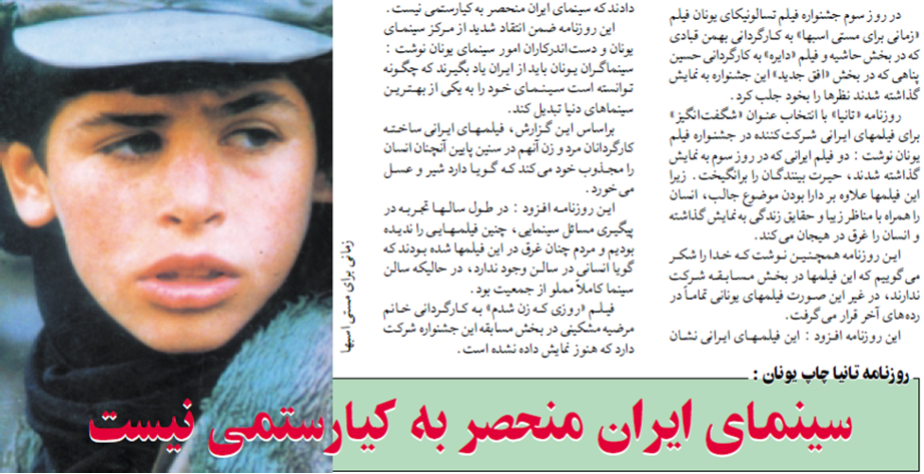
Figure 29: Report on Iranian films in the Greek newspaper Ta Nea.
In 2000, the debate over vulgarity in Iranian cinema was reignited by director Majīd Majīdī, prompting responses from fellow filmmakers. Abu’lfazl Jalīlī countered, saying: “The only goal that can be attributed to these films is making money; otherwise, if they aim to address the challenges facing the younger generation and the future of society, they are not vulgar at all—in fact, they are commendable.”192Abū’lfazl Jalīlī, “Vākunish-i Mihrjūyī, Alvand va Jalīlī bih Izhārāt-i Majīdī / Ibtizāl dar Sīnimā-yi Īrān Ārī yā Nah?” [Response of Mihrjūyī, Alvand, and Jalīlī to Majīdī’s Remarks / Vulgarity in Iranian Cinema: Yes, or No?], Khurāsān, no. 14847, November 15, 2000, 10.
Khurāsān closed the 1990s with a report titled “Cinema, one ‘sīn’ of the Haft-Sīn,”193In Persian tradition, Haft-Sīn is a Nawrūz display of seven symbolic items, each beginning with “sīn” in Persian and representing renewal and prosperity. By calling it “Cinema, one ‘sīn’ of the Haft-Sīn,” the newspaper wittily suggested that Iranian cinema was a noticeable element of a hopeful cultural decade. reflecting on the film community over the past decade. Director Dāryūsh Mihrjūyī remarked: “I hope the new year [1380 SH] will bring a revival for Iranian cinema—a cinema that, over these long years, has seldom experienced a true spring of vitality. The spring of cinema lies in its economic growth and flourishing.”194“Sīnimā-yi Īrān dar Sāl-i 2001 az Nigāh-i Dāryūsh Mihrjūyī, Dāvūd Rashīdī, Sīrūs Taslīmī, Abū’lfazl Jalīlī, Īraj Rād, Farīmāh Farjāmī va Pūrān Dirakhshandah / Sīnimā Yak Sīn az Haft-Sīn” [Iranian Cinema in 2001 from the Perspective of Dāryūsh Mihrjūyī, Dāvūd Rashīdī, Sīrūs Taslīmī, Abū’lfazl Jalīlī, Īraj Rād, Farīmāh Farjāmī, and Pūrān Dirakhshandah / Cinema, One Sin of the Haft-Sin], Khurāsān, no. 14946, March 18, 2001, 10. Director Pūrān Dirakhshandah added: “Undoubtedly, the new year can begin with the portrayal of the real face of women in Iranian cinema… Hopefully, in 2001, all the promises of officials, policymakers, and those involved in Iranian cinema will be fulfilled, rather than remaining mere slogans.”195“Sīnimā-yi Īrān dar Sāl-i 2001 az Nigāh-i Dāryūsh Mihrjūyī, Dāvūd Rashīdī, Sīrūs Taslīmī, Abū’lfazl Jalīlī, Īraj Rād, Farīmāh Farjāmī va Pūrān Dirakhshandah / Sīnimā Yak Sīn az Haft-Sīn” [Iranian Cinema in 2001 from the Perspective of Dāryūsh Mihrjūyī, Dāvūd Rashīdī, Sīrūs Taslīmī, Abū’lfazl Jalīlī, Īraj Rād, Farīmāh Farjāmī, and Pūrān Dirakhshandah / Cinema, One Sin of the Haft-Sin], Khurāsān, no. 14946, March 18, 2001, 10.
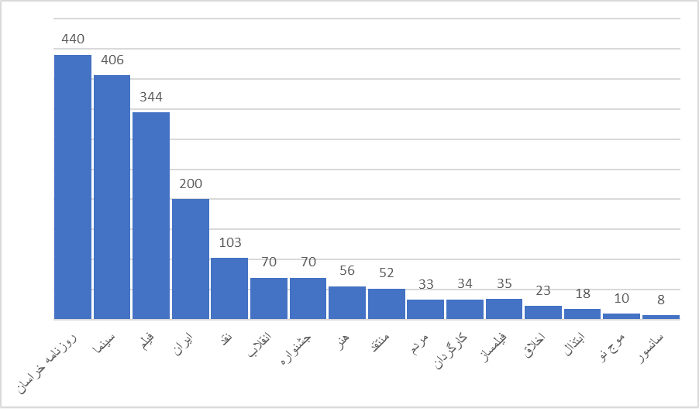
Word Frequency Chart
Conclusion
As the most significant local media outlet in eastern Iran, the Khurāsān newspaper covered Iranian cinema from the 1950s to the 1990s, actively shaping public perceptions. During this period, the newspaper addressed cinematic transformations through news coverage, moral-social critique, and cultural analysis. In the 1950s, coinciding with the rise of popular Fīlm-fārsī productions, Khurāsān engaged with cinema through technical and moral critiques, often condemning Western imitation and vulgarity while praising nationally and ethically grounded works. The philosophy of cinema and its role in public education also formed part of its early agenda.
During the 1960s, the critiques became more profound. With the emergence of the Iranian New Wave, the newspaper shifted its focus from overt moral concerns toward more intellectual and artistic criticism. Although critics continued to denounce the vulgarity of mainstream commercial films, altering popular taste proved challenging. Coverage of film festivals, the introduction of Western cinema, and recognition of artistically significant films remained consistent editorial priorities. By the 1970s, intellectual discourse had increasingly permeated Iranian cinema, transforming it from a form of entertainment into a medium for articulating social and artistic concerns. In response, Khurāsān evolved into a platform for debate and for cultivating a more informed audience, although some critiques reflected partisan motivations and political agendas. In the years leading up to the 1979 Revolution, moral criticism intensified once again, influenced by the broader revolutionary climate.
According to the newspaper, Iranian cinema underwent a period of stagnation in the 1980s, coinciding with the ascendancy of revolutionary discourse. Following the revolution, the Islamic regime confiscated the newspaper and redirected it toward the promotion of state-oriented cinema. Several journalists were dismissed, and filmmakers were compelled to alter their professional trajectories. Despite censorship and government control, the late 1980s saw a group of filmmakers trying to change Iranian cinema. However, continued government interference prevented the movement from lasting long. During this period, Khurāsān attempted to reflect diverse viewpoints. During the Reform Era of Muhammad Khātamī in the 1990s, the cultural climate became relatively more open, granting filmmakers greater creative latitude. During this period, Khurāsān sought to examine the causes of both stagnation and growth in Iranian cinema through a series of interviews with filmmakers. Nevertheless, Iranian cinema once again entered a period of decline due to renewed political restrictions, technical limitations, and censorship.