
Fantasmatic Ruptures: Unearthing the Hidden Map of Female Desire in Pre-Revolutionary Iranian Cinema




Introduction
The history of cinema has long been dominated by a patriarchal visual regime, one in which women are positioned as the objects of gaze. Laura Mulvey’s essay “visual pleasure and narrative cinema” famously conceptualized the male gaze as a structuring principle of classical Hollywood cinema, suggesting that the visual field is organized around the pleasure of the heterosexual male spectator.1Laura Mulvey, “Visual Pleasure and Narrative Cinema,” Screen 16, no. 3 (1975): 6–18. Yet, subsequent feminist film theorists—most notably Tania Modleski and Mary Ann Doane —have sought to complicate, extend, and challenge Mulvey’s model. Their interventions illuminate how cinema can construct spaces where female desire and fantasy are articulated, if not entirely freed from patriarchal mediation. Moving beyond Mulvey’s model of the male gaze, they have demonstrated that women’s fantasy and spectatorship can generate moments of rupture, irony, and subversion.2Mary Ann Doane, “Film and the Masquerade: Theorising the Female Spectator,” Screen 23, nos. 3–4 (1982): 74–87; Tania Modleski, The Women Who Knew Too Much: Hitchcock and Feminist Theory (New York: Routledge, 1988), 1–14. These theoretical interventions invite a re-examination of pre-revolutionary Iranian cinema, where similar moments of rupture and female subjectivity can be traced despite the dominance of patriarchal visual codes. In much of Fīlmfārsī productions, women were predominantly depicted either as objects of the male gaze or as passive victims lacking agency.3Shahla Lahiji, “Chaste Dolls and Unchaste Dolls: Women in Iranian Cinema since 1979,” in The New Iranian Cinema: Politics, Representation and Identity, ed. Richard Tapper (London: I.B. Tauris, 2002), 215–226; Hamid Reza Sadr, Iranian Cinema: A Political History (London: I.B. Tauris, 2006); Maryam Ghorbankarimi, A Colourful Presence: The Evolution of Women’s Representation in Iranian Cinema (Newcastle upon Tyne: Cambridge Scholars Publishing, 2015). However, there are rare cases in which female characters appear, for moments, as subjects of desire. These moments are most often represented in the form of fantasy, and it is precisely for this reason that they acquire heightened significance: fantasy constitutes a semi-conscious domain in which repressed desires are able to find expression. Focusing on a corpus of Fīlmfārsī produced between 1952 and 1975, this study analyzes scenes in which female desire and fantasy are represented. The films under discussion include Gulnisā (Serge Azaryan, 1953), Love Trap (Dām-i ʿIshq, ʿAzīzallāh Rafīʿī, 1961), I Am a Mother (Man Mādar-am, Farajallāh Nasīmiyān, 1965), The Jungle Man (Mard-i Jangalī, Kamāl Dānish, 1970), Men of the Dawn (Mardān-i Sahar, Ismāʿīl Nūrī-ʿAlā, 1971), Chubby (Tupulī, Rizā Mīrlawhī, 1972), Escape from Death (Gurīz az Marg, Nāsir Muhammadī, 1973), The Villain (Sharūr, Nāsir Muhammadī, 1973), Resurrection of Love (Qiyāmat-i ʿIshq, Hūshang Hisāmī, 1973), Muzaffar (Masʿūd Zillī, 1974), and The Ruined House (Khānah-Kharāb, Nusrat Karīmī, 1975). Although these works constitute a minority within pre-revolutionary Iranian cinema, each marks a distinct point on the hidden map of female desire. The importance of revisiting these scenes becomes evident on two levels. First, within the context of Iranian cinema, this analysis enables us to uncover the unarticulated and taboo-breaking potentials of certain films. Second, it allows us to read the history of Iranian cinema not through stereotypical representations of women, but as a contradictory and multilayered field in which women were also able to experience fleeting moments of subjectivity. The social context of Iran during this period played a decisive role in shaping these forms of representation. The modernization projects of the Pahlavi era created new possibilities for women’s social presence. Urban women gained access to universities and the labor market, acquiring novel experiences of participation in the public sphere. Nevertheless, patriarchal structures and social norms continued to constrain the female body and desire. This contradictory condition is reflected in Fīlmfārsī of the period: on the one hand, women were predominantly represented as lovers, cabaret performers, or self-sacrificing mothers;4Maryam Ghorbankarimi, A Colourful Presence: The Evolution of Women’s Representation in Iranian Cinema (Newcastle upon Tyne: Cambridge Scholars Publishing, 2015), 192. on the other hand, in brief and sporadic moments, they emerged as subjects of fantasy. The way these desires were represented was also shaped by the social conditions of the time. Restrictions imposed by official censorship and the pressures of prevailing moral codes made the explicit depiction of female desire nearly impossible. Consequently, filmmakers turned to devices such as imagination, projection, and fantasy to open up indirect ways for expressing these desires. From a theoretical perspective, these scenes can be interpreted within Lacanian frameworks of desire. According to Jacques Lacan, “it is the loss of the object that inaugurates the process of desiring,” since the real object is always absent.5Todd McGowan, The Real Gaze: Film Theory after Lacan (Albany: State University of New York Press, 2007), 6. What fills this absence is fantasy; an imaginary scene in which the subject momentarily organizes their desire and experiences a sense of coherence. For this reason, fantasy enables what has been repressed at the symbolic level to emerge—albeit in veiled or displaced form—within the realm of the imaginary. Drawing on Lacanian concepts of desire this study seeks to demonstrate how fantasy sequences in pre-revolutionary cinema can provide a renewed understanding of the intricate relationship between the female body, gender norms, and modernity in Iranian society during the 1950s through the 1970s.
Desire and Fantasy in Lacanian Theory
In Lacanian psychoanalytic theory, desire emerges through the subject’s entry into the symbolic order of language and law.6Jacques Lacan, Écrits: A Selection, trans. Alan Sheridan (New York: W. W. Norton, 1977), 50 This process separates the subject from the imagined primordial unity with the maternal Other and produces a fundamental lack. Desire is therefore structured around absence rather than fulfillment and is oriented toward the “objet petit a,” the unattainable object-cause of desire.7Jacques Lacan, The Four Fundamental Concepts of Psychoanalysis, trans. Alan Sheridan (New York: W. W. Norton, 1981), 180. As McGowan explains, this object is “a lost object that orients the subject’s desire even though the subject has never had it.”8Todd McGowan, Capitalism and Desire: The Psychic Cost of Free Markets (New York: Columbia University Press, 2016), 26.Because this lack can never be fully resolved, desire persists as an endless movement. Lacan conceptualizes fantasy as the mechanism through which the subject negotiates this constitutive lack. Fantasy fills these gaps by staging an imaginary scenario in which the subject experiences a temporary sense of wholeness. In this way, fantasy allows the subject to approach otherwise inaccessible forms of enjoyment.9Todd McGowan, The Real Gaze: Film Theory after Lacan (Albany: State University of New York Press, 2007), 23.This framework is particularly relevant for analyzing representations of female desire in pre-revolutionary Iranian cinema. Within a patriarchal culture that restricted the overt expression of female sexuality, fantasy became one of the few mechanisms through which repressed desires could be indirectly articulated. Scenes in which women emerge as desiring subjects can therefore be read as moments of rupture, when the dominant symbolic order fractures and the repressed excess returns to the level of representation. In such moments, a social and cultural lack—namely, the denial of women’s desire and sexual agency—is temporarily filled through the cinematic image.
Mapping Female Desire in Iranian Cinema
Gulnisā (1953) can be regarded as an early example of Iranian cinema’s initial attempt to represent female desire, which rarely had the opportunity to be realized within the film’s diegetic world or in the society of the time. The film narrates the story of a rural girl named Gulnisā (played by Maʿsūmah Khākyār), who is deceived by an urban man and ultimately becomes a victim. In this film, female fantasy emerges during the intimate encounter with the urban man. The scene opens in a natural setting but swiftly departs from objective reality. Through a close-up framing of Gulnisā’s face, the background turns dark and abstract, and the urban man is removed from the frame. The removal of the male fugure indicates that pleasure in this moment is represented not through the presence of the man, but through the woman’s subjective experience. On the left side of the frame, a superimposition introduces another version of Gulnisā — a modern woman in urban attire, adorned with jewelry, styled hair, and a pose that conveys enjoyment of her own beauty and body. This splitting of the image reveals two distinct layers of her existence: her real body, constrained by the traditional order; and her fantasized body, liberated as a pleasure-seeking woman. In Lacanian terms, Gulnisā’s fantasy of herself as a modern urban woman temporarily fills the lack produced by her marginal position within the symbolic order. The fantasy therefore stages an imaginary completeness in which she can experience herself as desirable, modern, and socially empowered.
As the scene continues, the superimpositions change. Gulnisā appears in a succession of urban outfits, fastens a piece of jewelry, and extends her desire through the active beautification of her self-image (Figures1–2). For Gulnisā, the intimate encounter with the man is not an embodied experience of male body; rather, it serves as a pathway toward the realization of her broader fantasies, centered on entering the realm of modernity. In Lacanian terms, the ostensible object of desire (the urban man) does not occupy the central position; instead, he functions as a mediator facilitating the fulfillment of the woman’s primary fantasy. Midway through this fantasmatic sequence, the image abruptly cuts to an insert shot of an owl’s face. This sudden intrusion foreshadows the gap between the fantasy world and Gulnisā’s tragic fate, illustrating how female fantasy, at the very instant of its emergence, becomes inextricably entangled with the oppressive consequences imposed by symbolic order. Subsequently, an objective shot of Gulnisā lying on a bed is presented, seemingly marking a later stage— possibly her pregnancy. This editing technique compresses the trajectory of the intimate encounter, the fantasy sequence, and pregnancy into a single mental montage. In the cinema of this period, such temporal compression could function as a subtle form of censorship, one that conditions the expressive potential of female fantasy upon the inevitable outcome of motherhood and underscores how female eroticism was never permitted as an autonomous experience.
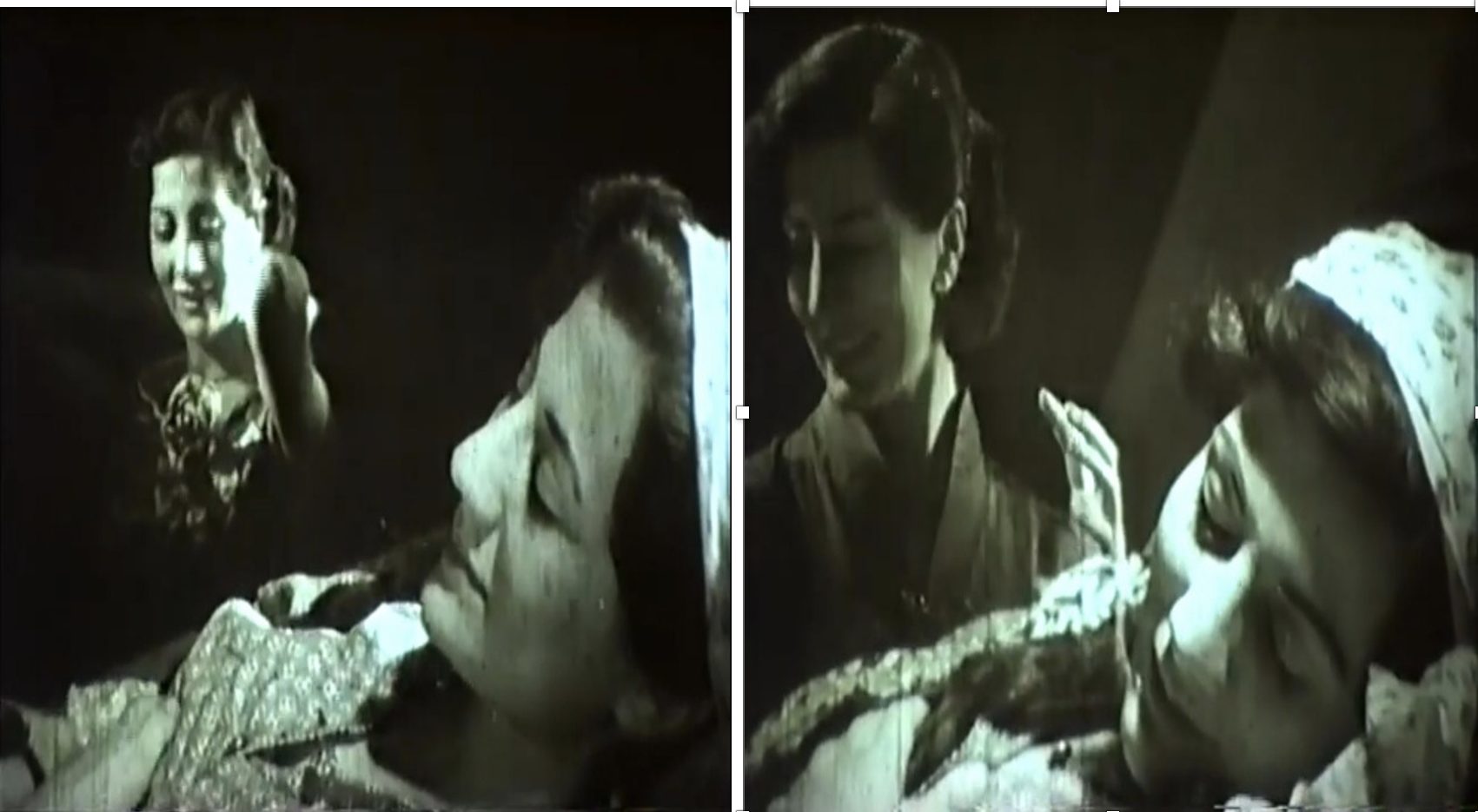
Figures 1–2: Stills from Gulnisā, directed by Serge Azaryan, 1953.
Love Trap (1961) advanced this trajectory further and stands as one of the earliest Iranian films to depict female sexual fantasizing directly. As Hasan Husaynī observes, “The female character in this film (within the realm of her dream) steps into a domain that had hitherto been entirely monopolized by men in Iranian cinema: sexual fantasy. Love Trap is undoubtedly one of the earliest examples of this breaking of tradition in Iranian cinema—a path that, in the following years, found few successors due to the prevailing patriarchal perspective in this cinema.”10Hasan Husaynī, ed., Rāhnamā-yi fīlm-i sīnimā-yi Īrān: jild-i avval (1309–1361) [A Companion to Iranian Cinema, Part One: 1930–1982] (Tehran: Rawzanah Kār, 2020), 121. The film centers on a young woman named Maryam (played by Āzādah), who falls in love with a young musician and resists the family-imposed suitor. The fantasy sequence opens with a shot of Maryam lying on a bed, as the camera slowly zooms in on her face. As the image gradually fades, the fantasy unfolds. In the dream, Maryam and Nāsir sit beneath a tree, engaged in lovemaking. (Figures 3–4) The natural setting—a recurrent trope in the cinema of this era—serves as a conventional substitute for the bedroom, functioning simultaneously as a means of evading censorship. Considering the moral constraints, Maryam’s fantasy remains entirely modest. Both characters are fully clothed in formal attire, and the emotive music foregrounds the romantic dimension of the scene over sexual aspect. As in the previous example, this dream sequence is less centered on the male body and more focused on structuring the entirety of the romantic experience from Maryam’s perspective. Nevertheless, the depiction of this imaginary intimate encounter,although still presented in a romanticized and moralized guise, represents a significant step in the history of representing female desire in Iranian cinema.
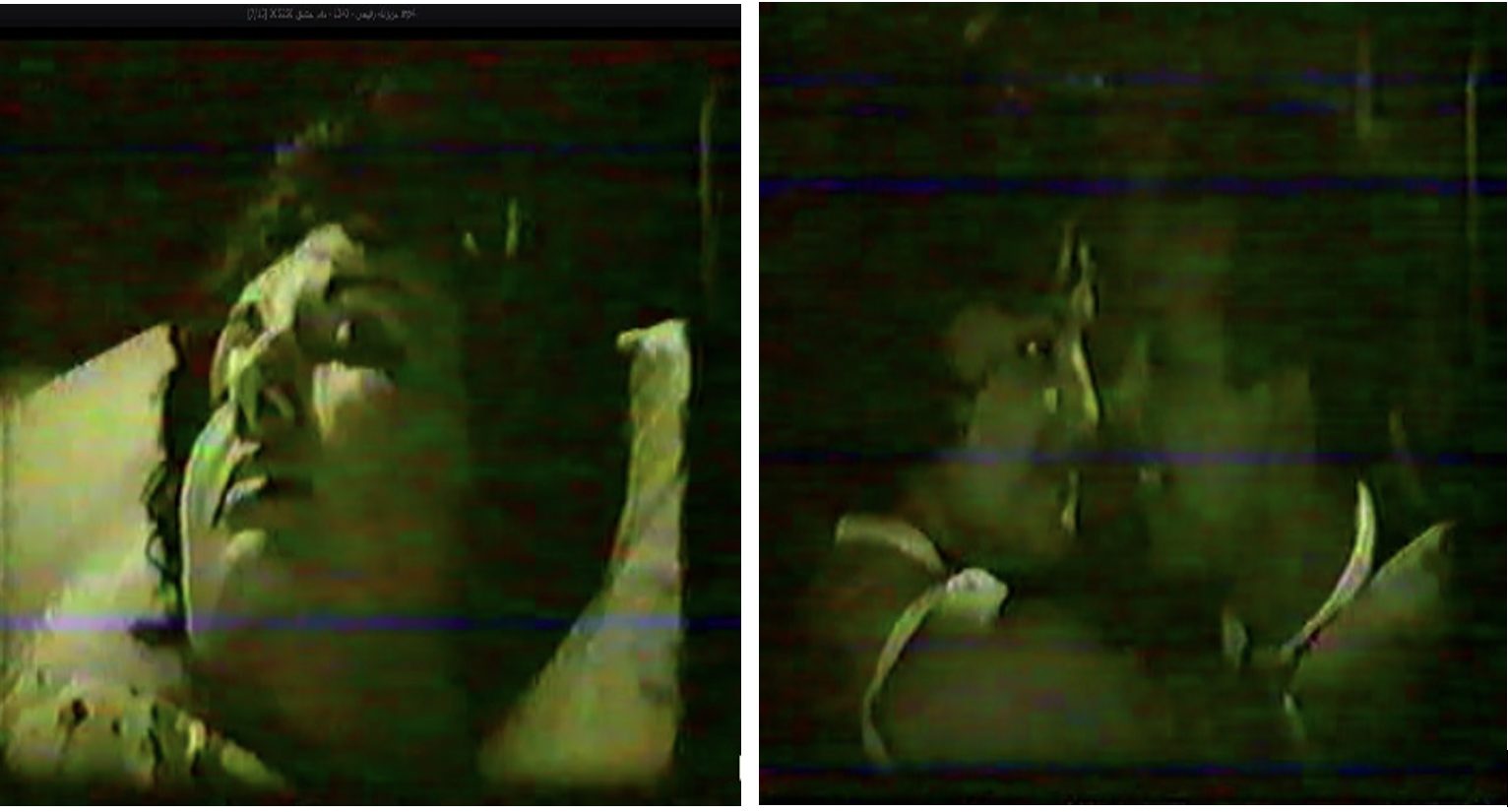
Figures 3–4: Stills from Love Trap (Dām-i ʿIshq), directed by ʿAzīzallāh Rafīʿī, 1961.
In I Am a Mother (1965), sexual frustration drives the woman toward the realm of fantasy. The narrative revolves around a woman (played by Āzar Shīvā) whose husband is indifferent toward her. In the scene under discussion, she attempts to attract her husband’s attention through seductive gestures. The erotic charge of her actions is heightened by close-ups and medium shots, underscored by jazz music, while her point-of-view shot shows the husband absorbed indifferently in reading the newspaper. Frustrated in her desire, the woman lies down on the bed, gazes off-frame, and begins to fantasize. At this moment, superimposed images of her memories with her husband’s friend—who admires her—appear over her face. (Figures 5–6) This transition from marital frustration to a substitutive fantasy illustrates a mechanism that can be elucidated in Lacanian terms: the object of desire changes, yet the structure of desire remains constant. Here, the film moves away from depicting a direct sexual fantasy—which would have been prohibited at the time—and instead represents it through memory images; in other words, the flashback serves as a surrogate fantasy. The film thus offers a rare portrayal of a married woman who disregards marital boundaries and carves out a psychic space for the realization of her own desire.
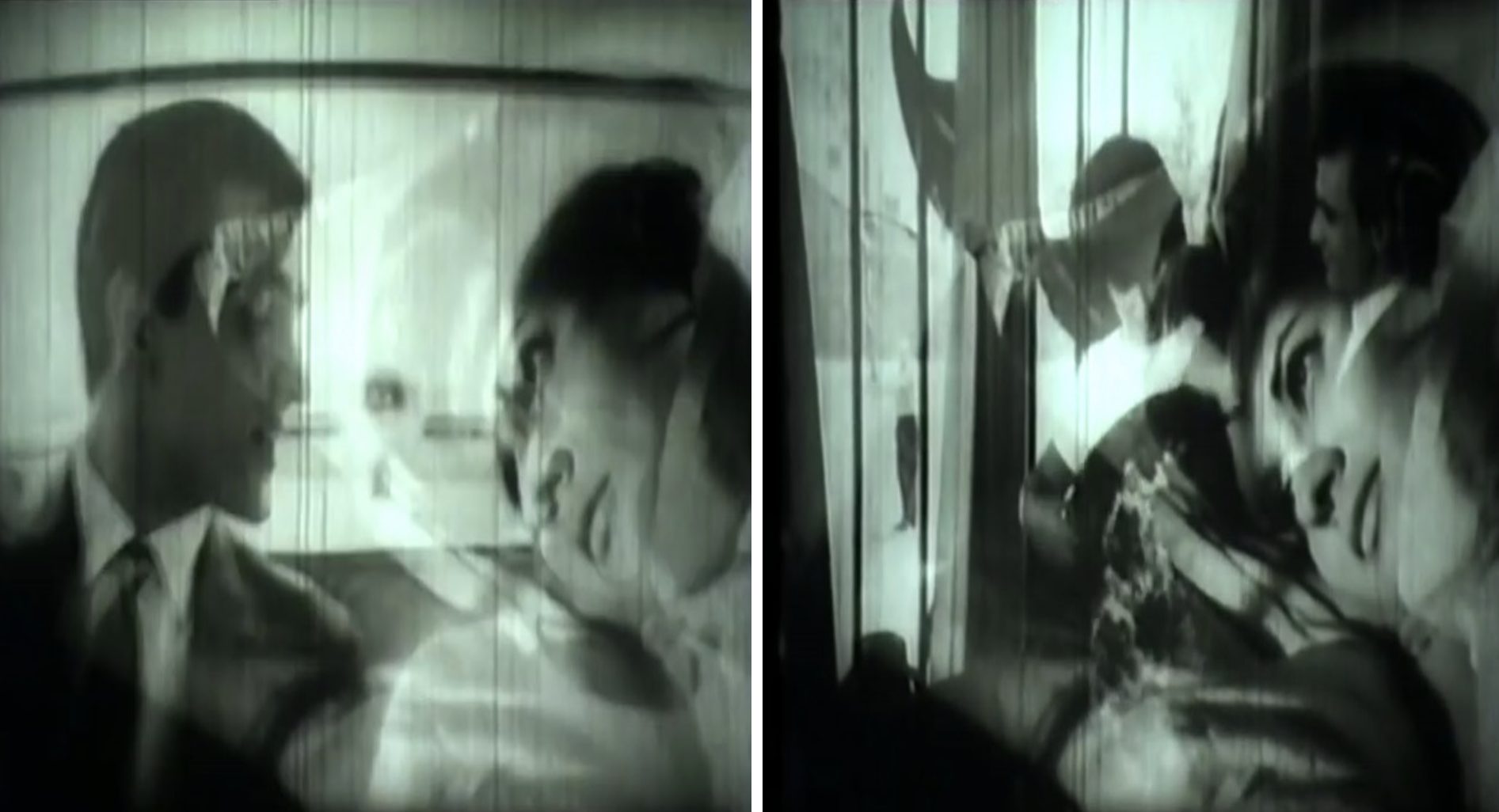
Figures 5–6: Stills from I Am a Mother (Man Mādar-am), directed by Farajallāh Nasīmiyān, 1965.
In The Jungle Man (1970), female sexual fantasy arises from the confrontation between two opposing models of masculinity. The character of Nargis (played by Suhaylā) is positioned between two poles: on one side, the weak, ridiculous, and intrusive “Āqā ʿAbdallāh,” who symbolizes sexual impotence; on the other, the attractive, muscular “Akbar Lancaster,” who embodies dominant masculinity. In the fantasy sequence, the camera slowly zooms from a wider shot to a close-up of Nargis’s face as she closes her eyes, and the fantasy image is gradually superimposed onto her face. Within the fantasy, Nargis appears on a riverbank deep in the forest, wearing makeup and an elegant dress, singing and dancing. Then, Akbar Lancaster enters the frame from off-screen and embraces her. His presence—marked by dark clothing and a powerfully built body—transforms this fantasy into a scene where female sexual desire is articulated. The male gaze directed at Nargis’s body, in contrast to male-centered narratives of the era, here functions as a reflection of female longing: a desire for intimacy and an erotic relationship with the man. Suddenly, the fantasy is disrupted. Akbar Lancaster turns away from Nargis and disappears into the depths of the forest. Nargis continues singing, seemingly immersed in her own performance, until she abruptly looks off-screen and lets out a scream of fear. The subsequent point-of-view shot reveals a grotesque, monkey-like mask entering the frame; moments later, the mask is pulled away, exposing Āqā ʿAbdallāh standing behind it. Her terror marks a sudden rupture in the flow of her fantasy—an anxiety that threatens female desire through the intrusion of an unwanted object. The threatening male presence at this level displaces the female subject from a state of pleasure and immersion in fantasy into a defensive posture of fear. The frantic flight of Nargis embodies the underlying structure of classical cinema, which interrupts the autonomous realization of female desire, thrusting it toward the brink of nightmare. The key element in this scene is the connection between the forest environment and Nargis’ desire. The forest, with all its symbolic attributes—wild, primitive, and lawless—becomes the mise-en-scène of her erotic imagination, functioning as a powerful metaphor for an uncontrollable female sexuality. This space enables Nargis’s longing to emerge unrestrained and free from the social and moral constraints imposed by symbolic order. Furthermore, the forest provides the setting for her attraction to Akbar Lancaster—a man who embodies phallic masculinity for her. In this sense, the forest simultaneously expresses her instinctual desire and opens a liberated space for the enactment of her erotic imagination. In the final shot of the sequence, the image of Nargis fleeing from Āqā ʿAbdallāh within her fantasy abruptly cuts to a shot of her in reality: she leaps out of bed in terror and, along the very path traced by her fantasy, encounters the real Akbar Lancaster. At this moment, the force of fantasy irrupts into reality; the imagined escape from the weak, undesirable man becomes directly linked to her physical escape in the real world.
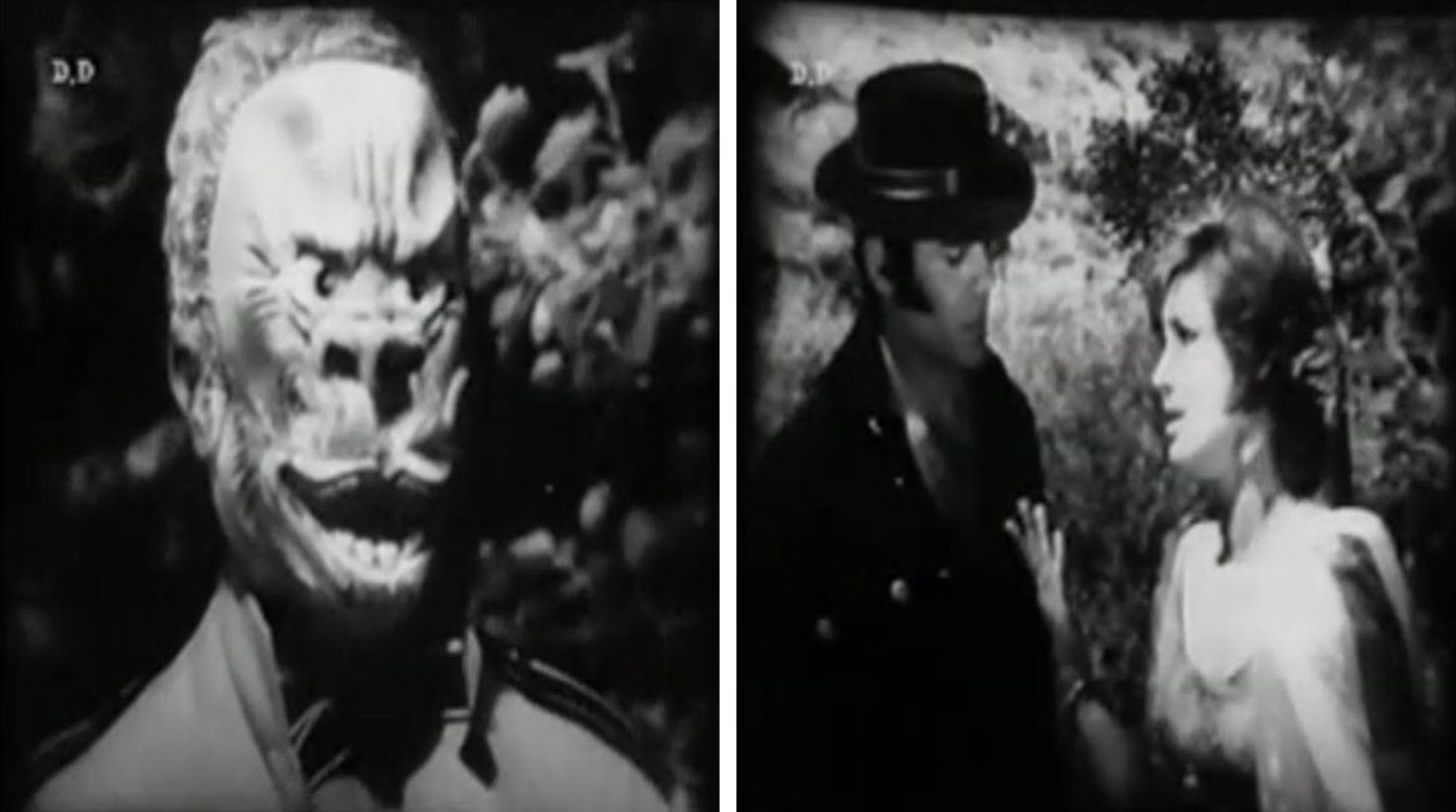
Figures 7–8: Stills from The Jungle Man (Mard-i Jangalī), directed by Kamāl Dānish, 1970.
The representation of female desire in Men of the Dawn (1971) is mediated through a metaphorical language. In her fantasy, Mīhan (played by Pūrī Banāyī) imagines Jahān (played by Rizā Bayk Īmānvirdī) entering her bedroom. The shot is represented as Jahān’s point of view, opening on a staircase over which streams of rainwater cascade, tracing the path that leads toward Mīhan’s bedroom. Frequent jump cuts, combined with the camera’s dynamic movements, accentuate the shot’s dreamlike quality. As the man enters the room, Mīhan opens her eyes and smiles; at the very moment of their approach, the shot cuts, and their intimacy is displaced on a metaphorical level. In the continuation of the scene, a sort of obsession with the fluidity of water is present as a visual motif. Shots of rain, the reflection of shimmering water, and the flowing quality of waves and ripples, combined with their sound ambiance, construct the overall atmosphere of the sequence. The framing of these images in close-ups, in addition to their diegetic function, links female sexuality to a fluid space. Feminist theorists, drawing on the writings of Luce Irigaray, have associated the uncontrollable quality of fluid mechanics with femininity.11Luce Irigaray, “La ‘Mécanique’ des fluides,” in Ce sexe qui n’en est pas un (Paris: Éditions de Minuit, 1977), 106–11; Giuliana Bruno, Streetwalking on a Ruined Map: Cultural Theory and the City Films of Elvira Notari (Princeton: Princeton University Press, 1993). According to Mary Doane: “as fluid signals that which exceeds set forms, boundaries, or limits, it is reminiscent of the construction of femininity, since excessive femininity is precisely that which does not respect boundaries, limits or frames.”12Mary Ann Doane, The Desire to Desire: The Women’s Film of the 1940s (Bloomington: Indiana University Press, 1987), 104.This symbolic motif, in connection with the following sequence showing Jahān in a public bath, further highlights this metaphor. At the end of the sequence, Mīhan awakens from her dream, and close-ups of her face and lips reveal the imprint of the fantasy on her body.
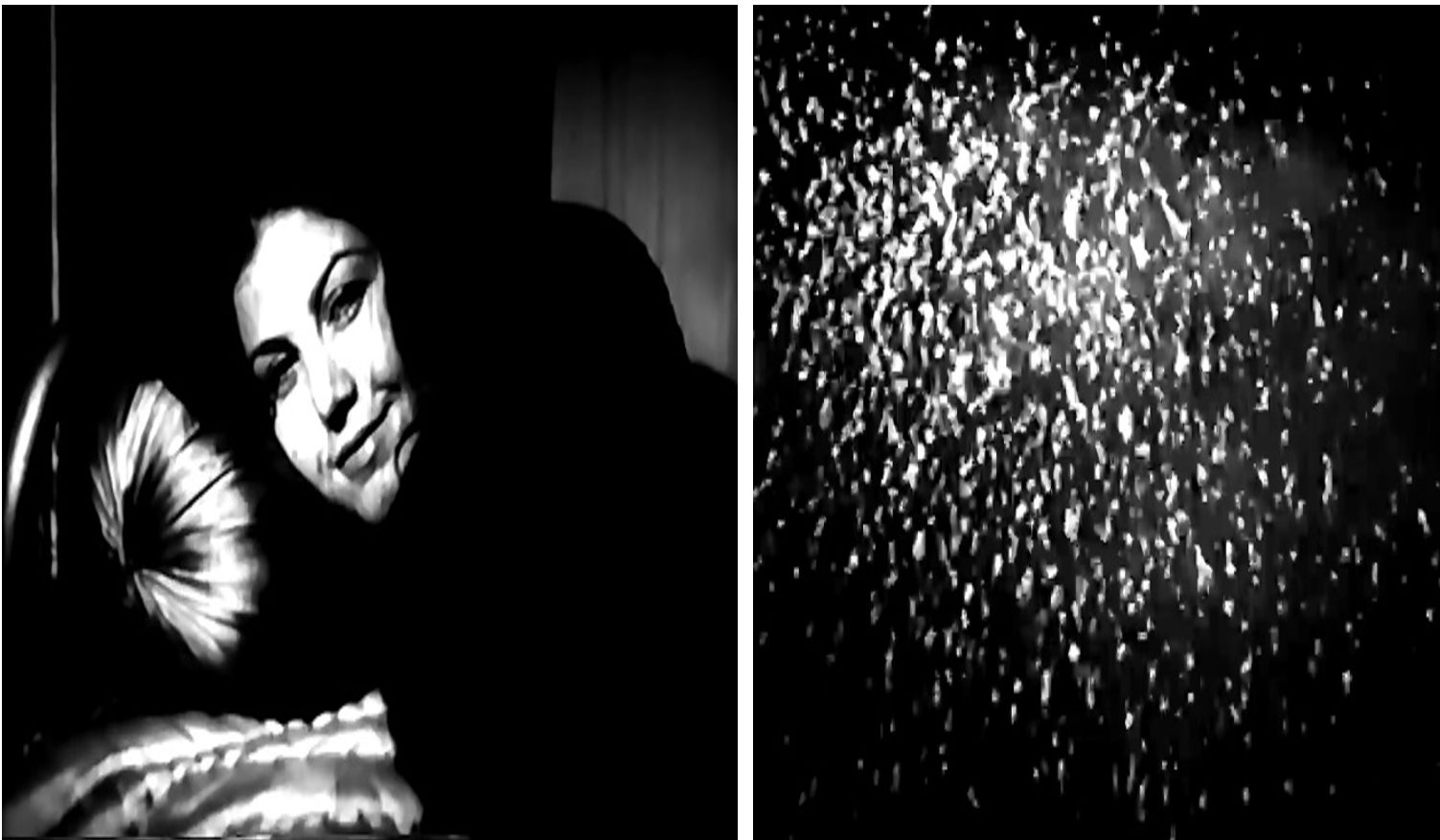
Figures 9–10: Stills from Men of the Dawn (Mardān-i Sahar), directed by Ismāʿīl Nūrī ʿAlā, 1971.
In Chubby (1972), the male character is sexually impotent. Frustrated, Amīr’s wife (played by Zarī Khushkām) attempts to seduce the foreman of the workshop at night, but he rejects her. Following this failure, she wanders through the workshop yard, and the light streaming from the workers’ dormitory windows catches her attention. She stops by one of the windows and peers into the dormitory in the darkness of the night. Inside one of the rooms, two naked workers are engaged in wrestling. Through a series of shots between the woman looking and her point-of-view, the scene establishes a voyeuristic logic of the gaze. The physical masculinity on display—the men’s muscular bodies engaged in contest—stirs her arousal, leading her to instinctively touch her own body. She then moves past the first window and stops at the next, where a group of male workers is fighting over possession of a photograph depicting a nude woman, each attempting to claim the image for himself. At this moment, the woman simultaneously observes the objectification of female body within the male gaze and projects herself into the position of the coveted object of their collective desire. She continues her wanderings and pauses at the final window, where she witnesses Tupulī winning in an arm-wrestling match. The display of his physical strength functions as a metaphor for sexual potency, standing in sharp contrast to her husband’s weakness.
In this sequence, a striking inversion of the conventional voyeuristic male gaze takes place. The woman’s curious and desiring gaze establishes a scopophilic relationship with the spectacle framed by the window, transforming the male bodies into objects of her visual pleasure. From the concealing darkness of her safe vantage point, she voyeuristically observes the muscular male forms, projecting her repressed desires onto them. The sequence can be read as an embodiment of female erotic fantasy. The successive windows function as cinematic tableaux, each framing and reflecting the woman’s desire for intimacy with a sexually potent man. In this regard, the female character becomes a spectator of her own desire, structured through quasi-cinematic frames. This interpretation aligns with Lacanian notions of fantasy as the imaginary scene that structures desire around the unattainable objet petit, here embodied in the visions of masculine strength that both fill and perpetuate her lack.
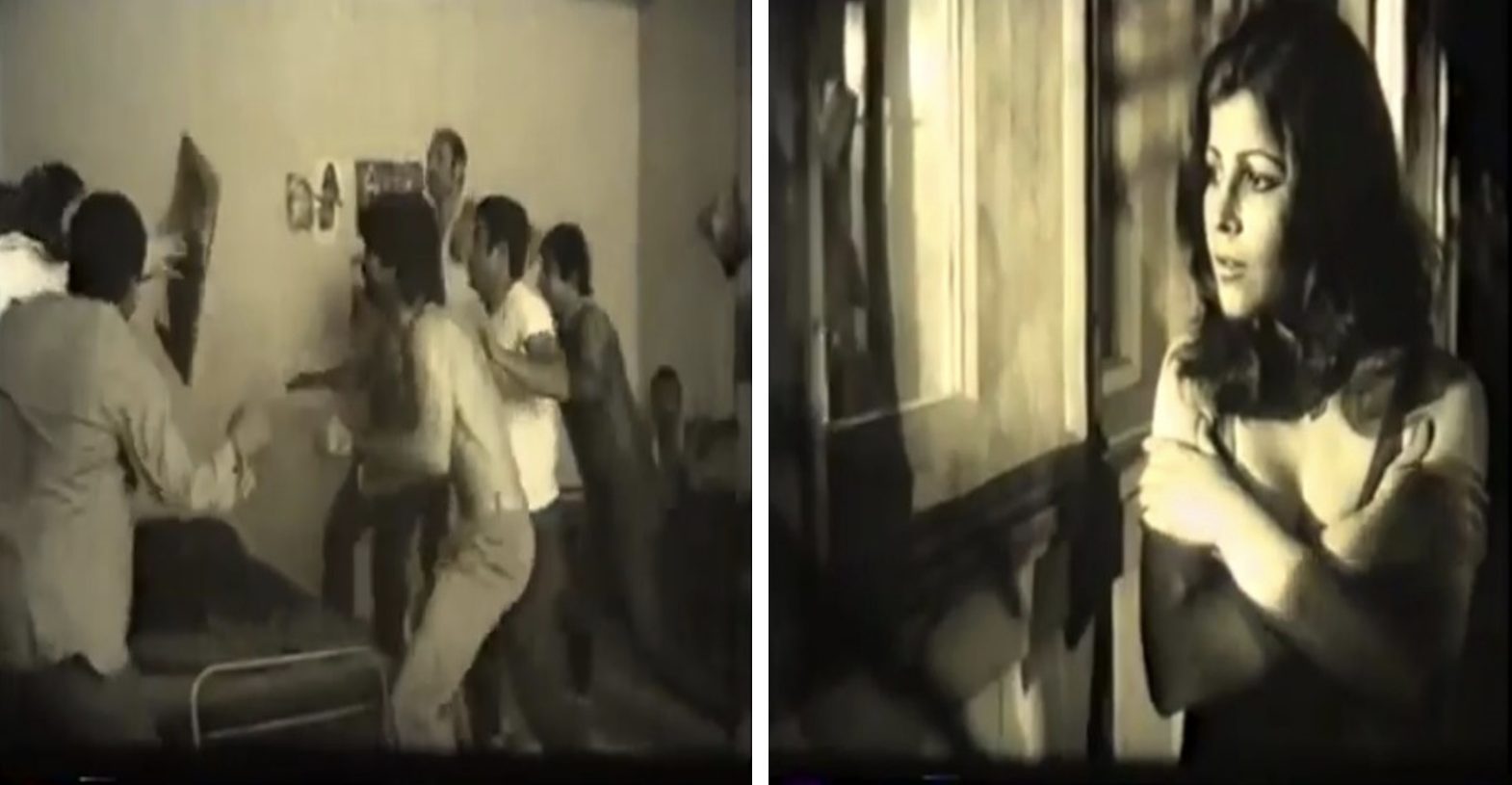
Figures 11–12: Stills from Chubby (Tupulī), directed by Rizā Mīrlawhī, 1972.
Escape from Death (1973) represents female fantasy in connection with maternal longing and the yearning for a family life. The female character, Lālah, is a cabaret performer with a disabled child. After meeting Rahmān, a man who shows affection toward her, Lālah becomes emotionally attached to him. The fantasy scene of Lālah occurs after Rahmān, with promises of support, instills a renewed hope in her life. It opens with a maternal vision: her disabled child runs happily across a meadow. The scene then transitions to romantic fulfillment: Lālah and Rahmān run toward each other, and with Lālah’s veil (Chador) falling—a metaphor for surrendering her body to the man—they embrace. The child joining this embrace turns the fantasy into a longing for a family formation: a harmonious triad of mother, father, and child. This multilayered fantasy performs three interconnected functions. First, it grants Lālah agency and subjectivity: a woman who, in the real world, is positioned as an object of male desire and relegated to the social margins becomes, in her imagination, an active desiring subject. As Elizabeth Cowie argues, fantasy constructs an imagined scene in which the subject is positioned as the protagonist, staging the fulfillment of a wish.13Elizabeth Cowie, Representing the Woman: Cinema and Psychoanalysis (London: Macmillan Press, 1997), 127.Second, the fantasy enables her to rewrite her social role. As a cabaret performer, Lālah is excluded from a legitimate family. In fantasy, she places herself at the center of an idealized nuclear family, reclaiming a position of belonging denied to her by societal norms. Third, the sequence reveals the intertwined nature of female desire in the film: romantic and maternal impulses are not separate but deeply entangled.
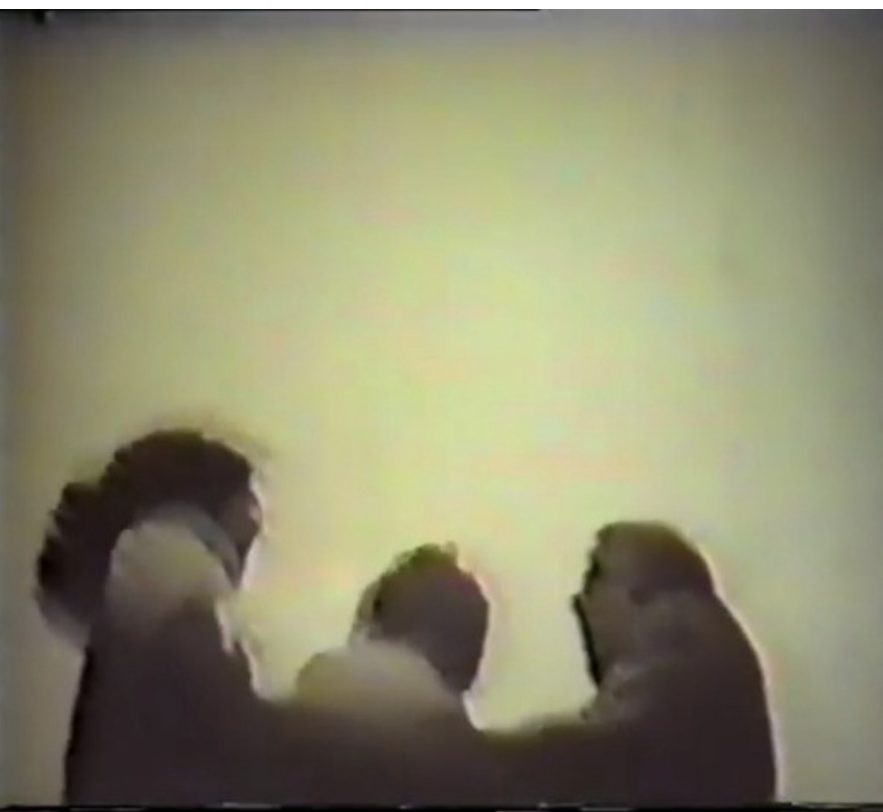
Figure 13: Stills from Escape from Death (Gurīz az Marg), directed by Nāsir Muhammadī, 1973.
The Villain (1973) reflects one of the most forthright representations of female sexual fantasy and is considered “a rare example of the unabashed expression of female desire and agency in the world of Fīlmfārsī.”14Hasan Husaynī, ed., Rāhnamā-yi fīlm-i sīnimā-yi Īrān: jild-i avval (1309–1361) [A Companion to Iranian Cinema, Part One: 1930–1982] (Tehran: Rawzanah Kār, 2020), 550. The female character, Farīshtah (played by Arghavān), openly expresses her desire for Tūraj, and this longing finds its most articulation in an erotic fantasy sequence. The scene opens with a shot of Farīshtah lying on her bed, clutching a pillow to her chest and gripping it with her hands. Suddenly, the image freezes into a photographic still—a formal device that signals the transition from the real to the realm of fantasy. The image then cuts to a fantasy in which Farīshtah and Tūraj walk together. This oscillation between reality and fantasy continues as a recurring motif. With each return to the bedroom shot, the erotic intensity of Farīshtah’s gestures is heightened. In the subsequent fantasy, Farīshtah envisions herself in bed with Tūraj, their bodies entwined as the camera circles fluidly around them. Here, camera movement emerges as a mechanism that embodies the subjectivity of female desire. In the reality portions of the scene, the camera remains static—fixed beside the bed in an observational position. By contrast, in fantasy shots the camera is fully fluid, reflecting the kinetic energy of female sexuality. In representing the female erotic relinquishing, the film evokes a metaphor familiar to collective imagination: the tearing of the pillow and the scattering of its feathers around the room. From a historical perspective, the frank, unmediated depiction of female sexual fantasy, unfolding in the privacy of the bedroom, challenged the boundaries of censorship and public morality of the era.
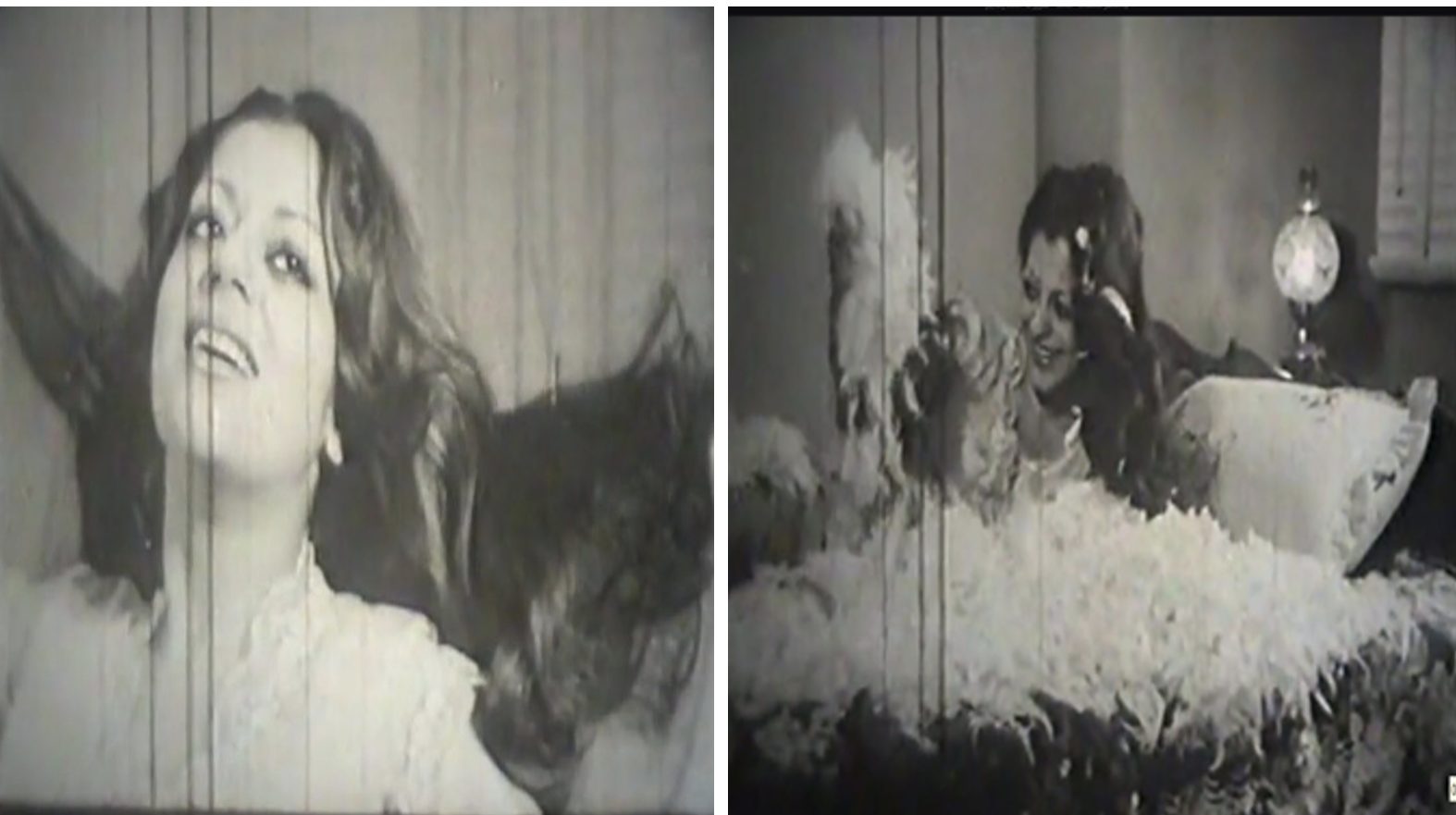
Figures 14–15: Stills from The Villain (Sharūr), directed by Nāsir Muhammadī, 1973.
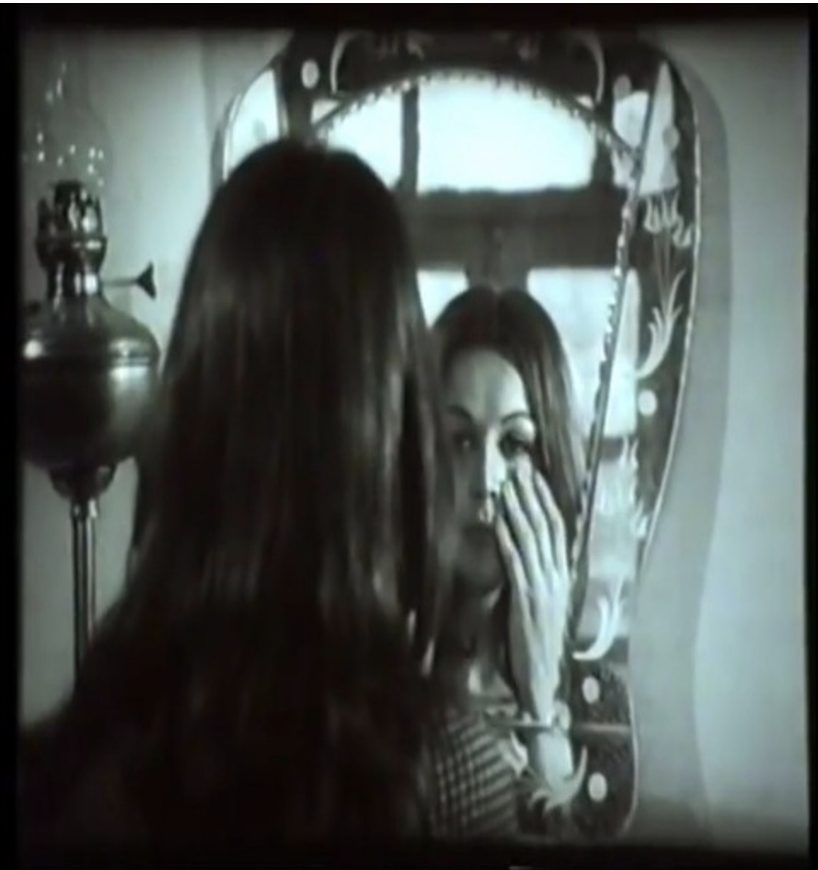
Resurrection of Love (1973) depicts female desire within the confines of a household structured by traditional relationships. The first encounter between Gulrukh (played by Farīshtah Jinābī) and Ahmad, in a room that previously belonged to him, creates a situation in which the male gaze and female fantasy are simultaneously activated. In this scene, Gulrukh’s chador falls off, and her body is briefly revealed. At this point, the editing—cutting between Ahmad’s point-of-view shots, his fixed gaze, and close-ups of Gulrukh’s body—reinforces the classical structure of the male gaze. After Ahmad leaves the room, the camera returns to Gulrukh, showing her gazing at her own bodily image in the mirror. She touches her cheeks and lips, enacting the fantasy of being touched by Ahmad. Gulrukh’s gaze then moves across the walls of Ahmad’s room, which are covered with posters of nude male athletes. The camera, aligned with Gulrukh’s point of view, moves closer to the poster of the male athlete; her hand enters the frame and touches the image of the male body. She then slides her hands over her own body, embraces herself. Under the constraints of traditional gender norms, her desire is displaced onto the image as a substitute surface. Since the girl is not allowed to enact her desire toward Ahmad on his actual body, she projects it onto images of male athletes who embody an idealized form of masculine physicality. Her tactile engagement with the surface of the image fills the distance between herself and Ahmad with an imaginary object.
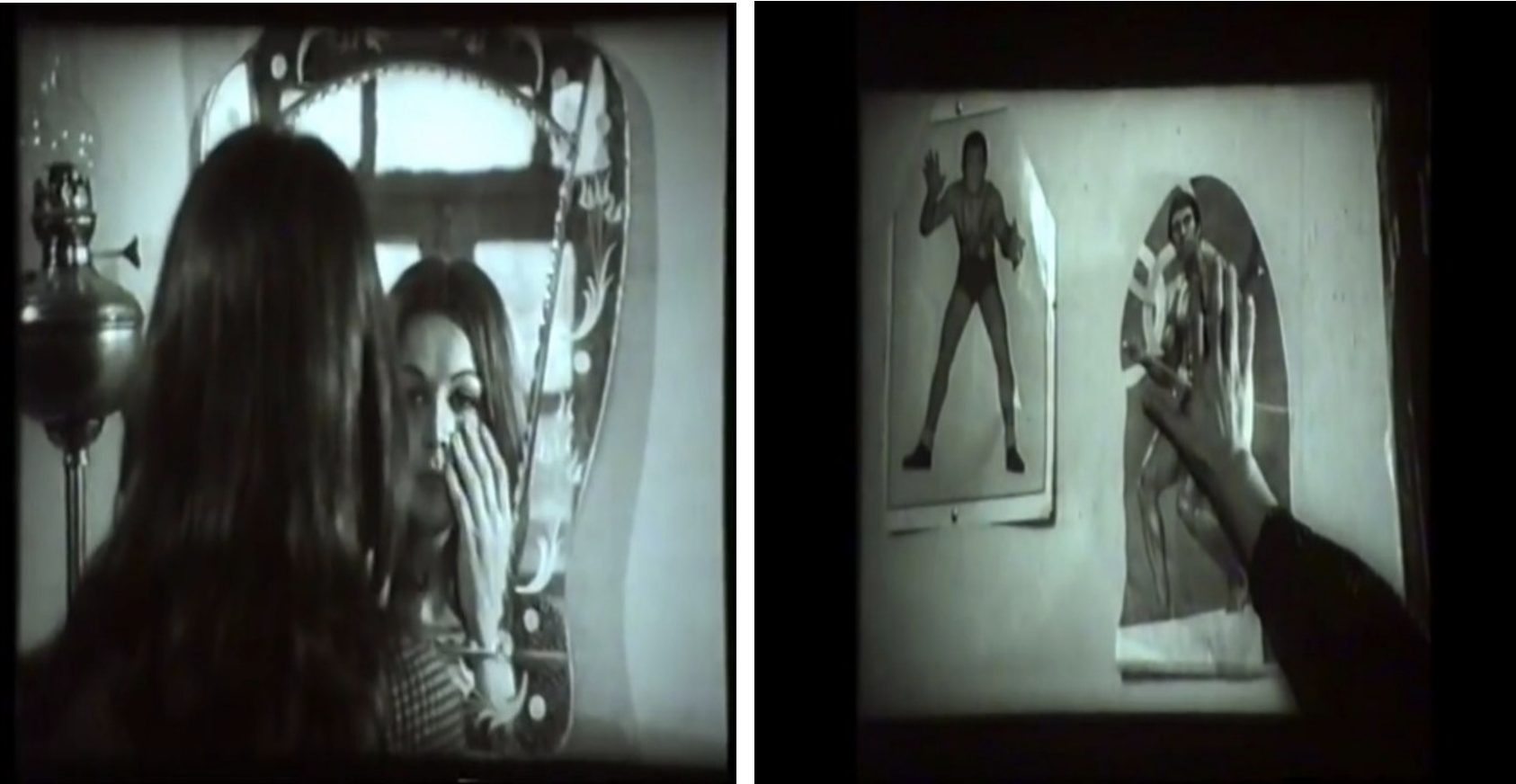
Figures 16–17: Stills from Resurrection of Love (Qiyāmat-i ʿIshq), directed by Hūshang Hisāmī, 1973.
In Muzaffar (1974), female fantasy is represented through imaginary cinematic images. The film tells the story of a young woman named Gulī (played by Mary Apick), who falls in love with Muzaffar, a man regarded as eccentric, while her mother (played by Parvīn Dawlatshāhī) fiercely opposes this choice, attempting to steer her toward marriage with Mutahhar, a wealthy man. As Doane notes in her psychoanalytic analysis of maternal melodramas, the mother is often positioned as a force alien to the love story, acting as a restraining power against the “daughter’s misdirected desire—her insistence on striving after the wrong object.”15Mary Ann Doane, The Desire to Desire: The Women’s Film of the 1940s (Bloomington: Indiana University Press, 1987), 92. Here too, Gulī’s attachment to Muzaffar stands in direct opposition to maternal desire. The mother, as a representative of the family institution, seeks to correct or suppress her daughter’s desire by imposing the figure of the wealthy man as the proper choice. This tension reaches its symbolic apex in Gulī’s fantasy. In this scene, she goes to the cinema accompanied by her mother. While watching the film, Gulī’s mother points to the wealthy male character on screen and remarks that he is exactly like Mutahhar. She then identifies the female character with Gulī herself, seeking to impose her ideal relationship on her daughter’s imagination. In response to this imposed interpretation, Gulī asserts that the devoted lover in the film more closely resembles Muzaffar. At this moment, Gulī’s point-of-view shot is represented, in which Muzaffar appears as the devoted lover and Mutahhar as the wealthy man on the cinema screen. This shot, rendered in the colorful imagery of a popular Hindi film—breaking the black-and-white logic of the original film—marks a rupture from reality and an entry into the realm of fantasy. In this scene, the cinema screen becomes a medium onto which the female subject projects her desire, allowing her to confront her inner conflicts. As has been argued in theoretical readings of cinema, the film screen can function as a membrane between lived reality and the realm of fantasy; a temporary site onto which the subject invests affectively (cathects) their impossible desire.16Tom Gunning, “A Machine for Killing Time,” in The Oxford Handbook of Film Theory, ed. Kyle Stevens (New York: Oxford University Press, 2022), 27. In this film as well, Gulī’s fantasy emerges on the cinema screen as a scenario of repressed desire. Yet the crucial point is that her fantasy is shattered by the imposed scenario—dictated by the mother figure. In the narrative of the Hindi film, the female character ultimately chooses the wealthy man, leaving the devoted lover aside.
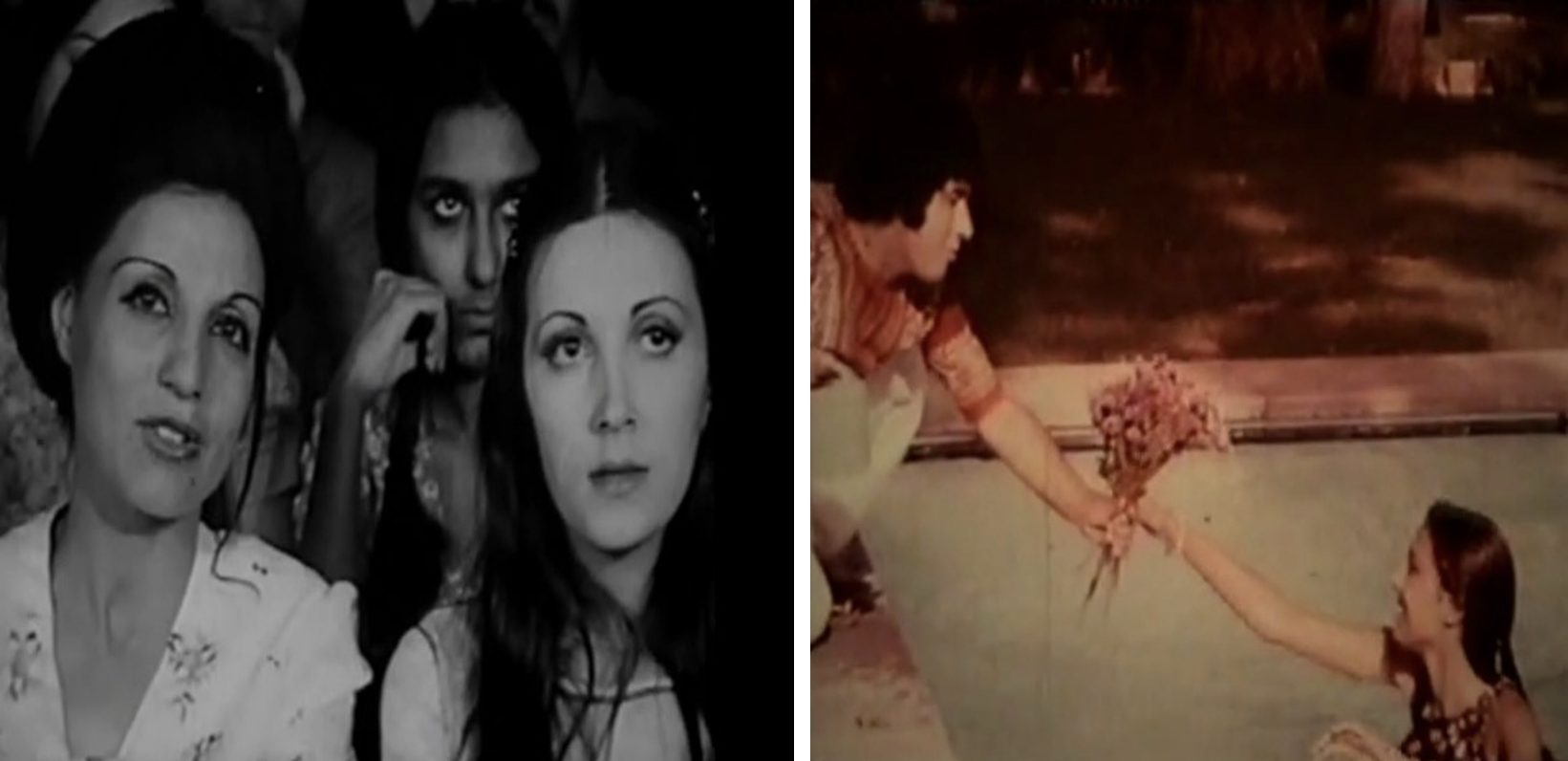
Figures 18–19: Stills from Muzaffar, directed by Masʿūd Zillī, 1974.
In The Ruined House (1975), Nāzī’s fantasy becomes a pivotal site where female desire emerges through her encounter with modern architecture, revealing the gap between the traditional Qājār house and the modern architectural space. In the sequence where the architect explains the blueprint of the new house to the Nawrūzkhān family, each family member fantasizes about the space designated for them. When the architect says, “each room has a private bathroom,” the shot cuts to a close-up of Nāzī’s face; whispering “private bathroom,” she enters her fantasy. In the fantasy, Nāzī is in a modern, private bathtub filled with foam, touching her body. The framing of her face alongside the phallic faucet and her expressions highlights the erotic nature of this fantasy. In Žižek’s reading of Lacan, fantasy “fills out a certain void, lack or empty place.”17Slavoj Žižek, The Sublime Object of Ideology (London: Verso, 1989), 80. The modern bathroom becomes such a fantasy-space for Nāzī: an imaginary site where the absence of privacy within the Qājār house appears temporarily resolved. In this sense, Nāzī’s fantasy emerges as a desire to rediscover bodily pleasure within a new spatial order—one that, in her imagination, promises autonomy and personal ownership over her own body. This imagination is meaningfully intertwined with visual modernity. As researchers have shown, Western visual media and popular magazines during this period, by presenting erotic images, had a significant influence on women’s imagination.18Janet Afary, Sexual Politics in Modern Iran (Cambridge: Cambridge University Press, 2009); Kamran Talattof, Modernity, Sexuality, and Ideology in Iran: The Life and Legacy of a Popular Female Artist (Syracuse: Syracuse University Press, 2011). In this scene, when the architect refers to the American origin of the plan, Nāzī responds that she has seen American houses in cinema, indicating that her fantasy is nourished by cinematic representations of modernity. From this perspective, Nazi—a modern girl in a Qajar house—discovers the eroticized body in the modernized body of the new house. Her fantasy demonstrates that the modernization of space can lead to the relative liberation of women from the collective order and control of the traditional home, transforming modern architecture into a site that enables the formation of a new female subjectivity.
Conclusion
An examination of selected examples in pre-revolutionary Iranian cinema indicates that the representation of female desire was a gradual and evolving process, consistently shaped within the tension between moral and regulatory constraints. Throughout this historical trajectory, fantasy has been the primary strategy for representing female desire; since such desire was not permitted to manifest openly at the level of narrative or social reality, it could only emerge through the ruptures provided by fantasy. Whereas male fantasy in pre-revolutionary Iranian cinema typically relies on established patterns of domination, ownership of the female body, and the display of male power, female fantasy assumes a fundamentally different quality. It is not structured around possession of the Other, but rather on the pursuit of being seen and reclaiming one’s own body as a field of desiring subjectivity. In early examples such as Gulnisā (1952), female desire found expression through formal techniques—such as superimposition and the removal of the male figure from the frame. Here, fantasy functions as a mediator for entering the realm of modernity. Yet even this fantasy is tied to punitive consequences (tragic death), indicating that female eroticism in this period could only be represented insofar as it was ultimately restored to the dominant moral order. In the 1960s, with films such as Love Trap (1961) and I Am a Mother (1965), female fantasy gained greater autonomy, yet it was still represented under the guise of romanticism and reminiscence. The preference for emotional gestures over sexual actions indicates a mechanism through which female desire was displaced from the nude body to a moralized and socially acceptable experience. At this stage, female fantasy is primarily a response to marital failure or the imposition of familial choices. Moreover, the preference for natural locations over the bedroom suggests that, for female desire to appear on screen, it must be represented within an imaginary geography, outside the bounds of patriarchal society. With the onset of the 1970s, a remarkable transformation occurs in the visual language and expressive audacity of female desire in cinema. The films produced in this decade demonstrate that female fantasy became increasingly embodied, active, and oriented toward the male body. In these works, the male body is explicitly transformed into the object of female desire for the first time. In Chubby (1972), the female character seizes the position of the active bearer of the look, disrupting the dominant male visual regime and articulating her voyeuristic fantasy through the complex interplay of being both observer and imagined object of desire. Modern architecture and private spaces—in The Ruined House (1975)—play a key role in the evolution of female fantasy. The independent bathroom, as a novel space, provides the possibility for imagining the eroticized body, demonstrating that the modernization of space is a precondition for the formation of a new subjectivity of femininity. However, female fantasy is never entirely freed from the threat of collapse or disruption. In some cases, fantasies turn into nightmares, become substituted with unwanted objects, or are disrupted by the presence of the mother figure. In this light, the history of representing female desire in pre-revolutionary Iranian cinema can be understood as the history of Iranian women’s fantasies that oscillated between social repression and imaginary liberation, and through this very oscillation, inscribed traces of female subjectivity on the cinema screen.
Cite this article

This article examines the representation of female desire in pre-revolutionary Iranian cinema from 1952 to 1975, offering a close reading of rare scenes of female fantasy across a selection of films from this period. While Fīlmfārsī predominantly portrayed women as objects of the male gaze, these scenes mark moments of rupture in which repressed female desires momentarily emerge. Drawing on Lacanian concepts of desire, the study argues that fantasy enables the female subject to experience repressed desires on an imaginary level. Revisiting these scenes allows for a remapping of Iranian cinema’s history as a contradictory field in which moments of female subjectivity briefly surface, challenging the dominant narrative of the male gaze. The analysis situates these representations within the socio-cultural context of Pahlavi-era modernization, during which women’s public presence increased while continuing to coexist with patriarchal constraints. The article argues that the representation of female desire in pre-revolutionary cinema evolves from constrained, moralized fantasies toward more nuanced and corporeal expressions; yet this shift never leads to complete liberation from censorship mechanisms and patriarchal order.