
Taking Refuge in Nature: An Ecocritical Perspective on Citizenship and Dispossession in Contemporary Iranian Cinema



Introduction: Iranian Cinema and Ecocriticism
“Ecology, by its very definition, is unrestricted; it is impossible to say where nature stops and culture begins, or vice versa.”
—Nadia Bozak, The Cinematic Footprint
Contemporary Iranian cinema has long been recognized internationally as a compelling example of national cinema that resists political oppression, largely due to its inventive use of metaphor, symbolic narrative structures, and sophisticated strategies for navigating censorship.1Hamid Taheri, “Compliance and Resistance in Iranian Cinema’s Censorship Landscape: A New Approach to Analyzing Iranian Films,” Quarterly Review of Film and Video 42, no. 6 (2024): 1435–53, https://doi.org/10.1080/10509208.2023.2294662. While much of the existing scholarship on Iranian cinema in Iranian studies or academic studies in general and film and literary criticism in general focuses on post-revolutionary politics and oppositional stances toward the Islamic Republic, repositioning contemporary Iranian cinema within the framework of ecocriticism offers a significant shift in critical perspective. This approach not only challenges conventional critical approaches but also calls for an expansion of the scope of Iranian studies to include ecocritical methodologies. Given that ecocriticism has only recently gained traction in the humanities, arts, and social sciences, particularly since the early twenty-first century, its application to Iranian cinema remains a largely underexplored yet promising area of scholarship.2Sean Cubitt, Salma Monani, and Stephen Rust, Ecocinema Theory and Practice (New York: Routledge, 2013), doi:10.4324/9780203106051. As Stephen Rust and Salma Monani note,
First, we agree that all cinema is unequivocally culturally and materially embedded. Second, whatever our politics, we tend to agree that the dominant, consumeristic modus operandi often suggests a troubled state of affairs not only in human interactions but also with the nonhuman world, and that cinema provides a window into how we imagine this state of affairs, and how we act with or against it.3Cubitt, Monani, and Rust, Ecocinema Theory and Practice, 3.
By asserting this entanglement of cinema with both cultural and material conditions, they suggest that films inevitably reflect ecological relationships between humans and the world, which are not merely symbolic but materially grounded in the very fabric of cinematic representation. Given Iran’s role as a major oil producer in the Middle East and its participation in global industrialization, Iranian studies must engage with this cinematic fabric and the ecological dimensions already embedded across genres, from documentaries and short films to social media activism. This engagement is already underway, exemplified by emerging scholars such as Roya Khoshnevis, whose insightful work on Iranian literature explores the intersections of modernization, oil production, and representation. A cultural theorist specializing in petroculture studies, Khoshnevis earned her PhD in Cultural Analysis from the University of Amsterdam, where her dissertation, “Crude Oil and Its False Promises of Modernization: Petroleum Encounters in Modern Iranian Fiction” (2021), examined how oil as commodity, infrastructure, and modernizing force that reshapes Iranian fiction’s engagements with environment, social relations, and national identity. Her subsequent work on Tehran’s transformation into an “invisible oil city,” as well as her contributions to cultural journalism, further demonstrate how her scholarship bridges the humanities with ecological critique and forms of political resistance.
While the theme of nature is a key component of both ecocinema and ecocriticism, ecocriticism as a theoretical approach does not necessarily require that a film overtly promote environmental consciousness. Paula Willoquet-Maricondi distinguishes between ecocinema and environmentalist film, noting that ecocinema seeks to raise ecological awareness and challenge dominant anthropocentric worldviews, whereas environmentalist film “affirms rather than challenges the culture’s fundamental anthropocentric ethos.”4Paula Willoquet-Maricondi, “Shifting Paradigms: From Environmentalist Films to Ecocinema,” in Framing the World: Explorations in Ecocriticism and Film, ed. Paula Willoquet-Maricondi (Charlottesville and London: University of Virginia Press, 2010), 45. In this light, contemporary Iranian films, such as those analyzed here, can be examined critically through an ecocritical lens, even if they do not explicitly aim to foster environmental activism. Although the anthropocentric ethos that Willoquet-Maricondi critiques places humans at the center of moral and ontological consideration, engaging with this framework is a crucial first step in interrogating human-nonhuman relationships, laying the foundation for a vital ecocritical tradition within contemporary Iranian cinema. The intimate engagement of protagonists with the natural environment emerges as a recurring and thematically significant element in contemporary Iranian cinema. For example, one of the masterpieces of Iranian New Wave cinema (1960-1979), The Cow (Gāv, 1969), directed by Dariush Mehrjui, portrays human-animal interdependence as a powerful metaphor for the failures of modernization and the fragility of human identity. Equally important, one of the earliest examples of Iranian New Wave cinema, Fereydoun Rahnema’s Persepolis (Takht-i Jamshīd, 1960), explores the entanglement of materiality and human memory through the ancient ruins of Persepolis. In this film, temporal decay of the archaeological site is driven not solely by human violence or historical rupture but is animated by nature itself as the primary agent of erosion and transformation. In this sense, nature is not a passive setting but a historical force. As Farbod Honarpisheh explains:
The expansion of the temporality of destruction across the ages means opening the door to another form of allegorical arrangement, that of the slow destruction, the decay. Differentiated from abrupt “destruction by man,” the decay (in a built structure) is, for Georg Simmel, significant as it was brought about by the nonconscious, yet creative, forces of nature.Persepolis dwells on the gradual, still ongoing, destruction brought on by the elements. Nature is still advancing over the ruin, a reality emphasized not only by the voice-over narrative but also by the images of broken stone, stumps of pillars amid grass and flowers, shots of small animals wandering about the place, birds singing, sounds of wind and water.5Farbod Honarpisheh, “From the Body of Ruin to the Ruin of Body: On Materiality and the Iranian New Wave Cinema, 1960–1979,” MoMA post, November 1, 2023, Notes on Art in a Global Context, https://post.moma.org/the-iranian-new-wave-cinema/.
This slow, nature-driven destruction shapes human memory and mediates history as a social and political practice. As nature gradually erases the material traces of the archaeological sites, history itself is reconstituted, continuously reshaped through absence, decay, and transformation. While these films may not aim to raise environmental consciousness in the explicit way ecocinema does, they nevertheless depict the active role of nature in shaping human ontology. In doing so, they serve as compelling examples of environmentalist cinema, highlighting the entanglement of the human and nonhuman.
This article approaches contemporary Iranian cinema through an ecocritical lens, focusing on the imagery of nature as an active and meaningful element of cinematic storytelling. In these films, natural environments are not mere backdrops; they shape the experiences of both characters and viewers, revealing how humans inhabit and respond to their surroundings. As Adrian Ivakhiv defines cinema as a “moving image,” he further proposes that the ethos of ecocriticism in cinema functions through the “anthrobiogeomorphic” apparatuses, drawing on Félix Guattari’s notion of “three ecologies”: cognitive, affective, and material.”6Adrian J. Ivakhiv, “An Ecophilosophy of the Moving Image: Cinema as Anthrobiogeomorphic Machine,” in Ecologies of the Moving Image: Cinema, Affect, Nature (Waterloo, ON: Wilfrid Laurier University Press, 2013), 3–28. These apparatuses allow films to represent spatial materiality while exploring the interdependent relationship between humans and nonhumans. Ivakhiv further emphasizes that the affective afterlife of nonhuman imagery shapes our relationship to the environment and ecological crisis, since cinematic apparatuses can evoke and cultivate ecological consciousness. If, as Ivakhiv suggests, cinema operates as a “machine” that generates this consciousness, then the imagery of nature functions as its fuel, owing to its persistent and generative presence within the very fabric of cinematic narrative. It is the imagery that activates the spectator’s affective and sensory perception through powerful depictions of nature, at times soothing, at times brutal, yet always overwhelming in its force when set against human fragility. This article argues that such powerful representation is prevalent in contemporary Iranian cinema, and that the use of striking imagery of nature has the potential not only to raise environmental consciousness and foster participatory politics against the environmental crisis but also to affirm and acknowledge the fundamental relationship between the human and the nonhuman.
Iranian Cinema and the Politics of Nature
When Bruno Latour asks, “Why political ecology has to let go of nature?,”7Bruno Latour, Politics of Nature: How to Bring the Sciences into Democracy, trans. Catherine Porter (Cambridge, MA: Harvard University Press, 2004), 9. he challenges the traditional view that treats nature as separate from society. Rather than seeing nature as an external, objective reality represented through environmental materiality, Latour suggests that it should be understood as part of an intrinsic “collective.” He does not claim that nature is unrelated to the science of ecology but instead proposes an alternative means of representing it through the collective to which he refers. This collective is not a dualism of nature versus society but a shared and interconnected world in which humans and nonhumans coexist and act together inseparably. In Politics of Nature, Latour offers not only an alternative way of interpreting ecocritical representations aesthetically, but also a call to deconstruct the grand narrative that separates nature from society. He argues that the modernist binary of nature versus society undermines the possibility of genuine politics by excluding nonhuman actors from the political sphere. In this sense, Latour’s idea of the collective operates on a “metaphysical” level, requiring a shift away from viewing nature as an external, passive reality, where nonhuman agents are ignored. Politics, he contends, must be reimagined based on this shared metaphysics, recognizing the agency of both humans and nonhumans to make democracy truly inclusive.8Latour, Politics of Nature, 69. Latour’s perspective on political ecology diverges from the mainstream environmentalist discourse, which often reinforces the nature-society binary and the politics of “think globally, act locally.”9Latour, Politics of Nature, 3. Instead, he proposes a radical rethinking of ecology that challenges modernist divisions and seeks to reconcile the ontologies of the human and the nonhuman within a shared political collective. He acknowledges that this shift in ecological thinking will take time but expresses optimism that it will eventually be accepted as self-evident, much like the recognition of voting rights for enslaved people and women, which was once considered radical.10Latour, Politics of Nature, 69.
For unpacking Latour’s dense and abstract concepts, contemporary Iranian cinema provides an illuminating case study due to its nuanced representation of human-nonhuman relationships Films such as Baran (Bārān, 2001) by Majid Majidi, A Time for Drunken Horses (Zamānī barā-yi mastī-i asb’hā, 2000) and Turtles Can Fly (Lākpusht’hā ham parvāz mīkunand, 2004) by Bahman Ghobadi, and The Blackboard (Takhtah’sīyāh, 2000) by Samira Makhmalbaf depict scenes in which human and nonhuman actors, such as snow, rain, animals, rivers, and mountains, coexist and shape survival, struggle, and (im)mobility in reciprocal ways. These films invite both political and humanitarian readings and resonate with Latour’s reconceptualization of political ecology, where the natural world is not a passive backdrop, but an active agent within the collective that both shapes and is shaped by human experience.
In engaging with this intersection of the human and nonhuman actors in Iranian cinema, it is important to situate the discussion within the broader scholarly landscape. Hamid Naficy, among the most influential voices in this field, has shaped much of the critical discourse on Iranian film and its diasporic dimensions. While Naficy provides valuable perspectives in the fourth volume of his series A Social History of Iranian Cinema, particularly on women’s representation, post-revolutionary film politics, and exilic voices, his analysis does not offer a theoretical reading through an ecocritical lens or a sustained engagement with nonhuman agency.11Hamid Naficy, A Social History of Iranian Cinema, Volume 4: The Globalizing Era, 1984-2010 (Durham, NC: Duke University Press, 2012). Although prominent scholars have contributed extensively to platforms such as Cinema Iranica, only Khatereh Sheibani’s “Through the Olive Trees: Probing the Premise of ‘Reel’ Narrative in an Eco-Poetic Film,” directly addresses the eco-poetics of Iranian cinema.12Khatereh Sheibani, “Through the Olive Trees: Probing the Premise of ‘Reel’ Narrative in an Eco-poetic Film,” in Cinema Iranica, (Encyclopaedia Iranica Foundation, 2025) https://cinema.iranicaonline.org/article/through-the-olive-trees-probing-the-premise-of-reel-narrative-in-an-eco-poetic-film/. Given the emerging and still limited body of ecocritical scholarship within Iranian studies, this article contributes to the field of Iranian cinema by offering a perspective grounded in Latour’s notion of participatory politics, treating nonhuman agency not as symbolic or peripheral, but as foundational to the ontological structure of political life.
Given the theoretical framework of this article, it is essential to outline the key conceptual lenses that inform its analysis. This ecocritical reading specifically engages with landscapes, imagery, and nonhuman actors such as the river as a source of labor in Baran; the horses, landmines, and snow that both enable and limit the mobility of smugglers and refugees in A Time for Drunken Horses and Turtles Can Fly; and the mountainous valleys that shelter displaced villagers on the move in The Blackboard. A common thread across these films is the exploration of citizenship through an “ecology of statelessness,” a condition in which characters, dispossessed of legal recognition and excluded from political systems, seek refuge in the natural environment. This recurring theme affirms Latour’s argument that human and nonhuman entities are ontologically inseparable, relying on one another for survival, navigation, and resistance under precarious conditions.
Returning to Latour’s question, “letting go of nature” is ultimately a matter of representation; it does not imply excluding nature, but rethinking how it is represented. By recognizing nature as an active agent rather than a passive object, this approach liberates it from reliance on human spokespersons and allows it to participate directly in the political collective. Letting go of nature, therefore, means allowing it to represent itself, affirming its “citizenry” and “capability of speaking.”13Latour, Politics of Nature, 62. This recognition of nature as an active participant allows us to move beyond the hierarchical distinctions between human and nonhuman agents. As Latour observes, “A snail can block a dam; the Gulf Stream can turn up missing; a slag heap can become a biological preserve; an earthworm can transform the land in the Amazon region into concrete. Nothing can line up beings any longer by order of importance.”14Latour, Politics of Nature, 25. In this reconfiguration, agency is distributed across a heterogeneous collective in which the nonhuman is politically and ontologically central to the political ecology, no longer peripheral. This shift challenges anthropocentric narratives by foregrounding the active participation of natural elements as agents that co-construct the lived realities of stateless and dispossessed individuals who lack proper documentation and shelter.
Slow Violence, Refuge, and the Ecology of Statelessness
“Right now, the earth is full of refugees, human and not, without refuge.”
—Donna Haraway
Baran, directed by Majid Majidi, narrates the story of an Afghan girl whose refugee family lives and works undocumented in Tehran. After her father suffers a broken leg, she disguises herself as a boy named Rahmat to work at a construction site and support the family. When Lateef, an Azeri worker, discovers her true identity, he develops romantic feelings for her. Following her father’s incapacitation in a workplace accident, the employer, Memar, hires Rahmat under the assumption that she is a boy. Unaware of her actual gender, he assigns her lighter duties, such as preparing breakfast and brewing tea, as she is not physically able to perform the heavier duties assigned to other workers. This arrangement frustrates Lateef, who resents losing the easier chores he previously enjoyed. One day, Lateef hears Rahmat singing while she works and, upon closer observation, realizes that she is a girl. From this moment, the dynamics of their relationship shift. Lateef falls in love with her and becomes increasingly protective. He eventually learns that her real name is Baran. During a surprise inspection, authorities spot Baran. Panicking, she flees while the inspectors give chase. Lateef intervenes, delaying them long enough for her to escape, but he is subsequently beaten and arrested. As a result, Memar is fined, compelled to comply with labor regulations, and forced to dismiss all undocumented workers. Determined to locate Baran, Lateef visits the district where Afghan refugees reside and observes her, along with other women, working in a river to collect stones for sale. He later learns that her family must return to Afghanistan. When they finally meet, their unspoken love is conveyed through eye contact and physical proximity. As Baran approaches the truck, now veiled, her shoe becomes stuck in the mud. Lateef retrieves it and hands it to her. The truck departs, carrying Baran from his life. Left alone, Lateef gazes at her fading footprints in the mud and smiles as the rain gradually washes them away.
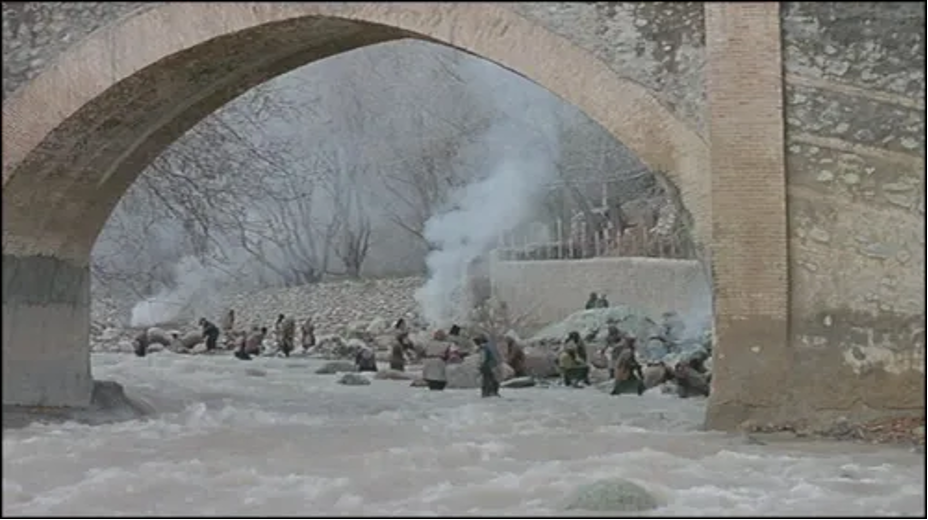
Figure 1: Afghan refugees, including Rahmat, collect stones from the river to sell for income. Baran (2001), directed by Majid Majidi. Accessed via https://www.youtube.com/watch?v=1KWei3v3z1o (00:58:29).
In examining how Baran’s cinematic techniques engage with elements of nature, Ahmet Oktan develops a “Nature-Related Sign Systems Table in Baran.”15Ahmet Oktan, “Nature as a Builder of Meaning in Majid Majidi’s Films,” Ordu Üniversitesi Sosyal Bilimler Enstitüsü Sosyal Bilimler Araştırmaları Dergisi 9, no. 1 (2019): 11–27. In his article, which analyzes the representation of nature and its contribution to the film’s atmosphere, he argues that natural sounds, such as lightning, birdsong, crackling fire, and strong wind, enhance the narrative’s expressive power. For instance, the sharp crack of lightning embodies the shock that Lateef experiences upon learning Baran’s real name. At the same time, the heavy snowfall cultivates an atmosphere of romantic euphoria, in which the body attains serenity, and the perception of time slows.16Oktan, “Nature as a Builder of Meaning in Majid Majidi’s Films,” 18. Moreover, Oktan associates the protagonists’ maturation with their deepening engagement with the natural world. While Oktan interprets the representation of natural elements as positively contributing to both the protagonists’ maturation and the plot’s development, such Baran’s attachment to pigeons, reflecting her innocence, or the wind stirring dust over hidden truths when Lateef discovers her gender, nature also functions as a violent agent. Snow and ice, which make the construction site slippery, cause Baran’s father to break his leg. Meanwhile, the cold weather and freezing river water leave her perpetually somber, bruising her fingers and intensifying the physical labor she must perform. The depiction of snow and cold thus reveals the slow violence that nature inflicts on humans, leaving deep and enduring scars on the protagonists’ psyches even in the absence of overt physical trauma. This slow violence is particularly compelling within Baran’s portrayal of displacement and migrant labor, where environmental hardships compound existing social and political marginalization. By portraying natural elements as agents of hardship, the film illustrates how environmental forces inflict ongoing physical and emotional damage that often goes unseen or ignored but is essential to understanding their lived experiences. Consequently, nature in Baran functions not merely as a poetic or symbolic backdrop but as an active site of slow violence, where environment, politics, and human endurance intersect in a vividly entangled manner.
Similarly centered on the theme of statelessness, Bahman Ghobadi’s Turtles Can Fly tells the story of refugee children living in a camp on the Turkey-Iraq border during the U.S. invasion of Iraq. These children, having lost their families to war, include Agrin, a fourteen-year-old girl; Soran, nicknamed “Satellite” for his interest in broadcasting; Agrin’s disabled brother Hengov, who lost his arms after stepping on a landmine; and a blind toddler, Riga, introduced as their younger brother but in fact Agrin’s child, born from rape during the Halabja Massacre. They survive by collecting and selling landmines. Satellite leads the group in selling the landmines to American soldiers, leveraging his limited English skills. He is also in love with Agrin and tries to comfort her by promising to find a red fish in a local pond, believed by villagers to be cursed and whose water they avoid drinking. The older brother, Hengov, possesses the ability to foresee the future, including Agrin’s eventual suicide and Saddam Hussein’s downfall. Haunted by the memory of her rape, Agrin abandons Riga in the minefield before ending her own life. Although the film depicts overt violence, including bombings and soldiers invading the camp, it also portrays slow violence, particularly through the gradual erosion of hope among the protagonists. The rising fog rising over the valley and creeping mist through the mountains symbolically reflect this loss of hope. A further poignant moment occurs when Satellite discovers, following Agrin’s death, that the red fish are artificially dyed by sellers, symbolizing the illusory promises of prosperity associated with the U.S. invasion. The narrative culmination, in which Satellite turns his back on the American soldiers he once regarded as saviors, underscores how the depiction of a hostile and oppressive natural environment intensifies the slow violence experienced by stateless individuals. For these protagonists, seeking refuge in an environment where harsh winds tear through tents only amplifies their misery and vulnerability.
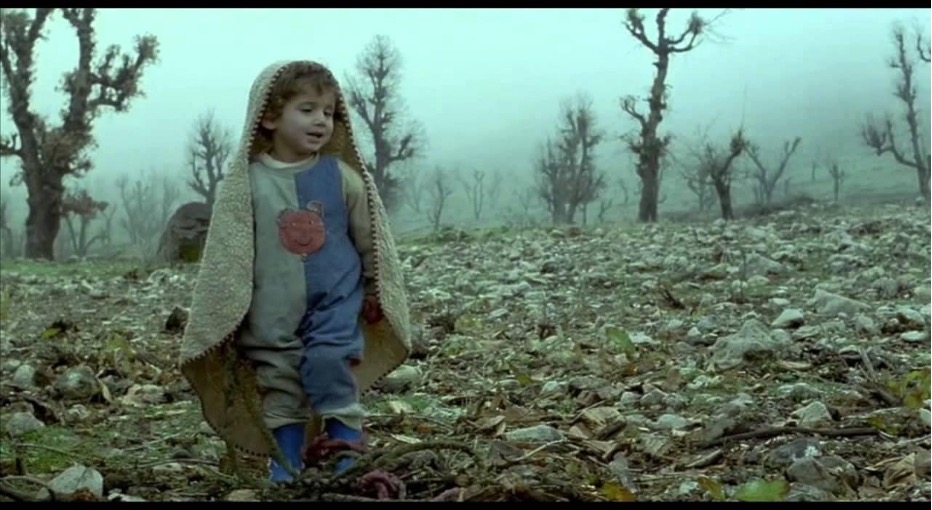
Figure 2: Agrin leaves her blind child, born of rape, in a mined land and subsequently commits suicide. Turtles Can Fly (2004), directed by Bahman Ghobadi. Accessed via https://www.youtube.com/watch?v=b3uawVIxPPc (01:16:25).
Although the term slow violence is often used in ecocritical studies to describe the long-term effects of environmental crises, such as deforestation, climate change, and nuclear warfare, on human life, it is equally important to consider forms of violence that, while not directly caused by environmental degradation, are nonetheless shaped by the broader ecological, political, and socioeconomic forces that condition human existence. Rob Nixon defines slow violence as a form of “violence that occurs gradually and out of sight, a violence of delayed destruction that is dispersed across time and space, an attritional violence that is typically not viewed as violence at all.”17Rob Nixon, Slow Violence and the Environmentalism of the Poor (Cambridge, MA: Harvard University Press, 2011), 2. Since this section focuses on the depiction of taking refuge, performing labor, and waiting for citizenship in Baran and Turtles Can Fly, it examines the forms of violence represented in these narratives through the lens of slow violence. The protagonists’ bodies are both physically and emotionally damaged, their livelihoods systematically eroded, and the violence they endure is diffuse, unfolding gradually over time. Nevertheless, the violence portrayed in Turtles Can Fly also aligns with the forms of conventional political, physical, and environmental violence that Nixon describes as “immediate in time, explosive, and spectacular in space,” producing what he calls “sensational visibility.”18Nixon, Slow Violence and the Environmentalism of the Poor, 2. These films explore violence in its multiple registers, both conventional, in the sense of physical harm and bodily violation, and slow, in the sense of the gradual erosion of hope. While the protagonists in these films are subjected to slow, accumulative violence, they consistently seek refuge in nature through various means, such as earning a living by pulling stones from the river in Baran or collecting landmines for trade in Turtles Can Fly. This act of seeking refuge in nature, or nature’s act of offering shelter for survival and basic needs, reflects the deeply entwined relationship between humans and nonhumans. In their most vulnerable moments, the characters turn to nature not only as a means of livelihood but also as a source of solace and imaginative escape, as poignantly expressed in Agrin’s wish to become a turtle that can fly, which is a metaphor for freedom beyond borders.
Both films center on the lives of undocumented individuals who, despite their precarious conditions, continue to endure atrocities with the faint hope of attaining legal recognition. What renders these films ecocritically compelling is their vivid portrayal of nature’s harsh realities, including heavy snowfall, muddy streets, and mined, contaminated landscapes, that intensify the struggle for survival faced by the characters. Although nature sustains protagonists’ livelihoods, it simultaneously denies them a dignified quality of life, forcing them to endure the absence of basic physical needs such as heating during winter, sanitary living conditions, and adequate health. This portrayal of nature highlights its profound presence in everyday human life and underscores the vulnerability of human existence in the face of natural forces. Moreover, in Turtles Can Fly, nature seems to exact a quiet revenge for the mined fields, abandoned tanks, and remnants of war that have scarred its terrain. Tragically, it is the innocent children, those least responsible for the violence, who bear the brunt of its wrath. Nature’s dual role as both provider and burden positions it as an active agent in human life rather than a passive backdrop. In these films, landscapes function as living archives of displacement, memory, and exploitation. By intertwining the physical wounds of people with those marked on the earth, including potholed roads, rain-soaked streets, hills cratered by landmines, scorched forests, and stagnant, muddy lakes, the films dissolve the boundary between the human and the nonhuman, making the wounds of both indistinguishable. The dispossession of bodies and identities becomes inseparable from the scars of the earth, which in turn bear witness to and react against the human-inflicted traumas that have altered its form and texture.
This interdependence between nature and human life is equally evident in Baran, where the material conditions of the construction site already compromise the workers’ safety and well-being. Harsh weather intensifies these hazards, forcing them to labor on slippery wooden planks in the freezing cold and falling snow, conditions that steadily deteriorate their physical health. In this film, nature also acts as a perpetrator of slow violence, gradually eroding the refugees’ bodily resilience. As an agent of physical pain, nature reaffirms the idea that it is an intrinsic and inseparable part of human existence, one that the body cannot escape, shaping human conditions even as it is simultaneously shaped by them. Nature’s agency in this film is not only spectacular but also gradual and cumulative, determining the long-term fates of the Afghan refugees. Over time, relentless environmental and material hardships weaken their ability to endure, and, when compounded by the renewed outbreak of war in Afghanistan and the loss of family members, leave them unable to remain resilient, compelling their return home. This narrative also aligns with Nixon’s concept of slow violence, as the refugees experience an intertwined form of harm in which political oppression and material deprivation accumulate over time. Although Nixon’s concept of refugees in Slow Violence does not necessarily foreground the embodied experience of displacement, it crucially encompasses subjects who must adapt to new terrains, environments, and temporalities. While Nixon focuses on environmental crises as drivers of “developmental refugees,” Baran and Turtles Can Fly depict not only displaced individuals but also those deprived of roots and a stable sense of belonging in both place and time, aligning with Nixon’s argument. The protagonists’ displacement is both spatial and temporal, erasing their memory of home and history and deepening their existential precariousness. Nature, in turn, inscribes this rootlessness onto the landscape. For example, the final scene in Baran, where Rahmat’s footsteps imprint in the mud, symbolically embodies how refugees leave transient traces on the places they pass through, marking their fleeting presence and displacement.

Figure 3: Rahmat’s footstep remains in the mud when she leaves Tehran. Baran (2001), directed by Majid Majidi. Accessed via https://www.youtube.com/watch?v=1KWei3v3z1o (01:28:25).
Similar to Baran, Turtles Can Fly portrays characters who are not only displaced from their physical surroundings but also stripped of a stable identity and a sense of hope. In Turtles Can Fly, the protagonists’ reduction to bare life reflects a form of slow violence in which nature serves both as a shelter and as a vehicle of harm. However, this violence originates from human politics rather than from nature acting as a punisher of humanity. This dual relationship between humans and nature reveals their inseparability: in life’s most precarious moments, people turn to nature as both a source of sustenance and a balm for suffering. In Turtles Can Fly, despite the atrocities they face, the children in the refugee camp search for a red fish,19In Iranian culture, the red fish symbolizes life and rebirth. During the Newroz celebration, it is a key element of the haft-sīn table, which features seven symbolic items such as garlic, apples, coins, vinegar, eggs, sumac, and the red fish, each representing something cherished in life. a fragile yet enduring symbol of hope. This symbolic search illustrates how human beings are tested in their interactions with nature, which is often perceived as passive, while the dream of finding the fish in the muddy pond reaffirms the protagonists’ dependence on nature for comfort and self-soothing. The search for the fish ceases to be a matter of choice or agency; instead, it becomes a necessary act of solace for protagonists trapped in the uncertainty of an ambiguous future. At this point, Latour’s concept of agency underscores how bare life within nature must share its agency with nonhuman beings and natural elements alike. While critiquing humanity’s “hubristic dream of control”20Bruno Latour, “Agency at the Time of the Anthropocene,” New Literary History 45, no. 1 (Winter 2014): 1–18. Published by Johns Hopkins University Press. https://www.jstor.org/stable/24542578. over nature, Latour argues that human beings can no longer disclaim responsibility for their actions toward the natural world, since these actions construct the very knowledge of it. In the era of Anthropocene, where human influence is pervasive, human subjects must share their agency with other beings and elements, for reality is no longer “objective” but fundamentally shared.21Latour, “Agency at the Time of the Anthropocene,” 5. This shared agency is embodied in the children’s search for the fish, which is not merely an ornament or passive metaphor of rebirth but an active negotiation of the fragile hope that sustains their emotional survival. In Agrin’s case, this fragile hope collapses entirely, leading to her suicide when the dream of the fish is lost. In this regard, agency is no longer defined solely by material conditions; it becomes a negotiation between humans and nature for emotional resilience. This negotiation blurs the boundaries between active agent, victim, and perpetrator of slow violence within the natural world.
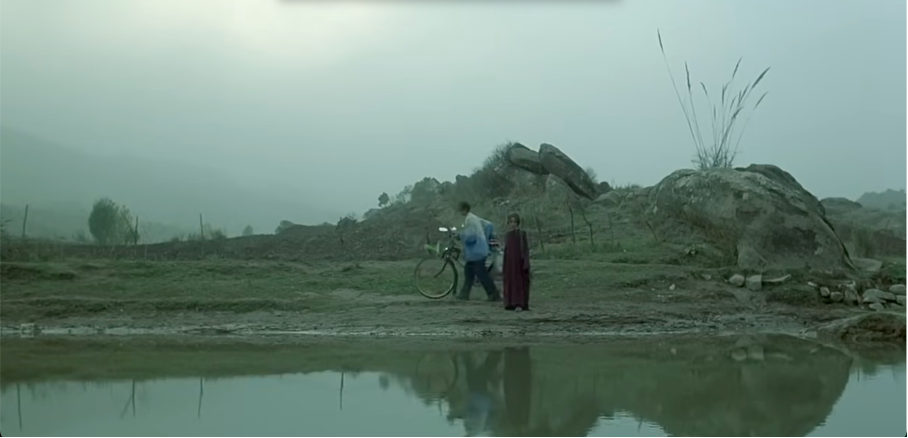
Figure 4: Agrin and the boy nicknamed Satellite search for the red fish in the pond believed to be cursed by other refugees. Turtles Can Fly (2004), directed by Bahman Ghobadi. Accessed via https://www.youtube.com/watch?v=b3uawVIxPPc (00:45:07).
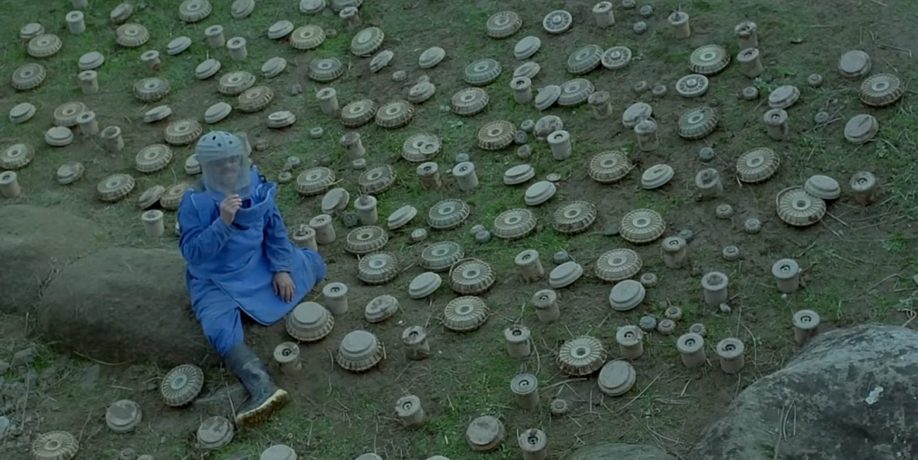
Figure 5: The refugees in the camp collect landmines to sell to the Americans and earn money, while nature seems to exact revenge on humanity, making no distinction between the guilty and the innocent. Turtles Can Fly (2004), directed by Bahman Ghobadi. Accessed via https://www.youtube.com/watch?v=b3uawVIxPPc (01:37:20).
(Im)Mobility, Dispossession, and Nature
In both Bahman Ghobadi’s A Time for Drunken Horses and Samira Makhmalbaf’s The Blackboard, the audience experiences the protagonists’ exhaustion as their (im)mobility is repeatedly obstructed by harsh natural forces such as stubborn animals, heavy snow, and treacherous rocky terrain. In each film, mobility becomes a central concern: the protagonists’ survival depends on their ability to keep moving despite the natural obstacles that threaten to halt them. A Time for Drunken Horses portrays the daily lives of villagers in a small Kurdish village on the Iran–Iraq border who sustain themselves through smuggling. The narrative follows five siblings whose mother dies while giving birth to Madi, the youngest and disabled child. After their father is killed during a smuggling trip, the eldest brother, Ayoub, assumes responsibility for supporting the family. Because Madi is gravely ill and requires urgent medical treatment, their uncle arranges for their sister, Rojin, to marry on the condition that Madi will receive care. Rojin agrees to the marriage only if she can take Madi with her. However, when the groom’s mother sees Madi, unaware of this agreement, she refuses to accept him, and he is sent back home. After Ayoub refuses to let Rojin marry someone else, he turns to smuggling to provide for his siblings and pay for Madi’s treatment. In this region, there is no alternative livelihood; smuggling is the only means of survival. It has become so normalized that even the books children are smuggled across the border, hidden inside clothing. Accompanied by his uncle’s mule and Madi, Ayoub joins a group of smugglers on a trip to Iraq and arranges with one of them to pay for Madi’s operation. That day, the weather is even more unforgiving than usual. In the freezing cold, the mules and horses are given alcohol to keep them moving. On the journey, they are ambushed by government officials, and a struggle for survival ensues; they must either run or be shot. However, the animals are intoxicated after being given too much alcohol. In the final scene, against an endless whiteness of the snow and behind barbed wires, Ayoub, Madi, and the mule come into view. The director leaves the ending to the audience’s interpretation.
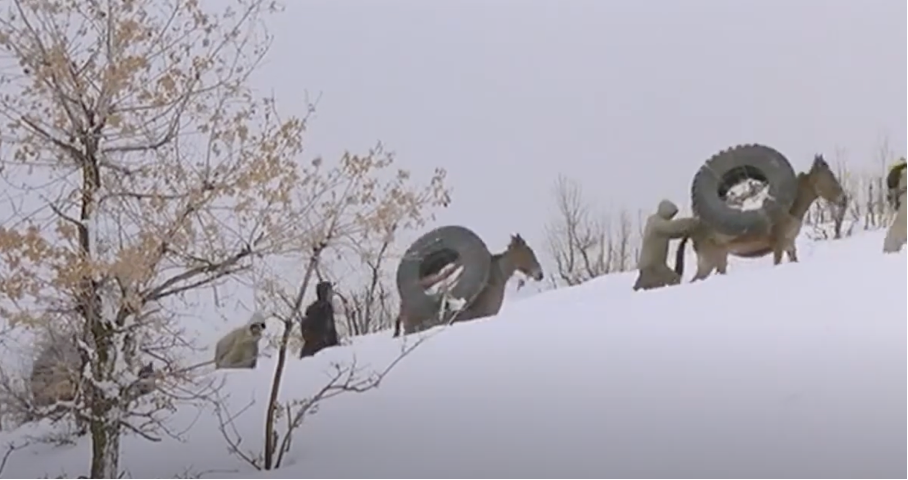
Figure 6: The smugglers transport goods on mules and horses, giving the animals alcohol to warm them and keep them moving. A Time for Drunken Horses (2000). Directed by Bahman Ghobadi. Accessed via https://www.youtube.com/watch?v=qp9-2VKNq8I (01:12:00).
In The Blackboard, as in A Time for Drunken Horses, the struggle with (im)mobility forms the core dramatic tension. The film follows volunteer teachers who travel from village to village during the Iran–Iraq War, seeking to teach literacy to local communities. The protagonists, Saeed and Reeboir, traverse mountainous terrain in search of children willing to learn, but along the way, Saeed encounters Kurdish refugees fleeing to Iran after the Halabja Massacre. Desperate for safety, they attempt to return to their village in Iraq. Saeed marries Halaleh, the daughter of an elderly man in the group. He agrees to escort them to the border in exchange for forty walnuts. Reeboir, meanwhile, follows a group of child smugglers and tries to teach them to read and write. The children, however, show little interest in learning, believing education is unnecessary for them. Coincidentally, one of the children’s names is also Reeboir, and he is the only child who finds joy in learning. To persuade them, the teacher explains that studying mathematics will help them calculate their earnings, to which one child responds, silencing the teacher: “Being able to read and do calculations only benefits the boss. We are porters, always on the move. How can you expect us to read? To read a book or a newspaper, we would have to sit still, but we never stop; we are always on the road.” The war conditions and constant moving prevent them from forming permanent relationships or achieving stability. The blackboards the teachers carry on their backs serve not only as instructional tools but also as shields and shelters from shooting helicopters. The film’s slow pacing mirrors its narrative of slow violence, as the rocky roads and cliffs obstruct movement and intensify the struggle, especially for the sick and elderly man in the group, who suffers from a urinary tract infection, that makes it difficult for him to endure the journey.
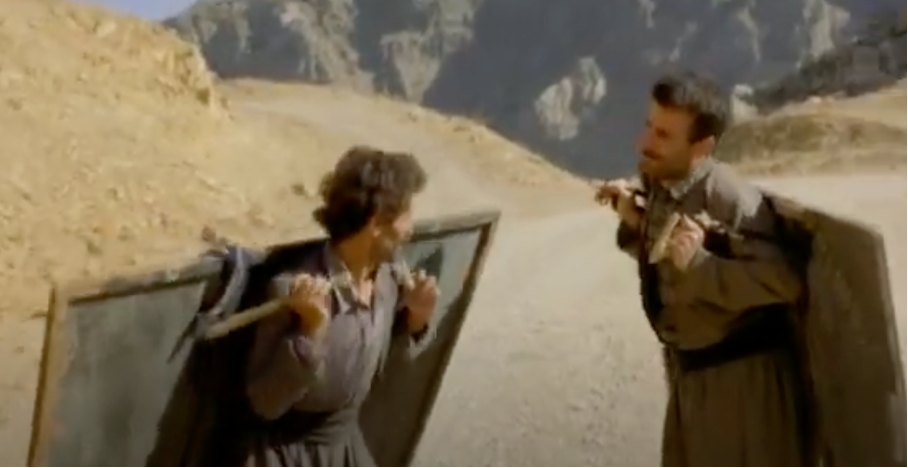
Figure 7: Volunteer teachers journey across villages, seeking to teach children how to read and write. The Blackboard (2000). Directed by Samira Makhmalbaf. Accessed via https://www.youtube.com/watch?v=RAcKdcj84N4 (00:07:31).
As (im)mobility becomes a question of survival in these films, agency no longer rests solely with the protagonists but emerges from a network of natural forces that shelter them. Survival itself is socially woven through the interplay of subjects, objects, and living beings. Latour defines the “social” as a web of entanglements among actors within a collective, while simultaneously asking what counts as a “non-social” entity and how such entities come to participate in the system of “social actors.”22Bruno Latour, Reassembling the Social: An Introduction to Actor-Network-Theory (Oxford: Oxford University Press, 2005), 247. A Time for Drunken Horses and The Blackboard respond to Latour’s questions by showing how nonhuman entities, and even everyday objects, as active participants in social life. In both films, survival depends not solely on human agency but also on a fragile interdependence between humans and their environment, an entanglement that lies at the core of human existence. For instance, the child Reeboir in The Blackboard forms an affective bond with the blackboard, which offers him a sense of hope for the future through learning. He closely follows what the teacher writes and repeats the sentences many times, which strengthens his motivation. The blackboard functions not merely as an object but as a symbolic possession, especially since the protagonists are dispossessed and deprived of material assets, leaving the board as their only form of belonging. Although it originates from a natural material, the blackboard is reshaped by human actors, transformed into an object that acquires new meanings as it mediates their relationship to the world, offering hope, providing shelter, and even serving as a form of capital when Saeed offers it as Halaleh’s dowry. Similarly, the mules and horses, as living entities, participate in the social sphere, determining the limits of human endurance and action. In this context, taking shelter in nature dissolves the boundary between objects and living beings, revealing their mutual dependence when the natural world becomes the only refuge. This interdependence redefines what a social collective means for humans. Such a redefinition is ecocritically rich, as it involves the material conditions necessary for survival, binding humans to the rhythms of animals, objects, and the natural environment upon which their lives precariously depend. Although the social collective in The Blackboard is structured around an object connected to a social practice, education, rather than a living being, the film underscores how materiality itself becomes socially generative. Immobile landscapes such as cliffs, mountains, and arid valleys shape the very conditions of collective life and survival.
Given expanded notion of the social that includes the nonhuman world, the question arises: how does dispossession intersect with ecocritical materiality? More concretely, how does A Time for Drunken Horses articulate the social beyond the symbolic opposition between humans and animals? Lance Newman’s reflections on Marxism and ecocriticism illuminate these questions not only through his analysis of the relationship between capital and nature, but also through his critique of ecocriticism itself. Newman argues that the material conditions of the environment both shape and are shaped by social and economic relations. Although his discussion focuses on literary studies and the ways nature writing channels social change, the films analyzed here demonstrate how objects and animals transcend their symbolic roles to become active participants in social relationships with the material world.
Iranian cinema, with its blend of symbolic narrative devices and realistic portrayals of survival shaped by nonhuman actors, exemplifies an ecological web of entanglements and distributed agency. Ayoub’s depiction in A Time for Drunken Horses, carrying goods too heavy for him to bear, mirrors the image of the mule burdened beyond its strength, blurring the distinction between human control and animal agency in the struggle to meet material needs. This parallel reflects Ghobadi’s deliberate choice. In his interview with Gülden Tümer, he explains that he approaches animal characters as if they were humans, attributing to each a distinct set of traits.23Gülden Tümer, Bahman Ghobadi Sinemasında Hayvan Metaforlarıyla Travma Anlatımı, Master’s thesis, Istanbul University, 2020. https://nek.istanbul.edu.tr/ekos/TEZ/ET002855.pdf
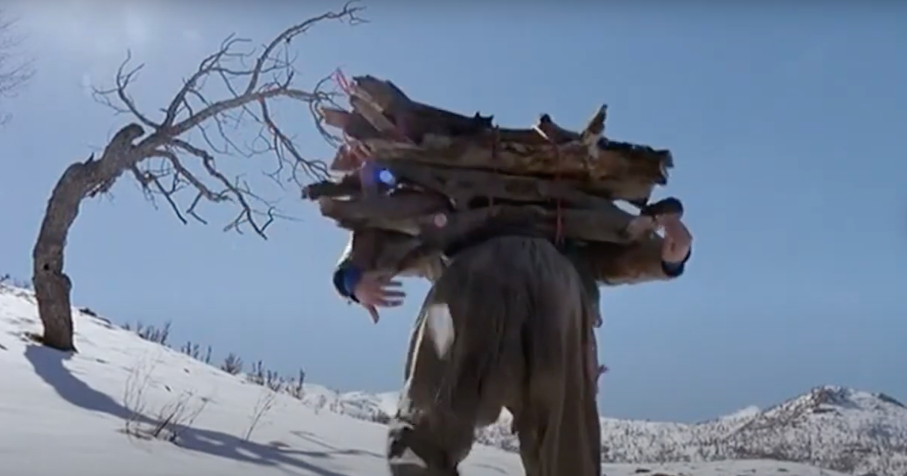
Figure 8: Both Ayoub and the mules carry burdens too heavy for them. A Time for Drunken Horses (2000). Directed by Bahman Ghobadi. Accessed via https://www.youtube.com/watch?v=qp9-2VKNq8I&t=4320s (00:20:14).
In the same interview, Ghobadi explains that in the region where he films, the lives of mules are crucial for human survival, and the tragedy of a mule stepping on a mine can be even more dramatic than that of a human being. In this sense, humans and animals become fellow sufferers.24Tümer, Bahman Ghobadi Sinemasında Hayvan Metaforlarıyla Travma Anlatımı, 150. In line with Newman’s view of nature writing as a form of social action, Ghobadi’s cinema performs an ecocritical act through its emphasis on animals as essential to human existence, aligning the natural environment and human existence within a social collective. Together, these examples show that dispossession is not solely a human condition but one that is materially and socially mediated through the intertwined lives of humans, animals, and objects. This expanded understanding of the social frames survival as a collective, ecologically grounded endeavor.
Conclusion
Through an ecocritical reading of contemporary Iranian cinema, this article aims to illuminate how nature functions as an active participant in the lived realities of dispossession, migration, and statelessness. Drawing on Bruno Latour’s understanding of political ecology, the films Baran, Turtles Can Fly, Time for Drunken Horses, and The Blackboard reveal an expanded understanding of citizenship that transcends human boundaries and integrates the agency of the nonhuman world. In these cinematic narratives, natural entities such as rivers, snow, mountains, animals, and even blackboards acquire a social and political presence that shapes both the conditions of survival and the fabric of human resilience. The protagonists’ search for refuge amidst environmental precariousness and political exclusion highlights how the dispossessed coexist with, and survive through, the landscapes that oppress and shelter them. In this sense, nature embodies what Rob Nixon calls slow violence; it gradually harms while simultaneously offering the possibility of fragile resistance. Iranian filmmakers transform this duality into a cinematic language that combines ecological awareness with ethical responsibility and places nonhuman agency at the center of human vulnerability. These films dismantle anthropocentric frameworks of belonging and nationhood, replacing them with a relational ecology of citizenship in which both human and nonhuman actors share the burden of survival.
By foregrounding the interdependence of dispossession and ecology, contemporary Iranian cinema performs what might be called an aesthetics of shared resilience and a vision in which survival is neither purely human nor purely environmental, but always collective. Reframing citizenship through ecological relation, these films call for an alternative politics that acknowledges the affective, material, and emotional networks that bind displaced people to the world they shelter in. In doing so, they argue that seeking refuge in nature is not merely an escape from political violence, but also an inhabitance of a world in which the boundaries between human and nonhuman life are constantly reimagined and renegotiated.
Cite this article

This article examines contemporary Iranian cinema through an ecocritical lens, analyzing how nature is entangled with experiences of citizenship, displacement, and dispossession. Drawing on Bruno Latour’s approach to political ecology, it explores how nature is represented not as a passive backdrop but as an active agent in films such as Baran (2001), A Time for Drunken Horses (2000), Turtles Can Fly (2004), and The Blackboard (2000). The article argues that nonhuman elements, including rivers, snow, mountains, animals, and material objects, constitute a collective political space that shapes survival practices under conditions of refuge, statelessness, and enforced (im)mobility. Engaging with Rob Nixon’s concept of “slow violence,” it demonstrates how environmental forces intersect with political and social violence in ways that are gradual, cumulative, and often invisible. In doing so, the article proposes a rethinking of citizenship in contemporary Iranian cinema through a non-anthropocentric framework grounded in ecological relationality.