
Audacious Cinema: How a new generation of films is transforming the contemporary ethical landscape and ethos of life in Iran



Introduction
Courage in filmmaking against political repression is neither new nor exclusive to the Iranian cinema. What sets an audacious film apart from others, is in its ability to deliver an ethical storytelling that defies many systemic technologies designed to obliterate it out of existence. Visual storytellers of films with a strong sociopolitical message navigate the treacherous terrain of ideological filtering and the political censorship that targets not only the film but endangers the life of those involved in its making.
A growing number of recent films exemplify audaciousness by radically changing the conventional code of storytelling in contemporary Iranian cinema. Feature productions in Iran by filmmakers such as ʿAlī Asgarī, Suhayl Bayraqī, Farshād Hāshimī, ʿAlī Rizā Khātamī, Maryam Muqaddam, Jaʿfar Panāhī, Muhammad Rasūluf, and Bihtāsh Sanāʿīhā, mark a paradigm shift in the contemporary history of Iran’s audacious filmmaking. After decades of systematic state assault on cinema, these recent films have carved out a liminal space between the zones of authorization1In addition to the expected layers of considerations about production, that includes securing funding, logistics, actors and crew’s wellbeing, and more, each Iranian filmmaker experiences multiple layers of submissions, reviews, appeals, and revisions to their film, in response to the demands of the State guidelines. and the silences of censorship to produce stories and creative technologies that make film accessible to a wider Iranian viewership in and beyond the country’s borders. This is not to say that Iran lacked audacity in filmmaking in the past. The history of Iranian cinema includes many valiant films that do not shy away from posing difficult questions about humanity (e.g., The House is Black (Khānah siyāh ast, 1963), by Furūgh Farrukhzād, and Bashu, the Little Stranger (Bāshū, gharībah-yi kūchak, 1989), by Bahrām Bayzāʾī, with strong lyricism in portraying humanity through empathy, come to mind). However, that history has not been consistent. Years of political upheaval revolution and war has made the Iranian cinema paradoxically both a powerful medium for contemplation on humanity and the subject of severe political propaganda and censorship. In what follows, I aim to demonstrate how today’s Iranian audacious filmmaking stands out as boldly reflexive and revelatory towards a shared sense of existentialist quandary on how to live through courage, empathy, aspirations, and integrity (recognized as character traits that qualify a sense of shared value, culturally) in an overwhelmingly hostile social reality of the everyday life.
Often under strict sociopolitical scrutiny, these productions point to a pivotal moment in Iran’s filmmaking, when empathy, intimacy, and love come face-to-face with structural violence, banality of injustice, and widespread apathy towards someone else’s pain. This article is structured around the thematic connections between current practices in courageously ethical filmmaking in Iran and the political climate of change in the country. The aesthetic modalities of today’s audacious cinema in Iran teeters on the boundary of transformative resistances to the dominant corporeal politics and its intersection with the social dissents to cultural norms about personhood, affect and ethos of being human. In particular, the most recent productions reviewed in this article – regardless of their genre – correspond to the collective existentialist awakening that is steadily on the rise in the country,2While majority of the analyses of the social movement known as the Woman, Life, Freedom in Iran, have concentrated on the political significance of solidarity and outrage of a people protesting the streets in the aftermath of Jina Amini’s death in 2022, few scholars have considered the profoundly radical philosophical and ethical shifts that are underway. One exception is Nayereh Tohidi’s reflections on the WLF movement’s liberation discourse and existentialism of the generation z in Jina’s uprising (2023). See Nayereh Tohidi, “Iran in a Transformative Process by Woman, Life, Freedom,” Freedom of Thought 13 (Summer 2023): 29–57. one that has given rise to the Jina uprising and the globally recognized poignant ideological revolutions embodied in the Woman, Life, Freedom movement – since 2022 to present.3On September 16, 2022, a young Kurdish woman named Jina Mahsa Amini visiting her grandmother in Tehran, was arrested by the pseudo military force called the “morality patrol” presumably for not wearing her scarf properly. Soon after, a leaked video on social media showed her collapsing to the ground while in custody, which resulted to her death in the hospital under suspicious circumstances. The news of her death and the authority’s refusal to provide clarity nor empathy in the aftermath of Jina’s death, angered the public, who came out in large numbers to protest the ongoing abuse of power and the systemic rise in violent crackdown on their civil rights. As the impromptu street marches grew larger, the rage against the onslaught violence by the State became spread across the country, taking the form of a social resistance movement united under the moto of Woman Life Freedom (WLF). Despite mass arrest, intentional targeting and violence assassination of the protesters, the resistance continued in new forms in and beyond the country’s geopolitical borders.
A Word on Words
Audacity – noun. /ôˈdasədē,äˈdasədē/4The Oxford Languages and Google Online Dictionary, s. v. “audacity.”
- a rude and unruly behavior with disregard for social conventions
- a bold and uncompromising stance; a willingness to take risks.5n researching the term, “audacity” and its Farsi equivalent (gustākhī) relevance to this project, I have consulted a number of notable dictionaries both in physical form and online, including: Abadis online Dictionary, s.v. “گستاخی”, https://abadis.ir/fatofa/%DA%AF%D8%B3%D8%AA%D8%A7%D8%AE%DB%8C/ Cambridge Dictionary, s.v. “audacity,” accessed September 10, 2025, https://dictionary.cambridge.org/us/dictionary/english/audacity Merrian-Webster, s.v. “audacity,” accessed February 25, 2025, https://www.merriam-webster.com/dictionary/audacity Oxford English Dictionary, s.v. “audacity,” accessed September 10, 2025, https://www.oed.com/dictionary/audacity_n?tab=factsheet#33706700
Academic scholarship across multiple fields of inquiry in the humanities and social sciences, including linguistic anthropology recognize the power of words in shaping and in revealing the collective ethos and their prevocational capacity for dissent from the norm of socio-culturally conventions of language.6Though a comprehensive list of pivotal scholarship on the power of language is beyond the scope of this article, the work of John Austin’s Speech Act Theory (1955), Charles Briggs exploration of how language is performative in folklore (2008), which he builds on Judith Butler’s theory of performativity (1990), Pierre Bourdieu’s study of the symbolic power of language (1991), Audre Lorde, bell hooks, Cherrie Moraga and many more Black and Feminist scholars building on Frantz Fanon’s (1952) theory of language as a form of decoloniality, inform my approach to the power of words in this writing. Seen as a social act, language is made meaningful by the way it is used collectively within a specific cultural context.7Ludwig Wittgenstein, Philosophical Investigations, trans. G. E. M. Anscombe (Oxford: Blackwell, 1953).
In the English-speaking world, black and feminist radical writers have long advocated for a critical use of language, however unconventional they may be. In the words of hooks, “coming to voice is an act of resistance.”8bell hooks, Talking Back: Thinking Feminist, Thinking Black (Boston, MA: South End Press, 1989).The power of resistance through language makes for an irrefutable argument for intentionality in speech.9Feminist and radical Black authors have long deliberated on the power of reclaiming a poetic language informed by the power of love, empathy and care, in resistance to colonial racism that has dominated not just the political terrain of the past, but the very notion of knowledge itself. The poetic exploratory writings of Frantz Fanon, James Baldwin, Toni Morrison, Maya Angelou, bell hooks, Angela Davis, and Alice Walker, have had a particular impact on my own formation of thoughts and critical reading of audacity in Iranian poetic cinema. Critical feminist anthropology approaches language as an impactful technology that has the paradoxical power to make visible in order to dominate, through “identifying” (as a technology for “knowing” carried out through a process of “discovery”, “naming” and “classification” by those in positions of power), as well as the capacity to undermine the social hierarchies that have sustained the exclusionary silences and systemic technologies of its erasure.10Consider, for example how in Gender Trouble emerges a critical counter-narrative to the naturalized feminist discourse on gender. Whereas mainstream feminism had been critical of patriarchy, it had locked women in their sociocultural position of inferiority to men. Butler’s counter argument offers a nuanced interpretation of “ambiguity,” wherein incoherences in language and in act “operate as sites of intervention, exposure, and displacement” of the cultural framework that stabilizes those acts and language. Thus, through the metaphor of “drag” (both as a word and a practice), “gender reality is created through sustained social performances” (Butler 1999). Put simply, the intentional use of an unconventional language that refuses to be reductive and exclusionary, has the power to dismantle the hierarchies of recognition and belonging that make it appear incoherent. Put simply, language has the power to make visible the unseen, and to silence the voices counter to the dominant discourse.
In writing about the power of language and how words “do things in the world”, John L. Austin made a compelling argument for the due attention to the use of ordinary language in the production of knowledge and the process of meaning making (1962). Addressing scholars in philosophical and human-scientific inquiries Austin wrote:
Words are our tools, and, as a minimum, we should use clean tools: we should know what we mean and what we do not, and we must forearm ourselves against the traps that language sets us. Secondly, words are not facts or things: we need therefore to prise them off the world, to hold them apart from and against it, so that we can realize their inadequacies and arbitrariness, and can re-look at the world without blinkers.11J. L. Austin, Philosophical Papers, ed. J. O. Urmson and G. J. Warnock (Oxford: Oxford University Press, 1979), 181–82.
Taken from the perspective of cultural anthropology, this writing recognizes the language of cinema to function within a discursively constructed frame for meaning making. Therefore, it is worth underscoring the relevance of the term, “audaciousness” in describing a distinguishing quality in cinematic production (beyond the genre classifications), as a deliberate act of selecting a terminology that is accurately reflective of the core argument in this study – to recognize the rise in Iranian films with a bold ethical voice. Put simply, language does not emerge in a vacuum and our un/intentionality in words have the potential, beyond a mere act of communication, to make visible that which has been obscured, or reversely, silence affective existences that are deemed unnamed. In what follows, I expand to demonstrate that to speak of “audacious cinema” in the context of the current socio-political transformations in Iran, is an intentional evocation of a sense of language that is informed by dynamic and changing flows in cultural ideas, social practices, and their consequences in everyday life.
Audacity, noun
Boldness, sometimes in a good sense; daring spirit, resolution or confidence.
Audaciousness; impudence; in a bad sense; implying a contempt of law or moral restraint.
Audacious, adjective
Intrepidly daring
Recklessly bold
Contemptuous of law, religion, or decorum; insolent
Marked by originality and verve12The Webster’s American Dictionary of the English Language, s. v. “audacity”.
Words matter, not only in the actions they evoke, but also in the meanings and concepts they surmise. The double meanings of the concept of audacity that functions paradoxically as both positive and negative characteristics of a human action, are key to understanding the core thesis in this writing – that the 21st century Iranian filmmaking features a strong ethical voice as a reflection on contemporary humanist paradoxes that makes up the everyday life choices and dilemmas, thus rendering it distinct not only in the context of the global cinema, but more urgently relevant to the lives of its Iranian viewers, here and now. As such, “audacity” in Iranian films brings to mind contrasting memories, affective responses, epistemic and existential quandaries. Here, I have opted for a translation of audacity in Farsi (Persian) cultural lexicon, to mean “boldness” [gustākhī], which inhabits the paradoxical meanings associated with “audaciousness”, with translations such as “insolence” [nā-khalafī]; “courage” [jisārat]; “non-conforming” [nā-mutiʿāraf], and “uninhibitedness” [bī-parvā’ī].
An early example of audacious storytelling in Iranian cinema can be seen in The House is Black, a short documentary film by Furūgh Farrukhzād (1962) with a focus on beauty of life among an otherwise sequestered humanity in a leper colony. The House is Black is an audacious poetic juxtaposition of normative “ugliness” (as emboldened in the opening scene of the film), with an affective visuality in the raw footage of everyday living with leprosy. Farrukhzād’s unorthodox nonconforming use of the camera provided for an audacious cinematic storytelling that becomes less about the leper colony, and more as a reflection on the mainstream sociocultural sense of belonging. Thus, the filmmaker poet, asks her audience to reconsider distinctions between beauty and ugliness, as it informs societal norms for inclusions versus invisibility.
Next, is a closer examination of three films that illuminate the notion of audacity in ethical storytelling of current Iranian cinema. Outcry (Bīdād, 2025), My Favorite Cake (Kayk-i mahbūb-i man, 2024), Me, Maryam, the Children and 26 Others (2024) offer an unabashed self-reflexive critique of both the banality of violence in everyday life and sound a sobering call to awaken our collective ethical sense who we have become in the face of difficult circumstances.
Audacious Cinema
Audacious filmmaking, when the subject of the story is evocative and disruptive of all that is normalized as culturally endorse modes of sociality, holds a poignant place in Iran’s cinema. The audacity of a film that portrays the violence in the erosion of our shared core values – in empathy for the suffering of the others – and the outrage it expresses against the systemically normalized injustices in everyday life, has always been an integral part of the art of cinema in Iran – if not the wider scope of introspective poetry and literature from the Classical period to present. One of the most impactful characteristics of audacity in filmmaking is its capacity to evoke a sense of collective memory through visual storytelling that is both compelling and ethically relatable. Rasūluf’s most recent audacious films in There is No Evil (Shaytān vujūd nadārad, 2020) and The Seed of the Sacred Fig (Dānah-yi anjīr-i maʿābid, 2024), ʿAlī Asgarī and ʿAlī Rizā Khātamī’s joint production of Terrestrial Verses (Āyah-hā-yi zamīnī, 2023), Muqaddam and Sanāʿīhā’s My Favorite Cake (2024), Hāshimī’s Me, Maryam, The Children and 26 Others (2024), and Bayraqī’s Outcry (2025) exemplify a rising trend in current Iranian audacious cinema that disrupts viewers anticipated narrative construction. These works which begin as a socially realistic form of storytelling, take an unexpected turn midway through the film, thus switching the genre from social realism to one of the other imaginative forms of fictional stylistic storytelling, such as surrealism, horror, thriller, and magical realism. While we can understand these filmmaking technologies as creative modes of resistance to governmental censorship, I argue that in these specific examples the adoption of a broader approach and a symbolic language towards the ending of the film, enhances the act of memorializing the unfathomable normality of violence that surrounds us, though rarely acknowledged.
As such, these allegorical visual tales can be interpreted to reveal a hidden meaning beyond their respective plot, as an invitation for engaged visual journey for the viewer and an ethical wake up call. For a people whose everyday life is heavily monitored, it is courageous to see a reflection of that banality in the film’s narrative with sincerity and determination to do better, to be better, to face the cruelty of our current political socio-cultural predicament.
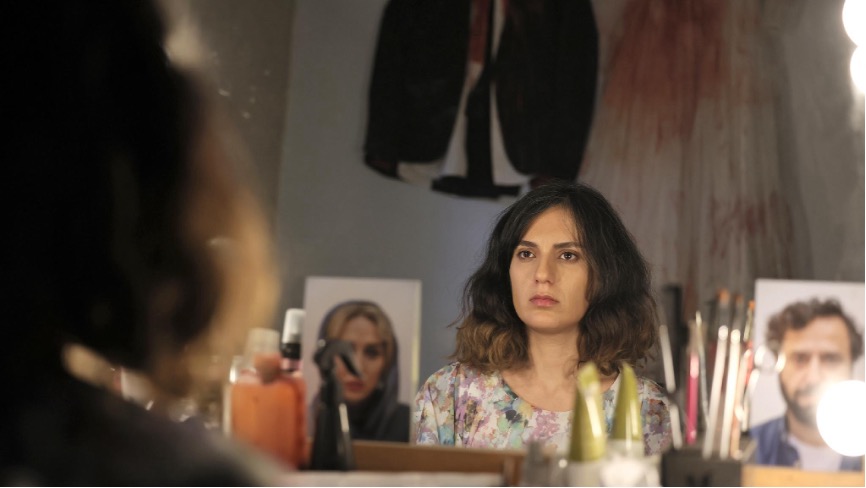
Figure 1: A still from the film Me, Maryam, The Children and 26 Others, directed by Farshād Hāshimī. 2024. Printed with permission from the director.
Seen from the perspective of social realism in Iranian cinema, the emerging generation of audacious films out of Iran benefits from the legacy of the New Wave filmmaking centered on the existential cultural quest for what it means to be human in the world as it stands today. What makes them audacious is the revealing act of vulnerability of the human subjects, embodied in an intersectional character portrayal of the central characters in their story, who are gendered, aged, isolated, and skeptical of sociality. For in the words of the great poet-observer, “life imitates Art far more than Art imitates life.”13Oscar Wilde, “The Decay of Lying,” in The Complete Works of Oscar Wilde, 2008 ed., 992.
Later I will expand on my analysis of these films to further illustrate the audacity of their respective visual narratives. But first, I deliberate on the spectrum of connotations evoked by the term, “audacity” in cinema, that moves us beyond the negative overtone of the word (disorderly and impertinent), to consider the inspirational radical act of ethical filmmaking that audacious cinema offers in the current cultural – political climate of our country.
Here, the audacity in filmmaking is unpacked from an anthropological point of analysis,14A word on methodologies deployed for meaning making in this study is in order. Presenting a transdisciplinary meditation on the theme of audacity in cinematic visual storytelling, I approach the study of “audaciousness” in Iranian cinema as an anthropological exploration of the dynamic role of visual culture (e.g., films) in socio-cultural life. In understanding audacity as an act of “ethical awakening”, I am interested in systems of meaning-making of a range of ideas included in the films, such as the concept of the self, sounds, and landscapes in dialogue with values around gender, age, ethnicity, urbanity, faith, solitude, trespass, and belonging. The methods employed in this study are not exclusively ethnographical – although I have had extended conversations with a few of the filmmakers whose work have informed my writing – but also attentive to history, digital communication, and the aesthetic semiotics of the Iranian cinema. Rather than offering a linear historical reading of cinema in Iran, this writing adopts a genealogical methodology that connects across multiple frames of intersections from, anthropological critique of shared values, to focus on the poetic aesthetic registers in film, performativity of language and visual culture, and the power of resistance in cinema. Employing techniques such as triangulation of concepts, connotations and consequences, each film in focus is examined not as art in isolation from the world that surrounds it, but rather as an impactful quiet revolution in how visuality in storytelling connects deep within the soul of the socio-cultural body that it engages. In combining the theory of audacity in film with the practice of viewership, emergence new technologies for unpacking cinematic audacity as a radical transformation in current Iranian filmmaking, revealing intrinsic and complex relationships between the art of cinema and the politics of knowledge production. Thus, through utilizing a systematic set of critical methodologies, “audacity” in Iranian filmmaking is exemplified in specific current productions (particularly in the last five years), and their potential value examined as provocation in a radical critique of our shared sense of ethical stance and praxis.wherein the human subject and his/her everyday experiences remain central to the introspective critique. In other words, because the film aims to awaken an ethical introspection in the collective viewership, it enhances emotional responses that could either foster empathy towards the other or reversely alienate the viewer for its moral pedantic use of the arts. The humanity of the story and its cast of characters – complex, vulnerable and flawed – is simultaneously familiar to the viewer, and estranged through the visual composition of the film, thus rendering the story as a poignant introspective experience for the viewer. Thus, audacious filmmaker endures structural forms of violence in the dire process of production, political persecution, the brutality of the box office in a polarized socioeconomics landscape, and most significantly, the viewers’ resistance to the ethical critique that is central to the film’s story.
The filmmakers of audacious cinema engage directly with the films’ ultimate audience – e.g., the Iranian viewer – in all aspects of storytelling. In choosing a subject matter that is relatable to current flow of life and imaginable by the general public, in character development that denies easy slippage into flattening the act as either evil or good, and in making visible the conventionality of violence – beyond the physical form – audacious filmmaking tugs at the heart of the viewer who sees her/himself intertangled in the story, and yet is utterly discomforted by the sheer inhumanity of that which has been unfolding in the film and its resonance to real life.
Audacious film’s most important quality is in visualizing the absurdity of the mundane. Audacious cinema not only awakens a shared sense of consciousness, but it also contributes to the collective sense of cultural memory – as it poses discomforting questions in who we are as human beings, and how we have become accustomed to the routine flow of life. Put differently, what renders a film audacious is evident in the measure of impact that an ethical film affords on its viewer. Moreover, the affective power of audacious cinematic production is enhanced by applying specific technologies to disquiet the artifice of the ordinary flow in life – wherein gradually people become desensitized to violence and silencing of the voices of dissent become the norm. These intentionally disruptive technologies to the norm of cinematic experience include, a) creating a story that discomforts the “familiar”, by directly addressing difficult subjects in the film, b) centering the focus of the story on the margins, by front-casting voices and stories that are historically ignored, c) building cultural memory through evocation of the aspects of the social history that has systematically been obscured, and d) shaping the “real” in contributing to the collective cultural knowledge about human life.
Not exclusive to contemporary Iran, the audacity in telling an ethical story that intends to “ruffle the feathers” on all forms of viewership, from the censorship machinery to the public opinion, has instituted poignant films as audacious.15One such example is The Battle of Algiers (1966), which was made following the failure of the French colonial repression in North Africa. In the seminal visual story of Algerian resistance against the French in mid-20th century, The Battle of Algiers (1966), cinema proves crucial in presenting a visual chronicle of French colonialism in North Africa and its failure. Yet, the film’s style of storytelling that overlaps documentary realism with fiction raises important questions about the making of a collective cultural memory, as it has been noted by the filmmaker himself. See Alan O’Leary, “The Battle of Algiers at Fifty,” Film Quarterly 70, no. 2 (Winter 2016), published January 10, 2017, https://filmquarterly.org/2017/01/10/the-battle-of-algiers-at-fifty-end-of-empire-cinema-and-the-first-banlieue-film/.
These technologies of disquieting are central to identifying audacity in filmmaking in contemporary Iranian cinema. Despite idiosyncratic distinctions among them, Seti in Bayraqī’s film Outcry (2025), shares with Maryam in Hāshimī’s I, Maryam, The Children and 26 Others (2024), and Mahīn in My Favorite Cake (2024) a sense of marginality as they are all “outcasts” by the societal and cultural conventional expectations of them. Mahīn is a septuagenarian widow, Seti is a teen street singer/musician, and Maryam is a solitary woman in her thirties. Their stories share an unflinching critique of gendered dynamics, specifically of the real-life patriarchal systems of control enacted through the ideological, cultural, and political codes of conduct that isolate, penalize, and even erase women. In this light the young and the old are cast aside for their non-normative positions and practices.
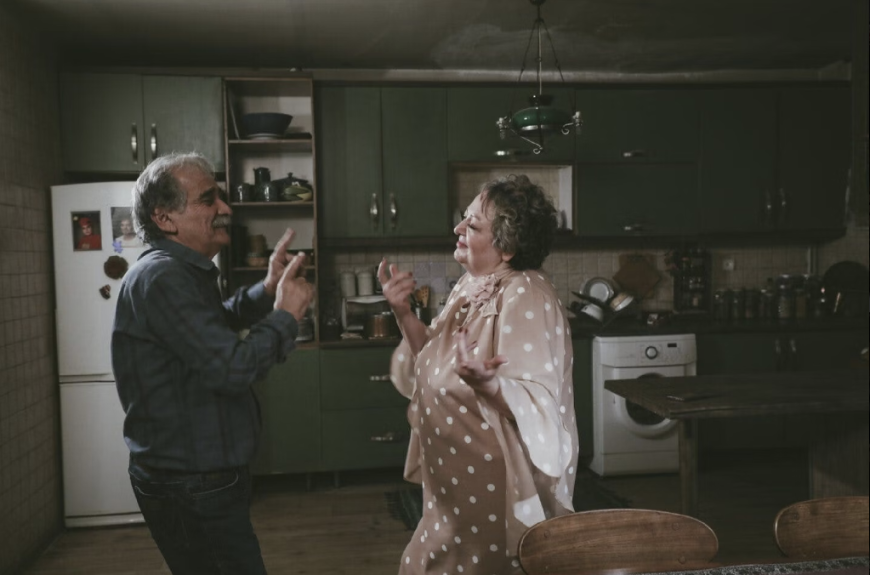
Figure 2: A still from the film My Favorite Cake (Kayk-i mahbūb-i man), directed by Maryam Muqaddam and Bihtāsh Sanāʿīhā. 2024.
The emphasis on strong central female characters in today’s audacious cinema in Iran reveals how deeply connected the creative process of filmmaking is with the nuanced social realities that inform both human fragility and strength. What makes these notable films audacious is their fearless and visionary cinematic dissent from that which is expected both by the authorities and the societal conventions. To speak of audacity in current filmmaking is to recognize the influential works of the past and present filmmakers whose courageous stories have transformed the Iranian collective ethos. In the words of bell hooks,16bell hooks (lowercase spelling is intentional and in accordance with the author’s choice of language) was a black American author, a radical feminist poet and educator, who passed away in 2021. in the struggle to break free of the censorship on life in the margins, one has to leave that space we call home, to endure the “alienation” and suffering displacement puts upon us, in order to recreate home no longer just as a “place,” but as “location” that empowers our collective “struggle of memory against forgetting.”17bell hooks, Talking Back: Thinking Feminist, Thinking Black (Boston, MA: South End Press, 1989), 36.Audacious cinema is such a location for the contemporary displaced and struggling generation of filmmaking and film-viewing Iranians who seek new locations – beyond the physical space – to find themselves in making new memories, without forgetting the ethos of the struggle.
Contemplating the embedded ethical narratives within the visual tales of these films that address core questions about alienation and othering, about visibilities and erasures, about moral dilemmas, about the banality of violence, and about the imperative of choosing life through empathy, I offer an exploration of the importance of audaciousness in contemporary Iranian filmmaking as an intentional act of dissent in and beyond the artform. Cinema as an act of defiance, opposes the universal characterizing of film, pivoting the value of visual storytelling to include the political and ethical meanings of the image. The creator of one of the most audacious films of the 20th century, The Battle of Algiers (1966) famously noted that “cinema is integral to cultural memory.” (Gillo Pontecorvo in the introduction note to The Battle of Algiers, printed in 1967).
Taken from this perspective, image-making, an integral aspect of cinematic production, is not indifferent to the meanings it conveys and the lasting affective memory it affords its viewer. Audacious films, therefore, are those visual stories in which the viewer engages with difficult subjects in defiance of the logic of the box-office, the codes of conduct within the industry, political restrictions, and most poignantly, the normative values resisted by the film. Thus, audacity in filmmaking is not exclusive to a specific genre or period of the history of cinema. As a work of art, cinema needs not to be exclusively a tale of social realism, an act of resistance to the political structures that work to discipline its creative realm of storytelling. “The filmmaker is not just a reader of reality, but a shaper of it.”18David MacDougall and Lucien Taylor, Transcultural Cinema (Princeton, NJ: Princeton University Press, 1998).
As cultural products born from a sense of shared values and discursive perceptions, knowledges, and apprehensions, films provide nuanced and complex reflections on the story of human – however fragmented and changing. Anthropology of cinema offers ways to address film as a subcategory of visual public culture with the power to both influence and to reflect the collective sensibilities and shared values that are central to the human experience in specific time and place. Visual anthropology offers a critical examination of the cultural context of film production, the sociopolitical climate that impact the reception and accessibility of cinema, and the experience of the intended audience. The perspective offered by a renowned visual anthropologist and ethnographic filmmaker, David MacDougall’s illuminating critique of the power dynamics between the viewer and film informs my intersectional critical analysis of what makes a film standout as an audacious act of dissent from the normative practices and ethical questions surrounding cultural representation that emerges in the narrative of the film in contemporary Iranian cinema.
Picturing Defiance
Outcry (Bīdād, 2025) by Suhayl Bayraqī tells the story of a defiant young woman with an ear-pleasing voice, in a country that forbids women to sing in public. Seti, in her twenties, represents a generation of Iranians disenchanted with the world they have inherited from their parents. Her personal ambition not only counters the legal interpretation of religious gender codes, but it is also a direct act of defiance against the complacency of urban middle-class generations whose surrendering silences compounds the violence of precarious the everyday life. Outcry is a bold social critique of contemporary Iranian topography, wherein the power of visibility (or in this case, audibility of Seti’s voice) acts as a catalyst for a tectonic shift in what may be summarized as a new countercultural movement, restless and rebelling against authoritative regimes of control. Though nuanced in the context of a real-life encounter by filmmaker on the streets of Tehran, where a defiant young woman street musician narrowly escapes the immanent arrest by the authorities, Outcry’s pre-occupation with gendered pronouncements of permissibility and impossibilities of the spatial, symbolic and personal in the everyday choices and acts, are central to Bayraqī’s films. In his previous trilogy of I (Man, 2016), Cold Sweat (ʿAraq-i sard, 2018) and Popular (ʿĀmmah-pasand, 2020), the unconventionality of central female character roles is itself a courageous undertaking that recognizes not only the state’s obsessive restrictions on woman, but its profound interconnectedness with patriarchal cultural norms that embolden the enactment of official heteronormative policies.
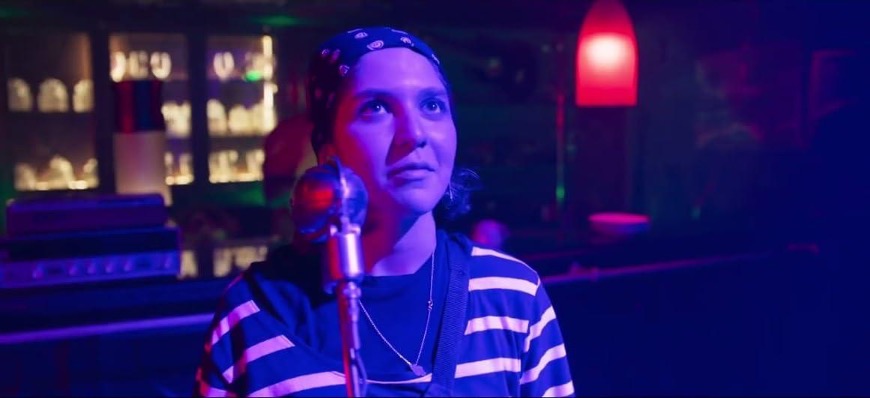
Figure 3: A still from the film Outcry (Bīdād), directed by Suhayl Bayraqī. 2025.
The audacity in Bayraqī’s cinema is noticeable both in his bold sociopolitical critique of the law (e.g. denying Iranian female athletes the right to compete on the international stage which is the subject of Cold Sweat), as well as the frustrating acceptance of the traditional gendered norms by the larger society – if not the women themselves – and the symbolic emotional violence endured by women who sit outside the boundaries of acceptable domestic caregiving roles of mother/daughter/wife in relation to the men in their familial orbit. In this light Bayraqī’s films exemplify visualities that mirror nuanced social realities faced by women in contemporary Iran. Seti in Outcry embodies a generation of young Iranian women recognized for their fierce resistance to the circumstantial and structural forces aimed to make them mute. Seti’s story typifies a social criticism of structural inequities and discriminatory regimes that are gendered, though a feminist critique is not the primary aim of the storyteller. Instead, it is the contrasting generational responses to discrimination, misogyny, and the prevalence of a culture of complacency – as we see between Seti and her mother, Humayrā. Seen against the backdrop of the rise in social protest of the last decade, from the “Girls of Revolution Street” (2017) to “Jina uprising” (2022), Seti typifies ambitious and outspoken women persecuted for their fearless persistence to gain visibility in life and autonomy over their bodies. In Seti, the Iranian viewer is reminded of Vīdā Muvahid (2017), Nīkā Shākaramī (2022) and countless other audacious youth, which collectively have been transforming the topography of resistance through intimacy, care, and determination.
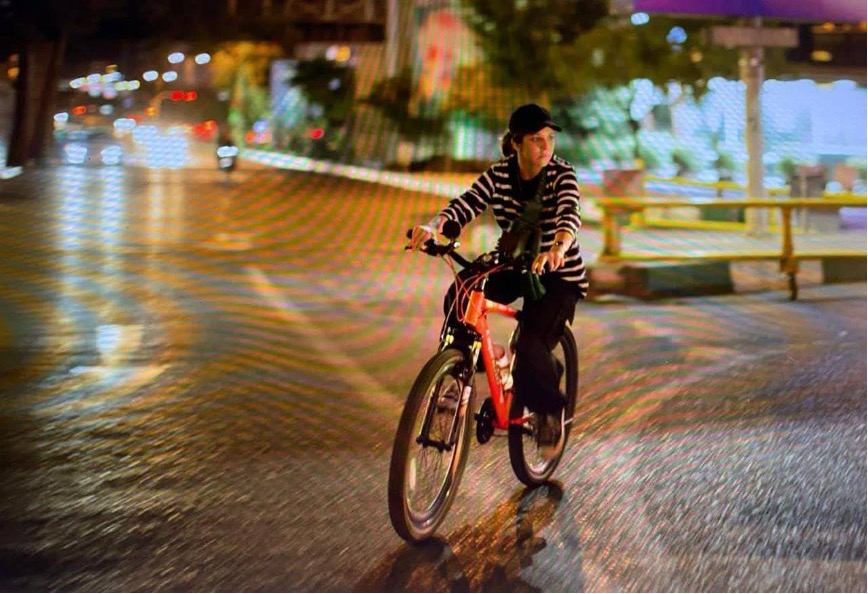
Figure 4: A still from the film Outcry (Bīdād), directed by Suhayl Bayraqī. 2025.
Love as a Political Act!
“Love is joy, love is freedom.
Love is the birth of humanity.”
(Ebtehaj, 2008)
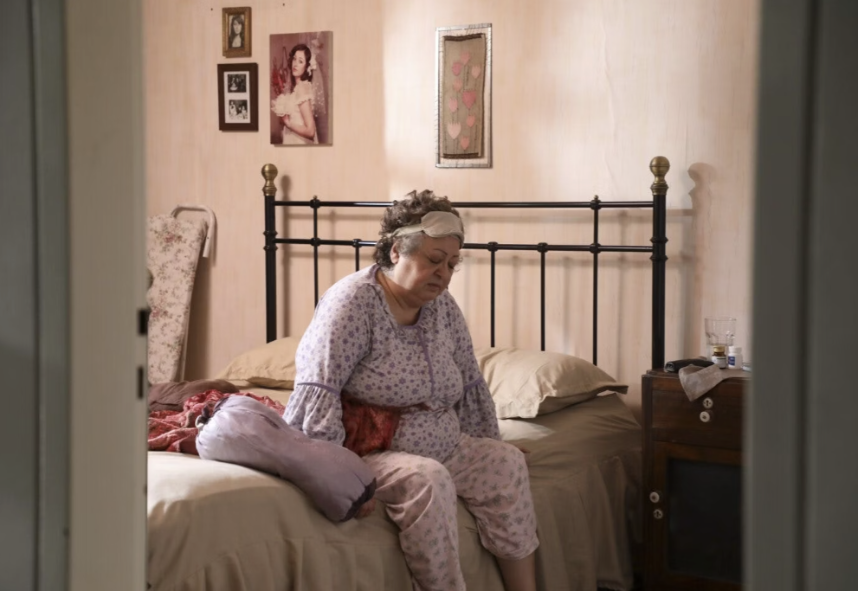
By contrast, My Favorite Cake (2024), jointly produced by Maryam Muqaddam and Bihtāsh Sanāʿīhā, finds a new “location”19By “location,” I am again referring to the notion of home as unpacked by bell hooks which I discussed earlier in this article. hooks argues that homemaking is an intimate process of healing achieved only through the necessary displacement from life in the margins to reclaimed location of remembrance and belonging. for telling a story about intimacy and connections between people in the fringes of visibility in today’s Iran. If Seti typified an outspoken ambitious generation of twenty-something urban educated middle-class women, Mahīn brings to light the seventy-year-old widows drowning in their solitary struggle against the corrosion of the mundane. The film tells a simple story – one that is centered around the character of Mahīn who decides to change the course of her life and to live according to her desire for intimacy and love. To the western audience Mahīn’s story does not merit audacity, per se. However, told in the context of the societal taboos about age and gender, compounded by the dominant cultural morality that emphasizes self-restraint and sexual propriety, Mahīn’s courageous decision to gain autonomy over her life and to seek out the companionship of a widower is a refreshingly honest example of audacious cinematic storytelling that defies both the legal and the conventional technologies to reduce, to obscure, even erase life beyond the realm of “duty” among older women. Mahīn is everyone’s mother, grandmother, neighbor, whose lonesome daily struggles are erased from the public imaginary. Muqaddam and Sanāʿīhā expand the boundaries of visuality in their intersectional meditation on human fragility and strength achieved through enactment of love. While this 2024 film has received due attention for its courage to portray a female body on screen without the compulsory hijab, it is the film’s evocative metaphysical poetics that brings Mahīn out of her protective solitary cocoon of grieving to connect with Farāmarz – quietly, gently, and resolutely.
Scratching beneath the surface of the story, My Favorite Cake is a bold attempt to tell an empathetic story about human vulnerability, and violence of invisibility as endured by the lead characters. Mahīn, however, is not resigned to her prescribed fate and it is through representing a story of her determination, resilience and tenacity, that the story of Mahīn disrupts age-old prophecies about duty, maturity, and love. Mahīn’s decision is a radical act of defiance in the face of societal and political conventions. She indulges in reclaiming her joy through dancing, baking and sharing the sweetness of life with those she decides to connect with – the young woman she rescues from the claws of morality patrol in the park, the taxi driver she befriends, in contrast to the guards she pushes away, and the nosy neighbor she shuts out of her home. The personification of the character Mahīn as a mild-tempered seventy-year-old widow, is key for the viewer’s affinity and empathy with a woman who is fed up with silences and the erasures that has become routine in the way women in general, and defiant women in particular, are treated. At the heart of the film is an audacious story about reciprocal bonds between humans, emphasizing the necessity for interconnections. In a society where people are evacuated from the center of public life by commerce (e.g., retirement, poverty) and political ideology (e.g., gendered norms and penalizing technologies for defiance), Mahīn’s story is a wakeup call for the human inside us.
The Journey from Lamentation to Light
One of the pioneering cinematic productions that has been recognized for its audacity in artistic disobedience to the compulsory depiction of Iranian women as cloaked in a narrowly inscribed code of socio-religious “modesty”, is a 2024 independent film by Farshād Hāshimī, entitled Me, Maryam, The Children And 26 Others. Hāshimī’s film, at first glance offers an uncomplicated narrative, wherein a filmmaker is allowed to use the private home of Maryam as a stage for making his short film. Set as a behind-the-scenes gaze into the underground filmmaking in Iran, Hāshimī’s film portrays a realistic everyday flow of interactions and conversations among members of the film crew, the occasional interactions with inquisitive neighbors, and above all, the conversations between the producer, played by Hāshimī himself, and the homeowner, Maryam, who is always present in the background and visibly discomforted by the intrusion. As the filmmaking proceeds, however, the story’s focal point shifts from the estranged couple in the short film, to the character of Maryam, the homeowner. Maryam is grieving, and in her grief, she finds comfort in isolating herself from others.
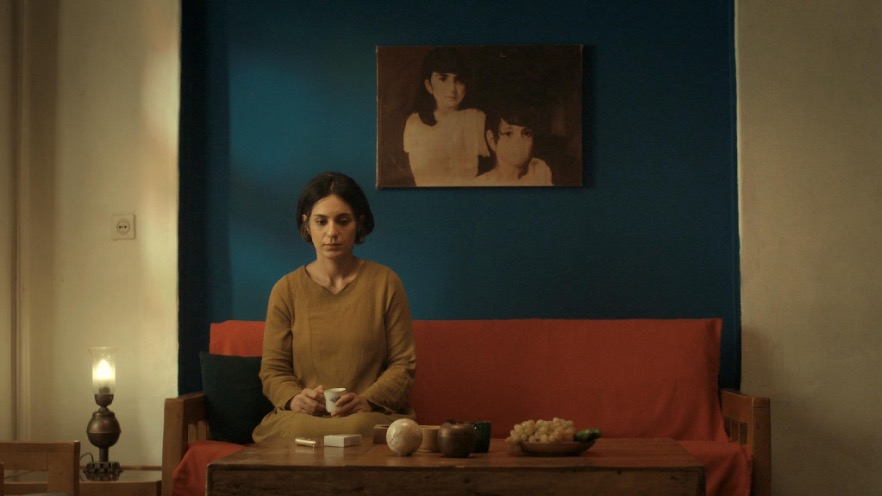
Figure 5: Maryam sits before an unfinished portrait by her late father, where the faces of the two sisters are blank. A still from the film Me, Maryam, The Children and 26 Others, directed by Farshād Hāshimī. Printed with permission from the director. 2024.
An unintended consequence of this encounter with a group of strangers in her sanctuary, the film moves us to witness Maryam’s transfiguration out of a cocoon of solitude spun to protect a single woman fatigued by systemic gendered hostility, to one who gradually learns to open up – not just her house, but her heart – to trust others. Maryams’s withdrawn mannerism, her precarious position of being wedged between a dire economic hardship which persuades her to rent her home as a set for an underground filmmaking, contrasted with her palpable discomfort with the intrusive nature of having a film crew take over the sanctuary of her quiet home – away from the public scrutiny and political retaliation – is a relatable honest narrative to the viewers, majority of whom with lived experiences resembling Maryam’s predicament in real life. The viewer is compelled to empathize with Maryam’s loneliness – as a single woman in a socio-politically hostile climate – to embrace her resilience and to appreciate her readiness to accept art as an affective medium for trespass and transformation beyond the ordinary solitude of her everyday life. Thus, the film’s poignant and transformative power is not limited to its bold decision in portraying an Iranian woman without the compulsory hijab, contemporary to the larger wave of protests sparked by Jina Amini’s death in 2022. Rather, the well-earned global recognition given to Hāshimī’s independent film as a fearless act of storytelling is due to the powerful connections made both on screen and between the viewer and the film.
Hāshimī’s agility to travel across zones of “performativity,”20Judith Butler’s theory of performativity introduced in Gender Trouble (1990) unpacks the idea of gender not as essentially biological (e.g., genetics), rather informed by a series of sustained repetitive acts and their associated cultural inferences that define and reinforce the idea of gender. Performativity, however, is not exclusive to gender, and applies to one’s positionality in each context. Here Hashemi adopts different positions integral to the intentional disruptive quality of the film. See Judith Butler, Gender Trouble: Feminism and the Subversion of Identity (New York: Routledge, 1990).as a director behind the camera and an actor entering the story, blurs up the established boundaries between the realm of imagination that unfolds in the film’s story and reflects the reality of the social disconnect and isolation familiar to the Iranian viewer. By moving in and out of the zones of belonging, Hāshimī disrupts cinematic forms (e.g., documentary, experimental, metaphysical) thus setting the ground for the viewer to venture outside the confinements of conventionality in the power dynamic between the filmmakers and their audience.
Me, Maryam, The Children and 26 Others, stands out as an example of audacious cinema not only for its daring political act of portraying Iranian women without the mandatory hijab – one of the first of its kind, but more poignantly for the story it tells that disrupts the normalized distrust and marginalization of empathetic human sensibilities, as technologies to make the individual vulnerable and isolated. Maryam enters our imagination as a familiar persona of a woman who has been quietly watching the world around her unfold. Maryam’s sanctuary is walled in books, and her most prized memento is an unfinished portrait painting by her father, whose death she is grieving. What we notice in this family portraiture is how the faces of the two daughters are blank, rendering them incomplete, unrecognizable and invisible. This powerful metaphorical expression of Maryam, her sister, and by extension women in Iran is not lost to the viewer, as Maryam is present in every shot, and in none of them. She stands fractionally outside the frame, so that we are aware of her presence and her power in the story – she is after all the homeowner who can cancel the entire project – though she keeps at bay.
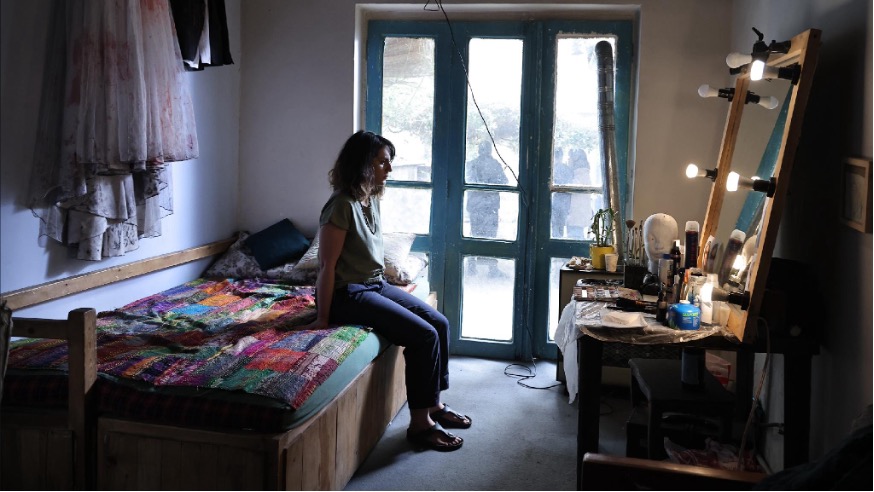
Figure 6: An “outsider” in her own home, Maryam shelters in her kitchen away from the crowd as life unfolds outside her window. A still from the film Me, Maryam, The Children and 26 Others, directed by Farshād Hāshimī. Printed with permission from the director. 2024.
Against the hostilities of the world that surrounds her, Maryam has become accustomed to her self-imposed solitary confinement, sheltering behind murky windows, watching others ruckus lives, among the glaring perils of sociality and faith in others. Yet, despite all reservations about the incursion into her world, Maryam gradually begins to connect with complete strangers who have invaded her inner most sacred layers of privacy. Beneath the coarse veneer we meet a woman whose heart melts with the vulnerability of the animals (e.g., the kitten caught in the collapsing filming equipment, the dying dog) and the displacement of humans alike (e.g., bonding with the Kurdish man from the film crew who she agrees to have stay in her house to watch over the expensive equipment). Bit by bit, Hāshimī’s story comes to focus as the story flows between the real and the image of reality.
One of the effective techniques utilized in this film is the incorporation of the industry within the story – that we see the camera, the filming crew, the crude and transient occupation of the space, the contested power play between the estranged couple who pretend to have a loving marriage for the sake of familial and cultural expectations, juxtaposed with Maryam solitary existence as she hovers on the fringes of the film, and the intimacy of friendship she witnesses among the trespassers in her home. Maryam is simultaneously Mahbūbah, the real-life person who inspired Hāshimī’s story, and the fictional character of Maryam with the only proper name in the film’s title, standing for a whole list of isolated self-preserving skeptical women in Iran.
The “Poetic” in Visual Culture
Etymological development of the word “poetry” and the idea of “poetics” are both related to the Ancient Greek term, “poiesis” meaning “to bring something into being that did not exist before,21Beyond the obvious connect to “poetry” and “poets”, it is worth considering how the Meriam-Webster dictionary includes in its definition of “poetical” a quality to “be beyond history,” and the Cambridge English dictionary points to its use as “an expression of beauty” and affective articulation. thus the poetical commitment required in audacious Iranian filmmaking is in its power to germinate novel ideas not only about the makings of cinema, but to create a forward-looking perspective on the ethos of being human.
In Iran, poetry has deep roots in the psyche of people, so that every Iranian child has grown up with poetry in their ear.22Whether invoking classical and epic poetry of the past or reciting contemporary New Poetry [Shiʿr-i naw] of the post/modern generations, the underlying moral guidance, often germinating from the spiritual meditations of the Sufi traditions in post-Islamic Iranian lexicon, remains an integral aspect of the gradual process of acculturation of the self. Moreover, since the emergence of the New Wave Cinema in the 1960’s, Iranian filmmakers have embraced a form of storytelling that evocative of the poetics of Omar Khayyam of Nishapur (the 11th century Persian polymath, philosopher and poet), Mawlānā Jalāl al-Dīn Muhammad Balkhī (13th century Sufi mystic and poet, known in the western lexicon as Rumi), and Khājah Shams al-Dīn Muhammad Hāfiz Shīrāzī (the 14th century mystic poet), with the age-old oral tradition of Pardah-khanī (screen reading), Shāhnāmah-khānī (the retelling of the epics of the legendary Rustam and his battles against evils of the time), and a wealth of public performance history that is intended to awaken the ethical sensibilities of the people against the backdrop of political austerity and domination.Audacious cinema in Iran though neither confined by genre of visuality, nor exclusively a 21st century innovation, has perfected the art of poetical storytelling. As revealed in examination of select films in this article, “audaciousness” of current Iranian cinema does not limit filmmaking to the genre of social realism. In this regard, “audacity” points to an intentional evocation of complex, if not paradoxical, ideas necessary for describing a distinctive quality in contemporary Iranian filmmaking that is “unorthodox” in both the subject matter of its focus, and “non-conforming” in its mode of cinematic storytelling.23Audaciousness in cinematic production needs not to be limited to narrative films, nor reduced to the plot. I refer to the art of storytelling as an evocative act of engaging with the spirit of the “story” that can encompass a diverse range of interpretation including an intentionality in bringing to focus existential quandaries (e.g., Still Life (Tabīʿat-i bījān, 1974), by Suhrāb Shahīd-Sālis, The Taste of Cherry (Tāʿm-i gīlās, 1997), by ʿAbbās Kiyārustamī, to name a couple) as well as an act of socio-political provocation (e.g., The Cow (Gāv, 1968), by Dāryūsh Mihrjūʾī, The Marriage of the Blessed (ʿArūsī-yi khūbān, 1989), by Muhsin Makhmalbāf). Thus, the “storytelling” and the “story” as it is reference in this study refers to the spirit of the story, or the essence in emotions and philosophical meanings that transcend the plot and characters of the film, per se. Put differently, here a distinction is made between politically critical social realism in film, with that of an intentional visual form of storytelling that resists political censorship, defies cultural norms and trespasses societal conventions to awaken a sense of collective ethical approach to life.
For the Iranian filmmakers, cinema often introduces a breathless meandering through the maze of political censorship, normative sensibilities, traditional and religious redlines and more. Yet, in the words of the legendary African American feminist author Audre Lorde, “poetry is not a luxury. It is a vital necessity of our existence. It forms the quality of the light within which we predicate our hopes and dreams toward survival and change.”24Audre Lorde, “Poetry Is Not a Luxury,” in Sister Outsider: Essays and Speeches (Freedom, CA: Crossing Press, 1984; reprint, Trumansburg, NY: The Crossing Press, 2007), 37.A close examination of the breadth of filmmaking history in Iran demonstrates how truly poignant are Lorde’s observations, not only as applied to the art of poetry, but to comprehend the trespassing and transformative power of cinema for both the Iranian filmmaker and her audience. To embrace “the intimacy of scrutiny, and to flourish within it,” as illuminated by Lorde,25Audre Lorde, “Poetry Is Not a Luxury,” in Sister Outsider: Essays and Speeches (Freedom, CA: Crossing Press, 1984; reprint, Trumansburg, NY: The Crossing Press, 2007), 37. Iranian filmmakers have mastered the poetic and poignant ability to adapt the products used for scrutiny in service to seats of power and transform it as an audacious dissent from that silencing.
Consider for example the two recent films by Muhammad Rasūluf with strong ethical narrative, told in radically different form. Structured episodically, in There is No Evil (2020) the viewer is introduced to four moral crossroads, where our decision to either obey that which we have been ordered to do (to preserve oneself or in complicity with establishment), or to resist such order on the grounds of moral responsibility. As such, Rasūluf’s 2020 film is a meditation on the political and the philosophical forces that determine life-and-death decisions. The style of its storytelling is of suspenseful mystery that enhances the sense of urgency in the film and captivates the viewer at the edge of her seat, breathless. There is No Evil, thus, is an intentional “poetical intervention” aimed to arouse the sleeping people numb to the banality of violence that seeps into every aspect of life in the country. The subjects of the stories are as bold and difficult as they are ubiquitous and familiar. Rasūluf’s audacious decision to germinate a visual journey into the soul of the viewer, with affective traumatic and terrifying stories that are all too believable, leaves a lasting impression on the viewer.
Coming on view two years into the widespread protests of the WLF, The Seed of the Sacred Fig (2024) addresses similar predicaments, heavily moral in its tone, yet in a radically distinct language. Both films by Rasūluf offer startling moral conundrums imposed by the urgencies for choosing between authority and autonomy. However, in 2020, Rasūluf’s anthology of short stories usher us to see a complicated far-reaching network of actors – including each of us – that make possible sustained injustices and violence (e.g., extinguishing the life of another). Beyond the actions of a prison guard or a soldier who pull the plug on life, there are masses of ordinary people whose collective compliance enables this. Here the film corresponds directly with Hannah Arendt’s writing on the question of justice, “wherein many people have participated, on various levels and in various modes of activity,” so that the evil, as it were, increases with the “degree of responsibility, as we draw further away from the man who uses the fatal instrument with his own hands.”26Hannah Arendt, Eichmann in Jerusalem: A Report on the Banality of Evil (New York: Penguin Books, 2006), 246–47. Thus, in the 2020 film There is No Evil, there lies a meditation on life and death and our individual responsibility towards it, in which Rasūluf poses a metaphysical question – albeit a difficult one – to his audience – what would you do? or rather, what would I do? By contrast, in 2024 that decision is less ambiguous. The rebellion of the women against the tyrannical patriarch of the family, as the symbolic figurehead for the State’s violent authoritative rule, is not lost to the viewer. Arendt’s startling observations on the “banality of evil”, that: “the sad truth is that most evil is done by people who never make up their minds to be either good or evil.”
The audacity in Rasūluf’s form of visual storytelling is not exclusive to the political undertone that renders it vulnerable to the brutality of governmental censorship. Its affective quality on the viewer is integrated in his refusal to produce film in service to comfort the viewer, through entertainment or escapism. The bold choices made in the creation of a relatable narrative; the audience forms empathetic bonds with complex characters caught in an ethical dilemma. Moreover, today’s audacious films provide a necessary outlet for affective meditations and critical reflections that correlate with the current existentialist sense of urgency expressed in the transformational nature of Jina uprising. While a critical analysis of the Woman, Life, Freedom movement is beyond the scope of this article, the radical transformations of praxis that are underway in how political resistance is organized (from schools to social media), point to a shift in ethos of dissent informed by ideas about “justice” and “autonomy” as core human values. This existentialist transformation in Iran embodies a poetic recalibration of the values that inform our collective struggle. As Lorde observes, a re-education is necessary “to learn more, and to cherish our feelings, and to respect those hidden sources of our power from where true knowledge and therefore lasting action comes.”27Audre Lorde, “Poetry Is Not a Luxury,” in Sister Outsider: Essays and Speeches (Freedom, CA: Crossing Press, 1984; reprint, Trumansburg, NY: The Crossing Press, 2007), 37. A cinema that is ambitious in its aspirations to transform the poetics of visuality, and bold enough to ask existentialist questions made palpable in the everyday life experiences of its audience, is poised to serve as a “home” away from home, where imagination, empathy, and love guide the progress towards change. For a people struck by structural exclusionary praxes and widespread systemic injustices in all aspects of their daily encounters (e.g., structural violence in the form of corporeal and gender discrimination, extreme poverty, abusive treatment of ethnic minorities and immigrants, and more), “to choose love is to go against the prevailing values of the culture” that requires violence, hatred and despair to sustain itself.28bell hooks, “Love as the Practice of Freedom,” in Outlaw Culture: Resisting Representations (New York: Routledge, 1994). In the context of contemporary social politics and most recent revelations brought forth by the Women, Life, Freedom movement and its aftermath, audacious Iranian cinema stands first as a lantern shedding light on the darkest of the collective consciousness, before holding up a mirror to reflect that light inwardly for us (the viewer) to delve into our sense of humanity and an ethical spirituality that has been the thread of our cultural existence for centuries.
Today’s Audacious Filmmaking in Iran
Today on the global stage, numerous Iranian filmmakers are recognized for perfecting the art of integrating the language of modern cinema with a poetic ethos passed down through generations via Iran’s oral, literary, and visual culture—from ʿAbbās Kiyārustamī’s Taste of Cherry (1997) to Muhammad Rasūlof’s The Seed of the Sacred Fig (2024) to Jaʿfar Panāhī’s It Was Just an Accident (2025).
The contemporary Iranian filmmaker carries the legacy of a collective sociocultural love affair with cinema that goes back decades. Shortly after the invention of the Cinématographe in late 19th-century Europe and the popularization of motion pictures by the Lumière brothers in 1895, cinema was introduced to Iran through the Qājār court photographer Mirza Ibrāhīm Khān ʿAkkāsbāshī Sāniʿ al-Saltanah, who in 1900 filmed Muzaffar al-Dīn Shah’s visit to a flower festival in Belgium. This event arrived in Iran amidst a whirlwind of state-driven modernization, religious backlash, and authoritarian politics. The art of filmmaking marked a turning point in the emergence of a new visual formation and public imagination that has continued to shape everyday life in Iran, as well as its collective visual aesthetics and cultural sensibilities.
Iranian cinema has a well-established legacy of increasingly ethical storytelling. Since its initial arrival on the cultural stage in the country, film has been viewed not only as a medium for entertainment, but often with poignant socio-political connotations, as an audacious voice for awakening the collective senses in its viewers. Audacious filmmaking is exemplified through diverse modes of storytelling in masterpieces such as The Cow (1969);29This movie is very well-known because of its psychological and social criticisms. It alludes to Marx’s theory of alienation as a central theme in the critique of modernist capitalism, and describes how Masht Hasan, the main character, loses himself in the struggle of finding his cow which is his most valuable property. It reveals how much Masht Hasan and his family’s life is depended on the cow both economically and emotionally that Masht Hasan cannot handle the situation logically. Thus, Masht Hasan’s demise becomes symbolic of a people who have lost their cultural roots and capital. Bashu, the Little Stranger (1989); as well as many of the 21st century productions, including Fireworks Wednesday (Chahārshanbah-sūrī, 2006) and About Elly (Darbārah-ye Ilī, 2009), by Asghar Farhādī; There is No Evil by M. Rasūluf (2020), and My Favorite Cake (2024), a joint venture by M. Muqaddam and B. Sanāʿīhā, each subject to extensive critical considerations by the scholars in the field.30For further reading, begin with the works of Hamid Naficy, A Social History of Iranian Cinema (Durham, NC: Duke University Press, 2011–2012); Hamid Dabashi, Close Up: Iranian Cinema, Past, Present, and Future (London: Verso, 2001); Hamid Reza Sadr, Iranian Cinema: A Political History (London: I.B. Tauris, 2006); Michael M. J. Fischer, Mute Dreams, Blind Owls, and Dispersed Knowledges: Persian Poesis in the Transnational Circuitry (Durham, NC: Duke University Press, 2004); Michelle Langford, Allegory in Iranian Cinema: The Aesthetics of Poetry and Resistance (London: Bloomsbury Academic, 2019); Matthias Wittmann and Ute Holl, eds., Counter-Memories in Iranian Cinema (Edinburgh: Edinburgh University Press, 2021).If cinema as a modern form of art is rendered a revolutionary measure for portraying a sense of a people, setting aside the self-indulgent authoritative political circumstances surrounding the event, wherein the new technology was to satisfy the interest of the modern King,31At the turn of the century, during his tour in Europe, Muzaffar al-Dīn Shah Qājār is introduced to the advent of the cinematograph, which he acquired and brought back to Iran for his court, inadvertently introduced this cutting-edge technology in storytelling to the country. The latter part of the 19th century Iran towards the end of the Qājār dynasty’s reign, in fact, coincided with many world changing events from within and beyond the territorial borders of the time, whose imprint has had a lasting effect on the course of Iranian sociocultural history – including the advancement in cinema. The rise in abolitionist movement and human-centered philosophical outlook in resistance to the European colonial expansionism, Eugenics structural racism, post-industrial revolution developments and their impact on the construction of a modern notion of a sociopolitical sensibility, technological advancement and the introduction of the moving pictures, women’s suffrage movement at the intersection of modern living, were all precursor to the Constitutional Revolution (1905-1911), that aimed to limit the political power of the monarchy toward a modernizing ambition for the establishment of a civil society under the rule of law. Historians and anthropologists, by and in large, recognize the events of this period with formative impact on the direction and quality of social and political dis/entanglements that have followed since. it was an audacious act to bring this budding visual technology to a people caught up in the clamorous period of navigating across the national, regional and transcultural boundaries. In the history of Iranian filmmaking, cinema is rarely superfluous to the doings and goings of the everyday life.
The renowned critical thinker and political philosopher of the 20th century, Walter Benjamin in the Arcades Project which he wrote between 1927-1940 states that, “history decays into images, not into stories.”32Walter Benjamin, The Arcades Project, trans. Howard Eiland and Kevin McLaughlin (Cambridge, MA: Harvard University Press, 1999), 476. This unrelenting power of cinema to break down history, its expansive ability to incorporate all manners of artistic forms and technologies, and to take root in diverse and dynamic cultural settings, has rendered it a powerful mode of inquiry for understanding the shared cultural ethos and the un/normative sociopolitical praxis of its creators and viewers, both. In 1911, when the Italian film theoretician Ricciotto Canudo identified it as “the seventh art,” the emphasis was in cinema’s plasticity in incorporating all previously established art forms – architecture, sculpture, painting, performance, and poetry. Since its initial introduction over a century ago, Iranian filmmakers have refined the art of cinematic provocation not only in the realm of social realism and political resistance, but more to the point of this study, as an audacious force for an ethical critique of who we are and how we want to be.
Not all cinematic productions need to convey a higher meaning, nor does audacious film need to tell a socially realistic story. Yet, art has the power to transform us. Iranian audacious cinema, above all, has the capacity to flare up an affective (empathetic and intimate) response to its story, to awaken a sense of self-reflexivity for the viewer through humanization of the narrative and relatability of its paradigm. As an evocative work of art, the Iranian audacious cinema makes a visceral connection to its viewer in telling a compelling story about life and humanity, beyond the escapism and erasures that are customary in the current climate of filmmaking in the country.
Figure 7: Weighted down by her grief and solitude, Mahīn sits at the edge of her bed, defeated in her loneliness. A still from the film My Favorite Cake, directed by Maryam Muqaddam and Bihtāsh Sanāʿīhā. 2024.
The power of audacious films is in their disruption of the distance between that which is unfolding on the screen to what we the viewer endures in real life. Iranian cinema in the hands of audacious “image-writers,” allows us to observe the dynamic interplay between all the layers of meaning-making processes, from the production of a film with intentionality to focus on humanity of the story, to diversity of viewership, and the transformative cultural landscape that surrounds it. The audacity then, applies not only to the vision of the filmmaker, but in the honest self-reflection of each of the viewers encountering its core quandary. This dynamic interconnected triad of film, filmmaker, and audience reaches a new height in contemporary audacious Iranian cinema. Intentionality in audacious Iranian films sets the stage for us to gaze at ourselves – isolated, flawed, vulnerable, even hurt – against the seemingly impossible “ethos” of our collective sense of humanity.33Hubert L. Dreyfus, “Heidegger’s Critique of the Husserl/Searle Account of Intentionality,” Social Research 60, no. 1 (1993): 17–38. “Visual anthropology encompasses two parallel aims: the production of anthropological media as well as the anthropological analysis of media.”34Jenny Chio, “Visual Anthropology,” in The Open Encyclopedia of Anthropology, ed. Felix Stein, The Cambridge Encyclopedia of Anthropology (2021), https://doi.org/10.29164/21visual.
As an anthropological deliberation on the political power of cinema as a force for change, this article explores how the viewer enacts agency through active and affective connections that makes the film a reflection on the personal and the political. Faye Ginsburg’s notion of “cultural activism,” underscores the sense of both political agency and cultural intervention that people bring to the process of viewing the visual.35Faye Ginsburg, Lila Abu-Lughod, and Brian Larkin, eds., Media Worlds: Anthropology on New Terrain (Berkeley: University of California Press, 2002).In writing to describe what he calls, “the activist imaginary,” George Marcus demonstrates how marginalized and fringe communities turn to film and visual culture not only to “pursue traditional goals of broad-based social change through a politics of identity and representation” but more profoundly as a mark of a desire for shaping of the “public sphere” for transformation in ideas about citizenship, visibility and inclusion.36George E. Marcus, ed. Connected: Engagements with Media (Chicago: University of Chicago Press, 1996), 6.
When speaking of courage in cinema of Iran, it is easy to think of a handful of renowned filmmakers who despite censorship continue to create critically acclaimed stories about one of many aspects of the sociopolitical injustices that mark the flow of life in Iran. Historical studies of cinema in Iran demonstrate how despite political repression, Iran’s cinematic journey has brought about formidable generations of courageous filmmakers across different styles and decades.37Chief among the filmmakers known for their audacity in ethical storytelling are Furūgh Farrukhzād, Bahrām Bayzāʾī, Dāryūsh Mihrjūʾī, Suhrāb Shahīd-Sālis, Muhsin Makhmalbāf, Rakhshān Banī-Iʿtimād, ʿAbbās Kiyārustamī, Ibrāhīm Hātamīkiyā, Jaʿfar Panāhī, and Muhammad Rasūluf, whose influential works have achieved preeminent global recognition. However, the films considered here share a critical audacity in ethical storytelling poignantly vibrant in the context of the current revolutionary transformations embodied in the Iranian counter-cultural defiance of the youth (e.g., “Girls of Revolution Street” in 2017, the Woman, Life, Freedom movement, and the “Jina uprising” of 2022–2023). Both the political movement and the cinematic reflections that is emerging in tandem with it, point to transformations of ethos that define the current cultural climate of resistances in Iran. While radically nuanced in addressing key existential questions that permeate the socio-aesthetics of a people struggling to find their footing at “home” and in the world, the intersectionality of the stories, representations of their multi-dimensional characters, and the fragmented struggles to remain human that is witnessed in these selection of audacious films point to a period of transitions, when it is necessary to rely on what Adrienne Rich called “the oppressor’s language.”38Adrienne Rich, “The Burning of Paper Instead of Children,” in Collected Poems: 1950–2012 (New York: W. W. Norton & Company, 1989), 304.
Audacious cinema of Iran still has a long way ahead if it is to widen the field of possibility for radical storytelling that is inclusive of non-normative sexualities, free of ideological entrapments of us versus them, and the embodiment of an appreciation for racial, ethnic, and transcultural connections that brings Iranian visual storytelling in conversation with the world – beyond the hierarchies in the commercial spectacular of the film festivals. As more trans-bordered voices of dissent arise from Iran in solidarity with struggling people regardless of language, skin color, geography and other super-imposed colonial divisive technologies of exclusions and strife, Iranian audacious cinema, I anticipate, will adapt and adopt new imaginative modes of engagement with a wider audience across many “homes” and “locations.”39bell hooks, “Choosing the Margin as a Space of Radical Openness,” Framework: The Journal of Cinema and Media 36 (1989): 17.
Iran’s audacious cinema is situated at the intersection of revolutions in ethical values that prioritize the human story, however painful the consequences. Those contemporary Iranian films that make an intentional point of resistance to both governmental control and societal norms to tell a difficult story about who we have become and how we want to be, demonstrate a bold act of ethical intervention to the normalcy of life. This audacity in filmmaking that remains connected to the current sociocultural changes flowing underfoot and can expose pain as well as power to live with hope, we find on the rise in today’s Iranian cinema.
Cite this article

Spurred by sociopolitical events in recent years, Iranian cinema is poised to offer a poignant new approach to ethical storytelling – one that is reflective of the “existentialist” transformations as expressed in the Woman, Life, Freedom movement (WLF for short) since 2022. There is a noticeable rise in current Iranian ethical filmmaking that is evident in its distinctively fearless addressing sociopolitical subjects that cross the governmental “red lines” and its openly provocative portrayal of human fragility in the face of ethical conundrums and moral questions that arise from the tension between the ordinary acts in the everyday life and their subsequent impact on the normalization of violence at large. This current approach to Iranian filmmaking, I call an audacious cinema, not only for its direct engagement with difficult social subject matters (such as the banality of violence, death and grieving), but for its bold expository approach to a visual narration that disquiets the normative flow of life, enabling the viewer to reflect on his or her own actions. Expanding across multiple generations of filmmakers, the Iranian audacious cinema is not limited by genre or topics. In form audacious filmmaking extends beyond the traditional social realism of the New Wave Cinema in the 1960s, and in scope it has come of age in contrast to revolutionary films that were confined in topics of war, poverty, and political corruption. The audacious cinema in Iran displays a lauding voice for those on the margins. The courage of filmmaking is evident in engaging with difficult subjects that are prevalent in daily life, yet addressing them on screen has become increasingly difficult, due to rise in censorship, unreliable economics in the industry, and the added burden of addressing a socio-culturally taboo subject, thus startling the viewer into a place of ethical introspection. Audacious cinema captivates the viewer by evoking a sense of thrill in the story told in an accessible language and empathetic acting, so the problem is understandable and familiar to the general viewer. However, as unexpected plot twists are introduced in the story, the audacious filmmaking offers an uncommon response to the conundrum faced by the protagonist (e.g., financial crisis, unbearable grief, or the disparity in the face of gross injustice). Thus, the film is able to usher the audience’s attention to reflect inwardly to deliberate on human values beyond the scope of the film itself. As a result, audacious films leave the audience wondering who we are and how we want to act, long after the screening has ende