This article offers a semio-pragmatic analysis of the film adaptation of Reading Lolita in Tehran, conceived as a reconfiguration of the contract of reception. The reception of Azar Nafisi’s book (2003) has been shaped by a persistent critical tension between readings that valorize Western literature as a resource for emancipation and interpretations that situate the work within a neo-imperial imaginary. Rather than reducing this diversity to a single polarity, the study shifts the analysis to a different plane—not that of ideological content, but of the operative conditions of meaning. It examines how the film’s dispositif configures the formation, circulation, and sustainability of interpretive positions within Roger Odin’s theoretical framework through an analysis of the regimes of reception the film activates.
The analysis identifies three interdependent operations. From the outset, the film activates a documentarizing regime that anchors the represented world in attestation, establishing a horizon of credibility prior to the emergence of interpretive conflict. This configuration does not impose a univocal meaning; rather, it regulates in advance the conditions under which subsequent hypotheses may circulate. The reading scenes then displace the locus of conflict toward a dynamic of validation: through the organization of exchanges and the distribution of enunciative positions, interpretations are subjected to progressively explicit criteria of acceptability. Plurality persists, yet it becomes hierarchized according to the institutional, historical, or moral supports on which particular readings rely. Finally, the denouement consolidates and hierarchizes this regime of validity by shifting into a testimonial mode and reconfiguring the conflict within a memorial frame, without formulating an explicit verdict.
The adaptation thus emerges as an intervention in the pragmatic economy of meaning: it recalibrates thresholds of credibility and asymmetrically redistributes the resources through which interpretive positions attain legitimacy.
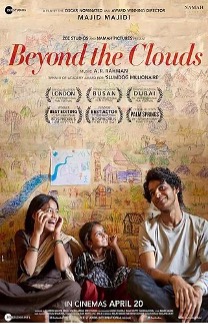
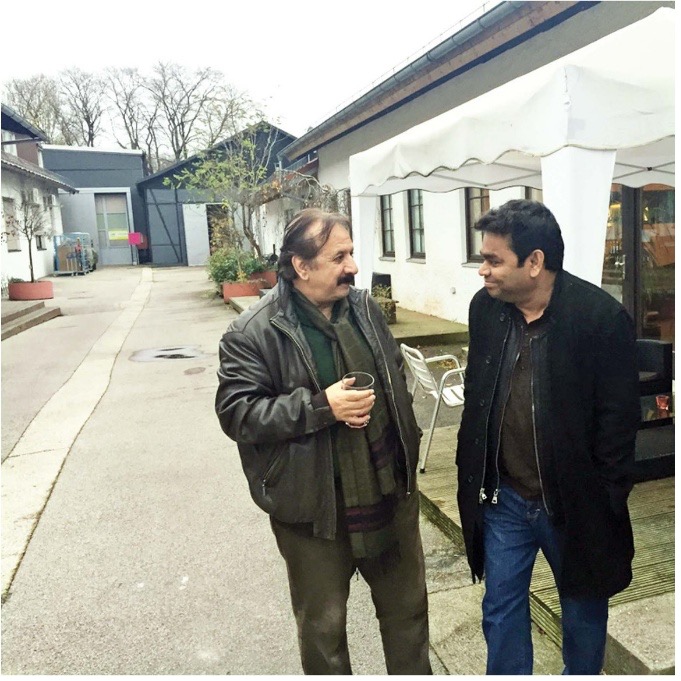
In 2017, the Iranian filmmaker Majīd Majīdī released his first Indian film, Beyond the Clouds. Majīdī is a prominent director of art films, including Children of Heaven (Bachchah’hā-yi Āsimān, 1997). This acclaimed film was part of Iran’s post-revolutionary cinematic wave of realist and humanist films about children. Children of Heaven concerns impoverished residents of Tehran, focusing on a young sister and brother whose touching relationship sustains them through hardship. Beyond the Clouds (2017) is a broad reimagining of this story, centering young adults and set entirely in Mumbai, featuring Indian actors and shot in Hindi. Majīdī made use of India’s more liberal film production policies (though they are not without censorship) to construct a tale about illicit activities such as drug dealing and forced sex work, escalating beyond Children of Heaven’s tamer tale of lost shoes. Majīdī’s 2017 film was keenly anticipated in India, where Iranian art-house films command respect. On his promotional tour for the film, Majīdī spoke at length about why he chose India for his first foreign-set film, pointing to shared culture and heritage between the two nations.1Namrata Joshi, “Iranian Director Majid Majīdī on Why He Set Beyond the Clouds in Mumbai,” The Hindu, April 14, 2018, https://www.thehindu.com/entertainment/movies/iranian-director-majid-majidi-on-why-he-set-beyond-the-clouds-in-mumbai/article23529025.ece While it was Majīdī’s first time working abroad, Beyond the Clouds marked his second collaboration with famed Indian composer A. R. Rahman, who had previously scored Majīdī’s controversial epic depicting the life of the Prophet, Muhammad: Messenger of God (Muhammad Rasūl-Allāh, 2015).
Figure 1: Film poster for Beyond the Clouds, directed by Majīd Majīdī, 2017. Source: IMDb.
Figure 2: Majīd Majīdī and A. R. Rahman, 2015. Source: Deccan Chronicle.
In the same year as Majīdī’s much-awaited Hindi cinema debut, the diasporic Indian filmmaker Anup Singh released TheSong of Scorpions, another international Hindi-language production filmed and set in India. Singh cast the expatriate Iranian actor Gulshīftah Farahānī in the lead role. The folkloric melodrama, shot in the Rajasthani desert, has resonances with the popular film traditions of both India and Iran, though Singh has said that his story was motivated by the specific social context of violence against women in contemporary India, particularly the 2012 Nirbhaya case.2Anuj Kumar, “In Search of an Antidote,” The Hindu, September 5, 2017, https://www.thehindu.com/entertainment/movies/in-search-of-an-antidote/article19624269.ece Neither Beyond the Clouds nor The Song of Scorpions was an equal co-production between Iran and India. Rather, they reflect a contemporary global art-film economy that sources funding from a combination of public grants and private producers, bringing in talent from a variety of national backgrounds. However, their casts, locations, and formal modes situate them in a lineage of Indo-Iranian film connections. They also mark a revival of interest in Indo-Iranian cinematic exchange that had last reached a high-water mark in the early 1970s, when fīlmfārsī still flourished in Iran.
How can we make sense of the cinematic histories of Indians in Iran, and Iranians in India? The two regions (including what is now Pakistan, and Afghanistan) have a centuries-long cultural relationship that produced celebrated Persian-language poetry. Recently, scholars have adapted frameworks from literary history to examine film production between India and Iran within broader histories of film circulation in South Asia, the Middle East, North Africa, and the former Soviet Union. Here, I map these frameworks alongside a survey of film production between India and Iran over the past century, encompassing co-productions, films with cast and crew from both countries, and films whose basis derives from shared literary and cultural touchstones. I focus on theories of Islamicate and Persianate modernity to contextualize this transnational film production, while also incorporating a political economic lens to examine continued relations and exchanges between the Indian and Iranian nation-states in the postcolonial and post-revolutionary period. I argue that mediawork emerges as a useful lens to analyze Indian and Iranian cinematic relations as they develop from the 1970s to the present.
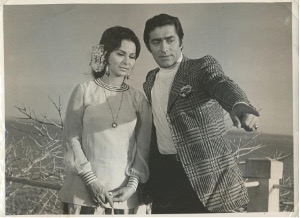
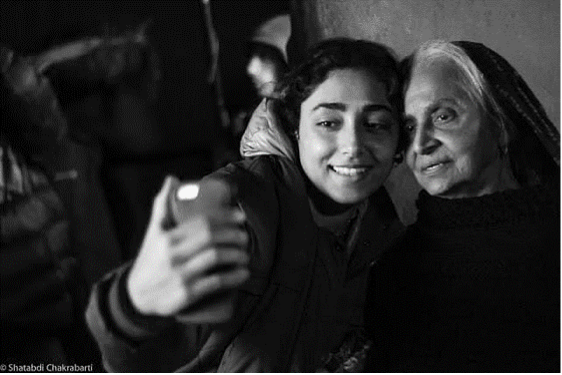
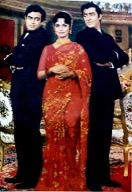
Subah-o-Sham, known in Persian as Humā-yi saʿādat (Bird of Happiness, 1972), was a co-production shot simultaneously in Hindi and Persian, and featured a mixed cast that included some of the most prominent stars of each national cinema – India’s Waheeda Rehman, alongside the Iranian Muhammad ‛Alī Fardīn and the Indian Sanjeev Kumar, the latter two playing brothers. However, despite an Indian director and composer duo, this film also situated itself in a national context, taking place entirely in Tehran. Rehman played a troubled Indian dancer, drawing on the tawaif trope that was popular in both countries’ mainstream cinemas and their longer literary and cultural histories. Interestingly, Rehman also appears in The Song of Scorpions, as Gulshīftah Farahānī’s mother. The casting of Kumar, Rehman, and Farahānī in these films also speaks to the salience of racial fluidity or passing between Iranians and North Indians for transnational visual cultures, which I discuss further in this article.
Figure 3: Gulshīftah Farahānī and Waheeda Rehman on the set of The Song of Scorpions. Courtesy of National Herald, photo by Shatabdi Chakrabarti, 2023.
Both Beyond the Clouds and The Song of Scorpions were released in India and at international festivals to mixed reviews and unsatisfactory box office results. Several critics registered tonal imbalances – especially in The Song of Scorpions – which they argued derived from the incompatible styles of a non-resident Indian director, a Paris-based Iranian actress, an Italian editor, and so on.3See Rahul Desai, “The Song of Scorpions Movie Review: Irrfan Khan’s Swansong Is a Hypnotic Mix of Myth and Matter,” Film Companion, April 28, 2023, https://www.filmcompanion.in/reviews/the-song-of-scorpions-movie-review-irrfan-khans-swansong-is-a-hypnotic-mix-of-myth-and-matter-anup-singh-golshifteh-farahani-waheeda-rehman-shashank-arora The Indian film critic Nandini Ramnath opened her review of Beyond the Clouds with the line, “Majid Majidi’s first Indian production is a Hindi movie with an English title – and that is only the first sign of a mismatch.”4Nandini Ramnath, “‘Beyond the Clouds’ Film Review: A Tale of Hope and Redemption That Stays Firmly out of Grasp,” Scroll.in, April 20, 2018, https://scroll.in/article/876218/beyond-the-clouds-film-review-a-tale-of-hope-and-redemption-that-stays-firmly-out-of-grasp Reviews from British and American publications invoked the term “Bollywood” to characterize Beyond the Clouds’ use of melodrama and departure from realist aesthetics.5See Peter Bradshaw, “Beyond the Clouds Review – Brash Bollywood in the Mumbai Underworld,” The Guardian, April 20, 2018, https://www.theguardian.com/film/2018/apr/20/beyond-the-clouds-review-bollywood-majid-majidi. This unknowingly echoed an Iranian critique of 1960s fīlmfārsī films. Similarly, critiques of The Song of Scorpions centered on its romanticized presentation of Orientalist tropes. The expectation, or barometer, for both films was a form of realism more often seen in Iranian New Wave films of the 1990s.
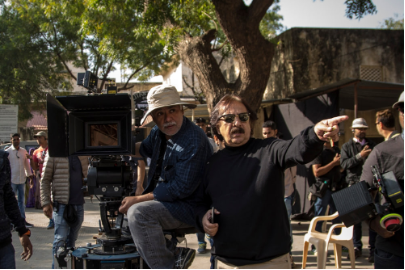
Figure 4: Majīd Majīdī filming in India, 2017 (Zee Studios)
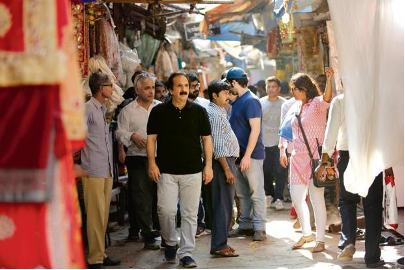
Figure 5: Majīd Majīdī in India, 2018 (Mint India)
Yet both these international productions had more interest in the qualities of popular Indian cinemas. Both were set in India, featured Indian characters, and adhered to the common melodramatic themes of Hindi cinema; each was anchored by musical sequences characteristic of popular cinemas made in the Bombay film industry. In their tightrope act between representing and bolstering national identity and culture on the one hand, and appealing to Indian, Iranian, and other Southwest Asian audiences more broadly on the other, they are aligned with a long tradition of cinematic co-production and circulation between India and Iran.
Persianate Modernity and (Trans)National Cinemas
Scholars have considered the relationship between Indian and Iranian cinemas through several frameworks, though no comprehensive studies focus exclusively on these two countries.6My dissertation, “Ministries of Light: Modernism and Modernity in Indian and Iranian State-Sponsored Documentaries, 1960s-1980s” (PhD diss., 2021), is a comparative study of state-sponsored documentary film production in India and Iran, but it does not focus on co-production. Hamid Naficy’s A Social History of Iranian Cinema places the origins of Iranian cinema in Mumbai (then Bombay) and establishes the roots of early Iranian cinema as mobile, multi-ethnic, and cosmopolitan.7Hamid Naficy, A Social History of Iranian Cinema, Volume 1: The Artisanal Era, 1897–1941, 1st ed. (Durham: Duke University Press, 2011). Richard Allen and Ira Bhaskar’s Islamicate Cultures of Bombay Cinema, published in 2009, maps “Islamicate genres and idioms” in Bombay-based film production from the 1930s to the present.8Ira Bhaskar and Richard Allen, Islamicate Cultures of Bombay Cinema (New Delhi: Tulika Books, 2009). A more recent edited volume, Bombay Cinema’s Islamicate Histories, identifies Islamicate cultural tropes and influences in several modes of Bombay cinema. Drawing on historian Marshall Hodgson’s term, Allen and Bhaskar specify that “Islamicate” refers to the broadly Muslim aesthetic and cultural world, which also encompasses non-Muslim peoples. They also include Persianate and Arabesque elements within the Islamicate.9Ira Bhaskar and Richard Allen, Bombay Cinema’s Islamicate Histories (Bristol: Intellect Limited, 2022). The Persianate world refers to geographical regions and communities that were linked through the influence of Persian language and culture, and Arabesque here refers to culture and aesthetic traditions that originate in Arab regions. I elaborate on the Persianate below. Other scholars, such as Pedram Partovi and Sunil Sharma, isolate India, Iran, and Turkey as modern nation-states within Persianate cinematic legacy, while Anupama Prabhala Kapse argues that the Arabesque functions as a “spatial and cultural imaginary” deriving from shared cultures of South Asia and the Middle East.10Pedram Partovi, “Constituting Love in Persianate Cinemas,” Journal of Persianate Studies 10, no. 2 (2017): 186–217; Sunil Sharma, “The Persian Masnavi Tradition and Bombay Cinema,” in Bombay Cinema’s Islamicate Histories, ed. Ira Bhaskar and Richard Allen (Bristol: Intellect Limited, 2022), 64–82; Anupama Prabhala Kapse, “Afterword: The Long Arabesque: Economies of Affect between South Asia and the Middle East,” Film History (New York, N.Y.) 32, no. 3 (2020): 241–54.
In his A Social History of Iranian Cinema: The Artisanal Era, Naficy traces Indo-Iranian film production back to the 1920s, when the first Persian-language talkie was produced in Bombay. This film, Dukhtar-i Lur or The Lor Girl(1932), was directed by the Iranian émigré ‛Abdalhusayn Sipantā, who worked with Parsi film producer Ardashīr Īrānī.11Parsis are an Indian religious community descended from Iranian emigrants. Sipantā went on make four more films in India: Firdawsī (1935), Shīrīn va Farhād (1935), Chashm’hā-yi Siyāh(1935), and Laylī va Majnūn (1936). Each of these films had Persianate themes, which I discuss in more detail below.
Naficy’s comprehensive history of Iranian cinema establishes the national cinema’s roots as transnational and diasporic. His research on early Iranian cinema demonstrates the role not only of Bombay-based Iranians and Parsis but also of Armenian Iranians, Qājār court photographers abroad, Western missionaries, and many others in the formation of Iranian national cinema. While he recognizes the centrality of national identity for Iranian modernity (and therefore Iranian cinema), he has consistently problematized the lens of national cinema in relation to Iranian film and media.12Hamid Naficy, A Social History of Iranian Cinema, vol. 1, The Artisanal Era, 1897–1941 (Durham, NC: Duke University Press, 2011), 8. In A Social History, he writes that scholars and readers should be sensitive to the “heterogeneity and constructedness of the two concepts of Iranian nation and Iranian national cinema.” Naficy also notes that, just as the spatial understanding of Iranian cinema and nation is unfixed, so too is its temporality. As such, Iranian and other modernities should also be understood as “asynchronous, asymmetrical, and partial.”
Research on ‛Abdalhusayn Sipantā, Ardashīr Īrānī, and the Imperial Film Company of Bombay has been the genesis of inquiry into further Indo-Iranian co-productions, and more broadly, cinematic linkages between South Asia and the Middle East. These co-productions are largely popular films that capitalize on regional star power, and more recently, on auteurist caché. India’s Islamicate film industries and Iran’s film industry continue to exchange transnational casts and crews in “national” productions. Contemporary films from both countries feature linguistic and musical intersections, and many still adapt communal narratives. The production and circulation of all these films rely on an existing shared audience in South to West Asia. For this reason, I focus on these cinemas as afterlives, echoes, or threads of the Persianate.
How did South-South transnationalisms and development ideologies impact cultural production and postcolonial national identity in India, Iran, and neighboring states? To what extent did East-West relations disrupt Oriental circuits? Taken together with instances of popular film co-production initiated by The Lor Girl, which have recurred every few decades, this history provides us with an opening to think about an alternate or adjacent history of trade, mobility, migration, and circulation.
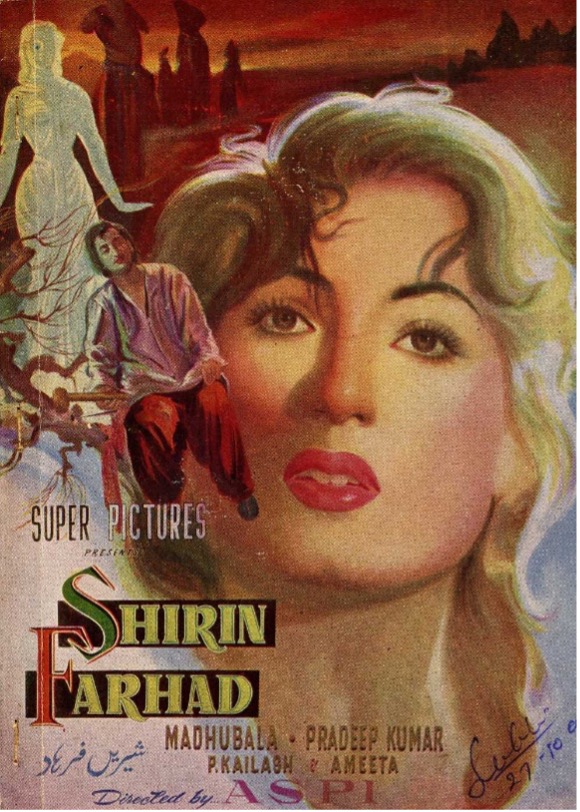
The Persianate refers to the geographical and imagined sphere consisting of regions that shared “literary, ethical, and aesthetic sensibilities,”13Mana Kia, “Indian Friends, Iranian Selves, Persianate Modern,” Comparative Studies of South Asia, Africa, and the Middle East 36, no. 3 (2016): 400. which derives from their governmental, educational, and literary use of Persian. This provides a genealogy for Indo-Iranian cinema separate from contemporary borders and national cinema frameworks, intervening against histories that argue colonialism disrupted the Persianate sphere. As Mana Kia writes, “It is assumed that colonial rule changed the fate of South Asia into something distinct from places like Iran. But if we look past the state and consider continuing trade networks and the social links that accompanied these transactions, we see that the circulation of people, texts, and ideas between the two lands continued. More than this, Iran was subject to political and economic pressures that spurred some of the same discussions around reform…” While Kia argues that this extends into the early twentieth century, it is clear that vestiges remain through the medium of cinema, not just literary and theatrical work. For example, beyond co-productions, romantic epics such as that of Leila and Majnun, or Shirin Farhad (also known as Khosrow and Shirin) have been repeated subjects of films in both countries. Indeed, a recent Indian film adaptation of the Shīrīn-Farhād story was remade as a contemporary comedy entitled Shirin Farhad Ki Toh Nikal Padiin 2012. These stories originate in the Persian epics the The Book of Kings (Shāhnāmah), from the 10th century, and Nizāmī Ganjavī’s 12th-century Khusraw and Shīrīn.
Figure 7: Film poster for Shirin Farhad (1956). Source: IMDb.
One essential link between Persianate cultures and cinema is their influence on the constitution of modernity in both India and Iran. The emergence of cosmopolitan cultures included the increasing mobility of Indians, Iranians, and other Asians in Europe, South Asia, and the Middle East, and the expansion of modes of communication, particularly in the nineteenth century.14Nile Green, “Spacetime and the Muslim Journey West: Industrial Communications in the Making of the ‘Muslim World,’” The American Historical Review 118, no. 2 (2013): 401–429. Kia describes the presence of the “Indian friend” in late nineteenth-century Persian modernist writings, stating, “His [the friend’s] presence demands a reconsideration of modern national selfhood at the turn of the twentieth century and of the ways in which enduring forms of belonging shaped modes of self-understanding as something that happened in the first person plural, as ‘we’ became modern together.” She writes that the two societies had a shared heritage in ideas of moral refinement, adding that, in the late colonial period in India, “older Persianate ethical norms could still function as a common lexicon between Iran and India. These continuities, and the social and political ties that they enabled, demand a reconsideration of Iranian and Indian modernity as interrelated.”15Mana Kia, “Indian Friends, Iranian Selves, Persianate Modern,” Comparative Studies of South Asia, Africa, and the Middle East 36, no. 3 (2016): 398–417. Thus, I extend the idea of the cinematic Persianate further to argue that these extensive transregional relations did have relevance not only for modernity but also for the formation of modern nation-states. Indeed, since India’s decolonization, the two nations have actively sought to foster a political and economic relationship. However, cinematic exchange has largely been characterized by representations of, or references to, pre-modern Persianate history (such as Laylā-Majnūn), or else privileged by only one of the two modern nation-states in narrative, language, and location.
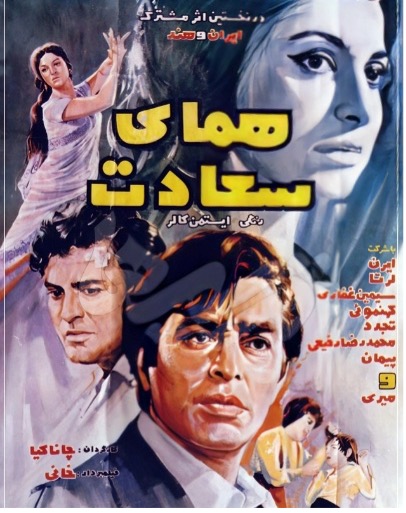
The two major exceptions to this are Subah-o-Sham or Humā-yi saʿādat (1971) and Salaam Mumbai! (Salām Bamba’ī,2016). Both are true co-productions, and their themes address romance and culture between Indians and Iranians. They are set in the contemporary period, rather than drawing on shared mythology or historical pasts. Humā-yi saʿādat was co-produced by Shree Ganesh Prasad Movies, a production company based in Madras (now Chennai), and by Ariana Studios in Tehran. It was directed by Tapi Chanakya, an established Bombay filmmaker, and the cast notably included top stars from both countries: India’s Waheeda Rehman and Sanjeev Kumar, and Iran’s Muhammad ‛Alī Fardīn. Rehman plays Shīrīn, an Indian dancer living in Tehran. Fardīn and Kumar play brothers Ārām and Nāsir, who belong to a wealthy Tehran family. Humā-yi saʿādat is filmed and set in Tehran, with an opening title that announces, “First Hindi film shot in Iran.” A Farsi version was shot simultaneously, with some new or varied scenes tailored to the Iranian audience. (The presentation of female characters is more conservative in the Indian release.)
Figure 8: Film poster for Humā-yi saʿādat, directed by Tapi Chanakya, 1971, Source: IMDb.
Figure 9: Subah-o-Sham (1971), image of Waheeda Rehman, Sanjeev Kumar, and Muhammad ‛Alī Fardīn. Source: IMDb.
The film centers on a love story between Shīrīn and Ārām. It is typical of both Bollywood and fīlmfārsī films of the time in that Ārām must overcome internal and familial prejudices about Shīrīn’s unsavory career and class position for their love to flourish. Less typical of both countries’ popular film narratives is the fact that Shīrīn is Indian and Ārām is Iranian. However, the film makes it clear that class is the ultimate barrier.
Samhita Sunya’s chapter “Foreign Exchanges: Transregional Trafficking through Subah-o-Sham (1972)” is the most comprehensive study of the film. Sunya reads an allegory for the informal circulation of Indian films in the Global South through the story of Shīrīn, writing that Shīrīn’s character “becomes metonymic for the trafficked object of the Indian song-dance film.”16Samhita Sunya, “Foreign Exchanges: Transregional Trafficking through Subah-O-Sham (1972),” in Sirens of Modernity (Berkeley: University of California Press, 2022), 171–172. Sunya maps a history of exchange in which B (and C, and D) movies from India were distributed in Iran through unregulated networks. Indian B movies were a comparable trade good to a cheap celluloid byproduct: plastic bangles. As Sunya writes, Indian “statist concerns over both film contraband and unauthorized channels of celluloid import-export sought to exert control over a range of ostensible excesses.”17Samhita Sunya, “Foreign Exchanges: Transregional Trafficking through Subah-O-Sham (1972),” in Sirens of Modernity (Berkeley: University of California Press, 2022), 175–176. The trade of both bangles and B-films was also gendered, with both considered garish commodities of feminine display.
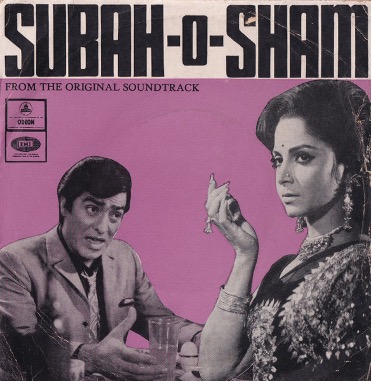
Trade and cultural exchange are brought to the forefront in several instances. Shīrīn’s performances draw on Indian classical dances, and she dances to Hindi songs by famous playback singer Lata Mangeshkar. (The Persian release also includes songs by Iranian pop star Gūgūsh.) As Sunya notes, the film explicitly engages the widespread appeal of Indian song-and-dance sequences by having characters discuss dance as a tool of universal communication. Additionally, while the film takes place in Tehran, it features a sequence of shots showcasing tourist destinations in both Iran and India. A selection of significant Iranian monuments is shown, beginning with the Shah Mosque in Isfahan, where Shīrīn and Ārām listen to the call to prayer. Other sights include Gulistān Palace in Tehran, and the Caspian shore. In India, the film presents a brief montage of erotic temple sculptures. Taken together, these sequences indicate the consummation of a cross-cultural relationship, which later results in the birth of a child.
Figure 10: Subah-o-Sham album cover (1972). Source: Discogs.
Shīrīn and Ārām hope to marry, but Ārām’s mother disapproves of the relationship due to Shīrīn’s profession. Ārām’s brother Nāsir convinces their mother that, in fact, Shīrīn is from a royal Indian family. He approaches various local vendors around the city, paying them to act as a veritable royal Mughal court at a party for the couple. The costuming and mise-en-scène in this scene is reflexively Orientalist, with men dressed in gilded turbans and Rajput-style angarkhas, each variously holding feather fans, swords, and a colorful hookah. In Bombay Cinema’s Islamicate Histories, Rosie Thomas writes of the Oriental genre in Indian cinema, which combined Western Orientalist tropes of the Arab and Persian worlds with pre-cinematic Indian representations of the Arabian Nights and other Islamicate stories.18Rosie Thomas, “Alibaba’s Open Sesame: Unravelling the Islamicate in Oriental Fantasy Films,” in Bombay Cinema’s Islamicate Histories, ed. Ira Bhaskar and Richard Allen (Bristol: Intellect Limited, 2022), 203–28. Similarly, Humā-yi saʿādat adapts mid-century Hollywood images of wealthy maharajas, played for comedy to a knowing audience. This imagery is recognizably Indian while remaining within an Islamicate lexicon.
Figure 11: A production still from Subah-O-Sham (1971), Courtesy of National Film Archive of India.
Humā-yi saʿādat’s treatment of race stands out from other Iranian media and cultural representations of Indians and South Asians. Alexander Jabbari writes that modern Iran’s most popular texts, such as the novel Savūshūn (1969) by Sīmīn Dānishvar, and the novel (1973, Īraj Pizishkzād) and television adaptation My Uncle Napoleon (Dā’ī jān Nāpil’un, 1976), present Indian characters as belonging to a shared but antiquated Persianate past—now less civilized in their sexuality and culture than Iranians. Indians are “enemies of progress” in a modernizing nationalist Iran.19Alexander Jabbari, “Race against Time: Racial Temporality and Sexuality in Modern Iran,” Journal of Middle East Women’s Studies 20, no. 3 (2024): 279.
In 1969, Muhammad Rizā Pahlavī made a much-publicized trip to New Delhi to establish the Indo-Iran Joint Commission for Economic, Trade, and Technical Co-operation. This was one of several strategic endeavors which aimed to repair fissures caused by separate Cold War allegiances and regional conflicts with neighboring nation-states. Thus, while Savūshūn, published in 1969, posits an Indian dancer as a threat to Iranian masculine nationalism, Humā-yi saʿādat, released a few years later, presents a recuperative study of the sexualized Indian dancer and her place in Indo-Iranian relations. Of course, as a joint production, the film hoped to appeal to both national audiences, and possibly broader West Asian and North African audiences as well, who consumed popular Indian films. As a commercial product, Humā-yi saʿādat’s audio-visual elements are a postmodern mélange, in which any Persianate or Islamicate citations are filtered through newer South Asian, West Asian, and Western cinematic references.
Mediawork and Mobile Signifiers
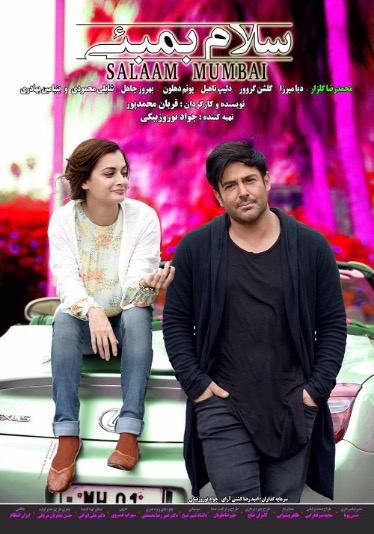
Salaam Mumbai! similarly presents shared cultural heritage through the prism of popular cinema. Set in the present day, the story focuses on a romance between two medical students, an Indian woman and an Iranian man, who is in Mumbai for his medical education. These characters, Karishma and ‛Alī, are played by Dia Mirza and Muhammad Rizā Gulzār, both well-known stars in their respective countries. Indeed, the Indian press referred to Gulzār as the “Indian SRK,” or Shah Rukh Khan, referencing India’s megastar actor.20Namrata Joshi, “Love beyond boundaries,” The Hindu, March 15, 2016, https://www.thehindu.com/news/cities/mumbai/entertainment/love-beyond-boundaries/article8348137.eceSalaam Mumbai! was directed by Iranian filmmaker Qurbān Muhammadpūr, filmed in Tehran and Mumbai—though most of the film takes place in India—and features Persian, Hindi, and English dialogues, as well as Hindustani songs scored by the Indian composer Dilshaad Shabbir Shaikh. Lastly, the executive producers of the film included prominent film producers from both India and Iran. Salaam Mumbai! gestures to continuities and shared heritage between the two countries in its story—for example, the romantic leads bond over their love of the poet Hāfiz. ‛Alī and his friend Ahmad, also an Iranian medical student who desires an Indian woman, deepen their homosocial intimacy by watching the celebrated song sequence “Yeh Dosti Hum Nahi Todenge” (“we will not break this friendship”) from Sholay (1975). Salaam Mumbai! constructs its plot around less publicized but contemporary forms of exchange, such as the presence of Iranian students in India for higher education.
Figure 12: Film poster for Salaam Mumbai (Salām Bamba’ī), directed by Qurbān Muhammadpūr, 2016. Source: IMDb.
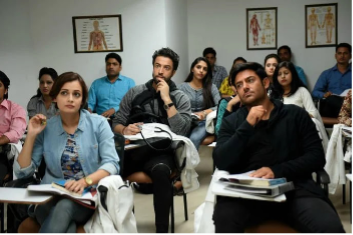
Much of the dialogue between the two leads is in English and the primary release of the film was not dubbed. Salaam Mumbai! released in theaters in Iran before going to India and other international markets. It was extremely popular in Iran—as widely reported, it set an opening-weekend box office record, surpassing Asghar Farhādī’s The Salesman (Furūshandah, 2016). It was also the only one of a set of post-revolutionary films discussed here to have a general release in Iran, having conformed to some, though not all, local film production codes (such as no physical contact between male and female actors, and no dances). Instead of touch or other gestures of physical intimacy, the lead couple, Karishma and ‛Alī, develop their relationship by learning each other’s language, reading and writing about love on paper, classroom whiteboards, and digital screens. As such, the film feels contemporary in its transnational production, narrative, and cinematic codes, including musical sequences.
Figure 13: Dia Mirza and Muhammad Rizā Gulzār in a film still from Salaam Mumbai (Salām Bamba’ī), directed by Qurbān Muhammadpūr, 2016. Source: DesiBlitz.
Naficy’s film history research and methodology provide an avenue to understand these texts together. First, he puts forward different modes of national cinema: sociopolitical, industrial, cultural, ideological, spectatorial, textual, and authorial. In their mobility and multiplicity, these modes intervene against the category of national cinema while simultaneously helping to understand its construction. This provides avenues to think about Indo-Iranian cinema in relation to the imagined community of the Persianate. These include the sociopolitical context of trade and exchange relations, the linguistic development between the two regions, and the cultural traditions and references, such as the sensuous iterations of Mughal courtly entertainment that informed the mode of both national cinemas.
Scholars such as Pedram Partovi have made more extensive arguments about the relationship of Persianate customs to popular Indian and Iranian film forms, building on Naficy’s work.21Pedram Partovi, “Constituting Love in Persianate Cinemas,” Journal of Persianate Studies 10, no. 2 (2017): 186–217. However, in examining the trajectory of Indo-Iranian relations in the context of economic liberalization and globalization, I adapt his theory of mediawork to contend that not only pre-modern cultural histories, but also contemporary relations have seeped into Indo-Iranian cinematic exchange. This theory of mediawork argues for the role of ongoing South-South relations in shaping consciousness and public opinion in relation to film production and spectatorship. Contemporary mediawork between India and Iran has slowly shifted from modernist concerns with modernity, nationalism, and heritage to postmodernism’s pliable identities, borders, and cultural touchstones. Accordingly, vestiges of Indo-Iranian history appear as fragments, such as the version of the Iranian song “Jamal Kudu” that achieved viral popularity in India after being featured in the Bollywood film Animal (2023). Another example is the Indian streaming series Made in Heaven (2019-present), in which Iranian-origin, Mumbai-based actor Ilnāz Nawrūzī has a metatextual role as an Iranian-origin actor in Indian film industries.
Formal trade and exchange between India and Iran also continue despite fluctuating relations with the U.S., as was the case in the 1970s. Salaam Mumbai!, Beyond the Clouds, and The Song of Scorpions each released between 2016 and 2017. These productions followed a historic Indo-Iranian trade agreement in which India committed $500 million to help construct the Chabahar Port in Iran, facilitating trade and movement between the two countries. In 2016, India’s Prime Minister Narendra Modi made a state visit to Iran to sign the deal, the first Indian leader to do so since the 1980s. The Chabahar Port is Iran’s first and only deep water oceanic port, located on the Gulf of Oman. The port project was initiated in the early 1970s by Muhammad Rizā Pahlavī, then Shah of Iran, who mobilized several large-scale development projects during his reign. However, his plans were curtailed first by the Arab oil embargo in 1973, followed by his removal from leadership during the Iranian Revolution of 1979.
The Islamic Republic maintained interest in building the port, as did India, despite its strong diplomatic relations with both Israel and the United States. (Indeed, Modi, who is known for his facilitation of Islamophobic violence and Hindu nationalism, pushed the project forward after inaction from previous leaders.) For India, the Chabahar Port presented an opportunity to create a South and West Asian power bloc that conveniently circumvents Pakistan, helping advance its interests against China. Iran, crushed under the weight of Western sanctions, similarly perceives Chabahar Port as a route for new economic and political solidarity based on diplomatic ties that, despite intervening political crises, have not been severed. Notably, modern political relations between the two countries are often framed in terms of the historical Persianate relationship by leaders such as Nehru and the Shah. In recent years, the port has facilitated an increase in humanitarian aid from India to Afghanistan and Iran during the COVID-19 pandemic and created a channel through which goods such as tea and Basmati rice can be transported between these nations and their neighbors (such as Sri Lanka).
As Naficy writes, contemporary mediawork is “motivated by the libidinal, political, public diplomacy, and commercial economies of collectivities, such as nations.”22Hamid Naficy, A Social History of Iranian Cinema, Volume 4: The Globalizing Era, 1984–2010, 1st ed. (Durham: Duke University Press, 2012), 273. Beyond exercises of soft power, it encompasses the latent desires and perceptions produced by globalized media. The film and media production that strives to sustain and reconfigure the relationship between these two nation-states should be considered not only an afterlife of longer cultural histories and forms, but also as mediawork that speaks to the re-centering and reorganization of political and economic power along new strategic routes.
New films continue to provide opportunities to examine Indian and Iranian perspectives on their own relationship and the two countries’ position in regional and global contexts. For example, what to make of the recent Netflix streaming film Tehran (2025)? The Indian production aims to distance India not only from Iran but also from Palestine and the wider Islamic world, while underlining Indo-Iranian trade relations as crucial to Indian economic growth. Tehran avoids any reference to the longstanding history between the two nations, but its lead actor and producer John Abraham told Variety magazine that he was drawn to star in the film because his grandfather was from Iran.23Naman Ramachandran, “John Abraham on Mining His Iranian Roots for Zee5 Global Thriller ‘Tehran’ amid Real-World Conflict: ‘You Realize the Reach When You Get the Response,’” Variety, August 18, 2025, https://variety.com/2025/tv/news/john-abraham-iranian-roots-tehran-tensions-1236490284/ Such examples, alongside television and other popular texts, demand multifaceted approaches to this transnational media. Scholarly perspectives on Indian and Iranian films’ mobile and contradictory representations of the other’s race, ethnicity, and sexuality will be invaluable to this research. Examining Indian and Iranian cinema histories together deconstructs national cinema orthodoxies and can reveal existing and new solidarities.24For other recent perspectives along these lines, see Kaveh Askari, “Configurations of Expertise: Sardar Sager in Tehran’s Film Studios,” in Cinema Iranica (Encyclopaedia Iranica Foundation, 2025); Claire Cooley, “Soundscape of a National Cinema Industry: Filmfarsi and Its Sonic Connections with Egyptian and Indian Cinemas, 1940s–1960s,” Film History 32, no. 3 (2020): 43–74; and the essay films of Sanaz Sohrabi.
Scholarship on Bayzā’ī’s work has established him as a pivotal figure in Iranian cinema and theater, engaging with key concepts including feminism and gender representation, as exemplified in studies of his progressive female characters as cultural memory-bearers.1S. Lahiji, Sīmā-yi Zan dar Āsār-i Bahrām Bayzā’ī [The Image of Women in the Works of Bahrām Bayzā’ī] (Tehran: Rushangarān va Mutāli‛āt-i Zanān, 1993); S. Talajooy, ed., The Plays and Films of Bahram Beyzai: Origins, Forms and Functions (London: I.B. Tauris/Bloomsbury, 2024). His work is also associated with modernization and urbanization—analyzing the psychological impact of urban transformation through cityscapes.2N. Pak-Shiraz, “Exploring the City in the Cinema of Bahram Bayzaie,” Iranian Studies 46, no. 5 (2013): 811–28. Another, recurring theme in Bayzā’ī’s films are national identity and belonging—which is revealed in his archaeological approach to Iranian identity through performance and ritual; mythology and literary heritage.3S. Talajooy, “Reformulation of Shahnameh Legends in Bahram Bayzaie’s Plays,” Iranian Studies 46, no. 5 (2013): 695–719; S. Talajooy, Iranian Culture in Bahram Bayzaie’s Cinema and Theatre: Paradigms of Being and Belonging (1959–1979) (London: I.B. Tauris/Bloomsbury, 2023), 696-698. Bayzā’ī synthesizes indigenous theatrical forms with modern dramaturgy, refunctionalizing tradition to produce counter-hegemonic meanings — a strategy that may be described as a form of critical traditionalism.”4S. Talajooy, “Reformulation of Shahnameh Legends in Bahram Beyzaie’s Plays.” Iranian Studies 46, no. 5 (September 2013): Special Issue: Bahram Beyzaie’s Cinema and Theatre. Cambridge: Cambridge University Press, 2013, 696. This critical traditionalism provides him with a political critique to authoritarianism and an allegorical resistance to power structures.
Scholars have also addressed the figure of the stranger in Bayzā’ī’s work. Its significance is further emphasized by the title of Muhammad ‛Abdī’s biography, Gharībah-yi Buzurg (The Great Stranger, 2015), which positions Bayzā’ī himself as a stranger within Iranian culture. Saeed Talajooy explores how these strangers embody marginalized outsiders—figures who are often initially accepted by women but ultimately rejected or alienated by society.5H. Abedini, “Iranian Culture in Bahram Beyzaie’s Cinema and Theatre: Paradigms of Being and Belonging (1959–79),” The Journal of Religion and Film 29, no. 2 (2025): 1A–9. In other words, across Bayzā’ī’s cinema, the encounter between the stranger and the community is almost consistently mediated through a female protagonist. However, a critical gap in the research remains. There has been little to no analysis of how gender, otherness, and nationalism intersect in Bayzā’ī’s cinema. While scholars have examined gender relations and nationalism as separate themes, no study has yet offered a rigorous theorization of how these three dimensions converge through the figure of the stranger.
To illuminate the intricate processes of belonging, boundary-making, and national identity formation in Bahrām Bayzā’ī’s cinema, this article will examine how women are the first to recognize, shelter, or engage with the outsider whose presence unsettles the established symbolic and social/patriarchal order. We argue that this recurrent narrative structure positions femininity as a relational and ethical force that interrupts patriarchal norms of belonging, exclusion, and control. Whether through acts of care, desire, protection, or alliance, female characters open a space in which the stranger’s presence becomes thinkable, even if only temporarily. In doing so, they expose the fragility of communal boundaries and reveal how norms of belonging are maintained through gendered forms of violence and exclusion. The woman’s engagement with the stranger thus functions not merely as a personal or emotional gesture, but as a political intervention that destabilizes reactionary social orders and foregrounds the gendered foundations of community, homeland, and national identity.
This recurring narrative structure can be observed throughout much of Bayzā’ī’s broader body of work. For example, in Downpour (Ragbār, 1972), Parvīz Fannīzādah, playing a middle-class teacher named Hikmatī, enters a traditional neighborhood where ‛Atifah (Parvānah Ma‛sūmī), the female protagonist, welcomes him. Through a love story she facilitates Hikmatī’s inner transformation, leading him into a symbolic struggle against the misogynistic patriarchy of the community—epitomized in his confrontation with Āqā Rahīm, the butcher and his romantic rival, who embodies reactionary male dominance. In Killing Mad Dogs (Sagkushī, 2001), by contrast, it is the female protagonist herself who appears as the stranger, bearing the burden of confronting patriarchal corruption and moral decay.
However, among Bayzā’ī’s works, this article focuses specifically on The Stranger and the Fog (1974), The Ballad of Tārā (1979), and Bāshū, the Little Stranger (1986), as these films most clearly foreground the intersection of strangeness, gender, and nation. While the figure of the stranger recurs throughout his oeuvre, these three films provide particularly rich examples in which the motifs of otherness, national belonging, and femininity converge, revealing how encounters with the stranger simultaneously disrupt patriarchal norms, negotiate communal boundaries, and explore the gendered construction of national identity. Drawing on insights from Sara Ahmed,6S. Ahmed, Strange Encounters: Embodied Others in Post-Coloniality (London: Routledge, 2000), 7-9. we argue that strangeness in Bahrām Bayzā’ī’s work is also depicted through embodied encounters that simultaneously create proximity and distance, enforcing boundaries between “us” and “them.” This feminist approach offers significant analytical potential for examining how Bayzā’ī’s cinema engages with the production of communal boundaries through encounters with strange bodies. As we build on how women are playing mediating roles in these gendered-national demarcations, we analyze the racialization of the male protagonist as the stranger, how his body is pre-recognized as “not belonging” and how his eventual acceptance is portrayed not as a neutral accident but an active negotiation of Iran’s ethno-national boundaries.
Home, Homeland, and the Stranger Within
George Simmel describes the stranger as someone who is simultaneously part of a group and yet detached from it, bringing characteristics that are not native to the group and thereby creating new meanings through interaction.7G. Simmel, Guzīdah-yi maqālāt [The Stranger: Selected Essays], trans. Sh. Bihiyān (Tehran: Dunyā-yi Iqtisād, 2016; originally published in 1908), 109. Y. Fu, “Towards Relational Spatiality: Space, Relation and Simmel’s Modernity,” Sociology 56, no. 3 (2021): 591–607; L. Koefoed and K. Simonsen, “‘The Stranger,’ the City and the Nation: On the Possibilities of Identification and Belonging,” European Urban and Regional Studies 18, no. 4 (2011): 343–57. Sara Ahmed further extends this definition by emphasizing how strangerhood is shaped by gendered, racialized, and nationalized markers, demonstrating that recognition of the stranger is never neutral but always embedded in relations of power, proximity, and social boundary-making. In Strange Encounters: Embodied Others in Post‑Coloniality (2000), she provides a critical framework that theorizes the stranger not as someone entirely unknown, but as a body already recognized through gendered, racialized, and nationalized markers that determine who belongs and who is “out of place.” Strangerhood, for Ahmed, emerges through relations of proximity and distance that organize social space, including the space of the home. The stranger is not outside the nation but produced through encounters that simultaneously invite and expel. Ahmed’s distinction between the stranger who may be incorporated and the “stranger” who must be expelled illuminates how national narratives differentiate between others within the same territorial space.8S. Ahmed, Strange Encounters: Embodied Others in Post-Coloniality (London: Routledge, 2000), 106.
Within patriarchal nationalist discourse, the homeland is frequently endowed with qualities conventionally associated with femininity and motherhood, protection, warmth, emotional care, and reproductive continuity, while political authority and territorial defense are coded as masculine.9T. Mayer, “Embodied Nationalisms,” in Mapping Women, Making Politics: Feminist Perspectives on Political Geography, ed. Lynn Staeheli et al. (London: Taylor & Francis, 2004), 165-167. The national resonance of “homeland” is perhaps most clearly illustrated through Farsi words such as ‘Mām-i Mīhan’ which is linguistically and symbolically feminized as Iran itself is a woman’s name, and where territory is imagined as something to be protected, possessed, and defended by men. Borders are often metaphorized through the language of honor and virginity, with invasion framed as “rape,” revealing how women’s bodies function as metonyms for the nation itself.
This gendered division renders women symbolically central yet politically subordinate to the national project. Geographers such as Gillian Rose further demonstrate that territory itself is historically produced through masculinist violence, conquest, and ownership, with women’s bodies serving as key sites upon which national struggles are inscribed.10G. Rose, Feminism and Geography: The Limits of Geographical Knowledge (Cambridge: Polity Press, 1993), 88-90. Feminist interventions into nationalism have also foregrounded how nationalist identities often emerge through social relations structured by unequal power and an entrenched us/them logic that is forged the regulation of women and domestic space.11T. Mayer, “Embodied Nationalisms,” in Mapping Women, Making Politics: Feminist Perspectives on Political Geography, ed. Lynn Staeheli et al. (London: Taylor & Francis, 2004), 165–168. Recent scholarship on migration and borders extends this insight by demonstrating how people can be enacted as migrants without crossing physical borders.12Stephan Scheel and Martina Tazzioli, “Who Is a Migrant? Abandoning the Nation-State Point of View in the Study of Migration,” Migration Studies 1, no. 2 (2022), https://scipost.org/MigPol.1.1.002/pdf. Alison Mountz and Nancy Hiemstrafurther show how discourses of crisis recast particular bodies as security threats across transnational contexts, reproducing geographies of fear and exclusion.13A. Mountz and N. Hiemstra, “Chaos and Crisis: Dissecting the Spatiotemporal Logics of Contemporary Migrations and State Practices,” Annals of the Association of American Geographers 104, no. 2 (2014): 382–90.
This theoretical constellation provides a critical lens for reading Bahrām Bayzā’ī’s The Stranger and the Fog, The Ballad of Tārā, and Bāshū, the Little Stranger. Across these films, home and homeland are not stable sites of belonging but contested spaces where gendered encounters with the stranger unfold. Women emerge as mediators of proximity and distance, recognition and refusal, shelter and expulsion. Bayzā’ī’s cinematic strangers—racialized, displaced, and marked as “out of place”—are not external intruders but figures through whom the nation negotiates its boundaries from within. Drawing on feminist theories of nationalism and Ahmed’s articulation of strangerhood, this framework allows us to read Bayzā’ī’s films as critiques of how gendered bodies are mobilized to produce, police, and occasionally rupture the borders of home and nation.
The Stranger and the Fog; The Stranger as a Traveler from Nowhere
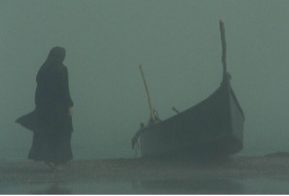
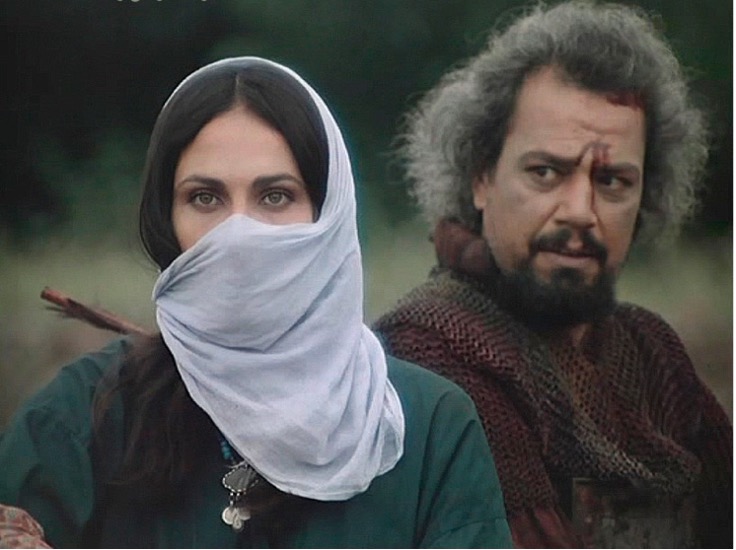
A boat from nowhere appears on the seashore — a nowhere the fog fills the frame, as a symbolic boundary separating “us” and “them,” while the sea—long associated in history with ambiguity and fear, brings an unfamiliar boat to shore. The village men gather to inspect it, and on the shore stands a veiled woman: Ra‛nā (Parvānah Ma‛sūmī). She is standing between the sea and the land, between hope and despair. She hopes that the boat might carry some trace of her husband who disappeared into the sea a year earlier.
She speaks with an old white-haired woman—her sister-in-law—who accuses Ra‛nā of bringing bad luck, linking her brother’s disappearance to Ra‛nā’s ill omen. The men, acting as guardians of the boundary, inspect the boat and discover an injured man inside. The old woman declares, “It’s not him. My brothers didn’t recognize him.” Soon we learn she is right: the man is not Ra‛nā’s husband but a wounded stranger the sea has carried to the shore. His name is Āyat. When he regains consciousness, he speaks of men who are after him. Soon after, the stranger’s presence, disturbs the stillness and the social order of the village. Yet, a condition is set for Āyat to be accepted into the village: he must marry one of the village women. Here, marriage becomes a mechanism of “the economy of the stranger”; the stranger must pay a price, and that price is negotiated through the female body as intermediary.14S. Ahmed, Strange Encounters: Embodied Others in Post-Coloniality (London: Routledge, 2000), 139. In other words, the stranger can only be integrated into the village through the acceptance of femininity — passing from alienation to belonging. The village men try to prevent this union; this is the moment when the boundary between homeland andhonor is summoned against the stranger. Sara Ahmed often distinguishes between fear and unknowing: the stranger is not someone we do not know, but someone we refuse to acknowledge.15S. Ahmed, Strange Encounters: Embodied Others in Post-Coloniality (London: Routledge, 2000), 55-56. As she explains, the stranger is not unknownbut already known—a body pre-inscribed in a network of signs and rendered outside within the logic of belonging. To the village men, Āyat embodies exactly that: placelessness, a threat to kinship and familiar order. As one of the village men says, “Our kin come before strangers.” This value reinforces the dividing line between “us” and “the other.”
In a frenzied scene, Āyat runs through the muddy rice fields, screaming, smearing mud across his face. Ra‛nā happens to pass by. Āyat runs after her, shouting: “No one wants me, do you understand? I’m not permitted!” Āyat exists in aspatial ambiguity; he is near yet distant, present yet non-intimate.16G. Simmel, Guzīdah-yi maqālāt [The Stranger: Selected Essays], trans. Sh. Bihiyān (Tehran: Dunyā-yi Iqtisād, 2016; originally published in 1908), 145. Ra‛nā responds, “Who are you?” and Āyat answers, “I’m the one who’s always brought you bad luck whenever I saw you!” (Figure 1).
Figure 1: Parvānah Ma‛sūmī as Ra‛nā in The Stranger and the Fog (Gharībah va Mih), directed by Bahrām Bayzā’ī, 1974.
Later, on a wooden bridge, Āyat follows Ra‛nā and says, “You don’t have to be afraid of me.” Ra‛nā replies, “I’m not afraid of you; I just don’t know you.” Āyat throws himself into the river; the mud washes from his face, and in a trembling voice he asks, “This is me—do you recognize me?” The bridge becomes a liminal space where the stranger undergoes an epistemological transformation and becomes knowable. Ra‛nā responds, “Maybe you don’t know it yourself, but you’re really crazy!” Āyat is transformed into a friend through Ra‛nā’s acceptance. Yet, Ra‛nā aware of the fragility of the bond between the two strangers, hides Āyat’s boat beneath the sand, as if she is composing an elegy for an inevitable separation (Figure 2).
Figure 2: Parvānah Ma‛sūmī standing beside the boat which carried Āyat in a scene from The Stranger and the Fog (Gharībah va Mih), directed by Bahrām Bayzā’ī, 1974.
The return of Ra‛nā’s former husband—hailed as the mythical hero of the village—appears to restore the familiar order, the very structure that the presence of the stranger had unsettled. Yet when Āyat confronts and kills him, the sea reclaims his body, initiating a cycle of arrival and disappearance in which the husband and Āyat seem to echo one another, alternating between presence and absence on the shore. This recurring rhythm of emergence and vanishing underscores the provisional nature of belonging and the fragility of communal boundaries. In the final act, black-clad men—messengers of death—emerge from the fog to erase the stranger once more, yet Āyat and Ra‛nā resist. Wounded and solitary, Āyat boards the boat again, returning to the sea and dissolving into the horizon of mist, as if seeking a new encounter in which the strangeness that once provoked fear might become a site of recognition, transformation, and self-knowledge.
While Āyat is marked as a stranger through mobility, placelessness, and the threat he poses to the village’s social order, Ra‛nā is already positioned as a stranger from within. Her unveiled body renders her “out of place” in the moral geography of the village, a relation of proximity without belonging.17S. Ahmed, Strange Encounters: Embodied Others in Post-Coloniality (London: Routledge, 2000), 53-56. Ra‛nā repeatedly says throughout the film: “My choices are my own,” a statement of feminine agency and self-determination, showing that her acceptance of the stranger is not submission but an act of resistance against the village’s patriarchal order. Her refusal to obey her husband’s family—particularly her rejection of their authority to determine whom she may shelter, desire, or mourn—positions her outside the moral economy of the village. Ra‛nā’s body in this sense, functions as contested territory: it is policed, blamed, and symbolically occupied by communal anxieties about honor, loss, and disorder. The accusation that she brings bad luck, and the attribution of her husband’s disappearance to her presence, reveal how her body is already inscribed as a national liability—an internal stranger whose behavior threatens the stability of home. Unlike Āyat, whose strangerhood must be negotiated through incorporation or expulsion, Ra‛nā’s strangeness is managed through containment and moral surveillance. Yet it is precisely through this shared condition of strangerhood—Āyat as the displaced outsider and Ra‛nā as the gendered internal exile—that a fragile alliance becomes possible. Their encounter exposes how the boundaries of home and homeland are not fixed at the shoreline but reproduced on and through women’s bodies, where nationalism, patriarchy, and fear converge. Ra‛nā’s disobedinece thus does not merely mediate the stranger’s entry; it reveals how the nation’s borders are already fractured from within.
The Stranger Between Ritual and Ruins: Forgotten Histories in The Ballad of Tārā
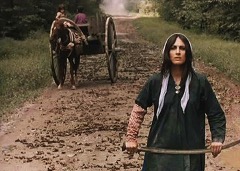
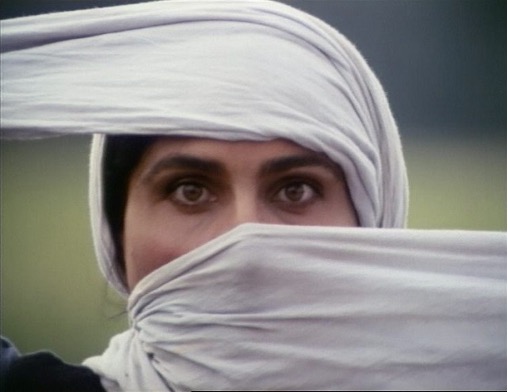
In the opening scene of The Ballad of Tārā, Tārā (Sūsan Taslīmī) appears proudly riding a carriage through the village, under the watchful gaze of men. She soon learns that her grandfather has passed away. In a subsequent scene, Tārā returns home and finds a bundle her grandfather left her as a keepsake. She opens the bundle and starts to give away its contents to the villagers. At the bottom there is a peculiar sword. She gives it to an old man, he happily asks, “Is it mine?” and says, “I’ll attach it to my plow!”
The next day, the same old man runs back in panic, places the sword on Tārā’s porch, and flees immediately as if the sword carried an ominous curse. Tārā tries to make some use of it but soon becomes clear that the sword is entirely useless: it serves no purpose in farming, chopping wood, or even cutting vegetables. No one at the market is willing to buy it either. Finally, Tārā throws the sword into the river to rid herself of it.
Figure 3: Sūsan Taslīmī holding the iconic sword in an early scene from The Ballad of Tārā (Charīkah-yi Tārā), directed by Bahrām Bayzā’ī, 1979.
On her way home, she encounters an armored man — someone she remembers from a distant vision. The Historical Man or the Guerrier (Manūchihr Farīd), approaches Tārā and tells her that he is searching for the sword that belongs to his tribe. When Tārā nervously points to his wounds, he replies:
I am a man descended from history. My entire lineage lived and died in battle. Which battle? There is no sign of us anywhere. Everything slowly disappeared; all traces were lost. Nothing remains of us on earth — except of a sword.
If in The Stranger and the Fog the figure of Āyat was a stranger by the virtue of his appearance from “nowhere” — from an unfamiliar geography —, the Guerrier appears to be a forgotten stranger — one erased by time. His estrangement arises from historical oblivion, from the fact that he and his soldiers belong to a history that no one remembers anymore. The Guerrier exists as a spectral presence, visible only to Tārā, as if conjured within the realm of her perception—a vision emerging from the shadowy threshold of death. He returns to reclaim a vanished past, wielding the sword that embodies his tribe’s lost honor and glory. In his appearance, memory and history are rendered as liminal forces, where the past intrudes upon the present and the work of recognition unfolds in the delicate space between life and death, presence and absence. The Guerrier explains that he needs the sword to return to his people. At that moment, someone calls Tārā’s name. She turns to see who it is, but when she looks back, the man has vanished. Yet his presence lingers around her — as he can no longer leave because he has fallen in love with her.
In another scene, as the two speak near an ancient fortress, the Guerrier laments the forgotten past, attempting to revive a history of oppression erased from collective memory of the people (Figure 4). Wounded, carrying a banner and pierced by arrows, and walking through the ruins of the fortress emerging from the mist, he says:
This is where my skull was split open. This is where an unknown dagger tore through my armor. This stone is where our hopes were broken. Oh woman, what can I tell you? This is where my seven brothers — sons of the same father — disappeared in the battle. This is the gate that collapsed, the opening through which we were driven to the shore.
Figure 4: Sūsan Taslīmī and Manūchihr Farīd in The Ballad of Tārā (Charīkah-yi Tārā), directed by Bahrām Bayzā’ī, 1979.
Tārā, still skeptical of his story, accuses him of lying. She says she has told his tribe’s story to a book reader who did not recognize the name. The historical man grows agitated and replies: “The story of my tribe is not in a book. It’s in the soil, the wind, and the plants. My story lives, step by step, right here.”
Taʿziyah, or shabīh’khānī, has long occupied a central place in Bahrām Bayzā’ī’s aesthetic and political imagination, functioning as a ritual form through which history is not merely represented but continually re-enacted. As a performative archive, Taʿziyah sustains the memory of ‛Āshūrā within Shiʿi culture, preserving a history of martyrdom, loss, and ethical struggle through repetition, embodiment, and collective witnessing. In The Ballad of Tārā, this ritual logic is mobilized to stage a tension between histories that endure and those that have been erased. When Tārā converses with the memory of her grandfather, the bloodied horse—first seen fleeing the Taʿziyah performance—reappears, now subdued and guided by her. The horse, once part of ritualized remembrance, is revealed to belong to the warrior whose history has been excluded from the written archive. In this moment, Tārā emerges as a mediator between competing regimes of memory. Her skepticism toward the historical man—her insistence that his tribe’s name cannot be found in any book—exposes the limits of textual history, to which he responds by locating memory in the land itself: in soil, wind, and the body. Through this encounter, Taʿziyah is not simply invoked as religious tradition but reworked as a cinematic device that juxtaposes a history kept alive through ritual performance with another consigned to disappearance, suggesting that remembrance is always selective, embodied, and unevenly sustained across time.
The Guerrier’s words thus function not merely as testimony but as an embodied memory of suffering, one that re-enters the present through narration and movement across space.
In giving voice to a past excluded from written history, his speech performs what Aleida Assmann describes as the activation of cultural memory, where storytelling summons forgotten histories into contemporary consciousness.18Aleida Assmann, Shadows of Trauma: Memory and the Politics of Postwar Identity (New York: Fordham University Press, 2016), 40-45. What unfolds here is a form of critical historical practice—a “history of compensation”—through which erased figures are momentarily restored by re-inscribing their presence onto the landscape itself. This act of remembrance requires a re-mapping of geography, a process that Saurabh Dube and Ishita Banerjee identify as central to rethinking subalternity in a transforming world, wherein marginalized subjects articulate modes of existence that exceed archival recognition. 19See, e.g., Saurabh Dube and Ishita Banerjee, eds., The Routledge Handbook of Subalterns across History (London: Routledge, 2025). Forgotten history, in this sense, is not lost but displaced, preserved within the material and affective textures of space. As Katherine McKittrick suggests, “space and place give black lives meaning in a world that has, for the most part, incorrectly deemed black populations and their attendant geographies as ‘ungeographic.’ 20Katherine McKittrick, Demonic Grounds: Black Women and the Cartographies of Struggle (Minneapolis: University of Minnesota Press, 2006), 14. Read through this lens, the historical man emerges not simply as a narrator of a vanished past but as a living cartographic trace—one whose return reactivates the earth, wind, and terrain as sites where history endures and speaks again beyond the limits of the written archive.
Bāshū, the Little Stranger: The Stranger as a Silent Refugee
Stepping away from the epic and historical atmospheres that shape The Stranger and the Fog and The Ballad of Tārā,Bāshū, the Little Stranger introduces a markedly different figure of the stranger—one no longer anchored in myth, ritual, or forgotten histories, but formed within the immediacy of modern war. Set during the ongoing Iran–Iraq War in 1985, the film displaces the stranger from the realm of legend to that of lived trauma, urging attention not to battles erased by time but to the war’s surviving victims and their unfinished stories. The film thus reconfigures earlier concerns with home and homeland, grounding them in modern conditions of displacement, ethnic and racial difference, and linguistic estrangement. Yet a familiar narrative structure remains. Once again, the encounter with the stranger is mediated through a woman, whose willingness to shelter Bāshū places her in conflict with the surrounding community.
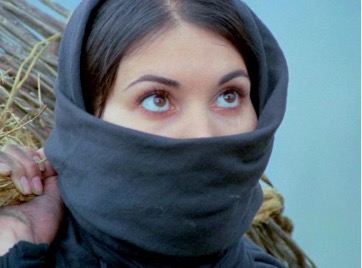
Figure 5: Sūsan Taslīmī in an iconic close-up from Bāshū, the Little Stranger (Bāshū, gharībah-yi kūchak), directed by Bahrām Bayzā’ī, 1986.
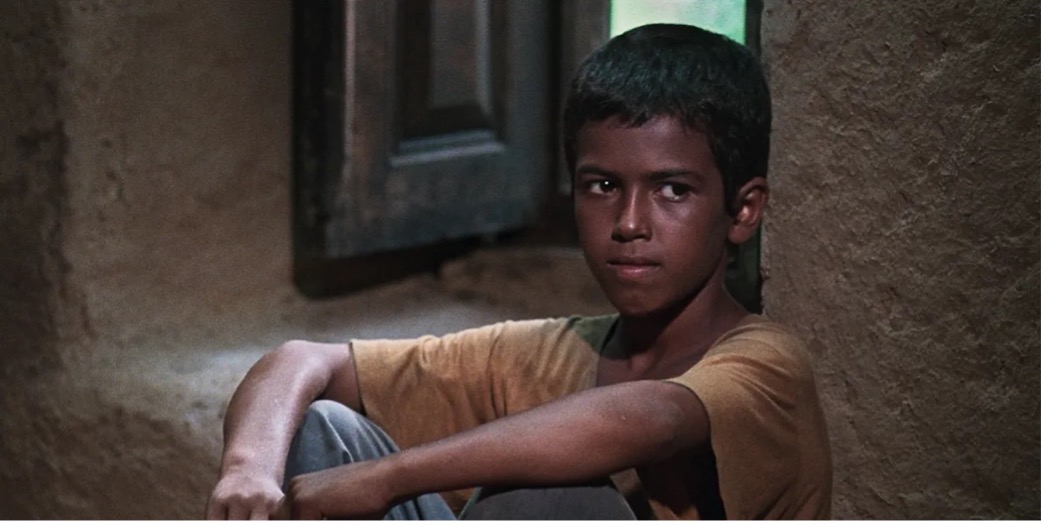
The film opens amid scenes of bombardment in southern Iran, where the violence of war ruptures everyday life. Amid this chaos, a young boy escapes by hiding in a cargo truck, only to find himself transported hundreds of kilometers away to northern Iran. When the truck stops along a roadside, the boy—deeply traumatized and marked by the aftershocks of war—is startled by the sound of explosions from a nearby construction site. Mistaking them for shelling, he leaps from the vehicle and runs screaming into the forest. His flight ends in a rice field, where he encounters two children and a local woman.
Nā’ī repeatedly attempts to teach him her words, yet language resists easy transmission, marking the limits of verbal communication in the face of trauma. The villagers, too, respond with suspicion, insisting that the boy must either leave or justify his presence through labor. Difference is thus immediately translated into obligation. In one unsettling scene, villagers gather inside Nā’ī’s home as a child rubs Bāshū’s skin, testing whether its darkness might be wiped away. In another, Nā’ī washes him in the river, while local children also mock and bully him. These moments expose how racialized otherness is negotiated through the body, touched, examined, and disciplined before it can be accepted. On the other hand, Bāshū’s body remains saturated with the aftershocks of war. The fire of the stove recalls bombardment, the cries of eagles echo the battlefield; for him, trauma persists not as memory alone but as an involuntary bodily response.
The villagers’ continued hostility toward Bāshū repeats the reactionary refusal of the stranger seen in Bayzā’ī’s earlier films, where alterity is perceived as threat rather than relation. When Nā’ī strikes village children with a stick to defend Bāshū, their parents confront her angrily, one woman accusing, “You hit our children for the sake of a stranger?” Yet the very next scene shows Bāshū and the children reconciled, playing together without tension. The rapid dissolution of conflict exposes the arbitrariness of the boundaries that adults so fiercely police, revealing the constructed nature of exclusion.
Figure 6: ‛Adnān Afrāviyān as Bāshū in Bāshū, the Little Stranger (Bāshū, gharībah-yi kūchak), directed by Bahrām Bayzā’ī, 1986.
When Nā’ī later falls ill, the film’s ethical axis subtly shifts. Bāshū assumes responsibility for the household, and in his concern for her well-being, he drums in the rhythms of his southern homeland to soothe her. In a letter to her absent husband, Nā’ī writes that she has accepted Bāshū as her son and will share her bread with him—a declaration that redefines kinship beyond blood or origin. Upon the husband’s return, visibly marked by war and missing his right hand, he encounters Bāshū without suspicion. In a quiet but powerful gesture, he tells the boy that he will be his “right hand,” binding them through mutual incompleteness. Together, the reconstituted family drives the wild boar from their fields, transforming survival into collective action.
Judith Butler argues that shared vulnerability can ground ethical relationality, and this scene crystallizes that claim.21Judith Butler, Precarious Life: The Powers of Mourning and Violence (London: Verso, 2004), 20. Nā’ī’s illness and Bāshū’s displacement render both bodies exposed and dependent, allowing care to emerge as an ethical practice rather than a moral abstraction. Bāshū’s acceptance is not secured through assimilation or resemblance, but through embodied presence and affective labor. His recognition as the husband’s “right hand” signals a form of solidarity forged through difference, where connection arises not despite vulnerability but through it—a mode of relation that aligns with Sara Ahmed’s understanding of emotional contact as the groundwork of social bonds. 22S. Ahmed, Strange Encounters: Embodied Others in Post-Coloniality (London: Routledge, 2000), 11. In Bāshū, the Little Stranger, the stranger is no longer mythic or historical, but fully contemporary, reminding us that the ethics of belonging are always negotiated in the fragile space between fear and care.
Conclusion: Re-articulating the Concept of Homeland through a Feminine Lens
In Bayzā’ī’s cinema, the stranger is never simply an external other; he is produced within the intimate spaces where women negotiate loss, vulnerability, and responsibility. Through these encounters, Bayzā’ī situates women not at the margins but at the ethical core of his narratives, transforming the stranger from a figure of threat into a site where alternative forms of relation, memory, and solidarity can emerge. Across The Stranger and the Fog, The Ballad of Tārā, and Bāshū, the Little Stranger, Bahrām Bayzā’ī repeatedly returns to the figure of the stranger, yet through the female protagonists—Ra‛nā, Tārā, and Nā’ī—is that this figure gains narrative and ethical significance. Although Āyat, the Guerrier, and Bāshū appear as strangers who disrupt the social order, the true centers of these films are the women who encounter them, refuse patriarchal demands, and reconfigure the meanings of home, belonging, and care.
Ra‛nā’s defiance of familial authority, Tārā’s mediation between ritual memory and forgotten history, and Nā’ī’s maternal acceptance of a war-displaced child each expose how nationalist and patriarchal structures depend upon women’s compliance—and how they begin to unravel through women’s refusal. In all three films, the women’s husbands are absent, lost at sea or displaced by war, leaving Ra‛nā, Tārā, and Nā’ī to inhabit roles of care, decision-making, and moral authority in their stead. Each woman is also figured as a mother—biological or chosen—through whom life is sustained in the face of loss. Bayzā’ī marks their refusals visually as well: in pivotal moments, each woman tears at or removes her veil, a gesture that signals not merely resistance to custom but a rupture with the patriarchal order that seeks to discipline women’s bodies as sites of honor, nation, and belonging.
Drawing on Sara Ahmed’s theorization of the stranger, the figures of Ra‛nā, Tārā, and Nā’ī emerge as central agents through whom strangeness is produced, negotiated, and transformed. For Sara Ahmed, the stranger is never simply an unknown outsider, but a figure already constituted through prior histories of encounter, recognition, and exclusion.23S. Ahmed, Strange Encounters: Embodied Others in Post-Coloniality (London: Routledge, 2000), 3. In Bayzā’ī’s cinema, it is precisely through women’s ethical and affective engagements with such marked bodies that the boundaries of belonging are unsettled. Ra‛nā’s sheltering of Āyat, Tārā’s insistence on recalling a history erased from the archive, and Nā’ī’s decision to claim Bāshū as her son do more than accommodate the stranger; they reveal how homeland itself is continuously made and unmade through repeated acts of inclusion and expulsion. The feminine body becomes the site where these boundaries are felt, contested, and reconfigured, exposing the violence embedded in regimes that seek to stabilize the stranger as threat or excess.
These gestures of care and refusal illuminate a process of subject formation that unfolds not through compliance with patriarchal norms but through their subtle and sustained reworking. In this sense, Bayzā’ī’s women resonate with Judith Butler’s understanding of subjectivity as constituted through reiteration and resistance, while also complicating any singular model of oppositional politics.24See, e.g., Judith Butler, Gender Trouble: Feminism and the Subversion of Identity (New York: Routledge, 1990). As Saba Mahmood reminds us, feminine agency does not always take the form of overt defiance; it may instead reside in the persistent redefinition of one’s conditions of existence.25Mahmood, Saba. Politics of Piety: The Islamic Revival and the Feminist Subject. Princeton, NJ: Princeton University Press, 2005, 15–18, 31–34. By reorienting belonging around vulnerability, proximity, and ethical attachment, Ra‛nā, Tārā, and Nā’ī also enact what Nira Yuval-Davis describes as a rethinking of national belonging from within.26See, e.g., Nira Yuval-Davis, The Politics of Belonging: Intersectional Contestations (London: SAGE Publications, 2011). Across these three films, homeland is no longer imagined as a closed or homogeneous territory, but as a relational and porous space shaped by encounters with those already designated as strangers. Bayzā’ī thus offers a vision of a feminine homeland—one grounded not in exclusion or denial, but in the refusal of stranger fetishism and the recognition of difference, where erased histories and marginalized lives may re-enter the present and speak again.
Acknowledgment
This article is written in honor of the memory of Bahrām Bayzā’ī, whose passing marks an immeasurable loss for Iranian cinema, theater, and critical thought. Bayzā’ī’s work continues to shape how histories are remembered, how strangers are encountered, and how women emerge as central figures of ethical and narrative possibility. His films remain enduring sites of resistance against erasure, inviting us to reimagine belonging, memory, and justice through care, refusal, and imagination. This work is offered in gratitude for his lasting intellectual and artistic legacy.
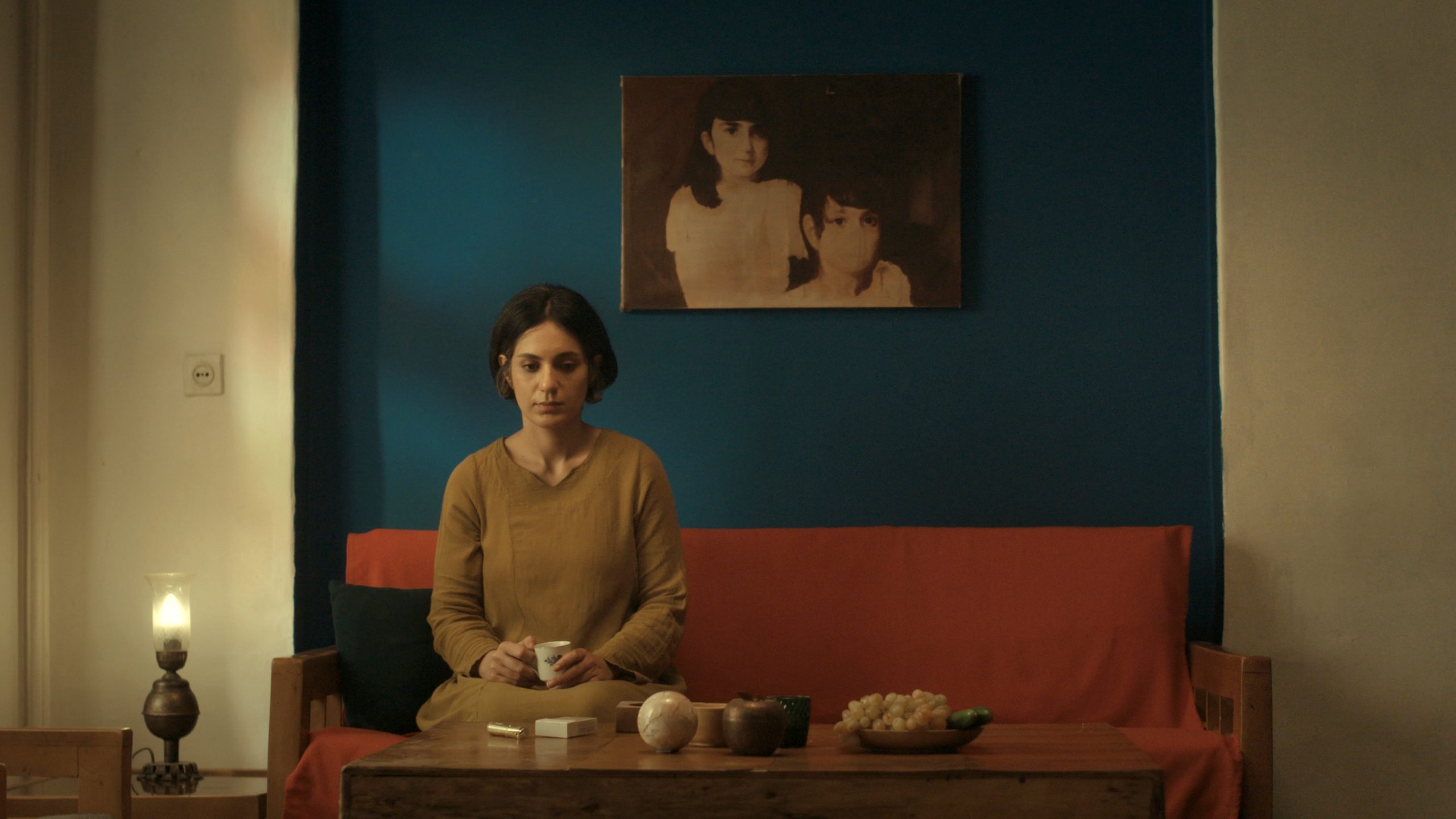
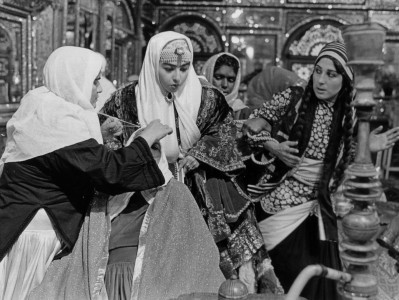
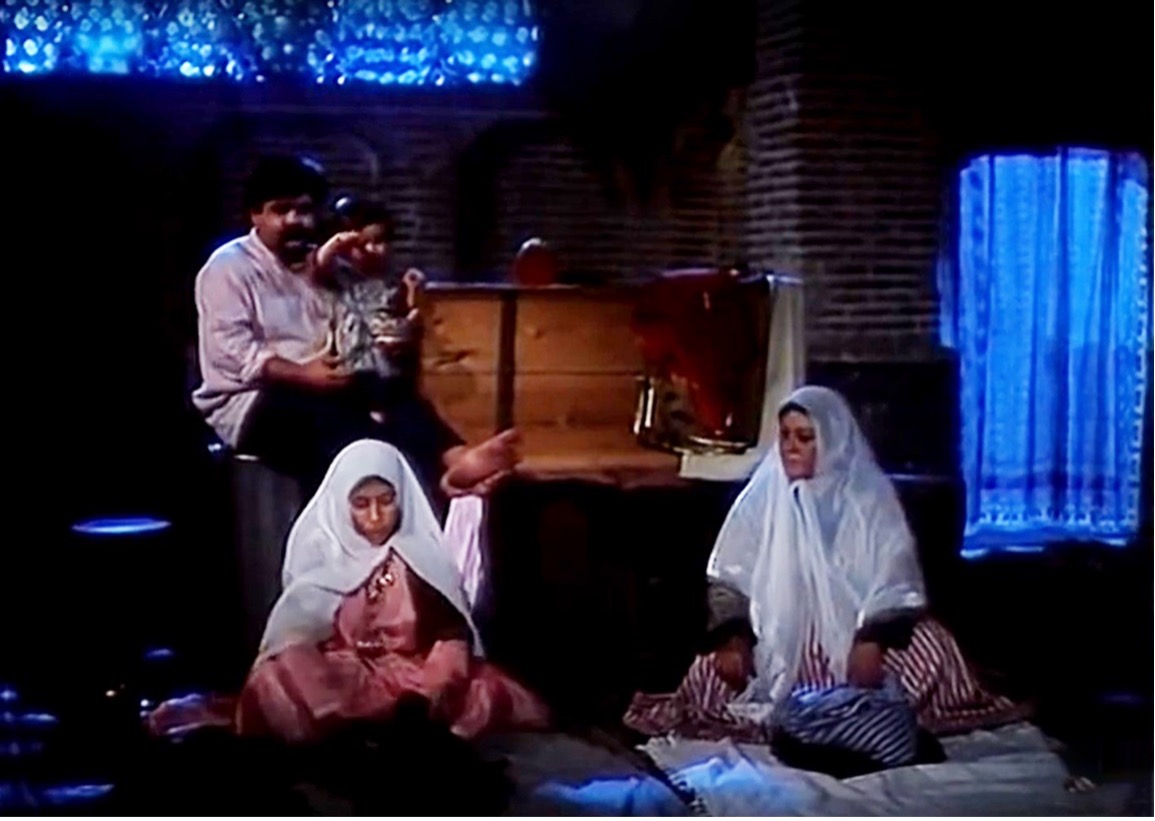
Figure 1: Still from the film Love Stricken (Dilshudigān), directed by ‘Alī Hātamī, 1992.
The cathedral leaves its locale to be received in the studio of a lover of art; the choral production, performed in an auditorium or in the open air, resounds in the drawing room.
—Walter Benjamin, The Work of Art in the Age of Mechanical Reproduction (1936)
Ultimately the phonograph records are not artworks but the black seals on the missives that are rushing towards us from all sides in the traffic with technology; missives whose formulations capture the sounds of creation, the first and the last sounds, judgment upon life and message about that which may come thereafter.
—Theodor W. Adorno, The Form of the Phonograph Record (1934)
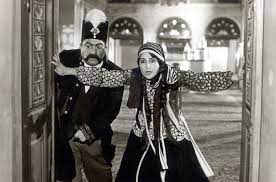
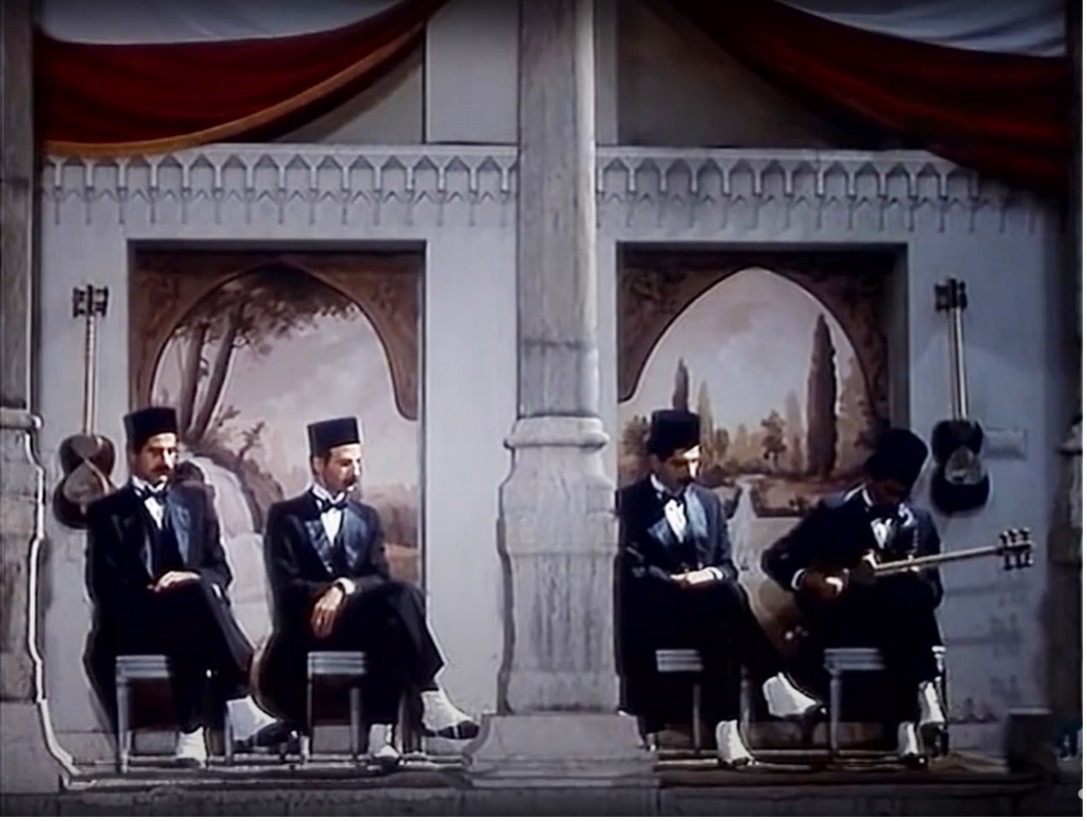
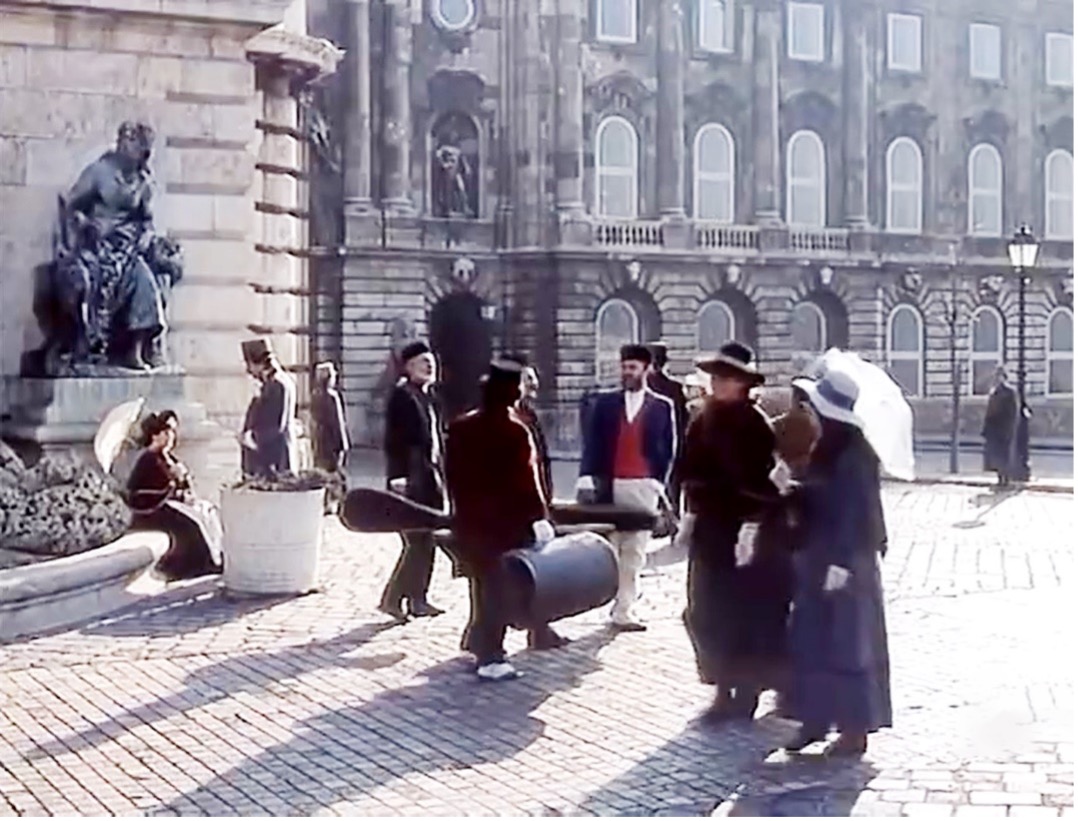
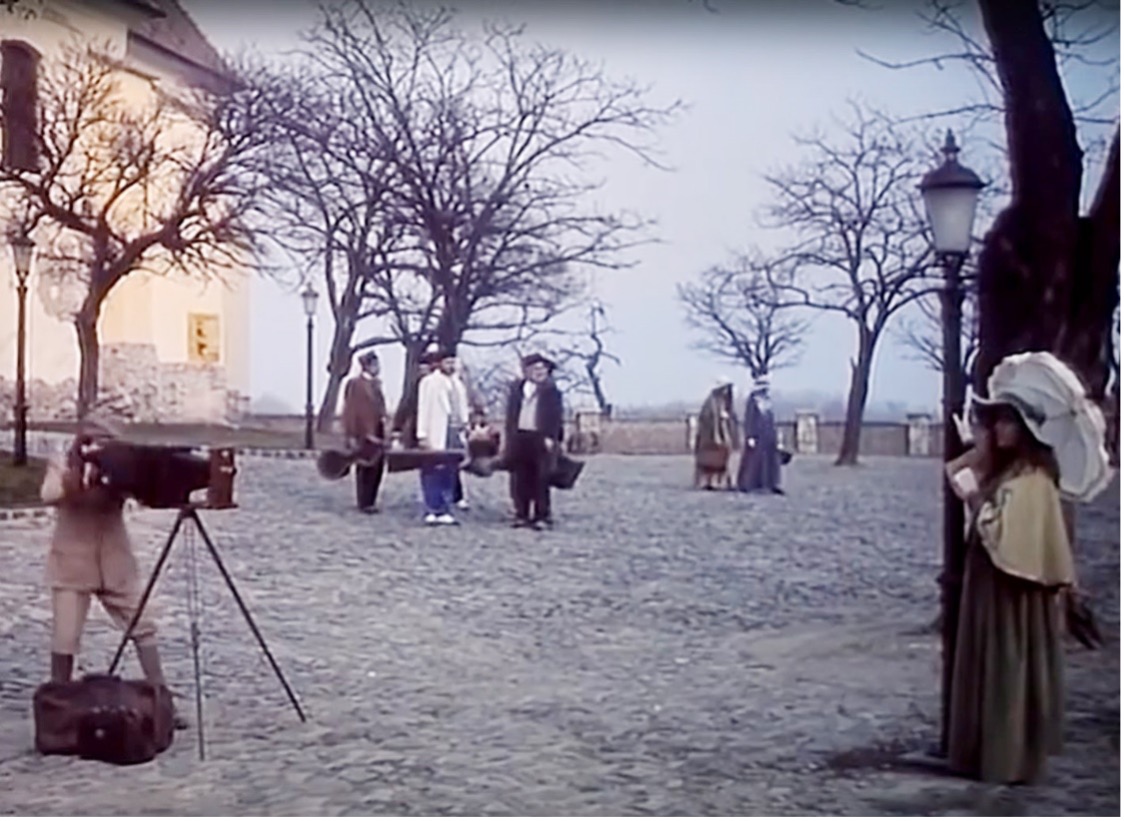
This piece briefly traces the introduction of visual and aural representational technologies to Iran. It places the genealogy of these technologies within a history of exchange between the East and the West. Focusing on Love Stricken(Dilshudigān, 1992), a highly popular Iranian post-Revolution fiction film by director ‘Alī Hātamī, this piece maintains that this historical exchange nests in the practices of inscriptive technologies, and as such continues to affect their modes of enunciation over time, charging the language of representation with ambiguity. It thus attempts to chart the ambiguities that surface in close readings of the film’s thematic contents and the organization of the film’s discourse.
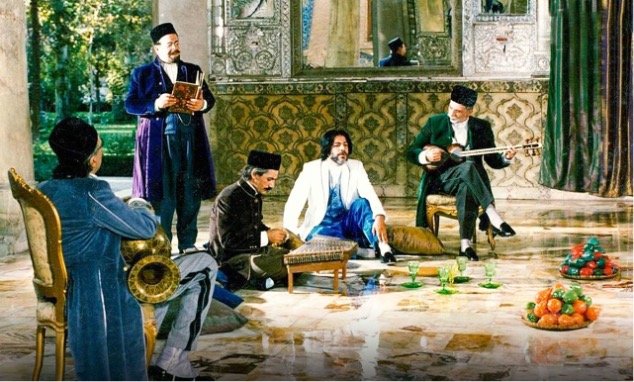
‘Alī Hātamī was one of Iran’s most prolific contemporary filmmakers until his untimely death at the age of 52 in 1996. Lauded as the master poet of Iranian cinema, the overwhelming popularity of his work for the screen in Iran has been noted for its heavy emphasis on dialogue and for its rich poetic language and composition. Although involved in the film industry before the Iranian Revolution, Hātamī’s work after the Revolution is known for introducing new innovations in what he referred to as “the historical genre.” 1Umīd Rawhānī, “ʿAlī Hātamī: Kārgardān-i Dilshudigān, ‘Man qālī mī’bāfam,’” Fīlm: Māh’nāmah-yi Sīnimā 2 (1378/1999): 541. In 1982 Hātamī made Hajji Washington (HājīWāshangtun), a film about the tribulations of the Persian ambassador to the United States during the reign of the monarch Nasir al-Dīn Shah Qājār (r. 1848-96). Two years later, in 1984, Hātamī made Kamal al-Mulk (Kamāl al-Mulk), a fictional film about the famous nineteenth-century Iranian painter in the court of Nasir al-Dīn Shah. Mother (Mādar), made in 1990, is one of Hātamī’s best-known films in the West. It excavates the buried histories of forced Westernization under Rizā Shah Pahlavī (r. 1925-41). Hātamī’s Love Stricken (sometimes rendered in English as The Enamored, or Haunted by Love), produced two years after Mother, follows a group of Iranian musicians who travel to Europe to record traditional music on the early gramophone. The film is set during the rule of Ahmad Shah Qājār (r. 1909-25). According to Hātamī, although the film is about the processes involved in the recording of music, “the specific historical figures” associated with the recording of traditional music are unimportant to the film itself. Hātamī’s aim in Love Stricken was to create characters that had no other identity except one that is associated with music. More than a documentary about the nation’s past, the film is a fictionalized reflection on the inscription and standardization of traditional music. As such, the film deals with the longue durée of contingencies that have surrounded and continue to inform the historical inscription of “the national” in representational technologies. The nation’s past and present are coeval in Love Stricken and, as such, interact in representational form. This insight is borne out in Hātamī’s discussion of the choices he made in directing the film: “I thought it would be interesting to show that early sound recording devices are curiosities not only for the contemporary audience of the film, but for my characters as well.”2Umīd Rawhānī, “ʿAlī Hātamī: Kargardān-i Dilshudigān, ‘Man qālī mī’bāfam,’” Fīlm: Māh’nāmah-yi Sīnimā 2 (1378/1999): 544. Fictional characters on the screen and audience members present before the screen are seen as inhabiting synchronous positions vis-à-vis mediating technologies – technologies that simultaneously plot the course of the narrative on screen and, at the same time, constitute and represent the nation’s identity, past and present.
Figure 2: Musicians performing in the royal palace, still from the film Love Stricken (Dilshudigān), directed by ‘Alī Hātamī, 1992.
This temporal confluence is used as a means to resist and upend the determining marks of standardization, which, put more forthrightly, is the stamp of the imperial domination of Hollywood globally. The “all-time” of musical history in Love Stricken is, in this way, brought into a messianic and revolutionary confrontation with the dominant force that standardizes vision and hearing. This intervention in cultural practices identifies precisely the site of struggle for Hātamī, a struggle that he also sees as any national cinema’s struggle against the homogenization of the medium of film itself. In order to confront the domination of Hollywood, Love Stricken embraces the “messianic all-time” of music, its recording, representation, and reception. Grounded in this redemptive temporal confluence, the film sees itself as confronting the imperial effects of cinematic standardization.
In my reading, Hātamī’s emphasis on the processes of production underscores the significance of cinema’s own productive technologies and the most obvious technological fork in film, namely that which separates the visual from the aural. Hātamī’s focus on the international history of cinema and on the processes of national production, by contrast, underscores the importance of that history to his project, emphasizing the international alongside the uniquely—and he insists, national—engagement with the mediating technologies. In light of this, the focus of my analysis of Love Stricken, will be a close reading of the meanings, messages, and contradictions forwarded on two tracks, sound and image. I insist on upholding the contradictions that arise within a secondary forking as well, namely those produced through the alternative positioning of the film narrative on the one hand and of enunciation on the other, as they refer to what is emphatically national. True, my approach abandons the hermeneutics of reading film as narrative, but it allows for a reflection on the enactive sites of culture in which the utopian image of the nation is produced.
Preoccupied with the processes involved in the production and inscription of sound and of national representation, Love Stricken repeatedly reflects on its own processes of production, that is, on what Christian Metz refers to as “filmic enunciation.”3One could think of enunciation as the organizing “source” of the film narrative. See Christian Metz, Impersonal Enunciation, or the Place of Film (New York City: Columbia University Press, 2016). For Hātamī, the specificity of cultural difference was to be inscribed within the source and process of production of the film itself. Metz articulates this more precisely, as the site of cinematic enunciation, where narrative meaning is produced, patterned, and organized. According to Hātamī, for Iranian cinema to be national, this process of ordering and patterning would have to signal the national difference: “I cannot tell an Iranian story on the patterns and production processes of the West. What I mean is, I have seen musicals or films about music in European and global cinemas, and I have seen many of them and with a great deal of attention. But what I am attempting to do, and this is where my efforts have converged in the last years, is to realize a language, a style, a production process that arrives through the clarity of Persian speech and Persian storytelling.” See Umīd Rawhānī, “ʿAlī Hātamī: Kārgardān-i Dilshudigān, ‘Man qālī mī’bāfam,’” Fīlm: Māh’nāmah-yi Sīnimā 2 (1378/1999): 545. What Hātamī means in referring to speech and narration is not dialogue precisely. National difference in his film must be conditioned by the specificity of “technique” and “style.” Thus, national difference for Hātamī is the difference that emerges not out of a difference in content and dialogue so much as in the determined ordering of undetermined elements—enunciation, more specifically. See Thomas Elsaesser, “From Sign to Mind: A General Introduction,” in The Film Spectator: From Sign to Mind, ed. Warren Buckland (Amsterdam: Amsterdam University Press, 1995), 12. John Mowitt’s important intervention on the role of enunciation, as that which joins text to industry in cinema, fleshes out this very cursory discussion of the unconscious site of national address in my own work. See John Mowitt, Re-Takes: Postcoloniality and Foreign Film Languages (Minneapolis: University of Minnesota Press, 2005). I will attempt to show the ways in which enunciation, as the landscape that inscribes the topography of film production and the unconscious site of the national address, self-reflexively reveals the very things that upend the messages and meanings produced by the film’s own narrative statements. In reading Love Stricken, then, I will discuss the ways in which narrative statements regarding the identity of the nation, the nation’s history, and its representation, are time and again contradicted by the histories and identities embedded within the film’s representational technologies and enunciative sources.
Love Stricken (1992)
Based in turn-of-the-century Iran, Love Stricken traces the peregrinations of a group of early-twentieth-century musicians to Paris to record traditional music on the newly invented gramophone. Historical in its leanings, the film narrative is preoccupied with the processes involved in the production of musical instruments and sound recordings. This preoccupation with production and inscription consistently reflects on the film’s own processes. Thus, the issue of production, national and aural, is clearly one of the concepts that the film offers up for analysis. Love Stricken’s narrative spans the period under the reign of Ahmad Shah, who ruled Iran during the revolutionary riots of 1909, riots that ultimately established a constitutional monarchy in Iran. While the film itself is emphatically ahistorical in its choice of characters and in its representation of historical events, it may be important to remark that the period in which the narrative is set is one of enormous turmoil in which Iran suffered a sad fate in the hands of an incompetent young monarch unable to resist European domination. The latter is a point left unacknowledged in the film narrative, which anachronistically overturns the conventional cultural hierarchies buried in the history of the film’s own technologies and instead sets Iran’s post-1979 moral economy in parity with the Western technological, economic, and political superiority at the turn of the twentieth century.
Figure 3: Closing credits of the film Love Stricken (Dilshudigān), directed by ‘Alī Hātamī, 1992.
The World
In the film, the young monarch, Ahmad Shah, is approached by one of his foreign advisors to assemble a traditional group of musicians to go to France to record music on the new foreign equipment. In effect, the musicians are to do what many did in this period, which is to traverse the space separating Tehran and Paris to bring back to Iran the product of a national modernity. The film’s thematic preoccupation with the history of sound recording in the Iranian constitutional era thus self-reflexively recalls the historical role played by the gramophone as studio sound displaced live musicians with sound that was prerecorded on a wax plate abroad. Inscribing the passage of time, the phonograph needle and reproducer would become catalysts for the reinscription of spaces, simultaneously destabilizing in this singular move, the traditional boundaries that were demarcated by sexual difference, demarcated, that is, by veils and walls.
The historian Farhang Rajā’ī observes that three early ventures to London, Paris, and Tbilisi by leading Iranian musicians were made to pursue the foreign “Gramophone Company’s” objective to record Iranian sound on a new invention.4Farhang Rajā’ī, Ganj-i Sūkhtah: Pazhūhishī dar Musīqī-i ʿAhd-i Qājār (Tehran: Ihyāʾ-i Kitāb, 1381/2002). Admittedly a slight groove in the otherwise extensive chronicle of sound recording, these traversals in space came toward the end of a civil war in Iran in which the nation’s past, its history, became the primary loci of struggles over the constitution of the nation’s modern identity.5Mohamad Tavakoli-Targhi, Refashioning Iran: Orientalism, Occidentalism, and Historiography (Hampshire and New York: Palgrave Macmillan, 2001), 142. The constitutionalists would in this struggle eventually take over Tehran, depose the Shah, and execute some of the anti-constitutionalists. The temporal configuration that conditions Hātamī’s historical film suggests that these events both precede and follow the film’s narrative setting. In the film, the present is a time out of time, a past-future conjunction that as “all-time.”
Love Stricken opens with a close-up shot of the interior of a mechanical music box, decorated on the exterior with a clock. Ahmad Shah stands next to the music box, enjoying the “voix céleste.”
Seated outside the royal palace, after an abrupt transition to the subsequent scene, Ahmad Shah expresses his desire for the world to be a music box “in which every voice is the sound of music and every conversation a song.” His minister informs him that a Monsieur Joli, a foreigner with a plan for recording music, has asked permission to gain audience with the Shah. As the modern monarch rides his bicycle in the park surrounding the royal palace conversing with the foreigner, in scene 3, he agrees to Monsieur Joli’s plan to gather up and record the sound of the traditional Iranian musicians abroad. Together, these three scenes locate the historical, technological, and affective contexts for the national inscription of traditional music on the phonograph record. What is important to note is that “the idea” of the phonograph is introduced in the film narrative, after the Shah has expressed his musical vision for the world. In the film, the monarch’s enjoyment of the music box is given as the motivating force behind the introduction of recorded music to Iran. Against the historical claims made about the forced commercialization of sound recording by the foreign “Gramophone Company,” the film formulates a historically motivated national rationale—that of desire and enjoyment– for the importation of recorded sound. In this way, the film’s opening sequence adjusts the sight lines of its audience to provide an altered perspective on modern national history from the perspective of the revolutionary present and a different look at the formation of Iranian identity in relation to it. In the film, the music box—a measure of temporality associated with its adorning clock—provides the genealogical ground, as well as the technological motivation, for the production of mechanized sound in Iran. The young monarch’s desire is set up by the film to charge the technology that will etch the groove of Iranian sound on a foreign wax plate. The Shah’s imaginary world, like the world of the film, situates the nation, a uniquely modern world, envisioned, mediated, and produced by mechanized music and song.
Figure 4: Ahmad Shah standing beside the music box, listening to its celestial sound, still from the film Love Stricken (Dilshudigān), directed by ‘Alī Hātamī, 1992.
Production
The scene that bears the overtures of the film doubly emphasizes the issue of production, this time national, artisanal, and technological. The scene depicts an old craftsman working on various parts of a new type of tār, a traditional Iranian string instrument made of wood. In close-ups and medium shots of the craftsman and the parts of the instrument that he is working on, the camera focuses on the steps involved in giving shape to the wood as the craftsman sands it, glues the parts of the instrument together, and finally polishes and strings the tār. Non-diegetic string music plays over this scene and rhythmically ushers the coming-into-being of a new instrument that advances innovations in Iranian traditional music. The overture, customarily a self-reflexive sequence in which films reflect on the means of their own coming into being, introduces Love Stricken’s actors, its film crew, and its director by name. As these credits roll, Love Stricken simultaneously catalogs the investment that the film has in interrogating the genealogy of an aural medium –a medium that comes to function as a mediator of national tradition. The credits roll as the old craftsman works on the tār. The craftsmen who produce the world of the film (the crew) and those artists who have been called to produce what will represent the nation to the world are introduced together in text and image form. Together these productive forces come to fulfill the young monarch’s vision of a world imbued with song and music. In accenting the processes of manufacturing, both visually and textually, the overture doubly signals the film’s interest in processes of production. This emphasis not only posits Iran’s musical history as a subject of cinematic reflection, but also the film’s reflection on itself as a produced object. That is to say, Love Stricken as a film made in an isolationist period in Iran’s post-revolutionary history that reflects on “a moment” in the history of national representation, also shows itself interested in interrogating the mediating processes by which any representation of nationhood comes into being.
Figure 5: An old craftsman carefully sanding and assembling a new tār, still from the film Love Stricken (Dilshudigān), directed by ‘Alī Hātamī, 1992.
What can be said about the genesis of the modern nation? What grounds this history and what motivates its evolution? What mediates the nation’s constitution? What impact does foreign influence have on the nation’s evolution? The emphasis on the processes of production in the opening sequences of the film pressures the historical context for the inscription of national representations and the influences of such representational technologies in the making of modern Iran and in crafting its identity. What marks and tempers national identity in this process of mediation?
The juxtaposition of innovations in traditional and modern musical technologies in the image track and the non-diegetic sound of studio-recorded string music on the overture sets the foundation for the questions that become fundamental for the film itself. The simultaneity of the two representations produces an analogic relationship between transformations in traditional representational media (tār music) in Iran and the technological innovations in (studio) sound recording associated with farang (Europe) in the film. Although the two innovations are posited as equally new, modern, and progressive in the film’s overture, the juxtaposition of studio sound and the visual attention to the process involved in the production of the traditional string instrument, split between the sound and the image track, reflexively recalls the historical role played by the gramophone as it displaced live musicians (who, we should remember, were artisans not unlike the film’s craftsman) with recorded film sound in the early years of film production everywhere. Thus the film seems to mourn an auratic national loss, while celebrating the gramophone’s reproducible sound—a celebration of a medium that was responsible for so many cultural and technological innovations, including sound films, which, far from being “talkies,” were more like primitive musicals, not unlike Love Stricken itself.
Testing
The scene in which the musicians are introduced opens to a group of four musicians testing the tār assembled in the course of the overture. The music is diegetic in this scene, emphasizing by contrast the use of non-diegetic studio music we hear in the scene setup in the overture. The mise-en-scène is structured as if on the set of a photo studio. In the scene, the musicians are framed by two landscape paintings and white pillars. Left over from the days of the Daguerreotype, when it was necessary for the photographic subject to lean and stand still during a twenty- to thirty-minute exposure time of “inorganic immobility,” such painted British garden backdrops would consistently frame photographs taken during the 19th century in Iran.
Figure 6: Four musicians performing in front of painted backdrops reminiscent of 19th-century photographic studios, still from the film Love Stricken (Dilshudigān), directed by ‘Alī Hātamī, 1992.
Love Stricken’s gesture of framing within the film frame suggests the film’s self-reflexivity. As such, the scene provides an overdetermined enunciative site that simultaneously ties the film to the early history of photography and the camera’s historical relation to the introduction of film technology to Iran. This scene, in which traditional live musicians play a newly invented national instrument against a photo-studio landscape, reflects on the genealogy of representational arts and their relation to the history of national modernity. In this genealogy, photography provides the earliest images of the encounter between machine and man.6Walter Benjamin, The Arcades Project, Konvolute J., ed. Rolf Tiedemann, trans. Howard Eiland and Kevin McLaughlin (Cambridge, Mass.: Harvard University Press, Belknap Press, 1999), 678. This scene, representing the musicians testing the new tār in Love Stricken, suggests that advancement in aural representative forms follows innovations in the visual arts. Historically speaking, in other words, the national subject has already traversed his/her groundedness in a specific geographic environment and interior landscape with the invention of the camera (referenced by the studio landscape), at the very moment when national sound loses its auratic context.
The European garden landscape that is represented in the photo-studio screen in this early scene provides the backdrop for the reproducibility of the national subject in effigy. The film foregrounds in this way the logic of transformation and the reconstitution of selves in and through the representational technologies of film. The subjects of the camera, in this scene, are transformed and transported into other settings through the process of mediation: Iranian men, playing traditional instruments, sit against the backdrop of a European landscape and are transformed by the context that frames them.
The film narrative also comes with a warning against the Western values as embedded in standardized representational strategies. In the scene in which the drummer converses with his wife and his mother about going to farang, the drummer’s wife asks if farang is the same place she has seen in the Shahr-i farang (literally, “City of Europe,” a popular peepshow in Iran that projected fantastic images of Europe), where the mosques have towers, she says, instead of domes? Inquiring about the distance of farang from Tehran, she says that she has seen the farangi women in the Shahr-i farang. She describes their perfumes and clothes and remarks that they look just like dolls and warns her husband not to let them “get into his frame” (narand tū jildit! i.e., “don’t fall for them”). Predictably, it is precisely these women that enter and disrupt the seams of the filmic frame as the musicians start recording their nationalist music on wax abroad.
Figure 7: The drummer talking with his wife and mother about traveling to Farang (Europe), still from the film Love Stricken (Dilshudigān), directed by ‘Alī Hātamī, 1992.
The scene that follows, opens with a long shot of a European cityscape in which European men in top hats and suits walk arm in arm with European women in Victorian garments, bonnets, umbrellas, and white gloves. This scene, which represents the arrival of the musicians in Europe, also marks, by contrast, the nineteenth-century freedom of heterosexual exchange in the West. Repeated scenes such as this reveal a stark contrast between Iranian women who walk around Tehran covered by the veil and the unveiled women who the musicians encounter as they traverse the Parisian city streets, instruments in hand. This scene from the musicians’ traversal of the Paris streets recalls eighteenth- and nineteenth-century travelogue entries by Iranian voyagers to the West who describe Europe in terms of the status of European women and the public display of heterosexuality.
Missive 1
In Love Stricken, the scene signifying the musicians’ arrival in Europe by staging a heterosocial mise-en-scène is taken in long shot. As such, it comments on the film’s preceding scenes. In its juxtaposition of cultural differences (between the travelers and the Europeans), the film articulates its own struggle to find a representational grammar in keeping with Iran’s post-revolutionary modesty laws. On the level of the film narrative, these juxtapositions compare the moral superiority of an imagined “uncontaminated” and chaste Islamic culture of the contemporary moment to a generalized sense of European moral laxity.
Maintaining a short lens, the scene in Love Stricken anachronistically shows itself critical of European heterosociality and thus eludes censorship in the Islamic Republic. But this self-consciously anachronistic overture to the post-revolutionary theocracy’s sensibilities is merely a precursor to the actual site of recording, where the film’s argument regarding the production of modern national identity, and the function of representation in this context, is forged. The gramophone, identified by the film as the historical site for the construction and inscription of a modern Iranian identity, becomes the focal point of this articulation. The musicians’ arrival at the Parisian studio foregrounds the film’s emphatic preoccupation with the enunciative site of this national identity: as if obsessed with its displacement of the book as sole chronicle of national history and identity, the film repeatedly returns to the question and the role of representational culture and technology in relation to it. In this scene, the presence of recording equipment in the mise-èn-scene reflexively and deliberately underscores the status of the film’s narrative as mediated by representational technologies.
Figure 8: Iranian musicians recording their performance in a Parisian studio, still from the film Love Stricken (Dilshudigān), directed by ‘Alī Hātamī, 1992.
In the lead-up to this scene, the musicians walk out of the Pension de Paris to traverse the city in their stroll toward the recording studio. At the entrance, the English sign “Recording Studios” signals the Persian tongue’s indifference to the specificity of farang, as if to say “The other speaks in a foreign tongue, and we do not care if it is English or French.” Indoors, the next scene is set in the recording studio and emphasizes the status of recorded diegetic and non-diegetic sound as fundamental to the modern constitution of national identity through cinematic technologies. In this scene, as musicians set up and as the recording begins, what we hear on the sound track is diegetic sound. In other words, the music that we, as the audience, hear is coming from the instruments the musicians are actually playing within the visual frame. There is a sound synchronicity with the instruments we see played on screen.
As the singing begins, however, there is a cutaway to outside scenes, and the musicians start their stroll along the Parisian city streets once again. The sound we hear over the outdoor scene is studio recorded sound, and it is non-diegetic; that is, no instrument is shown to be playing the musical score. Studio-recorded music continues to play the score we heard the musicians play in the studio but the musicians now merely stroll and look about the Parisian city streets. What we hear as the scene returns to the recording studio is a continuation of this non-diegetic studio recorded musical score. The soundtrack no longer synchronizes with the instruments we see the musicians playing. The music that played outside wanders into the studio and plays independently of the musicians’ movements. Indeed, what seems to have taken place in the musicians’ traversal of the city on the visual track is so disruptive to the process of the recording that the drummer stops playing the score and starts wandering about the recording studio to satisfy his curiosity about the recording process itself.
What is marring the otherwise seamless montage is that the process of narrative construction—that process involved in the construction of a national identity through the film’s mediating technologies—seems to be unsettling the synchronous harmony between sound and image. It is as if what takes place on the street—namely, the heterosocial visual exchange in the foreign sites and the nondiegetic Iranian sound that accompanies the musicians’ traversal of the foreign city—is now being brought back into the studio and recorded along with the national music. This, indeed, is the message that is scopically mediated through the recording tube as the audience duplicates the drummer’s gaze peering into the tube to see the needle inscribing the sights of Paris and the sound of Iran on wax.
This slippage on wax is the enunciative backdrop to an ironically patriotic lyric poem that is sung into the gramophone. The repeated refrain in this poem identifies the singers as “the enamored” worshippers of neither East nor West (one of the slogans of the revolutionary years) and the lovers of the beloved nation, rendered symbolically by the iconography of the lion and the crowning sun—the century-old symbol of Iran.
Figure 9: The musicians walking through the streets of Paris on their way to the recording studio, still from the film Love Stricken (Dilshudigān), directed by ‘Alī Hātamī, 1992.
Missive 2
In a subsequent scene in which the musicians regroup to play the same piece of music in a park, the question of enunciation is underscored anew. Here, the scopic and the aural become incommensurable and nonsynchronous once again. Set outdoors, the scene opens to a shot of a photographer and his female model. The model poses before the camera in the manner typical of late nineteenth-century carte de visite studio poses; that is, set against the backdrop of a European garden landscape. In this session, however, the conventional painted studio backdrop is absent. Contrasting with the early scene in which the musicians tested the new tār against the painted European landscape, the natural Parisian garden landscape takes the place of a studio screen. The oddity of playing out the scene of portrait photography outdoors is here underscored by the conversation that follows between photographer and model, where at the end of the session the model asks in French if they are going to do it again and he answers, “Yes, tomorrow, if the weather is good.” The exchange between the photographer and his model emphasizes the history of early photo-technology, which depended on the predictability of light available only indoors—in other words, only in studio spaces.
The presence of the camera, in this first shot, alerts the film’s audience to the status of its own vision as mediated and does so by foregrounding the technology that enables the images its audience sees on screen. With this emphasis on the mediating role of the camera, the musicians, in effect, become the after-images of the unveiled European model who, earlier in the sequence, is captured by a camera that reflexively stands within the narrative (as an alibi, one could say) for the film’s own camera.
As after-images of the unveiled European model, the musicians, representative of Iran abroad, forcefully wedge the question of national identity and cultural difference into an open ambivalence. While in the earlier scenes of the musicians’ arrival the camera kept its distance from the staging of heterosexuality on the Paris streets, thus asserting the superiority of Iran’s contemporary values, this scene situates both Europe and Iran within the same frame and simultaneously framed by the same lens. This comparative lens, now more ambivalent than that used to stage the musicians’ arrival, asks where contemporary Iran stands in relation to Europe, past and present. Given Iran’s dependence on mediating technologies that share an international history, how is the nation able to claim national purity in representation?
The status of sound becomes as important as the status of the visual in the film’s response.
Figure 10: A female model posing for a photographer in a Parisian garden, still from the film Love Stricken (Dilshudigān), directed by ‘Alī Hātamī, 1992.
Missive 3
As the musicians start their practice, it becomes quite clear that the music that we are hearing is a studio recording played over the outdoor landscape. What has happened to the national music is precisely what should have happened, but did not, to the photographer’s session. Studio sound plays outdoors, and the outdoors becomes the site of carte de visite poses. In this way, the film reiterates the non-synchronicity of the scopic and aural. This enunciative incommensurability pressures the issue of national identity by mapping the production of national identity onto traversals in space, where what is being inscribed as modern Iran is externalized and then reconstructed and internalized on the backdrop of an intimate visual exchange between the European gaze eastward and the westward gaze of Iranian travelers in Europe.
Love Stricken foregrounds what Iranian films from the earliest post-revolutionary years demonstrated repeatedly in the form of a quiet political protest on the level of enunciation. Like many of its contemporaries, the film appears on the narrative level to comply with the demands put on the film and media industry to construct a national culture that shows Iran as critical of Western influence. It represents the national lifestyle as “traditional,” Shiʿite, and “pure,” even if anachronistically. The film’s self-reflexive return to the history of the technologies of reproducibility uncovers dormant genealogies, undoing any claim to a purified selfhood in national representation. Self-reflexive, Love Stricken’sgovernment-compliant narrative unfolds on a contestatory landscape of enunciation that shows how undeniably the nation and its cinema is produced on the grounds of cultural confluences, wedged in the contradictions of a forked tongue.