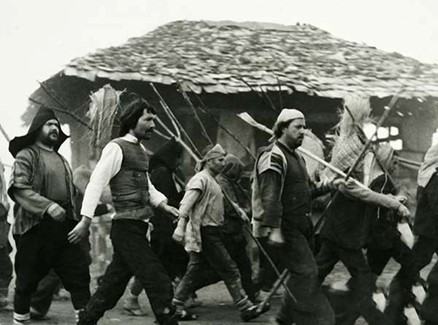
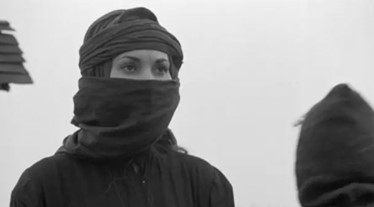
Éric Vuillard (The War of the Poor)1Éric Vuillard, The War of the Poor (New York: Picador, 2020), 46.
Introduction
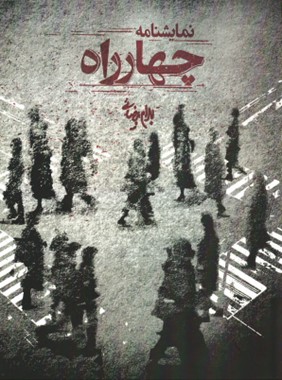
“Jin, Jiyan, Azadî” (“Woman, Life, Freedom”), the central slogan of the feminist liberation movement in Iran, is based on the Kurdish belief that a free society is impossible without the liberation of women. The violent murder of young Kurdish woman Jīnā Mahsā Amīnī (1999–2022) after her arrest by the ‘morality police’ (Gasht-i Irshād) sparked a class-transgressive, decentralized uprising aimed at breaking down the prison walls of fear, punishment and oppression in Iranian society. People from different social classes, generations, and ethnic groups—Kurds, Arabs, Azeris, Baloch—joined the resistance movement.
What is also expressed in the liberation movement’s slogan is a rejection of probably the most powerful necropolitical instrument of repression in the theocracy:2“Moreover I have put forward the notion of necropolitics and necro-power to account for the various ways in which, in our contemporary world, weapons are deployed in the interest of maximum destruction of persons and the creation of death-worlds, new and unique forms of social existence in which vast populations are subjected to conditions of life conferring upon them the status of living dead. […] under conditions of necropower, the lines between resistance and suicide, sacrifice and redemption, martyrdom and freedom are blurred.” See Achille Mbembe, Necropolitics (Durham/London: Duke University Press, 2019), 92. the cult of martyrdom (‘dying in the name of’). The majority of the population no longer wants to die for the “martyr welfare state,”3Cf. Kevin Harris, A Social Revolution. Politics and the Welfare State in Iran (Oakland: University of California Press, 2017). but to live. Women’s struggle against the colonization of their bodies became an inclusive people’s movement demanding basic rights to life. Iranian film history (before and after 1979) not only tells us a pre-history of this struggle—it has also always been part of it.
This article examines the cinematic practices, tactics and aesthetics of liberation developed by female filmmakers after the Iranian Revolution 1979 to the present time. Women’s struggle for liberation runs through the entire history of Iranian cinema like the “ticking of a clock” (as Walter Benjamin would say), longing for condensation into the “strike of the hour”4Walter Benjamin to Max Horkheimer (1935), in Walter Benjamin, Selected Writings, vol. 3 (1935–38), ed. Michael W. Jennings, Howard Eiland, and Gary Smith (Cambridge, MA: Harvard University Press, 2002), 424. of an overall social movement. The feminist forms of cinema are part of this ticking.
As will be shown, the struggle of Iranian women directors against hegemonic forms of patriarchy not only took place in Iran itself, but also challenged the trademarks of the New Iranian Cinema on an international level of festival policies, which highly insufficiently covered the feminist forms of Iranian cinema. And this despite the fact that statistics “released a few years ago stated that Iran actually has a higher percentage of female filmmakers than America,” as Rakhshān Banī-i‘timād once said in an interview.5Maryam Ghorbankarimi, “Conversation with the Director,” in ReFocus: The Films of Rakhshan Banietemad, ed. Maryam Ghorbankarimi (Edinburgh University Press, 2021), 12-24, 196.
If the word shahīd in Arabic and Persian means “witness,” which originally had nothing to do with blood witnessing (just as the Greek mártys was initially a juridical witness),6There are two classical meanings of shahādat (martyrdom): bearing witness and sacrificing oneself for the sake of a higher truth. These two meanings were not always interconnected. While shahīd in the sense of „witness” is “fairly common in the Qur’an,” the compatibility of this meaning with the later prevailing aspect of “self-sacrifice” was not self-evident from the beginning. Rather, the “Muslim tradition had to invent this connection,” amongst others as “a reflex of late antique Christian usage.” It was the early Christians in the middle of the second century A.D. who, by their (more or less) voluntary death in the arena, appeared as witnesses to a higher truth, thus also giving a new meaning to the commonly used term for witness, namely martyr (Greek martys; Latin martyres). Thus, a term initially used in a juridical context was transformed into the new and until today more dominant meaning of blood testimony in the sense of “sacrificial death for the faith.” —Ravinder Kaur, “Sacralising Bodies: On Martyrdom, Government and Accident in Iran,” Journal of the Royal Asiatic Society 20, no. 3 (2010): 442–60, 447; Keith Levinstein, “The Revaluation of Martyrdom in Early Islam,” in Sacrificing the Self: Perspectives on Martyrdom and Religion, ed. Margaret Cormack (New York: Oxford University Press, 2002), 78–92, 79. then the feminist films from Iran (and the diaspora) reveal practices of a counter-witnessing that fosters transgenerational as well as class-transgressive solidarity: a witnessing that counters the hegemonic witnessing of male martyrs with singular as well as connected gestures of resistance.
Filming on Many Fronts
After the 1979 Revolution, the cultural functionaries of Islamic guidance attempted to implement a quasi-Islamized version of the “Third Cinema”—which in fact was more a state hijacking of decolonial cinema and a propagandistic exploitation of its anti-imperialist rhetoric.7In order to express the state’s hijacking of the “Third Cinema”, Blake Atwood uses the term “state-controlled postcolonial cinema”. see Blake Atwood, Reform Cinema in Iran. Film and Political Change in the Islamic Republic (New York: Columbia University Press, 2016), 11. However, the authorities’ attempt to homogenize Iranian cinema ideologically and aesthetically has never achieved its goal. Even though the initial aim after the Islamic Revolution was to drive women out of cinematic spaces (both visually and acoustically), the unexpected result of this “purification phase” was an unprecedented opening of the film industry to women. Although they had to adhere to the strict modesty rules of veiling both in front of and behind the camera, cultural functionaries began to realise in 1985 (i.e. during the war), that they had to invest in a new generation of young female filmmakers in order to boost the weakened film industry. 8“A unique and unexpected achievement of this cinema has been the significant and signifying role of women both behind and in front of the camera. […] What is unique is the inscription of modesty rules and what is unexpected is that more women feature film directors emerged in a single decade after the revolution than in all the preceding eight decades of film making – and this in a patriarchal and traditional society, which is ruled by an Islamist ideology that is highly suspicious of the corruptive influence of cinema on women and of women on cinema. […] The strong presence of women behind the camera was officially recognized in 1990, when the 9th Fajr Film Festival – the country’s foremost national film event – devoted a whole program to the ›women’s cinema.” This cinema is very diverse, as women are involved in all aspects of feature, documentary, short subject, and animated films as well as in all aspects of television films and serials production. Some of the filmmakers are quite versatile and they make documentaries, television soap operas, and feature films. Of particular significance is the emergence of a new cadre of feature film directors (and prominent actresses) trained after the revolution, who have begun to make their mark on the cinema and provide powerful role models for other women. Hamid Naficy, “Veiled Voice and Vision in Iranian Cinema: The Evolution of Rakhshan Banī-i‘timād’s Films,” Iran Chamber Society (2000), accessed August 20, 2025, https://www.iranchamber.com/cinema/articles/veiled_voice_vision_iranian_cinema1.php. In addition, many female directors who had started out in state television then switched to the film industry (such as Rakhshān Banī-i‘timād around 1987), as the censorship conditions there were not quite as rigid. Gradually, Iranian female filmmakers turned the medium film into a “Trojan horse” through which they smuggled multi-layered counter-images and “counter-memories”9Counter-Memories re-member official versions of history against the grain. They destabilize the mainstream of uniform memories shaped by epistemic oppression, red lines and power effects. See Matthias Wittmann and Ute Holl, ed., Counter-Memories in Iranian Cinema(Edinburgh University Press, 2021). into the public sphere, exposing all facets of the widening gap between the propagandistically claimed achievements of the Revolution and actual social injustices, also maintaining a call for justice against the traps of what is often called “state reform.”
Thus, despite the state architects’ attempts to “purify” the language of post-Revolutionary film, Iranian cinema succeeded in developing a fascinating variety of resistant forms whose feminist facets were, however, inadequately represented by the distribution routines of international festival networks. The Iranian women filmmakers had to film on many fronts, as the title of this subchapter suggests – and as will be shown in detail below.
While Iranophile festival audiences in Europe were under the spell of the so called New Iranian Cinema—and wondered why women in ‘Abbās Kiyārustamī’s films were constantly absent (this was to change abruptly with Ten, 2002)—the presence of Iranian women behind and in front of the camera was consistently overlooked by the same audiences. Thus, their struggle against hegemonic forms of patriarchy took place not only in Iran itself, but also on a transnational level with regard to festival policies and trademarks to which the Iranian cinema was confined after the Islamic Revolution (1979), and especially after the Iran-Iraq War (1980-1988). Simple, allegorical stories about rural life had been foregrounded by international festival networks, which led to the impression in Europe that “there is no electricity and no telephone in the whole of Iran,”10Quoted according to Birgit Glombitzka, “Hassliebe mit Tradition,” TAZ, September 15, 2003, accessed July 20, 2025, https://taz.de/Hassliebe-mit-Tradition/!710766/ as director and producer Mohammad Farokhmanesh once expressed it from a critical diaspora perspective.
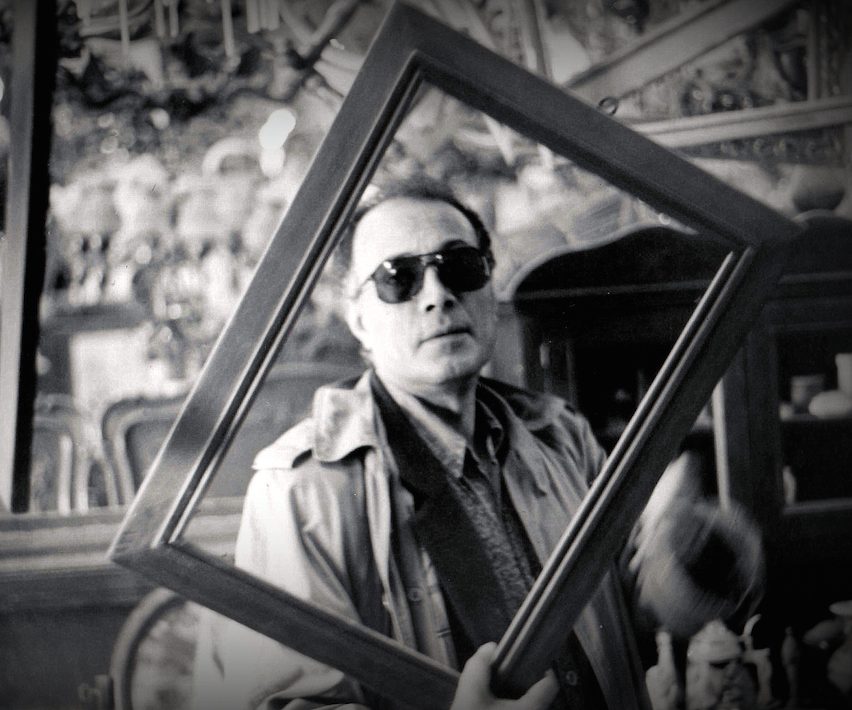
At a time when ‘Abbās Kiyārustamī, for example, considered Iranian cinema to be Iran’s most important export alongside “pistachios, nuts, carpets, and oil”11Miriam Rosen, “The Camera Art: An Interview with Abbas Kiarostami,” Cineaste 19, nos. 2-3 (1992): 40. (most likely including his own films), the no less significant films of Rakhshān Banī-i‘timād, the pioneer of socially critical film realism after the 1979 Revolution, were still decades away from gaining recognition in Europe. The following subchapter provides a closer look at Banī-i‘timād’s cinematic techniques of debunking the façade of the official success stories of the revolution, and documenting the daily struggle of those who have to live in the shadow of the state honoured martyrs.
Debunking the (Self-)Sacrificial Paradigm of State Martyrdom
Banī-i‘timād, who underwent a training programme at National Iranian Radio and Television (NIRT) before the Iranian Revolution, continued to pursue documentary projects after the Revolution, not only sharing the film footage—in the spirit of a Cinéma Verité-ethos of gift and counter-gift12Jean Rouch, “The Camera and Man”, in Ciné-Ethnography, ed. and trans. Steven Feld (London/Minneapolis: University of Minnesota Press, 2003), 29-48, 44.—with the people who had been filmed, but also using the films to persuade the city administration to implement reforms, especially when it came to improving living conditions in the shanty towns of Tehran.13See Maryam Ghorbankarimi, “Rakhshan Banietemad’s Art of Social Realism: Bridging Realism and Fiction,” in ReFocus: The Films of Rakhshan Banietemad, ed. Maryam Ghorbankarimi (Edinburgh University Press, 2021), 189-205, 196. Thus, Banī-i‘timād supported the 1979 Revolution as a secular critical intellectual rather than as a religious fundamentalist. In her words, “Our society needed a cinema with a different point of view.”14Shiva Rahbaran, “6. Rakhshan Banietemdad: Cinema as a Mirror of the Urban Image,” in Iranian Cinema Uncensored. Contemporary Film-Makers since the Islamic Revolution (London/New York: I. B. Tauris, 2016), 12-46, 131f. She remained committed to this cultural revolution in her own resistant way and dedicated her films to the micro-histories of suppressed voices that were able to brush the official success stories of war and revolution against the grain.
If censorship is as a set of permanently shifting, partly unwritten red lines that compel filmmakers to play a hide-and-seek-game called symbolism, then Banī-i‘timād’s semi-fictional, semi-documentary approach can be considered as a set of tactics in order to avoid pursuing this game. Instead, her post-revolutionary “street level perspectives”15Blake Atwood, Reform Cinema in Iran. Film and Political Change in the Islamic Republic (New York: Columbia University Press, 2016), 77. make visible and audible the materiality of tensions between conflicting social realities that are produced by the censorship of the city Teheran itself: a topology of boundaries, class differences and social limitations respectively exclusions, a system of all sorts of unequal distributed capital – social, cultural, economic, symbolic capital – and incorporated rules, schemes of perception and classifications.
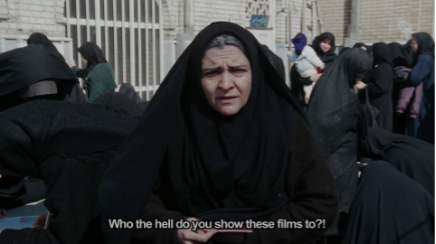
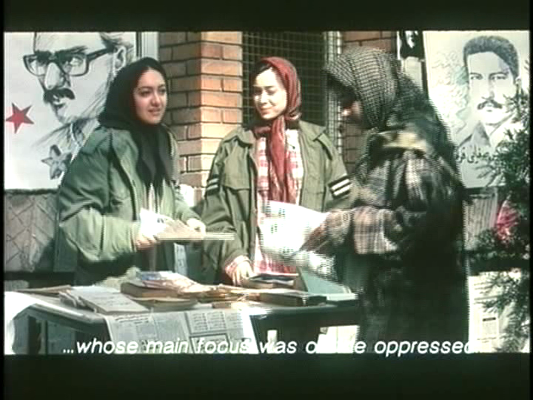
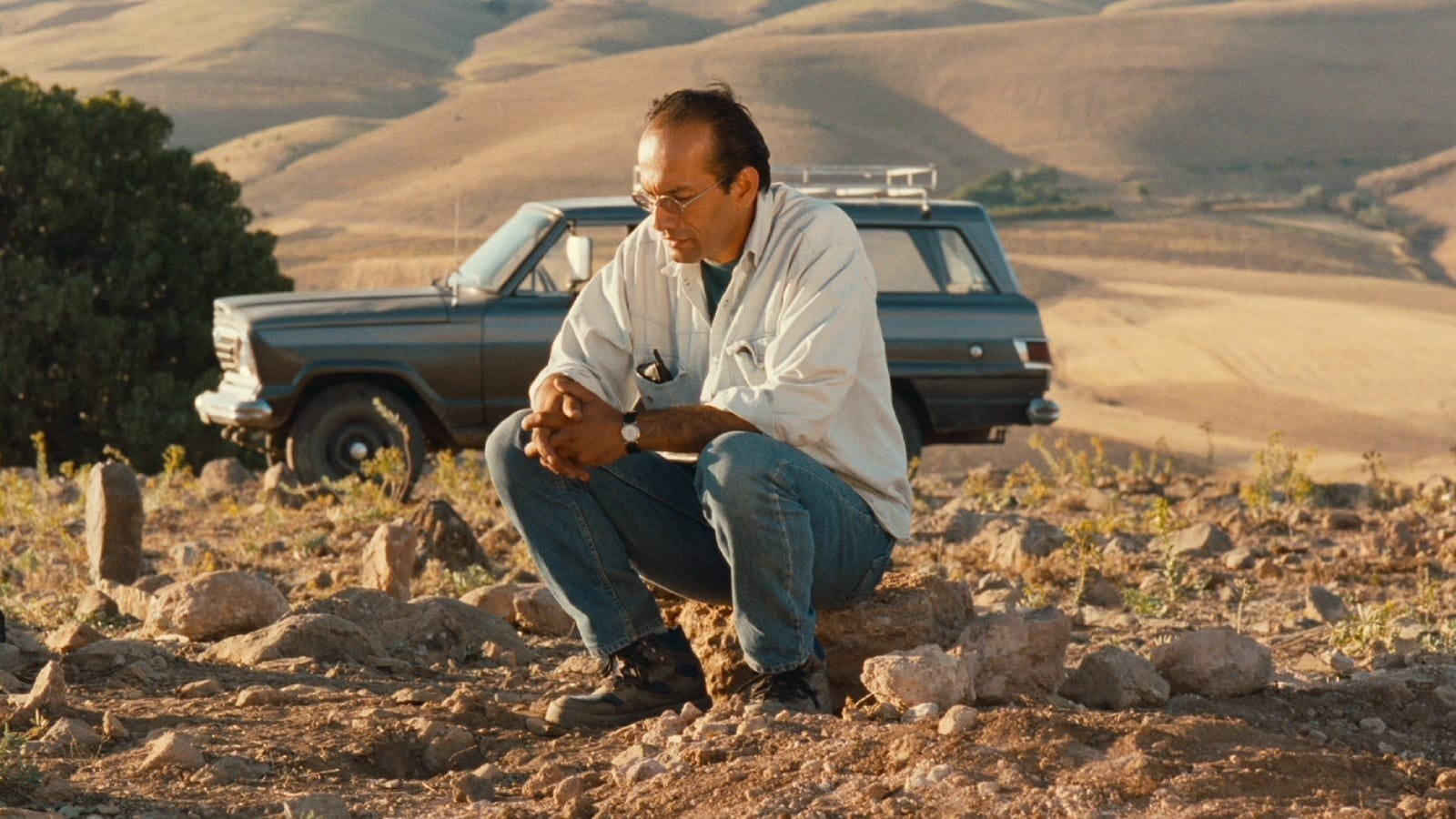
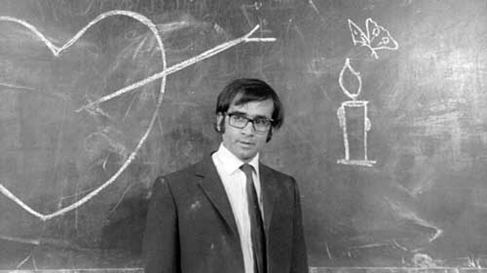
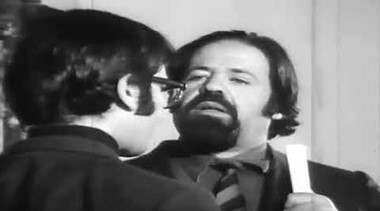
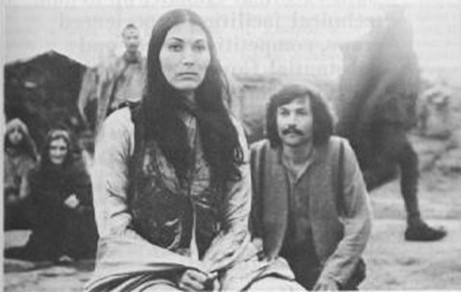
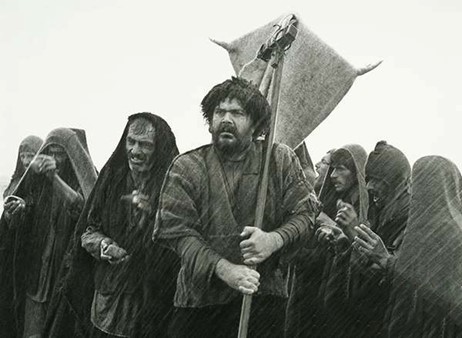
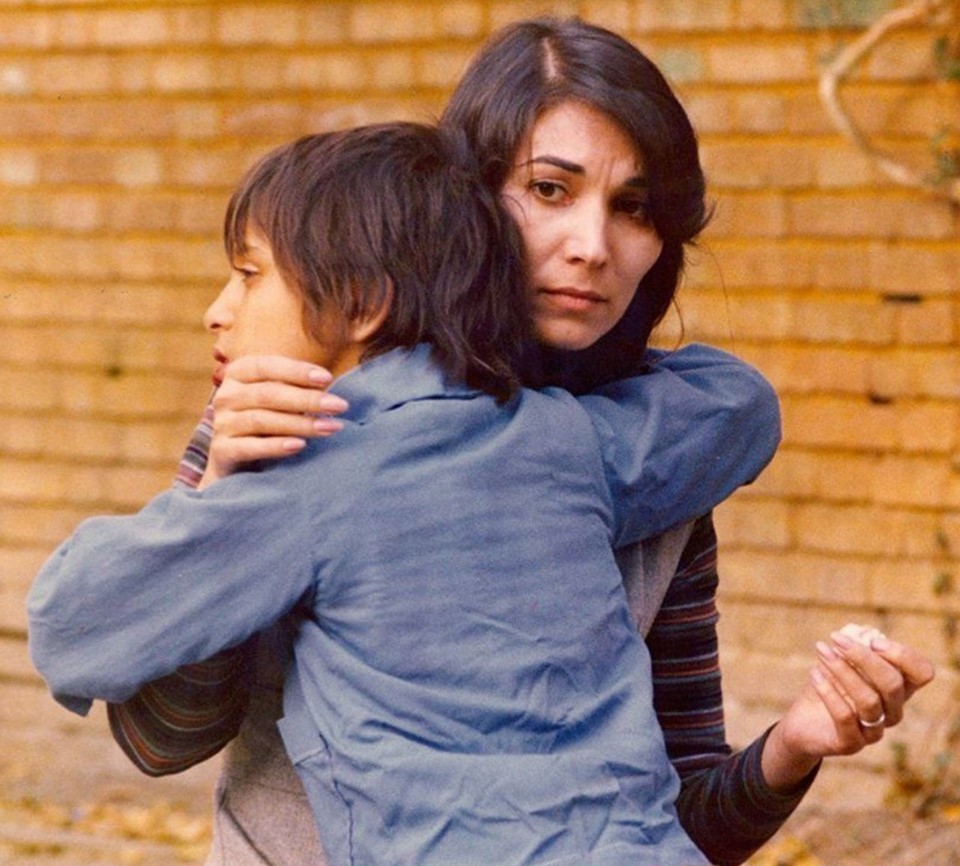
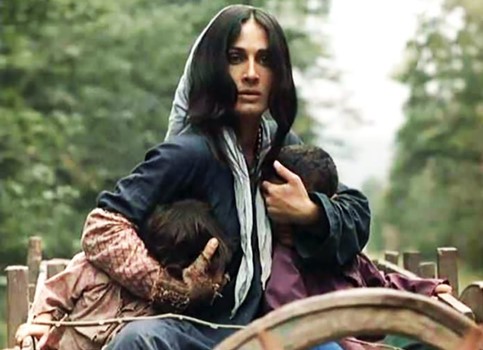
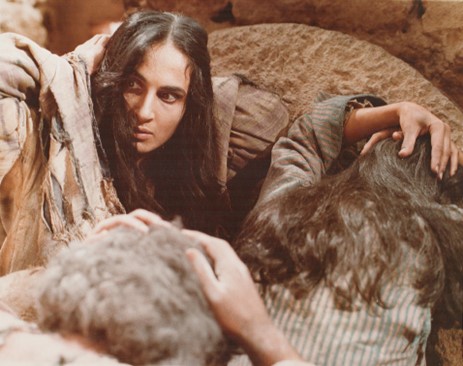
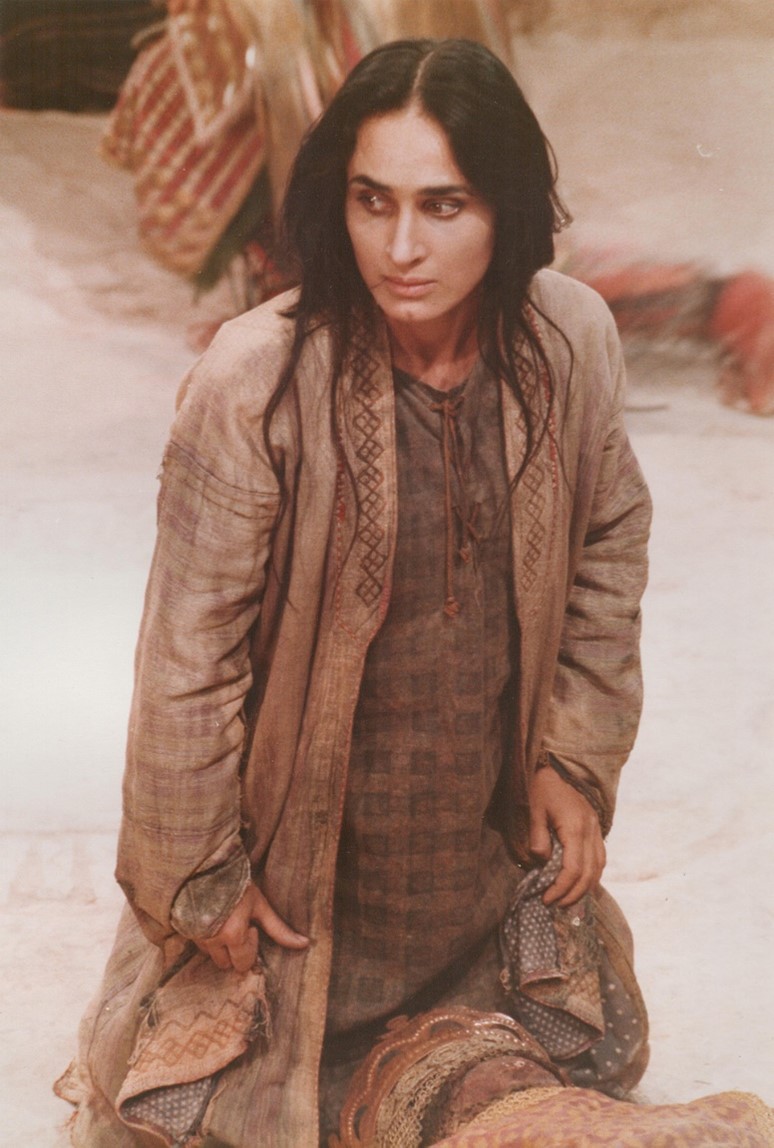
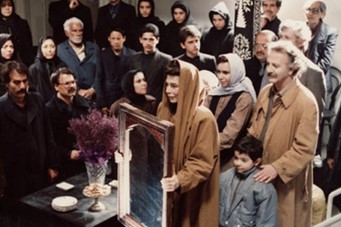
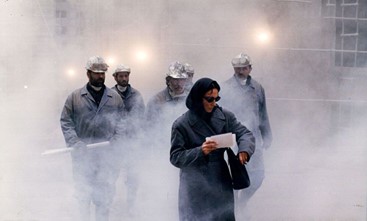
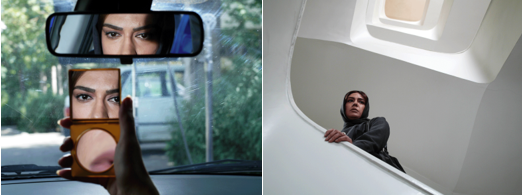
Under the Skin of the City (Zīr-i Pūst-i Shahr, 2001), the story of the struggle for survival of a courageous “Mamma Tehrani” named Tūbā (Gulāb Ādīnah), set in the poor south of Tehran, can be seen as a pivotal film in Banī-i‘timād’s cinematic social history. The blue-collar (or rather, “black-chador”) worker Tūbā is not only a composite figure made up of research and invention (like so many of Banī-i‘timād’s characters), but also a recurring figure, a revenant in Banī-i‘timād’s feature films. Before Under the Skin of the City, she had already made an appearance in May Lady (Bānū-yi Urdībihisht, 1997). Years later she would reappear in Tales (Ghissah-hā; 2014), thus giving a whole range of Banī-i‘timād’s feature films the character of a semi-fictional, semi-documentary long-term observational films, comparable to Volker Koepp’s Wittstock I – IV (1975), Nicolas Geyrhalter’s Over the years (Über die Jahre; 2015), Michael Apted’s63 Up (1964), Richard Linklater’s Boyhood (2014), or Želimir Žilnik’s Kenedi-Trilogy (2003-2007).
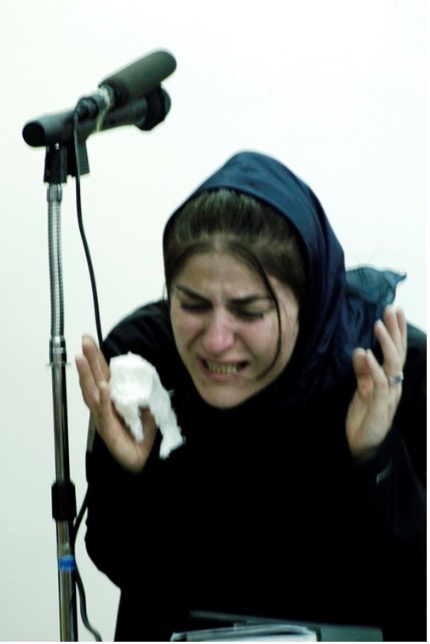
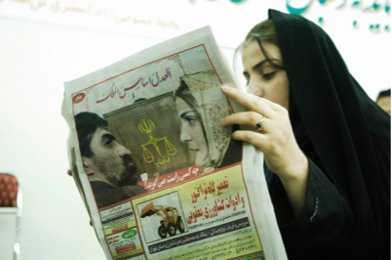
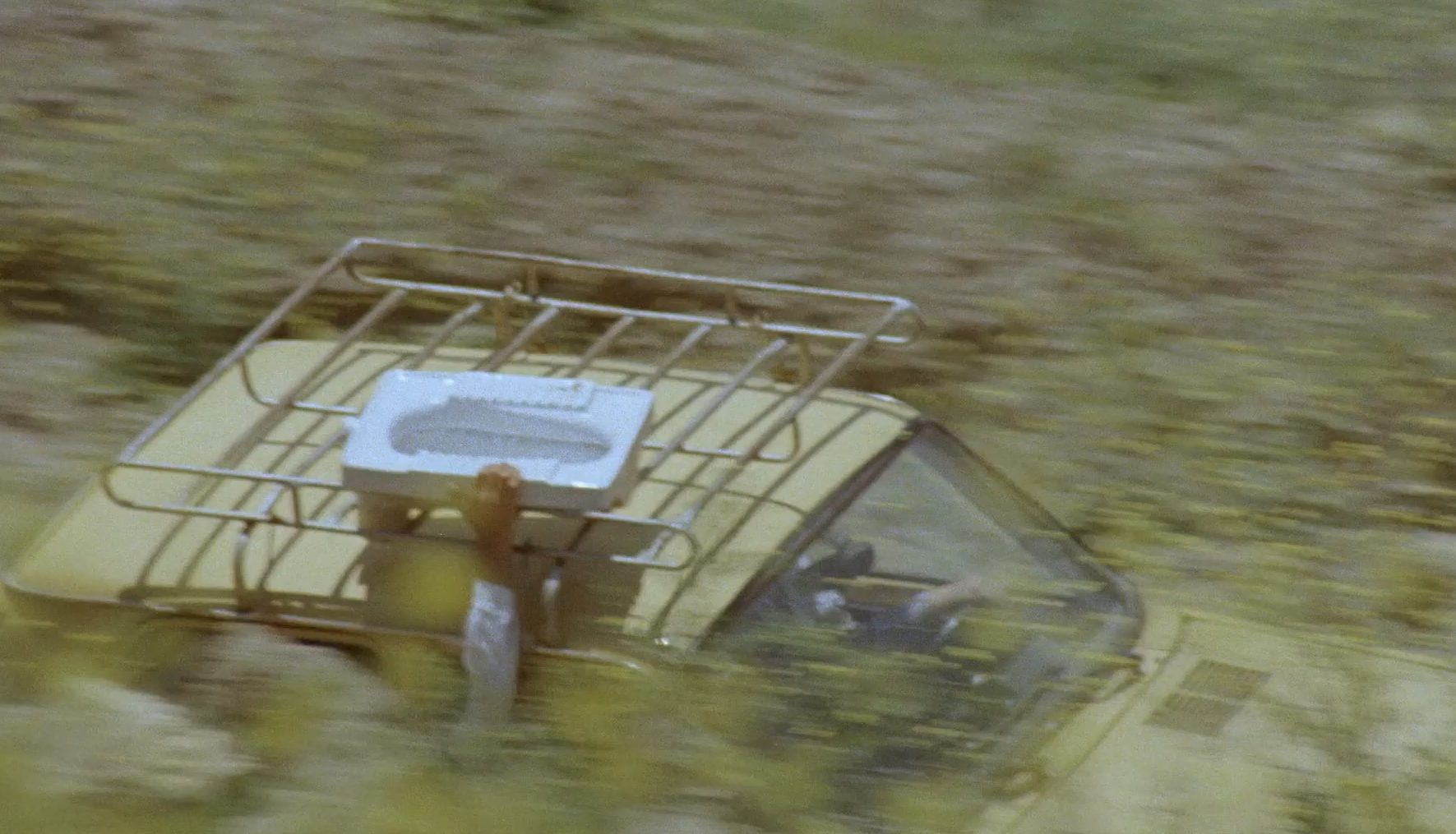
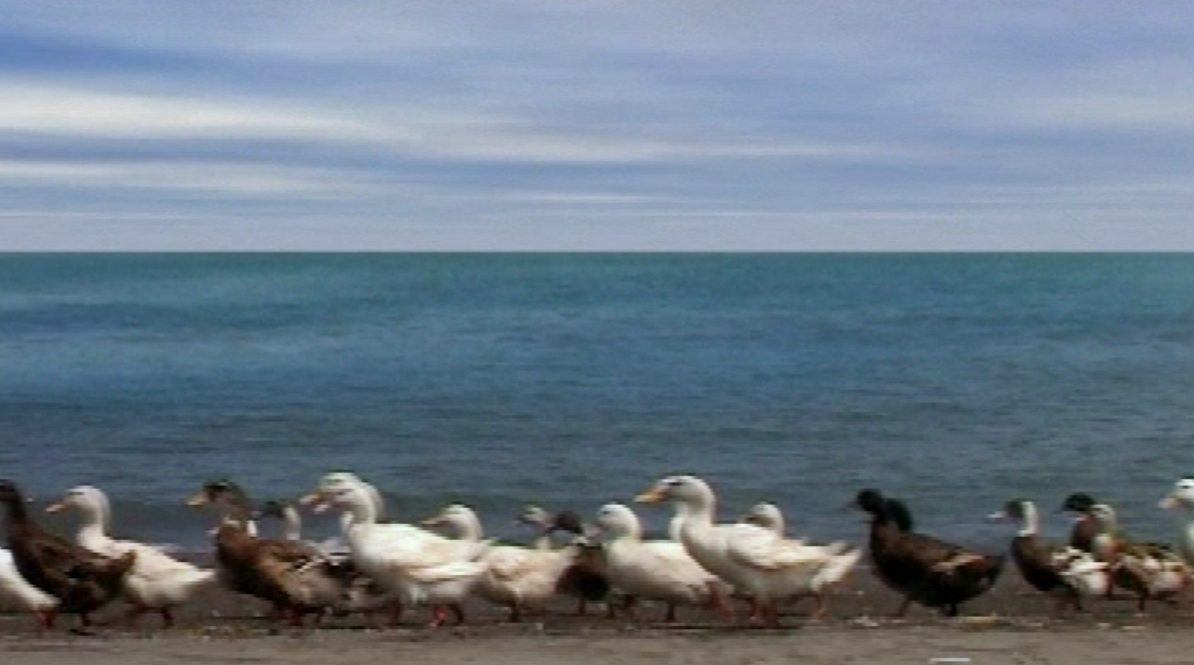
Figures 1 & 2: Screen Grabs from Under the Skin of the City (Zīr-i Pūst-i Shahr), directed by Rakshān Banī-i‘timād, 2001.
Over the course of several feature films, one follows various phases of a possible, imaginable subaltern life in southern Tehran—and listens to Tūbā’s increasingly severe cough as an effect of the murderous air both in the textile factory and in the smog of Tehran itself. Thus, the longitudinal study is a congenial accomplice to Tūbā’s long-term exposure to health risks. Long-term observational films in general often imply a critical attitude towards progress. They ask where time has gone. Banī-i‘timād’s socio criticism asks what has become of the expectations and promises of the revolution, and which events (or non-events) have altered the rhythms of life—or not altered, but hardened them. In doing so, they bring a sluggish, non-linear counter-time into play that subverts the martyrological and teleological model of time.
The mythical circularity of the time of the martyr (with its messianic telos of a future of redemption) is exposed by Banī-i‘timād’s social critique as a tough, circular time that does not pass because it is not allowed to pass—and because class relations are supposed to remain unchangeable. According to Jacques Derrida, “simultaneity is the myth of a total reading or description, promoted to the status of a regulatory ideal.”16Jacques Derrida, “1. Force and Signification,” in Writing and Difference, trans. Alan Bass (London/New York: Routledge Classics, 1978), 24. Banī-i‘timād’s time-critical art is entirely in line with Derrida’s criticism of totalitarian concepts of time: it makes visible the cracks that the myth of a total availability of time—as the simultaneity of past, present, and future—attempts to obscure. This becomes particularly clear in one scene of her earlier feature film The Blue Veiled (Rūsarī Ābī, 1995): While the upper-class widower and owner of a tomato sauce factory, Rasūl Rahmānī (‘Izzatallāh Intizāmī), prays with his family in the dining room of his luxury mansion and remembers the martyrs of the past (“Yā ‘Alī! Yā ‘Alī! Purify our hearts with your gifts. If people believe in the poor …”),17The Blue Veiled, directed by Rakshān Banī-i‘timād (Iran, 1995), 00:31:00-00:32:37. the domestic servants have to wait in the kitchen to be allowed to serve tea to the upper-class family after the endless prayers have ended.
Banī-i‘timād unmasks the hypocrisy of religious rituals (especially those dictated by the state) and lays open the empty remains of the promises of what was once called liberationtheology or Alavid Shi’ism by ‘Alī Sharī‘atī: a revolutionary political position and a counter-hegemonic utopia based on freedom, social justice, spirituality, based on a red, action-oriented rather than a black, mourning-oriented Shiism. What had promised decolonization and liberation before the Islamic revolution became a necropolitical instrument after the revolution, assisting the government to colonize its own population – especially the lower classes. Banī-i‘timād thus exposes religion as a governmental technique that uses rituals to keep people trapped in a self-sacrificial state of waiting for changes never to come.
The “martyr welfare state”18Cf. Kevin Harris, A Social Revolution. Politics and the Welfare State in Iran (Oakland: University of California Press, 2017). separates the “space of appearance”19Hannah Arendt, The Human Condition (University of Chicago Press, 1998), 199ff. of male martyrdom – as a public act of sacrifice that deserves recognition and remembrance – from the private testimony of women, who ultimately stand in the service of commemorating the heroic martyrdom of men. The time of male martyrdom, which is worth being told and re-presented in public spaces through murals and rituals (among other things), is passed on by the caring testimony of mothers, wives and daughters. Being a martyr also means being allowed to demonstrate in public the (supposed) freedom of risking one’s own life as a hero, while the lives of the female caregivers have no right to risk their life in public space.
Banī-i‘timād’s cinematic counter-witnessing confronts the hegemonic body testimony of male martyrdom and the symbolic vocabulary of state martyr propaganda with the singular times and resistant gestures of women portrayed in her films. In this way, Banī-i‘timād develops counter-martyrological forms of cinematic eye-witnessing that, above all, create frictions between political promises and social realities, dealing with solidarity between silenced voices—solidarity that also transgresses class boundaries. Her films try to carve out how ordinary people organize themselves in communities, networks, and grassroots movements,20See Asef Bayat, Street Politics. Poor People’s movements in Iran (New York: Columbia University Press, 1997). and how women from the middle-class (like Banī-i‘timād herself) try to support these grassroots movements.
Revisiting Iranian film history as a history of feminist counter-testimony therefore also means discovering forms of resistance in different strata of society. In addition, the films often raise the question of how solidarity between these social strata is possible. The following subchapter examines how Iranian women filmmakers deal with various forms of resistance within different social strata – and with forms of solidarity across these strata. The exploration will reveal a whole variety of feminist “passion plays” that can be found in the examined films, passion plays between (upper) middle-class feminism and subaltern articulations of resistance.
Middle-class Feminism and Subaltern Forms of Resistance
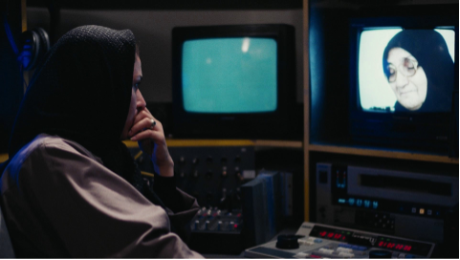
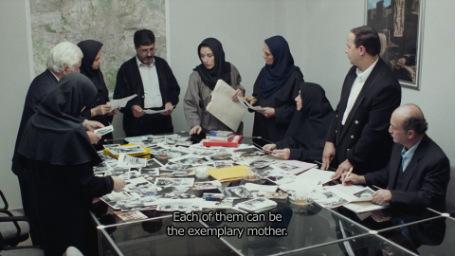
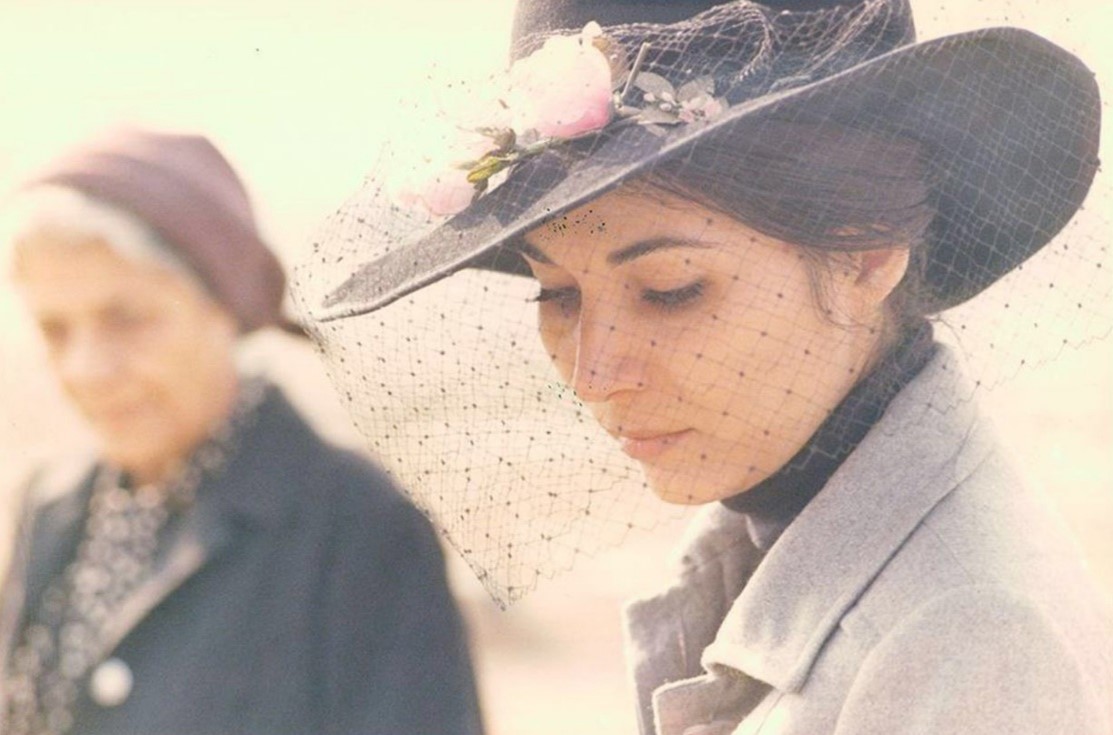
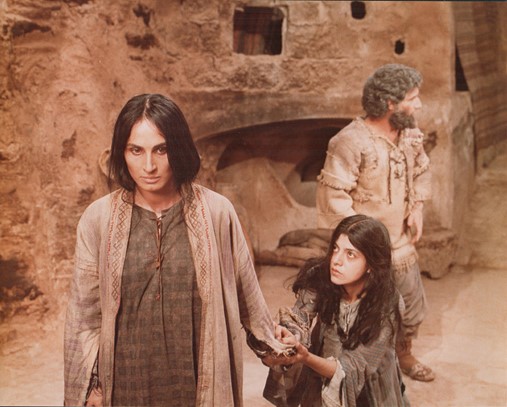
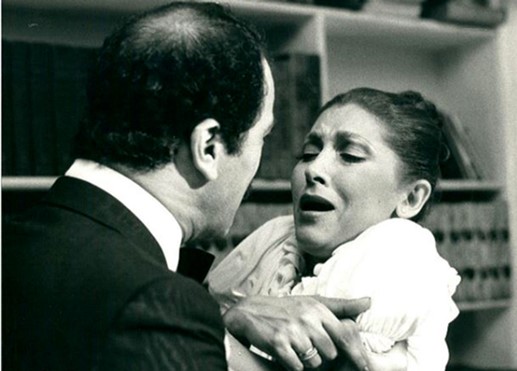
If we extend the radius of Tūbā’s family and in particular the paths of her son Abbas (Muhammad Rizā Furūtan), who delivers pizzas, beyond the boundaries of the diegetic world of Under the Skin of the City and move a little to the north, then we could imagine arriving at Tehran’s middle class and Banī-i‘timād’s self-reflexive, meta-film May Lady (Bānū-yi Urdibihisht, 1998). The film tells the story of 42-year-old documentary film director Furūgh Kiyā (Mīnū Farshchī). Furūgh is divorced, living with her adult, jealous son and having an affair with a man we never see, but whose presence is established through phone calls, letters and voice-over poems. In addition, she is starting to work on a TV reportage about an exemplary mother of Iranian society. The problem is that during her research, she is confronted with such a variety of individual mothers from different social classes that she finds herself increasingly unable to select an exemplary mother who would fit into the nationalist category of “motherland” (mādar-i-vatan), as the television company expects her to do. Thus, Banī-i‘timād’s documentary and feature films constantly confront us with crucial ethical dilemmas of ethno-sociography: How to keep in touch with multiple layers of society? How to avoid “speaking for” (e.g. the subalterns) when making committed documentaries? What does it mean to pick up one individual case, to decontextualize it, and transform it into a category, an exemplary case for society while thousands of other singularities have been de-selected? May Lady deals above all with the conflict between Islamist role expectations imposed on women (who are supposed to become the ideal mother) and the struggle for female autonomy in work and love life.
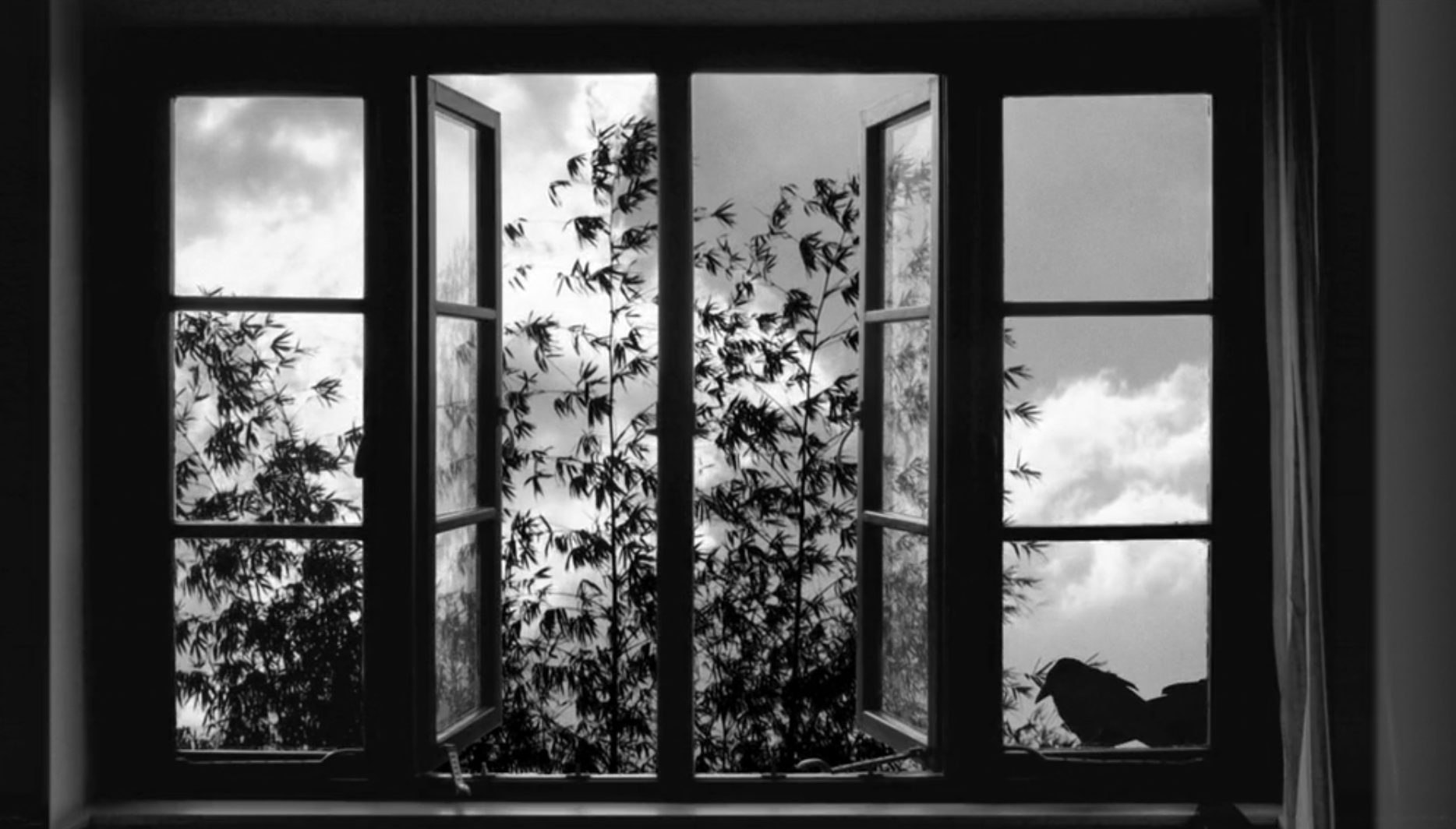
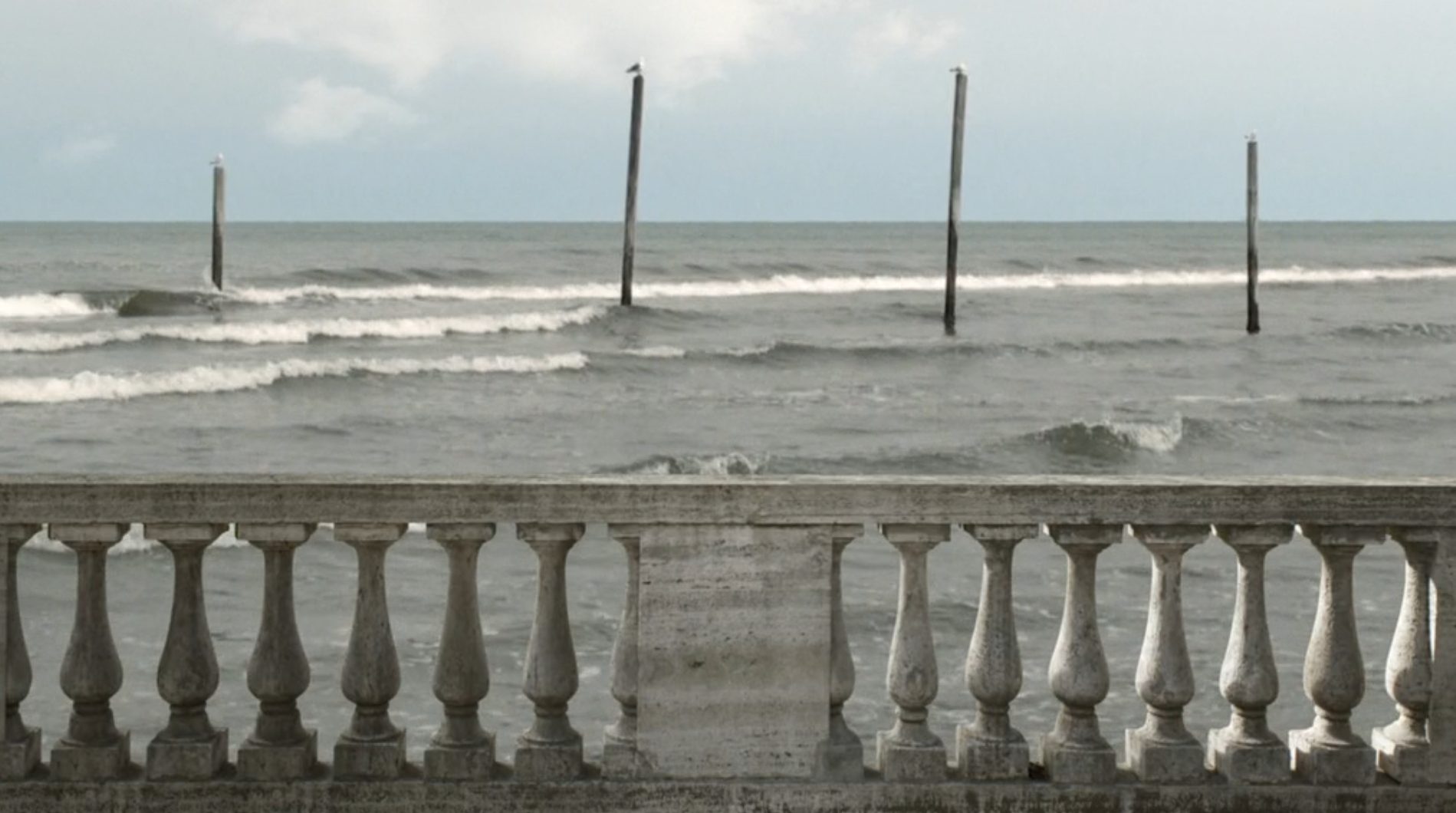
Figures 3 & 4: Screen Grabs from May Lady (Bānū-yi Urdībihisht), directed by Rakhshān Banī-i‘timād, 1998.
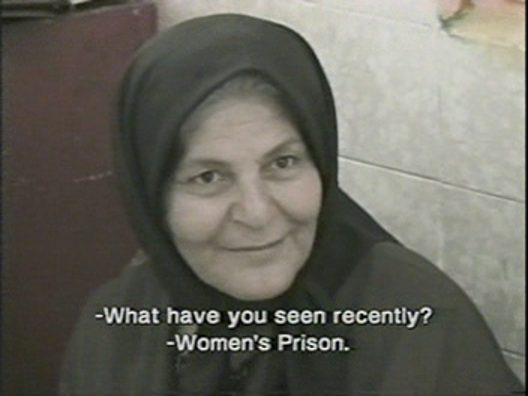
Banī-i‘timād, who as a middle class woman would not use the label “feminist filmmaker” for herself in order not to appear didactic or elitist towards subalterns,21Cf. Asal Bagheri, “The Blue-veiled: A Semiological Analysis of a Social Love Story,” in ReFocus: The Films of Rakhshan Banietemad, ed. Maryam Ghorbankarimi (Edinburgh University Press, 2021), 140-158, 142. was for a long time completely disregarded by the trademarks of international festival politics and their all-too-narrow prey scheme of “allegorical arthouse cinema from Iran”. The same is the case for feature films such as Tahmīnah Mīlānī’s political melodrama The Hidden Half (Nīmah-yi Panhān, 2001) and Manīzhah Hikmat’s powerful prison epic Women’s Prison (Zindān-i Zanān, 2002).
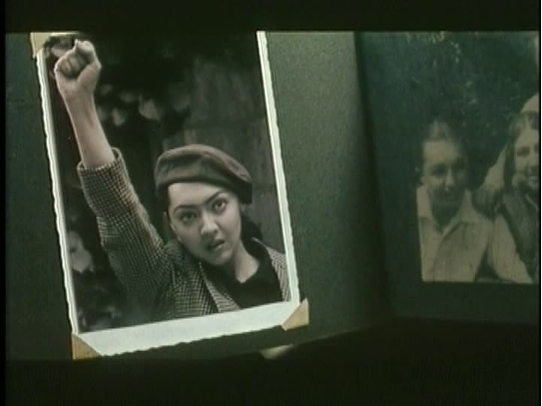
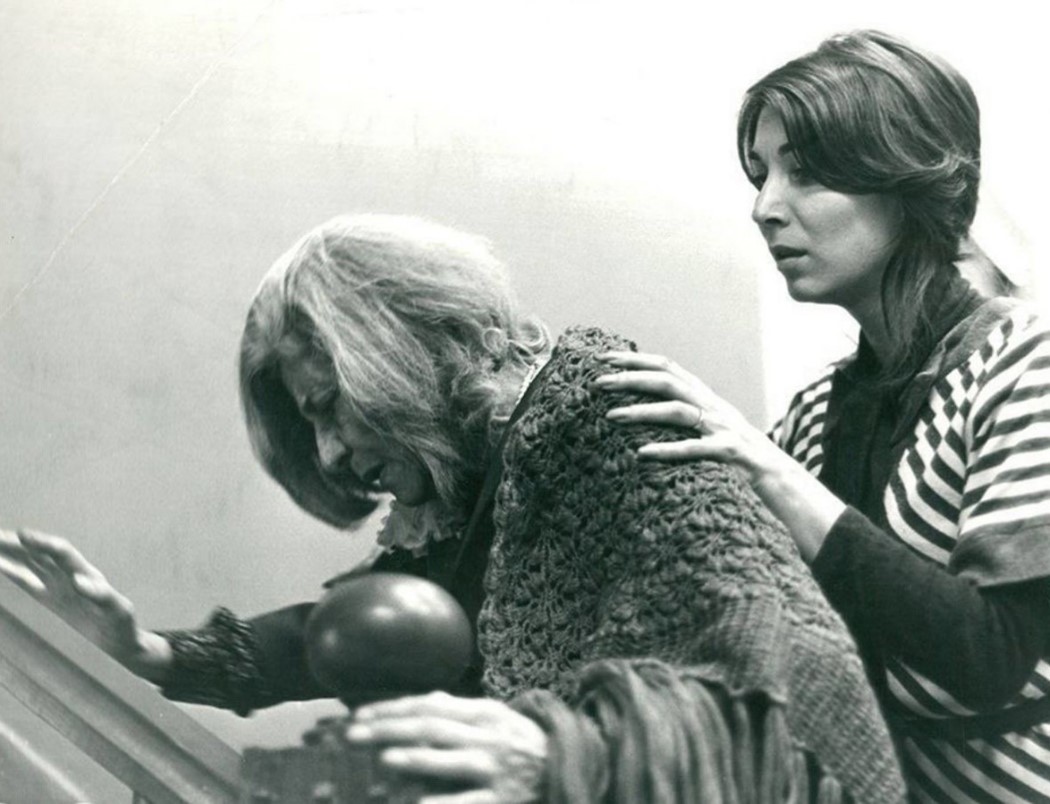
Mīlānī’s The Hidden Half tells the story of Farīshtah (Nīkī Karīmī), an upper-class protagonist and a former left-wing radical who decides to tell her husband, a Tehrani judge, about her previously hidden political activities in the period immediately following the revolution. The film’s structure is comparable to Max Ophüls’ Letter from an Unknown Woman (1948), since Farīshtah’s husband ends up reading her confidential writings and discovers her secret, hidden life. Using a series of flashbacks, the film portrays the repression unleashed by Islamic fundamentalists against gauchistes and politically committed women after 1979. Mīlānī’s film establishes counter-memories that challenge the official success stories of revolution, war and state martyrdom from the perspective of forgotten and repressed stories. What is at stake then is the quest for the crushed and silenced individuals or collectives and the question of representation: How to turn the grand narratives into minor or singular memories of revolt, uprising, and feminist dissidence? In contrast to Banī-i‘timād’s films, The Hidden Half arguably reflects the widespread hopes for change embodied by Sayyid Muhammad Khātamī who was 1997 elected as the president and was in office until 2005.
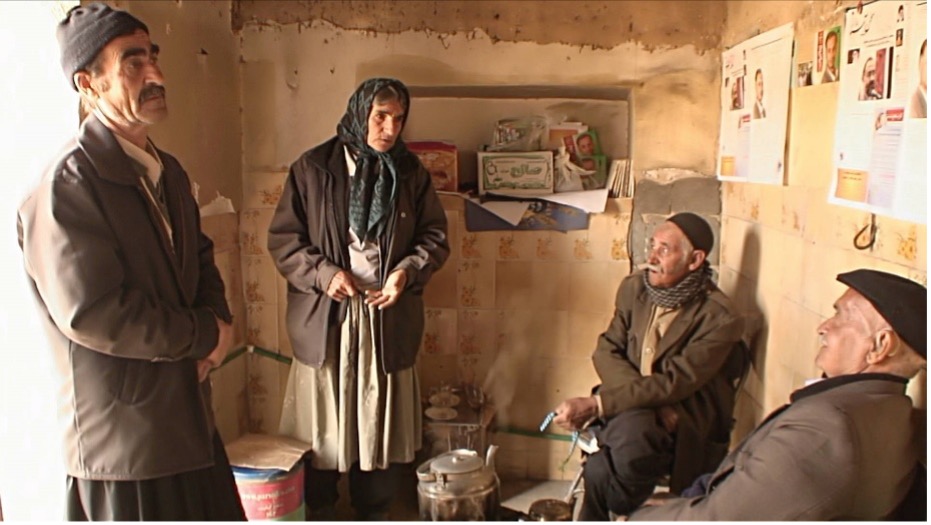
Figures 5 & 6: Screen Grabs from The Hidden Half (Nīmah-yi Panhān), directed by Tahmīnah Mīlānī, 2001.
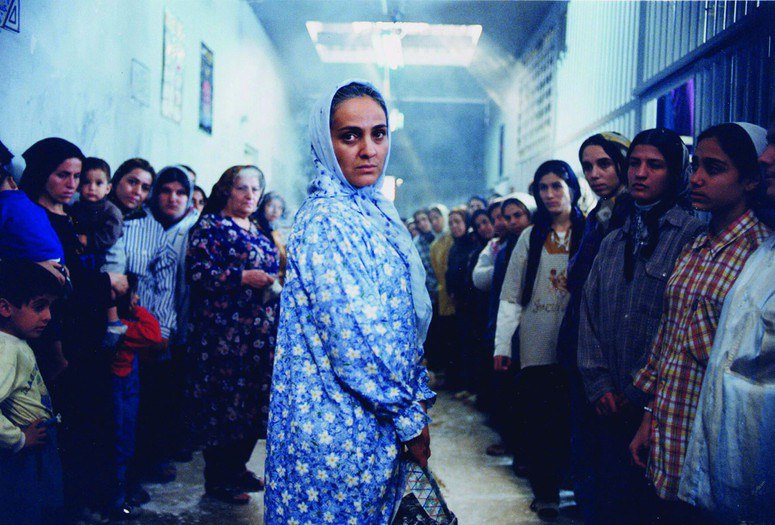
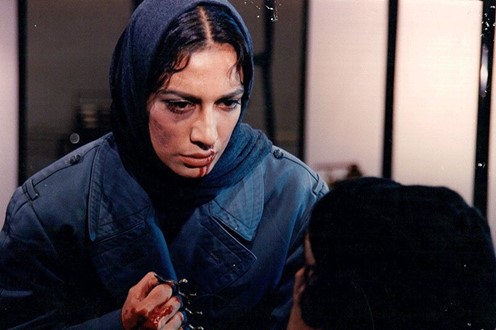
A particularly epic depiction of women’s struggle for liberation can be found in Manīzhah Hikmat’s feature film Women’s Prison (Zindān-i Zanān, 2002), which was no less popular than Banī-i‘timād’s Under the Skin of the City and reflects social conditions through the prism of a prison. Hikmat’s massive prison epic, spanning seventeen years, can be compared to Banī-i‘timād’s films in that in both cases careful milieu studies are turned into fiction—although Women’s Prison is also a gripping genre film that works with allegorical condensations. Revolving around the axis of a bitter conflict between rebellious inmate Mītrā (Rawyā Nawnahālī) and prison guard Tāhirah (Ruyā Taymūriyān), the film tells stories of power, sexuality, and violence, but also resistance through women’s solidarity. The now banned film was a box office success after release in Tehran, not least because it was regarded by the female population in particular as an echo chamber of their own experiences of oppression, and longing for resistance.
Figure 7: Screen grab from Women’s Prison (Zindān-i Zanān), directed by Manīzhah Hikmat, 2002.
The resistant gestures of women in Iranian cinema are not always grand, revolutionary gestures of feminist, well-educated middle-class activism. Especially when it comes to documenting subaltern articulations of revolutionary consciousness, and emancipatory struggles outside the discourses of Western, didactic feminism, it becomes especially important to look at female filmmakers who have remained in Iran in order to stay in touch with what Asef Bayat calls the “urban disenfranchised.”22See Asef Bayat, Street Politics. Poor People’s movements in Iran (New York: Columbia University Press, 1997), 5.
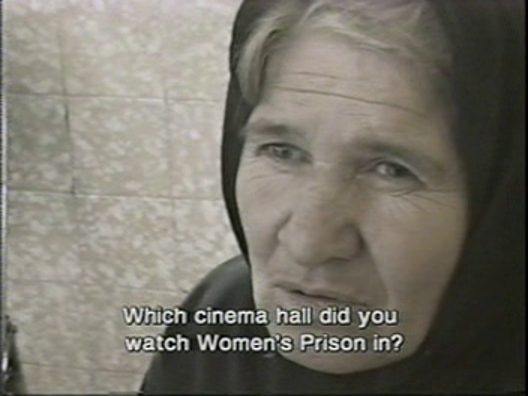
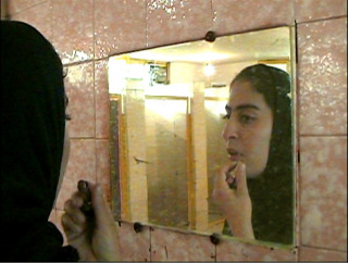
In her documentary film The Ladies Room (Zanānah, 2003), the underground filmmaker Mahnāz Afzalī introduces us to a women’s toilet in a Tehran park as the only place where sex workers, heroin addicts, and runaway daughters can find and create an aesthetic “space of appearance” (as Hannah Arendt would call it) for their experiences of violence (be it structural or domestic).23Hannah Arendt, The Human Condition (University of Chicago Press, 1998), 199ff. At the same time, this public toilet is transformed into a protective, semi-private space in which women can reclaim their right to intimacy as protection against domestic and state violence.
Following the traditions of cinéma vérité, Afzalī used special questioning techniques to gain the trust of these stunning women and persuade them to create performances that resulted in an extraordinary feminist ta‘ziyah in the ladies’ toilet. The women not only change roles (sometimes they are performers, sometimes they are the listening audience), but also enact a process of “truth-telling”24Cf. Michel Foucault, “The Courage of Truth: The Government of Self and Others II,” in Lectures at the Collège de France 1983-1984, trans. G. Burchell (London: Picador, 1984). (Parrhesia) against power. The protagonists regain the right to play the roles and wear the masks they want to wear—and not those that are forced upon them. During the passion play, not only are worries, fears and experiences of violence shared, but also excellent jokes critical of religion. We also learn that the system not only provides no rights for sex workers—and nothing but penalties ranging from imprisonment, flogging to the death penalty—but also refuses war-wounded women the status of “living martyrs,” and hence financial benefits.
Figures 8-10: Screen Grabs from The Ladies Room (Zanānah), directed by Mahnāz Afzalī, 2003.
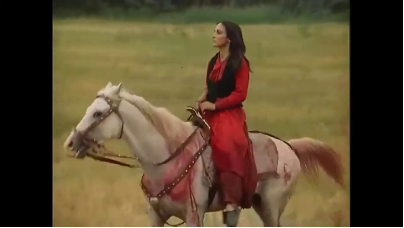
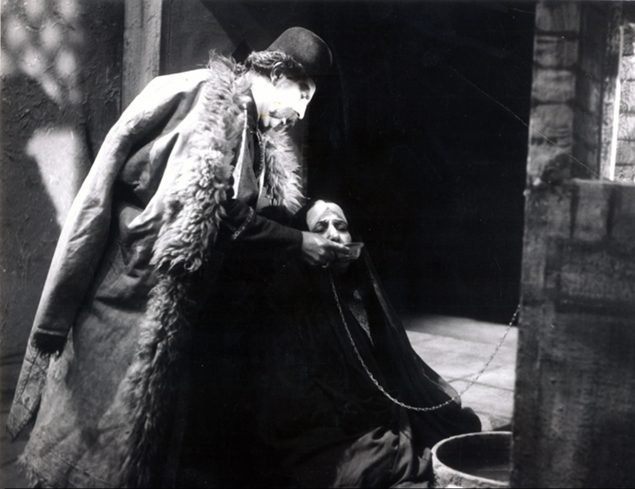
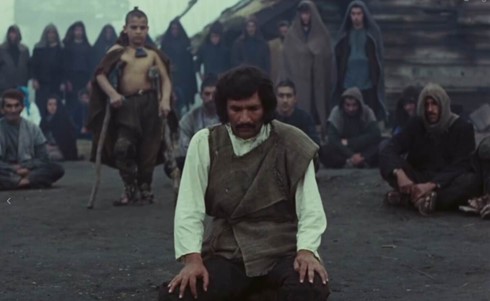
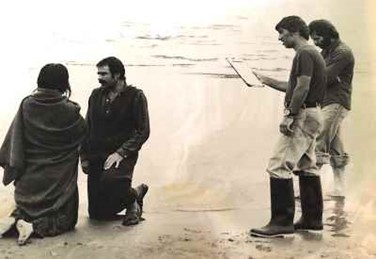
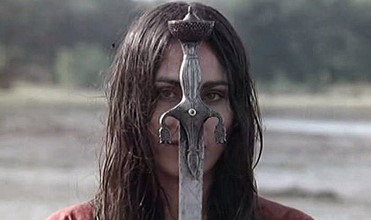
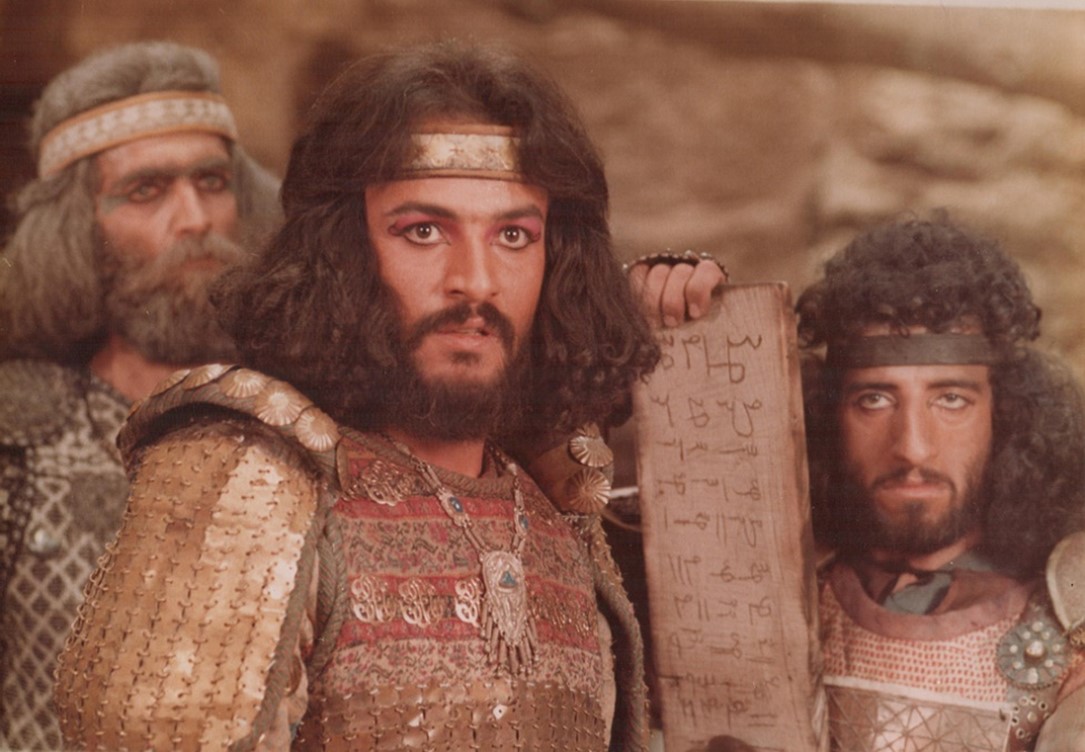
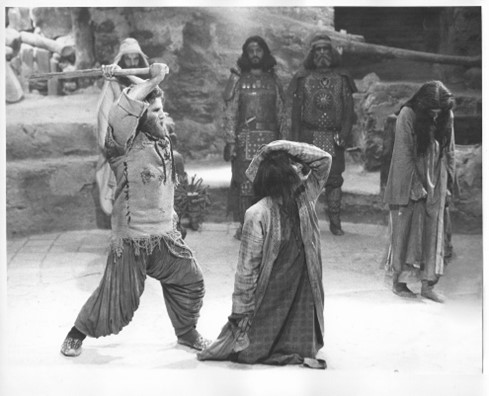
From a film-historical in-depth perspective, the feminist re-coding of ta‘ziyah as undertaken in The Ladies Room can be traced back to Bahrām Bayzā’ī’s The Ballad of Tārā (Charīkah-yi Tārā, 1979): In contrast to traditional mourning rituals, it is the widow Tārā (Sūsan Taslīmī) who rides the white horse instead of Husayn Ibn ʿAlī (626–680 CE). Above all, she does not want to die and become an allegorical, martyred body, but rather to live and become an independent woman. She very well knows that “martyrdom is a trap for the oppressed.”25Éric Vuillard, The War of the Poor (New York: Picador, 2020), 46. Accordingly, Afzalī’s film also gives the women of the Ladies Room the opportunity to free themselves from the role they are supposed to play according to the mythological battle at Karbala, and especially the story about Husayn’s sister Zaynab.26Cf. Kevin Schwartz and Olmo Gölz, “Negotiating Gender During Times of Crisis: Visual Propaganda from the Iran-Iraq War to Covid-19,” British Journal of Middle Eastern Studies (BRJMES), Special Issue: Cultural Production, Propagandas, and Negotiating Ideology in Iran, ed. by Goulia Ghardashkhani, Olmo Gölz und Kevin Schwartz (2024), accessed September 2025, https://www.tandfonline.com/doi/full/10.1080/13530194.2024.2342178. Instead of performing the classic role of Zaynab – and witnessing the public martyrdom of men –, the women portrayed by Afzalī are given the opportunity to bear witness to their own heartfelt passions.
Figure 11: Screen Grab from The Ballad of Tārā (Charīkah-yi Tārā), directed by Bahrām Bayzā’ī, 1979.
If, according to Arendt, the reality of inner life can only be constituted through “being seen and heard,” then Afzalī has succeeded in developing a cinematic realism that does justice to the “passions of the heart, the thoughts of the mind, the pleasure of the senses,”27Hannah Arendt, The Human Condition (University of Chicago Press, 1998), 50. which cannot exist as long as they are not allowed to claim any public space, any form of participation in a shared reality. While Hikmat’s feature film is about the prison as a microcosm of society, Afzalī presents the ladies’ toilet as a heterotopia and counter-space in order to uncover an alternative her-story of resistance. Remarkably, the popularity of Hikmat’s feature film becomes evident in Afzalī’s cinema verité-documentary when a sex worker during an interview names Women’s Prison as her favourite film because it shows the prison walls of society literally encircling the female body.
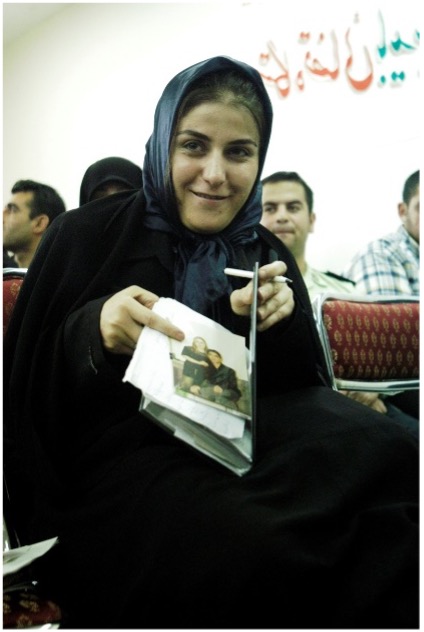
Also particularly noteworthy is a second documentary by Afzalī, which offers multi-layered insights into the misogynistic justice system of Iranian society. Using a refined montage of self-shot material and found footage (mainly home videos), The Red Card (Cārt-i Qirmiz, 2006) deals with the show trial against Shahlā Jāhid (1969–2010), who was sentenced to death because, as the lover of former national striker Nāsir Muhammadkhānī, she was accused of murdering his wife. The film is the most disturbing document imaginable of how “female guilt” is constructed in court. It is about the punishment of a woman whose neck had to fit into a socially prepared noose because she tried to live a love affair with a soccer star the way she wanted to. It is all the more remarkable that Afzalī succeeds in doing the almost impossible: In the midst of a misogynistic courtroom established to construct female guilt, the camera is consistently adjusted in such a way that the perspective of the accused victim is maintained and not denounced. It is not without reason that director Afzalī names Jāhid as co-director in the credits.28Afzalī’s The Red Card can be linked to Seven Winters in Tehran (2023), Steffi Niederzoll’s documentary debut, which contains secretly filmed footage and reconstructs the case of student Rayhānah Jabbārī (1987-2014), who was sentenced to death in 2007 for defending herself against an attempted rape. Before her execution, Jabbari was able to fight for a public voice from inside the women’s prison, supported by her parents, friends, and social media. Like the fictional Mītrā in Hikmat’s Women’s Prison, she also campaigned on behalf of her fellow inmates, who now pass on the songs Jabbari sang in prison to their children.
Figures 12-14: Screen Grabs from The Red Card (Cārt-i Qirmiz), directed by Mahnāz Afzalī, 2006.
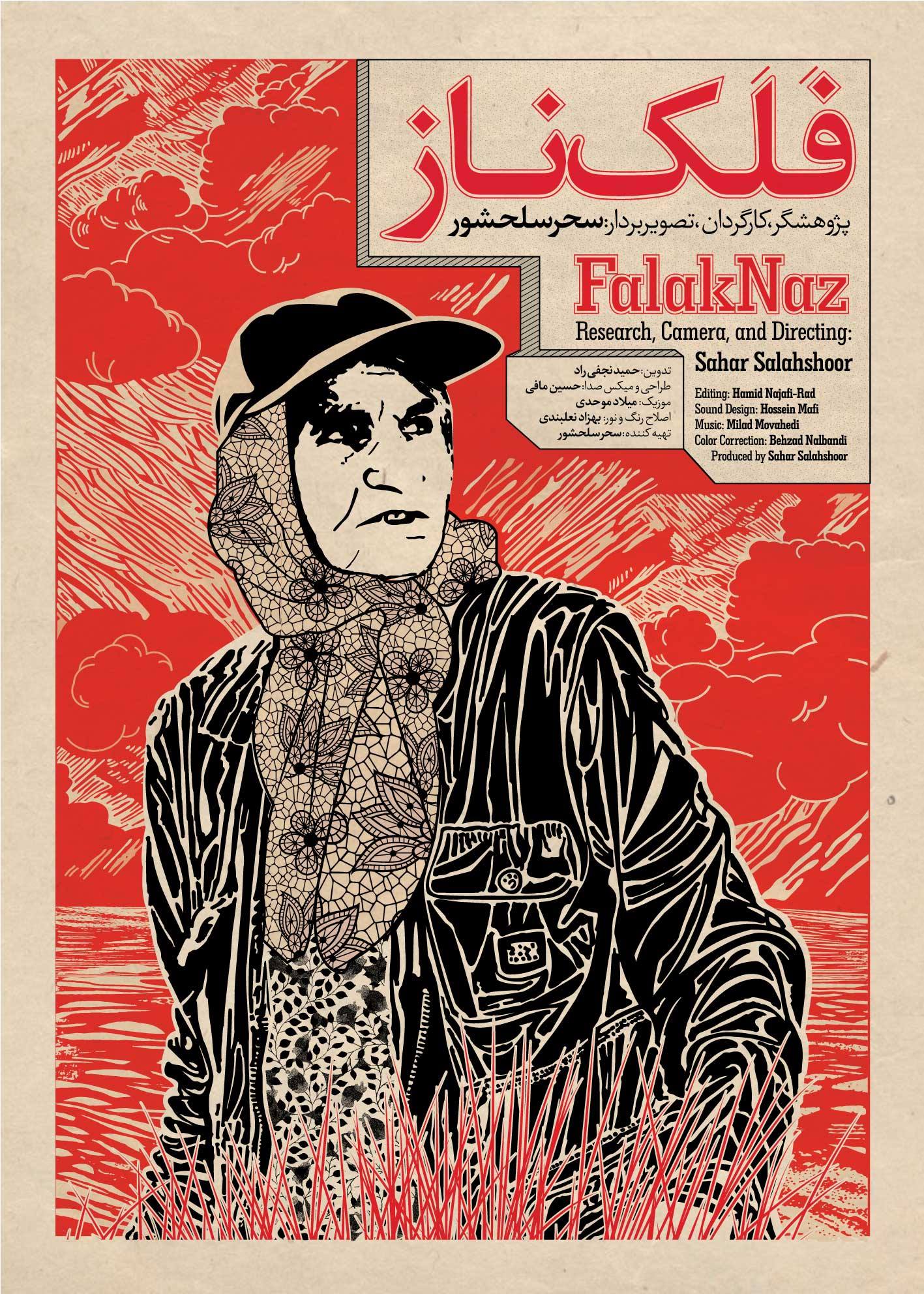
Another example of the practices of cinema verité is Sahar Salahshūr’s outstanding documentary film Falak’nāz (2015), which uses a hand-held camera and consistently rhythmic editing to portray the art of living and surviving of a Bactrian peasant woman. Falak’nāz, whose face is visibly carved and wrinkled by life, has to fight on various fronts in the western Iranian village of Fath-Ābād: against the dry earth, but also against the rigidity of village traditions, which she confronts with counter-stubbornness and subtle ingenuity. Salahshūr explores the social village structures through the lens of a subaltern peasant personality who, amid clearly defined roles, embodies an alternative, emancipatory model without acting in a consciously feminist or programmatically transgender political manner. The fact that Falak’nāz owes her local political authority to a rather rough, traditionally male habitus and, with her sharp-edged face under her headscarf, always looks like a cross-dresser, is not exposed by the documentary, but taken for granted. As a side story, the documentary thus also portrays the body as a venue for the most diverse role expectations between mother, politician, field worker and shopkeeper.
Figure 15: Screen Grab from Falak’nāz, directed by Sahar Salahshūr, 2015.
Thus, a leitmotif has emerged that runs through all the films and social milieus reflected above: The issue is not only the female body as an intersectional battleground of conflicting interests and forms of repression, but also as a self-empowering site for the development of diverse languages of resistance on many different frontlines. “Resistance” does not always refer to grand, revolutionary tactics, but can also point to emancipatory gestures whose liberating power arises from an awareness that there could be a different, alternative life. Although many female protagonists do not succeed in liberating themselves from constraints, they are very well able to recognize the social conditions that plunge their lives into manifold conflicts in order to reject or transcend the roles they are forced to play.
It is precisely these tensions and transgressions that are also the subject of Fā’izah Azīzkhānī’s entertaining post-Kiyārustamī film-within-a-film-construction For a Rainy Day (Rūz-i mabādā, 2015), a film that brings the social panorama, as reconstructed in this article, back to the middle class. For a Rainy Day is the story of a daughter shooting a documentary about her mother who, after a dream, imagines that she will soon die and finds herself torn between superstition, traditional role expectations, and (maternal) duties, but also between anarchic desires for self-fulfilment and revenge. In one hilarious scene, the mother becomes so pathetically involved in making a video testament (with quotes from the Koran) that the daughter feels reminded of a suicide bomber’s video message. Gradually, the documentary film project turns into a wish fulfilment machine for everyone involved. Mother and daughter even manage to persuade the film star Hadiyah Tihrānī to take part. Hence, in addition to a class-transgressive solidarity, the feminist forms of cinematic resistance also create a strong inter-generational solidarity. The article will come back to this aspect at the end.
Collective and Auto-Ethnographic Filmmaking
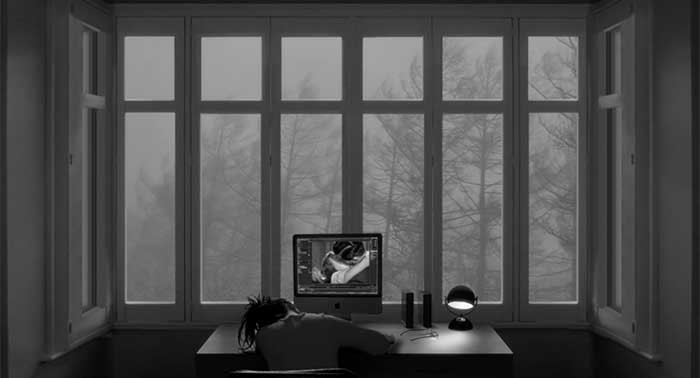
It should be noted at this point that it is above all in the form of collectives that Iranian feminist filmmaking not only organizes itself, but also draws its resilience within a totalitarian regime. This becomes particularly evident, as if through a burning glass, when one considers the auto-ethnographic film Profession Documentarist (Hirfah Mustanadsāz) from 2014, made in the aftermath of the Green Movement.
The film consists of seven episodes by young female directors (Shīrīn Bārqnāvard, Fīrūzah Khusravānī, Farahnāz Sharīfī, Mīnā Kishāvarz, Sipīdah Abtāhī, Sahar Salāhshūr, and Nāhīd Rizā’ī) who have found highly original and idiosyncratic ways of working through traumas, doubts, and fears. Some of the filmmakers live in Iran, some went into the diaspora, currently live in France, Australia, or Germany, and are extremely productive, with films such as The Art of Livingin Danger (2020) by Mīnā Kishavarz, My Stolen Planet (2024) by Farahnāz Sharīfī, or Density of Emptiness (2023) by Shīrīn Barqnavard).
Working together, the filmmakers developed a strong, collaborative form to film against the visible and invisible prison walls of Iranian society. How can a filmmaker give a voice to all the other silenced women in a society that strategically suppresses the vocal sphere (and especially the singing voices) of women? How to deal with (war) traumas and fears, but still remain open to the future? How can a possible world be filmed? How can films be imagined that are not allowed to exist? And how can the walls of a walled society be overcome with cinematic means in order to create windows to the public sphere, and allow resistance movements to emerge from private networks? What are the liberating effects of filmmaking? These are questions that drive all the contributions to this omnibus film and give it a high degree of actuality.
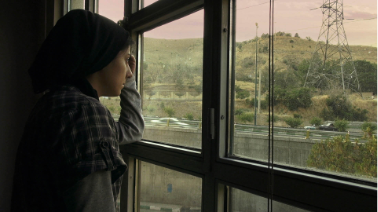
In one episode (by Sahar Salahshūr), the protagonist observes the walls of Ivīn Prison through her apartment window, and as this view begins to invade her privacy like a “vampire”, her filmmaking becomes a weapon and a shield—a kind of “screen” —against the intrusion of a prison architecture that can be understood here both literally and synecdochically, as part of a fait social total.29Marcel Mauss, The gift: Forms and functions of exchange in archaic societies (London: Cohen & West, 1966), 76-77. Even though filmmaking creates a protective, apotropaic shield against the outside world, it is impossible to escape the entanglement of private and public space.
However, it is important to view these episodes in their overall context, as taken together they show that feminist agency is based primarily on cooperation and collectivity. What connects and characterizes the latest films by female directors from Iran (and also from the Iranian diaspora) is the search for stories about feminist resistance movements that span generations and different social classes. This search no longer takes place against the backdrop of the trauma of a lost revolution (which would be a characteristic feature of the films of an older generation), but is driven by the need to pass on testimonies (“Who bears witness for the witnesses?”) and to create a living, performative, and popular memory through the medium of film.
Figures 16-17: Screen Grabs from Profession Documentarist (Hirfah, Mustanadsāz), directed by Shīrīn Bārghnāvard, Fīrūzah Khusravānī, Farahnāz Sharīfī, Mīnā Keshāvarz, Sipīdah Abtāhī, Sahar Salahshūr, and Nāhīd Rizā’ī, 2014.
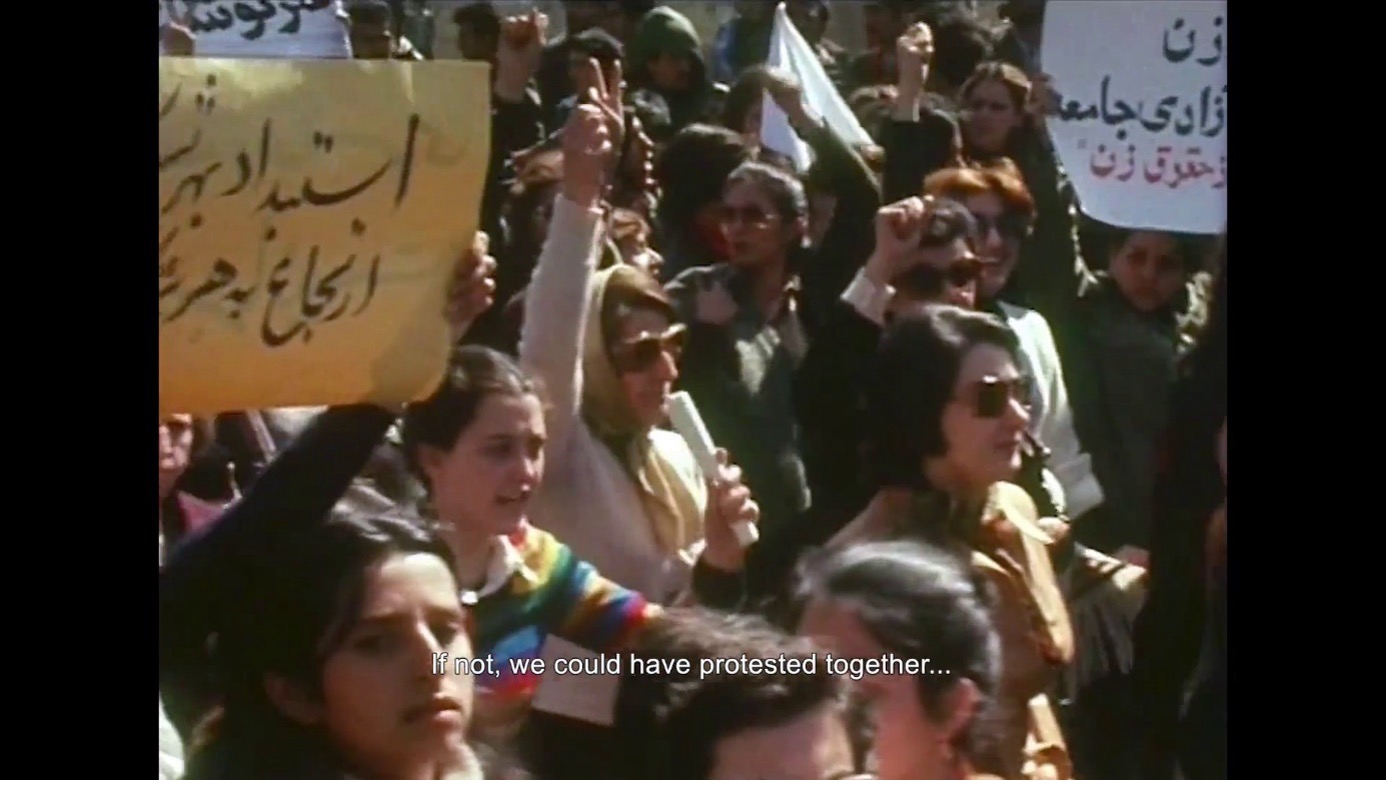
Another film dedicated to the work on transgenerational, popular memory is The Art of Living in Danger (2020), in which Mīnā Kishāvarz imagines a dialogue with her grandmother, who committed suicide at the age of 35 during the pre-revolutionary period after being forced into marriage at a young age. In the course of this conversation, Kishāvarz imagines a transgenerational encounter at the site of the 1979 revolution. “Nurījān, you had passed away by then. And I had not been born yet. If now, we could have protested together for freedom and justice.”30The Art of Living in Danger, directed by Mīnā Kishāvarz (Iran/Germany, 2020), 00:03:33-00:03:51.
However, the film also addresses the difficulties of establishing cross-class solidarity in the face of unequal opportunities (for emancipation). When the women’s rights activists portrayed in the film collect stories of oppressed women in the city of Marīvān (in western Iran) to support their efforts, they are confronted with criticism from many of the local women, who accuse the middle-class activists of not knowing enough about local social problems, especially of the lower-classes.
“There is no way for women to earn a living so they are all dependent on man … they even need the permission to leave home … When a woman marries here, they are no longer allowed to be friends with anyone they knew before the wedding… How shall we deal with such limitations … If a daughter wants to finish her studies at the university, she might never get married … If it took you, a counselor, eight years to gain independence (from your violent husband), how can a woman from my village, without any support, save herself?”31The Art of Living in Danger, directed by Mīnā Kishāvarz (Iran/Germany, 2020), 00:55:30- 00:58:22.
This critical statement is adressed to the women’s rights activist by a female resident at the local gathering. The film thus also shows that it is social inequality that renders cohesion amid diversity so difficult and challenging. It is, above all, the transformation of fear that interests filmmaker Kishāvarz in her cinematic counter-testimony, which counters the hegemonic testimony of male martyrs with cross-generational gestures of resistance. In this regard, entirely in line with the famous dictum by Theodor W. Adorno that the “purpose of revolution” is more than ever “the abolition of fear” (Adorno in a letter to Walter Benjamin in 1936).32Ernst Bloch, Walter Benjamin, Theodor Adorno et al., Aesthetics and Politics (London: Verso Books, 1980), 125.
Figure 18: Screen Grab from The Art of Living in Danger, directed by Mīnā Kishāvarz, 2020.
Archive footage documenting freedom from fear has remained important in Iran’s public revolutionary imaginary to this day: if there are images from the post-revolutionary period that the Islamic Republic’s propaganda machine was never able to appropriate and incorporate, then these are the images of the protests of May 8, 1979, the International Women’s Day, when thousands of women—with and without headscarves— took to the streets of Tehran in a united, cross-class protest against the “mandatory hijab” announced by Ayatollah Khomeini.33See Mouvement de libération des femmes iraniennes, année zéro, directed by Sylvina Boissonnas, Claudine Mulard (France, 1979), 13 min., color, 16 mm.
Films like Profession Documentarist and The Art of Living in Danger show very impressively that Iranian women are at the forefront when it comes to autoethnographic essay films, performative documentaries and the genre of auto-fiction.This can —mutatis mutandis—also apply to films from the Iranian diaspora. Only one example shall be given here in detail:
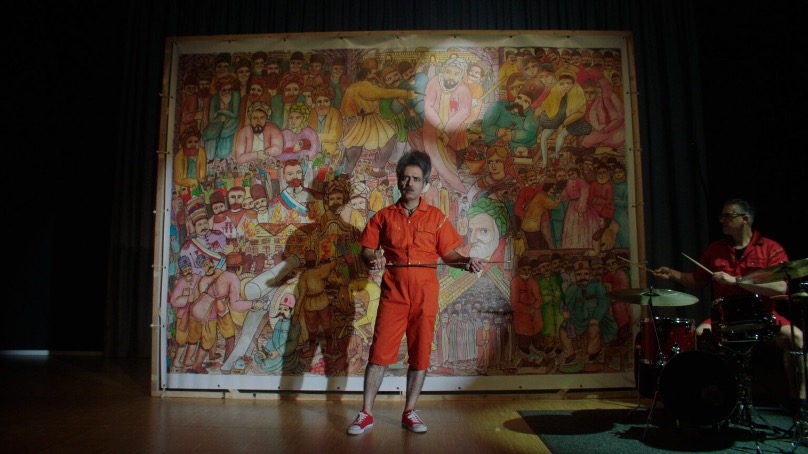
A remarkable auto-ethnographic and auto-fictional film that uses diasporic film spaces to perform a kind of counter-witnessing is Nargis Kalhur’s film Shahid (Shahīd, 2024) about an Iranian woman living in Germany who wants to break away from her past by changing her name. “Yes, I want Shahīd out of my name!”34Shahid, directed by Nargis Kalhur (Germany, 2024), 00:13:42. says Nargis Shahīd Kalhur (played by Bahārak ‘Abd-‘Alīfard) to her therapist, who is supposed to prepare a “psychological assessment of mental stress.” Thus, Nargis, daughter of a former Ahmadīnizhād official, who has been living in Germany since 2009 (after applying for political asylum), enters the fiction of her own film in order to change her name, since in the non-fictional reality it is precisely this name that prevents her from escaping the patriarchy of her country of origin. Thus, it is definitely not about longing to return—a trope with which the diaspora has all too often been re-essentialised. Instead, Kalhur’s “Cinemigrante”35“Cinemigrante. Narges Kalhor about Shahid,” Filmdienst Online (2024), accessed September 2025, https://www.filmdienst.de/artikel/68059/interview-narges-kalhor-shahid. (a term she likes to use) is about diaspora as dispersion and distraction. This also means using diasporic film spaces as a medium to portray bodies in their transcultural tension between times and places, liberations and constraints.
Figures 19-20: Screen Grabs from Shahid, directed by Nargis Kalhur, 2024.
What the “Shahīd” complex is all about is revealed to us by a pardah’khān, a Persian storyteller in front of a large screen display in the tradition of Persian coffeehouse painting: The protagonist inherited the name Shahīd from her great-grandfather Mirza Ghulām Husayn Tihrānī, who died for his beliefs during the constitutional revolution in Iran in 1907 and was awarded the honorary title of “martyr” (shahīd).36At the end of her autofictional research, Nargis discovers that she was on the wrong track and that she inherited the name from her great-grandmother—the true martyr who had no right to be in the public sphere. Even in the diaspora in Munich, the protagonist finds herself surrounded, pursued by the society of martyrs, who, as glorious spirits of patriarchy, shadows of the past, and tentacles of an expanded nation, want to prevent her from changing her name. A recurring shot shows Nargis/Bahārak lying naked on the ground, surrounded and literally crushed by men in black clothing. In another scene, her white-clad body becomes a screen and projection surface for archive images of the 1979 Revolution. The (de)colonization of the female body is a leitmotif in diasporic cinema.37Mania Akbari’s How dare you have such a rubbish wish? (2022) also deals with the colonization of the female body. Using around a hundred film clips taken from popular, pre-revolutionary cinema (fīlmfārsī), the so-called “years of sexual freedom” before 1979 are presented as a story of female bodies penetrated and marked by male gazes, which divided women into “chaste” and “unchaste” dolls. From this perspective, the revolution of 1979 does not appear as a rupture with the dichotomy chaste/unchaste, but as a mere reversal: the codes of chastity began to dominate the public space, while the spectacle of the “unchaste dolls” was made invisible, in other words: banished to the private sphere. After all, the body can be screened in a completely different form in the diasporic film spaces than in official cinema in Iran, which is subject to the rules of gaze (ahkām-i nigāh kardan), the semiotics of the hijab, and Islamic mise-en-scène. Or, to put it another way: diasporic film spaces and films from Iran are not subject to the same censorship.
Anti-Martyrocracy
The crossing out of the martyr’s name in Kalhur’s Shahid gains enormous complexity when seen in relation to the concerns of the Jīnā Movement, and with that, I would like to return to the starting point of this article. The feminist liberation movement has not only pushed the masculinist cult of state martyrdom into the background. Even the dissident reappropriation of the concept of martyrdom has lost its popularity. In contrast to the Green Movement (2009), martyrdom is no longer used so often as an interpretative framework to mourn the victims of resistance as heroines. As stated at the beginning: The movement would rather live than die “in the name of” (God, Holy Defence, Islamic Revolution).
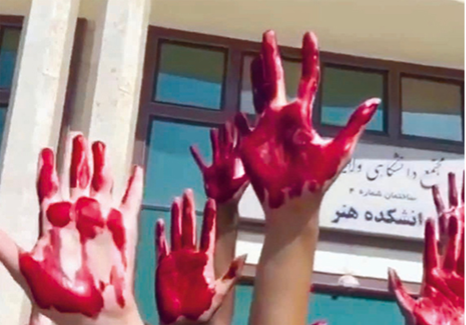
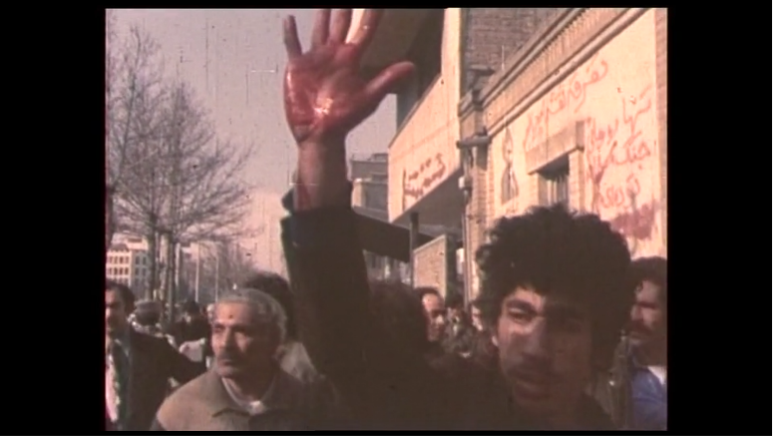
During the “Jin, Jiyan, Azadî”-movement, many state symbols of martyrdom have been replaced by revolutionary signs that, throughout history, stubbornly resisted being co-opted by the Islamic Republic’s visual propaganda machinery. Remarkably, a lot of blood-red hands (and hand prints) were brought into play and displayed, particularly prominently by protesting art students of Azad University Tehran on 9 October 2022, or online, as memes, after security forces attacked students staging a sit-in at Sharif University on 2 October 2022.
Figure 21: Blood Red Protest Hands, Sharif University and Azad University Tehran, October 2022.
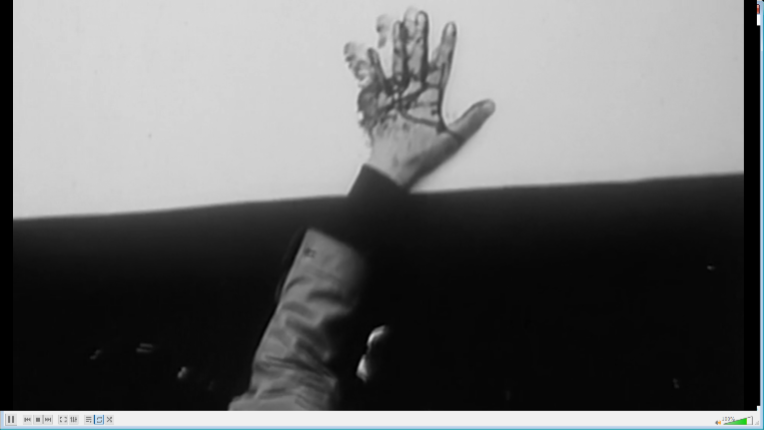
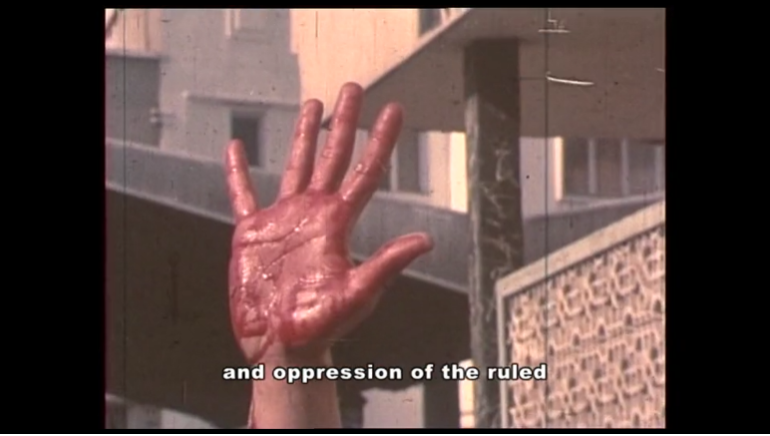
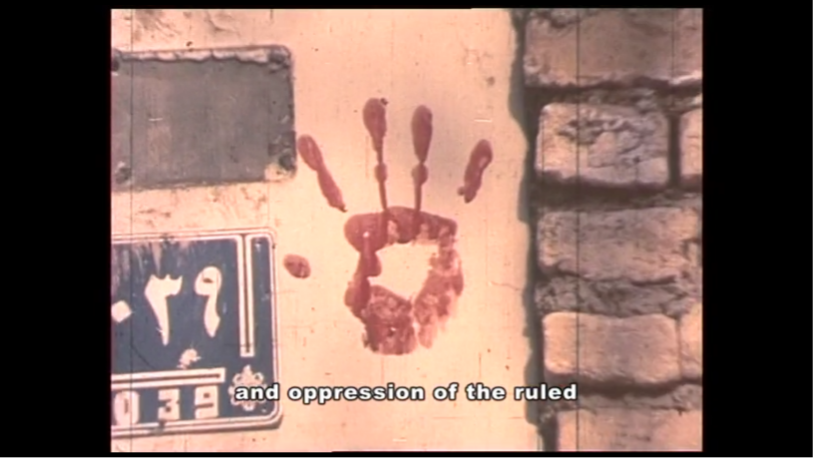
It is important to keep in mind that the blood-red hand (print) has been a strong sign and gesture of first-hand witnessing throughout history. We can trace the “microhistory”38Cf. Carlo Ginzburg, “Microhistory: Two or Three Things That I Know About It,” Critical Inquiry 20, no. 1 (1993): 10–35. of this—also transculturally significant—sign of resistance and decolonization not only back to the street protests in Tehran around the Revolution 1979 (and to the ways it is well documented by numerous films and photographs), but even further back, to the popular cinema before 1979: At the end of Mas‘ūd Kīmiyā’ī’s film Reza Motorcyclist (Rizā Muturī, 1970), when Rizā (Bihrūz Vusūqī) is stabbed in a movie theatre, he leaves a memorable, indexical and iconic trace: a bloody handprint on the inner diegetic cinema screen—as if to pass on his blood testimony to the cinema audience, and turn them into witnesses. A comparable symbolism can also be found in the film at the beginning of Mas‘ūd Kīmiyā’ī’s The Deer (Gavazn-hā, 1974), when Qudrat (Farāmarz Qarībiyān) is on the run from the police with a gunshot wound and a bag full of stolen money, he wipes his bloodstained hand on a house wall as if to leave a public trace of blood testimony.39Cf. Matthias Wittmann, “Ciné-Martyrographies. Media Techniques of Witnessing in Iranian Cinema,” British Journal of Middle Eastern Studies (BRJMES), Special Issue: Cultural Production, Propagandas, and Negotiating Ideology in Iran, ed. by Goulia Ghardashkhani, Olmo Gölz und Kevin Schwartz (2024), accessed September 2025, https://www.tandfonline.com/doi/full/10.1080/13530194.2024.2342178.
Figures 22-23: Screen grabs from Reza Motorcyclist (Rizā Muturi), directed by Mas‘ūd Kīmiyā’ī, 1970.
Figures 24-26: Screen grabs from Conversation with the Revolution (Guftugū bā inqilāb), directed by Robert Safarian, 2011.
As a body politics that remembers injustice, the iconic, symbolic and indexical sign of the blood-red hand re-appeared in different times and movements (The Green Movement 2009, Jin, Jiyan, Azadî 2022), and persistently eluded complete integration into the iconography of state martyrdom40In stark contrast to numerous symbols derived from Persian poetry, Sufi mysticism, and Islamic imaginaries (such as tulips, roses, candles, birds like doves, butterflies and moths) that were increasingly incorporated by the iconography of the IRI. with its disembodied, abstract martyr symbols. Especially the reclaiming of bodily autonomy during the “Jin, Jiyan, Azadî”-movement went hand in hand with attempts to challenge the necropolitical state doctrine of self-sacrifice in the name of sacred defence. The blood-red hand is an expression of this challenge. Instead of bearing witness to the achievements of the martyr’s welfare state, the symbolism of the blood-red hand testifies to its injustice.
Similar to the microhistory of the red hand, the history of feminist film in Iran also provided an archive of resistant counter-images to the disembodied, abstract martyr symbols produced by the necropolitical rhetoric of the state. Women were anything but mere victims, but central agents, architects, and forces of the historical processes in Iran. Cinematic practices became important constituents of this agency, especially when it came to counter-witnessing “resistant subjectivities”41Howard Caygill, On Resistance. A Philosophy of Defiance (London/New York: Bloomsbury, 2013), 97ff. that had (and still have) no right to be remembered by the visual machinery of the martyrocracy and its “clerico-engineers.”42Mohamad Tavakoli-Targhi, “The Emergence of Clerico-Engineering as a Form of Governance in Iran,” Iran Nameh 27, nos. 2–3 (2012): 14f.
As has been shown, the popular memory of resistance in Iran would be inconceivable without a long, multi-layered history of feminist film practices of (self-)image production and the facilitation of solidarity between generations and classes, including the depiction of subaltern forms of articulating a revolutionary, emancipatory consciousness. According to Michel Foucault (in a conversation with Pascal Bonitzer in 1974), “memory is an important factor in struggle, […] if you hold people’s memory, you hold their dynamism. And you also hold their experience, their knowledge of previous struggles. You make sure that they no longer know what the Resistance was actually about…”43Pascal Bonitzer and Serge Toubiana, “‘Anti-Rétro’ – Michel Foucault in interview,” Cahiers du cinéma 251-252 (July- August 1974), accessed September 2025, https://onscenes.weebly.com/film/anti-retro-michel-foucault-in-interview. — The people of Iran very well know what “resistance was [and is] actually about.”44Pascal Bonitzer and Serge Toubiana, “‘Anti-Rétro’ – Michel Foucault in interview,” Cahiers du cinéma 251-252 (July- August 1974), accessed September 2025, https://onscenes.weebly.com/film/anti-retro-michel-foucault-in-interview. The revolutionary imaginary in the midst of social life in Iran remains so resilient not least because it is interwoven with a strong cinematic memory of women’s struggle against the colonization of their bodies.
Ethnographic filmmaking—defined as making films that represent one culture to another or to itself—emerged in Iran in the 1960s, driven by many factors, such as rapid modernization and the resulting population displacements and psychic and social restructuring, which brought urgency to the task of documenting and preserving the country’s traditions, cultural expressions, and ways of life before their disappearance. This resulted in a style of filming that we call here “salvage ethnography,” which often exoticized its subjects as primitive.
Another impetus was the state’s institutional support to produce film and other media as vehicles for a modern form of national identity formation and its projection of such identities at home and abroad. The majority of these so-called ethnographic filmmakers have been supported by powerful state cultural and media organizations. Under the second Pahlavi state (1941–79), such organizations included the Ministry of Culture and Art (MCA) and National Iranian Radio and Television (NIRT). Under the Islamic Republic, there were the Ministry of Culture and Islamic Guidance, the Iranian Cultural Heritage Organization, and Voice and Vision of the Islamic Republic. Filmmakers were either full-time civil-servant employees of these state organizations or were freelance artists commissioned by them. Commercial private sector and non-governmental agencies also contributed to documentary and ethnographic filmmaking, but to a far lesser extent. State institutions were involved not only in financing and sponsoring these films, but also in their production and, due to their near monopoly on documentary film venues and television networks, in their distribution and exhibition. Because of these structural underpinnings and the leftist politics of a majority of the filmmakers, ethnographic films were always already embedded in politics—from their conception to reception. What constituted “nation,” “culture,” and “tradition” to be documented, exoticized, and salvaged were contested categories between the state that funded the films and the filmmakers who received funding from it but nevertheless wished to maintain editorial independence.
Figure 1: A screenshot from the film Bād-i Jin (The Sorcerer’s Wind, 1970), directed by Nāsir Taqvāʾī, accessed via https://www.youtube.com/watch?v=ymcLBPglUDA.
Another impetus was the presence of a coterie of new filmmakers trained at home and abroad who were armed with the ideologies of secular modernism, salvage ethnography, and cinematic storytelling. However, most of these creators were neither trained in anthropology nor deeply linked to university anthropology departments or research centers. As such, few “ethnographic films” were part of academic anthropological studies or were organically informed by anthropological and ethnographic concepts and methodologies. Therefore, Farhād Varahrām’s labelling of these films as “anthropological cinema without anthropology” is appropriate.1Farhād Varahrām, “Anthropological Cinema Without Anthropology,” synopsis of paper for Visual Representations of Iran Conference, St. Andrews University, June 13–16, 2008, accessed 30 November 2013, www.st-andrews.ac.uk/anthropologyiran/abstracts.html
Even so, there is what I call an anthropological unconscious at play in the works of these non-anthropologist filmmakers and non-anthropologist writers of cultural monographs about small communities, such as Ghulāmhusayn Sāʿidī (1936–85) and Jalāl Āl-i Ahmad (1923–69). This anthropological unconscious is exhibited in their choice and treatment of the subjects, rituals, customs, and events they deemed worthy of documenting and salvaging—constituting their films’ ethnographic content. It is also displayed in the stylistic features of their films, which were driven by the filmmakers’ ad hoc understanding of anthropological methodologies of research, their realist style of filming and narrative storytelling, and the technological limitations of cinema. Together, these factors of authorship, modernist ideologies of anthropology and nationalism, state support of films, choice and treatment of subject matter, and filming style constituted the political unconscious of Iranian ethnographic films.
This is long before new criticism and theory entered anthropology, and before the works of pioneer postmodernist cultural anthropologists at Rice University and elsewhere, such as George Marcus, Michael Fischer, James Clifford, and Steve Tyler, revolutionized anthropological fieldwork and ethnographic writing and filming.2James Clifford and George E. Marcus, ed. Writing Culture: The Poetics and Politics of Ethnography (Berkeley: University of California Press, 1986); George E. Marcus and Michael M. J. Fischer, ed. Anthropology as Cultural Critique: An Experimental Moment in the Human Sciences (Chicago: University of Chicago Press, 1986). As a result, Iranian ethnographic films tended to be straightforward and linear, relying heavily on a descriptive, wordy, and authoritative, even authoritarian, voice-of-God style of narration. Such an approach to narration was dictated as much by the difficulty of synch-sound recording in the field— necessitating voice-over narration and the suppression of the subjects’ voices—as by the oral narrative style of storytelling Iranians had internalized, or by the anthropological unconscious that necessitated a distance between anthropologist and subject. Yet, their deficit in terms of anthropological methodology became an asset in terms of their cinematic techniques, as some of the better filmmakers experimented with non-realist visual, musical, lyrical, and structural innovations to reduce this ethnographic distance and to suture the spectators into the diegetic worlds of their films. More sophisticated filmmakers created downright postmodern texts that self-reflexively parodied their subjects, the films themselves, and the complicit relationship of filmmakers and subjects in constructing the films.
Based on their content, I divide these ethnographic films into several thematic types which evolved over time, in particular in reaction to the revolution of 1978–79 and the subsequent eight-year war with Iraq (1980–88). Stylistic features of these films are also noted throughout this taxonomy.
Films of Religious Culture and Rituals
Religion, religious culture, and religious rituals and ceremonies, particularly those related to Shiʿism, are important topics covered in Iranian ethnographic films. An important early example of these films’ treatment of religion is Abūlqāsim Rizāʾī’s intimate and poetic film on the Hajj pilgrimage, Khānah-ʾi khudā (Mecca, The Forbidden City, 1965). Produced by Iran Film Studio, Khānah-ʾi khudā powerfully imparts the transcendent force of collective prayer and belief involving massive numbers of the faithful from different nations participating in the annual Muslim pilgrimage, including the circumambulation of the Kaʿba. Despite its seeming lack of a unifying idea, the film’s attention to details of religious traditions and practices gives it ethnographic and authentic depth, and its chronological treatment of pilgrimage gives it a pronounced forward momentum. These elements, and its use of rare and revealing documentary footage, made it an important and popular film. Some twelve commercial cinemas screened it in Tehran, a rare occurrence for documentaries. In honour of this religiously themed film, commercial cinemas removed flamboyant posters of sexy movie stars and coming attractions from their lobbies, and instead decorated them with posters of holy religious sites.3Jamal Omid, Tārīkh-i Sīnimā-yi Īrān, 1279–1375 (Tehran: Intishārāt-i Rawzanah, 1995), 395. In fact, the movie was so popular that it apparently led to the inauguration of the first public cinema in the holy city of Qom, across the river from the shrine of Hazrat Maʿsūmah, the sister of Imam ʿAlī. This film prompted the official religious strata, for the first time, to accept the medium of film as a vehicle of religious expression, thus paving the way for the recognition both of filmmaking as a legitimate profession and of film enjoyment as a legitimate pastime. It was dubbed into English and sold by Ashoqa Film to many foreign countries, the first Iranian film to receive such a wide foreign distribution.
In Īrān Sarzamīn-i Adyān (Iran: The Land of Religions, 1971), made for MCA, Vienna-trained documentarian Manūchihr Tayyāb focuses on the coexistence of major religious traditions in Iran—Shiʿism, Christianity, Zoroastrianism, and Judaism (with no mention of Bahaʿism)—which he renders with a smoothly gliding camera, deft realism, and glorious colour, and without voice-over narration. These techniques decrease distance and helped bring the spectators closer to the religious monuments and subjects. The scenes of Shiʿi faithful beating their bare chests into the camera, rhythmically, and in concentric circular formations, are particularly spectacular. Interestingly, the film created the false impression that Shiʿism, predominant in Iran, was tolerant of other religions. Ironically, in an interview in Jamshīd Akramī’s The Lost Cinema: Iranian Political Films in the 70s (2006), Tayyāb states that the film was banned, and never to be screened in public, due to religious objections, but he does not specify what those objections were.
Figure 2: A Muslim man praying. Īrān Sarzamīn-i Adyān (Iran: The Land of Religions, 1971), Manūchihr Tayyāb, accessed via https://www.youtube.com/watch?v=taMa3iTZFbo (02:35).
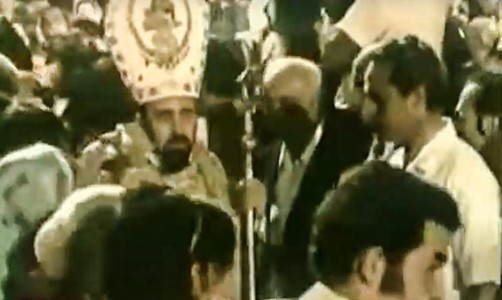
Figure 3: Christian religious ceremonies. Īrān Sarzamīn-i Adyān (Iran: The Land of Religions, 1971), Manūchihr Tayyāb, accessed via https://www.youtube.com/watch?v=taMa3iTZFbo (02:54).
Figure 4: Zoroastrian religious ceremony, the mobad beside the fire vessel. Īrān Sarzamīn-i Adyān (Iran: The Land of Religions, 1971), Manūchihr Tayyāb, accessed via https://www.youtube.com/watch?v=taMa3iTZFbo (12:50).
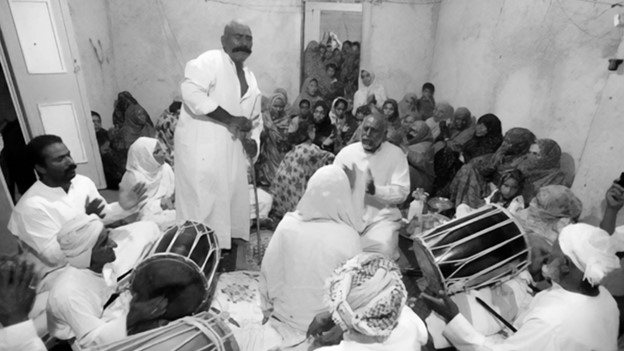
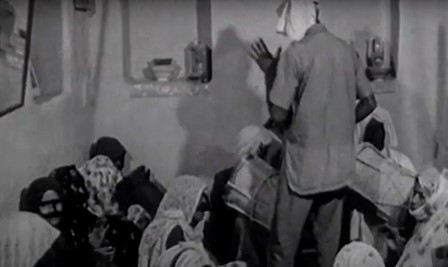
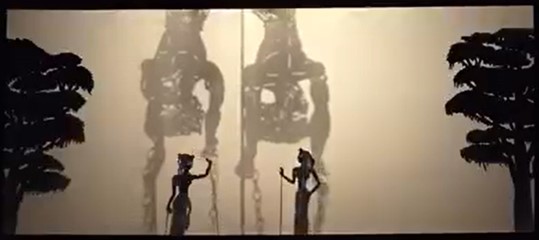
Sponsored by NIRT, Nāsir Taqvāʾī, a gifted writer from the South, made many short but insightful ethnographic sketches, including two well-assembled works that explored folklorist and religious themes with dramatic visuals, dynamic editing, lyrical narration, and native music. Bād-i Jin (The Sorcerer’s Wind, 1970), narrated by poet Ahmad Shāmlū (1925–2000), deals with possession and exorcism rituals (zār) practiced on the coast of the Persian Gulf, particularly in Bandar Lengeh. The film opens with shots of waves, the seashore, and the town ruins, accompanied by Shāmlū’s raspy and world-weary voice describing the origins of the people, rituals, and wind. In his account, the source of the beliefs and rituals of zār came from African slaves who in ancient times were brought to the southern shores of the Persian Gulf. They brought with them an ill wind, which purportedly decimated the population and left portions of the town in ruins. After this contextual opening, the film proceeds to the site of an exorcism ceremony that is very private and involves mixed-gender dancing and chanting to incessant, rhythmic drumbeats until trance is achieved and evil is expelled. Taqvāʾī filmed these scenes with both hidden-camera and direct-cinema techniques, countering the distancing of the opening scenes. He gained access to these private events because of his familiarity with the Persian Gulf region’s cultures and his personal connections with the participants.4Hamid Naficy, Fīlm-i Mustanad: Tārīkh-i Sīnimā-yi Mustanad, vol. 2 (Tehran: Intishārāt-i Dānishgāh-i Āzād-i Īrān, 1978), 324–25. His film Arbaʻīn (1971), shot in the Persian Gulf port of Bushehr, is also a highly visual, direct-cinema documentary on the religious processions and mourning rituals that annually commemorate Arbaʻīn, the fortieth day of Imam Husayn’s martyrdom. Like The Sorcerer’s Wind, this film emphasizes rhythmic action and rhythmic editing, without voice-over narration, to recreate the intensity of religious emotions evoked in men and young boys in these public rituals. It shows the preparation for the mourning, the colourful and sonorous processions, and focuses in the last sequence on the crowds gathered in the Dihdashtī and Bihbāhānī Mosques, moving rhythmically in concentric circles and beating their chests to the chants of a Muslim cantor. With the camera held either low or high, the vast dimensions and the intimate, frenzied tensions of this occasion are conveyed beautifully and powerfully. Interspersed throughout the film, we see shots of farmers working in fields and fishermen fishing, which both integrate the ceremony into their daily lives and demonstrate that these passionate, artistic people are the same people who ordinarily farm and fish. It also evokes an eerie atmosphere of the empty alleyways of Bushehr, through which a mysterious veiled woman scurries.
Figure 5: A scene of waves, the seashore, and the ruins of the city, accompanied by the voice of Ahmad Shāmlū. Bād-i Jin (The Sorcerer’s Wind, 1970), Nāsir Taqvāʾī, accessed via https://www.youtube.com/watch?v=ymcLBPglUDA (02:48).
Figure 6: Men playing Dammām (a percussion instrument), and women singing and clapping their hands. Bād-i Jin (The Sorcerer’s Wind, 1970), Nāsir Taqvāʾī, accessed via https://www.youtube.com/watch?v=ymcLBPglUDA (22:13).
Manūchihr Tabarī, a NIRT filmmaker, made a shocking short film, Lahazātī chand bā Darāvīsh-i Qādirī (A Few Moments with Qādirī Dervishes, 1973), in which, using an invasive cinéma vérité camera, he documented, without narration or extra-diegetic music, the extraordinary acts of faith of dervishes under trance in Iranian Kurdistan. This includes their swallowing large stones and handfuls of razor blades, eating live snakes, drinking kerosene and eating the glass chimney of the kerosene lamp, and puncturing their bodies and faces with numerous long skewers, all while dancing to frenzied drum beats. Absolute frenzy rules, not only because of the action of the trance-dancers, but also because the camera itself seems to be in a frenzy. No anthropological distance exists here. As it rapidly zooms in and out with the rhythm of the music and the trance-dancers, the camera replicates the trance stylistically, creating what Lotte Hoek, in the context of religious inscription in Bangladeshi cinema, called “Cinematic Zikr” (sacred chanting)5Lotte Hoek, “I Will Wash Your Shrine with My Blood: The Mazar in Bangladeshi Cinema,” paper presented at Global Seminar in Media, Religion, and Culture, Mission 21, Basel, Switzerland, July 10–12, 2006. until the camera suddenly goes black in mid-action, bringing the film to an end. As Tabarī told me in an interview, this was because one of the possessed participants lunged forward to swallow the camera lens.6Author’s interview with filmmaker Manūchihr Tabarī, Tehran, Iran, August 1977. This bit of self-reflexivity is one of the first instances of postmodernism in ethnographic films in Iran. While its exposé of the unusual customs of a community of believers is very powerful and informative, the film is a mere document of a trance session, offering no cultural context and no historical or ethnographic understanding.
Another noted NIRT filmmaker and a key new-wave director, Parvīz Kīmīyāvī, trained in filmmaking at IDHEC (Institut des hautes études cinématographiques) in Paris, made several films that violated the paradigmatic anthropological unconscious of ethnographic films long before such a violation became a style and a cliché in post-revolutionary cinema. He mixed nonfictional and fictional stories and filming styles to create dense, lyrical, and ironic ethnographic texts that exposed the contradictions of the ethnographic scene and the complicity of subjects with filmmakers. His most straightforward documentary is Yā Zāmin-i Āhū (Oh, Protector of the Gazelle, 1971), an intimate, ethnographically rich, and cleverly critical portrait of pilgrimage to the shrine of Imam Rizā in Mashhad. As cinematographer Ismā‛īl Imāmī told me in an interview, Yā Zāmin-i Āhū was filmed using a handheld and sometimes hidden camera—the latter violating the informed consent requirements of ethnographic cinema.7Author’s interview with filmmaker Ismāʿīl Imāmī, Tehran, Iran, August 1977. The film has no authoritative voice-over narrator. However, through contrapuntal uses of voice and vision, which create a contrast between the film’s visuals and the voices of the pilgrims, Kīmīyāvī critiques the official Shiʿi institutions for their failure to help the religious community (ummah). The visuals highlight the magnificent opulence of the massive silver and gold mausoleum, the shrine’s great halls covered with massive beautiful carpets, and its walls and ceilings decorated with cut crystal, glass, mirror, and huge crystal chandeliers. The soundtrack, however, carries the desperate voices of the lowly supplicants requesting mercy, compassion, better health, or redemption.
Figure 7: A view of the golden dome of Imam Reza shrine. Yā Zāmin-i Āhū (Oh, Protector of the Gazelle, 1971), Parvīz Kīmīyāvī, accessed via https://www.youtube.com/watch?v=yb_jnXUWxIE (02:30).
Figure 8: A pilgrim kissing the shrine of Imam Rizā. Yā Zāmin-i Āhū (Oh, Protector of the Gazelle, 1971), Parvīz Kīmīyāvī, accessed via https://www.youtube.com/watch?v=yb_jnXUWxIE (07:40).
Films of Tribes and Tribal Migration
Tribes and their “exotic” ways of life, colourful customs, and arduous annual migrations, so memorably documented in the 1920s by American filmmakers Cooper, Schoedsack, and Harrison in Grass: A Nation’s Battle for Life (1925), became subjects for Iranian documentarists. Sedentarism and modernization, which were eroding their customs and nomadic way of life, seemed to have intensified the cosmopolitan city dwellers’ nostalgia for and interest in them. In a kind of romantic “salvage ethnography,” modern, often foreign-trained, filmmakers, who were themselves agents of modernity, documented the tribes before their disappearance—attempts that always seemed to refer to Grass as the archetypal progenitor. One notable example was that of Hūshang Shaftī, who, at the head of a large film crew, filmed the Bakhtiari tribe’s migration in southwestern Iran for MCA. The resulting film, Shaqāyiq-i Sūzān (The Flaming Poppies, 1962), was technically well made and superior to its foreign predecessor in terms of its inclusion of colour, sound, and multiple camera viewpoints. It won the Silver Bear Prize at the 1961 Berlin Film Festival, and was widely distributed in Iran and abroad through Iranian embassies. However, it lacked the grandeur, drama, and scale of Grass and suffered from the shortcomings of the official style of documentary film, in which the Syracuse Team had trained Shaftī. Some such traits included an unimaginative and linear narrative structure and a plodding, voice-of-God, impersonal manner of narration.
Anthropologist Farīdūn Safīzādah first saw Grass in 1971 in an undergraduate ethnographic film class in the United States. It was so gripping that it inspired him to “retrace,” some fifty years later, the footsteps of the American filmmakers by filming the Bakhtiari annual migration, and it served as a “catalyst” for the 28-minute documentary The Shahsavan Nomads of Iran (1983), which he co-directed with his sociologist spouse, Arlene Dallalfar.8Farīdūn Safīzādah, “Yeyloq, Qishloq: The Lure of Grass and the Cinematography of Shāhsavan Nomads,” The Iranian (January 30, 2003), accessed November 30, 2013, www.iranian.com/Travelers/2003/January/Migrate/index.html That viewing of Grass was also instrumental in redirecting his academic interest from engineering to visual anthropology. However, logistics, proximity, and familiarity forced another type of redirection, as Safīzādah shifted attention from filming the southwestern Bakhtiari nomads to filming the northwestern Shāhsavan pastoral nomads of Azerbaijan. The Shāhsavan’s colourful seasonal migration between the Aras River in the Mughān Steppe and the high pastures of Sabalān Mountain provided a dramatic narrative focus, and Safīzādah’s Azari background, knowledge of culture and language, and contacts made a film about the Shāhsavan more plausible, particularly during the tumultuous revolutionary period.
Figure 9: The Shāhsavan nomads migrating. The Shahsavan Nomads of Iran (1983), Farīdūn Safīzādah and Arlene Dallalfar, accessed via https://www.aparat.com/v/AiaXK (01:54).
This project is worth noting here because of the influence of Grass on its inception, its female-centered filming, its ethnographically informed narration, and the effects of the anti-Shah revolution on its production and completion. By mid-January 1978, Tabriz had risen to commemorate the “martyrs” of the Qom demonstrations forty days earlier, and anti-government forces had burned and destroyed banks, liquor stores, and cinemas. The three-week spring tribal migration would take place in late winter. There was no time to lose. Safīzādah made a proposal to Nādir Afshār Nādirī (1926–79), director of Tehran University’s Institute for Social Research, to film the Shāhsavan camp life and forthcoming migration, a proposal that Afshār Nādirī approved, providing him with 5,000 feet of 16 mm raw stock and access to NIRT’s facilities for lab work and editing.
Safīzādah and Dallalfar formed an effective mixed-gender team, for they were able to film not only the male-dominated public events of the Mughānlū lineage of the Shāhsavan such as shepherding, felt-making, the buying and selling of flocks and wool, but also female-centred private activities inside and outside the women’s ālāchīq tents such as fetching water, baking, cooking, churning milk, making butter and yogurt, wool spinning, weaving, and nursing babies. They also documented the migration over rivers and mountain passes. By mid-September 1978, when they began editing the footage, the Zhālah Square massacre, known as “Black Friday,” had shaken the government to its core and emboldened the uprising. NIRT employees joined the national strike, which eventually brought the Pahlavi regime to an end. Sādiq Qutbzādah became Director General of the post-revolution broadcasting authority—the Voice and Vision of the Islamic Republic—and mandated a re-evaluation of all projects that brought them all to a halt. Purification purges took their toll, as did chaos and uncertainty, which forced Safīzādah and Dallalfar to give up “any hope of being able to complete the film.”9Safīzādah, “Yeyloq, Qishloq,” 9. Unable to retrieve the original footage from NIRT, they left Iran with approximately 2,000 feet of their work-print (nearly one hour), which Dallalfar subsequently edited as a sociology graduate student at UCLA into The Shahsavan Nomads of Iran. Dallalfar read the voice-over narration for this somewhat rough and incomplete but valuable film, providing additional textual information about the impact of agricultural modernization, land reform, sedentarism, large-scale irrigation systems, and modern transportation on the tribe’s way of life and livelihood. In his write-up about the film, Safīzādah admitted that the romance of authenticity and the impulse toward salvage ethnography prevented them from filming
the newly adopted technological ways of doing things, for example using pickup trucks to go and come from the camps, or the use of Mercedes trucks to relocate sheep from the Mughān Steppe to the Sabalān range, or to show the canning factories in Mughān where the Shāhsavan worked as day laborers.10Safīzādah, “Yeyloq, Qishloq,” 11-12.
Figure 10: A Shāhsavan woman milking a sheep. The Shahsavan Nomads of Iran (1983), Farīdūn Safīzādah and Arlene Dallalfar, accessed via https://www.aparat.com/v/AiaXK (03:48).
The film’s reception was somewhat limited, as Safīzādah and Dallalfar, at the beginning of their academic careers in anthropology and sociology, could not devote sufficient time to its publicity and distribution, and they did not consign it to a professional distributor. As a result, as Safīzādah told me in an email, the film “remained pretty much within university circles and their collections.” Several individuals and universities acquired it in Britain, Norway, and Turkey, but it has not been publicly screened in Iran.11Author’s e-mail correspondence with Farīdūn Safīzādah, Boston, Massachusetts, August 28, 2006.
To conclude this section, I would like to mention two other films that are interesting in their differing anthropological approaches. Anthropologist Nādir Afshār Nādirī and filmmaker Ghulām Hosayn Tāhirīdūst each made a film called Balūt (Acorn, 1968 and 1971, respectively), documenting the disappearing traditional process of making bread made from bitter acorn. Nādirī made his film for the Institute for Social Research, which he headed, and Tāhirīdūst made his for NIRT, for whom he worked as a director. Both were made in the Kuhgīlūyah region of the Zagros Mountains in the southwest, where over half of the tribal population was migratory with the remainder settled in small villages. Despite their similarities in terms of topic, region, subjects, and institutional sponsorship, their ethnographic and filmic approaches were different.
As an anthropologist, Nādirī made an effort, as he told me in an interview, to “portray the daily life of a nomadic people with emphasis on the division of labor during the three seasons of autumn, winter and spring,” during which he and his German wife and five other researchers lived in the region.12Hamid Naficy, A Social History of Iranian Cinema: The Industrializing Years, 1941–1978, vol. 2 (Durham: Duke University Press, 2011), 109. Such long-term cohabitation and participant observation was not something that non-anthropologist filmmakers had done before. The film focuses on the preparation of bread from acorns, whose bitterness is leached by running water from a stream, and places this process in the context of the daily activities of the nomads over a nine-month period. These scenes are filmed with a static camera and aesthetics that signal Nādirī’s training as a photographer, not cinematographer. Although the scenes of daily life are ethnographically informed and accompanied by clear, pro-filmic sounds, they tend to disperse the film’s narrative in all directions, and the lack of voice-over leaves certain key details unexplained, such as the colour change in the stream water that indicates the level of leaching.
Tāhirīdūst’s film, on the other hand, shows, in graphic detail and in a more coherent and visual manner, the preparation of acorns for bread making as recreated by one family and filmed in just two-and-a-half days. However, Tāhirīdūst’s recreation is not naïve for, as he told me in an interview, he had spent a year and a half of his Knowledge Corps service in the region and was well acquainted with the people and their way of life,13Naficy, A Social History of Iranian Cinema, 110. and thus he had been able to gain both cultural information and his subjects’ confidence before filming. He was also at the time working on his thesis on the topic of “possession” (zār) under the venerable ethnographic filmmaker, Jean Rouch. Tāhirīdūst’s film ends in a self-reflexive scene of the family eating their acorn meal, when the male head of the family looks directly into the camera and asks: “Is the film over?” The film freezes on the face of the man and ends with his question, thereby leaving the decision about the film’s ontological status as a straight documentary to the viewer. This gesture is perhaps Tāhirīdūst’s small homage to his mentor Rouch and his partner Morin and their seminal self- reflexive cinéma-vérité film Chronique d’un Été (Chronicle of a Summer, 1961).
The subject’s question at the end of the film also raises the issue of power relations between cosmopolitan ethnographers and filmmakers and their rural subjects. If the film ethnographers were in a position of power because of their access to advanced film technology, anthropological knowledge, government support, and official permission to study and investigate their subjects, the natives were armed with suspicion—the traditional weapon of the weak in neo-colonial situations; as Afshār Nādirī explains:
Although the tribespeople did not show any particular animosity toward us, nevertheless they did not regard us as benevolent anthropologists. We were similar to the type of soldiers who had recently murdered some of them. As a result, we were their potential enemies. We learned of this only after the tribespeople grew close to us. They confessed that at first they were suspicious that we were working for the army.14Nādir Afshār Nādirī, “Chand murid az mahzūrat-i rishtah-i insān-shināsi,” Kitāb-i Tūs (Summer 1987), 102. (Translated by the author).
Their different approaches to the same subject reflect Nādirī and Tāhirīdūst’s respective training as anthropologist and filmmaker. While Tāhirīdūst’s is widely considered a better film—it won several international awards—Nādirī’s film is ethnographically more informative and the research that undergirded it contributed to a rich trove of para-cinematic materials, consisting of seven monographs, several ethnographic films, and a tribal atlas of the Kuhgīlūyah region.
Figure 11: The final scene of the film shows a family eating their acorn meal. Balūt (Acorn, 1968), Ghulām Husayn Tāhirīdūst, accessed via https://www.aparat.com/v/k739562 (18:06).
Post-Revolution Ethnographic Filmmaking: Focusing on Emergent Practices
I would like to end with a few remarks about some of the new trends that I have noticed in post-revolution ethnographic films. In the aftermath of the revolution, ethnographic study and filmmaking declined, and even became somewhat delegitimized, for various sociopolitical reasons. First and foremost among these, the clerical regime was from the start both extra-nationalist—that is, interested in exporting the Islamic revolution to other Muslim countries, and anti-nationalist—seeking to suppress the pre-Islamic roots of Iranian identity and nationalism in favour of revitalizing its Islamic and Shiʿi roots. This eventually developed into the ideology I have called “syncretic Islamization,” which was posed as an alternative to the secular and nationalist “syncretic Westernization” ideology of the Pahlavis. Both of these syncretic ideologies attempt to reconcile different, even opposing, dominant principles, ideologies, practices, and religions: Westernization and Islamization. By presenting tradition as the source of identity, the regime politicized not only tradition but also some of the tenets of anthropology which is given to their study. Consequently, anthropology “lost its social legitimacy and popularity.”15Nematollah Fazeli, “Anthropology in Post-Revolutionary Iran,” synopsis of paper delivered at Anthropological Perspectives on Iran: The New Millennium and Beyond Conference, Institute of Historical Ethnology, Johann Wolfgang Goethe University, Frankfurt am Main (30 September–2 October 2004), 4.
In the realm of cinema, this loss may account for both the decline of serious ethnographic films and the forceful emergence of socially concerned documentaries, which examined the social strata, gender roles, practices, institutions, and traditions of society, as ethnographic films would have done, but from decidedly critical and political viewpoints. This critical space of inquiry became available only after the end of the war with Iraq when social criticism could no longer be legitimately suppressed on the basis of war conditions, national security, patriotism, or what Khomeini (1902–89) used to call defence of “dear Islam.” Universities and other educational and cultural institutions once again became hotbeds of thought and criticism. The creation in 1988 of the Iranian Cultural Heritage Organization consolidated education, research, preservation, and restoration of culture and cultural artefacts, as well as many anthropological and ethnographic studies, including ethnographic films.
Another new development was the emerging reversal of exchange relations between anthropology and filmmaking. Whereas during the Pahlavi regime, it was primarily filmmakers who moved into ethnography, in the Islamic Republic period, a reverse movement from anthropology into filmmaking and media making seemed to emerge. Anthropologists found the Khātamī-era bureaucracy (both during his time as Minister of Culture and Islamic Guidance and as President) more lenient with awarding research permissions. These creators used tape recorders, still cameras, and video cameras as part of their research arsenal and methodology; some to record interviews with their subjects, and others to document scenes of daily life, customs, rituals, and performances. Although these were rarely filmed for the purpose of making coherent, autonomous documentaries, the unedited footage provides a valuable record for future films, but access to this material requires individual contact with anthropologists. Nevertheless, the ethnography of certain subjects—such as the prison system, racism, and stigmatized minorities such as Bahaʿis, Jews, Afghan immigrants, and homosexuals16Christian Bromberger, “Commonplaces, Taboos and New Objects in Iranian Anthropology,” synopsis of paper delivered at Anthropological Perspectives on Iran: The New Millennium and Beyond Conference, Institute of Historical Ethnology, Johann Wolfgang Goethe University, Frankfurt am Main (30 September–2 October 2004), 3.—remained off-limits for a time; as did the topics that preoccupied Marxist and neo-Marxist schools before the revolution, such as class conflict, urban and rural relations, and the consequences of power and inequality.17Fariba Adelkhah, “Social Anthropology in Iranian Postrevolutionary Society and Dilemmas and Crises,” synopsis of paper delivered at Anthropological Perspectives on Iran: The New Millennium and Beyond Conference, Institute of Historical Ethnology, Johann Wolfgang Goethe University, Frankfurt am Main (30 September–2 October 2004), 2. Interestingly, however, filmmakers took advantage of the public spaces of discourse opened up by the reformists in the 1990s and 2000s to examine some of these topics in their social documentaries and in an emerging class of films I call “ethnographic-lite.” Strictly speaking, these are not truly ethnographic, but are rather reportage films that, like those of the Pahlavi era, are informed by certain unconscious understandings of anthropological methods and film styles. Some of them are process films, showing a ritual from beginning to end; some only document one aspect of a traditional ritual; some continue to engage in salvaging operations; some are impressionistic and descriptive; and a few, such as Varahrām’s films, are research-based, resulting from long periods of sociological and ethnographic study, participant observation, and interaction with their subjects. Many of the same taxonomic categories are still present here, from Shiʿi religious rituals to nomadic and tribal communities, as well as some new topics. Unlike the Pahlavi-era films given largely to salvaging a disappearing world, however, these films focus on discovering emergent practices, such as underground music (Amir Hamz, Bahman Ghubādī), transgender identity and practices (Amīr Amīrānī, Elhum Shākirīfar), women’s violence against husbands (Mahvash Shaykhulislāmī), rhinoplasty (Mihrdād Uskūyī), and schools for training professional mourners (Bahman Kīyārustamī). This shift from “disappearing” to “emerging” cultures and practices is another mark of postmodern ethnography and documentary practices in Iran. But this postmodernist practice exists side by side with the modernist salvaging practice, this time centered on Shiʿism, Shiʿi beliefs, and Shiʿi rituals, mythology, and martyrology. Tribes have continued to exert their fascination on ethnographers such as Farhād Varahrām, who made Tārāz (The Taraz Route, 1989), about a Bakhtiari migration, and Pīr-e Shalīyār (The Sage of Shaliyar, 1996) about an annual ritual among Kurdish tribespeople in the village of Urāmān.
Figure 12: A Bakhtiari man and woman eating food beside their tent. Tārāz (The Taraz Route, 1968), Farhād Varahrām, accessed via https://www.aparat.com/v/y19343g (17:01).
The Little Medium That Could
The wide availability of digital filmmaking and internet streaming of movies in the past couple of decades have empowered a new sort of documentary practice, one that is not just local, regional, and national, but also global, making its products available to worldwide audiences. As local amateur videos of street protests, police misconduct and violence, clandestine gatherings, and anti-regime investigations are posted online, they become global, feeding the “big media” of national and international Internet streaming services and daily broadcast and cablecast radio and television news and documentaries. The ready availability of mobile telephones with cameras capable of recording and live Internet streaming of high-definition video and sound is a newer development that feeds what I call the “little medium” consisting of worldwide, Internet-driven, mobile telephony. The impact of these readily available but sophisticated handheld mobile technologies for filming and sound recording, and the global dissemination of the resulting materials, which can then be used and reused by others to create new film and music pieces whose recordings are again shared globally via the Internet, is a new development that makes the little medium of cell phone into a big, global medium, hence the moniker “the little medium that could.” Other factors in the rise of this little medium include the deepening of authoritarian political control and the rise of militarized and violent rules of Islamic regimes and ideologies, resulting in state monopolization of all of the traditional means of mass communication such as radio, TV, and the press.18For more on this topic, see my article “Internet Cinema: A Cinema of Embodied Protest,” in Cinema Iranica, (2022), accessed May 25, 2023, https://cinema.iranicaonline.org/article/internet-cinema-a-cinema-of-embodied-protest/.
If the little medium of the 1970s-80s in Iran—portable audiocassettes, videocassettes, and handheld filming—energized the Islamic Revolution, some four decades later, it appears that the new little medium of the 2020s—cell phone and digital cameras—have become enablers of a new uprising in the making, as evidenced by the 2022 protest movement that followed the death of the young Iranian Kurdish woman Mahsā Amīnī, who died after she was arrested by Iran’s Morality Police on account of violating the strict Islamic dress code by appearing in public without a state-sanctioned head covering. The resulting widespread vociferous protests on the streets of Iranian cities were called movements—“Jin, Jian, Āzādī” movement in Kurdish, “Zan, Zindigī, Āzādī” movement in Persian, and “Woman, Life, Freedom” movement in English. These protests did not remain local or national, as documentary videos, professionally-made news footage, music videos, and amateur eyewitness videos were all widely shared and reshared on various global Internet sites. This Internet-fed fury against the compulsory restrictions of clothing and behavior (broadly called hijab), the brutality of the security forces, and the general government repression in all spheres has continued to escalate online and in the streets, one feeding the other.
How effective this little Internet-driven mobile filming and streaming medium can become in energizing and maintaining new social mobilizations resulting in sociopolitical change in Iran remains to be seen. Will it become a little medium that could?
Figure1: ‛Abbās Kiyārustamī with the Palme d’Or for Best Director, the Cannes Film Festival, 1997.
Paradoxically, the status of ‛Abbās Kiyārustamī (1940-2016) as a universal filmmaker appears to be one of his most underrated virtues. Iranian friends and colleagues have told me that his so-called “Western” traits are often viewed critically inside Iran, as a form of catering to Western film culture for “Western” rewards, while it appears that much of his reputation outside Iran is predicated on what he has to say or reveal about his home country to outsiders. To my mind, neither position is adequate for understanding and appreciating most of the greatest film artists. Calling Alfred Hitchcock an English filmmaker hardly does full justice to his work in Hollywood, and such major figures as Michelangelo Antonioni, Charlie Chaplin, René Clair, Carl Dreyer, Jean-Luc Godard, Howard Hawks, John Huston, Stanley Kubrick, Akira Kurosawa, Fritz Lang, F.W. Murnau, Max Ophüls, Otto Preminger, Nicholas Ray, Jean Renoir, Eric Rohmer, Roberto Rossellini, Raoul Ruiz, Douglas Sirk, Jacques Tourneur, Maurice Tourneur, François Truffaut, and Orson Welles (among many others) were all globetrotters who made films in more than one country.
It’s my conviction that Kiyārustamī, despite his reputation as an Iranian filmmaker, was a global artist who should be considered alongside the two dozen film directors listed above, and not only because he shot features in Uganda, Italy, and Japan near the end of his career. To my mind, he was a global filmmaker whose observations about the world in general account for much of his greatness and originality, and in the remarks that follow, I’d like to explore these virtues. Due to the lamentable habit of film critics and film teachers of classifying film artists as if they were zoo animals belonging to species that are defined nationally and often housed or caged in what appears to be their “natural” habitats, one could argue that the major figures who can’t be classified in this way are in certain respects stronger because of this multicultural range. Indeed, I’d like to suggest that Kiyārustamī’s value as a world artist exceeds his importance as an Iranian artist, even though his Iranian traits, such as poetry and humanism, clearly contributed to his value.
Indeed, one indication of Kiyārustamī’s strength is the influence exerted on his work by non-Iranian filmmakers including Robert Bresson, Roberto Rossellini, Jacques Tati, and Yasujiro Ozu, as well as by other kinds of artists outside of Iran, diverse figures ranging from Louis Armstrong to The Beatles to Antonio Vivaldi to Pieter Bruegel. It seems pertinent that Kiyārustamī’s very first film, The Bread and Alley (Nān u Kūchah, 1970) uses as its musical accompaniment a jazz performance by alto saxophonist Paul Desmond of the Beatles tune “Ob-La-Di, Ob-La-Da.” This could be compared and contrasted with certain non-Iranian influences on some of Kiyārustamī’s contemporaries, such as the respective impacts of Alain Resnais and Michelangelo Antonioni on Ibrāhīm Gulistān’s The Crown Jewels of Iran (Ganjīnah-hā-yi Gawhar, 1965) and Brick and Mirror (Khisht u Āyinah, 1965), and of Sylvia Plath on Furūgh Farrukhzād’s The House is Black (Khānah siyāh ast, 1962). But it’s worth mentioning that unlike many of his filmmaking colleagues, Kiyārustamī was not a cinephile.
Figure 2: Kiyārustamī behind the scenes of Where Is the Friend’s House? (Khānah-yi Dūst Kujāst), directed by ‛Abbās Kiyārustamī, 1987.
It has long been my contention that some of Kiyārustamī’s late features—most notably Taste of Cherry (Ta‘m-i gīlās, 1997) and The Wind Will Carry Us (Bād mā rā khvāhad burd, 1999), but also Close-Up (1990)—are reports on the state of the world at the time they were made, much like many of Jean-Luc Godard’s films made during the 1960s, such as Une femme mariée (1964), Alphaville (1965), Made in USA (1966), and Weekend (1967). I would also maintain that the growth and development of the global economy between the 1960s and the 1990s may account, in part, for the difference between the urban settings of Une femme mariée and Alphaville and the suburban or rural landscapes of Taste of Cherry and The Wind Will Carry Us. Once multinational corporations start to rule the world, the same manifestations of their presence and control can be felt everywhere, as in the media antennas of Life, and Nothing More… (Zindagī va dīgar hīch, 1992) and The Wind Will Carry Us and in the hero’s mobile phone in the latter film.
The eight short films made by Kiyārustamī between 1970 and 1982 offer an interesting riposte to critics who claimed during those years that they knew what was going on in world cinema. Even in Iran, where the shorts were made, none constituted much of an event. And considering how deceptively modest they are, they probably never would have attracted much notice anywhere if their director hadn’t gone on to make a string of masterful features. Yet, there’s nothing else in cinema quite like them.
All this only confirms that it’s preposterous to pretend that anyone can know the state of world cinema —unless, that is, we reduce “world cinema” to the films that get promoted, most of which are semi-mindless crowd-pleasers. For too long, we have been letting our cultural commissars—producers, exhibitors, distributors, official and unofficial publicists (including critics)—dictate the limited range of choices we’re supposed to want.
Kiyārustamī’s simple yet profound early shorts are a good example of the kind of cinema that typically falls between the cracks. They were all produced by the state-run organization called Kānūn, better known as the Centre for the Intellectual Development of Children and Young Adults (Kānūn-i Parvarish-i Fikrī-i Kudakān va Nujavānān), founded by the shah’s wife, Farah Dībā.
Kiyārustamī had been a commercial artist throughout the 1960s, starting out with posters and book jackets before graduating to television commercials and designing films’ credit sequences. He was already pushing thirty when the owner of an advertising agency that he had worked for, now the director of Kānūn, invited him to help set up the organization’s film unit in 1969.
Assigned to make educational films, Kiyārustamī wound up creating a particular kind of pedagogical cinema that was both experimental and playful, though he once said to me in an interview that he didn’t regard himself as a film artist when he made them. They played a substantial role in making films about children fashionable in Iran, although they weren’t always made for children. In fact, the last two films that he made for Kānūn went out into the world in the early 1990s as grown-up art features, Close-Up and Life, and Nothing More… The first of these, Kiyārustamī’s initial calling card in the West, contains no children at all. A few of the shorts—Breaktime (Zang-i tafrīh, 1972), also known as Recess, Two Solutions for One Problem (Du rāh-i hall barāyi yak mas’alah, 1975) and So Can I (Manam mī-tavānam, 1975), Orderly or Disorderly (Bih tartīb yā bidūn tartīb, 1981)—are set wholly or partially inside schools, and nearly all qualify in some fashion as didactic works, comparable to what Bertolt Brecht called Lehrstücken, or learning plays. Working within such a framework, Kiyārustamī could reflect on the advantages of cooperation over conflict (in Two Solutions for One Problem), draw on animation (used briefly in So Can I) or abstraction (as in The Colors [Rang-hā, 1976]), comically raise philosophical questions about order and disorder (Orderly or Disorderly), or formal as well as social questions about sound (in The Chorus [Hamsurāyān, 1982]), simply offer lessons in dental hygiene (Toothache [Dandān-dard, 1980]), and even explore how a man might roll a car’s tire down a highway (Solution [Rāh-i hall, 1978]) or how a little boy with a loaf of bread might get past an unfriendly dog (The Bread and Alley, 1970).
Figure 3 (left): A still from the film The Bread and Alley (Nān u Kūchah), directed by ‛Abbās Kiyārustamī, 1970.
Figure 4 (right): Kiyārustamī behind the scenes of The Bread and Alley (Nān u Kūchah), directed by ‛Abbās Kiyārustamī, 1970.
The latter is the subject of Kiyārustamī’s first film, drawn from an experience recounted by his brother Taqī (who was credited with the script). His second film, Breaktime, follows a boy heading home from school after being ejected from class for breaking a window, and Kiyārustamī’s design background becomes apparent when an early intertitle appears neatly and eccentrically over a wall at the end of a school corridor.
Try to imagine Laurel and Hardy directed by Robert Bresson, and you may get some notion of the hilarious performance style of Two Solutions for One Problem—a syncopated, deadpan grudge match between two schoolboys that ensues after one returns a borrowed book to the other with its cover torn. The camera lingers on the resulting damage, including a broken pencil, a ripped shirt, and a split ruler, while an offscreen narrator explains whose possessions got destroyed. Then, the story begins again with the torn book cover being glued back by the guilty party, proposing a second solution to the problem.
Children imitate the movements of other creatures in matching shots in So Can I; contrasting forms of behavior as seen at a school and a busy traffic intersection are the subject of Orderly or Disorderly. Other kinds of repetitions, parallels and contrasts recur in these shorts (as well as in Homework (Mashq-i shab, 1989), a feature-length documentary made in 16-millimeter for Kānūn in 1988) as formal principles and subjects. In Kiyārustamī’s subsequent features, moreover, where they’re no less central, they often wind up structuring the action.
In Where Is My Friend’s House? (Khānah-yi Dūst Kujāst, 1987), this entails running up and down a zigzagging hillside path. In Homework and the fiction film Life, and Nothing More… (1992), it consists partly of asking several people the same questions. In Through the Olive Trees (Zīr-i dirakhtān-i zaytūn, 1994), it involves two amateur actors in a film comically blowing take after take. Taste of Cherry (1997) follows a middle-aged man in a car repeatedly asking strangers to bury him if he succeeds in killing himself. The Wind Will Carry Us (1999) shows a brash media person in a remote Kurdish village repeatedly driving up a hill to receive calls on his mobile phone.
Figure 5: A still from the film Taste of Cherry (Ta‘m-i gīlās), directed by ‛Abbās Kiyārustamī, 1997.
This form of patterning is often a way of posing questions, and I would argue that Kiyārustamī belongs to that tribe of filmmakers for whom a shot is often closer to being a question than to providing an answer. This tribe includes John Cassavetes, Chris Marker, Otto Preminger, Jacques Rivette, Andrei Tarkovsky and, in his last three features, Jacques Tati (all of whom, with the exception of Rivette, were significantly also globetrotters). All these filmmakers confound many spectators by not providing the sort of narrative assurances they expect from cinema, and most of them have a particular predilection for what might be termed philosophical long shots and all the questions these imply.
Figure 6: A still from the film The Wind Will Carry Us (Bād mā rā khvāhad burd), directed by ‛Abbās Kiyārustamī 1999.
The Colors recalls the abstract montages of Hollis Frampton’s Zorn’s Lemma in terms of its color coding, but it also indulges violent fantasies involving cars, guns, little boys, and paint. The Chorus, by contrast, explores sound and its absence in narrative terms, through the story of an old man who escapes urban noise and his granddaughter by turning off his hearing aid. The most remarkable of the shorts, Orderly or Disorderly, shows boys leaving a classroom, heading for a water fountain and getting on a bus, then offers a cosmic overview of adults driving through a busy section of Tehran. Each action is shown twice, with the boys or adults behaving in an orderly or disorderly fashion, though the degree to which this is being staged or documented is teasingly imprecise — a kind of ambiguity that continues in Kiyārustamī’s work thereafter. The difference is that whereas in the 1982 short, Kiyārustamī was playfully foregrounding his work as a director, including his own instructions and comments to his crew in every take, in Ten (Dah, 2002) two decades later, he is avowedly trying to make a film without any direction at all, comparing his own function to that of a football coach, and ringing a bell between sequences as if they were separate innings. In this film, one might alternatively say he is proceeding more like a journalist than like a teacher. But as Close-Up demonstrated, few modern directors handle journalism so artfully and so ambiguously.
While Kiyārustamī was making his original and delightful early shorts, film critics elsewhere in the world were reminding their readers that the important contributions to world cinema all came from the U.S., South America, Europe, and Japan, with a few exceptions (generally one per continent — Satyajit Ray in India, Ousmane Sembène in Africa). China, Taiwan, Hong Kong, Korea, Egypt, and Iran were written off as producing films strictly for their own inhabitants, with little to interest sophisticated cinephiles. Today, when a good many more films are clamoring for our attention, it seems reasonable to assume that we might be missing at least as much. It’s fascinating to consider the ideological factors that influence how film canons are formed, especially when it comes to films that depict unfamiliar cultures. Without thinking much about it, we tend to prefer American movies that suggest either that foreigners are just like us (the liberal approach, as in Samuel Fuller’s China Gate, in which Angie Dickinson is cast as a Eurasian) or that they’re devils from another planet (consider the xenophobic and racist depictions of Viet Cong soldiers in Michael Cimino’s The Deer Hunter). The possibility that they might be neither is often more than the media can handle, with the unfortunate consequence that movies are less likely to succeed commercially when they depict foreigners as complex beings who are not carbon copies of ourselves—movies, in short, that are human in their approach but not necessarily idealistic or sentimental or bourgeois humanist. When it comes to foreign movies that depict their own cultures, the same rules apply but with even greater force.
Figure 7: Kiyārustamī behind the scenes of Ten (Dah), directed by ‛Abbās Kiyārustamī, 2002.
As one index of how ill-equipped most of us are to deal with films made in Iran, consider the kind of treatment Iranian or proto-Iranian characters have received in American movies — and it only became worse after the Islamic revolution and the seizure of American hostages in Tehran in 1979, in pictures like Raiders of the Lost Ark. Not surprisingly, we’re often insecure even about the most basic elements of Iranian cinema, such as titles and locations. Consider the title of Life, and Nothing More…, which won the Rossellini Prize at the Cannes Film Festival. It was called Et la vie continue in France and was given an English title that’s a precise translation of that. Yet, I’m told that a more accurate translation of the Iranian title is Life, and Nothing More. But because the latter title might have been confused with Bertrand Tavernier’s Life and Nothing But, Americans were originally stuck with the more sentimental and less accurate And Life Goes On… I first saw this feature at the Locarno film festival, and to me, it was far and away the most exciting new film shown there. Most of the Locarno festival’s main films were projected on an enormous outdoor screen in the town square, where thousands of people watched at once. Kiyārustamī’s film was not one of them, and the festival’s director told me that the only reason for this was that Kiyārustamī himself feared the film wouldn’t “work” on such a grand scale.
Figure 8: Poster for the film Life, and Nothing More (Zindagī va dīgar hīch), directed by ‛Abbās Kiyārustamī, 1992.
When I saw Kiyārustamī’s film a second time—at a retrospective of Iranian cinema at the Toronto Festival of Festivals—the festival program described it as a film dealing with the aftermath of an earthquake in northern Iraq. The earthquake in question—responsible for the deaths of over 50,000 people in 1990—actually took place in northern Iran. Though the difference of one letter could perhaps be excused as a simple typo, I think it also points to a more general misunderstanding.
Consider that during the recent Gulf War, Iranians in this country were widely confused with émigrés from Iraq, despite the fact that the two countries speak different languages and spent the better part of the last decade at war with each other. Formally, the resemblances between Kiyārustamī and Muhsin Makhmalbāf, the best known of his contemporary colleagues, are striking. Both take an almost completely open-ended and serial approach to narrative, allowing an ultrasimple, linear plot with a clearly defined and highly restricted time span to carry the film. Both completely avoid close-ups and show a taste for long shots in which they observe figures moving across vast landscapes. Both employ “comparative” editing that juxtaposes the behaviors of different characters from the same fixed camera setup; and both mix documentary and fictional elements in a manner that’s virtually impossible for the spectator to disentangle.
All four of these formal elements are present in the opening sequence of Life, and Nothing More…, and all but the third are present in the last. The opening sequence is seemingly a documentary record of motorists stopping at a tollbooth, filmed from the fixed vantage point of the tollbooth (with only the forearms of the attendant visible), and edited so that we have the impression of watching a single continuous take. It calls to mind the sequences contrasting the behaviors of various motorists in Tati’s Trafic, though what we hear—over a radio and from drivers and the attendant—is strictly expositional material about the recent earthquake.
The eighth and last of the drivers in this sequence essentially defines our angle on most of the remaining action in the film; practically everything else from here on is from the vantage point of this man or of his little boy. The greatest departure from this convention is the film’s extended final shot — a beautiful, mysterious long shot fully worthy of Tati — and final sequence, which shows the separate progress of the man’s car and of a pedestrian on a road leading in a left-to-right diagonal up a steep hill, and then right to left across a horizontal ridge in the same terrain.
We learn at the outset that the nameless middle-aged man (Farhād Khiradmand) is driving to the earthquake site with his son (Pūyā Pāyvar) in an attempt to find two of the male children who acted in Where Is the Friend’s House? five years earlier. It’s apparent that the man is a sort of stand-in for Kiyārustamī himself, who did spend a morning and afternoon with his son three days after the earthquake driving to villages hit by it. Then he returned five months later to re-create this experience with the real-life participants and two actors to play himself and his son but set the action five days after the earthquake. According to Kiyārustamī, for economic reasons he used his own car in the film.
Figure 9: Farhād Khiradmand and Pūyā Pāyvar in a still from the film Life, and Nothing More (Zindagī va dīgar hīch), directed by ‛Abbās Kiyārustamī, 1992.
Curiously, there’s never any reference to a wife or mother. In some respects, the man and boy call to mind the semi-invisible reporter played by William Alland in Citizen Kane, but with the pertinent difference that implicitly they’re mediators whose middle-class point of view allows us to see the working-class villagers from a safe distance. The periodic use of Vivaldi is crucial too, because this music clearly “belongs” to the father and to the audience in a way it does not to the villagers. The equivalent “elevated” culture for them is the Brazil-Argentina soccer game to be shown on TV—the kind of event usually more available to city people—and it’s one of the film’s key signs of hope and humor that people whose lives have been devastated by disaster can be preoccupied with setting up a TV antenna so they’ll be able to watch the game.
A surprising amount of the film consists of point-of-view shots—from the father’s vantage point driving his car through the ruined area, and from the boy’s, riding in the backseat. When they make an occasional stop along the way, the camera follows each of them separately as they converse with various villagers and records their different degrees of receptivity, without making any judgments about their different characters. Our sense of their open-ended, almost undirected curiosity—reflected in the way they periodically forget about the boys they’re searching for, thereby persuading us to forget the film’s narrative pretext too—calls to mind the extremely long takes of the Egyptian countryside in Jean-Marie Straub and Daniele Huillet’s powerful and beautiful documentary Too Early, Too Late (1981), a film that also returns us at times to a prenarrative Eden, to the innocence of a child’s eye and ear with no story to guide them.
The film’s exquisite sense of reality is, of course, a construction. It’s really nothing more than a profound sense of material presence, a way of placing us as spectators in the middle of an event being reimagined and observed at the same time. Kiyārustamī’s feeling for space and duration allows us to enjoy the unique textures of a place and event and gives us plenty of time to reflect on them. The fact that all of this happens to be taking place in Iran may well end up striking us Westerners as secondary.
At the Toronto Film Festival in 1995, Canadian filmmaker Clement Virgo recalled the memorable response of Winston Churchill to pressure to cut state arts funding during World War II: “If we cut funding for the arts and culture, then what are we fighting for?” A month earlier, while I was in the middle of looking at close to a hundred films as part of the New York Film Festival’s selection committee, I had the rare privilege of being able to fly for a weekend to still another festival, in Locarno, Switzerland, to serve on a panel devoted to Godard’s Histoire(s) du cinéma. Locarno had two ambitious sidebars that year—one devoted to Godard’s video series, the other to Iranian women filmmakers and the first virtually complete retrospective of work by Kiyārustamī ever held anywhere, including an exhibition of his color photographs of landscapes and two very beautiful paintings.
Figure 10: A still from the film Life, and Nothing More, directed by ‛Abbās Kiyārustamī, 1992.
Both Godard and Kiyārustamī could be described as creatures of state funding, hence representatives of what Churchill argued a country should fight for and what Newt Gingrich would contend we can and must learn to live without. Interestingly enough, in a letter to the New York Film Critics Circle the previous January, Godard paid tribute to Kiyārustamī, lamenting his inability “to force [the] Oscar people to reward Kiarostami instead of Kieslowski.”
The fact that Kānūn enabled Kiyārustamī to forge a style and method of filmmaking that weren’t dependent on commercial norms for survival is partly what accounts for his originality. But the thematic constant in his work that makes it more universal is an ethical exploration of how a filmmaker relates to the people he films, making much of his work a form of autocritique. Although this preoccupation is especially pronounced in The Wind Will Carry Us, his last feature shot in 35-millimeter, it is already a concern in what can be regarded as his first major work, The Traveler (Musāfir, 1974), about a boy who raises money by pretending to photograph his friends with an empty camera so he can travel by bus to Tehran to attend a soccer match with his favourite team. (Significantly, Kiyārustamī’s only previous short feature, The Experience (Tajrubah, 1973), is about a boy who runs errands for a photography shop.) The fact that the boy winds up oversleeping and missing the soccer match—occasioning the only dream sequence in a Kiyārustamī film, seemingly haunted by his guilt for having exploited his classmates—makes this story one of the first of the absurdist and comic quests favoured by Kiyārustamī in which a monomaniacal hero pursues a single goal, creating a storyline that eventually autodestructs in some fashion.
Figure 11: A still from the film The Traveler (Musāfir), directed by ‛Abbās Kiyārustamī, 1974.
Another near-constant in Kiyārustamī’s work pointing to his ethical concerns is regarding his audience as creative collaborators, aiming to place them on an equal footing. The best expression of this attitude can be found in a statement made by Orson Welles in 1938, before he even started as a filmmaker: “I want to give the audience a hint of a scene. No more than that. Give them too much and they won’t contribute anything themselves. Give them just a suggestion and you get them working with you. That’s what gives the theatre meaning: when it becomes a social act.”
Ironically, it was Kiyārustamī’s sense of filmmaking as a social act that presented the greatest challenge to his commercial status, a challenge that Welles also suffered from. (It seems worth adding that the state support of Welles’s early theater work, like Kānūn’s support of Kiyārustamī, is what made his enlisting of his audience as collaborators possible.) The lack of any conventional narrative closure in Life, and Nothing More…, Through the Olive Trees, Taste of Cherry, Ten (2002), Certified Copy, (2010), and Like Someone in Love (2012), are implicitly invitations to the films’ viewers to furnish their own conclusions, thus refusing the principle of completion deemed necessary for mainstream success. Our difficulty in synopsizing these films stems directly from Kiyārustamī’s insistence that we furnish our own endings. Audience expectations about where the camera goes—and what it finds—are deliberately flouted in these films. Furthermore, these are only some of the conspicuous absences, lacks, or outright deletions to be found in Kiyārustamī’s films. Parts of the soundtrack in some of the latter portions of Homework (1988) and Close-Up, for instance, have been suppressed (openly in the first case, and surreptitiously—by faking a technical glitch—in the second). In most of these cases, these are omissions in which we’re asked to fill in the blanks. Consequently, in the most literal and even trivial sense, we are what Kiyārustamī’s movies are about, and apart from a few notable exceptions—e.g., Shīrīn (2008)— “we” are not necessarily Iranian.
Kiyārustamī’s unusual methodology in shooting these films should also be noted. Most of the dialogue in Taste of Cherry is between a man contemplating suicide and a Kurdish soldier, an Afghan seminarian, and a Turkish taxidermist, yet none of the actors playing these roles met during the shooting. Kiyārustamī himself shot each of these actors in isolation, and only after combining the separate shots did the characters appear to be in proximity to one another. Only in the film’s concluding sequence—a video shot by one of Kiyārustamī’s sons during a break in the film’s shooting—are some of the film’s characters (along with Kiyārustamī and his skeletal crew) seen together in the same space.
In TheWindWillCarryUs, many of the film’s major characters, including the hero’s own camera crew, are systematically kept offscreen, and the 100-year-old Kurdish woman whose death and funeral they’re awaiting is never seen either. Because this film was made in 1999, it’s tempting to interpret the centrality of this century-old character as part of a millennial statement, but if, in fact, the film was conceived in such terms, this could only be done by privileging the Western calendar over the Iranian calendar.
The hero of The Wind Will Carry Us is a man from Tehran named Bihzād (Bihzād Dawrānī), who drives with a camera crew of three to a remote Kurdish village clinging to the sides of two mountains. There they secretly wait for an ailing 100-year-old woman named Mrs. Malik to die, apparently planning to film or tape the exotic traditional funeral ceremony they expect to take place afterward, as part of which some women mourners scratch and scar their faces. Bihzād spends most of the movie biding his time in the village, circulating a false story (involving buried treasure) about the reason for his presence and chatting with a few locals—mainly a little boy named Farzād (Farzād Suhrābī), the old woman’s grandson, who serves as his (and our) main source of information about the village.
Figure 12: Farzād Suhrābī in a still from the film The Wind Will Carry Us (Bād mā rā khvāhad burd), directed by ‛Abbās Kiyārustamī 1999.
Whenever Bihzād’s mobile phone rings, he has to drive to the cemetery on top of a hill overlooking the village to pick up his caller’s signal. (The first call he receives is from his family in Tehran, and we discover that by waiting for the old woman’s funeral, he’ll miss a funeral in his own family; all the subsequent calls are from his producer in Tehran.) At the same location he periodically chats with Yūsuf (another character in the film who is never seen), a young man digging a deep hole for unstated “telecommunications” purposes (most likely an antenna tower). Bihzād tells Yūsuf more than once how lucky he is not to be working under any boss, and after glimpsing the retreating figure of the digger’s 16-year-old fiancée, Zaynab, who brings him tea from time to time, Bihzād endeavors to meet her in the village by asking to buy some fresh milk from her family.
In the seven-minute title sequence, occurring roughly halfway through the film, Bihzād is directed to a cellar lit only by a hurricane lamp, where Zaynab obligingly milks a cow for him. Over the course of a long take from a stationary camera, Bihzād remains offscreen while Zaynab is filmed mainly from behind, though we can see her hands milking the cow. He idly flirts with her and casually remarks, “I’m one of Yūsuf’s friends — in fact, I’m his boss.” He also speaks to her somewhat condescendingly about Furūgh Farrukhzād. In between his comments and questions, to which she makes minimal responses, he recites one of Farrukhzād’s poems in full.
This is a sequence predicated on the arrogance of class privilege and assumed cultural superiority exerted by documentary filmmakers such as Kiyārustamī over his working-class subjects. Even though it’s centered on an Iranian poem, the rift between media and ordinarypeople is a universal theme rather than an Iranian one. The Iranian aspect of this theme, spelled out in much greater detail in Close-Up, is that in a culture without much economic mobility, filmmaking is one of the few professions in which a nobody can become a star. But I hasten to add that Iran is far from being the only country in which such a rift becomes operative. Theuniversality of class privilege is thus far more relevant to the ethics of The Wind Will Carry Us than the singularity of an Iranian poem.
Kiyārustamī’s shift from film to digital video after The Wind Will Carry Us had many ramifications for the remainder of his career. The fact that he was already a gallery artist thanks to his photography and painting made this a logical step and one that further removed his films from the industrial norms of commercial cinema, an arena he wouldn’t return to until a decade later, when he made Certified Copy. Thus, one might argue that the art world became a haven for Kiyārustamī’s experimentation in much the same way that the state funding of Kānūn had protected him earlier, regardless of whether the subject was the AIDS epidemic (in the 2001 ABC Africa) or nature (as in the 2003 Five). Ten (2002), a minimalist feature about a young woman (Māniyā Akbarī) driving in Tehran and her various passengers, was a transitional work insofar as it was both digital and narrative and was shown in some arthouse cinemas, but most of the other works during the first decade of the new millennium were “studies” shown in museums and galleries.
The first Kiyārustamī film to be reviewed in The New Yorker was Certified Copy. It was reviewed favourably by David Denby, who had previously disparaged Kiyārustamī’s work, and I suspect that it was the presence of Juliette Binoche as the female lead that led to this change of heart. It was likely the English dialogue as well as the presence of Binoche (who had already appeared briefly in Kiyārustamī’s 2008 Shīrīn) that made a positive review of a Kiyārustamī film in a mainstream magazine possible, despite the fact that it was in some ways even more radically subversive in its use of fictional narrative than any previous Kiyārustamī feature. Its plot concerns two strangers—an English author (William Shimell) and a French shop owner (Binoche)—meeting in Tuscany and driving to a nearby village, where they inexplicably turn into a quarreling married couple.
Kiyārustamī cast Shimell after having directed him two years earlier in a production of Mozart’s opera Cosi fan tutte in Aix-en-Provence. The fact that he took on such an assignment as an Italian opera already demonstrates the degree to which he had become a universal artist rather than simply or exclusively an Iranian one. Thus, it shouldn’t be too surprising that his oeuvre ends with the not-quite-finished 24 Frames (2017), which opens with the Bruegel painting Hunters in the Snow (1565) and concludes with a woman asleep beside a computer screen that has been showing the William Wyler film The Best Years of Our Lives (1946).
Figure 13: A still from the film 24 Frames, directed by ‛Abbās Kiyārustamī, 2017.
Considering the spread between a Dutch painting and a Hollywood movie four centuries later, or between an Italian village and Tokyo in Kiyārustamī’s last two fiction features, his elected turf was clearly the entire world and its history. Iran obviously was and is part of that world, but to restrict Kiyārustamī’s work to that part alone is to limit its relevance to all of us.
In this entry, I trace the trajectory of Bahrām Bayzā’ī’s creative impulse and examine his oeuvre to offer an analytical overview of his aesthetic and thematic concerns and innovations. Before embarking on my chronological overview, however, I need to clarify a few general points. In my writing, I pay attention to a number of key ideas and practices which are central to Bayzā’ī’s vision: (1) modernity, modernization, and democracy, (2) marginalization, trauma, and creativity, (3) outsider gaze, epistemic privilege, and epistemic authority, (4) transgressive and emancipatory framing and reframing, (5) redistributing the sensible by introducing new ways of seeing, doing, and understanding, (6) modalities and transformations of personal and collective identities, (7) desire for belonging, recognition, and self-recognition as incentives for change, (8) constructive curiosity, worldliness, and intellectuality, (9) citizenship and leadership, (10) gender relations and hegemonic masculinity and femininity, (11) totalitarianism, patriarchy, and power, (12) sociopolitical and religious surveillance, (13) reformulation of Iranian and non-Iranian dramatic and cinematic forms to create new artistic forms, and (14) yoking these reformulated forms to particular situations to construct his emancipatory aesthetics.
Figure 1: Portrait of Bahrām Bayzā’ī
Some of the terms I have used in this list need further clarification to specify the senses I give them in my writing. For instance, I use the term constructive to denote the range of qualities that facilitate individual and social health and prosperity. Thus, “constructive individuals” are those who lead a life of passion, purpose, and integrity dedicated to make the world a better place without hurting anyone. “Constructive curiosity,” therefore, is a type of curiosity that explores subjects or situations to resolve issues, help others, and prevent problems rather than to undermine or suppress others. Similarly, “constructive worldliness” means focusing one’s energy on the world to create better ways of living rather than, for instance, becoming obsessed with religious ideas. Relatedly, “constructive intellectuality” is the type that introduces new ways or spaces of seeing, learning, and acting in life. It is the type that dedicates its knowledge to solving problems and serving the community and does not obsess itself with criticizing without producing and creating.
Similarly, the idea of framing and reframing in my writing has two interrelated aspects. One is aesthetic and has to do with embedding dramatic rituals, performances, plays, trials or play-like scenes, cameras, or filming or cinema scenes within a play or a film in self-reflexive ways that transform the viewers understanding of rituals, drama, and cinema. The other is sociological and is concerned with how “framing” and “reframing” a social practice in a new situation or along other practices that are not usually associated with it changes its meaning to make the viewer conscious of the need to see certain beliefs, practices, or situations from new perspectives.1For more on framing as a sociological concept, see Erving Goffman, Frame Analysis: An Essay on the Organization of Experience (Boston: Northeastern University Press, 1986), 44-46.
To fulfil my plan, I have separated the entry into sections that mark new trends in Bayzā’ī’s oeuvre that have evolved with time. I first examine the origins and evolution of Bayzā’ī’s creativity while introducing a theoretical framework which I continue to refer to in my analytical overview. Then, I go through Bayzā’ī’s works by examining his early years of playwrighting and research before moving to the years in which he added filmmaking to his already rich creative and research profile. The sections engage with the above fourteen key ideas and their subdivisions in different ways and also highlight to different degrees his impact on the rise of Iranian indigenous forms in Iranian cinema and modern drama.
Figure 2: Bahrām Bayzā’ī on the film set.
Marginality, Epistemic Privilege, and Creative Impulse
Any overview of Bayzā’ī’s oeuvre must first examine the sources of his relentless creativity. These originate, from my perspective, in his ability to sublimate his traumatic experiences of marginalization into epistemic authority through dedicated learning, while at the same time maintaining the outsider gaze that has enabled him to explore old and new subjects from fresh perspectives. By “epistemic authority,” I refer to the ability to perceive problems that others neglect and to articulate new standpoints which challenge the cultural and sociopolitical constructs that cause those problems. Epistemic authority is thus rooted in epistemic privilege: the idea that some forms of knowledge are perceivable only by those who are directly affected by them, but not by others. In the context of psychology, this means that only an individual has privileged access to their own thought processes. In the context of the social sciences, however, it entails that those deprived of their rights by sociopolitical or religious centres or majorities apprehend the problems of these systems more acutely than those reaping the benefits of or remaining unharmed by them.2For “epistemic privilege,” see John Heil, “Privileged Access,” Mind 97, no. 386 (1988): 238-251; Bat-Ami Bar On, “Marginality and Epistemic Privilege,” in Feminist Epistemologies, eds. Linda Alcoff and Elizabeth Potter (London and New York: Routledge, 1993), 83-100; and Marianne Janack, “Standpoint Epistemology without the ‘Standpoint’? An Examination of Epistemic Privilege and Epistemic Authority,” Hypatia 12, no. 2, (1997): 125-139. Though similar in its essence, my conception of the term departs from these in how I link it to creativity, how I foreground the psychosocial processes leading to epistemic privilege, and how I emphasize the need to transcend minority and majority perspectives before such a process becomes possible. To clarify this, I usually use a door metaphor. If a door opens, the person leaving or entering a space never thinks of the door’s handle, frame, or hinges. However, if the door does not open, the person automatically scrutinises these parts of the door to find the issue. Thus, our pragmatic and goal-oriented mental processing means that we only notice problems when they affect us, or metaphorically speaking when the doors do not open for us. Rather than calling this state epistemic privilege, however, I call it the standpoint of the marginalized, and argue that epistemic privilege occurs only when such people gain psychological, sociopolitical, and historical self-awareness, exit the limits of their minority or marginalized outlook, and perceive the problems of those in other marginalized positions and that of the centre by understanding the way the system works. Indeed, the initial status cannot be a privilege if it only leads to suffering and pushes the person into self-pity and anger or makes them unable to see how other groups of people may suffer similar situations.
Epistemic authority, then, can only occur if such individuals are not cowed by the centre and thus try to prove that they are in fact more central to their culture than their suppressors by developing qualities that allow them to introduce new ways of seeing, doing, and understanding to confront the centre itself. The process also involves enhancing their ways of seeing with in-depth study or observation of other cultures, equipping them with a status of in-betweenness or an outsider gaze that helps them transcend their own minority obsessions and introduce emancipatory ways of seeing and doing to their wider culture. Further, the experience of marginality, as the initial trigger, does not need to be due to being a member of a marginalized group. Rather, it can result from any form of political, psychological, or social trauma that leads to early self-awareness: the death of a beloved person; a case of abuse; unjust imprisonment; a war or a revolution that deprives the person of a sense of belonging; or the experience of in-betweenness due to being exposed to different cultures at a young age so that the person becomes unable to fit in or accept any of these various cultures in their totality. Nevertheless, what guarantees epistemic authority is that, while identifying with the marginalized, the person rebels against marginalization and develops intellectual or physical qualities (e.g., creativity, knowledge, power, etc.) that make them appealing to the non-totalitarian members of the so-called centre.3For a theoretical analysis of Bayzā’ī’s creativity, see Saeed Talajooy, “Introduction,” in Iranian Culture in Bahram Beyzaie’s Cinema and Theatre: Paradigms of Being and Belonging (London and New York: Bloomsbury/I. B. Tauris, 2023).
Bayzā’ī’s creativity indicates just such a quality in its origin as well as in its focus on marginalization and marginalized artistic forms, social practices, narratives, and people. Bayzā’ī was born in Tehran on 25 December 1938. His father was a poet who organized a poetry group, and his mother and maternal grandmother were strong, intelligent, witty women with a passion for poetry and a treasure of folktales that triggered his early interest in folklore and myths. His forefathers were also among the leading directors of taʿzīyah passion plays in Ārān and Bīdgul County of Kāshān. This already rich cultural origin was further enhanced by his exposure to religious debates and Bahā’ī ideas due to his father’s conversion to Bahā’īsm. Though Bayzā’ī never practised Bahā’īsm as an adult and became an agnostic in his teenage years, he learned a lot from such debates while also suffering the consequences of his family’s religion from an early age. During his adolescence, he was also exposed to various vestiges of how dominant discourses marginalize the people, practices, and beliefs that contradict their reductive narratives of national identity. With the Allies’ occupation (1941-46) already shaking the country’s culture, politics, and economy, Bayzā’ī observed on a daily basis: the consequences of religious, party, and state terrorism of the early 1950s; the conflicts over the nationalization of Iran’s oil industry (1950-53); the suppression and executions of leftist and pro-Musaddiq intellectuals, military officers, and political activists before and after the 1953 coup; and the clampdown on Bahā’īs following the broadcast of Muhammad Taqī Faslafī’s anti-Bahā’ī speech on Radio Iran, the country’s national radio, in 1955.4See Michael Fischer, Iran: From Religious Dispute to Revolution (Cambridge and London: Harvard University Press: 1980), 187; and ‛Alī Davānī, Khātirāt va Mubārizāt-i Hujjat al-Islām Falsafī (Tehran: Markaz-i Asnād-i Inqilāb-i Islāmī, 2003), 200.
Figure 3: Bahrām Bayzā’ī on the set of Kalāgh (The Crow, 1977).
Growing up in such a tense context, Bayzā’ī developed an interest in cinema in the 1950s, first as a space to escape the violence of his teachers and classmates, and then as a field of interest and research where his evolving creativity identified the means to deconstruct the cultural narratives that justified such forms of violence against anyone who was deemed different.5See Mustanad-i Rīshah-hā (Roots), accessed January 15, 2021 via https://www.youtube.com/watch?v=xlNdgLRXbEs (00:02:00-00:15:00). Rīshah-hā is a documentary on Bahrām Bayzā’ī, directed by Ahmad Nīkāzar. Following the same path, in 1958, he joined Farrukh Ghaffārī’s Cine Club where he was exposed to art films and began to see and read plays and became interested in the indigenous-style plays similar to those staged by Gurūh-i Hunarhā-yi Millī (the National Art Troupe). These two passions—cinema and theatre—reshaped the young Bayzā’ī’s earlier interests in myths and folk culture to push him towards dedicated research on Iranian and non-Iranian art forms, but since it was not possible for him to make films in these early years, his creativity began to be reflected in writing plays and publishing articles on Iranian performance traditions.6See Talajooy “Chapter 1” in Iranian Culture. See also Saeed Talajooy, “Beyzaie’s Formation, Forms and Themes.” Iranian Studies 46, no. 5 (Autumn 2013): 689-693; as well as Talajooy, “Introduction: Bahram Beyzaie, A Critical Overview.” In The Plays and Films of Bahram Beyzaie: Origins, Forms and Functions, ed. Saeed Talajooy (London: I. B. Tauris, 2024). It will also be useful to look at Muhammad ‛Abdī, ed., Gharībah-yi Buzurg: Zindigī va Sīnimā-yi Bahrām Bayzā’ī (Tehran: Sālis Publication, 2004), 13-32.
Figure 4: Bahrām Bayzā’ī on the set of Kalāgh (The Crow, 1977).
Bayzā’ī’s Rise as a Leading Dramatist (1959-1970)
1959-1961: Theatre Scholarship and Early Plays
Between 1959 and 1961, Bayzā’ī studied Iranian myths, literature, and performance and visual art forms. His intention was to find ways to depict the lives of contemporary Iranians while remaining rooted in Iran’s artistic and material culture. He discovered taʿzīyah passion plays, puppet plays, and taqlīd comedies, and published articles on cinema and then drama in literary journals.7Ta‛zīyah refers to dramatic performances associated with Ashura, the annual mourning rituals commemorating the martyrdom of the Shiite saint, Husayn, and the male members of his family. With the establishment of Twelver Shiism as Iran’s official religion in the sixteenth century, these annual rituals became a locus for the reinforcement of an imagined national identity based on religious cohesion. During the seventeenth and eighteenth centuries, due to royal patronage, the semi dramatic aspects of these rituals transformed into dramatic forms, creating passion plays about sacrificial figures in Shiite historiography, including plays on Abel, John the Baptist, etc. Ta‛zīyah reached its highest status in the nineteenth century when it gave birth to about 2,000 plays on more than 270 subjects, including secular and comic ones. Ta‛zīyah is a treasure house of dramatic techniques from expressionist and minimalist depictions to grand scale re-enactments. The audience knows the events and outcomes of the plays, which are written and recited in verse. The unities are not observed: the characters might go from one city to another by circling the stage and the time is usually announced in the dialogue. Costume and makeup are essential, but the scenery is usually minimal: a basin of water may stand for the Euphrates, a palm branch in a vase for a grove of palms, a black handkerchief for mourning. Yet during the 1800s it was also possible to see Ta‛zīyah(s) of epic grandeur with hundreds of people performing. Taqlīd (imitating) is a general term used for a range of comic forms which used dance, music, witty dialogue, happy-ending plots and routines, and imitations of accents and typical movements of different types of people to draw laughter. Its different forms originate in the musical plays of pre-Islamic traveling and court entertainers, known after Islam as mutrib(s) (entertainers). From the seventeenth century, due to royal patronage, mutrib(s), who also performed in such carnival forms as Mīr-i Nawrūzī (Lord of Misrule) and Kūsah bar Nashīn (The Ride of the Beardless One), increased the dramatic qualities of their forms and gradually expanded them to create taqlīd plays in the nineteenth century. Up to the early twentieth century, the actors improvised in the fashion of commedia dell’arte to dramatize satirical or folktale scenarios dealing with moral or socio-political issues. These brief descriptions of Ta‛zīyah and Taqlīd have been adapted from Saeed Talajooy, “Indigenous Performing Traditions in Post-Revolutionary Iranian Theatre,” Iranian Studies 44, no. 4 (July 2011): 497-8. For more, see Bahrām Bayzā’ī, Namāyish dar Īrān (Tehran: Rushangarān, 2001 [1965]), 157-204; Willem Floor, History of Theater in Iran (Odenton, MD: Mage, 2005), 13-61. For a year he also studied Persian literature at Tehran University, but when he noticed the lack of interest in his favourite subjects, he left the university to write his book on indigenous performing traditions.8The sections of Bayzā’ī’s Namāyish dar Īrān were originally published as articles in Majalah-i Mūsīqī between 1962 and 1963. Later in 1965 Bayzā’ī republished the revised versions of these articles as a book which has been republished many times ever since. Bayzā’ī refers to this choice as an initially unwanted yet inevitable one which led to a pleasant development in his career. Years later in 1977, when he had already established himself as the most prolific playwright of modern indigenous-style plays and had directed four films, Hazhīr Dāryūsh, a journalist and filmmaker, asked him about the sources of his creativity and why he engaged with indigenous forms. His response revealed an outlook that has remained true:
I did not choose theatre; theatre chose me. When it could not find anyone, it placed itself on my path with the bewildering plays of Shakespeare or Greek or Far East playwrights. I was not tricked until one day theatre revealed its beauty to me in a taʿzīyah play that charmed my soul. This was when cinema had turned its back on me . . . I felt I had to rise to its challenge, find the causes of its enchanting beauty and the reasons for my fascination. It made me aware of my paucity, aware of what I was. Suddenly, I became conscious of the abyss behind me, of the baseless grounds under my feet. I realized that my historical wounds cannot be healed or beautified with cosmetic borrowings from others and that my ancestral treasure had been hidden from me. I studied history and found myself heir to an immense world of atrocity and fear. Yet I gradually began to hear the voices of people, the voices of those who have not been mentioned in history. For four years I wrote exegeses on Iranian theatre tradition. Until that strange day when I realized that I myself had to create . . . I sat down and wrote. It is now twenty years that I have been looking for my lost dreams.9Bahrām Bayzā’ī and Hazhīr Dāryūsh. “Tark-i Ghughā-yi Dukkān-dārān,” in Simia: Vīzhah-yi Bahrām Bayzā’ī va Ti’ātr 2 (Winter 2008): 36-42 (All translations are mine).
Bayzā’ī’s words suggest some of his main concerns which have persisted across his career as an artist: reformulating Iranian indigenous forms for modern theatre and cinema and rereading Iran’s history and myths—not to glorify kings and heroes but to echo the voices that have been marginalized and find what went wrong to produce the present issues. Bayzā’ī had also noticed that artistic and theatre establishments and even universities tended to deny that Iran had a performing tradition. Thus, he dedicated the first decade of his work to writing about and reviving indigenous Iranian forms and introducing Asian Theatre to Iranian practitioners. The result was the publication of several journal articles which he later published as books, including Namāyish dar Īrān (Theatre in Iran, 1965), Namāyish dar Zhāpun (Theatre in Japan, 1966), and Namāyish dar Chīn (Theatre in China, 1969), or as pamphlets for university teaching such as Namāyish dar Hind (Theatre in India, 1971). These monographs established Bayzā’ī as a leading contributor to the cosmopolitan discourses of Iran’s return-to-the-roots movements. These movements aspired to modernize indigenous Iranian forms and expand the horizons of Iran’s culture by engaging not only with Euro-American art forms but also with Asian and Middle Eastern ones.10Others who contributed to this movement included poets like Suhrāb Sipihrī and Ahmad Shāmlū, theatre practitioners like ‛Izzatallāh Intizāmī and ‛Alī Nasīrīyān, and intellectuals like Dāryūsh Shāyigān and Dāryūsh Āshūrī.
Figure 5-6-7: Book covers (from left to right): Theatre in Iran (1965), Theatre in Japan (1966), Theatre in China (1969).
Between 1959 and 1963, Bayzā’ī rewrote his play Ārash (written 1958, revised 1963, published 1977), which he had written earlier in response to Sīyāvush Kasrā’ī’s poem Ārash-i Kamāngīr (written 1954, published 1959).11In this entry whenever I discuss a work in detail, I use bold fonts for its title. Sīyāvush Kasrā’ī (1927-96) was a leftist poet whose modernist epic poem on the mythical archer Ārash depicts him as a proletarian hero of the people and a saviour who shows up in the nick of time to save his people from slavery after the country’s army has been defeated. See below for more on Ārash. He also wrote his own rendition of the myth of Zahhāk in Azhdāhāk (written 1959, published 1966) and a recitation piece about the myth of Jām-i Jam (The World Displaying Chalice) that he later published as Kārnāmah-yi Bundār-i Bīdakhsh (Account ofBundār, the Premier, written 1961, published 1996).12The World Displaying Chalice or The All-Seeing Chalice is a mythical device through which the ideal Iranian Kings could observe the events of the world, predict the future, or find whatever they were looking for. Though the name associates it with Iran’s mythical King Jamshīd, a.k.a. Jam, in the Shāhnāmah, it is only mentioned in relationship with Kaykhusraw, the most spiritual Iranian King, who uses the chalice to find Rustam’s grandson, Bīzhan, who is imprisoned in Tūrān. Some scholars argue that the association of the cup with Jamshīd has its origin in the fact the Muslims began to identify Jam as Sulaymān and thus attributed the chalice to Jam. Some others, however, state that it has been a poetic trope due to the similarities of the terms jām (chalice) and Jam (Jamshīd). Nevertheless, it is very likely that the attribution had more to do with Jamshīd’s mythical role as the civilizational initiator and the person who invented wine. From the twelfth century onward, the poetic interpretations of the chalice became increasingly more mystic, and the chalice came to symbolize the illuminated heart of the Sufi. For more, see Jamīlah Aʿzamīyān Bīdgul, “Jām dar adabīyāt-i fārsī va pīshīnah-yi ān,” Faslnāmah-yi Adabīyāt-i ‛Irfānī va Ustūrah-Shinākhtī, Year 5, no. 17 (Winter 2010): 9-23. These pieces, which function as recitation plays for one, two, or more actors, draw upon naqqālī’s subject matters and narration techniques to deconstruct the king- and hero-centered voice of the omniscient narrator of mythology and call for rereading the past and its narratives of belonging from perspectives that allow for more inclusive understandings of citizenship, leadership, and the location of the other in our social discourses.13Naqqālī (recounting) is an ancient form of dramatic storytelling. Pardah-khān(s) (pictorial recounters) were naqqāl(s) who set up paintings of the key scenes of their narrated legends and used them by moving from one image to another while narrating and performing the scenes. A naqqāl who carried pardah and specialized in religious stories was called pardah-dār. Naqqāl(s) performed on platforms in coffee houses or in bazaars. For more, see Saeed Talajooy, “The Genealogy of Ārash, A Hero: From Naqqāli to Beyzaie’s Recitation Plays and from Mythical Ārash to Beyzaie’s Marginalized Ārash,” in Bahram Beyzaie’s Drama and Cinema: Origins, Forms and Functions, ed. Saeed Talajooy (London: I. B. Tauris, 2024), 25-28. These early works already display Bayzā’ī’s deconstructive vision and his understanding of modernity as a process of facing the worst in ourselves and discarding our illusions of grandeur in order to construct better futures. As discussed below, they also subvert common assumptions about the mythical characters involved.
For instance, in the original myth, Ārash is a born hero, selected by Isfandārmaz, the Iranian Goddess of Earth, and Manūchihr, the king, to fulfil a sacrificial act. After the Iranians have been defeated by the Tūrānians, they are given a binding offer specifying that they may regain their lost land but only to the extent of s single arrowshot. Isfandārmaz advises the king’s craftsmen on how to make the bow and the arrow and helps choose Ārash, who shocks the victors by shooting an arrow that travels from the southeast coast of the Caspian Sea to Transoxiana and perishes in the act. The original mythical Ārash, thus, is a sacrificial hero whose sacrificial act, according to Bīrūnī, was also associated with a purgation festival.14Abū Rayhān Bīrūnī, Al-Āsār Al-Bāqīyah ‛an Al-Qurūn Al-Khālīyah, trans. Akbar Dānāsirisht. (Tehran: Amīr Kabīr, 2007), 334-35. For an analysis of the myth and its reformulations in Iranian cultural products, see Talajooy, “The Genealogy of Ārash,” 23-55. In Bayzā’ī’s play, however, the eponymous Ārash is a shepherd drafted into the army as a horse groom, and he eventually fulfills the heroic feat because he is cornered by both the Tūrānians and by his own people, the Iranians. The Tūrānians, who are following the advice of the defecting Iranian warrior Hūmān, aim to ridicule the Iranians by having a shepherd shoot the arrow that is to determine the border between their two kingdoms. The Iranians, however, assume Ārash has volunteered to shoot the arrow because he is a spy. If he says no to shooting the arrow, the Turānians will massacre the Iranian soldiers; if he says yes, the Iranians will conclude that he is a spy. Bayzā’ī highlights how his frustration with this intense ostracization pushes him to achieve this improbable feat. However, he also reflects the people’s craving for the arrival of a superhuman hero to resolve their issues and presents the arguments put forward by the wise warrior Kashvād to demonstrate that Ārash’s heroic act is likely to lead to nothing but the perpetuation of people’s obsession with messianic saviours that makes people apathetic to their responsibilities and leaves the culture at the mercy of tyranny.
Figure 8 (left): Book cover, Bayzā’ī’s Ārash (1977).
Figure 9 (right): A scene from the 2010 production of Ārash, directed by Gulchihr Dāmghānī.
The case of Azhdāhāk is also similar. In the original myth of Zahhāk, as recorded in the Shāhnāmah, the young prince becomes evil in three steps: (1) Satan incites him to kill his father and replace him; (2) Satan appears as a chef who prepares meat-based foods for him and when Zahhāk wants to reward him for his unique foods, Satan requests to kiss Zahhāk’s shoulders; (3) two snakes grow on his shoulders from the locations of Satan’s kisses causing him intense pain and fear, but Satan appears as a physician and advises him to calm the snakes by killing two young men every day and feeding their brains to the snakes. Bayzā’ī uses the myth as a background for a dramatic monologue that echoes the unheard voice of the demonized king to show how marginalization alienates people and leads to the continuation of vicious circles of violence. Thus, in Bayzā’ī’s Azhdāhāk, Zahhāk’s snakes are made to embody the hate that Jamshīd’s suppression of his non-Iranian subjects planted in him, and he is ultimately shown to be a suffering loner who was only depicted as evil to justify his suppression and enchainment.
Figures 10-11: A scene from the production of The One Thousand and First Night (Shab-i Hizār u Yikum, 2003), directed by Bahrām Bayzā’ī.
The case of Bundār, which I analyse later in this entry when dealing with Bayzā’ī’s rewriting of the play in 1995, is more imaginative as Bundār is an entirely imaginary character. In the play, Jamshīd is not the benevolent initiator of Iranian culture, but instead a paranoid king who claims the scientific achievements of his lead advisor, Bundār, and supresses the people around him so much that Bundār destroys his invention, the “world displaying chalice,” to stop Jamshīd from using the device to find and massacre dissidents.15For more on these recitation plays, see Saeed Talajooy, “Reformulation of Shahnameh Legends in Bahram Beyzaie’s Plays,” Iranian Studies 46, no. 5 (Autumn 2013): 695-719; and Talajooy, “Genealogy of Ārash,”
Figure 12: Hamīd Farrukhnizād and Bahrām Bayzā’ī on the set of the play The One Thousand and First Night (Shab-i Hizār u Yikum, 2003).
1962-1963: Bayzā’ī’s Puppet Plays
Following the publication of his first articles on Iranian theatre, Bayzā’ī, who had been employed as a clerk for a notary public, was transferred to the Office of Dramatic Arts. His experience in the notary office as an institution in which people are reduced to numbers and records is later reflected in some of his Kafkaesque scenes, such as in Ishghāl (Occupation, 1980) or Sag-kushī (Killing Mad Dogs, 2000), but the transfer also enabled him to cooperate with several theatre troupes as a text editor, designer, and assistant director.
The first products of this cooperation were three puppet plays: ‘Arūsak-hā (The Marionettes), Ghurūb dar dīyārī gharīb (Sunset in a Strange Land) and Qissah-yi māh-i pinhān (Tale of the Hidden Moon) in 1962-63. These three plays reframe the customary metatheatrical dialogue between the narrator/puppeteer and his puppets in Iranian puppet form (khaymah-shab-bāzī) to create an emancipatory aesthetics. The result is that the plays’ form comments on heroism, leadership, demonization, and citizenship by highlighting the impacts of dominant discourses on our minds in a context in which actors who move and talk like puppets begin to act as humans, rebel against the roles imposed on them for thousands of years and initiate new forms of dialogue with each other and the narrator. In the course of the three plays which are separate but have underlying similarities, the Hero realizes that he has been the victim of a culture in which people expect heroes to solve their problems and finds that the so-called Demon is only an oppressed individual. When the Hero and the Demon refuse to fight and the puppeteer destroys them, the Girl and the Black begin to rebel against their roles, think for themselves, and face both the positive and negative impacts of their decisions. The Girl realizes that she has been made to be either an object of desire or a damsel in distress, and the Black, who represents the downtrodden, announces that he wants to be a hero because he is tired of being a jester or being marginalised or demonized if he refuses to do so. Their self-awareness and revolt, however, are shown to be only the first steps which cannot, on their own, end the vicious circle of clichéd social roles, demonization and heroism.16See Talajooy, Iranian Culture, 37-70.
Figure13: Book cover, Bayzā’ī’s Three Puppet Plays (1963).
As reflected above, this period marks Bayzā’ī’s focus on examining and reformulating the ideals of heroism, leadership, and citizenship in response to the centrality of these subjects in the post 1953-coup era in which the tough guys and the military went against the will of the people by supporting the shah’s decision to end Musaddiq’s premiership. Bayzā’ī does this systematically by first examining the world of mythical heroes in Ārash and then reformulating the meaning of heroism in folktales in his puppet trilogy. In his third step, then, he goes to the hero of Zurkhānah and the Iranian javānmardī cults in Pahlivān Akbar mīmīrad (So Dies Pahlivān Akbar, 1963). The play used the linguistic registers, ambiance, and mentalities of the frequenters of the zurkhānah (traditional sport club), folktales concerning javānmardī (chivalry) cults, and their famous role model, Pūrīyā-yi Valī (Pahlivān Muhammad Khvārazmī, 1255-1323), to reconstruct the ideals of heroism. It played a significant role in initiating a new interest in javānmardī and its ideal heroes, pahlivān and ‛ayyār, in contrast with the streetwise tough guy characters that had become central to Iranian cinema since 1958.17Iranian javānmardī cults, which have their origins in ancient Mithraic practices, continued their evolution after Islam with military, physical, and spiritual training programmes for the youth and the practitioners of different crafts. Characterised by seven stages of development in Zurkhānah training, these cults, which were similar in their core practices, used the skills and physical qualities of the trainees to perpetuate three heroic types. Among these, a javānmard is a practitioner who serves his community by being skilled in a profession and adhering to the moral codes of the cult by helping the weak and the poor and joining hands with other javānmard(s) to defend their land, a pahlivān is a leading javānmard, a champion and a warrior skilled in single combat, wrestling and military leadership, and an ‛ayyār is a javānmard who has ninja-like fighting skills, is adapt in a particular type of fighting, or is a master of disguise, climbing walls, making trenches, or saving captives from enemy lands. For more, see Saeed Talajooy, “A Pahlevān’s Failed Quest for Belonging: Reconfiguration of the Ideals of Heroism in Beyzaie’s So Dies Pahlevān Akbar,” in The Plays and Films of Bahram Beyzaie: Origins, Forms and Functions, ed. Saeed Talajooy (London: I. B. Tauris, 2024). It also introduced the possibility of writing and successfully staging a play with a dying hero, a figure who became central to alternative Iranian films a couple of years after the play was staged by ‛Abbās Javānmard in 1965.
The play, which features the last hours of the indomitable wrestler and warrior Pahlivān Akbar, uses his soliloquies to depict a selfless, lonely man. Akbar, who was lost as a boy, grew up among nomads, and was ostracized as impure and kicked out by the nomads when he fell in love with one of their young women, ended up routing bandits and becoming a wrestling champion to prove his value to others. Now tired of leading a loveless life of fighting uselessly in a corrupt world in which officials are more corrupt than bandits and being the only person who stands against the tyranny of the political and religious elites, he faces the challenge of fulfilling the prayer of an old woman who prays for her son’s victory over Pahlivān Akbar. Bayzā’ī thus reformulates the legends of ideal heroes, who are lost or misplaced in childhood—Cyrus, Kaykhusraw, Zāl, Dārā, etc.—to create a play that analyses the traumatic origins, the loneliness, and the consequences of leading a life of selfless heroism and javānmardī ideals in a society fraught with political and religious corruption, opportunism, and exclusionism. Pahlivān Akbar’s captivating soliloquies offer an intensive form of psychological probing and depict selfless heroes as victims of marginalization and exploitation. The play thus reflects on how a marginalized person’s desire for belonging and love may initiate a quest for recognition that sets them on a pathway to becoming an outwardly indomitable hero who remains inwardly broken and lonely. It also examines how this quest for recognition distorts the person’s happiness due to other people’s expectations once the heroic individual achieves unique qualities. Bayzā’ī’s gaze also reflects on the individual’s conflict with his or her psychological shadow. This is seen most vividly, it can be argued, when the Kafkaesque figure uses Pahlivān’s own machete to kill him, representing death at the hands of the manifestation of his own shadow. Indeed, even if one interprets the figure as an assassin or a bandit who is after revenge, it is Pahlivān’s own death wish which makes him set aside his sword and turn his back to the black-wearing man as if surrendering to death. The play thus suggests how the potential of a powerful and responsible individual for creativity and productivity is distorted by the fact that other people remain passive, expect too much from him, and leave him to suffer when he needs help.18Talajooy, “A Pahlevān’s Failed.”
Figure 14: A scene from the 1965 production of So Dies Pahlivān Akbar (1963).
1964-1967: From Sinbad and Mr. Asrārī to The Feast and Four Boxes
Bayzā’ī’s involvement with the National Art Troupe, his trip to France for the performance of his second and third puppet plays Sunset in a Strange Land and Tale of the Hidden Moon as part of the Theatre of Nations Festival in Paris, and his own directorial debut with his first puppet play, The Marionettes, for Iranian television in 1966 established him as a leading voice in Iranian theatre. This position was further established by the plays that he wrote between 1964 and 1967, including Hashtumīn safar-i Sandbād (The Eighth Voyage of Sinbad, written 1964, published 1971), Dunyā-yi matbū‛ātī-i āqā-yi Asrārī (The Journalistic World of Mr.Asrārī, written 1965, published 1966), Sultān-i Mār (The Snake King, written 1965, published 1966), and Zīyāfat (The Feast), Mīrās (The Inheritance), and Chahār Sandūq (Four Boxes), written in 1967, published in 1967. Each of these plays introduced new forms of dramatization and new perspectives on politics, arts, society, and culture which diverged from dominant discourses, ultimately commenting on how individuals fall victim to the machinations of opportunistic elites or inherited narratives that distort their identity. As in So Dies Pahlivān Akbar, a major theme in these plays is human identity and how a person’s understanding of their life may be different from what others assume about that person, and how it is impossible to transform these inflated or distorted assumptions. In The Eighth Voyage of Sinbad for example, Bayzā’ī emphasizes the unreliability of history and how official accounts twist reality for the political or personal gain of ruling elites. Returning after a thousand years, Sinbad finds that the accounts of his life and adventures have been distorted and thus performs the real story of his life in a series of public plays to change the people’s incorrect assumptions about him. While these plays demonstrate how, in their quest for imagined happiness, human beings sacrifice the possibility of the simple happiness of love and productivity, Sinbad’s final failure to change the minds of the populace indicates the impossibility of altering people’s illusions and assumptions once they are trapped by the so-called common sense that dominant discourses have injected into their minds.
Bayzā’ī’s The Journalistic World of Mr. Asrārī was also special in its fast-paced, thriller-like plot that depicted the victimization of talented people in a society obsessed with class, money, and title. Bayzā’ī continued working with such plots in his noire-like city films, but this particular theme evolved in his later works to demonstrate how those who can contribute to the scientific and cultural growth of their society are exploited by those who crave power. It was also one of the earliest of Iranian plays and films that focused on the metamorphosis of the common man in a distorted culture. The machinations of exploitation, which work via the weight of the social gaze, economic pressure, or direct compulsion, pin the individual into a given role to exploit their skills—or derail their progress if they do not comply. The plot of The Journalistic World of Mr. Asrārī demonstrates this theme vividly: the nephew of the chief editor of a failing journal publishes the stories of a young typesetter under his own name; the journal’s readership skyrockets due to the popularity and literary genius of the stories; and the editor uses economic and peer pressure to disrupt the typesetter’s attempt to prove his authorship.
Figure 15: Book cover, Bayzā’ī’s The Journalistic World of Mr. Asrārī (1966).
Another key play, The Snake King, reformulated the techniques of taqlīd improvisatory comedies to recreate several folk narratives, particularly “Mihrīn Nigār and the Snake King” as a folk play commenting on colonialism, leadership, citizenship, and democratic change. While depicting human identity as a process of changing masks, the play uses creative theatricality and role playing as sites of emancipatory revelation. The intelligent daughter of a premier and her beloved, a young prince who has been disguising himself as a snake, revolt against the unscrupulous upholders of the hierarchies of power to help the downtrodden people, the demons, to regain a sense of humanity. However, like the other good rulers in Bayzā’ī’s oeuvre, they relinquish power once they bring justice to the land.
Bayzā’ī’s focus on how arrogant, greedy leaders, tribal and ethnic rivalries, and harmful, cultural obsessions may expose a country to colonial exploitation continued in his one-act plays The Feast and The Inheritance. The first depicts a village community in which the leaders are the real wolves who betray and destroy the cattle for their personal gain. The second demonstrates how the inane squabbles of three brothers leave their inheritance at the mercy of thieves. Four Boxes, written during Mohammad Reza Shah’s coronation in 1967, mixes the taqlīd dance play of four boxes with puppet forms to comment on the political situation of Iran since the early 1940s. As Bayzā’ī’s most political play of the 1960s, it depicts how four characters representing four social types fall victim to a scarecrow that they create to fend off foreign invaders. In a now famous scene, the play features the armed scarecrow ceremonially sitting on a throne after he subdues Yellow (the intellectual), Green (the clergy), Red (the businessman), and Black (the worker) and imprisons them in their boxes. Bayzā’ī directed the first two plays with the National Theatre Troupe, but the political suggestiveness of Four Boxes led to its being banned from formal performances until recently.19Respectively see, Bahrām Bayzā’ī, “Zīyāfat,” “Mīrās,” and “Chahār Sandūq” in Dīvān-i Namāyish 2 (Tehran: Rushangarān, 2002), 1-150. For an analysis of Four Boxes, see M. R. Ghanoonparvar, “Collective Identity and Despotism: Lessons in Two Plays by Bahram Beyzaie,” Iranian Studies 46, no. 5, Special Issue: Bahram Beyzaie’s Cinema and Theatre, ed. Saeed Talajooy (September 2013): 753-64.
Figure 16: A scene from the 1968 production of The Snake King (1968), directed by Bahrām Bayzā’ī.
1967-1970: The End of an Era
The years between 1967 and 1970 mark the final years of Bayzā’ī’s focus on theatre as the sole channel of his creativity. He continued writing plays after this point, but he gradually shifted his focus by writing screenplays from 1967, teaching at the University of Tehran from 1969, and making films from 1970. It was also during this period in 1969 that his performance of The Snake King in Mashhad was disrupted by radical leftists. The event left an indelible mark on Bayzā’ī’s mind to the extent that it further urged him to avoid the intense atmosphere of the theatre and focus on his university job and filmmaking.20Bayzā’ī and Dāryūsh, “Tark-i Ghughā.” During the event, which according to some sources had been organized by Sa‛īd Sultānpūr (1940-81), protesters chanted slogans, threatened to kill Bayzā’ī, and accused him of selling himself to the state even though he had long been involved in the campaign for freedom of speech and was one of the founding members of the Kānūn-i Nivīsandigān (the Writers’ Association, 1968-).21See Mahmūd Dawlatābādī, “‛Abbās Āqā tu Khaylī Shabīh-i Hidāyat Hastī,” in Dīgarān-i ‛Abbās Na‘lbandīyān, ed. Javād ‛Ātifah (Tehran: Mīlkān, 2015), 235; and Bahrām Bayzā’ī, “Āzādī Mīkhāstand barāyi Sānsūr-i Dīgarān: Guftugu bā Bahrām Bayzā’ī kih dar Shab-hā-yi Shi‛r-i Goethe bi Jā-yi Hukūmat Rushanfikrān rā bih Naqd Girift,” Andīshah-yi Pūyā 5, no. 39 (December 2016): 133. According to Bayzā’ī, Sultānpūr was not in Mashhad on the day, but he had visited the city three days earlier. Bahrām Bayzā’ī, interview by Saeed Talajooy, various dates and locations, 2015-2023; further instances in this article referred to as “Interviews.”
Among the plays written in this period, Dīvān-i Balkh (Court of Bactria, written 1968, published 1968) extended Bayzā’ī’s experimentation in turning taqlīd into a drama of emancipation and cultural resistance against the suppressive and exclusionist attitudes of the state, the clergy, and the radical left in Iran. The play mixes folk narratives of ‛ayyār warriors and historical and folk accounts about the corruption of Bactria’s (Balkh) officials and judges with Iranian comic forms. This mixture of influences and narratives creates an extended taqlīd piece about the resistance of people against unscrupulous rulers and their agents who use their immunity to rob people of their properties, reputations, and lives. If Four Boxes contracts taqlīd into a focused political allegory, Court of Bactria expands it, turning its stereotypical characters into life-affirming individuals facing the ruling elites’ tyranny and hypocrisy through role playing and creative theatricality. In doing so, the play thus turns indigenous dramatic forms into modern sites of resistance against economic, political, and religious opportunism. Bayzā’ī also echoes the special place given to women ‛ayyārs in Iranian romances and women’s agency and quests in his own earlier plays, particularly The Snake King, to construct the character of Marjān, one of his early heroines who engage in direct action against injustice.22Iranian popular romances and ‛ayyāri tales involve quests in which ‛ayyārs and pahlivāns embark on such adventures to fulfil tasks. In many of these, including Arrajānī’s rendering of the Parthian romance, Samak-i ‛Ayyār (ca. 1100s), or Tarsūsī’s Dārabnāmah (ca. 1100s), women ‛ayyārs and warriors play significant roles. The play also comments on social cruelty, including a scene in which a trader requests a handful of flesh from the body of a young man as payment for his debt, and another in which the true sinners engage in stoning an innocent woman to death.23Bayzā’ī, Dīvān-i Namāyish 1, 224-29. The account concerning flesh as payment is present in the original tales, such as Qāzī-i Hums, which predate Shakespeare’s Merchant of Venice. See Mujtabā Mīnuvī, Pānzdah Guftār (Tehran: Tūs, 2004), 181-205.
As Hamid Amjad states, at a metaphorical level, the play also reflects on the conflicts that led to the 1953 coup. Thus, in a scene which mirrors Musaddiq’s talk in Bahāristān Square, just before being ousted by the state opportunists and their thugs, the good judge in the play delivers a talk in “Nawbahār Square” to declare his intention to bring justice to the city.24Hamid Amjad, “Khānish-i Naʿlbandīyān dar Matn-i Zamānah-ash,” Daftarhā-yi Ti’ātr, no. 16 (March 2021): 38-39. As in So Dies Pahlivān Akbar, Bayzā’ī’s success in adding modern dramatic vibrancy to the speech registers of medieval ‛ayyāri tales by combining them with contemporary terms caught the attention of other writers.25‛Ayyāri tales are popular romances in which ‛ayyārs plays central roles. See footnote 22. In a general assessment of Bayzā’ī’s writing, for instance, Mahmūd Dawlatābādī argues that Bayzā’ī is a modern thinker with clear formal and thematic historical awareness. Dawlatābādī goes on even further, however, to compare him with Saʿdī in his versatility and notes how, during a group reading of Court of Bactria, he was impressed with Bayzā’ī’s ability “to revive the language of our ancestors for the stage.”26Mahmūd Dawlatābādī, Mīm va Ān Dīgarān (Tehran: Nashr-i Chishmah, 2014), 110-11. For Hūshang Gulshīrī’s comments on So Dies Pahlivān Akbar, see also Bahrām Bayzā’ī, “Rushanfikr-i Tamām-vaqt,” Andīshah-yi Pūyā, no. 33 (March 2016): 114. Despite these qualities and the impacts it has had on many cultural products that dealt with medieval stories, Court of Bactria was banned from performance at the time and has remained unperformed to the present.
During the same year, Bayzā’ī wrote Gumshudigān (The Lost, written 1968, published 1978), a play that follows some of the ideas he had promoted in Court of Bactria. Having returned from a religious pilgrim, a local ruler has nightmares about his death and resolves to rule fairly but he gets lost in his own inefficiency and the opportunism of the people around him. The peasants, who have suffered the consequences of these failures, are also lost as some of them talk about leaving and some are determined to do things, but when it comes to acting, they get entangled in vicious circles of hypocrisy and fear. Talhak, one of Bayzā’ī’s wise fools, appears for the first time in this play, but Bayzā’ī suggests that he is as lost as the others as Talhak’s idea of justice is distorted by his limitations and personal obsessions. Notably, Bayzā’ī’s experience with the ban on Court of Bactria pushed him towards metaphorical suggestions rather than direct statements, which in this case make the play too vague.
His final play of this important period was Rāh-i tūfānī-i Farmān pisar-i Farmān az mīyān-i tārīkī (The Stormy Path of Farmān the Son of Farmān through the Darkness, written 1970, published 1972). Farmān, the last heir of a feudal family, is in love with a village girl who looks like an ancient queen. The play thus reflects on contemporary Iranian politics by demonstrating how the obsession with an overblown past can distract attention from what is at stake in the present and leave people at the mercy of colonizers and exploiters. The play’s ending is also interesting in that, in a symbolic twist, it reveals the setting to be a mental asylum. This choice echoes Sādiq Hidāyat’s short story Sih Qatrah Khūn (Three Drops of Blood, 1932), which also used the metaphors of love, belonging, and madness to comment on the failure of Iran’s cultural bid for nation building due to obsessive utopianism, psychopathic self-centredness, and lack of pragmatic worldliness.
With the atmosphere of Iranian theatre becoming increasingly polarised under the pressures of state censorship, the militant anti-state, religious, and Marxist movements of the late 1960s, and the leftists’ attacks on the performances that were deemed pro-state or not critical enough, Bayzā’ī ended his theatrical activities without saying goodbye to playwriting. Before making his first film, however, he wrote a children’s story, Haqīqat va mard-i dānā (Truth and the Wiseman, written 1970, published 1972), a tale of initiation which recounts the quest of a child seeking truth. The story contains the philosophical backbone of most of Bayzā’ī’s works: truth is temporary, multisided, contradictory, and ultimately impossible to define. The boy’s quest for truth ends in his return as a middle-aged man to his hometown where his parents no longer recognize him. He thus becomes a recluse that finds truth not in the sky or in great ideas but in the simple relationships and acts of love, work, and production that we take for granted. It is in everything and in nothing, in wandering around, planting, harvesting, and building, in being kind, curious, and soft or hard when the circumstances demand it. It is the reed that grows from the earth and can be turned into a lance, a pen, or a flute, but the ultimate wise person is the one who knows how to turn the lance into a flute, a pen, or a plant again. The book, illustrated by Murtizā Mumayyiz (1935-2005) and published by the Institute for the Intellectual Development of Children and Young Adults, became a turning point in Bayzā’ī’s career as the Institute offered him the opportunity to make a film. The result was ‘Amū Sībīlū (Uncle Moustache), whose success meant that from 1970 until 1979 Bayzā’ī’s main preoccupation was making films and writing screenplays.
Figure 17: Book cover, Bayzā’ī’s Truth and the Wiseman (1972), illustrated by Murtizā Mumayyiz.
Bayzā’ī the Filmmaker and Screenplay Writer
1970-1973: From Uncle Moustache to Lonely Warrior, Downpour, and Lost
Produced by the Institute for the Intellectual Development of Children and Young Adults, Bayzā’ī’s first film, Uncle Moustache (1970), comments on the at first rocky but eventually warm relationship between an old man and a group of local boys who turn the abandoned field in front of his house into a makeshift football (i.e. soccer) pitch. The man’s initial refusal to accept the boys’ rights to play in the field leads to a conflict which culminates in a chase scene in which one of the boys falls from a wall and is badly injured. This leads to the boys’ disappearance, but soon the man realises that he misses them, goes to visit the injured boy in the hospital, reconciles with him and the others, and changes some of his old habits. Thus, the film offers a perspective on the inevitability of change when the world has changed. The man’s frowning moustachioed face and his knife in some scenes, his judge-like religious cloak and cap in others, and his formal statesman-like suit in still others represent three types of violent and authoritarian masculinity which are ultimately replaced with a new one: the old man with hands full of food and a big supportive smile. Similarly, his obsession with the past, closed doors and windows, and old photos and books is replaced with the markers of a modern, polyphonic society: a world of smiles, flowers, food, games, and open doors where children freely move and engage in constructive activities.
Figure 18: Screenshots from the film Uncle Moustache (1970), Bahrām Bayzā’ī.
Notably, Bayzā’ī turns the boys’ refusal to take the man seriously and their demonstrations and actions against him into a carnivalesque site of cultural resistance against suppressive authority. He also uses taqlīd and taʿzīyah elements in his characterization of the old man whose rolling eyes, theatrical shenanigans, moustache, and knife depict him as a comic version of shimr-khān (the murderer) of ta‘zīyah plays or the babrāz-khān (vainglorious braggart) of taqlīd plays.27Babrāz-khān is also a villain in the romance of Husayn Kurd Shabistarī. For a summary of the romance, see Ulrich Marzolph, “Ḥosayn-e kord-e Šabestari,” in Encyclopaedia Iranica Online, https://iranicaonline.org/articles/hosayn-e-kord-e-sabestari. These qualities create a lively ambiance for and juxtaposition with a profound ritual of quest, purgation, and alteration. Bayzā’ī associates these elements with children’s rights and their ability to demand their needs to the ideals of a modern democratic society in which even those in power learn to derive their happiness from cooperating with others to engineer collective happiness, rather than use surveillance and violence to dominate others. The ending of the film, therefore, envisions a society in which “violence no longer determines what is right, and the free movement and the voices of the younger generation no longer annoys the old man.”28For more see Saeed Talajooy, “Bahram Beyzaie,” in Directory of World Cinema, Iran 2, ed. Parviz Jahed (Bristol: Intellect, 2017), 36. See also the chapter on Uncle Moustache in Talajooy, Iranian Culture, 71-90.
Figure 19: A Screenshot from the film Uncle Moustache (1970), Bahrām Bayzā’ī.
Like ‛Abbās Kīyārustamī’s early films, Uncle Moustache functioned as a predecessor for many post-revolutionary films in which children acted as protagonists. Like Bayzā’ī’s later films, Safar (Journey, 1973), Ragbār (Downpour, 1972), and Bāshū, Gharībah-i Kūchak (Bāshū, the Little Stranger, 1985), the film also turned the untamed, resistant gaze of children against undue impositions to reflect on how violence, the normalizing gaze, surveillance, advice, and threats are used to control people’s constructive curiosity and desire for change.
In 1970, Bayzā’ī also wrote Lonely Warrior(‛Ayyār-i Tanhā), his first screenplay on the Mongol invasion. As in his other historical screenplays, his emphasis is not on the evilness of the invaders but on the political and cultural failures, such as apathy, ignorance, hypocrisy, sycophancy, disunity, opportunism, and obsession with power, which leave people at the mercy of external invaders or turn local rulers into megalomaniac oppressors. As in his mythical plays, Bayzā’ī’s historical screenplays also aspire to create a history of unseen people by analogy. Lonely Warrior further employs ritual elements to break several clichés about heroism by recounting a story of fear, transformation, and ultimate determination. The protagonists, the daughter of a man of knowledge and a warrior ‛ayyār, are notably dynamic characters in this regard. In the beginning of the film, traumatized by the violence he has witnessed, the ‛ayyār is not beyond raping women and killing people when angry. He murders the man of knowledge who claims Iran will survive the Mongols’ onslaught and rapes his daughter thinking that she will be raped by the Mongols anyway. But the girl, now pregnant, has a strong sense of doing what needs to be done. Thus, she chases him and uses her resourcefulness to revive the caring man in the beast and turn the man and herself into the types of men and women who may fulfil her father’s prophecy, even though they may die in their encounters with the sandstorm of the Mongol army.
Figure 20: Book cover, Bayzā’ī’s Lonely Warrior (Ayyār-e Tanhā, 1970).
In 1971, having failed to find a producer for Lonely Warrior, Bayzā’ī commenced another full-length project that evolved into his first filmic masterpiece, Downpour (1972). With its length and seeming disunity, the film suggests the directorial position of a young filmmaker who wants to say it all. Despite this problem, however, the film was a brilliant debut which confronted mainstream Iranian cinema by subverting its main clichés. In the film, a well-educated young teacher, Mr. Hikmatī, enters a poor neighbourhood, falls in love with a hardworking young woman, ‛Ātifah, is irritated by his pupils’ unruly behaviour and his colleagues’ nosiness, realizes that his pupils need proper entertainment and cultural facilities, and refurbishes the school hall as a site for his pupils’ cultural activities. Ultimately, however, he is transferred at the request of the jealous headmaster who failed to make him marry his spoiled daughter.
Figure 21: A Screenshot from the film Downpour (1972), Bahrām Bayzā’ī,
The film depicts the way personally and communally defined historical elements interlace with incidents in an individual’s life to form their identity and introduces the teacher, the prototype of intellectuality, as a protagonist competing with a thuggish butcher for the love of a girl in downtown Tehran. Bayzā’ī punctuates the lively comedy of resilience and hope with Kafkaesque motifs and encounters which gradually take over to create a tragedy of victimization and lost opportunities. This tragedy reflects the impossibility of positive action in a surveillance society where the success of an individual may threaten those who desire control by maintaining the status quo. Thus, the black-wearing man, dressed like a Shi’i mourner but wearing dark goggles, embodies both traditional and modern mercenaries who, like the black-wearing phantom in So Dies Pahlivān Akbar, act as instruments of tyranny and violence. Simultaneously, Bayzā’ī reformulates the tragic vision of ta‘zīyah by depicting Mr. Hikmatī as a sacrificial hero. Vicious cultural, political, or surreal forces distort the life of a creative intellectual who is propelled by his love for his students and a hardworking woman and his attempt to improve the lives of others.29See also Talajooy, Iranian Culture, 91-132.
Figure 22: A Screenshot from the film Downpour (1972), Bahrām Bayzā’ī.
Like Uncle Moustache, in Downpour the protagonist’s journey of individual growth, quest for belonging, and compassionate reconciliation with others occur due to his comically depicted encounters with naughty yet hardworking children who need guidance and facilities rather than punishment. Mr. Hikmatī’s journey is also intensified by his love for ‛Ātifah, a woman whose character suggests that together they can have a high potential for mutual growth, productivity, and constructive intellectuality. The teacher, therefore, comes to realize the important value of dedicated work and love for constructing a sense of identity and belonging. Downpour is also important at a self-reflexive level. For instance, Mr. Hikmatī’s rivalry with the butcher, Rahīm, for ‛Ātifah’s love proposes to replace the stereotypical “tough guy” of mainstream Iranian cinema with new types of protagonists. Indeed, in Downpour we see a female protagonist who is not just a simple love object or challenge for the male hero’s quest of initiation. Indeed, ‛Ātifah’s no-nonsense attitude, her sense of duty as the sole provider for her family, and her ability to choose rather than be won as a trophy play important roles in turning Mr. Hikmatī, a bookish man with little social experience, into a constructive intellectual who aspires to make himself a better person by serving his pupils.
Additionally, the film’s form combines the qualities of Italian neo-realism with taʿzīyah, taqlīd, and Iranian carnivalesque forms such as mīr-i nawrūzī (Lord of Misrule).30For Mīr-i Nawrūzī, see Saeed Talajooy, “Intellectuals as Sacrificial Heroes: A Comparative Study of Bahram Beyzaie and Wole Soyinka,” Comparative Literature Studies 52, no. 2 (2015): 382-83. Though reflected in the film’s general ambiance, this latter quality is central to the school hall scene in which Mr. Hikmatī’s students celebrate him as their champion in defiance of the headmaster who is planning to take credit for rebuilding the hall and organizing the performance. Another interesting quality of the film occurs in how meta-filmic images are produced by turning figures of speech into comic theatrical scenes and combining them with dialogue that reflect the similarity of life and cinema. Important among such scenes include: the boys’ shooting with a rented airgun at a target with Marisa Mell’s image on it; ‛Ātifah and Hikmatī’s date under the pupils’ cinema-like voyeuristic gaze; Hikmatī and Rahīm’s brawls and reconciliation; the dressmaker’s relationship with her imaginary customer; and Hikmatī’s funeral-like final departure which echoes that of “Jesus carrying his cross uphill to an inevitable fate.”31See Talajooy, “Bahram Beyzaie,” 37-38. See also Ragbār [Downpour], 00:21:00-00:22:00; 00:58:00-00:6100; 01:39:00-001:40:00; and 01:54:00-01:58:00. The version of the film I have used is the one renovated by the World Cinema Foundation in 2011, accessed January 15, 2021 via https://www.youtube.com/watch?v=5l8kLqkBYOo&t=1231s The conscious theatricality of these scenes creates performative Brechtian alienation moments that captivate the spectators and comment on both cinema and life itself as a form of performance.
Figure 23: A Screenshot from the film Downpour (1972), Bahrām Bayzā’ī.
Upon the success of Downpour at the Tehran Film Festival in 1972, the Institute for the Intellectual Development of Children and Young Adults approached Bayzā’ī for another film for children. The result was Journey (1972), a mythically charged film depicting two dispossessed orphans—the visionary Tāli‛ and the worldly and practical Razī—on a quest for belonging and identity, or even simply a secure home, a mother, and a family. Here Bayzā’ī’s metaphoric semiotics further evolve to generate a meticulous arrangement of the background images that turn a single journey into a cultural revelation. Like Huck in Mark Twain’s Adventures of Huckleberry Finn (first published in the UK in 1884 and 1885 in the US) the film deploys Tāli‛’s visionary aspirations and Razī’s down-to-earth practicality to offer an overview of a world in dire straits. The society depicted in Journey is devoid of critical thinking, obsessed with imitating the status quo, beleaguered by cruelty and mass mentalities, apathetic to the fate of the marginalized, and organized by unwritten laws that prohibit the weak from doing things but do not protect them from the tyranny of abusive elites. The film’s background is filled with images of broken arches, sleeping old-fashioned labourers in demolished buildings, marching modern-looking robotic workers, mirrors, eyeglasses, film posters, billboards, scrap yards, and bewildered characters, suggesting a culture caught in the drift of a rapid transition in which imitative modernity is replacing medieval forms of life and art with little attention to the loss of their positive cultural components.32See also Talajooy, Iranian Culture, 133-154. In an era when cinema was preoccupied with lionizing tough guys as champions of heterosexual love and saviours of damsels in distress in films teeming with sexually evocative scenes, Journey offers something quite different and critical of these tropes. For instance, at one point in the film a paedophile thug chases Tāli‛ and Razī in a meta-cinematic scene in which, as they run through an area full of film posters, the paedophile thug literally dives through a poster of a nude actress in order to catch them.
Figure 24: Behind the scenes of the film Journey (1972), Bahrām Bayzā’ī.
Further, Bayzā’ī juxtaposes the realities of child labour and the violation of children’s rights and potential for growth with images of joyful children and women on billboards advertising Western commodities and the cold high-rise buildings that fail to function as a home for the two boys. Though at an archetypal level, this journey depicts a single failed quest in a vicious circle of multiple failing quests, the hardship motifs and the labour-like stages of the quest are orchestrated to critique the contemporary approach to modernization as being more obsessed with appearances than creating the actual necessities of grassroots development. Thus, the boys’ differences, and the vicious circle of desire, hope, action, and failure, generate a symbolic layer that associates their fate with the pitfalls of Iranian modernity. Razī, the craftsman, is swayed by the visionary Tāli‛ to embark on a quest to find Tāli‛’s parents with the hope that, once found, they may give the boys the chance of having a normal life. This dream, however, is doomed to fail. The utopia that they imagine cannot be achieved by top-down development or, even if achieved, the marginalized will not be the ones who reap its benefits. Nevertheless, their futile quest seems to be the only meaningful act in the ritualistically mechanical existence of the people around them. Burdened by ideas that block constructive curiosity, those around the boys allow perversion and violence against the weak and are obsessed with the mundane and imitative repetition of outdated or superficially modern conventions with no clear understanding of their roots. Thus, Bayzā’ī highlights the need for transcending the mundane to be able to examine our lives like a work of art with aesthetic contemplation, to see our past as a construct that must be critically examined. Nevertheless, the boys’ allegorical quest for a lost sense of belonging and a supportive family also suggests that even such visions may turn into fixations of reclaiming a mythic great past or finding saviours.
Figure 25: Behind the scenes of the film Journey (1972), Bahrām Bayzā’ī.
Journey’s technical qualities and dense metaphorical structure play significant roles in echoing Bayzā’ī’s former concerns and predicting the qualities of his later works. In its archetypal form, ritualistic motifs, and regional music, Journey predicts Bayzā’ī’s village trilogy—Gharībah va Mih (TheStranger and the Fog, 1974), Charīkah-yi Tārā (Ballad of Tārā, 1979), and Bāshū, the Little Stranger—which focuses on human experience at archetypal and existential levels but also comments on human relationships with nature, history, race, and nationhood. Journey’s surrealistic urban setting and ambiance, however, also reflect Bayzā’ī’s later use of noir elements in his city tetralogy—Kalāgh (The Crow (1977), Shāyad vaqtī dīgar (Maybe Some Other Time, 1988), Killing Mad Dogs (1999), and Vaqtī hamah khābīm (When We are All Sleeping, 2010).33I group these four films together because in all of them the city itself is a major theme, and they are all characterised by using noir filmic elements to reflect the sociopolitical positions and psychological conditions of middle-class families in a corrupt society. Further, the focus on orphaned children as the ultimate markers of social negligence and marginalization echoes the same theme in So Dies Pahlivān Akbar, in which Pahlivān Akbar’s fate is sealed when he is lost as a boy and suffers a lifetime of traumatic ostracization. However, it also predicts similar situations in The Stranger and the Fog, The Crow, Bāshū, the Little Stranger, and Maybe Some Other Time. In other words, though short, Journey is a key film in Bayzā’ī’s oeuvre and a locus of thematic and formal experimentation for his later works.
1973-1974: The Stranger and the Fog and Experimentation with Forms
In 1973, Bayzā’ī, who had been teaching at the University of Tehran since 1969, became a tenured professor at the University of Tehran where he led the Department of Dramatic Literature for several years. Bayzā’ī himself taught Iranian and Asian dramatic forms, and his presence was inspirational in enhancing his students’ creative potential, but he also invited writers such as Hūshang Gulshīrī and scholars like Shamīm Bahār to join him as contributors to the undergraduate and postgraduate modules on drama, literature, and play and film analysis. As a result, he played an important role in establishing the momentum that has made the department a bastion of creativity for Iranian performing arts ever since.
The following year Bayzā’ī completed The Stranger and the Fog (1974), his first village film. Like an agricultural spring festival, the film focused on the uncanny arrival, passions, and final departure of an agent of fertility while reformulating several Iranian mourning, marriage, initiation, and fertility rituals to create a new template for Iranian cinema. Unlike other village films of the era, Stranger is not concerned with clichés of villagers as innocent victims of cruel feudal lords or brave rebels who confront their rulers. Instead, Bayzā’ī creates a narrative that works at three levels of suggestiveness: realistic, existential, and archetypal.
Figure 26: A Screenshot from the film The Stranger and the Fog (1974), Bahrām Bayzā’ī.
A rough sketch of the plot is helpful here. A boat appears on the shore of a coastal village from beyond the fog. In it, the villagers find an injured man, Āyat, who is suffering from amnesia. Āyat tries to make a place for himself in the village by working hard and marrying Raʿnā, a single mother and the widow of the fishing hero of the village. When hunting a wolf in the forest, Āyat is attacked by and kills a man whom he later finds out to be Raʿnā’s former husband, Āshūb, who was assumed dead but had been hiding in the forest for the past year. He is also warned by two tall, black-wearing men who tell him that he has “been summoned” by the one who owns everything and insist that Āyat himself knows what the summons is for.34I have used a full version of the film which is about 138.5 minutes long. The scene occurs between 1:18:40 and 1:20:30. When Āyat finally feels that he has been accepted, the village is attacked by five towering, black-wearing men like the two who had previously warned Āyat that he had been summoned. Āyat slays all of them in a surrealistic battle scene in which, with each slaying, he also seems to be injured. Ultimately, believing that the village may be attacked again because of him, he decides to leave to discover what is beyond the fog. He gets on the same boat in which he was found and leaves injured and semi-conscious.
At its realistic level, the villagers are shown to be trapped in superstitious beliefs and their obsession with the afterlife and the unknown. Like Mr. Hikmatī in Downpour, Āyat is a stranger who wishes to be recognized for his positive qualities and to achieve a sense of belonging by serving the community. He aspires to be constructive and productive, an agent of fertility, and a reliable husband and father who can fish, plough, plant, harvest, make boats, help the weak, and cut trees to build houses. This realistic aspect reflects the political hierarchies of belonging and power in a microcosm in which tacit rules, surveillance, ostracization, and punishment are used to create docile subjects that must function exactly as the community expects them to. If individuals refuse the community’s rigid categories or try to change the rules, they must either define a major role for themselves by risking their lives and becoming heroes, or they are rejected as villains, idiots, or outcasts.
Figure 27: A Screenshot from the film The Stranger and the Fog (1974), Bahrām Bayzā’ī.
This revelation about Āshūb, and the fact that the villagers never realize that he had escaped and become a mugger, reflect the same template that Bayzā’ī used to question the validity of myths, official histories, or people’s beliefs about who is and who is not a hero in Ārash, The Eighth Voyage of Sinbad, and Journey. Thus Āshūb, whose name means chaos, is comparable to Hūmān in Ārash or the paedophile thug in Journey. Āyat’s encounter with the at first unknown man—the fallen hero, Āshūb—which leads to the latter’s death when he tries to kill Āyat, contributes to the archetypal suggestiveness of the film.
Figure 28: A Screenshot from the film The Stranger and the Fog (1974), Bahrām Bayzā’ī.
At this level of archetypes, Raʿnā can be understood to embody Isfandārmaz, the goddess of nature and fertility, while Āshūb represents a fake agent of fertility who has failed to stand by Raʿnā.35Spenta Armaiti (Isfandārmaz, [ripeness of mind and creative harmony]), is the female divinity associated with earth, mother nature, fertility, farmers and, more interestingly, the resurrection of the dead. For more, see, Mary Boyce, A History of Zoroastrianism. Vol. 1 (Leiden, New York, Köln: E. J. Brill. 1996), 206; Prods Oktor Skjærvø, “Ahura Mazdā and Ārmaiti, Heaven and Earth, in the Old Avesta,” Journal of the American Oriental Society 122, no. 2 (2002): 404-09. Further, Āyat functions like a dying and then resurrecting fertility god whose arrival, actions, and departure occur to end the anomaly that Āshūb’s actions have caused (i.e., his abandonment of his role as an archetypal agent of fertility and provider in the village). Āyat thus fertilizes the goddess (i.e., Raʿnā) and destroys the anomaly, but cannot stay as, like all dying gods, he must return to the unpredictable and unknowable underworld. This archetypal aspect is reflected first in Āyat’s unexpected arrival and the first glimpse that the spectators see of him in the boat. In this moment, Āyat looks reddish gray as if he is a clay effigy like those that were used in fertility rituals to embody Adonis, Attis, Osiris or Tammuz.36James George Frazer, The Golden Bough. A New Abridgement (London and Oxford: Oxford University Press, 1994), 331-374. Read also the whole section on “Killing the God,” 223-556. This colour symbolism is then reinforced in the fertility, purgation, initiation, marriage, passion, and mourning rituals in which Āyat plays a central role, as well as his white or grey shirt whenever he is in a state of transition. This archetypal function can most especially be seen in the sequence in which Āyat destroys the effigies that represent the villagers’ obsession with the afterlife, breaks the bull-headed scarecrow like a Mithraic hero, beats the ground until his body and face are covered in black mud, and then washes himself in the river to make himself recognizable to Raʿnā just before he discovers that she also loves him in return. Its final confirmation, however, occurs in the battle scene in which every time he slays an invader, he himself seems to be injured, too, and in each case, the villagers ritualistically push down the corpse of the invader into the mud in their farms as if to guarantee the fertility of their land. The same use of colour symbolism and archetypal imagery can also be seen in Bayzā’ī’s depiction of Raʿnā, whose costumes are initially all black but move to appear in shades of red and green when her fertility is highlighted, and white when she is in a state of transition.
Figure 29: A Screenshot from the film The Stranger and the Fog (1974), Bahrām Bayzā’ī.
Despite these archetypal echoes which evolve with the ritualization of action, the film’s realistic narrative problematizes Āyat’s final departure. His return to the fog suggests how an obsession with the unknown, religion, and the afterlife finally takes him over, and how such obsessions deprive people, including Āyat himself, of the chance to lead a positive, worldly life of togetherness and productivity. Simultaneously, these two levels generate a third psychological level, possibly indicated by the shadowy beings who pursue Āyat. Initially only appearing to him, they later invade the village and finally force Āyat to leave despite their deaths, and thus may well represent his Jungian shadows—the sum of the stifled emotions, desires, and traumatic experiences behind his mask of control and positivity.
According to Jung, “the less” the shadow “is embodied in the individual’s conscious life, the blacker and denser it is.” If issues are examined at a conscious level, they may be adjusted by being “constantly in contact with other interests.” However, if they are “repressed and isolated from consciousness,” they “burst forth suddenly in a moment of unawareness.” Thus, the shadow evolves into a pervasive “unconscious snag, thwarting our most well-meant intentions.”37Carl Gustav Jung, Psychology and Religion: West and East: Collected Works of C. G. Jung. Vol. 11, trans. R. F. C. Hull (Princeton: Princeton University Press, 1969), 131. Āyat’s amnesia has stifled the shadows of his unknown past, but they finally arise as demonic projections that negatively impact his life and the lives of his loved ones. As in So Dies Pahlivān Akbar, therefore, the arrival of Āyat’s multiple Mr. Hydes, his uncanny doubles dressed in black, suggests that “Āyat’s dreams of belonging are threatened by nightmarish forms of condensation, displacement and secondary revision.”38See Talajooy, Iranian Culture, 133-154. See also Sigmund Freud, The Interpretation of Dreams, trans. James Strachey (New York: Basic Books, 2010), 147-158, 159-186, and 295-362.
Further, Stranger can also be interpreted on an existential level as Āyat, like all of us, comes out of the unknown, is exposed to social norms and pressures, and aspires to belong and to be recognized for his qualities rather than his past. Ultimately, however, he must leave for another unknown as his society and the embodied beliefs surrounding him, in the form of uncanny, black-robed invaders, do not allow him to fulfil his potential. He is disallowed from remaining with the woman he loves and with whom he could have made a better life for himself and others.
Figure 30: A Screenshot from the film The Stranger and the Fog (1974), Bahrām Bayzā’ī.
In general, however, Bayzā’ī’s approach reframes the indigenous or non-indigenous motifs and techniques he draws upon by placing them in situations that transform their forms and functions, or by juxtaposing them with other forms and rituals that change the meanings of the elements that have been used. These hybrid elements, therefore, serve his unique vision and, in doing so, they evolve to create new techniques, themes, and motifs. This is certainly the case in the final battle scene of The Stranger and the Fog which pays homage to Akira Kurosawa’s Seven Samurai (1954), but does so in a ritual context that evidences the similarity of Āyat’s essence with the invaders’ water-and-fog essence. Āyat is the water that has mingled with earth, represented in Raʿnā. Due to this mingling, Āyat-as-water wants to stay and contribute to the fertility of the land and its people, but the invading entities are determined to take him away. Thus, water and fog come to represent the unknown and the afterlife, while earth and mud—what Āyat grasps in his hand and smells with love and longing in the penultimate scene—represent love, fertility, and productive worldliness. Yet even this elemental aspect is sublimated further by another layer of ritualization. This added layering creates the feeling of an uncanny folktale in the film reminiscent of mystic Sufi tales, such as the folktale of Bāyazīd Bastāmī’s invincibility when, in his ecstasy of prayer, he becomes one with the divine.39As reported by ‛Attār’s Biographies (Tazkirat, ca. 1205), in his praying ecstasy, Bāyazīd once said, “Glory be to me, how sublime is my dignity?” When his disciples reported this to him, he asked them to slay him if he repeats the sentence again. But when, once again, in his ecstasy of prayer he repeated the sentence and the disciples attacked to kill him, his being filled the room and “his disciples’ knives” were as “effective as landing on water.” Bāyazīd, then, shrank to his normal size, the size of a “sparrow,” and told his confused disciples, “Bāyazid is what you see now, that was not Bāyazīd . . . The Almighty Himself sprinkled the tongue of his Servant.” Farīd al-dīn ‛Attār, Tazkirat al-Awlīyā [Biographies of the Saints], ed. Muhammad Isti‛lāmī (Tehran: Zavvār, 2012), 143-144. Bayzā’ī, therefore, is original; not in creating something from nothing, which is an overblown understanding of creativity, but in his eclectic reframing of ancient rituals and modern forms in works that raise significant existential questions about life, love, heroism, and death.40For more see also Zaven Qukasiyan, Majmū‘ah Maqālāt dar Naqd va Mu‛arrifī-i Āsār-i Bahrām Bayzā’ī (Tehran: Āgāh, 1992), 273-312; and Qukasiyan, Guftugū, 93-127.
Figure 31: Behind the scenes of the film The Stranger and the Fog (1974), Bahrām Bayzā’ī.
Following the release of TheStranger and the Fog, some critics, who were confused by Bayzā’ī’s unorthodox approach to filmmaking and his refusal to continue using a template that had already proved successful in Downpour, criticized him for making intellectual films which people could not understand, or linked the esoteric aspects of the film to Bahā’īsm.41See for instance Bihzād ‛Ishqī, “Darbārah-i ‘Gharībah u Mih,’” in Majmū’ah Maqālāt dar Naqd va Mu’arrifī-i Āsār-i Bahrām Bayzā’ī, ed. Zaven Qukasiyan (Tehran: Āgāh, 1999), 288-96; Hamid Naficy, “The Stranger and the Fog,” in Magill’s Survey of Cinema: Foreign Language Films, ed. Frank Magill (Englewood Cliffs, NJ: Salem, 1985), 2954-55; Hamid Naficy, A Social History of Iranian Cinema, Vol. 2 The Industrializing Years 1941–78 (Durham: Duke University Press, 2011), 367. In other words, although the film’s dazzling cinematography, simple story of failure in love due to inherited beliefs, and effective use of archetypal, realistic, and psychological motifs and colour symbolism were recognized by some critics, the intellectuals, who preferred simple political allegories, refused to play the intermediary role required for sublimating the public taste. Bayzā’ī, however, continued experimenting with new themes along with his favourite ones, persisting in the fashioning of innovative templates. In his press conference about The Crow in 1977, for instance, he even directly stated that his duty as a filmmaker was not to bend to what the dominant discourse calls popular taste, but to sublimate his spectators’ tastes by enabling them to see, hear, experience, and speak about what they are not used to seeing, hearing, and speaking about.42Bahrām Bayzā’ī in Jamāl Umīd, Tārīkh-i Sīnimā-yi Īrān 1279–1357 (Tehran: Ruzanah, 1995), 749. He also insisted that bending to what is assumed to be the popular taste is an insult to people as everyone has the potential to approach artistic works from new perspectives.43Bayzā’ī in Qukasiyan, Guftugū, 54-55.
1975-1977: Feminism and Epistemic Privilege in Truths about Laylā and The Crow
This determination was further reflected in Haqāyiq dārbārah-yi Laylā dukhtar-i Idrīs (Truths about Leila the Daughter of Idris, written 1975, published 1982), the first of Bayzā’ī’s many works which focus on the challenges that women face in patriarchal societies. Bayzā’ī’s screenplay depicts the life of Laylā, a young working-class woman—much like ‛Ātifah of Downpour—who, having completed her high school diploma despite all the odds, tries to find a job outside her suppressive neighbourhood and live independently. The screenplay combines noir elements with an anti-patriarchal discourse to depict the loneliness of a girl whose venturing into the world outside her home results in her need to carve out a new social identity for herself, further complicated by a public sphere characterized by toxic masculinity and obsessed with marking women as loose, promiscuous, or even prostitutes when they transcend its dictates. To make matters worse, Bayzā’ī literally puts Laylā in a situation in which she is unable to prove her identity, and the only room she can rent has been formerly occupied by a sex worker. The screenplay is one of the earliest occasions in which a character communicates with the dead to make sense of her identity in a world where twisted notary archives and ghostly presences of her room’s past occupiers impose distorted and clichéd identities on her. In the context of the numerous elements set against her, the eventual appearance of Laylā’s grandfather comes to represent the cultural practices that have historically contributed to women’s and men’s happiness by supporting women’s dreams. However, his ultimate inability to help Laylā, and Laylā’s determination to use the sword that she inherited from him to defend herself against rape, suggests the enormity of the issue.
Figure 32: Book cover, Bayzā’ī’s Truths about Leila the Daughter of Idris (1982).
In 1976, Bayzā’ī’s attempts to produce Truths failed because the CEO of the Shirkat-i Gustarish-i Sanāyi‛-i Sīnimā’ī-i Īrān (the Corporation for Expanding the Iranian Cinema Industry), Bahman Farmānārā, insisted on replacing Parvānah Ma‛sūmī, Bayzā’ī’s choice for the lead actress, and thus the film was never made. The screenplay, however, was published a few years later and continued to have an impact on the next generation of filmmakers.44For instance, Downpour and Truths about Leila the Daughter of Idris have had a major influence on Asghar Farhādī’s The Salesman (2016). The premise of Farhādī’s film echoes that of Bayzā’ī’s Truths, and the film places a man of Mr. Hikmatī’s type in a Qaysar-like situation to mark the metamorphosis of a compassionate man in a culture of toxic masculinity.
Having realized the impossibility of removing the obstacles for making Truths, Bayzā’ī immediately wrote The Crow, which received a limited budget from the same company and was completed in 1977. The Crow, the first film in Bayzā’ī’s city tetralogy, is also the first film in which Bayzā’ī’s epistemic privilege displays itself in an intellectual woman whose centrality suggests Bayzā’ī aspiration to redefine the roles of women in Iranian society. It is also the first of four films which use mystery and noir film elements and surrealistic journeys in time or to different parts of a violent city to contemplate the rise and the pitfalls of Iranian modernity.
Figure 33: A Screenshot from the film The Crow (1977), Bahrām Bayzā’ī.
In the film, the photo of a missing person’s advertisement, featuring a girl of about eighteen years old, attracts the attention of a news anchor, Isālat, who embarks on a quest to find the missing girl. Isālat enlists the help of a journalist and a TV presenter with detective techniques reminiscent of inept police assistants of ingenious detectives in noir films. Isālat’s wife, Āsīyah, due to her job as a teacher of deaf children, is involved on a daily basis in forms of communication that require intellectual precision, sympathy, empathy, and sensitivity to sounds, images, and movements. Despite these qualities, she remains disinterested in Isālat’s quest as she assumes it to be another of his temporary interests and conversation subjects for the phoney collegial parties and relationships that characterize Isālat’s life. After an accident occurs in which she escapes from a kidnapper, however, Āsīyah’s curiosity is provoked about the girl, setting her on a mission which highlights the condition of women in a society characterized by extremes of medieval and pseudo-modern mentalities and practices.
Contrastingly, while Isālat is obsessed with superficial clues, Āsīyah, who is also writing down the memories of Isālat’s mother, ‛Ālam, engages instead in discovering the past and the present of the city and its people. Bayzā’ī thus directs Āsīyah’s constructive curiosity toward the nexus of personal and national histories in order to discover the sources of alienated and authentic identities in her culture. Thus, rather than Isālat, it is Bayzā’ī’s heroine Āsīyah, a creative, intellectual woman from a lower-class family, who comes to discover that the photo of the missing person features the youth of Isālat’s mother, ‛Ālam. The revelation puts the events of the film in perspective as the audience now knows that ‛Ālam sent the picture to the missing people programme to protest against being forgotten. ‛Ālam, the young woman in the photo, lost her beloved fiancé during the occupation era of the 1940s, had a short loveless marriage afterward, worked as a nurse, adopted Isālat when he was a three-year-old boy, and has now come to feel neglected and lost in old age.
Figure 34: A Screenshot from the film The Crow (1977), Bahrām Bayzā’ī.
At this symbolic level as well, the crow of the film’s title—communicated to the audience through the story that Āsīyah recounts for her deaf pupils–is represented by Ālam, a woman who lost her dreams and her potential for fertility and creativity in the conflicts arising from the misguided trajectory of Iranian modernity. Āsīyah, however, is the woodpecker of the story, the one who pecks for the truth by rereading the past and present to get to the marrow of what Iranians are, what they can be, and what they have been dreaming of becoming.45In the story, the crow asks the woodpecker why she keeps on pecking at the bark of the tree, and the woodpecker says that she penetrates the bark to find what is underneath and that the pain of pecking is worth what she finds there.
The Crow is filled with characters who, in contrast to Āsīyah, are “inauthentic.” As in Isālat’s case, they are likeable due to their engaging and fun-loving personalities and their efforts to do something useful, but they have no clue about the ethical import of their actions or the bigger picture in which their lives are framed. As reflected in the scene in which the host of a party searches the pockets of his guests when a gem is lost, they also have no self-respect and easily bend to the dominant discourse and the policing of their private lives. Bayzā’ī’s use of names with direct or ironic vice and virtue connotations highlights this aspect. Thus, Isālat, whose name indicates authenticity, is anything but authentic, and his friend Daymkār (dryland farmer), whose name suggests planting without caring, is a happy-go-lucky dandified person who is only concerned with superficial relations and being easy going.
Figure 35: A Screenshot from the film The Crow (1977), Bahrām Bayzā’ī.
Besides focusing on an intellectual woman, a new feature of the film was the level of its self-reflexivity which transcended Bayzā’ī’s former engagements with cinema as a subject. For instance, Isālat, a television presenter and documentary filmmaker, is the one who initiates Āsīyah’s quest for finding the lost girl. Several filmmaking and photo-related scenes also comment on the relationship between photos and films with the truth, the past, the present, the philosophical meaning of time and space, and the position of cinema or other media in a culture obsessed with appearances and doing things just to entertain, earn a living, or pretend to care. Several characters also bear out this theme. For example, ‛Ālam’s lost fiancé was fascinated by new technology, had a camera, and took good photos. Relatedly, Isālat is also enamoured with technology, cameras, and modern modes of communication, yet he fails to communicate with ‛Ālam, who has raised him, or Āsīyah, who is going to give birth to his child. He involves himself instead in making documentaries that are supposed to convey the truth of social issues, but he does not really care about resolving them. These documentaries are assembled with fake dialogues and scene arrangements and are not concerned with how and why the issues they proport to examine have evolved through time. Further, ‛Ālam’s old house and district only survive in her mind and her fading photos. However, similar to the way in which history only preserves “the bigger picture,” her album only contains large photos while almost all the small ones are missing.
Bayzā’ī also uses the performance of the deaf pupils in the school celebration scene to self-reflexively comment on the impossibility of communication in a culture in which various forms of state, religious, and cultural censorship force artists to communicate with the language of signs and suggestions, rather than direct visual and linguistic engagement. Self-reflexive elements are also present in Āsīyah’s aspiration as a writer of memories, that is, as a writer who wants to understand and reconstruct the past. Thus, the difficulties that she faces, especially in establishing links between the memories, photos, places, and people of the past who are still alive, are those of a person who believes that a proper understanding of the past is necessary for building a better future. Such a belief is problematic as the film suggests that in her society, most people are satisfied with here and now and do not believe in rereading the past to understand the present or improve the chance of creating a better future. At this level, the film also subverts the tradition-modernity binary. Rather than setting the two against each other, as Isālat’s copying of Western modernity entails, The Crow suggests that the most constructive form of modernity is one that actively learns from and communicates with other cultures while reformulating for the present those aspects of the indigenous tradition that can generate a homegrown form of modernity. Bayzā’ī’s heroine, therefore, is the most modern person in the film, but she is not alienated from her tradition. She has “a room of her own,” but unlike ‛Ālam’s room, which is full of useless objects which once represented borrowed modernity, Āsīyah’s room, a greenhouse, is the only fertile and naturally beautiful space in the film. This is because her epistemic authority, rooted in her gender, lower-class origins, intellectual curiosity, education, and job, enables her to gain access not only to her own room and that of her parents who are flower gardeners, but also to ‛Ālam’s room and parties, and the lost memories and spaces that must be examined for understanding the present.
Figure 36: A Screenshot from the film The Crow (1977), Bahrām Bayzā’ī.
This idea is reinforced in the expressionistic reflections of evocative sounds and images in the sequence in which Āsīyah escapes from her kidnapper. In the scene, she passes fully covered women, made up hairpiece mannequins, ruined houses, and high-rise buildings before ending up in a shop full of clocks that show different times. Similarly, the scene in which she and ‛Ālam walk in an imagined old Tehran reinforces the idea of the need for rereading the past. Bayzā’ī thus problematizes the concept of time, the gap between the extremes of cultural practices, and the ignorance of the past. In this context, Āsīyah’s hesitant gaze at the end of the film suggests that she feels the impossibility of filling this gap and the possibility that another historical breach may deal her a fate like that of ‛Ālam. Thus, the film also highlights the cultural chaos of the particular “present” of the mid-1970s, an era which soon exploded with the Revolution and widened even further in its aftermath.
Due to its successful use of noir and expressionistic motifs and techniques, The Crow had the potential to become Bayzā’ī’s bestselling film, but the conflicts of the Revolution and the fear of another incident like the fire at Cinema Rex in Ābādān led to the closure of cinemas just a couple of weeks after the film was released in October 1978.46On 19 August 1978, Cinema Rex of Ābādān in Iran was attacked and burnt down by Islamic extremists who later blamed the Pahlavi government officials for the fire. The fire, which led to the death of 377 people, was effectively used by the Islamists’ propaganda to intensify the revolutionary anti-state demonstrations that had remained limited until then. For a brief account, see Abbas Amanat, Iran: A Modern History (Yale: Yale University Press, 2017), 719.The Crow, therefore, became a key film in inspiring some of the best films of the Iranian New Wave, particularly those by Asghar Farhādī, but remained underappreciated by the public.47See Talajooy, Iranian Culture, 193-235; and Khatereh Sheibani. “The Outcry of The Crow: Localizing Modernity in Iran,” Canadian Journal of Film Studies / Revue Canadienne D’études Cinématographiques 20, no. 2 (Fall 2011): 95-110, and “Film as Alternative History: The Aesthetics of Bahram Beizai,” in Familiar and Foreign: Identity in Iranian Film and Literature, eds. Manijeh Mannani and Veronica Thompson (Edmonton: Alberta University Press, 2015), 211-32.
Figure 37: Behind the scenes of the film The Crow (1977), Bahrām Bayzā’ī.
1977: Āhu, Salandar, Talhak and Others and The Mourning Wail
After The Crow, Bayzā’ī wrote the historically and ritually charged Āhū, Salandar, Talhak va dīgarān (Āhū, Salandar, Talhak and Others, 1977), a screenplay with three filmic narratives set in medieval Iran. Āhu, the first narrative, recounts how feudal rulers mutilated love through their practice of prima nocta, the right a ruler claimed to spend the first night with any new bride. In a series of understated and succinct scenes, the screenplay depicts a high-spirited girl slaying the feudal lord in revenge for killing her beloved husband who rebelled against this rule. The second narrative, which was turned into a short film by Vārūzh Karīm-Masīhī in 1980 and another by Rafi Pit in 1994, showcases Iranian mysticism as a method of cultural and political resistance. The third narrative is directly self-reflexive as it refashions the comic ritual of Mīr-i Nawrūzī (Lord of Misrule). It also reflects on how those who fail to achieve self-awareness and self-criticism project their self-resentments and criticisms onto others while remaining unwilling to see the same problems in themselves. The language of these three pieces shows a clear progress in Bayzā’ī’s adaptation of the medieval modalities of the Persian language for cinema. They also offer templates that celebrate difference by focusing on the victimization, resistance, and survival of three intellectually divergent characters: a divergent girl, a mystic thinker, and a witty comic performer.
Figure 38: Book cover, Bayzā’ī’s Āhu, Salandar, Talhak and Others (1977).
These features are also central to The Mourning Wail (Nudbah, 1977), which marks Bayzā’ī’s return to playwriting after seven years and is one of the earliest in which, like The Crow, he uses specific historical events as his settings to comment on the failures of Iranian modernity, the people’s inability to unite against tyranny, corruption, and external enemies, or the culture’s failure to protect its innovative people and systems of knowledge transfer against dogmatic opportunists. The play, which juxtaposes the worlds of early twentieth century women, rebels, and oppressors, creates a template that reframes taʿzīyah and taqlīd motifs and techniques to depict the status of Iran during the Constitutional Revolution, focusing on the lives of unknown women and their historically renowned or unknown visitors in a brothel. The play is, thus, partly in dialogue with Jean Genet’s The Balcony (1962) in that the relations of power in the brothel between its inhabitants and visitors function as a microcosm of the world outside. Bayzā’ī, however, also comments on how emancipation fails when the revolutionaries and the oppressors are similar in their understanding of power relations and when those who are different are easily victimized. The protagonist Zaynab, a girl sex trafficked by her fiancé, stands out as the most ethically responsible and compassionate person in the play. This is especially significant in the context of the world depicted in the play which is filled with the so-called politically committed people and their claims of being moral and socially responsible. These individuals hide behind their ideas to justify raping, breaking, burning, and killing, either due to their sadism or for their own political or economic gain. While linking the future of a nation to the way it treats its women, children, and marginalized people, the play uses name symbolism to associate Zaynab, whose name echoes that of Imam Hossein’s sister, with ta’zīyah sacrificial heroes. Rather than reflecting a religious outlook, however, this association signifies how people mourn atrocities inflicted on religious figures hundreds of years ago while they themselves inflict similar atrocities on those around them, especially women, children, and the marginalized. The play thus reflects and mythologizes the destiny of those average individuals who suffer as much as sacrificial heroes, but their accounts of suffering remain untold. By focusing on the imagined lives of marginalized people at one of the historic junctures of Iranian history, Bayzā’ī fulfils his ideal of writing a history of the common people, but he also marks people as victims of revolutions and shows how revolutions replace one form of tyranny with another as they do not change the suppressive relations of power.48Bayzā’ī, “Tark-i Ghughā,” 36; and Bahrām Bayzā’ī in Hamid Dabashi, Close Up: Iranian Cinema, Past, Present, and Future (London: Verso, 2001), 84. By focusing on a women-only space in which women-centred performances are included and into which different types of men enter to reveal their obsessions, failures, or merits, the play also creates a modern template for commenting on gender relations by using indigenous women-exclusive forms.
Figure 39: A scene from the production of The Mourning Wail (Nudbah), written by Bahrām Bayzā’ī (1977), directed by Ānāhītā Zaynīvand (2017).
With The Mourning Wail, Bayzā’ī was at the verge of retuning to theatre, but his attempts to perform the play came to a halt when the director of the Mawlavī Hall cancelled its planned staging after a few weeks of rehearsal in 1977 for what seems to be a politically motivated conservative decision. The cast included such leading actors as Shuhrah Āghdāshlū in the lead role of Zaynab, as well as Manīzhah Salīmī, Mahīn Dayhīm, ‛Alī Zhikān, Manūchihr Farīd, Amīn Tārukh, and Parvīz Parastū’ī.49See Parvīz Parastū’ī in Laylī Karīmān, Man Parvīz Parastū’ī: Sitārah-yi Bī-Niqāb (Tehran: Tawfīq Āfarīn, 2013), 107-8. This setback led Bayzā’ī to return to filmmaking until two years later when he returned to the field with Marg-i Yazdgird (Death of Yazdgerd).
Figure 40: A scene from the production of The Mourning Wail (Nudbah), written by Bahrām Bayzā’ī (1977), directed by Ānāhītā Zaynīvand (2017).
1978: The Revolution and Ballad of Tārā
During 1978, as the Revolution spread all over Iran, Bayzā’ī directed his second village film, Charikah-yi Tārā (Ballad of Tārā), having already written the screenplay in 1977. Though most of the filming had been completed by December of 1978, the escalation of the revolutionary conflicts delayed the films’ final production until 1980, only for it to be ultimately banned from screening by the new censorship committees. As reflected in Table 1, such bans were far reaching and were not specific to Bayzā’ī’s films. The first year following the Revolution was particularly damaging to cinema. The new regulations meant that most films produced in 1977 and 1978 or earlier which still had sales potential were deemed inappropriate. With ever-hardening rules in place, the pressures became so devastating that by 1983, the industry came to a halt.50For a discussion of the problems Iranian filmmakers faced in the 1980s, see Hamid Reza Sadr, Iranian Cinema: A Political History (New York: Palgrave Macmillan, 2006), 166-210.
Year
Films Reviewed
Permits Granted
Permits Refused
1979
2000
200
1800
1980
99
27
72
1981
83
18
65
1982
26
7
19
Total
2208
252
1956
Table 1: Iranian feature films granted or refused screening permits (1979–82).51Quoted in Hamid Naficy, Social History of Iranian Cinema, Volume 3: The Islamicate Period, 1978–1984. (Durham: Duke University Press, 2012), 29. From Ministry of Culture and Islamic Guidance 1985, appendix 1, 38-39.
Despite this blow, however, Ballad of Tārā gradually found its place as a key product of New Wave cinema due to its powerful filmic qualities. The film concerns the story of the eponymous Tārā, a widow whose husband was slain by his brother, Āshūb. Tārā represents both a nation and an individual at a critical time of decision making, finding herself loved by four men who represent different aspects of Iranian identity. These include: her obsessive and murderous brother-in-law, Āshūb; the simple-minded and infatuated Ismā‛īl; the honest and capable Qilīch who loves and respects her; and an uncanny stranger—the Historical Man—from an unknown history who appears in the film in order to reclaim his sword but falls in love with Tārā instead. Between these four, Tārā’s preference dangles between Qilīch and the Historical Man. Ultimately, she tries to join the Historical Man in death to compensate for his victimization in the past, but the natural world rejects this unnecessary sacrifice, and she returns to marry Qilīch.
The film begins with a sequence in which Tārā, a young, attractive widow with two children, returns from her summer residence, only to realize that her grandfather has died. Soon after on her way to the beach, she sees a medieval warrior crossing the road (her first glimpse of the Historical Man). Tārā then returns to the village, distributes her grandfathers’ belongings among her neighbors, and gives his mirror to the hard-working Qilīch whom she likes. No one, however, wants her grandfather’s sword. Unable to use it as a scythe, an axe, or a knife, or to exchange it for anything useful, she throws it into a river. Soon afterwards, the armored Historical Man appears again. He tells Tārā that his people were all slain in an unfair battle and that the sword, which he has come to reclaim, is the only surviving vestige of his people. Tārā later finds the sword and, after killing a mad dog in an unexpected encounter, gives it to the Historical Man. This time, however, he states that he is in love with her, and that blood has begun to gush from his old wounds.
Figure 41: A Screenshot from the film Ballad of Tārā (1980), Bahrām Bayzā’ī.
The four men who represent the four directions that Tārā’s life might take are fascinated by her beauty, high spirits, honest and unapologetic sensuality, native intelligence, and intellectual versatility. At the film’s personal, realistic level, she has to deal with her brother-in-law Āshūb (a name which means “chaos”), a southerner, whom she suspects of having killed his brother to possess her. Unlike Tārā’s dead husband, Rahmān, who embodied protective, compassionate masculinity, Āshūb embodies the destructiveness, dogmatism, and greed of toxic masculinity. Āshūb also embodies an attraction that is likely to pull Tārā down and transform her into a docile wife with no agency. Ismā‛īl, a boy of about sixteen, embodies infatuation and retrogression into an earlier life that Tārā has long since passed. Ismā‛īl’s love, therefore, represents mere impulse which is likely to pull her back in time and character. Qilīch, on the other hand, is Tārā’s best choice. He is practical, hardworking, clever and as sensual as Tārā is, and Bayzā’ī leaves no doubts that he will be a dedicated and capable husband and father. Tārā’s choice, however, becomes complicated with the appearance of The Historical Man, a warrior from an unknown history and the land of the imaginal, where the ideal heroes and their narratives are awaiting intellectual revival. His love, therefore, embodies Tārā’s desire to know the past of her people and homeland, to build firmer ground for her identity, to compensate for the wrongs of the past, and to be united with the sky and the heroes of the imaginal and their ideal of a nation aware of its history. Uniting with him, however, runs the risk of an obsession with abstract ideals and a past which may impede productivity and fertility in the present.
Her choice, therefore, also reflects an allegory of national liberation. If Tārā chooses Āshūb, the violent, controlling patriarch whose sisters’ clothing suggest that he also represents the consecration of patriarchy in religion, she will be forced to say no to her freedom and her desire for delight. If she chooses the Historical Man, the subconscious embodiment of dead heroes, she must join him in death or, even worse, lose her children to death in order to revive him. In other words, obsession with historical glories or past wrongs submerges the individual in a whirlpool of revenge which distorts the possibility of building a future. Indeed, as the account of the Historical Man demonstrates, history is a chaotic world of violence with layer after layer of discord, opportunism, greed, and fratricide. The fratricidal aspect of the Historical Man’s account also echoes, at a national level, Tārā’s personal story of Rahmān’s death. This in turn indicates that her visions of the Historical Man may be the projection of her attempts to understand the roots and the impacts of fratricide on her culture. Notably, the Historical Man and his people were massacred by those who claimed to be their brothers in religion but instead betrayed them for worldly gains.
Figure 42: A Screenshot from the film Ballad of Tārā (1980), Bahrām Bayzā’ī.
Tārā, attracted to the Historical Man’s benevolent strength and sense of honor, is so overwhelmed with pity and desire that she wants to join him in death in order to compensate for the wrongs of history. Indeed, her love for the Historical Man grants her a new understanding of who she is and gives new meaning to her grandfather’s sword, and the nearby castle, forest, and sea as places in which people died to protect their loved ones. However, Bayzā’ī structures the plot to signify that the past is not the land of glory it seems to be and that even its heroes are ready to exchange its distorting, cruel honors with a simple life.52See also Bayzā’ī in Qukasiyan, Guftugū, 154-156. Tārā’s ideal love, therefore, proves to be Qilīch, whose kindness, energy, and work ethic indicate that he can serve Tārā, her children, and their homeland as much as she does. If Āshūb’s path is downward, Ismā‛īl’s backwards, and the Historical Man’s upward, Qilīch’s path is forward. Thus, he is the only man who has the potential to be as forward looking as Tārā.
Figure 43: Behind the scenes of the film Ballad of Tārā (1980), Bahrām Bayzā’ī.
This is a liberating response to the tumultuous history of a nation which, confused by the rivaling claims of capitalist, leftist, royalist, and Islamist utopian ideologies and the degrading games of neo-colonialism, was barreling headlong towards revolution. In this context, the film rereads the past and mythologizes the transitional state of a people trapped between the claims of modern totalitarianism and outdated religious and cultural godheads. Tārā, as the soul of the nation, must decide what to do with her past, bitter conflicts. To pick up the sword and settle old accounts uncritically, to follow honor by saying no to the comforts of life, or to free herself from the plights of past dogmas and heroes and reconcile with love to build a productive life.
At its archetypal level, the film builds on the agricultural myths of earth, water, and fertility goddesses such as Ishtar, Isfandārmaz, and Ānāhītā. Like Ishtar, Tārā, whose name echoes a later version of Ishtar’s name in folktales, is sensual, warlike, and aspires to descend to the underworld to reclaim a beloved man—her potential hero of fertility—who has been taken to the underworld in her place. Like Ānāhītā, who represents water, protection of fertility and family, and victory in war, Tārā is also associated with the river and the sea, inherits a sword, and marries Qelich whose name also means “sword.” Like Isfandārmaz or Mother Earth, Tārā is additionally associated with motherhood, earth, choosing one’s husband, and preserving and resurrecting the dead.53For a girl’s ability to choose their husband during the Feast of Isfandārmaz, see Bīrūnī, Al-Āsār Al-Bāqīyah, 355. The association of the goddess with a girl’s freedom to choose her husband is also reflected in the myth of Ārash in which, though Isfandārmaz is (forcefully) betrothed to Afrāsīyāb (the earth, being occupied by an invader who has caused a drought), she guides Manūchihr and Ārash to craft the bow and the arrow that Ārash uses to extend Iran’s borders to central Asia. See also Talajooy, “Genealogy of Ārash.” This archetypal level is further reinforced by the simultaneity of the film’s main narrative with the villagers’ taʿzīyah performance. As a ritual originating in the fertility rites of dying gods and sacrificial heroes, and still associated with bringing prosperity and fertility to the lives of those performing it, the taʿzīyah performance becomes a parallel for the main plot. This suggests that Bayzā’ī’s film seeks to highlight the passions of the real defenders of the land, those who, like the Historical Man, fought against forces of destruction, featuring a passion play which is far superior to the one buried under layers of religious symbolism.
Figure 44: A Screenshot from the film Ballad of Tārā (1980), Bahrām Bayzā’ī.
This archetypal level also contains the film’s reflections on the idea of the imaginal or Nā-Kujā-Ābād (nowhere land), a place where the heroes of the past wait to be revived and reembodied to provide guidance and cultural authenticity for the living.54Nā-Kujā-Ābād is the unseen world of the ever-living heroes and saints between the earthly world (گیتی) and the heavens or the unseen space of the divine (مینو). Embedded in this pre- and post-Islamic cosmology is also the Shi’i idea of shahīdān-i shāhid “the living, observant martyrs,” who reside in a paradisaic limbo and are the eternal testifiers to the truth of their belief and also cognizant and observant of all human activities. The idea of communion with “the imaginal” has a structural significance that turns the film into a modern, secularized taʿzīyah which simultaneously asserts the pre-Islamic, animistic roots of the form.55For the imaginal in Iranian cultural products, see my chapter on Ballad of Tārā in Saeed Talajooy, Bahram Beyzaie’s Cinematic and Dramatic Worlds: In Dialogue with Time (1979-2021) (London and New York: Bloomsbury/IB Tauris, 2025). The term “Imaginal” was first introduced by Henry Corbin as a portmanteau word to refer to the two sides of the concept which introduces a “real” realm that is both original and imaginary and stands between the mundane and the spiritual. See Henry Corbin, “Mundus Imaginalis or the Imaginary and the Imaginal,” in H. C. Corbin, comps. Les Amis de Henry and Stella Corbin (1964), accessed June 30, 2021, https://www.amiscorbin.com/bibliographie/mundus-imaginalis-or-the-imaginary-and-the-imaginal/, Part 1, and Spiritual Body and Celestial Earth: From Mazdean Iran to Shi’ite Iran (Princeton: Princeton University Press, 1977), ix. The idea of an unseen world where the heroes of the past are ever-living can be seen in a number of narratives in Zoroastrian scriptures and in the Shāhnāmah, where Iranian pre-Islamic utopian myths are reformulated for a post-Islamic Iranian sensibility. These narratives include the legends in which Kaykhusraw, the ideal King of Iranian mythology, vanishes into the unseen world along with a number of his followers who are to come back in an unknown future. The references to Jamshīd’s Vara, Varjamkard (Jamshīd-made fort) in which people are supposed to be free from disease and live eternally, or Sīyāvush’s ideal Gang Dezh (Gang Castle), which exists between heaven and earth, also specify that they are ever-existing in an unseen realm and are inhabited by the pure ones who will join the Zoroastrian savior.56See James Darmesteter, trans., The Vendidad. The Zend-Avesta, Part 1 (Oxford: Clarendon Press, 1880) Zoroastrian Text, Fargard 2, 10-20; Faranbagh Dadegi, comp. Bundahishn, trans. Mehrdad Bahar (Tehran: Tus, 1990), Zoroastrian Text, Part 18, 139-42; and Corbin, Spiritual Body, 23-24, and 278. While celebrating Sīyāvush and Kaykhusraw’s spirituality, Firdawsī’s inclusion of Zāl’s comment on Kaykhusraw’s vanishing signifies the worldliness of a different type of intellectuality that the Shāhnāmah equally celebrates. In the comment, Zāl, who embodies worldly wisdom and human-centred practicality, states “the wise would laugh at the business of someone going to god alive”: “Khiradmand az īn kār khandān shavad * Kih zindah kasī pīsh-i Yazdān shavad.” One of the first post-Islamic mystic elaborations of the idea of Nā-Kujā-Ābād occurs in Shaykh Shahāb al-Dīn Suhravardī’s (1154-91) writings. The idea which has influenced the Shi’i beliefs in the occulting twelfth Imam and the ever-presence of Karbala martyrs and other religious figures in an unseen world occurs in ‛Aql-i Surkh (Red Reason or Crimsoned Archangel, ca. 1180s) and Sidā-yi Āvāz-i Par-i Jibra’īl (Rustling of Gabriel’s Wings). In these stories, a stranger from the unknown, the imaginal, appears to take the individual on a journey of self-discovery and, having completed the journey, disappears leaving the individual in the same place where their journey began.
In this context, the Historical Man appears like the angelic being in Suhravardī’s Red Reason to provide guidance and express the truth, which in his case involves conveying the claims of a marginalized, neglected past to the people of the present. In Bayzā’ī’s film, however, this messenger of the imaginal learns as much from Bayzā’ī’s lively heroine as she learns from him. Bayzā’ī celebrates humanity’s constructive worldliness, the idea of belonging to the here and now and working to make it better, rather than being obsessed with religion and the afterlife. He also subverts mystic obsessions with death by showing how the Historical Man craves the normal family life of fertility, productivity, and love that he could have had with a woman of Tārā’s qualities. Ultimately, he overcomes the tug of war between love and honor in his soul by realizing that the highest form of honor is not the one associated with honoring his sword to maintain his good name in history. Rather, the Historical Man comes to understand that the highest form of honor lies in the kind of sacrificial love and service that Qilīch can offer to Tārā. Upon realizing that Qilīch will readily accept the responsibility of Tārā’s children even if he cannot have her, and that Tārā is ready to join him in death to compensate for the wrongs of the past, the Historical Man experiences a level of compassionate humanity which transcends the binaries of honor and love.
This archetypal level also highlights one of the main roots of Bayzā’ī’s focus on women protagonists in the folktale of “Mihrīn Nigār and the Snake King,” a tale which had fascinated him since his childhood when he first heard it from his maternal grandmother.57See “Mihrīn Nigār va Sultān Mār,” in ‛Alī-Ashraf Darvīshīyān and Rizā Khandān Mahābādī, Farhang-i Afsānah-hā-yi Mardum-i Īrān, Vol. 14 (Tehran: Nashr-i Kitāb va Farhang, 2003), 539-47. In its essence, the story is like those folktales that are categorized as ATU425A, ATU425B, ATU433C, and ATU314 under the Aarne-Thompson-Uther Index.58The Aarne-Thompson-Uther tale-type index (ATU index) “classifies story plots into seven broad categories. Each category is assigned a group of numbers” which specify the subcategories. The broad categories are 1-299 (Animal Tales), 300-749 (Tales of Magic), 750-849 (Religious Tales), 850-999 (Realistic Tales), 1000-1199 (Tales of the Stupid Ogre [Giant, Devil]), 1200-1999 (Anecdotes and Jokes), 2000-2399 (Formula Tales). For more, see ATU-AT-Motif: Explanation of pages at Libraries: University of Missouri which also contains titles of each type, accessed December 1, 2023, https://libraryguides.missouri.edu/c.php?g=1039894&p=7610331. These include the legends of Savitri saving her husband from death (Yama) in Mahabharata, Ishtar’s second journey to the underworld to reclaim Dumuzid for half of the year, or Isfandārmaz’s protection of the dead in her heart. Thus, Bayzā’ī’s film includes echoes from all those legends in which a questing hero goes to the underworld or its epic or literary equivalent to save others. In the Shāhnāmah, the best examples of such quests include Rustam’s descent into the den of demons in Māzandarān, or his journeys to the land of trickster enemies in Hāmāvarān to save Kaykāvūs and the Iranian army and to Tūrān to extract Bīzhan. Giev’s extraction of Kaykhusraw from Tūrān is also similar. The motif of being ready to die instead of someone else also corresponds to the Turkic/Azeri legend of “Wild Dumrul, Son of Dukha Koja,” the fifth episode of Dede Korkut (ca. 1400s). In the tale, Dumrul challenges Death to single combat when he finds that he has taken the life of a young man. He is defeated, but when he is about to die, God forgives him with the condition that he finds someone to replace him. Rejected by his parents, he goes to bid farewell to his wife who volunteers to die on his behalf. In the end, the willingness of each to die rather than let their beloved do so urges God to take the lives of Dumrul’s parents instead and give the couple a prosperous long life together.59Geoffrey Lewis, trans., The Book of Dede Korkut (Harmondsworth, UK: Penguin Books, 1974), 108-17. Similar motifs are also present in the myth of Alcestis who volunteers to die instead of Admetus, her husband, but is saved by Hercules who defeats Thanatos, the embodiment of death. Such myths have also been adapted for films with various forms of reframing as in Fritz Lang’s Der Müde Tod (The Tired Death, 1921) or Masaki Kobayashi’s horror anthology Kwaidan (Ghost Stories, 1965).
Bayzā’ī, who was inspired by his mother and grandmother’s intelligence and wisdom and had two daughters in a world in which patriarchal values were still dominant, reframed the essential motifs of the above folktale type to celebrate and promote the personal and social agency of women in his films. This essential plot structure is particularly evident in those films in Bayzā’ī’s oeuvre in which a woman protagonist embarks on a quest to reclaim herself or a beloved form the underworld as in Ballad ofTārā. This structure is also apparent in his films which represent the realistic or symbolic equivalent of the underworld, such as a neglected past or identity (The Crow), the threat of execution (Death of Yazdgerd), a dark forest and the storm of rejection (Bāshū, the Little Stranger), death and death-centered beliefs (Travelers, 1991), or imprisonment and victimization (Killing Mad Dogs). It is even apparent in the embedded film which is being made in When We Are All Sleeping and the main film itself. In the embedded film, a woman desires to join her beloved in death, and in the main film, the beloved represents cinema itself which the screenplay writer, a woman, and the director, a man, try to save from being buried due to the opportunism of philistines and corrupt investors. In each case, however, Bayzā’ī introduces an emancipatory angle that reframes this epic of heroic extraction. Thus, in Tārā, Bayzā’ī suggests that the ideals of the Historical Man, who has come from the imaginal and is to be saved from the land of the dead, are too dated for the present. He must instead learn as much from Tārā as she from him, and, in the long run, she is the person who inherits her grandfather’s sword and becomes the agent of fertility and protection. This can also be observed in Killing Mad Dogs: although Gulrukh fulfills her quest to save her husband from prison and victimization, she eventually realizes he has been using her to swindle others. Rather than being angry about this, however, she leaves him to be punished by others only too like him and sublimates her rage by writing a novel which, it is suggested, is the basis of the film itself.
In other words, rather than rejecting Iran’s cultural traditions and attempting to replace them with a borrowed conception of existence, Bayzā’ī’s emancipatory reframing, operating at archetypal, cultural, and socio-political levels, plunges deep into its resources to recreate them for a new age. In Dabashi’s terms, he conducts “a successful negotiation with the enduring parameters of the Persian mythologizing imagination” to create a “countermyth.”60Dabashi, Close Up, 97. The film itself functions like a secular ta‘zīyah cycle in a setting in which ta‘zīyah plays are performed as fertility rituals in marginal scenes and folk beliefs are reflected in scenes that reveal Tārā’s emotional status. Thus, Bayzā’ī pushes the audience through the gamut of contradictory emotions, bringing together past and present, comedy and tragedy, romance and history, marriage and mourning, South and North, known and unknown, old and young, and the living and the dead to offer a powerful template for epic cinema.61For more, see Chapter 1 of Talajooy, Bahram Beyzaie’s Cinematic. See also Talajooy “Ballad of Tara,” in Directory of World Cinema: Iran 2, 392-94.
1979: Bayzā’ī’s Return to Theatre with Death of Yazdgerd
In 1979,Bayzā’ī wrote and staged Death of Yazdgerd, the best historical play ever written in Persian. The play revolves around a sentence in Iranian history books, which reduces a major historical event to the greed of a peasant with: “Yazdgird the last Sasanian King sought shelter in a mill in Marv but was killed by the miller who craved the treasures that he had with him.”62This is a common statement in history books about what happened to Yazdgird III, but Bayzā’ī includes it at the very beginning of his play as an ironic statement. In Bayzā’ī’s play, however, the event becomes a site of revelation to reflect on how an empire collapses when its rulers are only concerned with preserving and fighting over their privileges without trying to understand their people. It also mirrors the fluidity of human identity and the essential fallacy of what is assumed to be history. The play begins with a Commander (representing the nobility), a Priest (representing religion), and a Corporal (representing the military) entering a mill. They are to stand judge against a Miller, his wife (the Woman), and their daughter (the Girl), who presumably assassinated the last Sasanian king, Yazdgird, while he sheltered in their mill. The play then evolves into a series of performances for survival in which the most voiceless people in the hierarchy of power (i.e., the Miller and his family) recount the events of their encounter with Yazdgird in the hope that they might change the verdicts of the three representatives of power. These plays within the play and the use of role-playing signal the idea of the fluidity of human identity, with each family member playing “the King,” themselves—the Miller, the Woman, and the Girl—and one another in turn. This dramatic structure and sharing of roles allow Bayzā’ī to reveal the humiliation of the human soul under the master-slave momentum that defines the structure of power in society.63In his analysis of Hegel’s dialectic of power, Alexandre Kojève states that “the DIALECTIC of the master and the slave is the inevitable result of the fact that human DESIRE is the desire for recognition,” which requires the subject to impose “his idea of himself” on another. Lacan reformulates this reading in his own analysis of “aggressivity” and desire for recognition to argue that such a desire results in conflict as “this other also desires recognition,” and the willingness to risk one’s life in the “fight for recognition” or “pure prestige” is the marker of being human. However, since “recognition can only be granted by a living being,” and the drive for preserving one’s life is equally strong, the conflict usually ends before one of the rivals is killed. Thus, the defeated person “gives up his desire for recognition,” “recognises the victor as his ‘master’ and becomes his ‘slave.’” Kojève and Lacan reflect on the dialectical variability of this relationship and discuss the sources of fulfilment open to the slave. They also argue that this momentum is inevitable as it is impossible to have a community of masters. See Dylan Evans, An Introductory Dictionary of Lacanian Psychoanalysis (London and New York: Routledge, 1996), 6-7 and 108-09; and Jacques Lacan, Écrits: The First Complete Edition in English, trans. Bruce Fink (New York: W. W. Norton and Company, 2006), 7-22.
Figure 45: Book cover of the English translation of Bayzā’ī’s Death of Yazdgerd (1979) by Manūchihr Anvar (2022).
In the first re-enactment, Yazdgird, paralyzed by fear of the future, behaves wildly and orders the family around, causing them to first assume he is a bandit. He knows that his empire is about to collapse and that he must either escape and gather another army to fight the Arabs or die in the attempt. He is, thus, terrified of both death and life and behaves sadistically as he needs to feel he is still in control. In the beginning of the first performance, the Girl plays the King and the Woman and the Miller play themselves. They switch between narration and acting and then change roles until the Miller plays the King, the Woman plays herself and the Miller, and the Girl plays herself. The Girl additionally helps her mother, the Woman, with hints that enable her to change the course of their account like a master director. The scenarios that follow suggest that, rather than simply lying to save themselves, the family members—except the Girl—seek to hide some of what passed between them and the King as they feel ashamed of tolerating the humiliations that he imposed on them.
Figures 46-47: A scene from the film production of Death of Yazdgerd (1979), directed by Bahrām Bayzā’ī.
The first scenario indicates that the King was devastated by his failures in his wars against the Arabs and the looming collapse of the empire. This first performance also makes clear that the Miller was furious that he and his people had been exploited and that his fifteen-year-old son had been drafted into a war which led to his death. Realizing that the judges are still determined to hang them, the family announces that despite his anger, the Miller did not kill the King as he knew that his entourage would follow him. The second scenario specifies that the King wanted to commit suicide, but he did not have the heart to do it himself. Thus, he first offered money and then ordered the Miller to stab him when he was distracted. Here, the Miller plays the King and himself, the Woman plays herself and the Miller, and the Girl plays the Woman. Once more, however, the judges remain determined to kill them. The Girl, therefore, initiates the third scenario which her parents are reluctant to perform.
Figure 48: A scene from the film production of Death of Yazdgerd (1979), directed by Bahrām Bayzā’ī.
In this third scenario, the King tries to provoke the Miller by humiliating him, raping the Girl, and then denying that he is the King. The Woman plays the King, and the Miller and the Girl play themselves. The scene borders on shocking as the Miller watches his daughter taken into a room and then raped by the King. Initially, the family pretends that the Miller accepted the rape. It is only when, upon hearing the King claim that he had got the better of them by pretending to be the King, that the Miller killed him. At this stage the Corporal, the closest to the family in his class origins, changes his verdict, while the Priest and the Commander remain adamant to hang them.
Figure 49: A scene from the film production of Death of Yazdgerd (1979), directed by Bahrām Bayzā’ī.
Though seemingly random, the role-playing enables Bayzā’ī to reveal how the master-slave relations of power transform people, men and women alike, into raping agents against those immediately below them, also revealing how the hierarchy of power is reproduced in the family itself. For instance, the person who rapes the Girl is the Woman (her mother) playing the role of the King. Bayzā’ī thus signifies here how a woman may play the role of injecting master-slave values into the mind and body of her daughter. It also demonstrates how a father may do the same in his relationship with his wife and children. This is achieved by either imposing the values of the hierarchy of power onto his household, or by doing nothing to confront the imposition of power.
Realizing that the judges will not spare them, the Girl begins the fourth scenario, indicating that the Miller is the King and the corpse is the Miller. Aware of reports about kings covering their faces with masks to strike awe in their followers once revealed, Bayzā’ī introduces an interesting twist. The catch is that the Miller must either be the King or the murderer of the King. This works, at first, as none of the judges or the soldiers have ever seen the King. In a crucial scene, the three judges, who also function as the participating audience for the embedded plays that the Miller’s family perform, order the Woman to dress the Miller as the King to check his manners and postures. Bayzā’ī uses this command to turn the action into a ritual of crowning, with the Woman occupying the legendary place of the crown giving hero (Pahlivān-i Tājbakhsh). The judges go on to check the Miller/the King’s knowledge of life at the royal court with difficult questions, which the Woman accurately responds to instead of the Miller. This makes the Miller suspect the Woman, as he does not recall hearing the King explain those details. Thus, as in other cases in the play, the Miller’s actual character breaks the illusion of the embedded performance. He snaps out of the role and blames the Woman of sleeping with the King, which, in turn, demonstrates that the man is, indeed, the Miller rather than the King.
Figure 50: A scene from the film production of Death of Yazdgerd (1979), directed by Bahrām Bayzā’ī.
Yet, just when the illusion of the fourth scenario breaks, the Girl delightfully initiates another which indicates that the Woman was seduced by the King and then promised to help him kill the Miller. This fifth performance reveals the Girl’s Electra complex and her desire to revenge herself against her parents for doing nothing when she was raped. The scene also exposes the ultimate depravity of a system in which even the most intimate relations are distorted by the relations of power and the toxic forms of masculinity and femininity that it produces. Additionally, the Woman’s lost dreams of happiness and fulfilment in being wealthy and her anger at her husband’s inability to do anything against the intruder stand out as her Achilles’ heel. The seduction scene performed with the Girl as the King and the Woman as herself is also striking as it occurs before the eyes of the judges which, in this case, also includes the Miller. The Girl’s carnivalesque rebelliousness and the dark comedy of her grotesque references to bodily fluids—which have thus far been taken as signs of her madness— begin to make sense in this scene and are further marked out as the most powerful emancipatory force in the play.64For the emancipatory functions of the grotesque and the carnivalesque, see Mikhail Bakhtin, Rabelais and His World, trans. Helene Iswolski (Bloomington: Indiana University Press, 1984), 49 and 287-88.
Figure 51: A scene from the film production of Death of Yazdgerd (1979), directed by Bahrām Bayzā’ī.
This fifth scenario reveals that after sending the Miller out in a storm to find a sheep to slaughter for the monarch’s meal, the King seduced the Woman with the dazzling accounts of his riches and the promise of love and fulfilment in his palace. Yet, when the King tried to kill the Miller upon his return, the Miller overpowered and killed the King instead. It is ultimately never revealed whether the King actually wanted to kill the Miller or to be killed by him. However, what we most importantly come to understand is that, while any of the scenarios that Bayzā’ī has offered in the play may have happened, the main issue is the humiliation that individuals must suffer in the master-slave pyramid of power and money. In other words, at a fundamental level, Bayzā’ī shows that a nation cannot be born if its members bend to all forms of humiliation by the state and remain incapable of acting like responsible citizens.
Figure 52: A scene from the film production of Death of Yazdgerd (1979), directed by Bahrām Bayzā’ī.
With Death of Yazdgerd, Bayzā’ī fulfilled his project for sublimating the language and the thematic structure of Iranian historical drama, turning it from a vassal of official histories or their simplistic alternatives into an artistic form for commenting on human experience and life at familial, sociopolitical, and religious levels. In doing so, Bayzā’ī expertly utilized drama to retrieve the history of people’s subjugation and give voice to the voiceless by transcending history. Occurring on the day of Iran’s surrender to the Arabs and the country’s Islamization began, the play marks the day zero of year zero, the end of an era when the old gods are dead and the new ones are not yet born. The play is, thus, a locus of negotiation and encounter between the present and the past, the slaves and their lords. The lords stand in judgement over the poor, but the play carves a space of respite in history for the poor to save their lives by recounting, acting, and revising the accounts of their encounter with the King of kings.65Shāhanshāh, the King of kings, is the Iranian term for an emperor who rules over several countries and their kings. In doing so, the poor family demonstrates that they are the ones who must judge their lords. Using the idea of a trial, Bayzā’ī turns his role-plying characters into witnesses to the wrongs of history and actors in a plot that echoes the framing story of One Thousand and One Nights. Thus, like Shahrzād and Dināzād, the family, particularly the Girl and the Woman, use their creative agencies to guarantee their survival through stories and performances that reform those who are determined to destroy them.
Apart from this directly historical and literary overture, the play also draws a clear analogy between the death of the last Sassanid King, Yazdgird III (624-651), and the collapse of the Pahlavi dynasty in 1979 to enumerate the type of corruptions and obsessions that alienate people from their rulers. The question is thus: Who killed the king? And the answer is: the king and the system that he had inherited. Yet Bayzā’ī had no illusions about the euphoria of new beginnings which had entranced many people in 1979. Thus, the indeterminate ending suggests that the Arabs and, by extension, the officials of the Islamic Republic, are to become the new judges, the ones ruling over the people, but the signs are not as promising as some people may assume. As the Woman says towards the end, “Yours were white flags, and such was your ruling, let’s see what the ruling of those whose flags are black will be.”66See Bahrām Bayzā’ī, Marg-i Yazdgird. Tehran: Rushangarān, 59. For more, see Chapter 2 of Talajooy, Bahram Beyzaie’s Cinematic. See also Saeed Talajooy, “History and Iranian Drama: The Case of Bahram Beyzaie,” in Perceptions of Iran: History, Myths and Nationalism from Medieval Persia to the Islamic Republic, ed. Ali Ansari (London: Bloomsbury, 2013, 183-210.
1979-1983: Writing Plays and Screenplays in the Hard Years of the Early 1980s
Between 1979 and 1983, determined to keep trying to make films, Bayzā’ī completed a series of screenplays. However, as the regulations became tighter, none of them received official permits. He was even urged to turn Death of Yazdgerd into a film, which he did. While it proved to be the best chamber film of Iranian cinema, the film was never released. Here, I examine some of the screenplays written during this period in order to trace the development of certain themes and forms in Bayzā’ī’s oeuvre.
The first of these screenplays, The Tale of the Shroud Wearing Commander(Qissah-hā-yi Mīr Kafanpūsh, written 1979, published 1984), used folk narratives about the Mongol invasion to create a series of short epic accounts about societies in which people are awaiting heroes but fail to assist them when they arrive. It uses naqqālī and ta‘zīyah elements via a troubadour who recounts the deeds of Mīr Muhanā, a blacksmith who rises against the Mongols. The episodic structure moves from one place to another, using the pīsh vāqi‘ah (pre-incident) template or the gurīz (flashbacks and flash forward) technique of ta‘zīyah to splice the episodes and bring Mīr Muhanā to the scene of a local conflict against the Mongols. Notably, women’s agency and heroism play crucial roles in the framing narrative and its subplots. The death of Mīr Muhanā’s daughter Tarlān, who kills a Mongol commander and his sons just when they are about to rape her, initiates Mīr Muhanā’s resistance, and two other women, Hurrah and Arkān, join Mīr Muhanā’s army in different episodes when the men in their villages fail to unite to defend the village or become obsessed with defeatist exercises that prepare them for resisting torture rather than fighting. The women, therefore, take up arms when their men fail, and although they die while fighting the Mongols alongsideMīr Muhanā, they die like sacrificial heroes whose blood will generate new people like them.
Figure 53: Book cover, Bayzā’ī’s The Tale of the Shroud Wearing Commander (1984).
Another screenplay that Bayzā’ī finalized was a nine-hour version and then a six-hour version of a television series,Dāstān-i bāvar-nakardanī (The Unbelievable Story, written 1979, rewritten 1982, unpublished), which, due to its double-edged, critical perspective against exclusionism and warmongering, remained unwanted. Set in a village school near the Caspian Sea, it begins with a curious child’s questions about history and his teacher’s determination to find the answers. The pursuit of these answers traps them in a journey through time that takes them to the violent sites of historic events. The present is characterized by sycophancy, misguided rivalries, dogmatism, and confusion because the history of the people has remained distorted and misrepresented. Due to its surrealistic inter-historical gaze, its unifying vision, and its precision in identifying the ideals and pitfalls of Iranian history and culture, at one stage, the screenplay received the support of a high-ranking military commander, Colonel Mūsā Nāmjū (1938-81). Nāmjū, who had seen the screenplay in one of the offices of the Islamic Republic of Iran Broadcasting (IRIB), was very enthusiastic about the project, but, with his death in a suspicious aircraft crash, the screenplay never received a permit and the TV series remained unmade.67In one of our interviews in 2021, Bayzā’ī confirmed that he was preparing the screenplay for publication.
Equally important in these years were the three screenplays that Bayzā’ī wrote in 1980. Shab-i Samūr (Sable’s Night, published 1981)is a thriller in which a woman called Lālah realizes during her wedding that her husband, Amānī, is a SAVAK agent on a mission to control the activities of her brother.68SAVAK refers to the Bureau of Intelligence and Security of the State (Sāzmān-i Ittilā‛āt va Amnīyat-i Kishvar) and operated as the secret police of the Imperial State of Iran from 1957 to 1979. The screenplay brings film noir elements into a scene of marital encounter to offer a variation on the subject of betrayal of love and trust—themes which were central to some of Bayzā’ī’s later works as Iran became an extremely suppressive surveillance society during the 1980s. The plot is like Parvīz Sayyād’sBun-bast (The Dead-End, 1977), but it is more coherent and convincing in its details and more insightful in its conception. The protagonist, Lālah, is not a romantic girl whose dreams are shattered, but a perceptive young woman capable of thinking on her feet and acting with determination. The dialogue also offers an overview of the depravations that have pushed Amani towards his job. The screenplay thus transcends political othering, revealing the cultural roots of the emotional complexes that influence individuals to engage in activities which offer them power over other people’s lives. Though Bayzā’ī could not film the screenplay, he let Mas‛ūd Kīmīyā’ī restructure it for his own film, Khat-i Qirmiz (Red Line, 1982), which was nonetheless banned from screening.
Figure 54: A Screenshot from the film Red Line (1982), directed by Mas‛ūd Kīmīyā’ī.
Another screenplay,Ishghāl (Occupation, published 1982) compresses the zeitgeist of a different cataclysmic era of Iranian history—the era of Iran’s occupation by the Allies (1941-47)—into the events of four days. The screenplay contains clues that suggest Bayzā’ī is using historical distancing to comment on the 1980s. The plot-based clues include: photographic accounts of the atrocities of the early 1940s; reflections on the vicissitudes of people’s lives in an occupied country; links to the disappearance of people in suspicious circumstances; and the loss of a people’s courage, agency, honour, and identity. The screenplay’s Kafkaesque elements such as vast archives that reduce human identities into thousands of photos and files and unexplained disappearances that everyone takes for granted are particularly intense. In her unsuccessful quest to reclaim her intellectual husband, Fikrat, from the underworld of lost individuals, ‛Ālīyah, the protagonist, herself an actress, visits different types of spaces and individuals. Her journey through such encounters offers a panoramic view of the conditions of occupied Iran, the various distortions that the culture has suffered, and the apathy of people who claim honour and honesty but are not above using their daughter’s charms to gain economic favouritism. As expected, the screenplay also possesses a self-reflexive aspect which examines the status of theatre in which censorship crushes the possibility of creativity.69For a detailed analysis, see Saeed Talajooy, “Bahrām Bayzā’ī va Jang-i Jahānī-i Duvvum: Rivāyat-i Ishghāl va Digardīsī-i Mafhūm-i Millat,” Iran Nameh 28, no. 1 (March 2013): 128-150
Figure 55: Book cover, Bayzā’ī’s Occupation (1982).
Set in the late 1970s, Āyinah-hā-yi rūbirū (Facing Mirrors, written 1980, published 1982) is an aesthetically innovative tale of transformation and salvation. The screenplay turns the literary technique of parallel perspectives into a cinematic form in which a story of suffering and degeneration is recounted from the diverse perspectives of those who have survived it. Though, like Death of Yazdgerd, the plot’s use of parallel narratives is in dialogue with such films as Akira Kurosawa’s Rashomon (1950), it also echoes the pīsh vāqi‘ah plays (pre-incident plays) of ta‘zīyah which depict everyday characters and events that are then indirectly related to one of the tragic events of the Shi’i calendar to offer various outlooks on the origins and outcomes of such disastrous events. With the coming of the Revolution, a woman called Nuzhat is released from the bonds that had trapped her in sex work and encounters a man, Qanā‘at, who knows her from the past. Being Bayzā’ī’s most direct reflection on the consequences of political upheavals, the screenplay uses a flashback to take the reader back in history to focus on how the lively and intelligent Nuzhat, who has a promising life ahead of her, is forced to break her engagement and sleep with a general to save her brother, Captain Haqnazar, from execution. Then, having realized that her brother has already been executed and that she now faces the rejection of her family, she engages in self-destructive actions and ends up being forced to work as a sex worker. A parallel flashback also shows how these events ruin the life of her jilted lover, Qanā‘at, who remained rejected even after her fall because of her sense of guilt.Qanā‘at, who was a top student, becomes an unmotivated clerk rather than the promising scholar he could have become. The film, thus, recounts the events that ruined their lives, but promises a new beginning which is nevertheless charged with bitter memories. Bayzā’ī’s Facing Mirrors is, indeed, like a warning about the fates of innocent people when a country falls headlong into the abyss of totalitarian exclusionism of the type that characterized the 1980s.
Figure 56 (right): Book cover, Bayzā’ī’s Facing Mirrors (1982).
Figure 57 (left): A scene from the theatrical production of Bayzā’ī’s Facing Mirrors (1982), directed by Muhammad Rahmāniyān (2017).
The ban on the film version of Death of Yazdgerd (1981), which Bayzā’ī had made for Channel One of IRIB Television was a strong setback on Bayzā’ī’s prospects of working under the new regime. The final blow, however, came with the decision of the Committee of the Cultural Revolution to deprive him of his university position in 1981. It was in this situation that he wroteKhātirāt-i hunarpīshah-yi naqsh-i duvvum (Memories of the Actor of a Supporting Role(written 1981, published 1983). Bayzā’ī, who was initially planning to create the play by performing its scenario in a workshop in 1980, faced problems with holding rehearsals and had to write the whole play himself. Placing the final scene at the beginning of the play, the plot becomes like a ta‘zīyah, in which the audience knows the outcome of events ahead of time and, thus, the performance projects the circular quality of a ritual enactment, particularly because the end marks an irretrievable loss. Yet he also includes detective elements, transforming the plot into a whodunit in which the emphasis on how it was done also captures the audience’s attention. Bayzā’ī had experimented with this approach in Death of Yazdgerd, but it became central to his works of the 1980s and 1990s. Mūhibat, bewailing the death of his friend Zulfaqār while sitting near his friend’s corpse centre stage, recounts the events that culminated in his death. As seasonal workers, they had come to earn money in the capital. The two ended up becoming fake demonstrators, receiving money to promote the aims of the secret police, beating up people or being beaten up, and pretending to be workers, teachers, or senior citizens supporting the state. Zulfaqār, however, becomes absorbed in one of his roles as a protesting teacher, turning into an actual dissident and is finally martyred in the street. The play is unique in captivating the audience in a situation endemic in countries with totalitarian systems, but it also frames human identity as a process of performing roles, which Bayzā’ī had already used in Death of Yazdgerd.
Rūz-i vāqi‛ah (The Day of Incident, written 1982, published 1984), the best ever ta‛zīyah-like screenplay about the Ashura events, is structured as a pish vāqe‘eh of religious conversion: a Christian is inspired by a vision to leave his wedding to find the Jesus of his time—Husayn, who is to be martyred in Karbala.70Such plays were usually pīsh vāqi‘ah pieces in which a Christian, Jewish, Zoroastrian, or Hindu person converted to Shia Islam after a magical or dream-like encounter during a ta‛zīyah performance, after a Shia saint saved them or when their own prophets confirmed the truth of Shia Islam. Some of these pieces, like ‛Abbās Hindū also contained self-reflexive aspects that commented on the ritual significance of performing ta‛zīyah. See Bayzā’ī’s study of three versions of the play in Bahrām Bayzā’ī, “Darbārah-yi ‛Abbās Hindū,” Daftarhā-yi Ti’ātr, no. 5 (2005): 7-46. Bayzā’ī’s account reclaims Husayn and his followers from exclusionist Shiite obsessions by depicting them like his own dispossessed strangers who are entrapped in societies characterized by ignorance, blind zeal, hypocrisy, and obsession with money and distorted forms of honour. Despite the screenplay’s magical power, Bayzā’ī was not allowed to make the film. In 1994, however, Shahrām Asadī received Bayzā’ī’s permission to turn the screenplay into a film which, despite the director’s attempts, failed to fulfil the magic qualities of the text.
Figure 58: A Screenshot from the film The Day of Incident (1994), directed by Shahrām Asadī.
Another interesting screenplay wasZamīn (The Earth, written 1982, published 1985) a potential village film which, like TheStranger and the Fog, records vanishing village relations, rituals, and ceremonies while depicting people’s desire for having a home of their own. The basic plotline reminds the reader of the land runs of the late nineteenth century in Oklahoma, including the famous Cherokee Land Run of 1893 which has inspired such films as Tumbleweed (1925), Cimarron (1931), and Far and Away (1994). However, rather than focusing on humanity’s craving for ownership of land, Bayzā’ī explores the psychology of grief, belief, and greed. The screenplay follows the lives of Durnā and Yāvar, who lose their child as they try to turn an arid piece of land into a farm. Believing that the land itself has brought them a bad omen, they leave the fertile farm for another piece of land that they improve and then surrender to its owner after ten years. In search of an illusory happiness they might claim with land of their own, they participate in a land run that ends with Yāvar’s death. The screenplay contains vague allegorical suggestions about village to city migration, the recurrent attempts of Iranians to possess their homeland, and the factors that prevent them from doing so.
Figure 59: Book cover, Bayzā’ī’s The Earth (1985).
The Early 1980s: Increased Censorship and Further Play Writing
With the increase in the state’s suppressive attitudes, Bayzā’ī continued his focus on writing with a renewed focus on plays. The first masterpiece of this period wasFathnāmah-yi Kalāt (Conquest of Kalāt, a.k.a. Kalat Claimed, written 1982, published 1983). The play’s setting and themes contribute to Bayzā’ī’s projects that capture the zeitgeist of the Mongol era while making links to the country’s contemporary conditions, but it is also a major achievement in recording and refashioning Iranian rituals and offering heroic models of womanhood for Iranian performing traditions. The play’s language is poetic and imbued with medieval elements, yet it is also highly performable and vivid. The plot is multilayered with numerous characters, but Bayzā’ī gives it organic unity by focusing on Āy-Bānū, whose calm Shahrzād-like wisdom, beauty, performing skills, and cunning make her the desired other of the Mongolian “sound and fury.” Āy-Bānū is a realistically depicted, intelligent woman, yet she also embodies the soul of a people as it finds a way to survive the atrocities of local and foreign oppressors.
Figure 60: Book cover of the English translation of Bayzā’ī’s Kalat Claimed (Fath-nāmah-yi Kalāt, 1983) by Manūchihr Anvar (2022).
In the play, she has been offered as a gift to Tuy Khān to stop him from massacring the people of the city of Kalāt, but she uses the rivalry between Tuy and Tughāy, another leading Mongol commander, to recapture Kalāt’s fertile territories and deliver a speech of love, peace, justice, education, prosperity, and fertility. The play thus transcends the limitations of time and space to comment on universal aspects of human experience as well as the sadistic rivalries between the different utopian illusions of 1980s Iran. Thus, Tuy and Tughāy are not just Mongol commanders, they are exemplary products and the perpetuators of destructive human rivalry and greed for power and possessions that Bayzā’ī had been criticizing in his plays and screenplays on ancient and modern Iranian history. Yet Bayzā’ī also suggests that, like the different sides of the Iranian totalitarian patriarchy, Tuy and Tughāy are two sides of the same coin, doomed to wear each other down. Thus, when one degrades the other by dressing him as a woman, he is undermining his own position, too. It is in fact suggested that it is this insult to womanhood that infuriates Āy-Bānū and leads to her determination to recapture her lost city.
For the mocking parade in which Tughāy dresses Tuy Khān as a woman and marches him around the town, Bayzā’ī uses an ancient form of carnival mockery.The first extant recording of such shaming carnivals occurs in Herodotus’ account of Mughkushī (Magophonia), and the last samples are associated with the rituals of Kūsah bar Nashīn (Ride of the Beardless One) and ‛Umarkushān (Killing Omar).71For Mughkushī (Magophonia), see Herodotus, The Histories, trans. Aubrey de Selicourt (London: Penguin, 1954), 238. For Kūsah bar Nashīn (Ride of the Beardless One) and ‛Umarkushān (Killing Omar), see Bayzā’ī, Namāyish dar Īrān, 37-42 and 52-55; and Talajooy, Iranian Culture, 78-81, 120, and 173. The model that Bayzā’ī uses, however, echoes Plutarch’s account of Surena’s (84-53 BCE) parade for mocking Crassus (114-53 BC).
XXXII. Surena now took the head and hand of Crassus and sent them to [the Parthian King] Hyrodes in Armenia, but he himself sent words . . . to Seleucia that he was bringing Crassus there alive and prepared a laughable sort of procession which he insultingly called a triumph. That one of his captives who bore the greatest likeness to Crassus, Caius Paccianus, put on a woman’s royal robe, and under instructions to answer to the name of Crassus and the title of Imperator when so addressed, was conducted along on horseback. Before him rode trumpeters and a few lictors borne on camels; from the fasces of the lictors purses were suspended, and to their axes were fastened Roman heads newly cut off; behind these followed courtezans of Seleucia, musicians, who sang many scurrilous and ridiculous songs about the effeminacy and cowardice of Crassus; and these things were for all to see.72Plutarch, “Life of Crassus,” in Lives: Pericles and Fabius Maximus. Nicias and Crassus, trans. Bernadotte Perrin (London: William Heinemann, 1932), 417-419.
The account indicates that in the procession someone was dressed up as an effeminized replica of the mocked person and was put on horseback or backwards on a donkey while being accompanied by singing and dancing people. Bayzā’ī reformulated this carnival form in the scene before the football match in Uncle Moustache to celebrate its antiestablishment potential. He also did so in The Stranger and the Fog when Āyat is being tortured by the villagers to criticize the marginalization of strangers in hostile communities. Here, since he is using the ritual in a war setting, he echoes Plutarch’s passage but subverts its glorification of toxic masculinity, violence, and war by reframing it in a context in which he shows how its degradation of women leads to the wrath and empowerment of an intelligent woman.
In 1984, while continuing to apply for staging and filming permits with different plays and screenplays, Bayzā’ī edited Amīr Nādirī’s Davandah (The Runner, 1984) which won several international awards. Apart fromKafsh-hā-yi Mubārak (Mobarak’s Shoes, 1984)which has not yet been published, most of the screenplays Bayzā’ī wrote in this period, like his previous ones, gained wide readership in the following decades.Parvandah-yi Qadīmī-i Pīrābād (The Old Case of Pīrābād, published 1984), however, was twice made into a film. This screenplay is a comic piece which uses the rivalry between two villages to juxtapose the destructive and constructive aspects of Iranian culture. Mihrbānū, the female protagonist and the screenplay’s heroic voice of forgiveness, transcends the inherited obsession with violence and revenge to initiate a series of activities that lead to love and peace between the two villages. Yadallāh Samadī used Dāryūsh Farhang’s restructured version of this screenplay to make Utubūs (The Bus, 1985) which misses some of Bayzā’ī’s cultural evaluations but is better than Rafi Pitts’ adaptation of the screenplay in Fasl-i Panjum (The Fifth Season, 1997).
Another screenplay, ‛Ayyār-Nāmah(The Warrior’s Account, written 1984, published 1985) builds on Bayzā’ī’s knowledge of folktales and manuscript illustrations and his experience in dramatizing the accounts of people’s resistance against Turkic and Mongolian invasions to construct a story of male and female heroism. As in his other epic works, the screenplay imagines those aspects of Iranian life and identity that have remained neglected in official histories. These epic screenplays are the loci in which Bayzā’ī glorifies the pens and swords of those individuals whose miraculous presence in various periods have resulted in the preservation of the idea of Iran as a cultural entity. Thus, if Firdawsī brings together the myth and legends of ancient Iran to revive and eternalize what may have been otherwise lost or fallen into decline due to suppressed oral transmission, Bayzā’ī does the same with medieval history and folk narratives. In doing so, he turns these histories and narratives into a locus of negotiation between the past and present in which he criticizes the death-centred, oppressive, and patriarchal aspects of Iranian culture and instead glorifies the aspects that encourage peace, friendship, love, gender equality, fertility, innovation, wisdom, and justice. His mixture of the surrealistic, symbolic, and metaphorical with what seems real and pragmatic creates a style that is particularly Iranian in its dialogue with the Iranian imaginal. The idea of performance as a shaper of our identities is once more put into effective use. Thus, in The Warrior’s Account, Suhā, a female dancer, has been employed to entrap the reclusive warrior Qadar by pretending to be a teenage boy who wants to learn wrestling and swordsmanship. She finds herself won over by Qadar’s honesty and courage, however, to become the female version of what she had been pretending to be.
Figure 61: Book cover, Bayzā’ī’s The Warrior’s Account (1985).
As observed in the above two screenplays, Bayzā’ī’s heroines promote women’s heroism in physical and intellectual forms. These forms predict the turn of events in Iran from the 1990s onward as women began to occupy a space of anti-establishment modernity that had for too long been denied to them. This denial of their place within modernity due, in large part, to the West-obsessed or religion-obsessed hegemonic femininities of the dominant discourses of the pre- and post-revolution eras and the patriarchal social, cultural, and economic relations that kept them under control.
Written also in 1984, Tārīkh-i Sirrī-i Sultān dar Ābaskūn (Secret History of the King in Abaskun, published 1986) depicts the last days of Muhammad II of Khwarazm (1169-1220) on an island in the Caspian Sea. The king, overwhelmed by his fears and hallucinations about the havoc he has brought on his people and haunted by the ghosts of those who unjustly died during his reign, deprives himself of his last chance to gather an army by killing the last messenger of hope in a moment of paranoiac madness. As another screenplay dealing with the history of the Mongol invasion, the emphasis is on how failures such as courtiers’ sycophancy, the cowardice, opportunism, and apathy of the citizenry, and the violent arrogance of kings lead to the collapse of an empire under foreign invasion. In other words, as in the cycle of Jamshīd and Zahhāk in the Shāhnāmah, Bayzā’ī’s screenplays emphasize how a king’s tyranny and arrogance create a recipe for disaster by making the people sycophantic and indifferent about who will rule over them, which, in turn, makes the conquering of the country easier for foreign colonizers.73In one of our interviews in 2021, when I asked Mr. Bayzā’ī about the reason he focused more on the Mongol invasion than others, he explained that he realized very early that focusing on other invasions, such as the Arab and the Turkic invasions, antagonized some Iranians and made it harder to communicate with them about the cultural and political issues that have led to Iran’s failure in different historical eras.
Figure 62: Book cover, Bayzā’ī’s Secret History of the King in Abaskun (1986).
Stylistically the screenplay continues the use of nightmarish elements in Bayzā’ī’s oeuvre which later grew with Bāshū, the Little Stranger and Maybe Some Other Time and fulfilled its best results inPardah-yi Nay (Reed Panel, written 1986, published 1992). Here, however, the nightmares are not those of marginalized individuals, but those of an arrogant king trapped in a nightmare that he himself created. The screenplay is, thus, like Death of Yazdgerd in having a court-like scene in which the failures of absolute monarchy as an institution and the process leading to the death of a defeated king are examined. The structure of the screenplay, however, is closer to the dream-vision tradition of communion with the imaginal or the land of the ever-living dead as in some ta‛zīyah plays, I‛timād al-Saltanah’s Khalsah/Khābnāmah (Dream Story, 1894), or Mīrzādah ‛Ishqī’s Resurrection of Iranian Kings (1919). In Bayzā’ī’s screenplay, however, rather than kings appearing to pass judgment on contemporary people, those destroyed by the king’s cruelty or ignorance appear to condemn him. As in Ballad of Tārā, therefore, Bayzā’ī’s use of the uncanny combines psychological and surrealistic elements to comment on the different forms of fratricide, injustice, and opportunism that have distorted Iranian history. The screenplay is also interesting in its depiction of disfigured dead people who appear to the protagonist, which adds some horror and zombie elements to the screenplay.
1984-1989: Bāshū, the Little Stranger and Writing Masterpieces
In 1985, Bayzā’ī, while also dealing with his daughter Nīlūfar’s emigration, wrote and directed Bāshū, the Little Stranger, one of the best films ever made in Iran.74Facing the tense conditions and unbridled political imprisonments of the 1980s, Nīlūfar Bayzā’ī (1967-) emigrated to Germany at the age of eighteen in 1985, studied theatre, film and media studies at Goethe University Frankfurt am Main and went on to become one of the most successful playwrights and theatre directors of the Iranian diaspora. She is currently based in Frankfurt and is the Artistic Director of Daricheh (Opening) Theatre Company. The film is unique for several reasons. For instance, it is the first film in which ethnicity, language, and womanhood became central concerns in a way that promotes an inclusive idea of nationhood. As well, the protagonists speak languages other than Persian without subtitles in several scenes. It is also the first anti-war film of the 1980s, bewailing the occasional inevitability of the war while avoiding the war’s glorification, and lingers on its traumatic impacts on human life. Bayzā’ī’s approach to the depiction of trauma by means of hallucinations and the phantom-like figure of Bashū’s dead mother appearing to him to calm, chastise, or guide him was also innovative and one of the first instances of depicting the mental aftermath of war. As the third film in Bayzā’ī’s village trilogy, the film is also stylistically significant in mythologizing the two protagonists: Bāshū as the Sīyāvush- and Zāl-like outcast or migrant archetype, and Nā’ī as the Anāhītā- and Sīmurgh-like archetype of water, cleanliness, family, protection, wisdom, and fertility.75I have analyzed the film in detail in my forthcoming Bahram Beyzaie’s Cinematic. See also Hamid Dabashi, Masters and Masterpieces of Iranian Cinema (Washington: Mage, 2007); and Nasrin Rahimieh, “Marking Gender and Difference in the Myth of the Nation: Bashu, a Post-Revolutionary Iranian Film,” in The New Iranian Cinema, ed. Richard Tapper (London: I. B. Tauris, 2002), 238-54.
Figure 63: A Screenshot from the film Bāshū, the Little Stranger (1985), directed by Bahrām Bayzā’ī, the photo by Shahab Adel.
With Bāshū, the Little Stranger banned from public screening for three years and two months until February 1989, Bayzā’ī began another period of intense writing which produced several plays and screenplays. The play, The Covered Interior (Pardah Khānah; written 1984, published 1993) represents Bayzā’ī’s best template for reformulating indigenous women-only performances. Building on the accounts of the atrocities committed to bring women into the harems of Iranian kings, and the musical performances in the courts of Shah ‛Abbās (1571-1629) and Nāsir al-Dīn Shah (1831-96), Bayzā’ī creates a poetic festival that merges comedy and tragedy, subverting the conventional functions of these musical forms by framing them as tools of covering, conspiracy, and resistance. As in his other works with Iranian festival forms, the play deconstructs the elements that reinforce hegemonic masculinity and hierarchies of power, turning these forms into emancipatory templates for resisting the culture of cruelty and control. In other words, considering ritual performance as the most significant means of communication with people, Bayzā’ī adapts them into an anti-patriarchal project in which, rather than focusing on the victimization of women, he celebrates via the carnivalesque their awakening, rebellion, and survival. The play tells the story of the intelligent Gultān who, captured alongside her mother at the age of six, was educated by her mother in the harem, later forced to marry the king after her mother’s death, and is now a trainer for the new arrivals. When a new girl called Nusāl arrives and is forced to participate in killing her father and fiancé who had dared to attack the king’s convoy to save her, Gultān initiates a plot to use Nusāl to kill the king in revenge for all the atrocities he has committed against his people and the women in his harem. Having found the king’s will in which he has advised his officers to kill all his wives after his death, Gultān also manages to unite the women who represent the different ethnicities of the Iranian lands (the Kurds, Armenians, Georgians, Gilakis, etc.). When the king confides in Gultān about a prophesy in which he will be killed by a woman named Bīdukht who has one head and several bodies, Gultān, whose original name was Bīdukht, advises the king to pretend he is dead to see his wives’ reactions. The fake deathbed, however, turns into a real one when all the women rush to stab the cruel king. Bīdukht, then, destroys the king’s will and uses people’s superstitions to convince the king’s officers that he died of natural causes but the wounds he had inflicted on his enemies showed on his body the moment he perished. The play, then, ends with her and the other women opening the doors of the harem to enter the real world, which though dark, has a road that may lead to something better.
Figure 64: A scene from the production of The Covered Interior (1993), directed by Gulāb Ādīnah in 2022.
Notably, Gulāb Ādīnah, who had in the past appeared in some of Bayzā’ī’s plays and had also directed Death of Yazdgerd and The Snake King, successfully directed Pardah Khānah between November 2022 and March 2023. What was interesting about the timing of this performance was that the discourse of the play, which celebrates the rise of women against a state that embodies toxic masculinity, corresponded with the uprising of the “Women, Life, Freedom” movement.
This period also gave rise to two of Bayzā’ī’s masterpieces. The first was Tūmār-i Shaykh Sharzīn (Parchment of Master Sharzin, written 1986, published 1989),which, due toits poetically charged language, its array of wise, poetic, and witty sayings, and its inspiring use of metonymies, metaphors, and allusions, is like a divan of sonnets or a miniature painting that is also topical in its focus on the victimization of dissenting intellectuals by religious totalitarianism. Bayzā’ī uses ta‛zīyah and mīr-i nawrūzī elements to recreate his earlier template for depicting the creative intellectual as a sacrificial hero. Earlier he had tried this in Downpour and had shown in his other works how people’s ignorance and apathy turn them into silent observers or instruments of tyranny for victimizing creative people and lonely strangers. InParchment of Master Sharzin, his template challenges the Islamic Republic’s depiction of Iranian intellectuals as “Westoxicated” others who must be eliminated and instead depicts sacrificial heroes in contexts that frame them as contemporary constructive intellectuals.76The terms “rushanfikr-i gharbzadah” (the Westoxicated intellectual) and Westoxication (Gharbzadigī) were first introduced and popularised by Jalāl Āl-i Ahmad in his book Gharbzadigī (Westoxication; written 1961, published 1962) and later expanded in Dar Khidmat va Khīyānat-i Rushanfikrān (On the Services and Treacheries of Intellectuals; written 1964, published 1968). Though the ideas expressed in the books have some merits, they are expressed from a reactionary and opportunistic perspective. The ideas expressed in these works were later distorted and radicalised by the Islamic Republic to justify the prosecution of Iranian dissenting intellectuals. It also employs elements from the biographies of victimized Iranian thinkers and scientists of the past, such as Mansūr Hallāj (858-922), Zakarīyā Rāzī (865-925), and ‛Ayn-al Qūzāt Hamadānī (1098-1131). With these biographies in mind, Bayzā’ī creates the character Sharzīn, a philosopher, who suffers torture, ostracization, exile, and death because he prioritizes rationality, research, and knowledge over religious zeal and inherited dogma and because he considers men and women equal in creation. Offering an array of neglected philosophical discussions that suggest the potential modernity of some medieval Iranian thinkers, Bayzā’ī shows how a culture that fails to overcome bigotry and tyranny is doomed to collapse as it remains incapable of supporting and transferring its hard-earned knowledge from one generation to another.77For a detailed analysis, see Talajooy, “Intellectuals.”
Figure 65: Book cover, Bayzā’ī’s Parchment of Master Sharzin (1989).
The secondmasterpiece,Dībāchah-yi Nuvīn-i Shāhnāmah (New Preface to the Shāhnāmah,written 1986, published 1990) follows the same thematic and aesthetic structures to depict the passions of the greatest hero of Iran’s creative intellectuality: Firdawsī. As in Sharzīn, the circular, ta‛zīyah-like structure depicts people gathering and talking about the protagonist, Firdawsī, after his death. However, rather than remembering him by reciting his biographical parchment, as in Sharzīn’s case, they recount their memories of him while standing around his grave. These flashbacks build on historical and folk accounts about Firdawsī’s life events, including: his son’s death; his encounters with religious bigots and their thugs; his daughter’s loss of speech due to the family’s traumatic experiences; his refusal to bend to Sultān Mahmūd (971-1030), etc.78See Abulqāsim Anjavī Shīrāzī, Mardum va Firdawsī [People and Firdawsī] (Tehran: ‛Ilmī Farhangī, 1984). Bayzā’ī demonstrates the fallacy of the claims about Firdawsī’s racism and projects Firdawsī’s, and by extension his own, works as sites of negotiation for promoting a love for the diversity of Iran as a land in which a shared cultural heritage and the Persian language connect a multiplicity of superficially different but inherently similar cultures. The final part of the play echoes the reported account of ‛Abdulhusayn Sipantā’s )1907-1969) lost film, Firdawsī (1934), in which the metaphor of a bridge at the beginning of the film suggests Firdawsī’s dream for bridging pre-Islamic and Islamic Iran. Bayzā’ī, however, turns the metaphor into a geographical and intellectual one, suggesting the need for reconciling the disintegrated sections of the imagined cultural community of Iran.
Figure 66: Book cover, Bayzā’ī’s New Preface to the Shahnameh (1990).
At the end of the screenplay, facing Mahmud’s belated offer, Firdawsī’s daughter suddenly speaks after years of silence to reject the money and reiterate the theme of the screenplay that is also central to Bāshū, the Little Stranger. She states:
He did not sell the gem of his name to coins; why should I sell him to that? . . . You should, if you have any good intentions, rebuild the bridge whose collapse has disconnected the two sides of Tus... Maybe then the divided Tus becomes one again, and one of his one thousand dreams for this shattered country of onethousandpieces is fulfilled.79Bahrām Bayzā’ī, Dībāchah-yi Nuvīn-i Shāhnāmah [New Preface to the Shahnameh] (Tehran: Rushangarān, 2001), 118.
The fact that Firdawsī’s daughter delivers the last monologue reiterates the history of silenced women and youth—and Bayzā’ī’s belief in the centrality of women for Iran’s future. The emphasis on bridging the two sides of Tus, Firdawsī’s birthplace and a symbol for Iran, also implies the necessity that the religious establishment, which now had the political power, must open itself to the wisdom of secular Iranians. Bayzā’ī was not allowed to turn this screenplay into a film, but the Firdawsī sections of Muhammad Nūrīzād’s television series Chihil Sarbāz (The Forty Soldiers,2003-07) is like a butchered echo of Bayzā’ī’s New Preface to the Shāhnāmah, particularly in its attempt to connect the expressive power of the Shāhnāmah’s major narratives to specific crises in Firdawsī’s life.
1987-1989: Familial Emigration and Living Abroad
Bayzā’ī’s focus on family relations in Firdawsī’s life seems to also have reflected aspects of his own as 1987 marked the emigration of the rest of Bayzā’ī’s family—his wife Munīr-A’zam Rāmīnfar and his daughter Nigār—although he still preferred to remain in Iran. Despite these issues, however, Bayzā’ī remained in Iran and completed Shāyad Vaqtī Dīgar (Some Other Time Maybe) which was released in 1988 as Maybe Some Other Time. As the second film in Bayzā’ī’s city tetralogy, the film is like The Crow in its meta-cinematic referencing, its noir elements, and its focus on a marital crisis in which the identity of an educated middle-class woman is under scrutiny. While functioning as the first important film on the lives of middle-class families after the 1979 Revolution,Maybe Some Other Time also foregrounds the conditions of women in post-revolutionary cinema who were not to be shown in close-ups, in their intimate relationships, or as outspoken protagonists. The protagonist Kīyān’s identity crisis is thus the crisis of both Iranian cinema and middle-class women, as both of them, film industry and women alike, have been forced to face a new society in which their social groundings and socialisation have become useless because of a state that is adamant to impose its extreme ideological visions on cinema’s and women’s appearance, relations, and functions.
Figure 67: A Screenshot from the film Maybe Some Other Time (1988), Bahrām Bayzā’ī.
The film uses film noir techniques and surrealistic depictions to produce a family focused film which reflects the nightmares of a disturbed mind entangled in an identity crisis.80The film has had an indirect influence on Dāryūsh Mihrjū’ī’s venture to use similar techniques for the depiction of the identity crisis of his failed intellectual in Hāmūn (1990), but Mihrjū’ī’s vision has more affinity with Saul Bellow’s novel Herzog (1964) and Federico Fellini’s film 8½ (1963). As a psychological thriller focusing on a woman suffering from inexplicable fears and childhood trauma, it has affinities with Hitchcock’s Marnie (1964). It is, however, different in its narrative, thematic structure, and filmic techniques. As in Bayzā’ī’s early plays, or his Bāshū, the Little Stranger, the free movement in time and space and the nightmarish and surrealistic scenes echo the use of goriz-type flashbacks and dark fairy tale elements in ta‛zīyah. The juxtaposition of personal memory and national history in one particularly notable and highly antic shop scene reflects on how a nation’s ignorance of its past causes it to behave like an amnesic person with no sense of her identity. The film’s reflections on how creative work releases the individual from psychological pressures and on how historical breaches, like the 1979 Revolution, function as sources of trauma in peoples’ collective and individual identities are also notably among Bayzā’ī’s favourite themes. So is the enigmatic use of mirrors, photos, portraits, mannequins, armour, swords, sunglasses, gigantic eyeglass frames, cameras, voice recorders, and archives that emphasize the recording, preserving, controlling, or suppressing of human presence through time.81For more see Saeed Talajooy, “Maybe Some other Time,” in Directory of World Cinema. Iran 1, ed. Parviz Jahed (Intellect, 2013), 236-238, and “Khānah, Khānavādah va Shahr: Rivāyat-i Tajaddud dar Kalāgh va Shāyad Vaghtī Dīgar-i Bahrām Bayzā’ī,” Iran Nameh 27, no. 1 (March 2012): 142-161. See also Negar Mottahedeh, Displaced Allegories: Post-Revolutionary Iranian Cinema (Durham: Duke University Press, 2008), 49-69; and my chapter on the film in Bahram Beyzaie’s Cinematic.
In 1988,in an attempt to reunite with his family, Bayzā’ī left Iran and lived first in Germany with his daughter Nīlūfar for about three months and then in Sweden with his wife and his daughter Nigār for a few months, an experience that functioned as another turning point in his life. While abroad, Bayzā’ī wrote two screenplays and a play. One of the screenplays, A Lost Page of the Birth Certificate of a Future Country Fellow has remained unpublished. The other,Āqā-yi Līr (Mr. Lear, 1991),82A summary of the play was published in Majallah-yi Barrasī-yi Kitāb, no.7 (Fall 1991): 649-656. is Bayzā’ī’s intercultural and inter-historical adaptation of Shakespeare’s King Lear. A widower, Mister Delear (Mr. Brave), who is jokingly called Mister Lear by a train conductor, goes abroad to distribute the money from the sale of his house among his daughters and then to live with them. The screenplay aptly depicts a man’s loneliness and hallucinations in a strange land, far from the familiar places in which he has become who and what he thinks he is.
The play, The Slaves’ Battle Account: Taqlīd in One Session(written 1988, published 1990), an earlier version of which Bayzā’ī had tried to stage in 1983, reformulates some of taqlīd’s typical scenarios. The reformulation, however, is done in a way that challenges the adoration of brutal, authoritarian power and the suppression of the youth and lower classes in the name of security and tradition. Bayzā’ī maintains taqlīd’s motifs of broad humour and satire but importantly modernizes the form by undermining its depiction of toxic masculinity and of power relations as unchangeable. As in taqlīd, disguise is central to the romantic comedy that is born from the play’s dark satire. The play recounts the story of Yāqūt and Mubārak, servants of the clashing thugs Babrāz and Azhdar. The two servants, however, are in fact Babrāz’s disguised sister, Targul, and her secret fiancé, Ma‛rūf. Through their conversations with Almās, Azhdar’s black servant, it is revealed how the so-called heroes (i.e., the aforementioned thugs) convinced the three servants to obey them and suspect each other. The process reveals the relations of power in a simple plot that demonstrates how opportunistic politicians spread the seeds of discord among people and make them undermine or spy on one another to be able to continue their rule. Bayzā’ī deconstructs the concept of heroic violence by showing it to be an anachronistic disease. Thus, unlike Bayzā’ī’s early puppet folk plays, the Black, who has now achieved a high level of cultural awareness, does not want to be a hero. He rather wants to be a black man who does not have to serve heroes.
Upon his return to Iran in 1989, Bayzā’ī wroteFīlm dar fīlm (Film in Film, published 1994), a comic meta-cinematic screenplay with a new template which engages with the lives of ordinary, lower-class city dwellers, but uses stylized, surrealistic, or grotesque scenes to defamiliarize the accepted absurdities of our lives. The screenplay reframes everyday life in unexpected contexts to create entertaining narratives that challenge the cultural and sociopolitical assumptions that undermine the rise of responsible citizenship by accepting people’s marginalization of others or their apathy and loitering. The screenplay is also a prime example of Bayzā’ī’s belief that it is not verisimilitude that captivates the essence of reality, but a combination of different forms of framing and seeing that make visible what is usually neglected in everyday life.83See Bayzā’ī in Qukasiyan, Guftugū.This is a recurrent subject in the book whenever Bayzā’ī discusses the social aspects of his film’s “unrealistic” elements. See, for instance, the discussion on Gharībah u Mih, 93-107. The screenplay introduces us to Bihrūz Ihmālpūr who fails his exams, leading to his refusal to return home which, in turn, opens the plot to the depiction of the comic life of a family. Soon after, however, another person, Pīrūz Hizārjānī, is shown leaving the cinema, indicating that the events were all happening in a film. The same happens when Bihrūz Ihmālpūr is shown leaving a cinema after spectators have watched what was assumed to be Pīrūz Hizārjānī’s life and that of his family. Bayzā’ī’s use of names is usually suggestive of the characters’ qualities. In his comedies, however, the names become as precise as vice and virtue names. Thus, though Bihrūz’s (happy) and Pirooz’s (victorious) first names suggest that they have it good for now, the Ihmālpūrs, as their name suggests, are negligent, and the Hizārjānīs represent nothing less than the flaw of persistent habits that cannot be changed.
Figure 68: Book cover, Bayzā’ī’s Film in Film (1994).
The Early to Mid-1990s: Travellers, The Reed Panel, and Reciting Sīyāvush
The year 1990 was the year in which Bayzā’ī finally concluded that he had to officially separate from his wife if he wanted to remain in Iran. Yet it also marks the year he completed his next project, the film Travellers which was released in 1991. Travellers celebrates life and fertility while commenting on the flexibility of cultural traditions and the interpretability of the past and present in accordance with our understanding of human presence in time, as well as our understanding of love, belonging, marriage, fertility, birth, death, and rebirth. It combines taqlīd and ta‛zīyah with classical cinema techniques to reflect on the proximity of mirth and mourning in life, and adapts the ritual of the sacred marriage which guarantees the return of happiness and fertility to a culture that has been trapped in glorifying death. In Travellers, Bayzā’ī creates a stylized cinematic world that defies realism to sum up some of the realities of life. In this cinematic complex: actors announce their impending death directly to the camera at the outset of the film; trees dry up when their human counterparts die; and the dead arise to forgive the living and hold up the mirror of the sacred marriage ritual of love and continuity. Thus, the mirror, which was presumed lost in the car accident that killed those transporting it at the start of the film, is brought back towards the end to suggest the hope that the dead and the living have for the continuity of life. Made in response to ‛Alī Hātamī’s Mother (1989) which seemed to glorify death, Travellers is Bayzā’ī’s revaluation of the themes that he highlights in his village trilogy. Thus, though it is a city film, it diverges from the social themes and the noir worlds of his city tetralogy and, instead, it becomes like his village trilogy in that it is more concerned with a philosophical gaze at life which brings myth, history, ritual, the known and the unknown together to celebrate life. In their combination in the film, these elements function as touchstones that both separate reality from dogmatic and illusory beliefs and liberate individuals from their rigid or alienated identities born from ignorance, fear, imitation, despair, and infertility.
Travellers brings us into the life of Māhrukh, who, after several years of remaining betrothed, is preparing for her wedding. Her sister, Mahtāb, as the most recent member of the family to be married, is to bring to Māhrukh’s wedding their family’s wedding mirror which is presumed to initiate happiness. On her way to Tehran, however, Mahtāb and her family die in an accident with a truck along with their driver and a woman accompanying them who is desperate to go to a pregnancy clinic in Tehran. The wedding is thus doomed to be transformed into a funeral, but the grandmother insists that since the mirror must come, it will come. Through these various elements, particularly the grandmother’s resistance to the reality of Mahtāb and her family’s death, the film challenges the audience’s understanding of life by registering the various character’s reactions to the news and the concepts of death, the conversations arising from the grandmother’s insistence on the survival of the family, and the unexpected appearance of the dead carrying the mirror. As in ta‛zīyah, the film suggests that birth, life, love, and death are parts of the circular continuum of the grand cycle of being. It also brings the totality of Iranian culture under the visual umbrella of a film that suggests the possibility of cultural rejuvenation through determination. One can, therefore, see the film as a cultural allegory with a message of hope and survival that deconstructs the suicidal years of war and fury in the 1980s which transformed the awaited euphoria of new beginnings into a national funeral of lost hopes. The ritual ending thus brings together the protagonists’ siblings and relatives, neighbours, policemen, villagers—even the truck drivers whose vehicle killed Mahtāb and her family—to reveal their failures, illusions, dreams, desires, and fears in the mirror of Bayzā’ī’s cinema. A mirror which convincingly argues that the dead must either be left to the world of the dead or be allowed to celebrate the continuity of their loved ones’ lives.
Figure 69: A Screenshot from the film Travellers (1991), Bahrām Bayzā’ī.
Despite the film’s success in the 1992 Fajr International Film Festival, Bayzā’ī faced problems for screening Travellers and, as a result, returned the festival’s award to the officials. Later in the year, Bayzā’ī married Muzhdah Shamsā’ī, who had played the lead role of Māhrukh in Travellers. During the same year he also wroteSag-kushī (Killing Mad Dogs), which he eventually turned into a film in 1999, and finishedChi kasī ra’īs rā kusht(Who Killed the Boss?), a screenplay based on Three Witnesses, a scenario he had written for Muhammad Mutavassilānī’s comedy trio in 1970. Later in 1992, he also completedPardah-yi Ni’ī (The Reed Panel), which marks Bayzā’ī’s greatest use of complementary parallel narratives. The screenplay is like an eclectic bricolage that borrows elements from the folktales recorded in such medieval texts as Nakhshabī’s Tūtī-Nāmah (ca. 1330), taqlīd folk plays, and historical narratives of women’s lives in the Middle Ages and pre-modern era to negotiate a new conception of justice. As in Killing Mad Dogs, the setting is Tehran and Ray, but this time he focuses on the Tehran and Ray of the twelfth century to demonstrate that, despite the claims of modernity, the attitudes of dogmatic and opportunistic people towards life, peace, education, women, power, justice, and money have not changed all that much.
Figure 70: Book cover, Bayzā’ī’s The Reed Panel (1992).
The plot focuses on an educated woman, Varta, whose sufferings are narrated from several perspectives to create a spectrum of Iranian culture at its best and worst. Failing to seduce Varta, her brother-in-law accuses her of adultery and initiates a plot in which she must traverse several near-death situations, encountering various men who claim to be honourable but, in fact, represent hypocritical patriarchy, opportunistic religiosity, empty heroism, and toxic masculinity. Having survived the intrigues of the cruel power relations of her society, Varta uses her knowledge of Zakarīyā Rāzī’s medical theory about the psychosomatic origins of diseases to set up a medical practice through which she successfully cures her patients, including the people who victimized her, from behind a reed panel. The Reed Panel is one of the few occasions in Bayzā’ī’s works in which a just ruler, Emir of Mākān, appears to offer a degree of hope. Yet even this ruler realizes that to be able to help himself and his people, he must abandon his throne and live his life as a cultural activist. Due to its powerful language, captivating use of parallel narratives, emphasis on women’s agency, circular structure, and innovative reformulation of folktales, The Reed Panel—like Death of Yazdgerd, New Preface to the Shahnameh, Parchment of Master Sharzin, and his later piecesSīyāvush-khānī (Reciting Sīyāvush) andShab-i Hizār-u-Yikum (The One Thousand and First Night,2003)—has continued to be popular with readers for its literary significance.
Figure 71: A Screenshot from the film Killing Mad Dogs (1999), Bahrām Bayzā’ī.
In 1993 Bayzā’ī wrote Guftugū bā Khāk (Dialogue with the Dust, filmed 1998, published 2000) which he later published alongside his other pieces on the four elements. He also wrote Reciting Sīyāvush (published 1997), a screenplay he intended to use for a film and an open-air performance piece for the millennial anniversary of Firdawsī’s completion of the Shāhnāmah. Using evidence on the relationship between ta‛zīyah and pre-Islamic fertility rituals commemorating the passions of Sīyāvush, Bayzā’ī presents the legend as a central dramatic ritual in a spring fertility festival.84For these links, see Ehsan Yarshater, “Ta‛ziyeh and Pre-Islamic Mourning Rites in Iran,” in Ta‛ziyeh: Ritual and Drama in Iran, ed. Peter J. Chelkowski (New York: New York University Press, 1979), 88-95. The screenplay thus celebrates Sīyāvush as the hero of oath-keeping, peace, and fertility and as a sacrificial hero on par with Jesus and Husayn. It also emphasizes the communal function of the festival as a site of negotiation and cooperation where the members of nearby villages set aside their differences to conduct their annual fertility rites in honour of Sīyāvush. The screenplay emphasizes aspects of the ta‛zīyah that Bayzā’ī had always wished to foreground as a scholar. It also reflects on the mutual impacts of life and ritual performance upon each other by showing how obstacles create new meanings and forms in a performance, and how theatre can sublimate our ordinary identities into archetypal ones. As in Bayzā’ī’s other historical and mythical works, the language and the dramatic qualities are unique, and the text is a must read for anyone interested in Persian or Iranian culture.
The Mid-1990s: Writing (Again) Amid Censorship, Bayzā’ī Abroad (Again), and a Return to Puppet Form and the Stage
Realizing that he was again facing issues making films due to the activities of extremist pressure groups and their influence on the cultural organizations of the Islamic Republic, once more Bayzā’ī focused on writing. The first product of this period wasĀvāzhā-yi Nanah Ārsū (Mama Ārsū’s Songs, 1994), a detective piece on the smuggling of historical treasures in a family setting that deploys archetypal allusions in the suggested music and the arrangement of the background to sublimate the plot beyond a clever account of simply hunting down the smugglers. In 1996, ‛Alī Zhikān used Bayzā’ī’s screenplay for Like a Shadow, which was adequate in adapting the screenplay’s detective qualities but failed to reproduce its archetypal and cultural overtones. During this time Bayzā’ī also wrote Tarabnāmah(Merrymaking), an eight-hour-long taqlīd play which, like Court of Bactria, expands the limits of taqlīd to create a dark comedy on life. The play portrays the lives of a host of characters in a town where the burden of ignorance, sycophancy, and inherited cruelties distorts progress.
Figure 72: Book cover, Bayzā’ī’s Mama Ārsū’s Songs (1994).
After completing Tarabnāmah, which Bayzā’ī revised and directed two decades later in Stanford (2016), he published a monograph entitledHitchcock dar Qāb (Hitchcock in a Frame, 1995), based on a series of seminars he held for students of cinema in 1991. Still unable to make films, he also edited two films, Ibrahīm Hātamīkīyā’sBurj-i Mīnū (Minoo Watch Tower, 1996) and Karīm Hātifīnīyā’sBāzī-hā-yi Pinhān (The Hidden Games, 1995), and wrote three scenarios for a hundred-second film celebrating the centenary of Iranian cinema. He later published these scenarios alongside three others in a special issue of FilmMonthly.
In 1996, Bayzā’ī, who had started working on filming Who Killed the Boss?, received threatening letters from Islamist pressure groups and realised that he should stop the project to avoid risking his own life and that of his producer, the Jewish cultural activist and film producer, Hārūn Yashāyā’ī. Feeling that he still would not be allowed to make any films, Bayzā’ī then responded positively to an invitation from the International Parliament of Writers to spend a year in Strasbourg, France. During this period, which was his second time living abroad, he revised the short screenplayChashm-andāz (Landscape) and wrote two new screenplays. The first, The Protest, builds on an actual event involving the actress Āzar Shīvā (1940-) who in 1970 decided to leave cinema and, in a symbolic act, protested the conditions of cinema by running a chewing gum stall in front of the former Dānishgāh Millī (National University) for a few days. The screenplay is self-reflexive and criticizes the conditions of cinema before and after the Revolution. The second screenplayMaqsad (Destination, published 1998), however, is a road piece dealing with the lives of lower-class people in a stylized mode with fantastic and tragicomic elements. It depicts the sufferings and the rebellion of Unsī whose brother-in-law, Mīr ‛Azīm, has decreed that she must reside as a recluse near the grave of her husband. The film thus addresses serious problems in the lives of many lower-class women who often have no rights in their parents’ and their husband’s houses. Yet what makes the screenplay special is the intense moments of illumination it creates. Notable examples of this illumination occur, for instance, when Unsī and her dead husband engage in a heated dialogue in the back of the van that is taking them to the graveyard, or when she rebels against her upbringing that has required her to be a submissive woman. Her decision to choose to fully live her own life and to give herself permission to love over timid compromise is the triumph of the flesh, of blood, and of basic human needs over stilted conventions. Thus, she confronts her culture’s obsession with death, the afterlife, and patriarchal control by choosing life. Notably in 1999, Vārūzh Karīm Masīhī, who had worked with Bayzā’ī as his assistant director on several projects, applied for a permit to film the screenplay but faced impossible obstacles. During the first term of Hasan Rūhānī’s presidency (2013-2017), there were also some talks about inviting Bayzā’ī back to make Destination, but such discussions never materialised and the screenplay was never turned into a film.
Figure 73: Book cover, Bayzā’ī’s Destination (1998).
While abroad, Bayzā’ī returned to the resources of the puppet theatre after thirty-five years to write Congregation for Ousting (Majlis-i Basāt Barchīdan) (written 1996, unpublished). As in his other reformulations of Iranian forms, Bayzā’ī used the term Majlis, the traditional term for “congregation,” as well as “act” or “play,” in the title. The term may mean “sitting,” “gathering to see a play,” “a religious congregation,” or an “act,” but its mere presence in the title infuses the play with the idea of the public space as well as tragic connotations associated with ta‛zīyah and comic connotations related to taqlīd. Thus, it makes a modern experience feel authentically rooted in traditional Iranian culture while refashioning an old form to handle new subjects. Despite the interest that the play has created among those who love Bayzā’ī’s puppet trilogy, the play has remained unpublished, and I have only seen a summery.
In the autumn of 1997, and after spending eighteen years away from the stage, Bayzā’ī returned to Iran and began cooperating with Muzhdah Shamsā’ī and a group of young actors to stage Yukio Mishima’s The Lady Aoi (1954). With the relative relaxation of censorship during Muhammad Khātamī’s presidency (1997-2005), in 1997 Bayzā’ī was also able to begin rehearsals for Account ofBundār, the Premier, a recitation play he had written in 1961 and revised in 1995. The play reflects on how obsession with power leads to paranoid subjugation of people and control of knowledge in ways that derail the cultural and scientific activities that are essential for progress. To do so, Bayzā’ī juxtaposes Jam’s and Bundār’s narrative monologues. This juxtaposition reveals both how Bundār’s all-seeing chalice was used by Jam to control people, and how Jam’s paranoia makes him see Bundār as a potential danger to his totalitarian vision and the surveillance society he has created through his own use of the cup. Bayzā’ī’s earlier concerns with the trauma of living in a surveillance society are heightened here to show their determinantal impact on the transfer of knowledge and social growth.85For analyses of the play, see Talajooy, “Reformulation of Shahnameh Legends,” and “The Genealogy of Ārash.” The play was also timely in that Jam’s double function as a king-priest echoes the nature of the clerical monarchy of the Islamic Republic, and Bundār’s fate reflected the Chain Murders (1988-1998) of dissenting intellectuals by the rogue members of Iran’s security organizations. Both The Lady Aoi and Account ofBundār, the Premierwere staged in the early months of 1998 and continued running for a time. Later, Bayzā’ī tookBundār to the annual Silk Road Theatre Festival in Ruhr Theatre of Mulheim in Germany.
1999: Dialogues with Water, Dust, Wind, Fire, and Shadow, and Killing Suhrāb
In 1999, Bayzā’ī was invited to join several other filmmakers to make a short film on the Island of Kish in a project intended to promote the island as a cultural and economic centre. The result was Guftugū bā bād (Dialogue with Wind) which, nevertheless, proved too culturally charged for the taste of the producers and was put aside when the collection was shown at the Cannes Film Festival. When Bayzā’ī realized the situation, he bought the film back and wrote Guftugū bā āb (Dialogue with the Water) and Guftugū bā ātash (Dialogue with the Fire) and put them together with a former project to publish Dialogues with the Water, Dust, Wind and Fire (2000). His attempts to obtain a permit to film the screenplays, however, proved futile. The four screenplays of the elements echo Bayzā’ī’s use of the real and the uncanny in his inclusion of the elements as active forces in his village trilogy, where the elements come to highlight the earthliness of human senses of belonging, love, and spirituality in contexts that glorify creativity and fertility. The screenplays use echoes of historical, mythical, and literary texts, geographical and archaeological sites, and a symbolic attention to the semiotics of space and human behaviour to contemplate the recurrent loss of personal, relational, and cultural opportunities in human life as processes of maturing and rites of passage.
Figure 74: A Screenshot from the film Dialogue with Wind (1999), Bahrām Bayzā’ī.
In 1999, Bayzā’ī also revised Jānā and Balādūr (unpublished) a shadow play that he had worked on since 1977 as a creative project linked to his research on the forms and genre of shadow plays. Judging based on a recent pre-publication version that is very close to the one Bayzā’ī staged in Stanford—a venue in which he had no worries about censorship—the play is clearly in line with the four screenplays of his tetralogy he had also written in 1999. However, in 2012, it had become even more open in its sexual imagery of the elemental essence of fertility in nature. The play is imagined as a medieval performance of a shadow play in which the audience observes the whole process as if watching a performance within the play. It even has a well-developed “Apology for Poesy” and “Discussion of the Origins of the Shadow Play” in the form of a dialogue between a dogmatic member of the clergy, an apprentice, and the folk philosopher Sūratbāz (“Director”). As in Bayzā’ī’s ta‛zīyah and early taqlīd plays, the performers’ language is pre-modern in register and also rhythmic and poetic. The language of the shadow play itself, however, is closer to that of TheShāhnāmah. And, too, the play’s poetry and rhythm contain few Arabic words, reflecting the idea that the play itself is pre-Islamic in origin. This is also reflected in the openly sexual language of the play which echoes an agricultural fertility myth and recounts an archetypal tale of the battle of the four elements—the two sisters/lovers Jānā (Earth/Isfandārmaz) and Balādūr (Water/Ānāhītā) and their brothers/lovers Tashangān (Fire/Mithra), and Darvāi (Wind/Good Vāyu)—against the Demons of Winter and Drought. In the narrative, the emphasis on three years of extreme cold, the entrapment of the brothers, the near death of the sisters, the sufferings of the siblings/lovers, and the presence of Sīmurgh and the advisory role of the Speaking Tree make it clear that the play is about the rebirth of love and nature. The story of the demonized resident of a well—who saves and falls in love with Balādūr, is transformed back into a human being by her love, and ends up becoming a sacrificial hero—also echoes the descent of water from icy mountains into underground sources, its resurfacing which guarantees the continuity of life, the fertility myth of overcoming winter, and, overall, bringing back the prosperity of the spring and summer. With the archdemon, Haft Khat (Evil Trickster) having captured the heroic brothers Tashangān and Darvāi, the two sisters must find a way to release them by defeating Haft Khat who has stated that they will be released only if the sisters surrender themselves and the eternal garden to him. The play is, thus, also focused on the heroism of women: Jānā’s patient heroism in protecting the garden that guarantees the rebirth of nature, and Balādūr’s warrior-like quest to save her brothers to bring back the warmth and fertile breeze of the spring. The heroism of women is also evidenced in the acts of the marginalized gypsy girl who helps these divine figures and is given the duty of recounting their story.
Figure 75: A scene from the production of the shadow play Jānā and Balādūr (2012), directed by Bahrām Bayzā’ī.
Also written in 1999, Killing Suhrāb (published 2007) reworks the legend of Rustam and Suhrāb to depict Suhrāb as the hero of an untimely meritocracy that leads to nothing. Thus, a miraculous young man with an intense desire for achieving a sense of belonging with his absent father, and gaining recognition before meeting him, wanders in a cruel wonderland of distorted power relations where he is victimized by all the wielders of power—including his own father. The linguistic qualities of the text mark it as another substantial practice in dramatic epic narration in Persian. What makes the play exceptionally timely, however, is its implicit commentary on the failure of Muhammad Khātamī’s reform plans which emphasized political development, democracy, and meritocracy, but proved impossible. This became especially telling when the dormitories of the University of Tehran were stormed by the police and state-related paramilitary groups in July 1999 and many students—with similar dreams of a more politically developed, democratic, and meritocratic Iran—were injured, arrested, or even killed.
Figure 76: Book cover, Bayzā’ī’s Killing Suhrāb (2007).
Guzārish-i Ardāvīrāf (Ardāvīrāf’sReport, 1999) which dramatizes the pre-Islamic account of the journey of Saint (Arda) Viraf to the world of spirits is also special in its use of language, but its main subject is the diehard nature of inherited dogma. The original text, which Bayzā’ī’s play reformulates, is in fact the key text used for the standardization of Zoroastrianism as a part of Ardishīr Bābakān’s campaign for the centralization of power in the early third century Iran. It is thus as political as it is religious in its polemical force and roots. Bayzā’ī’s play, however, offers seven entries in each of which he handles the stories of several leading male and female figures of the Shāhnāmah. The stories of these figures show how they are eternally defined by the conflicts that determined their lives and deaths and, through them, Bayzā’ī offers revisionist perspectives about heroism, power, kingship, fathers and sons, women, love, religion, dogma, and the inevitability of the link between identity and fate. As in Jānā and Balādoor, the language of the final version, which Bayzā’ī used for his dramatic play reading with actors in Stanford (January 2015), is rich in its pure Persian, but it is also open in references to love, sex, desire, and the absurdities of religion.
2000 to 2002: Bayzā’ī the Director Returns, Killing Mad Dogs, and a Return to One Thousand and One Nights
In 2000,Bayzā’ī finally found the opportunity to direct Killing Mad Dogsafter nine years of futile endeavour to obtain permits to make one of his films. As the third film in his city tetralogy, Killing Mad Dogs uses archetypal and film noir elements in a family context that suggests how the political and economic obsessions of a corrupt public arena infiltrate the private lives of people, entangling them in unwanted conflicts. The film’s episodic plot places a woman writer, Gulrukh, in a mythically charged quest for reclaiming her marriage. As an intellectual Alice in Wonderland inside Iran’s toxically masculine market life, Gulrukh overcomes obstacles akin to Rustam’s seven labours or Ishtar’s gate by gate descent to the underworld.86Rustam passes through his Seven Labours while on a quest to save Kaykāvūs and the Iranian army who have been bewitched and blinded in the land of demons. The labours are: Killing a Lion, Facing Thirst While Crossing a Dessert, Slaying a Dragon, Seeing through the Allure of a Temptress, Capturing Olād Diev, Defeating Arzhang Diev, Slaying the White Diev and using his liver to cure the eyes of blinded Iranian soldiers. This quest-like descent, in turn, reveals the underbelly of Iran’s ravenous capitalism which facilitates every form of twisted business while suppressing genuine cultural activities. Despite the restrictions imposed on its representational style due to post-revolutionary regulations, the film marks Bayzā’ī’s success in bringing together the various aspect of his experience— his knowledge of myths, noir cinema, presentational acting of ta‛zīyah and naqqālī, symbolic background and mise-en-scène—to depict a country in which no one is where they should be, and those who are supposed to protect the people do the opposite. In its archetypal force which highlights womanly heroism, the film echoes traditional tales of a heroine facing challenges to reclaim a beloved husband. Yet the ending twists the myth to suggest the depth of corruption in Iran. Thus, the husband, Nāsir Mu‛āsir, plays the victim to exploit Gulrukh’s dedication to his advantage, just like a corrupt state that builds on claims of suffering under imperialism to exploit and suppress its own people. In that sense, the final scene, in which Nāsir Mu‛āsir is surrounded by his enemies, echoes the events after Ishtar’s return from her first journey to the underworld. Upon returning to her kingdom, Ishtar finds her husband having fun with his slave girls instead of mourning her, and so allows galla demons to take him to the underworld.87For more, see Chapter 7 of Talajooy, Bahram Beyzaie’s Cinematic. In Mesopotamian religions, galla (singular gallus) were the seven demons who dragged unfortunate sinners or unlucky people to the underworld. Gulrukh does the same when she steps back and leaves her deceptive husband as his enemies close in.
Figure 77: A Screenshot from the film Killing Mad Dogs (1999), Bahrām Bayzā’ī.
Between 2000 and 2002, Bayzā’ī edited two films: ‛Alī Muhammad Qāsimī’s Bād-i Surkh (Red Wind, 2001) and Hamīd Rizā Salāhmand’s Zamānah (The Time, 2001). His writing activitieswere mostly focused, however, on rewriting a history of the loss of talent and culture and the possibility of survival and rebirth. Among these, Seljuk Station (written 2000, published 2002), a screenplay in Persian and English, mixes actual events with the dreams and flashbacks of a childless French woman lost while touring through Turkey with her husband, Francois. The screenplay’s archetypal focus is the pre-Turkic Anatolian myth of fertility while its contemporary context centres on the absurd ethnic wars that chronically distort life in the Middle East, leaving thousands of children orphaned and destitute. The spectrum of its thematic suggestions includes: the sense of ennui in the life of a well-fed European couple visiting the site of an ancient temple of fertility; a woman’s desire for feeling human through affectionate activism and caring; and the Westoxicated ignorance of the drivers and the local youth wandering around the ancient site, hoping to exploit the tourists visiting the place sexually or financially.
Striking ‛Alī (written 2000, published 2002), on the other hand, is a self-reflexive play, commenting through meta-theatre on the difficulty of making a play about religious figures in Iran.88Like Hamid Amjad’s Mithra and Mirrors (2001) or Muhammad Rahmānīyān’s Shahādatkhvāni Qadamshād Mutrib (Tragic Recitation of Qadamshād, the Merrymaker, 2001), Pul (Bridge, 2003), and Ashaqah (Ivy, 2007), Bayzā’ī’s play seems to have been written to offer new perspectives on religious figures who have played important roles in Iranian culture. A theatre troupe is rehearsing a play about ‛Alī, the first Imam of the Shiite, in a plot that highlights retrogressive attitudes that prohibit authors from depicting ‛Alī, even though centuries earlier he was depicted in ta‛zīyah plays. The play also reflects Bayzā’ī’s vision in depicting ‛Alī as an intellectual, akin to the dissenting intellectuals who were killed by Iranian intelligence organizations after the 1978 Revolution. The play was, thus, in line with Bayzā’ī’s vision of depicting sacrificial heroes, like Sīyāvush, Husayn, and ‛Alī, as constructive intellectuals, while portraying pre-modern or modern constructive intellectuals as sacrificial heroes and victims of dogmatic societies. In this context, Striking ‛Alī is like many of his earlier plays in which an intellectual is murdered by officials or ignorant people who act as instruments of tyranny. It is also similar toMajlis-i Qūrbāni-i Sinnimār (Congregation for Killing Sinnimār, written 1999, published 2001) in which Bayzā’ī used a circular plot and ta‛zīyah motifs and techniques to depict how Nu‘mān, the Arab vassal king of the Sassanid Lakhmid, killed the legendary architect Sinnimār. Nu‘mān is astonished by the fabulous palace that Sinnimār has built for him, but being a narrow-minded bigot, he kills Sinnimār to prevent him from building a better one for another ruler or telling others about the secret passages of the palace.
Meanwhile, Bayzā’ī’s attempts to stop the screening of a censored version of Killing MadDogs in foreign festivals failed, but he waged a two-year battle against the system that had cut fifty minutes of the film and, finally, managed to screen the uncut version.
In 2002, Bayzā’ī also published a play that he had completed in 1997. The play was the result of several stages of reworking. It had first been written as a collection of independent parallel pieces reflective of individual mentalities in the early 1980s. Then, hoping to turn it into a film, Bayzā’ī had rewritten it as a screenplay in the early 1990s, and having realised that he would not be allowed to make the film, he had rewritten it as a play. The play,Afrā yā rūz mīguzarad (Afrā or the Day Is Passing), is one of Bayzā’ī’s masterpieces due to its successful combination of three innovative approaches. It uses parallel monologues delivered by people of different types who inadvertently reveal their own qualities while reconstructing the events in which Afrā, a young teacher who embodies constructive, cultural activism and intellectuality, is victimized by the people whom she has always helped and served. It employs, as its setting, an old neighbourhood threatened by demolition to bring together a number of potentially responsible and constructive individuals and their nemesis: people form the lowest and highest economic echelons who represent various forms of outdated and pseudo-modern obsessions with power, money, status, or birth background. While commenting on the pitfalls of Iranian modernity, this aspect of the play also reflects on how the absence of awareness among people leads to recurrent sociopolitical failures and how embodiments of greed, arrogance, and victimization are short-sighted in understanding the disasters that they cause. Finally, it uses the self-reflexive presence of an author who is trying to write a play based on the monologues that he hears, even though, ultimately, he is forced to step down from the ivory tower of his intellectual detachment. The process introduces a complicated discourse on saving and salvation in which Afrā’s dedication to work and constructive values sets a cycle of emancipatory awareness and action in motion. A cycle which rescues everyone from the torpor of apathy and monologues and, in turn, liberates Afrā from victimization.89For a detailed analysis and the play’s translation, see Saeed Talajooy, “Afra or the Day is Passing: A Cultural Diagnosis,” In Afra or the Day Is Passing, by Bahram Beyzaie, trans. Saeed Talajooy (San Francisco: Bisheh Publishing, 2023). 121-166.
Figure 78 (right): Book cover of the English Translation of Bayzā’ī’s Afra or the Day Is Passing (2002) by Saeed Talajooy (2023).
Figure 79 (left): A scene from the production of Afra or the Day Is Passing (2002) directed by Bahrām Bayzā’ī in 2009.
In 2002, Bayzā’ī also wroteIttifāq khudash nimīuftad (AnAccident Does Not Happen by Itself, published 2005), a screenplay that extends Bayzā’ī’s tragic vision to intellectual women. Up until he wrote this screenplay, Bayzā’ī’s woman protagonists were survivors who resisted the machinations of the dogmatic world in which they were trapped. Thus, Bayzā’ī’s dialogue with the rise of women’s consciousness and movements in Iran suggested his hope in their success to transform the country. Here, however, for the first time, his heroine is trapped by the hero of her past. This does not suggest the failure of the movement; rather, it suggest how intellectual women are as important to the future of the country as their male counterparts and how they are equally in danger of victimization, if not more. The screenplay is a psychological thriller that portrays a tale of betrayal in a film noir style and highlights: the history of Iranian political conflicts; the chain murders of dissenting intellectuals; and the impacts of ideology, violence, and torture on the human mind and on human relations.
2002 also marks a major turning point in Bayzā’ī’s career as it led to the intensification of Bayzā’ī’s research on theories that he had developed off and on since his teenage years concerning One Thousand and One Nights. This happened when he wrote a twenty-minute piece for the festival 1001 Nights Now which included ten theatrical pieces from the Middle and Near East. The composite play was directed by Alan Lyddiard in Copenhagen. Later in 2003, after failing to film An Accident Does Not Happen by Itself due to his disagreement with potential producers, Bayzā’ī turned to the piece he had written for 1001 Nights Now and expanded it into a trilogy, The One Thousand and First Night (published 2003), which he then rehearsed and staged in Chāhārsū Hall at the City Theatre Complex in Tehran. The trilogy is based on his research and speculations on the origins and transformations of the collection of ancient and medieval Iranian, Indian, and Arab tales known as One Thousand and One Nights. Working with the cycle of Zahhāk and Jamshīd’s Daughters from the Shāhnāmah, literary and historical reports about the existence of a missing Middle Persian book called Hizār Afsān (A Thousand Tales) and its translation into the Arabic One Thousand and One Nights, and the religious pressures against the translation of One Thousand and One Nights into Persian during the 1800s, Bayzā’ī constructs a fictional history for the book which focuses on the role of women in the continuity of Iranian culture.
Figure 80: Book cover of the English Translation of Bayzā’ī’s The One Thousand and First Night (2003) by Saeed Talajooy (2023).
The three plays bring together some of Bayzā’ī’s best techniques. The first is a mythical tragicomedy using naqqāli which proposes that Shahrzād and Dīnāzād are the folktale recreations of the Shāhnāmah’s Shahrnāz and Arnavāz, and that these two sisters were the ones who mesmerized Zahhāk with their stories to save one man for every night that they spent with him.90In the Shāhnāmah, the saviours are two wise men who come up with the idea of saving one man every night by mixing the brain of the other young man with that of sheep. Bayzā’ī argues that in epic narratives, like the Shahnameh, men are considered more important so the saved and the saviours are men, but in folktales, as in One Thousand and One Nights, which are always partly reported by women, women’s roles are bolder, and thus, as reflected in the framing story, the saved and the saviours are women. Overall, the first play celebrates role playing and dramatic narration as a means to resist, outwit, and entrap evil. The second is a tragedy that adapts Ruzbah Dādūyah’s (725-760) life story through the expressive tools of ta‛zīyah. The play reconstructs the story of how the book of Hizār Afsān was translated into Arabic, the original book destroyed, and the translator executed with charges of heresy. The travails of the fictional Ruzbah Pūr-Farrukhān, are thus performed as a passion play by an Iranian guard and Pūr-Farrukhān’s sister, Māhak, and wife, Khūrzād, in a prison in Baghdad. Besides being used as a source of performance techniques, ta‛zīyah is also sublimated here to function as a rite of passage, opening the gates of the unknown for the ritual self-sacrifice that helps the two women escape rape and disgrace. The third play is a comedy that echoes the life stories of some women’s rights activists of the Constitutional Era with the dramatic elements of taqlīd and women-only musical comedies. Promoting comic role-playing as a means of resistance against and emancipation from patriarchal obsessions with honour and its excessively sombre and dogmatic worldviews, the play reflects on women’s lives in the early 1900s. The dogmatic husband of an educated woman, Rushanak, has warned her that if she reads One Thousand and One Nights, which has recently been translated into Persian, she will die on the one thousand and first night. Rushanak, however, has devised a plot to cure her husband’s blind ignorance and cruel dogmatism. Bayzā’ī thus constructs an emancipatory myth in which women (as in One Thousand and One Nights) use the power of narration and performance to reform and civilize violent rulers, making them either properly serve the land or distracting them while preparing the path for a revolution (as in the cycle of Jamshīd, Zahhāk, and Farīdūn).91For a detailed analysis of the play, see Saeed Talajooy, “Continuity and Resistance through Emancipatory Speech: The Story of a Book,” in One Thousand and First Night, by Bahrām Bayzā’ī, trans. by Saeed Talajooy (San Francisco: Bisheh Publishing, 2023), 136-162. The book also includes my translation of the play.
Figure 81: A scene from the production of The One Thousand and First Night (2002), directed by Bahrām Bayzā’ī (2003).
2003 and Beyond: The Speaking Tree, The Chain Murders, and Bayzā’ī’s Final Film to Date—When We Are All Sleeping.
During the next 10 years, Bayzā’ī published two full length monographs, Rīshah-yābī-i dirakht-i kuhan (Finding the Roots of the Old Tree, 2004) and Hizār afsān kujast? (Where Is Hizār Afsān?, 2013), in which he examined pre-Islamic and post-Islamic evidence to prove the Iranian origins of One Thousand and One Nights. The texts highlight the link between the idea of emancipatory speech as an archetypal discourse with the idea of the fertile speaking tree of the Shāhnāmah, and women as civilizing agents of emancipation in myths, literature, history, the arts, and folktales. Bayzā’ī also highlights the role of artistic creativity and storytelling for cultural continuity. Both books are ultimately in line with Bayzā’ī’s vision of creative writing and performance as important means for civilizing and transforming or resisting and challenging violent exclusionist and totalitarian discourses that distort the human potential for life, creativity, and fertility. Later in 2006, Bayzā’ī also made a seven-minute film,Qālī-i Sukhangū (The Eloquent Carpet), which celebrates the mythical and artistic origins of the designs of Iranian rugs. Building his thematic structure on the Shāhnāmah legend of the eloquent speaking tree whose male side speaks during the days and whose female side speaks at night, it presents the carpet with the design of the speaking tree as a cultural icon for how the Iranian carpet has played the same function as texts and artworks in guaranteeing the continuity of Iranian culture.92The Shāhnāmah lines are as follows: Shigiftī-st īdar ki andar jahān * Kasī ān nadīd āshkār u nahān // Dirakhtī-st īdar du bun gashtah juft * Ki chūnān shigiftī nashāyad nahuft // Yakī māddah u digarī nar ūy * Sukhan-gū buvad shākh bā rang u būy // Bi shab māddah gūyā va būyā shavad * Chu rushan shavad nar gūyā shavad. The carpet, the fruit of women’s labour, whispers to us the secrets of the timeless beauty and fertility of art. The film also celebrates the way the carpet glorifies life and captures it in abstract and natural designs.
Figure 82 (left): Book cover, Bayzā’ī’s Finding the Roots of the Old Tree (2004).
Figure 83 (right): Book cover, Bayzā’ī’s Where Is Hezar Afsān? (2013).
In 2004, Bayzā’ī also conducted interviews with the people involved in Travellers, Killing Mad Dogs, The Lady Aoi, and Account ofBundār, the Premier, combining the interviews and his behind-the-scenes rushes into two documentaries: Musāfirān dar rāh (Travellers on the Road, 2004) andParvandah-yi kūtāh-i sag-kūshī (The Brief File of Killing Mad Dogs, 2005) are valuable as research material for those interested in Bayzā’ī’s works and Iranian filmmaking culture and its issues in the 1990s, but they are also important for helping young directors learn about the process of making films. In the same year, Bayzā’ī went on to write two screenplays: The Evidence andMāhī (The Fish). The former has remained unpublished, but the latter, published in 2020, focuses on the state’s criminalization of attractive women with a past to use them for seducing and gathering evidence against political activists or even to control members of its own ranks.
Figure 84: Book cover, Bayzā’ī’s The Fish (2020).
In 2004, Bayzā’ī also managed to writeMajlis-i shabīh; dar zikr-i masāyib-i ustād Navīd Mākān va hamsarash Muhandis Rukhshīd Farzīn (Congregation for Commemoration of the Travails of Professor Navīd Mākān and His Wife, EngineerRukhshīd Farzīn,staged July 2005, published 2023). As the ta‛zīyah-like title suggests, the play openly commemorates victimized intellectuals as sacrificial heroes. Using Kafkaesque elements, the play depicts a surveillance society in which thinking and being different are sins, the disturbing gazes of intruders overwhelm people’s private spaces, and protesting injustice leads to the persecution of the protester. The play reveals Bayzā’ī’s bitter reflections on the so called “chain murders” of 1988-1998 during which agents of Iran’s Intelligence Organizations assassinated over eighty dissenting intellectuals and human right activists with impunity. As such, the play tested the tolerance of the political establishment and showed that, although they condemned the murders as extremist activities of agents who had been enticed by Israel, they could not tolerate the representations of what their agents did on the stage as deep down they knew that what these agents did reflected what the regime had been doing all along. The play included a prologue in which Bayzā’ī himself appeared on the stage to offer the play to the memory of Muhammad Pūyandah (1954-98), Muhammad Mukhtārī (1942-98), and the other victims of the Islamic Republic’s elite killings. Despite having a formal permit and its popularity, the play was stopped after twenty-four nights on the main stage of the City Theatre Complex. While it was construed as the most political work of an artist who usually transcended politics, the play’s primary concern is cultural. For, like other works by Bayzā’ī, the play demonstrates how the majority remains silent or actively participates in the victimization of those who carry the emblem of knowledge among them. In this case, however, it was more open because the play decried a situation that seemed beyond cure. Bayzā’ī had chosen to be more direct to see if it would penetrate the crassness of the people who committed these crimes. As such, it revealed a new trend in Bayzā’ī’s works in which he openly depicts the self-destructive extremism of the Iranian political establishment.
Figure 85: Book cover, Bayzā’ī’s Congregation for Commemoration of the Travails of Professor Navīd Mākān and His Wife, Engineer Rukhshīd Farzīn (2023).
In 2007, Bayzā’ī tried to filmLabah-yi partgāh (The Edge of the Precipice) which he had recently written, but he got stuck in the quick mire of Iranian cinema. The combination of the state’s totalitarian censorship, the distorted grammar of Iranian cinema in relationship to women and intimate relations, and the absurd expectations of producers and upstart actors sought overwhelmingly to transform his screenplay—like that of so many others—into something very different from the original. Unable to continue, Bayzā’ī stopped the project and moved to another film.
This new film which came to be calledWhen We Are All Sleeping (2009) echoed the experience of The Edge of the Precipice with a self-reflexive study of the relationship between reality, cinema, and the corrupt or opportunistic forces that distort the paths of artistic and cultural creativity. The film, which has so far been Bayzā’ī’s last film made to date and the last film in his city tetralogy, builds on his concern with the distorting or liberating power of cinema on our understanding of reality, time, place, history, and life. Though this concern dates to his puppet plays, its cinematic aspect was first revealed in The Crow. Here, however, it is directly focused on the subject as the film is about the making of a film (highlighting one of Bayzā’ī’s favorite meta-approaches as in Film in Film). It begins with a film noir in which a man, Nijāt, who has been acquitted after five years from the charge of murdering his wife, is approached by a woman, Chikāmah. Chikāmah wants him to kill her addict sister, Labkhand, whom she blames for the accident that led to the deaths of Chikāmah’s husband and child. In addition, Chikāmah is being harassed by the lawyer of the driver whose fault led to the loss of her family, and Nijāt is being chased by his brothers-in-law who intend to kill him for his assumed murder of their sister. The spectator learns that before being imprisoned with the charge of killing his wife, Nijāt was imprisoned for the debts that his wife’s siblings, the Chāvushī brothers, had caused, and that the only way his wife could find to save him was to betray her marriage bond to get the debtors to withdraw their complaint. Chikāmah informs the brothers that Nijāt’s wife actually killed herself due to the shame of being unfaithful to her husband. The brothers, however, are still adamant in their desire to kill Nijāt as he is the only one who may be aware that they victimized him and their sister for their own corrupt deals. For his part, Nijāt refuses to kill Labkhand, but when he informs her of Chikāmah’s plot, she insists that Chikāmah was the cause of all the conflicts because she married a man that Labkhand loved, which, in turn, led to her, Labkhand’s, addiction. She then gives a knife to Nijāt and asks him to kill Chikāmah.
Figure 86: Book cover of Bayzā’ī’s When We Are All Sleeping (Vaqtī hamah khābīm, 2009).
Just as the plot moves towards its climax, however, the film stops to introduce a framing film that exposes the spectator to how various interferences by those who have no understanding of cinema gradually distort a grand artistic vision into something either banal or sensational. The producers’ interference and threats of suing the director first lead to changing the main actors, and then the director himself is replaced in a process of grotesque mutation. Thus, after the spectators are exposed to the now absurdly performed repetitions of some of the scenes they have already seen, the film closes with the director and the screenplay writer imagining the way they would have completed the film. Disappointed in Nijāt’s inability to kill her and ashamed of her budding love for him, Chikāmah, who has all along been pretending to be both herself and her sister Labkhand, searching for someone to help her kill herself, informs Nijāt’s brothers-in-law about a meeting place where they can kill Nijāt. She then disguises herself as Nijāt, goes to the meeting place, is stabbed by the brothers, and dies in Nijāt’s arms who has realized what has happened only to arrive too late.
Figure 87-88: Screenshots from the film When We Are All Sleeping (1999), Bahrām Bayzā’ī.
With Nijāt’s name suggesting the idea of a saviour and saving, and the budding love that Chikāmah kills in herself due to her guilt complex, both the embedded and the framing films have archetypal layers that echo Bayzā’ī’s visions about how love, fertility, creativity, and better futures are destroyed due to the opportunism of those who victimize others for their temporary gains. This theme, however, is more forcefully reflected in the way the embedded film is transformed into a monstrosity that demonstrates the banality of evil.93For more, See Alireza Kaveh, ed. Bahrām Bayzā’ī va Vaqtī hamah khābīm (Tehran: Nīlā, 2019). Though less than a decade later, many people came to the same conclusions that Bayzā’ī had arrived at in the film, the controversial reviews of the film at the time suggest that many people had not yet fully understood what was happening to Iranian cinema. In time, however, the film found its place among the masterpieces of self-reflexive filmmaking in Iran.
In 2010, Bayzā’ī relocated to California to start a guest professor position at Stanford University. At Stanford, in addition to teaching courses on cinema, drama, and mythology, he has given numerous public lectures on various aspects of Iranian performing traditions and Iranian mythology. He has also, so far, completed several research projects and performed or published some of his earlier works, among which his performance of Tarabnāmah in 2016 and Chahār-rāh (The Crossroad) in 2018 have been the most successful. In 2017, he also attended a ceremony and a workshop at the University of St Andrews in Scotland where he received an honorary doctorate for his contributions to cinema, theatre, and mythological studies. During the workshop, Bayzā’ī responded to questions about the production of Downpour and talked about the myth of Zahhāk and Jamshīd after Muzhdah Shamsā’ī delivered a dazzling solo performance of every role in the first play of The One Thousand and First Night. Bayzā’ī has also collaborated with the Film Foundation’s World Cinema Project which has so far renovated Downpour in 2011 and TheStranger and the Fog in 2023.
Figure 89: Book cover, Bayzā’ī’s The Crossroad (2018).
Conclusion
During my visit to Stanford in June 2024, after my talk on “The Evolution of Female Protagonists in Bahrām Bayzā’ī’s Oeuvre,” I had the opportunity of meeting Bayzā’ī again on several occasions. In these meetings, I talked with him about Iranian theatre and his works and watched him work with his actors during a rehearsal of his latest play, Dāshākul bi guftah-yi Marjān (Dāshākul According to Marjān), whose planned staging for April 2020 was cancelled due to the COVID-19 pandemic. What captivated my admiration more than anything else during our meetings was his dedication to work and his precision despite all the limitations that life imposes on all of us in old age. Bayzā’ī is one of the rare people who fulfil the promise of their epistemic privilege and outsider gaze by articulating new ways of seeing, doing, and understanding and contributing to the continuity of the positive qualities of their culture.
In my overview of Bayzā’ī’s oeuvre in this entry, I reflected on how he almost always reformulates neglected Iranian artistic forms and combines them with non-Iranian forms to create emancipatory forms that undermine the exclusionist and totalitarian discourses that limit the culture to the requirements of a particular ideology. While offering a chronological overview of his most important works, I also discussed his major themes which I divided into fourteen main groupings. I also tried to show how his visions have always come to be appreciated more than a decade or two after he first introduced them in his research or creative works. The sheer number of Bayzā’ī’s works and his creative and scholarly engagement with myths, folktales, Iranian and non-Iranian theatrical and artistic forms, and world cinema in more than one hundred creative and scholarly works made such a task daunting, and I left many specific or even general points unsaid to avoid making this entry too long. Nevertheless, it did become long because, like Firdawsī, Hāfiz, Rūmī, or Sa‘dī, Bayzā’ī is here to stay and remains a key figure of Iranian culture for the centuries to come. So I hope that this entry can function like a blueprint for those who want to have a better idea of how Bayzā’ī’s writings and films have engaged with and contributed to Iranian culture in the last sixty-six years.
‛Abbās Kiyārustamī’s work has often been praised for displaying at once formal simplicity and sophisticated emotional registers. This simplicity can be observed both in Kiyārustamī’s acclaimed narrative work and in the relatively less known documentary films that he has produced throughout his career, from Homework (1989) all the way to 24 Frames (2017), released just after his untimely death. Precisely because of the trademark combination of formal austerity, mundane subject matters and restrained plot structures, Kiyārustamī’s narrative filmmaking has been variously described as having a documentary quality,1Hamid Dabashi, Masters and Masterpieces of Iranian Cinema (Mage Publishers, 2007); Alberto Elena, The Cinema of Abbas Kiarostami (Saqi Books, 2005). and is at times associated with the stylistic manner of Italian neo-realism.2Bert Cardullo, André Bazin and Italian Neorealism (Bloomsbury, 2011); Stephen Weinberger, “Neorealism, Iranian Style,” Iranian Studies 40, no. 1 (2007): 5-16. This is certainly the case if one looks at his so-called “Koker trilogy,” which includes Where Is the Friend’s Home? (Khānah-yi dūst kujāst? 1987), Life, and Nothing More (Zindagī va dīgar hīch, 1992) and Through the Olive Trees (Zīr-i dirakhtān-i zaytūn, 1994). Set in and around the small village of Koker (Kukir), in the northwest of Iran, the three films deliberately intertwine fictional moments and factual elements, including the 1990 Manjīl–Rūdbār earthquake, which provides the impetus for the second chapter of the trilogy, Life, and Nothing More (1992). In his film-philosophical analysis of Kiyārustamī’s work, Mathew Abbott emphasises the Iranian director’s play between simplicity and reflexivity. Commenting on Where Is the Friend’s Home?, Abbott writes: “the simplicity of the film is part of its appeal, but it prefigures the crucial problem of Kiarostami’s later cinema: the question of the real and its relation to the fake (a relationship complicated by the film’s ending, in which Ahmad gets Mohammad off the hook by copying his own work into his book).”3Mathew Abbott, Abbas Kiarostami and Film-Philosophy (EUP, 2018), 3. Audiences worldwide have come to associate Kiyārustamī precisely with this intertwining of expressive dimensions. Departing somewhat from this framework, this article contends that it is possible to push the analysis even further, in order to detect in this trajectory further transgressions of the dichotomy between documentary and fiction. Expanding on and moving beyond the critical framework that describes Kiyārustamī’s cinema in terms of simplicity and documentary aesthetics, this article reads his work in light of the role played in his films by what I will call ‘documentary objects.’ These everyday presences—from the notebook in Where Is the Friend’s Home, to the rolling spray can in Close-Up (1990), to the football in the short Take Me Home (2016) and the various animals and objects of Five (2003) and 24 Frames (2017)—appear in the director’s narrative and documentary work alike, but do perform radically different roles depending on their placement and the film’s context. The argument developed here is therefore twofold: on the one hand in Kiyārustamī’s narrative work, ‘documentary objects’ pull the films towards the factual mode, connecting with the idea of cinema as expressing our sheer interest in the world’s ordinary manifestations, thus interrupting narrative and dramatic constructions. On the other hand, the insistence on ‘documentary objects’ in films such as Five (2003) or Take Me Home (2016) and 24 Frames (2017) produce a leap beyond the factual register, projecting the idea of cinema as a perceptual exercise, a form of re-enchantment and magic that transfigures the world of the everyday.
Objects of Cinema
Objects have been a primary concern for film ever since its inception. Born out of the desire to achieve technologically a full (or at least as full as possible) rendering of the world (what Bazin used to call “the myth of total cinema”), the cinema has never stopped animating our craving to see things as they are, at times also to see them abandon their functional roles to emerge in their scintillating autonomy. The early film theorists devoted a great deal of attention to this, which they considered to be one cinema’s greatest assets (in some cases its essence). As Stern writes, “the cinema, since its inception, has always had a curiosity about the quotidian, a desire to scrutinize and capture the rhythms and nuances of everyday life, to capture (or be captured by) things. This is what Jean- Louis Comolli refers to as ‘the force of things.’”4Lesley Stern, “Paths That Wind through the Thicket of Things,” Critical Inquiry 28, no. 1 (2001): 324. However, Stern notes that at the same time, the cinema has been driven by a tendency to theatricalization, “by stylization, by processes of semiotic virtuosity.”5Lesley Stern, “Paths That Wind Through the Thicket of Things,” Critical Inquiry 28, no. 1 (2001): 324. Writers from Béla Balázs and Vachel Lindsay to Walter Benjamin, Jean Epstein and Sergei Eisenstein, all emphasised this ability of cinema to bring us into a renewed, mechanical contact with things. In her volume Savage Theory, Rachel Moore offers an overview of early film theory fascination with objects:
In one of Lindsay’s enthusiastic reviews of cinema, he remarks, “Mankind in his childhood has always wanted his furniture to do such things [to move on their own accord].” This “yearning for personality in furniture” is a theme throughout early film theory. Balázs finds that in cinema things are as expressive as faces. Siegfried Kracauer sees the surface attraction of cinema’s mass ornament as a thing, but a thing that resonates with people’s thinglike experiences, and is therefore attractive; it draws the spectator toward it. It is a very lively thing.6Rachel Moore, Savage Theory: Cinema as Modern Magic (Duke University Press, 2000), 8.
Filmmakers have often centred objects in their work, in ways that have turned the least remarkable everyday commodities into the very building blocks of film history. From Chaplin’s boiled shoe, to Welles’ sledge and Bogart’s cigarettes, from De Sica’s bicycles to Panāhī’s white balloon, from Hitchcock’s rope to countless other cursed things in the films of Italian horror masters Bava and Argento. Objects are often projected beyond their immediate function into a broader context to serve as narrative devices. A great deal of emotional investment is projected onto them: characters cannot leave them behind, but neither can they completely possess them, or if they do, their possession is the cause of much suffering. In other genres, specifically, but not only science fiction, objects become so completely intertwined with humans as to become part of the human body (or the human becomes part of a technological assemblage). At least since Fritz Lang’s Metropolis (1927) then, the history of cinema is replete with objects that have human features, possess human-like intelligence, behave and move like humans. As Elizabeth Ezra aptly writes, these human objects and techno-natures are regarded with a mixture of awe and horror, precisely because their independence is both formidable and sought after.7Elizabeth Ezra, The Cinema of Things: Globalization and the Posthuman Object (Bloomsbury, 2018), 27.
Figure 2: Ahmad showing his mother the two identical notebooks in Where Is the Friend’s Home? (Khānah-yi dūst kujāst?), directed by ‛Abbās Kiyārustamī, 1987.
Kiyārustamī’s Objects
‛Abbās Kiyārustamī’s cinema is full of objects, starting with the nearly omnipresent football of The Traveler (Musāfir, 1974), his first feature film. In a number of his works, objects perform a more traditional narrative role. As mentioned, the history of cinema is partly also the history of objects that have offered the occasion for stories and narrative excuses. Stern offers a taxonomy of such objects, citing Aragon on cinema’s ability to “raise to a dramatic level a banknote on which our attention is riveted, a table with a revolver on it, a bottle that on occasion becomes a weapon, a handkerchief that reveals a crime, a typewriter that’s the horizon of a desk.”8Lesley Stern, “Paths That Wind Through the Thicket of Things,” Critical Inquiry 28, no. 1 (2001): 334. This function of the object is one that Kiyārustamī also makes use of. The notebook that Ahmad has taken accidentally from Muhammad Rizā in Where Is the Friend’s Home? is a perfect example of objects’ narrative function. The misplaced notebook sets off Ahmad’s journey and becomes the engine of the plot. Returning the object to its owner is of primary importance for the conscientious Ahmad, and so the notebook becomes the narrative device for his adventure. In order to overcome his mother’s reluctance to let him go on his quest, Ahmad shows her the two identical notebooks. The two objects, however, fail to move her, and she remains firmly opposed to Ahmad’s plans. As his mother leaves the scene, Ahmad manages to sneak out of the house, not after having once again taken the wrong notebook. The fact that the two objects are identical—and that they can so easily be confused and so swapped—is a well-known narrative trope as is the motif of the mistaken identification of something.
However, I contend that there is more to Kiyārustamī’s objects than their mere narrative function, and this ‘more’—this surplus—is worthy of attention for at least two reasons. On the one hand, it offers the opportunity to analyse something of critical importance to Kiyārustamī’s filmmaking, and on the other, it also allows us to look once again into the relation between cinema and objects. In the following pages, I will consider a number of other objects that appear in Kiyārustamī’s films and analyse their function in fictional and documentary work.
Figure 3: The squat toilet on the roof of the car in Life, and Nothing More (Zindagī va dīgar hīch), directed by ‛Abbās Kiyārustamī, 1992.
A Piece of Porcelain
Discussing his film Five, Kiyārustamī has articulated an approach to ordinary things, a way of looking at them: “I think we should extract the values that are hidden in objects and expose them by looking at objects, plants, animals and humans, everything.”9Around Five, directed by ‛Abbās Kiyārustamī (2005; London: BFI), DVD. There are many instances of objects taking centre stage in Kiyārustamī’s work, and these are often filmed following recurring compositional strategies. As Donna Honarpisheh acknowledges, “films in Kiarostami’s cinematic oeuvre such as Close-up (1990), Taste of Cherry (1997), and The Wind Will Carry Us (1999), to name a few, incorporate the long take to follow the movements of small objects as they traverse the earth’s windy landscapes. In these instances, our perception is oriented towards objects that would otherwise occupy the narrative’s background.”10Donna Honarpisheh, “Waves of Stasis: Photographic Tendency and a Cinema of Kindness in Kiarostami’s Five(Dedicated to Ozu),” Iran Namag 2, no. 4 (2018): 52-53. In Life, and Nothing More, we have various paradigmatic instances of this, with Kiyārustamī using the car, among other things, as a device to transport objects. In the first third of the film, as the director and his son try to find the way to Koker among the roads destroyed by the earthquake, they meet a group of women and children who are proceeding on foot. The two stop the car to ask for directions and end up loading a gas cylinder on the roof of the vehicle. Kiyārustamī cuts from a medium to a wide shot, showing the object travelling through the landscape on top of the car, before it is left by the side of the road, as requested by the owner. Shortly after, the two meet a man, who is walking and holding on his shoulders what remains of a squat toilet. The man loads the toilet onto the car’s roof and enters the vehicle. As the conversation progresses, we learn that the gentleman is familiar with the director, for having been involved in the shooting of Where Is the Friend’s Home. We also learn that he has lost everything in the earthquake, apart from the toilet that he carries with him. The dialogue then focuses on the object. As the director asks the reason why the man is carrying this object, his answer is as follows: “It is not polite to say, but it is obvious what it is used for! Everyone knows what its job is. The ones who died are gone, but those who are alive need this valuable piece of porcelain.” As the conversation continues, the shot remains on the porcelain, which becomes very much the visual focus of the sequence, as the car once again cuts the landscape diagonally, from the bottom-left corner to the top-right corner of the frame. At some point, the hill cuts off the bottom of the car, so that only the roof is visible, and for a few seconds, we get the impression of a porcelain toilet travelling on its own through the hilly landscape. This sequence contains in a nutshell much that will be developed in this article: a mundane object is isolated by the visual composition and brought to prominence, in a way that disrupts the narrative in favour of a focus on the factual register, here exemplified by the object. The latter’s relative autonomy, emphasised by the framing, brings it to our attention in ways that force us to shift attention away from the story and its development, in favour of its presence.
Figure 4: The rolling spray can from Close-Up, directed by ‛Abbās Kiyārustamī, 1990.
A Rolling Can
Close-up is arguably one of Kiyārustamī’s better known and most widely seen films. One could even go so far as to say that its peculiar blend of documentary interviews, reenactment and fictional elements has become exemplary of Kiyārustamī’s filmmaking. The film has inspired various other directors, who more or less explicitly have sought to revive its formal strategies,11The Italian director Nanni Moretti has released a short film, The Opening Day of Close-up (La Sera della Prima di Close-up (1996)), which is in many ways an homage to Kiyārustamī’s film. and has contributed a great deal to cement Kiyārustamī’s reputation outside of Iran as one of the most significant directors of his generation. The film’s main narrative is well known: Husayn Sabziyān, a man of poor means but with a great passion for cinema, passed himself off for the real film director Muhsin Makhmalbāf. The imposter managed to convince a family (the Āhankhāh) that they were the actors of his new film and even began rehearsing in their living room. Once the imbroglio is discovered, Sabziyān is jailed and trialed for fraud. When he is finally freed, he is picked up outside the prison by the real Makhmalbāf, who gives him a ride back to the Āhankhāh’s house. The film is structured like a fairly conventional narrative film, and despite the documentary elements (Kiyārustamī obtains permission to film the actual trial and at some point interviews the fake director in jail in a setup that is reminiscent of traditional documentary interviews), it has the structure of a fiction. The film opens with a journalist travelling in a taxi to the Āhankhāh family home. As he arrives at his destination, the taxi driver waits outside the house. At some point, the latter gets out of the car and he begins to look into a pile of dry leaves, from which he picks wild flowers. He also notices a green object, which turns out to be a spray can. As he lifts one of the orange and red flowers, the can falls from the pile and rolls onto the street. At this point, the driver’s attention turns to the can, which he kicks away from the bush. The camera seems to hesitate for a moment, before turning away from the man and following the can as it rolls, now the sole subject of the camera’s attention and isolated from everything else. After a second, we would expect the camera to move away from the apparently uninteresting object and its motion, back to the man and his flower arrangement. However, Kiyārustamī stays with the camera, disrupting the narrative flow, diverting the audience away from the plot and the events of the film, to witness the rolling of the can. The camera stays with the can; it pans slightly to make sure that the object remains in the frame, very clearly visible, until this ends its run against the raised footpath. Confirming the narrative suspension in favour of the factual register operated here by Kiyārustamī, French philosopher Jean-Luc Nancy, in his magisterial text on the director, writes: “like a movement that would exit from the film properly speaking (from its script, from its topic), but concentrate the property of kinematics or kinetics in its pure state: a little bit of motion in its pure state, not even to ‘picture’ motion pictures, but rather in order to roll up or unwind in them an interminable driving force.12”Jean-Luc Nancy, The Evidence of Film:Abbas Kiarostami, trans. Christine Irizarry and Verena Andermatt Conley (Yves Gevaert Éditeur, 2001), 26-28.
A similar occurrence happens in The Wind Will Carry Us (Bād mā rā khvāhad burd, 1999), where a green apple fallen from the hand of the main character, who had just finished washing it, begins to roll on the ground. Kiyārustamī deliberately follows its random rolling, including a change of direction, and once again, one experiences a suspension of narrative momentum.
Figure 5: The rolling apple from The Wind Will Carry Us (Bād mā rā khvāhad burd), directed by ‛Abbās Kiyārustamī, 1999.
Interruptions
A number of preliminary conclusions can be drawn from this first part of the analysis. There are two ways in which we tend to encounter objects in so-called fiction/narrative films. Objects can be part of the decor, props that increase the realism of a scene. They are not meant to be acknowledged; they are self-evident, so they are seen in an implicit, intuitive way. They corroborate, lend verisimilitude and give substance to the mise-en-scène, and might even become part of the iconography of a genre (this is true for genres as different as melodrama, horror and noir). For some directors, this has to be done in very specific and most literal ways. We know, for instance, that the Italian director, Luchino Visconti used to fill drawers with real things (bed linens, towels and so on) even if it was clear that these drawers would never be opened nor become part of the scene.13Alexander Garcia Duttmann, Visconti: Insights into Flesh and Blood, trans. Robert Savage (Stanford University Press, 2008), 113. More generally, objects remain invisible until they become narrative elements. In his examination of objects, Stern writes that the Maltese Falcon of the eponymous film “is a thing that makes other things (things of a different order) happen; that is to say, its value is functional, and its function, inflected within an emblematic or hermeneutic register, is primarily narrative.”14Lesley Stern, “Paths That Wind Through the Thicket of Things,” Critical Inquiry 28, no. 1 (2001): 318. This is how we encounter most objects in narrative films. They become part of the story being told. In the case of the Maltese Falcon, they become even the fulcrum of that narrative. But the object, as Stern says, continues to have “both a fictional and documentary identity.”15Lesley Stern, “Paths That Wind Through the Thicket of Things,” Critical Inquiry 28, no. 1 (2001): 318. Kiyārustamī is very much aware of this and uses this ambivalence to great effect. There is a subversiveness to his use of objects in fictional film that finds a parallel of sorts in his factual and experimental work. The choice of objects is also peculiar. Kiyārustamī’s objects, for instance, do not seem the kind of objects that Stern calls “cinematically destined,”16Lesley Stern, “Paths That Wind Through the Thicket of Things,” Critical Inquiry 28, no. 1 (2001): 335. and include “telephones, typewriters, banknotes, guns, dark glasses, coffee cups, raindrops and teardrops, leaves blowing in the wind, kettles, cigarettes.”17Lesley Stern, “Paths That Wind Through the Thicket of Things,” Critical Inquiry 28, no. 1 (2001): 335.
It is not about objects as narrative devices, but rather objects as pure factual presences, with a life independent of that of the camera and, therefore, capable of attracting our interest, regardless of and beyond our investment in the narrative. Rather than producing or supporting a narrative movement, the objects suspend the narrative’s momentum and divert our attention. This is a narrative cinema that is moved by the world’s presencing, and that, therefore, builds moments within the narrative that move beyond storytelling, that fixate us onto the life of objects.
Figure 6: Ducks walking from Five, directed by ‛Abbās Kiyārustamī, 2003.
Ducks in a row
The second part of this article considers Kiyārustamī’s explicitly factual work—films that present no explicit or recognizable narrative elements and seem closer to the documentary mode. Here, I will analyse the role played by everyday documentary objects in Kiyārustamī’s factual corpus, starting with Five (2003). This is a deceptively simple film that takes place around water, each section, however, presenting a slightly different focus. Five is also a film of recurring compositional strategies, perfectly exemplified by the first fragment: here, Kiyārustamī divides the screen horizontally into three areas—the sea at the top, the wet sand in the middle, and the dry sand at the bottom. In this fragment, a piece of wood, possibly a branch, rolls on the waves of the sea until a segment is detached. At this point, Kiyārustamī keeps both pieces within the frame, until only the smaller part of the branch remains, whilst the larger segment drifts into the water. Part 2 focuses on a boardwalk overlooking the waves. The frame is again divided into a series of horizontal strips (sky, water, and boardwalk), where men and women, singly, in pairs, and in groups, cross the frame from right to left or left to right. Parts 3 and 4 focus, respectively, on a group of dogs and a number of ducks and geese that move from left to right though the frame in single file. In the final segment, Kiyārustamī stands close to the water’s edge and tracks the reflection of a full moon on the surface of the sea. Alberto Elena calls this film “radical,”18Alberto Elena, The Cinema of Abbas Kiarostami (Saqi, 2005), 183. and in many ways, that is the right word to describe it. There is no narrative, no character, no theme, and no reflection on modern-day Iran. In fact, there is absolutely no development in the film. Kiyārustamī seems intent only on capturing, as factually as possible, the situation that unfolds in front of the camera. The fact that the film is dedicated to the Japanese master filmmaker Ozu is perhaps telling in that Kiyārustamī is situating his work within a tradition of minimalist compositions, but also within what one could call a contemplative approach to cinema. As Abbott recalls, “Kiarostami himself makes a few connections when asked about this in Around Five: the use of the long shot; simplicity; respect for the audience and its intelligence, which in Kiarostami’s terms means something like restraint, the avoidance of emotional manipulation.”19Mathew Abbott, Abbas Kiarostami and Film-Philosophy (EUP, 2018), 80. It is not surprising then to read Scott McDonald calling Five “a series of perceptual experiences” and writing of Five as Kiyārustamī’s film “that most resembled the tradition of landscape filmmaking epitomized by Larry Gottheim’s early films, and much of the work of James Benning, Sharon Lockhart, and particularly, Peter Hutton.”20Scott MacDonald, The Sublimity of Document: Cinema as Diorama (OUP, 2019), 207.
Figure 7: The rolling football from Take Me Home, directed by ‛Abbās Kiyārustamī, 2016.
Errant footballs
Take Me Home (2016) is perhaps even simpler than Five, since the action all takes place in one setting and focuses on one object: a rolling football set against the stark black and white contrast of a village in southern Italy. Kiyārustamī here films a football that drops and rolls through what seems like an endless set of stairs and alleyways. On the way, the ball encounters three cats, a dog, and two birds. By the directness of the light and the sharpness of the shadows, we can deduce that most of the filming would have taken place late morning early afternoon, somewhere in the south of Italy. The village is deserted, but for the above-mentioned animals, who react in different ways to the passage of the ball. Kiyārustamī uses visual effects and even incorporates his own photographs, which are then blended with live footage. The edits—mostly match-on action cuts—are minimal and almost all coincide with the ball moving out of the frame and then reappearing. The film is bookended by the owner of the ball, a child who first positions the ball on his doorstep before this starts its descent and, at the end of the film, picks it up and walks away, holding it under his arm.
The interplay of chance and predetermination, the trajectory of a moving object within a static shot, makes it so that Take Me Home can be seen almost as an extension of the rolling aerosol can fragment in Close-up. However, here the role played by the ball is, in a sense, the opposite. Whilst the rolling can in Close-up brings the viewer back to the non-teleological movement of the real, away from the story and the fictions created by the pseudo-Makhmalbāf, here the errant football creates almost a fairy tale. Like in fairy tale, the object seems enchanted and is afforded its own will. It descends and enters into a strange conversation with cats and the walls of this deserted village. The ball is not an excuse to show the village, but rather seems to be our host, showing us around the place where it lives, much like how in fairy tales we are at times introduced to otherworlds (or, as Cavell would have it, our world othered by our interest in it) by spirits or nonhuman creates. If not within fiction, the ball here brings us to the threshold of an experience.
Figure 8: Frame 6 from 24 Frames, directed by ‛Abbās Kiyārustamī, 2017.
Moving stills
In 24 Frames, Kiyārustamī again uses digital compositing and various forms of manipulation to bring to life a series of photographs he took over the years. The film is made of 24 stills, to which motion is added. There are no characters, dialogue, or narrative, at least in the usual senses of these terms. The card at the beginning of the film reads as follows: “For ‘24 Frames’ I started with famous paintings but then switched to photos I had taken through the years. I included about four and half minutes of what I imagined might have taken place before or after each image that I had captured.” The subjects are extremely simple, and—apart from the first frame, based on Bruegel’s painting Hunters in the Snow—they are taken from everyday moments. The film seems to constitute a sustained meditation on the making of images, and despite its origin in photography, the film is particularly relevant for our discussion. The subtle and slow movement, more perhaps than in any other film by Kiyārustamī, pushes the 24 four-and-half-minute vignettes into a unique dimension. One has the impression of finding oneself in front of a material, yet spiritual exercise, echoing Kiyārustamī’s words: “The calling of art is to extract us from our daily reality, to bring us to a hidden truth that’s difficult to access.”21Maya Jaggi, “A life in cinema: Abbas Kiarostami,” The Guardian, June 13, 2009, https://www.theguardian.com/film/2009/jun/13/abbas-kiarostami-film But he also adds, “I’ve often noticed that we are not able to look at what we have in front of us, unless it’s inside a frame.”22Andrew Pulver, “Interview: Abbas Kiarostami’s best shot,” The Guardian, July 29, 2009, https://www.theguardian.com/artanddesign/2009/jul/29/photography-abbas-kiarostami-best-shot24 Frames is both marked by the specificity of the places and times it offers to the audience’s attention (we see mostly daytime scenes, with a variety of meteorological conditions—rain and snow in particular—in very precise locations, along with recurring interiors, open windows, and seaside locales), and capable of using the specific material conditions of our shared world to cast an almost divinatory spell. Take Frame 6, for instance (and its companion piece, Frame 21). The composition is clearly organised between foreground, middle ground and background. The foreground is occupied by an open window, whilst in the middle ground, the wind agitates the leafy branches of a tree. In the background, clouds move quickly from the left to the right of the screen, in a movement that produces a natural choreography with the leaves. At some point, a crow walks into the shot (crows are a recurring feature in 24 Frames; they appear again in Frame 7, 12, 20, 21, and so do deer, seagulls, and cows) and then another. A plane, with its distinctive sound, crosses the screen from the bottom right to the top left. Before the sequence ends, the crows fly away, both at the same time. The scene is utterly mundane, and the movement is similar to many we have seen. The only element that confers dramatic intensity to the scene is the operatic music. And yet, the sequence, like many others in 24 Frames, is far from having the character of the documentary. The composition has the sobriety and simplicity of a landscape shot, with the camera seemingly left to record what is in front of it. There seems to be no other intention than to capture a moment of the world revealing itself to the camera. However, there is something hypnotic about the joint movement of the leaves and the clouds, something mysterious, but not in the sense of an impending danger or the pressure of occult forces. It is rather the surprising and endless attraction of the familiar, of a world becoming present to us. We see something similar in Frames 7 and 9 (and to a lesser extent in Frames 13 and 16), which deploy a similar framing composition, with a screening element in the foreground, respectively a metal balustrade in the first, a stone one in the second and the movement of the waves in the middle ground. Here again, we are pulled towards the image and kept in relation with it by a subtle and yet powerful attraction that comes from both recognizing what we see and acknowledging its aesthetic (and existential) significance, as if for the first time.
The factual as perceptual experience
As Bilge Ebiri writes, this film’s very conception is structured around “the conflict between control and expansiveness.”23Bilge Ebiri, “24 Frames: The World Made Visible,” The Criterion Collection, January 8, 2019,https://www.criterion.com/current/posts/6132-24-frames-the-world-made-visible It is precisely in this unresolved dialectic between letting the world show itself and channelling this presence that 24 Frames produces perhaps the best illustration of the “documentary object” in Kiyārustamī’s films. Here, the purely factual recording of a presence, transcends the confines of the documentary’s search for objectivity or its grounding in analysis and argument. In this sense, Kiyārustamī’s documentary work connects his filmmaking to a different tradition and trajectory.
The principles of documentary filmmaking (at least a certain understanding of it) presuppose a sober detachment from the object under scrutiny, so that this can be properly observed and placed in the appropriate context. This tradition of documentary film is one that anchors its formal solutions to the development of an argument or thesis. The object becomes the basis for a truth claim or the cornerstone of an argument (consider, for instance, how in true crime films, objects anchor the filmic narration to an extra-filmic, juridical truth). However, film historian Scott MacDonald reminds us that the documented object can also play a different role. MacDonald traces an alternative history of the factual mode (which he calls the “avant-doc”) and writes
the camera’s ability to document the world has generally been understood as an obvious and mundane dimension of cinema— something virtually automatic, barely worthy of our attention […] in a wide range of instances, inventive, often courageous, filmmakers have turned the camera’s facility with documenting reality into something remarkable, amazing, awe inspiring, sometimes almost too beautiful, sometimes terrifying, often powerfully educational.24Scott MacDonald, The Sublimity of Document: Cinema as Diorama (OUP, 2019), 14.
This seems to be exactly what Kiyārustamī is aiming for with films such as Five, Take Me Home and 24 Frames. These are works of documentary, but in which no argument takes place; therefore, they depart significantly from the way documentaries have been theorised by the likes of Bill Nichols and Michael Renov. To this effect, MacDonald writes that precisely the lack of thesis or argumentation “allows filmmakers to believe that carefully representing the way certain places, animals, people, and activities look (and sound) might be of value for a wide range of spectators, regardless of particular attitudes or political beliefs.”25Scott MacDonald, The Sublimity of Document: Cinema as Diorama (OUP, 2019), 11.
The fascination that ‘documentary objects’ evidently hold for the director is dependent on their ability to exercise a certain endlessly attractive independence. Here, the object plays a completely different role from the one it plays in much documentary cinema: it is not the object observed in order to be analysed, dissected, manipulated, and put to use. Here, it is the object liberated, presencing as an address that re-enchants the world, producing a leap beyond the factual register, connecting with the idea of cinema as a spiritual exercise.
Figure 9: Frame 8 from 24 Frames, directed by ‛Abbās Kiyārustamī, 2017.
Conclusions
The analyses of ‘documentary objects’ in the context of Kiyārustamī’s narrative and factual films offered here aimed to show how Kiyārustamī moves constantly between two registers: objects disrupt stories and the narrative momentum, but also the factual register of analysis and pure observation. In this, Kiyārustamī seems to be acutely aware of the earliest film experimentations. As Comolli writes, “… in the first Lumière films, it was already the force of things that captured cinematic representation; this force was equal to that of the form of representation that claimed to capture those things; it was this force of things as they assert themselves. For people were wonderstruck by the trembling of leaves on the trees.”26Jean-Louis Comolli, “Documentary Journey to the Land of the Head Shrinkers,” trans. Annette Michelson, October 90 (1999): 36-49, https://doi.org/10.2307/779079. Stern captures something similar, which also seems true of Kiyārustamī, when he invokes cinema’s unique ability “to register a world as if caught ‘off-guard, unposed.’”27Lesley Stern, “Paths That Wind Through the Thicket of Things,” Critical Inquiry 28, no. 1 (2001): 339. In her work on Chantal Akerman, Margulies writes that in Akerman’s Jeanne Dielman, objects have a certain animism—a material order’s seeming resistance to being tamed that produces an intrusion into the rigidity of form and points to the world’s disruptive autonomy.28Ivone Margulies, Nothing Happens: Chantal Akerman’s Hyperrealist Everyday (Duke University Press, 1996), 89. The cinema is particularly apt at registering and even channelling this autonomy precisely because cinema’s “capacity to render the phenomenal world (or to enact, as Kracauer put it, ‘the process of materialization’…) is equalled only by film’s capacity to also unhinge the solidity and certainty of things.”29Lesley Stern, “Paths That Wind Through the Thicket of Things,” Critical Inquiry 28, no. 1 (2001): 334.
By ‘unhinging’ we can read the ability of film to at once record our material world (with all the limitations that this involves, starting with the necessity to always only frame a certain portion of it at a given time and thus be limited in the amount of control we have over it), whilst at the same time transcend these limitations by connecting us with the idea of the world’s presence to us, of its becoming visible and audible to us despite our absence from the scene. What I have called Kiyārustamī’s documentary objects—far from simply adding documentary value to a narrative film or presenting a factual argument on the world—reignite our interest in the world and bring us into a renewed and mature (in the sense of not primal and innocent) intimacy with this world here. If Epstein could write that “if we wish to understand how an animal, a plant or a stone can inspire respect, fear and horror, those three most sacred sentiments, I think we must watch them on the screen, living their mysterious silent lives, alien to the human sensibility,”30Jean Epstein, “On Certain Characteristics of Photogénie,” trans. Tom Milne, in French Film Theory and Criticism: 1907-1939, vol. 1 (1907–1929), ed. Richard Abel (Princeton University Press, 1988), 317. this is because the cinema has the capacity to express to us something that we might otherwise be unable to see or at least to acknowledge (to see more than in passing). Jean-Luc Nancy, writing on Kiyārustamī, speaks of this as the interminable driving force of the world and also discusses cinema in terms of releasing the world as evidence that cannot be exhausted. It is worth here quoting the passage:
Before, after the film, there is life, to be sure. But life continues in the continuation of cinema, in the image and in its movement. It does not continue like an imaginary projection, as a substitute for a lack of life: on the contrary, the image is the continuation without which life would not live. The image, here, is not a copy, a reflection, or a projection. It does not participate in the secondary, weakened, doubtful and dangerous reality that a heavy tradition bestows on it. It is not even that by means of which life would continue: it is in a much deeper way (but this depth is the very surface of the image) this, that life continues with the image, that is, that it stands on its own beyond itself, going forward, ahead, ahead of itself as ahead of that which, at the same time, invincibly, continuously, and evidently calls and resists it.31Jean-Luc Nancy, The Evidence of Film:Abbas Kiarostami, trans. Christine Irizarry and Verena Andermatt Conley (Yves Gevaert Éditeur, 2001), 62.
Kiyārustamī’s documentary objects exemplify and give form to this operation: the camera opens our eyes, once again, onto the very world that we know and live in. It produces what one could even call a form of re-enchantment, but an adult version of it —a re-enchantment that is fully aware that there is also a non-poetic way of looking at the world, a disinterested way, but chooses interest instead (say poetry). One can call this a fully modern, materialist enchantment, fully aware that we lack a teleology, a happy ending and yet, or because of this, we continue to live in this world here.