

© Cinema Iranica. ISSN: 3064-9617
Introduction: Iranian Cinema and Ecocriticism
“Ecology, by its very definition, is unrestricted; it is impossible to say where nature stops and culture begins, or vice versa.”
—Nadia Bozak, The Cinematic Footprint
Contemporary Iranian cinema has long been recognized internationally as a compelling example of national cinema that resists political oppression, largely due to its inventive use of metaphor, symbolic narrative structures, and sophisticated strategies for navigating censorship.1Hamid Taheri, “Compliance and Resistance in Iranian Cinema’s Censorship Landscape: A New Approach to Analyzing Iranian Films,” Quarterly Review of Film and Video 42, no. 6 (2024): 1435–53, https://doi.org/10.1080/10509208.2023.2294662. While much of the existing scholarship on Iranian cinema in Iranian studies or academic studies in general and film and literary criticism in general focuses on post-revolutionary politics and oppositional stances toward the Islamic Republic, repositioning contemporary Iranian cinema within the framework of ecocriticism offers a significant shift in critical perspective. This approach not only challenges conventional critical approaches but also calls for an expansion of the scope of Iranian studies to include ecocritical methodologies. Given that ecocriticism has only recently gained traction in the humanities, arts, and social sciences, particularly since the early twenty-first century, its application to Iranian cinema remains a largely underexplored yet promising area of scholarship.2Sean Cubitt, Salma Monani, and Stephen Rust, Ecocinema Theory and Practice (New York: Routledge, 2013), doi:10.4324/9780203106051. As Stephen Rust and Salma Monani note,
First, we agree that all cinema is unequivocally culturally and materially embedded. Second, whatever our politics, we tend to agree that the dominant, consumeristic modus operandi often suggests a troubled state of affairs not only in human interactions but also with the nonhuman world, and that cinema provides a window into how we imagine this state of affairs, and how we act with or against it.3Cubitt, Monani, and Rust, Ecocinema Theory and Practice, 3.
By asserting this entanglement of cinema with both cultural and material conditions, they suggest that films inevitably reflect ecological relationships between humans and the world, which are not merely symbolic but materially grounded in the very fabric of cinematic representation. Given Iran’s role as a major oil producer in the Middle East and its participation in global industrialization, Iranian studies must engage with this cinematic fabric and the ecological dimensions already embedded across genres, from documentaries and short films to social media activism. This engagement is already underway, exemplified by emerging scholars such as Roya Khoshnevis, whose insightful work on Iranian literature explores the intersections of modernization, oil production, and representation. A cultural theorist specializing in petroculture studies, Khoshnevis earned her PhD in Cultural Analysis from the University of Amsterdam, where her dissertation, “Crude Oil and Its False Promises of Modernization: Petroleum Encounters in Modern Iranian Fiction” (2021), examined how oil as commodity, infrastructure, and modernizing force that reshapes Iranian fiction’s engagements with environment, social relations, and national identity. Her subsequent work on Tehran’s transformation into an “invisible oil city,” as well as her contributions to cultural journalism, further demonstrate how her scholarship bridges the humanities with ecological critique and forms of political resistance.
While the theme of nature is a key component of both ecocinema and ecocriticism, ecocriticism as a theoretical approach does not necessarily require that a film overtly promote environmental consciousness. Paula Willoquet-Maricondi distinguishes between ecocinema and environmentalist film, noting that ecocinema seeks to raise ecological awareness and challenge dominant anthropocentric worldviews, whereas environmentalist film “affirms rather than challenges the culture’s fundamental anthropocentric ethos.”4Paula Willoquet-Maricondi, “Shifting Paradigms: From Environmentalist Films to Ecocinema,” in Framing the World: Explorations in Ecocriticism and Film, ed. Paula Willoquet-Maricondi (Charlottesville and London: University of Virginia Press, 2010), 45. In this light, contemporary Iranian films, such as those analyzed here, can be examined critically through an ecocritical lens, even if they do not explicitly aim to foster environmental activism. Although the anthropocentric ethos that Willoquet-Maricondi critiques places humans at the center of moral and ontological consideration, engaging with this framework is a crucial first step in interrogating human-nonhuman relationships, laying the foundation for a vital ecocritical tradition within contemporary Iranian cinema. The intimate engagement of protagonists with the natural environment emerges as a recurring and thematically significant element in contemporary Iranian cinema. For example, one of the masterpieces of Iranian New Wave cinema (1960-1979), The Cow (Gāv, 1969), directed by Dariush Mehrjui, portrays human-animal interdependence as a powerful metaphor for the failures of modernization and the fragility of human identity. Equally important, one of the earliest examples of Iranian New Wave cinema, Fereydoun Rahnema’s Persepolis (Takht-i Jamshīd, 1960), explores the entanglement of materiality and human memory through the ancient ruins of Persepolis. In this film, temporal decay of the archaeological site is driven not solely by human violence or historical rupture but is animated by nature itself as the primary agent of erosion and transformation. In this sense, nature is not a passive setting but a historical force. As Farbod Honarpisheh explains:
The expansion of the temporality of destruction across the ages means opening the door to another form of allegorical arrangement, that of the slow destruction, the decay. Differentiated from abrupt “destruction by man,” the decay (in a built structure) is, for Georg Simmel, significant as it was brought about by the nonconscious, yet creative, forces of nature.Persepolis dwells on the gradual, still ongoing, destruction brought on by the elements. Nature is still advancing over the ruin, a reality emphasized not only by the voice-over narrative but also by the images of broken stone, stumps of pillars amid grass and flowers, shots of small animals wandering about the place, birds singing, sounds of wind and water.5Farbod Honarpisheh, “From the Body of Ruin to the Ruin of Body: On Materiality and the Iranian New Wave Cinema, 1960–1979,” MoMA post, November 1, 2023, Notes on Art in a Global Context, https://post.moma.org/the-iranian-new-wave-cinema/.
This slow, nature-driven destruction shapes human memory and mediates history as a social and political practice. As nature gradually erases the material traces of the archaeological sites, history itself is reconstituted, continuously reshaped through absence, decay, and transformation. While these films may not aim to raise environmental consciousness in the explicit way ecocinema does, they nevertheless depict the active role of nature in shaping human ontology. In doing so, they serve as compelling examples of environmentalist cinema, highlighting the entanglement of the human and nonhuman.
This article approaches contemporary Iranian cinema through an ecocritical lens, focusing on the imagery of nature as an active and meaningful element of cinematic storytelling. In these films, natural environments are not mere backdrops; they shape the experiences of both characters and viewers, revealing how humans inhabit and respond to their surroundings. As Adrian Ivakhiv defines cinema as a “moving image,” he further proposes that the ethos of ecocriticism in cinema functions through the “anthrobiogeomorphic” apparatuses, drawing on Félix Guattari’s notion of “three ecologies”: cognitive, affective, and material.”6Adrian J. Ivakhiv, “An Ecophilosophy of the Moving Image: Cinema as Anthrobiogeomorphic Machine,” in Ecologies of the Moving Image: Cinema, Affect, Nature (Waterloo, ON: Wilfrid Laurier University Press, 2013), 3–28. These apparatuses allow films to represent spatial materiality while exploring the interdependent relationship between humans and nonhumans. Ivakhiv further emphasizes that the affective afterlife of nonhuman imagery shapes our relationship to the environment and ecological crisis, since cinematic apparatuses can evoke and cultivate ecological consciousness. If, as Ivakhiv suggests, cinema operates as a “machine” that generates this consciousness, then the imagery of nature functions as its fuel, owing to its persistent and generative presence within the very fabric of cinematic narrative. It is the imagery that activates the spectator’s affective and sensory perception through powerful depictions of nature, at times soothing, at times brutal, yet always overwhelming in its force when set against human fragility. This article argues that such powerful representation is prevalent in contemporary Iranian cinema, and that the use of striking imagery of nature has the potential not only to raise environmental consciousness and foster participatory politics against the environmental crisis but also to affirm and acknowledge the fundamental relationship between the human and the nonhuman.
Iranian Cinema and the Politics of Nature
When Bruno Latour asks, “Why political ecology has to let go of nature?,”7Bruno Latour, Politics of Nature: How to Bring the Sciences into Democracy, trans. Catherine Porter (Cambridge, MA: Harvard University Press, 2004), 9. he challenges the traditional view that treats nature as separate from society. Rather than seeing nature as an external, objective reality represented through environmental materiality, Latour suggests that it should be understood as part of an intrinsic “collective.” He does not claim that nature is unrelated to the science of ecology but instead proposes an alternative means of representing it through the collective to which he refers. This collective is not a dualism of nature versus society but a shared and interconnected world in which humans and nonhumans coexist and act together inseparably. In Politics of Nature, Latour offers not only an alternative way of interpreting ecocritical representations aesthetically, but also a call to deconstruct the grand narrative that separates nature from society. He argues that the modernist binary of nature versus society undermines the possibility of genuine politics by excluding nonhuman actors from the political sphere. In this sense, Latour’s idea of the collective operates on a “metaphysical” level, requiring a shift away from viewing nature as an external, passive reality, where nonhuman agents are ignored. Politics, he contends, must be reimagined based on this shared metaphysics, recognizing the agency of both humans and nonhumans to make democracy truly inclusive.8Latour, Politics of Nature, 69. Latour’s perspective on political ecology diverges from the mainstream environmentalist discourse, which often reinforces the nature-society binary and the politics of “think globally, act locally.”9Latour, Politics of Nature, 3. Instead, he proposes a radical rethinking of ecology that challenges modernist divisions and seeks to reconcile the ontologies of the human and the nonhuman within a shared political collective. He acknowledges that this shift in ecological thinking will take time but expresses optimism that it will eventually be accepted as self-evident, much like the recognition of voting rights for enslaved people and women, which was once considered radical.10Latour, Politics of Nature, 69.
For unpacking Latour’s dense and abstract concepts, contemporary Iranian cinema provides an illuminating case study due to its nuanced representation of human-nonhuman relationships Films such as Baran (Bārān, 2001) by Majid Majidi, A Time for Drunken Horses (Zamānī barā-yi mastī-i asb’hā, 2000) and Turtles Can Fly (Lākpusht’hā ham parvāz mīkunand, 2004) by Bahman Ghobadi, and The Blackboard (Takhtah’sīyāh, 2000) by Samira Makhmalbaf depict scenes in which human and nonhuman actors, such as snow, rain, animals, rivers, and mountains, coexist and shape survival, struggle, and (im)mobility in reciprocal ways. These films invite both political and humanitarian readings and resonate with Latour’s reconceptualization of political ecology, where the natural world is not a passive backdrop, but an active agent within the collective that both shapes and is shaped by human experience.
In engaging with this intersection of the human and nonhuman actors in Iranian cinema, it is important to situate the discussion within the broader scholarly landscape. Hamid Naficy, among the most influential voices in this field, has shaped much of the critical discourse on Iranian film and its diasporic dimensions. While Naficy provides valuable perspectives in the fourth volume of his series A Social History of Iranian Cinema, particularly on women’s representation, post-revolutionary film politics, and exilic voices, his analysis does not offer a theoretical reading through an ecocritical lens or a sustained engagement with nonhuman agency.11Hamid Naficy, A Social History of Iranian Cinema, Volume 4: The Globalizing Era, 1984-2010 (Durham, NC: Duke University Press, 2012). Although prominent scholars have contributed extensively to platforms such as Cinema Iranica, only Khatereh Sheibani’s “Through the Olive Trees: Probing the Premise of ‘Reel’ Narrative in an Eco-Poetic Film,” directly addresses the eco-poetics of Iranian cinema.12Khatereh Sheibani, “Through the Olive Trees: Probing the Premise of ‘Reel’ Narrative in an Eco-poetic Film,” in Cinema Iranica, (Encyclopaedia Iranica Foundation, 2025) https://cinema.iranicaonline.org/article/through-the-olive-trees-probing-the-premise-of-reel-narrative-in-an-eco-poetic-film/. Given the emerging and still limited body of ecocritical scholarship within Iranian studies, this article contributes to the field of Iranian cinema by offering a perspective grounded in Latour’s notion of participatory politics, treating nonhuman agency not as symbolic or peripheral, but as foundational to the ontological structure of political life.
Given the theoretical framework of this article, it is essential to outline the key conceptual lenses that inform its analysis. This ecocritical reading specifically engages with landscapes, imagery, and nonhuman actors such as the river as a source of labor in Baran; the horses, landmines, and snow that both enable and limit the mobility of smugglers and refugees in A Time for Drunken Horses and Turtles Can Fly; and the mountainous valleys that shelter displaced villagers on the move in The Blackboard. A common thread across these films is the exploration of citizenship through an “ecology of statelessness,” a condition in which characters, dispossessed of legal recognition and excluded from political systems, seek refuge in the natural environment. This recurring theme affirms Latour’s argument that human and nonhuman entities are ontologically inseparable, relying on one another for survival, navigation, and resistance under precarious conditions.
Returning to Latour’s question, “letting go of nature” is ultimately a matter of representation; it does not imply excluding nature, but rethinking how it is represented. By recognizing nature as an active agent rather than a passive object, this approach liberates it from reliance on human spokespersons and allows it to participate directly in the political collective. Letting go of nature, therefore, means allowing it to represent itself, affirming its “citizenry” and “capability of speaking.”13Latour, Politics of Nature, 62. This recognition of nature as an active participant allows us to move beyond the hierarchical distinctions between human and nonhuman agents. As Latour observes, “A snail can block a dam; the Gulf Stream can turn up missing; a slag heap can become a biological preserve; an earthworm can transform the land in the Amazon region into concrete. Nothing can line up beings any longer by order of importance.”14Latour, Politics of Nature, 25. In this reconfiguration, agency is distributed across a heterogeneous collective in which the nonhuman is politically and ontologically central to the political ecology, no longer peripheral. This shift challenges anthropocentric narratives by foregrounding the active participation of natural elements as agents that co-construct the lived realities of stateless and dispossessed individuals who lack proper documentation and shelter.
Slow Violence, Refuge, and the Ecology of Statelessness
“Right now, the earth is full of refugees, human and not, without refuge.”
—Donna Haraway
Baran, directed by Majid Majidi, narrates the story of an Afghan girl whose refugee family lives and works undocumented in Tehran. After her father suffers a broken leg, she disguises herself as a boy named Rahmat to work at a construction site and support the family. When Lateef, an Azeri worker, discovers her true identity, he develops romantic feelings for her. Following her father’s incapacitation in a workplace accident, the employer, Memar, hires Rahmat under the assumption that she is a boy. Unaware of her actual gender, he assigns her lighter duties, such as preparing breakfast and brewing tea, as she is not physically able to perform the heavier duties assigned to other workers. This arrangement frustrates Lateef, who resents losing the easier chores he previously enjoyed. One day, Lateef hears Rahmat singing while she works and, upon closer observation, realizes that she is a girl. From this moment, the dynamics of their relationship shift. Lateef falls in love with her and becomes increasingly protective. He eventually learns that her real name is Baran. During a surprise inspection, authorities spot Baran. Panicking, she flees while the inspectors give chase. Lateef intervenes, delaying them long enough for her to escape, but he is subsequently beaten and arrested. As a result, Memar is fined, compelled to comply with labor regulations, and forced to dismiss all undocumented workers. Determined to locate Baran, Lateef visits the district where Afghan refugees reside and observes her, along with other women, working in a river to collect stones for sale. He later learns that her family must return to Afghanistan. When they finally meet, their unspoken love is conveyed through eye contact and physical proximity. As Baran approaches the truck, now veiled, her shoe becomes stuck in the mud. Lateef retrieves it and hands it to her. The truck departs, carrying Baran from his life. Left alone, Lateef gazes at her fading footprints in the mud and smiles as the rain gradually washes them away.
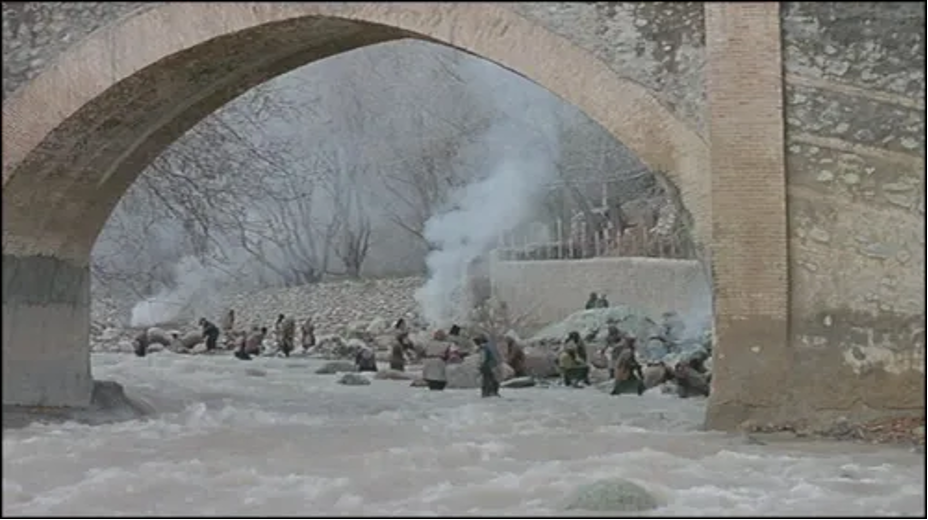
Figure 1: Afghan refugees, including Rahmat, collect stones from the river to sell for income. Baran (2001), directed by Majid Majidi. Accessed via https://www.youtube.com/watch?v=1KWei3v3z1o (00:58:29).
In examining how Baran’s cinematic techniques engage with elements of nature, Ahmet Oktan develops a “Nature-Related Sign Systems Table in Baran.”15Ahmet Oktan, “Nature as a Builder of Meaning in Majid Majidi’s Films,” Ordu Üniversitesi Sosyal Bilimler Enstitüsü Sosyal Bilimler Araştırmaları Dergisi 9, no. 1 (2019): 11–27. In his article, which analyzes the representation of nature and its contribution to the film’s atmosphere, he argues that natural sounds, such as lightning, birdsong, crackling fire, and strong wind, enhance the narrative’s expressive power. For instance, the sharp crack of lightning embodies the shock that Lateef experiences upon learning Baran’s real name. At the same time, the heavy snowfall cultivates an atmosphere of romantic euphoria, in which the body attains serenity, and the perception of time slows.16Oktan, “Nature as a Builder of Meaning in Majid Majidi’s Films,” 18. Moreover, Oktan associates the protagonists’ maturation with their deepening engagement with the natural world. While Oktan interprets the representation of natural elements as positively contributing to both the protagonists’ maturation and the plot’s development, such Baran’s attachment to pigeons, reflecting her innocence, or the wind stirring dust over hidden truths when Lateef discovers her gender, nature also functions as a violent agent. Snow and ice, which make the construction site slippery, cause Baran’s father to break his leg. Meanwhile, the cold weather and freezing river water leave her perpetually somber, bruising her fingers and intensifying the physical labor she must perform. The depiction of snow and cold thus reveals the slow violence that nature inflicts on humans, leaving deep and enduring scars on the protagonists’ psyches even in the absence of overt physical trauma. This slow violence is particularly compelling within Baran’s portrayal of displacement and migrant labor, where environmental hardships compound existing social and political marginalization. By portraying natural elements as agents of hardship, the film illustrates how environmental forces inflict ongoing physical and emotional damage that often goes unseen or ignored but is essential to understanding their lived experiences. Consequently, nature in Baran functions not merely as a poetic or symbolic backdrop but as an active site of slow violence, where environment, politics, and human endurance intersect in a vividly entangled manner.
Similarly centered on the theme of statelessness, Bahman Ghobadi’s Turtles Can Fly tells the story of refugee children living in a camp on the Turkey-Iraq border during the U.S. invasion of Iraq. These children, having lost their families to war, include Agrin, a fourteen-year-old girl; Soran, nicknamed “Satellite” for his interest in broadcasting; Agrin’s disabled brother Hengov, who lost his arms after stepping on a landmine; and a blind toddler, Riga, introduced as their younger brother but in fact Agrin’s child, born from rape during the Halabja Massacre. They survive by collecting and selling landmines. Satellite leads the group in selling the landmines to American soldiers, leveraging his limited English skills. He is also in love with Agrin and tries to comfort her by promising to find a red fish in a local pond, believed by villagers to be cursed and whose water they avoid drinking. The older brother, Hengov, possesses the ability to foresee the future, including Agrin’s eventual suicide and Saddam Hussein’s downfall. Haunted by the memory of her rape, Agrin abandons Riga in the minefield before ending her own life. Although the film depicts overt violence, including bombings and soldiers invading the camp, it also portrays slow violence, particularly through the gradual erosion of hope among the protagonists. The rising fog rising over the valley and creeping mist through the mountains symbolically reflect this loss of hope. A further poignant moment occurs when Satellite discovers, following Agrin’s death, that the red fish are artificially dyed by sellers, symbolizing the illusory promises of prosperity associated with the U.S. invasion. The narrative culmination, in which Satellite turns his back on the American soldiers he once regarded as saviors, underscores how the depiction of a hostile and oppressive natural environment intensifies the slow violence experienced by stateless individuals. For these protagonists, seeking refuge in an environment where harsh winds tear through tents only amplifies their misery and vulnerability.
Figure 2: Agrin leaves her blind child, born of rape, in a mined land and subsequently commits suicide. Turtles Can Fly (2004), directed by Bahman Ghobadi. Accessed via https://www.youtube.com/watch?v=b3uawVIxPPc (01:16:25).
Although the term slow violence is often used in ecocritical studies to describe the long-term effects of environmental crises, such as deforestation, climate change, and nuclear warfare, on human life, it is equally important to consider forms of violence that, while not directly caused by environmental degradation, are nonetheless shaped by the broader ecological, political, and socioeconomic forces that condition human existence. Rob Nixon defines slow violence as a form of “violence that occurs gradually and out of sight, a violence of delayed destruction that is dispersed across time and space, an attritional violence that is typically not viewed as violence at all.”17Rob Nixon, Slow Violence and the Environmentalism of the Poor (Cambridge, MA: Harvard University Press, 2011), 2. Since this section focuses on the depiction of taking refuge, performing labor, and waiting for citizenship in Baran and Turtles Can Fly, it examines the forms of violence represented in these narratives through the lens of slow violence. The protagonists’ bodies are both physically and emotionally damaged, their livelihoods systematically eroded, and the violence they endure is diffuse, unfolding gradually over time. Nevertheless, the violence portrayed in Turtles Can Fly also aligns with the forms of conventional political, physical, and environmental violence that Nixon describes as “immediate in time, explosive, and spectacular in space,” producing what he calls “sensational visibility.”18Nixon, Slow Violence and the Environmentalism of the Poor, 2. These films explore violence in its multiple registers, both conventional, in the sense of physical harm and bodily violation, and slow, in the sense of the gradual erosion of hope. While the protagonists in these films are subjected to slow, accumulative violence, they consistently seek refuge in nature through various means, such as earning a living by pulling stones from the river in Baran or collecting landmines for trade in Turtles Can Fly. This act of seeking refuge in nature, or nature’s act of offering shelter for survival and basic needs, reflects the deeply entwined relationship between humans and nonhumans. In their most vulnerable moments, the characters turn to nature not only as a means of livelihood but also as a source of solace and imaginative escape, as poignantly expressed in Agrin’s wish to become a turtle that can fly, which is a metaphor for freedom beyond borders.
Both films center on the lives of undocumented individuals who, despite their precarious conditions, continue to endure atrocities with the faint hope of attaining legal recognition. What renders these films ecocritically compelling is their vivid portrayal of nature’s harsh realities, including heavy snowfall, muddy streets, and mined, contaminated landscapes, that intensify the struggle for survival faced by the characters. Although nature sustains protagonists’ livelihoods, it simultaneously denies them a dignified quality of life, forcing them to endure the absence of basic physical needs such as heating during winter, sanitary living conditions, and adequate health. This portrayal of nature highlights its profound presence in everyday human life and underscores the vulnerability of human existence in the face of natural forces. Moreover, in Turtles Can Fly, nature seems to exact a quiet revenge for the mined fields, abandoned tanks, and remnants of war that have scarred its terrain. Tragically, it is the innocent children, those least responsible for the violence, who bear the brunt of its wrath. Nature’s dual role as both provider and burden positions it as an active agent in human life rather than a passive backdrop. In these films, landscapes function as living archives of displacement, memory, and exploitation. By intertwining the physical wounds of people with those marked on the earth, including potholed roads, rain-soaked streets, hills cratered by landmines, scorched forests, and stagnant, muddy lakes, the films dissolve the boundary between the human and the nonhuman, making the wounds of both indistinguishable. The dispossession of bodies and identities becomes inseparable from the scars of the earth, which in turn bear witness to and react against the human-inflicted traumas that have altered its form and texture.
This interdependence between nature and human life is equally evident in Baran, where the material conditions of the construction site already compromise the workers’ safety and well-being. Harsh weather intensifies these hazards, forcing them to labor on slippery wooden planks in the freezing cold and falling snow, conditions that steadily deteriorate their physical health. In this film, nature also acts as a perpetrator of slow violence, gradually eroding the refugees’ bodily resilience. As an agent of physical pain, nature reaffirms the idea that it is an intrinsic and inseparable part of human existence, one that the body cannot escape, shaping human conditions even as it is simultaneously shaped by them. Nature’s agency in this film is not only spectacular but also gradual and cumulative, determining the long-term fates of the Afghan refugees. Over time, relentless environmental and material hardships weaken their ability to endure, and, when compounded by the renewed outbreak of war in Afghanistan and the loss of family members, leave them unable to remain resilient, compelling their return home. This narrative also aligns with Nixon’s concept of slow violence, as the refugees experience an intertwined form of harm in which political oppression and material deprivation accumulate over time. Although Nixon’s concept of refugees in Slow Violence does not necessarily foreground the embodied experience of displacement, it crucially encompasses subjects who must adapt to new terrains, environments, and temporalities. While Nixon focuses on environmental crises as drivers of “developmental refugees,” Baran and Turtles Can Fly depict not only displaced individuals but also those deprived of roots and a stable sense of belonging in both place and time, aligning with Nixon’s argument. The protagonists’ displacement is both spatial and temporal, erasing their memory of home and history and deepening their existential precariousness. Nature, in turn, inscribes this rootlessness onto the landscape. For example, the final scene in Baran, where Rahmat’s footsteps imprint in the mud, symbolically embodies how refugees leave transient traces on the places they pass through, marking their fleeting presence and displacement.

Figure 3: Rahmat’s footstep remains in the mud when she leaves Tehran. Baran (2001), directed by Majid Majidi. Accessed via https://www.youtube.com/watch?v=1KWei3v3z1o (01:28:25).
Similar to Baran, Turtles Can Fly portrays characters who are not only displaced from their physical surroundings but also stripped of a stable identity and a sense of hope. In Turtles Can Fly, the protagonists’ reduction to bare life reflects a form of slow violence in which nature serves both as a shelter and as a vehicle of harm. However, this violence originates from human politics rather than from nature acting as a punisher of humanity. This dual relationship between humans and nature reveals their inseparability: in life’s most precarious moments, people turn to nature as both a source of sustenance and a balm for suffering. In Turtles Can Fly, despite the atrocities they face, the children in the refugee camp search for a red fish,19In Iranian culture, the red fish symbolizes life and rebirth. During the Newroz celebration, it is a key element of the haft-sīn table, which features seven symbolic items such as garlic, apples, coins, vinegar, eggs, sumac, and the red fish, each representing something cherished in life. a fragile yet enduring symbol of hope. This symbolic search illustrates how human beings are tested in their interactions with nature, which is often perceived as passive, while the dream of finding the fish in the muddy pond reaffirms the protagonists’ dependence on nature for comfort and self-soothing. The search for the fish ceases to be a matter of choice or agency; instead, it becomes a necessary act of solace for protagonists trapped in the uncertainty of an ambiguous future. At this point, Latour’s concept of agency underscores how bare life within nature must share its agency with nonhuman beings and natural elements alike. While critiquing humanity’s “hubristic dream of control”20Bruno Latour, “Agency at the Time of the Anthropocene,” New Literary History 45, no. 1 (Winter 2014): 1–18. Published by Johns Hopkins University Press. https://www.jstor.org/stable/24542578. over nature, Latour argues that human beings can no longer disclaim responsibility for their actions toward the natural world, since these actions construct the very knowledge of it. In the era of Anthropocene, where human influence is pervasive, human subjects must share their agency with other beings and elements, for reality is no longer “objective” but fundamentally shared.21Latour, “Agency at the Time of the Anthropocene,” 5. This shared agency is embodied in the children’s search for the fish, which is not merely an ornament or passive metaphor of rebirth but an active negotiation of the fragile hope that sustains their emotional survival. In Agrin’s case, this fragile hope collapses entirely, leading to her suicide when the dream of the fish is lost. In this regard, agency is no longer defined solely by material conditions; it becomes a negotiation between humans and nature for emotional resilience. This negotiation blurs the boundaries between active agent, victim, and perpetrator of slow violence within the natural world.
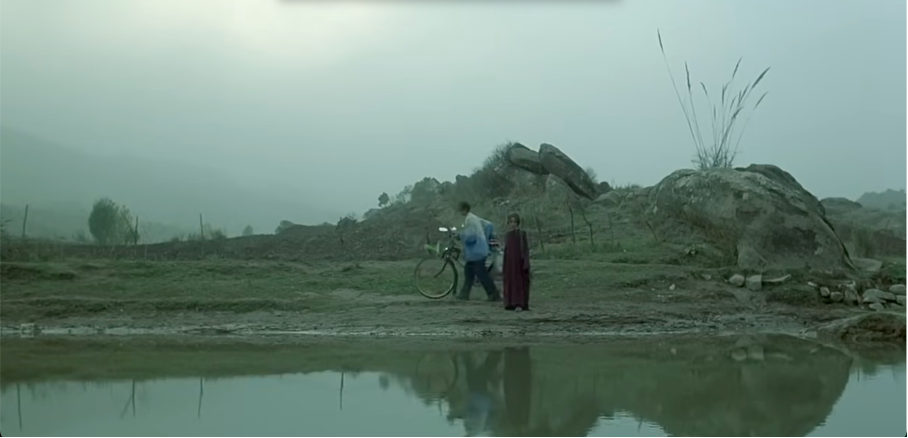
Figure 4: Agrin and the boy nicknamed Satellite search for the red fish in the pond believed to be cursed by other refugees. Turtles Can Fly (2004), directed by Bahman Ghobadi. Accessed via https://www.youtube.com/watch?v=b3uawVIxPPc (00:45:07).
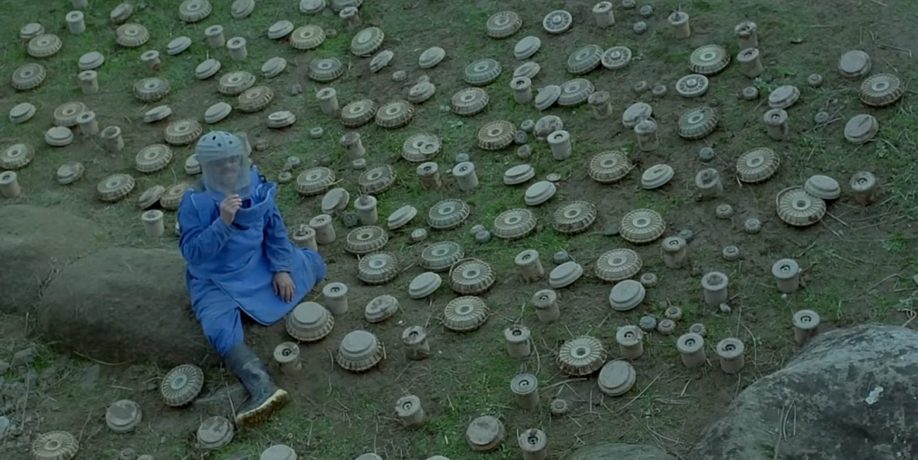
Figure 5: The refugees in the camp collect landmines to sell to the Americans and earn money, while nature seems to exact revenge on humanity, making no distinction between the guilty and the innocent. Turtles Can Fly (2004), directed by Bahman Ghobadi. Accessed via https://www.youtube.com/watch?v=b3uawVIxPPc (01:37:20).
(Im)Mobility, Dispossession, and Nature
In both Bahman Ghobadi’s A Time for Drunken Horses and Samira Makhmalbaf’s The Blackboard, the audience experiences the protagonists’ exhaustion as their (im)mobility is repeatedly obstructed by harsh natural forces such as stubborn animals, heavy snow, and treacherous rocky terrain. In each film, mobility becomes a central concern: the protagonists’ survival depends on their ability to keep moving despite the natural obstacles that threaten to halt them. A Time for Drunken Horses portrays the daily lives of villagers in a small Kurdish village on the Iran–Iraq border who sustain themselves through smuggling. The narrative follows five siblings whose mother dies while giving birth to Madi, the youngest and disabled child. After their father is killed during a smuggling trip, the eldest brother, Ayoub, assumes responsibility for supporting the family. Because Madi is gravely ill and requires urgent medical treatment, their uncle arranges for their sister, Rojin, to marry on the condition that Madi will receive care. Rojin agrees to the marriage only if she can take Madi with her. However, when the groom’s mother sees Madi, unaware of this agreement, she refuses to accept him, and he is sent back home. After Ayoub refuses to let Rojin marry someone else, he turns to smuggling to provide for his siblings and pay for Madi’s treatment. In this region, there is no alternative livelihood; smuggling is the only means of survival. It has become so normalized that even the books children are smuggled across the border, hidden inside clothing. Accompanied by his uncle’s mule and Madi, Ayoub joins a group of smugglers on a trip to Iraq and arranges with one of them to pay for Madi’s operation. That day, the weather is even more unforgiving than usual. In the freezing cold, the mules and horses are given alcohol to keep them moving. On the journey, they are ambushed by government officials, and a struggle for survival ensues; they must either run or be shot. However, the animals are intoxicated after being given too much alcohol. In the final scene, against an endless whiteness of the snow and behind barbed wires, Ayoub, Madi, and the mule come into view. The director leaves the ending to the audience’s interpretation.
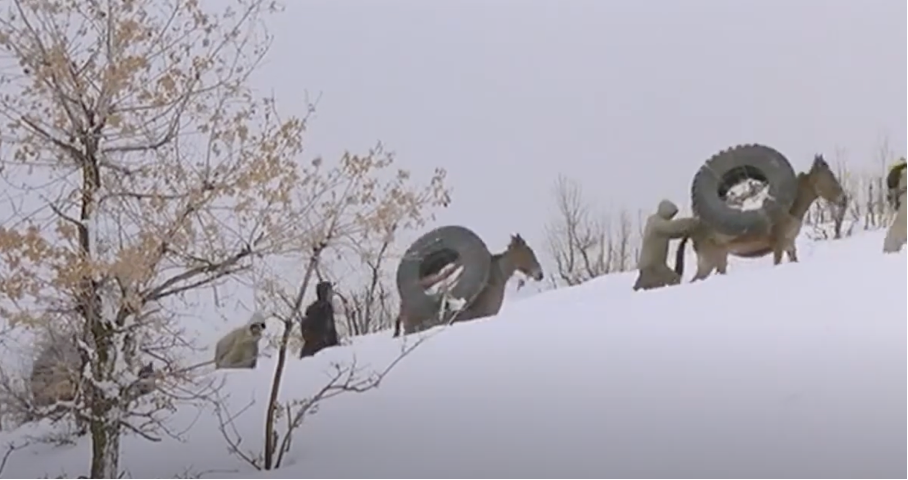
Figure 6: The smugglers transport goods on mules and horses, giving the animals alcohol to warm them and keep them moving. A Time for Drunken Horses (2000). Directed by Bahman Ghobadi. Accessed via https://www.youtube.com/watch?v=qp9-2VKNq8I (01:12:00).
In The Blackboard, as in A Time for Drunken Horses, the struggle with (im)mobility forms the core dramatic tension. The film follows volunteer teachers who travel from village to village during the Iran–Iraq War, seeking to teach literacy to local communities. The protagonists, Saeed and Reeboir, traverse mountainous terrain in search of children willing to learn, but along the way, Saeed encounters Kurdish refugees fleeing to Iran after the Halabja Massacre. Desperate for safety, they attempt to return to their village in Iraq. Saeed marries Halaleh, the daughter of an elderly man in the group. He agrees to escort them to the border in exchange for forty walnuts. Reeboir, meanwhile, follows a group of child smugglers and tries to teach them to read and write. The children, however, show little interest in learning, believing education is unnecessary for them. Coincidentally, one of the children’s names is also Reeboir, and he is the only child who finds joy in learning. To persuade them, the teacher explains that studying mathematics will help them calculate their earnings, to which one child responds, silencing the teacher: “Being able to read and do calculations only benefits the boss. We are porters, always on the move. How can you expect us to read? To read a book or a newspaper, we would have to sit still, but we never stop; we are always on the road.” The war conditions and constant moving prevent them from forming permanent relationships or achieving stability. The blackboards the teachers carry on their backs serve not only as instructional tools but also as shields and shelters from shooting helicopters. The film’s slow pacing mirrors its narrative of slow violence, as the rocky roads and cliffs obstruct movement and intensify the struggle, especially for the sick and elderly man in the group, who suffers from a urinary tract infection, that makes it difficult for him to endure the journey.
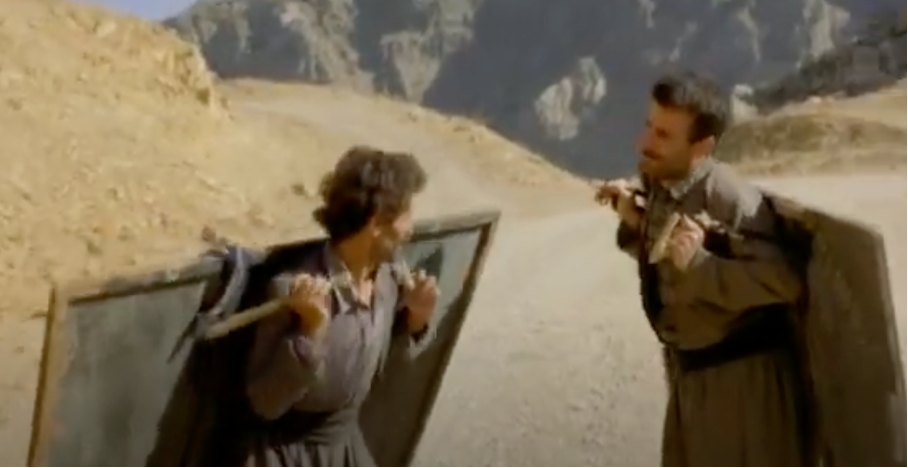
Figure 7: Volunteer teachers journey across villages, seeking to teach children how to read and write. The Blackboard (2000). Directed by Samira Makhmalbaf. Accessed via https://www.youtube.com/watch?v=RAcKdcj84N4 (00:07:31).
As (im)mobility becomes a question of survival in these films, agency no longer rests solely with the protagonists but emerges from a network of natural forces that shelter them. Survival itself is socially woven through the interplay of subjects, objects, and living beings. Latour defines the “social” as a web of entanglements among actors within a collective, while simultaneously asking what counts as a “non-social” entity and how such entities come to participate in the system of “social actors.”22Bruno Latour, Reassembling the Social: An Introduction to Actor-Network-Theory (Oxford: Oxford University Press, 2005), 247. A Time for Drunken Horses and The Blackboard respond to Latour’s questions by showing how nonhuman entities, and even everyday objects, as active participants in social life. In both films, survival depends not solely on human agency but also on a fragile interdependence between humans and their environment, an entanglement that lies at the core of human existence. For instance, the child Reeboir in The Blackboard forms an affective bond with the blackboard, which offers him a sense of hope for the future through learning. He closely follows what the teacher writes and repeats the sentences many times, which strengthens his motivation. The blackboard functions not merely as an object but as a symbolic possession, especially since the protagonists are dispossessed and deprived of material assets, leaving the board as their only form of belonging. Although it originates from a natural material, the blackboard is reshaped by human actors, transformed into an object that acquires new meanings as it mediates their relationship to the world, offering hope, providing shelter, and even serving as a form of capital when Saeed offers it as Halaleh’s dowry. Similarly, the mules and horses, as living entities, participate in the social sphere, determining the limits of human endurance and action. In this context, taking shelter in nature dissolves the boundary between objects and living beings, revealing their mutual dependence when the natural world becomes the only refuge. This interdependence redefines what a social collective means for humans. Such a redefinition is ecocritically rich, as it involves the material conditions necessary for survival, binding humans to the rhythms of animals, objects, and the natural environment upon which their lives precariously depend. Although the social collective in The Blackboard is structured around an object connected to a social practice, education, rather than a living being, the film underscores how materiality itself becomes socially generative. Immobile landscapes such as cliffs, mountains, and arid valleys shape the very conditions of collective life and survival.
Given expanded notion of the social that includes the nonhuman world, the question arises: how does dispossession intersect with ecocritical materiality? More concretely, how does A Time for Drunken Horses articulate the social beyond the symbolic opposition between humans and animals? Lance Newman’s reflections on Marxism and ecocriticism illuminate these questions not only through his analysis of the relationship between capital and nature, but also through his critique of ecocriticism itself. Newman argues that the material conditions of the environment both shape and are shaped by social and economic relations. Although his discussion focuses on literary studies and the ways nature writing channels social change, the films analyzed here demonstrate how objects and animals transcend their symbolic roles to become active participants in social relationships with the material world.
Iranian cinema, with its blend of symbolic narrative devices and realistic portrayals of survival shaped by nonhuman actors, exemplifies an ecological web of entanglements and distributed agency. Ayoub’s depiction in A Time for Drunken Horses, carrying goods too heavy for him to bear, mirrors the image of the mule burdened beyond its strength, blurring the distinction between human control and animal agency in the struggle to meet material needs. This parallel reflects Ghobadi’s deliberate choice. In his interview with Gülden Tümer, he explains that he approaches animal characters as if they were humans, attributing to each a distinct set of traits.23Gülden Tümer, Bahman Ghobadi Sinemasında Hayvan Metaforlarıyla Travma Anlatımı, Master’s thesis, Istanbul University, 2020. https://nek.istanbul.edu.tr/ekos/TEZ/ET002855.pdf
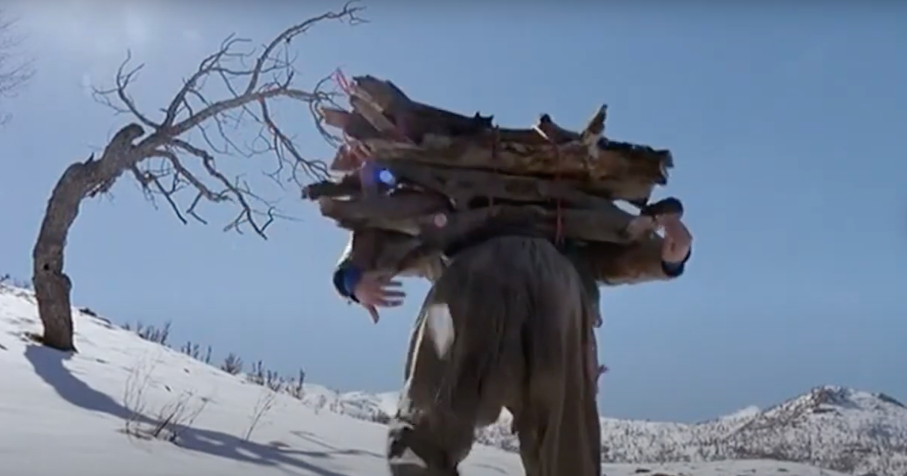
Figure 8: Both Ayoub and the mules carry burdens too heavy for them. A Time for Drunken Horses (2000). Directed by Bahman Ghobadi. Accessed via https://www.youtube.com/watch?v=qp9-2VKNq8I&t=4320s (00:20:14).
In the same interview, Ghobadi explains that in the region where he films, the lives of mules are crucial for human survival, and the tragedy of a mule stepping on a mine can be even more dramatic than that of a human being. In this sense, humans and animals become fellow sufferers.24Tümer, Bahman Ghobadi Sinemasında Hayvan Metaforlarıyla Travma Anlatımı, 150. In line with Newman’s view of nature writing as a form of social action, Ghobadi’s cinema performs an ecocritical act through its emphasis on animals as essential to human existence, aligning the natural environment and human existence within a social collective. Together, these examples show that dispossession is not solely a human condition but one that is materially and socially mediated through the intertwined lives of humans, animals, and objects. This expanded understanding of the social frames survival as a collective, ecologically grounded endeavor.
Conclusion
Through an ecocritical reading of contemporary Iranian cinema, this article aims to illuminate how nature functions as an active participant in the lived realities of dispossession, migration, and statelessness. Drawing on Bruno Latour’s understanding of political ecology, the films Baran, Turtles Can Fly, Time for Drunken Horses, and The Blackboard reveal an expanded understanding of citizenship that transcends human boundaries and integrates the agency of the nonhuman world. In these cinematic narratives, natural entities such as rivers, snow, mountains, animals, and even blackboards acquire a social and political presence that shapes both the conditions of survival and the fabric of human resilience. The protagonists’ search for refuge amidst environmental precariousness and political exclusion highlights how the dispossessed coexist with, and survive through, the landscapes that oppress and shelter them. In this sense, nature embodies what Rob Nixon calls slow violence; it gradually harms while simultaneously offering the possibility of fragile resistance. Iranian filmmakers transform this duality into a cinematic language that combines ecological awareness with ethical responsibility and places nonhuman agency at the center of human vulnerability. These films dismantle anthropocentric frameworks of belonging and nationhood, replacing them with a relational ecology of citizenship in which both human and nonhuman actors share the burden of survival.
By foregrounding the interdependence of dispossession and ecology, contemporary Iranian cinema performs what might be called an aesthetics of shared resilience and a vision in which survival is neither purely human nor purely environmental, but always collective. Reframing citizenship through ecological relation, these films call for an alternative politics that acknowledges the affective, material, and emotional networks that bind displaced people to the world they shelter in. In doing so, they argue that seeking refuge in nature is not merely an escape from political violence, but also an inhabitance of a world in which the boundaries between human and nonhuman life are constantly reimagined and renegotiated.
Introduction1With changes and additions, this essay is a section from my articles, published under the title “Leisure Architecture and the Aesthetics of the Pahlavi ‘Modern Middle Class’,” in Political, Social and Cultural History of Modern Iran: Essays in Honour of Ervand Abrahamian, ed. Houchang Chehabi (Edinburgh: Edinburgh University Press, 2025), Chapter 15, 378-398.
“In early nineteenth-century Iran, classes existed in the first, but not the second, meaning of the term,” writes Ervand Abrahamian in his seminal Iran Between Two Revolutions.2Ervand Abrahamian, Iran Between Two Revolutions (Princeton: Princeton University Press, 1982), 33. By the time of Rizā Shah’s exile and the founding of the Tūdah Party in 1941, Iran’s “modern middle class” not only distinguished itself from the Qājār “traditional middle class” but also managed to create what Abrahamian demarcated, employing Marx, as “a class ‘for itself’ as well as ‘in itself’.”3Ervand Abrahamian, Iran Between Two Revolutions (Princeton: Princeton University Press, 1982), 33. Focused on edifices in Tehran, this essay explores the role of architecture in shaping a modern-class discourse in Pahlavī Iran. It argues that the tectonic and stylistic language of modernist architecture in general, focused here on the leisure architecture of movie theaters, was instrumental in shaping the parameters of the collective identity of Abrahamian’s class category: the “salaried middle class” and, to some extent, the “urban working class.” Other processes of modernization, including secular education, the women’s movement, the tourist industry, modern sports, scouting, mass media, and a secularist cosmopolitan ethos of the healthy and fashionable body politics, were embraced by the modern middle class to define its image as a distinct and separate sociocultural class. As scholars of modern Iran have demonstrated, these tropes pivoted on broader global discussions about progress, leisure, health, and hygiene, informed by modernist aesthetic sensibilities.4In addition to works cited and quoted below, see H. E. Chehabi, “Mir Mehdi Varzandeh and the Introduction of Modern Physical Education in Iran,” in Culture and Cultural Politics under Reza Shah, ed. Bianca Devos and Christoph Werner (London: Routledge, 2014), 55-72; H. E. Chehabi, “The Juggernaut of Globalization: Sport and Modernization in Iran,” The International Journal of the History of Sport 19, no. 2-3 (July 2002): 275-294; Sivan Balslev, Iranian Masculinities: Gender and Sexuality in Late Qājār and Early Pahlavī Iran (Cambridge: Cambridge University Press, 2019); and Stefan Huebner, “Iran and the Indian Ocean Region Project: The Great Persian Empire, Oil Wealth, and the Seventh Asian Games (1-16 September 1974),” in Pan-Asian Sports and the Emergence of Modern Asia, 1913-1974 (Singapore: NUS Press, 2018), 230-260. As one of the most pervasive and porous among them, Pahlavī architecture was not only integral to the secular systems and strategies that gave birth to the modern middle class “for itself” and “in itself” but also sheltered and shaped its lifestyle; it was the infrastructure upon which that class molded its unique identity. However, when that very lifestyle was contested, its matching architecture of movie theaters came under violent attack.
Adhering to the principles of the canonical architectural style from the 1920s to the 1970s, the International Style and its subsequent offshoots, Pahlavī leisure architecture between the mid-1930s and 1979 was entirely novel in form and function, radically breaking with either the Qājār eclecticism of the nineteenth century or the Persian Revival style of the first three decades of the twentieth century.5See Talinn Grigor, The Persian Revival: The Imperialism of the Copy in Iranian and Parsi Architecture (University Park: Pennsylvania State University Press, 2021). In form, its large-scale street elevations with minimal ornamentation, its flat roofs and elongated openings, its receding and projecting oblong blocks, its all-glass transparent public facades, its oversized Latin inscriptions, its obsessive use of concrete, glass, and steel, as well as its exaggerated and asymmetrical volumes enabled new kinds of sociocultural activities and relations. In lived experience, to look and act fashionable meant being modern; and in the case of the 1930s to 1970s Pahlavī modern middle class, this sense of fashionability was primarily grounded in the aesthetics of that experience rather than the upholding of progressive socio-political convictions—at least for those who belonged to the apolitical stratum of Pahlavī society. These disciplinary techniques, through architecture, were intended to maintain the class status quo. Unlike Safavid and Qājār sites and practices of leisure, therefore, the claim of Pahlavī leisure architecture was utopian in form and spirit.6See Rudi Matthee, The Pursuit of Pleasure: Drugs and Stimulants in Iranian History, 1500-1900 (Princeton: Princeton University Press, 2005); and Farshid Emami, “Coffee Houses, Urban Spaces, and the Formation of a Public Sphere in Safavid Isfahan,” Muqarnas 33 (2016): 177-220. Despite its unavailability to many outside urban centers due to economic, geographical, or sociocultural obstacles, it was for “everyone” to aspire to, regardless of income and taste. The king’s discoursed life—and by extension, the king’s discoursed body—was the ultimate model of this aesthetic sensibility, often against the backdrop of modernist architecture.7On the king’s two bodies in European history, see, for instance, Alexandra Ion, “And Then They Were Bodies: Medieval Royalties, from DNA Analysis to a Nation’s Identity,” in Premodern Rulership and Contemporary Political Power: The King’s Body Never Dies, ed. Karolina Mroziewicz and Aleksander Sroczyñski (Amsterdam: Amsterdam University Press, 2017), 321-352.
Cinematic Pleasure, “Healthy” Leisure
From the outset, the Pahlavī state cultivated a modernist ethos of the healthy national body. The commissions of sporting, scouting, and later on other leisure infrastructure in Tehran benefited from this ideological priority that it conferred on health leisure architectural commissions. Known as Manzariyah, one of these major complexes was officially named the Garden of Scouts and Athletes of the Capital (bāgh-i pīshāhangān va varzishkārān-i pāyitakht).8See Īsā Sadīq, Yādgār-i umr, 4 vols. (Tehran: Dihkhudā, 1959–74), 2:169-70; Pīshāhangī va tarbiyat-i badanī 1 (4 Ābān 1319): 47; and Sayfpūr Fātimī, “Jashn va ‛āmaliyāt-i pīshāhangān dar manzariyah,” Ittilā‘āt (27 August 1935). In 1938, the project of turning several former royal lands into a modernist scouting and sporting complex was commissioned to Roland Dubrulle (1907-83), a young French citizen and a 1931 École des Beaux-Arts graduate who, before departing for Iran, had fallen in love with the Armenian-Iranian student Serpuhi Achik Voskanian.9See Bīzhan Shāfi‘ī, Nāhīd Biryānī, and Nigār Mansūrī, Mi‘mārī-i Rulān Dubrul / Roland Dubrulle: Architecture (Tehran: Rahsipārān, 2021), 13, 34-35, 48-49, 142-43. Their marriage and move to Tehran in August 1935 jump-started Dubrulle’s prolific career. During the same years, four large pieces of land were purchased by the Ministry of Education to serve as sporting grounds for the general public and public schools: Amjadiyah was located “outside Dowlat Gate” in what was then the north of Tehran, while Akbarābād Dūlāb was in eastern Tehran, Bāgh-i Shāh in western Tehran, and the Bāgh-i Firdaws in southern Tehran. Numerically labeled, Amjadiyah, the first and the largest, was named “Sports Complex Number 1.”10See “Amjadieh,” Ittilā‘āt 3352 (7 Day 1316/28 December 1937); “Ā’īn-i gushāyish-i istakhrhā-yi shinā,” Ettelā‘āt (21 Khurdād 1320/11 June 1941): 1; Hekmat, Sī khātarah, 76-77 and 81-82; and Bīzhan Shāfi‘ī, Nāhīd Biryānī, and Nigār Mansūrī, Mi‘mārī-i Rulān Dubrul / Roland Dubrulle: Architecture (Tehran: Rahsipārān, 2021), 50-51, 98-99, and 14856; and Viktor Daniel, Bīzhan Shāfi‘ī, and Suhrāb Surūshiyānī, Mi‘mārī-i Nīkulāy Mārkuf / Nikolai Markov Architecture (Tehran: Dīd Publications, 2004), 96-99.
In tandem with these sport-scouting megaprojects, such as Amjadiyah and Manzariyah complexes, Tehran and other cities began to see the mushrooming of small-scale culinary and recreational sites, intended to support a modern middle-class consumerist lifestyle. While these were a byproduct of the organic growth of the economy, the state forced modern reforms by lowering taxes on such leisure industries as film, while at the same time levying heavy fines on “cinemas, cafés, and hotels, if they discriminated against women.”11Ervand Abrahamian, Iran Between Two Revolutions (Princeton: Princeton University Press, 1982), 144. On taxation on cinemas, see Hamid Naficy, A Social History of Iranian Cinema, vol. 2, The Industrializing Years, 1941-1979 (Durham: Duke University Press, 2011), 158. On the architecture of cafés, bars, bowling allies, and to some extent, movie theaters, there was very little or no academic work that I could find. I am grateful to my parents, Moneh and Greg Der Grigorian, for their enormous help and incredible memory to start collecting some information about them. Playing an “extraordinarily significant role in the emancipation of Iranian women” and, thus, the modern middle class, movie theaters, hotel restaurants, delicatessens and diners, cafés, bars, cabarets, and casinos slowly pushed out from urban centers the once-popular tea and coffee houses wherein naqqālī (story-telling) and pardah-khvānī (canvas reading) were popular forms of entertainment and provided a sense of belonging.12Shireen Mahdavi, “Amusements in Qajar Iran,” Iranian Studies 40:4 (2007): 483–99; Hamid Dabashi, Close up: Iranian Cinema, Past, Present, and Future (London: Verso, 2001), 21; and William H. Martin and Sandra Mason, “The Development of Leisure in Iran: The Experience of the Twentieth Century,” Middle Eastern Studies 42:2 (2006): 239-254, at 245-46. Other recreational loci such as the zūrkhānah and takkiyah (structures for the performance of Shiite passion play, ta‘ziyah) were supplanted by these new forms and functions of leisure. Although lacking a modernist architectural character, new public venues such as Café Nādirī (1947, on Nādirī Avenue) and Café Shimīrān (ca. 1950, on Firdawsī Avenue) served Western-style food and deserts, held alcohol licenses, and brought live music bands; many of the early pop signers such as Vigen, Artush, and Wilson debuted here.13Another important site of intellectual and artistic gatherings was Café Firuz (on the southeastern crossing of Nādirī and Qavām al-Saltanah Streets), which was housed in the former stables or auxiliary structures of the Golestan Palace complex, large sections of which were destroyed during Reza Shah’s urban reforms in the late 1920s. The interior consisted of a ceiling of smaller domes with hanging fans, recreating a North African and Moroccan vernacular style, and recalling the images in such Hollywood movies as Casablanca (1942). Café Fīrūz was demolished sometime around 1965 when the wood furniture factory cut fire, and Eiffel Cinema eventually replaced the entire corner block. During the free political period between 1941 and 1963, Café Fīrūz served as the pātuq (hangout) of Sādiq Hidāyat, Nīmā Yūshīj, Manūchihr Shaybānī, Jalāl Āl-i Ahmad, and Jalīl Ziyāpūr. See Ahmad Karimi-Hakkak, “Protest and Perish: A History of the Writers’ Association of Iran,” Iranian Studies 18, no. 2/4 (1985): 193. By the mid-1960s, Tehran boasted a lively and diverse nightlife in Café Chattanooga (1966, owned by Johnny Lucas on Pahlavī Avenue), Café Brazilo (in Hāfiz and Simi intersection), Café Riviera (on Qavām al-Saltanah Street), Café Firdaws (on Istanbul Street), Cabaret Shukūfah Naw (adjacent to the Red District in southern Tehran), Cabaret Copacabana (on Takht-i Jamshīd Avenue), Cabaret Mayāmay [Miami] (on Pahlavī Avenue), Cabaret Ufuq-i Talā’ī (on Lālahzār Street), Café Jamshīd (on Manūchihrī Street) to name a few. In the mid-1960s, the youth of the modern middle class enjoyed outdoor minigolf and indoor bowling. On Old Shimirān Road, the recreational complex of ‛Abduh Bowling (1964) featured an automated bowling hall adjacent to a movie theater and an indoor pool. Owned by the CRC company with ‛Alī ‛Abduh, Commander of Airforce Muhammad Khātamī, and Princess Fātimah Pahlavī as its principal shareholders, it was also the owner of the famous soccer team Persepolis.
However, the movie theater was the most striking coupling of modern middle-class leisure and modernist architectural aesthetics. The modernizing effects of cinema are well established in the history of Pahlavī Iran; in fact, the rich and robust history of Iranian cinema is one of the few visual disciplines that has been accepted into the mainstream of Iranian Studies. However, despite its richness, few authors address the importance of the spaces in which movies were experienced as a form of modernity. In Iranian cities, movie theaters sprung up in abundance during the decades between Rizā Shah’s abdication and Muhammad-Rizā Shah’s exile. Their numbers jumped from fifteen to 122 in Tehran and 432 in other cities by 1973.14See Hamid Naficy, A Social History of Iranian Cinema, vol. 2, The Industrializing Years, 1941-1979 (Durham: Duke University Press, 2011), 158-59; and Shahin Parhami, “Iranian Cinema: Before the Revolution,” in Early Cinema in Asia, ed. Nick Deocampo (Bloomington: Indiana University Press, 2017), 257. “[M]oviegoing” was the “cheapest form of mass entertainment,” and the halls were packed.15Hamid Naficy, A Social History of Iranian Cinema, vol. 2, The Industrializing Years, 1941-1979 (Durham: Duke University Press, 2011), 159. At the dawn of the anti-Pahlavī revolution in 1977, vis-a-vis a total population of 39.9 million Iranians, 110 million cinema tickets were sold.16“Between 1963 and 1977 … the number of cinema tickets sold rose from 20 million to 110 million.” Ervand Abrahamian, Iran Between Two Revolutions (Princeton: Princeton University Press, 1982), 428.
At the start of each film session, the audience rose to the national anthem while watching the moving images of the royals. “Cinematic modernity” was contingent upon the theater because “screening spaces were implicated in a temporality that … propelled into the future.”17Golbarg Rekabtalaei, Iranian Cosmopolitanism: A Cinematic History (Cambridge: Cambridge University Press, 2019), 1. Like the stadium and its diving tower, the movie theater was quintessentially modern as a formal typology and, thus, both in the West and in Iran, those architects who identified with the Modern Movement sought out their commissions. Leading architectural journals published floor plans and photographs of new movie theaters designed by pioneering architects globally.18See, for example, the special issues or multiple articles on movie theaters in L’Architecture d’aujourd’hui 7 (September-October 1933): 24-119; L’Architecture d’aujourd’hui 2 (February 1936): 26-27 and 44-45; L’Architecture d’aujourd’hui 7 (July 1937): 38-40; and L’Architecture d’aujourd’hui 9 (September 1938): 2-12 and 51-75. By the end of World War II, when the first International Style theaters were erected by well-known Iranian architects, the modern middle class, “whose members not only held common attitudes toward social, economic, and political modernization” but also held “similar relationships to the mode of production, the means of administration, and the process of modernization,” was ready to consume them as their own.19Ervand Abrahamian, Iran Between Two Revolutions (Princeton: Princeton University Press, 1982), 145-146. Movie theaters were conducive to an image of a secular class “for itself” and “in itself.” Moreover, they provided a completely novel physical environment wherein to perform the rituals of bourgeois sociability: dating, consuming, and ceding to the pleasure of narcissism and scopophilia.20See Laura Mulvey, “Visual Pleasure and Narrative Cinema,” in Feminisms Redux: An Anthology of Literary Theory and Criticism, ed. Robyn Warhol-Down and Diane Price Herndl (New Brunswick: Rutgers University Press, 2009, first written in 1975), 432-442. Requiring specialized architectural expertise, their tectonic nature enabled modernity’s alluring tensions: public yet informal, classy yet non-elitist, artsy yet accessible, dark yet visible, hi-tech yet familiar, enclosed yet transparent, subversive yet apolitical, globally-connected yet intensely local and intimate. The private clientele enabled the architect to experiment with modernist principles free from the heavy demands of the state; the location and scale of the projects facilitated creativity with large street façades as well as complex interior morphologies.
Unlike its socio-cinematic history, scholarship on the architecture of Iranian movie theaters is scarce and patchy. In this brief study, I consider a dozen edifices with available visual evidence to me and erected by known Iranian architects who adhered to the tenets of the Modern Movement and its later offshoots. Many were ethnic Armenians involved in various aspects of Iranian modernism, particularly the movie industry.21On the Armenian role in the Iranian cinema, see Naficy, Social History, 2:54, 153, 170, 239, 253, 320, 334, and 341. For Abrahamian’s discussion of the role of ethnicity in the formation of the modern middle-class see, Ervand Abrahamian, Iran Between Two Revolutions (Princeton: Princeton University Press, 1982), 383-415. “Indeed,” as Houchang Chehabi argues, “one of the characteristics of the modern middle class was that it included Baha’is, Christians, Jews, and Zoroastrians, who commingled more easily with their Muslim compatriots,” and they did so in these new modernist spaces.22H. E. Chehabi, “The Rise of the Middle Class in Iran before the Second World War,” in The Global Bourgeoisie: The Rise of the Middle Classes in the Age of Empire, ed. David Motadel, Christof Dejung, and Jürgen Osterhammel (Princeton: Princeton University Press, 2019), 43-63, 61. Two of the earliest movie theaters in a sober Art Deco that incorporated the International Style were the work of the most vocal advocate of the Modern Movement in Iran: Armenian-Iranian architect Vardan Hovhannisian (1896-1982), whose prolific career after his 1935 return from Paris helped shape the leisure and tourist infrastructure of the middle class, including Darband (in Darband, 1938), Lāleh (on Lālehzār Street, 1945), and Ferdowsi (on Ferdowsi Avenue, 1949) hotels. In 1942, Hovhannisian was commissioned to design Metropole Cinema on the western side of Lālehzār Street among the range of other early theaters such as Iran (1940), Crystal (1945), and Rex (1945).23On Khachaturian, see Naficy, Social History, 2:169-70. They all shared the eye-catching, vertically tall, narrow street façades, demarcated by an inviting deep central entrance. Metropole’s façade looked like a cubist sculpture with receding and projecting blocks of the top three floors that housed the various production and distribution of films, dubbing, camera repair, and other cinema-related administrative offices. A protruding structure suspended from the third- to fifth-floor balconies carried the letters M E T R O P O L E as an integral part of the avant-garde design (figs. 1-2).
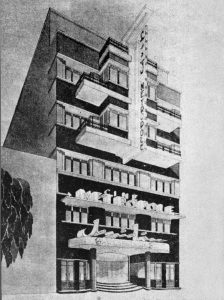
Figure 1: Rendering of Metropole Cinema by Irano-Armenian architect Vardan Hovhannisian, Tehran. Photo: “Paydāyish-i mi‛mārī-i mudirn dar Īrān: Yādnāmah-yi Vārtān Huvānisiyān 1275-1361,” Nashriyah-yi Jāmi‛ah-yi Mushāvirān-i Īrān 1 (Spring 1983): 9.
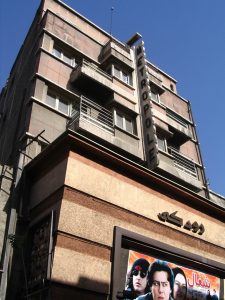
Figure 2: Façade of Metropole Cinema, designed by Irano-Armenian architect Vardan Hovhannisian, located on Lalahzār Street, Tehran, 1946. Photo with copyright: Talinn Grigor, 1999.
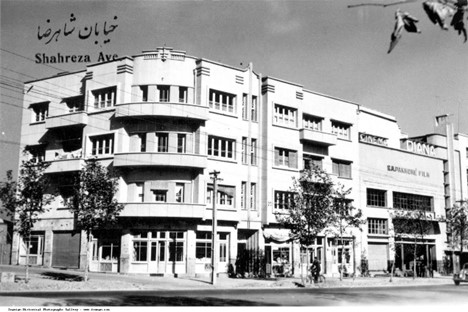
The main theater was accessed through the central doors into a large lobby, ticketing, and concession area with a balconied second floor visible from below. Once inside the hall, the ground floor accommodated 650 spectators on large, padded armchairs, while the mezzanine accommodated 250 spectators. Tehran’s Armenian-language daily, Alik‘, depicted Metropole in 1946 as an expression of “rhythm, modernity, harmony, and simplicity.”24lik‘ (23 November 1946), n/p; quoted in Suhrāb Surūshiyānī, Viktor Daniel and Bīzhan Shāfi‘ī, Mi‘mārī-i Vārtān Huvānisiyān / Vartan Hovanesian Architecture (Tehran: Dīd Publications, 2008), 98, see also 97-101. Four years later, Hovhannisian’s Diana Cinema (1950, owned by a female Armenian producer, Sanasar Khachaturian who also owned Diana Film, figs. 3-4), on Shah Rizā Avenue, wedded middle-class values to the same aesthetic sensibility of deep horizontal lines and openings, the use of bold Latin inscriptions, and a transparent glass wall on the façade.
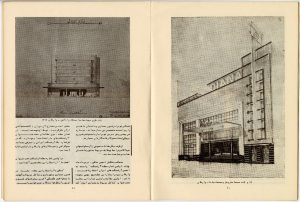
Figure 3: Renderings of Cinema Diana and the Train Station by Irano-Armenian architect Vardan Hovhannisian, Tehran. Photo: “Paydāyish-i mi‛mārī-i mudirn dar Īrān: Yādnāmah-yi Vārtān Huvānisiyān 1275-1361,” Nashriyah-yi Jāmi‛ah-yi Mushāvirān-i Īrān 1 (Spring 1983): 10-11.
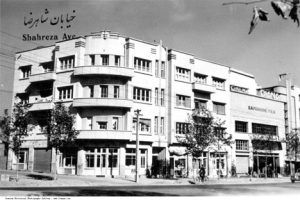
Figure 4: A postcard depicting Cinema Diana by Irano-Armenian architect Vardan Hovhannisian adjacent to a modernist residential building on Shāhrizā Avenue, Tehran, ca. 1950s. Photo: Public domain.
The mid-1950s and the end of the 1960s saw a bourgeoning of modernist theatres that dominated the visual and urban landscape by their sheer size and aesthetics, among them Firdawsī and Universal (on Shah Rizā Avenue, 1963), and Atlantic (on Pahlavī Avenue, 1964). The Iranian brand of the International Style came to its own in 1957 with Armenian-Iranian architect Paul Apcar’s (1909-1970) Niagara Cinema (owned by ‛Alī Hātamī or “Mr. A. Hūmanī” and actor Muhammad ‛Alī Fardīn, inaugurated on 29 April 1958, fig. 5). A massive block on Shah Avenue, its street façade consisted of a lattice structure, crowned cone, assembled of reinforced and exposed concrete, a material Le Corbusier had dubbed béton brute (bare concrete) and which was a quintessential signifier of modernity. Having returned to Iran from Paris and Brussels in 1936, Apcar took inspiration from Le Corbusier’s Chandigarh and from Brasilia in its unapologetic and rationalist use of béton brute, steal, and glass. Described as “one of the most modern cinemas in the capital,” the all-glass entrance wall introduced visual transparency between the sidewalk and the lobby. The floor plan, too, pioneered an innovative scheme, where the trapezoidal theater hall of 950-seat was nested into the outer shell, lodging the auxiliary facilities.25Bīzhan Shāfi‘ī, Suhrāb Surūshiyānī, and Viktor Daniel, Mi‘mārī-i Pul Ābkār (sic) / Paul Apcar Architecture (Tehran: Abyānah, 2015), 36; see also 302-315. The six pairs of doors lined the two long sides of the hall, allowing the smooth and safe circulation of the audience: through the lobby, they came into the hall via the western doors and exited, first into a long corridor onto the main façade (fig. 6). The first to include rocking chairs, the tactile expressiveness of Niagara Cinema conveyed contradicting regularity, harmony, brutality, and pleasure.
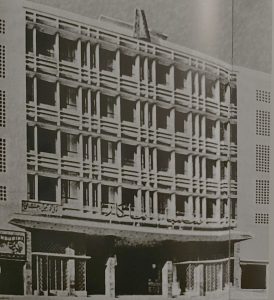
Figure 5: Façade of Niagara Cinema by Irano-Armenian architect Paul Apcar, located on Shah Avenue, Tehran, inaugurated on 29 April 1958. Bīzhan Shāfi‘ī, Suhrāb Surūshiyānī, and Viktor Daniel, Mi‘mārī-i Pul Ābkār (sic) / Paul Apcar Architecture (Tehran: Abyānah, 2015), 302-303.

Figure 6: Architectural drawings of the ground and mezzanine level floor plans and section for Niagara Cinema by Irano-Armenian architect Paul Apcar. Photo: Paul Apcar Private Collection in Bīzhan Shāfi‘ī, Suhrāb Surūshiyānī, and Viktor Daniel, Mi‘mārī-i Pul Ābkār (sic) / Paul Apcar Architecture (Tehran: Abyānah, 2015), 306.
Two other Beaux-Arts-educated architects embarked on movie theater design during this time. On the northwestern corner of Shah and Pahlavī avenues, Baha’i-Iranian architect Hūshang Sayhūn’s (1920-2014, returned to Iran in 1949) Asia Cinema (1958) incorporated an uninterrupted glass wall wrapped around that entire corner, rendering the interior visible to passersby.26See Sīrūs Bāvar, Nigāhī bih paydāyī-i mi‘mārī-i naw dar Īrān (Tehran: Fazā, 2009), 111; and Vahīd Qubādiyān, Sabkshināsī va mabānī-i nazarī dar mi‘mārī-i mu‘āsir-i Īrān (Tehran: ‛Ilm-i Mi‘mār, 2013), 238 and 242-243. Raising to five stories, the floor-to-roofline glass facade was supported with a set of loadbearing columns, right behind the glass wall. Structurally and visually novel, Asia Cinema was outdone by Sayhūn’s other contribution to the tourist industry; the network of national mausolea he designed, including Ibn Sīnā (Avicenna) (Hamadan, 1952), Nādir Shah (Mashhad, 1959), the painter Kamāl al-Mulk, and Omar Khayyam (Nishapur, 1962-63). Returning in 1954, Shiite-Iranian architect Haydar Ghiyā’ī (1922-85) designed Moulin Rouge Cinema (on Old Shimīrān Road, one of the five chain theaters owned by the Akhavān Brothers, 1956), Radio City Cinema (on Pahlavī Avenue, 1958), and Tehran Pars Casino and Drive-In Cinema (1960), to complement his icon of streamlined modernity, the Royal Tehran Hilton Hotel (1962).27See Heydar Giai [sic], “Cinéma en plein air à Téhéran,” L’Architecture d’aujourd’hui 93 (December 1960): 20-21. Designed by Shiite-Iranian architects Yūsuf Sharī‘atzādah (1930-2001) and Husayn Mīr Haydar (no dates), Rivoli Cinema (on Old Shimīrān Road, 1962) introduced an updated modernist vocabulary by rejecting the formal rigidity of the International Style and incorporating a massive curvilinear volume on its façade. It has been described as “the first theater where the facade had a direct relation with the interior function.”28Sīrūs Bāvar, Nigāhī bih paydāyī-i mi‘mārī-i naw dar Īrān (Tehran: Fazā, 2009), 132, see also 131-34.
The 1960s closed with the appearance of another massive and striking edifice on Takht-i Jamshīd Avenue: Tabriz-born architect from a Russo-Armenian family, Yougenia Aftandilians’s (1914–1998) Golden City (1039-seat, 1969, fig. 7) successfully pulled the stylistic history of Iranian movie theaters into the second half of the century.29In his private papers, Aftandilians spells his first and last name in various ways in different documents produced in various stages of his career, including “Y.” “Yougenia,” “Aftandilians,” and “Aftandilianz.” In Armenian and Iranian circles, he was known as “Zhenia” or “Genia” (the Russian pronunciation of Eugene) or “Zhenik” (the Armenian version of the Russian Eugene with the added Armenian diminutive “ik”). See the Aftandilians Private Collection of Roubik Aftandilians, Glendale, California. Hovering over an all-glass lobby, a massive, tilted cube rose to mimic the screen of a movie theater as if a semiotic game. The morphology of the edifice was carved so that the building stood like a gigantic sign: I am a movie theater! This solid frame that formed the cube on the northern façade upheld a three-story glass wall that flaunted an innovative truss system, stretched over the lobby, and attached to the mezzanine floor. On its eastern elevation, the structure follows the outline of the spectator’s gaze, starting from the metaphoric glass screen on the northern elevation, through the mezzanine, straight to the actual movie screen in the southern interior elevation. The movie industry’s more playful and daringly experimental modernist aesthetics was restrained and veiled in a Classical architecture language in Aftandilians’ state commissions with the design of the Rūdakī “Opera House” (1967, fig. 8) and the Ministry of Arts and Culture’s amphitheater (1977, fig. 9).30In his resume, it is listed as “Principle Building, Ministry of Art and Culture,” Yougenia Aftandilians, “Personal Resume,” in the Private Collection of Roubik Aftandilians, Glendale, California, undated, 1-2. Still, with the opening of Rūdakī, Aftandilians finally materialized Rizā Shah’s wish for an “Opera House” in Tehran, a scheme first proposed in as early as 1933 (model, fig. 10) by the first representative of the International Style in Iran: Istanbul-born, Tehran-raised, and Vienna-educated Armenian architect Gabriel Guevrekian (1900-1970).31See Talinn Grigor, “Mi‛mārī dar siyāsat va siyāsat dar mi‛mārī: Aqaliyyat-hā-yi mazhabī va bahs-i mi‛mārī-i naw-garā dar Īrān-i qarn-i bīsṭum,” trans. Greg Der Grigorian, the Persian-language Payman: Cultural Quarterly Magazine 79 (Fall 2017): 18-53; and keynote at the Fifth Biennial Conference of the Historians of Islamic Art Association, the Courtauld Institute of Art, University of London, London under the title “Modernism as (a)Politics: Religious Minorities and Discourse on Architecture in Pahlavī Iran” on October 22, 2016; on YouTube at https://www.youtube.com/watch?v=CpsXGqCMdhA.
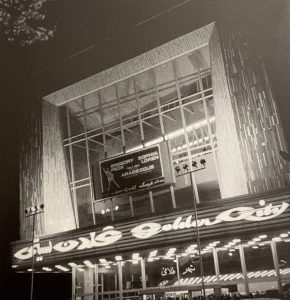
Figure 7: Golden City Cinema by Irano-Armenian architect Yougenia Aftandilians, located on Takht-i Jamshīd Avenue, Tehran, 1969. Photo: Mahmūd Pākzād, in Old Tehran: Photography by Mahmūd Pākzād (1941-1975) (Tehran: Dīd Publications, 2003), 314.
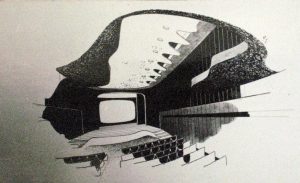
Figure 8: Rendering of the Ministry of Arts and Culture’s amphitheater by Irano-Armenian architect Yougenia Aftandilians, Tehran, 1977. Photo with copyright: Private collection and courtesy of Grigor Nazarian. Reproduced with permission.
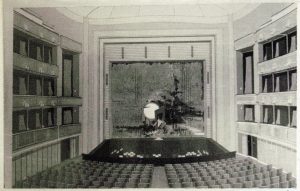
Figure 9: Rendering of the stage of Rūdakī Concert Hall by Irano-Armenian architect Yougenia Aftandilians, Tehran, 1967. Photo with copyright: Private collection and courtesy of Grigor Nazarian. Reproduced with permission.
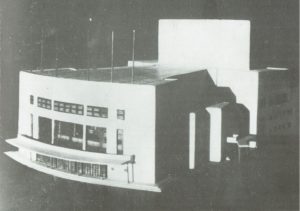
Figure 10: Model proposal for a state theater or an “Opera House,” by Armenian architect Gabriel Guevrekian, unrealized, 1933. Photo credit: Elizabeth Vitou, Dominique Des Houliers, and Hubert Janneau, Gabriel Guévrékian: Une autre architecture moderne (Paris: Connivences, 1987), 97.
Perhaps encouraged by the success of the leisure industry, particularly the cinema, or perhaps to bolster the bread and circus strategy, the government authorized in the 1960s, the launching of a series of recreational hubs (in effect, billiard rooms) for teens, called the Club of Healthy Leisure (bāshgāh-i tafrīhāt-i sālim). While these centers turned out to be a disaster as they contributed to the increase in teen gambling addiction and drug abuse, the campaign of visual hygiene burgeoned. Muhammad-Rizā Shah and Empress Farah Pahlavī continued to embody the image of a nation that was already modernized. Western and Iranian official publications, as well as tabloids like Life Magazine, continued to disseminate photographs of the royal couple engaging in various sporting and leisure activities, including skiing, waterskiing, horseback riding, and riding a Harley. While casually standing in the perfect posture of ski aesthetics and no longer needing the support of architecture, their healthy, fit, and beautiful bodies depicted the fulfilled project of modernity. As a telling sign, when “the massive dams … proudly named after his relatives” broke in 1978, the Pahlavī leisure architecture was the first target of revolutionary iconoclasm.32Ervand Abrahamian, Iran Between Two Revolutions (Princeton: Princeton University Press, 1982), 496.
Elsewhere I have argued that the Iranian Revolution of 1977-79 is considered one of the mildest in terms of widespread people-inflicted violence towards architecture and cultural heritage among the major political revolutions of the modern era, including in particular the French and the Russian revolutions, notorious for vandalism and destruction of royal and church property.33See Talinn Grigor, Building Iran: Modernism, Architecture, and National Heritage under the Pahlavi Monarchs. (New York: Periscope, 2009), Epilogue, 202-222; and Talinn Grigor, “The Thing We Love(d): Little Girls, Inanimate Objects, and the Violence of a System,” in The Destruction of Cultural Heritage in the Middle East: From Napoleon to ISIS, The Aggregate Architectural History Collaborative, eds. Nasser Rabbat and Pamela Karimi (Cambridge: MIT, 2016), https://we-aggregate.org/piece/the-thing-we-loved-little-girls-inanimate-objects-and-the-violence-of-a-system. The statues of Pahlavī royalties, along with movie theaters, were an exception. Many cinemas were attacked and burned down—most prominently, Ābādān’s Cinema Rex was set ablaze by Islamist extremists on August 19, 1978, trapping 377 moviegoers in an inferno. Like Pahlavī cinema architecture, the king’s body, which had stood as the symbol of the nation’s health, had also been under attack since 1973 when he was diagnosed with cancer. After the revolution, these sites of middle-class cosmopolitan lifestyle were themselves supplanted by new modalities of class ethics and their corresponding aesthetics. During the decades between the Iran-Iran War (1980-88), the Cultural Revolution (1982-84), and today, Iran has also lost not only ninety percent of its Armenian population but also, with some exceptions including outstanding monographs on Guevrekian, Hovhannisian, and Apcar, the history of their significant contributions to Iranian modern architecture and the Iranian modernization process. This “minor” history is important because, unlike its rivals with significant Armenian populations, the Ottoman and Romanov empires, the Iranian ruling dynasties since the Safavids have recognized the importance of their religious minority communities in their imperial structures, in great part, due to the long and rich tradition of Persianate cultural erudition.34My current book projects, entitled The Hyphenated Architect, aims to recover the lost history of the contribution of Iran’s religious minorities, particularly Armenians, to Iranian cultural modernism. In this book as well as my recent coauthored book, we make this same argument. See Houri Berberian and Talinn Grigor, The Armenian Woman, Minoritarian Agency, and the Making of Iranian Modernity, 1860–1979 (Stanford: Stanford University Press, 2025).

Before the narrative even begins, Rakhshān Banī-i‛timād’s Nargis (Nargess) of 1992 directly engages the theme of love. As the film opens accompanied by the melodic score, a close-up of a conventional bride and groom figurine appears, dancing. As the credits roll, photo scraps materialize on the black-and-white screen. These images are of the couple whose story we will soon witness. As the credits continue, the camera zooms out, allowing us to see the dancing figurine in its entirety, protected and covered by a glass dome. The transparent shield momentarily protects this imaginary couple from the realities of the outside world. Here, Banī-i‛timād uses symbolic imagery in the opening of the film to comment on love, but as the plot unfolds, these same images return to the screen with entirely different meanings.
This figurine, and its later reappearances, thus becomes one of the ways in which Nargis conveys a love story that is not only unconventional but also culturally taboo. For example, the plastic bride and groom figurine, at first sight, stands for the image of love and stability, represented by marriage. However, very quickly this facade is broken down. In a later scene, we watch the character ‛Ādil (played by Abulfazl Pūrarab) sifting through his bag of stolen goods, then taking out this same figurine. Thus, the identical object that represents marriage in the opening credits also foreshadows the tragic love story that is about to unfold, yoked with issues of gender, class, and crime. As the credits come to an end, the music stops, the screen turns dark, and we watch ‛Ādil panting, running as he escapes from the police. Before the love story even fully begins, it is already interrupted by the harsh realities of its external environment, metaphorically shattering the glass shield the bride and groom have been momentarily protected by. This pre-opening scene is significant; it relies on conventional depictions of love that also push the boundaries of what is permissible in Iran. However, while the imagery and symbolism allude to a typical romance, the narrative could not be further from a normative depiction of romantic tropes.

Figure 1: The statue of the bride and groom that ‛Ādil steals at the beginning of the film. Nargis (1992), Rakhshān Banī-i‛timād, accessed via https://www.aparat.com/v/x1625tj (00:03:49)
Instead, Banī-i‛timād’s Nargis tells a complex and heart-wrenching love story between three people. The film revolves around the triangular relationship between the petty-thief ‛Ādil, his older ex-lover and partner in crime Āfāq (played by Farimāh Farjāmī), and the innocent, younger woman Nargis (played by ‛Ātifah Razavī), who ‛Ādil falls in love with. Upon meeting Nargis, ‛Ādil decides to put aside his bad habits and to ask Nargis for her hand in marriage. In order to do so, however, he needs the support of his mother who, as it turns out, has shunned him. In fear of losing him forever, Āfāq decides to act the part of ‛Ādil’s mother, playing the role of the maternal figure, eventually staged in front of Nargis and her family, to help secure the marriage. Āfāq’s help comes with a lifetime promise, however: ‛Ādil can never leave her. Nargis, unaware of ‛Ādil’s complicated past, agrees to marry him.
Nargis marks Banī-i‛timād’s first explicit engagement with the subject of love and female desire; a trend that continues to shape her later works. In this vein, Banī-i‛timād brings to the screen unconventional love stories, but ones that still rely on the conventions of cinematic language. Films such as Nargis conform to the visualization and conventions of love through close-ups, score, lighting, and gaze to create intimacy, enabling Banī-i‛timād to boldly envisage love on the screen and firmly push against the boundaries of what is permissible in post-revolutionary Iranian cinema. In doing so, the complicated love stories we watch throughout Banī-i‛timād’s cinematic creations reflect their real-life cultural and political contexts. In relaying them, Banī-i‛timād confronts the restrictions of censorship and dares to bring love onto our screens, but also shows us how these stories are always intertwined with issues of gender and class. To fully grasp the historical significance of Banī-i‛timād’s Nargis, I begin by first contextualizing the film. From there, I open up a discussion for us to think about love more generally across Iranian art and cinema, reflecting on the restrictions imposed by state censorship in order to respond to the question: how do we screen love in a nation that forbids it? Finally, we return to Nargis, closely analysing the ways in which Banī-i‛timād engages with a forbidden love story, the film’s influence on her later works, and how such works dare to hope and dare to love.1I have previously written on Banī-i‛timād’s cinema through the lens of resistance. For instance, see: Zahra Khosroshahi, “The Artistic and Political Implications of the Meta-Cinematic in Rakhshan Banietemad’s Films,” in ReFocus: The Films of Rakhshan Banietemad, ed. Maryam Ghorbankarimi (Edinburgh: Edinburgh University Press, 2021), 81-94.; Zahra Khosroshahi, “Tracing the Tooba Character in Rakhshan Banietemad’s Cinema,” in Cinema Iranica, ed. Mohamad Tavakoli-Targhi (Toronto: University of Toronto, 2024), https://cinema.iranicaonline.org/article/through-time-and-space-tracing-the-tooba-character-in-rakhshan-banietemads-cinema/; and Zahra Khosroshahi, “Rethinking the Borders of Feminism: The Representation of Women in Rakhshan Banietemad’s films,” Feminist Media Studies, 20, no. 2 (2020): 294-296.

Figure 2: Āfāq is sitting in front of ‛Ādil in a restaurant when their conversation escalates into an argument. Nargis (1992), Rakhshān Banī-i‛timād, accessed via https://www.aparat.com/v/x1625tj (00:18:18)
Contextualizing Banī-i‛timād’s Nargis of 1992
When we speak of Nargis we speak of Iran’s cinema in 1992, a time when any depiction of love was seen as highly controversial. About Nargis, Asal Bagheri posits that it is “the first film after the Revolution that is based on a social taboo.”2Asal Bagheri, “The Blue-veiled: A Semiological Analysis of a Social Love Story,” in ReFocus; The Films of Rakhshan Banietemad, ed. Maryam Ghorbankarimi (Edinburgh University Press: 2021), 142. The post-revolutionary ideals that defined the country’s cinema were still fully intact and very much enforced at this time, producing a cinema that had to abide by Islamic laws and distance itself from any form of “Westernization.” Many Iranian film scholars have also commented on the significance of Banī-i‛timād’s Nargis in cementing her reputation as a filmmaker in Iran. Winning the Best Director for Nargis in 1991 at the 10th Fajr International Film Festival, Banī-i‛timād became the first woman to “garner the award for a feature film.”3Hamid Naficy, A Social History of Iranian Cinema: Vol. 4; The Globalizing Era, 1984-2010 (Duke University Press: 2012), 159. “This recognition,” Hamid Naficy adds, “corroborated her status not as a woman filmmaker but as a top Iranian filmmaker.”4Naficy. A Social History of Iranian Cinema, 159. In her discussion of the reception of Nargis, Shiva Rahbaran regards the film as representing “the vanguard of post-revolutionary Iranian cinema.”5Shiva Rahbaran, Iranian Cinema Uncensored: Contemporary Film-Makers Since the Islamic Revolution (I. B. Tauris, 2016), 1. Similarly, Hamid Reza Sadr considers the film “daring,” and “one of the first films after the revolution to focus on sexual relationships.”6Hamid Reza Sadr, Iranian Cinema: A Political History (I. B. Tauris, 2006), 259.
The significance of Nargis rests on a number of reasons, flagging it as a hallmark within women’s post-revolutionary filmmaking. Nargis introduced Banī-i‛timād as one of Iran’s most prominent filmmakers, both nationally and internationally. Most importantly, however, is the way in which Nargis shifted Banī-i‛timād’s storytelling and filmmaking. As Maryam Ghorbankarimi argues, the film is the “turning point in [Banī-i‛timād’s] career.”7Maryam Ghorbankarimi, A Colourful Presence: The Evolution of Women’s Representation in Iranian Cinema. (Cambridge Scholars Publishing: 2015), 67. Ghorbankarimi continues, arguing that “the unifying use of cinematic language and the thematic connections between all her films since Nargess define her as an auteur-director.”8Ghorbankarimi, A Colourful Presence, 67-68. In contrast to Nargis, her earlier satirical narrative films Off Limits (Khārij az mahdūdah, 1987), Yellow Canary (Zard-i qanārī, 1988), and Foreign Currency (Pūl-i khārijī, 1989), however bold in addressing social issues, do not rely on women as key agents of their narratives. Banī-i‛timād’s reputation as a filmmaker shifted after 1992 when she began to address women’s issues directly and center their stories within her films. Also, as Bagheri notes, Banī-i‛timād’s “evolution as a social realist director” begins with Nargis, but what is significant is the way in which these stories concerning women are combined with a “romantic style,” using love as their anchor to explore intersections of contemporary Iranian society.9Bagheri, “The Blue-veiled: A Semiological Analysis of a Social Love Story,” 144.

Figure 3: Āfāq is undoing a knitted dress while listening to ‛Ādil’s heartache. Nargis (1992), Rakhshān Banī-i‛timād, accessed via https://www.aparat.com/v/x1625tj (01:18:06)
In addition to centralizing women in her films, Banī-i‛timād began to play with the depiction of sexual love and desire on the Iranian screen, themes regarded as forbidden and taboo in the country’s cinema. Due to such taboos and censorship, love outside of marriage is often difficult to visualize or even speak about in post-revolutionary Iranian cinema, especially in its earlier years. Equally, the portrayal of women as sexual beings with their own desires was and remains unfavourable. What stands out in Nargis is its delicate negotiation with censorship codes in a way that dares to depict romantic and sexual love between its characters. As Hamid Dabashi notes, Banī-i‛timād’s “semiotic sense of names, shapes, objects, and colors assumes a mythical proportion when it comes to the point of visually insinuating moments of intimacy between a man and a woman as permitted on an Islamic screen.”10Hamid Dabashi, “Body‐less Faces: Mutilating Modernity and Abstracting Women in an ‘Islamic Cinema,’” Visual Anthropology 10, nos. 2-4 (1998): 371. Cinematic language, along with the symbolic motifs Banī-i‛timād employs in her films, become both the driver of her plot and the tools that enable her to resist censorship and tell her story.
Thus, by examining the depiction of the film’s female characters, along with the treatment of love and desire, this article considers how Nargis visualizes and negotiates the taboo through cinematic elements and narrative. Ultimately, this article demonstrates how the film tells a love story that is unconventional, challenging many of our expectations and perceptions of what love is in an Islamic and Iranian post-revolutionary society. Importantly, Nargis does this by bringing to the fore central female characters that are dynamic and complex, pulling them from the margins of society to the heart of the narrative. It also achieves this through expert use of visual symbolism.
Indeed, the symbolism that has come to define second wave Iranian cinema has given the nation its own visual brand. Often, ambiguity and metaphor are also employed to both challenge and bypass state censorship. As Negar Mottahedeh argues, on the international stage, Iranian cinema is known for its artistic expression that often blurs the lines and boundaries of fiction and non-fiction.11Negar Mottahedeh, Displaced Allegories: Post-Revolutionary Iranian Cinema (Duke University Press, 2009), 15. These symbolic and metaphoric references, along with the poetic nature of Iranian cinema, have become a trademark of the nation’s cinema post-1979. This stylistic branding, I argue, is far more than an artistic choice. It is out of necessity—a language that Iranian filmmakers often resort to as a way to cope with censorship. But, as I will discuss later, it is even more than that.
While Iranian cinema faces censorship laws that limit its content so that it abides by the guidelines of the Islamic Republic, the codes and lines are not always as clear as they may seem. Reflecting on the censorship laws in Iran, Banī-i‛timād has remarked: “The Ershad [Ministry of Culture and Islamic Guidance] never allows any freedom to anyone. We had to fight for our freedom. I push the boundaries; they wouldn’t give me freedom as a gift – neither to me nor to any other artist.”12Rahbaran, Iranian Cinema Uncensored,133-4 (the emphasis is original). She continues, “I want to point out that there are discrepancies – gaps – between the official line of the Ershad and the reality of film-making in Iran. It is within these gaps that we search for our freedom and try to gain it bit by bit.”13Rahbaran, Iranian Cinema Uncensored, 134. It is between these inconsistencies and gaps that filmmakers seek a path, to push against the boundaries of what is permissible.

Figure 4: Āfāq holds ‛Ādil’s shirt tightly after he tells her he plans to get married and leave the house. Nargis (1992), Rakhshān Banī-i‛timād, accessed via https://www.aparat.com/v/x1625tj (00:26:19)
The image of the Iranian woman on screen—in and outside of the country—has changed immensely. As well, the ways in which love and intimacy show up on the screen, despite continued control and censorship, have evolved. Writing on intimacy in Iranian cinema, Michelle Langford states that it is “thanks to filmmakers like Rakhshān Banī-i‛timād, who are willing to push the representation of intimacy to the very limits of censorship, [that] viewers can finally experience the much-anticipated and long-withheld embrace of a husband and wife.”14Michelle Langford, “Tales and the Cinematic Divan of Rakhshan Banietemad,” In ReFocus the Films of Rakhshan Banietemad, ed. Maryam Ghorbankarimi (Edinburgh University Press: 2021), 72. Langford here refers to the embrace of Nubar (played by Fātimah Mu‛tamid-Āryā) and Rizā (played by Farhād Aslānī) from Banī-i‛timād’s latest feature, Tales (Qissahā, 2014)—an important film in this discussion which I address later. By contextualizing Iranian cinema and reading it within its own time, we can better understand the cinematic shifts ignited by filmmakers such as Banī-i‛timād. In a cinema with laws against a close-up of a woman, Nargis became a trailblazer. What is special about films like Nargis is the way in which they have the potential to shift the trajectory of films about women in Iran, bringing to our screens in 1992 depictions of women whose stories, voices, and images had, until that time, been marginalized and ignored.
Though social issues have been a consistent interest of Banī-i‛timād throughout her entire career, the turn to more controversial issues around gender and sexuality and their intersection with class politics became much more prominent and bolder in her works since Nargis. We can observe this, for instance, in how the love story that Banī-i‛timād tells in Nargis subverts ideas of femininity and masculinity through the intersections of age, power, crime, and class. The moments of romance peppered throughout the film certainly offer cultural critique, but while they engage with the harsh realities of Iranian society, they still manage, even if short-lived, to convey a love story in a cinema that works hard to forbid them. Regarding this conversation about love on the post-revolutionary screen, it is worthwhile to turn briefly to its depiction in Iranian art and cinema more broadly.

Figure 5: Āfāq recalls the joyful moments with ‛Ādil. Nargis (1992), Rakhshān Banī-i‛timād, accessed via https://www.aparat.com/v/x1625tj (00:38:04)
Depicting Love and Desire in Iranian Cinema
While Persian literature has traditionally dealt with themes of love and desire, under the current Iranian regime there are strict Islamic guidelines and laws to follow, both in everyday circumstances and, invariably, in film. For example, “unrelated men and women are forbidden to touch one another.”15Shahla Haeri, “Sacred Canopy: Love and Sex under the Veil,” Iranian Studies, 42, no. 1, (2009): 114. In addition, under Islamic law in Iran women must be veiled in all public spaces. Given this state of affairs, Shahla Haeri poses an important question: “how, then, can one make movies based on love and carnal desire without having the lovers even touch each other’s hand?”16Haeri, “Sacred Canopy: Love and Sex under the Veil,” 114. In the face of these restrictions, post-revolutionary Iranian cinema has had to negotiate with censorship codes and find creative ways to represent love and desire. At the same time, as Haeri argues: “although the Islamic legal discourse has reasserted itself after the revolution of 1979 and appears to have become dominant, in fact the ‘erotic’ discourse that is ever so subtly embedded in Persian poetry and popular culture is alive and possibly thriving.”17Haeri, “Sacred Canopy: Love and Sex under the Veil,” 114. She further describes the historical tension between the “legal discourse that restricts gender relations” and the “erotic discourse that subverts the very same regulations,” vividly demonstrating the long tenure of these competing and conflicting discourses and their ongoing influence.18Haeri, “Sacred Canopy: Love and Sex under the Veil,” 114-115.
Reflecting on the role of women in Persian literary practice specifically, Farzaneh Milani asks: “what are the ways in which gender and space intersect in the Iranian literary arena?”19Farzaneh Milani, “Voyeurs, Nannies, Winds, and Gypsies in Persian Literature,” Critique: Critical Middle Eastern Studies, 8, no. 14, (1999): 107. She continues by asking: “if seclusion is an attempt to erase women from the public scene, how, then, have authors of numerous Iranian romances reconciled narrative imperatives with cultural proprieties and constructed feminine voices and images in a sex-segregated society?”20Milani, “Voyeurs, Nannies, Winds, and Gypsies in Persian Literature,” 107. Milani’s questions are relevant beyond literature and equally applicable to the nation’s post-revolutionary cinema, especially as women gain prominence both behind and in front of the camera.
In her work on literature, Milani further describes the models of virtue and femininity placed upon women; traditionally, a virtuous woman was one who “covered her body, guarded her honor, controlled her desires, measured her words.”21Milani, “Voyeurs, Nannies, Winds, and Gypsies in Persian Literature,” 107. Indeed, these “codes of ideal femininity, masculinity, and honor [that] demanded the exclusion of women from the public sphere” are reminiscent of the same ones witnessed in the early years of the Islamic Revolution when women were systematically pushed out of sight.22Milani, “Voyeurs, Nannies, Winds, and Gypsies in Persian Literature,” 107. It is through the inclusion of characters such as Āfāq, who is nowhere close to the ideal image of a woman of honour and virtue, that cinema begins to not only shift the representation of femininity and womanhood, but also begins to question these ideals entirely. Relatedly, Milani speaks of a “deep-seated desire to maintain strong sexual boundaries” and “to restrict women’s mobility” in literature in order to restore social order.23Milani, “Voyeurs, Nannies, Winds, and Gypsies in Persian Literature,” 123. If this is true in literary practices, then I would argue that it is enforced even more vigorously in cinema because of its visual nature.
How, then, do filmmakers engage with and visualize love and desire? What Ziba Mir-Hosseini refers to as the “art of ambiguity” in Persian poetry offers a good starting point for us to consider. It is worth quoting her at length:
Love has always been the main theme in Persian poetry, where it is seldom clear whether the writer is talking about divine or earthly love, or (given the absence of grammatical gender in Persian) whether the “beloved” is male or female. Both the Persian language and the poetic form have allowed writers to maintain and even work with these ambiguities. The art of ambiguity (iham), perfected in the work of classical poets such as Hafez, has spoken to generations of Iranians, including the present one.24Ziba Mir-Hosseini, “Negotiating the Forbidden: On Women and Sexual Love in Iranian Cinema,” Comparative Studies of South Asia, Africa and the Middle East, 27, no. 3, (2007): 694.
The art of ambiguity that Mir-Hosseini describes here is prevalent in other art forms, but most especially in post-revolutionary Iranian cinema. In this cinema, the goal of censorship is to ensure that films stay as far away as possible from “Westernization,” to promote Islamic values, to maintain social and political order, and to limit representations of love and desire. In the face of these many restrictions, particularly concerning the erotic, desire, and touch between lovers, one of the most useful arts of ambiguity for Iranian film-makers is allegory.
The use of allegory, through metaphors, double-entendres, symbolism, and ambiguity, has always been a part of Persian literary practices and language. In many ways, the ambiguous cinema of post-revolutionary Iran is rooted in, or at least greatly influenced by, these literary traditions. As many scholars of Iranian cinema have acknowledged, much of the nation’s cinematic visual aesthetic has also been significantly shaped by the Revolution of 1979. Thus, while iconic images and stories populating our screens are certainly influenced by poetic and linguistic traditions, censorship has necessitated a cinema that is implicit, coded, and ambiguous. Yet, as Langford reminds us, “it is important to recognize that for many Iranian film-makers, allegory is much more than a foil against haphazardly applied censorship rules, or an attempt to hide meaning under a veil of secrecy.”25Michelle Langford, Allegory in Iranian Cinema: The Aesthetics of Poetry and Resistance (Bloomsbury: 2016), 2. That is, allegory is not only a means of avoiding the censor, but also a rich mode of cinematic expression itself. Thus, Langford acknowledges how, on the one hand, because of “its capacity to say one thing while meaning another,”26Langford, Allegory in Iranian Cinema, 2. allegory has “proven to be a powerful way of evading state censorship and expressing forbidden topics or issues.”27Langford, Allegory in Iranian Cinema, 2. While on the other hand, Langford’s central argument, essential to our reading of Banī-i‛timād, highlights the relationship between the image and the audience: “allegorical aesthetics cues or prompts viewers to look for hidden meaning or to experience a film poetically beyond the literal level of story.”28Langford, Allegory in Iranian Cinema, 1. That is, the images on the screen invite the audience to actively engage with the cinematic text. This is especially relevant when we consider Banī-i‛timād’s body of work: an oeuvre covering over four decades that is also reliant on the stories of recurring characters that tap into our cultural memory (e.g., the character Sara who appears in both Mainline [Khūn-bāzī, 2006] and Tales [2014]).

Figure 6: Nargis meets ‛Ādil outside the house. Nargis (1992), Rakhshān Banī-i‛timād, accessed via https://www.aparat.com/v/x1625tj (00:19:29)
How then, given this ambiguous environment, do we read Banī-i‛timād’s cinema? What interests me most about the filmmaker’s works is their refusal to fit neatly into any category. Devoted to making social films, Banī-i‛timād’s expansive body of work explores a range of forms, oscillating between realist, documentary-style filmmaking to melodrama. Whether set in metropolitan Tehran or the rural landscapes of Gīlān, the director remains dedicated to those on the margins. In his discussion of Iranian cinema, Stephen Weinberger compares two types of films. The first he refers to as “gentle heartwarming films” that are not concerned with political or cultural issues, “sitting comfortably within the confines of censorship.”29Stephen Weinberger, “Joe Breen, The Ayatollah Khomeni, and Film Censorship,” Quarterly Review of Film and Video 26, no. 3, (2009): 211. Many of these films include the most celebrated and acclaimed of Iran’s cinema, fitting neatly into the allegorical and ambiguous brand the nation’s cinema has established. Then, there is “the other type of film,” those Weinberger refers to as a “voice of protest.”30Weinberger, “Joe Breen, The Ayatollah Khomeni, and Film Censorship,” 211. Unlike their heartwarming cousins, these films stretch “the censorship system to its limits,” specifically naming “Banī-i‛timād as the most prominent director of such films.”31Weinberger, “Joe Breen, The Ayatollah Khomeni, and Film Censorship,” 211. Like any other Iranian film-maker, Banī-i‛timād utilizes cinematic codes and visuals to bypass censorship, but her commitment to social issues is never masked behind an apolitical cinema. Indeed, characters like Āfāq, Nargis, and Tūbā (played by Gulāb Ādīnah in Under the Skin of the City (Zīr-i pūst-i shahr, 2001), through the combination of their complexities, social status, and circumstances, offer very loud and clear voices of protest. With these elements of ambiguity, allegory, and vocal protest in mind, I now turn back to Nargis in order to examine closely the ways in which intimacy, love, and desire are foregrounded on the post-revolutionary screen as a daring provocation that confronts Iran’s social issues.
Negotiating Forbidden Love on Banī-i‛timād’s Screen
Banī-i‛timād’s Nargis marks a pivotal moment in the filmmaker’s career, setting the foundation for her exploration of the subject of love in her later films. As Sadr argues, Nargis plays “with another Iranian taboo: sex between an older woman and a younger man.”32Sadr, Iranian Cinema, 259-260. As it will be the focus of this section, the film introduces to Iranian cinema not only a love triangle narrative, but also depicts love and intimacy in a way that, for its time, was considered truly bold and daring. In Nargis, Banī-i‛timād makes space for love on the post-revolutionary screen—no easy task!—and, more importantly, relies on forbidden love to explore contemporary Iranian society and the intersections of gender and class.
While the film undoubtedly plays with the taboo of sex between an older woman and a younger male lover, this love affair is further complicated through the Nargis character who enters their dynamic. In relaying this love story, Banī-i‛timād is also invested in complicating the role of motherhood, a trend we continue to see in her later films. Āfāq, the older experienced lover (in both crime and sex), must now perform the maternal role, but only in order to retain her (sexual) hold on ‛Ādil. One of the most poignant moments in establishing this polygamous exchange is the film’s Khāstigārī scene (i.e., the initial step in a traditional courtship process). Having agreed to perform the role of ‛Ādil’s mother, Āfāq joins him to ask for Nargis’ hand in marriage. While this ensures an eternal bond between them, it also displays Āfāq’s loyalty to ‛Ādil.

Figure 7: Āfāq, in the role of ‛Ādil’s mother, on his proposal day. Nargis (1992), Rakhshān Banī-i‛timād, accessed via https://www.aparat.com/v/x1625tj (00:31:43)
First, this scene establishes the polarization of its two women characters, Āfāq and Nargis, seeming to operate within the paradigm of what Shahla Lahiji terms chaste-and-unchaste representations.33Shahla Lahiji, “Chaste Dolls and Unchaste Dolls: Women in Iranian Cinema,” in The New Iranian Cinema: Politics, Representation and Identity, ed. Richard Tapper (I.B. Tauris: 2002), 215-26. An added layer to this initial representation of Nargis is her name: Nargis refers to a flower, furthering her characterization as chaste and virginal. The visual construction of the two women further heightens the scene. Nargis, as is customary of the bride-to-be, enters the small and humble sitting room carrying tea on a tray. The camera captures her as she pauses by the door, quietly greeting her guests. The camera then cuts to Āfāq who looks up, not responding. Nargis offers tea, first to Āfāq and then to ‛Ādil. Here for the first time the three appear in the same cinematic frame, visually depicting their complex triangular relationship. Banī-i‛timād further emphasizes their differences through light and dark colours to mark the two women’s clothing.

Figure 8: Nargis serves tea on her proposal day. Nargis (1992), Rakhshān Banī-i‛timād, accessed via https://www.aparat.com/v/x1625tj (00:30:40)
Once Nargis is seated, the conversation begins. Nargis’ mother asks Āfāq, “Ma’am, what does your son do?”34Nargis, 00:29:10-00:29:14 (the translation is mine). The camera then shifts to Āfāq as she looks up, asking in a distraught tone, “My son?”35Nargis, 00:29:16-00:29:17 (the translation is mine). In this moment, the film uses the information that is available to the audience to create pathos for Āfāq. While to Nargis and her family, Āfāq is ‛Ādil’s mother, those watching are fully aware of their romantic—and criminal—intertwinement. To further comment on the emotional disturbance experienced by Āfāq, Banī-i‛timād uses her camera to fully isolate the character for a brief moment and to then juxtapose her facial expression with the celebration of the wedding. Once the agreement has been reached, the sound of drums and wedding music can be heard, yet the camera remains focused on Āfāq, dressed in black as if in mourning. The scene then cuts to the next shot where we see the drums and Nargis dressed in white as a bride. Up to this moment, we have only been introduced to Nargis and Āfāq in separate scenes. Their first encounter with one another is Āfāq’s performance of motherhood, and through this, Banī-i‛timād complicates their already complex polygamous relationship. The two women are contrasted through Banī-i‛timād’s camera in this scene, yet, through their class status, they are brought under the same roof (and within the same marriage).

Figure 9: Āfāq, wearing a black dress, stands next to Nargis, who is dressed as the bride in white. Nargis (1992), Rakhshān Banī-i‛timād, accessed via https://www.aparat.com/v/x1625tj (00:33:50)
Āfāq’s performance of motherhood is done out of necessity, strategically functioning to ensure continuity in her relationship with ‛Ādil. But it is also worth reading this particular example in Nargis within Banī-i‛timād’s broader representation of mothers. The director’s corpus offers nuanced depictions of motherhood in films such as Blue Veiled (Rūsarī-i ābī, 1995), The May Lady (Bānū-yi Urdībihisht, 1999), Under the Skin of the City (2001), Mainline (2006), and Tales. While motherhood is not the central theme of Nargis, the way in which Āfāq navigates the role foreshadows the director’s later works. Āfāq’s roleplaying here facilitates the marriage and brings Nargis into their dynamic, as yet unaware of their illicit backgrounds. It is only after ‛Ādil’s first arrest since his marriage with Nargis that she finds out about his criminal past. Returning home from the prison, Nargis finds Āfāq waiting by the door. By this point, ‛Ādil has warned Nargis to stay away from Āfāq which adds to the suspense of this scene. Our view cuts to Nargis, on the floor pleading and crying, asking Āfāq why she never disclosed the truth about her “son” and his life of crime. In response, Āfāq, turning to face Nargis says: “This is just the beginning. When I was your age, I had a train track of stories behind me.”36Nargis, 00:56:17-00:56:22 (the translation is mine).

Figure 10: Nargis cries and blames Āfāq for not revealing ‛Ādil’s criminal past. Nargis (1992), Rakhshān Banī-i‛timād, accessed via https://www.aparat.com/v/x1625tj (00:58:05)
The next scene is of the two women in Nargis’ small bedroom: Āfāq lying down on the mattress, and Nargis sitting next to her, the two engaged in conversation. Up until this moment, the film has drawn on vivid distinctions between the two characters. In this key scene, however, Banī-i‛timād’s cinematic frame creates a space that uses class and gender politics to bring together Nargis and Āfāq in the intimate setting of the bedroom. Here, along with Nargis, we listen to Āfāq relay her past. Banī-i‛timād’s Nargis relies on pathos as a strong tool to convey an emotional response, and despite largely framing Āfāq as a societal outcast, offers her meaningful screen time in this moment to complicate our feelings about her. Through their increasing homosocial bond, the scene builds an important intimacy between the two women, the narrative and the camera bringing Nargis and Āfāq under the same roof and within the same cinematic frame. However, there is a sexual undertone at play here, too. Āfāq, who has been playing the maternal role of ‛Ādil’s “mother,” has now entered the bedroom of the couple. Significantly, it is the homosocial nature of the scene shared between the two women that enables Banī-i‛timād to film this. ‛Ādil’s absence allows the director to escape any hassle from the authorities. Nonetheless, despite his physical absence, it is not lost for the viewers that the only point of connection between the two women is ‛Ādil: a man both women have had sex with. Their sharing of this intimate (and sexualized) space tightens the triangular quality and blurs the lines of their polygamous relationship—and further descends into the realm of the “forbidden.”

Figure 11: Āfāq and Nargis are talking in Nargis’s bedroom, and Āfāq tells her about her past. Nargis (1992), Rakhshān Banī-i‛timād, accessed via https://www.aparat.com/v/x1625tj (01:00:07)
As I have already mentioned, despite censorship and bans by authorities, expressions of sexual and romantic interest somehow continue to find themselves on the Iranian screen. Banī-i‛timād’s cinema takes this a step further, however, by foregrounding characters from the margins of Iranian society. In this way, her love stories also function as an essential gateway into gender and class politics by subverting binaries and depictions of good vs. bad and chaste vs. unchaste. Instead, Banī-i‛timād’s screen brings forth daring characters that step outside of their prescribed roles. As Naficy points out: “casting a woman as an expert thief was something new, pushing casting boundaries.”37Naficy, A Social History of Iranian Cinema, 158. As previously discussed, Banī-i‛timād not only goes against casting conventions but, more importantly, meaningfully includes marginalized characters such as Āfāq as central to her stories. In one of the film’s most economical scenes, we watch Āfāq as she applies lipstick upon ‛Ādil’s visit. The guidelines of censorship (especially at that time) prohibit the use of make-up and close-ups, adding to the scene’s importance. Here, Āfāq performs what is prohibited, aligning her with her cinematic role. Her application of lipstick also functions as a reclamation of her sexuality (and her desire for ‛Ādil). But the scene also increases our sympathy for the older, criminal woman. Banī-i‛timād speaks to the construction of this scene and its significance:
Many factors are involved in creating a scene in a film: script, performance, lighting, sound, set design, and so on. Directing is about bringing all of these together to help create that moment the filmmaker is after. In my opinion, one of the most important elements of this scene was its location. A hidden upstairs room that faces the alley, with a wide mat hung from the large window and light peeking through the window—this helped convey Afagh’s lonely and sad life, and her corrupt relationship with the outside world.38Kay Armatage and Zahra Khosroshahi, “An Interview with Rakhshan Banietemad,” Feminist Media Histories 3, no. 1 (2017): 144.

Figure 12: Āfāq looks at ‛Ādil through bamboo shades. Nargis (1992), Rakhshān Banī-i‛timād, accessed via https://www.aparat.com/v/x1625tj (01:14:17)
In fact, as Banī-i‛timād herself describes, there is a lot happening in this sequence. The mise-en-scène makes visible not only Āfāq’s loneliness but also her class status, the tight space of the room visually marking her as an outcast. These cinematic conventions create a sense of closeness and heightened sympathy towards Āfāq. But there is also an element of agency here. Rahbaran describes Nargis as a “film that not only deals with woman’s sexuality and lust but goes a step further and represents the male protagonist as the sex object of that woman,” reversing more traditional gender roles.39Rahbaran, Iranian Cinema Uncensored, 134. That is, this scene dares to acknowledge Āfāq’s desire to be desired. While the filmmaker pushes censorship codes by having her character perform the forbidden (through the application of lipstick), Āfāq herself, though heartbroken, reaches for her lipstick, claiming her agency and sexuality.
With Nargis, Banī-i‛timād obviously challenges traditional gender roles, but this complex love affair also distorts the conventions of love and romance. Importantly, the film does this in such a way that reminds us of the fragility of the polygamous marriage further complicated by class politics. As previously noted, the film’s opening sequence and credits momentarily indulge in the conventions of love, leading with images and a score that convey the visual and sonic codes of romance. On the screen, as the credits roll, the figurine of the bride and groom dancing to the music thus become metonymical for love. While the figurine seems at first to be an after-thought, it appears again later in the film. In fact, as the love story ensues, the audience is confronted with a subplot that complicates the initial setup entirely. Even though the figurine in the opening of the film clearly alludes to the performance of love and marriage, as the plot unfolds we are confronted with a love story that moves far away from the clichéd depictions of romance. Instead, Banī-i‛timād delves deeply into the margins of Iranian society, complicated with issues of class, inequality, crime, and gender politics.

Figure 13: ‛Ādil went to Āfāq to discuss his plan to steal from the house. Nargis (1992), Rakhshān Banī-i‛timād, accessed via https://www.aparat.com/v/x1625tj (01:14:15)
Immediately following the credits, Āfāq and ‛Ādil appear on screen, running from the police in the dark. As quickly as they race to avoid capture, the curated images of love are quickly interrupted and discarded by the reality of the characters’ lives on the streets. They run, in fact, with a stolen bag, one that carries in it the same figurine from the opening credits. This visual symbol of love is now connected with theft. But there is more to it—this figurine, protected by its glass shield, becomes the ultimate image of love that ‛Ādil aspires to. In a later scene, ‛Ādil, not simply a thief but now also a man in love, places the figurine next to his bed, longing for Nargis, the young woman he had met earlier. Complicating its symbolic power a third time, Banī-i‛timād returns us again to this figurine, going even further to subvert the meaning of the original motif she sets up in the film’s opening. For when ‛Ādil goes to price the stolen items, he is told that the figurine is “worthless.” The very image of love here is stripped of its value.
Banī-i‛timād also employs other images of love to convey emotional intimacy in Nargis. In a country governed by strict censorship laws with tight regulations that forbid women and men from touching, visual codes are key to successfully relaying a love story. Relatedly, a particularly significant moment in the film occurs during ‛Ādil and Nargis’ wedding night. In her pursuit of retaining ‛Ādil’s love and in accordance with her performance as his mother, Āfāq lends her apartment to the newlyweds. As ‛Ādil and Nargis enter the building, the sounds of wedding bells and drums fill the screen. Āfāq runs up the stairs to hide, watching from above as the couple walk into the flat together. Guided by Āfāq’s gaze, the camera lands on the two pairs of shoes left outside by the bride and groom. The shoes, black and white and symbolic of the conventions of marriage, along with the closed door make everything clear. While the censorship codes will never allow us to see what happens behind closed doors, the filmmaker leaves no doubt in our minds. Not only does Banī-i‛timād’s camera lead us to imagine what happens behind the shut, matrimonial doors, but she also exploits this scene to delve deeper into the story. As Āfāq sits on the stairs in tears with a broken heart, the audience is transported via flashback to witness how the love story of Āfāq and ‛Ādil began.

Figure 14: Bride’s and groom’s shoes at the entrance of Āfāq’s house. Nargis (1992), Rakhshān Banī-i‛timād, accessed via https://www.aparat.com/v/x1625tj (00:38:09)
Weinberger calls Nargis both a display of “social criticism and the first post-revolutionary film that tells a love story.”40Weinberger, “Joe Breen, The Ayatollah Khomeni, and Film Censorship,” 211-212. Given that Banī-i‛timād’s investment in social films has long been acknowledged by film critics and scholars, it is perhaps unsurprising but no less extraordinary how love is used as a powerful theme through which the director engages with and explores the nuances of her society and the barriers that exist for those on the margins. While Nargis decidedly paves this path, Banī-i‛timād’s later films such as Blue Veiled, The May Lady, and Tales are additional and excellent examples of films that dare to question censorship codes and that, despite those restrictions, make space for love and intimacy on the Iranian screen.
Throughout her career, Banī-i‛timād has found various, creative means to negotiate the red lines of censorship. As the rules prohibit any contact between men and women, many filmmakers rely on various mediators (e.g., other actors, props, interior monologues, etc.) to bypass the threat of censorship. We see this in Banī-i‛timād’s Blue Veiled when Sanubar (played by Bārān Kawsarī), Nubar’s youngest sibling, is deployed as one such mediator, sitting between the two lovers. In the scene, Sanubar is used as a means to bring the couple closer, functioning as a physical connector between them which creates a much more intimate atmosphere. The same technique is used rather brilliantly in the final scene of Nargis, this time exploiting a prop rather than a person. Standing in the busy and hostile streets of Tehran, Āfāq and ‛Ādil wrestle over a bag of stolen money. As Naficy states, Banī-i‛timād “employs a mediating object to avoid male-female touching.”41Naficy, A Social History of Iranian Cinema, 159. The luggage between the couple becomes a tool to prohibit any contact or touching between them, performing a delicate “political balancing act.”42Naficy, A Social History of Iranian Cinema, 159. Although the bag is certainly deployed as an important mediating tool to bypass censorship, like most symbolic gestures employed by the filmmaker, this too stands as a comment on societal issues. The struggled over bag between Āfāq and ‛Ādil contains stolen money—literally and figuratively that which connects and distances the couple, commenting further on the reality of corruption and the nature of their relationship.

Figure 15: A fight between Nargis and ‛Ādil over a bag of money. Nargis (1992), Rakhshān Banī-i‛timād, accessed via https://www.aparat.com/v/x1625tj (01:29:50)
In her film, The May Lady, Banī-i‛timād turns to poetry as a mediating tool to explore how Furūgh (played by Mīnū Farshchī), a divorced single mother, navigates love, work, and motherhood. Specifically, through expert use of poetry and voiceover, Banī-i‛timād depicts the love between Furūgh and her lover. In fact, we never meet the male lover and only become acquainted with him through his recitations of poetry and his protestations of love for Furūgh. Poetry functions in this film as the language of love, allowing the filmmaker to bypass censorship while also granting us access to Furūgh’s innermost thoughts. An added layer to Banī-i‛timād’s negotiation with censorship is that Furūgh, too, must placate her son. Not only does censorship make it challenging for filmmakers to screen love in Iran, but at the metatextual level, The May Lady is also invested in questioning the very parameters of love itself. Can Furūgh, a filmmaker within the film, divorced and a mother, choose to love? The absence of the male lover, replaced by poetry, functions as a strategic move by Banī-i‛timād. Not only is poetry a mediating object in the film, but it is also a force which centres Furūgh. Indeed, by the end of the film, Furūgh chooses love. Thus, The May Lady, similar to Nargis and Blue Veiled, utilizes love as a narrative trope, but one that moves beyond mere romance to unveil and dismantle ideas of gender and class in contemporary Iranian society.
As argued by Dabashi, “the sheer fact of a woman telling a love story on a wide and voluptuous screen in a land of veiled faces, concealed bodies, and denied sensualities, is perhaps the most significant part” of Banī-i‛timād’s cinema.43Dabashi, “Body‐less Faces: Mutilating Modernity and Abstracting Women in an ‘Islamic Cinema,’” 371. Indeed, the love scenes that Banī-i‛timād depicts in her films, however compelling, are equally if not more so representative of the social conditions and external factors that define them. Again, Banī-i‛timād often sustains moments in Nargis that beautifully visualize intimacy between her lovers, yet despite the parameters she must work within, the cinematic techniques she deploys are so compelling that, for a moment, we also forget about the external factors and the realities awaiting them. These scenes invite us to join the characters as they slide away, falling deep into their brief moments of tender love. Yet, as we witness in Nargis, these moments are quickly interrupted, visually and narratively, by the external elements that Banī-i‛timād is so invested in exposing.

Figure 16: Nargis, after hearing ‛Ādil’s confession about his past and that Āfāq was his wife. Nargis (1992), Rakhshān Banī-i‛timād, accessed via https://www.aparat.com/v/x1625tj (01:04:23)
A significant example of this occurs, for instance, when ‛Ādil and Nargis begin to build their home only a few days after their marriage. As the couple clean, paint, and prepare their marital home, the scene is filled with music, dancing, and laughing, codifying and relaying their fresh love to the audience. However, the moment is soon interrupted as reality knocks on the door—achieved by Āfāq appearing literally out of nowhere. Āfāq has arrived, of course, to remind ‛Ādil of his promise and their agreement, telling him that she will keep his secret safe only if he visits her. Once again, Banī-i‛timād exploits the conventions of love to swiftly expose its fragility and to further show how it is conditional. In this way, Banī-i‛timād’s cinema, while daring to affirm love on the screen, also utilizes romance to expose and relay the fragility of her characters’ lives and to push ever further into and expose Iran’s class politics. It is this daring—and hopeful—quality of Banī-i‛timād’s cinema, however, which is worth emphasizing.

Figure 17: Nargis painting the wall of their house with ‛Ādil. Nargis (1992), Rakhshān Banī-i‛timād, accessed via https://www.aparat.com/v/x1625tj (00:41:40)
Conclusion: Daring to Hope and Daring to Love as Political Resistance
At the same time as her films deftly expose the vulnerable existence of her characters who live at the margins of Iranian society, Banī-i‛timād’s explorations of love sometimes function almost in reverse, acting instead as provocations for hope. While Nargis marks her initial forays into love, intimacy, and their complex reflections in a harsh world, it is in her more recent film, Tales, in which Banī-i‛timād brings forth what I would argue to be one of the most tender—and perhaps powerful—love scenes in contemporary Iranian cinema.
In Tales, the unspoken emotions between Hāmid (played by Paymān Mu‛ādī) and Sara (played by Bārān Kawsarī) break out into an intense conversation that exposes the harsh realities of life in Tehran. More importantly, however, the scene functions as a moment of surrender for both Sara and Hāmid. The character Sara first appeared in Banī-i‛timād’s 2006 film Mainline in which she struggles with drug addiction. She returns years later in Tales having beat her drug habit and now working at a woman’s shelter. Hāmid, among other part time jobs, offers taxi services for the shelter. In a key scene, the two are in Hāmid’s car on their way back from the hospital, returning to the shelter with a young woman who has been hospitalized after a suicide attempt—the young woman operating as the mediator in the scene. Interrupting their bickering suddenly, Sara boldly asks Hāmid: “Do you like me ?”44Tales, 01:19:24-01:19:25 (the translation is mine). Langford speaks to the poeticism of this moment in which, “on the surface, this scene appears to be quite conventionally driven by colloquial dialogue,” while through its “alternation of sound and silence, pace, rhythm, repetition, framing, editing, and eye-line looks” Banī-i‛timād opens the “sequence to a lyrical dimension that displaces narrative progression.”45Langford, “Tales and the Cinematic Divan of Rakhshan Banietemad,” 76.
The space of the car itself also further intensifies the confinement and intimacy of the scene. At the same time, the moving vehicle also eases the dialogue towards an explicit conversation about their interest in one another, revealing the anxieties of both Hāmid and Sara. And these revelations are no small matter. About Sara, we learn that, due to her past drug use, she is now HIV positive. About Hāmid, we learn that he has been kicked out of university for his political activism. The plight of both characters speaks to an audience that is, if not already sympathetic, then at least well-aware of the drug epidemic, and certainly one that has borne the consequences of political repression. Tales was, it should be noted, filmed under a pervasive cloud of economic deprivation, social instability, and political oppression in Iran. Thus, when Hāmid conveys his story, he does so in front of an audience who understands only too well the situation to which he speaks. Banī-i‛timād’s choice to include a love scene becomes even more powerful here, functioning as an act of resistance that dares to hope. Despite her fierce critique of social issues in Iran, the filmmaker makes room for love—a love that promises possibilities.
By surrendering their feelings toward one another, a moment of reckoning is created in the film, permitting Sara and Hāmid to accept themselves as deserving of love. Not only was Tales created under the harshest of conditions, it is, itself, a labour of love. This complex, intimate moment in a car in motion becomes a symbolic gesture then, not only of the realities of Iranian society—carrying tales of suicide, drug addiction, and political repression—but also a gesture which makes a space that can withstand these restrictions. A gesture which provides an opportunity for life that receives yet another chance to live—and new possibilities for love.
And the car keeps moving, carrying these stories of resilience into an unknown future. Here, Banī-i‛timād’s labour of love, captured through decades of filmmaking reaches new heights. Through films such as Tales and Nargis we watch how Banī-i‛timād’s films collectively represent an even greater reckoning: with censorship, with the harsh realities of life at the margins of Iranian society, and with the complex entanglements of gender, class, and politics displayed through the crucible of love. Banī-i‛timād’s works represent nothing less than a cinema that has for years withstood attempts to be erased and censored. A cinema that dares to love and be loved.

Asghar Farhādī was born in 1972 in Humāyūnshahr, also known as Sidah (now called Khumaynīshahr), on the outskirts of Isfahan. He gravitated towards theater and film at an early age despite having no obvious family connection to the arts.1Tina Hassannia, Asghar Farhadi: Life and Cinema (Raleigh, NC: The Critical Press, 2014), 26. He started to write plays and short films at the age of ten and successfully applied, aged eleven, to the government-run Youth Cinema Center (Markaz-i Sīnimā-yi Javān) in Isfahan for support to realize his first screenplay, Rādiyū (Radio). Farhādī continued to make short fictional and documentary films during his teen years but there was little personal or family expectation that he would pursue a filmmaking career until his university entrance exam scores denied him entry to the medical track. The next year, he sat the arts entrance exam and finished eighth nationally. He enrolled at the University of Tehran’s Faculty of Fine Arts in 1991, where he was steered towards a theater concentration because of his past writing experience. Those years spent studying modern realist drama profoundly shaped both his work habits and style as a professional.
Among his earliest paid work was writing radio plays. During his time at the state broadcaster’s radio drama division, he enrolled in a master’s program in directing at Tarbīyyat Mudarris University in Tehran. By his own admission, his on-the-job training was more valuable than graduate school.2Asghar Farhādī and Esmāʿīl Mīhandūst, Rū dar rū bā Asghar Farhādī, New Edition. (Tehran: Nashr-i Rawnaq, 2016), 20-27. Farhādī soon received an invitation to write for television, first for short and interstitial programs and then for serials. His first major television writing job was for the Shāpūr Qarīb-directed Rūzigār-i javānī (Youthful Days), broadcast on the Tehran Network (Shabakah-i Tehran) in 1998 and 1999.3“Chihil sāl sirīyāl sāzī dar havālī-i tapahʹhā-yi Vanak,” Māhnāmah-yi Sīnimāyī-i Fīlm, no. 245 (December 11, 1999): 106. The series, about a group of university students from different corners of Iran living together in a Tehran rental, undoubtedly mirrored his own recent college experiences. Each episode focused on a single character’s problem that the group would help to solve but, in doing so, also revealed the kinds of personal dilemmas, relationships, and class tensions that characterized contemporary urban life, presaging the social realist themes that would later shape Farhādī’s film narratives. Youthful Days demonstrated Farhādī’s potential to connect with audiences, which encouraged the Tehran Network to give him the opportunity to write, produce, and direct his own series, Chashm bih rāh (Looking Forward, 1998).4“Chihil sāl siriyāl sāzī,” 98. Episodes were set in a maternity ward waiting room and followed the stories of families there—an idea that occurred to Farhādī during his first child’s birth.
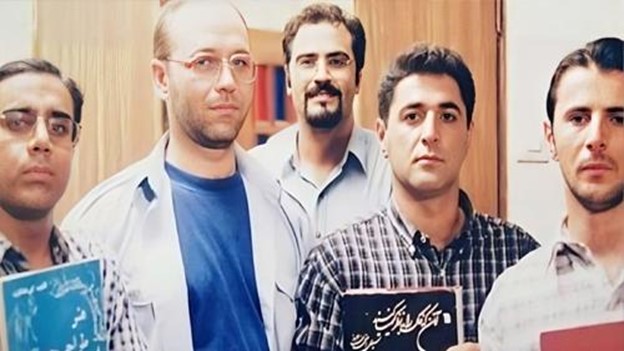
Figure 1: A still from Rūzigār-i javānī (Youthful Days, 1998-99), Asghar Farhādī.
The creative inspiration behind his early television work highlights an enduring pattern in Farhādī’s writing process: moving from a single image conjured up or moment experienced in his own life to a fully-fledged story.5Hassannia, Asghar Farhadi, 22. After a number of other writing commitments for the Tehran Network and the programmers at national Channel Three (Shabakah-i Sih), Farhādī had a breakout hit with Dāstān-i yik shahr (Story of a City, 2000-2001), directing and writing the first two seasons. The series, featuring a young television crew who scour the city for stories to capture on video, also examined the challenges of big city life from a variety of class perspectives.6“Chihil sāl sirīyāl sāzī,” 102. A few of its segments never aired because of their controversial content. Bitter experiences with censors helped to push Farhādī towards cinema. Nevertheless, he has continued to face censorship-related issues in this new medium.7Hassannia, Asghar Farhadi, 11, 16-17.
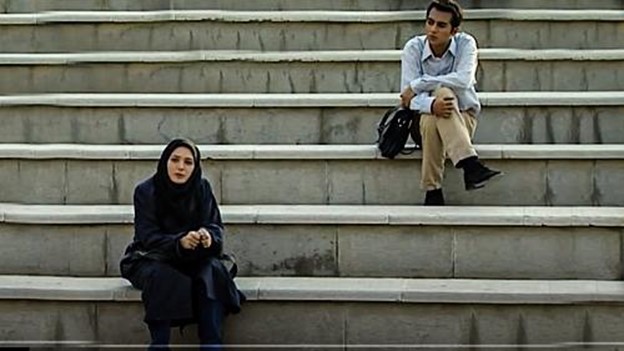
Figure 2: A still from Dāstān-i yik shahr (Story of a City, 2000-2001). Asghar Farhādī, accessed via https://www.youtube.com/watch?v=q5tGI5q2nFk (00:08:15)
Farhādī’s first film project was co-writing the screenplay for Irtifāʻ-i past (Low Heights, 2002), which became director Ibrāhīm Hātamī Kīyā’s biggest box office success to date. Low Heights represented a major departure for the director in terms of narrative themes, characterizations, and emotional tone.8For criticism of this narrative and stylistic turn, see Mojtaba Jibi, Sī sāl sīnimā-yi difāʻ-i muqaddas (1360-1390) (Tehran: Rūzigār-i Naw, 2016), 214-5. Previously, Hatami Kiya had operated exclusively within the narrative and stylistic conventions of the Cinema of Sacred Defense (Sīnimā-yi Difāʻ-i Muqaddas), a genre primarily concerned with martyrdom, self-sacrifice, and the “mystical” objectives of the Iran-Iraq War.9See Roxane Varzi, Warring Souls: Youth, Media, and Martyrdom in Post-Revolution Iran (Durham, NC: Duke University Press, 2006). Governmental and quasi-governmental organizations had long funded Sacred Defense productions,10See, for example, “Muʻarrifī-i nahādʹhā-yi sīnimā-yi jang va difāʻ-i muqaddas,” Film 165 (September 27, 1994): 67-70. due in part to their limited theatrical appeal. After the 1988 ceasefire, the collective project to capture on screen the war’s true nature did not end but instead increasingly explored postwar settings in which austere wartime values and the veterans who exemplified them existed uneasily in a society seemingly indifferent or openly hostile to both. Inspired by true events, Low Heights also concerns a war veteran, Qāsim (Hamīd Farrukhnizhād), but one who seeks material gain rather than transcendence by hijacking a plane and taking it abroad to claim asylum and make a fresh start. He boards a flight to Bandar Abbas along with his extended family, to whom he has falsely promised lucrative work and better life circumstances there. However, shortly after takeoff, he instructs the pilot at gunpoint to redirect the plane to Dubai. Two undercover security agents, themselves war veterans, and mutinous family members—most notably his mother-in-law and very pregnant wife—ultimately derail his plans. The final scene depicts the out of fuel plane crash-landing as his wife gives birth but the conflicting opinions of the passengers about where they have landed cast doubt for the audience about their survival. The film won critics’ and audience awards for best film at the 2001 Fajr Film Festival in Tehran, perhaps resonating with a jaded and weary “middle class” that fell outside of those social groups who by way of their sacrifice or opportunism had benefited morally or materially from the war.11For the excluded post-revolutionary “middle class,” see Pedram Partovi, “Martyrdom and the ‘Good Life’ in the Iranian Cinema of Sacred Defense,” Comparative Studies of South Asia Africa and the Middle East 28, no. 3 (2008): 529.
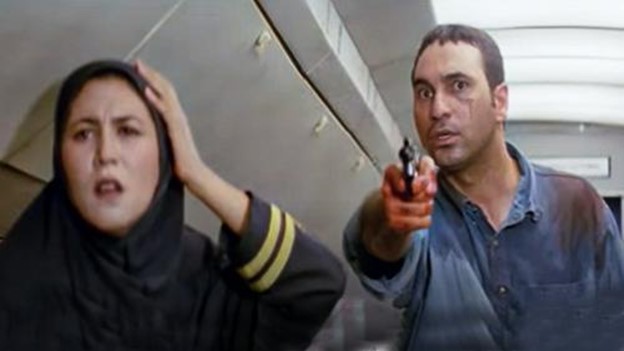
Figure 3: A still from Irtifāʻ-i past (Low Heights, 2002). Asghar Farhādī, accessed via https://www.youtube.com/watch?v=iyj6Y4tP1cs (00:36:54)
Farhādī’s own family background links him to the urban, educated middle class,12Hassannia, Asghar Farhadi, 15. which had largely acquired its social status in the Pahlavi era and was less likely to support some of the apocalyptic and otherworldly aims of the Islamic Revolution and Iran-Iraq War.13On the apocalypticism of the Islamic Revolution and Iran-Iraq War, see Farhad Khosrokhavar, Suicide Bombers: Allah’s New Martyrs, trans. David Macey (London: Pluto Press, 2005), 70-83. In fact, critics and commentators have often described him as a filmmaker with a special interest in the “values and lifestyle” of the middle class that had historically found expression in popular melodramatic films.14Daniele Rugo, “Asghar Farhadi,” Third Text 30, no. 3–4 (2017): 181-3. His complex engagement with melodramatic modes also sets Farhādī apart from an earlier generation of internationally-known directors who had gained auteur status by explicitly rejecting melodrama as supposedly inauthentic and manipulative of audiences and instead focused on stark depictions of poverty among the rural and urban working classes in postrevolutionary Iran.15For Farhadi’s engagement with tropes from Iranian and Western melodramas, see Pedram Partovi, “The Salesman,” in Lexicon of Global Melodrama, ed. Heike Paul, Sarah Marak, Katharina Gerund, and Marius Henderson (Frankfurt: Transcript Verlag, 2021), 347-51. For the stylistic and narrative preferences of postrevolutionary art film directors, see Richard Tapper, “Introduction,” in The New Iranian Cinema: Politics, Representation and Identity, ed. Richard Tapper (London: I. B. Tauris, 2002), 1-25. Yet, film historians have also claimed that social realism was, even if uneasily, a component of middle class melodramas produced by the commercial film industry since the 1950s and Farhādī’s films have continued that tradition.16Taraneh Dadar, “Framing a Hybrid Tradition: Realism and Melodrama in About Elly,” in Melodrama in Contemporary Film and Television, ed. Michael Stewart (London: Palgrave, 2014), 224; and Saʿid ʿAqīqī, Rāzʹhā-yi judāyī: sīnimā-yi Asghar Farhādī (Tehran: Rawzanah, 2017), 12-13.
Early in his directorial career, Farhādī quite self-consciously adhered to the formula of postrevolutionary realist cinema, with its overwhelming focus on the most deprived classes and settings. His first two films, Raqs dar ghubār (Dancing in the Dust, 2003) and Shahr-i zībā (Beautiful City, 2004), both concern the moral and material dilemmas that spring from abject poverty. Even so, Farhādī’s flair for tortured personal relationships and their attendant emotions was also present in these titles. Dancing in the Dust follows the story of an immature young couple from a poor south Tehran neighborhood whose marriage unravels when scandalous rumors reach the groom, Nazar (Yūsif Khudāparast), about how the bride’s mother has had to make a living. However, unpaid debts keep him from paying the dowry and finalizing a divorce. Nazar seeks refuge from creditors in the back of a snake-catcher’s van but, upon discovery, asks his accidental companion to teach him the trade. The gruff old loner (Farāmarz Gharībīyān), much irritated by the brash young man’s presence, tries to run him off but is unsuccessful. Much of the film’s running time is devoted to Nazar’s contentious relationship with the snake-catcher, which both reveals and obscures aspects of the mysterious man’s past. The narrative technique of slowly parceling out information about key characters and, in the process, disturbing the audience’s moral judgments of them is one that Farhādī has come to use to great effect in nearly all his films. Ultimately, Nazar’s persistence brings the two together but also places him in danger. He succeeds in catching a snake but also suffers a bite on his finger. The snake-catcher saves his life by amputating the finger and rushes him to a hospital for reattachment. He sells his meager belongings to pay for the surgery only to have Nazar run off with the money, leaving the severed appendage behind. The final scene depicts Nazar paying his mother-in-law the dowry. Both plot and resolution underline narrative themes of shame, masculine virtue, and family honor rooted in female chastity, which stand in the way of individual characters’ ‘selfish’ desires and passions. Farhādī’s cinematic oeuvre has frequently drawn on such themes but so has homegrown melodrama since its beginnings.17Partovi, “The Salesman,” 348.
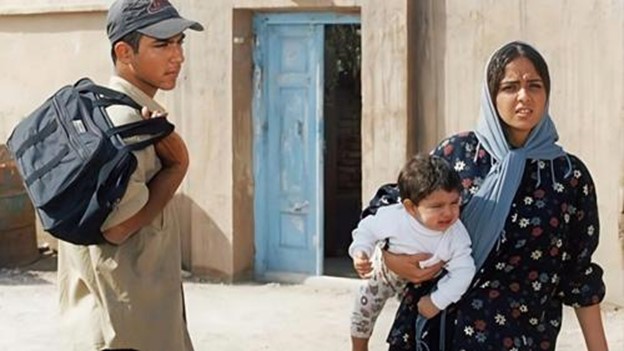
Figure 4: A‛lā’s visit with Fīrūzah to inquire about Akbar. Shahr-i zībā (Beautiful City, 2004), Asghar Farhādī, accessed via https://www.youtube.com/watch?v=YCVlSKhGLDw (00:15:31)
Beautiful City likewise explores the stifling of young love by social circumstances and, more generally, the impossible moral dilemmas that material deprivation creates. The narrative revolves around the impending execution of recently come-of-age Akbar (Husayn Farzīzād), convicted of killing his girlfriend, presumably after parental disapproval of the match, in a murder-suicide pact gone wrong. A full and accurate portrayal of this tragic incident, like many key plot details in Farhādī’s films, remains inaccessible to the audience. His sister, Fīrūzah (Tarānah ʿAlīdūstī), and fellow inmate, Aʿlā (Bābak Ansārī), join forces to convince Dr. Rahmatī (Farāmarz Gharībīyān), the victim’s father, to forgive Akbar. In the process, love blooms between Fīrūzah and Aʿlā but its consummation is complicated by Fīrūzah’s (unconfirmed) marriage to a neighborhood shopkeeper and opium addict. The victim’s father is equally conflicted. While he has no interest in clemency, the execution would also perversely require him to pay blood money to Akbar’s kin according to Islamic law. Such a payment would make it impossible for his daughter by another marriage, who suffers from developmental difficulties, to receive much needed and delayed medical treatment. Farhādī provides no obvious resolution to these narrative threads, again in line with (Iranian) social realism’s longstanding conventions.18See, for instance, Farah Nayeri, “Iranian Cinema: What Happened in Between,” Sight and Sound 3, no. 12 (December 1993): 28. In fact, narrative irresolution or ambiguity has since become a hallmark of Farhādī’s cinema. The film neither ends with Akbar’s execution nor with Fīrūzah answering Aʿlā at her door. Farhādī even raises the possibility for viewers that Aʿlā will marry Dr. Rahmatī’s remaining daughter, stifling his feelings for Fīrūzah in exchange for Akbar’s life, but he does not confirm it. Interestingly, prerevolutionary social melodramas often employed such bittersweet endings, in which concepts of masculine virtue were affirmed through the personal sacrifice of the young, and often unlikely, hero for the sake of friendship or family.19Pedram Partovi, Popular Iranian Cinema before the Revolution: Family and Nation in Fīlmfārsī (New York: Routledge, 2017), esp. 103-25. Farhādī’s fondness for ambivalent narratives and characters speaks to his uncanny ability to straddle the two (often complementary) worlds of commercially-driven and art cinema.20For a discussion of Farhadi’s narrative restraint and contradictory characters, see Farhādī and Mīhandūst, Rū dar rū bā Asghar Farhādī, 55-8.
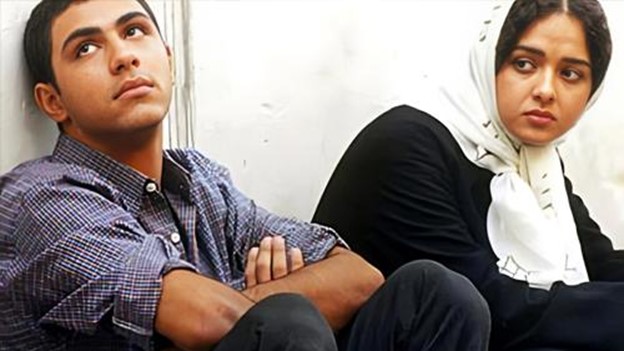
Figure 5: A still from Shahr-i zībā (Beautiful City, 2004). Asghar Farhādī, accessed via https://iranianfilmempire.wordpress.com/2017/10/18/the-beautiful-city-by-asghar-Farhādī-2004/
Still, Farhādī has rarely acknowledged in interviews his creative debt to a uniquely Iranian tradition of cinematic melodrama, even when incorporating explicit references to some of its most prominent examples—e.g., the diegetic use of music from M. ‛Alī Fardīn’s Sultān-i qalb’hā (King of Hearts, 1968) in Beautiful City. Critics for their part have especially stressed his early films’ debt to a postrevolutionary art and festival circuit cinema,21Hassannia, Asghar Farhadi, 14. not only because of the narrative choices Farhādī made but also the techniques he employed. The anti-heroes in Dancing in the Dust and Beautiful City were non-professional actors, following the casting practices of auteurs like ‘Abbās Kīyārustamī and Majīd Majīdī (casting non-professionals has also been commonly practiced in the Cinema of Sacred Defense). Likewise, Farhādī relied on simple set design, on-location shooting, and slow-paced, documentary-style editing. In fact, one of the co-writers of Dancing in the Dust had originally intended to make a documentary about the lives of snake-catchers before transforming the script with Farhādī’s help.22“Bīmārī yaʻnī bī-mārī,” Mahnāmah-yi Sīnimāyī-i Fīlm 310 (December 2003-January 2004): 90. Moreover, his own heavy or exclusive involvement in script development along with direction mirrored the predilections of then-established auteurs. While the screenplays were more fleshed out than the Iranian realist school’s bare-bones scripts, aspects of dialogue and acting were similarly worked out on the fly.23Hushang Golmakani, “Yik rūz-i bi-khusūs,” Mahnāmah-yi Sīnimāyī-i Fīlm 344 (March-April 2006): 136-7. However, these two films also bore influences from Farhādī’s television experiences in their ‘videographic’ look—namely minimalist shot framing, depthlessness, lack of wide-angle cinematography, and the heavy use of close-up medium shots.24Farhādī and Mīhandūst, Rū dar rū bā Asghar Farhādī, 64-66. Farhādī’s early films enjoyed some critical success, with Dancing in the Dust winning the best film award at Tehran’s annual Fajr Festival. However, they did not cultivate the audiences that he later became famous for, starting with Chahār shanbah sūrī (Fireworks Wednesday, 2006), in which he made a definitive turn towards middle class melodrama.
To be sure, Low Heights was an attempt at mixing melodrama with middle class concerns and similar plot themes were explored in television series like Tale of a City. These were initial engagements with a now well-established trope in Farhādī’s film narratives of the fragility of intimate relationships, with social, moral, or financial crises revealing the strains within and triggering a reckoning for the protagonists. In fact, a voyeuristic intrusion into characters’ most intimate thoughts and emotions, which in real life would otherwise be carefully hidden from public view, was part of the ‘entertainment’ for fans of Iranian melodramatic cinema from early on.25Partovi, Popular Iranian Cinema before the Revolution, 149. Fireworks Wednesday also concerned the shocking discovery of characters’ hidden lives. However, the facts (in part or whole) are foreshadowed throughout, highlighting another common narrative technique that Farhādī has employed.26Saʿid Qotbizadeh, “Kālbudʹshikāfī-i Ilī,” Mahnāmah-yi Sīnimāyī-i Film 396 (June-July 2009): 106. Farhādī directed the film but co-wrote it with Mani Haghighi, a fellow ‘next-generation’ writer-director who has also managed to successfully work across the boundary between art and commercially-driven cinema. The years between 2006 and 2009 marked a period in Farhādī’s career when he regularly collaborated with other directors as a writer or co-writer. He has since claimed sole responsibility for the script and direction of his productions, which perhaps betrays his mixed experiences during that phase. Fireworks Wednesday was in any case a very successful collaboration, winning the audience award at the Fajr Film Festival and enjoying a ten-week domestic box office run.
While this film marked a career shift for Farhādī in relying exclusively on professional actors for key roles, the cast included several carry-overs from previous productions in which he was involved. Most notably, Tarānah ʿAlīdūstī who played the young domestic Rūhī and has since worked with him on three other productions. Many critics have noted Farhādī’s reliance on a relatively small, semi-regular troupe of actors, a predilection which some have attributed to his theatrical training. His theatrical approach to filmmaking has included an extensive pre-production rehearsal schedule. Farhādī has claimed that his preference for working with the same actors helps to advance the dialogue writing process.27Golmakani, “Yik rūz-i bi-khusūs,” 136. Fireworks Wednesday was also the first time he teamed up with his long-time editor Hāyidah Safīyārī, who would break up the long takes that had characterized Farhādī’s earlier productions with faster pacing and jump cuts more in line with post-classical Hollywood cinema. According to Farhādī, the new editing style signaled a greater emphasis on characters’ emotions at the expense of cinematic realism.28Golmakani, “Yik rūz-i bi-khusūs,” 136. The film also employed a mise-en-scène different from and seemingly more theatrical than his earlier films; specifically cluttered and confined domestic spaces as the chief setting, with the strategic use of mirrors to redouble the chaotic atmosphere.29Golmakani, “Yikrūz-i bi-khusūs,” 142. Darbārah-yi Ilī (About Elly, 2009), Judāyī-i Nādir az Sīmīn (A Separation, 2011), Le Passé (The Past 2013), and Furūshandah (The Salesman, 2016) all incorporate domestic settings in various states of disarray that then serve as a venue for the protagonists’ moments of reckoning.
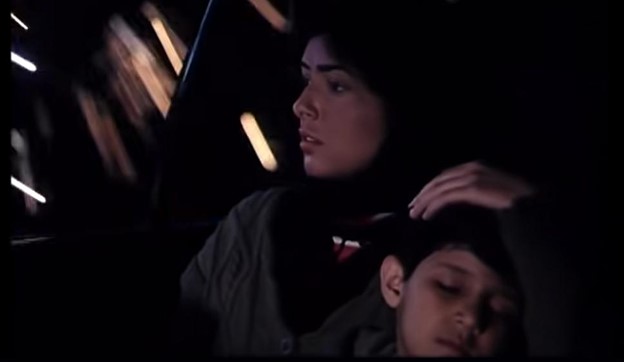
Figure 6: On Fireworks Wednesday night, Rūhī and Murtizā’s son are in Murtizā’s car. While the son sleeps peacefully, Rūhī anxiously watches the city’s fireworks and chaos. Chahār shanbah sūrī (Fireworks Wednesday, 2006), Asghar Farhādī, accessed via https://www.youtube.com/watch?v=bMBMlTNtf9E (01:23:04)
In Fireworks Wednesday, Rūhī comes to clean the home of a young middle-class couple in the midst of redecoration right before the New Year’s holiday. She is immediately dragged into the middle of their domestic spat when she is asked by the wife Mozhdeh (Hedieh Tehrani) to spy on her husband Murtizā (Hamīd Farrukhnizhād) and neighbor Sīmīn (Pānti’ā Bahrām), whom she suspects are having an affair. In effect, Rūhī becomes the audience’s proxy for peeking voyeuristically into the private lives of the love triangle’s three legs. Ultimately, Rūhī denies an affair between Murtizā and Sīmīn in order to restore the domestic order and protect the reputation of Sīmīn, with whom she most sympathizes. Farhādī does not place his audience in a starkly drawn moral universe, with obvious protagonists and antagonists more common to the classical Hollywood(-style) melodrama. He instead employs a more nuanced morality familiar to domestic melodramas where irony and cynicism have thrived; thus, he avoids automatically demonizing the ‘homewrecker.’30For a discussion of moral ambiguity in prerevolutionary melodramas, see Partovi, Popular Iranian Cinema before the Revolution, esp. 62-84. The film concludes in a typically bittersweet fashion, establishing an uneasy détente between the couple after Sīmīn ends her relationship with Murtizā while Muzhdah remains doubtful about her husband’s fidelity. The only character seemingly changed by the day’s events is Rūhī, who is about to start her own married life carrying this painful secret. Indeed, characters telling and covering up lies becomes a recurrent plot thread in Farhādī’s melodramas.
Farhādī doubled down on the theme of duplicity and infidelity in his next directorial effort, About Elly, which was not only a smash hit at home but charmed foreign critics too, winning the Silver Bear Best Director award at the Berlin International Film Festival. The film takes as its subject three young couples who travel to the Caspian Sea coast for a vacation with another friend, Ahmad (Shahāb Husaynī), who has just arrived from Germany. The trip’s organizer, Sipīdah (Gulshīftah Farahānī) wants to find the recently divorced Ahmad a new beau and invites her daughter’s teacher, Elly (Tarānah ʿAlīdūstī) to come along, without informing either of the two about her motives. Elly, like Rūhī in Fireworks Wednesday, is suddenly thrown into an intimate middle-class milieu whose cheeky and presuming behavior towards her elicits visible discomfort and regret about agreeing to the trip. Sipīdah nevertheless plots to keep Elly from returning to Tehran by hiding her cellphone. Her lies and deceptions in turn have disastrous consequences, following a now well-established pattern in Farhādī’s work.
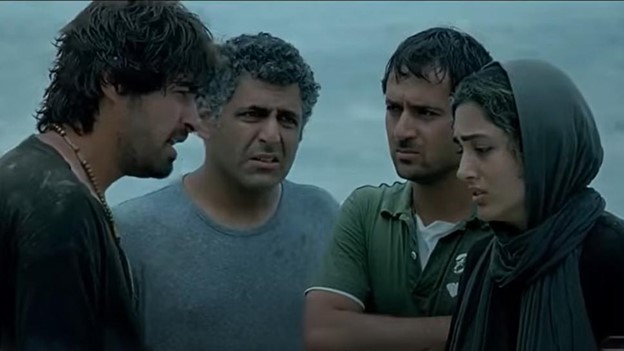
Figure 7: A still from Darbārah-yi Ilī (About Elly, 2009). Asghar Farhādī, accessed via https://www.youtube.com/watch?v=csfRfEI2uhk (00:51:21)
When Elly disappears after being left by the others to watch over the children playing on the beach, Sipīdah and her companions are whipped into a Hitchcockian frenzy to find her. The director predictably uses this incident to build tension between the remaining characters and uncover the more troubling aspects of their personalities and relationships. With the growing specter of Elly having drowned in the sea, the lies, infidelities, and recriminations pile up. Sipīdah reveals to her shaken friends how she had brought and kept Elly there under false pretenses, enraging her husband Amīr (Mānī Haqīqī) who suspects Sipīdah’s interest in Ahmad’s love life to be far from virtuous. However, as the couples search for clues about her disappearance, they learn of Elly’s own deceptions. Her mother didn’t know her true whereabouts that weekend; neither did her fiancé ‛Alī Rizā (Sābir Abar), who arrives to take part in the search. His revelation of their impending nuptials unsettles the group, who now come to realize Elly’s doubts about him and Sipīdah’s own superficial acquaintance with Elly. Collectively they assume the voyeur role, a character staple in Farhādī melodramas, discovering bit by bit more personal details about the mysterious Elly and in the process becoming party to her secrets. The friends thus conspire to hide from ‛Alī Rizā the reason why Elly was invited to spend the weekend there and why she accepted—not wanting to devastate him further. The seaside setting no longer serves as a calm respite from the turbulent workaday world but a deceit-filled quagmire engulfing them all, with Farhādī depicting their car sunk in the sand while the men fruitlessly seek to free it as a metaphor for their collective dilemma. Like Rūhī, the group is undoubtedly remade by their experiences. However, Farhādī once again offers no clues about where the characters’ new understanding of themselves or their relationships will take them. He leaves the audience to make its own judgments.
A Separation similarly eschews the kinds of narrative resolution familiar to the Hollywood-style melodrama. It nevertheless became Farhādī’s most successful film internationally, grossing nearly $18 million in overseas receipts, while drawing substantial audiences domestically. It also scored with critics around the globe, including multiple wins at the Fajr Festival and Iran’s first Oscar for best foreign film in 2012. The film begins with Sīmīn (Laylā Hātamī) seeking a divorce from her husband Nādir (Paymān Ma‛ādī). There is no infidelity driving a wedge between the two. Rather, filial obligation stands in the way of the couple’s relationship, in line with the melodramatic tradition’s privileging of familial over romantic love and other supposedly selfish impulses. Nādir’s father suffers from Alzheimer’s and needs round-the-clock care, while Sīmīn seeks to leave Iran and her family behind for a new, more hopeful life abroad. The main couple’s teenaged daughter Tirmah (Sārīnā Farhādī) is forced to navigate between these two divergent paths. The Islamic Republic’s legal apparatus has no answer to this ethical dilemma, only introducing further complications as Nādir accedes to divorce but not to his wife’s custody of their daughter. Farhādī ends the film with the court finalizing the divorce and Tirmah left to choose between her parents, but does not reveal her decision. In between these book-end scenes, A Separation (like Fireworks Wednesday and About Elly) pits its middle-class protagonists against working class analogues and, in the process, casts a harsh spotlight on their personal principles and most closely held beliefs.
Figure 8: Nādir and Sīmīn in court; Sīmīn complaining about her life situation to the judge. Judāyī-i Nādir az Sīmīn (A Separation, 2011), Asghar Farhādī, accessed via https://www.youtube.com/watch?v=bMJ48FeaHxw&t=207s (00:03:28)
Nādir triggers the social and moral crisis in A Separation by hiring a domestic, Rāzīyah (Sārah Bayāt), to help care for his father now that Sīmīn, who has moved out, no longer can. Rāzīyah is concerned about the religious permissibility of such work, since it requires intimate contact with an incontinent old man, but her financial situation and a second child on the way rule out refusal. She nevertheless keeps the details of her job from her hotheaded husband, Hujjat (Shahāb Husaynī), who is unemployed and drowning in debt. Shortly after starting the job, she loses track of the old man who wanders into the street. She manages to chase him down but, during her pursuit, she is apparently hit by a car. True to form, Farhādī’s elliptical storytelling does not show his audience this key plot detail that colors all subsequent events. When Rāzīyah abandons her shift the next day for a doctor’s visit, presumably for the injuries incurred in the accident, she ties the old man to the bed only to have Nādir return home and find him in that condition. Furious, Nādir fires Rāzīyah for her lapse of judgment but she refuses to leave until she receives payment for her work. He accuses her of stealing money from his bedroom and denies any debt to her. Yet, the audience knows that Rāzīyah is innocent as Farhādī’s camera had earlier captured Sīmīn taking money from their bedroom stash. Starting with A Separation, Farhādī increasingly turned the camera into his voyeur character encountering the hidden actions, thoughts, and feelings of his cast.
Figure 9: Nādir takes his father to the bathroom and notices the bruises on his body. Judāyī-i Nādir az Sīmīn (A Separation, 2011), Asghar Farhādī, accessed via https://www.youtube.com/watch?v=bMJ48FeaHxw&t=207s (00:46:02)
After Rāzīyah repeatedly asserts her innocence, Nādir violently shoves her out of the apartment and she falls down the stairs, another outside-the-camera-frame event. The fall leads to a court case in which he is accused of causing her miscarriage, or more specifically murdering her unborn child. After Nādir (falsely) denies knowledge of her pregnancy, Hujjat has a physical altercation with him. Nādir then files a counter-complaint against Hujjat for assault. Like in Beautiful City, Farhādī explores the complications of Islamic law and its often-perverse effects on the lives of ordinary Iranians. The dueling plaintiffs and their witnesses (including Tirmah) are forced to lie or withhold relevant information in order to survive the byzantine legal system.31Nacim Pak-Shiraz, “Truth, Lies, and Justice: The Fragmented Picture in Asghar Farhadi’s Films,” in Muslims in the Movies: A Global Anthology, ed. Kristian Petersen (Cambridge: Harvard University Press, 2021), 158-9. Farhādī’s missing scenes sow doubt in the audience’s mind about what actually caused the miscarriage, the car accident, or the fall, which explains if not excuses the main characters’ moral compromises and makes it harder to determine who is in the right. The director’s drip-feeding of the story, despite or because of its pacing, also contributes to the suspense that some critics have compared stylistically to Hitchcock’s cinema.32See, for example, Ann Hornaday, “Oscar-nominated ‘The Salesman’ melds Arthur Miller and Alfred Hitchcock,” Washington Post, February 2, 2017. This Hitchcockian element in Farhādī’s work perhaps took on greater prominence in The Salesman. Ultimately, the tension reaches its peak during a meeting at Rāzīyah and Hujjat’s home where Nādir is expected to pay blood money. However, when Rāzīyah is called on to swear on the Qur’an that he caused her miscarriage, she refuses and essentially returns the story back to its opening premise of divorce and custody. The film’s conclusion leaves the central characters dramatically changed by their experiences but their futures, in particular Tirmah’s, remain unknown.
Figure 10: A film still from Judāyī-i Nādir az Sīmīn (A Separation, 2011). Asghar Farhādī, accessed via https://mubi.com/en/notebook/posts/asghar-Farhādīs-a-separation
The Past and Todos lo saben (Everyone Knows, 2018) likewise traffic in the themes of “family crisis cinema” so common to Farhādī’s oeuvre but now in a non-Iranian setting, France and Spain respectively.33Kamran Ahmadgoli and Morteza Yazdanjoo, “The Politics of Cultural Diplomacy: The Case of Asghar Farhadi’s a Separation and the Salesman,” Quarterly Review of Film and Video 39, no. 3 (2022): 538. With About Elly, Farhādī began a collaboration with the French producer Alexander Mallet-Guy and Memento Films, which signed on as the film’s foreign distributor. Memento Films then expanded its partnership with The Past, which was Farhādī’s first foreign-financed film.34Celestino Deleyto, “Todos lo saben/Everybody knows (Asghar Farhadi, 2018),” Transnational Screens 10, no. 1 (2019): 73. Farhādī has followed a career progression established by previous Iranian auteurs who received funding from foreign production companies specializing in world cinema. In the past, foreign financing provided filmmakers an opportunity to escape censorship at home. However, such films rarely received screening permission in Iran, denying them their biggest potential audiences. Curiously, Farhādī has by and large avoided this dilemma, as only Everyone Knows did not receive screening permission. This exceptional record speaks to his ability to thread the nearly impossible needle of satisfying domestic censors as well as audiences and critics at home and abroad. To wit, Western critics have often claimed him as one of their own, arguing that his directorial style fits comfortably within a supposedly respectable melodramatic tradition represented by the work of directors like Paul Thomas Anderson, Michael Haneke, Mike Leigh, and Michelangelo Antonioni where
…nice, complacent middle-class people tootle along with their lives and then they’re sideswiped by a horrible event—mysterious, anonymous and malevolent—which shatters their calm and cracks open the carapace of their daily routine. It reveals the raw nerve of guilt and shame within.35Peter Bradshaw, “The Salesman Review—Asghar Farhadi’s Potent, Disquieting Oscar-winner,” The Guardian, (March 17, 2017), https://www.theguardian.com/film/2017/mar/17/the-salesman-review-asghar-farhadi-oscar-winner-iran
In The Past, it is a set of compromising emails and in Everyone Knows a kidnapping that brings to the surface secrets and past histories with devastating consequences for the central characters. In both films, the revelation of infidelity (but not its depiction) endangers marriages and lives. While the characters’ relationships in the aftermath of these tragic events remain a mystery, much like in Farhādī’s Persian-language films, a return to the status quo becomes impossible.
Only The Past includes an Iranian character, Ahmad (‛Alī Musaffā), and only then as an audience proxy and observer of the tragic love triangle involving his soon-to-be ex-wife, Marie (Bérénice Béjo). She wants a divorce from Ahmad so that she can begin a new life with Samīr (Tahar Rahim), whose wife is in a coma after a failed suicide attempt that the lovers soon learn may have been precipitated by the emails sent to her revealing the affair. The suicide attempt as the triggering incident is not shown. Similarly, the kidnapping in Everyone Knows, which reveals the victim’s true parentage and roils the marriages of erstwhile lovers Laura (Penélope Cruz) and Paco (Javier Bardem), occurs off-screen. The stories were clearly a continuation of a narrative trajectory that Farhādī had pursued in his Persian-language productions. Still, Farhādī chose France and Spain as settings for these two productions with the declared aim of making French and Spanish films.36Farhādī and Mīhandūst, Rū dar rū bā Asghar Farhādī, 261-3. He engaged in extensive audience testing during the script-writing process to ensure narrative authenticity.37Asghar Farhadi: Interviews, ed. Ehsan Khoshbakht and Drew Todd (Jackson: University Press of Mississippi, 2023), 101. His attempt to reproduce plot, characters, relationships, and dialogue that rang true to European audiences speaks to what critics have claimed to be the simultaneously universal and national character of Farhādī’s films.38See, for example, Rahul Hamid, “Freedom and Its Discontents: An Interview with Asghar Farhadi,” Cineaste 37, no. 1 (Winter 2011): 42.

Figure 11: A film still from Le Passé (The Past, 2013), Asghar Farhādī, accessed via https://www.youtube.com/watch?v=Z2-_lt4kwXE&t=50s (00:01:25).
Farhādī’s oeuvre and its cross-over or international appeal may also serve as evidence of the maturation of Iranian cinema, at least from the perspective of non-Iranian or Western critics and audiences, in that these viewers are now prepared to see Iranians in different and more familiar contexts than they were before. Reviewers have highlighted the shift in Iranian imports that Farhādī’s films represent: from a more ‘exotic’ post-revolutionary art cinema focused on the so-called simple lives and everyday struggles of the poor to a cosmopolitan and worldly middle class whose social existence and moral dilemmas more closely resemble those of middle-class Western audiences.39See Nicholas Barber, “About Elly,” The Independent, (15 September, 2012), https://www.independent.co.uk/arts-entertainment/films/reviews/about-elly-asghar-farhadi-118-mins-12a-hope-springs-david-frankel-100-mins-12a-paranorman-chris-butler-93-mins-pg-8142177.html [2] Bradshaw, “The Salesman Review.” A useful comparison to the recent trajectory of Iranian cinema on the global film circuit may be Italian cinema in the 1950s and 1960s, when neorealist depictions of post-war poverty gave way to the more socially and morally nuanced films of the Italian urban middle class that had an extensive pre-war history. The reinvention of filmmakers like Fellini and the emergence of fresh talents like Antonioni propelled Italian cinema in simultaneously new and old directions.
The Salesman continued this cosmopolitan turn in Iranian cinema with its quite pointed engagement with modern Western realist theater, specifically Arthur Miller’s Death of a Salesman.
In fact, the middle-class couple in the film moonlight as Willy and Linda Loman in a Tehran production of the play. The play highlights the couple’s seemingly subversive cultural and social bent in an Islamic republic whose leadership has long cultivated an anti-Western politics. However, the play’s narrative themes also subtly insinuate themselves into the unfolding crisis that dominates their lives after the wife Ra‛nā (Tarānah ʿAlīdūstī) is sexually assaulted. Neither the husband ‛Imād (Shahāb Husaynī), nor the neighbors, nor the audience witness the attack and a badly shaken Ra‛nā remains less than forthcoming about what exactly happened. Consequently, the full details of the night’s events remain unknown. Nevertheless, the film emphasizes that gossip and rumors about the assault matter more than the facts. Like in Dancing in the Dust, prevailing social mores and the fear of “what will the neighbors say?” push ‛Imād to act in defense of his honor. As one reviewer argues, ‛Imād’s “irrational” reaction to the apparent assault brings into question his modern, worldly facade.40Bradshaw, “The Salesman Review.” Farhādī foreshadows the cracking of ‛Imād’s psyche, and the eventual crumbling of the couple’s relationship, with the cracking of glass and mirror frames in the opening scene when a (likely illegal) construction project next door undermines the foundations of their apartment building. Their relocation to another apartment previously inhabited by a prostitute sets the stage for the assault. Again, the film’s mise-en-scène works to reflect the chaotic mood of the film and its characters, a thread in Farhādī’s films since at least Fireworks Wednesday.
‛Imād’s frenzied search for his wife’s attacker in the film’s second half springs from what Peter Bradshaw implicitly argues are obsolete ideas of masculine virtue. While Bradshaw may believe that such matters are best left to the police, ‛Imād makes no recourse to the law partly because of his (and his wife’s) understanding of family honor as a private matter. Of course, such conceptions of honor had motivated many homegrown melodramas’ protagonists, who also often operated on the margins of the law.41Partovi, Popular Iranian Cinema before the Revolution, 118-25 The key difference between Farhādī’s characterization of ‛Imād and those representations of film heroism from a previous era would seem to be that the character seeking vengeance is not some traditionally-minded lumpen hero but a member of the exemplary modern middle class. However, it was also those from the exemplary middle class who were the most likely audiences of prerevolutionary melodramas, despite their frequent, loud, and continued protestations to the contrary.42For middle-class denialism about their fandom for Pahlavi-era melodramas, see Pedram Partovi, “Reconsidering Popular Iranian Cinema and its Audiences,” Iranian Studies 45, no. 3 (May 2012): 439-447 [5] “Furūshandah rikūrd-i fur Interestingly, The Salesman became Farhādī’s most commercially successful film in Iran to date, ending its cinematic run as the biggest box office hit in history.43“Furūshandah rikūrd-i furūsh-i sīnimā-yi Īrān rā shikast,” Afkār Nīyūz (November 9, 2016) It also won Farhādī’s second Oscar for best foreign film, though with significant controversy. President Donald Trump’s 2016 “Muslim ban” on travel to and resettlement in the United States, which included Iranians, may have inspired some Academy voters to support the film to make their displeasure with this policy known.44Mike Fleming, Jr., “Are Best Foreign Film Nominees Trumped by Politicized Voting?” Deadline, (February 16, 2017), https://deadline.com/results/#?q=%E2%80%9CAre%20Best%20Foreign%20Film%20Nominees%20Trumped%20by%20Politicized%20Voting?%E2%80%9D
Figure 12: Ra‛nā, who was afraid of being alone at home, went to the roof until ‛Imād arrived. Furūshandah (The Salesman, 2016), Asghar Farhādī, accessed via https://www.youtube.com/watch?v=2RDZKuwFmEA (00:38:46)
The film’s denouement has ‛Imād confronting the street peddler who violated his wife’s honor, seeking to humiliate him in the way that he has presumably been humiliated. ‛Imād in effect tracks down in real life the man that he’s playing on stage. Farhādī has claimed that the film at its center asks a question that Arthur Miller forefronts in his play: Is Biff Loman’s humiliation of his philandering father, leading him to commit suicide, justified? In other words, do two wrongs make a right?45Asghar Farhadi: Interviews, 124. While ‛Imād answers affirmatively and proceeds to torment the man until he suffers a series of heart attacks, Ra‛nā is repulsed by his cruelty. According to Farhādī, Ra‛nā represents a long line of patient, forgiving women in his films who are invariably contrasted with blundering and impulsive men.46Asghar Farhadi: Interviews, 126. Rāzīyah in A Separation or Farkhundah (Sahar Guldūst) in Qahramān (A Hero, 2021) serve as additional examples. The characterization of women as emotionally stable and grounded (and their male reverse images) has its own long history in Pahlavi-era melodramas.47Partovi, Popular Iranian Cinema Before the Revolution, 107. Farhādī doesn’t provide the audience with closure on ‛Imād and Ra‛nā’s relationship status, but the events have certainly not brought them together, as made apparent in the coda where they silently sit beside each other while readying to take the stage.
In his most recent production, A Hero, Farhādī once more mined the rich narrative vein of characters choosing expediency over truth and its attendant costs. The film won the Grand Prix at the Cannes Film Festival and was a moderate commercial success at home. The story itself, like others that Farhādī has developed into film scripts (e.g., Low Heights), was based on true events. Specifically, in 2010 Mohammad Reza Shokri found and returned a bag of cash while on temporary release from debtor’s prison, briefly becoming a media star for his good deed. Similarly, the film’s seeming hero, Rahīm (Amīr Jadīdī) receives a two-day leave from prison to settle an unpaid debt with gold coins that his girlfriend Farkhundah found in a handbag left behind at the bus stop. The debt is owed to his former brother-in-law and antagonist Bahrām (Muhsin Tanābandah). Unlike A Separation or The Salesman where class defines the conflict, the acrimony between Rahīm and Bahrām is rooted in personal history, much of which remains off-screen. When Rahīm learns that the coins’ appraised value does not cover the entire debt, he approaches Bahrām about payment in installments, which he refuses. Rahīm then sets out to find the coins’ true owner, prodded by his sister who discovers them among his things and worries that Rahīm’s ill-gotten gains will only bring the family more shame. Farhādī depicts Rahīm as an unbecoming hero, unsure of himself and his actions. Even on those occasions when Rahīm takes the initiative, he quickly folds at the first sign of adversity, and his tentative and halting physical movements mirror his character traits. Thus, Farhādī’s direction together with Jadīdī’s acting portray him nervously loitering in the background of scenes, hesitating at doorsteps, or entering and quickly reversing out of rooms.
This good Samaritan turn, despite his initial motivations, gains him minor celebrity status on social media. While Bahrām and audience members may have suspicions about his heroism, a local charity and the prison are happy to promote Rahīm’s supposedly selfless act to advance their own interests. Rahīm’s inability to take control of his own narrative allows the prison to use his story to overshadow the news of a prisoner death and the charity to throw a fête in his honor to raise their fundraising profile. He neither takes advantage of a television interview on prison grounds to shine a light on poor prisoner conditions nor does he stop the charity from exploiting his son’s speech impediment to drum up more sympathy and donations. Predictably, events external to Rahīm provide the next twist in his story. Just as he plots his return to normal life, a rumor spreads on social media about his true intentions to keep the coins.
Figure 13: A film still from Qahramān (A Hero, 2021), Asghar Farhādī, accessed via https://vigiato.net/p/227598
The film shines a light on the social media phenomenon in Iran and its role in the making and unmaking of heroes. If neighborhood gossip helped to drive ‛Imād in The Salesman to disastrous ends, then social media seemingly set Rahīm on a similarly dangerous path. Before he can take up his new job arranged by the charity, the prospective employer, concerned about bad publicity, insists that he bring testimony from the woman who claimed the handbag to clear his name. The seeming disappearance of the presumed owner encourages Rahīm, his sister, and Farkhundah to perversely fabricate proof of their good intentions but fruitlessly. When Rahīm violently confronts Bahrām, whom he believes to be behind the rumors, Bahrām’s daughter Nāzanīn (Sārīnā Farhādī) captures it on video and eventually releases it on the internet, further sinking his reputation and souring those who had sought to capitalize on his fame. The charity takes back its donations to pay for the release of a death row inmate but, on Farkhundah’s insistence, they claim in the press release that Rahīm had voluntarily surrendered the money to save a life. A prison official in turn seeks to sanitize their links to Rahīm’s story by producing a video about his most recent so-called act of charity featuring a tearful appeal from his son, Sīyāvush. Finally, Rahīm takes a principled stand to protect his son’s dignity—violently confronting the official to delete the video. A bittersweet conclusion once more resets the puzzle pieces of Farhādī’s narrative. Rahīm returns to prison, putting aside the prospect of a new life with Farkhundah and Sīyāvush. However, he returns with a new outlook, which the character visibly signals with his freshly shaven head.
Figure 14: A film still from Qahramān (A Hero, 2021). Asghar Farhādī, accessed via https://vigiato.net/p/227598
Shortly after the film’s release, Farhādī faced accusations of wrongfully taking credit for A Hero—his protagonist’s reputational crisis now mirrored by his own real-life predicament. Āzādah Masīhzādah, a student who produced a documentary about Shokri after attending a filmmaking workshop convened by Farhādī, claimed that he had not only adapted the story but incorporated scenes from her documentary without proper acknowledgment of her work. Appropriately enough, she used social media to publicize her claims against Farhādī.48Rachel Aviv, “Did the Oscar-Winning Director Asghar Farhadi Steal Ideas?” The New Yorker, (November 7, 2022), https://www.newyorker.com/magazine/2022/11/07/did-the-oscar-winning-director-asghar-farhadi-steal-ideas After arbitration failed, Masīhzādah filed a court case against Farhādī to share the credit and revenues for A Hero. As of this writing, a final verdict has yet to be issued. However, the court case and resulting press has unleashed other allegations of Farhādī cheating his collaborators of their fair dues. The now exiled actress Gulshīftah Farahānī described Farhādī as a vasat-bāz, or a shrewd, calculating person who excels at playing the middle against the sides, to explain what she claimed to be his deceitful behavior towards colleagues and associates.49Aviv, “Did the Oscar-Winning Director Asghar Farhadi Steal Ideas?” Farhādī’s preoccupation with characters’ ethical struggles in a hypocritical and stifling social and political setting is even more interesting when considering these accusations. Farahani admits that holding firm to your principles is a costly endeavor in today’s Iran and that distortion and concealment of one’s intentions is necessary for survival—a skill that, according to her, Farhādī has mastered.50Aviv, “Did the Oscar-Winning Director Asghar Farhadi Steal Ideas?”
Indeed, if Farhādī’s true genius is his cross-over appeal with audiences and critics at home and abroad, it is by his own admission rooted in an ability to present himself and his work to different audiences in different ways at the same time.51Hamid, “Freedom and Its Discontents,” 42. In other words, he has successfully incorporated in his films multiple genres, aesthetic sensibilities, and social ideals, which he has revealed selectively and his varied audiences have received selectively. It is the very shape-shifting, chimerical nature of Farhādī’s cinema.
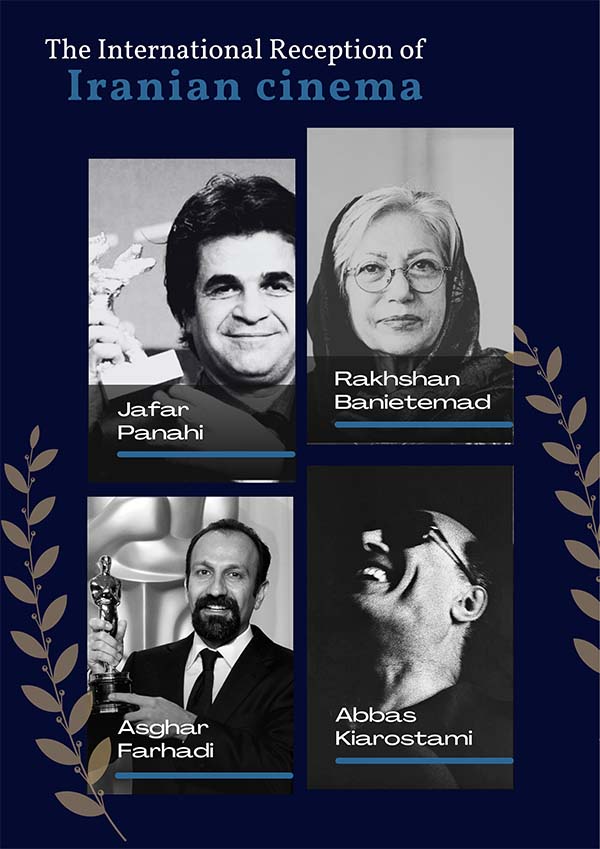
Introduction
Iranian cinema entered the European film festival scene in the 1960s.1Roy Armes, Third World Filmmaking and the West (Berkeley: University of California Press, 1987), 191. The first Iranian film to screen at Cannes was Mostafa Farzaneh’s Cyrus the Great (1961) during the year of its release. Viewed retrospectively, perhaps of more significance was Forough Farrokhzad’s The House is Black (1962), a twenty-one minute documentary, the length of which belies its importance. It won a Grand Jury Prize at the Oberhausen Short Film Festival in 1963 and has been cited as seminal by filmmakers and critics from Mohsen Makhmalbaf to Jonathan Rosenbaum.2Jonathan Rosenbaum, review of The House Is Black by Forough Farrokhzad, Chicago Reader (March 7, 1997), jonathanrosenbaum.net February 22, 2021/ Accessed June 24, 2022, jonathanrosenbaum.net/2021/02/the-house-is-black/. Some trace the origins of the Iranian New Wave to around this time, although Parviz Jahed claims it as around 1969.3Parviz Jahed, “The Forerunners of the New Wave Cinema in Iran,” in Directory of World Cinema: Iran. ed. Parviz Jahed (Bristol: Intellect, 2012), 84–91. By 1979 a number of major films had been selected for the European A festivals including Darius Mehrjui’s The Cow (1969), which famously debuted internationally at Venice in 1971 without subtitles. The Berlinale introduced both Sohrab Shahid Saless and Parviz Kimiavi in 1974 and 1975 respectively, while Cannes responded with international premieres from Bahman Farmanara and Bahram Beyzai, setting up a triangle between the two European festivals and Iran that would be resumed decades later. Just when Iranian cinema seemed to be blooming, the Islamic Revolution struck. There was a huge decline in production just before it, and immediately following it a virtual standstill.

Figure 1-2: Left: Movie poster for The House is Black (1962), Forough Farrokhzad. Right: Movie poster for The Cow (1969), Darius Mehrjui
This entry, concerned with the international reception of post-revolutionary cinema, will trace the history of the latter’s early reception through to its establishment as an important national cinema concluding with the winning of Iran’s first Academy Award in 2012. The markers for this will be festival screenings, because “festivals and critics grew the commercial market for Iranian films abroad.”4Hamid Naficy, A Social History of Iranian Cinema volume 4: The Globalizing Era 1984-2010 (Durham, NC: Duke University Press, 2012), 246. Cinema and politics are generally acknowledged as being closely connected in Iran and this is very pertinent to its international reception. The brevity of this article prevents much exploration of these connections. However, while focusing on the FIAPF A list festivals, it does devote some consideration to the audience-driven Rotterdam International Film Festival in order to demonstrate the impact of geopolitics. It then turns to a discussion of the other, various reasons for Iranian cinema’s international appeal, considering factors such as aesthetics and content. It will conclude with an overview of the post-Ahmadinejad period.
After the Revolution
Following the Islamic Revolution there was very little film production until the establishment in 1983 of the Farabi Cinema Foundation (Farabi), tasked with all matters cinematographic, from production to international affairs. As discussed by Mohammad Attebai, who worked at Farabi in the 1980s, initially Farabi staff persistently sent out letters and screeners to the major international festivals to no avail.5Interview with the author, February, 2011. The first film screened internationally after the Revolution was Amir Naderi’s The Runner (1985), at Nantes in 1985 where it was awarded a prize. The following year it screened at the London and Sydney film festivals, and in 1987 at a further three festivals. Alireza Shojanoori, then in charge of the international arm of Farabi, has singled out the screening of Frosty Roads (dir. Maud Jafari Jozani) at the 37th Berlinale in 1987 as what he considers the first major “international attention” having been paid to post-Revolutionary Iranian cinema.6Alireza Shojanoori, Interview with the author, 16 February, 2011. Frosty Roads then screened at Montreal, Tokyo and Hawaii as well as Hong Kong alongside The Runner. Mohsen Makhmalbaf began his foray into the international scene in 1988 when The Peddler was screened at the London Film Festival.

Figure 3-4: Left: Movie poster for The Runner (1985), Amir Naderi. Right: Movie poster for The Peddler (1986), Mohsen Makhmalbaf.
Perhaps the year when real international success for the cinema of the Islamic Republic might be considered to have begun was 1989. The Iran-Iraq War had ceased in August 1988 and in June 1989 the Grand Ayatollah Ruhollah Khomeini passed away. Both events had an impact on cinema but of more immediate impact was the screening of Kiarostami’s Where is the Friend’s House? at the forty-second Locarno International Film Festival held that same year. Made in 1986 and first screened at Nantes in 1988, this first of Kiarostami’s Koker trilogy received a “modest” Bronze Leopard and four other awards at Locarno, not yet a FIAF A list festival, but nonetheless a major one. Azadeh Farahmand specifically attributes the “escalation in the presence of Iranian films abroad” to Kiarostami’s Locarno success7Azadeh Farahmand, “Perspectives on Recent (International Acclaim for) Iranian Cinema,” in The New Iranian Cinema: Politics, Representation and Identity. ed. Richard Tapper. (London: Taurus, 2002), 94. and Naficy records a sudden leap in international exhibition in 1990, with “230 films in 78 international festivals, winning 11 prizes.”8Hamid Naficy, “Islamizing Film Culture in Iran: A Post-Khatami Update,” in The New Iranian Cinema: Politics, Representation and Identity. ed. Richard Tapper. (London: Taurus, 2002), 51. Around 1991 the National Film Archive of Iran assembled a collection of sixteen international award-winning films, which it made available as 16mm prints for festivals and cultural events internationally. Distributed by Farabi under the banner, “Festival of Iranian Films,” this highly successful venture resulted in events right around the world. (In Australia, for example, the festival screened in Sydney and Melbourne under the aegis of the Australian Film Institute.)
At this point it is important to note that what is seen internationally, and thus what is discussed here, is generally labelled under the category of “festival films” and accounts for a very small percentage of the total Iranian film output. Films generally approved and considered desirable for the domestic market include commercial comedies, sacred defence films and social issues films. The pan-Islamic market assumed a priority during Mahmoud Ahmadinejad’s second presidential term. The results of the ensuing government productions, starting with Shariar Behrani’s Kingdom of Solomon (2009), were not successful. However mention should be made of Majid Majidi’s Islamic blockbuster Mohammad, Messenger of God (2015), made with a crew heavy with Oscar winners such as cinematographer Vittorio Storaro and composer A.R.Rahman. It did gain some international traction despite facing controversy in some Islamic countries.

Figure 4-5: Left: Movie poster for Where is the Friend’s House? (1986), Kiarostami. Right: Movie poster for Mohammad, Messenger of God (2015), Majid Majidi.
Returning to Kiarostami, Through the Olive Trees, the third film in his Koker trilogy, was nominated for a Palme d’Or at Cannes in 1994, marking the beginning of what would be known as the ‘golden era’ of Iranian cinema. By 1997, when The Taste of Cherry won the Palme d’Or at Cannes, France alone had already honoured Kiarostami with the Career Award of the Prix Roberto Rossellini at Cannes (1992), and made him an Officier de la Légion d’honneur (1996). However, Locarno had also continued to acknowledge Kiarostami. In 1995 Marco Müller presented the first ever “virtually complete” retrospective of Kiarostami’s films at Locarno, along with an exhibition of his photographs of landscapes and two paintings.9Jonathan Rosenbaum, “From Iran with Love.” Chicago Reader, 29 Sep. 1995: jonathanrosenbaum.net accessed 12 Oct. 2012.
But Locarno’s contribution to Iranian cinema was greater than this. Müller was the first to screen Tahmineh Milani’s debut feature, The Legend of Sigh, in 1991; and under his directorship, two classics of New Iranian Cinema came to world attention with Golden Leopards: Ibrahim Foruzesh’s The Jar, in 1994, and in 1997 Jafar Panahi’s The Mirror. In 1998 Müller invited Abolfazl Jalili to Locarno where he received Locarno’s Silver Leopard for Dance of Dust.
Festival interest continued to build, along with limited commercial interest. International awards proliferated from 1995 with Panahi’s 1995 Camera d’Or (Cannes) win, The White Balloon, followed in 1998 by his above-mentioned Golden Leopard for The Mirror. Majid Majidi had been represented in the Director’s Fortnight at Cannes back in 1992 with his directorial debut, Baduk. In 1997 his Children of Heaven (1997) was the first, and for long the only, Iranian film nominated for Best Foreign Film at the Academy Awards. By the late 1990s, “No respectable festival could be without at least one film from Iran.”10Richard Tapper, “Screening Iran: The Cinema as National Forum.” Global Dialogue, 3:2–3 (2001): 120-31.
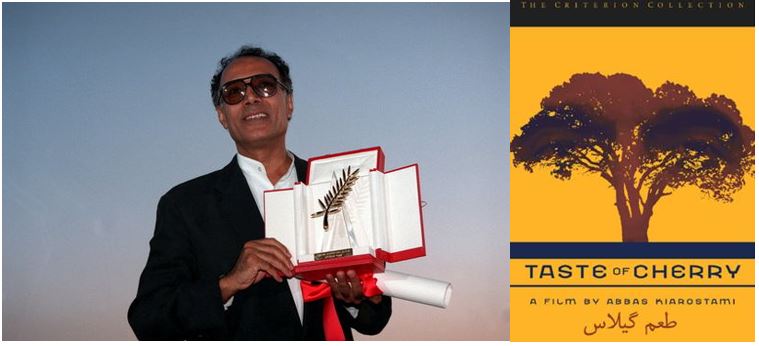
Figure 5-6: Left: Movie poster for Taste of cherry (1986), Kiarostami. Right: Kiarostami at the Vienna Film Festival with the Palme d’Or
Iran—A Millenium Hotspot
In 2000 Hamid Dabashi made the witty comment that, “for reasons that have nothing to do with the dawn of the third millennium, because Iran follows its own version of the Islamic calendar, the year 2000 marks a spectacular achievement for Iranian cinema.”11Hamid Dabashi, Close Up: Iranian Cinema, Past, Present, and Future (London: Verso, 2001), 259. Three early career Iranian filmmakers won major awards at Cannes—Samira Makhmalbaf won a Special Jury Prize for Blackboards, and the Camera d’Or was shared by Hassan Yektapanah (Djomeh) and Bahman Ghobadi (A Time for Drunken Horses). Most importantly, their films were all purchased for international distribution. Even more successful internationally, but more controversial on the home front, was Jafar Panahi’s The Circle which won a Golden Lion at the Venice Film Festival later that year and received wide international distribution. This exceptional achievement for Iranian cinema internationally was a kind of spring following the 1997 election of a Reformist government.
Yet another landmark, very important for the reception of Iranian cinema, also occurred in 2000—the first prominent use of the term ‘The New Iranian Cinema’ to describe a series of film screenings, and concurrent conference in London, followed by the seminal book of the conference papers, published in 2002. The New Iranian cinema was now a movement.12 In 1999 the National Film Theatre, London, presented a season, titled “Art and Life: The New Iranian Cinema”, and consisting of some sixty films, both pre- and post-revolutionary, accompanied by a small catalogue of the same name. The papers of the concurrent landmark were drawn together by Richard Tapper in the seminal book, The New Iranian Cinema: Politics, Representation and Identity.
However a very different, non-filmic landmark was created with 9/11. September 11, 2001 was a major turning point for many festivals. While up to that point festivals were focused on aesthetics, suddenly ideology and relevance became important. Many programmers who had seen objectivity as important in programming suddenly felt compelled to take a position in relation to the horrific rise of Islamophobia internationally.

Figure 7-8: Left: Movie poster for Blackboards (1999), Samira Makhmalbaf. Right: Movie poster for The Circle (1999??), Jafar Panahi.
The International Film Festival Rotterdam—A Case Study
Just four months after the September 11 attacks, the International Film Festival Rotterdam (IFFR), a large audience-driven festival with only a small market and a modest yet important production fund, demonstrated its serious political engagement. The co-directors, Simon Field and Sandra den Hamer, wrote in the introduction to the catalogue:
We are … presenting the festival in a world that has been rocked by September 11 … And in this world the question of ‘what cinema’ takes on additional force. Is there now an even more urgent need for a socially responsible cinema, for a new political cinema? In this regard, we strongly believe that a festival like Rotterdam becomes even more important as a necessary platform: showing films from different cultures and different perspectives and as a meeting place for people from all over the world.13Catalogue 2002, 23 January-3 February: 31st International Film Festival Rotterdam 2002, ed. Lot Piscaer (Rotterdam: International Film Festival, 2002), 12.
IFFR’s traditional engagement with Iran saw the integration of an unprecedented nine Iranian films across the programme that year. Peter van Hoof, programmer of a section called The Desert of the Real wrote a segment introduction in rhetoric reminiscent of the IRI itself:
The Film Festival Rotterdam was originally for many a cultural and ideological breeding ground where ‘politics’ and ‘cinema’ were inextricably bound up with each other. Film was a weapon in the struggle against imperialism and class struggle, and the aim of awakening a political consciousness. People took up arms against the dominance of Hollywood: its dominant film language, financial colonialism and repressive tolerance. Ideologies such as socialism, liberalism and nationalism have made way for more realistic and pragmatic varieties of capitalism …. Western cinema follows meekly [sic].14Catalogue 2002, 13.
Milani’s The Hidden Half, Rakshan Bani-Etemad’s Under the Skin of the City (a Farabi production) and Majid Majidi’s Baran, Kiarostami’s A.B.C. Africa and Reza Mir-Karimi’s Under the Moonlight were screened. Another three inclusions in the programme had been recipients of funding from IFFR’s Hubert Bals Fund. These were Secret Ballot, a first film directed by Babak Payami and produced by Marco Müller while he was at Locarno, that had won an award for screenplay at Venice in 2001; Delbaran, from the (then) mid-career director Abolfazl Jalili who had been one of IFFR’s Filmmakers in Focus the previous year; and Killing Rapids from veteran filmmaker Bahram Beyzai. The whole selection is notable for its diversity.
Iranian cinema remained prominent in the IFFR programme. In 2006 they introduced a segment called “hotspots,” the intention behind which was explained as follows: “To discover specific filmmakers and audiovisual artists, we are looking for the particular environment in which their work originates, the local scene.”15Kies Brienen, “Hot Spots,” in Catalogue: 36th International Film Festival Rotterdam. 2007, n.p. Iran featured in that first year with twenty short films, documentaries about cinema, music and Tehran, along with features, including Rafi Pitts’s It’s Winter and Jafar Panahi’s Offside in the general programme. The well-known musician, Mohsen Namjoo, gave his first performance outside Iran.
Iran has had some success in IFFR’s Tiger Awards Competition, which focuses on “promoting young talent in filmmaking from around the world”16IFFR Official Website, 2012. with Ramtin Lavafipour’s Be Calm and Count to Seven (2009). In 2013 Mohammad Shirvani’s Fat Shaker (2013) shared the award with two other films under a jury that included the famous Iranian actress Fatemeh Motamed Arya and Chinese artist/activist Ai Weiwei. At least equally significant was the festival’s Hubert Bals Fund for cinema from developing countries, where Iranian filmmakers received hefty funding support over the years. Moreover, the festival hired a specialist on Iranian and Arab cinema and art, the London-based independent curator, Rose Issa, to IFFR.
IFFR’s promotion of Iranian cinema internationally is more important than it might appear. Although Rotterdam prides itself on the size of its local audience, it also attracts many international film programmers, giving rise to Jafar Panahi’s description of the festival as a “souk”, despite there being no official market at Rotterdam.17Parviz Jahed, “Independent Cinema and Censorship in Iran: Interview with Jafar Panahi,” in Directory of World Cinema: Iran, ed. Parviz Jahed (Bristol: Intellect, 2012), 15. The festival’s reputation for quality programming ensures that most films screening there would travel, and widely, perhaps to festivals that may select only one or two Iranian films in any year.
Figure 9-10: Left: Movie poster for Fat Shaker (2013), Mohammad Shirvani. Right: Shirvani is receiving an award from Motamed-Aria at the Rotterdam Film Festival.
The Contradictory Politics of Film Festivals
The response or lack of it to the September attacks by the various festivals suggests “the contradictory politics of film festivals” that Farahmand had already noted in 2000.18Farahmand, “Perspectives” 104. A line was drawn between big market-driven festivals and festivals aimed at the general public, shocked into acknowledging contemporary politics in their programmes. This spike in interest from 9/11 did not last. Panahi noted in an interview in early 2008 that Iranian cinema was experiencing a decline in representation internationally.19Parviz Jahed, “Independent Cinema and Censorship in Iran,” 18.
Although initially the larger festivals were not concerned to take any kind of public political stance in relation to Iran, maintaining instead their focus on cinematic excellence, this changed radically in 2010 with Panahi’s arrest. Suddenly Cannes and the Berlinale competed with each other to show their commitment to the rights of filmmakers. In 2010 Cannes left an empty chair on the jury for Panahi; images of Juliet Binoche weeping at the news that Panahi had begun a hunger strike flooded the media, and Panahi was awarded the Carrosse d’or (Golden Coach) Prize, an annual tribute for the innovative qualities, courage and independent-mindedness of a filmmaker’s work. The Berlinale repeated the performance in 2011 with another empty jury chair. Jury president Isabella Rossellini read an open letter from Panahi at the festival opening ceremony, and festival director Dieter Kosslick continued to note his absence throughout the festival, whilst a truck circled the Potsdamer Platz, the festival venue, with a signboard asking, “Wo bleibt Jafar Panahi” (Where is Jafar Panahi?). A few months later Cannes screened Panahi’s This Is Not a Film (made despite his having been banned from filmmaking, and ostensibly smuggled out of Iran on a USB stick inside a cake).
Viewed retrospectively, Panahi’s 2008 concern about a decline in representation seemed unjustified and perhaps the Berlinale triumphed over Cannes—in 2009 they had backed Asghar Farhadi’s About Elly, which won a Silver Bear for best director. After Farhadi’s next film, A Separation, won the Golden Bear the following year, it was picked up by Sony Pictures Classics. Such a major distributor was able to mount the Oscar campaign necessary for a chance to win an award and, subsequently, in 2012, A Separation became the first Iranian film to win an Academy Award (for Best Foreign Film). Iran was now a real “player” and could anticipate increased commercial success.
Figure 11-12: Left: Movie poster for About Elly (2009), Asghar Farhadi. Right: Farhadi which won a Silver Bear for best director

Figure 13-14: Left: Movie poster for Separation (2011), Asghar Farhadi. Right: Farhadi’s Separation won the Academy Award for Best Foreign Language Film in 2012
The Cannes /Berlin rivalry surfaced again in 2013, when Cannes world-premiered Farhadi’s The Past and Rasoulof’s Manuscripts Don’t Burn, while Berlin screened Panahi’s Closed Curtain, rumoured to have been rejected by Cannes. Would it be cynical to note the extensive publicity this generated for both festivals?
Rotterdam had continued its commitment to Iranian cinema and in 2013 presented a special focus of thirty-six shorts and features, Signs—Inside Iran, with an emphasis on underground and exilic work. There were three features from well-known directors: A Modest Reception (Mani Hagighi), which had premiered at Berlinale the previous year, and two exilic works, Makhmalbaf’s The Gardener (2012, at the Busan International Film Festival), and Bahman Ghobadi’s Rhino Season. But even Rotterdam had not avoided exoticism. The notes by the curators indicated that in preparing the programme, both had visited Iran for the first time. Taal’s comments, published as “Imprisoned in an Unwanted Vacation,” read like an exotic traveller’s tale.20Bianca Taal and Gertjan Zuilhof. “Signals: Inside Iran: An introduction,” in International Film Festival Rotterdam, 19 Jan. 2013. https://iffr.com/en/blog/signals-inside-iran-an-introduction-by-bianca-taal-and-gertjan-zuilhof Accessed 15 Apr. 2013.
Moving to North America, in 1995 the prestigious Telluride Film Festival had opened with Jafar Panahi’s Camera d’Or winner, The White Balloon, where Werner Herzog introduced it with the following statement: “What I say tonight will be a banality in the future. The greatest films of the world today are being made in Iran.”21Dorna Khazeni. “Rev. of Close Up: Iranian Cinema Past Present and Future, by Hamid Dabashi.” Bright Lights Film Journal, 35 (2002). https://brightlightsfilm.com/book-review-close-hamid-dabashi/#.YrV7aS2r2Aw Accessed 15 July 2013. Often films which had missed a premiere at one of the European A festivals were held back for the Montreal World Film Festival (WFF) in late August or for the Busan International Film Festival (now known as BIFF, and previously as the Pusan International Film Festival), early October which was preferred over WFF by at least one sales agent.22Email correspondence with Mohammad Atebbai. It is notable that Iranian filmmakers had the power to decide on their premieres. However, WFF had a solid record for attracting premieres. WFF president Serge Losique noted of Jafar Panahi’s appointment as Head of the Jury in 2009, that “the appointment fits the festival’s long history of championing Iranian cinema.”23Denis Seguin, “Iranian Director Jafar Panahi to Lead Montreal’s Competition Jury,” Screen Daily, 18 Aug. 2009. https://www.screendaily.com/iranian-director-jafar-panahi-to-lead-montreals-competition-jury/5004645.article. 5 Nov. 2010 Majidi’s aforementioned The Children of Heaven (1997) won WFF’s top award, the Grand Prix of the Americas, in 1997, before its nomination for an Academy Award. Majidi loyally returned with The Color of Paradise (1999) and Baran (2001), each of which also took the award. Leila Hatami and Fatemeh Motamed Arya have both received Best Actress awards there. The Toronto Film Festival has also screened its share of Iranian cinema, including the world premiere of Bahman Ghobadi’s Rhino Season (2012). The New York Film Festival and the Lincoln Center under Richard Pena also showed a substantial commitment to Iranian cinema in the form of retrospectives.

Figure 15-16: Left: Movie poster for The Color of Paradise (1999), Majid Majidi. Right: Movie poster for Children of Heaven (1997), Majid Majidi.
Iranian cinema has been embraced by many major Asian festivals (such as Busan, Hong Kong, and Kerala) ideologically concerned to combat the exoticization of Asian film. They encourage Asian filmmakers to resist the lure of the West, in terms of adapting style or content to Western taste, and encourage preferencing Asian premieres. Already in 1989 the Hong Kong International Film Festival, arguably the major Asian festival at the time, screened The Peddler (dir. Mohsen Makhmalbaf) and Frosty Roads (dir. Massood Jafari Jozani).
BIFF, which was established in 1996, and quickly became the premiere Asian festival, has accorded Iranian cinema significant representation and recognition in the various sections of the programme since its inception. The Fipresci Award has twice in the period from 2000 to 2013 been won by an Iranian film—Parviz Shahbazi’s Deep Breath (2003) and Mourning (2011), directed by Morteza Farshbaf—and three times in that same period, the New Currents Award has gone to a new Iranian director: Marziyeh Meshkini, for The Day I Become a Woman (2000), Alireza Armin,i for Tiny Snowflakes (2003), and Morteza Farshbaf, for Mourning (2011). Mohammad Ahmadi’s Poet of the Wastes received the CJ Collection Award in 2005. In 2003 Makhmalbaf accepted the first annual Filmmaker of the Year Award, concurrent with a retrospective of his work. Makhmalbaf (in 2007) and Kiarostami (in 2010) have been appointed Dean of Busan’s annual Asian Film Academy programme and Iranian filmmaker and scriptwriter, Parviz Shahbazi was Directing Mentor in 2012.
The International Film Festival of Kerala’s (IFFK) distinctly Third Cinema programming regards its intended audience as local, but it has international impact among Asian cinema cinephiles. It has had a strong commitment to Iranian cinema, and Iranian guests and jury members have included Kiarostami, Panahi, Fatemeh Motamed Arya, Niki Karimi, Mania Akbari, Samira Makhmalbaf, and Mohammad Rasoulof.
The latter part of this time period also witnessed the rise of the Iranian themed film festival model. These targeted largely the Iranian diaspora but have also broadened the appeal of Iranian cinema.
The International Appeal of Iranian Cinema
Festival programmers, in their rush for the new, can be fickle; and the duration of a hotspot may be short. It is fruitful to explore some of the reasons for the ongoing appeal of Iranian cinema. Its prominence in Western festivals since the 1990s has waxed and waned and coincided with two contradictory situations. The first, the ongoing topicality of Iran’s domestic and international political situation, has already been discussed. This has combined with a changing festival landscape, one with a demand for an increased number of soft arthouse films; a requirement for novelty and exoticism are important elements in the rise of any hotspot.
Hamid Naficy has noted that Iranian cinema is “counterhegemonic politically, innovative stylistically and ethnographically exotic.”24Naficy, A Social History of Iranian Cinema, vol. 4, 176. This combination has allowed it to pass the festival gatekeepers, as ideal festival material, appealing to a broad demographic. Naficy notes more explicitly that this cinema embraces “small and humanist topics” and “often deceptively simple but innovative styles.”25Naficy, A Social History of Iranian Cinema, vol. 4, 175.
In 2001 Richard Tapper had perceived its appeal as follows:
Iranian movies have drawn international attention by their neo-realism and reflexivity, their focus on children and their difficulties with the portrayal of women. In an age of ever-escalating Hollywood blockbusters, part of their attraction [like that of much ‘Third World’ cinema] comes from shoestring budgets and the use of amateur actors. Many successful films have had strikingly simple, local, small-scale themes, which have been variously read as totally apolitical or as highly ambiguous and open to interpretation as being politically and socially critical.26Tapper, “Screening Iran.”
Jafar Panahi’s The White Balloon (1995; Camera d’Or Cannes), perhaps the most widely known of the “Children Cinema” films, epitomizes this, as its Variety review indicates: “By turns suspenseful and amusing, deceptively slight tale is a charmer with lots of local color.”27Lisa Nesselson, review of The White Balloon by Jafar Panahi, Variety, May 31, 1995. https://variety.com/1995/film/reviews/the-white-balloon-1200441531/#! Accessed 28 June 2022.
Laura Mulvey emphasized the aesthetic a year later, in 2002, writing that “there is no point in denying an element of the exotic in attraction between cultures,” but the attractiveness for non-Iranian audiences to “the sense of strangeness … is just as much to do with an encounter with a surprising cinema as with the screening of unfamiliar landscapes and remote people” ….and “[t]he exotic alone cannot sustain a ‘new wave.’”28Laura Mulvey. “Afterword,” in The New Iranian Cinema: Politics, Representation and Identity. ed. Richard Tapper (London: Taurus, 2002), 256. Here there is acknowledgement of a cinema of quality that has indeed sustained. In the following year Chaudhuri and Finn (2003) also countermanded the appeal of the exotic as the overriding factor in the appeal of Iranian cinema. They suggested that the “appeal of New Iranian Cinema in the West may have less to do with ‘sympathy’ for an exoticised ‘other’ under conditions of repression than with self-recognition. The open images of Iranian film remind us of the loss of such images in most contemporary cinema, the loss of cinema’s particular space for creative interpretation and critical reflection.”29Shohini Chaudhuri and Howard Finn, “The Open Image: Poetic Realism and the New Iranian Cinema.” Screen 44 (2003), 38.
Figure 17: Movie poster for The White Balloon (1995), Jafar Panahi.
These arguments are supplemented by other, more general ones. Films are seen as direct sources of information about countries, unmediated by Western (or any) media. They also offer escapism in the form of pleasurable armchair travel with location/culture foregrounded, education in the broad sense and an alternative perspective or truth. They are therefore often regarded as more accurate or more evocative. The filmmaker’s eye is seen as a superior substitute for the tourist’s own eye, one that gives a more vivid and/or accurate account of historical or current events. The well-known curator Rose Issa, on her choice of Iranian films for the 2006 Berlinale, commented that, “All the current issues of daily life in Iran are reflected in their [Rafi Pitts’s and Jafar Panahi’s] work. Those who go and see the films will have a better view of what life is like in Iran today.”30Ray Furlong, “Iran Films Return to Berlin Festival.” BBC News, 18 Feb. 2006. accessed. 29 Dec. 2010. Mehrnaz Saeed-Vafa commented similarly:
One of the attractive elements of Iranian films for non-Iranian audiences abroad is the locations used. On a safe, visa-free tour they can ‘visit’ parts of Iran and construct a mental map of the country and its culture. At times, watching these films confirms pre-existing images of the place as an exotic land of mystery (ancient mythical Persia) and misery (terrorism and poverty).31Mehrnaz Saeed-Vafa, “Location (Physical Space) and Cultural Identity in Iranian Films,” in The New Iranian Cinema: Politics, Representation and Identity, ed. Richard Tapper (London: Taurus, 2002), 200–201.
Mohsen Makhmalbaf was well aware of the appeal of exoticism when making Gabbeh. According to the Makhmalbaf Film House website, Gabbeh “served both as artistic expression and autobiographical record of the lives of the weavers. Spellbound by the exotic countryside, and by the tales behind the Gabbehs, Makhmalbaf’s intended documentary evolved into a fictional love story which uses a gabbeh as a magic story-telling device weaving past and present[,] fantasy and reality.” The film was “one of the top ten films of the year,” according to Time magazine.

Figure 18: Movie poster for Gabbeh (1996), Mohsen Makhmalbaf.
Humanism—A Major Characteristic of Iranian Cinema?
That Iranian cinema is characterized by humanism is a truism, and an irony that increases its fascination for the audience because it contradicts the media representation of the country.
While Hamid Naficy has spoken of “the small and humanist topics,”32Naficy, A Social History of Iranian Cinema, vol. 4, 175. Saeed Talajooy notes the tendency of critics to “extol the poetic qualities and the ‘humanitarian’ treatment of subject;”33Saeed Talajooy, “Directors: Jafar Panahi,” in Directory of World Cinema: Iran, ed. Parviz Jahed (Bristol: Intellect, 2012), 37. Rose Issa has written a length, that in “Iranian low-budget auteur films” there is a “new, humanistic aesthetic language, determined by the film-makers’ individual and national identity, rather than the forces of globalism,” making it part of the appeal of Iranian cinema, and creating “a strong creative dialogue not only on homeground but with audiences around the world.”34Rose Issa, “Real Fictions.” Dossier: Rose Issa. Haus der Kunst, 8 Mar. 2004. http://archiv.hkw.de/en/dossiers/iran_dossierroseissa/kapitel2.html. Accessed 10 Jan. 2014. Parviz Jahed has noted that humanism (along with poetic qualities) was one of the success factors both internally and externally for “Children Cinema.” For film critic Jonathan Rosenbaum, Iranian cinema is “among the most ethical and humanist.”35Mehrnaz Saeed-Vafa and Jonathan Rosenbaum, Abbas Kiarostami (Urbana: University of Illinois Press, 2003), 2.
Other Factors: Banned in Iran and The Representation of Women
“Banned” in relation to a film is every publicist’s delight for increasing desirability.36Shelly Kraicer in his article “The Use and Abuse of Chinese Cinema” (degenerate films, 9 Dec 2010, www.dgeneratefilms.com/post/shelly-on-film-the-use-and-abuse-of-chinese-cinema-part-two) has listed seven not mutually exclusive categories of ways in which Chinese films selected by Western programmers can be classified. One is for banned films. As he writes “There’s still no more seductive media attractant to spray onto Chinese movies than the overused ‘Banned In China!’ tag.” In relation to Iranian cinema, Naficy has noted that the “Islamic Republic’s severe censoring and its periodic banning and imprisonment of the filmmakers…further whetted the curiosity and appetite for these films.”37Naficy, Social History, 4:176.
Many of the major award-winning films on the Western festival circuit between 2000 and 2013 featured strong female leads and focused on women’s issues. Shahla Lahiji commented in a publication from 2002 that “one of the current criteria for evaluating a cinematographic piece of work is the filmmaker’s attitude to women.”38Shahla Lahiji,“Chaste Dolls and Unchaste Dolls: Women in Iranian Cinema since 1979” in The New Iranian Cinema: Politics, Representation and Identity, ed. Richard Tapper (London: Taurus, 2002), 215. Roughly contemporaneously, in 2000, Deborah Young, then a senior Variety reviewer, wrote of Jafar Panahi’s 2000 Venice Golden Lion winner The Circle:
Dramatizing the terrifying discrimination against women in Iranian society, Jafar Panahi’s The Circle both fascinates and horrifies with its bold assertions about what it means to be a woman under a cruel, institutionalized patriarchy. The pic is shot with such skillful simplicity, the hallmark of Iran’s finest cinema with its content pushing at the outer limits of Iran censorship, Circle was formally banned until recently at home. Circle marks the second Iranian film screened at Venice about female oppression.39Deborah Young, review of The Circle, by Jafar Panahi, Variety, Sep 11, 2000. https://variety.com/2000/film/reviews/the-circle-1200464326/ accessed 28 June 2022.
The trigger words here are “women” and “banned.”
More than a decade later, in 2012, when Jay Weissberg reviewed The Paternal House (dir. Kianoush Ayari), a powerful film about honour killing from Venice, the rhetoric had not changed. He wrote tellingly, in his piece for Variety, that “the pic is a standard-issue sudser without enough of a pro-woman message to propel it beyond home territories.”40Jay Weissberg, review of The Paternal House, by Kianoush Ayari, Variety, 9 Sept. 2012. https://variety.com/2012/scene/reviews/the-paternal-house-1117948275/ accessed 28 June 2022.

Figure 19: Movie poster for The Paternal House (2012), Kianoush Ayari.
International Distribution
Commercial distribution of Iranian cinema has been relatively limited over the years, confined mainly to the more accessible of the award winners from the A list festivals, such as Mohsen Makhmalbaf’s Gabbeh. Most of Jafar Panahi’s films have been acquired by French sales agent Celluloid Dreams, but as Panahi pointed out to me many years ago, never as a pre-sale. The French company MK11 distributed Kiarostami’s whole catalogue. To quote Mohammad Attebai, the most significant Iranian international sales agent working since the 1980s:
As for the commercial release of Iranian films in the world, you know there’s not been any considerable release at the level of commercial or even world-known arthouse filmmakers. There was firstly a circle of a few directors like the Makhmalbafs, Abbas Kiarostami, Majid Majidi and even Abolfazl Jalil whose films were sold to distributors worldwide; but we could see that the Makhmalbafs and Jalili and even Majidi were fading from the market and a new generation, Asghar Farhadi, Jafar Panahi, Bahman Ghobadi, and Mohammad Rasoulof were coming to the market, representing more social/political viewpoints.41Mohammad Atebbai, Email to author 24 June 2022.
But Farhadi’s About Elly made an impact and the French production company Memento Films International subsequently purchased the rights for international distribution of his next film, A Separation, in collaboration with Dreamlab. These were in turn acquired for the American market along with other territories by Sony Classics after the Berlinale premiere afforded Farhadi an opportunity for the essential Oscar campaign for the film. Memento was a producer of Farhadi’s next film, The Past. Most of Farhadi’s films have been widely bought, even retrospectively, since his Academy Award wins. French distributors still purchase Iranian films. Saeed Roustayi’s Just 6.5 (released in France as La Loi du Tehran) had a very successful French release in July 2021 after its 2020 purchase by Wild Bunch. Hopefully this may pave the way for the next generation.42Atebbai, Email to author 24 June 2022.
The Iranian Diaspora
The Diaspora has produced a number of films, some of which have achieved significant success in the West. A disproportionately high number are directed by women and feature female protagonists. There is an extraordinary list of first features: Marjane Sartrapi’s Persepolis, Shirin Neshat’s Women without Men, Granaz Moussavi’s My Tehran for Sale and Ana Lily Amirpour’s A Girl Walks Home Alone at Night (2014), the last of these hyped and ostensibly described by the director as “the first Iranian vampire spaghetti western.”43Matthew Watkins, “Best Horror Movies Directed by Women”, movieweb 15 March 2022 https://movieweb.com/horror-movies-directed-by-women/#:~:text=2014’s%20A%20Girl%20Walks%20Home%20at%20Night%2C%20is,in%20reality%2C%20it’s%20so%20much%20more%20than%20that.

Figure 20-21: Left: Movie poster for A Girl Walks Home Alone at Night (2014), Ana Lily Amirpour. Right: Movie poster for My Tehran for Sale (2009), Granaz Moussavi.
Juries, Polls, and Entering the Cannon
Another measure of the international reception of Iranian cinema is the inclusion of (mostly) directors or actors on prestigious juries. Directors, including Abbas Kiarostami and Asghar Farhadi, and actors such as Fatemeh Motemad Arya, have received their share of these honors. A notable moment occurred in 2009 when Jafar Panahi, as Head of the Montreal World Film Festival Jury, convinced his accompanying jurors to wear green scarves at the opening and closing of the festival in support of the Green Movement. The inclusion in 2014 of Leila Hatami as part of the famous Cannes all-female jury chaired by Jane Campion and comprised of only five members was another singular moment.
In the 2012 Sight & Sound poll, Kiarostami’s Close-Up made it to number thirty-seven on the “Directors’ 100 Greatest Films of All Time” list,44Directors’ 100 Greatest Films of All Time BFI, www.bfi.org.uk/sight-andsound/polls/greatest-films-all-time/directors-100-best while the same film, along with two other Kiarostami works and Asghar Farhadi’s A Separation, “made it into the top 100 in BBC Culture’s 2018 poll to find the greatest [ever] foreign-language films.”45Hamid Dabashi, “Why Iran creates some of the world’s best films,” BBC https://www.bbc.com/culture/article/20181115-the-great-films-that-define-iran
Figure 22: The moment when Jafar Panahi, as Head of the Montreal World Film Festival Jury, convinced his accompanying jurors to wear green scarves at the opening and closing of the festival in support of the Green Movement (2019).

Figure 23: Movie poster for Close-Up (1990), Abbas Kiarostami.
The Post-Ahmadinejad Period
With the beginning of the Rouhani presidency in 2013 the government was at pains to calm its much-publicized conflict with the film industry. However, Mohammad Rasoulof continued to create controversy with A Man of Integrity (2017; winner, Un Certain Regard, Cannes) and There is No Evil (2020; Golden Bear Berlinale). In 2016 Asghar Farhadi won his second Academy Award for The Salesman following recognition for Best Screenplay and Best Actor at Cannes. Among the newer generation to achieve acclaim internationally are Reza Dormishian, Shahram Mokri and Saeed Roustayi.
Figure 24-25: Left: Movie poster for The Salesman (2016), Asghar Farhadi. Right: Anousheh Ansari and Firouz Naderi received the Oscar award in place of Asghar Farhadi.
Conclusion
Following the Islamic Revolution, Iranian cinema re-built itself from a zero base and under new constraints. This unfamiliar cinema was gradually embraced internationally at festivals till in 2000 it acquired the status of a movement—The New Iranian Cinema. By then it had collected a serious number of major festival awards, and by 2012 its first Academy Award, cementing it firmly as a national cinema of importance. Its appeal has been variously ascribed to its humanism, its simplicity and the small scale of the works (although this has changed with time), but geopolitical topicality has also been a major factor. Its popularity has waxed and waned. While Abbas Kiarostami has reached a high level of international recognition, serious commercial reception, with the possible exception of Farhadi’s films, has yet to be achieved.

This article is about an emergent form of cinema in whose production and propagation most of us have participated in one way or another. I will concentrate on its manifestation in Iran around the political turmoil of 2009.1This article is based on a virtual talk I gave on Zoom on “Iranian Internet Cinema—a Cinema of Embodied Protest,” for The Elahé Omidyar Mir-Djalali Lecture Series, University of Toronto, Canada, 10 September 2021.
Internet cinema is a third mechanism and process—after video and satellite—by which Iranians have challenged the state’s broadcasting monopoly and monologism inside the country. However, this cinema is a new legitimate, artistic, and expressive form regardless of its political uses. Iranian cosmopolitanism, the financial wealth of the country, the widespread penetration of the Internet and its various modalities of connectivity and interactivity, and the presence of a sophisticated media savvy population in the diaspora drove the emergence of this cinema. Live public websites are also growing, offering glimpses onto Iranian social landscapes, historical sites, and ordinary sights such as city traffic (for a while in the 2000s the Tehran Traffic Control and Surveillance Center hosted a site with several live cameras trained on major thoroughfares, refreshed every two minutes).
The increasing number of CCTV (closed-circuit television) cameras in public thoroughfares, transportation centers, and buildings has become an instrument of government surveillance and control, one that Parisa Bakhtavar’s feature comedy, Tambourine (Dayirah-i zangi, 2007), uses in its narrative to showcase the efficiency of the police. They have also become sources of documentary films for filmmakers and of sousveillance (self- surveillance), by artists and the political opposition, to undermine the Islamist regime and to thwart its unwarranted charges on their arrest. The most prominent examples of the latter development were the myriad cellphone and other amateur and low-tech videos recorded during the widespread protests against Ahmadinejad’s reelection in 2009, which were uploaded to Facebook, YouTube, and other social networking websites. These were in turn picked up by news and broadcast organizations and amplified and disseminated to the world. Mohsen Makhmalbaf from exile called these amateur videographers “the most honest filmmakers of Iran,” contextualizing them within the history of Iranian cinema, with some exaggeration:
I think the thing they are doing is more important than all of the history of our cinema. For the past 30 years, we were trying to reach some kind of reality in art. We used our films like a mirror in front of society. But their images are full of reality; there is no artificiality. We were talking about democracy; they are in danger for democracy.2Quoted in Bari Weiss, “Finding Missing Persians,” Wall Street Journal, 17 February 2010, www.wsj.com/articles/SB10001424052748704804204575069323196402004
These videos are constituent of what I have called an “Internet cinema,” dealt with extensively below.
The State-Citizen Media Struggle (State-Owned Media)
With the success of the revolution in 1979, the Islamic Republic took over the broadcast media and placed it under direct control of the Supreme Leader. Having gotten rid of one authoritarian Pahlavi regime with a monopolistic state-run broadcast media consisting of vast national networks of radio and television, Iranians did not take this lying down.

Figure 1: People capturing moments with their smartphones. Image is decorative.
The State-Citizen Media Struggle (People’s Media)
In the 1980s and 1990s Iranians engaged in a creative cat-and-mouse game with the state to create thriving black markets for alternative “peoples’ media,” particularly for video distribution and satellite television.3I have documented this extensively in my four-volume book, A Social History of Iranian Cinema (Durham, NC: Duke University Press, 2011-12). But they did not stop there. In the 2000s, they added a third front in the struggle to create an alternative peoples’ medium. This was Internet cinema with which Iranians challenged the state’s media monopoly and monovocalism. However, this Internet cinema is a new and legitimate artistic and expressive form on its own, regardless of its political uses. Iranian cosmopolitanism, the financial richness of the country, its youthful and educated population, and the widespread penetration of the Internet and its various modalities of connectivity and interactivity drove the emergence of the Internet cinema.
For example, in 2005, CIA officers at the Open Source Center, a new division of the organization created to monitor public sources of information, discovered that Persian was among the top five languages in the blogosphere, offering valuable textual and audiovisual information and insight about Iranian people and their sentiments (Shane 2005).4In 2008, a Harvard University study further showed that the Persian (or Farsi) blogosphere is “a large discussion space of approximately 60,000 routinely updated blogs featuring a rich and varied mix of bloggers,” that ranges from President Mahmoud Ahmadinejad to lowly students. John Kelly and Bruce Etling, Mapping Iran’s Online Public: Politics and Culture in the Persian Blogosphere (Berkman Center for Internet and Society, Harvard Law School, 2008), http://cyber.law.harvard.edu/publications/2008/. Still later studies showed that Iran has “the most internet users in the Middle East, approaching 30 million.”5Cameron J. Shahab and Reza Mousoli, “Cat and Mouse in Cyberspace: A Case Study of China vs. Iran,” Iranian.com, 10 September 2010, www.iranian.com/main/print/120645. However, I must warn that these figures are ambiguous as it is not clear how the number of bloggers is calculated and what constitutes an ‘Iranian blog.’ If the physical location of bloggers is the criterion (counting only those inside Iran), the calculation would ignore the large number of bloggers in the diaspora; if the language of blogging is considered (Persian), then all those Iranians, dual national Iranian, and non-Iranians who write in other languages about Iran are ignored. Annabelle Sreberny and Gholam Khiabany, Blogistan: The Internet and Politics in Iran (London: I.B. Tauris, 2010), 35-6. No matter how they are counted Iranian bloggers formed a formidable presence in the blogosphere in particular and in cyberspace in general. Because of this presence and because of the strangling of other forms of journalism, the Internet became a vital source of information and activism in the 2000s for all sides and a highly contested public diplomacy sphere.6The 25-minute film, Iran: The Cyber-Dissidents (2006), produced by Vivien Altman and reported by Mark Corcoran for Australian Broadcasting Corp., deals with this burgeoning phenomenon.
The emergence of blogging and allied practices such as community reporting, social networking, and video sharing turned the Internet’s virtual space into a vast online public sphere, which in turn encouraged discursive formations and political activism in the society. The Internet thus became social, not only in its virtuality but also in its actuality. The streets, in turn, became virtual, both in their powerful representations on the Internet and in their power to represent.
One of these discursive formations was the Internet cinema, and the social formation that it helped mobilize was the opposition Green Movement which emerged after the 2009 disputed election which reelected Mahmoud Ahmadinejad as president, a movement that demanded government accountability and democracy. This movement posed the biggest challenge in the lifespan of the Islamic Republic, not only to its legitimacy but also to its existence.

Figure 2: Sharing videos and information on social media. Image is decorative.
The Components of Internet Cinema
What I am calling Internet cinema vastly differs from what we normally mean by cinema and by its product, movies. Internet films differ from motion picture films in their mode of production, the status of the filmmakers (who makes the film), the films’ textual system (the way the story is told), the way the films are distributed and exhibited, and finally the way they are received by spectators—on TV, on the Internet, on cell phones.7The power of this new virtual and discursive space was lauded ad infinitum by mainstream Western media and exile media, which prematurely and erroneously dubbed the new protests a “Twitter Revolution,” ignoring the facts that technology and media by themselves do not make a revolution and that Twitter actually played a small role inside Iran. It played a larger role outside in publicizing the events, partly because of government censorship at home. While Twitter and Facebook were used admirably to exchange information, file news reports and images, and organize protests domestically and internationally, the social space and the physical place remained high on the agenda of the protesters, emblematized by a street placard carrying the following slogan, addressed to the regime: “We’ll give you back the web sites and mobile phones, but we won’t give you the country,” referring, on the one hand, to the power of government to shut down the Internet and mobile phones and, on the other hand, to the power of citizens to withhold support from it and to fight back for the country. See Jonathan M. Acuff, ‘Social Networking Media and the Revolution That Wasn’t,” in Media, Power, and Politics in the Digital Age: The 2009 Presidential Election Uprising in Iran, ed. Yahya Kamalipour (New York: Rowman & Littlefield Publishers, 2010), 221-34; Golnaz Esfandiari, “The Twitter Devolution,” Foreign Policy, 8 June 2010, https://foreignpolicy.com/2010/06/08/the-twitter-devolution/; and Mahboub Hashem and Abeer Najjar, “The Role and Impact of New Information Technology (NIT) Applications in Disseminating News about the Recent Iran Presidential Election and Uprisings,” in Media, Power, and Politics in the Digital Age: The 2009 Presidential Election Uprising in Iran, ed. Yahya Kamalipour (New York: Rowman & Littlefield Publishers, 2010), 125-42.
The Disembodied Production Mode: Filming from Private Places
The negative consequences of the shift in the U.S. and Iranian public diplomacies from gathering secret information from enemy countries through espionage to collecting information from public sources in those countries, such as through the Internet, are that it politicizes, even militarizes, all public spheres, including the streets and the Internet. As a result, both people and government in Iran became camera shy in public places in major cities and a kind of disembodied filming emerged. If someone took out a camera to take a picture in the streets, both government agents and passersby would harass the person—one fearing that the image would be uploaded to social networking sites or to oppositional sites, feeding the gathering anti-regime dissent; the other fearing government surveillance and future arrests. As a result, some of the early protest videos were filmed almost clandestinely, from private and semi-private places like balconies and from inside apartments and offices. The government attempted to remove, impede, or block these public sources of information and to surveil, track down, imprison, and severely punish the Internet operators and users it considered aiding the dissidents. Ironically, the U.S. sanctions against the Islamic Republic, too, initially contributed to suppressing the digital uprising of Iranians.8Although the sanctions law, dating from President Clinton’s time, prohibited Americans from exporting goods and services to Iran, it allowed certain exceptions, among them, “information and informational materials.” The problem was that Internet technology, or any technology developed in the 1990s, was apparently not covered under this exception, with the result that companies such as Microsoft and Google denied their instant messaging to Iranians (MSN Messenger and Google Talk) because these depended on user downloads, which were interpreted as constituting not information but prohibited service. Even Twitter’s legal status came under question until the Obama administration removed the doubt, when in the aftermath of the 2009 elections it asked Twitter to “forego routine maintenance in order to continue providing uninterrupted service to Iranians.” Six months later, the Iranian Digital Empowerment Act, spearheaded by Representative Jim Moran, was passed by the U.S. Congress, which “authorized downloads of free mass market software by companies such as Microsoft and Google to Iran necessary for exchange of personal communications and/or sharing of information over the internet such as instant messaging, chat and email, and social networking.” Trita Parsi, David Elliot, and Patrick Disney, “Silencing Iran’s Twitterati: How U.S. Sanctions Muzzle Iran’s Online Opposition,” in Media, Power, and Politics in the Digital Age: The 2009 Presidential Election Uprising in Iran, ed. Yahya Kamalipour (New York: Rowman & Littlefield Publishers, 2010), 164, 165, 166.
Figure 3: Recording scenes of police violence against citizens by people’s mobile phones
The Embodied Production Mode: Filming in Public Places
The regime’s impediments and censorship efforts did not deter the opposition; instead, it encouraged a creative but sometimes deadly and violent cat-and-mouse game, both on the Internet and in the streets, leading to an embodied styled of filming. Protesters found ever more ingenuous alternatives to stay in touch, to coordinate, and to organize their protest, and they sought new strategies, internal and international, to create an alternative non-governmental mediascape to publicize their own activities and grievances, to document those protests, and to monitor police reaction and violence. Many resorted to proxies, which redirected them to banned sites, or used anonymizers, which concealed identities of senders and recipients.9Foremost among these anti-censorship software tools were Tor, Psiphon, Mixminion, Incognito, Freegate, and the purportedly more ingenuous program, Haystack, designed especially for Iran by American hacktivist, Austin Heap. William J. Dobson, “Computer Programmer Takes on the World’s Despots,” Newsweek, 6 August 2010, www.newsweek.com/computer-programmer-takes-worlds-despots-71587.
The Embodied Production Mode: Using Simple Equipment
This was the moment for the efflorescence of a new “little medium,” the “Internet cinema.” In contrast to the “big media” of movies and broadcast TV, this little medium with its simple equipment—a mobile phone or a consumer model digital camera/recorder—to not only replace those big media but also the formerly powerful little medium of the analogue audiocassette, which Ayatollah Khomeini had used so effectively to energize the Islamic Revolution in the late 1970s.10See Hamid Naficy, A Social History of Iranian Cinema, vol. 2 (Durham, NC: Duke University Press, 2011), 325-432. This was a new era, necessitating a new medium, for a new cause. Each protester became a digital medium and a historiographer by taking to the streets, digital camera, cell phone, or a recorder in hand, defying the government’s threats of force and terror and its monopoly on the big media.11Oppositional filmmaking against IRI took varied forms: documentaries, fiction films, agit-prop films, animated films, Internet films, and music videos. In this section the latter two are discussed.

Figure 4: Amateur videographers documenting protests with mobile phones.
The Embodies Production Mode: Filming from the Streets
They began to record their videos from the turmoil in the streets, at ground level, and from a close-up view, instead of from the safety of the high-rise buildings and from behind windows and curtains as before. With this shift from the private to the public space and from a distant view to a close-up view of the subjects, came other fundamental political and aesthetic changes in what was recorded. Production became democratized, as anyone with a cell phone camera was a potential filmmaker and broadcaster, not needing professional training. Social barriers and divisions, such as those separating genders, crumbled. That is why women were such a strong and defiant presence both in the streets and on Internet cinema’s community videos.12Hamed Yusefi’s 25-minute film, The Aesthetics of Political Protest in Iran (Zibashinasi-yi I’tirazat-i Siyasi dar Iran), aired by BBC Persian on 22 July 2010, provides insightful analysis of these points. See: www.bbc.co.uk/persian/tv/2010/07/100721_green_art.shtml.
The Embodied Production Mode: (Cinema Vérité)
Moreover, instead of recording from the point of view of an outsider observing events as before, community videographers began to record from the POV of insiders, engaged in action. Their recording mode, thus, shifted from direct cinema’s fly-on-the-wall observation of outside events to cinema vérité’s provocation-cum-recording of events.13Bill Nichols, Introduction to Documentary (Bloomington: Indiana University Press, 2001), 99-138.
The Embodied Production Mode—Aesthetics (Amateur Aesthetics)
As such, theirs was not a simple recording of protests that someone else had organized, but an embodied form of protest in whose organization they themselves participated, with all the subjectivity, ambiguity, and hapticity—roughness, shakiness, and out of focus and chaotic aiming and muffled sounds—that they entailed—in short an embodied camera effect.
The result was unedited, raw footage of action and affect, not edited films of a polished presentation. These proved to be very powerful when uploaded onto the Internet video sharing and social networking sites, bypassing government control and censorship.
Slogans
The slogans that protesters carried testified to the changed mission of the filmers and that of this new little embodied filmic medium. “My [cell] phone, my medium,” summarized the defiance of the protesters against the state and its centralized big media, the broadcast media. Amplifying that message, another said: “Every Iranian, a historiographer.”14A cartoon echoed these sentiments by depicting an Iranian woman wearing a crown of light and posing like the U.S. statue of liberty, but instead of holding a lit torch she holds up a cell phone emanating waves. The original Persian slogans are: “Telefon-i man, risanah-yi man” and “Har Irani tarikhnegar.”
Videographers
Who are these video historiographers filming these events? I make a distinction between filmers and videographers and filmmakers. The filmers and videographers are amateur filmers, not professional filmmakers. They work spontaneously in an unplanned, unscripted manner. They work alone and are often anonymous, which means they do not benefit from authorial recognition and financial gain. They work underground, without official authorization. They also work outside journalistic institutions that verify the authenticity of events, people, places and confer value on their result.
Production Phase 1
The production of Internet cinema film occurs in three distinct phases. In the first phase, community videos are filmed by people with digital cameras which are upload to Internet sites without editing.
Production Phase 2
In a growing practice, a second phase evolved, during which others, who were not necessarily involved in the first phase, blogged about them or shared, compiled, aggregated, repurposed, edited, and uploaded these Internet videos to create other fictional or nonfictional videos and music videos. These are what I call Internet films, and to which I will turn presently. In the case of the two videos of tearing up of Khamenei’s picture, or that of Neda Agha-Soltan’s death video, an anonymous person recorded the incident on a cell phone and uploaded them, starting their distribution process.
Figure 5: Pictures of a video recorded by an eyewitness of the Neda Agha-Soltan incident.
Distribution
Unlike most movie distribution, which requires professional distributors, the amateur filmer is also the primary distributor of Internet community videos. His distribution is not just individualized but also significantly globalized, because of the Internet. In this way, ordinary videographers become not only extraordinary producers but also extraordinary extraterritorial distributors, who bypass the traditional commercial and governmental distribution systems with their complicated monopolistic or competitive techno-political economies. In the case of the Agha-Soltan video, the anonymous filmer forwarded the video to the British newspaper The Guardian, Voice of America, and five other individuals. Significantly, according to the newspaper, one of these latter individuals uploaded the video onto Facebook, not the filmer himself or herself, showing the two-step production of Internet films. From that one posting “copies spread to YouTube and were broadcast within hours by CNN.”15See “Anonymous Video of Neda Agha-Soltan’s Death Wins Polk Award,” www.guardian.co.uk/media/pda/2010/feb/16/george-polk-awards. To see the video, visit “Neda Agha-Soltan Shot in Iran,” www.dailymotion.com/video/x9oltq_neda-agha-soltan-shot-in-iran_news. This video was then used in, or served to inspire, numerous types of Internet films—fiction, documentary, music video, and animated films. It is thus that this single video went viral and became simultaneously an icon, index, and symbol of the postelection protest and of the democratic aspirations of Iranians—the Green Movement—fulfilling all the three definitions of the sign in Charles Sanders Peirce’s semiology.
Figure 6: Examples of non-Iranian newspapers that published the image of Neda Agha-Soltan
Exhibition
The exhibition venue of the Internet cinema vastly differs from other forms of cinema. It shifts from the stationary brick and mortar movie houses where people watch movies collectively according to a schedule, to the small and mobile handheld devices, which could be viewed by any individual with Internet access at any time, and anywhere in the world. This means that Internet films’ exhibition is freed from both physical location and physical structure, becoming global and virtual—even viral, potentially. In short, in all its phases of production, distribution, exhibition, and reception, Internet cinema moves from professional and formal to amateur and personal forms, marking the ultimate triumph of modernity’s individuality in Iranian cinematic expression.
Reception
The rubber of the Internet films hits the road with the viewers, who are not passive receivers of pre-made films, but active interactants in creating new phase 3 films. They choose the order of the film clips they watch, sharing some, and blogging about them and others. Each viewer creates her own film by this process, which is different from the others’ films, for they click on different videos. Because of this and because many of these film postings are ephemeral, no single, unified, authorial film text exists. As a result, the real author of the Internet film, the filmmaker, is none other than the viewer who is also the film’s secondary distributor, exhibitor, and critic. This is a radical shift in cinema, from professional to amateur and from filmmaker to the viewer, a triumph of modernity and individuality.
Internet cinema is more democratic than traditional cinema because of its spontaneous, amateur production mode, its non-hierarchical production, open textuality, and viewer interactivity.
The Diasporic Contribution
Finally, the Iranian diasporic population contributes to the Internet films in several ways. It helps to globalize the film by sharing the first phase clips on social networking or streaming sites, by blogging about it, and by forwarding it to Western news organizations. They also contribute by repurposing them to make other films—documentaries, fiction films, music videos. I offer one such example of a music video, Another Brick in the Wall (Hey Ayatollah, Leave those Kids Alone),” directed by Babak Payami and performed by Blurred Vision.
This music video provides a great example of counter-interpellation. If you recall Louis Althusser’s example of interpellation, or hailing, it is this: you are walking down the street and a policeman calls you from behind. By turning around to face the caller, you’re interpellated, and have become the subject of the state. In the Islamic Republic the state hails and addresses the citizens by its monopolistic broadcast and other media, which propagate the dominant ideology. The state enforces that ideology by its control of the coercive forces as well: the police, armed forces, security, and intelligence services. The citizens can hail an authoritarian state by creating their own ideological apparatuses, such as black-market videos, installing clandestine satellite receivers, and creating Internet films, such as this music video, which are powerful in counterhailing the government, that is, talking back to and undermining the state. But these individual media makers are vulnerable to the state’s coercive forces, as Shahin Najafi found out when he created Naqi, a video critiquing Ayatollah Khamenei. He received a death fatwa and went into hiding. Both the production of counterhailing videos and the reaction of the state can turn Internet filmers into heroic characters, pushing them into unwanted political leadership, and make them better targets for government action.
This sort of affective Internet film augured not only entirely new relations with its social subjects, as described so far, but also new relations of production, distribution, exhibition, and reception with its viewers.16However, the affective power of these Internet films was often diluted when Western media broadcast them, for they often suppressed the soundtrack, replacing it with their own voice over narration or commentary. To be sure, the video of Neda Agha-Soltan’s on-camera death as broadcast by Western news media was very powerful, but this power came from its tragic content, timing, brief length (40 seconds), the semiotics of Agha-Soltan’s youth, beauty, fair skin, and her Westernized veil and attire. Its power also came from the video’s visuality, the way it clearly witnessed the last eye contact of the dying young woman with the camera, as life departed from her body. However, if one listens to the voices of the bystanders—all male—who gathered around her to save her, the video becomes much more compelling in its emotional and visceral impact. Here’s my translated transcription of the bystanders’ utterances, some of which are not sufficiently audible: “Let’s get someone to carry her away…” (to a hospital?); “Neda! Watch her eyes, watch her eyes”; “Her eyes are turning in”; Neda, don’t’ be afraid, don’t be afraid”; “Oh, oh, oh, OH” (voices rise to desperate shouts); “Press on her, press on her” (hands press on her chest, presumably the site of her gunshot wound); “Neda, stay, stay, stay, STAY” (man’s voice rises to a frantic and horrifying shout); and “Open her mouth, open her mouth.” See Setareh Sabety, “Graphic Content: The Semiotics of a YouTube Uprising,” in Media, Power, and Politics in the Digital Age: The 2009 Presidential Election Uprising in Iran, ed. Yahya Kamalipour (New York: Rowman & Littlefield Publishers, 2010), 111-25, and Sareh Afshar, “Are We Neda? The Iranian Women, the Election, and International Media,” in Media, Power, and Politics in the Digital Age: The 2009 Presidential Election Uprising in Iran, ed. Yahya Kamalipour (New York: Rowman &Littlefield Publishers, 2010), 235–49. While its site of production in its initial phases was primarily public places—either in the streets or underground—, its sites of reception were chiefly private places—homes and other private or semi-private locations. Production was ad hoc, spontaneous, amateurish, and without official permission, bypassing the strict government approval and censorship apparatuses. As such, Internet cinema was inherently an unauthorized, underground cinema. Its technology of recording was no longer optical and chemical, involving celluloid film, but entirely electronic and digital. This technological shift facilitated the globalized production and distribution of Internet Cinema videos.
Because of their highly individualized production, their spontaneous, embodied, and amateur aesthetics, their small-scale, short length, and un-edited raw footage, and their mobility the first phase Internet videos cannot satisfactorily be labeled ‘cinema.’ However, I am applying that term to them because they are a new form of audiovisual expression on their own, and they spawn, in their second-phase iteration, other longer, more robust, and professional works, which are exhibited both on the Internet and in the movie houses. The Internet cinema, thus, added another type to the typology of cinemas that emerged in IRI. Whatever the most accurate terminology, the fact remains that instead of being dismissed by the world on grounds of their amateur, improvised aesthetics, and brief burst of raw footage of affect, Internet videos gained an added value precisely because of those characteristics, which were reminiscent of the third cinema’s aesthetics of imperfection and smallness that in the 1960s and 1970s had countered both the reigning oppressive political regimes in the world and the oppressive mainstream cinema’s aesthetic regime of polish and perfection. In fact, the aesthetics of imperfection, smallness, and embodiment of these videos authenticated them fully, as intimate and defiant documents of their filmers having been there, documenting, provoking, and protesting against a seemingly hegemonic and intractable state and its media.
International recognition of the Iranian Internet cinema of protest was swift, not only in the reiteration and transmedial dissemination of its videos but also in the awards these received from film festivals and media and journalism associations—another reason to call them Internet cinema. For example, in 2009, Long Island University bestowed its prestigious journalism award, the George Polk Award for Videography, to the video of Neda Agha-Soltan in recognition of “the efforts of the people responsible for recording the death of 26-year-old Neda Agha-Soltan at a June protest in Tehran, Iran, and uploading the video to the Internet.”17See “Long Island University Announces Winners of 2009 George Polk Awards in Journalism,” www.liu.edu/About/News/Univ-Ctr-PR/2010/February/GP-Press-Release-Feb16-2010.aspx.
Internet films, like Agha-Soltan’s video, soon became the contents of other protest films and videos made in different forms—fiction, documentary, animated, and music videos—and some were used, reused, remade, remixed, homaged, signified upon, and repurposed so many times and so transmedially and rhizomatically in a meandering global chain reaction that they became viral, even though virality has usually been associated with comedy.18Neda, an animated version, offers a historical background of the incident and is 4:30 minutes in length: www.youtube.com/watch?v=wXN_yCSbUYk&feature=related. See David Gurney, “Infectious Culture: Virality, Comedy, and Transmediality in the Digital Age,” PhD diss., (School of Communication, Northwestern University, 2011). One of these is The Green Wave (2010), which received its international premiere at International Documentary Film Festival in Amsterdam in 2011. Directed by Iranian-born German filmmaker Ali Samadi Ahadi (b. 1972), according to its press book, the film is a “touching documentary-collage” that illustrates the dramatic 2009 presidential election protests and expresses the feelings of the people involved in the Green Movement. “Facebook reports, Twitter messages and videos posted on the internet were included in the film composition, and hundreds of real blog entries served as reference for the experiences and thoughts of two young students, whose story is running through the film as the main thread. The film describes their initial hope and curiosity, their desperate fear, and the courage to yet continue to fight.”19The Green Wave press book: www.thegreenwave-film.com/, 4. These fictional storylines were animated using the “motion comic” technique augmented by interviews with prominent human rights campaigners and exiled Iranians, such as Shirin Ebadi, Mohsen Kadivar, Payam Akhavan, Mehdi Mohseni, and Mitra Khalatbari.
These extended Internet cinema films, too, received international praise and prizes. For example, in November 2010, the International Documentary Film Festival in Amsterdam recognized the importance of such Internet films, when it gave its Unlimited Cinema Award to The Silent Majority Speaks (2010), a 93-minute film anthology consisting of 14 films made on cell phones and similar devices by anonymous Iranians about the post presidential election protests and the state violence against them. The 5,000-euro cash award given to the film was an initiative of the Hivos Cultural Fund, one of the NGOs that the Iranian intelligence ministry had identified as supporting a velvet revolution against the regime. The award was given to an Iranian women’s rights activist, Mahboubeh Abbasgholizade, who was condemned in absentia in Iran to two-and-a-half years of prison and thirty lashes, and who dedicated it to the anonymous citizen filmers.20See the following sites: www.idfa.nl/nl/webzine/nieuws/prijs-voor-the-silent-majority.aspx and “Jayizah-yi Sinimayi Bara-yi ‘Filmsazan-i Nashinas-i’ Iran,” http://zamaaneh.com/news/2010/11/ post_14948.html. In addition, in November 2010, the Foreign Press Association named Iranian journalist Saeed Kamali Dehghan, who regularly writes for The Guardian, as “journalist of the year,” for his coverage of the disputed presidential election, and gave the top award for best TV Feature/Documentary film to the HBO film, For Neda, which Anthony Thomas had co-directed with Kamali Dehghan.21David Batty, “Guardian Journalist Wins Award for Iranian Protest Coverage,” The Guardian, www.guardian.co.uk/culture/2010/nov/24/.
Music videos became one of the most powerful forms of the Internet cinema, driven by the global popularity of the music video form and by the continuing disenchantment of Iranians with their regime. Blurred Vision, a Toronto-based rock band formed in 2007 by brothers Sepp and Sohl, who fled Iran with their family in 1986 (and do not reveal their last name to safeguard family members’ security in Iran), produced one of the more powerful music videos supporting the protesters of Ahmadinejad’s reelection. This became very popular if not viral. On 30 January 2010, the band remade the famous Pink Floyed’s song “Another Brick in the Wall,” already very popular in Iran, into a clear-visioned new protest anthem, Another Brick in the Wall (Hey, Ayatollah, Leave Those Kids Alone!). In it they intercut footage of their purported clandestine performance of the song inside Iran, being filmed by a fan on a cell phone, with those of street clashes and an overbearing Ayatollah who orders the security police to shut down the performance (figure 73). By 1 November, the music video had been played an impressive number of 383,394 times on YouTube; however, the brothers were more impressed by the responses from inside Iran.22Blurred Vision’s music video is available at www.dailymotion.com/video/xcp5ua_blurred-vision-another-brick-in-the_music. Sepp explained:
We get a lot of e-mails, especially from the younger guys, and I remember we were in London for a film festival where we were there to receive an award for best video and Sohl was translating an e-mail into English. And as he was translating he started crying. The e-mail said, ‘It is you guys out there that can keep this going for us, that can keep our voice alive. We’re here sort of isolated from the rest of the world, we’ve been shut down and shut off from the rest of the world and all we can say is just keep our voice alive, keep going to allow us to reach this point of freedom.’23Quoted in Diane Macedo, “Iranian Rockers Tear Down ‘The Wall,’” Fox News, www.foxnews.com/world/2010/08/11/iranian-rockers-break-wall/.
Figure 7: Music cover for Hey, Ayatollah, Leave Those Kids Alone! (2011)
That YouTube was often shut down by the government made such a response all the more significant, for users had to go through extra steps to get around censorship (without censorship the hits the video received would have been much higher). Not all the comments were positive, however, for some people accused the band of being involved in American public diplomacy projects, of being “backed by the CIA and the Pentagon and making a fortune off the U.S. government,” a charge the band denied, stating that it donates most of the song’s download proceeds to Amnesty International. “It’s an ethos of the band that awareness can change the world and music is our tool and platform to do that,” said Sepp, “and in my opinion it’s truly working because the dialogue has begun.”24Macedo, “Iranian Rockers Tear Down ‘The Wall.”
Hey Executioner, Get Lost! (Hey Jallad, Gom Kon Gureto!, 2011) was another music video on the protest movement that tapped into the Pink Floyd’s “Another Brick in the Wall” song, except that this was more incendiary than Blurred Vision’s music video. For it identified President Ahmadinejad and Supreme Leader Khamenei as the executioners in its title, ordering them to leave the country that is no longer theirs. The videoclips of the street demonstrations that accompanied the lyrics included images of orderly protests which were disrupted by police violence, causing the angry demonstrators to turn on the uniformed and plain-clothes policemen, whom they beat up mercilessly and whose van they turn over. The video’s message was no longer protest but revolt.25The “Hey Executioner, Get Lost” music video is at www.youtube.com/watch?v=wR77TN1_d8 k&feature=player_embedded#at=60.
Yet another effective counterhailing song, which spawned music videos on YouTube, was Thorn and Riffraff (Khas o Khashak), which Iranians produced to counter what Ahmadinejad had once called the thousands of demonstrators to his reelection, “a few thorns and riffraff.” The song turns Ahmadinejad’s own words against himself and his regime, addressing them in its refrain: “You are the thorn and riffraff/ you are lower than dirt/ I am the aching lover/ ablaze, bright, and full of fervor.”26For an example, see “Khas o Khashak” at: www.youtube.com/watch?v=zlz5isdLFMA&NR=1.
Clearly, these music videos and many others like them were examples of the citizens withdrawing their support from the regime, the most effective peaceful means of combating intolerant and undemocratic rule. However, these videos took it one step further. All the videos reversed the interpellating process that Althusser describes in his famous illustration of a policeman calling a citizen: “Hey! You, there.” By turning to respond to the policeman, the passerby becomes a subject of the state. Instead of being hailed by the state and its agents (“Hey! You, there”), in these videos it is the protesters and their global sympathizers and collaborators who counterhail the state, not only in the video’s titles but also in their frequent shouted refrains addressed to the regime, “Hey, Ayatollah, Leave Those Kids Alone!,” “Hey Executioner, Get Lost!,” and “You are the thorn and riffraff/ you are lower than dirt.” It is in this power not only to withdraw consent but also to counterhail the state, of speaking truth to power, that the Internet cinema will find its political fulfillment.
Figure 8: Images from the music video for Hey, Ayatollah, Leave Those Kids Alone! (2011)
The Iranian government moved to stifle this new form of cinema, both in its production and dissemination. It began arresting virtual and social activists and videographers. It arrested an increasing number of bloggers, whose labor complemented the Internet cinema, sentencing them to jail terms ranging from a few months to many years. In 2004 it arrested some 20 bloggers and Internet journalists,27Hamid Tehrani, “Iran: A Long and Painful Story of Jailed Bloggers,” Global Voices, 18 December 2008, http://globalvoicesonline.org/2008/12/18/iran-a-long-andpainful-story-of-jailed-bloggers/. and between 2000 and 2006 Iran became the top censor of the Internet in the Middle East,28Ahmed El Gody, “New Media, New Audience, New Topics, and New Forms of Censorship in the Middle East,” in New Media and the Middle East, ed. Philip Seib (New York: Palgrave, 2007), 223. thwarting the democratic potential of the Internet as well as of Iranians. Within a few years, Reporters Without Borders was able to label the Islamic Republic, along with 13 other countries, as “enemies of the Internet.”29Shahab and Mousoli, “Cat and Mouse in Cyberspace.” In September 2008, prominent Iranian-Canadian blogger, Hosain Derakhshan (nicknamed blogfather, aka Hoder.com), was arrested inside Iran on a variety of charges, among them, collaborating with hostile foreign powers, including Israel. Derakhshan had been the editor of the Internet and Film section of Duniya-yi Tasvir (World of Pictures) magazine in Tehran and after emigrating to Canada had introduced “a simple but groundbreaking” way to show Persian letters and characters on the Internet, which contributed to the prominence of Iranians in the blogosphere. This charge of spying was apparently due to a well-publicized trip of his in 2006 to Israel (on his Canadian passport) whose aims were to show “his 20,000 daily Iranian readers what Israel really looks like and how people live there,” and to “humanise” Iranians for Israelis.30Michael Theodoulou, “Iranian ‘Blogfather’ Hossein Derakhshan is Arrested on Charge of Spying for Israel,” The Sunday Times, www.timesonline.co.uk/tol/news/world/middle_east/article5190462.ece. A controversial figure among the blogging community, he had toned down his anti-regime blogging in recent times and began supporting it, and he returned to Iran from his self-imposed exile, hoping to work inside the country. He was jailed for nearly two years before finally being sentenced to an incredible nineteen-and-a-half years of imprisonment on charges of “conspiring with hostile governments, spreading propaganda against the Islamic system, spreading propaganda in favor of counterrevolutionary groups, blasphemy, and creating and managing obscene Web sites.”31Robert Mackey, “Long Jail Term for Iran’s “Blogfather,”’ The New York Times, 28 September 2010, http://thelede.blogs.nytimes.com/2010/09/28/long-jail-term-foriranian-blogger/?ref=middleeast.
“Like journalists, bloggers have been treated for months as if they are enemies of the regime,” Reporters Without Borders said. “But the authorities have now started to impose much harsher sentences on them. Bloggers involved in censorship circumvention are being particularly targeted as they help their fellow citizens to gain access to banned information.”32“Persecution of Bloggers Continues, Now With Harsher Sentences,” UNHCR, www.unhcr.org/refworld/publisher,RSF,,,4cbd445512,0.html. Internet censorship took many forms, not only imprisonment but also more subtle and structural forms, such as passing of censorship laws and regulations, content filtering, tapping and surveillance, infrastructural control, telecom control, and self-censorship.33El Gody, “New Media, New Audience, New Topics, and New Forms of Censorship in the Middle East,” 231. Imprisonment, however, remained a common form. The Committee to Protect Journalists reported that by February 2010 there were fifty-two journalists in Iranian jails, a record high which accounted for a third of all the journalists imprisoned in the world.34See http://cpj.org/2010/03/with-52-journalists-in-jail-iran-hits-new-shamefu.php. A month later, Reporters Without Borders noted that, “With some sixty journalists and bloggers behind bars and another fifty forced to seek asylum elsewhere, the Islamic Republic of Iran has become the largest prison in the Middle East—and one of the world’s largest prisons—for journalists and netizens.35See http://en.rsf.org/spip.php?page=article&id_article=36684.
Undeterred, some Iranian activists came up with another tactic: they took legal action outside Iran. In August 2010, jailed and tortured prominent journalist Isa Saharkhiz and his son, Mehdi Saharkhiz, filed a lawsuit in the U.S. Federal Court in Alexandria, Virginia, against Nokia Siemens Networks and its parent companies, Siemens AG and Nokia Inc., alleging their complicity in the Iranian government’s human rights violations through the spying centers the companies had supplied. The journalist claimed that such centers had conducted surveillance, eavesdropping, and tracking of his cell phone and other communications after the 2009 elections, resulting in his incarceration and torture. The plaintiffs demanded that Nokia Siemens Networks cease its support of the Iranian intercepting centers and use its connections within Iranian regime to secure Saharkhiz’s freedom. They also called on the United States’ judicial system to hold accountable business practices such as the ones engaged in by Nokia Siemens Networks in Iran.36See http://onlymehdi.posterous.com/tortured-prominent-iranian-journalist-sues-no.
In another tactic, International Campaign for Human Rights in Iran called for the removal of Ezzatollah Zarghami, Director General of Voice and Vision of the Islamic Republic (national broadcast networks, VVIR, on the charge that in addition to its close cooperation with intelligence agents and interrogators, the broadcasting authority under him had “systematically produced and broadcast programs aimed to target well-known personalities through attributing undue, libelous, and untrue matters to them.” This was a reference to the latest iteration of Identity and Armageddon shows, a new series, Sedition Documents, which purported to be documentaries about reformists, such as Ataollah Mohajerani, Abdolkarim Sorush, Akbar Ganji, Shirin Ebadi, Fatemeh Haqiqatju, and Mohsen Sazegara, many of them in diaspora, aired on the main VVIR channels during prime time. Having no access to them to interrogate and force them into incriminating show trials, such state-sanctioned “documentaries” smeared these individuals by digging up dirt on their private lives and by falsely presenting them as immoral and hostile to Islam and to religion.37Siamand, “Patak-i Narm-i Televizioni,” Roozeonline, 14 June 2010, www.roozonline.com/persian/opinion/opinion-article/article/2010/june/14//-5399ef79c5.html. The campaign further demanded that the Iranian parliament and judiciary launch an independent inquiry into VVIR violations of the constitution and citizens’ rights on behalf of the defamed individuals who could not defend themselves in the court of public opinion because of the government monopoly on all broadcast media.38“Iranian State TV Acts as an Arm of the Intelligence Apparatus,” 11 August 2010, www.iranhumanrights.org/2010/08/iranian-state-tv-acts-as-an-arm-of-the-intelligence-apparatus/print/. How successful these extraterritorial legal interventions will be in impeding the government’s illegal attacks on its own citizens remains to be seen.
The Iranian regime took a page from the U.S. government’s public diplomacy rulebook and went global and began countering the U.S. government’s funding of anti-Islamic Republic and pro-democracy NGOs inside and outside of Iran. This included supporting and funding NGOs in the West that engaged in cultural programming that favored the Islamic Republic.39One NGO purportedly receiving such help was the Center for Iranian Studies in Toronto. See “Is Toronto Cultural Centre Funded by Iran’s Mullah Regime?” www.onlydemocracy4iran.com/2010/04/15/is-toronto-cultural-centre-funded-by-irans-mullah-regime/. National Iranian American Council (NIAC) has also been accused of promoting Islamic Republic causes by some exiles, even though it has received funding from the U.S. government and foundations, which would militate against such cross-funding. NIAC denies any affiliations with the Iranian regime. See “Voice of the Mullahs: Public Diplomacy takes a Pro-Islamist Tilt,” Washington Times, 14 April 2010, www.washingtontimes.com/news/2010/apr/14/voice-of-the-mullahs/; http://english.iranianlobby.com/page1.php?id=22&bakhsh=JOURNAL; http://www.niacouncil.org/site/PageServer?pagename=About_myths_facts. It also began a wide-ranging “campaign of harassing and intimidating members of its diaspora world-wide—not just prominent dissidents—who criticize the regime.” This unprecedented action consisted not only of slowing down the Internet speed, blocking social networking sites (Facebook, Twitter), video sharing sites (YouTube), Internet telephone services (Skype), and cutting e-mail service inside Iran, but also of tracking the activities of Iranians on networking sites worldwide, creating fake sites for the protesters to rope in more victims, monitoring Iranian protesters in the diaspora (900 were tracked in Germany), videotaping their public demonstrations in order to harass them and their families at home, and sending them anonymous threatening e-mails to cease and desist from “spreading lies and insults.”40Farnaz Fassihi, “Revolutionary Guards Extends Reach to Iran’s Media,” The Wall Street Journal, 4 November 2009, http://online.wsj.com/article/SB125730352972127145.html?KEYWORDS=farnaz+fassihi. All these measures may have been facilitated and enhanced by IRGC’s takeover of the telecom infrastructure.

Figure 9: Social media filtering. Image is decorative.
In 2010, Ahmadinejad’s government attempted another tactic: it put on another charm offensive for the Iranians in diaspora who had previously been denigrated by the Islamic Republic leaders. It established the High Council of Iranians Abroad, which sought to attract thousands of professional Iranians and potential investors to visit, invest, and return to Iran. It sought to facilitate their travels by establishing a 24-hour hotline, establishing branch offices of the Council in Iranian provinces, supporting the creation of “Iran House” branches in foreign countries, and organizing in Tehran a massive Grand Conference of Iranians Living Abroad, offering to pay for the participants’ travel and accommodations.41See http://congress.iranianshouse.ir/ and http://congress.iranianshouse.ir/. However, instead of “polishing Iran’s image,” the grand conference, “ended up showcasing many of the country’s bitter internal divisions”42William Yong and Robert F. Worth, ‘Iran Expatriates Get Chilly Reception’, The New York Times, Online Resource: https://www.nytimes.com/2010/08/08/world/ middleeast/08iran.html (accessed 18 November 2020)., and the opposition was quick to post the participants’ names and pictures on the Internet in an effort to “expose the double crossers.”43“Barkhi shirkat konandigan-i dar hamayish-i buzurg-i Iranian-i muqim-i kharij,” 5 August 2010, http://greenprotests.blogspot.com/2010/08/blog-post_05.html.
Such politicization of the digital media and the Internet by a public diplomacy quartet—Western powers, Iranian regime, dissidents at home, and dissident in exile—had the unfortunate result of deeply and structurally politicizing the Iranian domestic and exile media and Internet cinema, whether their contents were political or not, degrading their professional impartiality and journalistic fairness, and undermining the media and civil society formations inside and outside the country, regardless of whether they had accepted American or Iranian governments’ funding or not, and feeding Iranians’ penchant for conspiracy thinking. It also made Iranian or bi-national Iranian intellectuals, academics, artists, bloggers, filmmakers, and community activists, whether they were beneficiaries of the public diplomacy funding or not, suspect to the Iranian and Western intelligence services or targets of their surveillance and recruitment, with serious consequences for their democratic aspirations and their lives.
Multiplicity is overdetermined in accented films. Multiplicity is manifested in the films’ multilingual dialogues, multicultural characters, and multisited diegeses, and it is driven by the many languages of the filmmakers and their crews and the stories about which they make films. Multiplicity feeds into and feeds off of the horizontality of our globalized world, where compatriot diaspora and transnational communities and individuals are in touch with each other laterally across the globe, instead of being focused on an exclusive, binary, and vertical exilic relation between a former home country and the current homeland. The metaphor is more one of rhizome than one of root.
With financial consolidation, media convergence, digitization, and the Internet, we have entered the multidevice, multiplatform, and multichannel media world to whose multiplex creations multiple users flung far and wide contribute. This is clearly a vast, complex, and rapidly evolving topic, suffice it to say that it will give new meaning to the ideas of collective production and reception. It will also raise serious question about the nature of authorship, which has traditionally been tied to singularity and uniqueness. What would authorship in a multiauthored, user-generated, multiplatform, and multidevice environment consist of? Will it lead to the rise of egalitarian, democratic, amateurs and citizen or community journalists, self-taught filmmakers, dorm-room musicians, and unpublished writers, who, empowered by the Internet and artisanal do-it-yourself strategies, can crash through the traditional gatekeepers of ideas and cultural products; or will it lead, as Andrew Keen claims, to a cult of parasitic amateurs producing shallow, repetitious, mediocre art—a bunch of rumor-mongers, idea spinners, and intellectual property kleptomaniacs who copy and paste other peoples’ works.44Andrew Keen, The Cult of the Amateur (New York: Doubleday, 2008). Will the considered opinions of the experts be replaced by the wisdom of the crowd?45James Surowiecki, The Wisdom of Crowds (New York: Anchor Books, 2005). There is also a verifiability problem with Internet cinema. For the issue of authentic video from inside Iran, and of doctored film by exiles, see “Violence and Protest in Iran as Currency Drops in Value,” New York Times, 4 October 12, 2012, www.nytimes.com/2012 /10/04/world/middleeast/clashes-reported-in-tehran-as-riot-police-target-money-changers.html?emc=tnt&tntemail0=y, and Art Keller, “The Great Persian Firewall,” Foreign Policy, 28 September, 2012, www.foreignpolicy.com/articles/2012/09/28/Iran_firewall_google. The jury is out on this debate.

Iranian pre-revolutionary cinema has been characterized by different cinematic trends. While distinct in their modes of production, cinematic grammar, means of circulation, and reception, these cinematic trends were connected and overlapping. Starting in the late 1950s and early 1960s, a new cinematic movement grew in Iran that drew on some of the tropes of the extant post-WWII popular film industry while also distancing itself from it. Iran’s popular film industry, commonly known as “Film-Farsi” (Persian-language-films), was disparaged by film critics, cultural thinkers, actors, and directors as producing commercial, cheap productions that lacked serious artistic value. In an era defined by left-leaning political ideologies, third world nationalisms, and new artistic movements, a group of young Iranian filmmakers embarked on a journey that fostered a new cinematic movement aligned with new cinema trends and political ideologies around the world. This artistic and politically inclined filmic trend came to be regarded as an “alternative cinema” at the time—also recognized as Iran’s pre-revolutionary New Wave cinema, in retrospect. While grounded in Iranian traditions and practices, the films of alternative cinema can be regarded as vernacular-cosmopolitan offerings by virtue of their engagement with global ideological currents and artistic trends. The film directors of this alternative movement took their cameras to the streets (both physically and metaphorically) and recorded the Iranian quotidian in artistic and internationally informed forms that spoke to the local and global anxieties of the period.
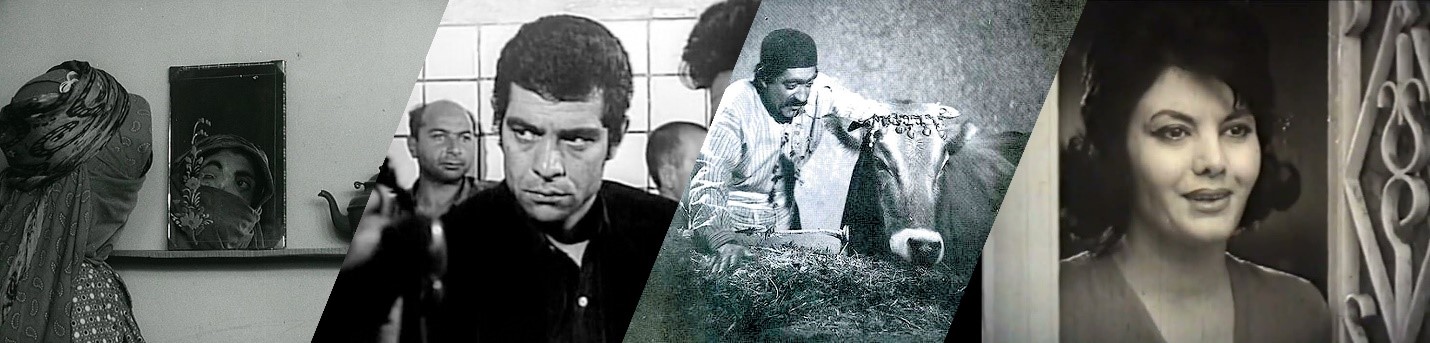
Figure 1 (from left): A still from Khānah siyāh ast (The House is Black, 1963), directed by Furūgh Farrukhzād. Qaysar (1969), directed by Mas‛ūd Kīmiyāyī. Gāv (The Cow, 1969), directed by Dāryūsh Mihrjū’ī. Junūb-i shahr (South of the City, 1958), directed by Farrukh Ghaffārī.
In 1967, the Iranian filmmaker, poet, and critic, Farīdūn Rahnamā, criticized Iranian cinema by saying, “Today we are submerged in imitation.” “If imitation is our role,” he continued, then “that role must not be.” “In the past, our noble deeds, which have sometimes appeared as miracles to outsiders . . . have been due to our combining seemingly incommensurable elements.” Such combining of forces, a blending of imitation and innovation, a fusion of global cinematic insight and local Iranian vision, Rahnamā believed, could ignite the Iranian “spiritual force” in filmmaking. “In this combinatorial path, we will be inevitably informed of the efforts and rectitude of all countries,” Rahnamā stated; what was unnecessary, however, was to follow other societies’ “dead-ends, crises, and extremes” in cinema. By implementing a combinatorial spirit in filmmaking, Rahnamā believed that Iranians could expose unexplored openings in culture that Westerners had also been waiting for.1Farīdūn Rahnamā, “Cinematic Insight,” Sīnimā-yi Āzād, Kitāb-i Duvvum [Free Cinema, Book Two] (Tehran: Sīnimā-yi Āzād Publishing Center, 1351 [1972]), 11-12. Translated by the author. While this piece was published in Free Cinema in 1972, the text was part of a speech that Rahnamā was supposed to deliver five years earlier at a cinema seminar which was to be broadcast on the radio. Such a cosmopolitan vision of filmmaking that drew on global cinematic experiences to foreground an Iranian cinematic imagination came to characterize a national filmmaking movement prior to the 1979 Revolution.
Iranian pre-revolutionary cinema has been defined by different artistic trends. While distinct in their characteristics, modes of production, means of circulation, and reception, these cinematic movements were connected and overlapping. Starting in the late 1950s and early 1960s, a new cinematic movement grew in Iran that drew on some of the tropes of the extant popular film industry, while distantiating itself from it. Iran’s post-World War II (WWII) popular film industry, usually regarded as “Film-Farsi” (Persian-language-films), was strongly criticized and disparaged by film critics, cultural thinkers, actors, and directors as producing commercial and cheap productions that lacked serious artistic value. In an era defined by a global counterculture movement, left-leaning political ideologies, third world nationalisms, and new wave cinematic movements, a young group of Iranian filmmakers embarked on the creation of a socially committed and realist cinematic movement that aligned with new waves around the world. As discrepancies emerged between this artistically and politically inclined trend and Iran’s mainstream films, some critics adopted the term “Alternative Cinema” for this movement. Iranian alternative films can be considered as vernacular-cosmopolitan productions. By virtue of their engagement with global ideological currents and artistic trends through their directors, producers, writers, actors, and global networks that circulated film culture, these productions had a cosmopolitan colour that appealed to an educated middle-class. On the other hand, alternative filmmakers looked to the Iranian past and traditions to shape a collective consciousness through film and imagine a new Iran that was free from tyranny and imperialism. It is not surprising, then, that this movement emerged while a collective political consciousness was taking shape in Iran before 1979.
Laying the Groundwork for Alternative Cinema
While cinema in Iran had become popular among the public by the 1930s, and while Persian language films were produced in Iran and India, the onset of WWII and the invasion of Iran by Allied forces gave rise to a hiatus in narrative feature filmmaking. This pause, however, did not mean the ceasing of cinematic activities as movie theaters still showcased international films and magazines published articles about world cinema. After the end of WWII and the withdrawal of the Allies from the country, a sustained film industry emerged in Iran. Despite just a few years of operation, however, this burgeoning popular film industry came under severe criticism and scrutiny from film critics, directors, actors, and cultural thinkers. Commercial films were reprimanded for their popular cultural tropes, lack of technical quality, mimicry in borrowing storylines from international commercial cinemas like Hollywood and Egyptian cinema, and their concern with profit-making.
Hūshang Kāvūsī, a pre-revolutionary filmmaker and critic who first coined the term “Film-Farsi” for Iranian post-WWII popular films, did not regard Iran’s popular cinema as part of the canon of Iranian cinema. He considered these visual offerings as films that “spoke in the Persian language” but, from a technical perspective, were not worthy enough to be included within the annals of a national cinema.2Hūshang Kāvūsī, “Sīnimā-yi bī-sāmān [Disorderly Cinema],” Nigīn, no. 34 (Isfand 1346 [March 1968]), 9. Translated by the author. Writing in Firdawsī magazine in 1955, Kāvūsī criticized the seven years of sustained film production after WWII as possessing no “cinematic value.”3Hūshang Kāvūsī, “Fīlm-Fārsī bi Kujā Mīravad? [Where is Film-Farsi Going?],” Firdawsī, no. 144 (Tir 18, 1333 [June 29, 1954]), page number not clear. Translated by the author. In the 1960s, he continued his battle with Film-Farsi when he wrote that “from twenty years ago hundreds of thousands of kilometers of film have been utilized, millions of Tomans have been spent, thousands of hours have been wasted, and the result, which is the current Farsi cinema, has not been able to find a place for itself in global cinema.”4Kāvūsī, “Sīnimā-yi bī-sāmān [Disorderly Cinema],” Nigīn, no. 34 (Isfand 1346 [March 1968]), 8. Translated by the author. Similar to Kāvūsī, Farhang Farahī also found it pitiful to call Film-Farsi “a filmmaking industry.”5Farhang Farahī, “Jumʻah Bāzār-i Sīnimā-yi Fīlm-Fārsī” [The Friday bazaar of Film-Farsi], Nigīn 44 (Day 30, 1347 [Jan. 20, 1969]): 25. Translated by the author. Farahi was especially frustrated that Film-Farsi would remain on screens for more than two or three weeks and competed with expensive commercial international productions, while grade A outstanding and meaningful international films were either never showcased in Iran or were screened for only one week.6Farahī, “Jumʻih Bāzār-i Sīnimā-yi Fīlm-Fārsī,” 26. If Film-Farsi was “worthless and vulgar,” it was not because it was part of a “young Persian Iranian industry” or because it did not receive the attention of the government, the critics held; it was because “a group of profit-seeking and greedy merchants” guided the industry.7Farahī, “Jumʻih Bāzār-i Sīnimā-yi Fīlm-Fārsī,” 26. Detecting a grave “danger” associated with the strong “disposition” of the Iranian public for “the bazaar of vulgarism,” Kāvūsī called for “an artistic revolution.”8Hūshang Kāvūsī, “Gandāb-i Rūbirū [The Wasteland Ahead],” Nigīn 44 (Day 30, 1347 [Jan. 20, 1969]), 6.
Through criticism, Kāvūsī believed, “a path would automatically be shown”; however abstract, this path could be teased “out of the heart of words” of cultural thinkers.9This is taken from an interview with Hūshang Kāvūsī and other filmmakers and film critics. See “Mīz-i Gird-i Sīnimā-yi Irān 1 [Roundtable on Iranian Cinema I],” Farhang va Zindigī [Culture and Life] (Tābistān 1354 [Summer 1975]), 55. Translated by the author. As criticisms aimed at Film-Farsi increased in the 1950s, the roots of a filmmaking industry grew stronger and deeper. The number of movie theatres in Tehran and provincial cities multiplied. Film magazines and cultural periodicals that wrote about Iranian and international films, actors and actresses, and the industry boomed in number. Journals such as ‛Alam-i Hunar (Hollywood, The World of Art), Sitārah-yi Sīnimā (Cinema Star), Payk-i Sinimā (Cinema Courier), Fīlm va Hunar (Film and Art), Nigīn (Jewel), Bāmshād, Sipīd va Sīyāh (White and Black), Rushanfikr (Intellectual), and Tihrān Musavvar (Tehran Illustrated) published articles and posters that represented the latest films and screenings in international movie theatres, film reviews, cultural essays, and biographies of movie stars and directors, in addition to the latest fashion of Hollywood, French, Italian, Danish, and later German and Russian cinemas. New film studios began operating, while more and more artists entered the world of cinema. Meanwhile, with the heightened flow of capital after WWII and Iran’s increased integration into the world economy during the Cold War, an increasing number of international mainstream and arthouse films were featured in movie theatres. While increasingly connecting Iran to the world, the wide circulation of such cultural productions aroused anxieties about “Westoxification.”10Westoxication (also referred to as Occidentosis) is a term that was coined by writer and cultural critic, Jalāl Āl-i Ahmad, in his 1962 book by the same title, Gharbzadigī. Westoxification refers to the encroachment of Western cultural imperialism by the pervasive adoption of Western lifestyles, values, and consumerism, which lead to the erosion of Iranian norms and culture.

Figure 2: Iranian Film magazines, from left to right: Sitārah-yi Sīnimā (Cinema Star), Bāmshād, Fīlm va Hunar (Film and Art), Sipīd va Sīyāh (White and Black).
To add to such tensions, the 1953 CIA- and MI6-engineered coup against Mohammad Mosaddeq’s government deepened apprehensions about American imperialism, Iranian despotism, and political suppression in the Iranian consciousness. Mohammad Reza Shah’s revolution from above, or the White Revolution of 1963, added to this growing social angst. Consisting of a series of education and land reforms that aimed to fulfill “the expectations of an increasingly politically aware general public,” and prevent the danger of “a revolution from below,” this revolution posed the Iranian monarchy “as the lynchpin of Iranian state and society.”11Ali M. Ansari, “The Myth of the White Revolution: Mohammad Reza Shah, ‘Modernization’ and the Consolidation of Power,” Middle Eastern Studies 37, no. 3 (2001): 2. With “modernism” at its central ideology, the revolution led to rapid modernization, urbanization, and a growing wealth gap that stirred anxiety among various sectors of society, but especially the poor and conservatives.
It was within these conditions that a group of young Iranian filmmakers, who heeded the criticisms aimed at the popular film industry, and who were now increasingly linked to global visual, literary, and political circuits, embarked on the crafting of a new cinema movement. Many of these young filmmakers had received their education in film, art, or other fields outside Iran. To name a few: Suhrab Shahid Sales (1943–98) studied cinema in both Vienna and Paris; Kāmrān Shīrdil (b. 1939) studied architecture and urbanism at the University of Rome, film at the Centro Sperimentale di Cinematografia in Italy, and worked under the mentorship of directors such as Nanni Loy (1925–95) and Michelangelo Antonioni while he engaged with Italian neorealism; Dāryūsh Mihrjū’ī (b. 1939) studied at the Department of Cinema at UCLA under the instruction of directors such as Jean Renoir (1894–1979); Farīdūn Rahnamā studied and wrote poetry in France; and Parvīz Kīmīyāvī (b. 1939) also studied film and photography in France. Many others were well-informed of cinematic activities in Iran and around the world, had watched Iranian and international films, and were already familiar with film magazines and publications in and beyond Iran. In the years and decades that followed WWII, numerous associations formed that organized international film screenings or film festivals. The National Film Association established in 1949 (later changed to the National Film Archive of Iran), the National Art Association and Cine Club established in 1954, and the Pahlavi University Film Association were some of the groups that organized cultural and film events. In addition, beginning in the 1960s, numerous film festivals were convened in Iran that served as artistic hubs and brought together actors, directors, artists, and films from around the world. Tehran International Festival of Films for Children and Young Adults (starting in 1966), Shiraz Persepolis Arts Festival (starting in 1967), Sipās (Gratitude) Film Festival (starting in 1969), Free (Azad) Cinema Film Festival (starting in 1970), Tehran International Film Festival (starting in 1972), and Tūs Festival (starting in 1975) showcased international films and linked the global cinematic imaginarium to an Iranian one. The films that were made by alternative filmmakers were informed by these cosmopolitan experiences, as well as dynamic national debates during which they were produced. The films of this movement can arguably be considered as cosmopolitan vernacular visual offerings in that they drew on global artistic and political trends to speak about the contemporary Iranian experience.
Thematically and textually, Italian neorealism made significant contributions to the new culture of filmmaking in Iran. Like Italian neorealist films, alternative films used realism and surrealism, an invisible style of continuity in filming and editing, camera movements and positions, minimal artificial lighting and natural light in exterior locations, non-professional actors in addition to professional ones, and “moral poetics” to evoke a collective ethical commitment to social issues that gripped the world.12Hamid Naficy, “Neorealism Iranian Style,” in Global Neorealism: The Transnational History of a Film Style, ed. Saverio Giovacchini and Robert Sklar (Jackson, MS: University Press of Mississippi, 2011). This shared moral commitment was expected to, as Naficy argues, “eliminate filmmakers’ individual, personal, and authorial differences and unite them on larger social issues.”13Naficy, “Neorealism Iranian Style.” Rather than studio sets, the streets and alleyways of metropolitan cities such as Tehran took centerstage in many of these films, not too dissimilar to the status of Rome in Italian neorealism. The pace of earlier films gave way to more observation and contemplation. The characters were more nuanced and flawed, with many films paying particular attention to antiheroes, inviting the audiences to explore more philosophical and existential questions. French Nouvelle Vague, Third Cinema, and other emergent new wave cinemas were also of significance to the shaping of this film movement.
Thematically, inspired by Italian neorealist films, filmmakers focused on aspects of everyday life that were sidelined or suppressed in Iran’s post-WWII visual culture. The quotidian lives of people from lower socio-economic classes became the subject of many social realist films of this ear, including: the working-class; those living in the outskirts of the city; the unemployed; impoverished villagers; the overlooked terminally ill; marginalized small-time thieves, petty criminals, and the formerly imprisoned; restless youth in an unstable society; and socially scorned women like cabaret dancers and sex-workers. While popular films also attended to many of the same topics, the subjects of alternative films were approached from a more humanist sensibility; their stories were told in more unorthodox narrative structures, and the films were aesthetically distinct and at times modernist. Exploitation was a common trope in many of these films. Overall, the collection of alternative films from this era worked to engender a new national culture and a collective consciousness. Noting the distinction in filmmaking in a 1996 retrospective, Farrukh Ghaffari, an influential critic and director of the pre-revolutionary era, proposed “Alternative Cinema” (sīnimā-yi mutafāvit) as an accurate term for this movement in filmmaking.14Farrukh Ghaffārī, “Sīnimā-yi Īrān az Dīrūz tā Imrūz [Iran’s cinema from yesterday to today],” Irān Nāmah 14, no. 3 (Tābistān 1375 [Summer 1996]): 350. Translated by the author. These films, while not cohesive in terms of their texts, themes, style, or the social background of their directors, were taken as alternatives to (even if overlapping with) the visual offerings of the popular film industry and those of the Pahlavi state.
It should be noted that the economic conditions of Iran permitted for the emergence of a somewhat niche market for intellectual and arthouse films. As Iran was increasingly integrated into the world economy, especially due to its oil production in the 1960s and 1970s, a social stratification of cinema and theatre viewers also emerged that allowed for arthouse and less commercially successful films to find their target audience. Since this was not an audience that developed into a distinct entity overnight, a lot of times filmmakers drew on commercially popular tropes in their films to attract spectators and showcase their films in movie theatres for longer periods of time. Alternative films often came under a barrage of criticism from film critics and arthouse film enthusiasts for indulging in the song and dance numbers and fight scenes that defined Film-Farsi.
The Emergence of Alternative Cinema, 1950s-1960s
Directed by Farrukh Ghaffārī, Junūb-i Shahr (South of the City, 1958) was one of the earliest films that blurred the distinction between Film-Farsi and alternative films. It drew on some of the tropes of popular film while also distancing itself from them by taking a more neorealist approach to societal issues such as urban moral disintegration and unemployment. The director shot many of the film’s scenes in real spaces in the south of Tehran that conveyed the film’s urban atmosphere and the poverty associated with this area. The film was banned by the government after a few nights of screening and released again in 1964 under the title Riqābat dar shahr (Competition in the City).15Some attribute the banning of the film to its depiction of the south of Tehran and some to the rumours surrounding the film, including its funding by the Soviet Union. For example see, Hamid Naficy, A Social History of Iranian Cinema, Volume 2: The Industrializing Years, 1941-1978 (Duke University Press, 2011), 188-189. To release it, Ghaffārī had to re-edit the film and incorporate new scenes of singing and dancing to divert the focus away from the impoverished neighbourhood where the film was shot and towards two men’s competition for a woman’s affection.16Naficy, A Social History of Iranian Cinema, 190.

Figure 3: Poster for Junūb-i shahr (South of the City, 1958). Farrukh Ghaffārī
The opening shots of the re-edited film depict different parts of Tehran which set the stage for the narrative. The film tends to the life of Iffat, a widower who works at a cabaret to take care of her young, orphaned son. ‛Iffat (played by Fakhrī Khurvash) tells her story in a voiceover which highlights her perspective and expresses her frustration with men corrupting destitute women and with the image associated with “a woman of the café.” Iffat’s account depicts issues faced by women of her strata, especially as an unemployed single mother. She eventually meets and falls in love with Farhād, a kulāh-makhmalī (velvet-hat-wearing) man of virtuous character, who must contend with Asghar, a vile jāhil, over ‛Iffat’s affection (jāhil is a term that refers to tough guys, often of the ignorant type). The juxtaposition of the two men works to foreground Iranian customs and traditional virtues such as justness and righteousness; scenes of traditional cafes, minstrel music, and Naqqali (Iranian dramatic storytelling) also loom large in the film. Despite the vile jāhil’s efforts, ‛Iffat and Farhād finally triumph over the trials and tribulations created by Asghar. The film ends with the couple depicted in their new lives as a middle-class family; Farhad has become a white-collar worker and Iffat a housewife. The last scenes of the film depicting the social mobility of the couple and their residence in one of the more affluent parts of Tehran were reportedly added by the director in order for the state to lift the ban on the film. It is worth remembering that South of the City was released after the White Revolution, which promised progress and modernization to the people.

Figure 4: A still from Junūb-i shahr (South of the City, 1958). Farrukh Ghaffārī, accessed via https://www.youtube.com/watch?v=9ii3KKJb6V8 (00:13:56)
Following early films such as South of the City, the 1960s was a formative decade for the crystallization of Alternative Cinema. For instance, Furūgh Farrukhzād’s Khānah sīyāh ast (The House is Black, 1962) portrays a neorealist depiction of a leper community at the Bābā-Bāghī hospice in Tabriz. Commissioned by the Society for the Assistance of Lepers and produced by an alternative cinema filmmaker, Ibrāhīm Gulistān, the documentary is a poetic film essay that aims to humanize a forgotten and marginalized community. Beginning with close shots of young lepers, the film compels the viewer to face the brutal reality of a people inflicted by this contagious disease—a disease commonly found among the poor in urban areas. By engraving the deformed faces of her subjects on celluloid and in the viewer’s mind, Farrukhzād urges her audience to remember the fragility of the human body and society’s responsibility to the most vulnerable. Farrukhzād’s poetry, which she recites over scenes of the quotidian in the leper colony, foregrounds her perspective, gives expression to the lepers’ misery, and highlights their dreams of rehabilitation and return. With her effective use of light and moving shots, Farrukhzād opens the viewer to a sense of beauty that the leper community is conventionally deprived of. “Leprosy is not an incurable disease,” the narrator states, calling the viewer to arms in a humanist spirit.

Figure 5: A still from Khānah sīyāh ast (The House is Black, 1963). Furūgh Farrukhzād, accessed via https://www.youtube.com/watch?v=xFe_Y4btwWs (00:02:02)
Similar to Farrokhzad’s The House is Black, Shīrdil’s three social documentaries made in the 1960s also attended to the lives of society’s marginalized. In his late teenage years, Kāmrān Shīrdil moved to Italy to continue his education first in architecture at the University of Rome and then in cinema at Centro Sperimentale di Cinematografia. He learned filmmaking under the instruction of notable directors such as Nanni Loy, while benefitting from a vivacious cinematic culture in post-WWII Italy that encompassed the contributions of Michelangelo Antonioni, Pier Paolo Pasolini, and Roberto Rossellini. When Shīrdil returned to Iran in the mid-1960s, he was almost immediately employed by the Pahlavi Ministry of Culture and Art to make a series of documentaries about the humanitarian work of the Women’s Organization (Sāzmān-i Zanān). Informed by the cinematic idiom of Italian neorealism, Shīrdil’s documentaries provided a social realist portrayal of everyday life that directly questioned state policies, challenged the Organization’s efforts, and thus faced censorship.
For instance, while Shīrdil’s Zindān-i Zanān (Women’s Prison, 1965) was commissioned to attend to the educational and training activities of the Women’s Organization in prison, it instead shed light on the despairing lives of poverty-stricken women who were forced into criminal activities, drug-trafficking, and murder. Taking a bolder approach, Shīrdil’s Women’s Quarter (1966) concentrated on the desperation, deception, and dispossession of sex workers in Tehran’s red-light district, with some attention to their supposed rehabilitation through education and training by the Women’s Organization. Due to the film’s dark portrayal of life in Tehran, the film was banned by the government before shooting was completed and was only finished after the 1979 Revolution, when Ibrāhīm Gulistān’s photos of the red-light district—ten years after the film was originally shot—were used. The superimposition of the voices of women narrating their firsthand accounts of hardship and despair over photos of sex workers in the district provide a compelling image of a dystopic Tehran in the 1960s and 1970s. Shīrdil’s Tihrān pāytakht-i Īrān ast (Tehran is the Capital of Iran, 1966) likewise addressed the impoverishment of the Khazānah neighbourhood in the south of the city. Shots and images of the destitute residents of Khazānah who did not have access to clean water, garbage collection, or other facilities expected in a modern city directly challenged the Shah’s reforms through his White Revolution. In the film, a teacher’s dictation to students enrolled in the Organization’s adult classes includes sections from a textbook about the success of the Shah’s White Revolution and the government’s attempts at modernization. The teacher’s voice projected atop the images of a deprived neighborhood serve as a clear objection to the Shah’s modernizing campaign. Taken together, the films of Farrukhzād and Shīrdil arguably can be understood as militant documentaries that implored a collective consciousness by representing neglected sectors of society, appealing to a shared humanity that called for socio-political action.
The Global 1960s: Key Films in Alternative Cinema
The years 1967 to 1969, significant in global social and political affairs, were at the crux of Iran’s alternative filmmaking trend. Of note, Farīdūn Rahnamā’s Sīyāvash dar Takht-i Jamshīd (Siavash in Persepolis, 1967) marked a significant turning point in filmmaking. The juxtaposition of real and fictional, concrete and imaginary, which characterized some of Shīrdil’s work, also took centre stage in Rahnamā’s films. Siavash in Persepolis is based on the epic story of Siyavash in Firdawsi’s epic poem, Shāhnāmah (Book of Kings) produced in the eleventh century. In Shāhnāmah, Sīyāvash is a warrior prince who attempts to bring peace to Iran, the land ruled by his father. A victim of lies and schemes begun by his stepmother, Sīyāvash is put to the test of fire to prove his innocence. Walking out of the fire alive, a triumphant Sīyāvash is then entrusted with the task of engaging in battle with the land of Tūrān. After a falling out with his father over a peace treaty offered by the Tūrāni King, Sīyāvash flees to Tūrān and marries a Tūrāni princess. While taking refuge there, he arouses the jealousy of some members of the royal family, which eventually leads to Sīyāvash’s execution.

Figure 6: A still from Sīyāvash dar Takht-i Jamshīd (Siavash in Persepolis, 1967). Farīdūn Rahnamā, accessed via https://www.aparat.com/v/n89px9c (00:51:18)
Rahnamā’s film was shot in the ruins of Persepolis, staged without much glamour and glory. Including documentary-style footage, modern-style dances, and tourists visiting the ruins, Rahnamā brilliantly mixes fact and fiction to allude to the pseudo-historical origins of a nation. Collapsing boundaries of time, the film brings the past into the present to make Siyavash relevant to the modern-day Iranian. The message is even more forceful when considering that the film was released in the same year that Mohammad Reza Shah coronated himself in a lavish ceremony in Tehran. In a way, Mohammad Reza Shah revealed himself to be far from the admirable and justice-seeking Sīyāvash of Firdawsī’s epic poem.
In a film essay on Siavash in Persepolis, film critic and director Nasīb Nasībī proclaimed Rahnamā as the “only cinematographer in Iran who carries the weight of Iranian thought and spirituality,” one whose film is a “totality about the human.”17Nasīb Nasībī, “Sīyāvash dar Takht-i Jamshīd [Siavash in Persepolis],” Sīnimā-yi Āzād, Kitāb-i Avval [Free Cinema, Book One] (Tehran: Sīnimā-yi Āzād Publishing Center, 1350 [1971]), 63. Translated by the author. Rahnamā’s films, in Nasībī’s opinion, would one day turn into a school of filmmaking, and this film in particular, due to its reach into the past, “is connected to a thousand years later.”18Nasībī, “Sīyāvash dar Takht-i Jamshīd [Siavash in Persepolis],” 63. For, as Nasibi argues, Rahnamā showed the relationship between the mythical Sīyāvash of Shāhnāmah and “today’s humans,” to say “that today, too, Siyavash exists,” but perhaps not in the form of the incumbent king, Mohammad Reza Shah.19Nasībī, “Sīyāvash dar Takht-i Jamshīd [Siavash in Persepolis],” 63. The film’s story and setting, as well as Rahnamā’s modernist approach to collapsing time and space, were innovative for this time period.
Also from the late 1960s, Qaysar (Mas‛ūd Kīmīyāyī, 1969) was one of the formative films of Iran’s alternative cinema, one that similarly drew from Film-Farsi tropes to address the anxieties that gripped the Iranian underclass. Qaysar tells the story of a man trapped in a transitional society that treads between modern values and traditional-familial morals. Upon arriving in Tehran from the booming, oil-producing Abadan where he is employed, Qaysar discovers that his sister committed suicide after being raped and that his brother was killed while defending his sister’s honor. In reaction to this news, Qaysar sees no choice but to take matters into his own hands. Learning the names of the perpetrators of the crime, Qaysar avenges both the lives of his sister and brother and the memory of a forgotten underclass in an almost epic fashion. Qaysar was praised by film critics for its representation of “the blind rebellions and pervasive dead-ends” in the dark underbelly of Iran’s conservative lower classes.20‘Alī Hamadānī, “Hamāsah-i Qaysar va Sīm-i Ākhar” [The Epic of Qaysar and Madness], Nigīn, no. 56 (Day 1348 [December 1969]), 69. Translated by the author. Despite its success at the box-office, Hūshang Kāvūsī censured the film for its connection to Film-Farsi in its depiction of traditional coffeehouses, bath houses, fight scenes, and folkloric elements.21Hūshang Kāvūsī, “Az ‘Dāj Sītī’ tā Bāzārchah-i Nāyib Gurbah” [From “Dodge City” to the Bazaar of Nāyib Gurbah], Nigīn, no. 56 (Day 1348 [December 1969]), 23-24. Translated by the author. Regardless of such criticisms, however, Qaysar staged on the silver screen a neglected community that sought solace in traditional values to combat the annihilation brought about by modern times.

Figure 7: A still from Qaysar (1969). Mas‛ūd Kīmīyāyī, accessed via https://www.youtube.com/watch?v=itYE35x-umQ (00:59:57)

Figure 8: A still from Qaysar (1969). Mas‛ūd Kīmīyāyī, accessed via https://www.youtube.com/watch?v=itYE35x-umQ (00:38:04)
Another significant film from this period—and perhaps the most well-known of the alternative trend—is Dāryūsh Mihrjū’ī’s Gāv (The Cow, 1969), based on a short story by Ghulām-Husayn Sā’idī, a leftist writer and psychiatrist. At a time when pastoral life and the incorruptibility of peasants was romanticized by alternative and popular filmmakers alike in reaction to rapid urbanization and growing social divides, The Cow’s poetic pessimism about village life was a subversive act against Pahlavi claims to progress and modernization. Mashdī Hasan, a poor villager who lives in a remote and impoverished area, is over-reliant on a single cow as a means for his subsistence. The cow’s mysterious death sparks a psychotic episode in which Mashdī Hasan loses contact with reality—the boundary between human and animal is disrupted and Mashdī Hasan metamorphoses into a cow. Screened at Berlin, Cannes, and Moscow film festivals, the film was praised for its critique of capitalism and imperialism and their alienating effects. Mihrjū’ī saw the demise of his protagonists in films such as The Cow, Āgāy-i Hālū )Mr. Halu, 1971), and Pustchī (The Postman, 1972) to be in reaction to their environments and informed by “historical and social factors.”22Hasan Qulī-Zādah, “Gāv, Hālū, va Pustchī va Sīnimā-yi Mu’allif [The Cow, Halu, and The Postman, and Auteur Cinema],” Sīnimā-yi Āzād, Kitāb-i Duvvum [Free Cinema, Book Two] (Tehran: Sīnimā-yi Āzād Publishing Center, 1351 [1972]), 30. Translated by the author. The absence of the cow, according to Mihrjū’ī, led to the collapse of the boundary between lover and beloved, or signaled a return to the “mother’s womb.” In that sense, Mashdī Hassan’s transmutation can be regarded as a journey towards “perfection” and “transcendence,” or a shift towards “self-reliance” for salvation—an essential third world nationalist response to imperialism.23Qulī-Zādah, “Gāv, Hālū, va Pustchī va Sīnamā-yi Mu’allif [The Cow, Halu, and The Postman, and Auteur Cinema],” 30.

Figure 9: Mashdī Hasan has taken the cow to the river and is washing it with love and enjoyment. Gāv (The Cow, 1969), Dāryūsh Mihrjū’ī, accessed via https://www.youtube.com/watch?v=d7hTfaEY0lA (00:08:25)
The alternative films of the era were specifically commended for their close connection to Iranian society, culture, and history. Shab-i Qūzī (The Night of the Hunchback, 1965) by Farrukh Ghaffārī was acclaimed in the Free Cinema journal for its similarities to the works of Hitchcock, also praising the film’s “perfect proximity” to “Iranian life.”24Sam (no last name), “Shab-i Qūzī [The Night of the Hunchback],” Sīnimā-yi Āzād, Kitāb-i Avval [Free Cinema, Book One] (Tehran: Sīnimā-yi Āzād Publishing Center, 1350 [1971]), 90-91. Translated by the author. Similarly in Arāmish dar huzūr-i dīgārān )Tranquility in the Presence of Others, 1970), Nāsir Taqvā’ī was commended for having “accessed the culture of his society,” a culture that had “polluted” urban dwellers and convicted them to “a state of dreadfulness.”25Gītī Vahīdī, “Ārāmish dar Huzūr i Fāji’ah” [Tranquility in the Presence of a Catastrophe], Nigīn, no. 96 (Urdībihisht 1352 [April 1973]), 56. Translated by the author. Bahman Farmānārā’s Shāzdah Ihtijāb (Prince Ejtejab, 1974) was also noted for its reliance on Iranian history to narrate “the decline of an aristocratic family in the context of an end of an era,” perhaps signifying the collapse of Iran’s monarchy.26Jamshīd Akramī, “Mīrās-i Tabāh-kunandah” [Corrosive Legacy], Rūdakī, nos 37-38 (Ābān-Āzar 1353 [October- November 1974]), 21. Translated by the author.
A prime example of such close connections was Farīdūn Gulah’s Zīr-i pūst-i shab (Under the Skin of the Night, 1974) which, as the title suggests, delved into the underbelly of Tehran, ripe with desire, crime, and lust for life. In the film’s opening scenes, Gulah compares a beetle’s efforts to make a home in the wild to a man’s attempt at life in Tehran, while an establishing wide shot of Tehran sets the stage for this tale. Under the Skin of the Night follows a day in the life of Qāsim Sīyāh (Qāsim, the Dark), unemployed and homeless, to expose the hardship faced by a young man in a harsh, modernizing city. His austere life is filled with a thirst for living, continuously reflected through sexually evocative scenes quite out of place in a conservative society. Qāsim is reproached by everyone: he is reprimanded by his mother for his unemployment; chastised by other mothers for playing soccer with their kids (and unintentionally injuring them); chased by men for harassing their wives or sisters; pursued by big name criminals for hustling in the streets he grew up in; and beaten up by affluent men who deride him.

Figure 10: A still from Zīr-i pūst-i shab (Under the Skin of the Night, 1974). Farīdūn Gulah, accessed via https://www.radiofarda.com/a/movie-under-the-skin-of-the-night-fereydun-gole/31331680.html
While feeling invisible in the busy streets of Tehran, Qāsim is spotted by a foreign young woman, Sūsan, who seems to be escaping from her past—a relationship perhaps. Despite facing a language barrier, the two strike a friendship and agree to spend Sūsan’s last night in Tehran together. Qāsim looks for a place where they can be sexually intimate but to no avail. In the absence of an actual erotic tryst, they smoke marijuana together and use the respite to imagine their sexual encounter. In the darkness of night, Qāsim and Sūsan cross paths with two affluent young men, whose family employs Qāsim’s mother as a servant. Invited to a villa by the wealthy duo, Qāsim’s jealousy flares as he watches one of them swim alongside Sūsan in the pool. Feeling impotent in front of the upper-class, an enraged Qāsim is eventually beaten up by the two men. Qāsim and Sūsan then leave the house and begin wandering through the streets again.
Scenes of Qāsim’s sobs, accompanied by the loud background noise of the city, highlight his atomization in this unjust society. Only in a few tender moments when the two lovers make out does the uproar of the city quiet—at least until the two are arrested by the police. Adding to his pain, Qāsim is kept in prison while Sūsan is put on her flight back to New York. Finally, in the early hours of the morning when Sūsan is on the plane, Qāsim finds solace in self-pleasure to alleviate the erotic tension and the social and cultural distress that he faced throughout the day. Gulah’s subject matter, techniques of filmmaking, and dream-like sequences were viewed as unprecedented and avant-garde. His depiction of the neglected underclass, antiheroes in their flaws and despair, challenged the Pahlavi state’s propaganda and social taboos, calling for a collective national consciousness for rebellion.
Alternative Cinema and the Rumblings of Revolution
As Iranian discontent with the regime of the Shah became more pronounced, films also became more conspicuously political, and at times religiously-attuned. As political activism and protests thrived in the streets of Tehran, films grew more revolutionary, and sometimes rife with religious undertones that paralleled the religious underpinnings of revolutionary activism. Tangsīr (1974), Sāyah-hā-yi buland-i bād (Tall Shadows of the Wind, 1978), and O.K. Mister (1979), were some of the films that grasped the collective angst and revolutionary spirit of their era. Based on a novel of the same title by Sādiq Chūbak, Amīr Nādirī’s Tangsīr portrays the battle of Zā’ir Muhammad, an honest veteran from Tangistān city of Bushehr province, against the corrupt, wealthy elite in southern Iran. The affluent nobility, who symbolize an unjust capitalist social system, have stolen Zā’ir Muhammad’s life savings. Outraged by the injustices he is subject to, he decides to pursue justice through violent retribution. Before setting out on his vendetta, he pays a visit to the local mosque and shrine to receive the blessing of the village’s religious superior. Zā’ir Muhammad drinks water from the mosque’s water reservoir and hesitates over a painting of the Shi’ite saint, Imam Hussein, which conjures an analogy to the events of Karbala. He then digs out his gun and axe and takes revenge against those who have oppressed him and other members of his community. Zā’ir Muhammad’s courageous acts inspire other villagers to also rise up and demand justice from the village nobility in the form of a cinematic rebellion.
Bahman Farmānārā’s Tall Shadows of the Wind also tells the story of a young man in a village who fights against injustice, this time imposed by a self-made cult. The people in ‛Abd-Allāh’s village have longed for a saviour to deliver them from their problems. To that end, the superstitious residents prop up a scarecrow at the village’s entrance for protection. While initially valorized, the scarecrow gradually unleashes a reign of terror upon the villagers who become consumed by fear. Arguably standing in for Mohammad Reza Shah, the scarecrow has supernatural powers that violently pound the people of the village, not unlike what SAVAK (a secret police, security, and intelligence service of the Shah) did to political activists. Strange and mysterious encounters with the scarecrow lead variously to psychosis, death, and, at one point, an unwanted pregnancy experienced by ‛Abd-Allāh’s sweetheart, Nargis. After speaking with a few other villagers, ‛Abd-Allāh takes up his plow, representing peasant valor, to battle the scarecrow.

Figure 11: A still from Sāyah-hā-yi buland-i bād (Tall Shadows of the Wind, 1978). Bahman Farmānārā, accessed via https://www.youtube.com/watch?v=bfisG2HDaLc (01:34:45)
After he is fatally injured by the scarecrow, ‛Abd-Allāh imagines, and perhaps leads, a revolution against the tyranny of the scarecrow in his mind. In his hallucinatory dream, villagers dressed in red follow ‛Abd-Allāh and set fire to scarecrows of varying sizes. ‛Abd-Allāh smiles after this dream-like sequence to signal a victory before he passes away. The village’s headmaster, Muhammad, is deeply moved and inspired by ‛Abd-Allāh’s self-sacrifice. Later in his classroom, he writes the last verse from Ahmad Shāmlū’s 1969 poem, “An Anthem for a Luminous Man Who Went to the Shadows,” which reads “The sea is jealous of the sip you took from the well,” hinting at ‛Abd-Allāh’s greatness.27Ahmad Shāmlū, “Surūd barāy-i mard-i rawshan ki bi sāyah raft [An Anthem for a Luminous Man Who Went to the Shadows],” The Official Website of Ahmad Shāmlū, accessed 19 May, 2024, http://shamlou.org/?p=167. Translated by the author. Taken together, the film’s numerous symbolisms allude to the multifaceted revolutionary zeitgeist in the streets of Tehran at that time. The colour red worn by the film’s rebels denote socialist undertones that were prominent among many of the cultural thinkers and activists of the period, and the moustaches sported by both ‛Abd-Allāh and Muhammad arguably point to the leftist backgrounds of these two young men. On the other hand, the names of the two men have religious implications as ‛Abd-Allāh was the name of the father of the Prophet of Islam, Muhammad.28In a question and answer after the screening of Tall Shadows of the Wind at Museum of Modern Art (New York), on 11 November 2023, Farmānārā specifically indicated his intentional use of these names for his film’s heroes. In that sense, ‛Abd-Allāh’s sacrifice inspires Muhammad’s calling for a new order against tyranny. In this light, the film’s religious symbolism served as a nod to political Islam as a means to break free from a tyrannical monarchy and imperialism.
Conclusion
By the late 1960s and early 1970s, the films of Iran’s alternative filmmakers were screened at prominent international film festivals such as Cannes, Berlinale, and Tehran International Film Festival. Applauded and recognized by film critics, some alternative films also won international awards. Mihrjū’ī’s The Cow, ‛Abbās Kīyārustamī’s Tajribah (The Experience, 1973), Bahram Bayzayi’s Gharībah va Mih (The Stranger and the Fog, 1974), and Bahman Farmānārā’s Prince Ehtejab (1974) and Tall Shadows of the Wind were among alternative films showcased at Cannes, while Suhrāb Shahīd Sālis’s Yik Itiffāq-i sādah (A Simple Event, 1974) and Tabī‛at-i bī-jān (Still Life, 1974) and Parvīz Kīmīyāvī’s Bāgh-i sangī (The Stone Garden, 1976) were screened at the Berlinale. The connection between Iranian and global arthouse films did not go unnoticed, prompting the British film critic John Gillett to compare the alternative films of Iran to those of François Truffaut and Akira Kurosawa.29John Gillett, “Dar Hāshīyah-i Jashnvārah-i Kan: Dar Intizār-i Zuhūr-i Āsārī Buzurg az Sīnimā-yi Īrān” [On the Sidelines of the Cannes Film Festival: In Anticipation of Great Works from Iranian Cinema], Sīnimā 54 [Cinema 54], no. 18 (Murdād-Shahrīvar 1354 [August-September 1975]), 60. Indeed, in the eyes of international film critics, the works of Shahid Sales were reminiscent of Truffaut, Mihrjū’ī’s films were likened to those of Luis Buñuel, while Parvīz Kīmīyāvī’s films such as Mughulhā (The Mongols, 1973) were thought to be informed by Godard’s cinema.30Bengt Forslund, “Matbūʻāt-i Jahān va Sivvumīn Jashnvārah-i Jahānī-yi Fīlm-i Tihrān” [World Press and the Third Tehran International Film Festival], Sīnimā 54 [Cinema 54], no. 18 (Murdād-Shahrīvar 1354 [August-September 1975]), 68-69. Following the “combinatorial spirit” that Farīdūn Rahnamā had encouraged in the late 1960s, Iranian filmmakers engaged with the works of prominent international filmmakers and foregrounded the Iranian experience—a predicament that was informed by domestic conditions and international politics.
Further, alternative filmmaking in Iran had different trajectories that at times turned into distinct filmmaking trends. While some focused their visual offerings on films that traversed between popular and realist cinema, others concentrated on making arthouse films that catered to a limited audience, while still others engaged in experimental filmmaking that was supported by the art community. Thus, the combination of Iran’s contentious love affair with cinema and film experimentation, a boom in state, international, and private funding for filmmaking in the 1960s and 1970s, and familiarity with global cinemas that spoke to current socio-political struggles and trends paved the way for the crafting of alternative films in Iran.
Informed by criticisms aimed at popular films, alternative cinema filmmakers functioned to distance themselves from charges of imitation and mimicry. Stirred by third world nationalist and leftist debates that called for struggle against imperialism and reliance on the self, the filmmakers of this era looked to their own history, culture, and society for inspiration. However, the struggle of these filmmakers was not that different from fellow filmmakers in other parts of the world, especially at a time when art, history, and politics were closely intertwined. Alternative films engaged with post-WWII ideological trends in filmmaking that showcased the poor, marginalized, and fallen. Hence, alternative films became vernacular-cosmopolitan offerings that not only looked to the past, but also investigated and questioned it in order to imagine a new horizon of expectation, a new future for Iran.
