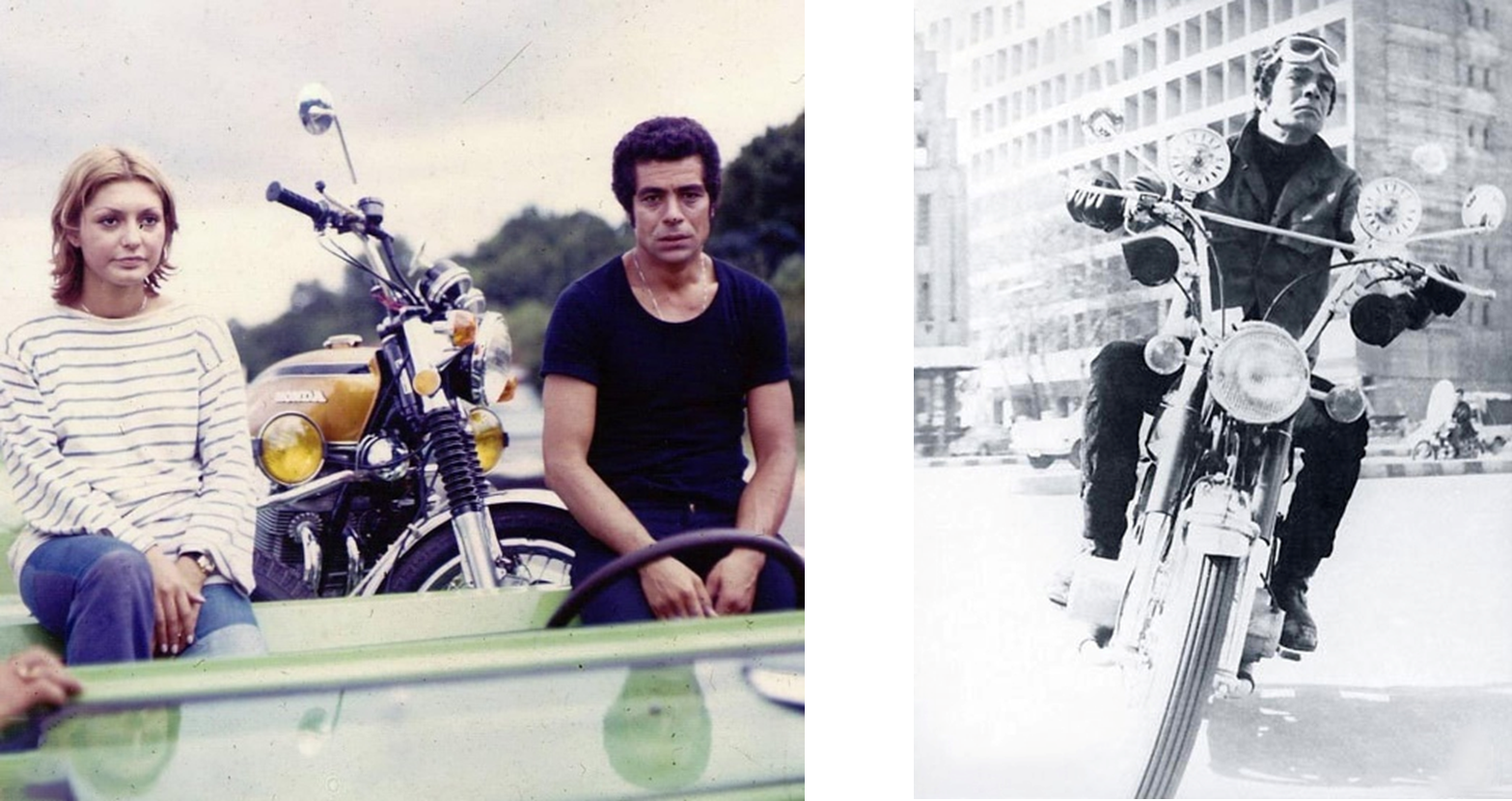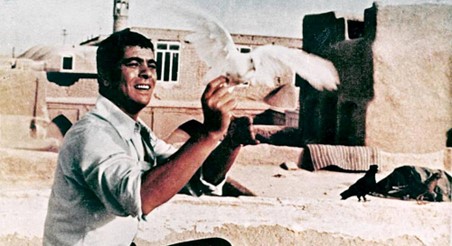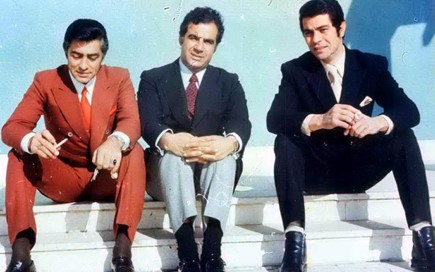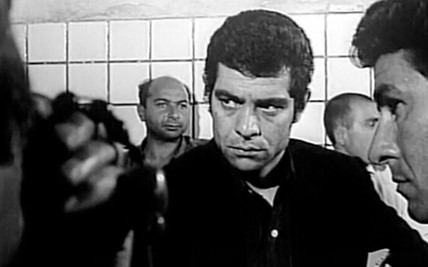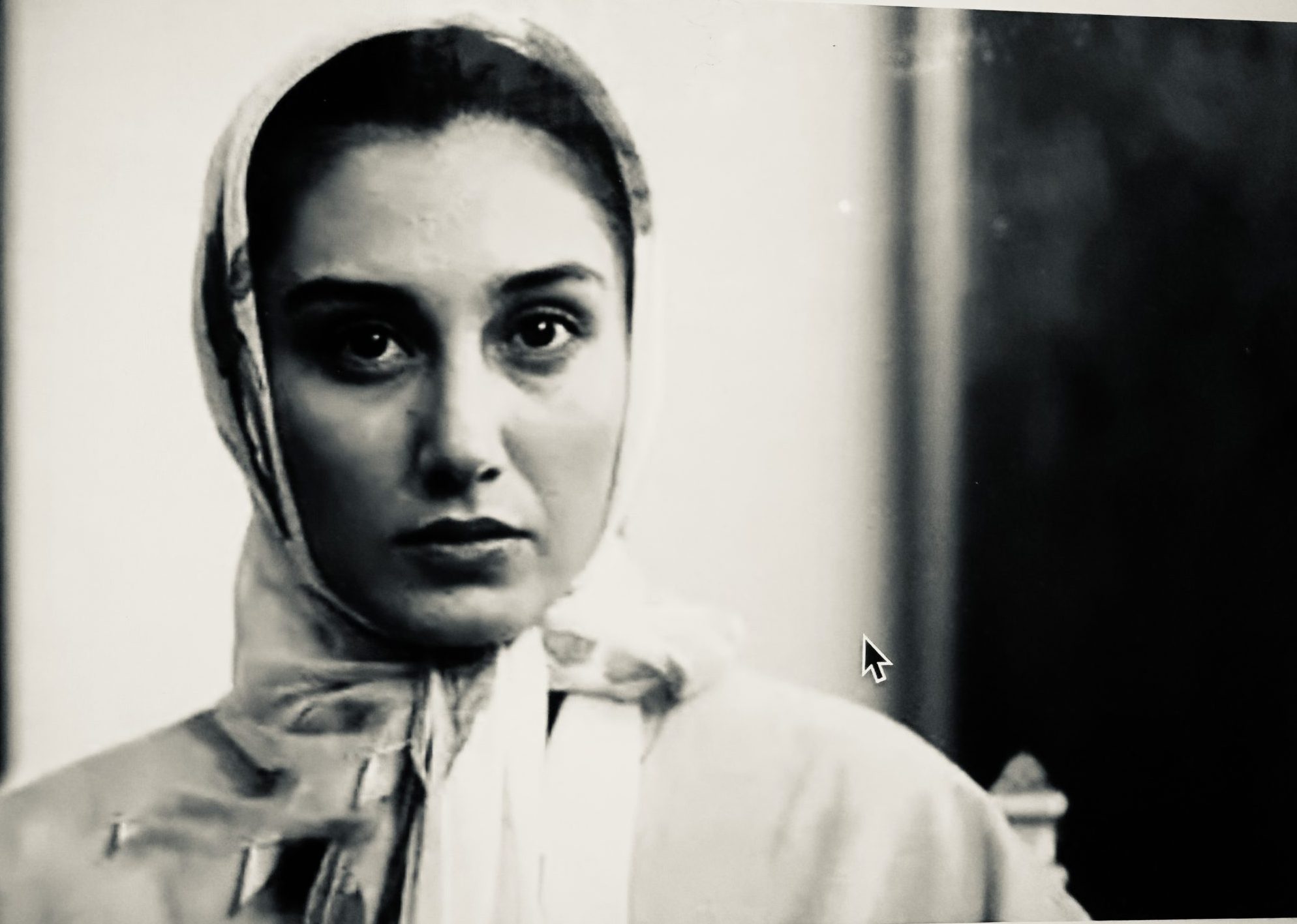
Filming Locations as a Defining Feature of Fīlm-Fārsī (1930-1978)

By

The choice of location was a crucial aspect in the creation of most Iranian films from the 1930s to the end of the 1970s. These locations depicted in Iranian cinema become significant parts of the story in and of themselves, offering unique windows into the everyday life and culture of the pre-revolutionary period, as well as the richness and significance of Iranian history and culture overall. Film locations provided backdrops and shelter, served as sites for rituals, and were more often than not integral to the story, representing specific aspects of Iranian society and culture. As well, given their ubiquitous if non-speaking presence in Iranian cinema, film locations were not only physical spaces but also symbols of social interaction, religious practices, and familial dynamics, all of which added depth and intrigue to the narrative.

Over time, the locations used in the pre-revolutionary Iranian cinema have become vital elements in the films themselves, as important as the directors, producers, actors, and others involved in their creation. Indeed, it is impossible to watch a movie from the period and not mention one or more of these locations, including:

  • Qahvah’khānah (coffeehouse or teahouse), representing socio-cultural life,
  • Zūr’khānah (traditional place for sports), representative of social and physical life,
  • Hammām (bathhouse), indicative of communal bathing and socializing,
  • Ziyārat’gāh (places of worship, mosques), depicting religious and spiritual significance,
  • Khānah (family home), the place of gathering, refuge, love, and stability, and
  • Qabristān (cemetery), representing the end of life, and the fragility and decadence of material life.

In what follows, I attend to each of these important types of film locations in this vibrant period of cinema in Iran. I showcase each type and their various aspects (especially concerning the khānah), through examples with still images from relevant films of the era. I also employ insights and observations drawn from travellers, historians, and others who have recognized the vital import of these various spaces to Iranian society and culture through the ages into the pre-revolutionary period. In so doing, this article offers an overview of the important roles and influences that these particular locations, settings, spaces, buildings, and architecture—and the symbolic, social, cultural, and even political meanings attached to them—have had and continue to play in Iranian cinema.

Qahvah’khānah: The Typical Filming Location in Iranian Cinema

Iranians’ most popular amusement spots of the 19th century were the Qahvah’khānahs, which were situated in the gardens and provided tea and narghile. In the summer, ice cream was also sold… A basin was located in the center of the Qahvah’khānah, and people would sit on coffee house beds surrounding the pool… An open space was provided for artists to practice and perform their dance, singing, drama, or poetry reading. The Naqqāls, who were storytellers, were also present. Thus, the Qahvah’khānahs were the first places where people gathered and expressed themselves through oral and artistic means.1Hamīd Shuʿāʿī, Sadā-yi pā…: Nazarī guzarā bih tafrīh va sargarmī-i mardum va tārīkhchah’ī az fīlm-i Īrānī va sīnimā dar Īrān (The Sound of Footsteps: A Brief Overview of Iranians’ Recreation and Entertainment and a History of Iranian Film and Cinema in Iran) (Tehran: Sipihr, 1973), 18-19. Note that naqqālī is a narrative form of performance art which combines storytelling, acting, and singing and is one of the oldest forms of traditional Iranian theatre. Thus, a Naqqāl is a performer of naqqālī who, as a kind of “one man show,” narrates, performs the roles of various characters, and sings for the live audience. As further noted by Shuʿāʿī:

“The Naqqāls were well-versed in the poems of the Shāh’nāmah (The Book of Kings) and could recite or sing them without fail. Religious Naqqāls [called also pardah-khānī], included those who quoted and spoke about religious events, such as the Karbala tragedy. The Naqqāls had a significant impact on the people. The Qahvah’khānah, which had a skilled Naqqāl, were consistently filled with people. […] The Naqqāls performed all the characters in the story on their own and relied heavily on human emotions, able to make the audience laugh or cry with ease.” See Shuʿāʿī, Sadā-yi pā…, 8-9.

The first Iranian film, Dukhtar-i Lur (Lor Girl, 1932), marked the beginning of the Qahvah’khānah’s role in Iranian cinema. This historical landmark, with its unique architecture and cultural significance, soon became a popular and often-used filming location. Further, its presence in early Iranian films set a precedent for its continued use, establishing it as a symbol of Iranian cinema’s connection to its cultural roots.
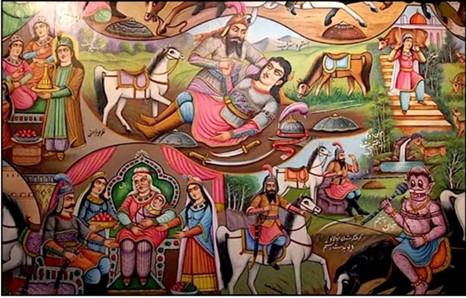
Figure 1. A painting of naqqālī depicting the story of Rustam and Sohrāb from the Shāh’nāmah (The Book of Kings).
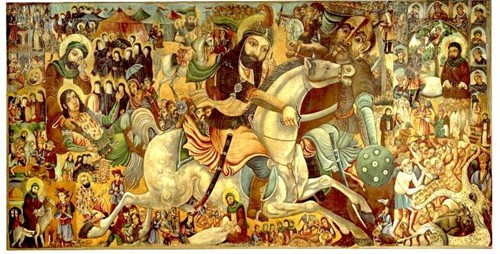
Figure 2. A painting of pardah-khānī illustrating ʿAbbās ibn ʿAlī at the Battle of Karbala, by the Persian painter ʿAbbās al-Mūsavī.

At first, this place was a traditional gathering and gossip spot for men, where they would smoke hookahs and drink coffee. Over time, coffee was replaced by tea, but these locations continued to be referred to as the House of Coffee (i.e., Qahvah’khānah). These coffee-turned-tea houses are glowingly described by the seventeenth- and eighteenth-century French traveller Jean Chardin in his book Voyage en Perse (Travels in Persia): “The most stunning places in towns are usually Tea Houses that are large, spacious and have elevated drawing rooms of varying shapes. They serve as meeting points and entertainment venues for the locals.”2Jean Chardin, Voyage en Perse (Travels in Persia) (Phébus, 2007), 142.

The Qahvah’khānah has been a male space in Iran since the beginning of the seventeenth century, and it has not changed much since then.3Initially, women did not express an affinity for this male locale and sought to make their displeasure known in a rather forthright manner. A comparison of the testimonies of Orsolle, Wills, and Edward Browne in 1888 with those of the Iranians suggests that the closure of cafes at the end of the 19th century was due to a protest by Iranian women against the idleness of men (idleness and, implicitly, the widespread consumption of opium and its harmful effects). See Aladin Goushegir, “Le café en Iran des Safavides et des Qājār à l’époque actuelle” (Coffee in Iran from Safavid and Qājār to the Present Day), in Contributions au thème du et des Cafés dans les sociétés du Proche-Orient (Contributions to the Theme of Coffee in Middle Eastern Societies), ed. Hélène Desmet-Grégoire (Aix-en-Provence: Institut de recherches et d’études sur les mondes arabes et musulmans, 1992), 67. As noted by Aladin Goushegir: “Cafes are permanently present in Iran as a masculine public area. Women have only been able to enjoy public spaces since the second half of the twentieth century, when cafe-restaurants or cafe-pastries were introduced, particularly in Tehran.”4Goushegir, “Le café en Iran des Safavides et des Qājār à l’époque actuelle,” 69.

While undeniably restricted in terms of gender, the Qahvah’khānah was a unique space for conversation, a place where any thought could be expressed without fear of embarrassment. In an era before the press or radio, the Qahvah’khānah stood as the sole arena for exchanging, communicating, and receiving information, where free expression was not just exceptional, but a rare and cherished privilege. As Chardin further remarks, “There is conversation because that’s where the news is spouted, and where politicians freely criticize the government.”5Chardin, Voyage en Perse, 142. In addition, and again from Goushegir, it is clear that these establishments drew the ire of authorities who sought to control those who employed them as spaces of communication, critical thought, and discussion. As Goushegir writes, “Tavernier mentions political discussions in Isfahan cafes during the seventeenth century. A situation that was managed by the authorities. Following the king’s directive, a cleric was to come and deliver a speech, and at the end, encourage customers to leave the cafe and go to work.”6Goushegir, “Le café en Iran des Safavides et des Qājār à l’époque actuelle,” 70.

These gathering places were also hotbeds of art and popular culture, particularly in the latter half of the nineteenth century and the start of the twentieth century. As noted in the opening epigraph to this section by Hamīd Shuʿāʿī, one of the most significant cultural phenomena was naqqālī (storytelling). In this way, one can understand how the Qahvah’khānah, a type of cafe theater, emerged as a precursor to the cinema—no doubt due in part to the fact that Naqqāls, the storytellers, often used images as one of their primary tools of narration (see Figures 1 through 4). These elaborate oil paintings, sometimes spanning up to ten meters, served as visual aids for their tales; while the Naqqāl would narrate the story, they would use the appropriate picture to enhance the narrative.7The traditional art of “storytelling,” known in shows such as naqqālī or pardah-khānī, has been an essential factor in the integration of cinema in Iran since the very beginning of motion-picture production in the era of silent films. Iranian audiences liked their films told to them by a narrator (storyteller), so there was always one in the screening room. This person did not only translate the commentary of the silent movies, but he also went further—for instance, in foreign movies, the narrator would give Persian first names to the characters or change the stories altogether. However, while very popular in their time, these performances could not resist the invasion of cinema, and especially television, into the cultural lives of Iranians. With the advent of television in particular, the Naqqāl was gradually replaced by these electronic devices.
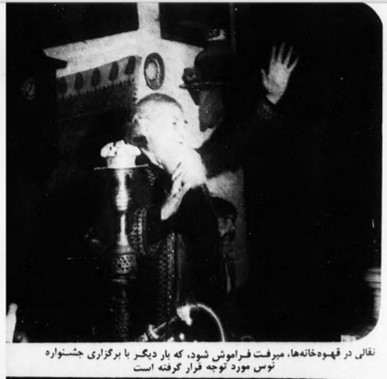
Figures 3. The advent of the Tus Festival (Jashnvārah-yi Tūs, 1975) saw a resurgence in the popularity of naqqālī in the Qahvah’khānahs. Photo from the newspaper Rastākhiz-i Kārgarān 24 (1975): 31.
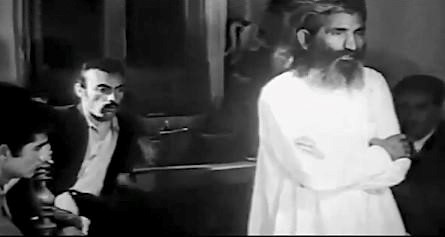
Figures 4. Naqqālī in Riqābat dar shahr—also called, Junūb Shahr (South of the City, 1958) directed by Farrukh Ghaffārī.
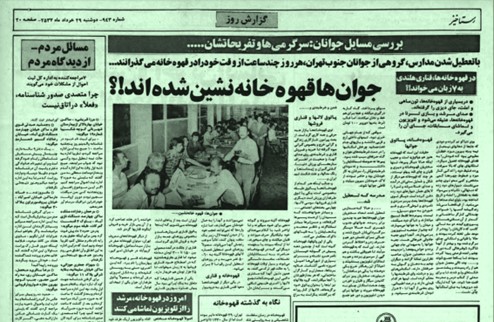
Figure 5. An article in the Rastākhīz newspaper about Qahvah’khānah, published in 1978, and titled “The Youth Are Fond of Qahvah’khānah.”

The Modern Café

In Iranian cinema, two types of café can broadly be distinguished: the traditional café serving tea (e.g., the Qahvah’khānah) and the modern café serving alcohol. The Second World War and the subsequent entry of the British and Russian armies into the country necessitated the adaptation of the Qahvah’khānah to the preferences of foreign soldiers, their new “clientele.” Traditional cafe proprietors began modernizing their establishments in response to the influx of these new “guests” (i.e., foreign soldiers). This entailed a change in décor, the substitution of tea for alcohol, the addition of music and dancers, and other modifications. Over time, these establishments gained in popularity. Even after the foreign clientele (i.e., the invaders) had departed, people continued to frequent these places. As noted by Caroline Gazaï and Geneviève Gaillet, “Cabarets were inaugurated in major hotels, along with several nightclubs (cafes), which were replicas of establishments in the West.”8Caroline Gazaï and Geneviève Gaillet, Vacances en Iran (Vacation in Iran) (Berger-Levrault, 1961), 70.

These new, distinctly masculine spaces of indulgence are strikingly similar to the saloons depicted in classic Western films. These locales where individuals imbibe alcohol, engage in gambling, attend live musical performances, procure the services of sex workers, and engage in physical altercations—all hallmarks of saloons in Western films—play almost a similar role in Iranian films. They serve alcohol, particularly vodka (known as ‛araq), accompanied by yogurt with cucumber, pickles, or fruit (mazzah). Male patrons frequent the establishment to consume alcoholic beverages, listen to music, and observe women performers engaged in a semi-nude, erotically charged dance reminiscent of the Oriental style. Other options are available, and may seem more enticing than dancing, for those who possess the appropriate funds.9A concoction of these elements can be discerned in the film Riqābat dar shahr, also called Junūb Shahr (South of the City, 1958), directed by Farrukh Ghaffārī. However, it is worth noting that the aforementioned cafés with their saloon-like atmospheres and disreputable indulgences bear no resemblance to the authentic and traditional “café” (i.e., Qahvah’khānah). Still, the term “café” in the Persian language is known to have a pejorative association, even in the present day, as it is utilized to designate a place of indulgence in alcohol and sexual pleasures. 

That said, both types of cafés are present in Iranian cinema, and indeed a transition can be observed from the traditional café (Qahvah’khānah) to the alcohol-infused, carnal pleasures of the “modern” café. This transition and the typical elements associated with these two types of café have greatly influenced directors and Iranian cinema at large. For instance, the choice of location for a movie’s setting is an important element of Iranian filmmakers’ styles as it is used to convey specific narratives or themes. Thus, when depicting characters who embody traditional values, filmmakers often utilize traditional cafés and their numerous glasses of tea as a setting, symbolizing a sense of community and tradition (see Figures 8 and 12). Conversely, when portraying characters with less favorable traits, such as those who are deceitful or violent, filmmakers tend to shoot their scenes in modern cafés, symbolizing a departure from traditional values and a shift towards modern vices (see Figures Annex, A6).

Notable Examples of Qahvah’khānah in Iranian Cinema
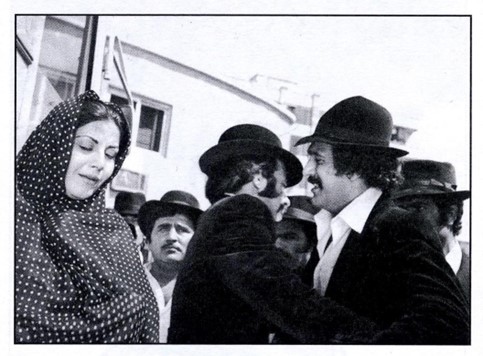
Figure 6. Tanhā Mard-i Mahallah (The Only Man in Town, 1972) directed by Dāvūd Ismāʿīlī. Qahvah’khānah is the place where chaos begins.
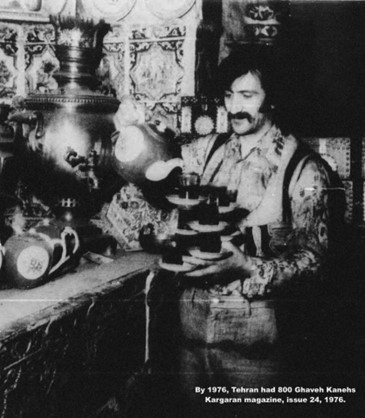
Figure 7. A snapshot from Rastākhīz-i Kārgarān 24 (1978): 30, a reflection of Qahvah’khānah’s widespread popularity.
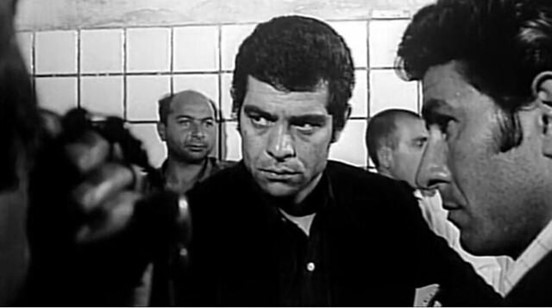
Figure 8. In a Qahvah’khānah, Qaysar (or Gheisar, from the eponymously named film, 1969), directed by Mas‛ūd Kīmiyāʾī, decides to take revenge and find his sister’s killer. One of the film’s highlights comes at the end of this sequence when Qaysar pulls on his shoes to get ready to run fast and take action.
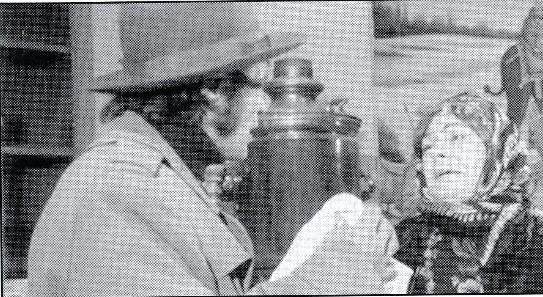
Figure 9. Gulparī jūn (Dear Gol Pari, 1974) directed by ʿAzīzallāh Bahādurī. The Qahvah’khānah was chosen as the main location in this film.
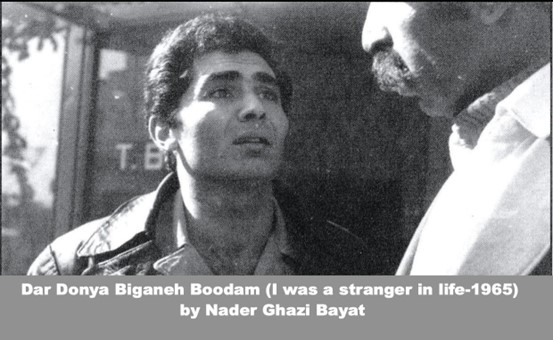
Figure 10. Dar dunyā bīgānah būdam (I Was a Stranger in Life, 1965), directed by Nādir Qāzī Bayāt. Qahvah’khānah represents a place of comfort and refuge for the character unfairly marginalized by society.
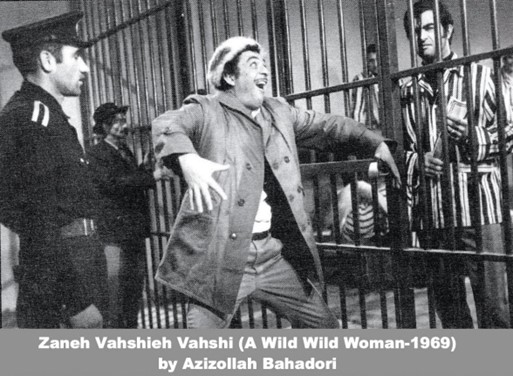
Figure 11. Zan-i vahshī-i vahshī (A Wild Wild Woman, 1969), directed by ʿAzīzallāh Bahādurī. Qahvah’khānah is a delightful family-owned establishment where the characters come together.
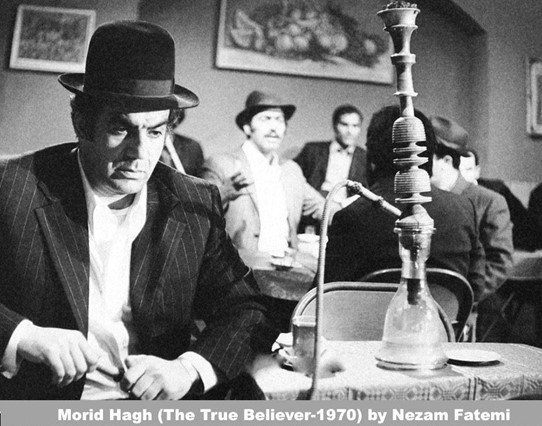
Figure 12. Murīd-i haqq (The True Believer, 1970), directed by Nizām Fātimī. Qahvah’khānah is a place where all the news, from the latest events to the most intriguing rumors, circulates throughout the town, often causing conflict and tension among the residents.
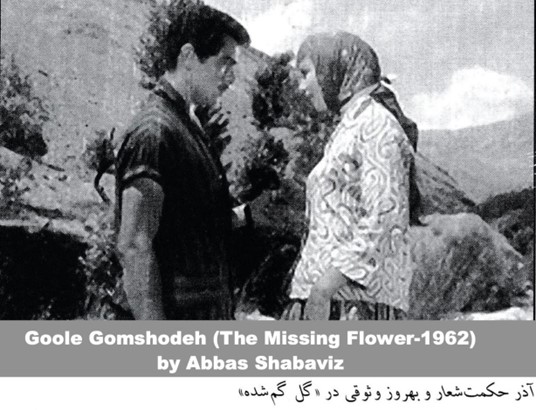
Figure 13. Gul-i gumshudah (The Missing Flower, 1962), ʿAbbās Shabāvīz. Upon the desert dunes, Qahvah’khānah stands as a meeting place for the characters.

Zūr’khānah (The House of Strength): The Traditional Place for Sports

The most remarkable and beautiful form by which the moral spirit of the Persian people was realized in life is the well-known Persian education, which entered into the soul of the person at an early age, planting in the young Persians the mentality that the good man in everyone should guide his actions, and which prepared the body and strengthened it so that he could one day be a good citizen. This education, which already existed at the time of the Medes at the court of the Persian prince (Pasargada) and was maintained by the Persians during their rule, is unique in the Orient. The Greeks were also aware of it since Herodotus. He reports that the Persians taught their sons only three things from the fifth to the twentieth year: to ride, to shoot a bow, and to speak the truth (Herod. I, 136).10Adolf Rapp, Die Religion und Sitte der Perser und übrigen Iranier nach den griechischen und römischen Quellen (The Religion and Customs of the Persians and Other Iranians According to the Greek and Roman Sources) (Wiesbaden: Harrassowitz Verlag, 1866), 103-104.
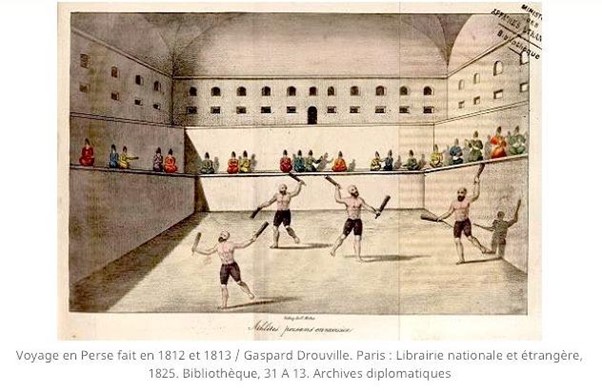
Figure 14. This captivating image offers a glimpse into the ancient tradition of Zūr’khānah in Iran, showcasing its historical significance and enduring cultural legacy.

Another location prominently featured in the films of this period is the Zūr’khānah (the House of Strength), a gymnasium for training and competing in traditional sports.11Zūr’khānah and Qahwah’khānah were incredibly popular gathering places where people and culture blended harmoniously. The Zūr’khānah shares certain traits with the café: first and foremost, it is a place for meeting and discussion. It is also where Firdawsī’s epic poems were sung (reminiscent of naqqālī in cafés) and where, in particular, the panegyric poems of Imam ʿAlī, the father of Imam Husayn, were recited. Like the café, the Zūr’khānah is therefore a space where pre-Islamic mythology and Iran’s post-Islamic religious history meet. As early as 1765, Carsten Niebuhr spoke of the “zur-xāneh” (Zūr’khānah) of Shīrāz as a place frequented by important personalities and merchants, where coffee was served, and hookah was smoked. See Goushegir, “Le café en Iran des Safavides et des Qājār à l’époque actuelle,” 72. Charles James Wills also documented the popularity of Zūr’khānah during his travels to Persia between 1866 and 1881. He wrote: “In each gymnasium (Zūr Khana, literally “house of force”) the professional “pehliwan” or wrestlers, practise daily; and gymnastics, i.e. a course of attendance at a gymnasium, are often prescribed by the native doctor. Generally, an experienced and retired pehliwan acts as “lanista,” and for a small fee prescribes a regular course of exercises. Dumb-bells are much used; also a heavy block of wood, shield-shape, some two feet by three, and three inches thick, with an aperture in the middle, in which is placed a handle. The gymnast lies on his back, and holding this in one hand makes extension from side to side; a huge bow of thick steel plates, with a chain representing the string, is bent and unbent frequently… Every great personage retains among his favoured servants a few pehliwans or wrestlers; and among the artisans many are wrestlers by profession, and follow at the same time a trade.” See Charles James Wills, In the Land of the Lion and Sun, or Modern Persia: Being Experiences of Life in Persia from 1866 to 1881 (London: Ward, Lock & Co., 1891), 98- 99. Historically, as noted in the epigraph of this section by Adolf Rapp, Iranians have always valued and participated in physical exercise as an important component of civic life since, if Rapp is to be believed, at least the time of Herodotus. Although the precise origins of this practice and the valuation of exercise in Iran remain unspecified, the purely symbolic (especially the distinctive clothing) and historical (e.g., Murshid’s poetic references) elements suggest that the Zūr’khānah tradition has been deeply embedded in Iranian culture for centuries, not merely decades (see Figure 14).12Henry Corbin mentioned a historical connection between Zūr’khānah and the Zoroastrian religion in Iran. See “Les zourhânés (interview de Henry Corbin),” YouTube, accessed January 9, 2025, https://www.youtube.com/watch?v=RhLDhyd_1Ws. Also Jambet writes, “Henry Corbin was often present at more or less ritualistic ceremonies such as those of Zur Khaneh, of Zoroastrian origin, in which the athletes, after a solemn kiss to the earth, performed difficult exercises and were accompanied by a reciter of poems.” See R. de Boyer Sainte Suzanne, “À Téhéran,” in Henry Corbin, ed. Christian Jambet (Paris: L’Herne, 1981), 288. According to Hossein Kohandani, Zūr’khānah is one of Iran’s most ancient sports. As he observes, “There is no valid written record of the sport of Zūr’khānah in pre-Islamic Iran, not in inscriptions, not on stones, not on the facades of historical monuments, not even on the various objects that have been discovered during archaeological excavations … However, there are indications that this sport already existed in the mentioned period, albeit for war preparation and unit conditioning.” See Hossein Kohandani, “Le zourkhâneh: Historique d’un sport traditionnel (The Zūr’khānah: The History of a Traditional Sport),” La Revue de Téhéran 9, August 2006, http://www.teheran.ir/spip.php?article509#gsc.tab=0. Goushegir notes that Zūr’khānah was highly regarded in ancient Iran and was a common meeting place for merchants and the people of the bazaar. see Goushegir, “Le café en Iran des Safavides et des Qājār à l’époque actuelle,” 72. In 1970, Roger Wood shared his experience of visiting Tehran, offering a captivating and insightful portrayal of the Zūr’khānah. He notes, “In steamy gymnasiums of Tehran, or glimpsed through basement windows in fusty provincial bazaars, the members of the Houses of Strength perform their rituals. Here is something strange and striking. Dressed only in bright knee-length trousers, a dozen large sweating men do peculiar exercises in a pit, to the beat of a drum and the chanting of epic verse. They leap. They spin. They juggle unliftable clubs. They do push-ups on the floor, and gyrate with shields and iron bows. They throw themselves grunting upon one another in wrestling contests. And when the drumbeat ends, the poetry subsides, and the last wrestlers disentangle themselves exhausted from the clinch, they resume their sober brown suits and unobtrusive ties, pick up their briefcases or their workboxes, and step outside into the ordinary world as though they have merely been having a haircut.” See Roger Wood, James Morris, and Denis Wright, Persia (New York City: Universe Books, 1970), 19.

The Zūr’khānah remains, even today, a purely male space with its own codes and secrets.13Chehabi observes this point in “The Juggernaut of Globalization: Sport and Modernization in Iran:” “What the vast majority of the national, regional, and local games and contests have in common is that they involve only men. This made physical education for women a major item on the agenda of modernizers, who faced daunting obstacles in a country whose Islamic culture mandated (albeit to various degrees in different regions) veiling and gender segregation.” See H. E. Chehabi, “The Juggernaut of Globalization: Sport and Modernization in Iran,” in Sport in Asian Society: Past and Present, ed. in J.A. Mangan and Fan Hong (London and Portland, OR: Frank Cass, 2003), 276-277. These sporty, Asian-like gymnasiums focus not only on physical training but also on spiritual development. To gain acceptance into the Zūr’khānah, one must respect all the established codes concerning honor, religion, friendship, family, and homeland.14Jaʿfar Shahrī underscores the pivotal role of Zūr’khānah’s remarkable and traditional architecture, enlightening the audience about its essential connection to the location’s core values: “The Zūr’khānah’s small door, a feature of profound cultural significance, plays a key role in fostering humility and respect. Its compact size compels athletes to lower their heads as they enter, symbolizing the importance of these virtues. This architectural design is a constant reminder for the athletes to cultivate modesty and avoid arrogance and vanity, which are detrimental to both personal growth and the communal spirit of the Zūr’khānah. This communal spirit, fostered by the shared experience of bowing their heads each time they enter, reinforces the virtues of humility and respect, foundational values in their training and discipline.” See Jaʿfar Shahrī, Tihrān-i Qadīm (Old Tehran) (Tehran: Mu‛īn, 1992), 1:165.

Pahlavānī Rituals

These traditions hold immense significance for Iranians. The individual who enters this arena and becomes its champion, or Pahlavān (literally, hero, or champion), is highly respected. For example, Ghulāmrizā Takhtī (1930-1968) is still revered as a hero and a saint, even many decades after his passing (see figure 26). As noted by Fariba Adelkhah,

Takhtī was frequently victorious in his competitions, commonly raising his head to the sky in triumph. He became a highly regarded and respected figure in the world of sports. However, it was his qualities as a hero, as a javānmard, and his simplicity that set him apart and gave him his authenticity. The qualities that distinguish a hero or sportsman from other individuals are not limited to physical attributes such as a muscular physique or a large frame. Rather, it is the individual’s ethical and human qualities that set them apart.15Fariba Adelkhah, Être moderne en Iran (Being Modern in Iran) (Karthala, 1998), 204. Concerning the concept of javānmardī, which can loosely be translated as “spiritual chivalry,” Lloyd Ridgeon notes: “Javanmardi is one of the most significant components in the identity of Persians and those who have lived and live in areas where Persianate culture has been and remains strong. This essay argues that the ethic of javanmardi demonstrates a high level of cultural continuity. The difficulty of defining this concept is partly resolved by relying on seminal texts from the medieval period and referring to important historical figures from early Iranian history. A taxonomy of types, the felon, the faithful and the fighter, are utilised in this article to provide a bricolage of characters who demonstrate that javanmardi is just as important in modern Iran as it was in medieval Persia.” See Lloyd V. Ridgeon, “The Felon, the Faithful and the Fighter: The Protean Face of the Chivalric Man (javanmard) in the Medieval Persianate and Modern Iranian Worlds,” in Javanmardi: The Ethics and Practice of Persianate Perfection, ed. L.V. Ridgeon (London: Gingko Library, 2018), 1.

To this day, he is still highly respected, to the point of becoming the subject and main character of a movie entirely devoted to him: Jahān Pahlavān Takhtī (Takhti the World Champion, 2004), directed by Bihrūz Afkhamī.

As noted by Adelkhah, Takhtī continues to be loved not only because he was physically powerful or possessed great athletic prowess, but because he also had the “ethical and human qualities” that raised him above other athletes to the status of “hero” (i.e., a pahlavān). As mentioned, these ethical qualities and the spiritual elements of the Zūr’khānah are of great significance, setting the House of Strength apart from any ordinary gym and elevating those who train and compete there. As noted by Hossein Kohandani, “The space of Zūr’khānah is reserved for the pure, the generous, the dignified, the polite, the modest, the believers, the practitioners; in short, for the irreproachable among the irreproachable.”16ee Kohandani, “Le zourkhâneh: Historique d’un sport traditionnel.”

All of these important qualities are recalled and repeated by the Murshid (literally, director, master, or guide) during the physical exercises. As in the café, a Naqqāl (also called a Murshid) recites and sings the words of the poets or prophets. As Kohandani notes, “The ‘Morched’ sings old poems out loud and encourages the athletes during the entire session. The athlete must ask permission from the elders before the Morched allows him to begin performing in the center of the track.”17See Kohandani, “Le zourkhâneh: Historique d’un sport traditionnel.” Jaʿfar Shahrī also underscores the esteemed status of the pahlavāns and the profound faith people have in their spiritual and physical strength. He writes, “The pahlavāns, held in such high regard, are often asked to pray for the recovery of sick relatives, a testament to people’s faith in their spiritual and physical strength. In a unique twist, some even seek the Murshid’s assistance in obtaining the pahlavāns’ sweat, believing it possesses healing properties.” See Shahrī, Tihrān-i Qadīm, 170. Shahrī also observes: “They also organized a ceremony called Gulrīzān (falling flowers), where they invited neighbors, particularly the wealthiest members of the community, to contribute. This event aimed to gather support for people facing various difficulties, such as illness, financial hardships, or the needs of orphans. Being invited to a Gulrīzān was a significant honor for the affluent merchants, who would strive to demonstrate their generosity and social standing by making substantial donations. This practice provided essential aid to those in need and reinforced the communal bonds and the values of charity and solidarity, fostering a sense of unity within the society.” See Shahrī, Tihrān-i qadīm, 179.

Once or twice a week, the men gather at the Zūr’khānah to practice their sports and listen to the Murshid’s recitals. Of course, as in all meeting places, there is always a highly respected champion (Pahlavān) who is held in high esteem both in the Zūr’khānah and the neighborhood or even the entire city. Its importance has been compared to the ‘Lattes’18“Luti [i.e., Latte] leaders were generally self-interested individuals looking to enhance their personal esteem, as well as gain the patronage of powerful political and religious leaders… they were often regarded as free spirits who were sometimes the local strongmen (wrestlers and weightlifters associated with local gymnasiums (i.e., ‘Zūr’khānah’), self-selected to protect the weak and uphold community morality.” See Stephan C. Poulson, Social Movements in Twentieth-Century Iran: Culture, Ideology and Mobilising Frameworks (Lexington Books, 2005), 84. It is important to note that the roles played by the “Lattes” and their politico-religious commitments also have dark and negative sides, much like those of the American “mobs.” For example, as Poulson writes, “… ethnic groups, mobilized by “mob” leaders in major American cities raised crowds quickly and engaged in some of the same behaviors that the Luti [i.e., Latte] leaders did in Iranian cities…” (the coup against Iran’s popular prime minister, Muhammad Musaddiq in 1953). See Poulson, Social Movements in Twentieth-Century Iran, 88. This was one of the reasons that Majīd Muhsinī, the director of Lāt-i Javānmard (The Noble Rogue, 1958), regretted the title of his film. He later told his son, “I should have just called it ‘Javānmard’ (chivalrous youth) and removed the word ‘latte.’ Lāt-i Javānmard was not an appropriate title.” See Farīd Muhsinī’s interview published in Sīnimā-yi Īrān, rūzigār-i naw (Iranian Cinema, The New Era), ed. Saʿīd Mustaghāsī (Tehran: Alast-i Fardā, 2002), 112. There were several reasons for using this character (e.g., hil, lūtī, lāt) in Iranian cinema of that period. Some critics think that the most important reason was censorship, which greatly influenced the choice of the characters. For example, as Amān Mantiqī remarks, “The only professions without any syndicate are those of the jāhil (literally, ignorant, or ill-mannered) and the prostitute. They have nobody to protect them. That is why the majority of Iranian pictures are about them.” See Amān Mantiqī, “Mīz-i gird-i sīnima-yi Īrān (Round Table on Iranian Cinema),” Farhang va Zindagī 18 (1976): 81. as they are often the same people that come to the sports “Mecca” (Zūr’khānah). The master stands at the top, and his disciples gather in a circle, then take their place in the middle to wrestle. Of course, that emblematic location (Zūr’khānah) plays a positive role in Iranian cinema so that whenever the camera is in that place, we know in advance that we are dealing with positive, respected, and respectable characters.19In Gharīb (Stranger, 1973), directed by Ghulām Rizā Sarkūb, the film opens in a Zūr’khānah. The Murshid’s song fills the air as men engage in physical exercises, while two young brothers are watching all this with joy. It is a happy scene before the drama unfolds. In the same film, the camera takes us to another type of house, also coveted in Iranian cinema: the “brothel.” I will discuss this highly coveted location, as well as the bazaar and prison, in a forthcoming article. This symbol is used not only in cinema but also in literature (e.g., by the author Sādiq Hidāyat) and theater (e.g., by the playwright and famous filmmaker Bahrām Bayzāʾī). It has even been used by those in power, including the Shah himself. Nonetheless, the excessive use of the Zūr’khānah by the political elite has undeniably had a negative impact.20The Pahlavānī tradition, a pillar of Persian culture, was deeply affected when the Shah, in a controversial move, placed Shaʿbān Jaʿfarī, also known as the ‘Brainless,’ at the helm of the Pahlavānī Federation. As noted by Philippe Rochard and Denis Jallat, “Shaʿban Jaʿfari remained a despised symbol of the close relationship between the zurkhaneh and the former regime.” See Philippe Rochard and Denis Jallat, “Zurkhaneh, Sufism, Fotovvat/Javanmardi and Modernity: Considerations about Historical Interpretations of a Traditional Athletic Institution,” in Javanmardi: The Ethics and Practice of Persianate Perfection, ed. Lloyd Ridgeon (London: Gingko Library, 2018), 235. Numerous well-known Iranian actors of that era emerged from Zūr’khānah. The foremost among them was Muhammad ʿAlī Fardīn, Iran’s most celebrated actor. He exuded good looks, stature, kindness, generosity, and honesty, embodying exactly what audiences anticipated from a pahlavān.

Notable Examples of Zūr’khānah in Iranian Cinema

Here are some exceptional examples that showcase the influence of the Zūr’khānah in pre-revolutionary Iranian Cinema (see Figures 15 to 26):
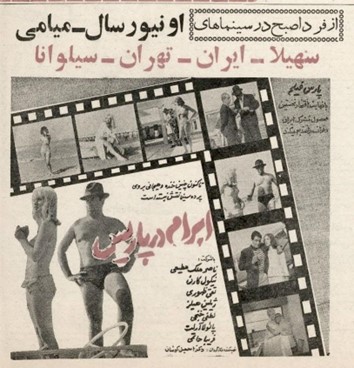
Figure 15. Abrām dar Pārīs (Abraham in Paris, 1964) directed by Ismāʿīl Kūshān. The film opens with scenes of a Zūr’khānah, where the Murshid sings and athletes exercise, including the main character, Abrām, played by Nāsir Malik-Mutīʿī. Through this opening, the director portrays his character, Abram, as a positive and righteous man.
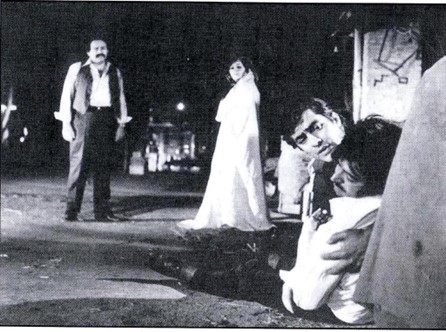
Figure 16. Kūchah-yi Mardhā (Alley of Valiants, 1970), directed by Saʿīd Mutallibī, tells the story of ʿAlī, who seeks solace in a Zūr’khānah after feeling heartbroken and being far from his best friend. In the Zūr’khānah, he finds comfort and is able to regain strength.
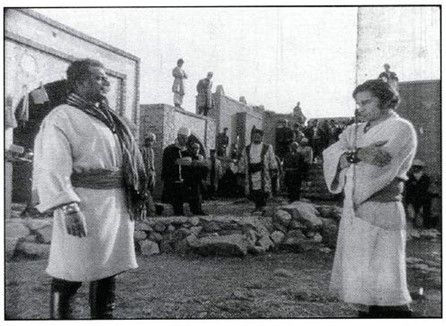
Figure 17. Pahlavān Mufrad (The Hero Mufrad, 1971), directed by Amān Mantiqī. The movie centers around Zūr’khānah and its characters. Pahlavān Mufrad (played by Nāsir Malik-Mutīʿī) is a highly esteemed trainer in a Zūr’khānah. The codes of honor and javānmardī that are promoted in the Zūr’khānah are the main themes of this movie.
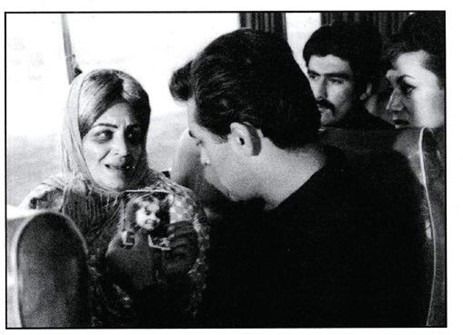
Figure 18. Jahān Pahlavān (The World Champion, 1966), directed by Ismāʿīl Riyāhī). The movie is focused on the javānmard attitude of the hero of the movie, Akbar Jahān Pahlavān (played by Muhammad ʿAlī Fardīn).
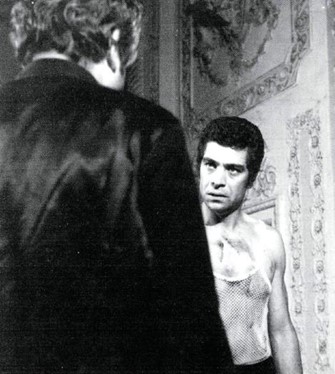
Figure 19. Qaysar (Gheisar, 1969), directed by Masʿūd Kīmiyāʾī. Isfandiyār Munfarid-zādah composed the soundtrack of Qaysar, which was inspired by the Murshid’s Zarb-i Zūr’khānah (Drum of the Zūr’khānah).
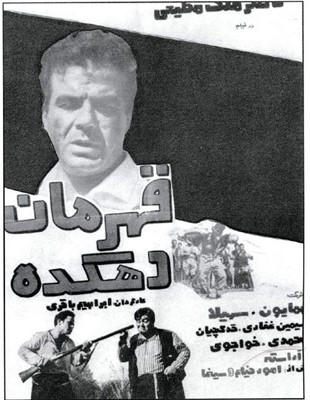
Figure 20. Qahramān-i Dihkadah (The Champion of the Village,1966), directed by Ibrāhīm Bāqirī. A pahlavān comes to save the village.
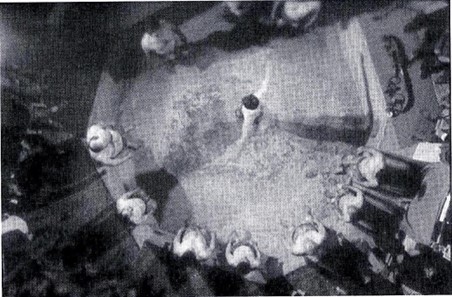
Figure 21. Gharīb (Stranger, 1973), directed by Ghulām Rizā Sarkūb. The film boldly opens at a Zūr’khānah, a symbolically important location for the protagonist, the sole individual prepared to combat injustices.
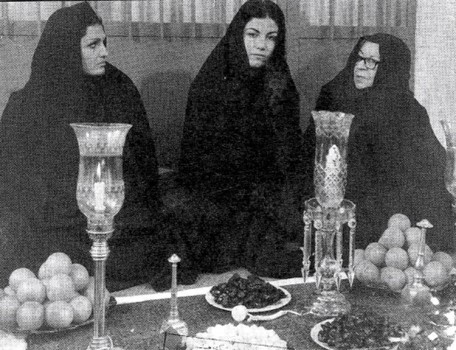
Figure 22. Mardān-i Sahar (Men of the Dawn, 1971), directed by Ismāʿīl Nūrīʿallā. In each Zūr’khānah, a greatly esteemed master (pahlavān) resides. He commands not just respect but deep reverence from the neighborhood. However, when love enters the picture, the town’s two most renowned pahlavāns compete fiercely for the beloved’s affection. The dramatic final fight of this timeless tale of love’s triangle unfolds within the distinctive setting of Zūr’khānah.
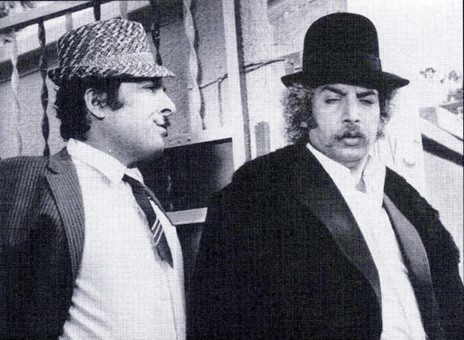
Figure 23. Jāhil va Raqqāsah (The Thug and the Dancer, 1976), directed by Rizā Safāyī. Faithful to the principles and traditions of Pahlavānī and Zūrkhānah, upholding their rules and values.
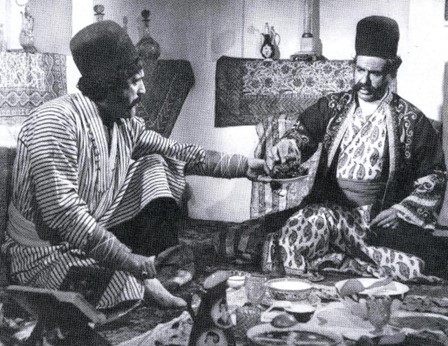
Figure 24. Qalandar (1972), directed by ʿAlī Hātamī. Pahlavānī and Zūr’khānah rituals are once again highlighted in this movie, emphasizing their cultural and spiritual significance.
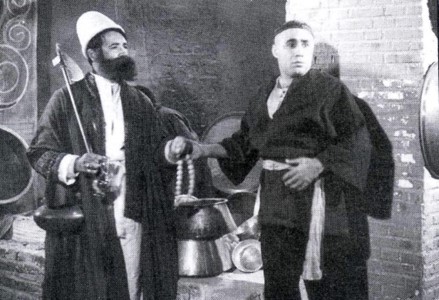
Figure 25. Hasan Kachal (Hasan the Bald, 1970), directed by ʿAlī Hātamī. Everyone wants to be a Pahlavān.
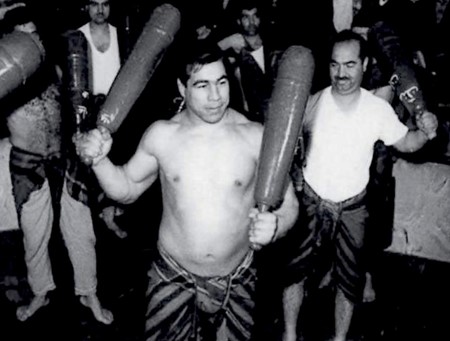
Figure 26. The one who enters this place and becomes its champion achieves immortality, exemplified by Ghulāmrizā Takhtī. Even decades after his passing, he remains a revered hero and saint, his legacy enduring through the passage of time.

Hammām (Bathhouses): Communal Bathing and Socializing

Hammāms, or bathhouses, are places for communal bathing and socializing. While hammāms are intended for both men and women, representations of women in Iranian and Arab cinema and art are rare compared to their Western counterparts. In Western art, painters such as Dominique Ingres and Jean-Léon Gérôme freely depicted women in hammāms,21Jean-Auguste-Dominique Ingres painted The Turkish Bath (Le Bain turc) between 1852 and 1859, and Jean-Léon Gérôme painted The Moorish Bath (Le Bain turc) in 1870. Both depict scenes inspired by hammāms. while in Iranian cinema, women’s spaces remain largely unexplored. Conversely, male sections of the baths, including nudity, are often captured on camera; but again, women’s areas are rarely featured. Indeed, in Iranian cinema, the portrayal of the women’s hammām is a mysterious and seldom explored subject, with only a few glimpses presented in fleeting moments.22This rare use of women’s hammāms and the restrictions around depicting them with accuracy lead to some strange filmic choices. For example, in Guzar-i Akbar (The Passage of Akbar, 1972), directed by Muhammad ʿAlī Zarandī, there is a sequence in which a group of women sit in the foyer of a hammām. Strangely enough, they are covered with towels, and we can only see their heads.

Despite the gender imbalances in filmmakers’ depiction, the hammām serves as a crucial gathering place, much like the Qahvahkhānah, bringing people together for conversation and interaction. Men gather here to bathe and socialize, while women have their own separate space. They drink tea and smoke, often in the dressing rooms, and discuss a wide range of topics, from national and international politics to the current market price of onions. In addition, the hammāms are bustling hubs for various business activities such as marriages, sponsorships, rentals, sales, and purchases.23As Gaspard Drouville recounts in his Journey to Persia during the early 1800s, the hammāms functioned as important location for the middle classes to mingle with traders from other lands, mixing business with relaxation. He notes how, even then “The public baths (hammāms) still serve as a meeting place for the middle class. Foreigners and merchants also gather there. They come to make acquaintances or talk business. Everyone smokes a pipe or a caillian, drinks coffee, and spends a few hours each day. During this time, they make or learn some news that they take with them elsewhere.” See Gaspard Drouville, Voyage en Perse, pendent les années 1812 et 1813 (Journey to Persia in 1812 and 1813) (Paris: Masson et Yonet, 1828), 1:83. Drouville further elaborates on the historical value of the hammāms for women in particular: “But it’s the women, above all, who use these places as a meeting place. They visit each other; each niche has its own society, and it’s always full. It is here that they deal with everything that concerns the affairs of their families, and since there are few among them who do not have some cause for jealousy and, consequently, for complaint, it can be said that this place is a women’s court, presided over by the old women, who decide in the last resort on all offenses within their jurisdiction… After exhausting this subject and consoling each other for their disgrace, they inquire about planned marriages, which provides an opportunity for a rigorous investigation of the unfortunate fiancées.” Gaspard Drouville, Voyage en Perse, 1:83-84. Interestingly, although women are not often depicted in films, in reality, they frequent the hammāms far more than men. Furthermore, there are occasions when the hammāms are exclusively reserved for women, sometimes for an entire day, creating a unique and vibrant atmosphere. The Feast of Hannah is one such occasion during which this occurs. As Hamīd Shuʿāʿī writes, “One of the most important celebrations for women was the feast of Hannah. It began after the months of Muharram and Safar, and since women did not often leave home during these religious months, they would all gather at the hammām afterward. To make Hannah more colorful, they would spend all day and would have lunch.”24Shuʿāʿī, Sadā-yi pā…, 34-35. It is worth noting, as observed in the writing of C. J. Wills in the mid to late nineteenth century, that not everyone frequented the baths, especially if they had their own at home. His observations on the minutiae of bathing practices are also of great interest, emphasizing the communal or collective nature of the experience and the best practices of that time. Wills observes: “As for the wealthier, they have baths in their own houses, and use them almost daily. The middle classes make parties to go to the hammam, and assist each other in the various processes of shampooing, washing with the “keesa,” or rough glove, and washing the hair with pipe-clay of Shiraz—a plan, by the way, which it is worthwhile to follow, for the hair is rendered thereby cleaner than when eggs are used. The pipe-clay is made up in little round cakes much resembling biscuits.” See Wills, In the Land of the Lion and Sun, 98- 99.

The bathhouse has been featured in numerous movies (figures 27 to 30), increasing cinema’s popularity and creating a captivating atmosphere on the screen. One of the most notable examples is Qaysar (1969), directed by Masʿūd Kīmiyāʾī, in which the murder scene in the hammām became so iconic that it was replicated in other movies (see Figure 30). This interest comes from the fact that the hammām, like other popular locations (e.g., Qahvah’khānah and Zūr’khānah), has always been full of stories and secrets. Towns and villages in Iran are often surrounded by walls as long and wide as those of a fortified castle. Public spaces are rare, and there are stories—or, more accurately, secrets—behind every wall. In this very discreet and closed society, for a moment amid the steam and conviviality of the baths, it is possible to cross human borders, to communicate, to speak and to be heard.

Importantly, the public baths in Iran are not merely physical spaces, but social equalizers. They are the places where all strata of society converge, where stories are shared and connections are forged. Filmmakers, recognizing the universal appeal of these spaces, often set their stories and characters in popular and underprivileged neighborhoods, using the familiarity of the public baths to reach wider audiences. C. J. Wills, for instance, notes the broad and economically balancing, if not entirely equalizing, appeal of the baths due to their affordability. Wills states: “These public baths are open free of charge and without distinction to rich and poor. A few coppers are given to the ‘delaks,’ or bath attendants, male and female. These pay for fuel, hot water, etc.… The whole bath can be always exclusively hired for a few kerans (shillings).”25See Wills, In the Land of the Lion and Sun, 334.

That said, in much the same way as the Naqqāls were pushed out by the advent of television and cinema, with the arrival of modernity and the inclusion of bathrooms in every home, the significance of the public hammām has diminished. As a result, many hammāms have closed down. Nevertheless, even in the face of financial constraints, residents of the southern working districts of Tehran or other cities (figure 27), have continued to maintain their hammāms, and some are still operational today.

Notable Examples of Hammām in Iranian Cinema

Figures 27 to 34 include specific examples of the influence of the hammām as an ideal setting and film location in the cinema of pre-revolutionary Iran.
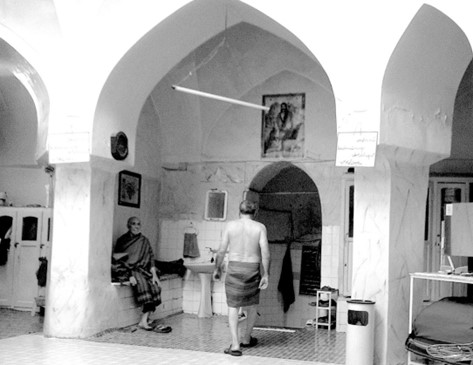
Figure 27. Hammām-i Bāzār-i Qom is one of the oldest and most rare hammāms still used today. Photo Vali Givehchi. 2023.
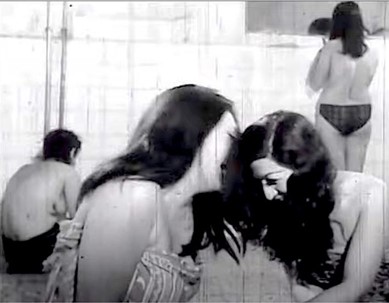
Figure 28. Janūbī (Southern, 1973), directed by Muhammad Rizā Fazīlī.
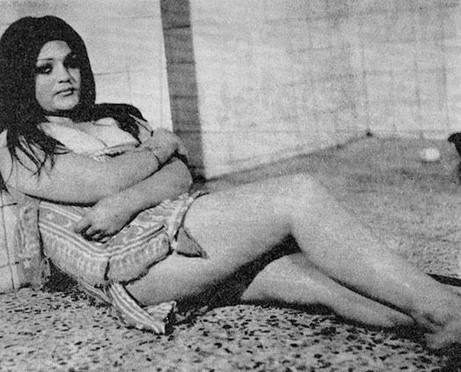
Figure 29. Janūbī (Southern, 1973), directed by Muhammad Rizā Fazīlī. Figures 28 and 29 present rare and captivating stills from the film, offering a glimpse into the intriguing world of a women’s hammām. They highlight the timeless rituals, distinctive architecture, and serene ambiance of this culturally rich space.
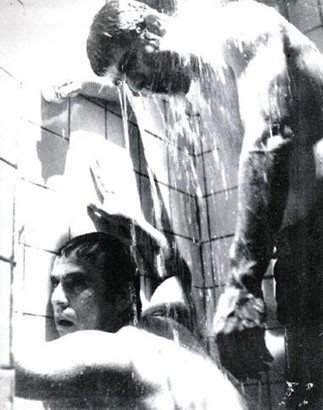
Figure 30. Qaysar (1969) directed by Masʿūd Kīmiyāʾī. The murder scene at the hammām became so iconic that it was replicated in several movies.
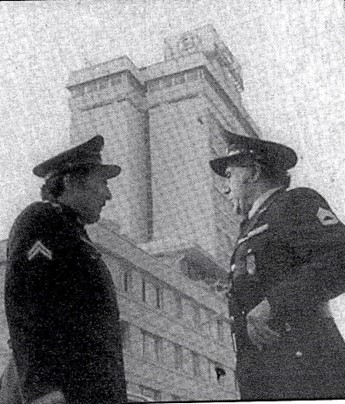
Figure 31. In Shādī’hā-yi Zindagī-i Mā (Our Joys of Life, 1976), directed by Mahmūd Kūshān, a gripping encounter unfolds as a policeman comes face to face with a determined stalker he has been tirelessly searching for over the course of several months. This suspenseful encounter takes place in a hammām, adding an additional layer of intrigue to the story.
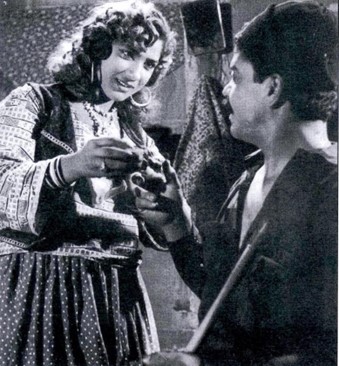
Figure 32. Khurshīd Mīdarakhshad (The Sun is Shining, 1956), directed by Sardār Sākir. The first character in the movie changes his identity by stealing clothes from a dressing room in a hammām.
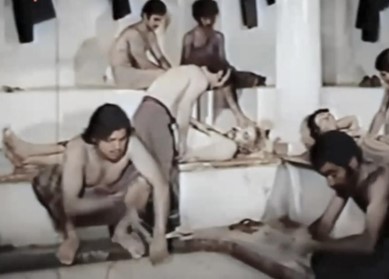
Figure 33. Jāhil va Raqqāsah (The Thug and the Dancer, 1976), directed by Rizā Safāyī. Whether it is discussing sports, news, or personal experiences, this space offers a comfortable environment for relaxation and camaraderie.
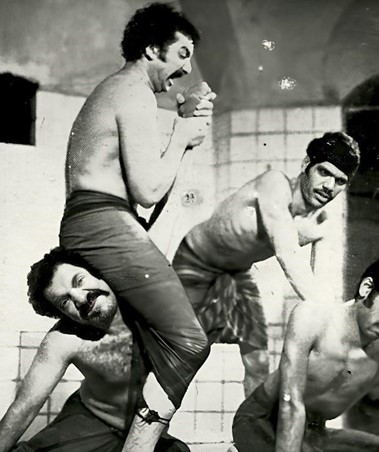
Figure 34. Pakhmah (The Dullard, 1972), directed by Māziyār Partaw. The captivating performances at this location have caught the attention of a broader and more diverse audience, bringing together people from various backgrounds and interests.

Ziyārat’gāh (Places of Worship, Mosques): Religious, Spiritual, and Political Significance

In addition to specific cinematic settings, Iranian culture is also characterized by a strong association with Ziyārat’gāh, a term referring to various religious sites and places of worship, including mosques (masjids).26“In Shiʿism, another category of pilgrimage is designated as ‘ziarat.’ These practices involve a pilgrimage, or ‘visiting,’ to the gravesites of revered Islamic figures.” See Dejan Bogdanovic and Jean-Louis Bacqué-Grammont, Iran, les sept climats (Iran, The Seven Climates) (Orientalistes de France, 1972), 37. “The term masjid (pl. masājid), which is translated as ‘mosque,’ is derived from the root sajada, which means ‘to prostrate oneself,’… As a result, it primarily denotes the location where the faithful prostrate themselves during ritual prayers.” Ismaël Kadaré et al., Dictionnaire de l’islam: Religion et civilisation (Dictionary of Islam: Religion and Civilization) (Paris: Encyclopaedia Universalis – Albin Michel, 1997), 598. As observed by Louis Massignon, the mosque itself is architecturally oriented toward Mecca. Massignon describes, for instance, how “the faithful, arranged in parallel rows, must maintain their gaze fixed on a single point during prayer, namely the axial niche, or ‘qibla,’ which marks the direction of Mecca, the site of the annual propitiatory sacrifice to the God of Abraham. In contrast to the bell tower, the minaret, where the human voice itself emerges, replaces the inanimate bronze, for the daily call to prayer.” See Louis Massignon, En Islam, jardins et mosquées (In Islam, Gardens and Mosques) (Paris: Le Nouveau Commerce, 1981), 12-13. Rather than, though not always, particular locations for filming, these sites have served more as backdrops for Iranian cinema writ large and have become inextricably intertwined with the nation’s film industry. Such locations are renowned for their status as places of meditation and prayer where devotees engage in various religious practices, and they are particularly prevalent in Muslim-majority countries with significant Shi’ite communities.

The grandeur of these locations, their magnificent architectural structures, and their historical significance were not just a product of their time but were further enhanced during the rule of Persian monarchs. The contributions of Shah ʿAbbās and Fath-ʿAlī Shah in particular have left an indelible mark on Iran’s religious and cultural landscape. As noted by Yann Richard, “He [Fath-Ali Shah] reinforced the religious character of his kingdom. Furthermore, he commissioned the construction of numerous mosques and embellished the domes of tombs belonging to Shiite Imams and saints in Qom and Mashhad.”27Yann Richard, L’Iran de 1800 à nos jours (Iran from 1800 to the Present Day) (Paris: Flammarion, 2009), 43.
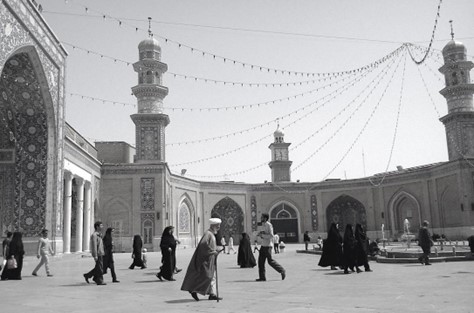
Figure 35. The sanctuary in Qom is notable for containing the tomb of a woman, Fātimah al-Maʿsūmah, sister of Imām Rizā. Photo: Aghdas Baghaei, 2024.

The Imāmzādahs (or, Imamzadehs),28Geneviève Gobillot helpfully defines what is meant by this term (i.e., Imamzadeh): “The term Imāmzādah, used to refer to both the descendant of a Shiʿite Imām and their tomb . . . It seems plausible to suggest that the first Imāmzādahgān settled in Persia around the time of the caliph al-Maʾmūn (m. 833). The rituals of these pilgrimages are similar to those of Mecca, with processions around the tomb in a counterclockwise direction. Pilgrims touch and kiss the flesh and recite litanies specific to each Imāmzādah . . . A visit to the tomb of one of the Imāms is considered to be of equal significance to a visit to the Prophet’s tomb in Medina.” See Geneviève Gobillot, Les Chiites, fils d’Abraham (The Shiites, Sons of Abraham) (Brepols, 1998), 140. as well as the mausoleums and great mosques associated with them, are worthy of mention. The most frequently visited of the latter are Imam Rizā in Mashhad and Maʿsūmah in Qom.29Religious pilgrimages and other forms of frequenting religious sites are a long-standing and diverse custom in Iran. Offering some examples of these, Joanna De Groot describes the importance of connections between “locality” and “shared rituals” in Shi’a faith. She writes, “The custom of visiting shrines associated with Imams, their relatives, or other holy persons, included weekly visits by groups of women to local imamzadehs (shrines) and long-distance journeys to major shrines like those at Mashad [sic] and Karbala. Local shrines were the focus for ceremonials celebrated by particular communities or occupational groups. Linking attachments to locality or occupation with affirmations of Shi’a commitment, and creating shared rituals, they were established and regular popular religious activities.” See Joanna De Groot, Religion, Culture and Politics in Iran: From the Qajars to Khomeini (I. B. Tauris, 2007), 26. Further, De Groot also observes and provides evidence of ongoing “expressions of personal and communal commitment and identity” of Shiʿa faith in Iran and the popularity of Mashhad and Qom as sites of pilgrimage. De Groot writes: “Among industrial workers surveyed in 1970s, those who were able to take holidays used them predominantly for pilgrimage trips to Mashad and Qum. Bazaris and the newly migrated slum and shanty dwellers of Tehran participated in the rituals of Muharram and Ramadan. Families attended mosques, hay’ats and huseiniyehs to undertake religious duties while making sociable and communal contacts. This evidence of persistent cultural energy in the established practices of Shi’a Iranians indicates continued support for such expressions of personal and communal commitment and identity.” See De Groot, Religion, Culture and Politics in Iran, 57. The pilgrimage to Mashhad is a profoundly significant tradition for Iranians, underlined by an account (hadīs) from Prophet Muhammad himself: “It was remembered that Mahomet had said: ‘A part of my body is to be buried in Khorosan, and whoever goes there on pilgrimage Allah will surely destine to paradise, and his body will be haram, forbidden, to the flames of Hell: and whoever goes there with sorrow, Allah will take his sorrow away.’” See Robert Payne, Journey to Persia (New York: E.p. Dutton & CO., INC., 1952), 181. Qom is a remarkable pilgrimage destination known for a tomb dedicated to a woman, which adds a unique and distinctive element to the site. “The sanctuary in Qom is notable for containing the tomb of a woman, Fātimah al-Maʿsūmah, sister of Imām Rizā… In 816 CE, this revered woman, on her way to visit her brother, fell ill in Sāvah. She was subsequently taken to Qom, where she died and was buried.” See Bogdanovic and Bacqué-Grammont, Iran, les sept climats, 37-38. Other noteworthy examples include the smaller places of worship located in the districts designated Saqqā’khānah (literally, the house of the fountain) and Shamʿ’khānah) (literally, the house of candles). Mohammad Ali Amir-Moezzi offers a vivid description of such sites by drawing on the impression of foreign visitors such as Chardin: “Western travelers, such as Chevalier Chardin, who visited Isfahan in 1665, described Qom, where they made a stop, as a flourishing market surrounded by a verdant oasis with intricate gold and silver decorations, fine wool and silk carpets, and continuous chanting of the Koran throughout the night and day.”30Mohammad Ali Amir-Moezzi, Lieux d’Islam, cultes et cultures de l’Afrique à Java (Places of Islam, Cults and Cultures from Africa to Java) (Autrement, 1996), 61. Amir-Moezzi’s depiction of Chardin’s impression highlights how such sites’ rich and immersive quality has left a lasting impact in Iran for centuries.

These religious cities in Iran, beyond their religious connotations, have also importantly played a pivotal role in shaping Iran’s socio-political landscape. They are not just places of worship, but also the foundation for vital elements of Iran’s socio-political movements. Joanna De Groot underlines this in her summary of several religiously inflected events which occurred in the year before the 1979 Revolution. She writes, for instance, how “The January 1978 confrontation of the Qum tullab [religious students] with the regime as they protested the attack on Khomeini in the establishment press segued into ‘mourning’ protests in other centres which in turn led to demonstrations fuelled by news of violence . . . Marches and shootings in Tehran in early September fuelled the spread of strikes and street protests.”31See De Groot, Religion, Culture and Politics in Iran, 243. These sites and, indeed, cities possess and represent both deep religious meaning as much as they represent and possess deep political import. Thus, it is not surprising that they should equally and deeply influence Iranian cinema.

Notable Ziyārat’gāhs in Iranian Cinema

In the vast majority of Iranian films, regardless of the specific narrative context, one can consistently observe the inclusion of places of worship in pivotal sequences where characters often make significant references to them. This cinematic motif is employed with such frequency that it ultimately becomes the hallmark of Iranian cinema, particularly within the context of Fīlm-Fārsī.

Some critics trace early cinematic representations of religion to Qaysar. Others consider Majīd Muhsinī’s Lāt-i Javānmard (The Noble Rogue, 1958) a relevant example of depicting the important religious location of Mecca. The Noble Rogue (figure 42) tells the story of a father’s journey to Mecca and his duty to leave his daughter in the care of a local nobleman. Undoubtedly, The Noble Rogue holds significant ground in this context. However, Qaysar truly stands as a historical milestone, establishing religious representations as a prominent and significant aspect, both visually and orally. The film’s narrative is enriched by numerous illustrations of the Imams, their tombs, and dialogue that references them. In Qaysar, religion and its places of worship are not mere pretexts, but integral narrative elements reinforced by their visual presence.32Images such as the prayer scene of Khān Dā’ī’s wife at the beginning of the movie and photos of the prophets in various scenes are shown during the movie. In another scene, Qaysar speaks with reverence about his brother Farmān, recalling, “He undertook Imam Rizā’s pilgrimage, a sacred journey of seeking forgiveness and finding righteousness. During the holy month of Ramadan, we would venture onto the streets with my brother (Farmān), who would selflessly spend all his savings on food for the less fortunate.” He concludes, “I have only two things left to do: Take Nān-i Mashadī on pilgrimage to Mashhad (the holy city) …” Qaysar, directed by Mas‛ūd Kīmiyā’ī (1969), 00:46:00.

Subsequently, other filmmakers extended this approach even further by incorporating mosques and other such places into their films. In Rafīq (Friend, 1975), directed by Īraj Qādirī, for example, the film opens with an impressive image of the Great Mosque of Mashhad. At the film’s outset, we witness two friends, Rizā and Zabīh, arriving at the Mosque of Mashhad where they intend to request pardon before the tomb of the revered Imam Rizā.33Regarding the significance of the pilgrimage to Mashhad in Iranian Shiʿa culture, Richard states: “The eighth Imam, Rizā, is a prominent figure in Shiʿism, particularly venerated in Iran where he is interred in a mausoleum. The shrine of Imam Rizā, since the 14th century, has been a focal point for Shiʿite piety. This was largely due to the conversion of the Mongol ruler (Uljāytū) to this branch of Islam, a pivotal event in the shrine’s history. From the 16th century onwards, pilgrimage to this site represented an alternative to the pilgrimage to Mecca or Najaf and Karbala, which were in enemy Sunni territory.” See Yann Richard, L’Islam Chi’ite (Shiʿite Islam) (Paris: Fayard, 1991), 56-58. Notably, the protagonist in this film shares the same first name as the positive character, “Rizā.” The film features numerous scenes of different mausoleums or places of worship (e.g., Saqqā’khānah), with particular emphasis on the courtyard of a mosque at the film’s conclusion. One particular scene depicts the death of Zabīh, a friend of the protagonist, who is stabbed in the stomach and dies in the courtyard of the Mosque.

In Tawqī (Wood Pigeon, 1976), directed by ʿAlī Hātamī, one of the film’s characters (Sayyid Murtazā) enters a mosque and subsequently conceals himself among worshippers engaged in prayer (see Figure 36). First and foremost, the Mosque represents a refuge for him, as it holds a certain reverence and respect among the local population. As a result, the Mosque’s importance serves as a deterrent to potential assailants, dissuading them from causing harm. Later in the film, Sayyid Murtazā takes refuge in an Imāmzādah. As a matter of protocol, the assailants must wait for him to emerge; they cannot act until he has departed. Respecting this rule is essential, even for those with negative characteristics. Failure to do so leads to being seen as malevolent and deserving punishment.

Similarly, in Mihmān (Guest, 1976) directed by Kāmrān Qadakchiyān, a man delegates the care of his daughter to the film’s protagonist, ʿInāyatallāh, for the purpose of undertaking a pilgrimage to Mecca. And in Mard (Man, 1972), directed by Farīdūn Zhūrak, the transformative power of a sacred site is vividly portrayed. One of the film’s characters, an alcoholic, is locked in an Imāmzādah by his companion in a desperate attempt to curb his addiction. Despite enduring numerous hardships, this character’s unwavering belief in the sanctity of the place is a testament to the profound influence of these sites. After a brief period of abstinence, he successfully overcomes his addiction.

The cultural significance of the narrative and its characters, particularly those from urban or impoverished areas, is deeply intertwined with the visibility of the locales in question. This connection is not coincidental. The attachment of these neighborhoods and cities to specific locales is a palpable phenomenon. It would be a challenge to find a neighborhood downtown (bazaar) without a mosque, an Imāmzādah, or a Saqqā’khānah, underscoring the cultural fabric of these areas. Groot highlighted the bazaar’s prime location in the city center, right alongside the bustling mosque, emphasizing the convenience for the mass population.

In nineteenth-century Iranian towns, religion was physically present at the very centre of urban life. That centre was the bazar, where most manufacturing and commerce took place. It was the location not only for workshops, business premises, warehouses and shops, but also for places of worship (mosques and shrines) and other places for religious gatherings (tekkiehs, huseiniyehs), or centres for education (colleges, schools), which were under mainly religious control… This proximity of workshop and mosque, of commercial premises and religious buildings was not just picturesque or coincidental, but expressed significant personal and institutional connections between those involved in manufacturing or trade and religious specialists.34De Groot, Religion, Culture and Politics in Iran, 63-64.

Including sacred sites in portraying these neighborhoods and their characters is a matter of cultural authenticity and a narrative necessity. Filmmakers who neglect these sites risk compromising the integrity of their narratives and potentially alienating their audience. The presence of these sites is thus not only a backdrop but a crucial element that enriches the narrative and enhances the audience’s engagement. However, this raises questions about the balance between aesthetic choices and narrative coherence, as the way filmmakers present these revered locations does not always align with their stories or make logical sense.

The presentation of religious elements in a movie sometimes turns out to be highly inappropriate, the pretext of presenting a mosque at the end of the movie sometimes becomes an easy way to end the story. For example, in a trendy movie called Raqqāsah-ʼi Shahr (The City Dancer, 1970) directed by Shāpūr Qarīb, the main character, Ghulām, who is married and has several children, falls in love with a dancer named Parī and decides to leave everything for her. However, at the end of the movie, after listening to his father’s advice, he comes to his senses and decides to get rid of Parī. In the movie’s final sequence, he is happy to be reunited with his family, with whom he pilgrimages to the tomb of Imam Rizā. These cobbled-together, happily-ever-after endings are frequently accompanied by a pilgrim’s journey such as the one undertaken by Ghulām to bring the “wicked” characters back to the straight and narrow path. No matter how slap-dash their presentation may be, the right elements—such as establishing or background views of the mosque, which becomes more and more visible as time goes by—have to be found within the world of the film to win over the audience. From 1970 to 1979, this element appeared in almost all of the films made during these years. For example, in one of Īraj Qādirī’s movies, Barādar-kushī (Fratricide, 1978), the mosque is an integral part of the plot.35t is notable that this movie was prohibited for more than thirty years and was only screened in 2011.

In addition to their pervasive presence, these sacred places also serve as emotional landmarks. When a film’s main character can no longer find solace in the chaos of the world, they often seek refuge in a mosque. In these places, the characters frequently pour out their hearts to God or to themselves, expressing their deepest fears and desires. In so doing, these scenes humanize these solitary, complex characters, making them more relatable and endearing to the viewer. Characters who, in the outside world, previously seemed invincible, come to appear vulnerable once inside the mosque, lost in the vastness of the building’s architecture. For example, in Nuqrah-Dāgh (The Burning Diamond, 1971) directed by Īraj Qādirī, one character’s (Tāhir) ability to regain their composure in the presence of a Saqqā’khānah and by drinking holy water from its well is significant. This brief scene immediately introduces one of the film’s protagonists as a morally upright individual, sparking intrigue about his character development.

In another film, Ustā Karīm Nawkaratīm (God, We Are at Your Mercy, 1974) directed by Mahmud Kushān, the main character’s transformation is crucial. Initially a violent and authoritative figure, he experiences a turning point when he is disappointed by his lover. He then decides to go to the mosque in Mashhad to mourn his misfortune. The breathtaking sight of the massive domes and towering minarets completely dominates the scene, almost entirely overshadowing the movie’s main character, making him appear diminutive and insignificant in comparison. This overwhelming architectural grandeur echoes Sir Aurel Stein’s description of Mashhad during his visit, where he noted: “The principal mosque, still an imposing building in spite of far-advanced decay, has three wide vaulted halls facing a quadrangular court lined on the other sides…”36Sir Aurel Stein, Old Routes of Western Iran, Narrative of an Archaeological Journey Carried Out and Recorded by Sir Aurel Stein (London: Mac-Millan Edition, 1940), 93.

Notable Examples of Ziyārat’gāhs in Iranian Cinema

Figures 36 to 42 feature further interesting and iconic examples of images of Ziyārat’gāhs in Iranian films of the pre-revolutionary period.
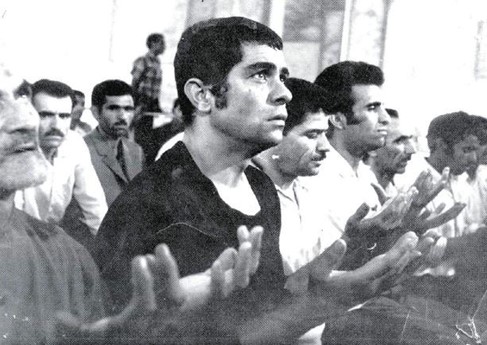
Figure 36. Tawqī (Wood Pigeon, 1976), directed by ʿAlī Hātamī. Sayyid Murtazā enters a mosque and hides among worshippers praying, deterring potential attackers due to the mosque’s significance.
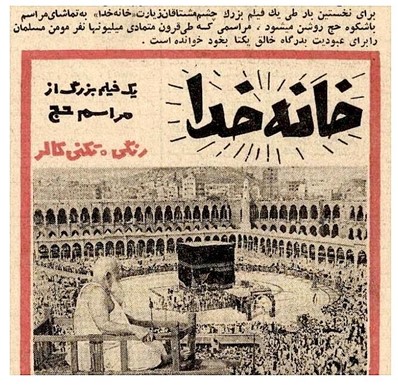
Figure 37. Khānah-ʼi Khudā (The House of God, 1966) directed by Jalāl Muqaddam. The movie’s religious theme deeply resonated with Iranian audiences, attracting many to experience the magic of cinema for the first time.
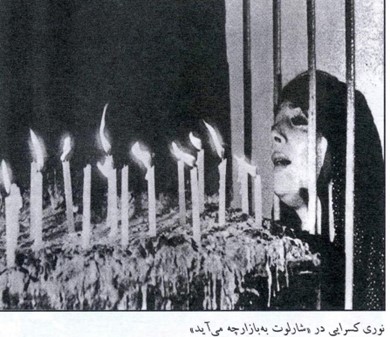
Figure 38. A scene of a Shamʿ’khānah in Shārlūt bih bāzārchah mī-āyad (Charlotte is Coming to Market, 1977), directed by ʿAbbās Jalīlvand.
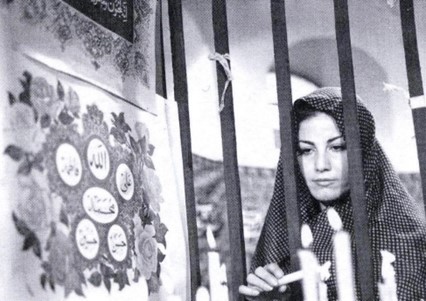
Figure 39. Shīrbahā (Bride Price, 1972), directed by Robert Ekhart. Gul-Bānū seeks solace and shares her deepest thoughts, fears, and hopes with a trusted confidant in the intimate setting of a shamʿ’khānah.

Figure 40. Qiyāmat-i ʿIshq (Hell of Love, 1973), directed by Hūshang Hisāmī. The main character, deeply devoted to his faith, tragically meets his end in a saqqā’khānah.
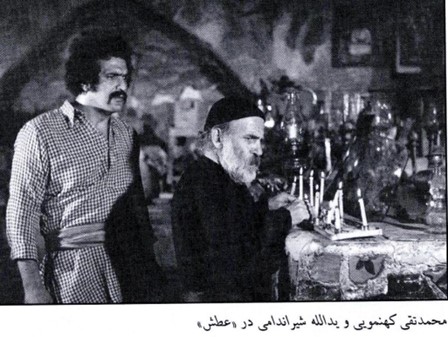
Figure 41. ʿAtash (Thirst, 1972), directed by Īraj Qādirī. The main character and his beloved partner are willing to face any danger, even risking their lives, to establish a shrine (zarīh) in their village.
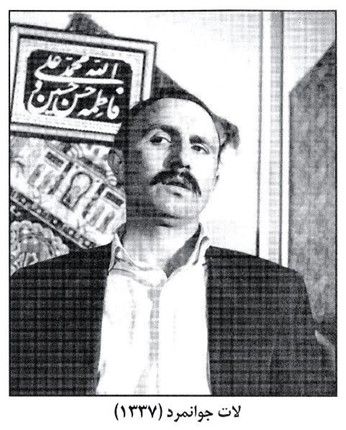
Figure 42. Majīd Muhsinī’s Lāt-i Javānmard (The Noble Rogue, 1958). The narrative of the film revolves around a father’s pilgrimage to Mecca and his responsibility to leave his daughter in the care of a local nobleman.

Khānah (The Family Home): The Place of Gathering, Refuge, Love, and Stability

The khānah, an iconic symbol of the family home, holds a significant place in Iranian national cinema. These modest brick houses,37As noted by Henri Stierlin, brick has long been a material of choice in Iran. Stierlin observes, for instance, how “For as long as we can remember, the great works of Iranian architects and builders, whether for dwellings, sanctuaries, or palaces, have been made of brick. Such is the case with the Ziggurat of Tchoga-Zambil (built in the 13th century BC).” See Henri Stierlin, Ispahan, image du paradis (Ispahan, the Image of Paradise) (Lausanne-Paris: La Bibliothèque des Arts, 1976), 85-86. Gaspard Drouville, in his observations of life, describes a striking feature of the homes in urban areas, noting that “in urban areas, homes are frequently enclosed by tall walls, hiding their fronts in spacious courtyards set back from the streets.” See Drouville, Voyage en Perse, pendent les années 1812 et 1813, 1:95. often portrayed as characters in their own right, are not just architectural elements.38A memorable example of one of these houses taking up the role of character can be seen in Amīr Shirvān’s Dirakhtān Istādah Mīmīrand (Trees Die Standing, 1971), set in a wealthy woman’s home, which takes center stage as the film’s primary setting and location. The lavish house and its decorations play an essential and unmissable role throughout the film, adding to the captivating atmosphere of the story. Rather, they serve as narrative devices, reflecting each film’s social and historical context. The khānah symbolizes the gathering place, refuge, love, and stability for the characters of a film. It is a source of reassurance and secrets, and above all, it represents the family. Scholars, such as Parvīz Ijlālī, have highlighted this vital element of traditional familial connection, especially in Iranian cinema, arguing that “The importance of family and its great role in individual life is one of the main traditional aspects of Iranian society. This characteristic was very well shown and highlighted in the popular Iranian films of these years (pre-revolutionary periods) … Even the lonely hero, like the one in Qaysar, revolted only because of family matters (the rape of his sister).”39Parvīz Ijlālī, Digargūnī-hā-’i ijtimāʿī va film-hā-i sīnimāyī dar Īrān (Social Changes and Feature Films in Iran) (Farhang va Andīshah, 2004), 408.

Traditionally, the khānah is so deeply rooted in Iranian society that its presence is as sacred as places of worship such as a mosque. In Iranian Cinema, it is the place that all the main characters must return to at some point or another. Of course, this place must also be protected. No intruder is allowed to cross the boundary, or he will be severely punished. The house also represents the place where women are protected from the gaze of men, and thus where they can finally be free, even more so than the hammām. They can take off their chadors and headscarves and even bathe naked in the courtyard pool (like Zarī in Tawqī). These elements of social life make this place not only as sacred, but also just as crucial as the mosque. Indeed, exploring Iranian sociology and culture is incomplete without delving into this unique and pivotal place within Iranian society. Further, and in this way similar to hammām, the khānah is also the hub where numerous crucial decisions are made, including social, commercial, and political matters, and where marriages (frequently), religious ceremonies, national holiday celebrations, and funeral wakes are held.

Khānah: The Place of Refuge

Home is, first and foremost, a safe place—the location where a protagonist first seeks refuge from the police just as readily as the fugitive returns to in order to find sanctuary (see Figure 43). For example, in Subh-i Rūz-i Chahārum (The Morning of the Fourth Day, 1972), directed by Kāmrān Shīrdil, Amīr finds no other place of safety besides his mother’s house after his accident and the crime he has committed. As well, in Nākhudā (The Captain, 1973) directed by Amīr Shirvān, one of the characters, Muslim, hides in the titular Captain’s house to escape the police who have falsely accused him of having killed a fisherman. These are only a few of many examples. As noted by Robert Graham, in a life filled with many obstacles, dangers, and violence, “the family is still regarded as the only effective bulwark against the hostile outside world.”40obert Graham, Iran: The Illusion of Power (London: Groom Helm, 1979), 197. On this subject, it is worth mentioning the following movies which share this thematic motif: Parastū’hā Bih Lānah Barmīgardand (Birds Will Return to Their Nests, 1963), directed by Majīd Muhsinī, Gavazn’hā (The Deer, 1974), directed by Masʿūd Kīmiyāʾī, Tangnā (Impass, 1972), directed by Amīr Nādirī, and Mādar (Mother, 1990), directed by ʿAlī Hātamī.
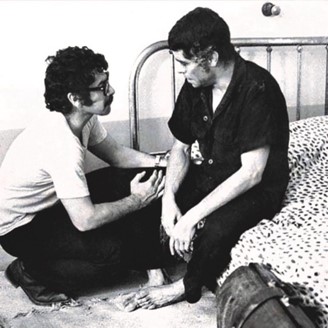
Figure 43. In Gavazn’hā (The Deer, 1974), directed by Masʿūd Kīmiyāʾī, Qudrat, a fugitive, seeks refuge in the house of his friend Sayyid Rasūl.
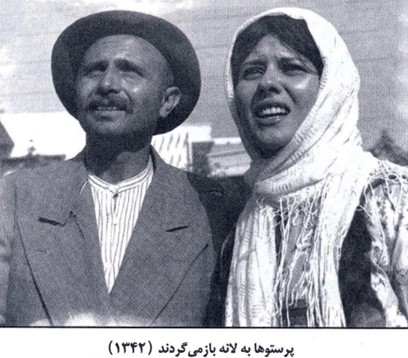
Figure 44. Parastū’hā Bih Lānah Barmīgardand (Birds Will Return to Their Nests, 1963), directed by Majīd Muhsinī. Through its storytelling and evocative portrayal, the film captures the essence of finding solace and safety within one’s homeland.

Khānah: The Place of Weddings

Iran, a country deeply rooted in its religious beliefs, strongly emphasizes the sanctity of marriage, and relationships outside of this institution are often viewed with disapproval. Therefore, including wedding scenes, a cultural cornerstone, is necessary to ensure that a film resonates with the audience. In fact, over time, the wedding scene became increasingly important for a movie’s success, and, slowly, such scenes began appearing at the film’s beginning. For instance, in Bar Farāz-i Āsimān’hā (Beyond the Heavens, 1979), directed by Muhammad ‛Alī Fardīn, the hero swears in front of God and a mullah that he will be a good and faithful husband to his wife. Thus, from the movie’s very beginning, his relationship with his girlfriend becomes halāl (legitimate). Indeed, finding a pre-revolutionary movie without a wedding ceremony in the hero’s or lover’s house is almost impossible. These easily understandable “happy endings” were nearly always at the end of the films made in that period (if not, as mentioned, planted firmly at their very opening).41Examples of films which conclude with a wedding include Dar Justujū-yi Dāmād (In Search of a Groom, 1960), directed by Ārāmāʾīs Āqāmāliyān and Gidāyān-i Tihrān (The Beggars of Tehran, 1966), directed by Muhammad ʿAlī Fardīn.

The wedding ceremony as representative of the strength of familial bonds is another crucial factor in the success of these movies. The Iranian audience’s choice to watch a national film is thus a function of a film’s ability to represent their ideas and values. One of these values is the family but even more importantly the bonds of kinship and loyalty that familial ties represent. It is no coincidence that many movies end with the hero getting married, like in Ganj-i Qārūn (Qaruns Treasure, 1965) and many others.42The film Ganj-i Qārūn (Qaruns Treasure, 1965) and other films in this genre depict a very positive and admiring view of family and family homes. In Iranian cinema, it is rare to find a movie in this category (Fīlm-fārsī) that does not give the family the key role in the story. Even in the Iranian New Wave generation, where a different kind of cinema emerged, the family remains central to the story. In Qaysar, for example, the rape of the sister and the tarnished honor of the family are the triggers of the story. In a decidedly less bleak fashion, in Ganj-i Qārūn, all of the movie’s happy scenes take place in a home: parties, weddings, reunions, meals. Like Shīrīn’s father, the men who look happy and prosperous are married men who spend their time at home with their wives and children. To be happy again, Qārūn must return home to his wife and son, ʿAlī. The movie ends with him bringing his wife to their son’s wedding. Finally, the smile returns to his face. The main character, ʿAlī Bīgham, also marries a wealthy merchant’s daughter and inherits Qārūn’s money, a happy ending that appeals to many spectators. The formula “they got married and had many children” is almost the final goal of all these films, where the hero, despite all his affairs with various women, finally marries only one to settle down and start a family. Thus, the hero becomes a respectable married man and, later, a good father and citizen. He gives the image of a perfect character in harmony with society and the people (i.e., the spectators).

The power of the connection between the audience and Iranian cinema of this period, through a film’s ability to represent traditional, “respectable” bonds of family, cannot be overemphasized. As with other locations that represented the experiences of an average citizen (e.g., the hammām), depictions of weddings held in khānah spoke to the majority of the population who were not wealthy. This was far different from today’s substantial ceremonial events in hotels and palaces designed for such occasions. In the 1950s, 1960s, and 1970s, most weddings occurred in people’s homes (i.e., the khānah), especially in the working-class neighborhoods where most movies were shot.

Indeed, there is a wide range of films depicting family wedding ceremonies taking place within a household setting such as this. Some of these include:

  • Mihmān (The Guest, 1976), directed by Kāmrān Qadakchiyān.
  • Mard (The Man, 1972), directed by Mahdī (Farīdūn) Zhūrak.
  • Gidāyān-i Tihrān (The Beggars of Tehran, 1966), directed by Muhammad ʿAlī Fardīn.
  • Sih Qāp (Knucklebones, 1971), directed by Zakariyā Hāshimī.
  • Ganj-i Qārūn (Qaruns Treasure, 1965), directed by Siyāmak Yāsamī.
  • Mahdī Mishkī Va Shalvārak-i Dāgh (Mehdi the Black and Hot Mini Pants, 1972), by Nizām Fātimī.
  • shnah Talā (The Golden Heel, 1974), directed by Nizām Fātimī.
  • Kūchah-yi Mardhā (Alley of Valiants, 1970), directed by Saʿīd Mutallibī.
  • Laghzish (Instability, 1953), by Mahdī Raʾīs-Fīrūz.
  • ʿAyyūb (1971), directed by Mahdī (Farīdūn) Zhūrak,43The houses in the film play a crucial role in setting the stage for almost all scenes, providing a significant backdrop to the story. and
  • Taʿassub (Intolerance, 1975), directed by Taqī Mukhtār.44Other examples include: Mast-i ʿIshq (Drunk of Love, 1951), directed by Ismāʿīl Kūshān, Yak Nigāh (A Look, 1952), directed by Hāyk Gārāgāsh, Vilgard (The Wanderer, 1952), directed by Mahdī Raʾīs-Fīrūz, Rūz-hā-yi Tārīk-i Mādar (Mothers Dark Days, 1967), directed by Muhammad ʿAlī Zarandī, Mādar dūstat dāram (Mother, I love you, 1975), directed by Dāryūsh Kūshān, Mujāzāt (Punishment, 1975), directed by Mahdī Fakhīm-Zādah, Ghayrat (Honor, 1975), directed by Jahāngīr Jahāngīrī, Shab-hā-yi Tihrān (Tehran Nights, 1953), directed by Siyāmak Yāsamī, and Āqā-yi Jāhil (Mr. Jahel, 1974), directed by Rizā Mīrlawhī. For an example of a film that depicts the celebration of a child’s birth at home, see Jūjah Fukulī (Baby Dandy, 1974), directed by Rizā Safāyī.
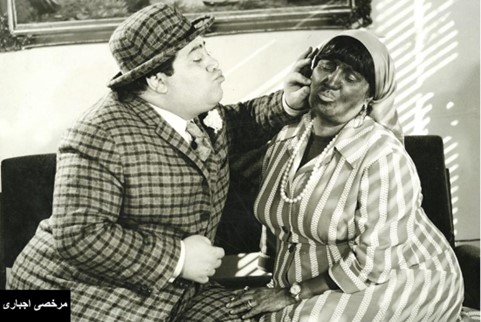
Figure 45. Murakhkhasī-i Ijbārī (Mandatory Leave, 1965) by Rizā Karīmī. A wedding ceremony held at home serves as the perfect conclusion.
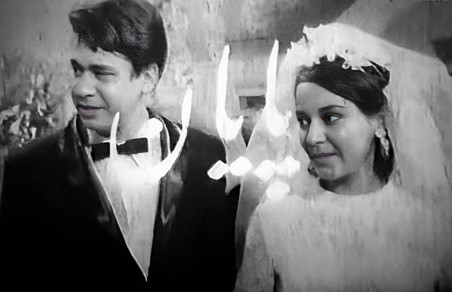
Figure 46. Dukhtar Talā (Golden Girl, 1967) directed by Sardār Sāgir. The movie comes to a close with a somewhat unconvincing wedding celebration taking place at the characters’ home.

Khānah: A Place of Intimacy

There is an excellent contrast between the protagonists’ behavior outside (e.g., out and about in the city or neighborhood) and inside the home (i.e., the khānah). Just as the men and women keep their distance from each other outside, once inside the house, they become more comfortable and closer to one another. The women immediately remove their chadors,45Women traditionally wear veils as a form of head covering. These veils are often draped from the top of the head and extend to the ground. Marry Dana Marks describes Iranian women wearing such attire, noting how they were “enveloped in dark chadors, half-moon shaped pieces of cloth that draped from the top of the head, over the shoulders, to the ground. When grasped at the chin, it obscured all of the woman but her face. Sometimes, even this was too bold and the chador would be pulled forward over the brow and held across the bridge of the nose so only the eyes were visible.” See Marry Dana Marks, Walled In, Walled Out, A Young American Woman in Iran (Peace Corps Writers, 2017), 21. The chador’s origin is the subject of two proposed theories, each contributing insight into its historical and cultural significance. For instance, one group of scholars propose that the chador originates with the advent of Islam: “It is known that when Mohammed placed his women in a room that overlooked the court of a public house, the future mosque of Medina, where they would receive visitors, both Muslim and non-Muslim, Mohammed told them to wear veils so that they would be safe. As the sculptures of Palmyra testify, this custom was known in the East long before Islam.” See André Burguière et al, Histoire de la famille (Family History) (Paris: Armand Colin, 1986), 566. Another group argues that its origins lie further back in time. For example, it is stated that “The chador (chadeur or câdor) has its origins in a centuries-old tradition of dress in Iran. It existed in Persia long before the advent of Islam, in particular at the time of Zoroaster. It has been the traditional women’s clothing since Sassanid times. It used to be a long shawl that would cover and wrap the entire body.” See Marie-Claude Lutrand and Behdjat Yazdekhasti, Au-delà du voile, femmes musulmanes en Iran (Beyond the Veil, Muslim Women in Iran) (Paris: L’Harmattan, 2002), 310. and their faces, previously closed and impassive, become smiling and open.46In Tawqī, for example, a young girl quickly removes her long black chador at home and spends the day in front of the mirror, either putting on makeup or singing. In the evening, she undresses and bathes in the house’s pool (hawz). Men also become more relaxed, their masks of masculinity suddenly coming off. Once home, they look for their mothers, calling out “Nanah!” (māmān),47Nāsir Malik-Muṭīʿī, a renowned actor, often portrays masculine and violent characters in his films. Surprisingly, he reveals a playful and childlike side at home as he interacts with his nanah (māmān). the way adolescents might when arriving home from school.48As in Āqā-yi Qarn-i Bīstum (Mr. Twentieth Century, 1964), directed by Siyāmak Yāsamī.

In Iranian culture in particular, all behavior must change when one is outside and facing others; yet the severe facade individuals display to the world is replaced by openness and intimacy at home. In his novel Bih khātir-i yak film-i buland-i laʿnatī (Because of a Cursed, Long Film), Dāryūsh Mihrjūyī, with profound insight and cutting humor, unequivocally asserts several reasons for this fact, underscored by a comparison of the distinct Iranian mentality with that of Westerners. Mihrjūyī writes:

For centuries, we have lived in deserts and hills, under the threat of various hostilities, natural calamities, and violent enemies… This has forced us to hide from others, taking refuge in philosophy and mysticism… We have developed a reluctance to reveal everything to others… Unlike Westerners who are always looking for the absolute truth, to reveal everything… We do not like to expose everything to everyone… Unlike Westerners, who are always in search of the absolute fucking truth, in order for everything to be revealed, everything has to be naked, open, in front of everyone’s eyes.49Dāryūsh Mihrjūyī, Bih khātir-i yak film-i buland-i laʿnatī (Because of a Cursed, Long Film) (Tehran: Qatrah, 2008), 145.
Figure 47. A typical kūchah (the alley) in Tehran, with old buildings lining the cobbled path and the murmur of daily life filling the air. Photo: Mobina M.
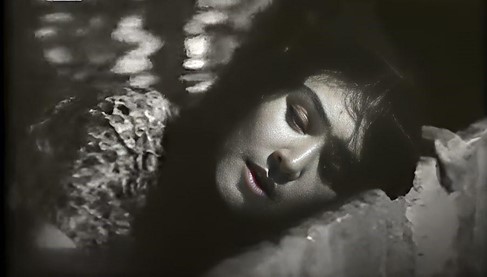
Figure 48. Tawqī (Wood Pigeon, 1976), directed by ʿAlī Hātamī. In the evening, the girl undresses and bathes in the pool (hawz) of the house.
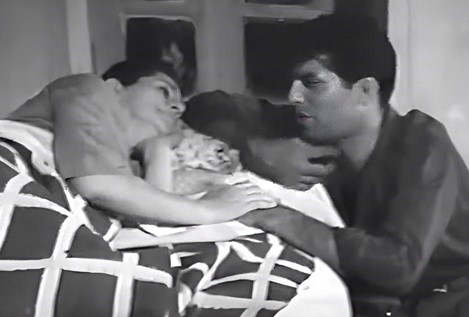
Figure 49. Āqā-yi Qarn-i Bīstum (Mr. Twentieth Century, 1964), directed by Siyāmak Yāsamī. Upon arriving home, the men eagerly search for their mothers, calling out “Nanah!” (Māmān).
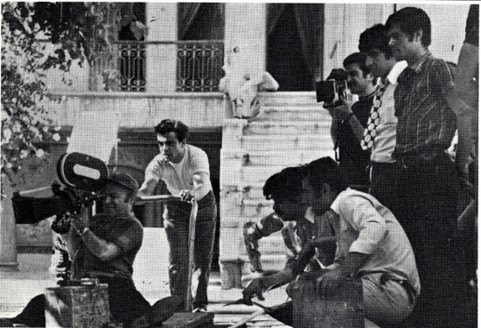
Figure 50. Kulāh Namadī (The Felt-Hatted Man, 1966), directed by Manūchihr Sādiqī. Shooting in the courtyard of a traditional Iranian house.

Khānah: A Place of Memory

In addition to the khānah being a place of refuge, weddings, and intimacy, the house is also a place of memory, a backup archive, as it were, where the film’s hero can return whenever they feel lost and wish to remember their life story, their past, and especially the lives and histories and stories of their ancestors. For instance, in numerous films of this era, we witness the profound emotional journey of solitary characters as they make a pilgrimage to their ancestral homes. More than just a physical structure, the khānah thus becomes a catalyst for their self-discovery, a place where they seek the keys to their memories.

Often, these characters stand in front of a framed photograph on the wall, their eyes filled with longing for the past. They talk to their deceased parents as if they were still present, their voices echoing with nostalgia. As they gaze at each corner of the house, they recall the memories that will help them remember where they have come from and who they are. For example, in Farīdūn Gulah’s Mihrgiyāh (The Mandrake, 1975), ʿAlī’s aspirations manifest in his dream of building a house and cultivating a garden around it (see Figure 51). His struggle with his aunt over the family land is a testament to his determination to reconnect with his past. Even his lover, Mihrī, returns to her family home to seek refuge and recall memories.
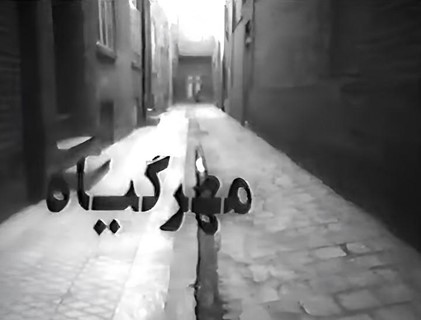
Figure 51. Mihr-giyāh (The Mandrake, 1975), directed by Farīdūn Gulah. ʿAlī is determined to build a house and create a stunning garden around it.
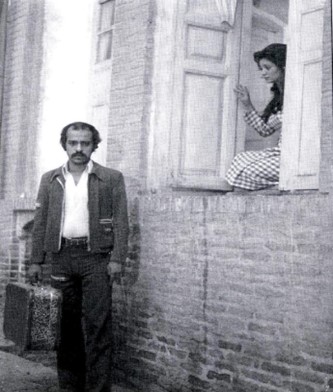
Figure 52. Bī-gunāh (Innocent, 1976), directed by Murtazā ʿAqīlī. As Mahmūd prepares to leave, he reflects on his most cherished memories with his family.

Khānah: A Place of Respect

Much like zūr’khānah or mosques, the khānah is a place of distinct respect. What may be permissible in other settings is not necessarily so at home. Upon entering a house, we are expected to lower our voices and maintain a humble demeanor. We should refrain from entering without permission and, once permission is granted, announce our arrival several times by calling out “Yā Allāh” (Oh God!) before stepping in. Children, in particular, are expected to demonstrate respect within the house, behaving differently than they might outside. For instance, in Sarāydār (The Custodian, 1976) directed by Khusraw Harītāsh, the son is forbidden from raising his voice in front of his father (see Figure 53). Should he disregard this rule, he will be compelled to leave the house, illustrating the seriousness of these cultural norms.
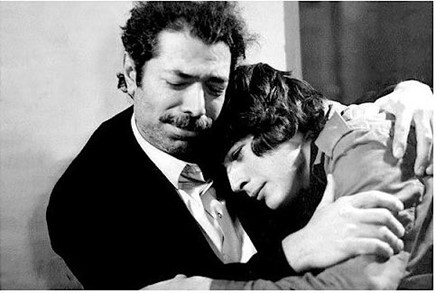
Figure 53. Sarāydār (The Custodian, 1976), directed by Khusraw Harītāsh. The story of a father and son relationship (old and young generation). The story is about a father and son’s relationship, representing the interaction between different generations. The son is expected to communicate with his father respectfully, refraining from raising his voice.
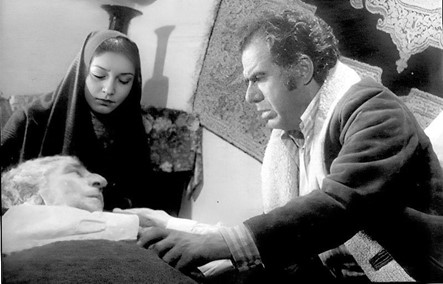
Figure 54. In Qisās (Punishment, 1971), directed by Nizām Fātimī, Muzaffar, with a booming voice, always makes sure to shout “Yā Allāh” (Oh God!) before crossing the threshold into the house.

Qabristān (Cemetery): The Fragility and Decadence—and the End—of Material Life

The cemetery is another highly coveted location in Iranian cinema. As with the mosque, it is almost impossible to watch a movie from this period (i.e., 1940 to 1979) without passing through a graveyard. In such locations, we are presented with blank, horizontal images (of tombstones), often accompanied by the screams and yells of the grieving.50Chardin also observed on his journey to Persia: “The women rend their cloaths [sic], tear their hair and flesh, beat their breasts, cry, yell, and gnash with their teeth, like people mad or possessed; the men also tear their cloaths [sic] and thump their breasts.” See the section titled “The Travels of Sir John Chardin, by the Way of the Black Sea,” in John Pinkerton, A General Collection of the Best and Most Interesting Voyages and Travels in All Parts of the World: Many of Which Are Now First Translated into English: Digested on a New Plan (London: Printed for Longman, Hurst, Rees, Orme, and Brown, and Cadell and Davies, 1811), 9:147. The images (of movies) show men and women dressed in black, mourning the loss of loved ones. In addition and quite notably, while cinematic characters might seek refuge or sift through their memories in the khānah, or appeal to God at a mosque, it is in the graveyard that most of the heroes of these movies decide to take their revenge (e.g., including, for instance, Qaysar, Tawqī, and diq Kurdah).51As noted by Chelkowski, “Revenge is a traditional Iranian theme and greatly utilized by Iranian film makers… Revenge is carried out mainly by the male members of a family or tribe.” See Peter Chelkowski, “Popular Entertainment, Media and Social Change in Twentieth-Century Iran,” in The Cambridge History of Iran: From Nadir Shah to the Islamic Republic, ed. Peter Avery, Gavin Hambly, and Charles Melville (Cambridge: Cambridge University Press, 2008), 7:796.

Indeed, the very role that cemeteries play and their significance in Iranian culture and the lives of Iranians are so profound that filmmakers find them indispensable and often incorporate them into their narratives. This may, at least in part, be due to the depth and layers of tradition in which qabristān are steeped, including some very ancient beliefs, and the conviction in a “life” or soul that lives on after death. For instance, Massoume Price notes how “The Iranians, loaded with their Indo-Iranian traditions were also influenced by the powerful civilizations of the ancient Mesopotamia. Elements of Sumerian, Babylonian and Elamite belief systems were incorporated into the Iranians ideas of cosmos and life after death.”52assoume Price, “A History of Moharram & Other Rituals of Death in Iran,” Iran Chamber Society, December 2001, https://www.iranchamber.com/culture/articles/rituals_of_death.php. Price also notes that, in addition to the history and depth of beliefs concerning death in Iran, the regularity with which individuals frequent cemeteries is also relevant. Indeed, visiting the cemetery every Thursday and Friday afternoon and every important day of the year is an integral part of Iranian and Muslim tradition: “Many believe that visiting the grave on Fridays is a good deed and if close by, the family members will visit the site on this day.”53Price, “A History of Moharram & Other Rituals of Death in Iran.”

Perhaps most importantly, because of their culture and religion, Iranians have long attached a great deal of importance to ideas and belief in life after death, even prior to the advent of Islam. Philip Huyse notes, for example, that ancient “Persians believed in the afterlife… The burial practice of the Indo-Iranians was inhumation, associated with the concept of a continuation of the life of the souls of the dead… This ancient practice of burial remained in vogue in pre-Islamic times among the nomads of Bactria and Sogdiana. It is also sporadically attested in the western regions of Iran during the Sassanid period.”54Philip Huyse, La Perse antique (Ancient Persia) (Paris: Les Belles Lettres, 2005), 127. Huyse is hardly the first to remark on such practices. Indeed, Western travelers have always noticed the importance of the qabristān, and this has been the case since the first foreign visitors. Thus, in 1632, Jean-Baptiste Tavernier wrote: “The Persian cemetery… The grave is six feet long, six feet deep, and barely two feet wide. Then, on one of the sides of the pit facing Mecca, a space is dug to receive a sprawled body, where it is rolled and laid on its side, also with the face directed toward Mecca.”55Jean-Baptiste Tavernier, Les Six Voyages de Jean-Baptiste Tavernier qu’il a fait en Turquie, en Perse, et aux Indes (The Six Voyages of Jean-Baptiste Tavernier that He Made Through Turkey, into Persia, and the East-Indies) (Paris: Gervais Clouzier, 1676), 1: 651.

A few years later, Jean Chardin was also impressed by cemeteries and the traditions and beliefs of the Iranians on this topic, writing:

I shall only speak a word concerning their Mourning, which is the Mourning of people in despair. When a Woman loses her Husband, or a near Relation, she rends her Cloaths [sic], strips herself naked to the Waste [sic], tears her Hair, and with her Nails claws off the Flesh and Skin from her Body and Face, she beats her Breast, she cries, yells, gnashes her Teeth, foams at Mouth, like a Woman mad or possessed, and acts her passion to that degree, that it seems terrible to the sight. The Men also express their Grief after a manner altogether as Barbarous: They tear their Cloths, thump their Breasts, and shave their Heads and their Beards. This Mourning continues 40 Days, with the same Fury as I have described for the first Ten Days, but afterwards relaxing by degrees. During the first Ten Days, the Relations of the deceased, and a great Number of Men and Women come to bewail the Dead, which they do in this manner. The people range themselves in order about the dead Corps [sic], and in their torn Habits, thump their Breasts with both Hands, crying out Vah, Vah . . . [desperately yelling]56John Chardin, The Travels of Sir John Chardin into Persia and the East-Indies (London: Printed for Moses Pitt, 1686), 1:104. Price provides an account of this remarkable ceremony, describing how “Friends and relatives gather around the dying person if they have the chance to do so. There will be prayers and crying mostly by women. Till recently once it became obvious that a person was dying, the relatives would dye the person’s hands and feet with henna. The body should be buried within 24 hours. It will be washed in line with Islamic traditions, scented with camphor ‘Kafoor’ (used by Zoroastrians as well) and wrapped in a white cloth (Kafan) The holy book Quran will be placed close or on the dead person to both protect and bless the deceased.” See Price, “A History of Moharram & Other Rituals of Death in Iran.” Blomfield vividly describes her experience at a Muslim funeral, noting that “The Iranians were dressed in long black chadors that billowed in the wind. I could see that some of them were crying. The Muslim cemetery had no angels or statues, no poetry or flower arrangements. There were just plain markers on the ground. There were specific prayers and a procession. I was escorted to the grave, dragging my black chador in the dirt, trying to keep from stumbling . . . The dead woman we placed in the ground, in no casket, by her sons. From dust to dust, I assumed. Her head was set on a pillow mounded from dirt, facing Mecca. Prayers were offered and tears were wept.” See Bridget Blomfield, The Language of Tears (White Cloud Press, Ashland, Oregon, 2015), 86.

These traditional religious rituals, deeply revered by Iranians, vividly illustrate the profound investment and significance of their mystical vision of life on earth and beyond.

The cemetery is thus a particular and poignant symbol of these beliefs, and most importantly, of beliefs in the both the fragility and the decadence of material life. As Price notes, part of this fragility and threat of decadence is ethical and religious—a consequence of choices over “good” or “evil,” or faithfulness (or lack thereof) in God: “In summary, the rituals of death in Iran like all other cultures are closely related to the concepts of life after death. With the ancient Iranians their fate in the afterlife was decided by their choice of good or evil. For the Muslims adherence to the God’s commands and total submission to ‘Allāh’s will’ decides their fate.”57Price, “A History of Moharram & Other Rituals of Death in Iran.” In this way, the notion that “life holds nothing and is worth nothing,” as conveyed by renowned Persian poets such as Hāfiz, Saʿdī, and Khayyām, is not simply a philosophical concept in movies such as Ganj-i Qārūn. It is, rather, a profoundly felt reality, evident in characters’ heartfelt conversations. Examples of these include, for instance, Qaysar’s discussions with his family, or in the musical expressions exemplified by ʿAlī’s songs in Ganj-i Qārūn.58In a moving scene from Ganj-i Qārūn, Fardīn croons, “I have no desire for Qārūn’s wealth; all I seek is a simple meal and a modest place to lay my head.” This line beautifully captures the film’s philosophical message, highlighting the characters’ rejection of material riches, favoring a more modest lifestyle.

As often portrayed in movies, life is depicted as devoid of meaning, with the protagonists emphasizing instead the significance of living with dignity and embodying virtuous qualities such as courage and strength as a “mard” (literally, “man”), a “javānmard” (noble, brave). Thus, recurring lines of dialogue in films from this era include: “Don’t sweat the small stuff,” “This too shall pass,” and “Stay humble.” However, there are also equally common and stronger messages in these films like “Never give up” and “Stand up to injustice, for that is what gives life its meaning.” This latter messaging, at least in part, authorizes the use of the space of the qabristān as an ideal place for the making of vows, especially, as mentioned earlier, oaths of revenge. For example, during the funeral of his sister Fātī at the cemetery, Qaysar decides to seek revenge against those who raped her (causing her to take her own life). Similarly, in diq Kurdah (Sadiq the Kurd, 1972), directed by Nāsir Taqvāyī, the protagonist (Sādiq) makes a similar decision at his wife’s grave and sets out to find the killer. Additionally, in Tawqī, Āq-Sayyid Murtazā carries his wife’s body to the cemetery and also resolves to seek revenge (see Figure 55).59Frédéric Jacquin describes the communal nature of the funeral procession, noting that, “During the procession to carry the coffin . . . every passer-by who happens to be there lends his shoulder to help bear the weight, as long as another person steps in to take their place.” See Frédéric Jacquin, Voyage en Perse au XVIIe siècle (Journey to Persia in the 17th Century) (Belin, 2010), 111. When two women express the belief that “God will punish the murderer,” he responds firmly, “I will do it myself.”60Tawqī (Wood Pigeon, 1976), directed by Ali Hatami (ʿAlī Hātamī). Time stamp 1:19:44. Further, in Haydar (Haydar, 1971), directed by Farīdūn Zhūrak, Aqdas, standing by her brother’s grave, resolutely determines to find a man to avenge her brother’s murder. The movie portrays her unwavering quest until she encounters Haydar, the man for whom she is willing to sacrifice everything—body and soul—to bring the murderer to justice.
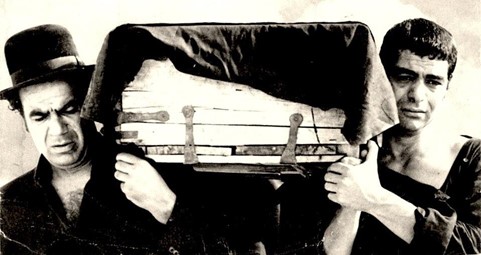
Figure 55. Tawqī (Wood Pigeon, 1976), directed by ʿAlī Hātamī. Sayyid Murtazā and his uncle, Sayyid Mustafā, they carry the body of their loved one, Tūbā.

Including a qabristān scene in movies from this era provides an evocative and poignant backdrop that adds depth and emotional resonance to the storytelling. The serene yet melancholic atmosphere of the cemetery setting allows for contemplation and reflection. It encourages the audience to delve into their thoughts, amplifying the viewers’ emotional engagement with the characters and the themes depicted in the films.

In the film Bītā (1972), directed by Hazhīr Dāryūsh, the portrayal of the eponymous character’s emotional experience following her father’s death is incredibly powerful. The touching image of the burial ceremony resonates profoundly and is among the most impactful moments in the movie. In another instance, in the compelling film Dāyirah-i Mīnā (The Circle, 1975) directed by Dāryūsh Mihrjūyī, the sad ending serves as a powerful metaphor for the defeat of the country’s modernization efforts. The scene unfolds in a desolate cemetery, where the solemn occasion of ʿAlī’s father’s burial occurs. The film concludes with a striking freeze-frame shot capturing the hauntingly pale face of young ʿAlī standing before his father’s final resting place. This evocative imagery leaves viewers with an overwhelming sense of suspension and introspection as they are compelled to grapple with the profound implications of the film’s conclusion. Additionally, in Yak Ittifāq-i Sādah (A Simple Event, 1973), directed by Suhrāb Shahīd Sālis, the narrative reaches a heart-wrenching climax. The sudden and sorrowful demise of a young boy’s mother brings the story to a poignant and unexpected conclusion, leaving a profound and lasting emotional impact.

The usage of cemetery imagery is also intricately and importantly tied to the pervasive theme of mortality within Iranian cinema. The compelling and sorrowful scenes found in films of this era draw direct influence from ta‛ziyah,61Ta‛ziyah is a form of religious drama with deep historical roots, dating back to the eighth century. It is often dubbed the “Islamic opera” in Western culture. It is known for its portrayal of the tragic events surrounding the massacre of Imam Husayn (Imam ‘Alī’s son) and his family by Yazīd. Ta‛ziyah vividly captures the emotional and intense moments of Tāsūʿā and ‛Ashūrā during this tumultuous period in Islamic history. Peter Chelkowski provides an insightful explanation of ta‛ziyah describing it as “a mourning ritual commemorating the death of Imam Hussein, the grandson of the Prophet Muhammad, who was murdered on the plain of Kerbela by his religious and political opponents in the 61st year of the Muslim era (680 A.D.). The actual Kerbela tragedy further divided the world of Islam between the Shi’ites, who believed that the leadership of the Muslim community should follow the blood-relations of the Prophet Muhammed, and the Sunnites, who believed that the leader should be elected according to ancient Arabic tradition. In Iran, the Shi’a branch of Islam became the state religion in the 16th century A.D.” See Peter J. Chelkowski, ed. Taziyeh: Ritual and Drama in Iran (New York University Press and Soroush Press, 1979), p. half-title of the book; Andrzej Wirth highlights the distinctive nature of taʾziyah acting, noting that “Taʾziyeh acting developed its own dramaturgy of signs, distinct from other performing traditions of the world. Maybe the most striking example for the understanding of the Taʾziyeh’s unique performance structure is the symbolic sign of chest-beating.” See Andrzej Wirth, “Semiological Aspects of the Taʾziyeh,” in Taziyeh: Ritual and drama in Iran, ed. Peter J. Chelkowski (New York University Press and Soroush press, 1979), 36. To commemorate and display these grand spectacles, the Iranians ingeniously constructed their own arena (takiyah). Nacim Pak-Shiraz discusses the evolution of taʾziyah, explaining that “Taʾziyeh started out as an outdoor performance, with simplicity of dialogue, props and mise-e-scene. With its growing popularity, however, the need for permanent place was all too evident, and resulted in the building of the tekiyes.” See Nacim Pak-Shiraz, Shiʿi Islam in Iranian Cinema (I. B. Tauris, 2011), 136. Although ta‛ziyah is observed on various occasions, its most significant enactment occurs during Muharram and Safar. Alfred Bates explains the timing of ta‛ziyah performances, noting that “The usual time for these representations is during the two holy months of Moharrem and Safar, in which the expounders of the Ali sect have contrived to bring closely together a number of important and significant events. Among them are the deaths of Hasan and of Hossein.” See Alfred Bates, The Drama: Its History, Literature, and Influence on Civilization (Cambridge, 1903), 200. In his writing, Bates discussed ta‛ziyah’s immense popularity and widespread cultural impact as entertainment and artistic expression. He writes, “The Tazieh, or Passion-Play of Persia, depicting the successive martyrdoms of Ali, Hasan and Husain, is a remarkable combination of religious fervor and dramatic art. The full performance occupies the afternoon and evening of ten successive days. If the success of a drama is to be measured by the effect it produces on the people for whom it is composed, no play has ever surpassed this long-drawn out tragedy.” See Bates, The Drama, 297. specifically the portrayal of the tragic fate of Husayn and his family, which holds a pivotal role in producing these performances. This particular staging style is emulated in Iranian cinema, where the notion of death, often symbolizing a poignant disappearance, is woven into nearly every narrative. Consequently, a given film’s central theme, whether centered on revenge or remorse, finds easier validation within this paradigm. In a way somewhat similar to the inclusion of the ubiquitous presence of Ziyārat’gāh, filmmakers always find a moment to include this place in their movies, even when there is no necessary need. For example, in Sih Qāp (Knucklebones, 1971), directed by Zakariyā Hāshimī, the protagonists’ meeting place is nothing more than a graveyard. However, the place takes on added symbolism when we learn that the meeting was arranged to organize a game of chance known as “sih qāp” (i.e., knucklebones from which the film takes its title). While waiting for the others, two pals start talking about death and “those people under the ground.”62Sih Qāp (Knucklebones), directed by Zakariyā Hāshimī (1971), 00:17:05. This conversation about mortality sets the tone for the film’s exploration of life’s uncertainties. Later, one of them will die at the movie’s end, further emphasizing the theme of mortality.

Notable Examples of Qabristān in Iranian Cinema

Figures 56-65 showcase scenes from films produced during the relevant era, covering a wide range of themes such as those related to cemetery, death, mortality and the transient nature of life, and more.
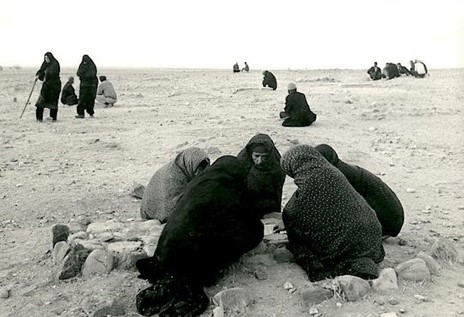
Figure 56. Gāv (The Cow, 1969), directed by Dāryūsh Mihrjūyī. The movie intricately delves into the nuanced and profound relationship between life and death within a remote village engulfed by swirling clouds of dust.
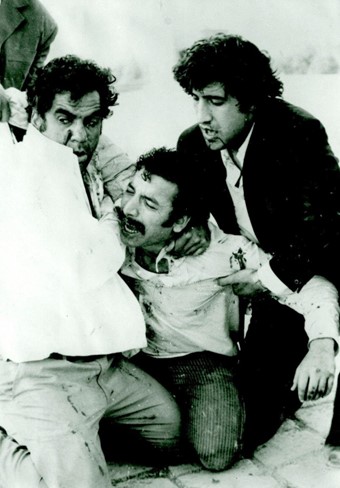
Figure 57. Sih Qāp (Knucklebones, 1971), directed by Zakariyā Hāshimī. The main characters meet at a cemetery to organize a game called “sih qāp.” They discuss death, setting the tone for the film’s focus on life’s unpredictability. Later, one of them dies, emphasizing the theme of mortality.
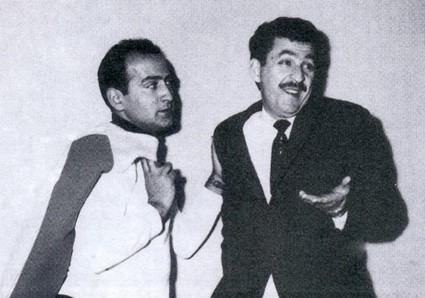
Figure 58. Ānhā Zindigī-rā Dūst Dāshtand (They Loved Living, 1963), directed by Ahmad Safāyī, depicts the heartfelt story of a father’s weekly pilgrimage to the cemetery, where he finds solace and reflects on the profound loss of his beloved son.
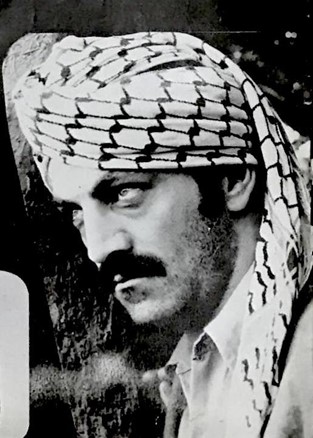
Figure 59. Sādiq Kurdah (Sadiq the Kurd, 1972), directed by Nāsir Taqvāyī. Sādiq stands solemnly at his wife’s gravesite in the cemetery, his heart heavy with grief and his mind filled with a burning determination to track down the person responsible for her untimely death.
Figure 60. Tūfān-i Zindagī (The Storm of Life, 1948), directed by ʿAlī Daryābaygī. The main character chose the cemetery as the location for their tragic act of committing suicide, adding a significant and impactful element to the storyline.
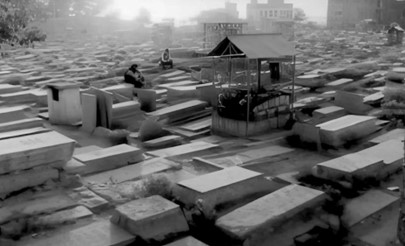
Figure 61. Sīnah-Chāk (A Tough Man, 1976), directed by Īraj Qādirī. The cemetery is the haunting backdrop where the characters are forced to confront and grapple with challenging and impactful decisions.
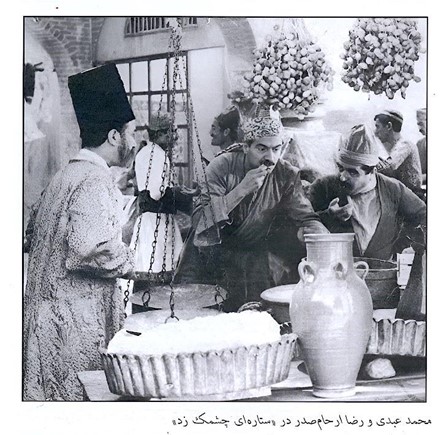
Figure 62. Sitārah’ī Chishmak Zad (A Star Winked, 1963), directed by Muhsin Badīʿ. Death is the film’s central theme, intricately woven into the storyline and compellingly explored through various characters and plot developments.
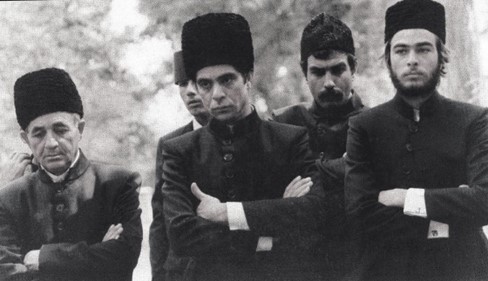
Figure 63. Malakūt (Kingdom, 1976), directed by Khusraw Harītāsh. The film explores the theme of death and its impact on the characters, their relationships, and the overall narrative.
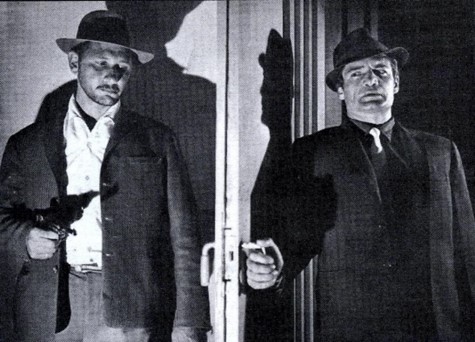
Figure 64. Nabard-i Ghūl’hā (The Battle of the Giants, 1965), directed by Rizā Bayk Īmānvardī). The cemetery holds great significance within the film’s narrative, serving as a crucial and impactful location.
Figure 65. In Haydar (Haidar, 1971), directed by Farīdūn Zhūrak, Aqdas stands before her brother’s final resting place, overwhelmed by grief and anger. In the stillness of the cemetery, she makes a solemn vow to take revenge on her brother’s murderer.

Conclusion

By exploring the film production of this period and paying particular attention to some of the most common locations employed in the creation of pre-revolutionary Iranian films, we can see that the elements like the Qahvah’khānah, Zūr’khānah, Hammām, Ziyārat’gāh, Khānah , and Qabristān were not just incidental features of the films of the era, but integral components of the very fabric of Iranian cinema. These elements, which continue to influence contemporary Iranian films, were not mere set pieces but rather cultural touchstones that resonated with audiences. Even more, the presence of these iconic locations was not limited to Fīlm-Fārsī but can be observed in even avant-garde films, which felt their pull, underscoring the enduring cultural, architectural, and historical importance of these various establishments, residences, communal and public gathering spaces, and sacred sites.

It is truly remarkable how pre-revolutionary cinema continues to captivate and charm audiences in Iran, even decades after the Revolution. This enduring popularity extends to post-revolutionary generations, who, despite not experiencing that era themselves, have emerged as active members of its “fan club.” A visit to the websites dedicated to downloading or watching these movies (YouTube, Telegram, Instagram, WhatsApp) reveals the sheer number and diverse profiles of these members, a testament to the timeless allure of these films. Despite the vast array of foreign films available to contemporary audiences, why do the films of the pre-revolutionary era in Iran continue to hold such a powerful allure?

For most of these films and their ardent audiences, the historical facts embedded in the narratives and images of these movies are the main reason. Much like the characters in these films who return to their khānah to revisit or relearn old memories, these old films are a treasure that offers glimpses of a lesser-known Iran. Audiences, especially younger generations, want to revisit them out of a deep sense of nostalgia. Another reason is that the cinema of the past depicts the country’s culture, mentality, and its most popular social classes in a natural manner. Indeed, this is in part the very reason for the use of these popular and well-known types of locations employed by filmmakers that have been reviewed in this article. Further, those men of principle and deep faith, represented by many of the main characters in these movies, are missed by today’s society. Equally, modern audiences long for those Javānmards—heroic figures who are ready to sacrifice everything for a friend or their family, united by kindness and love, or indeed by that deep friendship between men which no longer seems to exist.

The new generation lacks all of this, feeling trapped in a modern, materialistic life without a place for themselves as individuals or for humanity to flourish. For these reasons alone, we can thank the artisans of this cinema (i.e., Fīlm-Fārsī). Their works are now, more than ever, an integral part of the country’s national, cultural, and cinematographic heritage.
Behrouz Vossoughi: The Cult Star of Failed Rebellious Masculinity

By

Figure 1: Bihrūz Vusūqī, A screenshot from the film Dashnah (The Dagger).

Introduction

Né Khalīl Vusūqī on March 11, 1938, in the city of Khuy, Bihrūz Vusūqī made his entry into the Iranian film industry as a dub actor for foreign films.1Note on translations and dates: The translation of all Iranian movie titles, publications, expressions, institutions, quotations, and dialogue lines from Persian (Farsi) into English are mine unless suggested by their copyright owners. For converting the dates of events, movie productions, and publications from the Iranian Solar to the Gregorian calendar, I have used Taghvim.com. See “Tabdīl-i tārīkh [Iranian Date Converter],” taghvim.com, accessed July 9, 2024, http://www.taghvim.com/converter/. By the age of twenty-four, he had begun acting in films as well. Between the time of his first major cinematic role in Sad kīlū dāmād (One Hundred Kilos of a Groom, ‛Abbās Shabāvīz, 1961) and his breakthrough performance in Qaysar (Mas‛ūd Kīmīyā’ī, 1969), he had starred in a total of twenty-three other films. Though he had already become one of the most sought-after stars of mainstream cinema, Qaysar made him into a superstar whose fans would watch each of his films religiously and repeatedly for years to come. Over the next ten years, Vusūqī acted in thirty other films. These included some of the most frequently quoted movies from before the Revolution, including Rizā muturī (Reza the Motorcyclist, Mas‛ūd Kīmīyā’ī, 1970), Tawqī (The Ring-Necked Pigeon, ‛Alī Hātamī, 1970), Dāsh Ākul (Mas‛ūd Kīmīyā’ī, 1971), Tangsīr (The Man from Tangistān County, Amīr Nādirī, 1973), Gāvazn-hā (The Deer, Mas‛ūd Kīmīyā’ī, 1974), Ham-safar (Co-Traveler, Mas‛ūd Asadullāhī, 1975), Kandū (Beehive, Farīdūn Gulah, 1975), Malakūt (The Heavenly Kingdom, Khusraw Harītāsh, 1976), and Sūtahdilān (The Heartbroken, ‛Alī Hātamī, 1978), among others. Each of these films enjoys its own fandom, but they are all connected through the strong presence and undiminished reputation of their main actor, Bihrūz Vusūqī, an Iranian cult star par
excellence.

Figure 2: Left: A behind-the-scenes image from the film Ham-Safar (Co-Traveler), directed by Mas‘ūd Asadullāhī (1975). Right: A screenshot from the film Rizā muturī (Reza the Motorcyclist), directed by Mas‛ūd Kīmīyā’ī, (1970)

Cult movie stars are film actors who attract devoted and faithful fans over a long span of time. Cult fans’ passion for engagement with their object of fandom is enduring, interpretive, and productive, and serves the same social, cultural, and political functions as cult movies do. In Cult Cinema, Ernest Mathijs and Jamie Sexton argue that film stardom emerges from a dialogue between the audience’s expectations of the actor based on their chosen on-screen roles, and the actor’s private, off-screen life as publicly observed.2Ernest Mathijs and Jamie Sexton, Cult Cinema (Wiley-Blackwell, Malden, MA: 2011), 76. Moreover, cult reputation may be achieved through a number of different factors, including the longevity of the star’s status, the uniqueness of the movies’ cinematic style or of the star’s method of acting, their reported or rumored unhappiness, a scandal, or a sudden decline or ending of the star’s career, especially due to an untimely death.3Mathijs and Sexton, Cult Cinema, 77-79. In The Routledge Companion to Cult Cinema, Mathijs and Sexton re-iterate the idea that “shortened, abrupt, and fractured trajectories help form cult reputations,” which in turn inspires fans and academics to further inspect the origins of these unusual outcomes in the actor’s performance.4Ernest Mathijs and Jamie Sexton, “Actors,” in The Routledge Companion to Cult Cinema (New York: Routledge: 2020), 432.

We can recognize many of these elements in the life and works of Bihrūz Vusūqī. After more than fifty iconic performances in Iranian films, Bihrūz Vusūqī’s career was cut short due to his permanent departure to the US shortly before the 1979 Revolution. From then on, all of Vusūqī’s pre-revolutionary films have been banned from official distribution in Iran, as are the handful of movies in which he has acted abroad. Despite these circumstances, his fandom has yet to subside. Ask any Iranian, and they will refer you to somebody who can deliver one of Bihrūz’s angry monologues in Qaysar, imitate one of his facial gestures in The Ring-Necked Pigeon, or recite one of his funny quips in Co-Traveler. Even though many fans understood that the oft-quoted “Bihrūz’ lines” were written by different screenwriters and sometimes vocalized by dub actors, they still show their love for the manner in which “Bihrūz” delivered those lines and made them meaningful.5Many of his fans refer to Vusūqī by his first name. Others shorten his last name from Vusūqī to Vusūq—hence, Bihrūz Vusūq. In this article, I mainly use the last name Vusūqī when discussing him. Bihrūz Vusūqī’s adoration by his fans over the past five decades is reminiscent of Kate Egan and Sarah Thomas’s notion that divergent interpretations of “authenticity” act as the main boundary between (regular) stardom and cult stardom: stars convey authentic ordinariness while cult stars lead us to the realm of the extraordinary.6Egan and Thomas argue that while stardom’s authenticity usually conveys ordinariness and naturalness, cult film stardom’s authenticity incorporates “the ironic, the overtly performed, an explicit articulation of labor, the absence of traditional signifiers of emotion or intimacy, the playful juxtaposition between ‘fact’ and ‘fiction,’ the highly controlled, managed, or mediated, and the extraordinary.” See Kate Egan and Sarah Thomas, “Introduction,” in Cult Film Stardom (New York: Palgrave MacMillan, 2013), 8. Bihrūz Vusūqī presented the ordinary in an extraordinary way. Thus, he was, and has remained, an authentic cult star in the eyes of his fans.

Figure 3: A screenshot from a fan-colored version of the film Tawqī (The Ring-Necked Pigeon), directed by ‛Alī Hātamī, (1970)

In this article, I argue that Bihrūz Vusūqī’s cult star status stems from his authentic representation of the failure of both traditional and transitional modes of masculinity in Iranian cinema and culture. This argument requires a contextualization of Iranian cinema at the time of Vusūqī’s active career. I begin by introducing cinematically mediated modes of hegemonic masculinities as a productive framework for studying Iranian pre-revolutionary commercial cinema, collectively known as fīlmfārsī. Then, I analyze the major elements of Bihrūz Vusūqī’s persona and performance in order to reveal how he was perceived to be a symbol of rebellion against not only other modes of masculinity but also his own rendition of it.7I limit this study to an investigation of Vusūqī’s representation of transitional masculinity through a close reading of his on-screen performance and performance style in several cult movies. However, Janet Staiger’s quadruple consideration for studying star “images” may offer an excellent strategy for advancing this argument further. These include, “(1) the star persona (which may or may not be like the ‘real’ person but which is the intertextually constructed notion of the star through a series of films or television programs and which is known, perhaps, only through watching fictional texts); (2) the star as performer (acting ability or how a star plays the roles he or she is assigned); (3) the star as worker/laborer (the professional life of the individual or how she or he negotiates work situations); and (4) the star in the domestic, private sphere (the so-called off-camera life).” See Janet Staiger, Media Reception Studies (New York: New York University Press, 2005), 116. Emphases are in the original.

As such, he became a symbol of resistance to the abstract concept of patriarchal authority in general. Tracing the discussions of Vusūqī’s stardom before and after the Revolution by focusing on both his publicized off-screen life and the Iranian cultural policies since 1979 can further reveal that Vusūqī has remained a cult star not only because of his curtailed career in Iranian cinema but also because he embodied the culture of rebelling against societal norms without offering a viable alternative, a culture that remains very much alive in the country today.


Masculinity

As the governing style of national film production, fīlmfārsī developed its own aesthetic patterns for survival in its economic battle with foreign imports. One of the most effective strategies of fīlmfārsī involved using male stars who simultaneously represented similar and different conceptualizations of manhood by enacting several modes of differing hegemonic masculinity. R. W. Connell introduces hegemonic masculinity as a culturally honored form of manhood that embodies the norms that a culture idealizes. While hegemonic masculinity is not normal—as few men might be able to enact it—it is certainly normative: it dictates the standards of being a man in society and regulates the power, production, and emotional relations among men and between men and women.8If there is some correspondence between this form of culturally exalted manhood and institutional power, this form of masculinity becomes more likely to be established. Hegemony, in this sense, refers to “ascendancy achieved through culture, institutions, and persuasion.” See R. W. Connell and James W. Messerschmidt, “Hegemonic Masculinity: Rethinking the Concept,” Gender and Society 19, no. 6 (December 2005): 832. Connell states that some of the most visible characteristics of hegemonic masculinity are represented and reinscribed by film stars and their on-screen personas: “They may be exemplars, such as film actors, or even fantasy figures, such as film characters.”9R. W. Connell, Masculinities (Berkeley: University of California Press, 2nd edition: 2005), 77.

The overall hegemonic masculinity represented in fīlmfārsī was what many Iranian critics labeled lumpan (lumpen): a politically charged umbrella term for lower-class urban tough guys abundant in fīlmfārsī.10Originating in the Marxist concept of lumpenproletariat, lumpan was a pejorative title by which intellectuals of the era addressed the dramatic configurations of the jāhil (literally: ignorant) archetype of the era’s urban hoodlums. Lumpans did exist in the margins of society, but it was their dramatization that surfaced and emphasized their rather marginal presence. To read more about different characteristics of lumpans in Iranian society and cinema, see Ali Akbar Akbarī, Lumpanism [Lumpenism] (Tehran: Markaz-i Nashr-i Sipihr, 1973), 147-149; Shahin Gerami, “Islamist Masculinity and Muslim Masculinities,” in Handbook of Studies on Men and Masculinities, eds. Michael S. Kimmel, Jeff Hearn, and R. W. Connell (London: Sage, 2005), 451-452; Farīdūn Jayrānī, “Dahah-yi chihil: Ru’yā-yi shīrīn va shikast [The 1960s: A Sweet Dream and Its Failure],” in Tārīkh-i tahlīlī-i sad sāl sīnimā-yi Īrān [Analytical History of A Hundred Years of Iranian Cinema], ed. ‛Abbās Bahārlū, 79-124 (Tehran: Daftar-i Pazhūhish-hā-yi Farhangī, 2000), 91-103; and, Parviz Jahed, “Lumpanism dar Fīlmfārsī [Lumpenism in fīlmfārsī],” radiozamenh.com, last modified January 29, 2013, https://www.radiozamaneh.com/53023. As a hybrid construct of social and dramatic forces, the lumpan was as much an outcome of several sociocultural processes in Iranian society as it was a result of dramatization in cinema, literature, and theater. The fīlmfārsī of the 1960s and 1970s introduced lumpans as normative: men who were almost unanimously traditionalists, intrepid, tough, sons-of-the-moment, faithful to friendship, and self-assigned and society-assigned protectors of men’s honor in its most patriarchal sense.11For more, see Jamāl Umīd, Tārīkh-i sīnīmā-yi Īrān, jild-i avval: 1279-1357 [History of Iranian Cinema, Volume One: 1900-1978] (Tehran: Rawzanah, 1995), 307; Hamid Dabashi, Close Up: Iranian Cinema, Past, Present and Future (London: Verso, 2001), 26; and, Hamid Reza Sadr, Iranian Cinema: A Political History (London: I. B. Tauris, 2006), 110-112.

Figure 4: From left: Muhammad ‛Alī Fardīn, Nāsir Malak Mutī‛ī, and Bihrūz Vusūqī

However, the configuration of the fīlmfārsī lumpan shows the co-existence of several overlapping, but still distinct, modalities. Arguably, instead of an unmindful genesis of generic categories, the variety of the hegemonic masculinities represented by Iranian movie stars of the 1960s and 1970s determined the diversification of fīlmfārsī. Benefitting from the advantage of news items about the reception of fīlmfārsī products in pre-revolutionary trade presses as well as the accessibility of many of these films on YouTube in recent years, it is possible to classify the hegemonic representations of masculinity in fīlmfārsī into four categories, each of which can be symbolized by specific stars: the happy-go-lucky fatalist (represented especially by Muhammad ‛Alī Fardīn); the comical action hero (embodied mostly by Rizā Bayk Īmānvirdī); the chivalrous lūtī (represented, first and foremost, by Nāsir Malak Mutī‛ī); and the rebellious young man (whose face was Bihrūz Vusūqī).12Although Hamid Naficy explains the lūtī type in the two forms of the rural dāsh mashtī and the urban jāhil, the critics of the 1960s and the 1970s did not differentiate between different representations of this type, and interchangeably called the character lūtī, lāt, kulāh-makhmalī (velvet-hat), dāsh mashtī, or jāhil. See Hamid Naficy, A Social History of Iranian Cinema, Volume 2: The Industrializing Years: 1941-1978 (Durham, Duke University Press, 2011), 270. Together, these four types and their representative actors were the main forces behind the production of hundreds of films in a little over two decades before the Revolution. And yet, as the following analysis of Bihrūz Vusūqī’s persona and performance shows, his model of masculinity signaled a departure from the previously established norms of on-screen masculinity from the lūtī to an anti-hero (e.g., Qaysar and The Ring-Necked Pigeon), from the happy-go-lucky to a tortured soul (e.g., Reza the Motorcyclist and Co-Traveler), and from the funny action hero to a pathetic loser (e.g., The Deer and Beehive).

The most salient trait of Vusūqī’s persona and performance in personifying this transition was the sense of rebellion that he conveyed to his audience: a rebellion against not only the other forms of manhood, but also different embodiments of patriarchal traditions, authority, and power. Vusūqī’s rebellions can be studied best through his representations of sexuality, the body, and violence. Each of these three attributes contributes to Vusūqī’s embodiment of the failure of manhood, and thus, to the cultification of his image in Iranian cinema.

Figure 5: Left: A screenshot from the film Qaysar, directed by Mas‛ūd Kīmīyā’ī, (1969)

Sexuality

Sexual tensions were among the most recurrent struggles of Vusūqī’s characters. These tensions made themselves evident in three forms: implied impotency, queer-like behavior, and heterosexual temptations—and they began from his very first film. In the comedic One Hundred Kilos of a Groom, Vusūqī played the role of a young engineer pressed with financial hardship. We first see him in a conjugal fight with his wife whom he has already divorced and remarried twice. He threatens to divorce the wife again, which would be an almost unreturnable decision according to Islamic laws.13According to Shi’i jurisprudence, if a man and wife are divorced from each other three times, they cannot remarry unless the woman marries another person, and that person dies or divorces her. This person is called muhallil (the person who makes the ex-wife halal to the ex-husband). Other than this film, the most famous Iranian film which plays with this notion is Muhallil (Interim Husband, Nusrat Karīmī, 1971). The wife, however, teases him by saying “tu aslan mard nīstī! (You are not a man at all!).”14Sad kīlū dāmād (One Hundred Kilos of a Groom), directed by ‛Abbās Shabāvīz (1961; Iran, Tehran, ‛Asr-i Talā’ī, DVD), 00:19:17-00:19:19, https://www.youtube.com/watch?v=hVTgyno4FcQ Obviously charged with sexual intonations, this line also refers to the common knowledge in Iranian culture that only true men are brave enough to take drastic actions such as permanently divorcing their wives.15In this case, Vusūqī’s character divorces the wife for the third time and then, to be able to remarry her, they find an overweight muhallil; hence the title of the film.

The accusation or implication of impotency or the man’s reluctance to engage in sexual activities with a woman remained with Bihrūz Vusūqī’s characters for a long time. While obviously obsessed with the idea of sex in many of his films, Vusūqī’s characters seem to be constantly fighting their own desires. These internal battles sometimes drove his characters to abstinence, escapism, or different forms of sexual resistance or aberrant behavior. The examples are abundant. In Qaysar, seemingly because of his decision to take revenge for the deaths of his sister and brother, he nullifies his engagement with his fiancée; in Panjarah (The Window, Jalāl Muqaddam, 1969), his girlfriend is pregnant by another man without his knowledge; in Reza the Motorcyclist, the fiancée of Vusūqī’s first character tells him that he is a “khurūs-i bī-buttah (a rooster without balls)”16Rizā muturī (Reza the Motorcyclist), directed by Mas‛ūd Kīmīyā’ī (1970; Iran, Tehran, Payām Cinematic Organization, DVD), 00: 25:011-00: 25:012, https://www.youtube.com/watch?v=jgMisAgPOoo and that, instead of being called a man, they should call him a chicken with glasses; in Beehive, he seems to suffer from premature ejaculation during his first round of sex with a prostitute and then does not have the money to buy a token for a second round; in Dāsh Ākul, he cannot express his love for a girl because of his promise to her father; and in The Deer, he is totally consumed by his addiction to heroin, and thus, his relationship with his partner has become completely asexual.

These appearances of sexual shortcomings are sometimes underlined by a variety of male-male relationships with queer undertones or, at least, emphasized bromance. In The Deer, for example, the moment that Vusūqī’s heroin-addicted character meets his friend from high school after several years is punctuated with an exaggerated performance of hugging, smelling, and kissing each other (see Figure 1). An extended queer reading of these moments is beyond the scope of this article. What has been said thus far, however, may suffice to conclude that Vusūqī’s characters seem to be much more at ease during their moments of male bonding compared to their difficult moments of expressing heterosexual connections.

Figure 6. The moment when Sayyid (Bihrūz Vusūqī) and Qudrat (Farāmarz Qarībīyān) meet each other after years of separation. Two enlarged screenshots from Gāvazn-hā (The Deer), directed by Mas‛ūd Kīmīyā’ī (1974; Iran, Tehran, Mīsāqīyah Studio, DVD). Accessed via https://www.youtube.com/watch?v=Q9H_C7NN-EE (00:10:04).

More explicit than the implications of impotency and a proclivity for all-male relationships are the plotlines, sequences, scenes, and shots that represent one of the main dilemmas of Vusūqī’s characters: sexual temptations. These cases clearly point to his struggles with normative masculinities by putting his characters in no-win situations. His resistance against sex equals the failure of the dominant, patriarchal, and sexually active traditional man—he cannot readily act upon his sexual desire. On the other hand, his submission to these temptations implies the failure of the kind of rebellious masculinity that he represents—he fails in resistance. Consequently, his reactions to sex represent both the failure of the traditional man and his alternative.

This situation can be seen in several of Vusūqī-Gūgūsh co-starred movies such as Co-Traveler, in which the plot revolves around his character’s refusal of romantic or sexual engagements with the girl until the turning point of yielding to the temptation.17Fā’iqah Ātashīn (born in 1950), professionally known as Gūgūsh, is arguably one of the most well-known singers, performers, and pre-revolutionary actresses of Iranian cinema. She was briefly, and controversially, married to Vusūqī for fourteen months between 1976 and 1977. One of the best examples of these temptations can be seen in The Ring-Necked Pigeon. In this film, Vusūqī plays the role of a colombophile, Ā-sayd-Murtizā, who is tasked by his lūtī uncle, played by Malak Mutī‛ī, to travel to the city of Shiraz and bring the uncle’s fiancée to their hometown of Kashan. Once in Shiraz, he is struck by her beauty and lasciviousness. Two sequences, in particular, are dedicated to Ā-sayd-Murtizā’s inner struggle to avoid sex with the young woman. The first sleepless night at the fiancée’s house, we see images of her from Ā-sayd-Murtizā’s subjective point of view, followed by a semi-dream shot of her going into a big pool in the yard. Whether in reality or his dream, Vusūqī’s semi-naked character follows her into the pool. He approaches her, but at the last moment, he places his hand on his face—a signature gesture of Vusūqī—and turns his body around (see Figure 2). While this scene has a realistic logic neither in the characterizations nor the plotline of the film, its metaphorical strength is reinforced by the same kind of ambivalent sexuality that the audience expects from Vusūqī’s persona.

Figure 7. Sexual temptation in Tawqī (The Ring-Necked Pigeon), directed by ‛Alī Hātamī (1970; Iran, Tehran, Sierra Film, DVD). Accessed via https://www.youtube.com/watch?v=Uqu4HIgUpmg (00:21:34).

The next morning, the young man is awakened by the music of diegetic noises: a worker is repairing cotton-field mattresses in the yard by using a traditional cotton-beating instrument that has a rhythmic and musical sound. The girl’s mother is sewing, and the sound of her sewing machine adds to the musicality of the soundtrack. The young man is sweaty and already agitated when the young woman’s vocal improvisation complements the sexual music of the scene. She is doing her makeup in front of a mirror and simultaneously utters meaningless sounds in accompaniment with the seemingly natural music of the ambiance. Either in reality or the young man’s mind, the girl’s voice becomes more and more like sexual moans. The intercut between the image of the girl and Ā-seyd-Morteza’s tossing and turning in bed against the acoustic backdrop of the sex music finally overpowers him. He rushes outside his room while shouting “Oh, God!” Yet, he finally acquiesces and sleeps with her (see Figure 3).

Figure 8. A typical surrender of Vusūqī’s character to his sexual temptations, depicted through five images of the “vocal sex scene” in Tawqī (The Ring-Necked Pigeon), directed by ‛Alī Hātamī (1970; Iran, Tehran, Sierra Film, DVD). Accessed via https://www.youtube.com/watch?v=Uqu4HIgUpmg (from top and left to right: 00:21:55, 00:22:08, 00:22:26, 00:23:22, 00:18:15).

The Body

Like the ambivalence toward normative sexuality in Bihrūz Vusūqī’s persona, his bodily performance also implies a departure from the hegemonic masculinities of his time. In Masculinity and Film Performance, Donna Peberdy frames gender as an act with a performative nature. The body of the actor, then, becomes not only the means of performing gender but also “an ideological site of naturalized knowledge.”18Donna Peberdy, Masculinity and Fiction (New York: Palgrave MacMillan, 2011), 27. This ideological site, however, can perform functions other than conforming with and corroborating the status quo. Russell Meuf and Raphael Raphael, for example, argue that stars’ bodies can also become sites of ideological contestation.19Russell Meeuf and Raphael Raphael, “Introduction,” in Transnational Stardom: International Celebrity in Film and Popular Culture (New York: Palgrave MacMillan, 2013), 2. These two functions of stars, especially with regards to their bodies, can be studied in the context of male stardom in fīlmfārsī. If the sportsmanly bodies of sexually active and uncompromising characters of stars such as Malak Mutī‛ī, Bayk, and Fardīn reproduced those conceptualizations of hegemonic masculinity that had become cinematically and culturally exalted in Iranian society, Bihrūz Vusūqī’s body presented an intermediary star who was someplace between traditional heroes and quite average men. His body, therefore, was simultaneously highly celebrated because of his status and very identifiable because of its common characteristics.

By showing off his performative skills despite and because of his non-extra-ordinary body, Vusūqī both repeated the ideological norms of his time and challenged them. In many of his films, Vusūqī’s naked torso carries these dual functions. For instance, let us consider his body in Mamal Āmrīkāyī (Mamal the American, Shāpūr Qarīb, 1975, see Figure 4). In this film, he is playing the role of a small-time crook whose biggest goal in life is to immigrate to the United States to run a gas station. In the sequence from which I have chosen Figure 4, he is doing his routine exercises at his father’s house, instead of a traditional or modern gymnasium. His body is that of an amateur sportsman: he has some muscles in his arms, but not anything comparable to his contemporary superstars who usually had come to cinema after gaining some fame in manly sports such as wrestling. As a result, Vusūqī’s not-perfect posture along with his facial expression makes his body look rather comic instead of heroic.

Figure 9. The semi-comic posture of Vusūqī’s hairless torso simultaneously shows an exalted and common body, Mamal Āmrīkāyī (Mamal the American), directed by Shāpūr Qarīb (1975; Iran, Tehran, Sierra Film, DVD). Accessed via https://www.dailymotion.com/video/x82gpe9 (00:09:57).

Furthermore, his body seems to be completely hairless, which is contrary to the esteemed body of Iranian classic heroes and other male stars of the time, such as Fardīn (see Figure 5). Blake Atwood recognizes Vusūqī’s hairless body as a portent of change in the standards of male beauty, “perhaps inspired by European or American ideals.”20Blake Atwood, Reform Cinema in Iran: Film and Political Change in the Islamic Republic (New York: Columbia University Press, 2016), 152. Connecting the hairless bodies of Iranian men in Qaysar’s bathhouse scene to the historical tradition of equating the lack of body hair in young men with them being objects of homosexual desire for older men, he also acknowledges that “the hairless adult male bodies in Qaysar confound this traditional way of categorizing both sexual maturity and desire, especially at a time when sexual mores were changing.”21Atwood, Reform Cinema in Iran, 153.

Figure 10. Fardīn’s body conformed to the ideals of traditional manhood: physically strong with a hairy chest. Screenshot from Ganj-i Qārūn (Qārūn’s Treasure), directed by Sīyāmak Yāsamī (1965; Iran, Tehran, Pūrīyā Film, DVD). Accessed via https://shorturl.at/qODcm (01:16:02).

Another distinguishing characteristic of Vusūqī’s performance comes from the emphasis that he put on making his acting obvious through his body. Almost all of his pre-revolutionary films are marked with his obvious attempts in showing off the capabilities of his body. His various forms of bodily exaggerations sometimes gave way to the comic (as in Mamal the American or his other Gūgūsh duos) and sometimes led to different forms of physical violence and/or deformations of his body and face (as in Beehive or his Kīmīyā’ī-directed films).

Vusūqī’s overemphasis on performing with his body should be seen as an actor’s attempt to make all his talent and skills visible. At the time that he was active in Iranian cinema, the soundtrack of almost every movie was completely made in post-production. In order to make the production process faster and easier, the studios had long preferred to shoot the movies with no sound recording at all. Iranian sound studios, however, were technologically advanced thanks to the dubbing practices in effect since the mid-1940s. With a booming dubbing industry and a burgeoning pop music scene, reworking the whole soundtrack in Tehran’s numerous sound studios seemed like an ideal solution. It also enabled producers and directors to use the same dub actors who did the popular Persian voices of foreign stars for Iranian actors. For the Iranian actors, however, this meant losing control over the sonic aspects of their performance.

As a former dub actor, Bihrūz Vusūqī was well aware of the power of voice actors in Iranian cinema. Dub acting also helped him closely observe the works of those American actors who followed the Actors Studio style of identification between the actor and the character. In his memoir, Vusūqī stresses how he spent a lot of time researching his characters.22Nāsir Zirā‛tī, Bihrūz Vusūqī: Yak Zindigī-nāmah [Bihrūz Vusūqī: A Biography] (San Francisco: Araan Press, 2004), 250-253. For playing the role of the heroin-addicted Sayyid in The Deer, for example, he tried drugs. He also employed a real addict to be with him on the set of the film for him to imitate his posture and tone of voice.23Zirā‛tī, Bihrūz Vusūqī, 271-274. But, The Deer was only one of a dozen titles of his fifty-five films until 1979 in which he dubbed his own character.24Most of the roles in which Vusūqī dubbed his own performance belonged to his pre-superstar status, with exceptions such as The Deer and The Man from Tangistān County. His other dubbing double for that period was Manūchihr Zamānī who voice-acted for him in ten movies. Vusūqī’s guide to the dubbing industry, Manūchihr Ismā‛īlī, did his voice in fourteen films, some of which were titles that introduced him as a rebellious anti-hero, including Qaysar and Reza the Motorcyclist. Another well-known dub actor, Changīz Jalīlvand, dubbed Vusūqī in sixteen films, especially those with a more comic intonation because they allowed him to make those roles funnier by adding improvised quips. For more on the role of the dubbing industry in shaping the persona of Iranian actors, see Ahmad Zhīrāfar, Tārīkhchah-yi kāmil-i dūblah-yi fīlm bih Fārsī, jild-i duvvum: 1350-1392 [A Complete History of Dubbing Movies into Persian, Volume 2: 1971-2013] (Tehran: Kūlahpushtī, 2013), 726. Therefore, he had to work even harder to show off his acting skills in the films that he knew his voice would be replaced by another man’s in the post-production dubbing studio. To make his performance more visible, then, he both did rounds of pre-production character studies—such as being hospitalized in a mental hospital before playing the role of a mentally challenged character in The Heartbroken—and exaggerated his bodily performance in order to compensate for his lack of genuine voice.25Zirā‛tī, Bihrūz Vusūqī, 313-315. As a result of these exaggerations, Vusūqī’s body either tends toward comedy or toward violence and/or deformity in his more serious films. Figures 6 to 11 exemplify some of the facial deformations and changes that Vusūqī’s face and headwear undertook in some of his performances.

Figure 11. Dāsh Ākul lamenting the loss of his love in Dāsh Ākul, directed by Mas‛ūd Kīmīyā’ī (1971; Iran, Tehran, Rex Cinema & Theatre Company, DVD). Accessed via https://www.youtube.com/watch?v=2IniV6u55Hw (01:01:49).

Figure 12. Balūch searching for his wife in Balūch, directed by Mas‛ūd Kīmīyā’ī (1972; Iran, Tehran, Mīsāqīyah Studio, DVD). Accessed via https://www.youtube.com/watch?v=9XZdZ4Ud7Wo (01:36:35).

Figure 13. Peasants arguing over their right to land in Khāk (Soil), directed by Mas‛ūd Kīmīyā’ī (1973; Iran, Tehran, Mīsāqīyah Studio, DVD). Accessed via https://www.youtube.com/watch?v=-cHUW8O4Tfk (00:38:05).

Figure 14. A heated argument over marital relations and infidelity, from the movie Sāzish (Compromise), directed by Muhammad Mutivassilānī (1974; Iran, Tehran, Payām Cinematic Organization, DVD). Accessed via https://www.youtube.com/watch?v=prKFYZuLDPc (00:36:14).

Figure 15. Sayyid (Behrūz Vusūqī) is shot and dying at the end of Gāvazn-hā (The Deer), directed by Mas‛ūd Kīmīyā’ī (1974; Iran, Tehran, Mīsāqīyah Studio, DVD). Accessed via https://www.youtube.com/watch?v=Q9H_C7NN-EE (01:38:44).

Figure 16. Behrūz Vusūqī, portraying a mentally ill character, finds a chain on the street. Sūtahdilān (The Heartbroken), directed by ‛Alī Hātamī (1978; Iran, Tehran, Payam Cinematic Organization, DVD). Accessed via https://www.youtube.com/watch?v=wsuLNprT1h4 (00:12:17).

Iranian filmmakers made use of Vusūqī’s plasticity as a structural element of their movies. In several films, including Duzd-i bānk (Bank Robber, Isma‛īl Kūshān, 1965) and Reza the Motorcyclist, he played more than one role. In other films, such as Compromise, his character began to pretend to be someone else and thus continued the double act. Furthermore, whenever there was a need for heavy make-up for a character, such as in The Heartbroken, Vusūqī would be among the directors’ top choices. The master of Iranian art cinema, ‛Abbās Kīyārustamī, acknowledged this quality of Vusūqī as a formative element of his films. He was responsible for making the title credits of several Vusūqī/Kīmīyā’ī movies, including Qaysar and Reza the Motorcyclist. For the latter, he used blown-up photographs of the moment of the titular protagonist’s death for the beginning credits. The photos became grainier with each credit shot, so that in the last shot—introducing the director’s name—Vusūqī’s face becomes less visible than ever (see Figure 12).

Figure 17. Stills from opening credits of Rizā muturī (Reza the Motorcyclist), directed by Mas‛ūd Kīmīyā’ī (1970; Iran, Tehran, Payām Cinematic Organization, DVD). Accessed via https://www.youtube.com/watch?v=jgMisAgPOoo (from left to right: 00:00:58, 00:02:45).

Vusūqī also emphasized the malleability of his body by overacting with his body as well as his eyes and facial gestures. In almost all of his films, there is a scene in which he smashes his hand to his forehead and then covers his face with that drooping hand (see, for example, the snapshots from The Ring-Necked Pigeon in Figures 2 and 3). Another signature gesture of his is the way he abruptly turns away his look from something or someone who is making him angry or tempted. At other moments, he stretches the muscles around his eyes and eyebrows without raising the eyebrow in order to portray a discovery or convey his inner transformation. Similarly, he uses different facial tics to distinguish a character, especially in his comedies. These exaggerations often lead to blemishing the beauty that one expects from a movie star or the naturalness that one expects from a good actor. The critics, therefore, were divided over Vusūqī’s acting style before his superstardom with Qaysar. There was one camp that considered his work only suitable for “panoramic sights such as deserts and streets,” because his “stereotypical gestures and distasteful makeup” would produce “a bad image in close-ups.”26The direct quote is from a review on Zanī bih nām-i sharāb [A Woman Named Sharab {Wine}] (Amīr Shirvān, 1967), written by Mīhan Bahrāmī in Sitārah-yi Sīnimā [Movie Star], no. 601 (January 31, 1968), cited in Umīd, Tārīkh-i sīnīmā-yi Īrān, 400. And there was a second camp that believed “with that flexible face and intrinsic intelligence, with that control over his body and the experience that he surprisingly has acquired from playing in pop movies, he cannot not be a reliable ace for our filmmakers [in the future].”27The direct quote is from a review on Bīgānah bīyā [Come, Stranger] (Mas‛ūd Kīmīyā’ī, 1968) by Parvīz Davā’ī (Payām) originally published in one of the issues of the weekly Sipīd u Sīyāh (Black and White) and cited in Umīd, Tārīkh-i sīnīmā-yi Īrān, 430. Following Qaysar, the second group became dominant and Vusūqī began to comfortably repeat his style in different performances, further generating a following among both other actors and his fans.

Vusūqī’s reliance on makeup and exaggerated gestures presents us with a body in change, a body in transit. It was also a body of different emotions. This statement might not seem to carry much weight for an actor’s body in performative media today. After all, actors are supposed to be able to transfer different emotions via their physicality. It is their job after all. However, considering the characteristics of Iranian pre-revolutionary cinema that pushed for typecasting and pigeonholing, Vusūqī’s ability to act out a regular spectrum of emotions was considered extraordinary.28A comparison with Nāsir Malak Mutī‛ī might be helpful here. Vusūqī narrates that during filming Bot [Idol] Īraj Qādirī, 1977), the director had a hard time convincing Malak Mutī‛ī to cry in a scene as the lūtī actor believed that a man in uniform—which was the role he was playing—would not cry. See Zirā‛tī, Bihrūz Vusūqī, 300. Figure 13, for example, is the front cover of one of the issues of the magazine Dukhtarān va Pisarān that emphasizes Vusūqī’s image as a “sad and lonely artist,” while his other images in the magazines of the time advertised his image as a mischievous, and later, a rebellious young man.29Dukhtarān va Pisarān [Girls and Boys], no. 659 (August 15, 1971). Thus, Vusūqī’s malleable image was more identifiable than, for example, those of the other stars of his era; an identification that would surprisingly sit comfortably with his status as a celebrity. He had an attainable body similar to the body of his male fans (not too muscular, not too hairy) but it was also the unattainable body of a star par excellence. His fans could identify with the emotions that his body conveyed but he was also occupying a space beyond the regular spectrum of normal emotions because of his exaggerations and the bigger-than-life nature of cinema in general, and fīlmfārsī in particular.

Figure 18. “Bihrūz Vusūqī: A Sad and Lonely Artist.” The front cover image of Dukhtarān va Pisarān [Girls and Boys], no. 659 (August 15, 1971).

Violence

Vusūqī’s pliable body also would welcome violence. The relationship between masculinity, violence, and power further illustrates the transitional role of Bihrūz Vusūqī as a male icon. A leading scholar on masculinity, Michael S. Kimmel sees violence as men’s expression of their powerlessness when feeling entitled to power. In other words, the sense of entitlement (to power) drives powerless men to express forms of anger that are fed by frustration.30Michael S. Kimmel, “Chapter 14: Reducing Men’s Violence, The Personal Meets the Political,” in The Gender of Desire: Essays on Male Sexuality, ed. Michael S. Kimmel (New York: State University of New York Press, 2005), 227-234. This configuration of male violence is completely applicable to almost all of the physical and verbal forms of the cinematic violence that Vusūqī represented. Here, another difference between his comedies and non-comedies emerges. In the comedies, he usually wins his fights (whether verbal or physical), while in non-comedies, he either loses his battles or leaves the audience with a bitter feeling of failure.

The peak of his failed violence is portrayed in Beehive. In this film, Vusūqī plays the role of Ibī, a former wrestler with a silver medal in an important tournament. For unknown reasons, however, he has not continued sports. The film begins with his release from prison following a six-month stint due to committing a small robbery. Not having any specific place to call home once on the outside, like many other lumpans of fīlmfārsī, he frequents a traditional coffee shop (qahvah-khānah) to spend his nights. There, he loses a traditional gambling game to a macho man, a friend from the prison, whose character is a reiteration of the action hero that borrows elements from the lūtī. The winner decrees that the loser must go to the northern district of Tehran and drink in any bar that he orders, but without paying for it. This is only a game, and as the old lumpans in the coffee shop mumble, this decree is not implementable. But then, remembering his defeat in the final match of a wrestling tournament to the same homeless man whom he witnessed die the night before, Ibī changes into the clothes that the man had given him, and chooses to perform the decree. While it is not clearly stated why Ibī does so, his reasons are metaphorically implied: in this sociopolitical climate, the old heroes (i.e., the men) have no future but to get addicted to drugs, end up in places such as the coffee shop, and die. So, to not let heroic behavior (i.e., manhood) die, one must defend his honor even if he knows this defense will end in his demise. This is one of those more explicit messages that are constantly repeated in Vusūqī’s other milestones too, including in his Kīmīyā’ī trilogy, Qaysar, Reza the Motorcyclist, and The Deer. In Beehive, however, this philosophy takes on more crystal-clear imagery through the employment of the metaphors of the city and violence.

The economic and cultural geography of Tehran plays an important role in the progress of the film’s plot. Ibī must go up north on Pahlavi Street (now, Valī-i ‛Asr Street) which runs from the poor southern neighborhood of Rāh Āhan to the rich northern neighborhood of Tajrīsh. The impossibility of social class mobility in this journey becomes obvious in the contrast between Ibī’s clean and rather well-dressed image in the rundown bars of the south of the city at the beginning of his path and his bloody and smashed up face in the chic cabarets of the north of the city at the end of his route (see Figure 14).

Figure 19. Screenshots from Kandū (Beehive), directed by Farīdūn Gulah (1975; Iran, Tehran, Sierra Film, DVD). The lefthand image shows Ibī at the beginning of his journey in the poor neighborhoods of the south of Tehran. The righthand image shows Ibī at the end of his journey in the rich neighborhoods of the north of Tehran. Accessed via https://www.youtube.com/watch?v=VZ_vlHsX4SQ (from left to right: 00:46:10, 01:31:17).

Ibī drinks in seven bars and gets beaten in four of them. In this modern play on the seven-stages of ‘irfān or the haft khvān, Vusūqī’s body transforms from that of a clean young man’s to a horribly beaten, bloody, body with a smashed face.31Literally meaning “to know” or “to understand” and variously translated as mysticism, Sufism, gnosis, transcendental awareness, etc., ‘irfān is an Islamic-Iranian religious practice essentially holding that the goal of man must be to reach toward God by completing a seven-stage divine path called soluk (path, behavior). At least in its layering and seven stages, ‘irfān is similar to the pre-Islamic concept of haft khvān, which refers to the seven stages that some of the pre-Islamic heroes or pahlavānān, like Rustam of the Firdawsī’s Shāhnāmah, had to go through. This trajectory occurs with a masochistic pleasure for the protagonist, because he knows he is sacrificing his material body for his abstract but sacred concept of honor. Once, after being beaten and pissed on by a security guard, he confesses to his sidekick that having been beaten all his life, he finds a kind of joy in the process: “Always, after being beaten severely, I feel different. Like a man who’s itching and is scratched properly. I like the pain. It’s like they have signed my leave of absence.”32Kandū (Beehive), directed by Farīdūn Gulah (1975; Iran, Tehran, Sierra Film, DVD), 01:05:25-01:05:39, https://www.youtube.com/watch?v=VZ_vlHsX4SQ We do not know whether the audience feels connected to this depiction of pain but considering the social origins of this character and the exceptional imagery of the film—a rare color film, an epic song written for the film and performed by a rising star in Iranian pop music during the era also named Ibī, and the meticulous choreography of the fight scenes—the possibility of audience identification is not improbable. Moreover, Vusūqī’s performance of violence ends in nothing but the disintegration of a star’s body on screen and thus becoming more recognizable, or at least earthlier, than ever.

Vusūqī’s violent characters fail in their fights here in Beehive and in many of his other films as well. This model of failure, however, provided a very relatable experience for the Iranian audience, many of whom have witnessed or been engaged in constant battle with various forms of authority and patriarchy over the past half-century. The world of other male stars in Iranian cinema offered the audience a modern avenue for re-experiencing traditional conceptualizations of male heroes: men who would act heroically in everything associated with manhood, from fights to chivalry to sex. The cinematic world of Bihrūz Vusūqī, however, was a bitter, dark, and poisoned environment in which a man got beat up by different forces without being able to do anything about it except to take pleasure in the process of humiliation. Failure, then, could also mean resistance against powers beyond one’s control.

The entanglement of Bihrūz Vusūqī’s persona with violence is not limited to his characters’ bodies. It is also evident in his many verbal attestations to the decline of an era. In particular, we see this in many of his angry monologues. Qaysar, in this sense, is most remembered by the fans who would continue to re-deploy its protagonist’s rant against men of the past in different situations. The film is about a young man from the south of Tehran, Qaysar, who returns home from a temporary job in the city of Ābādān only to find out that his sister, Fātī, has committed suicide after being raped. Furthermore, he finds out that his lūtī brother, Farmān (Malak Mutī‛ī) went to confront and take revenge for the death of their sister from the rapist. The luti was barehanded, but the rapist and his two brothers use a knife to kill Farmān. At the moment of his death, Farmān shouts: “Qaysar, where are you [to see] that they killed your brother!”33Qaysar, directed by Mas‛ūd Kīmīyā’ī (1969; Iran, Tehran, Ārīyānā Film, DVD), 00:20:27-00:20:31, https://www.youtube.com/watch?v=Ahkqef86u4w This scene has a symbolic significance in Iranian cinema, for it connects the failure of one mode of hegemonic masculinity (that of Malak Mutī‛ī’s lūtī) and the birth of another mode (that of Vusūqī’s rebellion). Yet, to make this transition even more clear, the writer/director Kīmīyā’ī embellishes the film with several dialogue-filled scenes about men and manhood. First, when Farmān decides to take revenge for his sister’s death, it is his uncle, a former athlete of traditional zūrkhānah sports, who admonishes him against using a knife:

It is humiliating for a pahlivūn, Farmūn.34Pahlivūn is the colloquial form of saying pahlavān, a traditional male athlete in the zūrkhānah (a traditional martial-arts arena or gymnasium; colloquial: zūrkhūnah) sports. The same goes for Farmūn instead of Farmān. Don’t judge the skin and bone that I am now. There was a time that they rang the bell in any zūrkhūnah that I stepped into. There were times when I would wrestle for two days in a row. But I never touched a knife. Nāmard-hā must fear one’s arm, not a knife.35Nā-mard literally means non-man, and figuratively means a non-chivalrous man. You give the knife to a child, and he can cut his hand. I used to pull a brick out of the wall, but now what? My eyes are watery, and my feet are shaking. How do you think I feel? My heart is coming out of my chest. I feel like my heart is burning because of Fātī. But what can I do? It is like death for a pahlivūn. You had vowed Farmūn. Give me the knife and say a prayer.36Qaysar, directed by Mas‛ūd Kīmīyā’ī, 00:16:26-00:17:23.

Figure 20. Screenshot from A screenshot from the film Qaysar, directed by Mas‛ūd Kīmīyā’ī, (1969; Iran, Tehran, Ariyana Film, DVD).  Farmān decides to take revenge for his sister’s death, it is his uncle, a former athlete of traditional zūrkhānah sports, who admonishes him against using a knife. Accessed via https://www.youtube.com/watch?v=itYE35x-umQ ( 00:17:04)

Farmān gives the uncle the knife and goes barehanded, resulting in his death. This scene finds a parallel after Qaysar returns home after killing the first of the rapist’s brothers. Reading Firdawsī’s Shāhnāmah, the uncle begins to advise him too: “It’s far from being fair and being a [chivalrous] man [to kill those brothers with a knife and in the surreptitious way that you did].”37Qaysar, directed by Mas‛ūd Kīmīyā’ī, 00:46:14-00:46:16. But this time, Qaysar does not let the uncle go on. Instead, Qaysar begins his diatribe about manhood in modern Iran, which can be read like a manifesto on the form of masculinity that Vusūqī’s persona represented in his following films:

I respect you, uncle, but don’t tell me about [chivalrous] manhood for I am sick of it. Who showed me a speck of manhood so that I can show him plenty? This world has always been full of cheating and nāmardī [unmanly behavior]. Anyone that I respected, betrayed me. Didn’t you see Farmūn? He could displace a whole neighborhood. When he was bothered, he used to drink and yell so that the walls tremble and all those nā-mard [non-chivalrous men] would hide in the gutters like rats. But what happened to him? He went to a pilgrimage and repented. He started to work like a man to have halal [Islamically lawful] bread. But did they let him? This is the system of our time. This is our time, uncle. If you don’t hit them, they hit you. Now, where is brother Farmūn?38Qaysar, directed by Mas‛ūd Kīmīyā’ī, 00:46:17-00:46:59.

Following this angry monologue in which Qaysar vows to kill the remaining two brothers, the uncle closes his extra-large edition of the Shāhnāmah with a sense of symbolic finality. Thus, it becomes clear that Qaysar is not going to walk along the path of the heroes of the Shāhnāmah such as Rustam, traditional athletes and sports heroes such as his uncle, or lūtīs such as his brother Farmān.

The inefficiency of these previous forms of manhood finds other dialogue-based manifestations in Vusūqī’s films, including his next collaboration with Kīmīyā’ī. One of the two roles that he plays in Reza the Motorcyclist is that of small-time crook, Rizā, who has only one attachment in his life: his motorcycle. Rizā is also highly critical of movie heroes such as Fardīn. In a sarcastic exchange of comic lines with his mother, he says: “I have just found out that there is a better kind of life, so why should I say that we’d better remain content and happy just with our bread and yogurt? These are all lies, Mom.”39Rizā muturī (Reza the Motorcyclist), directed by Mas‛ūd Kīmīyā’ī, 00:54:44-00:54:52. Later, the film emphasizes Vusūqī’s transitional model of manhood in another verbal attack on men of the past, this time the lūtīs. Sitting in the neighborhood bakery having his breakfast, Rizā checks out the images of some zūrkhānah athletes on the wall and begins to ask the baker about them:

Rizā (pointing to a picture): Who’s this, Mr. Asghar?

Baker: Husayn Ganjah’ī.

Rizā: What does he do now?

Baker: He’s in jail.

Rizā (pointing to another picture): Who’s this other one, Mr. Asghar?

Baker: Rizā ‛Attār. He could do traditional powerlifting for two full days straight. He’s also in jail.

Rizā (pointing to another picture): Who’s this other one?

Baker: Akbar Khunchah’ī. Everyone in this neighborhood was at his command.

Rizā: What does he do now?

Baker: He’s a heroin addict.

Rizā (pointing to another picture): I know this one.

Baker: Yep. He’s one of those famous traditional heroes. Ahmad Haydarī. He’s now the chauffeur of a rich family. He has a hand-to-mouth income now.40Rizā muturī (Reza the Motorcyclist), directed by Mas‛ūd Kīmīyā’ī, 01:22:52-01:23:34.


Vusūqī’s oeuvre makes it obvious that life in Iran of the 1970s had made the previous hegemonic modes of masculinity either fantasies or the phenomena of a bygone era. Yet, what Qaysar, Beehive, Reza the Motorcyclist, and The Deer present instead does not provide a cohesive ground for a definitive idea of an alternative form of manhood. Vusūqī’s characters in these films vacillate between their distance from both the past and the future. They know what they are not, but they do not know what they are. They do not want to (or cannot) be like Fardīn and Bayk and Malak Mutī‛ī, but they do not know what they can be like. Maybe that is why they have no future but dying in pain in the end.

As a result of such struggles, many of the anti-heroes that Vusūqī portrayed on the Iranian screens were doomed to fail. Among his overall fifty films before the Revolution, Vusūqī’s characters die in fourteen films (25%), are severely wounded in eight films (14%), and are imprisoned by the end of four other films (7%). In these films, his rebellion against the past remains at the level of a rebellion without any fruitful results, which partly explains the frequency of words such as ‛usyān (rebellion), tughyān (revolt), and i‛tirāz (protest) in the reviews written about his works. These failed revolts were specifically appealing to an audience who was witnessing the many revolts against the Shah’s regime at the time, all to no avail until February 1979. Therefore, it may be possible to see Vusūqī’s rebellion as not only against his (and society’s) contemporary modes of manhood, but also against the authoritarian forces that discredited those forms of masculinity by class discrimination and political despotism. Yet, as the bitter ending of many of his films shows, he was, once again, also a failure in many aspects.

A final trope of Vusūqī’s textual failures within the context of Iran is the issue of fatherhood. There is no thorough research on the relation between different modes of masculinity and the conceptualizations of fatherhood among Iranians.41The few monographs on Iranian masculinity have continued to remain rooted in traditional studies of masculinity in Iranian studies. For more recent examples, see Sivan Balslev, Iranian Masculinities: Gender and Sexuality in Late Qajar and Early Pahlavi Iran (New York: Cambridge University Press, 2019); and, Wendy DeSouza, Unveiling Men: Modern Masculinities in Twentieth Century Iran (Syracuse: Syracuse University Press, 2019). Even in Western contexts, the relationship between fathering behavior and representations of manhood is not extensively researched.42Marsiglio and Pleck define fathering behavior based on the male parent’s involvement or investment prior to conception, during pregnancy, and throughout their children’s lives. See William Marsiglio and Joseph H. Pleck, “Fatherhood and Masculinities,” in Handbook of Studies on Men and Masculinities, eds. Michael S. Kimmel, Jeff Hearn, and R. W. Connell (London: Sage, 2005), 249. Yet, in their literature review on the issue, William Marsiglio and Joseph H. Pleck emphasize paternity as an emblem of masculinity in at least one qualitative study on young men between the ages of sixteen and thirty.43Marsiglio and Pleck, Fatherhood and Masculinities, 259. For the referred study, see W. Marsiglio and S. Hutchinson, Sex, Men, and Babies: Stories of Awareness and Responsibility (New York: New York University Press, 2002). I do not have access to the relevant statistics about the percentage of single men or childless married men under the age of forty in Iran of the 1960s and the 1970s. Nevertheless, Vusūqī’s portrayal of manhood in the films of this period does not seem to reflect societal norms. Among his fifty-five cinematic performances between 1961 and 1978, his characters were only fathers in eleven films (20%). In two of these eleven titles, the child turns out to be dead at birth, and in another film, we see him only as a father-to-be. This lack of children can partly be due to the social conceptions about lumpans as people who were unable to commit to their families.44Akbari, for example, states that “due to his life circumstances and his [lack of a] job and his social characteristics, the lumpan is deprived of matrimony and forming a family for good.” See Akbarī, Lumpanism, 49-50.

However, when we consider that Bihrūz Vusūqī also never became a parent in his real life, the rarity of children in his films may find another meaning. As the embodiment of transition and failure, the image of this anti-hero can only be complemented with impenetrable loneliness.45It should also be noted that children have historically been of great dramatic importance to Iranian cinema, and many titles of fīlmfārsī benefitted from the dramatic turns that the existence of a child would bring to their plots.


Conclusion

As noted earlier, abrupt cessation of a star’s career could potentially lead to cult status. This indeed happened to many movie stars of both sexes of Iranian pre-revolutionary cinema. Following the Revolution, the structure and format of the national film industry changed in several significant and related ways. For example, many actors faced legal charges for promoting non-Islamic values and sleaze on Iranian screens. In a series of rounds, tens of actors were summoned to the newly established Islamic Revolutionary Courts in the first two years after the Revolution. In their third official announcement in the newspaper Kayhān, the Revolutionary Court summoned ten new actors and singers to the court branch centered in the infamous Ivīn Prison on March 13, 1980. The title of this announcement highlighted four names among the summoned: Fardīn, Bihrūz Vusūqī, Malak Mutī‛ī, and Bayk Īmānvirdī.46Kayhān Newspaper, no. 10952 (March 12, 1980), 13.

Many of the summoned actors, especially female stars, were permanently banned from appearing on screen and stage. Some, like Vusūqī, had already left the country before the Revolution. Some, like Bayk (as known to his fans), emigrated from Iran after the court order. And some, like Fardīn and Malak Mutī‛ī, remained in the country.47Some of those actors managed to stay in the country and gradually were permitted to make movies or even to appear again on screen as actors. Īraj Qādirī and Said Rad, for example, re-emerged in movies after a period of absence, however, they never enjoyed the same attention and popularity that they had in the past. In fact, their return considerably lowered their chances of becoming superstars or cult stars. The inaccessibility of all these banned actors, however, played an important role in their cultification. Counter-memory and nostalgia can partly justify this process. Developed by Michel Foucault in the 1970s, counter-memory refers to the act of remembering by the broad category of “subjugated knowledges.”48Michel Foucault, Society Must Be Defended (New York: Picador, 2003), 7-9. All authoritarian regimes of power tend to rewrite history in ways that suit their political purposes. Omitting or blemishing the past with politically charged narratives is a part of the political agenda of any new center of power. And yet, the resistive act of remembering against the grain contributes to the insurrection of subjugated knowledge and the production of counter-histories.49For an excellent elaboration of Foucault’s concepts of counter-memory and counter-history, see Jose Medina, “Toward a Foucaultian Epistemology of Resistance: Counter-Memory, Epistemic Friction, and Guerrilla Pluralism,” Foucault Studies no. 12 (October 2011), 9-35. Thus, simple actions such as illegally collecting pre-revolutionary films, talking about them in unofficial gatherings, repeat-viewing them, and quoting them can all be considered subversive acts against hegemonic memory.

If counter-memories of pre-revolutionary films and stars contribute to their maintenance in society’s collective memory, it is nostalgia that endows them with a symbolic value. My use of nostalgia draws on psycho-cultural studies that liberate this concept from both its temporal and spatial boundaries, as developed by Susan Stewart and Svetlana Boym. In her definition of nostalgia as a social disease, Stewart asserts that the craved past has never actually existed; neither for those who have lived in the original time of nostalgia nor for their offspring.50“Nostalgia is a sadness without a cause, a sadness which creates a longing that of necessity is inauthentic because it does not partake in lived experience. Rather, it remains behind and before that experience. Nostalgia, like any other form of narrative, is always ideological: the past it seeks has never existed except as narrative, and hence, always absent, that past continually threatens to reproduce itself as a lack.” Susan Stewart, On Longing (Baltimore: Johns Hopkins University Press, 1984), 23. Similarly, Boym considers nostalgia as nothing but a fantasy: “a longing for a home that no longer exists or has ever existed. Nostalgia is a sentiment of loss and displacement, but it is also a romance with one’s own fantasy.”51Svetlana Boym, The Future of Nostalgia (New York: Basic Books, 2001), xiii. These conceptualizations of nostalgia as factitious memories augment the atemporality of the objects of nostalgia. Thus, it is possible for even the generation born after the Revolution to feel nostalgic toward movie stars of the past and to contribute to their engravement in counter-histories through acts such as writing this essay. To many Iranians, then, each of the banned stars became cultified images of the type of cinema that they represented. The fandom of Malak Mutī‛ī, Fardīn, or Bayk was not merely a star fandom anymore; it was a fannish nostalgia for types of manhood, film style, and cinema experience which would not be possible anymore as they were forbidden. While this argument is also true for the case of Bihrūz Vusūqī, it is important to note that he had already become a cult star after Qaysar in the 1970s.

Vusūqī’s cult status before the Revolution was symbolized in the Qaysar-cut hairdo, the wave of films and film actors imitating Qaysar and Vusūqī’s other performances, and the press hype about whatever he did in his professional or private life.52To read more about the wave of Qaysar, see Parvīz Ijlālī, Digargūnī-i ijtimā’ī va fīlm-hā-yi sīnimā-yi dar Īrān: Jāmi’ah-shināsī-i fīlm-hā-yi ‘āmmah-pasand-i Īrānī 1309-1357 [Social Change and Feature Movies in Iran: Sociology of Iranian Popular Films 1930-1978] (Tehran: Āgāh, 2016), 181-184. To see more about the popularity of the fashion and attire of Behrouz Vusūqī in Qaysar, see Sitārah-yi Sīnimā [Movie Star], no. 788 (July 19, 1972), 43; and, Sitārah-yi Sīnimā [Movie Star], no. 789 (July 26, 1972), 6. While a thorough investigation of Vusūqī’s role as an important contributor to the Iranian pre-revolutionary film industry and his publicized private life has been beyond the scope of this article, it is likely that such research will further distinguish him from the other Iranian stars of the time. The factionalism among film critics over the nature of Vusūqī’s brand of cinema (intellectual or fīlmfārsī), his relationships with female stars (romantic loner or womanizer), and his connections to the centers of political power (a symbol of resistance or an agent of the status quo) each shed light on controversial avenues that further contributed to the appropriable nature of a cult star image at the time of his active career—an image that is far from fading in the long years of his exile.

Vusūqī’s image after the Revolution has been intertwined with different forms of vocal, bodily, and media absence. Being a cult star, however, means occupying a space within resurging subjugated knowledges. This explains why the scope of Vusūqī’s fandom has extended to many unanticipated areas of the public sphere. In numerous post-revolutionary popular films, for example, Vusūqī’s gestures and lines of dialogue are officially quoted, such as in the extremely popular comedies Kulāh-qirmizī va Pisarkhālah (Redhat and Cousin, Īraj Tahmāsb, 1994) and Hizār-pā (Millipede, Abulhasan Dāvūdī, 2017), and even in Iranian politicians’ speeches.53See, for example, “Vaqtī sukhangū-yi dawlat yād-i fīlm-i Qaysar mī-uftad! [When The Speaker of the Government Is Reminded of the Movie Qaysar!],” mashreghnews.ir (July 23, 2019), https://www.mashreghnews.ir/news/977518/. Bihrūz Vusūqī’s forced absence from the lives of Iranians has had a long shelf life. But his absence has also been largely conspicuous. Such felt absence, then, is one of the powers of an original cult star.

Vusūqī’s absence from official Iranian screens has been contrasted with his continuous presence in the lives of Iranians as both a nostalgic icon and as a symbol of resistance. The recent controversy surrounding the movie Āshghāl-hā-yi dūst-dāshtanī (Lovely Trash, Muhsin Amīryūsufī, 2012) provides a cogent example of a cult star’s present absence and clearly denotes the longevity of his influence and its official recognition within Iranian society through to the present day. Banned for more than six years, a censored version of the film was finally granted a limited theatrical release in February 2019.54The story of this version of the film takes place during the 2009 unrest in Iran. An old lady who is living alone becomes fearful that the country’s disciplinary forces may raid her house because she inadvertently let some protesters take shelter in her yard for a few hours. Throughout most of the film, which takes place during the night after this incident, the old woman talks to four framed pictures in her house in order to find out where each of them has stashed their suspicious belongings. These pictures belong to the men in her life: her deceased husband (a former royalist), her executed brother (a communist), her martyred older son (dead in the Iran-Iraq war), and her long-since migrated younger son (the only one still alive out of the four but not in Iran). In the end, the woman gathers everything belonging to these men into a trash bag, including their framed pictures, and throws the bag into a garbage can on the street. Lovely Trash did fairly well in the box-office, ranking seventeenth among the seventy-seven total Iranian films screened that year. See “Furush-i kull-i fīlm-hā-yi ikrān shudah dar sāl-i 1397 [The Overall Sales of the Movies Screened March 2018-March 2019],” cinetmag.com, accessed February 8, 2020,   http://www.cinetmag.com/Movies/BoxOfficeYearly.asp?Saal=1397&Locality=240&Open=No. It also garnered fairly positive reviews admiring its social commitment, originality, and surrealistic undertone. See Jahānbakhsh Nūrā’ī, “Taghvīm-i kuhnah-yi tars-u-larz [The Old Calendar of Fear and Trembling],” Film, no. 566 (March 2019), 84-86; Muhsen Ja‛farī Rād, “Dilnishīn ammā talkh [Pleasant but Bitter],” Film, no. 566 (March 2019), 86-87; and, Mustafā Jalālī Fakhr, “Qahvah-yi talkh [Bitter Coffee],” Film, no. 566 (March 2019), 88-89. But the film’s eight-week screening was not the end of the story. In January 2020, director Amīryūsufī announced that he had prepared another version of the film entitled Āshghāl-hā-yi dūst-dāshtanī-i asl (Lovely Trash, the Original). Amīryūsufī stated that this other version was fifty-five minutes longer than the eighty-eight-minute version released in Iran, and thus, according to international standards, it would be considered a whole new film for submission to international film festivals.55Amīr Pūrīyā, “Qadighan-hā-yi dūst-dāshtanī-i asl [The Lovely Forbidden, the Original],” Asoo.org (January 9, 2020), https://www.aasoo.org/fa/notes/2557. More importantly, Amīryūsufī revealed that this version included a new character played by Bihrūz Vusūqī. Consequently, the rumors about the impact Vusūqī’s participation in this film had on its long-standing ban and heavy censorship continued to surge through virtual media.56See, for example, “Bihrūz Vusūqī dar fīlm-i Āshghāl-hā-yi dūst-dāshtanī-i asl [Bihrūz Vusūqī in the Movie Lovely Trash, the Original],” tabnak.ir (December 23, 2019), https://www.tabnak.ir/fa/news/946109/. The omission of Vusūqī underlines the Iranian cultural policymakers’ stringent attitude toward him as a public figure, especially when compared to his counterparts in the fīlmfārsī era. After all, Malak Mutī‛ī did play a small role in a movie before his death—Naqsh-i Nigār (Negar’s Role, ‛Alī ‛Atshānī, 2013)—and Bayk and Fardīn were celebrated in several magazines and books without substantial repercussions.57See, for example, Māh-nāmah-yi Haft Nigāh: Vīzhah-nāmah-yi Rizā Bayk Īmānvirdī [Haft Negah Monthly: Special Issue on Rizā Bayk Īmānvirdī], no. 34 (October 2013); and, ‛Abbās Bahārlū, Sīnimā-yi Fardīn bih ravāyat-i Muhammad ‛Alī Fardīn [Fardīn’s Cinema as Narrated by Muhammad ‛Alī Fardīn] (Tehran: Qatrah, third edition 2014). Vusūqī’s absent presence in Lovely Trash, on the other hand, was deemed unacceptable.

In this article, I explored Vusūqī’s exceptional role in Iranian cinema both before and after the 1979 Revolution by analyzing his cult status and his enduring significance to his fans. I started by contextualizing centrality of male stardom in Iranian pre-revolutionary cinema. Reviewing the variety of hegemonic masculinities in the popular films of the 1960s and the 1970s, I introduced Bihrūz Vusūqī as a superstar whose image paved the way for a transitional masculinity that bridged the fatalist, the chivalrous, and the action hero with the rebellious man. I argued that Vusūqī’s image portrayed rebellions against not only the diegetic representations of power but also against other conventional and popular modes of manhood in fīlmfārsī. He did so by imbuing his on-screen persona and his film performances with a repertoire of repetitive motifs, including his uneasy relationship with sex, his versatile body, and his violent verbal outbursts. While these rebellions signaled the failure of hegemonic masculinities, Vusūqī’s many diegetic failures—including the bitter endings of many of his films—also implied the failure of his particular brand of transitional masculinity. This embodiment of double failure made Vusūqī’s image even more identifiable for a society on the verge of a revolution and, in all likelihood, will continue to do so amid the ever-shifting surges of subjugated knowledges, counter-histories, and inevitable revolts in the years to come.

The Buttressing Gaze: Neopatriarchal Unconscious and the Biopolitics of Female Visibility in Iranian Cinema

By

Introduction

In the aftermath of Mahsa Amini’s untimely death in September 2022, following her arrest by the morality police for allegedly wearing an improper hijab, Iranian women took center stage in the Women, Life, Freedom movement. Powerful and poignant protest videos circulated widely, showing women defiantly removed their headscarves and casting them into bonfires, dancing in solidarity and determination. One of the first images of Iranian women protesting against the obligatory hijab in recent decade appeared on the My Stealthy Freedom Facebook page, where women, mainly with their backs to the camera, tossed aside their headscarves in defiance.1For more on My Stealthy Freedom, see Elnaz Nasehi, “The Question of Hijab and Freedom: A Feminist Critical Discourse Analysis of the Facebook Page My Stealthy Freedom,” in If You Wish Peace, Care for Justice, ed. Tuğrul İlter et al. (Famagusta: Eastern Mediterranean University Press, Center of Research and Communication for Peace, 2017), 15–24; Melissa Stewart and Uli Schultze, “Producing Solidarity in Social Media Activism: The Case of My Stealthy Freedom,” Information and Organization 29, no. 3 (2019): 1–23; Grace Yukich Koo, “To Be Myself and Have My Stealthy Freedom: The Iranian Women’s Engagement with Social Media,” Revista de Estudios Internacionales Mediterráneos 21 (2016): 141–57.  Later, a widely circulated video from Tehran’s Inqilāb Street showed a young woman stood boldly atop a platform, hair uncovered, waving her white headscarf on a stick.

The Women, Life, Freedom movement foregrounded Iranian women’s resistance against compulsory veiling, linking contemporary protest to a longstanding history of gender-based social activism in Iran. From its inception, confronting the gender-based restrictions has been central to Iran’s social activism. The mid-19th century Babi movement,2Janet Afary and Kevin Anderson, “Woman, Life, Freedom: The Origins of the Uprising in Iran,” Dissent 70, no. 1 (2023): 82–98. Iran’s first significant modern social movement, challenged traditional Shi’i rituals underpinning social and gender hierarchies, particularly compulsory veiling.3The Bábí Faith originated in 1844 as a monotheistic religion founded by the Báb, serving as the foundational precursor to the Bahá’í Faith. Followers of the Bahá’í Faith view the Bábí movement as integral to their religious heritage. The teachings introduced by the Báb significantly disrupted Persian society at the time, as his advocated principles and values directly contested established societal norms, prompting fierce resistance from authorities. Tāhirah Qurrat al-‛Ayn, a prominent female figure in the Babi and later Bahá’í faiths, “is considered the first Iranian woman to preach equality of the sexes and religious freedom.”4Annemarie Schimmel, “Qurrat Al-ʿAyn Ṭāhirah,” Encyclopedia of Religion, accessed January 30, 2024, https://www.encyclopedia.com/environment/encyclopedias-almanacs-transcripts-and-maps/qurrat-al-ayn-tahirah Her public unveiling at the 1848 Conference of Badasht symbolized a new era. Her subsequent execution by strangulation and the disposal of her body in a well by Qājār authorities, set a historical precedent for women’s rights activism in Iran.
Under the Pahlavī regime, unveiling symbolized modern progress, while in the Islamic Republic, the veil became a symbol of resistance to Western influence. In both eras, women’s visibility has been contested and politicized through efforts to regulate and redefine their appearance and societal roles.5Elnaz Nasehi, “Ambivalence of Hostility and Modification: Patriarchy’s Ideological Negotiation with Women, Modernity and Cinema in Iran,” International Journal of Advanced Research 8, no. 10 (2020): 542–52.  This regulation functions as a form of “biopolitical control”6Michel Foucault, Society Must Be Defended: Lectures at the Collège de France, 1975–76, vol. 1 (New York: Picador, 2003), 239–64.  over the female body, where state power operates through managing visibility, dress, and bodily conduct.

In the aftermath of Women, Life, Freedom, the issue of veiling has become more relevant than ever in Iran’s struggle for freedom. While focusing on mandatory hijab might appear to reduce a broader social problem to a single issue, the movement strikes at the core of Iran’s “neopatriarchal unconscious,” an ideological and biopolitical structure that governs which bodies can appear in public and under what conditions. This “buttressing unconscious,” as Nasehi and Kara term it,7Elnaz Nasehi and Nazlı Kara, “Buttressing Strategy: A Theory to Understand the Neopatriarchal Unconscious of Iranian Society/Cinema,” Revista de Cercetare si Interventie Sociala 60 (2018): 157–73.  operates as a mechanism of biopower and sustains the patriarchal order by framing women as inherently destabilizing and thus requiring containment through moral, legal, and aesthetic means.

This biopolitical unconscious extends into the realm of cultural production, particularly cinema, where it not only governs what can be shown, but also how female bodies are allowed to materialize on screen. It manifests through buttressing strategies and the buttressing gaze, which regulate empowered female characters by limiting their visual and narrative agency.

This research reviews the previously theorized “buttressing unconscious” of neopatriarchal Iranian society and expands it by tracing its cinematic inscriptions. Through analysis of narrative structure, cinematography, and mise-en-scène, it reveals how Iranian cinema participates in a biopolitical apparatus that shapes the visibility, desirability, and legibility of femininity. It introduces the buttressing gaze as a specific form of neopatriarchal visual governance, aligning with Kordela’s description of cinema’s role in the materialization of potential bodies through the logic of control.8Kiarina Kordela, “The Gaze of Biocinema,” in European Film Theory, ed. Temenuga Trifonova (London: Routledge, 2009), 151–64. 

Neopatriarchal Unconscious of Iranian Society

In her analysis of the Islamic Republic’s stance on women’s femininity and sexuality in Iran, Moradiyan Rizi describes “cinematic interdictions” as “the visual part of a general strategy, authorized by the government, regarding gender segregation and sexual hierarchy.”9Nayereh Moradyan Rizi, “Iranian Women, Iranian Cinema: Negotiating with Ideology and Tradition,” Journal of Religion & Film 19, no. 1 (2015): 7.  According to her, “the Islamic regime buttressed, and still buttresses, this gender segregation by claiming to protect women’s virtue and integrity from Western commodification.”10Nayereh Moradyan Rizi, “Iranian Women, Iranian Cinema: Negotiating with Ideology and Tradition,” Journal of Religion & Film 19, no. 1 (2015): 7. 

While Moradiyan Rizi identifies a “general strategy” that reinforces gender segregation within the Islamic regime, she does not fully theorize its structural depth. This is further developed by Nasehi and Kara, who conceptualize it as the “neopatriarchal unconscious of Iranian society.” They argue that “under the obligatory wearing of hijab, veiling is coerced through […] ‘buttressing strategy,’ which is used to justify the existence of the veil as a protector of society from corruption.”11Elnaz Nasehi and Nazlı Kara, “Buttressing Strategy: A Theory to Understand the Neopatriarchal Unconscious of Iranian Society/Cinema,” Revista de Cercetare si Interventie Sociala 60 (2018): 164. 

Before delving further into this theory, the concept of “buttress” warrants closer attention. According to Merriam-Webster, as a noun, “buttress,” means “a projecting structure of masonry or wood for supporting or giving stability to a wall or building” and “something that supports or strengthens.” As a verb, it means “to give support or stability to (a wall or building) with a projecting structure of masonry or woodto furnish or shore up with a buttress.” It also means “to support and strengthen.”12Merriam-Webster, “Buttress,” Accessed April 15, 2025. https://www.merriam-webster.com/dictionary/buttress In architectural terms, a buttress holds up a wall and “serving either to strengthen it or to resist the side thrust created by the load on an arch or a roof.”13Britannica, “Buttress,” Accessed April 15, 2025. https://www.britannica.com/technology/buttress-architecture

According to the definitions cited above, a buttress—or the act of buttressing—has a two-fold functions: to support a wall and prevent it from collapsing. Therefore, while a buttress ‘empowers’ a valuable part of the structure, it also implies a potential ‘threat’ of failure.  Drawing on some of the most repeated promoted slogans about hijab in Iran, Nasehi and Kara use the metaphor of “buttress” to theorize neopatriarchal unconscious of Iranian society, particularly its buttressing perspective on femininity. This perspective carries the same dual implication: to empower and to disarm a threat.

From this neopatriarchal standpoint, the obligatory practice of veiling is not a benign mechanism for protecting women’s inner virtue or a tool for empowerment, as suggested by official hijab propaganda. In contrast, when imposed coercively, veiling becomes a buttressing tool “to protect the patriarchal power and sovereignty through buttressing [disarming] the posited threatening women’s corrupted-to-be self. For, it is assumed that when an ‘unveiled’ woman –read as empowered and unconfined- unavoidably transgresses the boundaries and falls down, the whole structure of male-dominated family and society would fall down and become morally corrupted.”14Elnaz Nasehi and Nazlı Kara, “Buttressing Strategy: A Theory to Understand the Neopatriarchal Unconscious of Iranian Society/Cinema,” Revista de Cercetare si Interventie Sociala 60 (2018): 167-68.  The problem lies not only in the fact that mandatory veiling denies women freedom of choice, but more deeply in the buttressing view of femininity that constructs womanhood as a structural risk; a threat that must be managed to keep the edifice of “women’s honor” from collapse. As Moradiyan Rizi suggests, the Islamic regime’s strategy for enforcing gender segregation is only one element of a broader ideological apparatus surrounding femininity. Within this framework, women are buttressed through compulsory veiling to contain their perceived danger.

Understanding this neopatriarchal unconscious is essential for analyzing its cinematic manifestations, specifically, how it shapes the portrayal of “unveiled” female characters and reflects broader social structures, gendered relationships, and the institutionalization of patriarchal authority. While Nasehi and Kara have theorized Iranian neopatriarchy at both societal and cinematic levels, I will focus on the specific implications of this phenomenon in the realm of cinema.

Neopatriarchal Unconscious of Iranian Cinema

The Islamic Revolution of 1979 marked a profound rupture in Iranian society, transforming its socio-economic and cultural landscape. One of the cultural domains most immediately affected was Iranian cinema, which underwent a dramatic shift in response to the Islamic Republic’s policies of Islamization and anti-Western orientation. As a result, cinema was compelled to conform to newly enforced codes of modesty, particularly impacting the portrayal of women and heterosexual relationships.

Despite these restrictions, post-revolutionary Iranian cinema did not devolve into mere propaganda. Filmmakers responded to the new censorship regime in various ways. Some embraced the ideological codes—what Naficy terms “populist cinema,” which “affirms post-revolutionary Islamic values more fully at the level of plot, theme, characterization, portrayal of women and mise-en-scène.”15Hamid Naficy, “Islamizing Film Culture in Iran: A Post-Khatami Update,” in The New Iranian Cinema: Politics, Representation and Identity, ed. Richard Tapper (London and New York: I.B. Tauris, 2002), 30.  Others, like ‛Abbās Kiyārustamī, avoided depicting bodies, relationships, and spaces that, as Khosrowjah puts it, had to be “misrepresented in order to be represented.”16Hossein Khosrowjah, “Neither a Victim nor a Crusading Heroine: Kiarostami’s Feminist Turn in 10,” Situations: Project of Radical Imagination 4, no. 1 (2011): 57.  Other filmmakers sought ways to negotiate with and survive within these constraints.

The divergent responses of Iranian filmmakers gradually loosened the rigidity of the censorship codes, opening fissures within the regime’s ideological apparatus and allowing room for negotiation and subtle resistance. As Zeydabadi-Nejad observes, the ambiguity surrounding censorship definitions and the absence of a “unitary censorship mechanism” offer filmmakers with the space to maneuver within, and even subvert the system.17Saeed Zeydabadi-Nejad, The Politics of Iranian Cinema: Films and Society in the Islamic Republic (New York: Routledge, 2010), 30.  It is in this negotiated space that the genre of social films emerged. Naficy refers to these as ‘art cinema’—films that aim to critique “social conditions under the Islamic government.”18Hamid Naficy, “Iranian Cinema under the Islamic Republic,” in Images of Enchantment: Visual and Performing Art of the Middle East, ed. Sherifa Zuhur (Cairo: The American University in Cairo Press, 1998), 230. 

As Iranian cinema sought to redefine itself under newly imposed codes of modesty, it began to distinguish itself from dominant cinematic traditions, particularly those of the West. To navigate the restrictions, such films often use metaphor and symbolism as creative strategies to circumvent the imposed boundaries. A notable instance is the employment of children as symbolic figures who, unlike adults, are permitted to freely dance, sing, and express heterosexual emotions on screen, serving also as a vehicle for critiquing a restrictive society.

Directors developed a range of allusive techniques, such as “creating allegorical figures, displacing plots and deferring cinematic closure.”19Negar Mottahedeh, “New Iranian Cinema: 1982–Present,” in Traditions in World Cinema, ed. R. B. Badley (New Brunswick and New Jersey: Rutgers University Press, 2006), 180.  Over time, the repeated use of these strategies became standardized, forming a distinct set of cinematic conventions within post-revolutionary Iranian cinema.

Mottahedeh highlights how the deliberate rejection of the “conventionalized language of Hollywood realism” influenced not only narrative structures, but also the visual and formal aspects of filmmaking. Consequently, directors in the 1980s and 1990s faced the challenge of reimagining the “cinematic grammar and language of film”20Negar Mottahedeh, “New Iranian Cinema: 1982–Present,” in Traditions in World Cinema, ed. R. B. Badley (New Brunswick and New Jersey: Rutgers University Press, 2006), 180.  within the constraints of the Islamic Republic’s ideological and aesthetic mandates. She cites a scene from ‛Alī Hātamī’s Dil-Shudagān (The Enamored, 1992), set during the Qājār Dynasty, where a couple’s emotional farewell is portrayed. In this scene, symbolic elements—a cat and a musical instrument—are used to stand in for representations of heterosexual love and intimacy on screen:

The musician and his wife then sit down by a round table on which rests a set of book, a santoor (a string instrument) and a cat. The couple discuss the things that join them in their affections for one another and review the promises and sacrifices they have made in their devotion to music. The wife speaks to her husband with an averted gaze while she strokes the musical instrument-the signifier of their common love- with her palm… the close up frames the cat, who we first see being stroked by the musician’s hand, and then by his wife’s hand.21Negar Mottahedeh, “New Iranian Cinema: 1982–Present,” in Traditions in World Cinema, ed. R. B. Badley (New Brunswick and New Jersey: Rutgers University Press, 2006), 180-82. 

This allegorical language of allusion in post-revolutionary Iranian cinema enables filmmakers to subvert censorship codes while still operating within the regime’s ideological framework. As this visual and narrative strategy emerges from a broader structure of veiling and containment, it inadvertently perpetuates the very neopatriarchal logic it seeks to evade.

Kiarina Kordela’s notion of the subtractive gaze in biocinema is particularly illuminating here. Kordela argues that biocinema often denies the spectator an “unambiguous gaze to identify with,” leaving the body in a state of potentiality—unmaterialized and thus symbolically immortal.22Kiarina Kordela, “The Gaze of Biocinema,” in European Film Theory, ed. Temenuga Trifonova (London: Routledge, 2009), 161.  This subtractive or absent gaze becomes a site of resistance precisely because it obstructs any clear stable mapping of power relations or fixed ideological positions. In the context of Iranian cinema, this absence emerges through veiled female figures, deferred closures, and fragmented narrative resolutions—strategies that both enable survival under censorship and render femininity in ambiguous, non-totalizing terms. However, while these strategies resist overt interpellation by state ideology, they are also symptomatic of the “buttressing unconscious”—a structure that sustains femininity as enigma and reinforces patriarchal legibility through its very gestures of refusal.

To further elaborate the buttressing unconscious, we can again turn to Kordela’s theorization of the gaze of biocinema, which builds on Foucault’s concept of biopolitics and Lacanian psychoanalysis. For Kordela, biocinema is not concerned with representation, but rather with the production and regulation of life itself, where visibility and biological existence are interwoven as sites of control, where “the body finds its flesh” only through the construction of gazes.23Kiarina Kordela, “The Gaze of Biocinema,” in European Film Theory, ed. Temenuga Trifonova (London: Routledge, 2009), 153-55.  In this sense, the buttressing strategies in Iranian cinema function as biopolitical techniques —not only of veiling, but also of life regulating life, governing women’s visibility to neutralize their political and affective power. “Since capitalism calls into question the materiality of the body, biopolitics’ primary concern is not so much the control of pregiven material bodies, but the materialization of potential bodies through the bestowal of a gaze.”24Kiarina Kordela, “The Gaze of Biocinema,” in European Film Theory, ed. Temenuga Trifonova (London: Routledge, 2009), 155.  The buttressing unconscious, then, may be read as a culturally specific articulation of the broader biocinematic regime—one that surveils, regulates, and instrumentalizes gendered bodies through aesthetic means.

With this new perspective in mind, the concept of “veiling/unveiling” also requires closer examination. A “veiled” woman is not necessarily one who practices the sartorial aspect of the hijab, nor does “unveiling” always imply the absence of the sartorial practice. Nasehi and Kara identify three distinct aesthetic functions of veiling in Iranian cinema: first, sartorial practice; second, behavioral codes of modesty; and third, sex segregation. What these functions share in common is the presence of a barrier, a curtain that serves to hide, segregate, and buttress. In contemporary Iranian cinema, where women must appear in accordance with Islamic dress codes, “unveiling” pertains to the other two dimensions of veiling: behavioral codes and segregation in public spaces. Therefore, I define an “unveiled” woman as one who is empowered, unconfined, and uncontained—even if appears onscreen with the sartorial signifiers of hijab mandated by the Islamic Republic.

Cinematic Inscription: Buttressing the Empowered Threat

The neopatriarchal unconscious of Iranian society operates as a biopolitical apparatus, continuously reproduced and reshaped through cultural forms—particularly cinema. Within this framework, women are viewed not only as morally precarious, but also as bodies whose visibility and conduct must be tightly regulated to preserve a male-dominated social order. As Nasehi and Kara argue, this unconscious manifests in film through two primary narrative mechanisms. First, the ‘corrupted-to-be’ view of women inevitably portrays ‘empowered/unveiled’ female characters as those who, in attempting to break free from patriarchal constraints, disrupt the initial equilibrium and ultimately cause catastrophe.

Second, as the narrative moves toward a state of reparation and a new order is established, the female unveiled characters are buttressed, controlled, or made to bear the consequences of their transgressive or empowerment.25Elnaz Nasehi and Nazlı Kara, “Buttressing Strategy: A Theory to Understand the Neopatriarchal Unconscious of Iranian Society/Cinema,” Revista de Cercetare si Interventie Sociala 60 (2018): 168. 

This buttressing of femininity takes cinematic form in three ways. The first concerns the sartorial aspect of veiling: does the representation of women in film challenge the mandatory hijab or merely reproduce the officially sanctioned ideal? Secondly, regarding behavioral modesty, the buttressing unconscious restricts female characters from enacting subversive gestures that might unsettle patriarchal norms. Thirdly, the function of sex segregation gives rise to a distinct visual strategy in Iranian cinema: the emergence of a buttressing gaze.

Buttressing Gaze: Theory

As noted, the three functions of veiling in Iranian cinema involve barriers, curtains that conceal, divide, and “buttress.” These barriers underpin a new gaze that is veiled, mediated, segregated, and as Hamid Naficy describes, “averted.”

Naficy’s notion of the “averted gaze” refers to a distinct cinematic mode shaped by “modesty and the psychology and ideology of the dual self.”26Hamid Naficy, “The Averted Gaze in Iranian Postrevolutionary Cinema.” Public Culture 3, no. 2 (1991): 35.  Within Western feminist film theory, the female figure is marked by ambiguity, simultaneously desirable and threatening—often through the trope of castration. Iranian cinema presents a parallel, yet culturally specific, tension: women evoke not castration but potential disgrace and corruption. In this context, Naficy contrasts the gaze in Western and Islamic traditions. While Western feminist theory positions the gaze as a “controlling, sadistic agent that supports phallocentric power relations,” in the Islamic framework, Naficy argues, “the aggressive male gaze impacts not so much the female target who receives it but the male owner of the gaze… due to the male’s inherent weakness in the face of sexual temptation.”27Hamid Naficy, “The Averted Gaze in Iranian Postrevolutionary Cinema.” Public Culture 3, no. 2 (1991): 34.  This, the unveiled woman—resistant, unconfined, and empowered—poses a direct challenge to patriarchal authority.

Naficy suggests that the “sadistic pleasure” traditionally associated with the gaze in Western feminist theory is, in Islamic discourse, replaced by a “masochistic pleasure” experienced by men, who become “humiliated” and “abject” in the presence of women. He introduces the concept of the “averted gaze” as a mechanism “to prevent such humiliation and abjection and to avoid or, alternatively, to encourage the resulting masochistic pleasure.” This form of looking, he explains, is “anamorphic,” distorted by the voyeuristic desires and underlying anxieties of the viewer.28Hamid Naficy, “The Averted Gaze in Iranian Postrevolutionary Cinema.” Public Culture 3, no. 2 (1991): 35.  The desexualization—or as Naficy terms it, the androgynization—of the cinematic gaze through the averted gaze results from the new cinematic language developed in post-revolutionary Iranian cinema, as previously discussed.

Building on Naficy’s notion of the averted gaze, Ghorbankarimi contends that while this framework may have been relevant to certain films from the early post-revolutionary period, it does not hold for works produced after the first decade. She argues, first, that Islamic ideology has not been uniformly or fully implemented in Iranian cinema, and second, that “the individuals in the film industry are not necessarily amongst the most religious Iranians.”29Maryam Ghorbankarimi, “A Colourful Presence: An Analysis of the Evolution in the Representation of Women in Iranian Cinema since the 1990s,” (PhD diss., University of Edinburgh, 2012), 49.  She further notes that “a few years after the revolution, especially after the end of the Iran-Iraq war, a close-up or a two shot of a man and woman on screen was no longer taboo,” suggesting a relaxation of earlier visual restrictions in Iranian cinema.30Maryam Ghorbankarimi, “A Colourful Presence: An Analysis of the Evolution in the Representation of Women in Iranian Cinema since the 1990s,” (PhD diss., University of Edinburgh, 2012), 51.  Finally, she challenges Naficy’s framing of the veil as a source of mystery and curiosity that inadvertently reinforces a voyeuristic gaze. In contrast, she presents an alternative view, conceptualizing the veil as “an inherent aspect that should not outshine the whole film industry.” Indeed, as Ghorbankarimi points out, Naficy’s notion of the averted gaze cannot be universally applied to all post-revolutionary Iranian films, and it tends to present a monolithic view of how the institutionalized practice of veiling is reflected on screen. However, her argument overlooks the risk of normalizing veiling as merely “an inherent aspect” of Iranian cinema and dismissing its influence on narrative, aesthetic, and stylistic dimensions of filmmaking.

Ghorbankarimi further argues that “to the people living in Iran, the veil is no longer a priority for change; if the audience makes it past the surface of the veil, underneath is not so different to what they are used to either. The headscarf has become part of Iranian culture.”31Maryam Ghorbankarimi, “A Colourful Presence: An Analysis of the Evolution in the Representation of Women in Iranian Cinema since the 1990s,” (PhD diss., University of Edinburgh, 2012), 53.  Such a stance not only proves to be flawed in light of decades of resistance by Iranian women and the recent ‘Women, Life, Freedom’ uprising, but also risks reinforcing the existing ideological status quo. For this reason, I propose a reconceptualization of the averted gaze by taking into account the three distinct functions of veiling in Iranian cinema. Accordingly, the term buttressing gaze describes the new visual regime shaped by the cinema’s allegorical language and its underlying buttressing approach to femininity.

Compared to the concept of the averted gaze, the buttressing gaze is more appropriate for analyzing Iranian cinema, as it captures a broader range of veiling strategies—including covered, mediated, averted, and segregated forms. These varying modes of the buttressing gaze emerge from the differing degrees of permeability and penetrability of the metaphorical veil they establish. Based on this, the buttressing gaze can be divided into three main categories: first, the full-covering gaze, which entirely erases women from the visual field, leaving no room for access or visibility; second, the mediating or deferring gaze, which places women behind a barrier that allows only limited permeability; and third, the spatial-segregating gaze, which constructs gendered spaces within the mise-en-scène. These forms are not rigidly separate but often intersect and coexist within cinematic representation. The following section explores how these different manifestations of the buttressing gaze operate in Asghar Farhādī’s selected films: Dancing in the Dust (Raqs dar ghubār, 2003); The Beautiful City (Shahr-i zībā, 2004); Fireworks Wednesday (Chahārshanbah-sūrī, 2006); About Elly (Darbarah-yi Ilī, 2009); and A Separation (Judā’ī-i Nādir az Sīmīn, 2012).

Veiled Behind the Walls

While reflecting on the origins of Dancing in the Dust, Farhādī describes his initial motivation with the following remark:

I always used to pass by some place where there was a bridge under which there was a very poor house for immigrants. When I passed on the bridge, I could see everything in their house. It was a naked house. You could see everything, even their bedroom. It was like a naked woman sitting under the bridge. When I wrote the story about the prostitute, I thought her residence could be that house.32Tina Hassannia, Asghar Farhadi: Life and Cinema (New York: The Critical Press, 2014), 18. 

When translated into Asghar Farhādī’s cinematic language, this initial, vivid image that inspired the story becomes obscured—the “naked” woman, once central in the imagination, is rendered veiled and nearly invisible on screen. In Dancing in the Dust, Rayhānah’s mother, despite functioning as a key narrative catalyst, is visually marginalized. Her appearance is limited to just two brief scenes, both framed through the full-covering gaze. The first occurs in the opening sequence of the film, where Rayhānah and Nazar encounter each other for the first time aboard a minibus. (Figure 1).

The mother does not have a visible presence within the minibus. However, she is framed as she disembarks, following Rayhānah. From the moment she steps out of the minibus (1-a) until her swift exit from the frame (1-b cont’d), she is only briefly visible in a long shot for about five seconds. Rayhānah and her mother are then followed by Nazar, who finds them beneath a bridge. Through a point-of-view shot from Nazar’s perspective, Rayhānah and her mother are seen entering their home (1-c).

Figure 1

In the second scene, where Rayhānah’s mother engages in a dialogue with Nazar, they are spatially segregated, even though Nazar is now married to Rayhānah and, therefore, considered mahram to his mother-in-law (Figure 2). The full-covering gaze intersects with the mediating gaze in this scene, as the audience can still hear Rayhānah’s mother’s voice. Despite her limited visual presence, her spatial presence is suggested, albeit through the filter of the full-covering gaze.

Figure 2

The first shot of this scene shows Rayhānah’s mother from a distance in a very long shot, hanging laundry on the roof of her house, which is positioned at the same level as the highway and the bridge. In this frame, she is obscured behind barbed wire (2-a). The following shot shifts to Nazar, approaching the barbed wire in a medium shot (2-b). The rest of the scene continues to depict Rayhānah’s mother from behind the laundry, as she engages in dialogue with Nazar, who is framed in medium close-up and close-up shots, still positioned behind the barbed wire (2-c to 2-h). The final shot of this sequence spatially positions Nazar and Rayhānah’s mother together in one frame. In a medium over-the-shoulder shot, Nazar is initially framed alone on the left (2-i), and after a moment, Rayhānah’s mother enters the frame from the right side, her face turned away from the camera (2-j cont’d). Throughout this shot, Nazar remains the primary subject, maintaining visual dominance until the scene concludes.

While the last analyzed scene incorporates all three forms of buttressing gaze, it still maintains Rayhānah’s mother as fully veiled. A similar scene appears in Beautiful City, where Fīrūzah, Akbar’s sister, and her home are introduced for the first time (Figure 3). However, unlike the previous scene, this one does not employ a full-covering gaze. Instead, it creates a mediating gaze, which defers Fīrūzah’s presence, keeping her visually distant and obscured.

Figure 3

After A‛lā is released from the rehabilitation center, the manager gives him a ride to Akbar’s sister’s house. In the first shot following his release, the manager’s old jeep is shown in a pan shot from behind a fence (3-a), which separates the railroad zone from the rest of the city. Fīrūzah’s house lies on the other side of this fence. Her home is distanced both from the broader urban area and the male-dominated world of the rehabilitation center, which functions almost like a prison. Consequently, A‛lā must cross these boundaries in order to enter Fīrūzah’s domain.

The next shot presents Fīrūzah’s point-of-view of her house from behind the fence (3-b). The house is an old two-story structure with a blue entrance door. To the right of the frame, there is a small, shabby kiosk that belongs to Fīrūzah’s addicted husband, though it is not yet revealed that they are divorced. Unlike Rayhānah’s mother’s house, Fīrūzah’s house is not fully visible from the inside. The most noticeable features include a line of laundry on the second-floor balcony and a blue wooden window, behind which a white lace curtain moves gently in the wind. The second shot of Fīrūzah’s house (3-c) emphasizes the curtain’s movement. Despite the rundown exterior of the house, the space is feminized through various elements in the mise-en-scène, such as a tall, lively tree in the yard, plant vases on the staircase and beside the window, the elegant lace curtain, the laundry line, and the choice of blue for the door, window, and Fīrūzah’s scarf when she first appears in this scene.

A‛lā’s entry into Fīrūzah’s feminized space does not occur immediately; rather, it is mediated through a deferring gaze. The director underscores this separation by highlighting the act of pressing the doorbell in a deliberate insert shot (3-d), which is then followed by a medium shot of A‛lā knocking on the door (3-e). These choices deliberately delay the narrative progression and reinforce the spatial and symbolic separation between A‛lā and Fīrūzah.

Iranian society is deeply rooted in a longstanding tradition of gender segregation. As Naficy notes, “Every social sphere and every artistic expression must be gendered and segregated by some sort of veil or barrier inscribing the fundamental separation and inequality of the sexes.”33Hamid Naficy, A Social History of Iranian Cinema: Volume 4. The Globalizing Era, 1984–2010 (Durham: Duke University Press, 2012), 102.  Following the revolution, sex segregation in public spaces—including schools, beaches, sports facilities, and public transportation—was systematically mandated and enforced. These gender-based divisions have had far-reaching implications, as they “deprived Iranian women of access to high-ranking positions, such as the presidency and judgeships. Women are also barred from attending certain public spaces such as sports stadiums.”34Layla Mouri, “Gender Segregation Violates the Rights of Women in Iran,” Iran Human Rights Documentation Center, September 3, 2014, accessed April 5, 2016, https://www.iranhumanrights.org/2014/09/gender-segregation/

This gendered division of space is also reflected in traditional Iranian architecture, which, as Mottahedeh argues, is “symptomatic of cultural perception of veiling and visuality.”35Negar Mottahedeh, Representing the Unpresentable: Historical Images of National Reform from the Qajars to the Islamic Republic (New York: Syracuse University Press, 2008), 3.  Mottahedeh highlights the traditional Iranian architectural model that organizes domestic space into two distinct zones: the andarūnī (interior) and the bīrūnī (exterior). The andarūnī functioned as a harem-like space designated for preserving women’s privacy, while the bīrūnī served as a semi-public area within the home where guests and outsiders could be received. This gendered spatial segregation is not only reflected in architectural design but also becomes embedded in cinematic representation, shaping how space and gender roles are portrayed on screen.

In Fireworks Wednesday, the moment Rūhī arrives at Muzhdah and Murtazā’s building is introduced through a developing shot (4-a) in which the camera simultaneously tracks in and tilts downward, eventually settling into an eye-level full shot as Rūhī enters from the left and approaches the entrance door (4-b cont’d). Although the building lacks a solid boundary wall, it is surrounded by barred enclosures that function analogously to the fences in Beautiful City and the barbed wire in Dancing in the Dust. The subsequent medium close-up frames Rūhī from behind the bars as she presses the doorbell (4-c). Much like A‛lā’s deferred entry into Fīrūzah’s domain, Rūhī’s access is also delayed—the broken doorbell obstructs immediate communication. This malfunction symbolically reinforces the couple’s isolation from the outside world. However, this delay—produced by the mediating gaze—grants Rūhī the opportunity to notice the broken window of Muzhdah and Murtazā’s apartment through the barred wall (4-d/4-e), offering an initial glimpse into the domestic unrest she is about to encounter.

Figure 4

Unlike the scenes in Beautiful City and Dancing in the Dust, where gender-based spatial segregation is foregrounded, the scene from Fireworks Wednesday highlights Rūhī’s separation from Murtazā and Muzhdah primarily through class distinctions. With the exception of About Elly, which transports a group of Tehranis to a remote northern region of Iran, the films analyzed are predominantly set in Tehran—a city dense with symbolic significance as the epicenter of Iran’s political tensions and social transformations.

In recent decades, rapid population growth, internal migration, and urban expansion have profoundly transformed Iran’s class structures. Tehran, as a sprawling metropolis, reflects these shifts most vividly, with a pronounced class hierarchy shaped by cultural, economic, and social factors—each of which is spatially inscribed across the city. Home to a large population of migrants from other regions, Tehran reveals a complex pattern of socio-spatial segregation. As Mehryar and Sabet observe, “Segregation in Tehran has taken different shapes in different ways, evolving hand in hand with certain social changes.”36Sara Mehryar and Sara Sabet, “Socio-Spatial Segregation Dimensions in the City of Tehran: Measurement and Evaluation of Current Segregated Areas,” paper presented at Urban Change in Iran, International Conference, University College London, November 8–9, 2012, https://www.academia.edu/3411397/Socio_Spatial_Segregation_Dimensions_in_the_city_of_Tehran Despite undergoing significant transformations over time, the city’s urban landscape still adheres to a geophysical hierarchy that mirrors its class divisions.

This spatially segregated mise-en-scène provides Farhādī with a powerful narrative device to explore themes of division and disconnection. In A Separation, the contrast between the lives of Nādīr and Sīmīn—a middle-class couple living in a central Tehran neighborhood—and Rāziyah and Hujjat—residents of a modest, likely rented home on the lower socioeconomic periphery of the city—highlights entrenched class disparities. Farhādī depicts not only the physical and emotional demands imposed on Rāziyah, who must commute daily from the suburb while pregnant with her young daughter, but also the emotional burdens exacerbated by her husband’s unemployment and volatility. Her miscarriage, which occurs while she is secretly working, becomes a turning point that reveals the psychological toll of this divide. Rather than appreciating her efforts, Hujjat responds with anger, intensifying her emotional isolation.

Spatial segregation in A Separation is thus more than a setting; it serves as a symbolic and physical space that embodies broader societal rifts: between men and women, spouses, generations, individuals and institutions, tradition and modernity, and most starkly, between the lower and middle classes, as well as conflicting notions of justice and morality.

In Firework Wednesday, Farhādī similarly engages the spatially segregating gaze through a sequence of three shots that depict Rūhī’s commute to work (Figure 5). The scene opens with a static, symmetrically framed interior shot of a bus, its door forming a central axis.

Figure 5

As Rūhī runs to catch the bus (5-a), the next shot cuts to the bus door opening, showing both male and female passengers boarding through gender-segregated entrances. Each group briefly touches the dividing metal bar as they enter, symbolizing the fragility of this imposed separation (5-b/5-c). Once boarded, the door closes, and the bus departs (5-d). In the following shot (Figure 6), Rūhī opens a window and extends her hand, along with part of her scarf and chador, into the air. The compositional parallel to the previous shot—each frame split into two vertical halves—highlights the symbolic act of opening a barrier (the window). In the context of gender segregation, this gesture becomes a quiet but pointed active resistance, signaling a desire to breach confined boundaries.

Figure 6

While gender and class segregation pervade both private and public spheres, female characters respond to these constraints in distinct ways across Farhādī’s films. In Dancing in the Dust, the sex-segregating gaze renders Rayhānah’s mother invisible. In contrast, Fīrūzah in Beautiful City asserts her control over the boundaries of her domestic space.

In one scene from Beautiful City (Figures 3 and 7), no one answers the door. Fīrūzah’s ex-husband, seated in a kiosk separated from her house by a barred window (7-a), tells A‛lā that she is not home. After A‛lā buys a drink, Fīrūzah opens the door when her baby, left by his father, crying (7-b). While taking her child inside, she scolds the father his negligence. When A‛lā asks if she is Akbar’s sister, her ex-husband attempts to interject, asserting that no one can enter without his permission. However, the film makes clear that Fīrūzah has agency and controls the boundaries of her private sphere.

Figure 7

In a three-shot sequence involving Fīrūzah and the two men, she is positioned between them, engaging in a verbal confrontation with her ex-husband, telling him that the situation has nothing to do with him (7-c cont’d). In the same shot, she forces him to return to his kiosk, and the dialogue continues between her and A‛lā in a two-shot (7-d cont’d).

Fīrūzah’s control over her private and public boundaries is further illustrated in other scenes. For instance, the lace curtain on her window acts as a form of surveillance, providing Fīrūzah with a panoptical view of the outside world—allowing her to observe without being seen (Figure 7-a/b). The curtain serves as a permeable veil through which Fīrūzah, though veiled, can penetrate and surveil the outside world. However, when she leaves the curtain open, it facilitates communication by blurring the boundaries between the public and private spheres.

The interplay of veiling and surveillance speaks to broader visual and psychoanalytical dynamics. The inscription of female figures into invisibility through the buttressing gaze aligns with psychoanalytic suspicion regarding the realm of the visible. Although psychoanalysis often treats the visible with suspicion, this skepticism does not inherently align with feminist concerns. Mary Ann Doane highlights this issue, arguing that the instability of vision is frequently projected onto representations of women or the feminine:

The veil functions to visualize (and hence stabilize) the instability, the precariousness of sexuality. At some level of the cultural ordering of the psychical, the horror or threat of that precariousness (of both sexuality and the visible) is attenuated by attributing it to the woman, over and against the purported stability and identity of the male. The veil is the mark of that precariousness.37Mary Ann Doane, Femmes Fatales: Feminism, Film Theory (New York: Routledge, 1991), 46. 

Laura Mulvey asserts that “cinema is ‘about’ seeing and the construction of the visible by filmic convention. What is represented is inevitably affected.”38Laura Mulvey, “Visual Pleasure and Narrative Cinema,” in Issues in Feminist Film Criticism, ed. Patricia Erens (Bloomington: Indiana University Press, 1990), 28–40.  What remains unrepresented is equally impactful, carrying an affective function akin to that of what is visible. Absence itself stimulates curiosity and invites connotations. In this way, women in Farhādī’s cinema transform into enigmatic, unfathomable figures, where their invisibility becomes as significant as their presence.

Rayhānah’s mother, Elly, and other buttressed female figures are mysterious ciphers who raise curiosity. In themselves, women are of slightest importance as their desires and feelings have no place within the diegesis. They are faceless female figures whose presence provokes a strong feeling—a haunting mystery. Mulvey draws on Budd Boetticher, the American film director, to summarize this view: “what counts is that the heroine provokes, or rather what she represents. She is the one, or rather the love or fear she inspires in the hero, or else the concern he feels for her, who makes him act the way he does. In herself the woman has not the slightest importance.”39Laura Mulvey, “Visual Pleasure and Narrative Cinema,” in Issues in Feminist Film Criticism, ed. Patricia Erens (Bloomington: Indiana University Press, 1990), 33. 

As in About Elly, the character of Elly herself is inconsequential. What matters is that her absence drives the narrative forward. Elly’s subjective perspective is effaced by the film, which aligns itself with the group’s gaze rather than hers. Elly is continually segregated from the rest of the group. While everyone gathers on the picnic mat (8-a), Elly tends to the children (8-b). When the group begins discussing the matchmaking purpose of the trip, each person shares their thoughts and judgments about Elly. As she returns to the group, she is framed through a mediating gaze, seen from behind a barrier of bushes.

Figure 8

In the volleyball scene, Elly is the only female character who participates in the game, and the camera predominantly focuses on her, albeit through a mediating gaze (Figure 9). The first shot of the scene begins with the camera tilting down from the sky, following the ball until it frames Elly in a medium shot as she jumps to hit it (9-a).

In a series of subsequent shots, Elly is depicted behind the volleyball net, with her face not fully visible (9-b to 9-d). When she announces that she has to leave, the camera follows her in a long shot as she exits the yard (9-e to 9-g cont’d). This prolonged, veiled image of Elly serves two functions: on one level, it prompts the audience to unravel her as an enigma, and on another, it creates a moment of suspense, signaling a potential unspoken message.

Figure 9

Drawing on Susan Stewart, Doane explores the prevalence of close-ups of women in cinema, which she argues reflect the male gaze—where a woman’s face becomes a text to be read by others. Expanding this argument, Doane examines how women’s faces in close-ups are often “masked, barred, shadowed, or veiled,” creating an additional layer between the camera and the spectator.40Mary Ann Doane, Femmes Fatales: Feminism, Film Theory (New York: Routledge, 1991), 48.  She identifies several functions of the veil, noting its dual role as both “protective” and “hiding”: it shields a woman’s face from light, heat, and the gaze; conceals secrets or unwanted features like aging or scars; and hides an absence. In the volleyball scene discussed above, the mediating gaze, though it veils the female figure, invites the viewer to uncover the hidden secret, fueling a voyeuristic desire to unravel the mystery. As Doane points out, “the question of whether the veil facilitates vision or blocks it can receive only a highly ambivalent answer, as the veil, in its translucence, both allows and disallows vision.”41Mary Ann Doane, Femmes Fatales: Feminism, Film Theory (New York: Routledge, 1991), 48. 

Doane’s concept of the “second screen” is especially relevant to Farhādī’s cinema, where women are veiled behind walls or rendered through a mediated gaze. This visual strategy is tied to a buttressing strategy, where women are depicted as having a dangerous potential to be corrupted. As Doane states, “The veil incarnates contradictory desires –the desire to bring her closer and the desire to distance her. Its structure is clearly complicit with the tendency to specify the woman’s position in relation to knowledge as that of the enigma.”42Mary Ann Doane, Femmes Fatales: Feminism, Film Theory (New York: Routledge, 1991), 54.  Farhādī’s women, similarly, remain veiled has a enigmas: knowable only through mediated, partial views.

Through the veiling of women’s visuality, which prompts the decoding of their secrets and the pursuit of truth, Farhādī’s films fail to disrupt the persistent association between femininity and unknowability. His female characters remain unrecognized, portrayed as too dangerous to be fully understood, and are consistently denied subjectivity. The veiled figure becomes one whose presence and demands—under the buttressing logic—lead to catastrophe or punishment. In acting as a “second surface,” the veil not only obscures the face, but it also undermines the depth of women’s motivations and agency.

Conclusion

This article expands the theorization of Iran’s neopatriarchal unconscious—a deeply rooted system that governs not only social conduct but also cinematic representation. Through the analysis of post-revolution Iranian films, particularly the works of Asghar Farhādī, it becomes evident that female characters are often framed through what I have termed buttressing strategies: visual and narrative techniques that manage women’s visibility, limit their mobility, and redirect their agency into symbolic or ambiguous forms.

Central to this dynamic is the concept of the buttressing gaze, introduced in this article as a critical tool for understanding how cinema visually reproduces patriarchal power. Unlike Mulvey’s classic male gaze, the buttressing gaze is defined by its logic of containment. It does not simply objectify women; it veils, displaces, and fragments their presence in order to preserve social order. Through this gaze, the neopatriarchal unconscious materializes on screen, shaping the aesthetic and narrative conditions under which women may appear, act, or disappear.

Such strategies operate across three primary cinematic functions: sartorial veiling, behavioral modesty, and sex-based spatial segregation. While these forms of representation may initially appear as products of ideological censorship, a deeper reading reveals their biopolitical dimension. As Kordela suggests in her theorization of biocinema, the cinematic gaze does not merely reflect life but regulates and constructs it through the production of potential bodies.43Kiarina Kordela, “The Gaze of Biocinema,” in European Film Theory, ed. Temenuga Trifonova (London: Routledge, 2009), 151–64.  The Iranian female figure on screen becomes a managed potentiality—present but not fully materialized, empowered yet structurally contained.

The case analyses in this article demonstrate how these biopolitical operations are embedded in both the narrative logic and visual form of contemporary Iranian cinema. Farhādī’s films do not overtly transgress modesty codes, yet they reproduce the buttressing gaze by rendering female characters narratively absent, visually fragmented, or morally ambiguous. These cinematic gestures reflect the unconscious reproduction of power structures that seek to control femininity not by erasure, but by orchestration.

Ultimately, by conceptualizing the buttressing gaze as a biopolitical dispositif, I have offered a framework that connects the formal elements of cinema with broader regimes of gendered governance. Returning to the framing of the female body as a site of cultural, political, and moral struggle, particularly in the wake of the Women, Life, Freedom movement, this analysis shows how Iranian cinema participates in that same contest—through images, absences, and frames. The buttressing gaze thus not only interprets cinema’s response to censorship, but also reveals how cinematic form becomes a vehicle for negotiating the boundaries of female agency.

Bibliohraphy

Afary, Janet, and Kevin Anderson. “Woman, Life, Freedom: The Origins of the Uprising in Iran.” Dissent 70, no. 1 (2023): 82–98. https://dx.doi.org/10.1353/dss.2023.0032.

Althusser, Louis. “Ideology and Ideological State Apparatuses: Notes Towards an Investigation.” In Lenin and Philosophy and Other Essays, edited by Louis Althusser, 127–86. New York: Monthly Review Press, 1971.

Britannica. “Buttress.” Accessed April 15, 2025. https://www.britannica.com/technology/buttress-architecture.

Doane, Mary Ann. Femmes Fatales: Feminism, Film Theory. New York: Routledge, 1991.

Foucault, Michel. Society Must Be Defended: Lectures at the Collège de France, 1975–76. Vol. 1. New York: Picador, 2003.

Ghorbankarimi, Maryam. “A Colourful Presence: An Analysis of the Evolution in the Representation of Women in Iranian Cinema since the 1990s.” PhD diss., University of Edinburgh, 2012.

Hassannia, Tina. Asghar Farhadi: Life and Cinema. New York: The Critical Press, 2014.

Khosrokhavar, Farhad. “Post-Revolutionary Iranian Youth: The Case of Qom and the New Culture of Ambivalence.” In Gender in Contemporary Iran: Pushing the Boundaries, edited by Roksana Bahramitash and Eric Hooglund, 99–120. New York and London: Routledge, 2011.

Khosrowjah, Hossein. “Neither a Victim nor a Crusading Heroine: Kiarostami’s Feminist Turn in 10.” Situations: Project of Radical Imagination 4, no. 1 (2011): 53–65.

Koo, Grace Yukich. “To Be Myself and Have My Stealthy Freedom: The Iranian Women’s Engagement with Social Media.” Revista de Estudios Internacionales Mediterráneos 21 (2016): 141–57. https://doi.org/10.15366/reim2016.21.011.

Kordela, Kiarina. “The Gaze of Biocinema.” In European Film Theory, edited by Temenuga Trifonova, 151–64. London: Routledge, 2009.

Mehryar, Sara, and Sara Sabet. “Socio-Spatial Segregation Dimensions in the City of Tehran: Measurement and Evaluation of Current Segregated Areas.” Paper presented at Urban Change in Iran, International Conference, University College London, November 8–9, 2012. https://www.academia.edu/3411397/Socio_Spatial_Segregation_Dimensions_in_the_city_of_Tehran

Merriam-Webster. “Buttress.” Accessed April 15, 2025. https://www.merriam-webster.com/dictionary/buttress.

Mottahedeh, Negar. “New Iranian Cinema: 1982–Present.” In Traditions in World Cinema, edited by R. B. Badley, 176–89. New Brunswick and New Jersey: Rutgers University Press, 2006.

Mottahedeh, Negar. Representing the Unpresentable: Historical Images of National Reform from the Qajars to the Islamic Republic. New York: Syracuse University Press, 2008.

Mouri, Layla. “Gender Segregation Violates the Rights of Women in Iran.” Iran Human Rights Documentation Center. September 3, 2014. Accessed April 5, 2016. https://www.iranhumanrights.org/2014/09/gender-segregation/.

Mulvey, Laura. “Visual Pleasure and Narrative Cinema.” In Issues in Feminist Film Criticism, edited by Patricia Erens, 28–40. Bloomington: Indiana University Press, 1990.

Naficy, Hamid. “The Averted Gaze in Iranian Postrevolutionary Cinema.” Public Culture 3, no. 2 (1991): 29–40.

Naficy, Hamid. “Iranian Cinema under the Islamic Republic.” In Images of Enchantment: Visual and Performing Art of the Middle East, edited by Sherifa Zuhur, 229–46. Cairo: The American University in Cairo Press, 1998.

Naficy, Hamid. “Islamizing Film Culture in Iran: A Post-Khatami Update.” In The New Iranian Cinema: Politics, Representation and Identity, edited by Richard Tapper, 26–65. London and New York: I.B. Tauris, 2002.

Naficy, Hamid. A Social History of Iranian Cinema: Volume 4. The Globalizing Era, 1984–2010. Durham: Duke University Press, 2012.

Nasehi, Elnaz. “The Question of Hijab and Freedom: A Feminist Critical Discourse Analysis of the Facebook Page My Stealthy Freedom.” In If You Wish Peace, Care for Justice, edited by Tuğrul İlter et. al. 15–24. Famagusta: Eastern Mediterranean University Press, Center of Research and Communication for Peace, 2017.

Nasehi, Elnaz. “Ambivalence of Hostility and Modification: Patriarchy’s Ideological Negotiation with Women, Modernity and Cinema in Iran.” International Journal of Advanced Research 8, no. 10 (2020): 542–52. https://doi.org/10.21474/IJAR01/11879.

Nasehi, Elnaz, and Nazlı Kara. “Buttressing Strategy: A Theory to Understand the Neopatriarchal Unconscious of Iranian Society/Cinema.” Revista de Cercetare si Interventie Sociala 60 (2018): 157–73.

Rizi, Nayereh Moradyan. “Iranian Women, Iranian Cinema: Negotiating with Ideology and Tradition.” Journal of Religion & Film 19, no. 1 (2015): 1–26.

Schimmel, Annemarie. “Qurrat Al-ʿAyn Ṭāhirah.” Encyclopedia of Religion. Accessed January 30, 2024. https://www.encyclopedia.com/environment/encyclopedias-almanacs-transcripts-and-maps/qurrat-al-ayn-tahirah.

Stewart, Melissa, and Uli Schultze. “Producing Solidarity in Social Media Activism: The Case of My Stealthy Freedom.” Information and Organization 29, no. 3 (2019): 1–23. https://doi.org/10.1016/j.infoandorg.2019.04.003.

Zeydabadi-Nejad, Saeed. The Politics of Iranian Cinema: Films and Society in the Islamic Republic. New York: Routledge, 2010.

The Representation of Drugs in Iranian Arthouse Cinema and Their Social Context (2000-2025)

By


Figure 1: Still from Critical Zone (Mantaqah-yi buhrānī), directed by ‘Alī Ahmadzādah, 2023.

Figure 1: Still from Critical Zone (Mantaqah-yi buhrānī), directed by ‘Alī Ahmadzādah, 2023.

The Rise of the Social Issues “Genre” in Cinema Under Muhammad Khātamī’s Reformist Presidency

In 1999 a seminal conference on Iranian cinema was held at the School of Oriental and African Studies, London. In a paper delivered there and subsequently published as The New Iranian Cinema: Politics, Representation and Identity, Ali Reza Haghighi noted of the contemporaneous situation in Iranian cinema that although it was heavily affected by politics, the films themselves could not explore political issues. He claimed that in spite of this restriction many films could still be interpreted as political in intent.1Ali Reza Haghighi, “Politics and Cinema in Post-revolutionary Iran: An Uneasy Relationship,” in The New Iranian Cinema: Politics, Representation and Identity, ed. Richard Tapper (London: Taurus, 2002) 109-116. The conference occurred two years after the election of a Reformist government, under the presidency of Muhammad Khātamī, during which there was some relaxation of censorship in cinema. As Blake Atwood has summarised it, “Starting in the early 1990s an intimate relationship developed between the popular reformist movement and the film industry.”2Blake Atwood, “Introduction: Revolutionary Cinema and the Logic of Reform,” in Reform Cinema in Iran: Film and Political Change in the Islamic Republic (New York Chichester, West Sussex: Columbia University Press, 2016), 10. Changes became evident within a few years as filmmakers explored the (limited) new freedoms. Yet some twenty-five years later both everything and nothing has changed.

One significant change was the introduction of sīnimā-yi muslihānah or social issues filmmaking as an official “genre” in the Islamic Republic. 3Whether or not this qualifies as a genre has been debated, but for simplicity it will be classified as such here. Saeed Zeydabadi-Nejad has cited an unpublished document from the Ministry of Cultural and Islamic Guidance (MCIG) in which the genre was defined as “films with ‘reformist intentions’ which would focus on social, political and cultural problems.”4Saeed Zeydabadi-Nejad, The Politics of Iranian Cinema: Film and Society in the Islamic Republic (London: Routledge, 2009), 50. A significant marker was 2000, when these emerging changes to the industry were acknowledged internationally and became measurable through prestigious awards.5Three new or early career Iranian filmmakers, Ḥasan Yiktāpanāh, Samīra Makhmalbāf and Bahmān Qubādī, won major awards at Cannes. More controversial on the home front and more successful internationally was Panāhī’s The Circle (Dāyirah) which won a Golden Lion at the Venice Film Festival later that year. All films were purchased for international distribution. This prompted Hamid Dabishi, who described the situation as “a spectacular achievement for Iranian cinema,” to write prematurely of the “death of ideology in Iranian political culture.” This prompted Hamid Dabashi to write prematurely of the “death of ideology in Iranian political culture.”6Hamid Dabashi, “Whither Iranian Cinema? The Perils and Promises of Globalization,” in Close Up: Iranian Cinema Past, Present and Future (Verso, London & New York, 2001), 244–282. Nonetheless film critic Houshang Golmakani noted in his roundup of films from 2000 – 2001 that the biggest of these changes had been the filmic exploration of political content.7Houshan Golmakani, “Stars within Reach.” in Being & Becoming: The Cinemas of Asia. eds. Aruna Vasudev, Latika Padgaonkar and Rashmi Doraiswami (New Delhi: Macmillan India, 2002), 186–204. Although social issues films enjoyed official recognition, there was an inherent contradiction. While social issues films may be critical of the realms in which they are set, such as the home, they must tow the regime’s interests. Thus, it has been difficult for filmmakers to find the ever-shifting red line in showing or suggesting the social roots of personal problems, as they often reflect poorly on government.

A major social problem in Iran has been the use of drugs. Although drug use is seemingly a personal issue, I argue that it is not disconnected from government policy. In this article I trace the history of the representation of drugs as addressed by arthouse directors in what became one of the important ‘genres’ of the Islamic Republic. I justify my argument with several key films made between 2003 and 2025,  discussing their reflection of contemporary social debates, changes in policy and legislation, and the economic situation.8Peter Decherney and Blake Atwood note the complications of differentiating between mainstream and art cinema in Iranian cinema, using William Brown’s article “Cease Fire: Rethinking Iranian Cinema through Its Mainstream,” a film directed by Tahmīnah Mīlānī. The gist of their argument is that work such as Milani’s tackles controversial issues like gender and most recently AIDS [and thus] falls into Hamid Naficy’s category of “art cinema” because it “engages with [post-revolutionary] values” and critiques “social conditions under the Islamicgovernment.” See Peter Decherney and Blake Atwood, “Introduction,” in Iranian Cinema in a Global Context: Policy, Politics, and Form, ed. Peter Decherney and Blake Atwood (New York: Routledge, 2015), 7 and footnote 36. Over time, much genre hybridization can be observed, in line with global trends in contemporary cinema.9“Genre” as a term is used very loosely here. What constitutes genre in Iranian cinema is as difficult to define as the terms “mainstream” and “art cinema”, discussed in the following footnote. It has been claimed that Sacred Defence cinema is the only true Iranian genre. In examining the representation of drugs in social issue films, we find that the hybridization of genres has evolved over time, with the initial use of melodrama shifting to thriller, crime, action, and police procedural modes. Additionally, the setting has shifted from the middle class to the working class and back again. I will argue that these changes can be attributed to two external reasons ⸺changing politics and the Iranian economic crisis.

Figure 2: Still from Critical Zone (Mantaqah-yi buhrānī), directed by ‘Alī Ahmadzādah, 2023.

Figure 2: Still from Critical Zone (Mantaqah-yi buhrānī), directed by ‘Alī Ahmadzādah, 2023.

Although social issues films came to be a trademark of Iranian post-revolutionary cinema, its birth can be traced to the so-called New Iranian Cinema in the 1960s.10See Parviz Jahed, “The Forerunners of the New Wave Cinema in Iran,” in Directory of World Cinema: Iran. ed. Parviz Jahed (Bristol: Intellect, 2012), 84–91. Jahed claims 1969 as the starting point, while others argue for an earlier date, around 1962. A prominent and controversial feature was Dāryūsh Mihrjūyī’s The Cycle (Dāyirah-yi Mīnā) produced in pre-revolutionary Iran in 1974, but initially banned for release. The Cycle revolves around a young man attempting to raise money for his father’s medical treatment and is set largely within the confines of a large government hospital where organized gangs sell adulterated blood to impoverished patients. That a film must uphold the incorruptibility of the regime was true of both pre-revolutionary and post-revolutionary cinema, and so The Cycle was not released in Iran until 1978, following the establishment of a blood bank in Iran and after premieres of the film in Europe. It set what would become a common pattern for the controversies surrounding independent social issues productions in the Islamic Republic.

On my annual visits to the Fajr International Film Festival between 2001 and 2018, I discussed the films with other regular international guests. Some of us noticed that in each edition of the festival a specific theme would emerge among the films selected for our viewing. Polygamy and temporary marriage, for example, were themes that seemed to recur when the Family Laws were under debate in Parliament. At one point, I asked Amīr Isfandiyārī, who was in charge of International Affairs at the Fārābī Cinema Foundation at the time, about an observation I had made: that the selection of films, which seemed more arthouse than commercial, appeared to be connected to contemporary social issues. When queried whether this was related to funding, he commented that although I was not the first to ask this question, it was not the case. Unconvinced, I began to discuss the connections between funding and topics with independent filmmakers.11In 2014, I encountered an extreme example in a never realised project being pitched. It combined what seemed an unlikely mix of Bob Dylan and Jimi Hendrix with Sacred Defence. The filmmaker slightly shamefacedly conceded that this was for funding appeal.

Figure 3: Still from The Cycle (Dāyirah-yi Mīnā), directed by Dāryūsh Mihrjūyī, 1974.

Figure 3: Still from The Cycle (Dāyirah-yi Mīnā), directed by Dāryūsh Mihrjūyī, 1974.

Drug Representations in Film

Illegal drug use and addiction have long been one of Iran’s most pressing social issues. In the late 1990s, Khātamī introduced reforms, both reducing penalties for drug use and increasing methadone maintenance treatment, but neither survived the Ahmadīnizhād presidency. Estimates of drug abuse in Iran vary. The Islamic Republic of Iran Drug Control Headquarters claimed that 2.8 million people suffered from addiction in 2017, shortly before the production dates of two films explored further on, Sheeple (Maqz’ẖā-yi kūchak-i zang’zadah, 2018) and Just 6.5 (Mitrī shīsh u nīm, 2019).12“Iran’s drug problem: Addicts “more than double” in six Years,” BBC news, June 25, 2017. https://www.bbc.com/news/world-middle-east-40397727 Also in 2017, Hasan Nawrūzī, spokesman for the Majlis Judicial and Legal Commission, stated that more than six million people were involved in drugs in the country, including 5.2 million addicts and 1.8 million users.13“Iran: Drug Law Amended to Restrict Use of Capital Punishment,” Global Legal Monitor, August 31, 2017. Library of Congress Digital Collections. https://www.loc.gov/item/global-legal-monitor/2017-08-31/iran-drug-law-amended-to-restrict-use-of-capital-punishment/. It is generally agreed that these statistics are underestimated, along with the numbers of narcotics traffickers who have been executed in the last three decades. The impact, not reflected in these statistics, also extends to the significant number of narcotics agents who have died in the line of work.

Pūrān Dirakhshandah, an “insider” filmmaker and self-proclaimed social issues filmmaker, made a 17-part documentary called Shukarān between 1980 and 1982 about drug addiction, smuggling, and methods of preventing drug abuse. However, all the other films that I reference are fictional. During the Khātamī presidency, Dirakhshandah’s Candle in the Wind (Sham‘ī dar bād, 2003), a classic social issues film, introduced a theme involving parties and drug use that would become a recurring motif in later works, even though this theme appears only briefly in this film. This theme would resurface as a narrative device in many films, including Ja‘far Panāhī’s Crimson Gold (Talāy-i Surkh, 2003), also released in 2003, and Mustafā Kiyā’ī’s Ice Age (‘Asr-i Yakhbandān, 2015), which will be discussed further.14Ja‘far Panāhī is also a self-described Social Issues filmmaker.

Early in the Ahmadīnizhād presidency, two major examples of films where drug addiction is a major plot element were produced: Rakhshān Banī-I‘timād’s Mainline (Khūn’bāzī, 2006) and Dāryūsh Mihrjūyī’s Santūrī (2007). These two arthouse films were widely screened internationally. They both portray addiction in young middle class Tehrani characters, and the destruction that it causes to their personal lives and relationships. They are harrowing examples of melodrama, which had a strong presence in Iranian social issues films at the time.

Mainline deals with a young woman whose addiction eventually ruins her marriage prospects with her diasporic Iranian fiancé, despite the efforts of her mother to help her come clean. Mainline was approved for domestic and international screenings, despite, as Michelle Langford notes, that it “brazenly and cleverly flaunt[s] censorship regulations.”15Michelle Langford, “Mainline,” in Directory of World Cinema: Iran. ed. Parviz Jahed (Bristol: Intellect, 2012), 165. Roxanne Varzi learned from an interview with Banī-I‘timād’s script co-writers that inspiration for the film came fromBanī-I‘timād’s discovery that the drug problem was reaching the middle classes.16Roxanne Varzi, “A Grave State: Rakshan Bani-Etemad’s Mainline,” in Iranian Cinema in a Global Context: Policy, Politics, and Form, ed. Peter Decherney and Blake Atwood (New York: Routledge, 2015), 98.


Figure 4: Still from Mainline (Khūn'bāzī), directed by Rakhshān Banī-I‘timād, 2006.

Figure 4: Still from Mainline (Khūn’bāzī), directed by Rakhshān Banī-I‘timād, 2006.

Mihrjūyī’s Santūrī was another film set among the middle classes that focused on the addiction of one specific individual. It depicts the destruction of a love-match marriage caused by the addiction struggles of the lead male, professional musician ‘Alī Santūrī. The film only screened once in Iran, to foreign guests at the Fajr International Film Festival. Ostensibly the film had screening permit problems because Mihrjūyī used a Kurdish musician who did not have broadcasting permission as the playback singer for lead actor Bahrām Rādān. As I have argued elsewhere, I believe that the feisty and alluring character played by Gulshīftah Farahānī and the portrayal of the intense relationship between the two leads, who embody the antithesis of Islamic virtue, contributed to the banning.17Anne Démy-Geroe. Iranian National Cinema: The Interaction of Policy, Genre, Funding, and Reception. (Abingdon Oxon: Routledge, 2020), 60-62.

Although social issues films were initially intended to deal with the poor in accordance with Iranian Islamic theology, these two films were early examples of an emerging trend of films that I have described elsewhere as the middle class family drama.18Anne Démy-Geroe. Iranian National Cinema: The Interaction of Policy, Genre, Funding, and Reception. (Abingdon Oxon: Routledge, 2020), 67. What remained constant in films portraying drug addiction until 2018 was the depiction of individual addicts from the middle classes, suggesting they were isolated cases rather than a widespread societal problem. This isolation is emphasised through filmic language. In Mainline as Langford noted, “The rather confronting use of extreme close-ups of Kowsari helps to deeply connect the viewer with [the heroin-addicted young woman] Sara’s suffering and with her mother’s desperate attempts to protect her from society and herself.”19Michelle Langford, “Iranian Cinema Looks Inward: The 25th Fajr International Film Festival,” Senses of Cinema 44, 2007. https://www.sensesofcinema.com/2007/festival-reports/fajr-iff-2007/. Several years later Banī-I‘timād’s film Tales (Qissah’hā, 2014) develops the stories of her protagonists from Mainline and other earlier films. Sara has gone clean (although she is emotionally damaged) because her middle-class mother could afford to take her to rehab. In Ice Age, discussed further on, there are numerous medium shots of the female lead smoking alone. ‘Alī Santūrī is despatched to a sanatorium, where he wanders alone as the only drug addict among the mentally unstable.

Figure 5: Still from Santūrī, directed by Dāryūsh Mihrjūyī, 2007.

Figure 5: Still from Santūrī, directed by Dāryūsh Mihrjūyī, 2007.

Mahmūd Ahmadīnizhād’s second presidential term (2009-2013) witnessed unprecedented conflict between the regime and the filmmakers. While the government placed an emphasis on re-harnessing the film industry to its own goals, many social issues filmmakers, by contrast, created controversial films with thinly veiled references to regime corruption and dubious moral practices. Some examples include Private Life (Zindagī-i Khusūsī; dir. Muhammad Husayn Farah’bakhsh, 2012), The Guidance Patrol (Gasht-i Irshād; dir. Sa‘īd Suhaylī, 2012) and Manuscripts Don’t Burn (Dast’nivishtah’hā ni’mīsūzand; dir. Muhammad Rasūluf, 2013). Government aggression was so extreme that on his election Ahmadīnizhād’s moderate successor, Hasan Rūhānī, made a public apology to the filmmakers heralding another relaxation and a surge in independent filmmaking.

Ice Age follows the established model for representing drug addiction as isolated and situated among the middle class. But the content of the film is far from what was previously acceptable. A couple married for ten years suddenly faces a marriage crisis. The husband tries to counter their financial difficulties by working longer hours. His bored wife engages in an affair, attending an unceasing round of parties with her new lover’s circle, resulting in her addiction. The moral ending of the film sees her reach rock bottom, coming to the realisation that she has ruined her life. A commercial melodrama with luxury cars and a stellar cast, including Bahrām Rādān, the film received 6 nominations, one for the Audience Award, and two wins at Fajr that year. It was acceptable to show that failing to adhere to Islamic values can have devastating consequences. What once was forbidden was now permissible, as Javād Shamaqdarī, the Deputy Minister for Cinematographic Affairs, explained to me in an interview in 2013 when he was asked to define “Muslim filmmaking”. This interview took place very late in the Ahmadīnizhād presidency. Statistics showed that the volume of drugs brought into Iran between 2012 and 2015 had increased by 24%.20“Iran: Drug Law Amended to Restrict Use of Capital Punishment,” Global Legal Monitor Library of Congress, August 31, 2017. https://www.loc.gov/item/global-legal-monitor/2017-08-31/iran-drug-law-amended-to-restrict-use-of-capital-punishment/. Kiyā’ī portrayed another element in Ice Agethat ostensibly made people susceptible to drug addiction. He referenced the contemporary financial crisis facing Iranians. Sanctions placed on Iran since 2012, along with government mismanagement resulted in soaring inflation rates – 36.6% for 2013, dropping to 12.08 for 2015, but climbing to a staggering 39.91 by 2019. This significantly impacted the middle classes.21“Iran Inflation Rate 1960-2025,” Macrotrends, accessed October 1, 2025, https://www.macrotrends.net/global-metrics/countries/irn/iran/inflation-rate-cpi.


Figure 6: Still from Ice Age (‘Asr-i Yakhbandān), directed by Mustafā Kiyā’ī, 2015.

Figure 6: Still from Ice Age (‘Asr-i Yakhbandān), directed by Mustafā Kiyā’ī, 2015.

Drugs and the Crime Genre

In 2015 an article from the Tehran bureau of The Guardian newspaper about that year’s Fajr International Film Festival entitled “Cars, drugs and virginity tests dominate Iranian film festival” was subtitled, “Tehran’s Fajr film festival … has ditched weighty themes in favour of populist blockbusters.”22“Cars, drugs and virginity tests dominate Iranian film festival,” The Guardian, February 19, 2015. https://www.theguardian.com/world/iran-blog/2015/feb/19/iran-faji-film-festival-blockbusters-dominate. This was a transitional year for films with the relaxation of the regulations under Rouhani evident; drugs and corruption along with violence and crime had become more acceptable to the MCIG. The films selected for the festival were overall more commercial, as the Guardian article makes clear, but some themes were certainly of major sociopolitical relevance. Two films dealing with drugs screened, one of which was Ice Age, discussed above, a film following the narrative structure already established for the representation of drugs, but daring in its content. The second film, a thriller, from Hūman Sayyidī, was at the forefront of a new trend in representation. An advance publicity article for the 2015 Fajr International Film Festival discussedSayyidī’s Confessions of My Dangerous Mind (I‘tirāfāt-i Zihn-i Khatarnāk-i Man, 2015), and noted, “A bit of action and random violence is what sets this movie apart – a characteristic not very common in mainstream Iranian cinema.”23“A Glance at Fajr Festival Must-See Films,” The Financial Tribune, January 30, 2015. https://financialtribune.com/articles/art-and-culture/10106/a-glance-at-fajr-festival-must-see-films. However Sayyidī employed what is a cliché trope in Iranian cinema used to bypass censorship– amnesia. The protagonist wakes up in a random wheatfield and conveniently cannot remember whether he is a drug addict or has cancer. He embarks on a game foisted on him to try to discover the truth, yet another not uncommon device for avoiding censorship. This film received five nominations and one win at Fajr that same year.


Figure 7: Still from Confessions of My Dangerous Mind (I‘tirāfāt-i Zihn-i Khatarnāk-i Man), directed by Hūman Sayyidī, 2015.

Figure 7: Still from Confessions of My Dangerous Mind (I‘tirāfāt-i Zihn-i Khatarnāk-i Man), directed by Hūman Sayyidī, 2015.

Drugs, the Crime Genre and the Working class

The next shift in the representation of drug issues occurred with Sayyidī’s Sheeple (2018) and what is almost a companion piece made a year later, Just 6.5 (2019), the sophomore feature from Sa‘īd Rūstāyī. They have more in common than the theme of drugs and the lead actor Navīd Muhammadzādah, who gives sensational and strikingly different performances in both films.

Sheeple, as most of Sayyidī’s earlier films, is a crime film, but this one is also heavily inflected with social issues, dealing with family values, shame, disloyalty, tradition and child slave labour. It examines the dynamics of the conservative working-class family of a small-time druglord, Shakūr (Farhād Aslānī), who runs a ramshackle crystal meth kitchen for neighbourhood distribution. Shakūr lives with his parents and siblings, each of whom has their own story. The protagonist is his inept but verbose younger brother Shāhīn, who has delusions, fed by his best friend, of taking over the family business. He becomes conflicted when he discovers that the real money is not in the production of ice but in an even more dubious business involving child slave labour. Its strong streak of humanism cements it as Iranian.

Figure 8: Still from Sheeple (Maqz'ẖā-yi kūchak-i zang'zadah), directed by Hūman Sayyidī, 2018.

Figure 8: Still from Sheeple (Maqz’ẖā-yi kūchak-i zang’zadah), directed by Hūman Sayyidī, 2018.

Just 6.5 (aka The Law of Tehran) premiered at the 37th Fajr International Film Festival. It fared well domestically, both critically and commercially, then travelled with considerable international success.24Anne Démy-Geroe, “Just 6.5: A new modulation on the social issues film” in IB Tauris Handboook of Iranian Cinema ed. Michelle Langford, Maryam Ghorbankarimi and Zahra Khosroshahi (London, Bloomsbury, 2025), 163-182. Its major thematic ingredients are class conflict, patriarchy and moral ambiguity alongside drugs. The title refers to the 6.5 million drug users in Iran, reinforcing the film’s fusing of a humanistic message with “the razor’s edge of spiralling tension.”25Deborah Young, “Film Review: Just 6.5 (‘Metri Shesh-o Nim’),” Hollywood Reporter, April 29, 2019. https://www.hollywoodreporter.com/movies/movie-reviews/just-65-1205431/

Rūstāyī’s and Sayyidī’s filmic responses were contributions to the contemporaneous public debate around amendments to the drug-trafficking laws. On August 13, 2017, Majlis approved a bill to curtail the application of the death sentence to minor offenders. Just 6.5 first screened in January 2019, less than 18 months later. An important element in the debate was voiced by a member of the Majlis Judicial and Legal Commission who acknowledged that most drug dealers “are not the actual smugglers or ringleaders but are dragged and/or tempted into the crime due to poverty, joblessness and hopelessness … Poverty pushes people to do anything to provide for their families. But our laws did not take this into consideration….” 26“Majlis Endorses Bill to Restrict Death Penalty for Drug Crimes,” The Financial Tribune. August 14, 2017. https://financialtribune.com/articles/people/70331/majlis-endorses-bill-to-restrict-death-penalty-for-drug-crimes. This statement makes the link between drugs, poverty and the worsening economic situation in Iran. These two films, Sheeple and Just 6.5, emphasized working class sentiments.

Figure 9: Still from Sheeple (Maqz'ẖā-yi kūchak-i zang'zadah), directed by Hūman Sayyidī, 2018.

Figure 9: Still from Sheeple (Maqz’ẖā-yi kūchak-i zang’zadah), directed by Hūman Sayyidī, 2018.

More Than “Just” Genre Films

Both Sheeple and Just 6.5 had international critics scrambling to classify them. While some international critics started to compare the films with the work of directors such as Quentin Tarantino, Guy Ritchie and Anurag Kashyap, suggesting violence, crime, thugs and moral ambiguity, there was another view. Chief film critic for Variety magazine Owen Gleiberman, and Bijan Tehrani, expatriate Iranian writer, film critic and film director, were both confused as to how to classify the films. Tehrani, who had been following Sayyidī closely since Africa (Āfrīqā, 2010), acknowledged the influence of Tarantino on Sheeple but claimed “Houman takes a big step forward and comes up with an extraordinary and shocking film which provides great proof of the birth of a new voice for world cinema.”27Bijani Tehrani, “Sheeple – Birth of a new voice for world cinema,” Cinema Without Borders. May 5, 2019. https://www.cinemawithoutborders.com/sheeple-maghz-haye-kuchak-zang-zadeh/. Gleiberman saw Sheeple as outside the norm: “The cinema of Iran has often been marked by stylistic qualities of delicacy and restraint. It has found ways to speak loudly with a whisper. But …  the traumatically explosive… Sheepleamounts to a rather spectacular counterexample.” But he did not position it as derivative of Tarantino or Ritchie. He continued, “Hooman Seyyedi’s Sheeple, “for all its helter-skelter crime-film energy, [is] a serious and humane movie,” (author’s emphasis) and concluded that, “it’s tantamount to a kind of moral myopia to regard [Sheeple] as a genre film.”28Owen Gleiberman, “Film Review: ‘Sheeple’,” Variety, January 15, 2019, https://variety.com/2019/film/reviews/sheeple-review-iranian-film-festival-new-york-1203107426/. Again, this time in a crime-family drama about a family drug business, as with Just 6.5, there is the use of the adjective “humane”, an adjective more usually associated with the social issues films.

Just 6.5 pushes the genre boundary one step further than Sheeple. Rather than focus on the problems depicted in earlier films – a few isolated individual middle class addicts, or the phenomenon of the local neighbourhood drug ring based around a single working class family and arguably posited as something perhaps unusual in Sheeple – Rūstāyī portrays the existence of a widespread social issue and makes a thorough systemic analysis down to the children of both protagonists. Deborah Young, a senior critic highly respected in Iran for her knowledgeable and insightful criticism of Iranian cinema, expresses ideas about Just 6.5 similar to Gleiberman’s for Sheeple. “This differs from its genre companions in angrily underlining the human damage caused by the abuse of heroin, cocaine and crack.”29Deborah Young, “Just 6. 5 (‘Metri Shesh-o Nim’): Film Review,” Hollywood Reporter, April 29, 2019. https://www.hollywoodreporter.com/movies/movie-reviews/just-65-1205431/. Humanism is a characteristic that has often and long been attributed to post-revolutionary Iranian cinema by a range of people from Iranian film bureaucrats, politicians and critics to Western academics.30For examples see Anne Démy-Geroe, Iranian National Cinema: The Interaction of Policy, Genre, Funding, and Reception (Abingdon Oxon: Routledge, 2020), 98-99. Here the humanistic lens on the issue of drugs, hybridised with the action genre, again suggests the social issues genre, while eschewing another of its common characteristics, melodrama. At the same time, the convention of the thriller in this film downplays suspense as a less important element. Instead, the emphasis is on an emotional critique of a system unable to solve social problems. A new and prominent element added to the representation of drug addiction in both Sheeple and Just 6.5, along with the class depiction, was the execution of the druglord. Furthermore, the danger of the work for the narcotics agents is highlighted in Just 6.5. Rūstāyī confirmed his intent with Just 6.5 in an interview for the French release of the film. When asked if he had intended from the beginning for his film to be a thriller, as the French press has categorised it, he replied:

Not quite. Let’s say that the social issue got the upper hand in my mind. And that I arrived at the thriller as a consequence, quite simply because the problem that I raise affects circles – the poor, the Mafiosi, the police, the justice system – which are involved in the genre.31Jaques Mandelbaum, “Saeed Roustayi: ‘Un cinéaste iranien doit être persévérant’,” Le Monde, July 26 2021. https://www.lemonde.fr/culture/article/2021/07/26/saeed-roustayi-un-cineaste-iranien-doit-etre-perseverant_6089600_3246.html [translated by the author]. This is further confirmed by Rūstāyī’s unarguable use of the social issues genre in both his subsequent films, Leila’s Brothers (Barādarān-i Laylā, 2022) and Woman and Child (Zan u Bachchah, 2025).

Figure 10: Poster for the film Just 6.5 (Mitrī shīsh u nīm), directed by Sa‘īd Rūstāyī, 2019.

Figure 10: Poster for the film Just 6.5 (Mitrī shīsh u nīm), directed by Sa‘īd Rūstāyī, 2019.

 It is worth describing an early scene in Just 6.5 – the beautifully executed police round-up of every homeless person and drug user in South Tehran, where drugs, poverty and overcrowding are rife. This lengthy scene starts with close-ups and medium shots of many individuals, even a group shot of women using drugs, the camera pulling back to show their environment, the cluster of large concrete pipes in which they live. When the police arrive panic sets in. But the space empties quickly and the camera lingers on the deserted space, rather than following the mechanics of arresting and transporting the huge groups of addicts to the lockup. The sequence has worked to show the people, their environment, and the scope of the problem. Back at the lockup, this is reinforced as the shots of individuals become those of groups: slow pans of shirtless male bodies, tightly packed, tightly framed. Many are clearly in a narcotized state, their swaying bodies fragile and emaciated. The camera zeroes in, to close-ups of groups of faces. Four of the youths will not remove their shirts, finally revealing to the frustrated officer that they are actually women. A high angle shot of a bedraggled group of women making their way through the crowd and up a staircase follows. It is very clear that Rūstāyī utilised the typical Iranian neorealist device of using non-professionals in documentary-like footage. There is no denying the magnitude of the drug problem or the poverty. The intimate portraits of the groups of emaciated bodies connect the film visually to the lepers of Furūgh Farrukhzād’s The House Is Black (Khānah Siyāh Ast, 1963), a film often cited by Iranian directors.

Figure 11: In the lockup after the roundup. It’s clear that non-professionals were used. Still from Just 6.5 (Mitrī shīsh u nīm), directed by Sa‘īd Rūstāyī, 2019. Courtesy of Muhammad Atibbā’ī, Iranian Independents.

Figure 11: In the lockup after the roundup. It’s clear that non-professionals were used. Still from Just 6.5 (Mitrī shīsh u nīm), directed by Sa‘īd Rūstāyī, 2019. Courtesy of Muhammad Atibbā’ī, Iranian Independents.

As Rūstāyī has explained, he was not seeking to make a crime thriller. Content dictated the final form as he sought to highlight Iran’s massive drug problem and its sources, building a film that divides sympathy and understanding between the narcotics agent and the druglord, both victims of the system. The ending hauntingly echoes a statement made by the previously quoted Jalīl Rahīmī Jahān’ābādī, member of the Majlis Judicial and Legal Commission: “Four decades of war on drugs has yielded very little. Our laws clearly failed to have the desired deterrence effect. There is a need for an overhaul ….”32“Majlis Endorses Bill to Restrict Death Penalty for Drug Crimes,” The Financial Tribune, August 14, 2017. https://financialtribune.com/articles/people/70331/majlis-endorses-bill-to-restrict-death-penalty-for-drug-crimes. The worsening economic conditions in Iran, to which he was referring in August 2017, led to an almost continuous series of nationwide strikes and protests. In 2018, a range of strikes occurred, from miners and truckers to conservative bazaris. In 2019 the protest known as Bloody November (or Bloody Ābān), in response to a 50-200% increase in fuel prices, spread quickly, embracing a wide range of social groups and classes, including Tehrani bus and taxi drivers who organised protests in January 2020. In all, the protests continued for around a year. In September 2022 protests recurred. The catalyst was the death-in-custody of Mahsā Amīnī. The protests transformed into the ongoing Woman Life Freedom movement. Government repression was harsh; aside from internet cuts there was shocking violence with many deaths.

By the conclusion of the film, Rūstāyī’s protagonist, the narcotics agent, has traversed a trajectory from what seems to be a mix of idealism and careerism to complete disillusionment as he finally rounds up the major drug lord who has eluded him for years. He realises the full impact of the drug problem, and what he personally has sacrificed by being involved in attempting to control it. Moreover, he understands that the current approach to solving the problem will never be successful. He rejects a promotion and leaves the force. Sadly, this vital scene was removed for domestic release. Without it the film changes from a probing analysis of the problem – a successful drug raid with what, for the narcotics agent, should be a satisfying conclusion of the capture and execution of the druglord to a simple police procedural.

The drug laws implemented in 2017 led to an almost immediate and dramatic decrease in executions between 2018 and 2020.  But this was short-lived. In 2021 two new figures entered the scene – a new president, Ibrāhīm Ra’īsī, and a new Head of the Judiciary, Ghulām Husayn Izhah’ī – with a significant swing in the anti-narcotics policy. Amnesty International claims to have analysed official statements that criticized the 2017 reforms and called for increased use of the death penalty. There has been a horrifying upward trajectory since 2021, with 481 drug-related executions in 2023—an 89% increase from 2022 and a 264% increase from 2021, when 132 people were executed for drug-related offenses.33“Iran executes 853 people in eight-year high amid relentless repression and renewed ‘war on drugs’,” Amnesty International News, April 4, 2024. https://www.amnesty.org/en/latest/news/2024/04/iran-executes-853-people-in-eight-year-high-amid-relentless-repression-and-renewed-war-on-drugs/.

Woman, Life, Freedom and film

Concurrently, the inflation rate continued to rise, as discussed earlier. In 2022, with the shocking death of Mahsā Amīnī, protests erupted worldwide, alongside the rise of the Woman, Life, Freedom movement. Filmmakers were quick to represent the contemporary situation onscreen. Filmmaking in Iran shifted seismically with general rebellion in, for example, the portrayal of veiling, reflecting the changes on the streets. Filmmakers broadened their focus from drugs to other wide-ranging problems.

In 2024 veteran filmmaker Muhammad Rasūluf made The Seed of the Sacred Fig (Dānah-yi anjīr-i ma‘ābid) which follows the family of a man who has been promoted to state investigator. The limitations on the family’s freedom increase exponentially and although at huge personal costs to each family member there will be rewards such as an apartment large enough for each daughter to have her own bedroom! Drug representation is not present, but the abandoning of a basic tenet of Iranian filmmaking, the use of allegory, makes it useful to discuss. The film begins traditionally, but at the two-thirds point, Rasūluf, who had made sophisticated allegorical films such as The White Meadows (Kishtzār’hā-yi sipīd, 2009), turns to horror and thriller possibly comparable to Stanley Kubrick’s The Shining(1980). When interviewed about this he explained that he now felt that allegory was a cowardly type of self-censorship.34“Mohammad Rasoulof in conversation [conducted by the author],” ACMI, October 24, 2024. https://www.acmi.net.au/whats-on/mohammad-rasoulof-in-cinemas/mohammad-rasoulof-in-conversation/.

Figure 12: Still from Critical Zone (Mantaqah-yi buhrānī), directed by ‘Alī Ahmadzādah, 2023.

Figure 12: Still from Critical Zone (Mantaqah-yi buhrānī), directed by ‘Alī Ahmadzādah, 2023.

Young independent filmmakers took up the mantle very quickly, defying all government rules with a string of independent films of varying quality. One of these which did achieve traction was Critical Zone (Mantaqah-yi buhrānī, 2023), ‘Alī Ahmadzādah’s third feature, which won the Golden Leopard in Locarno in 2023. All three of Ahmadzādah’s films to date have been road movies, featuring wild parties and drugs. The earlier films, such as Kami’s Party (Mihmūnī-i Kāmī, 2013), portray the lifestyle of wealthy young Iranians and can perhaps be claimed as non-didactic social issues films. Critical Zone follows the protagonist, a pusher, one night as he prepares packages of drugs then drives around Tehran making deliveries. As with his earlier films, Critical Zone does not judge its characters, rather it tries to portray the contemporary atmosphere, showing a wild desperation in scenes of young people and their encounters with the law.

Conclusion

Drug addiction has been recognised as a major social issue by both Iranian society and the clergy for more than forty years, yet despite efforts little has been achieved to combat it. Its depiction has been a popular topic for independent filmmakers and while “insider” films on the subject are often formulaic in their use of cliché plot lines and melodrama, independent filmmakers, some discussed here, from Mainline and Santūrī to Just 6.5 and Critical Zone, have experimented in hybridising the topic with others, introducing new elements, taking risks in pushing the boundaries of the acceptable, and respecting their audiences with scripts of integrity. The humanism expected of Iranian cinema is present to varying degrees in all of them. Some of the filmmakers were careful in their approach, others could never have anticipated domestic or even international screening permission.35The government requires a separate permit for both domestic and international screenings, with films receiving both, neither, just domestic or just international. This, in itself, is a fascinating topic. Nonetheless they have attracted star talent from Bahrām Rādān to Bārān Kawsarī, Navīd Muhammadzādah, and Paymān Ma‘ādī, to create works which have stood the test of time.

Collective Sensuality: Exploring the Intimate Geographies of Cinema in Iran

By

Introduction

From its inception cinema has been defined by its capacity to foster collective experience. The Lumière brothers’ inaugural 1895 public screening on Boulevard des Capucines, Paris, was not only a technological breakthrough but also a social phenomenon, establishing a novel communal experience for modern urban audiences. As Miriam Hansen observes, cinema swiftly cultivated a distinct “public sphere of its own,” offering mass appeal that fulfilled a longing for connection in an increasingly fragmented urban experience.1Miriam Hansen, Babel and Babylon: Spectatorship in American Silent Film (Cambridge, MA: Harvard University Press, 1991), 7; Anton Kaes, “Movies and Masses,” in Crowds, ed. Jeffrey Thompson Schnapp and Matthew Tiews (Stanford: Stanford University Press, 2006), 154-157. This communal dimension is foundational to cinematic spectatorship: as Vanessa Schwartz asserts, “cinematic spectatorship cannot be recounted simply in terms of the connection between an individual spectator and a film. For it is necessarily among a crowd that we find the cinematic spectator.”2Vanessa R. Schwartz, Spectacular Realities: Early Mass Culture in Fin-de-Siècle Paris (Los Angeles: University of California Press, 1999), 179. The movie theater thus transcends its function as a site for image consumption, instead emerging as a relational space where audiences engage in shared sensual acts—a dynamic underscored even by early observers such as Ricciotto Canudo, one of the earliest theoreticians of cinema, who in 1908 characterized cinema as a locus of “public gathering” and “collective joy” that temporarily alleviated the isolation of modern urban life.3Canudo cited in Francesco Casetti, Eye of the Century: Film, Experience, Modernity (New York: Columbia University Press, 2008), 154.

Yet classical film theory, particularly within psychoanalytic and structuralist frameworks, has long privileged the individual spectator’s gaze, emphasizing mechanisms of identification, voyeurism, and visual pleasure while sidelining the theater’s physical and social dimensions. This narrow focus, as Giuliana Bruno argues, neglects the “emotion of viewing space”—the affective and spatial dynamics shaped by audiences’ corporeal presence and interactions.4Giuliana Bruno, Atlas of Emotion: Journeys in Art, Architecture, and Film (New York: Verso, 2002), 16. Building on this critique, scholars like Anne Friedberg and Miriam Hansen have challenged the notion of spectatorship as a static, disembodied act, contending that dominant theories often ignore the material conditions of heterogeneous spectatorship, such as mobility, distraction, and communal participation.5Anne Friedberg, Window Shopping: Cinema and the Postmodern (Berkeley: University of California Press, 1993), PAGE NUMBER; Miriam Hansen, Babel and Babylon: Spectatorship in American Silent Film (Cambridge, MA: Harvard University Press, 1991), PAGE NUMBER Together, these interventions call for a shift from analyzing film as a purely visual text to understanding cinema as an embodied, social environment.

This reorientation reveals how the movie theater functioned as a transformative space for urban audiences, and it did so in a way that was notably more inclusive than many other public venues at the turn of the twentieth century. For individuals ensnared in the isolating rhythms of metropolitan existence, cinema offered liberation from rigid social hierarchies. Within the theater’s darkness, diverse spectators—across class, ethnicity, and gender—experienced a level of egalitarianism rarely found elsewhere, united as equals before the screen.6Anton Kaes, “Movies and Masses,” in Crowds, ed. Jeffrey Thompson Schnapp and Matthew Tiews (Stanford: Stanford University Press, 2006), 154. Granted, the earliest days of public commercial cinema were not wholly devoid of exclusions, especially along racial and gender lines. Nevertheless, compared to other public spaces of the era—such as exclusive men’s clubs, segregated restaurants, or private salons restricted to upper-class patrons—the movie theater offered a relatively porous threshold. Women, for example, could and did attend, often without male escorts, as filmgoing gradually grew into a mass pastime. Non-elite viewers, including workers and immigrants, also managed to participate in the cinematic experience more readily than they could enter more prestigious or stratified sites.7Miriam Hansen, Babel and Babylon: Spectatorship in American Silent Film (Cambridge, MA: Harvard University Press, 1991), 80-81.

Figure 1: Cinema as a locus of public gathering. A caricature from Ja‛far Tijāratchī depicting the chaotic atmosphere of cinema in Iran (1969).

Unlike these exclusionary spaces that demanded conformity to a singular identity (elite, white, male), the cinema fostered a communal experience that resisted rigid social gatekeeping. The multisensory nature of cinema-going—encompassing not only sight and sound but also the theater’s atmosphere, the physical proximity of bodies, and even olfactive dimensions—intensified its affective power. This liminal environment, where normative codes loosened, allowed for novel forms of interaction and emotional expression, transforming the theater into a breeding ground for desire, intimacy, and urban modernity itself.8Zhen Zhang, An Amorous History of the Silver Screen: Shanghai Cinema, 1896–1937 (Chicago: University of Chicago Press, 2006), 84. Indeed, while discriminatory practices in broader society still seeped into early film culture (certain theaters in some regions barred or segregated Black audiences, for example), the fact that people from a range of backgrounds could sit together—even if not always without tension—marked the cinema as a comparatively inclusive domain in an era rife with social exclusions.

Central to the space of the movie theater was the interplay of darkness, sensory stimuli, and collective presence, which rendered the theater fertile ground for eroticism. The proximity of strangers in a shared yet intimate setting blurred personal boundaries, facilitating romance, flirtation, and the public negotiation of desire.9Dominique Mainon and James Ursini, Cinema of Obsession: Erotic Fixation and Love Gone Wrong in the Movies (New York: Limelight Editions, 2007), PAGE NUMBER Such dynamics positioned cinema-going as both a cultural ritual and a courtship practice, mediating relationships through the convergence of spectacle and social interaction.10Zhen Zhang, An Amorous History of the Silver Screen: Shanghai Cinema, 1896–1937 (Chicago: University of Chicago Press, 2006), 85-86. While myriad forms of desire—queer and otherwise—could and did find expression within the ambiguous spatiality of the theater, this article focuses on heterosexual relationships because these were most visibly sanctioned by the modern consumerist culture of the period. As Miriam Hansen observes, early film exhibition and publicity often addressed an idealized bourgeois family audience that largely assumed heterosexual coupling as its norm.11Miriam Hansen, Babel and Babylon: Spectatorship in American Silent Film (Cambridge, MA: Harvard University Press, 1991), PAGE NUMBER

Moreover, by publicizing previously private dimensions of eroticism, cinema normalized modern sexual relationships, allowing individuals to collectively navigate desire within a communal framework. This shift, as Graeme Gilloch notes, transformed sexuality into a subject of public discourse, reshaping societal norms and personal behaviors.12Graeme Gilloch, Myth and Metropolis: Walter Benjamin and the City (Cambridge, UK: Polity Press, 1996), 36-37. Cinema, acting as more than passive entertainment, not only reflected urban modernity and its new secular, publicized heterosexual order but actively shaped it. In doing so, it offered audiences a “sensory-reflexive horizon” through which to process rapid societal change, train the appropriate responses to modernity, and, ultimately, to modernize themselves and communally participate in the novel, emerging order.13Zhen Zhang, An Amorous History of the Silver Screen: Shanghai Cinema, 1896–1937 (Chicago: University of Chicago Press, 2006), 103.

Early film culture capitalized on the “respectable” nature of middle-class romance while simultaneously exploiting the allure of cinematic darkness to cultivate unconventional social and sexual dynamics. In Tom Gunning’s “cinema of attractions,” for instance, the spectacle of modern life frequently intertwined with sensational performances that both upheld and subtly subverted prevailing moral scripts.14Tom Gunning, “The Cinema of Attractions: Early Film, Its Spectator and the Avant-Garde,” Wide Angle 8, no. 3–4 (1986): 63–70. Such heterogenous viewing contexts enabled new forms of interaction, bringing courtship rituals—and the very performance of desire—into urban public spaces that were simultaneously regulated and surprisingly permissive. Thus, although alternative expressions of desire certainly circulated in this liminal environment, the spotlight on heterosexual relationships reflects how cinema—particularly in its formative years—served as a showcase and testing ground for the normative romantic ideals of an ascendant consumerist society.

Figure 2: The interplay of darkness, sensory stimuli, and collective presence, at the movie theater. Movies, Five Cents (1907) by John French Sloan.

Building on cinema’s global role in mediating eroticism and modernity, the Iranian context offers a striking case study of how these dynamics opposed and clashed with deeply rooted traditions. In 20th century Iran—a society marked by strict gender segregation, limited access to public spaces for women, and a strong presence of forbidden-yet-overlooked homoerotic inclinations—the arrival of cinema introduced a transformative communal experience laden with erotic, heterosexual implications.15Afsaneh Najmabadi, Women with Mustaches and Men without Beards: Gender and Sexual Anxieties of Iranian Modernity (Berkeley: University of California Press, 2005), PAGE NUMBER The rise of Iranian cinema coincided with the nation’s broader modernization projects, such as the centralization of state power; the introduction of compulsory military service; the expansion of a state-run education system; the construction of railways and modern infrastructure; and policies encouraging Western dress, such as the ban on traditional headgear, in the 20th century.16Mas‛ūd Mihrābī, Tārīkh-i Sīnimā-yi Īrān: Az Āghāz tā Sāl-i 1357 (Tehran: Mu’allif, 2020), 425-426. As a novel cultural institution, it attracted cross-class audiences and became a contested arena for renegotiating sexuality and courtship. Romantic narratives on screen, coupled with the sensual interplay of strangers in theaters, exposed audiences to alternative models of intimacy that gradually permeated the collective consciousness.17Janet Afary, Sexual Politics in Modern Iran (Cambridge: Cambridge University Press, 2009), 159. The darkened theater, a rare heterosocial space in an emerging modernizing landscape, subtly destabilized norms of separation by allowing men and women to share a collective environment. This setting fostered a distinct form of eroticism, merging the sensory allure of film with the charged proximity of diverse audiences, thereby enabling interactions that transgressed traditional boundaries.18Hamid Naficy, A Social History of Iranian Cinema, Volume 1: The Artisanal Era, 1897–1941 (Durham: Duke University Press, 2011), 14. Cinema’s dual function—as both a mirror and an engine of social change—amplified cinema’s cultural significance, and contributed to the moral ambiguity of cinema in the eyes of traditionalists who were wary of cinema’s “corruptive” effects. Such spatial and social transgressions epitomized moral decay and critics decried them as sites of indecency that eroded religious and cultural values.19Hamid Naficy, A Social History of Iranian Cinema, Volume 1: The Artisanal Era, 1897–1941 (Durham: Duke University Press, 2011), xxxvi. Such critiques underscored the tension between Iran’s modernization efforts and the persistence of established norms, framing cinema in Iran as a battleground for competing visions of societal progress.

Despite cinema’s profound social implications, scholarly work on Iranian cinema has predominantly prioritized interpretive and ideological analyses, emphasizing narrative structures, political subtexts, or religious concerns. This focus has overshadowed the medium’s role as a heterotopic space—one that both reflected and actively shaped competing notions of sexuality, desire, and public interaction. Here, we draw upon Michel Foucault’s seminal notion of heterotopias as “places that are absolutely different from all the sites that they reflect and speak about,” spaces in which “real sites . . . are simultaneously represented, contested, and inverted.” Foucault lists the cinema (among sites such as trains, cafes, and beaches) as an example of this principle due to its capacity to “juxtapose in a single real place several spaces… that are in themselves incompatible.”20Michel Foucault, “Of Other Spaces,” Diacritics 16, no. 1 (1986): 23–25. Extending Foucault’s insight, Hansen likewise situates cinema within this heterotopic framework, underscoring how its spatial and symbolic configurations—its “odd rectangular room” housing the illusion of three-dimensional space—facilitate new modes of spectatorship and social practice.21Miriam Hansen, Babel and Babylon: Spectatorship in American Silent Film (Cambridge, MA: Harvard University Press, 1991), 107. By invoking the concept of heterotopia, then, we aim to highlight how the cinema in Iran functioned simultaneously as a reflection of social norms and as a site of their critique, negotiation, and reinvention. Rather than merely a vehicle for ideological or political content, cinema also provided a liminal territory where emerging forms of desire, public interaction, and social identity could be articulated, tested, and transformed.

Addressing this gap, our study investigates the “erotic geographies” of Iranian cinemas, examining how these venues functioned as sites of modernizing influence and moral anxiety.22Giuliana Bruno, Streetwalking on a Ruined Map: Cultural Theory and the City Films of Elvira Notari (Princeton, NJ: Princeton University Press, 1993), 56. By analyzing historical accounts, literary texts, and filmic representations, we trace cinema’s fraught legacy as a space deemed inherently transgressive—a reputation that solidified its infamy as a corrupting force while simultaneously cementing its centrality to Iran’s urban modernity. Through this lens, we illuminate how the erotic experience of cinema-going not only mirrored societal transformations but also shaped the contours of Iranian sexual and social identity in the 20th century.

Erotic Geographies: Cinema as a Pedagogical Space (Training the Senses for Urban Alienation)

For urban populations thrust into the disorienting vortex of modernity—torn between resisting traditions and the accelerating demands of industrialized, urban life—cinema emerged as a critical pedagogical space. It functioned not merely as entertainment but as a school for the senses, training audiences to navigate modernity’s sensory overload and fragmented temporality. Siegfried Kracauer argues that movie theaters, with their chaotic architecture and immersive atmospheres, mirrored the metropolis itself, replicating its psychological disarray while offering a structured, communal context to process it.23Siegfried Kracauer, “Cult of Distraction: On Berlin’s Picture Palaces,” in The Mass Ornament: Weimar Essays, trans. Thomas Y. Levin (Cambridge, MA: Harvard University Press, 1995), 323–328 These spaces operated as Susan Buck-Morss’ “mimetic machines,” simulating modernity’s dislocations—mechanized labor, anonymous crowds, traffic—and allowing spectators to rehearse adaptive responses in a collective environment.24Susan Buck-Morss, “Aesthetics and Anaesthetics: Walter Benjamin’s Artwork Essay Reconsidered,” October 62 (1992): 3–41.

This pedagogical role proved vital for displaced migrants, workers, and marginalized groups confronting the clash between traditional lifeways and urban capitalism’s alienating rhythms. Miriam Hansen frames cinema’s function as cultivating a “sociocorporeal sensorium”—a shared bodily and perceptual grammar—through which audiences internalized modernity’s experiential modes.25Miriam Hansen, Babel and Babylon: Spectatorship in American Silent Film (Cambridge, MA: Harvard University Press, 1991), 15. The flickering screen’s rhythmic editing mirrored factory machinery and street traffic, while synchronized soundtracks acclimated viewers to the cacophony of urban life. The theater’s darkness softened this transition, buffering sensory assaults and reframing leisure as a survival ritual.

Architecture of Refuge: The Theater as a Paradoxical Counterworld

The cinema’s design amplified its role as a sensory training ground. Antonia Lant highlights the opulent interiors of early theaters—gilded decor, plush seating, orchestrated lighting—as deliberate contrasts to the austerity of factories and tenements.26Antonia Lant, “The Curse of the Pharaoh, or How Cinema Contracted Egyptomania,” in Visions of the East: Orientalism in Film, ed. Matthew Bernstein and Gaylyn Studlar (New Brunswick, NJ: Rutgers University Press, 2005), 160. These spaces, which Siegfried Kracauer calls “counterworlds,” paradoxically depended on modern technologies (electric lighting, film projection) to suspend the dehumanizing effects of industrial society.27Siegfried Kracauer, “Cult of Distraction: On Berlin’s Picture Palaces,” in The Mass Ornament: Weimar Essays, trans. Thomas Y. Levin (Cambridge, MA: Harvard University Press, 1995), 326. For many urbanites caught in the impersonal rhythms of wage labor and crowded living conditions, theaters became a “second home,” a communal refuge where the collective anonymity of the audience offered respite from the isolating anonymity of the city.28Siegfried Kracauer, “Cult of Distraction: On Berlin’s Picture Palaces,” in The Mass Ornament: Weimar Essays, trans. Thomas Y. Levin (Cambridge, MA: Harvard University Press, 1995), 326.

This sense of urban alienation was embedded in larger capitalist structures that, as Karl Marx argues in his Economic and Philosophic Manuscripts of 1844, separate the individual from the products of their labor, from fellow workers, and from their own humanity.29Karl Marx, “Economic and Philosophic Manuscripts of 1844,” in The Marx-Engels Reader, ed. Robert C. Tucker, 2nd ed. (New York: W. W. Norton, 1978), PAGE NUMBER Under such conditions, labor is commodified and social relations become increasingly transactional, eroding communal bonds and personal fulfillment. As industrial centers expanded in the late 19th and early 20th centuries, the intensification of wage labor, mechanized production, and urban crowding heightened feelings of anonymity and detachment. Georg Lukács conceptualizes this process as “reification,” wherein social relations and lived experience are rendered impersonal and objectified, fueling a pervasive sense of dislocation.30Georg Lukács, History and Class Consciousness: Studies in Marxist Dialectics, trans. Rodney Livingstone (Cambridge, MA: MIT Press, 1971), PAGE NUMBER Georg Simmel, meanwhile, underscores the “blasé” outlook provoked by the sensory overload and monetization of social interactions in metropolitan life, exacerbating the very alienation that cinema might temporarily relieve.31Georg Simmel, “The Metropolis and Mental Life,” in Georg Simmel on Individuality and Social Forms, ed. Donald N. Levine (Chicago: University of Chicago Press, 1971), 324–39. First published in 1903. Within this milieu, the lush interiors and communal darkness of the movie theater offered a liminal social sphere—neither fully private nor entirely public—where viewers could reconnect with others and experience an alternative social reality, if only momentarily.

The immersive environment—darkness, collective laughter, haptic vibrations—masked pedagogy as pleasure. As Anton Kaes illustrates through Franz Biberkopf’s cinematic encounter in Berlin Alexanderplatz, the shared presence of “parentless” spectators fostered an “oceanic feeling of community,” temporarily dissolving isolation.32Anton Kaes, “Movies and Masses,” in Crowds, ed. Jeffrey Thompson Schnapp and Matthew Tiews (Stanford: Stanford University Press, 2006), 154. This recalibration of perception through collective affect allowed audiences to endure modernity’s fractures without overtly challenging traditional norms.

Forging a Cinematic Public Sphere: Transient Solidarity in Fragmentation

Cinema’s communal essence lay in its capacity to forge a social public sphere—one that transcended individual adaptation by cultivating collective experience. Zhen Zhang argues that cinema mediated urban identity through a “sensory-reflexive horizon,” constituting a “composite public body” that redefined belonging in the modern metropolis.33Zhen Zhang, An Amorous History of the Silver Screen: Shanghai Cinema, 1896–1937 (Chicago: University of Chicago Press, 2006), 103. Unlike traditional institutions, the movie theater assembled transient audiences united by shared physiological reactions: laughter, tears, gasps. Kracauer observed in Weimar Berlin how these reactions dissolved hierarchies, transforming a “menacing mass” into a “homogeneous cosmopolitan audience” where “from the bank director to the sales clerk, everyone [had] the same responses.”34Siegfried Kracauer, “Cult of Distraction: On Berlin’s Picture Palaces,” in The Mass Ornament: Weimar Essays, trans. Thomas Y. Levin (Cambridge, MA: Harvard University Press, 1995), 326.

This democratizing effect stemmed from cinema’s sensory-spatial conditions. The darkness allowed spectators to “lose themselves” in the screen’s hypnotic allure while remaining acutely aware of the crowd’s noises, smells, and physical presence.35Antonia Lant, “The Curse of the Pharaoh, or How Cinema Contracted Egyptomania,” in Visions of the East: Orientalism in Film, ed. Matthew Bernstein and Gaylyn Studlar (New Brunswick, NJ: Rutgers University Press, 2005), 160. This duality—solitary immersion and collective participation—enabled audiences to negotiate modernity’s tension between individuality and mass culture. The theater’s “restless” and “contingent” composition fostered a provisional solidarity, bound not by shared identity but by shared consumption and desire.36Miriam Hansen, Babel and Babylon: Spectatorship in American Silent Film (Cambridge, MA: Harvard University Press, 1991), 94.

Figure 3: The communal experience of cinema serves as a point of attraction in this early ad for a cinema on Lālahzar Street. circa 1909.

Erotic Geographies: Cinema as a Laboratory of Modern Desire

Cinema, that according to Roland Barthes, “best defines modern eroticism of the big city,” plunges the audience deep into erotic journeys.37Roland Barthes, “Leaving the Movie Theatre,” in The Rustle of Language, trans. R. Howard (Berkeley: University of California Press, 1989), 345; Giuliana Bruno, Streetwalking on a Ruined Map: Cultural Theory and the City Films of Elvira Notari (Princeton, NJ: Princeton University Press, 1993), 53. But this erotic journey, is not limited to the visual sense, nor caused only by the image on screen. As Barthes observes, “The darkness of the theater is prefigured by the ‘twilight reverie’… which precedes it and leads the subject from street to street, from poster to poster, finally burying oneself into a dim, anonymous, indifferent cube… The ‘noir’ of the cinema… is also the color of a diffused eroticism.”38Roland Barthes, “Leaving the Movie Theatre,” in The Rustle of Language, trans. R. Howard (Berkeley: University of California Press, 1989), 345-246. The communal, multisensory experience of cinema is inextricably bound to its erotic potential as well. The interplay of darkness, bodily proximity, and on-screen desire forged a pedagogy of the senses, training audiences in publicized heterosexuality while destabilizing traditional morality. Giuliana Bruno frames theaters as “erotic geographies” where “forbidden pleasures” were explored through the nomadic gaze, blending urban exploration with intimate spectatorship.39Giuliana Bruno, Streetwalking on a Ruined Map: Cultural Theory and the City Films of Elvira Notari (Princeton, NJ: Princeton University Press, 1993), 57. In Shanghai, Zhang notes, cinemas became laboratories for “illegitimate” social and sexual dynamics, congregating diverse audiences to confront desire beyond marital confines.40Zhen Zhang, An Amorous History of the Silver Screen: Shanghai Cinema, 1896–1937 (Chicago: University of Chicago Press, 2006), 85-86. The cinema’s sensory architecture amplified this erotic charge. Darkness dissolved visual hierarchies, creating a “socially transgressive space” where women, in particular, accessed public erotic spheres.41Miriam Hansen, Babel and Babylon: Spectatorship in American Silent Film (Cambridge, MA: Harvard University Press, 1991), 1-3. Plush seating, shared fragrances, and visceral reactions to on-screen intimacy transformed theaters into tactile arenas for modern courtship. Kracauer observed how cinematic “distraction” fostered collective erotic imagination, dissolving class and gender distinctions.42Siegfried Kracauer, “Cult of Distraction: On Berlin’s Picture Palaces,” in The Mass Ornament: Weimar Essays, trans. Thomas Y. Levin (Cambridge, MA: Harvard University Press, 1995), 326.

Vernacular Modernism: Mediating Tradition and Modernity

Cinema’s eroticism bridged traditional norms and modern heterosexuality. Romantic narratives and star personas contributed to the overall eroticism of cinematic experience, providing a sensory lexicon for desire and democratizing access to fantasies through Hansen’s “vernacular modernism.”43Miriam Hansen, “Vernacular Modernism: Tracking Cinema on a Global Scale,” in World Cinemas: Transnational Perspectives, ed. Nataša Durovicová and Kathleen E. Newman (New York & London: Routledge), 287–314. Venus such as film magazines extended this pedagogy, normalizing public discussions of romance via advice columns and star gossip.44Zhen Zhang, An Amorous History of the Silver Screen: Shanghai Cinema, 1896–1937 (Chicago: University of Chicago Press, 2006), 82-84. These publications, part of a “libidinal economy,” trained audiences to perform desire as a public act. The nomadic gaze of the flâneur, replicated in cinematic spectatorship, turned viewers into “desiring machines,” destabilized by metropolitan impressions yet reassembling desires within a legitimizing collective framework. The cinematic experience was inherently transnational, as evidenced by numerous cross-cultural examples that highlight how these processes extended beyond national borders. In Naples, for example women reclaimed public space through “erotic journeys of the gaze,” while Shanghai’s darkness veiled clandestine interactions that rehearsed modern norms.45Giuliana Bruno, Streetwalking on a Ruined Map: Cultural Theory and the City Films of Elvira Notari (Princeton, NJ: Princeton University Press, 1993), 53; Zhen Zhang, An Amorous History of the Silver Screen: Shanghai Cinema, 1896–1937 (Chicago: University of Chicago Press, 2006), 86. Although these examples come from contexts outside Iran, they demonstrate how cinema’s erotic undercurrent could simultaneously negotiate inherited norms and modernizing impulses across varying cultural geographies. They also illustrate how seemingly disparate societies undergoing rapid change experienced cinema as a common site for reimagining social and sexual identities—an approach that enriches our understanding of Iranian cinema’s parallel engagements with modernity. Ultimately, it can be contested that cinema’s erotic geographies crystallized the tensions of vernacular modernism in various cultures, each negotiating their traditions with change and transformation in modern spaces such as cinema. By mediating globalized fantasies and localized codes, theaters became sites where “modern bodies” experimented with sexual identities in a conflation of traditional norms and modern ones. Hansen’s broadly defined vernacular movement democratized erotic agency, transforming sexuality into public discourse while retaining communal traces.46Miriam Hansen, Babel and Babylon: Spectatorship in American Silent Film (Cambridge, MA: Harvard University Press, 1991), 15. The result was a contested modernity—where “illegitimate” pleasures coexisted with marital laws, subtly reshaping morality through the collective sensorium of the dark theater.

Iran: Cinema and Its Erotic Spaces

Early Cinema and Moral Anxieties (1900s–1940s)

Cinema arrived in Iran at the dawn of the 20th century and was quickly recognized as a marvel of modern technology, soon coming into conflict with traditional morals. The very first public theater in Tehran (opened in 1905 by Mīrzā Ibrāhīm Sahhāf-Bāshī) was shut down within weeks under clerical pressure—police raided it, citing religious opposition to this new spectacle.47Jamāl Umīd, Tārīkh-i Sīnimā-yi Īrān, 1279-1357 (Tehran: Rawzanah Publication, 1995), 870.

Early screenings often segregated the sexes to assuage moral concerns, despite women’s desire to participate in this new social venue. By the 1910s, pioneers like Khān-Bābā Muʿtazidī, recognizing this market, arranged women-only showings to ensure women’s safety from male harassment and to prevent the intermingling of the sexes. Additionally, watching unveiled foreign actresses would be without scandal if the audience consisted solely of women.48Hamid Naficy, A Social History of Iranian Cinema, Volume 2: The Industrializing Years, 1941–1978 (Durham: Duke University Press, 2012), 68. However, due to the enormous popularity of cinema from its early days and modernists’ appreciation of it as a pedagogical venue, restrictions eased over time. By no later than 1928, Cinema Parī opened, hosting both male and female audiences. With the increasing popularity of cinema and even the production of Iranian films by the 1930s, along with the appearance of Iranian women on screen, anxieties persisted. Conservative segments deemed it sinful for men and women to sit together in the dark watching love stories. For many pious families, merely going to the cinema was “tantamount to committing a sin,” illustrating how deeply suspicious traditional society was of cinema, particularly its potentially erotic atmosphere.49Ziba Mir-Hosseini, “Iranian Cinema: Art, Society and the State,” MERIP 219 (2001): 34–40; Golbarg Rekabtalaei, Iranian Cosmopolitanism: A Cinematic History (Cambridge: Cambridge University Press, 2019), 199-203.

Figure 4: A still from The Window (Panjarah), directed by Jalāl Muqaddam, 1970.

Figure 5: A still from Night of the Foreigners (Shab-i Gharībān), directed by Muhammad Diljū, 1975.

A landmark confrontation with these moral concerns came in 1933 with Dukhtar-i Lur (The Lor Girl), Iran’s first sound film. The film’s heroine appeared unveiled and sang on screen—a bold break from convention that thrilled audiences but outraged conservatives. Rūhangīz Sāmīnizhād, the actress who played the Lor girl, became a target of public harassment after the film’s success. Religious zealots excoriated her for “exposing her body to the public,” forcing Sāmīnizhād to flee her hometown, change her name, and live in anonymity in Tehran out of fear.50Shahla Lahiji, “Chaste Dolls and Unchaste Dolls: Women in Iranian Cinema since 1979,” in The New Iranian Cinema: Politics, Representation and Identity, ed. Richard Tapper (London: I.B. Tauris, 2002), 217. This stark response underlined the era’s tensions: while urban moviegoers were drawn to the novelty of romance and female performers on screen, traditionalists saw early Iranian cinema as an insidious intruder threatening Islamic modesty. Local newspapers and clergymen’s sermons in the 1930s and 1940s frequently denounced cinema as a corrupting influence, objecting to any display of women’s voices or bodies in public, both on screen and in front of it. Thus, decades before the Revolution, the seeds of social debate over cinematic “indecency” were sown, with eroticism (even in its nascent, relatively tame form) at the heart of the controversy.

The Fīlmfārsī Era: Song, Dance, and Sensuality on Screen (1950s–1960s)

After World War II, Iran’s film industry boomed with popular melodramas and thrillers that unabashedly incorporated musical and dance sequences. These mass-market films—derogatorily nicknamed Fīlmfārsī—found an enormous audience appetite for on-screen sensuality.51The term was first introduced in 1953 by Dr. Hūshang Kāvūsī, who combined the words “Farsi” (Persian) and “Film” to critique what he perceived as the industry’s low quality. In Kāvūsī’s assessment, these films’ only genuine marker of Iranian identity was their Persian dialogue; in all other respects, he argued, they merely imitated lower-tier international productions. See: Golbarg Rekabtalaei, Iranian Cosmopolitanism: A Cinematic History (Cambridge: Cambridge University Press, 2019), 197. Musical melodramas were always a favorite genre among Iranian moviegoers, and producers quickly learned that adding comedy and titillating dance numbers, spiced with sexual allusions, kisses, heated romance, and revealing dresses—especially for cabaret dancers—would pack theaters.52Hamid Naficy, A Social History of Iranian Cinema, Volume 2: The Industrializing Years, 1941–1978 (Durham: Duke University Press, 2012), 149-151.

By the 1950s, it had become formulaic for mainstream films to feature at least one cabaret or nightclub scene in which a glamorous dancer performed in revealing attire. This trend was partly influenced by Egyptian and Indian cinema; like Egyptian belly-dance films and Bollywood spectacles, Iranian cinema discovered the popularity of dance scenes, both for voyeuristic male audiences and for female viewers, whose momentary sexual liberation in cinema—participation in a heterosexual atmosphere, exposure to erotic representations, and bodily presence in a space charged with desire and emotion—“was crystallized in dance.”53Hamid Reza Sadr, Iranian Cinema: A Political History (London: I.B. Tauris, 2006), 78. Stars such as Furūzān (a popular actress often cast as a seductress or dancer) became sex symbols, and posters routinely depicted them in sleeveless dresses and short skirts. Such imagery, both on screen and in lobby posters, was designed to entice audiences, trading on the allure of the female body as an erotic promise in the darkened theater.

Figure 6: Furūzān, a leading star of 1970s Iranian cinema, performing a song in Goodbye Little One (Khudāhāfiz Kūchūlū), directed by Rizā ‛Aqīlī, 1975.

Audiences in the 1960s embraced these flashy musical interludes with enthusiasm. Contemporary accounts describe cinema halls erupting in cheers or whistles when a beloved actress began a dance number, with young viewers memorizing the sultry songs. Filmmakers, aware of this reaction, inserted random musical scenes set in nightclubs to keep crowds engaged, even at the cost of disrupting the narrative.54Hamid Naficy, A Social History of Iranian Cinema, Volume 2: The Industrializing Years, 1941–1978 (Durham: Duke University Press, 2012), 176. The Fīlmfārsī formula of the era typically saw the plot pause for a sultry cabaret performance: the camera might linger on the dancer’s figure as she shimmied under colorful lights, while on-screen male patrons ogled—an obvious invitation for the real audience’s gaze. Meanwhile, young female viewers would glance at the screen furtively from the corners of their eyes, sitting beside friends or boyfriends. These vignettes offered a permissible outlet for erotic desire in an otherwise conservative society.

On a Friday night in 1960s Tehran, a packed cinema might be filled with cigarette smoke and anticipation as viewers waited for the expected dance scene; when it arrived, the haptic charge in the auditorium was palpable. Men would lean forward, and women might giggle or nudge their companions, as the darkness of the hall fostered a sense of collective intimacy. Yet this mainstream eroticism was not without backlash. Iran’s modernizing monarchy tolerated a degree of sexual display in cinema, but conservative elements and intellectual critics increasingly decried the trend. Moral guardians complained that Iranian films had become dominated by “scantily clad female bodies,” undermining the country’s values. Clerical leaders and traditional parents warned that cinemas were corrupting the youth by promoting immorality. At the same time, many educated Iranian cinephiles found the incessant cabaret numbers artistically crass—a sign of lowbrow commercialism. In fact, the emerging Iranian New Wave of the late 1960s was, in part, a reaction against these very conventions. Directors like Amīr Nādirī and Dāryūsh Mihrjū’ī pointedly avoided gratuitous song-and-dance sequences in their “serious” films, critiquing the shallow erotic tropes of Fīlmfārsī. Magazines and film journals of the period hosted debates pitting popular cinema’s fans—who argued these films were merely escapist fun—against cultural critics, who lamented the “excessive display of sexuality” and poor artistic quality.55Hamid Naficy, A Social History of Iranian Cinema, Volume 2: The Industrializing Years, 1941–1978 (Durham: Duke University Press, 2012), 193-195. Still, by the late ‘60s, the formula persisted because it worked—audiences continued flocking to see their favorite stars in romantic dramas, and dancing on stage, reveling in the festive atmosphere of cinemas. The allure of on-screen eroticism had firmly taken root in Iran’s urban pop culture, creating a vibrant yet contentious cinematic landscape.

Cinemas as Sensual Social Spaces

The physical space of pre-revolutionary cinemas was itself imbued with a charged, haptic atmosphere. By the 1970s, Iran had hundreds of movie theaters—from ornate modern picture palaces to humble provincial cinemas—drawing people from all strata of society.56Hamid Naficy, A Social History of Iranian Cinema, Volume 2: The Industrializing Years, 1941–1978 (Durham: Duke University Press, 2012), 156-159. For many young Iranians, a night at the movies became one of the few socially acceptable ways for men and women to be “modern” and mingle in public. As Janet Afary notes, cinema in Iran “created a new public space where young men and women could spend a few private hours together.”57Janet Afary, Sexual Politics in Modern Iran (Cambridge: Cambridge University Press, 2009), 159. The dimly lit hall provided a cocoon where couples could sit side by side (often away from the eyes of chaperones), and even unrelated strangers shared a rare closeness in the dark. This proximity gave moviegoing an illicit thrill in a segregated society; as the lights went down, the rules loosened. Naficy comments that “young girls and boys, who were not customarily allowed to walk the streets together or to meet openly in cafés and restaurants without chaperons, found the darkness and safety of the movie houses conducive to the charged moments of privacy, intimacy, and eroticism.”58Hamid Naficy, A Social History of Iranian Cinema, Volume 1: The Artisanal Era, 1897–1941 (Durham: Duke University Press, 2011), 256. Holding hands, stealing glances, or exchanging whispers during a love scene became common among dating youths, even as elders frowned upon such behavior.

Inside the theater, the sensory experience was intense. The air was thick with cigarette smoke and the smell of buttered popcorn, with all kinds of food sold or brought in by the audience. Conversations, arguments, and reactions created a feedback loop with the on-screen action.59Hamid Naficy, A Social History of Iranian Cinema, Volume 1: The Artisanal Era, 1897–1941 (Durham: Duke University Press, 2011), 115. Journalists and intellectual elites were always engaged in pedagogical efforts to teach the proper way to watch films and cultivate the culture of cinema-going.60Golbarg Rekabtalaei, Iranian Cosmopolitanism: A Cinematic History (Cambridge: Cambridge University Press, 2019), 58. Although cinema-going was indeed considered a form of “culture” to some extent, cinemas—especially those showing popular films, whether Iranian or imported—never attained the calm and quiet atmosphere sought by elite cinephiles who attended solely for the sake of watching a film. This led to proclamations such as: “The agony of watching Fīlmfārsī isn’t just enduring the torture of two hours of despicable sights, but going to the cinemas specialized in showing Fīlmfārsī and sitting among the audience of Fīlmfārsī is also another torture.”61Quoted in Parvīz Ijlālī, Digargūnī-i ijtimāʿī va fīlm-hā-yi sīnimāʾī dar Īrān: jāmīʿah-shināsī-i fīlm-hā-yi ʿāmmah-pasand-i Īrānī (1357–1309) (Tehran: Āgāh, 2016), 100. Intellectuals like Ja‛far Shahrī even chose to completely abandon cinemas, as he stated: “The reason I gave up going to the movies very often was this sort of [disruptive] behavior.”62Quoted in Mas‛ūd Mihrābī, “Khūb, Bad, Zisht.” Māhnāmah-yi Sīnimāʾī-i Fīlm 101 (1991): 31.

However, for the typical audience, going to the movies was a journey out of the social order and into the wild, liberated, multi-sensory festivity of cinema, where they could indulge their gastronomic, olfactory, haptic, and sexual desires in a communal manner. During an erotic or romantic scene—perhaps a first kiss or a heroine coyly removing her veil—one could feel the tension ripple through the crowd. Men might clear their throats or chuckle, and at times, brash youths would let out a low whistle at the sight of a favorite actress in a tight dress. Female audience members, if present in the general section, often sat in the balconies or middle rows, sometimes shielded by a husband or brother to avoid unwanted attention in the dark. (Some cinemas unofficially maintained a “family section” to segregate unaccompanied women from boisterous groups of men, a testament to the very real concerns about harassment in those shadowy aisles.) The more daring women would embrace their liberated sexuality in the company of girlfriends who had come to the cinema under various pretexts, or they would bashfully watch erotic scenes beside their boyfriends.

Figure 7: A still from The Morning of the Fourth Day (Subh-i rūz-i chahārum), directed by Kāmrān Shīrdil, 1972.

Figure 8: A still from The Singer (Mutrib), directed by Ismā‛īl Nūrī ‘Alā, 1972.

The combination of the giant flickering images and the communal bodily closeness made the movie hall feel almost tactile—viewers laughed, gasped, and even yelled advice to the heroes, engaging all their senses. In action films, fistfights in a cabaret might draw claps and stomps from excited patrons; in melodramas, a teary love confession could hush a rowdy crowd into sniffles. Such embodied, collective viewing heightened the erotic charge when it came—an on-screen embrace or a shimmying dance not only stimulated the eyes but seemed to electrically pass through the packed rows of seats.63For interesting accounts on film-viewing habits of general populace, see: Hamid Naficy, A Social History of Iranian Cinema, Volume 2: The Industrializing Years, 1941–1978 (Durham: Duke University Press, 2012), chap. 3; Golbarg Rekabtalaei, Iranian Cosmopolitanism: A Cinematic History (Cambridge: Cambridge University Press, 2019), chap. 5; Mas‛ūd Mihrābī, Tārīkh-i Sīnimā-yi Īrān: Az Āghāz tā Sāl-i 1357 (Tehran: Mu’allif, 2020), chap. ‘Sīnimā’hā’ (Cinemas).

The cinema thus became a laboratory of the senses in pre-revolution Iran: a modern public space where touch, sight, and sound converged to challenge traditional social boundaries. In particular, it emerged as a vital arena for cultivating modern heterosexual relationships—a development that supporters of modernity viewed as pivotal in “the transition from homosocial premodernity to heterosocial modernity.”64Hamid Naficy, A Social History of Iranian Cinema, Volume 1: The Artisanal Era, 1897–1941 (Durham: Duke University Press, 2011), 280. This emphasis on heterosexual courtship took on special significance in a cultural setting where, as Afsaneh Najmabadi notes, “falling in love was what a man did with other men … Falling in love with women more often than not was unmanly.”65Afsaneh Najmabadi, Women with Mustaches and Men without Beards: Gender and Sexual Anxieties of Iranian Modernity (Berkeley: University of California Press, 2005), 160.

Such remarks reflect a broader historical reality in Iran, where the social and literary traditions of the Qājār era (1789–1925) permitted—and often celebrated—homoerotic relations, but relationships with women was usually limited to marriage, conducted out of economic and social considerations, rather than intimate relationship or affection. Afary and Najmabadi both trace how classical Persian poetry and courtly practices valorized male homoeroticism as a spiritual or aesthetic ideal, especially in elite literary circles.66For deeper discussion, see Afsaneh Najmabadi, Women with Mustaches and Men without Beards: Gender and Sexual Anxieties of Iranian Modernity (Berkeley: University of California Press, 2005), and Janet Afary, Sexual Politics in Modern Iran (Cambridge: Cambridge University Press, 2009). Both explore the historical tolerance for homoeroticism in Persian poetry and court culture, abusive homosexual relationships between master (Murshid) and disciple (Murīd), possible historical reasons for this social phenomenon, as well as the eventual shift toward heterosocial norms in the context of modernization. These same practices placed less emphasis on exclusively heterosexual pairing, creating a cultural context that contrasted sharply with emerging Western-influenced ideals of “companionate and romantic marriage.” By the early twentieth century, however, Iran’s modernizing discourses—spearheaded by state-led reforms, intellectual movements, and exposure to European norms— which advocated western bourgeois morality, began explicitly advocating the formation of heterosocial public spaces and reorienting romantic ideals toward heterosexual unions. Cinema, introduced during this transformative period, became one of the most visible and accessible settings for reshaping sexual and social norms. In the darkened theater, “modern” heterosexual interactions could be publicly enacted and observed, thus providing a pedagogical arena for a new kind of romantic and social script. By highlighting this context, we see more clearly why the cinema functioned as a “workshop for heterosexuality.” It channeled the broader push to redefine intimate relationships, using movies and the attendant culture of film magazines, star gossip, and advice columns to naturalize newly valorized forms of male-female bonding. In a society that had historically accommodated robust homoerotic traditions, the cinematic experience thus played a central role in directing the social gaze—and, by extension, sexual practice—toward a normative ideal of modern heterosexual desire and love.

Unsurprisingly, many devoutly religious Iranians approached cinemas with unease or outright avoidance, not because traditionalists inherently objected to heterosexuality—indeed, it aligned with the officially prescribed ethics of the time—but rather because it publicly showcased courtship and flirtation well beyond marital confines. The problem lay in how these “modern” practices appeared in the dark, collective sphere of the theater, where men and women (nāmahram) mixed freely and witnessed unveiled actresses singing and dancing, turning formerly private or marital behaviors into something openly consumed by a broad audience. Newspapers recount incidents of older conservative men scolding younger viewers for applauding a sensual dance scene or of chador-clad women hurriedly leaving a theater when a revealing costume appeared on screen.67For historical accounts, refer to Hamid Naficy, A Social History of Iranian Cinema, Volume 1: The Artisanal Era, 1897–1941 (Durham: Duke University Press, 2011), chap. 4; Kamran Talattof, Modernity, Sexuality, and Ideology in Iran: The Life and Legacy of a Popular Female Artist (New York: Syracuse University Press, 2011), chap. 4. These anecdotes highlight the divide in how erotic content was received: for one segment of society, cinema in the Pahlavī era (1925-1979), was a thrilling escape into a more liberal world of lights, music, and romance, even if it was followed by a sense of guilt; for another, it was a den of vice infiltrating Iranian culture. This very split—between a growing, mostly urban audience acclimated to on-screen intimacy versus a traditional society alarmed by the breakdown of norms—would set the stage for the showdowns to come.

Figure 9: In the darkened theater, “modern” heterosexual interactions were publicly performed and observed, creating a pedagogical space for new romantic and social scripts. A still from But Problems Arose (Valī uftād mushkil’hā), directed by Hazhīr Dāryūsh, 1965,

Social Debate and Backlash in the 1970s

By the early 1970s, the clash over eroticism in Iranian cinema had moved from hushed debates to a loud public outcry. The content of popular films had steadily pushed boundaries: actresses appeared in ever shorter skirts, implied bedroom scenes and passionate onscreen kisses made their way past censors, and the taboo of going to the cinema loosened, with even young girls venturing to theaters alone in the 1970s. To secular-minded youth in Tehran, this was simply the natural progression of art and entertainment during the “Swinging ‘70s.” To Iran’s traditionalists and Islamist factions, however, it was proof of cultural degradation under the Shah.

Hardline clerics and even leftists, fearing the West’s corrupting influence, lumped cinemas together with dance halls and mixed swimming pools as sites of moral contamination. Critical voices in mosques and conservative journals described the typical Iranian movie as fāsid (corrupt) and decadent. They warned that the allure of on-screen flesh and fantasy was leading an entire generation astray from traditional moral standards. An influential hardline cleric of the 1950s, Navvāb Safavī, had earlier warned that Hollywood films were “a smelting furnace” before whose heat “the sanctity of Islam would wither.”68Calum Marsh, “Insidious Tempter: A History of Iranian Cinema,” Hazlitt, accessed March 1, 2025, https://hazlitt.net. Other revolutionary clerics amplified that rhetoric, thundering that movies “corrupt our youth,” calling the Shah’s theaters hotbeds of sin, and railing against “depraved secular horrors like dance and mixed-sex gatherings,” which they claimed “rape the youth of our country and stifle in them the spirit of virtue.”69Cited in Calum Marsh, “Insidious Tempter: A History of Iranian Cinema,” Hazlitt, accessed March 1, 2025, https://hazlitt.net.

This stark rhetoric captured the belief that pre-1979 Iranian cinema’s flirtation with eroticism was a serious social problem—one that the Revolution sought to purge. In hindsight, the haptic thrills and permissive displays of pre-revolution cinema played a vital role in Iranian history. They provided the public with decades of exposure to modern sexual relationships, desires, and fantasies, allowing audiences to collectively experience desire, laughter, and tears in the dark. Although the cinemas were brought down, its effects created were too deep and endured. Sexuality and sexual desire, romantic love, the public presence of heterosexual relationships, and the visual and public display of eroticism had become too deeply rooted and were already intrinsic to Iranian modernity. Pahlavī-era cinema had “contributed to the project of normative heterosexuality” in Iran, and its impact could not be reversed.70Janet Afary, Sexual Politics in Modern Iran (Cambridge: Cambridge University Press, 2009), 159.

Eroticism of Cinema Represented

“The next evening, he went to the cinematograph with her for a few minutes before train time. As they sat, he saw her hand lying near him. For some moments he dared not touch it. The pictures danced and dithered. Then he took her hand in his. It was large and firm; it filled his grasp. He held it fast. She neither moved nor made any sign.”71D. H. Lawrence, Sons and Lovers (CA, San Diego: Icon Group, 2005), 389. This passage from D. H. Lawrence’s 1913 classic, Sons and Lovers, is an early example of the discussed phenomenon of cinema theater eroticism, as represented in literature. In fact, cinema’s eroticism, as a heated, multisensory urban experience, found its way into numerous representations across various media. This applies to Iranian cultural works as well.

For example, in Gulī Taraqī’s 2014 novel The Event (Ittifāq), in which the narrative unfolds in the modern urban spaces of Pahlavī-era Iran, cinema plays a significant role as a space that allows young characters to engage with modernity in a haptic and sensual way, experiencing romantic, heterosexual relationships that are socially frowned upon. Thus, it warrants closer examination. The brother and sister protagonists of the story, Shadī and Nādir, had previously visited this street many times with their parents. However, in one particular incident, they experience the city alongside friends their own age, an encounter that awakens in them a sense of maturity: “Shadī and Nādir had been to Istanbul Street with their mother many times before, but that night, their parents were nowhere in sight… They had a strange feeling—an amalgamation of pleasure and anxiety.”72Gulī Taraqī, Ittifāq [The Event] (Tehran: Nīlūfar, 2014), 46. As they revel in the city’s attractions, they pass by cinema halls, gazing in fascination at the enchanting movie posters: “They would stop in front of the cinemas along the way, staring, mesmerized, at the pictures of the actors.”73Gulī Taraqī, Ittifāq [The Event] (Tehran: Nīlūfar, 2014), 46.

In this story, the ritual of going to the cinema is intertwined with the experience of being present within other urban landscapes. The use of visually striking posters, glowing electronic and neon signs, and artificial lighting on the cinema’s exterior façade were key elements in the strategy to attract audiences into a world of images and desires.74Janet Ward, Weimar Surfaces: Urban Visual Culture in 1920s Germany (Berkeley: University of California Press, 2001), 166. As a result, the cinema’s façade was transformed into a seductive spectacle capable of drawing the masses away from their everyday lives and into the realm of cinematic entertainment.

The depiction of cinema-going in the story is also linked to the desire for touch and intimacy between the young male and female protagonists. In another scene from The Event, the adolescent characters go to the cinema together to watch a film. Nādir is infatuated with his female companion, Tania. The sensual intensity of the dark cinema hall amplifies their mutual longing to touch each other’s bodies. Taraqī describes this fervent desire in the following passage:

Nādir was floating above the clouds. Was he dreaming? He gripped the decayed armrest tightly and pressed his heel against the floor… Tania stared at the film, but her mind was on Nādir. Both of them sat nervously, gathering themselves… Tania’s left hand rested on her knee, just a finger’s width away from Nādir’s hand. Both were acutely aware of this proximity. Their restless hands trembled but never met. Tania waited, and Nādir lacked the courage to bridge that slight gap. It was one of those sultry nights, with a half-clouded sky and the distant rumble of thunder.75Gulī Taraqī, Ittifāq [The Event] (Tehran: Nīlūfar, 2014), 40.

Later in the story, due to the cinema being open-air and an unexpected downpour, everyone gets drenched. This act of being soaked reconnects them with their corporeality and physicality:

Half an hour hadn’t passed before the rain came pouring down, like a waterfall from the sky. Some grumbled and left. Tania and Nādir, along with a few others, took shelter under an arch, and as soon as the rain stopped, they returned to their seats. The chairs were filled with water, and their clothes were half-wet. They sat down, and a wave of happiness—one of those magical happinesses that visits a person only once in a lifetime, and only in youth—swept through their restless hearts, wrapping around their fresh, rain-drenched bodies like an invisible thread.76Gulī Taraqī, Ittifāq [The Event] (Tehran: Nīlūfar, 2014), 40.

Iranian cinema, too, was acutely aware of cinema’s sexual and erotic significance in Iran. Apart from the socially conscious films of the Iranian New Wave, such as The Experience (Tajrubah, ‛Abbās Kiyārustamī,1973) and Under the Skin of Night (Zīr-i Pūst-i Shab, Fereydun Goleh, 1974), which consciously portray the eroticism of cinema and its effects on the Iranian psyche, multiple instances of popular cinema also represent cinema’s eroticism as a socially established aspect of the cinematic experience. This representation not only highlights the erotic dimensions of cinema itself but also enhances the erotic quality of the films, contributing to their box office success.

In Parvīz Usānlū’s Black Hassan (Hasan Siyāh, 1972), while Hasan Siyāh intends to marry Fātī, who is significantly younger than him, Fātī is drawn to Mahdī, a young member of the performance group that Hasan leads. These two youngsters are deeply enamored with each other. In one scene Mahdī takes Fātī to the cinema. He first purchases some snacks (two sandwiches and a packet of sunflower seeds) from the concession stand in the theater’s waiting area before they both hand over their tickets and enter the screening hall, where they will engage in a collective multi-sensory feast. The scene cuts from a shot of them in the brightly lit waiting area to a medium shot inside the darkened cinema, where they search for seats in the dimness. The flickering light from the screen intermittently illuminates their faces before fading into darkness again. They move toward the camera and sit down near it. A medium shot captures the interplay of light and shadow on their faces as they eagerly watch the film on the screen.

Figure 10: Mahdī buys some snacks first; the theater experience was more than just watching the screen. A still from Black Hassan (Hasan Siyāh), directed by Parvīz Usānlū, 1972.

Figure 11: ahdī and Fātī sit before the screen, where the dreamy atmosphere invites the possibility of physical intimacy. A still from Black Hassan (Hasan Siyāh), directed by Parvīz Usānlū, 1972.

The scene then cuts to the film being projected—a Western erotic movie is playing. A semi-nude woman undresses and a man are making love, and they whisper their mutual affection. The image on the screen then cuts to a close-up of Fātī’s hands resting on her chador, which is draped over her lap. Mahdī’s hand reaches out, firmly grasping Fātī’s hand and guiding it beneath her chador. The camera reveals only the chador itself, while their movements, beneath it, allude to physical intimacy. The scene then cuts to a tight two-shot of them—Mahdī gazes intensely at Fātī, and after a moment, she turns toward him, locking eyes with him in fervent anticipation. With a look of quiet satisfaction, she glances downward while Mahdī continues to gaze at her face with longing. As this moment unfolds, the shifting images from the screen intermittently darken their faces, with the interplay of light and shadow continuing across their features.

Figure 12: The couple’s attention drifts from the screen—though typically central to the cinema experience, the screen isn’t necessarily the main attraction for viewers like Mahdī and Fātī. A still from Black Hassan (Hasan Siyāh), directed by Parvīz Usānlū, 1972.

Through poetic and metaphorical cinematic language, the filmmaker conveys the yearning for closeness and the erotic charge that the experience of sitting in a darkened cinema can evoke in viewers. In particular, the close-up of their hands touching beneath the chador—the preferred traditional garment intended to preserve women’s chastity—serves as a symbolic barrier for their forbidden intimacy that is happening beneath its cover, much like the darkness and anonymity of the cinema theater. With just a few brief shots, the film portrays the eroticism of the cinema hall, the influence of its darkness, and the power of images on the screen to arouse its audience.

The scene then cuts to Hasan Siyāh in his shop, accompanied by Shamsī—a woman his age with whom he had a relationship in their youth and who still desires to rekindle their connection. During their conversation, Hasan expresses his attraction to the young Fātī, acknowledging that her youth makes her more capable of stimulating him. Shamsī, speaking in a tone of irony, warns that a beautiful young woman might easily be taken by a younger rival. Suddenly, Hasan interrupts and asks Shamsī where Fātī is. She replies, “she went to the cinema.”77Black Hassan, dir. Parvīz Usānlū (Tehran: Ali Abbasi Production, 1972), 00:44:46. Suspicion flares in Hasan’s eyes, and he abruptly turns to his apprentice, demanding to know Mahdī’s whereabouts. Upon realizing that Mahdī has also gone to the cinema, Hasan becomes enraged. Hasan knows all too well what happens in the darkened spaces of the cinema.

The scene cuts to the exterior of the cinema, where Hasan, scanning the crowd, spots Fātī and Mahdī among the masses. Overcome with fury he forcefully pulls Fātī away from Mahdī and drags her with him. As he marches her away from the cinema, he angrily declares, “Now I’ll show you what it really means to go to the cinema!”78Black Hassan, dir. Parvīz Usānlū (Tehran: Ali Abbasi Production, 1972), 00:45:11. At this moment the film briefly shifts to two onlookers in the crowd. Mistakenly assuming that Hasan is Fātī’s father, they express satisfaction, approving of his actions. One of them remarks that a father should keep his daughter away from the corrupting influence of the cinema.

Figure 13: Hasan takes Fātī away from the cinema, a space he sees as morally corrupting. A still from Black Hassan (Hasan Siyāh), directed by Parvīz Usānlū, 1972.

In the second case study, ‛Alī Kunkūrī (1973) by Mas‛ūd Asadallāhī, Jalālfar, a notary, takes Malīhah into his home after her divorce, intending to marry her. However, his lonely son, ‛Alī, and Malīhah develop feelings for each other. Jalālfar opposes their union, as he himself is infatuated with Malīhah, leading to a romantic rivalry between father and son. In a humorous scene, ‛Alī takes Malīhah to the cinema, unaware that Jalālfar, having discovered their plan, is rushing to intercept them and prevent their time alone together. A sequence of shots follows: ‛Alī and Malīhah walk through the streets toward the cinema, while Jalālfar, moving swiftly behind them, struggles to catch up. ‛Alī and Malīhah enter the theater and proceed into the screening hall. The scene then cuts to a shot from behind the audience, showing only their silhouetted heads against the glowing screen—a visual metaphor for anonymity in the cinema hall.

Figures 14 & 15: ‛ Alī and Malīhah walk through the modern space of metropolis to reach its center, the cinema. Upon entering the cinema, Malīhah’s hijab loosens. Stills from ‛Alī Kunkūrī, directed by Mas‛ūd Asadallāhī, 1973.

The film then cuts to Jalālfar, breathless as he enters the cinema, searching frantically for the screening room. It seems that like Hasan in the Black Hassan, Jalālfar is also aware of what can transpire in the cinema. Another cut takes us to a two-shot of ‛Alī and Malīhah inside the darkened theater, their faces and skin intermittently illuminated by the flickering light from the screen. The intimacy of the cinema envelops them. When Malīhah whispers, “If your father finds out, this will be bad,” ‛Alī reassures her, replying, “It’ll be fine. When we get home, I’ll tell him I’ve found the cure for my pain,”79‛Alī Kunkūrī, dir. Mas‛ūd Asadallāhī (‛Asr-i Talā’ī, 1973), 00:41: 16-00:41:22. a reference to his mental distress and his belief that being with Malīhah is the remedy he needs. They relish the experience of being in the cinema together, and ‛Alī excitedly speaks of his dreams of marrying Malīhah. They laugh along with the collective audience, momentarily forgetting their concerns—particularly Jalālfar’s disapproval of their relationship. The cinema’s charged atmosphere—the emotional flow of the crowd—seems to dissolve their individual anxieties, drawing them into the collective rhythm of the audience.

Figures 16 & 17: A collective sensual experience unfolds, bringing ‛Alī and Malīhah closer than ever. Stills from ‛Alī Kunkūrī, directed by Mas‛ūd Asadallāhī, 1973.

Suddenly, at the edge of the frame, a figure moves between the rows of seats—it is Jalālfar. His entrance disrupts the dreamy, erotic atmosphere developing between the lovers in the cinema. Jalālfar calls out to ‛Alī. The same shot holds as the audience reacts with annoyance, protesting against the disruption. Finally, Jalālfar spots ‛Alī and Malīhah, his expression filled with anger and urgency. As Jalālfar begins to reprimand ‛Alī, the loud protests of the audience force him to take a seat. The mise-en-scène positions Malīhah in the middle, flanked by the two men.

The scene cuts back to the familiar shot from behind the audience, showing their silhouettes against the screen. A three-shot follows, framing Jalālfar, Malīhah, and ‛Alī. Lowering his voice, Jalālfar reproaches ‛Alī: “Have you thought about what people will say? You brought a woman who is staying in our home as a guest to the cinema.”80‛Alī Kunkūrī, dir. Mas‛ūd Asadallāhī (‛Asr-i Talā’ī, 1973), 00:42: 21. ‛Alī, unfazed, responds, “It’s no one’s business.”81‛Alī Kunkūrī, dir. Mas‛ūd Asadallāhī (‛Asr-i Talā’ī, 1973), 00:42: 30. As the argument unfolds, ‛Alī gently reaches for Malīhah’s hand, offering her reassurance. The audience once again protests, demanding silence. A cut to the screen follows, then to a close-up of ‛Alī’s hand slowly moving toward Malīhah’s, eventually taking her right hand in his. The dimly lit cinema setting amplifies the desire for touch and closeness. Malīhah, surrendering to the moment, places her hand fully in ‛Alī’s, allowing him to cradle it between both of his, caressing it in an unmistakably erotic manner. The prolonged close-up lingers on this intimate gesture.

The shot then cuts back to the three-shot, where it becomes clear that Malīhah has turned her face toward ‛Alī, visibly enjoying this physical connection. Suddenly, another close-up reveals that Jalālfar, too, reaches for Malīhah’s free hand, intertwining his fingers with hers and gripping it firmly. A close-up of Malīhah’s face follows—she is still turned toward ‛Alī, relishing his touch—until she suddenly feels Jalālfar’s hand enclosing hers. Startled, she turns toward Jalālfar, her expression shifting to shock and discomfort. A cut to Jalālfar’s face reveals his satisfaction in this clandestine, erotic contact. Malīhah then sharply turns back to ‛Alī, as the camera lingers on his face, showing his quiet pleasure in holding her hand.

Neither ‛Alī nor Jalālfar realizes that the other is also holding one of Malīhah’s hands. The darkened cinema obscures their awareness, allowing the tension to build. A rapid sequence of close-ups follows: Jalālfar’s hand gripping Malīhah’s tightly, then ‛Alī’s hand caressing hers. A return to the three-shot shows Malīhah visibly distressed by Jalālfar’s touch. In an abrupt act of defiance, she jerks both hands away, breaking the physical connection.

Figure 18: Both men are holding Malīhah’s hands. A still from ‛Alī Kunkūrī, directed by Mas‛ūd Asadallāhī, 1973.

The film on the screen then cuts to an inverted reflection of their situation—depicting a man caught between two women. This ironic visual parallel heightens the emotional charge of the scene.

Figures 19 & 20: Malīhah is caught in the middle. In a comedic twist, her situation mirrors an inversion of what’s happening onscreen. Stills from ‛Alī Kunkūrī, directed by Mas‛ūd Asadallāhī, 1973.

A close-up follows of both ‛Alī’s and Jalālfar’s hands, each reaching out once again in search of Malīhah’s. However, with Malīhah having withdrawn, their hands inadvertently make contact with each other. Each, assuming he is still holding Malīhah’s hand, tenderly clasps the other’s fingers. The camera frames their faces in tight close-ups as they remain unaware of the mistake. Suddenly, the film on the screen ends. The theater lights begin to rise. A cut back to the three-shot captures the moment of realization in a comic tone—‛Alī and Jalālfar both register, with dawning embarrassment, that they have been holding each other’s hands rather than Malīhah’s.

Taken together, Black Hassan and ‛Alī Kunkūrī underscore the unique place cinemas held in pre-revolutionary Iran as charged, liminal spaces where social norms could be temporarily suspended or renegotiated. In both films, young protagonists exploit the theater’s anonymity and intimacy to pursue illicit or frowned-upon relationships—Mahdī and Fātī defying Hasan’s authority, and ‛Alī and Malīhah defying Jalālfar’s jealousy. The theaters in these stories emerge not as passive backdrops but as active participants in the drama: darkened rooms that embolden lovers to express forbidden desire, heighten emotional responses through collective viewing, and ultimately provoke the ire of those invested in guarding social decorum. Yet the two films also illustrate the tensions and comedic ironies inherent in such spaces. In Black Hassan, Hasan’s rage—and the approval of bystanders who mistake him for Fātī’s father—reveal the broader societal suspicion toward cinema as a “corrupting force.” Conversely, in ‛Alī Kunkūrī, Jalālfar’s attempted interruption collapses into embarrassment when he unwittingly holds his son’s hand. Both conflicts revolve around the same premise: the older generation views cinema as a den of moral peril precisely because it enables new forms of proximity between men and women—a possibility they cannot fully control or police.

By highlighting these parallel encounters, the films point to a larger cultural ambivalence. On one hand, cinema extends a liberating promise, permitting intimacy and flirtation outside of marriage. On the other, it stands as a flashpoint for conservative anxieties, made visible in the outraged father figures determined to suppress erotic transgressions—yet who are themselves hardly immune to cinema’s temptations (as Jalālfar is not when he sits beside Malīhah in the cinema). The final scenes of both works highlight how the fallout from these cinematic encounters spills into everyday life, underscoring that the theater’s power lies not only in its on-screen images but in its capacity to reshape social interactions. In doing so, both Black Hassan and ‛Alī Kunkūrī offer a nuanced glimpse into Iranian society’s evolving sexual mores and the contested role of cinema as a crucible for negotiating new forms of desire.

Conclusion: Cinema’s Eroticism and the Contours of Iranian Modernity

The history of cinema in Iran reveals its profound role in the dialectic of tradition and modernity, with eroticism serving as both a catalyst and a battleground for cultural transformation. As a medium that inherently merges the sensory, the social, and the symbolic, cinema did not merely reflect Iran’s modernization—it actively shaped its trajectory. By fostering a communal, heterosocial space where urban audiences could collectively negotiate desire, cinema became a pedagogical force, training Iranians in the rhythms and rituals of modern life. The darkened theater, with its charged proximity of bodies and flickering fantasies of romance, functioned as a sensory-reflexive horizon where the tensions of a rapidly changing society were felt, rehearsed, and reconfigured.

Cinema’s role in modernizing Iran lay in its ability to democratize access to new forms of intimacy. The multisensory environment of the theater—its darkness, collective laughter, and haptic stimuli—dissolved rigid social hierarchies, allowing diverse audiences to experience a provisional egalitarianism. For women, whose public presence was tightly policed, cinemas became rare spaces of agency, where they could navigate desire both on-screen and in the anonymous crowd. This shift was not merely symbolic; as noted by Afary, displacing earlier homoerotic social norms and redefining gender relations in urban Iran. The erotic charge of Fīlmfārsī’s cabaret scenes, however crassly commercial, offered a vernacular modernism that hybridized global tropes with local anxieties, rendering modernity tangible—and consumable—for mass audiences.

Yet this modernization was inherently contested. The backlash against cinema’s “corruptive” influence, articulated by clerics and traditionalists, underscored its disruptive power. But their very outrage revealed cinema’s success in publicizing previously private desires. Theaters became heterotopias—spaces of exception where social norms were temporarily suspended, enabling Iranians to experiment with modern subjectivities. Even as the 1979 Revolution sought to purge these spaces, the sensory and social practices they fostered proved indelible. The collective experience of desire, laughter, and tears in the dark had already normalized a new public intimacy, embedding romantic love and heterosocial interaction into the fabric of Iranian urban life.

The legacy of pre-revolutionary cinema endures in Iran’s cultural memory as a testament to the irreducible complexity of modernization. Cinema’s eroticism, far from a mere indulgence, was a crucible for Iran’s negotiation with global modernity—a space where tradition was neither wholly rejected nor passively preserved, but dynamically reinterpreted. In this sense, the history of Iranian cinema mirrors the broader paradoxes of modernity itself: a project of liberation and discipline, of fractured identities and fleeting solidarities, played out under the flickering light of the silver screen.

As Iran continues to grapple with the tensions between cultural authenticity and global influence, the cinematic past offers a reminder that modernity is not a fixed destination but an ongoing negotiation—one that unfolds not only in grand political acts but in the intimate, sensory exchanges of everyday life. The darkened theater, with its whispers, glances, and collective gasps, remains a metaphor for this process: a space where the old and the new collide, and where the erotic, in all its ambiguity, becomes a force of historical change.

Doctors and Medical Ethics in Post-Revolutionary Iranian Cinema

By


Figure 1: Poster of the film A House Built on Water (Khānah-ʾī rūy-i āb), directed by Bahman Farmān-Ārā, 2002.


Introduction: The Portrayal of a Type

In exploring modern Iranian literature and cinema, one can see that in many cases, the character of “medical doctor” has been used to encapsulate the characteristics of the affluent, self-confident class that arose from the modernization process of Iran in the early and mid-twentieth century and created a contract with the traditional lifestyle and values of the powerful clergy.

The modernization process in Iran began in the mid and late 1800s and was strengthened by the establishment of modern educational institutions.1Vahid Rashidvash, “Qajar rule in Iran: in the Qajar government events that changed the fate of Iran,” Research Journal of Humanities and Social Sciences 2, no. 2 (2011), 11-12. In 1925, a new dynasty, Pahlavī, seized power in Iran. During that time, modernization became a governmental agenda and continued at a fast pace.2James A Bill, “Modernization and reform from above: The case of Iran,” The journal of politics 32, no. 1 (1970). During that time, the establishment of Tehran University and other universities, sending many students to study in Western countries and employing them in high-ranked governmental positions upon their return, noteworthy improvements in women’s rights and their participation in social life, and many other initiatives, led and supported by the government, changed the face of the country.3Ervand Abrahamian, “Structural causes of the Iranian Revolution,” Merip Reports, no. 87 (1980). The newly educated and modernized classes of society, including physicians, adopted Western norms and lifestyles. All these changes were fervently opposed by the traditional sectors of society led by the Islamic clergies who played a central role in the 1979 Revolution.4Ahmad Ashraf and Ali Banuazizi, “The state, classes and modes of mobilization in the Iranian revolution,” State, Culture, and Society 1, no. 3 (1985). The revolution ended the rule of the Pahlavī dynasty and established the Islamic Republic in Iran.5Said Amir Arjomand, The Turban for the Crown: The Islamic Revolution in Iran (Oxford University Press, 1988), 103-133.

For instance, the leader of the 1979 Islamic Revolution in Iran was also an avid critic of the university-graduated elites. For instance, he once said: “…Universities are more dangerous than cluster munition!” and “… all the corruptions are rooted in universities.6Rūhallāh Khumaynī, “Dānishgāh va khatar-i bumb-i khushah-ʾī,” Dalil, accessed March 31, 2025, https://dalil.khomeini.ir/امام-خمینی-خطر-دانشگاه-از-بمب-خوشهای/.” Because of this attitude toward the institution of modern education, he launched a “cultural revolution” through which the universities were forced to close from 1980 to 1983. During that period, many professors were expelled, the textbooks were reviewed and revised, and new rules and regulations were established with the purpose of Islamization of universities.7Reza Razavi, “The cultural revolution in Iran, with close regard to the universities, and its impact on the student movement,” Middle Eastern Studies 45, no. 1 (2009). It goes without saying that medical doctors, as a group of university graduates with a strong influence on people and their lifestyle choices, were at the center of angst and attention of the new rulers after the Islamic Revolution.

As another example, the cleric ‛Abdalkarīm Hāshimīnizhād (one of the influential figures in the Islamic Revolution of 1979) wrote a book in the 1970s containing an imaginary debate between a person who does not believe in Islamic teachings named “the doctor” and a wise person who defends them, called “the old man.”8Abdalkarīm Hāshimīnizhād, Munāzarah Ductur va Pīr (Tehran: Nashr-e-Shahed, 2002).

Iranian cinema was heavily influenced by the abovementioned attitudes.9Hassan Mohaddesi Ghilevaaeii, “Ideological Cinema in Iran,” in Cinema Iranica (Encyclopaedia Iranica Foundation, 2025). https://cinema.iranicaonline.org/article/ideological-cinema-in-iran/; Saeed Zeydabadi-Nejad, “Iranian intellectuals and contact with the West: the case of Iranian cinema,” British Journal of Middle Eastern Studies 34, no. 3 (2007); Sayyid Muhammad Mahdīzādah and ʿAbd al-Rizā Zandī, “Bāznamāyī-i arzish-hā-yi ijtimāʿī-i zan dar sīnimā-yi baʿd az inqilāb: Muqāyisah-yi du dawrah-yi islāh-talabī va usūlgarāʾī,” Majalah-yi Jahānī-i Rasānah 8, no. 1 (2013). The examples are numerous. Over the past decades, medical doctors have frequently been central characters in Iranian cinema, often portrayed as affluent and influential figures indifferent to the plight of their impoverished patients. In addition, their personal lives are portrayed as chaotic and dysfunctional due to adopting modern norms, in contrast with traditional lifestyles that are portrayed as full of love and mutual understanding.

For instance, in ‛Alī Hātamī’s Mother (Mādar, 1991), one of the characters, played by Amīn Tārukh, is a physician whose modern and chaotic life creates a contrast with the traditional and peaceful lifestyle of the carpenter, played by Hamīd Jibilī. The doctor and his wife work day and night shifts in a rhythm that means they cannot see each other in person. As a result, they communicate by recording tapes so the other one can listen to them when they get home. At the same time, the carpenter leads a life full of love and passion with his wife. The doctor and his wife do not have any children and live in an apartment, while the carpenter, who lives in a traditional home, has a happy family.

Figure 2 (left): Poster of the film Mother (Mādar), directed by ‛Alī Hātamī, 1989.
Figure 3 (right): A still featuring Amīn Tārukh from the film Mother (Mādar), directed by ‛Alī Hātamī, 1989. Accessed via https://www.youtube.com/watch?v=_k8RzGNRd28 (00:30:21).

In Hāmūn (1989), the masterpiece of Dāryūsh Mihrjū’ī, two psychiatrists play destructive roles in the protagonist’s life. They are depicted as arrogant and greedy figures who have hidden ties to the affluent family of Mahshīd, Hāmūn’s wife, who wants a divorce. The doctors participate in a plot to help the family facilitate the divorce process. They are part of a circle of wealth and power whose members include Mahshīd’s wealthy parents, a mass construction contractor who issues hefty checks to buy Mahshīd’s paintings and wants to marry her after her divorce, a lawyer who represents Hāmūn in the divorce court but in fact works for Mahshīd’s family, and the arrogant and greedy psychiatrists. Hāmūn is a true lover of his wife with authentic ideas about life and love who criticizes modernity (for instance, during a conversation with his colleague, he belittles the advances in southeast Asian countries by saying they are like ants and cockroaches trapped in the swamp of technology) and follows a traditional spiritual figure named ‛Alī ‛Abidīnī.10Morteza Yazdanjoo and Fazel Asadi Amjad, “Performing the poetics of the Iranian dream on silver screen: Hamoun as a tale of spiritual rebirth,” Textual Practice 38, no. 4 (2024); Ilīkā Āshja‛ī and Habīb Allāh ʿAbbāsī, “Āyīn-i tasavvuf; matn-i pinhān-i fīlm-i Hāmūn,” Pazhūhishnāmah-ʾi farhang va adabiyāt-i āyīnī 1, no. 1 (2022).

Figure 4 (left): Poster of the film Hāmūn. directed by Dāryūsh Mihrjū’ī, 1989.
Figure 5 (right): The doctor is trying to convince Hāmūn to divorce Mahshīd, a still from the film Hāmūn, directed by Dāryūsh Mihrjū’ī, 1989. Accessed via https://www.youtube.com/watch?app=desktop&v=hlqbgun7A_M (00:38:26).

In So Far, So Close (Khaylī dūr, khaylī nazdīk, 2005), directed by Rizā Mīrkarīmī, an arrogant brain surgeon tries to save his son’s life and is nearly buried in the sands of the desert, a symbol of the smallness of human power and life in the hands of God of nature. After losing hope in his powerful car, the doctor is saved by his son, who breaks the glass ceiling of the car and extends his hand toward his father at the end of the movie, showing that the self-confidence and arrogance of the doctor lead him nowhere while those who lead a simple life become his saviors. In this movie, the doctor does not believe in God, while his saviors are avid believers. The brain surgeon has a Mercedes, which is considered an incredibly luxurious car in Iran. Driving a Mercedes is a symbol of the doctor’s affluence and prestige—which is shattered when the savior’s hand breaks the glass ceiling of the car to save him from the sands.

Figure 6 (left): Poster of the film So Far, So Close (Khaylī dūr, khaylī nazdīk), directed by Rizā Mīrkarīmī, 2005.
Figure 7 (right): The doctor is stuck in his car, buried in the desert sands. A still from the film So Far, So Close (Khaylī dūr, khaylī nazdīk), directed by Rizā Mīrkarīmī, 2005. Accessed via https://www.youtube.com/watch?v=qZcOpzhczy0 (01:42:55).

In Vahīd Jalīlvand’s No Date, No Signature (Bidūn-i tārīkh, bidūn-i imzāʾ, 2017) a forensic medicine doctor accidentally hits a family riding a motorcycle while driving home from his workplace. The next day, he finds himself responsible for dissecting and diagnosing the cause of death of the family’s little boy, who was brought to the forensic medicine department the previous night. He can manipulate the report to save himself from the legal consequences of the accident. The movie depicts his struggle to avoid such an abuse of power.

The exceptions to the characterizations discussed above are movies that depict the events of the Iran-Iraq War, as they belong to a genre referred to as “the sacred defense cinema” by governmental officials.11Niki Akhavan, “Sacred Defense Cinema: From Defense to Intervention,” in Cinema Iranica (Encyclopaedia Iranica Foundation, 2025). https://cinema.iranicaonline.org/article/from-defense-to-intervention-the-iran-iraq-war-on-screen-and-the-evolution-of-sacred-defense-cinema/#citation. In this cinema, the characters who belong to the “right” front are portrayed as flawless and superhuman in nearly all cases. The doctors are no exception. In these movies, the doctors are extraordinarily selfless and passionate. They sacrifice everything and go the extra mile to serve their patients.

Figure 8 (left): Poster of the film No Date, No Signature (Bidūn-i tārīkh, bidūn-i imzāʾ), directed by Vahīd Jalīlvand, 2017.
Figure 9 (right): A still from the film No Date, No Signature (Bidūn-i tārīkh, bidūn-i imzāʾ), directed by Vahīd Jalīlvand, 2017. Accessed via  https://www.youtube.com/watch?v=K8Vbwmcr2RU (00:20:31).

For instance, in Kīmiyā (1995), directed by Ahmad Rizā Darvīsh, a female surgeon, played by Bītā Farrahī, endangers herself to save the life of a newborn whom she subsequently adopts and raises. This film depicts the extraordinary conditions of the work of medical teams during the war and the enormous risk they took to provide medical care to military and civilian patients. At the same time, based on the written and unwritten mandates for this genre in Iranian cinema, the ones involved in the Iranian front are portrayed as almost superhumans.12Niki Akhavan, “Sacred Defense Cinema: From Defense to Intervention,” in Cinema Iranica (Encyclopaedia Iranica Foundation, 2025). https://cinema.iranicaonline.org/article/from-defense-to-intervention-the-iran-iraq-war-on-screen-and-the-evolution-of-sacred-defense-cinema/#citation.

There are other exceptions in which a kind and compassionate doctor is portrayed. For instance, in ‛Abdalhasan Dāvūdī’s The Rain Man (Mard-i bārānī, 2000), a medical doctor spends all his time and energy finding a cure for his cancer patients. The protagonist, Dr. Bārānī (which means “rainy” in Persian), has a chaotic family life. Even so, instead of being a selfish and arrogant figure, he is a selfless and compassionate doctor and researcher. He is also depicted as a victim of the revolution because he was expelled from the university. This movie (similar to many others that challenge the clichés of post-revolutionary cinema) was produced and released during a temporary period of reforms under the presidency of Sayyid Muhammad Khātamī from 1997 to 2005.

Figure 10 (left): Poster of the film Kīmiyā, directed by Ahmad Rizā Darvīsh, 1995.
‌Figure 11 (right): A still featuring Bītā Farrahī from the film Kīmiyā, directed by Ahmad Rizā Darvīsh, 1995. Accessed via https://www.youtube.com/watch?v=GpKNxx32fBs (00:20:31).

A House Built on Water

As is clear in the examples above, doctors in post-revolutionary Iranian cinema have typically been portrayed as greedy and arrogant elites with modern lifestyles and chaotic family lives. Bahman Farmān-Ārā’s film, A House Built on Water (Khānah-ʾī rūy-i āb, 2002) does little to break this mold. By portraying the professional and personal life of a doctor with the aforementioned characteristics, this film explores medical doctors’ moral and ethical dilemmas in post-revolutionary Iran.  In this thought-provoking narrative, the protagonist, Dr. Sifīd-Bakht (played by Rizā Kiyāniyān), is an obstetrician and gynecologist grappling with significant personal and professional turmoil.

The film begins with a striking symbol of ethical failure when Dr. Sifīd-Bakht, driving recklessly while intoxicated and with a prostitute beside him, hits an object. When he stops the car and gets off to see the object, he finds out he has hit—of all things—an angel. This moment of surrealism sets the stage for a series of ethically challenging situations in his private practice and life. Although most of the movie’s stories take place in a real environment, its surreal moments, mostly centered around hitting the angel, give it a poetic vibe, a frequent feature in Iranian cinema.13Shahrooz Yousefian, “Iranian Poetic Cinema A Historical Perspective on Poetic Film and Its Reflections in Iranian Cinema,” in Cinema Iranica (Encyclopaedia Iranica Foundation, 2025). https://cinema.iranicaonline.org/article/iranian-poetic-cinema-a-historical-perspective-on-poetic-film-and-its-reflections-in-iranian-cinema/.

Figure 12: Dr. Sifīd-Bakht, driving recklessly while intoxicated and with a prostitute beside him, hits an object. A still from the film A House Built on Water (Khānah-ʾī rūy-i āb), directed by Bahman Farmān-Ārā, 2002. Accessed via https://www.youtube.com/watch?v=62jJBa8jFd0 (00:01:51).

Figure 13: Dr. Sifīd-Bakht discovers that he has hit—of all things—an angel. A still from the film A House Built on Water (Khānah-ʾī rūy-i āb), directed by Bahman Farmān-Ārā, 2002. Accessed via https://www.youtube.com/watch?v=62jJBa8jFd0 (00:03:08).

From the beginning of the movie, we see its concern with morality. The movie addresses morality through the use of several symbols, such as drunk driving, the prostitute, loud laughing (that is typically the behavior of sinister figures in Iranian cinema), and hitting an angel. Even before this symbolic imagery, the movie opens with reciting a poem of Rumi by a narrator, who says: “You, who sits in this home filled with images and illusions, leave this house and say nothing!” The movie’s title refers to this poem, emphasizing the moral hollowness of Dr. Sifīd-Bakht’s life and prophesizing his death at the end of the story.

Ethical Challenges of a Medical Doctor

Hitting the angel symbolizes what Dr. Sifīd-Bakht does in his everyday personal life and medical practice. Here are some instances:

Dr. Sifīd-Bakht has had an affair with his secretary, who, due to a series of unfortunate events, is left unable to have children of her own. This relationship crossed many moral lines, from the professional (having romantic relations with a subordinate) to the personal (having an affair, making false promises, and leaving the exploited secretary unable to have a child).  The secretary, played by Hadiyah Tihrānī, deeply resents Dr. Sifīd-Bakht. In the movie’s final scenes, we see her collaborating with the men plotting to murder Dr. Sifīd-Bakht. She lets them know about the whereabouts of a doctor. In one of their conversations, the secretary says to Dr. Sifīd-Bakht that she had no idea who had woven the threads of her destiny, but if she did, she would ask them to unravel it.

Figure 14: The secretary, played by Hadiyah Tihrānī, tells Dr. Sifīd-Bakht she doesn’t know who wove the threads of her destiny, but if she did, she would ask them to unravel it. A still from A House Built on Water (Khānah-ī rūy-i āb), directed by Bahman Farmān-Ārā, 2002. Accessed via https://www.youtube.com/watch?v=62jJBa8jFd0 (00:26:50).

Dr. Sifīd-Bakht refuses care for an unfortunate patient facing a complicated and life-threatening labor, underscoring the tension between his medical responsibility and his personal convictions about family planning. The patient, most likely, the audience can assume, because she did not have any power to convince her husband otherwise, became pregnant again. Dr. Sifīd-Bakht dismisses them from his office, fully aware that without his expertise and help, the poor woman will face severe and life-threatening risks during her labor. Later, when he resolves to visit the patient’s home, likely to offer his assistance, he discovers that she has passed away due to complications. Grief-stricken, Dr. Sifīd-Bakht is confronted by the husband’s furious attack.

In another scene, Dr. Sifīd-Bakht agrees to perform a hymenoplasty for financial gain, aiding a woman in deceiving her future husband about her virginity. The culmination of his ethical quandaries arises when he conducts an HIV test without the patient’s consent, discovering a positive result that the patient opts not to disclose to her future spouse. Therefore, the doctor finds himself complicit in deceiving the future husband in two ways, first by a hymenoplasty that creates fake virginity and second, and more seriously, by not informing him about the lethal disease that can be transmitted to him.

Figure 15: A woman asks Dr. Sifīd-Bakht to perform a hymenoplasty to deceive her future husband. A still from A House Built on Water (Khānah-ʾī rūy-i āb), directed by Bahman Farmān-Ārā, 2002. Accessed via https://www.youtube.com/watch?v=62jJBa8jFd0 (01:32:35).

Through these vignettes, the film offers a compelling insight into the complexities of medical ethics in a socio-political landscape, challenging the viewer to reflect on healthcare professionals’ responsibilities and moral boundaries. In one of the film’s final scenes, the doctor steals a young patient from the hospital to protect him from parental abuse. Since the patient looks to be the angel whom the doctor hit by hiss car at the beginning of the movie, this part of the movie is too surrealistic to be judged by conventional ethical standards. After all, medical ethics has nothing to say in relation to dealing with supernatural patients! However, it is still part of the paternalistic approach of Dr. Sifīd-Bakht to his professional duties.

As with many other examples of medical doctors in Iranian cinema, Dr. Sifīd-Bakht has a chaotic and dysfunctional family life. He has left his father in a nursing home and does not pay attention to the old man’s pleas to come and live with him at his home. The father, whose dress style shows his belonging to the modern and prosperous class of society during his younger ages, was similar to Dr. Sifīd-Bakht in being intoxicated by power and neglectful of his son’s needs and feelings. Dr. Sifīd-Bakht’s son, who returns from abroad to visit him, is struggling with addiction. All these problems are rooted in the selfish personality and self-centered lifestyle of Dr. Sifīd-Bakht and his father.

Figure 16: The doctor steals a young patient from the hospital to protect him from parental abuse. A still from A House Built on Water (Khānah-ʾī rūy-i āb), directed by Bahman Farmān-Ārā, 2002. Accessed via https://www.youtube.com/watch?v=62jJBa8jFd0 (01:35:10).

An Ethical Analysis

Unsurprisingly, Dr. Sifīd-Bakht adopts a paternalistic approach in his professional life. Such a paternalistic approach is a well-known characteristic of the generation of doctors to which Dr. Sifīd-Bakht belongs. This characteristic plays a part in their public portrayal as arrogant and self-righteous.

The four-principle approach to ethical analysis in biomedical ethics, developed by Tom Beauchamp and James Childress,14Tom L Beauchamp and James F Childress, Principles of biomedical ethics, 7th ed. (New York: Oxford university press, 2013). offers a robust theoretical framework for examining ethical narratives, such as those found in A House Built on Water. This framework outlines four core principles that serve as the foundation of biomedical ethics; these are outlined below, followed by a brief description of the principle and relevant to the aspects of the movie to which that principle applies:

  1. Respect for Autonomy: The principle of respect for autonomy emphasizes empowering patients to make informed decisions about their healthcare treatments, including allowing them to choose which interventions they wish to receive or decline.15B. Gordijn and H. ten Have, “Autonomy, free will and embodiment,” Med Health Care Philos 13, no. 4 (Nov 2010), https://doi.org/10.1007/s11019-010-9283-y. The paternalistic approach adopted by Dr. Sifīd-Bakht is in contrast with the autonomy-based approach derived from this principle. Such a paternalistic approach is also concordant with the approach adopted by most doctors of his generation and those portrayed in Iranian cinema. Dr. Sifīd-Bakht denied treatment for a patient in dire need because she had refused to accept his recommendations about family planning. For instance, He finds and throws away the drugs his son had hidden in the house. The same is true about his decision to save the child by stealing him from the hospital or to order an HIV test for his patient without obtaining her prior consent. Other doctors portrayed in post-revolutionary Iranian cinema also show paternalistic behaviors in their practices.

Figure 17: A still of Dr. Sifīd-Bakht and his son, from the film A House Built on Water (Khānah-ʾī rūy-i āb), directed by Bahman Farmān-Ārā, 2002. Accessed via https://www.youtube.com/watch?v=62jJBa8jFd0 (01:01:58).

  1. Beneficence: The principle of beneficence obligates physicians to act in the best interest of their patients. It supports various ethical guidelines, including protecting and defending patients’ rights, alleviating conditions that may cause harm, assisting individuals with disabilities, and rescuing those in danger.16Eric J Cassell, “The principles of the Belmont report revisited: How have respect for persons, beneficence, and justice been applied to clinical medicine?,” Hastings Center Report 30, no. 4 (2000). In A House Built on Water, Dr. Sifīd-Bakht fails to observe this principle on multiple occasions. For example, he avoids providing necessary care to his pregnant patient. Of course, he does not lack any traces of conscience and benevolence, as even in the case of the pregnant woman, he ultimately regrets his decision; it is too late, however, to save the life of the patient. The doctors in other post-revolutionary movies are also paternalistically benevolent, such as the protagonist in No Date, No Signature, The Rain Man, and even So Far, So Close. In other cases, doctors, such as the psychiatrists in Hāmūn, are too corrupt to act benevolently.
  2. Non-maleficence: The principle of non-maleficence impels physicians to avoid causing harm to their patients. This fundamental concept upholds several ethical guidelines, including refraining from killing, minimizing pain and suffering, avoiding actions that incapacitate, preventing offenses, and ensuring individuals are not deprived of the necessities of life.17T.L.  Beauchamp, “The ‘Four Priniciples’ Approach to Health Care Ethics,” in Principles of Health Care Ethics, ed. R.E. Ashcroft et al. (West Sussex: John Wiley & Sons, LTD., 2007). This principle has also been emphasized in the resources of Islamic jurisprudence, which is the base of the laws and regulations in post-revolutionary Iran.18Abdulaziz Sachedina, “No Harm, No Harassment: Major Principles of Health Care Ethics in Islam,” in Handbook of Bioethics and Religion, ed. David E. Guinn (Oxford and New York: Oxford University Press, 2006), 265-289. Dr. Sifīd-Bakht fails to observe this principle, too. In addition to depriving her pregnant patient of life-saving treatment, as mentioned above, he harms his patient by accepting to do futile treatments such as hymenoplasty for his own monetary gain. The psychiatrists in Hāmūn harm their patients for similar incentives.

Figure 18: A still from the film A House Built on Water (Khānah-ʾī rūy-i āb), directed by Bahman Farmān-Ārā, 2002. Accessed via https://www.youtube.com/watch?v=62jJBa8jFd0 (00:14:10).

  1. Justice: In medical ethics, the principle of justice emphasizes the importance of ensuring a fair and equitable distribution of healthcare resources. This principle seeks to ensure that all individuals have equal access to the necessary resources and care.19Gabriel d’Empaire, “Equality, Justice and Equity,” in The UNESCO Universal Declaration on Bioethics and Human Rights: Background, Principles, and Application, ed. Henk ten Have and Michèle S. Jean (Paris: UNESCO, 2009), 173-185. As a doctor practicing in a luxurious private office, Dr. Sifīd-Bakht does not follow this principle. In fact, the ideological obsession of post-revolutionary filmmakers with the concept of justice has influenced their resentment toward the powerful class of medical doctors. Justice, fairness, and equity among people in society have been a central ideal for post-revolutionary movie makers.20Hassan Mohaddesi Ghilevaaeii, “Ideological Cinema in Iran,” in Cinema Iranica (Encyclopaedia Iranica Foundation, 2025). https://cinema.iranicaonline.org/article/ideological-cinema-in-iran/ However, the specific feature of justice as a principle of biomedical ethics that commands fair distribution of health resources among various population groups has not been explicitly addressed in any post-revolutionary movie featuring a medical doctor as the protagonist.

Conclusions

The portrayal of medical doctors and their ethical challenges in the post-revolutionary Iranian cinema, as exemplified by A House Built on Water, is heavily influenced by the ideas and ideals of the revolution and its leaders, both those who finally seized power, and those (such as the left and communist groups) who were brutally eliminated by their religious rivals. These ideas and ideals centered around the principles of equity and solidarity among the poor against the affluent ruling class. The revolutionary Islamic groups also sought to revive their version of tradition and fight against modernity.

Medical doctors have been considered part of the affluent class and one of the primary beneficiaries of modernity. With a few exceptions, mainly from the “sacred defense” genre (where doctors are shown as extraordinary superhumans), the portrayal of doctors in post-revolutionary cinema is of arrogant, self-centered, greedy, and immoral individuals with chaotic personal lives.

Although no empirical data is available in this regard, one can conclude that the ideological approach of those movies had little to improve the institution of healthcare in Iran, ethically speaking. It has only added to the mutual resentment and misunderstanding between some groups of peers and medical doctors.

In addition, governmental censorship has banned the portrayal of powerful post-revolutionary classes, such as the clergy or high-ranked officials of the revolutionary guard, as corrupt, greedy, and arrogant, despite the general perception of them.21Hamid Naficy, “Iranian cinema under the Islamic Republic,” American Anthropologist 97, no. 3 (1995); Hamid Taheri, “Compliance and Resistance in Iranian Cinema’s Censorship Landscape: A New Approach to Analyzing Iranian Films,” Quarterly Review of Film and Video (2024); Amir Ganjavie, “Utopia and censorship: Iranian cinema at the crossroads of love, sex and tradition,” Asian Cinema 27, no. 2 (2016). This discrimination and favoritism has added to the resentment of other classes, such as physicians, who have been typically targeted by this kind of portrayal and criticism.

The influence of revolutionary ideologies mixed with totalitarian control over the media has made the experience of post-revolutionary Iranian cinema a failure in terms of promoting the standards of medical ethics. The only way to change this trend toward a more fair and constructive portrayal of doctors is by removing the shadows of governmental ideology and censorship from Iranian cinema.

Acknowledgment

The author would like to express sincere gratitude to the editorial team of Cinema Iranica for their invaluable cooperation and support. Special thanks are due to Sophia Farokhi for her assistance and to Nicole Dufoe for her insightful editing and comments, which significantly enhanced this article.

Parviz Goes to College: A 1930s Missionary Film in Context

By


Figure 1: Alborz College, a still from the film Parviz Goes to College, 1932-34

Introduction

This article explores Parviz Goes to College, a 1930s silent film produced by American Presbyterian missionaries at Alburz College in Tehran. Intended both to attract Iranian students and to reassure American benefactors, the film blends staged scenes of school life with documentary-style footage of Iranian society. Close analysis shows that the filmmakers carefully orchestrated the portrayal of modernization and Western influence, while downplaying religious evangelism until the film’s concluding minutes. By examining the film’s production context, technological features, and especially the strategic use of intertitles, including several added in the United States, after initial filming, the article reveals how the film catered to two different audiences and advanced missionary objectives under the guise of promoting education. The article concludes that Parviz Goes to College was not a neutral depiction of reality, but a crafted advertisement designed to reinforce the missionaries’ dual mission of educational modernism and religious conversion. Its significance lies not only in what it shows about Alburz College and Iran’s “modernization,” but also in how it reflects broader patterns of Orientalist framing and missionary self-presentation. By studying this rare example of early missionary filmmaking in Iran, the article contributes to our understanding of the intersections between religion, education, and Western cultural expansion during a pivotal era in Iranian history. This thought-provoking film encourages in-depth analysis; This article will focus specifically on certain visual footage and intertitles that were added later in Philadelphia for a different audience. It will explore how these elements shaped audience perception by strategically appealing to two distinct groups of viewers.

Production Background and Filmmaking Techniques

Parviz Goes to College is a two-reel, 16-millimeter, black-and-white silent motion picture produced in Iran between 1932 and 1934.1Parviz Goes to College. Produced by: Alborz College. Tehran, 1932-34. Black and White. 35min. Digitized by the Presbyterian Historical Society (P.H.S.), Philadelphia, Pennsylvania in 2020. Accessed April 28, 2025.

https://digital.history.pcusa.org/islandora/object/islandora%3A169213. Also available on YouTube: “Parviz Goes To College, about 1930,” posted February 2, 2021, by Presbyterian Historical Society, 34 min., 43 sec., https://www.youtube.com/watch?v=obKIYcPo4KM
The Presbyterian Historical Society (P.H.S.) in Philadelphia digitized the reels in 2020 at the request of Matthew K. Shannon, a history professor and research fellow at Emory and Henry College. The film lacks an opening or closing credit sequence that would typically specify production details and personnel. It appears to have been filmed by a single individual using one camera, either placed on a tripod or handheld for the most part. During the 1930s, Cine-Kodak silent movie cameras were popular among amateurs and American missionaries for their affordability and accessibility.2Joseph Ho, Developing Mission: Photography, Filmmaking, and American Missionaries in Modern China (Cornell University Press, 2022), 95–96. Joseph Ho, a historian of modern East Asia and professor at the University of Michigan, notes that in 1930, a Presbyterian Church in Rye, New York, purchased a Cine-Kodak Model B camera for Harold Henke, a missionary in North China, and his wife, Jessie Mae Henke, to film local scenes and people. These cameras were widely advertised, and Kodak established offices in major cities such as Shanghai, encouraging users to send their films for processing.3Joseph Ho, Developing Mission: Photography, Filmmaking, and American Missionaries in Modern China (Cornell University Press, 2022), 105-6. Given these factors, it is plausible that Parviz Goes to College was filmed using a similar Cine-Kodak camera.

During the production of Parviz Goes to College, Samuel Martin Jordan (1871-1952), a Presbyterian missionary, presided over Alburz College. He and his wife, Mary Park Jordan, were dispatched to Iran in 1898 to establish and manage the school according to the Church’s principles.4Michael Zirinsky, “Jordan, Samuel Martin,” Encyclopaedia Iranica Online,

https://www.iranicaonline.org/articles/jordan-samuel-martin/.
Similar to the case of Harold and Jessie Mae Henke, it is likely that the Church appointed Samuel and Mary Jordan to manage the camera. Ho includes records that indicate several women missionaries in China were the ones who took photographs and filmed the occasions.5Joseph Ho, Developing Mission: Photography, Filmmaking, and American Missionaries in Modern China (Cornell University Press, 2022), 101–2. It is highly probable that some of the filming was done by Mary.

Figure 2: President S.M. Jordan, head of the College, a still from the film Parviz Goes to College, 1932-34

The Dual Audiences: Iranian Families and American Patrons

Shannon describes the film as a promotional piece intended for church benefactors in the United States and, probably, for recruiting students in Iran.6Matthew K. Shannon, “The Iran Mission on Film,” Presbyterian Historical Society Blog, May 16, 2022. Accessed April 28, 2025. https://pcusa.org/news-storytelling/blogs/historical-society-blog/iran-mission-film. Shannon’s newly published book, Mission Manifest: American Evangelicals and Iran in the Twentieth Century (Cornell University Press, 2024), also explores the role of American missionaries in Iran during the 1940s to 1960s. Therefore, the film’s primary audience consisted of donors who funded the Presbyterian Church’s overseas educational activities and Iranian families considering sending their sons to Alburz College. Shannon uncovered several documents showing that, other than in Philadelphia, the motion capture was screened at a church in Pottstown, Pennsylvania, in 1935 and again in 1936 by The Scranton Republican in Scranton, Pennsylvania. Those two churches borrowed the reels from the Church’s office, “in the Witherspoon Building, Philadelphia.”7The institution was originally known as The American Presbyterian College of Tehran (A.P.C.T.), also referred to as The American College of Tehran (A.C.T.). In 1932, it was renamed Alburz College, which is the name we see in this film. American Protestant missionaries began their religious and secular activities in Iran in 1829. Like missionaries from other Western nations and Christian denominations, they were largely unsuccessful in converting Iranian Shiʿi and Sunni Muslims, Jews, Armenians, Assyrians, other Christian sects, Zoroastrians, or other cultural and religious minorities. While the Iranian communities and governments largely disregarded the missionaries’ religious teachings, they did appreciate their contributions to education, technology, and science. The missionaries aimed to demonstrate the superiority of their religion and culture through both their words and actions. Michael Zirinsky, a historian and a student at Alburz College in the 1950s, notes: “Characterizing their secular work as ‘bait for the gospel hook,’ Presbyterian missionaries in Iran sought to improve Iranian access to modern medicine and education.” See Michael Zirinsky, “Inculcate Tehran: Opening a Dialogue of Civilization in the Shadow of God and the Alborz,” Iranian Studies 44, no. 5 (2011): 658. There was probably a second copy kept at the school to recruit students. The version currently available is the one preserved by the P.H.S., and the present copy of Parviz Goes to College suggests that this copy and the one kept at Alburz College were not precisely the same.

Figure 3: A portrait of Parviz, a still from the film Parviz Goes to College, 1932-34

Another possibility is that only a single copy of the film existed, and it was initially shown to Iranian families in Tehran, as well as to the authorities responsible for reviewing and censoring all forms of media. Afterward, this copy was taken to the United States in 1934, where it was revised to include additional footage and intertitles for church patrons. Either way, the existence of two unidentical copies or one revised copy implies that the motion picture was designed to inform and attract two distinct groups of spectators.

The original film focuses on Alburz College as a modernized space, where students have access to Western technologies, advanced teaching methods, and a fruitful upper-class lifestyle. This could encourage Iranian families to send their boys to Alburz College. The promotion of Christianity and gospel lessons is reserved for near the end of the film and is not as extensive as the advertising of Western “modern” education.

The revised copy of the reels sent to the United States and now held by P.H.S. Archives underlines the idea that Iran’s “modernization” was directly attributable to the introduction of Christianity, which was also presented by this particular group of missionaries. Consequently, the funds provided by American patrons were needed to continue the mission. To bring attention to this initiative, the Presbyterian Church enhanced the copy sent to the United States with a new title sequence and additional footage filmed in Tehran. They also included three new intertitles aimed at church patrons, showcasing the missionaries’ success in preaching the gospel and promoting Christianity at Alburz College, and the fact that they still required financial support and prayers from these patrons. Accordingly, the original version, which lacks these elements, downplayed its evangelical mission, focusing instead on highlighting the American missionaries’ contributions to “modernization” and Western education, making the film more appealing to Iranian families, less overtly religious, and acceptable for the Iranian state.

Creating these promotional reels was crucial for Jordan and his team to maintain the school’s operational success, as tuition and donations from parents and American patrons covered expenses. The film emphasizes this necessity by including two illustrative scenes. Approximately one minute of the film is devoted to the visit of a donor, Mrs. Moore. This sequence commences with an intertitle: “Mrs. Moore, donor of Moore Science Hall, leaves Teheran by plane.”8Parviz Goes to College, 00:06:46. Subsequently, she, along with two other women and two men, is shown conversing with Jordan in front of an airplane. Jordan takes Mrs. Moore’s arm and guides her toward the camera, looking directly at the camera and smiling. The following two sequences show Jordan speaking with the three women, assisting them as they board the plane, and again smiling at the camera.9Parviz Goes to College, 00:06:50. The film also indicates that students pay tuition through an intertitle: “Next Parviz pays his fees to Bursar Barseghian and registers with Mr. Chaconas.”10Parviz Goes to College, 00:11:53. In the next sequence, Parvīz meets with Mr. Barseghian, counts several bills, and places them on the table, whereupon Mr. Barseghian provides Parvīz with a receipt.11Parviz Goes to College, 00:12:00.

Even after 1940, when American missionaries were asked to leave Iran during World War II and Alburz College started functioning under the Iranian government, it continued to operate using tuition and donations from students’ parents.12John H. Lorentz, “Educational Development in Iran: The Pivotal Role of the Mission Schools and Alborz College,” Iranian Studies 44, no. 5 (2011): 650. According to Lorentz, the Iranian government forced Jordan and his team to leave Tehran in 1940 during World War II. The official reason given was that Alburz College was situated in a military zone, and the missionaries needed to leave for their own safety. Nevertheless, Lorentz argues that this was essentially a strategic move to reduce the risk of internal rebellion and to reinforce national loyalty. None of the Iranian governments during the reigns of Rizā Shah (1925-1941) and Muhammad Rizā Shah (1941-1979), nor those following the 1979 Revolution, provided funding to the school.13Habib Ladjevardi, Memoirs of Mohammad Ali Mojtahedi (Harvard University Center for Middle Eastern Studies and Oral History Project, 2000), 40-41. Mujtahidī notes the one occasion when the government provided a small fund to cover some expenses during the reign of Muhammad Rizā Shah. Most students came from affluent families, political elites, or the educated upper-middle class. Alburz College offered work scholarships to students under Jordan’s leadership. The students, who were already enrolled in the school, could take jobs and receive payment.14Yahya Armajani, “Alborz College,” Encyclopædia Iranica Online, https://www.iranicaonline.org/articles/alborz-college/. And, it offered free education to a few low-income students during Muhammad ‛Alī Mujtahidī’s tenure, with donors covering their tuition at his request.15Habib Ladjevardi, Memoirs of Mohammad Ali Mojtahedi (Harvard University Center for Middle Eastern Studies and Oral History Project, 2000), 30. In a 2000 interview with Habib Lajevardi, Mujtahidī clarified on multiple occasions that parents covered all expenses, that he sometimes solicited donations from wealthy families, and that he explained how these funds were spent during meetings of the Home and School Society (Anjuman-i Khānah va Madrasah).16Habib Ladjevardi, Memoirs of Mohammad Ali Mojtahedi (Harvard University Center for Middle Eastern Studies and Oral History Project, 2000), 48-49. Also, Homa Katouzian, a scholar of Iranian Studies who attended Alburz College in the latter half of the 1950s, mentions the Home and School Society that Mujtahidī initiated, maintained, and “tried to use the wealth and influence of its notable members in the interest of the school.”17Homa Katouzian, “Alborz and its Teachers,” Iranian Studies 44, no. 5 (2011): 745.

Figure 4: Students in the College laboratory, a still from the film Parviz Goes to College, 1932-34

The Role of Material Culture: Modernization Through Western Technology 

The first thirty-one minutes of the film present various locations and people in Iran and illustrate Alburz College as a westernized and sophisticated institution. It showcases the school’s curriculum and the upper-class American Christian lifestyle offered to Iranian male students from families who could afford it.18Yahya Armajani, a member of the Alburz staff in the 1930s, notes that four women graduated with a B.A. from Alburz in 1940. But, he does not provide further details about these women. He writes, “The first graduating class of the elementary school in 1891 numbered five, three Armenians and two Jews. In the last commencement of the college held in 1940 there were 106 junior college graduates, and twenty B.A.s, including four women.” See Yahya Armajani, “Alborz College,” Encyclopædia Iranica Online, https://www.iranicaonline.org/articles/alborz-college/.

The camera follows Parvīz, the film’s main protagonist, from his initial entry into the school, shadowing his progression through the registration process. The film proceeds to depict the students’ daily routines, classes, activities, staff, educators, resources, and technologies. It also introduces locations beyond the school’s campus and other individuals.

The film serves as a valuable source of information, offering remarkable examples of architecture, government-regulated and Western-style clothing,19In the film, Iranian men, including a farmworker, are seen wearing Pahlavī hats, which had been declared the official headgear for men by the government during that period. See Elahe Saeidi and Amanda Thompson, “Using Clothing to Unify a Country: The History of Reza Shah’s Dress Reform in Iran,” International Textile and Apparel Association Annual Conference Proceedings 70, no.1 (2013): 31, https://www.iastatedigitalpress.com/itaa/article/id/2160/. For example, at minute 00:02:16, although the poor quality of the surviving footage makes it hard to distinguish facial features, the Iranian driver can be identified by his Pahlavī hat, setting him apart from the European visitors. working-class labor, upper-class privileges, transportation, tourism, Western technologies, and the connotations that missionaries working in the 1930s Iran correlated with terms such as “primitive,” “an awakening land,” and “modern.” In the film, “primitive” is associated with poverty, hardship, and a non-Western lifestyle that many Iranians experienced at that time, whereas “awakening” and “modern” are linked to prosperity and Western practices.

Throughout Parviz Goes to College, instances of what the filmmakers considered “primitive” are evident, most notably in the footage depicting a tribe—likely one of the Bakhtiyāri tribes 20Jordan accompanied a Bakhtiyāri tribe on multiple occasions during their migration.—during its migration. As Hamid Naficy states, “Tribes and their ‘exotic’ ways of life” were one of the most fascinating phenomena for Westerners from the 1920s to the 1970s.21Hamid Naficy, A Social History of Iranian Cinema, Volume 1: The Artisanal Era, 1897-1941 (Duke University Press, 2011), 106-113. Naficy briefly discusses several documentaries made by both Iranian and Western filmmakers about these communities. One of his examples is from the 1970s: “Tribes and their ‘exotic’ ways of life, colorful customs, and arduous annual migrations, which had been memorably documented in the 1920s by American filmmakers Merian Cooper, Ernst Schoedsack, and Marguerite Harrison in Grass, became subjects for Iranian documentarians.” Naficy explains that these documentaries typically focused on the story of one tribe, highlighting their unique cultures. In contrast, Parviz Goes to College does not provide any information about the community featured in the film. Instead, the camera focuses primarily on Jordan, not the tribe itself. The 13th sequence of the motion capture features an intertitle that reads: “President Jordan joins nomads on their spring migration.”22Parviz Goes to College, 00:06:01. This intertitle is immediately followed by a long shot of a small group of men, women, horses, a dog, and a sheep walking and exiting the frame. As they leave the frame, Mr. Jordan separates from the group, approaches the camera, removes his hat, and smiles at the viewers.23Parviz Goes to College, 00:06:10. The inclusion of this community’s migration was sufficiently important for the producers to travel from Tehran to the Zagros Mountains in western Iran, the site of numerous tribal migrations, to capture footage of Mr. Jordan walking with them for a brief duration.

Figure 5: Mr. Jordan approaches the camera, removes his hat, and smiles, a still from the film Parviz Goes to College, 1932-34

In contrast, Western clothing, inventions, machinery, and even the presence of Western tourists and the American staff at Alburz College are presented as indicators of Iran’s “awakening land” and the modernization afforded to upper-class Iranians. For example, the film directs viewers to observe cars and airplanes outside the school, and it explicitly highlights Western equipment and material objects within the school, including a telephone, an electric generator, a recording device, a microscope, a typing machine, lab supplies, a desk lamp, musical instruments, and English-language books. One illustrative example is the chemistry lab supplies and equipment. At the 00:18:03 mark, the intertitle reads: “Parviz majors in Science in Moore Hall.” Next, the film shows students working in a chemistry lab, where jars of chemicals are arranged on tables and shelves. A slow camera pans from left to right displays the room and the students, including Parvīz, at work. The following sequence is a medium shot of Parvīz taking samples and measuring liquid with an advanced scale, followed by a close-up of Parvīz engaged in his experiment.24Parviz Goes to College, 00:18:23.

The Women Behind the Scenes

The couple, Samuel and Mary Jordan, who were instrumental in the making of Parviz Goes College and were behind the camera, also appeared in front of it. However, Mary is almost invisible in this film. According to Michael Zirinsky, Mary was “overshadowed in public by her husband;” and, despite being very active at the school, she often remained in the background and let her husband speak for both of them.25Michael P. Zirinsky, “Harbingers of Change: Presbyterian Women in Iran, 1883-1949,” American Presbyterians 70, no. 3 (Fall 1992): 181-82. In the film, Samuel Jordan appears fourteen times, and except once, always looks directly at the camera and smiles. His major role in leading Alburz College is highlighted in many ways. There is even an intertitle dedicated to him: “Headed by President S. M. Jordan.”26Parviz Goes to College, 00:05:51. Mary, on the other hand, is in five sequences, accompanying her husband in group shots. In another scene, she may or may not be one of the women listening to students performing a music recital.27Parviz Goes to College, 00:23:42. (Figure 1) Zirinsky adds, “Her contributions were of equal importance to the mission enterprise.”28Michael P. Zirinsky, “Harbingers of Change: Presbyterian Women in Iran, 1883-1949,” American Presbyterians 70, no. 3 (Fall 1992): 180-181. Zirinsky wrote: During her forty years in Iran, Mary chaired the music committee of the Evangelical Church in Tehran. She published several writings, initiated after-school events to empower Alborz College students in their non-academic pursuits, and taught singing to interested Iranians. Additionally, she arranged game nights and Sunday school classes at her home for students and hosted evangelistic meetings for Iranian women. Mary also served as an advisor for English textbooks with the Iranian Ministry of Education. When Reza Shah outlawed the Hijab for women, she wrote: “In late years, this outdoor covering has been no hindrance to education or progress, though resented by some … as a badge of ignorance and servitude and an insult to the men of Persia. One of the leaders of what might be called the feminist movement in Persia has frequently said: We are working for the lifting of the veil of ignorance and superstition. The removal of the chuddar is of no great importance.” Yet, even when some of the instructors and staff are introduced in close-up shots of their faces and in intertitles, showing their names and the subjects they taught, Mary, who was the English and Music instructor, is not included.29Parviz Goes to College, 00:19:36.

Apart from Mary, several wives of American instructors and staff were either teaching at Alburz or engaging in activities. For example, Mrs. Boyce, the vice president’s wife, played a key role in the publication of ‛Alam-i Nisvān, one of the first magazines dedicated to women in Iran.30Yahya Armajani, “Alborz College,” Encyclopædia Iranica Online, https://www.iranicaonline.org/articles/alborz-college/. Samuel Jordan was a strong advocate for women’s social activism and education. He and Mary decided to involve the wives of the staff as faculty members to demonstrate to their male students that “Girls too can be educated… By the example of husbands and wives working together, and by definite teaching, we have convinced our students… The young men are insisting on educated wives.”31Michael Zirinsky, “Inculcate Tehran: Opening a Dialogue of Civilization in the Shadow of God and the Alborz,” Iranian Studies 44, no. 5 (2011): 662. Despite their significant contributions, none of the women faculty members found themselves in front of the camera in Parviz Goes to College.

Figure 6: Families listening to students’ music recital, a still from the film Parviz Goes to College, 1932-34

Staging and Performance: Fictional Elements in a Promotional Film 

Parviz Goes to College should not be considered an observational documentary, as it is heavily staged. It is obvious that the camera operator directs Parvīz and the other participants inside the school to act, perform tasks, smile, and appear delighted. The film was intended as an advertisement for Alburz College. Therefore, like any advertising project, most scenes are theatrical. In some sequences, the participants even look at the camera operator, who guides them through their next actions for a few seconds. Moreover, it is sometimes evident that they are merely pretending. For instance, the student telephone operator pretends to receive phone calls,32Parviz Goes to College, 00:24:53. or Parvīz feigns illness and is taken to the school’s hospice, where another student is lying in bed, looking at the camera and smiling.33Parviz Goes to College, 00:29:52.

The staged nature extends to the step-by-step registration process. The film depicts this process until Parvīz is settled in the dormitory and joins other students in the dining room. The film intends to convince viewers that this process transpired within a single day. Certain details suggest that the filming occurred over several days, that Parvīz was not a new student, and that he was already familiar with the school. Parvīz adheres to the school’s regulations from the moment he enters Alburz College. He produces various documents from his pocket to present to the staff in each room he visits. He is seen in multiple outfits, consistent with the school’s dress code, as observed elsewhere in the film.

Initially, Parvīz is seen wearing a white shirt, a dark hat, a polka dot tie, and a dark jacket while standing in front of the school’s brick wall, already inside the premises.34Parviz Goes to College, 00:09:07. Yet, in the subsequent scene, he enters the school, feigning the demeanor of a new student, dressed in a light jacket and light pants, without a tie, but wearing the same hat.35Parviz Goes to College, 00:10:18. Later, when he is taken to the dormitory, he is wearing light pants and a dark jacket.36Parviz Goes to College, 00:15:55. Parvīz’s glances around Dean Groves’s office also fail to convey the impression that he is unfamiliar with the school.37Parviz Goes to College, 00:13:50. In contrast, the Iranian people filmed in locations outside the school appear unscripted, engaged in daily activities, generally aware of the camera, and occasionally looking directly at it. Therefore, the film should be analyzed as a short fiction, incorporating documentary footage of actual events.

This does not imply that the film presents a false depiction of Alburz College or that its students experienced a dissimilar reality. Based on published memoirs and interviews from both Alburz staff and students, from the school’s inception, Alburz maintained a rigorous curriculum, enforced discipline, and fostered a staff that was both firm and approachable. Katouzian describes the school as an exception compared to many others in Iran: “The generally fair and polite behavior of the students towards one another, and the cordial, if not warm, relationship between teacher and student was far from representative of what went on outside the school, at other schools or in much of the society at large… teachers at the College had been held to exceptionally high standards, and discipline and manners had been strict, although not harsh.”38Homa Katouzian, “Alborz and its Teachers,” Iranian Studies 44, no. 5 (2011): 743. This ethos is palpable in Parviz Goes to College. The friendliness and politeness of the staff, along with a well-rounded curriculum designed to empower students, are palpable in the film.39See, for example, Parviz Goes to College, 00:10:50.

Under the supervision of Jordan (from 1918 to 1940), Muhammad ‛Alī Mujtahidī (from 1941 to 1978), and continuing after the 1979 Revolution, Alburz became one of Iran’s most successful and prestigious educational organizations. It has consistently ranked among the top schools with high acceptance rates at universities in Iran and abroad. Although the school’s location, name, curriculum, and teaching philosophy have undergone several changes, it has remained capable of training highly educated young minds whose academic and professional achievements and contributions continue to be celebrated by the school and by Iranians.40See Khānah-i Alburz, “Alborz House | Khānah-i Alburz,” YouTube video, 7:52, posted September 11, 2016, https://www.youtube.com/watch?v=DBlUqPdvasU&list=PL1hTDDqomX6voRVuzUafeNhFpsHxH2tmC.

Visualizing Iran: Orientalism and Persophilia in the Film 

Another significant aspect of this film is its portrayal of Iran to its American audience. Approximately five minutes of the film show several places and people from different social classes outside the school. This would have provided context for patrons and donors, most of whom had not traveled to Iran and were likely curious about this foreign place. Moreover, this part of the film amplifies the perceived importance of Alburz College in making American Christian values and Western technology accessible in Tehran to those who, from the missionaries’ perspective, were deemed to be in dire need. Yahya Armajani, who appears in Parviz Goes to College and is introduced as the housemaster of Lincoln Hall, recounts a quote from Jordan that attests to the American missionaries’ perspective on Iranians and Jordan’s vision for Alburz College. Armajani writes: In 1906, eight years after Jordan and his wife, Mary, arrived in Tehran, Jordan said in an interview:

The young oriental educated in Western lands as a rule gets out of touch with his home country… Too often, he discards indiscriminately the good and the bad of the old civilization and fails to assimilate the best of the West. He loses all faith in his old religion and gets nothing in its stead… We adapt the best Western methods to the needs of the country while we retain all that is good in their own civilization.41Yahya Armajani, “Alborz College,” Encyclopædia Iranica Online, https://www.iranicaonline.org/articles/alborz-college/.

Jordan genuinely cared about his mission; yet the idea of ‘Us’ against ‘Them’ and the ideology promoting the superiority of white Western upper-class over people of color, referred to as “Orientals,” greatly contrasted with his preaching of equality and impartiality. This is stated by Shannon, too. He emphasizes that the film is deeply infused with themes of “Orientalism” and “Persophilia,” crafting an “imagined Iran.”42Matthew K. Shannon, “The Iran Mission on Film,” Presbyterian Historical Society Blog, May 16, 2022. Accessed April 28, 2025. https://pcusa.org/news-storytelling/blogs/historical-society-blog/iran-mission-film. This portrayal gives a thought-provoking look at Iran seen through the Western lens. It shows how Western views shaped ideas about Iran during that time, presenting it as both exotic and artificially constructed.

Religious Messaging: Evangelism Embedded in Modernization 

The producers edited the film so that all footage and intertitles related to religion are placed at the end, thereby amplifying the film’s intended message. At minute 19:32, through six consecutive intertitles and close-up shots, the film introduces Professor Farhī, the Persian literature professor, and Professor Nakhustīn, the Arabic teacher, before presenting Dr. Wysham, the religion teacher, whose remarks, which we don’t hear, are much longer than the other two professors. Furthermore, the religious activities at the school are revealed during the final four minutes of the film. Therefore, it becomes evident that the producers intended to emphasize missionaries’ sponsorship of Western education and modernization for both Iranian and American viewers before disclosing their efforts to evangelize the students.

Nevertheless, they needed to convince their supporters in the United States that the mission’s success was attributable to the funding provided by patrons. As a result, the final four minutes of the film, including the three added intertitles, were edited to fulfill this expectation. Armajani explains that the missionaries’ primary objective was to evangelize Iran, but they were unsuccessful. “Hence, they offered the Iranians the ‘best’ of American civilization, which, in their view, was the direct result of Christianity.”43Yahya Armajani, “Alborz College,” Encyclopædia Iranica Online, https://www.iranicaonline.org/articles/alborz-college/. This is precisely what is conveyed in Parviz Goes to College. It presents Alburz College’s contributions to westernization, which at the time were considered synonymous with the modernization of third-world countries.

The Added Intertitles: Reframing the Film’s Message

The film was created to present the American missionaries as representatives of modernity, Western technologies and materials as instruments of modernization, and the students as recipients of modernity from its Western Christian architects. To achieve this goal, the film mainly relies on intertitles. The film was produced in the early 1930s, a few years after the beginning of Talkies in 1926,44Unlike silent films, talkie films feature recorded dialogues, monologues, or voiceover narrations that are captured during filming and editing. when films with diegetic and non-diegetic synchronized sound began to gradually replace silent moving images.45Diegetic synchronized sounds are those that originate from within the film’s world, recorded simultaneously with the visuals and directly matching what is seen on screen. In contrast, non-diegetic sounds are added during editing and postproduction, such as voiceover narrations, which come from outside the film’s world. Parviz Goes to College lacks both diegetic or non-diegetic voiceover narration, dialogue, monologue, background sound, or music, which suggests the use of a Kodak camera, as these cameras were unable to record sound before 1937. As a result, storytelling and communication with the audience are delivered entirely through moving images and intertitles. The intertitles are even more critical than the moving images in conveying the film’s purpose and vitalizing its message. Without intertitles, the audience could interpret most visual sequences differently. Intertitles prepare the spectators for what to see, how to see it, and what to contemplate about the visual sequences. Therefore, most serve as more than narrative and descriptive texts, guiding the audience to understand the visual footage from its producers’ standpoint.

The film has thirty-nine intertitles, a substantial number for a 35-minute short film. The duration of these intertitles ranges from four to eleven seconds, providing the audience with ample time to read each one. Like other silent moving images, a few are descriptive and provide basic information about the setting and theme. Examples include [Alburz College is] “Headed by President S. M. Jordan,”46Parviz Goes to College, 00:05:47. “Prof. Farhi teaches Parviz Iranian literature,”47Parviz Goes to College, 00:19:32. and “Prof. Nakhosteen teaches Arabic.”48Parviz Goes to College, 00:19:49. Nonetheless, the fact that intertitles occupy approximately four minutes of this short project confirms their essential function. Nonetheless, four of these intertitles were added later. Those four consist of the title sequence and three intertitles that appear in the final two minutes of the film; their font and color differ from the rest. Shannon cites a note by Mary Jordan published in the Alburz College Newsletter in Philadelphia on October 10, 1934, in which she stated that they possessed a film about the College’s activities and were willing to send it to the interested parties. She added: “There are two 16 mm reels which have been improved by recent additions.”49Matthew K. Shannon, “The Iran Mission on Film,” Presbyterian Historical Society Blog, May 16, 2022. Accessed April 28, 2025. https://pcusa.org/news-storytelling/blogs/historical-society-blog/iran-mission-film. It is highly probable that the ‘additions’ she mentioned are these intertitles, the title sequence, and the visual footage appearing at the end of the film. They were likely added in Philadelphia by the Church’s staff under the supervision of Mary Jordan (Figure 2).

Figure 7: The title sequence and three intertitles, distinguished by different fonts and colors, were added at a later stage.

The film opens with the title sequence, “Parviz Goes to College, Presented by Alborz College at Teheran.” The font used for this title varies from that of the second title sequence, which appears immediately after. The second title sequence reads, “A great college in an awakening land,”50Parviz Goes to College, 00:00:15. and its background is slightly lighter than the first. While beginning a promotional film with a title that provides basic information about the location appears logical (Figure 3), the question remains as to why it was added later. The answer may lie in the second title sequence and the phrase “an awakening land.” In the 1930s, all publications and media, including those produced by foreign entities for consumption in Iran or abroad, were subject to review, censorship, and approval by the police.51Naficy, A Social History of Iranian Cinema, Volume 1: The Artisanal Era, 1897-1941 (Duke University Press, 2011), 152-155. According to Hamid Naficy, during the early years of the Pahlavī monarchy, the government established an organization called Sāzmān-i Tablīghāt va Intishārāt (The Propaganda and Publication Organization). This body was responsible for granting permission for the production and distribution of all forms of media, as well as for reviewing their content. Media created by foreign entities had to be submitted to this organization for approval before being published, screened, or distributed both within Iran and internationally. All media were expected to portray Iran as a developing and modern nation. Discussions of poverty and socio-economic challenges were forbidden. Although the westernization of Iran started in the late sixteenth century by Shah ‛Abbās I (the fifth shah of the Safavīd Dynasty, reigned 1587-1629), it was important for the newly established Pahlavī monarchy to be recognized as the architects of westernized and modern Iran. Initiating the film with the title “A great college in an awakening land” would have satisfied Iranian authorities while simultaneously highlighting Alburz College’s contributions to Iran’s “awakening.”52See Mohammad Ali Issari, “A Historical and Analytical Study of the Advent and Development of Cinema and Motion Picture Production in Iran (1900-1965)” (PhD diss., University of Southern California, 1979); And, Mohammad Ali Issari, Cinema in Iran, 1900-1979 (Scarecrow Press, 1990), 82–89. Issari published the full text of the 1936 regulations for films in his PhD dissertation and the book. He notes that these regulations were formalized into law in 1936. The police were given full authority to censor, reject, and confiscate films that did not comply with the established regulations.

Figure 8: This image highlights the contrasting fonts used in specific letters in the two title sequences, suggesting a potential difference in their production timeline.

During the film, two other intertitles refer to Iran as a modern country.53Rev. J. N. Hoare, who served in Iran from 1933 to 1936, submitted a report to the Church Missionary Society in London in 1937 regarding his mission. Hoare argues that Iran’s “new life movement” and modernization will not endure without the growth of the Church. He points to an example of an Iranian woman who converted to Christianity, gaining a “modern voice” and emerging “from the darkness of the veil into the light of God’s sunshine,” a phenomenon he describes as “new in Iran.” Hoare asserts that this transformation is made possible by both the Church and the new government. See Rev. J.N. Hoare, Something New in Iran (London: Church Missionary Society, 1937). The report is also available online at: https://anglicanhistory.org/me/ir/hoare1937/. One is the 4th sequence, “Modern Iran is a country of curious contrasts,”54Parviz Goes to College, 00:01:27. and the other is the 26th sequence, “Outstanding in modern Iran is Alborz college.”55Parviz Goes to College, 00:05:03. The scene that follows the 4th sequence depicts a farmworker using a wooden plow pulled by a pair of cows. The labor, arid land, and the thatch wall in the background suggest challenging living conditions for the farmworker.56Parviz Goes to College, 00:01:35. Next, we see a row of camels carrying goods shown in front of a brick structure, probably a bazaar. Working-class people and children are sitting or walking in the background. The camera moves closer to the camels as they exit the frame.57Parviz Goes to College, 00:01:31. One element Western audiences often associated with the Middle East and expected to see was the everyday presence of camels. The film includes three brief appearances of camels, reinforcing what Shannon identifies as the film’s Orientalist framing and its evocation of an “exotic East.” At minute 00:02:50, an intertitle introduces their role, “Camels bring the winter’s wood,” followed by extended shots of camels carrying firewood through the city, eventually arriving at a residential home. In another scene (00:02:56), camels are shown resting on the ground. Alongside the camels, the film also depicts Iranian urban transportation using carts drawn by horses and mules. This is followed by a sequence in which a durushkah (cart) carrying one man and pulled by a pair of horses enters the frame. The coachman signals the horses with a long wooden stick, stopping them to allow a man in a European-style outfit to look at a brick building.58Parviz Goes to College, 00:01:15. This intertitle is the only ambiguous one in this film. Was the intention to accentuate the poverty of the Iranian working class versus the wealth of the Westerners, to compare urban versus rural life, or to contrast comfort versus hardship? Furthermore, what does “curious” signify in this context? It seems the producers adopted a cautious approach by including “modern” before “Iran” while presenting it as a country of “contrasts.”

The 26th sequence, “Outstanding in modern Iran is Alborz college,” is followed by approximately 25 minutes of intertitles and footage that highlight the school’s contributions to the modernization process and the advanced Western lifestyle available to Iranian students at the school. The film particularly emphasizes Western machinery and material objects as indicators of modernity. For example, the 51st sequence features the intertitle, “Prof. Young makes his room assignment in the dormitory and arranges his scholarship work.”59Parviz Goes to College, 00:14:08. Three thick books with English titles are visible behind the door. In the accompanying footage, Parvīz is shown entering Professor Young’s office and presenting him with an envelope. In the following sequence, the medium shot of Professor Young and Parvīz transitions to a close-up of the professor’s head framed in such a way that the viewers can see the recording device he uses while reading from a sheet of paper. The content of the paper remains unclear, as the camera focuses on the device rather than the text. A black telephone is also visible next to the recording device.60Parviz Goes to College, 00:14:45. Black telephones reappear in two additional offices,61Parviz Goes to College, 00:11:10. and again following an intertitle that reads, “Other students do other jobs such as operating telephone switchboard,”62Parviz Goes to College, 00:24:46. which is followed by approximately one minute of shots from various angles depicting a student smiling and operating a telephone switchboard.63Parviz Goes to College, 00:25:28. In contrast to the intertitles discussed above, the three intertitles added to the end of the film at a later date are not informational in nature.

The font and color of the three intertitles appearing in the final four minutes of the film differ from those of the earlier intertitles, including the one in the opening title sequence. These three intertitles appear before and between eleven long and medium shots. The shots depict students and the staff moving toward the two-story chapel,64A woman, likely Mary, Jordan’s wife, appears briefly in this footage. preparing to stand or sit in front of it, settling on the balcony, attending the school’s Christian Conference—described as the “high point of each school year”65Parviz Goes to College, 00:30:53. The full intertitle is: “The high point of each school year is the student Christian Conference.” It is one of the original intertitles. —posing for the camera, and walking in front of the Chapel (Figure 4). The orange hue of the three long shots of the chapel also contrasts with the rest of the film and matches the color of the three added intertitles. It is therefore plausible that these scenes, like the three intertitles, were added to the original version of the film at a later stage in Philadelphia.

Figure 9: Students and staff assembled in front of the chapel, a still from the film Parviz Goes to College, 1932-34

These shots are interrupted by another intertitle, “Student leaders prayerfully draw up a Christian challenge to students of Iran.”66Parviz Goes to College, 00:33:17. This is also one of the original intertitles with the same font and color. This is followed by two brief shots of five students, leading into the next added intertitle, “Beautifully inscribed over the door of the College are those words of Christ, ‘You Shall Know the Truth and the Truth shall make You Free.’”67Parviz Goes to College, 00:33:53. This refers to a decorative tile frame installed above the door of the main building at the school. The inscription on the tile is written in Persian, using a Quranic calligraphy style known as naskh, and is adorned with traditional Iranian-Islamic non-figurative patterns. The style of both the tile and the inscription closely resembles that of tiles displaying verses of the Quran or Hadith,68Ahādīs (singular: hadīs) are recorded sayings or actions attributed to the Prophet Muhammad or, in the Shiʿi tradition, also to the Imams. typically found in mosques, takiyahs, 69Tekeyehs (or takiyahs) are religious structures in Iran traditionally used for mourning rituals, especially during Muharram to commemorate the martyrdom of Imam Husayn. They serve as gathering spaces for theatrical reenactments, sermons, and other Shiʿi ceremonies. and shrines.70This tile is a rare example, though not unique. Iranian-Islamic decorative motifs were used by Christians in Iran both before and during this period. Some churches incorporated similar patterns into their design. A prominent example is Vank Cathedral in Isfahan, where the interior walls and ceilings feature biblical murals framed by intricate Iranian-Islamic ornamentation. See Mahshid Modares, “Religious Art in Iran During the Qajar Period,” Hunar-i Āgāh Magazine 6-7, (April-May 2016): 55-66. The fact that the words of Christ appear in Quranic calligraphy and that the Christian missionaries, who sought to convert students by preaching the Gospel, commissioned this Islamic artistic style and tilework, is a particularly striking choice.

The tile frame appears for the first time at timestamp 00:10:74. A long shot shows Parvīz seated in a durushkah as he approaches and enters the school. Upon his arrival at the entrance, the camera lingers for nine seconds, capturing a two-story brick building, a tall arch decorated with Iranian-Islamic patterns, and the tile frame positioned between a wooden window and a wooden door.71Interestingly, the interior and exterior of the two-story chapel differ noticeably from the main building and resemble a traditional church in both structure and design. This long shot is followed by a brief sequence in which Parvīz pays the driver. In the next sequence, Parvīz and his guide are seen walking toward the stairs and the main entrance. This time, the camera is positioned closer to the stairs, and the handheld camera slowly tilts upward to reveal the main door as Parvīz and his guide enter the building. This is the only moment in the film where the title frame is shown clearly (Figure 5).

Figure 10: The intertitle presents the translated inscription above the entrance. Below it is a still from the film showing the original Persian text,  a still from the film Parviz Goes to College, 1932-34

Interestingly, there is no visual sequence between this intertitle and the next, which is “These men have been made free through the Truth which you have sent them.”72Parviz Goes to College, 00:33:41. In the following sequence, the scene returns to the two-story chapel scene, where students and staff are seen waving their hands or hats to the camera.73Parviz Goes to College, 00:34:18. Furthermore, one original intertitle appealing to patrons for support and prayers and one added intertitle containing the words of Christ are reserved for the very end of the film. These read: “They invite you to visit – support – pray for The Alborz College of Teheran,”74Parviz Goes to College, 00:34:26. and, “This is life eternal, that they should know Thee, the only true God, and him whom Thou didst send, even Jesus Christ.”75Parviz Goes to College, 00:34:36.

Conclusion: The Legacy of Parviz Goes to College

Parviz Goes to College stands as one of the most valuable missionary films produced during a period when few comparable examples existed in Iran or elsewhere. The film reveals the perspective of the missionaries toward the communities they sought to convert and westernize. It relies heavily on intertitles to guide the viewers’ interpretation of the moving images and to communicate its core message from the producers’ point of view. The missionaries present themselves as agents of modernity, with Western technologies positioned as instruments of progress, and Iranians depicted as recipients of a Western, Christian, upper-class lifestyle and belief system.

The footage, alongside the three added intertitles that emphasize the mission of the Evangelist educators, raises important questions regarding viewership and the differential treatment of audiences. The intended audience for the P.H.S. copy comprised the Church’s patrons, who expected the school to promote Christian conversion among Iranian students. The inclusion of the chapel scene and the three added intertitles served to enhance the film’s religious tone and likely aimed to encourage greater financial support. In contrast, the original version of the film, which lacks these elements, downplayed its evangelical mission, focusing instead on highlighting the American missionaries’ contributions to modernization and Western education, thereby making the film more appealing to Iranian families and less overtly religious in nature.

Acknowledgment

The author would like to express gratitude to Matthew Shannon for his request to digitize the 16mm reels and for introducing this film to researchers, and to Peter Limbrick, who supervised the writing of this article. A special thanks is extended to the Presbyterian Historical Society in Philadelphia for granting permission to include several still images from the film in this article.

Index: Order of Intertitles in the Film

  1. Title (First) Sequence: “PARVIZ GOES TO COLLEGE, Presented by Alborz College at Teheran”
    • (min 00:00:04 to 00:00:15)
  2. Second Sequence: “A great college in an awakening land”
    • (min 00:00:15 to 00:00:19)
  3. Fourth Sequence: “Modern Iran is a country of curious contrasts”
    • (min 00:01:27 to 00:01:32)
  4. Eighth Sequence: “Ordinary travel is by motorcar, however”
    • (min 00:02:08 to 00:02:12)
  5. Tenth Sequence: “Trucks carry the freight”
    • (min 00:02:26 to 00:02:32)
  6. Thirteenth Sequence: “Camels bring the winter’s wood”
    • (min 00:02:50 to 00:02:55)
  7. Nineteenth Sequence: “Iranian gardens and architecture have been famous for centuries”
    • (min 00:04:26)
  8. Twenty-Sixth Sequence: “Outstanding in modern Iran is Alborz College”
    • (min 00:05:03 to 00:05:08)
  9. Twenty-Eighth Sequence: “Headed by President S.M. Jordan”
    • (min 00:05:47)
  10. Thirteenth Sequence: “President Jordan joins nomads on their spring migration”
    • (min 00:06:01)
  11. Thirty-Fifth Sequence: “Mrs. Moore, donor of Moore Science Hall, leaves Tehran by plane”
    • (min 00:06:45)
  12. Thirty-Ninth Sequence: “Students come from all parts of the land of the Medes and the Persians”
    • (min 00:08:52)
  13. Fortieth Sequence: “The arrival of Parviz to begin his college course is typical”
    • (min 00:08:59)
  14. Forty-Fourth Sequence: “Vice-President Boyce receives Parviz”
    • (min 00:10:49)
  15. Forty-Seventh Sequence: “Next, Parviz pays his fees to Bursar Barseghian and registers with Mr. Chaconas”
    • (min 00:11:48)
  16. Fiftieth Sequence: “Dean Groves approves his program”
    • (min 00:13:24)
  17. Fifty-First Sequence: “Prof. Young makes his room assignment in the dormitory and arranges his scholarship work”
    • (min 00:14:08)
  18. Fifty-Second Sequence: “Mr. Armajani, housemaster of Lincoln Hall, arranges his accommodations in the dormitory”
    • (min 00:15:18)
  19. Fifty-Eighth Sequence: “End of PART ONE”
    • (min 00:16:57)
  20. Fifty-Ninth Sequence: “PART TWO”
    • (min 00:16:58)
  21. Sixtieth Sequence: “Parviz joins boarders at lunch”
    • (min 00:17:00)
  22. Twenty-Second Sequence: “Parviz majors in Science in Moore Hall”
    • (min 00:18:03)
  23. Sixty-Seventh Sequence: “Prof. Farhi teaches Parviz Iranian literature”
    • (min 00:19:32)
  24. Sixty-Ninth Sequence: “Prof. Nakhosteen teaches Arabic”
    • (min 00:19:49)
  25. Seventy-First Sequence: “Dr. Wysham teaches Religion”
    • (min 00:20:15)
  26. Seventy-Third Sequence: “Parviz is eager to use the library”
    • (min 00:20:49)
  27. Seventy-Sixth Sequence: “Other courses round out his program”
    • (min 00:21:33)
  28. Eighty-Sixth Sequence: “Daily chapel and student orchestra”
    • (min 00:23:22)
  29. Ninetieth Sequence: “Parviz operates college generator to earn his fees”
    • (min 00:24:01)
  30. Ninety-Third Sequence: “Other students do other jobs such as operating telephone switchboard”
    • (min 00:24:46)
  31. Ninety-Fifth Sequence: “Physical education is not neglected”
    • (min 00:25:29)
  32. One Hundred Fifth Sequence: “Parviz learns lifesaving in college pool”
    • (min 00:29:09)
  33. One Hundred Eighth Sequence: “When he is ill, the infirmary is ready”
    • (min 00:29:48)
  34. One Hundred Tenth Sequence: “The high point of each school year is the student Christian Conference”
    • (min 00:30:51)
  35. One Hundred Sixteenth Sequence: “Student leaders prayerfully draw up a Christian challenge to students of Iran”
    • (min 00:33:20)
  36. One Hundred Eighth Sequence: “Beautifully inscribed over the door of the College are those words of Christ, ‘You Shall Know the Truth and the Truth Shall Make You Free’”
    • (min 00:33:32)
  37. One Hundred Nineteenth Sequence: “These men have been made free through the Truth which you have sent them”
    • (min 00:33:41)
  38. One Hundred Twenty-First Sequence: “They invite you to visit, support, and pray for The Alborz College of Tehran”
    • (min 00:34:26)
  39. One Hundred Twenty-Second Sequence: “This is life eternal, that they should know Thee, the only true God, and him whom Thou didst send, even Jesus Christ”
    • (min 00:34:26)

Exploiting Sīghah: Gender, Power, and the Marginalization of Women in Iranian Media

By

Figure 1: A still from the film Shawkarān (Hemlock), directed by Bihrūz Afkhamī, 2000.

In Iranian films and TV series such as Bihrūz Afkhamī’s Shawkarān (Hemlock, 2000), Muhammad Husayn Farahbakhsh’s Zindagī-yi Khusūsī (Private Life, 2011), and Āydā Panāhandah’s Dar Intihā-yi Shab (In the End of the Night, 2023), the portrayal of Sīghah (temporary marriage) underscores a recurring theme: the exploitation and marginalization of women under the guise of religious legitimacy. Though set in different contexts, these films critique the manipulation of religious practices like Sīghah, exposing underlying gender inequalities. A comparative analysis of Shawkarān and Zindagī-yi Khusūsī highlights the intricate relationship between religion, politics, and gender in Iranian society, with Sīghah serving as a focal point. Dar Intihā-yi Shab extends this discourse through a brief Sīghah, illustrating how in addition to other factors, the practice is often a means of coping with male emotional vulnerability, particularly in the form of a rebound in the aftermath of divorce. Collectively, these works reveal how Sīghah marriages erode women’s rights while reinforcing systemic gender inequality. They further illustrate how state policies promoting Sīghah, particularly post Iran-Iraq War, exemplify government intervention in sexual matters, prioritizing men’s access to heterosexual relationships while restricting women’s agency.1In my book, Temporary Marriage in Iran: Gender and Body Politics in Modern Persian Literature and Film (Cambridge University Press, 2020), I provide an in-depth analysis of the Shawkarān and Zindagī-yi Khusūsī. In this article, I will offer a brief review of these two films before concluding with a final section on the miniseries, Dar Intihā-yi Shab. Sīghah, a legally sanctioned Shia practice, allows men and women to enter a contractual union for a specified duration. While it offers some legal protections for women, men often use it to gain sexual access without committing permanently.

Religious Hypocrisy and Female Victimization

Shawkarān explores the intersection of law, religion, and politics through personal morality.2Bihrūz Afkhamī, Dir. Shawkarān [Hemlock]. Sūrah Cinema, June 12, 2000. The film critiques societal and moral corruption by portraying the eradication of women’s bodies as a symbolic purge of corruption and decadence from the nation. Afkhamī uses Sīghah to reveal conflicts between religiosity and modernity, highlighting the practice’s negative impact on women and society. Key themes include religious manipulation, double standards for women, and the intersection of personal and political issues. Set in 1995 Zanjān and Tehran, the film follows Mahmūd Basīrat (Farīburz ‛Arabniyā), a factory director who engages in a secret Sīghah marriage with Sīmā Riyāhī (Hadiyah Tihrānī), a widowed nurse. Despite the relationship’s complications and Sīmā’s pregnancy and Mahmūd’s resistance to accept paternity, Mahmūd’s life is spared from ruin. Ultimately, Sīmā and their unborn child die in a fatal accident, eliminated from Mahmūd’s life. Mahmūd’s actions underscore the hypocrisy of a society that upholds religious practices like Sīghah as morally righteous while allowing men to exploit and harm women without consequence. Sīmā, a Sīghah wife, is portrayed as both socially marginalized and central to the plot, representing a threat to Mahmūd’s established marriage. The film critiques how Sīghah is manipulated by religiously-oriented men in positions of power to control and dispose of women.

Shawkarān’s release in post-revolutionary Iran in 2000 was hailed as a groundbreaking cinematic achievement, as it openly challenged traditional Iranian morals and ethics in a way no film had before. Following the Islamic Revolution, Iran underwent significant cultural shifts, impacting its film industry. The Ministry of Culture and Islamic Guidance (MCIG) enforced strict guidelines and censorship. This film therefore marked a turning point, pushing boundaries and sparking important conversations about women’s roles and female sexuality in Iranian society.

Figure 2: Mahmūd Basīrat (Farīburz ‛Arabniyā) and Sīmā Riyāhī (Hadiyah Tihrānī) in a scene from the film Shawkarān (Hemlock), directed by Bihrūz Afkhamī, 2000.

In the early years following the Revolution, Iranian cinema perpetuated idealized female figures, contributing to women’s real-life marginalization. Women were often portrayed as self-sacrificing mothers or obedient wives, reinforcing reductive stereotypes. However, by the late 1990s and early 2000s, the industry began to challenge these portrayals, reflecting more realistic images of women and their lives. Film scholar Mehrnaz Saeed-Vafa notes this shift, writing that films with female characters were portrayed “as selfless mothers, obedient wives and pious daughters,”3Mehrnaz Saeed-Vafa, “Iran Behind the Scenes,” In These Times, 2002. accessed May 11, 2015. https://inthesetimes.com/article/iran-behind-the-screen while Shahla Lahiji observes that the industry that had ignored women’s lives for over 50 years, by the late 1990s and early 2000s, “[started] purging itself of the notions of chaste and unchaste dolls to paint a real and realistic portrait of women and their presence.”4Shahla Lahiji, “Chaste Dolls and Unchaste Dolls: Women in Iranian Cinema Since 1979,” in The New Iranian Cinema: Politics, Representation, and Identity, ed. Richard Tapper (London: I. B. Tauris, 2008), 226. The presidency of Muhammad Khātamī and ensuing political changes allowed for more openness in Iranian cinema, including films addressing previously taboo subjects such as romantic love and sexuality.5See Hamid Naficy, “Iranian Cinema under the Islamic Republic,” American Anthropologist, New Series 97, no. 3 (1995): 548-558; Richard Tapper, “Introduction,” in The New Iranian Cinema: Politics, Representation, and Identity, ed. Richard Tapper (London: I. B. Tauris, 2008), 1-25; and Jean-Michel Frodon, “The Universal Iranian,” SAIS Review 21, no. 2 (2001): 217-224. By the 2000s, even Iranian officials began to embrace a more democratic portrayal of women such as in Shawkarān, despite persistent legal and moral taboos. Shawkarān exemplifies this shift, exploring the conflict between modernity and traditionalism in the context of women’s struggles to balance religious customs with modern rights. The film highlights gendered double standards in Iranian society, where women face stricter controls over their sexuality compared to men. In modern Iranian society, the state’s enforcement of dress codes, gender segregation, and censorship underscores the tension between tradition and modernity. It serves as a microcosm of this divided society, using a love triangle to reflect prevailing sociocultural dynamics.

Figure 3: A still from the film Shawkarān (Hemlock), directed by Bihrūz Afkhamī, 2000.

Set in post-Iran-Iraq war Iran, Shawkarān captures a period of significant political and social change. Following Ayatollah Khumaynī’s death in 1989, the country’s leadership shifted, with ‛Alī Khāmanah’ī becoming supreme leader and Hāshimī Rafsanjānī elected president. This new leadership faced the challenge of transforming the nation amidst global and domestic pressures, leading to the “Reconstruction” period. During this time, Iran focused on rebuilding economic infrastructure, renewing industries, and expanding foreign policy, while privatizing nationalized industries and encouraging foreign investment.6‛Abbās Najafī-Fīrūzjā’ī, “Durān-i sāzandagī; taḥlīlī bar tahavvulāt-i ijtimā‛ī-siyāsī-i pas az inqilāb-i islāmī (1368-1376) [The Reconstruction Period: An Analysis of Sociopolitical Developments after the Islamic Revolution (1989-1997)],” Ma‛ārif 12 (2003), accessed October 10, 2015, https://shorturl.at/0Ggdi The post-war shift from collective values to privatization exposed previously hidden corrupt tendencies, including individualism and self-interest.7Mustafā Karīmī, “Barrasī-yi naqsh va tahavvulāt-i sarmāyah-yi ijtimā‛ī-yi jāmi‛ah-yi Īrān dar durān-i difā‛-i muqaddas [An Analysis of the Role and Developments of Social Capital of Iran During the War],” Nigīn-i Īrān 9, no. 35 (2010): 70-71. Shawkarān portrays characters grappling with the instability and moral corruption brought about by these rapid changes. Mihrzad Dānish notes that the film resonated with audiences who saw their struggles reflected in the characters, particularly Mahmūd, who represents the disillusionment of those seeking to regain lost opportunities.8Mihrzād Dānish, “Yak trāzhidī-i Īrānī [An Iranian Tragedy],” Café Naqd, 2013, accessed May 8, 2015. The author has done all translations of passages from articles written in Persian. Set in 1995, amid Rafsanjānī’s privatization drive, the film centers on Mahmūd, who works for a factory controlled by the Foundation of the Oppressed, which plans to sell the factory. As Mahmūd deals with the fallout of a suspicious accident involving his boss, he is offered a bribe to sell the company to exiled Iranians. The film reveals Mahmūd’s moral compromise and his desire for social advancement, as seen in his accumulation of wealth and luxury. Afkhamī uses Mahmūd’s character to explore the conflict between religious values and personal ambition in a transforming society.

On the other hand, Afkhamī’s portrayal of Sīmā subverts traditional stereotypical representations of Iranian women by depicting her as an active, independent figure who navigates her own life despite external pressures. Sīmā’s modern lifestyle, marked by light-colored headscarves and trench coats, contrasts sharply with Mahmūd’s traditional wife, who conforms to conventional norms, wearing the chador and dark-colored clothing. As a single, widowed professional woman, Sīmā defies earlier cinematic portrayals of the ideal Iranian woman, remaining defiant in the face of social, legal, and religious disapproval.

Figure 4: Sīmā, with her light-colored headscarves and modern demeanor, stands in stark contrast to Mahmūd’s traditionally veiled wife. A still from the film Shawkarān (Hemlock), directed by Bihrūz Afkhamī, 2000.

Initially, Sīmā’s independence gives way to regret and vulnerability after facing the stigma associated with Sīghah. However, the film challenges traditional perspectives by revealing Mahmūd as the disruptor of Sīmā’s life, rather than casting her as the villain. As the film progresses, Sīmā is presented in a new light, grappling with personal challenges like her father’s drug addiction and internal conflict about traditional values. This nuanced portrayal reveals Sīmā as a victim of societal pressures and personal struggles, rather than an inherently immoral person. In contrast, Mahmūd’s devout image is undermined by his actions, exposing his lack of genuine piety. According to Āryā Qurayshī, this complexity forces viewers to confront moral ambiguities within themselves and recognize often-hidden societal evils.9Āryā Qurayshī, “Bih ta’m-i Shawkarān [With the Taste of Hemlock],” naghdefarsi, 2012, accessed May 8, 2015. https://naghdefarsi.com 

The film also critiques the controversial nature of Sīghah marriages more broadly, highlighting their complex motivations and consequences. While some women enter these temporary marriages out of economic necessity, Sīmā’s decision is driven by a deep-seated desire for marriage and motherhood, influenced by patriarchal expectations. Her hope that the temporary marriage would evolve into a permanent one is ultimately dashed, leading to profound personal consequences. In contrast, Mahmūd faces no stigma for their Sīghah arrangement, underscoring the gendered double standards in such relationships. Through Sīmā’s character, Afkhamī exposes the cultural and religious constructs that shape female sexuality and societal expectations in Iran, illustrating how her body becomes a battleground for cultural and social control. This reflects broader issues of female autonomy and the negotiation of cultural norms, as Sīmā’s story reveals the ways in which women’s bodies and lives are regulated and controlled by societal expectations.

Mahmūd’s character provides insight into how male viewpoints and societal norms influence and shape women’s experiences. Initially, Mahmūd’s life appears fulfilling, but his dissatisfaction becomes apparent in a conversation with his son about Iran’s educational system, where he criticizes traditional viewpoints, revealing his desire for modernization and progress. This dialogue sets up a contrast between Mahmūd’s public persona and his underlying desires. Through various scenes, Afkhamī subtly unveils Mahmūd’s true nature, exposing his covert sexual desires and hypocrisy. Some of those moments include his lecherous gaze at a woman in a luxury car, his lustful demeanor towards a sex worker, and his similar behavior towards his wife and later Sīmā. These instances reinforce Mahmūd’s egotistical pursuit of sexual gratification, a pursuit that ultimately leads him to sacrifice Sīmā for his own self-serving motives.

The film’s historical context sheds further light on these dynamics. Following the Iran-Iraq War, Sīghah marriages became prevalent as a response to economic and moral issues. The government, under President Hāshimī Rafsanjānī, actively promoted such practices to regulate female sexuality and provide economic relief. This policy exemplifies the state’s intervention in sexual affairs, prioritizing men’s access to heterosexual relationships while restricting women’s autonomy. The state’s promotion of Sīghah and institutions like khanah-yi ‘iffat reflects a broader agenda of controlling female sexuality.10Janet Afary, Sexual Politics in Modern Iran (Cambridge: Cambridge University, 2009), 285–6. This control manifests through policies that impose moral and economic burdens on women, particularly the unmarried or widowed, rendering them powerless and voiceless under strict state surveillance while marginalizing their agency and rights. Set against this backdrop, Shawkarān offers a nuanced portrayal of the consequences of such policies on women’s lives, highlighting the tensions between individual desire and societal expectations.11Janet Afary, Sexual Politics in Modern Iran (Cambridge: Cambridge University, 2009), 345.

Afkhamī’s portrayal of Sīmā embodies the contradictory situation of women in post-revolutionary Iran. Initially desired and objectified by Mahmūd, Sīmā’s transition from a coveted object to a perceived threat highlights the patriarchal control over female bodies and the precarious position of women. Sīghah marriages in Iran are typically discreet, with no formal registration or witnesses, and can be conducted by low-level clerics or the partners themselves. Mahmūd’s secret Sīghah relationship exemplifies the inherent imbalance of power and control within this system. When faced with the choice between his formal marriage (nikāh) and his Sīghah marriage, he opts to maintain the appearance of stability. However, when Sīmā becomes pregnant, Mahmūd is entangled in a dilemma. According to Sīghah rules, a temporary wife cannot prevent pregnancy unless she uses birth control that does not interfere with her husband’s pleasure.12Janet Afary, Sexual Politics in Modern Iran (Cambridge: Cambridge University, 2009), 61; see Shahla Haeri, Law of Desire: Temporary Marriage in Shi’i Iran (New York: Syracuse University Press, 1989), 55. Sīmā, longing for motherhood, chooses not to use birth control, leading to her pregnancy and further complicating Mahmūd’s situation. A pivotal scene shows Sīmā holding a doll in a toy store, placing a pacifier in its mouth – a poignant moment that gains significance once her pregnancy is revealed. When Mahmūd learns of Sīmā’s pregnancy, he demands an abortion. He presumes that managing birth control is Sīmā’s responsibility and insists she terminate the pregnancy, despite it conflicting with his professed religious beliefs. Sīmā requests a birth certificate for the child, which would require disclosing the Sīghah marriage, but Mahmūd refuses, choosing to protect his reputation and marriage over his responsibilities to Sīmā and the unborn child.13Janet Afary, Sexual Politics in Modern Iran (Cambridge: Cambridge University, 2009), 61; see Shahla Haeri, Law of Desire: Temporary Marriage in Shi’i Iran (New York: Syracuse University Press, 1989), 55. In Iran, women cannot acquire a birth certificate for their children without a guardian’s or a father’s presence. So Sīmā needs Mahmūd’s permission/presence to be able to get a birth identification card/birth certificate for the child.

Figure 5: Sīmā, holding a doll in a toy store, places a pacifier in its mouth. A still from the film Shawkarān (Hemlock), directed by Bihrūz Afkhamī, 2000.

Afkhamī’s portrayal of Mahmūd exposes the hypocrisy embedded in his religious and moral principles, which are disregarded when they conflict with his personal convenience. The film critiques the broader societal and legal context where Sīghah marriages are regulated to benefit men while marginalizing women. The stigmatization of Sīghah women and their bodies is central to this critique, highlighting a double standard in how these relationships are perceived. Despite the legality of Sīghah, women face societal condemnation and isolation, while men like Mahmūd manipulate religious norms to continue living as they please. Sīmā’s plight, abandoned by Mahmūd and rejected by her father, illustrates the harsh consequences for women who defy societal expectations. Through Mahmūd’s actions, Afkhamī critiques how Islamic law can be distorted to serve patriarchal interests, illustrating the systemic issues that lead to women’s stigmatization and erosion of autonomy.14Maryam Basīrī, “Talkhtar az Shawkarān [Bitter than Hemlock],” Payām-i Zan, 2014, accessed May 8, 2015, http://payamezan.eshragh.ir/article_50919.html

The film explores the intersections of Iranian sociocultural, religious, political, and economic institutions in shaping women’s experiences, particularly focusing on how female sexuality is regulated within a culture that prioritizes male sexuality. Sīmā’s transformation from a vibrant and courageous woman to a figure of pity illustrates the oppressive nature of societal expectations. Her father represents traditional views, pressuring her to marry and bear children despite her caretaking responsibilities (which include providing him with opium). This pressure reflects the entrenched societal belief that a woman’s worth is tied to her ability to fulfill familial and reproductive roles. Sīmā internalizes these societal norms, leading to feelings of guilt and shame regarding her sexuality and motherhood. The film critiques the double standards in the treatment of women, highlighting how societal expectations force women into roles that often result in stigmatization and marginalization.

The film also represents Iran’s struggles between tradition and modernity through various aesthetic choices and motifs. Afkhamī uses the motif of the traveling car to symbolize Iran’s struggle between tradition and modernity. The car becomes a liminal space where Mahmūd navigates between his traditional life in Zanjān and the cosmopolitan environment of Tehran. His ease in transitioning between these worlds contrasts with the rigidity faced by women, who suffer regardless of their choices. The car represents the male privilege of maneuvering between different spheres with little consequence, while women are bound by stricter societal constraints. Afkhamī uses the car as a metaphor to highlight the lack of agency women possess in navigating between modernity and tradition in a patriarchal society. Both Tarānah (Mahmūd’s nikāh wife) and Sīmā, despite their differing positions and choices, remain victims of a male-dominated system. Tarānah embodies the ideal traditional wife, dedicated to her home and family, primarily depicted within the confines of her house in Zanjān. Her lack of autonomy is emphasized by her absence from driving scenes, and her only appearance in a vehicle is when Mahmūd takes her out, illustrating her dependence. Sīmā, in contrast, is portrayed as an independent woman actively exercising her agency. She is shown driving, symbolizing her mobility and freedom compared to Tarānah. However, Sīmā’s independence ultimately leads to her marginalization and rejection. A poignant scene depicts Sīmā’s anguish as she drives, culminating in a fatal accident. This is juxtaposed with Mahmūd’s indifferent drive to confront her father, emphasizing Sīmā’s victimhood. The film’s final scenes underscore the tragic outcomes for both women. Sīmā, abandoned and pregnant with a stigmatized child, is left to grieve and ultimately die alone. Her sorrowful drive, accompanied by a mournful score, contrasts sharply with the concluding image of Mahmūd and his wife in their car, where Sīmā’s death is reduced to a fleeting, inconsequential event. The camera’s focus on Mahmūd as he drives away reflects how the male perspective remains dominant, with Sīmā’s suffering relegated to the background. The cinematography in the film skillfully illustrates the shifting power dynamics between the two women and Mahmūd. Initially, Sīmā’s independence is highlighted through camera angles that emphasize her autonomy. However, as Sīmā transitions into a Sīghah marriage, her social status and agency diminish. The camera’s focus shifts, portraying Sīmā’s increasing dependence on Mahmūd and her loss of former independence. This visual representation underscores how societal expectations erode women’s agency, particularly when they conform to traditional roles.

Figure 6: Mahmūd driving alone highlights his wife’s absence and lack of autonomy. A still from the film Shawkarān (Hemlock), directed by Bihrūz Afkhamī, 2000.

Afkhamī uses Sīmā’s journey to illustrate how personal choices are heavily politicized within intimate relationships in modern Iran. Sīmā’s efforts to align with traditional ideals highlight how cultural and religious expectations shape and constrain women’s lives. The film concludes with Mahmūd’s unchanged demeanor, symbolizing not just his personal shortcomings but reflecting broader societal issues. Afkhamī’s portrayal of the contradictions and societal expectations surrounding women, particularly in the context of Sīghah, sheds light on the broader issues of gender inequality and societal control.

Political Manipulation and Women’s Disposability

Farahbakhsh’s Zindagī-yi Khusūsī explores the intersection of private and political spheres through the story of Ibrāhīm Kiyānī (Farhād Aslānī), a high-profile Reformist politician struggling with his sexual desires.15Muhammad Husayn Farahbakhsh, Dir. Zindagī-yi Khusūsī [Private Life]. Salām Cinema/ Sūrah Cinema, 10 March 2012. The film exposes the religious and political hypocrisy in Sīghah, highlighting gender-based double standards and the price women pay to conceal male moral failings. Ibrāhīm, a former radical religious zealot turned conservative Reformist politician, initiates a Sīghah relationship with Parīsā (Hāniyah Tavassulī) to fulfill his desires while maintaining his traditional marriage. Like Shawkarān, Zindagī-yi Khusūsī features educated, financially independent woman seeking legitimate means of having children, only to face violent repercussions due to societal and patriarchal constraints. Both films expose how Sīghah serves male desires and maintains social and political power, marginalizing women. Similar to Sīmā’s predicament in Shawkarān, when Parīsā becomes pregnant, Ibrāhīm pressures her into an abortion, and her refusal leads to a violent confrontation, culminating in her murder. The film critiques the hypocrisy in Sīghah through Ibrāhīm’s character, whose engagement in the practice contradicts his proclaimed moderate, reformist views. By using Sīghah to satisfy his desires, Ibrāhīm exemplifies how religious and political leaders manipulate institutions to their advantage while maintaining a veneer of moral integrity. The film contrasts the treatment of male and female protagonists, highlighting the disposability of women within patriarchal structures. Parīsā’s transition from desired lover to discarded victim emphasizes the gendered double standards in Sīghah, where her reproductive capacity becomes a liability, and challenging patriarchal norms proves lethal. Zindagī-yi Khusūsī shares thematic similarities with Shawkarān in its portrayal of the tragic fate of Sīghah women.

Figure 7: Ibrāhīm Kiyānī (Farhād Aslānī) and Parīsā (Hāniyah Tavassulī) in a scene from the film Zindagī-i Khusūsī (Private Life), directed by Muhammad Husayn Farahbakhsh, 2011.

Farahbakhsh’s cinematic portrayal provides a critical lens on the legacies of Iran’s 1979 revolution, addressing political and sexual taboos while presenting a blend of romance and ideological critique. The film explores Iran’s complex political landscape, where the dichotomy between Reformists and Hardliners is not clear-cut. It captures the tensions following Khumaynī’s death in 1989, which saw the emergence of competing Reformist and conservative factions.16Ramin Jahanbegloo, “Pressures from Below.” Journal of Democracy 14, no. 1 (2003): 127–9. This context influenced Iran’s film industry, reflecting the Reformist discourse that sought to reconcile traditional Islam with modern democratic principles. Between 1989 and 2011, Iranian cinema played a crucial role in reflecting and shaping mainstream political discourse. During Khātamī’s presidency, film censorship relaxed, leading to provocative films that sparked early reformist discourses. However, Ahmadīnizhād’s election in 2005 marked a return to conservative censorship, yet factionalism and debates continued to influence filmmakers.17Blake Atwood, Reform Cinema in Iran: Film and Political Change in the Islamic Republic (New York: Columbia University Press, 2016), 14-7.

Zindagī-yi Khusūsī critiques both revolutionary extremists and reformists, portraying Ibrāhīm’s shift from a radical conservative to a reformist politician and highlighting inherent contradictions and hypocrisy in their policies and approaches. By focusing on political factionalism and personal moral failings, the film critiques superficial political transformations and ongoing conflicts in Iranian society. Muhammad Husaynī notes that the film’s exploration of these themes was seen as new and impactful in Iranian cinema, offering a critical perspective on post-revolutionary Iran’s complexities.18Muhammad Husaynī, “Nigāhī bih Gasht-i Irshād va Khusūsī [An Analysis of Gasht-i Irshād and Khusūsī],” Haraz News, May 7, 2012. accessed June 30, 2016. https://haraznews.ir/ Unlike Shawkarān’s post Iran-Iraq War setting, Zindagī-yi Khusūsī explores the 2010s, marked by heightened individualism and political factionalism. The film critiques the attempts to control women’s bodies through legal mechanisms, highlighting Sīghah’s complex role in Iranian society.

Zindagī-yi Khusūsī is set in the era under Mahmūd Ahmadīnizhād’s presidency. This period saw Sīghah become a contentious issue, particularly in 2007, when the interior minister encouraged youth to enter Sīghah marriages without parental consent, sparking public backlash.19Frances Harrison, “Iran Talks Up Temporary Marriage,” BBC, June 2, 2007, accessed June 30, 2016. http://news.bbc.co.uk/2/hi/6714885.stm Ahmadīnizhād later clarified that the advice was religious, not state-endorsed.20Marjānah Fātimī, “Buhrān-i jinsī va da‛vā bar sar-i yak rāh-i hall: bāz-khanī-i parvandah-yi izdivāj-i muvāqqat dar bīst sāl-i akhīr [Sexual Crisis and Altercation Over a Solution: Rereading the Discourse on Temporary Marriage in the Past Twenty Years],” Panjarah 27 (2010): 48-49. In 2008, the Iranian Parliament proposed reforms to the Family Protection Law, including Article 23, which would have removed the requirement to register Sīghah marriages, nullifying women’s and children’s legal and financial rights. Women’s rights activists strongly opposed the bill, leading to delays and revisions. Although Article 23 was eventually removed, the debate highlighted the state’s attempts to control women’s bodies through legal mechanisms, underscoring the ongoing struggles for women’s rights in Iran.21Glonaz Esfandiari, “Controversial Family Bill returns on Iranian Parliament Agenda,” Radio Free Europe, August 24, 2010, accessed June 30, 2016. https://www.rferl.org/a/Controversial_Family_Bill_Returns_To_Iranian_Parliaments_Agenda/2136632.html; See also Arzoo Osanloo, “What a Focus on ‘Family’ means in the Islamic Republic of Iran.” In Family Law in Islam: Divorce, Marriage and Women in the Muslim World, ed. Maaike Voorhoeve. (London: I.B. Tauris, 2012), 51-76.

Zindagī-yi Khusūsī critiques the state’s use of Sīghah as a solution to social and sexual problems, illustrating how it marginalizes women and erodes traditional family structures. The film exposes the consequences of Sīghah, particularly for women like Parīsā, who are left without legal and financial protections. It expands on the narrative of Shawkarān, exploring the exploitation of Sīghah by high-profile political figures in the Reformist Islamic Republic. Ibrāhīm, a high-ranking political figure, commits murder to conceal his corruption, illustrating the broader theme of powerful individuals using their resources to escape accountability.

Figure 8: A still from the film Zindagī-i Khusūsī (Private Life), directed by Muhammad Husayn Farahbakhsh, 2011.

The film opens with Ibrāhīm, a bearded cleric, participating in the 1980s Islamic Revolution. He and his comrades attack a cinema, destroying posters and engaging in violence against women deemed improperly veiled. Ibrāhīm’s actions reflect the early revolutionary zeal and desire to purge Iranian society of pre-revolutionary influences.22Hamid Naficy, A Social History of Iranian Cinema, Volume 3: The Islamicate Period, 1978–1984 (Durham, London: Duke University Press, 2012), 16. Ibrāhīm’s pushing the tack might be a reference to Akbar Ganjī, who was nicknamed Akbar Pūniz (Akbar the Tack) for pushing tacks to poorly veiled women’s foreheads in the years after the revolution to hold their hijab in place. While he was a supporter of the Islamic revolution at a young age, in the 1990s, he became disillusioned, protested, published stories about the murders of dissident authors, and consequently spent time in Ivīn Prison from 2001 until 2006. Ganjī has since become an Iranian pro-democracy journalist, writer, and political dissident. Imam Zamān or al-Mahdi is the Twelver Shi’a ultimate savior of humanity who has vanished from the world at a young age but will emerge to bring justice and peace. These acts symbolize the broader conflict between revolutionary ideals and the remnants of the old regime. The film cuts to three decades later when Ibrāhīm has transformed into a sophisticated, suit-wearing government official with a neatly trimmed beard and a standard accent. This change symbolizes his attempt to distance himself from his past and project a new image, despite the superficial nature of his reforms. From a sociolinguistic perspective, accents signify regional, socioeconomic, or ethnic identity. Ibrāhīm’s shift from a regional to a standard accent suggests a deliberate effort to conceal his origins and present himself as part of the elite. However, this transformation ultimately proves to be a façade, highlighting the tension between his revolutionary past and his current persona.

The next scene shows Ibrāhīm resigning from his job amidst accusations of inciting political discord. He threatens to reveal sensitive information. However, his shift to editing Mardum-i Imrūz and role as a reformist critic represents a significant ideological transformation. Ibrāhīm’s critique of conservative fundamentalists and reformists is evident in his exchange with Saffāriyān, a character likely representing Husayn Sharī‛atmadārī. Saffāriyān accuses Ibrāhīm of undermining the regime, while Ibrāhīm counters that Saffāriyān’s accusations are a means of consolidating power and ignoring the populace’s suffering. The dialogue is rich with foreshadowing of Ibrāhīm’s ultimate betrayal of Parīsā, illustrating the film’s exploration of superficial political reform and persistent corruption. Ibrāhīm’s actions underscore the hypocrisy within Iranian politics, where outward reformist stances mask underlying power struggles and personal motivations. The film provides a critical examination of political and personal transformation, using Ibrāhīm’s character to explore themes of superficiality, power, and corruption. His self-righteous condemnation of Saffāriyān, where he accuses him of extremism, unethical behavior, and hypocrisy, reflects a broader critique of the political landscape.

Figure 9: A still from the film Zindagī-i Khusūsī (Private Life), directed by Muhammad Husayn Farahbakhsh, 2011.

Parīsā’s portrayal in Zindagī-yi Khusūsī is complex and multifaceted, challenging the simplistic binaries embedded in the Madonna-whore dichotomy. ‛Alīrizā Pūrsabbāgh argues that “Parīsā’s introduction as an easy-going and unrestrained woman who does not deserve having a family, while also demanding marriage and family from Ibrāhīm in the second half of the film, is also contradictory.”23‛Alīrizā Pūrsabbāgh, “Nigāhī bih fīlm-i ‘Zindagī-yi khusūsī’ [An Analysis of Zindagī-yi Khusūsī],” Tebyan. May 23, 2013, accessed June 30, 2016. https://shorturl.at/lTlqx This shift reflects her evolving desires and the film’s commentary on the limitations placed on women’s autonomy. Parīsā’s character embodies the post-revolutionary generation, shaped by Iran’s social, economic, and political changes. As a member of this generation, she forges a new identity amidst shifting societal norms, asserting her rights and striving for gender equality.24Pardis Mahdavi, Passionate Uprisings: Iran’s Sexual Revolution (Stanford CA: Stanford University Press, 2009), 446. Parīsā and Ibrāhīm’s relationship subverts Sharia law’s norms; they use Sīghah to legitimize their sexual relationship rather than adhering to the broader religious framework. Through Parīsā, the film critiques societal norms that stigmatize women who assert their independence while depicting their struggles for equal rights and personal fulfillment. The film presents Parīsā and Ibrāhīm’s relationship as a microcosm of broader societal conflicts, using Ibrāhīm’s character to challenge viewers to question the authenticity of political reform and its effects on individual lives. It explores the complexities faced by Iran’s younger generation, particularly their struggle for both personal and political autonomy. Ibrāhīm’s suggestion to use Sīghah to legitimize his relationship with Parīsā, a conservative approach to extramarital relationships, highlights his internal conflict, as he privately attempts to break free from those same traditional norms.

The film exposes Ibrāhīm’s contradictions, particularly through his interactions with Parīsā. When she confronts him about his past affiliation with the Islamic Revolutionary Guard (IRGC) and his subsequent critical stance toward former comrades, Ibrāhīm’s dismissive response reveals a power struggle, rather than a genuine ideological shift. Furthermore, Farahbakhsh’s portrayal of Ibrāhīm’s relationship with his wife, Furūgh, reveals the underlying motives behind his decision to engage in Sīghah with Parīsā. This choice stems from his dissatisfaction with his conventional marital life and his desire for sexual variety. Parīsā’s suspicion that Ibrāhīm is more attracted to her for sexual novelty than genuine affection deepens the layers of his hypocrisy. For Ibrāhīm, Sīghah serves as a convenient cover for his extramarital desires.

Figure 10: A still from the film Zindagī-i Khusūsī (Private Life), directed by Muhammad Husayn Farahbakhsh, 2011.

Ibrāhīm’s power play is fully exposed when he accuses Parīsā of infidelity upon learning of her pregnancy, revealing his willingness to manipulate accusations for self-preservation. Although he claims to support a modern, non-violent interpretation of Islam, his actions betray ulterior motives. His immediate reaction is to dismiss their relationship as inconsequential, disregarding the emotional and ethical implications of Parīsā’s pregnancy. His refusal to acknowledge paternity or provide a birth certificate further underscores his attempt to evade responsibility.25Historically, Islam has held a different stance on birth control and abortion compared to Christianity. Medieval Islamic philosophers and theologians, including Ghazali, viewed conception as a contract between a man and a woman, requiring mutual consent. They believed that ensoulment occurs after 120 days (approximately four months). This perspective reflects a relatively permissive attitude toward abortion, allowing it with the husband’s consent prior to ensoulment. Ibrāhīm’s hypocrisy becomes even more apparent when he suggests abortion as a solution, contradicting his previous claims that women should have control over their own bodies. His violent actions against Parīsā and her unborn child, justified under the guise of protecting his reputation, expose the superficiality of his moral stance. The dialogue between them highlights his attempts to reconcile his behavior with religious justification, yet his deceitfulness ultimately lays bare his manipulative tendencies.26Eskandar Sadeghi-Boroujerdi, “‘Zendegi-ye Khosoosi”: The ‘Private Life’ of an Iranian Reformist,” PBS. August 9, 2012, accessed, 30 June 2016. https://www.pbs.org/wgbh/pages/frontline/tehranbureau/2012/08/cinema-zendegi-ye-khosoosi-the-private-life-of-an-iranian-reformist.html Parīsā’s struggle with Ibrāhīm highlights the precarious legal status of Sīghah unions, where men can easily deny paternity, leaving women to navigate burdensome legal obstacles. Parīsā, however, resists his coercion. Her refusal to undergo an abortion and her direct confrontation with Ibrāhīm challenge the stereotypical portrayal of women as passive or dependent in post-Revolution Iran. The film intricately ties reproductive rights to the archetype of the vengeful “other woman,” with Parīsā’s fight for control over her pregnancy contrasting sharply against societal perceptions of her as mentally unstable. By asserting her right to make decisions about her own body, she embodies strength and autonomy, standing in stark contrast to Ibrāhīm’s outdated and self-serving views. Through Parīsā’s defiance and Ibrāhīm’s deception, the narrative reveals broader issues of gender dynamics and the struggle to navigate personal and political identities within a repressive society. Through these portrayals, the film critiques the constraints placed on women within a patriarchal society and the complex dynamics that shape their autonomy and resistance.

Figure 11: Ibrāhīm lures Parīsā into his car, offers her water, and then fatally shoots her. A still from the film Zindagī-i Khusūsī (Private Life), directed by Muhammad Husayn Farahbakhsh, 2011.

Ultimately, Ibrāhīm acknowledges his paternity but his deceitful pretense of accepting responsibility for Parīsā and their unborn child represents nothing more than a façade of reform. His ultimate betrayal is manifested by luring Parīsā into his car, offering her water before fatally shooting her, and setting her body on fire. This gruesome act shows the lengths he will go to protect his public image and political career, revealing the superficiality of his claims to reform. His hallucinations and emotional breakdown after he shoots Parīsā reveal internal conflict. The film critiques Ibrāhīm’s conflation of personal and political morality. His moral degeneration reflects broader moral decay within the reformist movement and its complicity in systemic violence and injustice. Parīsā’s role as a Sīghah woman illustrates paradoxes and contradictions in gender relations, and the harsh consequences of defiance, as she is reduced to a problem that must be eradicated. Parīsā’s tragic fate symbolizes broader systemic issues faced by women, particularly those in Sīghah unions, who must navigate legal ambiguity and societal prejudice. Zindagī-yi Khusūsī serves as a powerful indictment of personal and political corruption, exposing grim reality of gender dynamics and superficiality of political reformism.

Figure 12: Burning Parīsā’s body and his ensuing hallucinations expose Mahmūd’s inner collapse. A still from the film Zindagī-i Khusūsī (Private Life), directed by Muhammad Husayn Farahbakhsh, 2011.

Secularism, Emotional Vulnerability, and a Shift in Consequences

In Dar Intihā-yi Shab (In the End of the Night, 2023), directed by Āydā Panāhandah, the lives of Bihnām (Pārsā Pīrūzfar) and Māhī (Hudā Zayn al-Ābidīn) are upended by a seemingly minor incident that sets them on a path towards separation. As they struggle with financial, emotional, familial, and sexual issues, Māhī’s confusion and indecision are expertly captured, while Bihnām is portrayed as a complex, middle-aged man entangled in a web of relationships. Interestingly, their divorce is not sparked by physical abuse, infidelity, or addiction, but rather Māhī’s unfulfilled sexual and emotional needs, which render life with Bihnām unsustainable. Following their divorce, Bihnām enters a brief Sīghah marriage with Surayā, his neighbor. Through this narrative, Panāhandah masterfully explores pressing social issues, including the clash between tradition and modernity, women’s rights, unfulfilled desires, Sīghah marriages, and divorce. The series presents a nuanced portrayal of a middle-class family’s struggles, delving into economic concerns, and the darker aspects of relationships and the challenges faced by both men and women post-separation in contemporary Iran.27See Bābak Javād, “Dar Intihā-yi Shab: sabukī-yi tahammul-nāpazīr-i hastī [Dar Intihā-yi Shab: The Unbearable Lightness of Being],” Filmnet, September 12, 2023, accessed February 8, 2025, https://filmnet.ir/news/در-انتهای-شب-سبکی‌-تحمل‌ناپذیر-هستی; Farhād Khālidī Nīk, “Vāqi‛garā’ī-i maḥẓ dar siriyāl-i Dar Intihā-yi Shab [Pure Realism in the Series Dar Intihā-yi Shab],” Filmnet, September 15, 2023, accessed February 8, 2025, https://filmnet.ir/news/واقع‌گرایی-محض-در-سریال-در-انتهای-شب.

Figure 13: Bihnām (Pārsā Pīrūzfar) and Māhī (Hudā Zayn al-Ābidīn) in a scene from the film Dar Intihā-yi Shab (In the End of the Night), directed by Āydā Panāhandah, 2023.

Dar Intihā-yi Shab breaks away from the conventional portrayals of socioeconomic classes in Iranian television series by focusing on the middle cultural class. The series’ central theme revolves around the characters’ doubts between past and future, leading to indecision. Economic concerns, a pressing issue for contemporary Iranians, erode hope for the future and foster attachment to the past dreams. The series illustrates how during precarious socioeconomic situations, memories and desires anchor individuals to the past, hindering progress.28Parniyān Mustawfī, “Naqd va barrasī-i siriyāl-i Dar Intihā-yi Shab az Āydā Panāhandah [Review of the Series Dar Intihā-yi Shab by Āydā Panāhandah],” Maajara, January 8, 2024, accessed February 8, 2025, https://maajara.com/Blog/158/نقد_و_بررسی_سریا‌ل_در_انتهای_شب_از_آیدا_پناهنده In tandem with the economic malaise, the characters in Dar Intihā-yi Shab are haunted by a deep sense of emotional and sexual longing, yearning for past desires that have been left unfulfilled. Dar Intihā-yi Shab demystifies love, moving beyond romantic illusions to pose a profound question: what remains when tradition, God, and love are stripped away? The show presents a dark world where relationships are extinguished, and life becomes a perilous journey. In the series, turbulent relationships, lies, betrayal, and love intertwine, while moments of solitude, shared looks, smiles, tears, and the pain of loneliness are used as ways to mend the lies and betrayals.29Javād Kāshī, “Tahlīl-i yak jāmi‛ah-shinās az siriyāl-i ‘Dar antihā-yi shab’ [A Sociologist’s Analysis of the Series Dar Intihā-yi Shab],” Tabnak, September 10, 2023, accessed February 8, 2025, https://www.tabnak.ir/fa/news/1250122/تحلیل-یک-جامعه-شناس-از-سریال-در-انتهای-شب.

In Dar Intihā-yi Shab, the critique of toxic masculinity is evident through the portrayal of Bihnām as a selfish and neglectful husband. Māhī openly condemns Bihnām’s behavior, highlighting his shortcomings for the viewer. The narrative sheds light on Māhī’s sexual unfulfillment which intensifies the marital conflict. Bihnām’s carelessness and thoughtlessness are starkly contrasted with Māhī’s diligence in managing household finances and her concern for her family’s needs. The conflict reaches a boiling point due to Bihnām’s indifference towards their son’s well-being, who has ADHD, and Māhī’s emotional and sexual needs. The series emphasizes the significance not only of economic security in marriage, but also emotional and sexual rights, positing these issues to be as valid as other legitimate reasons for divorce such as infidelity and physical abuse.

Figure 14: A still from the film Dar Intihā-yi Shab (In the End of the Night), directed by Āydā Panāhandah, 2023.

Focusing on emotional and sexual fulfillment, Dar Intihā-yi Shab diverges from the more typical plotlines found in Shawkarān and Zindagī-yi Khusūsī, reflecting a significant shift in Iranian media. By prioritizing personal desires over traditional societal constraints, the film speaks to a broader historical moment in Iran where individual expression, especially concerning emotions and sexuality, is gaining visibility despite cultural and political challenges. This shift mirrors the evolving discourse around gender, relationships, and personal autonomy, where younger generations increasingly challenge long-held norms. The series’ focus on these themes positions it as a commentary on the tensions between modernity and tradition in a yet again transforming society.

Māhī’s sudden proposal of divorce is met with Bihnām’s calm but enthusiastic acceptance. The film glosses over the court proceedings, instead skipping straight to the aftermath. This unconventional approach bypasses the typical stages of divorce narratives, presenting a rapid and smooth separation process. In contrast, the film delves into the psychological stress that follows separation, particularly for women. Māhī grapples with the emotional fallout, while Bihnām appears unaffected, swiftly entering a Sīghah marriage with Surayā, their divorced neighbor. Bihnām’s brief union with Surayā exposes his insecurities and sense of patriarchal entitlement. Seeking to prove his virility, he uses Surayā to validate his masculinity. When he ends the relationship, he callously remarks, “he doesn’t want to create another Māhī out of her,” revealing his awareness of Māhī’s unfulfilled desires and his determination to avoid empowering another woman. Ultimately, Bihnām emerges unscathed, while Surayā faces the devastating consequences of losing custody of her child, a harsh reminder of the societal penalties imposed on women who assert their desires and needs even under the legally and religiously sanctioned Sīghah.

Figure 15: Bihnām enters into a temporary marriage with Surayā, his recently divorced neighbor. A still from the film Dar Intihā-yi Shab (In the End of the Night), directed by Āydā Panāhandah, 2023.

Another notable deviation in Dar Intihā-yi Shab is the reversal of traditional dynamics seen in Shawkarān and Zindagī-yi Khusūsī, where men, married to conventional wives, lusted after educated and independent women for Sīghah. In Dar Intihā-yi Shab, the opposite occurs: Bihnām, who is married to the independent and educated Māhī, is drawn to the more traditional Surayā after his divorce. This inversion serves as a commentary on the state of progressivism and its potential backlash. This tension underscores a critique of how societal advancements in gender roles and independence are fragile or unsustainable in a shifting cultural landscape. By flipping the traditional female roles, the film explores the complexities of modern Iranian society, where the allure of progress clashes with a longing for traditional values: the past is always in conflict with the present. The contrast between Māhī and Surayā critiques the delay in changing men’s traditional attitudes toward women regardless of claims of progressivism. Surayā serves as a foil to Māhī’s character, highlighting different ways women navigate relationships and societal expectations.30“Āyā ‘Dar Intihā-yi Shab’ rawzanah-yi umīdī mītābad? [Does a Ray of Hope Shine at the End of the Night],” Fararu, September 5, 2023, accessed February 8, 2025, https://fararu.com/fa/news/746716/آیا-در-انتهای-شب-روزنه-امیدی-می‌تابد.

Figure 16: A still from the film Dar Intihā-yi Shab (In the End of the Night), directed by Āydā Panāhandah, 2023.

Dar Intihā-yi Shab poignantly portrays the decline of moral virtues and social status within the middle class, as the couple’s struggle to maintain their social status and cultural markers amidst economic instability ultimately leads to the erosion of their humanity.31Parīsā Kadīvar, “Tabaqah-yi mutavassit dar intihā-yi shab [The Middle Class in Dar Intihā-yi Shab],” Ketabnews, October 1, 2024, accessed February 8, 2025, https://ketabnews.com/fa/news/22281/طبقه-متوسط-در-انتهای-شب-پریسا-کدیور. The series delves into the struggles of Māhī and Bihnām, an intellectual couple, whose individuality is suffocated by their marriage. Māhī feels trapped and responsible for Bihnām’s failures, while Bihnām feels suffocated by the daily grind and loss of his artistic identity. Panāhandah challenges traditional norms in marital relationships and patriarchal family structures, highlighting the struggle for independence and identity. Māhī represents women seeking dignity and escape from decline, while Bihnām reflects the struggle to maintain social status. The series challenges traditional beliefs about the idea of sacrificing the present for an uncertain future. However, amidst this tumultuous relationship, Surayā becomes a collateral victim, caught in the web of Māhī and Bihnām’s struggles. Her Sīghah to Bihnām serves as a stark reminder of the consequences of patriarchal entitlement and the objectification of women. As the couple’s relationship unravels, Surayā’s character is left to face the devastating consequences of being a pawn in their game of marital discontent.

Conclusion

Zindagī-yi Khusūsī, Shawkarān, and Dar Intihā-yi Shab critically examine identity and societal expectations through relationships, exposing the patriarchal structures that exploit women, particularly through Sīghah. While Shawkarān and Zindagī-yi Khusūsī depict pregnancy as a trigger for violent repression, Dar Intihā-yi Shab portrays Surayā losing the custody of her child due to her temporary marriage, highlighting how women are forced to sacrifice motherhood for fleeting relationships. The films condemn the manipulation of religious practices and political status for male benefit, with Zindagī-yi Khusūsī and Shawkarān featuring independent women who face violence for seeking legitimate motherhood, while Dar Intihā-yi Shab’s Surayā, a traditional woman, loses custody of her child. Shawkarān and Zindagī-yi Khusūsī critique Sīghah as a tool for male dominance, whereas Dar Intihā-yi Shab reflects on broader sociopolitical dynamics, critiquing modernism and secularism. Collectively, they all challenge patriarchal norms, showing how Sīghah enables men to exploit women’s bodies and emotions while reinforcing social power imbalances. Though Surayā, Parīsā, and Sīmā have distinct experiences, they all enter Sīghah seeking fulfillment, only to face further oppression, underscoring how women’s desires are policed and controlled within a society rife with sexual repression and hypocrisy.

Shawkarān, Zindagī-yi Khusūsī, and Dar Intihā-yi Shab share similar themes and critiques of patriarchal norms in Iranian society. However, a notable distinction lies in their direction: the first two films are made by male directors, while Dar Intihā-yi Shab is directed by a woman. This difference in perspective results in distinct portrayals of women’s experiences, particularly their unfulfilled sexual and emotional desires, within romantic relationships. Another significant difference is that in the first two films, the men are more religiously oriented, while in the contemporary series, a highly educated, middle-class, secular, and intellectual man such as Bihnām still perpetuates patriarchal dynamics – this time under the façade of progressivism. Unlike characters in earlier films, Bihnām is neither religiously oriented nor a politically high-profile figure. However, Surayā still suffers albeit a different consequence: loss of her child custody. Despite championing modernity and enlightenment, men like Bihnām leverage temporary marriages to satiate their desires and maintain control over women’s bodies and agency. This disconnect highlights the deeply ingrained nature of patriarchal mindset, which coexists with progressive values and often hides behind intellectualism and secularism. Spanning different periods in Iran’s history, all three collectively reveal a disturbing timelessness in the repercussions faced by Sīghah women. From the post-revolutionary era to the present day, Sīghah women’s lives have been consistently governed by patriarchal norms, leading to similar, and often tragic, consequences. In all three works, Sīghah marriages serve as a reminder of the enduring societal constraints limiting women’s agency, autonomy, and desire.

Accented Cinema: Muhsin Makhmalbāf’s Transnationalism

By

Introduction

Since the last decade of the 20th century, theoreticians, media experts, and film critics have analyzed movies through the lens of “nationality” and “transnationality.” An increasing number of books discuss this phenomenon: Transnational Chinese Cinemas: Identity, Nationhood, Gender (1997) by Sheldon Hsiao-Peng Lu, Transnational Cinema: The Film Reader (2006) by E. Ezra and T. Rowden, World Cinemas, Transnational Perspectives (2009) edited by N. Durovicová and K. Newman, and Transnational cinema: An introduction (2018) by S. Rawle. The concept began to develop in film studies in response to frequent collaboration between filmmakers, actors, cinematographers, and producers across borders of nation-states. This collaboration is evidenced by the etymology of the term “transnational cinema,” the first part of which derives its meaning from the Latin word trans meaning “behind,” “beyond,” or “from the other side.” Researchers of film transnationality define it based on various aspects: the director’s nationality, sources of production financing, the cast’s composition, and the location of filming.

The prevalence of transnational cinema is closely related to the broader phenomenon of transnationalism, a characteristic feature of globalization. The reduction of the role of state borders created a new social reality. As a result, the concept of “transnationalism” appeared in the lexicon of social sciences. Steven Vertovec defines it as a type of social formation extending beyond borders and a certain type of consciousness: individual, collective, multiplied, and diasporic. It emphasizes the multiple ties and practices connecting people, organizations, and institutions across national borders.1Steve Vertovec, Transnationalism (New York: Routledge 2009), 7.

Researchers studying the mechanisms of transcultural cinema often refer to the influential book Imagined Communities (first published in 1983), where Benedict Anderson defines national identity as a socially constructed community with a shared identity that exists in the minds of its members.2Benedict Anderson, Imagined Communities: Reflections on the Origin and Spread of Nationalism (Verso, 2006). Since Anderson, the study of nationalism has been startlingly transformed in method, scale, and sophistication. In the English language alone, Ernest Gellner’s Nations and Nationalism (1983);

Anthony Smith’s The Ethnic Origins of Nations (1986); Partha Chatterjee’s Nationalist Thought and the Colonial World (1986), and Eric Hobsbawm’s Nations and Nationalism since 1780 (1990) — to name only a few of the key publications — have made the traditional literature largely obsolete.
The American political scientist argues that nations are imagined because members of even the smallest nation will never know most of their fellow members, yet in the minds of each lives the image of their common nationality. Pointing at the cultural roots of nationalism, Anderson emphasizes that national identity is created through a shared sense of time, narratives, symbols, and media. All these factors allow people to imagine themselves as part of a larger community. This concept has been foundational in understanding how national identities form and evolve.

The growing number of transnational practices in film financing, production, and distribution has allowed film studies to broaden the definition of the national. “The Limiting Imagination of National Cinema” by Andrew Higson critically examines and analyzes various ways this title term is used. The problem Higson notices is that when describing national cinema there is a tendency to focus only on those films that narrate the nation as a finite, limited space inhabited by a tightly coherent and unified community, closed off to other identities.3Andrew Higson, “The limiting imagination of national cinema,” in Cinema and Nation, ed. Mette Hjort and S. MacKenzie (Psychology Press, 2000), 66. Higson also argues that the traditional notion of national cinema is often too narrow and Eurocentric, used prescriptively rather than descriptively, failing to account for the diversity and complexity of global cinemas. Revisiting Anderson’s idea of a modern nation as an “imagined community,” Higson notes that communities are often dispersed, diasporic, unstable, and changing.4Higson, “The limiting imagination of national cinema,” 63-64.

Is the increasing frequency of applying the term “transnational cinema” as a descriptive marker within film studies a sufficient response to the growing complexity of socio-cultural networks and the hybridization of identities? Will Higbee and Song Hwee Lim explore the evolving concept of transnational cinema, arguing that this theoretical notion also requires a critical approach. They notice that the term “transnational cinema” also tends to be taken as a given—used as shorthand for an international or supranational mode of film production where the impact and reach lie beyond the bounds of the nation. The danger here is that the national becomes negated in such analysis, as if it ceases to exist, when in fact the national continues to exert the force of its presence even within transnational film-making practices. Moreover, the authors point out that the term “‘transnational”‘ often indicates international co-production between technical and artistic personnel worldwide, without any real consideration of the aesthetic or political implications of such collaboration.5Will Higbee, and Song Hwee Lim, “Concepts of transnational cinema: towards a critical transnationalism in film studies,” Transnational Cinemas 1, no. 1 (2010): 10. They highlight the liberating and limiting aspects of the term “transnational cinema” and advocate for a more inclusive approach considering diverse cinematic traditions, for instance from Asia or Africa.

Taking this diversity into account allows us to better appreciate the unique nature of the development of cinema in Iran. In the first decades, domestic cinema developed thanks to the international travel of Persian rulers and representatives of Iranian elites, as well as close contacts with neighboring Indian cinematography. ‛Abdalhusayn Sipantā, the first Iranian director to start making sound films for the domestic market, shot all five of his films in India. Most of the other pioneers of Iranian cinema (Ibrāhīm Murādī, Uvānis Uhāniyān, Ismā‛īl Kūshān) traveled to Europe or Russia, learning the skills of cinematography, directing, or producing. After World War II, many Iranians temporarily migrated to Europe and the United States to study at film schools. A milestone in the transcultural tendency of Iranian cinema was the mass exodus of Iranian directors, actors, and especially actresses after the revolution, during the prolonged war with Iraq (1980–1988). Later migrations occurred as a consequence of the further economic, political, and social difficulties that Iranians experienced under the new regime. The waves of migration resulted in the formation of diasporas of Iranians in their new, adopted homelands.

Contemporary Iranian filmmakers on the new map of world cinema

It is not uncommon for Iranian filmmakers today to work abroad—whether occasionally, or permanently. They often leave their homeland tired of fighting against the powerful (while also often vague) censorship restrictions that apply at every stage of film production. A prime example of such a situation is the creative path of Muhsin Makhmalbāf, a director who initially supported the ideology of the Islamic Republic of Iran, but over time came into conflict with the regime and became an opposition artist. Because the production of his scripts was suspended due to censorship, Makhmalbāf left his homeland in 2000 to continue making films. Since then, he has made films in Afghanistan (Kandahar/Safar-i Qandahār, 2001), Tajikistan (Sex and Philosophy/Siks-u-Falsafah, 2005) and India (Scream of the Ants /Faryād-i Mūrchah-hā, 2006).

Figure 1: A still from Scream of the Ants (Faryād-i Mūrchah-hā, 2006), directed by Muhsin Makhmalbāf. Photo by Marzieh Meshkini, accessed via https://Makhmalbaf.com/?q=Photo-Gallery/scream-of-the-ants-photo-gallery.

The reasons why Iranian directors make films outside Iran are not always due to censorship restrictions. Sometimes they are looking for inspiration from outside the local cultural circle, e.g. fascination with the Italian landscape in ‛Abbās Kiyārustamī’s film Notes from Tuscany (Copie conforme, 2010), the French-Italian-Belgian co-production. Another example is Kiyārustamī’s interest in Japanese culture in Like Someone in Love (Raiku samuwan in rabu, 2012), a French-Japanese co-production, that takes place in Tokyo. Other examples of non-Iranian settings and actors are found in Asghar Farhādī’s movies. He decided to make Le Passé (The Past, 2013) in Paris, where he found a location where the past feels present in space and atmosphere. Todos lo saben (Everybody Knows, 2018) takes place in Spain because Farhādī was intrigued by photos of a missing boy while traveling in the south of the country.

Figure 2: ‛Abbās Kiyārustamī and Juliette Binoche on the set of the movie Notes from Tuscany (Copie conforme, 2010), accessed via https://www.filmaffinity.com/us/movieimage.php?imageId=946670414.

Figure 3: A still from Todos lo saben (Everybody Knows, 2018), directed by Asghar Farhādī.

Hamid Naficy is reluctant to employ the term “transnational,” preferring to think of these films and filmmakers as “international.” Similarly, when searching for a term to describe the shared aesthetics created by displaced filmmakers, Naficy settles on “accented cinema,” distancing from his earlier formulation of “independent transnational genre.”6Hamid Naficy, “Theorizing” Third-World” Film Spectatorship,” Wide Angle 18.4 (1996): 3-26. Suppose, for example, that the dominant cinema in each country and the dominant world cinema, that of Hollywood, are considered to have no “accent.” In that case, the films produced by displaced directors are considered “accented.” This adjective, however, does not refer to the speech of the diegetic characters but to the narrative and stylistic attributes of such films and their alternative collective modes of production.7Hamid Naficy, An Accented Cinema: Exilic and Diasporic Filmmaking (Princeton UP, 2001), 4. Iranian films made abroad are part of a new global “accented cinema” created by displaced filmmakers. According to Naficy, despite their many differences, such filmmakers’ work shares certain features, which constitute their films’ “accent.”8Naficy, An Accented Cinema: Exilic and Diasporic Filmmaking, 4-5. Writing about the post-revolutionary Iranian filmmakers, he differentiates five types of displaced artists to account for the complexity and nuances of their displacement and the variety of the accented films they produce. He distinguishes the following categories of directors: exilic, dia­sporic, émigré, ethnic, and cosmopolitan.9Hamid Naficy, A Social History of Iranian Cinema, Volume 4: The Globalizing Era, 1984–2010 (Duke University Press, 2020), 393. As the product of individual filmmakers working under conditions of artistic independence, Iranian accented cinema deals primarily with individual subjectivity often having autobiographical narratives. It explores various identities other than national, including ethnic, cultural, social, gender, and ideological identities. The variety of forms and types of films displaced Iranian makers produce and how these works are disseminated (namely, online), underscore their postmodernity.10Naficy, A Social History of Iranian Cinema, Volume 4, 370-371. This article unpacks the features of “accented cinema” in Muhsin Makhmalbāf’s movies, while also analyzing the transnational storytelling and identity issues that were trademarks of his artistic creativity long before his emigration.

The Belated Sensuality and New Sensibility

A growing shadow gradually obscures the sun. A group of women in burqas is moving slowly through the vast, barren desert. The silhouette of a rider looms on the slope of the snow-covered hills, and the howl of a wolf pierces the empty, cold space. The babbling stream carries flowers and balls of colorful wool downstream. Colorful carpets dry on dazzling white limestone, and in the background, we hear the sounds of sheep and bells. A blind boy listens to the buzzing of a bee, guessing what it is sitting on. Men gathered in the bazaar tap out the sounds of Beethoven’s 5th Symphony on brass kettledrums. A man holding a large mirror walks across the garden reflecting red flower beds.

Figure 4: A still from Gabbah (1996) by Muhsin Makhmalbāf, accessed via: https://watch.plex.tv/movie/gabbeh.

Figure 5: A still from Kandahar (Safar-i Qandahār, 2001), directed by Muhsin Makhmalbāf, accessed via: https://www.youtube.com/watch?v=H_KBdU0lXes.

Sometimes the shots in Makhmalbāf’s movies appeal to senses other than sight. The recipient of such directed shots is certainly not just a viewer; perception also activates other senses. The sensual saturation of these shots intensifies their impact to such an extent that as a viewer I often experience them as autonomous film units, not feeling the need to arrange them in a causal order. The specific independence of these scenes or shots is a bit surprising, given that (as compared to in Europe) visual art did not have a major influence on the development of Iranian film aesthetics.

Verbal narration in the form of naqqalī tradition—one-person recitations of rhythmic prose—had a much greater impact on cinema. This was noticed by Makhmalbāf himself: “We have passed directly from the story to the cinema.”11Nader Takmil-Homayoun, Iran: A Cinematographic Revolution (Iran: Icarus Films, 2006). In the filmmaker’s opinion, it was perhaps this lack of the burden of visual arts tradition that made Iranian filmmakers have a fresh approach and gave them the potential to create simple and at the same time sensual images with a high impact.

In the Warsaw International Film Festival program from 1999, where Makhmalbāf’s fifteenth feature film Silence (Sukūt, 1998) was shown, we read: “There is no more lyrical, poetic and artful voice in cinema than that of Mohsen Makhmalbaf.”12“The Silence,” Warsaw International Film Festival, 10-19 October 2025, accessed December 28, 2024, https://wff.pl/en/film/1999-sokout If one attempted to apply the above statement to the director’s first propaganda films such as Two Feeble Eyes (Du Chashm-i Bīsū, 1984), which promotes Islamic values, or the anti-communist Boycott (Bāykut, 1985), with its ideologically and technically simplified plot, one may get the impression that we are talking about a completely different director.

Since the late 1980s, Makhmalbāf has brought in other perspectives within his movies, introduced innovations giving voice to marginalized characters, and moved away from the cause-and-effect narrative in favor of a polyphonic narrative or one based on an aesthetic leitmotif. The movie heralding these changes is Marriage of the Blessed (‛Arūsī-i Khūbān, 1988)—a dramatic portrait of Hājī (Mahmūd Bīgham), a photojournalist and veteran of the Iran-Iraq War, struggling to reintegrate into civilian life. His trauma is vividly conveyed through the film’s aesthetic choices. The director goes beyond the Shiite paradigm of a martyr for the faith (shahīd) promoted by the Islamic Republic of Iran. Instead of following the national rhetoric, the film accentuates a universal theme: a connection between perception, the human body, and “the vision machine” (Paul Virilio’s term) represented in this case by the camera.

Figure 6: A still from Marriage of the Blessed (‛Arūsī-i Khūbān, 1988), directed by Muhsin Makhmalbāf, accessed via https://www.Makhmalbaf.com/?q=Photo-Gallery/marriage-of-the-blessed-photo-gallery.

Despite undergoing treatment in a mental hospital, Hājī is unable to function in the post-war reality. After traumatic experiences, his senses are so overloaded that the most ordinary stimuli come unexpectedly and trigger panic or aggression as a form of self-defense. The prolonged insistent noises of typewriters evoke such strong reminiscences of the Iraqi army attack that Hājī counterattacks the enemy by “shooting” with an orthopedic bullet. The hero’s heightened sensual sensitivity deepens his social sensitivity. The viewer experiences the protagonist’s sensitivity through a combination of intense visual and narrative techniques. The film uses surreal and symbolic imagery to reflect Hājī’s inner turmoil. For example, flashbacks to the battlefield are interwoven with unsettling visuals, such as a typewriter in the foreground of a war scene or dismembered limbs, emphasizing the psychological scars of war. Another example is the scene where Hājī fiancée Mihrī (Ruyā Nawnahālī) walks into a room carrying a plate of pomegranate seeds, and is frightened by a pigeon released in front of her, causing her to spill the tray and triggering a splash of the red color evoking blood and violence. The film juxtaposes moments of clinical realism, such as scenes in a hospital for war veterans, with poetic and symbolic sequences. This contrast draws the viewer into Hājī’s heightened emotional state, oscillating between despair and fleeting moments of hope. His state is also emphasized by dynamic camera work: Makhmalbāf employs wide-angle lenses, moving camera shots, and shifts between color and black-and-white to create a disorienting and immersive experience. These techniques mirror Hājī’s fragmented perception of reality and his struggle to reconcile his past with the present and through them, the viewer is drawn into the veteran’s perspective.

As a professional photographer hired by a local newspaper, Hājī records the grim reality of the poor inhabitants of Tehran, whose existence the editor wants to deny as too pessimistic. Makhmalbāf gestures towards the transnational, juxtaposing images of local poverty with the television’s snapshots of famine in Africa. The director’s storytelling shows the dissonance between the hero’s private experience, based on his senses, and the public space appropriated through visual propaganda and its slogans calling Iranian men to fight.

Figure 7: A still from Marriage of the Blessed (‛Arūsī-i Khūbān, 1988), directed by Muhsin Makhmalbāf, accessed via https://www.Makhmalbaf.com/?q=Photo-Gallery/marriage-of-the-blessed-photo-gallery.

In Makhmalbāf’s early films, made in the early 1980s for the Islamic Art and Thought Center at the Islamic Propaganda Organization, reality is presented from the perspective of an ideologically committed male protagonist. Beginning with Marriage of the Blessed, the filmmaker moved away from theological and nationalistic ideas, instead emphasizing human autonomy within his phenomenological style of viewing and describing what directly appears.13The Greek word phainomenon means “that which appears.” Sensual subjectivity, and the potential deceptiveness of perception, become the main theme of A Moment of Innocence (Nūn va Guldūn, 1995), which is one of the director’s most personal works.

After this breakthrough, a change in narrative perspective took place. It manifested in the transition to alternative perspectives of showing the diegetic world through the prism of women, children, or underprivileged men, such as the poor Afghan refugee Nasīm in The Cyclist (Bāysīkilrān, 1988). Characters’ identities are defined less by specific nationality and its ethos and more by categories such as ethnicity, social class, economic class, gender, generational affiliation, and religion. This change in content is inextricable from the change in filming style.

A Diary Written with a Thread of Wool

Makhmalbāf’s poetic and sensual sensitivity manifested with full intensity in his movie Gabbah. The French company MK2, led by Marin Karmitz—a producer and distributor specializing in artistic cinema—participated in its production. The Iranian-French coproduction premiered in 1996 in the Un Certain Regard section at the Cannes Film Festival and subsequently was released in 23 cities in France and Switzerland. It was the first time an Iranian film had such a wide international release. On the official website of the Makhmalbāf family Gabbah is described as a “brilliantly colorful, profoundly romantic ode to beauty, nature, love and art.”14“Mohsen’s Films,” Makhmalbaf Film House, accessed January 03.2025, https://www.Makhmalbaf.com/?q=Mohsen-Films Indeed, the film is primarily a lyrical vision of the nomadic life of the Qashqāʾī people who inhabit the southeastern regions of Iran; most were originally nomadic pastoralists and some remain so today. They migrate over long distances, moving twice a year between winter pastures near the Persian Gulf and summer pastures in the Zagros Mountains.15Lois Beck, Nomad. A Year in the Life of a Qashqa’i Tribesman in Iran (London, 1991), 12. For centuries, these wandering families created unique rugs—gabbah—that served not only as a form of artistic expression but also as autobiographical records of the lives of the weavers.16Due to its unique characteristics, a gabbah is not a typical carpet. It differs in having a smaller size, greater thickness, surface texture, and a manufacturing method based on ancient techniques. Spellbound by the tales behind the gabbahs, what began for Makhmalbāf as a documentary evolved into a fictional love story that uses a rug as a magic storytelling device weaving past and present’ fantasy and reality. The director moves away from the politicized context of Shiism in favor of the multi-ethnic, cultural heritage of Iran and transnational Islamic philosophy. This transgression takes place from the perspective of a young woman—the protagonist of the film—named Gabbah (played by Shaqāyiq Judat) from the Qashqāʾī tribe. The close, almost organic connection of the protagonist with the titular rug is manifested in the way she appears on screen. The woman miraculously emerges from the weaves of the gabbah lying on the ground, freshly washed by an elderly couple, announcing that her father’s name is “Ball of Wool.” The protagonist is thus an anthropomorphization of the gabbah itself, whose name she bears, and at the same time the narrator of the film’s story. The drama of the plot arises from the tension between traditional tribal customs and the romantic love of the protagonist. Gabbah experiences romantic turmoil due to the impossibility of fulfilling her feelings for the mysterious rider on the horizon, who follows her clan. She must wait for the opportunity to marry her beloved until—according to custom—her uncle, who has been living in the city for years, gets married. The separated lovers communicate through the voices of animals.

Figure 8: A still from Gabbah (1996), directed by Muhsin Makhmalbāf, accessed via https://watch.plex.tv/movie/gabbeh.

It is also possible to read the character of Gabbah as a manifestation of color; the significance of color is explicitly expressed not only by the visual aspects of the movie but also by the statements in the dialogue. Weaving girls exclaim: “Life is color! Love is color! Man is color! Woman is color! Love is color! Child is color!”17“Script Gabbeh,” Makhmalbaf Film House, accessed January 03.2025, https://Makhmalbaf.com/?q=node/797/ The director presents the sensual perception of the world as the beginning of everything and the initial condition for the creation process. The indication of this dependency is particularly clear in the scene where the protagonist’s uncle—a wandering teacher—teaches the Qashqāʾī children about the primary colors and then explains the mechanism of creating secondary colors. This performative lesson in the outdoor school also has a supernatural dimension, considering the magical way the teacher’s hands are covered in colors. This scene is also a tribute to God as the creator of reality and the source of colors. It is also worth noting that the word “color” in Persian has another special meaning. The word “rang” usually also refers to “way/style (of existence or behavior).” The Quranic reference to the “color” of God thus denotes the way of God’s existence, His spiritual form.18Shaul Shaked, From Zoroastrian Iran to Islam. Studies in Religious History and Intercultural Contacts, (Aldershot – Brookfield, VT 1995) 41. In seeking God, Makhmalbāf departs from the concept of personal jihad, instead following the perceptible divine signs in nature. He does this by following in the footsteps of Iranian nomads, who—due to their way of life—remain close to the miracle of divine creation.

According to tradition, the patterns visible on a Gabbah depicted specific events from the family’s history. This is also the case here: the rug woven in the film is a main tool of storytelling; it illustrates the story of the main character and reveals its ending. The very first shot is a kind of futurospection, manifested using woollen yarn. A Gabbah flows with the swift current of a mountain stream. The camera focuses on its detail—a woman and a man riding together on a white horse. The waves of clear water flowing over the fabric seem to animate the motionless figures. The significance of this motif is explained only in the film’s ending. The girl wishes to escape with her beloved against her father’s will. The father follows her with a weapon, and when he returns, he announces to the family that he has shot his daughter. However, the rug shows two lovers happily escaping.

The director shows the process of recording important events in statu nascendi through parallel editing of shots leading to the tragic event in the film family’s life and shots in which we see the weaving of subsequent parts of the rug. Shu‛lah—Gabbah’s younger sister—follows a lost goat into the mountains, which she finds on the edge of a precipice. The film does not show the girl’s accident but suggests it through a black ball of wool, which in the next shot flows with the stream and is then thrown onto the loom and incorporated into the fabric as a symbol of death. This sequence is accompanied by dramatic symphonic music using the interval of a minor second, which is usually used to build tension. The mournful female singing we hear while seeing the lonely return of the goat to the herd and the man digging a grave leaves no doubt about the child’s fate. The director’s original form of narration through sensory experiences combines the oldest art of Persia, weaving, with the youngest of the arts, film. The key activity of weaving in Gabbah brings to mind the metaphor of text as fabric and the figure of the weaver, which is almost an emblematic representation of the woman-artist. The film offers an analogy between the act of spinning and female narration, language, and history. Second-wave feminists made weaving more than just another metaphor for writing, transforming it into a kind of genesis myth of women’s art, different from male creation both in terms of inspiration and language of expression. Referring to the myth of Arachne, Nancy Miller adds a sense of nobility to female creative subjectivity and the feminine sources of art. According to Miller, there is a key distinction between weaving—the artistic creation of images—and spinning, which does not entail representation.19Nancy K. Miller, “4. Arachnologies. The Woman, the Text, and the Critic,” in Subject to Change. Reading Feminist Writing (New York, NY 1988), 77-101. In Makhmalbāf’s film, the former model of female expression dominates. The gabbah woven by women are an interesting blend of representations of the external and internal: nature, the life of the tribe, as well as the autobiography and emotions of the weavers.

Figure 9: A still from Gabbah (1996), directed by Muhsin Makhmalbāf, accessed via https://watch.plex.tv/movie/gabbeh.

The dramatic fate of the nomadic tribes in Iran could provide excellent material for a socially engaged and critical film to work against institutionalized centralization. In the early 1900s, as much as 25% of the country’s population consisted of nomadic tribes. Beginning in 1925 the new monarch—Rizā Shah Pahlavī—began to dismantle the centuries-old nomadic communities, prohibiting them from moving between their summer and winter habitats. This led to forced settlement and the decimation of entire tribes. However, despite the extensive historical record concerning the planned extermination of Iranian nomads, Gabbah (unlike the director’s earlier works) is entirely devoid of political accents. Adopting the perspective of the female protagonist, the artist fully devotes himself to meditating on color. The cinematography by Iranian operator Mahmūd Kalārī, through the play of light, brings out and emphasizes the shades, textures of liquid and solid bodies—the softness of animal fur, the fluffiness of freshly cut wool, the roughness of the warp on the looms, the weight of yarn soaked in dye, the violent current of the river, and the cold of snow. The filming technique gives the images a sensual intensity, accompanied by equally intense effects on the viewer’s sense of hearing. Already in the opening credits, attention is drawn to the loud, rhythmic sound of heavy scissors (as it turns out later—cutting wool) accompanying the opening titles.

The lyrical romanticism of Gabbah, distanced from the daily problems still faced by Iranian nomads, met with disapproval from some experts, who stated that the film is far from the realities of tribal life.20Jean-Pierre Digard, and Carol Bier, “Gabba” in Encyclopaedia Iranica Online, Originally Published: December 15, 2000, Last Updated: February 2, 2012, accessed March 17, 2025,

https://www.iranicaonline.org/articles/gabba-
However, in most cases, the director’s change of strategy, this time focusing on the beauty of nature, human feelings, sensory perception, and creativity, was met with applause. Gabbah received five international awards, among others – Best Artistic Contribution Award at 9th Tokyo International Film Festival (1996) and Best Asian Feature Film at Singapore International Film Festival (Singapore, 1997).21Tokyo International Film Festival – the list of awards, accessed March 19.2025, Tokyo International Film Festival (1996) – IMDb Singapore International Film Festival – the list of awards, accessed March 19.2025, Singapore International Film Festival (1997) – IMDb In 1996, reviewers of the American edition of Times recognized Makhmalbāf’s work as one of the top 10 films of the year.22“Gabbeh,” Makhmalbaf Film House, accessed January 03.2025, https://www.makhmalbaf.com/?q=film/gabbeh

Silence or Symphony of the Senses?

While in Gabbah the essence of life, creativity, and film storytelling is color, in Makhmalbāf’s next film—paradoxically titled Silence (Sukūt, 1998)—the essence is sound. The film is the first work of the director’s private production company, Makhmalbāf Film House, and a renewed collaboration with Marin Karmitz (MK2). Set in Tajikistan, the film tells the story of a blind boy named Khurshīd (interestingly, played by a Tajik girl: Tahmineh Normatova), who is raised by a single mother. The family struggles with financial problems, as the only source of income is Khurshīd’s work in a workshop producing musical instruments. His exceptional sensitivity to sounds, likely resulting from his lack of vision, helps him fulfill his duties as a tuner of instruments, but sometimes gets in the way of his physical movement through space. His love for melodious sounds causes him to follow them and sometimes makes him late for work. For this reason, when he rides the bus, he plugs his ears with cotton balls to avoid being lured by the music and getting off at the wrong stop. Khurshīd primarily lives in a world of auditory sensations, picking up the same rhythmic sequences from various sound sources. Both the knocking on the wooden door by an impatient landlord and the sounds of craftsmen making brass vessels sound to him like music. The movie viewer familiar with classical music will recognize the motif from Beethoven’s 5th Symphony. Khurshīd tries to retain and reproduce the recurring motif in his memory. This piece was, apparently, the first Western composition the director ever heard, which is likely why it features in the soundtrack.23I noted this information during the public meeting with Makhmalbāf in Kraków, which took place in November 2008, as part of the 15th Etiuda&Anima International Film Festival. The dominance of auditory impressions in the protagonist’s perception makes hearing his primary sense, and sounds determine all his choices—from the direction he takes to what he buys to eat—and by extension the film’s storytelling.

Figure 10: A still from Silence (Sukūt, 1998), directed by Muhsin Makhmalbāf, accessed via https://Makhmalbaf.com/?q=Photo-Gallery/silence-photo-gallery.

Figure 11: A still from Silence (Sukūt, 1998), directed by Muhsin Makhmalbāf, accessed via https://Makhmalbaf.com/?q=Photo-Gallery/silence-photo-gallery.

Silence introduces the audience to the perceptual world of the blind protagonist in various ways. One is the noticeable intensification and sometimes even hyperbolization of selected sound effects, such as the buzzing of a bee, which in ordinary perception are relegated to the background and rarely reach the status of stimuli. Another strategy the director uses is apparent in the bus scene. When the boy plugs his ears with his fingers, complete silence falls, only interrupted by the removal of his fingers. Considering that acoustics serve not only as a carrier of information but also—in both a metaphorical and literal sense—as an anchor for the viewer’s body in space, this directorial technique is crucial for any attempts to identify with the protagonist. This scene also proves that the ear allows the film experience to root itself inside the viewer. Moreover, focusing attention on this organ means the viewer cannot be merely a passive receiver of images, but rather an embodied being, acoustically, spatially, and affectively entangled in the texture of the film.

A similar strategy is employed by Makhmalbāf in the scene where Khurshīd’s guide is taken over by the teenage Nādirah (Nadira Abdullaeva). When the boy gets lost while following a melody coming from a tape recorder, the girl tries to find him. When her frantic search in the crowd at the market doesn’t yield results, Nādirah decides to close her eyes, listen to the surrounding sounds, and catch the music. Extending her hands forward, she follows the melody and soon reaches its source: a group of street musicians playing in the square. By doing so, she also finds Khurshīd. This method of sensory navigation further immerses the audience into Khurshīd’s world, highlighting the importance of sound in the film, and creates a deep connection between the audience and the characters.

Filled with the beauty of nature and Tajikistan’s folklore, Silence further emphasize Khurshīd’s perceptual limitations. The viewer is aware that this stunning array of colors and shapes is inaccessible to the film’s protagonist. Nevertheless, Makhmalbāf focuses on exploring the realm of multisensory sensations, both for the viewer and for the protagonist. The inability to see helps to concentrate on being present in the here and now. Rational knowledge, which primarily relies on the eye, gives way to auditory contemplation and experience.

By the 1990s, Muhsin Makhmalbāf was an international director, making films within the framework of the production company he founded in 1996, Makhmalbāf Film House. At the same time, most of his films—such as Kandahar (Safar-i Qandahār 2001)—were made in the Middle East and Central Asia, and still referred to his personal history and experiences. In these films, the artist does not openly question the patriarchal culture, but his characters blur clear boundaries of male and female roles and the categories of childhood and adulthood; these choices raised concerns from the fundamentalist censors. Makhmalbāf’s nuanced approach to challenging traditional roles and exploring diverse models of identity adds complexity to his films and provides a subtle critique of societal norms. For example, in Kandahar, Afghan expatriate Nafas (Nilofer Pazira playing herself), travels from Canada to Kandahar and secretly records commentary on her journey on a dictaphone, which emphasizes the importance of the female narrative.

Figure 12: A still from Kandahar (Safar-i Qandahār, 2001), directed by Muhsin Makhmalbāf, accessed via https://www.youtube.com/watch?v=H_KBdU0lXes.

After six of his movies were banned, Makhmalbāf gradually moved beyond mere criticism to actively opposing the regime. In the late 1990s, the rebellious filmmaker gained the status of a political dissident, and in 2005, following Mahmūd Ahmadīnizhād’s election as president, he permanently left Iran.

Transnational par excellence: The Gardener

Muhsin Makhmalbāf broke free from the censorship of the Islamic Republic, and from self-censorship, gaining access to an unlimited array of thematic possibilities, and the ability to push the boundaries of storytelling. The most thought-provoking result of this creative freedom is perhaps his most recent documentary film, The Gardener (Bāghbān, 2012), which combines Makhmalbāf’s strong social commitment and activism with a poetic perception of reality. The choice of location—Israel—is itself a major transgression for an Iranian director. Since 1979, the Islamic Republic of Iran and Israel have had no diplomatic relations. As a result, Iranian citizens are generally not allowed to travel to Israel.24The new Islamic Republic of Iran did not recognize the legitimacy of Israel, which marked the beginning of a period of open hostility between the two countries. Makhmalbāf and his team will be automatically sentenced to five years in prison should they ever return to Iran.

The Gardener is also Makhmalbāf’s most controversial film because of its subject matter. The director and his son Maysam traveled to Israel to investigate the Baháʼí Faith—both its principles, and the current situation faced by its believers.25The Baháʼí Faith is variously described as a religion, sect, relatively new religion, and new religious movement. The world’s youngest independent monotheistic religion, the Baháʼí Faith originated in 1844 in the city of Shiraz in southwest Iran. Just as Christianity grew out of messianic expectations for Judaism, the Baháʼí Faith grew out of tensions in the Islamic world. A merchant named Sayyid ‛Alī Muhammad Shīrāzī, later known as “The Báb” (“the Gate”) took eighteen Shaykhīs Muslims as his disciples. The Báb began preaching that he was the bearer of a new revelation from God. He taught that God would soon send a new messenger, and Baháʼís consider an Iranian religious leader Baháʼu’lláh to be that person. Baháʼu’lláh declared himself the latest in a line of prophets, including Abraham, Moses, Buddha, Jesus, and Muhammad. The movement has faced ongoing persecution since its inception. It has been met with much official resistance from Qājār rulers and clerical authorities, as it recruited new adherents and became a significant insurgency. The initial rise of the movement ended with the Báb’s public execution for the crime of heresy.26Friedrich W. Affolter, “The specter of ideological genocide: The Baha’is of Iran,” War Crimes Genocide & Crimes against Human 1 (2005), 75. The Baháʼí community was mostly confined to the Persian and Ottoman empires until the end of the 19th century, after which it gained followers in Asia and Africa. By the early 20th century, the religion had established a presence in Europe, North America, and other regions.

The Baháʼí teachings emphasize the essential spiritual unity of the world’s major religions. It can be observed that the Baha’i Faith combines, among others, elements of Judaism, Christianity, and Islam. Religious history is considered orderly, unified, and progressive from one age to the next.27Peter Smith, An introduction to the Baha’i faith (Cambridge University Press, 2008), 108-109. Three fundamental principles form the foundation of Bahá’í teachings and doctrine: the unity of God, the unity and essential worth of all religions, and the unity of humanity.28Manfred Hutter, “Bahā’īs,” in Encyclopedia of Religion, ed. Lindsay Jones, 2nd ed. (Detroit: Macmillan Reference USA, 2005), 737-740. Other principles advocate “peace, universal education, and equality of all human beings regardless of race, ethnicity, gender, or social class.”29William Garlington, The Baha’i Faith in America (Lanham, MD: Rowman & Littlefield, 2008), 24.

These theological, social, and spiritual ideas based on Love and Unity continue to attract followers worldwide. The Bahá’í community continues to grow, with an estimated 5-8 million adherents worldwide as of 2024.30In 1948, the Bahá’í International Community (BIC) was first chartered with the United Nations, and it has since gained consultative status with various UN agencies. The Bahá’í community continues to grow, with an estimated 5-8 million adherents worldwide as of 2024. At the same time, Baháʼís continues to be persecuted in some majority-Islamic countries, whose leaders do not recognize the Baháʼí Faith as an independent religion, but rather heresy. Paradoxically, the most enduring persecution of Baháʼís has been in Iran, the birthplace of the religion.31Paula Hartz, Baha’i Faith (New York: Infobase Publishing, 2009), 11. Since its beginning, the new religious movement has been treated by Iranian religious authorities as an apostasy from Islam and from the state religion of Shiism.32See Peter B. Clarke, ed., “Baha’i,” in Encyclopedia of New Religious Movements (London and New York: Routledge, 2006), 56. In Gardener, Muhsin Makhmalbāf openly points out the contradiction between Article 18 of the Declaration of Human Rights, giving each person the right to choose a religion, accepted by the Iranian government, and its actual policies, which have persecuted the Baháʼí community in Iran before and after the 1979 Revolution.33Shahrough Akhavi, Religion and Politics in Contemporary Iran: Clergy-State Relations in the Pahlavi Period (Albany, NY: SUNY Press, 1980), 76-78. The government claims that the Baháʼí Faith is not a minority religion, but is instead a political organization.34Marc Kravetz, Irano Nox (Paris: Grasset, 1982), 237. As a result, hundreds of thousands of Islamic Republic citizens who have chosen the Baháʼí Faith have been deprived of their rights.35“The Gardener,” Makhmalbaf Film House, accessed January 03.2025, https://www.Makhmalbaf.com/?q=film/the-gardener They are often arrested, sent to prison, and even executed. They are not allowed to gather as a community, receive higher education, and work in government offices. Their cemeteries are destroyed and property has been seized and occasionally demolished.36Friedrich W. Affolter, “The Specter of Ideological Genocide: The Baháʼís of Iran,” War Crimes, Genocide, & Crimes Against Humanity 1, no. 1 (January 2005): 75-114. The rights of Baháʼís have also been restricted (to a greater or lesser extent) in numerous other countries, including Egypt, Afghanistan, Indonesia, Iraq, Morocco, Yemen, and several countries in sub-Saharan Africa.37Peter Smith and Moojan Momen, The Bahá’í Faith 1957-1988: A Survey of Contemporary Developments, Religion (1989): 63–91.

Why did Muhsin Makhmalbāf decide to come to Israel’s third-largest city— Haifa— to make a movie about the Baháʼí community? The city is home to the Bahá’í World Centre, which includes the administrative center for the international Bahá’í community, the Shrine of the Báb, the Terrace Gardens (opened to the public in 2001), and other key sites centered on Mt. Carmel.38Haifa’s connection with the Baháʼí began in the late 1800s. see Jay D. Gatrell and Noga Collins-Kreiner, “Negotiated Space: Tourists, Pilgrims, and the Bahá’í Terraced Gardens in Haifa,” Geoforum 37, no. 5 (2006): 765-778. For the Baháʼís, Mt. Carmel was of singular importance when Bahá’u’lláh—the prophet and leader— stood on its slopes in 1891 and sketched his plans for the development of the spiritual and administrative core of the new religion. At the center of the Mt. Carmel complex, Bahá’u’lláh selected the site for a mausoleum to be constructed to hold the remains of the Báb—the founder of the faith. The original mausoleum was constructed in 1909, and since then, the Bahá’ís have maintained a permanent presence on the mountain. Farīburz Sahbā began working in 1987, designing the gardens and overseeing construction. The terraces were opened to the public in June 2001. In 2008 The Gardener set was recognized as a UNESCO World Heritage Site. It includes not only the gardens but also the Baháʼí World Centre buildings in Haifa and Western Galilee.39“Three new sites inscribed on UNESCO’s World Heritage List,” UNESCO, July 8, 2008, accessed January 03, 2025, https://whc.unesco.org/en/news/452 The Bahá’í connection to Mt. Carmel is based (in part) on the historical narrative surrounding Mt. Carmel and the belief of Jews and Christians that Mount Carmel is the “Mountain of the Lord.” Mount Carmel was known to the ancient Hebrews as a symbol of fruitfulness and prosperity. Following a long period of deforestation, during which it turned into a dry, rocky landscape, it has regained its former verdure and beauty in the form of the Terrace Gardens. Once again, it embodies its Hebrew name, “kerem-el,” meaning “vineyard of the Lord.”

The director intended to come to Haifa with his son to make a movie about the Baháʼí faith and the tragic fate of its adherents in some countries. In his monologue, he expresses hope that this movie will raise awareness about this religious movement and change the situation: “Perhaps our not knowing has contributed to the cruelties committed against Baháʼí.”40Muhsin Makhmalbāf, The Gardener (2012), 0: 2: 03. TIMESTAMP https://www.youtube.com/watch?v=LIR3QAkIKT8

The subject of the movie makes the narrative of The Gardener transnational par excellence. The Baháʼí religion is based on global identity, embracing the idea of “a world citizen.” Adherents view themselves as united by the universal belief that transcends national boundaries. The film’s location itself—the Baháʼí Gardens in Haifa and the historic center of Jerusalem—also makes the narrative transnational, as the settings are neither homogeneous in their culture nor ethnicity. Rather, they represent a blending of religion and nationality. However, there is also a difference between these two “zones of diversity.” The diversity of Jerusalem is determined by its turbulent history. Over millennia, the city has been influenced by various civilizations, including the Israelites, Romans, Byzantines, Arabs, Crusaders, Ottomans, and British. These layers of history contribute to its rich and diverse cultural heritage. In the case of gardens on Mt. Carmel, promoting the interconnectedness of all people, was the planned, foundational idea, which is reflected in the gardens’ design and purpose. The very choice of the site was thoughtful; Mount Carmel, where the gardens are located, holds significance in multiple religious traditions and has an interfaith character because of its story. Another important aspect is global collaboration. The construction and maintenance of the gardens involved contributions from Baháʼís and professionals worldwide, reflecting the international nature of the Baháʼí community. Juxtaposing the Old City of Jerusalem and the garden in Haifa, they have something in common: they are both global pilgrimage destinations.
Father-son debate over cinema and devotion

The film adopts an experimental approach of father and son conversing while filming each other, and through this explores how different generations view religion and peace. The pair choose a loose structure to discuss ideas, philosophies, and doctrines. As is typical for Makhmalbāf (for example in A Moment of Innocence), this poetic perception of reality intertwines with fundamentally political remarks, highlighting the ongoing persecution of Baháʼí believers. The father and son declare that they aim to present the Baháʼí faith from two angles: Maysam, with his camera, tries to find the negative points, while his father looks for its positive aspects. There are, however, three perspectives in the movie; the third is another camera that records both father and son. This kind of multilayered viewpoint was also used much earlier in The Cyclist. The complex visual perspective is accompanied by a complex narrative of people from all over the world serving in the Terrace Gardens and fostering peace-loving attitudes through their interactions with nature. Muhsin Makhmalbāf accompanies a gardener (Ririva Eona Mabi) from Papua New Guinea, where Baháʼí is currently the largest minority religion in the country.41The Bahá’í Community of Papua New Guinea is estimated at approximately 60,000 and is representative of the country’s rich cultural and ethnic diversity. See https://bahai.org.pg/baha-i-community accessed January 03.2025. During their conversations, he finds similarities between the teachings of this religion and the positive ideas promoted by figures such as Nelson Mandela and Mahatma Gandhi. Their encounter also provides an opportunity for the director to manifest his concept of cinema. He reminds viewers that the medium began with a focus on real people and real lives. Gradually, it transformed into a film industry that is often called a “dream factory” because it creates and sells fantasies, and fictional stories transport viewers to different worlds, times, and realities, offering an escape from everyday life. Applying the original, documentary approach created by Louis Lumière, the director declares: “I don’t need an actor. The first person who walks by the camera, if it is looked at deeply, has a story to tell, and is suitable for the next film.”

Figure 13: A still featuring Muhsin and Maysam Makhmalbāf from The Gardener (Bāghbān, 2012), directed by Muhsin Makhmalbāf, accessed via https://Makhmalbaf.com/?q=Photo-Gallery/the-gardener-photo-gallery.

Figure 14: A still showing Muhsin and Maysam Makhmalbāf from The Gardener (Bāghbān, 2012), directed by Muhsin Makhmalbāf, accessed via https://Makhmalbaf.com/?q=Photo-Gallery/the-gardener-photo-gallery.

The major difference between the two perspectives—father’s and son’s—lies in their approach to the process of perception. The father believes that perception can be developed through concentration and patient observation: “Cinema is the extension of one’s eye, not the extension of one’s glasses. Better tools are like better glasses.”42Muhsin Makhmalbāf, The Gardener (2012), (0: 12: 38) On the contrary, his son appreciates technology, and short shots (up to 10 seconds) and questions the slow rhythm, finding it boring. While Maysam wants to capture as many places and people as possible, Mohsen is focused on the figure of one volunteer, perceiving his gardening as prayer and meditation: “He is educating himself to be like a gardener of society.”43Muhsin Makhmalbāf, The Gardener (2012), (0: 14: 24) The shots of the resting gardener are combined with dreamlike shots showing a bird’s-eye view of Haifa and the design of the gardens. Camera flight reveals the central axis and the structure of concentric circles that provide the main geometry of the eighteen terraces. The terraced gardens on Mount Carmel conjure up images of the Garden of Eden—paradise described in the Bible, and Qur’an. In the Bahá’í writings, gardens are sometimes used as metaphors for divine revelation and the Manifestations of God referred to as “divine gardeners.”44Bahá’u’lláh, Prayers and Meditations by Bahá’u’lláh (Wilmette: Bahá’í Publishing Trust, 1987), 160-161.

Muhsin Makhmalbāf wonders whether Iran would still be pursuing nuclear weapons if the Iranian people had adopted a peaceful religion. He shares this idea with his son, who is also investigating religion, but the son strongly believes that all religions tend to bring about destruction. As a result of these arguments, father and son separate and pursue their paths.

Maysam goes to the Old City of Jerusalem. Like most visitors, he visits the most important pilgrimage sites and historical landmarks. He visits the Chapel of Ascension, on the Mount of Olives, the site traditionally believed to be the earthly spot where Jesus ascended into Heaven after his Resurrection. He watches people reaching towards a slab of stone believed to be touched by Jesus’ body and bringing their clothes here to bless them. Maysam notices that Muslims do the same things in Iran: their faith in Muhammad is as strong as these people’s faith in Christ. Then, he visits the Dome of the Rock, the world’s oldest surviving Islamic shrine at the center of the Al-Aqsa Mosque. It is also known as a place where Muhammad is said to have gone to heaven. Maysam, as a cameraman and narrator at the same time, expresses his amazement over the striking proximity of sacred sites important for the believers of different denominations. The Western Wall—the most important site in the world for Jewish people—is located so close to the Al-Aqsa Mosque.45The Western Wall, sometimes also called the Wailing Wall. He walks the city streets carrying the camera, guided by the question: what is religion, a collective spirit or a series of practices? Noticing a bazaar near every sanctuary, Maysam wonders if religion is just a set of traditions and accessories, some of them sold globally, such as rosaries or pictures of saints.

Figure 15: A still showing the sanctuary in Jerusalem from The Gardener (Bāghbān, 2012), directed by Muhsin Makhmalbāf, accessed via https://Makhmalbaf.com/?q=Photo-Gallery/the-gardener-photo-gallery.

Who am I?

In the beginning of the movie, Makhmalbāf takes on the role of narrator through the use of voice-over and defines his identity through negation. The voice from outside the frame declares: “I am not a Christian, not a Muslim, not a Buddhist, not Zoroastrian, not a Jew, nor a Baháʼí. I am an agnostic filmmaker.” The Iranian identity of Muhsin and Maysam manifests through their language. In the conversations between them and in the voice-over, they speak Persian, which is a meaningful choice, considering that all the other characters speak English (however mostly as a second language). The use of Persian breaks the cultural hegemony of the English language and introduces trans-lingual dialogue within the film’s diegesis. This linguistic aspect is significant because it is linked to the question: can transnational film can be truly transnational if it only speaks in English?
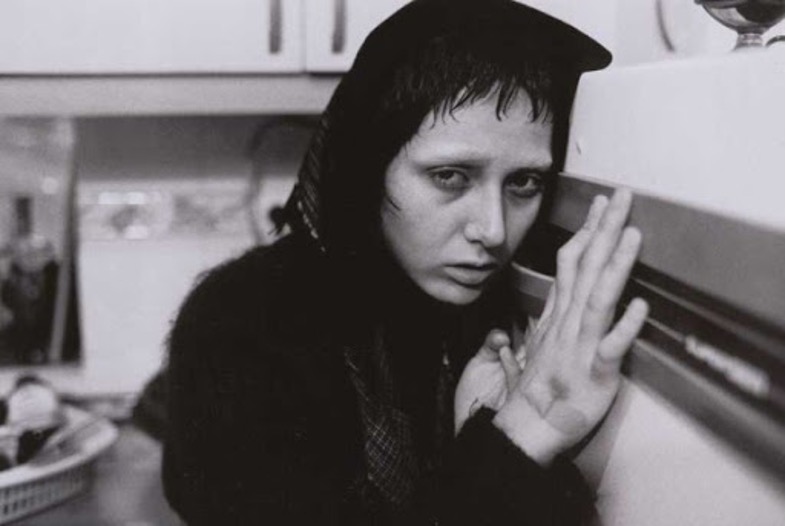
The Gardener offers a range of identities as the people the director encounters come from various countries, of different ages and genders. The volunteers come from different countries—Paula Asadi from Canada, Guillaume Nyagatare from Rwanda, Tjireya Tjitendero Juzgado from Angola, Ian Huang from Taiwan and the United States, Bal Kumari Gurung from Nepal. Each volunteer has a unique history behind them, and each of them shares their thoughts on spirituality. The camera close-ups on each face emphasize their individuality.

Figure 16: A still showing the volunteers from different countries from The Gardener (Bāghbān, 2012), directed by Muhsin Makhmalbāf, accessed via https://Makhmalbaf.com/?q=Photo-Gallery/the-gardener-photo-gallery.

Almost every scene in The Gardener shows that identity comes in a variety of forms. The documentary deals with different layers of identity: ethnic, national religious, familial, and professional. It also shows that the sources of identification that ground human beings are immensely diverse. Social, cultural, and other narratives directly impact who we are. Consequently, our identities, as economist and philosopher Amartya Sen (witnessing Indian Muslims and Hindus fighting each other), has noted, are “inescapably plural.”46Amartya Sen, Identity and Violence – The Illusion of Destiny (New York: W.W. Norton, 2006), xiii. The film asks, how do various narratives of identity serve as vehicles of unity?

Muhsin Makhmalbāf is deeply concerned with this question. Maysam’s trip to Jerusalem shows how the sense of belonging to a certain religion brings coherence and direction to the disparate experiences of individuals. Another identity category is profession, which can be seen in the title of the film itself. As all the people working in the Terrace Gardens are volunteers, we may assume they are not professional gardeners. They came here not to do a job they were trained for but were driven by the spiritual motivation to take care of this sacred space. Muhsin’s and Maysam’s identities as filmmakers are marked by the constant presence of their cameras. The cameras they hold function as character-defining attributes, as the image we see is recorded by another cameraman, Mahmūd Kalārī. However, the father and son differ in how they perceive the director’s role and how they use their cameras. Maysam does not stay long in Haifa. Looking for answers to his questions, he soon sets off to Jerusalem, where he visits all the must-sees. He represents the attitude of the ubiquitous reporter, or even tourist. Muhsin stays in one place, focused on meditative contemplation of the Terrace Gardens. This choice brings him to a surprising transformation—he leaves the role of a filmmaker and takes on the role of a gardener. When Maysam returns from his trip, he sees his father in a gardener’s clothes watering the plants and his camera, hoping that it will blossom as well. Already a gardener, Muhsin delivers a reverse of his earlier monologue from the beginning of the film, assuming all the religious identities he denied before. The camera also offers an expanded perspective on consciousness. The camera inches, antlike, close to the ground and then soars birdlike over the grounds, which symbolically joins the spiritual with the terrestrial.

Figure 17: A still from The Gardener (Bāghbān, 2012), directed by Muhsin Makhmalbāf, https://Makhmalbaf.com/?q=Photo-Gallery/the-gardener-photo-gallery.

The Beauty in Diversity

In Makhmalbāf’s value system, cinema experience is what counts the most. The Gardener also reveals the dangers facing documentary film directors. Through his honest, neutral, but still emotional approach (also applied in Salām Sīnimā, 1995), Makhmalbāf proposes its own model of documentary film. Armond White notices The Gardener’s profundity: “It’s a reminder of how Iranians first broke through Western structures of cinematic structure.”47Armond White, “Critic’s Pick of the Week: The Gardener, reviewed by Armond White for CityArts,” NYFCC, August 7, 2013, accessed December 7, 2024, https://www.nyfcc.com/2013/08/critics-pick-of-the-week-the-gardener-reviewed-by-armond-white-for-cityarts/. The personal testimonies of volunteers working in Haifa’s Gardens are shown without judgment. The director listens patiently to the explanation and reasons why they follow the Bahá’í path: “Without religion would I have been able to overcome hatred?”48Muhsin Makhmalbāf, The Gardener (2012), (0:18:29) and “Religion releases the unleashed forces of the heart in the way that science cannot because science addresses the reason and yet the human needs the heart and the reason.”49Muhsin Makhmalbāf, The Gardener (2012), (0:38:21)

This attitude makes a powerful difference from contemporary directors such as Darren Aronofsky, Lars von Trier, and Sacha Baron Cohen, who are known for their critical and spiteful approach to religion in their films. The Gardener seems to be the opposite of the open antagonism in Religulous (2008), for example, a documentary film written by and starring comedian Bill Maher and directed by Larry Charles. The very title of this American production—the contamination of the words “religion” and “ridiculous,” reveals Maher’s skeptical and humorous approach to the subject. The film critically examines organized religion and its impact on society. Like Makhmalbāf, Maher travels to various religious sites such as the Vatican, Israel, and a Creationist Museum in Kentucky. He also engages with adherents of different faiths, including Christians, Jews, Muslims, Mormons, and Scientologists. The documentary addresses topics such as the compatibility of religious beliefs with scientific evidence. However, Maher’s goal is different; he is challenging faith and questioning the role of religion in the modern world. Religulous blends serious discussion with satirical commentary, reflecting Maher’s background in political comedy. It uses humor and pointed questioning to provoke thought. To some extent, his position is similar to Maysam Makhmalbāf’s, who also questions the necessity of religion in contemporary society. Maher states, “I am convinced that organized religions are the source of hatred in this world. What did Al-Kaida do? It turned religion into an engine for terrorism. The Taliban took children into religious schools and taught them how to become suicide bombs.”50Muhsin Makhmalbāf, The Gardener (2012), (0: 57: 36) Muhsin Makhmalbāf takes a different approach. Instead of rejecting all religious beliefs he dwells on their diversity and expresses his respect for the power of religion in shaping human minds and even leading people to die for religious values. Moreover, the experienced filmmaker also challenges new philosophies, as in his replica to his skeptic son: “You’re turning technology into a new religion. You are creating from Steve Jobs a Moses, a Jesus, a Mohammad. Was it not technology that led to Hiroshima?”51Muhsin Makhmalbāf, The Gardener (2012), (0: 57: 42)

Despite so many misuses of religious commitment, Muhsin Makhmalbāf declares his hope in the potential of religion and believes that people can use its power for the promotion of peace and friendship. When we hear his words, the camera spans over the trees, bushes, and flower beds. It reminds the traditional practice of storytellers—pardah-khāns—pointing at the illustrations painted onto a large canvas (pardah). However, the voices from behind the frame do not describe the garden; they refer to the issues of conflicting religious beliefs, intolerance, and possible reconciliation. It encourages the audience to look for deeper connections between the narration and the image. The gardens on Mount Carmel in Haifa illustrate the nexus between human beings and the natural world and symbolize the harmony that occurs when humanity’s actions are based on an awareness of the divine presence in nature. The gardens combine the diversity of gardening practices. They have elements of the Persian gardens of Shiraz, the Nishat Bagh gardens of Jammu and Kashmir in India, and elements of English Gardens. The beauty of the Bahá’í gardens derives from the harmony between different elements and styles, what ‘Abdu’l-Bahá calls “the beauty in diversity, the beauty in harmony.”52Abdu’l-Bahá, Paris Talks: Addresses Given by ‘Abdu’l-Bahá in Paris in 1911-1912 (London: Bahá’í Publishing Trust, 1995), 52. The terraces embody this principle of unity in diversity in every detail. The cameras show stairs leading up to the Shrine of the Báb, and then to the crest of the mountain, together with the fountains, flower beds, and paths surrounding them. They are symmetrical in design and convey an impression of geometric order. However, as the camera moves outwards, the landscaping becomes increasingly varied and irregular until it merges into the mountain’s natural environment. The paths are winding; wildflowers, bushes, and trees grow in profusion; the impression is one of organic naturalness. The man-made and the natural, the formal and the informal, each have their place here. Within each terrace, too, one finds a union of divergent elements. The steps are made of stone, but along their sides run streams of water whose murmur gives life to the stone. Each garden has a unique design, including a color scheme, and yet is integrated into the whole.
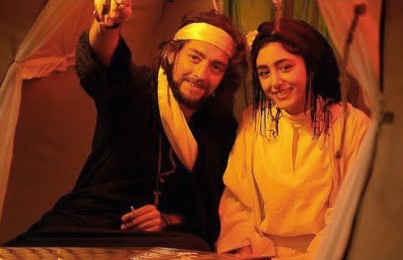
Such harmony between different elements symbolizes the unity in diversity that is the goal of the Bahá’í Faith. In the vision of Bahá’u’lláh, people, lands, and cultures will preserve their unique characteristics while harmonizing together to form a whole greater and more beautiful than the sum of its parts. ‛Abdu’l-Bahá’s explanation of the unity of humankind uses the metaphor of a garden. The diversity of hues and shapes adorns the garden. Similarly, when diverse shades of thought and character are brought together, it enriches the beauty and glory of human perfection.53Abdu’l-Bahá, Selections from the Writings of ‘Abdu’l-Bahá (Wilmette: Bahá’í Publishing Trust, 1997), 291-92. Amid the Terrace Gardens, Muhsin Makhmalbāf video camera is silhouetted against the sky like a tree, but also like an antenna, sensing mankind’s deepest political-spiritual needs. The father and son cannot come to an understanding about religion.

Mirrors as Portals to the Divine as Symbols of Self-reflection

The Bahá’í teachings explain that spiritual qualities are gifts from God that we may receive by turning the mirror of our hearts towards Him. The Báb was the first to use mirrors to demonstrate unity through truth. He asked his followers to be like a “concourse of mirrors” following the one true God.54Selections from the Writings of the Báb, accessed January 03.2025, https://www.bahai.org/library/authoritative-texts/the-bab/selections-writings-bab/4#850847635. In The Gardener, we can see the exploration of the symbolic meaning of the mirror. Ririva Eona Mabi, as a Bahá’í believer, compares the human heart to a mirror which should be cleaned from the dust. Walking down the avenue, the gardener carries the huge, unframed mirror reflecting red flowers. In the next shot, we can also see Muhsin Makhmalbāf recording the gardener and reflecting in the mirror. Then, he puts aside his camera and holds the mirror. Makhmalbāf and the gardener face each other reflecting in their mirrors, creating a “concourse of mirrors.” They walk together to the seashore, facing their mirrors toward the waves.

Figure 18: A still showing Muhsin Makhmalbāf’s reflection in a mirror held by Ririva Eona Mabi from The Gardener (Bāghbān, 2012), directed by Muhsin Makhmalbāf, accessed via https://www.youtube.com/watch?v=LIR3QAkIKT8.

Figure 19: A still showing the gardener’s reflection in a mirror held by Muhsin Makhmalbāf from The Gardener (Bāghbān, 2012), directed by Muhsin Makhmalbāf, accessed via https://www.youtube.com/watch?v=LIR3QAkIKT8.

Mirrors hold multifaceted symbolism in Persian mythology. They represent portals to the divine, tools for self-reflection, symbols of deception and transformation, and instruments of justice and truth. In Persian culture, religious ceremonies and rituals often incorporate mirrors as tools for divination and communication with the supernatural, for instance during weddings, and Nawrūz celebrations. One notable example from Persian mythology is the story of Jamshīd, the legendary king who discovered the mirror, and gained access to the divine realm and obtained knowledge from the gods. Beyond their connection to the divine, mirrors in Persian mythology also symbolize introspection and self-discovery. These examples showcase the mirror as a powerful tool for self-examination, encouraging individuals to delve into their inner depths. Characters such as Zāl and Rustam use mirrors to confront their inner selves, gain wisdom, and understand their true nature. In Muslim mystical symbolism, the mirror is the image of the soul reflecting the supernatural reality, which, for the mystic, is the only real reality.

Figure 20: The poster for the 16th Fajr Film Festival in Tehran, accessed via https://en.wikipedia.org/wiki/16th_Fajr_International_Film_Festival.

On the poster of the 16th Fajr Film Festival held in Tehran, in February 1998, a man in white holds a mirror that reflects light. The metaphor of the screen as a mirror is used in Western film theory mainly to represent psychoanalytic reflection. Adopted by the Iranians, this metaphor acquired spiritual and mystical meanings. The screen mirror can serve as a surface reflecting life and a gateway to a higher reality, providing a glimpse into the unseen world.

Conclusion

Makhmalbāf’s films prove the potential to affect, subvert, and transform both national and transnational cinema. By working with international production companies and filming in various countries, the artist has shown the potential of cross-cultural collaboration in filmmaking. Each of his films made abroad has a different transnational trajectory, whether within a film’s narrative or a production process. These differences can also be seen in the reception of his movies. The Gardener gained worldwide attention and acclaim. The film has been shown in more than 20 film festivals and won the Best Documentary award from Beirut International Film Festival and the special Maverick Award at the Motovun Film Festival in Croatia. The film was selected as “Critic’s Pick of the Week” by New York Film Critics Circle in 2013, “Best of the Fest” at Busan Film Festival by The Hollywood Reporter, and “Top Ten Films” at Mumbai Film Festival by Times of India.55For the full list of awards see: accessed December 25, 2025, https://www.Makhmalbaf.com/?q=film/the-gardener Its script was added to the Library of Academy of Motion Picture Arts and Sciences.

At the same time, The Gardener became Makhmalbāf’s most controversial film to date. It was the first time since the 1979 revolution that an Iranian filmmaker shot a movie in Israel and posed such radical statements about religion. It should be mentioned, however, that it was not the artist’s first attempt to re-establish a dialogue with Israel. Although he did not travel to the country himself, he had sent his movie Gabbah. He was hoping that this film could change the minds of the Israeli people about the negative image of Iranians. This resulted in an attack by the Iranian media on the director and an interrogation by the secret police.56“Iranian film-maker Mohsen Makhmalbaf on his relationship with Israel,” The Guardian, July 17, 2013, accessed January 03, 2025, https://www.youtube.com/watch?v=fWYRzSrtofA It should therefore come as no surprise that he committed one of Iran’s gravest sins: visiting Israel. Consequently, Javād Shamaqdarī, the Director of the Iran Cinema Organization, demanded that the Film Museum of Iran (FMI) remove all of Makhmalbāf’s memorabilia from its archives, and erase his cinematic legacy from the country.57“Iran Cinema Organization asks film museum to remove Mohsen Makhmalbaf memorabilia,” Tehran Times, July 15, 2013, accessed January 03. 2025, Iran Cinema Organization asks film museum to remove Mohsen Makhmalbaf memorabilia – Tehran Times He made the demand in response to Makhmalbāf’s presence at the Jerusalem International Film Festival in July 2013, and also due to his remarks in favor of Bahaism during the event. In addition, before the festival, Open letter to Filmmaker Mohsen Makhmalbāf: Please be a Messenger of Freedom for Iranian and Palestinian People was published in the magazine “Jadaliyya” urging him not to attend the festival. A group of prominent Iranian scholars, artists, journalists, and activists expressed their deep concern that Makhmalbāf’s participation directly violates the International call for Boycott, Divestment, and Sanctions (BDS) of the State of Israel issued by Palestinian civil society in 2005, as well as the specific call for Academic and Cultural Boycott of Israel issued in July 2004. They reminded the director that performing in Israeli is a political statement, condemning his disregard for the global movement for Palestinian human rights and his implicit support for Israel’s apartheid policies. They also pointed out that many international artists already refused to take part in cultural events taking place in Israel and others who had initially accepted this invitation have cancelled their performances, preferring to show their support for the struggle of the Palestinian for their most elementary human rights.58The full text of the letter is available here: https://www.jadaliyya.com/Details/29064 , accessed March 06, 2025. Interestingly, the letter was also signed by Iranian scholars working at European and American universities, sometimes even the researchers in the field of Global and Transnational Studies.

This complex reception of the film and its severe consequences prove that the concept of “transnational cinema” should also consider that border-crossing activities in the film industry are often fraught with power dynamics and politics. These conditions confirm Jean Baudrillard’s observation of the tensions between globalization and universalization. He associated globalization with the spread of technology, markets, tourism, and information, driven by economic and cultural homogenization. Universalization, on the other hand, refers to the Enlightenment ideals of spreading universal values such as democracy, liberty, and human rights. Baudrillard argued that globalization leads to the commodification of universal values, reducing them to mere products or commodities, similar to consumer goods.59Fernanda Navarro, Jean Baudrillard, Power Infierno (Paris: Galilée, 2002), 63-83. In fact, however, the spheres of globalization and universalization are separate. Āyatallāh Khumaynī effectively used cassette tapes as a tool to spread his revolutionary message during his exile in the 1970s. These tapes contained his sermons and speeches, which were smuggled into Iran and widely distributed among his supporters. The cassette tapes allowed Khumaynī to bypass state-controlled media and directly communicate with the Iranian people, rallying them against the Shah’s regime. This innovative use of technology played a crucial role in mobilizing the masses and shaping the Iranian Revolution, however the message spread was promoting neither the dominance of global markets and culture or the Western universal values. Similarly, the fact that directors from all over the world are increasingly using the same technology and are increasingly involved in international co-productions or making films abroad does not mean that the world of values is becoming homogenized. Makhmalbāf’s films are proof of this disjunction. Regardless of the country in which his films are made and with whom they are produced, they all manifest some key aspects of the director’s values. They often focus on the struggles of marginalized individuals, reflecting his commitment to humanistic values and empathy for the underprivileged. His works frequently critique societal and political structures, addressing themes like oppression and personal freedom. Makhmalbāf also celebrates cultural heritage while also questioning traditional norms, and pointing out the power of cinema as a medium tool for challenging authoritarianism. Besides, the case of Makhmalbāf’s family exemplifies that modern nations actually consist of widely dispersed groups of people. If this is the case, it follows that nations are in some sense diasporic.

Transcending Realities; The Poetic Evolution of Love in Daryoush Mehrjooyee’s Cinema (The Pear Tree and Dear Cousin Is Lost)

By

This article investigates the evolution of Daryoush Mehrjooyee’s poetic vision through a critical analysis of his two significant films, The Pear Tree (1997) and Dear Cousin Is Lost (1998). These consecutively produced films mark a transformative phase in Mehrjooyee’s career, illustrating his mastery in elevating cinematic storytelling into poetic realms that transcend conventional narrative
forms.
In The Pear Tree, the protagonist Mahmoud navigates the complexities of love, loss, and the relentless passage of time, represented through the symbolic pear tree, which serves as a silent witness to his emotional turmoil. The film’s contemplative pacing and rich visual imagery create a meditative atmosphere, inviting audiences to engage with profound silences and unspoken emotions embedded in the narrative.
Conversely, Dear Cousin Is Lost transitions into a surreal exploration of similar themes, crafting a fantastical world that distances itself from reality to underscore the significance of love. Set against the enchanting backdrop of Kish Island, this metafictional narrative follows a group of filmmakers as they confront the fluid boundaries between reality and fantasy. The film’s surreal elements—including the mythical return of a lost cousin and the ethereal presence of magical beings—reflect Mehrjooyee’s commitment to artistic authenticity, prioritizing creative vision over commercial success.
By juxtaposing these two films, this article highlights Mehrjooyee’s distinctive artistic voice and how his unique cinematic approach enriches narrative depth while inviting audiences to reflect on the complexities of the human experience. Ultimately, Mehrjooyee emerges as a master of poetic cinema, crafting richly layered narratives that resonate across cultural boundaries, emphasizing the enduring importance of love amidst the ephemeral nature of existence.