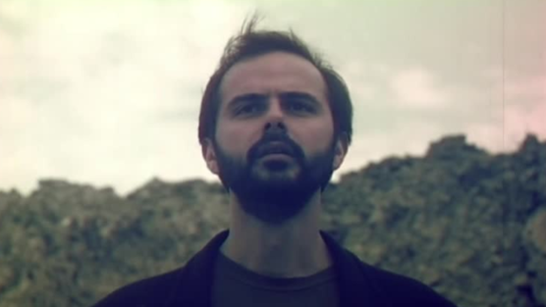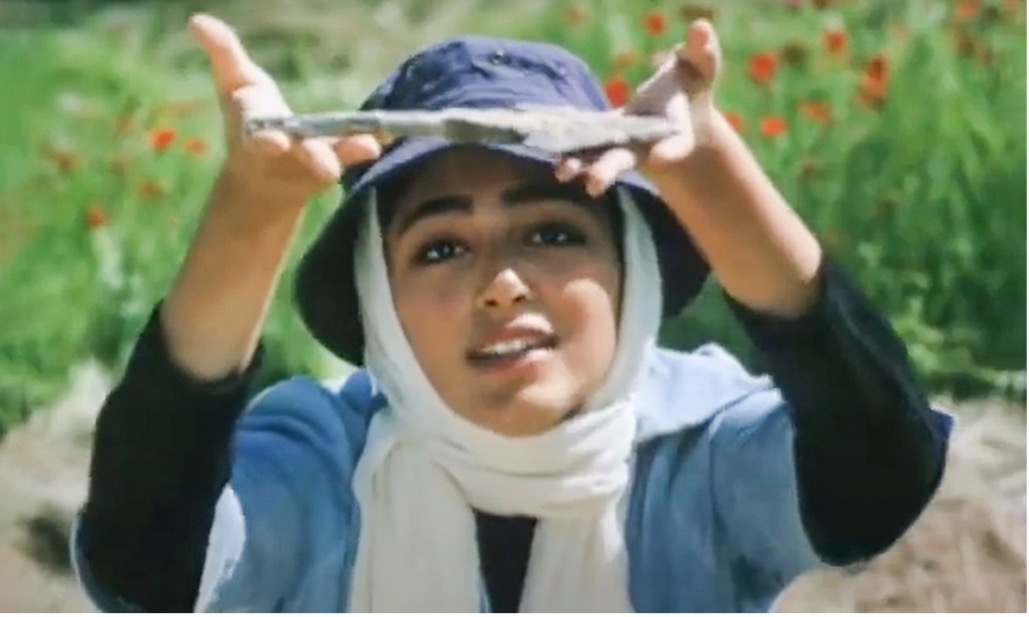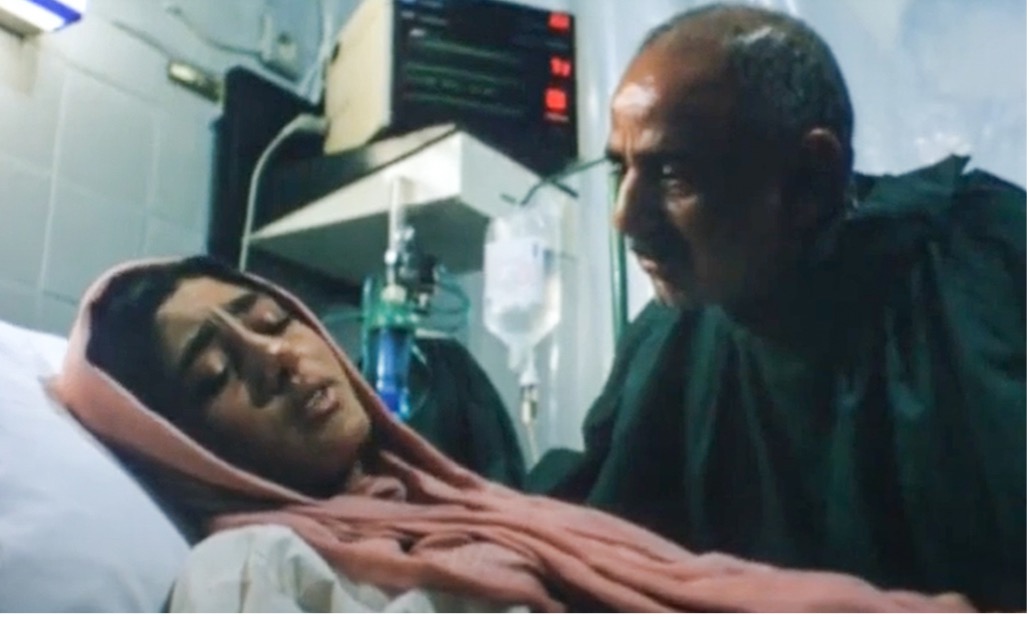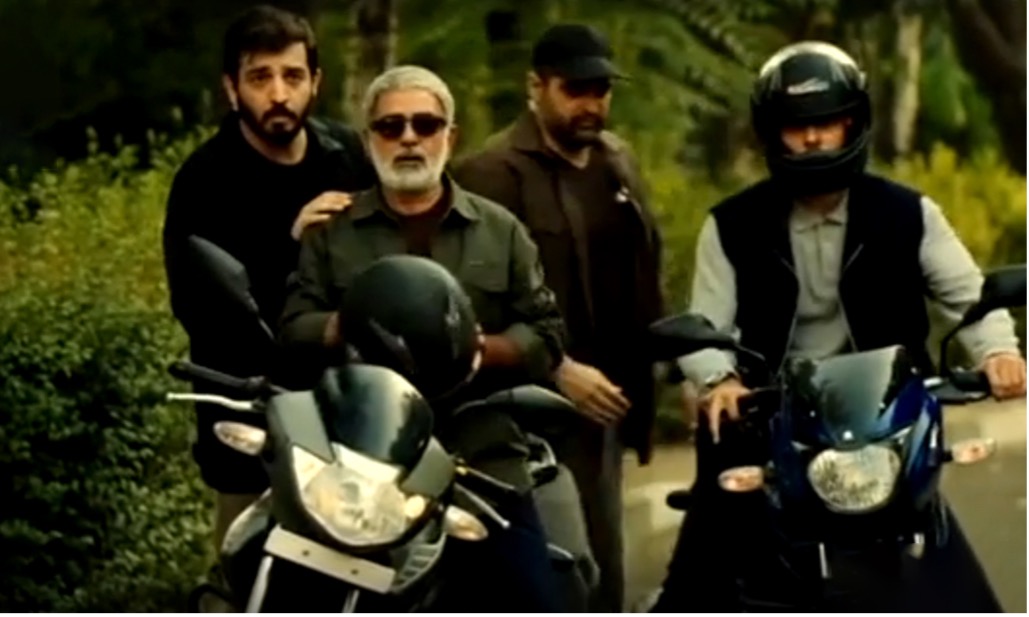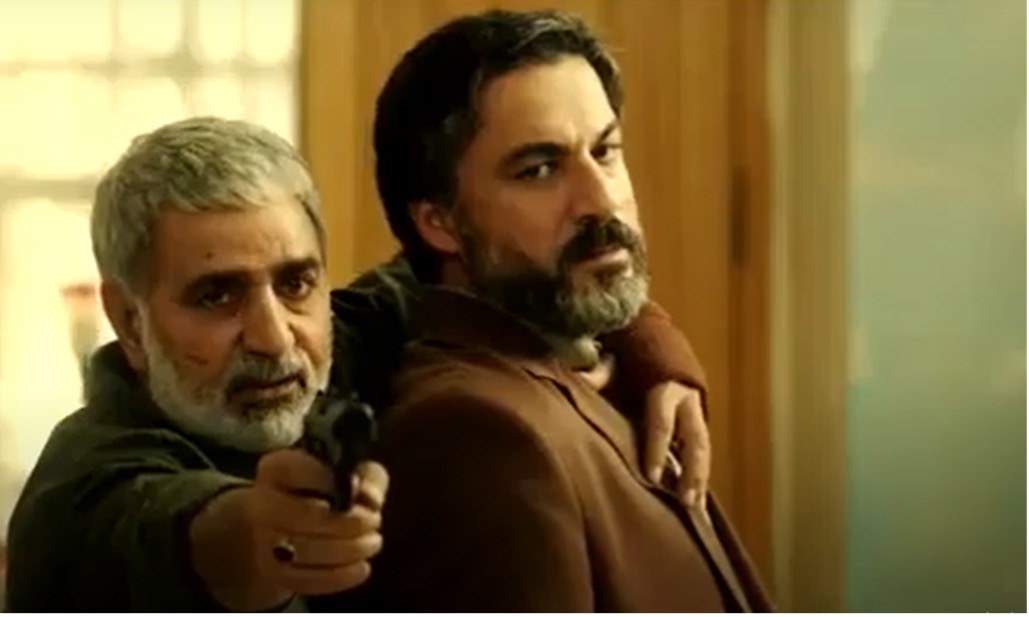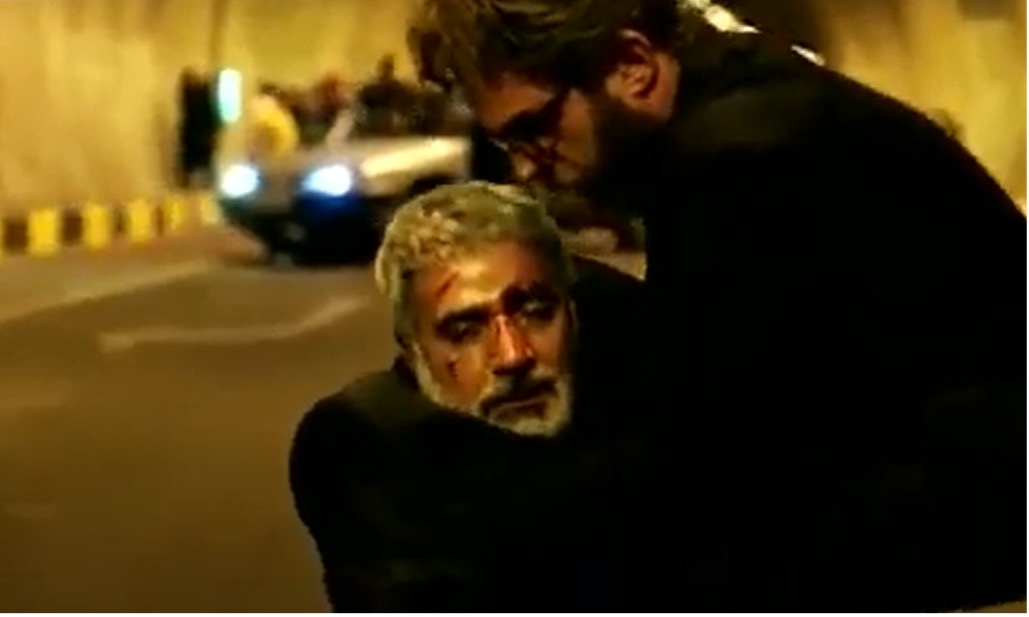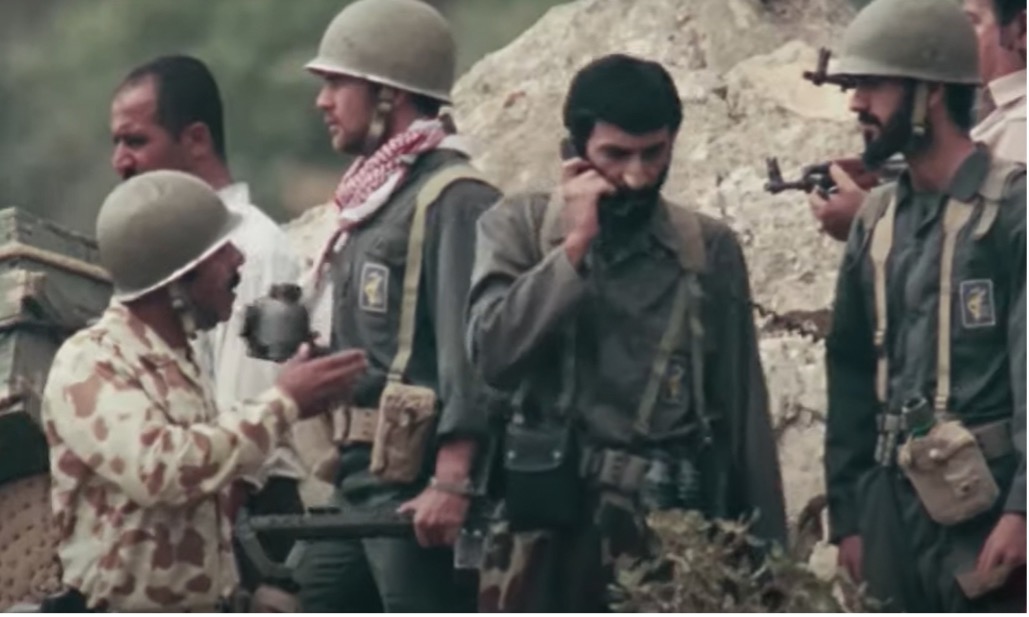
Farīdūn Rahnamā’s Postmodernist Approach in Siavash in Persepolis

By

Introduction

In this article, my focal point is Farīdūn Rahnamā’s (1930-1975) first feature film, Siavash in Persepolis (Siyāvash dar Takht-i Jamshīd, 1964). This film, defined by its minimalist, postmodern approach and self-reflexive metafictional perspective, explores the mythological figure central to Iranian culture: Siyāvash, a legendary hero immortalized in Firdawsī’s Shāhnāmah. In this article, I examine Rahnamā’s historical and mythological insights to highlight his primary preoccupation with themes such as the erosion of Iranian identity, the perplexing historical incongruities, and the intricate interplay between the modern individual and their historical and mythological heritage, all as portrayed in the film. The article argues that Rahnamā’s cinematic innovations extend beyond formal experimentation; they serve as a deliberate means of engaging with the existential and political dilemmas of his time. Through its reworking of myth, Siavash in Persepolis offers a commentary on the role of the sacrificial hero in modern Iran, exploring how personal choices intersect with broader societal forces. By analysing Rahnamā’s stylistic choices and thematic concerns, this study situates Siavash in Persepolis within the intellectual currents of its time, demonstrating how it both reflects and critiques the struggle for meaning in a fragmented modern world. At the heart of Siavash in Persepolis lies a profound engagement with myth and modernity, particularly through the reinterpretation of the legendary figure of Siyāvash. In many ways, the film reflects the era’s larger struggles with identity, autonomy, and political resistance, mirroring the tensions between tradition and modernity that defined Iran’s sociopolitical landscape. Rahnamā’s choice to reimagine Siyāvash—a mythological figure known for his unwavering integrity and ultimate self-sacrifice—raises compelling questions about individual agency in a rapidly changing world. The article also casts a critical eye on the film’s modernist non-linear narrative structure, as well as the intriguing historical anachronism woven into the narrative. Furthermore, I analyse Rahnamā’s formalistic approach to adapting literary works and defamiliarising prominent mythological characters like Siyāvash, Sūdābah and Rustam.

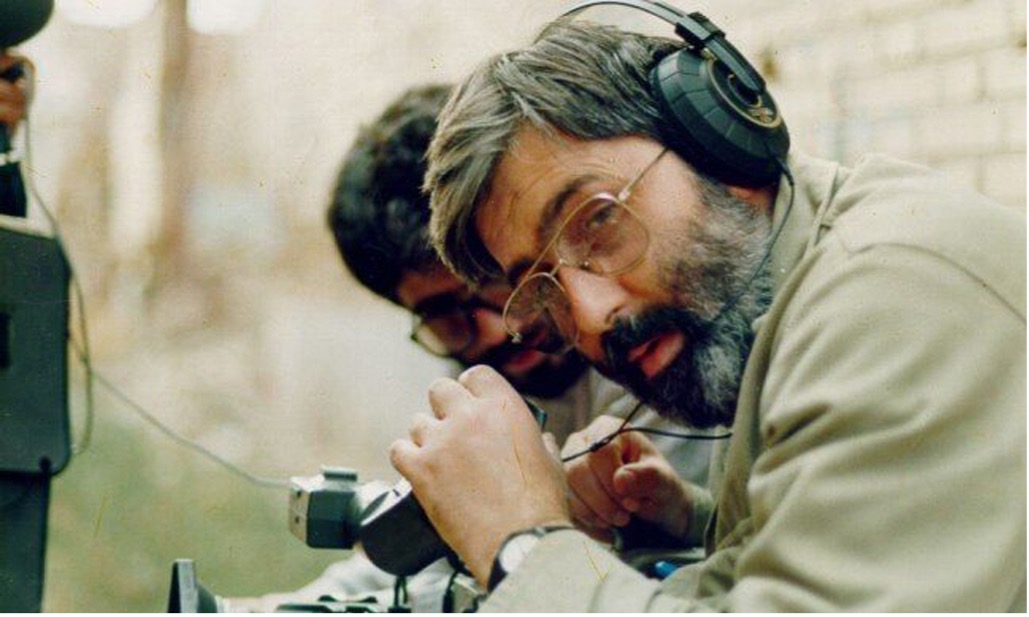
Rahnamā made only three films: a short documentary known as Takht-i-Jamshīd (Persepolis, 1960) and two feature-length films, Siavash in Persepolis and Iran’s Son is Unaware of His Mother (Pisar-i Īrān az mādarash bi ittilā’ ast, 1976) in his short life. His films explore certain core ideas, namely the loss of identity amongst Iranians and the incompatibility between modern Iran and its historical and mythological past. He made Siavash in Persepolis with the financial backing of National Television of Iran.1For film information, see Siavash in Persepolis (1964), dir. Farīdūn Rahnamā, IMDB https://www.imdb.com/title/tt0207106/

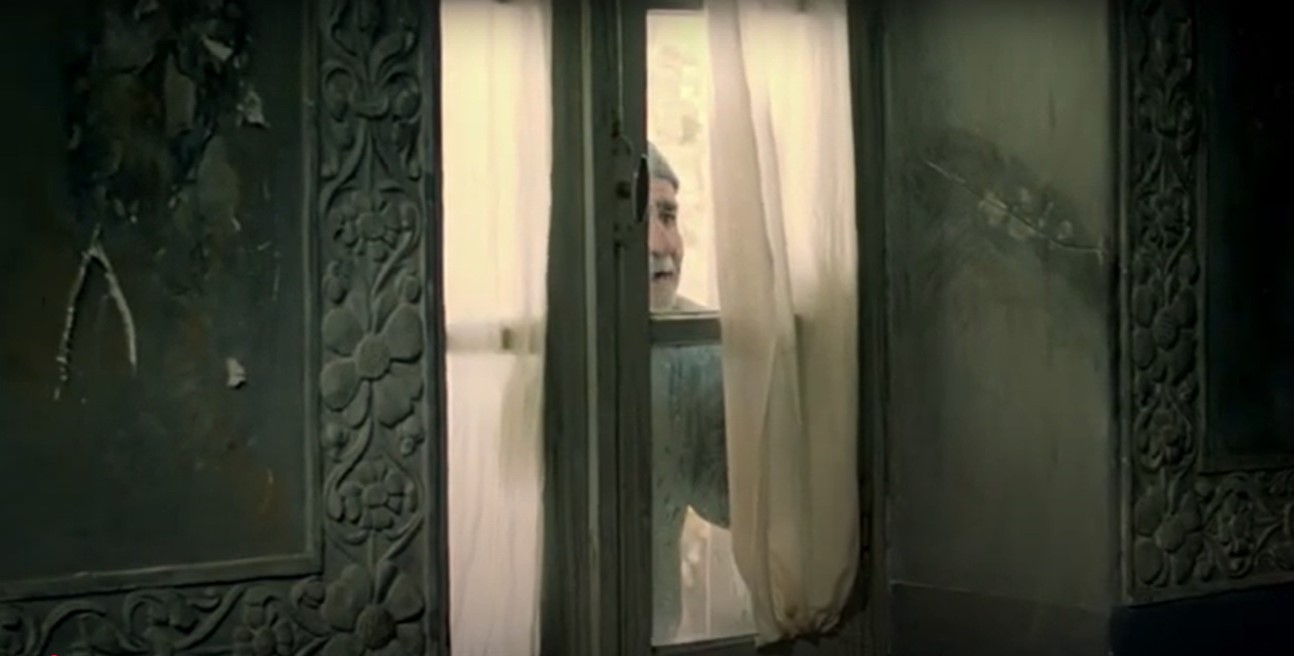
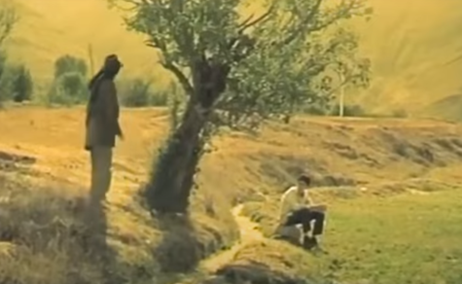
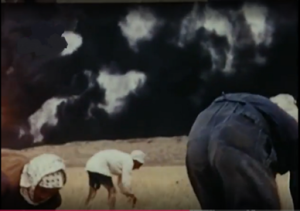
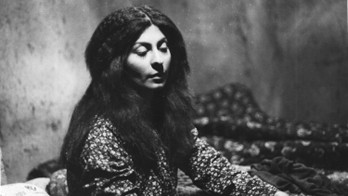
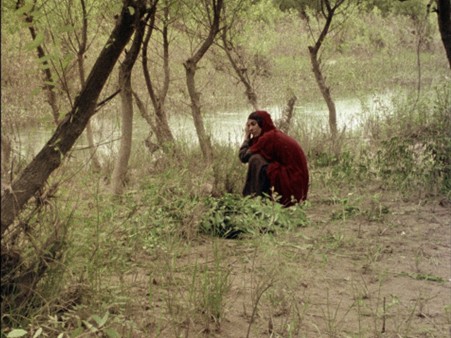
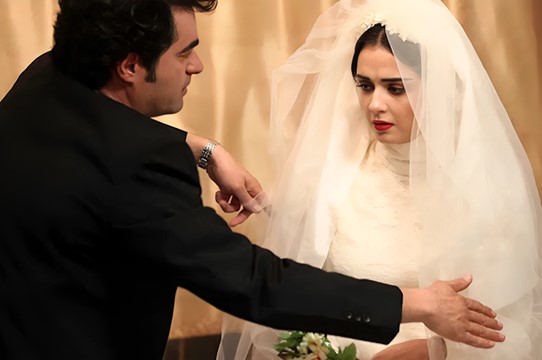
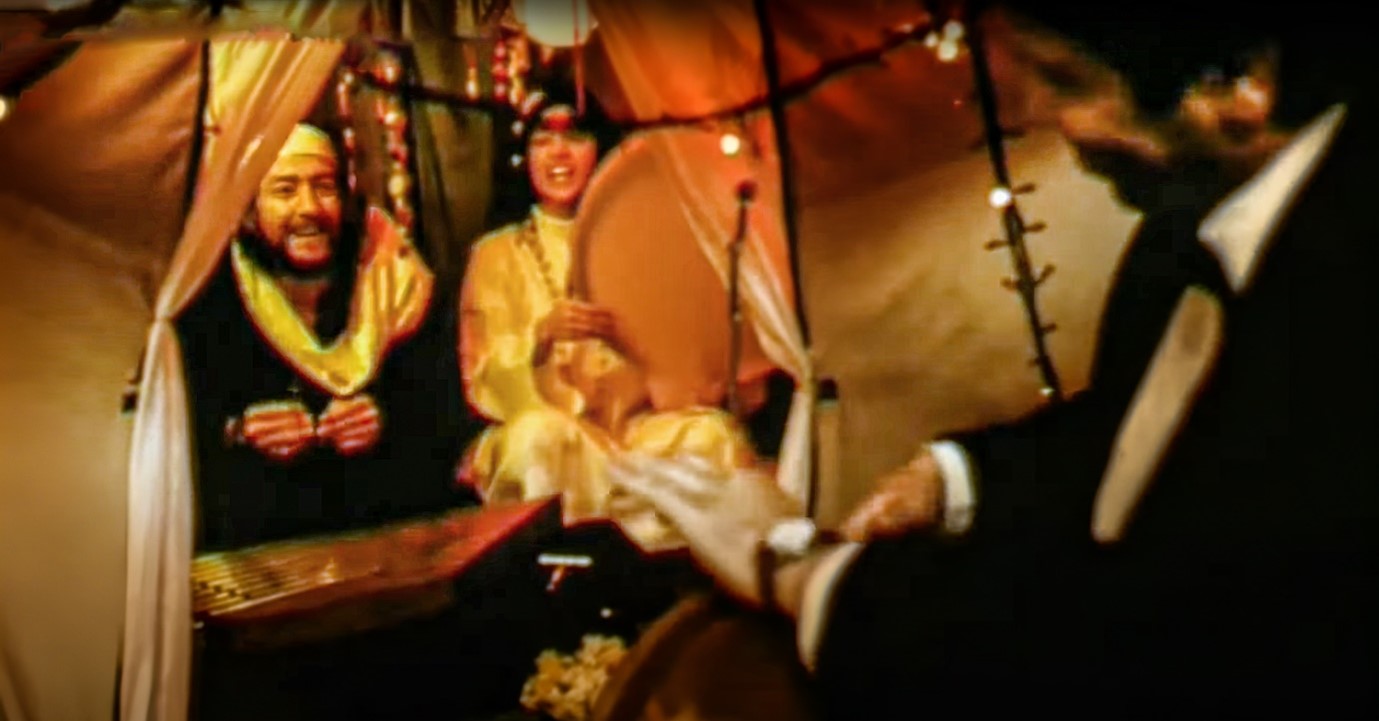
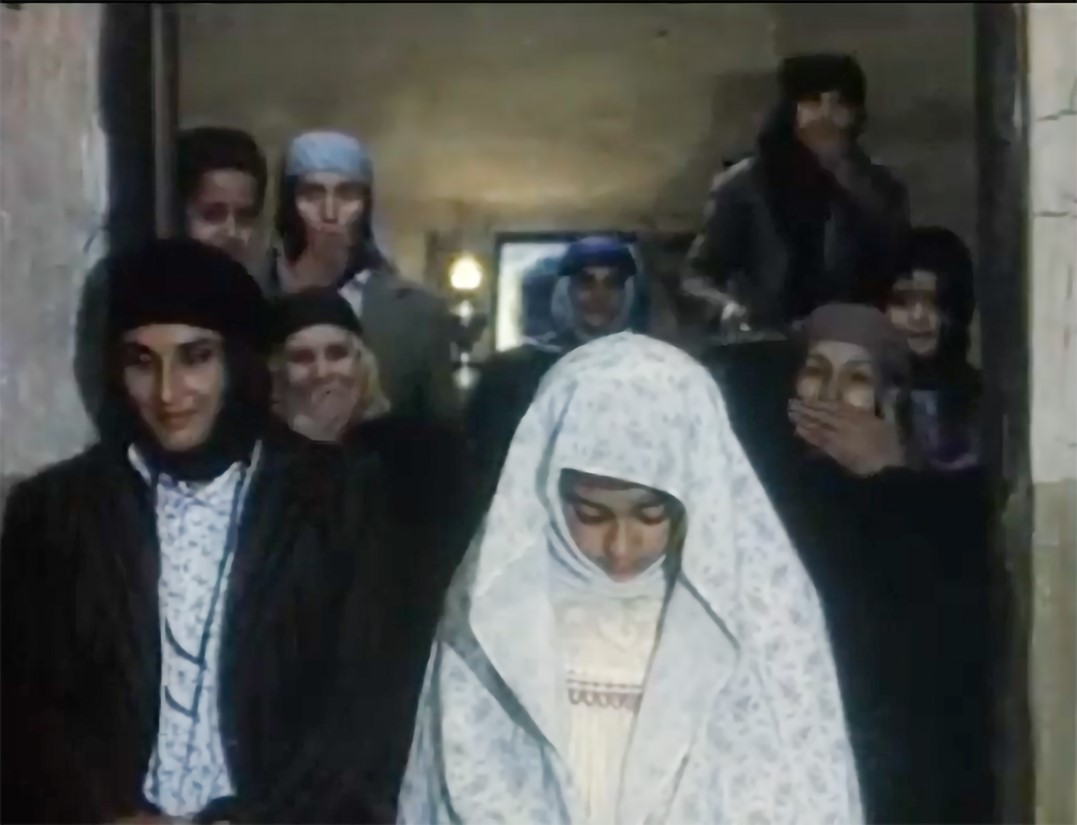
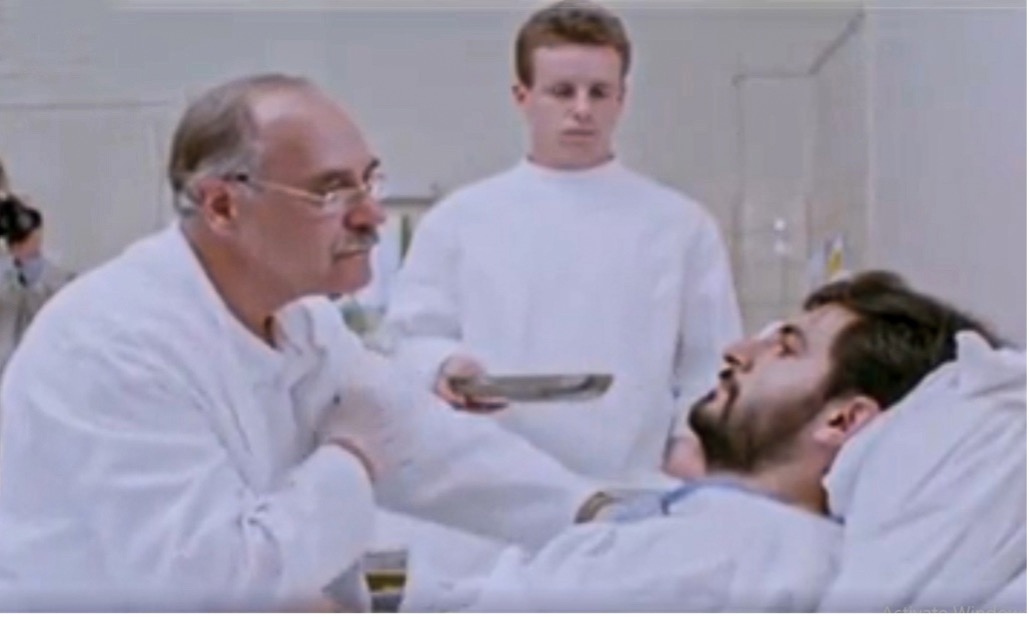
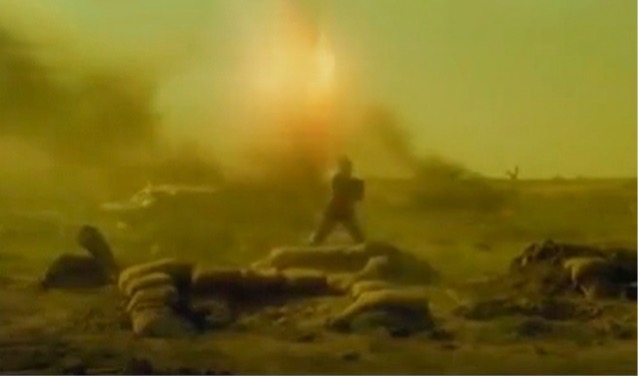
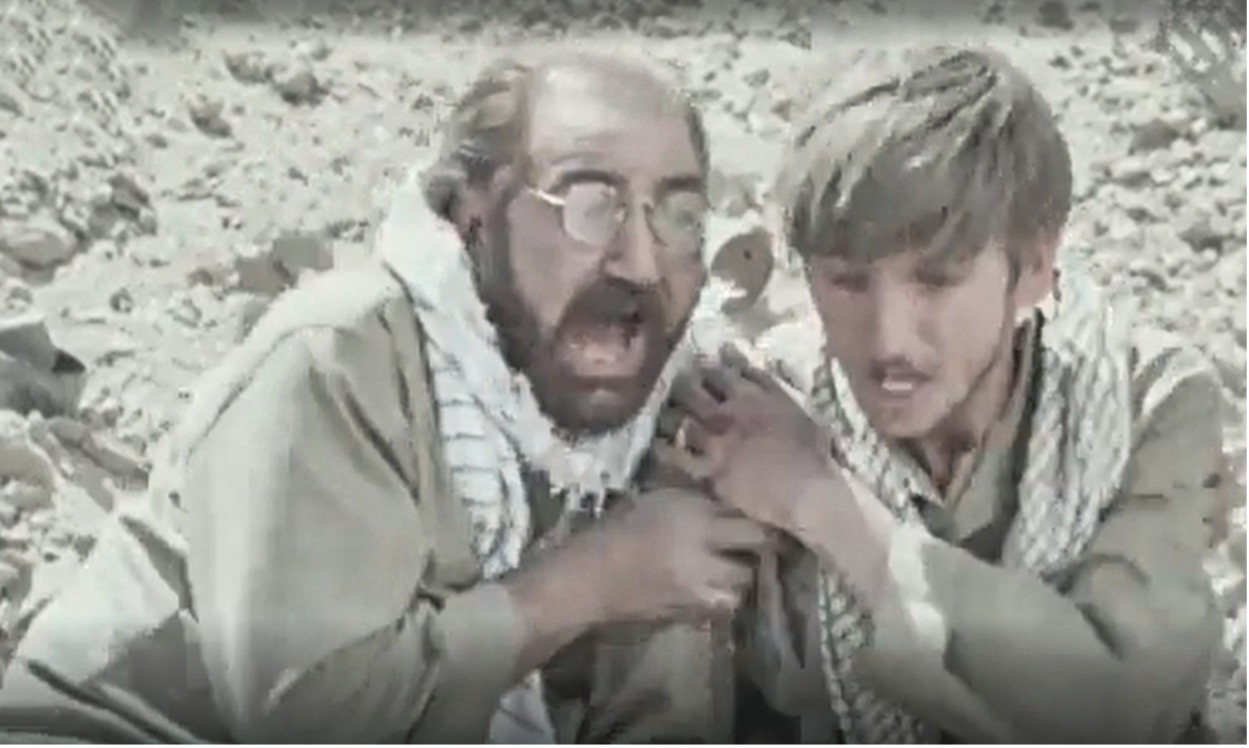
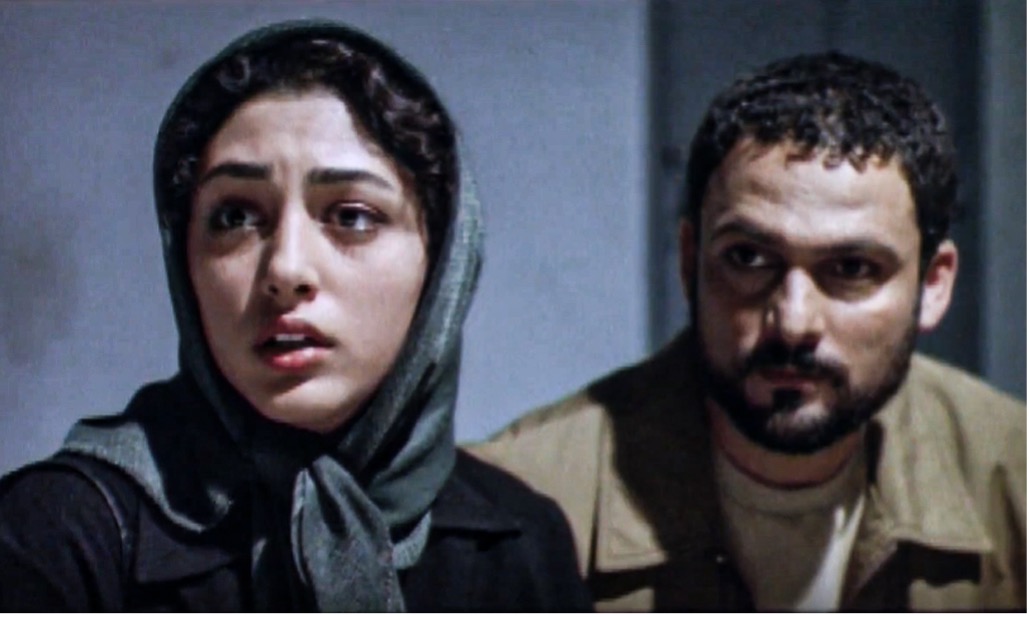
Shot on location in the ruins of Persepolis, the film tells the story of Crown Prince Siyāvash who leaves his homeland in order to avoid dishonoring his father, Shah Kay Kāvūs. He marries the daughter of the local king Afrāsiyāb, but is betrayed and murdered. The film is notable for its then-uncommon temporal experimentation with footage of tourists trekking through the ruins of Persepolis interspersed with the older setting. By framing Siyāvash’s journey within the ruins of Persepolis, the film not only explores the weight of historical legacy but also invites a meditation on the fragmentation of meaning in a modernizing society.

Siyāvash in Shāhnāmah

Siyāvash is mythological figure in Iranian culture and a central character in Firdawsī’s Shāhnāmah. The son of Kay Kāvūs, Siyāvash embodies innocence and purity but falls victim to betrayal. His stepmother, Sūdābah, falsely accuses him of assault after he rejects her advances. To prove his innocence, Siyāvash undergoes a fire trial and emerges unscathed, yet he becomes disillusioned and seeks refuge in Tūrān, ruled by Afrāsiyāb, Iran’s enemy.2See, “Shâhnâmeh (the epic of kings): The Story of Siyâwash,” CAIS, accessed April 24, 2025, https://www.cais-soas.com/CAIS/Literature/Shahnameh/siyawash.htm There, he marries Firangīs, Afrāsiyāb’s daughter, but faces further treachery, leading to his tragic execution. Siyāvash’s tragic demise symbolizes martyrdom and the triumph of purity over deception.

Unlike epic heroes like Rustam, Siyāvash is a pacifist who avoids violence, even toward his enemies, by rejecting the archetypal warrior ethos and seeking resolution through moral integrity and diplomacy. His alienation from Iran and Tūrān reflects his unique stance and independence from conventional allegiance. This duality mirrors Rahnamā, who navigated between Western cultural influences and Iranian traditions, demonstrating that engagement with modernity did not necessitate a rejection of national identity but rather fostered a dynamic interplay between the two.

The Shāhnāmah can be viewed as a series of myths that fill the gaps in the history of the Persian Empire; it has become a foundational work of Persian culture by preserving its myths and legends in an archival form. The tragic story of Siyāvash has been adapted into various artistic mediums, including literature, theatre, and cinema, in Iran and Central Asia. In a notable cinematic rendition in 1976, Soviet filmmaker Boris Kimyagarov made an epic film faithfully portraying the Siyāvash narrative derived from the Shāhnāmah. Additionally, Bahrām Bayzā’ī contributed to this cultural legacy with a screenplay titled Siyāvashkhānī (Siyāvash Recitation) in 1992. But Rahnamā’s adaptation of this story bore no resemblance to the previously made films about Siavash or other heroes of the Shāhnāmah, such as Mahdī Ra’īs Fīrūz’s Rustam u Suhrāb (Rustam and Sohrab, 1957) or Manūchihr Zamānī’s Bījan u Manīzhah (Bijan and Manijeh, 1958) which were more straightforward epics centred on heroism and romance.

Siavash in Persepolis remains a strikingly fresh and innovative film even sixty years after its creation. With his cinematic innovations and modernist approach, Rahnamā played a crucial role in shaping Iranian New Wave cinema and significantly contributed to the development of the language and arthouse film culture in Iran. However, his innovations were not merely aesthetic; they were deeply intertwined with the broader cultural and political transformations of Iran in the 1960s. His films explore certain core ideas, namely the loss of identity amongst Iranians and the incompatibility between modern Iran and its historical and mythological past. Rahnamā reframes Persian cultural heritage for modern viewers by juxtaposing the ancient myth of Siyāvash, who is recast as a sacrificial hero, with the experimental techniques of the Iranian New Wave.

Rahnamā’s approach to editing, narrative structure, and visual composition defied conventional filmmaking norms of his time, positioning the film as a pioneering work in Iranian New Wave cinema. One of the film’s most striking innovations is its fragmented and experimental editing style. Rahnamā employs discontinuous cuts, abrupt shifts in perspective, and a deliberately non-linear structure that disrupts traditional narrative flow. This unconventional editing technique mirrors the film’s thematic preoccupation with the rupture between past and present, reinforcing its meditation on identity and historical memory.

Siavash in Persepolis was shown at La Cinémathèque Française in 1965 and was well-received by the French film critics including Henry Langlois, the French film archivist and the co-founder of La Cinémathèque. Rahnamā’s film was later submitted to the Locarno Film Festival in 1966 and awarded the Jean Epstein prize for promoting cinematic language.3Peter Chelkowski, “Popular Entertainment, Media and Social Change in Twentieth-Century Iran,” in The Cambridge History of Iran, vol. 7, ed. Peter Avery (Cambridge: Cambridge University Press, 1991), 798. The film was screened at The Boulevard Cinema in Tehran for only four days, but it failed to achieve commercial success and garnered limited attention from critics upon release. Iranian film critics such as Shamīm Bahār and Bīzhan Khursand have characterized the film as “intellectual and pedantic,” dismissing it as the “delusions and nightmares of an intellectual filmmaker lacking familiarity with Firdawsī’s Shāhnāmah and its protagonists.” Criticisms extended to the film’s perceived deficiency in cinematic vision.4Jamāl Omīd, Tārīkh-i Sīnimā-yi Īrān, 1279–1357 [The History of Iranian Cinema, 1900–1978] (Tehran: Rawzānah, 1995).

Shamīm Bahār, a prominent Iranian film critic of the time, characterized Siavash in Persepolis as a manifestation of the director’s “desperation” and labelled it a “futile” and “pathetic effort” in his review. He said that “enduring more than 10 minutes of the film, for a film critic who takes cinema seriously, was nearly unbearable.”5Shamīm Bahār, “Tawzīhī darbārah-yi Siyāvash dar Takht-i Jamshīd (Kārī az Farīdūn Rahnamā),” Andīshah va Hunar 1 (December 1967), 90-93. Bahār’s reaction to the film was particularly harsh and dismissive. He described the experience as so unbearable that he left the cinema hall abruptly, advising against any discussion, commentary, or contemplation of the film. His scathing critique—hoping that even the memory of those few minutes would quickly fade—suggests an unwillingness to engage with the film’s experimental nature. Rather than attempting to understand its unconventional approach, Bahār outright rejected it: “It is impossible to sit in front of this terrible effort of this dumb speaker and not feel pity… Rahnamā’s film does not have the ability to express anything (in the strict sense of the word: nothing).”6Shamīm Bahār, “Tawzīhī darbārah-yi Siyāvash dar Takht-i Jamshīd (Kārī az Farīdūn Rahnamā),” Andīshah va Hunar 1 (December 1967), 90-93. The primary thrust of criticism centred on Rahnamā’s perceived deficiency in cinematic language, particularly its inability to articulate philosophical and intellectual concepts accurately. According to Ahmadrizā Ahmadī, the renowned Iranian poet and writer, while Siavash in Persepolis demonstrates the same weaknesses and deficiencies that are evident in Rahnamā’s documentary film, these shortcomings were exacerbated by the amateur performances of non-professional actors, who lack the necessary training and creativity to effectively portray Firdawsī’s legend. Ahmadi states: “In the absence of sufficient familiarity with Siyāvash’s narrative in Shāhnāmah, the viewer would struggle to discern Siyāvash, Sūdābah, Kāvūs, Garsīvaz, and Rustam amid the confounding delusions and nightmares. If Firdawsī were alive to watch this film, he would likely find his iconic heroes unrecognizable.”7Ahmadi, Ahmadreza. Film and Cinema Magazine, no. 6 (1998).

Henry Corbin (1903–1978), the French philosopher, theologian, and Iranian studies scholar, was among the early enthusiasts of Farīdūn Rahnamā’s film. After viewing of the film, Corbin wrote, “Upon watching this film, I found myself both amazed and captivated. What I had been seeking and attempting to comprehend in Iranian thought for years, this young Iranian filmmaker embodied within himself.”8“Chihil sāl pas az khāmūshī-i Farīdūn Rahnamā [Forty Years After Fereydun Rahnema’s Disappearance],” Iranian Studies, March 19, 2016, accessed April 24, 2025, https://iranianstudies.org/fa/1394/12/29/. Henri Corbin posited that Farīdūn Rahnamā’s film transcends the historical narrative presented in the Shāhnāmah. He asserted that limiting the film to Siyāvash’s historical account would diminish its significance, stating:

If the film merely wove the informational thread of Siyāvash’s story, the director’s task would be relatively straightforward, and the film’s scope would not extend beyond the boundaries of conventional or, rather, superficial understanding. In such a scenario, it would suffice to substitute ruined palaces with makeshift sets and unleash a multitude of Iranian and Tūrānian horsemen, engaging in cavalry charges and skirmishes across plains and mountains. The resultant work would fall into the category of ‘historical reconstructions’… but Rahnamā’s aspiration did not align with any form of ‘historical reconstruction’ whatsoever.9“Chihil sāl pas az khāmūshī-i Farīdūn Rahnamā [Forty Years After Fereydun Rahnema’s Disappearance],” Iranian Studies, March 19, 2016, accessed April 24, 2025, https://iranianstudies.org/fa/1394/12/29/.

Corbin’s statement underscores the distinctive artistic ambition of Rahnamā, who sought to move beyond a literal historical retelling in favor of a more symbolic and philosophical exploration. Rather than adhering to a conventional historical narrative, Rahnamā’s film employs an abstract and highly stylized approach, using fragmented storytelling, poetic dialogue, and unconventional cinematography to evoke deeper existential and spiritual themes. The film engages with questions of fate, sacrifice, and the cyclical nature of history, presenting Siyāvash not simply as a tragic hero, but as an archetype representing moral purity and resistance against corruption. By rejecting historical realism, Rahnamā transforms the tale into an allegory, where Siyāvash’s martyrdom resonates beyond its specific temporal setting, offering commentary on broader philosophical and socio-political concerns.

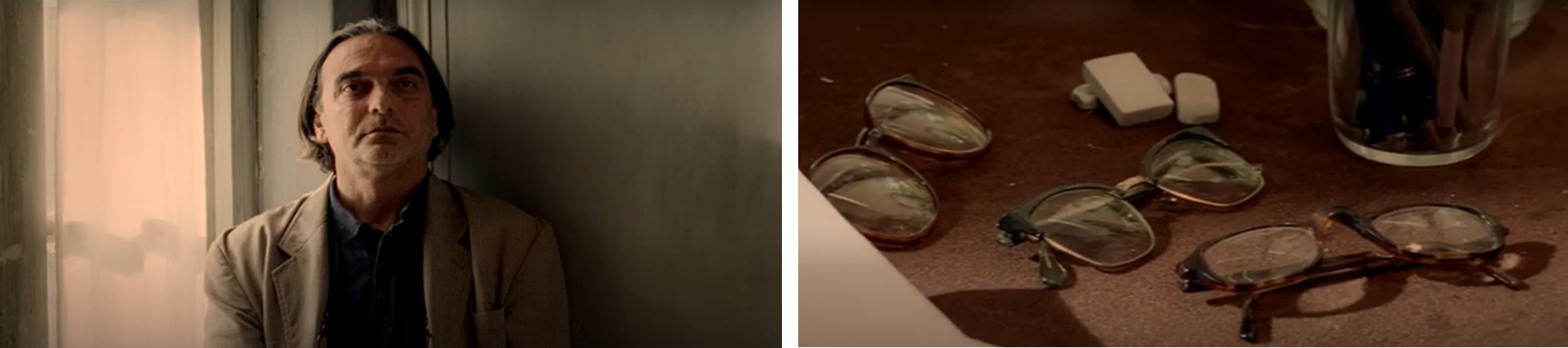
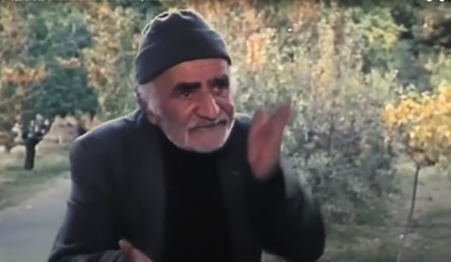
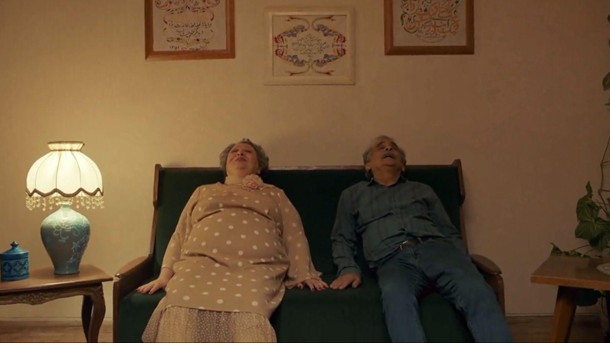
Rahnamā is primarily preoccupied with realism, although his interpretation leans toward a more subjective reality. In Siavash in Persepolis, he depicts a mythological reality through a modernist lens. According to Rahnamā, “this mythological realm represents an integral aspect of our consciousness and thoughts, transcending a mere mythological world and assuming the stature of a mythological historical analysis.”10Farīdūn Rahnamā, “Guftugū bā Nasīb Nasībī [In Conversation with Nasīb Nasībī],” Nigīn 82 (February 1971): 22. Departing from the established conventions of preceding Iranian films centred on mythological figures and narratives from the Shāhnāmah, the film exhibits a notable deviation in both narrative structure and visual aesthetics. In contrast to the traditional narrative style used to recount the story of Siyāvash, Rahnamā adopts a more innovative narrative technique and offers a modernist reinterpretation. Set in a contemporary setting, the film follows a group of actors attempting to create a cinematic or theatrical recreation of Siyāvash’s narrative amidst the ancient ruins of Persepolis. However, the film withholds details about the identities and objectives of the characters, whose costumes suggest that they are the mythological characters of Shāhnāmah. Rahnamā focuses on key characters from the Shāhnāmah, including Kay Kāvūs, Sūdābah, Garsīvaz, and Siyāvash, extracting them from their mythological contexts and transplanting them into the contemporary era. This juxtaposition allows the characters to grapple with their destinies in interaction with modern individuals to provide a fresh perspective on the legend of Siyāvash. The characters look through history and navigate dark physical and psychological passages in search of some grounding in reality. Subsequently, Firangīs and, later, Rustam joins this contemporary assembly in the film, transforming the setting of Persepolis into a quasi-judicial for the trial of Siyāvash and other major characters of the Shāhnāmah.

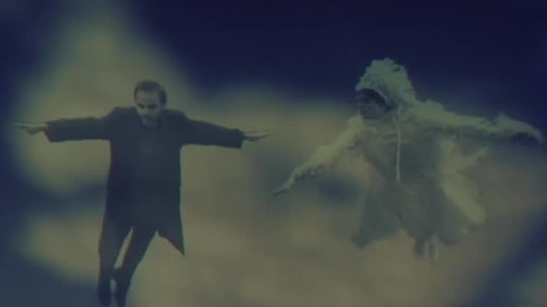
These ghostly figures, like spectral echoes from a bygone era, awaken from millennia of slumber to roam the ruins and challenge the historical narratives of Persian mythology. Moving like zombies, they traverse ancient remnants, accusing one another of their roles in historical performances and the errors and betrayals they have perpetuated. This blurred boundary between the living and the dead reflects the film’s meditation on the persistence of history and the inescapability of myth.

Both Sūdābah and Kay Kāvūs acknowledge their supernatural essence in a scene discussing a plant that has flourished amid the ruins of Persepolis. When Kay Kāvūs points out, “Look at the plant that turned green,” Sūdābah indirectly alludes to their own resurrection, stating, “Just like us after all these years.” This moment suggests that they, much like the plant, have endured despite time’s passage—implying that the figures of mythology never truly die but continue to haunt the cultural and historical consciousness.

Then, in a striking juxtaposition, the camera shifts leftward to reveal a Jeep entering the scene. A German film crew arrives, their presence symbolizing an external, perhaps colonial, gaze upon Iran’s history. As they observe Siyāvash and his companions, one of the passengers queries the driver about their identity. The driver speculates that they might be art groups frequenting the area for photography and filming, adding that he experiences hallucinations amidst the ruins at night, seeing these figures. Sūdābah, privy to their discourse, tells Kay Kāvūs, “We are pleased that nothing has changed. It’s as if the same stories and conflicts persist.” Kay Kāvūs responds, “You heard it yourself. One of them thought we were ghosts. Everyone knows we’re not, but we are indeed.”

This exchange is crucial in reinforcing one of the film’s central themes: the cyclical nature of history and the way mythological and historical narratives continue to shape present realities. The characters exist in a liminal space, neither fully alive nor entirely spectral, embodying the persistence of the past within contemporary Iran. Their recognition as “ghosts,” by outsiders, underscores how the legacy of Persian mythology is perceived—both as an enduring cultural force and as something distant, almost unreal. The intrusion of the film crew further emphasizes how Iran’s historical identity is constantly being interpreted, observed, and sometimes misrepresented through an external lens.

Henry Corbin reflects on how these characters navigate the ruins, emphasizing their complex existence beyond mere historical reenactment. Unlike Firdawsī’s heroes, they speak in modern language—not as a break from the past, but in full continuity with it. Corbin argues that they are neither simply past heroes nor mere actors; rather, their return allows them to reclaim and revive history, driven by an unfinished purpose. Unlike the German film crew, who perceive them as performers, Corbin sees them as true mythic figures whose work remains unfinished, necessitating their return—not for spectacle, but for deeper historical reckoning.

Corbin’s insight adds layers to the interpretation of these characters, inviting contemplation on the intricacies of time, identity, and the enduring significance of ancient narratives.

Discussing his fascination with Siyāvash’s character, Rahnamā expressed, “Undoubtedly, Siavash holds my interest. One could argue that he is the hero residing in my heart.”11Farīdūn Rahnamā, “Javānān tanhā umīd-i sīnimā-yi mā hastand [Youngsters Are the Only Hope for Our Cinema],” Rastākhīz Newspaper 87 (1975): 11. In Rahnamā’s view, Siyāvash is a symbol of human oppression in a society full of lies and deception. In the Shāhnāmah, Siyāvash experiences a profound sense of isolation, feeling misunderstood by others. His lifelong commitment to advocating peace and friendship between Iranians and Tūrānians clashes with his current predicament, as he finds himself surrounded by warmongers like Afrāsiyāb, Sūdābah, and Kay Kāvūs. Despite his naïveté, Siyāvash possesses bravery, courage, and purity. He falls victim to deception by Garsīvaz, leading to his tragic death. Amidst this turmoil, Firangīs, Siyāvash’s devoted wife, remains the sole source of genuine sympathy and support. She steadfastly stands by him, even engaging in arguments with his father, Afrāsiyāb, on his behalf.

History, Mythology and Persian Identity

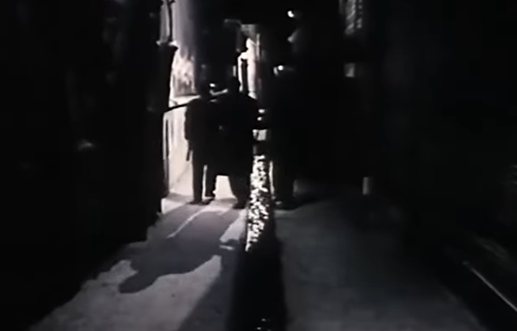
Rahnamā does not focus on the epic aspects of Shāhnāmah or the story of Siyāvash, instead he follows the ethical and philosophical elements of Iranian myths, providing a new cinematic form in his narrative and literary adaptation. Rahnamā does this by bringing the past to life and placing these historically significant characters of Persian mythology in the present. The film begins ostensibly as a portrayal of the hero and his trials during the wars between Iran and Tūrān. Set in the ruins of Persepolis, it intercuts between the present and the past with a metatextual approach. Rahnamā transforms the ancient site into an allegorical space where history, myth, and modernity collide. The stark contrast between the grandeur of the past and the alienation of the present is heightened by the film’s black-and-white cinematography, which enhances its poetic and dreamlike quality. The interplay of light and shadow, combined with meticulously composed frames, evokes a sense of both timelessness and dislocation. Confronted with this novel cinematic experience, the spectator is invited to engage with something distinct from previous visual and narrative forms. In the auteur’s own words, “the problem with the spectators who do not communicate with my films, is that they do not know their culture well enough, and they are not to blame for they have not been given the opportunity.”12Hamīd Shu‛ā‛ī, Nām Āvarān-i Sīnimā dar Irān, Volume 2: Farīdūn Rahnamā [Outstanding Figures of Iranian Cinema: Farīdūn Rahnamā] (Tehran, 1976): 94.

Rahnamā suggests that his cinematic approach offers a distinct viewing experience that deviates from conventional visual and narrative norms. He acknowledges that some viewers may struggle to connect with his film based on their lack of familiarity with its historical and cultural context, emphasizing the importance of cultural knowledge in engaging with his work.

Rahnamā’s narrative strategy transcends the characters’ viewpoints, weaving scenes from the past—derived from Firdawsī’s Shāhnāmah—to create a reciprocal dynamic between historical epochs. The film’s mythological characters offer modern individual insight into their past, helping them grasp their historical significance. However, the contemporary characters cannot assist, as they lack a clear understanding of history and are unfamiliar with the Shāhnāmah and Iranian myths. The director blurs the lines between the present and the past, with some scenes appearing as direct extensions of historical events. The film oscillates between the past and the present, featuring identical characters in the same attire and makeup, reenacting segments of Siyāvash’s life within both the framing narrative and its embedded story.

The crux of Rahnamā’s work is centred on exploring the Iranian sense of self, reflecting on the history and mythology of the nation and its relation to current society. Rahnamā adapts Persian classical literature, such as Firdawsī’s Shāhnāmah, with a new approach. He explains: “Some people criticised my conception of the Shāhnāmah and the story of Sūdābah and Siyāvash. I do not say my take is exactly like the Shāhnāmah, no one can have such a claim, but what you see in my film is not that far from Firdawsī’s concept.”13“Farīdūn Rahnamā dirakht-i hizār shākhah-yi sīnimā [Farīdūn Rahnamā and the Thousand-Branched Tree of Cinema,” [Interview with Talāsh magazine], Talāsh 10 (1969): 18. Rahnamā was more of an archaeological thinker than a nationalist. His fondness for Iran’s cultural past and historic identity did not lead him to chauvinism or absolutism; instead he adopted a more critical approach to history. Unlike many intellectuals of his time, he held no hatred or grudge against the West or Western culture. He lived in Europe for years, spending much of that time learning French and writing poetry in the language. The alienation of Westernized Iranians from their identity and Iran’s history was a central theme in many stories, plays, and films of the 1960s and 1970s, including Rahnamā’s work. The nativism in Rahnamā’s films and writings reflects the philosophical discourse common among the Iranian elites and intellectuals during the 1960s. In an era when anti-Westernism and nativism (in the form of radical nationalism or politicized Islam) dominated Iranian intellectual discourse, Rahnamā’s nativism, focused on ancient historical identity, was neither anti-Western nor reactionary. Instead, it served as a warning against historical ignorance and an invitation to reassess history from a modern, unorthodox perspective. Rahnamā aimed to bridge between Iranian thought with Western modernity, and the anachronistic nature of his film, with its fluid passage between past and present, reflects the postmodernist aspect of his cinema.

Rahnamā’s use of Zarb-i Zūrkhānah music in the opening credits serves to evoke traditional Iranian mythology and its continuity in modern-day Iran, contrasting with Ibrahīm Gulistān’s use of the same music in Brick and Mirror (Khisht va āyīnah, 1964) to allude to themes of Iranian masculinity and its subversion. In the title sequence, the camera moves from images of Achaemenid soldiers on the walls of the Persepolis ruins, accompanied by the powerful beat and voice of Murshid ‛Abbās Shīrkhudā (b. 1933), the renowned Shāhnāmah reciter and percussionist in Zūrkhānah (the house of strength). By drawing upon this auditory tradition, Rahnamā situates his film within a broader historical and mythological continuum, reinforcing its engagement with Iran’s cultural heritage.

Following the credits, the film opens with a panoramic view of Persepolis, where Siyāvash and his companions walk among its towering columns, engaging in dialogue. Kay Kāvūs gestures toward the columns, symbolizing their separation, and says: “You see how these columns are separated from each other.” The camera then tilts down from a tall pillar to the ground, where Kay Kāvūs picks a plant, and hints at their undisclosed mission: “Look at the plant that turned green. It’s a bit like the plant that is the subject of our work.” Although he does not explicitly state their purpose, the plant references the mythological belief that it grows from Siyāvash’s blood after his martyrdom.

Rahnamā assigns Sūdābah the most vocal role among the film’s characters, as she engages in disputes and questions the actions of everyone, including Kay Kāvūs, Afrāsiyāb, Siyāvash, and Rustam. From the outset, Sūdābah critiques Siyāvash and Kay Kāvūs for their illusions, asserting, “You both have an illusion, one fixated on duty and the other on righteousness and purity.” In response, Kay Kāvūs accuses her of succumbing to the illusion of selfishness, but Sūdābah counters that selfishness is simply doing whatever one desires. This exchange underscores the clash of values and worldviews among the characters, enriching the film’s exploration of myth, morality, and contemporary perspectives.

Sūdābah emerges as a formidable critic, targeting Kay Kāvūs and her companions for their unwavering beliefs: “You stay in the moulds you made for yourself until you rot.” She also criticises Siyāvash and Rustam for making peace with Tūrān, accusing Siyāvash of compromising his homeland by seeking refuge in Tūrān and marrying the daughter of Iran’s enemy. However, the validity of Sūdābah’s critique is questioned as scenes depict her manipulating Kay Kāvūs, caressing his feet and tearing her shirt while accusing Siyāvash. Sūdābah embodies a conspiratorial and politically motivated figure, willing to sacrifice others to fulfil her goals. Yet, she is also a victim of unrequited love, and her anger stems from the failure to win Siyāvash’s affection. Her character unfolds as a complex mix of manipulation, political intrigue, and personal torment.

Rahnamā portrays Sūdābah as a melancholic woman, her spirit broken by unrequited love, which fuels her rebellious inclinations and covert actions. Her poignant admission reveals her vulnerability: “I am not afraid of anything except loneliness and aging.” The main narrative explores the dynamics between Siyāvash and Sūdābah, captured through evocative shots that show Sūdābah sitting beside Siyāvash, holding his hand and frequently whispering his name. A pivotal scene, framed in a fixed two-shot, captures their conversation where Sūdābah bares her soul, expressing the depth of her sorrow and love. Their dialogue demonstrates the intensity of Sūdābah’s passion and the futility of her desires. Sūdābah implores, “You’re trembling every time. Stay with me.” Burdened by his own melancholy, Siyāvash responds, “I am depressed.” Sūdābah mirrors his sorrow and confesses, “I am also depressed. I’m mourning. You are depressed for the death of your mother, and I am for the death of my heart. I want you, my baby. Do not leave me.” Despite her pleas, Siyāvash departs, leaving Sūdābah to face solitude.

Frustrated by rejection, she plots revenge by falsely accusing Siyāvash of rape. The film explores the tragic consequences of unfulfilled love, blending emotion, deception, and the complexities of human relationships. Sūdābah’s yearning for love and fear of abandonment drive her defiance, positioning her as both a tragic figure and an agent of disruption. Her vulnerability contrasts with Siyāvash’s restraint, highlighting the film’s exploration of unfulfilled desires and emotional isolation. Through Sūdābah, Rahnamā critiques rigid moral structures that condemn female longing, framing her not merely as a villain but as a deeply human, wounded soul.

Disheartened by his harsh destiny and the inherent cruelty of his existence, Siyāvash confides in Pīrān Vīsah. As a member of Afrāsiyāb’s ranks and an individual known for his genuine honesty, Pīrān becomes the recipient of Siyāvash’s lamentations. Siyāvash expresses his weariness with Tūrān and Afrāsiyāb’s palace, feeling like a stranger in a foreign land. Despite his discontent with his father and stepmother in Iran, he contemplates leaving Tūrān. In this moment of vulnerability, Siyāvash identifies Pīrān as a figure of moral equivalence among the Tūrāni fighters, standing shoulder to shoulder with admired Iranian personalities. Recognizing Pīrān’s consistent efforts in fostering understanding and empathy between Iranians and Tūrānis, Siyāvash entrusts him with his thoughts, posing the profound question, “Why is existence like this?” In response, Pīrān solemnly states, “It has always been this way, my son,” and encapsulates the enigmatic nature of the universe with a poignant verse: “This is the secret of this universe—sometimes it brings joy, and sometimes it brings sorrow.”

Defamiliarization of the characters

Rahnamā employs the postmodernist technique of defamiliarization to present mythological characters such as Siyāvash, Sūdābah and Rustam in a unique light within this film.  They are no longer the inaccessible and mythic heroes of Shāhnāmah, but ordinary people who are walking around the ruins of Persepolis and expressing their feelings and thoughts about their past and present situation. The film rejects conventional characterization and instead embraces an abstract, symbolic mode of storytelling. The figure of Siyāvash is not presented as a traditional protagonist but as an emblem of existential and philosophical inquiry. His movement through the film is often stylized, resembling theatrical or ritualistic performance rather than naturalistic acting. This choice underscores the film’s engagement with myth as a living, evolving entity rather than a fixed historical account.

Unlike the conventional heroic portrayal of Rustam found in Firdawsī’s Shāhnāmah or prevalent in Iranian and ex-Soviet Union films, Rahnamā’s rendition of Rustam deviates markedly. In his film, Rustam is depicted engaging in unconventional activities, such as playing the game of Nūn Biyār Kabāb Bibar (an old and traditional Iranian children’s game literally means bring bread, take kebab) with a boy or joking around with others. Essentially, Rustam becomes a parody of himself, challenging and subverting the traditional heroic archetype. Defamiliarization of Rustam transforms him from the mighty hero of epic tales into a character with a satirical edge.

Rahnamā’s approach disrupts the audience’s preconceived notions of these prominent figures of Persian mythology to prompt a re-evaluation of their roles and characteristics. By injecting humour and everyday activities into the depiction of Rustam, the filmmaker not only defies established conventions, but also introduces an element of relatability by portraying these mythological beings more approachable and human.

The technique of defamiliarisation extends to Sūdābah’s character to offer a reinterpretation that challenges conventional expectations. She diverges significantly from the familiar portrayal found in Shāhnāmah or depicted in old Iranian films. Sūdābah’s character intricately weaves together layers of manipulation, political intrigue, and profound personal turmoil, all stemming from the poignant absence of reciprocated love. Rahnamā’s narration refrains from vilifying Sūdābah; rather, he offers a nuanced portrayal that invites sympathy by positioning her as a victim of unrequited love. Within the narrative, Sūdābah’s false accusation against Siyāvash is not merely a personal act of revenge but a political intrigue, aimed at manipulating power dynamics within the court. Rahnamā presents this act as deeply entwined with her unfulfilled romantic desires, highlighting the complexity of her character beyond a simple villainous portrayal. Rahnamā portrays Sūdābah’s character with nuance, moving beyond a simplistic depiction of good-versus-evil narrative. He delves into the vulnerability beneath her manipulative facade, revealing the emotional toll of unreciprocated love. In opting for this compassionate approach, Rahnamā encourages the audience to empathize with Sūdābah’s struggles and inner conflicts. By doing so, he challenges conventional notions of morality and invites a more profound exploration of the human condition, wherein characters are not merely painted in broad strokes of virtue or vice, but rather as multifaceted individuals shaped by the complexities of their own emotions and circumstances.

Rahnamā’s postmodernist technique goes beyond reinterpretation, challenging the sanctity of mythological characters and shifting in the audience’s perception and understanding of these timeless figures. Through his defamiliarization, the film comments on the malleability of cultural narratives and the transformative power of reinterpretation by a postmodernist filmmaker. For example, Sūdābah expresses skepticism about Siyāvash’s tale of passing through fire, dismissing it as implausible. In her perspective, the idea that someone could traverse fire unscathed contradicts reason: “Zāl, Rustam’s father, was a magician, and Rustam, Siyāvash’s supporter, shares a similar magical lineage. It is not logically sound that one can pass through fire without consequence.”

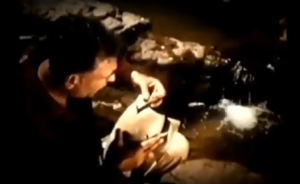
In a pivotal scene, Sūdābah, joined by Kay Kāvūs, symbolically challenges Siyāvash’s narrative by setting fire to a piece of paper—an evocative representation of his fire test. Provoking Siyāvash, Sūdābah dares him to place his hand on the fire: “Put your hand and see if it doesn’t burn.” This act serves as both a direct challenge to Siyāvash and an interrogation of the Shāhnāmah narrative. Sūdābah seeks further validation for her doubts by asking a passerby if he knows the tale of Siyāvash, and more specifically, his fire ordeal, which the passerby dismisses as a legend. Undeterred, Sūdābah presses him further for his opinion on the legitimacy of the narrative. When asked by Kay Kāvūs if he believes Siyāvash passed through fire, the passerby responds hesitantly, “Maybe.” This scene underscores Sūdābah’s skepticism and reflects a broader questioning of the boundary between legend and reality in the Shāhnāmah. The film refrains from offering a definitive stance on the myth’s authenticity, embracing the postmodernist essence of ambiguity and subjective storytelling. By involving passers-by and seeking their opinions, the film invites the audience to question the reliability of mythologies, challenging the notion of absolute truth and acknowledging the interpretative nature of ancient tales like those found in the Shāhnāmah.

Anachronism in narrative

Another postmodernist trait of Rahnamā’s film is its deliberate use of anachronism. In a scene discussing the war between Iran and Tūrān, a boy brings a copy of the Kayhān newspaper, which forecasts the possibility of a Third World War. This historical anachronism illustrates Rahnamā’s view of the fluid continuity between past, present, and future. Rahnamā asserts, “The border between yesterday and today is only hypothetical. A sword that penetrated the body of an Achaemenid or Parthian soldier is not much different from a bullet that penetrated the body of a Frenchman or a German. Both of them are killed.”14Farīdūn Rahnamā, “Guftugū bā Nasīb Nasībī [In Conversation with Nasīb Nasībī],” Nigīn 82 (February 1971): 22.

Rahnamā’s use of anachronism extends beyond individual props or references; it is embedded in the film’s very structure. In Siavash in Persepolis and Iran’s Son is Unaware of His Mother, Rahnamā employs a metafictional “film within a film” framework to challenge linear perceptions of time. By refusing to separate mythology, history, and the present, Rahnamā collapses temporal distinctions, allowing legendary figures to coexist with contemporary individuals. In Siavash in Persepolis, mythological characters wander the ruins of Persepolis alongside modern tourists and a German film crew, an anachronistic layering that disrupts conventional historical reconstructions. This temporal collapse reaches its height in the film’s final scene, where Siyāvash stands atop a hill, visually aligned with the towering pillars of Persepolis. This powerful image serves as a metaphor for Siyāvash’s destiny merging with the enduring legacy of Iranian cultural memory. Through such anachronisms, Rahnamā crafts a vision of history not as a fixed past but as an ever-present force that continues to shape Iranian identity.

Rahnamā’s use of anachronism is not merely a stylistic choice but a means of interrogating historical and cultural narratives. The presence of contemporary elements, such as the Kayhān newspaper referencing a possible Third World War, underscores the film’s assertion that past and present conflicts are intrinsically linked. This visual interplay also reveals a deeper tension between Western and Eastern perspectives, mirroring the nativist and anti-Western discourse prevalent in Iranian intellectual circles. By collapsing time and placing mythological Persian figures within the modern ruins of Persepolis—alongside tourists and a German film crew—Rahnamā critiques the Western gaze that historicizes and exoticizes Iran while simultaneously reinforcing the continuity of Iranian identity. Through this technique, he challenges dominant narratives and invites the audience to reflect on the portrayal of self and other within Iran’s historical and contemporary cultural dynamics.

Other, self and Nativism

The film explores nativism and the theory of otherness through historical anachronism, where elements from different temporal and cultural contexts are juxtaposed. These moments include a German film crew documenting Persepolis, tourists conversing with mythological characters, children in modern clothing engaging in disputes, and mythological figures visiting a historical museum. One striking example of this technique is that of the Germans filming Persepolis. Through a Lacanian lens, the German filmmakers directing their gaze at Persepolis, and the subsequent shift of perspective, dramatizes the dynamics of subjectivity and the “Other.” Siyāvash and his companions, immersed in their discussions and indifferent to the foreign crew, represent the subjective experience within the Lacanian framework, creating an autonomy and self-contained reality. The focus then shifts to a portable radio playing a melodic song, prompting the Germans to request a dance from Sūdābah and Siyāvash. Their request becomes a symbolic turning point, shifting the gaze and transforming the Iranians from subjects to objects in the foreigners’ perspective. Rahnamā visually highlights this shift through the contrast between black-and-white, representing Iranians’ internal subjectivity in contrast to the vivid colours of the Germans’ camera, signifying an external, foreign perspective.

In Lacan’s terms, the transition discussed above reflects the symbolic order in which Iranians become objects in the gaze of the Western filmmakers. The shift from black-and-white to colour can be seen as a move from an internal, subjective reality to an external, objective positioning. This transformation visually portrays the contradiction between the Western perception of Iran as the “Other” and the Eastern, nativist view of the country as the “self.” Lacan’s theory of the mirror stage, wherein the individual constructs their identity in relation to an external image, can be applied here. The Iranians, once the subjective subjects, become objects in the gaze of the Western filmmakers, highlighting the complex interplay between self-perception and external representation in the context of cultural identity.

Siavash in Persepolis is a self-reflexive metafictional film that deliberately cultivates narrative unreliability, which not only challenges conventional expectations of linear storytelling, but also engages in a self-conscious reflection on its own language, narrative structure, and cinematic form. This self-awareness, which becomes a defining characteristic of the film, blurs the boundaries between fiction and reality to encourage the audience to question the nature of the narrative and narration. Rahnamā’s film goes beyond mere self-awareness, becoming a compelling investigation of the intricate interplay of art, literature, mythology, and lived experiences. The film serves as a canvas where these elements converge, each influencing and shaping the other. By transcending the traditional confines of filmmaking, the film prompts deeper contemplation of the relationship between creative expression and the human experience. Through this dynamic intersection of imagination, literature, and reality, Siavash in Persepolis invites viewers to embark on a thought-provoking journey that challenges the conventions of storytelling.

Rahnamā’s minimalistic approach to Siyāvash’s killing suggests a stark and direct portrayal of the brutality of the act. The depiction of Siyāvash’s execution before Afrāsiyāb and Garsīvaz is remarkably minimalistic. The executioner retrieves a dagger from its sheath, accompanied by the resonant clang of a cymbal. Abruptly, the scene transitions to a shot of a creek, where the haunting imagery of flowing blood unfolds. The film concludes with the shot of the plant nourished by Siyāvash’s blood, sprouting resiliently in the arid desert. Stripping away elaborate details may serve to emphasize the raw and unfiltered nature of the violence, making it more impactful and evoking a visceral response from the audience. The film’s conclusion with a plant growing in the desert, nourished by Siyāvash’s blood, is laden with metaphorical significance. The plant, fuelled by Siyāvash’s sacrifice, can be interpreted as a symbol of resilience, regeneration, and the potential for hope even in the face of tragedy.

Siavash in Persepolis contributed to the promotion of arthouse film language and culture in Iran by introducing experimental narrative structures, symbolic storytelling, and a poetic cinematic approach that challenged conventional filmmaking. The film reinforced the idea of cinema as a philosophical and artistic medium rather than just a tool for storytelling. It influenced a wave of filmmakers, such as Muhammad Rizā Aslānī (1943-) and Parvīz Kīmiyāvī (1939-), who embraced avant-garde techniques and non-linear narratives. Culturally, the film helped legitimize arthouse cinema in Iran, fostering a growing appreciation for experimental and intellectual filmmaking that became a defining feature of the Iranian New Wave.

Rahnamā’s primary concern was to refine the language of cinema, crafting a form capable of articulating his philosophical, poetic, and artistic musings. As he remarked in an interview:

As evident in Siavash in Persepolis, I deliberately steer clear of conventional forms of cinematic language—a cinema that may be facile to produce but falls short of conveying the expressive depth I seek. The cinema that I like is one that looks for a higher goal. Some have every right to laugh at this cinema here or at any other place of the world or even ridicule it. It is because they have other expectations from cinema. But, today, this type of cinema goes its own way very easily. Those who ridiculed it yesterday are now so curious about it.15Farīdūn Rahnamā, “Guftugū bā Nasīb Nasībī [In Conversation with Nasīb Nasībī],” Nigīn 82 (February 1971): 22.

Rahnamā’s rejection of conventional cinematic forms is particularly evident in Siavash in Persepolis, where he subverts the linear storytelling of the Shāhnāmah by repeatedly cutting between past and present. This stylistic choice not only reflects Brechtian distancing techniques but also aligns with the cinematic approach of Jean-Marie Straub. Like Straub, Rahnamā employs a minimalist aesthetic, prolonged scenes, and a deliberate emphasis on the spoken word over visual spectacle. These choices disrupt passive spectatorship, encouraging intellectual engagement rather than emotional immersion. By doing so, Siavash in Persepolis fosters a critical reflection on history and mythology, challenging audiences to consider the interplay between cultural memory and contemporary identity.

Conclusion

Farīdūn Rahnamā’s Siavash in Persepolis stands as a landmark in Iranian cinema, not only for its aesthetic and narrative innovations but also for its profound engagement with history, myth, and modernity. By reinterpreting the Siyāvash legend through a modernist cinematic lens, Rahnamā bridges the past and present, using film as a philosophical and political medium. His experimental approach—marked by non-linear storytelling, symbolic mise-en-scene, and a poetic engagement with sound and image—helped redefine the language of arthouse cinema in Iran and left a lasting imprint on the Iranian New Wave.

The film’s enduring relevance nearly six decades after its release underscores its significance beyond its immediate historical and cultural context. Its themes of personal sacrifice, existential struggle, and the search for meaning in a fragmented world continue to resonate, making it a critical reference point for contemporary filmmakers and scholars alike. Moreover, Rahnamā’s influence on directors such as Muhammad Rizā Aslānī, Parvīz Kīmiyāvī, and Nasīb Nasībī (1940-2004) demonstrates how his innovations shaped the trajectory of Iranian cinema, inspiring generations of filmmakers to push the boundaries of cinematic form and storytelling. The film’s self-reflexive and metafictional style continues to resonate, not only as an artifact of Iran’s cinematic past but as an enduring exploration of historical consciousness and national identity.

In a broader sense, Rahnamā’s film exemplifies how cinema can function as both an aesthetic experiment and a philosophical inquiry. By reimagining Siyāvash as a sacrificial hero caught between ancient legend and modern existential crisis, the film offers a meditation on the fluidity of cultural narratives and their continued relevance in contemporary discourse.

Looking forward, further research could explore Rahnamā’s impact in a global context, situating Siavash in Persepolis within the broader currents of modernist and avant-garde cinema or examine its relevance in the context of Iran’s ever-evolving cultural and political landscape. Comparative studies with filmmakers such as Jean-Marie Straub (1933-2022) and Chris Marker (1921-2012), or Sergei Parajanov (1924-1990) could illuminate the film’s place within an international cinematic dialogue on myth, history, and experimental narrative. Additionally, given the film’s political and philosophical undertones, its relevance in contemporary Iran—where issues of cultural identity and artistic expression remain highly charged—merits deeper analysis.

Ultimately, Siavash in Persepolis is more than just an artifact of the past; it remains a living, evolving work that continues to challenge and inspire. Its ability to merge history with innovation, personal struggle with collective memory, myth with modernity, and form with philosophical depth ensures its place as a cornerstone of Iranian arthouse cinema and a timeless meditation on the human condition.
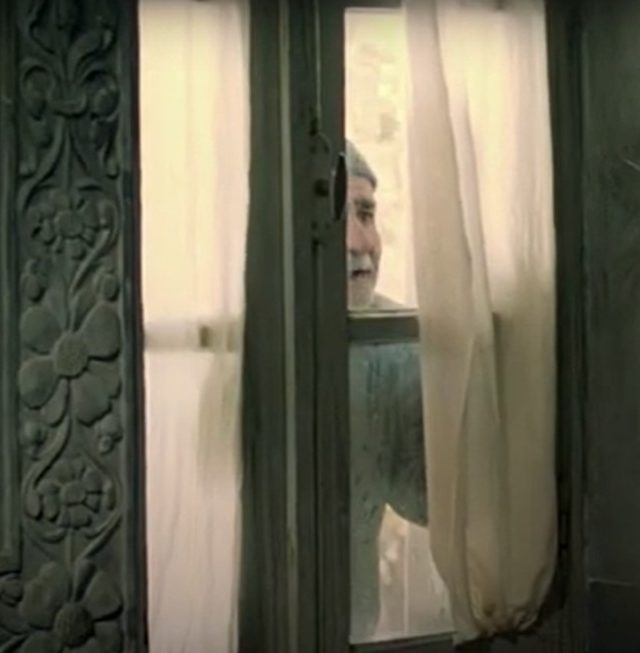
Transcending Realities The Poetic Evolution of Love in Dāryūsh Mihrjūyī’s Cinema (The Pear Tree and Dear Cousin is Lost)

By

Introduction

Silence, often perceived merely as the absence of sound or speech, functions in narrative and literary contexts as a complex and generative phenomenon. It is not simply muteness or void; rather, it constitutes a deliberate absence within the semiotic chain that invites interpretation and engagement. In written narratives, silence refers to elements that are left unstated, unrepresented, or absent in the text, yet still influence the reader’s understanding of the story. It may manifest as omitted lines, words, or events that shape interpretation and generate meaning through what is not explicitly told.

In literary studies, silence has been addressed from multiple angles. Scholars such as Politi (1998),1J. Politi, “The Silencing of Silence,” in Anatomies of Silence: Selected Papers of the Second HASE International Conference on Autonomy of Logos: Anatomies of Silence, ed. Ann Cacoullos and Maria Sifianou (Athens: Hellenic Association for Semiotics of the Arts and Letters, 1998), 29–45. Massey (2003),2K. R. Massey, “Shattering the Empty Vessel: Absence and Language in Addie’s Chapter of Faulkner’s as I Lay Dying,” (Master’s thesis, North Carolina State University, 2003). Schwalm (1998),3H. Schwalm, “The Silence of Many Words: Metafictional Interior Monologues in the Postmodernist British Novels of Julian Barnes and Kazuo Ishiguro,” in Anatomies of Silence: Selected Papers of the Second HASE International Conference on Autonomy of Logos: Anatomies of Silence, ed. Ann Cacoullos and Maria Sifianou (Athens: Hellenic Association for Semiotics of the Arts and Letters, 1998), 128–36. Tseng (2002),4M.-Y. Tseng, “The Representation of Silence in Text,” Dong Hwa Journal of Humanistic Studies, no. 2 (2000): 103–24. and Glenn (2004)5K. M. Glenn, Discourse of Silence in Alcanfor and “Te deix, amor, la mar com a penyora” (California: Wake Forest University, 2004). examine various theoretical dimensions of silence, while sociolinguistic researchers—including Bruneau (1973, 1988, 2007),6Thomas J. Bruneau, “Communicative Silences: Forms and Functions,” Journal of Communication 23 (1973): 17–46; Thomas J. Bruneau and S. Ishii, “Communicative Silences: East and West,” World Communication 17, no. 1 (1988): 1–33. Originally presented at the International Communication Association Conference, Honolulu, HI, 1985; Thomas J. Bruneau, “Functions of Communicative Silences: A Critical Review; a Revision of a Paper: ‘Functions of Communicative Silences: East and West,’” paper presented at Harmony, Diversity, and Intercultural Communication Conference, Harbin, China, June 2007. Huckin (2002),7Thomas Huckin, “Textual Silence and the Discourse of Homelessness,” Discourse & Society 13, no. 3 (2002): 347–72. Kurzon (1997, 2007),8Dennis Kurzon, Discourse of Silence (Amsterdam: John Benjamins Publishing, 1998); Dennis Kurzon, “Towards a Typology of Silence,” Journal of Pragmatics 39, no. 10 (2007): 1673–88; Dennis Kurzon, “Peters Edition V. Batt: The Intertextuality of Silence,” International Journal for the Semiotics of Law 20 (2007): 285–303. Tannen (1985),9Deborah Tannen and Miriam Saville-Troike, Perspectives on Silence (Norwood, NJ: Ablex, 1985). Saville-Troike (1985, 1994),10M. Saville-Troike, “Silence,” in The Encyclopedia of Language and Linguistics, ed. R. E. Asher and J. M. Y. Simpson (Oxford: Pergamon Press, 1994), 9345–47; M. Saville-Troike, The Ethnography of Communication: An Introduction (Oxford: Wiley-Blackwell, 1985); M. Saville-Troike, “The Place of Silence in an Integrated Theory of Communication,” in Perspectives on Silence, ed. Deborah Tannen and M. Saville-Troike (Norwood, NJ: Ablex Publishing, 1985), 3–18. and Jaworski (1993, 1997, 2000)11Adam Jaworski, ed., Silence: Interdisciplinary Perspectives (Berlin: Walter de Gruyter, 1997); Adam Jaworski, “‘White and White’: Metacommunicative and Metaphorical Silences,” in Silence: Interdisciplinary Perspectives, ed. Adam Jaworski (Berlin: Walter de Gruyter, 1997), 381–401; Adam Jaworski, “Silence and Small Talk,” in Small Talk, ed. Justine Coupland (Routledge, 2000), 110–132.—focus primarily on silence in speech and language use. These approaches, though valuable, often overlook the function of silence as a narrative strategy that structures the story itself. This study, by contrast, investigates the role of narrative silence in shaping fictional worlds, emphasizing how stories are structured by what is intentionally left untold.

Key theorists in literary and narratological studies have explored related concepts. Wolfgang Iser’s notion of the “blanks” (1978)12Wolfgang Iser, The Act of Reading: A Theory of Aesthetic Response (London: Routledge & Kegan Paul, 1978). highlights the reader’s active role in completing indeterminate spaces left by the author, while Gérard Genette’s concept of gap-reading (1982)13Gérard Genette, Figures of Literary Discourse, trans. Marie-Rose Logan (New York: Columbia University Press, 1982). emphasizes narrative omissions that demand imaginative supplementation. Meir Sternberg (1987)14Meir Sternberg, The Poetics of Biblical Narrative: Ideological Literature and the Drama of Reading (Bloomington: Indiana University Press, 1987). describes a network of informational gaps through which meaning emerges via the reader’s active reconstruction. Lubomír Doležel (1995)15Lubomír Doležel, “Fictional Worlds: Density, Gaps, and Inference,” Style 29, no. 2 (1995): 201–14. and David Herman (2009)16David Herman, Basic Elements of Narrative (Chichester: Wiley Blackwell, 2009). consider these gaps as inherent features of fictional worlds rather than flaws. Similarly, Denis Kurzon (1997), Michal Ephratt (2018), and Thomas Huckin (2002) demonstrate that silence—whether as blank spaces, pauses, or rhetorical gaps—produces meaning precisely through its absence, functioning as a semiotic and communicative tool. Literary examples, such as the blank pages in Laurence Sterne’s Tristram Shandy or William Faulkner’s As I Lay Dying, illustrate how silence foregrounds unspoken or unshown content, eliciting interpretive and imaginative activity from the reader.

Building on these perspectives, silence in narrative can be understood as a cognitive and semiotic mechanism: it creates a space where meaning is not delivered directly but constructed through the reader’s or viewer’s engagement. By leaving elements unstated, narrative silence stimulates the mind to anticipate, infer, and conceptually complete missing information. Drawing on Sadeghi’s typology (2008, 2010, 2013, 2015),17Leila Sadeghi, “The Denotative Discourse of Silence from a Linguistic Perspective (Intersection of Silence in Social Interaction and Narrative Silence) [Guftimān-i dilālī-i sukūt az dīdgāh-i zabānshināsī (taqātu‘-i sukūt dar taʿāmul-i ijtimāʿī va sukūt-i rivāyī)],” Majallah-yi Pazhūhish-i ʿUlūm-i Insānī 10, no. 24 (Fall–Winter 2008): 163–183; Leila Sadeghi, “Narrative Function of Silence in Story Structure,” Quarterly Journal of Comparative Language and Literature (Linguistic Essays) 1, no. 2 (Summer 2010): 69–88; Leila Sadeghi, Discursive Function of Silence in Contemporary Persian Literature [Kārkārd-i guftimānī-i sukūt dar adabiyāt-i muʿāsir-i fārsī] (Tehran: Naqsh-i Jahān, 2013); Leila Sadeghi, “Interaction of Verbal and Visual Modes in the Discourse of Contemporary Persian Visual Poetry: A Cognitive Poetics Approach [Taʿāmul-i shīvah-hā-yi kalāmī va tasvīrī dar guftimān-i shiʿr-i dīdārī-i Fārsī-i muʿāsir bā rūykard-i shiʿr-shināsī shinākhtī],” (PhD diss., University of Tehran, Department of General Linguistics, 2015). this study distinguishes structural, semantic, and implicational forms of silence in cinematic and literary narratives, each contributing differently to audience engagement and meaning-making. Cognitive research provides a framework for understanding these processes, showing that just as the mind reconstructs incomplete visual or sensory input, it similarly interprets narrative gaps to form coherent understandings. In this sense, silence is not merely an aesthetic or formal device but a cognitive tool, mobilizing attention, memory, and inferential reasoning to generate meaning from absence.

Discursive Silence: The Link Between the Brain and Narrative

Human sensory experiences are mediated through complex perceptual mechanisms that allow the mind to construct coherent wholes from fragmented or incomplete information. The unconscious perceptual system enables the organization of visual and auditory inputs into structured forms, a concept formalized as Gestalt theory by Max Wertheimer (1923)18Max Wertheimer, Laws of Organization in Perceptual Forms (Berlin: Psychologische Forschung, 1923). and further developed by Wolfgang Köhler (1929),19Wolfgang Köhler, Gestalt Psychology (New York: Liveright, 1929). Kurt Koffka (1935),20Kurt Koffka, Principles of Gestalt Psychology (London: Routledge & Kegan Paul, 1935). and Wolfgang Metzinger (1936).21Wolfgang Metzger, Laws of Seeing, trans. Lothar Spillmann et al. (Cambridge, MA: MIT Press, 2009). The term Gestalt, meaning “shape” or “form” in German, reflects the theory’s emphasis on perceiving integrated patterns rather than isolated elements. According to Todorović,22Dejan Todorović, “Gestalt Principles,” in Encyclopedia of Perception, ed. E. Bruce Goldstein, (Thousand Oaks, CA: SAGE Publications, 2008), 381–384. humans perceive the world as nested, complex scenes composed of smaller components within broader contexts, yet the mind organizes these elements into coherent wholes through Gestalt principles.23Dejan Todorović, “Gestalt Principles,” Scholarpedia 3, no. 12 (2008): 5345. Within this framework, the principle of closure, in particular, illustrates how the brain completes incomplete or occluded elements, enabling perception of a unified object even when parts are missing.24Kurt Koffka, Principles of Gestalt Psychology (New York: Harcourt, Brace & Company, 1935; repr. Milan: Mimesis International, 2014), 632. This process, which relies on the interaction of closure and continuity, demonstrates a universal cognitive tendency to seek patterns and maintain perceptual coherence. This tendency underlies not only visual perception but also narrative comprehension.

One reason children enjoy playing hide-and-seek is related to the brain’s perceptual tendency to complete what is only partially given—a process explained by the Gestalt principle of closure. Even when an object is not fully visible, the mind infers its continued existence, deriving satisfaction from resolving the gap between absence and presence. Infants respond positively to such games, but as they grow older, the increasing predictability of outcomes modifies the game’s structure.25Diane Rogers-Ramachandran and Vilayanur S. Ramachandran, “The Neurology of Aesthetics,” Scientific American Mind 18, no. 2 (2008): 74. This same principle of closure extends into other cognitive and aesthetic activities, including puzzles, riddles, problem-solving, and discovery. In these cases, the brain derives pleasure not simply from perceiving hidden or fragmented elements, but from actively “closing” gaps to construct a coherent whole. For this reason, the so-called “principle of perceptual problem-solving” can be understood as a cognitive manifestation of closure: humans find it inherently rewarding to resolve what is incomplete, whether in visual perception, play, or intellectual inquiry.

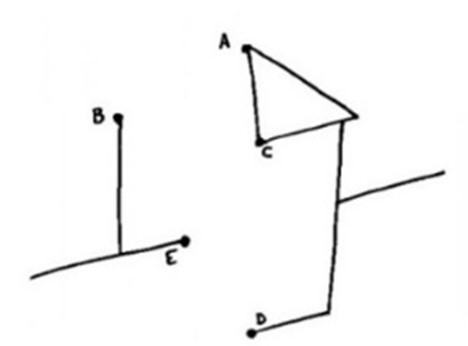
Figure 1-1: Principle of Closure

Consider a triangle outlined in black behind a white triangle (Figure 1-1). On the retina—the light-sensitive surface at the back of the eye—the image initially appears fragmented. However, the brain does not perceive the gaps as empty spaces. Instead, it seamlessly integrates the broken segments into a single, unified shape, filling in missing portions based on surrounding texture, color, and illumination.26Luiz Pessoa and Peter de Weerd, eds., Filling-in: From Perceptual Completion to Cortical Reorganization (Oxford: Oxford University Press, 2003), 1. As Bradley argues that our perceptual system seeks to complete partially occluded visual forms, deriving cognitive satisfaction when enough cues are present for the mind to infer missing elements—but if too much information is missing, the viewer fails to integrate the parts into a coherent whole.27Steven Bradley, Design Fundamentals—Elements, Attributes, & Principles: A Beginner’s Guide to Graphic Communication (Boulder, CO: Vanseo Design, 2013). Interestingly, if all elements are explicitly provided, the closure mechanism remains inactive, and the cognitive satisfaction derived from mentally filling in gaps does not occur.

Neurologically, this reconstructive capacity reflects the brain’s handling of incomplete sensory input. As Stephen Grossberg explains, blind spots in the visual field arise from gaps in photoreceptor coverage on the retina, yet the brain compensates seamlessly, producing a continuous perceptual experience.28Stephen Grossberg, “Filling-In the Forms: Surface and Boundary Interactions in Visual Cortex,” in Filling-in: From Perceptual Completion to Cortical Reorganization, ed. Luiz Pessoa and Peter de Weerd (Oxford: Oxford University Press, 2003), 16. This principle of completion extends beyond visual perception to textual and auditory domains, where the mind naturally interpolates missing elements to construct coherent meaning even when information is partial or fragmented. Silence, at its core, refers to what is not explicitly uttered in the semiotic chain yet is still received as meaning. It does not signify mere muteness or absence but rather functions as a constitutive gap within the textual system—an absence that stimulates the reader’s cognitive and imaginative faculties. As Spolsky observes, “the construction of new meaning arises not merely from collaboration among different domains of the brain, but from the very presence of gaps and fissures within the text, which lead to innovation.”29Ellen Spolsky, “Darwin and Derrida: Cognitive Literary Theory as a Species of Post-Structuralism,” Poetics Today 23, no. 1 (2002): 31. Silence thus operates at the interface between narrative and cognition: meaning emerges not only from what is present but also from what is withheld, and interpretive dynamism depends upon this tension between absence and presence.30David Herman, Basic Elements of Narrative (Malden, MA: Wiley-Blackwell, 2009), 137–160.

According to Ray Kurzweil, the neocortex continuously predicts what will happen next in the world. In doing so, it detects information consistent with expectation, allowing humans to perceive what they anticipate and to attend selectively to expected stimuli. Consequently, human narratives mirror these cognitive predictions and possess a neurobiological foundation, while unanticipated elements often remain unnoticed, forming cognitive blind spots.31Ray Kurzweil, How to Create a Mind, unabridged ed. (Brilliance Audio, 2012), 1. He further emphasizes that the neocortex’s repeated cortical columns detect and generate hierarchical and networked patterns, enabling humans to link fragmented observations into coherent structures and conceptually reconstruct missing information. This predictive function aligns with Boyd’s observation that humans have an innate propensity to recognize patterns, integrating previously acquired environmental information to comprehend the world and their relationship to it.32Brian Boyd, “Patterns of Thought: Narrative and Verse,” in Cognitive Literary Science: Dialogues between Literature and Cognition, ed. Michael Burke and Emily T. Troscianko (Oxford: Oxford University Press, 2017), 49. Together, these findings indicate that narrative gaps—such as omitted events or unresolved actions—actively engage evolved cognitive mechanisms, prompting audiences to infer, complete, and interpret the story-world, just as the visual system reconstructs fragmented retinal images into unified percepts.

Building on these foundational perceptual processes, the principle of closure also underpins how humans engage with more abstract and symbolic forms of information. Activities such as connecting dots, solving riddles, and uncovering hidden patterns do more than exercise visual or motor skills—they cultivate higher-order cognitive functions, including reasoning, pattern recognition, and problem-solving. By actively inferring missing elements and integrating them into a coherent whole, the mind practices the same reconstructive processes that operate in visual perception and narrative comprehension. In this way, closure functions as both a perceptual and cognitive tool, shaping the way humans interpret fragmented or incomplete information across domains, from play and learning to storytelling and literary engagement (Figure 1-2).

Figure 1-2: Connecting Key Points to Enhance Cognitive Abilities in Children

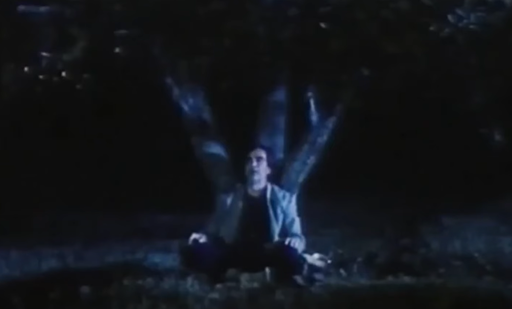
In cinematic narratives, similar to the way children connect the dots in games, segments of a narrative function as key nodes that viewers mentally link to construct the structural and semantic Gestalt of the film. This allows audiences to infer unstated or unseen elements within the narrative. For instance, in The Pear Tree (Dirakht-i Gulābī, 1998) the recognition of key conceptual metaphors as nodes creates a structural Gestalt: the protagonist’s life is initially shaped not just by the literal “destiny of the pear tree” but by the metaphorical “destiny of the spider’s web.” The proximity of the web to the tree branches directs the trajectory of the narrative, leading the protagonist to lose the beloved and pursue social recognition. Only at the narrative’s conclusion does the character realize the misalignment, understanding that the true “beloved” must be sought within the self rather than externally.

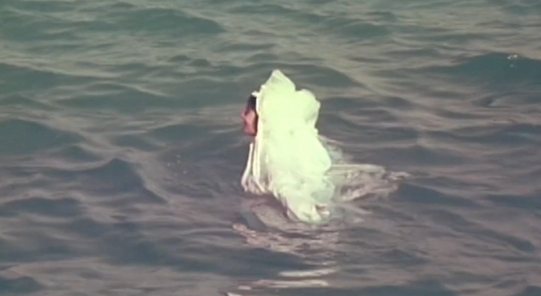
Similarly, in Dear Cousin is Lost (Dukhtar’dā’ī-i Gumshudah, 1998) the narrative uses illogical sequences and fragmented storytelling, where moments of silence, visual gaps, and disjointed interactions act as nodes that the audience mentally connects. These gaps—such as the drowned bride, the floating camera, and the interplay between the director, ‘Alī, and the unseen bride—require viewers to actively construct narrative meaning, linking metaphoric elements (water as loss, the camera as memory, the air as freedom) to produce a coherent internal Gestalt of the story. The juxtaposition of expected and unexpected events creates cognitive tension, and the audience completes the narrative using prior knowledge, intuition, and emotional inference.

In both films, silence function as a cognitive and semiotic tool, distinct from mere muteness or inaction. Deliberate silence—whether a pause in dialogue, an unshown event, or a gap in the visual field—evokes meanings that contribute directly to narrative construction. This aligns with the principle of closure: the human brain perceives incomplete visual or auditory information as part of a whole, filling gaps to form a coherent narrative experience. In these films, audiences mentally complete what is not explicitly presented, engaging actively in the interpretation of the narrative.

Thus, silence in cinema serves a dual purpose: aesthetically, it produces suspense, poetic resonance, and emotional engagement; cognitively, it mobilizes the audience’s perceptual and inferential capacities, allowing them to reconstruct hidden narrative elements. By strategically omitting key moments, both The Pear Tree and Dear Cousin is Lost exemplify how biologically grounded cognitive mechanisms—rooted in the principle of closure—underlie the reception of cinematic narratives, transforming what is absent into a site of meaning and interpretive participation.

Mihrjūyī’s filmmaking is often situated within the framework of the Iranian New Wave—a style that privileges visual composition, symbolism, and atmospherics over linear, plot-driven narratives. This style typically incorporates non-linear storytelling and focuses on philosophical reflection rather than delivering definitive resolutions. Such an approach resonates with the ideas of Viktor Shklovsky, who distinguishes poetic cinema from prosaic cinema, arguing that its primary concern is not narrative or conventional plot, but the formal construction of the film, which makes the audience perceive familiar objects and actions in new and heightened ways.33Viktor Shklovsky, “Poetry and Prose in Cinematography,” in Russian Formalist Criticism: Four Essays, ed. and trans. Lee T. Lemon and Marion J. Reis (Lincoln: University of Nebraska Press, 1965), 10–14. In his differentiation he identifies that cinema enables the viewer to encounter the world in a renewed way, moving beyond a merely linear reading of narrative. As he observes, through the concept of ostranenie (defamiliarization), cinema can “return sensation to our limbs,” allowing viewers to experience the world freshly and deepening their engagement with their surroundings.34Viktor Shklovsky, “Poetry and Prose in Cinematography,” in Russian Formalist Criticism: Four Essays, ed. and trans. Lee T. Lemon and Marion J. Reis (Lincoln: University of Nebraska Press, 1965), 11.

Building on this formalist foundation, contemporary cognitive theorists such as Daniel Stern expand on how viewers experience cinema on a pre-reflective, sensory level. Stern’s concept of “vitality affects” describes the dynamic, temporal qualities of perception—the sensory and affective impulses that arise before explicit narrative meaning is formed.35Daniel Stern, The Interpersonal World of the Infant: A View from Psychoanalysis and Developmental Psychology (New York: Basic Books, 1987), 45–48. In other words, the audience’s engagement with film can occur through rhythms, gestures, and audiovisual patterns, rather than solely through plot comprehension. By linking Shklovsky’s emphasis on formal perception to Stern’s cognitive framework, one can trace a continuum from early theories of poetic cinema to modern understandings of embodied cinematic experience. A significant portion of Mihrjūyī’s style—particularly in Dear Cousin is Lost—aligns with this perspective, as he abandons conventional storytelling to create a sensory and emotional experience. Through his use of surrealist style and cinematic silence as a narrative technique—both at the structural and semantic levels—Mihrjūyī compels the viewer to confront the dynamics of form rather than the conventions of classical narrative.

Extending this line of inquiry, Tom Gunning emphasizes that the essence of poetic cinema lies in its ability to estrange perception and reveal “new ways of sensing and knowing the world,” positioning form not as a vessel for meaning but as a site of aesthetic and cognitive renewal.36Tom Gunning, “The Question of Poetic Cinema,” in The Palgrave Handbook of the Philosophy of Film and Motion Pictures, ed. Noël Carroll, Thomas Nannicelli, and Piers Rawling (Cham: Palgrave Macmillan, 2019), 551–71. Similarly, Maarten Coëgnarts and Peter Kravanja propose an embodied poetics of cinema, asserting that films communicate abstract meaning through patterns of perception and bodily experience shared across viewers. They focus on “image schemas,” such as SOURCE-PATH-GOAL and CENTRE-PERIPHERY, which structure how movement, spatial relations, and intensity are perceived, and show how these schemas can be metaphorically extended to represent time, emotion, and thought. By highlighting how rhythm, camera movement, and audiovisual patterns are experienced corporeally, their framework demonstrates that poetic cinema engages audiences pre-reflectively, eliciting sensory and affective responses that go beyond intellectual comprehension. In this way, their work extends Shklovsky’s ideas, illustrating how cinematic form can foster a participatory, embodied experience that transcends traditional narrative structures.37Maarten Coëgnarts and Peter Kravanja, “Towards an Embodied Poetics of Cinema: The Metaphoric Construction of Abstract Meaning in Film,” Alphaville: Journal of Film and Screen Media 4 (2012): 1–15.

Thus, Mihrjūyī’s films exemplify poetic cinema by deliberately challenging conventional narrative structures and engaging viewers on a pre-reflective, sensory level. In this style, silence becomes a central narrative device, creating a perceptual space that encourages introspection and embodied engagement. By minimizing explicit dialogue or linear exposition, the films cultivate an environment in which the audience interacts with audiovisual rhythms, gestures, and spatial patterns, activating what Daniel Stern terms “vitality affects”—dynamic, temporal qualities of perception that arise before conscious interpretation. Similarly, drawing on the framework of Coëgnarts and Kravanja, Mihrjūyī’s use of visual composition, camera movement, and silence can be seen as employing image schemas that metaphorically structure abstract concepts such as time, emotion, and relational dynamics. In this way, the viewer participates actively in meaning-making, experiencing the film not merely intellectually but in an embodied way, as form and sensation guide perception and interpretation. Silence, therefore, functions as both a cognitive and aesthetic tool: it opens a space for ambiguity, reflection, and personal resonance, heightening sensory awareness and inviting the audience into a participatory cinematic experience.

From a cognitive perspective, silence engages the brain’s predictive and inferential mechanisms: when information is missing, the mind actively fills in gaps, anticipates possible continuations, and constructs coherent interpretations based on prior knowledge and experience.38Leila Sadeghi, A Cognitive Approach to Literary Theory [Naqd-i adabī bā rūykard-i shinākhtī] vol. 3 (Tehran: Logos Publications, 2022), 215. This aligns with Gestalt principles of closure, where perception and understanding rely not only on what is present but also on the brain’s ability to infer and anticipate absent elements. As Barbara Johnstone suggests, silence only becomes legible when it is foregrounded against textual fragments, drawing attention to absence itself.39Barbara Johnstone, Discourse Analysis (Malden, MA: Blackwell, 2008), 70. In this way, discursive silence becomes a cognitive tool that fosters active engagement, imagination, and deeper comprehension of narrative structures.

These cognitive mechanisms provide a framework for analyzing how silence operates within cinematic narratives, guiding audience interpretation and shaping perceptual and emotional engagement. Drawing on Sadeghi’s typology (2009), this study distinguishes structural, semantic, and implicational forms of silence, each contributing uniquely to audience engagement and meaning-making.40Leila Sadeghi, “The Discursive Function of Silence in Short Stories [Kārkard-i guftimānī-i sukūt dar dāstān-i kūtāh]” (Master’s thesis, Allameh Tabatabaʾi University, 2009). By examining these dimensions in the two films, the research demonstrates how silence functions as a productive site for interpretation, enhancing narrative logic while activating viewers’ perceptual capacities. Through sensory and affective engagement, audiences reconstruct unstated events and link fragmented narrative elements, forming a participatory experience that connects individual perception with broader socio-cultural contexts. In this way, silence in Mihrjūyī’s cinema emerges as a defining feature of poetic cinema, creating layered spaces for reflection and offering novel means to convey the subtleties and complexities of human experience.

In sum, discursive silence can be understood as a cognitive phenomenon in which the absence of textual or auditory elements does not denote a deficit but instead functions as a generative gap that engages the mind’s predictive and inferential mechanisms. Rather than representing emptiness, silence operates at the intersection of narrative structure and cognitive processing: what is withheld prompts mental closure, encourages the anticipation of narrative continuations, and facilitates the reconstruction of meaning from incomplete information. Through this dynamic interaction, silence transforms absence into an active site of interpretation, shaping coherence and enriching narrative comprehension. Building on this perspective, discursive silence can be systematically categorized into three interrelated domains:41Leila Sadeghi, A Cognitive Approach to Literary Theory [Naqd-i adabī bā rūykard-i shinākhtī] vol. 3 (Tehran: Logos Publications, 2022), 216-227.

  1. Structural Silence — located at the level of textual or narrative organization.
    • Omission: A silence produced by the physical absence of narrative segments. Certain elements are deliberately cut or left unexpressed, compelling the reader to supply them through the Gestalt principle of closure. In this case, meaning arises not from what is presented but from the recognition of a missing part that the mind reconstructs.
    • Cataphora (Deferred Disclosure): A silence generated by deferred disclosure. Information is withheld at one point in the text and introduced later, requiring the reader to maintain a provisional representation and retrospectively integrate the missing detail once it appears. Cognitively, this engages memory and backtracking processes to restore coherence.
  2. Semantic Silence — arising from substitution or displacement of meaning.
    • Metaphor: A silence that conceals one meaning beneath another by mapping an abstract concept onto a more concrete domain. The explicit expression displaces the underlying content, which the reader must reconstruct by identifying similarity across domains. This cognitive mechanism produces new interpretive possibilities by layering absence and presence.
    • Metonymy: A silence that emerges when two entities share a conceptual domain or scope, and one is used to evoke the other. By presenting only part of a whole, or cause in place of effect, the narrative withholds direct articulation, relying on the reader’s associative cognition to retrieve the absent referent.
  3. Implicational Silence — grounded in Herbert Paul Grice’s cooperative principle, which holds that communication relies on shared expectations expressed through four maxims: quantity (provide the right amount of information), quality (speak truthfully), relation (be relevant), and manner (be clear and orderly).42Herbert Paul Grice, “Meaning,” Philosophical Review 66 (1957): 377–88. Silence in narrative emerges when these expectations are either upheld or strategically flouted, prompting the audience to supply meaning through cognitive processes such as schema activation, presupposition, and inference.
    • Presupposition (as schemata): This type of silence depends on the audience’s prior knowledge, cultural frameworks, and mental schemas to interpret narrative gaps. Rather than violating conversational norms, presuppositional silence aligns with the Maxim of Quantity: only partial information is provided, requiring the audience to infer unstated elements. By activating shared assumptions and background knowledge, the narrative conveys meaning indirectly, embedding significance in the cognitive context rather than in explicit text.
    • Implication (as inference): This form of silence prompts the audience to actively reconstruct meaning beyond what is directly presented. It engages cognitive processes to detect relevance and resolve ambiguity, corresponding to the Maxims of Relation and Manner: meaning is implied rather than stated explicitly. By encountering details that seem unrelated or incomplete, viewers or readers are compelled to draw connections, bridging gaps and elaborating on the narrative through inference. In this way, inferential silence transforms absence into a semiotic cue that guides interpretation.

Type of Silence

Subcategory

Role in Narrative and Meaning-Making

Structural Silence

Omission

Leaves events, actions, or explanations unstated, creating gaps that compel viewers to actively reconstruct the narrative.


Cataphora / Deferred Disclosure

Delays revealing information, requiring the audience to maintain provisional understanding and integrate later details to make sense of the story.

Semantic Silence

Metonymy

Objects, gestures, or minor details stand for broader concepts (e.g., the pear tree for lost love and blocked creativity).


Metaphor

Concrete images symbolize abstract ideas, evoking emotional or conceptual meaning indirectly.

Implicational Silence

Presuppositional

Relies on audience’s prior knowledge and cultural schemas to interpret narrative gaps (relates to Maxim of Quantity: only partial info given, requiring inference).


Inferential

Encourages viewers to draw connections and reconstruct meaning beyond what is shown (relates to Maxims of Relation and Manner: relevance and clarity are implied, not explicit).

Table 1: Typology of Discursive Silence and Their Functions in Meaning-Making (adapted from Sadeghi, 2009)

This tripartite model highlights that discursive silence is not reducible to muteness or textual voids. Rather, it functions as a cognitive strategy of absence, systematically embedded within narrative structures, semantic substitutions, and implicational cues. Each type of silence mobilizes distinct mental processes—closure, analogy, association, schemata, and inference—demonstrating how meaning emerges as much from what is withheld as from what is articulated.

The Pear Tree (1998): A Meditation on Time and Lost Love

Mahmūd, a writer struggling to finish his latest book, retreats to his family’s orchard in Damavand. There, the old pear tree, full of childhood memories, remains barren, and Mahmūd is asked to participate in a ritual to revive it. During his stay, he recalls his adolescence, when he fell in love with his cousin “Mīm”, who reciprocated his affection. Years later, after becoming involved in political activities, he fails to respond to her letters and eventually learns of her death while he was in prison. Now approaching sixty, Mahmūd remains creatively and emotionally stagnant, like the barren pear tree of his youth.

Dāryūsh Mihrjūyī’s The Pear Tree is a meditation on love, memory, and the passage of time, tracing the reflective journey of its protagonist, Mahmūd, as he revisits his past and confronts the emotional impact of lost affection and interrupted creativity. The film intricately interweaves past and present, employing silence not merely as a formal pause but as a deliberate cognitive and narrative device that engages the viewer in constructing meaning. Following the tripartite model of discursive silence, silence in The Pear Tree operates across structural, semantic, and implicational dimensions, guiding inference, interpretation, and participation.

Mahmūd’s fragmented recollections, the episodic non-linear narrative, and recurring visual motifs—such as the pear tree and the spider web—create deliberate gaps in the story. These absences invite the audience to engage in Gestalt closure, mentally filling in missing elements to construct a coherent understanding of Mahmūd’s life, relationships, and emotional state. Deferred revelations, such as memories that emerge later in the narrative, require viewers to maintain provisional representations and retrospectively integrate new details, activating memory and backtracking processes to restore coherence.

Building on these structural gaps, the pear tree itself operates as a metaphorical conduit for time, lost love, and creative inspiration, displacing explicit exposition and prompting viewers to reconstruct underlying meanings through analogy. Other objects and visual motifs function metonymically: a spider web, a neglected manuscript, or a childhood photograph evokes broader concepts—entanglement, interrupted creativity, past intimacy—without directly articulating them. These semantic substitutions stimulate associative cognition, encouraging viewers to infer connections between what is visible and what is absent.

Extending from both structural and semantic silences, the film strategically introduces details that appear disconnected or irrelevant, such as Mahmūd’s absorption in writing while the gardener announces the pear tree. These moments create processing gaps that engage the audience in inferential elaboration. Viewers instinctively seek coherence, drawing on contextual cues, mental schemas, and prior knowledge to bridge these gaps. In doing so, absence becomes meaningful, transforming what is unsaid or unseen into a space of active interpretation and narrative participation.

From the opening sequences, the film establishes a rhythm of structural silence through omission and evocation. Mahmūd’s interactions with his surroundings, punctuated by silences and visual ellipses, draw immediate attention to what is unsaid or unseen. For instance, the sequence at 00:03:23 presents the gardener knocking on the window to inform Mahmūd about the pear tree, while Mahmūd remains absorbed in his writing (Figure 2-1). The narrative then cuts from Mahmūd’s distracted wandering at 00:04:21 to a medium shot of his cluttered desk, littered with glasses, erasers, cups, cigarette packs, and typewriters.

Figure 2-1: A medium shot of the gardener standing silently behind the window, framed by reflections of the garden, while Mahmūd sits inside absorbed in his thoughts. Still from The Pear Tree (Dirakht-i Gulābī), directed by Dāryūsh Mihrjūyī, 1998 (00:03:23).

This abrupt transition, lacking explicit explanation, generates a cognitive gap characteristic of structural silence: the audience must mentally connect Mahmūd’s distraction, his writing attempts, and the gardener’s intervention. The omission of direct continuity engages the viewer in Gestalt closure, requiring them to reconstruct the temporal and spatial links and thus actively participate in the narrative. Simultaneously, these silences carry semantic weight: the cluttered desk and Mahmūd’s absorption function metonymically, evoking his disorganization, creative struggles, and emotional detachment without directly stating them. By withholding explicit exposition, the film transforms absence into meaning, illustrating how structural and semantic silences collaborate to engage the audience in interpretive reconstruction.

Figure 2-2: Mahmūd’s distracted wandering around the room (00:04:21) transitions to a shot of his cluttered desk (00:07:46), scattered with three pairs of glasses, erasers, cups, cigarette packs, and typewriters. Stills from The Pear Tree (Dirakht-i Gulābī), directed by Dāryūsh Mihrjūyī, 1998.

Similarly, Mahmūd enumerates the potential productivity of his writing:

If I write one page an hour, and ten hours a day, that’s ten pages a day, seventy pages a week, and by the first day of winter, nearly a thousand pages. The hardcover would be ready, embossed with gold letters, and would amount to four volumes.43The Pear Tree, directed by Dāryūsh Mihrjūyī (Iran: Fārābī Cinema Foundation, 1998), 00:06:05.

Yet the film visually depicts him staring blankly, refraining from writing. At this moment, Mahmūd is immobilized, while the gardener, having opened the door, says, “Sir, go take a look at the pear tree.” Mahmūd mutters in frustration, “To hell with the pear tree, with trees and plants. Leave me alone,” and steps onto the balcony.44The Pear Tree, directed by Dāryūsh Mihrjūyī (Iran: Fārābī Cinema Foundation, 1998), 00.06.59. The temporal leap and lack of explicit linkage between Mahmūd’s inner calculation, his inaction, and the gardener’s intervention constitute an instance of structural silence: the audience must bridge the narrative gap and mentally reconstruct the continuity between intention, action, and external stimuli.

At the same time, this scene embodies semantic silence. The juxtaposition of Mahmūd’s obsessive internal focus with the external significance of the pear tree conveys meaning indirectly: the unshown tree, Mahmūd’s blank stare, and his frustrated mutterings invite the audience to infer his creative and emotional stagnation. These metonymic and metaphorical cues allow the viewer to map abstract concepts—productive ambition, distraction, frustration—onto concrete visual elements, generating interpretive depth without explicit exposition.

Figure 2-3: The gardener expresses his frustration at the pear tree’s lack of fruit, gesturing and speaking aloud while the tree itself remains off-screen. Still from The Pear Tree (Dirakht-i Gulābī), directed by Dāryūsh Mihrjūyī, 1998 (00:12:37).

The gardener’s vocalization of frustration—describing the tree’s lack of fruit as “an unforgiving impoliteness” and speculating about magic, illness, or bewitchment—further illustrates omission as structural silence.45The Pear Tree, directed by Dāryūsh Mihrjūyī (Iran: Fārābī Cinema Foundation, 1998), 00:13:21. The tree itself remains absent from the frame, and the visual and narrative gap forces the audience to infer its presence, significance, and symbolic weight. The deliberate cuts and temporal progression emphasize the gardener’s obsessive care—watering, pruning, fertilizing, speaking lovingly—and highlight the contrast between human effort and the tree’s muteness. Here, silence becomes a generative space: viewers mentally reconstruct the interplay of care, expectation, and futility, implicitly linking the tree’s fruitlessness to Mahmūd’s creative and emotional sterility.

Beyond its structural absence, this sequence also evokes semantic and implicational forms of silence. Semantically, the gardener’s lamentations— “I’ve caressed it and expressed love to it… but it was all useless” —do not offer a literal explanation for the tree’s fruitlessness. Instead, meaning arises through metaphor and metonymy: the pear tree functions metaphorically as a stand-in for human barrenness, reflecting the futility of both the gardener’s devotion and Mahmūd’s blocked creativity. At the same time, the gardener’s physical acts—watering, pruning, caressing—operate metonymically, signifying care, persistence, and ritual devotion, which contrast sharply with the tree’s muteness.

Through this interplay, the narrative demonstrates how semantic silence transforms absence into meaning. The tree’s fruitlessness is not explicitly explained; rather, its significance is implied through metaphorical and metonymic relationships, requiring the audience to infer connections between action, object, and abstract concepts. In this way, the film leverages silence as a cognitive and interpretive tool: meaning emerges from what is withheld and displaced, inviting viewers to actively reconstruct both the symbolic and emotional dimensions of the scene.

On the level of presupposition, the gardener’s detailed account of his labor—watering, pruning, fertilizing, and speaking words of love—relies on a shared cultural schema: diligent care is expected to yield growth and fruit. This background knowledge shapes the audience’s understanding of the tree as an object that should respond to human effort, rendering its barrenness uncanny and unjust. On the level of inference, the gardener’s remark, “There’s nothing wrong with him,” creates a deliberate gap that demands interpretive reasoning. With no external cause offered for the tree’s silence, viewers are compelled to bridge the absence by mapping the tree’s muteness onto Mahmūd’s creative and emotional sterility.

In this way, the silence between the gardener’s words and the missing answer becomes productive, guiding the audience to construct meaning beyond what is explicitly stated. Through these mechanisms, implicational silence transforms the pear tree into a site where presupposed expectations collapse and new inferences must be generated, actively engaging viewers in reconstructing the narrative’s unspoken connections. Moreover, this sequence exemplifies a Relation violation: details that appear disconnected—the gardener’s dialogue, Mahmūd’s internal preoccupations, and the unseen tree—prompt the audience to search for hidden links, turning absence into a cognitive and interpretive space.

In a childhood memory, Mahmūd recalls an incident in which the gardener tricks him into climbing a tree, only to deceive him when promising a donkey ride: “You used to like all the trees here before. I remember one day you went to the well with Ms. Mīmchah on the donkey.”46The Pear Tree, directed by Dāryūsh Mihrjūyī (Iran: Fārābī Cinema Foundation, 1998), 00:16:30. Mahmūd sees himself sitting atop a massive tree, and despite repeated calls, he does not respond, enjoying the concern of the adults. Shukrallāh, the gardener—“the gardener of Damāvand Garden… and he was the sole ruler of all the trees in the village”—is the only one who knows where he is hiding.47The Pear Tree, directed by Dāryūsh Mihrjūyī (Iran: Fārābī Cinema Foundation, 1998), 00:19:41–00:19:52. This episode exemplifies structural silence: Mahmūd’s non-response and the absence of direct dialogue between him and the other adults create a cognitive gap that requires viewers to infer his motives, agency, and emotional negotiation with authority. His defiance signals both a disconnect from the adult world and the early formation of his artistic self, asserting autonomy from imposed structures. When he finally descends and realizes he has been deceived, the structural gaps amplify the emotional weight of disillusionment and self-awareness.

This memory also engages semantic silence. Mahmūd’s refusal to answer, his silent enjoyment of attention, and the discrepancy between expectation and outcome function metaphorically: the tree becomes a site of autonomy, risk, and emerging identity, while his concealment signals early creative self-fashioning. The narrative displaces explicit explanation, requiring the audience to reconstruct the psychological stakes through his actions and the surrounding context.

Finally, Mahmūd’s recollection conveys the intensity of youthful passion and internal disorientation:

I’m twelve years old and I’m in love twelve thousand times more than the capacity of my small heart and soul… I’m confused and out of it, I’m dry. I’m a mess and mesmerized.48The Pear Tree, directed by Dāryūsh Mihrjūyī (Iran: Fārābī Cinema Foundation, 1998), 00:22:24.

Semantically, the narrative does not explicitly describe his emotional turbulence; instead, meaning emerges through his fragmented, overflowing expressions of love and confusion, which function metaphorically to signal the immensity and chaos of his inner life. On an implicational level, the gaps in articulation invite the audience to engage in inferential reasoning, reconstructing the depth of his early attachments and the ways these intense feelings shape his emerging identity. The unspoken tension—between the vastness of his emotions and his inability to fully articulate or control them—creates a reflective cognitive space where viewers mentally assemble the psychological and artistic stakes of his childhood. In this way, Mihrjūyī demonstrates how inferential silence can render internal states vividly, showing that what is left unsaid can be as telling as any spoken dialogue in conveying formative emotional and creative development.

Rapid leaps between self-observation (“I’m not myself, my usual self. Even better!”), bodily awareness (“I’m ugly, tall, and disproportionate… although my legs have suddenly and frighteningly grown.”), aspirational statements (“I want to become an author… to be faithful, forever, to my great and eternal love, ‘M’.”), and temporal wishes (“I wish I were twelve years old again… Even the dead ones I wish”) leave gaps in narrative continuity. These disjunctions compel the audience to mentally reconstruct connections between Mahmūd’s internal states and external events, actively bridging the discontinuities created by the narrative form.

Figure 2-4: Mahmūd as a child standing next to Mīm, with the pear tree visible in the background. Still from The Pear Tree (Dirakht-i Gulābī), directed by Dāryūsh Mihrjūyī, 1998, (00:23:55).

Concrete objects and sensory details evoke abstract ideas: the reference to M’s tennis shoes49The Pear Tree, directed by Dāryūsh Mihrjūyī (Iran: Fārābī Cinema Foundation, 1998), 00:24:47. functions metonymically, standing for her presence, intimacy, and the emotional significance of lost love. Bodily descriptions, such as his sudden physical growth, metaphorically reflect the anxiety and disorientation of adolescence. Likewise, Mahmūd’s wishes to accelerate or slow time metaphorically encode his impatience for maturity and his ambivalence toward the passage of life. By displacing meaning into objects, sensations, and imaginative projection, the narrative withholds explicit explanation, requiring the audience to infer his emotional and developmental stakes.

Presupposition relies on cultural and emotional schemas: viewers understand the norms of childhood love, youthful aspiration, and self-consciousness, which Mahmūd assumes without explicitly stating. Inferential silence arises as the audience interprets gaps, such as the impossibility of revisiting his youth or reconnecting with “M,” and maps these absences onto his emerging identity and creative ambition. The sequence also creates a Relation violation: adult instructions about hygiene, appearance, and conduct50The Pear Tree, directed by Dāryūsh Mihrjūyī (Iran: Fārābī Cinema Foundation, 1998), 00:25:46. appear disconnected from Mahmūd’s intense interiority, prompting the audience to reconcile these seemingly irrelevant elements with his psychological and emotional experience.

Figure 2-5: A sudden cut to a past scene, depicts the narrator being taken to prison. Still from The Pear Tree (Dirakht-i Gulābī), directed by Dāryūsh Mihrjūyī, 1998 (01:18:48).

The narrator reflects, “I had built a world of bubbles… which was popped with a snap of the fingers.”51The Pear Tree, directed by Dāryūsh Mihrjūyī (Iran: Fārābī Cinema Foundation, 1998), 01:18:48. Structurally, this moment creates a deliberate discontinuity: the film immediately leaps to a past trauma—his imprisonment two years before the revolution—without a narrative bridge linking personal loss and political suffering. This structural silence compels the audience to mentally connect the rupture between Mahmūd’s private heartbreak over “M” and the political consequences of his beliefs, reconstructing the trajectory from youthful romantic desire to disillusioned political prisoner.

The disjointedness continues when the playful, fragmented dialogue of children in the garden“Had you told us that judging you would be something dangerous to us?”unfolds amidst their games near the pear tree.52The Pear Tree, directed by Dāryūsh Mihrjūyī (Iran: Fārābī Cinema Foundation, 1998), 01:21:43. Here, structural silence is reinforced by tonal shifts between teasing, laughter, and serious questioning, leaving viewers to navigate the gap between surface play and the underlying emotional and relational stakes.

Visually present, the pear tree functions metaphorically as a symbol of Mahmūd’s later creative and emotional barrenness, while its unspoken significance relies on the audience’s ability to infer meaning from the interplay of dialogue, gesture, and setting. In fact, viewers must engage in inferential reasoning, bridging the absence of explicit commentary to understand the symbolic resonance of the tree and its relation to Mahmūd’s internal and external experiences. Through these mechanisms, silence transforms discontinuity into a site for cognitive and interpretive engagement, demonstrating how Mihrjūyī relies on what is withheld to generate narrative depth.

Mahmūd, in a reflective moment, recalls his love for “M” and contrasts it with his devotion to his work.53The Pear Tree, directed by Dāryūsh Mihrjūyī (Iran: Fārābī Cinema Foundation, 1998), 00:38:45. The metaphor “Love is Career” encapsulates the emotional substitution that has reshaped the course of his life: love, once vibrant and deeply felt, has been displaced by professional ambition and the performative responsibilities of the intellectual class. This semantic silence, implied rather than articulated, resonates throughout his fragmented memories, allowing the audience to infer the costs of societal expectation and the internalized prioritization of achievement over intimacy. The scene links seamlessly to the previous childhood sequences: just as the garden games and the echo of Joan of Arc invite inferential reconstruction, Mahmūd’s conflation of love with career activates interpretive schemata, prompting the audience to map personal, emotional, and social pressures onto his trajectory. Together, these layers compel the viewer into active interpretation, bridging childhood play, adult imprisonment, and personal and ideological transformation. Silence here is not emptiness; it is a cognitive space where the audience must infer connections, reconcile discontinuities, and map Mahmūd’s internal conflicts onto symbolic frameworks, generating a reflective meditation on lost love, thwarted creativity, and moral endurance.

Figure 2-6: A childhood scene in the garden where “M” is play-acts as Joan of Arc, surrounded by children who pretend to burn her in playful imitation of martyrdom. Still from The Pear Tree (Dirakht-i Gulābī), directed by Dāryūsh Mihrjūyī, 1998 (01:22:25).

Inferential silence dominates the scene,54The Pear Tree, directed by Dāryūsh Mihrjūyī (Iran: Fārābī Cinema Foundation, 1998), 01:22:25. as the narrator’s fragmented questioning “Had you told us that judging you would be something dangerous to us?”— and cryptic remarks about martyrdom prompt the audience to activate cognitive schemas grounded in cultural knowledge. On an implicational level, viewers rely on shared assumptions about authority, obedience, and suffering, while the echo of Joan of Arc provides a latent schema for courage, sacrifice, and moral trial. In Mahmūd’s childhood memory, “M” is positioned close to the pear tree while the other children pretend to “fire” her in their game, reinforcing her symbolic role as a Joan of Arc figure. This presuppositional framework aligns with the maxim of Quantity, as not every connection between the game, M’s heroic symbolism, and Mahmūd’s developing understanding is explicitly stated, and the maxim of Manner, since the fragmented and playful presentation invites the audience to interpret meaning through context. By linking “M,” the pear tree, and the children’s actions, the scene encourages viewers to infer both the stakes of the game and its deeper symbolic resonance, connecting Mahmūd’s personal experience to archetypes of courage, moral trial, and early imaginative formation.

At the semantic level, the statement “Martyrdom is the torture we go through in the prison… Could there be a worse pain than this?” transforms the courtroom—and, in childhood echoes, the garden games—into metonyms for systemic constraint and moral trial. Simultaneously, the pear tree’s persistent fruitlessness and the gardener’s lamentations function metaphorically, representing Mahmūd’s creative and emotional barrenness. Meaning emerges not through direct exposition but via these displaced and layered cues, inviting viewers to reconstruct conceptual and emotional connections.

At 01:12:33, Mahmūd’s reflection on the eternal yet lost “M” illustrates how affection evolves into broader commitment: the love that once animated his heart is redirected toward revolutionary ideals, opposition to oppressive powers, and dutiful engagement with party commands. This shift is presented without explicit narrative explanation, creating inferential silence. The audience infers the causal relationship between absence of “M,” unanswered letters, and Mahmūd’s immersion in political work. This process engages schemas, as the audience relies on prior knowledge and conceptual frameworks to fill in unstated causal links between personal desire and political engagement. Viewers infer that Mahmūd’s intimate longing for “M,” left unresolved, shapes his ideological commitments. In doing so, the narrative invokes the maxim of Quantity, by leaving certain connections unsaid, and the maxim of Manner, by presenting these relationships elliptically, requiring the audience to actively integrate context, memory, and cultural understanding to reconstruct meaning.

Further gaps—such as Mahmūd’s acknowledgment of poverty, illness, and threats against him,55The Pear Tree, directed by Dāryūsh Mihrjūyī (Iran: Fārābī Cinema Foundation, 1998), 01:13:20. illustrate structural silence. The omission of explicit contextual detail compels the audience to reconstruct the conditions of his struggle, mentally filling in the narrative gaps. His declaration, “I know they’re after me, but I don’t care, I’m in love,”56The Pear Tree, directed by Dāryūsh Mihrjūyī (Iran: Fārābī Cinema Foundation, 1998), 01:13:26. signals a continuity of devotion that has shifted from personal to ideological commitment. Semantic silence emerges in Mahmūd’s reflections on life’s excitement, missed opportunities with “M,” and his literary ambitions.57The Pear Tree, directed by Dāryūsh Mihrjūyī (Iran: Fārābī Cinema Foundation, 1998), 01:13:38. Here, concrete objects and acts—unfulfilled correspondence, unaddressed letters, and the “best and most complete book” he writes despite doubts—function metonymically, standing for redirected ambition and compromised emotional fulfillment. Broader reflections on his emotional state operate metaphorically, substituting direct exposition with abstract, conceptual meaning.

The absent figure of “M” continues to generate multiple forms of silence. Though she never appears physically, recurring references“Did you really have feelings for ‘M’?”58The Pear Tree, directed by Dāryūsh Mihrjūyī (Iran: Fārābī Cinema Foundation, 1998), 01:24:44. and “She was a goner herself”59The Pear Tree, directed by Dāryūsh Mihrjūyī (Iran: Fārābī Cinema Foundation, 1998), 01:24:50.—position her as a conceptual presence, whose significance transcends literal depiction. Semantically, her love transforms into ideological and performative commitment, dispersing into revolutionary zeal—posting images of Marx and Lenin, chanting slogans, and participating alongside comrades—mirroring Mahmūd’s adult responsibilities and creative labor. Implication (as inferential silence) emerges as the audience bridges the gaps through presupposed schemas of lost love, personal transformation, and redirected devotion, reconstructing the causal and emotional links between absence of “M” and Mahmūd’s ideological engagement. This silence is reinforced visually: when the gardener curses the pear tree, the cut to Mahmūd’s image extends the metaphor, implying that he, like the tree, bears the weight of frustration, expectation, and stifled potential.

I am still in love, and this love and heart-throb has taken a new direction. This is a new and truthful love, one that is more worldly. The eternal “M,” the lost “M,” now appears on a larger scale. “M”’s love within me has transformed into hatred and disdain toward the British and the dictatorial class. “M”’s letters went unanswered, but that no longer matters; her presence has become integrated into the political ideals of the party.60The Pear Tree, directed by Dāryūsh Mihrjūyī (Iran: Fārābī Cinema Foundation, 1998), 01.12.18.

This scene exemplifies implicational silence, where the shift from personal to ideological attachment is inferred rather than explicitly narrated, engaging the audience in reconstructing the psychological and emotional trajectory. The narrator observes:

All but the pear tree… With a dead body and empty hands… is standing in the middle of all that commotion and doesn’t care about all that complaint… Like an old sheikh sitting in the quiet… Down to the earth… Patient… And thankful.61The Pear Tree, directed by Dāryūsh Mihrjūyī (Iran: Fārābī Cinema Foundation, 1998), 01:26:50.

The tree’s stillness and apparent indifference function as semantic silence, a metaphorical substitution for Mahmūd’s creative and emotional barrenness. Its absence of fruit and activity conveys meaning more powerfully than direct exposition. Sensory layering—the aromas of the tree, memories of M’s tennis shoes, and tactile engagement with the fruit,62The Pear Tree, directed by Dāryūsh Mihrjūyī (Iran: Fārābī Cinema Foundation, 1998), 01:29:57. acts metonymically, signaling the narrator’s internal stasis and mnemonic associations. Semantic silence thus invites the audience to infer significance without explicit narrative commentary, exemplifying Mihrjūyī’s sophisticated layering of structural, semantic, and implicational silences.

At 01:27:13, the staged “execution” of the pear tree exemplifies layered silence that engages the audience cognitively and emotionally. Structurally, the sequence withholds the actual consequences of the gardener’s threat—“Tree, you have behaved against the laws of the garden and you deserve to die”—creating a discontinuity that compels viewers to anticipate outcomes. The tree functions metaphorically for Mahmūd, its threatened destruction paralleling his creative and emotional sterility, while its stillness under judgment conveys the weight of internalized responsibility. When the village head intervenes—“You must issue the judgment”—authority is juxtaposed with the act, shifting moral accountability onto Mahmūd and highlighting social and ethical pressures. Implicationally, viewers rely on presuppositional schemas, drawing on prior knowledge and cultural understanding (including the Joan of Arc imagery from earlier childhood play), to infer Mahmūd’s internal struggle and the tension between duty, compulsion, and moral constraint. Through this interplay, silence operates as a generator of meaning: the gaps in action, the metaphorical substitution of tree for self, and reliance on cognitive schemas invite active interpretation of emotional, ethical, and creative stakes. The pear tree thus transforms from a passive symbol into a dynamic site of judgment and reflection, linking narrative absence to cognitive engagement.

Later, Mahmūd reflects on the passage of time and his suspended creativity, highlighting the enduring presence of inferential silence in his inner life: “It feels like I am sitting in an empty pause between two noisy minutes, between infinite past and infinite future.”63The Pear Tree, directed by Dāryūsh Mihrjūyī (Iran: Fārābī Cinema Foundation, 1998), 00:21:36. Structurally, this moment creates a visual and temporal gap, as his gaze drifts away from objects, gardens, and gardeners—and from his “enlightened intellectual artist self”—without explicit narrative guidance, compelling the audience to dwell on the pause and reconstruct its significance. He focuses on a spider weaving its web: “Can’t you see the magnificent web it has woven? … I can’t see anything. That’s because you’re blind, deaf and dumb. You are selfish.”64The Pear Tree, directed by Dāryūsh Mihrjūyī (Iran: Fārābī Cinema Foundation, 1998), 00:21:44. Semantically, Mahmūd’s attention to the spider, paired with the girl’s critical observation, functions as a metonym for disciplined, patient, and humble creative labor, contrasting with his own self-absorption. Implicationally, viewers engage presuppositional and inferential reasoning, mapping Mahmūd’s suspended creativity and reflective stasis onto the spider’s meticulous activity, thereby interpreting his longing for discipline, patience, and attentiveness without explicit exposition. In this way, the scene layers structural, semantic, and implicational silences, transforming visual and temporal absence into a cognitive and emotional site of reflection.

This meditation returns later at 01:33:32, when the spider weaving its web functions as both a structural and implicational mirror of the narrator’s state: structurally, the scene presents a visual pause with no dialogue, minimal movement beyond the spider’s meticulous weaving, and no explicit narrative guidance, producing a temporal and visual gap that compels the audience to dwell on the image and construct its meaning; implicationally, viewers are invited to infer through presupposition and cognitive mapping that Mahmūd’s suspended creativity and contemplative stasis are mirrored in the spider’s productive yet constrained activity, a careful construction that resonates with his emotional and creative blockage while allowing symbolic connections to emerge without explicit exposition. Taken together with the pear tree’s quiet presence and the absence of “M,” the spider becomes a site where Mihrjūyī layers structural, semantic, and implicational silences, transforming visual and temporal gaps into moments of cognitive and emotional reflection that link patient observation, blocked creativity, and symbolic absence into a cohesive meditation on longing, failure, and interpretive engagement.

Figure 2-7: Mahmūd sitting under the pear tree in his adolescence, reflecting on the significance of the tree. Still from The Pear Tree (Dirakht-i Gulābī), directed by Dāryūsh Mihrjūyī, 1998 (01:32:42).

Semantic silence emerges through the contrast between Mahmūd’s internalized ideals and the spider’s quiet, persistent labor. He recalls his youthful declarations: “I feel very, very happy I’ve made a great decision. I want to become an author… or perhaps a poet… and I have sworn to be faithful to my great and eternal love, ‘M,’ forever.”65The Pear Tree, directed by Dāryūsh Mihrjūyī (Iran: Fārābī Cinema Foundation, 1998), 00:23:15–00:23:22. These statements are grandiose and emotionally charged but undercut by hesitation and unspoken limitations. The phrase “or perhaps a poet” signals both ambition and doubt, leaving the source of that ambivalence unstated and inviting the audience to infer the intimidating weight of poetic creation. Similarly, his vow of eternal fidelity to “M” conveys youthful idealization and emotional intensity, yet the semantic silence resides in what is left unsaid: the practical impossibility, immaturity, and futility of such a promise.

The spider’s humble, careful weaving functions as a semantic substitution, signaling that authentic creativity requires patience, attention, and subtlety, in contrast to Mahmūd’s performative declarations. The unspoken tension between Mahmūd’s ego-driven self-perception and the spider’s modest productivity conveys meaning more powerfully than explicit exposition: the audience is prompted to infer that authenticity in art and life is less about grand statements and more about sustained, humble attention to one’s work. Finally, his lines — “I wish I could grow up faster. I wish time wasn’t so slow” — introduce temporal and existential tension, reflecting Mahmūd’s stalled agency and the structural and implicational silence of his awareness of past failure and unfulfilled potential.

Implicational silence emerges as viewers reconstruct Mahmūd’s psychological state. The spider mirrors his suspended creativity and unresolved desires: meticulous yet constrained, its activity parallels his stalled artistic growth and the impracticality of his youthful vows to “M.” The unspoken disillusionment—the recognition that phrases like “maybe even a poet” mask doubt and fear, and that eternal fidelity was an idealized, perhaps impossible promise,66The Pear Tree, directed by Dāryūsh Mihrjūyī (Iran: Fārābī Cinema Foundation, 1998), 00:23:22–00:23:28. invites the audience to infer the tension between aspiration and reality. The girl’s remark that the spider is “more poet than you” intensifies this implicational silence, highlighting the contrast between Mahmūd’s performative self-image and the quiet efficacy of genuine effort. Through these cues, viewers actively infer his awareness of missed opportunities, personal inadequacy, and the gap between youthful idealism and lived experience, making silence a semiotic tool for cognitive and emotional engagement.

I feel very, very happy I’ve made a great decision. I want to become an author—or perhaps a poet. I have also sworn to be faithful to my great and eternal love, “M,” forever, or at least for as long as I’m alive. I only wish that time wouldn’t go by so slowly and turtle-like, and that it wasn’t stalling so much. I wish I’d turn 20, 30, or 40 quickly. I wish I’d be as old as mature, wise, and reputable men. How stupid I was.

Through the interplay of structural, semantic, and implicational silences, the spider scene crystallizes a meditation on creativity, humility, and the maturation from youthful ambition to reflective understanding. Structurally, the visual pause—with minimal movement and no dialogue—creates temporal and narrative gaps that compel the audience to dwell on the image and construct meaning. Semantically, the spider’s meticulous weaving substitutes for Mahmūd’s performative declarations, signaling that authentic creativity demands patience, attention, and subtlety. Implicationally, viewers infer his stalled growth, unrealized aspirations, and the contrast between youthful idealism and lived experience. By linking Mahmūd’s reflections to the spider’s silent, persistent labor, the film extends its motifs—the pear tree, “M”’s absence—demonstrating that disciplined observation and effort constitute meaningful engagement, in contrast to grandiose but hollow declarations. Mahmūd’s contemplation transforms the visual pause into a reflective cognitive space, inviting the audience to reconstruct the emotional, moral, and artistic stakes of his inner life.

Dear Cousin is Lost (1998): Silence, and the Narrative of Disorientation

Dear Cousin is Lost (Dukhtar’dā’ī-i Gumshudah), an episode of the Island Stories (Dāstān-hā-yi Jazīrah) series, follows a young girl who disappears while at the sea. Sometime later, she returns, flying through the clouds with two white wings. Her cousin, a young actor, believes in her miraculous return and even joins her in flight. Although the group around them is concerned, the cousin ultimately returns safely to the ground.

Dear Cousin is Lost continues Dāryūsh Mihrjūyī’s trajectory toward poetic cinema, offering a metafictional and surreal experience in which boundaries between reality, imagination, and the filmmaking process are constantly blurred. The narrative opens with a tragic event—the drowning of the bride (the cousin)—yet the story does not follow a conventional linear cause-and-effect trajectory. Instead, structural silences emerge through fragmented sequences, temporal leaps, and abrupt cuts, compelling the audience to mentally reconstruct connections and infer narrative continuity. Semantic silence operates as locations, objects, and cinematic gestures—such as the golden sunsets, dusty streets, or fleeting glimpses of characters—substitute for explicit exposition, inviting viewers to interpret emotional, cultural, and symbolic resonances. Implicational silence arises as the audience actively bridges gaps, connecting the filmmaking process itself to the narrative of loss and disorientation, and inferring meaning from the interplay of dreamlike sequences and self-referential storytelling. Kīsh Island, thus, functions not merely as a geographical backdrop but as a stage where absence, ambiguity, and layered silences guide cognitive and emotional engagement, producing a participatory cinematic experience.

Figure 3-1: The film opens with the haunting image of the bride (the cousin) drowning. Still from Dear Cousin is Lost (Dukhtar’dā’ī-i Gumshudah), directed by Dāryūsh Mihrjūyī, 1998 (00:05:37).

In Dear Cousin is Lost, silence functions as a multifaceted narrative device that establishes surrealism and disorientation from the very opening sequence. The drowning of the bride exemplifies structural silence: she is first shown laughing and swimming, a lighthearted presence sharply contrasted with her sudden disappearance beneath the water, yet the causal link between play and tragedy is withheld. This omission and deferred disclosure compel the audience to mentally reconstruct the transition, generating a suspension of meaning and an active engagement with the narrative gap. Semantic silence emerges as the bride’s ethereal narration — “I am no longer who I used to be. I am something suspended, caught between my dreams” — maps abstract concepts of liminality, transformation, and emotional displacement onto the concrete imagery of swimming and disappearing, inviting viewers to infer psychological and symbolic significance beyond literal events. Metonymy is also at work: the sound of her “light steps” and the golden palm trees evoke her prior vitality and presence, standing in for the full scope of her character and the relational loss ‘Alī experiences. Simultaneously, the audience draws on cultural schemas about grief, danger, and the fragility of life to interpret ‘Alī’s frantic pursuit and the juxtaposition of the director and crew’s casual activity, bridging the gap between narrative expectation and cinematic reality. Inferential silence also functions cognitively, creating tension between the audience’s mental models and the film’s surreal logic. Environmental cues, such as sudden wind, chaotic crowds, or floating objects, generate implicit expectations of normality that are systematically undermined, producing cognitive estrangement and prompting the viewer to negotiate meaning actively. The interplay of these silences—the structural gaps, metaphorical layers, and inferred emotional stakes—positions the audience as an active co-creator of meaning, transforming the abrupt rupture from laughter to tragedy into a reflective meditation on loss, impermanence, and the unstable boundary between dream and reality.

A key example occurs with the bride’s sudden drowning. The cause is never explained, leaving a narrative void that would normally be completed by causal inference. Instead, the audience is presented with a discontinuity: ‘Alī’s frantic pursuit, the intervening crew, and environmental distractions. Conventional knowledge about narrative causality is insufficient; viewers must reconcile these disjointed elements to construct meaning, often blending the fantastical with the real. Similarly, ‘Alī’s apparent death and subsequent “resurrection” defy realist logic, compelling viewers to accept a poetic, dreamlike logic as the governing principle.

Implicit silence also functions cognitively, as it creates a tension between the audience’s mental models and the text’s surreal logic. The film deliberately positions presupposed knowledge against contradictory developments. For instance, environmental cues, such as sudden wind, chaotic crowds, or floating objects, generate implicit expectations of normality that are systematically undermined. This contrapuntal use of Inferential silence transforms audience assumptions into a tool for engaging with a new, internally consistent cinematic logic. The viewer experiences a form of cognitive estrangement, where prior schemas are suspended or inverted, prompting novel interpretations.

Figure 3-2: ‘Alī shouts and searches for the bride after her drowning. Still from Dear Cousin is Lost (Dukhtar’dā’ī-i Gumshudah), directed by Dāryūsh Mihrjūyī, 1998 (00:05:45).

Furthermore, the sudden jump to behind-the-scenes sequences with the film crew, while ‘Alī’s main narrative continues, represents a key instance of structural silence. These interruptions disrupt the story’s flow and introduce a metafictional layer, blurring the boundary between reality and film production. The presence of the director, cameraman, and extras interacting playfully with ‘Alī reveals unseen processes behind narrative construction, such as planning, framing, and directing actions, without explicitly showing the full apparatus. This omission creates a structural gap that compels the audience to mentally reconstruct how the scene is shaped, bridging ‘Alī’s diegetic experience with the production context. Simultaneously, the camera, the director’s instructions, and the extras’ reactions function both metonymically and metaphorically, standing in for the entire filmmaking process, and representing broader themes of observation, mediation, and the artificiality of storytelling. By exposing only fragments of these processes, the film transforms absence into meaning, prompting viewers to actively infer the interplay between performance, direction, and narrative construction, and to understand how stories are crafted, filtered, and interpreted. The filmmakers do not explicitly explain the purpose or mechanics of the production, relying on viewers’ shared cultural and cinematic knowledge to infer the significance of these interruptions. This creates a dual layer of implicational silence: inferential, because the audience must infer how the fragments relate to narrative construction; and presuppositional, because understanding depends on prior knowledge of filmmaking conventions. These silences align with the Gricean maxim of Quantity, as only partial information is provided, compelling viewers to supply meaning through cognitive inference and schema activation. In this way, the structural gap becomes a site where absence generates understanding, and the interplay between diegetic action and production context conveys thematic resonance without explicit exposition.

Another key moment occurs when ‘Alī runs into the camera shop and receives the extraordinary camera from the shopkeeper. The narrative abruptly presents the shop, the strange figure of the shopkeeper in white, and the camera’s hyperbolic capabilities without explaining the logic or reason behind this encounter, exemplifying structural silence through omission and deferred disclosure. The audience is left to mentally connect ‘Alī’s urgent search, the odd camera shop, and the extraordinary abilities of the camera—its capacity to film subatomic particles, traverse the sea, land, sky, and sun—without any explicit explanation of why these elements matter. Semantically, the camera itself, the shopkeeper’s gestures, and the close-up of her wrinkled hand function metonymically, representing the process of capturing and interpreting reality. Metaphorically, these elements suggest human curiosity and the desire to reach beyond ordinary perception: the camera becomes a tangible symbol of ‘Alī’s quest to see, understand, and document the world in ways that surpass ordinary limits. The objects and gestures make abstract ideas of knowledge, discovery, and mediation visible, giving the audience concrete cues through which to interpret ‘Alī’s pursuit.

The filmmakers never explicitly tell the audience why the camera is special or what role the shopkeeper plays, leaving key information unsaid. Instead, viewers draw on what they know about storytelling, film, and visual cues—like the camera’s exaggerated abilities or the shopkeeper’s uncanny appearance—to make sense of the scene. This reliance on prior knowledge turns the silence into a tool: the audience must actively infer the camera’s significance, understand how it shapes ‘Alī’s quest, and connect the surreal details to the narrative. By leaving these explanations unspoken, this scene makes the viewers co-creators of meaning, filling the gaps between ordinary expectation and the scene’s fantastical logic.

Figure 3-3: ‘Alī enters the surreal camera shop, where the shopkeeper, dressed in white reminiscent of a bride, presents him with a fantastical camera. Still from Dear Cousin is Lost (Dukhtar’dā’ī-i Gumshudah), directed by Dāryūsh Mihrjūyī, 1998 (00:08:13).

Sequences in which ‘Alī dives into the sea or stands atop a tower, pausing without explanation while interacting with the crew, bystanders, and fantastical figures, withhold crucial causal and temporal information, compelling the audience to mentally reconstruct his intentions and the consequences of his actions. When people block him from taking the camera underwater—shouting, “Filming underwater’s forbidden… guys, we’ve got guests”—and the director warns, “That camera is your license to death,” the narrative does not clarify the rules or logic of these interventions, creating structural gaps that demand active interpretation. The abrupt shifts between ‘Alī’s pursuit, the chaotic environment of the shore, and the playful or threatening actions of the crew detach the narrative from linear logic, producing a dreamlike atmosphere in which movement and stillness acquire symbolic weight.

‘Alī’s suspended gestures—struggling in diving gear, fainting under blows, or standing atop a tower—metaphorically evoke the limits of human ambition, the tension between freedom and constraint, and the vulnerability of memory under external pressures. The spectators, crew, and giant-like figures—shown partially through glances, comments, and gestures—operate metonymically, representing society’s authority, collective judgment, and the unpredictable forces that shape individual action. Everyday objects in the scene—playing cards, hookah smoke, money, and the oversized camera box—also function metonymically, standing for mundane life, ritual, and the apparatus of narrative construction, emphasizing how ‘Alī’s quest is embedded in cultural and social systems.

Implicational silence, here, is activated as the filmmakers withhold explanations for ‘Alī’s pauses, the dangers he faces, and the outcomes of his actions, relying on viewers’ presuppositions and prior knowledge of narrative and cinematic conventions to interpret their significance. This is reinforced when the bride narrates, “I’m suspended between my dreams, closest to me,” as the camera box plunges into the sea, or when ‘Alī appears on a hospital bed with wires attached while the director assumes the role of chief doctor—details left unexplained but loaded with symbolic and emotional weight. The climactic visual of ‘Alī simultaneously flying with the bride while emergency personnel attend to him fuses past, present, and imagination, creating a paradoxical scene that requires the audience to integrate structural gaps, metaphorical cues, and implicit narrative logic, actively negotiating the interplay of desire, risk, societal constraint, and the fragile pursuit of memory and creativity.

The bride’s ethereal presence—gliding among clouds in a white dress, her gestures resembling flight—extends these silences into the semantic and implicational realms. Her physical absence and dreamlike form turn her into a liminal figure, bridging material reality and imagination. She embodies love, loss, and unattainable desire, while her voice — “I am no longer the same person… I am suspended among my dreams” — signals transformation and stasis without providing concrete explanation. This functions metaphorically, as her untethered, floating body conveys emotional states that words alone cannot express, and metonymically, as her presence evokes the larger network of memory, longing, and narrative gaps that shape ‘Alī’s quest. Simultaneously, viewers draw on prior knowledge of desire, loss, and cinematic convention to interpret her significance and the effects of her absence. In this way, the bride becomes both a symbolic anchor and a cognitive cue, making the audience an active participant in constructing the symbolic logic of the film.

Environmental and situational details intensify the film’s semantic silence by turning everyday phenomena into narrative signifiers. Gusts of wind toss ‘Alī’s clothing and hair, dust swirls around the streets, and bystanders jostle and shout, creating a chaotic backdrop that externalizes his confusion and anxiety. These occurrences are never explicitly explained or narrated, yet they signal the unpredictability of his quest, the tension between control and chance, and the pressures of social observation. The oversized Sony box, which ‘Alī carries through crowds and uneven terrain, operates similarly: it is both a practical obstacle and a symbolic object, representing the weight of responsibility, the burden of perception, and the mediation of experience through technology. The box’s interaction with the environment—catching on street signs, jostled by people, or sliding into the water—visually dramatizes the constant negotiation between ‘Alī, the object, and the world around him, inviting viewers to interpret these interactions as reflections of his struggle to maintain focus, memory, and agency within an unstable and mediated reality.

Finally, motifs of death and resurrection in Dear Cousin is Lost operate as semantic silences that prioritize poetic resonance over literal explanation. ‘Alī’s apparent death—struck, fainted, or submerged, such as when the giant’s men pour water over him and declare, “He’s dead,”—is immediately juxtaposed with his presence in dreamlike sequences alongside the bride, soaring through the sky or interacting with her ethereal form. The film provides no causal or logical explanation for this transition, leaving the audience to interpret the simultaneity of mortality and imaginative continuity. Similarly, the bride’s whispered guidance — “You can even come to my blue world and smile… Then return and tell the beautiful birds everything” — blurs temporal and spatial boundaries, suggesting that survival and agency are mediated through perception and narrative imagination rather than corporeal certainty. These moments transform the ordinary and the grotesque—hospital beds, wires attached to ‘Alī, and the crane attempting to lift his body—into symbolic markers of life, loss, and continuity, with semantic weight arising from juxtaposition and implication rather than explicit narration.

Figure 3-4: ‘Alī and the bride soar through the sky together, suspended between dream and reality. Still from Dear Cousin is Lost (Dukhtar’dā’ī-i Gumshudah), directed by Dāryūsh Mihrjūyī, 1998 (00:34:05).

Additionally, the repeated focus on the “sunset’s shadow” demonstrates how the film deliberately creates gaps between what the audience sees and what is explained. Rizā calls, “Boss, we’re ready,” and the cameraman replies, “Let’s shoot.” The director repeatedly instructs ‘Alī to “stand center” and “look at the sky,” emphasizing that “the sunset’s shadow must not fall in your eyes.” ‘Alī protests, “But it’s sunset,” and repeatedly asks if his positioning is correct, while crew members distract him with veils, jewelry, and other props. The audience watches ‘Alī adjust his posture, follow instructions, and respond to interruptions, but the director’s insistence on the shadow remains unexplained.

This absence of causal reasoning creates structural silence, forcing viewers to actively fill the gap. The audience can interpret the director’s obsession as a concern for precise framing, a desire for control over light, or an attempt to visually align ‘Alī’s gaze with a deeper symbolic moment. The repeated motifs of sunset and wind, combined with the bride’s disembodied voice — “The sun sets in his eyes. When the wind plays with your hair, I know you are mine” — allow viewers to link ‘Alī’s tangible actions to poetic meaning. Although no one in the story notices the bride, the audience hears her guidance, which connects ‘Alī’s physical compliance with emotional and narrative layers. By observing ‘Alī’s adjustments, the crew’s interruptions, and the surreal intrusion of the bride, viewers reconstruct significance, understanding the scene as a negotiation between human action, environmental conditions, and unseen forces, while bridging the gap between literal performance and symbolic resonance.

In this sequence, presuppositional silence arises because the film assumes the audience understands the conventions of cinematic and narrative logic: that a character’s voice can be present without being seen, that repeated motifs signal emotional or symbolic continuity, and that visual gestures can carry meaning independently of explicit explanation. For instance, when ‘Alī adjusts his posture under the director’s instructions—standing center, looking at the sky, shielding his eyes—the film does not explain why these precise movements matter. The audience is expected to presuppose that these actions are connected to the bride’s whispered motifs about sunset and wind, recognizing that her voice provides a poetic framing that informs his physical performance.

Overall, inferential silence in Dear Cousin is Lost is a dual mechanism: presuppositions are broken, creating unexpected interpretive possibilities, and realist inference is suspended, establishing a poetic, cognitively distinct logic. By juxtaposing partial knowledge with surreal events, Mihrjūyī constructs a disorienting yet internally coherent universe, where meaning emerges from the interplay between audience expectation and narrative disruption. This type of silence, therefore, is central to producing the film’s dreamlike, participatory, and surreal aesthetic.

In general, silence in Dear Cousin is Lost functions as more than the mere absence of dialogue or explanation; it actively shapes the rhythm, texture, and experiential logic of the film, becoming the very grammar of its poetic logic. By leaving events, transitions, and character motivations partially unstated, the narrative cultivates uncertainty and open-endedness, prompting viewers to navigate between imagined and observed realities. These absences act as connective tissue, encouraging the audience to mentally link disparate moments, anticipate possible outcomes, and dwell in the tension between expectation and revelation. Across structural, semantic, and implicational dimensions, silence establishes a cinematic language that destabilizes conventional narrative and draws viewers into an interpretive dialogue with absence, rupture, and ambiguity. Repeated interruptions of ‘Alī’s search, abrupt cuts to the crew and behind-the-scenes sequences, and the unresolved juxtaposition of the bride’s flight with her corpse exemplify structural silences that fracture narrative continuity, compelling the audience to construct coherence from discontinuity. Semantic silence emerges in the symbolic weight of objects—the magical camera, the oversized Sony box, the bride’s ethereal presence among clouds, and gusts of wind—each extending meaning beyond the visible image and inviting imaginative interpretation. Inferential silence permeates the unresolved emotional arc: the unexplained drowning of the bride, ‘Alī’s surreal resurrection, and the final images of absence force viewers to inhabit uncertainty and experience the space between longing and fulfillment without resolution. Through these layered silences, the film generates a participatory temporality in which meaning arises from the audience’s active cognitive and emotional engagement, transforming the cinematic experience into an exploratory journey where understanding is co-constructed, and the boundaries between narrative, memory, and perception are continuously negotiated.

Through these layered silences, Mihrjūyī creates a film that resists closure and situates meaning in suspension, contradiction, and disorientation. Viewers are invited to oscillate between narrative layers—dream and reality, performance and life, love story and meta-cinema—without reconciling them. Silence becomes generative rather than reductive: it produces a poetic space where desire is inseparable from absence, and memory and imagination blend into lived experience. Ultimately, Dear Cousin is Lost transforms silence into a principle of cinematic freedom, subverting traditional narrative logic in favor of a dreamlike, participatory encounter with the instability of love, loss, and the act of storytelling itself.

Conclusion: Silence as Poetic and Cognitive Catalyst in Mihrjūyī’s Cinema

The examination of The Pear Tree and Dear Cousin is Lost demonstrates that Dāryūsh Mihrjūyī’s cinematic evolution toward poetic storytelling is inseparable from his sophisticated deployment of narrative silence. Across both films, silence operates not as mere absence but as a generative force that structures perception, evokes metaphor, and catalyzes audience participation. In The Pear Tree, structural and semantic silences shape fragmented temporality, emotional resonance, and metaphorical depth, inviting viewers to engage in inferential reconstruction of Mahmūd’s memory, desire, and creative stasis. Inferential and presuppositional silences extend this engagement, transforming cognitive gaps into reflective spaces where personal longing, lost love, and suspended creativity acquire narrative and symbolic weight.

Dear Cousin is Lost amplifies this trajectory, extending silence into surreal, metafictional, and dreamlike realms. Structural silences—through abrupt cuts, temporal dislocations, and interruptions by the film crew—fracture conventional narrative continuity, compelling viewers to actively negotiate coherence. Semantic silences manifest in objects, gestures, and environmental cues, which function metonymically and metaphorically to convey emotional, cultural, and symbolic significance. Implicational silences further destabilize audience expectations, juxtaposing real and imagined, life and death, desire and loss, thereby producing interpretive novelty and cognitive engagement. In this film, absence and ambiguity are not gaps to be filled but deliberately open spaces in which the audience participates in meaning-making, reflecting Mihrjūyī’s poetic ethos.

Together, these analyses reveal a continuum in Mihrjūyī’s poetics: the director’s strategic manipulation of silence evolves from reflective meditation on personal memory and lost love (The Pear Tree) to a surreal, participatory exploration of narrative, imagination, and emotion (Dear Cousin is Lost). Across both works, silence functions simultaneously as a formal, semantic, and cognitive device, shaping narrative rhythm, guiding audience inference, and generating a reflective space in which meaning emerges through absence, suggestion, and imaginative engagement. By foregrounding what is withheld rather than what is said, Mihrjūyī constructs a cinematic grammar in which poetic resonance, emotional depth, and interpretive freedom converge. Ultimately, his films demonstrate that silence—far from emptiness—is a primary mechanism for cinematic poetics, enabling a transformative interplay between narrative form, cognitive engagement, and affective experience.

Through this lens, Mihrjūyī’s work exemplifies how cinema can transcend conventional storytelling, using the invisible and the unspoken as a medium for intellectual, emotional, and imaginative participation. Silence, in his hands, becomes both a structural principle and a poetic gesture, establishing a space where audience and film co-create meaning and where the evolution of love, memory, and creativity is experienced as a cognitive and aesthetic phenomenon

Between Fire and Mirror: Ibrāhīm Gulistān’s Cinematic Journey

By

Introduction

Through his ground-breaking work as a director, Ibrāhīm Gulistān, has significantly influenced Iranian cinematic traditions. His work is characterized by a combination of reality accuracy and poetic expression, integrating rhythmic editing, figurative imagery, and lyrical narration to produce a distinct cinematic language. Gulistān himself compared filmmaking to “writing with a camera rather than a pen,”1Parviz Jahed, Nivishtan bā dūrbīn: Rūdarrū bā Ibrāhīm Gulistān [Writing with the Camera: Face to Face with Ibrāhīm Gulistān] (Tehran: Akhtarān, 2005), 147. expressing his conviction that cinema is an artistic medium that is comparable to literature.

Poetic cinema, a trend that emphasizes symbolic imagery and visual composition over conventional plot-driven storytelling, has a strong influence on Gulistān’s filmmaking. Non-linear narrative is frequently used in poetic film, which aims to provoke strong feelings or introspective thoughts rather than provide definitive answers. In Poetry and Prose in Cinematography, Viktor Shklovsky (1927) argues that a poetic cinema is organized around formal techniques rather than traditional narrative progression. He contends that poetry and film both have the ability to defamiliarize everyday events and force viewers to interact with the environment in novel ways.2Viktor Shklovsky, “Poetry and Prose in Cinematography,” Russian Formalist Criticism: Four Essays, trans. Lee T. Lemon and Marion J. Reis (University of Nebraska Press, 1965), 25–34. In Gulistān’s films, commonplace occurrences are turned into metaphors for more general sociopolitical and existential concerns. This idea, known as “ostranenie” or “defamiliarization,” is central in his work. Gulistān contributed to the redefining of Iranian cinema by fusing this artistic sensibility with documentary realism.

The foundation for the Iranian New Wave, a cinematic movement that arose in the 1960s in opposition to commercialized narratives, was laid by Gulistān’s vision. The New Wave, seriously influenced by European art cinema—mainly Italian Neorealism and the French New Wave—was characterized by a departure from traditional melodrama in favor of realism, social critique, and poetic imagery.3Hamid Naficy, A Social History of Iranian Cinema, Volume 2: The Industrializing Years, 1941–1978 (Duke University Press, 2011), 232. Through innovative story structures, realistic performances, and location-based filming, these movies frequently examined existential themes, moral dilemmas, and sociopolitical difficulties.

In addition to Gulistān early signs of New Wave aesthetics were evident in the works of filmmakers such as Farrukh Ghaffārī and Hazhīr Dāryūsh, who were not only directors but also active film critics and writers. They used “their writing to challenge the prevailing conventions of Iranian cinema and advocate for art and quality films, positioning themselves as significant critics of the established cinematic norms.”4Parviz Jahed, The New Wave Cinema in Iran: A Critical Study (Bloomsbury Academic, Bloomsbury Publishing Inc., 2022), 116. Gulistān, in particular, pushed New Wave aesthetics through his fusion of documentary realism and poetic cinema, which influenced later directors such as Dāryūsh Mehrjū’ī, Suhrāb Shahīd Sālis, and ‛Abbās Kiyārustamī.

After switching from writing and photography to filmmaking in the late 1950s, Gulistān started his cinematic career. He started off making documentaries before branching out into narrative films. In 1957, he founded Gulistān Film Studio, which played a significant role in forming contemporary Iranian cinema.

A significant factor that indirectly supported this cinematic evolution was the oil concession, a historical agreement between Iran and a consortium of Western oil companies following the 1953 coup. According to scholars such as Hamid Naficy and and Negar Mottahedeh, this economic agreement provided financial resources that allowed for the development of Iranian cinema beyond commercial formulas.5Hamid Naficy, A Social History of Iranian Cinema, Volume 2: The Industrializing Years, 1941–1978. Durham, NC: Duke University Press, 2011, 73.; Mottahedeh, Negar. “Crude Extractions: The Voice in Iranian Cinema” In Locating the Voice in Film: Critical Approaches and Global Practices, edited by Tom Whittaker and Sarah Wright, Oxford: Oxford University Press, 2017, 228. This financial stability enabled filmmakers like Gulistān to experiment with poetic realism and social critique, elevating both documentary and narrative filmmaking to aesthetic and intellectual milestones.6Negar Mottahedeh, “Crude Extractions: The Voice in Iranian Cinema,” In Locating the Voice in Film: Critical Approaches and Global Practices, ed. Tom Whittaker and Sarah Wright, Oxford: Oxford University Press, 2017, 227. Because of this, Gulistān’s films are well known for their lyrical style, which combines powerful sociocultural commentary with eye-catching visual composition. The funding allayed worries about production expenses, allowing him to make films that delved into the intricacies of the human condition while breaking with the traditional, formulaic narrative that had before dominated Iranian filmmaking.

Through his Film Studio, Gulistān played a pivotal role in producing documentaries that portrayed Iran as both a modernizing nation and a repository of ancient cultural heritage. Poetic realism, which combines lyrical expression with social critique to “subvert traditional, propagandistic documentary methods,”7Hamid Naficy, A Social History of Iranian Cinema, Volume 2: The Industrializing Years, 1941–1978 (Duke University Press, 2011), 76. is the best way to characterize Gulistān’s cinematic legacy. Gulistān stayed firmly grounded in realism, employing poetic elements to enhance—rather than obscure—meaning,8Shiva Rahbaran, Iranian Cinema Uncensored: Contemporary Film-Makers Since the Islamic Revolution (London: I.B. Tauris & Co. Ltd, 2016), 131. in contrast to directors who used abstract or symbolic representations to get around restrictions. His films are distinguished by: Rhythmic editing that determines the tone and tempo of the picture; evocative narrative that deepens the theme; and striking imagery that turns ordinary reality into metaphor.

This is especially evident in Gulistān’s films that combine lyrical imagery with factual observation, such as A Fire (1961) and Wave, Coral, and Rock (1962). In A Fire, Gulistān employs an observational realist approach to document an oil well fire; yet through his poetic narration and the sequencing of images, he transforms the fragmented visuals into a meditation on industrialization and a critique of humanity’s impact on nature. Similar to this, Wave, Coral, and Rock uses landscape cinematography as a metaphor for industrialization by contrasting the natural world with human interference. For later New Wave filmmakers who aimed to portray Iranian culture with more nuance and creative inventiveness, these films act as basic texts.

Gulistān further showcased his versatility as a filmmaker by branching out into narrative filmmaking, building on his experience in documentaries. His uplifting film Brick and Mirror (1965) explores existential issues and human connections in a harsh and reflective manner. The movie is an example of documentary-style realism, which includes genuine performances and on-location filming, as well as fragmented storytelling, which emphasizes themes of ambiguity, loss, and societal unrest. This film also contained film noir aesthetics, which feature lengthy takes and shadow-heavy photography.

Gulistān’s career shows a constant progression rather than a shift from one medium to another, with his narrative works being influenced by his documentary sensibility. His fusion of social criticism with poetic realism established him as a forerunner of the New Wave movement, impacting later filmmakers like Muhsin Makhmalbāf, ‛Abbās Kiyārustamī, and Dāryūsh Mehrjū’ī.

He made incomparable contributions to Iranian cinema. He expanded the possibilities of visual narrative by fusing socio-political commentary, documentary realism, and poetic cinema. His influence on Iranian and international cinema will live on as his legacy continues to motivate modern filmmakers.

Early Life and Career

Gulistān was born on October 19, 1922, in Shiraz, Iran. He first attended Tehran University to study law, but he left before earning his degree to get involved in politics. He became a member of the Tūdah Party, a 1941-founded Iranian Marxist-Leninist political group renowned for its support of socialism and ties to the Soviet Union. However, the party was outlawed after the 1953 coup, which made many of its members—including Gulistān—rethink their political participation.9Hamid Dabashi, Masters & Masterpieces of Iranian Cinema (Mage Publishers, 2007), 74.

Gulistān started translating and authoring articles for Tūdah Party publications, such as the journals Rahbar va Mardum, in 1944. Later, he opposed the group headed by Khalīl Malikī, whom he thought wanted to create a Communist Party in Iran that was sanctioned by the Soviet Union. Consequently, Gulistān joined the Anglo-Iranian Oil Company in 1947 after departing from the Tūdah Party. Some scholars claim that “the real history of documentary cinema in Iran begins with the films he made for the Oil Company.”10Parviz Jahed, “Ibrāhīm Gulistān: Naft va Fīlm-i Mustanad,” Phoenix News, August 27, 2023, Accessed July 30, 2024. https://phoenixnews.ca/ابراهیم-گلستان-نفت-و-فیلم-مستند/. A representative of the International News Service (INS) approached Gulistān during this period and urged him to get someone to record the important events taking place in the city. Rather, Gulistān took up the duty himself and chronicled these occurrences, which accompanied the political turmoil that followed the nationalization of oil in 1951.11Parviz Jahed, “Ibrāhīm Gulistān: Naft va Fīlm-i Mustanad,” Phoenix News, August 27, 2023, Accessed July 30, 2024. https://phoenixnews.ca/ابراهیم-گلستان-نفت-و-فیلم-مستند/.

When oil was nationalized, I was in the oil company. And besides working in the company, I was doing other things. I am talking about an era in which television had not yet reached Iran. I was working for NBC and CBS and making news reports for them. It was very easy. At that time, I was in Abadan and one of my friends called Fenzy introduced me to INS (International News Service). They asked Fenzy to find someone who could film the incidents happening in Abadan. It was the time of the forcible dispossession of the British in Abadan. I told them I will do it for you.12Parviz Jahed, Nivishtan bā dūrbīn: Rūdarrū bā Ibrāhīm Gulistān [Writing with the Camera: Face to Face with Ibrāhīm Gulistān] (Tehran: Akhtarān, 2005), 115.

Gulistān quickly came to the conclusion that his income from making newsreels was more than his pay from the oil firm, which led him to concentrate on making news films. When he documented significant moments of Dr. Muhammad Musaddiq’s political collapse during the 1953 coup, his work became well-known. Days prior to the coup, he had gone to Musaddiq’s house, filmed there, and captured the house’s ensuing devastation. His photographs and videos, which show the looting and destruction of Musaddiq’s home, are still among the most striking documentation of the chaos that followed the coup.13Ebrahim Norouzi and Arash Norouzi, “Filmmaker Ebrahim Golestan Remembers 1953 Coup in Iran,” Mohammad Mossadegh Website, August 29, 2014, accessed June 22, 2025, https://www.mohammadmossadegh.com/news/ebrahim-golestan/.

Following the coup, the newly formed Iran-England Oil Consortium established a film and photography unit, appointing Gulistān as its head. During this time, he made From a Drop to the Sea (Az qatrah tā daryā, 1957), his first significant documentary. Gulistān’s abilities were later acknowledged by the consortium, which was mostly under Shell’s control. After viewing one of Gulistān’s films, a former Shell oil engineer in Egypt who had become the company’s operations director in Iran asked Gulistān to be added to the consortium’s film unit.14Parviz Jahed, Nivishtan bā dūrbīn: Rūdarrū bā Ibrāhīm Gulistān [Writing with the Camera: Face to Face with Ibrāhīm Gulistān] (Tehran: Akhtarān, 2005), 276.

In this role, Gulistān oversaw all of the consortium’s photography and video projects, which helped him hone his craft and develop a name for himself as a top documentary filmmaker.15Parviz Jahed, Nivishtan bā dūrbīn: Rūdarrū bā Ibrāhīm Gulistān [Writing with the Camera: Face to Face with Ibrāhīm Gulistān] (Tehran: Akhtarān, 2005), 122-124. His 1956 film A Fire, which took home the Bronze Lion at the Venice Film Festival, marked his international debut. Gulistān’s reputation was solidified by the film’s popularity, which also signaled the start of his investigation into more intricate storylines.

Shell financed Gulistān’s film training trip to the Netherlands, England, and France in 1957. Shell’s head of film production, Arthur Elton, initially refused a meeting with Gulistān, but after viewing one of his pieces, Elton traveled to Tehran. This meeting was crucial because it allowed Gulistān to formally establish Gulistān Film Studio and legitimize his relationship with Shell. Gulistān bought land and constructed a cutting-edge studio to meet the expanding needs of the film industry. The initial investment was made by Shell, but Gulistān later expanded the studio through his own film productions. Wave, Coral, and Rock was the first show produced by the new studio. His brother Shāhrukh Gulistān, as well as Karīm Imāmī, Mahmūd Hingvāl, Furūgh Farrukhzād, Solomon Minassian, and Ismā‛īl Rā’īn were all members of his crew,16Parviz Jahed, Nivishtan bā dūrbīn: Rūdarrū bā Ibrāhīm Gulistān [Writing with the Camera: Face to Face with Ibrāhīm Gulistān] (Tehran: Akhtarān, 2005), 133-134. and they all made significant contributions to the development of contemporary Iranian cinema.

While documentaries demonstrated his technical prowess, Gulistān’s desire for a more profound artistic expression led to his feature film debut in 1965 with The Brick and the Mirror. This intricate and poetic examination of Tehran’s working-class life, characterized by lyrical narration, symbolic imagery, and a dreamlike quality, was praised by critics and is regarded as an influential work in Iranian cinema. Gulistān then became a major force in Iranian cinema, leaving a lasting impression with his inventive approach to both documentary and feature filmmaking, fusing realism with poetic abstraction.

In addition to Brick and Mirror, Gulistān was a key producer of Furūgh Farrukhzād’s inspiring documentary The House Is Black (Khānah Siyāh Ast, 1962). One of the most important documentaries in Iranian cinema, the film depicted the life of leprosy sufferers with a never-before-seen fusion of poetic storytelling with realism. In addition, Gulistān directed the experimental allegory The Secrets of the Treasure of the Jinn Valley (1974), which examined themes of social degradation, modernity, and avarice. The increasing discontent in Iranian society was predicted by this movie, which was generally seen as a critique of the excesses of the Pahlavī dictatorship.

Years before the 1979 Revolution, Gulistān fled Iran for England in the mid-1970s, seeing the political turmoil that was about to occur. He had long been an outspoken opponent of the Shah’s policies, especially those pertaining to authoritarianism and corruption, but he was also cautious of the revolutionary forces that aimed to topple the monarchy. In retrospect, his last movie, The Secrets of the Treasure of the Jinn Valley (1974), has been seen as a prophetic allegory of the revolution, showing a society on the verge of disintegration as a result of unbridled materialism and moral deterioration.

At the age of 100, Ibrāhīm Gulistān died on August 22, 2023, in his home in Sussex, England. Even though he lived far from Iran at the end of his life, generations of Iranian artists have been influenced by his writings and films. His reputation as a trailblazing filmmaker, astute social commentator, and literary genius endures.

Documentary Filmmaking

Iranian documentary filmmaking began in the early 1900s and mostly focused on recording everyday happenings and real-life events, frequently with little to no artistic or fictional interpretation. Instead of using creative or dramatic depictions, this style relied on factual video and simple storytelling tactics in an effort to express reality as faithfully as possible. Without the impact of artistic embellishment or fictional aspects sometimes seen in other styles of filmmaking, the aim was to capture and portray the reality of the event. Jashn-i Gul’hā (Carnival of Flowers), a documentary, was the earliest Iranian film ever known to exist. It was produced in 1900. Mirza Ibrāhīm Khan ‛Akkāsbāshī Sanī‛ al-Saltanah took this video while Muzaffar al-Dīn Shah was at Ostend, Belgium. The Shah is shown in the movie taking part in a “flower parade,” in which he joyfully throws flowers back at women on moving carriages. Documentary filmmaking in Iran began with this event.17Hamid Naficy, A Social History of Iranian Cinema, Volume 1: The Artisanal Years, 1897–1941 (Duke University Press, 2011), 44.

Iranian documentary cinema expanded significantly in the 1960s and 1970s due to historical and cultural concerns, such as the study of modernity, social transformation, and national identity. Iran’s progress in infrastructure, industrialization, and education, as well as the changes in society brought about by the nation’s fast modernization and urbanization, were frequently highlighted by government commissions during this time. A major factor in this period was the founding of Iranian National Television (NIRT) in 1966, which promoted the creation and dissemination of documentaries. Significant contributions were made by pioneers like Mustafā Farzānah, Gulistān, and Ghaffārī, who combined modernist methods with historical themes. With pieces like From a Drop to the Sea, created in the later part of the 1950s, Gulistān in particular had a significant impact. His documentaries established the foundation for independent cinema in Iran by introducing novel techniques and departing from conventional forms, especially for the National Iranian Oil Company.18Mansūr Pūyān, “Tappah-hā-yi Mārlīk: Mustanadī Shā‛irānah [Mārlīk Hills: A Poetic Documentary],” Nāfah Monthly 12, no. 45 (2011): 89.

Iranian documentary filmmaking was significantly influenced by Gulistān’s efforts. His method blended documentary truth with artistic expression to create visually arresting and thought-provoking films. His filmmaking was innovative in Iran because it combined poetic sensibility with a critical eye toward societal issues, both in his documentary and narrative films. Gulistān was able to incorporate his critical viewpoints into his work even though he was commissioned by organizations such as the National Iranian Oil Company. This is especially noteworthy when considering state commissions that frequently aimed to portray industrial advancement in a favorable light.

His relationship with the oil industry and his ability to subtly critique it deserves further exploration. In documentaries like A Fire, he not only showcased the industrial processes of the oil industry but also critiqued the colonial aspects of foreign control over Iran’s resources. By emphasizing the harsh and dangerous working conditions faced by local workers, he highlighted the power dynamics and exploitation embedded in the oil industry. His approach went beyond simply documenting the labor process; it revealed the broader socio-political implications, subtly questioning the impacts of Western colonialism and Iran’s dependence on foreign industries. This critical stance was expressed through eloquent narration and striking visuals, which were not merely decorative but served to underscore the emotional and intellectual weight of the issues he was addressing.

Because of their depth of thought and inventive storytelling, Gulistān’s films set a high bar for upcoming directors. Modern Iranian documentarians have shifted their focus toward more realistic and everyday themes, such as personal stories, the everyday lives of ordinary people, social issues like poverty, women’s rights, and urbanization, as well as the effects of modernity on traditional ways of life. This is in contrast to Gulistān’s films, which frequently explored philosophical, sociopolitical, and historical themes with intellectual depth. These more grounded subjects reflect a shift in priorities toward immediate, observable realities. Despite this shift, Gulistān’s innovative techniques and narrative style remain influential.

Whether they are about the oil business or crown jewels, Gulistān’s films are distinguished by a singular fusion of powerful imagery and poetic narrative. His dedication to fusing artistic expression with documentary truth is highlighted by his storytelling style, which was greatly impacted by his experience writing short stories. His impact in the profession was cemented by his ability to create storylines that were both visually striking and intellectually challenging because of his affinity for literature. His documentaries stood out in Iranian cinema because he was able to incorporate the subtleties of fiction writing while keeping a factual, instructional tone. Gulistān’s work, often regarded as educational films by the fine arts, gained international acclaim, with notable awards such as the Golden Mercury Award and the Lion of Saint Mark medals, marking a significant milestone in Iranian cinema history.

Despite some critiques labeling his films as commissioned works, Gulistān defended the inherent value in all films, asserting that the notion of “commissioned” does not diminish their artistic or intellectual merit. Critics of his work, however, have noted how Gulistān subtly integrated his critical views into films even when commissioned by the National Iranian Oil Company, including one directly requested by the Shah. According to film scholars, this integration is evident in his narration, which often infused his poetic sensibility to convey a critical stance on the colonial aspects of the oil industry. For instance, in A Fire, Gulistān marvels at the skill of oil craftsmen while simultaneously drawing attention to the harsh and dangerous working conditions faced by local workers.19Roya Khoshnevis, “Muvājahah-yi Naft dar Sīnimā-yi Īrān: Kār’gāh-i Fīlm-i Ibrāhim Gulistān [Oil Encounters in Iranian Cinema: The Studio of Ibrāhīm Gulistān’s Films],” Dunyā-yi Iqtisād 6061 (August 2, 2024). https://donya-e-eqtesad.com/fa/tiny/news-3997081. This nuanced approach not only elevates the visual and narrative quality of his work but also reflects his ability to challenge authority, even within the constraints of commissioned content.

While the Gulistān’s “authoritative” aspect of his documentaries narration grounded the content in factual, informational presentation, the “poetic” element infused his films with a layer of artistic expression, allowing for a deeper emotional and intellectual engagement with the subject matter. This innovative fusion “transformed the documentary genre, setting a high standard for future filmmakers, leaving a lasting legacy in Iranian cinema.”20Parviz Jahed, “Ibrāhīm Gulistān: Naft va Fīlm-i Mustanad,” Phoenix News, August 27, 2023, Accessed July 30, 2024. https://phoenixnews.ca/ابراهیم-گلستان-نفت-و-فیلم-مستند/.

Though some critics such as Tahāmīnizhād have argued that Gulistān’s poetic narrative style occasionally overshadowed the informational content of his films, this approach added aesthetic depth and intellectual complexity.21Muhammad Tahāmīnizhād, “Mīrās-i Ibrāhim Gulistān dar Sīnimā-yi Mustanad [Ibrāhīm Gulistān’s Legacy in Documentary Cinema],” Farhang-i Imrūz, January 25, 2015, accessed June 22,2025, https://www.farhangemrooz.com/news/27477/میراث-ابراهیم-گلستان-در-سینمای-مستند. His films went beyond simple documentation—they engaged viewers not only with the facts but with the human and social dimensions of those facts. In contrast, contemporary Iranian documentarians have often shifted toward more pragmatic themes, focusing on everyday life and personal experiences with an emphasis on clear, unembellished reality. These filmmakers tend to address social, political, and cultural issues in a direct, often journalistic manner.

After the coup d’état of August 19, 1953, Gulistān, who had taken on the role of managing the photo and news department for the Iranian oil consortium, used both his personal news films and footage shot with his own camera to create a documentary. In 1957, he traveled to southern Iran to film oil extraction, resulting in his first major documentary, From a Drop to the Sea. The film was well-received by the French head of the Consortium and Arthur Elton, the renowned English documentary filmmaker and head of the film department at Shell UK and marked the beginning of Gulistān’s documentary filmmaking career.

From a Drop to the Sea was noted for the contrast between its visually striking imagery and its narration. The film’s powerful and dynamic visuals, which captured the oil extraction process and the landscape of southern Iran, were widely praised for their aesthetic appeal and storytelling ability. In contrast, the narration, while informative, sometimes felt overly simplistic and struggled to match the depth conveyed by the visuals. While the images were vivid and conveyed much of the story on their own, the narration aimed to express ideas that were more abstract or complex, leading to a sense of tension between the two elements. This contrast between imagery and narration highlighted the film’s blending of artistic vision with documentary realism, and it contributed to the film’s unique impact on Iranian cinema.

However, not all reactions were entirely positive. Bahrām Bayzā’ī, a prominent filmmaker at the time, critiqued Gulistān’s use of narration, noting that it often conveyed ideas that could not be fully captured visually, leading to simplifications. Additionally, Bayzā’ī observed that the film’s structure felt somewhat fragmented and lengthy, with non-cinematic elements contributing to its duration. According to him,

Gulistān used narration to express ideas that could not be fully captured visually, often resulting in a degree of simplification. The film’s structure was somewhat fragmented and extended due to non-cinematic elements, with secondary sections contributing to its length.22Bahrām Bayzā’ī, “Kārnāmah-yi Fīlm-i Gulistān,” Ārash 5 (1962): 52.

Nonetheless, its grandiose narration, national music, vibrant color, and dynamic movement garnered considerable praise from audiences. Following this success, Gulistān resigned from his at the oil consortium and founded the Gulistān Film Studio, which went on to produce several notable documentaries, including Perspective (Chashm’andāz).23Parviz Jahed, ed. Directory of World Cinema: Iran (Bristol: Intellect Books, 2012), 88.

This documentary series, Perspective, directed by Gulistān and produced between 1957 and 1962. Commissioned by the Oil Consortium, the collection includes A Fire, Wave, Coral, and Rock, and Water and Heat (Āb u Ātash, 1962), each exploring different aspects of Iranian industry, environment, and modernity. These films exemplify Gulistān’s distinctive cinematic style, which blends poetic narration with striking visual compositions. His approach is marked by an intricate relationship between text and image, where narration does not merely describe what is seen but adds layers of meaning, sometimes through contrast or abstraction.

Gulistān’s early works are often divided into two periods: his industrial documentaries and his later, more personal and stylistically experimental films. A Fire (1956), produced during his collaboration with the National Iranian Oil Company (NIOC), belongs to the former category. As part of the Perspective series, this documentary marks a significant milestone in Iranian cinema, capturing one of the most catastrophic oil-well fires in history. The fire, which burned for 65 days in Ahvāz, serves as both the film’s dramatic centerpiece and a broader symbol of human struggle against nature. Rather than relying solely on the inherent drama of the event, he crafts a carefully structured narrative that juxtaposes powerful imagery with a restrained, epigrammatic voice-over. The narration employs precise, poetic phrasing that enhances the film’s rhythm and impact. His use of concise, evocative language mirrors his cinematic economy, ensuring that every word and image contributes to a cohesive and immersive viewing experience.

Mottahedeh’s observation that the poetics of the opening of A Fire is crucially cinematic, highlights how the film intricately weaves together text, imagery, sound, and narration to create an emotional resonance.24Negar Mottahedeh, “Crude Extractions: The Voice in Iranian Cinema,” In Locating the Voice in Film: Critical Approaches and Global Practices, ed. Tom Whittaker and Sarah Wright (Oxford University Press, 2017), 233. Each element serves not just to inform, but to deepen the viewer’s emotional engagement, much like the distinct notes of a musical composition. It opens with the image of the well being drilled near Ahvāz, which soon transitions into the explosive eruption of fire. The on-screen text and voiceover draw attention to the sudden ignition: “suddenly a spark flew.” The initial scene captures the overwhelming scale of the fire, dwarfing the firefighters as the camera lingers on the thick smoke. Gulistān’s narration imbues the technical struggle with a poetic quality, focusing on the human effort to control the destructive power of nature. The juxtaposition of the “Danger Well Drilling” sign with the raging inferno establishes a stark contrast between the advancing force of technology and the uncontrollable might of nature.

Figure 1: A close-up of a sign reading “DANGER WELL DRILLING IN” with Persian script above. A still from the film A Fire (Ātash), directed by Ibrāhīm Gulistān, 1958–1961.

The sequence in which the fire is fought with water from the Kārūn River powerfully emphasizes the scale and intensity of the battle against nature’s force. Gulistān introduces Myron Kinely, an American expert in oil firefighting, whose technical prowess is portrayed as almost magical, positioning him as a symbol of Western technological superiority. His methods, notably using water from the Kārūn River to extinguish the flames, are presented with a sense of awe, yet this technological solution starkly contrasts with the quiet, relentless perseverance of the local Iranian laborers.25Roya Khoshnevis, “Crude oil and its false promises of modernization: Petroleum encounters in modern Iranian fiction,” (PhD diss., University of Amsterdam, 2021), 122-125. The camera’s careful focus on the Iranian workers—often silhouetted by the fire—depicts their grueling, labor-intensive efforts, humanizing them in ways that emphasize their endurance and resilience.

This contrast between the sophisticated foreign expertise and the uncelebrated, yet vital, contributions of the Iranian workers critiques the broader effects of industrialization on both the land and its people. The fire, a byproduct of the oil extraction process, represents the destructive side of progress, while the local workers’ physical labor underscores the human cost of industrialization. Their toil is juxtaposed against the seemingly effortless success of foreign intervention, suggesting a power imbalance where the benefits of industrial advancements largely favor outsiders, while the local community bears the brunt of the hardship.

Figure 2: Iranian laborers, silhouetted by the fire, engaged in grueling efforts to combat the oil well fire. A still from the film A Fire (Ātash), directed by Ibrāhīm Gulistān, 1958–1961.

As the fire is eventually subdued through the “magic power of an explosion,” a dramatic shift occurs in the film’s visual storytelling. The camera lingers on the blackened faces of the workers, capturing their exhaustion and the deep physical toll the operation has taken on them. These close-up shots serve as a stark reminder of the grueling reality behind the success of the oil industry. Despite the fire’s eventual suppression, the laborers’ faces convey the unspoken price of industrial triumph, as they return to their difficult, often thankless work.

In these moments, Gulistān subtly critiques the notion of technological advancement as inherently positive. The explosion that extinguishes the fire, while hailed as a “magic power,” becomes a symbol of the larger forces at play—forces that are capable of dominating the environment and the people. The film thus critiques industrialization not only for its environmental consequences but also for the way it exploits the local workforce, whose perseverance remains overlooked in the grand narrative of progress. Through his nuanced portrayal of this moment, Gulistān highlights the tension between the mythic allure of technology and the human cost it entails, leaving viewers to consider the true price of industrial success.

The film’s poetic voiceover amplifies the emotional weight of the situation. Descriptions of the slow passage of time in the fight against the fire emphasize its long-lasting impact: “Little was gained, Nights passed, Days dawned.” These lines resonate not only as poetic reflections but also as a commentary on the drawn-out consequences for the workers and the surrounding communities. The interplay of sound further emphasizes this juxtaposition, shifting from the terrifying roar of the flames to the peaceful sounds of farmers in the fields. This contrasting soundscape highlights the proximity of the oil industry to the everyday lives of local nomads, who remain disconnected from the industrial struggle but still find themselves affected by it.

The images of the workers harvesting grain, oblivious to the nearby flames, present a haunting reminder of how the oil industry has become an unavoidable part of the lives of these people. The persistence of the fire, which the voiceover describes as something the sheep “grow accustomed to,” mirrors how the locals must accept the presence of the oil industry in their lives, despite the threat it poses. This depiction encapsulates the inescapable nature of industrialization, where those affected have no power to change the course of events.

Beyond its depiction of the fire itself, the film subtly gestures toward the socio-economic consequences of Iran’s oil industry. While it does not explicitly critique industrialization, A Fire captures the ways in which modern oil extraction disrupts traditional communities. Brief glimpses of villagers and farmers displaced by the fire hint at the broader tensions between progress and preservation.26Parviz Jahed, ed. Directory of World Cinema: Iran (Bristol: Intellect Books, 2012), 106. This nuanced perspective allows the documentary to function not just as a record of a disaster but as an implicit commentary on Iran’s shifting landscape in the mid-20th century.

The editing, undertaken by the renowned Iranian poet Furūgh Farrukhzād, adds a layer of artistic sophistication, elevating the film beyond straightforward reportage. Her careful shot selection and pacing contribute to the film’s emotional weight, creating a sense of urgency without resorting to sensationalism. Despite the film’s success, controversy emerged regarding authorship: Shāhrukh Gulistān, the film’s narrator, initially claimed credit for its creation. However, in a 1961 note to a film journal, Gulistān clarified his vision, emphasizing that the film was an experiment in atmosphere rather than a conventional documentary. He reflected:

Now the film A Fire is separate from me, and my friends and I who made it no longer dwell on it. Good or bad, it is finished. We created it as an experiment. Shāhrukh Gulistān had never filmed before, and Furūgh Farrukhzād had never edited a film. We knew our footage depicted a compelling event and did not want to rely solely on this advantage. Many oil wells had caught fire, and many films had been made about them. We aimed to create a different atmosphere, which delayed the film’s completion. Now, watching the rainbow arching over the Adriatic is more gratifying than any award or prize.27Parviz Jahed, Nivishtan bā dūrbīn: Rūdarrū bā Ibrāhīm Gulistān [Writing with the Camera: Face to Face with Ibrāhīm Gulistān] (Tehran: Akhtarān, 2005), 290.

Premiering at the Tehran Film Center in May 1961 and later showcased at the Venice Film Festival, A Fire received critical acclaim, winning the Golden Mercury Award and the Lion of Saint Mark medals. These awards, prestigious honors in documentary and experimental filmmaking, solidified Gulistān’s reputation as a pioneering filmmaker whose work transcended commercial commissions.

Critics praised A Fire for its innovative blending of documentary realism and artistic expression. Filmmaker Bahram Beyzai, in his article “Gulistān’s Film Legacy,” described the film as:

This film is an epic of labor, showcasing the terrifying beauty of the towering fire, which was both magnificent and fearsome. The film captures the heroic efforts of unsung heroes amidst the machinery and fire, controlling the inferno. The cameraman’s adept location choices, Farrukhzād’s skillful shot selection, and the film’s honest commentary make A Fire the most flawless Iranian film under those conditions.28Bahrām Bayzā’ī, “Kārnāmah-yi Fīlm-i Gulistān,” Ārash 5 (1962): 52.

Despite its achievements, Bayzā’ī noted a certain hesitation in the film’s editing and narration, suggesting that it occasionally wavered between an industrial documentary and a more artistic, independent vision. He speculated that this tension may have stemmed from the need to satisfy the oil company’s expectations while simultaneously striving for creative autonomy.

Following A Fire, Gulistān deepens his exploration of Iran’s petroleum modernity with Wave, Coral, and Rock (1962), the next installment in the Perspective series. While A Fire focuses on the raw, violent confrontation between man and nature through the lens of catastrophe and labor, Wave, Coral, and Rock shifts toward a more contemplative, visually lyrical mode. It retains Gulistān’s signature blend of poetic narration and evocative imagery, but reorients the viewer’s attention from immediate disaster to the broader, systemic transformations wrought by oil extraction. Here, the focus lies on the invisible lines—pipelines, geographies, and ecologies—that bind the Iranian plateau to the sea, industry to nature, and progress to erosion. The film expands Gulistān’s cinematic vocabulary, offering a philosophical meditation on technology’s imprint on both landscape and consciousness.

The film highlights the striking geological features of Khārk Island, from its coral reefs to its rugged rock formations, while simultaneously confronting the environmental degradation and the broader tension between tradition and modernity. The opening sequence sets the tone for this contrast, as the camera follows an oil tanker approaching the port of Khārk Island. As its anchor descends into the water, it disrupts the tranquility of the marine ecosystem—a visual metaphor for industrial encroachment. The focus then shifts to a fish, an early symbol of the natural world, swimming through an underwater landscape increasingly dominated by human intervention. This poetic contrast is further emphasized by the narrator’s existential questioning of the fish, reinforcing the film’s meditative exploration of change and disruption.

What is it you look for?

A blossom of the sea? A hue upon the stone?

A gentle light? A pearl from ages past? A time long gone?

Or the deep roots of yesterday and the seeds of a life yet to come?29Ibrāhīm Gulistān, dir., Wave, Coral, and Rock (Mūj, Marjān, va Khārā) (Golestan Film Workshop, 1962), accessed via YouTube, 00:01:59.

Figure 3: A mechanical claw holding a large piece of white rock. A still from the film Wave, Coral, and Rock (Mūj, Marjān, va Khārā), directed by Ibrāhīm Gulistān, 1962.

Here, Gulistān articulates a nostalgic longing for a pre-industrial past while also questioning the legitimacy of oil-driven progress. The sea and its creatures symbolize a world untainted by human exploitation, yet one that is being irreversibly altered.

While Wave, Coral, and Rock was ostensibly commissioned to showcase the engineering marvels of Iran’s oil infrastructure, Gulistān subtly embeds a critique of its consequences. The voice-over describes the fish as oblivious to their own impending doom:

In the depths of the sea, they remain untouched by the burdens of thought,

Neither seeking mysteries nor possessing the power to create.

Bound to the fate of their surroundings,

They shape their lives in harmony with their nature.

Yet, a mud from another world drifts upon them endlessly,

Seeping from a hard, restless shell.30Ibrāhīm Gulistān, dir., Wave, Coral, and Rock (Mūj, Marjān, va Khārā) (Golestan Film Workshop, 1962), accessed via YouTube, 00:02:53.

This passage employs a layered metaphor: the fish represent the Iranian people who, caught in the overwhelming forces of modernization, are unaware of their gradual subjugation to a foreign-controlled industry. The “mud from another world” alludes to both the literal oil pollution and the figurative encroachment of Western petroleum companies, emphasizing the exploitative nature of Iran’s oil economy. The imagery reinforces Gulistān’s central concern—oil as a force that transforms landscapes and livelihoods while leaving destruction in its wake.31Roya Khoshnevis, “Crude oil and its false promises of modernization: Petroleum encounters in modern Iranian fiction,” (PhD diss., University of Amsterdam, 2021), 127.

One of the film’s most striking sequences depicts the transformation of Khārk Island. The camera surveys the island’s rugged geological formations and coral structures, contrasting them with the massive industrial machinery brought in to facilitate oil transportation. As the documentary progresses, scenes of nomadic pastoral life are juxtaposed with the relentless advance of oil pipelines, illustrating the disruption of traditional ways of living. The narrator notes:

Some have left, others have arrived;

The sun has risen and set,

And a place once bustling with life now stands deserted.32Ibrāhīm Gulistān, dir., Wave, Coral, and Rock (Mūj, Marjān, va Khārā) (Golestan Film Workshop, 1962), accessed via YouTube, 00:04:24.

This passage encapsulates the alienation and displacement brought about by petroleum modernity. The rapid industrialization of Khārk, once a quiet coral island, is emblematic of how oil-driven development marginalizes indigenous communities. The film emphasizes the irrevocable changes wrought by this transformation, underscoring the environmental and social costs of Iran’s oil industry.

In his esteemed critique of Gulistān’s cinema, published in Ārash magazine, Bahrām Bayzā’ī, one of the most renowned filmmakers, described the documentary’s depiction of “the funeral ceremony for the pipe, under the sun, with men in dust-covered face masks” as “poetry—no ordinary poetry, but a strikingly poignant one.”33Bahrām Bayzā’ī, “Kārnāmah-yi Fīlm-i Gulistān,” Ārash 5 (1962): 55. Gulistān’s signature use of poetic language elevates Wave, Coral, and Rock beyond conventional documentary storytelling. The narration, delivered in an elegiac tone, oscillates between reverence for the land’s natural history and lamentation for its commodification. This documentary features a beautifully shot sequence of underwater scenes, showcasing vibrant marine life and intricate coral structures. It also includes segments on the island’s geological formations, highlighting the dramatic interplay between waves, corals, and rocks. For instance, in one particularly poignant moment, the film juxtaposes images of ancient ruins on Khārk Island with the burgeoning industrial infrastructure, while the narrator invokes the island’s historical legacy:

Here lies Khārk, a coral resting beneath the sun,

An ancient companion to the endless waves of time,

Holding within its sturdy heart the memories of distant ages.34Ibrāhīm Gulistān, dir., Wave, Coral, and Rock (Mūj, Marjān, va Khārā) (Golestan Film Workshop, 1962), accessed via YouTube, 00:03:20.

This contrast between the past and present highlights Gulistān’s critique of the oil industry’s erasure of historical and cultural identities. By situating petroleum extraction within a broader historical framework, the documentary suggests that modernity is not a seamless progression but a disruptive force that often disregards heritage and tradition.
Upon its release, Wave, Coral, and Rock was widely recognized for its artistic merit, winning a bronze medal at the Venice Film Festival. It was praised for its innovative cinematography, particularly its underwater sequences, which were achieved with minimal equipment but maximum visual impact. Critics have since noted that while the film appears to celebrate Iran’s oil industry, its underlying message is far more ambivalent. Hamid Dabashi describes Gulistān’s cinematic approach as one that aestheticizes the very industry it critiques, calling his films “beautiful water lilies on the surface of a very dirty swamp.”35Hamid Dabashi, Masters & Masterpieces of Iranian Cinema (Mage Publishers, 2007), 78.

Gulistān himself later reflected on the documentary’s dual nature. In interviews, he acknowledged that although the film was produced with oil company funding, he sought to embed his own perspective, using poetic narration and visual allegory to subvert the dominant industrial narrative.36Mas‛ūd Bihnūd, “Guftugū-yi Mas‛ūd Bihnūd va Ibrāhīm Gulistān [Interview with Ibrāhīm Gulistān], BBC Persian, 2020, https://www.youtube.com/watch?v=ubAOFYmu_VM. This duality aligns with broader trends in Iranian cinema, where filmmakers navigated corporate and state constraints to introduce critical perspectives. While the documentary ostensibly celebrates oil infrastructure, its true significance lies in its critique of petroleum modernity’s disruptions. Through evocative imagery, metaphor-laden narration, and intricate editing, Gulistān captures both the marvel and menace of Iran’s entanglement with oil, making the film a lasting reference in discussions of Iranian cinema and resource politics.

During the production of this movie, Ibrāhīm Gulistān suffered a broken leg. As a result, one of his English friends, Alan Pendre, who worked for Shell, was sent to oversee the continuation of the project under Gulistān’s supervision. However, all the aerial shots that were shot with a helicopter were filmed by Gulistān himself.37Parviz Jahed, “Ibrāhīm Gulistān: Naft va Fīlm-i Mustanad,” Phoenix News, August 27, 2023, Accessed July 30, 2024. https://phoenixnews.ca/ابراهیم-گلستان-نفت-و-فیلم-مستند/.

Water and Heat is the final installment in Gulistān’s acclaimed Perspective series, which spans from 1957 to 1962. Continuing the philosophical and visual inquiries established in A Fire and deepened in Wave, Coral, and Rock, this final piece brings Gulistān’s meditation on oil, industry, and transformation to its most abstract and elemental level. While the previous films juxtaposed labor, landscape, and infrastructure to reveal the tensions of petroleum modernity, Water and Heat distills these themes into their most basic physical forms, suggesting a cosmological dimension to industrial progress.

Bahrām Bayzā’ī remarked on the series’ evolution, noting that while it includes instances of repetition and adaptation of others’ work—an understandable phase in the creative process—the series as a whole demonstrates significant technical and artistic development. Despite these advancements, Bayzā’ī observed that the series often struggled to fully translate poetic ideas into visual imagery. He highlighted that while the series sometimes relied on narration to maintain its artistic integrity, it was this literary script that often saved the films from falling short.38Bahrām Bayzā’ī, “Kārnāmah-yi Fīlm-i Gulistān,” Ārash 5 (1962): 56. Despite these critiques, Water and Heat exemplifies Gulistān’s skill in balancing documentary realism with lyrical abstraction, solidifying his role in shaping the language of Iranian documentary cinema.

If the Perspective series traces the trajectory of Iran’s entanglement with oil—from extraction and catastrophe to ecological disruption and elemental forces—then The Hills of Mārlīk (1963) offers a poignant counterpoint, redirecting Gulistān’s lens from the modern industrial present to the ancient, archaeological past. While formally distinct from the Perspective films, The Hills of Mārlīk maintains Gulistān’s signature approach: poetic narration, meditative pacing, and a deep concern with the relationship between humanity and its environment. Where Wave, Coral, and Rock explored the erosion of traditional lifeways by petroleum modernity, The Hills of Mārlīk evokes a civilization long gone, unearthed from the soil rather than buried beneath oil pipelines. The thematic shift—from destruction to discovery, from displacement to remembrance—marks a natural progression in Gulistān’s evolving cinematic inquiry into time, landscape, and legacy.

The film’s opening sequence immediately establishes its philosophical tone. The sound of the Sifīd-Rūd, one of Iran’s longest rivers, approximately 670 kilometers (416 miles) long, originating in the Alburz mountain range, fills the screen, accompanying the image of a man carefully reassembling the broken fragments of an ancient clay pot, setting a reflective tone that connects ancient artifacts with the present, which are “portrayed not merely as historical objects but as representations of a lost civilization’s world and its hidden truths.”39Pūyā Janānī, “Jaryān-i Hastī dar Tappah’hā-yi Mārlīk-i Gulistān [The Flow of Existence in Gulistān’s Mārlīk Hills],” Cine Eye, April 2020. Accessed July 30, 2024. https://cine-eye.net/=سینما-تجربی-مستند/جریان-هستی-در-تپه-های-مارلیک-گلستان/. By juxtaposing historical and contemporary images, the film explores the continuity and creativity of human life. Gulistān’s narration, blending rhythmic prose with evocative imagery, creates a surreal atmosphere that invites viewers into a dreamlike journey through time.40Mansūr Pūyān, “Tappah-hā-yi Mārlīk: Mustanadī Shā‛irānah [Mārlīk Hills: A Poetic Documentary],” Nāfah Monthly 12, no. 45 (2011): 88. The narrator, whose voice shifts between past and present, engages the audience in a dialogue, highlighting the immortality of ancient artifacts.41Mansūr Pūyān, “Tappah-hā-yi Mārlīk: Mustanadī Shā‛irānah [Mārlīk Hills: A Poetic Documentary],” Nāfah Monthly 12, no. 45 (2011): 89. The film contrasts with modern documentaries, which often focus on interviews and live-action scenes, by blending reality and imagination to explore ancient history.

Figure 4: A man carefully reassembling the fragments of an ancient clay pot by the Sifīd-Rūd river. A still from the film The Hills of Mārlīk (Tappah’hā-yi Mārlīk), directed by Ibrāhīm Gulistān, 1963.

This seemingly simple act carries profound symbolic weight: it is a visual metaphor for reconstructing history, piecing together the remnants of a lost civilization in an attempt to understand its past. The accompanying narration sets the film’s temporal and poetic framework:

This year,

last year,

thousands upon thousands of years,

Carried by the wind, the scent of pine’s timelessness. . .42Ibrāhīm Gulistān, dir., The Hills of Mārlīk (Tappah’hā-yi Mārlīk) (Golestan Film Workshop, 1963), accessed via Aparat, 00:01:17.

This recurring phrase establishes The Hills of Mārlīk as a film deeply concerned with temporality. The past and present do not exist as separate entities but as intertwined forces shaping human existence. Gulistān’s repetition of these words throughout the film underscores the cyclical nature of history, where civilizations rise and fall, leaving behind fragments—both material and cultural—that continue to speak across time. Another theme in the film is “creativity,” portrayed as timeless, spanning from the distant past to the present. Gulistān’s narration suggests that creativity exists in various forms—within the soil, in people like trees with deep roots, and in women. This theme intertwines creativity with fertility, nature with society, and blurs the line between the artisanal (ancient artifacts) and the artistic.43Farbod Honarpisheh, “Fragmented Allegories of National Authenticity: Art and Politics of the Iranian New Wave Cinema, 1960-79,” (PhD diss., Columbia University, 2016), 83.

By embracing a style of “creative ambiguity,” the film draws viewers into an interpretive experience that goes beyond traditional documentary storytelling. Instead of being passive recipients of information, viewers become part of the narrative flow, invited them to imagine ancient histories and meanings. Gulistān employs ‘darkness and close-ups of ancient artifacts to evoke a dreamlike, immersive experience, compelling viewers to accept the film’s aesthetic ambiguity and stop attempting to decode it’.44Pūyā Janānī, “Jaryān-i Hastī dar Tappah’hā-yi Mārlīk-i Gulistān [The Flow of Existence in Gulistān’s Mārlīk Hills],” Cine Eye, April 2020. Accessed July 30, 2024. https://cine-eye.net/=سینما-تجربی-مستند/جریان-هستی-در-تپه-های-مارلیک-گلستان/.

The film’s “museum display sequences” highlight Gulistān’s montage virtuosity beyond the realm of verbal narration. These sequences feature sharply the excavated objects, suspended in the air, filmed from various angles and distances against an immaculately black background. By employing a range of cinematic techniques—including jump cuts, traveling shots, extreme close-ups, stop-motion cinematography, dissolves, and fades—Gulistān constructs a mesmerizing visual experience that blurs the boundaries between historical documentation and poetic imagination.45Farbod Honarpisheh, “Fragmented Allegories of National Authenticity: Art and Politics of the Iranian New Wave Cinema, 1960-79,” (PhD diss., Columbia University, 2016), 82. These artifacts are not merely static exhibits; they appear almost ethereal, as if floating through time.

Figure 5: A close-up of an ancient deer-like artifact, illuminated against a dark background in a museum display sequence. A still from the film The Hills of Mārlīk (Tappah’hā-yi Mārlīk), directed by Ibrāhīm Gulistān, 1963.

Additionally, Gulistān juxtaposes these “museum pieces” with images of villagers standing in front of their mud-brick homes, creating an unexpected contrast between ancient artifacts and contemporary rural life. This interplay produces a collage-like quality that reinforces the film’s meditation on historical continuity and rupture. The blackness of the background, combined with Gulistān’s evocative narration, weaves these fragmented elements into a cohesive visual and conceptual experience, urging the audience to find meaning in the interplay of past and present.

History was lost,

the cast turned to dust,

and the mind that once held thought is no more…46Ibrāhīm Gulistān, dir., The Hills of Mārlīk (Tappah’hā-yi Mārlīk) (Golestan Film Workshop, 1963), accessed via Aparat, 00:05:57.

Reminiscent of ancient ruins, the excavated skeletons, the museum artifacts, and the voice-over narration all point to a long process of destruction and decay. The voice-over suggests that this collapse may have been triggered by external invasion, a “tribe,” an “evil idea,” or a “deceiving tyrant.” However, amidst this depiction of decline, Gulistān offers a vision of renewal.47Farbod Honarpisheh, “Fragmented Allegories of National Authenticity: Art and Politics of the Iranian New Wave Cinema, 1960-79,” (PhD diss., Columbia University, 2016), 96. This voiceover also challenges the viewer to consider the role of civilization itself. At one point, he reflects on the potential causes of Mārlīk’s decline: “Perhaps fear of an external force… a tribe, an evil idea, a deceitful tyrant?”

These words subtly critique not just ancient history but also contemporary political realities. The documentary, while supposedly about an ancient site, resonates with Gulistān’s critique of modern Iran, particularly the Pahlavī regime’s modernization efforts, which often disregarded historical and cultural continuity in favor of imposed Westernization. By evoking the idea of external and internal forces leading to decay, Gulistān draws a parallel between past empires and the socio-political conditions of his own time. His poetic narration invokes the hope of revival, of an ancient civilization reawakening from the depths of time.

This documentary, influenced by the subject of “the death of a civilization,” is a tangible poem that envisions the re-emergence of an ancient civilization in dreams and ends with a question, accepting the gap between ambiguity and reality. “Mārlīk Hills” was neither a fleeting phenomenon nor an event that abruptly faced a dead end. Besides its unique features in language, style, technique, and structure, this documentary reacts to social events and challenges the modernization program of the Pahlavī regime from a different perspective.48Mansūr Pūyān, “Tappah-hā-yi Mārlīk: Mustanadī Shā‛irānah [Mārlīk Hills: A Poetic Documentary],” Nāfah Monthly 12, no. 45 (2011): 88.

May the ancient roots bloom once more!

May the god of seed bless the valley!

May the eyes behold! and in their seeing, may life be reborn.49Ibrāhīm Gulistān, dir., The Hills of Mārlīk (Tappah’hā-yi Mārlīk) (Golestan Film Workshop, 1963), accessed via Aparat, 00:13:44.

This closing passage transforms the film from a lamentation into an invocation of hope. The past, rather than being a mere relic, contains within it the seeds of renewal. By ending on this note, Gulistān suggests that cultural heritage is not only something to be remembered but something that can inspire and shape the future.

In conclusion, The Hills of Mārlīk stands as a groundbreaking work in Iranian poetic cinema, blending visual storytelling with philosophical and historical reflection. Gulistān’s innovative use of poetic narration, symbolic imagery, and modernist cinematic techniques transforms the documentary into a meditation on time, civilization, and artistic expression. The film not only constructs an extinct civilization but envisions its potential revival, challenging the viewer to engage with history in a dynamic, rather than static, way. Through its abstract and metaphorical approach, it invites audiences to rethink their relationship with the past, recognizing its ongoing influence on the present. The 2019 restoration reaffirms the film’s enduring significance, solidifying its place as one of the most important works in Iranian cinema.

Figure 6: A hand presenting a highly ornamented, jeweled object. A still from the film The Crown Jewels of Iran (Ganjīnah-hā-yi Gawhar), directed by Ibrāhīm Gulistān, 1965.

If The Hills of Mārlīk looked to the earth for remnants of lost civilizations, meditating on time and the creative spirit embedded in history, The Crown Jewels of Iran (Ganjīnah-hā-yi Gawhar, 1965) turns its gaze upward—toward glittering artifacts preserved not in soil but in vaults, protected by the very regime that commissioned their display. Like Wave, Coral, and Rock and The Hills of Mārlīk, this film reflects Gulistān’s complex engagement with the symbols of power and the legacies of civilization. Yet here, the tone is more ambivalent: commissioned by the Central Bank of Iran to commemorate the Shah’s 25th anniversary, The Crown Jewels of Iran was ostensibly designed to glorify the monarchy through its possession of the Iranian crown jewels. Instead, Gulistān repurposes the project into a visually intricate, philosophically charged inquiry into the nature of wealth, spectacle, and sovereignty. While jewels dazzle the eye, the narration—subtle, ironic, and layered—suggests a deeper tension between material display and historical truth. In this way, The Crown Jewels of Iran continues Gulistān’s pattern of poetic subversion: working within the constraints of official commissions, he crafts films that both fulfill and resist their institutional origins. The narration begins with an observation: “Here is the jewel vault at the Central Bank of Iran. This treasure of abundance and preciousness is unparalleled.”50Ibrāhīm Gulistān, dir., The Crown Jewels of Iran (Ganjineh-ha-ye Gohar), (Golestan Film Studio, 1965), 00:01:11.

This framing device initiates an associative process, wherein the jewels become more than artifacts; they function as nodes in a network of meaning, linking wealth to authority, tradition to legitimacy. Yet, as the film unfolds, this static representation destabilizes. However, Gulistān employs a dynamic audiovisual structure that subtly disrupts this initial impression. The documentary’s rhythm plays a crucial role in shaping cognitive engagement. In the early sequences, a steady quadruple-meter soundtrack underscores the weight and legacy of the monarchy. Objects—plates, teapots, and chests—are presented as immutable symbols of power. But as the film progresses, the rhythm transitions to a waltz, a triple meter, introducing an embodied sense of instability. This shift, much like a change in cognitive framing, primes the viewer for a re-evaluation of the images.

This rhythmic pattern reinforces a schema of order, permanence, and grandeur. However, Gulistān disrupts this pattern through a shift to a waltz, a triple-meter that introduces instability:

Glory and greatness in history

never grew from the glow

of gold or emeralds.

Never the brilliance of diamonds

guaranteed the life of a nation. 51Ibrāhīm Gulistān, dir., The Treasures of the Jewel (Ganjīnah-hā-yi Gawhar) (Golestan Film Studio, 1965), 00:12:26.

The waltz introduces a perceptual shift—once perceived as symbols of continuity, the jewels now signify transience. The change in rhythm subtly reconfigures the audience’s cognitive processing, leading them from a sense of stability to an awareness of fragility.

By embedding these cognitive shifts in the interplay of music, imagery, and narration, Gulistān transforms a documentary on jewels into an intricate mental exercise, guiding the viewer through layers of perception. Gulistān’s integration of sound with visual elements is not only a technical achievement but also a form of storytelling in itself. The music functions as a counterpoint to the imagery of the crown jewels. The jewels, ostensibly markers of wealth, function as metaphors—objects that activate deeper associations beyond their immediate visual presence. Their brilliance and abundance initially suggest sovereignty and control, yet their presentation also evokes absence. A striking moment in the narration emphasizes what is missing:

These stones never represented
the prosperity of a people.
Each one of these pricey pebbles is
a page of the life of the people of Iran.52Ibrāhīm Gulistān, dir., The Treasures of the Jewel (Ganjīnah-hā-yi Gawhar) (Golestan Film Studio, 1965), 00:12:42.

This passage prompts a conceptual reframing—the jewels, initially perceived as complete and immutable, transform into markers of loss and displacement. The human mind, inclined toward pattern recognition, fills in these absences, drawing attention away from the physicality of the jewels toward the social realities they obscure. The viewer is no longer simply observing treasures but engaging in a reconstructive act, imagining the unspoken histories concealed within their radiance.

The contrast between presence and absence shifts the viewer’s attention from what is displayed to what is missing, turning the jewels from mere objects of admiration into silent witnesses of history. The idea that absence itself tells a story disrupts the conventional perception of wealth as permanence, instead linking it to displacement and loss. The rhythmic shifts in the music mirror this tension, reinforcing the sense of an unstable political order beneath the surface of opulence. The jewels, while representing wealth and power, also act as metaphors for political control and the monarchy’s hold over Iran. Through these elements, the film subtly unsettles the viewer’s perception, prompting an awareness of the contradictions embedded within the grandeur it presents. Gulistān’s storytelling layers these visual and auditory cues, allowing the audience to engage with both the explicit and the unspoken narratives woven into the imagery.

The documentary further employs metaphorical inversion to challenge ingrained cognitive associations. Wealth, typically aligned with security and permanence, is reframed in a passage that juxtaposes material riches with intellectual and social progress:

The treasures of yesterday’s gems have become today a guarantee of money.

Today’s country of wealth means the richness of the living.

Today, power means thinking.53Ibrāhīm Gulistān, dir., The Crown Jewels of Iran (Ganjīnah-hā-yi Gawhar) (Golestan Film Studio, 1965), 00:13:12.

This duality between celebration and critique captures the essence of the regime’s paradoxical nature—on one hand, a symbol of prosperity, and on the other, a system on the brink of transformation due to internal contradictions.54Yūsuf Latīfpūr, “Mustanadī kih faqat Shāh ān rā dīd; marammat-i Ganjīnah-hā-yi Gawhar-i Ibrāhīm Gulistān,” BBC Persian, May 8, 2021, Accessed August 23, 2023, https://www.bbc.com/persian/arts-57027584. This reversal compels the audience to update their framework: jewels cease to be static symbols of power and instead become fluid markers of shifting value systems. The monarchic paradigm, which links authority to material display, is implicitly undermined by the notion that true power is dynamic, residing in intellect and adaptability rather than in immutable artifacts.

In The Crown Jewels of Iran, Gulistān does more than document historical artifacts; he orchestrates a cognitive shift in the viewer’s perception of power and permanence. Through rhythmic manipulation, strategic absences, and the interplay of sound and image, the film destabilizes the assumed grandeur of the monarchy, turning symbols of stability into precursors of transformation. The jewels, initially framed as emblems of opulence and legitimacy, gradually reveal themselves as silent witnesses to historical erosion. As the film’s rhythm shifts—from measured stability to an unsettled waltz—the audience is subtly guided through a transformation in understanding, where grandeur dissolves into fragility, and permanence gives way to transience. By intertwining sensory elements with narrative subversion, Gulistān’s documentary transcends historical commentary, becoming an active force in reshaping how history itself is perceived.

Narrative Filmmaking

Gulistān’s transition from documentary to narrative cinema did not mark a break from his earlier concerns but rather an evolution of them. His documentaries had already revealed his fascination with time, power, and the aesthetics of interpretation. These films blurred the boundaries between fact and fiction, inviting viewers to think critically about Iran’s past and present through visual metaphor and poetic narration. In many ways, Gulistān’s entry into narrative filmmaking extended this sensibility into new territory. Rather than adopting the dominant modes of melodrama or escapist entertainment prevalent in Iranian popular cinema, Gulistān’s narrative work continued to interrogate modernity, alienation, and political consciousness.

The 1960s was a decade of rapid transformation in Iranian cinema, with production output and institutional support expanding significantly. The establishment of the College of Dramatic Arts in 1963 and the rise of film festivals provided fertile ground for experimentation. Amid this cinematic reawakening, Gulistān’s Brick and Mirror (1965) emerged as a landmark in Iranian narrative film—an introspective, noir-inflected exploration of moral uncertainty and existential disorientation in an urbanizing Tehran. Just as The Hills of Mārlīk uncovered buried histories and The Crown Jewels of Iran probed the glittering facades of royal power, Brick and Mirror turned its gaze to the psychological and social ruptures of contemporary life.

Gulistān’s entry into narrative cinema began not with Brick and Mirror but with Courtship (Khāstagārī, 1962), a short fiction film that laid the groundwork for many of the themes he would later explore more fully. As his first narrative work, Courtship reflects Gulistān’s evolving cinematic language—one still rooted in documentary realism, yet increasingly concerned with dramatizing the tensions between tradition and modernity. Set in early 1960s Iran, the film offers a sharply observed portrayal of traditional marriage customs through the story of Hasan, a young worker at an ornamental ironworks, who seeks to marry Rubābah. The courtship unfolds through formal negotiations between Hasan’s mother and Rubābah’s father, the Hājī, emphasizing the ritualistic and hierarchical nature of family involvement in marriage. In this context, personal desire is secondary to collective expectations and social conformity.

Figure 7: Women during a traditional marriage negotiation. A still from the film Courtship (Khāstagārī), directed by Ibrāhīm Gulistān, 1962.

While modest in scale, Courtship prefigures Brick and Mirror in its quiet interrogation of societal structures and its sensitivity to unspoken emotional tensions. Both films share a concern with the limits of individual agency within rigid social frameworks—whether it is the family unit or the broader modernizing state. In Courtship, Hasan is praised not for his emotional connection to Rubābah but for being “good, sincere, and thrifty,” attributes that signal his economic and moral suitability more than his personal desires. This emphasis on socially sanctioned virtue foreshadows Brick and Mirror’s deeper exploration of alienation, moral ambiguity, and the existential burden of choice.

This dynamic is particularly evident in the portrayal of the courtship process, which is defined more by ritual and hierarchy than by emotional intimacy. The narrative centers on a formal exchange between Hasan’s mother and Rubābah’s father, the Hājī—a man of notable social standing—through which the marriage negotiations are initiated. The dialogue underscores how personal qualities are evaluated through a collective lens.

The film also underscores the rigid gender roles of the time, with women remaining largely in the background. As Hasan’s mother and sister navigate the proposal process, they are actively involved in maintaining the family’s reputation: “The mother tells her to serve the visitors first.” This moment demonstrates how women’s actions were tightly linked to the social standing of their families. The women’s role is not only to be present but to facilitate and reinforce the formalities of the courtship.

A pivotal scene in the film revolves around the orchestrated “chance” meeting between Hasan and Rubābah. While it is framed as an unscripted moment, every aspect of the encounter is meticulously planned. The father’s reluctance to allow Rubābah to meet Hasan reflects the patriarchal authority that governs the family. “You must appear very reluctant to let his daughter be seen by a strange man,” the father says, heightening the formality and tension of the situation. This careful control over the interaction highlights how every aspect of courtship was steeped in tradition and expected social behavior.

Hasan and Rubābah’s interaction is polite but formal, a product of societal expectations rather than personal affection. “They’re casual and express polite thanks, but actually they’re inspecting her very closely.” The physical distance between the two is indicative of the societal norms that dictate a more reserved approach to intimacy and affection. This scene emphasizes that the purpose of the meeting is not to assess personal chemistry but to maintain the decorum expected of such a serious and publicly observed occasion.

When the father finally grants his blessing, it is not a simple personal approval but a communal decision that reflects the collective expectations of both families. The decision-making process is lengthy and methodical, reinforcing the importance of deliberation within the family structure. “Finally, the father grants his blessing, saying, ‘I hope you will both grow old together,’” which is less an expression of personal affection than a ritualistic conclusion to a process shaped by social norms.

Through these carefully orchestrated interactions, Courtship provides a lens into the societal and familial expectations that governed courtship in Iran during the 1960s. The film presents marriage not as a union of two individuals but as a formal agreement between families. Every gesture, conversation, and decision is framed within the context of duty, social standing, and tradition. The structured, almost ritualistic nature of the courtship process, as seen through Hasan and Rubābah’s interactions, illustrates the deep-rooted customs that shaped personal relationships in Iranian society at the time. In doing so, Courtship sets the stage for Gulistān’s more radical narrative turn in Brick and Mirror (1965), which expanded on these themes with a more experimental and introspective style. Officially recognized as a foundational work of the Iranian New Wave, Brick and Mirror departed from traditional narrative formulas by embracing ambiguity, realism, and philosophical inquiry. Where Courtship subtly critiques the constraints of social custom, Brick and Mirror magnifies them within a broader urban and existential context—signaling Gulistān’s full immersion into a cinematic language that echoed the depth and disquiet of modern human experience. This movie developed “a tradition of Iranian films that took simple stories, in an echo of art cinema, to present human drama.”55Carlo Celli, National Identity in Global Cinema (Palgrave Macmillan, 2011), 76. Gulistān’s first fiction film is “an intriguing urban melodrama, were subjected to censorship and to public apathy, as the public’s taste had been conditioned by glossy foreign films and formulaic local productions.”56Oliver Leaman, ed. Companion Encyclopedia of Middle Eastern and North African Film (Routledge, 2001), 145.
This drama follows Hāshim, a taxi driver in Tehran who discovers an abandoned baby in his cab after a young woman exits. As Hāshim and his girlfriend, Tājī, grapple with the moral and emotional implications of the child’s sudden arrival, their differing views come into sharp conflict: Hāshim wishes to abandon the baby, while Tājī is determined to keep it. The ‘baby ultimately becomes a symbol of hope and a positive force in the taxi driver’s life’.57Blake Atwood, Reform Cinema in Iran: Film and Political Change in the Islamic Republic (New York: Columbia University Press, 2016), 128. Set against the backdrop of a rapidly modernizing Tehran, the film explores the social and emotional challenges faced by its characters. Gulistān uses the taxi driver’s encounters with his friends, a chaotic range of neighbors, and his interactions with the police and legal system to satirize the intellectual elite and highlight the failings of the state. The film’s portrayal of everyday life is interwoven with ironic commentary on mass media and superficial entertainment, emphasizing the disconnection between personal lives and political realities.58Hamid Naficy, A Social History of Iranian Cinema, Volume 2: The Industrializing Years, 1941–1978 (Duke University Press, 2011), 127-128.

Figure 8: An abandoned baby wrapped in cloth, held in a woman’s hand. A still from the film Brick and Mirror (Khesht va Āyeneh), directed by Ibrāhīm Gulistān, 1965.

Brick and Mirror is distinguished by its existential themes and modernist approach. The film offers a profound exploration of societal disintegration and existential uncertainty, questioning the human tendency to seek external saviors. Tājī’s desire to keep the baby reflects her belief that the child’s arrival has strengthened her bond with Hāshim, whereas Hāshim remains reluctant, underscoring the film’s deep engagement with themes of hope, connection, and personal conflict.59Hamid Naficy, A Social History of Iranian Cinema, Volume 2: The Industrializing Years, 1941–1978 (Duke University Press, 2011), 360. Gulistān’s reflection on human autonomy echoes these themes. In his interview, he emphasized the need for self-reliance and the rejection of external saviors, illustrating how individuals must confront their struggles alone, without the expectation of a rescuer. As he explains:

And still it so happens a kid, this baby, is brought in. Towards the end of the film, the girl is telling the man: “We got together and I thought that my life and your life was saved because of that little girl, that baby and I thought that she is a link, she is our savior and now you have snatched her away from me. Now I have to rely on myself, I know that it is me, the human being, who is responsible for his own life. [I] should save [myself] without any help from anybody…60Ignatiy Vishnevetsky, “The Brick and the Mirror / Selected Answers from Ebrahim Gulistan,” Sounds, Images, May 7, 2007. Accessed June 22, 2025, https://soundsimages.blogspot.com/2007/05/brick-and-mirror-selected-answers-from.html.

This resonates with Brick and Mirror’s exploration of personal responsibility, as both Hāshim and Tājī wrestle with their individual choices and their shared moral dilemma. Gulistān’s use of visual symbolism further reinforces these existential struggles. The repetitive imagery of mirrors and reflections throughout the film serves as a metaphor for self-examination and duality, questioning the gap between personal identity and societal roles. Hāshim’s reluctance to keep the baby is not just a rejection of responsibility but a broader refusal to confront his own vulnerabilities and uncertainties. The taxi’s confined space symbolizes Hāshim’s entrapment in his own existential crisis, mirroring the larger social stagnation of Iran during that period.

Drawing inspiration from a poem by ‛Attār— “What the old can see in a mud-brick/Youth can see in a mirror”—Gulistān’s debut film weaves together dreams and reality, offering a critique of Iran’s shifting social landscape, the intellectual elite’s failures, and widespread corruption. It also marks a significant milestone in Iranian cinema as the first film to use direct sound, with a deliberate emphasis on environmental noises, further intensified by the absence of a musical score, and complemented by the claustrophobic feel of widescreen composition.

Jonathan Rosenbaum views Ibrāhīm Gulistān’s Brick and Mirror as a groundbreaking film within the Iranian New Wave, notable for its blend of modernist and existential elements61Jonathan Rosenbaum, “Ebrahim Golestan’s Epic Tragedy of the 60s: BRICK AND MIRROR,” jonathanrosenbaum.net, November 8, 2024. Accessed June 18, 2025, https://jonathanrosenbaum.net/2024/11/ebrahim-golestans-epic-tragedy-of-the-60s-brick-and-mirror-tk/.. He praises the film for its innovative use of direct sound and lack of traditional musical scoring, which, combined with its neorealist surface, underscores its deeper expressionist and metaphysical themes. The film, Brick and Mirror, employs a modernist approach characterized by its use of dialogic theory and existential themes. It integrates

Diverse voices and perspectives, reflecting the complexities of truth and identity without adhering to a singular, authoritative viewpoint. This fragmented, dialogic structure allows the audience to engage with multiple meanings and interpretations, highlighting the ambiguity and fragmentation inherent in human experience.62Assadallāh Ghulām-‛Alī and ‛Alī Shaykh Mahdī, “Mantiq-i mukālamah dar film-i Khisht u Āyinah (1343) [Dialogism in the Movie of the Brick and Mirror (1965)],” Nashriyah-yi Hunar’hā-yi Zībā 22, no. 2 (2017): 137-145.

Gulistān’s dialogues, particularly the exchanges between Hāshim and Tājī, serve as indicators of internal conflict and moral ambiguity. For instance, in a pivotal scene, Hāshim, grappling with his own fears, tells Tājī: “This isn’t my problem. I didn’t ask for this,” to which Tājī responds: “You don’t ask for life, Hāshim. It just arrives.”63Ibrāhīm Gulistān, dir., Brick and Mirror (Khesht va Āyeneh) (Golestan Film Workshop, 1965).

This brief yet intense exchange reveals Hāshim’s resistance to responsibility versus Tājī’s acceptance of fate and moral duty. This interplay between agency and determinism is a recurring theme, emphasizing the cognitive dissonance in Hāshim’s character development.

Furthermore, the film’s interplay between light and shadow enhances its themes of moral ambiguity. Gulistān’s cinematography frequently places Hāshim in half-lit environments, symbolizing his wavering convictions and uncertain path. The stark contrast between Tājī’s illuminated face and Hāshim’s shadowed profile visually encapsulates their ideological divide, reinforcing the film’s psychological depth.

Rosenbaum highlights the film’s critical examination of societal and intellectual hypocrisy through its portrayal of Tehran and its institutions, positioning it as a significant achievement in Iranian cinema.64Jonathan Rosenbaum, “Ebrahim Golestan’s Epic Tragedy of the 60s: BRICK AND MIRROR,” jonathanrosenbaum.net, November 8, 2024. Accessed June 18, 2025, https://jonathanrosenbaum.net/2024/11/ebrahim-golestans-epic-tragedy-of-the-60s-brick-and-mirror-tk/. He views it as a profound critique of contemporary life, comparable in ambition to European cinema of the same era, and a major contribution to global filmmaking. The film’s portrayal of a society in turmoil critiques oppression, injustice, and identity crises, enriching the viewer’s understanding of the characters’ inner conflicts.

The film’s social commentary critiques the challenges and complexities of modernization in Iranian society, offering a deep and introspective view of its protagonists’ psychological turmoil and evolving relationships. It employs a closed situation drama with circular narrative elements and random encounters reinforcing the sense of confinement.65Vahīd-Allāh Mūsavī, Mahdī Pūrrizā’iyān, Muhammad Shahbā, and Sayyid-‛Alī Rūhānī, “Sabk va Zhānr dar Sīnimā-yi Hunarī-i Īrān (Muridkāvī-i Fīlm’hā-yi Khisht va Ayneh, Siyāvash dar Takht-i Jamshīd),” Nāmah-yi Hunar’hā-yi Namāyishī va Mūsīqī (Fall and Winter 2017): 90. Characters experience alienation and lack meaningful motivation, reflecting broader themes of modern cinema. In the film’s climax, parallel editing reveals the characters’ helplessness against larger, unseen forces. The woman’s encounter with children in the orphanage and the man’s realization of societal hypocrisy highlight their despair and alienation. Unlike classic melodramas with hopeful resolutions, the film emphasizes the characters’ inability to overcome pervasive, invisible crises, resulting in a profound sense of existential defeat. The film’s blend of melodrama and social critique, culminating in the taxi driver’s aimless wandering after being abandoned by his girlfriend, reflects a profound sense of disillusionment and instability in the nation.
Hamid Dabashi’s view on Brick and Mirror highlights its profound impact on Iranian cinema and its unique artistic achievements. Based on his view, “unlike Farrokh Ghaffari, who was deeply influenced by European cinema, Golestan was a major literary figure in Persia, which deeply influenced his approach to filmmaking.”66Hamid Dabashi, Masters & Masterpieces of Iranian Cinema (Mage Publishers, 2007), 102. Although Brick and Mirror was a commercial and critical failure upon its release, its innovative blend of realism and surrealism, coupled with its deep literary foundations, has since established it as a pioneering work in Iranian cinema. Gulistān’s ability to transform Persian literary aesthetics into a visual medium, despite the film’s initial lack of public and critical appreciation, marks it as a significant contribution to the evolution of Iranian cinema.

Moreover, Gulistān’s innovative approach combines radical politics with formal creativity, offering a compelling and unique vision of Iran on the cusp of the 1970s.67Hamid Naficy, A Social History of Iranian Cinema, Volume 2: The Industrializing Years, 1941–1978 (Duke University Press, 2011), 127-128. Brick and Mirror is a cornerstone of the Iranian New Wave, a cinematic movement that emerged in the 1970s. As noted by Farrukh Ghaffārī, “Brick and Mirror and its contemporaries played a crucial role in shaping the new direction of Iranian film, establishing a foundation for future cinematic innovations’.68Parviz Jahed, ed. Directory of World Cinema: Iran (Bristol: Intellect Books, 2012), 30. Gulistān’s innovative style and thematic exploration have left a lasting impact on Iranian film aesthetics, establishing Brick and Mirror as a critical piece in the evolution of Iranian cinema.

Following Brick and Mirror, Gulistān continued to expand the thematic and stylistic boundaries of Iranian cinema with The Secrets of the Treasure of the Jinn Valley (1973), released in 1974 alongside a book of the same name authored by Gulistān himself. While Brick and Mirror delved into existential uncertainty and urban alienation, Jinn Valley marks a turn toward biting political satire and social critique, filtered through the lens of dark humor. Set against the backdrop of pre-revolutionary Iran, the film offers a scathing commentary on modernization and its discontents, targeting the newly affluent, pseudo-intellectuals, opportunistic artists, and even the monarchy. The Shah is portrayed as a grotesque caricature obsessed with oil and opulence, exemplifying Gulistān’s anti-establishment sensibility.69Hamid Naficy, A Social History of Iranian Cinema, Volume 2: The Industrializing Years, 1941–1978 (Duke University Press, 2011), 155. Yet, true to his style, Gulistān refrains from proposing a clear ideological solution, instead exposing the absurdities and contradictions of the status quo. Jinn Valley stands as a daring and intellectually charged continuation of Gulistān’s cinematic project—one that blends literary depth, formal experimentation, and radical critique to probe the soul of a society on the brink of upheaval.

The film begins with construction workers building a road in a small village, where a peasant, ‛Alī, a rural farmer portrayed by Parvīz Sayyād, accidentally uncovers a vast treasure while plowing his field. Believing the wealth will liberate him from poverty, he spends it on luxury items that are incongruous with his reality. This moment signifies a shift for ‛Alī, whose perception of wealth as a tool for freedom is immediately distorted by his environment. His mindset is conditioned by his limited experience, leading him to misunderstand prosperity as excess rather than stability. This newfound wealth leads him to indulge in a lavish lifestyle, attracting the attention of various individuals, including antique buyers and villagers, all of whom become involved in the search for the treasure’s origin. Encouraged by a jeweler and his wife, the peasant becomes increasingly disconnected from his former life, marrying a servant girl and buying extravagant but impractical goods.

Figure 9: The peasant, ‛Alī, conversing with a jeweler over a counter displaying various pieces of jewelry. A still from the film The Secrets of the Treasure of the Jinn Valley, directed by Ibrāhīm Gulistān, 1973.

The transformation of ‛Alī is evident in his dialogue, which shifts from simple peasant expressions to exaggerated declarations of grandeur. At one point, he exclaims, “Now I am a man of status! Who dares to question my worth?” This conflict illustrates how rapid shifts in socioeconomic status disrupt an individual’s identity, forcing them to reconcile their past with an imagined future. The more ‛Alī indulges, the more he distances himself from his origins, losing sight of his initial motivations.

As his wealth attracts the greed of others, including a gendarme and a café owner, the treasure becomes the focal point of a power struggle. The narrative reaches a dramatic climax during a grand wedding celebration when ‛Alī’s opulent mansion is destroyed by an explosion caused by road construction. The destruction leaves ‛Alī isolated and disillusioned, highlighting the superficial nature and consequences of his sudden affluence. His final moments in the film are filled with fragmented thoughts, verbalizing his confusion: “It was all here, I had it, and now…nothing!” This breakdown illustrates cognitive overload—his inability to process the reality of his downfall.

Directed and edited by Ibrāhīm Gulistān, with music by Farhād Mishkāt and sculptures by Kāvah Gulistān, the film faced significant controversy upon its release. Gulistān’s film, a follow-up to his critically acclaimed The Brick and the Mirror (1964), was produced during a period of economic growth and political corruption in Iran.

It critiques the Shah’s authoritarian modernization and superficial reforms through a satirical lens, using allegorical elements to address issues such as the Shah’s 2500-year celebrations and foreign contracts, symbolizing Iran’s oil wealth and the regime’s corruption. The treasure itself is an illusion—much like the promises of the Pahlavī government. Gulistān uses cognitive framing to juxtapose the dream of wealth with the realities of exploitation. Banned by the Shah’s regime after a brief screening in 1974 due to its subversive content and criticism of the Shah, the film faced suppression by key figures such as Parvīz Sābitī of SAVAK. Initially, the actors, including Parvīz Sayyād, were unaware of the film’s full political implications. Sayyād claimed that the script was obscured, revealing its critical nature only upon completion.70Abbas Milani, “Asrār-i ‘Asrār-i Ganj-i Darrah-yi Jinnī.’ Ravāyat’hā-yi Mutafāvit az Tawqīf-i Yak Fīlm,” BBC Persian, September 16, 2015, Accessed June 22, 2025, https://www.bbc.com/persian/arts/2015/09/150916_l41_cinema_gang_milani_comment. Despite its rougher style compared to Gulistān’s earlier, more stylistically refined work, the film’s political and allegorical content remains significant. After its ban, Gulistān adapted the film into a novel in 1974, extending its reach and impact.71Parviz Jahed, ed. Directory of World Cinema: Iran (Bristol: Intellect Books, 2012), 302-306.

According to Hamid Naficy, this movie stands out as Gulistān’s most ambitious and vociferous film, and it became one of the most prominent critiques of the Shah’s regime.72Hamid Naficy, A Social History of Iranian Cinema, Volume 2: The Industrializing Years, 1941–1978 (Duke University Press, 2011), 155. It employs a rich tapestry of analogies and allegories, presenting a surreal exploration of social values related to sex, consumerism, and family through the episodic journey of a poor rural man, played by Parvīz Sayyād. The satirical elements and anti-bourgeois, in the film, set pieces reflect a witty yet harsh critique of corruption in 1970s Iran.73Hamid Naficy, A Social History of Iranian Cinema, Volume 2: The Industrializing Years, 1941–1978 (Duke University Press, 2011), 155. The humor highlights the absurdity of the villager’s attempts to embrace Western styles and values, revealing the disconnect between genuine progress and the façade of modernity. ‛Alī’s attempt to assimilate into elite society mirrors the nation’s forced modernization—both collapsing under their own contradictions. The film’s satirical approach emphasizes the emptiness of wealth and the pitfalls of imitating Western ideals, ultimately critiquing both the regime’s extravagance and the societal impact of its policies.74Parviz Jahed, ed. Directory of World Cinema: Iran (Bristol: Intellect Books, 2012), 263.

Paul Sprachman views this work (the novel version) as a parable that uses cliché and consumption to comment on deeper societal and psychological issues. He criticizes it for its reliance on cinematic clichés to develop its characters and narrative. He illustrates how Gulistān employs these clichés to satirize the superficiality and materialism of modern society, particularly through the transformation of the farmer who finds the treasure.75Paul Sprachman, “Ebrahim Golestan’s the Treasure: A Parable of Cliché and Consumption,” Iranian Studies 15, no. 1-4 (1982): 159.

So, ‛Alī’s compulsive purchasing reflects his biases—his inability to resist immediate gratification and his flawed belief that material possessions equate to power. This is further emphasized when he boasts about his imported clothing, “They say it’s from Paris, so it must be finer than anything in this village!” His logic is dictated by external validation rather than intrinsic value, underscoring how societal pressures shape perceptions of worth.

Moreover, Sprachman notes that this work critiques the false sense of progress and the absurdity of consumer culture. The farmer, dazzled by the glitter of urban life, squanders his newfound wealth on frivolous purchases, which symbolizes a distorted sense of progress and modernization. Sprachman also highlights the use of caricatures to portray the characters, pointing out that these exaggerated depictions serve to underscore the emptiness of their pursuits and desires. It concludes with a fitting punishment for the farmer’s crimes against nature and common sense, reinforcing Gulistān’s critical perspective on the hollow nature of materialistic ambition.

The film is renowned for its sharp depiction of societal transformations, skillfully combining social commentary with a captivating narrative to examine the intricacies of modernization in mid-20th-century Iran.76Rezaei, Mina, and Seyed Mohsen Habibi. “Shahr, Mudirnītah, Sīnimā: Kāvush dar Asār-i Ibrāhīm Gulistān,” Nashriyah-yi Hunar’hā-yi Zībā 18, no. 2 (Summer 2013), 14-15. Ahmadrizā Ahmadī’s review highlights how the film preemptively predicted the 1979 revolution, using the story of the ruined mansion as a metaphor for the collapse following sudden wealth.77Parviz Jahed, Nivishtan bā dūrbīn: Rūdarrū bā Ibrāhīm Gulistān [Writing with the Camera: Face to Face with Ibrāhīm Gulistān] (Tehran: Akhtarān, 2005), 289–290. Abbas Milani underscores the film’s political sensitivity and its suppression due to its critical stance against the Shah’s regime.78Abbas Milani, “Asrār-i ‘Asrār-i Ganj-i Darrah-yi Jinnī.’ Ravāyat’hā-yi Mutafāvit az Tawqīf-i Yak Fīlm,” BBC Persian, September 16, 2015, Accessed June 22, 2025, https://www.bbc.com/persian/arts/2015/09/150916_l41_cinema_gang_milani_comment. The film underscores how the regime’s rapid and uneven modernization efforts led to tensions between traditional values and modernity, foreshadowing the revolutionary upheaval that eventually toppled the Pahlavī government.79Shahāb Shahīdāni, and Parvīn Rustamī, “Bāzṭāb-i I‛tirāz-hā-yi Ijtimā‛ī dar Fīlm’hā-yi Dahah-yi 1350 (Mutāli‛ah-yi Muridī-i Asrār-i Ganj-i Darrah-yi Jinnī, Tangsīr, and Safar-i Sang,” Jāmi‛ah-shināsi-i Tārīkhī 11, no. 2 (2019): 175.

Symbolically, the treasure in the film represents oil, while characters such as ‛Alī, the teacher, the jeweler, and others serve as allegories for various strata of Iranian society, including the Shah and his Prime Minister. The film’s visual and thematic elements, such as the phallic tower, allude to real events like the Shahyād monument construction and the eventual 1979 Revolution. Gulistān employs contrastive thinking—juxtaposing symbols of excess with their inevitable destruction. This is especially poignant in the final moments when ‛Alī cries out, “The road was supposed to bring riches, but it only brought ruin!” Here, the audience is forced to re-evaluate the very concept of progress.

The theme of identity, in the film, is explored through the lens of modernization in Iran during the Pahlavī era. It highlights the mismatch between modern luxury items and the lack of essential infrastructure and services.80Shahāb Shahīdāni, and Parvīn Rustamī, “Bāzṭāb-i I‛tirāz-hā-yi Ijtimā‛ī dar Fīlm’hā-yi Dahah-yi 1350 (Mutāli‛ah-yi Muridī-i Asrār-i Ganj-i Darrah-yi Jinnī, Tangsīr, and Safar-i Sang,” Jāmi‛ah-shināsi-i Tārīkhī 11, no. 2 (2019): 175. Through its satirical tone and exaggerated characters, Treasure critiques the Pahlavī regime’s use of cultural heritage for nationalistic purposes, based on Michelle Langford.81Michelle Langford, Allegory in Iranian Cinema: The Aesthetics of Poetry and Resistance (London: Bloomsbury Publishing, 2019): 47–57. It reflects on the destruction of historical and cultural values for the sake of economic gain and modernization, using allegory to convey its critical perspective on the era’s societal issues.

The Secrets of the Treasure of the Jinn Valley remains a powerful example of how cinema can address and challenge contemporary political realities. Despite its suppression and limited public screening, the film’s narrative and allegorical content offer a profound commentary on the contradictions of modernization and its impact on Iranian society. The film’s narrative and its suppression highlight the fragile nature of political stability and the challenges of historical truth, illustrating how political fears can shape and stifle artistic expression.

Conclusion

Ibrāhīm Gulistān’s cinematic practice operates at the intersection of poetic structure, historical inquiry, and narrative experimentation. His films employ defamiliarization, fragmentation, and metaphor to interrogate dominant representations of industrialization, national identity, and institutional authority. Gulistān constructs layered systems of meaning in which the viewer is positioned as an active participant in meaning-making processes rather than a passive observer of events.

The documentary A Fire uses juxtaposition between visual sequences and poetic narration to contrast technological intervention with local labor, enabling a multi-layered critique of petroleum modernity and foreign economic presence. In Wave, Coral, and Rock, Gulistān mobilizes spatial metaphors and auditory dissonance to highlight the cognitive dissonance between natural systems and extractive infrastructure. The Hills of Mārlīk reframes archaeological recovery as epistemological reconstruction, activating memory and historical consciousness through montage, rhythm, and temporal layering.

In The Crown Jewels of Iran, he destabilizes symbolic systems of monarchy through rhythmic modulation and cognitive reframing. The shift from stable metrical patterns to temporal instability alters the viewer’s perception of sovereignty, linking spectacle to absence and dislocation. This transformation is structured around sensory-cognitive disjunctions between image, narration, and sound.

Gulistān’s narrative film Brick and Mirror extends these operations by deploying dialogic structures, visual recursion, and existential motifs to examine ethical uncertainty, moral paralysis, and the fragmentation of agency. The film structures meaning through discontinuity, symbolic space, and interpersonal discourse, using cognitive ambiguity as a mode of narrative propulsion. The later work The Secrets of the Treasure of the Jinn Valley applies allegorical displacement to model socio-economic critique through inversion, caricature, and symbolic collapse. The viewer’s cognitive frame is continuously challenged by the disjunction between material accumulation and ontological failure.

Across documentary and fiction, Gulistān formulates a cinematic method that foregrounds epistemological instability and interpretive multiplicity. His films generate layered interpretive fields that require constant recalibration of viewer assumptions. This framework positions Gulistān not as a recorder of historical events, but as a constructor of perceptual and cognitive architectures through which sociopolitical systems are interrogated.

Marvā Nabīlī: Woman, Rebel, Artist, Exile

By

Marvā Nabīlī is one of the three pioneering women filmmakers of feature films in the history of pre-revolutionary Iranian cinema, along with the two successful commercial actors turned filmmakers, Qudratzamān Vafādūst (1926 or 1927-1919), artistic pseudonym Shahlā Riyāhī, who made Marjān (1956), and Kubrā Saʿīdī (1946 or 50-2025), artistic pseudonym Shahrzād who followed her short film Ārizū’hā-yi Buzurg-i Maryam (Maryam’s Great Dreams) with the feature fiction Maryam va Mānī (Maryam and Mani, 1979), which she also wrote and for which she took charge of the cinematography. Nabīlī shot only one film inside Iran, Khāk-i Sar Bih Muhr, also known as Muhr va Khāk and Khāk-i Muhr Shudah (The Sealed Soil, 1977) and left the country with the negatives during the turbulent years of Muhammad Rizā Shah’s regime, which led to the 1978-79 Revolution.1Muhammad Rizā Pahlavī (1919-1980) was the son of Rizā Shah, who established the nation state, emerged during the post-constitutional period (1911–25). He replaced the Qājār Dynasty, crowned himself Shah in 1925 and ruled until 1941. With the outbreak of World War II and the Allied occupation of Iran, he abdicated to be replaced by Muhammad Rizā Shah Pahlavī who withstood the nationalist movement headed by the Prime Minister Muhammad Musaddiq in 1953 and reigned until 1979, when he was toppled by the Revolution masterminded by Ayatollah Rūhallāh Khumaynī (1900-1989). He died in exile in Egypt. She has never returned. The Sealed Soil has never been publicly screened in Iran, nor has it been acknowledged in the “official” histories of Iranian cinema. Outside its country of origin, however, the film has received acclaim at prestigious film festivals as a provocative meditation on female vulnerability in patriarchal cultures that also holds a mirror to the violence and turmoil of a crucial period of transition in Iranian history.

This article focuses on three aspects of the life and work of Marvā Nabīlī, who has received considerable, though sporadic, international attention over the years depending on the political and artistic trends that shape global film industries: a) her trajectory from an aspiring young painting student in pre-revolutionary Iran to a self-exiled filmmaker in the United States; b) an analysis of her most renowned work, The Sealed Soil with the purpose to explore the film’s aesthetics and filmic style within the context of the film practices of its day and almost half a century later; and c) her niche within the context of Iranian and global cinema, leaving the last word to Nabīlī herself. The article benefits from a private interview with Marvā Nabīlī, conducted by the author at the residence of Nabīlī’s niece in London, on August 20, 2017, following the screening of The Sealed Soil at the BFI (British Film Institute).2All quotations from Nabīlī are drawn from this interview. I wish to thank Mania Akbari, Iranian filmmaker in exile, actor, and visual media artist for introducing me to Marvā Nabīlī and arranging this interview and to Marvā Nabīlī for her hospitality inviting an absolute stranger to her private family domain, and her openness, patience and generosity in sharing valuable details of her life and art.

Figure 1: Marvā Nabīlī in London in 2017 at the house of her niece (photo by Gönül Dönmez-Colin)

  1. From Pre-revolutionary Iran to California: A Rebel with a Cause

Marvā Nabīlī was born in Iran in 1941 to an open minded, progressive family and raised as a Bāhā’ī, “a religion that was not so discriminated against then as now,” as she recalls.3The Bahā’ī Faith is a universalist religion, originating with the Bāb’s declaration in 1844 and founded by Bahā’u’llāh in the 19th century. After the Bāb’s incarceration and subsequent execution in 1850, one of his disciples, Husayn ‘Alī Nūrī (known as Bahá’u’lláh, meaning “Glory of God” in Arabic) declared himself the Messenger of God. The religion advocates the unity of all religions and the unity of humanity. Believers are devoted to the abolition of racial, class, and religious prejudices and to the affirmation of the innate nobility of the human being. Under the Islamic Republic regime, an estimated 300,000 Bāhā’īs face systematic state-sponsored persecution in Iran. See: “Bahāʾī Faith,” Encyclopaedia Britannica, accessed November 6, 2025, https://www.britannica.com/topic/Bahai-Faith. Distinguished Iranian filmmaker Muhammad Rasūluf (b. 1972) was severely reprimanded by the authorities for his award-winning film, Lerd (A Man of Integrity, 2017), which exposes the persecution of the Bāhā’īs in present-day Iran. Her father was mostly absent, living in India and Afghanistan. He died when Nabīlī was two years old. Widowed at the age of twenty-seven, her mother decided to raise her three children alone rather than marry a suitable man for support. Initially, she opened a kindergarten; she later worked as a secretary for the railroads. She sent her son to a British school in India when he was eleven years old. The boy continued his studies in London and eventually settled in the United Kingdom. As a very independent woman, her mother became Nabīlī’s “role model,” as she underlines.

The beginning of the 1960s when young Marva was a student at the Decorative Arts Faculty of the University of Tehran was a period of rapid changes in Iran. After the 1953 coup d’état, which, with the aid of the United States and the United Kingdom, overthrew the legally elected government of Prime Minister Muhammad Musaddiq4Muhammad Mussaddiq (1882-1967) was the 30th prime minister of Iran (1951-53) best known for his social security measures, land reforms and the nationalization of the Iranian oil industry. and brought back Muhammad Rizā Shah Pahlavī from his temporary exile, the monarchy became more authoritarian. The networks of the bazaar and the clerics constituted the heart of civil society but there was no autonomous political society since the banning of all major parties after the 1953 coup.5Kevan Harris, “A Martyrs’ Welfare State and Its Contradictions: Regime Resilience and Limits through the Lens of Social Policy in Iran,” in Middle East Authoritarianisms, Governance, Contestation, and Regime Resilience in Syria and Iran, ed. Steven Heydemann and Reinoud Leenders, (Stanford: Stanford University Press. 2013), 61–80; and Cihan Tuğal, The Fall of the Turkish Model: How the Arab Uprisings Brought Down Islamic Liberalism (London and New York: Verso, 2016), 46. In 1958, the Shah established the brutal secret police, SAVAK. In 1961, he dissolved the 20th Majles, the legislative assembly, and subsequently passed the land reform law. The White Revolution, ratified in 1963 with the aim of industrializing the country while weakening the privileges of the landlords, merchants, and the clergy, was a turning point. The republican development models of Turkey and Egypt, which the Shah took as a model produced similar results as in those countries benefiting the urban regions more than the rural, and formal employees more than informal employees. The outcome was an exclusionary corporatism that left large parts of society outside the formal sectors of production and protection, paving the way for Ayatollah Khumaynī, a dissident cleric, to seize the opportunity to lead the dissatisfied masses.6Michael M. J. Fischer, Iran: From Religious Dispute to Revolution (Cambridge: Harvard University Press,1980). He masterminded a major uprising in June 1963, which was brutally crushed, and Khumaynī was subsequently exiled to Turkey and then to Iraq.

Encouraged by Suhrāb Sipihrī her professor in painting, and supported by her brother, who offered her the train ticket but no other assistance, twenty-two-year-old Marvā headed for London in 1963 to escape the present social and political uncertainties and to search for better possibilities to accommodate her artistic talents.7Suhrāb Sipihrī (1928-1980), a prominent modernist poet and painter from a family of artists and poets, traveled widely, studied art in Tokyo and Paris. His work reflects a synthesis of Eastern philosophies and Western artistic techniques. Although her original idea was a short trip to visit relatives, when she found a job as an au pair with a friendly family in the affluent Hampstead neighborhood, she stayed until 1966.

Nabīlī was always interested in cinema, although initially she studied painting. Upon her return to Tehran, Farīdūn Rāhnamā, her professor in film aesthetics, who had just returned from studying in Paris, offered her the job of script assistant on his film in preproduction, Siyāvash dar Takht-i Jamshīd (Siyavash in Persepolis, 1965), as well as the opportunity to play one of the main characters.8Farīdūn Rāhnamā (1930–1975), a filmmaker and poet, first drew attention with Takht-i Jamshīd (Persepolis, 1960). Marvā Nabīlī dedicated her first film, The Sealed Soil, to Rāhnamā. For more on Rāhnamā, see Hamid Naficy, A Social History of Iranian Cinema. Volume 2 The Industrializing Years, 1941–1978 (Duke University Press. Durham and London: 2011), 93-5. Nabīlī recalls: “I played Sūdābah. Based on Firdawsī’s Shāh’nāmah (The Book of Kings) (980-1010), it was a very avant-garde film. In several episodes, the main character walks around Persepolis introducing other characters.”  In retrospective, the film has come to be recognized as a forerunner of the formal asceticism of the post-revolutionary Iranian cinema.9Siyāvash dar Takht-i Jamshīd (Siyavash in Persepolis, 1965) is available on YouTube: https://www.youtube.com/watch?v=82vN0CTQBrs (Accessed, November 7, 2025) Just like Sipihrī, Rāhnamā also encouraged Nabīlī to leave the country and study cinema abroad.

A new opportunity arose when a family living on the outskirts of New York needed an au pair and were willing to pay the transatlantic fare. After two years of working for them, young Nabīlī moved to the center of New York, where she supported herself by modeling and waiting tables while studying French cinema at the New York University. During this period, she was deeply influenced by Robert Bresson and his style, which she aspired to follow.10Robert Bresson (1901–1999) was a French filmmaker whose aesthetics—the ellipses, the use of non-professional actors, the avoidance of non-diegetic music, and on-location shooting—and minimalist style have influenced filmmaking practices globally. Among his most renowned works are Pickpocket (1959), Au hasard Balthasar (Balthasar, 1966), and Argent (Money, 1983).

As a student, in New York, and later in California, Nabīlī experienced the 1960s cultural revolution, “the political awakening, the counterculture, and the psychedelia.” She described herself as a “hippie.” However, in 1975, at the age of thirty-four, she decided it was time “to be real,” to return home and capture the reality that had been omitted from the popular fare inundating Iranian screens. In the atmosphere of increased political repression, the Shah’s cultural policies became more lenient toward Indian-style song-and-dance films, one-dimensional melodramas modeled on Egyptian or Turkish trends, and Persianized versions of popular Western movies. What eventually came to be known as Fīlm-fārsī exploited the female body in films targeting the young working-class single male audiences or migrant workers separated from their families, banking on their suppressed sexual drives.11See Gönül Dönmez-Colin, Women in the Cinemas of Iran and Turkey: As Images and as Image-makers. (London and New York: Routledge, 2019), 43.

The male-dominated atmosphere of the pre-revolutionary Iranian film industry was not conducive to the participation of women. The New Wave (mawj-i naw) movement of the 1960s and 1970s helped shape the Iranian public’s perception of the Westernization process in the name of modernization and contributed to a broader cultural transformation. However, it continued to relegate women to the margins, despite ongoing social reforms and the increasing recognition of women’s rights in certain sectors. The movement itself was initiated by a woman, Furūgh Farrukhzād (1934-1967), who subverted male-defined aesthetic standards of beauty in cinema by offering a different representation of the female body and its beauty in Khānah Siyāh Ast (The House is Black, 1962), a rare documentary on disability that she scripted, directed, and edited. Nevertheless, several talented and qualified women filmmakers remained largely confined to television productions.12A number of well-known women filmmakers of today, including Pūrān Dirakhshandah (b. 1951) and Rakhshān Banī-Iʿtimād (b. 1954), began their careers in the television sector prior to the revolution. (From the unpublished interviews with Dirakhshandah and Banī-Iʿtimād in Tehran on 24 April 2017 during the 35th Fajr International Film Festival and published interview with Banī-Iʿtimād. See Gönül Dönmez-Colin, Cinemas of the Other: A Personal Journey with Film-makers from Iran and Turkey, 2nd ed. (Intellect. Bristol and Chicago: 2012), 15-25.

While waiting for an opportunity to shoot her own film, Nabīlī began collaborating with her cousin, Bārbad Tāhirī, who had been commissioned by the Iranian National Radio and Television (NIRT) to produce a twelve-episode television series titled Afsānah’hā-yi kuhan-i Īrānī (Ancient Fairy Tales, also known as Old Persian Legends, 1977–8).13Bārbad Tāhirī (1942–2010) was an Iranian filmmaker known for his multifaceted contributions to cinema as a director, co-director, producer, and cinematographer. He directed Suqūt-i 57 (The Fall of 57, 1979); co-directed the television series Samak-i ʿAyyār (1975) alongside Vārūzh Karīm’masīhī and Muhammadrizā Aslānī; co-produced Khudāhāfiz Rafīq (Goodbye Friend, 1971), directed by Amīr Nādirī, in collaboration with ʿAbbās Shabāvīz; and served as cinematographer for Ragbār (Downpour, 1972), directed by Bahrām Bayzāʾī. She worked on the series for approximately one year, directing some of the episodes alongside Malik-Jahān Khazāyī (b. 1949), another talented young woman who had served as the set and costume designer for the historical TV series Samak-i ʿAyyār (directed by Vārūzh Karīm’masīhī, Muhammadrizā Aslānī and Bārbad Tāhirī, 1975). The money Nabīlī earned was allocated to the production of her film, which would also serve as her master’s thesis.

In the village of Qalʿah Naw’askar, near Abadan in the south of Tehran where her sister worked as a schoolteacher, Nabīlī was deeply troubled by the story of a fifteen-year-old girl about to be married without her consent. As a young woman, she also resisted pressures to marry and stayed single to pursue her studies and career possibilities. “I did not marry until I was 35”, she admits. Having experienced the cultural revolution of the 1960s in the West, she “could not remain silent in the face of the oppression of women.” However, she did not have the necessary permit to shoot a film. Tāhirī suggested that they present the project as part of the television series. He offered to be her cinematographer, while his wife, Filurā Shabāvīz, who was already acting in the TV series, agreed to play the female lead. Thus began the lengthy process of writing the script, which took over two months and involved several visits to the village, including a month-long stay with Shabāvīz to observe daily life.14In 1979, Filurā Shabāvīz and her husband, Bārbad Tāhirī, relocated to the United States; according to Marvā Nabīlī, she never acted again.

Figure 2: Still from The Sealed Soil (Khāk-i Sar Bih Muhr), directed by Marvā Nabīlī, 1977.

The shooting, which took only six days, went smoothly, as Nabīlī recalls, “with the collaboration of the villagers, including those who took part in the film and without any unpleasant incidents despite the dominance of men in the industry,” which she attributes to the “broadmindedness” of her producer, Tāhirī. “It was a different kind of relationship. I was the boss,” she adds.

Once shooting was completed, Nabīlī placed the 16mm negatives in her suitcase and traveled to New York, where she edited the film and dubbed it using the voices of local professional Iranian dubbers. “It was low budget, and it had a lot of flaws,” she comments. “The word got around that I ‘smuggled’ the film. I don’t know, and I don’t mind, as I do not intend to go back to Iran, and nobody is inviting me anyway. I wonder if they know about me and my film over there, which is fine.”

The film, which had never been publicly screened in its country of origin, began its festival journey at the Berlinale Film Forum in 1977 during the 27th edition, and received the Best Newcomer Award at the San Remo Film Festival the same year. Its U.S. premiere took place on January 25, 1978.15A New York Times article dated June 9, 1978, “Mideast Feminism: Views of Female Film Makers” by Barbara Crossette narrates an interview, conducted with three women filmmakers from the Middle East, “Layla Abou‐Saif, an Egyptian; Edna Politi, an Israeli, and Marva Nabili, an Iranian” on the occasion of the Middle East Film Festival taking place in New York with a simultaneous panel on “Women, Cinema and the Middle East” at the New York University. Crossette states: “Miss Nabili, 37, a pioneering woman in Iran in both television and film, have made what might be called feminist films.” She quotes Nabīlī saying, “Anyone working with me took me right away as a joke…There I was, a tiny woman. I couldn’t be gentle: I’ll tell you, I really had to be a bitch” adding, “What you create is something different from how you approach it. Work may change your method, but it never changes your personality.” See Barbara Crossette, “Mideast Feminism: Views of Female Film Makers,” New York Times, June 9, 1978, https://www.nytimes.com/1978/06/09/archives/mideast-feminism-views-of-female-film-makers-feminist-films-trying.html. Subsequently, it was invited to the London Film Festival and was also screened during the first edition of Festival des 3 Continents (3 Continents Festival) in Nantes, France, in 1979. After a long hiatus, it was featured in the “Women Filmmakers from Iran and Turkey” section of the Brisbane Film Festival in Australia in 2006, curated by this author. When Nabīlī arrived at the London Women’s Film Festival in 2017 for the 40th-anniversary screening, “the reel box still had the labels from Brisbane,” she commented, drawing attention to another long period of obscurity.

International attention was revived following the digital restoration from the original A/B 16mm negatives in 2024 by the UCLA Film and Television Archive. Screenings at the New York Film Festival, London Film Festival, the Valladolid International Film Festival, and others took place the same year and reviews in well-known publications followed.16“The Sealed Soil: Modesty and Its Discontents,” New York Times, May 28, 2025, accessed November 11, 2025, https://www.nytimes.com/2025/05/28/movies/the-sealed-soil-bam.html; Matt Zoller Seitz, “Reviews: The Sealed Soil,” Roger Ebert, accessed November 11, 2025, https://www.rogerebert.com/reviews/the-sealed-soil-1977-4k-rerelease-film-review-2025, are two examples. Numerous additional international festival invitations have ensued, as the Zan, Zindagī, Āzādī (Woman, Life, Freedom) movement, triggered by the death of Mahsā Amīnī at the hands of Iran’s morality police in 2022 for defying the mandatory hijab regulations, has gained momentum, and female resistance against patriarchal authority, a central concern of the film, has begun to resonate globally, particularly among younger generations.17Restored by UCLA Film & Television Archive in 2024 with funding provided by Golden Globe Foundation, Century Arts Foundation, Farhang Foundation and Mark Amin, from the 16mm original A/B negatives, color reversal internegative, magnetic track, and optical track negative. Laboratory services by Illuminate Hollywood, Corpus Fluxus, Audio Mechanics, Simon Daniel Sound with the collaboration of Thomas A. Fauci, Marvā Nabīlī, and Garineh Nazarian.

Nabīlī’s second feature, Nightsongs (1984), was made in the United States. It emerged from a workshop she attended in 1982 with five other screenwriters at the Sundance Film Festival, where she also received financial support. The film centers on a young Chinese-Vietnamese woman who arrives in New York to live with the relatives of her husband while working in a clothing sweatshop in Chinatown. She finds solace in writing Chinese poetry as she misses her family. In the film, her internal soliloquies (vocalized in English) are superimposed over her image.

The central theme parallels that of The Sealed Soil, depicting the shift in society from traditionalism to modernity through the struggles of a young woman. Silent resistance of the oppressed female is again a strong trope for disempowerment and resistance to authority. As Kaplan argues, silence is “a political resistance to male domination,” a manner for women to find “ways to communicate outside of, beyond, the male sphere,” through a “politics of silence that at once exposes their oppressed situation as women within patriarchy and suggests gaps through which change may begin to take place.”18Ann E. Kaplan, Women and Film: Both Sides of the Camera (London & New York: Routledge, 1983), 9.

Nabīlī directed Nightsongs and also served as its cinematographer, an example of accented filmmaking, according to Hamid Naficy, who recalls Nina Menkes, another accented filmmaker, who viewed this practice of “multifunctionality [as] a proactive strategy” rather than merely “a form of victimization and poverty.”19Hamid Naficy, An Accented Cinema: Exilic and Diasporic Filmmaking (Princeton and Oxford: Princeton University Press, 2001), 49. The film was produced for PBS’s American Playhouse series by Nabīlī’s husband, Thomas A. Fucci, screenwriter, director and producer. “By performing multiple functions, the filmmaker is able to shape a film’s vision and aesthetics and become truly its author,” Naficy claims, although “multiple involvement in all phases and aspects of films is not a universally desired ideal; it is often a stressful condition forced by exile and interstitiality.”20Hamid Naficy, An Accented Cinema: Exilic and Diasporic Filmmaking (Princeton and Oxford: Princeton University Press, 2001), 49.

Nightsongs is a “nuanced and emotionally involving study of the traumatic effects of cultural displacement”, claims Christopher Gow. As the group of immigrants “are of Chinese origin rather than Iranian, the film, directed by Iranian émigré Marva Nabili, also significantly hints at the emergence of a pan-diasporic dimension to Iranian émigré cinema, although this dimension does not yet manifest itself as such with the diegetic world of the film,” as the characters form a distinct diasporic community in the Chinatown of New York City where they live and work. Their community is “fractured along generational lines,” as Gow underlines. What distinguishes the film slightly from other émigré films, according to Gow, is that despite her use of common émigré film tropes such as having the teenager Tak Men wander around the streets of New York City to show his alienation, Nabīlī does not offer colorful images of those streets. “There is no cultural allure or hidden delights on the lonely, bleak streets of Nightsongs’ New York City.” On the other hand, there is “a gritty, desolate beauty” to those images “reminiscent of Chantal Akerman’s News from Home (1977) and which when combined with the ‘authentic’, premodern, almost ethnographic quality of the traditional Chinese music playing on the soundtrack – which clashes noticeably with the film’s contemporary urban setting – serves to enhance Tak Men’s gradual withdrawal from the world around him.”21Christopher Gow, From Iran to Hollywood and Some Places in-Between: Reframing Post-revolutionary Iranian Cinema (London & New York: I.B. Tauris, 2011), 90-1.

Reception within the Chinese community, particularly among Asian-American filmmakers, was not favorable to a film featuring a Chinese narrative made by an Iranian, despite the substantial involvement of a Chinese crew and the film’s universal theme, which, according to Nabīlī, is “the alienation of a young person cut from her roots.” For Naficy, this is another example of “intraethnic controversy,” which he describes as “integral to the politics of postcolonial identity cinema”22Hamid Naficy, An Accented Cinema: Exilic and Diasporic Filmmaking (Princeton and Oxford: Princeton University Press, 2001) 73. and “another aspect of the ‘politics of hyphen,’ confining filmmakers to their own ethnic boundaries and encouraging ethnic essentialism.”23Hamid Naficy, A Social History of Iranian Cinema. Volume 4: The Globalizing Era, 1984–2010 (Durham and London: Duke University Press, 2012), 438.

Nabīlī has made her home in the United States as an émigré, but, as a free spirit, she has “eluded being part of the Iranian diaspora.” She has kept a close eye on the contemporary Iranian “art cinema through the opportunities offered by film festivals, following the works of masters such as ‘Abbās Kiyārustamī and Ashgar Farhādī, always staying away from the commercial fare.”24Internationally renowned Iranian filmmaker ‘Abbās Kiyārustamī (1940–2016) won the Palme d’Or at the Cannes Film Festival for Ta‘m-i Gīlās (Taste of Cherry, 1997), among numerous other prestigious international awards. Asghar Farhādī (born 1972) is another internationally renowned Iranian filmmaker and the recipient of two Academy Awards, in 2012 and 2017, for Judā’ī-i Nādir az Sīmīn (A Seperation, 2011) and Furūshandah (The Salesman, 2016) respectively, among other distinguished awards. She spent fifteen years working as an editor in the Hollywood film industry before retiring. Although she wrote several screenplays, she never made another film.

Figure 3: Poster of The Sealed Soil (Khāk-i Sar Bih Muhr), directed by Marvā Nabīlī, 1977.

  1. The Sealed Soil

The Sealed Soil tells the story of a young peasant woman caught between the conventional values of her environment and her yearning for freedom during a period of transition from traditionalism to state-imposed modernization—associated with land redistribution, hygiene, literacy and education programs, and new housing developments.

Although Nabīlī focuses on the disruptive effects of the modernization initiatives imposed by the Shah’s White Revolution on the village life, at the heart of the film lies patriarchal oppression that is manifested in various forms, including male domination within the microcosm of the family, the community, and society at large, as well as top-down oppression imposed by the ruling elite. This is conveyed through the experiences of an eighteen-year-old peasant woman named Rūy-bih-khayr (Filurā Shabāvīz), who is expected to marry a suitable provider according to local customs. As she silently struggles for independence and self-identity, refusing all suitors, she is reprimanded by her uncle, the village chief, who reminds her that she is better off than the previous generation. Her mother had been married off at the age of seven, and by eighteen, she had already given birth to four children. “Today, you can’t force a girl to marry a man,” laments the chief.25The Sealed Soil, directed by Marvā Nabīlī (Iran/USA, Venera Films, 1977), 01:00:51.

Figure 4: Family consultation with the village chief. Screenshot from The Sealed Soil (Khāk-i Sar Bih Muhr), directed by Marvā Nabīlī, 1977.

For Rūy-bih-Khayr, who is secretly attempting to learn to read, even the possibility of being mistaken by the schoolteacher for the mother of one of her sister’s classmates constitutes an offense. She withdraws from her environment, avoiding the gossipy village women while doing the family laundry by the river and finding solace in daily walks through the woods. These are accompanied by a non-diegetic sound, a Kurdish folk song. When she is pressured to accept a man whose primary asset is that he “owns a TV set,” she suffers from a nervous breakdown, lashing out in frustration and kicking the perpetually peeping chicks in the yard.26The Sealed Soil, directed by Marvā Nabīlī (Iran/USA, Venera Films, 1977), 01:05:20.

Figure 5: Rūy-bih-khayr in her sanctuary. Screenshot from The Sealed Soil (Khāk-i Sar Bih Muhr), directed by Marvā Nabīlī, 1977.

Women pass burning lead over her head to expel evil spirits. She is locked in a room away from a child, as she is believed to be “possessed.” A procession of villagers of all ages, including children and the elderly, take her to the local exorcist to cleanse her soul. With her head down, she follows their footsteps—a scene not unlike early practices in Western societies, where women who did not confirm to patriarchal norms were sent to asylums.

In retrospective, this episode could also be considered as a premonition for what happened later in Iran with the Revolution, when “the people turned to the person whom they took to be a harmless old healer, Ayatollah Khomeini, and expected him to cure the country’s ailments with some tried-and-true traditional medicine.” Not unlike the Iranian nation, “Ruy Bekheir […] does not react so well to the traditional medicine” as Pardo underlines, “In her weakness and perplexity, she displays strong resistance to the system that wants to co-opt her into the patriarchal way of life. Her solution is disintegration and being cleansed by the rain.”27Eldad J. Pardo, “Iranian Cinema, 1968‑1978: Female Characters and Social Dilemmas on the Eve of the Revolution,” Middle Eastern Studies 40, no. 3 (May 2004): 47.

The village of Qalʿah Naw’askar resembles the leper colony in Farrukhzād’s The House is Black, constructing a potent trope for the socio-political atmosphere of the period through the central motif of claustrophobia induced by confined spaces. Nabīlī’s camera captures a village in which ordinary people repeat daily routines of their lives, mostly in silence. Under the heavy hand of the state, men have little control over the course of their lives, and women even less—confined to dark places, perpetually hiding their faces, their lips “sealed” except for the occasional outburst at the communal fountain, the women’s space: “We live in a strange world!”28The Sealed Soil, directed by Marvā Nabīlī (Iran/USA, Venera Films, 1977), 00:37:15.

The visual patterning of the film is designed to alternate the narrative between two oppositional cinematic spaces that are performative in shaping its context. The primitive village, with its mud huts, dirt roads, arranged marriages, exorcists, and women who live in the shadows, is juxtaposed with the new settlement, shahrak (literally, small town), characterized by its concrete dwellings, a school with a teacher in Western clothes (played in the film by the actual teacher who was Nabili’s sister), representing the Shah’s Literacy Corps, Sipāh-i Dānish (Army of Knowledge), an educational program which emerged during the White Revolution employing young urban Iranians to educate the illiterate peasants. The asphalt road with motorized vehicles renders the occasional horse and rider anachronistic.

The emancipatory reforms promoted by the Shah stop at a symbolic border, marked by a red-and-white line and a physical barrier. Neither side crosses to the other—except for the children who are eager to learn to read and write despite daily reprimands from the condescending urban teacher. The teacher scolds them for not washing their hair with shampoo every day, despite the reality that soap is rationed, and the village lacks water, as evidenced by earlier images of women washing clothes in the river or lining up to fill buckets from a single source—a direct reference to the unrealistic policies of the Shah.

“The ‘forced time’ imposed by the government aims at destroying the village and its mud-brick houses to cram the unwilling inhabitants into concrete apartment buildings—an architecture that is not conducive to the hot climate,” Nabīlī explains. Agribusiness companies are taking over the land that the villagers once cultivated. Unlike earlier times, when private landowners would share a portion of the crop with farmers to store for winter, they now offer cash to be spent at government shops. “What about our cows?” one peasant asks the chief. “You won’t need your cows,” he is told. “You’ll buy milk from the store.”29The Sealed Soil, directed by Marvā Nabīlī (Iran/USA, Venera Films, 1977), 00:28:41. Those who do not have enough cash migrate to the cities.

An act of “state violence” is enacted through the erasure of the land’s memory.30Vivian Sobchack, “11. The Change of the Real: Embodied Knowledge and Cinematic Consciousness,” in Carnal Thoughts: Embodiment and Moving Image Culture (Berkeley: University of California Press, 2004), 281. The confused villagers are reluctant to accept top-down changes that threaten their customs and traditions. Under the circumstances, the brief encounter with the village chief, who has already assimilated into the new way of life and now acts as a mediator, gains affective significance. This is the same chief who had lectured Rūy-bih-khayr earlier in favor of child brides and arranged marriages. He is an apt trope for the modernization and Westernization ideologies of the Pahlavī regime, which were laden with dichotomies regarding the modern versus the traditional. As Minoo Moallem comments:

While modernist forms of femininity were disciplined by the state through national performance, modernist education, and print and media representations, it was family and community members who policed the so-called world of tradition, the world confined to the private sphere (the household, community spaces, neighborhoods, particular urban spaces). Modernization and Westernization neither challenged patriarchy in Iran nor changed it. Indeed, they merely divided patriarchy into hegemonic and subordinated semiotic regimes positioned to compete for control of women’s bodies and minds.31Minoo Moallem, Between Warrior Brother and Veiled Sister Islamic Fundamentalism and the Politics of Patriarchy in Iran (Berkeley: University of California Press. 2005), 3.

Rūy-bih-khayr, who sends her younger sister to fetch water from the construction site to avoid crossing the demarcation line, is not entirely bound to the old ways of life, but the new one fails to serve her needs. “In her search for an identity, she is caught in the middle,” Nabīlī emphasizes. As the quotation from Albert Camus during the opening sequences foreshadows, “But before man accepts the sacred world and in order that he should be able to accept it—or before he escapes from it and in order that he should be able to escape from it—there is always a period of soul-searching and rebellion.”32Albert Camus, The Rebel: An Essay on Man in Revolt, revised and complete translation of L’Homme Révolté by Antony Bower (New York: Vintage Books, 1956), 21.

Societal violence against the female body reaches its climax when Rūy-bih-khayr stops at her usual sanctuary in the forest while gathering wood. In a cathartic moment underscoring women’s agoraphobia, claustrophobia, and spatial confinement, the body takes over the narrative. She sheds her clothes under the pouring rain and offers her naked body in ecstasy to nature as to a lover. The camera, which has previously favored dark corners and uncanny spaces, now focuses on the rays of the sun falling on her bare back. Although the moment is open to interpretation as erotically charged, Nabīlī does not agree: This is a symbolic act of the release of tension from oppression. Rain cleanses her. Then she has a nervous breakdown because she can’t take it anymore. She is told to put [on] her best dress and get ready, “they are coming to take a look at you” as if she is a piece of meat. In her defiance, she goes out and hits the chicks.33The Sealed Soil, directed by Marvā Nabīlī (Iran/USA, Venera Films, 1977), 01:05:20.

Upon reflection, almost five decades and several civil movements later, Rūy-bih-khayr’s shedding of her garments can be viewed as a precursor of the acts of courageous women today who risk their lives to liberate themselves from the hijab and other symbols of patriarchal oppression. The fact that the next sequence in the film shows happy children returning home from school in full sunlight can be interpreted as a ray of hope for the future.

The Sealed Soil, is a compelling example of “slow cinema,” decades before the term was allegedly coined by Michel Ciment (1938-2023), the French film critic, and the editor of the film journal Positif, who employed it in his “State of Cinema” speech  in 2003 at the 46th San Francisco International Film Festival.34“Michel Ciment: The State of Cinema,” San Francisco International Film Festival, 2003, accessed November 4, 2025, https://web.archive.org/web/20040325130014/http://www.sfiff.org/fest03/special/state.html. Its commitment to realism and authenticity in its depiction of local settings and traditions, the stillness of diegetic action, the use of a stationary camera, and its transgression of the boundaries between fiction, documentary, and experimental cinema align it with the works of Lav Diaz of the Philippines35Lav Diaz (b. 1958) is the recipient of numerous prestigious international prizes, including the Golden Lion for Ang Babaeng Humayo (The Woman Who Left, 2016) at the 73rd Venice Film Festival. The film was based on Leo Tolstoy’s novel, God Sees the Truth but Waits. Norte, Hangganan ng Kasaysayan (Norte, The End of History, 2013) adapted from Fyodor Dostoyevsky’s Crime and Punishment, a film running 250 minutes with very few camera movements was screened at the Cannes Film Festival’s Un Certain Regards section to critical acclaim. and the early works of Nuri Bilge Ceylan of Turkey.36Nuri Bilge Ceylan (b. 1959), recipient of multiple prestigious awards at the Cannes Film Festival, among which, the Golden Palm in 2014 for Kış Uykusu (Winter Sleep, 2014), has been considered as one of the followers of “slow cinema” aesthetics starting with his first films, among which Kasaba (Small Town, 1997), Mayıs Sıkıntısı (Clouds of May, 1999), Uzak (Distant, 2002) and İklimler (Climates, 2006) could be considered as prominent examples. For more on Ceylan, see: Gönül Dönmez-Colin, ed. Re:Focus; The Films of Nuri Bilge Ceylan (Edinburgh: Edinburgh University Press, 2023). Its cinematic stillness also resonates with the work of Apichatpong Weerasethakul of Thailand.37Apichatpong Weerasethakul (b. 1970) is the recipient of the Palme d’Or at the Cannes Film Festival for Lung Bunmi Raluek Chat (Uncle Boonmee Who Can Recall His Past Lives, 2010), among several other prestigious awards. All of them are considered contemporary masters of “slow cinema.”38Recent research has begun to examine The Sealed Soil as an example of Slow Cinema. See: S. Amiri, “Marvā Nabīlī’s The Sealed Soil as Slow Cinema,” Cinema Iranica, Encyclopaedia Iranica Foundation, https://cinema.iranicaonline.org/article/marva-nabilis-the-sealed-soil-as-slow-cinema/. At the same time, The Sealed Soil’s slowness echoes the works of several avant-garde filmmakers of its period, many of whom turned to slow pacing, most likely “as [a] reaction against the increasing speed of mainstream movies, whether it was intended or unintended.”39Peter Wollen, Paris Hollywood: Writings on Film (London and New York: Verso, 2002), 270. Nabīlī also asserts that shooting The Sealed Soil in real time was “a small revolution for Iranian cinema of the period that was occupied with imitating the fast-shooting cowboy films of Hollywood.”40For more on “slow cinema,” see: Tiago de Luca and Nuno Barradas Jorge, eds., Slow Cinema (Traditions in World Cinema) (Edinburgh: Edinburgh University Press, 2015), particularly chapters 6 and 7 on Weerasethakul (pp. 99–111) and Diaz (pp. 112–122).

The slow tempo of the narrative and the aesthetic features of the film also serve as a form of resistance against the accelerated tempo of modernity that infringes upon the lives of the villagers. The premeditated long takes that stretch time and space disrupt the conventional figure-ground relationship to express temporality, or “time-image,” as defined by Gilles Deleuze.41Gilles Deleuze, Cinéma 2: L’image-temps (Paris: Les Éditions de Minuit, 1985), translated by Hugh Tomlinson and Robert Galeta as Time-Image (London & New York: The Athlone Press, 1989). Nabīlī emphasizes stillness and the everyday. The spiral lingers on images of people entering or leaving the village through the frame of a wooden arch, and on the detailed, cyclical repetitions of daily chores—such as women picking stones from rice or turning dough, or the repeated “peep, peep” of chicks—challenging the notion of a hypothetically “homogeneous empty time” of historical progress.42Benedict Anderson, Imagined Communities: Reflections on the Origin and Spread of Nationalism, revised ed. (London and New York: Verso, 2006), 24, 26.

Nabīlī is cautious about identifying herself as a political filmmaker, despite the film’s evident political undertones. At its core, the narrative centers on the oppression of women by retrograde customs. This theme is rendered through her cinéma vérité style, which captures the transition in the lives of ordinary people from traditional practices to state-imposed, unrealistic modernity, often accompanied by moments of comic relief that arise from the irony of the situations depicted. The refrain of the “peep, peep, peep” of the chicks, heard at regular intervals and a source of mounting frustration for the protagonist, becomes a powerful leitmotif that reminds the audience of the monotony of her restricted existence, while also serving as comic relief in a somber narrative of entrapment.

The subjectivities of modernity, time, and history are further challenged in several instances, including through the medium of the exorcist’s body, which contests the assumption that such traditions are embedded in an atemporal modernity.43For further discussion on this subject, see Laura Kendall, Shamans, Nostalgies, and the IMF: South Korean Popular Religion in Motion (Honolulu: University of Hawaii Press, 2009). At the same time, a spiritual man endowed with the power to purify the wayward woman—thereby disempowering her to ensure obedience to patriarchal authority—functions as a precursor to the religious leaders in contemporary Iran who seek to suppress women’s resilience in their struggle to break the yoke of patriarchy and express their individuality and identity.

  1. Nabīlī’s Legacy

Focusing on a female character and highlighting her tribulations under the yoke of the patriarchal traditions, The Sealed Soil is unconventional for the pre-revolutionary Iranian cinema, including the New Wave, which was dominated by male filmmakers whose privileged perspectives seldom placed women at the center of the narrative, except to expose their bodies for the benefit of male viewers. With a few notable exceptions—such as Dāvūd Mullāpūr’s Shawhar-i Āhū Khānum (Mrs. Ahu’s Husband, 1968), Ibrāhīm Gulistān’s Khisht va Āyinah (Brick and Mirror, 1965), and the works of Bahrām Bayzāʾī such as Charīkah-yi Tārā (Ballad of Tara, 1978)— the formal elements of these films, including the mise-en-scène, composition, costume, gesture, facial expression, focus, and lighting, often reinforced entrenched ideologies regarding women. Significant New Wave films, such as Qaysar (1969) by Masʿūd Kīmiyā’ī, endorsed patriarchal values marginalizing women and presenting  distorted representations.44Gönül Dönmez-Colin, Women in the Cinemas of Iran and Turkey: As Images and as Image-makers (London and New York: Routledge 2019), 45-6, 62, 147. The testimony of twenty-five female icons interviewed for the documentary Razor’s Edge: The Legacy of Iranian Actresses (2016) further confirms that pre-revolutionary Iranian cinema was, in essence, a patriarchal cinema that mirrored the country’s patriarchal culture, positioning women as inferior subjects devoid of agency. The films predominantly emphasized male experiences and perspectives.45Bahman Maghsoudlou, Razor’s Edge: The Legacy of Iranian Actresses (USA, International Film and Video Center, New York, 2016), documentary film.

Hamid Naficy describes The Sealed Soil as “consciously experimental, influenced by the austere aesthetics of the Japanese director Kenji Mizogouchi, by the tableau-like Persian miniature paintings, and, most important, by Bertolt Brecht’s ‘alienation effect.’”46Hamid Naficy, A Social History of Iranian Cinema. Volume 2: The Industrializing Years, 1941-1978 (Durham and London: Duke University Press, 2011), 376. Distinguished films journals such as Sight and Sound and Cahier du Cinéma have compared Nabīlī’s stylistic approach to that of Chantal Akerman’s in Jeanne Dielman, 23 quai du Commerce, 1080 Bruxelles (1975), particularly in terms of merging the quotidian with the cinematic and employing a gaze that is both intimate and distanced. The aesthetics of both films are unquestionably revolutionary.

For Saljoughi, The Sealed Soil as “a meditation on the politics and aesthetics of refusal.” She argues that the film articulates a politics of refusal that emerges on three registers: The first refusal is thematic; Rūy-bih-khayr refuses to marry or disclose her reasons for doing so. A parallel refusal of narrative is the villagers’ refusal to forgo their traditional ways and accept the state-imposed changes to their lives. The second refusal is embedded in the film form-fixed camera, long shots, avoidance of close-ups- as a resistance to mainstream cinematic conventions. By distancing her camera, Nabīlī initiates the modesty act, the so-called “distanced look” generally attributed to postrevolutionary Iranian cinema by the scholars.47See: Negar Mottahedeh, Displaced Allegories: Post-Revolutionary Iranian Cinema (Durham: Duke University Press, 2008). Her camera “refuses to satisfy the desires of the spectatorial gaze.” The third refusal is the camera’s distance from Rūy-bih-khayr’s face and body, which separates the film from the mainstream Iranian cinema, particularly the Fīlm-fārsī, which thrived on exposing women, particularly their bodies.48Sara Saljoughi, “A Cinema of Refusal: The Sealed Soil and the Political Aesthetics of the Iranian New Wave,” Feminist Media Histories 3, no. 1 (2017): 81-82.

During the Q&A session following the screening of the Sealed Soil in 2017 at the BFI, a member of the audience pointed to certain parallels she identified between The Sealed Soil and Gāv (The Cow, 1970) by the distinguished Iranian filmmaker Dāryūsh Mihrjūyī (1939-2023), particularly in the depiction of the underdeveloped rural life. Nabīlī’s response was that she did not see The Cow until several years later in the United States admiring the film as she admires other films of Mihrjūyī. Comparison could also be drawn with the early works of Suhrāb Shahīd Sālis (1944-1998), a master of minimalist slow cinema who reacted against cinematic conventions prevalent during the Iranian New Wave with his first two films, Yak Ittifāq-i Sādah (A Simple Event, 1973) and Tabiʿat-i Bī’jān (Still Life, 1974), before relocating to the West to pursue a more independent career. Elements such as the stillness and loneliness of daily life observed in real time, the impassive Bresson-like performances, the rhythmic, distant sound of drums propelling the narrative in Still Life, and the refrain of the “peep, peep, peep” of the chicks in The Sealed Soil, connect these contemporaries, even though it is unlikely that the two filmmakers were aware of each other’s work at the time.

One may question how unbiased the gaze of a young, urban, Western-educated middle-class filmmaker can be—a follower of Brecht and Bresson—returning from the free-love, anti-establishment socio-political milieu of the 1970s New York and California to immerse herself in the life of a traditional village confronted by modernizing measures imposed from above by a Shah soon to be deposed. Nabīlī was an outsider and a nonparticipating observer who, had a script to follow and instructed the villagers “what to do, rehearse briefly and then shoot.” She notes that they were “cooperative, including those who acted in the film,” although they were not aware of the content of the script. A further concern is how one avoids the temptation to self-Orientalization—a particular risk for filmmakers in similar circumstances, accentuating the issues of their developing or under-developed countries in films that will eventually reach audiences in developed Western countries.

Nabīlī acknowledges that her engagement with the emerging feminist movements in the West influenced her decision to explore the subject of women’s oppression in so-called “primitive” cultures⸺ “women practically sold for a TV set.” The empathy she felt for the constrained choices available to villagers trapped in cyclical, limited lives was genuine, and she adopted an ethnographic approach to convey her narrative.

She admits that she had been away from Iran for extended periods since 1963 and had not viewed Iranian films prior to shooting The Sealed Soil. Reflecting on her intentions as both a filmmaker and an observer of cultural realities, Nabīlī offers a lucid articulation of her aesthetic decisions and theoretical influences, explaining the visual and narrative strategies she employed in The Sealed Soil:

In terms of its style, The Sealed Soil may not fit the expectations of the audience as an Iranian film. For example, framing the village activities through open doors is Bresson. I also avoided close-ups and zooms to remind the audience that this was a staged play, to force them to make their own decisions. I combined Brecht’s approach with my own culture of Persian poetry and miniature painting adapting how the second incorporates the background, the landscape, and the dwellings. I minimized the dialogue and the camera movements, preserving a tempo of action, inaction, action, which is my preferred style. I thought life in the village was so still, it did not need any camera movements, or dialogues. There was nothing to be said. Only the chickens were driving her nuts. In terms of its subject, the film is extremely Iranian. I wanted to show that life. The repetition, everyday-ness. What you see in the film is the real life. The title The Sealed Soil represents the film. It is a sealed deal. The title matches the situation.49Marvā Nabīlī, interview by the author, 2017.

From Hollywood to Tehran: American Movies in Iran Before the Revolution American Dreams in Iranian Theaters: Hollywood’s Rise Before 1979

By


Figure 1: A still from the film Vilgardān-i Sāhil (The Vagabonds of the Shore), directed by Gudratallāh Ihsānī, 1966.

Figure 1: A still from the film Vilgardān-i Sāhil (The Vagabonds of the Shore), directed by Gudratallāh Ihsānī, 1966.

Winter 1991. Tehran. The Fajr Film Festival.

On one of those bone-chilling February afternoons when your breath turns to ice before your words finish leaving your mouth, something magical—and slightly absurd—was happening at the Shahr-i Qissah cinema.

A massive crowd had gathered, bundled up like overstuffed cafés, forming a line that snaked around the block. Why? Because Dances with Wolves, Kevin Costner’s three-hour Western epic, was being screened. For the first time since the revolution, an American film was appearing on the big screen in Tehran—and not just any American film: one with buffalo stampedes, Lakota dialogue, and Kevin Costner bonding with a wolf.

This was cinema history, and no self-respecting cinephile was going to miss it—even if it meant standing in line so long that they could have filmed a movie about the line itself. Spoiler: many never even made it inside. The crowd was just too massive. Some were left pressing their noses to the glass like kids outside a candy shop.

Sensing a riot of film-hungry fans, the cinema owner—likely sweating bullets under his parka—announced a spontaneous midnight screening. Midnight! In Tehran! In winter! But people stayed. Some even cheered. That’s how desperate they were to see Kevin Costner ride across the prairies in slow motion. By the time the movie ended, groggy, awe-struck Tehranians stumbled out of the theater as the city’s early risers were heading to work. Confused commuters rubbed their eyes, wondering if they were hallucinating a crowd of people who looked like they had just time-traveled from the American frontier.

And thus, for one chilly, chaotic, unforgettable night, Dances with Wolves danced its way into Iranian cinema legend.

Figure 2. Throughout the 1980s and 1990s, Cinema Azadi and Cinema Shar Geseh occupied a central role in Tehran’s cinematic culture, functioning as the principal screening locations for the Fajr Film Festival during this period.

Figure 2. Throughout the 1980s and 1990s, Cinema Azadi and Cinema Shar Geseh occupied a central role in Tehran’s cinematic culture, functioning as the principal screening locations for the Fajr Film Festival during this period.

But what was the status of American cinema in Iran before the 1979 Revolution, during the era of the Shah? What kinds of Hollywood films were being screened in Iranian theaters? How did Iranian audiences respond to them? Who exactly was watching these films—which social classes, age groups, or cultural circles? Which movies were the most popular, and why did they resonate with local viewers? And beyond that, in what ways did American cinema impact the evolution of the Iranian film industry, including its screenwriting, direction, and acting techniques?

This article, in its own humble way, seeks to explore these questions and shed light on the cultural and cinematic exchange between the United States and Iran during the Pahlavī era: a time when Western pop culture played a significant role in shaping urban lifestyles and cinematic tastes in the country.


Figure 3: Iranian poster for the film Dances with Wolves (translated in Iran as Bā gurg’hā mīraqsad), directed by Kevin Costner, 1990.

Figure 3: Iranian poster for the film Dances with Wolves (translated in Iran as Bā gurg’hā mīraqsad), directed by Kevin Costner, 1990.

Figure 4: A scene from Intolerance, directed by D. W. Griffith (1916). In 1921, this film was screened in Iran under the title The Great Cyrus and the Babylonian Invasion.

Figure 4: A scene from Intolerance, directed by D. W. Griffith (1916). In 1921, this film was screened in Iran under the title The Great Cyrus and the Babylonian Invasion.

The earliest major milestone

The first significant entry of the American film industry into Iran can be traced back to around 1945, shortly after the end of World War II.5Before World War II, Rizā Shah maintained strong diplomatic and economic ties with Germany, which had become one of Iran’s major trade and industrial partners. As a result, German cultural influence grew significantly in Iran during the 1930s, and one of the most visible aspects of this was the increased presence of German cinema. Films produced by the German company UFA (Universum Film AG), one of Europe’s most powerful film studios at the time, were screened in Iranian cinemas more frequently than films from most other foreign countries. “From a commercial point of view, the UFA group had operated beyond Germany’s national borders since its founding, pursuing a strategy of expanding its spheres of influence. The company’s activities abroad aimed, quite simply, to establish a media empire on a European scale […] to create a European center capable of counterbalancing Hollywood.” See Klaus Kreimeier, The UFA Story: A History of Germany’s Greatest Film Company 1918-1945, transl. Robert & Rita Kimber (University of California Press, 1996). Later, the Americans attempted to compete with German cinema: “their film imports to Iran increased by 60% in 1940, and by 70% to even 80% in 1943–1944.” See “Movies in the Middle East,” Foreign commerce weekly (May 29, 1943): 43.  While American films had already trickled into the country—including Charlie Chaplin’s silent shorts, early Tarzan adventures, and other popular titles being screened in small, privately owned theaters in Tehran and other major cities—these were sporadic and mostly unofficial showings, with the films often imported by private distributors or cinema owners with foreign connections.

Figure 5: Poster for Charlie Chan at Treasure Island, directed by Norman Foster, 1939.

Figure 5: Poster for Charlie Chan at Treasure Island, directed by Norman Foster, 1939.

Figure 6: The film’s advertisement in the Iranian satirical magazine Bābā Shamal, 1943.

Figure 6: The film’s advertisement in the Iranian satirical magazine Bābā Shamal, 1943.

Figure 7: Iranian poster for Tarzan’s Greatest Adventure, directed by John Guillermin, 1959. The Tarzan series was one of the most successful American film franchises in Iran, enjoying widespread popularity from the early days of cinema in the country through the 1960s.

Figure 7: Iranian poster for Tarzan’s Greatest Adventure, directed by John Guillermin, 1959. The Tarzan series was one of the most successful American film franchises in Iran, enjoying widespread popularity from the early days of cinema in the country through the 1960s.

Figure 8: Book cover for the Persian translation of Harriet Beecher Stowe’s Uncle Tom’s Cabin (1852). The 1914 American film adaptation, directed by Robert Daly, was another widely popular American film in Iran during the 1920s.

Figure 8: Book cover for the Persian translation of Harriet Beecher Stowe’s Uncle Tom’s Cabin (1852). The 1914 American film adaptation, directed by Robert Daly, was another widely popular American film in Iran during the 1920s.

Figure 9: Richard Talmadge was one of the most popular actors of the 1920s, with many of his films enthusiastically received by Iranian audiences. Photo from Film Magazine 17 (1984), 4.

Figure 9: Richard Talmadge was one of the most popular actors of the 1920s, with many of his films enthusiastically received by Iranian audiences. Photo from Film Magazine 17 (1984), 4.

 
Figure 10: Advertisement in Ittilā‛āt newspaper (April 1931) for a film starring Richard Talmadge

Figure 10: Advertisement in Ittilā‛āt newspaper (April 1931) for a film starring Richard Talmadge

Figure 11: Print advertisements for classic American films in Iranian newspapers during the 1940s and 1950s.

Figure 11: Print advertisements for classic American films in Iranian newspapers during the 1940s and 1950s.

Figure 12: Advertisement for My Reputation (1946), an American film directed by Curtis Bernhardt, published in Ittilā‛āt newspaper (April 1950).

Figure 12: Advertisement for My Reputation (1946), an American film directed by Curtis Bernhardt, published in Ittilā‛āt newspaper (April 1950).

It was not until after 1945, however, that Iranian audiences saw a more organized and institutional introduction of American cinema. This coincided with growing U.S. global cultural influence and its strategy of soft power during the early years of the Cold War. Agencies such as the United States Information Agency (USIA),6It was the same U.S. Information Agency that established itself in Italy after World War II to implement the same training program as in Iran: contributing, among other things, to the production of Rome, Open City (Roma citta aperta) by Roberto Rossellini. “Citta aperta’s first screening took place August 28, 1945, under the auspices of the U.S. Information Agency at the Italian under ministry for press and spectacle.” See Tag Gallagher, The Adventures of Roberto Rossellini (Da Capo Press, 1998), 164.  possibly with the support of institutions like the American Film Institute or related cultural organizations, facilitated the import and distribution of selected American films in Iran. These were shown not just for entertainment, but also as part of educational and cultural exchange programs. This period laid the groundwork for the eventual widespread popularity of Hollywood films in Iran, especially during the 1950s to 1970s, when American movies became a staple of urban entertainment, influencing not only audiences but also a new generation of Iranian filmmakers. The goals of this early cinematic presence were twofold:

  1. To promote American culture and values through Hollywood storytelling, thereby offering Iranian audiences a window into American life, ideals, and technologies.
  2. To introduce and popularize modern film as a medium of both education and entertainment. Screenings often included documentaries, educational reels, and films intended to teach ideas such as hygiene, modernization, democratic values, and technological progress.

The USIA organized training programs to teach Iranians how to produce news reports and documentary films. This system allowed the Americans, in a certain way, to create propaganda films in the form of newsreels or documentaries made by their Iranian trainees. For many Iranians living in remote villages and towns, these films were their very first encounter with cinema, as they were shown all over the country thanks to “mobile cinema”—a traveling cinema system using a van and a projector as a sort of itinerant film screening unit.7Mohammad Ali Issari, “A Historical and Analytical Study of the Advent and Development of Cinema and Motion Picture Production in Iran (1900-1965),” (PhD diss., University of Los Angeles, 1979), 232.  These mobile cinemas extended reach, as the number of cinemas in 1945 did not exceed 35 across the entire country, with 13 located in Tehran. Only 5% of the population attended movie theaters.8“Movies in the Middle East,” Foreign Commerce Weekly (May 29, 1943): 43. 

In order to launch their film operations, the Americans needed efficient and “native” intermediaries to help establish their branches in Iran. Thus, the first cinema operators in Iran emerged. These pioneering investors secured the earliest contracts with American film companies, while many of the domestic exhibitors were drawn from Iran’s Jewish and Armenian immigrant communities. It is quite plausible that the interactions with these companies were easier for Armenians and Jews than for Muslim Iranians. This is due, on one hand, to their dual cultural background and language, and on the other hand, because this type of business was still considered “haram” (forbidden or sinful) by many Muslim Iranians. Among the new cinema owners during this period, notable names include Zorkof, Kogan, ‛Alī Vakīlī, Arnold Yaʿqūbzādah, and several Russians who had been naturalized as Iranians. These Russians had arrived in Iran following the October Revolution in Russia, which brought about significant political and social changes in the region. Thanks to these new investors, the number of movie theaters soon increased to 80 by the end of 1950,9“Persia,” Reports on the Facilities of Mass Communication (Press, Film, Radio) (UNESCO, Paris, 1951). 142 by 1960, and 238 in 1962 (the year of the launch of the White Revolution by the Shah). In 1970, the total number of movie theaters in Iran was 440.10Hamīd Shu‛ā‛ī, Farhang-i Sīnimā-yi īrān [The Encyclopedia of Iranian Cinema] (Tehran, Herminco, 1975), 337.

American Cinema Took the Stage

By the 1950s and 60s, American films had established a strong and growing presence in Iran’s cinematic landscape. The influx of Hollywood productions coincided with Iran’s broader cultural opening and modernization efforts under the Pahlavī regime. Epic films such as One Million B.C. (1940), The Ten Commandments (1956), Ben-Hur (1959), Thunder in the Sun (1959), and other large-scale productions were particularly well-received by Iranian audiences.

Figure 13: Iranian poster for Thunder in the Sun, directed by Russell Rouse, 1959. The film was one of the most popular among Iranian cinema-goers when it was released in Iran in 1960.

Figure 13: Iranian poster for Thunder in the Sun, directed by Russell Rouse, 1959. The film was one of the most popular among Iranian cinema-goers when it was released in Iran in 1960.

Figure 14: Advertisement for One Million B.C., directed by Hal Roach, 1940. Although the film was produced in 1940, it was not screened in Iran until 1960, where it became a great success.

Figure 14: Advertisement for One Million B.C., directed by Hal Roach, 1940. Although the film was produced in 1940, it was not screened in Iran until 1960, where it became a great success.

Figure 15: Iranian poster for It Started with a Kiss, directed by George Marshall, 1959. This American-style romantic comedy gained significant popularity and attracted many fans when it was screened in Iranian movie theaters in 1960.

Figure 15: Iranian poster for It Started with a Kiss, directed by George Marshall, 1959. This American-style romantic comedy gained significant popularity and attracted many fans when it was screened in Iranian movie theaters in 1960.

These films, known for their lavish budgets, grand narratives, and groundbreaking special effects, offered a level of visual and technical sophistication that was unmatched by local productions at the time. Their appeal went beyond mere entertainment; they also introduced new cinematic techniques, storytelling formats, and aesthetic standards that deeply influenced the tastes of Iranian viewers. The sheer scale and spectacle of these movies—featuring historical and social themes, elaborate sets, and dramatic musical scores—resonated with a public eager for modern cultural experiences. According to Sitārah-yi Sīnimā magazine (no. 28), out of the 294 films screened in Iranian cinemas in 1954, 180 were American productions. In the same article, Cyrano de Bergerac (1950), directed by Michael Gordon, is noted as a major box office success and was ranked as the most successful film of the year in Iran in 1954.

American cinema became one of the dominant foreign influences on Iran’s film market during this period. U.S. films not only filled the programing of many newly built movie theaters but also played a key role in shaping the cinematic expectations of a generation of Iranians.11Among the most popular films were American action movies, particularly B movies. Notably, car chase scenes became a favorite spectacle, while the extended shooting sequences typical of Westerns increasingly drew audiences to theaters. Subsequently, Italian filmmakers capitalized on this trend by producing a prolific number of low-budget B action films and spaghetti Westerns. The primary markets for these productions were countries in the Middle East, with Iran representing a significant consumer base. Iranian audiences, supported by petrodollar wealth, attracted a growing number of Italian distributors, which facilitated the widespread distribution of this emerging genre. Among the most prominent examples were the film series starring Terence Hill and Bud Spencer, whose numerous action-comedy and spaghetti Western films achieved considerable popularity. Starting from the 1960s, actors in these films, such as Giuliano Gemma (The Bounty Killer by Duccio Tessari, 1968) and Franco Nero (Django by Sergio Corbucci, 1966), and especially his famous Keoma (by Enzo Castellari, 1976), became as popular and well-known as Iranian actors.

While American blockbusters became increasingly visible in Iran during the mid-20th century, the demographic and socioeconomic composition of their audience often diverged from that of the average Iranian moviegoer. Hollywood epics were predominantly screened in modern, upscale theaters (first class) situated in affluent neighborhoods of Tehran and other major cities such as Isfahan and Shiraz. These venues largely catered to the urban upper-middle class and elite, who were more receptive to foreign cultural imports and had greater access to leisure activities.

Figure 16: Cinema Cristal, one of the most prominent and active theaters in Tehran, gained a reputation for showcasing newly released American films that often featured bold or provocative themes. Displayed here is a 1960 publicity poster for Affair in Trinidad, directed by Vincent Sherman, 1952.

Figure 16: Cinema Cristal, one of the most prominent and active theaters in Tehran, gained a reputation for showcasing newly released American films that often featured bold or provocative themes. Displayed here is a 1960 publicity poster for Affair in Trinidad, directed by Vincent Sherman, 1952.

Figure 17: In many major cities, including Tehran, movie theaters were often divided into two categories: first-class and second-class. First-class cinemas, typically located in well-off neighborhoods, primarily screened films from the United States and other Western countries.

Figure 17: In many major cities, including Tehran, movie theaters were often divided into two categories: first-class and second-class. First-class cinemas, typically located in well-off neighborhoods, primarily screened films from the United States and other Western countries.

In contrast, the majority of cinemas located in the southern districts of Tehran and in economically marginalized areas tended to show local productions—often categorized under the popular genre known as Fīlm-fārsī. These films, though produced with far more modest budgets, reflected characters and narratives that were culturally familiar to their audiences.12This approach provided an opportunity for emerging filmmakers around the world to gain experience and transition into professional cinema. However, the practice was not always applied with discernment or grounded in artistic justification. As Jean Serroy explains: “Two primary motivations have consistently served to legitimize the remake of one film by another. In some cases, the goal is to adapt a film originally intended for one audience to suit another—often of a different nationality. Hollywood, for example, has long preferred to remake foreign films it deemed commercially promising rather than simply distribute the original versions in the American market […] In other equally common cases, the remake seeks to revive an older film—whether renowned or forgotten—in order to make it relevant for contemporary audiences. This may be done for purely commercial reasons or driven by more artistic ambitions.” See, Jean Serroy, Entre deux siècles: 20 ans de cinéma contemporain [Between Two Centuries: 20 Years of Contemporary Cinema] (Editions de La Martinière, 2006), 37. The process of remaking often extended beyond narrative and thematic elements to include culturally specific visual adjustments. For instance, in Western cinema, protagonists—particularly heroic or morally upright characters—are typically introduced entering the frame from left to right, a direction aligned with the natural reading flow in Western languages. In contrast, Iranian cinema frequently mirrors this convention by having the protagonist enter from the right side of the frame, consistent with Persian script and reading habits. This culturally informed spatial orientation reflects a deeper localization strategy, designed to create visual comfort and intuitive coherence for domestic audiences. The working-class spectators in these neighborhoods sought stories that mirrored their lived experiences: protagonists who resembled them physically, spoke in colloquial language, navigated similar social constraints, and inhabited comparable urban or rural environments. For such audiences, the polished, idealized worlds presented in American films—often led by blue-eyed protagonists navigating Western moral dilemmas—felt distant and unrelatable.

This dissonance in cultural representation prompted several Iranian filmmakers to begin adapting, and in some cases outright replicating, American cinematic narratives. These adaptations, often unlicensed, involved replacing foreign characters, locations, and values with their Iranian counterparts, effectively “Iranizing” the content.13This localization strategy became so prominent that, in some instances, voice actors dubbing American films into Persian would assign Iranian first names to foreign characters—such as Texans or New Yorkers—in an effort to create a stronger sense of familiarity for local audiences. For example, in a Western film, John Wayne might be renamed Gholām. Or in the dubbed version of Premier Rendez-vous (Her First Affair), directed by Henri Decoin (1941), the character opposite Danièle Darrieux was transformed into a young Iranian student named Īraj. “Altering the storyline, inserting humorous lines and so-called ‘slapstick’ dialogue to heighten the comedic tone, and having foreign characters speak in regional Iranian accents such as Turkish or Rashti gradually became common practices in film dubbing.” Ahmad Zhīrāfar, Tārīkh-i dūblah bi fārsī dar Īrān [Complete History Dubbing to Persian in Iran] (Edition Kulah-Pushtī, 2014), 611.

Such interventions went beyond linguistic translation; they constituted deliberate acts of cultural localization. Foreign characters were frequently assigned Iranian names, and their speech was infused with local idiomatic expressions or regionally resonant humor. Endings were sometimes rewritten to reinforce moral values or comply with state censorship. These modifications were not merely technical necessities, but strategic adaptations shaped by broader socio-political imperatives. As such, the practice of dubbing in Iran reveals the intricate dynamics between global cinematic forms and localized cultural production. In certain cases, dubbers went even further, modifying entire lines of dialogue, which in turn altered the narrative of the film itself. A significant portion of such interventions stem from censorship requirements. This is explicitly stated in a regulatory article mandating that all wrongdoers must be arrested and brought to justice by the end of the film. Article 6 of the Censorship Law, published by the Sāzmān-i Vazāyif-i Idārī-i Kull-i Nizārat va Namāyish va Āyīn’nāma-hā-yi marbūt bi Fīlm va Sīnimā [Central Office for the Supervision of Film and Cinema] (Tehran: MCA, 1976), 22.

For example, in the dubbed version of The Thomas Crown Affair (1968), the protagonist, Thomas Crown (played by Steve McQueen), expresses regret for his involvement in a heist and even promises to return the stolen money to the police.

It is interesting to note that the first director of Iran’s Film Censorship Office was Nilla Cram Cook (1908–1982), an American cultural attaché who established censorship guidelines in 1943 during the Allied occupation—well before the office became part of Iran’s Ministry of Culture. Her work primarily focused on the following: establishing Iran’s first film censorship board under Reza Shah’s exile government; instituting moral codes adapted from Hollywood’s Hays Code (1930); and banning “indecent imagery” as well as anti-Allied content. She was considered by Iranian filmmakers as ‘kāsah-yi dāghtar az āsh’—hotter than the dish itself—criticizing Cook’s regulations as being “more Puritan than Persian.” (Nasr, Cinema of Resistance, 2005).
In doing so, directors preserved the structural and thematic elements of American scripts while localizing them for a domestic audience. The result was a wave of hybrid productions within the Fīlm-fārsī genre—films that drew inspiration from American cinema but were reimagined through a distinctly Iranian lens.14“The films of this commercial cinema, or ‘cinema farsi,’ remain extremely mediocre. Clumsily made and set in a timeless past, they rely heavily on exaggerated effects and turbulent plots, whose twists and character styles belong to the crudest kind of melodrama […] With minor differences, one can recognize the traditional structure of Egyptian cinema, which itself is a watered-down imitation of Hollywood cinema.” Guy Hennebelle, Les Cinémas Nationaux Contre Hollywood [National Cinemas Against Hollywood] (Guy Gauthier, Éditions du Cerf, 2004), 238. This practice of cultural appropriation extended beyond American cinema, encompassing popular Indian, Italian, and even French films, many of which were similarly localized to suit the tastes of Iranian viewers.15Amīr Shirvān, one of the well-known filmmakers of the time, explained the reasons behind the success of his films in an interview: “The reasons are multiple—first, the story itself; then the fact that the story unfolds in settings familiar to the audience, which they find entertaining. But above all, spectators appreciate the actors, with whom they feel a close connection and genuine affection.” See, Sitārah-yi Sīnimā 788 (1972), 34.

It should also be noted that the impact of foreign cinema on Iranian filmmaking manifested in two distinct ways. On the one hand, successful newly released international films were promptly remade with Iranian actors and settings to recapture audience interest. On the other hand, older but popular films from Europe or North America were adapted into new Iranian versions. One such example is the film Gidāyān-i Tihrān (The Beggars of Tehran, 1966), a remake of Frank Capra’s Pocketful of Miracles (1961).

Figure 18: Advertisement for Frank Capra’s Pocketful of Miracles (1961) in an Iranian newspaper, 1964.

Figure 18: Advertisement for Frank Capra’s Pocketful of Miracles (1961) in an Iranian newspaper, 1964.

Figure 19: Promotional image for Gidāyān-i Tihrān (The Beggars of Tehran, 1966), an Iranian cinematic remake of Pocketful of Miracles, directed by and starring Muhammad ‛Alī Fardīn.

Figure 19: Promotional image for Gidāyān-i Tihrān (The Beggars of Tehran, 1966), an Iranian cinematic remake of Pocketful of Miracles, directed by and starring Muhammad ‛Alī Fardīn.

Figure 20 (left): Poster for The Defiant Ones, directed by Stanley Kramer, 1958. It starred Tony Curtis and Sidney Poitier as two escaped prisoners. “[…] Mr. Shaybānī, the producer, liked the film [The Defiant Ones] and asked me [Rizā ‛Aqīlī] to write a similar screenplay. So I wrote Nājūr’hā (The Crooks, 1974), directed by Sa‛īd Mutallibī, in which they intended to cast Bayk Īmānvirdī and Fardīn in the roles corresponding to Curtis and Poitier.”<sup class="modern-footnotes-footnote " data-mfn="1" data-mfn-post-scope="0000000012b10308000000003e5c3609_18572"><a href="javascript:void(0)"  role="button" aria-pressed="false" aria-describedby="mfn-content-0000000012b10308000000003e5c3609_18572-1">1</a></sup><span id="mfn-content-0000000012b10308000000003e5c3609_18572-1" role="tooltip" class="modern-footnotes-footnote__note" tabindex="0" data-mfn="1">Rizā ‛Aqīlī (screenwriter), interview with Ittilā‛āt (March 1976). </span> Figure 20 (right): Poster for Nājūr’hā (The Crooks), directed by Sa‛īd Mutallibī, 1974.

Figure 20 (left): Poster for The Defiant Ones, directed by Stanley Kramer, 1958. It starred Tony Curtis and Sidney Poitier as two escaped prisoners. “[…] Mr. Shaybānī, the producer, liked the film [The Defiant Ones] and asked me [Rizā ‛Aqīlī] to write a similar screenplay. So I wrote Nājūr’hā (The Crooks, 1974), directed by Sa‛īd Mutallibī, in which they intended to cast Bayk Īmānvirdī and Fardīn in the roles corresponding to Curtis and Poitier.”[mfn]Rizā ‛Aqīlī (screenwriter), interview with Ittilā‛āt (March 1976). [/mfn] Figure 20 (right): Poster for Nājūr’hā (The Crooks), directed by Sa‛īd Mutallibī, 1974.

Figure 21: A still from Kākū (Kako), directed by Shāpūr Gharīb, 1971. “The script of Kako (1971) directed by Shāpūr Gharīb, borrows from classic American Western movie tropes: A once-noble man returns to a town he abandoned years ago. In his prime, he was a formidable force for justice—protecting the weak and upholding order. But in his absence, a ruthless usurper seized power, oppressing the very people the hero once swore to defend. Now, his return ignites a spark of hope, rallying the townsfolk against their oppressor.”<sup class="modern-footnotes-footnote " data-mfn="2" data-mfn-post-scope="0000000012b10308000000003e5c3609_18572"><a href="javascript:void(0)"  role="button" aria-pressed="false" aria-describedby="mfn-content-0000000012b10308000000003e5c3609_18572-2">2</a></sup><span id="mfn-content-0000000012b10308000000003e5c3609_18572-2" role="tooltip" class="modern-footnotes-footnote__note" tabindex="0" data-mfn="2">Hasan Tihrānī, “Persian Title of the article,” Tamāshā magazine 11 (1971): PAGE NUMBER </span>

Figure 21: A still from Kākū (Kako), directed by Shāpūr Gharīb, 1971. “The script of Kako (1971) directed by Shāpūr Gharīb, borrows from classic American Western movie tropes: A once-noble man returns to a town he abandoned years ago. In his prime, he was a formidable force for justice—protecting the weak and upholding order. But in his absence, a ruthless usurper seized power, oppressing the very people the hero once swore to defend. Now, his return ignites a spark of hope, rallying the townsfolk against their oppressor.”[mfn]Hasan Tihrānī, “Persian Title of the article,” Tamāshā magazine 11 (1971): 56

Figure 22: Mahvash, a famous Iranian singer. “In some unusual practices, certain distributors went as far as inserting Iranian songs and dance sequences into the middle of American movies. In one film starring Gary Cooper, when he enters a saloon, we suddenly see Mahvash — a famous Iranian singer at the time — appear on screen, singing and dancing as if she were part of the original cast, as though she had actually acted in the American film alongside Gary Cooper.”<sup class="modern-footnotes-footnote " data-mfn="3" data-mfn-post-scope="0000000012b10308000000003e5c3609_18572"><a href="javascript:void(0)"  role="button" aria-pressed="false" aria-describedby="mfn-content-0000000012b10308000000003e5c3609_18572-3">3</a></sup><span id="mfn-content-0000000012b10308000000003e5c3609_18572-3" role="tooltip" class="modern-footnotes-footnote__note" tabindex="0" data-mfn="3">Author, “Persian Title of the article,” Ittilā‛āt (April 1976): PAGE NUMBER </span>

Figure 22: Mahvash, a famous Iranian singer. “In some unusual practices, certain distributors went as far as inserting Iranian songs and dance sequences into the middle of American movies. In one film starring Gary Cooper, when he enters a saloon, we suddenly see Mahvash — a famous Iranian singer at the time — appear on screen, singing and dancing as if she were part of the original cast, as though she had actually acted in the American film alongside Gary Cooper.”[mfn]Author, “Persian Title of the article,” Ittilā‛āt (April 1976): 34

Late 1960s and Early 1970s

By the late 1960s and into the early 1970s, American cinema underwent a profound transformation, reflecting the turbulent political and cultural shifts of the time. Filmmakers in the United States began to produce socially conscious works that engaged with issues such as systemic corruption, racial injustice, the Vietnam War, and class inequality.16“Whereas from the 1940s to the 1950s, from Truman to Eisenhower, continuity prevailed, the election of John F. Kennedy in 1961 instead marked a break—at least an apparent one. A break, because for the first time, a Catholic reached the nation’s highest office. A break, because there was a return to the spirit of the pioneers, with talk of opening a ‘New Frontier,’ and fighting for social progress and racial equality: African Americans, and more generally the underprivileged, naturally voted overwhelmingly for the Democratic candidate.” Jean-Loup Bourget, Le cinéma américain 1895–1980 (Presses Universitaires de France, 1983), 171.  As Michael Ryan and Douglas Kelner note:

In the late 1960s many Hollywood films, responding to social movements mobilized around the issues of civil rights, poverty, feminism, and militarism that were cresting at the time, articulated critiques of American values and institutions.17Michael Ryan and Douglas Kelner, “Films of the Late 1960s and Early 1970s,” in Hollywood’s America: Understanding History Through Film, ed. Steven Mintz, Randy Roberts and David Welky (Wiley Blackwell Editions, 2016), 270. 

Films such as The Graduate (1967) by Mike Nichols, Point Blank (1967) by John Boorman,18Among these films, Point Blank particularly captured the attention of a young Iranian filmmaker, Masʿūd Kīmiyāʾī. The film centers on the revenge of a lone gangster who has been betrayed by his accomplices, losing both his money and his wife. The theme of “revenge” in Point Blank would later reappear in Masʿūd Kīmiyāʾī’s future film Qaysar (Gheisar), marking a significant influence on his early cinematic style.

“Revenge is a traditional Iranian them and greatly utilized by Iranian filmmakers […] Revenge is carried out mainly by the male members of a family or tribe.” See, Peter Chelkowski, “Popular Entertainment, Media, and Social Change in Twentieth-Century Iran,” in The Cambridge History of Iran, vol. 7, ed. Peter Avery, Gavin Hambly, and Charles Melville (Cambridge: Cambridge University Press, 1991), 796. 
Bonnie and Clyde (1967) by Arthur Penn, Cool Hand Luke (1967) by Stuart Rosenberg, Bullitt (1968) by Peter Yates, and The Thomas Crown Affair (1968) by Norman Jewison prominently featured male characters as their primary protagonists.19 “On every Hollywood front, and for nearly every major screen talent, the 1960s proved to be far more agreeable to male actors. […] Most subtly, the standard characterization of ‘masculinity’ in American movies shifted. Rugged, individualistic, and aggressive male types still found work as Hollywood leads, but a set of more tentative and reflective character types emerged during the 1960s to share the American screen with them. Among the male Hollywood leads of the decade whose screen personas best reflected these shifts—albeit in varying ways and to different degrees—were Paul Newman, Robert Redford, Warren Beatty, and Steve McQueen.” Paul Monaco, The Sixties 1960-1969, History of the American Cinema (University of Californian Press, 2003), 139.

This shift, of course, did not escape the attention of Iranian filmmakers such as Masʿūd Kīmiyāʾī, who assigned leading roles to male actors—roles that were often performed with a clear inclination toward the style of American actors of the period.
These characters reflected a shift in cinematic representation, as the traditional American hero gave way to figures marked by psychological depth, moral ambiguity, and an increasing alienation from societal norms. As Géraldine Michelon observes, “The late 1960s marked the end of a certain vision of America. It was the ‘end of innocence’ and the rise of a counterculture embraced by the younger generations.”20Géraldine Michelon, Larousse du Cinéma, ed. Laurent Delmas and Jean-Claude Lamy (Paris: Larousse, 2005), 164. 

These American films, which often challenged the status quo, resonated with a generation of Iranian filmmakers who were increasingly disillusioned with formulaic Fīlm-fārsī conventions.21As stated in Assadi-Nik’s thesis, the percentage of American films shown in theaters in Tehran in the 1970s was quite high, ranking immediately after Iranian films and before all other foreign films: “Iranian 51.6%, USA 30.8%, Italian 9.9%, Indian 4.4%, French 3.3%.” see, Ali-Naghi Assadi-Nik, “Les moyens de communication de masse (presse, radio, cinéma et télévision) en Iran,” (PhD thesis, Faculty of Arts and Humanities, Paris, March 1973), 213.  Directors such as Masʿūd Kīmiyāʾī emerged at the forefront of what came to be known as the Iranian New Wave—a movement characterized by realism, psychological depth, and socio-political critique.22Kīmiyāʾī made his first independent works by creating advertisements for American films. These commercials were made for films such as The Hustler (1961) by Robert Rossen, The Killers (1964) by Don Siegel, and The Cincinnati Kid (1965) by Norman Jewison. Kīmiyāʾī learned the craft of filmmaking under Khāchīkiyān, an Iranian filmmaker of Armenian origin, who was also known for his action films. Khāchīkiyān was highly regarded for his taste for American cinema. This influence of American cinema never left Kīmiyāʾī and continued to follow him throughout his filmmaking career, spanning the 1970s and 1980s. A large part of his scripts and characters were greatly influenced by those in American films (for example, Surb, made in 1988, was largely inspired by Once Upon a Time in America by Sergio Leone, 1984). 

In parallel with the emergence of these new sensibilities in Iranian cinema, the Iranian market saw a dramatic increase in the screening of American films. This influx coincided with the height of Hollywood’s global dominance. Works by directors such as Sam Peckinpah, Don Siegel, and Francis Ford Coppola became particularly popular. Bonnie and Clyde (1967), The Godfather (1972), Dirty Harry (1971), M*A*S*H* (1970), No Orchids for Miss Blandish (1971), and Bring Me the Head of Alfredo Garcia (1974) were among the most well-received titles in Iran during this period. Some of the other remarkable films that had a profound impact include John Boorman’s Deliverance (1971), Milos Forman’s One Flew Over the Cuckoo’s Nest (1975), John G. Avildsen’s Rocky (1976), Brian De Palma’s Obsession (1976), John Schlesinger’s Marathon Man (1976), and Martin Scorsese’s Taxi Driver (1976).23 “We are witnessing a resurgence of gangster films, emblematic of the 1930s: heralded by Don Siegel’s Baby Face Nelson (1957) and Roger Corman’s Machine-Gun Kelly (1958), continued with Budd Boetticher’s The Rise and Fall of Legs Diamond (1960); Roger Corman’s The St. Valentine’s Day Massacre (1967), which reconstructs the ‘historical’ events of Chicago on February 14, 1929, more literally than Party Girl (N. Ray, 1958); and Arthur Penn’s Bonnie and Clyde (1967). One can also cite Frank Capra, who portrays celluloid gangsters in his fairy tale Pocketful of Miracles (1961), a remake of Lady for a Day (1933), based on Damon Runyon. Around the same time, the southern penitentiaries, a setting from I Am a Fugitive from a Chain Gang (1932), reappear in Cool Hand Luke (1967) by Stuart Rosenberg.”

Jean-Loup Bourget, Le Cinéma Américain 1895-1980 (Presses Universitaires de Science, 1983), 176.
Marked by their raw energy, intense characterizations, and occasionally subversive narratives, these films offered both aesthetic inspiration and thematic frameworks for a new generation of Iranian directors, including Amīr Nādirī and Jalāl Muqaddam.24 Later, some Iranian filmmakers began creating equivalents of American actors in Iranian cinema — for example, Bayk Īmānvirdī as the counterpart to Charles Bronson, or depending on the script, as Peter Falk; and Jamshīd Āryā as a stand-in for Yul Brynner or Sean Connery. Other actors emulated the acting methods of American stars — such as Bihrūz Vusūqī, who drew inspiration from Marlon Brando and James Dean. This actor, a favorite of director Masʿūd Kīmiyāʾī, has long acknowledged Brando’s influence on his performance style. He stated:

“I was really influenced by James Dean and Marlon Brando. I always tried to be on Brando’s level. And Dean — well, we were from the same generation. He was about my age. We were living through the same things — him in America, me in Iran. We were far apart, sure, and from different worlds, but somehow, we had the same worries and the same kind of sorrow.” Bihrūz Vusūqī in an interview with the author in 1996 at the University of Toronto, Canada.

These American influences significantly contributed to the evolution of acting techniques among Iranian actors, who had previously relied primarily on theatrical performance styles that often failed to resonate authentically with Iranian character portrayals.

The aesthetic and ideological impact of these American films extended far beyond surface-level imitation. As Jean-Baptiste Thoret insightfully notes, “Post-1968 American cinema, subjugated to a logic of implosion, with circularity as the master form of an energy that threatens to suffocate. [Films] serve as an energy reservoir, but they also convey a state of history doomed to stutter.”25Jean-Baptiste Thoret, Le Cinéma Américain des années 70 (Edition Cahier du Cinéma, 2006), 77.

The symbolic resonance of American cinema—especially its portrayal of disillusionment, resistance, and existential crisis—helped shape the narrative and visual grammar of Iranian New Wave filmmakers. As Pauline Kael notes in her essay “Trash, Art, and the Movies,” “The heroes of the best early-60s films were insane […] but by 1967, the madness had turned outward—Bonnie and Clyde’s violence was a spit in the face of Depression-era morality. The new heroes weren’t sick; they were society’s executioners.”26Pauline Kael, “Trash, Art, and the Movies,” Harper’s Magazine (February 1969): 66. Thus, American cinema in this period not only influenced Iranian viewing habits but also profoundly reshaped Iranian cinematic production, ushering in a new wave of artistic experimentation and socio-political commentary.

Gavazn’hā (The Deer-1974) directed by Masʿūd Kīmiyāʾī: An example among others

Despite the heavy-handed censorship enforced by authorities in the 1970s, Iranian filmmakers, much like their American counterparts at the time, began to push the boundaries of expression. “I think it was for the film Gavazn’hā, because of the kick that police gave him [during the interrogation about this film], which caused internal bleeding in his intestines.”27Rizā Shukrallāh, Hamīd Tūrānpūr, Qaysar: Nimād-i Insān Mu‛tariz [Qaysar: The Manifesto of a Man] (Qasīdah Edition), 158.

Films like Gavazn’hā (The Deer-1974),28Gavazn’hā (The Deer), often considered one of the most important films in the Iranian New Wave movement. The film tells the story of Qudrat, a leftist revolutionary who has spent years in prison. The narrative unfolds as Qudrat tries to reconnect with the world and people he left behind, including his best friend Sayyid. directed by Masʿūd Kīmiyāʾī, managed to address themes of alienation, poverty, and existential despair, drawing both from Iranian realities and international cinematic influences while still operating under surveillance.

In the final version, however, Kīmiyāʾī was forced by the censor to change the ending of his film. The film ends with Qudrat’s hand dropping the gun before he dies. The scene is followed by an image of a lush green garden. Another requirement was that the censors made Kīmiyāʾī reshoot a scene in which Sayyid kneels before a policeman asking for forgiveness.

Moreover, Kīmiyāʾī only introduces the police at the very end of Gavazn’hā. This is a faithful representation of the censorship office’s regulations,29“Article 6: All characters who have committed a wrongdoing must not be left unpunished,” In Sāzmān-i Vazāyif-i Idārī-i Kull-i Nizārat va Namāyish va Āyīn’nāmah-hā-yi marbūt bi Fīlm va Sīnimā [Central Office for the Supervision of Film and Cinema] (Tehran: MCA, 1976), 22. but it has the opposite effect. It is clear that Kīmiyāʾī developed this critical perspective and confidence thanks to American films such as Bonnie and Clyde, Cool Hand Luke, and The Dirty Dozen. His characters are new heroes capable of standing up to the police. “Police are unsympathetic in most of these movies (in 1960s) […] in the end of Bonnie and Clyde the police sneakily, viciously murders the buoyant young criminals: the slow motion death sequence, which everyone has praised, painfully intensifies our feelings or revulsion and hatred for the executioners […] Cool Hand Luke is notable for its total, unrelieved hostility toward the prison warden and guards.”30Stephen Farber, “The Outlaws,” Sight and Sound 5 (autumn 1968): 171-72.

Masʿūd Kīmiyāʾī’s American Inspirations

  1. a) Serpico (1973) by Sidney Lumet

Sidney Lumet’s Serpico,31 Lumet’s Serpico tells the story of an honest police officer, Frank Serpico (played by Al Pacino), who rebels against the corruption within the New York Police Department and the broader justice system. He believes that the city’s inability to rid itself of crime and corruption stems from the failure of the police to set a moral example. The film takes place largely within the police station, offering an introspective examination of the institution:

“Once again, one could highlight the daring nature of American liberalism in its willingness to publicly criticize even its most sacred institutions—here, the New York Police.” Freddy Buache, Le cinéma américain 1971-1983 (Edition L’âge D’homme, Lausanne, 1985), 38.
screened in Tehran in 1973, is one of the American32In co-production with Italy. films particularly admired by Masʿūd Kīmiyāʾī. Lumet’s work—especially this film—inspired the young Iranian filmmaker to make films that critique Iran’s social and institutional systems. Although these critiques are less direct than Lumet’s, they mark a significant first step in Iranian cinematic history. Kīmiyāʾī’s critical stance was unprecedented in the country’s film landscape.

After premiering at the Tehran International Film Festival in November 1974, the film encountered such severe censorship that its Tehran theatrical release was delayed until January 1976, mere months before the revolution began. At that time, the Censorship Bureau and the police administration were highly sensitive to political critique, making such a film seem nearly impossible: “Kīmiyāʾī received only negative responses from producers. They said: this script will likely be censored because it contains too many political elements.”33Hasan Sharīfī, Pīshkisvatān-i sīnimā-yi Īrān [The Founders of Iranian Cinema] (Khalīliyān Publishing, Tehran, 2006), 171. But Kīmiyāʾī, true to himself, took the risk of tackling dangerous subjects, and the boldness of American filmmakers—Lumet in particular—encouraged him in this direction.

Figure 23: Advertisement for Serpico accompanied by a critical review, published in the Iranian daily Ittilā‛āt 14626 (1973).

Figure 23: Advertisement for Serpico accompanied by a critical review, published in the Iranian daily Ittilā‛āt 14626 (1973).

Lumet’s protagonists, like Serpico, are outraged by social injustice and are driven by a thirst for justice. They must act on their own initiative without waiting for help from authorities. In Serpico, nearly every character—even within the police—is corrupt, leaving the protagonist to confront the system alone. This solitary hero bears no resemblance to traditional superheroes such as Superman or his British counterpart, James Bond. Instead, he is an ordinary, honest, and upright man—qualities that made him both compelling and relatable to 1970s audiences.

Much like Serpico, Gavazn’hā’s Qudrat is an ordinary man driven by life’s circumstances to stand against injustice. Qudrat is similarly a citizen of a modern society plagued by corruption and inequality. Neither character resigns himself to the situation. Serpico must “clean up” the police department alone, and similarly, Qudrat and his friend Sayyid choose to seek revenge on their own—without the help of family, neighbors, or especially the police.

This critical view of law enforcement is taken even further in Gavazn’hā. When the revolutionary leftist Qudrat and his drug-addicted childhood friend Sayyid are surrounded by police, their deaths are depicted violently through a grenade explosion initiated by the authorities. These officers symbolize the corrupt ruling power, opposed by both the intellectual youth (Qudrat) and the marginalized, forgotten youth (Sayyid), both are victims of poverty and drugs.

In a poignant scene at the end of the film, Sayyid tells Qudrat, “Together again, like when we were kids.” They both die moments later, symbolizing a shared sense of rebellion that cuts across all layers of Iranian society. The country’s social tensions needed only a spark to ignite—soon realized with the outbreak of the revolution in 1977.34In the final version, Kīmiyāʾī is compelled by censorship to alter the film’s ending. In fact, the film concludes with Qudrat dropping the gun before his death. The scene is then followed by an image of a lush green garden. Another requirement: censorship forces Kīmiyāʾī to reshoot a scene in which Sayyid kneels before a police officer, asking for forgiveness.

  1. b) Dog Day Afternoon (1975) by Sidney Lumet

Gavazn’hā is also heavily influenced by another of Lumet’s films: Dog Day Afternoon (1975). In Dog Day Afternoon, three amateur bank robbers impulsively attempt a heist. One flees immediately, while the remaining two (like Gavazn’hā’s protagonists) find themselves surrounded by police and are violently killed at the end. This deliberately anti-climactic conclusion mirrors Gavazn’hā’s own rejection of conventional narrative resolution.

Lumet uses these characters to explore American society’s relationship with its outcasts. Kīmiyāʾī does the same with Qudrat and Sayyid. Both directors present a microcosm of a closed society, where the characters are trapped inside brick buildings surrounded by armed police—already doomed to death.

Despite their flaws and cowardice, these antiheroes are embraced by the public in the films. In Gavazn’hā, neighborhood residents gather outside Sayyid’s home, reminiscent of spectators at a traditional Zurkhānah wrestling match. In Dog Day Afternoon, Sonny and his partner wave to the crowd outside the bank like celebrities, receiving applause: “The misunderstanding, the rigid violence, and the empty promises of the authorities ultimately humanize Sonny, who, waving a handkerchief like a white flag, regularly steps outside to negotiate with police commanders—always cheered by the onlookers.”35Freddy Buache, Le cinéma américain 1971-1983 (Edition L’âge D’homme, Lausanne, 1985), 40.

In both Gavazn’hā and Dog Day Afternoon, characters like Sayyid and Sonny slowly realize they are mere pawns in a corrupt system. This realization leads Sayyid to take matters into his own hands by killing the local drug dealer responsible for his suffering, choosing to fight back even at the cost of his own life. Similarly, Sonny’s actions in Dog Day Afternoon reflect his own rebellion against a system that has marginalized him. “Sonny discovers he has been cynically manipulated by society […] Through his contradictory actions, Sonny reveals the crushing terror of a diseased society and the despair it breeds in individuals.”36Freddy Buache, Le cinéma américain 1971-1983 (Edition L’âge D’homme, Lausanne, 1985), 40.

What makes these characters so moving—both in Lumet’s and Kīmiyāʾī’s work—is their blend of naïveté and realism. They live partly in a dream world, yet are forced to confront harsh realities. “The modern fact is that we no longer believe in the world. Not even in events like love or death, which seem only half real. It’s not us making cinema—it’s the world that appears like a bad movie.”37Gilles Deleuze, L’image-mouvement (Paris, Coll. “Critique,” editions de Minuit, 1983), 223.

The simplicity of these stories is grounded in everyday life, with characters’ actions portrayed as instinctive responses—almost animalistic—to their environment. Characters such as Sayyid and Qudrat, much like Sonny and Sal, are paradoxical: tough yet fragile, cowardly yet brave, dependent yet independent—in short, they are simply human. Their contradictions make them deeply relatable “We all intellectualize about why we should do things, but it’s our purely animal instincts that are driving us to do them all the time.”38Prince Stephan, Savage Cinema: Sam Peckinpah and the rise of ultraviolent movies (University of Texas Press, 1998), 104. These irreducible contradictions render them profoundly relatable as complex psychological subjects. “Images no longer reflect a unified or synthetic reality but a fragmented one. Characters shift from central to peripheral roles and back again.”39Gilles Deleuze, L’image-mouvement (Paris, Coll. “Critique”, editions de Minuit, 1983), 279.

Figure 24: A promotional advertisement for the film Dog Day Afternoon (1975), accompanied by a critical review published in the Iranian daily Ittilā‛āt in 1977.

Figure 24: A promotional advertisement for the film Dog Day Afternoon (1975), accompanied by a critical review published in the Iranian daily Ittilā‛āt in 1977.

The contradictions (or missteps) of the protagonists compel the other characters in the film to side with and assist them. In Dog Day Afternoon, Sonny’s hostages grow sympathetic toward him and even end up aiding his cause—as does the crowd outside the bank. Similarly, in Gavazn’hā, Fātī (Sayyid’s wife) and his neighbors rally to help him and Qudrat.

  1. c) Scarecrow (1973) by Jerry Schatzberg

A similar thematic approach is evident in Jerry Schatzberg’s Scarecrow (1973), which tells the story of two lost friends confronting an unforgiving world.40Scarecrow ranked among Tehran’s top 10 box office hits for 1974. See, Sitārah-yi Sīnimā (March 1974): Page number. Given the film’s considerable success in Iran, it likely exerted influence on Kīmiyāʾī’s work, as both filmmakers exhibit similarly pessimistic and melancholic social critiques in their cinematic visions.41In a interview, Masʿūd Kīmiyāʾī said: : “My new film is called Gavazn’hā. It’s a movie about two high school friends who reunite after 10 years—only out of necessity. When they meet, they realize everything has changed: life has turned bitter, worse, and full of burdens- exactly the harsh truths I want to explore in this film.”  Author, “Harf’hā-ye bā Mas’ūd Kimiāei” (Conversations with Masʿūd Kīmiyāʾī ), Cinema 53 (March 1974)): 19.

Figure 25: Advertisement for Scarecrow (1973) in Ittilā‛āt newspaper, 1976.

Figure 25: Advertisement for Scarecrow (1973) in Ittilā‛āt newspaper, 1976.

This American road movie—traversing the route from Denver to Pittsburgh—follows two marginalized figures: Max, recently released from prison (evoking parallels with the revolutionary figure of Qudrat), and Lionel, a former sailor. They meet while hitchhiking, their economic precarity emphasizing their outsider status. Traveling by truck, passing through provincial towns, and hopping freight trains, they gradually share their histories, aspirations, and disillusionments.

Lionel dreams of reuniting with the son he has never met, only to discover that the child was never born—a cruel fabrication. Max harbors the modest ambition of opening a car wash with his savings. As in Gavazn’hā, a dynamic of protection and brotherhood emerges: Max defends Lionel after he is attacked, urging him not to surrender to despair. Likewise, Qudrat urges Sayyid to stand up to the drug dealer and safeguard his family. Lionel—slight and emotionally vulnerable—perceives Max as a guardian figure: a gentle giant whose glasses (a recurring cinematic emblem of thoughtfulness or intellectualism) signal inner sensitivity. Notably, Qudrat too wears glasses, reinforcing the visual and thematic resonance between the characters.

The journey through a bleak, alienating America offers a sobering contrast to the triumphant arc of pre-war cinematic heroes who rose from poverty to prosperity. In contrast to these earlier characters, Max and Lionel embody a clear-eyed pessimism—one rooted in disenchantment rather than defeatism. Schatzberg’s drifters traverse a post-industrial wasteland where the American Dream is a lie, symbolized most obviously in Lione’s non-existent son. “While many American veterans are treated with shame, this film presents the failed reintegration of two pariahs […] Lionel’s wife delivers the final blow by telling him their child is dead.”42William Bourton, Le Western, une histoire parallèle des Etats-Unis (Presse Universitaires de France, Paris, 2008), 269.

The ending of Scarecrow is as dark as that of The Deer (Gavazn’hā) or Dog Day Afternoon: both of the main characters are helpless and lost, and even friendship can no longer offer solace. This deep bond between two lost souls dies, giving way to a society that is policed, violent, merciless, and arbitrary. Lionel’s catatonic state becomes a cry of despair in a collapsing America. Even though, unlike the protagonists of The Deer (Gavazn’hā) or Dog Day Afternoon, Lionel and Max do not die at the end of the film, their despair leads them to a kind of psychological death (Lionel is sent to a psychiatric hospital)—a fate that seems far more difficult to endure than physical death. Ultimately, all those on the margins—the disoriented and the dispossessed—become society’s test subjects. Their disastrous fates serve only to frighten the middle class into obedience, warning them that any defiance of the system will result in a similar punishment.

Gavazn’hā was granted release in part because of its tragic ending, which conformed to one of the most important rules imposed by the censorship office at the time: “No wrongdoer shall escape punishment.”43“Article 6: All characters who have committed a wrongdoing must not be left unpunished,” In Sāzmān-i Vazāyif-i Idārī-i Kull-i Nizārat va Namāyish va Āyīn’nāmah-hā-yi marbūt bi Fīlm va Sīnimā [Central Office for the Supervision of Film and Cinema] (Tehran: MCA, 1976), 22. From the censors’ perspective, the film successfully fulfilled its ideological purpose by concluding with the protagonists’ (Qudrat and Sayyid) deaths—a narrative resolution that aligned with state-approved moral frameworks.  From the perspective of the censors, the film served its disciplinary function: the two “scarecrows” (as the protagonists of Gavazn’hā were perceived) offered a stark warning to the public (i.e., the spectators) against transgression, lest they suffer the same consequences.44Some believe the film was allowed to be screened thanks to the strong influence of its producer, who had close ties to the regime. As Sharīfī explains: “The film directly challenged the system […] the festival brochure in Tehran repeatedly referred to the misery of society […] if anyone other than Mīsāqiyah had produced it, the film would undoubtedly have been banned.” Hasan Sharīfī, Pīshkisvatān-i sīnima-yi Īrān [The Founders of Iranian Cinema] (Khalīliyān Publishing, Tehran, 2006), PAGE NUMBER

It is also important to note that the violence found in the American films mentioned earlier contributed to an escalation of aggression and brutality in Iranian cinema. The vicious cycle of violence and revenge has remained a persistent theme in the films of both countries—a theme that also finds justification in broader historical and social contexts. As Peter Chelkowski observes, “Violence plays a prominent part […] This was also more acceptable to the religious element […] The use of physical strength in the service of the poor, wronged and oppressed has been a traditional them in Iranian culture for millennia.”45Peter Chelkowski, “Popular Entertainment, Media, and Social Change in Twentieth-Century Iran,” in The Cambridge History of Iran, vol. 7, ed. Peter Avery, Gavin Hambly, and Charles Melville (Cambridge: Cambridge University Press, 1991), 796.

Figure 26: A still from Scarecrow (1973) in Sīnimā 52 magazine (December 1973).

Figure 26: A still from Scarecrow (1973) in Sīnimā 52 magazine (December 1973).

Within this framework, violence is not depicted as gratuitous or nihilistic, but rather as a form of moral resistance—a symbolic act of redress against injustice. This cultural acceptance extends to the theme of revenge, which is equally embedded in Iranian storytelling traditions. As Peter Chelkowski observes, “Revenge is a traditional Iranian them and greatly utilized by Iranian filmmakers […] Revenge is carried out mainly by the male members of a family or tribe.”46Peter Chelkowski, “Popular Entertainment, Media, and Social Change in Twentieth-Century Iran,” in The Cambridge History of Iran, vol. 7, ed. Peter Avery, Gavin Hambly, and Charles Melville (Cambridge: Cambridge University Press, 1991), 796.

These narrative patterns not only resonate with audiences steeped in epic traditions like the Shāhnāmah but also articulate modern societal grievances, ensuring their enduring presence in Iranian cinema.

Figure 27: The title page of an article from Fīlm va Hunar (Film and Art), titled “Khushūnat bīdād mīkunad [Violence Reigns Supreme],” which explores the growing presence of violence in contemporary cinema during the 1970s.<sup class="modern-footnotes-footnote " data-mfn="4" data-mfn-post-scope="0000000012b10308000000003e5c3609_18572"><a href="javascript:void(0)"  role="button" aria-pressed="false" aria-describedby="mfn-content-0000000012b10308000000003e5c3609_18572-4">4</a></sup><span id="mfn-content-0000000012b10308000000003e5c3609_18572-4" role="tooltip" class="modern-footnotes-footnote__note" tabindex="0" data-mfn="4">Suzanne Darci, “Khushūnat bīdād mīkunad,” Fīlm va Hunar (April 13, 1972): 20,21.</span>

Figure 27: The title page of an article from Fīlm va Hunar (Film and Art), titled “Khushūnat bīdād mīkunad [Violence Reigns Supreme],” which explores the growing presence of violence in contemporary cinema during the 1970s.[mfn]Suzanne Darci, “Khushūnat bīdād mīkunad,” Fīlm va Hunar (April 13, 1972): 20,21.[/mfn]

Hollywood Reacts and Wakes Up: Protecting Its Business Interests in Iran

As Iran’s domestic film industry gained strength and prominence, American studios began to view it as a competitive threat.47“In 1948, only two Iranian films were produced and exhibited, whereas by 1970, this number had increased significantly to 81.” See, Sitārah-yi Sīnimā 788 (1972): 15 “American companies had endeavored to prevent the development of a national Iranian cinema: for instance, they had opposed four Persian-language films produced in Bombay between 1932 and 1935. However, at the time, there were only a handful of movie theaters in the country.”48Guy Hennebelle, Les Cinémas Nationaux Contre Hollywood [National Cinemas Against Hollywood] (Guy Gauthier, Éditions du Cerf, 2004), 238. Farrukh Ghaffārī (1922–2006), an influential Iranian filmmaker, film critic, and author, expressed deep bitterness and sorrow over this cultural loss.

As you know, Sipantā was the first filmmaker to create a Persian-language talking picture. With this achievement, he demonstrated that movies made in Persian about Iran and its people could deeply resonate with Iranian audiences and achieve great success. We could have had a major revolution in Iranian cinema during 1936-37. This progress was within reach, but it was crushed by exploitative foreign distributors who monopolized film imports. Our so-called “American brothers” joined in suppressing this movement. They not only stopped the production of Iranian films in India but simultaneously destroyed any potential for growth in Iran’s film industry.49Farrukh Ghaffārī, “Goftegu bā Farrukh Ghaffārī,” Tamāshā magazine 5 (1971): 16.

The collapse of Pārs Film—Iran’s first major studio—coincided with Hollywood-linked distributors strangling access to film stock and processing.50Pārs Film, Iran’s first major film studio, was Founded in 1928 by ‛Abdalhusayn Sipantā and Ardishīr Īrānī (Indian Parsi producer) and officially closed in July 1937. U.S. State Department records celebrate how American firms “discouraged Persian sound-films,” while British-run labs in India tripled processing fees. This wasn’t an accident; it was an economic siege.

Archival evidence confirms that Pārs Film’s 1937 collapse directly resulted from predatory pricing tactics at Bombay’s Imperial Film Laboratory—where development costs for Iranian filmmakers abruptly tripled following pressure from Metro-Goldwyn-Mayer (MGM). Trade correspondence reveals this was a deliberate strategy to eliminate nascent competition in Persia’s film market. As Farrukh Ghaffāri observes, “The Imperial Film Company of Bombay has, without justification, raised development fees from 300 to 900 rupees per reel this month. Our local agent confirms this followed a visit by MGM’s distribution chief, Mr. James Warner.”51Pārs Film Correspondence Collection, Box 12 (1936), Bahār Film Institute.

Another economic strategy employed to suppress Iran’s film industry involved U.S. distributors—allegedly in collaboration with local authorities—lobbying for exorbitant import tariffs on color film stock during the late 1940s. These prohibitive costs made it nearly impossible for Iranian filmmakers to shoot in color, despite color cinema becoming the international standard by the late 1960s. As a result, most Iranian films from this period were produced in low-quality black and white, a limitation that not only compromised aesthetic quality but also reinforced the perception of domestic cinema as outdated.52 By 1954 more than 50 percent of American features were made in color, and the figure reached 94 percent by 1970. David Cook, Robert Sklar,  History of the motion picture, https://www.britannica.com/art/history-of-film/The-threat-of-television

While Iranian films of the 1960s–70s predominantly used black-and-white film due to economic constraints
On this subject, Bahman Mufīd notes that, “Due to American productions and their desire to control the market, we were not allowed to shoot in color, even though films in color were being made in Africa. We wanted to purchase the necessary materials, but the Ministry of Culture refused to grant us permission. They told us that even they had left their materials in the ministry’s basement and were not allowed to use them.”53Bahman Mufīd (the renowned Iranian actor of the 1960s and 1970s) discussed the boycotts imposed by American producers and distributors during that period in a 2010 YouTube interview (no longer available online). A 1938 memo from the U.S. consul in Tehran boasts that Hollywood distributors had “successfully discouraged Persian sound-film ventures” to protect their market share.54An article on the state of Iranian cinema and ticket prices published in Rastākhīz newspaper (1978).

Figure 28: An article from Rastākhīz (July 1976) discussing the sharp increase in movie ticket prices.

Figure 28: An article from Rastākhīz (July 1976) discussing the sharp increase in movie ticket prices.

Figure 29: An article from Rastākhīz (July 1978) discussing tax regulations affecting cinema theaters and ticket prices.

Figure 29: An article from Rastākhīz (July 1978) discussing tax regulations affecting cinema theaters and ticket prices.

The tactics employed by Hollywood and American distributors to safeguard their market dominance extended beyond film production. American influence also significantly shaped the exhibition practices of Iranian cinemas. Cinemas that failed to prioritize the screening of American films were subject to government-imposed regulations, which included uniform increases in ticket prices.55“Between 1951 and 1976, American films dominated Iranian cinemas, maintaining an annual presence of 250 to 340 titles, a volume more than tenfold that of films imported from Italy, France, the United Kingdom, or the Soviet Union during the same period.” See the demographic table in the book of Masʿūd Mihrābī, Tārīkh-i sinamā-yi Īrān [The Cinematic History of Iran] (Tehran: Nashr-i Pīkān, 2004), 126.

Figure 30: The Getaway (1972, dir. Sam Peckinpah) screened at a popular cinema in southern Tehran in 1974.

Figure 30: The Getaway (1972, dir. Sam Peckinpah) screened at a popular cinema in southern Tehran in 1974.

This policy disproportionately impacted working-class audiences, many of whom were already struggling with inflation and limited disposable income. For these patrons, attending the cinema became an increasingly unaffordable luxury. Given that Iranian film production relied heavily on ticket sales for financial survival—unlike Hollywood, which enjoyed access to diversified revenue streams through international distribution—this reduction in cinema attendance severely threatened the sustainability of local filmmaking. This economic pressure exemplifies the persistent challenges American film interests posed to Iranian cinema’s development, employing both direct competition and structural market advantages to constrain the industry’s growth from its earliest stages.

In the 1950s, a tax increase from 10% to 40% forced several studios to close their doors.56Ali-Naghi Assadi-Nik, “Les moyens de communication de masse (presse, radio, cinéma et télévision) en Iran,” (PhD thesis, Faculty of Arts and Humanities, Paris, March 1973), 24. “In 1975, for reasons of national pride and anti-inflationary policy, the Shah himself briefly opposed the exorbitant demands of American companies to double ticket prices (a 100% increase), under threat of halting the export of American films.”57Yves Thoraval, Le cinéma du Moyen-Orient; Iran, Egypte, Turquie, 1896-2000 (Edition Seguier, 2000), 41.

Ultimately, the U.S. strategy was not merely an economic maneuver but a broader attempt to maintain dominance over the global film market. As one critic aptly noted, “Whenever a national cinema of a new genre rises on the international stage, challenging the American cinematic empire by its very existence […] whether with a velvet glove or a brutal grip, it makes every effort to neutralize it.”58Guy Hennebelle, Les Cinémas Nationaux Contre Hollywood [National Cinemas Against Hollywood] (Guy Gauthier, Éditions du Cerf, 2004), 115. This sentiment encapsulates the overarching narrative of American intervention in the global film industry: everything possible was done to safeguard Hollywood’s preeminent position by neutralizing potential competitors, regardless of the economic or aesthetic costs.

The expansion of television in Iran during this period added yet another layer of complexity. With state-run channels broadcasting a wide array of imported American shows and films, Iranian audiences were increasingly drawn to the convenience and affordability of home entertainment. This shift in viewing habits, while somewhat alleviating American concerns about direct competition from Iranian cinemas, further exacerbated the decline in theater attendance. As a result, domestic filmmakers faced even greater challenges, as the shrinking audience base placed further economic strain on local production efforts. As Guy Hennebelle notes, “since their films occupied seventy percent of the market, American companies did not bother to fight against an Iranian cinema whose techniques could not rival theirs and which held only twenty to thirty percent of the market.”59Guy Hennebelle, Les Cinémas Nationaux Contre Hollywood [National Cinemas Against Hollywood] (Guy Gauthier, Éditions du Cerf, 2004), 238.

A parallel case of economic and cultural restriction could be observed in Canada. In response to similar pressures from Hollywood studios, Canadian feature film production was significantly limited. As a result, Canada redirected its cinematic focus toward documentary filmmaking, which, being less commercially competitive, was more viable under the constraints of American dominance in the North American film market:

Canada’s concentration on documentaries was dictated by the fact that very few firms in Canada had the resources to become involved in film-making. Those who did engage in film-making did so in order to utilize a new and more persuasive form of communication. These early Canadian documentaries were sponsored commercials produced by either big business or government […] Due to these initial failures, private investors became leery of investing in other Canadian firms. without access to the distribution system, few Canadian films were seen, even though there was a supposed market for them.60 “In America, in order to guarantee their financial return, the major American firms involved in the production of motion pictures and equipment formed the Motion Picture Patents Association. The Motion Picture Patents Association (MPPA) was a powerful trust group which was formed in 1908 by Edison, Vitagraph, Biograph, Kalem, Lubin, Selig, Essanay, Pathe Exchange, Melies and Gaumont. These companies pooled together their patents on film, camera and projector technology. The MPPA then used their legal ownership of the patents to control the production, distribution and exhibition of motion pictures in the United States. Through pressure and intimidation, the MPAA either purchased or forced out of business all the exchanges in the U.S. with the exception of William Fox. Control was extended into Canada by the refusal of the MPAA to sell to Canadian producers and exchanges unless they were licensed by the MPAA. Through these monopoly actions, the MPAA was able to ensure that its members made a profit. In addition, MPAA members were assured of a market for their film production […] In 1916 George Brownridge, a Toronto film distributor and promoter, formed the Canadian National Features Company. Brownridge promoted this company as a nationalistic alternative to the American film industry. Nationalistic sentiment was high in Canada at this time in part due to Canada’s involvement in the First World War. There was also a strong anti-American sentiment, likely influenced by the after effects of the 1911 federal election in which free trade with the Americans was strongly rejected. Film censorship boards had been established in Ontario, Quebec and Manitoba by 1911 and in British Columbia and Alberta by 1913. Among the first acts of these boards was the banning or censoring of films which contained “an unnecessary display of U.S. flags”. In addition, the American MPAA had recently been dissolved by the U.S. courts. The combination of all of these factors likely lead Brownridge to believe that this was the opportunity to establish a film production industry in Canada.” Greg Eamon, “The Origin of Motion Picture Production in Canada,” canadianfilm.ca, January 10, 2022, accessed 11/06/2025, https://canadianfilm.ca/2022/01/10/the-origin-of-motion-picture-production-in-canada/

History records many unsavory incidents between Canadian independents and MPAA directed goons. For examples, see Janet Wasko, Movies and Money: Financing the American Film Industry (Norwood, NJ: Ablex Publishing Corporation, 1982); also Manjunath Pendakur, Canadian Dreams & American Control (Toronto: Garamond, 1990).

Hollywood’s Strategic Retreat from Low-Budget National Cinemas

Faced with the rise of national film industries in countries such as Iran, India, Egypt, and Turkey, American film companies gradually scaled back their efforts to suppress these burgeoning competitors.61“The cost of legal enforcement against these ‘copycat industries’ (notably Bombay and Istanbul-based producers) now exceeds projected revenue losses from their competition. Recommendation: Redirect anti-piracy funds to Arab markets where returns justify expenditure.” See, Toby Miller, Nitin Govil, John McMurria, Richard Maxwell, and Ting Wang, Global Hollywood 2 (London: Bloomsbury Publishing, 2019), 89. This memo proves Hollywood’s deliberate withdrawal from Iran was not due to cultural respect, but a cold cost-benefit analysis favoring oil-rich Arab markets. See also Complete the citation Hollywood’s Secret Strategy: Paramount’s 1969 Memo on Abandoning Anti-Piracy Efforts in Iran. This strategic retreat was prompted by two key factors.

First, the sheer volume of emerging productions made control impractical. As regional film industries expanded, imitation became widespread. As Muhammad ‛Alī Fardīn observed, “More and more films were being made […] nearly all the stories were copied from the mass-produced Turkish, Indian, Arab, and Western films. With minor changes, someone would copy a story, then the same man would declare himself a director and insist on filming his plagiarized plot.”62‛Abbās Bahārlū, Sīnimā-yi Fardīn (Bi Ravāyat-i Muhammad ‛Alī Fardīn) (Edition Qatrah, 2000), 195. Second, Hollywood recognized that these low-budget productions—despite their popularity—posed little real threat to American cinematic dominance. On the contrary, their aesthetic and technical shortcomings often underscored the superior quality of Hollywood films. “Let them steal—their poverty makes better advertising for our superior quality.”63Hamid Naficy, A Social History of Iranian Cinema, Volume 3: The Islamicate Period, 1978–1984 (Duke University Press, 2011), 159. This quotation reflects a widespread view among Western distributors that piracy in markets like Iran inadvertently served as a form of promotion.

In some cases, American narratives were directly adapted by local filmmakers. One of the most notable examples, as mentioned earlier, was The Beggars of Tehran. Reflecting on the film, Fardīn remarked: “I was presented with a screenplay attributed to writer Hasan Siyāmī. Upon reading it, I enthusiastically approved the project, resulting in the commercially successful film […]. In reality, this production constituted an Iranian adaptation of Frank Capra’s American film Pocketful of Miracles (1961).”64‛Abbās Bahārlū, Sīnimā-yi Fardīn (Bi Ravāyat-i Muhammad ‛Alī Fardīn) (Edition Qatrah, 2000), 220.

From the American perspective, these imitative cinemas were seen as ideologically aligned rather than oppositional:

These Middle Eastern and Asian cinemas merely replicated, through different cultural frameworks, the ideological constructs of Westerns and American action films. As they ultimately reinforced, through alternative means, the hegemony of dominant classes allied with U.S. imperialism, excessive economic or political measures against them were deemed unnecessary.65Guy Hennebelle, Les Cinémas Nationaux Contre Hollywood [National Cinemas Against Hollywood] (Guy Gauthier, Éditions du Cerf, 2004), 239.

Despite its reliance on familiar narrative and stylistic conventions, Iranian national cinema steadily cultivated remarkable popularity among domestic audiences. These films resonated deeply within Iran, organically attracting a large viewership even without robust institutional protection. Iranian audiences (even contemporaneously) maintain strong affective ties to these cinematic narratives despite their technical or scriptural deficiencies, demonstrating the complex interplay between cultural proximity and cinematic quality.

“In Iran, while an economic market exists with quotas favoring domestic production, such protectionist measures prove superfluous as commercial Iranian films naturally enjoy public favor.”66Guy Hennebelle, Les Cinémas Nationaux Contre Hollywood [National Cinemas Against Hollywood] (Guy Gauthier, Éditions du Cerf, 2004), 240. Ultimately, the somewhat reluctant remakes of American films served, in part, as Siyāh Mashq (practice sheets), through which Iranian filmmakers could hone their technical and narrative skills, progressively articulating a distinctive cinematic language and aesthetic rooted in local cultural values, social realities, and collective consciousness. This process may help explain why domestic audiences increasingly gravitated toward these localized productions, favoring indigenous narratives and performers over imported Hollywood content.

Figure 30: The Getaway (1972, dir. Sam Peckinpah) screened at a popular cinema in southern Tehran in 1974.

Figure 31: A photograph of a movie theater in Tehran from the late 1950s, showing a large crowd of spectators outside, eager to obtain tickets for one of their favorite Fīlm-fārsī productions. The film featured is Tūfān dar Shahr-i Mā (Storm in Our Town), directed by Samū’il Khachikian, 1958.

On the night after watching Dances with Wolves, an elderly taxi driver took us home. Startled—as crowds still filled the streets at dawn—he asked:

“What’s happening?”

“Nothing special,” I replied. “They just showed a new American film.”

He slammed the brakes abruptly.

“An American film?”

His voice carried both surprise and nostalgia.

“I used to watch films all night long—from midnight until sunrise. That was before the Revolution, during the golden age of Iranian cinema. I saw every Fardīn films, all of Nāsir Malak-Mutī‛ī’s works, and Bayk Īmānvirdī’s, and Vahdat’s, and Bihrūz Vusūqī’s…”

His voice grew thick.

“But Fardīn—Fardīn was magic.67Muhammad ‛Alī Fardīn (1931-2000) was one of the most iconic and beloved actors in pre-revolutionary Iranian cinema (Fīlm-fārsī), known for his roles in action-packed melodramas and romantic films. He was also a champion wrestler before becoming an actor. Fardīn became a superstar in the 1960s and 1970s, often playing charismatic, tough, yet kind-hearted heroes who fought injustice. He remains a cultural icon in Iran, often referred to as “Sultān-i Qalb’hā” (King of Hearts). There will never be another like him. He was truly the greatest.”

As we drove through Tehran’s waking streets, he began singing softly, his voice trembling with memory:

Sultān-i Qalbam tu hastī…”68“You are the king of my heart, yes, you are…” In Sultān-i Qalb’hā (1968), directed by Muhammad ‛Alī Fardīn, Fardīn’s character performs the title song “Sultān-i Qalbam” during a key emotional moment, blending the film’s themes of romance and social hardship. The song became a national hit, cementing Fardīn’s status as Iran’s “King of Hearts.”

At Vanak Square, he stopped to collect another fare. Then jabbed a finger at the dark:

“See that shop? The one with the Kashan carpets displayed in the window?”

He looked at us sadly.

“Fardīn’s shop. Our greatest national actor reduced to selling carpets to survive. What a shame… What a shame!”

The taxi lurched forward, his voice trailing the melody like exhaust fumes—faint, persistent, dissolving into Tehran’s dawn.

Figure 32: Fardīn at his shop in Vanak Square, Tehran, during the early 1990s
 

Figure 32: Fardīn at his shop in Vanak Square, Tehran, during the early 1990s

To Live Is to Rebel: Khayyām’s Rubāʿiyāt, My Favourite Cake, and the Politics of Joy in Iran

By

Introduction

Awareness of mortality has long served as a powerful catalyst for philosophical reflection and artistic creation. Across cultures and centuries, the certainty of death has inspired artists, thinkers, poets, and creatives alike to ask urgent questions about the meaning of life, the possibility of happiness, and the value of lived experience. Rather than retreating into nihilism or religious consolation, some of the most enduring creative works engage this awareness of finitude as a call to live more fully—to find beauty, intimacy, and truth in the fleeting moment.

This ethos underpins My Favourite Cake (Kayk-i mahbūb-i man, 2024), a contemporary Iranian film by Maryam Muqaddam and Bihtāsh Sanā‛ī’hā. Set in Tehran, the film follows Mahīn, a seventy-year-old widow who, after decades of solitude, dares to pursue love and self-expression. In the context of a society that polices aging, femininity, and desire, Mahīn’s rebellion—seeking companionship, inviting a man to her house, sharing wine and dancing—becomes a radical act of agency and presence.

Described by its directors as a film made “in praise of life,”1“My Favourite Cake. Iran, France, Sweden, Germany 2024, 97 mins. Directors: Maryam Moghaddam, Bihtāsh Sanā‛ī’hā,” BFI Southbank Programme Notes, accessed June 20, 2025, https://bfidatadigipres.github.io/new%20releases/2024/09/13/my-favourite-cake/. My Favourite Cake presents an unapologetic embrace of desire and pleasure in the face of mortality—an outlook that invites deeper reflection: What intellectual and cultural resources inform this perspective? What kind of worldview shapes the film’s portrayal of pleasure not as indulgence, but as a form of meaning-making?

Figure 1: Poster for My Favourite Cake (Kayk-i Mahbūb-i Man), directed by Maryam Muqaddam and Bihtāsh Sanā‛ī’hā, 2024. The image captures the film’s central characters, Mahīn and Farāmarz, seated together across a modest table adorned with a cake.

This essay explores how My Favourite Cake draws on enduring currents in Persian literary and philosophical thought, particularly the legacy of ‛Umar Khayyām (1048–1131), a celebrated philosopher, poet, mathematician, and astronomer, to frame mortality as a catalyst for authentic living.

This connection to ‛Umar Khayyām’s philosophy is indeed affirmed by the directors of My Favourite Cake in their own reflections. As co-director Bihtāsh Sanā‛ī’hā notes, “Our poets, like Omar Khayyam, speak about seizing the moment. As Iranians, we are always thinking about this because we live in a country where the future is unpredictable. Bad things might be waiting for us, but we are used to living in the moment and enjoying it.”2“My Favourite Cake,” Lansdown Film Club, accessed June 20, 2025, https://www.lansdownfilmclub.org/whats-on/myfavouritecake. Khayyām uses his Rubāʿiyāt (quatrains) to reflect on enduring existential questions, especially the transient and uncertain nature of human life. Composed in eloquent and compact verses, the Rubāʿiyāt weave together themes of mortality, doubt, and desire, offering a poetic philosophy that urges readers to embrace the present moment rather than defer meaning to the hereafter. In Khayyām’s verse, earthly pleasures—such as drinking wine, enjoying nature, and indulging in sensual intimacy—are not distractions but existential responses to the fact of life’s finitude and humans’ unescapable uncertainty about its meaning. Importantly, Khayyām frequently positions these themes in direct tension with dominant religious doctrines concerning abstinence, divine judgment, and the afterlife. In this sense, My Favourite Cake functions as a contemporary reflection of Khayyām’s carpe diem principle. Filmed without state approval, this film offers a quiet but radical act of defiance within a socio-political structure that tightly monitors and restricts women’s autonomy, agency, and desire. In her rebellion against societal, religious, and gendered expectations, Mahīn becomes a contemporary heir to Khayyām’s call for present-tense living. Her pursuit of love and pleasure, though tender and deeply human, directly challenges the restrictive legal and religious norms in post-revolutionary Iran. This defiance, whether conscious or not, carries the imprint of Khayyām’s worldview, who in his verses—often dismissed by religious authorities as hedonistic—performs a subversive critique of theological orthodoxy by placing significant importance on earthly experiences and human agency.3Daryūsh Shāyigān, Panj Iqlīm-i Ḥuzūr [The Five Realms of Presence] (Tehran: Farzān-i Rūz, 2001), 43-44. As Khayyām boldly declares in one of his verses:

Fardā ‛alam-i nifāq tay khāham kard,

Bā mū-yi sipīd qasd-i may khāham kard,

Paymānah-yi ‛umr-i man bih haftād risīd,

In dam nakunam nishāt, kay khāham kard?


Tomorrow, I will cast off the robe of hypocrisy;

With my white hair, I will raise a toast,

The cup of my life has reached seventy—

If I don’t rejoice now, then when will I?4All translations of Khayyām’s Rubāʿiyāt are by the author of this article, unless otherwise noted.

The following sections provide a deeper examination of how My Favourite Cake reflects the philosophical and poetic legacy of Khayyām, revealing a rich, multi-layered cultural and intellectual continuity. Through their shared emphasis on mortality, joy, and defiance, both works offer a rich meditation on what it means to live truthfully under conditions of repression.

Contextual Overview: Subversive Echoes Across Eras

Although separated by nearly a millennium, The Rubāʿiyāt of ‛Umar Khayyām and My Favourite Cake emerge from similarly repressive sociopolitical conditions. Both works speak from within societies governed by orthodoxy, moral surveillance, and tightly controlled narratives around mortality, pleasure, and freedom.

Living during the Seljuk era, Khayyām made significant contributions to algebra and calendar reform, yet it is his Rubāʿiyāt—a collection of quatrains that continues to provoke and inspire. His verses, often written in a skeptical and disarmingly candid tone, challenge dominant religious doctrines and advocate for embracing sensual and intellectual pleasures despite societal or theological prohibitions.5Dariush Shayegan, Panj Iqlīm-i Ḥuẓūr [The Five Realms of Presence] (Tehran: Farzan-e Rooz, 2001), 43-44.​

My Favourite Cake was produced in contemporary Iran under a similar climate of intense ideological censorship. Iranian cinema, particularly since the 1979 Revolution, has long been subject to strict controls, including mandatory hijab regulations on screen and restrictions on the depiction of intimacy. By portraying an elderly woman acknowledging her agency and seeking connection, intimacy, and joy, the film boldly challenges these cinematic and moral constraints—an act that led to serious legal repercussions for its filmmakers.6Bahar Momeni, “A Slice of Life: The Lasting Bittersweet Taste of My Favorite Cake,” IranWire, accessed June 20, 2025, https://iranwire.com/en/guest-blogger/135764-a-slice-of-life-the-lasting-bittersweet-taste-of-my-favorite-cake/.

Despite their different historical contexts, both the Rubāʿiyāt and My Favourite Cake subvert the dominant religious and political orthodoxies of their time. Each work poses profound questions about mortality, freedom, and authenticity, offering ephemeral pleasure not as a distraction but as philosophical resistance. In such similar socio-political settings, both Khayyām and the creators of My Favourite Cake address the same fundamental questions: How should one live in the shadow of death? What does it mean to pursue joy and authenticity in a repressive world? How might art illuminate the deeper truths obscured by dogmatic and authoritarian systems of control?

Ephemeral Existence – The Fleeting Nature of Life

While My Favourite Cake highlights the ephemerality of life through its various manifestations—growing old, physical decline, solitude, isolation, and ultimately, death—Khayyām’s verses achieve a similar effect by repeatedly reminding us of the brevity and fragility of our time on earth.

Afsūs kih bīfāyidah farsūdah shudīm,

Vaz dās-i sipihr-i sarnigūn sūdah shudīm;

Dardā u nidāmatā kih tā chashm zadīm,

Nābūdah bih kām-i khvīsh, nābūdah shudīm!7Sādiq Hidāyat, ed. Tarānah-hā-yi Khayyām [The Songs of Khayyām] (Tehran: Amīr Kabīr, 1963), 74, quatrain 19.


Alas, we were worn down, wasted in vain,

Crushed beneath heaven’s inverted blade again;

Ah, sorrow and regret—for in the blink of an eye,

Before tasting life’s joy, we vanished!

Mahīn, the protagonist of My Favourite Cake, faces the twilight of life directly. After decades of widowhood, Mahīn makes a bold and unexpected choice: she confronts the woman she has become, and dares to be honest with herself. In a radical act of self-liberation, she embraces her long-silenced yearning for intimacy and connection and, without apology, begins to seek love on her own terms. This determination to disregard the strong taboos surrounding old age and womanhood, as well as to seek intimacy and humbly pursue her last chances at love and happiness, is a response to the simple yet profound realization that her time is short. Mahīn’s late-life romance is suffused with an awareness that every moment is precious precisely because it will not last long.

Throughout the film, subtle cues highlight Mahīn’s marginalization as she struggles to feel truly alive. During a gathering to celebrate her belated birthday, her friends present her with a blood pressure monitor. This gift serves as a poignant reminder of her advancing age and the societal expectations associated with it. The scene is infused with dark humor, as Mahīn’s friends are also widows, highlighting the shared experiences of aging and loneliness within their social circle.8John McDonald, “My Favourite Cake,” Everything the Artworld Doesn’t Want You to Know, December 5, 2024, accessed June 20, 2025, https://www.everythingthe.com/p/my-favourite-cake.

Figure 2: Mahīn chats with her friends during a lively lunch gathering. A still from the film My Favourite Cake (Kayk-i Mahbūb-i Man), directed by Maryam Muqaddam and Bihtāsh Sanā‛ī’hā, 2024. (00:07:21).

Later that night, in a video call with her daughter, Mahīn attempts to share a tender gesture—a handwoven quilt made for her grandson—but is met with distracted detachment. Her daughter barely registers the offering, cuts her off mid-conversation, and offers perfunctory advice: to wear new clothes “in the house” and to stay indoors because of a new disease. These moments accumulate into a painful realization: Mahīn is seen only as a fragile, aging woman who needs to be protected, not as someone capable of love, longing, or renewal.

Figure 3: Mahīn holds up a handmade crocheted blanket. A still from the film My Favourite Cake (Kayk-i Mahbūb-i Man), directed by Maryam Muqaddam and Bihtāsh Sanā‛ī’hā, 2024. (00:12:40).

The emotional disregard she receives from her closest relations drives home the quiet violence of being rendered invisible. In the wake of this indifference, immediately after her conversation with her daughter, Mahīn steps into the dim light of her bathroom, confronts her own reflection, and begins to apply bold makeup—not out of vanity, but as an act of reclamation. In doing so, she asserts her right to feel, to desire, and to be seen—not as a relic of the past, but as a woman still alive to possibility.

As Mahīn’s journey unfolds into a seemingly meaningful and intimate connection with Farāmarz, the viewers, like Mahīn herself, are drawn into a joyous celebration of love and companionship, marked by a night of passionate drinking, dancing, eating, and conversation. This emotional peak is abruptly shattered by Farāmarz’s sudden death—the film’s most vivid and jarring reminder of life’s fragility. Only hours after spending the “best night of his life”9My Favourite Cake, dir. Maryam Muqaddam and Bihtāsh Sanā‛ī’hā (Caractères Productions, Watchmen Productions, HOBAB, Fīlmsāzān-i Javān, 2024), 00:57:32.—an intimate evening with his newfound love—Farāmarz, instead of carrying the night into morning with his beloved, unexpectedly succumbs to death and embarks on a journey of no return. His passing underscores death’s omnipresence, intruding just as joy and intimacy take root, and leaving both Mahīn and the viewer with a sobering awareness of life’s impermanence.

This cinematic exploration of life’s impermanence finds a profound literary parallel in numerous quatrains of Khayyām.

Yak qatrah-yi āb būd bā daryā shud,

Yak zarrah khāk bā zamīn yiktā shud,

Āmad shudan-i tu andar īn ‛ālam chīst,

Āmad magasī padīd u nāpaydā shud.10Sādiq Hidāyat, ed. Tarānah-hā-yi Khayyām [The Songs of Khayyām] (Tehran: Amīr Kabīr, 1963), 80, quatrain 41.


A drop of water—it joined the sea.

A speck of dust—it became one with the earth.

What is your coming and going in this world?

A fly, it appeared—then vanished.

Much like a drop dissolving into the ocean of nothingness, or a speck of dust merging with the earth, the human journey—our arrival and departure—is brief and, ultimately, insignificant. As Dāryūsh Shāyigān notes in his work Panj Iqlīm-i Huzūr (The Five Realms of Presence), Khayyām, when faced with the profound futility of existence, offers two interwoven yet distinct responses, reflecting the dual nature of human experience. One is a poignantly blunt and negative view that cuts through all illusions and hopeful fantasies with a blinding, unsparing force of disillusionment, unveiling the powerful presence of death to reveal the fragility of human beings in life. The other is a constructive effort to salvage a sense of presence, however fragile, from the world’s wreckage and disorder. Khayyām is merciless in his negation: What does it matter whether this world is created or eternal, when we are headed toward a destiny we have no reliable way of knowing?11Dariush Shayegan, Panj Iqlīm-i Ḥuẓūr [The Five Realms of Presence] (Tehran: Farzan-e Rooz, 2001), 52-53. From this unflinching awareness, Khayyām draws a logical and deeply human conclusion: since certainty eludes us and permanence is an illusion, all we can do is embrace the present, finding joy, beauty, and meaning in the fleeting moments of life while they last.

Shādī bitalab kih hāsil-i ʿumr damī-st,

Har zarrah zi khāk-i Kayqubādī u Jamī-st,

Ahvāl-i jahān va asl-i in ʿumr kih hast,

Khvābī u khiyālī u farībī u damī-st.12Sādiq Hidāyat, ed. Tarānah-hā-yi Khayyām [The Songs of Khayyām] (Tehran: Amīr Kabīr, 1963), 103, quatrain 109.


Seek joy, for life’s yield is but a breath.

Every particle of dust was once a Jamshīd or a Kay Qubād.

The state of the world and the truth of this life—

Are but a dream, a fantasy, a deception, a fleeting moment.

Khayyām reminds us that no one, and no life situation, can exempt a human being from the law of mortality, as even the most significant and powerful figures in history have ultimately been reduced to mere objects in the hands of time.

In addition to highlighting life’s impermanence and the inevitability of death, Khayyām frequently contemplates the material transformation of the body after death. Several of his quatrains imagine human remains—once reduced to dust—being reshaped into clay, then fashioned into everyday vessels such as jugs or pitchers. This recurring imagery of the kūzah (jug) and clay serves as a potent metaphor in both Persian literary and Islamic traditions, evoking the idea that humans are formed from the earth and will ultimately return to it.13Nick M. Loghmani, Omar Khayyam: On the Value of Time (New York: Routledge India, 2022), 18–22. These symbols not only affirm the cyclical nature of life and matter but also make the reality of death intimately tangible, embodied in the ordinary objects we hold in our hands. At the same time, Khayyām subtly undermines belief in an afterlife or metaphysical continuation of the soul, offering instead a vision of posthumous existence as dissolution into earth and reconstitution as inert form. One quatrain poignantly captures this vision:
Zān kūzah-yi may kih nīst dar vay ẓararī,

Pur kun qadahī, bikhur, bi-man dih digarī.

Zān pīshtar, ay sanam, kih dar rahguzarī,

Khāk-i man u tu kūzah kunad, kūzah-garī.14Sādiq Hidāyat, ed. Tarānah-hā-yi Khayyām [The Songs of Khayyām] (Tehran: Amīr Kabīr, 1963), 90, quatrain 68.


From that jug of wine that brings no harm,

Fill a cup, drink, and hand me another.

Before, O beloved, on a passway,

A potter fashions a jug from your dust and mine.

In this quatrain, Khayyām envisions death not as a metaphysical journey, but as a material transformation—our bodies, once reduced to dust, reshaped into a humble jug. This potent image collapses the boundary between the animate and inanimate, reminding us that the matter of our being persists, not as soul, but as clay—molded, repurposed, and woven back into the cycle of nature.

This philosophy reverberates in Farāmarz’s fate, which—uncannily—mirrors Khayyām’s worldview. Shortly after sharing moments of joyful communion with Mahīn, Farāmarz dies unexpectedly. Earlier that evening, while drinking wine and admiring the vitality of Mahīn’s lush garden, he wistfully expresses a longing for such a space. Mahīn generously replies, “Well, this garden is yours.”15My Favourite Cake, dir. Maryam Muqaddam and Bihtāsh Sanā‛ī’hā (Caractères Productions, Watchmen Productions, HOBAB, Fīlmsāzān-i Javān, 2024), 00:55:10. What seems at first a warm gesture becomes, in retrospect, a prophetic one. Farāmarz dies that very night, and by becoming part of the garden—symbolically rooted in the soil he admired—he fulfills both his promise to bring a plant and Khayyām’s vision of posthumous transformation. Just as Khayyām imagines human remains reconstituted as vessels of pleasure, Farāmarz becomes part of the garden’s living beauty, folded into the earth and its quiet continuities.

Pā bar sar-i sabzah tā bih khvārī nanahī,

Kān sabzah zi khāk-i lālah rūyī rastah ast.16Sādiq Hidāyat, ed. Tarānah-hā-yi Khayyām [The Songs of Khayyām] (Tehran: Amīr Kabīr, 1963), 88, quatrain 63.

Tread not with scorn upon the living grass,

For it has sprung from the dust of a tulip-faced one.

Or

In kūzah chu man ʿāshiq-i zārī būdah-st,

Dar band-i sar-i zulf-i nigārī būdah-st.

In dastah kih bar gardan-i ū mī-bīnī,

Dastī-st kih bar gardan-i yārī būdah-st.17Sādiq Hidāyat, ed. Tarānah-hā-yi Khayyām [The Songs of Khayyām] (Tehran: Amīr Kabīr, 1963), 91, quatrain 72.

This jug, like me, has been a desperate lover,

Captivated by the tresses of a beloved

The handle you see upon its neck,

Was once a hand that once embraced a beloved’s neck.

In his work titled The Songs of Khayyām (Tarānah-hā-yi Khayyām) influential twentieth-century writer Sādiq Hidāyat notes that Khayyām’s worldview stands in stark contrast to the Sufi belief that everything in the universe serves a divine purpose and that human life is guided by a higher mission. Instead, for Khayyām, existence is composed of transient particles, bound to dissolve and recombine in the indifferent cycles of nature. In the wine jug, he sees not merely a vessel but the reconstituted dust of once-beautiful bodies, their essence now animated by the wine it holds. This vision evokes both awe and sorrow, inviting readers to embrace the present before it vanishes into oblivion.18Sādiq Hidāyat, ed. Tarānah-hā-yi Khayyām [The Songs of Khayyām] (Tehran: Amīr Kabīr, 1963), 34.
A similar sensibility surfaces in My Favourite Cake through Farāmarz’s revelation that he once made wine with a friend, sealing it in clay jugs and burying them in the earth. When Mahīn playfully suggests they do the same in her garden, the gesture seems lighthearted—until it gains weight in hindsight. Farāmarz, who dies unexpectedly that night, symbolically becomes the jug: returned to the soil, folded into the cycle of impermanence that Khayyām so often evokes. The scene transforms a moment of intimacy into a meditation on mortality, underscoring the film’s awareness that joy is always shadowed by loss.

Figure 4: Mahīn opens a large bottle of homemade wine with a joyful smile. A still from the film My Favourite Cake (Kayk-i Mahbūb-i Man), directed by Maryam Muqaddam and Bihtāsh Sanā‛ī’hā, 2024. (00:44:33).

In this light, the acknowledgment of mortality in both works does not lead to despair or nihilism. Instead, it becomes the ground for a different kind of existential courage. Having faced the inevitability of death, both the Rubāʿiyāt and My Favourite Cake turn to a deeper question: how to live meaningfully within life’s fleeting limits. In doing so, they embrace joy—both sensual and relational—not as a denial, but as a defiance: an act of choosing beauty and connection precisely because they are impermanent.

Seizing the Moment: A Response to Life’s Uncertainty

Even though Khayyām in his Rubāʿiyāt unapologetically confronts readers with the fragility of human existence, he does not leave them stranded within this unsettling truth. Instead, his candid acknowledgment serves as an invitation to live life to the fullest. Ultimately, Khayyām’s reflections encourage embracing and savoring life’s fleeting yet exquisite moments as the most meaningful human response to existential uncertainty. Nick M. Loghmani, in his work Omar Khayyam: On the Value of Time, emphasizes Khayyām’s message that existence is fleeting, and, thus, the precious moments of life must be cherished.19Nick M. Loghmani, Omar Khayyam: On the Value of Time (New York: Routledge India, 2022), 25. Loghmani adds that Khayyām’s central message in addressing life’s perplexing ambiguities is unambiguous: life is brief and impermanent, and therefore its beautiful, fleeting moments deserve deep appreciation. In a world defined by constant flux, Khayyām suggests that the only path to true equanimity lies in embracing the present fully and without illusion. Loghmani further contends that, for Khayyām, life’s transience grants each moment inherent worth, made meaningful when lived through experiences of art, love, and beauty. Thus, the act of savoring these moments may be understood as a mode of aesthetic engagement with temporality.20Nick M. Loghmani, Omar Khayyam: On the Value of Time (New York: Routledge India, 2022), 26-27.

Figure 5: Mahīn and Farāmarz recline side by side, hands clasped, silently savoring their shared presence after dancing together. A still from the film My Favourite Cake (Kayk-i Mahbūb-i Man), directed by Maryam Muqaddam and Bihtāsh Sanā‛ī’hā, 2024. (01:13:33).

My Favorite Cake also underscores a keen awareness of time’s transience through several poignant moments. Shortly after her initial encounter with Farāmarz, Mahīn repeatedly urges him to return quickly, even during the briefest separations—whether he steps away to visit the pharmacy, use the bathroom, or take a shower. She seems genuinely aware of how limited their time is, and having already lost three decades of her life in solitude, she does not want to miss a single moment of the joy and happiness of being with a beloved companion. For instance, after their heartfelt exchange in the car, when Farāmarz steps out to go to the pharmacy, Mahīn remains seated, gazing through the rain-speckled windshield. The droplets shimmer with soft hues of yellow, red, and blue—reflections of a world that suddenly feels more alive. Mahīn smiles, not merely at the colors, but at the tenderness they seem to embody. Through this quiet interplay of rain and light, the film subtly suggests how Farāmarz’s presence brings warmth and color back into her life.

Figure 6: Rain blurs the city lights into soft, colorful orbs as Mahīn sits alone in the car. A still from the film My Favourite Cake (Kayk-i Mahbūb-i Man), directed by Maryam Muqaddam and Bihtāsh Sanā‛ī’hā, 2024. (00:36:09).

Also, when Mahīn goes to the kitchen to prepare fruit and wine glasses while talking to Farāmarz, she notices him standing and, with visible concern on her face, asks, “Why did you get up? I was just about to serve you something.”21My Favourite Cake, dir. Maryam Muqaddam and Bihtāsh Sanā‛ī’hā (Caractères Productions, Watchmen Productions, HOBAB, Fīlmsāzān-i Javān, 2024), 00:45:35. Mahīn appears anxious that Farāmarz might leave, bringing their brief time together to an abrupt end. However, upon realizing that he has no intention of departing, she smiles with visible relief.

Figure 7: Mahīn in the kitchen notices Farāmarz standing in the middle of the living room. A still from the film My Favourite Cake (Kayk-i Mahbūb-i Man), directed by Maryam Muqaddam and Bihtāsh Sanā‛ī’hā, 2024. (00:45:45).

Further, just before the dance scene, when Farāmarz says he’s going to the bathroom, Mahīn says, “Come back soon,” and, moments later, teasingly urges him, “Farāmarz, what’s taking you so long? Come on, we want to dance!”22My Favourite Cake, dir. Maryam Muqaddam and Bihtāsh Sanā‛ī’hā (Caractères Productions, Watchmen Productions, HOBAB, Fīlmsāzān-i Javān, 2024), 01:09:20. As Farāmarz rejoined Mahīn, the camera glides alongside their gentle movements, rotating through the house to reveal how Mahīn’s once-muted space is now bathed in warm light—alive with joy, intimacy, and renewed vitality. In stark contrast, the scene following Farāmarz’s sudden death captures the devastating rupture of that transformation. When Mahīn realizes he is not merely asleep but truly gone, she rushes from the room in panic. The camera lingers, panning through the dimly lit home, now hushed and hollow—an echo of the solitude that once defined her existence. Her desperate cry, “Don’t do this to me,”23My Favourite Cake, dir. Maryam Muqaddam and Bihtāsh Sanā‛ī’hā (Caractères Productions, Watchmen Productions, HOBAB, Fīlmsāzān-i Javān, 2024), 00:21:35. reverberates through the silence as the camera drifts for nearly two minutes, capturing the eerie stillness. It eventually settles on Mahīn, weeping at his bedside, trying in vain to revive him. With Farāmarz’s absence, the warmth and color he had brought vanish, replaced by a void as profound as the one his presence had briefly dispelled.

This emotional intensity helps explain why their bond deepens so quickly over the span of just a few hours, culminating in Mahīn referring to themselves as “lovers.”24My Favourite Cake, dir. Maryam Muqaddam and Bihtāsh Sanā‛ī’hā (Caractères Productions, Watchmen Productions, HOBAB, Fīlmsāzān-i Javān, 2024), 00:51:00. In the kitchen scene where they share a glass of wine, Mahīn recalls a past attempt at making wine on her own, noting that the result was unsuccessful. She then proposes that she and Farāmarz make wine together and bury the jugs in her garden, mentioning an old belief that if two lovers make wine jointly, “the more in love they are, the finer their wine will be.” Farāmarz responds affirmatively, implicitly acknowledging their romantic connection by remarking, “How interesting! Maybe ours will be good too!”25My Favourite Cake, dir. Maryam Muqaddam and Bihtāsh Sanā‛ī’hā (Caractères Productions, Watchmen Productions, HOBAB, Fīlmsāzān-i Javān, 2024), 00:51:10. While their behavior may seem hasty, rushing to call their feelings love, it stems from an acute awareness that time is fleeting.

Wine also plays a symbolic role in the film—its presence in conversation, its consumption, and its liberating effect on the characters all serve as catalysts for moments of self-revelation. In most of the scenes involving Mahīn and Farāmarz, wine appears as a recurring motif. Mahīn has carefully preserved a large jar of fine, deep red wine, awaiting the opportunity to share it with a companion. To her, the act of drinking serves as a means of suspending temporal concerns, allowing her to transcend both past and future in favor of a conscious engagement with the present. In an interview, Sanā‛ī’hā mentions, “Drinking wine is a simple sign of enjoying life, which is why we put it in our story.” Also, Muqaddam concurs, “[Khayyām] talks a lot about drinking wine and forgetting the madness of the world, because life is too short, and you’ll be gone forever, sooner or later.”26Nick Chen, “My Favourite Cake: The Iranian Rom-Com That Earned Its Makers a Travel Ban,” AnOther, September 13, 2024, accessed June 20, 2025, https://www.anothermag.com/design-living/15861/my-favourite-cake-maryam-moghaddam-behtash-seanaeeha-interview-film.

Figure 8: Mahīn and Farāmarz raise their glasses in a toast, sharing a joyful moment over wine and fruit in her cozy kitchen. A still from the film My Favourite Cake (Kayk-i Mahbūb-i Man), directed by Maryam Muqaddam and Bihtāsh Sanā‛ī’hā, 2024. (00:49:20).

Echoing this perspective, wine in Khayyām’s Rubāʿiyāt serves not merely as a symbol of earthly pleasure but as a paradoxical conduit to mindfulness and presence. Far from a marginal motif, wine is a recurring and foundational element in Rubāʿiyāt: forty quatrains depict the act of drinking, and twenty-seven others reference terms for wine—may, bādah, and sharāb—underscoring both its symbolic weight and literal presence in Khayyām’s corpus.27Omar Khayyam and Kuros Amouzgar, The Rubaiyat of Omar Khayyam for Students of Persian Literature: Bilingual Edition with Transliteration of the Persian (Farsi) (Bethesda, MD: Ibex Publishers, 2014), 13.

In the film, Khayyām’s worldview also shines through in several moments involving wine, most vividly in the garden scene where Mahīn and Farāmarz share a drink. Before taking another sip, Farāmarz pauses and gently pours a portion of his wine into the garden’s soil. When asked why, he replies simply, “This is the portion for the ones who are beneath the soil. In the old days, they’d say: with every glass you drink, offer a sip to those who’ve departed.” Mahīn, touched by the sentiment, smiles and says, “How beautiful!” She pours a sip and adds, “This is my share.”28My Favourite Cake, directed by Maryam Muqaddam and Bihtāsh Sanā‛ī’hā (Caractères Productions, Watchmen Productions, HOBAB, Fīlmsāzān-i Javān, 2024), 00:57:20.

Figure 9: Mahīn and Farāmarz in the garden. Farāmarz pours a cup of wine onto the earth—an offering in remembrance of the dead. A still from the film My Favourite Cake (Kayk-i Mahbūb-i Man), directed by Maryam Muqaddam and Bihtāsh Sanā‛ī’hā, 2024. (00:57:40).

This evocative gesture echoes Khayyām’s poetic logic, in which wine becomes more than indulgence—it serves as a medium for contemplating mortality and communing with the dead, as if in drinking with them, we are reminded that we will one day join them, and perhaps, in some way, already have. This quiet ritual of remembrance and Farāmarz’s acknowledgment of mortality can be read as an embodiment of this verse with striking clarity:

Yārān bih muvāfaqat chu dīdār kunīd,

Bāyad kih zi dust yād-i bisyār kunīd;

Chun bādah-yi khushgavār nūshīd bih ham,

Nūbat chu bih mā rasad, nigūnsār kunīd.29Sādiq Hidāyat, ed. Tarānah-hā-yi Khayyām [The Songs of Khayyām] (Tehran: Amīr Kabīr, 1963), 94, quatrain 83.

When you, my friends, gather in harmony,

Remember your absent friend often and warmly.

And when you drink that sweet, delightful wine—

Turn the cup down when it comes to my time.

Deep in his heart, Farāmarz might know that this is the last time he will drink wine, thus offering this view to Mahīn, as if he already senses that he will soon become part of the garden’s soil. In doing so, he signals to Mahīn that she may continue to share the ritual with him even after he has passed, when his presence lingers in the earth beneath her feet. Furthermore, there are several subtle cues in various scenes that foreshadow Farmaraz’s death. For instance, in their conversation in the garden, he promises Mahīn that he will be there daily, sitting in the garden and watching over her. He also speaks of bringing her a bush of stock flowers to plant in the garden’s “pure soil.” Additionally, among all the herbs, he expresses a fondness for mint: “Mint is such a good plant. Once you plant it, it stays forever. It’s always there,” Mahīn says. “Nothing lasts forever,” Farāmarz replies. “Yes, it does!” Mahīn insists. “Like what?” Farāmarz asks. Mahīn pauses, as if recalling the quiet truth of transience, as if realizing that only nothingness endures—and answers, “I don’t know… maybe nothing.”30My Favourite Cake, dir. Maryam Muqaddam and Bihtāsh Sanā‛ī’hā (Caractères Productions, Watchmen Productions, HOBAB, Fīlmsāzān-i Javān, 2024), 00:55:30.

In retrospect, Farāmarz’s promises seem to have been fulfilled not in life but in death—he becomes the plant buried in the earth, the eternal mint, and the silent presence watching Mahīn from within the garden. It is no surprise, then, that from the moment Mahīn meets Farāmarz, the film subtly shifts its visual perspective. For instance, when Mahīn first enters her backyard—on that rainy night—the camera adopts the garden’s point of view, as though we are witnessing her through Farāmarz’s eyes, soon to be embedded in the garden’s soil.

Figure 10: Mahīn enters the door to her house under the cover of night and rain for the first time after meeting Farāmarz. A still from the film My Favourite Cake (Kayk-i Mahbūb-i Man), directed by Maryam Muqaddam and Bihtāsh Sanā‛ī’hā, 2024. (00:38:00).

In the final scene, this transformation is further underscored: Mahīn is depicted from behind, sitting and gazing into the garden, wearing a dress adorned with stock flowers, as if wrapped in the memory of Farāmarz’s final gift.

Figure 11: The back of Mahīn’s head frames the screen as she sits alone, facing the garden, now quiet and sunlit (Last scene of the film). A still from the film My Favourite Cake (Kayk-i Mahbūb-i Man), directed by Maryam Muqaddam and Bihtāsh Sanā‛ī’hā, 2024. (01:32:00).

This intimate layering of symbolism—where love, the fleetingness of the moment, and mortality are interwoven with nature—sets the stage for a deeper reading of the film within its broader cultural framework. It reveals how the quiet act of embracing joy, however small or ephemeral, becomes a meaningful gesture in the face of life’s transience. Yet in a society where joy and intimacy are tightly policed, particularly for women, such gestures take on added weight. What begins as personal becomes unmistakably political, and what feels poetic becomes subversive when placed against the backdrop of contemporary societal constraints.

Socio-Political Resistance Through Individual Agency

Another significant parallel between Khayyām’s Rubā‛iyāt and My Favourite Cake lies in their shared engagement with—and defiance of—restrictive socio-political and moral frameworks. Both works mount their resistance through subtle, embodied challenges to dominant norms, portraying joy, companionship, and sensuality not merely as private indulgences but as radical affirmations of life and personal freedom—a declaration of autonomy in the face of repressive authority.

Although the Rubāʿiyāt was not publicly circulated during Khayyām’s lifetime, its verses nonetheless posed a quiet yet profound challenge to the dominant religious dogmas of the highly orthodox Seljuk era (c. 1037–1194), privileging the richness of temporal life over abstract theological promises of the afterlife. The Seljuk Empire, while politically expansive, actively reinforced Sunni orthodoxy and curtailed earlier traditions of rationalist and speculative thought. As Bertold Spuler explains, it was during this period that powerful institutions like the Nizāmiyah madrasas in Baghdad were established to promote orthodox Sunni doctrine and suppress theological dissent, particularly the lingering Muʿtazilite rationalism that had flourished in Persia for centuries. Through these state-backed schools and court patronage, viziers such as Nizām al-Mulk institutionalized a system of favoritism that rewarded compliant scholars and marginalized dissenters. Scholars whose views diverged from sanctioned orthodoxy risked losing their posts and their patrons.31Bertold Spuler, Iran in the Early Islamic Period: Politics, Culture, Administration and Public Life Between the Arab and the Seljuk Conquests, 633–1055 (Leiden: Brill, 2014), 145–146. In this climate, Khayyām’s skeptical and hedonistic quatrains offered a subtle yet potent critique of the restrictive religious and political order that sought to dictate not only belief but the very terms of philosophical inquiry.

As Mehdi Aminrazavi notes in The Wine of Wisdom, Khayyām lived at the cusp of this cultural shift, when the intellectual openness of the Islamic Golden Age gave way to increased dogmatism and theological rigidity. In contrast to contemporaries like Al-Ghazzālī, who worked to consolidate mainstream Sunni beliefs through Sufi-infused orthodoxy, Khayyām’s verse articulated a philosophical skepticism that quietly resisted these enforced norms.32ehdi Aminrazavi, The Wine of Wisdom: The Life, Poetry and Philosophy of Omar Khayyam (Oxford: Oneworld Publications, 2005), 84-85.

Importantly, Khayyām turned to verse as a safer medium for ideas that would have been dangerous to express openly in prose. While not all the quatrains attributed to Khayyām are authentically his, his quatrains often satirize dogma and highlight the limits of human knowledge, setting him at odds with the dominant intellectual currents of his time, especially the contentious debates between the Muʿtazilites and Ashʿarites, two major Islamic schools that clashed over reason, free will, and divine justice.33Mehdi Aminrazavi, The Wine of Wisdom: The Life, Poetry and Philosophy of Omar Khayyam (Oxford: Oneworld Publications, 2005), 85.

This tension between rebellion and restraint is reflected not only in the content of Khayyām’s verses but also in their chosen form. The rubāʿī—a popular form of quatrain in Persian poetry known for its brevity, precision, and rhetorical force—has long been a favored vehicle for unorthodox expression. Its direct and compact structure allows the poet to unveil philosophical and existential truths without hesitation, mirroring the boldness and clarity often found in the meanings these quatrains carry.34Mehdi Aminrazavi, The Wine of Wisdom: The Life, Poetry and Philosophy of Omar Khayyam (Oxford: Oneworld Publications, 2005), 51. As Peter Avery notes, this form was widely embraced by thinkers “who were in some degree non-conformists opposed to religious fanaticism,” and who used the verse form to veil their dissent.35Peter Avery and John Heath-Stubbs, The Rubáiyát of Omar Khayyam (Harmondsworth: Penguin, 1981), 9.

Aminrazavi notes that although Khayyām outwardly practiced Islam—reportedly even performing the pilgrimage (hajj), likely as a way to demonstrate his faith and shield himself from allegations of heresy circulating among his contemporaries—his quatrains unmistakably reveal an agnostic, if not outright atheistic, worldview.36Mehdi Aminrazavi, The Wine of Wisdom: The Life, Poetry and Philosophy of Omar Khayyam (Oxford: Oneworld Publications, 2005), 29. As Hidāyat further observes, Khayyām’s verses offer a rare and enduring example of secular thought in a Persian literary tradition often shaped by mystical or moral allegory. In contrast to poets like Hāfiz, whose wine-soaked metaphors often serve as vehicles for mystical allusion or at least allow such alternative spiritual interpretations, Khayyām speaks about wine with striking clarity and directness. His references to wine, intoxication, and sensual pleasure are not cloaked in symbolic ambiguity but are instead literal affirmations of earthly joy in the face of mortality. Hidāyat emphasizes that Khayyām’s poetry resists the indirect, allegorical style typical of the Persian canon, articulating materialist and existential concerns with a rare plainness and unembellished force.37Sādiq Hidāyat, ed. Tarānah-hā-yi Khayyām [The Songs of Khayyām] (Tehran: Amīr Kabīr, 1963), 56. Khayyām’s rejection of the false dichotomy between piety and pleasure—and his unapologetic use of symbols like wine and revelry—was so provocative that it not only unsettled religious authorities in his own time but continues to spark debate today. The subversive force of his poetry has elicited polarized responses from Iranian intellectuals and the broader public over centuries, ranging from reverence to repudiation. For instance, Sādiq Hidāyat regards Khayyām as the embodiment of a rebellious Aryan spirit resisting Semitic religious doctrines.38Sādiq Hidāyat, ed. Tarānah-hā-yi Khayyām [The Songs of Khayyām] (Tehran: Amīr Kabīr, 1963), 27-28. In contrast, critics such as Siddīqī Nakhjavānī condemn Khayyām for what they view as irreverent hedonism and overt challenges to theological authority.39Rizā Siddīqī Nakhjavānī, Khayyām-pindārī va pāsukh-i afkār-i qalandarānah-yi ū (Tabriz, Iran: Sorush, 1931), 25-40. These polarized interpretations underscore the enduring rebellion at the heart of Khayyām’s work: his commitment to sensual and existential freedom in a context shaped by asceticism and spiritual discipline.

Sādiq Hidāyat frames Khayyām’s worldview as deeply rooted in his background in mathematics and astronomy, suggesting that the poet viewed the universe as a product of random particle assembly, caught in eternal cycles of formation and dissolution. This cosmic indifference is reflected in verses such as:

Bāz āmadanat nīst, chu raftī raftī.

There is no return—once you are gone, you are gone.

Or

Chun ʿāqibat-i kār-i jahān nīstī-st.40Sādiq Hidāyat, ed. Tarānah-hā-yi Khayyām [The Songs of Khayyām] (Tehran: Amīr Kabīr, 1963), 32.

For the end of the world’s work is nothingness.


Dawrī kih dar [ū] āmadan u raftan-i māst,

Ū rā nah nahāyat, nah badāyat paydāst,

Kas mī-nazanad damī dar-īn maʿnī rāst,

Kīn āmadan az kujā u raftan bih kujāst!41Sādiq Hidāyat, ed. Tarānah-hā-yi Khayyām [The Songs of Khayyām] (Tehran: Amīr Kabīr, 1963), 71, quatrain 10.

This cycle in which our coming and going takes place—

Has neither a beginning nor an end in sight.

No one speaks truthfully, even for a moment,

Of where this coming is from and where this going leads.

Or

Tā chand zanam bih rūyi daryā-hā khisht?

Bīzār shudam z but-parastān-i kunisht.

Khayyām! kih guft duzakhī khvāhad būd?

Kih raft bih duzakh u kih āmad z bihisht?42Sādiq Hidāyat, ed. Tarānah-hā-yi Khayyām [The Songs of Khayyām] (Tehran: Amīr Kabīr, 1963), 70, quatrain 6.

How long must I lay bricks upon the sea?

I’m weary of the idol-worshippers of the sanctuary.

Khayyām! Who said there will be a hell?

Who has gone to hell—and who returned from paradise?

Khayyām’s outright denial—or, at the very least, profound skepticism—regarding the afterlife, and by extension one of the foundational tenets of religious belief, constitutes a radical departure from Islamic eschatological doctrine.

In the medieval Islamic context, doubting the idea of Resurrection was a radical departure from the mainstream, essentially a rejection of a cornerstone of Islamic theology. Yet Khayyām often writes as if the body and its fate were all that we have, with “death…confined to the body” and no promise of an afterlife.43Abhik Maiti, “Out, Out Brief Candle! The Fragility of Life and the Theme of Mortality and Melancholia in Omar Khayyam’s ‘Rubaiyat’,” International Journal of English Language, Literature in Humanities 5, no. 8 (August 2017): 486. While he adopted a more conservative stance in his scientific writings—likely as a means of safeguarding his social position—his poetry reveals no such restraint.44Nick M. Loghmani, Omar Khayyam: On the Value of Time (New York: Routledge India, 2022), 19.

In one verse, he ridicules divine creation by likening God to a deranged potter who smashes his own fragile vessels:

In kūzah-gar-i dahr chunīn jām-i latīf

Mīsāzad u bāz bar zamīn mī-zanad-ash.45Sādiq Hidāyat, ed. Tarānah-hā-yi Khayyām [The Songs of Khayyām] (Tehran: Amīr Kabīr, 1963), 83, quatrain 43.

This potter of fate crafts such a delicate vase,

Only to dash it to the ground in spite.

Elsewhere, he portrays humanity as helpless puppets in the hands of a capricious cosmic force:

Mā luʿbatigān-īm u falak luʿbat-bāz,

Az rūyi haqīqatī nah az rūyi majāz;

Yak-chand dar-īn basāt bāzī kardīm,

Raftīm bih sandūq-i ʿadam yak-yak bāz!46Sādiq Hidāyat, ed. Tarānah-hā-yi Khayyām [The Songs of Khayyām] (Tehran: Amīr Kabīr, 1963), 85, quatrain 50.

We are but puppets, and the firmament the puppeteer,

Not in metaphor, but in the truest sense, clear.

For a brief while we played upon this stage,

Then, one by one, returned to the chest of nothingness.

His revolutionary ideas culminate in a verse that dismisses debates about religion and blasphemy as ultimately meaningless—childish diversions that distract from the real uncertainties of existence, and ultimately asserts that even God is nothing more than a word, lacking any reliable or verifiable source.

Sāniʿ bih jahān-i kuhnah hamchun zarfī-st.

Ābī-st bih maʿnī u bih zāhir barfī-st;

Bāzīchah-yi kufr u dīn bih tiflān bispār,

Bugzar z maqāmī kih khudā ham harfī-st!47Sādiq Hidāyat, Tarānah-hā-yi Khayyām [The Songs of Khayyām] (Tehran: Amīr Kabīr, 1963), 42.

The maker of this worn-out world is like a vessel—

Its meaning fluid, though on the surface, like snow.

Leave the game of faith and blasphemy to children;

Move beyond such stations—where even God is just a word.

Notably, although skeptical of the prevailing beliefs of his time, Khayyām does not claim certainty or advocate a particular ideology. Instead, he acknowledges the fundamental limits of human understanding. This perspective is consistent across multiple quatrains, where Khayyām reflects on the inescapable limits of human knowledge and the futility of metaphysical speculation:

Asrār-i azal rā nah tu dānī u nah man,

Vīn harf-i muʿammā, nah tu khvānī u nah man.48Sādiq Hidāyat, ed. Tarānah-hā-yi Khayyām [The Songs of Khayyām] (Tehran: Amīr Kabīr, 1963), 70, quatrain 7.

The secrets of eternity—neither you know, nor I;

The answer to this riddle—neither you can read, nor I.

Also:

Ān bīkhabarān kih durr-i maʿnī suftand,

Dar charkh bih anvāʿ sukhan-hā guftand;

Āgah chu nagashtand bar asrār-i jahān,

Avval zanakhī zadand u ākhir khuftand.49Sādiq Hidāyat, ed. Tarānah-hā-yi Khayyām [The Songs of Khayyām] (Tehran: Amīr Kabīr, 1963), 72, quatrain 14.

Those heedless ones [who thought that] they grasped truth’s pearls,

Spoke countless words beneath the turning sky;

Yet never touched the secrets of this world—

They muttered at first, and in the end, slept away.

These verses frame human existence as uncertain and ultimately unknowable—an existential stance that privileges earthly meaning-making over religious promises of salvation. This celebration of present-tense joy, sensual freedom, and defiance of orthodoxy finds a powerful contemporary parallel in My Favourite Cake. Just as Khayyām’s verses challenge the theological and moral structures of his time by affirming the dignity of earthly experience, the film confronts Iran’s modern socio-political restrictions on bodily autonomy, female agency, and private pleasure. Turning now to the cinematic context, we can trace how Mahīn’s rebellion mirrors Khayyām’s ethos, reimagining the pursuit of love, joy, and personal freedom as subversive acts within a heavily censored and patriarchal society.

The film’s Berlinale synopsis underscores the inherently political nature of its narrative, describing it as the story of “a woman who decides to live out her desires in a country where women’s rights are heavily restricted.”50Vassilis Economou, “My Favourite Cake Wins the Eurimages Award at the Berlinale Co-Production Market,” Cineuropa, February 15, 2022 accessed June 20, 2025, https://cineuropa.org/en/newsdetail/421980/. In this light, Mahīn’s decision to pursue love—and to open her heart and home for a night of dancing, wine, and intimacy—is nothing short of revolutionary, both personally and politically.51Nick Chen, “My Favourite Cake: The Iranian Rom-Com That Earned Its Makers a Travel Ban,” AnOther, September 13, 2024, accessed June 20, 2025, https://www.anothermag.com/design-living/15861/my-favourite-cake-maryam-moghaddam-behtash-seanaeeha-interview-film. In a society that polices female desire and autonomy, such an act becomes a radical intervention that challenges a patriarchal culture expecting widows and older women to become invisible, to “disappear and remain modest as they age.”52Zebib K. Abraham, “My Favourite Cake,” Writers Mosaic Magazine, October 30, 2024, accessed June 20, 2025, https://writersmosaic.org.uk/reviews/my-favourite-cake/. The film pointedly refuses to punish or shame its protagonist for her desires—a powerful act of resistance within the context of Iranian cinema. Instead, Mahīn’s pursuit of pleasure and companionship is treated as both natural and profoundly human.

Figure 12: Mahīn sits silently next to a stranger on a bench at the bakery. The metal racks in the foreground frame them like bars. A still from the film My Favourite Cake (Kayk-i Mahbūb-i Man), directed by Maryam Muqaddam and Bihtāsh Sanā‛ī’hā, 2024. (00:16:35).

Iranian society under the Islamic Republic imposes strict moral codes on individuals: a woman of any age hosting an unrelated man behind closed doors, sharing alcohol (which is strictly illegal), or even appearing without hijab in front of him—all defy the country’s dominant socio-political norms. These restrictions are not incidental but have been institutionally enforced since the 1979 Revolution. As Pardis Minuchehr explains, “From the very outset of the revolution, the Ministry of Culture and Islamic Guidance (MCIG) attempted to define the role of women in the new regime’s ideological understanding of cinema specifically and to regulate cultural policies in the Islamic Republic more broadly.”53Pardis Minuchehr, “Women’s Cinema in Post-Revolutionary Iran,” in Cinema Iranica (Encyclopaedia Iranica Foundation, 2024), accessed June 20, 2025, https://cinema.iranicaonline.org/article/14251-2/. Also, Negar Mottahedeh notes, “Attached to traditional Islamic values and confined by the enforcement of modesty laws, women’s bodies became subject to a system of regulations that aimed to fabricate the modesty of Iranian women into the hallmark of the new Shi’ite nation.”54Negar Mottahedeh, “Iranian Cinema in the Twentieth Century: A Sensory History,” Iranian Studies 42, no. 4 (2009): 534. These state-imposed fabrications have profoundly shaped not only Iranian cinema but also the very representation of women within it.

The film strives to remain faithful to the private, often hidden dimensions of Iranian life, shedding light on experiences long suppressed by censorship and cultural norms. As Sanā‛ī’hā explains, “Alcohol is forbidden in Iran, but Iranians drink it. It’s just being honest about life. By being honest, you face consequences. But that is life in Iran.” He adds, “For the last 45 years, Iranian cinema has had to show Iranian women wearing a hijab inside their house, even when they sleep… It’s a lie. We want to show how Iranian women really live.”55Nick Chen, “My Favourite Cake: The Iranian Rom-Com That Earned Its Makers a Travel Ban,” AnOther, September 13, 2024, accessed June 20, 2025, https://www.anothermag.com/design-living/15861/my-favourite-cake-maryam-moghaddam-behtash-seanaeeha-interview-film. In revealing these realities, the film quietly affirms the dignity of everyday Iranian life and allows viewers to see themselves truthfully represented on screen. Unsurprisingly, despite being banned from official release in Iran, a leaked version spread rapidly and became a major topic of discussion, especially among women.

This commitment to portraying lived reality culminates in one of the film’s most poignant and transgressive moments. Among the film’s most memorable scenes is an intimate moment in which Mahīn and Farāmarz, intoxicated by wine, sing and dance together. Earlier in the evening, Mahīn is visibly anxious about the neighbors and the weight of social expectations. In a striking visual moment, she is shown speaking to her neighbor through a metal gate. Mahīn stands inside her dimly lit home—warm, private, and intimate—while the outside is drowned in an unnatural green light, the kind often used in lighting of religious spaces such as mosques and shrines. This color contrast instinctively separates Mahīn’s inner world from the external pressures of public morality and religious surveillance. Yet, as the night progresses—and under the influence of both the wine and the emotional connection—she relinquishes those fears. Their dance becomes a liberating, defiant embrace of private joy and intimacy, marking a significant shift in Mahīn’s character.

Figure 13: Mahīn, talking to her neighbor who has come to question the noise. A still from the film My Favourite Cake (Kayk-i Mahbūb-i Man), directed by Maryam Muqaddam and Bihtāsh Sanā‛ī’hā, 2024. (00:51:50).

Critic Zebib Abraham notes that the film’s most “daring feature” lies precisely in this tender, physical portrayal of the elderly couple: “Mahīn and Farāmarz… want emotional and physical connection at a time of their lives when they are supposed to have no desire, and in a country that suppresses the expression of desire.” Their joyous dance breaks long-standing taboos in Iranian cinema surrounding female sexual subjectivity and aging.56Zebib K. Abraham, “My Favourite Cake,” Writers Mosaic Magazine, October 30, 2024, accessed June 20, 2025, https://writersmosaic.org.uk/reviews/my-favourite-cake/.

The dance is accompanied by Farīdūn Farrukhzād’s song “Dar-rā vā nimīkunam” (I Won’t Open the Door), which deepens the emotional and symbolic layers of the scene.57Farīdūn Farrukhzād, “Dar-rā vā nimīkunam [I Won’t Open the Door],” lyrics by Abulqāsim Ilhāmī, music by Hādī Āzarm, released ca. 1970s, accessed June 20, 2025, https://parand.se/?p=18537. The lyrics evoke a fierce desire to protect a private moment of connection from the intrusions of the outside world:

If the moon comes down from the sky and knocks at my door,

If the bird of luck and fortune flies above my head,

If the thunder in the sky starts to roar,

If a thousand screams rain down on me—

Since you’re my guest, I won’t open the door.

You are the companion of my soul, I won’t open the door.

Figure 14: Mahīn and Farāmarz dance joyfully in her living room, their faces lit with laughter and warmth. A still from the film My Favourite Cake (Kayk-i Mahbūb-i Man), directed by Maryam Muqaddam and Bihtāsh Sanā‛ī’hā, 2024. (00:01:12).

The choice of Farrukhzād’s song carries profound political and cultural resonance. A beloved pre-revolutionary singer, poet, and openly queer public figure, Farrukhzād embodied resistance to censorship, gender norms, and authoritarian control. His assassination in exile in 1992—widely believed to have been orchestrated by the Iranian Islamic regime—transformed him into a potent symbol of silenced dissent.58“Former IRGC Minister Admits to Directing International Assassinations,” IranWire, February 1, 2025, accessed June 20, 2025, https://iranwire.com/en/politics/139765-former-irgc-minister-admits-to-directing-international-assassinations/. Within this context, the inclusion of “Dar-rā vā nimīkunam” amplifies the characters’ private act of rebellion, linking their fleeting joy to a broader history of resistance, vulnerability, and suppressed expression in Iranian society. Mahīn’s dance thus becomes a fearless, unapologetic assertion of presence, feeling, and desire in defiance of forces that seek to repress them.

In fact, Mahīn’s journey toward understanding, embracing, and revealing her truth demands that she navigates multiple layers of censorship, pushing back against both internalized and external forms of control. She must confront her own guilt and hesitation, as well as the ever-present threat of the state’s moral surveillance, symbolically embodied in the watchful eye of a nosy neighbor.

This dual structure of repression—internal censorship, shaped by years of ideological conditioning, and external censorship, enforced through legal and social sanctions—frames Mahīn’s rebellion. Her actions become emblematic of a broader feminist challenge to Iran’s gendered and institutional constraints. The Women’s movement surrounding the film in the contemporary Iranian context cannot be overlooked: in recent years, particularly following the “Woman, Life, Freedom” protests of 2022, Iranian women and artists have increasingly defied compulsory hijab laws and resisted conservative censorship. Yet even in this context, My Favourite Cake’s boldness is almost unprecedented among Iranian films produced inside the country. The film was produced independently “without the [Iran] Culture Ministry’s permission, in defiance of the country’s strict ideological censorship and hijab regulations for actresses.”59“Iran Summons My Favorite Cake Film Directors to Revolutionary Court,” Iran International, February 12, 2025, accessed June 20, 2025, https://www.iranintl.com/en/202502128369.

It is no wonder, then, that the filmmakers and their team faced severe repercussions for this film. They were barred from travel and later summoned to Tehran’s Revolutionary Court on charges including producing a film with obscene content, violating public morality and ethics, “promoting immorality,” and even “propaganda against the Islamic Republic.”60“Iran Summons My Favorite Cake Film Directors to Revolutionary Court,” Iran International, February 12, 2025, accessed June 20, 2025, https://www.iranintl.com/en/202502128369. Ultimately, both directors, Muqaddam and Sanā‛ī’hā along with the film’s producer, were sentenced to suspended prison terms on charges largely stemming from the film’s depiction of women without hijab and its submission to international festivals without prior domestic approval.61“Iranian Guild Condemns My Favorite Cake Film Convictions,” IranWire, April 8, 2025, accessed June 20, 2025, https://iranwire.com/en/society/140204-iranian-guild-condemns-my-favorite-cake-film-convictions/. The filmmakers’ equipment was confiscated, and other crew members, including actors and the cinematographer, were fined. These charges make clear that the film is viewed as a direct challenge to the sociopolitical order of the Islamic Republic. This defiance is vividly rendered in a pivotal scene where the morality police attempt to arrest young women for improper hijab in a public park, just as Mahīn passes by in pursuit of love. Her bold intervention to protect the young women serves as a stark illustration of the everyday battles Iranian women face. The scene powerfully evokes the arrest and death of Mahsā Amīnī—a 22-year-old woman who died in the custody of the morality police—an event that ignited the “Woman, Life, Freedom” movement and occurred during the very days the film was being shot in Tehran. While some critics argue that the scene disrupts the film’s otherwise subtle, lyrical, and whimsical tone, it stands as a crucial moment: both a reflection of the socio-political reality surrounding Mahīn’s story and a timely expression of collective resistance.62Martha Bird, “Berlinale 2024: My Favourite Cake,” Film Fest Report, February 19, 2024, accessed June 20, 2025, https://film-fest-report.com/berlinale-2024-my-favourite-cake-maryam-moghaddam-behtash-sanaeeha-review/. In this light, Mahīn’s transformation can be seen not merely as personal, but as deeply political.

Figure 15: Mahīn stands before morality police officers as a young woman ushered into a van. A still from the film My Favourite Cake (Kayk-i Mahbūb-i Man), directed by Maryam Muqaddam and Bihtāsh Sanā‛ī’hā, 2024. (00:23:40).

Conclusion

The parallels between My Favourite Cake and ‛Umar Khayyām’s Rubāʿiyāt reflect a deep cultural continuity in how Iranian artists, across centuries, have turned to joy, ephemerality, and mortality as tools for resistance and meaning-making. Beginning with moments of quiet domesticity, the film soon unfolds into a bold expression of rebellion, echoing the silent defiance many Iranian women enact in their everyday lives. In portraying an elderly woman who seeks love and intimacy without shame, the film challenges not only narrative expectations but also entrenched sociopolitical taboos. It openly defies the codes of post-revolutionary Iranian cinema, which have long suppressed representations of female desire, aging, and autonomy. Without explicit imagery or overt political rhetoric, it insists that women—even older, widowed women—have the right to feel, to want, and to live fully.

This cinematic act of defiance resonates profoundly with the philosophical spirit of Khayyām. In his Rubāʿiyāt, Khayyām invokes the imagery of wine, gardens, and love not merely to celebrate life’s fleeting pleasures, but to challenge the accepted tenets of religious orthodoxy. He satirizes theological doctrines that postpone fulfillment to a speculative afterlife, instead urging his readers to embrace the here and now. Unlike the mystical ambiguity often found in Sufi verse, Khayyām’s voice is strikingly literal—so much so that his work has endured centuries of censorship, forced allegorization, and moral discomfort, all efforts to sanitize a worldview that steadfastly refused to conform. In this sense, both the film and the poems challenge what is culturally or theologically forbidden, whether in thought or bodily experience, as a means of reclaiming authenticity. In their worlds, pleasure becomes a form of truth-telling, and joy becomes an act of resistance. As Mahīn violates the unwritten rules of widowhood and as Khayyām pours wine in the face of dogma, both affirm a right to presence, feeling, and freedom.

This contemplation finds its most intimate expression in the quiet details of Mahīn’s home. Hanging on the wall above her green velvet couch are three embroidered frames—repeatedly visible throughout the film, including the pivotal moment when Farāmarz first enters her house. These works, according to a conversation of author of this article with co-director Bihtāsh Sanā‛ī’hā, were handmade by Maryam Muqaddam’s grandfather, who was an admirer of Khayyām. Each embroidery, while visually modest, bears philosophical weight. The leftmost reads something akin to “One must savor every moment of life and share that joy with others,” stitched with the date Urdībihisht 1352 (May 1973), a nod to a hopeful pre-revolutionary past. The rightmost contains the Zoroastrian ethic, “Good thoughts, good words, good deeds,” a moral compass that predates Islamic doctrine and persists in the Iranian ethical imagination.

The center frame, at first glance the most ambiguous, carries a profound weight. As Sanā‛ī’hā explained, it features lines by Bertolt Brecht:

“…Alas, we

Who wished to lay the foundations of kindness

Could not ourselves be kind.

But you, when at last it comes to pass

That man can help his fellow man,

Do not judge us

Too harshly.”63Bertolt Brecht, To Posterity, 1938, quoted in George Fish, “Alas, we who wished to lay the foundations of kindness…” New Politics, July 3, 2011, accessed June 20, 2025, https://newpol.org/alas-we-who-wished-lay-foundations-kindness/.

This verse—delivered as a message to future generations—is a haunting acknowledgment of historical failure and enduring hope. Embedded within it is the voice of an older generation, one that tried and perhaps faltered, yet still entrusted the dream of compassion and liberation to those who would follow. In this way, the three frames—crafted by a grandfather inspired by Khayyām, chosen by filmmakers who reimagine joy as subversion, and centered in a story of late-life intimacy—form a symbolic triad of inherited values. They quietly stitch together a lineage of dissent that spans generations: from Khayyām’s poetic irreverence to Brecht’s political yearning, and finally to Mahīn and Farāmarz’s shared longing for connection. This transmission of subversive ethics across time—through embroidery, through poetry, through film—becomes a radical act in itself.

Together, The Rubāʿiyāt and My Favourite Cake resist the erasure of lived experience under systems of control. They reclaim intimacy and immediacy not only as aesthetic choices but as philosophical imperatives. Both works insist that the right to joy, to desire, to love, and to live fully—even under repression—is not just essential, but the very essence of life itself in its most unadulterated form.

In this way, My Favourite Cake becomes not only a story of transgressive love but also a vessel of cultural memory. It is a quiet yet resounding testament to how Persian intellectual traditions—embodied in the embroidered maxims on a widow’s wall, or in Khayyām’s heretical verse—continue to animate acts of beauty, resistance, and radical authenticity in the face of constraint.

Figure 16: Mahīn and Farāmarz sit side by side in the parlor, engaged in a conversation. Behind them hang three framed pieces of embroidery in Persian. A still from the film My Favourite Cake (Kayk-i Mahbūb-i Man), directed by Maryam Muqaddam and Bihtāsh Sanā‛ī’hā, 2024. (00:43:35).

Queering the Institution of Marriage in Iranian Wedding Ceremonies: An On-Screen Analysis

By


Figure 1: A still from the TV series Shahrzād, directed by Hasan Fathī, 2015.

Introduction

Marriage in Iran as both a legal and cultural institution has changed significantly in recent decades due to factors such as a rise in the average age at which people marry, a decline in the popularity of formal marriages, and a growing prevalence of alternative relational forms such as temporary marriage and cohabitation.1Janet Afary and Jesilyn Faust, Iranian Romance in the Digital Age: From Arranged Marriage to White Marriage (London: Bloomsbury Publishing Plc, 2021), 1. However, according to historian Janet Afary, the structure of the institution of marriage remains heteronormative and patriarchal in Iranian society.2Janet Afary, Sexual Politics in Modern Iran (Cambridge: Cambridge University Press, 2009), 360. This paper explores the wedding ceremony as a reflection of the institution of marriage, focusing on how it reinforces persistent gender norms through symbolic roles and expectations assigned to the participants – such as the clergyman as mediator, young unmarried women assisting the bride’s transition into wifehood, the excluded divorced/widowed women, the bride’s symbolic absence under the pretense of “ picking flowers” or “bringing rose water,” and the role of female elders in surveilling the bride’s virginity on the wedding night.

I highlight how marriage as a patriarchal institution exerts control over women’s bodies, particularly through the embodied practices of wedding ceremonies. Ultimately, I aim to explore possibilities for queering, resisting, and reimagining those gender norms that this analysis identifies. To do so I use cinema as the central analytic lens, focusing on the representation of marriage rituals in Iranian film and television, where visual and narrative strategies reproduce or resist normative structures of this institution. How do Iranian films portray the wedding ceremony as a space of control over women’s bodies and gendered expectations? What visual, symbolic, and/or performative elements reinforce or disrupt these norms? And in what ways can cinematic representations be mobilized to queer the institution of marriage? To answer these questions, I analyze the film The Mare (1986) by ‛Alī Rizā Zhikān and the TV Series Shahrzād (2015) by Hasan Fathī. For cinematic examples that deviate from the heteronormative structure, I analyze the films Santūrī (2007) by Dāryūsh Mihrjūyī and Zīr-i Saqf-i Dūdī (2017) by Pūrān Dirakhshandah. I argue that wedding scenes in Iranian visual media function not merely as cultural reflections but as active sites of negotiation—where heteronormative values are both reinforced and challenged. Despite the constraints of censorship and other limitations imposed on Iranian cinema, these scenes still hold the potential for queering marriage through critical analysis and imaginative reorientation.

Literature review: Marriage, Gender Norms, and the Potential for Resistance

Marriage is often referred to as an “institution” to emphasize its role as a “natural,” time-honored, and stable component of society.3Heather Brook, “Re-orientation: Marriage, Heteronormativity and Heterodox Paths,” Feminist Theory 19, no. 3 (2018): 47. However, both historical and contemporary critiques, particularly within Western feminist and queer theory – challenge this perception by exposing how marriage functions to uphold heteronormativity and patriarchal power structures. In Western contexts scholars have analyzed how legal frameworks, cultural norms, and performative rituals reinforce binary gender roles and regulate sexuality.4Heather Brook, “Re-orientation: Marriage, Heteronormativity and Heterodox Paths,” Feminist Theory 19, no. 3 (2018): 345-67. Meanwhile, in the Iranian context, marriage operates within distinct religious, legal, and cultural frameworks that similarly discipline women’s bodies and identities, though often through localized symbols, rituals, and state-sanctioned practices.

In “Reorientation: Marriage, Heteronormativity and Heterodox Paths,” Heather Brook, drawing on Sara Ahmed’s theory of queer phenomenology, outlines how heterosexual marriage is institutionally privileged. This framing constructs normative social orientations while marginalizing deviations. Concepts like “desire paths” offer alternative ways of imagining social movement beyond these fixed lines. Brook emphasizes that social change can emerge through repeated everyday acts of deviation from normative structures.5Heather Brook, “Re-orientation: Marriage, Heteronormativity and Heterodox Paths,” Feminist Theory 19, no. 3 (2018): 350-57.

And in “The Wedding as a Reproductive Ritual,” Rebecca Burch examines how cultural practices surrounding marriage are deeply rooted in fertility symbolism, including acts like placement of the wedding ring as a symbolic sex act, or the phallic undertones of the Japanese cake-cutting ritual.6Rebecca L. Burch, “The Wedding as a Reproductive Ritual,” Review of General Psychology 23, no. 3 (2019): 383. These symbols underscore the societal endorsement of heterosexual reproduction within marriage. Burch also highlights values traditionally associated with the female bride, such as seclusion and purification, reluctance, and virginity, arguing that such rituals function to regulate female sexuality, reinforce patriarchal structures, and uphold family honor.7Rebecca L. Burch, “The Wedding as a Reproductive Ritual,” Review of General Psychology 23, no. 3 (2019): 389-90.

Figure 2: A still from the TV series Shahrzād, directed by Hasan Fathī, 2015.

Similarly, Iranian scholars have identified patterns of marriage as a regulatory institution and have explored the transformations it has undergone. In Women with Mustaches and Men without Beards: Gender and Sexual Anxieties of Iranian Modernity, Afsaneh Najmabadi explores how notions of romantic love and sexual fluidity during the Qājār era (1785-1925) changed under colonial influence, what she calls “another gaze”—the judgmental perspective of Europeans which pathologized homoeroticism and same-sex practices, framing them as signs of Iran’s “backwardness.”8Afsaneh Najmabadi, Women with Mustaches and Men without Beards: Gender and Sexual Anxieties of Iranian Modernity (Berkeley: University of California Press, 2005), 38. In response, a heteronormative restructuring of family life and public space took place, leading to the “heterosocialization” of Iranian society.9Afsaneh Najmabadi, Women with Mustaches and Men without Beards: Gender and Sexual Anxieties of Iranian Modernity (Berkeley: University of California Press, 2005), 3.

In Sexual Politics in Modern Iran, Afary traces the transformation of marriage in Iran from the early 19th century to the present. During that earlier period, marriage was considered nearly universal: once a girl reached a certain age, she was expected to marry, regardless of her family’s wealth or social class. These marriages were typically arranged by families and closely tied to female virginity. Marriage functioned primarily as a transaction in which women were often treated as commodities, subject to financial negotiations over mahriyah (dowry) and shīrbahā (milk price), typically arranged by fathers and male guardians.10Janet Afary, Sexual Politics in Modern Iran (Cambridge: Cambridge University Press, 2009), 21-28. However, within this patriarchal framework, women found subtle ways to assert agency.11Janet Afary, Sexual Politics in Modern Iran (Cambridge: Cambridge University Press, 2009), 19. For instance, although families traditionally chose husbands, women—whether married or widowed—could discreetly signal their availability to men in public through socially coded behavior.12Janet Afary, Sexual Politics in Modern Iran (Cambridge: Cambridge University Press, 2009), 47. In Iranian Romance in Digital Age: From Arranged Marriage to White Marriage, Afary and Faust argue that in contemporary Iran, despite the privileges granted to married couples by the Islamic regime, the structure of family appears to be fracturing. The rate of marriage has declined significantly, and women have gained greater autonomy in deciding whether to marry and at what age to enter the institution of marriage.13Janet Afary and Jesilyn Faust, Iranian Romance in the Digital Age: From Arranged Marriage to White Marriage (London: Bloomsbury Publishing Plc, 2021), 11.

Even as Iranian women gain greater autonomy through education and professional achievement, marriage continues to function as a central marker of their social identity. In “Modernity and Early Marriage in Iran: A View from Within,” Soraya Tremayne emphasizes that, regardless of women’s achievements in education or professional life, societal pressure to marry persists.14Soraya Tremayne, “Modernity and Early Marriage in Iran: A View from Within,” Journal of Middle East Women’s Studies 2, no. 1 (2006): 65. She argues that marriage, motherhood, and identity are closely intertwined, and that unmarried women are often perceived as failures.15Soraya Tremayne, “Modernity and Early Marriage in Iran: A View from Within,” Journal of Middle East Women’s Studies 2, no. 1 (2006): 84. Similarly, although Passionate Uprisings: Iran’s Sexual Revolution by Pardis Mahdavi was published in 2009, its ethnographic insights remain relevant for understanding the cultural weight of marriage. Drawing from her fieldwork in Tehran, Mahdavi portrays marriage as both a social goal and a perceived necessity for attaining status and personal freedom.16Pardis Mahdavi, Passionate Uprisings: Iran’s Sexual Revolution (Stanford: Stanford University Press, 2009), 155. She notes that traditional views on marriage and family remain deeply rooted, even as premarital relationships and discussions around virginity become more open.17Pardis Mahdavi, Passionate Uprisings: Iran’s Sexual Revolution (Stanford: Stanford University Press, 2009), 156, 275.

In Temporary Marriage in Iran: Gender and Body Politics in Modern Iranian Literature and Film, Claudia Yaghoobi also underscores the social status that marriage confers on women—a status often negotiated by fathers or male guardians prior to marriage.18Claudia Yaghoobi, Temporary Marriage in Iran: Gender and Body Politics in Modern Iranian Literature and Film (Cambridge: Cambridge University Press, 2020), 1. These scholars depict marriage in Iran as an evolving yet persistently gendered institution—one that continues to reinforce heteronormative expectations and regulate women’s roles within society. Within this heteronormative structure, there are ways to navigate, negotiate, and even subvert the institution of marriage. Yaghoobi introduces women who enter temporary marriage (sīghah) as individuals who do not necessarily conform to disciplinary expectations of society. These women are capable of disrupting dominant discourses and creating alternative and nonpatriarchal forms of female embodiment. Through literary analysis Yaghoobi argues that resistance is always possible because identity formation is the result of “acts of repetition, bodily gestures, and movements that create an illusion of a gendered self, which is in fact fluid and ever-changing.” While the female body is often regulated by overarching power structures, it simultaneously possesses agency. According to Yaghoobi women in temporary marriages occupy an invisible and liminal space, yet they remain significant within the dominant social imaginary by exercising power and agency.19Claudia Yaghoobi, Temporary Marriage in Iran: Gender and Body Politics in Modern Iranian Literature and Film (Cambridge: Cambridge University Press, 2020), 18.

I also use the works of Ahmed and Butler to explore how the heteronormative structure of Iranian marriage can be subverted by analyzing wedding ceremonies and their symbolic representations through the lenses of queer phenomenology and performative acts. These theoretical frameworks offer pathways for imagining alternative possibilities for queering the institution. In Queer Phenomenology: Orientations, Objects, Others, Ahmed examines how the body’s orientation toward certain objects or social structures—such as marriage—shapes one’s sense of self and belonging.20Sara Ahmed, Queer Phenomenology: Orientations, Objects, Others (Durham, NC: Duke University Press, 2006), 14. She argues that these orientations are not neutral, but are shaped by surrounding cultural and social norms, which direct the body along specific lines – often reinforcing heterosexual values.21Sara Ahmed, Queer Phenomenology: Orientations, Objects, Others (Durham, NC: Duke University Press, 2006), 58. Deviation from these normative paths is thus marked as abnormal or disordered.22Sara Ahmed, Queer Phenomenology: Orientations, Objects, Others (Durham, NC: Duke University Press, 2006), 79. Judith Butler’s theory of performativity, as articulated in “Performative Acts and Gender Constitution: An Essay in Phenomenology and Feminist Theory,” offers a framework for understanding gender identities as constituted through repeated actions. Butler contends that gender is not a fixed identity but rather a performance enacted through the repetition of specific bodily acts and behaviors.23Judith Butler, “Performative Acts and Gender Constitution: An Essay in Phenomenology and Feminist Theory,” Theatre Journal 40, no. 4 (December 1988): 519. She examines in how gender is constructed through these acts, and considers the possibilities for its transformation through subversive performance.24Judith Butler, “Performative Acts and Gender Constitution: An Essay in Phenomenology and Feminist Theory,” Theatre Journal 40, no. 4 (December 1988): 521. By employing these two theoretical approaches, I examine Iranian wedding ceremonies as sites where bodies are oriented along heteronormative lines and where gender is constituted through ritualized, repetitive acts. At the same time, these ceremonies also hold the potential for disruption – through alternative orientations and performances that challenge and reimagine the dominant structures.

Transactional Marriage and Maternal Disempowerment in The Mare (1986): Gender Roles and Family Survival in Iranian Society

Figure 3: A still from The Mare (Mādiyān), directed by ‛Alī Rizā Zhikān, 1986.

‛Ali Zhikān’s The Mare follows Rizvānah (Sūsan Taslīmī) as she travels with her brother Rahmat (Husayn Mahjūb) to visit her daughter Gulbutah (Mojilong Danespooy), who has just given birth. Along the way Rizvānah reflects on her past hardships, including the destruction of their crops and raising four children alone. At that time Rahmat arranged a match between Gulbutah and Qudrat (Fīrūz Bihjat-Muhammadī), an older man with an infertile wife. Though Gulbutah resisted, the family accepted the proposal in exchange for a mare as shīrbahā (bride price). The journey ends with Rizvānah finding Gulbutah content beside her husband.

Figure 4: A still from The Mare (Mādiyān), directed by ‛Alī Rizā Zhikān, 1986.

This film portrays several symbolic layers relevant to this study, particularly through a gendered ‛aqd scene that foregrounds the performative dimensions of the Iranian marriage ceremony. Gulbutah, the young daughter of a struggling fatherless family, is effectively traded in a transactional marriage arrangement rooted in poverty and maternal disempowerment. Her marriage is framed not as a personal choice, but as a necessity for family survival. In one sequence a child asks whether Gulbutah is truly leaving to marry. Rizvānah replies, “Every girl finally leaves her house.” “To where?” asks the child. “To their man’s house—like me, who left my family’s house for your dad’s.” This dialogue reveals that marriage is a prescribed destiny for girls—a passage from one patriarchal household to another. In deeper layers of Rizvānah’s role, although we can sense her disappointment with this destiny, she has no choice but to force Gulbutah to enter this institution for the sake of the family’s survival.

Figure 5: A still from The Mare (Mādiyān), directed by ‛Alī Rizā Zhikān, 1986.

Parallel to Gulbutah’s story, we encounter Qudrat’s first wife, rendered voiceless by her infertility, a condition that undermines her position within the family. During the marriage proposal scene, Rizvānah assures the groom’s family of her daughter’s fertility, claiming she will bear many healthy children. This moment underscores the naturalized link between successful marriage and reproductive capability, presenting fertility as an essential criterion for a worthy bride. The proposal scene not only underscores fertility as a requirement for a worthy bride but also normalizes lifelong unions as the marital ideal. After the conditions are accepted, Qudrat’s father offers a conventional blessing, wishing the couple a long life together “until they grow old.” Although divorce is legally permissible, the repetition of such blessings across many generations contributes to the perception that marriage should be permanent, an expectation deeply embedded in cultural discourse. Yet this seemingly unanimous endorsement of marriage is unsettled by Gulbutah’s quiet resistance. Despite the agreement among Rizvānah, Rahmat, and Qudrat, Gulbutah voices her reluctance. Rizvānah, imagining the improved future promised by the mare, tries to reassure her daughter: “Gulbutah dear… The seed must be sown. The ripe rice must be harvested. And a girl of age must be married. A man has come to take you. The husband’s house is the house of power.”25The Mare (Mādiyān), dir., ‛Alī Rizā Zhikān (Fārābī Cinema Foundation, Iran, 1986), 0:38:38- 0:38:54. When Gulbutah expresses fear, Rizvānah adds: “You are going to your man’s house, not the wolf’s house.”26The Mare (Mādiyān), dir., ‛Alī Rizā Zhikān (Fārābī Cinema Foundation, Iran, 1986), 0:39:00-0:39:04. These statements frame marriage as natural, inevitable, and tied to power and protection, reinforcing traditional gender roles and familial expectations.

The ‛aqd (marriage contract) ceremony further solidifies this transaction. Qudrat and other men are seated in a room. Rizvānah brings Gulbutah to the threshold, accompanied by her young siblings. Symbolic rituals unfold. Women make celebratory kil (ululation) sounds, burn isfand (wild rue) for protection, and scatter nuql (sugar-coated almonds)—all traditional signs of blessing and joy. As Gulbutah crosses into the room, she is seated before the men, while the accompanying women remain in the background—creating a visually gender-segregated space that emphasizes her passage into wifehood. The clergyman serves as the institutional voice of authority, interrupting the feminine rituals and finalizing the marriage with his formal blessing. Though his interaction with the couple is minimal, his presence signals the legal and religious legitimacy of the union. His blessing – “God willing, may you grow old together—and grow tired of each other too” – echoes the earlier ideal of permanence. Once his words are spoken, the women’s celebratory sounds resume, reinstating the gendered rhythm of the ritual.

Figure 6: A still from The Mare (Mādiyān), directed by ‛Alī Rizā Zhikān, 1986.

Patriarchy and Tradition in Shahrzād (2015): A Depiction of Coercion, Rituals, and Marriage in 1950s Iran

One of the most vivid depictions of an Iranian wedding ceremony is in Hasan Fathī’s Shahrzād, a historical television series set in 1950s Iran. The story centers on Shahrzād (Tarānah ‛Alīdūstī), a young medical student, who plans to marry her lover, Farhād (Mustafā Zamānī). Their plans are disrupted when Farhād is arrested for political activism. Although he is eventually released, Shahrzād is coerced into marrying Qubād— a man already married to the infertile daughter of a powerful patriarch, Buzurg Āqā—who orchestrates the union to secure a family heir. Despite her initial resistance, familial and patriarchal pressure compels Shahrzād to comply.

Figure 7: A still from the TV series Shahrzād, directed by Hasan Fathī, 2015.

The ‛aqd (marriage contract) scene between Shahrzād and Qubād unfolds in a room filled with women. Some make celebratory kil (ululation) sounds, others play the daf (a traditional frame drum), while the rest clap rhythmically. The spatial arrangement mirrors familiar Iranian wedding settings. A decorative cloth (sufrah-yi ‘aqd) is spread on the floor, with two chairs placed before it for the bride and groom. This sufrah is adorned with symbolic items meant to bestow blessings of prosperity, fertility, and sweetness upon the couple, such as a mirror and candlesticks, sangak bread, walnuts, eggs, and a Qur’an. The visual symmetry of the scene, emphasizing paired elements, reinforces the notion of the marital union. As the groom enters, the ambient sounds pause, and a woman announces his arrival. Shahrzād, seated and veiled in gauze, awaits the ceremony’s commencement. Her mother urges the others to bring in the clergyman quickly, emphasizing the cultural belief in the importance of auspicious timing. At this moment Shahrzād’s sister asks any widowed or divorced women to leave the room, reflecting a superstition that they may bring misfortune to the marriage. Once the clergyman arrives, four women begin the sugar cone grinding ritual. Two hold gauze above the couple’s heads, while the other two—typically unmarried women—grind decorated sugar cones over the fabric, symbolizing the wish for a sweet and blessed union. The clergyman recites the proposal three times. Because this is Shahrzād’s first marriage, she is referred to as Dūshīzah (maiden), emphasizing cultural norms surrounding virginity. He states: “… am I authorized by you, with the permission of your father and the elders present, to bind you in permanent and eternal marriage to Mr. …, with the agreed-upon dowry and conditions?”27Shahrzād, dir., Hasan Fathī (Sīmā Film, Iran, 2015), 0:13:33­- 0:13:50. After the first recitation, one woman holding the gauze responds, “The bride has gone to pick flowers.” The second time, another says, “The bride has gone to bring rosewater.” On the third recitation, Shahrzād reluctantly responds: “With the permission of my father and the elders present, yes.” At that moment, the sugar-cone grinding stops, the gauze is removed, and the celebratory sounds resume. Simultaneously, Qubād lifts the veil from Shahrzād’s face, seeing her unveiled for the first time.

Figure 8: A still from the TV series Shahrzād, directed by Hasan Fathī, 2015.

Based on Butler’s theory, gender is not a fixed identity but a series of performative acts—rituals, gestures, and speech—that are repeated and reinforced over time. In this scene, Shahrzād’s hesitant “yes” is not just an individual choice but part of a larger script she is expected to follow. Her consent is structured by familial authority, the presence of elders, and religious norms, making her role as bride something she must perform to be recognized within the system. At the same time, Sara Ahmed’s notion of queer phenomenology helps us understand how the space and orientation of the ceremony work to “straighten” Shahrzād’s path—turning her away from a life with Farhād, her lover. The objects on the sufrah, the gendered tasks of the women, and the careful choreography of timing and speech all create a setting in which Shahrzād is pushed—bodily and emotionally—into a direction not of her choosing.

Reconfiguring Tradition: Marriage, Addiction, and Autonomy in Santūrī (2007)

The transformation of heteronormative marriage is symbolically portrayed in Dāryūsh Mihrjūyī’s Santūrī (2007), where traditional notions of marriage are reconfigured through the stages of proposal, the ‛aqd (marriage contract), marital life, and eventual separation. ‛Alī (Bahrām Rādān)—a talented yet troubled musician—and his wife, Hāniyah (Gulshīftah Farahānī), begin their marriage in love, but their relationship gradually unravels as ‛Alī succumbs to drug addiction. The film opens with flashbacks to ‛Alī and Hāniyah’s early relationship, narrated by ‛Alī, who reflects on how his addiction to alcohol not only derailed his music career but also led to the collapse of their marriage. Throughout the film, ‛Alī performs at celebratory events, including traditional Iranian weddings that adhere to customary spatial arrangements and gender roles. However, in the depiction of his own wedding, there is a symbolic slippage from the expected structure of the ritual, subtly undermining the traditional form.

Figure 9: A still from the film Santūrī, directed by Dāryūsh Mihrjūyī, 2007.

Even the marriage proposal departs from tradition. Estranged from his family due to his professional pursuit of music, ‛Alī visits Hāniyah’s family home alone, without the customary accompaniment of relatives. The subsequent ‛aqd ceremony is similarly unconventional, taking place at ‛Alī’s home. A clergyman rings the doorbell and is greeted by one of ‛Alī’s friends, while the bride and groom sit together in a small tent on the balcony. Their sufrah-yi ‘aqd is reduced to a modest tray containing only a few symbolic items. Absent are the traditional audience, the sugar-grinding ritual, and the feminine mediators to typically facilitate the bride’s transition into wifehood.

During the ‛aqd ceremony, the clergyman, seated between ‛Alī and Hāniyah, asks, “Where are your parents?” They reply: “Bī kas u kārīm” – “We are alone and have no one to rely on.”28Santūrī, dir., Dāryūsh Mihrjūyī (Iran’s Institute for the Intellectual Development of Children and Young Adults, Iran, 2007), 0:45:40. When he asks Hāniyah if she consents to the marriage, she directly whispers that she wants a zīr lafzī—a traditional pre-acceptance gift. In conventional Iranian weddings, this exchange is highly stylized and indirect, often involving playful metaphors such as the bride being “out picking flowers” or “bringing rosewater.” Here, however, the dialogue is strikingly direct. When the clergyman poses the same question to ‛Alī, he, too, requests a zīr lafzī, and Hāniyah responds by giving him a small gift. After the clergyman departs, the couple celebrates by making music themselves – Hāniyah plays the daf and emits celebratory kil (ululation) sounds, actions typically performed by female guests or hired entertainers in traditional ceremonies.

Figure 10: A still from the film Santūrī, directed by Dāryūsh Mihrjūyī, 2007.

This sequence challenges the expected performative structure of marriage, and characters disrupt the normative script through their refusal of the usual rituals, indirect speech, and familial presence. Hāniyah’s direct speech act subverts the hesitation expected of brides, marking a shift from passive to active agency within the ceremony. At the same time, the physical space and positioning of items, helps us read it as reorientation from desired paths.

Queering the Invisible Ceremony: Emotional Divorce, Temporary Marriage, and Female Agency in Zīr-i Saqf-i Dūdī (2017)

Unlike the earlier case studies, Zīr-i Saqf-i Dūdī (Under the Smoky Roof), directed by Pūrān Dirakhshandah, does not center around a traditional ‛aqd ceremony or the symbolic rituals typically associated with Iranian weddings. Instead, the film explores the aftermath of marriage—its erosion, its silences, and its potential for reconfiguration—through the lens of emotional estrangement and temporary unions. While the absence of the ceremonial space might initially suggest the film’s disconnection from the institution of marriage, its narrative reveals a powerful critique of heteronormativity by portraying marriage not as a celebratory beginning, but as a site of ambivalence, regulation, and, ultimately, deviation.

The film follows Shīrīn (Mirīlā Zāri‛ī), a middle-aged housewife estranged from both her husband Bahrām (Farhād Aslānī) and their son Ārmān (Abulfazl Mīrī). Her attempts to salvage the marriage through weight loss, hair dye, and pleas for emotional intimacy underscore the pressure placed on women to remain desirable and docile within the domestic sphere. Yet her gradual awakening and eventual decision to seek change reflect what Ahmed would describe as a shift in orientation: a refusal to continue along the prescribed “straight” path of heteronormative wifehood. The film closes with Shīrīn standing outside the idārah-yi āgāhī (literally, the “awareness office”), a metaphorical threshold that signals the possibility of reorientation, awareness, and departure from marital subjection.

Figure 11: Shīrīn attempts to salvage the marriage through weight loss, hair dye. A still from the film Zīr-i Saqf-i Dūdī (Under the Smoky Roof), directed by Pūrān Dirakhshandah, 2017.

Parallel to Shīrīn’s story is Bahrām’s relationship with Ra‛nā (Bihnūsh Tabātabā’ī), a bank executive and his temporary (sīghah) wife. While sīghah relationships are often portrayed as secondary or marginal within Iranian cinematic and cultural narratives, Ra‛nā’s portrayal subverts this norm. She is not economically dependent nor socially invisible; rather, she is educated, financially stable, and assertive. Her desire to become pregnant, a role usually reserved for the permanent wife, queers the normative expectations surrounding sīghah, which conventionally discourages reproduction and long-term emotional involvement. In this way, Ra‛nā reclaims fertility not as a heteronormative imperative but as an act of bodily agency. Her refusal to remain reproductively and emotionally peripheral disrupts the temporality and function of sīghah, echoing Claudia Yaghoobi’s argument that women in temporary marriages can subvert patriarchal expectations through embodied resistance and self-determination.

Figure 12: Ra‛nā subverting the sīghah wife image. A still from the film Zīr-i Saqf-i Dūdī (Under the Smoky Roof), directed by Pūrān Dirakhshandah, 2017.

Bahrām’s discomfort with Ra‛nā’s desire for a child further exposes the gendered double standards of Iranian marital structures. He accuses her of wanting a baby rather than love, revealing a tension between affect and function, emotion and reproduction, legitimacy and secrecy. Ra‛nā, however, refuses to perform the expected script of passive temporariness. Her character exemplifies what José Esteban Muñoz in Disidentifications: Queers of Color and the Performance of Politics terms disidentification:29José Esteban Muñoz, Disidentifications: Queers of Color and the Performance of Politics (Minneapolis: University of Minnesota Press, 1999), 4. she engages with the institution of marriage without aligning herself fully with its normative demands, carving out a queer positionality within the boundaries of legibility.

Figure 13: Ra‛nā reclaims fertility, showing Bahrām the result of her medical status. A still from the film Zīr-i Saqf-i Dūdī (Under the Smoky Roof), directed by Pūrān Dirakhshandah, 2017.

Zīr-i Saqf-i Dūdī extends the logic of queering marriage beyond the ceremonial moment, into the emotional and reproductive life of marriage itself. While earlier films such as The Mare and Shahrzād focused on how rituals structure normative femininity, and Santūrī offered a vision of ritual deviation and female agency, Dirakhshandah’s film complicates the institution from within. It queers the institution not through aesthetic rupture but through emotional, reproductive, and relational reconfiguration, making visible the quiet yet radical gestures of women who refuse to remain fixed within the boundaries of heteronormative marital roles.

Figure 14: Shīrīn standing outside the idārah-yi āgāhī. A still from the film Zīr-i Saqf-i Dūdī (Under the Smoky Roof), directed by Pūrān Dirakhshandah, 2017.

Analysis: Reconfiguring Marriage in The Mare, Shahrzād, Santūrī, and Zīr-i Saqf-i Dūdī

Through an examination of The Mare (Mādiyān), Shahrzād, Santūrī, and Zīr-i Saqf-i Dūdī, I trace the invisible lines heteronormativity draws through spatial arrangements and symbolic acts, as well as identify the potential acts of deviation from the structure of the tradition of marriage. These films articulate how gender roles, particularly those assigned to women, are constructed and performed within the heteronormative framework of Iranian marriage ceremonies. Such weddings function as repetitive performative acts that establish a “normal” feminine life trajectory: virginity, marriage, and motherhood.

In The Mare, marriage emerges as an urgent necessity for the bride’s family—a transactional means of survival. Gulbutah, the bride, is positioned as an object within this economic exchange, reducing her agency and reinforcing the notion that marriage is the inevitable destiny for all girls. The success of this marriage, as emphasized through dialogues, hinges on the bride’s fertility. In contrast, Qudrat’s infertile first wife is voiceless and marginalized. This dynamic illustrates how the institution of marriage in Iran not only regulates female sexuality but also naturalizes reproduction and fertility as prerequisites for legitimate wifehood.

Figure 15: A still from The Mare (Mādiyān), directed by ‛Alī Rizā Zhikān, 1986.

Time also plays a crucial role in the structure of the marriage ceremony. As expressed in ritual verses such as those in The Mare, marriage is presumed to be lifelong, ending only in death. This temporality is both linear and gendered, positioning a girl’s life along a fixed path: from virginity to motherhood, and eventually, to death. This linearity is reinforced through gendered rituals—such as kil (ululation) sounds, sugar grinding, and symbolic acts— performed mostly by women, who accompany the bride through this transition. However, this ritualistic femininity is interrupted and formalized by male agents: the groom, who unveils the bride, and the clergyman, who legitimizes the union. Their interventions play critical roles in enacting and sanctioning the passage into womanhood.

In Shahrzād, heteronormativity is inscribed not only in language and ritual but also in spatial organization and symbolic design. The symmetry of the sufrah-yi ‛aqd and fertility-oriented items it bears – mirror, candlesticks, bread, walnuts, eggs, and Qur’an – visually affirm heterosexual union and reproductive potential. The veiled bride sitting silently, becomes the symbolic centerpiece of the ceremony, awaiting her unveiling by the groom. This act, which coincides with the removal of the sugar-grinding gauze, can be read as a metaphoric erasure of the hymen—marking the bride’s transformation from virgin to wife, and from girl to woman, through the legitimating agency of a man.

Another critical aspect depicted in both the Mare and Shahrzād is the emphasis on passivity and reluctance as feminine virtues. The bride is asked three times for consent and is expected to remain silent until the final repetition—a performance of shyness and hesitation that affirms modesty and appropriateness. An assertive or enthusiastic bride would disrupt the ritual’s logic; failing to perform the reluctance would deviate from the heteronormative path. While young and married women actively participate in these rituals, the exclusion of widowed or divorced women from the ceremony – explicitly shown in Shahrzād – further exposes another heteronormative expectation: the continuity and reproductive viability of marriage. As Ahmed explains, heteronormativity functions by orienting bodies and desires along prescribed paths; those who deviate are pushed aside or rendered invisible.30Sara Ahmed, Queer Phenomenology: Orientations, Objects, Others (Durham, NC: Duke University Press, 2006), 79. The exclusion of non-reproductive women thus aligns with Ahmed’s framework, illustrating how heteronormative structures discipline bodies through spatial and symbolic means. Both films demonstrated that marriage is not merely a private relationship, but a deeply social institution that disciplines women into culturally sanctioned forms of womanhood. Fertility, modesty, and lifelong devotion are not merely personal traits, but are performative roles that women are expected to embody within the heteronormative order.

In Santūrī, although the structure of the wedding ceremony is not entirely subverted, clear deviations from the conventional Iranian wedding ritual are evident. Unlike the brides in the other two visual references, Hāniyah chooses to marry her lover not out of necessity or for social acceptance, but out of love. Her autonomy remains visible even in separation. In the ‛aqd scene, there are no agents or mediators facilitating her transition into wifehood: instead, she plays the daf and produces the celebratory kil (ululation) sounds herself – acts typically performed by others on behalf of the bride. When asked by the clergyman whether she consents to the marriage, she responds directly and requests the zīr lafzī, disrupting the traditionally silent and passive image of the bride. Through the absence of mediatory roles—primarily fulfilled by women in conventional ceremonies—this bride reclaims a measure of female autonomy often lost within the ritual. In contrast to the spatial arrangements and symbolic elements depicted in Shahrzād, Santūrī introduces subtle yet significant departures. While the sufrah-yi ‘aqd remains, it is reduced to a small tray, diminishing both its scale and visual presence. The phallic-shaped sugar cones, typically used in the sugar-grinding ritual, are notably absent. Through these understated reconfigurations and omissions, the film subverts the heteronormative structure that underpins the earlier visual references.

Figure 16: A still from the TV series Shahrzād, directed by Hasan Fathī, 2015.

A compelling extension of this queering of the institution appears in Zīr-i Saqf-i Dūdī, which moves beyond the ceremony itself to explore the institution’s emotional aftermath. While it omits the visual spectacle of the ‛aqd, it offers a layered critique of heteronormative marriage through its depiction of emotional divorce, reproductive autonomy, and non-normative marital configurations. Shīrīn, the legal wife, experiences alienation and invisibility within her marriage—her body no longer oriented toward marital fulfillment but toward self-knowledge and independence. In contrast, Ra‛nā, the temporary wife, queers the boundaries of sīghah by seeking fertility on her own terms. Both women reorient themselves away from the submissive roles prescribed to them, embodying forms of agency that interrupt the reproductive, emotional, and gendered expectations of marriage.

Zīr-i Saqf-i Dūdī thus reveals that queering marriage does not require the ritualistic markers of the wedding ceremony. Instead, it highlights how everyday acts—emotional refusal and reproductive assertion—can serve as Ahmed’s “desire paths,” bending the institution toward alternative futures. This film adds a crucial layer to the archive: that queering marriage can occur not only through ritual subversion but also through the embodied practices that unfold in its wake. The analysis of The Mare and Shahrzād reveals that Iranian wedding ceremonies are far more than just joyful personal celebrations; they are deeply embedded with invisible heteronormative lines that, through bodily orientation and ritual repetition, shape normative ideas about gender, particularly for women. Within this institution, the female body is directed along a singular, linear trajectory from virginity to wifehood to motherhood.

While many ceremonial practices are carried out by women, the most pivotal moments — such as the groom unveiling the bride or the clergyman formalizing the marriage—are controlled by men. The bride is expected to remain passive, silent, and demure, waiting for events to unfold around her rather than exercising agency. Her role is defined by modesty, submission, not choice or power. The objects and actions that structure these weddings—such as the symmetrical arrangement of the sufrah-yi ‛aqd or the ritual of asking the bride for consent three times—construct and reinforce a normative image of femininity. Fertility, passivity, and coupledom are not presented as options but as the only acceptable marker of womanhood.

However, by examining these rituals closely, we can begin to question their authority and normative force. These practices, as scholars like Ahmed and Butler argue, derive their power from repetition– making them socially constructed rather than natural or immutable. This recognition opens the possibility of reimagining these ceremonies and the gender roles they enforce. Understanding that these rituals are not fixed allows us to envision alternative ways of being – ones that resist the prescriptive “straight” lines of heteronormativity and make room for queerer plural paths. A compelling example of such subversion appears in Santūrī, where the marriage ceremony—although still formalized by a clergyman—departs from traditional expectations. Through subtle reconfigurations and the erasure of specific feminine roles, the ‛aqd scene disrupts the “straight lines” of the ritual and challenges what has been normalized as the institution of marriage through repetition.

Conclusion:

Taken together, these three films and one TV series —The Mare (1986), Shahrzād (2015), Santūrī (2007), and Zīr-i Saqf-i Dūdī (2017) —illustrate how Iranian marriage ceremonies and institutions operate not only as cultural traditions but as historically situated sites where gender norms are performed, negotiated, and occasionally disrupted. The Mare, made during the early post-revolutionary era and amidst the Iran-Iraq War, reflects a socio-political landscape marked by economic hardship, patriarchal consolidation, and the sacralization of traditional family values. Marriage here is portrayed as a survival mechanism—an institution where women’s roles are strictly defined by fertility and sacrifice. Shahrzād, though set in the 1950s but produced in the 2010s under heightened censorship, offers a retroactive critique of patriarchal coercion and the idealization of marriage, embedding these themes within lush period aesthetics and nostalgic tropes. Its faithfulness to ritual aesthetics masks deeper anxieties about gender, agency, and political control—past and present. Santūrī, released in the late reformist era but suppressed by the state, marks a pivotal departure: it presents marriage not as destiny or duty, but as choice—and ultimately failure—due to addiction and social alienation. Here, traditional symbols are reduced or erased, and the bride takes active control of her role, challenging both ritual convention and normative femininity. Finally, Zīr-i Saqf-i Dūdī shifts the focus beyond the marriage ritual to examine its emotional and reproductive aftermath. Set in a contemporary urban setting, the film portrays how emotional detachment, temporary marriage, and reproductive desire can become tools of both regulation and resistance. Through its portrayal of women who reorient themselves away from submissive roles and reclaim agency—whether through refusing invisibility or asserting fertility on their own terms—the film queers the institution from within, showing that subversion can occur not only through ritual deviation but also through lived, embodied resistance. In each production heteronormativity is not only maintained through ritualistic repetition, but also questioned and reimagined in moments of cultural transition. Each production thus becomes a visual archive of its time, tracing how gendered bodies are shaped by—and can at times resist—the institutional demands of marriage.

Sacred Defense Cinema: From Defense to Intervention

By

Introduction

Despite having ended nearly 40 years ago, the Iran-Iraq War (1980-1988) still resonates today, at the same time that some of the basic facts of the conflict are still debated. In no way forgotten, the war continues to be conjured for various political agendas, a fact reflected in Iranian media in general and most notably in Iranian films. Cinema related to the Iran-Iraq War began to be created while the war was raging and continues to the current day. It constitutes a vast body of work, some of which is officially recognized in Iran and in the scholarship as its own category or genre under the moniker of “Sacred Defense Cinema.” While the boundaries of Sacred Defense Cinema itself are also blurry and contested, some commonalities emerge from a general view. As a state endorsed phenomenon, Sacred Defense Cinema is of note for what it might reflect about the state’s cultural and political policies and challenges. This is not to say, however, that this body of work is either monolithic or always accepted by the same state institutions or constituents that support it.

Figure 1: A still from Īstādah dar Ghubār (Standing in the Dust, 2016), directed by Muhammad Husayn Mahdaviyān.

Among the hundreds of films and numerous filmmakers affiliated with Sacred Defense Cinema, several figures have received the majority of critical attention. While mostly a genre of cinema in the vein of narrative fiction, the documentarian Murtizā Āvīnī is credited for starting Sacred Defense Cinema as a school of filmmaking.1Pedram Khosronejad, “Introduction,” In Iranian Sacred Defence Cinema: Religion, Martyrdom and National Identity, ed. Pedram Khosronehad (Sean Kingston Publishing, 2012), 1-58. Ibrāhīm Hātamīkīyā is also considered a founding figure, a steadfast director on the narrative side of the genre, with almost the entirety of his oeuvre dedicated to Sacred Defense themes.2Shahab Esfandiary, “Iranian Sacred Defence Cinema and the Ambivalent Consequences of Globalization: A Study of the Films of Ebrahim Hatamikia,” In Iranian Sacred Defence Cinema: Religion, Martyrdom and National Identity, ed. Pedram Khosronejad (Sean Kingston Publishing, 2012), 59-98. Among the younger generation of filmmakers—those born during the war or later but too young to have been a part of the ideological or physical battles of wartime—Muhammad Husayn Mahdavīyān’s narrative and documentary works have broken new ground in Sacred Defense Cinema and Iranian cinema more broadly. Despite the fact that such filmmakers are well-known for their work in this genre—with the latter two receiving a fair amount of attention in the scholarship—the category Sacred Defense itself is not singularly understood by filmmakers, audiences, or even within the state. In addition, even a cursory look across more than three decades of media and cultural production identified under the category of Sacred Defense reveals a shift in accordance to political exigencies. Lastly, and surprisingly, given that most of these works have or continue to benefit from direct state sponsorship or endorsement, these films have also served as a site for critique, albeit an internal critique that positions itself on the side of the Revolution and its ideals.

Before beginning a closer examination, a clarification of terms is necessary. While these terms are sometimes used interchangeably, Iranian war cinema is not coextensive with Sacred Defense Cinema: that is, not all Iranian war cinema is Sacred Defense Cinema and not all Sacred Defense Cinema is war cinema as that category is generally understood. Whereas war films focus on actual warfare, with battle scenes typically at the center of the action, Sacred Defense Cinema has a more expansive understanding of war. While many of the films of Sacred Defense take place on the battlefield, some of the most significant films of the genre do not. Films focused on the lives of veterans, for example, allow for films that take place in all manner of locations and time periods. Indeed, the figure of the veteran permits filmmakers to present a long-passed war in the present tense. The implications of this will be further discussed below in the examination of the political uses to which these films have been put. For the purpose of the point at hand, the ways in which veterans appear in films of Sacred Defense Cinema are in fact one of the indications that Sacred Defense Cinema is not synonymous with war cinema. As Rastegar has pointed out, the concept of Sacred Defense itself

came to be applied more broadly, not only to the work exploring the aftermath of the war, but even to projects that promoted what were considered to be the ideological aims of the war, even if these had little direct bearing on the war and postwar setting.3Kamran Rastegar, Surviving Images: Cinema, War, and Cultural Memory in the Middle East (Oxford University Press, 2015), 124.

Understanding the shifting contours of Sacred Defense Cinema is central to the examinations of this article, which provides a chronological overview from wartime in the 1980s through the early 2010s. As with most accounts of Sacred Defense Cinema, this article begins with the work of the documentarian Murtizā Āvīnī and his contributions to defining the themes and styles of the emergent genre. In this early period, Āvīnī and the state were able to successfully depict a unity of aim and vision, but such assertions become increasingly difficult in post-war Iran. This article examines this fraying discourse of unity by then moving to a discussion of the genre in the 1990s. If Āvīnī is the name that dominates the non-fiction works of Sacred Defense, Ibrāhīm Hātamīkīyā is the best-known director of the narrative fiction side. Looking at his genre-defining work in this period both reflects developments in storytelling as well as cracks in the images of social and political unity presented during wartime. The post-war period enabled stories of Sacred Defense that went beyond the battlefield to examine the lives of veterans; and the ending of the war also meant that Sacred Defense need not be limited to drama: that is to say, comedy could also be a vehicle for carrying the themes of the genre. The paper next moves to the early 2000s, a relatively dull period where regional wars raged in Afghanistan and Iraq, and generational differences in Iran begin to come into greater relief as the Iran-Iraq War receded further into the past. Melodramas examining the lasting physical and psychological damage of the Iran-Iraq War, especially as it impacted younger generations, are a hallmark of the films of this period. The final section of the paper moves into the 2010s when Sacred Defense Cinema saw a revival and several innovations. New filmmakers such as Muhammad Husayn Mahdavīyān and new technologies introduced opportunities for a more action-packed cinema and experiments in the form, while the content of the films of this period reflect attempts to make a case for Iran’s domestic and foreign policies. It is this latter point that makes the Sacred Defense Cinema of this period stand out against the earlier works of the genre: while there are continuities of themes and topics from the inception of the genre that have persisted to the current day, the 2010s marks a shift toward using the language of “defense” in order to justify Iran’s interventionist actions in the region. Nonetheless, like post-war Sacred Defense Cinema, the films of the 2010s also contain internal critiques about contemporary power structures and society in Iran. These periods and what they show about Iranian cinema, state, and culture, are discussed in further detail below.

Figure 2: Murtizā Āvīnī on the filming set. accessed via https://irna.ir/xjxPnF

1980s: The Defining Years of a Genre

Perhaps the most written about work in Sacred Defense Cinema, Murtizā Āvīnī’s Ravāyat-i Fath (Chronicles of Victory, 1986-1994), also bears the least similarity to the vast body of work that has subsequently been produced under the umbrella of the genre. Organized into chapters, the sixty-three-episode documentary series is an innovation in form. At times experimental and even poetic with dramatic voice-over narration, it includes extensive footage of the battleground as well as interviews with soldiers, their families, and ordinary people. Production and distribution of the series on state television, however, did not begin until 1986.

Āvīnī’s innovation of a new style was imbricated with an explicit ideology which viewed martyrdom as the “highest degree of human elevation” 4Mehrzad Karimabadi, “Manifesto of Martyrdom: Similarities and Differences Between Avini’s Ravaayat-e Fath [Chronicles of Victory]  and More Traditional Manifestoes,” Iranian Studies 44, no. 3 (2011): 383. and claimed the distinctiveness of the Iran-Iraq conflict as a “sacred war.”5Khosronejad, “Introduction.” 14. The series highlighted the selfless and pious defense of the country by the Basīj6The Basīj, established on April 30, 1980, began as an auxiliary military unit composed of everyday citizens which was later employed as part of the front-line forces during the Iran-Iraq War. The term can be translated as “the mobilization,” and while Basīj refers to the entire force, a basījī refers to a single member of the group. volunteers and Islamic Revolutionary Guards Corps (IRGC), and emphasized the war as a conflict that was imposed on the country. Both of these premises aligned directly with the newly formed state’s own rhetoric about the war. Considering himself a seeker of truth rather than deception, Āvīnī did not understand himself to be a propagandist.7Karimabadi, “Manifesto of Martyrdom: Similarities and Differences Between Avini’s Ravaayat-e Fath [Chronicles of Victory] and More Traditional Manifestoes,” 383. Yet Āvīnī was highly selective in editing and he chose his interview subjects so that he could tell a very specific story about the war.8Roxanne Varzi, Warring Souls: Youth, Media, and Martyrdom in Post-Revolutionary Iran (Duke University Press, 2006). The focus on the IRGC at the expense of the army and its role is one of the most obvious indications of this. Thus, contrary to his claims about the search for hidden meaning, there is much that Āvīnī’s work actively hides. The result is a body of work that depicts the war as singular and spiritual, encouraging the audience to support the war effort, and by extension, the state that was leading it.

Works of narrative fiction were also important in setting the standards and image of unity in this period. Like Āvīnī, Hātamīkīyā believed in the uniqueness of the Iran-Iraq War and the experience of brotherhood on the frontlines, and these early films attempted to depict that singularity. As Shahab Esfandiary has noted, “Hatamikia’s two groundbreaking films, The Scout and The Immigrant are largely credited with setting the standards and defining the terms of the Sacred Defence genre in Iranian Cinema.”9Esfandiary, “Iranian Sacred Defence Cinema and the Ambivalent Consequences of Globalization: A Study of the Films of Ebrahim Hatamikia,” 63. Inspired by a true story, Dīdahbān (The Scout, 1989) covers the final few hours in the life of ‛Ārifī, a watchman who is surrounded on the frontlines by Iraqi forces. Signaling his comrades with his walkie-talkie to help them identify his location and thereby the location of the Iraqis, ‛Ārifī sacrifices himself so that the Iranians can bomb the site and be saved from certain death. Hātamīkīyā’s next film, Muhājir (The Immigrant, 1990), is similarly about the self-sacrifice of its protagonist. This time the technology at the center of the film is not a walkie-talkie but a small reconnaissance drone named “The Immigrant.” Stationed at two different locations, the film’s two main characters, pilots Asad and Mahmūd, work together in guiding the drone with the aim of destroying an important target. In the end, Asad, who has infiltrated enemy territory, manages to safely hand over the drone and ensure the success of the mission, but this comes at the cost of his own life.

Figure 3: ‛Ālī guiding the drone from enemy territory. Muhājir (The Immigrant, 1990), Ibrāhīm Hātamīkīyā, accessed via https://www.youtube.com/watch?v=rQMRhHk7FmU (01:24:18).

If in the years since the war’s conclusion the internal tensions around the conflict continue to be revealed, in the midst of the war, it was relatively easy for the state to create and maintain a facade of unity—both in terms of its own rhetoric as well as the cultural productions it supported. The dominance of state broadcasting and the lack of alternate choices for a war-shocked populace, a revolutionary state unifying its forces against an external enemy, and media talent who believed in the state endorsed ideology were all important factors in the ability to craft and present clear messaging about the war. Broadcast on the Islamic Republic of Iran Broadcasting (IRIB) Channel 1 on Thursday nights at 8:00 PM, Āvīnī’s Chronicles of Victory was able to reach a vast audience and had a central role in crafting a monoculture concerning the war. However, this period of relative harmony was short lived, and the cracks in the Sacred Defense narrative and the political system it buttressed became particularly evident after the war ended and Sacred Defense films moved off of the battlefield. Even Hātamīkīyā, whose films The Scout and The Immigrant were key to defining the contours of narrative fiction in the emerging genre of Sacred Defense, would soon depart from a singular focus on the battlefield, instead largely depicting veterans as a vehicle for probing social and political issues related to the war and beyond.

The 1990s: Beyond the Battlefield: Explorations in Narrative and Genre

Whereas Āvīnī’s name is synonymous with the documentary style of Sacred Defense, his contemporary Ibrāhīm Hātamīkīyā is the dominant name on the narrative fiction side. The familiar themes of ideological purity and sacrifice have remained a mainstay in his works, yet Hātamīkīyā has also broken new ground in Sacred Defense Cinema both in formal terms and regarding the issues broached in his films. Unlike his contemporary Āvīnī, who died when he stepped on an unexploded mine while filming on a former battlefield in 1993, Hātamīkīyā has lived to see the numerous internal crises that have befallen the Iranian state since the end of the Iran-Iraq War, and has been a prolific filmmaker during this entire period. It is impossible to know for sure if Āvīnī would turn against the Iranian state or the ideals of the revolution, but many of his contemporaries have in fact become harsh critics of or outright oppositional toward the regime.10Muhsin Makhmalbāf is perhaps the most notable director whose filmmaking and political views have drastically shifted over the years. His 1989 film, Arūsī-yi khūbān (Marriage of the Blessed), for example, still appears in many “best of” lists of Sacred Defense Cinema. Makhmalbāf left Iran in 2005, and “he became not only a dissident filmmaker but also a political dissident in the aftermath of the 2009 presidential election.” See, Elżbieta Wiącek. “Transnational Dimensions of Iranian Cinema: ‘Accented Films’ by Mohsen Makhmalbaf.” Studia Migracyjne-Przegląd Polonijny 46, no. 3 (177) (2020): 61. Hātamīkīyā, for his part, has remained a steadfast supporter of revolutionary ideals while consistently offering a critical view on how those ideals are not being realized. As such, his films are an instructive case study for examining how the films of Sacred Defense have functioned as sites for both bolstering and critiquing state ideologies.

In the early 1990s, the conflict was still fresh enough for audiences and directors alike to have a visceral sense of the Iran-Iraq War experience, but enough time had passed to allow for critical reflections on the war and its aftermath to emerge. This also meant an expansion of narrative possibilities for Sacred Defense Cinema. More stories could be told off the battlefield, and soldiers no longer were required to represent the majority of characters, which in turn meant there were more ways in which to incorporate women into such narratives. As Esfandiary has pointed out, all of these elements would become evident in Hātamīkīyā’s work in the 1990s, with Az Karkhah tā Rhine (From Karkheh to Rhine, 1993) indicating a “substantial shift, both in Hatamikia’s professional career and within the wider Sacred Defence genre framework.”11Esfandiary, “Iranian Sacred Defence Cinema and the Ambivalent Consequences of Globalization: A Study of the Films of Ebrahim Hatamikia,” 70. Furthermore, Sacred Defense films begin to incorporate references to contemporary regional developments in their narratives, often in the form of documentary footage, such as Iraq’s invasion of Kuwait shown in From Karkheh to Rhine, or the toppling of Saddam’s statue in Mullāqulīpūr’s Mīm misl-i mādar (M for Mother, 2006) which I discuss in a later section.

Figure 4: Doctor removing the bandage from Sa‛īd’s eye after surgery in a hospital in Germany. Az Karkhah tā Rhine (From Karkhe to Rhine, 1993), Ibrāhīm Hātamīkīyā, accessed via https://www.aparat.com/v/f6570w6 (00:33:47).

A recurring theme in Sacred Defense cinema is Saddam’s use of chemical weapons and their long-term consequences. For instance, Hātamīkīyā’s Karkheh to Rhine centers on Sa‛īd, a veteran and chemical weapons victim who travels to Germany for eye surgery. Although he regains his sight at the hands of a German surgeon, he is soon diagnosed with leukemia caused by his exposure to chemical gas and dies before being able to return to Iran. At this point in his filmmaking, Hātamīkīyā’s depiction of the state’s treatment of its veterans is largely positive. After all, Sa‛īd is not the only veteran in the German hospital; there are many others that appear to have been sent there on the government’s dime and for whom additional provisions such as translators are provided. The same cannot be said for the depiction of the veterans themselves, however, marking a quiet but important shift in the claims of unity of purpose and purity of heart that had largely dominated Sacred Defense Cinema. For instance, the film’s condemnation of an unlikeable veteran who decides to apply for asylum is one such example that demonstrates a rift in the depiction of the state’s treatment of veterans vs. the quality or character of the veterans themselves.

Figure 5: Sa‛īd is inside the CT scan machine. Az Karkhah tā Rhine (From Karkheh to Rhine, 1993), Ibrāhīm Hātamīkīyā, accessed via https://www.aparat.com/v/f6570w6 (01:21:44).

Figure 6: Saʿīd’s memories and scenes from the war flash before him with every movement of the machine. Az Karkhah tā Rhine (From Karkheh to Rhine, 1993), Ibrāhīm Hātamīkīyā, accessed via https://www.aparat.com/v/f6570w6 (01:22:25).

Sa‛īd’s sister Laylā, who for reasons not disclosed to the audience is alienated from her family and her past and resides in Germany, also figures in the film. While Sa‛īd dies in Germany without achieving his wish to return to his homeland, his death prompts Laylā to reconsider her relationship to the past and return to Iran at the film’s conclusion. Sa‛īd’s wife also appears at the end of the film with her newborn: Sa‛īd calls her “doctor” and the audience learns that she married him despite his blindness. Whether or not she met him while caring for him medically is unclear, but her status in society and her compassion is indicated by these two pieces of information. Though not exactly at the center of the narrative, both women are part of the storyline and are granted dimensions that go beyond the battlefield. With the further passage of time, women become increasingly incorporated as focal points of Sacred Defense films, such as the protagonists of M for Mother (2006), discussed further below, or Vīlā’ī-hā (The Villa Dwellers, 2017), which was directed by a woman: Munīr Qaydī.

As mentioned earlier, From Karkheh to Rhine engages contemporary developments by incorporating documentary footage of Iraq’s invasion of Kuwait. The use of the footage alongside the film’s emphasis on the damage suffered by Iranian victims of chemical weapons underscores the “defense” element of the Sacred Defense genre while also indirectly condemning a world that not only tolerated but also helped Saddam in his attacks on Iran. In the one rare instance where the Germans are treated with hostility in the film, an Iranian veteran answers a reporter’s question about the war with a retort about how Iranians should be the ones interrogating the Germans about the chemical weapons sold to Iraq. Other than this, however, all of the Germans appearing in the film—the doctors, the police, the priest, and Laylā’s husband—are depicted positively. In fact, after his sight is restored at the hands of a German surgeon, Sa‛īd says that he was born twice: once in Iran and again in Germany. Given that this was the first post-revolution film to be made abroad, Esfandiary notes that Hātamīkīyā had to work with locals and he speculates that this accounts for the film’s more nuanced depiction of the West.12Esfandiary, “Iranian Sacred Defence Cinema and the Ambivalent Consequences of Globalization: A Study of the Films of Ebrahim Hatamikia,” 70.

In addition to enabling the elements discussed above, such as an increase in the number and variety of roles for women, some nuance in the depiction of erstwhile soldiers and their views, as well as engagement with contemporary political developments and their connections to the conflict, the end of the war also allowed the possibility of genre exploration. While Mas‛ūd Dihnamakī’s 2007 film Ikhrājī-hā (Outcasts) has received much attention for its humorous approach to the war, it was Kamāl Tabrīzī’s film Laylī bā man ast (Leili is with Me) which broke new ground in 1996 by making the first comedy about the conflict. The plot centers around Sādiq Mishkīnī, a cameraman with financial troubles who needs money to complete construction on his half-built home. The state-run television station offers loans to employees, and in order to secure one, Sādiq accompanies Kamālī, a reporter, to film Iraqi prisoners of war. The comic core of the film lies in Sādiq’s numerous thwarted attempts to avoid the frontlines, each of which get him closer to rather than further from them. Sādiq’s duplicity is also the source of humor: while he presents himself as a pious warrior whose only wish is to get to the frontlines as quickly as possible, he shows his true self in asides to God as he bargains to be saved from the war and in his direct address to the camera about his situation.

Figure 7: Sādiq praying for a safe return from the war front line. Laylī bā man ast (Leili is with Me, 1996), Kamāl Tabrīzī, accessed via https://www.aparat.com/v/2lZd4 (01:19:33)

This sort of comedic style and the breaking of the fourth wall were major departures from the formal features of documentary and narrative Sacred Defense Cinema created thus far. In comparison, both Āvīnī and Hātamīkīyā did experiment in their storytelling; in the case of Āvīnī, it can be seen in the use of both poetic and dramatic narration, and with Hātamīkīyā, it is evident in his use of flashbacks which would become a hallmark of his style. Yet their experimentation is done with extreme seriousness about the war and the medium of film. In going the comic route where the anti-hero-turned-hero occasionally addresses the audience directly, Leili is with Me treats the medium and subject with a never before seen levity. Nonetheless, it is still in essence a Sacred Defense film insofar as it propagates key ideas about the nature of the war and those who fought in it.

Some of these elements can be seen through Sādiq’s interactions with his fellows on the frontlines. For instance, throughout his journey to avoid the front, Sādiq meets all manner of basījī fighters, including his loan officer and contractor, who are surprised and repentant that they had not judged him as someone who would go to the frontlines. One character he meets more than once is a handsome young man who is desperate to go to the frontlines but is being prevented from doing so by his commander who insists that he return home for his wedding. The range of fighters Sādiq meets—young and old, with a range of accents indicating they have come from many regions of the country, dedicated to the cause, pious, and brotherly—are all familiar archetypes in the work of Sacred Defense Cinema. Many of his encounters with the basījī are imbued with humor, but the sense of the seriousness of the cause and the genuineness of the fighters remain. For example, when the young man yearning to go to the front against his commander’s orders gets hit with shrapnel, Sādiq’s screaming over-reaction aims at garnering laughs; at the same time, it is played against the steady and brave reaction of the basījī who has been hit.

Figure 8: A young man gets shot, and Sādiq screams in fear. Laylī bā man ast (Leili is with Me, 1996), Kamāl Tabrīzī, accessed via https://www.aparat.com/v/2lZd4 (01:01:42).

Furthermore, the film is in essence a conversion narrative, and though the conversion does not happen until the very last ten minutes of the film, it concludes with the protagonist waking up in the hospital with a genuine desire to return to the frontlines. In the entirety of the film, Sādiq’s duplicity brings into relief the authenticity of everyone else. With the exception of the reporter Kamālī, who turns out to have also been putting on an act and simply going to the front because of the job he was assigned, every other person is there to contribute to the cause according to his ability, including an old man who is there to shine the shoes of fighters since he can do nothing else.

Perhaps the best wrap-up to 1990s Sacred Defense films is to return to where this examination began, with Hātamīkīyā, and specifically with what is arguably the most explosive and widely seen film of Sacred Defense Cinema in this period: Hātamīkīyā’s Āzhāns-i Shīshah’ī (The Glass Agency, 1998). The film’s theme and structure mirrors Sidney Lumet’s Dog Day Afternoon (1975), but instead of robbing a bank to pay for a partner’s sex-change operation, the protagonist in The Glass Agency, war veteran Hāj Kāzim, is attempting to secure tickets from a travel agency so that his fellow veteran ‛Abbās may receive urgently needed treatment abroad for a life-threatening war injury. Hāj Kāzim had sold his car to buy the tickets for ‛Abbās’ trip, but when the buyer fails to bring the money in time to the travel agency, Hāj Kāzim asks the agency’s owner if he can put his car up for collateral. The owner refuses, and angered, Hāj Kāzim takes the weapon of a guard. Thus, like Lumet’s film, the circumstance in The Glass Agency escalates into a hostage situation. The film then takes a turn, pitting veterans against veterans. Two other comrades of Hāj Kāzim and ‛Abbās join their side, while another two enter the scene as members of the state security services. Importantly, one of the representatives of the security forces was a comrade of Hāj Kāzim’s on the frontline. In the end, after a long night and the failure of hostage negotiations, Hāj Kāzim prepares to kill the first hostage when they are successfully raided. Yet two plot twists remain: first, executing an order from high ranking authorities a helicopter arrives to take ‛Abbās and Hāj Kāzim to the airport; second, just when it seems that the film may have a happy ending, ‛Abbās dies in the air while the plane is still above Iran.

Figure 9: Two officers enter the agency to talk and negotiate with Hāj Kāzim. Āzhāns-i Shīshah’ī (The Glass Agency, 1998), Ibrāhīm Hātamīkīyā, accessed via https://www.aparat.com/v/m453767 (01:11:06).

What was indicated with more nuance in From Karkheh to Rhine about the tensions among veterans, as well as the difficulties faced by individual veterans, becomes explosively evident in The Glass Agency. As Ahmadi has noted,

By 1993, in From Karkheh to Rhine, it is apparent that Hatamikia’s Islamo-Iranian subject struggled for their existence in peacetime Iran. Either cast aside or alienated by society, Hatamikia portrayed the basiji as perpetually doomed to act out rather than work through his trauma.13Shahrzad Ahmadi, “The Basiji Must Die.” Film International 16, no. 1 (2018): 8.

In short, Hātamīkīyā is drawing attention to how quickly the once celebrated fighters have either been forgotten, or worse yet, become objects of contempt. In The Glass Agency, for example, “by using the term ‘witnesses’ to refer to the hostages in the travel agency, Kāzim wants the people to witness the suffering of ‛Abbās and to remember this forgotten generation.”14Shahab Esfandiary, Iranian Cinema and Globalization: National, Transnational, and Islamic Dimensions (Intellect Books, 2012), 167. In so doing, Hāj Kāzim is trying to explain his actions to the hostages themselves. Yet his attempts to justify his actions and connect with the hostages is futile, further underscoring the distance between the veteran and society at large. Hātamīkīyā’s unvarnished depictions of the reality of peacetime Iran for veterans and the cracks within Iranian society gained him praise and drew in a large audience.

Overall, there was a strong output of Sacred Defense films in the 1990s. Depictions on and off the battlefield experimented with narrative, genre, and form, took on serious political and social issues, and began to show the fissures and disagreements within society, even among veterans and the state’s core supporters. The momentum of popular and critically acclaimed (albeit sometimes controversial) Sacred Defense films of this period, however, would not last.

The Early 2000s: Melodrama During Times of Regional Wars

In contrast to the late 1990s and what the genre would see in the second decade of the new millennium, the aughts were a relatively dull period for Sacred Defense Cinema. Indeed, as Kamran Rastegar has pointed out, there was official acknowledgement of the downturn in the genre as early as Muhammad Khātamī’s first administration, with critics pointing out the opportunism and superficiality of new filmmakers in the genre and that “even the annual Sacred Defense Film Festival was canceled several times in the 2000s.”15Rastegar, Surviving Images: Cinema, War, and Cultural Memory in the Middle East, 133. In addition, the back-to-back U.S. invasions of Afghanistan and Iraq dominated world headlines and put the Iranian state in the odd position of having two of its regional enemies taken out by world powers with which it had not had diplomatic relations since 1979. Domestically, the early 2000s also saw a decline in reformist power and popularity, with a surprise election of hardliner Mahmūd Ahmadīnizhād in 2005.

While a relatively slow period in Sacred Defense productions, a few developments merit examination. In keeping with the trend that began in the early 1990s, post-war Sacred Defense directors and films expanded the ways that the war and its aftermath were incorporated into cinema. Films of this period also began to pay more attention to the generational aspect of the war and its impacts, specifically how the children of those involved in the war suffered the mental and physical costs of a conflict now long gone by. In the films of this era, neither the battlefield nor even veterans have center stage; rather it is the family and family dynamics that are a locus for examining the legacies of the war. This includes attention to the experiences of wives and mothers in ways that break the mold of the idealized mother or wife who willingly sacrifices her loved ones to the war.

Rasūl Mullāqulīpūr’s M for Mother (2006) and Ibrāhīm Hātamīkīyā’s Bi Nām-i Pidar (In the Name of the Father, 2006) are useful case studies for understanding the state of Sacred Defense Cinema in this period. Both Mullāqulīpūr and Hātamīkīyā were already established directors in the genre when these films were made. Yet the two films depart from both established tropes in Sacred Defense and from tendencies in their own filmmaking as directors. Indeed, it may be controversial to even claim that these films are part of the Sacred Defense oeuvre. However, the war looms large in both films, and though the moralizing of the films diverge from the usual type that may be found in Sacred Defense Cinema, the focus is not on the faith and dedication of soldiers or veterans, nor are there grand claims about unity. On the contrary, these two films expose the widening cracks within society, among the political class and veterans, and inside families. Finally, both films betray a confusion about not just the legacies of the war but also what filmmaking about that legacy looks like almost two decades after its conclusion.

M for Mother was Mullāqulīpūr’s last completed film before he died suddenly of a heart attack while making his final film, which also dealt with war themes. Significantly, M for Mother begins with a dedication to “all mothers,” immediately signaling a reach beyond the mothers of martyrs. The story centers on Sipīdah, a pregnant classical violinist and former nurse in the war who is currently married to a diplomat, whose marriage and life is upended when a routine screening reveals abnormalities to her pregnancy. In its nearly two hour run time, the film attempts to take up numerous social and political issues, including: a stance against abortion; commentary on the post-war generation of politicians, and diplomats in particular; the sacrifice of mothers; the active participation of religious minorities in the war effort; and the devastating impacts of Iraq’s use of chemical weapons. The latter two issues are standard tropes in Sacred Defense Cinema, but they are diluted against the backdrop of the film’s many melodramatic twists. Thus, although Mullāqulīpūr incorporates the war and its aftermath into his film, the results are mixed.16Critics inside Iran have faulted Mullāqulīpūr’s depictions of post-war urban life, characterizing them as “angry” and contrasting these films with his ability to capture the atmosphere of the battlefront in his war-centered films. Examples of such analyses can be found in Seyed Aria Ghoreishi, “Bi munāsibat-i sālgard-i ikrān-i ‘Qārch-i Sammī’ sākhtah-i Rasūl Mullāqulīpūr [On the Occasion of the Making of Mullāqulīpūr’s Poison Mushroom],” Filimo Shot, April 17, 2022, accessed 3/9/2024, http://tinyurl.com/566c8tz2

Figure 10: Sipīdah and Suhayl waiting in an illegal clinic to see a doctor for an abortion. Mīm misl-i mādar (M for Mother, 2006), Rasūl Mullāqulīpūr, accessed via https://www.aparat.com/v/d11c107 (00:21:45).

Early in the film, sitting before an accusatory panel of medical staff, a doctor asks Sipīdah when she was exposed to chemical weapons and why she didn’t seek medical advice before becoming pregnant. Her husband Suhayl refuses to acknowledge that she is a “shīmīyā’ī” (the Persian word for chemical that has become shorthand for victims suffering from chemical weapons exposure), interrupting the doctor to say that she had been fine a week after the attack. However, he soon becomes intent on forcing Sipīdah to get an abortion. Suhayl’s efforts become increasingly gruesome, first when he takes her to a dark and dirty hospital with hostile staff, and then when he injects her with some kind of medicine to induce pregnancy loss. After both attempts fail, Suhayl pressures Sipīdah to put the baby into a home for the disabled, which she also refuses, prompting Suhayl to leave Sipīdah and the baby. Suhayl is depicted as an unsympathetic character who is driven only by his selfish focus on his career and comfort. Importantly, he is a rising star of a diplomat, and as such, can be a stand-in for the film’s critique of a new political class within the state that is motivated by personal gain rather than revolutionary ideals.17The theme of self-serving individuals in positions of power was present in Mullāqulīpūr’s previous films as well. His 2000 work, Qārch-i Sammī (Poison Mushroom), for example, centers on a former war commander who now heads a construction company but whose actions have strayed far from the ideals of the war period. The film has many subplots and plot holes, but the main emphasis remains on Sipīdah’s suffering and sacrifices.

Unlike most other Sacred Defense films which center the lives of male soldiers and veterans, M for Mother’s protagonist is a woman who served and was injured in the war effort. Her sacrifices as a mother to a disabled child—who she names Sa‛īd—are the focal point of the film. Sacred Defense films—including Mullāqulīpūr’s other works—often include cross-cuts between scenes from the war and a veteran’s current life. M for Mother also uses this method, but is significant in that the flashback scenes are of the female protagonist’s service as a wartime nurse. Notably, the recurring flashbacks pertain to a notorious day in the Iran-Iraq War—June 28, 1987—when the Iraqi Air Force dropped mustard and nerve gas on several residential neighborhoods in the northwestern Iranian city of Sardasht. The film Dirakht-i Girdū (The Walnut Tree, 2019), by Muhammad Husayn Mahdavīyān whose work is addressed further below, is also structured around the consequences of the chemical attacks on this day.

Indeed, the sustained reference to Iraq’s chemical attacks on Iranians is the film’s most direct connection to Sacred Defense tropes which emphasize the injustices suffered by the Iranian populace at the hands of an invading enemy. In one of the later scenes of the film, for instance, Sipīdah’s chemical weapons-incurred illness has greatly advanced and she can barely walk on the street while television screens in the stores she is passing show the toppling of Saddam’s statue. Here the film seems to indicate that Saddam has received his comeuppance for his crimes against Iran but does so without condoning the U.S. invasion of Iraq. While there are other references to the war and its effects, such as in a subplot involving a devout Iranian Christian veteran who acts as a father figure to Sipīdah’s disabled son Sa‛īd, the film is essentially a melodrama preoccupied with the many twists and turns in Sipīdah’s life and relationships.18The film’s many dramatic terms and unconvincing plot-lines were the subject of a number of critiques inside Iran, including claims about the film’s resemblance to “Bollywood Films.” See for example, “‘Mīm misl-i Mādar’ ranj-nāmah-yi mādārān-i fadākār-i sarzamīn-i Irān ast: Guzārish-i naqd va barrasī-yi ‘Mīm misl-i Mādar’ dar Dānishgāh-i Shahīd Bihishtī [M for Mother is the Account of the Suffering of Iranian Mothers: A report on the examination and critique of the film at Shaheed Beheshti University],” Mihr News Agency, November 10, 2006, accessed 3/9/2024, http://tinyurl.com/yc85rb4n. Despite such weaknesses, the film was Iran’s official submission to the Oscars but was not selected for nomination by the Academy of Motion Picture Arts and Sciences.

Figure 11: Sipīdah carrying Sa‛īd, who has stopped breathing, out of the bathroom to perform CPR. Mīm misl-i mādar (M for Mother, 2006), Rasūl Mullāqulīpūr, accessed via https://www.aparat.com/v/d11c107 (01:20:06).

In the Name of the Father provides a more literal depiction of the impact of the war on younger generations who had not experienced the conflict firsthand. The film initially tells two parallel stories. The first follows Nāsir, an engineer and war veteran, who is attempting to register a mine while simultaneously pursued by the people he works for and by his wife, whose calls are going largely unanswered. The second story follows an archeological student dig on a hillside, where a student, Habībah, finds an ancient spear. The happiness of the discovery is cut short when there is an explosion, and the audience soon learns that the student who has stepped on a mine and severely damaged her foot, Habībah, is the daughter of the engineer Nāsir. The ancient spear and the contemporary mine gesture not only to the many wars fought on the same land but speak to the main theme that soon emerges in the film: that the signs and consequences of past wars never truly dissipate, and that warriors are not the only ones who pay the ongoing costs of conflict.

Figure 12: Habībah raises the ancient dagger she found to show it to her professor and classmates. Bi Nām-i Pidar (In the Name of the Father, 2006), Ibrāhīm Hātamīkīyā, accessed via https://www.youtube.com/watch?v=3sH0w1sTfGc&t=156s (00:02:14).

Nearly one hour into the film it is revealed that, during the war, the Iraqis had advanced to the area of the archaeological dig site, and the mine that injured Nāsir’s daughter had been laid by him. Upon realizing this, Nāsir pleads with God to take his leg instead, crying “I am the one who fought in the war, not her! I am the one who believed, not her!”19In the Name of the Father (00:55:15-00:55:19). In a later scene, Habībah refers to herself as her father’s “bunker mate” and “comrade,” prompting Nāsir to implore her to stop using such terms and telling her that the war is long over. When she responds that the war is still ongoing, he says that perhaps it is for him, but not for her. This and other exchanges between Nāsir and Habībah, as well as a conversation he has with his wife Rāhilah, underscore the unwitting, generational, and overlapping impacts of the war: whereas for Nāsir and veterans like him the war may still not be over, they do not seem to recognize (or want to recognize) the ongoing consequences of the war for younger generations.

In an effort to save their daughter’s foot from amputation, Rāhilah and Nāsir opt for flying Habībah to Tehran for surgery, but Rāhilah suffers a heart attack in the airport before they are able to do so. They return to the local hospital where Rāhilah is saved and Habībah undergoes the operation where her foot is amputated. Two points are important to note about the ending specifically as they relate to Nāsir’s own attitude about the war and its legacy. He observes, for one, that although he lost many friends in the local hospital where his wife and daughter were operated on, the same hospital gave him his wife and daughter back. As well, in the film’s last scene, Nāsir returns to the field where he fought and where his daughter was injured to disarm any remaining mines; as he does so, he looks up to see three presumably U.S. fighter jets flying overhead.

In this way, In the Name of the Father comes full circle in acknowledging the constant state of war that has taken place in the area: it began with Habībah finding the ancient spear and then being injured by a mine, and ends with an effort to find contemporary weaponry as another war rages on. Although more subtle in this regard than M for Mother, both films reference the U.S. military involvement in the region, gesturing toward a continuity of warfare. Both films also focus on the legacy of war in terms of its negative impacts on the minds and bodies of those who fought in them and on the generations after them as well. Critic and writer Soheila Abdohosseini lamented this preoccupation with the generational differences in Hātamīkīyā’s films and the work of other filmmakers in this period, accusing them of repeating ideas that are par for the course in the accounts of “western media and those domestically who have lost their hearts to them.”20Soheila Abdolhosseini, “Nigāhī bi fīlm-i ‘Bi Nām-i Pidar’ [A Look at the Film In the Name of the Father],” Umīd-i Inqilāb, no. 371 (October 2016), accessed 3/9/2024, http://tinyurl.com/yc2vu5p7.

Indeed, it is hard to disagree with Abdohoseeini as, for the most part, Sacred Defense films of the aughts were uninspired works of cinema that neither captured critical regard nor audience attention. One exception is the earlier mentioned Outcasts (2007), in the sense that it was a crowd-pleasing comedy and a calculated attempt to attract younger audiences and to invigorate a new approach to Sacred Defense Cinema.21For more discussion of The Outcasts as a harbinger of new trends in Sacred Defense Cinema, see Narges Bajoghli, “The Outcasts: The Start of New Entertainment in Pro-Regime Filmmaking in the Islamic Republic of Iran.” In Debating the Iran-Iraq War in Contemporary Iran, ed. Narges Bajoghli and Amir Moosavi (Routledge, 2019), 59-75. As addressed in the next section, however, Iranian Sacred Defense works would soon receive a boost in funding and ideological support.

Figure 13: Habībah is in the hospital with her father visiting her. She says to her father, “Am I dreaming?” Bi Nām-i Pidar (In the Name of the Father, 2006), Ibrāhīm Hātamīkīyā, accessed via https://www.youtube.com/watch?v=3sH0w1sTfGc&t=156s (00:37:18).

The 2010s and Beyond: State Struggles and the Return of Sacred Defense

In contrast to the largely lackluster and directionless cinema of the early 2000s, Sacred Defense works were reinvigorated in the second decade of the new millennium for reasons that can be traced to both domestic and regional developments. Domestically, the Islamic Republic faced its biggest legitimacy crisis following the disputed 2009 election which saw massive demonstrations that lasted for months. In reaction, the Iranian state not only unleashed its repressive arm to quell the protests but also expanded its cultural and media productions as part of a soft power initiative it called “soft war.”22The notion of “soft war” was essentially a rebrand of a longstanding policy of supporting cultural productions that ideologically serve the Iranian state’s agenda. What is significant for the purpose of the examination here is the injection of new funds and ideological fervor into pro-state cultural productions. For further exploration of the evolution of the notion of “soft war” after the 2009 Green Movement and its consequences, see: Niki Akhavan, “Social Media and the Islamic Republic.” In Social Media in Iran: Politics and Society After 2009, ed. David Faris and Babak Rahimi (State University of New York Press, 2015), 213-230. Between 2010-2014, four Iranian nuclear scientists were assassinated and one wounded on Iranian soil. December 2010 was also the start of the Arab Spring, beginning in Tunisia and spreading across the region, most importantly for Iran hitting Syria in March 2011.

Iran’s intervention to help its ally Bashar Assad began not too long after Assad’s rule was challenged, but this involvement had initially been largely downplayed or denied entirely. However, sometime in May 2013, sources in Iran began using the phrase “The Martrys Protecting the Tomb of Zeynab” as an honorific for Iranians killed in Syria as part of Iran’s involvement in the Syrian Civil war. The emergence of the “martyrs” label indicated an important shift. During the early years there were reports of Iran secretly burying those killed in battle in Syria and generally keeping a tight lid on its operations, but thereafter the state began not only to acknowledge its interventions in Syria, but to embrace and cast them as a “defense.”23Evidence that the state’s use of the language of defense in support of intervention was not merely symbolic can be found not only in the formation and recruitment for groups such as the “Protectors of the Tomb of Zeynab,” but also in the media attention given to these efforts. See for example: “Nām-nivīsī i‛zām-e nīrū-yi dāvṭalab bi Sūrīyah [Volunteers Sign Up to Be Sent to Syria],” Mashriq News, May 5, 2013, accessed 3/9/2024, https://shorturl.at/2WjLy The existing discourse and popular culture of Sacred Defense Cinema therefore served as a perfect shell for drawing in this new definition of defense that suited the state’s contemporary foreign and domestic policies.

In short, the Sacred Defense Cinema of this period must be understood in the broader context of these developments, in which the war and post-war stories function as vehicles for justifying Iran’s foreign and domestic policies. At the same time and in continuity with the late 1990s, elements of critique can be seen in the Sacred Defense films of this period, albeit internal critiques that are often in the service of settling scores. In addition, at least two other factors are relevant to understanding the Sacred Defense films of this period. One is the availability of new technologies that allow for cinematography and special effects that are better suited for depicting scenes of conflict.24In addition to examining the interconnected developments in weaponry and media technologies, Paul Virilio’s well known discussions concerning the relationship between war and technology in War and Cinema: The Logistics of Perception also point to how improvements in the cinema apparatus are better able to capture aspects of war such as the speed of bullets, the depth of battlefields, etc. See, Paul Virilio, War and Cinema: The Logistics of Perception. (Verso, 1989). The second is the emergence of new filmmakers who had no personal experience or memory of the Iran-Iraq War.

Two films from this era by filmmakers of different generations and differing filmmaking styles best illustrate the state of Sacred Defense Cinema in this period. The first is Bādīgārd (Bodyguard, 2016) by Ibrāhīm Hātamīkīyā, and the second is Īstādah dar Ghubār (Standing in the Dust, 2016), directed by Muhammad Husayn Mahdavīyān. Both of these works were released in the same year and, notably, both of these films were sponsored by the Owj Arts and Media Organization. This organization is said to have direct links to the IRGC and to have been extremely active in funding and supporting a range of media productions since 2013—from billboards opposing the nuclear deal with the U.S., to documentaries, television serials, and animations, etc. In a mission statement no longer available on its website, Owj notes that its aim is to produce art that promotes “revolutionary discourse.” It is also often explicitly clear (e.g., in the case of billboards against the nuclear deal) that work sponsored by Owj is not only engaging with current social and political developments, but promoting a particular agenda in the face of these developments.25For more information on the OWJ foundation as Iran’s main producer of politicized cultural content in the service of particular state agendas, please see, Moises Garduño García, “The Role of Sazman-e-Honari Rosanai Oax (Owj) During the ‘Maximum Pressure’ Campaign Against Iran,” In Conflict and Post-Conflict Governance in the Middle East and Africa, ed. M.A. Elayah and L.A. Lambert (Cham: Springer Nature, 2023), 19-39.

Hātamīkīyā’s Bodyguard is not a translated title: the English word “bodyguard” is the title of the film even in its Persian version. In fact, that word and concept are themselves points of contention from the outset of the film and become metaphors for a loss that the film is lamenting. The film has a cold open, in which the lead character, Haydar Zabīhī, a war veteran with shrapnel in his head, is having his eyes examined by a doctor who is asking him questions about the nature of his work as part of the process of diagnosis. In the course of this conversation, the doctor asks, “Oh you’re a bodyguard?” but Zabīhī twice repeats that he is not a bodyguard but a muhāfiz, using the Persian word for bodyguard.26The Bodyguard (00:00:55-00:01:00). The emphasis on muhāfiz and its connotation of protection/protector here and throughout the film is important for understanding the lead’s struggle and the kind of revolutionary manhood that the film depicts as slipping away. The protagonist’s inner struggle also overlaps with several external struggles, including struggles with the younger generation—with his own child and the child of a former fallen comrade—and a struggle with the state and the authorities. The film is at once depicting a crisis of the protagonist and the crisis of the state. All of these and other themes in the film—the veteran battling internally and externally with the society he lives in, the veteran with physical remnants of war wounds, the generational struggles, and the ultimate sacrifice of the protagonist—are all familiar motifs in Hātamīkīyā’s oeuvre. What is different here is the orientation the film takes in relation to Iran’s contemporary geopolitical stances and how the film uses familiar Sacred Defense tropes to make an implicit case for those policies.

Figure 14: Haydar, along with several other bodyguards, is waiting in front of Maysam’s house. Bodyguard (2016), Ibrāhīm Hātamīkīyā, accessed via https://www.aparat.com/v/JS16C (01:08:18).

The central plot is essentially as follows: Haydar Zabīhī, a veteran still suffering from the physical and psychological impacts of the war, has been a security officer for high ranking officials for many years. Early in the film, there is an assassination attempt on the VP by an ISIS-type suicide-bomber that Haydar is not able to stop. Haydar starts to have some self-doubts about his inability to stop the attack and later the authorities also cast doubt on his actions that day. He wants to quit but is re-assigned as security for a nuclear scientist who happens to be the son of his comrade killed in the Iran-Iraq War. The movie ends with an assassination attempt on the young scientist which this time Haydar stops, ultimately sacrificing his life to do so.

Between the assassinations that open and close the film, there are many instances where Haydar is ruminating about his role as a security officer for the state but also about the current circumstances of the state. Haydar understands the role of the security agent—a muhāfiz—as a protector whose actions are rooted in deep belief, unlike a bodyguard for whom it is just a job and the work is simply transactional. The centrality of the juxtaposition of a simple bodyguard as opposed to a muhāfiz becomes explicit a little over twenty-five minutes into the film when Haydar is speaking to his superior in the security services. His boss, Ashrafī, is angry with him for not writing a proper report and instead writing a self-flagellating letter about his inability to stop the attack. In this exchange, which is at once about the events that opened the film but also about bigger issues he sees with the state and its supporters, Haydar says that “We are about to become bodyguards.” When his boss says that this “era needs bodyguards” Haydar retorts that “a bodyguard is a mercenary. There is no belief behind his actions.”27The Bodyguard (00:27:49-00:27:56). In other words, Haydar views the state and its supporters as reduced to performative actions for money or position without substantive belief or commitment behind any of it. This is again evident quite late in the film when Haydar is brought to answer before an internal review concerning his actions on the day of the assassination that opens the film. Despite the fact that his immediate supervisor and the VP who was the target of the attack support him, there is a younger official who initially casts doubt on Haydar. After the VP dies of his wounds, this official brings the protagonist in for formal questioning.

Figure 15: Haydar is reconstructing the assassination attempt scene on the vice president, whom he was guarding, in the presence of an interrogator. Bodyguard (2016), Ibrāhīm Hātamīkīyā, accessed via https://www.aparat.com/v/JS16C (01:27:26).

In a tense exchange, cross-cut with scenes of Haydar getting ready for and attending the VP’s funeral as well as scenes from the initial assassination attempt, the inspector accuses him of using the VP as a human shield. Haydar’s boss becomes angry at the inspector and at Haydar for not defending himself, stating that “Haydar is from a generation who doesn’t know fear.”28The Bodyguard (1:32:03). Again, the issue of getting paid comes up, with the inspector accusing Haydar of being an unbeliever in the system. Ashrafī again defends him, but Haydar refuses to defend himself, instead stating: “I fear the day this ship gets holes in it”: an explicit warning about the broken condition of the state.

As mentioned in the earlier plot summary, the film concludes with a second assassination attempt, this time an attempt on the life of the young nuclear scientist. In keeping with how Iranian nuclear scientists have been killed in Iran, the film’s second assassination attempt is a combination of car bombs and a drive-by shooting by assassins on motorcycles. Haydar stops the car bomb on the scientist’s door by motioning him to open the door so that he can drive by with his own car and knock the door off, flipping his own car in the process. Suspecting a backup assassin may be coming, Haydar runs towards the scientist with open arms. The young scientist, thinking Haydar is coming in for a hug, opens his arms and waits for him with a big smile. But Haydar is only approaching him to protect him, and he is the one who is shot in the back by the assassins. Thus the motif of self-sacrifice is once again repeated in this Hātamīkīyā film, but notably the scene is also one of intergenerational reconciliation. The young scientist—the son of Haydar’s former comrade—does not understand what his dad died for or what his dad’s generation is all about, but finally grasps the sacredness of the endeavor due to Haydar’s sacrifice.

Figure 16: Haydar, shot in the neck while protecting Meysam in a tunnel, loses his life. Bodyguard (2016), Ibrāhīm Hātamīkīyā, accessed via https://www.aparat.com/v/JS16C (01:36:52).

Mahdavīyān’s Standing in the Dust (2016) represents another rising sub-genre of Sacred Defense Cinema in this period: the biopic and/or the recreation of notable battles, usually taking place in the early post-revolution and war period. In fact, Hātamīkīyā’s Che (2014), which depicts two days in the life of the revolutionary figure and then defense minister Mustafā Chamrān, is also a film in this sub-genre. Mahdavīyān’s film is focused on Ahmad Mutivasilīyān, a commander during the Iran-Iraq War who has been MIA since he disappeared in Lebanon in 1982. Because such films are set in the past about dead or presumably dead figures, the filmmakers do not have to deal directly with the realities and contradictions of contemporary Iran, and as such, can have an easier time in sculpting the ideal soldier. Mahdavīyān’s film does not have a plot to speak of: as a biopic in pseudo-documentary form, the director frees himself from the conventions of both plot-driven narratives and documentary standards. In addition, in this work and others, Mahdavīyān has—at least in terms of formal film techniques—forged new ground in the ways that his work blurs the boundaries of fiction and non-fiction and, in turn, the ways that the Sacred Defense story can be told.

Standing in the Dust begins with two written textual clarifications for the audience: the first stating that the actual voice of Mutivasilīyān is used and the second noting that none of the images are real. The film is honest with us at the outset about its constructedness and the ways it mixes documentary sound with fictive images. Nonetheless, the use of Mutivasilīyān’s actual voice with a mise-en-scène that carefully recreates the era the film is set in, as well as the sepia color tone the film was shot in, imbue the images with a documentary feel of watching live footage. These formal elements of the film are used to create an authentic feel to trigger a sense of nostalgia not just for those who experienced that era but also for those who were not born or were too young at the time of the actual events (the director himself was born in 1982, the year that the subject of his film disappeared). One can see in this film and in such techniques an attempt to bring in and connect the younger and “revolutionary” generations. Rather than lamenting gaps between the old and the young, Mahdavīyān is in essence using affect to influence a disaffected generation.

Figure 17: A still from Īstādah dar Ghubār (Standing in the Dust, 2016). Muhammad Husayn Mahdavīyān, accessed via https://www.youtube.com/watch?v=tJwOMi3zipc&t=3392s (01:34:59).

These formal techniques for giving the setting an authentic feel extend to the depiction of the film’s hero as well. While there are many cliché moments to show the positive side of Mutivasilīyān’s character (e.g., he is nice to kids, he carries the wounded, etc.), the director also reveals the negative aspects of his personality (e.g., he fights with comrades, he can be rude and short-tempered, coming off as unpleasant even in scenes telling the story of his engagement). As noted by at least one critic of this film, this is Mahdavīyān’s special way of making the hero believable and acceptable to his audience.29Masoud Ahmadi, “Ustūrā-sāzī dar sīnimā az Qaysar tā Ahmad Mutivasilīyān [Building Myths in Cinema from Qiesar to Ahmad Mutivasilīyān,” July 6, 2019, accessed 3/9/2024, http://tinyurl.com/yvuu2pvw In other words, Mahdavīyān employs these more showy and staged scenes of what revolutionary manhood and heroism look like, but he also provides an antidote to them in the form of glimpses into the hero’s weaknesses in order to soften the audience up to accept the realistic nature of his depiction.

The combination of these heroic strengths and weaknesses reveal how Mahdavīyān’s soldier is driven by belief, is not always likeable or rational, and has a commitment to his local community, his country, and to a broader religious/ideological fight that extends beyond Iran’s borders. Still, the film leaves no doubt concerning his heroism. In this sense he is very similar to Haydar Zabīhī in Bodyguard. If Bodyguard laments this type of hero as being from a generation without fear and also a dying breed, Mahdavian’s hero is a sketch of a generation at a time when that type of heroism was on the rise, at a time when the state had an easier time making heroes of its fallen and disappeared and was not internally ridden with strife among the “revolutionary” ranks.

Mutivasilīyān disappeared in Lebanon, but Mahdavian never shows Lebanon itself. Instead, the last seven minutes in which Mutivasilīyān is seen on film are in Syria as he is leaving the Iranian embassy. The movie ends with a voice-over of Motevasselian’s sister and brothers in the present tense against the backdrop of scenes of the family mourning their disappeared brother. In this voice-over, the siblings say that they eventually went on with their lives but that their mother is still waiting and remains as impacted as ever by her son’s disappearance. The last image of the film is a shaky camera fixed on open doors before fading to text that explains all that is known of the disappearance of Mutivasilīyān and his comrades in Lebanon: “On July 5, 1982, Ahmad Mutivasilīyān was lost somewhere in history.”30Standing in the Dust (2016), 1:34:02. The door that is literally left open seems not only to indicate the lack of closure about Mutivasilīyān and his comrades, but represents the unfinished business in the region. Further, given the current context of Iranian involvement in the region and questions about why Iran is in those countries in the first place, the film makes the case that Iran’s post-revolutionary history has been tied from the outset with events outside of its borders.

To sum up, made in a period in which the state is both involved in conflicts in the surrounding region and internally fractured, both Bodyguard and Standing in the Dust can be seen as attempts to suture the past to the present through their central protagonists. These films can also be seen as attempts to connect the war generation with those that have come after. Bodyguard’s Haydar is a living symbol of the dying ideals of the revolution and the war, and his death at the end symbolically reconciles two generations but does not resolve the problem of a state crumbling from within. Standing in the Dust’s protagonist, in turn, tries to capture that ideal without being caught up in the profound cracks that have become evident in that ideal over time. Both films show a nation under threat: in Bodyguard this is revealed in the form of threats from terrorists on the border and foreign assassins in the capital; in Standing in the Dust the threat is a backwards look at a state in the midst of a full-blown war. While the films themselves do not explicitly make this argument, the threat of violence by outsiders—whether in the case of the Iran-Iraq War or in the current moment—is shown to have become central to the Iranian state’s justifications for its policies, most notably policies of domestic repression. In this sense, both films are reproducing a very familiar state argument.

Conclusion

The trajectory of Iranian state struggles domestically and the state’s global and regional tensions have accelerated in the third decade of this century, and more recent and forthcoming works of Sacred Defense must take these developments into consideration. Iran’s rivalry with Saudi Arabia and the latter’s massive investment in Persian language media, the U.S. withdrawal from the Joint Comprehensive Plan of Action (JCPOA) and the inability of Iran and the U.S. to renegotiate a deal, the Iranian elite’s rapid march toward eliminating all but the most hardline elements of the state, and, perhaps most importantly, the mass demonstrations and ongoing civil disobedience campaigns that followed the death of Mahsa Amini in 2022, are among the most critical factors that will influence the shaping and understanding of Sacred Defense films of this time.

The periods covered above illustrate some of the main trends and developments roughly spanning from the early years of the Iran-Iraq War through 2016. Adequately addressing the vast body of Sacred Defense works requires a longer study, and much remains to be examined even about the films and filmmakers that were covered here. However, it is clear that Sacred Defense works have not been stagnant. This is not a comment so much on their quality but rather a statement about the shifts in the form and content of these films and what they reflect about contemporary Iranian society. More specifically, given that most of these films are beneficiaries of state support, what they show about the state’s cultural policies are also telling. While many of the Sacred Defense works of the last four decades have continued to include familiar themes such as revolutionary ideals and self-sacrifice, the appearance of unity in the state and its cultural productions could not endure following the end of the war. Since then, Sacred Defense films and filmmakers have reflected the internal tensions of the Iranian state and society and are highly revealing cultural artifacts about contemporary Iran.