Iranian Horror Cinema

By

… the shadow (sayah) has an importance in the non-material world (ghayr-i madi)… etymologically, the shadow (sayah) has the meaning of the double (ham-zad), and shadow-stricken (sayah zadah), and Jinn-stricken or possessed by jinn (jinn giriftah); and it also refers to a spiritual essence (sirisht-i ruhani), which appears in a material body (heykal-i madi). It has also been called fantôme ombre.

—Sadeq Hedayat1Sadeq Hedayat, Majmūʻah-i asār-i Sādiq Hidāyat: pazhvahish dar farhang-i ‘āmīyān-i mardom-i Īrān [Complete Works of Sadegh Hedayat: Studies on the Folklore of Iran], vol. 3 (Kālīforniyā: Korūh-i Intishārāt-i Āzād-i Īrān, 2018), 326. My translation from the Persian.

Those who wander in the night (nykti polois): Magi (magois), bacchants (bakchois), maenads (lênais), initiates (mystais).

—Heraclitus2Heraclitus (Fragment 14 B), cited in Jan N. Bremmer, “Persian Magoi and the Birth of the Term ‘Magic,’” in Greek Religion and Culture, the Bible and the Near East (Leiden: Brill, 2008), 236; Hedayat was deeply interested in the history of Magic in Iran and wrote an article in this connection in French, ‘La Magie en Perse’ [Magic in Iran]. See Hedayat, Complete Works of Sadegh Hedayat – Volume III, 373-385.

The origin of the cinema lies in the ancient tradition of shadow-play and the delight in shadows, in popular sorcery, and magic. The beginnings of the invention of the cinematograph in the late nineteenth-century is linked with the history of magic lantern shows, and “one of the leading precursors to horror cinema was the Phantasmagoria, a form of magic lantern presentations that specialized in raising ghostly specters.”3Stacey Abbot, Celluloid Vampires: Life After Death in the Modern World (Austin, TX: University of Texas Press, 2007), 45. Indeed, the “magic lantern was an instrument of natural magic that kept its ‘magical’ character longer than almost any other…” optical media, and it never truly disappeared but when it was transformed by incorporating motion and when it “became the cinema, its first achievement was not to produce art, but to put stage magic out of business.”4Thomas L. Hankins, and Robert J. Silverman, Instruments and the Imagination (Princeton: Princeton University Press, 1995), 69. Hence, horror cinema almost simultaneously appears with the cinema itself, when the French magician Georges Méliès projected the first cinematic vampire: Le manoir du diable (The Haunted Castle; 1896). It is strange, then, that a people whose name is indelibly linked with magic, the famed Magi—derived from the Greek word for Persian priests, magoi and Latinized as magus—should come so late to the magic art of horror cinema.

And yet, it seems from its early beginnings horror cinema and Persian magic were indelibly linked together in the Western cultural imaginary. Indeed, although horror cinema may be considered to have emerged together with the invention of cinema itself, yet it is in the year 1922 that the chiaroscuro light of horror cinema shed its luminous darkness into the world with the production of the German expressionist masterpiece, Nosferatu: A Symphony of Horror (dir. F. W. Murnau, 1922). The same year gave birth to another horror film of resplendent darkness that equally cast a lasting spell on the imagination of audiences, the Swedish-Danish horror documentary, Häxan (The Witch; 1922), directed by Benjamin Christensen.5On the film see Richard Baxstrom and Todd Meyers, Realizing the Witch: Science, Cinema, and the Mastery of the Invisible (New York: Fordham University Press, 2016). It is in one of the first images of Häxan that we encounter an image drawn from a Persian manuscript containing images of monstrous and supernatural creatures. The intertitle states: “In Persia, the imaginary creatures depicted in the following picture were thus believed to be the cause of diseases.” Then through the technique of an iris out we get the image of the manuscript, but the source of the image remains undisclosed. What is this mysterious Persian manuscript and the monstrous figures that it depicts? The manuscript page is drawn from a Persian translation of a famous compendium of so-called ‘natural history’ in Arabic called, ‘Wonders of Created Things and Strangeness of Existent Beings’ (‘Ajā’ib al-makhlūqāt wa gharā’ib al-mawjūdāt) by the thirteenth century Persian naturalist scholar, jurist and cosmographer Abū Yahyā Zakarīyā’ ibn Muhammad al-Qazwīnī (d. 1283). The ‘Ajā’ib or wonders/marvels is a term that designates an important genre in Arabic and Persian literature that “dealt with all things that challenged human understanding, including magic, the realms of the jinn, marvels of the sea, strange fauna and flora, great monuments of the past, automatons, hidden treasures, grotesqueries and uncanny coincidences.”6Tales of the Marvellous and News of the Strange [al-hikayat al-‘ajiba wa’l-akhbar al-ghariba], introduced by Robert Irwin, trans. Malcolm C. Lyons (UK: Penguin Books, 2104), ix. Qazwīnī’s compendium is the most famous example of this genre and combines discussions on botany, zoology, minerology, “geography, astrology, talismans, and alchemical transmutations with accounts of angels, jinn, and savage beasts at the edges of the known world.”7Travis Zadeh, Wonders and Rarities: The Marvelous Book That Traveled the World and Mapped the Cosmos (Cambridge, Massachusetts: Harvard University Press, 2023), 3. An excellent and definitive study of Qazwīnī’s text. The manuscript page and image in Häxan therefore does not directly refer to imaginary creatures that were “believed to be the cause of diseases,” but is an account of Solomon’s theurgic control and command of the jinn. In this strange or weird (‘aj’ib) way, at least, there is a short-circuit between early horror cinema and Persian magic.8An argument may be made as to the possible Orientalizing gesture in the evocation of this reference to ‘Persia’ in the film, especially in the way Persian magic conjures up images of a ‘superstitious Orient’ in the Western cultural imaginary. But there is also another fantasmatic ‘Orient,’ in which ‘Persia’ and the Iranian prophet ‘Zoroaster’ were often associated with magic, an association that goes back not only to the occult philosophy of the Renaissance and what was termed prisca theologia, but even further back to ancient Greece, to pre- and post-Socratic philosophers who saw ‘Persia/Zoroaster’ as the fount of primordial wisdom and which John Walbridge has termed ‘Platonic Orientalism.’ See John Walbridge, The Wisdom of the Mystic East: Suhrawardi and Platonic Orientalism (New York: State University of New York Press, 2001).

Figure 1: A still from Häxan (The Witch, 1922). Benjamin Christensen, accessed via (00:01:30)
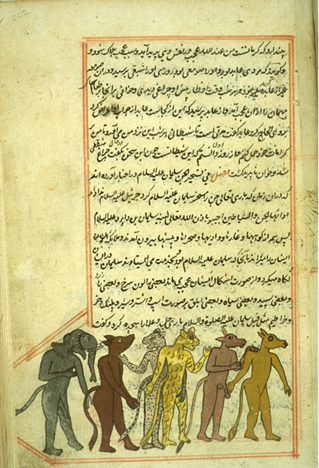
Figure 2: Six animal-headed demons or jinns, from ‛Ajā’ib al-makhlūqāt va-gharā’ib al-mawjūdāt (Marvels of Things Created and Miraculous Aspects of Things Existing), Zakarīyā al-Qazvīnī (d. 1283/682). The copy was made in 1537/944, probably in western India. Neither the copyist nor illustrator is named. accessed via www.nlm.nih.gov/hmd/arabic/natural_hist3.html (The Islamic Medical Manuscripts at the National Library of Medicine)

Theorizing the development of genre filmmaking in the history of Iranian cinema remains a desideratum, not least the horror genre, which had not gained popularity in Iran until more recently. Among the various genres that populate Iranian commercial cinema such as comedies, crime thrillers or melodramas, there is a paucity of examples of the horror genre and in the history of Iranian cinema more broadly. Indeed, a small number of horror films had been made in Iran in the Pahlavi era and in the post-revolutionary period under the Islamic Republic. However, as I will demonstrate, examples of films coded with horror elements and conventions may retrospectively be read in films which were not formerly regarded as encoded with formal or narrative features of horror. Finally, I will argue that there is a burgeoning of Iranian horror films after the 2009 failed protest movement in Iran (the so-called Green Movement), that may be termed, New Iranian Horror, which includes examples of transnational or diasporic horror films, that deploy the horror genre as a way to critique the socio-political conditions of post-2009 Iranian society.

There is no theorization of horror films in Iran and no academic studies of the history of Iranian horror cinema have ever been written, since most scholars of Iranian cinema consider that the horror genre never found a foothold among Iranian filmmakers for various reasons. Among the reasons often provided for the shortage of horror films in Iran is censorship, or that it is “partly due to the infamous censorship rules.”9Farhang Erfani, Iranian Cinema and Philosophy: Shooting Truth (New York: Palgrave Macmillan, 2011), 7. However, the censorship rules that scholars often refer to were instituted after the 1979 Iranian Revolution, and although censorship existed in the Pahlavi era, it does not explain the paucity of horror films in the pre- and postrevolutionary era. Some Western scholars have even erroneously claimed that since “Iranian horror films are subject to censorship in the country,” they “are consequently an exilic or diasporic phenomenon.”10Terri Ginsberg and ‎Chris Lippard, Historical Dictionary of Middle Eastern Cinema (London: Rowman & Littlefied, 2020), 212. This mistaken view is partly due to the fact that many of the horror films made in Iran were part of Iran’s commercial cinema and were never seen outside Iran, and those Iranian films that were seen outside Iran were prestige art house films or New Wave films sent for competition to International Film Festivals, both in the pre and post-revolutionary period. Hamid Naficy theorizes that the underdevelopment of the horror genre in Iranian cinema is due to cultural schemata that are specific to Iran such as the logic of ‘ritual courtesy’ (taʻāruf):

It seems the case also that the absence of certain film genres in a culture may be explained by the unacceptable violation of cultural schemas that these genres produce. One reason for the underdevelopment of the horror genre in Iranian cinema, for example, may be sought in this genre’s violation of the etiquette of formal relationships between strangers dictated by the system of ritual courtesy, which requires control of emotions and display of ritual politeness. This system authorizes, even encourages, the display of certain emotions such as sadness but it prohibits behaviors such as frightening someone, rage, and graphic violence against women and children—which are the staples of the horror genre.11Hamid Naficy, The Making of Exile Cultures (University of Minnesota Press, 1993), 237.

Although Naficy’s theory that the underdevelopment of the horror genre is the result of cultural schemas such as its contravention of the system of ritual courtesy operative in Iranian culture is largely apt, yet I would suggest that a more unconscious dimension is operative and hence a psychoanalytic reading of Iranian society and horror cinema provides a unique theoretical lens for understanding the early underdevelopment of this genre in Iranian cinema, and its recent renaissance. Indeed, the horror genre is the site of what is repressed within the psyche and brings out the repressed content to the surface and exposes it. The horror genre is the privileged domain of psychoanalytic film theory, especially due to the genre’s relation to the unconscious, to Freud’s concept of the uncanny (unheimlich) (meaning ‘unhomely’ in the original German), and to the logic of repressed desire or the return of the repressed. There is a correlation between Iranian society as a ‘repressed’ society and a lack of horror in the development of Iranian horror; but since horror cinema is often the site of the ‘return of the repressed,’ the rise in popularity of the horror genre in contemporary Iranian cinema therefore signals the emergence of the return of the repressed, especially as the unconscious fears, anxieties, deadlocks, antagonisms and contradictions in Iranian society and psyche are brought to the surface and exposed in these films.

Besides the problematic of defining and discussing horror in the history of Iranian cinema, scholars have long acknowledged that the horror genre itself is notoriously difficult to define and conceptualize, not least because “genres are never fixed.”12Brigid Cherry, Horror (New York: Routledge, 2009), 2. Indeed, throughout the long history of film, conceptualizing horror has posed a problem not only in Hollywood cinema, but in global cinematic traditions. Mark Jancovich has pointed to several problems in the history of the theorization of horror, given that many of the films that were included in academic histories of horror were not originally conceived, produced, or received as horror films, and were “defined as horror only retrospectively.” Indeed, Jancovich notes that there is often a slippage between the term horror and terms such as fantasy, the Gothic, and the tale of terror,” which are terms that are not “commensurate with one another but through which differences can be elided.”13Mark Jancovich, “General Introduction,” Horror, the Film Reader (London: Routledge, 2001), 7-8. This slippage between seemingly incommensurate terms such as fantasy, Gothic, and tale of terror, “highlight a problem about generic definitions.” For example, in these histories the work of silent filmmakers such as Georges Méliès were retrospectively viewed as horror, although “it is not at all clear that these films were originally understood as horror films.”14Jancovich, “General Introduction,” 7. Similarly, films that today may not be thought of as horror were originally produced and marketed as horror films at the time of their release. As Brigid Cherry puts it, “deciding on a classification as to what film (or kind of film) is (or isn’t) a horror film” is not “straightforward,” and “what might be classed as the essential conventions of horror to one generation may be very different to the next…”15Cherry, Horror, 2. In this sense, the Freudian concept of ‘retroactivity’ (Nachträglichkeit) (developed by Freud in Studies in Hysteria and the Entwurf, and later in the “Wolf-Man case) as a form of recursive temporality in which an event in the past only becomes traumatic retroactively may be a useful concept here, since it signals a belated understanding or retroactive attribution of horror elements to earlier films that were not regarded as horror or containing elements of horror originally.

In the first Pahlavi era (1925-1941) American and European horror imports dominated the cinemas, with no indigenous productions of Iranian horror films. Indeed, there was state resistance to the screening of American horror films, as well as resistance from modernist intellectuals at the time who deemed horror films a corrupting influence on children and youth and as a source of moral corruption in society.16Jamal Omid, Tarikh-i Cinema-yi Iran: 1279–1357 (Tehran, Iran: Intisharat-i Ruzanah, 1998), 99. See also, Hamid Naficy, A Social History of Iranian Cinema, Volume 1: The Artisanal Era, 1897-1941 (Duke University Press, 2011), 246. Iranian intellectuals were caught in a paradoxical predicament since they wanted to introduce Western media into Iranian society as soon as possible, but they also opposed action and horror films, arguing that European and American horror films were produced for the lower classes and “did not answer Iran’s needs, but would rather pose a threat to the progress and reform of Iranian society.”17Bianca Devos, “Engineering a Modern Society? Adoptions of New Technologies in Early Pahlavi Iran,” in Culture and Cultural Politics Under Reza Shah: The Pahlavi State, New Bourgeoisie and the Creation of a Modern Society in Iran, ed. Bianca Devos and Christoph Werner (New York: Routledge, 2014), 276. Indeed, modernist authors and intellectuals “agreed that, above all, horror films could bring mental harm to young spectators.”18Devos, “Engineering a Modern Society?” 276. In this way both the state and modernists agreed as to the pernicious effects of horror films on young minds and on society at large and this did not only limit the import of horror films from America and Europe but may be one of the reasons for the lack of Iranian horror productions during this period.

By the middle of the second Pahlavi era (1941-1979) two types of filmic productions became dominant in Iran: an Iranian commercial cinema called filmfarsi and an art house movement called the Iranian New Wave (mauj-i naw). The first was the popular commercial cinema pejoratively called filmfarsi (Persian film) by critics, consisting mostly of stew-pot melodramas (ābgūshtī) or tough-guy films (lūtī or jāhilī), largely song and dance films or melodramas influenced by Hollywood, Egyptian and Bollywood Indian films. The second was art cinema or the Iranian New Wave (mauj-i naw) that developed at the end of the 1960s and the 1970s as a reaction to the earlier filmfarsi films and which was influenced by the aesthetics of Italian Neorealism, with rural settings, non-professional actors, and often with a subversive critique of socio-economic conditions and the political climate of the Pahlavi regime.

Although it is generally noted among scholars of Iranian cinema that the horror genre never gained traction in the history of the development of cinema in Iran, nonetheless elements of horror were present in individual films within Iran’s commercial cinema early on, largely beginning in the second Pahlavi era. Among the most important filmmakers during this period whose name is indelibly linked with crime thrillers—especially inflected through the influence of German expressionist cinema, film noir and Alfred Hitchcock—is the Armenian-Iranian Samuel Khachikian (1923-2001). Indeed, Khachikian, dubbed the Iranian Hitchcock, was the first filmmaker in the history of Iranian cinema to terrify audiences with his crime thrillers, imbued as they were with a sense of mystery, fear, and suspense. Khachikian’s contribution to the genre was not simply to develop expressionist and noir techniques in his thrillers with an unmistakable Iranian stamp but to simultaneously deploy formal codes of the horror genre in several of his films.

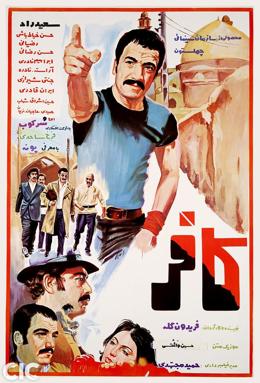
Among his films that may be seen inflected with generic codes and conventions of horror is Anxiety also known as Horror (Dilhurah, 1962) and Delirium (Sarsām, 1965), including the highly popular hybrid subgenre comedy-horror film, A Party in Hell (Shabʹnishīnī dar jahanam, 1956). It is the story of a loan shark Haji Agha, who spends a night in hell, and encounters several literary, cinematic, and historical figures, including Hitler. The film may be considered as a “Persianized take on Dickens’s A Christmas Carol.”19Abbas Amanat, Iran: A Modern History (New Haven & London: Yale University Press, 2017). Another film that is worth mentioning in the context of horror is Khachikian’s Zarbat (Strike, 1964), which, although it is ostensibly a crime thriller—the mise-en-scène in which, especially the low-key and chiaroscuro lighting in the film—often evokes elements of gothic horror and German expressionism by way of film noir. Indeed, in Khachikian’s noir cycle, comprised of Delirium, Anxiety, and Strom in Our City (1964), the home and domestic interiors are encoded with horror motifs drawn from the gothic universe that “evoke the uncanny of psychological horror while still providing a setting for the professional activities of criminal gangs and detectives.”20Kaveh Askari, Relaying Cinema in Midcentury Iran (California: University of California Press, 2022), 151. It may be said that Khachikian’s combination of film noir with horror elements at once brings to the surface the societal repressed (film noir) and what is repressed within the psyche (horror genre).
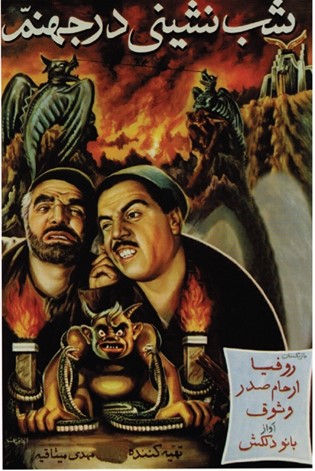
Figure 3: Poster for the film Shab’nishīnī dar jahanam (A Party in Hell, 1956)

Recently Khachikian’s crime cinematic universe has been recognized to be coded with elements of the horror genre by Laura Fish, who reads Khachikian’s crime thrillers in a comparative context with Edger Allen Poe’s gothic tales, a felicitous choice since Poe was effectively the inventor of the detective story or crime genre. Fish reads Poe’s tales and Khachikian’s crime thrillers by looking at the presence or absence of a corpse “as a critical device inciting the horror logic that hinges on the centralization and devolution of female characters.” Deploying Freud’s psychoanalytic concept of the uncanny and Julia Kristeva’s concept of abjection in relation to the present or missing corpse, Fish “positions Khachikian’s production of horror as a gendered process of feminine descent into madness and eventual masculine salvation.”21Laura Fish, “The Disappearing Body: Poe and the Logics of Iranian Horror Films.” Poe Studies 53 (2020): 88. In this reading these films become invested with psychological horror, especially in the way in which horror stages the dynamics of gender and sexuality in the psyche and in society. Khachikian’s comparison to Poe is certainly apt, yet Hitchcock would seem to be a more exact comparison apropos the logic of the corpse, as Hitchcock himself states in a humorous turn, “If I was making ‘Cinderella,’ everyone would look for the corpse. And if Edgar Allan Poe had written ‘Sleeping Beauty,’ one would look for the murderer.”22Hitchcock On Hitchcock: Selected Writings and Interviews, ed. Sidney Gottlieb (California: University of California Press, 1995), 145.
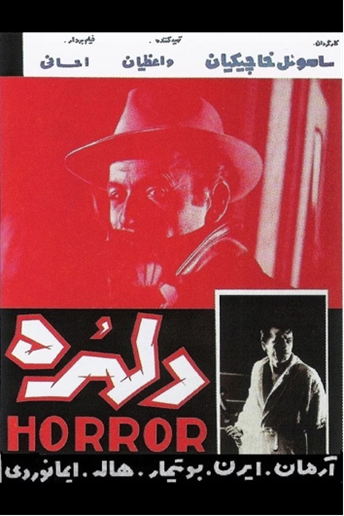
Figure 4: Poster for the film Dilhurah (Horror, 1962)

Several commercial horror films were made during the second Pahlavi era such as vampire and supernatural ghost films, mostly B-movies that were unsuccessful with audiences of the time, and although influenced by Euro-American horror and Gothic genres, nevertheless had an indelibly local flavor. B-horror vampire films were not unknown in the second Pahlavi era, and one of the first examples of vampire cinema in Iran is the largely derivative commercial film, Zan-i khūn āshām (The Female Vampire; 1967) directed by Mustafa Usku’i, which had a female lead as a vampire.23Mehrabi, Tarikh-i sinima-yi Iran, 120. Among examples of commercial supernatural ghost films is the horror-comedy Intiqām-i Rūh (Revenge of the Ghost; 1962) directed by Esmail Koushan (1917-1983)—one of the pioneering figures of Iranian cinema—around  the same period. The film is about a wealthy man with a young son who is murdered by his brother so that the latter can possess his riches. After his murder, his son becomes homeless and his ghost vows to take revenge against his cruel brother and to haunt the mansion until he finally rediscovers his son and exacts revenge. The film was influenced by the aesthetics of Khachikian’s films and is coded with Gothic tropes and expressionist techniques and is an example of commercial Iranian horror genre of the period.24On the films and place of Esmail Koushan in the history of Iranian cinema see Nima Hassani-Nasab, “A Hollywooder in the Land of Persia,” trans. Philip Grant, Underline: A Quarterly Arts Magazine 2 (February 2018): 94-9.
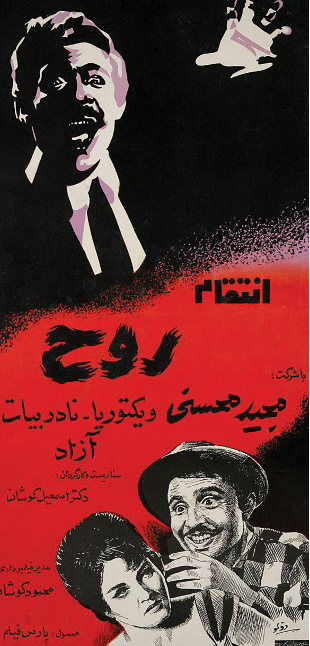
Figure 5: Poster for the film Intiqām-i Rūh (Revenge of the Ghost, 1962)

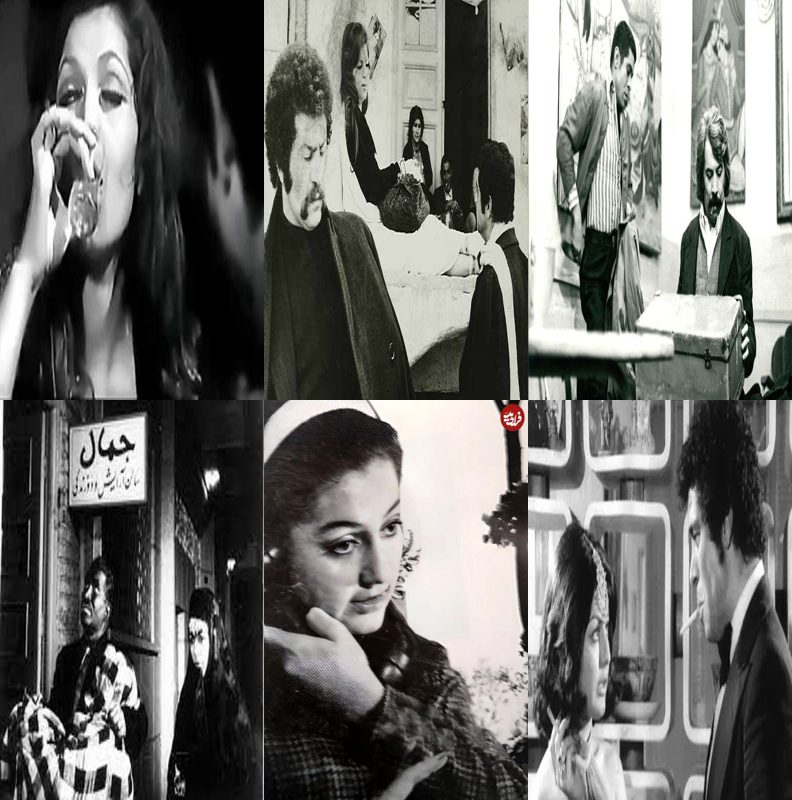
The logic of horror articulated by Fish apropos the presence or absence of a corpse in Khachikian’s crime thrillers appears in other films during the same period. Indeed, this dialectic of the absence and presence of a corpse is also operative in Farrokh Ghaffari’s early precursor to the Iranian New Wave, Shab-i qūzī (Night of the Hunchback; 1963), based on a story from the Thousand and One Nights. The film is a “dark comedy” containing expressionist elements “about a hunchback in a team of entertainers, who dies in a farcical accident, and his dead body is passed around from person to person.”25Michele Epinette, “ḠAFFĀRI, FARROḴ,” Encyclopædia Iranica, online edition, 2015, available at www.iranicaonline.org/articles/gaffari-farrok (accessed on 05 October 2015). The problematic of how to get rid of the corpse, which appears and disappears throughout the film, functions similarly to the corpse in Alfred Hitchcok’s The Trouble with Harry (1955). Ghaffari’s film not only “reveals the corruption, hypocrisy, and fear in the different classes of Tehran society…”26Epinette, “ḠAFFĀRI, FARROḴ.” at the time, but especially the unconscious fear and anxiety in a society where critics and dissidents of the State feared the Shah’s secret police, SAVAK.

Figure 6: Poster for the film Shab-i qūzī (Night of the Hunchback, 1963)

Although a large number of horror films or horror inflected films were part of the commercial filmfarsi, there are also examples of New Wave films that contained elements of horror, or that may be read retroactively as coded with certain narrative or formal features of horror. Among these art films that may be read retroactively as coded with elements of horror—particularly in their formal features—is Mohammad Reza Aslani’s magnificent Shatranj-i bād (Chess Game of the Wind; 1976), which was recently rediscovered and restored. The film has Gothic and expressionist motifs and is about the saga of the declining fortunes of a Qajar family—like Luchino Visconti’s familial epic The Leopard (1963)—at the centre of which is again a corpse, hidden in a cellar. All the interior shots of the film were lighted solely by candles and exemplify a masterful command of expressionist cinematography and chiaroscuro lighting by the great Iranian cinematographer Houshang Baharlou. Although the interior lighting evokes Stanley Kubrick’s similarly candle-lit interiors in Berry Lyndon (1975), Aslani has cited the works of the French Baroque painter Georges de La Tour (d. 1652), and especially the late nineteenth- and early twentieth-century painter and poet Mahmoud Khan-i Saba (aka Malek-o-Shoara), whose expressionist painting Estensakh (Transcription) was an inspiration for the candle lighting of the interior scenes.

Figure 7: Istinsākh (Transcription) by Mahmūd Khān-i Malik al-Shu‛arā. accessed via https://commons.wikimedia.org/wiki/File:Estensakh_by_Mahmoud_Khan_Malek-o-Shoara.jpg

Figure 8: A still from Shatranj-i bād (Chess Game of the Wind, 1976). Muhammad Rizā Aslānī, accessed via https://www.youtube.com/watch?v=4r69Wa06u1E

Another New Wave film that may be read retroactively as coded with narrative and formal elements of horror, especially through expressionist lighting techniques, is Bahman Farmanara’s Shāzdah Ehtejab (The Prince Ehtejab; 1974) based on the 1969 story of the same name by Houshang Golshiri. The story is about the eponymous Qajar prince who is dying from tuberculosis. The film uses techniques of flashback and flashforward and real photographs of Qajar monarchs and their descendants to evoke a dead yet spectral past that still haunts the present. The eponymous prince, who harbours a sense of guilt from the cruelty of his ancestors’ misdeeds, is visited by ghostly apparitions of his father and grandfather who castigate him for not following in their footsteps of despotism and cruelty. It is as if “Ehtejab’s tuberculosis comes to synecdochically embody not just the fate of the aristocracy in modernity, but also the degradation of time as such, which the cinema has the unique capacity to arrest, preserve, and set back in motion.”27Pardis Dabashi, “The Art of the High-Born: A Look Back at Bahman Farmanara’s Shazdeh Ehtejab”, Politics / Letters, September 17, 2018, http://quarterly.politicsslashletters.org/the-art-of-the-high-born-a-look-back-at-bahman-farmanaras-shazdeh-ehtejab/ (accessed on 10 September, 2022). In this sense, Farmanara’s film at once evokes the medium of cinema as a purveyor of ghosts, the long dead who exist or persist only through the cinematic apparatus; and those in power or the elite, who eventually become the ghosts of history, and are reanimated as specters through the moving-image—the cinema. In this connection, even Jacques Derrida draws a link between psychoanalysis, spectrality and the cinema stating, “The cinematic experience belongs thoroughly to spectrality, which I link to all that has been said about the specter in psychoanalysis—or to the very nature of the trace.”28Antoine de Baecque and Thierry Jousse, “Cinema and Its Ghosts: An Interview with Jacques Derrida,” trans. Peggy Kamuf, Discourse 37, 1–2 (Winter/Spring 2015), 26. For Derrida, not only psychoanalysis, and psychoanalytic reading “is at home at the movies,”29De Baecque and Jousse, “Cinema and Its Ghosts,” 26. but “the projected film,… is itself a ghost.”30De Baecque and Jousse, “Cinema and Its Ghosts,” 27.

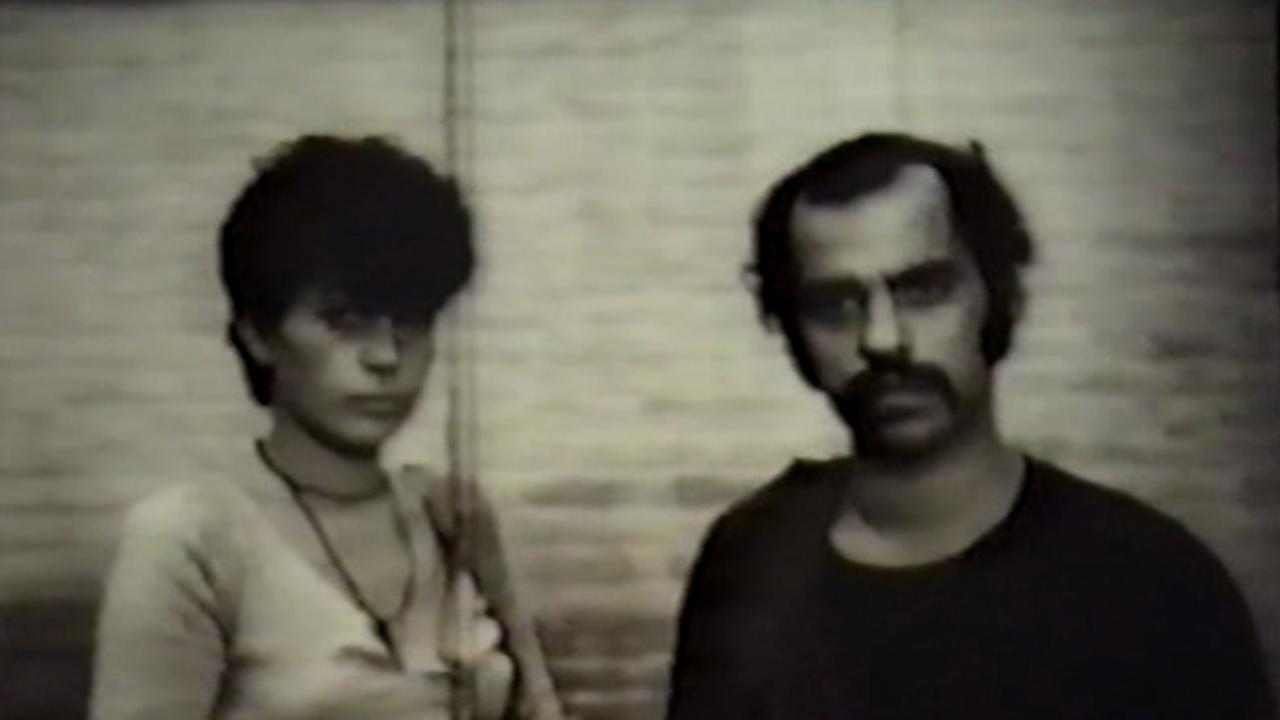
Perhaps one of the most important New Wave horror films of the pre-revolutionary era is Bahman Farmanara’s remarkable, Sāyahā-yi buland-i bād (Tall Shadows of the Wind; 1979). The film is based on a short story by Houshang Golshiri called “First Innocent,” and represents their second collaboration together after Prince Ehtejab (1974). The film centres on mysterious and supernatural events that take place in an unnamed village, metaphorically representing Iran. In a village, a group of superstitious inhabitants, who had erected a scarecrow clad in a black robe for protection are subsequentially terrorized by it and begin to believe in the supernatural powers of the scarecrow, and eventually worship it as a redeemer. The only people who do not believe in the supernatural power of the scarecrow is the main character, a bus driver named Abdullah and the village teacher. The film was made just before the 1979 revolution and deployed the codes and conventions of psychological horror and folk-horror, as a critique of the Pahlavi monarchy. The film was banned first by the Shah’s regime and later by Khomeini and the Islamic Republic. This is to be expected, as the film does not only represent a critique of the ruling political ideology of the Shah but also Shi’ite religious authority (clergy) and the belief in the expected Shi’ite savoir or the Twelfth Imam. In this sense, the figure of the scarecrow stands at once for religious (Shi’ite) and political authority (the Pahlavi State). Indeed, the films critique has a Marxist or communist revolutionary dimension, as Golshiri was a member of the Tudeh Party (Iranian communist party) for a short period, for which he was arrested and imprisoned for six months in 1962.31Mirʿābedini Ḥ. and EIr, Hušang Golširi [in:] Encyclopædia Iranica, vol. XI, fasc. 2, 114–118, www.iranicaonline.org/articles/golsiri-husang (accessed January 11, 2023). In the film the teacher of the village represents the Iranian intellectual and Abdullah, stands for the proletariat or the working class. In one of the last scenes of the film, this revolutionary dimension comes to the fore, as there is a powerful and surreal dream sequence in which Abdullah dreams that he and large group of villagers are donned in red clothing, and holding red flags and banners attack the black-clad scarecrows in the field and set them on fire.

Figure 9: Poster for the film Sāyahā-yi buland-i bād (Tall Shadows of the Wind, 1979)

Among the Iranian New Wave films that can retroactively be read as containing elements of the horror genre broadly construed is Darioush Mehrjui’s Gav (The Cow; 1969), which blends neo-Gothic and expressionist elements with Italian neo-realism. The film’s story stages the mental deterioration of the farmer Masht Hassan (Ezzatolah Entezami), who after learning that his beloved bovine has died, slowly descends into madness and culminates by identifying with his cow. The film was based on a short story by the Marxist psychiatrist Gholam-Hossein Saedi (1936-1985), and has been variously interpreted in light of Iranian folklore, metempsychosis, etc. However, the film is open to a psychoanalytic reading, especially as exemplifying the structure of fetishism. Sigmund Freud famously considered that the “return of the repressed,” the repressed truth of a traumatic event, can appear either as symptom, or as fetish. A fetish is in a way the obverse of the symptom. If the symptom is the excess that perturbs the façade of false appearances, “the point at which the repressed Other Scene erupts, [then] the fetish is the embodiment of the Lie that enables the subject to sustain the unbearable truth.”32Slavoj Žižek, Enjoy Your Symptom! (London and New York: Routledge, 2008), x. Indeed, the cow functions as a perfect fetish for Masht Hassan, whose loss is so catastrophic that to recuperate the lost fetish he ultimately sacrifices his sanity and identifies with it. The cow as fetish enabled Masht Hassan to cope with his everyday existing reality by repressing the traumatic truth of the socio-political deadlock of the Pahlavi State, and the threatening and paranoiac atmosphere created by its secret police (SAVAK), symbolized in the mysterious and menacing figures of the Crystallines (Boluriha). This inaugural film of the Iranian New Wave has certain resonances and correspondences with aspects of New Iranian Horror films of post-2009 (see below), especially in its critique of authoritarian politics and the subsequent pervasive fear and anxiety in society.
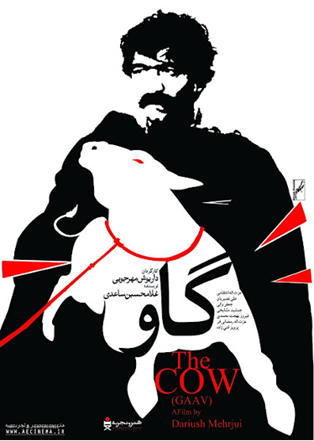
Figure 10: Poster for the film Gāv (The Cow, 1969)

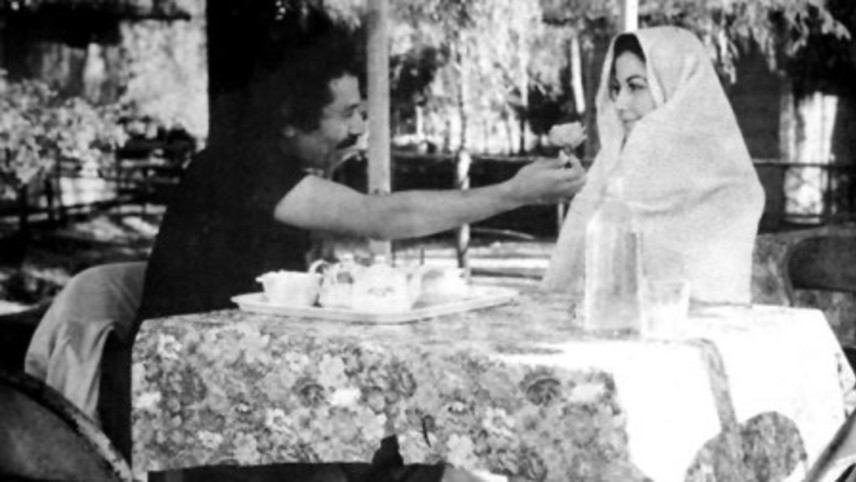
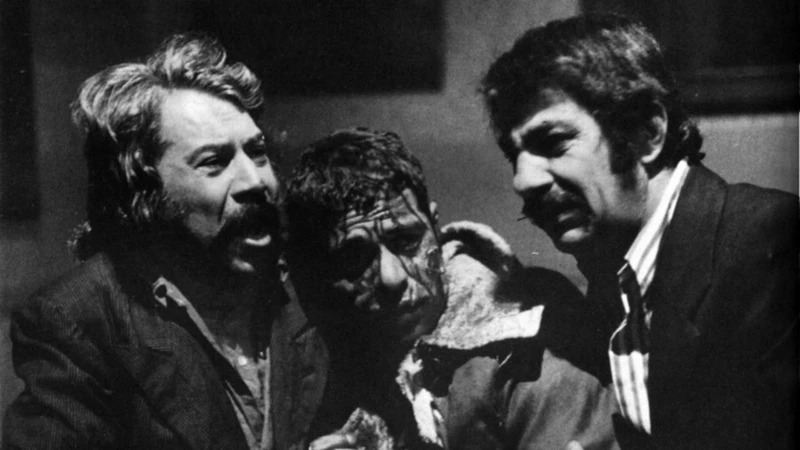
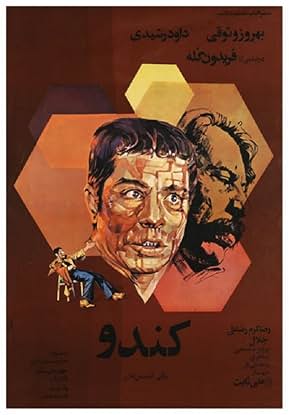
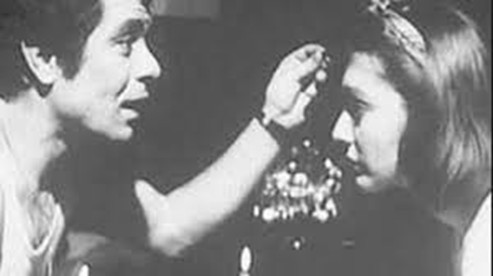
A New Wave film that didn’t simply contain elements of the horror genre but may be considered more fully as an example of art-house horror is the banned Malakūt (Heavenly Kingdom; 1976) by Khosrow Haritash, based on a 1961 novella of the same name by Bahram Sadeqi (1937-1985), and with Behrouz Vossoughi, perhaps one of the most famous actors of the pre-revolutionary era, in the lead role. The film centers on the figure of Mr. Maveddat who suddenly falls ill during a party in his garden and requires treatment. He is then taken to see a doctor called Dr. Hatam for treatment and is introduced to a mysterious man by the name of M. L., who has had parts of his body cut off over several years, and who has come to remove his last remaining limb, namely his hand. It is slowly revealed that Dr. Hatam harbours dark secrets and has killed all his pupils and previous spouses with a lethal injection—an injection that promises a long life full of earthly pleasures. In the end Dr. Hatam injects several people, including M. L. (Mr. Maveddat has cancer and will die soon regardless), and informs them that they will all die in a week. Dr. Hatam then goes to another city and begins anew his sinister plan.33See Saeed Honarmand, “MALAKUT,” Encyclopædia Iranica, online edition, 2011, available at www.iranicaonline.org/articles/malakut (accessed on 16 October, 2017).
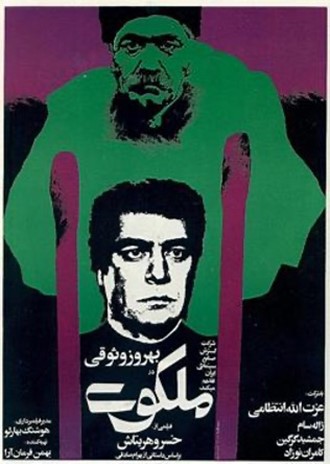
Figure 11: Poster for the film Malakūt (Heavenly Kingdom, 1976)

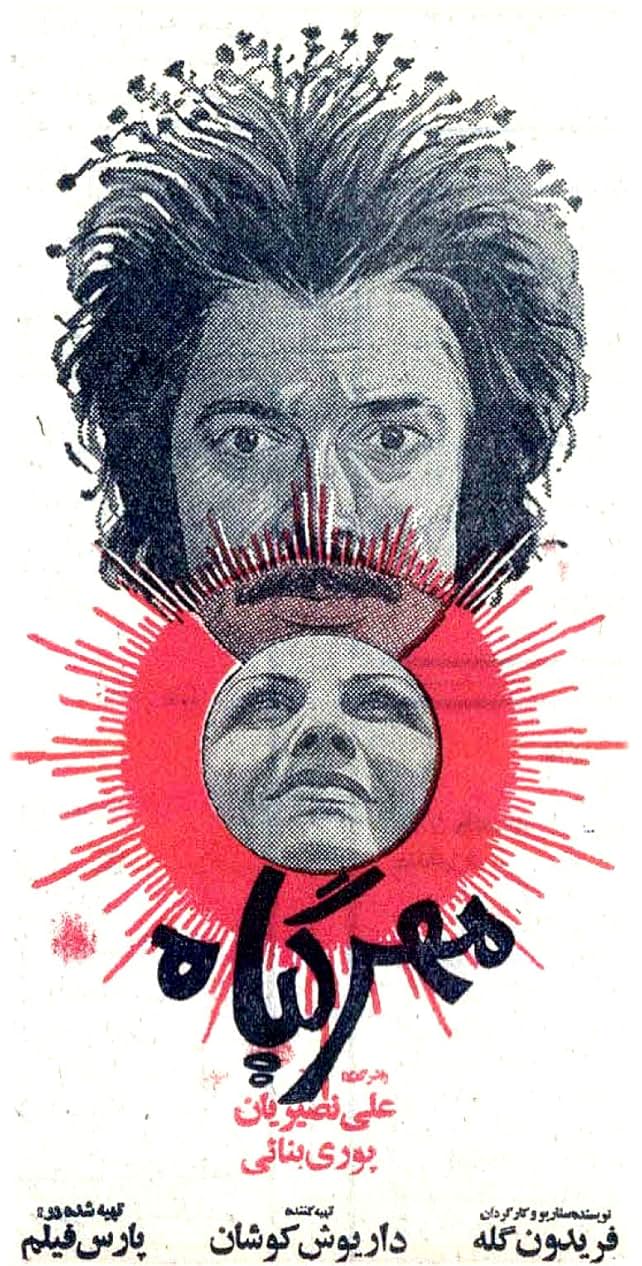
Although ghostly and spectral figures at times appear in the New Wave cinema of Bahram Beyzaie—mostly drawn from Iranian mythological and epic sources such as Ferdowsi’s Shāhnāmah, or other texts such as the Memorial of Zarir, to name a few—his cinema has never been associated with horror. However, certain aspects of his films may be read retroactively as coded with elements of horror. For example, Beyzaie’s mysterious Gharībah va mih (The Stranger and the Fog; 1974), although permeated with mythological motifs, may retroactively be theorized and stylistically categorized as an instance of Iranian folk horror. Folk horror has been notoriously difficult to define among genre theorists, but Adam Scovell in his study Folk Horror: Hours Dreadful and Things Strange, provides one of the better definitions. In his book, Scovell offers an intriguing theorization in which narrative folk horror may manifest in cinema through what he terms “The Folk Horror Chain.”34Adam Scovell, Folk Horror: Hours Dreadful and Things Strange (UK: Auteur, 2017), 15. The folk horror chain is a “causational narrative theory” that consists of four rules or chains, with each link leading to the subsequent link in the chain. The four chains are: 1) a rural location or landscape; 2) isolation or isolated communities and groups; 3) skewed belief systems or morals; and 4) happening/summoning, usually through violent or supernatural methods.35Scovell, 17-19. The logic here is that a folk horror film must first be set in a rural setting, in a village, or in the countryside, where the landscape itself functions as a character in the story and contributes to the film’s formal style, evoking an atmosphere that is at times uncanny, surreal, or haunted. The Stranger and the Fog fulfils this requirement since the logic of rurality is operative in the film, it has a rural setting by the sea that establishes an important relation between the land or the earth (represented by Ra’na)—as well as between the sea or water (represented by Ayat)—, and the landscape creates a sense of surreality and the uncanny. The second category in the chain is that of isolated locations, and since in most folk horror the characters are isolated and cut off from any aspect of urban life, Beyzaie’e film again fits well into the second chain of folk horror, because the villagers in the film are completely severed from urban civilization and seem to exist as it were in mythic or primordial time. The third chain in the link, that of skewed belief systems or morals, suggests that characters in folk horror often have beliefs, rituals, and customs that are strange or alien to our modern sensibility, or to the dominant culture or religion. This logic is also operative in Stranger and the Fog, for the viewer of the film may find the rituals, customs, and practices of the village community strange, backward, or dangerous from their modern perspective. For instance, the custom in which Ayat must become part of the community by marrying one of the female villagers if he wishes to stay, or the ritual mourning performed in the beginning and end of the film, such as the final ritual mourning ceremony as Ayat goes back into the sea on the boat. Finally, as part of the fourth link in the chain, a violent or supernatural happening is also manifested in the film through the appearance of strangers who, like an otherworldly force, attack the villagers in the film’s final act. In this sense, Beyzaie’s The Stranger and the Fog may be considered the first folk horror film in the history of Iranian cinema.36Hamid Naficy has noticed elements of ‘horror’ in Stranger and the Fog, although not folk horror. He writes: “In Baizai’s Stranger and the Fog… the strangers’ entry into the primordial village follows the formula of American horror movies in the 1980s, in which a monster disturbs the stability and tranquility of a community and must be eradicated to return it to normal.” Naficy, A Social History of Iranian Cinema Vol. 2, 344.

Figure 12: Poster for the film Gharībah va mih (The Stranger and the Fog, 1974)

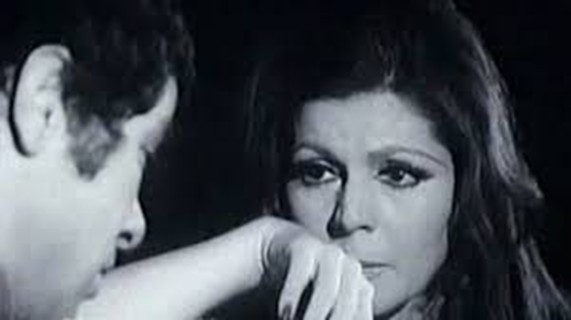
In the first two decades after the 1979 Revolution, two types of horror films may again be distinguished: on the one hand, lower quality productions, usually commercial horror films catered to Iranian audiences and not meant to be exported or seen outside Iran; and, on the other, higher quality films that aspired to be art films competing in international film festivals. Among the few pioneering higher quality horror films in the first decade of the post-revolutionary period that should be mentioned is Dariush Farhang’s Gothic Tilism (The Spell; 1988), starring the magnetic Susan Taslimi in her final role in Iran. The film is a Gothic tale set in nineteenth century (Qajar) Iran where the carriage of a newlywed couple breaks down during a storm, forcing them to seek refuge in a haunted mansion. As Fretting Botting states, Gothic atmospheres signal “the disturbing return of pasts upon presents”—elaborating that “in the twentieth century, in diverse and ambiguous ways, Gothic figures have continued to shadow the progress of modernity with counternarratives displaying the underside of enlightenment and humanist values.”37Fred Botting, Gothic (London and New York: Routledge, 1996), 1–2. In this Iranian Gothic film, the past that returns and haunts the present is one of the cruelties of Qajar kings that metaphorically stands for the atrocities of the clerics in the Islamic Republic. Among the commercial horror films of this period Hamid Rakhshani’s Shab-i bīst o nuhum (The 29th Night; 1989/1990) should be mentioned, which tells the story of a married couple Mohtaram and Haj Esmail. The film depicts an evil female spirit named Atefeh who haunts the mind of Mohtaram. The evil female spirit in the film—called Āl, a supernatural creature in Iranian folklore that personifies perpetual fever, and one that has been described as a child-stealing witch or demon38A. Shamlu and J. R. Russell, “ĀL,” Encyclopædia Iranica, Vol. I, Fasc. 7, 741-42, accessed September 12, 2015, www.iranicaonline.org/articles/al-folkloric-being-that-personifies-puerperal-fever—appears as a nocturnal chador-clad figure in dark silhouette atop the roof of Hossein’s home. The film deploys Iranian folklore, the supernatural and occult motifs, and an arsenal of horror genre conventions to terrify its audiences. It was immensely popular among young Iranian audiences at the time and demonstrated a growing appetite for horror film productions.

Figure 13: Poster for the film Tilism (The Spell, 1988)

During this period, Islamicate folklore, the supernatural, and occult motifs were deployed more consistently as source material for horror films in Iran; and since some of this material was related to what is often termed “women’s Islam,” they provided ready material for exploration of horror themes. One example of horror genre films made in this vein is Mohammad Hoessein Latifi’s successful Khābgah-i dukhtarān (Girl’s Dormitory, 2004). The film deploys “popular Muslim beliefs and practices where a young woman becomes the target of a crazed killer claiming to be under the command of the jinn.”39Pedram Partovi, “Girls’ Dormitory: Women’s Islam and Iranian Horror,” Visual Anthropology Review 25, 2 (2009): 186–207. Pedram Partovi provides an excellent reading of the film and argues that the theological and legal difficulties facing the film were sidestepped by associating such “superstitious” beliefs (such as jinn and possession) with women, and thereby continuing the discourse on “the pivotal and deleterious female role in their practice and promotion.” As Partovi notes, such folk beliefs, though they may have accounted for the popularity of the film among female audiences, what Girls’ Dormitory also provided was a novel and satisfying form of female representation and identification that appealed to female audiences at the time, since it depicted “…its young female hero engaging with the visible and invisible barriers to individual and familial prosperity”40Partovi, “Girls’ Dormitory,” 187. in Iran at the time.

New Iranian Horror (Mauj-i naw-yi vahshat)

A new group of horror films have emerged in the aftermath of the 2009 presidential election of Mahmoud Ahmadinejad which spawned mass protests in Tehran. These films deploy certain conventions of the horror genre as a politically subversive critique of the claustrophobic, terrifying, and paranoiac atmosphere of post-2009 Iranian society. Due to the censorship restrictions imposed on Iranian filmmakers, especially in the depiction of violence, blood, gore, and various other elements that are the staples of horror, filmmakers have had to creatively work around these restrictions while seeking to produce horror films. I have theorized the emergence of a band of horror films or horror inflected films that are structured around what I call the Uncanny Between the Weird and the Eerie, since staging horrific and terrifying scenes cannot directly be shown on screen.41Farshid Kazemi, “Interpreter of Desires: Iranian Cinema and Psychoanalysis” (PhD diss., University of Edinburgh, 2019), 186-226. The prestige horror films coming out of Iran and their transnational or diasporic counterparts in the past decade or so may be considered as having inaugurated what can be called New Iranian Horror. I draw a theoretical short-circuit or correlation between the two modes of the weird and the eerie (as theorized by Mark Fisher) to literary terms found in Perso-Arabic literature, particularly in texts such as the One Thousand and One Nights (Alf layla wa-layla) called ‘ajīb va gharīb (‘ajib, lit. meaning wondrous, marvellous or amazing; and gharīb, meaning, strange or weird). It should be recalled that there is no doubt that the translation of the One Thousand and One Nights into French by Antoine Galland in the period spanning 1704-1717 immensely influenced Euro-American literature, and especially the Gothic genre—not to mention the works of Edgar Allen Poe—all of which contained much of the themes and motifs that appeared in the Nights. And it is in the Gothic genre that we have the origins of the vampire and of vampire cinema itself.

What distinguishes and characterizes the films of this new filmic horror renaissance that I have theorized through the two modes of the weird and the eerie is their evocation of the menacing environment of post-2009 Iran (which includes diasporic or exilic films) and several thematics that they commonly share. For example, among the various components shared by this movement are such motifs as political and ideological critique through the deployment of supernatural elements or occult phenomena (the devil/satan, vampires, jinn, Āl and zār, etc.). They also touch on such taboo subjects as (female and male) sex/sexuality, homosexuality, or queerness in Iran. They are often pervaded by doubles or doppelgängers (ham-zad, in Persian), dreamlike worlds, nightmarish landscapes, paranoid and menacing atmospheres, invisible threatening forces, and a sense of pervading fear, terror, or of impending doom. Some of these thematics appear in the films’ form or style which shares certain formal features with the universe of German expressionism and film noir, and that includes such techniques as contrast of light, dark, and shadows; the evoking of a sense of mystery, dread, existential angst, moral corruption and crime; these latter are evident especially in the films’ use of color, light, and darkness (low-key or chiaroscuro lighting); the mise-en-scène, setting, objects, and spaces; and camera techniques such as strange unbalanced (tilted) off-angle shots (Dutch angle) or oblique angle shots, long takes, extreme long takes, and even the entire film as a single take (especially in Shahram Mokri). The soundtrack or musical score of the films may also contain subversive Iranian underground music (Mokri’s Fish and Cat and Amripour’s A Girl Walks Home Alone at Night are emblematic in this respect). This is precisely why I consider these films as constitutive of a new movement, for beyond embodying the two modes of the weird and the eerie, they share a common set of motifs that evoke the menacing and suffocating atmosphere of post-2009 Iranian society.

Shahram Mokri’s Māhī va gurbah (Fish and Cat; 2013) may be said to have inaugurated the film movement that I have called the uncanny between the weird and the eerie, or the emerging New Iranian Horror. The film has been described by the director as an Iranian slasher,42In the following interview with Shahram Mokri in Persian, Mokri states that with Fish and Cat he intended to make a ‘slasher’ film and notes his interest and enthusiasm for slasher films. See “An Interview with Shahram Mokri,” www.youtube.com/watch?v=f7NtIyKWZ68 (accessed July 09, 2022). but it is a slasher without any slashing. Fish and Cat is formally innovative and is among a handful of films in the world to be shot in a single long take, such as Bela Tarr’s Macbeth (1982) and Alexander Sokurov’s Russian Ark (2002). The camera follows elliptically a number of students in the camp who have traveled to the Caspian region to participate in a kite-flying competition during the winter solstice. Nearby their camp is a small restaurant, whose three cooks seem to be serial killers using human meat for their restaurant. They are out on the hunt for new meat for their restaurant with plenty of students around to serve as the next meal. The film never actually shows a single murder, and throughout, the film is pervaded by an eerie sense of looming violence, a violence that always remains virtual but is never actualized on screen. The constant threat or virtuality of violence in the film creates a profound sense of terror and anxiety that metaphorically comments on the way Iranian society is under a constant threat of violence from state authority. This is the structure of symbolic authority as such, for, in order for it to “function as an effective authority, it has to remain not-fully-actualized, an eternal threat.”43Slavoj Žižek, Organs without Bodies: On Deleuze and Consequences (New York and London: Routledge, 2004), 4. This is precisely why the brief actualization of violence by the state in June 2009 in Tehran was so traumatic; but on the other hand, whenever the threat of symbolic authority passes from virtuality to actuality, the true impotence of its power is displayed. This is the moment of emancipatory consciousness, to see that beneath the façade of its power and authority: the “emperor has no clothes.” The circular temporal logic operative in the film has interestingly been read by Max Bledstein through the prism of taʻziyah—the dramatic passion play on the martyrdom of the third Shi’i Imam Hussein in Karbala, and his family. However, Mokri himself has cited the influence of the drawings of M.C. Escher on the circular temporality of the film as one single shot, stating “I wondered if it was possible to apply what Escher was doing in the medium of cinema, and create and impossible temporal perspective that occurs in one shot.”44[1]“The Time Bending Mysteries of Shahram Mokri,” www.youtube.com/watch?v=U6wfPMxdeRA (accessed July 09, 2022).
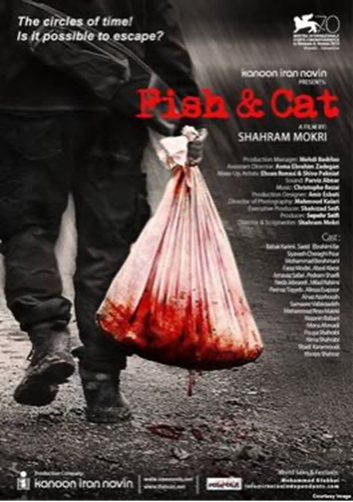
Figure 14: Poster for the film Māhī va gurbah (Fish and Cat, 2013)

Mokri’s next film, the postapocalyptic crime vampire film Hujūm (Invasion; 2017), also fits within the coordinates of the uncanny between the weird and eerie, and it continues his engagement with the horror genre. Contra Fish and Cat, “Mokri himself has acknowledged the influence of the ta’ziyeh on… Invasion (2017).”45Max Bledstein, “Allegories of Passion: Ta’ziyeh and the Allegorical Moment in Shahram Mokri’s Fish and Cat,” MONSTRUM 4 (October 2021), 106. Within the setting of a stadium engulfed in perpetual darkness, there are men with strange tattoos who are engaged in a sport that remains unseen and unnamed. After the discovery of a body in the stadium, the police have mysteriously already identified the murderer. There only remains the circumstances of the crime, which has to be reconstructed in order for the case to be put to rest. But it is here that the true killer and his teammates want to take advantage of the reconstruction to commit another murder—the would-be candidate the twin sister of the victim, who is thought to be a vampire. However, in the midst of the re-enactment of the murder, the team players forget their supposed roles, chaos ensues, and the characters are caught in an endless loop, in which events repeat themselves in slightly different ways. As the write-up for the film in the Berlinale states, “The disquieting feeling that time is dissolving, that past, present and future are becoming one and that history has been halted is likely to strike a chord with how many young Iranians feel about their lives. Shahram Mokri’s intimate drama ominously interweaves place, space and time in the stadium’s labyrinthine corridors to form a dark allegory.” In an interview for the film, Mokri himself relates the film’s threatening and nightmarish atmosphere to contemporary Iran, sating: “I think this movie, [has] the same atmosphere in Iran these days.”46“The Filmmakers @ KVIFF 2018: Interview with Shahram Mokri,” YouTube, Jul 7, 2018, www.youtube.com/watch?v=zkxIg5yed9k (accessed January 19, 2020). Indeed, both Fish and Cat and Invasion evoke the dark, menacing, and threatening atmosphere of post-2009 Iranian society.

Another important film that may be emblematic of the rise of these horror inflected films deploying the two modes of the weird and the eerie is ‘Ali Ahmadzadeh’s nightmarish and ‘surreal’ road film Atomic Heart (Qalb-i atomi; 2015), also called Atomic Heart Mother (Mādar-i qalb atomi). The reason why this film is perhaps even more emblematic of the movement of the New Iranian Horror is because it contains some of the thematics of the New Iranian Horror delineated earlier, especially through unique deployment of occult motifs, in particular its evocation of the figure of the Devil or Satan. The film is structured into two halves with the first half apparently functioning as reality and the second half as surreality. This double or two-part structure of the film can be turned around through Lacan’s theory of fantasy and desire, where the first part of the film functions as the world of fantasy and the second part as the world of desire. It is in the second half, when reality loses its grounding in the world of fantasy, that we are confronted with the traumatic (Lacanian) Real in all its horror in the figure of Toofan, whose link with totalitarian and dictatorial figures (Saddam, Hitler) represents the Islamic Republic, and the Iranian president Mahmud Ahmadinejad. Nobahar and Arineh, the two female heroines of the film, may be lesbians whose homoerotic desire functions as the fright of Real desires in Lacanian terms, since in the Islamic Republic same-sex desire is forbidden and may bring one into confrontation with the Law, exemplified here in the figure of Toofan. It is this oppressive, sinister, and menacing atmosphere in Iran that this film so powerfully stages, and which is what all the films related to this emerging new movement have in common.47Also see the recent chapter on Atomic Heart by Shohini Chaudhuri which expands on my arguments apropos the weird and the eerie. Shohini Chaudhuri, Crisis Cinema in the Middle East Creativity and Constraint in Iran and the Arab World (United Kingdom: Bloomsbury Academic, 2022). See especially chapter 9.

Some of the horror films which represent lower quality commercial films that were produced for Iranian audiences and represent examples of the rise in popularity of the horror genre during this period include Mehrdad Mirfallah’s Khab-i Layla (Leila’s Dream; 2010), Nima Farahi’s Zar (2017), Farid Valizadeh’s The Mirror of Lucifer (2016), and Āl (2010) by Bahram Bahramian. Indeed, Bahramin’s Āl is an early proto example of the weird and the eerie horror sub-genre, since the figure of Āl and its subject matter, places it within the thematic coordinates of this movement. Similarly, and in addition to containing occult practices such as a séance and Spiritism, Farahi’s Zār deploys the supernatural wind or zār—a motif that also appears in transnational examples as a way to evoke the paranoid, threatening, and menacing atmosphere of post-2009 Iranian society. The film was initially given a permit for shooting and was self-funded by the director, but following its initial release, the Ministry of Culture and Islamic Guidance did not grant a screening permit for the film, which was deemed unworthy of screening. After three years of being given the runaround, Farahi was finally able to secure a permit for screening the film and was inexplicably permitted to screen the film in cinemas. Zār was uploaded on YouTube so that Iranian audiences both at home and abroad could access the film for free without any hinderance.

As indicated above, Iranian horror films are not only emerging out of Iran but from the Iranian diaspora, especially from Iranian directors working in the US and Europe. One of the first diasporic or accented filmic examples that I situate as part of the transnational circuitry of New Iranian Horror is A Girl Walks Home Alone At Night (2014), Ana Lily Amirpour’s black-and-white vampire film made in the US. Though A Girl draws from the history of the vampire genre in both Anglo-American and European fiction and cinema, the film also taps into the vast reservoir of Iranian folklore and myths about a female vampire-like creature, namely the figure of bakhtak or kabus, otherwise known as the Nightmare. The film may be regarded among the new cycle of films that represents the uncanny between the weird and the eerie, in that it stages the return of the repressed Real of feminine sexuality, where the figure of the black chador-clad female vampire stands for the (Lacanian) Real of feminine sexuality, which in Islamic and Shi‘ite legal theory (fiqh) is imagined to possess an inherent surplus enjoyment (jouissance) that can cause chaos and destabilize the social-symbolic order—hence, the logic of the veil, which is meant to cover over this excess in feminine desire as a way to contain and control it. In this sense, the feminine body and female sexuality unimpeded functions as a source of terror to the ideology of the Islamic Republic. The film therefore stages the return of the repressed desire embodied in the chador-clad female vampire, the Girl, who hunts the male inhabitants of Bad City, representative of the dark underbelly of Tehran. There is a revolutionary core at the heart of the film where the vampire Girl stands for the call to all women to revolt against the patriarchal symbolic order, exemplified in the State and all its super-ego injunctions that seeks to control and delimit female autonomy and agency. In this way, and although the film was made outside Iran, it is a veritable commentary on the oppressive and repressive measures that are prevalent in contemporary Iran.48See Farshid Kazemi, A Girl Walks Home Alone at Night (Liverpool: Liverpool University Press, 2021).
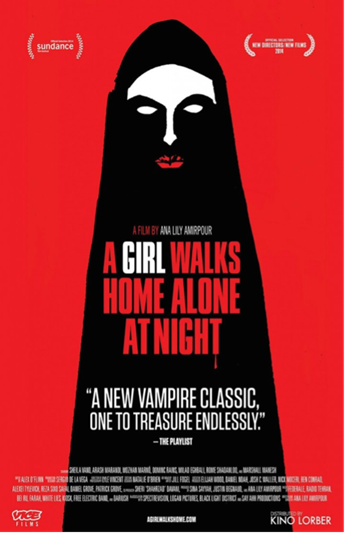
Figure 15: Poster for the film Dukhtarī dar shab tanhā bi khānah mīravad (A Girl Walks Home Alone at Night, 2014)

Figure 16: The chador-clad female vampire, the Girl in Dukhtarī dar shab tanhā bi khānah mīravad (A Girl Walks Home Alone at Night, 2014). Ana Lily Amīrpūr, accessed https://www.youtube.com/watch?v=A0GIz8gmqmw

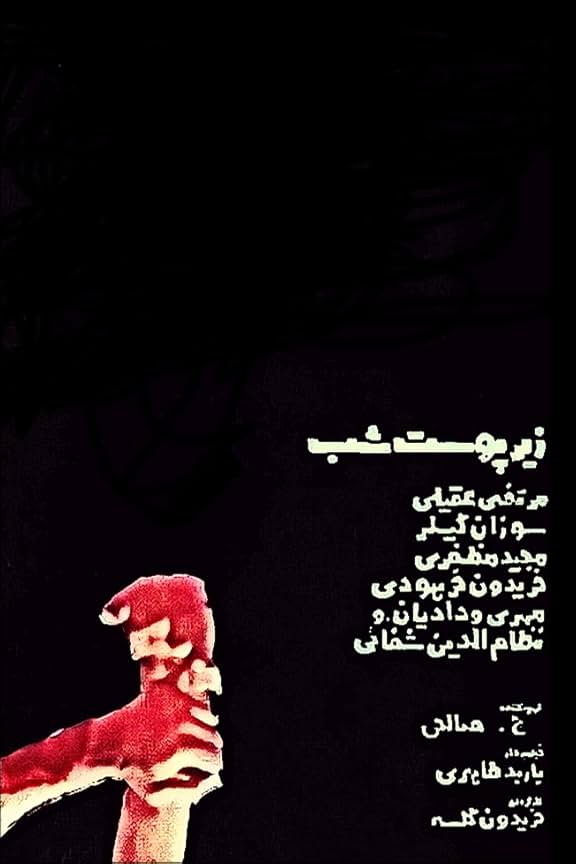
Perhaps inspired by the success of A Girl, another critically acclaimed diasporic Iranian horror film was made in the recent past, this time in the UK, namely, Babak Anvari’s Under the Shadow (2016).49During the question and answer session following the premiere screening of Under the Shadow at the Cameo Cinema in Edinburgh in 2016, I asked Babak Anvari whether A Girl or any other Iranian horror films were an influence on his film. Although he was not very forthcoming on the influence of A Girl, but mentioned the Iranian horror film Girl’s Dormitory. For other filmic and directorial influences both Western and Iranian, see “Under the Shadow: The Films that Influenced this Creepy Iranian Horror,” interview by Samuel Wigley, Updated: 13 February 2017, accessed April 25, 2017, www.bfi.org.uk/news-opinion/news-bfi/interviews/under-shadow-babak-anvari-influences-iranian-horror. The film is set during the Iran-Iraq War (1980-1988), and centers on the life of a married couple, Shideh and Iraj, and their young daughter Dorsa. After the father (Iraj), who is a doctor, leaves to offer medical aid at the frontlines, an Iraqi missile hits the roof of their apartment building but does not explode—a scene that seems to have been inspired by The Devil’s Backbone (2001), the Spanish-Mexican ghostly horror film directed by Guillermo del Toro. It is after this incident that the daughter and mother are haunted by the appearance of the jinn (as noted above, jinn folklore was also used in the Girl’s Dormitory), who relentlessly attack them until they finally escape their building. There is a formal connection made in the film between the unexploded missile and the appearance of the female jinn (a similar connection is drawn in The Devil’s Backbone between the unexploded bomb and the appearance of the ghost) on the building that serves as a political allegory for the horrors of the Iran-Iraq War, and the nightmarish universe created by the new Islamic regime after the Revolution. The influence on the film of the motif of zār, or malefic wind, in southern Iranian folklore is also evident, especially as much of the imagery linked to the jinn is gestured through the motif of the wind, and is related to beliefs pertaining to zar.50“Zār, harmful wind (bād) associated with spirit possession beliefs in southern coastal regions of Iran. In southern coastal regions of Iran such as Qeshm Island, people believe in the existence of winds that can be either vicious or peaceful, believer (Muslim) or non-believer (infidel). The latter are considered more dangerous than the former and zār belongs to this group of winds.” Maria Sabaye Moghaddam, “ZĀR,” Encyclopaedia Iranica, accessed October 22, 2016, http://www.iranicaonline.org/articles/zar

Figure 17: Poster for the film Zīr-i sāyah (Under the Shadow, 2016)

The trend of making horror films within transnational circuitry continues with another film called Shab (The Night; 2019/2020), directed by Kourosh Ahari. Perhaps influenced by the successes of Amirpour’s A Girl and Anvari’s Under the Shadow, The Night went into production in the US in 2018 and was mainly shot on location in that country. The Night stars Cannes Best Actor winner Shahab Hosseini, as well as Niousha Jafarian, in lead roles. The film has a higher production value than its other diasporic counterparts but is similarly populated by a cast consisting predominantly of Iranian immigrants or US-born Iranian-Americans. Like A Girl and Under the Shadow, the film’s dialogue is mostly in Persian and the majority of the people who worked on the film were either Iranian or of Iranian descent. The film was given permission for screening in Iran, which is unprecedented in the history of films made by Iranian filmmakers outside Iran. The film can be seen to fit well within the coordinates of the New Iranian Horror cinema since it evokes the logic of the double or the doppelgänger, especially in one of the last scenes of the film where Shahab Hosseini’s character looks into the mirror and his mirror-image suddenly splits off from him and acts autonomously. This double is the traumatic repressed which returns to haunt us in the Night(mare). This structure of the double, which is repeated throughout the film, both at the level of form and narrative, gestures to one of the characteristics of life in contemporary Tehran under the Islamic Republic, namely the double-life led by many of its subjects. This structure of a double-life, where you dissimulate the truth in order to survive is part of the technique of taqīyah (dissimulation) in Shi’ite doctrine, which has permeated social and political relations in Tehran.51On taqīyah in Shi‘ism see Etan Kohlberg,“Some Imami-Shi‘i Views on Taqiyya,” Journal of the American Oriental Society 95, 3 (July-September 1975): 395-402; Etan Kohlberg, “Taqiyya in Shi‘i Theology and Religion,” in Secrecy and Concealment: Studies in the History of Mediterranean and Near Eastern Religions, ed. Hans Hans Gerhard Kippenberg, Guy G. Stroumsa (Leiden: Brill, 1995), 345-80. L. Clarke, “The Rise and Decline of Taqiyya in Twelver Shi‘ism,” in Reason and Inspiration in Islam: Theology and Inspiration in Islam, ed. Todd Lawson (London: I.B. Tauris Publishers, 2005), 46-63. Due to the strict controls, surveillance, and policing of society by the State apparatus, Iran is a Janus-face society, with everyone leading a double-life as a survival strategy.52On the Janus-face society in Iran, see Ramita Navai, City of Lies: Love, Sex, Death, and the Search for Truth in Tehran (London: Weidenfeld & Nicolson, 2014), 1. The title of the film, Night, itself symbolizes a never ending night or perpetual darkness that has enveloped Iranian society, with the hotel in which the couple are effectively imprisoned standing for Iranian society under the Islamic Republic. In this sense, the film enacts a subtle critique of the State by deploying the conventions of psychological horror.

Figure 18: Poster for the film Shab (The Night, 2020)

It should be noted that the New Iranian Horror is not confined only to feature films but comprises the burgeoning of new shorts and animation films that can be said to constitute this larger growing body of Iranian horror films that I have termed New Iranian Horror. For example, a notable and beautiful animated short that may be mentioned is Malakout (2020) written and directed by Farnoosh Abedi. The film was part of the official selection at the online Halloween Film Festival 2020. The short uses to powerful effect elements of expressionism (shadows, chiaroscuro lighting) and the Gothic—evocative of the stop-motion animation of Tim Burton in such films as Vincent (1989) and Corpse Bride (2005)— especially the setting of a large Qajar mansion and the iconography of late nineteenth century Iranian art. In fact, the film is largely based on the German expressionist silent horror film, The Hands of Orlac (1924), directed by Robert Wiene who also directed the silent horror, The Cabinet of Dr. Caligari (1920), perhaps one of the most influential films of German expressionism. The short depicts a mourning pianist who grieves the loss of his wife, and who, longing to bring his wife back from the dead, is visited by the figure of Death, to whom, in a Faustian bargain, he sacrifices his hands for the return of his love. Another noteworthy short is Hiyvān (AniMal; 2017), directed by the Ark brothers, Bahman and Bahram Ark. The short depicts a person who, while attempting to cross a border, is forced to metamorphose into a ram (the iconography of the ram also evokes the ram’s occult and magical associations) by using the animals head as a disguise, gesturing towards the dark and animalistic treatment of immigrants and their plight, but also what Iranian migrants have to go through in order to escape Iran. Although some of the feature horror films or shorts may not contain a critico-political subtext and may be seen as the directors’ interest in the horror genre itself, the larger growing popularity in productions of the horror genre in Iran and in the diaspora may be read as part of a response in the aftermath of the failed protest movement and the subsequent terrifying and fearful atmosphere that permeates post-2009 Iranian society.

Figure 19: Poster for the film Malakūt (2020)

Figure 20: A still from Malakūt (2020). Farnūsh ‛Ābidī

The Ark brothers (Bahman and Bahram Ark), made their first feature debut with the magical fantasy-horror film, Pūst (Skin; 2020). A supernatural curse follows the son of a family, whose mother is threatened by the jinn, since she had cast a spell on a woman whom her son loved and by doing so, sought to thwart their union. The film uses aspects of magical beliefs and folktales from Azerbaijan with the films dialogue itself being in Azeri. The film was never given screening permission in Iran and does not appear to have been entered into any of the international film festivals. The film showcases the talents of the Ark brothers in the making of genre pastiches that include elements of horror.

An Iranian filmmaker whose films appear in the International Film Festival circuits and whose recent films play with horror genre tropes is Mani Haghighi. The mystery supernatural horror thriller A Dragon Arrives (Izhdihā vārid mīshavad; 2016), is perhaps Haghighi’s first foray into supernatural territory. The film was selected for competition for the Golden Bear at the 66th Berlin International Film Festival. The film is shot in part as a mockumentary and in part as supernatural mystery—the mystery being related to the death of the political prisoner who lived in a shipwreck in the middle of the desert, the cause of which may or may not be a jinn. The jinn is never shown in the film but only appears as a narrative MacGuffin. The film draws inspiration from Bahram Sadeqi’s novella Malakūt (Heavenly Kingdom)—adapted into a film by Khosrow Haritash in 1976—in which the first famous line of the book is recited in the film, “At eleven, on the Wednesday evening of that week, Mr. Maveddat was possessed by the jinn.” Sadeqi’s book even appears in the mise-en-scène of the film and functions as a form of filmic intertextuality that calls attention to the relation between this text and the film. Haghighi’s recent comedy-horror Khūk (Pig; 2018) is ostensibly a spoof of serial killer films, in which there is a mysterious serial killer who calls himself the Pig, and who is stalking and killing directors. A blacklisted director named Hasan Kassami (Mohammad Hassan Madjooni) is feeling a sense of neglect and wonders why the serial killer has not come after him and complains humorously to his mother in one scene, “If he had cut off my head, they wouldn’t disrespect me.” To which his mother coyly replies, “Don’t worry my son, he’ll come after you [too]…” The film is not only a critique of the commercial film industry in Iran, but also of the Islamic Republic, which stands in for the serial killer who target certain filmmakers that are critical of the regime.

Apropos serial killer films, there is what may be termed a ‘serial killer turn’ in Iranian cinema with the recent release of two films, based on the real-life serial killer Saeed Hanaei who murdered sixteen prostitutes, in the Shi’i holy city of Mashhad from 2000 to 2001.53There is also a graphic novel by the exiled cartoonist Mana Neyestani, titled The Spider of Mashhad (2017) and based on video interviews with the serial killer. The first film, titled Killer Spider (Ankabūt; 2020), is directed by Ebrahim Irajzad. The film is a dramatic social critique with little horrific elements and does not show overt scenes of killing, blood, or violence but only hints at them through camera techniques suggesting violence outside the frame—one of the few strategies available to filmmakers making horror in postrevolutionary Iran, so as not to run afoul of the censors. Holy Spider (2022), the other film based on the same serial killer, is by the Iranian-Danish director Ali Abbasi. Upon premiering at the Cannes Film Festival, it was given a seven-minute standing ovation. The film was shot in Jordan with the entire dialogue in Persian, as in other examples of diasporic horror films. The film follows a female journalist Rahimi (Zar Amir-Ebrahimi)—winner of the Best Actress award at Cannes for her performance in the film—who is trying to crack the case but is thwarted at every turn by the apathy of the authorities. It is revealed, however, that the killer is an Iran-Iraq War veteran by the name of Saeed (Mehdi Bajestani), who lives a seemingly normal family life but who picks up drug addicted women or prostitutes at night on his motorcycle and remorselessly strangles them as a way to religiously cleanse the world. The movie stages brutal violence and sex scenes that could not otherwise have been shown if the film had been made in Iran. The film recalls serial killer films such as Bong Joon-ho’s Memories of Murder (2003) and David Fincher’s Zodiac, which were also based on real-life serial killers. Holy Spider is a powerful socio-political critique of a society that gave birth to such a heinous killer who not only justified his horrific actions based on religious beliefs, but whose victims were destitute women that were forced to sell their bodies to support themselves and their children, and who were ignored in Iranian state media of the time that reported on the killings. The burgeoning of such films metaphorically suggests that the ‘true’ serial killer in these films is the Islamic Republic itself.

Continuing this trend of prestige horror films is a recent film which has won international acclaim, namely the horror-comedy Zālāvā (2021), directed by Arsalan Amiri and co-written with Ida Panahandeh and Tahmineh Bahramalian. The film was screened at the 39th Fajr Film Festival and was also part of the Toronto International Film Festival’s Midnight Madness. The film is set in Zalava, a village of the Kurdistan region of Iran, in 1978, just before the Iranian Revolution. After reports of jinn possession in the village reaches the authorities, a skeptical Gendarmerie sergeant Masoud (Navid Pourfaraj), is sent to investigate the situation. The villagers fear that Zalava was cursed, and that demonic entities or jinn exist in their midst. Alarmed by this superstition, the villagers want to exorcize the suspected victim of possession by employing a crude method such as resorting to bloodletting with their rifles—a possibly lethal form of exorcism. After the onset of the death of a supposed victim of possession, the incident brings into confrontation Masoud and the local shaman or ramal (jinn-catcher), Amardan (Pouria Rahimi Sam), who claims that he can permanently contain the demonic plague that has beset the village. The film puts a modern twist on the fabled ‘Genie in the Bottle’ motif from the Thousand and One Nights. As critic Peter Kuplowsky states, “this dread-filled fable eventually crystalizes these tensions in an irresistible, metaphysical horror dilemma that is guaranteed to haunt you the next time you handle a sealed glass jar, regardless of whether a demon waits inside.”54Peter Kuplowsky, “Zalava,” accessed June 20, 2020,  https://tiff.net/events/zalava Zālāvā was made during the global COVID-19 pandemic and comments on current fears and anxieties about the virus and its societal effects, all the while critically engaging with questions of reason and superstition, tradition and modernity.

Figure 21: Poster for the film Zālāvā (2021)

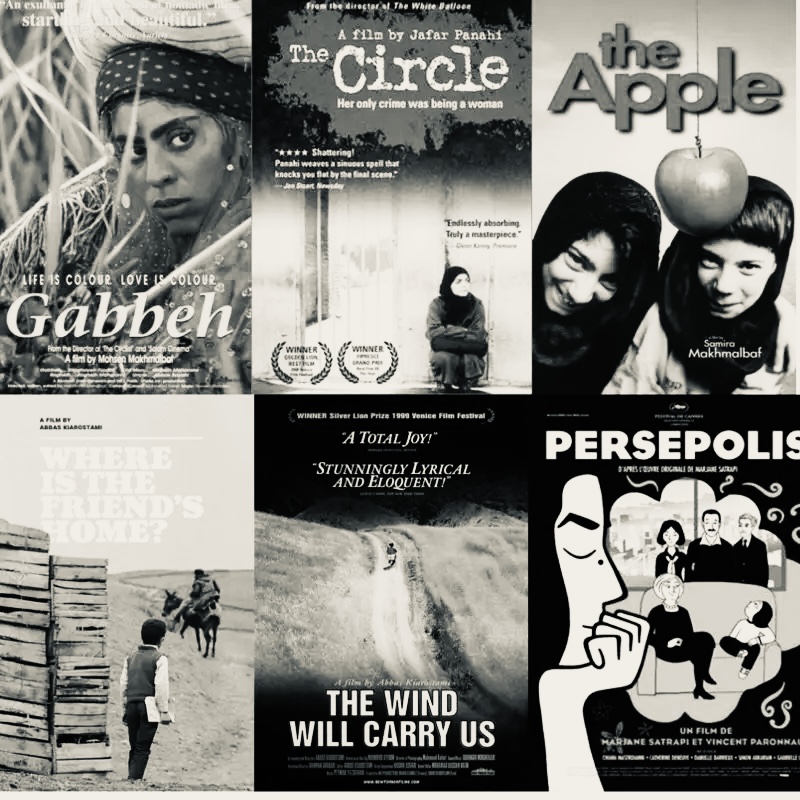
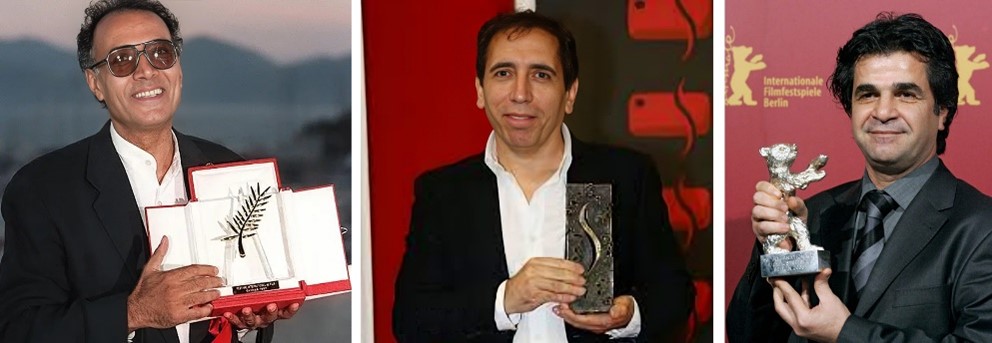
As noted, there is, in the films that are emerging from Iran today, a notable shift from the arthouse films of the New Iranian Cinema that used to populate and dominate international film festivals, and which were directed by the likes of Kiarostami, Makhmalbaf, Panahi, Rasoulof, and Ghobadi—a shift which was even noted by the film scholar Kristin Thompson in her review of Iranian films at the Vancouver International Film Festival in 2014, which included A Girl Walks Home Alone at Night (2014) by Ana Lily Amirpour and Shahram Mokri’s Māhī va gurbah. Kristin Thompson states: “Maybe it’s just the particular selection of Iranian films at this year’s festival, but I sensed a shift from the ones we’ve seen in previous years…. all three of the Iranian fiction features this year depart from some conventions we’ve grown used to in the New Iranian Cinema of the past decades.”55See Kristian Thompson, “Iranian cinema moves on,” Thursday, October 9, 2014, accessed May 25, 2016, www.davidbordwell.net/blog/2014/10/09/middle-eastern-fare-at-viff/ Zālāvā seems to be continuing this trend with the recent growth of prestige or high-quality horror films emerging both from within Iran and from the Iranian diaspora. To conclude, it remains to be seen if the New Iranian Horror Cinema will continue unabated within the transnational circuitry, with new films and filmmakers joining the fray, or if it will be stifled with new censorship measures that will halt its development and progress. Regardless, a new era of Iranian cinema has already been born and will require sustained theoretical attention by film scholars and critics.
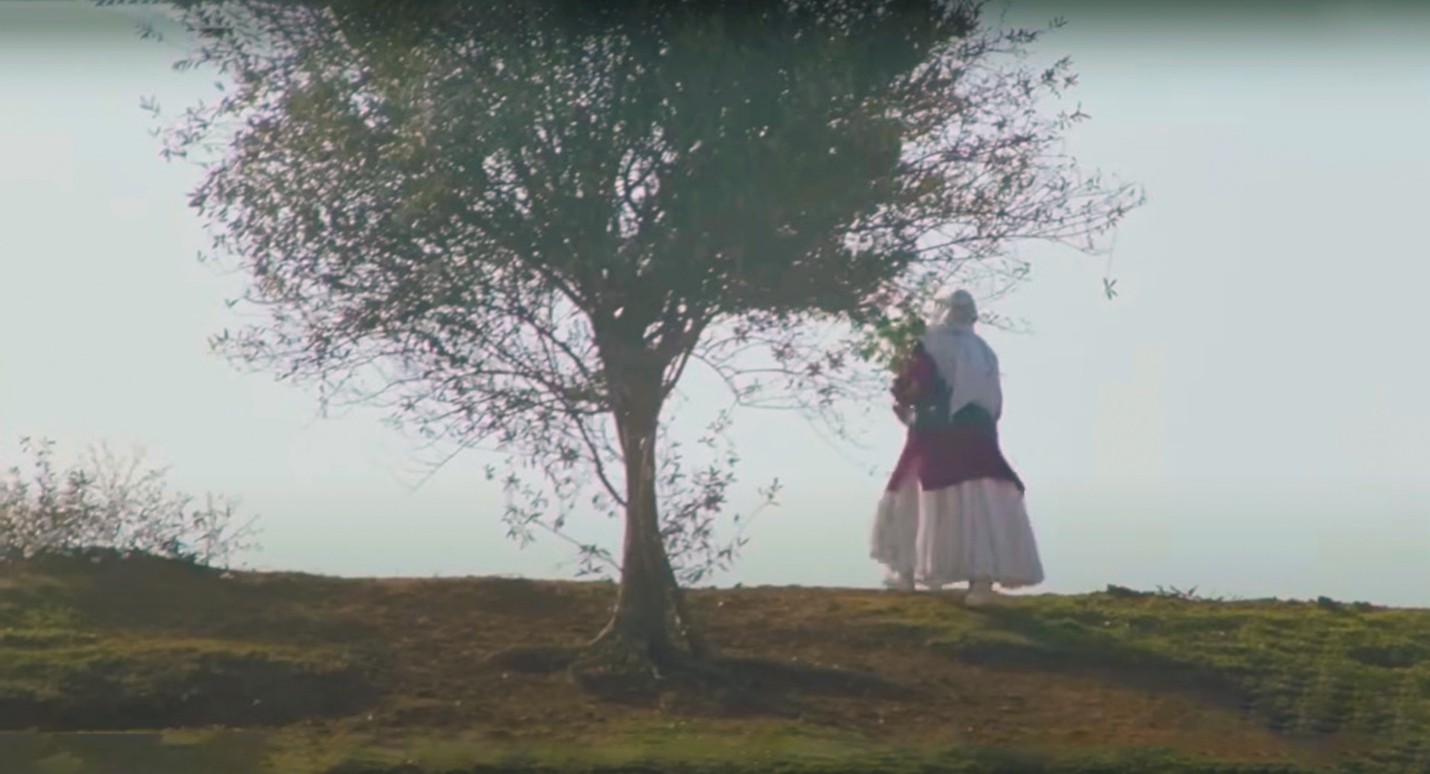
Through the Olive Trees: Probing the Premise of ‘Reel’ Narrative in an Eco-poetic Film

By


Figure 1: Poster for the film Through the Olive Trees (Zīr-i Dirakhtān-i Zaytūn), directed by ʿAbbās Kiyārustamī, 1994.

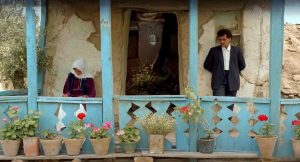
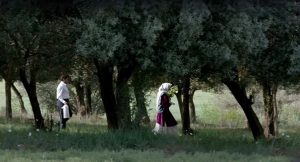
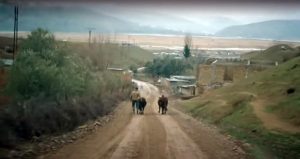
Through the Olive Trees (Zīr-i Dirakhtān-i Zaytūn, ʿAbbās Kiyārustamī, 1994)1The title of the film is shortened to Olive Trees henceforth. is the third and last installment of ʿAbbās Kiyārustamī’s Koker trilogy filmed in the village of Koker, in the township of Rustam Ābād in northern Iran.2The previous films of the trilogy are: Where Is the Friend’s House? (Khānah-yi Dūst Kujāst? 1987) and Life, and Nothing More (Zindagī va Dīgar Hīch, 1992). Olive Trees is a seemingly simple story of rural life as though Kiyārustamī is showing the spectators another episode of reality in the same village where he filmed his previous movies. However, as the film continues, the audience comes to understand that there is nothing simple or even real about this story at all. In Olive Trees, Kiyārustamī questions the authenticity of cinematic stories, including his own. More vehemently than in the director’s previous films, Olive Trees portrays a multi-layered, paradoxical, and ironic meta-cinematic narrative that questions the reality of the “reel” world and the role of the filmmaker in creating such “reality”. When Kiyārustamī made the third installation of the Koker trilogy, he was already celebrated in global film circuits as an auteur who excels in the art of improvisation by recruiting amateur actors to play themselves. He was taken as a filmmaker who produces “authentic” neorealist films about rural life in Iran. With this context in mind, Olive Trees was made to playfully and ironically question the premise of authenticity of ‘Kiyārustamī style’ reality. The ensuing discussion explores this topic in both the formal and contextual levels in the film.

ʿAbbās Kiyārustamī (1940-2016), was one of the most prolific Iranian directors and arguably the most acclaimed Iranian filmmaker outside of Iran. He was praised throughout his career by distinguished international directors such as Jean Luc Godard and Akira Kurosawa.3Jean Luc Godard said: “Film begins with DW Griffith and ends with Abbas Kiarostami.” Quoted in “Abbas Kiarostami/Movies,” Guardian, April 28, 2005, accessed July 2, 2024 https://www.theguardian.com/film/2005/apr/28/hayfilmfestival2005.guardianhayfestival

Praising Kiyārustamī’s aesthetics, Akira Kurosawa told him: “What I like about your films is their simplicity and narrative fluency. It is hard to describe them. One has to see them.” See Shohreh Golparian, “The Emperor and I: Abbas Kiarostami Meets Akira Kurosawa,” Film International Magazine 1, no. 4 (Autumn 1993): 4-7.
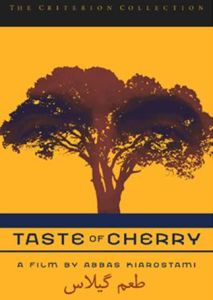
It was the Koker trilogy that introduced Kiyārustamī, and by extension post-revolutionary Iranian cinema, to film festivals and cinephiles around the world. Olive Trees secured multiple awards and was praised by critics for its artistic and aesthetic merits, especially in France. The most notable among the accolades for the film were its nomination for Palm D’Or at the 1994 Cannes Film Festival and the winning of the Silver Hugo Award at the Chicago Film Festival in the same year. The critical success of Olive Trees paved the way for Kiyārustamī’s eventual winning of Palm D’Or at Cannes Film Festival three years later for Taste of Cherry (Taʿm-i Gīlās, 1997).

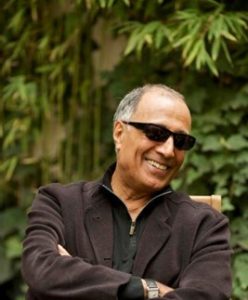
Figure 2: Portrait of ʿAbbās Kiyārustamī

Narrative

Kiyārustamī was inspired to make Olive Trees while he was producing Life, and Nothing More (Zindagī va Dīgar Hīch, 1992) in Koker. He fancied to make a movie about the continuity of life and love with the backdrop of a quake-struck displaced community that had lost more than 45,000 of its inhabitants. Paradoxically, given this grim context, he chose to focus on life rather than death, and to meditate on hope, love, and nature from within this disastrous moment in Iran’s history. It is important to indicate that the deadly earthquake in the Rūdbār area opened unhealed wounds for the nation. Iranians in early 1990s were still traumatized by the aftermath of mass imprisonments of the opposing groups and mass executions of 1980s,4Iran Tribunal recorded 11,000 executions in the 1980s by the Islamic regime “but an alternative estimation suggests that the number exceeded 20,000.” See “History of Mass Executions in 1980s,” Iran Tribunal, accessed July 10, 2024, https://irantribunal.com/mass-executions/history-of-mass-executions-in-1980s/. as well as the remnants of Iran-Iraq war that lasted eight years and caused around 1,000,000 causalities, as well as bringing economic hardship to the nation.

The story of Olive Trees does not contemplate on the sociopolitical issues that captivated Iranians at the time. Instead, (in the middle layer of the narrative, which is presented as the “reality” outside of the cinematic story) it is a seemingly simple tale of a young man’s (Husayn, played by Husayn Rizā’ī) love for a woman (Tāhirah, played by Tāhirah Lādaniyān). Husayn, who was previously working as a mason, is pictured in the film in his second attempt to win Tāhirah’s heart, after being rejected once before. Tāhirah has lost all her family members in the earthquake and is left only with her grandmother. Before the earthquake, Tāhirah’s family found an illiterate man’s proposal to their daughter insulting. Her grandmother also believes that Husayn’s social status is below that of her grandchild, an aspiring student. Husayn’s logic to win Tāhirah’s heart follows the idea that since life is fleeting, being illiterate or not having money should not become a barrier to love. While this plotline is unraveling, the film also depicts Husayn and Tāhirah being picked by a fictional film crew to play a newlywed couple. To the fictional filmmaker’s dismay, Tāhirah is unable to differentiate between off-camera reality and on-camera acting. Hence, she refuses to talk to Husayn on-set and does not deliver her lines properly. It causes frustration for the (fictional) crew and creates a comedy for the viewers.

The Sketch of the three layers of Through the Olive Trees

The first layer: a fictional film crew are making a film. The process of filmmaking by a fictional director played by Muhammad ‛Alī Kishāvarz is shown.

The second layer:  the ‘real’ life of the village, as people are depicted in their ‘everyday’ activities. Husayn and Tāhirah as their ‘real’ selves are depicted.


The third layer: performance of Tāhirah and Husayn as actors in Kishāvarz’s movie. In this layer Tāhirah and Husayn are a married couple


As the above chart outlines, there are at least three layers of narrative in Olive Trees. One layer is the process of making a film by a fictional film crew. The second layer is the story of everyday life in the village, their community life, and behind-the-scenes interactions with the cast. The third layer shows on-camera moments with Husayn and Tāhirah, unsuccessfully playing the same sequence repeatedly, in the hopes that Tāhirah would finally talk to Husayn in a less rigid more natural manner.5Previous sequences were equally humorous, showing how Hussein (the film crew errand boy) ended up replacing another fellow villager as Tāhirah’s fictional partner. The previous man was stuttering in front of young women, hence was released by the film director. The viewer understands, of course, that both the so-called off-camera reality and on-camera acting are fictional. The real and fictional layers of the film are scripted, set up and played by (mostly) amateur actors. The story’s meta-narrative layout showcases stories within the frame story that unfold in a nonlinear manner. The on-camera details interfere with off-camera stories to the point that the viewer cannot comprehend a complete, uninterrupted fictive story, as is shown in a more conventional film.

Figure 3: Husayn and Tāhirah, the film’s main characters, stand apart on a porch that visually reflects the emotional and societal distance between them. A still from the film Through the Olive Trees (Zīr-i Dirakhtān-i Zaytūn), directed by ʿAbbās Kiyārustamī, 1994. accessed via https://www.youtube.com/watch?v=iAe8_O_4VZI (01:08:42).

Olive Trees has a meta-cinematic structure as well, since the film (a cinematic production) shows the making of a film (an embedded fictive cinematic production) to draw the viewers’ attention to the artificiality of on-screen “reality.” As mentioned before, in the opening sequences, Olive Trees appears deceptively simple. But once the spectators continue watching, they realize that the multilayered and meta-cinematic structure of the film is quite sophisticated and self-reflexive. Kiyārustamī playfully intermingles the assumed “diegetic” and “non-diegetic” stories to show his mastery in making a multi-narrative poetic realist film.

Olive Trees unfolds in a non-linear, multilayered meta-narrative style to depict the yearning for a beloved and dealing with the loss of loved ones in a half-destroyed village. Kiyārustamī pictures a devastated community yet beaming with love and life. The hustle and bustle of the village, the blooming of flowers, and the glamour of trees minimize the impact of the natural disaster. Loss and love are juxtaposed to remind the viewer that life offers paradoxical paradigms simultaneously. The story within story structure of the film, known in literary studies as the “Chinese Box Structure,” or “Framed Narrative Structure” is a well-known narrative format for Iranian audiences. It is rehearsed in such classical works as Thousand and One Nights, Rumi’s Masnavī and Kalīlah and Dimnah. The narrative structure is also spatial and circular, which is closer to Persian poetry (such as ghazal poetry of Rumi and Hāfiz).6The affinities between Kiyārustamī’s aesthetics in Koker trilogy and the spatial format of Ghazal poetry is diligently explored in Khatereh Sheibani, The Poetics of Iranian Cinema: Aesthetics, Modernity and Film after the Revolution (London: I.B. Tauris, 2011).

On a philosophical level, Kiyārustamī reminds us that life is not a linear journey as often simplified in many commercial movies. It is rather non-linear and multilayered. Olive Trees maintains a narrative style that exposes the artificiality of what is seen in mainstream cinema. The meta-cinematic structure of the movie contains the three layers of stories intertwined into one another. The whole film remains an unfinished story showcased in fragmented sequences. The director, Kiyārustamī, evades “seamless classical editing” that would have offered a linear story. Instead, the film narrative and its editing are “disjunctive” and open-ended, which recall the structure of both Persian stories such as Thousand and One Nights as well as the format of ghazals by Hāfiz.

The notion of love, which is a central theme in Persian literature (such as the ghazals of Hāfiz and Rumi) is also a predominant subject in Olive Trees. After making Report (Guzārish, 1977), Kiyārustamī shows a comeback to romantic stories in Olive Trees. Although both films have melodramatic elements, in none of them love is glamorized. Instead, we see a pessimistic twist and (in this film) a humorous depiction of love. The sarcastic point of view, the unheroic and even waggish characterization of the lover, and the representation of a non-reciprocal love makes it hard to consider the film as a love story in a traditional sense. Husayn does not look as handsome, masculine or assertive as the archetypal image of lovers such as Khusraw in Nizāmī’s Khusraw and Shīrīn or in movies such as Qārūn’s Treasure (‛Alī played by Muhammad ‛Alī Fardīn) (Ganj-i Qārūn, Siyāmak Yāsimī, 1965). The romance in Olive Trees is reduced to a comic situation that may or may not turn to a serious love affair. Romance in Olive Trees has distancing effect; therefore, the audience does not identify with the lover and may not commiserate with his feelings. That said, while the portrayal of Husayn does not necessarily recall the perfect lover, his determination and diligence are admirable. Through the characterization of Husayn, the director gave precedence to human agency and perseverance without idealizing romance.

Figure 4: The character Husayn in the film Through the Olive Trees (Zīr-i Dirakhtān-i Zaytūn), directed by ʿAbbās Kiyārustamī, 1994.

The characterization of Husayn is far from the ideal character of traditional heroes, yet his words to Tāhirah about the ephemeral nature of life and the importance of seizing the present moment, being happy with what we have are worth pondering upon. Unconventionally, the director decided to have an illiterate uncharismatic character delivering the lines that are normally reserved for charismatic and wise characters. The filmgoers’ expectations on many levels, including the narrative style and characterization are deconstructed by Kiyārustamī.

Nonetheless, the film concentrates on the power of life, which surmounts tragedy and death. It is the pursuit of happiness, love, and the desire to live that conveys meaning to the lives of people in mourning. Olive Trees shows that hope and perseverance outlived the earthquake, as do the trees themselves. Olive trees become an emblem of fortitude and endurance. Their predominant presence in the filming location inspired the director’s choice in naming the film. The olive grove, with its prevalent visual and thematic signification in the film could, even be considered the main character. The subject of love is juxtaposed with the significance of nature as represented by the trees in the film. Hence, love, passion, perseverance and having dreams for a better life are the most valued concepts in this eco-poetic film.

Figure 5: The theme of love is juxtaposed with the significance of nature, represented by the trees.  A still from the film Through the Olive Trees (Zīr-i Dirakhtān-i Zaytūn), directed by ʿAbbās Kiyārustamī, 1994. accessed via https://www.youtube.com/watch?v=iAe8_O_4VZI (01:34:34).

A multilayered narrative in a nonlinear fashion, and a meta-cinematic arrangement provide the film with a complex structure which demands the audience’s participation in constructing meaning while watching the film. In this way, the audience is challenged to play a semiological game as a seemingly simple story becomes a complicated one.

Perfecting the Genre of ‘Rural Movies’ in Through the Olive Trees

With the Iranian revolution of 1979, a politicized and fundamentalist interpretation of Islam became the dominant narrative propagated by the new regime, prescribing behavior in all levels of social life. The mandatory hijab for women became an emblem of the Islamic government and a message of defiance to the West. Naturally, the Iranian film industry, as with other social sectors, was affected by such ideological mandates. Filmmakers faced new limitations in depicting everyday life, especially when they wanted to zoom their camera in private spaces. It is noteworthy that the newly appointed Islamists in power exerted more control over urban spaces compared to rural and nomadic areas. The image of an Islamic Iran was mostly showcased in films and television programs that were produced to depict an urban Iran. With hijabized women pictured even in the intimacy of their bedroom and fictional couples who could not even touch each other’s hands, making realist films about urban life became next to impossible. The time for making fascinating realist melodramas such as Report was over.

Beyond the Islamic mandates in gender behavior and sexual politics, the revolution and war created profound sociopolitical transformations. As a result, the Iranian film industry experienced fundamental amendments. The existing cinematic genres and modes had to be modified to ensure the survival of the medium. In the late 1980s and early 1990s, two distinct cinematic genres thrived in Iranian film industry: War Movies and Rural Movies. Popular War Movies such as Ibrāhīm Hātamīkiyā’s From Karkheh to Rein (Az Karkhah tā Rāyn, 1993) were more in line with the regime’s propagandist goals of altruist exertions of soldiers fighting with “the enemy,” Rural Movies, with Kiyārustamī as the genre’s most important representative, mostly evaded ideologically oriented themes of sacrifice, martyrdom, loyalty to one’s country, and religion to instead embrace ontological and existential questions. Refreshingly, Kiyārustamī’s rural films mapped a new artistic route to transcend hope, love and, at times, romance in the absence of ideology. Set within vast farmlands, olive groves, and secluded villages, the characters of Kiyārustamī’s films enjoyed open spaces to ponder deeper questions about life and existence outside of the current political situation. The imagery of slow-paced rural living had a meditative impact on the traumatized Iranian viewers who were constantly experiencing adversity in their daily lives and bombarded with ideological-ridden visual aesthetics.

Figure 6: The rural landscape depicted in Kiyārustamī’s film. A still from the film Through the Olive Trees (Zīr-i Dirakhtān-i Zaytūn), directed by ʿAbbās Kiyārustamī, 1994. accessed via https://www.youtube.com/watch?v=iAe8_O_4VZI (00:06:34).

With the Koker trilogy,7The village of Koker was introduced to him by a visionary colleague and fellow filmmaker Kāmbūziyā Partuvī. Kiyārustamī, who had already made seven feature films and semi-documentaries about city life, trained his camera to the rural domains. The genre of (art-house) Rural Movies in Iranian cinema was not initiated by Kiyārustamī. It was already rehearsed by notable filmmakers such as Amīr Nādirī and Suhrāb Shahīd-Sālis. Like these directors, Kiyārustamī found a more liberal space in rural settings to practice his poetic realist style. The liberal aura in the post-revolutionary village movies was the result of a less controlled and less politicized environment of villages.

Koker trilogy practiced realism. In Olive Trees, as with the previous films of the trio, the cultural and societal depiction of life in corresponded with a natural rural atmosphere. Unlike films made in cities, the viewers are offered relaxed and realistic human interactions. What is interesting in Olive Trees is that the liberal vibe of the rural space influenced the film grammar. Kiyārustamī freed his film from more conventional stylistic choices such as excessive closeup shots, medium shots, shot/reverse-angle shots for dialogue sequences, as well as ‘seamless classical editing’. Instead, Olive Trees perfected Kiyārustamī’s employment of deep focus, long shots and extreme long shots, long takes, and slow-pace editing. A superb example of a deep focus sequence, which also employed extreme long shots of the subjects, studded with an extreme long take, can be found in the last sequence of the film.8The following example is quoted from Khatereh Sheibani, The Poetics of Iranian Cinema: Aesthetics, Modernity and Film After the Revolution (London: I.B. Tauris, 2011), 62-63.

In a long, static take with deep focus, Husayn is shown following Tāhirah, apparently proposing to her once again. The camera tilts down the hill through the olive trees and into an open field after the fictional crew has finished shooting the film. Here the couple are depicted (deceptively) in their real, off-camera lives. They fade into white dots in the green landscape. As they move further away, the audience no longer hears Husayn’s pleading.

Figure 7: Husayn is shown following Tāhirah, seemingly proposing to her once again. A still from the film Through the Olive Trees (Zīr-i Dirakhtān-i Zaytūn), directed by ʿAbbās Kiyārustamī, 1994. accessed via https://www.youtube.com/watch?v=iAe8_O_4VZI (01:36:33).

After a fairly long silence, the audience is given the privilege of hearing the soundtrack once again, but disappointingly it is not Tāhirah and Husayn’s conversation. Instead, it is a peaceful piece of classical music: “Concerto for Oboe and Strings” by Domenico Cimarosa. This extremely static long take with deep focus continues as we see Husayn running towards the camera once again. Does he have good news? The audience can only assume so. Here, the depth of focus gives a more realistic, less theatrical image of life with its complex messages. This last shot is a reflection of the actual passage of time and makes the entire movie seem to be one long episode in which the viewer is suspended between film fiction and reality. The deep focus that shows reality as a whole, especially in the absence of a soundtrack, proposes a unique cinematic language, offering ultimate liberation from the constructed meaning imposed through traditional montage images that break down the action into cuts.

Kiyārustamī’s rejection of the classic editing aesthetics gives the audience of Olive Trees maximum freedom to conclude the film either way. The fact that this episode is presented in its seemingly physical entirety makes it ambiguous, if not undecidable. In the last sequence, the audience does not see the actors in close-ups that would reveal their facial expressions accompanied by their voices. The choice of deep focus, which brings uncertainty, is especially important in suggesting that Husayn and Tāhirah are shown in real, off-camera moments – although this is a deceptive twist, and in any case, this is only a film or a fictive imitation of reality. The last sequence could suggest that people’s real personalities are much more complex and intriguing than the characters they play in front of a camera. It displays Kiyārustamī’s perfection of the employment of deep focus in a long take in a natural landscape.

Figure 8: The final sequence of Olive Trees showcases Kiyārustamī’s mastery of deep focus in a long natural take. A still from the film Through the Olive Trees (Zīr-i Dirakhtān-i Zaytūn), directed by ʿAbbās Kiyārustamī, 1994, accessed via https://www.youtube.com/watch?v=iAe8_O_4VZI (01:38:02).

In the post-revolutionary context, Kiyārustamī decided to turn his gaze to rural spaces in the trilogy to evade a non-realistic portrayal of life. He succeeded to side-step the religiosity that was promoted by state-funded films of the 1980s and 1990s. Rural Movies provided a transcendental escape for Iranian filmgoers. They created a much needed peaceful and serene vibe that was almost therapeutic. Instead of pondering on politics and ideology, humanism became the quintessential appeal of the trilogy. Olive Trees sealed a cinematic trilogy that offered an innovative narrative and stylistic approach in Iranian cinema. A new aesthetic vista started shaping in Iranian cinema with Kiyārustamī at its forefront. As indicated above, Rural Movies didn’t start with Kiyārustamī, but his aesthetic choices made his pastoral films the most outstanding examples of the genre. When Kiyārustamī became a canonized filmmaker, his auteuristic choices, including his generic and aesthetic eccentricities became known as the Kiyārustamī School of filmmaking. The Kiyārustamī Film School was later imitated, adopted, and remodified by the next generation of filmmakers in Iran. Ja‛far Panāhī and Bahman Qubādī are among the directors who were initially trained by Kiyārustamī and made their first movies in line with Kiyārustamī aesthetics. Later on, both Panāhī and Qubādī attained their own cinematic language and produced masterpieces on their own accord.

Stylistics

Olive Trees, like almost all Kiyārustamī’s films, is a low-budget, neorealist film that typically employs amateur actors, on-location shooting, and available lighting. The mise-en-scène appears non-staged and authentic. The only professional actor of the film is Muhammad ‛Alī Kishāvarz who plays the role of the fictional director/Kiyārustamī’s alter ego in the film. Superficially, Olive Trees seems to have an undeveloped story line, which comprises of a Tehrani film crew coming to a northern village to film a simple, documentary-like story. The minimalist mise-en-scène with non-professional acting and the on-location setting may suggest that the film was made with no or minimal directorship. As noted, only after the film ends, the viewer realizes that the film has a complex storyline, alluding to profound existential questions about life, love, and death. Olive Trees, followed by Taste of Cherry (1998) and The Wind Will Carry Us (Bād mā rā khvāhad burd, 2000) are among Kiyārustamī’s most philosophical films.

Figure 9: Muhammad ‛Alī Kishāvarz, who plays the role of the fictional director, along with the directing team. A still from the film Through the Olive Trees (Zīr-i Dirakhtān-i Zaytūn), directed by ʿAbbās Kiyārustamī, 1994. accessed via https://www.youtube.com/watch?v=iAe8_O_4VZI (00:27:04).

What the audience sees in the movie (in every layer of the film) is in fact meticulously planned, scripted, and designed by Kiyārustamī. None of the ‘natural’ or amateur looking dialogues were uttered spontaneously by the actors. They were all scripted by the director. A short documentary film about the making of Olive Trees, consisting of footages of behind-the-scenes sequences, reveals the meticulous supervision and intervention of Kiyārustamī on every aspect of acting, camera movements, cinematography, and mise-en-scène.9Beyond Olive Trees (Ānsū-yi Dirakhtān-i Zaytūn), dir. Ḥamīdah Sharīf-Rād (Iran, 2018, 32 min.) is a documentary that looks behind the scenes of Through Olive Trees. Sharīf-Rād made the documentary based on the footage taken by Bahman Kiyārustamī during the making of the feature film. The documentary reaffirms the fact that there is nothing simple, improvised, or unassuming about this seemingly simple and modest film. Olive Trees was directed, produced, edited by Kiyārustamī. It is a sublime example of auteur cinema in Iran. He had overall artistic and creative control over the production.

A significant feature of Olive Trees is the use of local non-actors and the employment of regional dialects in the film. Because the cast are local Gīlakīs, their dialect and acting rehearse the ethnic veracity of rural life in the Rūdbār region. Even in the setting of a small village such as Koker, we see cultural and linguistic diversity. For instance, the Roma people (known in Iran as the ‘kawlī’) have their own dialect, rituals, and traditions. The villagers consist of diverse communities with economic and cultural differences. The film highlights the ethnic and cultural diversity of Iran, something not seen in most official narratives. The stylistic choice of the director to make a village as the epicentre of the narrative enhances the idea that Iran is more than its capital Tehran and the major cities. Iran is a multi-cultural and multi-linguistic country, yet rural Iran has been always marginalized in Iranian cinema. Even when represented, rural life has often been appropriated through an urbanist point of view. This is even visible in acclaimed films such as The Journey of the Stone (Safar-i Sang, Mas‛ūd Kīmiyā’ī, 1978). In this film, the employment of well-known stars such as Īraj Rād, Farzānah Ta’īdī, Gītī Pāshā’ī, and Ja‛far Vālī who deliver their lines in a theatrical tone and non-specified dialect makes it difficult for film viewers to imagine the well-known stars as authentic rural characters.

Figure 10-11: Use of local non-actors and incorporation of regional dialects. Stills from the film Through the Olive Trees (Zīr-i Dirakhtān-i Zaytūn), directed by ʿAbbās Kiyārustamī, 1994.

The accuracy of the dramatic situation in Olive Trees does not merely rest on the choice of a local cast. The film resists the idea of stereotypical representation of rural people as quintessentially different from their urban counterparts. The fictional film crew in Olive Trees try to impose their own presumptions of village life onto the local cast. In their interactions with the Koker community, the fictional director (Kishāvarz) and his team are constantly challenged by the villagers. Tāhirah in particular defies the film crew and makes them understand the reality of village life with more open-mindedness, not through urbanized cliches. At one point, the fictive director/Kishāvarz and Ms. Shīvā insist that Tāhirah should wear local costumes. Tāhirah initially resists the idea. She tells Ms. Shīvā that only old women, and the illiterate kawlī women wear local costumes. Her normal attire (off-set) is more like the urban schoolgirls uniform in the 1990s: a baggy manteau and a scarf. However, she wanted to appear on camera with a party dress. In her everyday conversations, she does not speak Gīlakī but the standard Persian dialect. Eventually, despite her resistance, she is forced by the film crew to wear the traditional dress and speak with a Gīlakī dialect. Tāhirah, however still manages to defy the director’s authorial power as she does not talk to Husayn on the set.

Overall, since modernity was implemented in Iranian cities, many urbanized Iranians have showcased a sense of superiority over people who live in small towns and villages. Residents of Tehran sometimes use the pejorative term of “Shahristānī” to refer to people who live outside of the capital. The Shahristānīs are normally considered as low class, less cultured, and less educated. The Shahristānīs are assumed to be on the lower level of the hierarchy both culturally and intellectually. The presumed inferiority of the Shahristānīs is challenged and defied by Tāhirah. She teaches the urban film crew a lesson about equality and equity of all Iranians, regardless of their place of residence. The role of director, the authorial power, is questioned in the characterization of Kishāvarz as the director of the film within the film. Kiyārustamī criticizes his alter ego, and by extension questions his own role as the author and director of the film.

Figure 12: Ms. Shīvā urges Tāhirah to wear local costumes, but Tāhirah resists, saying only old and illiterate kawlī women do. A still from the film Through the Olive Trees (Zīr-i Dirakhtān-i Zaytūn), directed by ʿAbbās Kiyārustamī, 1994. accessed via https://www.youtube.com/watch?v=iAe8_O_4VZI (00:11:24).

Olive Trees shows that the Tehrani crew came to the village with presumptions about their filming subjects. Their expectations, it seems, were unrealistic. They faced difficulty and were corrected and defied by the villagers. They discovered the real village by reflecting on their own mistakes. The fictional director eventually becomes more invested in the off-camera life of Husayn and Tāhirah, giving Husayn lessons in befriending Tāhirah. The film crew tries to retain order, but in the end, it is the disorderliness and imperfections that make the story meaningful.

The fact that this film is not linear and refuses a clear ending remind the viewer that real life doesn’t always have the perfect ending of mainstream movies. The concepts of “perfection” and “happy ending,” or even “ending,” “completion,” and “closure” are illusionist ideas. Order and structure are not necessarily part of our everyday life. They must be imposed on it, sometimes with no success. Life is filled with imperfect open ending events with no closures. Virtuous cinema, philosophical cinema could remind the viewer about such realities.

Ecopoetic Cinema

Olive Trees is a film with ecopoetic sensibilities. Its meditation on nature and the natural beauty of olive trees makes it an example of visual poetry with ecological emphasis. A survey of old and new films made by directors such as Sāmū’il Khāchīkiyān, Amīr Nādirī, Shahīd Sālis, Muhsin Makhmalbāf, and Rakhshān Banī I‛timād reveals that the themes of the love for nature, finding peace and serenity in nature, and searching for humanity in nature all appear often in Iranian cinema. However, among other art-house filmmakers, Kiyārustamī’s ecopoetic approach is prevalent. He was obviously inspired by Persian poets such as Hāfiz and Suhrāb Sipihrī who employed nature as their source of aesthetic stimulation.10See Khatereh Sheibani, The Poetics of Iranian Cinema: Aesthetics, Modernity and Film after the Revolution (London: I.B. Tauris, 2011).

As discussed, Olive Trees conveys documentary aesthetics by employing neorealist sensibilities and amateur acting that appears to be improvised. Yet, there is barely anything natural, improvised, and unpremeditated in the film. The mise-en-scène, including dialogue, acting, and most of the set design, including the façade of the newlywed couple for the on-camera sequences, were manicured by an auteur director who had inclusive artistic control over the film.

The only natural and real part of the mise-en-scene is the olive grove. As indicated, one could also argue that the grove is in fact the film’s protagonist. All of the sequences in Olive Trees are shot outdoors within nature. Even the scenes of homelife take place outdoors. When Ms. Shīvā goes to fetch Tāhirah, she finds the young woman’s grandmother sitting on the balcony behind pots of geraniums. When Tāhirah eventually shows up, she enters the house to try on a party dress. Ms. Shīvā follows her to check on her attire, but the camera remains outside of the house. Likewise, the shots of the newlyweds in their home are all done in open space, and the fictional film crew are also shown camping outside in tents under olive trees. The cast and crew are always shown in open spaces— whether in cars, walking, acting, or in conversation. Nature is home to these people. The olive grove is their resting place, and the sky is their roof. The emphasis on nature in the film is more apparent than in any other in Kiyārustamī’s oeuvre.

Figure 13: The fictional film crew is shown camping in tents beneath olive trees. A still from the film Through the Olive Trees (Zīr-i Dirakhtān-i Zaytūn), directed by ʿAbbās Kiyārustamī, 1994.

The olive has a long history in Iranian culture and Persian literature. The Achaemenid documents attest to the existence of olive trees 2500 years ago. In Middle Persian/Pahlavī language (224-651 CE), the word for olive is mentioned as Zayt. Olives are also mentioned in the Old Testament and the Quran. Poets such as Rumi and Khāqānī referred to olive as a source of enlightenment11“Zān hamī pursī charā īn mī-kunī / kih ṣuvar zayt ast u ma‛nī rushanī.” (Rumi) and beauty.12“Jān fashānand bar ān khāl u bar ān halqah-yi zulf/ ʿĀshiqān kān rukh-i zaytūnī-i zībā bīnand.” (Khāqānī)

The poems are quoted from Bahrām Girāmī, Gul u giyāh dar hizār sāl shiʿr-i fārsī: Tashbīhāt va Istiʿārāt [Flowers and Plants in a Thousand Years of Persian Poetry: Similes and Metaphors] (Tehran, Farhang-i Mu‛āsir, 2007), 571-573.
In Olive Trees, Husayn eventually secures a response from the reluctant Tāhirah when they walk under the grove. The final composition of the film shows that Husayn has become enlightened under the olive trees, but the audience is not given the same privilege. Instead, the audience is rewarded to view a peaceful composition of olive trees in extreme long shot.

The olive tree, Dirakht-i Zaytūn in Persian, is the emblem of perseverance. Olive trees easily acclimatize in different climate types.13The information about olive tree and its history and significance in Iran is mostly acquired from the following two sources: Shamāmah Muhammadīfar, “Zaytūn” (Olive), Dānishnāmah-yi Jahān-i Islām, accessed June 2, 2025, https://rch.ac.ir/article/Details?id=14882; And Bahrām Girāmī, Gul u giyāh dar hizār sāl shiʿr-i fārsī: Tashbīhāt va Istiʿārāt [Flowers and Plants in a Thousand Years of Persian Poetry: Similes and Metaphors] (Tehran, Farhang-i Mu‛āsir, 2007), 571-572. In Iran, olive trees have been planted and used as a source of energy as well as for culinary, aesthetic, hygienic and medical purposes for over 3000 years. Olive trees yield fruits in the mild, rainy provinces of Gīlān and Mazandaran as well as the arid areas of southern Khurāsān, Fārs and Kirmān. They can live for over a thousand years. These evergreens thrive in locations with gusting winds and endure cold winters. In the film, the audience sees that unlike the man-made edifices, the olive trees survived the earthquake. Hence, olive trees are the insignia—both literally, and figuratively—of endurance, perseverance and longevity. Kiyārustamī’s camera is quite observant of the olive grove, often focusing more on the trees than the human characters. The constant portrayal of olive trees in deep focus, wide angle shots, long shots, medium long shots, and long takes collectively depict the integrity and diligence of olive trees.

 Olive trees also symbolize peace and love. Husayn’s perseverance in his pursuit of love also bears resemblance to the nature of olive trees. The prominence of olive gardens in the film and the matching resilience of the human characters and olive trees could be seen as an allegory for Iranian/Persian art and identity, which survived and even thrived under repression in different periods of history. The allegorical significance of olive trees is discernible through the zooming of camera on the olive grove rather than highlighting the ruined houses caused by the earthquake. Like the trees, Persian art and identity survived despite sociopolitical suppression after the formation of the Islamic regime.

Figure 14: A view of Tāhirah and an olive tree. A still from the film Through the Olive Trees (Zīr-i Dirakhtān-i Zaytūn), directed by ʿAbbās Kiyārustamī, 1994. accessed via https://www.youtube.com/watch?v=iAe8_O_4VZI (01:35:59).

Iranian cinema after the 1978-79 Revolution was threatened with annihilation, as initially, Khumaynī was not in favor of having a film industry in the country. He wrote about cinema as the “direct cause of prostitution, corruption, and political dependence.”14Quoted in Khatereh Sheibani, The Poetics of Iranian Cinema: Aesthetics, Modernity and Film after the Revolution (London: I.B. Tauris, 2011), 5. Hundreds of theatre houses were burned down by the Islamists during the revolution. Many theatre houses and entertainment centres were also shut down by the revolutionary forces or the government. Prominent filmmakers and actors were either exiled, secluded, or imprisoned. The film industry went into a dormant period for the first few years, and once it revived, the state-funded productions of Islamist directors such as Muhsin Makhmalbāf replaced the favorite fīlmfārsī movies of the pre-revolutionary era.

However, Iranian cinema, with its diverse range of commercial and art-house productions, revived slowly in the 1980s. For art-house cinema, the newly imposed constraints forced filmmakers to further draw on an allegorical language, known as the poetic realist aesthetics, to convey sociological or philosophical meanings. The result was aesthetically outstanding productions such as Kiyārustamī’s Through the Olive Trees. The perseverance of olive trees in the film could be understood as an allegory for the perseverance of cinema in Iran. It is worth remembering the meta-cinematic story of the film depicts the hardship a film crew endures in a half-ruined village. The fictional story of the film crew in Olive Trees is the story of filmmakers, artists, and film technicians who sacrificed a much easier lifestyle so they could revitalize Iranian cinema. Through the Olive Trees is a love story, but the subject of true love in the film is not Tāhirah, but rather nature in the form of olive trees and by extension culture and identity in the form of Iranian cinema. Olive trees are the subject of passion and love—the real protagonists of the film. Unlike previous superstars who were eradicated from the cinema screens and pushed to seclusion by the Islamic regime, the beauty of nature as the protagonist or a star, could not be eradicated. The nature, in an ecopoetic outlook, became immortalized in one of the most outstanding productions of ʿAbbās Kiyārustamī.

Through the Olive Trees problematizes conventional cinematic realism, and in a self-reflexive manner criticizes the role of filmmakers in the process of making (neo)realist films. In the end, the audience comes to the conclusion that the only authentic and real element of the film, which has been there before the intrusion of the film crew, is the nature represented and highlighted through the olive trees. Indeed, the eco-poetic representation of nature as Kiyārustamī’s camera portrays is the poetry of life.

On the Western Reception of Iranian Cinema

By


Figure 1: A still from the film Gabbah, directed by Muhsin Makhmalbāf, 1996.

Introduction: Cinema as Tourism

 “I think gabbehs are like good Iranian films,” Muhsin Makhmalbāf noted while promoting one of his more popular films, Gabbah, in 2012:

What attracts foreign audiences to Iranian films is their simplicity and their recreation of nature. These are the same two qualities that have also made gabbehs popular in foreign markets. In Western countries people are overwhelmed by difficult, complicated, and rough situations. When they go to the movies they don’t want to see the same complexity and violence they are surrounded by. That is why they are fascinated by simple Iranian films that remind them of nature. Iranian gabbehs also have a sort of naturalistic poetry about them that gives you a sense of tranquility. You feel that you have spread nature on the floor of your living room.1Jonathan Rosenbaum, “Packaged Parables,” JonathanRosenbaum.net, February 2024, https://jonathanrosenbaum.net/2024/02/packaged-parables/.

A gabbah is a kind of Iranian carpet produced by the nomadic Qashqā’ī tribe and compared by some to American quilts as a similar form of folk art. Makhmalbāf estimates that only one out of every ten thousand Iranians owns a gabbah and that only one out of every thousand has even heard of one—facts that suggest Makhmalbāf himself is a bit of a tourist when describing gabbahs. Even if one questions whether the best Iranian films are simple recreations of nature, the notion that Iranian filmmakers and films and their foreign audiences are all parts of the tourist trade seems harder to shake off. As a luxury item that can appeal to the imagination, stimulate an aura of fairy tales, and summon up an idea of preindustrial Iran that can fit cozily inside any Westerner’s home, the gabbah is a consumer object, a Disney-like cartoon feature, and a visionary art-movie icon all rolled into one.

Figure 2: A still from Gabbah, directed by Muhsin Makhmalbāf, 1996, showing a Gabbah — a traditional handwoven Iranian rug.

All this suggests that the relation of non-Iranian audiences to Iranian cinema is essentially a form of tourism. This helps to explain why Gabbah had a bigger impact on Western audiences than Makhmalbāf’s earlier Marriage of the Blessed (ʿArūsī-i Khūbān, 1989), a film that has far more to say and to convey about Iranian life and culture.

This also may help to explain part of the basis for Rex Reed’s extravagant, four-star review of Ben Affleck’s Argo in the October 9, 2012, issue of the New York Observer, calling it “a movie that defines perfection”:

Gifted, intelligent and full of cogent ideas, Mr. Affleck can almost always be depended on to come up with something fascinating, coherent and thoroughly cinematic. Argo […] is no exception. It grabbed me by the lapels and held my attention for two solid hours without a sideward glance, and I can’t wait to see it again. You have to see it twice if you want to absorb the myriad pieces of a jigsaw too fantastic to accept as fact, although we know going in that the recently declassified records of an amazing history lesson prove otherwise. This movie is not only true, but unbelievably true.2Rex Reed, “Ben Affleck’s Argo Is a Masterpiece,” Observer, October 12, 2012, https://observer.com/2012/10/rex-reed-argo-ben-affleck/.

Figure 3: Poster of the film Argo, directed by Ben Affleck, 2012.

A desire not for the truth but for “the unbelievable truth” is ultimately a desire for “perfection,” not information. Thus the CIA’s rescue of six Americans from Tehran during the Iran hostage crisis of 1979 is a subject that can be “understood” only from the vantage point of American entertainment. Many Iranian-American commentators complained about the historical distortions and bogus facts about Iran used by Ben Affleck and his writer Chris Terrero, only two of which I will point out here: the suggestion that the Shah’s wife bathed in milk while the Shah had his lunches flown in by Concorde from Paris. Admittedly, both of these absurd claims are cited only as rumors just after the 1953 coup d’état by the U.S. and Britain that deposed the democratically elected Muhammad Musaddiq—which, to the credit of Argo, is cited as fact, not as rumor. But the milk bathing nevertheless warrants and receives a full illustration, in both black and white and color, during a comic-strip history of Iran that opens the film, because this yields a far more memorable (i.e. “perfect”) image than the aforementioned coup d’état. To put it simply, tourists want spectacle more than deeper understanding, so the milk bath has a better sales value than the overthrow of a government that helped to motivate the 1979 hostage crisis.

A far more notable as well as verifiable activity of the Shah’s wife was the founding in the 1960s of Kānūn—the Center for the Intellectual Development of Children and Young Adults—that occasioned and even necessitated the introduction of ‛Abbās Kiyārustamī to filmmaking when he was asked to help lead Kānūn’s film unit. This fact is more notable and verifiable, but also far less functional, even useless, if one wants to recount a comic-strip history and employ thriller mechanics, which is what Affleck needs for his story.

I

Here are three quotations from American film critics roughly a quarter of a century ago, all expressing skepticism about Kiyārustamī’s Taste of Cherry (Taʿm-i Gīlās, 1997) and/or American defenses of Kiyārustamī:

1. Roger Ebert

There was great drama at Cannes last year when the Iranian director Abbas Kiarostami was allowed, at the last moment, to leave his country and attend the festival premiere of his new film, Taste of Cherry.  He received a standing ovation as he entered the theater, and another at the end of his film (although this time mixed with boos), and the jury eventually made the film co-winner of the Palme d’Or.

Back at the Hotel Splendid, standing in the lobby, I found myself in lively disagreement with two critics I respect, Jonathan Rosenbaum of the Chicago Reader and Dave Kehr of the New York Daily News. Both believed they had seen a masterpiece. I thought I had seen an emperor without any clothes.

A case can be made for the movie, but it would involve transforming the experience of viewing the film (which is excruciatingly boring) into something more interesting, a fable about life and death. Just as a bad novel can be made into a good movie, so can a boring movie be made into a fascinating movie review.3Roger Ebert, “Reviews: Taste of Cherry,” Chicago Sun-Times, February 27, 1998, https://www.rogerebert.com/reviews/taste-of-cherry-1998.

2. David Denby

The quiet bravura of Abbas Kiarostami’s Taste of Cherry has received the highest praise, both here and abroad. At Cannes, in 1997, the movie shared the Palme d’Or […], and a number of American critics have hailed it as a masterpiece. A masterpiece! I agree that Taste of Cherry is an interesting and unusual movie, but still, I wonder—that is, I struggle like an infidel against evil thoughts. First, an acknowledgment: Kiarostami, the most celebrated director of the Iranian cinema, is a man both delicate in his perceptions and generous in his sentiments; he also wields enormous formal control over his material. Yet I can’t help thinking that the comparisons to De Sica and Satyajit Ray and other masters betray a degree of critical desperation. Is this movie rich enough—does it show the many-sided vitality of the great movies of the past – to warrant the extravagant praise? Or are critics, depressed by the obvious aesthetic poverty of world cinema, arguing themselves into it, placing their bets on Kiarostami because they have no other cards to play? That could be a risky game. When an audience is primed to encounter a royal personage in breastplate and plumes, it can turn vindictive when it discovers instead an emperor wearing no clothes.4David Denby, “Nowhere Man,” New York Magazine, April 6, 1998, https://nymag.com/nymetro/movies/reviews/2509/.

Figure 4: ‛Abbās Kiyārustamī with Catherine Deneuve and Kōji Yakusho at the 1997 Cannes Film Festival.

3. Howard Hampton:

In its regard for ordinary people and the ways it finds to honor the mysteries of everyday life—along with the film’s diffuse sense of time and its synthesis of almost pure visual abstraction and unadorned emotional intimacy— [David Lynch’s] The Straight Story has obvious affinities with Iranian cinema’s meld of realism and fable. But although the film was by and large enthusiastically if not perceptively received by mainstream reviewers, the serious critics who have championed like-minded foreign films were less generous, even condescending or outright dismissive… Even a largely sympathetic reviewer like the Chicago Reader’s Jonathan Rosenbaum called the movie “propaganda,” as if Lynch’s taking money from Disney were inherently more compromising than Abbas Kiarostami’s working under the aegis of a totalitarian theocracy.

[…] The Straight Story’s headstrong old gentleman and the relentlessly single-minded protagonists of Kiarostami’s films, or the equally determined little girl of Jafar Panahi’s 1995, Kiarostami-scripted White Balloon (not to mention the upright, fiercely independent senior citizen Umberto D. of an earlier, no less allegorical branch of Neorealism), have an innate kinship—they are gnarled branches of the same cinematic family tree. Yet there is a widespread view among the film intelligentsia that humanity is the specialized province of the salt of the foreign earth, where indigenous cultures are typically mediated through familiar Eurocentric tropes and gestures (depoliticized avant-Godardisms, Bresson-oil rubdowns, the many moods of Antonioni). For these rigidly positioned film missionaries, places like Iowa are what they fly over on their pilgrimages to Lourdes-like film festivals—where true believers seek healing epiphanies, artistic ‘miracles,’ the blessings of directorial saints.5Howard Hampton, “Lynch Mob,” Artforum, January 2000, https://www.thefreelibrary.com/LYNCH+MOB.-a059460574.

Figure 5: Poster of the film Taste of Cherry (Taʿm-i Gīlās), directed by ‛Abbās Kiyārustamī, 1997.

Two particular issues are raised by these quotations regarding either puzzlement about what Kiyārustamī is doing (Roger Ebert and David Denby) or what is arguably unjustified and misplaced confidence about understanding what Kiyārustamī is doing (Howard Hampton).

Ebert appears to be more honest about his puzzlement than Denby, who can’t resist inserting a sarcastic wisecrack about Islamic beliefs (“I struggle like an infidel against evil thoughts”) without explaining how or why he considers such beliefs relevant aside from the fact that Kiyārustamī is Iranian. In short, if a capacity to distinguish between “Islamic” and “Iranian” is one of the key prerequisites for understanding Iranian culture, Denby seems unwilling to make such a distinction. He also avoids distinguishing between the films he has seen, the films he has access to, and all the other films that exist in the world. The “obvious aesthetic poverty of the world cinema” can thus become “obvious” only if one has seen everything comprising “world cinema,” and because obviously no one has or can, Denby doesn’t seem to consider it important to distinguish between everything he has seen and everything he has not in arriving at such a massive, global judgment. One might even conclude that dismissing most of the world as impoverished and therefore as irrelevant is something that many United States citizens already do as a matter of routine habit, according to which the poverty of world cinema, aesthetic and otherwise, becomes both obvious and inescapable.

I’ve often believed that one of the key drawbacks to living in any of the truly expansive countries such as China, India, Russia, and the U.S. is that you are surrounded by people who regard their own country as the world and therefore all that counts or matters, meaning in effect that they (and you) are more than a little bit inattentive towards other countries. It is a paradox that what is regarded as worldly nowadays is really just a repackaging of some version of provinciality and familiarity. And it hardly seems exaggerated to claim that blindness or indifference to other cultures is part of the way that Americans respond to Iranian films, made worse by the lack of knowledge about the influence of Iranian censorship on what can or can’t be shown. For example, it probably isn’t clear to most Western viewers that the reason why so much of contemporary Iranian art cinema occurs outdoors is that showing women in their homes without their hijabs is forbidden. Furthermore, the prohibitions in earlier phases of Iranian film history (I’m told that at one stage, close-ups of women were not allowed), combined with the fact that Iranian film censors are not obliged to give reasons for their cuts, likely foster more confusion, in some cases for Iranian filmgoers as well as for their Western counterparts. Indeed, the domestic and international gossip that has circulated about Kiyārustamī’s Taste of Cherry ever since it shared the Palme d’Or at the Cannes film festival—including diverse speculations about the degree to which the theme of suicide affected the film’s visibility inside Iran—has made it virtually impossible for Westerners such as myself to arrive at a coherent account of what happened.

Figure 6: Scenes from Taste of Cherry (Taʿm-i Gīlās), directed by ‛Abbās Kiyārustamī, 1997.

The relative provinciality of the largest countries seems worth emphasizing because of the way “Americans” (that is, U.S. citizens whose status as North Americans is thus abbreviated, a privilege generally denied to Mexicans and Canadians) view the world clearly affects the way they view world cinema. The seeming presumption of Hampton that ‛Abbās Kiyārustamī and David Lynch are like-minded colleagues making separate versions of the same sort of movie seems directly tied to the common “American” assumption that the world is divided between Americans, people who want to be Americans, and people who hate Americans, so that indifference to “America” and “Americans” isn’t even regarded as an option.

In an angry letter I sent to Artforum responding to Hampton’s essay, which appeared in their next issue, I rhetorically asked Hampton where he saw “propaganda for theocracy or totalitarianism in Kiarostami’s work” and what he meant by “working under the aegis of,” especially when Lynch was obliged to test-market his film and Kiyārustamī wasn’t.6For a much fuller account of this exchange see, Mehrnaz Saeed-Vafa & Jonathan Rosenbaum, Abbas Kiarostami (Urbana/Chicago: University of Illinois Press, 2003), 90-92, 94-97. Yet the fact that so much of what happens in and in relation to Iranian cinema is conveyed to the public both inside and outside Iran as gossip can only foster many ongoing forms of misinformation and distortion. Based on my own limited experience and perspective, I would hypothesize that a similar condition of shared befuddlement characterizes the public’s understanding of the motives of Russian film censorship, especially in its pre-glasnost manifestations.

Western responses to Iranian cinema encompass much more, of course, than responses to Kiyārustamī. I have nevertheless started with these examples because they dramatize the extent to which much broader issues, such as the ideological biases and limitations of larger countries considering smaller countries, reflect and even determine how the West responds to Iranian cinema. One has to factor in the almost complete unfamiliarity of Western viewers with Iranian history, including the role played by the CIA in fostering the 1953 coup that ended Iranian democracy, and a tendency to demonize Iranian culture based on the dimly understood 1979 hostage crisis. This makes Ebert’s and Denby’s charge that “the emperor has no clothes” a fairy tale concept, like so many of the images associated with the Arabian Nights, suggesting both comic book fantasies of Persia and an unwitting acknowledgment of the literal void that often characterizes Western understandings of Iran.

Indeed, the limitations of the Western reception of Iranian cinema are inscribed in many such cultural conditions that tend to be unexamined. Some of these cultural conditions include (and this is very far from an exhaustive list, the issue here being not their veracity or falseness but the full range of positions that they suggest):

  1. Limitations of how large Western countries perceive (and don’t perceive) other countries.
  2. The Western film industry’s conceptions of commercial cinema and art cinema. and what both “foreign” cinema in general and Iranian cinema in particular consist of.
  3. A widespread belief that films can be unproblematically labeled “good” or “bad” universally.
  4. The idea that banned films are more likely to be “good” than unbanned films.
  5. “Good” films should be seen, and “bad” films should be avoided (overlooking the possibility that there might be good, i.e. informative or educational reasons to see “bad” films that aren’t tied to consumption models).
  6. A belief that “Third World” filmmakers from totalitarian regimes have a moral obligation to criticize their own regimes, unlike many or most “First World” filmmakers.
  7. A widespread belief that Iranian filmmakers whose films aren’t critical of Iran implicitly support and endorse its totalitarian regime.
  8. Iranian films need to be entertaining before they can be enlightening.
  9. Iranian films need to be enlightening before they can be entertaining.
  10. Iranian films were ignored by Western critics until recently because they weren’t “good” enough.
  11. Iranian films were ignored by Western critics until recently because the critics weren’t more sophisticated.
  12. Iranian films were ignored by Western critics until recently because they weren’t exported or made available in the West.
  13. It is possible to determine whether any given year is a “good” year or a “bad” year for cinema.
  14. Even though it is not possible for any individual viewer or critic to determine whether any given year is a “good” year or a “bad” year for cinema, it’s still reasonable and useful for any viewer or critic to create and publish a “ten best list.”
  15. Characterizing any film as “political” is both hazardous and often confusing, especially if one is uncertain about what distinguishes political commentary from social commentary. For example, Stanley Kauffmann’s 1995 review of Kiyārustamī’s Through the Olive Trees (Zīr-i Dirakhtān-i Zaytūn, 1994) asks the question, “Do we still need reminders that human connections, conveyed in art, persist through political differences?”7Stanley Kauffmann, Regarding Film (Baltimore/ London: The Johns Hopkins University Press, 2001), 67-68. I suspect that Kauffmann’s assumption of political differences between himself and Kiyārustamī stems not from his knowledge of Iranian culture but from insecurity and uncertainty about his lack of knowledge, and I would submit that such confusions underlie many, perhaps most Western reviews of Iranian films.
  16. The best Iranian films are those that appeal to the most people, Iranian and non-Iranian.
  17. The best Iranian films are those that are banned in Iran.
  18. Because Iranian cinema is the most humanist of all nationalist cinemas, the best Iranian films are the most humanist (e.g., Furūgh Farrukhzād’s The House is Black [Khānah Siyāh Ast]).

I have deliberately made the above list as contradictory as possible because the dealings of the West with Iran and the critical positions of virtually everyone regarding cinema have shown a comparable illogic and lack of continuity. I’ve tried to suggest the confused and confusing spectrum of Western attitudes about Iranian cinema in this list. They all reflect an overall condition of “unfinished business” when it comes to these matters, which tend to be taken up only to be subsequently contradicted or abandoned due to subsequent events or pressures. It is worth adding that almost all of these events and pressures are dictated by the whims of capitalism—that is, some version of the marketplace and its fluctuations. Thus, the reluctance of capitalist institutions both inside and outside Iran to discuss or even acknowledge various forms of capitalist censorship (such as censoring films or elements in films that are deemed noncommercial) has tended to make Iranian censorship seem more singular and exceptional than it actually is.

I have chosen to highlight these concerns because film criticism everywhere tends to be riddled with confusions and contradictions of this kind, twisted into temporary shapes by the marketplace and its clarifying or obfuscating ideologies before being replaced by others that are often equally questionable. Even the basic and seemingly universal belief that films can be regarded as “good” or “bad” overlooks the question of what makes something “good” or “bad” for what, and for whom. The seeming conviction that a film, an idea, a person, or a country can be “good” or “bad” strikes me as ridiculous, yet entire industries such as the Academy Awards have been created to honor and promulgate such convictions. Even the degree to which the Academy Awards are a method of both advertising and the resale of products that have already been sold tends to be minimized in public discussions.

Figure 7: Portrait of Ja‛far Panāhī holding the Silver Bear award at the 2015 Berlin International Film Festival.

II

One of the most striking things about Western attitudes toward Ja‛far Panāhī, at least in recent years, is that they appear to equate his talent as a filmmaker with his defiance against the government rather than with any aesthetic distinction. Paradoxically, Panāhī’s rebellion in continuing to make films after being forbidden to do so appears to be considered more important and newsworthy than the social critiques of his pre-arrest features—the specific treatments of class difference in The White Balloon (Bādkunak-i Sifīd, 1995) and Crimson Gold (Talā-yi Surkh, 2003) and misogyny in The Circle (Dāyirah, 2000) and Offside (Āfsāyd, 2006)—even though one could easily find these latter achievements to be far more important in terms of both their activism and their art. The earlier films address how members of the working class and women are treated, clearly huge topics, whereas thanks to Panāhī’s unusual position as a banned filmmaker, This is Not a Film (Īn Fīlm Nīst, 2011), Closed Curtain (Pardah, 2013), Taxi (Tāksī, 2015), and No Bears (Khirs Nīst, 2022) can address only how he is treated, a much narrower subject. I should point out, however, that the class difference between the two main child characters in The White Balloon apparently wasn’t noticed or deemed significant by most Western reviewers, and that an overall avoidance of class issues tends to be a universal trait.

I hasten to add that The White Balloon was one of the first Iranian films to win a major award at Cannes (the Caméra d’Or), preceded only by Kiyārustamī’s …And Life Goes On (Zindagī va Dīgar Hīch, 1992). The Circle, Crimson Gold, and Offside won awards at other major film festivals. Yet perhaps because it is easier to focus on individuals than on films, and on causes rather than on works of art, it wasn’t until Panāhī was arrested in 2010, sentenced to six years in prison, and banned from all filmmaking activities for the next 20 years, that he was noticed at all in the mainstream press in the West.

One important factor that helps to explain this anomaly is the fact that all eight of the Panāhī features cited above qualify as “festival films,” existing within the specific bubbles of “media events” designed to attract the international press as potential mainstream news items. An overall ambiguity about what separates film criticism from advertising and reviewing from journalistic reporting—which I would maintain is even more prevalent at Cannes than at other festivals, precisely because it is monitored as well as encouraged by publicists and because Cannes is deemed the most important venue for commercially launching foreign films—inevitably shortens most valuable criticism of films into snappy slogans.

Both Panāhī and Muhammad Rasūluf have insisted that their films qualify as social critiques rather than as political critiques, but even the status of their films as social critiques can be matters of dispute and controversy. This is especially the case with The Circle, a film I regard as Panāhī’s most radical work aesthetically as well as socio-politically, but which two Iranian writers outside Iran, both women studies professors, Roksana Bahramitash and Homa Hoodfar, regard as corrupt and reprehensible.

Figure 8: Poster of the film The Circle (Dāyirah), directed by Ja‛far Panāhī, 2000.

After Panāhī rejected a proposal to show The Circle at the Fajr film festival with the final 18 minutes removed, but ended up showing a video of the uncut version in his house to foreign guests, he was accused by Bahramitash and Hoodfar in the Montreal Gazette of tailoring his film for the West and reinforcing Western stereotypes about Iranians. They outlined:

[…] three distinct kinds of problems for those of us intent on familiarizing people with the realities of women’s situation in the Muslim world. First, [The Circle] ignores completely the multiplicity of women’s acts of resistance to and subversion of oppressive practices. Second, it presents the story of Iranian women as one of continuous defeat. As a result, they seem in dire need of a white knight to ride in from the West, much as the Crusaders did, to rescue them. Third, it compromises Muslim women’s position and poisons the atmosphere among family, friends and community. When one of our teenage daughters saw the movie, she whispered: “I will never go back to Iran because of her shame about being Iranian.”8Roksana Bahramitash and Homa Hoodfar, “Faces of Iranian Feminism,” Montreal Serai 14, no. 2 (2001), https://montrealserai.com/_archives/2001_Volume_14/14_2/Article_6.htm.

There is always a price to pay for expressing negative perceptions of reality. But to suggest that the women shown in The Circle are all “defeated” seems to me a reductive and misleading summary of a story where solidarity between women, shown in varying degrees, obviously counts for something, along with highly visible signs of female pride, anger, and defiance. One of the first things we see in the film, for example, is a woman aggressively berating a passing male on the street for asking her and a friend, “You two alone?”—not exactly the behavior of a passive victim. And when these academics add that “the movie was made by a man, evidently seeking Hollywood success,” they offer a good illustration of how what seems “good” and progressive to some (myself included) might seem “bad,” regressive, and even corrupt to others.

To be honest, I should admit that even though I have never considered myself a white knight rescuing damsels in distress, my lengthy defense of The Circle that was published in the Chicago Reader on June 8, 2001 is based in part on an extended comparison with film noir, a Hollywood genre (albeit one that wasn’t formulated or even named until many years later):

This is the first Iranian noir I’ve seen—and I’m using “noir” here to denote a style that isn’t “ours” but the world’s. After all, the term itself is French, and it’s worth adding that France has probably influenced Iran as much as us. (The most common way of saying “thank you” in Tehran, audible in The Circle, is “merci”.) Fear and noir typically go together—and the most frightening of Val Lewton’s noirish B films, The Leopard Man, has a somewhat similar narrative structure, a narrative relay passing from one character to the next ⸺though so do Luis Buñuel’s The Phantom of Liberty and Richard Linklater’s Slacker, among other arthouse examples.

Mainstream movie counterparts come as readily to mind. In more ways than I can count, The Circle is also like a punchy Warners proletarian-protest quickie of the 30s, with salty convicts, a hard-nosed, self-accepting prostitute who could have been played by Joan Blondell, snappy extras, and a kind of narrative pacing—the way characters drift in and out of the plot—that evokes the way traffic moves on a busy city sidewalk. (Parenthetical query: are American movies made before we were born “ours” or “theirs”? Answer: I think they can become ours if we decide to adopt them).9Jonathan Rosenbaum, “Nobody Here But Us,” Chicago Reader, March 3, 2000, https://chicagoreader.com/film-tv/nobody-here-but-us/.

Figure 9: A still from the film The Circle (Dāyirah), directed by Ja‛far Panāhī, 2000.

In short, I was partly defending The Circle by pointing out what it allegedly has in common with a fashionable Hollywood genre, thereby minimalizing its less familiar “Iranian” traits to make it more accessible and inviting to American audiences nurtured on Hollywood fare and making its less familiar aspects seem more familiar. From the viewpoints of Bahramitash and Hoodfar, who accused Panāhī of pandering to the Hollywood  studios, I was only helping the director along by trying to make his foreign film seem less foreign, ignoring what might have been distasteful to Iranian viewers in order to make it seem tasty to American dilettantes such as myself, who was actually doing the same thing that I was accusing  Howard Hampton of doing—that is, ignoring what was distinctive about a foreign filmmaker in order to boost Hollywood and the simplifications of commercial movies.

The uncomfortable truth of the matter is that Western ignorance about Iran places a crippling burden on Iranian cinema for Western and Iranian viewers alike because they both want it to combat ignorance yet, practically speaking, it can’t do this because there are too many competing agendas. When I visited Tehran for the first time in 2001, to serve as a juror at the Fajr film festival, the question I was asked most often was why Americans and Westerners preferred to see Iranian films about poor people. My standard answer was, “maybe the Iranian art movies that we see have too many poor people, but the Hollywood movies that you see have too many rich people, so the depictions we get of both countries are distorted.” Significantly, both the question and my response to it implicitly assumed that the depictions of both countries were expected to be not only accurate but politically, socially, and journalistically “correct” (that is to say, favorably propagandistic), if only to make up for certain habitual distortions and false impressions. It would be a tall order to require this of films that are already expected to be well made, entertaining, and artistic—a difficult requirement if one starts to consider all the existing disagreements about what craft, entertainment, and art are or can be. Films, in other words, are implicitly asked to serve and fulfill all the functions that governments and cultures have failed to perform, as if they represent the last resort, the final vehicle for truth-telling.

There are, however, occasional instances in which Iranian films can actually correct certain Western misimpressions about the country. Divorce Iranian Style (1998), its title derived from Pietro Germi’s sarcastically titled Divorce Italian Style (1961), is a documentary by English documentarian Kim Longinotto and Ziba Mir-Hosseini, a divorced Iranian anthropologist based in London. The film describes divorce in Iran, where a man is free to leave his wife, but a woman needs either her husband’s permission or proof that he’s insane or sterile to end a marriage. The film’s image of contemporary Iranian women clashes with Western stereotypes: despite their legal handicaps, the women we see here are angry, aggressive, resourceful, and sometimes successful. Longinotto and Mir-Hosseini make their feminist bias clear from the outset, and their periodic involvement in the court proceedings adds to the film’s interest.

This Iranian British coproduction is a rare example of a documentary in the mode of Frederick Wiseman made outside the United States. Yet Mehrnaz Saeed-Vafa reports that some Iranians have criticized the film “on the grounds that [it] only included low-income women and paid no attention to middle or upper-class women who would employ lawyers to take care of their cases and would have a more ‘civilized’ divorce process. Those who did not like the film objected to the setting—one particular Tehran courtroom—arguing that if the camera had been placed somewhere else, or in another court, it would have captured a different class of women, and, consequently, different stories.”10Mehrnaz Saeed-Vafa, “Location (Physical Space) and Cultural Identity in Iranian Films,” in The New Iranian Cinema: Politics, Representation and Identity, ed. Richard Tapper (London/New York: I.B. Tauris, 2002), 201.

Figure 10: Poster for the film Divorce Iranian Style, directed by Kim Longinotto and Ziba Mir-Hosseini, 1998.

Even in this case, then, the competing interests between Iranian films made domestically and those made elsewhere, as well as their separate agendas, and classes of viewers—Iranian and non-Iranian alike—make any sort of consensus in reception unlikely.

One should also consider the diverse ethnicities and religious beliefs that constitute what we regard as Iranian culture. In short, the Western viewer is often confronted with a three-dimensional cinema that often receives only one- or two-dimensional understandings. As film theorist Laura Mulvey has noted, “Uncertainty is built into Kiarostami’s cinema, and this is what differentiates it so definitely from the cinema of, say, Majid Majidi, which is ultimately a cinema of faith and certainty.”11Laura Mulvey, “Afterword,” in The New Iranian Cinema: Politics, Representation and Identity, ed. Richard Tapper (London/New York: I.B. Tauris, 2002), 260.

Roger Ebert’s perception of Majīdī as a fully clothed “emperor” of Iranian cinema whose greatest virtue was his innocence was usefully spelled out by his widow Chaz Ebert, who wrote the following for the web site rogerebert.com, posted on April 5, 2016:

Roger only reviewed three films by Majidi, but his first review introduced a special connection of taste between the critic and the filmmaker—for all of the “Teenage Mutant Ninja Turtles” movies Roger had to see, Children of Heaven was a four-star reprieve [….] As Roger also stressed, this comedy/drama about impoverished Iranian kids and a pair of shoes also made for universal entertainment: “Children of Heaven is very nearly a perfect movie for children, and of course that means adults will like it, too. It lacks the cynicism and smart-mouth attitudes of so much American entertainment for kids and glows with a kind of good-hearted purity.” He concluded his review with a striking sentiment, one as timeless as the story in Majidi’s film: “In this film from Iran, I found a sweetness and innocence that shames the land of Mutant Turtles, Power Rangers and violent video games. Why do we teach our kids to see through things, before they even learn to see them?”12“Roger’s Favorites: Majid Majidi,” Chaz’s Journal, April 5, 2016, https://www.rogerebert.com/chazs-blog/rogers-favorites-majid-majidi.

Figure 11: A still from the film Children of Heaven (Bachah’hā-yi Āsimān), directed by Majīd Majīdī, 1997.

Significantly, one could argue that the humanism of Iranian cinema is a quality shared by Majīdī and Kiyārustamī, yet this humanism seemingly only became acceptable and praiseworthy to a mainstream reviewer such as Ebert when it was accompanied by the sentimental “certainty” and simple life-lessons of Majīdī. By contrast, the metaphysical uncertainties of Kiyārustamī in Taste of Cherry merited only a one-star review from Ebert, and skepticism from David Denby that Kiyārustamī could be regarded as important a filmmaker as Vittorio De Sica or Satyajit Ray (for him at the time, the filmmakers that Kiyārustamī seemed most related to).

Denby, however, would wind up revising his position on Kiyārustamī thirteen years after he reviewed Taste of Cherry, in a reconsideration of the director’s career prompted by Certified Copy (2010): “The movie is fascinating, beautiful, and intentionally enraging: a brilliant return to form from a director whose work, in the past, has joined modernist game-playing to ethical propriety and modesty.”13David Denby, “End Games,” The New Yorker, March 14, 2011, https://www.newyorker.com/magazine/2011/03/14/end-games.

It isn’t clear to me what Denby means here by “ethical propriety and modesty,” but I suspect this has something to do with the Iranian settings and characters of Kiyārustamī’s previous narrative features, which again links Denby’s impressions of Iran with Ebert’s. One might even wonder if Denby’s conversion might have been influenced by the fact that Certified Copy was the first narrative fiction feature of Kiyārustamī to have been shot outside Iran, and that it costarred Juliette Binoche. But whatever sparked his changed viewpoint, it does seem relevant that Denby no longer compares Kiyārustamī to Vittorio De Sica and Satyajit Ray, replacing them with Alain Resnais and other European modernists.

Figure 12: A still from the film Certified Copy, directed by ‛Abbās Kiyārustamī, 2000.

This is arguably an improvement over Howard Hampton’s viewpoint, which seems to place both Kiyārustamī and David Lynch in the same aesthetic tribe as Majīdī. Yet all these comparisons, like my comparison of The Circle to film noir, suffer from the desire and compulsion of Western viewers to assign familiar reference points to an unfamiliar country and its cinema. “Kiarostami is not known as a cinephile,” Denby notes, “but he seems to have absorbed the European art cinema of the past several decades.” In short, Westernizing the Middle East, or trying to do so, has long been the most notable aspect of the Western reception of Iranian cinema, whatever its aesthetic biases might be; this approach thereby constitutes this diverse and important body of work’s most consistent source of appreciation and most successful sales pitch to Western audiences.

Clearly Western criticism needs to do a better job of understanding Iranian cinema in relation to its own traditions – some of which, to be sure, derive from either Western traditions and/or Iranian responses to them. Clearly more knowledge about Iranian film history is needed for such an understanding to take place, but simple information is arguably the aspect of film criticism that tends to be most ignored or overlooked, especially if it interferes with sales pitches.

Speaking through Pain: Feminist Testimony and Diasporic Resistance in Born in Evin

By

“When you are near, the winds carry away my loneliness and

winter flowers begin to bloom in my heart.”1From the song “Gole Yakh” by Kūrush Yaghmāyī, translated by Tania Ahmadi.

Introduction

Born in Evin2Born in Evin, directed by Maryam Zaree (Germany: Tondowski Films, 2019), documentary film. unfolds as a poignant confluence of personal memoir and political inquiry, following filmmaker Maryam Zaree’s courageous pursuit to uncover the concealed truths surrounding her birth within the walls of Iran’s infamous political prison, Ivīn Prison. Born in 1985, during Ayatollah Khumaynī’s regime, Zaree entered the world in the shadow of state violence and repression. The details of her early life remain shrouded in secrecy. As an infant she was separated from her imprisoned mother and sent to live with her grandparents; years later, following her mother’s release, the two of them fled to Germany in search of safety and freedom. It was not until the age of twelve that Zaree discovered the truth about her birthplace. Now, at thirty-five, she embarks on a deeply personal and politically charged journey to confront the silence that has long defined her life. In doing so, she not only engages with the emotional legacy of her family’s trauma, but also questions the broader historical amnesia surrounding Iran’s political prisoners. By returning to the literal and symbolic walls of the prison that once shaped her family’s fate, Zaree transforms her search for answers into an act of resistance, challenging both personal denial and collective forgetting. Her journey becomes a remarkable effort to reclaim agency, restore memory, and illuminate a suppressed chapter of history, the effects of which continue to echo across generations.

Figure 1: Zaree as a child in a home video recorded in 1991. Still from Born in Evin, directed by Maryam Zaree, 2019.

Figure 1: Zaree as a child in a home video recorded in 1991. Still from Born in Evin, directed by Maryam Zaree, 2019.

This urgent act of remembrance evokes the words of political activist Angela Davis, who writes, “pernicious examples of state violence that produce (and reproduce) collective trauma also generate demands for memorialization that can imprint the memory of trauma on the historical record.”3Angela Davis, foreword to Voices of a Massacre: Untold Stories of Life and Death in Iran, ed. Nasser Mohajer (New York: Oneworld Publications, 2020), xii. Davis emphasizes the importance of remembering state-sanctioned atrocities—not only to honor the lives that were lost or irrevocably altered, but also to support those who continue to resist oppression. As history has shown, in the aftermath of atrocities there have been numerous innovative efforts to memorialize the victims whose lives were systematically, ruthlessly, and often covertly extinguished by the Islamic Republic. What must be remembered is that history, despite its wrenching pain, cannot be unlived. Yet with courage, one can confront it—pushing against forced silences and boundaries to uncover the truth. In this context, Born in Evin stands as a powerful act of unveiling, transforming personal inquiry into a collective confrontation of suppressed history.

In this essay, I examine two key ways in which Born in Evin dismantles power hierarchies, state violence, and political persecution. First, by breaking three decades of silence and situating her personal narrative within the broader landscape of state-sponsored repression, Zaree destabilizes the conventional boundary between private memory and public history. Her testimony operates as a profound act of resistance, directly confronting the systematic and gendered violence perpetrated by the Islamic Republic of Iran. In reclaiming this silenced past, Zaree not only asserts her individual voice but also organizes a collective gesture of solidarity with others whose experiences have been marginalized or erased. This intervention powerfully evokes the feminist axiom that “the personal is political,” a slogan popularized during the second-wave feminist movement of the late 1960s to emphasize the entanglement of individual experiences with broader structures of power. Zaree’s act of remembrance thus moves beyond personal catharsis, contributing to a collective oral history that transforms trauma into political agency.

Second, Zaree calls attention to and denounces the roles she has played as an actress within contemporary German cinema,4Maryam Zaree has appeared in numerous German cinema and television productions, including Christian Petzold’s Transit (2018) and Undine (2020), Nora Fingscheidt’s Systemsprenger (System Crasher, 2019), as well as the series Doppelhaushälfte (2021–present) and Legal Affairs (2021). Born in Evin (2019) is her directorial debut in documentary filmmaking. specifically those that reduce refugee identities to simplistic tropes of victimhood and suffering, thereby asserting narrative agency and reclaiming control over how diasporic identities are represented on screen. Her directorial debut functions as a feminist, political intervention, disrupting dominant narrative conventions, deconstructing representational hierarchies, and resisting the cultural politics of erasure. Drawing on Hamid Naficy’s concept of accented cinema,5Hamid Naficy, An Accented Cinema: Exilic and Diasporic Filmmaking (Princeton, NJ: Princeton University Press, 2001). which encompasses the work of exilic, diasporic, and postcolonial filmmakers negotiating hybrid identities, Zaree’s film inhabits a space of liminality—a condition of in-betweenness that destabilizes fixed boundaries between self and other. The film reimagines identity beyond imposed binaries, contributing meaningfully to ongoing discourses on agency, memory, and the ethics of representation. Through this dual intervention—both cinematic and autobiographical—Born in Evin not only unsettles entrenched structures of cultural power but also provides a new framework for historical reckoning and transnational storytelling.

The Personal is Political: Memory as Resistance

The film opens with a home video in which a young Zaree briefly recounts the story of her life. The year is 1991; she is in the second grade, and her mother is pursuing a master’s degree in psychology. It is revealed that the footage is meant for her father. His whereabouts remain unknown, a mystery that casts a long shadow and immediately captures the audience’s attention. In the following scene, we see Zaree at age 35, parachuting. Upon landing in a barren farm field, Zaree becomes entangled in the equipment. As she struggles to free herself, a voiceover reveals that her father too was imprisoned in Ivīn. It’s a clever cinematic image that draws a powerful parallel between her current struggle and his emotional and political confinement. After a brief pause, she adds, “I also know I was born in Evin, and that’s basically everything I know.” The camera then cuts to a long shot of the desolate landscape—vast, empty, and uncertain. Zaree enters from the right side of the frame, literally stepping into this unknown space to chart her own path. At this moment her narration grows resolute. She states that she is no longer willing to hide behind fragmented memories and unanswered questions—she is ready to confront the past and uncover the truth. Here, the visual and narrative elements converge powerfully, signaling the beginning of a deeply personal and political journey of reclamation and self-discovery.

Figure 2: Zaree is entangled in parachuting equipment in a barren field. Still from Born in Evin, directed by Maryam Zaree, 2019.

Figure 2: Zaree is entangled in parachuting equipment in a barren field. Still from Born in Evin, directed by Maryam Zaree, 2019.

The film employs silence, ellipses, and non-linear storytelling to reflect the fragmented and often elusive nature of memory. Through a blend of home videos, archival footage, and old photographs, it constructs a partial yet evocative historical record of Zaree’s family. Accompanied by her voice-over narration, these materials reveal that her parents were vocal critics of the Pahlavī monarchy. Despite certain civil liberties—such as freedom of dress—they viewed the regime as deeply unequal, where a privileged minority lived in luxury while the majority endured widespread poverty. Like many in their generation, her parents were revolutionaries, influenced by Marxist ideology and Western counterculture, including the music of John Lennon. The film shifts rhythmically between archival footage and contemporary narration, presenting an oral history of Iran in the 1970s, with a particular focus on the fervor surrounding the 1979 Revolution. Scenes of mass demonstrations, chaotic streets, and the burning of the Shah’s image portray the collapse of the monarchy. In the end, the hopeful vision of the just and egalitarian society that Zaree’s parents fought for quickly unravels. With the rise of the Islamic Republic, the film depicts the rapid transformation of Iranian society. Women are now subjected to compulsory hijab laws, and tens of thousands of political dissidents face persecution, imprisonment, torture, and execution. In 1983, while Zaree was still in utero, her parents were arrested. What followed remains largely unknown to her. This absence—marked by a prolonged narrative pause—represents the central mystery in both the family’s history and the documentary itself. It is the missing piece that Zaree seeks to uncover, not only to understand her origins but to confront a silenced past that continues to shape the present.

Zaree’s quest to uncover the truth about her life unfolds in three distinct phases. The first begins when she initiates a conversation with her mother, asking about the circumstances of her birth in Ivīn Prison. As film critic Nuzhat Bādī writes, “Spanning two generations of imprisoned mothers and their children, [the film] tells a story of resistance that begins with the mothers and is carried on by their daughters.6Nuzhat Bādī, “Rāvī-i yak sarguzasht-i jam‘ī,” [Narrator of a Collective History],” Cahiers du féminisme, accessed October 2, 2025, https://cahiersdufeminisme.com/%d8%b1%d8%a7%d9%88%db%8c-%db%8c%da%a9-%d8%b3%d8%b1%da%af%d8%b0%d8%b4%d8%aa-%d8%ac%d9%85%d8%b9%db%8c/. [translated by Tania Ahmadi]. This intergenerational silence, however, is not easily broken. At first, Zaree’s mother resists engaging in the conversation. Despite what Zaree describes as a close and affectionate relationship with her mother, the past—particularly their time in Ivīn Prison—remains an unspoken subject. For over three decades, they have avoided confronting the traumatic memories associated with this time. This silence begins to shift during a summer holiday, when Zaree musters the courage to reveal her intention to make a documentary about their shared history. In a pivotal and intimate scene, the two women float on rafts in a swimming pool, captured in a medium shot from above. The camera’s perspective, coupled with the serene setting, emphasizes their closeness and establishes a safe, private space for them to begin addressing their long-suppressed past. This moment marks the tentative opening of a dialogue that has been avoided all of Zaree’s life.

Following this declaration, Zaree shows her mother a short trailer she created for the film, hoping it will serve as a catalyst for dialogue. In the subsequent shot, her mother is seen in tears. Despite her efforts to articulate supportive and encouraging words, her emotional response reveals a profound internal conflict. Her tears betray unspoken anguish, and the conversation quickly lapses into silence. The scene subtly conveys her mother’s discomfort, who shifts frequently in her chair and poses seemingly redundant questions— “What is the trailer for? For a film? What film?”—suggesting an attempt to delay or deflect the emotional weight of the subject. Her visible unease underscores the difficulty and pain associated with revisiting a traumatic past that has long been suppressed. This moment highlights the fragility of memory as well as the intergenerational struggle to articulate trauma, even within intimate family spaces.

This scene can be understood through Manijeh Moradian’s book This Flame Within: Iranian Revolutionaries in the United States. She conceptualizes memory as “individual explorations of a larger phenomenon: the complex and unpredictable interaction between dramatic historical events and the intimate experiences of everyday life that shape people into political subjects.”7Manijeh Moradian, This Flame Within: Iranian Revolutionaries in the United States (Durham, NC: Duke University Press, 2022), 34. This framing emphasizes that Zaree’s mother’s memories are not merely personal, but are shaped by—and reflective of—broader historical forces. Moreover, Moradian introduces the concept of “revolutionary affects,” which she defines as “those visceral intensities generated by experiences of repression and resistance that remain latent within the body.”8Manijeh Moradian, This Flame Within: Iranian Revolutionaries in the United States (Durham, NC: Duke University Press, 2022), 7. In the context of Zaree’s mother, these affects manifest as the embodied residue of dictatorship, imprisonment, and diasporic displacement, shaping both her visible unease and her silences. The scene thus exemplifies how personal memory and historical trauma are interwoven, and how revolutionary affects continue to resonate within the intimate spaces of familial interaction.

The next phase of Zaree’s journey toward self-discovery unfolds through psychoanalysis, long-awaited conversations with her father, and visits to family friends and relatives who may be able to reveal fragments of the past. What begins as a search for the facts surrounding her birth gradually reveals itself to be something much broader and more politically charged. Her story is not unique, and like so many children born into political violence she has been shaped by silences, ruptures, and inherited trauma. In a way the truth of her birth is not a singular experience, but one of many embedded within collective histories of repression and resistance.

A central element of this investigation is Zaree’s reunion with her father, a former political prisoner who served his sentence under the constant threat of execution. Zaree meets him in Europe, and together they revisit the letters he wrote while in prison and look at old photographs. In one intimate and emotionally restrained scene, father and daughter sit side by side on the ground, captured in a static shot that emphasizes the stillness and weight of the moment. As her father reads aloud, Zaree listens with intense concentration, her gaze fixed not only on the text but on his face, examining the traces of a past she never fully knew. Her quiet observation becomes a form of reading in itself: an attempt to decipher memory from gestures, expressions, and pauses. In this act of witnessing, Zaree begins to piece together a fragmented history, forging a deeper understanding of her father’s experiences and their shared legacy.

Figure 3: Zaree and her father look through family photo albums. Still from Born in Evin, directed by Maryam Zaree, 2019.

Figure 3: Zaree and her father look through family photo albums. Still from Born in Evin, directed by Maryam Zaree, 2019.

In her critical essay, Bādī underscores the importance of preserving letters, photographs, and audio recordings, asserting that such materials are essential for documenting both personal and collective histories.9Nuzhat Bādī, “Rāvī-i yak sarguzasht-i jam‘ī,” [Narrator of a Collective History],” Cahiers du féminisme, accessed October 2, 2025, https://cahiersdufeminisme.com/%d8%b1%d8%a7%d9%88%db%8c-%db%8c%da%a9-%d8%b3%d8%b1%da%af%d8%b0%d8%b4%d8%aa-%d8%ac%d9%85%d8%b9%db%8c/ [translated by Tania Ahmadi].‌ According to Laura U. Marks’ concept of “sense memories,”10Laura U. Marks, The Skin of the Film: Intercultural Cinema, Embodiment, and the Senses (Durham, NC: Duke University Press, 2000), 258. personal memorabilia are not merely evidentiary, but may also function as sensory portals through which exiled individuals reconnect with the people, places, sounds, and tastes of a lost home. Rather than affirming the existence of what has been lost, these materials raise awareness for the gradual erasure of lives and histories. Letters, in particular, serve as both intimate and historical archives, giving voice to the silence adopted over years of political and personal upheaval. Through them, Zaree uncovers a critical yet forgotten moment in her past: a brief but powerful visit she and her mother made to her imprisoned father following her mother’s release. It was during this encounter that her father saw and held her for the first time. This recollection emerges not as a complete narrative but as a fragmented memory—one that enriches the emotional fabric of the film. The documentary further reveals the painful decision made by Zaree’s parents to send her to live with her grandparents while her mother remained incarcerated for two additional years. Physical and emotional separation becomes a central motif in the film’s exploration of disrupted familial bonds and the intergenerational transmission of trauma. The film’s formal strategies—its deliberate use of mise-en-scène, static compositions, and narrative ellipses—mirror this emotional fragmentation. In this way, the film constructs a counter-history to official narratives, reclaiming memory as both a political and personal act.

Building on this sense of emotional and narrative fragmentation, the film also eschews linear storytelling in favor of a spiral structure that reflects the recursive nature of trauma and memory. The narrative does not move forward in a straight line but instead circles back on itself, revisiting people, places, and images in a rhythm that mimics personal recollection and the repetitions of traumatic experience. Early in the film, Zaree introduces her stepfather, Kurt, a psychoanalyst and the son of Holocaust survivors. His research on intergenerational trauma profoundly shapes Zaree’s own interpretive lens, expanding on the intergenerational dimension of and adding a transnational dimension to the story. Kurt’s understated presence reminds viewers that personal and political trauma can transcend disparate historical contexts. Adding further dimension to the familial dynamic is the presence of Zaree’s disabled sister, born of her mother’s second marriage. Her inclusion subtly broadens the film’s scope, reminding viewers that the aftermath of trauma is not limited to a single historical rupture but is lived through the everyday realities of caregiving, identity, and responsibility. The sister’s presence introduces a quieter, embodied experience of marginalization—one that is not explicitly narrated but remains visually and emotionally resonant, reinforcing the film’s attention to the unspoken and the peripheral. Here the film not only documents the past but also interrogates how individuals continue to live with it—how they talk about it, represent it, and grapple with the parts of it that resist articulation.

This concern with how memory is reconstructed—both individually and collectively—is further explored in Zaree’s conversation with Shādī Amīn,11Shādī Amīn (she/they), a pioneering Iranian LGBTI activist and writer, is the coordinator of the Iranian Lesbian and Transgender Network (6Rang). a prominent human rights activist and researcher who has conducted extensive interviews with hundreds of former female political prisoners. In one evocative scene, Amīn brings out a basket filled with small dolls and invites Zaree to reenact her birth in the Ivīn prison cell. The camera shifts to a medium close-up, focusing on Zaree’s hands as she carefully places a small doll inside the clothing of another, symbolizing her pregnant mother. Amīn gently prompts her for further details, asking whether others were present in the cell. In response Zaree arranges dolls and wooden blocks to recreate the setting—an unexpected accomplishment, considering it is very rare to remember one’s own birth. These images, though not fully formed, seem to persist in her memory in fragmentary, affective ways. As Moradian writes, “The movement of memory, its selectivity, changeability, erasures, and disjunctures may be all the more apparent for the exile or the refugee who cannot return to the places that are being remembered, who can only conjure up the past that was home from the ongoing displacement of diaspora.”12Manijeh Moradian, This Flame Within: Iranian Revolutionaries in the United States (Durham, NC: Duke University Press, 2022), 34.

This act of imaginative reconstruction aligns with Bill Nichols’ understanding of reenactment in documentary film. Nichols argues that “[r]eenactments occupy a strange status in which it is crucial that they be recognized as a representation of a prior event while also signaling that they are not a representation of a contemporaneous event.”13Bill Nichols, “Documentary Reenactment and the Fantasmatic Subject,” Critical Inquiry 35, no. 1 (Autumn 2008): 73. In this context, Zaree’s use of dolls functions not as an attempt to replicate historical accuracy but as a form of emotional and psychological engagement with a traumatic experience she cannot fully recall. As Nichols notes, “the reenacted event introduces a fantasmatic element that an initial representation of the same event lacks.14Bill Nichols, “Documentary Reenactment and the Fantasmatic Subject,” Critical Inquiry 35, no. 1 (Autumn 2008): 73. The mediated act of reenactment allows Zaree to externalize a deeply personal trauma and make visible the affective traces of a silenced past. Through this stylized performance of memory, the documentary foregrounds the ways in which trauma resists linear narration and instead emerges through embodied, symbolic, and often nonlinear forms of expression.

Figure 4: Zaree uses dolls to reenact a memory. Still from Born in Evin, directed by Maryam Zaree, 2019.

Figure 4: Zaree uses dolls to reenact a memory. Still from Born in Evin, directed by Maryam Zaree, 2019.

Figure 5: Zaree depicts her pregnant mother using dolls. Still from Born in Evin, directed by Maryam Zaree, 2019.

Figure 5: Zaree depicts her pregnant mother using dolls. Still from Born in Evin, directed by Maryam Zaree, 2019.

Amin finally encourages Zaree to place herself in her mother’s position, prompting a deeper emotional engagement with her mother’s experience of imprisonment. It becomes evident that Zaree harbors a sense of frustration and incomprehension toward her mother’s long-standing silence. In Amīn’s presence, she begins to visualize her mother as a pregnant prisoner—isolated from her loved ones, emotionally burdened, and physically responsible for the life growing inside her. The camera lingers in a close-up on Zaree’s face as she struggles to hold back her tears, eventually overcome with emotion. This moment marks a turning point in the film: an instance where empathy and imagination converge to bridge the generational gap between mother and daughter, allowing Zaree not only to witness but also begin to embody the unspoken trauma of her family’s past.

The third phase of Zaree’s journey of discovery unfolds as she travels to France to visit her aunt and her mother’s former cellmate. It is through these encounters—and her subsequent attendance at a feminist conference in Florence—that the fragmented pieces of her personal history begin to cohere. Each person she meets contributes a detail to the evolving mosaic. Her aunt, for instance, admits that she never found the courage to ask Zaree’s father about the torture he endured in prison, while her mother’s former cellmate, who witnessed Zaree’s birth, recalls the entire cell erupting in tears and applause on that unforgettable night. These memories, though partial and subjective, become essential threads in the reconstruction of Zaree’s past.

A key figure in this chapter of piecing together her past is Chahla Chafiq,15Chahla Chafiq is an Iranian sociologist and writer. She participated in the 1979 Revolution but went into exile following the rise of the Islamic regime. Now based in France, she writes in both French and Persian on gender and political Islam. a sociologist and scholar who studies Iran’s oppressive social norms, including its prison system. In an intimate and visually poetic scene, the two women sit together in a warmly lit café, their chairs bathed in tones of orange and brown. As Chafiq holds Zaree’s hand, the moment is brimming with cinematic intimacy and emotional depth. Chafiq speaks about the difficulty of survival, the weight of tragedy, and the enduring impact of silence. Her most powerful insight comes when she advises Zaree not to be discouraged by her mother’s secretiveness, suggesting that silence is in fact a part of Iran’s historical condition—a form of testimony shaped by trauma and fear. Chafiq’s perspective reframes Zaree’s narrative. She emphasizes that Zaree’s story is not unique but rather embedded within a broader social and political context shared by many others who have lived through repression and exile. It is Chafiq who introduces Zaree to the annual feminist conference for Iranian women in exile in Florence, a space for solidarity building and intellectual exchange. The conference becomes more than a destination—it is a catalyst, drawing Zaree ever closer to the closure she seeks and affirming the political and emotional significance of remembering.

In another chapter of her book, Moradian defines “affects of solidarity” as the embodied, emotional connections that motivated Iranian student activists in the United States during the 1960s and 1970s to engage in anti-imperialist and anticolonial struggles. Moradian asserts that the activists’ personal experiences of repression and resistance in Iran fostered their solidarity with other marginalized groups, including those associated with the Black liberation movement and Palestinian resistance. She notes that “affective attachments to the liberation of others are necessary for the emergence and sustainment of mass movements seeking systematic change.”16Manijeh Moradian, This Flame Within: Iranian Revolutionaries in the United States (Durham, NC: Duke University Press, 2022), 134. The Florence conference scene exemplifies this dynamic: by encountering other Iranians born in prison, Zaree situates her personal experience within a collective, transnational network. Diaspora, in this context, becomes not only a condition of displacement but a site of solidarity—a political community that transcends national borders. Affects of solidarity allow individuals to empathize with each other’s losses and to act collectively, producing “a collective expression of melancholia.”17Manijeh Moradian, This Flame Within: Iranian Revolutionaries in the United States (Durham, NC: Duke University Press, 2022), 140. For Zaree, these affects provide a profound sense of belonging within a community that recognizes and validates her pain.

At the conference, Zaree presents her documentary project, explaining that she is searching for individuals who, like herself, were born inside Ivīn Prison. Following her talk some attendees approach her to share their own experiences of incarceration or memories of children being born in prison. Miraculously, a few people who had also been born in captivity agree to meet with her for the sake of the documentary. However, a few of these individuals later cancel, saying they cannot bear the emotional weight of revisiting the trauma. Zaree is ultimately able to have conversations with several individuals, including Chowra Makaremi,18Chowra Makaremi is an anthropologist and researcher at the CNRS in Paris. Her work focuses on state violence—both judicial and everyday—and the experiences of those subjected to it, particularly in exile. She is also the director of Nothing: An Iranian History, a documentary that explores her family’s memories and personal history as the daughter of an Iranian dissident killed after the Islamic Revolution, interweaving biography with the political history of Iran. Nīnā Zandkarīmī,19Nīnā Zandkarīmī is a psychologist based in London who, as a child, was imprisoned alongside her mother in Ivīn Prison. and Sahar Dilījānī.20Sahar Dilījānī is an Iranian author whose internationally acclaimed debut novel, Children of the Jacaranda Tree, draws heavily on her personal experience. Born in Ivīn Prison, her novel spans the years 1983 to 2011, culminating in the Iranian Green Movement, and reflects the struggles and hopes of young Iranians making history today. All three share traumatic histories involving state violence, with parents who had been imprisoned or executed. Among them, Dilījānī’s experience most closely mirrors Zaree’s—she, too, was born inside Ivīn Prison.

The meeting with Dilījānī is pivotal, as it brings together two women bound by a traumatic past they can scarcely remember—one that is shrouded in silence, as both their mothers are too pained to speak of it. Their conversation becomes an act of mutual recognition. They share fragments of memory, moments of laughter, and periods of quiet reflection. In this intimate exchange, Zaree’s suffering is no longer hers alone. Through her dialogue with Dilījānī, the weight of her trauma is acknowledged, mirrored, and, to some extent, alleviated. This act of witnessing and emotional reciprocity becomes a subtle yet powerful gesture of solicitude. It signals a political and personal intervention—a quiet, effective resistance against erasure and a contribution to the slow labor of healing and historical reckoning.

Figure 6: Zaree and Dilījānī by the sea following their conversation. Still from Born in Evin, directed by Maryam Zaree, 2019.

Figure 6: Zaree and Dilījānī by the sea following their conversation. Still from Born in Evin, directed by Maryam Zaree, 2019.

Zaree’s cinematic language renders this emotional arc with gentle visual poetics. The motifs of compassion and emotional resolution are articulated through formal strategies that emphasize intimacy and reflection. In a contemplative medium shot, Zaree and Dilījānī stand side by side before the sea, their bodies framed against the horizon as the ambient sound of waves underscores a moment of stillness and introspection. They exchange glances before walking out of the frame, giving way to an evocative image of the sea—a recurring visual metaphor for memory, time, and emotional depth. A subsequent long shot shows the two from behind, talking and laughing as they play in the sand. This use of the long take and diegetic sound emphasizes their shared vulnerability and the slow unfolding of trust. Overlaying this scene is Zaree’s voiceover, in which she reflects that the issue was never truly her mother’s silence but rather the way Zaree herself had been framing her questions. This realization marks the culmination of Zaree’s journey—a narrative and emotional closure that affirms the transformative potential of dialogue, memory, and cinema and their status as tools for self-discovery and intergenerational healing.

Figure 7: Zaree and Dilījānī are seen framed against the horizon, looking out over the sea. Still from Born in Evin, directed by Maryam Zaree, 2019.

Figure 7: Zaree and Dilījānī are seen framed against the horizon, looking out over the sea. Still from Born in Evin, directed by Maryam Zaree, 2019.

Accented Cinema and the Representation of Displacement

In an early scene in Born in Evin, a medium shot captures Zaree preparing for a scene in a German television series. Another woman, most likely an assistant on set, carefully wraps a tight hair covering around Zaree’s head, pulling in every strand of hair to ensure that none remains visible. She then drapes a chador over Zaree, at which point Zaree’s facial expression becomes tense—she freezes, visibly uncomfortable. Breaking the silence, she assertively tells the assistant that there is no way she can wear the costume, emphasizing that it conveys a distorted and unrealistic image of refugees: “No one arrives dressed like this on a boat,” she insists. The camera then cuts to a semi-long shot, centering Zaree in the frame, now fully costumed in an exaggerated, hyper-conservative outfit. She glances behind her to ensure no one is around, then points toward her own camera, stating: “This is just badly researched, crappy German television. It is totally clueless and stupidly racist.” This moment powerfully exposes the persistent misrepresentation of refugees in mainstream Western media and highlights Zaree’s strong disapproval of reductive, orientalist narratives that erase complexity and individual agency.

Figure 8: Zaree prepares for a scene in a German television series, portraying a Middle Eastern Refugee. Still from Born in Evin, directed by Maryam Zaree, 2019.

Figure 8: Zaree prepares for a scene in a German television series, portraying a Middle Eastern Refugee. Still from Born in Evin, directed by Maryam Zaree, 2019.

Figure 9: Zaree’s facial expression grows tense in her hyper-conservative outfit. Still from Born in Evin, directed by Maryam Zaree, 2019.

Figure 9: Zaree’s facial expression grows tense in her hyper-conservative outfit. Still from Born in Evin, directed by Maryam Zaree, 2019.

Naficy’s theory of “accented cinema” offers a useful lens for understanding Zaree’s critical intervention. The term refers to the filmmaking practices of exilic and diasporic directors—often those who have migrated from the Global South to the West—whose work is marked by a condition of displacement and cultural in-betweenness. For Naficy, a film is not “accented” simply because its maker speaks with a linguistic accent; rather, a film’s accent emerges from conditions of deterritorialization, fragmented narrative structures, and artisanal or independent modes of production that reflect the filmmaker’s marginal status.21Hamid Naficy, An Accented Cinema: Exilic and Diasporic Filmmaking (Princeton, NJ: Princeton University Press, 2001), 4. These films often inhabit liminal spaces, navigating competing ideologies, languages, and identities. Born in Evin exemplifies this in-betweenness, both aesthetically and thematically. Zaree speaks several languages—including German, Persian, and English—which draws attention to her complex diasporic identity. In one of the film’s aforementioned archival segments, a family video recorded in Frankfurt in 1991 and intended for her father in Iran, a young Zaree, then in the second grade, looks into the camera and begins introducing herself. Mid-sentence, she abruptly pauses and asks whether she should continue speaking in German. This moment captures a profound instance of linguistic and cultural dislocation, emblematic of the internal negotiation between inherited and adopted languages that defines much of Zaree’s work.

This early moment of identity negotiation foreshadows a broader strategy that runs throughout Born in Evin. Rather than remaining confined by the tensions of her diasporic condition, Zaree transforms them into a critical vantage point—one that enables her to challenge clichéd representations and resist reductive portrayals of exile, displacement, and trauma. In doing so, she articulates a distinctive voice that moves fluidly between personal testimony and political critique. Her shift between languages, cultural references, and visual modes is a deliberate strategy of self-definition and resistance, not a marker of confusion or fragmentation. In this way, Born in Evin demonstrates the transformative potential of accented cinema, where personal and cultural dislocation are not merely narrated but reworked into new forms of aesthetic and political agency.

Building on Naficy’s framework, Pinar Fontini introduces the concept of “accented feminism” to account for the gendered dimensions of diasporic filmmaking often overlooked in existing scholarship. In her analysis of works by Kurdish female filmmakers, Fontini argues that while accented cinema offers a compelling model of cultural hybridity, it can fall short in addressing how gender mediates experiences of displacement, authorship, and belonging.22Pinar Fontini, “Her Resistance Is Many: The Accented Filmmaking Practice of Mizgin Müjde Arslan,” Feminist Media Studies 23, no. 5 (2023): 2270. Her framework is particularly productive for understanding Born in Evin, which foregrounds Zaree’s self-reflexive authorship as both filmmaker and subject. Zaree provides voice-over narration, in which she reflects on her past roles as an actress, noting that she is skilled at telling others’ stories but eventually reached a point when she could no longer hide behind them. This turn toward self-authorship became, in effect, a radical act of resistance. As Bādī puts it, “This young woman’s refusal to conform to her assigned cinematic role and her decision to act as herself marks a prelude to stepping into the real world of her own life.”23Nuzhat Bādī, “Rāvī-i yak sarguzasht-i jam‘ī,” [Narrator of a Collective History],” Cahiers du féminisme, accessed October 2, 2025, https://cahiersdufeminisme.com/%d8%b1%d8%a7%d9%88%db%8c-%db%8c%da%a9-%d8%b3%d8%b1%da%af%d8%b0%d8%b4%d8%aa-%d8%ac%d9%85%d8%b9%db%8c/ [translated by Tania Ahmadi].‌ Indeed, Zaree’s dual role in the film intensifies its emotional and political impact by blurring the boundaries between testimony, performance, and authorship.

Fontini introduces the term “accented feminism” as a critical alternative to the problematic notion of the “Third World.” She criticizes the term “Third World” for implying a hierarchical global structure—one that presumes the existence of a “First” and “Second” world, thereby positioning the third as inherently dependent, underdeveloped, and less civilized.24Pinar Fontini, “Her Resistance Is Many: The Accented Filmmaking Practice of Mizgin Müjde Arslan,” Feminist Media Studies 23, no. 5 (2023): 2277. By contrast, “accented feminism” emphasizes that differences are not deficiencies but rather nuanced markers of identity and cultural specificities. The “accent” here signals both a departure from dominant norms and a disruption of the supposed purity of mainstream, universalist feminism. It breaks the illusion of standardization and questions the hegemony of Western feminist discourse by introducing alternative voices and epistemologies.25Pinar Fontini, “Her Resistance Is Many: The Accented Filmmaking Practice of Mizgin Müjde Arslan,” Feminist Media Studies 23, no. 5 (2023): 2277. In Born in Evin, Zaree embodies this notion by offering a dual critique. On the one hand, she confronts the Iranian regime’s role in perpetuating a legacy of trauma and silence across the generations; on the other, she challenges the Eurocentric narratives prevalent in German and broader Western portrayals of refugees. Rather than accepting the reductive role of victimhood often imposed on displaced individuals, Zaree reclaims agency for herself and for other Iranian voices. She courageously uncovers her personal history, regains her memories, and, as a filmmaker, constructs a space in which others can speak for themselves—unmediated, complex, and fully human. In doing so, she enacts an accented feminism that resists both political repression and cultural simplification.

The film frequently foregrounds the cinematic apparatus, making the presence and positioning of the camera explicitly visible. In one scene, for example, Zaree is shown walking through the streets of Paris on her way to interview her aunt and her mother’s former cellmate. The handheld camera follows her movements, drawing attention to its own mobility and mediation. These self-reflexive moments invite viewers to reflect on the constructed nature of the documentary and on Zaree’s exploration of her dual role as both filmmaker and subject. Her physical presence both behind and in front of the camera becomes a powerful symbol of reclaiming narrative control: she not only revisits inherited trauma but also actively shapes how the story of it is told. The camera, in this context, becomes more than a recording device—it is an extension of Zaree’s agency and authorship.

Crucially, her ownership and control of the camera mark a visual and narrative departure from her earlier on-screen appearances, where she is seen cast in clichéd refugee roles shaped by externally imposed narratives. In Born in Evin, Zaree asserts control over the storytelling process, shifting the gaze from one placed upon her to one she actively constructs. This act of reclaiming visual and narrative authorship resists reductive portrayals of refugee identity and challenges the politics of representation. Her refusal to perform a simplified or fabricated identity is not merely an aesthetic choice but a political one—an act of self-determination within a cinematic landscape that often marginalizes diasporic women. Through her presence behind the camera, Zaree offers a more layered exploration of trauma, inheritance, and agency, speaking both with and through the cinematic form on her own terms.

The experience of border crossing and the strategic use of language play a critical role in shaping the diasporic identity of the film. At the intersection of personal memory and national trauma lies the transnational journey Zaree undertakes across various European countries, where she meets with individuals whose lives echo aspects of her own history. This movement is accompanied by frequent shifts in language, embodying what Fontini aptly describes as “linguistic liminality.”26Pinar Fontini, “Her Resistance Is Many: The Accented Filmmaking Practice of Mizgin Müjde Arslan,” Feminist Media Studies 23, no. 5 (2023): 2275. Among these languages, Persian holds particular significance. For instance, when Zaree introduces her project at the conference in Florence, she chooses to present in Persian despite her lack of fluency, signaling a deliberate return to her linguistic roots. Similarly, her conversations with her father are conducted primarily in Persian, reinforcing a deep emotional and cultural connection.

As Naficy argues, the accented filmmaker’s insistence on using her native language—even at the risk of limited accessibility across borders—can be interpreted as a conscious effort to preserve the bond between herself and her native cultural heritage.27Hamid Naficy, An Accented Cinema: Exilic and Diasporic Filmmaking (Princeton, NJ: Princeton University Press, 2001), 24, 122. This emotional attachment to Persian is further underscored by the recurring use of the song “Gole Yakh” (“Ice Flower”) by Kūrush Yaghmāyī. Composed in 1973, the song explores themes of love, loss, loneliness, and lost youth, using the “ice flower” as a metaphor for emotional fragility. Heard in fragmented pieces throughout the film, the song not only honors the Persian language and culture but also resonates with the historical and political realities of the era and mirrors the hearts of Zaree’s documentary subjects—former political prisoners whose lives and youth were shaped by loss and exile.

As an undeniably “accented” documentary, Born in Evin is intentionally rooted in the experiences of refugees and immigrants. From Zaree’s mother, who was forcibly displaced, to her father, to Zaree herself and the many people who support her throughout her journey, the documentary traces a collective narrative shaped by migration and exile. What stands out is the way these individuals are portrayed—markedly different from the ignorantly simplified and dehumanizing depictions of immigrants commonly seen in German and other Western media. As Edward Said observed in his theory of Orientalism, refugees and people from the Middle East are frequently rendered as exotic or othered beings.28Edward W. Said, Orientalism (New York: Pantheon Books, 1978), 1-28. By contrast, Zaree presents them as complex, fully human subjects engaged in struggles for justice, respect, and equality. Many of the film’s subjects are highly accomplished. Zaree’s mother became the first female migrant candidate for mayor in Germany; Zaree herself is a successful filmmaker and actress; and the rest are anthropologists, psychologists, lawyers, and other professionals in various fields. By showing these individuals as they truly are, Zaree widens perspectives and opens hearts, challenging and dismantling stereotypical portrayals of immigrants. Ultimately, she offers a nuanced and empowering representation that asserts immigrants’ agency, intellect, and humanity.

Conclusion

In the final moments of Born in Evin, Zaree jumps into a swimming pool, mirroring an early scene in the film in which she informs her mother of her intention to make the documentary. This parallel emphasizes a cyclical narrative structure that underscores a sense of both return and transformation. The camera, positioned underwater, captures her descent in slow motion. Once submerged she holds her breath and curls into a fetal position—a visual evocation of confinement, gestation, and emotional entrapment. Surrounded by rising bubbles, this image becomes a powerful metaphor for the inherited trauma of her mother’s past and the silence that shaped her identity. A subsequent close-up lingers on Zaree’s face beneath the surface—her eyes closed, with light streaming down from above—suggesting a state of vulnerability and the possibility of transcendence and renewal. In the next shot, Zaree floats in the center of the frame, a tree in the background, in a symbol of growth, continuity, and rootedness. Over these clips Zaree delivers a voice-over that takes the form of direct questions to her mother: “Is it true you gave birth to me blindfolded? Did they really kick you in the stomach? Did you wonder if I might be dead? Did you talk to me while I was in your belly?”

Figure 10: Zaree assumes a fetal position after jumping into a swimming pool. Still from Born in Evin, directed by Maryam Zaree, 2019.

Figure 10: Zaree assumes a fetal position after jumping into a swimming pool. Still from Born in Evin, directed by Maryam Zaree, 2019.

Figure 11: Zaree remains underwater, voice-over narration revealing her thoughts on her experience. Still from Born in Evin, directed by Maryam Zaree, 2019.

Figure 11: Zaree remains underwater, voice-over narration revealing her thoughts on her experience. Still from Born in Evin, directed by Maryam Zaree, 2019.

Figure 12: Zaree finally finds the right words to express to her mother. Still from Born in Evin, directed by Maryam Zaree, 2019.

Figure 12: Zaree finally finds the right words to express to her mother. Still from Born in Evin, directed by Maryam Zaree, 2019.

These questions, posed without hesitation, mark a turning point in Zaree’s narrative stance—from suppressed uncertainty to open confrontation. The fear that once surrounded the past is replaced with clarity and emotional courage. In the final shot of the sequence, the camera lingers in a close-up of Zaree as she remains suspended in the water. Her voiceover concludes with a simple, profound statement to her mother: “I’m sorry for all you had to go through.” In speaking aloud these powerful words, Zaree experiences a moment of emotional catharsis. Her on-screen emergence from the water can be read as a symbolic rebirth—this time not into a prison cell, but into her true, self-authored identity, liberated from the silence that has shaped her family history. In this moment Zaree embodies the feminist principle that the personal is political, transforming her exploration of private pain into an act that resonates beyond her individual experience, inviting others who share similar histories of silence and trauma to confront their own stories and join a broader act of resistance.

In the following scene, Zaree’s mother finally opens up to her—not by directly answering Zaree’s questions about the past, but by offering a perspective that deepens our understanding of her character. Rather than a candid tell-all, her words reveal an internal struggle to cope with the psychological aftermath of imprisonment and the lingering trauma that endures despite her physical freedom. Her long-held silence, as Laura Pottinger describes, embodies a form of “quiet activism,” comprising “small, everyday, embodied acts, often making and creating, that can be either implicitly or explicitly political in nature.”29Laura Pottinger, “Planting the Seeds of a Quiet Activism,” Area 49, no. 2 (2017): 215, https://doi.org/10.1111/area.12318. The film positions her not as a passive victim but as a resilient figure whose refusal to narrate directly is a conscious act of defiance. In this sense, her body becomes a vessel of memory, transmitting trauma and resistance across time and context. As Moradian observes, “history is mapped into bodies, which register the sensations and moods of a certain time and place and then keep going, bringing affects and emotions from one context to another, offering up a new interpretation of the past from the always shifting vantage point of the present.”30Manijeh Moradian, This Flame Within: Iranian Revolutionaries in the United States (Durham, NC: Duke University Press, 2022), 21.

Through Zaree’s mother, the documentary resists the simplistic equation of silence with oppression. Instead, it portrays both Zaree’s curiosity and her mother’s guardedness as distinct forms of agency. The film’s emotional climax does not come in the form of a resolution but in the act of questioning itself, affirming inquiry as a step toward reclaiming one’s voice and identity. The process of questioning one’s history, and at the same time the history of one’s country, underscores how deeply intertwined the personal and political are, especially for those shaped by state violence, exile, and silence. Through this exercise, Zaree begins to move beyond the categorization imposed by the state, forging a counter-narrative that honors the complexity of diasporic and dissident identities.

Toward the end of Born in Evin, Zaree and her mother are seated on a couch in a warm, intimate medium shot, with her mother reciting a verse from a collection of poems by the Persian poet Hafez. In a gesture that honors the Iranian tradition of divining one’s fortune through a poet’s words, Zaree opens the book at random, and her mother reads aloud: “The good news is that sad days will be over, cherish the moment we have. Because these times will not last forever.”31This translation of Hafez’s poem is taken from the documentary’s subtitles. Surrounded by candles, flowers, and family photographs, the scene radiates tenderness and a sense of reconciliation. In this moment, Zaree seems deeply connected to both her mother and their shared past, signaling a shift toward inner peace and acceptance. This emotional resolution is not merely personal but politically resonant. As Bādī argues, “By erasing stories and suppressing historical narratives, dictatorial regimes impose their own false versions of events, constructing a fabricated history.”32Nuzhat Bādī, “Rāvī-i yak sarguzasht-i jam‘ī,” [Narrator of a Collective History],” Cahiers du féminisme, accessed October 2, 2025, https://cahiersdufeminisme.com/%d8%b1%d8%a7%d9%88%db%8c-%db%8c%da%a9-%d8%b3%d8%b1%da%af%d8%b0%d8%b4%d8%aa-%d8%ac%d9%85%d8%b9%db%8c/ [translated by Tania Ahmadi]. Born in Evin counters this erasure by positioning documentary filmmaking as a tool of resistance—one that challenges state-imposed silences and constructs a bridge between generations. Zaree’s film rejects reductive portrayals of refugees and resists binary identity categories, instead embracing the complexity of liminality—the in-between space of exile, memory, and belonging. In doing so, it affirms the enduring power of documentary not only as a medium for truth-telling, but also as a vehicle for healing, political critique, and intergenerational dialogue.

Figure 13: Zaree and her mother seated on a couch, as her mother recites a verse from Hafez. Still from Born in Evin, directed by Maryam Zaree, 2019.

Figure 13: Zaree and her mother seated on a couch, as her mother recites a verse from Hafez. Still from Born in Evin, directed by Maryam Zaree, 2019.

In her essay “The Generation of Postmemory,” Marianne Hirsch defines postmemory as the phenomenon whereby “descendants of survivors of massive traumatic events connect so deeply to the previous generation’s remembrances of the past that they need to call that connection memory and thus that, in certain extreme circumstances, memory can be transmitted to those who were not actually there to live an event.” Born in Evin illustrates this dynamic in Zaree’s reconstruction of her mother’s imprisonment and her own birth within Evin Prison—a narrative absent from official archives. Working in exile, she draws on memory, testimony, and imaginative reenactment, demonstrating Hirsch’s assertion that the generation after trauma can form connections to a past they did not directly experience. Her postmemorial strategies—such as the use of dolls to restage her birth and the parachute as a metaphor for entanglement—transform silence into embodied acts of remembrance. Framed as a memoir-documentary hybrid, the film situates itself within the prison memoir genre33The prison memoir genre in cinema foregrounds narratives of incarceration as sites of political resistance, identity formation, and socio-political critique. It often transcends carceral settings to interrogate colonial legacies, militarized regimes, and systemic injustice. In Iranian cinema, particularly in the post-1979 period, the genre functions as a vehicle for exposing state violence, ideological repression, and the endurance of dissenting voices. A diasporic film such as Women Without Men (dir. Shirin Neshat, 2009) interweaves testimonial modes with aesthetic strategies to reflect both personal and collective trauma., tracing the psychological aftershocks of incarceration within a diasporic and feminist framework, and functions simultaneously as an act of witnessing and as a reflective archive of intergenerational trauma.

The documentary advances the ongoing struggle of Iranians to reckon with the legacy of political persecution by harnessing the distinctive capacities of film—reenactment, affective imagery, and fragmented narrative—to render silence and trauma visible in ways that surpass memoir or testimony alone. From the vantage point of diaspora, where distance from the homeland both circumscribes and enables creative intervention, Zaree aggregates fragments, mobilizes transnational solidarities, and resists both Western misrepresentations and the erasures imposed by the Iranian state. Informed by the logic of postmemory, her cinematic practice transfigures personal and familial recollection into collective testimony, demonstrating how imaginative reconstruction can retrieve histories otherwise inaccessible. The film thus positions diaspora as a transformative site for rearticulating silenced narratives, highlighting the capacity of cinema to not only document absence and trauma but to mediate historical and ethical witnessing, offering a crucial mode of engagement with the unresolved violence of Iran’s recent past.

The film concludes by returning to the desolate opening scene, where Zaree, having finished her parachute jump, finds herself entangled in the very equipment that allowed her to land safely. This striking visual serves as a potent metaphor for her psychological and emotional state: suspended between past and present, agency and constraint, and yearning for freedom while still ensnared by the weight of inherited trauma. Yet, unlike in the opening, this time she frees herself, symbolizing the transformation she has undergone. By confronting a past that was once thought unapproachable and unspeakable, Zaree affirms that healing and political resistance are not mutually exclusive, but profoundly intertwined. The film ultimately asserts that healing does not require forgetting. By speaking through pain, in whatever capacity, one may reclaim authorship over one’s own story.

Figure 14: Zaree has freed herself from the parachuting equipment. Final image from Born in Evin, directed by Maryam Zaree, 2019.

Figure 14: Zaree has freed herself from the parachuting equipment. Final image from Born in Evin, directed by Maryam Zaree, 2019.

Farīdūn Gulah (Fereydun Goleh): An Enduring Mystery

By


Figure 1: Portrait of Farīdūn Gulah, Iranian director.

Farīdūn Gulah was a writer and director whom historians have associated with an informal group of filmmakers (the “Third Front” or Jibhah-yi sivvum) that, during the 1970s, sought to transform the commercial studios’ production environment by experimenting with new aesthetic and narrative formulas drawn from global art and youth-oriented cinemas.1ʿAbbās Bahārlū, Sad chihrah-ʾi sīnimā-yi Īrān (Tehran: Nashr-i Qatrah, 2002), 115. No consensus has emerged about Gulah’s impact on the industry and purported role in challenging then-dominant filmmaking conventions. For some critics, the uneasy marriage of film school techniques with commercial sensibilities in his work has fueled doubts about his professional motivations.2See, Bihzād ʿIshqī, “Bāzkhvānī-i tārīkh,” Fīlm 340 (November-December 2005): 106-8. The seemingly out-of-character entries in his filmography have only added to his unsettled status in Iranian film history, while retrospective statements about his life and career have raised as many questions as they have answered. Still, the writer-director’s more personal projects from the 1970s have retained cult appeal even as other so-called Third Front features and filmmakers have faded into irrelevance. Like many of his contemporaries, he faced significant obstacles to continuing his filmmaking career after the Islamic Revolution of 1979. However, he was rediscovered in the 1990s by a new generation of audiences and critics. The resurgence of interest in his pre-revolutionary film catalog even prompted Gulah’s brief return to cinema circles. His untimely death in 2005 brought an end to hopes of reviving his career, as well as the possibility of unlocking some of the mysteries surrounding it.
Gulah was born the eldest of five siblings in the Hasanābād neighborhood of Tehran in either 1940 or 1943. In official documents, his birth year was 1940, but in a 1999 interview he stated that his family had long told him that he was actually born in 1943.3“Guft-u-gū bā Farīdūn Gulah,” in Sīnimā-yi Farīdūn Gulah, ed. Rizā Durustkār (Tehran: Nashr-i Khazzah, 2000), 72. He was intellectually advanced for his age, learning to read as early as four. It may well have been that his mother and father, a teacher and government bureaucrat respectively, had altered his birth certificate to enroll him in school early. As a young reader, he quickly developed an interest in popular folk tales and their (often ill-fated) heroes. His love of cinema was also cultivated at around the same time. Apparently, the five-year-old Gulah constructed a makeshift home projector from a shoebox, magnifying lenses, and thread spools. His father brought him fragments of old film reels that he would project on the wall.4“Guft-u-gū bā Farīdūn Gulah,” in Sīnimā-yi Farīdūn Gulah, ed. Rizā Durustkār (Tehran: Nashr-i Khazzah, 2000), 66. While no one else in his family had a similar passion for film, Gulah nevertheless recalled their weekly trips to Tehran’s Lālihzār cinema district during his early childhood. Upon entering primary school in Tehran’s Qulhak neighborhood, Gulah also started going to the open-air Bahār Cinema on the city’s northernmost fringes to catch the double feature on Fridays.5“Guft-u-gū bā Farīdūn Gulah,” in Sīnimā-yi Farīdūn Gulah, ed. Rizā Durustkār (Tehran: Nashr-i Khazzah, 2000), 68. When at home, he entertained himself and others by reciting his favorite bits of film dialogue and recreating his favorite scenes. By the time he entered his teen years, the frequency of his cinema visits increased to nearly daily.6“Guft-u-gū bā Farīdūn Gulah,” in Sīnimā-yi Farīdūn Gulah, ed. Rizā Durustkār (Tehran: Nashr-i Khazzah, 2000), 73. A 16 mm projector bought by his father also allowed a fifteen-year-old Gulah to obsessively watch some of his favorite films in the home’s garden.7“Guft-u-gū bā Farīdūn Gulah,” in Sīnimā-yi Farīdūn Gulah, ed. Rizā Durustkār (Tehran: Nashr-i Khazzah, 2000), 71.

Figure 2: Portrait of Farīdūn Gulah, Iranian director.

His father’s career as a customs officer required the family to move frequently, from Tehran to Bushehr to Tehran to Khurramshahr and finally to Mashhad where Gulah graduated high school in 1958 and then enrolled at Ferdowsi University to study literature.8“Guft-u-gū bā Farīdūn Gulah,” in Sīnimā-yi Farīdūn Gulah, ed. Rizā Durustkār (Tehran: Nashr-i Khazzah, 2000), 75. In high school, he had already started publishing short stories in a local newspaper and writing pieces for the national weekly Ittilāʿāt-i haftigī.9“Guft-u-gū bā Farīdūn Gulah,” in Sīnimā-yi Farīdūn Gulah, ed. Rizā Durustkār (Tehran: Nashr-i Khazzah, 2000), 76. In 1960, he left to continue his education in the United States, following in his father’s footsteps, although in a markedly different field of study. The available biographical profiles include erroneous or unverifiable details about Gulah’s foreign student years. His own dubious testimony, in which he alleged to have studied under and with some of the biggest names in Hollywood’s past, present and future, adds little clarity to this obscure period in his life, but all sources agree that he went to New York to study acting, writing, and directing for the stage and screen. The historian ʿAbbās Bahārlū, among others, has written that he enrolled at New York University, perhaps due to Gulah’s claim that he was a classmate of Martin Scorsese who studied English there from 1960 to 1964.10ʿAbbās Bahārlū, Sad chihrah-ʾi sīnimā-yi Īrān (Tehran: Nashr-i Qatrah, 2002), 115. However, Gulah’s own account of his student days makes no mention of New York University. Rather, he claimed to have attended the Dramatic Workshop in Carnegie Hall, then under the directorship of famed theatrical agent Saul Colin.11“Guft-u-gū bā Farīdūn Gulah,” in Sīnimā-yi Farīdūn Gulah, ed. Rizā Durustkār (Tehran: Nashr-i Khazzah, 2000), 83-88. It is certainly possible that Scorsese sat in on some classes at the Dramatic Workshop or that Gulah did the same at New York University, but there is no ready evidence for such speculations. Some of Gulah’s other supposed brushes with fame suffer from the same deficiency of evidence. One of the more believable claims about his New York years is that he spent them taking in as much theater and film as he could.12“Guft-u-gū bā Farīdūn Gulah,” in Sīnimā-yi Farīdūn Gulah, ed. Rizā Durustkār (Tehran: Nashr-i Khazzah, 2000), 86-7. He also continued to write, including the outlines of a novel called Chashm-kāghazī-hā (The Paper-eyed) that he finished and published shortly after returning to Iran.13Muhammad Nāsir Ahadī, “Qalamhā-yi nigātīvī,” Hamshahrī (23 November 2021): 16.

Gulah moved to Tehran in 1967 and began teaching drama at the city’s Youth Palace (Kākh-i Javānān), which had been recently established by government decree with other branches soon to be opened across the country.14“Guft-u-gū bā Farīdūn Gulah,” in Sīnimā-yi Farīdūn Gulah, ed. Rizā Durustkār (Tehran: Nashr-i Khazzah, 2000), 94. The domestic film industry was experiencing a major expansion following the record-breaking success of Ganj-i Qārūn (Qārūn’s Treasure, 1965), by Siyāmak Yāsimī, with dozens of new production companies registering for business.15Mamad Haghighat, and Frédéric Sabouraud, Histoire du cinéma iranien (Paris: BPI Centre Georges Pompidou, 1999), 60. However, Gulah lacked the connections needed to break into the industry. Through the intervention of his neighbor, the public intellectual Ahmad Surūsh, he instead took up a position writing for the national radio network.16Khudāyār Qāqānī, “Tasharruf bih maʿsūmiyat va tafakkur,” in Sīnimā-yi Farīdūn Gulah, ed. Rizā Durustkār (Tehran: Nashr-i Khazzah, 2000), 236. In 1968, he managed to arrange a meeting with Ismāʿīl Kūshān, head of Pārs Fīlm studios. Kūshān provided Gulah with an opportunity to write and direct wrestling champion Imām-ʿAlī Habībī’s biopic, entitled Khashm va ghurūr (Wrath and Pride), also starring Habībī.17“Guft-u-gū bā Farīdūn Gulah,” in Sīnimā-yi Farīdūn Gulah, ed. Rizā Durustkār (Tehran: Nashr-i Khazzah, 2000), 98-99. On-set disagreements with the star contributed to Gulah’s removal from the production and it morphed into an entirely different film, Babr-i Māzandarān (The Māzandarān Tiger, 1968), now directed by Sāmūʾil Khāchīkiyān.18Jamāl Umīd, Tarīkh-i sīnimā-yi Īrān: 1279-1357 (Tehran: Intishārāt-i Rawzanah, 1998), 414. This bitter first experience did not discourage Gulah, who then transitioned to collaborating with independent producers on screenplays. His contributions could be extensive, such as building a script around a story idea that a producer had provided, or relatively superficial, such as punching up dialogue or fixing problematic scenes.19“Guft-u-gū bā Farīdūn Gulah,” in Sīnimā-yi Farīdūn Gulah, ed. Rizā Durustkār (Tehran: Nashr-i Khazzah, 2000), 99-107. By his own telling, several writing credits were mistakenly attributed to him as a result of his work as a script consultant.20“Guft-u-gū bā Farīdūn Gulah,” in Sīnimā-yi Farīdūn Gulah, ed. Rizā Durustkār (Tehran: Nashr-i Khazzah, 2000), 108. However, scripts that he had claimed to write were also attributed to other writers, which would suggest a lack of enforcement standards and protections for intellectual property during the period. In fact, a mushy indifference to intellectual property supports what scholars like Hamid Naficy have recognized as the industry’s halting progress towards professionalization and labor specialization despite its rapid growth in the late Pahlavī era.21See Hamid Naficy, A Social History of Iranian Cinema. Volume 2: The Industrializing Years, 1941-1978 (Durham, NC: Duke University Press, 2011), 168-76.

The film critic Bihzād ʿIshqī has taken a contrarian view of Gulah’s efforts to set the record straight about his career, positing that Gulah retrospectively disavowed his work on some features because they were commercial failures, critical failures, or both.22Bihzād ʿIshqī, “Bāzkhvānī-i tārīkh,” Fīlm 340 (November-December 2005): 106. Specifically, his earlier contributions did not align with the reputation that Gulah had earned from some critics, after his more culturally and politically resonant releases of the 1970s, as the rare filmmaker who could correctly read society’s pulse. ʿIshqī has drawn attention to Gulah’s second directorial effort, Shab-i firishtigān (Night of Angels, 1968), as an example of his denial of responsibility for the more inconvenient lines in his resume.23Bihzād ʿIshqī, “Bāzkhvānī-i tārīkh,” Fīlm 340 (November-December 2005): 106. In a 1972 interview, Gulah blamed his own fickle and indecisive nature as a young filmmaker for the film’s narrative and technical flaws and subsequent box office failure.24Jamāl Umīd, Tarīkh-i sīnimā-yi Īrān: 1279-1357 (Tehran: Intishārāt-i Rawzanah, 1998), 430. Decades later, he claimed that he had ceded control of the project to its star and producer Rizā Fāzilī after shooting about twenty minutes of the running time. While he remained on set, the film was completed under Fāzilī’s direction, even though Gulah received screen credit for it.25“Guft-u-gū bā Farīdūn Gulah,” in Sīnimā-yi Farīdūn Gulah, ed. Rizā Durustkār (Tehran: Nashr-i Khazzah, 2000), 101. He did admit to writing the “rushed and weak” script and it was his poor opinion of it that triggered disagreements with Fāzilī, who presumably did not share those concerns or had other, more pressing ones (namely, financial) that trumped a substandard script.26“Guft-u-gū bā Farīdūn Gulah,” in Sīnimā-yi Farīdūn Gulah, ed. Rizā Durustkār (Tehran: Nashr-i Khazzah, 2000), 100. Interestingly, Gulah also denied an earlier collaboration with Fāzilī on the 1967 release Qahramān-i shahr-i mā (Our Town’s Hero, Dāvūd Fāzilī), for which he received a writing credit. The film was mildly profitable, which Jamāl Umīd appropriately enough has attributed to its thrifty production and well-timed release. See Jamāl Umīd, Tarīkh-i sīnimā-yi Īrān: 1279-1357 (Tehran: Intishārāt-i Rawzanah, 1998), 410.

To be sure, the film includes some hints of Gulah’s later inventiveness, with the opening scenes incorporating jump cuts, jarring transitions, and brash, irreverent characters directly addressing the viewer—reminiscent of techniques popularized by French Nouvelle Vague filmmakers during the 1960s. Gulah spoke of his admiration for Jean-Pierre Melville, an early source of inspiration for the Nouvelle Vague.27“Guft-u-gū bā Farīdūn Gulah,” in Sīnimā-yi Farīdūn Gulah, ed. Rizā Durustkār (Tehran: Nashr-i Khazzah, 2000), 135. Likewise, Night of Angels also incorporated original compositions and pop songs by then radio stars Gūgūsh, Īraj, and Rāmīn in its score. The original score was a relatively new industry practice after years of soundtracks produced for local productions that relied on what Kaveh Askari has called “collage sound” drawn from a whole host of sources including other (mainly Hollywood) film productions.28Kaveh Askari, Relaying Cinema in Midcentury Iran: Material Cultures in Transit (Berkeley: University of California Press, 2022), 81-113. The film’s composer, Vārūzh Hākhbandiyān (credited as Vārūzhān), had first crossed paths with Gulah working for the national radio network and would go on to collaborate with the director on three of his biggest hits of the 1970s.29Khudāyār Qāqānī, “Tasharruf bih maʿsūmiyat va tafakkur,” in Sīnimā-yi Farīdūn Gulah, ed. Rizā Durustkār (Tehran: Nashr-i Khazzah, 2000), 237-9. However, the film’s plot closely adhered to the well-worn clichés of contemporary romantic melodramas: class conflict and familial obligation separate the male protagonists from their love interests until a greater danger to the family is introduced and the heroes’ inner virtues are revealed in defense of the family, ultimately redeeming their love. Night of Angels registered with neither audiences nor critics.
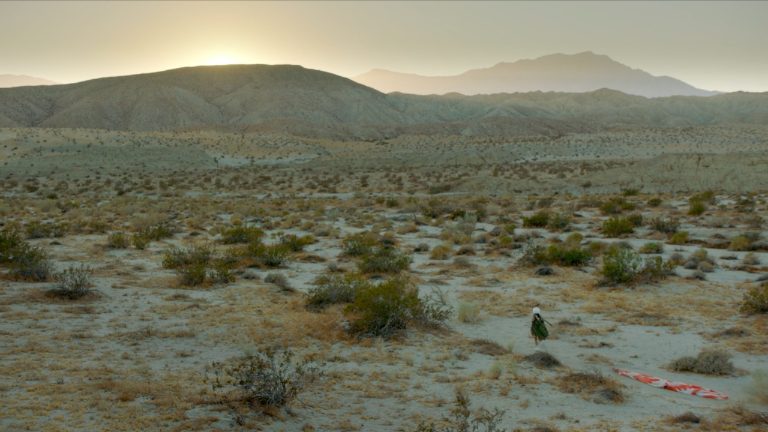
Figure 3: A still from the film Shab-i firishtigān (Night of Angels), directed by Farīdūn Gulah, 1968.

Gulah had to wait nearly four years before receiving another opportunity to direct a film, a significant pause in an industry in which high-demand directors could have as many as four films released in a single year. In the interim, he continued to consult on and write scripts for others, including Dunyā-yi ābī (Blue World, Sābir Rahbar, 1969), which won for best screenplay at the industry-sponsored Sipās (Gratitude) Awards, and the box office hit Kūchah-mard-hā (Men of the Alley, Saʿīd Mutallibī, 1970).30Jamāl Umīd, Tarīkh-i sīnimā-yi Īrān: 1279-1357 (Tehran: Intishārāt-i Rawzanah, 1998), 524, 555. Establishing a precise chronology of Gulah’s screenwriting career is as challenging as determining his level of involvement in the screenplays attributed to him. Gulah has noted that some of his scripts were sidelined for extended periods of time before entering production.31“Guft-u-gū bā Farīdūn Gulah,” in Sīnimā-yi Farīdūn Gulah, ed. Rizā Durustkār (Tehran: Nashr-i Khazzah, 2000), 102. Again, the film industry’s expansion in the late 1960s and early 1970s was both rapid and disorderly; it certainly created space for achieving greater levels of professionalization, technical proficiency, and creative expression but also attracted unpracticed outsiders eager to sink money into dubious productions for fast (and often unattainable) returns.  Increased competition and swollen production slates, combined with stagnating ticket prices, ultimately wreaked havoc on studio coffers and release timelines.32Masʿūd Mihrābī, Tarīkh-i sīnimā-yi Īrān: az āghāz tā sāl-i 1357 (Tehran: Nazar, 1983), 143. The potential delays between Gulah’s submission of a script, its production, and release may help to explain the differences in subject and tone that viewers encounter between many of his ‘hired gun’ scripts and those that he wrote for himself to direct during the 1970s. His later interviews also acknowledged a mercenary attitude towards scriptwriting for others, admitting that his artistic and professional integrity could at times take a back seat to more immediate, pecuniary interests.33“Guft-u-gū bā Farīdūn Gulah,” in Sīnimā-yi Farīdūn Gulah, ed. Rizā Durustkār (Tehran: Nashr-i Khazzah, 2000), 108-9. In his memoirs, Bihrūz Vusūqī has attested to Gulah’s occasional indifference to professional scruples, recalling a meeting between himself, Gulah, and the actor and producer ʿAlī Amīnī in which Gulah made up a script on the spot that he pretended to read from an empty notebook in front of him. Yet, he still managed to sell it to Amīnī. Vusūqī added that Gulah then took that same improvised script and sold it a second time to another studio with some minor alterations. See, Nāsir Zirā‛atī, Bihrūz Vusūqī: Yak Zindigīnāmah (San Francisco, CA: Aran Press, 2004), 291-2. In fact Gulah was known to write multiple screenplays simultaneously, peddling them to different production companies. Occasionally, the features based on his writing would reach theaters at the same time, much to the shock of their competing producers.34ʿAbbās Bahārlū, Sad chihrah-ʾi sīnimā-yi Īrān (Tehran: Nashr-i Qatrah, 2002), 115. However, once a script was optioned, Gulah admitted that he took little interest in either how or when his clients realized his words on screen.35ʿAbbās Bahārlū, Sad chihrah-ʾi sīnimā-yi Īrān (Tehran: Nashr-i Qatrah, 2002), 115.

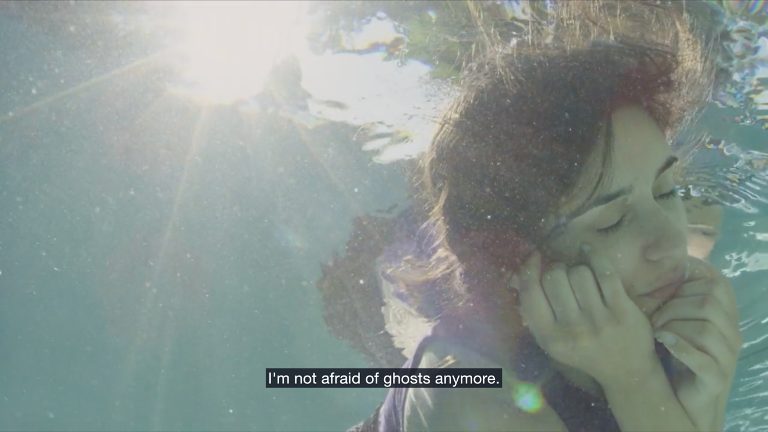
Whatever regrets Gulah had about his screenwriting career were reserved for scripts that he directed or planned to direct himself. In fact, there were a few screenplays that he claimed to write for himself to realize, for which the Ministry of Culture and Art never granted or later rescinded production permits. These ‘lost’ scripts included an adaptation of Sādiq Hidāyat’s Dāsh Akul that Ministry officials made an offer to finance and just as quickly reconsidered. Not long after, the writer and director Masʿūd Kīmiyāʾī brought his own version of the short story to the screen in 1971, one of a number of episodes in which Kīmiyāʾī’s professional accomplishments paralleled (or overshadowed) Gulah’s own.36“Guft va gū bā Farīdūn Gulah,” 105. Gulah attributed his leadership role in the Artists’ Syndicate (Kānūn-i Hunarmandān), whose chief adversary during the 1970s was the Ministry, for creating obstacles to the production of some of his scripts.37“Guft-u-gū bā Farīdūn Gulah,” in Sīnimā-yi Farīdūn Gulah, ed. Rizā Durustkār (Tehran: Nashr-i Khazzah, 2000), 117-8. Moreover, he alleged that two of his films were kept out of the competition for best picture at the court-sponsored Tehran International Film Festival because of his adversarial relationship with Ministry officials.38“Guft-u-gū bā Farīdūn Gulah,” in Sīnimā-yi Farīdūn Gulah, ed. Rizā Durustkār (Tehran: Nashr-i Khazzah, 2000), 115-6.

Prominent failures such as his abortive screenplay of the modern folktale Dāsh Akūl nevertheless highlight a commonality in narrative and character development that can be discerned from Gulah’s diverse screenwriting career: an overarching interest in depicting the lives of the urban poor and working classes. Since his childhood days in Hasanābād, he had spent many hours in quiet observation of the lives and habits of the most deprived segments of society.39“Guft-u-gū bā Farīdūn Gulah,” in Sīnimā-yi Farīdūn Gulah, ed. Rizā Durustkār (Tehran: Nashr-i Khazzah, 2000), 127. Accordingly, his shooting locations were often the back alleys, markets, and cafés of older, poorer city neighborhoods. Once he returned to directing in the early 1970s, “dirty realism” became a stylistic hallmark that pervaded his features’ mise-en-scène, casting, and even camera-work (including the use of hidden cameras to heighten the realism).40ʿAbbās Bahārlū, Sad chihrah-ʾi sīnimā-yi Īrān (Tehran: Nashr-i Qatrah, 2002), 116. Hence, his inclusion among Third Front filmmakers seems appropriate—given their desire, according to critics and historians, to connect with younger audiences by appropriating the techniques and politics of post-war realist movements in Europe while also working within locally established ‘rules’ of film entertainment.41ʿAbbās Bahārlū, Sad chihrah-ʾi sīnimā-yi Īrān (Tehran: Nashr-i Qatrah, 2002), 115; Umīd also includes Gulah among “Third Front” or “Third Wave” (Mawj-i sivvum) filmmakers like ʿAlī Hātamī, Mas‛ūd Kīmiyāʾī, and Dāryūsh Mihrjūʾī. See Jamāl Umīd, Tarīkh-i sīnimā-yi Īrān: 1279-1357 (Tehran: Intishārāt-i Rawzanah, 1998), 555). In their narrative and stylistic aims (but also class and educational backgrounds), the Third Front resembled the contemporaneous “Movie Brats” working in Hollywood such as Francis Ford Coppola, George Lucas, and Martin Scorsese, and Steven Spielberg, who all brought a more worldly “film school” aesthetic to studio features aimed at a coming-of-age but also increasingly sophisticated audience. The Movie Brats’ attempts to shake up a stagnant studio system were likewise met with an initial dose of skepticism from the critical community.42See, Michael Pye and Lynda Myles, The Movie Brats: How the Film Generation Took Over Hollywood (New York: Holt, Rinehart and Winston, 1979). If there were indeed links between Gulah and Scorsese, they are more likely to be found in their spiritual and aesthetic connections rather than in the personal realm.

To be sure, Gulah’s narrative focus on the socially marginalized was itself a common feature of the industry’s output dating back to its post-war origins. 43See, Hamid Naficy, A Social History of Iranian Cinema. Volume 2: The Industrializing Years, 1941-1978 (Durham, NC: Duke University Press, 2011), 294-310. While some critics and fans have voiced appreciation and even astonishment at his detailed renderings of the language, personalities, sentiments, and domains of the rough-and-tumble men of the streets, especially given his own firmly middle-class status, it is worth remembering that the film industry’s creative talent almost entirely came from middle class backgrounds, even if their on-screen protagonists had not. Again, in ʿIshqī’s contrarian view, much of Gulah’s oeuvre was not intrinsically different in terms of its characters, narrative themes, or settings from the most mundane and forgettable releases of his time.44Bihzād ʿIshqī, “Bāzkhvānī-i tārīkh,” Fīlm 340 (November-December 2005): 106. The prominent critic Hazhīr Dāryūsh, in his capacity as the head of the awards committee for the Tehran International Film Festival, had likewise asserted the mediocrity of Gulah’s work in excluding his 1974 submission Mihr-i giyāh (The Mandrake) from the prize competition.45“Guft-u-gū bā Farīdūn Gulah,” in Sīnimā-yi Farīdūn Gulah, ed. Rizā Durustkār (Tehran: Nashr-i Khazzah, 2000), 116. Nevertheless, Gulah’s fiercest defenders have also argued quite compellingly that while he did not necessarily break with established commercial formulas (unlike his contemporaries in the Iranian New Wave [Mawj-i naw]), his written-and-directed titles of the 1970s were significant efforts to reimagine or reinvigorate those formulas for a changing audience demographic—one that was now increasingly single, male, socially and politically disaffected, and raised on a steady diet of violent, profane movies from around the world that featured male protagonists of a similar temperament. Third Front cinema is perhaps too broad a category to accurately describe Gulah’s work during the 1970s, which resembled what film scholars working in a different national context (India) but on a similar time period have called “angry young man” cinema.46See, e.g., Ranjani Mazumdar, Bombay Cinema: An Archive of the City (Minneapolis: University of Minnesota Press, 2007), esp. 1-40.  Amīr Qādirī has made a similar argument about Gulah belonging to an era of “protest cinema.” See Amīr Qādirī, “Lizzat-i shikastan-i shīshih-i tamīz-i khvush tarāsh,” Fīlm 340 (November-December 2005): 109. Gulah, both as a film professional and movie buff, participated in what was in fact a global wave of angry young man filmmaking that contributed novel settings and camera angles, faster-paced editing, darker characterizations, bloody and highly choreographed violence, graphic sexuality and language, and pop music-inspired scores, among other things, to the stylistic and technical repertoire of their respective industries.

Gulah made his directorial return with Kāfar (Infidel, 1972). The self-penned script was likely inspired by Kīmiyāʾī’s groundbreaking entry in Iran’s angry young man cinema genre, Qaysar (1969), which transformed its star Bihrūz Vusūqī into the film icon of the 1970s. According to ʿIshqī, Infidel was merely another (and failed) attempt to capitalize on Qaysar’s enormous success by shamelessly borrowing from its storylines, settings, dialogues, sound design and overall style.47Bihzād ʿIshqī, “Bāzkhvānī-i tārīkh,” Fīlm 340 (November-December 2005): 107. Even Gulah’s title is drawn from his film’s anti-hero, Mahdī Kāfar, just like Vusūqī’s eponymous character in Qaysar. Gulah selected relative newcomer Saʿīd Rād for what he presumed to be a star-making role. Rād did indeed have his break-out role that year but it was to be in fellow Third Front director Nāsir Taqvāʾī’s Sādiq Kurdah (Sādiq the Kurd).48Jamāl Umīd, Tarīkh-i sīnimā-yi Īrān: 1279-1357 (Tehran: Intishārāt-i Rawzanah, 1998), 620-1.

Figure 4: A Poster for the film Kāfar (Infidel), directed by Farīdūn Gulah, 1972.

Kāfar, shot in black and white like most commercial productions of the time, has a relatively straightforward plot about youthful rebellion against an unjust world and its predictable outcomes. Kāfar returns home from a short spell in prison after a robbery gone bad that his former accomplices pinned on him. He seeks revenge by challenging his old street boss, Hasan Talā (Ghulām Rizā Sarkūb) for supremacy in the neighborhood. Gulah chose locations in Isfahan’s old quarter for filming, mirroring his seemingly anachronous characters.49“Guft-u-gū bā Farīdūn Gulah,” in Sīnimā-yi Farīdūn Gulah, ed. Rizā Durustkār (Tehran: Nashr-i Khazzah, 2000), 122. Kāfar’s quest for revenge is disrupted by the discovery of a diary belonging to a young woman Sūrī (Pūnah), who is being abused by her mother’s landlord. In line with post-Qaysar industry conventions, the girl’s sexual victimization is not merely hinted at through dialogue or body language but depicted explicitly by Gulah. Kāfar sets out to right the wrongs done to her according to the diary and in the process falls in love. Sūrī in turn falls in love with him, despite never having seen her mysterious savior. Kāfar vows to marry her and break with his violent and criminal past but only after one last robbery that will allow him to give her the kind of life that she dreams about in her diary. However, his former crew mates and now rivals alert the police who, by shooting at him, cause him to fall eight stories to a grisly death. 

Gulah’s gory depictions of on-screen violence contributed to a larger trend in youth cinemas the world over, with Arthur Penn’s Bonnie and Clyde (1967) perhaps the earliest example. This move towards greater realism included the staging of increasingly elaborate stunts and fight sequences, the use of hand-held cameras and zoom lenses, and faster-paced editing.  Moreover, Gulah’s protagonists often receive as many beatings as they hand out during their brawls, turning the page on industry clichés of the invincible hero and, in the process, endowing the characters with greater humanity and realism. Hong Kong cinema and its then-growing global profile may have inspired Gulah’s characterizations, just as it had inspired his contemporaries in popular Indian cinema. Kāfar’s use of a throwing star to subdue a rival during an early fight scene may well be considered as an explicit acknowledgment of the director’s debt to Hong Kong cinema. More subtly, though, critics and fans have noted his penchant for fleshing out characters—big and small—via shifting perspectives, the manipulation of chronology, and other relatively unique narrative and stylistic devices as likely inspired by Hong Kong imports.50“Guft-u-gū bā Farīdūn Gulah,” in Sīnimā-yi Farīdūn Gulah, ed. Rizā Durustkār (Tehran: Nashr-i Khazzah, 2000), 152-3.

While Infidel failed to attract audiences, the film’s stylistic flourishes and his previous successes as a screenwriter had earned Gulah some industry credit. Veteran producer Mahdī Musayyibī offered to finance his next script, Dishnah (Dagger, 1972), and convinced established stars Bihrūz Vusūqī and Furūzān to headline. In Vusūqī’s own telling, he became the de facto producer once Musayyibī fled the country to escape his creditors.51Nāsir Zirā‛atī, Bihrūz Vusūqī: Yak Zindigīnāmah (San Francisco, CA: Aran Press, 2004), 218. Musayyibī’s debt and sudden absence from the production underlined the film industry’s precarity in that moment, despite reaching its highest total of theatrical releases ever (90) in the same year.52M. Ali Issari, Cinema in Iran, 1900-1979 (Metuchen, NJ: Scarecrow Press, 1989), 242. The impossible demands that uncontrolled industry expansion had placed on producers reached a crisis point in 1972, with the number of annual domestic releases dramatically declining in subsequent years. Fortunately, the film became an unqualified hit with audiences, finishing fifteenth in the annual box office rankings.53Humā Jāvdānī, Sālshumār-i tārīkh-i sīnimā-yi Īrān: Tīr-i 1279-Shahrīvar-i 1379 (Tehran: Nashr-i Qatrah), 107. Gulah retained his previous narrative focus on the so-called dregs of society. Vusūqī plays two-bit gangster ʿAbbās Chākhān or ʿAbbās the Phony. To celebrate his recent release from jail, his cronies take him to a brothel where he meets Banafshah (Furūzān), held captive by her pimp Mamad Dishnah (Husayn Gīl). ʿAbbās eventually falls in love with her and seeks to save her from Dishnah’s brutality, even if it means risking his own life.

The storyline mirrors Infidel in important aspects, with a wrongdoer attempting to do right in the name of love. Yet Gulah included some plot divergences, perhaps with the intention of correcting what he perceived to be his previous film’s missteps. ʿAbbās’s redemptive turn from unscrupulous goon to virtuous champion is slower than Kāfar’s. His offer to save Banafshah from her brutal predicament and make a new life with her is at first a transparent ploy to exploit her affections. In fact, his wanton cynicism may have resonated more with contemporary audiences than Kāfar’s seemingly chaste and self-abnegating love. ʿAbbās’s manipulations of Banafshah bear fruit after he is re-arrested. She comes to his rescue with bail money and in the process deepens her debt to Dishnah. While he promises to pay her back, he has no intention of doing so until he sees a painting of a violet, Banafshah’s namesake, in a café. Instead of relying on exaggerated acting for melodramatic effect, Gulah primarily used cinematography (quick cuts and zooms) to communicate the emotional impact of sequences where the changing nature of couple’s relationship is depicted. He also relied on music to underline such narrative shifts but, again, in ways different than in many previous melodramas. Rather than a standard operatic score, his frequent collaborator Vārūzhān wrote one that was far more atmospheric in character. Pop star Dāryūsh’s “Dast-hā-yi Tu” (“Your hands”) recurs as a theme for ʿAbbās and Banafshah’s erotic emotions. The pop song soundtrack had become a hallmark of 1970s youth cinemas, with its likely origins in Hollywood productions like The Graduate (Mike Nichols, 1967), Midnight Cowboy (John Schlesinger, 1969), and Easy Rider (Dennis Hopper, 1969). The haunting melody of Dāryūsh’s song heralds ʿAbbās’s emotional realization in the café. He then makes it his mission to clear Banafshah’s debts and find a home for the two of them. Yet, the destructive and bloody path that the couple must tread in pursuit of this future underlines the difficulty that the socially marginalized face in escaping their life conditions. It recalls a line addressed to Banafshah from the film’s initial scenes about the street thug and prostitute as kindred spirits who both live on the edge of a knife.  The couple’s final bloody struggle with Mamad Dishnah makes this sentiment a literal reality. Nevertheless, ʿAbbās, with Banafshah’s help, ultimately subdues her longtime tormenter.

The film’s coda is a jarring departure from the tense final showdown with Dishnah. ʿAbbās the jokester from the first reel makes a return appearance, back in prison and anxiously awaiting his release to be with Banafshah, who is pregnant with his child. Ironically, this ill-fitting resolution recalls some of the mediocre melodramas of the previous decade (including a few of Gulah’s mercenary scripts), which Third Front filmmakers such as himself had strived to transcend. To his credit, Gulah claimed that the original script concluded with the couple dying alongside Dishnah but the new ending was added during post-production; he was unsure who was the responsible for the change but named Musayyibī’s production team, Vusūqī, and cinematographer Niʿmat Haqīqī as likely possibilities.54“Guft-u-gū bā Farīdūn Gulah,” in Sīnimā-yi Farīdūn Gulah, ed. Rizā Durustkār (Tehran: Nashr-i Khazzah, 2000), 141-2. Still, Gulah’s next three productions, which critics have considered his best work, would more forcefully confirm his turn away from increasingly stale industry formulas.

Figure 5: ʿAbbās and Banafshah in the film Kāfar (Infidel), directed by Farīdūn Gulah, 1972.

In retrospective interviews, Gulah stressed that Zīr-i pūst-i shab (Under the Skin of the Night, 1974), The Mandrake (1975), and Kandū (Beehive, 1975) comprised a trilogy exploring man’s spiritual journey from material attachment to physical annihilation and transcendence.55“Guft-u-gū bā Farīdūn Gulah,” in Sīnimā-yi Farīdūn Gulah, ed. Rizā Durustkār (Tehran: Nashr-i Khazzah, 2000), 187. Under the Skin of the Night makes up the first leg of that journey. It depicts the travails of an idle and homeless young man, Qāsim Siyāh (Murtizā ʿAqīlī), in finding a place where he can have sex with an American tourist. From Gulah’s viewpoint, Qāsim’s predicament illustrates the seemingly unbridgeable gap between the Shah’s self-aggrandizing vision of the country (epitomized by the recently-held 2500th anniversary of Iranian monarchy celebrations that fed into the aims and rhetoric of the “Great Civilization”) and the urban poor’s own miserable reality.56“Guft-u-gū bā Farīdūn Gulah,” in Sīnimā-yi Farīdūn Gulah, ed. Rizā Durustkār (Tehran: Nashr-i Khazzah, 2000), 163. Qāsim lives hand-to-mouth, wandering Tehran’s streets largely deprived of the material benefits that state-directed development plans had promised. Nonetheless, his acculturation in the consumerist paradise (and its sensual pleasures), available only to a privileged minority, is complete, which only manages to intensify his sense of deprivation. Shot in black and white in a hidden-camera documentary style, Under the Skin of the Night follows Qāsim over a roughly twenty-four-hour span in which he meets uninhibited backpacker Susan, played appropriately enough by a non-professional actor (Susan Geller), and then unsuccessfully tries to bed her. The title credits sequence features a dung beetle engaged in a Herculean effort to hide its treasure, foreshadowing Qāsim’s own futile struggle.

Figure 6: Qāsim and Susan in the film Zīr-i pūst-i shab (Under the Skin of the Night), directed by Farīdūn Gulah, 1974.

The protagonist’s single-minded drive to satisfy his base instincts marks a sharp break with the family-centered melodramas of only a few years earlier, where superficially Westernized gigolos were presented as the main threats to female chastity while lumpen heroes from poor ‘traditional’ neighborhoods retained their moral composure. Typical of 1970s global youth cinema, Under the Skin of the Night does away with concepts of forbearance and restraint preached by the parental generation (and the political leadership as the “fathers” of the nation) to a new generation whose social status and civic role was increasingly limited. Qāsim’s volatile relationship with his mother, a live-in maid in tony north Tehran, encapsulates his rejection of the once powerful but now empty shibboleths of so-called national progress. Instead of finding work, he indulges the fantasy of easy money and easy women by engaging in petty theft, window-shopping, watching sexually explicit films, and harassing female passers-by. However, reality constantly intrudes on this world-making. His encounter with Susan and attempts to physically possess her land particularly devastating blows to his psyche. She first notices him stealing hubcaps and then they flirt with each other in the park. Despite the language gap, he manages to convince her to sleep with him before catching her flight home early the next morning. However, Qāsim cannot secure a place for their intimate relations. He predictably retreats to his fantasy world, imagining her naked on a bed while they are window-shopping. Out of options, he goes to his mother for help who, scandalized, throws him out. Her employer’s son Farrokh, though, pretends to come to Qāsim’s aid, giving him and Susan a ride to a friend’s empty house where he and his friend proceed to sleep with Susan while a humiliated Qāsim sits by the pool.

Figure 7: A Poster for the film Zīr-i pūst-i shab (Under the Skin of the Night), directed by Farīdūn Gulah, 1974.

In a sharp rebuke to melodramatic conventions, the two Westernized gigolos emerge victorious in these scenes. Gulah effectively portrays not only the material gap between the well-to-do and poor in 1970s Iran but how this gap contributed to the deprived classes’ exploitation and abasement. ʿAqīlī in turn powerfully communicates his character’s pent-up anger and frustration once he works up the courage to confront the two rich men for ‘stealing’ Susan and is violently ejected from the home. The sound of a ticking clock (or perhaps a time bomb?) accompanies his weeping while Susan looks on. Gulah’s camera lingers on this scene for several minutes before she attempts to comfort him physically, leading to a furtive attempt at love-making in a parking lot that the police quickly disrupt. While Susan receives a police escort to the airport, the tilted scales of justice condemn Qāsim to a night in jail. The film ends with a montage of the modern city at daybreak intercut with Qasem sleeping on his cell floor.

Gulah’s transgressive turn in narrative and style in Under the Skin of the Night may well explain why he self-produced the film.57“Guft-u-gū bā Farīdūn Gulah,” in Sīnimā-yi Farīdūn Gulah, ed. Rizā Durustkār (Tehran: Nashr-i Khazzah, 2000), 137. He even shelved plans to incorporate a Dāryūsh pop song in the film, in line with his non-commercial approach in subject and presentation.58It still won a prize for best music at the annual Sipās industry awards. See, “Guft-u-gū bā Farīdūn Gulah,” in Sīnimā-yi Farīdūn Gulah, ed. Rizā Durustkār (Tehran: Nashr-i Khazzah, 2000), 165. Surprisingly, Gulah also claimed that the film did not receive any undue attention from government censors, recalling only one specific instance when the lyrics to a song were banned.59“Guft-u-gū bā Farīdūn Gulah,” in Sīnimā-yi Farīdūn Gulah, ed. Rizā Durustkār (Tehran: Nashr-i Khazzah, 2000), 121. While depictions of graphic sexuality on theater screens had lost their novelty by the time the film was released, ʿAqīlī’s simulation of Qāsim masturbating in his jail cell still has a shock factor today (to say nothing of the film’s general political critique). Despite serious technical flaws (e.g. murky and under-lit scenes) for which the ‘guerilla’ cinematography likely deserves some blame, it became a cult hit. The Kāprī Cinema was the film’s lone venue in Tehran, but it played there for seven months.60“Guft-u-gū bā Farīdūn Gulah,” in Sīnimā-yi Farīdūn Gulah, ed. Rizā Durustkār (Tehran: Nashr-i Khazzah, 2000), 165; Bihzād ʿIshqī, “Bāzkhvānī-i tārīkh,” Fīlm 340 (November-December 2005): 107. It received unprecedented press attention, including reviews in weeklies that had generally ignored homegrown cinema.61“Guft-u-gū bā Farīdūn Gulah,” in Sīnimā-yi Farīdūn Gulah, ed. Rizā Durustkār (Tehran: Nashr-i Khazzah, 2000), 164. The positive press, but also the film’s box office performance, undoubtedly encouraged Gulah to continue his turn away from commercial filmmaking conventions.

Gulah began working on the script for The Mandrake immediately after Under the Skin of the Night.62“Guft-u-gū bā Farīdūn Gulah,” in Sīnimā-yi Farīdūn Gulah, ed. Rizā Durustkār (Tehran: Nashr-i Khazzah, 2000), 189. If his previous film was a commentary on the fruitless chase for personal fulfillment in this world, then The Mandrake revealed how a higher calling (here, erotic love) can sever one’s attachment to the material. Gulah repeatedly claimed in interviews that The Mandrake was his best film.63“Guft-u-gū bā Farīdūn Gulah,” in Sīnimā-yi Farīdūn Gulah, ed. Rizā Durustkār (Tehran: Nashr-i Khazzah, 2000), 195. Interestingly, Pārs Fīlm produced it despite the studio’s reputation as an industry pillar and, thus, presumably more reluctant to accept the risky departure from industry conventions that Gulah’s project represented. The studio played a central role in shaping the post-war commercial cinema and its products—a fact which had earned it far more scorn than praise from the critical community. Nevertheless, its founder, Ismāʿīl Kūshān, who personally approved the production, had also been responsible for many of the creative and technical advancements of that same era. Even the royal court had not long before commissioned his studio to produce an official documentary for the 2500 years of Iranian monarchy celebrations, despite many prominent Pahlavī insiders’ longstanding and well-documented distaste for domestic studio fare.64Mohammad Saeed Habashi, Final Sequence: Esmail Koushan through the Lens of Mahmoud Koushan, trans. Mahasti Afshar (Los Angeles: Kambiz Koushan, 2022), 148. Gulah claimed that Kūshān, along with the film’s star ʿAlī Nasīriyān, had also collaborated with him on the final script for The Mandrake.65“Guft-u-gū bā Farīdūn Gulah,” in Sīnimā-yi Farīdūn Gulah, ed. Rizā Durustkār (Tehran: Nashr-i Khazzah, 2000), 188.

Figure 8: A Poster for the film The Mandrake (Mihr-i giyāh), directed by Farīdūn Gulah, 1975.

Shot in black and white, The Mandrake is a magical realist drama in the spirit of Parvīz Kīmiyāvī’s New Wave classic Mughulhā (The Mongols, 1973). According to Thierry Zarcone, the mandrake plant has since antiquity represented the mystical connection between man and nature for people in both Europe and Asia. Texts from across this geographic area have noted the plant’s magical character, springing “…chiefly from the shape of its root, which vaguely resembles the human body” with later developments in this line of thought even promoting a belief in the plant’s ability to take human form.66Thierry Zarcone, “The Myth of the Mandrake, the ‘Plant-Human’,” Diogenes 207 (2005): 115-6. Although understood to be poisonous and even fatal to humans, magicians and sorcerers also sought to harness the mandrake’s power, and relied on it for “arousing love due to its aphrodisiac characteristics…”67Thierry Zarcone, “The Myth of the Mandrake, the ‘Plant-Human’,” Diogenes 207 (2005): 115. In Persian, “mihr-i giyāh” literally means “love-plant” and the tales associated with it undoubtedly influenced Gulah’s characterization of the aptly named Mihrī (Pūrī Banāʾī) and her ultimately deadly effect on the film’s protagonist ʿAlī ʿIzzat Fākhir (ʿAlī Nasīriyān). Gulah included very few speaking roles in the film, with the narrative focused almost exclusively on the mysterious Mihrī and ill-fated ʿAlī.

ʿAlī, the son of a once-prominent family in decline, works for a florist in a city on the Caspian coast. According to Gulah, he wanted Nasīriyān for the role precisely because his looks and mannerisms allowed him to easily shift between characters from the privileged and lower classes.68“Guft-u-gū bā Farīdūn Gulah,” in Sīnimā-yi Farīdūn Gulah, ed. Rizā Durustkār (Tehran: Nashr-i Khazzah, 2000), 189. The opening scene is set on a beachfront where, inside the delivery van that also serves as his home, ʿAlī writes a letter to government officials about a nearby property that he claims to have inherited but which is disputed by his aunt. ʿAlī is obsessed with this patch of land, set in the most verdant part of Iran, and, as viewers soon learn, he has made many petitions and written many letters to validate his claim to it. As he later tells Mihrī, he has plans to turn it into a nursery and open his own flower business. However, like Qāsim in Under the Skin of the Night, all of ʿAlī’s desires remain tantalizingly out of reach, with forces worldly and otherworldly seemingly working against him. Drifting off to sleep, an ethereal vision of a white-veiled young woman running along the beach towards his van appears to him. The atmospheric sound design amplifies the action of the wind and waves in conjunction with this vision. Her on-screen presence is often signaled by amplified and looped ambient sounds. The next evening, while driving back from work, he sees the woman in white running along the road as if someone is chasing her and stops to pick her up. She does not tell him who was chasing her or where exactly her home is.

Her mystery charms ʿAlī, who proclaims that he has always been unlucky in love. At first she resists his advances but his growing affection for her appears to weaken her guard. She becomes his travel companion, which ʿAlī welcomes as he is eager to show her the land on which his future dreams are based. In fact, as his love for her deepens, he wishes to make it their shared dream. Gulah thus translates the spiritual journey, on which he has sent his protagonist, into a literal one. Mihrī, for her part, asks him to take her to her mother’s grave, to which he agrees. On the way there, they finally make love, with Gulah far more restrained in his framing and depiction of sexual intimacy than in Under the Skin of the Night—perhaps to underline its emotional gravity. Not long afterwards, ʿAlī begins to exhibit fever-like symptoms as if he is suffering from an infection (love-sickness?) or, worse, poisoning. Strange events also occur when they arrive at her mother’s grave. The gravestone is badly time-worn and the cottage nearby, which Mihrī also claims to remember, appears to have been abandoned for many years. Before they leave the cemetery, he tells her to enter a kiosk for prayers where he seemingly consecrates their relationship while repeating to her “You said you were single.”

Figure 9: ʿAlī and Mihrī in the film The Mandrake (Mihr-i giyāh), directed by Farīdūn Gulah, 1975.

They arrive in the city where he buys her shoes. The next day, she takes him on a tour of the neighborhood where she claims to have grown up. They arrive at a home supposedly belonging to her grandmother and she asks him to wait outside. After some time passes without her returning, he goes to look for her but notices that the door which he believed that she entered is padlocked from the outside. Gulah again uses rapid camera action and quick cuts rather than the standard package of techniques in domestic melodramas to communicate and intensify character emotions—specifically ʿAlī’s desperate bewilderment at Mihrī’s disappearance.  ʿAlī backtracks to the coastal road to find her, asking anyone he passes if they have seen her. Finally, his emotions get the better of him and he retreats to the rear of the van where the camera, stationed outside in the pouring rain, captures him tearing up his appeals and documents about the land claim. In doing so, he disavows his last link to the world. He spends a fitful night dreaming of an unknown assailant attacking Mihrī as he stands by powerlessly. When he returns behind the wheel, his visions continue but now of a physically and emotionally unburdened ʿAlī running through the paradisiacal property supposedly promised to him. However, this image is suddenly interrupted by the sound of his van veering off the road and crashing. The camera cuts to his van’s mangled remains at the bottom of a ravine, followed in quick succession by shots of his scattered personal effects. Panning up, the camera reveals a handful of figures looking down from the hilltop, accompanied by the disembodied children’s voices that marked his lover’s disappearance. Gulah then focuses the camera on what appears to be Mihrī in her new shoes at the cliff edge, followed by a quick cut to her emotionless face looking down at the destruction below.

ʿAlī’s fatal passion for the seemingly callous Mihrī not only argues for the mandrake plant’s well-known double nature (both seductive and dangerous) but may also suggest to viewers the ascetic’s reckless yearning for God, presented metaphorically in the love poetry of Sufi masters. In fact, Bahārlū has claimed that Gulah’s script took direct inspiration from the poet and mystic Jalāl al-Dīn Rūmī.69ʿAbbās Bahārlū, Sad chihrah-ʾi sīnimā-yi Īrān (Tehran: Nashr-i Qatrah, 2002), 116. For a materialist interpretation of the film’s ending, see Muhammad Tahāmī Nizhād, Sīnimā-yi ruʾyāpardāz-i Īrān (Tehran: ʿAks-i muʿāsir, 1986), 72. Gulah thus represents ʿAlī as Mihrī’s (unwitting) devotee. She is the ultimate cause of ʿAlī’s physical detachment, and her true nature can only be known to him at the moment of spiritual transcendence. Yet, ʿAlī’s death has no worldly effect beyond its testimony to love’s devastating power. In his next film, Beehive, Gulah transforms self-abnegation into (potentially revolutionary) action in the world.

Gulah wrote Beehive, originally titled Gulgūn savār (The Bay Horse-rider), six months after filming The Mandrake.70Muhammad Tahāmī Nizhād, Sīnimā-yi ruʾyāpardāz-i Īrān (Tehran: ʿAks-i muʿāsir, 1986), 194-6. It was his first and only color feature. Mahdī Musayyibī agreed to produce Beehive in conjunction with the Ministry of Culture and Art, which had been encouraged to collaborate with Gulah after visiting foreign critics’ positive reception of The Mandrake. The Ministry provided equipment and access to their processing facilities but ceased cooperation about halfway through production after reviewing the rushes.71Muhammad Tahāmī Nizhād, Sīnimā-yi ruʾyāpardāz-i Īrān (Tehran: ʿAks-i muʿāsir, 1986), 207-8. Fearing that officials would ultimately confiscate the footage that he had shot, Gulah shipped it to France for editing, music recording, and sound mixing.72Khudāyār Qāqānī, “Tasharruf bih maʿsūmiyat va tafakkur,” in Sīnimā-yi Farīdūn Gulah, ed. Rizā Durustkār (Tehran: Nashr-i Khazzah, 2000), 240. Nevertheless, screening permits for Beehive were eventually granted, with its premiere held at the 4th Tehran International Film Festival in November 1975, where it was a major hit with audiences.73Jamāl Umīd, Tarīkh-i sīnimā-yi Īrān: 1279-1357 (Tehran: Intishārāt-i Rawzanah, 1998), 688. Critics were more mixed in their reactions and the film, which did not win any prizes except an honorable mention award for supporting actor Rizā Karam Rizāyī. Still, Gulah’s bête noire, Hazhīr Dāryūsh, supposedly confided in its star, Bihrūz Vusūqī, that he should have won the best actor award, but he viewed an Iranian winning the prize in consecutive years as being in bad form.74Nāsir Zirā‛atī, Bihrūz Vusūqī: Yak Zindigīnāmah (San Francisco, CA: Aran Press, 2004), 289.

Gulah again assigned to Vusūqī the role of a petty criminal, Ibī, just released after spending seven months in jail.  Another cellmate, Āq Husaynī (Dāvūd Rashīdī), is released on the same day after serving sixteen years for a murder whose circumstances remain unknown. Nevertheless, Gulah later confirmed that the sentence length was politically significant indicating Āq Husaynī’s dissident past, as it roughly coincided with the length of time between the era of crackdowns following the 1953 coup d’état against Prime Minister Muhammad Musaddiq’s government and the film’s current setting.75“Guft-u-gū bā Farīdūn Gulah,” in Sīnimā-yi Farīdūn Gulah, ed. Rizā Durustkār (Tehran: Nashr-i Khazzah, 2000), 203-4. Both have their own vague plans after jail; Ibī wants to reconnect with his gang for another heist while Āq Husaynī wants to go to Khorramshahr for work. The title credits sequence, employing crane shots across from Tehran’s Bāgh-i Millī gate, gives viewers the initial impression that their pairing is incidental and temporary as they disappear separately into the passing crowd. A disillusioned Ibī soon takes refuge in a brothel, after realizing that he was better off in prison where he still had friends, a place to sleep, and no creditors to fend off.  When he stiffs the bill and an argument breaks out, he hears Āq Husaynī’s voice in the adjacent room offering to pay his due. He too had a change of heart about his plans. Despite the differences in their ages and life experiences, they appear to be inextricably linked, which Gulah also subtly signaled by having them wear the same bracelet.76“Guft-u-gū bā Farīdūn Gulah,” in Sīnimā-yi Farīdūn Gulah, ed. Rizā Durustkār (Tehran: Nashr-i Khazzah, 2000), 204. Yet, Gulah also admitted that this shared fate was not necessarily written in the stars. Their outcomes may well have been different under a different economic and political situation.77“Guft-u-gū bā Farīdūn Gulah,” in Sīnimā-yi Farīdūn Gulah, ed. Rizā Durustkār (Tehran: Nashr-i Khazzah, 2000), 204.

Gulah exhibits the economic and political order’s marginalization and derogation of the urban masses, or the effects of a “lumpenizing system,” when the pair relocates to a teahouse that is seemingly full of society’s detritus. He in fact attributed the film’s title to this oppressive system: like a beehive’s engineered structure with only one way in and one way out.78“Guft-u-gū bā Farīdūn Gulah,” in Sīnimā-yi Farīdūn Gulah, ed. Rizā Durustkār (Tehran: Nashr-i Khazzah, 2000), 194. The teahouse customers spend their days chatting, conspiring, and gambling. At night, the establishment turns into a flophouse for the left behind, destitute, and drug-addled; it is also a convenient trap, the audience later learns, for police dragnets (with the owner’s cooperation). Ibī recognizes one poor soul there who used to be his wrestling rival. He had once defeated Ibī in competition, which Gulah later depicts in a flashback sequence, but now lies dying uncared for in a corner. Āq Husaynī too seems to find his own teahouse rival, Āq Mustafā (Jalāl Pīshvāyān), with whom he plays games of chance. Their back-and-forth competition eventually reaches its climax with Āq Mustafā wagering that Ibī can drink booze at seven locales across Tehran without paying and Āq Husaynī betting against him. Ibī’s challenge invited speculation that Gulah had adapted his script from Frank Perry’s The Swimmer (1968), about a seemingly eccentric man (Burt Lancaster) who at a friend’s party decides to swim back home by way of his neighbors’ backyard pools, inviting a series of unsettling encounters along the way. Once he reaches his destination, though, it is revealed that the home has been long abandoned, and the film ends with its defeated hero slumped behind the padlocked front door. The absurdity (and danger) of Ibī’s challenge bears resemblance to this earlier Hollywood release, but Gulah claimed to have never seen it.79“Guft-u-gū bā Farīdūn Gulah,” in Sīnimā-yi Farīdūn Gulah, ed. Rizā Durustkār (Tehran: Nashr-i Khazzah, 2000), 207. Instead the Shāhnāmah or Book of Kings epic, and specifically the seven trials of the hero Rustam, as told in popular naqqalī or storyteller traditions familiar from his childhood, were supposedly a major source of inspiration.80“Guft-u-gū bā Farīdūn Gulah,” in Sīnimā-yi Farīdūn Gulah, ed. Rizā Durustkār (Tehran: Nashr-i Khazzah, 2000), 207. While the teahouse elders seek to dissuade Ibī from carrying out the suicidal challenge that Āq Husaynī and Āq Mustafā have set for him, he eventually agrees to it but only after failing once more to contact his gang. Like a beehive, there is seemingly only one path for Ibī in this world and only one path out. Echoes of Vusūqī’s character actions in Qaysar are also apparent in the preparations that Ibī undertakes once he accepts his fate. Ibī purifies himself at the public baths and then wears the clothes of his now dead wrestling rival, who had given them to him before his passing, symbolizing his readiness for a similar end. 

Figure 10: Āq Husaynī (Dāvūd Rashīdī) and Āq Mustafā (Jalāl Pīshvāyān), with Ibī (Bihrūz Vusūqī) in the center, in Kandū (Beehive), directed by Farīdūn Gulah, 1975.

Beehive clearly communicates the anger and hopelessness then common (or again reignited) among the urban poor. It bolsters the claim made by some critics and fans that Gulah was painfully aware of the coming revolution against the Pahlavī regime.81“Guft-u-gū bā Farīdūn Gulah,” in Sīnimā-yi Farīdūn Gulah, ed. Rizā Durustkār (Tehran: Nashr-i Khazzah, 2000), 194. Presumably, like Āq Husaynī before him, Ibī too engages in violent protest against an unjust world, with martyrdom the ultimate testimony to his cause’s righteousness. Interestingly, Vusūqī viewed Ibī’s actions not as rebellion but surrender, presenting instead Masʿūd Kīmiyāʾī’s Gavaznhā (The Deer, 1974) as a revolutionary film in which Vusūqī’s character Rasūl stares down a police siege alongside his friend Qudrat (Farāmarz Qarībiyān), who even takes up arms against the state.82Nāsir Zirā‛atī, Bihrūz Vusūqī: Yak Zindigīnāmah (San Francisco, CA: Aran Press, 2004), 289. Gulah held a more ambivalent view, acknowledging that Ibī’s efforts to buck the system involve a rudderless violence more fitting perhaps of an inchoate political movement than a mature, revolutionary one. Furthermore, he argued that it is impossible to be a revolutionary without weapons, but the censorship regime at the time would have undoubtedly disallowed their inclusion.83“Guft-u-gū bā Farīdūn Gulah,” in Sīnimā-yi Farīdūn Gulah, ed. Rizā Durustkār (Tehran: Nashr-i Khazzah, 2000), 203.

Ibī’s gauntlet runs from what many previous domestic releases depicted as the rough-and-tumble streets of south Tehran to the affluent and orderly north. Yet, Gulah provocatively turns such industry clichés upside down. As Ibī’s taxi driver warns him once they enter the northern reaches of the city, they don’t take mercy on you there. In fact, he walks out on his bill in the first two southern bars without incident. When he confronts the witness accompanying him (Rizā Karam Rizāyī), he admits that Āq Mustafā has rigged the challenge to win the bet. Ibī then seeks to antagonize the bouncers at subsequent establishments, whose numbers and savagery multiply. Ibī, like ʿAbbās in Dagger, has his own theme, played without lyrics and at different speeds during the final reel. The song, also called “Kandū” or “Beehive,” is then performed live by the pop star Ibī (Ibrāhīm Hāmidī) at the cabaret in a ritzy hotel, the seventh and final establishment. Gulah again turned to his longtime collaborator Vārūzhān, along with another veteran composer Rubīk Mansūrī, to score the film.84“Guft-u-gū bā Farīdūn Gulah,” in Sīnimā-yi Farīdūn Gulah, ed. Rizā Durustkār (Tehran: Nashr-i Khazzah, 2000), 201. Ibī the character arrives drunk with his face covered in blood, an iconic image that Gulah featured in the film’s promotional materials. An orgy of violence follows but he refuses to concede. To paraphrase Ibī from an earlier dialogue, he has tasted defeat often in his life and does not fear it. He escapes to a backroom bar where he gains the upper hand on the bouncers and in the process destroys its mirrored walls (a potential homage to the final fight scene in Robert Clouse’s 1973 kung fu classic Enter the Dragon). He stumbles out of the hotel and lets out a guttural scream just as a shell shocked Āq Husaynī and Āq Mustafā arrive, their bet now long forgotten. When they return to the teahouse with the bruised and battered champion, the owner calls the police, who promptly arrest Ibī. Āq Husaynī then stabs the owner. Like in Under the Skin of the Night, a shot of the morning sun on the horizon closes the book on the night’s tragic events. A mournful version of Ibī’s theme plays as the doomed pair take comfort in each other’s company on their return to prison—proving there is no escape from this lumpenizing system.

Figure 11: A Poster for the film Kandū (Beehive), directed by Farīdūn Gulah, 1975.

If Beehive was an overtly political film that channeled the frustrations bubbling up from below in the years leading up to the Islamic Revolution, Gulah’s next (and final) release, Māh-i ʿasal (Honeymoon, 1976) ignored the immediate and political for a revival of family-centered melodrama more typical of the mid-1960s than the mid-1970s. Only the inclusion of gratuitous nudity and profanity places the film in the increasingly unrestrained production climate of its times. Scholars and critics who have viewed Beehive as evidence of Gulah’s continuing maturation as a filmmaker have rightly puzzled over his follow-up, which would also abandon his exploration of the metaphysical themes in the so-called trilogy of Under the Skin of the Night, The Mandrake, and Beehive.85See, Jamāl Umīd, Tarīkh-i sīnimā-yi Īrān: 1279-1357 (Tehran: Intishārāt-i Rawzanah, 1998), 703. Gulah reunited with Beehive producer Mahdī Musayyibī and star Bihrūz Vusūqī to make Honeymoon. Pop icon Gūgūsh, then married to Vusūqī, signed on as the female lead Nīnī, the daughter of a wealthy businessman, Khān Bābā (Jamshīd Mashāyīkhī). Vusūqī plays Rizā, the son of the family’s housekeeper. While her father has a soft spot for troublemaking Rizā, he wants to distance Nīnī from him for fear that they will fall in love, which they do. Again, pop songs, including multiple Gūgūsh singles, accompany and narrate the action, specifically the protagonists’ developing love affair. Ultimately, Khān Bābā gives his blessing to this match but only when it is revealed that Rizā is not just the lowly housekeeper’s son but family via Nīnī’s maternal uncle, his biological father—employing a tried-and-true melodramatic plot convention.

Figure 12: Rizā and Nīnī in the film Māh-i ʿasal (Honeymoon), directed by Farīdūn Gulah, 1976.

Honeymoon recycles longstanding narrative themes of class, family honor, and the difficulties of balancing erotic love and family obligation, which can be traced back to the very beginnings of the commercial cinema after the Second World War.86For an in-depth exploration of the dominant narrative themes in Pahlavī-era popular commercial cinema, see Pedram Partovi, Popular Iranian Cinema before the Revolution: Family and Nation in Fīlmfārsī (New York: Routledge, 2017). Likewise, the cinematography and editing is closer to an earlier set of industry practices that Gulah had seemingly minimized in his recent work. Nevertheless, the film struck a note with audiences, with one of the highest box office takings that year.87Humā Jāvdānī, Sālshumār-i tārīkh-i sīnimā-yi Īrān: Tīr-i 1279-Shahrīvar-i 1379 (Tehran: Nashr-i Qatrah), 130. Undoubtedly, the film’s star power and soundtrack drove audiences to theaters, but its success may also speak to the enduring appeal of the commercial industry’s narrative and stylistic conventions, despite Gulah’s prior attempts to blaze a new trail. In later interviews, Gulah sought to downplay his involvement in the production, claiming that disagreements with Musayyibī caused him to walk off the set and that the producer completed the film in his stead.88Khudāyār Qāqānī, “Tasharruf bih maʿsūmiyat va tafakkur,” in Sīnimā-yi Farīdūn Gulah, ed. Rizā Durustkār (Tehran: Nashr-i Khazzah, 2000), 237-8. Even Gulah’s choice of title was overruled. The original title was Māh-i munʿakis (Upside-down Month).89“Guft-u-gū bā Farīdūn Gulah,” in Sīnimā-yi Farīdūn Gulah, ed. Rizā Durustkār (Tehran: Nashr-i Khazzah, 2000), 208. Previous struggles over creative control with Musayyibī (dating back to Dagger) seemingly support his version of events, but Vusūqī’s memoirs do not confirm this account.90Nāsir Zirā‛atī, Bihrūz Vusūqī: Yak Zindigīnāmah (San Francisco, CA: Aran Press, 2004), 291-2. Again, depending on one’s opinions on the filmmaker, the flatness of the characters and narrative inconsistencies either suggest a messy collaborative process or bolster ʿIshqī’s thesis about Gulah’s mediocrity. 

Figure 13: A Poster for the film Māh-i ʿasal (Honeymoon), directed by Farīdūn Gulah, 1976.

The following year, Gulah left for the United States. As with his student days during the 1960s, his personal account of his experiences there provides few verifiable details. He had left for Los Angeles to direct a script that he wrote called Sabz-i khuftah (Sleeping Green), which the Ministry of Culture and Arts had agreed to finance along with an American production company.91ʿAbbās Bahārlū, Sad chihrah-ʾi sīnimā-yi Īrān (Tehran: Nashr-i Qatrah, 2002), 116. Gulah claimed that the Ministry never paid its share of the production costs and the film, with a mixed American and Iranian cast that included Pūrī Banāʾī and Mickey Rooney, was shelved after an hour of the running time had been shot. He filed a lawsuit against the producers and supposedly received a multi-million dollar out-of-court settlement.92“Guft-u-gū bā Farīdūn Gulah,” in Sīnimā-yi Farīdūn Gulah, ed. Rizā Durustkār (Tehran: Nashr-i Khazzah, 2000), 210-11. Unfortunately, there is no publicly available evidence either of this production or Gulah’s lawsuit, but there are numerous unfinished films in studio vaults and court files may be sealed. Gulah claimed to use the settlement money to establish a production and distribution company in 1980 called Future Pictures, which remained in business even after his return to Iran. During the same year, the company began producing another script of his called Dīrūzī (Yesterdayish), which he abandoned after his father fell ill. According to Gulah, his company also signed contracts with several soon-to-be Hollywood stars including Harrison Ford, Kevin Costner, and Morgan Freeman.93“Guft-u-gū bā Farīdūn Gulah,” in Sīnimā-yi Farīdūn Gulah, ed. Rizā Durustkār (Tehran: Nashr-i Khazzah, 2000), 214. Again, none of these details can be verified.

Gulah returned to Iran in 1982 to tend to his father. Some officials in the post-revolutionary government had attempted to coax him back to filmmaking, but the conditions he laid out for his return were ultimately not accepted. After receiving a travel ban, he chose retirement on the Caspian coast where he lived alone and largely forgotten by the cinema world.94ʿAbbās Bahārlū, Sad chihrah-ʾi sīnimā-yi Īrān (Tehran: Nashr-i Qatrah, 2002), 116. In the summer of 1999, the film critic Rizā Durustkār was vacationing in Salmānshahr when he came across a young boy who told him that Gulah was his neighbor.95Rizā Durustkār, “Ahmaq-hā sitāyishat ni-mīkunand,” in Sīnimā-yi Farīdūn Gulah, ed. Rizā Durustkār (Tehran: Nashr-i Khazzah, 2000), 246. Durustkār and some colleagues had already planned to write a reassessment of 1970s cinema by studying the life and work of ten “independent” filmmakers, including Gulah.96Rizā Durustkār, “Ahmaq-hā sitāyishat ni-mīkunand,” in Sīnimā-yi Farīdūn Gulah, ed. Rizā Durustkār (Tehran: Nashr-i Khazzah, 2000), 244. The late 1990s had inaugurated a period of intense scholarly interest and fandom for Pahlavī-era cinema among a younger generation of Iranians, just as the post-revolutionary art cinema was having its moment among critics and festival-goers abroad.97See, Husayn Muʿazzizī Niyā, ed. Fīlmfārsī chīst? (Tehran: Nashr-i Sāqī, 1999). Durustkār struck up a friendship with Gulah and returned to the Caspian coast with his writing team to interview him at length. The following year, the interviews were published in a book along with several critical essays about Gulah’s oeuvre. Other journalists began to reach out to Gulah for interviews.98Rizā Durustkār, “Ahmaq-hā sitāyishat ni-mīkunand,” in Sīnimā-yi Farīdūn Gulah, ed. Rizā Durustkār (Tehran: Nashr-i Khazzah, 2000), 248-9. Durustkār capitalized on the old director’s newfound fame to arrange a series of meetings with producers about film scripts that he had written during his exile in Salmānshahr, including a sequel to Beehive.99Rizā Durustkār, “Ahmaq-hā sitāyishat ni-mīkunand,” in Sīnimā-yi Farīdūn Gulah, ed. Rizā Durustkār (Tehran: Nashr-i Khazzah, 2000), 250. After the revolution, a handful of his screenplays had been in the possession of the now-defunct Mīsāqiyah Studios and were transferred to the government-sponsored Fārābī Foundation, which undertook to sell them but obscured his authorship.100ʿAbbās Bahārlū, Sad chihrah-ʾi sīnimā-yi Īrān (Tehran: Nashr-i Qatrah, 2002), 116. However, Gulah’s negotiations with producers in the early 2000s was the first time in more than twenty years that he had actively tried to revive his career. Sadly, none of the discussed projects were completed, even though BBC Persian service’s obituary of the filmmaker noted that producer and erstwhile collaborator Īraj Qādirī had Gulah ghost-write his 2005 box office hit Ākvāriyum (Aquarium).101“Farīdūn Gulah dar guzasht,” BBC Persian, October 22, 2005, https://www.bbc.com/persian/arts/story/2005/10/051022_aa_fgoleh Gulah eventually lost faith in a comeback and returned to Salmānshahr where he took solace in his writing. He died of a heart attack on October 22, 2005. Even after death, his fame continued to grow, with a consensus of critics in 2009 voting Beehive the tenth best Iranian film of all time (ahead of Kīmiyā’ī’s Qaysar!) in the venerable journal Māhnāmah-yi Fīlm (Film Monthly).102“Bihtarīn fīlmhā-yi zindigī-i mā,” Māhnāmah-yi Fīlm 400 (September-October 2009): 10; Beehive did not appear in the previous “best of” polls taken in 1988 and 1999. The film also maintained its ranking in the 2019 Film Monthly decennial poll. See, “Nawbat-i ʿāshiqī: bihtarīn fīlmhā-yi zindigī-i mā,” Māhnāmah-yi Fīlm 558 (May-June 2019): 10.

Many questions remain unanswered about Gulah’s life and work. He was even a mystery to his close collaborators, one of whom described him quite candidly as “strange.”103Nāsir Zirā‛atī, Bihrūz Vusūqī: Yak Zindigīnāmah (San Francisco, CA: Aran Press, 2004), 291. Likewise, a film scholar who tried to make sense of the inexplicable twists and turns of his career concluded that he was “not a stable person.”104Jamāl Umīd, Tarīkh-i sīnimā-yi Īrān: 1279-1357 (Tehran: Intishārāt-i Rawzanah, 1998), 703. The lack of many close relationships in his life, by his own admission, further impedes any attempt to fill in the significant gaps in his biography or map his trajectory as a screenwriter and director.105“Guft-u-gū bā Farīdūn Gulah,” in Sīnimā-yi Farīdūn Gulah, ed. Rizā Durustkār (Tehran: Nashr-i Khazzah, 2000), 178-9. Yet, his imprint on Iranian cinema-goers’ collective memory cannot be questioned. Other more prolific or successful contemporaries have faded from view with the passing of time while he has seemingly grown in stature as a filmmaker. His enduring profile (and mystery) may well be related to his status as a cipher, in both senses of the word. While often insecure about his abilities, in more confident moments he conveyed esoteric truths to audiences of his time who were increasingly prepared to receive them and to audiences today who can better appreciate his vision of a revolutionary future in light of the past. He was also a self-described loner, and thus invisible to wider society, which gave him the power to observe the world unmolested and represent it back to the rest of us.

Self-Reflexivity in Iranian New Wave Cinema

By

Introduction

In Khirs nīst (translated into English as No Bear [2022]), the acclaimed filmmaker Ja‛far Panāhī, banned from making films stands in a somber mood on the Iranian side of the border separating the country from its western neighbor, Turkey, contemplating the advantages and disadvantages of departure, illegally and in the night.1Ja‛far Panāhī, dir. No Bear (Iran, 2021). A court verdict in 2010, in the wake of the Green Movement, had banned the director from making movies and leaving the country for film festivals, where he had been frequently invited not only as a director but as a jury member as well.  In No Bear, like his other post-ban films, Panāhī appears in front of the camera publicly showing his ordeal, revealing his trials and tribulations, and at the same time struggling with the decision to either leave a country where his engagement in what he loves and his source of income is forbidden to him, or to stay and bear the brunt of his verdict.  Ironically, at the time of his film screenings in festivals in 2023, Panāhī was incarcerated at the notorious Evin prison. Thus, the question of leaving the country, for him, was not only a philosophical dilemma but also one imbued with personal and political significance. No Bear served as a remarkable example of a self-reflexive film in which the director, the production crew, and the filmmaking process itself became the subject matter of the film.

This article examines the self-reflexive technique in the works of ‛Abbās Kīyārustamī, Muhsin Makhmalbāf, and Ja‛far Panāhī, and questions how the employment of this technique aids the filmmakers to create a movie with multiple layers of meaning, in a political sense. Self-reflexive technique here refers to occasions where directors demonstrate on camera the film making apparatus, and/or themselves, as a subject of the filmic enterprise. We see this technique repeatedly appearing in the experimental cinema of Iranian film directors such as ‛Abbās Kīyārustamī, Muhsin Makhmalbāf, Ja‛far Panāhī, as well as Bahrām Bayzā’ī, Rakhshān Banī-i‛timād, Tahmīnah Mīlānī, and Dāryūsh Mihrjū’ī. By analyzing the works of Kīyārustamī, in this article, we see how the self-reflexive characteristics of Close-Up, for instance, allow the director to become a sympathetic interlocutor throughout the film, seeing things differently from the judicial and political lens, and finding creative and idiosyncratic ways to solve societal problems. Likewise, Makhmalbāf’s self-reflexive forays in the autobiographical film Nūn u Guldūn (A Moment of Innocence, 1996), show the necessity of re-visiting the political past through personal memory, and providing a revisionist reading of it. Makhmalbāf’s early movies grapple with the idea of the role of film in re-defining the past, offering a revisionist reading of history. The last section of this article examines the works of Ja‛far Panāhī in the period when he was banned from filmmaking, and how his metacinematic attempts re-define the meaning and role of cinema, which has become a powerful medium to tell astounding stories with social and political significance.

Figure 1: from left: ‛Abbās Kiyārustamī, Muhsin Makhmalbāf, and Ja‛far Panāhī,

Siska defines  reflexivity  in “Metacinema: A Modern Necessity,” as a “consciousness turning back on itself.” This reflexivity appears in aesthetic media in two varied ways: “1) in the artist reflecting upon his medium of expression; and 2) in the artist as a creator reflecting upon himself, meaning that reflexivity is manifested in films on movie making, or on the movie-maker, or both.”2William C. Siska, “Metacinema: A Modern Necessity,” Literature/Film Quarterly 7, no. 4 (1979): 285–89, 286. Self-reflexivity in Iranian cinema generally disrupts narratives, transcends set boundaries, and functions in a subversive manner. In a metacinematic representation, the aesthetic representation takes a foray into the cultural, social and political realms, and the viewer is pushed to think differently, rather, more critically about the subject matter.  Therefore, the use of metacinema is generally accompanied with a “narrative intransitivity,” referring to a break in the linear progression of film. While disrupting the linear progression, this narrative intransitivity makes room for a more critical and nuanced interpretation of the film, transcending the superfluous.

Siska believes that “instances of narrative intransitivity seldom occur in traditional cinema, though they are by far the most commonly used reflexive techniques in modernist films.” He further defines narrative intransitivity by explaining that “Narrative is rendered intransitive when the chain of causation that motivates the action and moves the plot is interrupted or confused, through spatial and temporal fragmentation or the introduction of alien forms and information.”3Siska, “Metacinema: A Modern Necessity.” 285–89, 286. Resnais’s films, and  later Buñuel films seek to mystify in this fashion. Godard and Makavejev have made the interpolation of literary texts, skits, speeches, and printed slogans such an integral part of their style that we now regard it as conventional. In their work, reflexive techniques cause the films to “lose their transparency and become themselves the object of the spectator’s attention.”4Lúcia Nagib, “2. Jafar Panahi’s Forbidden Tetralogy: This Is Not a Film, Closed Curtain, Taxi Tehran, Three Faces,” In Realist Cinema as World Cinema: Non-Cinema, Intermedial Passages, Total Cinema, (Amsterdam University Press, 2020) 63-86, 66. In the films of multiple Iranian filmmakers, we encounter instances of narrative intransitivity as an integral part of their style, where reflexive techniques cause the film to themselves become the object of the spectator’s attention.

Self-reflexivity, as well as the Verfremdung/Entfremdung (alienation) techniques initially introduced by Bertolt Brecht in theater, have turned film into an aesthetically different “political” project. During his “militant period,” Jean Luc Godard embarked on making self-reflexive movies where he could show the means of production through the course of the film, and he announced that he did not just want to make “political films,” but to make them “politically,” for the sole purpose of “politicizing the viewers.”5Ewa Mazierska, “Introduction: Marking Political Cinema.” Framework: The Journal of Cinema and Media 55, no. 1 (2014): 35-44. Godard had followed in the footsteps of others including Bertolt Brecht, who had theorized the technique of Verfremdung/Entfremdung, an act of alienation, wherein the actor came out of the performance in the midst of production and thus made the viewers feel closer to the performance, a sort of self-reflexive technique.6See Kent Carroll, “Film and Revolution: Interview with the Dziga-Vertov Group,” in Focus on Godard, ed. R. S. Brown (Englewood Cliffs: Prentice-Hall, 1972), 50–64. The literature on Godard’s political cinema is huge. For Godard’s original views see also Jean Luc Godard, “Towards a Political Cinema,” in Godard on Godard, ed. Tom Milne (New York: Da Capo Press, 1972). For a concise discussion, see Julia Lesage, “Godard and Gorin’s left politics, 1967–1972,” Jump Cut, no. 28 (April 1983): 51–58. Brecht’s alienation effects aimed “to disrupt narrative illusionism” and  brought the reality of the medium and its corresponding ideology to the audience’s awareness.7Nagib, “2. Jafar Panahi’s Forbidden Tetralogy,” 63-86.

Impersonating a Filmmaker: Kīyārustamī’s Close-Up

Close-Up (Nimā-yi nazdīk, 1990), directed by ‛Abbās Kīyārustamī, is considered today to be one of the most widely acclaimed movies in world cinema in terms of both form and content. Close-Up chronicles the true story of an individual who impersonated the renowned filmmaker Muhsin Makhmalbāf, when the family’s mother mistook him for the director on a public bus.8‛Abbās Kīyārustamī, dir. Close-up (Iran, 1990). She introduced the fake filmmaker to her family, a husband and two sons, and they wholeheartedly embraced the spurious claims of this imposter filmmaker, in a state of gullibility. Subsequently, the family unearths the true nature of the fake filmmaker, Husayn Sabzīyān. They promptly summon the authorities seeking his arrest and a journalist accompanies the police during the apprehension.  This event is then chronicled in the daily newspaper.

Upon reading the news in the newspaper, Kīyārustamī considered this incident to be a remarkable subject matter to document, and he pursued the matter by visiting with the impersonator in police detention. Subsequently, in Close-Up, he recreated the story, embedded his actual questioning of the perpetrator in the documentary film, and filmed the actual trial as it happened.  In the course of the trial, the turbaned judge, who did not see the added value of this legal case compared to others, reluctantly starts asking Sabzīyān to explain his motives for introducing himself as the filmmaker Makhmalbāf. His line of questioning focuses mainly on determining whether he can find Sabzīyān culpable by questioning his “intent,” which would legally make him responsible.

But the director, Kīyārustamī, is not satisfied with the line of legal questioning, and he starts his own line of questioning to uncover the psychological and social motives of this individual’s actions.  In an unusual turn of events, the trial judge allowed the film director to probe the defendant in the court. The socio-psychological questions Kīyārustamī poses differ from the legal ones in that they try to get deeper into the inherent roots of the seemingly criminal act. The director’s embeddedness in the court case allows matters to come into light, such as Sabzīyān’s state of being, his poverty level, his veteran status, as well as his working-class milieu, that otherwise would not have been revealed. It also opens up issues fundamental for the viewer’s understanding of the character of the defendant and his motives, shedding light on the context of the society in which he lives. Kīyārustamī’s line of questioning reveals more than the obvious, as he had hoped, and at the same time opens the line of scrutiny to go beyond the defendant himself, implicitly critiquing the political conditions in post-revolutionary Iran.

Figures 2-3: Sabzīyān is in court alongside the plaintiff’s family. Close-Up (Nimā-yi nazdīk, 1990), ‛Abbās Kīyārustamī, accessed via https://www.aparat.com/v/j53425n (00:31:56-00:38:26)

Before the trial scene, however, Kīyārustamī had shown his presence, and the contour of his face, as an involved filmmaker in a brief meeting with Sabzīyān in jail. By seeing and hearing Kīyārustamī, the director broke from the linear narrative that the documentary was trying to create. In an intriguing dalliance with the camera, Kīyārustamī showed himself, inserted his voice, and alerted the spectator about the significance of Sabzīyān’s case for understanding the society in contemporary Iran. When in the trial scene, Kīyārustamī disrupts the court session—and his own documentary narrative—by questioning the defendant as if he were the judge. The director seeks to shed light on Sabzīyān as a person, delving into his background and historical context, seeking to understand his human needs, and eventually his intentions. While the legal interrogation concentrated on finding out intent (mal-intent or not), the director’s questioning concentrated on understanding the defendant’s subjectivity.

By interjecting himself in the trial, Kīyārustamī turns himself into a sympathetic interlocutor, one who elucidates social malaise with his camera. The director is more interested in Sabzīyān’s mental state, seeking to know what went on in his mind that made him impersonate a filmmaker, and why he wanted to create such a rapport with this middle-class family. As a sympathetic interlocutor, he is not there to judge, but to observe, document, and report—and maybe more. The metacinematic characteristic of these scenes revolves around designating a role for the filmic enterprise in solving social malaise, through empathy rather than discipline.

Why is the working-class Sabzīyān impersonating a filmmaker? What significance does this hold for the cinematic enterprise with which he wants to connect himself? What does Kīyārustamī’s questioning show us about the role of film in a post-war society?

In the trial, Kīyārustamī asks pointed questions to show his in-depth interest not necessarily in the legal matters of the case, but rather in the way this case sheds light on how the culprit’s acts are interlaced with issues related to unemployment, social malaise, and the post-traumatic stress disorder (PTSD) of war veterans. In his thorough questioning, Kīyārustamī repeatedly pushes Sabzīyān to bluntly reveal and explain to the viewer, as well as to his court attendees, any links between his perceived crime and the post-revolutionary circumstances that led to it. Is this hence a commentary on life in post-war Iran? And how is Close-Up a tribute to the power of film in underscoring major social ills?

After getting the answers that Kīyārustamī pursues, can the viewer still blame Sabzīyān solely for what transpired? Is he the culprit, or rather the victim of the culmination of years of mistaken social policies and decision making? At one point, Sabzīyān identifies himself with the protagonist, Hājī, of Makhmalbāf’s ‛Arūsī-i Khūbān (Marriage of the Blessed, 1989), who was a PTSD survivor of the eight-year war between Iran and Iraq.9Muhsin Makhmalbāf, dir. ‘Arūsi-i Khūbān (Iran, 1989). Could the affinity Sabzīyān felt with the character of Hājī, whose physical resemblance is also striking, suggest that Sabzīyān suffered from PTSD as well? Has he also returned from the “sacred war,” the Iran-Iraq war of 1980-1988, only to be left alone to his own devices, without any assistance from outside, perishing in impoverishment, suffering from trauma? Could such a striking social and political commentary be gleaned from this documentary had Kīyārustamī not embedded himself as an interrogator in the trial scene? The director asks his unusual questions precisely to get to a point where it reveals and divulges the deeper reasons behind the alleged criminal act.

As mentioned above, in the court, the judge needs to establish criminal intent to successfully move forward with the case. However, for Kīyārustamī, criminal intent is not of interest, rather, of interest are the actual reasons behind the criminal act. As Matthew Abbott states in Abbas Kiarostami and Film-Philosophy, Kīyārustamī’s interjection, “is a call to present-ness; it demands you wake up and pay attention.”10Mathew Abbott, Abbas Kiarostami and Film-Philosophy (Edinburgh: Edinburgh University Press, 2016), 812. It is indeed Kīyārustamī’s way to make the spectator look at what is going on, particularly to pay attention to social malaise in post-war Iran, but also to pay attention to the role of film and the apparatus of filmmaking.

In Close-Up, ingenious self-reflexivity disrupts the traditional narrative in many ways as it disrupts the form as well as content of the film. With his inquiry, Kīyārustamī unabashedly goes further to delve into the intent of the defendant. The line of questioning that Kīyārustamī adopts divulges a whole array of new information that would have otherwise remained unknown to the court. In this case, the new information helps to establish our understanding and sympathy for the accused not as a common criminal but rather as an unfortunate victim of circumstances: a victim of war, trauma, unemployment, and family and marital conflicts.

Figure 4: Sabzīyān, accompanied by Muhsin Makhmalbāf, is on the way to the plaintiff’s family home. Close-Up (Nimā-yi nazdīk, 1990), ‛Abbās Kīyārustamī, accessed via https://www.aparat.com/v/j53425n (01:34:04)

In this film, the filmmaker’s role is more than a sympathetic interlocutor. The filmmaker becomes not only one who listens neither to judge nor be judgmental, but also one who seeks to pay attention to root causes. Kīyārustamī’s self-reflexivity plays a great role in highlighting what he could not otherwise have told had he not pursued that line of questioning. He disrupted the court and disrupted the spectator’s notion of how this trial would go, and he also disrupted the traditional role film plays in order to create an intimacy between the subject and the spectator. In other words, narrative intransitivity allowed him to establish a close connection with the spectator, and at the same time to express his social and political commentary.

The director’s final statement on the role of film occurs predominantly in the last scene when Makhmalbāf meets Sabzīyān in front of the detention center, an encounter that has an element of surprise, both for the spectator and Sabzīyān himself. In this encounter between the real Makhmalbāf and the fake one, the spectator becomes aware of the filmic process when the audio is suddenly cut off and we hear Kīyārustamī telling his crew about the age of their filming equipment. Ironically, the long shot of the encounter turns into a closeup on the challenges of filmmaking in Iran, juxtaposed with the closeups of earlier footage. In turn, this becomes a critique of the equipment used since the seventies, before the Revolution, highlighting how the film industry was struggling to make films. Many have asked why Kīyārustamī actually includes this sequence in his finished film. How does this add to the film? No doubt, by bringing up the issue of the equipment at a crucial stage of the film, the role of film and filmmakers present a jab at the social situation that has left them—the filmmaker, Sabzīyān, and the entire filmic enterprise—in such dire straits. Therefore, while the film is not “political” per se, in a Godardian sense, it was made “politically” to question and reflect upon contemporary circumstances.

Close-Up was an experimentation with forms for Kīyārustamī, and in his other films he continues to do other experiments. For instance, in Ta‛m-i Gīlās (The Taste of Cherry, 1997),11‛Abbās Kīyārustamī, dir. Ta’m-i Gīlās (Iran, 1997). we see a digital sequence of the director filming the crew at the very end of the film. In an earlier movie, Zīr-i Dirakht-i Zaytūn (Through the Olive Trees, 1994),12‛Abbās Kīyārustamī, dir. Zīr-i Dirakht-i Zaytūn (Iran, 1994). while we do not see Kīyārustamī himself, we see an actor playing a film director engaged in the prolonged process of filmmaking. In all these films, Kīyārustamī, wittingly or unwittingly, provides a space that disrupts linearity and increases the intransitivity.

Figure 5: A digital sequence of the director filming the crew at the very end of the film. Ta‛m-i Gīlās (The Taste of Cherry, 1997), ‛Abbās Kīyārustamī, accessed via https://www.aparat.com/v/k62t9u0 (01:32:21)

Experimenting with Time and Memory: Makhmalbāf’s A Moment of Innocence

Like Kīyārustamī, Muhsin Makhmalbāf’s experimental style uses self-reflexive techniques in remarkable ways throughout his oeuvre. In the autobiographical documentary, A Moment of Innocence (1996), he repeatedly disrupts the narrative, showing the cinematic enterprise throughout this movie as it re-tells a significant historical incident that upturned his life and the lives of all around him.13Muhsin Makhmalbāf, dir. A Moment of Innocence (Iran, 1996). As an ideologically motivated 17-year-old, Makhmalbāf stabbed a police officer to steal his gun and engage in militant activism against the Shah in pre-revolutionary Iran.  However, his plan did not pan out as he had envisioned, and he was arrested, tortured, and held in the notorious Evin prison. It was because of the 1979 Revolution that Makhmalbāf was released from Evin and was able to join the ranks of revolutionaries.

In the early nineties, Makhmalbāf set out to re-cast this major event in his life, giving each of those involved a separate camera to film their own account: one camera for the stabbed police officer; one camera for the young actor playing the police officer; one camera for the director himself; and one camera for the actor playing the younger Makhmalbāf. Interestingly, each account turns out to be considerably different from the others.

In order to find the right cast for his experimental movie, Makhmalbāf held casting auditions for actors to play his younger self as a militant revolutionary. At the same time, he held a parallel audition for the policeman he had stabbed twenty years earlier. The entire movie is seemingly about Makhmalbāf, the director, and how he interjects himself in the process of filmmaking in one way or another. At the same time the narrative repeatedly breaks the rules by juxtaposing multiple points of view. Here, Makhmalbāf’s narrative is interrupted, a narrative intransitivity that according to Siska happens when the chain of causation motivating the action in film is either interrupted or confused “through spatial and temporal fragmentation.”14Siska. “Metacinema: A Modern Necessity.” 285–89, 286. In terms of form, therefore, Makhmalbāf parts with traditional linear filming, and transforms filmmaking into a series of narrative intransitivities.

What is even more astounding is Makhmalbāf’s insistence on giving a voice to the downtrodden by providing the means of filmmaking to his former opponent, an enemy whose life was truly upturned due to the young Makhmalbāf’s ideological militancy. The stabbed policeman, now in his forties, lost the livelihood he had imagined in his youth as a result of the young Makhmalbāf’s ideologically motivated folly. In the beginning of the film, the police officer—the actual officer himself—had come looking for the celebrity Makhmalbāf, with the hope that he could get an acting position from him in recompense for what he had done twenty years earlier. A few sequences later, we see that Makhmalbāf has offered a camera to the policeman and has allowed him to choose the young actor who will play him in the upcoming film. However, he does not entirely give him carte blanche. When the policeman selects a young modern youth with starkly different physical appearances, Makhmalbāf, unsatisfied with the former policeman’s choice, changes the young actor without the policeman’s approval.  This unwelcome interjection by the director not only disrupts the narrative but upsets the former policeman and causes him to leave the scene.

Figure 6: A police officer is standing next to a young actor who has been chosen to play a young version of him. Nūn-u guldūn (A Moment of Innocence, 1996), Muhsin Makhmalbāf, accessed via https://www.youtube.com/watch?v=kmlH673_jnM (00:12:34)

In an attempt to solve this sudden turn of events, once again we hear the director, Makhmalbāf, instructing his cameraman, Zaynāl, to fetch the former policeman. Zaynāl walks down a snowy, white alley way, shown in a long take. While the director initially intended to give free reign to the policeman he once wronged, he soon realized that they have differing assumptions and different versions of how this history should be reconstructed. The director, Makhmalbāf, enforces his ways as much as he can, but at some point he himself realizes that his version and his ways may not be the only correct way to remember the past. As a result, the outcome is fascinating in that Makhmalbāf and the policeman offer different versions of what really transpired.

We know that the historical moment at the center of A Moment of Innocence is considered a turning point in the lives of both the director and the stabbed policeman, a dramatic and traumatic exit from the age of innocence for both individuals. But how should this past be narrated, and from whose perspective? By recounting history in this way, we understand that the director does not wish for this autobiography to be re-told unilaterally or dogmatically, but rather that it is essential to be generous about including the perspective of the other sides, which means he intends to include the perspective of the policeman and that of his female cousin, who appeared as an accomplice in the stabbing ordeal. By shedding light on the narrative of opposing parties, however, the dissonance of these narratives becomes more pronounced. In other words, Makhmalbāf employs the self-reflexive technique not to extoll his past political engagement and ideological beliefs, or merely show them as they were. Rather, he disrupts the unilateral narrative to create a new multi-faceted narrative about the past. At the same time, he is offering a new reading of history—which is a political endeavor per se, but without making an explicit political statement.

Figure 7: A reconstructed scene from Makhmalbāf’s past, where he and his cousin are discussing their plan about the police officer. Nūn-u guldūn (A Moment of Innocence, 1996), Muhsin Makhmalbāf, accessed via https://www.youtube.com/watch?v=kmlH673_jnM (00:38:42)

The plot thickens with the realization that the new generation of 17-year-old boys cast to play the older men’s former selves also feel agency, and offer a revisionist reading of how they should act their roles. The final moments of the film entail a freeze scene in which the younger Makhmalbāf and the younger policeman exchange bread (nūn) and a flowerpot (guldūn) instead of stabbing one another (which is the actual thing that happened). Is the film thus showing the new generation’s advocacy of a different message? Are they adopting a non-violent method over that of previous generations in the past? Interestingly, the final scene shows how the new generation disrupts the narrative by changing the outcome, by exchanging bread for a flowerpot instead of a knife for a gun, and through this revisionist interpretation they offer a non-violent reading of the past—for the sake of the future. As such, Makhmalbāf’s self-reflexive experimental style can be seen as a political critique. By inserting himself into this historical project, Makhmalbāf disrupts the linearity of a presumably autobiographical film, not to highlight his point of view as the only correct way of seeing the world, but rather to make several “political” statements about his personal past, and more broadly about how history is recounted—or should be recounted and revisited.

Clearly, self-reflexivity in Makhmalbāf’s film upends the traditional narrative, and opens the door for a remarkable political reading necessary for understanding the past, present, and the future. The new generation of actors are reconstructing a militant, violent past, to which they do not adhere, and thus they offer a completely new ending, namely the freeze scene with which Makhmalbāf’s film ends. Makhmalbāf’s self-reflexivity thus led to an ending that defies expectations, a reading that values the social and political necessity for revisiting, and transforming, the ways of the past, and at the same time acknowledging the new generation’s different and, perhaps, better choices.

Figure 8: In the final scene of the film, when the girl asks the officer what time it is, he gives her a flowerpot. Nūn-u guldūn (A Moment of Innocence, 1996), Muhsin Makhmalbāf, accessed via https://www.youtube.com/watch?v=kmlH673_jnM (01:12:42)

In addition to A Moment of Innocence, Makhmalbāf has also made several other self-reflexive documentaries. Salām Sīnimā (Salaam Cinema) was entirely a film about cinema, the role of the director, and the cinematic process.15Muhsin Makhmalbāf, dir. Salaam Cinema (Iran, 1995). When thousands of people showed up to an audition announcement he published in a daily newspaper, he recorded that enthusiasm for movies in this documentary.

Likewise, in Rūzī rūzigārī sīnimā (Once Upon a Time Cinema), Makhmalbāf pays tribute to a hundred years of cinema in Iran by creating a collage of different clips from cinema’s history.16Muhsin Makhmalbāf, dir. Once Upon a Time Cinema (Iran, 1992).

Panāhī’s Re-visionist Re-definition of Film

After the Iranian judiciary issued a verdict against the filmmaker Ja‛far Panāhī in 2010, in the wake of the Green Movement, the celebrated director was forbidden from making movies for twenty years.  While that inconceivable verdict was a disruption to his illustrious career, it did not deter the artist from continuing his creative oeuvre. Before the ban on filmmaking, Panāhī had created some remarkable works with wide international circulation such as Bādkunak-i sifīd (White Balloon, 1995), Āynah (The Mirror, 1997), Dāyarah (The Circle, 2000), Talā-yi surkh (Crimson Gold, 2003), and Offside (2005), among others.17Ja‛far Panāhī, dir. The White Balloon (Iran, 1995); Ja‛far Panāhī, dir. The Mirror (Iran, 1997); Ja‛far Panāhī, dir. The Circle (Iran, 2000); Ja‛far Panāhī, dir. Crimson Gold (Iran, 2003); Ja‛far Panāhī, dir. Offside (Iran, 2005).

While these earlier other films follow a rather linear fictional narrative (except in a brief segment in The Mirror), Panāhī’s post-ban films are almost entirely self-reflexive. For example, Panāhī’s Īn yik fīlm nīst (This is Not a Film, 2011), is an autobiographical documentary that situates the filmmaker and the process of filmmaking at the crux of the work.18Ja‛far Panāhī, dir. This is not a Film (Iran, 2011).

In This is Not a Film (2011), we hear a director speaking mainly in a monologue, defying all legally imposed restrictions. There is a defiance felt from the beginning, as the title of his film itself is also in negation: This is Not a Film! Lúcia Nagib argues that, “Panāhī’s films could be seen as a late bloomer of a long modernist tradition in political art whose agenda draws on its own rejection as art.”19Nagib, “2. Jafar Panahi’s Forbidden Tetralogy,” 66.  This is Not a Film is a clear allusion to Rene Magritte’s famous surrealist quip, “Ceci n’est pas une pipe,” or “this is not a pipe,” as Nagib also reiterates, which is “a handwritten caption appended to a faithful, even hyperrealist depiction of a pipe, in [Rene Magritte’s] 1929 drawing La Trahison des images (The Treachery of Images).” This negation, which is hard to ignore, has a political provenance, namely originating from his judicial ban from making movies, and his defiance in accepting this injustice. This is Not a Film is filmed thus to oppose those regulations, but at the same time feigning to be within the acceptable parameters of law. Aside from the filming which was itself a defiant act, Panāhī further sent the film to the Cannes Film Festival on a USB hidden inside a cake—another major oppositional move. As such, the very act of filmmaking in Panāhī’s case, and the act of sending it abroad to be seen in major international festivals, was an act protesting the political enterprise that deemed his creative work impermissible.

Hence, This is Not a Film is a movie entirely about his creativity and the process of movie making that Panāhī had to go through during a time of political uncertainties. It is set in his personal apartment—in his living room, his kitchen, his bedroom and even his elevator, with his pet iguana featuring a background role throughout the film. The director offers an up-close and personal glimpse into his everyday life, having been confined to house arrest until the finalizing of his verdict.

This film is also not a traditional film insomuch as the director is making a film in which he is also the narrator of what the film is about. Within it he narrates the story of another one of his films (presumably the one he was forbidden to make) while roaming around on the living room rug and drawing imaginary lines. By narrating the storyline, he thus immortalizes it in film. Panāhī’s narration seems innocuous, but in reality, there is more to this simple tour of a filmmaker’s house. The spectator is required to ask, why is Panāhī filming in his apartment, rather than on a film set? Why is he narrating his film rather than making it? Why is he in front of the camera rather than behind it? Interestingly, Panāhī himself answers these questions in the film itself. In a telephone conversation with his lawyer, we learn that Panāhī is awaiting a verdict on appeal, and in this phone conversation it becomes clear that his restriction from filmmaking, for the duration of twenty years, will not be entirely lifted—maybe only shortened.

Figures 9-10: Panāhī while roaming around on the living room rug and drawing imaginary lines. Īn yik fīlm nīst (This is Not a Film, 2011), Ja‛far Panāhī, accessed via https://www.newyorker.com/video/watch/dvd-of-the-week-this-is-not-a-film (00:00:38-00:01:34)

While Panāhī is restricted from making movies, he uses every medium possible to visually record his predicament. From his conversation with Mujtabā Mīrtahmāsb we see how the cameraman’s semi-professional camera is invited to record the filmmaker’s agonizing solitude, as he is awaiting a harrowing verdict. Mīrtahmāsb walks with the director around his house and provides the necessary solace for an otherwise depressing situation. Further, This is Not a Film was also partially filmed with his son’s camcorder, while another part was taken with his own iPhone camera, amounting to three different mediums that thus highlight the difficulties he went through in making his films. The final product is therefore an edited version of footage taken with all three mediums, with the intention of showing the resilience of activism and political engagement at a tumultuous time in Iran’s contemporary history, immediately following the 2009 unrest. What is significant is the nature of this new activism, which deliberates on its moves, circumnavigates its ways, and patiently heralds a new socio-political consciousness to the new generation. As Nagib mentions, “This is not a Film ends literally with the ‘pyrotechnics’ Adorno and Lyotard describe as the ‘only truly great art,’ as the director observes the defiant Nawrūz bonfire and fireworks from behind the gate of his building where he and his film are confined.”20Nagib, “2. Jafar Panahi’s Forbidden Tetralogy,” 83. In other words, Panāhī’s plight feels compounded with Chahār’shanbah Sūrī (the last Tuesday night of the year before Nawrūz) fireworks that we hear towards the end of the movie. While the pyrotechnics are signs of celebrations which the director cannot attend, at the same time they signal an uneasy and tumultuous public sphere. Confining the director to his private spaces, however, has not deterred him from demonstrating dissatisfaction with the political situation, which is exactly what the censors tried to stop. In other words, censors wanted him to stop creating films that show this public dissatisfaction in society, but Panāhī defies that order and continues to use his camera to tell the story of his own subjectivity in confinement—a theme that he continues not only in This is not a Film, but also in the following movies where he plays himself as the main protagonist, namely, Taxi, Pardah (Closed Curtain), Sih rukh (Three Faces), and finally No Bear.21Ja‛far Panāhī, dir. Taxi (Iran, 2015); Ja‛far Panāhī, dir. Closed Curtain (Iran, 2013); Ja‛far Panāhī, dir. Three Faces (Iran, 2019); Ja‛far Panāhī, dir. No Bear (Iran, 2021).

Figures 11: Panāhī is inside the house, using his mobile phone to film the Chahār’shanbah Sūrī celebrations. Īn yik fīlm nīst (This is Not a Film, 2011), Ja‛far Panāhī, accessed via https://www.newyorker.com/video/watch/dvd-of-the-week-this-is-not-a-film (00:03:34)

Self-reflexivity is the common denominator in all Panāhī’s post-ban films.  In Taxi, Panāhī acts as an impartial driver, taking different rides and getting to know the society through the lens of a taxi driver.  He is not taking a fare for the ride, but instead he gets their stories which become the subject matter of the film.  The process of filmmaking  thus becomes a social phenomenon, with strong political undertones. At the same time, the process of filmmaking remains in a vague state. Is the director, who is banned from filmmaking, making a film here, or is he just documenting the ins and outs of the taxi rides?  For a lay spectator, the taxi rides and the driver seem real, whereas in reality everything is staged.

The position of the director in the place of a taxi driver, and serving as the film’s protagonist, also further questions the role of film and filmmaking in contemporary Iran. While Taxi seems to be a linear narrative, the intransitivity of the narrative comes to the fore every time we see the director/driver in the close-up and long shots.

In No Bear, Panāhī speaks more openly about his conflicted state and his impossible predicament remaining in his homeland as a filmmaker. Banned from making movies, in No Bear , the director travels to a remote village on the border between Iran and Turkey.  His main objective is not clear throughout the film, whether he is there to make another autobiographical documentary, film a romantic feature, find a serene spot to direct his movie online in Turkey, or merely document the customs and traditions of the folks on the border, or all of the above. Throughout the film, Panāhī juxtaposes his philosophical predicament of whether he should stay or leave (albeit illegally), with the stories he hears in the village. In the romantic story he follows, of a couple who decide to elope due to their families’ opposition, we see them dead at the end, shot by border patrols before they could unite in love. Is this meant to be an alarming incident for the director, who may be contemplating crossing the border, in the depth of the night without papers. Panāhī is clearly divided. Should he make a decision that could have fatal consequences, or should he remain in fear in Iran—like the villagers’ fear of a bear that proves to be non-existent. This film remarkably allows the spectator to empathize with the director’s anxieties and fears, and question Panāhī’s conflicted psyche.

Ironically, in the midst of the Women, Life, Freedom uprisings in Tehran, Panāhī went to the Evin prison in support of his friend, Muhammad Rasūluf, was detained. At the prison, the administrators notice Panāhī’s pending sentence and— to everyone’s utter surprise they hold him. Rasūluf and Panāhī spent frightful nights in Evin, for example, as they witness a major fire that happened very close to their ward. They became acquainted with a large number of individuals who were arrested in the aftermath of the Mahsā Amīnī protests after September 2022. Panāhī was released in 2023, and continues making movies. His post-ban movies are significant in their metacinematic characteristics and his experimentations in independent filmmaking. The self-reflexivity in Panāhī’s films clearly disrupt linearity, and provides a political critique.

Conclusion

In the given examples of self-reflexivity from ‛Abbās Kīyārustamī, Muhsin Makhmalbāf, and Ja‛far Panāhī, we see how their films create narrative intransitivity that disrupts traditional narrative, and how these films may not necessarily be named as “political” films, yet they were  indeed  made “politically” in the Godardian sense. The aforementioned directors have put themselves in the center of an aesthetically subversive representation that narrates their stories, while at the same time posing questions about cultural, economic, and social issues. Most importantly, these films explore the impact of art and cinema in a volatile society. Self-reflexivity—putting oneself and the art creation process at the center of the narration—thus evolves as a signature technique for Iranian filmmakers to traverse the personal and the political.

Examples such as those discussed in this article demonstrate how Iranian filmmakers have used self-reflexive cinema in order to create both thought-provoking and insightful works that challenge traditional narrative structures and offer deeper insights into the complexities of human existence and the art of filmmaking itself.  It is important to note that these films have not only earned critical acclaim, both nationally and internationally, but they have also contributed to the rich and diverse landscape of Iranian cinema on both the national and the global stage.