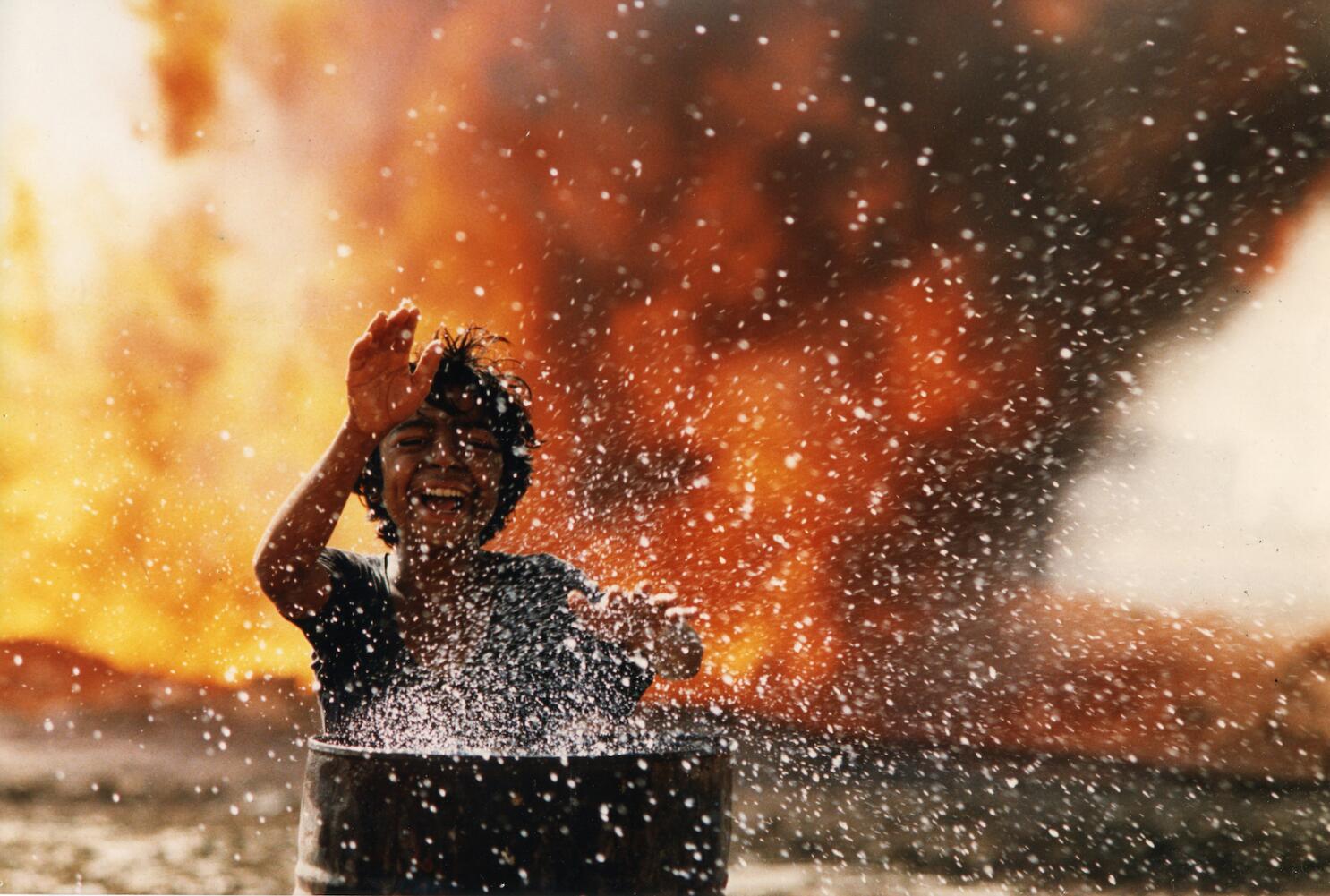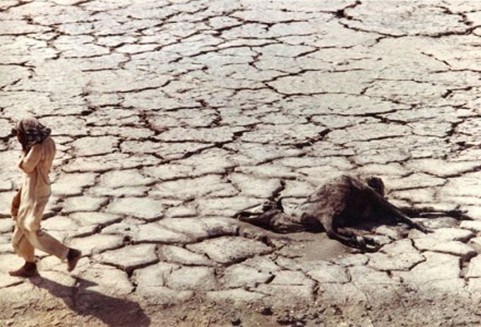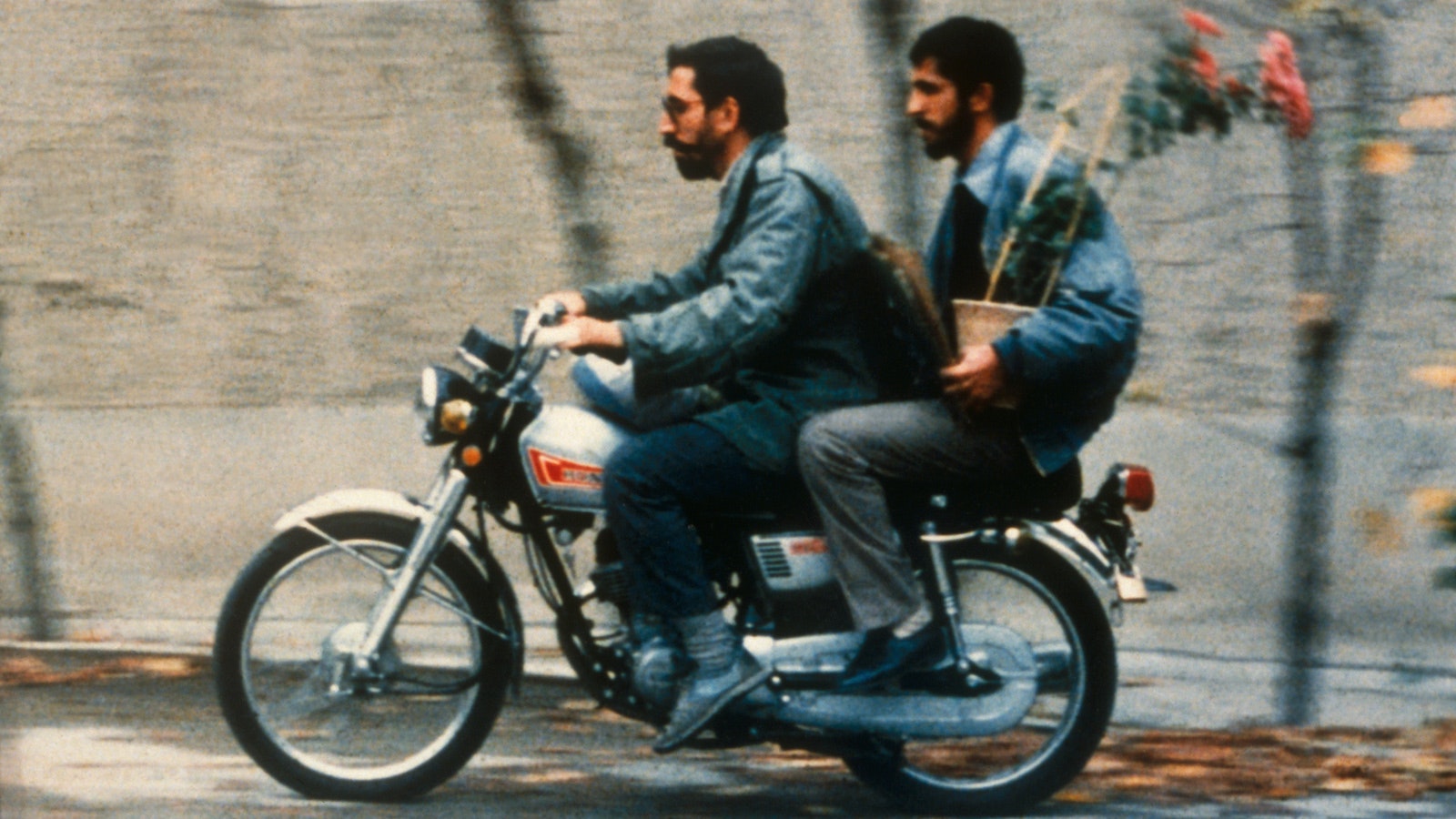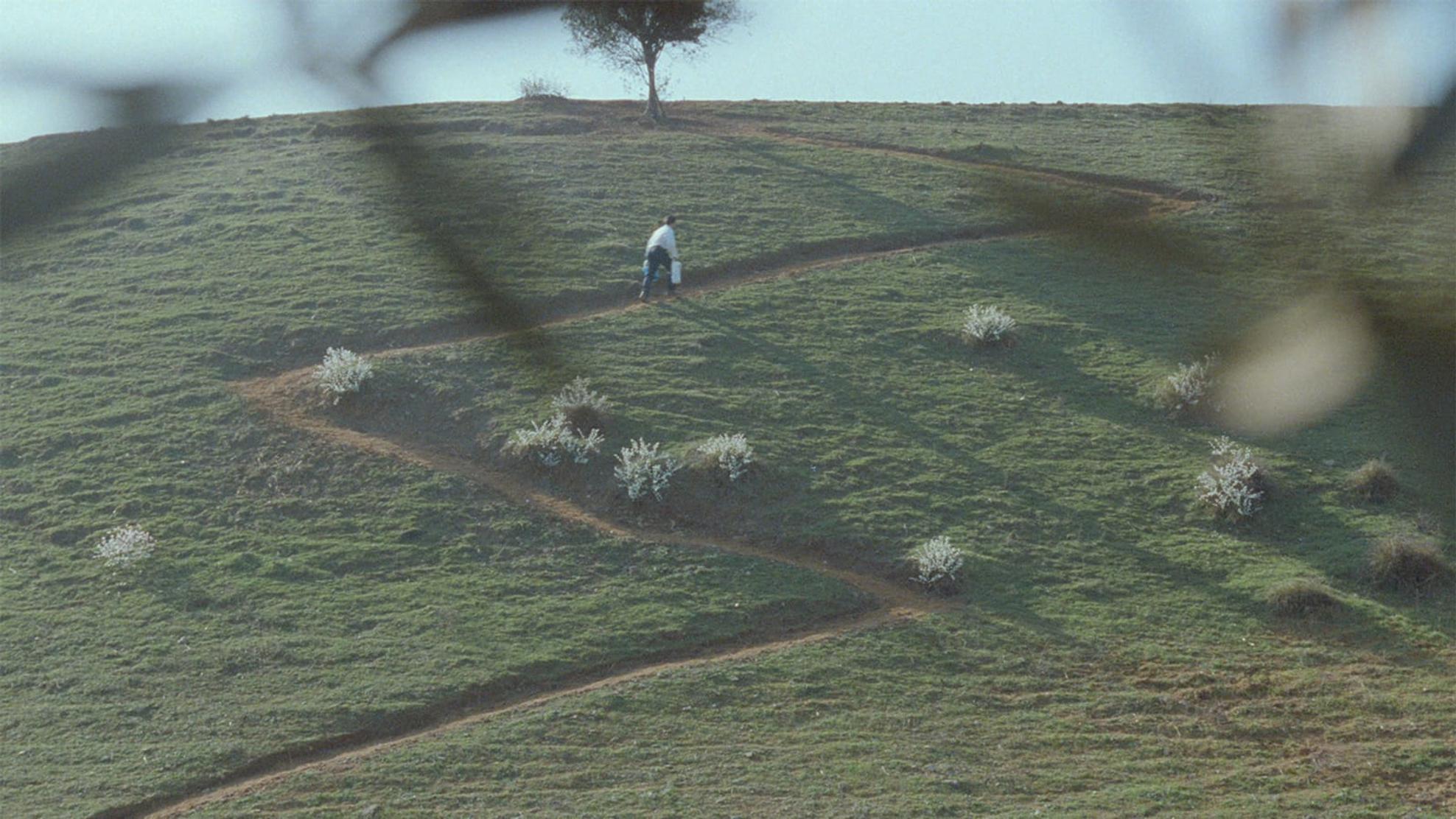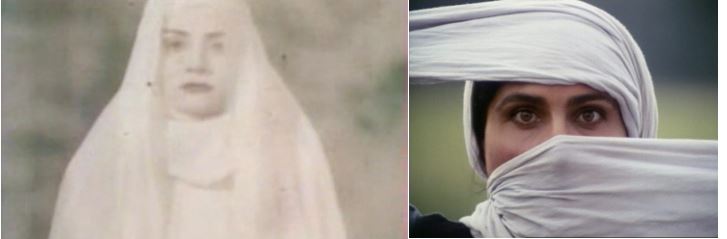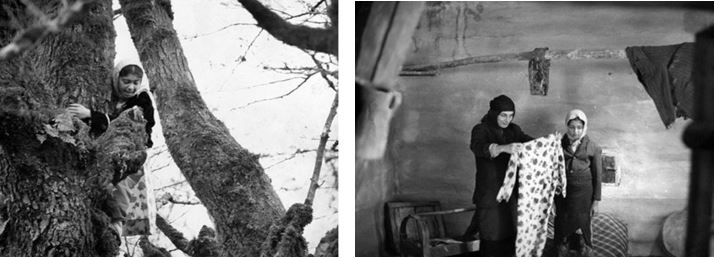
Corporeality, Absence, and Signifiance in Rakhshān Banī-I‛timād’s Cinema: A Case Study of The Blue-Veiled

By

Introduction

It’s not what you see that is art, art is the gap.”
Marcel Duchamp

In Persian language and culture, even today, the term pardah’nishīn is synonymous with “woman,” reflecting a traditional discourse that historically defined women as being “behind the curtain” and excluded from the public sphere. This term carries connotations of confinement, invisibility, passivity, and silence, reinforcing the cultural and social embedding of femininity within language, beliefs, and traditional expectations. In traditional ethics and social relations, a woman’s role has often been one of passivity and submission, forcing her to remain invisible in the public sphere, limit her presence and interactions, suppress her voice, and avert her gaze. To reinforce this view, the discourse surrounding women’s bodies aimed to obscure their presence, restricting visual contact and social interaction with men. These constraints not only shaped everyday life but also influenced representation, restricting a woman’s image, particularly her moving image, from appearing freely in the public sphere.

However, the advent of cinema in Iran challenged this long-standing tradition. Cinema blurred the boundaries between the private and public spheres, bringing the bodies and images of women into the public eye on the silver screen. The art of cinema brought men and women together, both as actors and spectators, disrupting traditional gender norms. This shift sparked strong opposition, particularly from religious authorities, clerics and traditionalists, who viewed cinema as a tool for gender mixing and a threat to social order.  opposition had lasting effects on narrative structures, filming techniques, representation, and film viewing.1Farzaneh Milani, Words, Not Swords: Iranian Women Writers and the Freedom of Movement (Syracuse: Syracuse University Press, 2011), 74. After the 1979 Revolution, censorship became official policy, targeting the portrayal of women’s bodies and intensifying historical opposition in new forms.

Over time, these restrictions contributed to the development of a unique cinematic language, where absence, loss, and silence became integral to the narrative. In other words, when the direct depiction of the female body or her desires was prohibited, skilled filmmakers turned to indirect and metaphorical strategies. The concept of “absence,” for example, transcended a mere limitation and evolved into both a form of expression and a narrative tool. In this context, absence itself becomes meaningful, serving as a form that not only represents loss but also implies an implicit presence, resistance, and signifiance. It conveys the lived experience and embodied consciousness of characters to the audience. As Justin Remes notes, the absence of characters, voices, or visual elements in a work of art is not a void, but an active tool for generating meaning and aesthetic experience.2Justin Remes, Absence in Cinema: The Art of Showing Nothing (New York: Columbia University Press, 2020), 123-124. This framework enables the analysis of scenes, silences, and deliberate absences in Iranian cinema, particularly in works where the female subject is central to the narrative, as explored in this study.

Research Problem and Literature Review

Since the 1979 Revolution, Iranian cinema has navigated the tension between the presence and absence of the body, particularly the female body. Legal restrictions and state censorship on displaying the body have resulted in a culture of silencing and exclusion. These constraints not only shape how women are represented in films but also influence how they are perceived and experienced in society. This situation is deeply rooted in the ideological policies of the Islamic Republic. The imposition of the mandatory hijab and strict control over women’s bodies serve not only as tools of domination and suppression but also as means to reinforce and promote the regime’s ideological visual symbols. As a result, the female body has become a paradox of invisibility, existing in a constant state between being and non-being, perceptibility and imperceptibility, presence and absence.

Since the early 20th century, cinema has served as a powerful political and social tool. It has played a crucial role in shaping political systems, often serving as a space for intervention by those in power, due to its ability to influence both individual and collective imaginations. As Zahra Khosroshahi asserts, for the new political system in Iran, censorship in cinema was not merely a moral action; it reflected the regime’s deep fear of the power of imagery and its potential impact.3Zahra Khosroshahi, “‘I Am Them and They Are Me’: The Transnational Body as Collective in Iranian Women’s Cinema,” Transnational Screens 14, no. 2 (2023): 91. In this context, the female body has become the focal point of these policies, carrying ideological implications both in cinematic representation and in the public sphere. As Khosroshahi cites from Eric Egan, the project of Islamizing cinema advanced through the control of the female body, turning Iran’s “geo-body” into a gendered image that not only legitimized the regime’s symbolic order domestically but also became a political asset in projecting the Islamic Republic’s symbol onto the international stage.4Zahra Khosroshahi, “‘I Am Them and They Are Me’: The Transnational Body as Collective in Iranian Women’s Cinema,” Transnational Screens 14, no. 2 (2023): 90.

Although the Iranian state’s restrictions on cinema—particularly regarding the representation of women—have had a negative impact, filmmakers like Rakhshān Banī-I‛timād have creatively found ways to bypass these limitations. Rather than erasing or silencing the female body, they have turned these restrictions into opportunities to deepen meaning, expand storytelling, and resist erasure.

In recent years, many scholars have analyzed cultural and social representations in Iranian cinema, including Banī-I‛timād’s work. Some focus on historical and descriptive frameworks, others on technical and aesthetic aspects, while some combine both approaches. For example, Elnaz Nasehi in her article “Ambivalence of Hostility and Modification: Patriarchy’s Ideological Negotiation with Women, Modernity and Cinema in Iran,”5Elnaz Nasehi, “Ambivalence of Hostility and Modification: Patriarchy’s Ideological Negotiation with Women, Modernity and Cinema in Iran,” International Journal of Advanced Research (IJAR) 8 (October 2020): 542-552. focuses on the female body’s role in relation to Pahlavī modernity and post-revolutionary Islamism, showing the body as a battleground for ideological conflict.

Najmeh Moradiyan Rizi in her article “Iranian Women, Iranian Cinema: Negotiating with Ideology and Tradition”6Najmeh Moradiyan Rizi, “Iranian Women, Iranian Cinema: Negotiating with Ideology and Tradition,” Journal of Religion & Film 19, no. 1 (2015), https://digitalcommons.unomaha.edu/jrf/vol19/iss1/35. focuses on the social and sexual transformations of women in contemporary Iran and their portrayal in post-revolutionary cinema, especially over the past decade. Moradiyan Rizi adopts a macro-sociological approach, viewing cinema as a reflection of societal changes, and focuses on how women in this new generation have challenged traditional boundaries.

Zahra Khosroshahi in her article “‘I Am Them and They Are Me’: The Transnational Body as Collective in Iranian Women’s Cinema” examines how two female Iranian filmmakers, Rakhshān Banī-I‛timād and Māniyā Akbarī, use the female body to transcend national meanings, transforming it into a platform for critique, reconsideration, and intersectional feminism. The study aims to demonstrate that both filmmakers redefine the female body beyond traditional limitations, thus shaping a collective and intersectional feminism.

Hamid Taheri in his article “Censoring Iranian Cinema: Normalization of the ‘Modest’ Woman”7Hamid Taheri, “Censoring Iranian Cinema: Normalization of the ‘Modest’ Woman,” Feminist Media Studies 24, no. 8 (2024): 1938–1951. analyzes the image of women in Iranian cinema, arguing that the “modest” portrayal of Iranian women has become normalized, despite not fully reflecting the reality of women in society. This normalization has occurred not only through governmental censorship but also through international film festivals, which have played a key role in reinforcing it. In his study, Taheri highlights the deficiencies of Iranian cinema and encourages the audience to adopt a more critical perspective on the global power structures that shape it.

While many studies have examined how the female body is portrayed in Iranian cinema in response to censorship laws, fewer have focused on how the audience personally experiences these portrayals. This experience, which cannot be fully understood through historical or ideological analysis alone, should instead be explored through sensory perception and the cinematic experience.

This article differs from related studies in several ways. A central aspect of this research is its redefinition of the concept of the body—not merely as an object of representation, but as a site of resistance. From this perspective, gestures, movements, silences, and even moments when the body is absent carry hidden meanings that often go against the dominant narrative. Resistance in this context is understood as a complex, multi-layered phenomenon, a dynamic force intertwined with social and cultural contexts, carrying profound implications. Resistance can emerge even in situations where people are silenced, ignored, or marginalized. In other words, even when bodies appear silenced or erased, they can still find ways to resist and challenge the dominant order.

Another key feature of this article is its focus on the lived experience of the spectator in relation to their encounter with the film. The analysis extends beyond the mere representation of characters’ bodies, exploring how elements such as narrative, movement, light, framing, and interactions with objects— even in the physical absence of the body—activate the tactile and sensory engagement of the viewer.

Finally, another distinguishing aspect of this research is its integrative theoretical framework, which is based on a tripartite theoretical connection:

  • Maurice Merleau-Ponty’s theory of corporeality, which introduces the body as the site of sensory perception.
  • Julia Kristeva’s concept of the “semiotic/symbolic,” which facilitates signifiance.
  • Jennifer Barker’s theory of cinematic tactile experience, which focuses on the sensory and bodily experience of the spectator.

This theoretical combination aims to provide a new interpretation of Banī-I‛timād’s cinema, one that goes beyond purely narrative or representational analyses and explores the relationship between the body, resistance, and the sensory experience of both the spectator and the text. Thus, this article demonstrates how the body, within the constraints and mechanisms of censorship, becomes a tool for reinterpreting meaning and cultural resistance through the strategic use of image or narrative absence.

Absence is an intrinsic feature of both functional and literary language. In literary works, poets and writers often use rhetorical devices to deliberately veil certain themes in ambiguity. This veiling can engage readers, reflect the limitations imposed on the author, or arise from the threats posed by dominant cultures or powers. Therefore, the constraints on expression within a semiotic network inevitably push it toward “absence.” However, after the 1979 Revolution, art, particularly cinema, faced limitations, most of which originated from state mechanisms of supervision and censorship, with fewer arising from the cultural and religious context of society.

It is important to note that the absence discussed here refers to the type of absence addressed in contemporary literary, artistic, and cultural studies. For instance, Justin Remes draws on Kazimir Malevich’s work in modern visual art,8Kazimir Malevich (1879-1935) was one of the most prominent artists of the 20th century and the founder of the Suprematist movement. His most famous works include Black Square (1915) and White on White (1918). analyzing how Malevich was able to create a meaningful and impactful force through physical or visual absence. The presence of a black or white square, devoid of additional detail, serves to focus the viewer’s attention on the absence itself, highlighting the tension between what is present and what is absent—where meaning is neither inherent nor explicitly provided.9Justin Remes, Absence in Cinema: The Art of Showing Nothing (New York: Columbia University Press), 8. In cinema, “absence” refers to the elements, events, or bodies deliberately excluded from the frame, narrative, or visual composition, often serving to emphasize meaning or stimulate interpretive engagement for various artistic or thematic reasons. For example, in Iranian cinema, absence is seen in the erasure of women’s bodies from the screen, the concealment of the violence inflicted upon them, and the suppression of their desires, aspirations, and sexual agency. In poststructuralist and deconstructionist thought, absence does not imply a lack of prominence, dominance, or significance; rather, absence itself generates meaning and becomes a source of significance within semiotic systems.

This article explores how the meaning of a woman’s body can be understood, even when it is not directly shown. How can the body, through mechanisms of erasure, be constructed to acquire a meaningful presence? In other words, how can cinema, through the body, transcend explicit signs to unveil its implicit meaning within the sensory, spatial, and narrative structure of the film? These questions are particularly important in the films of Rakhshān Banī-I‛timād, a director known for exploring the experiences of women, marginalized bodies, and relationships across generations throughout her career. The article also argues that resistance in Banī-I‛timād’s films is not just an external reaction to censorship and political-cultural norms, but also a process of signifiance through corporeality, absence, and everyday narratives.

Methodology of the Research

This study employs a hybrid methodology, integrating scene-based analysis with theoretical interpretation to examine the representation of absence, corporeality, and processes of signifiance in Banī-I‛timād’s cinema. The primary focus is on the film The Blue-Veiled, as its narrative offers a concrete framework for connecting theoretical concepts with the lived experiences of the characters. Within this framework, technical and visual elements are examined in relation to the narrative to emphasize the characters’ corporeality and moments of resistance. The film’s storyline bridges abstract theory and lived experience by depicting everyday life, emotional struggles, social tensions, and acts of resistance in a tangible way that grounds the analysis.

Technical and visual elements, such as mise-en-scène, framing, and lighting, play a crucial complementary role, as these elements directly convey absence, distance, and sensory tensions on the visual and auditory surfaces, portraying the characters’ lived experiences in a concrete and credible way. However, an analysis that focuses solely on technical elements is insufficient; without engagement with the narrative, these elements remain fragmented and detached losing their connection to the characters’ social and psychological context. Moreover, an excessive emphasis on technical elements may result in a mechanical and monotonous analysis. Accordingly, this study adopts a narrative-centered approach, with technical elements referenced primarily to support and enrich the narrative analysis.

Furthermore, to avoid fragmentation and excessive detail, the scene-based analysis of The Blue-Veiled will focus on a few key scenes. However, in the concluding section, the film The May Lady (Bānū-yi Urdībihisht, 1999) will be used as a supplementary example to illustrate the broader scope of Banī-I‛timād’s style in representing the feminine subject. In analyzing The May Lady, the focus will be on providing evidence of the continuity or transformation of the director’s gaze, rather than conducting an in-depth analysis of scene details or narrative. This approach allows us to analyze individual scenes in detail while also looking at Banī-I‛timād’s overall role in Iranian social cinema, without losing theoretical or structural clarity.

Theoretical Framework

  1. Corporeality in the Phenomenology of Maurice Merleau-Ponty

This article begins with the aim of exploring the representation of the body in the cinema of Banī-I‛timād. One approach to achieving this understanding is through the phenomenological conception of corporeality, which shapes our perception and interpretation of the world. In Merleau-Ponty’s philosophy, the body is the fundamental mode of being in the world, the site where all perception, seeing, and existence originate. According to Merleau-Ponty, perception is more than the mere sensing of things, such as seeing or touching. It is not a passive process where we simply receive sensory information in isolated fragments. Nor is it the outcome of logical reasoning. Rather, perception is, first and foremost, an embodied experience through which we actively engage with the world, preceding and independent of thought. The central theme of Merleau-Ponty’s philosophy emphasizes the body as the foundational phenomenon through which we experience and engage with the world, prior to and beyond conscious reflection. Merleau-Ponty argues that, before being consciousness, each of us is a body that perceives and shapes the world. Unlike Cartesian views, which treat the body as separate from the subject of perception, Merleau-Ponty shows that the subject of perception is inseparable from corporeality and has no meaning without it: “The body is the vehicle of being in the world, and having a body is, for a living creature, to be intervolved in a definite environment, to identify oneself with certain projects and be continually committed to them.”10Maurice Merleau-Ponty, Phenomenology of Perception (London: Routledge Classics, 2002), 94.

In this conceptual framework, lived experience is seen as fundamentally connected to the body. Our body is not merely a medium for sensory perception; it is the site where meaning is both created and received. From a phenomenological perspective, a cinematic image is understood not just as a collection of signs, but as an embodied, lived experience.

Merleau-Ponty’s contribution lies in clarifying one of his fundamental interpretations of the body, as he states: “My body is the fabric into which all objects are woven, and it is, at least in relation to the perceived world, the general instrument of my ‘comprehension’.”11Maurice Merleau-Ponty, Phenomenology of Perception (London: Routledge Classics, 2002), 273. He goes on to explain, “It is my body which gives significance not only to the natural object, but also to cultural objects like words […] A word, before becoming the indication of a concept […] is first of all an event which grips my body, and this grip circumscribes the area of significance to which it has reference.”12Maurice Merleau-Ponty, Phenomenology of Perception (London: Routledge Classics, 2002), 273-74.

Therefore, this article argues that the body should not be seen merely as content within an image (film), but rather as an integral part of the perceptual and subjective process. From this perspective, we can rethink and experience the body through the narrative and visual constraints of cinema. Sometimes the body is absent from these images, but this absence, combined with image, sound, light, and movement, creates an embodied experience. Banī-I‛timād repeatedly reconstructs and represents this embodied visual texture in the seemingly bodiless images of her films.

This phenomenological view places the body at the core of perception and links it directly to our way of being in the world. It directs our discussion toward a deeper understanding of the body’s role in signifiance, ultimately leading to Julia Kristeva’s theory of signifiance. Her theory suggests that the body is not only the source of perceiving but also the central locus of meaning, experience, and language. The following sections will examine the relationship between the body and meaning within the framework of Kristeva’s linguistic theory, in which the body, through signs, is integrated into the structure of language and signifiance, while its subjective experience extends into the unconscious and emotional realms.

  1. Signifiance in Julia Kristeva’s Theory

In Kristeva’s semiotics, signifiance takes center stage, with Kristeva arguing that this concept surpasses the static and formal understanding of signs originally proposed by Ferdinand de Saussure. Kristeva differentiates between established linguistic signification and her own concept of signifiance, emphasizing that language is not merely a tool for transmitting meaning, but also a space where meaning is produced and constantly evolves.13Estelle Barrett, Kristeva Reframed: Interpreting Key Thinkers for the Arts, (New York: Palgrave Macmillan, 2011), 57. Thus, in Kristeva’s semiotics, language is understood as a dynamic process of signification, rather than a fixed and separate system.14Julia Kristeva, Revolution in Poetic Language (New York: Columbia University Press, 1984), 13. Kristeva identifies two sets of meanings or forces involved in the process of signification:

A. The first set of meanings or pre-linguistic, emotional, sensory, instinctual, and feminine forces, which Kristeva calls the semiotic. The semiotic exists within the pre-symbolic domain, tied to the body, the unconscious, music, sound, rhythm, rupture, silence, stuttering, repetition, and non-syntactic forms of expression. Kristeva connects the semiotic to the pre-Oedipal experience, before the subject enters language, defining it as linked to the maternal realm, bodily pleasure, and instinctual drives. The semiotic is not self-sufficient; instead, it exists within language, in contrast to the symbolic realm. In art, particularly in poetry, music, and cinema, the semiotic manifests through unstable forms, corporeality, sound, narrative disruptions, and breaks in space and time. The semiotic is expressed through rhythm, resonance, and emotional pulses, maintaining an inseparable connection to the body.15Julia Kristeva, Revolution in Poetic Language (New York: Columbia University Press, 1984), 27. The semiotic belongs to the pre-symbolic phase, where, before the subject is established as a speaker within the structure of language, their perception of the world is shaped by the mother’s body, sound, lullabies, and emotional impulses. Kristeva argues that this phase is not merely a remnant of early childhood experience, but also a domain in which the individual can resist and revolt against the rigid logic of the symbolic realm and the dominance of established societal discourses. For this reason, from Kristeva’s perspective, art, poetry, and imagery serve as sites for the emergence of the semiotic, where the body generates alternative meanings through rhythm, silence, rupture, and disruption.

B. The second set of meanings or social, rational, scientific, technical, logical, and masculine forces, which form the symbolic. The symbolic resides in the realms of structure, syntax, meaning, law, patriarchal order (in Lacanian psychoanalytic terms), and language.16Jacques Lacan, in his definition of child development, speaks of a stage to which the child must inevitably enter, and that is the symbolic order or the realm of language. This realm is metaphorically referred to as the paternal realm because the child must leave the mother’s embrace to enter the realm of language, the very entry that, according to Lacan, confronts the human with loss (manque) forever. Lacan has made the rejection of the mother the sole condition for subjectivity. This is the domain in which the subject, as a speaker endowed with logic and law, engages with the societal stage. However, Kristeva emphasizes that language is not just symbolic or semiotic, but is the result of a constant struggle between the two. According to Kristeva, signifiance cannot occur unless these two sets of meanings or forces are present in the process of signification in language.17Julia Kristeva, Revolution in Poetic Language (New York: Columbia University Press, 1984), 24. As a result, both art and language, in their ideal form, embody this duality. The distinction between these two forces can provide a theoretical foundation for analyzing the presence or absence of the feminine body in cinema. That is, how the body can generate meaning through sound or rhythm, even in the absence of explicit symbolic signs.

From Kristeva’s perspective, the subject that emerges at the intersection of these two forces is a subject in process. It is neither stable nor fixed, nor self-sufficient; instead, it is constantly in a state of “becoming,” perpetually shaped by both conscious and unconscious forces, and situated within the dynamic interaction between the semiotic and the symbolic.18Toril Moi, ed. The Kristeva Reader (New York: Columbia University Press, 1986), 216. This subject, which is constructed in the realm of language, is constantly confronted with transformation, crisis, and reconstruction. As Kristeva explains, the subject is in a state of “positioning.” She uses the term “thetic” to describe the “subject in the process of becoming,” where the subject is not fixed but constantly undergoing disruption and reconstitution. According to Kristeva’s theory, the thetic is a moment in which the flow of the semiotic is contained and stabilized by the linguistic structures of the symbolic order; it is the point at which the subject, by “positing” a signifiance in language, performs as a meaningful speaker within the symbolic realm. The thetic is not a sudden or completed event, but rather an ongoing process that unfolds continuously throughout the subject’s linguistic life, forming repeatedly with each meaningful linguistic act. In other words, every time the subject attempts to express an experience, emotion, or image—whether through words, images, or even meaningful silence—the thetic occurs. The thetic represents a threshold, occurring at the boundary between the semiotic and symbolic realms. It is the moment or process in which the tension and transition between these realms unfold—the space where the bodily, emotional, and instinctual signs of the semiotic move toward the structured order of the symbolic, where they are then regulated and stabilized. However, the interesting point is that the primary characteristics of the semiotic are not entirely lost in this process; they persist in certain deeper layers of meaning and expression.19Julia Kristeva, Revolution in Poetic Language (New York: Columbia University Press, 1984), 48.

Kristeva’s analysis of the interaction between the semiotic and the symbolic demonstrates that meaning is constructed not only at the level of language but also through the body, sound, and emotion. Thus, the cinematic image can function as a medium through which the semiotic emerges. I will draw on a framework that understands cinematic perception as an embodied, rather than purely cognitive, experience in order to situate this theory within the aesthetic and sensory realm of the cinema viewer. By focusing on how the viewer’s sensory experience deepens the relationship between the cinematic image, the body, and perception, Jennifer Barker explores not only how we think about images but also how we experience them at a bodily level, through our senses and bodily responses.

  1. Cinematic Image as Sensory Experience: The Embodied Viewer in Jennifer Barker’s Theory

Jennifer Barker, a scholar and professor of cinema studies at Georgia State University, is widely recognized for her influential work The Tactile Eye: Touch and the Cinematic Experience (2009), which provides a phenomenological approach to the cinematic experience. In her book, Barker explores the notion that the cinematic viewer does not simply engage in a passive act of watching; rather, the relationship between the viewer and the film is both embodied and sensory. Barker argues that the film should be seen as another body, one that is not just watched, but also felt, and that in turn affects the viewer. This concept lays the groundwork for a phenomenological and embodied approach to cinema.

In this work, Barker draws explicitly on Merleau-Ponty, especially his conception of the lived body as the primary mediator between the self and the world. She extends this idea to cinema, suggesting that the film functions as another body in such a way that the viewer does not merely observe it but physically engages with it, connects with it, and even undergoes bodily affect. Barker’s approach challenges the notion of film as merely representational; instead, she conceives of it as an embodied, sensory experience in which The viewer’s perception is closely connected to the cinematic image, which evokes a bodily, sensory engagement and has interactive qualities that shape the viewer’s experience.

In her view, film acts as a body, and the viewer becomes more than just an observer, engaging with the film as a sensitive body: body with body. Barker sees the contact between film and viewer not just as physical touch, but as an embodied perceptual experience. For Barker, the body is not merely an object to be touched or to touch, but a sensory field where seeing, hearing, and touching are inseparably intertwined.20Jennifer M. Barker, The Tactile Eye: Touch and the Cinematic experience (University of California Press, 2009), 2-5.

In her book, Barker argues that three sensory layers—the skin, musculature, and viscera—demonstrate how the experience of watching a film unfolds on tactile, motor, and internal levels. She describes the skin as the outer layer of the body, where we first encounter the world and form primary sensory responses. In other words, she views the skin as the closest layer of the sensory experience, where visual elements like brightness, color, light, camera movement, and textures interact directly with the viewer’s body. This contact resembles a visual touch, with light moving gently across the skin.21Jennifer M. Barker, The Tactile Eye: Touch and the Cinematic experience (University of California Press, 2009), 34-36.

Barker suggests that the viewer’s body responds in active, internalized ways, which can be observed in muscular reactions such as contractions, movements, or tension during specific scenes. For all viewers, these physical reactions are felt experiences, with the body unconsciously tensing or moving in response to camera work or the intensity of a scene. Thus, the viewer’s experience of a film is not just visual or cognitive, but embodied and deeply internalized.22Jennifer M. Barker, The Tactile Eye: Touch and the Cinematic experience (University of California Press, 2009), 38.

Finally, at the deepest level, Barker examines the viscera, referring to internal bodily responses that are often subconscious, including goosebumps, gripping the armrest, shortness of breath, heart palpitations, fear, sadness, or even nausea. These experiences are connected to the viscera which Barker identifies as the site through which the film engages the viewer’s unconscious bodily responses. This layer has the greatest psychosomatic impact.23Jennifer M. Barker, The Tactile Eye: Touch and the Cinematic experience (University of California Press, 2009), 120.

Additionally, Barker’s progression from the body’s surface to its deeper layers can be mapped onto Kristeva’s concept of the semiotic. Meaning is thus experienced not only through language’s symbolic structures, but also pre-linguistically, in the body, through the heartbeat, breath, and viscera, which convey instincts and emotions. Barker’s discussion of the interactions between the viewer’s body and the film’s body aligns with the dynamic processes central to Kristeva’s theory of signifiance. This reflects the tension between the symbolic’s stability and the semiotic’s instability—without it, meaning would not arise.

The Blue-Veiled: A General Overview

“My work consists of two parts: the one presented here plus all that I have not written. And it is precisely this second part that is the most important one.”
Ludwig Wittgenstein

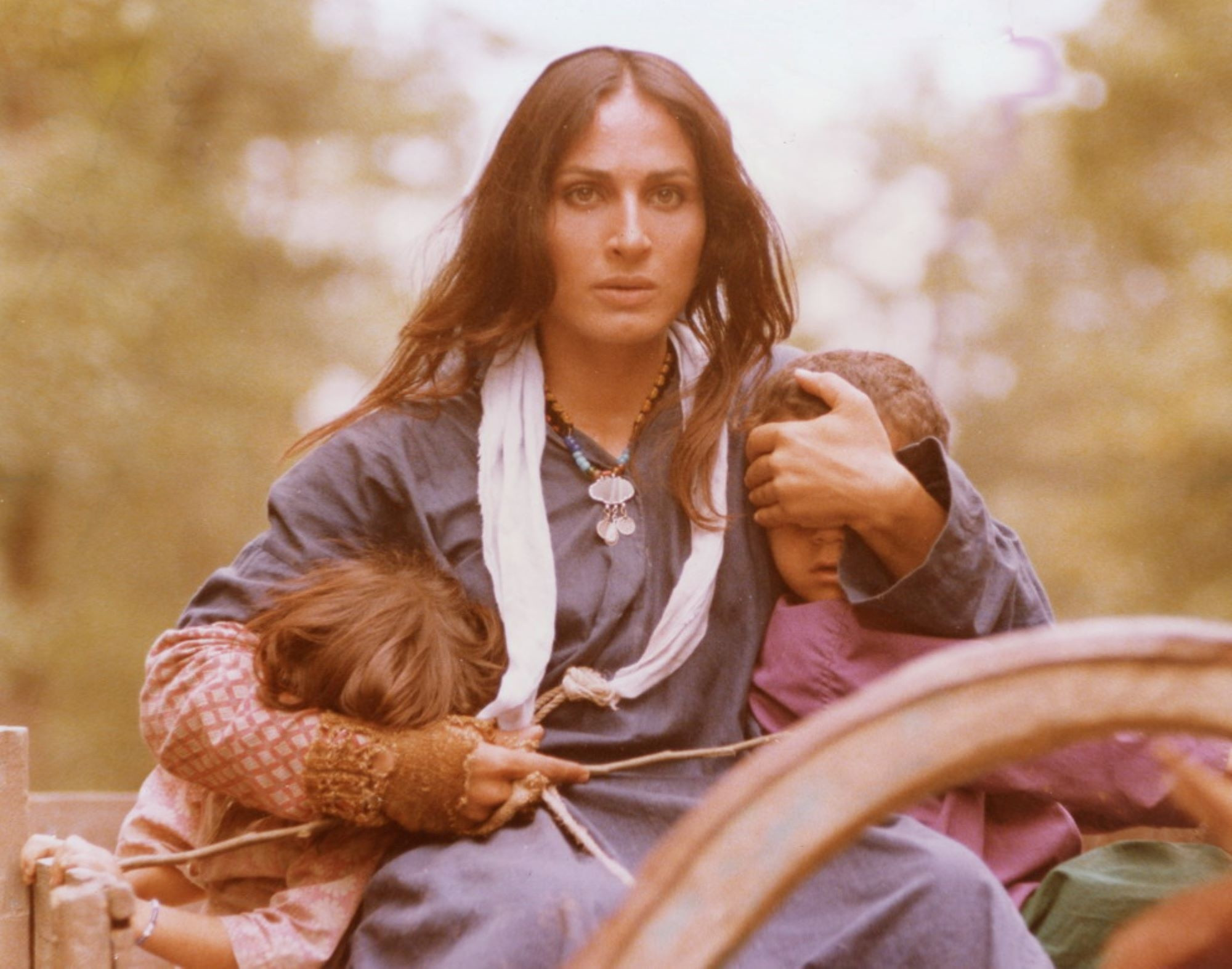
The Blue-Veiled follows the story of a young woman named Nawbar Kurdānī, who works on a tomato farm and in the adjacent tomato paste factory. Unmarried, Nawbar bears the responsibility of looking after her addicted mother, teenage brother, and young sister, making her situation far more difficult than that of other women. She lives on the outskirts of the city, next to a brick kiln. Gradually, the factory owner, Hāj Rasūl Rahmānī, becomes interested in her. A widower for three years, he lives alone in a large house. Fearing their father’s affection for a young woman they call a ghurbatī (vagrant), two of Rasūl’s three married daughters use every trick they can to prevent him from marrying Nawbar.

This romantic relationship reflects deep class conflicts and the struggles of female subjectivity. The film uses minimalistic style, controlled dialogue, and a cold atmosphere to explore Nawbar’s mental and bodily experience as she faces societal pressures. Nawbar is both humble and defiant, yet uncertain, and her body and speech seem “suspended,” reflecting hesitation and tension. Although she cannot act like upper-class women or openly claim her place in society, she is far from passive and demonstrates significant courage and agency. At first, Rasūl’s interest in Nawbar is not based on an equal or balanced relationship. At the beginning of the film, if we view their potential marriage as a continuation of patriarchal authority, we’re not entirely mistaken; yet, in the end, we see a genuine, mutual love between them.

Discussion and Analysis

Dual Representation of Documentary and Fiction in Cinematic Narrative

Before analyzing her work, it’s important to note that Banī-I‛timād pays close attention to details from the real world, blending them with imagination, so that storytelling always includes realistic elements. This approach reflects Banī-I‛timād’s background in documentary filmmaking. According to Maryam Ghorbankarimi:

Banī-I‛timād films depict little vignettes from society, with all its ups and downs, and the people in it trying to cope with and tolerate what life has in store for them. The cinema of Banī-I‛timād offers a realistic portrayal of the people in their familiar environment. She bases her scripts on real people she meets during her research and documentary filmmaking, which is why her characters are often quite tangible, with genuine problems and issues similar to those that people have in real life. The documentary style of her filmmaking helps the characters fit into the environment she portrays them in.24Maryam Ghorbankarimi, A Colourful Presence: The Evolution of Women’s Representation in Iranian Cinema (Cambridge: Cambridge Scholars Publishing, 2015), 68.

I aim to examine this feature in The Blue-Veiled as an example of Banī-I‛timād’s use of both documentary and narrative cinema, and to interpret it in terms of a semantic structure that connects the symbolic and semiotic orders in Kristeva’s theory.
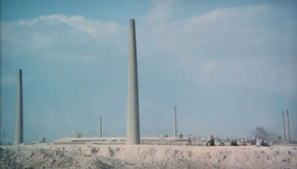
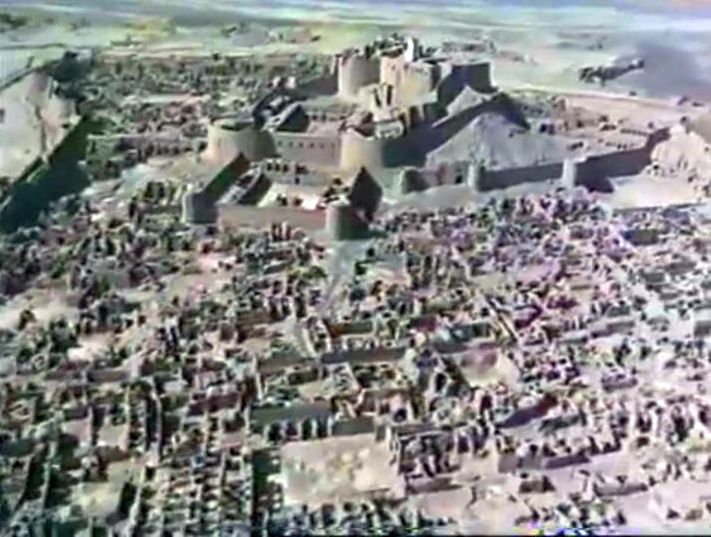
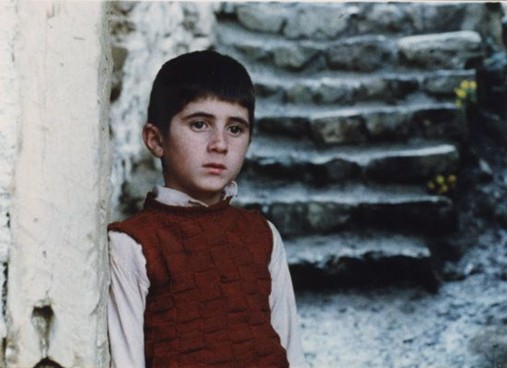
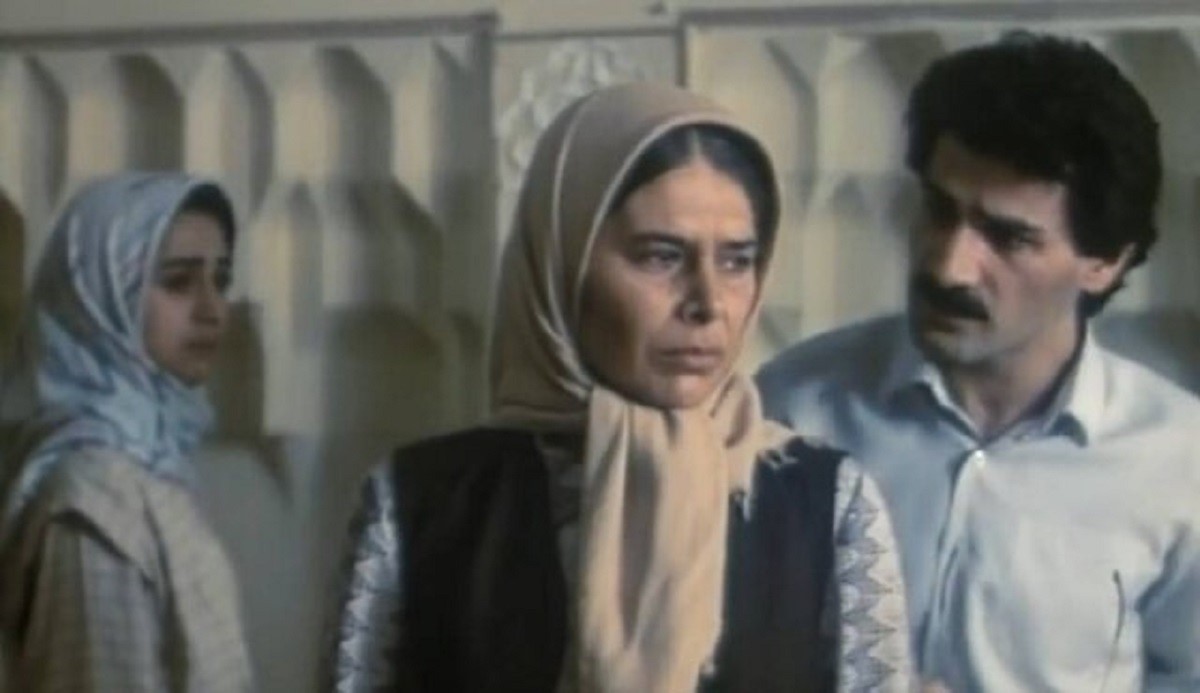
Figure 1: Background image of the opening credits from The Blue-Veiled (Rūsārī Ābī), directed by Rakhshān Banī-I‛timād, 1995.
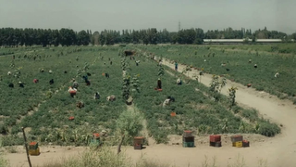
Figure 1: Background image of the opening credits from The Blue-Veiled (Rūsārī Ābī), directed by Rakhshān Banī-I‛timād, 1995.

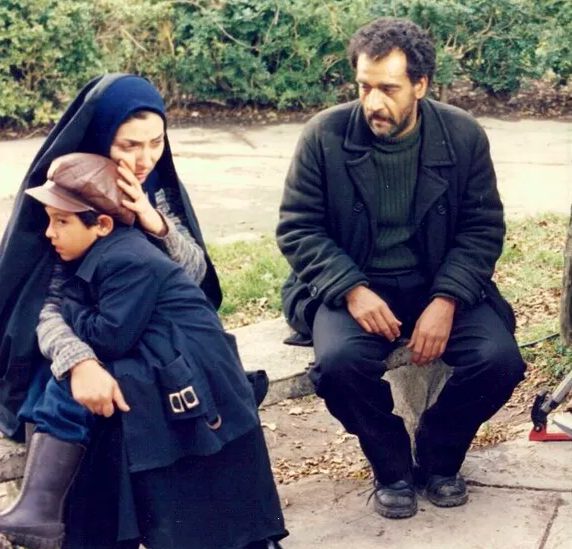
Figure 2: Laborers working in the tomato fields. Still from The Blue-Veiled (Rūsārī Ābī), directed by Rakhshān Banī-I‛timād, 1995 (00:02:19).

Figure 2: Laborers working in the tomato fields. Still from The Blue-Veiled (Rūsārī Ābī), directed by Rakhshān Banī-I‛timād, 1995 (00:02:19).

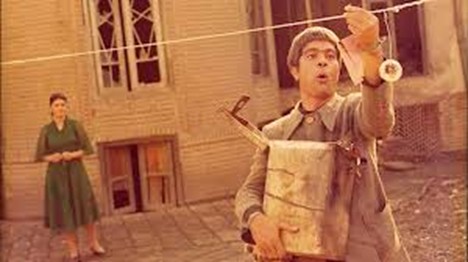
The film’s documentary-like dimension becomes evident from its very first moments (Figures 1 and 2), in shots of the harsh, dry landscape around the brick kiln, the bustle of women seeking farm work, and the depiction of laborers in the tomato fields. These scenes use social and real elements, placing them in the symbolic realm where language, social law, and patriarchal order operate. This realm connects the film to a network of structural meanings and positions identities within fixed frameworks. In contrast, the film gradually reveals a love story, filled with silence, shame, and bodies that speak without words—clearly belonging to the realm of the semiotic. Shots conveying pronounced emotional and affective expression exemplify, as Kristeva puts it, a body embedded within language, representing a subject in the process of becoming rather than one that is fixed. Thus, according to Kristeva, signifiance emerges as a process arising from the dynamic interplay of language’s heterogeneous dimensions—the structured, rule-governed symbolic and the bodily, affective semiotic. This dual articulation allows the artistic text to convey meanings that the purely communicative or representational function of the language alone cannot express.25Julia Kristeva, Desire in Language: A Semiotic Approach to Literature and Art (New York: Columbia University Press, 1980), 18.

Robert Sāfāriyān also considers The Blue-Veiled’s depiction of two opposing tendencies as one of the fundamental features of Iranian cinema: the first, a social tendency, which, according to Sāfāriyān, engages with the dominant perspectives of the 1960s and 1970s; the second, a more humanistic and cross-class tendency, which offers a different view of human relations and emotions.26Robert Sāfāriyān, “Afsānah-pardāzī bih nām-i ri’ālīsm,” In Bānū-yi Urdībihisht: Naqd va barrasī-i fīlm-hā-yi Rakhshān Banī-I‛timād, ed. Zāvun Qukāsiyān (Nashr-i Sālis, Yūshīj, 1378/1998), 299. The interplay of documentary realism and imaginative emotionalism immerses the viewer in both the narrative and a sensory, embodied experience, echoing Barker’s notion of the film’s tactile effect.

At the Threshold: The First Encounter

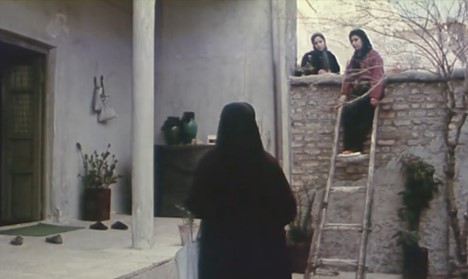
The first encounter between Rasūl and Nawbar in the factory courtyard (Figure 3) provides an example of how bodily meaning is created even in the absence of explicit language. What helps analyze this scene is the combination of three factors: (a) the spatial layout of the courtyard in front of Rasūl’s office, (b) visual and editing choices (camera angle, framing, shot length, and editing rhythm), and (c) the scene’s sound design (group conversations, intervening silences, and Nawbar’s dialogue).
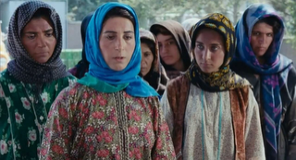
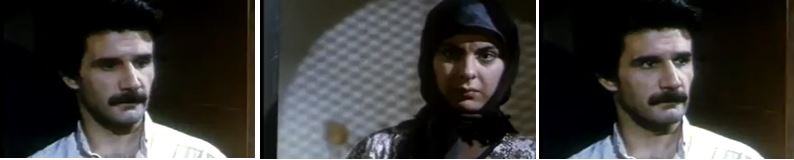
Figure 3: Nawbar introducing herself in order to be hired. Still from The Blue-Veiled (Rūsārī Ābī), directed by Rakhshān Banī-I‛timād, 1995 (00:05:54).

Figure 3: Nawbar introducing herself in order to be hired. Still from The Blue-Veiled (Rūsārī Ābī), directed by Rakhshān Banī-I‛timād, 1995 (00:05:54).

Rasūl’s first encounter with Nawbar is an indirect and accidental meeting, made meaningful through silence rather than dialogue. This encounter, which takes place in the opening scenes of the film, is one of the key moments in the narrative, from which Rasūl and Nawbar’s first sensory connection develops. This affective interaction is not explicit; rather, it unfolds implicitly and subtly through glances, sounds, silences, and the physical distance between them.Asghar Āqā, the foreman, selects several female laborers from around the brick kiln and offers them work on the farm. Each woman provides her name, address, and briefly explains her living situation. When it’s Nawbar’s turn, Asghar Āqā doesn’t ask for her address, implying that, as an unmarried woman, she won’t be hired. Contrary to expectations, Nawbar boldly asserts through her gaze, voice, and body that, though unmarried, she is responsible for several dependents.

Marked by both impulse and intensity, Nawbar’s expression belongs to the semiotic realm: a bodily articulation of need, suffering, and psychological pressure, unrelated to the legal and symbolic order. Nawbar subtly demonstrates her resistance, without any grand gesture; through her gaze, posture, tone, and speech rhythm, she challenges the social rules and hierarchical structures of the symbolic order. Her voice in the group, distinguished by its tone and rhythm, conveys her resistance. In a context where the voices of female workers are often silenced—particularly those of unemployed women—Nawbar asserts herself and claims her rights through speech.

This resistance originates in the symbolic domain (employment rules, collective verbal order) and is expressed through speech and silence. The scene’s sound design plays a critical role: the simultaneous presence of other women’s voices, the emphasis on Nawbar’s voice (or the variable balance of volume and softness), and the silence following her words, all reinforce the semiotic force. According to Kristeva, this force precedes the symbolic order and generates meaning at a bodily and rhythmic level.

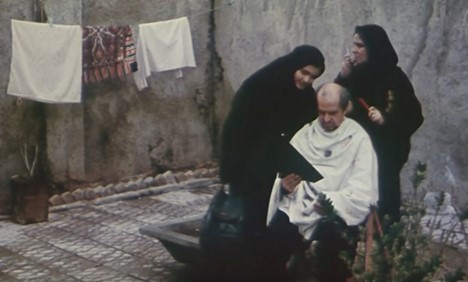
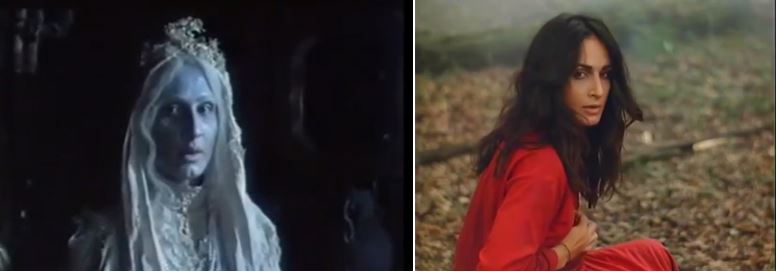
Figure 4: Rasūl, hearing Nawbar’s voice, looks out the window. Still from The Blue-Veiled (Rūsārī Ābī), directed by Rakhshān Banī-I‛timād, 1995 (00:06:14).

Figure 4: Rasūl, hearing Nawbar’s voice, looks out the window. Still from The Blue-Veiled (Rūsārī Ābī), directed by Rakhshān Banī-I‛timād, 1995 (00:06:14).

When Rasūl hears Nawbar’s voice, he looks out the window (Figure 4). A subtle shift in the camera draws him into a world of sounds and bodies that don’t typically belong in his life. The glances exchanged between Nawbar and Rasūl, the pauses, and the rhythm of the cuts between them—combined with the camera’s focus on their body language and facial expressions—work together to deepen the meaning, emphasizing the body and its signs. They highlight how resistance can emerge through the interplay of sound, body, and language.

From Merleau-Ponty’s perspective, this scene depicts a perceptual contact; The relationship between vertical and horizontal space (the office’s height, the courtyard, and the window) interacts with the individual’s perspective (Rasūl’s gaze through the window) in a way that renders the concept of social distance a tangible and lived experience. This shot uses the “frame within a frame” technique, where the window acts as the first frame, and then we get a close-up of Rasūl’s face. The camera moves from behind the window frame to focus on Rasūl’s face, and the brief pause in the cuts makes the viewer not just observe his external position, but also feel his internal experience. The spatial geometry and selective framing transform the act of seeing into an embodied experience, aligning with Merleau-Ponty’s concept of perceptual corporeality, where perception is inseparable from our bodily presence in the world.

Thus, from a higher position, Rasūl looks down at Nawbar’s face. While a top-down perspective typically suggests authority or power, Rasūl’s gaze carries no sense of domination. When he tells Asghar, “Put all eight of them to work,” then pauses with his eyes fixed on Nawbar’s face, it signifies more than just a managerial decision. In this shot, the camera lingers for a few moments on Rasūl’s face, framed in a relatively close-up that deliberately highlights his facial features, the depth and direction of his gaze, all within a carefully chosen camera angle. This framing makes the viewer focus not just on Rasūl’s features, but also on his thoughts and emotions.

Additionally, the tactile dimension noted by Jennifer Barker is clearly expressed in this visual-sound arrangement: The relatively long shots, the delayed cuts, and the focus on the movement of Rasūl’s eyes and facial features all contribute to a visual experience that feels almost “tactile,” as if the viewer’s body is intertwined with the image. Specifically, the fixed camera on Rasūl’s face (the close-up with a delay), coupled with the brief silence following Nawbar’s speech, creates a sense of bodily intertwining between the viewer and the image. The viewer senses that something remains unsaid or that there is something beyond the reach of the symbolic realm. In my interpretation of Jennifer Barker, this gaze can be understood as a tactile gaze—one that, rather than asserting control, is driven by a genuine desire to empathize. It is a gaze filled with empathy, a look that goes beyond just meeting eyes, reaching deeper into perception, emotion, and meaning. The camera and the characters’ eyes seem to move past the surface of the body, reaching inside to capture feelings and perceptions.

For Merleau-Ponty, speech and gesture communicate through the body, where the senses are directly connected and mutually influence one another. The body is a system in which each sense interacts with and shapes the others.27Maurice Merleau-Ponty, Phenomenology of Perception (London: Routledge Classics, 2002), 332. Thus, the camera’s focus on Rasūl’s gaze, paired with a brief pause before the next cut, creates a sense of suspension in the narrative. This suspension provides enough time for cross-sensory communication between the viewer, Nawbar, and Rasūl. Nawbar’s response to Rasūl’s kindness is also non-verbal, shown through a gentle smile and a look of gratitude. When their gazes meet, it’s a moment full of meaning, in the absence of words. Though nothing is spoken, all the bodily and symbolic elements—from anxiety and doubt to desire and devotion—intertwine within the frame, sparking signifiance in the shot.

As the story unfolds, we see Rasūl’s emotions grow and Nawbar’s shared attraction. He arranges a house for Nawbar and her family to help them leave their tough neighborhood. At first, trying to move past this forbidden love, Rasūl arranges a marriage proposal for Nawbar, but she boldly refuses to even meet the suitor. Nawbar has repeatedly rejected her love-stricken, devoted admirer. On the other hand, Rasūl, emotionally isolated and receiving no sympathy from those around him, decides to spend a few days alone without telling anyone.

The Duality of Action and Speech: The Distinction Between Body and Language

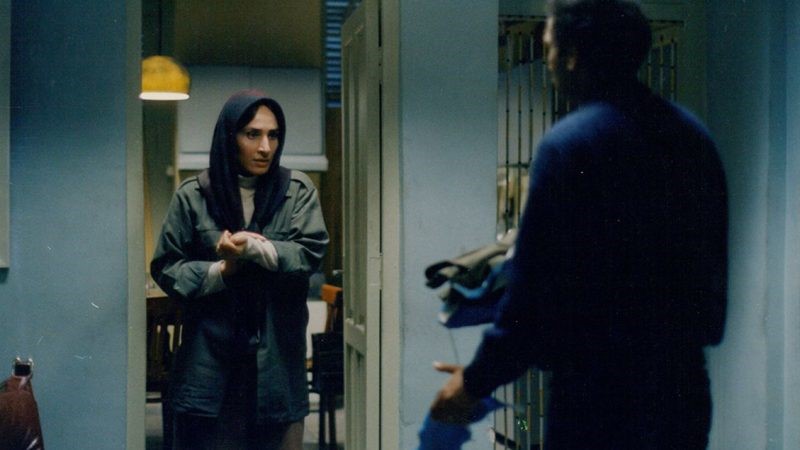
After days of wandering and inner turmoil, Rasūl decides to return and visit Nawbar at night. In a medium shot, the camera follows him from the moment he approaches until he reaches Nawbar’s door. The camera is almost at his level, and without any cuts, it gives his movement a smooth, natural flow. The camera moves closer to him from the medium shot, using this angle to show Rasūl’s desperate state and evoke empathy from the viewer. As Rasūl takes hesitant and unsteady steps, the camera’s movement and shot pacing mirror his uncertainty, making the viewer feel as though they are moving alongside him. The dim lighting and the complete darkness behind him reflect the ambiguity of his situation. When Nawbar opens the door to Rasūl, we only see her hand as she takes the bag from him, and the door closes behind her (Figure 5). At this moment, the cutting pace shifts. After a brief pause on the door, the film cuts to the next scene.
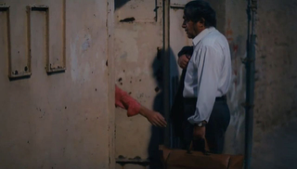
Figure 5: Nawbar extending her hand to take Rasūl’s bag. Still from The Blue-Veiled (Rūsārī Ābī), directed by Rakhshān Banī-I‛timād, 1995 (00:54:41).

Figure 5: Nawbar extending her hand to take Rasūl’s bag. Still from The Blue-Veiled (Rūsārī Ābī), directed by Rakhshān Banī-I‛timād, 1995 (00:54:41).

The absence of Nawbar’s face and body, replaced by a close-up of her hand, is not merely a visual void; this momentary absence is charged with meaning. The absence of her face and body, together with the simplicity of her action, signals the subject’s absence on a symbolic level while simultaneously suggesting the body’s presence on a semiotic level.Nawbar’s hand becomes an object of communication, a point of intersection between two bodies that are still unable to fully express themselves. Kristeva defines these moments as the threshold between speech and silence, where the body and language intersect and meaning is in the process of “becoming,” the point at which the thetic is born.28Julia Kristeva, Revolution in Poetic Language (New York: Columbia University Press, 1984), 43-44. It is a point where language—here, the image—has not yet fully entered the order of symbolic representation, and through a partial or incomplete expression rooted in emotion and the body, it produces a fluctuating meaning. In other words, the viewer is faced with the manifestation of the thetic in the absence of a face.

The viewer is confronted with the manifestation of the thetic in the absence of Nawbar’s face—a face that could easily convey her emotions, yet its omission opens the way for an experience of contact in absence. Thus, in this scene, the body is absent from the image but present in the viewer’s imagination, signifying a physical absence that opens the door to signifiance. The cautious camera does not erase the subject. Instead, by closely focusing on the hand and avoiding direct depiction, it reshapes the subject, presenting the woman’s presence through an incomplete yet powerful expression of her body. In this case, resistance is not expressed through direct action, but through the absence and erasure of Nawbar’s body, creating a new form of resistance. The absence of the face and body, rather than creating a sense of void for the viewer, opens up the possibility for a different kind of bodily presence. The Nawbar’s hand, as a point of contact, symbolizes the implicit presence of her body and reveals that even in conditions of erasure, the woman’s body can be redefined through signs and sensory details.

Jennifer Barker defines such moments as examples of indirect tactile experience in the image, where the presence of the body is not conveyed through its literal existence within the frame, but through the viewer’s sense of its being.29Jennifer M. Barker, The Tactile Eye: Touch and the Cinematic experience (University of California Press, 2009), 23-25. As mentioned, For Merleau-Ponty, the body of each person is integral to the perception of the “Other.” Thus, the hand that emerges from the door is not merely a representation of a character, but a manifestation of a subjective relationship that operates beyond sight, revealing meaning to both Rasūl and the viewer simultaneously. For Rasūl, it signifies acceptance from Nawbar; for the viewer, in Barker’s terms, it becomes a tactile-visual experience, where—even without physical contact—the sensory presence of Nawbar’s hand is felt perceptually and emotionally.


Figure 6: Nawbar and Rasūl inside Nawbar’s house. Still from The Blue-Veiled (Rūsārī Ābī), directed by Rakhshān Banī-I‛timād, 1995 (00:54:56).

Figure 6: Nawbar and Rasūl inside Nawbar’s house. Still from The Blue-Veiled (Rūsārī Ābī), directed by Rakhshān Banī-I‛timād, 1995 (00:54:56).

In the next scene (Figure 6), the camera shows both of them in a full shot, next to a dry pool, facing the viewer. Nawbar, barefoot and looking hesitant, is leaning against the wall next to Rasūl. The camera cuts to a slow zoom-in on Rasūl, sitting helplessly on the porch steps, under dim light, speaking to Nawbar in a desperate, tearful tone. The lighting highlights Rasūl’s uncertain state, which is crucial to the story. It depicts the moment when the line between wanting and not wanting, speaking and remaining silent, acceptance and rejection begins to blur. The camera then slowly zooms in on Rasūl’s distressed, desperate face, he speaks with anguish, his words filled with sobs: “Just tell me no… tell me you don’t want me… say it and set me free… my dignity… my honor… I’ll take care of you like my own daughter for as long as I live, maybe even more than them… that’s all I ever meant to do… I just got caught up… I suddenly became trapped… a prisoner…”30The Blue-Veiled, dir. Rakhshān Banī-I‛timād (Iran, 1995), 00:55:05-00:55:34. From Kristeva’s perspective, this is a liminal moment where the “thetic” and the “symbolic” intersect. Nawbar’s body— her occasional, hesitant, and sometimes ashamed glances at Rasūl — bears the shifts of the semiotic order. Here, the viewer observes a struggle between the semiotic order (emotion, desire, silence, hidden sexual inclinations) and the stabilizing structure of the symbolic order. However, the shift in this dynamic occurs from the thetic to the symbolic state.
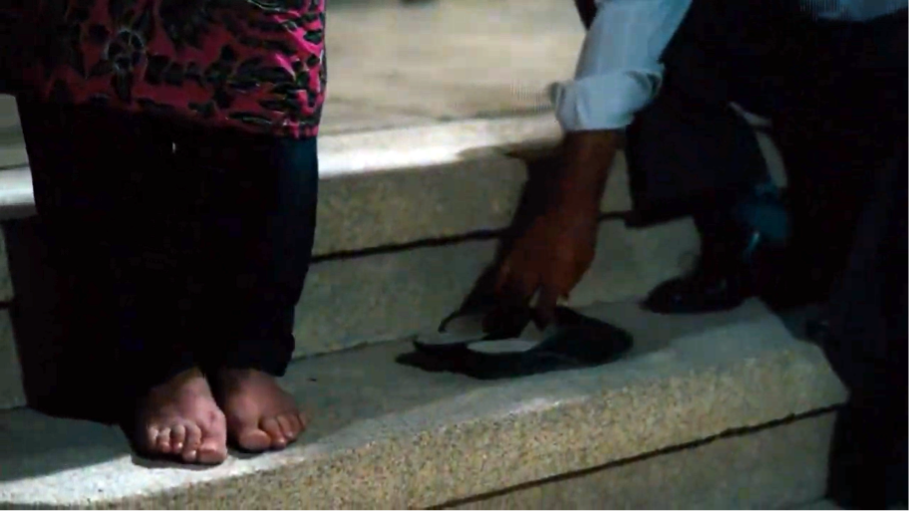
Figure 7: Rasūl arranging Nawbar’s slippers. Still from The Blue-Veiled (Rūsārī Ābī), directed by Rakhshān Banī-I‛timād, 1995 (00:55:57).

Figure 7: Rasūl arranging Nawbar’s slippers. Still from The Blue-Veiled (Rūsārī Ābī), directed by Rakhshān Banī-I‛timād, 1995 (00:55:57).

Then, as the camera focuses on Rasūl, we see him arranging Nawbar’s slippers while urging her to reject and deny his feelings: “Tell me you’re like a father to me… tell me this is immoral… I don’t want you to waste your youth on me.”31The Blue-Veiled, dir. Rakhshān Banī-I‛timād (Iran, 1995), 00:55:43-00:55:58. Here, Rasūl enters the symbolic realm, speaking from the position of father, morality, social order, and established rules. However, his body, especially in the act of arranging the slippers and the pain on his face, still belongs to the semiotic realm. It’s a space where the body goes beyond language, where his movements express a kind of desire, tenderness, and longing that contradict his words. In this scene, Rasūl carries a physical tension that he tries to hide with his words. In response, Nawbar pulls her feet back (Figure 7). She doesn’t put on the slippers, offering a mute, defiant reply to Rasūl’s words. It is a response without a firm “yes” or “no,” which Kristeva refers to as the thetic ⸺ a “threshold where meaning is in the process of formation but has yet to be fully realized. Nawbar’s body, with her feet pulled back and her legs tense, silently expresses a longing that words can’t capture. She only says a short sentence, neither rejecting nor fully accepting: “What if I’m willing? Do I still have to say no?”32The Blue-Veiled, dir. Rakhshān Banī-I‛timād (Iran, 1995), 00:56:10-00:56:14.

Thus, Rasūl seeks to shape his desire through ethical and rational standards, within the symbolic realm of language, social rules, norms, structures, and shared meanings. In other words, when Rasūl urges Nawbar to say ‘no,’ he is, in fact, trying to bring their relationship back into the symbolic, ethical framework. However, from the very beginning of the film, Nawbar has undermined all of Rasūl’s efforts to suppress this love. Nawbar’s response, caught between acceptance and shame, signals a moment when the thetic breaks through, when language, with all its rules, fails to contain psychosomatic mobility. More precisely, this psychosomatic mobility refers to an unstable, dynamic energy arising from the inner struggles of mind and body, which, before it can be shaped into structured language, expresses itself through sensory, emotional, and bodily forms. From the semiotic perspective, the body is not merely a physiological object but a dynamic force shaped by the unconscious, emotions, and desire—a continual flow embodied in the tremor of a voice, the pulsation of muscles, the hesitation in a glance, the pauses in speech, incomplete gestures, and ambiguous responses.

I emphasize the existence of psychosomatic mobility for two reasons. First, the viewer feels the tension of the scene—a space shaped by glances, Rasūl’s silence, and the distance between the two bodies on the dimly lit porch. Second, there’s the emotional tension beneath Nawbar’s calm, ambiguous, yet meaningful response. This response comes from an inner process where desire, shame, and doubt subtly shape her words. Her refusal to wear the slippers becomes a quiet but powerful expression of her mixed longing and a silence full of meaning.

Thus, the emotional tone of the scene and Nawbar’s voice set the stage for the semiotic to emerge. His response is not a clear statement; it shows his feelings and body directly, rather than through words. His voice is steady, yet his response is still an act of disobedience. This kind of resistance does not show as an open confrontation; instead, it appears in the hesitation, ambiguity, and delay of her response. It is neither linguistic nor explicit—it is bodily and emotional, a force that, rather than being fixed within the symbolic order, remains at the threshold of the thetic, leaving meaning uncertain. Therefore, Nawbar resists quietly, refusing to follow the clear and certain rules of language. This form of defiance, shown in silence, uncertain meaning, and bodily gestures, offers an alternative to blind obedience.

Ultimately, from Jennifer Barker’s perspective, this scene creates a tactile-visual experience for the viewer. Nawbar’s voice, her hesitant and ashamed presence, and the dim lighting all work together to involve the viewer’s body in the emotion of the scene. Moreover, from the phenomenological perspective of Merleau-Ponty, the body is not merely an object of observation; it serves as the medium through which we perceive and make sense of the world. In human experience, the “Other” is not merely an object of observation; the “Other” possesses a body that we perceive, sense, touch, and share space with.

From a technical perspective, the shot of arranging the slippers—showing only Nawbar’s feet and the slippers in close-up—is a careful and subtle way of showing the characters’ inner feelings and desires. The camera angle is low, at foot level, an unconventional choice that conveys intimacy. By not showing the faces, the shot makes the body the center of meaning, creating a sensory connection that replaces language.

Embodied Perception through Objects

As the film progresses, the viewer sees Nawbar’s cheerful mood before Rasūl arrives, shown through scenes of her cleaning the yard, washing clothes, and laughing playfully. From Merleau-Ponty’s perspective, the human body is connected to the world, and this connection is not made solely through seeing but also through action. When Nawbar washes clothes, sweeps, or splashes water on the ground, her bodily actions merge her with the surrounding space. Objects are identified in relation to Nawbar’s body; the linen she washes seems to become an extension of her hand. Even the basin, previously empty of water and flowerpots, is now filled with water and surrounded by flowerpots. In other words, objects are not merely tools; they function as perceptual extensions that amplify bodily presence and convey intensity, desire, and vitality within the space.33Maurice Merleau-Ponty, Phenomenology of Perception (London: Routledge Classics, 2002), 160–162.

In this regard, Justin Remes introduces the term “an uncanny presence of the absent,” referring to a state in which characters or visual elements are absent, yet their presence continues to be felt in the space and the viewer’s experience. In this way, when a character or certain actions are absent, the viewer’s attention shifts to objects, empty spaces, and indirect interactions—elements that carry traces of the character, through which their mediated or shadowy presence is felt.34Justin Remes, Absence in Cinema: The Art of Showing Nothing (New York: Columbia University Press, 2020), 138–139. In my view, this process serves at least three important functions. First, it decentralizes the traditional narrative, so that a character’s presence is not limited to their direct actions but is also conveyed through objects and secondary signs. Second, we experience the character’s body indirectly; even when we don’t see it, its emotions and presence are felt in the space and objects. Third, this process allows the female character to resist being completely erased, keeping her presence alive as a shadowy but strong figure.

According to Jennifer Barker, cinema represents the body to the viewer not only through the gaze but also through a kind of visual touch. In this scene, the movement of objects, such as shaking out wet clothes and hanging them on the clothesline, acts like the film’s “skin,” serving as the viewer’s first tactile experience. Nawbar’s body is also perceived through the skin of these objects. In this scene, instead of Nawbar’s body being the main focus, it is shown through the objects she touches, arranges, and prepares for Rasūl’s arrival. In several later scenes, especially the night Nawbar welcomes Rasūl and prepares a platter of colorful fruits for him, this idea is recreated. The variety of colors and types of fruit that Nawbar prepares and presents to Rasūl creates an unexperienced connection between them, a visual and sensory encounter that serves as a substitute for their direct physical touch. This embodied sign, rooted in the emotional unconscious according to Kristeva, transforms into an intense experience of the body within the language of cinema.

Indirect Touch of the Body

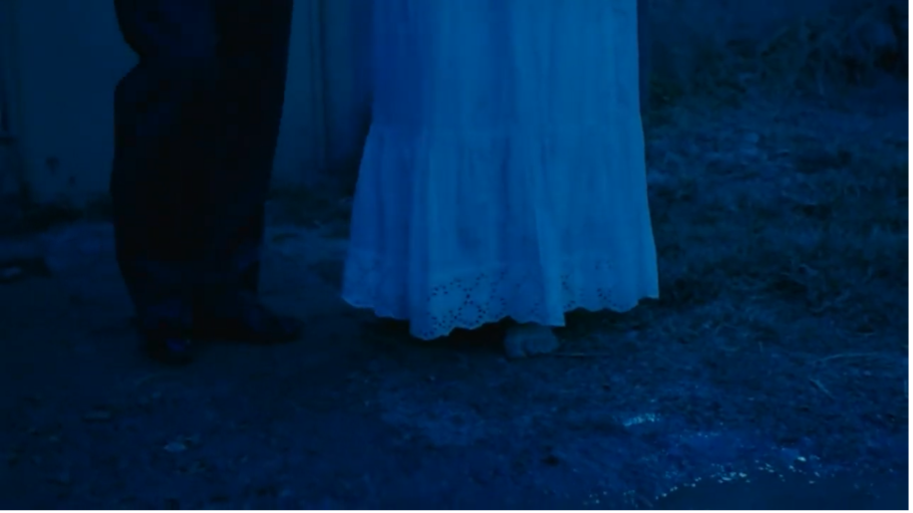
In a scene that marks Nawbar’s wedding night, she is in a long white gown, barefoot, running toward Rasūl across the garden in slow motion. Her bare feet move slowly, giving the scene a poetic, sensual feel, as if time is stretching just to show how deep her desire goes (Figure 8). One body wears shoes, the other is barefoot, symbolizing the intimacy soon to unfold between them. The camera focuses on her bare feet as she moves toward Rasūl.

Figure 8: Nawbar’s wedding night. Still from The Blue-Veiled (Rūsārī Ābī), directed by Rakhshān Banī-I‛timād, 1995 (01:02:08).

Figure 8: Nawbar’s wedding night. Still from The Blue-Veiled (Rūsārī Ābī), directed by Rakhshān Banī-I‛timād, 1995 (01:02:08).

In this scene, Nawbar’s body transforms into another form; it ceases to be merely an object of the gaze. Instead, the body manifests a joy and fervor that, as Merleau-Ponty asserts, resembles a tactile body inhabiting the world—one that can be felt, touched, or experienced—not a body to be observed, but one to be engaged with. The movement of the feet is not simply perceived as a visual contact; instead, it evokes a sensory, tactile engagement. This is where Banī-I‛timād’s perspective, the language of cinema, and Jennifer Barker’s theory of tactile experience converge. Hamid Naficy also discusses this shot: “This single shot suggests wedding-night lovemaking without breaking modesty rules.”35Hamid Naficy, A Social History of Iranian Cinema. volume 4: The Globalizing Era, 1984–2010 (Durham and London: Duke University Press, 2012), 159.

The camera’s creative use of slow-motion shots and its focus on bare feet, particularly during the wedding night, serves as a form of resistance. Nawbar’s body expresses desire and meaning freely, even when social and moral limits are imposed. The flowing water highlights her resistance; each step she takes is met with the movement of water, and despite facing its resistance, her body moves freely and meaningfully.

An important point here is the presence of Sinawbar, Nawbar’s sister. At the beginning of the film, we see that Rasūl allows Nawbar to bring her along to the farm so she won’t be left alone and unattended at home. Sinawbar, unlike the harsh environment of the farm and factory, belongs to the world of home, love, and possibly Nawbar’s past. Her childlike presence can be looked at in two different ways:

First: According to Kristeva’s theory, Sinawbar embodies qualities of the semiotic order, such as physical and emotional dependence on others, and she has yet to move into the more rational, rule-bound world. The way a child speaks isn’t through complete words but rather through body language, emotions, and facial expressions. This form of communication is tied to the early, more instinctual connection to the mother, before the child enters the world of structured language and logic.

Second: Sinawbar is an embodiment of Nawbar’s identity, a symbol of her past innocence, representing a version of Nawbar that has not yet been touched by society’s cruelty. For example, when there’s no news of Rasūl and he’s absent, Sinawbar, who is very attached to him, is shown in the film as sad and waiting. This shot, without words or action, shows Sinawbar sitting on a pile of earth, her worried eyes staring into the distance, her body still but tense. In the absence of words, this shot conveys her deep emotional attachment. Through silence and a fixed gaze into the distance, Sinawbar silently expresses her concern with her body language; this body is active through emotions and a childlike language, expressed through the sensory and visual elements of the film. On the night when Rasūl returns home to her and Nawbar, we see Sinawbar’s head resting on Rasūl’s lap as she listens to the story he tells, unwilling to go to bed and wanting to stay beside him (Figure 9).
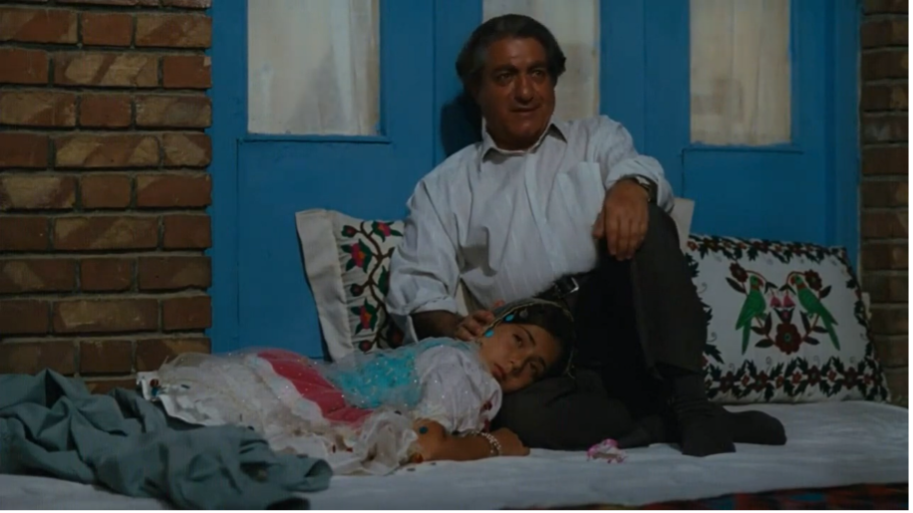
Figure 9: Sinawbar resting her head on Rasūl’s lap as she listens to his story. Still from The Blue-Veiled (Rūsārī Ābī), directed by Rakhshān Banī-I‛timād, 1995 (01:03:44).

Figure 9: Sinawbar resting her head on Rasūl’s lap as she listens to his story. Still from The Blue-Veiled (Rūsārī Ābī), directed by Rakhshān Banī-I‛timād, 1995 (01:03:44).

This scene, while it could be understood within the traditional family and cultural norms of Iranian society, is actually quite complex. Sinawbar, with her childlike behavior, not only shows her attachment but also uses her body to communicate signifiance. In this moment, Rasūl is no longer just an employer or stranger, but Nawbar’s husband, offering warmth and comfort in their home. It’s as if Sinawbar acts as a bridge; her body expresses not only her own emotions but also Nawbar’s desires. In this context, resistance is about being at the “threshold,” not directly showing Nawbar’s desires, as they are forbidden or censored in the symbolic world. However, these desires are not entirely erased, as they still flow through Sinawbar’s body and her attachment to Rasūl. So, resistance here means staying in a liminal space, where the film hints at Nawbar’s desires without openly revealing them.

Hamid Naficy interprets Sinawbar’s role as “an adult substitute for evading modesty censors [in a scene that] strongly suggests that the daughter is a stand-in for her mother who cannot touch her lover and lay her head on his lap.”36Hamid Naficy, A Social History of Iranian Cinema. volume 4: The Globalizing Era, 1984–2010 (Durham and London: Duke University Press, 2012), 159.

Wound as a Language of Protest

At the end of the film, when Rasūl and Nawbar’s relationship is exposed, the entire family is shocked. Meanwhile, as his daughters become increasingly worried and create a scene, Rasūl suffers a heart attack. After Rasūl is taken to the hospital, his daughters try to take action. Ansiyah goes to Nawbar to persuade her to separate from Rasūl, but Nawbar insists she will only agree if Rasūl himself asks for it. After arguing with Nawbar, Ansiyah threatens, insults, and eventually beats her. When Rasūl is discharged from the hospital, he goes straight to Nawbar’s house and sees that she’s been beaten. This scene is one of the most intense moments in the film, showing the struggle between the body, power, and language in a powerful way. What’s interesting is that Banī-I‛timād doesn’t show the actual beating or the person doing it. The audience only sees the aftermath of the violence. By leaving the violent act out, Banī-I‛timād aims to send a strong message. She draws attention to women and urges the audience to recognize the violence that is often hidden in society. The truth is, women suffer even when no one witnesses it.
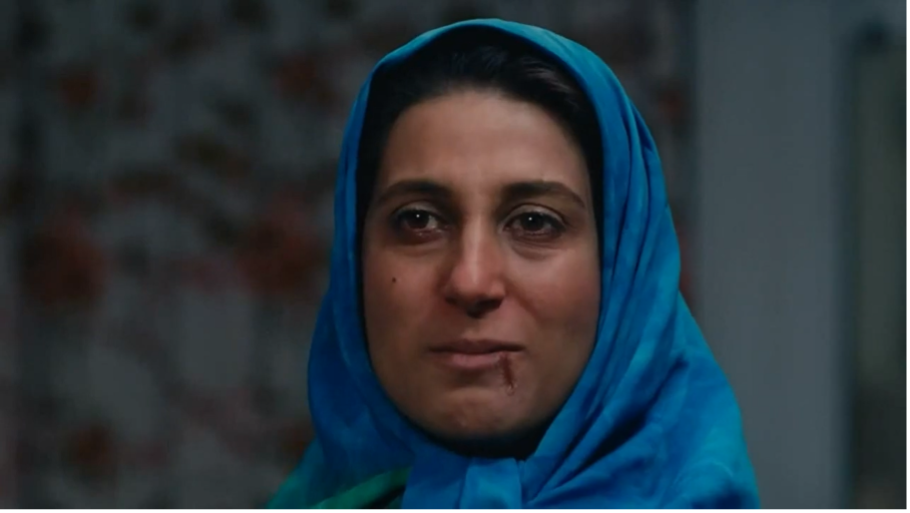
Figure 10: Nawbar with a wounded face, explaining to Rasūl what happened to her. Still from The Blue-Veiled (Rūsārī Ābī), directed by Rakhshān Banī-I‛timād, 1995 (01:21:28).

Figure 10: Nawbar with a wounded face, explaining to Rasūl what happened to her. Still from The Blue-Veiled (Rūsārī Ābī), directed by Rakhshān Banī-I‛timād, 1995 (01:21:28).

By withholding the violence, the film creates a gap that allows the viewer to sense the resistance behind it. This scene gives a voice to women from lower social classes, who are often silenced and endure greater hardships than women from other social backgrounds. Nawbar tells Rasūl what happened to her, while the pain from the experience still affects her (Figure 10). Nawbar’s face becomes a symbol of power and, in a way, a form of resistance. When she faces Ansiyah, this resistance becomes more apparent. Despite being humiliated and offered a bribe, Nawbar stands firm in her dignity and says, “If I am to leave, I’ll go tonight, right now, but only if Rasūl himself wants me to.”37The Blue-Veiled, dir. Rakhshān Banī-I‛timād (Iran, 1995), 01:17:08-01:17:16. This bold statement emphasizes the strong, independent role that the film gradually develops for women.

On the other hand, by depicting the aftermath of violence rather than the act itself, the film invites the viewer to imagine and empathize with Nawbar. Withholding the violence intensifies its emotional impact. Banī-I‛timād deliberately refrains from showing the act to prevent the viewer from perceiving the woman solely as a victim. Instead, the viewer is confronted with Nawbar’s wounded face, prompting them to derive signifiance from the absence of the incident itself.

In this scene, the close-up of Nawbar’s wounded face creates an emotional connection: her trembling voice, tear-filled eyes, and pauses between words clearly express the emotions through her body language. The close-up of Nawbar’s face, fragile and trembling with pain, draws the viewer into an emotional connection through her expression and body language. In Merleau-Ponty’s view, a relationship with another can only be formed when one is able to engage with the “speaking subject,” the embodied expression of the other: “What I communicate with primarily is not ‘representations’ or thought, but a speaking subject, with a certain style of being and with the ‘world’ at which he directs his aim.”38Maurice Merleau-Ponty, Phenomenology of Perception (London: Routledge Classics, 2002), 213.
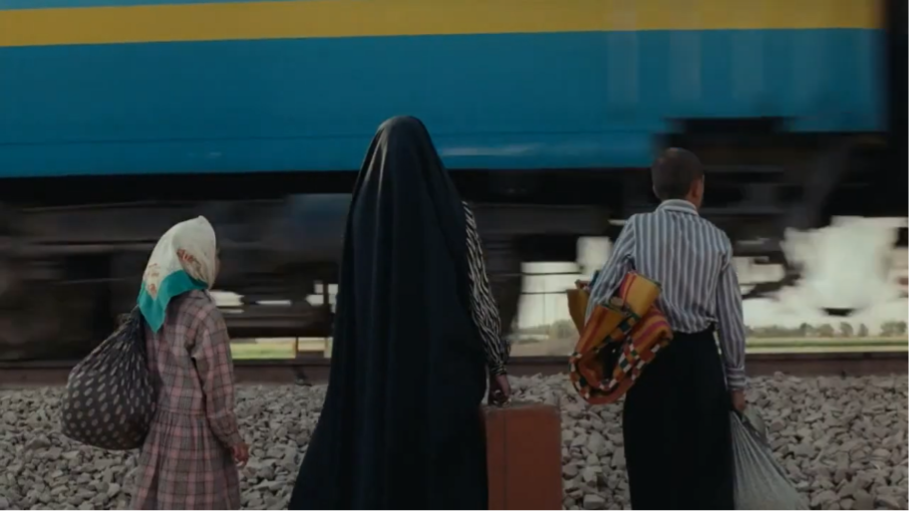
Figure 11: Still from the final scene of The Blue-Veiled (Rūsārī Ābī), directed by Rakhshān Banī-I‛timād, 1995 (01:24:58).

Figure 11: Still from the final scene of The Blue-Veiled (Rūsārī Ābī), directed by Rakhshān Banī-I‛timād, 1995 (01:24:58).

Ultimately, in the final scene of the film (Figure 11), there is a symbolic moment. Nawbar and Rasūl are moving toward each other from opposite sides of the road, but a passing train arrives, preventing them from meeting and blocking their view of one another. This moment serves not only as the dramatic climax of the film but also symbolizes a traditional societal perspective, particularly within the upper class, where the desire for such a union is regarded as taboo. Society continually puts obstacles to this love, manifesting through social, economic, and moral barriers. In this sense, the train symbolizes opposing forces, such as tradition, society, or law, that prevent a romantic relationship from developing outside traditional class boundaries. Nonetheless, the scene allows space for the viewer to imagine and interpret alternative possibilities.

Resistance in this scene can be understood in two ways: First, within the narrative itself, Nawbar and Rasūl’s desire persists despite the obstacle of the train, suggesting that their longing remains intact, even as society attempts to thwart it. Second, on a cinematic level, the film portrays the lovers’ failed attempt at union while simultaneously inviting the viewer to envision alternative outcomes. Thus, the resistance in this scene is not about overcoming obstacles, but about keeping desire alive and maintaining hope for different possibilities, even in the face of failure.

Female Subjectivity and Resistance in The Lady of May

Another example of subjectivity and resistance is the film The May Lady (1998) by Rakhshān Banī-I‛timād. The main character, Furūgh Kiyā, is a documentary filmmaker from a wealthy, well-educated background, who encounters an emotional crisis in middle age. She lives with her 22-year-old son, Mānī, who fears that if his mother remarries, his financial and emotional security will be at risk. Furūgh struggles to balance motherhood with her need for independence, while society and cultural expectations pressure women like her to stick to traditional rules.

An analysis of the film shows that the director intentionally uses the absence of the male character, Dr. Rahbar (her supervisor), as a structural device. He is never physically present, only appearing through phone calls, letters, and poetry recitations. This absence serves as a unique narrative and visual tool for both signifiance and resistance. Far from creating a gap in the story, it shifts the focus to Furūgh’s body and voice, crafting a simultaneous visual-auditory experience that deepens the signifiance. As Merleau-Ponty states, “my body is the seat or rather the very actuality of the phenomenon of expression (Ausdruck), and there the visual and auditory experiences, for example, are pregnant one with the other.”39Maurice Merleau-Ponty, Phenomenology of Perception (London: Routledge Classics, 2002), 273.

Khatereh Sheibani discusses the metaphorical language and form that Banī-I‛timād uses in her storytelling, noting that in The May Lady, the visual poetics is complemented by the verbal poetics of Ahmad Rizā Ahmadī.40Ahmad Rizā Ahmadī (1940–2023), an Iranian poet, writer, and playwright, served as the poetic narrator in The May Lady. This fusion hides metaphorical meanings in the text, going beyond the surface narrative to bring out deeper, symbolic interpretations.41Khatereh Sheibani, “Abbas Kiarostami and the Aesthetics of Ghazal,” in Conflict and Development in Iranian Film, ed. A. Seyed-Gohrab and K. Talattof (Iranian Studies Series; Amsterdam: Amsterdam University Press, 2012), 82. In my view, this visual and verbal poetry attains an aesthetic dimension and connects with Kristeva’s concept of the semiotic. The poems, along with the narrative images, create a space where meaning emerges not through direct representation, but through ambiguity, metaphor, and bodily rhythms.

On the other hand, this poetic and metaphorical aspect can also be seen as an act of resistance. In a context where censorship blocks direct expression about gender, body, or desire, the narrative shifts to an implicit, indirect, yet powerful form of communication through the semiotic and poetic atmosphere. Resistance is embedded in the narrative form, where the use of poetry, metaphor, and ambiguity allows the film to subvert the transparency demanded by official discourse, thereby creating an alternative space for marginalized voices and suppressed desires.

Thus, resistance in The May Lady is multi-faceted: first, Furūgh’s corporeality, conveyed through constrained movements, gazes, and the innovative use of the hijab, consistently expresses subjectivity while also serving as a direct protest against societal limitations. Second, signifiance and the symbols of romantic relationships are constructed through the interplay of verbal and visual poetry, allowing the woman’s emotions and desires to be symbolically represented, and thereby engaging the viewer’s sensory and tactile experience. This is achieved through Furūgh’s actions, movements, and interactions, enabling a direct, bodily connection between the viewer and the female subject. The mix of documentary and narrative forms strengthens resistance and signifiance, helping the audience see female resistance to social limits through presence and absence, silence and voice, and symbolic actions. In this way, sensory engagement in The May Lady becomes a key element of signifiance and resistance, conveying the female subject’s experience to the viewer in a bodily, active way.

The third aspect is how women’s identity and social roles are represented, particularly through their relationship with the hijab and other restrictions, which serve as a critique of social and cultural norms. In other words, Furūgh and other women’s actions in facing restrictions and traditions show female agency and resistance. For example, in one scene, Furūgh walks through a doorway at home and reaches to remove her headscarf, but the shot cuts just before she does. In reality, Furūgh does remove it, but not on screen, in the viewer’s imagination. As Norma Claire Moruzzi explains, in this moment, the viewer clearly understands that through the absence of this act, the director signals that in everyday life, Furūgh would remove her headscarf. This visual expression pushes the limits of what is considered acceptable representation in film.42Norma Claire Moruzzi, “Women’s Space/ Cinema Space: Representation of Public and Private in Iranian Films,” Middle East Research and Information Project (Fall 1999): 53.

Furthermore, the construction of this pivotal scene illustrates how Banī-I‛timād strategically employs absence and silence as aesthetic instruments for communication and engagement with the viewer. The incomplete shot of removing the headscarf generates both absence and tactility (physical presence), engaging the viewer on a sensory and symbolic level. The viewer does not witness the act itself but perceives its potential and physicality. Returning to Merleau-Ponty, visual and auditory perception are interconnected; thus, even the absence of a clear image can become a bodily experience. This is precisely what we discussed earlier from Remes, as the aesthetic power of absence; absence as an active force that not only avoids creating a sense of lack but also actively generates meaning. In this sense, the pause and cut in the image demonstrate that resistance is not merely embedded in the narrative content but is also prominently reflected in the film’s form. Through this form, Banī-I‛timād bypasses the boundaries of censorship without overtly transgressing them. This approach directly aligns with the concept of resistance: Using constraints, such as censorship or societal norms, to develop innovative forms of expression and representation. Thus, the form itself becomes a crucial tool, resisting while avoiding direct confrontation.

As a result, it can be argued that The May Lady is not only the story of a woman torn between her maternal role, public identity, and personal desires, but also a metaphorical representation of the director herself: A female filmmaker striving to balance social realities, censorship constraints, and artistic integrity, while avoiding clichés and slogans, transforming the female body into a space for representing resistance and reconstructing subjectivity. These two levels ⸺the narrative and the form⸺ converge, turning the film into a platform for resistance, signifiance, and the viewer’s embodied experience, where absence and silence serve as both elements of meaning and tools of female resistance.43Norma Claire Moruzzi, “Women’s Space/ Cinema Space: Representation of Public and Private in Iranian Films,” Middle East Research and Information Project (Fall 1999): 53.

Conclusion

Rakhshān Banī-I‛timād is widely considered one of the most important and influential female filmmakers in Iran. Over the past four decades, she has created a unique portrayal of women, exploring their bodies, the city, and politics in her films. Her works integrate social narratives addressing family, class, and gender issues, exploring themes of suffering, resistance, breakdown, and the reconstruction of the individual, all while avoiding excessive dramatization or didacticism. Her films not only emphasize social struggles but also employ visual style and language to convey signs of crisis and division, such as the tension between speaking and remaining silent, being present or absent, and exposing the body versus concealing it.

In Iranian social cinema, Banī-I‛timād focuses on the lives of women from both middle and lower classes, tackling problems like poverty, addiction, and war. She intertwines these themes in her films, illustrating how her characters’ bodies, voices, spaces, and narratives reflect their internal emotional and existential struggles. Rather than relying on stereotypes, she transforms the female body into a dynamic expression of resistance, breakdown, and recovery. In her films, the body is not a passive object; instead, it becomes an active site for personal agency and transformation.

Banī-I‛timād’s films integrate form and content in a way that enables the character to reconstruct itself in moments of expressing pain or desire, bridging the gap between words and meaning. This blend of social issues and personal experiences means the bodies of her characters are not reduced to images or stereotypes. Instead, they become places where new meanings and possibilities emerge. In this context, the body takes on a personal dimension that reveals itself in the gaze, voice, silence, and even the failure of the narrative. In this way, the body goes beyond just being a symbol of an idea or a stereotype representing a group. It becomes a space where the character’s personal experiences, suffering, desires, or resistance can be expressed.

Just as there are variations in feminine tone in contemporary Iranian poetry, as seen in the works of Furūgh Farrukhzād and Parvīn Iʿtisāmī, in Iranian cinema, female filmmakers, drawing on their personal experiences and perspectives, offer a distinctive approach to narrating and expressing the feminine subject.44Maryam Ghorbankarimi, A Colourful Presence: The Evolution of Women’s Representation in Iranian Cinema (Cambridge: Cambridge Scholars Publishing, 2015), 52. In her works, Banī-I‛timād, through her feminine tone and perspective, portrays the feminine subject not only on a visual level but also through bodily experience, signifiance, and tactile sensibility. This narrative choice, like the differences in tone in poetry, allows feminine resistance to social and cultural limitations to emerge, giving the viewer a closer understanding of the female character’s lived experience. Through her use of a feminine tone and voice in storytelling, Banī-I‛timād reinforces the representation of women’s perspectives and experiences, placing women’s resistance to societal norms and the creation of signifiance at the core of her films.

The main reasons for this narrative and formal approach in Banī-I‛timād’s work can be explained in the following points. First, she has always sought to tell women’s stories in ways that differ from the male perspective, aiming to provide a fairer view of their concerns and struggles. Second, in her artistic journey, she has learned to rely on bodily perception and pre-linguistic expression, using the senses, impulses, and even silence, to convey women’s lived experiences. Another element is her use of narrative and visual techniques, such as absence, which evoke deeper empathy in the viewer and encourage more active engagement with the film. Finally, through these artistic strategies, Banī-I‛timād, without falling into the trap of sloganizing, connects the personal to the political, offering a thoughtful and rigorous critique of patriarchal structures in Iranian society. Through this approach, she shows how people resist unfair social and cultural power structures.

The film The Blue-Veiled is a prominent example of these factors. The film represents the lives of women from the urban lower class amid psychological, familial, and social crises. Through its attention to corporeality, sound, spatial relations, and the subtle gestures of its characters, the film conveys their lived experiences. In The Blue-Veiled, Banī-I‛timād Carefully and delicately, the film presents the female subject as she faces social and cultural constraints, showing how, through resistance and creativity, she seizes opportunities for new meanings and forms of action even within restrictive conditions.

Furthermore, in Banī-I‛timād’s cinema, the focus on female subjectivity does not entail the elimination or absence of men; rather, it promotes a more nuanced representation of power relations and social structures. Men always occupy a significant role in the narrative; for instance, in The Blue-Veiled, as both employers and romantic partners, and in The May Lady, men are represented as “absent-but-present” figures, whose indirect presence emphasizes the lived experiences of women. By prioritizing women’s experiences and struggles, Banī-I‛timād provides a critical, multifaceted analysis of gender, class, and cultural dynamics of Iranian society. Men in the narrative are not active agents of change or central figures; rather, they serve to maintain or reinforce existing societal beliefs, power structures, and norms, through their actions or social relations. Men thus become part of the structure that shape women’s corporeality, emotions, and resistance. Thus, focusing on women in Banī-I‛timād’s works does not erase men’s presence but redefines their role in relation to women’s experiences and actions.45Hamid Naficy, A Social History of Iranian Cinema. volume 4: The Globalizing Era, 1984–2010 (Durham and London: Duke University Press, 2012), 162.

My aim now is to integrate Hamid Naficy’s analysis of The May Lady and The Blue-Veiled with the core concepts central to this study. According to Naficy, Banī-I‛timād conveys affectionate physical contact, such as Furūgh drying Mānī’s hair with a towel or gently stroking him under a blanket, by using objects as mediators. This type of contact not only exposes the restrictions of censorship but also transforms them into a semiotic tool. Naficy states in this regard:

“A comparison of The Blue Veiled and The May Lady demonstrates the plasticity of the hermeneutics of male-female physical contact. It appears that physical contact in situations of violence is permissible, but not in moments of tenderness. In the former film, Nobar beats up her brother by slapping and punching him, while in the latter film, Foruq expresses her concern and love for her son (Mani Kasraian) by touching him only indirectly, through mediating cloths […] These gestures of physical expression may seem innocent and small, but they are significant and signifying in the context of modesty rules that prohibit public heterosexual physical contact.”46Hamid Naficy, A Social History of Iranian Cinema. volume 4: The Globalizing Era, 1984–2010 (Durham and London: Duke University Press, 2012), 162.

Thus, Furūgh has agency not only in the narrative but also in its formal construction; through elements such as her voice, body, and the constraints imposed upon her, she shapes the staging, framing, rhythm, and editing, collectively attaining a critical level of representation. Her representation aligns with the aesthetic potency of absence, as previously explored by Justin Remes: rather than signifying a void, absence and silence emerge as vital sources of sensory engagement and tactile experience for the audience.

Through intricate and sophisticated narrative and visual strategies, Banī-I‛timād expose the existence of forbidden desire and constrained corporeality in cinema, even in the face of physical absence. The body is represented not as a direct visual object, but as an absent, semiotic component of both the narrative and the image. These absent bodies, through gestures, body language, verbal impulses, hesitant glances that often avoid direct eye contact, silence, and positioning, construct profound emotional and social meanings.

Finally, in reference to the film Mainline (Khūn-bāzī, 2006), I return to one of the study’s key defining points: the emphasis on the viewer’s embodied perception while watching a film. As noted by Jennifer Barker, the viewer is not merely a passive observer, but an embodied, active subject engaged with each scene. Analysis of The Blue-Veiled and references to The May Lady demonstrate that Banī-I‛timād’s cinema achieves this bodily connection between film and audience through various techniques. In Mainline, one technique is the use of handheld cinematography, with slight shakes from the cinematographer’s breathing, and the floating movement of the camera. This enhances the sense of presence, allowing the viewer to directly share the character’s tangible experience.47Maryam Ghorbankarimi, A Colourful Presence: The Evolution of Women’s Representation in Iranian Cinema (Cambridge: Cambridge Scholars Publishing, 2015), 69. The viewer shifts from being a passive observer to an active participant in the scene. This tactile connection with the image creates an experience that goes beyond just watching, allowing the viewer to feel present in the scene.

Therefore, this study focuses on the audience’s embodied perception: the film experience is not just about seeing and hearing, but also involves the viewer’s body in the narrative. This embodied experience brings realism to the viewer, exposing the audience to the realities of Iranian life via tangible scenes and situations such as daily life, legal and social restrictions, poverty, and war. At the same time, observing the body, gaze, silence, and symbolic interactions of the characters allows the viewer to feel the pressures, restrictions, and emotions. In this manner, the viewer engages with the characters’ mental and emotional experiences exclusively through the film’s tangible, embodied engagement.
Iranian Poetic Cinema: Historical Perspectives and Reflections

By


Figure 1: A still from the film Where Is the Friend’s House? (Khānah-yi dūst kujāst?), directed by ‛Abbās Kiyārustamī, 1987.

Introduction

Poetic cinema and film poetry are significant in global cinema history, especially in Europe. These ideas express different aspects of processing poetic material and developing narrative themes. They also propose new methods for expressing ideas in cinematic language to create innovative artistic forms. Exploring the connections among poetry, literature, and film can uncover new opportunities for structuring narrative information, examining linguistic variations, and grasping the contemporary essence of film as a multimedia system. Since poetic cinema has faced numerous verbal equivalents in studies since the 1950s, it is evident that a clearer understanding of the historical developments of this concept and its reflection in contemporary world cinema is especially significant. This study initially explores the historical evolution of this concept and its diverse lexical forms during the turbulent rise and decline of European cinematic style trends. These historical insights will offer a theoretical roadmap for suggesting the factors and methodological model of analysis for the Iranian films explored. The concept of poetic cinema will be introduced through scholarly discourse, focusing on its historical evolution in European film studies. The article then categorizes and presents Iranian poetic cinema’s key criteria and indicators. This allows readers to gain a deeper understanding of the requirements and methods for addressing this concept within Iranian cinema while also considering the historical context of the discussion from a global perspective. Next, the article will explore the historical context of Iranian cinema over the last fifty years by categorizing Iranian films and presenting a conceptual map based on four factors: verbal and written expression, visual and observational expression, emotional-sensational expression, and cinematic perception. In the next stage, several notable films in Iranian cinema will be analyzed, including the poets’ discourse on the text, dialogues, poetic content, cinematic images, and poetic subgenres. Evidence and examples will be provided for each film and filmmaker mentioned, and the concept of poetic cinema within them will be explored.

Poetry and Prose in the History of Cinema

Figure 2: A still from the film Water, Wind, and Dust (Āb, bād, khāk), directed by Amīr Nādirī, 1985.

In the 1920s, French cinema began to explore new ideas, while scholars from the Russian formalism school were already examining the connections between film and poetry. Notable critics such as Boris Eichenbaum and Viktor Shklovsky emphasized the symbolic nature of cinema, drawing on their literary knowledge and poetic techniques. Their ideas were first published in Russian in the Poetics of Cinema (1927), which examined the symbolic relationship between film and poetry. In his article “Problems of Cine-Stylistics” (1927), Eikhenbaum defines the concept of the Cine-phrase as a group of elements clustered around an accentual nucleus, perceivable as segments of moving materials, whether verbal or musical. He defines a Cine-phrase as a shot that can be lengthened or shortened, with longer shots creating the impression of a slowly developing narrative. Eikhenbaum explores the potential for meaning within a film’s linguistic structure, stating that filmic expressions arise from visual, audio, and movement signs. The transfer of concepts between viewpoints occurs through what he terms spatio-temporality, or the Cine-Period.1Boris Eikhenbaum, “Problems of Cine-stylistics,” In Russian Poetics in Translation, vol. 9: The Poetics of Cinema, ed. Richard Taylor (Oxford: RTP Publications, 1982), 22-25.

In “Poetry and Prose in Cinema” (1927), Shklovsky highlights the poetic potential of visual signs in film, paving the way for the reader-response studies in cinematography that would emerge in the 1960s. He examines the creative techniques of Dziga Vertov, comparing the arrangement of various shots to how a poet combines words and sounds to evoke an unfinished concept in the reader’s mind. Viktor Shklovsky argues that cinema employs poetic techniques to express its aesthetic values. He believed that the key difference between poetry and prose lies in the “greater geometricality” of poetic devices. In his view, a series of arbitrary semantic interpretations is replaced by a formal geometric resolution. Furthermore, he explained that poetry and prose in cinema are distinguished by rhythm. Poetic cinema prioritizes technical and formal elements over semantic ones, which shape the overall composition.2Viktor Shklovsky, “Poetry and Prose in Cinema,” In Russian Poetics in Translation, vol. 9: The Poetics of Cinema, ed. Richard Taylor (Oxford: RTP Publications, 1982), 88-89.

Dziga Vertov viewed himself as a poet, using poetry to influence his films instead of traditional scripts. He stated, “I am a film poet. However, instead of writing on paper, I write on the film strip.”3Germaine Dulac, “The Essence of the Cinema: The Visual Idea.” In The Avant-Garde Film: A Reader of Theory and Criticism, ed. P. Adams Sitney (New York: Anthology Film Archives Series, 1987), 38. He regarded film as a visual poem, utilizing techniques to evoke emotional and intellectual responses. As Eugene McCreary notes, when Dulac referred to the film as “Visual Poetry,” he highlighted the creative act of isolating and stylizing significant details. Despite drawing inspiration from poetry, however, Dulac firmly believed that cinema should break free from the constraints of literature and verbal processing patterns and instead discover new ways to comprehend the unique visual language of film: “Every cinematic drama […] must be visual and not literary […] A real film cannot be able to be told since it must draw its active and emotive principle from images formed of unique visual tones.”4Germaine Dulac, “From Visual and Anti-Visual Films,” In The Avant-Garde Film: A Reader of Theory and Criticism, ed. P. Adams Sitney (New York: Anthology Film Archives Series, 1987), 31, 35.

Man Ray, an American photographer is the first artist to suggest that “a series of fragments, a Cine-poem with a certain optical sequence make up a whole that remains a fragment. […]. It is not an ‘abstract’ film nor a story-teller; its reasons for being are its inventions of light-forms and movements, while the more objective parts interrupt the monotony of abstract inventions or serve as punctuation.”5Man Ray, “Emak Bakia,” Close-Up 1, no. 2 (August 1927): 44-45. Susan McCabe considers Man Ray’s works to be very close to Gertrude Stein’s poetic style and compares the characteristics of their verbal or visual data organization. “The kinship between modern poetry and film […] hinges upon the subordination of plot to rhythm, but also upon a montage aesthetics that privileges the fragment and its abrasion of other fragments” […] “Like Stein’s writing, Man Ray’s film denies a stable subjectivity.”6Susan McCabe, “Delight in Dislocation: The Cinematic Modernism of Stein, Chaplin, and Man Ray.” Modernism/Modernity 8, no. 3 (2001): 431.

On October 28, 1953, a seminar focused on poetic film, gathering critics, writers, playwrights, and filmmakers. Maya Deren, an American experimental filmmaker, focused on capturing the pure essence of cinematic expression and eliminating non-cinematic elements. She insisted on avoiding literary adaptations, abstract animation, or imitating reality in film. In ‘Anagram,’ poetry is the only art form from which Deren permits borrowing creative methods without her usual warnings against misappropriation.7Renata Jackson, The Modernist Poetics and Experimental Film Practice of Maya Deren (New York: Edwin Mellen Press, 2002), 111.

Poetry is defined by its construction, Deren argued, and “the poetic construct arises from the fact that it is a ‘vertical’ investigation of a situation, in that it probes the ramifications of the moment, and is concerned with its qualities and its depth so that you have poetry concerned in a sense not with what is occurring, but with what it feels like or what it means.”8Maya Deren, speaking in Willard Maas, “Poetry and The Film: A Symposium,” Film Culture 29 (1963): 56. Deren then adds, “just as the haiku consists not of the butterfly but of the way the poet thinks and speaks of the butterfly, so my filmic haiku could not consist of movements of reality but had to create a reality, most carefully, out of the vocabulary and syntax of film image and editing.”9Willard Maas, “Poetry and The Film: A Symposium,” Film Culture 29 (1963): 56. Although this core principle remained, Deren encountered various issues with the comparison, mainly regarding how to structure her film haikus. She argued that “one has random access to a book of haiku… but a film made up of haiku would necessarily be in an imposed sequence,” bringing up the question of “what is the principal, the form which would determine such a sequence? […] Common locales? […] Increasing intensity? Contrast? Perhaps like the movements of a musical composition?”10Maya Deren, “On a Film in Progress,” Film Culture 22-23 (1961): 161.

Evolution of Poetic Films

Poetic film emerged in European cinema studies after World War II and has evolved significantly over the past century. Initially labeled as film poem, film poetry, poetic avant-garde film and similar terms, these often-overlapping concepts have changed meaning over time. From 1965 to 1975, new descriptive combinations arose in modern cinema. Today, advancements in media technology have led to various innovative forms of documentary films, referred to as ‘poetry films,’ ‘video poems,’ ‘e-poetry,’ and ‘screen poetry.’ Filmmakers often blend verbal, auditory, and visual elements to evoke emotions. This fusion of poetry and cinema forms the two-way interaction known as poetic cinema, which continues to evolve.

The development of ‘Poetic Cinema’ can be divided into three periods: the ‘formation’ period, the ‘conceptual maturity’ period, and the ‘multiplicity of genres’ period. This classification clarifies conceptual and aesthetic complexities while adopting a perspective of evolution. From 1925 to 1950, the Moscow literary movement and the European avant-garde shaped poetic filmmaking. Key figures such as Shklovsky and Mayakovsky and filmmakers such as Vertov, Pudovkin, and Eisenstein played a pivotal role in the development of poetic film.  During this formative period, there was a strong emphasis on originality and unique cultural expression through the language of cinema. Vertov called this an experiment in communicating visible events without intertitles or theatrical elements. His goal was to develop a universal language of cinema, distinct from theatre and literature.11See Dziga Vertov, dir. The Man with a Movie Camera. 1929, Moscow, VUFKU & Dovzhenko Film Studios.

Artists’ early efforts to outline poetic cinema simplified its structure, aligning it with visual arts such as painting and graphics. French abstract cinema and Dadaist experimentalism removed verbal elements, creating a stylized form that was often challenging for audiences. This avant-garde approach transformed cinema into a more elite visual experience, distancing it from mainstream entertainment and creating a divide between “film as entertainment” and “film for film’s sake.”

The intentional pacing of images in film led to the creation of a visual poem that expressed human instincts and emotions through visual harmonies rather than facts.12Germaine Dulac, “The Avant-Garde Cinema.” In The Avant-Garde Film: A Reader of Theory and Criticism, edited by P. Adams Sitney (New York: Anthology Film Archives Series, 1987), 47. Filmmakers did not differentiate between poetic and musical languages, focusing on form over content in their non-narrative art. Dulac claims, “Just as in a symphony, each note contributes its vitality to the general line, each shot, each shadow moves, disintegrates or is reconstituted according to the requirements of a powerful orchestration.”13Eugene C. McCreary, “Louis Delluc, Film Theorist, Critic, and Prophet,” Cinema Journal 16, no. 1 (Autumn 1976): 23.

Between 1955 and 1975, poetic cinema advanced significantly alongside the evolution of film studies. This established cinema as an independent language that interacts with other art forms, such as poetry, novels, and painting and music. The term “Poetic Film” emerged to describe this interdisciplinary approach. Abel Gance noted, “…the marriage of image, text, and sound is so magical [here] that it is impossible to dissociate them in order to explain the favorable reactions of one’s unconscious.”14Anaïs Nin, “Poetics of The Film.” Film Culture 31 (1963-64): 14.

Prominent European filmmakers such as Michelangelo developed personal artistic expressions reflecting their own cultural and sociological variations. The universal significance of transcendental themes gradually diminished, blending film and poetry with various conceptual approaches. For example, Antonioni’s narrative, editing, and long takes blend rationality and emotion in marriage conflicts.15Peter Brunette, The Films of Michelangelo Antonioni (Cambridge: Cambridge University Press, 1998), pp 1-27. In Antonioni’s style, poetry minimizes dialogue, utilizes extended frames to enhance visuals, and portrays unstable love relationships portrayals.16Matilde Nardelli, Antonioni and the Aesthetics of Impurity: Remaking the Image in the 1960s (Edinburgh University Press, 2020), p 161. Alain René’s work explores connections between places, fluid memories, and trauma from separations. This modern cinema era links to writers of the new novel who crafted unique cinematic narratives language.17Griselda Pollock, & Max Silverman, ed. Concentrationary Cinema: Aesthetics as Political Resistance in Alain Resnais’s Night and Fog (Berghahn Books, 2012), p 178.

Ingmar Bergman explored sensitive themes from Christian teachings, using light and striking mise-en-scène to examine humanity’s relationship with death, sacredness, and hope salvation.18Jesse Kalin, The Films of Ingmar Bergman (Cambridge: Cambridge University Press, 2003), pp 1-33. In Persona (1966), he revealed the magic of enclosed shots, especially in intimate dialogue scenes centered on women, poetically and sometimes sorrowfully portraying the dark shadows of female identity. Bergman’s poetic narrative of human experiences uniquely blends emotion and intuition in cinema Bergman.19Geoffrey Macnab, Ingmar Bergman: The Life and Films of the Last Great European Director (London: Bloomsbury Publishing, 2009), p 175. Andrei Tarkovsky’s Mirror (1975) is also a nostalgic and poetic reflection of the filmmaker’s childhood.20Andrey Tarkovsky, Sculpting in Time: Tarkovsky, The Great Russian Filmmaker Discusses His Art, transl. Kitty Hunter-Blair (Austin: University of Texas Press, 1989), pp 231-238. It depicts his experience reading his father’s poems and discovering his mother’s femininity. The film features unique visuals, poetry readings, and the interplay of past, present, and future through dreams. Likewise, Nostalgia (1983) conveys the sorrow of exile and distance from home through a blend of images, movements, and voice whispers.21Nariman Skakov, The Cinema of Tarkovsky: Labyrinth of Space and Time (London: Bloomsbury Publishing, 1989), p 167.

The film-poetry hybrid has evolved significantly since the late 1980s, with the influence of postmodernism and the technological advancements of the early 1990s. The third stage integrates intellectual and psychoanalytical frameworks of human experience with artists’ emotional creativity. Over the past thirty years, advancements in digital communication, internet connectivity, video gaming, and the proliferation of virtual networks have contributed to a redefined understanding of the relationship between reality and the virtual. William Wees’s term ‘poetry film’ is now less commonly associated with poems. Wees noted that these designations indicate different genres: filmmaker Ian Cottage uses “poem film,” while poet Tony Harrison prefers ‘film poem.’22William Wees, “Poetry Film,” in Poem Film Film Poem, ed. Peter Todd, Newsletter 4 of the South London Poetry Film Society, March 1998, 5. Robert Speranza, who has studied the work of Harrison and the British film-poem, suggests that the new poets and filmmakers that came together “attempted spontaneous creation of film and verse (within reason), calling the results ‘film/poems’ or ‘film-poems.’” 23William Wees, “Poetry Film,” in Poem Film Film Poem, ed. Peter Todd, Newsletter 4 of the South London Poetry Film Society, March 1998, 5; Robert Scott Speranza, “Verses in the Celluloid: Poetry in Film from 1910-2002, with Special Attention to the Development of the Film-Poem” (PhD diss., University of Sheffield, 2002), 119. I use the hyphen to distinguish these from other types of film poems.

Iranian Poetic Cinema: Methods and Factors

Iranian cinema’s growth stems from diverse experiences of filmmakers, shaped by political trends and social movements, particularly between 1946 and 1996. Cinema has become vital to Iran’s sociopolitical landscape, reflecting the desire to merge tradition with modernity while promoting freedom of expression. This success has been achieved by blending poetry and visual arts to revitalize national identity and showcase modern Iranian complexity and richness.      

The relationship between cinema and literature in Iran began with ‛Abd al-Husayn Sipantā and Ardashīr Īrānī, who adapted themes from classical poetry to film. From 1956 to 1978, Iranian cinema changed significantly due to socio-political movements, reflecting public expectations. Until the mid-1960s, films resembled popular Indian romantic tales, incorporating poetry and music to appeal to the middle and working classes. Successful films thrived through foreign investments, resonating with audiences via romantic protagonists and local references. This era shifted towards one of independent cinema, driven by critical discourse and analysis.24Khatereh Sheibani, The Poetics of Iranian Cinema: The Aesthetics of Poetry and Resistance (London and New York: Bloomsbury Academic, 2016), 16.

In 1953, Amīr-Hūshang Kāvūsī, a French-educated critic from the Institut des Hautes Études Cinématographiques (IDEC), coined the term Fīlmfārsī, which became the dominant label. He claimed that the only element these films inherited from Iranian culture was their Persian language; otherwise, they were “formless, structureless, and storyless.”25Hamid Naficy, A Social History of Iranian Cinema. Vol. 2: Industrializing Years, 1941-1978 (Durham and London: Duke University Press, 2011), p 149

In the 1950s-60s, as Fīlmfārsī rose, alternative currents influenced Iran’s art cinema and New Wave. Since the 1920s, Iranian poetry has evolved through formalism, surrealism, and symbolism. This transformation aligned literature with drama and cinema. Prominent poets expanded literary circles, enhancing linguistic artistry—metaphor, metonymy, allegory, and irony—in Iranian drama. Post-1950s efforts revived classical techniques and modernized poetic language, merging poetry with storytelling through film. The return of educated intellectuals from France brought avant-garde movements to Iranian cinema. The New Wave rose to prominence in the mid-1960s during a 15-year cultural renaissance, highlighting Iranian identity in film. Much of Iranian avant-garde cinema’s poetic essence stems from the strong ties between poetry, storytelling, playwriting, and art films. This aesthetic interaction continued for at least 20 years after the 1979 Islamic Revolution, with many films achieving international recognition due to the filmmakers’ sustained efforts and dedication.

Since the 1960s, three genres—documentary, fiction, and docufiction—have emerged. Iranian documentary cinema has been influenced by experimental trends from France and Germany, with filmmakers pursuing innovative ways to connect cinema with visual arts, literature, and narrative poetry by extracting themes into abstract ideas. Ethnographic documentaries showcasing Iran’s beauty and culture offer new opportunities for artists. They explore Iranian identity using poetic methods, develop new storytelling techniques, and enhance the narrator’s role in voice-over, achieving unique expression documentaries.

In the 1970s, the Institute for the Intellectual Development of Children and Young Adults (Kānūn) produced educational films to promote literacy and encourage poetic experimentation. Fiction films explored new ways to depict human emotions, often adapting modern Iranian novels and short stories. Fīlmfārsī cinema dominated Iranian filmmaking, while avant-garde art cinema attracted a smaller audience. Nevertheless, it earned recognition and praise from the educated elite and critics in literature and art. A thorough examination of the developments in Iran’s alternative cinema between 1960 and 1975 shows that the most important poetic elements in documentary, docufiction, and fictional films can be analyzed across four dimensions: Verbal-inscriptional Presentment, Visual-observational Presentment, Sensational-emotional Re-presentment, and Filmic-perceptional Re-presentment.

By “presentment,” I refer to the explicit articulation of poetic experience within the film’s narrative—anything that can be articulated, heard, or seen. Presentments are defined by their clarity. Conversely, “re-presentments” involve implicit relationships between signs, including subtleties and connotations. While presentments are pure experiential data, re-presentments capture our sensory and emotional responses to poetic meanings in the narrative and the filmmaker’s artistic use of plot, cinematography, mise-en-scène, and editing.

Consequently, poetic re-presentments are primarily a form of meaning evocation or an analytical interpretation by the audience of the combined relationships between sensory, emotional, and kinetic signs within the filmic world. Unlike overtly visible and tangible poetic presentments, poetic re-presentments are often interpretative and vary based on the aesthetic literacy or cinematic receptivity of viewers and film critics. This conceptual relationship can be applied to analyzing shots, scenes, or sequences in the films discussed below and can be hypothetically and experimentally illustrated as follows.

Chart 1: Poetic Elements in the World of Film; Explicit Presentments and Interpretative, Implicit Re-presentments (by the author).

Selected film scenes can combine all four dimensions from Chart 1. Nevertheless, a singular aspect typically prevails within the film’s poetic realm, known as ‘the dominant face of poetry.’ For instance, poetic dialogues or monologues signify the verbal expression of poetry. Similarly, silence, which signifies an emotional void between a husband and wife following a painful separation, clearly manifests their circumstances. A poem recitation, a zoomed photo, or a famous quote is a transparent poetic element in a film, allowing viewers to immediately grasp its expression and meaning. Whether the director’s approach is creative or clichéd, it enriches the film’s world with varied verbal, written, or visual elements. Additionally, the set design, the arrangement of objects, and the creative use of time—illustrated through the depiction of daily life—enhance the audience’s understanding of the film’s poetic qualities.

Visual elements shape the audience’s perceptions of hallucinatory scenes, nightmares, and tumultuous dreams in cinematic works. Key factors include lighting style, the pace of camera movement, shot duration, image rhythm, and character interactions. Skillful editing can evoke moods and enhance the narrative atmosphere through shot combinations, decoupage patterns, and alterations of actors’ movements, adhering to mise-en-scène principles. Each element can lead to various interpretations, reflecting the cinematic world and the characters’ emotional depths. Grasping these interpretations requires aesthetic literacy and critical sensibility, allowing the recognition of new combinatory logic in the film’s signifying relationships. Such representations enrich cinematic language, deepening meanings and interpretations for audiences, ultimately revealing the film’s essence poetically.

Poetic Effects in Iranian Cinema

This section highlights the unique artistic methods and styles that enhance the aesthetic appeal of Iranian cinema. Poetic films use distinct elements to convey the filmmaker’s vision and enrich the cinematic atmosphere. Despite the sometimes-amorphous principles, specific characteristics have evolved over time, influenced by artists’ and audiences’ preferences. Thus, poetics is evaluated using specific analytical criteria. As Khatereh Sheibani notes, “crucial changes took place both in fiction and documentary films made by Iranian filmmakers and cultural activists in the 1960s, inspired by literature and the dramatic arts. The impact of literature on cinema was mostly through a few poets and writers such as Forough Farrokhzad and Ibrahim Golestan, who were also filmmakers.”26Khatereh Sheibani, The Poetics of Iranian Cinema: The Aesthetics of Poetry and Resistance (London and New York: Bloomsbury Academic, 2016), 18.

Narration and Poetic Narratives

In the late 1950s, filmmakers aimed to show innovative realities through unique editing techniques that went beyond representation. They employed harmonious language to deepen the audience’s comprehension of the images. The intricate coordination of cross-cutting shots and accompanying narration in the brief industrial and educational documentaries of the period gave viewers insights surpassing those of conventional realistic films. One of the first Iranian documentaries, Wave, Coral, and Rock (Mawj u Marjān u Khārā, 1957-1961), by Ibrāhīm Gulistān, poetically explores nature and human attempts to control it. This 40-minute film illustrates Khārk’s evolution into a crude oil port. The narrative thematizes the struggles between humanity and nature in the pursuit of energy resources. The film’s creative, poetic imagery endures as a significant work.

Figure 3: A still from the film Wave, Coral, and Rock (Mawj u Marjān u Khārā), directed by Ibrāhīm Gulistān, 1957-1961.

The opening scene displays a quality that, even after sixty years, still competes with the best nature films. Gulistān addresses the fish, an ancient inhabitant of the region, by inquiring, “What do you seek? The essence of a secret about today, or perhaps a seed for the genesis of tomorrow?” While fish function through instinct, humans must elevate their gaze from the water to fully perceive their surroundings. Next, the camera shifts to portray the person reflecting on the scene. The Film suggests that grace touched this island. This insightful film explores oil as a cultural and life force. It artfully weaves together various elements in a poetic documentary format. The tension between tradition and modernity emerges with the arrival of industrial machines, illustrated by massive stones being shifted by colossal rakes. Wave, Coral, and Rock is a living document of a pivotal moment in Iran’s history, presented poetically by a thoughtful writer and filmmaker.

The House is Black (Khānah siyāh ast, Furūgh Farrukhzād, 1962), which was made in collaboration with Ibrāhīm Gulistān, is a pioneering Iranian documentary offering a poetic perspective from a female filmmaker. Furūgh Farrukhzād’s 1964 poem, Another Birth (Tavalludī Dīgar), marks a milestone in modern Persian poetry. She became the leading voice for generations of Iranian women facing oppression in a patriarchal society. More than just a brilliant voice, Farrokhzad symbolizes the suffocated feminine presence in Iranian poetry.27Hamid Dabashi, Close Up: Iranian Cinema, Past, Present and Future (London and New York: Verso, 2001), 28. Her film depicts the lives of leprosy patients in a nursing home, isolated from society. Utilizing visual strategies like repeated movements and long shots of characters, the film conveys their daily suffering. It blends literary text and poetic expression to engage the audience emotionally. “The world contains much ugliness, but blindness to it exacerbates the issue. People can be solution-makers. This film reflects ugliness and pain to help remedy suffering and invoke awareness and compassion.”28Forugh Farrokhzad, The House is Black, 1963. 00:02-00:12. The film’s intelligent use of still shots and dynamic movements, combined with narration, captures the audience’s interest beyond the images.

One of the peculiar features of the inorganic intellectual is an affinity for metaphor and allegory. By transforming social realities into poetic parables they sustain the illusion that they have in fact launched a political struggle. This is principally the reason why Golestan’s influence on The House Is Black has been instrumental in creating a weak political reading of that film as a metaphor of the nation at large, rather than allowing its own dark vision—contemplating the long shadows of a colonially mediated modernity—to come true. In Golestan’s own documentaries, this tendency toward aesthetic metaphor was sometimes highly effective and resulted in brilliant works of art.29Hamid Dabashi, Masters and Masterpieces of Iranian Cinema (London and New York: Mage Publishers, 2007), 79.

Figure 4: A still from the film The House is Black (Khānah siyāh ast), directed by Furūgh Farrukhzād, 1962.

In the 1960s, Albert Lamorisse traveled to Iran, invited by the Ministry of Culture and Arts to create a film highlighting Iran’s historical and cultural heritage. The Lovers’ Wind (1978) illustrates the country’s diverse landscapes, including cities, villages, paddy fields, pastures, the sea, and the desert. Its richness lies in the poetic, bird’s-eye view narration, enhanced by literary text and the narrator’s voice. In one part of the film, the narrator says, “[…] the land of Isfahan where works of art and gardens intertwine,”30Albert Lamorisse, dir. The Lover’s Wind (1978), 00:21:26. in another part,

This hill called Susa is made out of cities we had buried. Recently, some people took a fancy to this to find these cities. They had to dig very deep so thoroughly had we done the job. The first city stood here thousands and thousands of years ago. Here, generation after generation people have toiled and rejoiced. We have buried everything, and the nomads have come roaming about the remains. But the city rose again, then broke in, and we buried everything. Thus, spread over uneven periods of time fifteen cities have grown and died here. Each had her great scholars, her great politicians, her great warriors, her great artists, each claimed to be not only the most beautiful city on earth, but also the mightiest and the wisest. Fifteen times we have overlaid them with dust and sand, and each time the nomads would come back.31Albert Lamorisse, dir. The Lover’s Wind (1978), 00:11:28-00:12:42.

Poetic Dialogues

Before the Islamic Revolution, the impact of literature on Iranian cinema’s international success was significant. In the 1960s and 1970s, cinema integrated narrative poems, theatrical stories, and cinematic scripts, with poetic dialogues. These concepts, rich in similes and metaphors, resonated as melodious poetry, embodying the essence of Iranian cinema across social statuses.


Figure 5: A still from the film The Lovers’ Wind, directed by Albert Lamorisse, 1978.


  • 1-Hātamī and Poetic Language

‛Alī Hātamī was a prominent Iranian New Wave filmmaker. His films highlighted Iranian culture and literature with poetic dialogue that celebrated Persian language. Hātamī combines visual elements (stage design, costumes, architecture) and auditory components (dialogue, music, sound) to express Iranian cultural identity. His stories merge history and tradition, offering a unique literary voice. His cinematic work is akin to painting with music and words. Hātamī constructs lyrical tableaux that draw inspiration from Iran’s rich cultural heritage, skillfully integrating the vernacular of everyday individuals into his scripts. Describing his own particular film language, he stated:

Since starting to write scripts, I have sought a unique language that reflects our characteristics. I realized we often fail to express our intentions clearly. Irony permeates our speech; we frequently use proverbs, sayings, or references from religious texts. This tone resembles storytelling. To support our arguments, we reference ancient poems, and itinerants often sell their wares with rhythm and rhyme. We also use rhythm to express social and political messages. Thus, this language embodies our people’s mood and culture.

The title “Iranian Cinema Poet” aptly characterizes ‛Alī Hātamī. His dialogue embodies Iran’s vibrant cultural and historical legacy, weaving in elements such as Gulistān Palace, Takyah Dawlat, and traditional Persian artifacts to define their identity. His films combine Persian miniatures with music, costumes, and editing, helping to preserve Iran’s ancient culture. However, the local nuances can present challenges for translation while attempting to preserve their essence.

Sūtah-Dilān (Desiderium, 1977) is one of Hātamī’s critical films from this period; the film’s scenes exemplify literary and poetic depth in storytelling and dialogue. In a powerful monologue, the protagonist laments: “Everyone claims a liar is God’s enemy […] How many enemies do you have, God! Your friends are us! A group of helpless, mentally ill individuals You turned into enemies!”32‛Alī Hātamī, dir. Sūtah-Dilān (Desiderium, 1977), 00:11:56.

Figure 6: A still from the film Sūtah-Dilān (Desiderium), directed by ‛Alī Hātamī, 1977.

Hātamī’s dialogues often serve as moral insights, reflecting their origins in classic Iranian literature. In Sultān-i Sāhibqirān (1975), Amīr Kabīr states: “Dying is a right; dying at your hands is bitter. However, a desire to leave eases death. I am destined for new clothes today. Please wash away my pain and sadness.”33‛Alī Hātamī, dir. Sultān-i Sāhibqirān (1975), 01:04:22-01:06:27

In the Hizār Dastān TV series, which is a historical account of the role of Rizā Tufangchī in the Punishment Committee of the Ahmad Shah Qājār period, the hero of the story (Rizā Khushnavīs) says:

Eventually, this house of lovers, our beloved prison, has demanded us. Ibrāhīm and Ismā‛īl lived in the same body within me, so I said, ‘Ibrāhīm! Sacrifice Ismael, for the time, is right for sacrifice. I sacrificed him in front of this altar, and the ink of this writing comes from the blood of Ismā‛īl, the son we never had. Alas, the sheep did not reach us from the unseen world. For slaughtering, a reed pen had come from the reedbeds instead; the reed pen flowed smoothly in my palm; it was my inhalation, not a blow, but it had its exhalation. I was blowing into it, steadily blowing, breathing in, and then breathing out.34‛Alī Hātamī, dir. Hizār Dastān (1979-1987), Episode 11, 25:52- 26:32.

The character’s linking of his biography to a religious event is skillfully crafted with literary language. In Hātamī’s cinema, an example of poetic form appears during the ‛Ayd al-Azhā (‛Ayd-i Qurbān) scene in Hājī Vāshīngtun (Hajji Washington, 1983). The exiled diplomat sacrifices a sheep, expressing his desires and regrets about national identity with sharp, ironic remarks on the country’s political and social state. He states, “O sheep, you will not become a deer. Commitment to the light means not remaining off. The one sacrificed does not fear death; it is destined. You grew fat in vain; if you ate less, you would last longer. How clean is this white fawnskin, the sacrifice! Happy ‛Ayd al-Azhā.”35‛Alī Hātamī, dir. Hajji Washington (1982), ) 00:51:43-00:57:14

Figure 7: A still from the film Hājī Vāshīngtun (Hajji Washington), directed by ‛Alī Hātamī, 1983.

In Kamāl-al-Mulk (1984), Nāsir al-Dīn Shah’s talks with the Iranian painter, illustrating the chaotic state of art and honor. Kamāl al-Mulk remarks: “The world’s work leans towards moderation. We are all what we deserve… I make my wishes! The domain of art here has been poisoned, from Hafez to now!” Similarly, the king’s words resonate with the current cultural realities: “Nāsir al-Dīn Shah: The art school is not a cornfield with better crops yearly. Among the stars, only one shines brightly; the rest flicker.”36‛Alī Hātamī, dir. Kamāl al-Mulk (1984), 00:53:55-00:57:35

Figure 8: A still from the film Kamāl-al-Mulk, directed by ‛Alī Hātamī, 1984.

Hātamī’s film Dilshudigān (1992) expresses nostalgia for Iran through themes of love for the motherland, cultural experiences, and history. The film highlights sentiments like, “Love is a shield against adversity, and the mother’s gaze resembles a lover’s, hoping for reunion tonight.” Hātamī’s work captures melancholic themes and genuine emotions that resonate with Iranians, transcending mere storytelling to embody the Persian poetry and literature that serves as a basis of Iranian identity. This is vividly illustrated in the symbolism of Iranian artists in Europe: “With all my height, my hands have never reached my dreams. When fame feels unwanted, it is a blessing to have a home where its walls are missed. I wish the world were a music box, where all sounds are melodious, and words are songs.”37‛Alī Hātamī, dir. Dilshudigān (1992), 01:12:23

  • 2- Bayzā’ī and Archetypes of Mythopoetic

Bahrām Bayzā’ī’s dramatic works (1950s-1990s) employ fictional languages and historical narratives in a literary manner. He appreciates the rich heritage of Persian literature, and the themes found in indigenous oral myths, which are reflected in his plays, scripts, and films—all infused with rhythmic language. His sorrowful reflections on ancient cultural traditions and ethnic customs are consistently apparent. His deep connection to Persian literature has fostered a unique language that transcends standard norms, capturing the poetry behind the myth. Myths serve as metaphors for timeless concepts passed orally through generations, depicting the compelling speech of heroes and narrators. This mythological influence shapes Bayzā’ī’s narratives, dramatic scenes, and characters’ wise, melodious dialogue.

Over the years, Bayzā’ī’s films have evolved, integrating poetry through minimal expressive forms such as spoken word and character narration. The interplay of words, literary arts, and linguistic creativity has added poetic depth to characters’ speeches, monologues, and dialogues. His works exemplify an eclectic approach to these discourses, focusing on modernizing Iranian artistic forms rather than imitating Western ones. He emphasizes identifying failures that allow internal tyrants and external invaders to thrive instead of blaming others for Iranian culture’s shortcomings.38Saeed Talajooy, Iranian Culture in Bahram Beyzaie’s Cinema and Theatre: Paradigms of Being and Belonging (1959-1979) (London and New York: I.B. Tauris, 2023), p 6.

Figure 9: A still from the film Ballad of Tārā (Charīkah-yi Tārā), directed by Bahrām Bayzā’ī, 1979.

Ballad of Tārā (Charīkah-yi Tārā, 1979) illustrates Iranian cinema’s frequent blend of myth, history, love, and poetry. Like many of Bayzā’ī’s works, it features a story rooted in myth—of a woman entangled in unrequited love with a warrior. Men and women from different backgrounds engage in a lyrical dialogue of forgetting and remembering as their survival and destruction intertwine:

Historical man: My descendants see me now, and I cannot return; I am ashamed! My wounds trouble me!

Tārā: You should have treated them!

Historical man: These wounds cannot heal! Do you hear? They are old but not hopeless; new blood flows from them!

Tārā: Since when?

Historical man: Ever since I saw you! […] This is where our conquest’s flag was raised; this is the division’s base that marched over our fallen. What rivers flowed from our blood? In temptation and anxiety, we were deceived! They testified to God’s word and sold their oaths for coins. The cry rose from the heart like blood! How can anyone escape this desperate war? I am leaving. […] Tārā! Your look is all I take! Alas, why must I die again? Show me a battlefield; I will be the soldier! This war is unfair; you are more robust, and this fallen sword signifies surrender. My wounds bear no honor! Your life was carefree; what have I given you? Only my bleeding wounds! I regret it!39Bahrām Bayzā’ī, dir. Ballad of Tārā (Charīkah-yi Tārā, 1979), 00:25:30-00:26:50

The Death of Yazdgird (Marg-i Yazdgird, 1980) is a notable adaptation of one of Bayzā’ī’s plays, offering a unique perspective on the Persian king’s refuge with a miller post-defeat. The narrative follows Yazdgird, the monarch of Iran, who fled to Marv, one of the prominent metropolitan areas of ancient Iran, during the Arab conquest in the seventh century. It unfolds through the voices of the miller, his wife, their daughter, and others, each presenting distinct viewpoints. The characters’ dialogue is rich and poetic:

The Miller: What did the elders say about the king fleeing in his land?

Woman: Nothing important!

The Miller: I run from house to house, feeling like a stranger. No table to host me, no bed to sleep in. My hosts are fleeing, too. Instead of leading me to battle, the warhorses took me away. Shame on me!

Woman: We have never killed a guest!

The Commander: We hunted for death unknowingly. The Day of Judgment is not over. Watch as the judges arrive, a vast army. They do not say hello or goodbye; they ask nothing and listen to no answers. They speak the sword’s language.40Bahrām Bayzā’ī, dir. The Death of Yazdgird (1980), 00:10:43-00:14:16

Figure 10: A still from the film The Death of Yazdgird (Marg-i Yazdgird), directed by Bahrām Bayzā’ī, 1980.

In Passengers (Musāfirān, 1991), the filmmaker blends epic and dramatic effects. The story carries mythological qualities, infused with symbols like mourning, weddings, and mirrors, which reflect good news in Iranian culture. A family misses their wedding celebration while the mother awaits the symbolic arrival of travelers on an endless road. The elderly mother’s account of the accident is both bitter and poetic: “Curse the roads if they lead to separation!” 41Bahrām Bayzā’ī, dir. The Passengers (1991), 001:25:34

Another example of literary speech processing appears in Pardah-yi Ni’ī (1986): “We taught you what we knew, but we do not know a cure for grief.”42Bahrām Bayzā’ī, Pardah-yi Ni’ī (Tehran: Rawshangarān, 2003), p 35. Similarly, Siyāvash-Khvānī (1993) features Siyāvash’s speech, which combines myth and melody, showcasing the rhythm between film language and poetry.

Siyāvash: What happened to our relatives that we shed blood? You suggest killing him, my grandfather. The Javelin has a hold on your father’s brother! What do we lack in today’s world? Are sickness, old age, and pain not enough? Is debris, shaking ground, rushing water, and hail insufficient? Is drought and strong wind not enough? Are predators and killer horns not enough? Are we not left broken and blind? Losing teeth, gaining white hair, weak bones, and sagging limbs? Is it not enough that night and day sleep are lost, limiting our short lives?43Bahrām Bayzā’ī, Siyāvash-Khvānī (Tehran: Rawshangarān, 1996), p14.

  • 3- Kīmiyā’ī and the poet-like Lutis

Mas‛ūd Kīmiyā’ī’s narratives demonstrate the poetic processing of words and spoken language in Iranian films. His depiction of lower-class protagonists highlights their connections to crime and street culture. Alongside themes of love and betrayal, Kīmiyā’ī’s films critique traditional Iranian values rooted in prejudice, honor, and male loyalty. The lute’s masculine discourse connects to the growing consumer economy and Iran’s relationship with the West during this period.44Hamid Reza Sadr, Iranian Cinema: A Political History (London: I.B. Tauris Publishers, 2006), pp 111-114.

From the 1960s to the 1990s, Kīmiyā’ī’s films centered on male protagonists struggling against societal norms. These characters rise up and seek revenge for their violated rights and often resort to violence. Despite coming from lower-middle-class backgrounds with limited education, they convey depth through pseudo-poetic language and spaces of solitude. Often depicted as poets, they reflect Iranian men over the past fifty years. Throughout his career, Kīmiyā’ī focused on marginalized male voices, highlighting their loyalty—whether as thieves or brave men—and expressing humanity and self-sacrifice.

The Deer (Gavazn-hā, 1974) exemplifies the challenges in Iranian society. An educated man, seeking to help others, becomes involved in political conflict against the ruling power and ultimately resorts to theft. His childhood friend, now addicted and poor, supports him out of loyalty. Ultimately, he suffers because of his friend’s ideals, all for the sake of friendship.

Figure 11: A still from the film The Deer (Gavazn’hā), directed by Mas‛ūd Kīmiyā’ī, 1974.

Sayyid’s speech in the film, performed brilliantly by Bihrūz Vusūqī, reflects these values:

Sayyid: When you left, I did not know who was going. Now, I see who has returned. You remain quiet, still astonished, but love glimmers in your eyes like a dove on my shoulder. I cherish you; you are like a flower that brings me joy.

Sayyid: My misery was my right. If not for this woman, I would have killed myself ten times during a hangover. What do you think? I embraced life. Have I lost my mind? No, I know my challenges. Sadness overwhelms me. My grief differs from yours. It is all about begging. Curse the hangover from begging. When I cry, I know I am alive. […]  Theft is theft, even by clerics. They say we are not in a good mood! Has anyone taught us about goodness, and we did not understand? […] My life is begging; curse this hangover. […] We survived until we were shot. […] Better to die from a bullet than in an alley under the bridge.45Mas‛ūd Kīmiyā’ī, dir. The Deers (1974), 00:17:25-00:18:36

The film’s hero merges street language with his experiences, creating a strong emotional bond. His empathy towards disadvantaged communities softens their rhetoric. Qaysar (1969) stresses the presence of humanity despite anger within families, portraying a society filled with oppression and corruption:

This is our time, dear uncle. If you do not hit them, they will hit you. What did you think, Mom? Does anyone care when we die? No, let the sun set three times… Everyone will forget who we were and why we died, just as we forget others. In this era, no one has patience for others’ stories.46Mas‛ūd Kīmiyā’ī, dir. Qaysar (1969), 00;13;26-00:15:17

Figure 12: A still from the film Qaysar, directed by Mas‛ūd Kīmiyā’ī, 1969.

Kīmiyā’ī’s heroes thus employ a poetic style of language to illustrate a unique class of individuals.

Poetic Content and Storyline

In Iranian poetry and folk tales, love stories are central. This reflects the collective spirit of Iranians, shaped by mystical teachings and Oriental romanticism. Themes of longing for reunion and the pain of separation are prevalent in both written and oral narratives. From the 1960s to the 1990s, Iranian cinema crafted diverse narratives centered on profound love and the impacts of secret romances. Poetry often influences these love stories, typically featuring love triangles among family or friends. Many documentary-style tales from this era highlight heroes’ failures and tragic endings.

Unlike Persian cinema, which mirrors Bollywood patterns with happy endings, Iranian films often depict emotionally painful endings and unwanted separations of lovers. Many poetic Iranian films focus on romance but depict unexpected deaths or deep sorrow. Themes of failed affection, delayed love confessions, murder, and envy shape the narratives. Typically, lovers do not reunite or do so too late. The romantic themes in Iranian new-wave cinema center on tragic heroes and have a nostalgic tone. They are often influenced by a historical perspective that illustrates a struggle to attain truth due to Islamic mysticism, which contributes sadness and social injustice to the romance.

In Brick and Mirror (Khisht u Āyinah, 1964), Gulistān highlights the futility of fulfilling social responsibilities amidst widespread suffering through a recurring narrative pattern. The film, styled like a neorealistic documentary, tells the story of a taxi driver who unwittingly brings an unexpected passenger into his life. A young woman enters the taxi and leaves her baby behind, hoping to provide it with a better destiny. Reluctant to accept emotional responsibility, the driver resolves to leave the baby at an orphanage, while his girlfriend wishes to keep it to strengthen their relationship.

Figure 13: A still from the film Brick and Mirror (Khisht u Āyinah), directed by Ibrāhīm Gulistān, 1964.

Gulistān presents a naturalistic view of poverty, illustrating his hero’s struggles with decision-making and his passivity. The film ends with the driver watching a veiled woman, likely with a child, enter another taxi, reflecting a semi-open narration in Iranian cinema. While portraying the harsh realities of 1960s Iran, the film prompts audiences to reflect and seek solutions. The filmmaker enhances the plot by emphasizing the central incident and imbuing the cinematic content with poetic expression.

Some of the essential Iranian screenplays based on love triangles, tension, unity, and the lover’s sacrifice for the beloved can be found in the films Come Stranger (Bīganah Biyā, Kīmiyā’ī, 1964), The Cow (Gāv, Mihrjū’ī, 1968), Tawqī (Hātamī, 1970), and Dāsh Ākul (Kīmiyā’ī, 1971). These films portray dramatic intensity and vulnerability. The transformation of the lover into the beloved, as a process of destruction in the object of affection, can be considered a kind of poetic treatment of the story’s content, which is perhaps most evident in The Cow (1969). The film’s hero becomes so attached to his cow that he does not accept its absence. The cow plays existential role in his rural life to guide him from madness to illness, neurosis, and finally, death.

Beyond the visuals, strong performances, and notable mise-en-scène, the storyline is engaging and reflects the poetic spirit of Iranians. The cow exemplifies semantic slippage through Mash Hasan, where new meanings replace original ones. This presents an innovative twist on allegorical personification, reversing anthropomorphism. Personification here conveys abstract concepts through human figures, while anthropomorphism gives human traits to non-human entities.47Michelle Langford, Allegory in Iranian Cinema: The Aesthetics of Poetry and Resistance (London and New York: Bloomsbury Academic, 2019), 33.

Figure 14: A still from the film The Cow (Gāv), directed by Dāryūsh Mihrjū’ī, 1968.

Tawqī and Dāsh Ākul gently depict a man’s love for a teenage girl, exploring complex family dynamics. Their relationship, between uncle and niece, reveals emotional ups and downs. The complex affection culminates in a painful conclusion that emphasizes morality. Hātamī’s Sūtah-Dilān exemplifies the challenges of expressing love in a society bound by shame and ethics, where the protagonist’s confession meets the harshness of fate. This poetic exploration of human relationships, emotional turmoil, and tragic endings creates an intense atmosphere that places characters in complex, often impossible, situations.

Figure 15: A still from the film Dāsh Ākul, directed by Mas‛ūd Kīmiyā’ī, 1971.

Cine-Poetic Images

Poetic cinema, and many experimental Iranian filmmakers, make unique use of image language. However, the desire to express facts visually and tell stories that resonate with audiences on this level has dimmed. Films exploring these themes are often labeled intellectual and considered a distinct and sometimes challenging art form. However, there remains a strong desire among filmmakers to express unique image arrangement and poetic composition.48Its example can be seen in the style of filmmaking and the poetic language of unique images and camera movements, which compose cinematic poems, as seen in the works of Terrence Malick. In a paper published in Iran Nameh’s film issue (2008), director Bahram Bayzā’ī claims that a century of cinema in Iran proves that “the image” is now “the language of the people.”49Negar Mottahedeh, Displaced Allegories: Post-Revolutionary Iranian Cinema (London and New York: Duke University Press, 2008), 42.

Before the revolution, Iranian cinema was seen in Suhrāb Shahīd-Sālis’s film Still Life (Tabī‛at-i Bījān, 1974), which is marked by long shots depicting cold faces and strained family relations. It depicts exhausting survival instincts against plain backgrounds such as bare walls and railways.

Figure 16: A still from the film Still Life (Tabī‛at-i Bījān), directed by Suhrāb Shahīd-Sālis, 1974.

The city’s bleak atmosphere reflects the elderly protagonist’s impending retirement, beautifully framing existence’s challenges with slow rhythms and dull expressions, revealing a poetic beauty in life’s ugliness. In Still Life, poetry transcends traditional storytelling, subtly hinted by its plot, which emerges through visual elements intrinsic to Iranian film poetry. Parvīz Kīmiyāvī’s film Mongols (Mughul-hā, 1973) explores collective memory through minimalistic symbols. Conceptual images represent pure cinematic art, transforming subjects into thoughtful concepts. They invite audiences to uncover hidden truths in a world of illusions and dreams. These images engage the mind with cinematic language beyond the conventional storytelling.

Figure 17: A still from the film Mongols (Mughul-hā), directed by Parvīz Kīmiyāvī, 1973.

Amīr Nādirī (b. 1946) was the first post-revolution Iranian filmmaker to create cinematic poems, sparking Western interest in Iranian cinema. His notable films, The Runner (Davandah, 1984) and Water, Wind, and Dust (Āb, bād, khāk, 1985), simplify narratives to depict longing and the complexities of life in Iran. The Runner follows teenage Amīru, who dreams of traveling across the Persian Gulf while collecting and selling bottles and shining shoes for a living in Abadan, attending night classes to learn the alphabet.

Figure 18: A still from the film The Runner (Davandah), directed by Amīr Nādirī, 1984.

This storyline forms the foundation of a poetic narrative that transcends time while emphasizing the importance of learning and self-improvement. Instead of cause-and-effect logic, The Runner uses a unique arrangement of small narrative fragments that visually depict the struggle for survival, awareness, and respect. The film features stunning shots, especially during the climactic ice race, contrasting flames from oil rigs in southern Iran with the reward of ice, which symbolizes a teenage quest for knowledge. These elements secure The Runner’s unique place in Iranian cinema; the film continues to be celebrated for its poetic imagery.

Water, Wind, and Dust is about a teenage hero battling a land overtaken by dust. This mythic struggle aims to preserve national identity. The film uses visuals and metaphors to highlight human resilience against nature. Powerful final scenes show water erupting from the Iranian desert—where survival seems impossible—and, combined with Beethoven’s fifth symphony, create a lyrical exploration of the eternal struggle among these elements of existence.

Figure 19: A still from the film Water, Wind, and Dust (Āb, bād, khāk), directed by Amīr Nādirī, 1985.

Personal Style in Cine Poetry

‛Abbās Kiyārustamī’s unique style is evident in an early scene in Close Up (1989), when a reporter and soldiers enter a house to arrest Husayn Sabziyān, who falsely claims to be the filmmaker Makhmalbāf. Rather than focusing on Sabziyān’s arrest, Kiyārustamī highlights the taxi driver, who is sitting outside and smoking. He depicts the driver waiting for the reporter while soldiers prepare for the arrest, as Sabziyān wanders nearby. The driver sees autumn leaves and attempts to take a branch of dried flowers, placing it on the taxi’s dashboard. A spray paint can unexpectedly slip, rolling under his feet and down the alley until it comes to a stop near a stream. This subplot, which may initially seem insignificant, unfolds humorously until the group accompanies Sabziyān to the police station.

Figure 20: A still from the film Close Up, directed by ‛Abbās Kiyārustamī, 1990.

Husayn Sabziyān’s arrest unfolds through the Āhankhāh family’s legal proceedings. The filmmaker uses narrative pauses to evoke tenderness, creating a media frenzy around an unemployed individual, all set amid larger social conflicts. Kiyārustamī’s style merges violence and delicacy, complicating moral judgments on civil rights and goodwill. Thus, Close-up prompts viewers to confront the challenges of judgment and humanity amidst dreams, regrets, and the harsh realities of life.

Under the Olive Trees (Zīr-i Dirakhtān-i Zaytūn, 1994) depicts subtle satire within a romantic story. In the final scene, the male protagonist gazes at olive trees, searching for his distant lover. Their conversation flows with the wind rustling the branches, yet the audience is oblivious to the words. The young man’s excitement and uplifting music evoke a sense of freedom and longing. This approach introduces a lyrical element to the film, similar to Close-up where the conversation between Makhmalbāf and Sabziyān is interrupted. They are to visit Āhankhāh’s family to seek forgiveness. Cutting off their voices creates a distancing effect that encourages viewers to reconstruct the conversation, filling gaps in the film’s soundtrack with their interpretations. This method was frequently used in Kiyārustamī’s films, such as Life and Nothing More… (Zindagī va dīgar hīch, 1992), Taste of Cherry (Ta‘m-i gīlās, 1997), and The Wind Will Carry Us (Bād mā-rā khvāhad burd, 1999).

Figure 21: A still from the film Under the Olive Trees (Zīr-i Dirakhtān-i Zaytūn), directed by ‛Abbās Kiyārustamī, 1994.

Poetic sub-narratives

After the 1970s, world cinema embraced new narrative patterns influenced by postmodern literature. Filmmakers explored innovative storytelling, moving from traditional plots and cause-and-effect logic to unstable, anti-plot experiences. Hero-centered characterization dissolved, giving way to intersecting sub-narratives. Filmmakers combined narrative layers and negative spaces—such as off-screen voices—to create ambiguity. Many films from this era are deliberately incomplete, inviting viewers to construct their own narratives. The main storyline often fragments, with sub-narratives woven into the structure.

Kiyārustamī’s continued prominence, even posthumously, is due to personal, historical, and institutional factors. His biography highlights the evolution of Iranian cinema’s quest for modernity, authenticity, and identity. His unique style influences art cinema. In the 1990s, he showcased Iranian cinema globally by entering Art-House Cinema 179 festival circuits. No Iranian filmmaker gained more acclaim in the West than Kiyārustamī, whose image graced the July-August 1995 issue of Cahiers du Cinema with the caption “Kiarostami le Magnifique.”50Hamid Naficy, A Social History of Iranian Cinema. Vol. 4: The Globalization Era, 1984-2010 (Durham and London: Duke University Press, 2012), 178-179.

The Wind Will Carry Us (1999) is a complex narrative by Kiyārustamī that poetically explores life and death. The film documents a filmmaking team’s efforts to portray the end of life of an elderly woman with cinematic objectivity. It intertwines real and fictional elements, showcasing young love and the struggle against death, intensified by a devastating earthquake in northern Iran—a recurring theme in Kiyārustamī’s work.

Figure 22: A still from the film The Wind Will Carry Us (Bād mā-rā khvāhad burd), directed by ‛Abbās Kiyārustamī, 1999.

The plot of The Wind Will Carry Us follows Bihzād, Kayvān, ‛Alī, and Jahān, who are part of a filmmaking group documenting a mourning ceremony in Tehran. Working for a certain Ms. Gūdarzī, they travel to Kurdish villages, waiting for the death of an old woman to film for their project. The villagers think they seek treasure, and Bihzād stays silent. He climbs rooftops to visit the older woman and often talks on his mobile from the cemetery on a nearby hill, where a young man is digging. As his companions grow weary and depart, the pit collapses, injuring the digger and resulting in the woman’s death. Bihzād returns to Tehran after witnessing the villagers’ despair. Before leaving, he throws a bone he found in the cemetery into the water, revealing that another Bihzād, a young man from the city, died in that village, which offers fresh insights on life death.

Kiyārustamī opens the film with a straightforward narrative. He gradually enriches the plot’s secondary elements, shifting attention from the documentary team’s mission to more profound themes. Through repetitive actions, like trips to the cemetery for phone calls, he weaves narratives about heaven and hell, life and death, via the village teacher’s dialogue. This focus on off-screen dialogue transforms the film, positioning these subtler themes as the core storyline.

The film’s narrative reveals a sub-story of emotional ties between a village gravedigger and a girl, highlighted by Furūgh Farrukhzād’s romantic poetry that connects to feelings to death. The title evokes modern Iranian poetry, specifically Suhrāb Sipihrī’s Where Is the Friend’s House? (Khānah-yi dūst kujāst? 1987). The filmmaker explores love poetically, contrasting the cemetery’s light with the grave’s darkness. Their bond is expressed through song, as the gravedigger notices the food the girl leaves next to her digging site. Their tender relationship, both searching for love and a future, starkly contrasts the themes of death and mourning in the main storyline. This contrast mirrors the metaphors in Farrukhzād’s poem Another Birth (1950), which reflects, The Wind Will Carry Us:

Just a moment

And nothing then

Behind this window,

The night is shaking

And the earth

Stops rotating

Behind this window,

There is an unknown person who is worried about you and me.

O, You! You, all the green!

Like a burning memory, put your hands in my hands

Moreover, leave your lips to the caresses of my loving lips, like a warm feeling of existence.

The wind will carry us.

The wind will carry us.51Furūgh Farrukhzād, Tavallodi dīgar (Another Birth) (Tehran, 1950), pp 31-32.

Kiyārustamī depicts life and death’s complexities through layered narratives, capturing nuances beyond mere words.

Figure 23: A still from the film Where Is the Friend’s House? (Khānah-yi dūst kujāst?), directed by ‛Abbās Kiyārustamī, 1987.

Conclusion

In conclusion, this article presents a compilation of evidence and poetic influences that highlight the significance of discussing Iranian poetic cinema. Understanding Iranian cinema’s conceptual and expressive complexities is crucial for fully appreciating it, particularly given its reliance on specific cinematic techniques. The evolution of the poetic film concept in contemporary world cinema has provided Iranian filmmakers with innovative techniques, both before and after the Islamic Revolution, enabling them to effectively express the unique characteristics and poetic narratives of Iranians through their cinematic works.

“Tooba” in Rakhshan Banietemad’s Cinema

By

Drawn out by Rakhshan Banietemad in 1985, the role of Tuba, the filmmaker’s most iconic character, was initially reserved for Golab Adineh to perform in Under the Skin of the City (2001). As a result of censorship, the film was stalled and only received approval sixteen years later.1Kay Armatage and Zahra Khosroshahi, “An Interview with Rakhshan Banietemad,” Feminist Media Histories 3, 1 (2017), 150. Tuba, however, makes her first appearance in The May Lady (1999), mediated and framed through its main character’s lens, that of Forough Kia (Minoo Faraschi), the documentary filmmaker within the film. Where The May Lady offers a glimpse into the Tuba figure, the character takes center stage in Under the Skin of the City, upon its delayed approval. In 2014, Tuba appears once again in the filmmaker’s latest feature, Tales. Written before she even appears on screen, Tuba is inspired by a ‘real’ film subject from a documentary (1992), and at the same time a fictional construction, who despite years of delay, serves a central part of Banietemad’s cinema.

Tuba’s centrality functions at both the micro and macro level; the textual and the intertextual; the domestic and the public; the personal and the political. As this chapter will show, Tuba’s persistence and insistence on drawing on the cinematic form grants her a sense of duality, where she operates between Banietemad’s documentary and fictional world. In some ways, Tuba functions in these works as a mirror for the viewer and the director herself. These notions of duality embodied by Tuba extend to other themes and motifs too. Binaries, a generic convention of melodramas, are utilized in Banietemad’s films, but in such a way that points our attention not to distinctions between the private and public, or documentary and the fictional, but rather, to how these forms, spaces, and characters intersect.

A close reading of Tuba allows us to better understand the various aspects of Banietemad’s filmmaking practice. Tuba manifests the filmmaker’s investment in the meta-cinematic. Through her, we see traces of Banietemad’s filmic styles, how she weaves documentary filmmaking with narrative cinema, and how she oscillates between realism and melodrama. Tuba, an illiterate, working-class mother, is who Banietemad relies on to explore the constraints and possibilities of her society. For over three decades, through her recurring question, “Who will watch these films anyway,” Tuba demands that we pay close attention to the cinematic form. Through this line, both her and Banietemad question and reaffirm at the same time, the role of filmmaking in Iran. To illustrate the cinematic and political significance of Tuba, I begin by outlining her origins to explore her positionality within the director’s filmic practice. Turning then to Under the Skin of the City, I employ a close reading of the film to demonstrate how Tuba connects the personal and the political.

Figure 1: Movieposters, from left to right: The May Lady (1999), Under the Skin of the City (2001), Tales (2014)

Tooba’s Origins

We encounter Tuba for the first time in The May Lady, but she has been under development in the screenplays of the director long before that. While Tuba is a fictional character, her construction is inspired by Banietemad’s documentary To Whom Do You Show These Films (1992). It is this question, inspired by a woman called Mehri, that Tuba echoes for years to come. Banietemad speaks to the origins of this significant line:

The sentence which Touba says in the film, the first time I heard this exact sentence was 24 years ago. I was making a documentary and a character called Mehri asked me: ‘Who do you show these films to anyway?’ This sentence had so much meaning that it stuck with me. I used it time and time again in many films that I made since then. I think the reason I use it is as a reminder to authorities to know what people are feeling and be aware of their sentiments.2Yonca Talu, “Interview: Rakhshan Bani-E’temad,” Film Comment, 20 Feb. 2015, www.filmcomment.com/blog/interview-rakhshan-bani-etemad/.

Tuba’s famous line highlights the significance of Banietemad’s documentary filmmaking and its influence on her career. Prior to her narrative cinema, Banietemad was involved in documentary work, where she was “largely concerned with the lower and middle classes of Iranian society.”3Maryam Ghorbankarimi, A Colourful Presence: The Evolution of Women’s Representation in Iranian Cinema (Cambridge: Cambridge Scholars Publishing, 2015), 67. Her fictional films are often informed by the research conducted for her documentary projects, “used as the foundation for the scripts for her films.”4Ghorankarimi, A Colourful Presence, 68. As scholars such as Roxanne Varzi have noted, Banietemad’s films offer an “ethnographic value.”5Roxanne Varzi, “A Grave State: Rakhshan Bani-Etemad’s Mainline,” in Iranian Cinema in a Global Context, ed. Blake Atwood and Peter Decherney (London: Routledge, 2015), 97. At a “time when documentary and most anthropological endeavors have become close to impossible in Iran,”6Varzi, “A Grave State,” 97. this practice serves even greater significance. As Maryam Ghorbankarimi posits in her discussion of To Whom Do You Show These Films, Banietemad’s documentary is a “demonstration of self-reflexivity, whilst ensuring that, from the onset, the spectator is also playing an active role.”7Maryam Ghorbankarimi, “Rakhshan Banietemad’s Art of Social Realism: Bridging Realism and Fiction,” in ReFocus: The Films of Rakhshan Banietemad, ed. Maryam Ghorbankarimi (Edinburgh: Edinburgh University Press, 2021), 197.

Tuba, who reiterates this question for over three decades also demands from her audience to pay close attention. Her repeated question, “To whom do you show these films?” connects Tuba to Mehri, and functions within Banietemad’s works as “a conduit between documentary and fictional modes of filmmaking.”8Michelle Langford, “Tales and the Cinematic Divan of Rakhshan Banietemad,” in ReFocus: The Films of Rakhshan Banietemad, ed. Maryam Ghorbankarimi (Edinburgh: Edinburgh University Press, 2021), 67. Characters from previous films appear again, creating a sense of cultural and cinematic memory for the audience. In revisiting characters and storylines from previous films, Banietemad creates a strong sense of continuity and progression, which “provides a valuable temporal frame of reference for understanding social, political, and cinematic developments in Iran during a period of rapid and wide-ranging change.”9Zahra Khosroshahi, “The Artistic and Political Implications of the Meta-Cinematic in Rakhshan Banietemad’s Films,” in ReFocus: The Films of Rakhshan Banietemad, ed. Maryam Ghorbankarimi (Edinburgh: Edinburgh University Press, 2021), 84. This links Tuba’s cinematic journey to the social and political conditions of contemporary Iran, as well as its film industry.10Khosroshahi, “The Artistic and Political Implications,”  85. This method of interwoven storytelling also creates a sense of intimacy between the characters and the audience. We return in later films to familiar faces and engage with stories in a way that connects us back to these characters – we become as an audience then, invested in their journeys. Tuba’s depiction further illustrates this point, where her recurrences mark her relevance to the film but also function as a point of reference within the world of Banietemad’s films.

In addition to offering a sense of familiarity for the audience, Tuba, through self-reflexive filmmaking, sits between documentary traditions and narrative cinema. In a similar fashion, Banietamad’s modes of storytelling “bring together two cinematic stylistic traditions, social realism and melodrama.”11Laura Mulvey, “Between Melodrama and Realism: Under the Skin of the City (2001),” Film Moments (2010), 8. As Laura Mulvey argues, Banietemad “uses both [realism and melodrama] to tell a story about crises rooted in class and gender inequality in contemporary Iran.”12Mulvey, “Between Melodrama and Realism,” 8. For Mulvey, Under the Skin of the City “encapsulates the way that realism and melodrama are, in different ways, stylistically important for dramas of social oppression and injustice.”13Mulvey, “Between Melodrama and Realism,” 8. Whereas “realism records the state of things, without stylistic intrusion into a representation of the norms of everyday life and its fragile survival strategies,” melodrama “takes on an expressive function that responds to both the intensity of the crisis and its protagonists’ desperation.”14Mulvey, “Between Melodrama and Realism,” 8. This crossover highlights the intersection of the director’s stylistic approaches, and Tuba through her rootedness in documentary filmmaking and through her melodramatic performance sits at the axis of these traditions.

The combined use of realist filmmaking with melodrama is not merely an artistic choice. For Banietemad, filmmaking is about addressing social issues and confronting gender and class politics. As Mulvey puts it, this “deeply political” perspective by way of two filmmaking styles also reflects social dynamics. The use of true-to-life locations as the film’s setting (Tehran, shopping centres, alleys etc.), and handheld cameras that capture “real” social and political anxieties are paired with performances by professional and well-known actors. Both realism and melodrama are suited for societies that deal with oppression, and the way in which Banietemad combines the two styles frames the “individual and family-level conflict in the larger social and political structure.”15Rini Cobbey, “Under the Skin of the City (Rakhshan Bani-Etemad): Under the Surface Contrasts,” in Film in the Middle East and North Africa: Creative Dissidence, ed. Josef Gugler (Austin: University of Texas Press, 2011), 88. As Rahul Hamid adds, Under the Skin of the City “animates an essential question of political filmmaking: how to balance fidelity to social reality with the often more compelling and convincing dictates of dramatic fiction.”16Rahul Hamid, “Under the Skin of the City,” Cinéaste 28, 4 (2003), 50. Through the Tuba figure, Banietemad foregrounds a combination of filmic styles and modes, as well as social issues and realities of contemporary Iran without ever sacrificing the dramatic or artistic dimensions of her storytelling. A product of her time, Tuba is a character that has been revisited, rewritten, drafted, and crafted over time. It is not only her centrality within Banietemad’s repertoire that marks her importance, but also how she operates within the filmic text itself. In Under the Skin of the City, Tuba’s framing positions her as the nexus of the family, through which the connection between the personal and the political are drawn.

Figure 2: The May Lady (1999), Rakhshan Banietemad,Still from Banietemad’s The May Lady, Accessed via https://www.youtube.com/watch?v=N775FrzHCko (00:58:16)

Tuba’s Centrality in Under the Skin of the City (2001)

Under the Skin of the City is bookended with its main character Tuba, cementing her centrality to the narrative arc of the film, as well as reaffirming her relationship to the cinematic medium. The film opens with a close-up shot of Tuba, framing her face as officials interview her about the role of women labor workers in the forthcoming election. The first image shown on the screen is of a small Sony television, through which we first encounter Tuba. At first, the image is blurry. As it becomes focused, the officials signal to Tuba to cover the hair poking out of her headscarf. Tuba fixes her hijab, pulling it forward, covering the exposed hair. In his discussion of Under the Skin of the City, Hamid Naficy writes that “veiling and unveiling are overdetermined. The movies’ title invites the peeling away of surfaces to understand hidden truths.”17Hamid Naficy, A Social History of Iranian Cinema: Vol. 4; The Globalizing Era, 1984-2010 (Durham, NC: Duke University Press, 2012),163-164. Banietemad’s engagement with veiling and unveiling is spatially charged, both through her commentary on the conventions of the hijab in this opening scene, but also in the way she dissects the city through its many layers. In addition to the double-screen, Tuba’s black hijab adds another visual frame to her face. The film’s very opening sequence, with the double framing and the veiling of Tuba, links its main protagonist to the screen and the class politics of her society, establishing her cinematic and political importance early on.

Figure 3: Under the Skin of the City (2001), The image of Tuba on a small Sony TV. As it focuses, officials signal her to adjust her hijab, and she promptly covers her exposed hair. Rakhshan Banietemad, Accessed via https://www.aparat.com/v/xtjc3 (00:00:27)

Under the Skin of the City tells the story of Tuba and her family, exploring the layers of Tehran. The opening scene sets up the film, framing and situating Tuba, but also commenting on the conditions endured by the working class. The next scene shows Tuba at work, and following her commute, we arrive at her home. This domestic space reveals the family life awaiting Tuba: a pregnant daughter who has taken refuge from her abusive husband (yet again), and her politically active teenage son who has just been bailed out of prison. We learn about the older son Abbas (Mohammad-Reza Foroutan), who longs for an escape from his dead-end situation, a direct comment on the socio-economic conditions in Iran. Central to the plot is one of his projects which goes wrong when his ‘friend’ takes off with the money, leaving him with nothing. Desperate to make up the loss, he agrees to deliver a package of heroin, but ends up losing it. Meanwhile, Tuba’s husband who is unable to work due to his disability, grants the title of the sole breadwinner to Tuba.  To get under the skin of the city, of Tehran, then, means to enter Tuba’s home and find stories of economic hardship, drugs, disability, and gendered violence.

The film’s introduction to the domestic space, Tuba’s home, is worth examining. First, we have an establishing shot of the house, and the camera pans across the courtyard, and its tiny doors. The house is in disrepair and appears to be traditional, signifying the class status of its inhabitants. As the camera pans across, there is pop music playing. Over the music, we hear two young women speaking. One is teaching the other chemistry. The camera, then panning over the house and courtyard, pauses by the wall that connects the house to the building next door, attached wall-to-wall. There we see the two young women, using a ladder to climb up to the wall to talk over their chemistry homework. The camera pauses here, focused on them.

This scene with the house as its location, tells its own story about gender and familial relationships. As Tuba enters, we learn that this is her home, and it is her younger daughter Mahboubeh (Baran Kosari) and their neighbour Masoumeh (Mehraveh Sharifinia) who are reviewing chemistry. The two are friends, classmates, and neighbours. Tuba enters the house in a bad mood, and complains about the music being too loud, comparing it to the sound of the factory where she works. She also asks the girls to climb down. Then turning to Masoumeh, she asks, “Aren’t you scared of your brother?” This early scene, without unpacking familial relationships yet, alludes to Masoumeh’s abusive brother, foreshadowing what is to come.

Figure 4: Under the Skin of the City (2001), Rakhshan Banietemad, Tuba’s daughter and the neighbor’s daughter climbed up the ladder to the top of the wall and are studying chemistry together., Accessed via https://www.aparat.com/v/xtjc3 (00:06:33)

Tuba’s role here is instrumental. She functions as the glue of the family, binding all its members. Her home is telling of the complex social and political layers of Tehran. The film explores the lives of Tuba and her family members, both through the many challenges they face, but also through moments of tenderness and joy. Mulvey writes that for Tuba, “the house stands for her motherhood, her love for her children and their love for each other.”18Mulvey, “Between Melodrama and Realism,” 8. On the other hand, “the house next door, identical in layout, is tyrannised by a brutal and conservative eldest son so that the high walls are more resonant of a prison than of maternal comfort.”19Mulvey, “Between Melodrama and Realis,” 8.

This juxtaposition is most clear in a scene where Tuba cuts her husband’s hair in their courtyard. Their daughter Mahbubeh enters pretending she is returning from a tutorial. Tuba however knows that she and Masumeh had just been to a concert. While she hides this from her father, pretending she has come home late from a study session, the open space conveyed through the courtyard, and their banter and laughter, signal his leniency as he warns her to study. Moments later in the same scene, Mahbubeh runs around in the courtyard with Tuba’s homework in hand (she is learning how to read). Tuba chases her asking her to return the piece of paper. The scene conveys a sense of intimacy and closeness between the family members. The laughter however is interrupted by the cries of Masumeh next door, as her brother violently beats her. As Mulvey points, the contrast between the two houses is significant, and the symbolic value of the home for Tuba itself is important to the film’s narrative and themes.

Far more than a setting, the home is crucial to the plot as a motif and theme. It serves as a space where the various issues of economic instability, gender and class politics, and male violence all clash. The dramatic tension rises when Tuba finds out that the documents for her property are missing, and that her home will be demolished. In this scene, the small courtyard yet again becomes the centre of action, and the subplots merge together to heighten the drama. We know in this scene that Mahbubeh is in prison and needs bailing out. She found herself in trouble with the authorities having aided Masumeh in running away from home to escape her abusive brother. The house too is gone, and with it, the centre of the family. The visuals of the scene, the dark night, and the consistent coughing of Tuba intensify the mood. The two brothers confront one another, fighting. The paternal figure sits quietly in the corner of a room, unable to intervene. The two homes mirroring one another are initially set up with stark differences, but soon this duality is distorted, where Tuba’s loving home is also interrupted by dramatic tension and chaos. Like the walls of Tuba’s home on the verge of collapse, these binaries also break down and crumble, and through what lies underneath Banietemad explores the harsh realities of her society.

Figure 5: Under the Skin of the City (2001), Rakhshan Banietemad, Tuba cuts her husband’s hair in their courtyard, Accessed via https://www.aparat.com/v/xtjc3 (00:38:34)

The politicization of the personal and private reaches its climax with the destruction of Tuba’s home. The scene represents a sense of uprooting and the dismantling of her home (literally deconstructed brick by brick). The house represents the long years of Tuba’s hard work, and its destruction (by two men: her husband and son) is symbolically significant. But the house means something different for Abbas. It is his escape from his lived reality, a potential path forward. The Iran he lives in is no longer a place for growth for people like him, and his desires to leave are tied to the conditions under which he lives. The house and its walls represent for him a system that continues to hurt him, and there are merely walls that need to be broken down to allow for his escape.

The imagery here connects the domestic space of a home with the social and political discontent of Iranian society. The function of Tuba’s home, symbolically and narratively, becomes a political statement. The house is all-encompassing and spatially significant to the film. The relationship between the house and the state is alluded to here as well. This is especially the case when Tuba reiterates that this house is all she has from this ‘place.’ This sentiment is fully fleshed out in Banietemad’s Tales years later, where Tuba and her fellow workers travel on a tightly packed bus to protest labour conditions. In another meta-cinematic scene, and in characteristic style, Tuba addresses the viewer directly, saying: “Don’t I deserve something? A piece of land after so many years of hard work?” For Tuba, everything has failed her, the state, her family, and her employer. The space that once represented solitude and a home for Tuba and her family has become a space for drama and tension.  The destruction of the home is also important. For example, when Tuba travels to find the man in charge, asking for the legal documents to be returned and the deed undone, the images of the bricks in the scene, piled in a corner of the construction site depict a sense of uprooting and destruction. What was once a home will no longer be. Regardless of what this home represents for Tuba, its fate had been foreshadowed throughout the film.
Functioning as a stage, the home is where we meet the family and witness their interactions. Through Tuba, Banietemad allows audiences into this often unseen and marginalized domestic space, that highlights the intersections of gender and class in Iranian society. Yet, Tuba’s home is not defined and visualized to reinforce gendered readings of domestic spaces. Quite the contrary; the home is torn down (literally, by the end of the film) to question and challenge the socio-political conditions of Iranian life. Through the home, Banietemad unveils many aspects of Iranian society and shows how embedded the private and public spaces are. Tuba’s role as a mother is significant to the narrative of the film, as well as her relationship with space. But Tuba is also the sole breadwinner, working in the textile factory to support her family. Her multi-faceted characterization grants Tuba the spatial mobility to take us from the home to the metropolis of Tehran.

Figure 6: Under the Skin of the City (2001), Rakhshan Banietemad, Still from Banietemad’s Under the Skin of the City, Accessed via https://www.aparat.com/v/xtjc3 (01:11:54)

Blake Atwood argues that Banietemad’s “films constitute a separate track in Iranian art-house cinema, one that interrogates urban spaces and experiences.”20Blake Atwood, Reform Cinema in Iran: Film and Political Change in the Islamic Republic (New York: Columbia University Press, 2016), 73. As set out in this chapter, Under the Skin of the City complicates binaries of domestic and public spheres to show how interconnected the private and the political are. The film’s title alone alludes to the idea of unveiling,21Naficy, A Social History of Iranian Cinema, 163-164. and accompanied by its meta-cinematic opening, Under the Skin of the City illustrates the on-screen spatial politics around filmmaking and the woman’s body. Also significant to the reading of the film is its setting; as Atwood argues, “Tehran serves as a complicated and unstable character in all [of Banietemad’s] films.”22Atwood, Reform Cinema in Iran,73. The depiction of urban life, and the way in which the film locates itself within the city and its political and social issues, can be read as an act of resistance and a deliberate use of cinematic space to bring forth and comment on the country’s social and gender dynamics. Significantly, it is through Tuba’s positionality and gaze that the film begins to explore the urban.

Under the Skin of the City offers a thought-provoking visual treatment of the metropolitan city of Tehran. Banietemad relies on real life locations to tell her story. These locations are not fabrications of Tehran (though the narrative is fictional). In his review of the film, A. O. Scott writes that Banietemad shoots “the courtyard and alleyways of Tehran, as well as its fashionable shopping and office districts, with efficient realism, but the cries that wrack Tuba’s family could be happening anywhere.”23A. O. Scott, “Film Review; An Iranian Family, Facing Conflict Within and Beyond,” The New York Times, 14 March 2003, www.nytimes.com/2003/03/14/movies/film-review-an-iranian-family-facing-conflict-within-and-beyond.html. Banietemad relies on her realist style that uses Tehran as its mise-en-scène, and, by centering Tuba and her family, provides cinematic and narrative space for the most marginalized of Iranian society. From its opening segment, the film already has characters oscillating between various spaces. Central to this is Tuba, who we follow from the initial interview in the film’s first scene.

The following scene is the same camera crew following Tuba working at the textile factory. There are no words exchanged and only the loud noise of the machines can be heard. The next shot, singling Tuba out, is of her coughing on the bus, alluding to the consequences she bears from the conditions that she works under. We see Tehran through Tuba’s window as she commutes home, a shot that creates a frame-within-a-frame. The frame of the window through which we see Tehran disappears and what remains on the screen is the vast metropolitan landscape. Through sound and the grey colour pallet of the scene, the urban city of Tehran is portrayed as a chaotic, polluted, and busy place. A particular shot that stands apart is when a fight breaks out. The encounter is never explored further in the plot, and the positioning of the camera makes the characters anonymous. The function of the scene is not to serve the narrative but rather to further characterise the city. At the same time, a voiceover of the campaign speech of former president Mohammad Khatami is heard. In this scene, with the city as its backdrop, Banietemad offers a deliberately political reading of the urban space, and all the while, from Tuba’s vantage point.

The voiceover is significant for what can be heard, but also for what is left out. It begins by producing the following words: “And we shall broaden democracy and progress toward a civil society. We will try to continually strengthen the dignity and stability of this nation. Our developments were the product of a great revolution, and our problems…;” here on, the voice fades, obscured by the noise of the city. As the noise clears, the voiceover continues: “…the result was first and foremost a recovery of ourselves, and particularly of our youth.” The pause and interruption to Khatami’s voiceover are reflective of a political reality. This interrupted voiceover by the busy sounds of the city, and the follow-up story of Ali, Tuba’s younger son, are far too familiar for an Iranian audience, highlighting the reality of a city in decline set against the optimistic rhetoric of politicians. This juxtaposition is a savvy way to deal with the censorship codes of the country and Banietemad takes advantage of these lines to draw on the political reality and the current and continuous social struggles of the youth in Iran.

As Atwood argues, “urbanism allows Bani-Etemad to investigate the representation of reality and to consider the ways in which multiple urban realities coalesce.”24Atwood, Reform Cinema in Iran, 73. Incorporated in this political reading of Tehran is also the depiction of the daily life of Iranians. As the camera glosses over the city, it is important that the exploration of the urban space begins with Tuba. Through her gaze, as she looks out of the window of the bus, we too see the city. Also key in this scene is Banietemad’s documentary and realist approach to film that captures the essence of Tehran. The real location of the city, and the campaign that contextualizes Tehran, add to this notion.

As the following shot takes us into a shopping centre, Banietemad’s Under the Skin of the City explores other aspects of the city too. There is a stark contrast drawn here between the empty and glossy shopping centre and the busy and polluted streets of Tehran. Functioning almost as an escape, the space is a visual contradiction to the Tehran we encounter earlier. But the calm and coolness of the mall is also interrupted by the events that follow: a young woman running to Abbas (Tuba’s older son) to deliver urgent news to him. Even during these slow and calm business hours, the events of the city create a sense of urgency and tension about it. Abbas is told that his brother is in custody. The next shot is of the two, Abbas and Ali, on a motorcycle, riding in the city. The exchange between the brothers, and the way in which the scene is constructed comments directly on the socio-political nature of Iran—the city and the theme of urbanization adding to its message. As suggested by Atwood, Under the Skin of the City “represents one of Bani-Etemad’s most complex portrayals of Tehran. In this film, the director explores the political possibility of the metropolis, and she envisions the capital city and its many paradoxes.”25Atwood, Reform Cinema in Iran, 73-74.

The city, like the home, becomes its own stage, responsible for aspects of the film’s narrative, functioning as a political landscape. The brief exchange between Abbas and Ali as they ride away from the prison on a motorcycle, along with the cinematic qualities of the scene, illustrate how the city of Tehran is linked to state politics. Sitting on the motorcycle, we only see the two men, the camera closely framing them, as they yell loudly over the sound of the engine and the noise of the city. “Get in any political trouble again, and I’ll show you,” Abbas warns Ali. Countering his brother, Ali insists that in order to change the situation, there needs to be resistance. Abbas, who is older and less optimistic, tells him to keep his “head down” and focus on his education. The two speed off towards the grey, foggy, and polluted Tehran horizon, an ominous foreshadowing for any political action. As Abbas states his final words and speeds off, his vehicle becomes smaller within the larger metropolitan setting, and the focus is now on the city, visually depicted through the concrete buildings. Hardly into the plot of the film, Under the Skin of the City has already linked the personal and the political, with the city’s landscape serving as its backdrop.

Utilising her documentary and realist filmmaking style, Banietemad explores the layers of the city, showing us Tehran’s “ability to represent the various human experiences that exist on its concrete surfaces.”26Atwood, Reform Cinema in Iran, 82. The urban setting of Tehran obliquely conveys the film’s political position. Through its title, Under the Skin of the City claims its self-reflexivity, and yet the film is more than just a simple depiction of an urbanized space. The gaze and journey through which we witnessed the city, on Tuba’s route, has now transitioned to a more omniscient view, and yet, Tuba remains central within this plot, as it progresses and intensifies. After all, it is through her and her family that Under the Skin of the City engages with the complexities and layers of Tehran.

Figure 7: Under the Skin of the City (2001), Rakhshan Banietemad, Tuba in the presidential elections, Accessed via https://www.aparat.com/v/xtjc3 (01:11:54)
(01:29:47)

The links the opening of the film draws between the personal and the political, the domestic and the urban, reach a climax by the film’s ending. Under the Skin of the City returns to Tuba. This time again, she is placed in front of the camera. In this final scene, she is shown participating in the presidential elections. When asked about her message, Tuba’s response is deliberate and unapologetic. “Just forget about it. I lost my house, my son ran away, and people are filming all the time,” Tuba says. “I wish someone would come and film what’s happening here,” she points to her heart. The film ends with Tuba’s iconic question: “Who the hell do you show these films to anyway?” Tuba’s cinematic development and visualization throughout Banietemad’s films guide the viewer across the layers of the city, commenting on its class and gender politics at every turn. From film to film, and from frame to frame, the character has served as a central figure in the director’s body of work. For over three decades, a nation has watched Tuba appear and reappear on the Iranian screen; an embodiment of resistance and defiance. In this final scene, Tuba personifies Banietemad’s commitments to the practice of making social films. Not only does the scene capture the personalisation and politicisation of Tuba’s struggles, but also, through the reiteration of her iconic question, once again draws our attention to the importance of the camera and the meta-cinematic.


Certified Copy (2010)

By


Figure 1: Poster for the film Certified Copy, Directed by ‛Abbās Kiyārustamī, 2010.

An English art critic, James Miller, comes to Tuscany to promote the Italian translation of his latest book, Certified Copy. He delivers a frankly uninspiring lecture on the inseparability of the copy and the original to a small audience, who desultorily clap when it is over. While he is talking, an attractive middle-aged woman, whom we only ever get to know as Elle, whispers to the organiser and passes on her details to give to the speaker. After his lecture, James goes to meet Elle in the downstairs cellar from which she runs her antiquities business. After a brief discussion, they decide to drive through the countryside to the nearby town of Lucignano. Elle wants to show James Musa Polimnia, an example of a work of art that was once thought to be original but is now understood as a copy. The painting is housed in a museum near a church, in which newlyweds pose for photos together and later celebrate in a garden. James and Elle then walk to the town square, where there is a much-loved statue depicting a woman leaning her head on a man’s shoulder, which attracts tourists from across Europe. But in between, they have a coffee in a local café, and while James is outside taking a phone call, the elderly woman serving them speaks to Elle as though she and James were married. “He’s a good husband though,” she says to Elle, despite observing James’s typically brusque behaviour. “How do you know?” asks Elle. “I can tell,” replies the woman, offering her opinion based on a lifetime of experience.

Figure 2: James Miller promoting the Italian translation of his latest book, Certified Copy. A still from the film Certified Copy, directed by ‛Abbās Kiyārustamī, 2010 (00:33:00).

After this small incident, almost inexplicably, James and Elle behave as though they were actually married. We have already heard James tell the story, both in his lecture and in response to a question from Elle, that the inspiration for his book came from seeing a mother and son at the Piazza della Signoria in Florence, where, famously, there is a copy of Michelangelo’s David. We begin to suspect that James is in fact referring to his own wife and child. (We saw Elle with her son at the beginning of James’s lecture, and, in retrospect, we even remember seeing her, James and the boy together at the beginning of the film.) Later, in a restaurant, James, having decided that he does not like the wine, goes outside briefly, then comes back and delivers a lengthy criticism of Elle for having nodded off once in their car, in behaviour that we suspect only a wife would tolerate. Earlier, indeed, we now realise that a pair of French tourists, visiting the statue of the woman leaning her head on the man’s shoulders in the square, had treated them like husband and wife. The man offered James advice as to how to make Elle happy, and they did not correct them. Then, most explicitly, towards the end of the film, while still in Lucignano, Elle asks James to try to remember where they spent their honeymoon. When James says he cannot remember, Elle enters the hotel behind them, asks the clerk for the keys to the room they once stayed in, goes up the stairs with James and lies beckoningly on the bed. She says to him that this was where they spent their wedding night fifteen years ago and asks him to look out the window at the nearby church to remind him. James, for his part, in what we might alternately take to be either a typical expression of his narcissism or a rare moment of self-doubt, stares at his reflection in the bathroom mirror while the church bells ring out, celebrating another marriage.

Figure 3: James meeting Elle in the downstairs cellar where she runs her antiquities business. A still from the film Certified Copy, directed by ‛Abbās Kiyārustamī, 2010 (00:19:20).

Of course, as any number of commentators have remarked, it is difficult, no matter how we understand their relationship, entirely to make sense of events in the film. If the couple is not married, what is it that suddenly makes them pretend they are? There does not appear to be any immediate physical attraction between them. James’s pompousness and occasional flashes of bad temper are not obviously appealing qualities. However, Elle does not seem to be put off by them, and at a certain point, after a particularly unjust outburst from James, she even goes into the bathroom of the restaurant to put on lipstick and earrings to make herself even more beguiling and attractive.1Elle is played by the famously glamorous French actress Juliette Binoche and James by the first-time actor English baritone William Shimell. On the other hand, if they are married, why pretend otherwise? Why does James tell the story of seeing a mother and child at the Piazza della Signoria as though they were anonymous, when it is more than likely that he is referring to his own wife and child? If he is referring to his son, why does he not properly greet him before his talk or ask to meet him as any responsible father would do, even if he is separated from the mother? It seems difficult to explain why they pretend to be married if they are not. Conversely, if they are married and pretend not to be, there are certain aspects of the plot that do not make sense and prevent us from approving of their playfulness and inventiveness as a long-married couple that has resorted to games and pretence to introduce excitement into an otherwise failing relationship. In either understanding, they do not appear to be an immediately likely couple, and it is certainly easier to sympathise with Elle and her situation being with the unbecoming, ungrateful, ponderous and pretentious when he attempts to explain his ideas, James.2Although, as a number reviewers noted, Shimell’s first-time clumsy acting and Binoche’s slightly mannered acting tends to even our sympathies out. See on this, Paul Wood, “Certified Copy,” London Review of Books, October 7, 2010, https://pugpig.lrb.co.uk/the-paper/v32/n19/michael-wood/at-the-movies.

Figure 4: Elle applies lipstick and puts on earrings, making herself even more attractive. A still from the film Certified Copy, directed by ‛Abbās Kiyārustamī, 2010 (01:17:30).

In reviews upon the film’s release and in subsequent essays and commentaries, Certified Copy often received a less than positive response. The director, ‛Abbās Kiyārustamī, had previously directed the acclaimed Ta‛m-i gīlās (The Taste of Cherry, 1997) and Bād mā rā khāhad burd (The Wind Will Carry Us, 1999), amongst many others, and the sense of disappointment with his latest film was palpable. Lisa Nesselson wrote after its premiere at the Cannes Film Festival in May 2010 that “while the premise holds promise, the actual execution is painfully awkward, forced and contrived.”3Lisa Nesselson, “Certified Copy Review,” SBS What’s On, May 20, 2010, https://www.sbs.com.au/whats-on/article/certified-copy-review/gighrmr3a. Later, upon its general release, the Guardian’s film critic Peter Bradshaw described it as “persistently baffling, contrived, and often simply bizarre – a highbrow misfire of the most peculiar sort.”4Peter Bradshaw, “Review: Certified Copy,” The Guardian, September 3, 2010, https://www.theguardian.com/film/2010/sep/02/certified-copy-review. In more academic accounts too, the film was not spared criticism. Canadian English Professor Marcus Boon writes that “the movie is set up so didactically – it more or less begins with a ten minute lecture setting out the thesis of the writer’s book – that one is forced to assume that what follows… is also about copying.”5Marcus Boon, “On the Copies in Kiarostami’s Certified Copy,” Marcus Boon, April 27, 2011, https://marcusboon.com/on-the-copies-in-kiarostamis-certified-copy/. While Gönül Dönmez-Colin in her Women in the Cinemas of Iran and Turkey observes of the conversation between Elle and the lady serving her in the café: “Something seems to be missing in these conversations that are rather formulaic and anachronistic in the context of modern women.”6Gönül Dönmez-Colin, Women in the Cinemas of Iran and Turkey: As Images and as Image Makers (London: Routledge, 2019), 319. Perhaps as some kind of a justification for the film, then, commentators have pointed to a number of esteemed European arthouse precursors to Certified Copy, in which we can already see aspects of the film. Hajnal Király notes, along with any number of others, that the idea of a couple driving through scenic Italy while trying to work out the status of their relationship was already to be seen in Roberto Rossellini’s Journey to Italy (1954).7Hajnal Király, “World Cinema Goes to Italy. Abbas Kiarostami: Certified Copy (2010),” Acta Universitatis Sapientiae, Film and Media Studies 5 (2012): 58. Perhaps even more relevantly, Maryse Bray and Angès Calatayud point out that Alain Resnais’ Last Year at Marienbad (1961) features a plot in which a man insists to a woman that they have previously met and had an affair, while the woman for her part, baffled or bafflingly, declares that they have never met.8Maryse Bray and Agnès Calatayud, “The Truth about Lies: The Relationship between Fiction and Reality in Abbas Kiarostami’s ‘Certified Copy’,” New Readings 11 (2011): 96, https://doi.org/10.18573/newreadings.78. Altogether, these kinds of parallels with European arthouse classics are seen not only as part of Kiyārustamī’s general move to Europe – where he came to live and work after difficulties of making films in Iran – but also as indicative of how non-European directors now most profoundly continue the European arthouse tradition in the twenty-first century. As British art writer Paul O’Kane observes, “The aim of Certified Copy… [is] to show Europe to itself as seen by others, while challenging preconceived values and traditions in ways that offer Euro-American art the opportunity of extending its own possibilities.”9Paul O’Kane, “Only a Game?: Abbas Kiarostami’s Certified Copy,” Wasafiri 27, no. 1 (2012): 54-56, https://doi.org/10.1080/02690055.2012.636919.

Figure 5: A still from the film Last Year at Marienbad, directed by Alain Resnais, 1961.

Undoubtedly, the most intriguing attempt to somehow make sense of or justify Certified Copy is the thinking of it in terms of the American philosopher Stanley Cavell’s notion of the filmic genre of the “comedies of remarriage.”10See, for example, Aaron Cutler, “Certifying a Copy: An Interview with Abbas Kiarostami,” Cinéaste 36, no. 2 (2011): 12; Rex Butler, “Abbas Kiarostami: The Shock of the Real,” Angelaki 17, no. 4 (2012): 62, https://doi.org/10.1080/0969725X.2012.747330; and Mathew Abbott, “Certified Copy: The Comedy of Remarriage in an Age of Digital Reproducibility,” chap. 6 in Abbas Kiarostami and Film-Philosophy (Edinburgh University Press, 2016), 110-128. This is Cavell’s identification of a previously unnoticed twist in a number of beloved and often-watched Hollywood comedies of the 1930s and ’40s: the couples in them are not simply falling in love and getting married for the first time, but falling back in love and getting married again after previously separating or getting divorced. Thus, in Adam’s Rib (1949), a middle-aged couple, played by Katharine Hepburn and Spencer Tracy, reunite after originally commencing divorce proceedings. In an even more exaggerated version of this, in Philadelphia Story (1940), Hepburn and Cary Grant actually get remarried again in the last scene of the film at the same ceremony and in front of the same guests who were gathered to watch her marriage to another man. Cavell’s argument is that what this remarriage genre testifies to is the fact that in the modern world where traditional norms no longer unquestioningly apply – for example, women are far more empowered and have more agency than previously – such long-running social customs as marriage can no longer be assumed but must continuously be tested. (Cavell’s analogy is something like the Wittgensteinian conception of language, in which the meaning of words is not fixed but comes about through their use and negotiation in every conversation.11Stanley Cavell, Pursuits of Happiness: The Hollywood Comedy of Remarriage (Cambridge, Mass.: Harvard University Press, 1981), 9-14, 74-78, 271. For an essay exploring the connection between Wittgenstein and Cavell’s comedies of remarriage, see David Macarthur, “What Goes without Seeing: Marriage, Sex and the Ordinary in The Awful Truth,” Film-Philosophy 18 (2014): 92-109.) Thus, when the characters in those remarriage comedies get remarried, it is precisely to re-establish a convention that has previously failed, to try to find new forms of connection when nothing can any longer be taken for granted. Indeed, Cavell’s point is that all marriages today are effectively remarriages, that couples must continually renegotiate the terms of their relationship, which cannot be repeated unquestioningly.12Cavell writes, “Without the separation or divorce, the marriage would not be lawful… Marriage is always divorce, always entails rupture from something”, and “only those can genuinely marry who are already married,” see Cavell, Pursuits of Happiness, 103, 127.

Figure 6: A still from the film Philadelphia Story, directed by George Cukor, 1940.

Thus, although it is not perhaps an exact fit, we might understand James and Elle, if we can imagine them as separated or once married, seeking to reconceive the terms of their marriage by pretending to get together for the first time or to be still married. What we are watching is a couple that has either split up or is about to split up, starting over again by acting as though they were married or actually getting remarried (and in this regard that final scene in their original honeymoon suite with the church bells ringing is very revealing).13It is in this regard that we might understand James’s argument that the copy is just as good as the original, or that there is nothing wrong with people regarding a copy as an original. However, as the film goes on, it is Elle, initially sceptical about what James is saying, who seems more able to apply this idea to their marriage. On the other hand, James, who originally proposed the argument, appears more reluctant to apply it to his life and marriage. There have, of course, been any number of essays addressing the relationship between the original and the copy in Certified Copy. Two notable examples include: Zina Giannopoulou, “‘Original Copy’: Inverting Platonism in Abbas Kiarostami’s Certified Copy,” Offscreen 27, no. 8-10 (2023): 1-13; and Marco Dalla Gassa, “Certified Copy: The Thin Line between Original and Original,” in Borders: Itineraries on the Edges of Iran, ed. Stefano Pellò (Venice: Università Ca’Foscari, 2016), 333-352. Of course, this meditation on both the failure of marriage and the necessity to reinvent it is ironic given James and Elle’s presence at the church where couples are getting married, and these couples asking them to pose in their wedding photographs, given their status as an apparently happily married long-term couple. Indeed, Mathew Abbott in his book Abbas Kiarostami and Film-Philosophy makes the further point that the very undecidability of what we are watching, whether it is two unmarried people pretending to be married or a married couple pretending to be unmarried, is the very logic of Cavell’s comedies of remarriage, in which the meaning and status of marriage are never fixed, never determined, always in doubt and dispute. Abbott writes, “The film is so reflexive, so aware of itself as a film, that it puts Cavell’s account into question – and not simply by challenging any particular generic ascription.”14Abbott, “Certified Copy,” 112. Indeed, Abbott comments on the difficulty of determining whether Certified Copy is a comedy of remarriage – James and Elle break up and make up several times throughout the film, and at the end it is unclear whether they have got back together – although this undecidability is also true of a number of the original comedies of remarriage. Although not all of the narrative inconsistencies of the film are resolved – we still cannot understand why James does not recognise his son at the beginning of the film if he is his, or why Elle does not tell him the boy is his son if indeed he is, and in fact children altogether were not part of Cavell’s original conception of the genre – this is perhaps part of the uncertainty of modern marriage, in response to which the remarriage genre arises.

Figure 7: Elle’s son. A still from the film Certified Copy, directed by ‛Abbās Kiyārustamī, 2010 (00:11:14).

There have been any number of essays on how we might understand the genre of the comedy of remarriage continuing on into the present beyond its original moment in Hollywood in the 1930s and ’40s, including those by Cavell himself.15See Stanley Cavell, Cities of Words: Pedagogical Letters on a Register of Moral Life (Cambridge, Mass.: Harvard University Press, 2004); and Rex Butler, “An ‘Exchange’ with Stanley Cavell,” Senses of Cinema, 13 (April 2001), https://www.sensesofcinema.com/2001/film-critics/cavell/. (Again, if we follow the argument that it is significant for a non-European director like Kiyārustamī to be seen as continuing the European arthouse heritage, it is equally significant for a non-Hollywood director like him to be understood as continuing the Hollywood genre of the comedy of remarriage.) But if we were to make an unexpected connection to Certified Copy, and one that particularly exhibits the radical undecidability of its couple’s marital status at any moment, or at least its radical reversibility, it would be Daniel Kwan and Daniel Scheinert’s Everything Everywhere All at Once (2022), which is also, among all of the other things it is, an updated version of the comedy of remarriage.16See, for example, Austin Kang, “Balancing Multiple Worlds: The Multiverse and the Fractured Asian American Experience in Everything Everywhere All at Once” (MA thesis, Chapman University, 2023), 45. In Everything Everywhere All at Once, a Chinese-American couple living in California repeatedly get married and divorced according to which multiverse they are in in a science-fiction time-travel story. Even the apparent resolution of the story, which we take to be a restoration of normal reality, and in which the couple is apparently happily reconciled, can be understood to be only another possible reality. As a number of commentators have pointed out, Certified Copy similarly lacks any overall framing device, by which we could definitively judge the truth of what we see. A copy of the Italian translation of James’s book, Copia Conforme, sitting on the desk behind which he will talk and speaking of the indiscernibility between the original and the copy, serves as the credits to the film, suggesting that there will be no external, authoritative directorial voice telling us how to understand what we will see. The daring aspect of Certified Copy is that nowhere does Kiyārustamī indicate the true status of the couple we follow throughout the film, and no matter which way we decide, there are irreconcilable inconsistencies. Yet it must be one of two scenarios (we always do live within one particular universe): either the couple have just met and pretend to others and themselves that they are married, or they are already married but pretend at the beginning and at various points throughout the film that they are not, both to themselves and sometimes to others.

The script by translator Ma‛sūmah Lāhījī – necessary because the two main characters speak in French, Italian, and English – is based on an original scenario by Kiyārustamī. But what, we might ask, originally drew Kiyārustamī to this story of a couple either pretending or not pretending to be married? If we were looking for something similar in another of Kiyārustamī’s films we might perhaps think of his Zīr-i dirakhtān-i zaytūn (Through the Olive Trees, 1994), in which the actor playing the lover of a woman character in a film actually falls in love with the actress playing that character, but because she refuses to speak to him off set he can only declare his love for her using the words of the film. After the film has been shot, we watch him chasing after her through a grove of olive trees to propose marriage, but we never discover the results of his pursuit. (Through the Olive Trees is based on an incident that occurred during the shoot of Kiyārustamī’s earlier Zindagī va dīgar hīch (Life and Nothing More, 1992), where something like this actually occurred.17Kiyārustamī will speak of this aspect of the making of Through the Olive Trees in “Abbas Kiarostami by Akram Zaatari,” in Abbas Kiarostami: Interviews, ed. Monika Raesch (Jackson, Miss.: University Press of Mississippi, 2023), 11-14.) In an obvious way, what Through the Olive Trees demonstrates is that love is not natural but artificial, always taking place, as it were, on a film set or its equivalent. It is inherently theatrical, and those conventions that apparently inhibit it in fact make it possible.  The woman only loved the man while they were on set, and the man only had the right words to make her fall in love with him when he was reciting a script. (There is a whole line of other Kiyārustamī films that likewise demonstrate the crossing-over between art and life, the actor and their role, the film and its audience. To take just one example: in Shīrīn (Shirin, 2008), we see not the film based on a famous twelfth-century Persian love poem Khusraw and Shīrīn that Kiyārustamī apparently made, but only a series of women’s faces watching the film, accompanied by its soundtrack. Thus, when a happy moment occurs in the film, we see the women smile, when a sad moment occurs, we see them cry.) If the couple in Certified Copy fall in love again, it is only by acting that they are in love, whether it is a first date and they are pretending to be married, or they are married and are pretending not to be. We can only fall in love for the first time by pretending it has all been written for us, as though we only have to recite our lines, and we can stay in love only by pretending not to be married and going out on a first date. The original, as James says but does not enact, and Elle does not believe but behaves as though it is true, is only a copy; indeed, it is only a copy of a copy. It becomes original only by becoming a certified copy, that is, a copy that people retrospectively treat as original.
Figure 8: James and Elle, a still from the film Certified Copy, directed by ‛Abbās Kiyārustamī, 2010, (01:33:38).

Creating the image of “Decent Woman” in Iranian Films (1979-1989)

By


Figure 1: A screenshot from the film Bugzār Zindagī Kunam (Let Me Live), directed by Shāpūr Qarīb, 1986.

Toward Shaping the Image of Woman Amid the Turmoil of the Revolution

In the thick of the Revolution, 180 theaters from the existing 436, or 451 based on another estimation, were burned down.1Humā Jāvdānī, Sāl shumār-i tārīkh-i sīnimā-yi Īrān (Tīr 1279 – Shahrīvar 1379) [Chronology of Iranian Cinema History (June 1900 – August 2000)] (Tehrān: Qatrah, 2002), 139; Saeed Zeydabadi-Nejad, The Politics of Iranian Cinema: Film and Society in the Islamic Republic (London: Routledge, 2010), 35; Hamid Naficy, A Social History of Iranian Cinema, Volume 3: The Islamicate Period, 1978–1984 (Durham: Duke University Press, 2012), 21–22. More than anything else, the hostilities had formed around the roles of actresses in commercial cinema in the second Pahlavi period, known as Fīlm-Fārsī. In these films, several female stars appeared in roles that were perceived as seductive by audiences, primarily men, with the camera often focusing in a voyeuristic manner on the actresses’ bodies. These actresses’ fame was primarily based on their sexual appeal rather than on other criteria. In this way, the creation of a unified entertainment industry in Iran was facilitated and films became intertwined with popular culture. A number of other actresses were professional singers and dancers who performed for audiences in cafés, bars, and nightclubs and helped to boost the financial success of the films. Despite the social taboos of that period, some of these actresses successfully entered the burgeoning media of radio and television, gaining considerable popularity.2Naficy, A Social History of Iranian Cinema, 207–13.

Figure 2: A screenshot from the film Raqqāsah-yi Shahr (The Dancer of the City), directed by Shāpūr Qarīb, 1970.

Although it was common to censor scenes that were considered “immoral” even before the Revolution,3Censorship had been multifaceted, involving state, religious, commercial, and internal self-censorship. These different forms collectively shaped the film industry, often applied inconsistently and locally. Some films, like Khāchīkiyān’s Qāsid-i Bihisht (Messenger from Paradise, 1958), faced multiple censorship demands despite already having an official exhibition permit. This included removing nudity, dialogues, and scenes that different groups found objectionable, leading to significant delays and financial strain for producers. See: Hamid Naficy, A Social History of Iranian Cinema, Volume 2: The Industrializing Years, 1941–1978 (Durham: Duke University Press, 2011), 259–60. this censorship reached a different level after it. Cinema, along with other Western phenomena such as theater and dancing, was looked at with suspicion and its revision was considered inevitable. Thus, the words of the returned-from-exile leader of the revolution about the reprehensibility of the cinema of the Pahlavi period became a foundation for the later changes: “Why was it necessary to make the cinema a center of vice? We are not opposed to the cinema, to radio, or to television; what we oppose is vice and the use of the media to keep our young people in a state of backwardness and dissipate their energies…. The cinema is a modern invention that ought to be used for the sake of educating the people.”4Ruhollah Khumaynī, Islam and Revolution: Writings and Declarations of Imam Khomeini, trans. Hamid Algar. (Berkeley: Mizan Press, 1981), 258.

Therefore, one of the main concerns—perhaps the most significant—was the need to formulate a new image of women. This image was one of the cornerstones of the new government. Even before the Revolution, the women’s hijab had already been declared a symbol against the West and its manifestations. During the demonstrations leading up to the Revolution, the hijab became a symbol of resistance against a government believed to be promoting the westernization of the country while undermining religious values. For some women, even those who did not usually wear the hijab, donning the chador became a means of stabilizing their cultural and religious identity. Hijab was not just a piece of clothing, but a manifesto against the cultural invasion of the West and a testament to the desire to return to native roots. These ideas not only influenced the traditional Shiite women, but also attracted the attention of educated women through the writings of ‛Alī Sharī‛atī.5Anne H. Betteridge, “To Veil or Not to Veil: A Matter of Protest or Policy,” in Women and Revolution in Iran, ed. Guity Nashat Becker (Boulder, Colorado: Westview Press, 1983), 119–24. Therefore, the roots of this transformation can be found both in religious texts and in Shiite groups that sought political power, as well as in the anti-imperialist ideas of thinkers like Frantz Fanon (1925–1961), the French theorist of the mid-20th century, which were highly influential at the time. In his essay, “Algeria Unveiled,” which was published before the Islamic Revolution in A Dying Colonialism, Fanon suggested that a woman’s hijab is key to understanding the symbolic hegemony of colonialism and the ways to resist it. It was assumed that while colonial powers sought to dominate cultural symbols like the hijab, resistance could create new meanings for the hijab—or its absence—and, in a symbolic battle against the colonizer, fight this hegemony on the battleground of the veiled woman’s body.6Frantz Fanon, “Algeria Unveiled,” in A Dying Colonialism, Trans. Haakon Chevalier, (New York: Grove Press, 1959): 36–37.
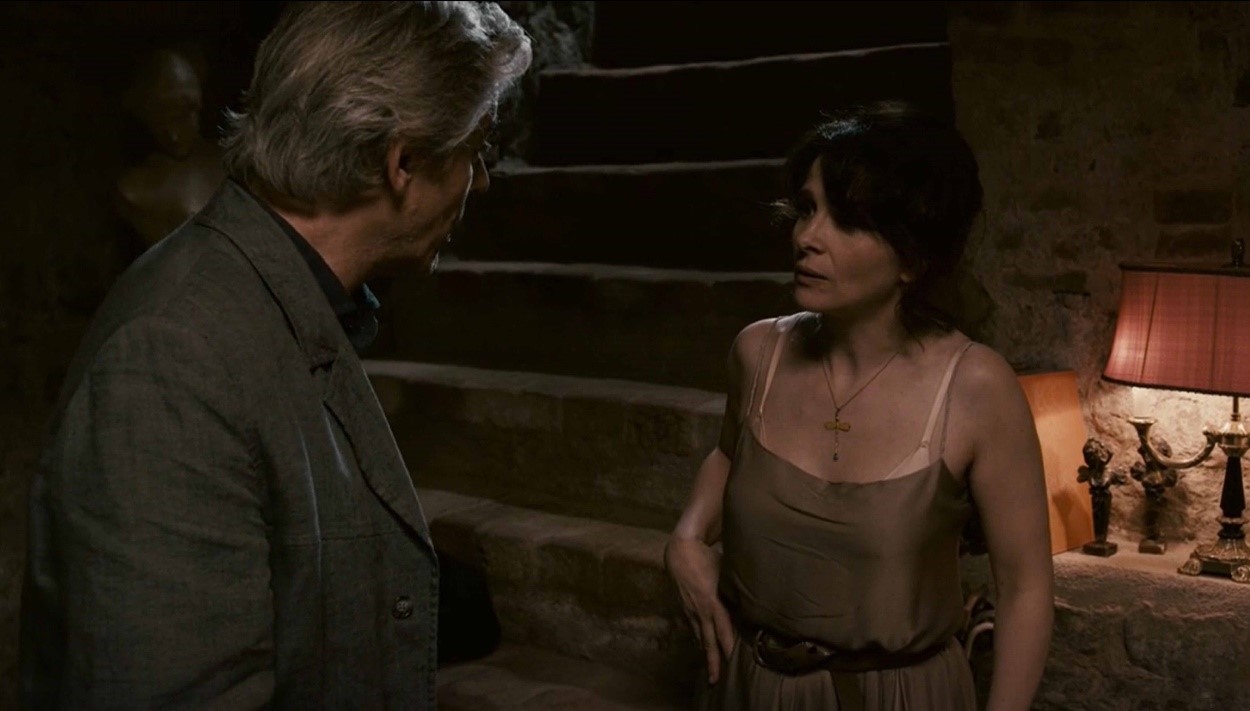
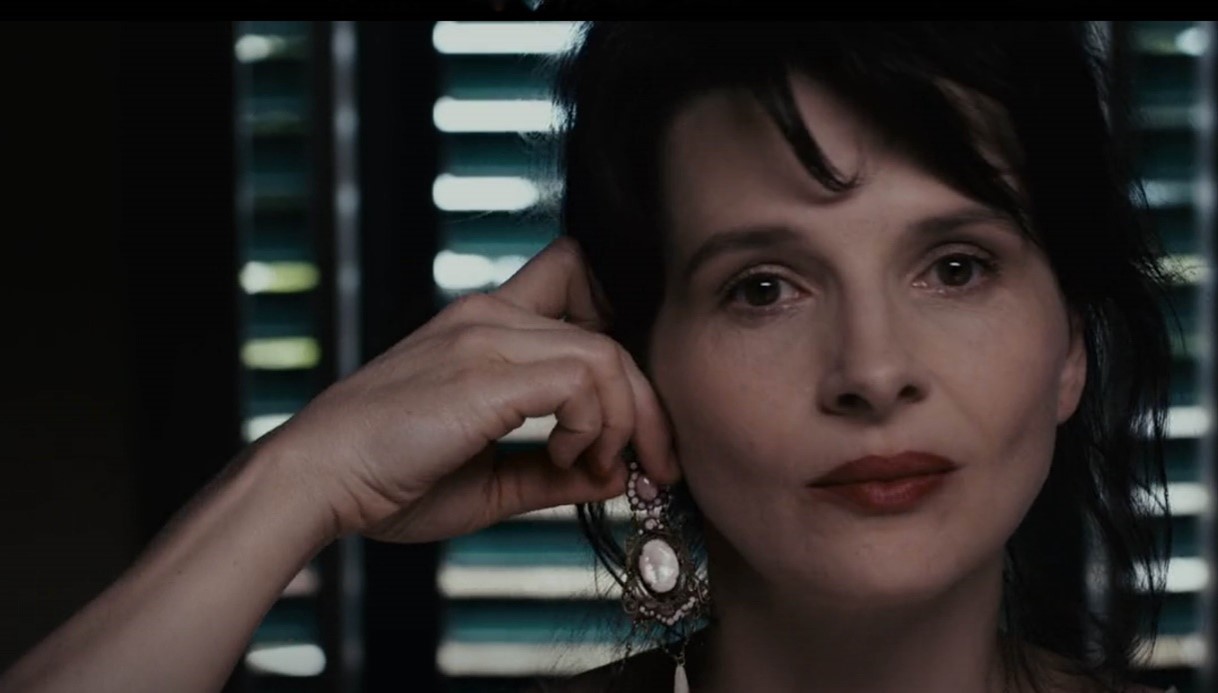
Figure 3: A screenshot from the film Dāyarah-i Mīnā (The Cycle), directed by Dāryūsh Mihrjū’ī, 1978.

In consequence, a change in the image of women, which was created in the Pahlavi period, was thought to be inevitable because the revolutionary discourse defined itself as opposed to all the ideals and norms of the previous regime and aimed at cleaning and reforming everything that was pictured before. These changes were not only necessary for establishing a new political and economic foundation and gaining popular legitimacy through new mechanisms, but also instrumental in the recreation of culture, daily life, and intellectual life, as well as in cleansing it of the ‘contamination’ of Western elements.

Increasing attempts were made around the formation of the image of the revolutionary woman from the very beginning of the Revolution.7After the Revolution, one of the first laws to be annulled was the law supporting families, which had been enacted in 1967. It limited the rights of men for polygamy and divorce upon request and eventually preserved the rights of women for divorce and taking custody of their children. In 1973, these reforms were expanded and strengthened. It was the annulment of this law that sparked protests on Women’s Day. In cinema, too, reflecting society, there was no doubt about the need to change the way women were presented; however, due to the initial chaos, it took a few years to institutionalize this image and formulate detailed regulations on what this image should be and how it should be presented.

A few years after the Revolution, the society was engulfed in chaos. The expansion of parallel powers alongside the established government made it impossible to maintain order.8Among them were revolutionary committees, revolutionary courts of law, the Revolutionary Guard, and many parties and political movements that supported various radical policies. Last but not least, the citizens had military bases, police stations, palaces and ministries under their control. See, Shaul Bakhash, The Reign of the Ayatollahs: Iran and the Islamic Revolution, (New York: Basic Books, 1984), 55–56. In such circumstances, cinema also was in a period of chaos. The purging process began as part of the changes in cinema after the Revolution. Movie theaters were periodically closed and reopened; some were repurposed, while others, like the theater in Rūdakī Hall, were cleansed of previous “immoralities” through religious rituals such as ghusl (a ritual purification in Islam).9Naficy, A Social History of Iranian Cinema, 22. It was unclear which ministry was responsible for handling cinema affairs; therefore, it is not surprising that there was no agreement on how to portray women in films in this chaotic situation. The changes seemed inevitable, but no one knew how necessary these changes were and who was responsible for formulating and implementing them.

This confusion created a constant struggle between film producers, cinema owners and the government. The producers made small changes to the films made before the Revolution in order to escape censorship. Sometimes, only the name of the film was changed, while the content remained the same.10“Sinimā dar vīdīyu: Rāhnamā-yi film-hā-yi mujāz-i vīdīyu (Cinema in Video: A Guide to Permitted Films on Video in Iran),” Māh-nāmah-yi Fīlm 1 (June 1982): 98. Another solution was to cut some scenes that were deemed immoral and to replace them with scenes that were shot anew. Cinema owners also tried to control the ‘damage’ by voluntarily omitting sexual relations, behaviors, and clothing that went against the new ideology. A common practice was to use marker pens on the frames and posters of films to cover the exposed parts of women’s bodies with skirts, shirts, or scarves. However, the government was dissatisfied with these superficial changes and made it mandatory to obtain a movie screening permit. As a result, all the films produced in the previous period, along with imported films, were revised. Many films, not only commercial ones but also those belonging to the New Wave movement or the intellectual cinema of the Pahlavi period, such as Muhammad Rizā Aslānī’s Shatranj-i bād (The Chess of the Wind, 1976), were banned permanently, while others had to endure censorship to become compatible with Islamic values.

Figure 4: A screenshot from the film Shatranj-i bād (Chess of the Wind), directed by Muhammad Rizā Aslānī, 1976.

Radical conservative groups went even further and demanded that the government prevent well-known filmmakers and actors from the pre-revolutionary commercial cinema from working. Even when these filmmakers and actors received official screening permits for their films, their past artistic activities sparked protests. For instance, despite the initial success of Īraj Qādirī’s Barzakhī-hā (The Imperilled, 1980), huge protests erupted against the casting of film stars from the Pahlavi period to play the roles of epic Islamic heroes,11An unknown writer of Kayhān wrote: “Actors whose tasks in the past were to soil the honor of the society are now, with the same appearances and the same trite techniques, playing the roles of revolutionary and Islamic figures, even the role of Imam [Khumaynī]. See: Īraj Qādirī, “Dūzakh-i Ibtiẕāl dar ‘Barzakhī-hā’ (The inferno of Vulgarity in ‘The Imperilled’),” Kayhān (May 30, 1982): 13. which eventually led to the banning of the film. Qādirī’s look toward women in his other film, Dādā (1982), also made him the target of harsh criticism; for instance, an article in Film Monthly (Māh-nāmah-yi Fīlm) read: “now that Qādirī cannot picture women naked, he cannot hide from view the essence of women that he has in mind. From the very beginning, the new bride of Dādā gets raped, which motivates Dādā to take action. In other words, once again, it is an act of dishonor that sets the wheels turning.”12Īraj Qādirī, “Dādā,” Māh-nāmah-yi Fīlm 4 (1983): 48.

In such a volatile situation, filmmakers were also confused in their response to this trend. Many of them omitted the depiction of women from their films altogether, such as Farīburz Sālih in Safīr (Ambassador, 1982) and Muhsin Makhmalbāf in Isti’āzah (Fleeing from Evil to God, 1983). By avoiding stories that needed the participation of women, they sought to appease the new sensitivities. The director of Ambassador opined that “in this confused and chaotic situation” for filmmaking, it is better to “close down cinemas for a while so that the officials and experts could sit down… and prepare the practical guidelines” clearly. He claimed that there actually were some (women) actresses in his film, “but the camera angle was in a way that they were not in the frame.”13“Musāhabah bā Farīburz Ṣālih, Kārgardān-i Fīlm-i Safīr (Interview with Farīburz Sālih, Director of Ambassador),” Māh-nāmah-yi Fīlm 4 (July 1983): 7–12. However, there was still a minority of filmmakers who did not turn away from women. The roles women played clearly changed, though, and there was no more dancing or singing in the films. No agreement had yet been reached regarding the hijab. This is evident in films that addressed the political situation before the Revolution, such as Khusraw Sīnā’ī’s Zindah bād! (Long Live! 1980), Mas‛ūd Kīmiyā’ī’s Khaṭ-i Qirmiz (Red Line, 1982) and Ghulām-‛Alī ‛Irfān’s Āqāy-i Hīrūglīf (Mr. Hieroglyph, 1980), which revolves around the life of a guerilla girl and narrates the story of the armed struggle of leftist movements in 1970s Iran. In the mythological and historical works of Bahrām Bayzā’ī, too, such as Charīkah-yi Tārā (Ballad of Tārā, 1980) and Marg-i Yazdgird (Death of Yazdgerd, 1982), the image of the modest and reticent woman epitomizing the decent woman after the Revolution was not completely formulated yet. Many of these films were made without any official permit and were never screened, or, if they were, they were taken down after a short run.

Figure 5: A screenshot from the film Khaṭ-i Qirmiz (The Red Line), directed by Mas‛ūd Kīmiyā’ī, 1982.

These rather spontaneous and disorganized efforts were approved by neither the new government officials nor by cinema owners and filmmakers, who demanded the organic and full-fledged intervention of the government in the cinema industry.14In December 1980, in a letter to the Ministry of Culture and Islamic Guidance, the Society of Cinema owners criticized the government for its inattention to cinema. It was also announced that, with the help of the government, the private sector would be able to harmonize the cinema industry with “the revolution and the people” in five years. Filmmakers had similar concerns as well. In 1981, they wrote a letter to ‘the people and the government,’ claiming that even two years after ‘the holy and anti-imperialist revolution of the people of Iran,’ the revolution had not yet taken root in the cinema industry and that ‘a kind of dependence’ had emerged there, similar to the dependence of the previous period. The writers asked the government to implement the new law “organically and comprehensively”. See: Hamid Naficy, “Islamizing Film Culture in Iran: A Post-Khatami Update,” in The New Iranian Cinema: Politics, Representation and Identity, ed. Richard Tapper (London: I.B. Tauris, 2002), 35. Therefore, in February 1983, the government passed a set of regulations about the screening of films and videos and assigned its implementation to the Ministry of Culture and Islamic Guidance.15“Niẓārat bar namāyish-i fīlm va islāyd va vīdīy’ū va sudūr-i parvānah namāyish ān-hā,” Markaz-i Pazhūhish-hā-yi Majlis, 23/02/1983, accessed on 10/11/2024, https://rc.majlis.ir/fa/law/print_version/106928. These regulations stipulated that all films and videos screened publicly must have an official screening permit. Additionally, a supervisory committee was made responsible for regulating the presence of women in a way that does not contradict the “human dignity” of women.16This committee consisted of one cleric familiar with artistic fields, three individuals familiar with political, social and Islamic issues as well as film and cinema, and one expert in the field of domestic and foreign film and cinema. This committee should determine and provide the Islamic regulations to be applied in all films, whether Iranian or foreign.

The aim was to represent women as chaste individuals who play essential roles in society and in raising pious and responsible children. Additionally, women were not to be used for stimulating sexual desires. These general and ambiguous guidelines had a deep effect on the presentation of women in cinema.17Naficy, “Islamizing Film Culture in Iran,” 36. The hijab was gradually made compulsory in society, and a law was passed in 1983 regarding women’s clothing.18Article 102 of the Penal Code was about this issue, which was later added as a note to article 141 of the Islamic Penal Code approved in 1996. According to this law, any individual who practically pretends to be doing something illegal in plain sight, public places, and thoroughfares, in addition to being punished for her/his crime, will be sentenced to imprisonment from 10 days to 2 months or a fine of 74 lashes; and if the individual commits a deed that is not punishable itself but violates public morals, he/she is only sentenced to imprisonment from 10 days to 2 months or 74 lashes. The note also says: Women who appear in thoroughfares and in public without Islamic hijab will be sentenced to imprisonment from 10 days to 2 months or a fine of 50 thousand to 500 thousand rials. The pressures, however, had increased even before these laws were approved. Cinema theaters were among the first public places that, since 1981, were forced to prevent women without Islamic hijab from entering.19Jāvdānī, Sāl shumār-i tārīkh-i sīnimā-yi Īrān, 153. Consequently, the rules of “modesty” dominated the actresses’ behavior and affected their attire, their speech, the narrative structure of the film, and also the mise-en-scène and the style of cinematography.

In this research, we will examine how these regulations were institutionalized in films made between 1979 and 1990, which contributed to the construction of the new image of the “decent woman.” This goal will be achieved on two levels: first, we will explore the privative aspect of this image, which aim to diminish women’s sexual drive ⸺that is, the suppression of their desires in order to give cinematic form to the limitations gradually defined by revolutionary ideology. Next, we will explore its affirmative aspect, which seeks to create an otherworldly image of women, formed at an abstract level, and can be explained through the concept of ‘Eternal Feminine.’ These two aspects are examined successively here for the sake of discussion, although in reality, both of these aspects are intertwined, proceed in parallel, and have no temporal precedence. In order to have a more inclusive research sample, we aim to discuss all types of films, including those among the influential works that are considered to have high cinematic value, such as Ballad of Tārā and Dāryūsh Farhang’s Tilism (The Spell, 1986), and popular and commercial films such as Shāpūr Qarīb’s Bugẕār Zindagī Kunam (Let Me Live, 1986). Such a sample can cover a significant portion of the productions, although it is impossible to be fully inclusive, as some films fall outside this pattern. For instance, from the mid-1980s onward, we see examples of different presentations of women in films such as Muhammad ‛Alī Najafī’s Guzarash-i yak qatl (A Report on a Murder, 1986), where a woman is shown as a member of the central committee of the Tūdah Party and plays a central role in the story. Some of these examples are discussed in the final section of this article.

Figure 6: A screenshot from the film Guzarash-i yak qatl (A Report on a Murder), directed by Muhammad-‛Alī Najafī, 1986.

It is also worth noting that Hamid Naficy has made significant contributions to the literature on the changes in the role of women in post-revolutionary cinema through his articles and books, which serve as the primary sources for this article. In his article, “Women and the ‘Problematic of Women’ in the Iranian Post-Revolutionary Cinema,” he argues that after the Revolution, the emphasis shifted to the radical intertwining of women with their sexuality.20Hamid Naficy, “Women and the ‘Problematic of Women’ in the Iranian Post-Revolutionary Cinema,” Nimeh-ye digar 14 (1991), 122–69. This shows that femininity is only defined by sexuality. This is not true about men. Therefore, a woman is attributed with having a powerful influence on stimulating man’s desires. This leads to the development of a supervisory system and a change in the portrayal of women on screen. In “Veiled Visions/Powerful Presences: Women in Postrevolutionary Iranian Cinema,” Naficy examines the changes and expansion of women’s roles in Iranian cinema after the revolution, both in front of the camera and behind the scenes.21Hamid Naficy, “Veiled Visions/Powerful Presences: Women in Postrevolutionary Iranian Cinema,” in Life and Art: The New Iranian Cinema, ed. Sheila Whitaker (London: National Film Theatre, 1999), 44-65. It also discusses how the principles of modesty and sexual segregation shaped the aesthetics of wearing and not wearing the hijab, ultimately influencing the representation of women and the theme of love in Iranian cinema. Also, in “Veiled Voice and Vision in Iranian Cinema: The Evolution of Rakhshān Banī’i‛timād’s Films,”22Hamid Naficy, “Veiled Voice and Vision in Iranian Cinema: The Evolution of Rakhshan Banietemad’s Films,” Social Research 67, No. 2, (2000): 559–576. Naficy outlines the changes in the portrayal of women in post-revolutionary Iranian cinema in three stages: initial absence, limited roles in the background, and finally, powerful main roles, both as actors and directors. He argues that the rules of modesty have played a significant role in driving these changes. Supported by the rise of prominent women filmmakers like Rakhshān Banī’i‛timād, these rules contributed to the creation of a unique cinematic image.

The formation of a Criteria for the Image of Woman: Desexualization and the Principle of Eternal Feminine

In the early years following the Revolution, women were seldom instrumental in the stories and were presented on the screen in particular forms. Sometimes, we deal with what Hamid Naficy calls “absent presence,” which means all the aspects of the woman are not shown in the film: sometimes there is her voice, but there is no image of her; sometimes the image is there, but the voice is not; and sometimes neither the image nor the voice is there, yet her presence is still felt.23Naficy, “Women and the ‘Problematic of Women’,” 141-142. We hear the voice of the mother for a few moments in Ibrāhīm Furūzish’s Kilīd (The Key, 1985), but we only see a distant and blurred shot of her from behind and a medium shot of her hands. After this scene, neither her image nor her voice appears in the film, but her absence influences the story.

And when the woman is present with both her image and voice, the rules of hijab and modesty are dominant over her clothes (long, loose, and dark), her behaviors and actions (demure and avoiding any bodily contact with the unrelated men) and her gaze (avoiding direct and long look). Therefore, we only see some faces whose bodies are wrapped in several layers of clothing, which are described by Hamid Dabashi as “body-less faces”; faces that deny their bodies and testify to the impossibility of femininity in post-revolutionary cinema. Dabashi believes that there is a striking inconsistency between these faces and the clichéd distortion that should characterize their bodies.24Hamid Dabashi, “Body‐less Faces: Mutilating Modernity and Abstracting Women in an ‘Islamic Cinema’,” Visual Anthropology 10, no. 2-4 (1998): 362.

According to the ever-expanding criteria for filmmaking, close-up shots of women’s faces or the exchange of lustful glances between a woman and a man were forbidden. Additionally, women were more often than not shown in long shots and (in) static roles in order to prevent the appearance of their body lines because, as the Islamic law decrees, a woman’s clothing should be in such a way as to “conceal the features and the beauties of her body.”25‛Alī Khāmanah-ī, Risālah-yi Āmūzishī (2): Ahkām-i Mu‛āmilāt (Educational Thesis (2): The Rules of Transaction) (Tehran: Fiqh-i Rūz, 2019), 369. It is only allowed to look at the face and hands of a woman, without any sexual pleasure, provided that these parts are without makeup or jewelry. In this discourse, the woman’s body, its reproductive potential, and its sexual appeal serve both as a symbol and a physical and tangible tool for organizing the world. Being a woman was the principal sign of unity and independence in a changing society and had to be “protected.” This symbology revealed itself in the tendency to limit women’s freedom in choosing their clothing and movements.

As a result, “both women and men were desexualized… Love and the physical expression of love (even between intimates) were absent.”26Naficy, “Veiled Visions/Powerful Presences,” 45. Meanwhile, even marriage was pictured as devoid of desire. Murtazā in ‛Alīrizā Dāvūdnizhād’s Bī-panāh (Exposed, 1986) is an officer who takes it upon himself to marry A‛zam, a lonely woman who has come to him for help. Murtazā doesn’t even know her name, but he is worried that if he doesn’t marry her, she will be “exposed.” After marriage, he assures her that he has taken the vow of marriage so that he could take care of her. There is no desire involved, and he will not approach her unless she wants him to. A‛zam also insists on wearing her chador in his house. After a while, it comes to light that A‛zam is a divorced woman, and, more importantly, a mother. Being a mother has created such a “holiness” for her that she should not be tainted by being touched. A “decent mother” is a woman who is sexually inactive. Well aware of the preference for being a mother over being a wife, Murtazā separates from her at the end so that she can go back to her husband, Ahmad, and raise her child, Rizā. He assures Ahmad that he has treated A‛zam, who is now addressed with her main role as “Rizā’s mother,”, as his “sister,” rather than as his wife.

Figure 7: A screenshot from the film Bī-panāh (Exposed), directed by ‛Alīrizā Dāvūdnizhād, 1987.

This treatment reminds us of the titles for women and men in Islamic leftist political parties. When encountered with the inevitable closeness of the two sexes, these parties used these titles as tools for keeping women away. In order to be separated from their sexual attractions, fighting women are addressed as “comrades” or “sisters” by their peers and are constantly reminded of the prohibition of having sexual relations with them. The imaginative walls of the private world can be extended to eternity. Away from the taboo of incest, a woman can magically turn into a “sister” and a “comrade” and get sexually out of reach. In this way, the imaginative borders replace the real borders.27Farzaneh Milani, Veils and Words: The emerging voices of Iranian women writers (Syracuse: Syracuse University Press, 1992), 27.

The boundary between private and public space is erased. As strangers enter the private space and become ‘brothers,’ the private space of the house is transformed into a public space because of the presence of unrelated spectators. Consequently, women in these films are always covered and obedient, even when they are with their close relatives. Keeping hijab in the presence of intimate ones creates an unrealistic and distant space that presupposes the presence of an unrelated spectator. In this situation, not only does touching each other become a taboo, but also there is a change in the characters’ gaze at each other and the spectators’ gaze at the film because:

“An unveiled woman, like Medusa, should not be gazed at… In a veiled society, seeing, far from being considered a mere physiological process, takes on a socially determined, potentially dangerous, and highly charged meaning. Considered much more than windows to the soul safely concealed, eyes become subject to the strictest regulations for both men and women. Men’s eyes attain phallic power… Men’s forbidden act of seeing thus becomes a violation, a sin, a visual rape.”28Milani, Veils and Words, 24–25.

If women are supposed to cover their bodies, men are also supposed to cover their eyes. Therefore, the film is worried about the gaze of the male spectator. There are complications in the process of this gaze, which is implicated in the nature of the cinematic picture. The most obvious instance of the look in cinema is the one that originates with the spectator, whose gaze is directed at moving images on the screen. But the act of looking in cinema is more complex than this. Cinematic address may also, for example, direct looks toward the spectator. This is particularly clear in the shot/reverse shot structure: the viewing subject, in standing in for the look of a protagonist in the film, becomes the object of the fictional gaze of the other protagonist.29Annette Kuhn, Women’s Pictures: Feminism and Cinema, 2nd ed. (London: Verso, 1994), 56.

This structure of looking and looking back is used abundantly in the scene of arguments between the modest Farīdah and her husband, Manūchihr, in Let Me Live (Shāpūr Qarīb, 1986) about the failures in performing their assigned tasks as wife and husband, and mother and father, and the shrewdness of the women of the family (Figure 8). In a sense, these characters are aware not only of each other, but also of an unrelated man, the spectator of the film, who is required to obey the “rules of looking” just like the characters in the film.30Negar Mottahedeh, Displaced Allegories: Post-revolutionary Iranian Cinema (Durham and London: Duke University Press, 2008), 8-9.

Figure 8: Shot/reverse shot of Farīdah and Manūchihr, from the film Bugzār Zindagī Kunam (Let Me Live), directed by Shāpūr Qarīb, 1986.

These rules prohibit men and women from looking lustfully at unrelated persons. Looking at women’s hair is forbidden for men; therefore, women are required to cover it. Looking at unrelated people, whether in person or through a picture (live or recorded, such as a photo), is not allowed if it is accompanied by sexual pleasure and lust. These rules created a certain kind of look, which is called “averted look” by Hamid Naficy: “to satisfy the rules of modesty, a situationist grammar of looking has evolved that ranges from direct gaze to what I have called the averted look. In this case, people avoid looking at others directly…. When meeting each other, they tend to look down or to look at the other’s face in an unfocused way so as to avoid definitive eye contact.”31Naficy, “Veiled Visions/Powerful Presences,” 56.

Nevertheless, every now and then, we encounter a close-up shot, a distinct face, a rather direct look, and a significant role in the story. In these cases, to desexualize women, it is necessary to distance oneself from the tangible facts of life and unique moments, moving toward abstraction, which relies on relinquishing the unique and special aspects of life. This situation can be best explained by the principle of Eternal Feminine. Simone de Beauvoir makes extensive and detailed references to literary works in order to explain what she calls Eternal Feminine, or “that vague and basic essence, femininity.”32Simone de Beauvoir, The Second Sex, trans. and ed. H. M. Parchley, (London: Jonathan Cape, 1956), 214. This myth takes different forms, like the holiness of the mother, the purity of the virgin, the fertility of the earth and the womb; however, in each and every one of these forms, the aim is to negate the individuality of women and to relegate them into the unattainable dreams.

Mythical, ghost-like, and unworldly women permeate the cinema of this period. The most remarkable example is Ballad of Tārā. Tārā is considered “the manifestation of mother earth…, the mythological image of woman that can belong to yesterday, today or tomorrow and always be a woman complete.”33Shahla Lahiji, Sīmā-yi Zan dar Āsār-i Bahrām Bayzā’ī (The Image of Woman in the Works of Bahrām Bayzā’ī) (Tehran: Rawshangarān, 1988), 49. Tārā, or the “mother earth”, falls in love only with an unworldly man; someone who is not bound by flesh and blood, but is an inhabitant of the realm of the dead; a man who cannot gently return to his own world because of his love for her. Tārā finally falls in love with him, reveals her body to him and welcomes him into her arms. Tārā intends to make life and blood flow in the veins of the man who has been living in another world for centuries. In order to come to life, the man asks for the lives of Tārā’s children. Tārā cannot forsake her children, so she gets ready to go with him to the world of the dead. Such a sacrifice breaks the man’s spell. He leaves the earth and returns to his world with both comfort and sorrow. In the real world, each woman manifests herself in different ways; however, each of the myths constructed about her claims to summarize her completely, as each one asserts its uniqueness. Therefore, Tārā “is considered to be a tale in praise of every manifestation of women” (Figure 9).34Lahiji, Sīmā-yi Zan, 49.

It is not only in this period that such an image of women is presented. In the pre-revolutionary Iranian cinema too, similar characterizations can be seen. For instance, Gharībah va Mah (The Stranger and the Fog, 1973), is one of the first steps by Bahrām Bayzā’ī to enter the world of myths. He starts using symbols (in here) that become more unified and understandable in his later films. The character of Āyat is considered a “fugitive from the world of death” who should “return to his home sooner or later”; and the character of Ra‛nā is “an allegory of life and rebirth against death and destruction.”35Lahiji, Sīmā-yi Zan, 43–46. This image of woman can be traced back to fictional literature and the ethereal woman in the first part of Sādiq Hidāyat’s Būf-i Kūr (The Blind Owl), where she is heavenly and her beauty is unrelated to the earth and its belongings. The perfect woman is pictured as follows: “She was not like ordinary people. Her beauty was not ordinary, too. She manifested herself to me like a vision in an intoxicated dream.” For the narrator, she is an inaccessible woman: “I never wanted to touch her. The invisible rays that radiated from our bodies and intertwined with each other were enough.”36Sādiq Hidāyat, Būf-i Kūr (Tehran: Chāpkhānah Sipihr, 1972), 9–10.

Nevertheless, in the post-revolutionary period, this type of characterization became more frequent and more diverse. In the film The Spell, we learn that many years ago, the future lady of a mansion disappeared on her wedding night after entering the mirror salon and since then, no one has ever heard from her. Then, it is revealed that she is imprisoned by the lord’s butler in a cellar, surrounded by chains and gears. For the past five years, everyone thought the lady of the house had escaped; however, she is still wearing her wedding gown, and her hair and face match the color of her dress in the dark cellar, making her look like a ghost. Her memories are also frozen, like her dress on the wedding night, and she has become immortal, existing outside of history and time, as if that night has never ended (Figure 10).

Figure 9 (Left): Tārā calls the other-worldly man to herself. A screenshot from the film Charīkah-yi Tārā (Ballad of Tārā), directed by Bahrām Bayzā’ī, 1980.
Figure 10 (Right): The lady of the mansion is imprisoned in the cellar. A screenshot from the film Tilism (The Spell), directed by Dāryūsh Farhang, 1986.

Khusraw Sīnā’ī’s Hayūlā-yi Darūn (The Inner Beast, 1983) presents another instance of such characterization. A man has gone to a village to escape from his past, while his wife follows him like a ghost without skin and bone (Figure 11), challenging the picture of a real and down-to-earth woman. The woman’s ghost separates him from time and place and takes him to the past. This is the man’s sinful past in which the woman has become immortalized. Each of these women is abstracted from reality in a similar way. They are both “innocent” women who are sacrificed. Being ladies in white, they imply closeness to light and ideas of cleanliness, purity and the principle of Eternal Feminine.

This image of a woman, like other eternal concepts, becomes meaningful in a duality, that of angel/whore.37The Madonna/Whore complex was formulated by Freud. According to this complex, women are divided only in two categories of Madonna, which means she is pure, virtuous and nurturing; or Whore, which means she is sexually active, devious and unruly. Betty Friedan in The Feminine Mystique believes that the most recent representation of the duality of Madonna/whore, which has dictated the dominant image of women from a long time ago, can be seen in the chasm between the housewife and the working woman. See: Janet McCabe, Feminist Film Studies: Writing the Woman into Cinema (London: Wallflower Press, 2004), 5. The Madonna (the angel) is usually represented as a young woman who is as beautiful as she is, chaste and pure, and has an innocent heart. The more she suffers, the purer she becomes. On the other side of the spectrum, there is the woman who reveals herself, breaks all the boundaries, and accepts her role as a sexual object. This reminds us of the fall of the ethereal woman of The Blind Owl to the state of a prostitute who is earthly, wicked, and devious, accessible to all, and “has numerous lovers.”38Hidāyat, Būf-i Kūr, 46. She has her way with everyone except her husband and has gone too far in her debauchery. In The Inner Beast, too, it is only by committing suicide that the woman can escape falling into this state. Simone de Beauvoir explains the principle of the Eternal Feminine in this way:

“There are different kinds of myths. This one, the myth of woman, sublimating an immutable aspect of the human condition -namely, the ‘division’ of humanity into two classes of individuals- is a static myth. It projects into the realm of Platonic ideas a reality that is directly experienced or is conceptualized on a basis of experience; in place of fact, value, significance, knowledge, empirical law, it substitutes a transcendental Idea, timeless, unchangeable, necessary. This idea is indisputable because it is beyond the given: it is endowed with absolute truth. Thus, as against the dispersed, contingent, and multiple existences of actual women, mythical thought opposes the Eternal Feminine, unique and changeless.”39De Beauvoir, The Second Sex, 260.

In this situation, the reality that is directly experienced or conceptualized based on experience dissolves into abstract concepts that, regardless of the specific details of life, are formed around the generalities and the fundamental nature of femininity. Reality and the experiences of women of flesh and blood are replaced by a transcendental, timeless and inescapable idea. The changing and contingent existence of real women is countered by the mythical principle of Eternal Feminine. To create this immortality, the this-worldly femininity should be questioned. De Beauvoir borrows this term from the last lines of Goethe’s Faust:

What is destructible,

Is but a parable;

What fails ineluctably,

The undeclarable,

Here it was seen,

Here it was action;

The Eternal-Feminine,

Lures to perfection.40Johann Wolfgang von Goethe, Goethe’s Faust, trans. W. Kaufman, (New York: Anchor Books, 1962), 503.

Figure 11 (Left): The woman’s ghost follows her husband after her suicide. A screenshot from Hayūlā-yi Darūn (The Inner Beast), directed by Khusraw Sīnā’ī, 1983.
Figure 12 (Right): Nāyī’s direct look. A screenshot from the film Bāshū, Gharībah-yi Kūchak (Bashu, the Little Stranger), directed by Bahrām Bayzā’ī, 1989.

The special moments of the woman’s life disappear because, historically, her experiences have turned into private and specific experiences of her own. Just as a wall of cloth covers a woman’s body in Islamic societies, a wall of silence covers the details of her life, too. She is a secret. Like the walls that enclose a house and separate the inside from the outside, the hijab also serves as a clear declaration of the separation of specific feminine experiences from public space. The hijab maintains an order that silences the concrete, specific, and private experience, signifying the power of deindividualization, protection, and secrecy.41Milani, Veils and Words, 23.

In such a situation, it is captivating to witness moments that represent the real experiences of a woman in the rather earthly femininity of Nāyī in Bahrām Bayzā’ī’s Bāshū, Gharībah-yi Kūchak (Bashu, The Little Stranger, 1989). There are, of course, interpretations of Nāyī as a general and non-individual character, and there are implications in the film itself to support such interpretations; for instance, it is believed that “Bashu is the continuation of Ballad of Tārā”; and that Nāyī is “a description of and a gratitude toward motherhood in all its aspects, as an attribute, a characteristic, a virtue that is expanded everywhere.”42Lahiji, Sīmā-yi Zan, 54–55. Here, too, love is desensitized, and “an indirect, complex and ambiguous love comes in.”43Naficy, “Veiled Visions/Powerful Presences,” 59. Nevertheless, there are moments and frames that contain Nāyī’s individual feelings rather than the feeling of a generalized idea. Most remarkable is the sudden close-up of Nāyī’s face, which, while showing her with a white scarf covering her hair and chin, concentrates on her passionate eyes. This is the look that shows us the potential of an earthly and lively look (Figure 12). She creates this moment while covering herself with a scarf, which signifies that the paradox between Nāyī’s modesty and her direct look at the camera is meant to emphasize the conflict between compulsory decency and personal expression. It also shows the simultaneity of accepting the rules and challenging them, which is one of the characteristics of cinema in later years and will be discussed in the final section.

We will end the discussion of the Eternal Feminine by referring to a film that differs from the previous ones in its search for realism: ‛Alī Zhikān’s Mādīyān (The Mare, 1986). The film fails to achieve realism, though, because in many parts, we can see the infiltration of generalizing ideas, such as the innocence of the virgin, and attempts to omit the accidental and “extraneous” elements of a real woman’s life. Rizvānah is a widowed woman struggling to cope with the burden of taking care of her children. Therefore, she intends to exchange her young daughter, Gulbutah, who is meant for a forced marriage, for a mare. It can be concluded that Rizvānah is not the ideal mother but rather an earthly and fragile woman, as we witness moments that show the loving relationship between Rizvānah and her children, as well as the tasks created for her in raising them. But upon closer inspection, we find that all her failures are overshadowed by her role as a mother, in which she occasionally stumbles. Rizvānah’s rebellion and violence are also transcended when she sees Gulbutah in a miserable state and decides not to exchange her. She is the type of mother who could seamlessly adapt to different circumstances:

The film talks about generalities and does not limit itself to specific realities of a specific environment. It goes from part to whole. This poignant story could also take place in a village on the edge of a desert or even in traditional cities beyond that, in places with similar social and cultural conditions to those depicted in the film.44‛Alī Zhikān, Mādīyān (Tehran: Nay, 2010), 128.

The innocence of the virgin in the film, Gulbutah, underlines this interpretation. Gulbutah is a weak and innocent girl who remains pure and untainted. She seems unattainable: a woman whom men desire, yet her own chastity prevents her from giving in to their advances. In the end, she becomes the sacrificial virgin whose innocence should be taken by force. The scene of her suicide attempt is replete with allusions to the innocence of the immortal idea of the holy virgin (Figure 14):

The sturdy ancient tree…, is rooted in the earth of tradition and the girl is chased by her suitor in it…. In one frame of this scene, we see a sapling emerging from the mud, stubbornly resisting the trampling feet of men and cattle. This sapling is Gulbutah. She is referred to as a sapling in the dialogues, too. Rizvānah says: “My dear Gulbutah, my sapling, my white silk.” And now, this sapling is faced with the ancient tree of tradition. Her failure is inevitable. When she realizes that the tree is not her refuge, she takes the final decision and throws herself down with the intent of killing herself. However, … she is caught in a branch of the tree, or one of the branches of tradition. From here on, the sapling is broken and the time of virginity and natural dignity is over.45Zhikān, Mādīyān, 124–125.

Figure 13 (right): Rizvānah shows Gulbutah the dress presented to her by her suitor. A screenshot from the film Mādīyān (The Mare), directed by ‛Alī Zhikān, 1986.
Figure 14 (left): To escape the unwanted marriage, Gulbutah throws herself down from the tree. A screenshot from the film Mādīyān (The Mare), directed by ‛Alī Zhikān, 1986.

Accepting and Rejecting the Image of “the Decent Woman”: The Appearance of Aspects of Desire

The image of the Iranian woman in the post-revolutionary cinema was fully committed to the idea of modesty. This ideal gradually took root in cinema, grew through many ups and downs and became normalized. Faced with such impositions from above, pressures from some producers and audiences from below, perhaps as a result of their own preferences, filmmakers tried to address or circumvent this issue using fictional and visual techniques to protect the film as a work of art. Beside the main technique discussed earlier, namely depicting an unreal woman, other measures were taken to escape limitations. For instance, it is no coincidence that Nāyī, just like Tārā and Rizvānah, is a woman from the north of Iran wearing traditional dress. Other filmmakers of this period also showed interest in picturing local women in traditional dresses. The frequent portrayal of rural women allowed directors to move away from the capital and the urban hijab (long, loose manteau, chador, and dark scarf).46It should be noted that the small societies had come under attention before the Revolution by Ghulām-Husayn Sā‛idī’s stories, Suhrāb Shāhīd Sālis’s feature films and Hūshang Shāftī’s documentaries. After the Revolution, making such documentaries was in decline; however, perhaps because of the existing limitations, notable films were made about these societies. For further reading about ethnographic cinema, see, Hamid Naficy, “The Anthropological Unconscious of Iranian Ethnographic Films: A Brief Take,” Cinema Iranica Online (2024). https://cinema.iranicaonline.org/article/the-anthropological-unconscious-of-iranian-ethnographic-films-a-brief-take/

These are just examples of suggested “solutions” that, approaching the end of the 1980s and recovering from the initial shock of the revolution and the war with Iraq, were presented with bolder frequency and resulted in modifications in the limitations. Filmmakers’ compliance with realities after the Revolution was predicated on maintaining a balance between obedience and creativity. They found novel ways to tell their stories within the framework of limitations, the general criteria for which had already been established by then. For example, to prevent the banning of his films, Dāryūsh Mihrjū’ī often compromised with the officials and consented to their demands. For instance, he altered the ending of the film Ijārah-nishīn-hā (The Tenants, 1987) due to censorship, while also incorporating critiques of the prevailing situation in the film. This approach let him (to) stay fit within the framework. Bayzā’ī also delicately challenged the limitations; as a result, he was able to continue working for several years after the 3-year banning of his film, Bashu.

Meanwhile, Bahrām Bayzā’ī’s Shāyad vaqt-i dīgar (Maybe Some Other Time, 1988) showed women in more multifaceted roles. Here, too, the development of individual characters is intentionally prevented by a single actor playing the roles of the three women –mother, Kiyān and Vīdā. However, the filmmaker, by disrupting conventional cinematic techniques such as “the interrupted shot–reverse shot…, a visual stutter of sorts,”47Mottahedeh, Displaced Allegories, 52. draws the spectator’s attention to the mediating conventions of dominant cinema and engages them with the narrative, particularly in how women are depicted. Additionally, the character of the woman in this film, besides other characters like Farīshtah in Tahmīnah Mīlānī’s Bachah’hā’yi talāq (Children of Divorce, 1991) attracted the modern middle-class woman to cinema.

Figure 15: A screenshot from the film Shāyad vaqt-i dīgar (Maybe Some Other Time), directed by Bahrām Bayzā’ī, 1988.

Alongside these new trends, the conservative movements underwent changes as well. These changes are nowhere more visible than in Muhsin Makhmalbāf’s films. There is a meaningful break between his initial films and those he made in the late 1980s. As a filmmaker committed to the cause of Revolution, in films such as Tawbah-yi Nasūh (Pure Repentance, 1983) and Isti‛āzah (Fleeing from Evil to God, 1984), he sought the nature of redemption through living an Islamic lifestyle. However, in 1990, he presented Nawbat-i ‛Ashiqī (Time of Love) and Shab-hā-yi Zāyandah-rūd (The Nights of Zayandehroud) in the Ninth Fajr Film Festival, which sparked a great deal of critique. These films focused on the themes of earthly love and the rights of women to choose their life partners. In addition, Time of Love showed extreme close-up shots of Ghazal’s face, such as her lips and eyes, which came as a surprise in a cinema that only accepted depictions of women in long and medium shots. These controversies prompted Murtazā Āvīnī, the journalist and documentary filmmaker, to label Makhmalbāf as a defender of “sexual liberalism” who believes that “the way out of despair” lies in “the sexual attraction between woman and man.”48Murtazā Avini, “Nawbat-i ‛Ashighī va Shab-hā-yi Zāyandah-rūd: Vaqtī Bādkunak Mī-tarakad… (Time of Love and The Nights of Zayandehroud; When the Balloon Pops…),” in Āyinah-i Jādū (The Magic Mirror), vol. 2 (Tehran: Vāhah, 2011), 148–76. Although these films were banned, they clearly show the change in the orientation of their directors. This change was not limited to cinema. One year before, Ahmad Samī‛ī Gīlānī, the translator and writer, wrote about his disagreement with the omission of sexual content in novels and attempted to justify his position by examining ancient Persian literature:

Anyway, if these scenes are included in the novel, perhaps there has been no way to avoid them; as is the case in the discussions of jurisprudence and medical sciences, where there is no way to avoid naked and explicit descriptions and even pictures…. If some scenes of a novel are to be omitted because of protection and chastity, then no small parts from masterpieces of Persian literature should also be omitted; for example, in Kalīlah va Dimnah, the story of the barber’s wife; or the story of a hermit who finds himself in a brothel and has to spend a night in “a wicked woman’s house” who has “such and such concubines” and witnesses obscenities; or in Masnavī-i Ma‛navī, the famous story of the woman who uses the zucchini in a way she should not; or in Sa‛dī’s Gulistān, the story of the judge in Hamedan who has a relationship with a “shoemaker boy”. Anyway, including scenes that are not exactly chaste does not signify preaching and promoting what is going on in them…. It is the nature of a novel to refine them through the sieve of art…. Novel is the creation of beauty; and even when vices are described, the description is still beautiful.49Ahmad Samī‛ī Gīlānī, “Rumān, Dunyā-yi Khīyāl-i ‛Aṣr-i Mā (Novel, the Imaginative World of Our Age),” Nashr-i Dānish 55 (1990): 4-5.

We started the discussion by looking at the character of A‛zam played by Farīmāh Farjāmī in Exposed; and now we will refer to another role played by this actress in Nargis (Rakhshān Banī’i‛timād, 1992) to clarify the changes that happened in these years. Both of these films are about marriages that take place due to an external necessity; the first one was because of the dangers that were threatening A‛zam and prompted Murtazā to take her under his care; and in the second one, it is Āfāq who, in order to support ‛Ādil, makes him marry her. Āfāq is an older woman who married at a very young age and later divorced, resulting in her being separated from her son. This emotional gap with the child was filled with ‛Ādil. But gradually, this feeling results in a one-sided love by Āfāq. Now, while meeting Nargis, ‛Ādil suddenly realizes that he wants an ordinary life with Nargis. The conflict shown in this film is the result of Āfāq standing between ‛Ādil and Nargis. Although a kind of affection –without any sexual desire– was seen in Murtazā in Exposed, he simply and intentionally pulls back, allowing A‛zam and her husband to live together again. But in here, Āfāq doesn’t hold back. The director –indirectly and through signs– emphasizes her desire; for example, when ‛Ādil knocks on Āfāq’s door, we see her in the mirror putting make-up on, which reveals the existence of desire in their relationship.

Figure 16: A screenshot from the film Nargis, directed by Rakhshān Banī’i‛timād, 1992.

We observe in this period that relationships become earthlier and expressions of desire are more direct. This shift in direction was made possible alongside changes in cultural policies. At the end of the 1980s, when the revolutionary discourse was replaced by reformist policies in the political field, cinema started to change as well.50Blake Atwood, Reform Cinema in Iran: Film and Political Change in the Islamic Republic (New York: Columbia University Press, 2016), 4. The year 1989 was a fateful year, as the war between Iran and Iraq ended and the leader of the Islamic Revolution died. These events created an opportunity to challenge the government’s strict rules and its failures in economic and social sectors. The new reformist political party came into being. The Ministry of Culture and Islamic Guidance, especially under the leadership of Muhammad Khātamī, supported the filmmakers and supervised film censorship. This dual approach created a complicated situation that, to some extent, encouraged filmmakers to work, while simultaneously imposing significant limitations on them. This trend had some ups and downs with the conservatives coming to power, but the changes remained relatively permanent.

The question is, to what extent have these attempts made the limitations more bearable. Is this essentially possible? We attempted to take a small step toward answering this question by showing that, throughout history and in what might today be seen as an inevitable and self-evident experience in post-revolutionary cinema, nothing has truly been inevitable. It is neither an accidental nor a necessary outcome for post-revolutionary cinema to follow a certain path and formulate a specific image of woman; it is actually the result of certain interactions in this specific period of time. The next steps to complete the discussion of this article and find answers to the questions involve delving deeper into the very existence of compulsive and oppressive elements in art, as well as exploring the possibility—or impossibility—of neutralizing them with cinematic techniques in a way that leaves the work of art unaffected. It should be sufficient to point out, in a sense, that the existence of oppressive elements in art can negatively impact the aesthetic of the work in various ways, even if this compulsion remains concealed. This is because the oppressive element creates an “imaginative resistance” that happens when a competent imaginator is asked to participate in an imaginative activity but he/she experiences psychological tension. The difficulty most people have in imagining a subject like the killing of daughters may be explained by the fact that they do not verify this moral judgment in reality.51Joy Shim and Shen-yi Liao, “Ethics and Imagination,” In Oxford Handbook of Ethics and Art, ed. James Harold (New York: Oxford University Press, 2023), 711. This resistance cannot be reduced to something outside the film. This is an aesthetic failure.52Noel Caroll believes that when the audience’s imagination does not accompany the immoral themes and situations, we are dealing with an aesthetic failure:…in order to design various characters and/ or situations in such a way that emotions like anger and indignation will be elicited, those characters and/ or situations must be constructed in such a way that they satisfy the criteria for the emotions that they are intended to elicit. Failure to do so is an aesthetic failure. It is an aesthetic failure because it is a formal failure, since, according to a functional view of form, the formal features of a work are those choices that are implemented or designed with the intention to realize the constitutive purposes of the artwork. If a choice that is designed to realize the constitutive purpose of the work blocks the attainment of the constitutive purpose of the work, that is a formal defect of the work.See: Noel Caroll, “Moralism,” in Oxford Handbook of Ethics and Art, ed. James Harold (New York: Oxford University Press, 2023), 306-307.

This situation also applies to the limitations imposed on the clothing, appearances, and behaviors of women in post-revolutionary cinema. These types of interventions can evoke imaginary resistance, as a sensitive audience is likely to experience it during this encounter. This does not escape his or her attention, even if this image is embedded in the logic of the story.