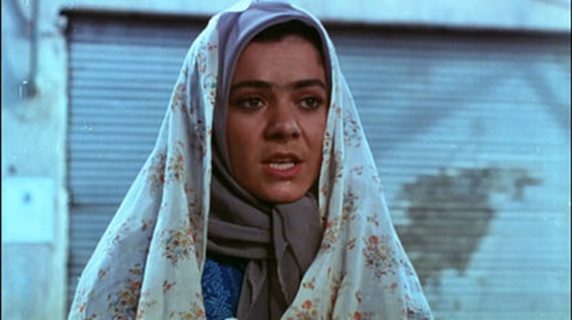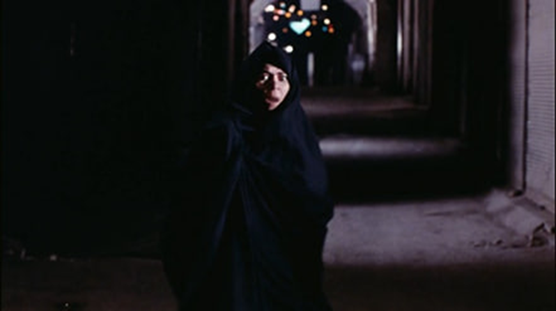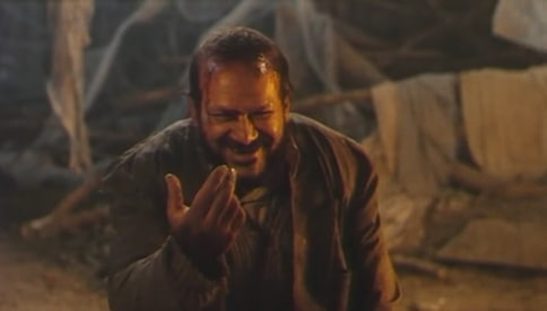
Home in Cinema and Women at Home (1969–1999)

By

Introduction

This article focuses on the changes in the cinematic representation of home and how women are represented at home and in relation to home before, during, and after the 1979 Iranian Revolution. Research findings are based on an ethnographic content analysis of thirty post-revolution and thirty pre-revolution films from 1969 to 1999. These films include best-sellers, films made by New Wave filmmakers, films by new revolutionary filmmakers, and films known as Fīlmfārsī. This article illustrates how the cinematic representation of women at home and in relation to home changed by discussing three major themes: the role of class in the representation of women at home, the presence of women in the background and foreground, and women, home, and homeland as objects to be protected. Cinema, as an institution that has a reciprocal relationship with society and state, can demonstrate how changes in society or state are manifested. Also, cinema itself changes as a result of shifts in society and state. I introduce a model to describe this dialectical relationship between the state, cinema, and society based on Griswold’s cultural diamond. The inseparability of social and spatial processes is key in discussing the relationship between home and revolution. Home is constantly in the process of being made, which affects and is affected by social processes.

The relationships between cinema and revolution, and cinema and women, have been discussed in the academic world from different approaches. The question of how the representation of home changes during big social changes, such as revolution, was the starting point of this study. The theme of the representation of women emerged in the early stages of research. Thus, the research scope evolved to foreground analysis of the representation of women at home and how this changed during the revolution. Firstly, this article illustrates the meaning of home. Symbolic interactionists pay attention to the processes of meaning-making and place-making that result in home-making. Therefore, home is a dynamic process, not a static state of being. After discussing home, the relationship between cinema and revolution become the focal point of the discussion.

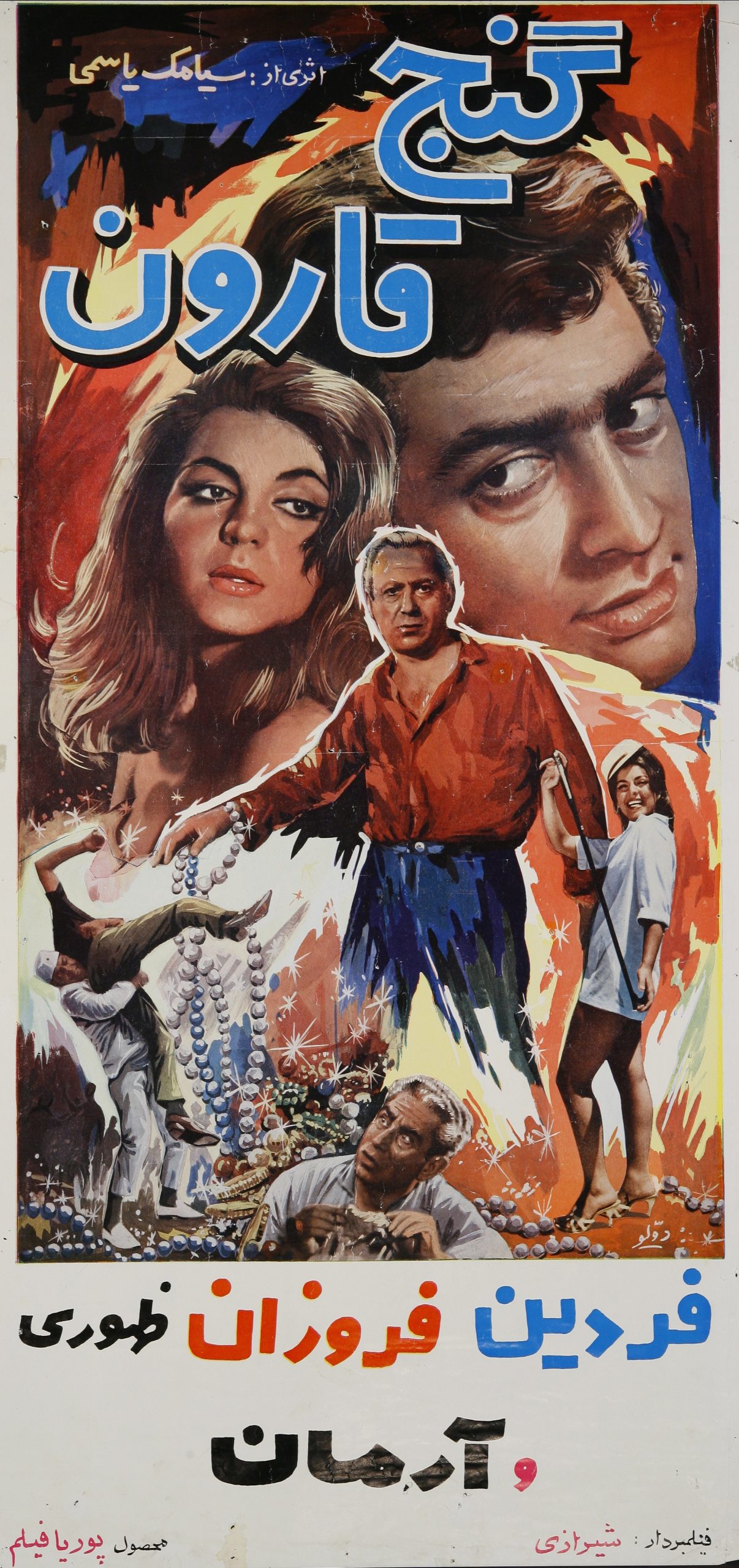
Studying the history of cinema in Russia, Cuba, Algeria, and Iran shows the inseparable connection between cinema and revolutionaries before and after revolutions. In Iran, the Cinema Rex arson triggered the revolution six months before the triumph. This tragedy happened on the twenty-fifth anniversary of the American-British coup while people were watching Gavazn’hā (1974). This film was interpreted in a political way in those days.1This film is about a person, Qudrat, who robs a bank, gets shot, and takes refuge with his old friend, Sayyid, in his old neighbourhood. The popular interpretation of this film is that Ghodrat is a communist guerrilla who fights against the Pahlavi regime and got shot because of it. Mas‛ūd Kīmīyā’ī, the director, claims that a person from SAVAK interfered in the process of producing this film and made them change some scenes, including the final scene, to prevent this political interpretation. Over 377 people died on this day. The revolutionaries blamed the regime and the Intelligence and Security Organization of the Country (SAVAK) for burning the cinema, while the Pahlavi regime blamed the revolutionaries for it. This incident was not the only connection between cinema and revolution in Iran. Khomeini and his supporters considered cinema to be a deceptive medium which corrupts society. He included cinema in his first speech after his return to Iran during the revolution. The extreme supporters of Khomeini lit theaters on fire even after the revolution as they were seen as hubs of depravity. However, some of them became filmmakers in the following years and saw cinema as a revolutionary and educative tool. This research discusses that duality below.
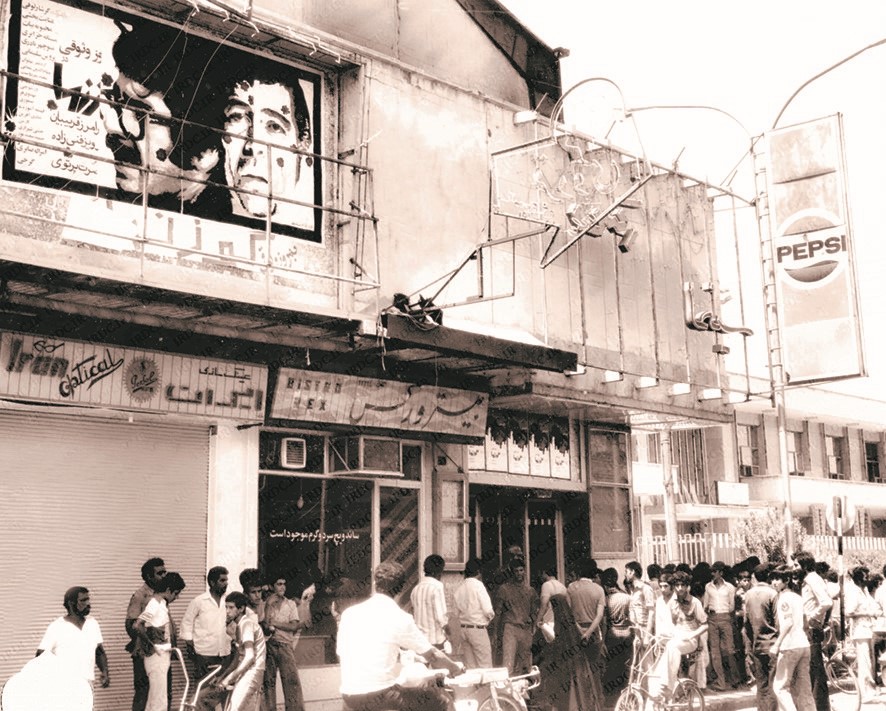
Figure 1: The image of the Cinema Rex with a poster of Gavazn’hā (The Deer, 1974), directed by Mas‛ūd Kīmiyāyī, accessed via https://raseef22.net/english/article/1093599-a-blaze-of-horror-in-iran-the-regions-biggest-act-of-terror-in-the-20th-century.

The development of the male gaze in cinema and its role in Iranian cinema is a key point of this research. Feminist approaches by both male and female filmmakers in Iran influenced the representation of women in Iranian cinema. By using the Ethnographic Content Analysis method in studying sixty films from before and after the revolution, I discuss three major themes regarding the presentation of women at home. I argue that class plays a crucial role in this representation and affects gender roles at home. Then, I investigate the process of representation of women in the foreground and background of films and the changes in their status with respect to hierarchy at home. In the end, I discuss how women and their bodies were represented as objects to be protected by men before and after the revolution. Further, home becomes a place to protect women from the “outside,” which is seen as a masculine space.

What is Home?

Scholars across different disciplines have published copious work on the impact of revolution on society at the macro-level. In this article, I will concentrate more on the changes that revolutions bring to society and everyday life at the micro- and meso-level. As Agnew states, histories of place are the best method for looking at the social bases of response and resistance to institutions, including states.2John Agnew, Place and Politics: The Geographical Mediation of State and Society (Boston: Allen & Unwin, 1987), 1. Scott classifies these resistances and responses in everyday life as “weapons of the weak.”3James C. Scott, Weapons of the Weak (New Haven: Yale University Press, 1985). Home, as a context and also as a site for agential enactment of roles in everyday life, is the core of this discussion. This article explores the concept of home as a place from the symbolic interactionist perspective and bridges theories of home from scholars with different approaches.

Space is not only produced through social relations and structures,4Henri Lefebvre, The Production of Space, trans. Donald Nicholson-Smith (Oxford: Blackwell Publishing, 1991).‎ but also affects how social processes work.5Doreen Massey, “Introduction: Geography Matters,” ‎in Geography Matters, eds. Doreen Massey and John Allen (Cambridge: ‎Cambridge University Press, 1984), 1-11. Social processes and space are inseparable. ‎Lefebvre argues that place is where everyday life is situated, and it is not merely an abstract space. It is where we live out basic practices.6Andrew Merrifield, “Place and Space: A Lefebvrian Reconciliation,” Transactions of the Institute of British Geographer 18, no. 4 (1993): 516-531‎. To illustrate the concept of place, I refer to ‎Gieryn’s work. He sees place as a “space filled up by people, practices, objects, and ‎representations… Everything we study is emplaced.”7Thomas F. Gieryn, “A Space for Place in Sociology,” Annual Review of Sociology 26, no. 1 (2000): 463-496, 466.‎ Geographic location, material form, and invested meaning and value are three elements of recognizing a space as a place. The latter is the key point in my discussions about place and home. Action and intention are the essence of a place,8Edward Relph, Place and Placelessness (Los Angeles: Sage Publications, 1976/2016), 47. and interactions are the roots of the process of meaning-making. The process of meaning-making is crucial in turning a space into the place we call home. The meaning-making process is dynamic, which is linked to the endless place-making process. Therefore, “home is a process rather than a state of things.”9Paolo Boccagni and Margarethe Kusenbach, “For A Comparative Sociology of Home: Relationships, Cultures, Structures,‎” Current Sociology 68, no.5 (2020): 595-606, ‎597.

The assigned meaning to a place shapes memory and identity that is connected to that place. It ‎links home and identity.10Lisa-Jo K. van den Scott, “Mundane Technology in non-Western Contexts: Wall-as-Tool,”‎ ‎in Sociology of Home: Belonging, Community and Place in the Canadian Context, ‎eds. Laura Suski, Joey Moore and Gillian Anderson (Toronto: Canadian ‎Scholars Press International, 2016), 33-53. Home is a significant focal point where our ‎thoughts, memories, and dreams get combined.11Gaston Bachelard, The Poetics of Space‎, trans. M. Jolas. (Boston: Beacon Press, 1969). Our interactions and social life shape these thoughts, memories, ‎and dreams. Cinema comes into this process at a ‎point where it impacts our thoughts, memories, and dreams. We think and dream about what home means to us, in part, through our engagement with cinema. This engagement with cinema impacts our vision and the memories we strive to create at home. As we strive towards this ideal image of home, we are continually making home.12Paolo Boccagni and Margarethe Kusenbach, “For A Comparative Sociology of Home: Relationships, Cultures, Structures,‎” Current Sociology 68, no.5 (2020): ‎595-606.

In an ethnography that I did on Boushehri homes, I found that the way people conceptualize of and define home can be extended to a whole neighbourhood or be restricted to a single room or even a rooftop.13Pouya Morshedi, “The Study of Human Communications in Iranian Homes through the Ethnography of the ‎Role ‎of Architecture in Human Communication, A Case Study of Boushehri Homes,” MA Thesis (University of Tehran, 2015). In this research, I argue that the concept of home can be extended to be as large as the homeland. Therefore, references to home in any kind of art, including cinema, could be as small as a room or as big as the homeland. The section on women, home, and homeland further discusses this.

Cinema and Revolution

An art world consists of all people who are involved in producing a particular genre of artwork.14Howard S. Becker, Art World (Berkely: University of California Press, 1982‎). While we see the artist/s in the frontstage, the work is not restricted to the artist. Art is, in fact, a collective action.15Howard S. Becker, “Art as Collective Action.” American Sociological Review 39, no. 6 (December 1974): 767-776. Cinema is not an exemption in this regard. The field of cinema includes filmmakers, actors, actresses, drivers, editors, writers, producers, audiences, and all other people who are involved in producing, screening, and watching a film. To illustrate the relationship between different roles in an art world, Griswold’s cultural diamond is helpful. The cultural diamond has four elements: social world, receiver, creator, and the cultural object itself.16Wendy Griswold, Cultures and Societies in a Changing World (Thousand Oaks: Pine Forge Press, 2004). This diamond helps us to find out how film, filmmakers, audiences, and the social world are connected. We can think about each of these elements in relation to the other elements. However, it is imperative to expand her first element, the social world, to fully discuss how political changes influence the world of cinema. To do so, Huaco’s work on the emergence of cinematic waves in four different countries is useful. Huaco discusses ‎four factors that shape new cinematic waves. He argues that cinematic waves are shaped by a cadre of directors, cameramen, editors, actors, and technicians; the industrial plant ‎required for film production; a mode of the organization of the film industry that is either in ‎harmony with or at least permissive of the ideology of the wave; and finally, a political climate that is either in ‎harmony with or permissive of the ideology and style of the wave.17George A. Huaco, The Sociology of Film Art‎ (New York: Basic Books, 1965‎), 212. A model that weaves together Griswold and Huaco’s ideas is ideal to account for the last factor, the political climate, in analyzing the way films represent home in the pre- and post-revolutionary eras.
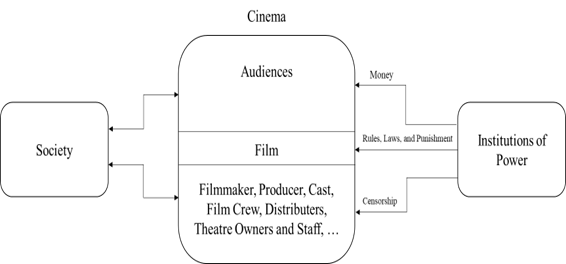
Figure 2: A Model for the Relationship Between Cinema, Society, and Institutions of Power

The role of institutions of power in the field of cinema makes cinema suspect as a tool for domination. In the hands of a state, cinema has the potential to be a tool for dominating, standardizing, and homogenizing societies. The state, through cinema, can then play a powerful role in what Adorno and Horkheimer call the culture industry.18Theodor Adorno and Max Horkheimer, Dialectic of Enlightenment, eds. Gunzelin Schmid Noerr, trans. Edmund Jephcott (Stanford: Stanford ‎University Press, 1944/2007).‎ However, this is not the only way that cinema can influence society. Benjamin discusses the development of methods of artistic reproduction, and claims that technological reproduction is more independent than manual reproduction and can create ‎simulacra that take on a new significance beyond the original work of art.19Walter Benjamin, “The Work of Art in the Age of Mechanical Reproduction.”‎ ‎in Walter Benjamin; Selected Writing 1935-1938, eds. Howard Eiland and ‎Michael W. Jennings, trans. Edmund Jephcott, Howard Eiland and Others (Cambridge, MA: Harvard University Press, 2002), 99-‎‎252. He argues that establishing “equilibrium between the human being and the apparatus” is the most important social function of film. Film not only represents human beings, but also their environment and hidden aspects of familiar objects.20Walter Benjamin, Art in A Technological Age (London: Penguin,1935/2008), 17. It provides the potential to influence society in ways other than standardizing and homogenizing. Indeed, Hansen and Dimendberg‎ find this aspect of film as much cognitive and pedagogical as it is remedial and therapeutic.21Miriam Hansen and Edward Dimendberg‎, Cinema and Experience: Siegfried Kracauer, Walter Benjamin, and Theodor W. Adorno‎ (Berkeley: University of California Press, 2012‎), 79.

This approach views cinema as having the potential to be a revolutionary field, rather than a manipulative and deceptive tool. The emergence of revolutionary cinema is intertwined with the concept of national cinema. Croft argues that diverse traditions of national cinema identify themselves mostly by determining their relationship with Hollywood. He names seven categories of cinema. First, cinema that differs from Hollywood without any direct competition. Second, cinema that differs from Hollywood and critiques it. Third, European and third-world cinema that struggles against Hollywood without success. Fourth, cinema that ignores Hollywood and is successful in this matter. Fifth, Anglophone cinema that tries to beat Hollywood at its own game. Sixth, state-controlled and state-subsidized cinema. Seventh, regional/national cinema that keep their distance from the nation-state context.22Stephen Croft, “Reconceptualising National Cinema/s,‎” in Theorising National Cinema, eds. Valentina Vitali and Paul Willemen (‎London: Palgrave Macmillan, 2006‎), 44-58. Each national cinema may fit into one or more of the categories Croft names. In countries that have undergone or are currently experiencing revolutions, the relationship between cinema and Hollywood, and cinema and the state are important in shaping national cinema. This article discusses two examples connected to the case of Iran below.

In the Cuban context, the Cuban Institute ‎of Cinematographic Art and Industry was established less than three months after the 1959 revolution. This demonstrates how the new Cuban regime saw cinema as a revolutionary field. The emergence of Third Cinema in South America influenced Cuban cinema as well. Espinosa introduces the concept of “imperfect cinema,” in which the content takes over the aesthetics.23Julio García Espinosa, “For an Imperfect Cinema,” in Film Manifestos and Global Cinema ‎Cultures, ed. Scott MacKenzie (Berkeley: University of California Press, ‎‎1969/2014), 220-229. The new Cuban cinema became a response to the dominance of Hollywood, while it was also a response to the need for commercial cinema. Russia (and later the Soviet Union) had a different story. Russian cinema had a rich history before the revolution. Cuba did not have such a history in cinema before the revolution. The hegemonic role of the United States in cinema in 1917 was not the same as what it had become by 1959. Therefore, post-revolutionary Soviet cinema was confronting and rejecting pre-revolutionary aesthetics more than the hegemony of Hollywood.

Post-revolutionary cinema in Iran was a response to both of the issues Cuban and Russian films faced: responding to Hollywood and rejecting the cinematic aesthetic from before the revolution. However, rejecting pre-revolutionary aesthetics was the primary target. To illustrate the new regime’s perspective on cinema in Iran, we can take a look at what Khomeini, the first leader of the Islamic Republic, said about cinema in his first speech after coming back from exile: “Our cinema is a hub for depravity… We are not against cinema, but we are against depravity… Cinema is a symbol of civilization that must be at the people’s service, at the service of the cultivation of the people…”24Ruhollah Khomeini, Sahīfah-i Imām (Tehran: The Institute for the Compilation and Publication of the Works of Imam ‎‎Khomeini‎, 1979/1999), 6: 15. [Translated by the author.]

This quote demonstrates that the perceived deception and corruption of pre-revolutionary cinema were salient qualities to be excised from cinema for the new regime leaders. However, Khomeini’s view of cinema as a symbol of cultivation shows that there is a different kind of cinema that would be acceptable under the new regime. Cinema which is “at the service of the cultivation of the people” would be considered “good cinema.” This implies that the regime leaders ought to promote cinema that embodies a new post-regime narrative of the world and a revolutionary aesthetic. It turns cinema into a tool for the state ‎under the guise of service to the people. ‎

Pre-revolutionary filmmakers, movie-goers, and other groups involved in the field of cinema lost hope for the future of cinema in the post-revolutionary era.25Parviz Jahed, “Kārnāmah-yi 35 Sāl Sīnimā-yi Inqilāb,” BBC Persian. February 5, 2014. ‎retrieved 28/11/2023, https://www.bbc.com/persian/iran/2014/02/140130_l44_cinema_35th_anniversary_iranian_revolution There was no guideline and little description of the “good cinema” which Khomeini and new people in power had in mind. Later, Khomeini mentioned that Gāv (The Cow) was an educative film.26Ruhollah Khomeini, Sahīfah-i Imām (Tehran: The Institute for the Compilation and Publication of the Works of ‎Imam Khomeini, 1980/1999) 12: 292.‎   The Cow was a film by Dāryūsh Mirhjū’ī, a New Wave filmmaker, based on a story by Ghulāmhusayn Sā‛idī, a Marxist writer who had left the country after the revolution. Filmmakers took this as a sign to start again. New Wave filmmakers, such as Bayzā’ī, Taghvā’ī, and others, started to work again. The new social and political atmosphere shaped new rules, laws, and restrictions for filmmakers. Women, their presence, their bodies, and their interactions in cinema were the target of most of these new rules, restrictions, and censorship.
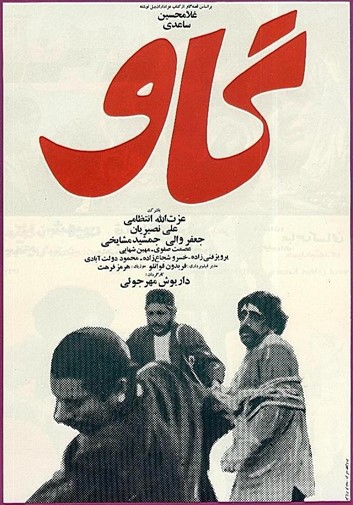
Figure 3: Poster for the film Gāv (The Cow, 1969), directed by Dāryūsh Mihrjū’ī.

Women, Cinema, and Iranian Cinema

When discussing the relationship between the representation of home in cinema and big social changes, gender roles and interactions between people at home arrests our attention. Women and their roles, interactions, presence, and absence play a crucial role in representing the home and are crucial for understanding the social changes caused by the revolution. Women, as objects of spectacle in cinema, have been discussed in many feminist scholars’ work directly and indirectly.27See, for example, Laura Mulvey, “Afterthoughts on ‘Visual Pleasure and Narrative Cinema’ inspired by King ‎Vidor’s Duel in the Sun (1946),” in Visual and Other Pleasures. Language, Discourse, ‎Society (London: Palgrave Macmillan, 1989), 29-38; Teresa De Lauretis, Alice Doesn’t (Bloomington: Indiana Press University, 1984); and Ann Kaplan, Women and Film (London: Taylor & Francis, 2002‎). However, this conversation is not restricted to feminist theorists of cinema. While Blumer focuses on movie-goers and their reactions to motion pictures,28Herbert Blumer, Movies and Conduct (New York: Macmillan, 1933‎). his data, while it is not from a feminist theoretical approach, discusses women as being objects of spectacle in cinema.29Patricia T. Clough, “The Movies and Social Observation: Reading Blumer’s Movies and Conduct,‎” Symbolic Interaction 11, no. 1 (1988): 85-97.‎ Blumer and Clough both discuss cinema as a male-dominated field. Johnston claims that women are presented as what they “represent for man” in a sexist ideology and a male-dominated cinema.30Claire Johnston, “Women’s Cinema as Counter-Cinema,‎” in Feminist Film Theory: A Reader, ed. Sue Thornham (Edinburgh: Edinburgh ‎University Press, 1999), 31-40, 34. In all cases, scholars have recognized that cinema has focused on men as agents over time and across different places. Even today, a woman is often not present in a film as a woman, but as an accessory to a man and to how men are represented in cinema. This situation extends from a sexist ideology that puts women as secondary in the gender hierarchy. The concept of the cinematic gaze offers insight into how cinema shapes and orders gendered positions and hierarchy.

Social and cultural context shapes our vision.31Eviatar Zerubavel, Social Mindscapes; An Invitation to Cognitive Sociology (Cambridge: Harvard University Press, 1997). We are socialized not only in terms of what to attend to, but also how to interpret what we see. Therefore, vision is a “skilled cultural practice.”32Chris Jenks, “The Centrality of the Eye in Western Culture: An Introduction,” in Visual Culture, ed. Chris Jenks (London: Routledge, 1995), 1-25, 10. The gaze as a function of vision follows the same rule. Urry and Larsen define the gaze as “a performance that orders, shapes, and classifies, rather than reflects the world.”33John Urry and Jonas Larsen, The Tourist Gaze 3.0 (Los Angeles: Sage Publications, 2011‎), 2. While they use this definition to introduce the concept of the tourist gaze, it also helps to expand the concept of the cinematic gaze. The cinematic gaze has been discussed mostly in Lacanian scholars’ work.34See, e.g., Clifford T. Manlove, “‘Visual “Drive’ and Cinematic Narrative: Reading Gaze Theory in Lacan, Hitchcock, and ‎Mulvey,” Cinema Journal 46, no. 3 (2007): 83-108; Todd McGowan, “Looking for the Gaze: Lacanian Film Theory and Its Vicissitudes,‎” Cinema Journal 42, no. 3 (2003): 27-47.‎ Mulvey explains the cinematic gaze as a male gaze upon females. According to Mulvey, “Playing on the tension between film as controlling the dimension of time (editing, narrative) and film as controlling the dimension of space (changes in distance, editing), cinematic codes create a gaze, a world, and an object, thereby producing an illusion cut to the measure of desire.”35Laura Mulvey, “Visual Pleasure and Narrative Cinema,‎” Screen 16, no. 3 (1975): 6-18, 17. She argues that women are presented as passive objects of desire for men not only in the story, but also in how the audience is conceptualized, targeted, and treated. Mulvey has concentrated both on the content of films, such as when she wrote “Visual Pleasure and Narrative Cinema (1975), and the audience, particularly women and their approach to film and the way they watch and interpret film.36Mulvey, “Afterthoughts on ‘Visual Pleasure and Narrative Cinema’ inspired by King ‎Vidor’s Duel in the Sun (1946),” 29-38 While I agree with her approach, I argue that the cinematic gaze is not restricted to a gendered gaze. It also shapes, orders, and classifies the world regarding the race, ethnicity, class, and other sociological locations of human beings. Further, this research study suggests that the social class of women in their cinematic roles is an important component of the cinematic gaze.

There are several groups engaged in shaping the cinematic gaze: filmmakers, producers, artists, institutions of power that fund, censor, control, and distribute films, and society. We can think back to Griswold’s cultural diamond and the expanded role of the state as part of the element of the social world. Power relations are a key factor that privilege certain social roles as more influential in shaping the cinematic gaze. Here, big social changes, including revolutions, become more important to discuss because new regimes that result from revolutions can play a role in shaping the cinematic gaze through their tools of power. However, all these factors do not mean that audiences are passive in the field of cinema. They interpret what they see, hear, and experience, albeit through the lens of their socialization. As Rancière argues, artists construct their stages to exhibit ‎their artwork, but the effect of their art cannot be anticipated.37Jacques Rancière‎, The Emancipated Spectator, trans. Gregory Elliott (London: Verso, ‎‎2009).‎ Representation entails audiences who are ‎active interpreters and who develop their own translation of the story to make it their own. This may be underestimated by those who use cinema as a tool for domination. While the cinematic gaze shapes, orders, and classifies the world in a film, the interpretation of the ‎audiences affects the resulting vision.

Women in Iranian cinema were not exceptions and have been the object of the male gaze. They have been portrayed in a way that fits within the patriarchal order of Iranian society. There are many scholarly works on how women were presented in Iranian cinema before and after the Revolution. Naficy categorizes women’s roles in pre-revolutionary cinema into nine categories. First, woman as an attractive and termagant being. This woman is usually a dancer, prostitute, or cabaret singer who is sexually alluring. Second, woman as an ethereal being who is unattainable. Third, woman as a mother/angel who sacrifices for everyone. Fourth, woman as a sister who is chaste and virtuous, and who is protected by the men of the family. Fifth, woman as a rural naïve person who has been deceived in town and becomes a dancer/singer/prostitute who will be “redeemed” by a man. Sixth, woman as sexual object and fetish. Seventh, woman as a seductive being who deceives men. Eighth, woman as a witness who is beside a man. Ninth, woman as an independent being who is working in a position which is not a dancer, singer, or prostitute.38Hamid Naficy, ‎“Zan va Mas’alah-yi Zan dar Sīnimā-yi Irān-i Ba‘d az Inqilāb,” Nīmah-yi Dīgar 14, ‎‎(1991): 123-169.‎ Derayeh categorizes women in pre-revolutionary cinema as positioned in one of two main ethical categories; ma‛sūm (naïve/innocent) and ‎fāsid or gumrāh (corrupted or misguided).39Minoo Derayeh, “Depiction of Women in Iranian Cinema, 1970s to Present,” Women’s Studies ‎International Forum 33, (2010): 151-158, 152. Similarly, Ghorbankarimi asserts that to be a good woman in the first decade of post-revolutionary films, women should be pure, chaste, and untouched. The good woman is the one whom a man will protect.40Maryam Ghorbankarimi, A Colourful Presence: The Evolution of Women’s Representation in Iranian Cinema (Newcastle: Cambridge Scholars Publishing, 2015), 192. The more women are portrayed spending their time at home and being restricted to the home, the more positive they are from the patriarchal perspective. Cinema contributes to ordering a world where the home (inside) is where women belong, while outside is a masculine space which is dangerous, deceptive, and corruptive for women. The only way to survive outside the home is for a man to protect and save the woman. I argue that keeping women at home in cinema perpetuates the idea of women as pure, chaste (because they are restricted), and untouched (because strangers are not there).

After the 1979 Revolution, the new regime had a paradoxical perspective toward cinema. On the one hand, cinema was a Western weapon to deceive people and assimilate them. On the other hand, it was an educational medium for “cultivation.” The new regime decided to choose the latter perspective and made cinema “the main art of the new political project.”41Sara Saljoughi, “Seeing, Iranian Style: Women and Collective Vision in Abbas Kiarostami’s ‎Shirin,” Iranian Studies 45, no. 4 (July 2012): 529-535, 522. Women, their images, and their presence were key points in the new regime’s perspective and their goals with cinema. For the post-revolutionary leaders, women were directly related to depravity and corruption in pre-revolutionary cinema. Therefore, cleansing cinema and purifying this medium was intertwined with reimaging women in cinema.

There were different strategies to do this. In the first years of the new regime and during the Iran-Iraq war, women were mostly invisible and absent. Later, women were portrayed, but only as a background for the real story. By the end of the 1980s, women started to be present in the foreground.42See Hamid Naficy, A Social History of Iranian Cinema, vol. 4. (Durham: Duke University Press, 2012); Derayeh, “Depiction of Women in Iranian Cinema, 1970s to Present,‎” 151-158.‎‎ Despite new rules and laws restricting women more and more in cinema, women gradually found a space to be more present at the same time. The presence of women as directors, first-role actresses, and producers became possible as long as they were following the Islamic codes of modesty.43Hamid Naficy, “Veiled Voice and Vision in Iranian Cinema: The Evolution of Rakhshan ‎Banietemad’s,” Social Research 67, no. 2 (2000): 559-576.‎ This new presence was not an immediate consequence of the post-revolutionary changes, rather, it was the result of the resistance strategies that women agentically chose in this restrictive situation in cinema and society.

The emergence of female filmmakers influenced the cinematic gaze and its masculine nature. We cannot name many women who made films before the revolution. Shahla Riahi was the first woman who directed a film in 1956. Furūgh Farukhzād made a documentary, In Khanah Sīyāh ast, in 1962 and Shahrzād (Kubrā Sa‛īdī) directed Maryam va Mānī in 1978. They were the only women who directed films in Iran before the revolution. After the revolution, we see more women’s names on screen as the director, such as Rakhshān Banī-i‛timād, Pūrān Dirakhshandah, and Manīzhah Hikmat. This brought women in primary roles to the foreground more and more. Women became the agentic subjects in more stories rather than being represented in relation to other men. This not only happened in women-made films, but also in male-made films in the late 1980s and early 1990s. This change brought women more to the centre, however, patriarchy and the Islamic codes of modesty maintained the dominance of the male gaze in the field of cinema. Women, their presence, and their interactions are still targets of censorship. The new regime wanted the film industry to represent a purified Shiite world.44Negar Mottahedeh, Displaced Allegories: Post-Revolutionary Iranian Cinema (Duke University Press, ‎‎2008).‎ They attempted a cleansing process to shift cinema from a site of the profane to the sacred.45Emile Durkheim, The Elementary Forms of the Religious Life, trans. Karen Elise ‎Fields (New York; Toronto: Free Press, 1912/1995). Therefore, codes of modesty that women had to follow in public spaces influenced the image of women in private spaces, which impacted the representation of home and the representation of women at home. The next section explains the research conducted to address the changes in the representation of home and women at home in Iranian cinema.
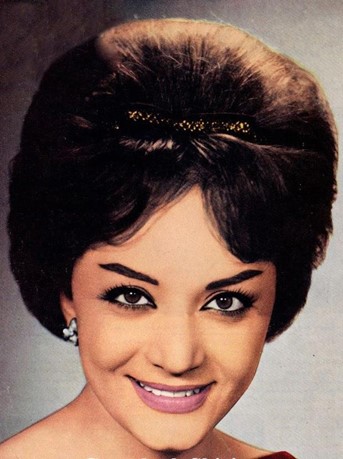
Figure 4: Shahlā Riyāhī (1926-2019), the first Iranian woman who directed a feature film.

Methodology

This research primarily focuses on the changes in cinematic representation of home and of women at home before and after the 1979 Revolution in Iran. Sociological qualitative research centres the researcher in the process.  Throughout the methods section, the first person indicates this centred approach and the reflexivity that is part and parcel of this research.  It is important to acknowledge the role of the researcher in the process, and to recognize that different researchers will find various aspects of polysemic meanings. To do so, I conducted a content analysis of sixty Iranian films produced between 1969 and 1999. I chose thirty films from the pre-revolutionary era (1969-1979) and thirty films from the post-revolutionary era (1979-1999). The transition from the previous regime to the new regime did not happen immediately. During the transition time, the number of films that were produced decreased. Also, the Iran-Iraq war was going on between 1980 and 1988. The war influenced all political, economic, social, and cultural aspects of Iranian society. Iranian cinema was not an exemption. Given these historical circumstances, I decided to study two decades of Iranian cinema after the revolution to include films that were produced during a more stable period in post-revolutionary Iran.

Film selection criteria included best-sellers, films made by new revolutionary filmmakers, New Wave films, films made by women, films about different historical eras, and films known as Fīlmfārsī. The diversity in genres, filmmakers, and content allowed for the analysis of the representation of home and women at home from different perspectives. To do so, I chose the Ethnographic Content Analysis (ECA) approach to analyze the chosen films. While this approach is very close to what we know as qualitative content analysis, Altheide and Schneider make this approach different by emphasizing “the description of people and their culture” in the process of ECA, privileging an inductive approach.46David L. Altheide and Christopher J. Schneider, Qualitative Media Analysis, 2nd. ed. (Los ‎Angeles: SAGE, 2013),‎ 24.

At the level of analyzing the data, ‎”symbolic interactionists often rely on grounded theory when they do ethnography.”47Lisa-Jo. K. van den Scott, “Symbolic Interactionism,” in SAGE Research Methods Foundations, ‎eds. Paul Atkinson, Sara Delamont, Alexandru Cernat, Joseph W. Sakshaug and ‎Richard A. Williams (Sage Publications, 2019), ‎6. In the first phase, I watched films, took notes, and looked for patterns in dialogue, interactions, and frames in the films. I developed codes from these themes. I applied an inductive approach while coding. This allows the researcher to be systematic and flexible, while avoiding a reductionist approach.,48Margrit Schreier, “Qualitative Content Analysis,” in The SAGE Handbook of Qualitative Data ‎Analysis, ed. Uwe Flick (London: Sage Publication, 2013), 170-183. ‎ In the second phase, I shaped my preliminary themes based on the codes that inductively emerged in the previous phase. In the last phase, I identified major themes which will be discussed in the next section.

Emergent Themes: Women at Home, Home in Cinema

Three major themes emerged around women and home in this research. These show the representation of home and representation of the relationship between home and women in cinema before and after the 1979 Revolution. The emergent themes below are depictions of social class and women at home; the shift of women from the background to the foreground; and how the protection of women stands in for and expands to the protection of the homeland.

Poor Women vs. Rich Women: The Role of Class in the Representation of Women at Home

The importance of the intersection of gender and class emerged immediately in the data both in pre-and post-revolutionary films. While intersectionality describes how our gender and class (and other aspects of our social location, such as race, ethnicity, dis/ability, etc.) impact our status in social hierarchies, this analysis focuses on how gender and class specifically impact the representation of people in films.

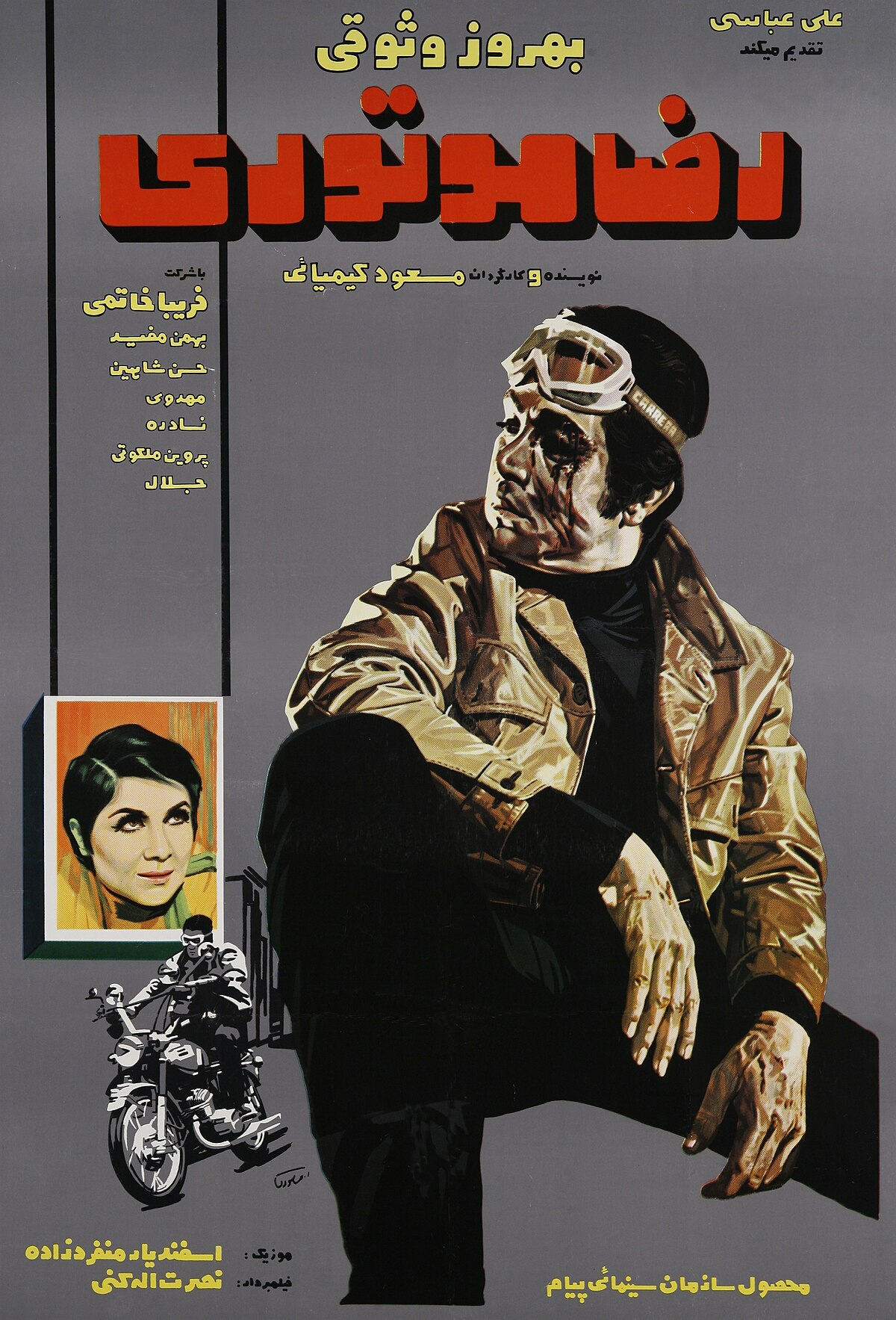
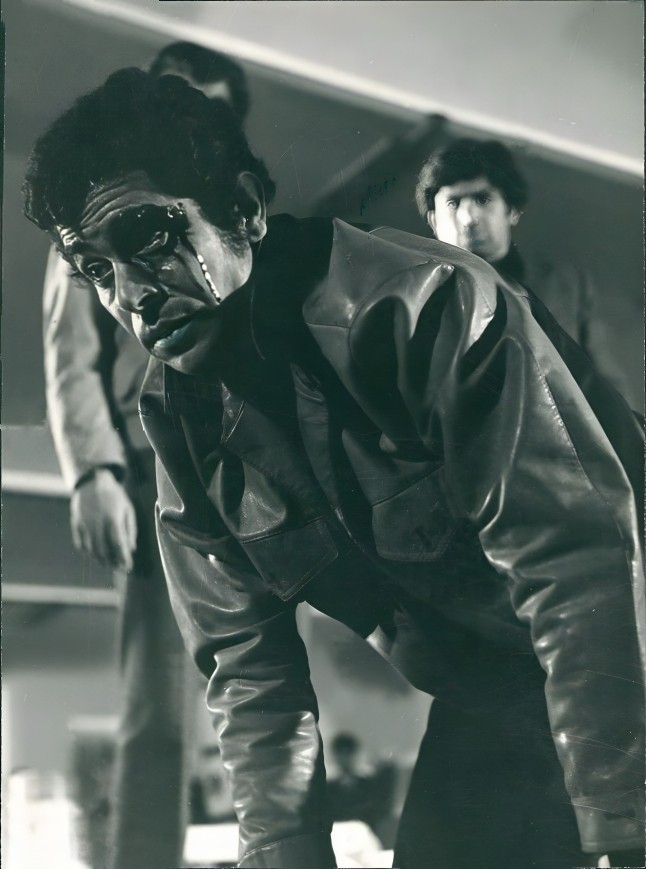
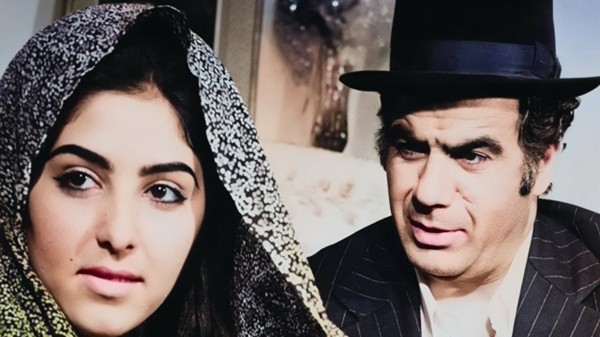
In pre-revolutionary films, most of the women from the upper class do not work at home. They usually have servants who will take care of housework. For example, in Rizā Muturī (1970), we see women at a rich girl’s house who do nothing. They are sitting on fancy couches, resting in open areas of the house, and chatting. They have the privilege of having leisure time and performing their class by showing off their leisure and doing nothing at home. They do not have a significant role at home or in other spaces, which makes them somewhat ornamental or decorative at times. However, there are films that represent higher-class women who have jobs or work outside of home. They usually play roles such as artist (not mutrib),49Mutrib is a word that has been used to downgrade the status a musician. This word does not have a bad meaning itself, but people use it to mention a low-brow musician in contrast with a high-brow musician who is an artist. writer, or poet. We can find the role of Parvānah in Dar Imtidād-i Shab (1978) in pre-revolutionary films and the role of Bānū in Bānū (1992) in post-revolutionary films. In post-revolutionary films, one sees women more often as writers and poets rather than artists (specifically as singers).

In pre-revolutionary films, lower-class women always do the housework. They take care of all the chores inside the home. However, due to their economic status, some of them work outside. Usually, the jobs they take are related to doing housework at others’ homes, and if they are young attractive women, they may work as a dancer, a singer, or an actress at a club. The difference between these two kinds of depictions of lower-class women’s roles is that the latter usually turns out to be a deviant woman or a deceived woman. In post-revolutionary films, we see more of the first type of lower-class women who perform so-called “respectable” work outside the home. The lower-class women are condemned to housework. 
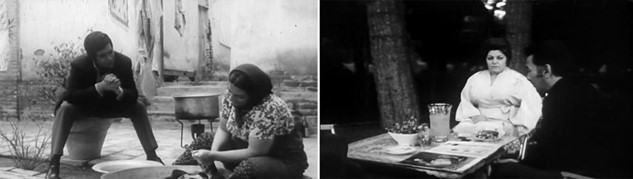
Figure 5: The representation of lower-class (left; 00:52:58) and upper class (right; 00:27:15) women in Rizā Muturī (Reza, the Motorcyclist, 1970), directed by Mas‛ūd Kīmiyāyī.

Middle-class women have been pictured in more diverse ways at home. In early pre-revolutionary films, we cannot find middle-class families in films. By the last decade of the Pahlavi regime, we can see narratives of middle-class families in films by the younger generation of filmmakers. This follows from the changes in Iranian society, the rise of oil money, and the birth of new, middle-class, urban families. In post-revolutionary films, middle-class women fall into two main categories regarding their activities at home. The first one is the middle-class woman who works outside in a mid-range job and has a servant or servants at home. We can find an example of this group in Ārāmish dar Huzūr-i Dīgarān (1972). Here, the characters Malīhah and Mahlaqā work at a hospital as nurses while a servant takes care of the chores at home. We can find the second model of the middle-class woman in Guzārish (1977), where a middle-class woman, A‛zam, still does the housework and takes care of the child. She may complain about her husband’s lack of responsibility for housework and childcare, but she remains responsible for them. In post-revolutionary films, we see more and more middle-class women who may or may not work outside. However, we still find them primarily as the person responsible for housework and childcare. The new regime’s perspective on women as mothers and caregivers exacerbated these roles for middle-class women in cinema. For example, in Hamsar (1994), we see how Shīrīn, the woman, is in charge of housework even while she works at the company where her husband works. When the man, Riza, stays at home in protest of his wife’s promotion to the CEO position, he performs housework, but it is represented as an unusual responsibility that affects his manliness. This is even illustrated in the film poster (see figure 6). Housework and childcare are not included in the gender role that a man takes at home. In Khāharān-i Gharīb (1996), man and woman are separated, and each took one of the twins. The man has his mother by his side to take care of the home and the child, while the woman takes on the responsibility herself and remains alone at home caring for her child. Women are expected to do the “second shift” assuming responsibility for all unpaid domestic labor.50Arlie Russell Hochschild and Anne Machung, The Second Shift: Working Parents and the ‎Revolution at Home (New York: Penguin Books, 2012).‎ While we can find this second shift in lower-class families in pre- and post-revolutionary films, the representation of middle-class families and working women made women’s second shift and their double burden bolder in later cinema.
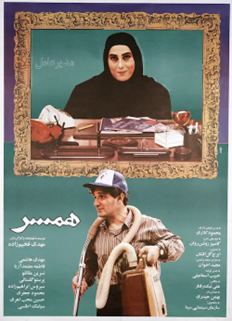
Figure 6: Poster for the film Hamsar (The Spouse, 1994), directed by Mahdī Fakhīmzādah.

Women’s gender role at home and their presence and absence in the job market is not the only manifestation of the intersectionality of gender and class in Iranian cinema. The relation between the hijab and class is another important factor in the representation of women at home. The hijab is intertwined with lower-class lifestyle in both eras. While we can find non-hijab-wearing lower-class women in pre-revolutionary films, it is restricted to women who were considered deviant or deceived by men and who are mostly shown working at cabarets or brothels. It does not matter if the film is about the current (Pahlavi) era or the past (Qājār) era, in either case, lower-class women wear a hijab while middle-class and higher-class women are much less likely to be presented in a hijab.  The film Bābā Shamal (1971) is a good example. After the revolution, filmmakers could not show women without a hijab anymore. Still, higher-class women and intellectuals—portrayed as Westernized people—wear a loose scarf in comparison with lower-class women who clearly wear a scarf as a hijab or wear a chador. In post-revolutionary films, particularly in the first two decades, a woman’s hijab instantly communicated to the audience whether she was an outsider or an insider to the dominant discourse of the Islamic Republic. Intellectuals, and Westernized, urban, and rich people, by wearing a relaxed, loose scarf as a hijab are portrayed as outsiders of the regime’s discourse, while lower-class, poor, rural, and religious people are identifiable as insiders by wearing more formal hijab. If we see anyone without a hijab in post-revolutionary cinema of this period, it is a sign that she is a non-Iranian actress, such as we see, for example, in Az Karkhah tā Rāyn (From Karkheh to Rhine, 1992) (see figure 7). There is no place for women without hijab in the definition of being Iranian under the new regime’s discourse.

Figure 7: Iranian and non-Iranian actresses. Az Karkhah tā Rāyn (From Karkheh to Rhine, 1992), Ibrāhīm Hātamīkīyā, accessed via https://www.aparat.com/v/f6570w6 (00:36:56)

Women at Home: From Background to Foreground

The presence of women on the silver screen and their roles in the stories that films narrate changed during both the pre-revolutionary and post-revolutionary periods examined. Both periods had a similar starting point, although post-revolutionary cinema was established based on a history of women’s presence in pre-revolutionary cinema. In both periods, women were portrayed in the background of the stories and played the role of accessory in each scene to make it believable. I call this the first phase. In the second phase, women gained more influential roles in the story, however, they were still depicted as dependent on the man who was the lead character. A woman could be mother, wife, sister, mistress, fiancée, or a love who helps the hero, or fights against him, to advance the story. The third phase was the period when women became the starring roles of the films and the stories were shaped around them.

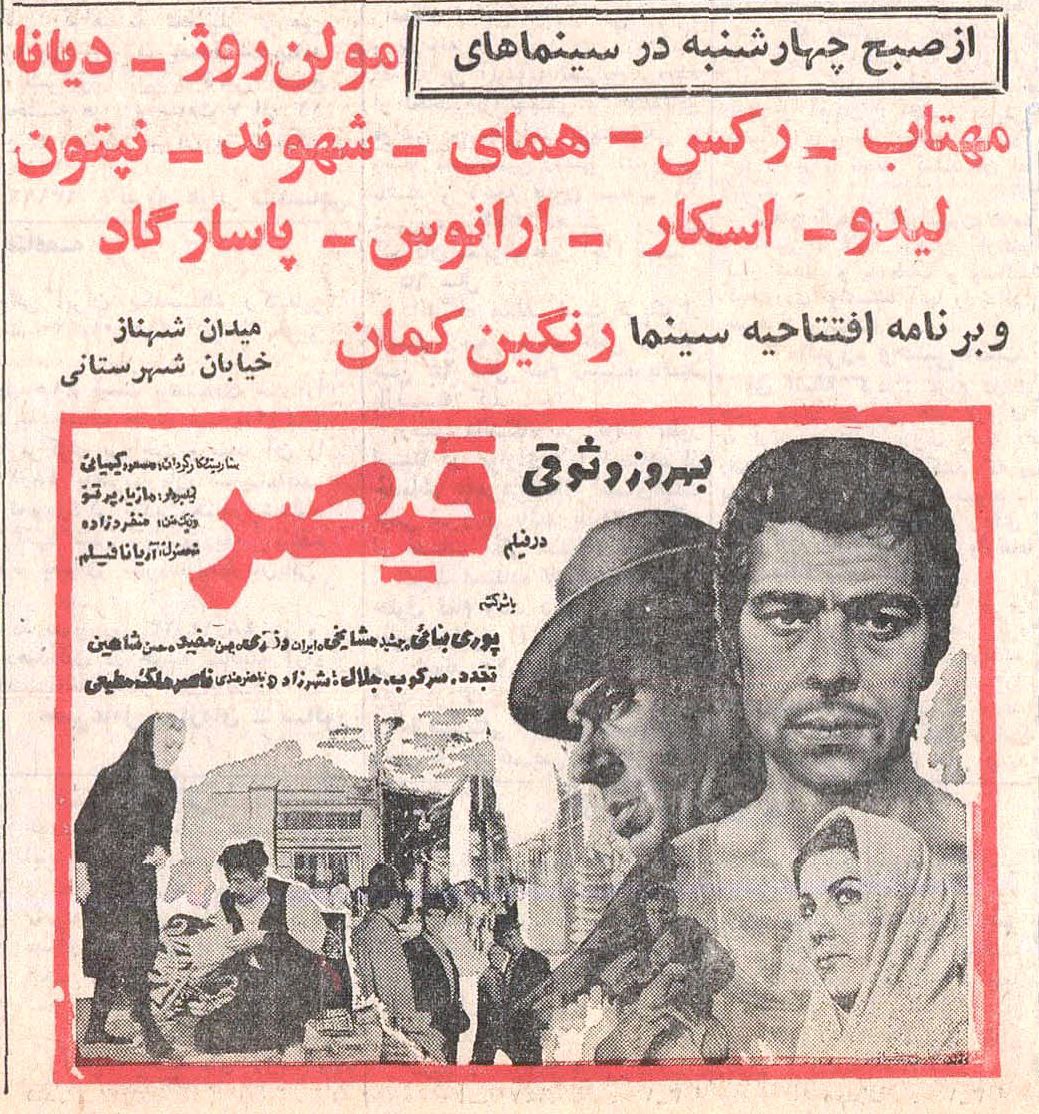
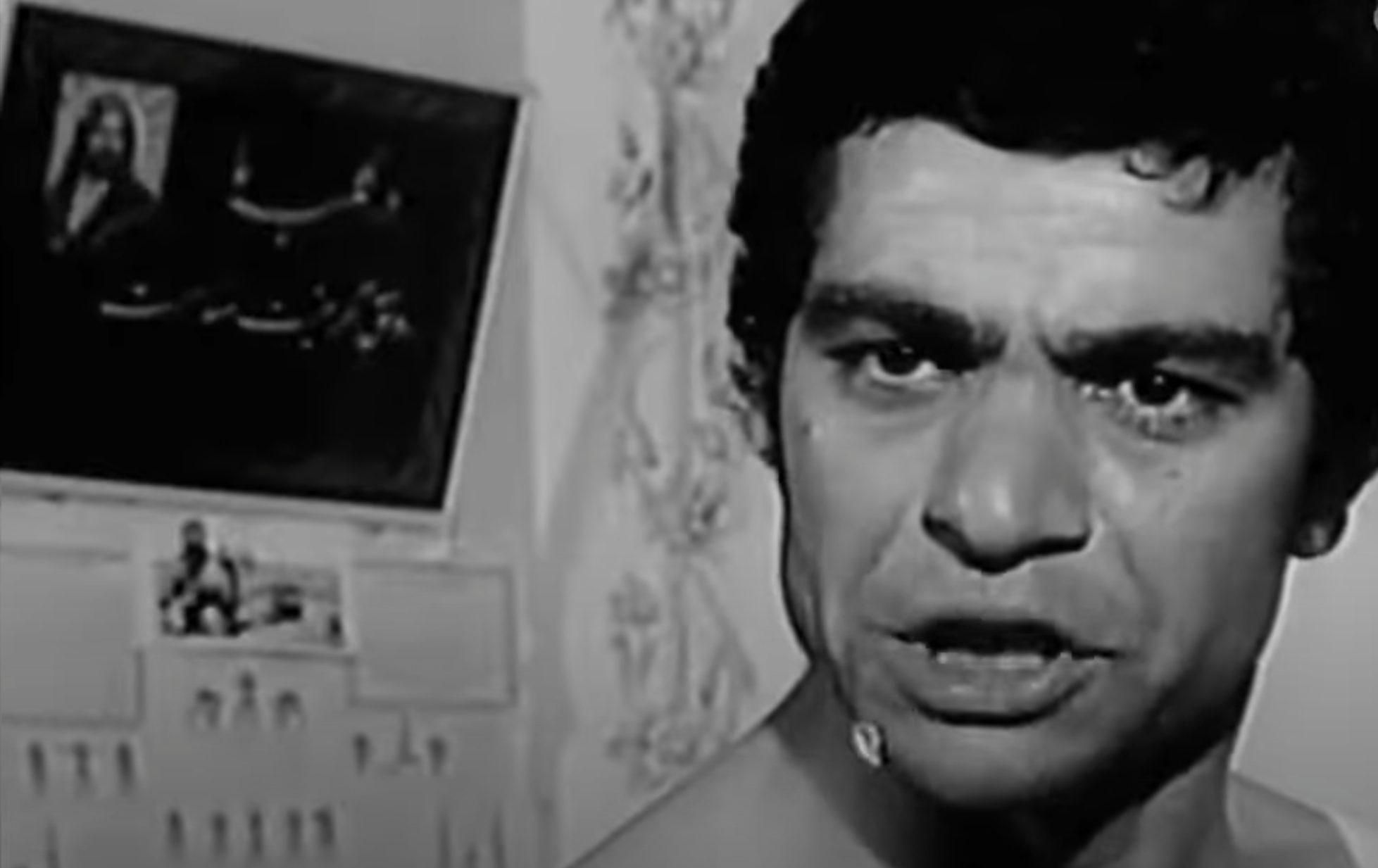
In the first phase, women did not have a significant role in narrating or even portraying the story. They mostly played a type-role rather than a named or relevant character. In pre-revolutionary cinema, a strong patriarchal culture influenced the traditional perspective towards women. However, in post-revolutionary cinema, the second phase of the portrayal of women was more influenced by the new regime’s discourse and the influence of their interpretation of Islamic laws where women had no agentic role in public space and society. Most of the new revolutionary filmmakers’ films, such as Tubah-yi Nasūh (1982), and most of the films in the Holy Defence genre (related to the Iran-Iraq war in the 1980s), such as Uqāb’hā (1984) and Kānī-Māngā (1987), were produced in this era. In the second phase, women perform complementary roles in films. Most of the pre-revolutionary films included here belong to this phase. Qaysar (1969), Ragbār (1972), and Būy-i Gandum (1977) are some of the many examples these films. Later, in post-revolutionary films, we have a transition from phase two to phase three. While women in many films such as Ādam Barfī (1994) or Mard-i ‛Avazī (1999) could belong to phase two, we can also start to find women in films such as Khāharān-i Gharīb (1994) and ‛Arūs (1990) in between phase two and three. Women play a more important role but are still adjunct to a man in the whole story.

The image of the independent woman takes form in the last years of the Pahlavi regime, but it faded out after the revolution and then gradually faded back in by the end of the first decade of the Islamic Republic. The role of Parvānah in Dar Imtidād-i Shab (1978), in pre-revolutionary cinema, and later Bānū in Bānū (1992), and Laylā in Laylā (1997) are examples of the presence of women in the foreground in the third phase. After the reform era (1997-2005), we can see more women in the center of the story in Iranian cinema. Future research should examine how this continued to develop once film production moved beyond the immediate shadow of the revolution.
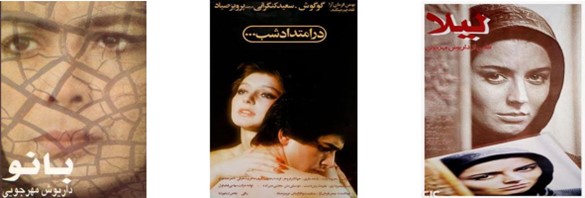
Figure 8 (from left to right): Film Posters for Bānū (The Lady, 1992), Dar Imtidād-i Shab (Along the Night, 1978), and Laylā (Leila, 1997).

The representation of women at home developed over time, through these three phases, and yet there are nuances that cannot be captured entirely by conceptualizing the progression of women in film in this way. The more central a woman’s role became (i.e., phase three), the more we would see her with a higher status at home, including challenging the patriarchal structure. However, women are not the head of their household in most of the films in both pre- and post-revolutionary cinema, similar to Iranian society between 1969 and 1999. Women would only be portrayed as the head of the household if they were single moms, grandmothers in the absence of grandfathers, or in comedy films. The latter perpetuates a comedic trope which frames women as cruel, irrational, and as bullies at home. This was a pattern in Iranian cinema. In Rūz-i Bā-shukūh (1989), the mayor tells his wife: “It is not home. You cannot do whatever you want.”51Rūz-i Bā-shukhūh, directed by Kīyānūsh ‛Ayyārī (Hidāyat Fīlm, 1988), 00:35:57 – 00:36:00. The duality between home and workspace becomes a duality between women’s power and men’s power in these kinds of films. Still, workspace is considered a masculine space versus home as a feminine one.

Protection by Men and From Men: Home, Homeland, and Woman

The image of the “good woman,” as discussed above, is a chaste and untouched woman. She should be protected by a man who is a father, brother, husband, son, or a faithful lover. Ghorbankarimi claims that women in pre-revolutionary films are defined by their relationships to these male figures.52Maryam Ghorbankarimi, A Colourful Presence: The Evolution of Women’s Representation in Iranian Cinema (Newcastle: Cambridge Scholars Publishing, 2015). It is evident that this representation of women continued after the revolution. Films that belong to the third phase described above are the only cases in the data where women are women without being connected to a man. This shows that in most films women are “someone” to be protected by men. Here, the concept of nāmūs in Iranian culture is useful. Nāmūs is a kind of a male honor that is mostly connected to the women of a man’s family.53Sivan Balslev, Iranian Masculinities: Gender and Sexuality in Late Qajar and Early Pahlavi ‎Iran (New York: Cambridge University Press, 2019).‎ Iranian culture also treats the homeland (vatan) as a part of one’s nāmūs. Man is in charge of protecting his nāmūs. The target of this protection is home, homeland, and women’s bodies. It makes women at home and people from the homeland a symbol of one’s nāmūs. In Ādam Barfī (1994), Isī Khān says: “Turks did not hit you. They hit an Iranian. One of my compatriots. Do you know what it means? It is like someone hit your nāmūs and you say nothing.”54Ādam Barfī, directed by Dāvūd Mīr-Bāqirī (The Artistic Sect of the Islamic Republic, 1995), 00:31:13 – 00:31:17. [Translated by the author.] The process of protecting women is not restricted to the story that a film narrates. The representation of women’s bodies, specifically in sexual scenes, was intertwined with covering bodies and avoiding nudity. This practice did not start with the revolutionary regime.55Ziba Mir-Hosseini, “Negotiating the Forbidden: On Women and Sexual Love in Iranian ‎Cinema,” Comparative Studies of South Asia, Africa and the Middle East 27, no. 3 ‎‎(2007): 673-79.‎ [56] See Negar Mottahedeh, “Iranian Cinema in the Twentieth Century: A Senso This approach, however, changed in the last decade of the Pahlavi regime. The influence of non-Iranian cinema, the image of modern woman, sexual liberation movements around the world, and the changing position of women as a more sexual object in films under the male gaze brought more nudity to Iranian cinema. Dar Imtidād-i Shab (1978) and Shāzdah Ihtijāb (1974) present some examples of this kind of nudity which became one of the main complaints of the new regime about pre-revolutionary cinema. Nudity and exposing women’s bodies was a symbol of depravity and corruption for the Islamic Republic. In both regimes’ perspective, woman’s body was a sexual object that either had to be exposed and perform sexually or had to be covered and protected. This perspective became the major approach of the decision-makers in post-revolutionary cinema in Iran.

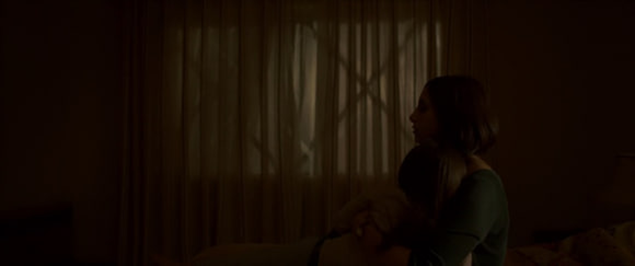
The woman’s body had to be protected by a man in the story of the film and from other men who may gaze upon or attack her body. The body and hair should also be protected from male spectators watching the film. This set of practices brought a new representation of women in private spaces, including their own home. Presenting women with a hijab in private spaces became a norm in post-revolutionary films.56See Negar Mottahedeh, “Iranian Cinema in the Twentieth Century: A Sensory History,” Iranian ‎Studies 42, no. 4 (2009): 529-548, and Maryam Ghorbankarimi, A Colourful Presence: The Evolution of Women’s Representation in Iranian Cinema (Newcastle: Cambridge Scholars Publishing, 2015). The image of women in private spaces such as a bedroom was eliminated and even if there was a scene about their presence in the bedroom, it would be dark, vague, and blurred (see figure 9).
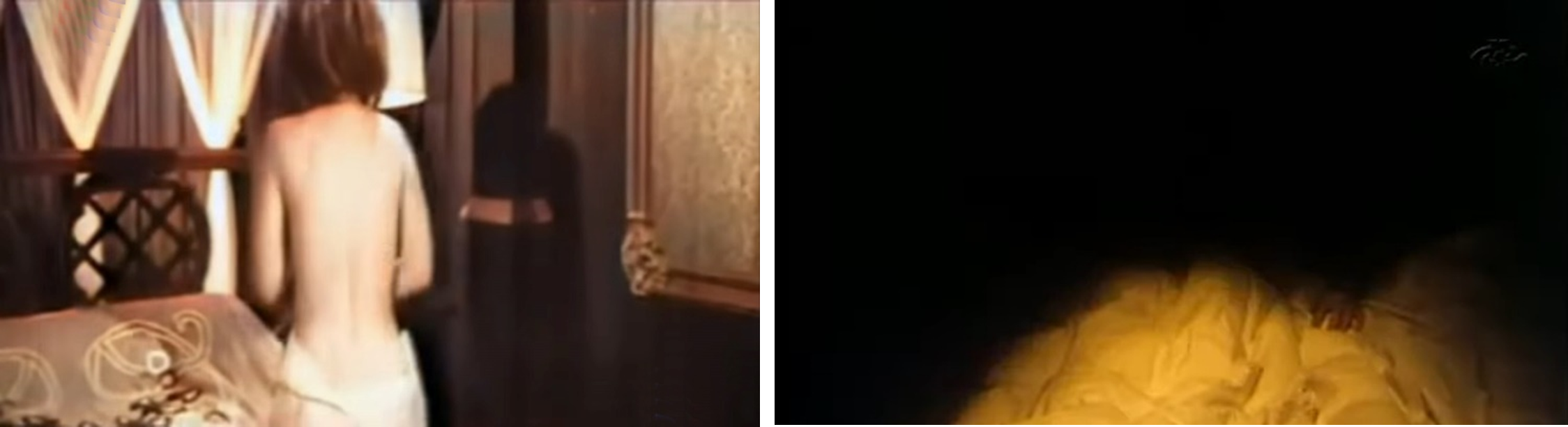
Figure 9 (from right to left): The Representation of Women in Bedrooms in Laylā (Leila, 1997), directed by Dāryūsh Mihrjū’ī (00:45:52). Mardī Az Junūb-i Shahr (A Man from the South of the City, 1970), directed by Sābir Rahbar (01:11:03).

In the scene from Laylā (1997), we can barely see the woman and space around her. The bedroom became a mysterious space where nothing could be seen vividly. On the other hand, in Mardī Az Junūb-i Shahr (1970), you find the woman in her bedroom with full lighting and even some nudity. The censorship restrictions after the revolution and their focus on women’s bodies and hijabs encouraged filmmakers to represent women in bedrooms in the way we see in Laylā. Women were to be covered and thus “more protected.”

Conclusion

The representation of home in cinema has an unbreakable connection with the representation of women. The gender roles assigned to women and the division of labor that we experienced through the centuries made this connection stronger. However, resistance against these socially constructed gender roles, changes in them, and changes in society influenced the cinematic representation of women at home. This article discussed how these relationships both changed and remained the same in the cinematic representation of women at home as the result of the 1979 Revolution in Iran. This study shows that the revolution influenced these changes, however, they did not happen necessarily in the way expected by the authorities. Some of the changes followed the ideology of the new regime, and some emerged as resistance to that ideology and brought different perspectives to women’s representation at home and outside the home.

Regarding women and their representation in cinema, Naficy argues that the leaders of the Islamic Republic, specifically Khomeini, saw Iranian cinema and its influences on society from the Injection Theory approach. In this view, a film could send a message that would affect the audience directly.57Naficy, “Veiled Voice and Vision in Iranian Cinema: The Evolution of Rakhshan ‎Banietemad’s,” 559-576, 560. Women and their “non-Islamic” representation in cinema could deceive and corrupt society, specifically men. He also believes that by relying on the Realist Illusionist theory, which claims a direct relationship between reality and its representation, the new regime cleansed post-revolutionary Iranian cinema to make the illusion of Islamic modesty the reality. This approach to cinema made women, their bodies, their interactions, and their presence the target of the cleansing process. The new regime’s laws made filmmakers portray the image of women in a way that they could show on the silver screen. Also, they had to manage the interactions between family members, neighbours, and friends to follow the modesty laws that were established by the regime. The main targets of these changes were women, as they were the first to be suspected of depraved and deviant influence. Filmmakers covered women in hijab even when they were at home and in their bedrooms, refrained from showing physical contact between women and men, including any male member of the family (such as father, brother, son, or husband), and made them body-less human beings while their bodies were the target of the male gaze and censorship. The representation of a woman’s body shifted from an exposed sexual object of the gaze to an object to hide and cover. Now, the home was not a private space for women anymore, but it was the extension of the public space where women had to follow the Islamic modesty laws, specifically in covering their bodies.

Marjān and The House is Black: First Two Films by Iranian Women Directors

By

Introduction

From the birth of the Iranian cinema in 1931 until the end of the Pahlavī era in 1979, women played many important roles as actresses, but as directors they only made four films: Marjān (1956), The House is Black (Khānah Siyāh Ast,1962), The Sealed Soil (Khāk-i Muhr-Shudah, 1978) and Maryam and Mani (Maryam va Mānī, 1979). The movie Marjān, which was produced eight years after the ‘rebirth’ of Iranian cinema, was the first feature film directed by a woman in the history of Iranian cinema.1The year ‘1931’ in which the first Iranian film was produced, is called the birth of the Iranian cinema. Nine Persian movies were produced from 1931 until 1937. But no Persian movies were produced from 1937 to 1948 (to know about the causes of this production discontinuance, See Musa Khamushi, “Causes of the Production discontinuance of Iranian Films During 1937–1948,” Quarterly Review of Film and Video (August 2019): 1-13. The year ‘1948’ in which Iranians started to produce movies again, is called the Rebirth of the Iranian Cinema. Shahlā Riyāhī (1927-2019), Marjān’s director, had previously acted in film and theatre. The House Is Black was directed by former-known poet Furūgh Farrukhzād (1934-67) in 1962. The House is Black was also the first Iranian documentary film directed by a woman. The Sealed Soil, produced in 1978, was the third movie directed by an Iranian woman. Marvā Nabīlī directed the movie in southwest of Iran in just six days with non-professional actors. Before the 1979 Revolution, she migrated to the United States, where her movie was screened in 1978. Thus, this film was never screened in Iran.2Hamīd Naficy, An Accented Cinema: Exilic and Diasporic Filmmaking (Princeton: Princeton University Press, 2001), 73. Maryam and Mani was the fourth film that was directed by a woman during the Pahlavī era. Kubrā Sa‛īdī, artistically known as Shahrzād directed the film in 1979. but it was not screened in Iran until two years after the 1979 Revolution.

This article considers the film Marjān to be highly significant, as it was the first film directed by a woman in Iran. It also regards The House Is Black as important, not only because it was the second such film, but also because it was the first documentary directed by an Iranian woman. In this article, the two aforementioned films are examined comparatively through a historical approach.

Literature Review

So far, no research has been devoted to a comparative study of the films directed by Shahlā Riyāhī and Furūgh Farrukhzād. However, there are some papers that have compared Furūgh’s poems or thoughts with those of others. For instance, Ruqayyah Bahādurī has studied the concept of mortality and immortality in Furūgh’s poems and one of Andrei Tarkovsky’s movies.3See Ruqayyah Bahādurī, “Mutālaʻah-yi tatbīqī-i mafhūm-i marg va jāvdānagī dar shiʻr va sīnimā (murid-i mutālaʻah: shiʻr-i Furūgh va sīnimā-yi Tārkūfskī),” Faslnāmah-ʼi ʻilmī-pazhūhishī-i Naqd-i Adabī, year 12, no. 47 (Fall 2019): 35-61. Additionally, in their joint-authored paper, Mahbud Fāzilī and Shahlā Jalālvandī have compared Furūgh’s views of men and gender in her poems with Sādiq Hidāyat’s view of women and gender in his works.4See Mahbud Fāzilī & Shahlā Jalālvandī, “Bāztāb-i nigāh bih jins-i mukhālif dar āsār-i Sādiq Hidāyat va Furūgh Farrukhzād,” Faslnāmah-ʼi Pazhūhishhā-yi Adabī, year 10, no. 42 (January 2014): 81-112. In another joint article, Zaynab Mīrzāyī and Fātimah ‛Itā’at also compare the ideas of Furūgh Farrukhzād and T.S. Eliot.5See Zaynab Mīrzāʼī & Fātimah Tāʿat, “Barrasī-i afkār-i mushtarak-i Furūgh Farrukhzād va T. S. Eliot,” The 10th International Conference on the Promotion of Persian Language and Literature [Tarvīj-i Zabān va Adab-i Fārsī], University of Muhaqqiq Ardabīlī, Ardabil, August 26-28, 2015, 1035-43. All of these papers have only studied Furūgh’s literary and poetic persona in comparison to others, despite her having directed a significant film (The House is Black), which should be studied comparatively with the notable film Marjān produced some years earlier.

In the case of Shahlā Riyāhī, there has been only one study about her, which was partly comparative. In “Motherhood and Coyness,” Bihzād ‛Ishqī analyzes and examines the figure of the Iranian mother in pre- and post-revolutionary cinema, focusing on the performances of Shahlā Riyāhī.6See Bihzād ʻIshqī, “Nāzvāragī va Mādarānagī,” Majallah-ʼi Fīlm (January 21, 2020): 17-18. In this article, in addition to Shahlā, ‛Ishqī also mentions Sūsan Taslīmī, Nādirah, Īrān Daftarī, and some other actresses before and after the 1979 Revolution. Apart from this article, there are some books that generally deal with Riyāhī and her works. For instance, Gulnūsh Umīd and Jamāl Umīd mention her theatre, film, and television performances in their joint book.7Gulnūsh Umīd va Jamāl Umīd, Sīnimāgarān-i zan (Tehran: Nigāh, 2010), 148-149. The same information is provided by Murtazā Sayyid Muhammadī in his book about Iranian directors.8See Sayyid Murtaz̤ā Sayyid Muhammadī, Farhang-i kārgardān-hā-yi sīnimā-yi Īrān, 1309–1377 (Tehran: Sīmrū, 1999), 462-464.

My article aims to fill a gap in Iranian cinema research by comparing two seminal cinematic works by Furūgh Farrukhzād and Shahlā Riyāhī.

Marjān and The House Is Black

Perhaps Shahlā Riyāhī did not initially consider directing a film when she received the screenplay of Marjān from Manūchihr Kaymarām, a friend of both Shahlā and her husband, Ismā‛īl Riyāhī. Kaymarām had given her the screenplay to review and provide feedback. Shahlā liked the screenplay and particularly the leading role of its girl.9Hasan Sharīfī, Nīm qarn khātirāt-i sīnimā-yi Īrān, 1st ed. (Tehran: Pashūtan, 2003), 125.

Table1: Marjān

Director

Shahlā Riyāhī

Producer

Shahlā Riyāhī

Scriptwriter

Manūchihr Kaymarām

Actors

Muhammad ‛Alī Ja‛farī, Shahlā Riyāhī, Ahmad Qadakchiyān

Release Year

1956

Running Time

90 minutes

The plot of the film revolves around a Gypsy tribe that sets up camp on the outskirts of a village. Marjān’s father (Ahmad Qadakchiyān) who is a member of the tribe, steals sheep under the pressure of poverty and hunger. Hamīd (Muhammad ‛Alī Ja‛farī), the young teacher of the school, arrests and imprisons him in one of the school rooms. Marjān (Shahlā Riyāhī), while visiting her father who is imprisoned in the school, becomes acquainted with the teacher, and this leads to a mutual fondness between them. Hamīd releases the father and takes him into his own care. The following year Hamīd has to move to a city because of a formal ordinance. Marjān and her father return to their tribe too. Marjān who is fond of Hamīd, leaves her tribe to go to the city in order to find Hamīd; but she fails to do so. Marjān finds a job in a hospital as a nurse. Long after, Hamīd, now married, brings her wife to the same hospital for childbirth. Seeing them, Marjān decides to kill his wife; but she changes her mind and commits suicide by injecting the toxin.10Ghulām Haydarī, Fīlmshinākht-i Īrān, 1309–1340 (Tehran: Daftar-i Pazhūhishhā-yi Farhangī, 1994), 129. Shortly after the release of the movie Marjān, scenes of dances and singing of Mahvash (A famous dancer in Pahlavī time) were added to it and the end of the film also changed. In the new ending, she doesn’t commit suicide and returns to her tribe!11Ahmad Amīnī, Sad film-i tārīkh-i sīnimā-yi Īrān (Tehran: Muʼassasah-yi Farhangī-Hunarī-i Shaydā, 1993), 36.

Figure 1: The names Yāsamīn and Mahvash are listed as the singers in the film Marjān.

These changes could attract more audience to movie theaters. Including a performance by a well-known singer like Mahvash, along with altering the film’s tragic ending, might have contributed to drawing larger audiences to theaters. The film Marjān had a deeply sentimental and tender mood, and despite its somewhat weak structure, it featured remarkable and valuable elements as the first directing effort by a female filmmaker.12Muhsin Sayf, Kārgardānān-i sīnimā-yi Īrān az Ugāniyāns tā imruz (az 1309 tā 1376), vol. 1, 1st ed. (Tehran: Kānūn-i Farhangī-Hunarī-i Īsārgārān, 1998), 523-525.

Six years after the movie Marjān, another movie titled The House Is Black was directed by another woman in a very different atmosphere. The House Is Black was not a feature film; but a 22-minute documentary one. The idea to make a movie for the lepers came from Ibrāhīm Gulistān. It all started when at the request of Kayhān newspaper, one of the Gulistān Film Studio’s members made a short news film about Lepers of Mashhad. This motivated Gulistān to think about making a good film about them. Via one of his friends, Gulistān made a connection to board of directors of ‘Association of Helpers to Lepers’ to consult about making such a movie. After his agreement with the board, Furūgh traveled to Tabriz for a few days in 1962 to investigate a leper colony in the region and its inhabitants, in order to make the necessary arrangements for her film.

Table 2: The House Is Black

Director

Furūgh Farrukhzād

Producer

Ibrāhīm Gulistān

Writer

Furūgh Farrukhzād

Editor

Furūgh Farrukhzād

Release Year

1962

Running Time

22 minutes

A few months later, in the same year, Furūgh traveled again to Tabriz, accompanied by three people, to spend time among the lepers. She approached the outcast lepers there and was able to gain their trust. From then on, they easily stood in front of the camera and she was able to return to Tehran after two weeks of hard working.13Pūrān Farrukhzād, Kārnamah-yi zanān-i kārā-yi Īrān (az dīrūz tā imrūz), 1st ed. (Tehran: Nashr-i Qatrah, 2002), 866. In addition to directing the film, she was the writer and the editor too.14Jamāl Umīd, Tārīkh-i sīnimā-yi Īrān, 1279–1357 (Tehran: Rawzanah, 1995), 866.

Figure 2: Furūgh Farrukhzād directing The House Is Black.

The film The House Is Black featured a text recited by Gulistān, with much of it delivered poetically by Furūgh Farrukhzād. Furūgh mostly used Book of Job, Psalms and Book of Jeremiah to write her film’s text. All the three books are among the thirty-nine books of the Old Testament.15Muhammad Tahāmī-Nizhād, Sīnimā-yi mustand-i Īrān: ʻarsah-yi tafāvut-hā (Tehran: Surūsh, 2002), 57. She recited the film’s text in a very, pleasant and passionate intonation.

Shahlā Riyāhī and Furūgh Farrukhzād

The movie Marjān (1956) was directed by Shahlā Riyāhī. Riyāhī was born in 1926 with the original name of Qudrat al-Zamān Vafādūst. She began acting in theater productions in 1944—her first role being in the play Siyāsat-i Hārūn al-Rashīd—at a time when women in acting faced significant challenges. Continuing her artistic path, she gained fame as one of the most prominent theatre actresses. Then, at the invitation of Mu‛iz al-Dīn Fikrī (one of the founders of the Iranian cinema), Shahlā for the first time acted in a feature film titled Golden Dreams (Khvāb-hā-yi Talāʼī, 1951).16Muhsin Sayf, Kārgardānān-i sīnimā-yi Īrān az Ugāniyāns tā imruz (az 1309 tā 1376), vol. 1, 1st ed. (Tehran: Kānūn-i Farhangī-Hunarī-i Īsārgārān, 1998), 523. Acting in the movies At a Glance (Yak Nigāh, 1952), The Thief of Love (Duzd-i ‛Ishq, 1952), Halfway through Life (Nīmah-rāh-i Zindagī, 1953), The Sinner (Gunāhkār, 1953), The Girl on the Way (Dukhtar-i Sar-i Rāhī, 1953), The Shepherd Girl (Dukhtar-i Chūpān, 1953), The Familiar Face (Chihrah-yi Āshnā, 1952), For You (Barāyi Tū, 1955) and Mother’s Kiss (Būsah-yi Mādar, 1956), Shahlā affirmed her place in Iranian cinema. Prior to directing the film Marjān, Shahlā had spent several years acting in Iranian cinema and had occasionally directed theatrical productions. Having acted in films herself, she was practically familiar with the nuances of performance. For instance, she had a basic understanding of how to work with cameras, coordinate camera movement with actors’ movements, and utilize the effects of lighting and music. Thus, when Shahlā directed the film Marjān, she was acquainted with the know-how of directing, without having had any training in the field.17Hasan Sharīfī, Nīm qarn khātirāt-i sīnimā-yi Īrān, 1st ed. (Tehran: Pashūtan, 2003), 124-125. Nevertheless, she was courageous enough to direct a feature film as a woman at a time when Iranian cinema had no precedent for female filmmakers in such roles.

On the other hand, The House is Black (1962) was directed by Furūgh Farrukhzād who has been well-known in Iran as a poet rather than an actress or a director. Furūgh al-Zamān Farrukhzād Arākī known as Furūgh Farrukhzād was one of the most beloved female poets of contemporary Iran, born in December 1934 to a father from Tafrish and a mother from Kashan.18Pūrān Farrukhzād, Kārnamah-yi zanān-i kārā-yi Īrān (az dīrūz tā imrūz), 1st ed. (Tehran: Nashr-i Qatrah, 2002), 599.

Figure 3: Portrait of Furūgh Farrukhzād.

Furūgh grew up in a strict family with a military father, but also in a cultured environment that valued education and reading.19Nāsir Ṣaffāriyān, dir. Kasī kih misl-i hīch kas nīst: darbārah-yi Furūgh Farrukhzād, (Tehran, 2000, 63 minutes), 00:00:25-00:00:34. She became so famous that, by 2013, more than 20 different translations of her poems had been published in the United States alone.20Parvīz Nāziryān, Guzarī bar zamān (Los Angeles: Ketab Corp, 2013), 57. After her early poetic life in which she composed a collection of poems such as Captive (1952), Wall (1956) and Sin (1975), she found the opportunity to get acquainted with Ibrāhīm Gulistān who was very talented in discovering different people’s abilities. For example, he employed Akhavān Sālis as a sound mixer in his studio; Akhavān was a prominent poet of the time.21Ārash Sanjābī, dir. Āqā-yi Gulistān (Tehran, 2017, 65 minutes), 00:00:51-00:00:52. Observing Furūgh’s interest in cinema and its affairs, Gulistān directed her talent to a correct way. He sent her to England to educate in the field of film editing. Being trained there for some months, Furūgh came back to Iran to improve her knowledge in practice too. She traveled to Khūzistān in company of Gulistān and some other members of the Studio to cooperate with them as an assistant director and an editor in making some documentary movies until 1960. In 1961, she edited the documentary A Fire (Yak Ātash, 1961) directed by Gulistān. Later that year, she traveled to England to study the technical aspects of film production.22ʻAbbās Bahārlū, Sad chihrah-yi sīnimā-yi Īrān (Tehran: Nashr-i Qatrah, 2002), 80. Thus, Furūgh became a film editor at Gulistān Film Studio, although she also undertook various other responsibilities.23Ārash Sanjābī, dir. Āqā-yi Gulistān (Tehran, 2017, 65 minutes), 00:00:51-00:00:52.

With two educational trips to England in the field of film production, practical experience as an assistant director on several documentary films, and substantial expertise in film editing, Furūgh was in a stronger position than Shahlā to direct a film. Although Shahlā had much more experience in acting when she started to direct Marjān, She had only some practical experience with directing, without having attended any formal educational classes, or even having had at least any experience as an assistant director in cinema.24Hasan Sharīfī, Nīm qarn khātirāt-i sīnimā-yi Īrān, 1st ed. (Tehran: Pashūtan, 2003), 124-125.

Reflection in the Press

Following its screening in various cinemas, Marjān became the first film to provoke a stark confrontation between journalists and artists with opposing views. This event, however, did not work in the film’s favor.25Jamāl Umīd, Tārīkh-i sīnimā-yi Īrān, 1279–1357 (Tehran: Rawzanah, 1995), 282. The first criticism about the movie was written by Parvīz Nāziriyān, one of the famous critics of the time. Nāziriyān sharply criticized the film, considering the omission of the director’s name on its poster to be a major weakness.26Ahmad Amīnī, Sad film-i tārīkh-i sīnimā-yi Īrān (Tehran: Muʼassasah-yi Farhangī-Hunarī-i Shaydā, 1993), 36. Nāziriyān, seemingly trying to provoke a press uproar, later claimed that, according to his inquiry, a highly positive article about Marjān, published in the magazine Bamshād, had been written by the film’s director, Shahlā Riyāhī. This claim led to a war between Nāziriyān and Shahlā Riyāhī.27Ahmad Amīnī, Sad film-i tārīkh-i sīnimā-yi Īrān (Tehran: Muʼassasah-yi Farhangī-Hunarī-i Shaydā, 1993), 36. Shahlā decided to respond to his claims, but the newspapers refused to publish her statement. As a result, she chose to publish her response in an advertising column.28Jamāl Umīd, Tārīkh-i sīnimā-yi Īrān, 1279–1357 (Tehran: Rawzanah, 1995), 280. The press disputes surrounding the film continued, and another critic of the time, Bābak Sāsān, also wrote a negative review of the movie.29Ahmad Amīnī, Sad film-i tārīkh-i sīnimā-yi Īrān (Tehran: Muʼassasah-yi Farhangī-Hunarī-i Shaydā, 1993), 36. However, some newspapers like Ittilā‛āt, Dunyā-yi Jadīd, Tihrān Musavvar, Bamshād, Pust-i Tihrān, Kayhān, Āshuftah and Khandanīhā praised the movie on several occasions.30“Marjān,” Ittilā‛āt, year 31, no. 9127 (September 27, 1956), 13. It is hard to believe that all these publications wrongly supported Shahlā and praised her film. If she had been influential enough to publish a positive piece about her film in Bamshād, as Nāziriyān claimed, she would not have needed to use an advertising column to respond. Instead, she could have published her response in one of the aforementioned newspapers.

Figure 4: Film still of Shahlā Riyāhī in Marjān.

It seemed that these press clashes were more related to those who disliked Muhammad ‛Alī Ja‛farī (the film’s first actor) than to the film itself. When Ja‛farī, a popular theater actor, entered the film industry and took on his first acting role in Marjān (which, as expected for a first film performance, had some flaws), he unknowingly gave his rivals an opportunity to criticize him as much as they could. In this turbulent situation, Hūshang Kāvūsī, a cinema critic and head of the Iranian Cinema Writers Association, also criticized the movie, making the film’s situation even more desperate.31Ahmad Amīnī, Sad film-i tārīkh-i sīnimā-yi Īrān (Tehran: Muʼassasah-yi Farhangī-Hunarī-i Shaydā, 1993), 36. The screening of the movie began on September 6, 1956, at Diana Cinema and ended on October 2, 1956, at Khurshīd Cinema.32“Ākharīn taghyīrāt dar barnāmah-yi sīnimā-hā,” Ittilā‛āt (September 6, 1956): 13; “Ākharīn taghyīrāt dar barnāmah-yi sīnimā-hā,” Ittilā‛āt (October 2, 1956): 15. That is to say, Marjān was screened for approximately 45 days (though not continuously) in theaters. Although the movie performed well at first, its sales gradually declined. Overall, Marjān wasn’t very successful at the box office.33Gīsū Faghfūrī, Sarguzasht-i sīnimā dar Īrān (Tehran: Nashr-i Ufuq, 2014), 40. One of the factors behind the low sales can be attributed to the dispute between critics and artists in the press. In this way, the movie became a victim of the conflicts among some critics and artists, so that Shahlā, due to her frustration, negative experience with critics’ reviews, and perhaps her fragile spirit, did not appear in any other films for four years and never directed another film in her life.

The situation was completely different for The House Is Black. The movie was screened at Sa‛dī Cinema in Tehran, and like other films, it received both positive and negative opinions.34Muhammad Tahāmī-Nizhād, Sīnimā-yi mustand-i Īrān: ʻarsah-yi tafāvut-hā (Tehran: Surūsh, 2002), 55. Of course, some had only negative views, seeing the movie as a sort of exploitation of the lepers, with the filmmaker benefiting more than anyone else.35Muhammad Tangistānī, Shahrvand-i jahān (London: H & S Media, 2015), 145. But there was no backlash like with Marjān, and overall, the positive opinions about the movie outweighed the negative ones. Although Hamīd Naficy first pointed out the film’s defects, he was also among those who praised it and generally supported it.36Hamid Naficy, Fīlm-i mustand, vol. 2 (Tehran: Dānishgāh-i Āzād-i Īrān, 1979), 344. Kāvūsī, who had previously criticized Marjān, also commented on The House Is Black. In a relatively long article, he discussed both the positive and negative aspects of the film from his perspective, and ultimately ended by praising Furūgh’s film.37Jamāl Umīd, Tārīkh-i sīnimā-yi Īrān, 1279–1357 (Tehran: Rawzanah, 1995), 846-847. It’s possible that, after six years since Marjān’s release, critics changed the way they judged another film directed by a woman. Perhaps critics like Kāvūsī, who had seen the impact of their criticism on Marjān, took a different approach this time.

Financial Support

One of the factors that led to Shahlā’s failure in her first directing experience, and her subsequent decision not to pursue it again, was the insufficient financial and economic support. According to her words, the movie Marjān was not produced with enough funds and was made with the financial help of one of her husband’s friends. The movie was produced with a few actors and mostly in free spaces among the nomads who commuted near the city of Tehran, which consequently lowered the transportation costs for the film crew. The classroom scene was filmed in one of the Iran Film Studio’s rooms. The scenes of the hospital and the gendarmerie were filmed at real locations. During the movie’s screening, while the box office performance was not as good as she had expected, some scenes of song and dance were added to the film in an attempt to recover the main investment. However, the film’s financial problem was not resolved with these scenes, and after its failure at the box office, Shahlā sold Marjān to a film company to compensate for her financial loss.38Hasan Sharīfī, Nīm qarn khātirāt-i sīnimā-yi Īrān, 1st ed. (Tehran: Pashūtan, 2003), 127-128.

On the other hand, Furūgh faced no financial problems with her movie The House Is Black, thanks to the Gulistān Film Studio and its financial backer, the Iranian Oil Consortium. Before entering the film industry, Ibrāhīm Gulistān was a photographer and a writer. He began his cooperation with the Iranian Oil Consortium in 1953, and with its financial support, he was able to establish the ‘Gulistān Film Studio,’ whose equipment remained in use until 1965.39Jamāl Umīd, Tārīkh-i sīnimā-yi Īrān, 1279–1357 (Tehran: Rawzanah, 1995), 842-843. In terms of film production equipment, Gulistān Film Studio was clearly head and shoulders above all other filmmaking studios in Iran. Most of the films produced by his studio were commissioned by the Iranian oil companies.40ʻAbbās Bahārlū, Furūgh Farrukhzād va sīnimā (Tehran: Nashr-i Qatrah, 2017), 71-72. Thus, significant sums were injected into the studio. Furthermore, Gulistān knew how to secure funding for film production. Since making a movie like The House Is Black was expensive, Gulistān proposed that the ‘Association of Helpers to Lepers’ cover half the cost, with Gulistān Film Studio covering the other half, provided that the studio would have complete freedom in how to make the film with a humane message. The film cost 108,000 tomans, of which 50,000 tomans was paid by the ‘Association of Helpers to Lepers,’ and the rest was covered by Gulistān.41Bihrūz Jalālī Pindarī, ed., Furūgh Farrukhzād: Jādū-yi jāvdānagī: shāmil-i nāmah-hā, musāhibah-hā, maqālāt, dāstānvārah-hā va khātirāt-i Furūgh (Tehran: Murvārīd, 2015), 234. Ibrāhīm Gulistān had settled the financial aspect of The House Is Black before Furūgh began making it.42Bihrūz Jalālī Pindarī, ed., Furūgh Farrukhzād: Jādū-yi jāvdānagī: shāmil-i nāmah-hā, musāhibah-hā, maqālāt, dāstānvārah-hā va khātirāt-i Furūgh (Tehran: Murvārīd, 2015), 234. Gulistān Film Studio financially supported Furūgh’s film, while Āriyā Film, the studio that produced Marjān, was unable to do so for Shahlā’s film.43Ghulām Haydarī, Fīlmshinākht-i Īrān, 1309–1340 (Tehran: Daftar-i Pazhūhishhā-yi Farhangī, 1994), 129.

Honors and awards

In the year Marjān was produced, there were no film festivals in Iran to select the best films, and Iranian movies had not yet participated in foreign film festivals. Therefore, Marjān received no awards or honors. However, it is worth mentioning that the newspaper Ittilā‛āt ranked films as excellent, very good, good, or medium based on the number of stars.44“Arzish-i har yak az film-hā,” Ittilā‛āt, year 31, no. 9123 (September 22, 1956): 9.

Table 3: Rank of the Movies

Number of Stars

Its meaning

1

Medium

2

Good

3

Very Good

4

Excellent

The movie Marjān was given a rating of two stars, indicating that it was considered a ‘good’ film according to the newspaper’s ranking system. According to Ittilā‛āt, Marjān had an ordinary screenplay that was somewhat better than those of some other Iranian films, but it did not demonstrate any significant superiority. The film’s strengths lay mainly in its cinematography and, to some extent, in the lead performances by Shahlā Riyāhī and Muhammad ‛Alī Ja‛farī.45“Tirās-i Sīnimā Diyānā – Sīnimā Khurshīd-i Naw,” Ittilā‛āt, year 31, no. 9116 (September 13, 1956): 9. Of course, in the early days of the movie’s screening, many newspapers responded differently. Ittilā‛āt (the same newspaper mentioned above), along with other journals such as Dunyā-yi Jadīd, Tihrān Musavvar, Bamshād, Pust-i Tihrān, Kayhān, Āshuftah, and Khāndanīhā, welcomed the film and highlighted its positive features.46“Marjān,” Ittilā‛āt, year 31, no. 9127 (September 27, 1956): 13.

Around sixty years after the production of Marjān, Shahlā Riyāhī was honored at a ceremony. She was invited, and some scenes from Marjān were shown to the audience during the public screening of the film Night Shift (Shīft-i Shab, 2015), directed by Nīkī Karīmī, in 2015. Karīmī praised Shahlā Riyāhī as Iran’s first female director and described her decision to direct a film in 1956 as a taboo-breaking act at the time.47See Mustafā Imāmī’s eight-minute report on the public screening ceremony of the film Night Shift. However, Shahlā—who was 88 years old at the time of the ceremony and suffering from Alzheimer’s disease—was not fully aware of the event (perhaps a little too late to be honored as the first female director). Nevertheless, although the film Marjān received no official awards, it deserves to be remembered with honor as the starting point for women directing films in Iran.

On the other hand, The House Is Black was accepted into the 16th Cannes Film Festival in 1963. However, one day before the festival began, Ibrāhīm Gulistān sent a telegram to the festival’s secretariat, withdrawing the film from competition. He never explained his reasons for the withdrawal.48Jamāl Umīd, Tārīkh-i sīnimā-yi Īrān, 1279–1357 (Tehran: Rawzanah, 1995), 866. Subsequently, The House Is Black participated in a German documentary film festival and won the festival’s grand prize. This festival was dedicated exclusively to documentaries that had not participated in other festivals.49Bihrūz Jalālī Pindarī, ed., Furūgh Farrukhzād: Jādū-yi jāvdānagī: shāmil-i nāmah-hā, musāhibah-hā, maqālāt, dāstānvārah-hā va khātirāt-i Furūgh (Tehran: Murvārīd, 2015), 232-233. In addition to this award, news of another award for the movie at the International Short Film Festival Oberhausen was published in newspapers in 1963.50Pūrān Farrukhzād, Kārnamah-yi zanān-i kārā-yi Īrān (az dīrūz tā imrūz), 1st ed. (Tehran: Nashr-i Qatrah, 2002), 602. The film won the grand prize among sixty-five of the best documentary films from around the world at the festival.51Bihrūz Jalālī Pindarī, ed., Furūgh Farrukhzād: Jādū-yi jāvdānagī: shāmil-i nāmah-hā, musāhibah-hā, maqālāt, dāstānvārah-hā va khātirāt-i Furūgh (Tehran: Murvārīd, 2015), 233. The movie The House Is Black gained such widespread fame outside Iran that, after Furūgh’s death, the organizers of the 14th Oberhausen Short Film Festival (held from March 31 to April 6, 1968) named the grand prize for documentary films the “Forough Farrokhzad Memorial. Prize.” The festival’s slogan was taken from the opening lines of the movie;52ʻAbbās Bahārlū, Furūgh Farrukhzād va sīnimā (Tehran: Nashr-i Qatrah, 2017), 58. recited in Gulistān’s voice: “There is no shortage of ugliness in the world. If man closed his eyes to it, there would be even more. But man is a problem solver.”53Furūgh Farrukhzād, dir. The House is Black (Tehran: Gulistān Film Studio, 1962, 22 minutes), 00:00:01. Since then, The House Is Black has been frequently screened at various foreign film festivals, such as the Chicago International Film Festival in 1997, and has been broadcast on television in many different countries as well.54ʻAbbās Bahārlū, Furūgh Farrukhzād va sīnimā (Tehran: Nashr-i Qatrah, 2017), 58.

Conclusion

Shahlā Riyāhī made her film only eight years after the ‘rebirth’ of Iranian cinema—a time when the industry was still grappling with major limitations. Her achievement, given these circumstances, is especially noteworthy. However, critics’ negative reactions—and perhaps Shahlā’s fragile morale—led to an unfortunate outcome for Iranian cinema: the end of her career as a director. The world of Iranian cinema can be grateful that Shahlā Riyāhī eventually returned to acting, after having completely withdrawn from the industry for four years. On the other hand, Furūgh Farrukhzād was a young and gifted woman whose presence was a true gift to Iranian cinema—thanks in large part to the pivotal role played by the Gulistān Film Studio. By participating in filmmaking and film editing courses in England, Furūgh Farrukhzād laid a strong foundation for her career in cinema. Although The House Is Black was a documentary rather than a feature film, it marked an impressive beginning. In addition to being a pioneering documentary in the context of women’s filmmaking, the film—through its international recognition—also served as an inspiring model for women aspiring to direct, even in the realm of feature films, during the Pahlavī era. As Furūgh Farrukhzād clearly stated in a 1964 interview, she was eager to direct additional films as well.55Bihrūz Jalālī Pindarī, ed., Furūgh Farrukhzād: Jādū-yi jāvdānagī: shāmil-i nāmah-hā, musāhibah-hā, maqālāt, dāstānvārah-hā va khātirāt-i Furūgh (Tehran: Murvārīd, 2015), 241. However, a sudden and tragic event, which led to her untimely death on February 13, 1967, at the age of 32, brought an abrupt end to her cinematic career. Despite the significant contributions of these two women to Iranian cinema through their making of Marjān and The House Is Black, it seemed that Iranian women were generally not inclined to pursue filmmaking.

The financial aspect of film production was certainly an important factor. Furūgh Farrukhzād’s notable work was created when financial arrangements had already been made. At that time in Iranian cinema, it was uncommon to find all the necessary elements—such as financial support, motivation, interest, and knowledge of film directing—in a woman wishing to direct a film. Many male directors of the era also lacked these resources. It was only in the final years of the Pahlavī era that two other women, Marvā Nabīlī and Kubrā Sa‛īdī (Shahrzād), directed the films The Sealed Soil and Maryam and Mani, respectively. While this paper does not address the works of Nabīlī and Shahrzād, they deserve a separate study to explore their films and careers.


Women’s Cinema in Post-Revolutionary Iran

By

Iranian women’s cinema is a theater of activism, audacity, and determination and women have played numerous important roles in cinematic production since its coming to Iran at the beginning of the twentieth century. However, after the Iranian Revolution of 1979, the role of women in cinema has been divided between pre-revolution and post-revolution. In the decades since the revolution, however, women have continued to till the landscape of Iranian cinema despite the considerable and varied social stigmas restricting their movements and activities. Indeed, in the face of these restrictions, the increase in the number of women engaged in film and filmmaking in Iran has been staggering, with hundreds of movies in Iran having women behind the camera as well as in front of it, even with regulations and rules that restrict their presence and their visual portrayal on screen. From the beginning of the coming of cinema to Iran until today, over 120 films have been made by women, and the number is growing. Today, many celebrated women filmmakers make films in Iran alongside their male counterparts. These include Rakhshān Banī-I‛timād, Tahmīnah Mīlānī, Pūrān Dirakhshāndah, Marzīyah Burūmand, Nargis Ābyār, Faryāl Bihzād, Samīra and Hanā Makhmalbāf, Manīzhah Hikmat, Marzīyah Mishkīnī, Yasmīn Malik Nasr, Maryam Shāhrīyār, Jahāndukht Khādim, Munā Zand Haghīghī, Maryam Bizhānī, Mihrnāz Muhammādī, Tīnā Pākravān, Āydā Panāhandah. Iranian women living outside of Iran have also continued to create internationally acclaimed films. Marjān Sātrāpī, Maryam Kishāvarz, Līlī Amīnpūr, Zar Amīr Ibrāhīmī, and Sierra Ulrich, amongst others, have succeeded in making films which have been able to flout or otherwise differently resist the restrictions in Iran.
From the very outset of cinema in Iran, women have also exerted their agency on screen through acting where they have represented a whole array of personalities and characters, portraying a diverse and variegated range of women. In the 1970’s, women gradually began to also establish themselves as directors and writers in Iranian cinema. In film, we have directors such as Kubrā Sa‛īdī, and in documentary, we can name Furūgh Farrukhzād, but the role of women in Iranian cinema changed dramatically since the Islamic revolution. Since its establishment in 1979, the Islamic Regime has pursued policies intended to project the image of the ideal Islamic woman in media. In reality, however, the presence of women in Iranian cinema diverges greatly from the presumed defined role of an ideal woman who is supposed to be najīb (chaste), coy, obedient, subservient, motherly, sacrificial, and all-giving for the welfare of her family and society.

However, the reality is more complicated than the regime’s pre-defined, simplified designations, and with the presence of more women in Iranian cinema, the general stereotypes of women who are subservient to male authority no longer rings true. In this way, we can understand Iranian cinema as a paradoxical environment with a constantly changing dynamic in which women have been working and collaborating in films in Iran since the beginning of the revolution and long before. As Janet Afary has maintained, “if the legal arena has not given women much room for maneuver, the realm of cultural representation, particularly cinematic production by women, has provided a fertile ground for self-expression and resistance.”1Janet Afary, “Guest Editor’s Note,” Iranian Studies 42, no. 1 (2009): 3. Thus, films on women and by women in the Islamic Republic represent a completely alternate and distinct image from the desired—or demanded—ideal picture of Iranian women. Women’s cinema is diverse and variegated, sometimes subversive and politically provocative, and largely portrays the resilience of women in Iranian society and related diasporas.

In this article, I take stock of this diversity, inclusiveness, and women’s activism for social justice by examining the state of Iranian women’s cinema from after the revolution up to the recent Women, Life, Freedom movement which began in Iran in 2022. I do this by looking into how women have utilized cinematic expression to pose important social critiques in an otherwise repressive environment. I first track some of the gender-based rules and restrictions emplaced upon women since the Iranian revolution in 1979, and then turn to how women have responded to these limitations through film. I round off the article with a brief examination of how Iranian women both inside and outside of Iran are forging a shared space of international cooperation via global cinema.

State Policies and Women after the 1979 Revolution

State policies put in place after the establishment of the Islamic Republic of Iran in 1979 dictated certain specific and restrictive roles and related images for women to be adhered to. From the very outset of the revolution, the Ministry of Culture and Islamic Guidance (MCIG) attempted to define the role of women in the new regime’s ideological understanding of cinema specifically and to regulate cultural policies in the Islamic Republic more broadly. As Negar Mottahedeh argues, “Attached to traditional Islamic values and confined by the enforcement of modesty laws, women’s bodies became subject to a system of regulations that aimed to fabricate the modesty of Iranian women into the hallmark of the new Shi’ite nation.”2Negar Mottahedeh, “Iranian Cinema in the Twentieth Century: A Sensory History,” Iranian Studies 42, no. 4 (2009): 534. These regulatory fabrications have had a continued impact on women in Iranian society and quite specifically in both the depictions of women in films and films made by women in Iranian cinema.

Many of these policies have been arbitrarily imposed and it is no different in Iranian cinema. Indeed, the establishment of an Islamic dress code for women, restrictions on touching of the opposite sex, the forbiddance of displays of affection on screen, and obedience to other Islamic regulations have not been uniformly enforced on the Iranian silver screen. As Hamid Naficy asserts about these filmmaking policies in Iran, “This situation has not remained static. Filmmakers, the film industry, film critics, governmental agencies, film financiers, and audiences have all been engaged in a multifaceted discourse and negotiation on the status of cinema as a cultural institution and an economical enterprise.” Alongside this dynamic negotiation of restrictions, he further describes how “Women and their representation on the screen were major sources of contention,” and the “woman question” continues to “dog cultural productions under the Islamic Republic” and “resurfaces with every social crisis.”3Hamid Naficy, “Iranian Cinema Under the Islamic Republic,” American Anthropologist 97, no. 3 (1995): 4.

Relatedly in 1997 the Supreme Leader, ‛Alī Khāminah’ī (reigning as Supreme Leader since 1989), identified “women’s issues and families as a priority for the country.”4This and all following translations in this article are my own. While he admitted that the state acknowledged that women constitute half of the population, he conceded that women’s “impact on the fate of the country is greater.” For instance, Khāminah’ī expressed that, “At one point we consider a collective of humans together, half of them play a role commensurate with fifty percent, but the issue of women in the society is not as such, it is much higher.”5For this and preceding quotations, see, Vizārat-i Farhang va Irshād-i Islāmī, Safhah-yi Nākhust-i Umūr-i Khānivādah va Zanān, February, 18, 1998, accessed 04/09/2024, https://shorabanovan.farhang.gov.ir/fa/ongoingplans Thus, the ideological view which the MCIG holds of women in Iran is of this figurative woman who represents “Islamic-Iranian culture”—note that MCIG includes both Islam and Iran as both a composite and an ideal value system on its website.6Iran, Ministry of Culture and Islamic Guidance (MCIG), accessed 04/09/2024, https://shora-banovan.farhang.gov.ir/fa/ongoingplans

Women are, however, mainly defined in their role as mothers to build “good human beings” according to “the teachings of the Quran.”7Iran, Ministry of Culture and Islamic Guidance (MCIG), accessed 04/09/2024, https://shora-banovan.farhang.gov.ir/fa/ongoingplans This vital mission, it is argued in ideological terms, aims to ensure the strengthening of the foundations of families and education, producing the needed human resources committed to future generations. While the MCIG also indicates that women constitute half of the population of Iranian society, it puts increased weight on their responsibility for educating and raising the other half of society—and thus views women as social capital who are mainly responsible for raising new generations. MCIG states that in order to “reach sustainable growth” in the fields of culture, art, religion, media, and literature, the participation of women is of vital importance.8Iran, Ministry of Culture and Islamic Guidance (MCIG), accessed 04/09/2024, https://shora-banovan.farhang.gov.ir/fa/ongoingplans

In addition to these prescribed policies and regulations, there are also a series of unwritten rules that define cultural issues surrounding women, such as the various ways of wearing hijab, gender dynamics, gendered language, and displays of affection between the sexes. To give an example, the restriction of wearing the hijab (the Islamic head and body covering) is arbitrarily upheld, depending on different administrations and which people are in power, or in some cases, as related to film, the director’s decision. However, restrictions and regulations have not stopped women from exerting their subjectivities, and they continue to creatively circumnavigate many of the unwritten rules. It is within this dynamic and sometimes contradictory landscape of gender-based prescriptions—both written and assumed—in which women have not only negotiated these boundaries but creatively and audaciously worked around them.
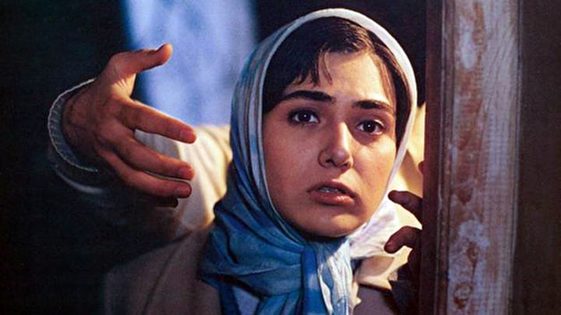
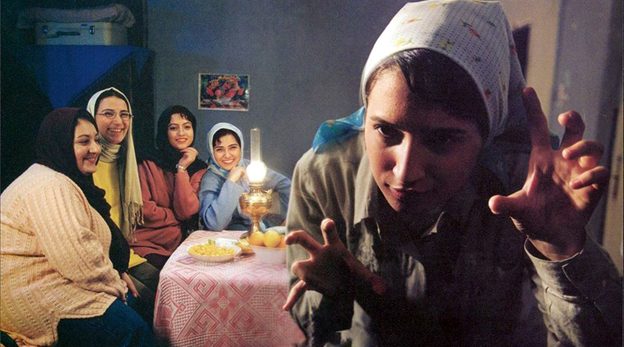
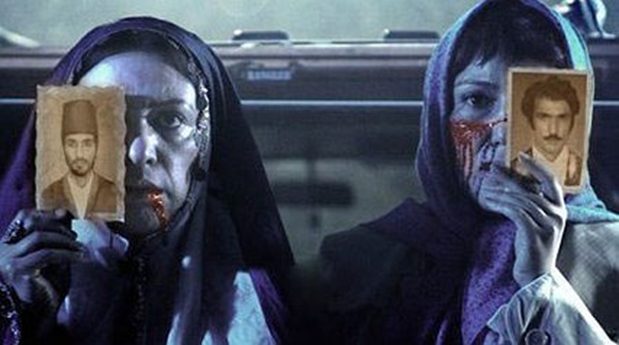
Social Critique, Women’s Cinema, and Gender-Based Violence: Pūrān Dirakhshandah

In light of these many rules and restrictions, women’s cinema in Iran offers strong critiques concerning the reality of women’s lives, their social and cultural concerns, as well as their political and individual rights. Generally, women filmmakers in Iran are, to varying degrees, ideologically critical of their society, producing films which criticize traditional norms that hinder women’s rights. Such films seek to question gender dynamics and unabashedly offer perspectives that are doggedly different from what the state prescribes. Thus, women in Iranian cinema, whether as actors, directors, producers, or crew members, show a remarkable tenacity in the face of the regime’s prescriptions and stand at the forefront of social and political activism in promoting women’s rights in Iran.

One of the most urgent social issues that women filmmakers, actors, and others have drawn attention to is gender-based violence. For instance, in recent years many filmmakers have taken up the torch of the #MeToo movement—following the example of women in Hollywood—by exposing and calling out unwanted sexual advances, sexual harassment, and even assault in the cinema industry. For instance, signatories to the petition of the #MeToo movement in Iran in the spring of 2022 include many of the major women filmmakers in Iran’s cinema today, spearheaded by well-known names such as Tarānah ‛Alīdūstī, Lādan Tabātabā’ī, and Katāyūn Rīyāhī.9Jonbesh-e Me Too Az Taraneh Alidousti ta Riyahi va Pour Samimi. (The Me-Too Movement from Taraneh Alidousti to Riyahi and Pour Samimi). https://www.mashreghnews.ir/news/1383000

Of even greater contemporary and Iran-specific importance, after the Mahsā Amīnī-related uprisings in September 2022, many of cinema’s women celebrities, who had previously come together for the #MeToo petitions, were the first to take off their hijab at public events. For instance, Fātimah Mu‛tamid-Āryā and Afsānah Bāyigān, both acclaimed actresses, appeared without head scarves in various official functions, and some of these protestors were summoned to court for their transgressions.10“Huzūr-i Bidūn-i Hijāb-i Afsānah Bāyegān va Fātimah Mu‛tamid-Āryā dar yik marāsim [The presence of Afsānah Bāyegān and Fātimah Mu‛tamid-Āryā without veil in a ceremony].” RFI, accessed 04/09/2024 https://www.rfi.fr/fa20230501 In this way, women celebrities in contemporary Iranian cinema face a difficult choice between expressing themselves in the way they wish or succumbing to the rules they are forced to follow, whether it is in their dress code or their political views. However, these public petitions against gender-based discrimination and violence have created a network in which women feel a solidarity that gives them courage to stand up against verbal and cultural abuse. It also has permitted them to break the silence around gender-based abuses which have haunted them for centuries.

Figure 1: Afsānah Bāyegān (Left) and Fātimah Mu‛tamid-Āryā (Right) attended the memorial ceremony for Ātīlā Pisyānī without compulsory hijab. accessed via https://www.iranintl.com/202305023819

While these events have captured the attention of the contemporary moment, standing up against gender-based abuse can be understood as a continuing trend that began long before #MeToo and the Women, Life, Freedom movements. Cinema in Iran has been at the forefront of demonstrating social malaise, critiquing such problems, and at the same time advocating for change. For instance, the seasoned female filmmaker Pūrān Dirakhshandah can be considered a pioneer in delivering explicit public criticism of otherwise taboo subjects with the intention of changing social stigma.

Pūrān Dirakhshandah (born in Kermanshah, March 1951) stands as one of the most senior female directors of Iranian cinema, having graduated from the School of Television before the Iranian Revolution and beginning her directing of documentaries in 1975 for National Iranian Radio and Television (NIRT). One of her most remarkable filmic achievements was her production of seventeen episodes of Shukarān (1980) for national TV. However, after the broadcast of the third episode, the TV authorities halted its showing because it publicly displayed the addiction of women, children, and men in society. Courageously, the series uncovered the negative impacts of smuggling and the black market in Iran and at the same time proposed ideas on how to prevent such drug-related problems. But it was her audacity to make an open series about drug addictions that caused her conflict with authorities.

In addition to her numerous documentaries, Dirakhshandah has produced multiple feature films, including: Zīr-i Saqf-i Dūdī (Under the Smoky Roof, 2016), Hiss! Dukhtarān Faryād Nimīzanand (Hush! Girls Don’t Cry, 2013), Hirfah-yi-hā (The Professionals, Video film, 2010), Khāb-hā-yi dunbālah dār (Sequential Dreams, 2009), Bachah-hā-yi Ābādī (The Village’s Children, 2006), Ru’yā-yi Khīs (The Wet Dream, 2005), Sham‛ī dar bād (A Candle in the Wind, 2003), Ishq-i Bidūn-i Marz (Love without Borders, 1998), Zamān-i az dast raftah (Lost Time,1989), ‘Ubūr az Ghubār (Passing from the Dust, 1989), Parandah-yi Kūchak-i Khushbakhtī (The Small Bird of Happiness, 1987), and Rābitah (Connection, 1986). In addition, Dirakhshandah has written and produced several of her own films, as well as being the recipient of many domestic and international awards for her films, and regularly teaches acting classes privately.

But it is her film Hiss! Dukhtarān Faryād Nimīzanand (Hush! Girls Don’t Cry, 2013) in which Dirakhshandah best exposes issues related to sexual assault, rape, and the culture of silencing, revealing her defiance of social stigmas. Dirakhshandah’s subject matter was primarily based on social research she conducted after she had received a diary notebook from the provincial city of Būkān, a conservative rural area. The film was, in fact, based on the true story of a sexually-abused, rural boy of Būkān who had retold the story of a sexual assault he had endured in some detail. Knowing of the prevalence of such stories among both men and women, Dirakhshandah featured her fictional film with a woman protagonist, rather than a boy, as the subject of her social realist movie. This striking film, and Dirakhshandah’s body of work overall, is worth examining closely as a forerunner of women’s contributions to social and political criticism in Iran.

Figure 2: As a child, Shīrīn sees the shadow of Murād behind the window of her room and calls out to her mother, crying. Hiss! Dukhtarān Faryād Nimīzanand (Hush! Girls Don’t Cry, 2013), Pūrān Dirakhshandah, accessed via https://www.youtube.com/watch?v=DqR40Oj7Rns&t=2599s (00:43:19).

As a highly evocative beginning, in the opening of the film we see a woman in a white bridal dress holding a knife smeared in blood in front of the camera. Through the course of the film, we come to understand that the soon-to-be-bride, Shīrīn, had attacked and killed the custodian who was abusing a child in his room. Shīrīn, we also discover through the course of the film, is a survivor of abuse herself, and in an impulsive moment of revenge took justice into her own hands. The entire film revolves around re-telling the story of violence and how this cycle of abuse eventually leads to more violence: in this case, the execution of Shīrīn, who in the eyes of the law is responsible for murder. At first, her murder of the custodian is an unexplainable and completely unexpected occurrence. Gradually, the audience, through a series of flashbacks, comes to learn of the past history of abuse that Shīrīn had endured, and like the disgruntled groom, comes to understand the psyche of an abused woman who commits this crime.

The sympathetic lawyer, played by Mirīlā Zāri‛ī, tries until the very last minute to keep Shīrīn from execution. She presents Shīrīn as a victim, and her execution as an injustice unaccounted for by the flawed laws of the country. Sadly, by the end of the film, the lawyer fails to stop this execution. In other words, the film makes clear the idea that existing laws do not adequately protect women from abuse, nor from persecution when, as victims of sexual abuse, they take justice into their own hands. Rather, the film seems to suggest, the laws protect the perpetrators and leaves such violent abusers at large in society to prey on their next victim.

Figure 3: Shīrīn is in court, narrating the scene of the murder. Hiss! Dukhtarān Faryād Nimīzanand (Hush! Girls Don’t Cry, 2013), Pūrān Dirakhshandah, accessed via https://www.youtube.com/watch?v=DqR40Oj7Rns&t=2599s (01:11:25).

In response to the success of this movie on gender-based violence, Dirakshandah commented that “Films that are based on research will find depth,”11“Hiss! Dukhtar-hā Faryād Nimīzanand,” Facebook, retrieved 04/09/2024, https://www.facebook.com/hissmovie/; This is as part of a Facebook entry on Pūrān Dirakhshandah’s website. indicating her belief that films drawn from real experience—in this case a real victim of sexual abuse—will evoke real feeling and meaning for the audience. Dirakshandah received an award for “promoting honest social issues” at the Global Festival in India in addition to many other domestic and international film awards.12Pūrān Dirakhshandah received the Crystal Sīmurgh Audience Award for Best Film in 2013 for Hush! Girls Don’t Cry in 2013, see: “Dawrah-yi sī-u-yikkum – javāyiz Ihdā shudah dar jashnvārah-yi baynalmilalī-yi fīlm-i Fajr [31st Fajr International Film Festival – Awards of Festival],” Soureh Cinema, retrieved May 8, 2020, http://www.sourehcinema.com/Festival/AwardsOfFestival.aspx?FestId=139107050000; “Global Film Festival honors Pūrān Dirakhshandah with lifetime achievement award.” Tehran Times, December 2, 2020, retrieved May 8, 2021, https://www.tehrantimes.com/news/455348/Global-Film-Festival-honors-Puran-Derakhshandeh-with-lifetime It is also worth noting that Dirakshandah has also started the shooting for a similar film, Hiss! Pisar-hā Giryah Nimīkunand (Hush! Boys Don’t Cry), but it was delayed due to the coronavirus pandemic which hit Iran hard and compelled film crews to put their operations on hold.

From Social Documentary to Feature Films: Rakhshān Banī-I‛timād

Like Pūrān Dirakhshandah, Rakhshān Banī-I‛timād (born in Tehran, April 1954) entered the realm of feature filmmaking from a solid background in documentary through the National Iranian Radio and Television (NIRT) state broadcaster before the revolution. Later studying cinema at Tehran University’s Faculty of Dramatic Arts, Banī-I‛timād continued working in Television into the early years of the revolution. In many ways, Banī-I‛timād can be considered a pioneer in women’s cinema in Iran as she brings her documentary story-telling background to feature films with a social realist angle. She is notable for being one of the first female directors to receive the Fajr Film Festival award,13Maryam Ghorbankarimi, “Rakhshan Banietemad’s Art of Social Realism: Bridging Realism and Fiction,” In ReFocus: The Films of Rakhshan Banietemad, ed. Maryam Ghorbankarimi (Edinburgh University Press, 2021), 189. has regularly received international accolades, and is considered one of the leading figures of Iranian cinema today.

Banī-I‛timād ‘s first internationally recognized film with a female protagonist, Nargis (1992), depicts a love triangle between an older and a younger woman who are both in love—and both married to—the same man: ‘Ādel. ‘Ādel is a dishonest husband and a petty thief with no sense of guilt, and Nargis’ predicament begins with her dealings with this unstable and unreliable character. According to Maryam Ghorbankarimi, Nargis is not only a “turning point in [Banī-I‛timād’s] career; it also marks the beginning of a significant shift in the representation of female characters in Iranian cinema.”14Ghorbankarimi, “An Overview of Banietemad’s Career and Films,” In ReFocus: The Films of Rakhshan Banietemad, ed. Maryam Ghorbankarimi (Edinburgh University Press, 2021), 7. The character of Nargis, with her initial naivete, withstands the injustices and challenges that come upon her, expertly juxtaposed against the character of Āfāq, the older, more mature woman in the triangle.

Most of Banī-I‛timād ‘s feature films continue to revolve around social realist subject matters. For instance, in Rūsarī-i Ābī (The Blue Veil, 1995), the protagonist, a young rural villager named Nubar (played by Fātimah Mu‛tamid-Āryā), becomes involved in an amorous relationship with the factory-owner Rasūl Rahmānī (played by ‛Izzatallāh Intizāmī), an older, urban, middle-class father and grandfather. The evolving amorous relationship, unsanctioned by class nor age, breaks all social and cultural taboos. In spite of the existing love between the two, members of the middle-class family cannot accept the existence of such a love between their father, on the one hand, and an urban young villager who is also a wage worker of their factory, on the other. The exceptional acting of Fātimah Mu‛tamid-Āryā as Nubar and ‛Izzatallāh Intizāmī as Rasūl create a striking performance that not only criticizes the restrictive nature of prescribed gender relationships but works to disrupt such social stigmas.

Figure 4: Rasūl calls out to Sinawbar as ‘Hey, Blue Scarf’, and Nubar brings her to Rasūl. Rūsarī-i Ābī (The Blue Veil, 1995), Rakhshān Banī-I‛timād, accessed via https://www.youtube.com/watch?v=m5MTGDoRN3I&t=1474s (00:24:34).

While The Blue Veil tells the tale of a rural woman, in Bānū-yi Urdībihisht (The May Lady, 1998), Banī-I‛timād offers the story of an urban, middle-aged single mother, Furūgh, who is also a photographer and a documentary filmmaker with a political activist background. In this film, Furūgh must deal with her teenage son, Mānī, a stigmatized love connection, and the social malaise of urban life. As one means by which to find meaning in her complex situation, she concentrates her activism by filming and documenting the plight of children living in slums. At the same time, she is also seeking companionship and love throughout the film, but she is deprived of it as a result of traditional social stigmas, reflected through the outbursts of her teenage son. While unsuccessful, Furūgh seeks in this film to find balance between the needs of herself, her family’s needs, and the needs of her lover (who remains unseen throughout the film). Similar themes and sub-themes exist in Banī-I‛timād ‘s other films where the burden of the family is placed upon the shoulders of the mother, depicting the weight of such social malaise affecting women in undue ways. This idea of a mother’s burden is aptly displayed in Zīr-i Pūst-i Shahr (Under the Skin of the City, 2001), Gīlānah (2004), Khūn-bāzī (Mainline, 2006), and finalized in Qissah-hā (Tales, 2014).

It is also worth noting that many of Banī-I‛timād ‘s films were produced by her husband, Jahāngīr Kawsarī. Their daughter, Bārān Kawsarī, is now a recognized actress and a vocal social activist in her own right. Banī-I‛timād  has received numerous accolades in major international film festivals, such as Locarno and Venice International Film Festivals in addition to domestic festivals.15Rakhshān Banī-I‛timād has received numerous awards during her career. For a full list of these awards, see her IMDb site (https://www.imdb.com/name/nm0051999/awards/)

From Social Realism to Fiction: Tahmīnah Mīlānī

Alongside Rakhshān Banī-I‛timād and Pūrān Dirakhshandah, Tahmīnah Mīlānī (born 1960 in Tabriz), is an award-winning film director and one of Iran’s most prominent filmmakers. Mīlānī graduated with a degree in architecture from the University of Science and Technology in Tehran in 1986, but already had been working with major filmmakers since 1979 in various positions. Mīlānī’s work mainly concentrates on women’s and feminist issues in Iran,16Roxanne Varzi, “Tahmineh Milani,” Encyclopedia of the Modern Middle East and North Africa, ed. Philip Mattar et al. (Macmillan Reference USA, 2004). and she was briefly jailed by Iranian authorities, presumably for portraying a positive image of anti-revolutionaries in her melodramatic film Nīmah-yi Pinhān (The Hidden Half, 2001).17“Feminist Filmmaker is Arrested in Iran,” New York Times. August 30, 2001, retrieved 04/09/2024, https://www.nytimes.com/2001/08/30/international/middleeast/feminist-filmmaker-is-arrested-in-iran.html

In one of her first films about women, Afsānah-yi Āh (The Legend of Aah, 1991), Mīlānī offers a critique of the relationship between society and women’s unfulfilled desires, unrequited love, and suppressed dreams. In this film, Mīlānī sets the foundation for her future female-centered oeuvre, following with Du Zan (Two Women, 1999), Nīmah-yi Pinhān (The Hidden Half, 2001), Vākunish-i Panjum (The Fifth Reaction, 2003), Zan-i Zīyādī (The Unwanted Woman, 2005), Ātash Bas I & II (Ceasefire I & II, 2006 and 2007), and Malī va rāh hā-yi naraftah ash (Melli and Her Untrodden Ways, 2018). While in her earlier films women are portrayed with a certain kind of innocence, in her later films many of the female protagonists are displayed as strong-minded, independent women who claim agency in a predominantly patriarchal world. Mīlānī’s work is also significant in terms of her broaching of socially and politically taboo subjects with regards to women, sometimes in a melodramatic manner. In The Hidden Half (2001), Mīlānī features female political activists who engage in student activism after the Iranian Revolution, recounting the story of women activists who succumb to persecution, arrests, and other repressive measures after the revolution. This film warrants some detailed attention.

The protagonist of The Hidden Half, Firishtah (Angel), is the wife of a judge, Khusraw Samīmī, who has been appointed by the new government (i.e., Muhammad Khātamī’s reformist administration that came into power in 1997). Samīmī is set to hear the last words of a female prisoner on death row in the city of Shiraz’s prison and is planning a trip to the city to prepare a report. When Firishtah finds out from her husband about the political activist on death row, she hides a long letter, delineating her life-long secret about her own activist phase during the revolution. Via a series of tribulations, she hides the letter in her husband’s suitcase. Samimi discovers the hidden letter in his suitcase when he arrives in his hotel room in Shiraz, and he becomes completely absorbed in reading it. The film provides a visual narration of this past as narrated by the letter, filled with intermittent flashbacks to the present time.

Figure 5: Khusraw is reading a letter from Firishtah and flashes back to the past. Firishtah tells Khusraw about her situation at the university, and Khusraw assures her that he can get her back into university. Nīmah-yi Pinhān (The Hidden Half, 2001), Tahmīnah Mīlānī, accessed via https://www.youtube.com/watch?v=5gxPphnn_pQ&t=6012s (01:30:41).

From reading the letter, Samimi learns of untold secrets, political activism, and an unrequited love between his wife and an older man called Jāvīd—translated as “the eternal one.” Overall, the letter contains profound revelations about his wife and the mother of his children whom he had thought he knew very well but in fact did not. By reading the secret memoirs of Firīshtah, he learns of her hidden life, of her political activism that she had concealed from him all these years, and of a love to a social ideal—and her love of an older, activist man. At the same time, Samimi learns about Firīshtah’s dilemma of hiding such an immense secret from him during the course of their marriage. At the end of the film, Samimi is seen interviewing the woman on death row, but her file—and even her voice—resembles that of his own wife, suggesting that this woman on death row could very easily have been Firīshtah. Firīshtah, however, succeeded in fleeing the authorities by hiding in the house of the mother of her future husband, whereas the woman on death row did not have the same luck. The nameless and faceless woman was incarcerated for over twenty years and is now awaiting execution, and her last hope of life is to be heard by the reformist government, which has promised leniency and reform.

Figure 6: The final scene of the movie where Khusraw is sitting across from the woman condemned to death, listening to her speak. Nīmah-yi Pinhān (The Hidden Half, 2001), Tahmīnāh Mīlānī, accessed via https://www.youtube.com/watch?v=5gxPphnn_pQ&t=6012s (01:03:41).

The theme of judging women, being judgmental towards them, and being a good judge of circumstances runs through this quasi-political movie. How will the husband/judge determine the fate of this political activist on death row? Can the judge remain impartial to the plight of this death row convict? Can the judge forgive the woman and release her from captivity? Can the resemblance between the story told by the detainee and that of his own wife have a positive impact on his decision making? While the ending of the film remains open-ended, and does not reveal how the judge will eventually decide, Mīlānī brilliantly merges the two stories of both women through intermittent flashbacks and connects Iran’s past with its present through the voice and narrative of its female protagonist. The film elegantly shows how the idealism of the early revolutionary years is silenced and now hidden from public view, just as Firīshtah’s story was hidden and silenced. But Javid’s appearance towards the end of the story—twenty years later but still looking exactly the same as before—telling Firīshtah that she may have rushed to judgement, alerts her to the necessity to present all sides before her husband decides the fate of a woman on death row. With deft filmic devices (e.g., overlaying Firīshtah’s image over the woman on death row), flashbacks, and the unexpected return of Jāvīd, Mīlānī’s film utilizes melodrama to compelling effect.

Indeed, the melodramatic style of the movie, as Michelle Langford argues, is a “practical strategy to examine the impact of public events on the private lives of Iranian women.” Langford argues persuasively that “where films are subject to severe censorship, melodrama serves as an important vehicle for expressing figuratively that which cannot be said within the allowable codes of state-controlled discourse.”18Michelle Langford, “Practical Melodrama: From Recognition to Action in Tahmīnah Mīlānī’s Firīshtah Trilogy.” Screen (London) 51, no. 4 (2010): 341–364. In a melodramatic style, Mīlānī’s The Hidden Half thus effectively reveals the untold and invisible lives of women who have exerted passion and selflessness in their political beliefs and causes.

While in The Hidden Half the feisty activist moves away from politics with age and maturity, in Mīlānī’s later films The Fifth Reaction (2003) and Ātash Bas I & II (Ceasefire I and II, 2006 and 2007), her female protagonists claim agency over their lives, rebelling against patriarchal norms and social expectations, and show powerful women on screen.19See Matthias Wittmann and Ute Holl, eds. Counter-Memories in Iranian Cinema (Edinburgh: Edinburgh University Press Ltd, 2021). In Malī va rāh hā-yi naraftah ash (Malī is short for Malīhah; the English title is Melli and the Untrodden Roads, 2018), however, Mīlānī treats the subject matter of domestic abuse in a more in-depth manner, and like Dirakhshandah’s Hiss! Dukhtarān Faryād Nimīzanand, she seeks to push the boundaries of social stigma with regard to abuse. In Melli, Mīlānī portrays a woman whose simplicity and vulnerability bring her into the orbit of an abusive husband and depicts how difficult it is for her to break out of the abusive relationship without major verbal and physical altercations. With Melli, Mīlānī joins the crowd of activists crying for women’s rights in Iran, especially for a woman’s right to stand up to any form of abuse, whether it be domestic or political.

Women’s Experimental Movies: Samīrā and Hanā Makhmalbāf

Many women filmmakers have also engaged in various cinematographic experimentations. At the age of seventeen, Samīrā Makhmalbāf began making internationally recognized movies, becoming the youngest director in the world participating in the official section of the 1998 Cannes Film Festival. Samīrā Makhmalbāf became known for her documentary debut, Sīb (Apple, 1997), written alongside her acclaimed filmmaker father, Muhsin Makhmalbāf. Sīb recreated the true story of two girls locked up in their small apartment by their father in the middle of Tehran. The two girls and their mother had next to no contact with the outside world, making them socially awkward and developmentally delayed. The mother and the girls, who had been confined to their dark rooms, had been denied the amenities of life by a patriarchal ideology. The experimental nature of depicting and recreating their true story brought the younger Makhmalbāf international attention and multiple awards.

Figure 7: A still from Sīb (Apple, 1997). Samīrā Makhmalbāf, accessed via https://www.youtube.com/watch?v=_tIqMtP77BE (00:13:38).

Her second movie, Takhtah Sīyāh (Blackboard, 2000), depicted the role of education in the deprived areas of Kurdistan. She directed a series of nomadic teachers carrying their blackboards on their shoulders and traveling from one village to another in the midst of bombs and an ongoing war, just to bring literacy to children. Blackboard was also selected by the Cannes Film Festival to compete in the official section in 2000, where Samīrā Makhmalbāf received the Special Jury Award. The film also received the “Federico Fellini Honor Award” from UNESCO, and the “Francois Truffaut Award” from Italy. This film had a large viewership in France.20For a complete list of awards see Makhmalbāf Film House’s website and her IMDb page: https://makhmalbaf.com/?q=samira; https://www.imdb.com/name/nm0538533/

Makhmalbāf also collaborated in one of the eleven episodes of September 11 (2002), alongside directors such as Youssof Chahine, Sean Penn, Shohei Imamura, and Ken Loach. Makhmalbāf’s third feature film, Panj-i ‘Asr (At Five in the Afternoon, 2003) was set in Afghanistan and features an Afghan woman who wants to be President. This film also won the Jury’s Special Award at the Cannes Film Festival in 2003, as well as the Golden Peacock’s Best Film Award.21See the IMDb page for Panj-i ‘Asr: https://www.imdb.com/name/nm0538533/ In 2004, The Guardian named Makhmalbāf among its selection of the forty best filmmakers under forty.22See: http://makhmalbaf.com/?q=samira The entire Makhmalbāf family immigrated to France and then England in 2008, and Samira Makhmalbāf has been a jury member at various international festivals such as Cannes, Venice, Berlin, Locarno, Moscow, and Montreal.

Figure 8: A still from Panj-i Asr (At Five in the Afternoon, 2003). Samīrā Makhmalbāf, accessed via https://www.youtube.com/watch?v=XWWLmN_BkrE (00:30:27).

Samīrā’s sister, Hanā Makhmalbāf, also started making films at an early age. Her film, Buddha Collapsed Out of Shame (2007), relates the obstacles women face to become educated under the Taliban regime in Afghanistan. As well, in the documentary Green Days (2009), Hanā Makhmalbāf explored the incidents following the disputed elections of 2009 in Iran which led to the Green Movement, a series of protests that saw several years of political demonstrations across the country. The film also received the “Bravery Award” at the Venice Film Festival in 2009.23See https://makhmalbaf.com/ and their IMDb page for a complete list of awards.

Also part of the Makhmalbāf “Film House,” Marzīyah Mishkīnī, the wife of Muhsin Makhmalbāf and an aunt of Samīrā and Hanā, gained international fame for her first film, Rūzī ki Zan Shudam (The Day I Became a Woman, 2000), and won awards at the Venice International Film Festival in 2000. Her second film, Stray Dogs (2004), also competed in the best film category at the Venice Film Festival.24For a list of all awards see the Makhmalbāf Film House’s website. Marzīyah Mishkīnī also wrote the script for Hanā Makhmalbāf’s Buddha Collapsed Out of Shame, which won several awards.

Shabakah-yi Khānigī (The Home Network)

But it would be remiss to ignore contributions by Iranian women beyond the purview of mainstream filmmaking. Women have also started to find a niche in the newly established Shabakah-yi Khānigī (The Home Network), which is a private, independent filmmaking enterprise. As the supervision of content production in Shabakah-yi Khānigī did not start directly under the tutelage of the Ministry of Culture or state-run TV—for which they pose as competition—directors found less restrictions in their filmmaking. Since 2021, there have been many attempts made to curtail the freedoms of Shabakah-yi Khānigī, in particular in their depiction of women and their freedom of expression. Iranian Radio and Television, Sidā va Sīmā, has made several attempts to bring Shabakah-yi Khānigī under its own supervision, and this back and forth is continuing between independent artists and the state.

Shabakah-yi Khānigī’s success began with the series, Shahrzād (2015-2018), a fictional account of a woman’s life set in pre-revolutionary Iran in which tradition and modernity are pitted against each other. In terms of the subject matter and cinematography, Shahrzād, written by Hasan Fathī and Naghmah Samīnī, offered distinct and remarkable episodes that gained a wide and favorable reception. In addition, many famous filmmakers such as Mihran Mudīrī, Manūchihr Hādī, Hasan Fathī, and others began making movies with Shabakah-yi Khānigī, finding value not only in its distribution potential, but also in its relaxed restrictions compared to state-run TV.

One of the most successful filmmakers in Shabakah-yi Khānigī is Tīnā Pākravān, whose series Khātūn, presented with the English title, Once Upon a Time in Iran (2021), has now mesmerized millions of viewers. Set in the aftermath of the Iranian occupation by the Allied forces in 1941, Once Upon a Time in Iran tells the story of a female protagonist, Khātūn, who deals with issues of love, marriage, divorce, treason, and espionage set in the background of the Second World War in Iran and its tumultuous political setting. In a star-studded cast, Pākravān, who has previously worked in different roles with major Iranian filmmakers, comes to Shabakah-yi Khānigī from commercially successful feature films, such as Los Angeles, Tehran (2017).

Pākravān’s work is significant in that she has created a series that places women at the center of major historical events in Iran. Pākravān juxtaposes the past with the present and invites the viewer to see this history through the eyes of an activist woman who is torn apart by the different ideologies of her time, dividing divergent ideologies in the midst of an unwanted war. Like Shahrzād, Khātūn may represent a historical era, but it can also be read as a critique of present times. Notably, both series would not have been able to be made were it not for the ability of the Shabakah-yi Khānigī to bring in private investors and wider distribution venues, permitting subject matter that would otherwise be deemed controversial. Thus, Shabakah-yi Khānigī is now a major alternative to the ideologized filmmaking that state-run TV and film pursues. Yet it would be remiss to forget that the trailblazing work of the first generation of women filmmakers in Iran paved the way for many future filmmakers via this network, such as Nargis Ābyār, Āydā Panāhandah, Munā Zand Haqqīqī, and Yāsamīn Mālik Nasr, amongst others.

Women’s Diaspora

No treatment of Iranian women’s cinema would be complete without at least a mention of the films created outside of Iran’s stringent gender-based restrictions. Indeed, many of the topics discussed in films of the Iranian diaspora would never have been given permission to be filmed and screened in Iran. Major players in this genre, including Maryam Kishāvarz, Grānāz Mūsavī, Sipīdah Fārsī, Līlī Amīnpūr, Shīrīn Nishāt, and later the women of the Makhmalbāf family, amongst others, have created films that reveal a very different Iran from the one depicted by the cinema produced inside the country.

Maryam Kishāvarz’s debut movie set against the backdrop of a conservative society, Circumstance (2011), for instance, deals with explicit homosexual female love, a topic that would never have been sanctioned for depiction inside Iran, let alone its filming. The winner of the Sundance Audience Award, Kishāvarz’s film tells a story of complex family dynamics, the devastating effects of traditional gender norms, and the challenges of the silenced LGBTQ members as they navigate their desires, dreams, and the societal pressures that separate them from each other. Another of her films, The Persian Version (2023), an Iranian-American comedy-drama which takes up the subject of mother-daughter relationships, won two awards at the Sundance Film Festival in 2023. Overall, her work has received accolades for tackling sensitive topics and giving a platform to marginalized voices.

Figure 9: A still from Sharāyit (Circumstance, 2011). Maryam Kishāvarz, accessed via https://www.youtube.com/watch?v=0YnLvPbNw0c (00:00:18).

Likewise, the work of Sipīdah Fārsī, an Iranian director living in France, unravels the underground scene of addiction and corruption amid social and political tensions in her illegally-filmed movie, Tehran: Bidūn-i Mujavviz (Tehran: Without Permission, 2009). Fārsī filmed the shots on a phone camera on the streets of Tehran without obtaining the regular filming permits required for filmmakers. The film is predominantly about the city of Tehran and what is happening on the streets: its bazaars, rituals, and even an imminent political election.

Likewise, in My Tehran for Sale (Australia, 2008), directed by the Iranian-Australian poet and filmmaker Grānāz Mūsavī, the film examines the double life of middle-class families, their underground music, art, identity crises, brain drain, and how HIV is treated socially. Women’s issues such as their access, or lack thereof, to abortion, to women’s health clinics, and other women’s concerns are presented critically in the film.

One of the most successful and well-known Iranian women in the international setting, however, is the graphic novelist and filmmaker Marjān Sātrāpī, who converted her poignant autobiographical tale from a graphic novel into animation. In order to do so, Satrapi provides a simple story narrated from the point of view of a child in the film Persepolis (2007). The animated version of the film blends personal narrative with socio-political commentary, while exploring the complexities of belonging, cultural displacement, and identity. Satrapi also directed the film version of her graphic novel, Chicken with Plums (2011), which also presents a satirical perspective on historical realities. Several years later in The Voices (2014), Sātrāpī moved away from Iranian topics and engaged issues related to mental illness, combining humor and horror to probe the depths of the protagonist’s psyche. Finally, in Radioactive (2019), Satrapi directed a film on the life of the female scientist, Marie Curie.

A New York-based artist, Shīrīn Nishāt, is another notable women’s diasporic filmmaker who has made several art movies, including Women Without Men (2009), based on Shahrnūsh Pārsī’pūr’s novella set in Tehran.25Shahrnūsh Pārsī’pūr, Zanān bidūn-i mardān, 1st edition (Tehran: Nashr-i Nuqrah, 1989). This film depicts the life of six single women seeking refuge in a very politically laden time during the overthrow of Musaddiq in 1953. Nishāt has also made several other installation movies. Her film, co-directed with Shujā Āzarī and entitled Looking for Oum Kulthum (2017), takes her to Egypt to uncover the life of the celebrated Egyptian singer.

In Conclusion: International Recognition and Reception of Iranian Women’s Cinema

Today, many women filmmakers stand at the forefront of the women’s rights movement, whether they live in Iran or abroad. Of particular, ironic, and recent note, three female actresses from Iran were present on the red carpet of the Cannes Film Festival in May 2022: Tarānah ‛Alīdūstī starring in Barādarān-i Laylā (Brothers of Leyla, 2021), with a film from Iran; Zahrā (“Zar”) Amīr Ibrāhīmī, starring in ‛Ankabūt-i Muqaddas (Holy Spider, 2021), with an Iranian film from Sweden; and Gulshīftah Farahānī, starring in a film from France. All three have had tenuous relationships with Iranian cinema, and all came together during the Cannes Film Festival in the spring of 2022. All three belong to the same generation and all three have been social activists in their own right. Tarānah ‛Alīdūstī remains in Iran, while the other two are now making controversial movies as political activists.

Amīr Ibrāhīmī is of particular interest as she had to leave Iran due to the revelation of a sex tape showing her and her boyfriend in their most private moments in 2008. In her acceptance speech of the Best Actress Award at the Cannes Film Festival in 2022, Amīr Ibrāhīmī alluded to the long ordeal she endured to get to where she now stood. She began her speech with words in Persian, and while she did not say much, she was understood by the Iranian audience as referring to her forced exile and the unjust cancellation that she endured almost a decade earlier.26Roger Cohen. “An Iranian exile channels her trauma into film,” The New York Times. October 22, 2022, retrieved 04/09/2024, https://www.nytimes.com/2022/10/22/movies/zar-amir-ebrahimi-holy-spider.html On fleeing Iran and her Cannes comeback, Amīr Ibrāhīmī has said, “If you lose everything, it’s easier to rise up.”27Emma Graham Harrison. “Zar Amir Ebrahimi on fleeing Iran and her Cannes comeback: ‘If you lose everything, it’s easier to rise up’,” The Guardian. January 20, 2023, retrieved 04/09/2024, https://www.theguardian.com/film/2023/jan/20/zar-amir-ebrahimi-holy-spider-interview  In 2023, she also co-directed a film with an Israeli director in Georgia that has become very controversial. As examples such as this rare but poignant moment on the international red carpet show, the line between Iranian diasporic and domestic cinema is thin today and often overlapping. Diasporic cinema, however, ensures the allowance for wider female expression, given that women need not abide by rules and regulations imposed by the Iranian state. Many of the films produced by female directors in the diaspora delve into issues that would never gain approval inside the country which makes them even more important as stories which must be told.

In conclusion, women’s cinema in Iran has grown tremendously despite the exceptional restrictions that women have faced for decades, whether on or off screen. Despite all that is set against them, women filmmakers have managed to create thought-provoking and powerful movies that have garnered international recognition and acclaim. And despite their confrontation with numerous challenges, women’s cinema in Iran continues to flourish. Through the variegated tapestry of women’s stories both real and fictional, the body of Iranian women’s cinema provides an important platform for women’s voices and perspectives, demonstrating women’s resilience, creativity, and a commitment to addressing pressing social issues. With the activism shown since September 2022 in relation to the Women, Life, Freedom movement, the contributions of women filmmakers remain crucial in shaping the future of Iranian cinema, and even Iran’s history. Women filmmakers in Iran continue to deal with topics that their male counterparts may not be able to access, and thus often find themselves at the forefront of protest movements, culturally and politically.

Maybe Some Other Time (1988)

By

Introduction

Maybe Some Other Time (Shāyad Vaqtī Dīgar, 1988)1All the images employed in this text are screenshots (under fair use) taken from different moments throughout the film on Namāshā. All the rights of these visual elements belong exclusively to the film’s owner/creator/producer. Shāyad Vaqtī Dīgar, directed by Bahrām Bayzāʼī (Namāshā, July 24, 2021), accessed July 3, 2023. https://www.namasha.com/v/dLYS3DdA/شاید_وقتی_دیگر displays the lives of Mudabbir and Kīyān, a middle-class couple residing in Tehran, Iran during the 1980s. The film was directed by Bahrām Bayzāʼī, one of the most prominent and highly influential filmmakers, playwrights, and writers associated with the Iranian New Wave.2Iranian New Wave Cinema that emerged in the 1960s and continued into the 1970s onward was a departure from traditional storytelling techniques and focused on social and political issues. The movement brought forth a new wave of talented filmmakers such as Hazhīr Dāryūsh, Bahrām Bayzāʼī, Nāsir Taghvā’ī, Furūgh Farrukhzād, Suhrāb Shāhid-Sālis, ‛Abbās Kīyārustamī, Dāryūsh Mihrjūʽī, and others who challenged the conventions of Iranian cinema and in some cases gained international recognition. Bayzāʼī’s films often explore themes of identity, history, and cultural heritage, and he is known for his unique visual style, poetic storytelling and language, symbolism, innovative use of camera movements, and attention to details. Maybe Some Other Time is a fascinating example of the therapeutic exploration of the human psyche through cinematic enactments, particularly the role of the “mirror stage,” repression, dreams, and childhood experiences in shaping adult behavior. This article adopts Freudian and Lacanian approaches to understanding how Maybe Some Other Time explores Kīyān’s psychological repression, her mirror stage, her desire, and her formation of identity in relation to the symbolic order, as well as Mudabbir’s masculinity, male jealousy, vulnerability, and fear of castration. This article focuses on the ending of Bayzāʼī’s film and includes analysis of Gilles Deleuze’s notion of the camera eye. It then proceeds to explore the intricate connection between archives, the unconscious, and identity in the film.

Figure 1: Poster for the film Shāyad Vaqtī Dīgar (Maybe Some Other Time, 1988)

Although Bahrām Bayzāʼī is usually known for his use of powerful allegories with mythological themes in his films such as Charīkah-yi Tārā (Ballad of Tara, 1979) and Musāfirān (Travellers, 1990), Maybe Some Other Time is among Bayzāʼī’s less allegorical films which instead focus more on psychological investigations. The portrayal of a middle class Iranian urban couple in the 1980s seemed irrelevant at a time when Iranian cinema in international film festivals was known for its depiction of poor children characters and exotic rural settings in films such as Amir Naderi’s Davandah (The Runner, 1984), and ‛Abbās Kīyārustamī’s Khānah-yi Dūst Kujāst (Where Is the Friend’s House? 1987). More than two decades before the spread of social commentary films about middle-class families in Tehran such as Asghar Farhādī’s Oscar winning film A Separation (2011), Bahrām Bayzāʼī’s Maybe Some Other Time (1987) explores the complexities of a nuclear family living in Tehran during the 1980s.

Maybe Some Other Time follows the story of Mudabbir, a television commentator working on a documentary about air pollution, who unexpectedly discovers his wife, Kīyān, engaging in a conversation with an unfamiliar man on the very footage he is dubbing (figures 1-2). This documentary footage casts Mudabbir into a turbulent emotional state, evoking feelings of jealousy, pride, and prejudice concerning his wife’s seemingly mysterious actions and subsequently his emotional feelings provoke a clash with his family’s moral values. The suspicion of Kīyān’s potential infidelity challenges Mudabbir’s understanding of reality, presenting him with a hypothetical scenario of Kīyān’s unfaithfulness that he must grapple with. Simultaneously, Kīyān, who has experienced a foster upbringing, is grappling with an identity crisis, intensified by her recent discovery of her pregnancy which contributes to her anxiety and unsettling dreams. To alleviate his doubts, Mudabbir, with the assistance of the documentary’s editor, locates the stranger from the footage, who is revealed to be Mr. Haq’nigar, an antiquarian with an extensive collection of historical artifacts in his cellar.

Intrigued, Mudabbir visits Mr. Haq’nigar’s antique store and unexpectedly comes across a portrait painting of Kīyān. This discovery prompts him to devise a plan to film a documentary on antique collecting at Mr. Haq’nigar’s house. His crew sets up at Haq’nigar’s house and checks their sound recording system. When Mudabbir sees that Haq’nigar’s wife, Vīdā, bears an exact resemblance to Kīyān, he calls Kīyān on the phone and asks her to join him at Mr. Haq’nigar’s address. As Kīyān knocks on Mr. Haq’nigar’s door, Mudabbir asks Vīdā to open the door. This unexpected meeting between sisters leads to a profound and distressing revelation for Kīyān, transporting her back to her childhood. She learns that their father passed away during their early years, and their mother, burdened by poverty, left Kīyān in the care of an anonymous family who rescued her from the street. This meeting with her sister contributed to Kīyān’s ongoing identity crisis and personal confusion. However, at the end of the film and upon leaving Haq’nigar’s house, Kīyān experiences a sense of relief, feeling that she has regained a sense of self.

The intricate storyline of Maybe Some Other Time explores the complexities of miscommunication and suspicion which could erode the desired trust and stability undergirding the Iranian middle class in the 1980s.

Figures 2-3: Mudabbir being shocked (Left) by seeing a woman resembling his wife Kīyān next to a male stranger in the footage he is dubbing (Right). Shāyad Vaqtī Dīgar (Maybe Some Other Time, 1988), Bahrām Bayzāʼī, (00:14:38)

Despite being a commissioned work, Bayzāʼī transformed the project into a remarkable film that explores the complicated journey of a woman in 1980s Tehran as she embarks on a quest to discover her true self. Bayzāʼī’s film seamlessly weaves together the alluring elements of the Noir genre, enveloping the audience in a world of suspense, suspicion, and enigmatic melodies where the Femme is not only fatal but also fatalized, adding depth to the characters and their struggles. The film mainly revolves around Kīyān, an Iranian woman who grapples with a complex psychological condition including an identity crisis, which is further intensified by disturbing feelings and dreams, all of which are triggered by the unsettling emotional consequences of obesity. Within this narrative framework, Kīyān also faces the challenges of marital pressures, particularly as her husband suspects her of infidelity. These suspicions exacerbate her existing identity crisis, creating a dynamic interplay between her personal struggles and the strains within her marriage. While Kīyān’s experiences serve as a focal point in the film, it is crucial to note that the narrative is equally propelled by Mudabbir’s suspicions and doubts regarding Kīyān’s faithfulness. Thus, both Kīyān and Mudabbir are equally important protagonists within the film’s narrative landscape.

Figure 4: Mudabbir talking on the phone at the dubbing studio where film images are projected onto a large background screen. Shāyad Vaqtī Dīgar (Maybe Some Other Time, 1988), Bahrām Bayzāʼī (00:07:44)

The film employs various cinematic techniques, such as flashbacks, surreal dream sequences, and film-within-film re-enactments that blur the line between reality and imagination, consciousness and unconsciousness, in the depth of Kīyān’s psychological struggles. (This is reminiscent of complicated psychological characters in films by cineastes such as Alfred Hitchcock’s Marnie [1964], Ingmar Bergman’s Persona [1966], Federico Fellini’s Juliet of the Spirits [1965], Andrei Tarkovsky’s Mirror [1975], Michelangelo Antonioni’s Identification of a Woman [1982], and David Lynch’s Mulholland Drive [2001]).

Repression

The concept of “repression” is addressed at the heart of the film through the delirious nightmares from which Kīyān suffers.3In her article “Bahram Bayzai’s Maybe…Some Other Time: The un-Present-able Iran,” Negar Mottahedeh explains that Bayzā’ī, in an interview with Sa‛īdah Pākravān from February 1995 in the journal Chantah, points out that the film directly addresses the question of identity (huvīyyat) and that, in fact, this is one aspect of Iranian life that had not been adequately explored in recent times. See: Negar Mottahedeh, “Bahram Bayzai’s Maybe…Some Other Time: The un-Present-able Iran.” Camera Obscura 15, no. 1 (May 1, 2000): 162. Her anxiety and delirious illusions (figure 5) reflect the workings of the unconscious mind, a central concept in Freudian theory. Furthermore, Kīyān’s vague memory of her past, her search for her identity, and her melancholic impressions affect her interactions with others, especially with her husband Mudabbir. Meanwhile, her inner turmoil is repeatedly triggered by Mudabbir’s suspicion-induced aggression and provocation through the use of cynical and bitter language which makes her suffer more throughout the film. In one of their family routines around the dinner table, Mudabbir loses his patience and verbally bullies Kīyān stating, “Life in these four-walled matchboxes must be very boring.”

Figure 5: One of the surreal and horrifying scenes that Kīyān envisions. Shāyad Vaqtī Dīgar (Maybe Some Other Time, 1988), Bahrām Bayzāʼī (01:45:40)

Later in the same scene, Mudabbir—believing he had seen Kīyān riding in a red car with an unknown man on the film he was editing—uses cynical language in an attempt to pry into what he erroneously imagines to be Kīyān’s secretive life:

Mudabbir: “If you were to have a car, what color would you wish it to be?”Kīyān: “What difference does it make?”Mudabbir: “So the difference is with the one who sits at the wheel?”4Maybe Some Other Time (00:28:25).

Mudabbir’s unintentional and spontaneous passive aggression and suspicion fuelled by strong moral taboos can be interpreted as symptomatic of his confrontation with his unconscious repressed anxieties, masculine vulnerability, fears, and insecurities.

According to Austrian psychoanalyst Sigmund Freud’s psychoanalytic theory, dreams are the “royal road to the unconscious.”5Sigmund Freud, “The Interpretation of Dreams” in The Standard Edition of the Complete Psychological Works of Sigmund Freud, ed. James Strachey, vol. 4, (Hogarth Press, 1953), 608. In dreams, the unconsciousness talks with the individual in intimate yet different tones. The surreal and sweaty dream sequences in Maybe Some Other Time reflect Kīyān’s unconscious desire to know who she is and the anxieties caused by the absence of her birth parents’ attention and love.

The Freudian Oedipus complex is an essential aspect of Kīyān’s longing for her father. The void left by her father’s absence is an example of the Oedipus complex. According to Freud, in his seminal work The Interpretation of Dreams (1900), a child develops an unconscious desire for their opposite-sex parent and sees their same-sex parent as a rival.6Freud, “Interpretation of Dreams,” 274. Freud believed that resolving the complex is important for healthy adult sexuality.7We should note that the theory has faced criticism for its heteronormative and limited perspective. Mudabbir’s suspicion towards Kīyān reflects a fear of castration, which is a central aspect of the complex. Mudabbir’s desire to uncover the truth about Kīyān’s behavior derives from his jealousy about a rival to whom Mudabbir assumes he is losing Kīyān’s affection.

Figure 6: Kīyān and her foster parents in the background. Shāyad Vaqtī Dīgar (Maybe Some Other Time, 1988), Bahrām Bayzāʼī (00:05:24).

Figure 7: Photos of Kīyān’s foster parents in her photo album. Shāyad Vaqtī Dīgar (Maybe Some Other Time, 1988), Bahrām Bayzāʼī (00:19:00).

Mirror Stage

For the French psychoanalyst Jacques Lacan, the unconscious is not merely a repository of repressed desires or traumatic experiences but a fundamental aspect of human subjectivity. According to Lacan, the formation of the subject’s identity is rooted in the mirror stage which fundamentally orients the subject within the symbolic order, a system of language and social norms that determines how individuals understand themselves and their place in society. Lacan believes that the mirror stage is a critical phase in the development of the human psyche through the formation of a self-coherent self:

[T]he mirror stage is a drama whose internal pressure pushes precipitously from insufficiency to anticipation—and, for the subject caught up in the lure of spatial identification, turns out fan­tasies that proceed from a fragmented image of the body to what I will call an “orthopedic” form of its totality—and to the finally donned armor of an alien­ating identity that will mark his entire mental development with its rigid struc­ture.8Jacques Lacan, “The Mirror Stage as Formative of the I Function” in Écrits: A Selection, trans. Alan Sheridan (New York: Norton, 1977), 75-81, 78.

This stage usually occurs when an infant recognizes its reflection in a mirror, creating a sense of unity and coherence within her/his mind. The mirror stage is thus a critical moment in the formation of the ego, which Lacan sees as a necessary but ultimately illusory construct.9Lacan, “Mirror Stage,” 80.

Bayzāʼī’s fascination with mirrors and their mythological implications can be discerned in his earlier film, Ragbār (Downpour, 1972), all the way to his later works like Musāfirān (Travellers, 1991).10For more on the implications of mirrors in Bayzāʼī’s work, see Cinema Iranica’s entry for Bayzāʼī’s other film Musāfirān (Travellers, 1991). However, in Maybe Some Other Time, the mirror takes on a new significance, intertwining with the realm of cinema and psychology. Within the confines of their home, there is a mirror adorned with film perforations, serving as a visual motif (figure 8). At first, we see Kīyān on the phone in front of this mirror, and at another moment, she suddenly places her hand upon it after a heated dispute with Mudabbir. Maybe Some Other Time presents a unique conceptualization of the Lacanian mirror stage, exploring the depths of self-identity and perception.

Figure 8: Kīyān in front of the mirror with film perforations in the background. Shāyad Vaqtī Dīgar (Maybe Some Other Time, 1988), Bahrām Bayzāʼī (00:38:17).

Bayzāʼī further presents an intriguing exploration of Kīyān’s initial experience with the mirror stage within the setting of Haq’nigar’s antique store.11Maybe Some Other Time (01:59:53). It is through the surface of an artwork, specifically a painting (Vīdā’s portrait), that the revelation unfolds, impacting not only Kīyān but also, significantly, Mudabbir (figures 9-10). In Haq’nigar’s antique store, Kīyān’s eyes fell upon the portrait painting, an uncanny resemblance to Kīyān which unsettles her to the point of the feeling of suffocation and she flees from the antique store in a desperate frenzy. Later, in the climactic finale of the film where Kīyān first meets Vīdā, her long-lost twin sister, Kīyān comes to know the shocking truth that the haunting portrait actually belonged to Vīdā. Furthermore, Kīyān’s return to her childhood memories and her mother starts here from her recollection of the antique store which leads to her memories in Tehran, a revealing and cathartic episode that ends with healing and self-realization.

Figures 9-10: Kīyān visiting Haq’nigar’s antique store when she first sees a portrait that resembles herself which disturbs her to the point that she desperately runs outside the store. Shāyad Vaqtī Dīgar (Maybe Some Other Time, 1988), Bahrām Bayzāʼī (01:59:53).

Kīyān’s interaction with her twin sister Vīdā in the final scene emerges as an embodiment of her mirror stage, where she perceives her own reflection in the form of her twin sister. This is subtly conveyed through Vīdā’s deliberate hand movements in front of her face to verify that she is not merely a reflection in a mirror (figure 11). The mirror stage represents a crucial juncture of intense psychological transformation, facilitating the emergence of a cohesive sense of self, albeit masking the underlying fragility of the unconscious mind with an illusion of stability. Paradoxically, Kīyān’s encounter with Vīdā disrupts Vīdā’s established self-perception, compelling her to confront the disconcerting realization that she has lived with a false sense of identity and parentage. Consequently, it can be inferred that Vīdā plays the role of Kīyān’s “Other,” a catalyst for Kīyān’s attainment of a genuine sense of identity. Interestingly, Vīdā’s expertise in repairing and restoring antiques is relevant to this illuminating encounter. In his husband’s words, Vīdā is “the best restorer of old pottery and other antique items.”12Maybe Some Other Time (02:04:42).

Figure 11: After visiting her twin sister Vīdā, Kīyān moves her hand to sides to make sure it is not a mirror. Shāyad Vaqtī Dīgar (Maybe Some Other Time, 1988), Bahrām Bayzāʼī (02:10:37).

When Kīyān first meets Vīdā in the frame of Vīdā’s door—as if in a mirror frame—Vīdā is surprised by meeting someone so similar and therefore steps backward toward her husband. At this time, Mudabbir carefully scrutinizes a photograph of the twin girls in a family photo album (figure 12) while Vīdā explains that in her early childhood she had a sister but every time she asked about her, people said that she had gone on a long trip. The following shot displays Kīyān with her back facing the camera, overcome with tears. In this emotional moment, Vīdā recalls how their father had died and the hardships they faced, including hunger symbolized by the phrase “nān nabūd” (“there was no bread”).13Maybe Some Other Time (02:04:42). Evocative images of their mother engaged in domestic tasks like washing in basins and working with wool alongside other women appear on the screen.14See Mottahedeh, “Bahram Bayzai’s Maybe … Some Other Time,” for more detailed analytical discussion of the concept of Mother, cinema’s camera/screen; Bayzāʼī’s use of constant blocking of mirrors such as the doubling of the image of Mother in the antique cellar, and Vīdā’s door-frame scene; and the film’s emphasis on the present as a Benjaminian Jetztzeit (now-time—comprising the past and the present) that requests everyone’s responsibility. Subsequently, the film transports us back to the antique store, where the portrait painting of Vīdā extends and becomes a reflective mirror, revealing a reel of black and white film that shows the recollections and bleak memories of their mother’s circumstances that unfold before Kīyān, Mudabbir’s camera, and us as viewers. Like Diane in David Lynch’s Mulholland Drive (2001), Kīyān experiences a disintegration of identity and a fracturing of her psyche that leads to a series of melancholic surreal seances all caused by her desire to explore her past and family roots.15One of the film’s most iconic scenes in Mulholland Drive involves Diane’s confrontation with her reflection in a mirror, prompting her to confront the painful truth of her past. This moment of self-recognition is a pivotal moment in Lynch’s film, as it marks Diane’s acceptance of her own identity and the integration of her fragmented psyche. Other films that share similarities with Bahram Bayzāʼī’s Maybe Some Other Time can be Marnie (1964) the American psychological thriller directed by Alfred Hitchcock and Krzysztof Kieslowski’s The Double Life of Veronique (1991). They both explore themes of the unconscious, identity, and the supernatural and employ a dreamlike, surreal aesthetic.

Figure 12: Mudabbir checking the family album photos for a photo of the twins. Shāyad Vaqtī Dīgar (Maybe Some Other Time, 1988), Bahrām Bayzāʼī (02:11:24).

Desire, another central theme in Lacanian theory, is reflected in Kīyān’s search for her absent parents and for her identity to fill the “lack” (or absence) within herself. Lacan emphasizes the role of the lack inherent in our existence, stemming from the separation from the maternal unity experienced during the process of individuation. This lack gives rise to desire as individuals seek to fill this void and achieve a sense of wholeness. Desire, as a complex and elusive force shaped by the symbolic order is reflected in the absence of Kīyān’s father, and her search for her twin sister is an attempt to fill this lack or absence within herself.

Similarly, desire figures into Mudabbir’s character as well. Mudabbir’s suspicion towards Kīyān and his need to uncover the truth displays his desire to seek truth by shining light on the roots of his anxieties and uncertainties. Mudabbir’s fragile masculinity is challenged when he assumes that Kīyān has a lover. Mudabbir’s suspicion is a manifestation of his desire to seek and resolve his anxieties and uncertainties. According to Lacan, masculinity is a defense mechanism against the fear of castration but also a symptom of the male subject’s vulnerability.16Jacques Lacan, Écrits: The First Complete Edition in English (New Yok: Norton, 2006), 239. Thus, Mudabbir’s masculinity is precarious and dependent on recognition and authorization by the symbolic order that structures the social norms by which couples need to stay faithful in a marital tie.

Bayzāʼī deliberately tackles Kīyān’s complex struggle with her identity, using powerful symbolism, visuals, and the setting of the antique store to convey her profound sense of alienation. This is exemplified through the poignant depiction of a fish out of water, which serves as a metaphor for her deep suffering due to her lack of a solid sense of self. The first instance occurs in real life, following a heated dispute with Mudabbir.17Maybe Some Other Time, 01:38:21. Kīyān suddenly drops the jar of fish, which breaks, leaving the fish thrashing on the floor. This visual representation poignantly captures her deep-rooted anguish and the overwhelming sense of not belonging. Later, in the account of her mother’s past in Tehran, we see a fish out of water too, which communicates the emotional turmoil and existential crisis that Kīyān experiences. Furthermore, reminding cinephiles of similar scenes in the Russian filmmaker Andrei Tarkovsky’s film The Mirror (1975), Bayzāʼī uses slow-motion impressionist black and white and surreal dream scenes of the streets of Tehran in an earlier era including shots of a horse carriage and orphanage. Maybe Some Other Time and The Mirror both use non-linear narratives that blur the line between reality and dream. Both films explore themes of memory and identity. However, Bayzāʼī and Tarkovsky use their particular visual motifs to draw attention to the subjective nature of memory. Tarkovsky uses reflective surfaces and water as visual motifs to represent the fluidity of memory. In contrast, Bayzāʼī employs distorted surreal imagery to represent the protagonist’s fragmented identity.

Camera-eye: The Film-Within-Film Scene

The French philosopher Gilles Deleuze’s concept of the “camera-eye” offers valuable insights into the complex interplay between the camera’s gaze, the spectator’s gaze, and the unconscious elements present in Bayzāʼī’s film narrative.

Deleuze’s concept of the camera-eye introduced in his book Cinema 1: The Movement-Image highlights the importance of cinema as a medium that can transform our perception of reality and create new ways of seeing the world.18Gilles Deleuze, Cinema 1: The Movement-Image, trans. Hugh Tomlinson and Barbara Habberjam (Minneapolis: University of Minnesota Press, 1986), 2-3. The camera-eye is a way of seeing that is unique to cinema and is different from the way we see the world with our own eyes. Deleuze argues that the camera-eye is not simply a mechanical device that records images, but rather a creative tool that can transform reality. The camera-eye can capture movement and time in a way that is impossible for the human eye, and it can create new perspectives and ways of seeing the world. Deleuze also suggests that the camera-eye is not neutral, but rather has its own subjective point of view. The camera-eye can be used to express the filmmaker’s own vision and ideas, and it can also be used to manipulate the viewer’s perception of reality. For example, Alfred Hitchcock and Stanley Kubrick are filmmakers who use the camera as a creative tool.

Deleuze emphasizes the camera’s detached gaze and its ability to reveal unnoticed emotions and issues. Through Bayzāʼī’s masterful camera movements and direct references to the lens in the final scene, the audience is delicately immersed in Kīyān’s moment of catharsis. This is displayed by the enactment of her memory of her mother holding onto the back of a carriage following those who adopted Kīyān (figures 13-14). In this scene, the projected shadow of the carriage’s wheels on the wall behind Kīyān can be seen as the projection of her psyche that the camera captures and reveals, implying both the recording and projection of the unconscious onto the screen.

Figure 13: Kīyān and Vīdā’s mother holding onto the back of a carriage following those who adopted Kīyān. Shāyad Vaqtī Dīgar (Maybe Some Other Time, 1988), Bahrām Bayzāʼī (02:21:03).

Figure 14: The surreal enactment of the mother holding onto the back of a carriage in Haq’nigar’s house. Shāyad Vaqtī Dīgar (Maybe Some Other Time, 1988), Bahrām Bayzāʼī (02:20:57).

Apart from the importance of camera eye in the final scene, this scene displays the moment of Kīyān’s trauma and anxiety as a result of confronting a sense of loss and a desire to return to the pre-symbolic state of unity with the mother.

The film’s final scene brings together cinema, performance, psychology, and philosophy, all intertwining and communicating with each other. After an impressive theatrical enactment of Kīyān’s cathartic moment of finding out her identity through the mirror stage drama of visiting her twin sister Vīdā, Mudabbir congratulates Kīyān in wishing her “Happy birthday,”19Maybe Some Other Time (02:31:01). while Kīyān breathes fresh air and stretches her arms as if waking up from a deep sleep (figures 15-16). This reference to Kīyān’s birthday highlights the significance of the mirror stage as the signifier of the birth of the “subject/self”—the moment of self-recognition and the formation of her subsequent subjectivity/identity recorded before the camera eye.

Figure 15: Kīyān stretches her arms as if waking up from a deep sleep. Shāyad Vaqtī Dīgar (Maybe Some Other Time, 1988), Bahrām Bayzāʼī (02:30:49).

Figure 16: Mudabbir celebrates her birthday by presenting her with a bouquet of flowers. Shāyad Vaqtī Dīgar (Maybe Some Other Time, 1988), Bahrām Bayzāʼī (02:31:01).

Furthermore, the final scene in Haq’nigar’s house where Mudabbir and his crew gather to capture and chronicle the twins’ meeting cleverly highlights the self-reflexivity of the film-within-film technique which asks for the audience’s active engagement with and contemplation about the situation (figures 17-18). Notably, Susan Taslimi remarkably portrays the roles of the mother, Kīyān, and Vīdā, effectively blurring the lines between the characters, thus seamlessly integrating their performances into the overall production of the film (figures 19, 20, 21).

Figures 17-18: Direct reference to camera lens and filmmaking equipment. Shāyad Vaqtī Dīgar (Maybe Some Other Time, 1988), Bahrām Bayzāʼī (02:10:53).

This self-reflexive address to the film-within-film technique drags the audience’s attention into the enacted self-discovery scene and asks them to subtly think about what is happening before them on the screen.

In addition to focusing on the psychological dimensions of the characters, Maybe Some Other Time equally emphasizes the technology of film as a means of psychological investigation and expression. The reference to camera and sound recording equipment casts a nostalgic spell over modern movie enthusiasts, transporting them back to the golden era of 33mm celluloid on the silver screen. Notably, the film’s engagement with film technology is addressed by Mudabbir’s job as a documentary commentator; his dubbing studio; his office full of film photos and the poster of a film made by the Japanese filmmaker Kenji Mizoguchi; the projection of the documentary onto the screen behind him; and especially the dimly lit dubbing room, accompanied by the gentle whir of the projector as it illuminates the cinema screen and the looming figure of Mudabbir standing before it.

Figures 19, 20, 21: Kīyān (02:11:37), Vīdā (02:09:49), and their mother (02:15:10) played by Sūsan Taslīmī. Shāyad Vaqtī Dīgar (Maybe Some Other Time, 1988), Bahrām Bayzāʼī.

Archives, the Unconscious, and Identity

The archive is a site of memory and forgetting, a place where the past is preserved and repressed, where the dead are remembered and forgotten.20Marlene Manoff, “Theories of the Archive from Across the Disciplines,” Portal: Libraries and the Academy10, no. 1, (2010): 9-25, 23.

Archives are the unconscious of a culture, the place where the repressed, forgotten, and marginalized aspects of collective memory are stored and can potentially resurface.21Hal Foster, “An Archival Impulse,” October110 (2004): 3-22, 9.

Archives—consisting of various artefacts, records, and documents from the past—serve a dual role in the construction of identity. They are not only crucial for understanding and shaping our sense of self but are also subject to the unconscious desires and fears that influence their interpretation and utilization. Several notable films, such as Orson Welles’ Citizen Kane (1941), Wim Wenders’ Wings of Desire (1987), and Wes Anderson’s The Royal Tenenbaums (2001), explore the theme of archives and their significance within narrative. Maybe Some Other Time is perhaps the first and only Iranian film that explores antique collections and the antique store as an important setting to explore and unfold psychological conflicts.

According to Terry Cook, a prominent scholar in the field of archives, the definition of archives encompasses a wide range of media, including textual records, photographs, sound recordings, and electronic records. Archives are carefully selected for permanent preservation based on their enduring value.22Terry Cook, “What is Past is Prologue: A History of Archival Ideas since 1898, and the Future Paradigm Shift,” Archivaria 43 (February 1997): 17-63, 29. Cook’s definition highlights the significance of archives as repositories of evidence that provide valuable insights into the past.

In Maybe Some Other Time, the influence of Kīyān’s past on her present is prominently portrayed through archival elements such as the antique store and references to family photos, and the Registry Office. As the film reaches its two-hour mark, the suspicious Mudabbir decides to discreetly trail Kīyān, who appears to be in a hurry to reach a mysterious destination. It is later revealed that Kīyān secretly visits her foster parents’ home, where she frantically sifts through the old family album while her foster parents try to calm her troubled mind (figures 22-23). These poignant moments intricately intertwine Kīyān’s psychological journey and her encounters with the archives of her own life.

Figures 22-23: Kīyān desperately sifts through the old family album (Left), while her foster father tries to calm her troubled mind (Right). Shāyad Vaqtī Dīgar (Maybe Some Other Time, 1988), Bahrām Bayzāʼī (01:52:00).

Later, in a dreamlike scene, Kīyān sees that all the recorded files in the archives of the Registry Office are burnt. Furthermore, once at home on the phone with the Registry Office she anxiously says: “Sometimes I think I am someone else. Sometimes I think I am not myself. No one responds to my requests. They need official requests. I can’t rely on their reply. Why do they burn the old files?”23Maybe Some Other Time (00:56:48).

Figures 24-25: Kīyān looking through her childhood’s photos in her family photo album. Shāyad Vaqtī Dīgar (Maybe Some Other Time, 1988), Bahrām Bayzāʼī (00:19:57).

Kīyān’s family photo album and the Registry Office serve as recurring motifs, both in her waking reality and in her dream sequences. These archives play a vital role in shaping her understanding of self and the events that unfold in the narrative. Through its exploration of Kīyān’s relationship with personal archives, Maybe Some Other Time invites viewers to contemplate the complex interplay between personal archives and the construction of identity, highlighting how the past continues to reverberate in the present. Family archives are not simply repositories of information but are also “sites of memory and identity construction,” and they can help individuals have a deeper understanding of one’s identity and history.24Jennifer Wood and Maria Tamboukou, “Family Archives: An Autoethnographic Exploration,” Life Writing 14, no. 1, (2017): 19-33, 20. By dipping into the realm of archives, Maybe Some Other Time illuminates the dynamic relationship between memory, identity, and the preservation of historical evidence.

As a pivotal setting, the captivating antique store not only serves as a key initiating location but also holds the essence of an archive, addressing implications surrounding the concept of collection. Mudabbir’s first visit to the antique store is very important as the antiquarian enthusiastically explains the antique items that have historical significance such as “the shield of Shah Ismā‛īl Safavī… the Ottoman’s weapon used in the Battle of Chaldiran … the Queen Victoria’s clock sent to Nāsir al-Dīn Shah (Qājār)”25Maybe Some Other Time (01:12:05). and “the stirrups of Sultan Mahmūd, the helmet of Uzun Hasan, and the seal of Genghis Khan.”26Maybe Some Other Time (02:00:33). Mudabbir’s excited and immediate comment—”The past of the world is here!”27Maybe Some Other Time (02:00:42).—turns out to be ironically correct insomuch as Kīyān’s past can be explored in the same archive, as this is where she meets the portrait of her twin sister that first led her to her horrifying recollection of the past.

Further, a comment made by Haq’nigar reinforces the ambivalent importance of archives such as antique stores. Haq’nigar notes that there are two different views about antique collections, that they are either “the rubbish heap of memories” or “the treasury of history.”28Maybe Some Other Time (01:12:29). Finally, the antique store serves as a metaphor for the archives of the unconscious mind in Maybe Some Other Time, as this is the place where Kīyān first met her double, in the guise of Vīdā’s portrait, which functions as the first reference to the Lacanian mirror stage in the film.

The fact that the antique store is in a cellar reinforces the idea of its relation to that which is repressed in the unconscious. As explained before, Kīyān’s first encounter with her twin sister’s image in the antique store is so irritating that she desperately rushes out of the store after seeing the portrait. However, it is this same archive that also opens up the door to her repressed memories that, in cathartic way, comfort and heal her. Within the same archive, Kīyān stumbles upon her “mirror image” reflected in Vīdā’s portrait,29Maybe Some Other Time (01:59:53). a moment that is later enhanced by her visit to Haq’nigar and Vīdā’s home.30Maybe Some Other Time (02:11:03). This convergence of events brings a therapeutic revelation for Kīyān, finally allowing her to attain a genuine sense of self and identity.

As Kīyān visits Vīdā and Haq’nigar in their house, Mudabbir notices the perplexed expressions on their faces. In response, he sheds light on Kīyān’s identity crisis by explaining, “My wife has recently been afflicted by a peculiar ailment. She yearns to understand why she possesses no photographs with her parents prior to the age of five.”31Maybe Some Other Time (02:07:18). Similarly, the meeting of the twins holding each other in their arms serves as an enlightening moment for Mudabbir, who exclaims, “Now I understand the meaning of the orphanage, the Registry Office. … The elderly couple are not her biological parents.”32Maybe Some Other Time (02:07:18).

Vīdā’s first account of her past after meeting Kīyān displays how the mirror stage is important for the two sisters’ identities: one raised in orphanage and foster parents, the other raised by her real mother; Vīdā: “I, in my childhood, when I was very little, had a sister about whom whenever I asked, I was told that she has been travelling.”33Maybe Some Other Time (02:13:01). As Clare Brant writes, “The unconscious is at work in archives, which contain fragments of a life, documents which may be purposefully or unconsciously saved, or which may be retained in order to ‘re-member’ a past self.”34Clare Brant, “Life Writing and the Unconscious: The Use of Archives in Autobiographical Narrative,” Life Writing 6, no. 1, (2009): 67-78, 71. In Kīyān’s case, the antique store works as a part of history that contributes to the demystification of her history.

Conclusion

The exploration of Iranian identity, particularly that of Iranian women, has been a recurring theme in Bayzāʼī’s body of work such as Haqāyiq Darbārah-i Laylā Dukhtār-i Idrīs (Facts about Leila, the Daughter of Idris, 1975) and Sag Kushī (Killing Mad Dogs, 2001). Additionally, his fascination with the use of mirrors to address mythological truth, history, and symbolism is also evident in many of his films such as Charīkah-i Tārā (Ballad of Tara, 1979) and Musāfirān (Travellers, 1991). However, it is unclear whether Bayzāʼī’s inclusion of mirrors in Maybe Some Other Time was influenced by Lacan’s concept of mirror stage. Nevertheless, the direct references to archives, the camera, and cinema technology in addition to the mirroring images of the twin sisters in Maybe Some Other Time opens up doors for psychological approaches for interpretation and analysis of themes such as the unconscious, identity, and mirror image. Furthermore, when considering Kīyān’s referring to her family photo album, her frequent calls and visits to the Registry Office, and the significant role of Mudabbir’s antique store as a central location in the film, it is evident that for Bayzāʼī’, the archives hold immense significance as a space that houses tangible remnants of the past, ultimately influencing the formation of one’s identity.

The music and sound effects in Maybe Some Other Time contribute significantly to creating a suspenseful thriller with a surreal atmosphere, particularly during dream sequences. Bābak Bayāt’s music is reminiscent of the works of the American composer Bernard Herrmann (1911-1975), and some of Alfred Hitchcock’s suspense thrillers such as Vertigo (1958), Psycho (1960), and Marnie (1964). However, Maybe Some Other Time exemplifies the Iranian New Wave aesthetic of introspective storytelling by focusing more on character and emotions over plot.

Bahrām Bayzāʼī is a highly regarded figure in Iranian cinema and culture, known for his long-time contributions as a filmmaker, playwright, researcher, educator and theatre director. He is recognized as one of the pioneers of Iranian New Wave cinema, using a poetic and visually stunning style to explore complex social and cultural issues, especially a progressive gender politics in Iran. Additionally, he is an innovative theatre director who incorporates traditional Iranian theatrical forms and techniques into his contemporary work. Bayzāʼī’s films serve as an invaluable laboratory where the timeless and modern aspects of performing arts seamlessly merge, appealing to individuals who appreciate the magic of theater, cinema, cultural legacy, artistic expression, and their enchantments.

Taste of Cherry (1997)

By

In the film Taste of Cherry (by ‛Abbās Kīyārustamī, 1997), Mr. Badīʻī (played by Homayoun Ershadi), a middle-aged Iranian man, decides to take an overdose of his sleeping pills at night and then fall asleep in a grave he has dug for himself at the foot of a tree in Tehran’s suburban foothills. But there is one remaining detail to be sorted out. Badīʻī is looking for someone to sprinkle twenty shovelfuls of dirt on his body after his death in exchange for reasonable financial compensation. In order to find his suicide assistant, Badīʻī picks up three passengers in his car on his drive to his planned final resting place. Two of these passengers, a young Kurdish soldier (Safar ‛Alī Murādī) and a young Afghan seminary student (Mīr Husayn Nūrī), he starts a series of conversations with about life, death, money, morality, belief, and sin. The soldier and student picked up by Badīʻī both reject his request; however, his last pick-up, Mr. Bāqirī (‛Abdalrahmān Bāqirī) a Turkish taxidermist, unenthusiastically agrees to assist him because he needs money for his child’s medical bills. Badīʻī asks him to come to the designated hillside at dawn, call him twice, toss a couple of stones into the grave to make sure he is not asleep, and if he does not respond, throw the twenty shovels of dirt over his body and collect the money left for him in his parked car. During his conversation with Badīʻī, Mr. Bāqirī recites a similar personal anecdote in which he was deterred from committing suicide by enjoying the taste of the mulberries from the very tree which he had decided to hang himself. Later and in line with this theme, Bāqirī introduces the idea of the taste of cherries as life’s most vital reason for living. Despite this, Badīʻī inevitably takes all his pills and lies back in his grave, looking at the full moon which then fades into a blackout. The final camcorder coda sequence is a shocking twist in the plot that breaks up the illusion of cinema at the expense of the celebration of life and renewal.

Figure 1: Poster for the film Taʻm-i gīlās (Taste of Cherry, 1997)

The cliché journey of a depressive, suicidal middle-aged protagonist on dusty dry roads seems too dull to make for an entertaining film; however, Kīyārustamī’s simple-yet-impossible minimalistic plot, characterization, setting, and the universal theme of suicide amuse the audience, most especially fans of Kīyārustamī’s thinking about life and its many meanings.

The international recognition of Iranian alternative cinema had already begun in the 1960s with films such as Furūgh Farrukhzād’s Khānah sīyāh ast (The House is Black, 1962), Ibrāhīm Gulistān’s Khisht va āyinah (Brick and Mirror 1964), Dāryūsh Mihrjū’ī’s Gāv (The Cow, 1969), Mas‛ūd Kīmīyā’ī’s Qaysar (Caesar, 1969), Nāsir Taqvā’ī’s Ārāmish dar huzūr-i dīgarān (Tranquility in the Presence of Others, 1969), and Bahrām Bayzā’ī’s Ragbār (Downpour, 1972). However, Kīyārustamī was the first Iranian cineaste who won the Palme d’Or at the Cannes Film Festival (shared with Shohei Imamura’s The Eel), which made Iranian cinema globally distinguished in 1997. In the introduction to his book Iranian Cinema: A Political History (2006), Hamid Reza Sadr explains how in the 1990s, Iranian filmmakers made one of ‘the most ambitious” groups of films in the world, enabling Iran to break out of “a cultural cocoon” through its cinema.1Hamid Reza Sadr, Iranian Cinema: A Political History (I.B. Tauris, 2006), 2. Taste of Cherry placed Kīyārustamī as a significant figure in what is now known as world cinema. The universal themes of Kīyārustamī’s film and the cosmopolitan-looking nomad represented by Badīʻī spoke beyond geographic borders, granting Taste of Cherry success at both transnational and international levels. Meanwhile, the depiction of usually underrepresented people such as Kurdish and Afghani refugees and soldiers, in addition to the use of the song “Khudā būvad yārat” (“May God Be Your Protector”) by the late Afghan singer Ahmad Zahir at the thirty-eight-minute mark in the background of the film on a radio, connects Taste of Cherry to global issues such as the crisis of refugees and other displaced communities.

Perhaps Kīyārustamī’s success should not be entirely surprising. His background in graphic design helped him find employment at Kānūn (Center for the Intellectual Development of Children and Adolescents) in the 1960s and 1970s. At Kānūn, Kīyārustamī was given the opportunity and freedom to experiment with the medium by making educational films for children. At the same time, he worked as a designer of book covers as well as film posters for the Nigārah advertising firm. Ultimately, Kīyārustamī’s exceptional talent in minimalism, coupled with his skillful cinematography, helped him cultivate his humanistic filmmaking vision to the point of becoming one of the masters of meditative cinema.

Much has been said about Kīyārustamī’s cinema, however, there is little to no discussion about the significance of humor and taste in Kīyārustamī’s Taste of Cherry. Thus, the first section of this article offers an overview of the visual atmosphere in Taste of Cherry, Kīyārustamī’s use of humor, as well as a discussion of the meta-ending. The second section then offers a discussion on taste and cherries and how these relate to Kīyārustamī’s film overall.

Atmosphere, Humor, and The Meta Ending

By the 1990s, Abbas Kīyārustamī had already built a strong career in filmmaking with years of experience in the art, craft, and industry of the visual arts, including graphics, photography, and filmmaking. Kīyārustamī’s skill in quasi-documentary, complemented by his graphic compositions and expertise in the use of light and color, aids in his creation of realistic cinema with minimal use of fiction. For instance, the natural lighting and landscapes, with a palette of often dull colors in most parts of Taste of Cherry, create a gloomy and introspective atmosphere that perfectly captures the film’s theme until the concluding, self-reflexive camcorder sequence. The minimalist composition and dry landscape in which Badīʻī, the contemporary nomad, wanders evoke an external expression of the character’s impression of life’s emptiness. Taste of Cherry can be thus understood as a visual equivalent of T. S. Eliot’s long and difficult poem The Waste Land (1922), which coincidentally opens with a section titled “The Burial of the Dead.”2Eliot’s poem is available on the Poetry Foundation’s website: www.poetryfoundation.org/poems/47311/the-wasteland

Figure 2: The empty impressionist landscape in Taʻm-i gīlās (Taste of Cherry, 1997). ‛Abbās Kīyārustamī (00:22:36)[mfn]All images employed in this text are screenshots (under fair use) taken from different moments throughout the film on YouTube. All the rights of these visual elements belong exclusively to the film’s owner/creator/producer. ‛Abbās Kīyārustamī, “Taste of Cherry, 1997,” YouTube, May 27, 2023, retrieved 04/09/2024, https://www.youtube.com/watch?v=6NvDTuHQXrk[/mfn]

By relating the “impressionist” sadness and loneliness of Kīyārustamī’s characters to their “modern subjectivity,” Hamid Naficy adds that in such circumstances, companionship and pleasure of the senses work as “the antidote.” Naficy writes:

The idea that the phenomenological world, synesthesia, and aesthetic pleasure are worth living for and making films about is counterhegemonic to the dominant ethos of the Islamic Republic, which emphasizes postponing corporeal pleasure in the here and now over metaphysical pleasures and the reward in the hereafter.3Hamid Naficy, A Social History of Iranian Cinema. Vol. 4, The Globalizing Era, 1984-2010 (Durham, N.C.: Duke University Press, 2012), 219.


Indeed, modern Persian poets such as Suhrāb Sipihrī and Nīmā Yūshīj have had a strong impact on Iranian art-house filmmakers.  The pleasure of the senses that inspires Persian poetic sensibilities has influenced many Iranian filmmakers’ uses of symbolism and non-human and natural elements such as fruit and animals as the reference point in the titles of their films. From Hazhīr Dāryūsh’s short Jild-i Mār (Serpent’s Skin, 1964), Mas‛ūd Kīmīyā’ī’s Gavazn’hā (The Deer, 1974) and Dandān-i mār (Snake Fang, 1990), Sa‛īd Ibrāhīmīfard’s Nār va nay (Pomegranate and Cane, 1989), Samīrā Makhmalbāf’s Sīb (The Apple, 1989), Kīyārustamī’s Zīr-i Dirakhtān-i Zaytūn (Through the Olive Trees, 1994) and Taste of Cherry, and Dāryūsh Mihrjū’ī’s Dirakht-i gulābī (The Pear Tree, 1998), to Bahman Qubādī’s Zamānī barā-yi mastī-i asb’hā (A Time for Drunken Horses, 2000); Lākpusht’hā ham parvāz mīkunand (Turtles Can Fly, 2004); Mas‛ūd Bakhshī’s Tihrān Anār Nadarad (Tehran Has No More Pomegranates!, 2006); Sāmān Sālūr’s Chand kīlu khurmā barāyi marāsim-i tadfīn (A Few Kilos of Dates For A Funeral, 2006) and Sāmān Muqaddam’s Nahang-i ʻanbar (Sperm Whale, 2015), these filmmakers have produced fruitful films.

Kīyārustamī’s love of non-human and natural elements such as wind, sky, dogs, cows, trees, cherries, olives, and bread can be seen in the titles of his other films as well, including Nān va kūchah (The Bread and Alley, 1970), Through the Olive Trees (1994), and Bād mā rā khvāhad burd (The Wind Will Carry Us, 1999)—which is also the title of a poem by the modern Iranian poet, Forough Farrokhzad (1934-1967). Kīyārustamī’s use of the non-human as visual elements helps create evocative impressions in his films, photography, and installations. Examples of these include: an airplane that leaves a white trace on the sky (Taste of Cherry); a tin rolling down the street (Close-Up); a cow that passes in front of Kīyārustamī’s camera (Through the Olive Trees, 1994); doors (Photography: Doors Without Keys, 2015); trees (Installation: Haft Chinār/Seven Sycamores, 2003) and crows (Film: Taste of Cherry, 1997; and photography: Snow White, 2010).

Being a poet himself, Kīyārustamī’s filmmaking and unique vision can hardly be separated from his personality; his films are sincere, often peopled with lonely characters that are primarily clever and, more importantly, playful, interwoven with undertones of boredom in the face of contemporary life. In the fourth volume of his magnum opus on Iranian cinema, A Social History of Iranian Cinema, The Globalizing Era (1984-2010), Hamid Naficy explains that “His [Kīyārustamī’s] films are so intricately and intimately tied to his own existence and subjectivity that it is difficult to conceive of his life without his films and of his films without him.”4Naficy, A Social History of Iranian Cinema, 183.

Kīyārustamī made Taste of Cherry in 1997 when he was fifty-seven years old, that is, middle-aged—a stage of life similar to that of the central character Badīʻī. Naficy further argues that

Although not strictly speaking autobiographical, his movies are tightly interwoven with his own life story. His first fiction film, The Report (1977), about a disintegrating nuclear family (consisting of parents and two children), echoed the crumbling of his own family, while his later films featuring lone, and in some cases, as in Taste of Cherry (Ta’m-e Gilas, 1997), very lonely, males echoed his post-revolutionary marital and emotional status.5Naficy, A Social History of Iranian Cinema, 183.


However, the semi-autobiographical flavor of some of Kīyārustamī’s films usually transcends such particular and personal overtones toward a more collective level in his works, especially Taste of Cherry. In Kīyārustamī’s type of cosmopolitan film, his protagonist Badīʻī experiences a kind of existential mid-life crisis that challenges his outlook and course of action in life. In response, Kīyārustamī’s clever humor helps him and us to settle more calmly into these situations of crisis and makes the experience more tolerable by thinking and laughing through them. In Taste of Cherry, Kīyārustamī’s playful humor goes so far as to make a joke about his movie and the audience’s perception of it through radical cinematic self-reflexivity at the film’s end.

In the final sequence, after taking his sleeping pills, Badīʻī lies back in his grave and looks up at the night sky and moon while waiting to die. The sound of pouring rain follows a blackout. We then see the actor Homayoun Ershadi rise in the middle of shooting the film’s ending, breaking the fourth wall. In the ending, not only are the trees blossoming, but the symbolic seed that Kīyārustamī planted in his film also begins sprouting in the form of a shaky, grainy, amateur-like video of the making of the film behind the scenes (see figures 3 & 4). Interestingly enough, the name “Badīʻī” has strong denotations of newness and innovation in Farsi and Arabic languages; Badīʻī is symbolically a seed (of newness) that Kīyārustamī implants in the grave (and the film) that sprouts a kind of do-it-yourself digital cinema for future generations of film viewers and makers.

Figure 3 (left): The meta-ending that reveals the behind-the-scene production of the film. Taʻm-i gīlās (Taste of Cherry, 1997), ‛Abbās Kīyārustamī (01:36:33)
Figure 4 (right): Irshādī exchanging a cigarette with Kīyārustamī in the same meta-ending. Taʻm-i gīlās (Taste of Cherry, 1997), ‛Abbās Kīyārustamī (01:36:07)

In this (digital) film-within-the-film, we see Kīyārustamī and his crew, a group of soldiers with flowers in hand, the shining sun, and the blossoming trees, flavored by Louis Armstrong’s 1929 tearful jazz trumpet adaptation of “St. James Infirmary Blues.” Unexpectedly, the ending outdoes humor to the point of joking with the film itself and the audience. The ending raised mixed feelings and reactions from audiences and film critics. Some, like Dan Schneider and Roger Ebert, detested the ending, the former believing that it ruined the film, while other critics, like Jonathan Rosenbaum, consider the film a “masterpiece.”6Jonathan Rosenbaum, “Fill in the Blanks,” The Chicago Reader, May 28, 1998. accessed February 2, 2024. https://chicagoreader.com/film/fill-in-the-blanks/

One of the greatest anti-suicidal films of all time, Taste of Cherry seeks to inspire the depressed to stick to life-friendly Epicureanism and seize the moment. The ending conceptually distances Kīyārustamī’s protagonist and audience from the dark atmosphere of cinema and death (displayed by Badīʻī’s sleep in his grave) and frees his and our own death drives in the face of joyful, simple activities such as recording behind the scenes of a film, sharing a cigarette, or, like the soldiers, simply enjoying the spring’s scenery and flowers. Once Kīyārustamī faked a technological glitch in his sound recording at the end of Close-Up (1990); In Taste of Cherry, he makes a fake conceptual glitch at the end of his film (and perhaps in cinema at large) that opens the window to the blossoms of digital filmmaking. Is this a kind of Dogme 95 film that foresees the future of cinema?7The Dogme 95 Manifesto was originally written by Danish filmmakers Lars von Trier and Thomas Vinterberg. It was not published in a traditional book format but circulated as a set of guidelines and principles for filmmaking. The manifesto was presented publicly on March 13, 1995, at a screening of Thomas Vinterberg’s film The Celebration (Festen) in Paris, France. It marked the official launch of the Dogme 95 movement. The manifesto aimed to challenge the conventions of traditional filmmaking and promote a more raw and authentic approach to cinema.

In his interpretation of the “distancing effect” created at the end of the film, Rosenbaum makes connections between elements of the film with its antidote ending:

The most important thing about the joyful finale is that it’s the precise opposite of a ‘distancing effect.’ It does invite us into the laboratory from which the film sprang and places us on an equal footing with the filmmaker, yet it does this in a spirit of collective euphoria, suddenly liberating us from the oppressive solitude and darkness of Badii alone in his grave. Shifting to the soldiers reminds us of the happiest part of Badii’s life, and a tree in full bloom reminds us of the Turkish taxidermist’s epiphany—though the soldiers also signify the wars that made both the Kurdish soldier and the Afghan seminarian refugees.8Rosenbaum, “Fill in the Blanks,” https://jonathanrosenbaum.net/2024/06/fill-in-the-blanks/

Figure 5 (left): Badīʻī trying to convince the soldier to bury him who eventually runs away. Taʻm-i gīlās (Taste of Cherry, 1997), ‛Abbās Kīyārustamī (00:26:09)
Figure 6 (right): The Soldier. Taʻm-i gīlās (Taste of Cherry, 1997), ‛Abbās Kīyārustamī (00:27:17)

Alongside this “spirit of collective euphoria,” Kīyārustamī’s ending also achieves a compelling “haunting mysticism”9Matthew Lucas, “From the Repertory,” Front the Front Row, November 09, 2020, accessed 05/14/2023 http://www.fromthefrontrow.net/2020/11/from-repertory-november-2020.html that blurs the boundaries between cinema and life, provoking contemplation among viewers regarding Badīʻī’s decision. Kīyārustamī adeptly manipulates this decision to address the nature of existence and its significance. Alternatively, some believe that Kīyārustamī finished his film with the meta ending to avoid censorship because suicide has been a major taboo in Iran, and, therefore, its depiction is illegal in Iranian cinema.10Naficy, A Social History of Iranian Cinema, 215.

For all the talk of self-reflexivity around which discussions of the film’s ending tend to center, Taste of Cherry’s humor is just as memorable. Everything from Badīʻī’s conversation with the plastic collector from Lorestan wearing a T-shirt with UCLA’s insignia to the implied homoerotic undertones in some of his encounters is sensitively humoristic (see figure 7):

Badīʻī: Nice shirt! Where did you get it? Where are you from?

The plastic collector: Near Lorestan. Are you from Lorestan too?

Badīʻī: You could say that! (00:10:28)11This and all further quotations from the film have been translated by the author.

Figure 7: Badīʻī commenting on the plastic collector’s T-shirt. Taʻm-i gīlās (Taste of Cherry, 1997), ‛Abbās Kīyārustamī (00:27:17)

Although the humor is latent for the non-Iranian audience, the UCLA logo on his T-shirt speaks for itself. For an Iranian audience, however, Badīʻī’s exchange with the plastic collector refers to Iranian ethnic and geographical jokes in which stereotypical simplicity and lack of sophistication are attributed to people from the Lorestan region in Iran.

Later on, when Badīʻī picks up the Afghan seminarian student, it seems that Badīʻī preaches to the man about the benefits of suicide instead of the seminarian preaching to him to stop his deed! Badīʻī remarks, “You see, the word ‘suicide’ isn’t only made for dictionaries” (48:49). When Badīʻī drops the seminarian off at his desired location, the man invites Badīʻī to share the omelet that his friend has made. The seminarian states: “My friend has cooked an omelet, and it smells good. Let’s eat. You will find a solution” (54:48). Badīʻī humorously turns his offer down, saying: “Thank you. I know he’s made one, but eggs are bad for me!” Similarly, at another point, when Badīʻī decides to leave the security cabin, he is so concerned about the shaky wooden ladder at the security guard’s door that he suggests the guard “mend it” as “It’s dangerous!” Badīʻī tells the man that he “can mend it by wrapping fuse wire around it!” (44:28).

Figure 8: The Afghan seminarian student that Badīʻī picks up to try and convince him to help with his suicide. Taʻm-i gīlās (Taste of Cherry, 1997), ‛Abbās Kīyārustamī (00:49:11)

After approaching the Turkish taxidermist, Mr. Bāqirī, to help him with his suicide, Mr. Bāqirī makes his promise to help Badīʻī and leaves for work. Next, we see Badīʻī display uneasiness, doubt, and desperation, and he then decides to go back to the museum to make sure that Mr. Bāqirī will keep his promise. When Mr. Bāqirī comes out with his white uniform on, Badīʻī’s immediate reaction is humor, followed by a brief question-and-answer session on the killing of birds by the taxidermist. Their final exchange is darkly funny. Badīʻī instructs Mr. Bāqirī: “When you come in the morning, bring two small stones and throw them at me. I might just be asleep and still alive. Shake my shoulders too, perhaps I’m still alive!” (1:23:40).

The obscurity of Badīʻī’s motivations for his decision to commit suicide creates an excellent sense of suspense in the film, which might also be seen as a hole in the plot. The only relatively straightforward motivation is found when the Afghan seminary student warns Badīʻī against suicide as a sin. Badīʻī’s response does not offer any details about his decision except when he admits: “When you’re unhappy, you hurt other people, and hurting other people is a sin” (51:25). However, the obscurity of Badīʻī’s motivation for suicide, deployed with subtle skill by Kīyārustamī, plays well on audiences’ and critics’ perceptions of the film.

Some believe that Badīʻī’s initial motivation is his desire for and struggle with homosexual companionship.12Roger Ebert, “Taste of Cherry,” Roger Ebert.com, February 27, 1998. accessed 08/09/2023. https://www.rogerebert.com/reviews/taste-of-cherry-1998 These homoerotic speculations are based on a couple of scenes in the film, including Badīʻī’s way of requesting random male strangers to help him in exchange for money. For example, when Badīʻī first approaches a man who works at a tombstone store, his request seems to have such solidly taboo connotations that the worker threatens to beat him.

Badīʻī: If you have money problems, I can help you.

Worker: No.

Badīʻī: You don’t have money problems?

Worker: No.

Badīʻī: I can help you!

Worker: Clear off, or I’ll smash your face in … get lost (00:07:20).

Figure 9: The worker that threatens Badīʻī to leave as he feels uncomfortable about Badīʻī’s request. Taʻm-i gīlās (Taste of Cherry, 1997), ‛Abbās Kīyārustamī (00:07:32)

Next, Badīʻī goes to the security guard’s office at a construction site and starts a conversation about Afghanistan, the security officer’s friend, the seminarian student, and the war. Briefly, Badīʻī later asks the security guard to join him for a ride. Badīʻī states: “Today’s a holiday, so why are you here alone? You feel sad. So do I. Come for a drive. We can get a change of scenery and talk” (00:43:15). However, the guard politely turns him down as the security guard cannot leave his post.

Through these uses of humor, Kīyārustamī encourages us to think more about Badīʻī’s longing for connection, his decision to die, and, more specifically, the act of suicide itself. This subtle humor extends to the most serious part of the film in which the Turkish taxidermist agrees to help Badīʻī in his suicide plans, juxtaposed against the fact that the taxidermist’s job is to fill the skin of dead animals with a particular material to make them look as if they are alive! Ironically enough, Kīyārustamī’s taxidermist fills Badīʻī’s emptiness with his sweet stories of how the taste of mulberries rescued him from his intended suicide to the point that Badīʻī seemingly becomes doubtful about his decision.

Thus, the most crucial and humoristic question of Taste of Cherry becomes: what does it matter to be buried after death once one wholeheartedly decides to end their life? Who cares what is going to happen to one’s dead body if one is so desperate that one decides to finish their life?

The Significance of Taste and Cherry: Aesthetics, the Sacred, and the Erotic

Gūyand kasān bihisht bā hūr khush ast,

Man mī-gūyam ki āb angūr khush ast,

Īn naqd bigīr va dast az ān nisyah bidār,

Ki āvāz-i duhul shinīdan az dūr khush ast.


They say heaven is a nice place with its angels

I say that grape juice is nice

Take the one at hand and stop borrowing

Because the drum sounds nice

(only) from afar.

—Omar Khayyám (1048 – 1131)13This is a commonly known quatrain by the famous poet Omar Khayyám and translated by the author.

Persian classical poetry, especially the poems of Omar Khayyám and Hafiz, is full of references to grapes and to grape juice, both suggesting wine. The religious get drunk on the wine of ʻirfān (the knowledge of God), while for the bohemian, mystical wine reinforces the wisdom to seize the day (i.e., carpe diem). In comparison, one of the very few references to cherries is found in the influential modern Iranian poet Forough Farokhzad’s poem “Tavalludi Digar” (“Rebirth”). Farokhzad’s poem is charged by the symbolism and association of the cherry’s feminine innocence and bloom:

Gūshvārī bi du gūsham mīyāvīzam,

az du gīlās-i sūrkh-i hamzād.


I wear earrings in my ears,

From two identical red cherries.14Furūgh Farrukhzād, “Tavalludī Dīgar,” [“Rebirth”], in Furūgh Farrukhzād, ed. Muhammad Huqūqī (Tehran: Nigāh Publication, 1997), 252.

A Sense of Taste, Tasting the Sacred

While the motif of cherries may be rare in Persian poetry, exploring the symbolism associated with taste and cherries helpfully expands the horizon for understanding different perceptions of Kīyārustamī’s film. In addition, alongside taste as a sense of the gustatory system, taste is also a powerful metaphor for aesthetics. That is, to have a “sense of taste,” as it were, means to be able to perceive aesthetic qualities in things. In his long conversations with his various temporary companions, Badīʻī displays that aesthetic taste is important to him, and he sincerely expresses his aesthetic judgments in his comments to others, especially on their outfits (which, one might argue, adds to the film’s homoeroticism).

One such comment appears in Badīʻī’s encounter with the Luristānī plastic collector. Badīʻī remarks: “Nice shirt. Where did you get it?” and “Nice color. It suits you” (9:49). Similarly, when Badīʻī desperately goes back to see Mr. Bāqirī, the first thing he does is compliment him on his white uniform, saying: “That white coat suits you” (01:23:15). Badīʻī’s sense of taste is further evidenced while on his way to leave the museum when a young woman asks him to take a photo of her and her partner (as the only female character in the film, I discuss her significance further below). Badīʻī agrees to do so, even though it might be the last photo he ever takes. Even while faced with his oncoming demise, Badīʻī demonstrates his care for aesthetic detail, rolling down his car window so that he can take a clear picture of the couple. Meanwhile, Kīyārustamī’s subtle dramatic force depicted via Badīʻī’s obsession with finding someone who will meticulously cover him with a few shovelfuls of dirt does not seem to have religious significance but is rather a manifestation of his compulsive obsession with orderliness and perfectionist aesthetic tendencies. Similarly, Badīʻī’s attention to detail extends to his choice of refined attire, whose neatness and simplicity exude an air of cosmopolitan urban elegance reminiscent of solitary flâneur.

Regarding taste as a gustatory system, some believe that the activities and senses connected to eating have been traditionally considered “lower senses” and, therefore, not worthy of analytical consideration.15Carolyn Korsmeyer, Making Sense of Taste: Food and Philosophy (Cornell University Press, 2002), 30. On the other hand, the metaphysics of taste and eating are embedded in popular religious ceremonies that consider food as a ritual medium of remembrance and reenactment. The physical and perceptual sense of taste itself, while usually thought of as one specific sense, is a series and combination of several different sensations perceived by the tongue but also evoked by smell, texture, and the temperature of the edible. Like the sense of smell and touch, our sense of taste is also closely related to our emotions because it is connected to the autonomic nervous system and our access to memories. For example, Marcel Proust’s magnum opus, In Search of Lost Time (À la recherche du temps perdu, 1913-1927), encapsulates the evocative portrayal of smell and taste. Within the novel, a mere spoonful of madeleine and linden-flower tea acts as a transformative gateway, unleashing a flood of long-forgotten memories. For Proust, the intertwined senses of smell and taste possess a delicate yet enduring nature, capable of preserving fragments of the past far more effectively than tangible remnants.

Indeed, taste engages almost all of our other senses and asks for participants’ synesthetic sensory responses, especially in religious rituals. For instance, the ancient associations of tasting the “forbidden fruit,” outside of its Biblical context of Original Sin and the Fall of Man, invariably associates itself with life and “fecundity.” Fruit and food have always encouraged a particular embodiment of joy, health, and pleasure. On the other hand, in Islamic Iranian cuisine tradition and culture, the folk rituals of tasting have shifted their address to rather spiritual and religious allusions.

For instance, the eating customs associated with Ramadan, Muharram, and Thanksgiving are good examples of appropriate ritualistic occasions in which participants grow a deeper and more immediate interaction with the holy through the senses of touch, smell, and taste. The making of certain foods and offerings, such as shulizard (saffron rice pudding dessert with rose water) and inscribing the name of the holy through the use of pistachio, almond, and cinnamon powder on the pudding’s surface is a kind of appreciation and immediate remembrance of the Imams and their households. In addition, Nazri (gift food) is the food ritual of the Holy Day of ʻĀshūrā in the month of Muharram in which Imam Hussain’s mourners make, eat, and share Nazri and believe it will bless their life. The ritual of food and fasting is an immediate medium to relate to the holy and ask for bliss, forgiveness, and good luck. In this way, Nazri is also an act of performing and showing love for the Ahl al-Bayt (literally meaning the Imams’ family members). Although the act is to bless the foods and offerings with the name of the Innocent Imams, there are certainly undertones of sacred rituals in the very act of devouring these holy names. This is, of course, similar to the Christian ritual of Holy Communion: to become one with what one eats; to become what one eats; to participate in a phenomenon that cannot be rendered and mediated so intimately by any sense other than by taste.

Relatedly, within the vast realm of film history, numerous instances can be found where food and taste serve as powerful vehicles for conveying a variety of such underlying themes. Notably, the works of Welsh filmmaker Peter Greenaway and Swedish filmmaker Lasse Hallström provide compelling examples of this symbolic use of eating. In Greenaway’s film The Cook, the Thief, His Wife and Her Lover (France/United Kingdom, 1989) and Hallström’s Chocolat (2000), the act of consuming food becomes a rich tapestry of symbolism, representing elements such as connection, temptation, sexuality, love, revenge, and religion.

The Sensual and Erotic Associations of Cherries

In a cuisine culture that is tightly connected to the ritualistic attributes of the edible, however, Badīʻī’s rejection of food (e.g., the omelet) and drinks (e.g., tea) is not simply the expression of distaste for worldly pleasures. Kīyārustamī’s contemporary take on taste brings us back to the various meanings evoked by cherries to the point of being the sole motivation for living. For example, Mr. Bāqirī asks Badīʻī: “Do you want to give up the taste of cherries?” (01:12:53)

Figures 10-11: Mr. Bāqirī the taxidermist vividly recounts the pivotal moment when he altered the course of his life just because he incidentally ate a few “deliciously sweet mulberries” from the very tree that he decided to hang himself from; a tale that seems to captivate the undivided attention of Badīʻī. Taʻm-i gīlās (Taste of Cherry, 1997), ‛Abbās Kīyārustamī (01:04:26)

Indeed, as a minimalist modern allegory, the title of Kīyārustamī’s film is charged with two meanings of taste: the aesthetic (i.e., to have a “sense of [aesthetic] taste”) and erotic overtones (i.e., the word “cherry” and its allusions to the sexual). Cherries are ripe with symbolism and have different significations depending on what historical context we look at them. That said, the cherry most often embodies and perpetuates positive associations of feminine love. Furthermore, cherries have been used as symbolic elements in poetry, novels, and various forms of literature, serving as vehicles for conveying diverse themes and evoking various emotions.

The significance ascribed to cherries in literature and art encompasses a broad spectrum, ranging from expressions of disdain and sacredness to themes of sexuality and spirituality. Cherries stand out as a unique fruit with a shape that can be associated with both masculinity and, more commonly, the “intact” feminine organs (i.e., the hymen). In Gordon Williams’ A Dictionary of Sexual Language and Imagery in Shakespearean and Stuart Literature, the cultural influences and connections of cherries as a euphemism for erotic body parts and representations of women’s sensual organs are explored. These associations can be traced back to the sixteen- and seventeenth centuries, thanks to the cherry’s aphrodisiac-like qualities and its erotic shape. Williams explores the historical significance of cherries, uncovering their cultural impact during the English Renaissance. He explores how Europeans ingeniously employed this delectable fruit to symbolize the indulgence in carnal desires. Accordingly, he highlights the poetic works of Josuah Sylvester and Robert Herrick, who skillfully likened cherries to tantalizing “niplets” and enticing “teates” in various literary compositions.16Gordon Williams, A Dictionary of Sexual Language and Imagery in Shakespearean and Stuart Literature, Vol 1 (London: Atlantic Highlands, N.J.: Athlone Press, 1994), 233. However, in A Midsummer Night’s Dream, William Shakespeare takes a different approach and associates cherries with intimacy and unity. In the play, cherries symbolize the intimate bond between Helena and Hermia, likening their connection to a “double cherry”—two cherries sharing the same “stem.”17William Shakespeare, A Midsummer Night’s Dream, eds. Barbara Mowat and Paul Werstine (Washington, DC: Folger Shakespeare Library, 1993), 97.

Conversely, the spiritual meanings of cherries in Christian texts center primarily on the miraculous and the divine. The 16th-century painting known as Madonna and Child with Saint Joseph or Madonna of the Cherries with Saint Joseph by the Italian Renaissance painter Tiziano Vecelli or Vecellio, known in English as Titian, depicts the Virgin Mary holding the infant Jesus, with Saint Joseph standing beside them.18For the painting, see the following link: https://www.1000museums.com/shop/art/titian-madonna-of-the-cherries-with-joseph-st-zacharias-and-john-the-baptist-panel/ The cherries in the painting are often interpreted as a symbol of the Christ child’s innocence and sweetness and of Paradise

Cherries can also embody themes of youth, innocence, and the pursuit of simple pleasures in life. For example, “cherry blossoms” floating on the water are fleetingly depicted in Sylvia Plath’s The Bell Jar. In Anton Chekhov’s play The Cherry Orchard, the very orchard itself assumes symbolic significance, embodying the transient nature of existence due to the ephemerality of cherries’ blossoming period.

During the eighteenth and nineteenth centuries, the ripe cherry became a synonym for juvenile femininity. From the nineteenth century on, the erotic symbolism of cherries became even more direct. In modern times, pop-culture and women’s cosmetics take advantage of such erotic implications of cherry symbolism emphasizing youth and innocence while also alluding to sexual allure. In this way, the cherry’s emblematic expressions have been replicated to the point of a rampant fantasy of erotic femininity. And although cherries are sexually spun around male pleasure, they are also paradoxically pure and innocent.

Amid these many and varied associations, it is plausible to interpret the symbolism of cherries in the film as referring to female eroticism. Meanwhile, the ironic contrast between the predominantly masculine characters and the typically dull and arid landscapes depicted in Kīyārustamī’s work encourages a masculine overtone and, thus, also works as a foil to the feminine. As I have previously mentioned, the only presence of a female character in Taste of Cherry comes near the end after Badīʻī’s conversation with Mr. Bāqirī. On his way, Badīʻī stops on the street where a young, joyful girl (herself a direct reference to the feminine and youthful associations of cherries) with a camera in hand comes to Badīʻī’s car window. She asks him to take a photo of her and her partner, and Badīʻī agrees to do so. Before letting Badīʻī drive off, she smiles at the camera, which is to say both at Badīʻī and the audience (see figure 12).

Figure 12: The only representation of a woman who asks Badīʻī to take a photo of her and her partner. Before letting Badīʻī drive off, she smiles at the camera; perhaps adding a cherry on top of Badīʻī’s frustrating condition. Taʻm-i gīlās (Taste of Cherry, 1997), ‛Abbās Kīyārustamī (001:18:12)

Kīyārustamī’s exclusion of any otherwise overt human elements of femininity (except this young stranger) leaves it to the audience to elaborate upon the meaning of the film through the symbolism of cherry in the title and cherries as a key reference in the film through Mr. Bāqirī’s conversation with Badīʻī. We can therefore interpret Badīʻī’s search for female companionship and empathy as a yearning for emotional connection. Perhaps, the frustrated, middle-aged Iranian male (possibly virgin) bourgeois seeks solace in the celebration of feminine culture, which emphasizes interpersonal bonds and emotional support as a means of countering the oppressive nature of death.19Jacques Lacan, the renowned French psychoanalyst, proposed a unique perspective on the drive of life and its connection to death through erotic pleasure which he ambiguously termed jouissance. Departing from Sigmund Freud’s ideas of the Life Drive (Eros) and the Death Drive (Thanatos) in his work Beyond the Pleasure Principle (1920), Lacan introduced the notion that all other drives are subordinate to the death drive, which he referred to as “the drive.” This drive, according to Lacan, pulls us back to a time when we were united with our mothers (or in the case of Badīʻī, Mother Earth) before our birth. Interestingly, Badīʻī, during his conversation with the Afghani security guard at the construction site, holds the belief that “Earth gives us all good things” (39:39), while simultaneously preparing for his own death. By intertwining Lacan’s ideas with Badīʻī’s contemplation of life and death, one can explore the complex relationship between pleasure, desire, and mortality. It prompts us to question whether the pursuit of jouissance ultimately leads us towards our own demise, as Lacan suggests. Additionally, Badi’i’s acknowledgment of the Earth’s generosity raises the possibility that even in the face of death, there is still beauty and goodness to be found in the world.

Considering that the reference to cherries enters the film through a car conversation between two male characters, it is equally important to note that Mr. Bāqirī, who recalls his own attempted suicide, plays a crucial role in challenging Badīʻī’s decision. This conversation is consequential enough to cause Badīʻī to revisit his request by going back to the taxidermy museum to meet Mr. Bāqirī with increasing desperation and trepidation. This particular dynamic between Badīʻī and Bāqirī raises severe doubts for Badīʻī regarding his original decision, suggesting that his return to the museum was not simply about seeking reassurance and reaffirmation.20In addition, the narrative raises intriguing considerations about the implications of masculinity and homoeroticism. Considering the male approach to friendship in Iranian culture, it seems that the resonance of masculinity within this context takes the form of “brotherhood,” surpassing a mere request or the incorporation of potential homoerotic undertones. It is important to acknowledge that the concept of brotherhood among many Iranian males, in its ideal form, is characterized by immediacy and sincerity in helping other brother humans—qualities that are commonly encouraged by mythical Persian chivalry (Javānmardi) in addition to Islamicate morals.

On a general note, Mr. Bāqirī’s suggestion of cherries and their association with taste within the film can be interpreted as a tribute to the tangible aspects of existence, particularly the experience of sustenance in the form of sensational pleasures of the edible, especially fruits. The taste of cherries resonates with individuals’ shared recollection of the immediate sensory experience associated with cherries’ flavor. Notably, this immanent sensation remains rooted in the corporeal realm, devoid of any explicit allusions to transcendental elements. Instead, it serves as an embodiment of life itself and its inherent pleasures—gustatory, erotic, or otherwise. Overall, the presence of cherries symbolizes the materiality of existence, emphasizing the significance of sensory engagement and the enjoyment derived from earthly delights in the present as envisioned by Omar Khayyám in his famous quatrain.

A Dragon Arrives! (2016)

By


Figure 1: Frame enlargement of the film poster for A Dragon Arrives! (Azhdahā Vārid Mīshavad, 2016), Mānī Haqīqī.

Introduction and Synopsis

On Saturday, January 23, 1965, a SAVAK detective named Bābak Hāfizi (played by Amīr Jadīdī) is sent to Qishm, an island off southern Iran in the Persian Gulf, to investigate the suspicious suicide (or possible murder) of a Marxist-Leninist political exile at his resort, fashioned from the wrecked remains of a ship from an old war.1SAVAK is an abbreviation for Sāzmān-i Ittilā‛āt va Amnīyyat-i Kishvar, that is, “Intelligence and Security Organization of the Country.”  Another SAVAK agent, Mr. Chārakī, is already on Qishm to assist Hāfizī with his investigations. The locals believe that the ancient cemetery known as Darrah-i sitārihā (the Valley of Stars) is haunted by a strange animal with black scales, and earthquakes strike any time a new body is buried there.Meanwhile, sporadically throughout the film, there are (staged) interviews featuring prominent figures in Iranian arts, politics, and the director Mānī Haqīqī himself. For example, Haqīqī at one point discusses a chest recently found in his family’s basement that inspired the making of the film. These interviews address several key concepts, including the significance of Huzvārish (هزوارش) in the Pahlavi language.2Dehkhoda’s online Farsi Dictionary defines Huzvārish as a verb which means to “explain, interpret and analyze.” See: “هزوارش,” Dehkhoda, accessed June, 4, 2023, https://www.vajehyab.com/dehkhoda/هزوارش. In another of the staged interviews, Sādiq Zībākalām, the Iranian neo-liberal reformist and academician, reveals that, “it was hard to believe that someone named Sa‛īd Jahāngīrī succeeded in infiltrating the SAVAK system—only God knows how—and he was able to take four-to-five other people to the department at which he worked and they made a group named Huzvārish” (see Figure 3).3A Dragon Arrives! 00:18:59 (All translations are by the author unless otherwise stated). In a real-life interview, Sādiq Zībākalām states that he simply repeated “like a robot” what Haqīqī asked him to say. During this interview, Zībākalām sheds light on his decision to participate in the film, despite his limited knowledge of Haqīqī. The primary reason behind his acceptance was the fact that the interview was initially intended to be with the renowned Iranian journalist, Mas‛ūd Bihnūd. However, due to the strict regulations imposed by the Islamic government, the film would not have obtained the necessary release permission had Bihnūd’s interview been included. Out of deep respect for Bihnūd and Sa‛īd Hajjārīyān, another influential reformist political activist and journalist, Zībākalām willingly stepped in as a substitute and “repeated like a robot what Haqīqī asked him to say.” See: “Sādiq Zībākalām chitur bāzīgar shud? Ravāyat-i Sādiq az ḥuzūr dar Azhdahā vārid mīshavad!” Aparat, September 15, 2018, accessed July, 6, 2023, https://www.aparat.com/v/KnRXz (00:06:40) However, to make it more complicated, in another staged interview, the Iranian historian Touraj Daryaee argues that “Huzvārish comes from Aramaic words that are inscribed in Pahlavi.”4A Dragon Arrives! 00:19:42. Additionally, a group of students in the film take on the task of investigating the mysterious death of the sound engineer from Ibrāhīm Gulistān’s film Khisht u Āyinah (The Brick and the Mirror, 1965) by conducting interviews (see Figure 2). Their efforts further complicate the film’s narrative, adding layers of intricate relational meanings.5During the Fajr Festival press conference, Haqīqī vehemently dismissed the notion of relying on symbolism, a characteristic often associated with his previous works. He expressed his disdain for fixed symbolism, instead favoring a dynamic approach to meaning-making:

To me, it’s about crafting an ambiance that suggests hidden depths, which I find incredibly alluring. However, I don’t expect the audience to uncover specific predetermined meanings that I’ve embedded in the film. I want them to embark on their own exploration. This interplay of meaning is an enthralling game in which we can all partake . . . I hope my films would create a system of meaning-making in which the audience can participate.

See: “Nishast-i khabarī-i Azhdahā vārid mīshavad bā ḥuzūr-i Mānī Haqīqī,” Aparat, February 9, 2016, accessed August 28, 2023, https://www.aparat.com/v/RQhKB (translated by the author).

Figure 2: The group of students/researchers interviewing different figures including Haqīqī himself on the making of the film and the story behind it. A Dragon Arrives! (2016), Mānī Haqīqī. Accessed June 6, 2023, https://www.youtube.com/watch?v=2hGuvh2Du-I (01:27:01)

Two friends, a photographer and geologist named Bihnām Shukūhī (played by Humāyūn Ghanīzādah) and Kayvān Haddād, a sound recorder preoccupied with recording the silence in Qishm (played by Ihsān Gūdarzī), accompany Hāfizī to document the investigation of the sketchy suicide (or murder) of the political prisoner and the other mysteries of the island. Throughout the movie, Hāfizī encounters some strange characters, including the shark hunter’s wife who initiates the detective into the healing trance-like ritual of zār (a term with multiple meanings such as “affliction” and “visitation” which I later discuss at length). After the zār ritual, the three friends make a shocking discovery: the dead, exiled Marxist got Halīmah, the shark hunter’s daughter, pregnant. Additionally, they uncover a conspiracy, concocted by the two other SAVAK detectives, Mr. Chāraki and Sa‛īd Jahāngīrī, that Halīmah’s father planned to kill both his daughter and the Marxist and stage it as a suicide.

The sound recorder and photographer-geologist eventually come across the pregnant Halīmah, located in the mortuary of the ship left from an old war. Halīmah dies during childbirth, but the two friends manage to save the baby. One of the other SAVAK agents, Jahāngīrī, investigates the three friends about what they have explored and found out regarding the mysterious death of the political exile. Due to what the three friends have discovered, the SAVAK agency chooses to halt the investigation and orders the execution of the three friends, including Hāfizī. During their attempt to escape the island, Hāfizī is killed, Haddād flees holding Halīmah’s child, and Shukūhī’s face is seen sinking into the water at night.

Figure 3: Sādiq Zībkalam explaining to the interviewers the political implication of Huzvārish as a group that Jahāngīrī shaped infiltrating SAVAK. A Dragon Arrives! (2016), Mānī Haqīqī. Accessed June 6, 2023, https://www.youtube.com/watch?v=2hGuvh2Du-I (00:19:02)

Throughout the movie, director Mānī Haqīqī weaves together themes of conspiracy, betrayal, and supernatural belief by incorporating elements of superstition, a fake documentary style, and Iranian history. As the director himself has admitted: “I wanted to prove, observe and test that the more I lie with confidence and audacity, the more believable my lies become. My experiment yielded concerning results.”6“Azhdahā Vārid Mīshavad,” Tiwall, March 3, 2016, accessed April 8, 2023, https://www.tiwall.com/p/ezhdeha.vared.mishavad (translated by the author).

Figure 4: Haqīqī in his own film, A Dragon Arrives!, explaining why he decided to make it. A Dragon Arrives! (2016), Mānī Haqīqī. Accessed June 6, 2023, https://www.youtube.com/watch?v=2hGuvh2Du-I (00:14:35)

Haqīqī’s statement about the increasing believability of his “lies” complicates his denial of any use of symbolic reference in his film. In fact, in press conferences, Haqīqī has heatedly denied any intentional use of symbolism in A Dragon Arrives!. Instead, he has expressed that his films “have never been symbolic or metaphorical,” and that he detests the use of symbols in his works.7“Nishast-i khabarī-i Azhdahā vārid mīshavad bā ḥuzūr-i Mānī Haqīqī,” Aparat, February 9, 2016, accessed August 28, 2023, https://www.aparat.com/v/RQhKB (00:05:20). However, despite Haqīqī’s aversion to symbolism, it is nearly impossible to disregard the symbolism inherent in A Dragon Arrives!, with the “dragon” being the most evident. Along these same lines, this article refers to Fredric Jameson’s conceptualization of the “political unconscious” to support the argument that the dragon’s “arrival” is in fact a politically symbolic one.

Through the combination of investigations of a suicide or possible murder, staged interviews, unravelling conspiracies, betrayals, and the dire fates of the three friends, alongside Haqīqī’s experiment of lies and his denial of symbolism, we are dealing with an extremely playful movie—most especially in the sense that Haqīqī seems to have used cinema to create a generative plane of interpretations. In the same manner, in a playful interpretation of A Dragon Arrives!, this article also borrows from the Pahlavi term Huzvārish, referenced in the film, which means to interpret, explain, and analyze.

In addition to exploring the symbolic aspects of A Dragon Arrives! —particularly its relevance as a symbol of the “arrival” of a new form of political resistance—this article emphasizes the importance of archival elements in constructing alternative historical narratives or creating false beliefs. In addition, the film’s supernatural elements, such as jinn, the use of zār, psychedelics, talismanic magic, and the dragon itself, are also analyzed to offer various interpretations of the plot and its wider meaning for Iranian politics today. The use of philosophical concepts and cultural references is intended to provide an in-depth understanding of the film’s underlying themes and meanings. Through this approach, this article contributes to the academic discourse of cultural symbolism concerning this important Iranian alternative film.

Intertextuality and Fragmentation

A haunted cemetery on Qishm island, circa 1960-65,

An old war-wrecked ship hosting a Marxist-Leninist political exile,

The mysterious murder or suicide of said political exile,

A recently found chest in the basement of Haqīqī’s family home,

A nosy SAVAK detective (from the late Pahlavi’s Intelligence and Security Organization),

A buried chest at the mysterious cemetery, later passed on to the director Gulistān’s family,

The mystery of the missing daughter of a shark hunter/ophthalmologist,

A lurking crevasse-dwelling dragon,

An eccentric sound recorder obsessed with the silence of Qishm island,

A witty photographer/geologist,

Zār rituals,

A psychedelic trance,

References to the Portuguese, Arabs, and (South Asian) Indians,

A Maxwell cassette tape marked by a fragment of a famous Iranian poet’s poem,

A camel with a broken leg,

A newborn,

Jinn,

A gun.

These are the ingredients of Mānī Haqīqī’s film A Dragon Arrives!. Add to them, among other things, a series of make-believe direct interviews with real people. On top of that, the opening credits acknowledge that A Dragon Arrives! is “based on a true story.”8A Dragon Arrives! 00:13:11. In subsequent interviews, Haqīqī and others confirm this claim, revealing that the film is inspired by a family chest recently found (see Figure 5), and the real-life disappearance of the sound engineer who worked on Haqīqī’s grandfather’s film, Khisht u Āyinah (The Brick and the Mirror, 1965) by Ibrāhīm Gulistān, a leading filmmaker of the Iranian New Wave.9The chest functions as a plot device (i.e., a “MacGuffin”) that pushes the story forward and makes it dramatically suspenseful (like the briefcase in Quentin Tarantino’s film, Pulp Fiction, from 1995). Among all these seemingly too-diverse elements, A Dragon Arrives! is, in actuality, a powerfully political and critical work that draws on a range of cinematic genres and intertextual references which explores Iran’s complex historical, cultural, and current political context. Apart from whatever interpretations one adopts, A Dragon Arrives! looks and sounds like an unsettled yet very enjoyable cinematic work.

Figure 5: The chest in the wrecked ship found by Shukūhī and later found in Haqīqī’s basement which inspired him to make the film. A Dragon Arrives! (2016), Mānī Haqīqī. Accessed June 6, 2023, https://www.youtube.com/watch?v=2hGuvh2Du-I (01:17:46)

Given its multiple textures and influences, Haqīqī’s film presents a complex and multifaceted narrative that invites multiple interpretations and readings, from the extremely symbolic to those dependent on film theories.10The film scholar and critic Farshid Kazemi considers A Dragon Arrives! as an example of the new wave of horror films in Iranian cinema, which is already nascent. For a thorough discussion of the new horror cinema in Iran, see: Farshid Kazemi, “Iranian Horror Cinema,” in Cinema Iranica Online, accessed April 25, 2023, https://cinema.iranicaonline.org/article/iranian-horror-cinema/ The thematic references of conspiracy and a climate of fear add depth and complexity to the film, as evidenced by the influence of Gulistān’s Khisht u Āyinah (The Brick and the Mirror) and the direct references to Bahrām Sādiqī’s novella Malakūt (The Heavenly Kingdom, 1961). By weaving together different perspectives and narratives, the film creates a fragmented sense of time that reflects how history is constructed and interpreted through the adoption of certain events by whoever controls the narrative. For instance, The Brick and the Mirror was produced during a time of significant modernization in Iranian society. Despite the expectations for this hoped-for, extensive modernization, the potential for democratic change had not yet been fully realized due to the second Pahlavi era’s oppressive regime of sovereign power (1941-1979). This gave rise to an atmosphere of paranoia and fear that is well reflected in Haqīqī’s film (set, as it is, in pre-revolutionary Iran). According to some cultural theorists such as Murtizā Āvīnī and ‛Abdulkarīm Surūsh, a return to Iran’s Islamic history, with more democratic interpretations, could provide an alternative vision after the 1979 revolution.11Murtizā Āvīnī (1947-1993) was an Iranian filmmaker, director, and war correspondent born in Tehran, Iran. Āvīnī is known for his documentary films and his coverage of the Iran-Iraq War in a documentary series titled Ravāyat-i fath (The Chronicles of Victory, 1980s). In Ravāyat-i fath, Āvīnī documented several important parts of the war and the spiritual atmosphere of sacrifice among the war’s participants. Āvīnī’s own intimate, affective, and genuine voice-over for the documentary gave it a lyrical and aesthetic dimension that enlivened the celebration of holy sacrifice/martyrdom and esoteric dimensions of the war. Four years after the end of the Iran-Iraq War, in an attempt to make a documentary about the martyrs of the conflict, Āvīnī himself was martyred (as he was on duty) when he stepped on an unnoticed live landmine while returning from a film shoot. Āvīnī’s documentation of the Iran-Iraq conflict has left a lasting impact on the collective memory of the war.

‛Abdulkarīm Surūsh (b. 1945 in Tehran) is an Iranian philosopher, theologian, and reformist thinker known for his critical and progressive views on Islam, religious interpretation, and the relationship between religion and modernity. He became a prominent figure in the intellectual and cultural debates in Iran during the 1980s and 1990s. Surūsh’s ideas revolve around the concept of rushanfikrī-i dīnī (religious intellectualism) which has been a kind of religious reformation. He argues for a reinterpretation of Islamic teachings in light of modern knowledge and values. Surūsh believes that religious knowledge should be dynamic and adaptable to the changing circumstances of society. His ideas have been influential in shaping the discourse on Islam and modernity in Iran. However, his views have also faced criticism and opposition from both conservative religious authorities and modern democratic thinkers.
They believed that the modernization process had caused a drastic disruption in the traditional Iranian psyche, ultimately leading to an identity crisis that culminated in the revolution. Among other things, A Dragon Arrives! offers some insights into that fractured psyche.

In A Dragon Arrives!, Haqīqī employs a diverse array of cinematic genres, such as avant-garde, Acid Western,  horror, mockumentary, direct interview, and detective mystery to create a postmodern work that defies easy classification.12Acid Western is a subgenre of the Western film genre that emerged in the 1960s and 1970s. It is characterized by its unconventional and often psychedelic style, as well as its exploration of darker themes and countercultural ideas. The term “acid” in Acid Western refers to the psychedelic drug culture popular during the 1960s and reflects the genre’s use of hallucinatory imagery and themes. Acid Westerns are sometimes referred to as “Neo-Westerns” or “Post-Westerns,” as they deviate from the traditional Western formula and address contemporary social and political issues. The genre also frequently incorporates elements of mysticism and surrealism, such as dream sequences and hallucinations. Some notable examples of Acid Westerns include films like Monte Hellman’s The Shooting (1966), Dennis Hopper’s Easy Rider (1969), Alejandro Jodorowsky’s El Topo (1970), and Jim Jarmusch’s Dead Man (1995). In addition, by displaying the performativity of filmmaking with documentary interview scenes, A Dragon Arrives! challenges the authenticity of realism. Notably, while Haqīqī’s use of fake documentaries is unconventional, the technique itself is not new. For instance, Woody Allen’s Zelig (1983) is a well-known example of a heterogeneous film that employs fabricated documentary footage, staged performances, and fictional elements to construct a bizarre and sometimes absurd storyline.13Haqīqī’s interest in absurdism can be seen in some of his previous works such as Kārgarān mashghūl-i Kārand, (Men at Work, 2006) and Pazīrā’ī-i sādah, (Modest Reception, 2012).

Further, the intertextual references to other works and their interplay with the theme and structure of the film are of paramount importance to its interpretation.14For example, the film’s engagement with the theme of jinn and allegory allude to The Secrets of the Treasure of the Jinn Valley (1974, original Farsi title: Asrār-i Ganj-i Darrah-yi Jinnī) by Ibrāhīm Gulistān. Gulistān’s film satirically criticizes the superficial modernization of the Second Pahlavi era by exploring the discovery of a hidden treasure on a peasant’s property, transforming the peasant’s lifestyle from impoverished to affluent. Drawing inspiration from Bahrām Sādiqī’s novella Malakut (The Heavenly Kingdom) and incorporating archival elements, the film transcends its medium and becomes literature itself, haunted by Mr. Mavaddat’s wall-written diaries. This is apparent from nearly the very beginning of the film when the voiceover reads the first line of Sādiqī’s novella: “At eleven o’clock on Wednesday night of that week, the jinn settled in Mr. Mavaddat.”15A Dragon Arrives! 00:11:45.

Figure 6: The diaries of political exile written on the ship’s wall. A Dragon Arrives! (2016), Mānī Haqīqī. Accessed June 6, 2023, https://www.youtube.com/watch?v=2hGuvh2Du-I (00:10:33)

Furthermore, the Marxist-Leninist exile’s handwritten diaries and graphic calligraphy on the wall of his strange residence—a ship sunken in the desert—offers a representation of practically living amongst the pages of his own version of the story of Malakut (see Figure 6). Additionally, the theatre performance of ‛Abbās Na‛lbandīyān’s play, A Deep and New Research on the 25th Geological Period of Rocks, or the 14th, 20th Etc. … It doesn’t matter in the film, and the performance-like quality of almost all the shots, add to the intermediality—the intermixing of literature, film, theatre, and performance—of the film.16The full title of the book is: Pazhūhishī zharf va siturg va naw, dar sangvārāh-hā-yi dawrah-yi bīst u panjum-i zamīn-shināsī yā chahārdahum, bīstum, va ghayrah, farqī nimīkunad (A Deep and New Research on the 25th Geological Period of Rocks, or the 14th, 20th Etc. … It doesn’t matter).

In addition to the use of archival elements, the Southern locals’ peculiar customs, superstitions, and beliefs are also intertwined with the detective mystery, both compelling the viewer’s interest until the end and contextualizing the film’s themes within the country’s social and historical context. Since “film’s historical context is essential in interpreting its meaning,” the political intelligence-induced mysteries and the specificity of supernatural elements such as zār and jinn in Qishm are also worth considering (which I turn to later in detail).17Robert C. Allen, Film History: Theory and Practice (Alfred A. Knopf, Inc., 1985), 11.

The film’s address to the archives (i.e., that the film is drawn from “real life” and events) also challenges how alternative interpretations can inspire and shape Iran’s history, politics, and religion. By using constructed reality and staged interviews, the film makes the audience assume that they are watching a re-enactment of a true story, while the story is in fact a mixture of staged interviews and fiction. In this way, Haqīqī invites audiences to engage more deeply with the film’s themes and raises essential questions about the authenticity of historical facts and the relationship between archives, history, and storytelling. Accordingly, the film addresses the contradictions and complexities of Iran’s political history.

Furthermore, the film explores the importance of personal archives as possibilities for making alternative histories that challenge how a nation’s history, politics, and religion can be constructed. Relatedly, the film’s use of metafiction, such as the director Haqīqī’s and other interviewees’ voiceovers, adds a unique feature that plays on the true vs. the false. Haqīqī shows how false beliefs can be created through the manipulation of media, particularly cinema, and how the exploration of superstition can be a commentary on the manipulation of religiosity, associated with current practices of the supernatural, such as jinn exorcism and psychic fortune-telling (rammālī), which have become more prominent among some real-life Iranian politicians (Mahmūd Ahmadīnizhād seems to be one of the pioneers).18After the election of Mahmūd Ahmadīnizhād as the Iranian president (2005-2012), superstitions and the practice of superstitious fortune-telling through jinn have become dominant among some politicians in Iran. For example, as Abbas Amanat discusses (2017; see the end of this footnote), Ahmadīnizhād also “used to lay an extra place for the 12th Imam at his weekly cabinet briefings.”

In addition to this veritable cornucopia of intertextual influences, Haqīqī’s use of fragmentation is equally important. As Lotte Meinert and Bruce Kapferer argue, fragmented narrative often mirrors the realities of fragmented social, political, and economic processes and can be used as a means of criticizing those processes. As such, fragmentation can be seen as a mode of addressing contingency and the fragility of politics and social structures.19Lotte Meinert and Bruce Kapferer, In the Event: Toward an Anthropology of Generic Moments (Berghahn Books, 2015), 7. This technique is a common feature of postmodernist and experimental films and is used in A Dragon Arrives! to subvert traditional cinematic conventions, destabilize established forms of meaning-making, and prompt viewers to engage actively with the film’s enigmatic narrative. Specifically, the Iranian audience is already familiar with fragmented and labyrinthine storytelling styles, particularly through the Islamicate Rite of Passion Plays (ta‛zīyah). A performance tradition dating back fourteen hundred years, ta‛zīyah involves the portrayal of the tragic killing of religious figures through dramatic re-enactments. These performances were believed to be true by the Ramadan mourners, who participated in the yearly ceremonials of the martyrdom of Imam Husayn, due to deeply ingrained prejudices and the promotion of a sense of sacredness surrounding the martyrs in Shi’a history, creating a powerful and immersive experience for the audience.

To explore the film’s influences even deeper, it is important to acknowledge how A Dragon Arrives! also follows a complicated pattern reminiscent of the intricate and intertwined lines of narrative found in One Thousand and One Nights, Persian/Arabic classical literature, animal fables such as Kalīla va Dimna, and the books of the mystic poet Jalāl al-Dīn Muhammad Rūmī (popularly known as Rumi, 120781273), such as Fīhi Mā Fīh (1316, loosely translated as In It What Is In It) and Mas̲navī maʻnavī (1441).20One Thousand and One Nights, with the original Arabic title Alf Laylah va-Laylah, also commonly known as The Arabian Nights from the first English-language edition (c. 1706–1721, which was translated originally as The Arabian Nights’ Entertainment), is a collection of Middle Eastern folk tales and stories with an uncertain year of publication due to the collection’s complex history. Originating in the Islamic Golden Age, the stories have been continuously revised and added to over many centuries. The most famous Arabic manuscript, the Cairo edition, dates back to the fourteenth-century CE and includes well-known stories such as “Aladdin’s Wonderful Lamp” and “Ali Baba and the Forty Thieves.” For a more recent version of the English translation, see: J. C. Mardrus and E. P. Mathers, The Book of the Thousand and One Nights (Abingdon, Oxon: Routledge, 2013).

Kalīla va Dimna (or Kalila and Dimna, also known as The Fables of Bidpai), is an ancient collection of animal fables with roots in Indian and Persian literature. It has been translated and adapted into various languages over the centuries. The original version is believed to have been written in Sanskrit (titled “The Panchatantra”) Its exact year of publication is not well-documented; however, the surviving work is dated to about 200 BCE or perhaps even as early as the third century BCE. The most well-known Arabic translation of Kalīla va Dimna was written by Ibn al-Muqaffaʿ (d. circa 760 BCE) a Persian scholar, in the eighth-century CE. This translation played a significant role in spreading these stories throughout the Islamic world and is considered one of the earliest and most influential renditions of the work. It’s important to note that Kalīla va Dimna has been passed down through oral and written traditions and various versions and adaptations exist. The specific year of publication may not be available, given the ancient origins and the numerous translations and retellings of the fables over time. For an example of an Arabic manuscript version attributed to Ibn al-Muqaffaʿ with illustrated miniatures published in fourteenth-century Egypt, see: Ibn al-Muqaffaʿ, trans. Kalila and Dimna (Egypt: circa. 1310), retrieved from https://www.loc.gov/item/2021667224/.

Regarding Rūmī’s works, see: Bankey Behari, Fiha Ma Fiha, Table Talk of Maulani Rumi (DK Publishers, New Delhi, 1998); and Jalāl Al-Dīn Rūmī, Mas̲navī-i maʻnavī, Volume 3 (Tehran: Amīr Kabīr Publication, 1984).

This complex narrative pattern creates a maze-like structure that has the potential to captivate and astonish the audience, particularly when executed with deliberate intention, similar to the works of renowned storyteller Jorge Luis Borges and his labyrinthine narratives. In this style of storytelling, the blending of—indeed, the lack of any difference between—fact and fiction becomes a technical aspect, where fabricated tales are presented as if they were genuine accounts. This deliberate erasing of the border between ideas of reality and lies adds to the complexity and richness of the narrative, asking for more active engagement of the audience with the film narrative, demanding them to answer: what are the boundaries between reality and imagination?

On the other hand, A Dragon Arrives! can be compared also to more contemporary manifestations of fragmentation in film, such as Christopher Nolan’s Memento (2000), particularly in comparison to Nolan’s use of non-linear narrative and fragmented imagery. Thus, fragmentation can create a sense of uncertainty and disorientation by disrupting the viewer’s sense of chronology and causality. As a result, the fragmented narrative of A Dragon Arrives! challenges established norms and power structures, leading to a deeper engagement with the film’s theme of mystery. While I will return to these elements later, the use of psychedelics, superstition, and mystery in A Dragon Arrives! also operate to transcend realism, allowing the film to enter the realms of magic and surrealism. This occurs, for instance, when Halīmah’s mother, the shark hunter’s wife, offers Hāfizī a psychedelic cigarette, telling him to “smoke it; you won’t understand what I’m saying until you smoke it” (see Figure 7).21A Dragon Arrives! 00:47:17.

Figure 7: Halīmah’s mother offers Hāfizī the psychedelic cigarette. A Dragon Arrives! (2016), Mānī Haqīqī. Accessed June 6, 2023, https://www.youtube.com/watch?v=2hGuvh2Du-I (00:47:17)

After smoking the cigarette, Hāfizī and his two friends experience a psychedelic phase that introduces them to an exploration of the island’s enigmas, eventually uncovering the SAVAK agency’s secrets. The psychedelic trance references traditional rituals such as zār that alter consciousness, ironically disrupting traditional modes of perception and allowing for a further exploration of different states of consciousness.22Gilles Deleuze and Félix Guattari suggest that such drug-induced trances can cause gaseous consciousness, which leads to what they conceptualized as a “body without organs” in their book Anti-Oedipus: Capitalism and Schizophrenia (1972). A “body without organs,” they argue, is a state of pure potentiality and openness to experience. The concept of “body without organs” is introduced in Chapter 3 of Anti-Oedipus in the section titled “A Materialist Psychiatry.” Deleuze and Guattari describe the “body without organs” as a “full body” that is not yet “formed” or “organized” by the dominant structures of society, such as language, law, and ideology. They argue that the dominant structures of society impose “desiring-production,” or how desires and social relations are produced and regulated upon the body. This process leads to the formation of a “body with organs” defined by its functions and roles in relation to the dominant structures of society. In contrast to the “desiring-production,” the “body without organs” represents a state of pure potentiality, where desire is free from the constraints of social norms and is free to experiment and create alternative forms of existence and social relations. See: Gilles Deleuze and Félix Guattari, “A Materialist Psychiatry,” in Anti-Oedipus: Capitalism and Schizophrenia, trans. Robert Hurley et al. (University of Minnesota Press, 1983): 149–155. Haqīqī’s use of psychedelia and zār music makes A Dragon Arrives! a psychedelic film in which symbols and signs conjure new meanings and interpretations of reality from a more expanded perception of reality. By doing so, A Dragon Arrives! is like other “[p]sychedelic films [which] challenge the linear, left-brain dominance that structures our waking lives and offer us an opportunity to step into the right-brain world of metaphor, symbol, and vision. They reveal the underlying structures of reality, transforming the mundane into the fantastic and the invisible into the visible.”23Jeffery Zacks, Flicker: Your Brain on Movies (Oxford University Press, 2014), 212.

On the other hand, fragmentation and surrealism encourage viewers to question the stability of their perceptions and identities, reflecting the characters’ psychological and subjective experiences. In this way, A Dragon Arrives! encourages audience participation in the film world without any presumptions that might block the magic of images and sounds, allowing them to explore the depth of the island’s psyche and its secrets. Meanwhile, the metafiction of the film disrupts our anticipation of a straightforward narrative and urges us to reflect on how meaning is formed within the film, prompting us to interact with the movie in an engaged and imaginative way.

 Archives: Is History a Novel in Writing?Archives are the depositories of social memory, but they are also constructed out of the very same social processes that they record. They reflect the desires and biases of their creators, and their selective preservation of specific documents and artifacts shapes our understanding of the past. Archives are not neutral; they are always implicated in constructing reality.24Jaimie Baron, The Archive Effect: Found Footage and the Audiovisual Experience of History (Routledge, 2014), 8. History is not only a set of stories but also a set of styles of seeing and representing the world. In this sense, film, like literature, is not only a cultural artifact but also a representation of cultural processes and practices, a window into how history is remembered, constructed, and represented.25Richard Neupert, A History of the French New Wave Cinema (University of Wisconsin Press, 2007), 3.

One of the various techniques Haqīqī uses to create a fragmented narrative that mirrors Iranian society is the way in which he employs archival footage, photographs, and recorded voiceover narration in the film to convey a fake storyline from the very beginning. In her book Framer Framed (1992), the filmmaker and theorist Trinh T. Minh-ha discusses the use of archival materials as a means of challenging dominant narratives and constructing new forms of knowledge.26Trinh T. Minh-Ha, Framer Framed (Taylor & Francis Group, 1992). Minh-ha’s argument importantly demonstrates how archives shape our understanding of history and how this understanding can come back differently to haunt us. In this way, the film’s depiction of the investigation into the exile’s death on the island is a kind of archival project. As the characters sift through local superstitions and rituals to uncover the truth about what happened, they recover forgotten histories that were supposed to be out of reach as intelligence secrets. These elements foreground the role of archival investigation and extraction in constructing historical narratives.

Figure 8: Jahāngīrī, the assigned-to-Qishm SAVAK agent whose investigation of the three friends is occasionally displayed as they tell their stories of the incidents relating to the suicide (or the possible murder) of the Marxist exile. A Dragon Arrives! (2016), Mānī Haqīqī. Accessed June 6, 2023, https://www.youtube.com/watch?v=2hGuvh2Du-I (00:01:27)

In fact, A Dragon Arrives! begins with a direct archival element: the voice recorder that Jahāngīrī used to record his investigations of the three friends (see Figures 8 and 9). Haqīqī’s use of such archival materials is a way to challenge dominant narratives and create new forms of knowledge about Iranian history and politics. At the seventy-eight-minute mark of the film, for instance, Shahrzād Bishārat visits a pharmacy and covertly hands her fiancé—the sound recorder—a note that reads: “Everything is in Halīmah’s grave.”27A Dragon Arrives! 01:18:27. This cryptic message sets off a chain of events leading to the excavation of Halīmah’s grave—an act that can be interpreted as an archival investigation of the past to understand the present. Through these events, the film explores the relationship between memory and history and how archives can shape alternative histories that challenge dominant narratives by uncovering hidden truths that may have been silenced or buried.

Following the advice of this note, the group of friends discover a cache of secret documents that delineate a series of memories, interspersed with interviews, that are supposed to make the story believable. A remembrance of Gulistān’s film, which is performed by recalling the mysterious disappearance of the film’s sound engineer, emphasizes how memory is essential in constructing a sense of history, and that without memory such experiences would be lost. As Shoshana Zuboff writes:

Memory is the bridge between the private and the public domains of experience, between subjective awareness and collective history. Without memory, experience dissolves into the existential confusion of an eternal present. Without memory, history has no meaning, substance, direction, or purpose.28Shoshana Zuboff, The Age of Surveillance Capitalism: The Fight for a Human Future at the New Frontier of Power (Public Affairs Publication, 2019), 383.

Indeed, archival memory can be a powerful tool in uncovering hidden histories and secrets of society; however, in A Dragon Arrives!, the audience must contend with multiple narratives that contextualize each other. For instance, as audience members, we need to know the sociopolitical context of the production of Gulistān’s The Brick and the Mirror which in turn contextualizes the making of A Dragon Arrives!. Together, these two films operate as if they are two inseparable strata—especially through the presence of a parentless newborn that occurs in both films.

Figure 9: The film opens with the sound-recorder used by Jahāngīrī to record his investigations of the three friends. The recorder is displayed at different occasions in the film (e.g., at 01:10:21). A Dragon Arrives! (2016), Mānī Haqīqī. Accessed June 6, 2023, https://www.youtube.com/watch?v=2hGuvh2Du-I (00:00:25)

Figure 10: The Maxwell cassette tape with Mahdī Akhavān-Sālis’ poem, Katībah, which includes the lines, “That who knows my secret / That who flips my side,” written on one side. A Dragon Arrives! (2016), Mānī Haqīqī, Accessed June 6, 2023, https://www.youtube.com/watch?v=2hGuvh2Du-I (01:30:00)

Figure 11: The cassette player that plays the other side of the Maxwell cassette which contains Haddād’s voice talking about recording the dragon’s silence. A Dragon Arrives! (2016), Mānī Haqīqī. Accessed June 6, 2023, https://www.youtube.com/watch?v=2hGuvh2Du-I (01:39:34)

However, Haqīqī’s attempt to construct a cinematic truth through documentary is achieved only halfway because all the elements within the film are fabricated, including the details of a fictional historical incident. The film’s title itself is borrowed from the martial-arts movie Enter the Dragon (1973), further contributing to the postmodern pastiche elements of the film. Overall, the film performs the insight that history is a subjective representation of past events shaped by the intentions and perspectives of those in power who write and edit it.29In his book The Poverty of Historicism (1944), the philosopher of science Karl Popper challenges the notion of historicism, which posits that history unfolds according to predetermined laws and patterns, and contends that such a framework overlooks the role of human agency and subjectivity in shaping the past; however, the French philosopher Michel Foucault’s seminal book, The Archaeology of Knowledge (1972), argues that power and knowledge have significantly influenced the discourse around the production and utilization of history, and the concept of “discourse” has proved particularly influential in this regard. Similarly, Ifi Amadiume’s work, The Politics of Memory: Truth, Healing, and Social Justice (2008), explores how political elites employ their control over historical narratives to legitimize their power and to marginalize certain groups within society. See: Karl Popper, The Poverty of Historicism (Routledge, 1957); Michel Foucault, The Archaeology of Knowledge, trans. A. M. Sheridan Smith (Routledge, 1972); and Ifi Amadiume, The Politics of Memory: Truth, Healing, and Social Justice (Zed Books, 2008).

Thus, Haqīqī uses archival materials to create his own version of history, thereby challenging and ridiculing the authority and authenticity of natural historians (or politicians). He explores how effectively a wholly fabricated history can be constructed, highlighting how those in power fear alternative histories. The truth is often hidden behind a veil, and opposition to the dominant narrative is often deemed dangerous as it carries the potential to bring to the surface all the hidden power (i.e., the “dragon”) that can create significant change. This can be felt most keenly when Hāfizī discovers Halīmah, a minor character who has broken free from tradition and sought refuge in her love for the exiled prisoner. When he finds her she is giving birth to Vāllah, who emerges from the depths of the earth more than a little akin to a representation of the unconscious. In these same depths, another creature—the dragon—serves as a metaphor for latent power. The earthquakes it causes then are also a metaphor for change, a tremor limited to the boundaries where people are buried in the unconscious mire of historical and un/remembered fragmentation.

Another related instance in the film occurs while Haddād records the silence of Qishm’s sunset, his voiceover reflecting on the transformation of a strange creature that shifts from roaring to becoming breathless. He remarks,

Finally, I found it, in this crypt, in the middle of Tehran. At one point, it used to shake the cemetery with a jolt and would split the ground and pour out her guts. I witnessed it with my own eyes. Now, it doesn’t even shake. She even breathes in silence. She just looks, sometimes blinking slowly . . .30A Dragon Arrives! 01:28:15.

The voiceover then transitions to Haqīqī directly addressing the Maxwell cassette tape, one side of which bears a handwritten line from Mahdī Akhavān-Sālis’ poem Katībah (Inscription):

That who know my secret

That who flips my side.31A Dragon Arrives! 01:29:58. The line of poetry is from: Mahdī Akhavān Sālis, Az īn Avistā [From This Avesta], 5th ed. (Tehran: Murvārīd, 1981), 122.

Subsequently, Haqīqī flips the cassette and presses the play button, revealing the SAVAK agency’s recorded investigation of the sound recorder, and further describes the situation under investigation by Jahāngīrī, another SAVAK agent. The reference to the cassette with a line from Akhavān-Sālis’ poem makes the film more enigmatic by increasing intermediality and, as a result, the interpretability of the work (see Figures 10 and 11).

Finally, Haqīqī’s depiction of a camel with a broken leg which should be put down can be interpreted as a commentary on an old, stagnant heritage that requires termination and rejuvenation—a transition where the new supersedes the old.32A Dragon Arrives! 00:49:06. While not as enigmatic or powerful, perhaps, as Haddād’s recorded silence of the island (and the dragon), the lame camel as a message of opposition against the dominant yet tired and indeed crippled state of things is no less clear.

In combination, Haqīqī’s storytelling through intertextuatlity, fragmented narrative, and archival elements in A Dragon Arrives! transports the audience into a realm of enchantment and mysticism. No less so than by the added inclusion of talismanic objects discovered within a hidden chest and the references to zār and the Azhdahā (dragon) which infuse the story with a touch of magic and the supernatural.

The Talismanic and the Magical

For a film as indebted to the supernatural, magical, and mythological as A Dragon Arrives!, it is worth considering briefly some of the ways in which talismans, belief, and even dreams continue to hold influence, most especially in relation to film. For instance, Laura U. Marks, the Canadian media and cultural studies theorist, explores the history and practice of talismanic magic in both Islamic and European cultures, arguing that the roots of talismanic magic can be traced back to the Islamic Neoplatonist tradition of Yaqūb ibn Ishāq al-Kindī.33Laura U. Marks, “Talisman-Images,” The Nordic Journal of Aesthetics 61-62 (2021): 134-139.

As Marks explains, the practice of talismanic magic has a long and rich history in both Islamicate and European cultures. According to al-Kindī’s theory of causation in De Radiis, the stars and planets emit rays that affect everything in the sublunar world, and each affected thing also sends out rays that affect other things. This cosmology, based on the concept of emanation, holds that all creation emanates from a unitary entity, allowing for a link between every heavenly and sublunar entity. Talismans thus function as conduits between the material and spiritual realms, enabling the magician to manipulate energies that might otherwise be beyond human control.34Marks, “Talisman-Images,” 134-135. Marks further emphasizes the role of visual talismans in working transformations in the world, demonstrating the continued relevance of talismanic magic today by noting that, “[i]n our time, certain artworks, performances, and movies . . . act as talismans by developing connections between earthly bodies and cosmic forces.”35Marks, “Talisman-Images,” 136-138.

Relatedly, in his seminal book, The Interpretation of Dreams (1899), the famous Austrian psychoanalyst Sigmund Freud argued that the origin of magic lies in primitive humans’ attempts to understand and control the world around them. Freud believed that a “magical technique” is rooted in “the over-estimation of the psychic factor.”36Sigmund Freud, The Interpretation of Dreams (Hogarth Press, 1900), 535.  According to Freud, humans developed an animistic system of belief in which external events were believed to be influenced by human desires and wishes, leading to the development of religions, sacred or ritualistic protocols, and magic. This system formed the basis for the belief in the power of thought and the practice of such magical techniques.37For more on this topic, see: Laura U. Marks, “Talismanic Materiality: From Ancient Times to the Digital Age,” Journal of Material Culture 18, no. 2 (2013): 113-131; Maslama al-Qurtubi, Picatrix: A Medieval Treatise on Astral Magic, trans. by Dan Attrell and David Porreca (Pennsylvania: Pennsylvania State University Press, 2019); and Emilie Savage-Smith, ed., Magic and Divination in Early Islam, (Edinburgh: Edinburgh University Press, 2021).  Further, and bringing these ideas into increased illumination and importance, we may argue that in movies, magic might be associated with marginalized groups and individuals who have been excluded from mainstream society. By asserting their agency through magic, these characters can challenge the dominant order and offer fresh perspectives on what is possible.

Thus, as a complex, visual work, A Dragon Arrives! can be interpreted as a talismanic object itself, composed of heterogeneous elements including the presence in the film of two archival chests—one of which contains talismanic objects (see Figures 12, 13 and 14). The first chest includes a collection of objects which are associated with magical essence, including an astrolabe, metal talismans, charms, a fragment of an animal’s bone, an old book, a pen case, and a knife. These objects resist straightforward interpretation and require thorough investigation to uncover their full significance. Despite the impracticability of comprehending their full significance, the film offers a thought-provoking exploration of the power of talismans and their ability to evoke a sense of mystery and fascination. In this way, the film operates like a talisman full of talismans.

Figure 12: A chest that Shukūhī found in the wrecked ship. A Dragon Arrives! (2016), Mānī Haqīqī. Accessed June 6, 2023, https://www.youtube.com/watch?v=2hGuvh2Du-I (01:17:54)

Figure 13: Haddād taking the chest he found buried in the cemetery. A Dragon Arrives! (2016), Mānī Haqīqī. Accessed June 6, 2023, https://www.youtube.com/watch?v=2hGuvh2Du-I (01:19:31)

Figure 14: The chest full of balloons that Shukūhī releases into the sky for taking photographs. A Dragon Arrives! (2016), Mānī Haqīqī. Accessed June 6, 2023, https://www.youtube.com/watch?v=2hGuvh2Du-I (00:34:22).

There are many such talismans in the film, including poetry. For instance, Mikhail Bakhtin, the Russian literary critic and theorist, believed that “The poetic image is itself a kind of talismanic device, a miniature representation of the world that brings into its confines the riches and complexities of the universe. The poetic image can be seen as a kind of verbal amulet, capable of exercising a magical influence on the reader.”38Mikhail Bakhtin, Speech Genres and Other Late Essays, ed. Caryl Emerson and Michael Holquist, trans. by Vern W. McGee (University of Texas Press, 1986), 122. In this way, poetry itself can be considered an art form that transforms language into a talismanic object, imbuing it with a sense of magical potency and giving shape and significance to the often-disordered events and experiences of life. Poetry, therefore, serves as a talismanic magic that helps individuals derive meaning from the chaos surrounding them.

Importantly, the key talisman in Haqīqī’s film is a fragment (mentioned earlier) of Akhavān-Sālis’ poem (katībah, “Inscription”) found on an old Maxwell tape. This particular talisman conceptualizes the film’s vague, mysterious theme by unfolding it in the form of a fragment of a poem:

Kasī rāz-i ma-rā dānad,

Ki az īn rū bi ān rūyam bigardānad.

That who knows my secret

That who flips my side.39Akhavān Sālis, Az īn Avistā [From This Avesta], 122.

Mainly, this poetic fragment conceptualizes a border between now and then, an invitation to transform, a call to fight with so-called eternity and create a new fortune by meeting its conditions: that is, to know the “secret” by flipping the tape which is made up of a description of silence!

Figure 15: The chest found by Haddād under the cemetery with talismanic objects. A Dragon Arrives! (2016), Mānī Haqīqī. Accessed June 6, 2023, https://www.youtube.com/watch?v=2hGuvh2Du- (00:34:10)

The second chest in A Dragon Arrives! contains more recently found archival photographs, a physical copy of the book Malakūt, and a few reels of 16mm film and other sound recordings. These objects generate vague impressions, connections, and outcomes rooted in individuals’ objectives and yearnings. The film also features a third chest carried by Shukūhī which contains colorful balloons that he later releases into the air (see Figure 14). The interplay between these three chests complicates and even confuses the viewer’s perception of the film and its “McGuffin.” However, Hāyidah Safīyārī’s subtle film editing effectively renders them indistinguishable, adding to the enigmatic aura surrounding the multiple chests.

Figure 16 (left): The Pahlavi word malikān (meaning farmānravā, the ruler). A Dragon Arrives! (2016), Mānī Haqīqī. Accessed June 6, 2023, https://www.youtube.com/watch?v=2hGuvh2Du-I (00:20:11)Figure 17 (right): The Pahlavi word gabrā (meaning mard. man). A Dragon Arrives! (2016), Mānī Haqīqī. Accessed June 6, 2023, https://www.youtube.com/watch?v=2hGuvh2Du-I (00:20:14)

Regarding the brief reference to the Pahlavi word Huzvārish by the Iranian scholars Zībākalām, Hajjārīyān, and Daryaee in the film, it is possible to interpret Huzvārish as yet another symbolic word with unfamiliar calligraphy that carries talismanic potential.40A Dragon Arrives! 00:01:24, 00:19:46, and 00:19:49. The scholars are depicted in the film in quick succession. The word originally means “to interpret, explain and analyze,” which is relevant to the larger context of the film’s themes and its references to the supernatural.

 The Supernatural: Zār, Jinn, and Azhdahā

When these themes of archival and intermedial influence are taken together, A Dragon Arrives! can be easily seen as an allegory of contemporary Iran. This allegory is clearly represented by the dragon, a symbol of Iran’s ancient power that is sleeping, waiting for awakening in the form of new capabilities, beliefs, and possibilities in Iranian culture and society—and especially political resistance. In other words, the dragon represents the oppressed power of the nation that will emerge from the very cracks caused by the religious superstitions that run through Iran’s history.

A central element of A Dragon Arrives! comes from the portrayal of mysterious events on Qishm island which draw upon the island’s folklore and culture and, in doing so, play upon belief in superstitions. Through depicting supernatural elements and superstitions such as jinn and zār, the film explores their potential power as both a source of threat and of healing. Specifically, the jinn and the ritual performance of zār serve as the two primary supernatural elements in the movie, reflecting the complex beliefs and relationships on the island with the “Other.” This includes the representation of a strange monster living at the heart of the earth and the foreign fatalities of an old war buried in the same cemetery. By utilizing these supernatural elements and superstitions, A Dragon Arrives! reveals an intricate interplay between the spiritual and the material world on the island. In particular, the film explores how these beliefs and practices can both frighten and provide comfort to individuals living within the community. Through its examination of these cultural and spiritual practices, the film offers a unique perspective on how communities navigate the boundaries between visible and invisible worlds.

Zār

Encyclopaedia Iranica defines zār as a “harmful wind (bād) associated with spirit possession beliefs in southern coastal regions of Iran. In southern coastal regions of Iran such as Qishm Island, people believe in the existence of winds that can be either vicious or peaceful, believer (Muslim) or non-believer (infidel).”41Maria Sabaye Moghaddam,“ZĀR” in Encyclopaedia Iranica Online, accessed July 5, 2023, https://www.iranicaonline.org/articles/zar. The word zār itself is derived from the Arabic word “zār,” which means alternately “visitation” or “affliction.”42For more discussion on zār, see: W. O. Beeman, “Perso-Arabic and Islamicate Healing Rituals of the Iranian Cultural Sphere” in W. O. Beeman (Ed.), Islamicate Rituals: From Iran to Indonesia (Brill, 2015), 77–100; Robert Lawrence Friedman, The Healing Power of the Drum (Barrytown, NY: Station Hill Press, 2000); Mohammed Hassen, “The Spirit Possession Tradition in Oromo Society,” Journal of Ethiopian Studies, 23, no. 2 (1990): 1-23; Steven J. Heine, Cultural Psychology: Understanding Human Behaviour in Cultural Context (W. W. Norton & Company, 2016).; Lindsay Jones, ed., Encyclopedia of Religion, vol. 14, 2nd ed. (Macmillan Reference USA, 2005), 1056.; William S. Sax, Possession and Exorcism in the Modern World (Polity Press, 2002). According to Taghi Modarressi, the name zār is Persian and was applied to the cult when it was introduced in southern Iran by black sailors from the south-east coast of Africa in the sixteenth century.43Taghi Modarressi, “The Zar Cult in South Iran,” in Trance and Possession States, ed. R. Prince (Montreal, 1968), 149. However, as Richard Natvig argues “According to the Ethiopian origin theory the Zār cult was thought to have been introduced into the Middle East by female Abyssinian slaves. All of these theories are marred by speculations, uncritical use of sources, or self-contradictions, and must be rejected. The ultimate origin of the Zār cult is open to conjecture.”44Richard Natvig, “Oromos, Slaves, and the Zar Spirits: A Contribution to the History of the Zar Cult,” In The International Journal of African Historical Studies 20, no. 4 (1987): 685. https://doi.org/10.2307/219657.

Contradictory as its origins may be, the traditional healing ritual of zār is still practiced in some communities on Qishm Island. Primarily performed by women, the ritual is believed to involve communication with jinn, or supernatural beings, in order to seek their assistance in curing physical and psychological ailments. The practice of zār has become an essential part of the cultural identity of the island’s inhabitants and is deeply intertwined with local beliefs about health, illness, and the supernatural. The zār ritual is performed using traditional instruments such as the daf (a frame drum instrument also known as Dāyirah and Riq) and nay (an end-blown flute that figures prominently in Persian, Turkish, and Arabic music), and is accompanied by songs that address specific spirits. During the zār ritual in Qishm, women gather to sing and dance while a woman who is believed to be possessed by a jinn is brought before them.45W. O. Beeman, ed., Islamicate Rituals: From Iran to Indonesia (Brill, 2015), 81. The women performing the zār then attempt to communicate with the jinn through song and dance, offering it gifts and asking for its help in curing the possessed woman’s illness.

Figure 18: Hāfizī and his two friends playing music around the fire before another earthquake. A Dragon Arrives! (2016), Mānī Haqīqī. Accessed June 6, 2023, https://www.youtube.com/watch?v=2hGuvh2Du-I (00:55:00)

As I described earlier, Hāfizī’s journey takes a captivating turn when he indulges in the psychedelic cigarette. This peculiar experience leads him to partake in a zār session on the enchanting island of Qishm, where his consciousness expands into a realm beyond the ordinary. Within this supernatural world, he unravels the hidden threads of the SAVAK conspiracy. One particular belief that holds sway on the island is the existence of jinn, ethereal beings said to possess certain individuals. As Hāfizī ventures deeper into this enigmatic realm, he discovers that the jinn’s influence was intricately intertwined with the island’s inhabitants. In a mesmerizing scene, Hāfizī and his two trusted companions gather around a crackling fire under Qishm’s night sky (see Figure 18). They conduct a trance-like performance followed by another earthquake. As seekers of truth, they are united in their pursuit of the unraveling of the SAVAK conspiracy and find themselves on the cusp of extraordinary things—zār, a jinn-stricken cemetery, and the Azhdahā—the dragon—and the earthquake cracks caused by its awakening.

JinnThe concept of jinn has played an essential role in Islamic culture and mythology for centuries. Pre-Islamic Arabian belief systems often associated jinn with natural phenomena such as storms and earthquakes, and, with the advent of Islam, the concept of jinn became integrated into Islamic beliefs and practices. Jinn are believed to be supernatural beings created by Allāh from smokeless fire, granted free will and the ability to choose between good and evil.46In Quran, Surah Al-Hijr, verse 27, Allāh says: “val-jānna khalaqnāhū min qablu min nāri al-samūm.” (And the jinn We created before from scorching fire) (Quran 15:27); Also, in Surah Rahmān (55), verse 15 Allāh says: “va khalaqa al-jānna min mārijin min nārin.” (And He (Allāh) created the jinn from a smokeless flame of fire) (Quran 55:15). According to popular tales, jinn possess the extraordinary ability to transform into humans or animals, and are believed to reside within every imaginable lifeless object—be it stones, trees, or ancient ruins. They also dwell beneath the earth, in the vastness of the air, and even within fire. Despite sharing similar bodily needs as humans, jinn are not bound by physical limitations and can be killed. They take pleasure in exacting punishment upon humans who have caused them harm, whether intentionally or unintentionally, and are believed to cause various illnesses and accidents. However, those individuals who possess knowledge of the proper magical rituals can harness the power of the jinn to their own advantage.47“Jinni,” Encyclopaedia Britannica Online, accessed July 11, 2023, https://www.britannica.com/topic/jinni

Jinn are thought to inhabit a world parallel to humans and to possess supernatural powers, including the ability to influence human affairs and perform magic. However, the portrayal of jinn in cinema, particularly in Hollywood and Disney, has been heavily influenced by Orientalism, perpetuating narrow views and stereotypes of Middle Eastern culture.48It’s worth noting that, while the stereotypical depiction of characters like jinn (or a “Genie”) in Disney’s Aladdin has been wrong, the film still makes the concept available. While Middle Eastern cinema often portrays jinn as mischievous or malevolent, Hollywood’s portrayal ranges from appropriating friendly genies to more sinister beings. These portrayals can oversimplify the complexity and diversity of magic in these originating cultures, creating further misunderstanding and misrepresentation and further exacerbating such negative stereotypes. Despite this, the concept of jinn remains an important aspect of Islamic mythology and culture, reflecting the belief in the goodness and diversity of the natural world. Anthony DeStefano discusses the jinn, particularly their ability to transform, and considers them as “shape-shifters” that can transform into “werewolves, bigfoot, and the Loch Ness monster.”49Anthony DeStefano, The Invisible World: Understanding Angels, Demons, and the Spiritual Realities That Surround Us (Image, 2017), 56. Considering the reference to supernatural elements such as jinn in the film, the strange creature living under the cemetery can be understood to be a jinn which has shifted into the form of a strange animal—namely, a dragon with huge scales. These sorts of transformations are said to be achieved through the jinn’s mastery of “magic and illusion”—qualities notably shared by the medium of cinema itself which, I suggest, can be thought of as a jinniology of cinema.50It should be noted that the various implications of jinn depend on the particular interpretation of scholars and sources in Islamic tradition. Notably, the film weaves together these diverse, supernatural elements including belief in and the practices of magic, ethnic superstitions, and jinn exorcism. Overall, this weaving establishes strong associations with the making of talismans in the form of pictures and words, especially in regions such as Qishm, and talismans are inseparable from Rammālī (fortune-telling) and duā-nivīsī (magic prayer inscription) in Southern Iran specifically.Importantly, the film’s use of magical and talismanic elements serves as a powerful metaphor for the transformative potential of art and cultural exchange, while also offering a critique of the limitations and challenges facing contemporary Iranian society, such as censorship and the oppression of alternative ideas. In this way, Haqīqī’s dark comedy can be seen as a remarkable exploration of the role of abortive art and culture and as a symbolic gesture towards the potentiality of renewal of Iranian society. In order to do so, the film employs the figure of a dragon—a mythic creature which interestingly originates in both ancient Greek and Chinese traditions—presenting the beast as both an alien and traditional, mythological creature with uncanny attributes. A creature that is seemingly asleep yet awaiting the right moment to awaken, arise, and foment great change against all the odds! Azhdahā (Dragon)

Over time, through cross-cultural interactions and other forms of cross-pollination, similarities and connections emerged between the depiction of the dragon in Chinese tradition and the mystical creature known as the Sīmurgh in Persian culture.51The word “dragon” has its etymological roots in the Greek term “drakon” (genitive drakontos), which translates to “serpent” or “giant seafish.” This term is derived from the strong aorist stem of “derkesthai,” meaning “to see clearly.” The connection to “the one with the (deadly) glance,” suggests the notion of the dragon possessing a vigilant or penetrating gaze. This concept aligns with the dragon’s role in literature and traditions found in Persian and Chinese cultures, where it is often depicted as a guardian of valuable treasures. These themes have permeated both classical and contemporary works of literature and cinema, capturing the fascination and imagination of audiences. See: Harper Douglas, “Etymology of Dragon,” Online Etymology Dictionary, accessed on June 10, 2023, https://www.etymonline.com/word/dragon.  The Sīmurgh, which translates to “Thirty Birds,” is prominently represented in Shāhnāmah (The Book of Kings, 977 to 1010 CE), an epic poem by the Persian poet Firdawsī (931-1025). Additionally, it is featured explicitly in The Conference of the Birds or The Speech of the Birds (Mantiq-u-Tayr), a mystical, allegorical poem composed by the Persian mystic and author Farīd ud-Dīn ʿAttār Nayshābūrī (1145-1221). These cross-cultural influences and poetic works have contributed to the interconnectedness between the two mythological creatures.

For instance, the Sīmurgh tale has multicultural origins, as ʿAttār’s poem spread in influence due to the Mongol invasion of Persia (1219-1221). Specifically, the tale’s illustrations were strongly influenced by Chinese painting, and ʿAttār wrote about Chinese artists and philosophers, as in the tale of the contest between the Greek and Chinese painters.52Lily Anvar and Dick Davis, The Canticle of the Birds: Illustrated Through Persian and Eastern Islamic Art. Farîd-ud-Dîn Attâr (Paris: Diane de Selliers, 2013), vii. While the Chinese dragon and Sīmurgh are distinct creatures from different cultural traditions, they share certain characteristics and symbolism. In Iran, skilled miniature artists adeptly integrated and appropriated the Chinese dragon into Nigārgarī (Persian miniatures) in the illustrations in Persian classical mystical literature, giving rise to the myth of the Sīmurgh. Further, the Chinese dragon and the Sīmurgh both hold prominent positions in their respective mythologies, both possessing a long history and associations with auspicious qualities and spiritual significance. “In Chinese mythology, the dragon has many forms symbolizing clouds, earth, intelligence, power, sovereignty, water.”53Gertrude Jobes, Dictionary of Mythology, Folklore and Symbols (Scarecrow Press, 1962), 468. However, in Persian mythology, it is sometimes equated with other mythological birds such as the phoenix (Persian: quqnūs) and the Huma Bird (Persian: hu), which further situates the Sīmurgh as a divine entity and consequently, “[i]n classical and modern Persian literature the Sīmurgh is frequently mentioned, particularly as a metaphor for God in Sufi mysticism.”54Hanns-Peter Schmidt, “Simorḡ,” in Encyclopaedia Iranica Online, accessed January 4, 2024, https://www.iranicaonline.org/articles/simorg; Regarding the phoenix and the humā, see: Juan Eduardo Cirlot, A Dictionary of Symbols (Courier Dover Publications, 2002), 253.

Thus, as a symbol long associated with Persia (through its association with the Sīmurgh), what are we to make of the dragon in this film and its meaning today? What interpretation are we being asked to make, particularly regarding its political relevance?

For over fourteen hundred years, Iran has endured the rule of despotic regimes, their oppressive grip often tightening even further with each passing era. However, within this oppressive governing apparatus, there has been conscious and unconscious political drives at work in Iran post-revolution; there lies a dormant energy, waiting to be unleashed through the cracks and changes that inevitably occur. The last four decades, marked by the Islamic Revolution of 1979, have only intensified this oppression, burdening the people of Iran with immense pressures and hardships. Their yearning for liberation and respite has become a powerful force, evident in the multitude of anti-government protests that have emerged in various forms. For example: the July 8, 1999 Tehran University students’ riots; the 2009 Green Movement (between June 2009 and February 2010); the 2017-18 Economic Protests; the 2019 Price Hike Protests; the January 11, 2020 Protests; and the recent formation of the Zan Zindigī Āzādī – Jin, Jīyān, Āzādī – movement (i.e., Woman, Life, Freedom) as a result of the tragic death of Mahsā Amīnī—widely believed to have occurred at the hands of the morality police—on September 16, 2022.55“The Iran Primer,” United States Institute of Peace, May 30, 2023, accessed June 10, 2023, https://iranprimer.usip.org/blog/2019/dec/05/fact-sheet-protests-iran-1999-2019-0.

The dragon in Haqīqī’s film can thus be understood as a representation of the long-suppressed, pent-up passive-aggression held by the Iranian people due to the regime’s oppression—an increasingly volatile, explosive feeling of resistance and resentment that will inevitably manifest itself in due course, regardless of attempts to impede its emergence. Notably, the landscapes depicted in Haqīqī’s film, particularly the rugged scenery of Qishm Island and the cemetery, have symbolic resonance with the dragon’s exploding skin scales. The landscape becomes a canvas upon which the dragon’s emergence and the accompanying release of accumulated tension unfolds, painting a powerful and evocative picture of societal transformation and longing for freedom in Iran.

In this way, the dragon in Haqīqī’s film can be interpreted further as an example of what the prominent cultural critic and Marxist theorist Fredric Jameson conceptualized as the “political unconscious.”56 Fredric Jameson, The Political Unconscious: Narrative as a Social Symbolic Act (London: Methuen, 1981).

Inspired by Jameson’s concept and its expansion, the idea of “political subjectivity” emerged in the social sciences and humanities, reflecting the intersection of several traditional disciplines such as anthropology, political theory, philosophy, and psychoanalytic theory.
Jameson argues that cultural texts, such as literature and film, are not simply aesthetic creations but are deeply intertwined with politics and ideology. He suggests that texts carry implicit or unconscious political messages that reflect and reproduce a given society’s dominant ideologies and power structures: “The political unconscious insists on the priority of the social and the historical, and on the priority of the collective over the individual.”57Jameson, The Political Unconscious, 17. Jameson argues against a purely interpretive approach to cultural texts by proposing a symptomatology, which involves examining the symptoms or signs within the text to uncover the underlying political ideologies and structures: “The political unconscious, then, is not a hermeneutic, but a diagnostic instrument, a way of reading the symptoms of the collective political body, a way of grasping the meaning of the symptoms and of the underlying disease.”58Jameson, The Political Unconscious, 20. He argues that just as individuals may have repressed desires and thoughts in their personal unconscious, societies and cultures also possess a collective unconscious that contains suppressed or marginalized political forces.59In regard to the Azhdahā’s / dragon’s emergence referring to the potential forces of Iranian “political unconscious” and how it can break through any suppressive system, Iranians may recall The Tale of the Snake-Catcher in the third book of Masnavī Ma‛navī by Rumi which metaphorically references Azhdahā’s awakening in unsettling situations. The tale recounts the story of a serpent charmer who ventures into the mountains to catch a snake. There, he discovers a slumbering dragon buried in the snow, mistaking it for dead. Filled with the desire to stage a captivating spectacle and reap the financial gain, the charmer transports the seemingly lifeless creature to Baghdad. As news spreads, people flock from all directions to witness this extraordinary sight, believing the huge serpent is dead. However, as the radiant sun of Baghdad warms the despondent and hunched dragon, it gradually revives and begins to stir. The crowd panics, scattering in fear as the enraged dragon breaks free from its restraints and embarks on a destructive rampage. The dragon immediately kills the serpent charmer, and the ensuing chaos results in the unfortunate death of many who were caught in the overcrowded frenzy. In this allegory by Rumi, the dragon symbolizes human “nafs” (whims), which, if not carefully managed, can lead individuals into trouble. It also offers an interpretation of the dragon as representing the realm of the “unconscious,” wherein desires, aggression, and intricate psychological complexities lie dormant. In a famous line from the tale (in form of a long poem), Rumi says: “nafsat azhdahāst, ū kay murdah ast?” (Your whim is a (sleeping) dragon which is not dead), see Rumi,

“Hikāyat-i mārgīr [The Tale of the Snake-Catcher],” Ganjoor, accessed June 6, 2023, https://ganjoor.net/moulavi/masnavi/daftar3/sh37
Following Jameson, the cemetery depicted in the film where the fatalities from an old war were buried long ago can be thus metaphorically understood as akin to a repository of memories and therefore a vital, important site of this Iranian “collective” unconscious—a potent location in which disturbing recollections are gathered and concealed. In response to this latent potency, censorship and other defense mechanisms (both in the film and in reality) attempt to suppress these memories as they contain elements of truth that threaten to unsettle dominant power structures if brought to light. However, the unconscious, collective mind continually strives to emerge and enter the conscious realm. In this context and in relation to the film, Hāfizī, responsible for providing a report on the death of the exile, seeks to uncover something hidden from him as much as from the wider, Iranian consciousness; however, the pursuit of truth comes at a high cost.

During the SAVAK’s investigation, an intriguing connection between the earthquake and a peculiar creature beneath the cemetery’s surface is revealed by Shukūhī to Jahāngīrī, one of the other SAVAK agents. Shukūhī states,

I have already explained this. The cracks caused by the earthquake were only present in the cemetery. This is highly unlikely for an earthquake. You see, earthquakes typically have a wide-ranging impact. If there had been an earthquake here, the ground would have shaken for several thousands of kilometers. We would have observed signs of its occurrence, but in this case, the effects were limited solely to the cemetery.60A Dragon Arrives! 00:27:59.

Furthermore, Shukūhī elaborates on their experience during another earthquake, recalling how they ventured in the Impala to survey the area surrounding the cemetery. They discovered five new cracks, but interestingly, “Two hundred meters away from the cemetery everything was fine.”61A Dragon Arrives! 00:55:25. In addition, Shukūhī shares an account of the Indian individual who spoke to him in German before his death after being pulled out from one of the cracks. Shukūhī recounts the encounter, and translates into Farsi what the Indian man said to him in German: “I saw a strange animal with scales as black as tar and red eyes like molten coal.”62 A Dragon Arrives! 01:04:40.

In combination, the film’s eye-catching landscapes appear to metaphorically settle upon the unyielding skin of a camouflaging dragon which is awakening from a centuries-long slumber of fourteen hundred years. The tension accumulated during this dormant Islamicate phase is now being released as the dragon shakes off its camouflage, unraveling its proper form against the backdrop of Qishm’s scenery and landscape. The rough terrain, with its untamed features and rugged beauty, reflects the underlying tumultuous state of Iranian society, poised for a transformative and cathartic release. Through these visual and symbolic elements, Haqīqī displays a compelling depiction of the suppressed desires and aspirations of the Iranian people, embodied by the dragon, as they strive for liberation from the oppressive regime that has metaphorically buried them in silence for over four decades in a cemetery.

Figure 19: Hāfizī and Shukūhī fly colorful balloons into the sky to which a camera is attached for taking photos. A Dragon Arrives! (2016), Mānī Haqīqī. Accessed June 6, 2023, https://www.youtube.com/watch?v=2hGuvh2Du-I (00:35:43)

Notably, the portrayal of Qishm Island’s beautiful and pristine—if coarse—landscape serves as a visual representation of their very allure, exemplified by Hūman Bihmanish’s cinematography skills and underscored by the film’s haunting ambiance. For example, no audience member can ever forget the flight of colorful balloons that Hāfizī and Shukūhī release into the sky. Floating over the breathtaking landscape to take photos of the cemetery from above, this combination of balloons and panorama evokes a deeply poetic sentiment that can be understood as the visual equivalent of hope and renewal (see Figure 19).63A Dragon Arrives! 00:35:55. The inclusion of such visually striking scenes and the adept use of long shots contribute to the film’s overall visual appeal while effectively supporting its themes of mystery and intrigue.

 Conclusion

In A Dragon Arrives!, alongside its many interwoven elements of superstition, fragmentation, archives, and intertextuality, careful attention to costume and make-up design works in harmony to create a believable and immersive world, allowing the audience to more fully engage with the film. Additionally, the musical composition by Christophe Rizā‛ī plays a crucial role in setting the tone and foreshadowing the film’s suspenseful nature. Rizā‛ī’s innovative fusion of electronic pop and mouth-harp with traditional zār music creates a unique auditory experience, effectively heightening tension and anticipation and complementing the visual and narrative aspects.

For some, Haqīqī’s film might be a mere attempt to create a pleasant cinematic experience by presenting jumbled sequences and orchestrated interview fragments that have little to do with the social reality of Iran. However, such an impression ignores the significance of the many artworks which it incorporates, especially films and performances, in influencing—if not directly helping to fashion—the concepts concerning the larger social, cultural, and historical context in which they are situated and produced. Furthermore, Haqīqī’s skillfully crafted assemblage of concepts within the intertwined network of (sometimes) bizarre pieces are appealing enough to effectively stimulate alternative dialogues surrounding Iranian history and politics. Such simplistic reductions of the film to mere entertainment also ignore Haqīqī’s work with cinema as a concept-making machine—or in Haqīqī’s own words a “meaning-making system.”64See: “Nishast-i khabarī-i Azhdahā vārid mīshavad bā ḥuzūr-i Mānī Haqīqī,” Aparat, February 9, 2016, accessed August 28, 2023, https://www.aparat.com/v/RQhKB (translated by the author). Such reductive views also overlook the film’s potential to spark meaningful discussion and reflection on Iranian culture and identity and its complex politics and relationship with the world beyond its borders.

Iran’s Cinema in Pursuit of Happiness: Part I (1951-1971)

By


Figure 1: Poster for Iran Cinema in Pursuit of Happiness (Sīnimā-yi Īrān dar just-u-jū-yi khushbakhtī)– Episode 1 (2024). Design by Armyn Naderi.

According to John Reich, “Characters are the essence of a movie.”1John Reich, Exploring Movie Construction & Production: What’s So Exciting about Movies? (SUNY Textbooks, 2017), 36. They are the primary meaning-bearers and bring the story to life through their actions in various situations. In fact, they are often the key drivers behind a film’s success. As audiences, we become deeply involved with the characters’ lives, their conflicts, and their stories.2Johannes Riis and Aaron Taylor, eds. Screening characters: Theories of character in film, television, and interactive media (Routledge, 2019): 1-17. Moreover, characters are central to films because they allow the audience to identify with them, and, in this way, they create a measurable impact on viewers’ engagement and emotional response.3Jens Eder, “Understanding characters.” Projections 4, no. 1 (2010): 16-40.

For both filmmakers and researchers, characters have always been at the forefront of analysis. A well-developed, memorable character can significantly boost a film’s box office success, while researchers can explore characters from various perspectives and disciplines. One such approach examines character actions, as proposed by Joseph Campbell. An American author and comparative mythologist, Campbell is best-known for his work on the hero’s journey.4Robert Segal, “Joseph Campbell: American author,” Encyclopaedia Britannica Online, https://www.britannica.com/biography/Joseph-Campbell-American-author In his 1949 book The Hero with a Thousand Faces, Campbell details the structure of the hero’s journey, which he describes as a monomyth. According to him, the monomyth follows this pattern: “A hero ventures forth from the world of common day into a region of supernatural wonder: fabulous forces are there encountered and a decisive victory is won: the hero comes back from this mysterious adventure with the power to bestow boons on his fellow man.”5Joseph Campbell, The hero with a thousand faces, 2nd ed. (Pantheon Books, 1968), 30. This monomyth is a metaphorical representation of the cyclical processes of Separation (Departure), Initiation and Return.6Derek L. Robertson & Christopher Lawrence, “Heroes and Mentors: A Consideration of Relational-Cultural Theory and “The Hero’s Journey,”” Journal of Creativity in Mental Health 10, no. 3 (2015): 264–277.

Later, Christopher Vogler, a Hollywood development executive and screenwriter, adapted Campbell’s model for modern cinematic narratives, expanding the three core stages of Departure, Initiation and Return into twelve distinct steps. In Vogler’s model, the hero’s journey begins with the Departure stage where the hero starts in their familiar, “Ordinary World” (1). This tranquility is disrupted by an unexpected “Call to Adventure” (2), but the hero initially hesitates, and in the “Refusal of the Call” (3) stage, does not accept the challenge as they are reluctant to leave their comfort zone. However, after “Meeting a Mentor” (4) who offers guidance, the hero crosses the threshold into the unknown, marking their entry into the adventure, which marks the “Crossing the Threshold” (5) stage. As the hero moves into the Initiation stage, they face a series of tests, encountering both allies and enemies along the way, a stage Vogler calls “Test, Allies and Enemies (6). They “Approach the Inmost Cave” (7), where they prepare to confront the most difficult part of their journey. This climaxes in the “Ordeal” (8), a moment of extreme challenge or crisis, followed by a “Reward” (9) that comes because of overcoming the ordeal. In the final Return stage, the hero begins their journey home, often facing new obstacles along the “Road Back” (10). The hero then experiences a “Resurrection” (11), a transformative insight or rebirth, before ultimately “Returning with an Elixir” (12) to the ordinary world. The hero returns with a solution or wisdom that can heal or help others, completing the cycle of transformation.7Christopher Vogler, “Joseph Campbell Goes to the Movies: The Influence of the Hero’s Journey in Film Narrative,” Journal of Genius and Eminence (December 2017): 9-23.

Since Vogler’s model is specifically designed for cinematic narratives, we believed that applying this detailed structure through descriptive analysis would provide us a deeper understanding of the heroes of Iran’s cinema. Our research aimed to examine Iranian cinema to discover the types of characterizations found in some of its most pivotal films. In the first phase of our research project, we focused on a selection of key films produced between 1951 and 1971. 

While Iranian cinema traces its root back to 1900, when Muzaffar al-Dīn Shah Qājār ordered the purchase of a cinematograph for Iran the real emergence of Iranian cinema came nearly three decades later.8Mas‛ūd Mihrābī, Kitāb tārīkh-i sīnimā-yi Īrān: az āghāz tā sāl-i 1357 [The History of Iran’s Cinema from the Start till 1978] (Tehran, 1992), 14-20. In 1930, Ovanes Ohanian made the first feature film, Ābī and Rābī, a slapstick comedy that attracted around seventeen thousand viewers and introduced a new form of entertainment to the Iranian public. However, it was not until 1933 that Iranian cinema began to take a more defined character with the release of The Lor Girl (Dukhtar-i Lur), directed by Ardashīr Īrānī. This film served as a clear manifesto, reflecting the belief that Rizā Shah Pahlavī had liberated Iran and created a better country.

Figure 2: The poster for The Lor Girl (Dukhtar-i Lur). The text reads: “The Lor Girl. The first all-talkie and musical film in Persian, produced by the Farsi Film Company at the Imperial Company, Bombay, and directed by Khan Bahādur Ardashīr Īrānī.”

The Lor Girl tells the story of Gulnār, a young woman from an affluent family who is abducted by bandits and forced into a life as a café dancer. Eventually, Gulnār meets a young man, Ja‛far, and together they decide to escape. When viewed through the lens of Vogler’s hero’s journey, Gulnār’s life is disrupted as she is taken from her ordinary world, and her abduction sets her on an uncertain path. She faces numerous hardships and, eventually, finds an ally in Ja‛far, who serves as her “mentor.” However, Gulnār’s journey lacks the active participation that is crucial to the hero’s transformation. Initially, she is passive in the face of her abduction, with little agency in shaping her destiny. It is only after meeting Ja‛far that she begins to act, but even then, her decisions are driven by circumstances rather than active choice. Ja‛far and Gulnār ultimately flee to India by taking a ship (considered by some to be the first depiction of refugees in Iranian cinema). However, despite their efforts, it is not their agency but “chance” and “external factors” that brings them resolution. With a change in Iran’s government and the defeat of the bandits, Ja‛far and Gulnār at last find a means for heroic “resurrection” and return to Iran. According to Vogler’s model, however, the true test of a hero lies in their active participation in the supreme ordeal, which is the way to resurrection and finding elixir. While Ja‛far and Gulnār try to escape, which might be seen as their way of confronting hardship, it is the intervention of “chance”—the change in government and the bandits’ defeat—that allows them to return victorious. In this case, both characters, particularly Gulnār, remain passive players in their own redemption, and their journey lacks the transformative agency that Vogler’s model suggests is necessary for the true hero.

In the 1950s, cinema began to emerge as a money-making industry in Iran, with the success of Mother (Mādar), directed by Ismā‛īl Kūshān, marking a significant turning point. Mother (1951) tells the story of Rubābah, a woman working as a babysitter who falls in love with a handsome man from her neighborhood. After they begin a relationship, Rubābah becomes pregnant, but the man abandons her. She loses her job and, with the help of another man, starts working in a café. Tragically, her former lover returns only to be murdered, and Rubābah is falsely accused of the crime and sent to prison. Before her sentence ends, she asks a wealthy family to raise her daughter. Upon her release fifteen years later, Rubābah returns to find her daughter about to marry a wealthy man. In the end, Rubābah and her daughter are reconciled, and they live happily ever after.

At first glance, it appears that Rubābah could be an active character, one who will struggle against her circumstances and fight for her dignity. However, as the narrative unfolds, it becomes clear that Rubābah does not change or actively influence the course of her life. In fact, her journey is defined by passivity and resignation. When her lover abandons her, Rubābah chooses to flee rather than confront him or assert her rights. She accepts her victimhood without resistance, embodying a passive role throughout the film. When accused of murder, Rubābah does not attempt to actively defend herself or challenge the charges. She simply denies the accusation, stating that she did not kill the man, but does little else to confront injustice. Her fate is sealed as she is sent to prison, where she waits out her sentence without taking any action to alter her situation. Upon her release, she seeks out her daughter but, upon meeting her, decides to leave again. In one poignant moment, when her daughter asks who she is, Rubābah remains silent and once again runs away. Ultimately, it is not Rubābah who reveals the truth to her daughter, but rather the daughter’s stepmother, who takes the initiative and discloses the information.

Figure 3: Poster for Mother (Mādar). The text reads: “The musical drama Mādar, produced by Pars Film Studio. Written by ‛Alī Kasmā’ī, with cinematography by ‛Ināyatallāh Famīn, and starring Dilkash.”

When we apply Vogler’s model of the hero’s journey, it becomes clear that Rubābah fails to meet the essential criteria for a heroic transformation. In Vogler’s framework, the hero must actively accept the call to adventure, but Rubābah never rises to this challenge. When faced with a false accusation, she passively accepts the situation rather than resisting or attempting to alter the course of events. Even if we consider her imprisonment as the start of her adventure, Rubābah does not undergo any meaningful transformation during this period. When she is released, she remains passive and unchanging as she was at the beginning of the story. According to Vogler, the “elixir” represents a change in the hero’s character—an internal transformation that allows the hero to return to their ordinary world with newfound wisdom or power. For a journey to be complete, the hero must evolve through their trials, gaining insights or achieving self-realization.9Christopher Vogler, “Joseph Campbell Goes to the Movies: The Influence of the Hero’s Journey in Film Narrative,” Journal of Genius and Eminence (December 2017): 9-23. However, Rubābah’s journey lacks this essential element of transformation. She never fully engages with the challenges that arise in her life. She does not accept the call to adventure. She does not cross the first threshold. She does not return with an elixir of change.

In this film, Rubābah embodies the stereotype of a self-sacrificing mother in Iranian culture. Her value is determined not by personal growth or rational action, but rather by her emotional devotion and maternal instincts. Her character arc is defined by a kind of emotional immobility, where her role as a mother becomes her defining characteristic, but this is not enough to fulfill the dynamic journey required by Vogler’s model. Rubābah’s journey ultimately illustrates how some film characters, particularly those cast in the mold of traditional roles, remain passive observers of their own lives, failing to break through the boundaries of the archetypal figure they embody.

Cinema in Iran, like the broader social uprisings of the era, experienced significant growth in both quantity and scope during the late 1950s and 1970s. The number of films produced skyrocketed, with the reel count increasing from 28 in 1959 to 58 by 1974. However, most of these films fell under the category of Fīlmfārsī. These films were typically regarded as low-quality cinema, marked by weak plots and simplistic narratives. Despite their often-derogatory reputation, these films held an essential place in reflecting the societal realities of the time. The dominant theme of Fīlmfārsī was one of fatalism, where events unfold in accordance with the will of fate or divine intervention. This perspective echoed the uncertainty of Iranian society during this period. The government’s financial plans, influenced by American modernist ideologies, were not in harmony with the country’s existing patrimonial system, leading to structural contradictions and widespread instability. Amidst this upheaval, a growing segment of society, experienced rapid financial growth, which, in turn, drastically reshaped the public’s understanding of hard work and effort. This shift in societal values would influence cinema, where the struggles of the common man, often resolved through supernatural or fated interventions, became a staple in Fīlmfārsī narratives.

Figure 4: The poster for The Strong Man (Avval-Haykal) bears the inscription: “The Strong Man, directed by Siyāmak Yāsamī,” followed by the names of the principal actors.

In 1958, a new archetype, the jāhil, entered the world of Fīlmfārsī,10Mas‛ūd Mihrābī, Kitāb tārīkh-i sīnimā-yi Īrān: az āghāz tā sāl-i 1357 (Tehran, 1992), 86-87. a character whose name translates as “ignorant” but also refers to hyper-masculine character, combat-savvy hero.11Muhammad Mu‛īn, Farhang-i Mu‛īn [Mu‛īn Encyclopedic Dictionary], Vol.1 (Tehran: Amīr Kabīr, 1972): 523. This figure would eventually come to define what became known as the “Velvet Hat” genre, which focused on a rugged, tough male protagonist often coming to the rescue of women in distress. One key film in this subgenre was The Strong Man (Avval Haykal, 1960), directed by Siyāmak Yāsimī, which became a major box office success. In The Strong Man, one of Fīlmfārsī’s recurring themes—social status change—was depicted. The film tells the story of Parvīn, a woman who works as a singer at a cabaret to support her brother and elderly mother. Parvīn regularly faces harassment from the male patrons of the cabaret. Desperate to escape this situation, she meets Kāmrān, a wealthy man’s driver, who offers her a ride. When the cabaret’s owner and Parvīn’s coworkers see her being dropped off by a luxurious car, she fabricates a story, claiming that she is Kāmrān’s fiancée. As the story progresses, Kāmrān falls in love with Parvīn, and the two eventually marry.

The Strong Man emphasizes the theme of upward social mobility, but it is critical to note that this change in Parvīn’s life does not occur through her own actions or agency. Instead, it is brought about by fate and divine intervention. Despite her own struggles and efforts, it is Kāmrān’s external help and the intervention of chance that transform Parvīn’s circumstances. This reflects a broader pattern in Fīlmfārsī cinema, where protagonists often find themselves at the mercy of fate, with little active participation in changing their own destinies.12Parvīz Ijlālī, Digargūnī-i ijtimā‛ī va fīlm-hā-yi sīnimā-yi dar Īrān: Jāmi’ah-shināsī-i fīlm-hā-yi ‘āmah-pasand-i Īrānī (1357–1309) [Social Transformation and Cinema in Iran] (Tehran: Āgah, 2021): 228-230; 323-330.

Although the main character of The Strong Man is Parvīn, she is unable solve her problems on her own and depends on the assistance of male figures, particularly a male patron. Her character is primarily defined by her sexual appearance and her voice, which serve as key features in her interactions with others. Applying Vogler’s model of the hero’s journey, Parvīn’s initial encounter with Kāmrān’s driver can be seen as her “call to adventure,” and her lie about being Kāmrān’s fiancée represents her acceptance of that call. Throughout the film, Kāmrān’s driver plays a critical role, helping Parvīn navigate the various challenges she faces. Parvīn’s central ordeal is maintaining the lie of her fake engagement, but with the driver’s continuous assistance, she ultimately transforms the lie into a genuine relationship. Despite her involvement in the story, Parvīn does not actively shape her own fate. She does not even try to seduce Kāmrān, and much of what happens to her is driven by chance or external forces, such as the intervention of Kāmrān’s driver. While her life does change by the end of the film, this transformation is not the result of Parvīn’s own actions or personal growth, but rather of “intervention of external factors.” She does not engage with or overcome the challenges she faces; instead, she passively moves from one event to another. Thus, according to Vogler’s model, while the external circumstances may change—symbolized by her eventual marriage to Kāmrān—the hero does not experience the necessary self-transformation that would constitute a true “return with the elixir.” The shift in her life occurs, but not through her own agency or active participation in her journey.

The Strong Man also serves as one of the earliest anti-capitalist films in Iranian cinema. Kāmrān, the wealthy male character, is portrayed as somewhat inept and dependent on his driver, who is the true “strong man” of the story. The resolution of the film, in which Parvīn and Kāmrān marry, acts as a metaphor for blending the wealthy and the poor, yet this union occurs without conflict or any real ideological challenge.13Naderi, Armyn, Dir. Sīnimā-yi Īrān dar justujū-yi khushbakhtī [Iran’s Cinema in Pursuit of Happiness] (Noghteh Group & Cinema Iranica, 2024), 15’:29”-18’:09”. The lack of agency or transformative struggle in the characters reflects a broader societal and cinematic trend where personal and social upheavals are resolved through “fate” or external intervention rather than through individual effort or agency.

Figure 5: Poster for The Midnight Terror (Faryād-i Nīmah’shab). The inscription reads: “Fardīn in The Midnight Terror. Director: Samuel Khāchīkiyān,” followed by the names of the principal actors.

As Fīlmfārsī films began to lose popularity with audiences, many turned to foreign films, which were becoming more accessible through cinema magazines and international distribution. By 1961, a shift in Iranian cinema had begun, sparked by films like Alfred Hitchcock’s Psycho (1960) and Iranian works that emulated its style. One such film, The Midnight Terror (Faryād-i Nīmah-shab, 1961), directed by Samuel Khāchīkiyān, shares several cinematographic similarities with Hitchcock’s work but retains the thematic underpinnings of Fīlmfārsī.

In The Midnight Terror, the protagonist is Amīr, a young, tough man who is unemployed and unable to marry his fiancée due to his circumstances. While he loves her, Amīr makes no effort to change his situation and instead spends his days drinking and singing in cafes, believing that intoxication offers an escape from his frustrations. By chance, Amīr becomes entangled with a mafia gang involved in counterfeiting money. The wife of the mafia boss, drawn to Amīr, attempts to seduce him. In the end, Amīr rejects her advances, but the mafia boss, discovering his wife’s infidelity, kills her. This sets off a confrontation that ultimately leads to the death of the mafia boss.

Amīr’s encounter with the mafia gang can be seen as his “call to adventure,” yet it is driven purely by chance rather than any active decision on his part. His greatest ordeal—avoiding the unwanted attention of his boss’s wife—also unfolds passively, without Amīr taking meaningful steps to confront the challenge. In the end, the situation is resolved not through Amīr’s actions, but through an external event: the violent confrontation between the mafia boss and his wife. Amīr remains a passive participant, and even when the police arrive at the scene, they do not arrest him. He simply walks away, untouched by the events that have transpired.

This lack of personal transformation highlights a central theme of the film: Amīr does not change throughout his tumultuous journey. Despite the various ups and downs he faces, he does not grow or evolve. By the end of the film, Amīr’s life returns to the status quo, and he reverts to his former, aimless existence. According to Vogler, a hero should experience some form of change—whether in their environment, personality, or worldview—by the time they return from their journey.14Christopher Vogler, “Joseph Campbell Goes to the Movies: The Influence of the Hero’s Journey in Film Narrative,” Journal of Genius and Eminence (December 2017): 9-23. In The Midnight Terror, however, Amīr’s journey is not one of growth or transformation. He embarks on an adventure, only to return to his old life, unchanged and unaffected by the challenges he faced.

In 1962, another thriller film captured the audience’s attention: Anxiety (Dilhurah) by Samuel Khāchīkiyān. The film follows the story of Bihrūz, a writer married to Rushanak. One day, a man named Bābak arrives at their house, claiming to possess five romantic letters written by Rushanak. He threatens to expose her if she does not comply with his demands. Bābak requests a large sum of money in exchange for four of the letters but insists that Rushanak sleep with him to obtain the final one. She agrees, but when they go to bed, she kills him. Following this incident, Rushanak begins to lose touch with reality. The police become involved, and the case is assigned to Jamshīd, an officer who also happens to be Rushanak’s former lover. As Jamshīd investigates, he uncovers that Bihrūz was the mastermind behind the plot. In the end, Jamshīd kills Bihrūz.

Rushanak, the protagonist, initially enters the hero’s journey by accepting Bābak’s proposition. Her act of killing Bābak can be seen as her “first ordeal,” in which she takes action to protect herself. However, as the film progresses, her journey stagnates. Instead of evolving through her challenges, she descends into madness, hallucinating and seeing Bābak everywhere. Her emotional and psychological unraveling halts her journey, preventing any meaningful transformation or redemption. In this respect, Rushanak’s journey does not follow the classic trajectory of the hero’s journey, as outlined by Vogler.

The film portrays Rushanak not as a heroine who takes active steps toward her own redemption but as a character whose fate is largely dictated by external forces. Her inability to make rational decisions and her lack of agency in resolving her situation reflect a recurring theme in early Iranian cinema: protagonists who are passive in their struggles. Ultimately, it is an external helper, in the form of the police officer Jamshīd, who resolves the situation, killing Bihrūz and removing the immediate threat. This external intervention leaves Rushanak’s fate unresolved and her journey incomplete. According to Vogler, heroes are expected to actively participate in their own redemption and transformation.15Christopher Vogler, “Joseph Campbell Goes to the Movies: The Influence of the Hero’s Journey in Film Narrative,” Journal of Genius and Eminence (December 2017): 9-23. However, in Anxiety, Rushanak’s journey is interrupted by her own mental breakdown, and she never truly experiences the kind of cathartic change that Vogler’s model suggests is essential for a complete hero’s journey.

During the 1960s, Indian musical films made their way into Iranian cinema and quickly became box office hits, outperforming nearly every Iranian production. Their success sparked concern among Iranian filmmakers, with many fearing the financial collapse of the industry.16Parvīz Ijlālī, Digargūnī-i ijtimā‛ī va fīlm-hā-yi sīnimā-yi dar Īrān: Jāmi’ah-shināsī-i fīlm-hā-yi ‘āmah-pasand-i Īrānī (1357–1309) [Social Transformation and Cinema in Iran] (Tehran: Āgah, 2021): 101. In response to this, Iranian filmmakers found themselves navigating a shifting landscape: While a new wave of more serious, art-house cinema emerged, focusing on deeper and more meaningful subjects, it failed to captivate the broader public. This era, now known as the “New Wave” of Iranian cinema, was defined by original screenplays, continuous filming techniques, and a more realistic approach to character development.17Hamid Naficy, A Social History of Iranian Cinema, Volume 2: The Industrializing Years, 1941–1978 (Duke University Press, 2011), 327. However, despite the critical acclaim these films received, they struggled to find a mass audience. As a result, filmmakers were compelled to return to the more commercially viable Indian musical formula.

Figure 6: The poster for Qārūn’s Treasure (Ganj-i Qārūn). The inscription reads: “Qārūn’s Treasure, directed by Siyāmak Yāsamī, produced by Pūriyā Film,” followed by the names of the principal actors.

One film that helped revitalize Iranian cinema and marked a turning point in the industry’s recovery was Qārūn’s Treasure (Ganj-i Qārūn), directed by Siyāmak Yāsimī. The film centers on a wealthy, estranged father and the love story between a poor young man and a rich young woman. It presents the story of a lonely, affluent man who, after abandoning his wife and son many years ago, is overcome by despair and contemplates ending his life. The protagonist, a strong, young man named ‛Alī Bīgham, saves the wealthy man and brings him into his humble home. ‛Alī lives simply with his friend, a street vendor, and together they try to teach the wealthy man about the meaning of life.

In one memorable scene, during a modest dinner, ‛Alī sings a song that encapsulates the central message of the film:

‛Alī: “All the sober in the world have some sort of sorrow; indifference is the best way to pass this world.”

This lyric reflects ‛Alī’s philosophy of life, which is further emphasized during a conversation between him and the wealthy man:

Wealthy Man: “I think that, until today, I never truly understood what life is.”

‛Alī: “If you understood, you wouldn’t want to kill yourself. Life has just one motto: eat, sleep, wander, and enjoy. A good life requires only joy and health. That’s all.”

At the heart of Qārūn’s Treasure is the tension between material wealth and spiritual fulfillment. The film explores the idea that, in a world dominated by consumerism, the pursuit of material success often leads to a lack of true contentment. Made at a time when Iran was experiencing an unprecedented economic boom due to rising oil prices, Qārūn’s Treasure is also a reflection of the social realities of the period. The sudden influx of wealth brought about by the oil boom led to an increased reliance on imports, which, in turn, stifled local production. This phenomenon, known as the “Dutch Disease”18Dutch Disease: An economic term that describes the negative effects of a sudden increase in a country’s income, often resulting from the discovery of abundant natural resources such as oil and gas. See M. W. Corden & P. J. Neary, “Booming Sector and De-Industrialization in a Small Open Economy,” Economic Journal (1982): 825-48. led to a sharp increase in unemployment, particularly in rural areas, as domestic industries became less competitive.19Rizā Manūchihrī Rād and Nāsir Shams Mughāranah, Bīmārī-i Hulandī dar iqtisād-i Īrān [The Dutch Disease in Iran’s Economy] (Tehran: Dunyā-yi Iqtisād, 2013). This economic shift caused a massive migration from the countryside to the cities, further exacerbating the growing divide between wealth and poverty and leading to even more unemployment and stagnation.

The strain on urban infrastructure and resources made it increasingly difficult for the newcomers to find stable employment, and this economic turbulence fueled a sense of helplessness among the population. In such an environment, it is no surprise that Iranian cinema would give rise to protagonists who embody a sense of passivity and resignation, characters who do not actively seek change or expect much from life.20Naderi, Armyn, Dir. Sīnimā-yi Īrān dar justujū-yi khushbakhtī [Iran’s Cinema in Pursuit of Happiness] (Noghteh Group & Cinema Iranica, 2024), 42’:54”-43’:19”. These characters, like ‛Alī in Qārūn’s Treasure, reflect the pervasive disillusionment of the time, as individuals struggle to navigate a world where external circumstances, rather than personal agency, dictate their fate.

Life, fate, and divine will dictate the protagonists’ journeys, with little to no active effort required on their part. At the conclusion of Qārūn’s Treasure, the tension between social classes is resolved in a way that feels almost too convenient: the wealthy man is revealed to be ‛Alī’s long-lost father. This revelation neatly resolves the film’s central conflict, but not through any meaningful struggle or action. Once again, the dichotomy between the poor and the wealthy is bridged without substantial effort or confrontation.

In this way, Qārūn’s Treasure, like many of its contemporaries, promotes a kind of social slacktivism, reinforcing the notion that material wealth and prosperity are ultimately hollow if they do not lead to happiness and health.21Naderi, Armyn, Dir. Sīnimā-yi Īrān dar justujū-yi khushbakhtī [Iran’s Cinema in Pursuit of Happiness] (Noghteh Group & Cinema Iranica, 2024). 40’:25”-42’:04”. The characters’ transformations occur not through personal initiative or struggle, but through an external, almost divine intervention. In a society struggling with economic turmoil and class disparity, this cinematic resolution reflects a broader cultural tendency to rely on fate, rather than individual agency, to resolve complex social issues.

The conditions of the society were worse than before, with widespread dissatisfaction toward the modernism promoted by the government. At the same time, the government, which considered itself as the ultimate authority on all matters, began to restrict freedom of speech. During 1960s, people began to take notice of films from Iran’s New Wave cinema. This new wave primarily focused on themes such as locality, national identity, and authenticity which were becoming increasingly popular among Iran’s educated class, especially filmmakers.22Parviz Jahed, The New Wave Cinema in Iran: A Critical Study (London: Bloomsbury, 2022): 7-14. These filmmakers sought a more serious form of cinema that deeply engaged with social issues, often using their films as critiques of the status que. In addition to their thematic focus, these films were also more artistic in terms of cinematography, costume design, settings and character development. Qaysar (1969), directed by Mas‛ūd Kīmiyā’ī, was one such film that metaphorically depicted the people’s anger toward the government. It is the first film in which the protagonist rises against injustice and seeks revenge. 

Figure 7: The poster for Qaysar. The text reads: “Qaysar, written and directed by Mas‛ūd Kīmiyā’ī, produced by Āriyānā Film,” followed by the names of the principal cast and crew.

Qaysar tells the story of a sexual assault. A female protagonist named Fātī is sexually assaulted by the Āb-Mangul brothers. Overcome by despair, she commits suicide. She has two brothers: Farmūn and Qaysar. When Farmūn tries to confront the Āb-Mangul brothers, they kill him. Qaysar then vows to take revenge. He kills the Āb-Mangul brothers one by one, and in the end, he is arrested by the police while severely injured.

Qaysar, the protagonist, embarks on his journey after receiving the devastating news of his sister Fātī and older brother Farmūn’s deaths. This tragic revelation serves as his “call to adventure,” urging him to step away from his ordinary life as a laborer in southern Iran. Despite the pleas from his mother and uncle, who urge him to stay silent and do nothing, Qaysar is resolute in his decision to seek revenge against the cruel forces that have shattered his family. By choosing to act, he rejects passivity and crosses the first “threshold,” committing himself to a path of justice.

As Qaysar hunts down the Āb-Mangul brothers, the perpetrators of his family’s suffering, he receives unexpected help from a cabaret dancer, who provides him with the brothers’ location. Throughout his journey and as he kills the perpetrators one by one, Qaysar begins to realize that values such as justice and honor are more important than personal desires or revenge. His transformation becomes evident when he breaks off his engagement, choosing instead to sacrifice his life for the greater cause of eradicating cruelty. This shift from a man driven solely by vengeance to one who seeks a broader societal justice aligns with the kind of character arc that Vogler’s model suggests—a hero who grows and evolves through challenges.

Qaysar functions as a powerful protest against the inequalities in Iranian society. Unlike typical heroes driven by personal gain, Qaysar’s quest is rooted in a desire for something far more meaningful: the eradication of cruelty and injustice. His journey is not about wealth, power, or revenge for its own sake, but about addressing the deep-seated wrongs he sees in the world around him. His actions reflect a willingness to sacrifice his own life for the benefit of his community, thus embodying the ideal of the selfless hero.23Naderi, Armyn, Dir. Sīnimā-yi Īrān dar justujū-yi khushbakhtī [Iran’s Cinema in Pursuit of Happiness] (Noghteh Group & Cinema Iranica, 2024), 52’:14”-54’:00”

Qaysar’s transformation throughout the film underscores his growth from a man obsessed with vengeance to one motivated by a broader social mission. By the end of the film, he sits alone in a train station, waiting for others to join him in his fight. This scene symbolizes his evolving role from an individual seeking revenge to a leader who hopes to inspire others to take a stand. In this way, Qaysar emerges as one of the first truly active protagonists in Iranian cinema—someone who does not rely on fate or divine intervention but instead takes control of his own destiny. He is one of the first protagonists of Iranian cinema to pass through all the stages of Vogler’s hero’s journey.

Figure 8: The poster for Reza, the Motorcyclist (Rizā Muturī). The text reads: “Reza, the Motorcyclist, written and directed by Mas‛ūd Kīmiyā’ī, produced by Payām Cinematic Organization,” followed by the names of the principal cast and crew.

The impact of Qaysar on Iranian society can be seen in the real-world events that followed. The film’s depiction of a rebellious hero encouraged a shift in social consciousness. In 1970, in the wake of Qaysar’s success, university students staged a protest against the rise in bus ticket prices. They set fire to several buses, prompting a strong police response. The protest led to injuries and arrests but also caused the government to reverse the price hikes. This event marked a significant moment in the Iranian struggle for social justice, highlighting how Qaysar not only reflected but also influenced a growing sense of dissatisfaction and activism among the public. Through both the film and the protests, Qaysar’s legacy as a hero and rebel became intertwined with the increasing social unrest of the time.

One year after the release of Qaysar, Mas‛ūd Kīmiyā’ī directed another significant film in Iranian New Wave cinema, Rizā, the Motorcyclist (Rizā Muturī, 1970). Much like Qaysar, Rizā also gained significant attention for its portrayal of a protagonist who grapples with the harsh realities of life and the limitations imposed by social class. The film tells the story of Rizā and his accomplice ‛Abbās, two thieves who seek refuge in a mental hospital after a robbery. Once inside, they feign insanity and, in a daring turn, steal an ambulance and break into a factory safe. As their betrayal of accomplices unfolds, the arrival of Farrukh, a writer who resembles Rizā, further complicates matters. Rizā adopts Farrukh’s identity, becoming enamored with the writer’s lifestyle and even falling in love with Farrukh’s fiancée, Farangīs. However, Rizā’s charade unravels, and he eventually confesses the truth to Farangīs, realizing that no matter how far he has come, his life remains trapped in a cycle he cannot escape.

Rizā’s journey can be seen as a “call to adventure,” an opportunity for him to step outside his mundane existence as a petty thief and adopt the identity of someone far more privileged. However, Rizā’s adventure, unlike the transformative journeys of traditional heroes, is driven not by a desire for justice or heroism, but by a wish to escape his social class and gain access to a life of luxury. His encounter with Farangīs deepens his personal transformation, shifting his motivation from personal gain to love. However, Rizā’s ultimate ordeal—the confession to Farangīs—marks a turning point in which he comes face to face with the impossibility of escaping his fate. He realizes that no matter how much he pretends or desires a different life, his true self remains tethered to his humble beginnings. He realizes that he is condemned to live a stagnant life with no hope of progress.

Rizā’s transformation during the journey contrasts sharply with the passive, effortless elevation of characters like ‛Alī in Qārūn’s Treasure. ‛Alī, in the latter film, moves through life with ease, benefiting from fate or destiny’s hand to shift his social class effortlessly. In Rizā, the Motorcyclist, however, Rizā is forced to confront a much bleaker reality: social mobility is an illusion, and changing one’s fate is not only difficult but, in his case, impossible. His realization—expressed in a conversation with his mother about the futility of expecting anything more from life—reflects the crushing limitations of Iranian society at the time. Rizā, much like the protagonist of Qaysar, seeks change but ultimately finds only disillusionment and despair.

The tragic end of Rizā underscores this disillusionment. After being betrayed and killed by his accomplices, Rizā’s body is discarded into a garbage truck, and his motorcycle, a symbol of his dreams and desires, is crushed under the truck’s weight. This final, symbolic act captures the essence of Rizā’s journey: the crushing reality that dreams of social ascension or transformation are often met with a brutal, inescapable fate. Rizā’s death serves as a metaphor for the fate of young heroes in Iranian cinema, heroes who aspire to change but are ultimately discarded by society. It is a stark contrast to the easy victories of characters like ‛Alī, whose success in Qārūn’s Treasure comes with little personal effort or sacrifice. The journeys of characters like Rizā and Qaysar offer a critique of a society where personal change and mobility seem nearly impossible, and social class is an unbreakable chain.

An overview of the key films from two-decade period (1960s and 1970s) reveals that truly active protagonists who undergo significant transformation are rare. Aside from Qaysar, whose journey is marked by agency and personal growth, most characters either never fully embark on the hero’s journey or fail to undergo meaningful change. This is often due to their belief that fate or divine intervention will resolve their struggles. During this period, three major approaches emerged in the way the hero’s journey was depicted in blockbuster films: The first category is the Active Protagonist (e.g., Qaysar in Qaysar) – Qaysar is a hero who fully follows Vogler’s hero’s journey model. However, his redemption ultimately comes with a form of self-destruction. He kills the aggressors and, while severely wounded, is arrested by the police. Nevertheless, in terms of both personal growth and the hero’s journey, he undergoes all stages of transformation and achieves all his main and secondary goals—goals that include revenge and a moral commitment to the elderly woman and his fiancée.24Naderi, Armyn, Dir. Sīnimā-yi Īrān dar justujū-yi khushbakhtī [Iran’s Cinema in Pursuit of Happiness] (Noghteh Group & Cinema Iranica, 2024), 52’:13”-52’:22” He tangibly reaches both his material and spiritual objectives. The second category belongs to the Fake Active Protagonist (e.g., Rizā in Rizā, the Motorcyclist) – At first glance, Rizā appears to be an active hero who spares no effort to achieve his goals. However, when analyzed within the framework of the hero’s journey, it becomes clear that he is unable to progress through its stages and remains deeply passive. His efforts do not lead him toward either material or spiritual goals, and in the end, he perishes without any achievements. Characters like Rizā follow a one-way path to self-destruction, without experiencing character transformation or upward social mobility. And the last category consists of the Fatalistic Passive Protagonist (e.g., ‛Alī in Qārūn’s Treasure) – This type represents the complete opposite of Rizā. ‛Alī does not pursue a specific goal. He has accepted a minimal and routine life, seizing every opportunity to glorify poverty. His central philosophy is to be content with what he has and not sacrifice his life for greater ambitions. He unwittingly gets involved in an event, drifts along with it, and in the end, an external factor leads to his material success. In ‛Alī’s case, he witnesses a person attempting suicide, only to later discover that the man is his wealthy father, making him the sole heir to a vast fortune. ‛Alī becomes rich without undergoing any personal transformation; he does not strive for social mobility, yet his faith in God, contentment, and acceptance of his circumstances reward him with overnight wealth.

Figure 9: Portrait of Muhammad ‛Alī Fardīn, the actor who portrayed ʿAlī in Qārūn’s Treasure (Ganj-i Qārūn). He represents the category of the fatalist, passive protagonist.

Figure 10: Portrait of Bihrūz Vusūqī, the actor who portrayed Rīzā in Rīzā, the Motorcyclist (Rīzā Muturī). He represents the category of the fake-active protagonist.

Iranian cinema has always been under the grip of censorship. From the moment cinema entered Iran, it has operated under the shadow of a supervisory institution. This is evident from the fact that the first public cinema in Iran was shut down by the order of Muzaffar al-Dīn Shah at the request of Fazlallāh Nūrī.25‛Abbās Bahārlū, Rūz Shimār-i Sīnimā-yi Īrān [Chronology of Iranian Cinema] (Tehran: Matn, 2011): 37. Over time, the supervisory body and the censorship office took on a more formal and structured role. In 1958, following the controversy surrounding the movie South of the City (Junūb-i Shahr) by Farrukh Ghaffārī, the Censorship Commission of the Ministry of Interior’s Film Screening Office issued a warning letter to all Iranian film studios, outlining forbidden subjects. One of these prohibitions was the depiction of poverty in people’s lives. In 1967, the Bureau of Writing was established within the Ministry of Culture, essentially a modernized version of the Publications Office from the pre-Constitutional era.26Muhammad Tahāmī Nizhād, Sīnimā-yi Ru’yā-pardāz-i Īrān [The Cinema of Dreams and Phantasm] (Tehran: Aks-i Mu‛āsir. 1986): 119-123. The establishment of this bureau formalized and institutionalized state oversight of cultural and artistic productions, making it an official and mandatory practice. By examining the history of censorship in Iranian cinema, we can reflect more deeply on the relationship between these three types of protagonists and the supervisory institution wielding the grip of censorship. The Fatalistic Passive Protagonist was the most common and frequently repeated type of hero in Iranian cinema during the 1960s and 1970s. These protagonists were most prominent in the genre of films known as Fīlmfārsī. They appeared in comedies, dramas, and musicals—the main genres of Fīlmfārsī—and shared a common template: they were witty and entertaining characters, who were good-looking and physically fit. They had a warrior spirit and were quick to engage in fights. They placed great emphasis on masculinity, making every decision based on a code of chivalry. They maintained a sharp distinction between men and women, often highlighting social differences between the genders. They had strong religious inclinations and engaged in dialogues with God or Shiite Imams throughout their narratives. And most importantly, they always had happy endings—life ultimately turned out in their favor. On the other hand, the Fake Active Protagonist and the Active Protagonist were closely related. These heroes typically had rough, bony facial features. They often had lean and wiry physiques, constantly ready for violence and bloodshed. They held deep moral convictions and refused to compromise their principles. Their defining characteristic was a strong sense of vengeance, which often served as the primary driver of their narratives. They sought revenge—sometimes against a murderer or an aggressor, and sometimes as a form of class revenge against those responsible for their poverty. These characters evolved through a path of self-destruction, where their salvation was intertwined with their demise—meaning they had no path to redemption except through their own annihilation. The key difference between the two was that the Active Protagonist underwent a personal transformation and achieved his goals, unlike the Fake Active Protagonist, who remained stagnant and ultimately perished without resolution.

Figure 11: Poster for the film Qaysar, directed by Mas‛ūd Kīmiyā’ī, 1969.

A fascinating intertextual connection can be observed between these three types and the political events of the period under study. These parallels may have emerged through cinematic techniques, intentionally or otherwise. For instance, historical events such as the exile of Reza Shah or the 1953 coup—both orchestrated by foreign powers—effectively stripped the people of their agency as primary actors in their own history. Similarly, the mass arrests and executions of the Fadā’iyān-i Khalq following the Siyāhkal guerrilla operation suggest that independent and self-determined revolutionary action was ultimately doomed to failure. One could also point to the phenomenon known as Dutch disease, where the rich grew richer, and the poor became poorer. This reflects a broader deterministic worldview: in a system centered around individual power, the further one strays from the dominant discourse, the weaker they become. This highlights the significant role of external forces in shaping people’s livelihoods within such a system—where an ordinary person sees no path to advancement other than turning to divine faith and waiting for fate to intervene.

The intersection of censorship and Iran’s sociopolitical and economic conditions suggests that there was a deliberate or implicit tendency to repeatedly feature Fatalist Passive Protagonists in Iranian cinema of that era. These films distorted cinema’s potential, reducing it to the idea that life’s beauty lies in enjoying what one has—promoting the sanctification of poverty, the culture of contentment, and simplistic thinking.

However, in a cinematic act of defiance, the Iranian New Wave emerged—films that symbolically referenced historical events and challenged the hegemonic narratives of mainstream Iranian cinema. Films like Qaysar served as allegorical reflections of real-world events. These films often employed cinematic techniques to weave intertextual layers and subvert censorship.

Figure 12: A still from the film Qaysar, directed by Mas‛ūd Kīmiyā’ī, 1969.

The Role of National Identity in the Development of Fīlmfārsī

By

Introduction

Figure 1: A still from the film Murīd-i Haqq (God’s disciple), directed by Nizām Fātimī, 1970.

The predominant concepts of nation and nationality, and consequently national art, were challenged by many thinkers across the globe throughout the twentieth century; despite this fact, the issue of how to reflect national and cultural identity in cinema remains one of the most common topics of discussion among artists, critics, and cinematic policymakers in every country. Some of the most recognized film theorists even consider the audience of artistic works to be a “temporary nation” whose cohesion results from the shared action of watching. Rick Altman, for example, refers to genre audiences as a “constellated community”: “for like a group of stars their members cohere only through repeated acts of imagination.”1Rick Altman, Film/Genre (British Film Institute, 1999), 161-2.

In the 1940s and 1950s, many Iranian intellectuals considered nationality, national identity, and national art—topics often intertwined with governmental policies during that period—as signs of dependency, backwardness, and ignorance, and vehemently opposed discussing such issues. Additionally, the absence of a broad range of genre cinema in Iran, limited to just one or two genres, significantly widened the gap between the art of cinema and the concepts of the temporary nation, constellation society, and real nation. Consequently, Iranian cinema struggled for years in the quagmire of identity-less films that were little more than mere imitations of Western versions.

By examining movies in countries that have managed to relatively sideline Hollywood’s dominance and create their own distinct audiences (both domestically and internationally), it can be observed that a genre approach is beneficial, both for moving towards the idea of national cinema and for conceptualizing the contours of specific national cinemas. The genre framework allows filmmakers to leverage the multiple advantages of working within familiar formats for both domestic and international audiences, thus offering greater profitability potential for international distribution to producers. Filmmakers around the world have responded to the dominance of American films by adopting Hollywood genres and localizing them based on their cultural sensibilities. For instance, one can point to Spaghetti Westerns in Italy or martial arts films in Hong Kong. In this study, we will focus specifically on the Fīlmfārsī genre in Iran. We explore how the prominent components of Iranian national identity in the period shape the development of the Fīlmfārsī genre.

Literature Review

Research examining the role of national and cultural identity in the formation of genres, styles, and cinematic movements is quite limited. Even historical studies on national cinema often overlook the issue of genre or address it only peripherally. Carlo Celli’s National Identity in Global Cinema (2011) is one of the few distinctive studies exploring the reflection of national identity in world cinema. Celli discusses the cinema of China, Finland, France, India, Iran, Italy, Mexico, Ukraine, and the United States, skillfully mapping out the cinematic history of each country and demonstrating how commercial, mainstream films often provide a more realistic depiction of national culture than so-called art films. With a touch of ironic humor, Celli examines how the pulse of national culture is reflected in popular cinema. In the fifth chapter, after describing the historical, geographical, linguistic, and ethnic situation of Iran, the author examines the state of Iranian popular cinema before and after the 1979 Revolution to elucidate contemporary Iranian national identity, occasionally referencing the cultural background that has shaped such cinematic forms.

This current study builds upon Celli’s foundational insight, yet aims to go further by focusing specifically on genre as a critical framework — not only as a site of cultural reflection but also as a mechanism through which national identity is actively constructed. By analyzing Fīlmfārsī as a local genre shaped by socio-political conditions and cultural memory, this research offers a more focused inquiry into how genre can function as both symptom and strategy of national identity formation.

National and Cultural Identity

Early theories on national identity defined it as an individual’s affiliation to a country or nation, but prominent mid-twentieth-century theorists have abandoned this narrow definition, instead defining it as a person’s identity or sense of belonging to one or more states or to one or more nations.2Henry Tajfel & J.C. Turner, “The social identity theory of intergroup behavior,” In Political psychology, ed. J.T. Jost & J. Sidanius (New York: Psychology Press, 2004), 276-293. These broader definitions remove the restriction of affiliation to a single nation, aligning better with the new forms of contemporary societies. National identity might even refer to an individual’s subjective feeling about a nation, regardless of their legal citizenship status. It is not tied to existing or potential geographical boundaries and includes diaspora communities or multiethnic societies with a common sense of identity, irrespective of differences. In Imagined Communities: Reflections on the Origin and Spread of Nationalism (1991), Benedict Anderson argues that “national identity is not an inborn trait, it is essentially socially constructed,” something that individuals develop through shared social relationships with others. Its scope can encompass shared national symbols, language, history, blood and racial ties, as well as music, food, culinary styles, and other commonalities.

Social identity theory embraces this definition of national identity and suggests that conceptualizing national identity involves both self-categorization and affect. Self-categorization refers to identifying with a nation and seeing oneself as a member of that nation. Affect refers to the emotion a person has with this identification, such as a sense of belonging or emotional attachment toward one’s country.3Henry Tajfel & J.C. Turner, “The social identity theory of intergroup behavior,” In Political psychology, ed. J.T. Jost & J. Sidanius (New York: Psychology Press, 2004), 280. Simply being aware of belonging to a particular group generates positive feelings about the group and leads to a willingness to act on its behalf, even when other members of the group are not personally known.

Many studies on national identity highlight situations at certain historical junctures where the element of national identity becomes prominent and significant. The salience of national identity is one of the important factors in nationalistic action. When a nation is confronted with external or internal enemies or natural disasters, national identity can become more pronounced. An example of this phenomenon is the heightened sense of American identity following the September 11th attacks. As Grant Lyon observes, “The post-9/11 climate created a surge in patriotism that at times bordered on nationalism.”4Grant Lyon, “Patriotism vs. Nationalism in a Post 9/11 World,” Huffington Post, September 8, 2011, accessed November 17, 2015, https://www.huffpost.com/entry/patriotism-versus-nationa_b_953251. Similarly, Uko-Ima emphasizes that “identity is intensified when a group perceives threats to its values, culture, or existence.”5Barrister Uko-Ima, National Identity: Pragmatic Solutions for Democratic Governance in African Nations. (Xlibris, 2014), 141. Overall, the contrast between “self” and “other” plays a crucial role in creating and distinguishing manifestations of national identity.

It is important to note that the concept of national identity can be misused and reduced to a political and ideological category. For example, national identity in the Soviet Union was limited to socialism, and in Nazi Germany, it was reduced to National Socialism. In such cases, national identity does not align with cultural identity. However, under normal conditions, national identity and cultural identity are aligned, with minimal divergence between them. In this study, we define national identity as a form of collective identity publicly recognized and shared among the people of a country. This identity not only reflects the contemporary self-perception of the nation but is also deeply rooted in the shared historical and cultural heritage of its people. Its manifestations are often distinct and easily recognizable in social, political, and symbolic expressions.

National Cinema

The concept of “national cinema” is complex and multifaceted, with definitions that vary according to different artistic, cultural, and political perspectives. At its core, national cinema refers to the body of films produced within a specific nation-state that reflect its cultural identity, historical experiences, and social values. This notion gained significant traction in the 1970s and 1980s, particularly in Europe, as part of broader discussions about the nature of cinematic internationalism and the impact of Hollywood’s global dominance.

Philip Rosen offers a foundational approach to understanding national cinema. He suggests that national cinema should be viewed through three interconnected aspects: the national films or texts themselves, the relationship between them marked by shared signs, and the understanding of the nation as a concurrent entity despite these signs. Additionally, Rosen emphasizes the importance of historical and traditional signs that contribute to contemporary systems and meanings.6Phillip Rosen, Change Mummified: Cinema, Historicity, Theory (University of Minnesota Press, 2001), 5-11. This intertextuality can manifest through various elements such as style, narrative, character, setting, and cultural background. Andrew Higson expands on Rosen’s theory by identifying national cinema through several lenses: production (where and how films are made), content (the themes and narratives portrayed), and consumption (how and by whom the films are viewed). Higson points out that national cinema is not only about films made within a specific geographical boundary but also about how these films engage with the national audience and international markets.7Andrew Higson, “The Limiting Imagination of National Cinema,” In Cinema and Nation, ed. M. Hjort & S. Mackenzie (Routledge, 2000), 63-74.

National cinema often arises in response to specific historical and cultural contexts. For instance, the emergence of Italian Neorealism after World War II was a direct response to the social and economic conditions in post-war Italy. These films focused on the lives of ordinary people, highlighting the struggles and resilience of the Italian populace.

The notion of national cinema often emerges as a response to dominant global forces, particularly the cultural hegemony of Hollywood. In the 1970s and 1980s, European scholars and filmmakers sought to define national cinematic identities that could assert local narratives and resist cultural homogenization. This era saw the rise of avant-garde and art cinema movements, which, despite their political and aesthetic divergences, shared a common goal of defining a national cinematic voice.8Thomas Elsaesser, European Cinema: Face to Face with Hollywood (Amsterdam University Press, 2005), 61.

Government policies and the structure of the film industry play crucial roles in shaping national cinema. Tom O’Regan emphasizes the impact of market forces, state support, and cultural exchanges in defining national cinema. He argues that national cinema is often a product of deliberate efforts by governments to promote cultural identity and heritage through subsidies, quotas, and other forms of support.9Tom O’Regan, Australian National Cinema (Routledge, 1996), 77-110. In countries such as France, the government has historically provided substantial support to the film industry to preserve and promote its cultural identity. The Centre national du cinéma et de l’image animée (CNC) plays a pivotal role in financing and regulating French cinema, ensuring the production of films that reflect French culture and values. This model contrasts sharply with the more market-driven approaches seen in the United States, where commercial success often dictates the nature of film production.

National cinema is a dynamic and evolving concept that encapsulates the intersection of film, culture, history, and politics. It reflects—and simultaneously shapes—a nation’s identity through its cinematic output, shaped by historical contexts, government policies, and the global film industry. As globalization continues to influence cinema, the challenge for national cinemas will be to preserve their unique cultural voices while also contributing to and engaging with an increasingly interconnected world.

Local Genre

The term “local genre” may not be widely accepted among film critics, as genres are traditionally viewed as global categories rather than tied to specific regions or ethnicities. However, this study proposes a straightforward definition that makes the use of “local genre” feasible. Before the twentieth century, genres were broadly used as general categories to organize and classify a vast array of texts, playing a significant role in the classification and valuation of literature. In cinema, genres hold a central role, but their boundaries extend much further. A genre is a flexible and unstable category based on a set of conventions, including narrative conventions, which are intuitively shared between audiences and filmmakers.

In film studies, there exists a relatively stable group of primary genres: comedy, melodrama, action, crime, musical, western, science fiction, and horror. These genres delineate and distinguish major narratives. Among professional cinema audiences, these main genres become more granular, creating sub-genres. For example, the spy film is a sub-genre derived from the action genre. Sometimes, main genres combine to form hybrid genres, like romantic-comedy or comedy-horror, each incorporating features of more than one primary genre simultaneously.

The premise of this article is that in many cases, local genres are either sub-genres or hybrid genres with unique characteristics that are less commonly found together elsewhere. In fact, through the repetition of certain distinct features in the movies produced within a specific region—and with a significant number of such works—these sub-genres or hybrid genres evolve into local genres. For instance, Japan has several local genres that are essentially sub-genres or hybrid genres: The Kaiju genre combines elements of both science fiction and horror, while the Yakuza film is a sub-genre of the crime genre. Local genres can be understood as cinematic forms that emerge from and are deeply rooted in the cultural and social contexts of a particular region. These genres reflect the unique experiences, traditions, narratives, and economic and social conditions of their place of origin, as well as interactions with global cinematic trends.

Local genres often exhibit certain recurring features that set them apart from global genres. These may include:

  1. Cultural Specificity: Elements that are unique to the local culture, such as traditional customs, local settings, and culturally specific themes.
  2. Narrative Conventions: Storytelling techniques and plot structures that resonate with local audiences and reflect their experiences and worldview.
  3. Visual Style: Distinctive cinematographic techniques, costume designs, and mise-en-scène that align with local artistic traditions.
  4. Language and Dialogue: Use of local dialects, idiomatic expressions, and culturally resonant dialogue that enhances authenticity and relatability.
  5. Themes and Motifs: Recurring themes and symbols that are particularly meaningful within the local context, often addressing local issues and concerns.

While local genres are rooted in specific cultural contexts, they are not isolated from global influences. The interplay between local and global cinema can lead to the evolution of local genres, incorporating elements from international genres while retaining their unique characteristics. This dynamic process allows local genres to remain relevant and adaptive to changing social and cultural landscapes. Local genres are a testament to the diversity and richness of global cinema. They offer insights into the unique cultural identities of different regions and provide a platform for voices and stories that might otherwise remain unheard. By examining local genres, we can gain a deeper understanding of how cinema reflects and shapes the cultural and social fabric of societies worldwide.

The Role of National Identity in the Formation of Local Genres

In this section, we will briefly examine several local genres to better understand the role of national and cultural identity in their formation. To achieve this, we will first outline the general characteristics of each genre and distinguish them from Hollywood genres, considered as the dominant “other.” We will also explore the relationship between these local genres and the hegemony of Hollywood cinema. Following this, we will analyze the prominent aspects of national identity during the formation of these genres to determine the social conditions that contributed to their development. Given the significance of historical influences on national identities, we will also examine the impact of artistic, historical, and cultural heritage on these film genres. This includes investigating how the cultural, literary, and artistic backgrounds, especially in relation to local dramatic arts, have influenced the themes, structures, styles, and iconography of these genres. Additionally, the influence of cinematic and non-cinematic forms from other regions will be considered. Efforts have been made to select examples of local genres from both the East and the West, showcasing a variety of genres compared to the primary and global ones.

Martial Arts and Colonialism

The martial arts film, a hallmark of Chinese-language cinema, flourished in Hong Kong. This genre originated from Chinese folk literature, specifically wuxia novels, which depicted sword-wielding warriors, often with mystical elements. Early Chinese filmmakers in Shanghai quickly adopted this genre. By the 1920s, wuxia films, often adapted from novels, gained immense popularity. The first martial arts film, The Burning of the Red Lotus Temple (1928), set the stage for the genre, pioneering action sequences and Kung Fu on screen. The film’s significance is due to its action sequences, which were regarded as innovative for their time and played a key role in establishing martial arts as a distinct cinematic genre.10Ying Zhu, Hollywood in China: Behind the scenes of the world’s largest movie market (New York: The New Press, 2022), 28-30.

Figure 2: A still from the film The Burning of the Red Lotus Temple, directed by Shichuan Zhang, 1928.

Hong Kong’s martial arts films are deeply rooted in Chinese cultural traditions, such as Chinese opera, storytelling, and aesthetic practices. Filmmakers blended these traditions with elements from Hollywood and Japanese cinema, crafting a distinct style with broad cross-cultural appeal. Themes of battling evil, self-sacrifice, and heroism in these films reflect Hong Kong’s history of colonialism, invasion, and national struggles. This genre’s emphasis on ancient heroic values, family loyalty, and resistance against oppression, often foreign, directly stems from Hong Kong’s social conditions.

During the development of the martial arts genre, Hong Kong faced an identity crisis, with its people lacking independent historical status and often treated as second-class citizens. The portrayal of national and racial issues, and the depiction of heroes with a strong sense of identity arose from these national crises and found expression in popular cinema. independent historical status under British colonial rule and were often treated as second-class citizens. The portrayal of national and racial issues, and the emergence of heroes with a strong sense of cultural identity, arose from these crises and found powerful expression in popular cinema. As Ackbar Abbas notes, “What is distinctive about Hong Kong is that identity becomes an issue only when it is in crisis, when something assumed to be fixed, coherent and stable is suddenly displaced by the experience of change.”11Ackbar Abbas, Hong Kong: Culture and the Politics of Disappearance (Minneapolis: University of Minnesota Press, 1997), 6. Thus, Hong Kong’s martial arts films, rather than merely national cinema, represent a unique ethnic cinema that not only challenged Hollywood’s dominance but also significantly influenced it.

Spaghetti Westerns in Defeated Italy

The term “Spaghetti Western” refers to a subgenre of Western films predominantly made in Europe by European directors. These films often diverged from traditional American Westerns, critiquing or even demythologizing them. This divergence was partly intentional and partly due to the filmmakers’ distinct cultural backgrounds.12Christopher Frayling, Spaghetti Westerns: Cowboys and Europeans from Karl May to Sergio Leone (Bloomsbury Academic, 2006), 68. Although Spaghetti Westerns may initially appear to have been created in a cultural vacuum, detached from political or social realities, closer analysis reveals their deep engagement with contemporary historical and ideological concerns. Italy, a defeated power in World War II, felt humiliated, and this sentiment is reflected in many Spaghetti Westerns set against the backdrop of the American Civil War. Italian directors frequently used the Civil War as a metaphor for World War II. These films often depict the post-Civil War struggles of individuals trying to rebuild their lives. The protagonists are usually noble yet defeated Southerners, forced to fight corrupt Northerners or ruthless businessmen to protect their land and families.

Figure 3: Poster for the film Kill and Pray, directed by Carlo Lizzani, 1967.

In The Hills Run Red (1966), directed by Carlo Lizzani, the hero, a Confederate soldier, must accept dirty jobs to survive. He accidentally kills his brother, a poignant reference to the internal conflicts Italy faced at the end of World War II. In Johnny Hamlet (1968), directed by Enzo G. Castellari, reimagines Shakespeare’s Hamlet in a post-Civil War Western setting, using the returning veteran trope to explore themes of disillusionment, betrayal, and the collapse of traditional moral structures—motifs resonant with Italy’s own struggle to redefine national identity in the wake of fascism. Some films carry messages of peace and brotherhood; for example, in The Fort Yuma Gold (1966), the hero strives to prevent a massacre threatened by traitors even after the war has ended. Spaghetti Westerns were also influenced by Italy’s leftist politics of the time. A notable example is Kill and Pray (1967), featuring Italian director Pier Paolo Pasolini as a main character, a priest advocating liberation theology. Additionally, Italy’s unification and the consequent rise of the Mafia, with its distrust of authorities and self-reliance, were contemporary Italian issues reflected in these films. In A Bullet for the General (1967), a family is brutally murdered by five men, who later become respectable citizens controlling local authorities, showcasing this distrust. The plight of Italian immigrants in America and the depiction of Native Americans as victims, rather than savages (as in American Westerns), highlighted issues of the Italian diaspora and historical injustice. The Price of Power (1969) serves as a political allegory about John F. Kennedy’s assassination, tackling underlying racism in America by portraying the killing of a U.S. president in Texas by Southern white supremacists who frame an innocent African American.

Thus, Spaghetti Westerns were not only a unique cinematic genre but also a reflection of Italy’s complex national identity, grappling with its historical traumas, political upheavals, and cultural legacy.

Figure 4: A still from the film The Price of Power, directed by Tonino Valerii, 1969.

Masala and the Colorful Identity of India

Indian cinema, especially Bollywood, stands as one of the world’s most popular film industries, captivating audiences both domestically and globally, particularly in South Asia. The term “Bollywood” was coined in the 1970s, during the establishment of commercial film conventions in Bombay (Mumbai). This era marked the creation of the masala genre by Nasir Hussain and Salim-Javed: a vibrant blend of action, comedy, romance, drama, melodrama, and musicals.13Diptakirti Chaudhuri, Written by Salim-Javed: The Story of Hindi Cinema’s Greatest Screenwriters (Penguin UK, 2015), 58. Their film Yaadon Ki Baaraat (1973) is heralded as the first masala film and a landmark in Bollywood’s history. While the roots of masala can be traced back to the 1950s with films such as Parasakthi (1952) and Enga Veettu Pillai (1965), it was in the 1970s with movies like Sholay (1975) and Amar Akbar Anthony (1977) that the genre’s stylistic framework and popularity were solidified.

Masala films often address pressing social and cultural issues in Indian society, such as poverty, women’s rights and gender equality, the clash between tradition and modernity, internal political conflicts, ethnic tensions, and relations with neighboring countries. Laxmii (2020), directed by Raghava Lawrence, for example, humorously tackles gender identity and the transgender community in India, while Bajrangi Bhaijaan (2015), directed by Meghna Gulzar, delves into religious conflicts and the political divide between India and Pakistan. Similarly, Raazi (2018) addresses the enmity between India and Pakistan.

Although the masala genre emerged in the 1970s, it was shaped by several earlier influences. Ancient Indian literature, with its subplots and layered narratives, significantly informed the storytelling. The ancient Sanskrit drama, characterized by its stylization and emphasis on dramatic spectacle, combined music, dance, and gesture into a vibrant artistic unit, influencing the masala genre. Traditional regional Indian theater forms such as Jatra in Bengal, Ramlila in Uttar Pradesh, and Terukuttu in Tamil Nadu, which gained prominence after the decline of Sanskrit theater, also left their mark. Additionally, Parsi theater, which blended realism and fantasy with music, dance, and melodrama, contributed significantly to the genre’s development.

Hollywood also had a notable influence on the masala genre, especially with its popular musicals from the 1920s onwards. However, Indian filmmakers diverged from their Hollywood counterparts by naturally integrating song and dance into their narratives, reflecting a strong tradition of storytelling through music and movement. While Hollywood filmmakers often concealed the constructed nature of their works to emphasize realism, Indian filmmakers embraced and highlighted the creative and fantastical elements of cinema, showing how these artistic creations intersected with everyday life in intricate and fascinating ways.

Anime and Post-War Japanese Identity

Anime, a distinct form of animation in Japan, includes both hand-drawn and computer-generated works. While “anime” outside Japan refers specifically to Japanese animation, within Japan it denotes all animation types. While originating as far back as 1917, a notable artistic style emerged in the 1960s with Osamu Tezuka’s works, which expanded the genre to attract a vast domestic audience. Anime often adapts Japanese comics (manga), light novels, or video games, and is categorized into numerous subgenres targeting a wide audience. Japan’s tradition of colorful, moving entertainment figures dates back to utsushi-e shows, a form of nineteenth-century magic lantern shows, and earlier forms of story-based entertainment like Emakimono and kagee (Japanese shadow play). These forms, along with Kamishibai, Bunraku puppet theater, and ukiyo-e prints, are considered the predecessors of Japanese animation.

Anime features limited motion animation, flat expression, temporal suspension, and thematic range, with historical characters and intricate narratives. Its unique design style includes large, oval eyes, defined lines, bright colors, and reduced lip movement. According to cultural anthropologist Rachel Thorn, Japanese audiences do not perceive the large, stylized eyes of anime characters as indicative of Western identity. “Big eyes don’t mean Western,” she explains, “they mean expressive.”14Rachel Thorn, “Do Manga Characters Look ‘White’?,” matt-thorn.com, 2005, accessed July 17, 2011, http://www.matt-thorn.com/mangagaku/faceoftheother.html. Rather than reading these features as indicative of race or nationality, viewers interpret them as expressive tools that convey emotion and character type, thus locating meaning within cultural codes specific to Japanese animation rather than external ethnic associations. A distinguishing factor of anime is its potential for visceral content. Once the perception of animation as solely for children is set aside, themes of violence, suffering, sexuality, pain, and death become evident as storytelling elements used as effectively as in other media.

Figure 5: A still from the anime Attack on Titan, directed by Tetsurō Araki, Masashi Koizuka, Yuichiro Hayashi, 2013-2023.

World War II frequently appears in anime, reflecting Japan’s experience as a defeated nation. Much like the Spaghetti Westerns—where Italy’s postwar identity crisis and fractured nationalism were projected onto stylized narratives of violence and betrayal—postwar Japanese animation often channels themes of loss, recovery, and national ambiguity through allegory and science fiction. These narratives allow anime to explore collective trauma while avoiding direct confrontation with wartime culpability. War anime often portrays collective amnesia, emphasizing the evils of war while ignoring Japanese wartime mistakes. For example, Attack on Titan (2013-2023) incorporates WWII themes and Holocaust imagery, exploring war’s impact on youth and the rationale behind fighting. Beyond war, anime addresses social issues, including sexual minority rights and youth issues, often through a teenage protagonist. One Piece (1999), for instance, features a character who uses male pronouns despite being born female. These works consistently address contemporary political and social issues in Japan, intertwining national identity with cultural heritage and current concerns, such as cultural differences, racial issues, regional crises, and international relations.

Figure 6: Poster for the anime Attack on Titan, directed by Tetsurō Araki, Masashi Koizuka, Yuichiro Hayashi, 2013-2023.

Phoenix of the East: The Resilient Soul of Iranian Identity

Iranian identity is a multifaceted concept shaped by the country’s complex history, diverse cultures, languages, religions, and longstanding traditions. It encapsulates a sense of pride in a civilization that has contributed significantly to art, science, and philosophy. This identity is not monolithic; while unified by shared history and cultural heritage, Iranian identity includes diverse ethnic, linguistic, and religious groups. The Persian language and its literature, with seminal works such as  Firdawsī’s Shāhnāmah, play a crucial role in shaping this identity, serving as cultural touchstones that connect Iranians to their past.15Ehsan Yarshater, “The Persian Presence in the Islamic World,” In The Persian Presence in the Islamic World, ed. Richard G. Hovannisian & Georges Sabagh (Cambridge University Press, 1998), 28.

During the reigns of Rizā Shah (1925-1941) and Muhammad Rizā Shah Pahlavī (1941-1979), Iranian identity underwent significant transformations as the nation grappled with modernity, nationalism, and tradition. Rizā Shah’s era was marked by a forceful push towards modernization and secularization. He sought to construct a cohesive national identity by emphasizing pre-Islamic Persian heritage, sidelining the influence of Islamic culture in public life. This period saw the introduction of Western-style education, the establishment of a secular legal system, and the promotion of Persian nationalism.16Nikki R. Keddie, Modern Iran: Roots and Results of Revolution (Yale University Press, 2006), 97. Rizā Shah’s policies aimed at centralizing power and creating a uniform national identity; they also included measures such as banning the hijab and encouraging Western dress codes. These actions were part of a broader attempt to align Iran with the West and diminish the influence of traditional and religious authorities.17Ervand Abrahamian, Iran Between Two Revolutions (Princeton University Press, 1982), 105. However, these reforms often met with resistance from various segments of society who felt alienated by the rapid changes.

Muhammad Rizā Shah continued his father’s policies but faced different challenges. His White Revolution in the 1960s aimed to further modernize the country through land reforms, industrialization, and social reforms, including women’s suffrage. These changes were designed to curb the influence of the traditional landowning class and religious leaders while fostering a sense of national pride and progress. However, the Shah’s authoritarian rule and close ties with the West fueled discontent among various societal groups, including the clergy, intellectuals, and the rural population. Under Mohammad Rizā Shah, the notion of national identity became increasingly complex and contested. The regime’s portrayal of Iran as a beacon of modernity and progress clashed with the reality of widespread social inequality and political repression. The Shah’s vision of a “Great Civilization” was built on the glorification of Iran’s ancient past, particularly the Achaemenid Empire, and a future of rapid modernization and economic development.18Mohammad Reza Pahlavi, Mission for My Country (McGraw-Hill, 1960). This imagined identity was heavily propagated through state media, education, and grandiose celebrations such as the 2,500th anniversary of the Persian Empire in 1971.

Despite these efforts, many Iranians felt disconnected from the official narrative. The disconnect was particularly stark between the cosmopolitan elite who embraced Western lifestyles and the majority of the population who maintained traditional ways of life. This period also saw the rise of political and cultural movements that sought to reclaim Iranian identity back from what they perceived as Western cultural imperialism and the erosion of Islamic values. Religious leaders capitalized on this discontent, framing their opposition to the Shah as a return to authentic Iranian and Islamic values. This alternative vision of national identity emphasized social justice, independence from foreign influence, and a commitment to Islamic principles, ultimately leading to the Islamic Revolution in 1979.

The evolution of Iranian national identity during the Pahlavī era reflects the tensions between tradition and modernity, nationalism and religious values, and Western influence and indigenous culture. Rizā Shah’s and Mohammad Rizā Shah’s efforts to craft a unified national identity were both ambitious and contentious, leaving a legacy of cultural pride and societal division. Understanding these dynamics is crucial for appreciating the complex nature of Iranian identity and its enduring impact on the country’s contemporary socio-political landscape.

Fīlmfārsī and the Lost Identity

The term Fīlmfārsī, widely used by Iranian film critics, refers to commercial films that are typically regarded as simplistic, repetitive, and culturally shallow. However, if we can look for national and cultural identity within the commercial genres of foreign cinema, then Fīlmfārsī should not be an exception. While the wave of criticism against this genre was led by critics such as Hūshang Kāvūsī, who coined the term Fīlmfārsī, some of his contemporaries held a more flexible view towards this genre. Among them was Parvīz Dāvā’i, who believed that “Fīlmfārsī must contain something of Iranian identity that, despite its technical weaknesses and expressive deficiencies, appeals to the common people and is attractive to them.”19Parvīz Dāvā’i, “Gunāh-i Nābakhshūdanī-i Fīlmfārsī [The Unforgiven Sin of Fīlmfārsī],” Sitārah-yi Sīnimā. 666 (1969). Davā’i argued that, regardless of critical dismissal, Fīlmfārsī has played a significant and lasting role in the lives of many Iranians. The widespread audience of Fīlmfārsī suggests that the public saw something in it that was not only absent in foreign films but also rarely found in other contemporary cinema or the so-called New Wave.

To an unfamiliar audience, Fīlmfārsī represents a genre that emerged in Iran during the mid-twentieth century, characterized by its unique blend of melodrama, romance, and action, often infused with musical interludes. These films were typically produced on modest budgets and aimed at mass entertainment, rather than artistic innovation. One hallmark of Fīlmfārsī is its formulaic storytelling, where predictable plots and stereotypical characters dominate the narrative. The protagonist often embodies exaggerated virtues or vices, making the moral dichotomy clear and straightforward. The stories in Fīlmfārsī frequently revolve around themes of love, betrayal, social justice, and revenge, set against the backdrop of contemporary Iranian society. The settings range from urban to rural landscapes, depicting a spectrum of Iranian life, albeit in a simplified manner. Despite the criticism for their lack of originality, these films capture the socio-cultural zeitgeist of their time, resonating with the daily lives and struggles of the ordinary Iranian.

Although the influence of Indian and Egyptian cinema on Fīlmfārsī is often discussed, these influences likely pertain to the later periods of Fīlmfārsī, as the genre predates the commercial cinemas of these countries. The influence of Hollywood’s romantic comedy genre and, in later years, martial arts and Western films, especially in the characterization of male heroes, is also evident.

The visual style of Fīlmfārsī often includes vibrant colors, dynamic camera work, and dramatic lighting, which, while technically rudimentary, contributed to their distinctive appeal. Action sequences, although sometimes clumsily choreographed, were a staple, providing a sense of excitement and suspense. The musical segments, inspired by traditional Persian music and contemporary Western tunes, added an emotional layer, making the films more engaging for the audience.

One of the defining features of Fīlmfārsī is its dialogue, which is typically theatrical and laden with moralistic overtones. This style of speech helped to elevate the ordinary and dramatize the narrative, making the films accessible and emotionally potent. The language used often mirrored the everyday vernacular, ensuring that the audience could relate to the characters and their predicaments. Furthermore, Fīlmfārsī films were notable for their portrayal of gender roles and social hierarchies. Women in these films were often depicted in binary roles – virtuous heroines or seductive villains – reflecting the societal attitudes of the time. Men, on the other hand, were portrayed as either noble saviors or corrupt antagonists, embodying the struggle between good and evil.

Despite the critical disdain, Fīlmfārsī films were incredibly popular, filling cinemas across Iran and creating a significant cultural footprint. They provided a form of escapism and acted as a mirror to the societal values and issues of the era. The genre’s ability to draw large audiences demonstrated its connection to the cultural identity and everyday experiences of the Iranian public. Put simply, Fīlmfārsī, with all its superficiality and flaws, spoke to the hearts of many Iranians, offering stories that were familiar, accessible, and emotionally resonant. The genre was also shaped by Iranian popular culture and the preferences of the public, as it combines aspects of romantic comedy, occasionally musical elements, and often includes action scenes reminiscent of martial arts films. Despite valid criticisms—ranging from superficial and repetitive themes to technical flaws in directing and editing—Fīlmfārsī continues to evoke nostalgia, suggesting a deep-rooted connection with the Iranian public.

During the formative and popularization periods of Fīlmfārsī, Iranian society was entangled in a crisis of identity encompassing various aspects such as nationality, religion, modernity, and, of course, art. As a result, the genre often mirrored these tensions, serving both as a product and a reflection of its time. In the early years of cinema in Iran, as seen in works like Hājī Āqā Āktur-i Sīnimā (Haji Agha, the Cinema Actor, 1933), cinema aligned with modernization. However, in the years following the occupation of Iran and the resumption of cinema after a hiatus, films such as Sharm-sār (Ashamed, 1950) advocated for the simple rural life, a pure existence where an idealized Iranian identity could be found. This thematic turn was not merely nostalgic but indicative of an emerging desire to locate a “pure” and idealized Iranian identity in contrast to the perceived disorientation of modern urban life.

Figure 7: A scene from Hājī Āqā Āktur-i Sīnimā (Haji Agha, the Cinema Actor), directed by Ovanes Ohanian, 1933. This is the only surviving film from Iran’s silent cinema era, offering a glimpse into the country’s evolving political and social landscape, transitioning from tradition to modernity.

Fīlmfārsī consistently depicted the political and social concerns of the masses, often offering simplistic and unrealistic solutions to these issues. In the post-coup d’état atmosphere of 1953, with the increasing prominence of political parties and particularly imported ideologies that solely criticized the masses and deemed the Iranian people incorrigible, Fīlmfārsī works such as Lāt-i Javānmard (The Noble Rogue, 1958) by Majīd Muhsinī clung to religious symbolism. This film, aside from highlighting the significance of religion in the daily lives of people, mocked the well-dressed advocates of Western culture. A year after the White Revolution, the same filmmaker blended Shia Islam with the nationalism promoted during the period. In Parastū-hā Bih Lānah Bāz Mīgardand (Swallows Return to Their Nest, 1963), Muhsinī condemned blind Westernization and the abandonment of national and cultural identity. If religion is considered a key element of national and cultural identity, as illustrated in the previous examples, Fīlmfārsī always served as a platform for expressing religious beliefs and even the superstitions of the people. In Sālār-i Mardān (The Champion of Men, 1968), the image of Imam ‛Alī appears in every corner of the protagonist’s home, seemingly guiding him in his decisions. In Murīd-i Haqq (God’s disciple, 1970), the hero faces a dilemma between love and duty, which can only be resolved by a pilgrimage to the shrine of Imam Rizā.

Figure 8: A scene from Murīd-i Haqq (God’s disciple), directed by Nizām Fātimī, 1970. The protagonist is confronted with a dilemma between love and duty, a conflict that can only be resolved through religion and tradition.

The content origins of Fīlmfārsī are deeply rooted in Iran’s historical past, the social and political landscape, religion, modernity, and, of course, the contemporary Iranian interpretation of these elements, alongside classic Iranian art and literature. The influence of traditional narrative styles and character development taken from epic stories, as well as traditional forms of Iranian theater such as Ta‛ziyah and Rūhawzī, are clearly visible in many of these works. One of the most prominent influences of epic literature and Ta‛ziyah on Fīlmfārsī can be observed in the portrayal of heroes and anti-heroes in these films. These are one-dimensional characters without dramatic complexity, symbolizing good or evil, whose manner of dress and speech would be familiar to the audience, eliminating the need for introduction.

Many critics argue that Fīlmfārsī lacks dramatic character development, insisting that its characters are flat and archetypal. Yet these very archetypes—though devoid of psychological depth—possess a striking consistency that resonated with audiences and contributed to the genre’s popularity. One of the primary factors behind the commercial success of Fīlmfārsī is the heroic aspect of the films. The main characters in these films are brave, honorable, powerful, and often poor men who fall in love with a beautiful, witty, and usually wealthy girl trapped by a corrupt, dishonorable, ugly, anti-hero, often the owner of a cabaret. The hero, through numerous struggles and with the help of a friend or devotee who entertains the audience with acrobatics and sometimes an exaggerated fake accent, restores justice and wins the girl’s heart as a reward. These heroic characters are sometimes played repeatedly by a single actor, transforming them from conventional characters into archetypes, such as the famous hero known as Mahdī Mishkī or Pāshnah Talā (Mahdī in Black or Golden Heel), depicted in several films. The Fīlmfārsī hero always sides with tradition and seeks salvation in religion. These characters represent a modern social group of Iranian men known as Kulāh’makhmalī, who dressed in suits and velvet hats (Kulāh-i makhmalī) but never wore ties. These heroes can be seen as a revival of the forgotten national identity of a disillusioned nation.

Figure 9: Poster for the film Pāshnah Talā (Golden Heel), directed by Nizām Fātimī, 1975. The character Mahdī, dressed in black, is one of the most iconic archetypal figures in Iranian cinema. He represents a modern social group from the Pahlavī era known as the Kulāh’makhmalī (velvet-hatted).

There is a significant correlation between the social changes in Iran and the content of Fīlmfārsī films. Despite all their clichés, superficiality, and vulgarity, these films embody the ancient national and cultural identity of Iran. As previously mentioned, Fīlmfārsī films were not particularly aligned with the modernization and development goals of the Pahlavī regime. In fact, in their superficial style, they were very traditionalist, opposing Western influence and aligning instead with the perspectives of their primary audience, the traditional middle class.

Conclusion

The study of a wide range of local genres in both Eastern and Western countries reveal significant aspects of the generic mechanisms that can be utilized in filmmaking. Local genres comprise a broad array of sub or hybrid genres that, while adhering to the main features of global genres, incorporate elements of the local region’s national and cultural identity. These distinctive features, rarely seen elsewhere, are crucial in their evolution as independent genres. Productions within these local genres often aim to compete with foreign products, particularly Hollywood cinema, by addressing national concerns and local issues absent in Hollywood films. By consistently featuring structure and content that resonates with local audiences, these genres have gradually garnered dedicated followers both domestically and internationally, serving as a showcase for expressing national and cultural identity.

The examination of selected local genres reveals that their developmental trajectories follow similar patterns across nations. One recurring element is the prominence of national identity, often shaped by historical experiences such as war, colonialism, cultural domination, and the tension between tradition and modernity. These forces give rise to a symbolic confrontation between “self” and “other”—where the “self” represents an idealized, often reimagined national or cultural identity, and the “other” is constructed as a threat or point of contrast, whether external (e.g., colonial powers, enemy nations) or internal (e.g., modernity, social deviance). This dialectic becomes a central narrative engine in many national cinemas, particularly in genres that emerge in moments of social and political upheaval. Consequently, filmmakers turn to their national and cultural heritage to find a sense of cultural identity that has been lost, tarnished, or subdue, and, relying on this heritage, create works that differ from dominant cinematic genres. These works, addressing the concerns of the people in their own voice, resonate with the general populace of that region and even find fans beyond their geographical boundaries. Over time, they become an integral part of the national identity. Local genres, by representing national identity, gaining popularity, and revitalizing the domestic film industry, play a crucial role in shaping the concept of national cinema.

Fīlmfārsī, a genre that emerged and flourished in Iran between the 1950s and late 1970s, epitomizes this phenomenon. Despite criticisms regarding its superficiality and formulaic nature, Fīlmfārsī encapsulates the social and cultural struggles of its time, reflecting a unique blend of tradition and modernity. The heroes of Fīlmfārsī, embodying virtues like bravery, integrity, and justice, resonate deeply with the traditional values of Iranian society, even as they navigate the complexities of modern life. This genre, much like other local genres, underscores the importance of national identity in cinema and demonstrates how local storytelling can achieve broad appeal and cultural significance.

The Horror Genre in Post-Revolutionary Iranian Cinema

By


Figure 1: Poster for the film Under the Shadow (Zīr-i Sāyah), directed by Bābak Anvarī, 2016.

Introduction

Films of any given genre will inevitably reflect the cultural, political, and social contexts of their time. Moreover, the development of each genre is closely connected to the changes occurring in a society over time, and this is certainly the case for horror. According to Brigid Cherry, the films in this genre “meaningfully address contemporary issues and reflect cultural, social or political trends.”1Brigid Cherry, Horror (New York: Routledge, 2009), 11. Thus, films in the horror genre can serve as mirrors of societal anxieties across different periods, and the evil they depict can be read as representing a culture’s collective fears.

A historical analysis of horror, from its inception with James Searle Dawley’s 1910 film Frankenstein to the present, suggests that its enduring presence is rooted in its ability to adapt and reflect the social concerns of different eras. As Cherry states, since “fear is central to horror cinema, issues such as social upheaval, anxieties about natural and manmade disasters, conflicts and wars, crime and violence, can all contribute to the genre’s continuation.”2Brigid Cherry, Horror (New York: Routledge, 2009), 11. Cherry, in an effort to articulate the reciprocal relationship between horror genre films and political-social transformations, as well as the underlying anxieties of each period, presents the concept of the “limited experience of fear.” Referencing Isabel Pinedo, she writes that “such films are thus cathartic, allowing for these anxieties and other negative emotions towards the world or the society one inhabits to be released safely.”3Brigid Cherry, Horror (New York: Routledge, 2009), 12. Further elaborating, Cherry asserts:

And, of course, horror cinema can also represent more personal fears and phobias, which are ever present, and thus act to confront or release those fears on a psychological as well as a social level. We can thus see horror cinema as fulfilling a basic human need—for society and for the individual.4Brigid Cherry, Horror (New York: Routledge, 2009), 12.

Thus, one of the primary reasons for creating horror films is that audiences confront their personal fears and anxieties within the safe confines of the cinematic experience. This article aims to explore the reflection of societal anxieties in post-revolutionary Iranian horror cinema, with the goal of examining how these films engage with political and social transformations across different periods. The significance of this research lies in the fact that Iran has undergone fundamental changes over the past fifty years—including a revolution and an eight-year war—which can be reflected in the themes and production of Iranian horror films. This analysis is conducted using the theoretical framework of English film critic Robin Wood (1931-2009). His proposed model has proven effective in categorizing the societal anxieties reflected in American horror films, thereby offering a framework that can be extended to the horror cinema of other countries, including Iran.

In “The American Nightmare: Horror in the 70s,” Wood draws on Sigmund Freud’s theory of the “return of the repressed” and its manifestation in the concept of the “Other,” ultimately identifying a distinct Freudian pattern in 1970s American horror films. Wood argues that the monster in these films serves as a reflection of the fears and anxieties of a society that, through the mechanism of “repression,” has relegated these fears to the unconscious. These repressed elements are then reintroduced and represented in the form of the “Other,” embodied by the “monster.” Wood distinguishes between eight types of the “Other”:

Quite simply, Other people, Woman, The proletariat, Other cultures, Ethnic groups within the culture, Alternative ideologies or political systems, Deviations from ideological sexual norms—notably bisexuality and homosexuality, Children.5Robin Wood, Hollywood from Vietnam to Reagan…and Beyond (New York: Columbia University Press, 2003), 68.

He classifies the monsters of horror films into various forms of “otherness” to clearly demonstrate the reciprocal relationship between horror cinema and relevant socio-political transformations of the era. By emphasizing this perspective on horror films, Wood argues that his theory provides a framework for a more rigorous and committed engagement with the genre.

With this background in mind, this article first offers a clear definition of the horror genre and then examines two notable Iranian horror films—The 29th Night (Shab-i bīst u nuhum, 1989) by Hamīd Rakhshānī, and Under the Shadow (Zīr-i Sāyah, 2016) by Bābak Anvarī—as fairly successful examples that fit within Wood’s theoretical framework. In analyzing these two key films, along with several other Iranian horror films, this article also seeks to answer the following questions:

1.How can horror films reflect a society’s collective anxieties? 2. How do post-revolutionary Iranian horror films align with Wood’s theory of the “return of the repressed” and his concept of “the Other”? 3. How do The 29th Night and Under the Shadow create fear by reflecting social and political changes, as well as common beliefs, of Iranian society? 4. And finally, why are films that directly address a society’s political and social anxieties more frightening and impactful?

Figure 2: A still from the film The 29th Night (Shab-i bīst u nuhum), directed by Hamīd Rakhshānī, 1989.

Theoretical Observations

Wood begins by acknowledging that his theoretical framework is grounded in the concepts of “repression” as articulated by Freud, and the “return of the repressed” as proposed by Herbert Marcuse, the German sociologist.6Robin Wood, Hollywood from Vietnam to Reagan…and Beyond (New York: Columbia University Press, 2003), 63. As a result, his theory is consistent with the psychoanalytic approach to horror films. Freud defines the concept of the “repressed” in the opening of an article by the same title as follows:

One of the vicissitudes “an” instinctual impulse may undergo is to meet with resistances which seek to make it inoperative. Under certain conditions, which we shall presently investigate more closely, the impulse then passes into the state of “repression.”7Ivan Smith, ed. Freud: Complete Works (open-access pdf, 2010), 2977.

From Freud’s perspective, repression occurs when a gap is created between the conscious and unconscious. He argues that repression prevents certain drives or desires from reaching the conscious mind.8Ivan Smith, ed. Freud: Complete Works (open-access pdf, 2010), 2978. Freud further asserts that these repressed desires never disappear:

The doctrine of repression, which we need in the study of psychoneuroses, asserts that such repressed wishes still exist, but simultaneously with an inhibition which weighs them down. The psychic mechanism which enables such suppressed wishes to force their way to realization is retained in being and in working order.9Sigmund Freud, The Interpretation of Dreams (New York: Avon. 1980), 94.

In an article focusing on aesthetics, in which he analyzes works such as E.T.A. Hoffmann’s The Sandman, Freud defines the concept of “the uncanny” as follows:

It is undoubtedly related to what is frightening─ to what arouses dread and horror; equally certainly, too, the word is not always used in a clearly definable sense, so that it tends to coincide with what excites fear in general.10Ivan Smith, ed. Freud: Complete Works (open-access pdf, 2010), 3675.

Figure 3: An illustration for The Sandman, a short story by E. T. A. Hoffmann.

He further asserts that “the uncanny” is directly linked to the repressed, with strange and unnatural phenomena serving as manifestations of repressed desires or memories that have returned to consciousness.11Ivan Smith, ed. Freud: Complete Works (open-access pdf, 2010), 3676. According to Freud’s theory, what evokes the feeling of “the uncanny” and an unnatural sensation in humans is not something entirely unknown. Rather, it is something that appears to be unknown but was repressed into the unconscious long ago. Therefore, in Freud’s model, these experiences, drives, and thoughts continually threaten to resurface in the conscious mind, and this phenomenon is nothing other than the “return of the repressed.” Freud argues that these repressed elements can resurface in the form of hallucinations and dreams, and may also give rise to phobias, fears, and anxieties.12Brigid Cherry, Horror (New York: Routledge, 2009), 104.

Drawing on Freud, the German philosopher and sociologist Herbert Marcuse divides the repression of natural instincts and drives into two categories: basic repression and surplus repression. Basic repression is linked to the development and advancement of humanity, while surplus repression refers to the repression of desires and behaviors deemed unnecessary but required for social control and domination.13Horowitz, Gad. Repression – Basic and Surplus Repression in Psychoanalytic Theory: Freud, Reich and Marcuse (Toronto: University of Toronto Press, 1977), 2. Basic repression is a prerequisite for civilization and the peaceful coexistence of human beings. As Wood states: “It is what makes possible our development from an uncoordinated animal capable of little beyond screaming and convulsions into a human being.”14Robin Wood, Hollywood from Vietnam to Reagan…and Beyond (New York: Columbia University Press, 2003), 63. In contrast, surplus repression is specific to cultures and varies significantly from one civilization to another.

Before introducing his proposed framework for horror films, Wood first addresses the differences between these two forms of repression. To differentiate between the two types of repression, he draws on examples from American culture:

Basic repression makes us distinctively human, capable of directing our own lives and co-existing with others; surplus repression makes us into monogamous heterosexual bourgeois patriarchal capitalists (“bourgeois” even if we are born into the proletariat, for we are talking here of ideological norms rather than material status)—that is, if it works.15Robin Wood, Hollywood from Vietnam to Reagan…and Beyond (New York: Columbia University Press, 2003), 64.

He also addresses the revolt against these two forms of repression, asserting:

Basic repression (universal, necessary to any form of civilization) and surplus repression (specific to each culture, varying enormously in degree from one culture to another), the two levels being continuous and interactive rather than discrete. The revolt against repression may then be valid or invalid, a legitimate protest against specific oppressions or a useless protest against the conditions necessary for society to exist at all, the two not being easily or cleanly distinguishable.16Robin Wood, Hollywood from Vietnam to Reagan…and Beyond (New York: Columbia University Press, 2003), 42.

Subsequently, Wood distinguishes between the concept of “repression” and that of “oppression.” He considers repression to be an internal process, as it is linked to the unconscious. He then explains a form of repression that is primarily external, referring to the ideological confrontation between governments and individuals, before raising a key point: “What escapes repression has to be dealt with by oppression.”17Robin Wood, Hollywood from Vietnam to Reagan…and Beyond (New York: Columbia University Press, 2003), 64. As a result, Wood establishes a reciprocal relationship between “the return of the repressed” and external repression, arguing that the foundation of his theory on horror cinema rests on the idea that the monsters in horror films serve as manifestations of repressed matters that have resurfaced in monstrous form. He describes the “true subject” of the horror genre as:

… the struggle for recognition of all that our civilization represses or oppresses, its re-emergence dramatized, as in our nightmares, as an object of horror, a matter for terror, and the happy ending (when it exists) typically signifying the restoration of repression.18Robin Wood, Hollywood from Vietnam to Reagan…and Beyond (New York: Columbia University Press, 2003), 68.

What complements the concept of “the return of the repressed” in Wood’s theory is the notion of the “Other.” Cherry succinctly presents selected definitions of the “Other” as outlined by Edward Said and Jacques Lacan:

The Other is central to definitions of identity since it is anything that is outside of or different from the self or the society. Edward Said (2003), for example, explored how Western societies Othered the people of the ‘Orient’ in order to control and subjugate them. Jacques Lacan (1998) introduced the idea of the Other in his account of language and symbolic order. In very simple terms, the Other is that which is separated off from ourselves by subjectivity (we are only created as subjects in relation to the Other and for Lacan desire is always of/for/by the Other – so perhaps we can see why the monstrous Other of horror cinema is so fascinating).19Brigid Cherry, Horror (New York: Routledge, 2009), 107.

Wood discusses the concept of the ‘Other’ as follows:

Otherness represents that which bourgeois ideology cannot recognize or accept but must deal with in one of two ways: either by rejecting and if possible annihilating it, or by rendering it safe and assimilating it, converting it as far as possible into a replica of itself.20Robin Wood, Hollywood from Vietnam to Reagan…and Beyond (New York: Columbia University Press, 2003), 65.

We will now briefly outline eight aspects of the “Other” according to Wood’s theory.

1.Other People

Wood believes that in a capitalist system, concepts such as power, domination, and control extend to human relationships. One of the relationships he emphasizes is the marriage between a man and a woman. He states that, according to American capitalist culture—similar to the prevailing marriage culture in Iran—“marriage as we have it is characteristically a kind of mutual imperialism/colonization, an exchange of different forms of possession and dependence, both economic and emotional.”21Robin Wood, Hollywood from Vietnam to Reagan…and Beyond (New York: Columbia University Press, 2003), 66.

2.Women

Wood believes that in a system of domination, particularly in a patriarchal one where the power of most social institutions lies in the hands of men, women occupy an inferior position that meets the criteria of the concept of the “Other.”22Robin Wood, Hollywood from Vietnam to Reagan…and Beyond (New York: Columbia University Press, 2003), 66. Under male domination, women lose their autonomy and independence. Men, in turn, repress or reject traits considered feminine, projecting these repressed qualities onto women to undermine their status.

3.The Working Class

The working class serves as a useful means for the capitalist system in terms of exploitation and oppression. Wood also believes:

The bourgeois obsession with cleanliness, which psychoanalysis shows to be an outward symptom closely associated with sexual repression, and bourgeois sexual repression itself, find their inverse reflections in the myths of working-class squalor and sexuality.23Robin Wood, Hollywood from Vietnam to Reagan…and Beyond (New York: Columbia University Press, 2003), 67.

4.Other cultures

According to Wood, when other cultures come into proximity with American culture, there is a tendency to either suppress them or reshape them to align with our values. To illustrate this point, he references John Ford’s dualistic portrayal of Native Americans in his film Drums Along the Mohawk (1939):

If they are sufficiently remote, no problem arises: they can be simultaneously deprived of their true character and exoticized (e.g., Polynesian cultures as embodied by Dorothy Lamour). If they are inconveniently close, another approach predominates, of which what happened to the American Indian is a prime example. The procedure is very precisely represented in Ford’s Drums Along the Mohawk, with its double vision of the Indians as “sons of Belial” fit only for extermination and as the Christianized, domesticated, servile, and (hopefully) comic Blueback.24Robin Wood, Hollywood from Vietnam to Reagan…and Beyond (New York: Columbia University Press, 2003), 67.

5.Ethnic communities within a culture

Wood regards culturally distinct groups—such as African Americans, Native Americans, other racial minorities, and the working class—as tools employed by the capitalist system onto which it projects its own values. If they refuse to function as such instruments, they are left with two options: either to remain on the margins without disrupting the dominant order, or to emulate dominant values and behaviors, thereby becoming a version of the “good bourgeois.” This resembles the case of Pakistanis who, by adopting Western attire such as the business suit, become more readily accepted within dominant cultural or social frameworks.25Robin Wood, Hollywood from Vietnam to Reagan…and Beyond (New York: Columbia University Press, 2003), 67.

6.Alternative ideologies and political systems

According to Wood, Marxism represents the most significant ideological challenge to the capitalist system. For this reason, despite the significance of this theory, Marxism is deliberately disregarded in the capitalist system of public education due to the constant fear that it could potentially challenge the dominant capitalist ideology. He adds that “Marxism exists generally in our culture only in the form of bourgeois myth that renders it indistinguishable from Stalinism.”26Robin Wood, Hollywood from Vietnam to Reagan…and Beyond (New York: Columbia University Press, 2003), 67.

7.Deviations from Ideological Norms in Sexual Relations: Bisexuality and Convergence

Homophobia, defined as an irrational fear and hatred of homosexuality, manifests as a psychological process of repression and the failed projection of repressed bisexual tendencies onto others. The mainstream hatred towards this form of “Otherness” is essentially the result of these tendencies being repressed within the individual.27Robin Wood, Hollywood from Vietnam to Reagan…and Beyond (New York: Columbia University Press, 2003), 67.

8.Children

Wood identifies children as the most repressed segment of the population. “What the previous generation repressed in us, we, in turn, repress in our children, seeking to mold them into replicas of ourselves, perpetuators of a discredited tradition.”28Robin Wood, Hollywood from Vietnam to Reagan…and Beyond (New York: Columbia University Press, 2003), 68. He categorizes this group based on their depiction in American horror films of the 1960s and 1970s.

In Iranian horror films, monsters often take the form of one of the above-mentioned “Others.” In some Iranian horror films, the lack of a clear political or social context weakens the monster’s impact, making it harder for the audience to connect with it. In other words, it is not anchored in the real-world issues or fears that could render it more frightening, and more meaningful, to the Iranian audience. Although the monster appears to emerge from the “return of the repressed,” embodied as an “Other,” this figure sometimes fails to serve as a reliable representation of societal anxieties. Instead, the monster is reduced to a disposable figure, crafted solely for the purpose of entertaining through the act of frightening the audience, and, at times, even fails to achieve this effect.

To categorize Iranian monsters within Wood’s framework of the “Other,” it is necessary to selectively examine examples that align with the cultural context of Iran. The most significant group of “Others” in Iranian horror cinema is “women.” It can be said that in almost every Iranian horror film, we can find the trace of a female victim. Women in Iran—historically shaped by traditional and patriarchal attitudes—have been systematically deprived of their agency. The repression of feminine traits in men has also relegated women to a subordinate status in society.

In Iranian horror cinema, women typically appear in two forms. The first and more common form is that of the female victim. In this case, the monster of the film often attacks a woman. The second form, which is less common, is the monstrous woman. According to Wood, the repressed element in women can take the shape of a monstrous figure, attacking the patriarchal system and establishing its presence. We will discuss the role of women as the “Other” in each of these two categories. It is worth noting that while women are the most common examples, the working class, individuals with alternative ideologies, and children also appear as “Others” in Iranian horror films.

Figure 4: A still from the film Girls’ Dormitory (Khābgāh-i Dukhtarān), directed by Muhammad Husayn Latīfī, 2004.

Wood also introduces an important element in the creation of monsters in American horror films, which is relevant for analyzing Iranian examples. Among the themes of the horror genre, such as the psychotic or schizophrenic individual, nature’s revenge, demonic possession, the child, horror and cannibalism, Wood identifies a unifying element: “the family.” The relationship between the family and the horror genre is such that even the psychotic or schizophrenic individual, the Antichrist, and the child-monster are viewed as products of the family—regardless of whether the family is responsible in their creation.29Robin Wood, Hollywood from Vietnam to Reagan…and Beyond (New York: Columbia University Press, 2003), 75.

The traditional family plays a significant role in the creation of monsters in many Iranian horror films. Thus, the family, along with various forms of the “Other,” plays a crucial role in horror cinema and serves as a significant source of fear. We will now turn to key horror films in Iranian cinema, categorizing each type of monster within the concept of “Otherness” and discussing their political and social roots.

Figure 5: A still from the film Girls’ Dormitory (Khābgāh-i Dukhtarān), directed by Muhammad Husayn Latīfī, 2004.

Research Background

Zahra Khosroshahi argues that two Iranian horror films, A Girl Walks Home Alone at Night (2014) and Under the Shadow (2016), employ elements of the magical and the monstrous to explore issues of femininity in diasporic Iranian horror cinema.30See Zahra Khosroshahi, “Vampires, Jinn and the Magical in Iranian Horror Films,” Frames Cinema Journal 16 (Winter 2019), https://framescinemajournal.com/article/vampires-jinn-and-the-magical-in-iranian-horror-films/ Khosroshahi points out similarities between these films, such as using the veil as a symbol of female figures and their connection to the magical and the monstrous, as well as using grotesque magical female figures to explore the limits and possibilities for women. She also discusses the theme of hybrid identity in A Girl Walks Home Alone at Night and the concept of “in-betweenness,” based on Homi Bhabha’s theory of “the third space,” in the film Under the Shadow.

Pedram Partovi analyzes the representations of popular Muslim belief and practice in modern Iran by focusing on the horror film Girls’ Dormitory (Khābgāh-i Dukhtarān, 2004), where the “horror” is rooted in the concept of the jinn.31See Pedram Partovi, “Girls’ Dormitory: Women’s Islam and Iranian Horror,” Visual Anthropology Review 25 no. 2 (Fall 2009), 186-207. He examines how the female character’s encounter with a jinn contrasts with mainstream religious views, which often attribute belief in such supernatural phenomena to the perceived mental or emotional weakness of women. He argues that the female character’s bravery in confronting the jinn-possessed man leads to her rescue, while dominant religious views criticize such courage in women and regard belief in jinn as superstition. In the film’s universe, formal religion is absent, and religious practices do not function as they do in the real world, thus allowing the film to offer a critical or ironic commentary on the role of religion in confronting supernatural or spiritual concerns.

Ārizū Shādkām, in a brief note published in 2008, provides an overview of topics such as the history of the horror genre in Iran, the interplay between horror and comedy, the role of women in the genre, and the insufficient attention given to the horror genre in Iranian cinema.32Ārizū Shādkām, “Nigāhī bi zhānr-i vahshat va sīnimā-yi jināyī-pulīsī-i Īrān: Kābūs-i Vahshat dar Sīnimā-yi Īrān,” Naqd-i Sīnimā, 54 (2008): 44–45. On the relationship between horror and comedy, Shādkām argues that comedy can complement the horror and help attract an audience. For instance, she regards this element as a strength of the film Girls’ Dormitory. However, she believes that the excessive use of comedy in this film overshadows its horror elements.

Husām al-Dīn Islāmī examines five Iranian horror films, including The 29th Night, The Enclose (Harīm, 2011), Cottage (Kulbah, 2009), The Postman Doesn’t Knock 3 Times (Pustchī sih bār dar nimīzanad, 2009), and Girls’ Dormitory (2004), analyzing elements such as the monsters’ characteristics, and habitat. He also analyzes the narrative elements of the screenplays and the visual elements of the films, such as lighting style, architecture, and set design. However, Islāmī does not analyze the process of each monster’s creation, the specific frightening traits it embodies, or its connection to the political and social transformations of the era. A significant critique of his analysis is that the elements he employs to study horror films lack a defined theoretical framework.33See, Husām al-Dīn Islāmī, “Guzashtah va Āyandah-yi Fīlm-i Tarsnāk dar Sīnimā-yi Īrān,” (Master’s thesis, University of Art, Cinema and Theater, Tehran, 2011).

Figure 6: A still from the film The Postman Doesn’t Knock 3 Times (Pustchī sih bār dar nimīzanad), directed by Hasan Fathī, 2009.

A Definition of the Horror Genre

The entry on horror films in the Schirmer Encyclopedia of Film defines the genre as follows:

Horror films take as their focus that which frightens us: the mysterious and unknown, death and bodily violation, and loss of identity. They aim to elicit responses of fear or revulsion from their audience, whether through suggestion and the creation of mood or by graphic representation. Horror paradoxically provides pleasure, providing a controlled response of fear that is presumably cathartic. Stories of fear and the unknown are timeless, no doubt beginning around the prehistoric campfire.34Barry Keith Grant, ed. Schirmer Encyclopedia of Film, vol. 2 (Thomson Gale, 2007), 391.

Based on this definition, both the audience’s response to what is perceived as frightening and the thematic elements that provoke fear are key aspects of horror films. According to this definition mentioned earlier, the subject matter of such films can be classified into three main categories:

1) Entering the realm of the supernatural and the unknown.

2) Violating the body’s secure boundaries (crossing the line between what is normal and what is terrifying or unnatural by disrupting the body’s natural state).

3) The loss of identity, which can also be interpreted as a violation of the human psyche.

Schirmer Encyclopedia goes on to refer to other fears:

Horror films address both universal fears and cultural ones, exploiting timeless themes of violence, death, sexuality, and our own beastly inner nature, as well as more topical fears such as atomic radiation in the 1950s and environmental contamination in the 1970s and 1980s.35Barry Keith Grant, ed. Schirmer Encyclopedia of Film, vol. 2 (Thomson Gale, 2007), 391.

Therefore, this classification could be expanded to encompass issues such as the fear of both natural and unnatural disasters, whether caused by humans or non-human entities. In defining the horror genre, Cherry highlights not only the various themes that evoke fear in the audience but also the desired response from viewers, emphasizing the significance of viewers’ reactions in classifying a film as part of the horror genre: “The principal responses that a horror film is designed to exploit, is thus a more crucial defining trait of the horror genre than any set of conventions, tropes or styles.”36Brigid Cherry, Horror (New York: Routledge, 2009), 4. She argues that filmmakers of this genre continually redefine its boundaries and adapt their techniques for inducing fear, ensuring that audiences do not become accustomed to a fixed formula. Cherry explains that a key element of the horror genre is how films are designed to provoke specific emotional responses from the audience:

Thus, any film that shocked, scared, frightened, terrified, horrified, sickened, or disgusted, or which made the viewer shiver, get goosebumps, shudder, tremble, jump, gasp or scream in fear could be classified as horror.37Brigid Cherry, Horror (New York: Routledge, 2009), 16.

Cherry also writes about films that were not originally intended to be horror films but still evoke some of the aforementioned reactions from the audience:

Accounts of genre should not just engage with film form, then, but with function and intended audience as well (and in this respect the marketing of films and the construction of audience expectations, together with the receptions of genre films, as well as aspects of the texts themselves, are all important considerations in analyzing the horror genre).38Brigid Cherry, Horror (New York: Routledge, 2009), 16.

Drawing on Rick Altman, a prominent theorist in the field of genre studies, Cherry introduces the concept of “genre hybridity” to analyze certain horror films. She quotes Altman, stating: “Not all genre films relate to their genre in the same way or to the same extent.”39Brigid Cherry, Horror (New York: Routledge, 2009), 27. Regarding the definition of “genre hybridity,” Cherry once again quotes Altman, who defines as “ the cross-pollination that occurs between genres to produce recombinant forms – borrowing conventions from one or more different genre(s) and mixing them up with horror genre conventions.”40Brigid Cherry, Horror (New York: Routledge, 2009), 3.

Cherry provides examples of horror films that have been created through the process of “genre hybridity:”

The Silence of the Lambs employs several visual and narrative patterns of the thriller, but is about the rite of passage of a final girl; Alien (Carol Clover 1992 includes Ripley in her list of final girls) is a combination of the mise-en-scène of a science fiction film with the psycho-sexual themes of horror.41Brigid Cherry, Horror (New York: Routledge, 2009), 27.

Figure 7: A still from the film The Silence of the Lambs, directed by Jonathan Demme, 1991.

Cherry also provides the following classification of the major sub-genres of horror: gothic, supernatural, mystery, and ghost films; psychological horror films; monster films; slasher films; body horror films; splatter films; blood and gore films; exploitation cinema; video nasties; and other films featuring explicit violence.42Brigid Cherry, Horror (New York: Routledge, 2009), 5–6. Based on her classifications, we can briefly outline the key aspects that should be considered when analyzing a film in the horror genre:

1) The factors that contribute to the film’s horror could include the mysterious and unknown world, death and physical violence, loss of identity, atomic radiation, environmental pollution, mysterious diseases, and other components associated with sub-genres of horror. 2) The film’s genre hybridity and its potential to extend beyond the confines of the horror genre. 3) The filmmakers’ intentions in presenting frightening scenes and evoking a specific emotional reaction from the audience. 4) The film’s promotional goals, establishing an unspoken agreement with the audience, and how posters, advertisements, and promotional materials influence the audience’s perception of the film’s genre.

The classification of Iranian horror films

Table 1 classifies Iranian horror films. This classification is based on the definitions and criteria established for the horror genre. It is important to note that whether or not these films succeed or fail in frightening the audience, or whether the final product is critically acclaimed, is not a criterion in this categorization.

Table 1. Classification of Iranian Horror Films

Film Title

Year of Production

Source or Theme of Fear

What Triggers the Fear

Genre Hybridity

Sub-Genre

The 29th Night

(Shab-i Bīst-u Nuhum)

1989

Popular beliefs about an unknown woman who casts spells on others (The unknown realm and influence on the human psyche)

Presence of a woman

Non

Supernatural

The Ethereal (Asīrī)

2002

The return of the spirit of a woman who died in the past (The unknown realm and its influence on the human psyche)

Presence of a woman

Horror – Mystery

Supernatural

Girls’ Dormitory

(Khābgāh-i Dukhtarān)

2004

A man who appears to be insane threatens the girls in a dormitory with death (Fear of death and physical threat)

Presence of a man

Horror

Psychological – Slasher

Iqlīmā

2007

A woman who appears at a couple’s house at night (Fear of death and the unknown realm)

Presence of a woman

Horror

Mystery – Psychological

Parkway (Pārkvay)


2006

A psychotic boy who attracts girls and then threatens them with death (Fear of death and physical threat)

Methods of killings

Horror

Slasher

Psychological

Leila’s Sleep (Khāb-i Laylā)

2007

The return of the spirit of a little girl who died in the past (Unknown realm and influence on the human psyche)

Presence of a little girl

Horror-Mystery

Psychological-Supernatural

The Postman Doesn’t Knock 3 Times

(Pustchī sih bār dar nimīzanad)

2009

A killer’s presence in a house affected by temporal distortion (Fear of the unknown realm and death)

Nightmares of a house’s inhabitants

Horror

Supernatural

Cottage

(Kulbah)

2009

A corpse that seemingly comes back to life (Unknown realm)

Body relocation

Horror-Crime

Supernatural

The Enclose (Harīm)

2011

Serial killing of several tourists in an abandoned village—the return of villagers’ spirits (Unknown realm)

The characters are ghosts

Horror-Mystery

Supernatural

Āl

2010

The presence of a mysterious neighbor woman – belief in an unknown entity called “Āl” and its psychological impact on the main character

(Unknown realm)

A neighbor woman and her potential violent actions

Horror

Psychological-Supernatural

Fish and Cat (Māhī va Gurbah)

2013

The presence of a wandering killer in a lake and the serial killing of several young people (Fear of death and physical threat)

The death or disappearance of young people, one by one

Horror – Mystery

Slasher

A Girl Walks Home Alone at Night

2014

The presence of a female vampire who attacks men (Fear of death and physical threat)

Woman’s attacks

Horror-Romance

Monstrous – Physical horror

Under the Shadow

2016

The presence of a supernatural figure in the shape of a chador resembling a djinn (Unknown realm)

Djinn attacks

Horror

Supernatural

Zār

2016

Characters possessed by spirits (unknown realm)

Possession of each character by a djinn – Djinn attacks

Horror

Supernatural

The Night (Ān Shab)

2020

A couple trapped in a hotel where, apart from them, the other guests are abnormal (Unknown realm)

The abnormal nature of a hotel and its inhabitants

Horror

Supernatural

A Review of Notable Horror Films

The 29th Night, by Hamīd Rakhshānī

Wood’s concept of the “Other” highlights how women are often portrayed as outsiders or in a patriarchal society, where their autonomy and independence are systematically denied or suppressed.43Robin Wood, Hollywood from Vietnam to Reagan…and Beyond (New York: Columbia University Press, 2003), 66. Thus, it can be argued that in a patriarchal system, the woman is helpless, confined, and subjugated. The 29th Night can be discussed from this perspective.

At the beginning of the film, a girl named Muhtaram is born. When her umbilical cord is cut, the mother of a boy named Ismāʿīl asks the Muhtaram family to agree that their children will marry when they come of age, meaning Muhtaram is to marry Ismāʿīl in the future. According to Hasan Ẕulfaghārī: “It was customary that when cutting a child’s umbilical cord, a wish would be made, based on the belief that the child would inevitably follow the path wished for them throughout their life.”44Hasan Ẕulfaghārī, and ʻAlī Akbar Shīrī, Bāvar´hā-yi ‛Āmiyānah-yi Mardum-i Irān (Tehran: Nashr-i Chishmah, 2017), 676. This introduction of the film immediately presents the woman as the “Other,” someone who has no control over her destiny from the moment of her birth. Muhtaram is portrayed as the embodiment of a victimized woman, someone who, without agency, must marry Ismāʿīl according to an agreement made for her (Figure 8).

Figure 8: Muhtaram as the embodiment of a victimized woman in The 29th Night (Shab-i bīst u nuhum), directed by Hamīd Rakhshānī, 1989.

At the time of Muhtaram’s marriage to Ismāʿīl, a woman named Zahrā and her sisters were living next door to Muhtaram’s house. One of Zahrā’s sisters, Ātifah, had a husband who divorced her due to her infertility. Now, Zahrā was searching for a husband for Ātifah, hoping to relieve herself from the responsibility of covering her expenses. In a key scene, Zahrā blames Ātifah, saying that she can no longer bear the responsibility of taking care of her. Zahrā is worried that, because of Ātifah’s divorce, people would gossip about their family and that the other sisters would also struggle to get married.

Ātifah, who has repressed any desire or affection for a man in the traditional society shown in the film, is about to enter Ismāʿīl’s life, hoping not to burden her sister and to reclaim her identity through marriage. Ātifah’s repressed desires resurface, and she now threatens Muhtaram in the form of a monster, while at the same, in the form of an alluring woman, drawing Ismāʿīl toward her. Ātifah’s emotions or desires, once repressed, are now expressed outwardly, becoming a powerful force for her. Ātifah reappropriates the popular beliefs and traditions that victimized her to turn them against the society that created them. She knows that if she appears in Muhtaram’s private space after the birth of her child and frightens her, Muhtaram will be seen as “cursed” or “bewitched” by the community.45Hasan Ẕulfaghārī, and ʻAlī Akbar Shīrī, Bāvar´hā-yi ‛Āmiyānah-yi Mardum-i Irān (Tehran: Nashr-i Chishmah, 2017), 749. With her power, Ātifah is able to challenge the beliefs of this family and eliminate Muhtaram. Her powerful presence as a monster on the rooftop, watching over Husayn, clearly demonstrates the transformation of someone who has been suppressed in society into a figure of power and fear (Figure 9).

Figure 9: The appearance of the monster on the roof in The 29th Night (Shab-i bīst u nuhum), directed by Hamīd Rakhshānī, 1989.

Furthermore, the element of family, which Wood identifies as a crucial factor in the birth of the monster, is also linked in the film to traditional and popular beliefs. The family acts as a form of repression, setting the stage for the monster’s emergence. The monster is a product of a patriarchal and traditional society that uses people’s beliefs against them.

The monster uses deeply ingrained beliefs in society and exploits Ismāʿīl’s emasculation as a passive man controlled by his father to influence his life. Constantly repressing his desire for authority and rebellion against his father, Ismāʿīl seems helpless but gradually tries to break free from his father’s dominance and engages in subversive actions in society. Initially, he decides to pursue a different career from his father’s and establish his own independent business. After the monster makes Muhtaram sick and isolates her, Ismāʿīl, tempted by Ātifah, decides to tell his mother that he wants to marry Ātifah through sīqah (temporary marriage) during Muhtaram’s absence (Figure 10). His desire leads him to stand up against his family and, despite the gossip surrounding him, marry Ātifah. Therefore, the monster causes Ismāʿīl’s suppressed desires or emotions to resurface.

Figure 10: Ātifah tempting Ismāʿīl in The 29th Night (Shab-i bīst u nuhum), directed by Hamīd Rakhshānī, 1989.

The film The 29th Night reflects the anxieties of Iranian society in the 1960s, during a time when the nation was shifting towards modernism. Traditional beliefs were slowly giving way to subversive and long-repressed ideas, making it increasingly difficult for the patriarchal system to maintain its dominance. In addition to Ismāʿīl mocking traditional values, Muhtaram’s love for him is completely beyond the understanding of society at the time. In a society where men viewed women as commodities, addressing them with phrases like “women are a curse,” “a woman’s presence is one disaster, her absence another,” or “I didn’t think a divorced woman would have many marriage options,” Muhtaram’s love for Ismāʿīl is progressive and beyond the comprehension of her society. Her true love is only recognized once Muhtaram is no longer alive.

What fate awaits the monster in the end? According to Wood, in horror films, a happy ending often signifies the re-establishment of the repressive system:

One might say that the true subject of the horror genre is the struggle for recognition of all that our civilization represses or oppresses, its re-emergence dramatized, as in our nightmares, as an object of horror, a matter for terror, and the happy ending (when it exists) typically signifying the restoration of repression.46Robin Wood, Hollywood from Vietnam to Reagan…and Beyond (New York: Columbia University Press, 2003), 75.

Wood’s assertion applies to films in which the monster is, in the end, killed and eliminated. However, in the conclusion of The 29th Night the monster does not die; instead, it is left to its fate. The crucial point in the film’s ending is that Husayn, Muhtaram’s father, refrains from killing the monster and instead abandons it in the bazaar. The monster fleeing into this central hub of traditional culture symbolically and metaphorically signifies the monster’s infiltration into Iranian society (Figure 11). One of the men in the bazaar, who has also fallen victim to the monster, puts it bluntly: this monster is “the child of the devil.” When the monster is left on its own, there remains a lingering fear that it may return at any moment.

Figure 11: The monster fleeing into the bazaar in The 29th Night (Shab-i bīst u nuhum), directed by Hamīd Rakhshānī, 1989.

A horror film that reflects the anxieties of its society does not confine its fear to the time it takes to watch the narrative; instead, it stays with the audience long after the film ends. The source of fear in this film is not limited to a conniving neighbor girl; it extends to a traditional and decaying mindset that can gain control of the people in society. If such beliefs remain the standard for judgment, and this passivity and emasculation—whether in men or women—are transmitted from generation to generation, the fear of the monster’s return will endure. A summary of the film’s aspects that match Robin Wood’s theory can be found in Table 2.

Table 2. The 29th Night according to Robin Wood’s Theoretical Framework

The Fate of the Monster

Connection between the Other and the Monster

Repressed Issue Other


The monster does not die in the end; it is left to face its own fate. Whenever society falls back into its traditional beliefs, the monster will return.

Muhtaram appears as the victim of the monster.

Muhtaram does not express her desires to her family and represses them within herself

A woman named Muhtaram, who involuntarily marries a man (the denial of women’s freedom in Robin Wood’s theory)

Ātifah’s repressed desires resurface, and as a monster, they revolt against the traditional society by frightening Muhtaram and seducing Ismāʿīl, drawing a married man toward her.

Ātifah remains silent in the face of her sister’s reproaches and initially represses her desire to marry Ismāʿīl.

A divorced woman named Ātifah, who is forced to marry (the denial of women’s freedom in Robin Wood’s theory).

Under the Shadow, by Bābak Anvarī

In The 29th Night, it is the family that acts as a tool of the patriarchal system, in Under the Shadow, it is the political atmosphere that, through a patriarchal mechanism, strips a woman named Shīdah of her freedom. No longer allowed to work after the revolution, she is introduced as the “Other” from the very beginning of the film and, based on Marcuse’s theory, is subjected to “surplus repression.” Shīdah, who supported left-wing political movements before the Islamic Revolution of 1979, is now seen as representing an “alternative ideology,” which implies that her beliefs are now marginalized and not aligned with the dominant ideology of the Islamic Republic (Figure 12).

Figure 12: Shīdah is seen as a representative of the “alternative ideology” in the new regime in Under the Shadow (Zīr-i Sāyah), directed by Bābak Anvarī, 2016.

She should, ideally, express her anger against the religious and patriarchal dominant system and fight it, but instead she submits to this political regime and represses her anger. As the film progresses, the reason for her repressed anger is revealed. Shīdah’s husband, a doctor, has no choice but to go to war to continue his profession. The emasculation of men in this film is evident as they show no will to resist the dictates of the ruling system. The man must go to war and leave his family behind because if he disobeys this order, he will, like Shīdah, be confined at home. Therefore, when Shīdah’s husband submits to this system, Shīdah herself, due to her responsibilities such as taking care of the child, finds her position weakened in society and is no longer able to resist it.

The monster in Under the Shadow differs in one important way from what Wood describes in his theory. Shīdah, introduced as the “Other,” remains a victimized woman but does not become a monster. Instead, the monster in the film, though it has a feminine appearance, represents the same system that suppresses Shīdah. An invisible monster, hidden in a chador, represents all the beliefs that have now infiltrated Shīdah’s home, taking over the once-safe domestic space (Figure 13).

Figure 13: The depiction of the monster wearing a chador in Under the Shadow (Zīr-i Sāyah), directed by Bābak Anvarī, 2016.

An example of this is a key scene in the film where Shīdah, afraid of the monster, steps out of the house without a hijab and is arrested by the police. Her fear reflects the anxiety of people such as Shīdah, who face rapid political and cultural changes and feel they have no longer have a place in Iranian society (Figure 14).

Figure 14: Shīdah fleeing from the monster in her house, only to be arrested by the police for not wearing her hijab. A still from Under the Shadow (Zīr-i Sāyah), directed by Bābak Anvarī, 2016.

In a manner akin to The Exorcist (William Friedkin, 1973), where the monster exploits the rift between the father and mother to infiltrate the household, the monster in this film takes advantage of the absence of the male figure, as well as Shīdah’s and her daughter’s vulnerability, to breach the sanctity of their private space. Based on Wood’s theory, the house—a recurring motif in horror cinema—is presented here as a threatened sanctuary, with the monster’s intrusion undermining its sense of safety.47Robin Wood, Hollywood from Vietnam to Reagan…and Beyond (New York: Columbia University Press, 2003), 80.

Under the Shadow draws on another historical moment, the Iran-Iraq War, as a backdrop for the emergence of its monster. Director Bābak Anvarī depicts this period in Iran as one of rapid political and cultural transition, creating anxiety for Shīdah. The film uses the frightening atmosphere of war and the refuge of dark basements, serving as bombing shelters, to enhance its overall sense of horror. As Anvarī himself mentions in the opening of the film, life in such conditions is filled with darkness, creating fear and anxiety (Figure 15).

Figure 15: Facing the war situation and staying in a war-torn house make the conditions even more terrifying for Shīdah. A still from Under the Shadow (Zīr-i Sāyah), directed by Bābak Anvarī, 2016.

The monster in Under the Shadow not only frightens Shīdah but also focuses on her daughter. Wood describes children in horror films as either as the monster itself or as a medium through which the monster operates.48Robin Wood, Hollywood from Vietnam to Reagan…and Beyond (New York: Columbia University Press, 2003), 67. In this film, the monster transforms Shīdah’s daughter into a vessel for its power, inciting her to rebel against her mother. The daughter’s cooperation with the monster and her role in carrying out its will suggest that the monster seeks to align the child’s thoughts with the ruling system, as opposed to her mother’s beliefs. The climax of this rebellion occurs in a scene where the return of repressed emotions is symbolized by the daughter slapping her mother.

As with The 29th Night, the monster in Under the Shadow does not vanish in the end. Instead, it manages to drive Shīdah and her daughter out of the house. The final shots of the film, showing every corner of the house empty, suggest that the monster remains powerful and that the family will no longer have a safe space there. At the film’s conclusion, Shīdah, dressed according to the imposed regulations of the ruling system, gets into a car to escape with her daughter, signifying her surrender to the political system. Thus, the fear in this film extends beyond its own cinematic world. This monster, symbolizing a force that opposes or suppresses differing beliefs through harsh and excessive control, can represent a situation or system that exists at any time or place. A summary of how the film fits with Wood’s theoretical framework is provided in Table 3.

Table 3. Under the Shadow according to Robin Wood’s Theoretical Framework
The Fate of the Monster Connection between the Other and the Monster Repressed Issue

Other

The monster does not perish in the end and drives Shīdah and her daughter out of the house. The monster can still attack any woman with Shīdah’s mindset

Shīdah appears as a victimized woman. However, the monster, wearing a feminine chador that represents the ruling system, attacks Shīdah in her home.

Reacting to and protesting the surplus repression of society.


A woman named Shīdah who is not allowed to practice medicine (denial of women’s freedom in Robin Wood’s theory)

Shīdah’s daughter becomes a means for the monster to frighten her mother.


Reacting to the mother’s beliefs.


Shīdah’s daughter, who is distrustful of her mother, while her mother suppresses her own fear (child repression in Robin Wood’s theory).

Shīdah, as the representative of an ideology, becomes the victim of the monster.

The reaction of those who follow this ideology to the dominant one.

Shīdah’s leftist ideology before the revolution (alternative ideology in Robin Wood’s theory).

A look at other Iranian horror films based on Robin Wood’s Theory

In this section, we will explore several other Iranian horror films whose monsters fail to accurately reflect anxieties relevant to social transformations. Although these films may scare the audience in some scenes, they fail to leave a lasting impression. Subsequently, it will be argued that by following Robin Wood’s model and grounding the creation of the monster in a strong socio-political foundation, these horror films could have evoked a more enduring fear in the audience while still achieving their primary goal of frightening and entertaining.

In Girls’ Dormitory (2004), directed by Muhammad Husayn Latīfī, the monster is a man who, having failed to win the affection of his lover, now seeks revenge by attempting to kill the girls in a dormitory. His behavior suggests that he has lost his mental stability. However, the film does not provide enough attention or detail to the antagonist to help the audience understand his role, social status, or background. This character has great potential, as a working-class member of society, to fit into Wood’s model of the “Other” (Figure 16). Had this aspect of his character been explored in the film, we could have seen a monster who, due to his lower social class and unattractive appearance, was scorned by his lover’s family.

Figure16: The depiction of the monster in Girls’ Dormitory (Khābgāh-i Dukhtarān), directed by Muhammad Husayn Latīfī, 2004.

Then, his repressed desires towards women would have resurfaced, transforming him into a monster emerging from society’s rejection. In that case, the terrifying nature of the film would have been enriched, and the film, as a horror genre piece, would have adopted a more responsible and serious approach towards its depiction of this social class. A comparable example could be The Texas Chainsaw Massacre (Tobe Hooper, 1974), where the monster is portrayed as coming from the working class. The killing of three workers in a burning oil storage unit, as narrated at the beginning of the film, is later reflected in the depiction of Leatherface and his family as outcast members of society, prone to rebellion. Moreover, their life in a small town, their background as former slaughterhouse workers, and their wearing of workers’ uniforms further reinforce this working-class portrayal.

In the film The Postman Doesn’t Knock 3 Times (2008), directed by Hasan Fathī, a man named Ibrāhīm arrives at a three-story, isolated house and kidnaps another man’s daughter hostage to settle a personal score with him. The filmmaker designates each floor of the house to represent a distinct historical period in Iran. The ground floor represents the contemporary narrative of Ibrāhīm and his personal feud, the second floor depicts a marital relationship from the late 1960s, and the third floor tells the story of a Qājār prince during the early years of Rizā Shah Pahlavī’s rise to power. The shared element across these three floors is a young boy who comes and goes between them. By the end of the film, it is revealed that this boy is the father of the girl whom Ibrāhīm, in the contemporary narrative, has taken hostage (Figure 17).

Figure 17: The depiction of the young boy who is destined to be a monster in the future in The Postman Doesn’t Knock 3 Times (Pustchī sih bār dar nimīzanad), directed by Hasan Fathī, 2009.

At first glance, this storyline has the potential to create a monster-child (one of Wood’s “Others”) within a historical context, examining how this boy, amidst the political and social changes in Iran, becomes a contemporary monster. However, in conclusion, the filmmaker undermines this possibility by attributing the birth of the monster-child solely to the absence of a mother. At the end of the film, Ibrāhīm and the girl decide to go to the third floor and kill the boy, preventing him from moving between historical periods. However, when they realize that the boy’s mother is still alive, they leave him, believing that with her presence, the boy will be able to lead a different life. The filmmaker addresses various historical periods in each narrative, all sharing the common theme of the oppression of women. Yet, instead of tracing the monster’s origins within this historical repression, the filmmaker offers an irrelevant explanation for its birth.

In The Enclose (2009), directed by Rizā Khatībī, we are presented with a series of murders involving English tourists in a mysterious village where all the inhabitants are dead. Thus, it appears that the film targets the fear of a foreign culture or an alternative ideology as the primary source of horror. However, once the murders are resolved, the detective protagonist uncovers the fate of his missing child in the village. Aside from the question of why the spirits of the village inhabitants would assist a detective in locating his child, the simplistic resolution of the serial murders and the unresolved identity of the monster squander the film’s potential to be truly terrifying (Figure 18).

Figure 18: The depiction of the spirits of the village, assumed to be the monster in The Enclose (Harīm), directed by Rizā Khatībī, 2011.

In Fish and Cat (2013), directed by Shahrām Mukrī, a middle-aged restaurant owner, in collaboration with his friend, murders a series of young campers near a lake. This film, inspired by Friday the 13th (Sean Cunningham, 1980), tends towards the slasher subgenre, while also retaining an element of mystery. However, the film’s atmosphere and the nature of its killer draw little from the generic conventions. Of course, this may be because the restrictions on depicting explicit violence in Iranian cinema have limited the film’s ability to fully adhere to the slasher subgenre. That said, the more pressing question about this film is what type of ideology or social class the killer belongs to. Is the conflict between the traditional mindset of previous generations and today’s youth a recurring theme in this film? Does the killer embody an ideology that corresponds to the socio-political issues of the time? If the filmmaker had integrated a subtle socio-political background for the killer, the film could have offered a deeper and more compelling horror experience—one that emerges from real-world anxieties of the time.

In A Girl Walks Home Alone at Night (2014), directed by Ana Lily Amirpour, a fully veiled woman appears as a vampire, sacrificing men to suck their blood. The act of men being victimized by an Iranian female vampire dressed in religious attire obviously evokes a political metaphor for the woman’s motivations, considering the historical context of women’s oppression in Iran (Figure 19).

Figure 19: The depiction of the vampire woman in a chador as the monster in A Girl Walks Home Alone at Night, directed by Ana Lily Amirpour, 2014.

However, the absence of a robust socio-political context and a clearly defined motivation for her actions reduce the film to a rather superficial work, ultimately preventing it from achieving its potential impact. Unanswered questions, such as the woman’s family background, when and how she became a vampire, and why she targets certain men, undermine the film’s engagement with political and social issues beyond its own limited world. Throughout the film, the female vampire kills men who wish to engage with her; the film’s climax shows the woman falling in love with one of these men and choosing not to kill him. By reducing the fundamental fear and horror to a simple romance, the film limits its own potential for cultural impact.

Conclusion

With an effective and committed approach, a horror film can reflect the anxieties and political and social transformations of its time. The most important element in achieving this is creating a monster or source of fear rooted in social anxieties. Wood’s approach provides valuable insight by connecting the concept of the “Other”—a marginalized and oppressed group—to the monster in a wide range of horror films. The deeper this connection, the more effectively the film can serve as a powerful reflection of social anxieties and oppression. For example, films such as The Postman Doesn’t Knock 3 Times or Girls’ Dormitory fail in this respect because they do not establish a clear connection between the social “Other” and the monster of their films. In contrast, the success of a film like The 29th Night lies in its accurate portrayal of traditional Iranian society on the brink of modernity. This understanding is reflected as a woman, oppressed by traditional beliefs, transforms into the monster of the film, fitting perfectly into the category of the “Other” as described in Wood’s theory. Similarly, Under the Shadow successfully gives significance to its monster by combining a supernatural woman, representing an external repressive ideology, with a child who serves as the monster’s mediator. This combination forms a complete portrayal of a woman’s fear during the war.

The horror born from societal anxiety should not end with the closing credits of a film. The fear lingers with the audience long after the movie ends, and the viewer knows it could, like an undefeatable monster, return at any time. This type of horror is more impactful than entertainment-driven horror, which confines the film to a one-time experience in the movie theater. In this way, the film’s “safe space” functions not only as a medium for the audience to psychologically release their own fears but also as a mechanism for society to face and address collective fears in a meaningful way. In summary, this type of horror encourages the audience to continue reflecting on their own reactions, offering a deeper, more complex understanding of the source and nature of the fear, and perhaps what they can do to assuage it.