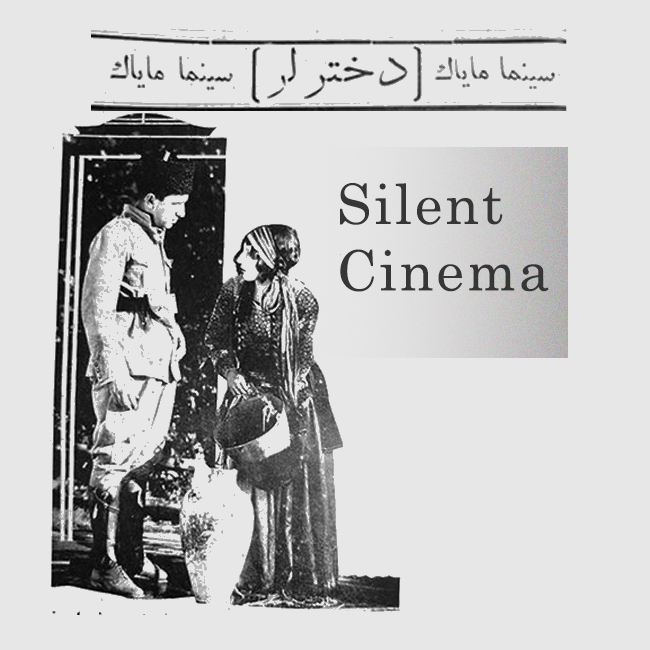
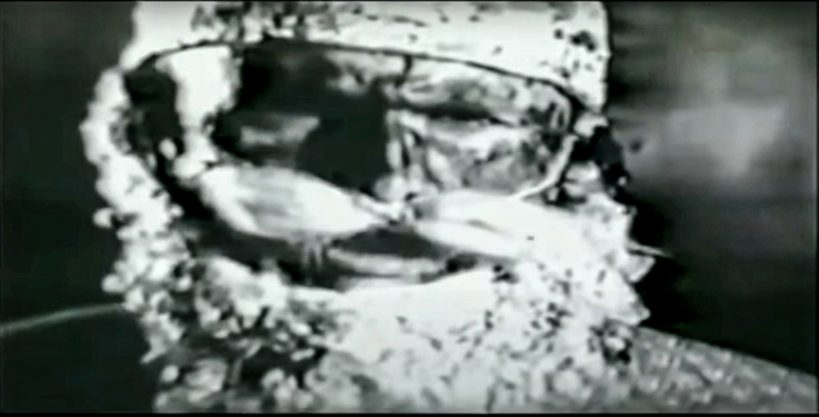
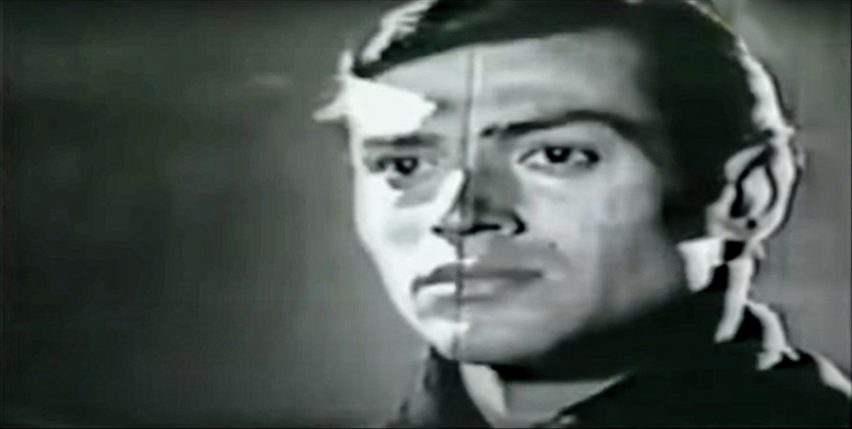
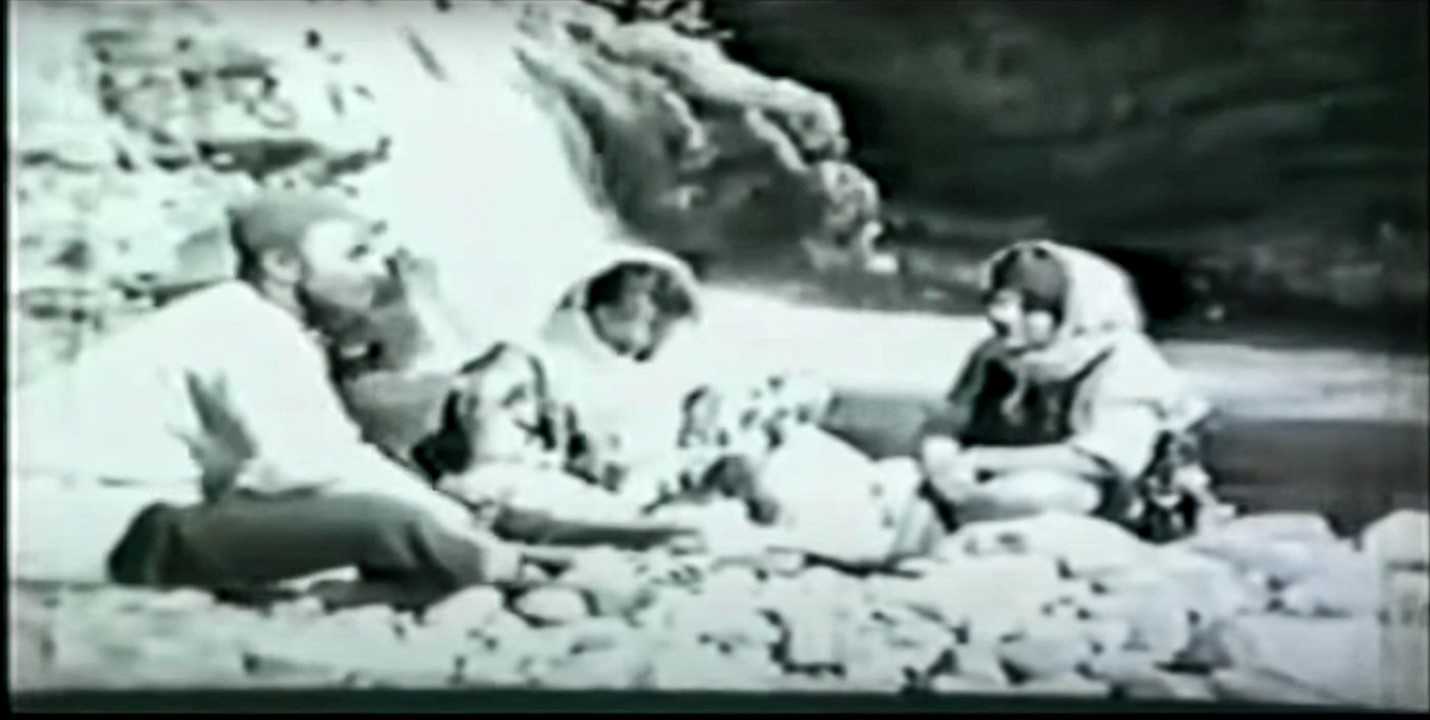
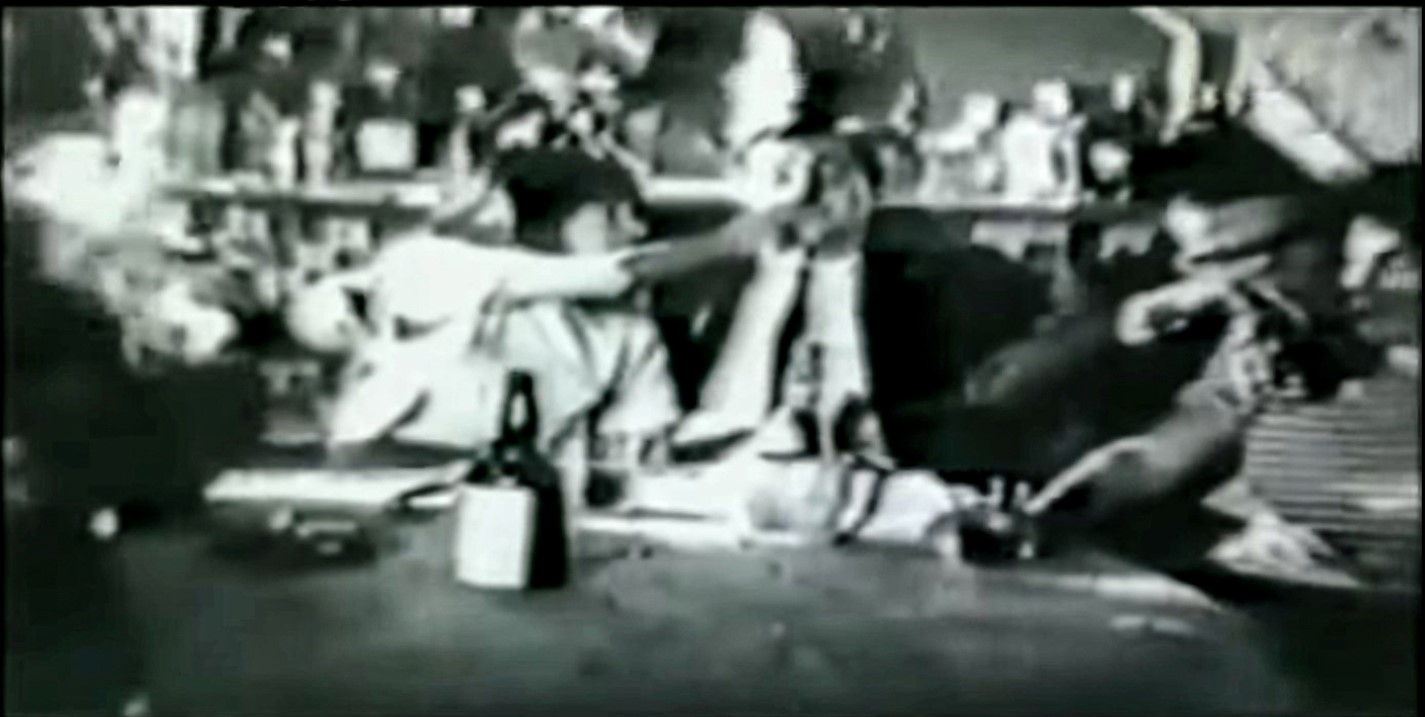
To research silent cinema in Iran is to reconsider what aspects of cinema history, broadly conceived, are worth showcasing. Does one seek out firsts: the first inventions, initial contact with the moving image, the opening of a successful cinema, the first feature made locally or in one’s language? Or does one highlight pathbreaking achievements alongside other forms of creative work? Longstanding habits of thinking of cinema in strictly national terms, when they privilege firsts to the exclusion of other approaches, can obscure cinema’s dynamism. Celluloid is designed, after all, to roll up and change location. It comes to life when it moves from one place to another. If we focus too exclusively on national production centers we risk concealing the kinds of creative agency involved in sourcing films and engaging new audiences with them. Films travel and, despite their fragility, often last far longer than they were intended to—yielding creative asynchronies in film cultures around the world.
Many of the stories of silent cinema in Iran are well known, thanks to the work of historians and the documentation of archivists over the years. The challenge lies in framing the kinds of questions that do not reify these familiar stories, but rather open them up to the pressing questions of the broader field. One way to do this, which I pursue here, is to consider the ways in which silent cinema in Iran was itself a labor of compilation. It was a kind of compendium of early global cinema itself. Film reels, devices, and traditions came to life in Iran in this period not by way of a local film industry (that came later), but through several paths of exchange and creative reuse. This dynamic aspect of silent cinema, which was such an important part of Iran’s silent film scene, can thus help the field of cinema studies to refocus its own questions about what to prioritize in cinema history. I address these questions here using cases from four phases of silent cinema in Iran: questions of origin, exhibition and import, local production, and silent cinephilia after the coming of sound.
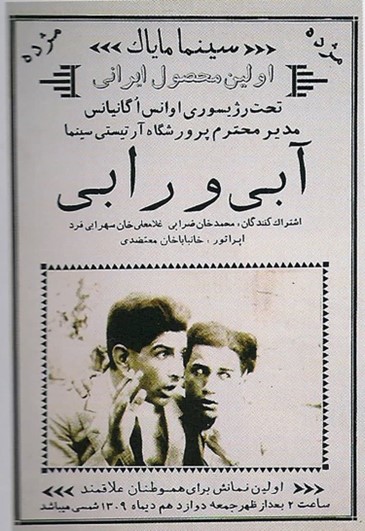
Figure 1: Poster for Abi and Rabi (Abi-va- rabi), directed by Ovanes Ohanian, Iran’s first comedy film, 1930
Questions of Origin and Media Convergence
The history of early cinema abounds with accounts of surprise and revelation at moments when the technology was first introduced to audiences. As rich as these stories of transformative first contact with the cinema may be, they must be considered alongside the inauspicious and everyday uses of the motion picture. In the case of Iran, it would be misleading to refer to first interactions with cinema in 1900 as a sudden transformation in an environment that was somehow naïve to what moving images could do. For in fact, as is often the case with a new technology, the moving picture found a home among users who had clear ideas about what to do with it from the start. New technologies may turn out to be culturally transformative, but they usually first appear alongside the other arts. Media technologies emerge as guests within an established practice. A new apparatus can offer a technical enhancement of a practice that has been around for a while—just as a university lecture illustrated by 35mm slides is not unrecognizably different from one synchronized with a video projector.
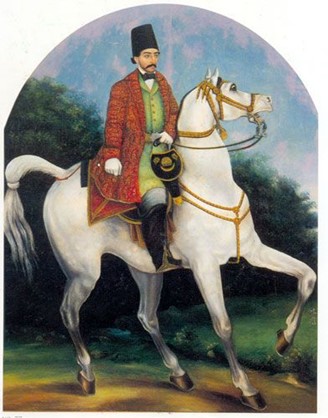
The late Qajar rulers are known for their collections and sponsorship of optical devices, photography, and film—from the photographs of Nasir al-Din Shah to the earliest archive of moving images created by Muzaffar al-Din Shah’s photographer. Throughout this period, new media technologies conjoined with and technically extended royal imaging and entertainment practices. Like a graft in an orchard, the new scion attaches to existing root stock, which both nourishes and determines its growth.1 The films made under Muzaffar al-Din Shah’s direction spanned the personal and the official. They grafted onto established practices of court photography and sovereign portraiture in painting. Alongside the documents of parades and official events the court photographer also staged scenes with the shah that borrow from traditions of royal portraiture, which include popular equestrian scenes and guns-and-scope pictures that date back centuries. Paintings of the later generation of Qajar royalty with poses comparable to those of the early films include Equestrian Portrait of ʻAli Quli Mirza, I‘ti ̤zad al Saltanih (1864) and Nasir al-Din Shah and a Cannon (c. 1865).
This merger of the moving image with traditions of royal portraiture should come as no surprise. It offers an alternative to historical narratives of cinema’s emergence that are better known. Historians of cinema in the US and Europe have taken pains to outline the way in which the moving image ascended from its low status as a fairground entertainment or a “chaser” for clearing out spectators at the end of a vaudeville bill.2Filmed subjects as vaudeville “chasers” refers to a debate between Charles Musser and Robert Allen about the variety of uses of actuality films in early cinema. For a recent examination of this formative debate using digital tools, see Paul Moore, “A ‘Distant Reading’ of the ‘Chaser Theory’: Local Views and the Digital Generation of New Cinema History,” in Hildago Santiago, ed. Technology and Film Scholarship: Experience, Study, Theory. (Amsterdam: Amsterdam University Press, 2018), 169-92. It soon appealed to the notions of cultural sophistication (and decorum and domestication). As a mass entertainment it could include professional or even genteel audiences. The technology, as it developed its medium identity, moved from the marginal penny entertainments and traveling shows into other social strata. In Iran, however, the devices of the cinema engage the top of the social hierarchy from the start. Motion picture technology found purchase around Gulistan Palace in the first years of the twentieth century. Meanwhile, in the West Midlands of England and the Midwest USA, it thrived under muddy fairground tents. Early cinema took divergent paths, and the case of its emergence in Iran highlights how the invention of a medium is not something that happens at a single point and then is introduced around the world in a series of surprising premieres. Cinema is invented laterally, at every stage of its movement, by those who devise ways to fold it into their existing media practices.
Figure 2: Portrait of ʻAli Quli Mirza, I‘ti ̤zad al Saltanih (1864)
Figure 3: Naser al-Din Shah on a Hunt, Sa’dabad Palace Museum . source: https://sadmu.ir/detail/1358
Reshaping Silent Films in Commercial Theaters in Iran
Descriptions of actual screenings are somewhat rare in the historical record, so the details of these screenings are worth reconstructing. Those who brought cinema onto screens in Iran were resourceful in the way they worked with constraints and created a screening experience built on a foundation of fandom and remix. Evidence of this reshaping exists in fragments. Business records of film distribution combined with newspaper advertisements can give us some sense of how this worked—especially for standout forms like the serial film and epic films that returned to Tehran theaters over the years.
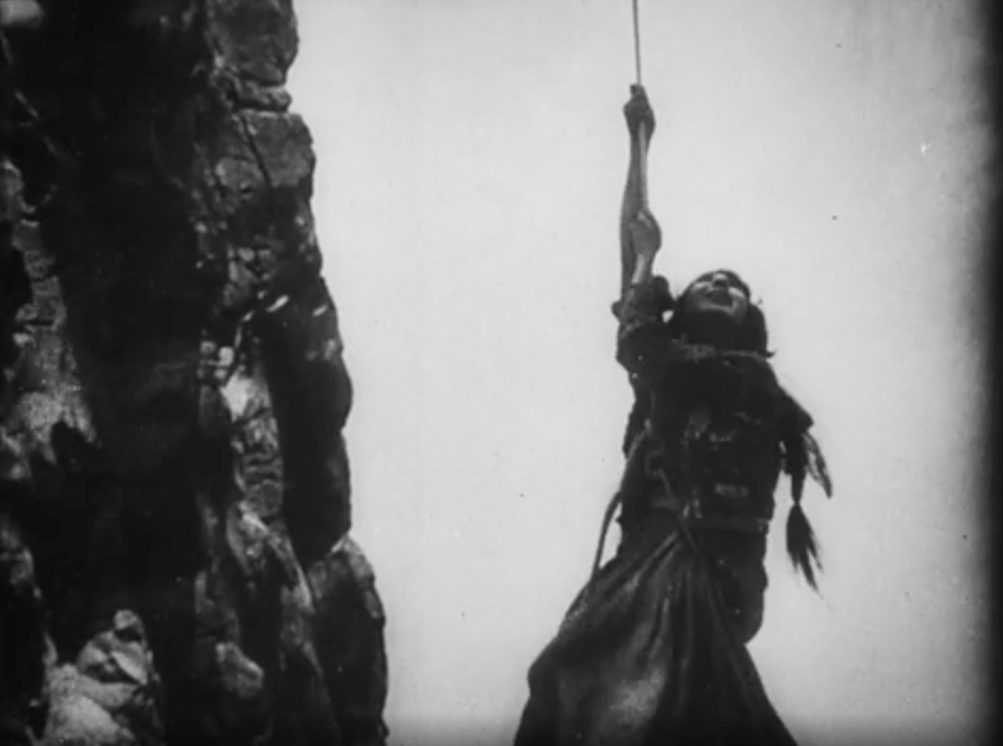
The serial film, modern in both form and content, provides an important gauge for the global life of cinema in the silent era. It occupies a space between the short variety programming of early cinema and the feature films that became a global standard in the late silent era.3There were still many programs of shorts around the world (and certainly in Iran) in the late 1920s and early 1930s—especially when one considers the wide variety of film programming that occurred outside of major commercial cinemas. Serial film plots develop across multiple episodes. This thread of continuity distinguishes serial films from series films, which only feature recurring characters in unlinked situations. The narrative thread and frequent cliffhanger endings in serial films were designed to cultivate an audience’s habit of regular attendance. The serial’s frequent structuring around spectacular physical stunts along with its episodic format made it well suited for both attracting a large audience and regularizing its flows. Drawing from the success of serialized fiction, newspapers and magazines published stories of the episodes in advance of the screenings so that audiences could read the story and then see it on the screen that evening. These tie-in stories complemented the advertisements and had the benefit of generating publicity over a long-term run of a serial at a given cinema.
The serial drew modern audiences with sequences of female protagonists leaping from trains,4For discussions of the global modernity of the serial queen as a performer, see Weihong Bao, “From Pearl White to White Rose Woo: Tracing the Vernacular Body of Nüxia in Chinese Silent Cinema, 1927-1931,” Camera Obscura 20.3 (2005): 193-231; Rosie Thomas, “Not Quite (Pearl) White: Fearless Nadia, Queen of the Stunts,” in Bollyworld: Popular Indian Cinema through a Transnational Lens, ed. Raminder Kaur and Ajay Sinha (New Delhi: Sage, 2005), 35-69. it synchronized film exhibitors’ schedules with regular programming,5On synchronization and time management for the 1920s serial, see Ruth Mayer, “In the Nick of Time? Detective Film Serials, Temporality, and Contingency Management, 1919-1926,” The Velvet Light Trap 79 (Spring, 2017), 21-35. and it created opportunities to link with the serial press.6On serial tie-in culture see Ben Singer, Melodrama and Modernity: Early Sensational Cinema and its Contexts (New York: Columbia University Press, 2001), 271-82, and Shelly Stamp, Movie-Struck Girls: Women and Motion Picture Culture after the Nickelodeon (Princeton, NJ: Princeton University Press, 2000), 102-25. This combination of features allowed the serial to travel to become an important part of cinema culture around the world—especially in Iran. The experience of the modern film serial was indeed shared around the world, but it would be misleading to assume that this sharing was homogeneous or transparent—especially when the serials available in a given market were of varying age and were missing several episodes. The life of the serial in Iran suggests that its influence might best be tracked as flexibility rather than homogeneity, as an adaptable rather than as a plug-and-play form.
Iranian exhibitors display a few patterns of inventive adaptations to the material they were able to import. First, because they were programming this material at the time in which the feature film was well known to audiences, exhibitors in Iran sometimes featurized them by combining multiple episodes and billing these multi-episode programs in a similar fashion to multi-act feature films. Second, the printed tie-in prose stories were not as tightly synchronized with the film screenings as they were in other markets. When episodes were missing, which was usually the case, newspapers such as Ittila‘at sometimes published tie-in stories to fill in the gaps of missing reels.7See the serialized print story of The Tiger’s Trail, starring Ruth Roland, in Ittila‘at. Ittila‘at published translations of Guy de Téramond’s Le Tigre Sacré, a prose adaptation of the serial film, in 1,000-2,000-word installments over a three week period toward the end of 1306/1927. The first episode can be found in Ittila‘at, Azar 28 [December 20] 1306/1927. Finally, faced with the challenge of promoting serials that were sometimes a decade old, exhibitors often foregrounded the long journey of a film rather than trying to erase it. If an old print could no longer showcase global of-the-moment fashion, this could just mean (or be marketed to mean) that the films had passed muster with audiences in cities around the world and could function in a cosmopolitan imaginary. The scratches and missing reels could indicate a serial’s status as an evergreen and as a modern classic.8I make this argument in extended form and with greater documentation in Kaveh Askari, “An Afterlife for Junk Prints: Serials and other ‘Classics’ in 1920s Tehran,” in Silent Cinema and the Politics of Space, eds. Jennifer M. Bean, Anupama Kapse, Laura Horak (Bloomington: Indiana University Press, 2014), 99-120. Each of these examples highlights ways that exhibitors could construct cultural capital around a media artifact through intelligent design of programs and promotion. The serial was adaptable but not universal in its appeal.
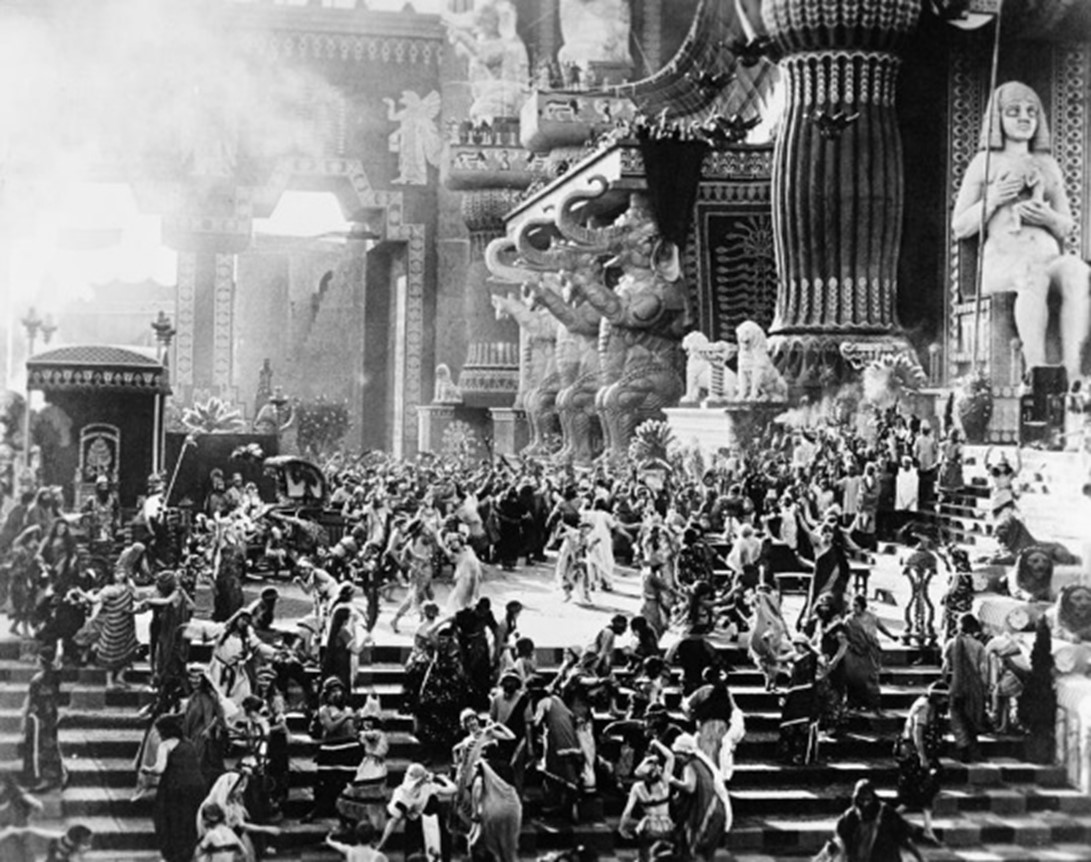
The rhetoric of universal appeal and transparent communication was, however, an important part of the intellectual history of silent cinema.9Indeed, audiences and critics in Iran welcomed D.W. Griffith, who was one of the filmmakers from the silent period who was most committed to an idea of cinema as a universal language. More on this in the final section. The way these ideas of universal global communication through silent films unfolded in Iran reveals the ironies inherent in this modern story of Babel. The best-known example of the rhetoric of universal language in silent films is Intolerance (dir. D.W. Griffith, 1916). The epic film expressed Griffith’s ideal in its most elaborate form, linking as it did four different periods and cultures throughout history through a parallel editing scheme. In Iran, however, the version of Intolerance that played was an excerpt of the film’s Babylonian narrative that Griffith retitled The Fall of Babylon—only one thread of the four narratives that were originally interwoven. The film played for years in Tehran as Kurush-i Kabir—Fath-i Babil (Cyrus the Great—Victory over Babylon).10Advertisement for “Kurush-i Kabir- Fath-i Babil” Ittila‘at, 1307/1928. It was linked to the Iranian new year and was accompanied in advertisements by nationalist sentiments. This celebration of the Iranian characters in the film, originally portrayed as villains, completely refashioned the meaning of a film that was created with the ambition to eliminate such drift in communication. Much like the serial situation, the impressive travel and long life of the film did in some way fulfill the ambitions of its creators, but not as a universal transparent form of communication. The copy of the film was a media artifact. It was pliable, adaptable, and able to be reintegrated with intellectual traditions at work in the press at the time.
Figure 4: Intolerance, (1916). D.W. Griffith, still from Griffith’s Intolerance. Accessed via https://www.openculture.com/2013/07/dw-griffith-intolerance.html
A Compendium of Silent Film Performance, Made in Tehran
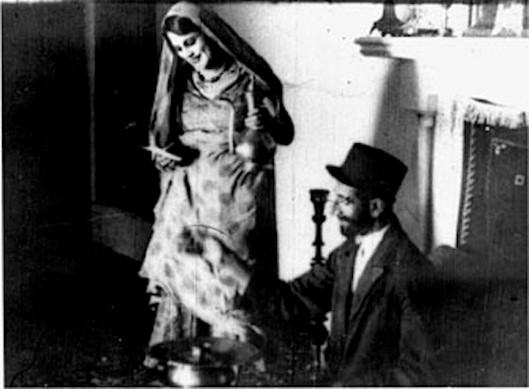
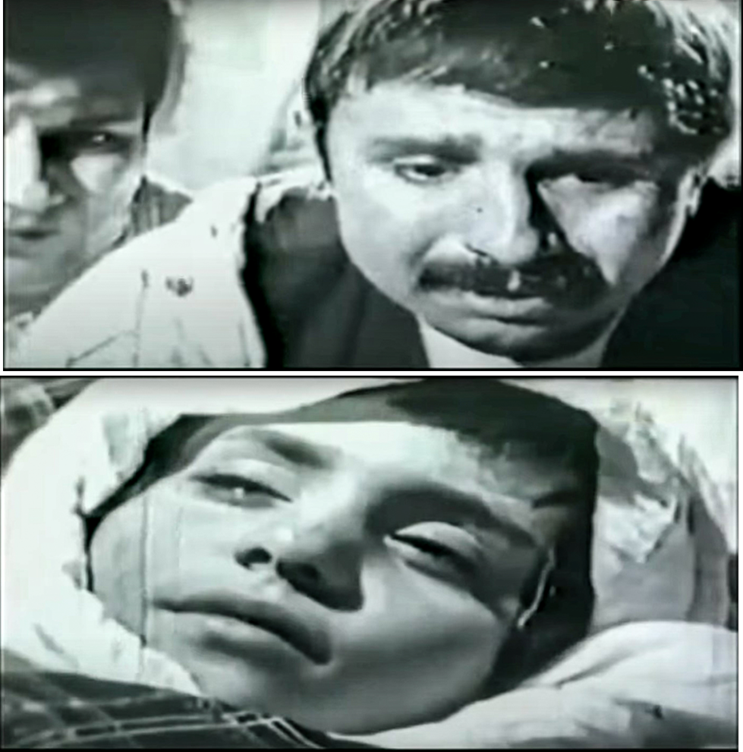
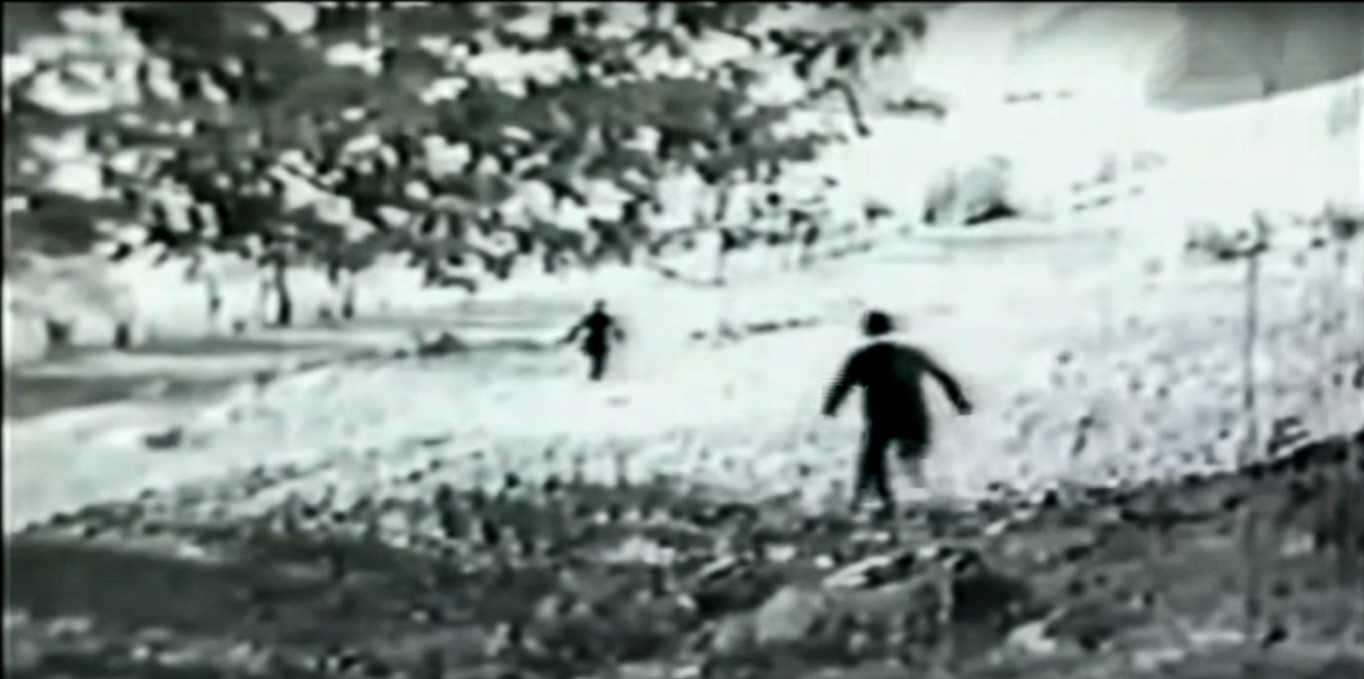
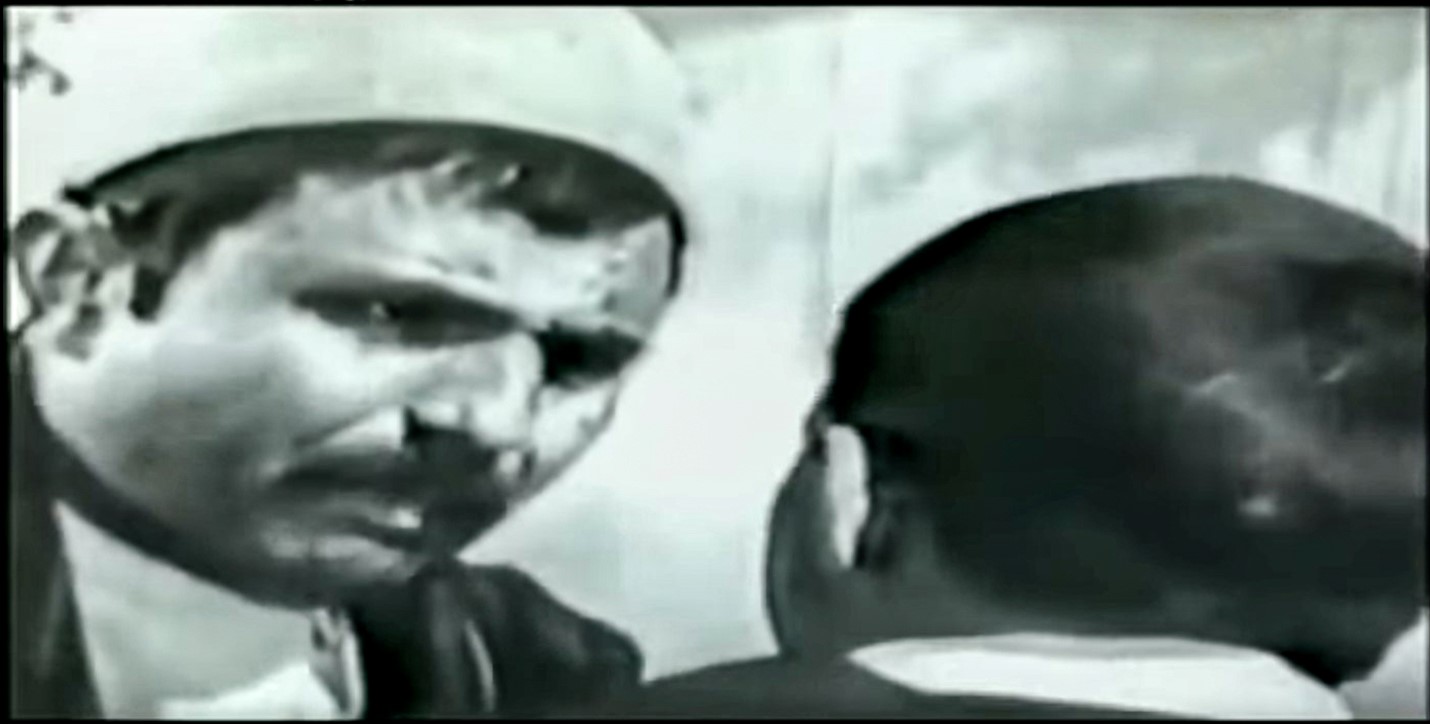
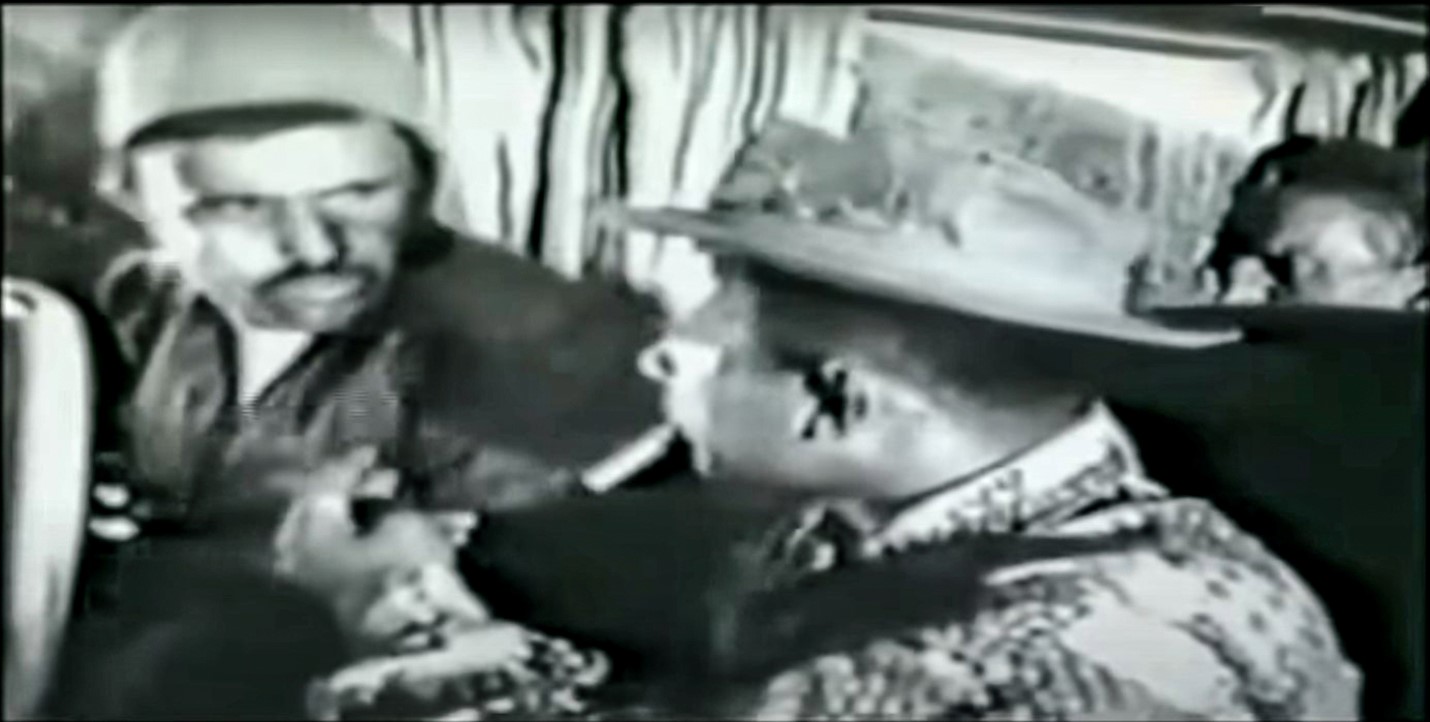
The film was a rough-edged experiment, a one-time project that tells us little about the industry standards that would stabilize after the 1950s. It does, however, reveal other historical patterns as a vector for film styles. The film is about performance, it was made by a director who founded a school for acting, and it was structured as a kind of variety show. A character chases another through the streets and encounters a series of situations. The narrative is thin, but like many chase films, it provides a simple framework on which to arrange modular scenes. The filmmakers use a series of gags to create a kind of compendium for the variety of performance traditions that coursed through cinema in its first thirty years.11This makes sense given that the film was an outgrowth of his school for film acting. in which various forms of acrobatic, comedic, and dramatic performance were a part of the curriculum. Discussion of this gymnastic training as a form of uplift are quoted in Jamal Omid, Uvanes Uganians: Zinidgi va Sinama, (Tehran, Faryab, 1362/1984), 55. The traces of global film traditions in Haji Aqa are numerous. The film cites a range of famous figures of silent cinema including Dizga Vertov, Lev Kuleshov, Richard Talmadge, Maciste, Georges Méliès, and Mack Sennett. This dense network of citation comes into view when we pull back from a view of this film as a “first.”
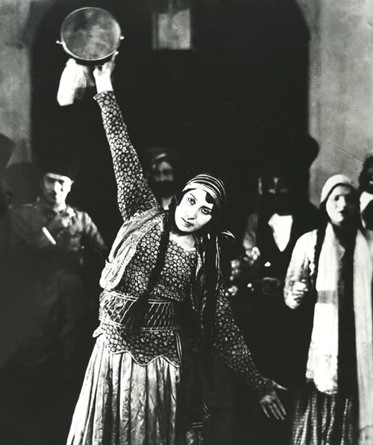
A helpful way to appreciate the reach of Haji Aqa’s many references to performance traditions is to consider the phases of silent film in which those traditions were prominent. From the early period, we see magic, dance, stunt, and strongman traditions of the 1890s to the 1910s. There is a magician performing tricks with substation splices in the manner popularized by Georges Méliès. A dancer (Asia Qustanian) performs what Ida Meftahi has analyzed as a kind of hybrid national dance while the camerawork and mise-en-scène take cues from turn-of-the century dance films.12For discussion of national dance in the scene, see Ida Meftahi, Gender and Dance in Modern Iran: Biopolitics on Stage (London: Routledge, 2016), 18-48. The serpentine dance, popularized by Loïe Fuller was an important act in early films. The canted angles used for shooting a performance can be seen in silent Soviet cinema as well as avant-garde traditions in France. The filmmakers would have known some of these examples through training in Russia or from screenings as these films circulated. Mack Sennet-style knockabout comedy can be seen in the automobile sequence of the film, and spectacular stunts appear throughout. Adventure serials featuring actors known for their stunts, such as Ruth Roland and Richard Talmadge were popular in Iran. Comparisons to these figures were readily at hand when the filmmakers staged Mir Ahmad Safavi’s elaborate jump from a building.13“[…] un aqa (Safavī) varzishkar-i mashhar ast va dArad taqlid dar miʹavarad kih az u fīlmbardari kunand (Albattih lazim bih tuzih nist kih aqa-yi Safavi bih taqlīd az fīlmʹha-yi Rishard Talmaj yik sahni-yi pur zad’u’khurd-i pulisi ra bazi miʹkard.” Jamal Omid, Uvanes Uganians, 61. It should not come as a surprise that we would find a strongman in the dentist’s office in Haji Aqa.14His feat of strength involves turning a winch for the extraction of teeth. For a discussion of Maciste and the tradition of the strongman in Italian cinema, see Jacqueline Reich, The Maciste Films of Italian Silent Cinema (Bloomington: Indiana University Press, 2015), 115-48. There are records of Albertini films in the advertisements in Ittila‘at, including 27 Farvardin, 1309/April 16, 1930. For a discussion of Maciste in Tehran, see Golbarg Rekabtalaei, Iranian Cosmopolitanism: A Cinematic History (New York: Cambridge University Press, 2018), 41. Audiences in Iran had the opportunity to see silent serials featuring strongman performers like Maciste and Luciano Albertini. Uganians’s acting school even designated displays of strength as one of the specializations alongside the more common comedy and drama.15 The film offers a kind of education in each of these aspects of early cinema technique.
Figure 5: Haji Agha, the Cinema Actor,(1933), Ovanes Ohanian, stil from Ohanian’s Haji Agha
But Haji Aqa looks not only toward the early years of cinema, it also engages with modernist traditions of performance that emerged more than a decade after its earliest references. The 1920s Soviet schools of acting, which Uganians knew, tended to blend feats of physical agility with the eccentric display of emotion. This style turned away from the Stanislavsky-influenced methods that preferred psychological interiority.
Gymnastic training tuned the body like a machine, and it was prized in Soviet physical culture. In the arts, it served as a foundation of Soviet modernist acting styles. Likewise, Haji Aqa features a number of gymnastic performances. We even see actual gymnasts doing traditional gymnastics. Their performance of skill proceeds in reverse motion, which was a common technique used by the Dziga Vertov group in scenes where they wanted to analyze the movements of a trained athlete. Vertov’s Kino Glaz (Kino Eye, 1924) shows the acrobatic movements of divers in order to illustrate the proper technique of a high dive. Uganians’s scene in his acting school shows trained bodies appearing to fly onto the uneven bars. As in Vertov’s films, reverse motion offers both spectacle and analysis. The skilled movement amazes and edifies at once.
One of the most influential film educators in Moscow during the silent era was Lev Kuleshov, whose teaching and filmmaking practices drew from a tradition of athletic, modernist acting known as Biomechanics. Actors in Kuleshov’s Po Zakonu (By the Law, 1926) and Neobychainye priklyucheniya mistera vesta v strane bolshevikov (The Extraordinary Adventures of Mr. West in the Land of the Bolsheviks, 1924) perform sets of eccentric and concentric poses rhythmically. In ensemble scenes, their dynamic movements synchronize as if their bodies belonged to the same machine. Habibullah Murad’s performance of Haji Aqa bears comparison to the dynamic, cyclical, and eccentric posturing that Kuleshov directed in his own actors. Traces of this biomechanical style intermingle with other comedic performance traditions with which the actor had been familiar. The performance most recognizable for those who know Kuleshov’s work is Uganīans’s own role as the director of the film-within-the-film. Following an intertitle that reads “A director in search of a scenario” Uganians as “the director” brainstorms potential scenes by running through a series of poses. He articulates gestures in a series punctuated by brief pauses. He makes eccentric facial expressions and positions his shoulders in unnatural alternating diagonals that would be at home in the films of the Kuleshov Collective. Uganians’s strong resemblance and Moradi’s partial resemblance to the style of the Collective are consistent with an actor-director imparting these principles of movement to another actor.
Each of these performances, which comprise the majority of the film, refers to a cinematic tradition. The framing story and the chase structure allow the film to showcase a variety show that reanimates genres and attractions from the turn-of-the-century, the 1910s, and from the 1920s. The film is not territorial or chronologically narrow. Instead, it treats cinema as a vector of exchange. It provides a compendium of performance traditions from silent cinema in the world’s orbit.
Silent Cinema as a Marker of Cinephilia
The silent cinema phased out of most commercial exhibition in Iran, as it did elsewhere, in the 1930s, but it maintained an important cultural position in the years to come. Silent comedians, serial stars, Soviet cinema of the 1920s, along with other silent film epics and dramas became an important archive for the formation of traditions of cinephilia or Sinamadusti.16On these formations of cinephilia, see Ehsan Khoshbakht, “Cinemadoosti: Film Folklore in Iran,” Sight & Sound (March 9, 2018), www2.bfi.org.uk/news-opinion/sight-sound-magazine/features/cinemadoosti-film-folklore-iran It can be argued that the effort to reshape, reedit, and adapt cinema described in previous sections is already a practical cinephilia. It was a business, but it was also a creative labor of love. In the years that followed, silent films drew interest among modernist intellectuals and were prized at early retrospective screenings. The history of this curatorial afterlife of silent cinema in Iran marks an intellectual cinephilia.
Charlie Chaplin offers a standout example. The life of Chaplin’s films in Iran highlights the continuities between practical cinephilia and intellectual cinephilia. Consider André Malraux’s famous passage about a screening he saw in Iran.
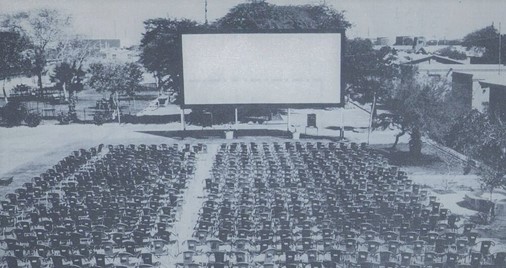
In Persia, I once saw a film that does not exist. It was called The Life of Charlie. Persian cinemas show their films in the open air, while black cats look on from the walls surrounding the audience. The Armenian exhibitors had artfully compiled Chaplin’s shorts into a single film. The resulting feature film was surprising: the myth of Chaplin appeared in its pure state.17André Malraux, Esquisse d’une psychologie du cinéma (Paris: Gallimard, 1946), 34.
Malraux’s passage provides a description of a phenomenon, which is valuable in itself. It also expresses an intellectual curiosity about the kind of cinema experience made possible by the labors of compilation. The passage indicates the way films were manipulated as they moved across distances into Iran. It was an instance of craft labor. Malraux attributes agency in this passage, not to the filmmakers, but to the exhibitors who created a montage of Chaplin’s shorts [tous les petits Charlots] into a full-length film. The compilation of Chaplin crystalized the modern mythology of the movie star for Malraux.
It is important to understand this familiar passage in the context of Malraux’s curiosity for modernist ideas about a metaphysical purity that translates across cultures.18See Derek Allan, “Art as Anti-Destiny: Foundations of André Malraux’s Theory of Art,” Literature and Aesthetics 13, 2 (2003): 7-16. He mentions other stars in the section of the book, but for him Chaplin is “the perfect example.”19Malraux, Esquisse d’une psychologie du cinéma, 34. Chaplin’s tramp character influenced a range of vagabond characters in popular cinemas around the world, including Raj Kapoor in Awaara (1951) and velgard characters in Iran. He sparked inspiration among modern artists such as Fernand Léger, who animated a cubist Chaplin puppet as the presenter of Ballet Mécanique (1924). Malraux’s quote directs us to the way these two elements could comingle: the interest in fan culture and remix on one hand and, on the other, the modernist intellectual engagement with silent film performance as mass culture. Here a French art theorist describes a modernist notion of aesthetic purity or essence created by an impure compilation. The statement contradicts any assumption by Chaplin purists that compiling and reediting these films would bowdlerize them. This paradox is why I highlight the curatorial labor of distributors, exhibitors, and fans alongside that of intellectuals.
Throughout the formative years of the film press in Iran, there were multiple instances of this merger of popular fandom and modernist fascination. There are more than seventy discussions of Chaplin in Sitarih-ʼi Sinama between 1953 and 1960. The discussions tend to follow the magazine’s typical mix—sometimes contentious—of enthusiastic discussions for fans and serious film criticism. In a 1955 essay about the future of the film industry in Iran, an ambitious young director named Samuel Khachikian describes aspects of Chaplin’s and Griffith’s work in tandem with that of Soviet theorists including Vsevolod Pudovkin.20“Aya bih Ayandeh-ʼi ṣan‘at-i Filmbardari-yi Iran Mitavan Umidvar Shud? (Is There Hope for the Future of the Iranian Cinema Industry?” Sitarih-ʼi Sinama 24 (22 Dey 1333/Janurary 12, 1955), 14 He participates in modernist reception of key figures from the silent era by mentioning those aspects of Chaplin’s work that interested Soviet modernists. After a few years of experience making films, Khachikian brings his own work in comparison to theirs—mostly as a comparison of the working conditions of industries around the world.21“Sharayiṭ-i Kar-i Ma Hatta Charli Chaplīn’ha va Disika’ha ra Ham Bizanu Dar Mi’avarad (Our Working Conditions Would Bring Charlie Chaplins and De Sicas to Their Knees)” Sitarih-ʼi Sinama 196 (5 Bahman, 1337/January 25, 1959), 8-9, 40. Essays about Chaplin also appear in the film sections of intellectual magazines. An essay on Chaplin in Film va Zindagi, translated by Iraj Purbaqir makes similar connections. The magazine even includes, as an illustration, the cubist Chaplin puppet from Ballet mécanique. In each of these examples the life of Charlie appears in its privileged state. He seems to have been specifically important during this experimental decade when film intellectuals were establishing a canon.22Discussion of Chaplin tapers off during the 1960s followed by another wave of publicity during the 1970s around the time when the Tehran film festival also sought to return to Chaplin as a way to consider the cultural work of a festival like this.
Figure 6: sample of an outdoor cinema in Abadan, Iran, 1960
Non-fiction, sponsored, institutional, and children’s films are integral to the history of Iranian cinema. Iran, like other developing economies in the post-World War II order, was eager to invest in documentary film as a means of communication, education, and promotion of state agendas. Cinema was an exemplary object of modernity, and thus an ideal medium through which to construct new social worlds. Iran’s midcentury production of “useful cinema”1Charles R. Acland and Haidee Wasson, Useful Cinema (Durham N.C.: Duke University Press, 2011). was vast and varied, ranging from dull statist visions to avant-garde interpretations of societal change. These non-fiction films provide a valuable lens through which to understand the Iranian national imaginary. Many of Iran’s best-known filmmakers, such as ‛Abbās Kīyārustamī, began their filmmaking careers making sponsored and non-fiction films. Further, many sponsored and non-fiction films made in the 1960s and 1970s influenced the form of the Iranian New Wave and post-revolutionary art cinema. A focus on institutions illuminates film history and political history together.
This article considers the film output from an institute for children’s media, Kānūn-i Parvarish-i Fikrī. Films produced by Kānūn, such as Davandah [The Runner] (1984), Khānah-yi dūst kujāst [Where is the Friend’s House?] (1987), and Bachah-hā-yi Āsimān [Children of Heaven] (1997),2Davandah [The Runner], directed by Amīr Nādirī (Tehran, Iran: Kānūn-i Parvarish-i Fikrī, 1984); Khānah-yi dūst kujāst [Where is the Friend’s House?], directed by ‛Abbās Kīyārustamī (Tehran, Iran: Kānūn-i Parvarish-i Fikrī, 1984); Bacha-hā-yi Āsimān [Children of Heaven], directed by Majīd Majīdī (Tehran, Iran: Kānūn-i Parvarish-i Fikrī, 1997). stand as some of the most significant and influential works of Iranian cinema. How did Kānūn come to play such a valuable role in Iran’s cinematic history? What factors motivated film production decisions at the institute? To address these questions, this article begins by contextualizing Kānūn within a broader history of sponsored film production in Iran. Initially, Kānūn focused on literary pursuits, but soon founded a film department. Here, I focus primarily on its first decade of film production. Even in these early years, filmmakers at Kānūn produced a diverse body of work, which can be broadly categorized as realist, modernist, or experimental. An examination of the institute’s bureaucracy and structure sheds light on the emergence of these aesthetic modes. The Islamic Revolution of 1979 resulted in sweeping and fundamental changes in governance, and this extended to film production too, though Kānūn remained a prolific and vital production house through the 1990s.
Figure 1: Logo of Kānūn-i Parvarish-i Fikrī (Center for the Intellectual Development of Children and Young Adults, 1965), designed by Muhamad Pūlādī.
Sponsored Film in Iran
Iran’s earliest moving pictures are actualities (short non-fiction films) from the court of Muzaffar al-Din Shah. The Shah had ordered court photographer Sanī‛ al-Saltanah to buy two film cameras and film stock while they were traveling through Europe in 1900. The first of these actualities was likely Jashn-i Gulhā (1900), in which al-Saltanah documented Belgian women tossing floral bouquets at the Shah.3Hamid Naficy, A Social History of Iranian Cinema. Volume 1, the Artisanal Era, 1897-1941 (Durham, N.C.: Duke University Press, 2011).The Iranian state would go on to invest more heavily in film—particularly as pedagogical media—in future decades. Reza Pahlavi’s modernization reforms paved a path for the state’s involvement in film production, distribution, and exhibition. The Pahlavi state codified cinema through regulations that governed film distribution and exhibition in the 1930s. This ensured the exhibition of non-fiction films such as newsreels, scientific films, and industrial films. Further, the code both governed children’s ability to see appropriate films and advocated for the screening of educational films in schools.4olbarg Rekabtalaei, “Cinematic Governmentality: Cinema and Education in Modern Iran, 1900s–1930s,” International Journal of Middle East Studies 50, no. 2 (2018): 247-269. These regulations set a precedent for the state’s use of film as a pedagogical tool.
In 1964, Pahlavi’s son, Muhammad Reza Pahlavi, established the Ministry of Culture and Arts (MCA). This organization oversaw all arts production and exhibition in the country. Mihrdād Pahlbud, a member of the royal family, was appointed to run the ministry. He had previously been the head of the Fine Arts Administration, which had housed Iran’s first documentary production unit. During the 1960s, there was a proliferation of government institutions related to arts administration, and many began to sponsor film production with an eye towards social reform and societal modernization. Other film-sponsoring organizations included the National Iranian Oil Company (NIOC), a consortium in which Iran had a majority ownership (foreign oil companies owned shares of it as well); The Red Lion and Sun Society; as well as similar aid, relief, and care organizations. Thus, initially there was no single centralized film production unit, but rather, various interlinked agencies and institutes that were either entirely under state control or received funding, training, or material resources from the state.
Founding the Film Department at Kānūn
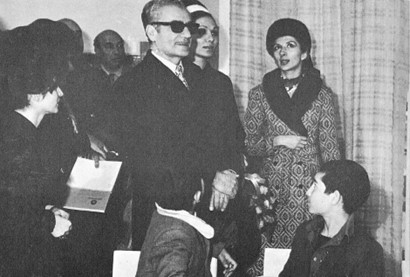
This article focuses on influential film production at an institute dedicated to children’s media and culture. Kānūn, or the Center for the Intellectual Development of Children and Young Adults, was a nominally independent institution but was entirely funded by state agencies. Lily Amīr-Arjumand had the idea of creating a children’s library and publishing house after seeing similar institutions in European countries. Her childhood friend, Farah Pahlavi, the Queen of Iran, entrusted Amīr-Arjumand first to head the National Iranian Oil Company Library in 1959, and then to found Kānūn in 1965. (In between, Amīr-Arjumand trained as a librarian at Rutgers University in the United States.) According to Farshīd Misqālī, a graphic designer and animator who worked for the center, funds for the organization were determined by board members from the Ministry of Art and Culture, the Ministry of Education, the national airline (Iran Air), the Interior Ministry, the Oil Ministry, the Pahlavi Foundation, and National Radio and Television. Queen Farah Pahlavi led the board of trustees. Misqālī also states that “Board members supported Kānūn through their affiliated organizations,”5Arash Sadeghi, “Institute for the Intellectual Development of Children & Young Adults,” Bidoun 16 (Winter 2009), retrieved 29/08/2024, https://www.bidoun.org/articles/institute-for-the-intellectual-development-of-children-young-adults indicating additional flows of support for the institution. In the same interview, Misqālī says that filmmaker ‛Abbās Kīyārustamī—who, at the time, was a commercial artist—recommended that Kānūn establish a film department. The organization launched this department in 1970 and Ibrāhīm Furūzish became its first director. The department also produced animation films.
Figure 2: Grand opening of a Kānūn-i Parvaresh library with Muhammad Reza Shah Pahlavi and Farah Pahlavi (1965). accessed via https://commons.wikimedia.org/wiki/File:KanunShah.jpg
Festivals and Exhibition
Even in its earlier years, the organization was involved in film exhibition: it hosted an international festival of children’s films, with entries from the Soviet Union and the National Film Board of Canada. The International Festival of Films for Children and Young Adults was very popular, running from 1966 until 1977. It was also influential, helping to circulate the best of international film and animation to young Iranians, and providing a platform for nascent Iranian talent.
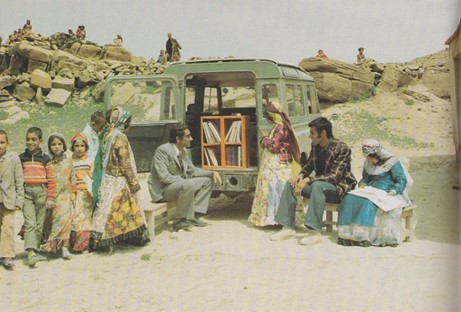
Kānūn’s exhibition venues for their films included cinemas, schools, state-run film festivals, film clubs, and other institutions. However, they were primarily exhibited in their own libraries, which functioned as local cultural centers. In its first decade, Kānūn established 150 libraries in Iran, in both urban and rural areas; after the Islamic Revolution, this number would rise to over three hundred. These libraries soon expanded to include infrastructure and space for film screenings, theatre, and other cultural activities. Kānūn also provided mobile cinemas and traveling theatre so that they could reach children in more rural and remote parts of the country.
Figure 3: A photo of a mobile library taken in Kurdistan province (1970). accessed via https://commons.wikimedia.org/wiki/File:MobLib.jpg
Filmmakers, Genres, Aesthetics
Kānūn’s first films included animations by Misgālī and live-action short films by Kīyārustamī, Muhammad Rizā Aslānī, and Bahrām Bayzāʾī. Indeed, these and several other prominent Iranian filmmakers began their film careers at Kānūn. Associated filmmakers include Suhrāb Shāhīd-Sālis, Amīr Nādirī, Nūr al-Dīn Zarrīnkilk, who is considered the father of Iranian animation.
In Kānūn’s first decade, these filmmakers produced a plenitude of notable, influential, and beloved films. This initial run of production ended with the Iranian Revolution in 1979. After that, the Islamic government imposed a new set of rules to govern film production. These rules advocated for an Islamic “purification” of cinema, in which women on screen were to be veiled at all times. The depiction of physical intimacy was restricted, and rules interfered with how men and women in the cast and crew could interact with one another. However, these restrictions helped to shape a golden age of film production for and about children in the 1980s and 1990s. Filmmakers had more freedom in storytelling about pre-pubescent children, who were not subject to the same regulations. In both periods, Kānūn’s films circulated abroad at festivals, garnering international publicity for the country’s cinema more broadly.
Ibrāhīm Furūzish states that Kānūn’s cinematic stories were told “through the eyes of an ordinary person.”6Kānūn, directed by Khātirah Khudā’ī (2016). Live-action films articulated this through documentary and neorealist aesthetics. Animated films brought a magical realist lens to Iranian history, mythology, and the natural world. Broadly, the first decade of Kānūn productions can be divided into four categories: scientific and educational films; films based on literary or historical sources (poetry, religious texts, mythology); animation (often fantastic or surrealist); and films representing everyday life. There was a general sense among those involved with Kānūn that Iranian children’s media should edify the viewer. As such, these four film types sometimes intersected with another overarching category: the moral tale. Many Kānūn films—operating in diverse genres and formats—demonstrated examples of good behavior, and often illustrated the consequences of poor behavior too.
Kānūn’s live-action films deviated from the “official style” of the state-sponsored non-fiction film. This style defined the dominant strain of film production at the Ministry of Culture and Arts and National Iranian Radio and Television (NIRT). It emerged as a result of training and filmmaking practices under the United States Information Service, which ran a documentary unit in Iran in the 1950s. The official style was characterized by discrete stories told in linear fashion. Their statist ideology (which was pro-modernization and syncretist) was made legible through voiceover narration.7Hamid Naficy, A Social History of Iranian Cinema. Volume 2, the Industrializing Years, 1941-1979. (Durham, N.C.: Duke University Press, 2011).
In contrast, Kānūn films often combined modernist experimentation with social realism. Hamid Naficy uses the term “poetic realism” to describe Iran’s state-sponsored artistic documentaries made prior to the Revolution. He writes that this mode is defined by “various lyrical and symbolic uses of indirection, by contrapuntal strategies of sound and editing, and by poetic narration.”8Naficy, A Social History of Iranian Cinema. Volume 2, 76. “Poetic realism” built on movements in postwar European cinema. In particular, Italian neorealism (which tended to feature more child-centric stories than other art cinema) had a notable impact. Films such as Vittorio de Sica’s Ladri di biciclette [Bicycle Thieves] (1948),9Ladri di biciclette [Bicycle Thieves], directed by Vittoria de Sica (Rome, Italy: Produzioni De Sica, 1948). for example, told minor stories of everyday life without conventional dramatic urgency—particularly in comparison to popular cinema’s fanciful melodramas. Kānūn’s film practitioners also wished to avoid the sensational aesthetics and narrative modes of Iranian mainstream cinema, fīlmfārsī. Furthermore, many Kānūn artists had studied various arts in Europe: for example, animator Nūr al-Dīn Zarrīnkilk studied at the Royal Academy of Fine Arts in Belgium and performing arts polymath Nosrat Karimi studied at the Academy of Arts in Prague and later worked with de Sica in Rome. Many of them returned with the urge to infuse Iranian cinema with the aesthetic influences acquired through European training and exposure to foreign films.
Social Realism
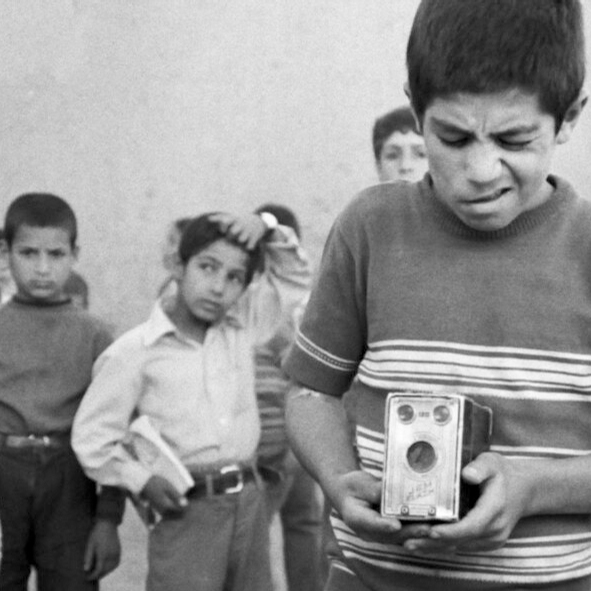
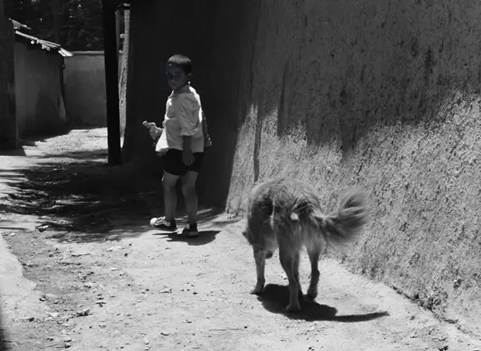
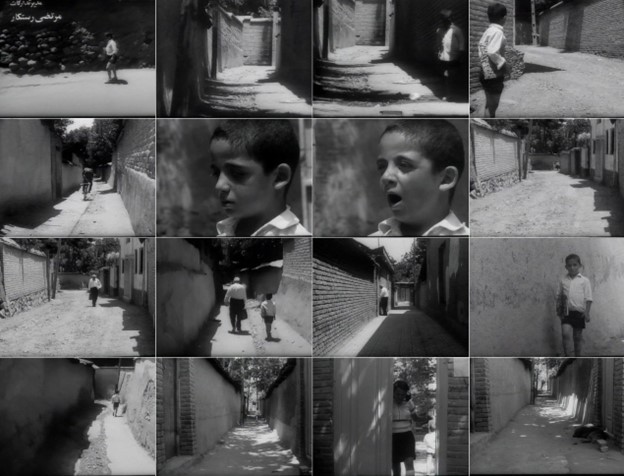
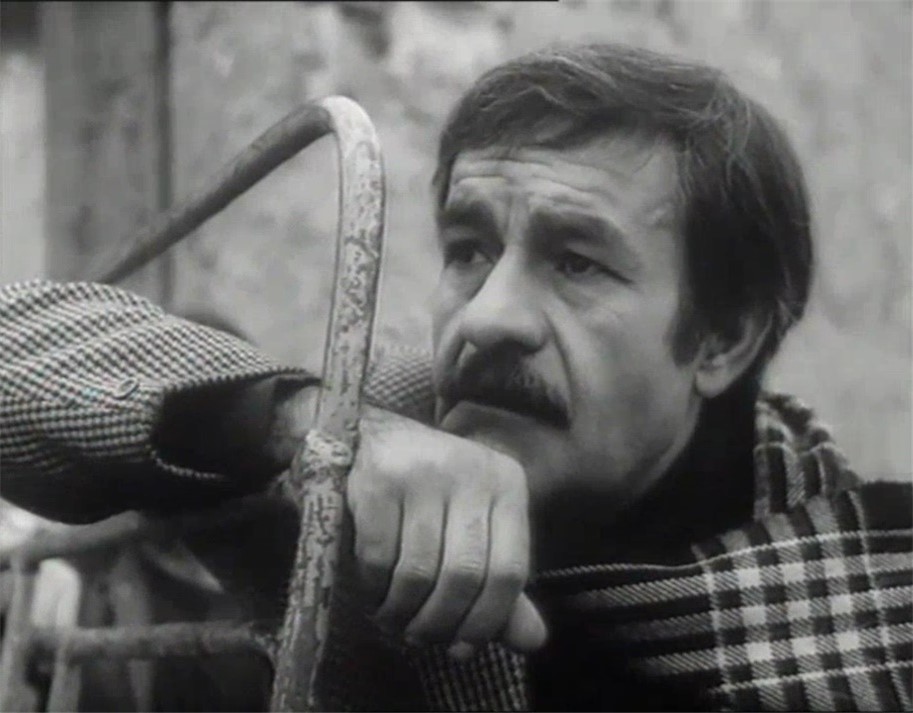
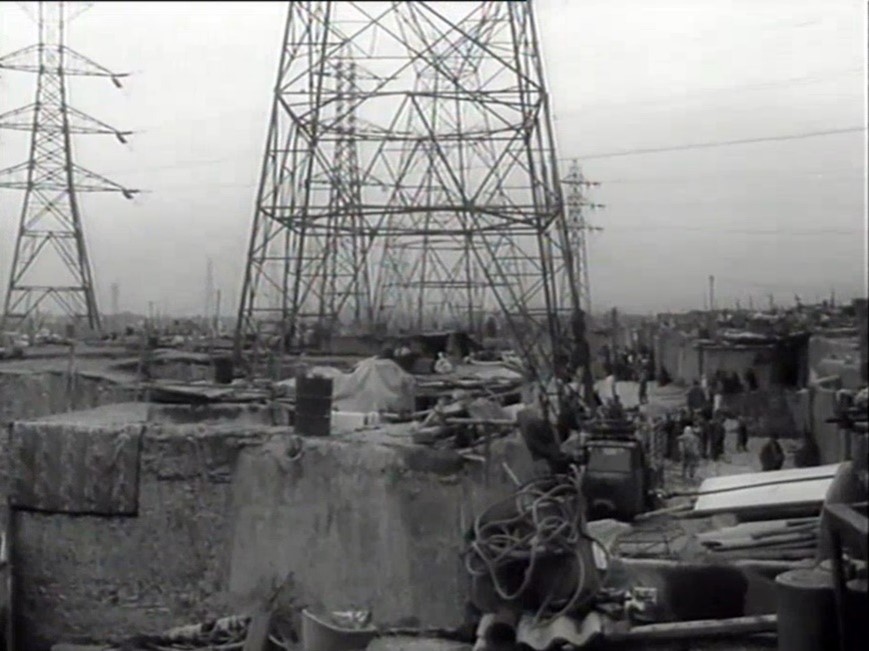
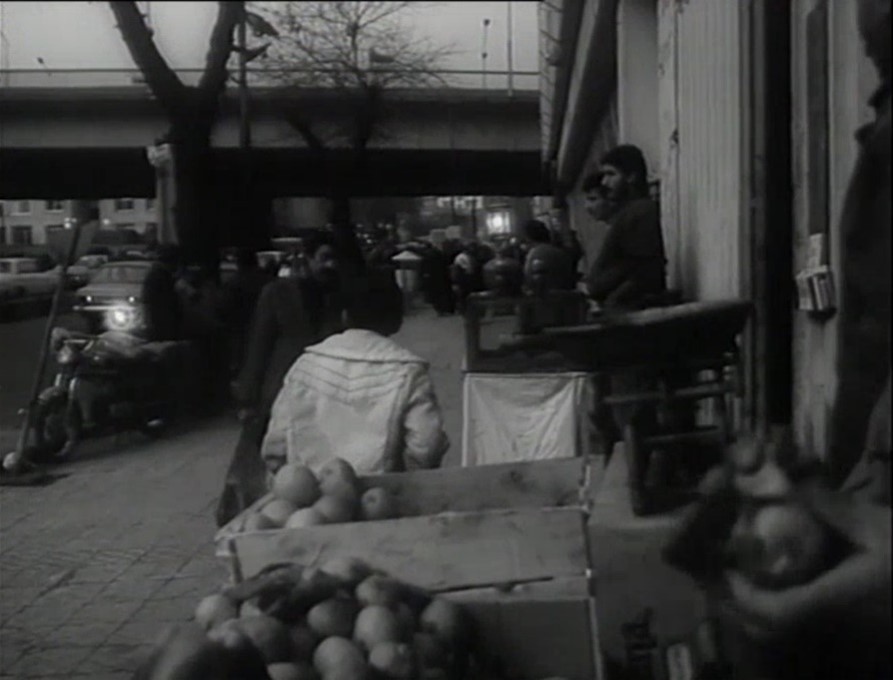
Social realist films echoed cinematic conventions of global postwar cinema. These films had simple subjects, often focusing on marginalized members of society. They were shot on location (rather than in a studio), used natural light, and employed untrained actors. Qualities of social realism formed the basis for many Kānūn films. Nān u kūchah [Bread and Alley],10Nān u kūchah [Bread and Alley], directed by ‛Abbās Kīyārustamī (Tehran, Iran: Kānūn-i Parvarish-i Fikrī, 1970). directed by ‛Abbās Kīyārustamī is widely considered Kānūn’s first live-action film. Nān u kūchah features several of the formal characteristics that populated Kānūn films. In black and white, it features an untrained child actor and is shot on location in Tehran. It eschews any traditional plot or story, focusing instead on a minor moment in a boy’s daily routine. In the film, a young boy carries a sheet of bread, kicking a ball of paper down narrow alleys on his way home. The child is startled by a barking dog who begins to follow him. Frightened, he tries to evade the dog. He tags behind an elderly man, hoping for protection. Ultimately, he must face the dog, and throws him a piece of bread. The dog then joins him as a companion and the two continue their walk. Kīyārustamī spends a considerable amount of time in close-up on the boy’s face, his sweat and anxiety clearly visible to the viewer. This focus on children’s interiority and respect for their seemingly mundane problems shone through in many Kānūn productions both pre- and post-revolution, as evinced by films such as Ibrāhīm Furūzish’s Kilīd [The Key] (1987) and Majīd Majīdī’s globally acclaimed Bachah-hā-yi Āsimān [Children of Heaven] (1997).11Kilīd [The Key], directed by Ibrāhīm Furūzish (Tehran, Iran: Kānūn-i Parvarish-i Fikrī, 1987); Bachah-hā-yi Āsimān [Children of Heaven], directed by Majīd Majīdī (1997).
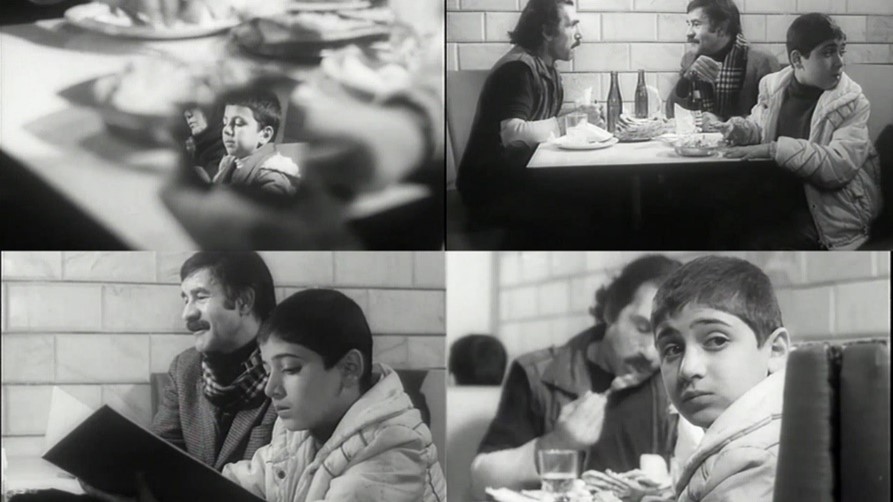
Other early Kānūn films evinced a more overtly political commitment to social realism. Safar [The Journey]12Safar [The Journey], directed by Bahrām Bayzā’ī (Tehran, Iran: Kānūn-i Parvarish-i Fikrī, 1972). was the celebrated playwright Bahrām Bayzāʾī’s second film. (His first, the comical ‛Amū Sībīlū [Uncle Moustache]13‛Amū Sībīlū [Uncle Moustache], directed by Bahrām Bayzāʾī (Tehran, Iran: Kānūn-i Parvarish-i Fikrī, 1971). from 1971, was also made for Kānūn.) Safar presents two young brothers who face harsh urban conditions while in search of their father. Bayzāʾī shows the impoverished boys moving through Tehran’s upcoming developments and the dust and rubble of poorer and older parts of the city. This critical perspective on modernization contradicts the bright and cheerful symbols of modernity seen in other state-sponsored films, such as new buildings, cars, clothes, and signs.
Figure 4: A still from Nān u kūchah (Bread and Alley, 1970). ‛Abbās Kīyārustamī, accessed via https://www.aparat.com/v/pf475 (00:07:48).
Modernism
Some Kānūn films displayed a formal complexity that distinguished them entirely from any popular or mainstream cinematic mode. I define these as modernist because they are characterized by a heightened formalism, responding to (and striving to make sense of) emergent conditions and structures of modernity. As filmmaker Muhammad Rizā Aslānī says, citing European art cinema as an influence, “we made modern films that children could not understand very well.”14Kānūn. directed by Khātirah Khudā’ī (2016).
Tehran’s rapid development created the context and backdrop for Kānūn’s modernist films. Qualities such as abstraction, non-linear editing, contrapuntal sound, and self-reflexivity were present in several films by Kīyārustamī and would later become signatures of his post-revolutionary cinema. Bi tartīb yā bidūn-i tartīb [Orderly or Disorderly], from 1981, is an exemplar of this mode, while also functioning as a light-hearted pedagogical film.15Bi tartīb yā bidūn-i tartīb [Orderly or Disorderly], directed by ‛Abbās Kīyārustamī (Tehran, Iran: Kānūn-i Parvarish-i Fikrī, 1981). The film presents two versions each of four scenarios. In three of these scenarios, schoolchildren must organize themselves neatly within a particular space: descending stairs, boarding a bus, or drinking from the school water canteen. The fourth and longest scenario brings an aerial view to a traffic intersection with crossing pedestrians and vehicles. Kīyārustamī shows us the orderly and disorderly version of each of these scenarios. The film is structured by a voiceover conversation between Kīyārustamī and a colleague. They discuss the scenarios, their editing decisions, and the point of the film. Furthermore, each sequence is separated by a shot of a director calling takes with his clapboard (“Sound! Camera!”). This was one of several Kānūn films by Kīyārustamī which, in some sense, documented its own production, moving between the diegetic world of the film and its construction.
In Bi tartīb yā bidūn-i tartīb, Kīyārustamī foregrounds editing to structure and restructure space and time, and aerial photography in particular presents an image of how spaces of modernity are ordered and organized (for example, by stoplights, road signs, and markings), and simultaneously, how they might be confounded by local interferences. The film reinforces technology’s organizational power by making technology visible in its form and signals the advanced modernity of the Iranian state and its institutions. In a sense, Bi tartīb yā bidūn-i tartīb (and other films) engage in a mimetic mode of pedagogy for urban social life. The film thus provides audiences with a visual and spatial understanding of urban modernity and how it might be negotiated. While Kīyārustamī imbues his interpretation of modern life with a sly sense of humor, his film aligns with the ambitions of the statist documentary.16I expand on this argument in Simran Bhalla, “Modern Time: Abbas Kiarostami’s Immersions, from Sponsored Documentary to Slow Cinema,” JCMS: Journal of Cinema and Media Studies 61, no. 3 (2022): 160–66.
Didacticism in children’s media is not unique to Iran. However, Kānūn films were produced in a historical context where society placed high value on, and expectation for, parental education of children. Parvarish, or moral education, began at home (rather than at school). Parents were responsible for the psychological health of their children.17Cyrus Schayegh, Who Is Knowledgeable, Is Strong: Science, Class, and the Formation of Modern Iranian Society, 1900-1950 (Berkeley: University of California Press, 2009), 172. Simultaneously, Muhammad Reza Pahlavi’s technocratic state saw a role for itself in guiding modern and civic education for both children and adults. Without overstating the influence of top-down modernization programs within this historical context, Kānūn films emerged in a fertile social and political environment for pedagogical children’s media. Kānūn’s libraries provided a social and educational space outside of school for children and their parents, and the films themselves explored themes of childhood and family, communicating norms and ideals to audiences.
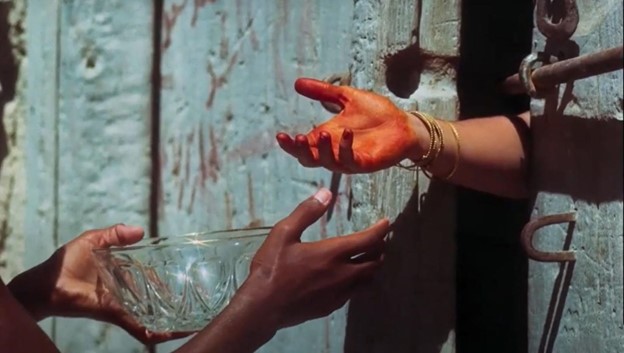
Other realist and modernist18This article uses the term realism in the same sense as postwar realist cinema, and the term modernism for films that use editing, sound, and other cinematic techniques to depart from realist modes of representation. However, the two are often rightly understood as inextricable from one another, and often intersect in their representations and negotiations of modernity. films focused on life outside the metropolis, showcasing rural and regional traditions and social formations. For example, Amīr Nādirī’s Intizār [Waiting] (1974)19Intizār [Waiting], directed by Amīr Nādirī (Tehran, Iran: Kānūn-i Parvarish-i Fikrī, 1974). Waiting was filmed in Bushehr. Nādirī himself grew up in Abadan, a poor port city in southwestern Iran, which is also the site of major oil refineries. takes place in southern Iran, which was an uncommon location for fiction films of the period. A young boy is tasked with picking up ice cubes from a wealthy neighbor. He waits for the neighbor’s hands to emerge from her carved wooden door with fetishistic pleasure. The film, which is nearly without dialogue, follows him as he makes his way through the town. He quietly observes acts of prayer, ritual sacrifice, and mourning ceremonies. He joins the mourning ceremony, an outlet for his inhibited emotions. (The call to prayer and ‛Āshūrā chants are the only voiced words in the film.) At home, he bathes, helps his mother to prepare food, and interacts with local cats and pigeons. Nādirī lingers on hands, bodies, and breathing in close-up. His focus on local Shi’ite rituals and bodily response is rare for a state-sponsored fiction film of this period. The film is also unusual in its ambiguity and reserve in terms of its perspective on children’s behavior: it has no instructional aspect, nor does it model clearly moral actions. Lastly, by eschewing a more urban, industrialized location, it avoids even incidental representations of technology and development—though the film leaves open the question of how the ice is made.
Figure 5: A still from Intizār (Waiting, 1974). Amīr Nādirī, accessed via https://www.youtube.com/watch?v=jGeZQ5wqMZw (00:07:04).
Experimental and Animated Films
Animated film in Iran also emerged under state-sponsorship. Filmmakers, invigorated by the possibilities and liberatory potential of animation strategies, experimented with graphic and surrealist abstraction. These more experimental and avant-garde films included animations such as Murtizā Mumayyiz’s Yik nughtah-yi sabz [A Green Dot], and Suhrāb Shāhīd-Sālis’s pixilated Sīyāh-u sifīd [Black and White], both from 1972.20Yik nughtah-yi sabz [A Green Dot], directed by Murtizā Mumayyiz (Tehran, Iran: Kānūn-i Parvarish-i Fikrī, 1972); Sīyāh-u sifīd [Black and White], directed by Suhrāb Shāhīd-Sālis (Tehran, Iran: Kānūn-i Parvarish-i Fikrī, 1972). Each filmmaker brought their expertise and interest in other art forms to the practice of film animation and experimental techniques. Mumayyiz was a renowned graphic designer who, like other Kānūn employees, had worked in commercial design and advertising before bringing his talents to the institute. In Yik nughtah-yi sabz, he controls shifting lines and dots, disrupting recognizable shapes and symbols with random movement. Shāhīd-Sālis, meanwhile, began his career in sponsored non-fiction films after studying abroad in Austria and France. He directed four short ethnographic films about regional dances for the Ministry of Culture and Arts before Sīyāh-u sifīd, his sole film for Kānūn. Sīyāh-u sifīd takes place on a set designed to look like a white cube, with actors dressed as mimes in all-black or all-white. It features two fathers and their sons fighting over a striped ball. Like Mumayyiz, Shāhīd-Sālis is more interested in the artificial mechanics of motion he can generate than any story aspect. It is his most playful and comic film in a career of reserved and lonesome works. However, it presages the aesthetic minimalism and austerity that would define his feature-length films.
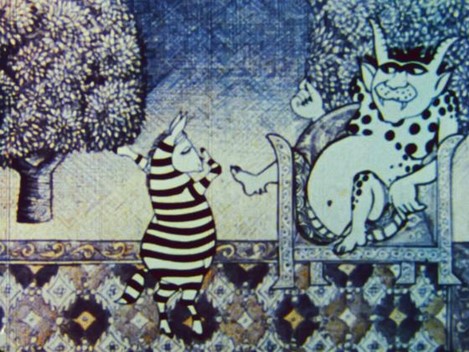
Several Kānūn animators (such as ‛Alī Akbar Sādiqī) also drew on Iranian artistic traditions such as the miniature and Qahvah-khānah painting for their animations, illustrations, and designs. In his film work, Sadeghi is noted for elegant animations of stories from the Shahnameh. Similarly, the acclaimed Nūr al-Dīn Zarrīnkilk drew on Persian carpet motifs for animations such as Amīr Hamzah-yi Dildār va Gūr-i Dilgīr (Amir Hamzeh and Onager, 1977). Zarrīnkilk has a diverse animation style, from the irreverent citation of American symbols such as cowboys, Charlie Chaplin, guns, and the Statue of Liberty in Tadā‛ī [Association of Ideas] (1973) to the whimsical mix of influences on display in the gentle watercolor A Playground for Baboush (1971).21Amir Hamzeh and the Onager, directed by Nūr al-Dīn Zarrīnkilk (Tehran, Iran: Kānūn-i Parvarish-i Fikrī, 1977); Tadā‛ī [Association of Ideas], directed by Nūr al-Dīn Zarrīnkilk (Tehran, Iran: Kānūn-i Parvarish-i Fikrī, 1973); A Playground for Baboush, directed by Nūr al-Dīn Zarrīnkilk (Tehran, Iran: Kānūn-i Parvarish-i Fikrī, 1971).
Figure 6: A still from Amir Hamzeh and the Onager (1977). Nūr al-Dīn Zarrīnkilk, accessed via https://www.youtube.com/watch?v=Jm6N4hQqx3Y (00:05:46).
Figure 7: Poster for Sīyāh-u sifīd (Black and White, 1972). Suhrāb Shāhīd-Sālis.
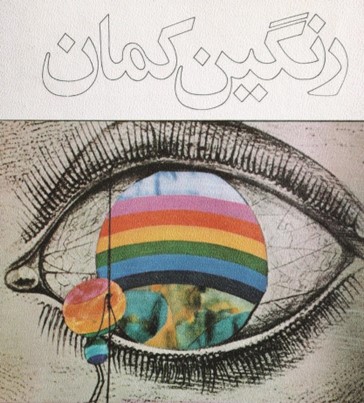
Lastly, while filmmaking at Kānūn was male-dominated, Nafīsah Rīyāhī directed her first animations there, becoming Iran’s first female animator.22While women filmmakers were few and far between in Kānūn’s first decade, the institute did employ women in other prominent roles. Beyond Amīr-Arjumand, this included the composer Shaydā Gharachahdāghī and singer-composer Sīmīn Gadīrī. One of her notable works is Rangīnkamān [Rainbow] (1973), a surrealist cartoon which features a rainbow creature moving through a fantastic landscape.23Rangīnkamān [Rainbow], directed by Nafīsah Rīyāhī (Tehran, Iran: Kānūn-i Parvarish-i Fikrī, 1973). The creature helps seed roses from concrete, and watched a worm consume a giant apple and then transform into a butterfly. Some of Rīyāhī’s imagery, such as the large green apple, seems influenced by Belgian surrealist painter René Magritte. The creature paints a rainbow in a painting of an eye, which resembles Magritte’s artwork The False Mirror (1928) and paints a rainbow-colored visage of Charlie Chaplin over the blank face of a man in a bowler hat, evoking Magritte’s The Son of Man (1946).
Figure 8: Poster for Rangīnkamān (Rainbow, 1973). Nafīsah Rīyāhī.
Figure 9: A still from Rangīnkamān (Rainbow, 1973). Nafīsah Rīyāhī, accessed via https://www.youtube.com/watch?v=6u87_zLMV8k (00:01:44).
Organizational Structure: Leadership, Funding, and Oversight
A significant number of filmmakers who began their careers in Kānūn’s first decade went on to shape Iranian cinema. They helped build the Iranian New Wave, contributed to Iranian exile and diasporic arts, and brought global audiences to Iranian cinema. Yet their achievements must be contextualized within Kānūn’s bureaucratic structure, which itself was impacted by shifting distributions of political power. Detailing the “state” and adjacent figures involved in state sponsorship reveals a confluence of factors that helped create an exceptional environment at Kānūn in this early period. As Ibrāhīm Furūzish attests, “freedom in both content and production […] led to the establishment of an avant-garde.”24Kānūn, directed by Khātirah Khudā’ī (2016).
This freedom came from generosity in both funding and oversight for Kānūn productions. The head of Kānūn, Lily Amīr-Arjumand, was a close confidante of Iran’s queen, Farah Pahlavi. Pahlavi—who had trained as an architect in France—helped spearhead and direct many of the country’s cultural institutions, appointing loyal friends and family members with shared sensibilities to positions of power. Her bureau and the institutions she helped establish and sustain were funded by petrodollars, which ensured financial liquidity for the Iranian state. A gendered division of power gave her purview over Iran’s state-sponsored cultural realm, while her husband (who was reportedly disinterested in film and fine arts) managed “masculine” spheres such as the nation’s military and economy.25Farshid Emami, “Urbanism of Grandiosity: Planning a New Urban Centre for Tehran (1973–76),” International Journal of Islamic Architecture 3, no. 1 (2014): 69-102. For more on Farah Pahlavi’s artistic ambitions relating to state planning, see Shima Mohajeri, “Louis Kahn’s Silent Space of Critique in Tehran, 1973–74,” Journal of the Society of Architectural Historians 74, no. 4 (2015).
In addition to Amīr-Arjumand, Pahlavi hired her cousin Kāmrān Dībā, an artist and architect, to build several significant structures including the Tehran Museum of Contemporary Art, which he also ran. Her other cousin, Rizā Qutbī, ran National Iranian Radio and Television (NIRT). Farrukh Ghaffārī, the son of a prominent diplomat, was a significant figure in Iranian cinema. He founded an influential film club (the National Iranian Film Center) in Tehran and was selected by Dībā to organize the annual Shiraz Arts Festival, among other activities.26Hamid Naficy writes about nepotism and cronyism in state-sponsored film and cultural production during this period in A Social History of Iranian Cinema. Volume 2. Furthermore, nearly every major filmmaker involved with Kānūn received some training or education in the West, with a few notable exceptions (such as ‛Abbās Kīyārustamī).27In addition to those mentioned previously, other employees of Kānūn who studied in the West (before the Revolution) included Fīrūz Shīrvānlū, Murtizā Mumayyiz, Shaydā Gharachahdāghī, and Nafīsah Rīyāhī. This indicated both a particular class position and a shared set of influences and references that guided taste at the institute. Despite Kānūn’s endeavors to reach other cities and towns, it retained a “Tehran-centric gaze.”28Hamid Dabashi, An Iranian Childhood: Rethinking History and Memory (Cambridge: Cambridge University Press, 2023) 102.
This elite network helped ensure that Kānūn’s creative projects would be produced, published, or performed, and beyond that, circulated outside of Iran. Furthermore, this “second royal court” inoculated the many leftist and dissident voices at Kānūn from censorship and harsh punishment by the state to a certain extent.29See Talinn Grigor, Building Iran: Modernism, Architecture, and National Heritage Under the Pahlavi Monarchs, (New York: Periscope Publishing, distributed by Prestel, 2009), and “A Tribute to the Legacy and Vision of Lily Amir Arjomand and Kanoon,” Asia Society, 2022, retrieved 29/08/2024, https://www.youtube.com/watch?v=Sj3Cv-LJCb8 Yet the gendered and mercurial nature of the monarchy’s organization meant that Farah Pahlavi’s influence was uneven, and her later statements about her cultural work are inconsistent with the ideological implications of her patronage.30Farah Pahlavi had her own organization, The Special Bureau of Her Imperial Majesty (also known as the Farah Pahlavi Foundation), through which she oversaw cultural endeavors. However, as Laylā Dībā (a curator and relative of the Queen’s) notes, “I found that Iran was full of “courts.” Everybody had their court… whether you were talking about the prince or princess or a major industrialist or a member of an old family.” So it is possible that the commentators and scholars quoted here are referencing either Pahlavi’s actual court or metaphorical court (or indeed conflating them). For more, see “Interview with Diba, Leyla,” Foundation for Iranian Studies, 1984, https://fis-iran.org/oral-history/diba-leyla/ In the first decade of her reign, Pahlavi was able to hand-select the radical writer and artist Fīrūz Shīrvānlū to help build Kānūn.31Shīrvānlū advised Pahlavi in many capacities, including in acquiring a now-famous collection of modern art for the Tehran Museum of Contemporary Art. Shīrvānlū also helped found the Nīyāvarān Cultural Center and helped Pahlavi in organizing festivals and exhibitions. This was despite the fact that he had served time in prison after being convicted (as a member of the activist group Confederation of Iranian Students) in a plot to assassinate the Shah.32Sadeghi, “Institute for the Intellectual Development of Children & Young Adults.” Shīrvānlū had worked at the Franklin Book Program, a Cold War American non-profit that facilitated local publishing in developing countries, and after his time in prison, founded a graphic design studio. At Kānūn, he hired young university graduates such as Farshīd Misqālī, ‛Abbās Kīyārustamī, and Amir Naderi to work with him. Shirvanlu was given the position at Kānūn based on his experience in publishing and as the institution expanded into film production, he was able to hire his former colleagues. However, Shīrvānlū and Kānūn as a whole did court controversy. This occurred, for example, with the publication of the children’s book Māhī Sīyāh Kūchūlū [The Little Black Fish], which was seen to present an allegory of the Shah’s repressive regime.33Samad Behrangi, Māhī Sīyāh Kūchūlū [The Little Black Fish] (Tehran: Kānūn-i Parvarish-i Fikrī, 1968).
Kānūn was critiqued in this first decade for its insular administration and ideological position. Critics felt that it was a waste of state funds that did not actually produce films suitable for children. Others theorized that it kept intellectuals and dissidents occupied and placated, thus preventing them from organizing against the state. Some speculated that it was a platform for them to circulate their ideas, particularly to children. Ultimately, what was true was that Kānūn employed several notable members of Iran’s political left, and those who ran it helped prevent some of these artists and writers from being persecuted by the state for a period of time.34See Kānūn, directed by Khātirah Khudā’ī (2016); Naficy, A Social History of Iranian Cinema. Volume 2.
Figure 10: Book cover of Māhi-e siāh-e kučulu (A little black fish, 1968), Samad Bihrangī, illustrated by Farshīd Misqālī.
Transitions Since the Islamic Revolution
After the Iranian Revolution began in 1979, Farshīd Misqālī took over from Lily Amīr-Arjumand as the director of Kānūn during a period of transition. (Amīr-Arjumand moved to the United States.) Like other cultural institutions, Kānūn found itself in a state of flux. In 1980, ‛Alīrizā Zarrīn took over as the head of Kānūn, and remained in this position until 1991. The center produced several films in the early 1980s that were temporarily or permanently banned from exhibition. However, Kānūn adapted to political change. Indeed, in some senses it was able to do so with more ease than agencies such as National Iranian Radio and Television (NIRT) and commercial film studios because its films were (at least on the surface) for and about children. Kānūn’s films thus rarely ran the risk of defying the Islamic regime’s new cinematic production codes. As Zarrīn notes, it met with easy approval from the Revolutionary Council, despite its reputation as a “Communist’s fortress.”35Kānūn, directed by Khātirah Khudā’ī (2016). After the 1980s, Kānūn became a directly state-run institution with a new board of directors.36Kānūn, directed by Khātirah Khudā’ī (2016).
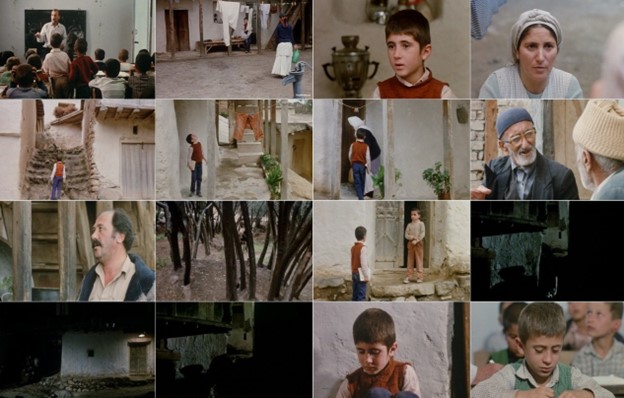
Zarrīn was a good manager—particularly during a turbulent period—and also a strong producer. Kānūn’s revolutionary charter also ensured that it was not ensnared in governmental red tape, and the organization was able to create an internal production council, thus sustaining its environment of artistic freedom. Several of Kānūn’s most notable filmmakers stayed on in Iran and continued to make films with the Institute after the Revolution. This included Bahrām Bayzāʾī, Ibrāhīm Furūzish, ‛Abbās Kīyārustamī, Amīr Nādirī, Nafīsah Rīyāhī, and Nūr al-Dīn Zarrīnkilk. Kānūn’s second decade also saw the release of their milestone cinematic achievements: Nādirī’s Davandah [The Runner] (1985), Kīyārustamī’s Khānah-yi dūst kujāst [Where is the Friend’s House?] (1987), Close-Up [Nimā-yi Nazdīk] (1990), and Zindigī va dīgar hīch [And Life Goes On…] (1992), Furūzish’s Kilīd [The Key] (1987), Bayzāʾī’s Bāshū, gharībah-yi kūchak [Bashu, The Little Stranger] (1989).37Nādirī, Davandah [The Runner] (1985); Kīyārustamī, Khānah-yi dūst kujāst [Where is the Friend’s House?] (1987); Furūzish, Kilīd [The Key] (1987); Close-Up [Nimā-yi Nazdīk], directed by ‛Abbās Kīyārustamī (Tehran, Iran: Kānūn-i Parvarish-i Fikrī, 1990); Zendegi va digar hich [And Life Goes On…], directed by ‘Abbās Kīyārustamī (Tehran, Iran: Kānūn-i Parvarish-i Fikrī, 1992); Bāshū, gharībah-yi kūchak [Bashu, The Little Stranger], directed by Bahrām Bayzāʾī (Tehran, Iran: Kānūn-i Parvarish-i Fikrī, 1989). Kīyārustamī and Bayzāʾī’s films were noted for their sensitive and realist treatment of children’s experiences after the Manjīl-Rūdbar earthquake and Iran-Iraq war, respectively. Zarrīn is credited as a producer on each of these films.
According to Kīyārustamī, Zarrīn resigned after the documentary Mashq-i shab [Homework] (1989) met with censure from the Ministry of Education.38Mashq-i shab [Homework], directed by ‛Abbās Kīyārustamī (Tehran, Iran: Kānūn-i Parvarish-i Fikrī, 1989). For Kīyārustamī’s interview on the subject, see Kānūn, directed by Khātirah Khudā’ī (2016). Since then, six men have held the position of director (now termed CEO in its English translation). Kānūn continues its many activities today, including film production, though in recent decades it has focused more on children’s animated films, producing fewer documentaries and docufiction. Its films continue to be successful, circulating at major children’s film festivals worldwide. Kānūn itself hosts the Tehran Animation Festival. (The Fārābī Cinema Foundation, a major film company, has co-hosted the International Film Festival for Children and Young Adults in Isfahan since 1982, which was established after Kānūn’s original film festival came to an end. Fārābī and Kānūn have co-produced films such as Bachah-hā-yi Āsimān).39Bachah-hā-yi Āsimān [Children of Heaven], directed by Majīd Majīdī (1997). Kānūn’s changes in governance and structure since the 1990s, and resulting shifts in film production and aesthetics, can be credited both to shifts in national politics and technological transformation, with moving images being produced, distributed, and exhibited through new and ever-fluid means. Kānūn’s era of digital film production deserves further research and scholarship.
A Girl Walks Home Alone at Night (2014) is the debut feature of Iranian-American director Ana Lily Amirpour. Amirpour, whose family left Iran following the Revolution, was living in California at the time of filming after studying scriptwriting at the UCLA School of Theater, Film and Television. She had earlier made a short version of the film in 2011 and then begun a crowd-funding campaign to make a longer, full-length version. The film ended up being shot over some twenty-four days on a budget of only a little over $50,000. The film was first screened in the “Next” program of the 2014 Sundance Film Festival and was an immediate success. Amirpour won the Breakthrough Award at the Gotham Independent Film Awards in 2014, a distributor picked up the film, and it ended up taking over half a million dollars at the domestic box office alone. The initial reviews of the film praised it in the highest terms. The critic Nate von Zumwalt wrote soon after the end of the Festival of an “assured new female film-making voice.”1Nate Von Zumwalt, “A Girl Walks Home Alone at Night, Vampire Lovers, and Warpaint Close Out NEXT FEST,” Sundance Institute (blog), August 11, 2014, https://www.sundance.org/blogs/a-girl-walks-home-alone-at-night-vampire-lovers-and-warpaint-close-out-next-fest/ Sheila O’Malley at RogerEbert.com spoke of the way that the film “launches itself into a dreamspace of its own that has a unique power and pull,” and Peter Bradshaw of the Guardian remarked that Amirpour had “found her own funny, smart expression for teenage-bedroom loneliness, romantic isolation, and a kind of perpetual emotional exile.”2See: Sheila O’Malley, “A Girl Walks Home at Night.” RogerEbert.com, November 21, 2014, https://www.rogerebert.com/reviews/a-girl-walks-home-alone-at-night-2014 Peter Bradshaw, “A Girl Walks Home Alone Review–Vampire in a Veil Stalks Iran.” The Guardian, May 22, 2015, https://www.theguardian.com/film/2015/may/21/a-girl-walks-home-alone-at-night-review In subsequent years the reputation of the film has only continued to grow, with any number of academic articles, chapters in books on such things as horror and feminism, and even an entire 2021 monograph by Iranian Studies scholar Farshid Kazemi devoted to the film.3Farshid Kazemi, A Girl Walks Home Alone at Night (Liverpool: Liverpool University Press, 2021). Today it is frequently spoken of as a “contemporary classic” and one of the most important examples of Iranian feminist cinema, and if this is not enough, commentators often point out that the film rates some 95% on the Rotten Tomatoes film review website.4As of 24 April 2024, the website’s review-aggregation or Tomatometer lists the film as “Fresh” at 96%. See: Rotten Tomatoes, “A Girl Walks Home Alone at Night,” April 24, 2024, https://www.rottentomatoes.com/m/a_girl_walks_home_alone_at_night
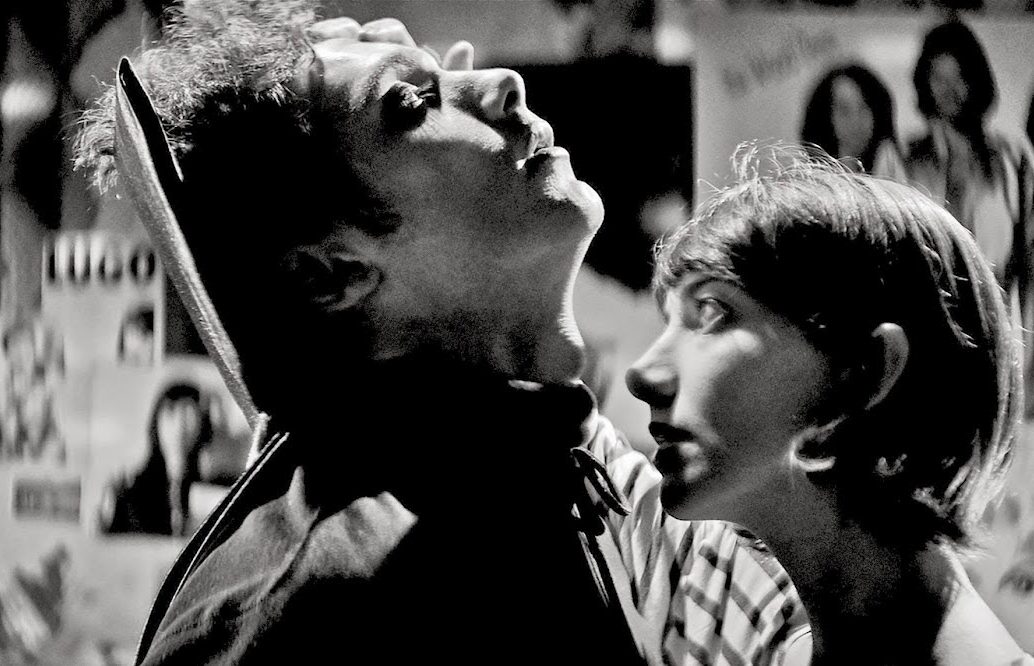
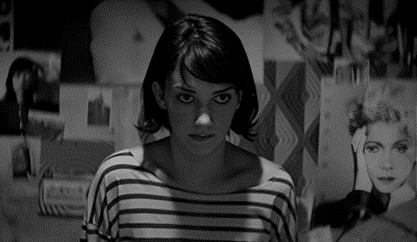
Figure 1: A still from Dukhtarī dar shab tanhā bi khānah mīravad (A Girl Walks Home Alone at Night, 2014). Ana Lily Amirpour, accessed via https://www.youtube.com/watch?v=js2R8b6_giY (00:00:41)
A Girl Walks Home Alone at Night is a vampire film. Set in an anonymous town in Iran referred to by its characters as Bad City (Shahr-i Bād)—in fact, the film was shot in the town of Taft in Southern California—it is the story of a young woman, known simply as Girl, whom we see kill and suck the blood of three men. The first is Sa‛īd, a pimp and drug dealer, who early on in the film takes Girl back to his house to have sex with her, but instead Girl sprouts fangs, bites off his finger, and kills him by piercing his neck. We then see in the middle of the film—from a distance and in a much less intimate way—Girl kill and drink the blood of a sleeping street person. Finally, towards the end of the film, we again see in a more detailed and confronting manner Girl kill Husayn Ārash, the father of the other main character in the film, the young man Ārash.
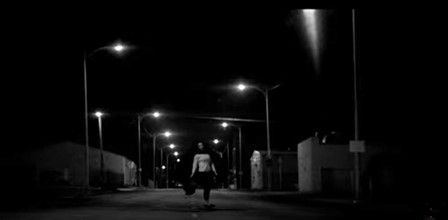
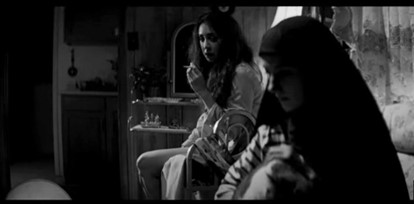
Figure 2: A still from Dukhtarī dar shab tanhā bi khānah mīravad (A Girl Walks Home Alone at Night, 2014). Ana Lily Amirpour, accessed via https://www.youtube.com/watch?v=js2R8b6_giY (00:04:20)
Notably, the audience witnesses both Sa‛īd and Hossein mistreat women before Girl kills them. Sa‛īd cheats one of his sex workers, ‛Attī, refusing to give her the money she has earned, and then extorts sex from her in the front of his car. Hossein, a drug addict, has previously been observed smashing up his bedroom, throwing a photo of his wife and Ārash’s mother to the floor, and then making ‛Attī dance for him, forcing drugs upon her and then lying down on a bed next to her after taking drugs himself. As these events play out, we see Girl and Ārash gradually fall in love after they first meet at a fancy costume party at which Ārash dresses up as Dracula. At the end of the film, after Girl kills his father—eventually Ārash will realize it was her—they leave Bad City in Ārash’s car, repossessed from Sa‛īd, driving off into the night and an uncertain future together.
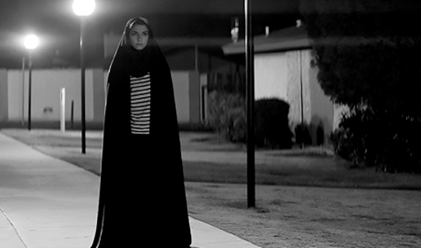
Figure 3: A still from Dukhtarī dar shab tanhā bi khānah mīravad (A Girl Walks Home Alone at Night, 2014). Ana Lily Amirpour, accessed via https://www.youtube.com/watch?v=js2R8b6_giY (00:01:27)
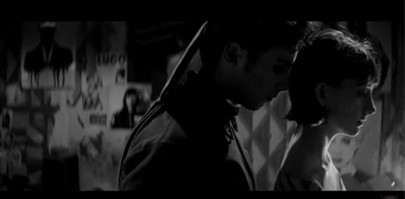
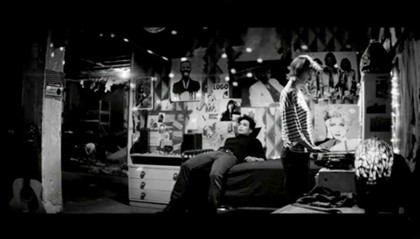
There are many surprising and extraordinary things about A Girl Walks Home Alone at Night for both Iranian and Western audiences. For Iranian audiences, there is the obvious “Americanism” of the look of a film notionally set in Iran.5Joanna Mansbridge writes: “The film itself is an American film disguised as an Iranian film.” See: Joanna Mansbridge, “Law of Extraction: Transcultural Environments, Uncanny Subjects, and the ‘Unresolved Question of Pleasure’ in Ana Lily Amirpour’s A Girl Walks Home Alone at Night (2014),” The Journal of Popular Culture 54, no. 4 (August 2021): 813. Ārash resembles James Dean in his sunglasses and white T-shirt, and Girl has short clipped hair, a striped T-shirt, and black pumpernickel ankle boots. The Persian Farsi dialogue apparently reads as though filtered through the linguistic conventions of English. The soundtrack features a number of songs by Western rock bands and Girl’s bedroom walls are covered with posters of such 1980s pop-cultural icons as Madonna, the Bee Gees, and Michael Jackson, which were specially fabricated for the film.
Figure 4: A still from Dukhtarī dar shab tanhā bi khānah mīravad (A Girl Walks Home Alone at Night, 2014). Ana Lily Amirpour, accessed via https://www.cinemaldito.com/tag/a-girl-walks-home-alone-at-night/
But perhaps most notably and provocatively, there is the whole question of the empowering of women and the depiction of their sexuality in the film, and whether Girl’s killing of bad men is to be seen as an act of “feminist” revenge. Kazemi notes in his book that A Girl Walks Home Alone at Night received overwhelmingly negative reviews upon its release in Iran and was soon after banned, and goes on to argue that this was because the film upset religious sensibilities in the country.6Farshid Kazami, A Girl Walks Home Alone at Night (Liverpool: Liverpool University Press, 2021), 28-29. However, almost as a complement to this, we could equally say that the film also offends Western sensibilities, but this time because it overturns Western preconceptions about Iranian culture. There is much commentary, for example, on the way that the film features a queer character—the scarf- and lipstick-wearing Rockabilly, who operates as something of an outside observer throughout the film and whose gender is hard to determine—and on the empowerment of a chador-wearing female vampire who has been given the life-or-death ability to judge men in an apparently masculinist, Islam-dominated Iran.7Shadee Abdi and Bernadette Marie Calafell, “Queer Utopias and a (Feminist) Iranian Vampire: A Critical Analysis of Resistive Monstrosity in A Girl Walks Home Alone at Night.” Critical Studies in Media Communication 34, no. 4 (2017): 363-364. Also note that a chador, commonly worn by Muslim women, is an item of clothing derived from wrapping a large piece of cloth around the head and body, leaving only the face exposed.
The other aspect of the film that surprises and perhaps discomforts Western critics is the thorough immersion of A Girl Walks Home Alone at Night in long histories of Western culture. First of all, there is Amirpour’s desire to make a film about a vampire, which takes us back at least to Bram Stocker’s 1897 novel Dracula. Stoker’s film was the inspiration for Tod Browning’s classic Hollywood film of the same name (1931), starring Bela Lugosi in one of the most iconic cinematic performances of all time, but was also inspiration for Friedrich Murnau’s Nosferatu (1922) and Carl Dreyer’s Vampyr (1932). And then there are the endless kitsch remakes such as Abbott and Costello Meet Frankenstein (1948), the English Hammer Horrors, arguably Werner Herzog’s 1979 version of Nosferatu, all the way up to Tomas Alfredson’s Let the Right One In (2008).
Figure 5: A still from Dukhtarī dar shab tanhā bi khānah mīravad (A Girl Walks Home Alone at Night, 2014). Ana Lily Amirpour, accessed via https://www.youtube.com/watch?v=js2R8b6_giY (00:04:57)
Second, there are the other genres of Hollywood film that A Girl Walks Home Alone at Night clearly plays on. As previously suggested, the opening of the film with its English-language credits and the entrance of the handsome young actor Ārash Marandī with T-shirt and sunglasses walking down an empty main street with oil jacks pumping in the background is much like James Dean in a film like Giant (1956) or Rebel without a Cause (1955). Further, the idea of a justice-dispensing vigilante meting out punishment to bad men—even if she happens to be a female Iranian vampire—as much as anything draws on the conventions of Westerns, whether it be the Hollywood version by John Ford or the Italian spaghetti version by Sergio Leone.
Figure 6: A still from Dukhtarī dar shab tanhā bi khānah mīravad (A Girl Walks Home Alone at Night, 2014). Ana Lily Amirpour, accessed via https://www.pinterest.com/pin/545076361129979200/
Finally, and perhaps less obviously, such commentators as Barbara Creed and Lindsey Decker want to see the film as part of a feminine new wave horror film genre.8See for instance: Barbara Creed, “5. Vampires, Feminism and Ethnicity: A Girl Walks Home Alone at Night.” In Return of the Monstrous-Feminine: Feminist New Wave Cinema (New York: Routledge, 2022); and Lindsey Decker, “The Transnational Gaze in A Girl Walks Home Alone at Night.” In Women Make Horror: Filmmaking, Feminism, Genre, ed. Alison Peirse (New Brunswick: Rutgers University Press, 2020), 170-82. So too others both want to see it as a continuation of the Iranian New Wave and such directors as Ja‛far Panāhī and Husayn Shahābī, and view the film as marking the arrival of a new Iranian feminist cinema alongside such artists and directors as Shirin Neshat and Marjane Satrapi. And still other commentators, like Shadee Abdi, Bernadette Calafell, and Miriam Borham-Puyal, even see the film as part of a whole “queer” cinema movement due not only to such characters as the cross-dressing Rockabilly, but as well the androgynous haircut sporting, and T-shirt and ankle boots wearing actress Sheila Vand who plays the, one now realizes, ironically named Girl; the almost feminine beauty of the actor Ārash who plays her lover; and the very different, and undoubtedly non-conformist, love that develops between them, which is, after all, between a human and a vampire.9See for instance: Miriam Borham-Puyal, “2. Female Vampires on the Threshold of Time, Space and Gender,” In Contemporary Rewritings of Liminal Women: Echoes of the Past (New York: Routledge, 2020). For another example of the “queerness” of vampires, and Stoker’s Dracula in particular, see the recent edition of his book with a new Introduction by Silvia Moreno-Garcia and with a Forward by Alexander Chee: Bram Stoker, Dracula (Brooklyn, NY: Restless Books, 2023). Also see Chee’s related article concerning Stoker’s own alleged queerness: Alexander Chee, “When Horror is the Truth-Teller,” Guernica, October 2, 2023, https://www.guernicamag.com/when-horror-is-the-truth-teller/
The other principal way the film has been read is as an expression or even an allegory of Amirpour’s own situation as a diasporic Iranian. In interviews, Amirpour often speaks of the way that, despite moving from Iran when she was a child, much of the history and customs of the country remain with her through her family.10Amirpour says in an interview: “It’s a weird thing about Iranian culture. We’re one of those cultures like Italian or Jewish, we have very strong families, aggressively imposing families, in an awesome way . . . So I always had my Iranian-ness in that way, my grand-mother and mother and my aunt and everybody, and the dinners and the noises and everything.” Cited in Amanda Howell and Lucy Baker, “7. A Badass in Bad City: The Interstitial Artist and Monstrous Self-Fashioning in A Girl Walks Home Alone at Night.” In Monstrous Possibilities: The Female Monster in 21st Century Screen Horror (London: Palgrave Macmillan, 2022), 121. She also speaks about the uncanny aspect of trying on a chador herself in America and wearing it when she visited Iran, insofar as it was at once strange and familiar. As it turns out, the chador was key for Amirpour in explaining her original inspiration for the film; it reminded her, of all things, of a vampire’s black cloak. She further recalls, while making a short film at UCLA, seeing an extra walking through the set wearing a chador and then asking to try it on: “Looking at herself in the mirror, she felt like a bat. She immediately thought ‘Iranian vampire’ and wondered why no one else had thought of it before.”11Kaleem Aftab, “Ana Lily Amirpour Has Created a Completely New Film Genre – The Iranian Vampire Western,” Independent, May 20, 2015, https://www.independent.co.uk/arts-entertainment/films/features/ana-lily-amirpour-has-created-a-completely-new-film-genre-the-iranian-vampire-western-10265538.html And all of this hybridity or in-betweenness, this belonging at once to two cultures or states of being, is absolutely to be seen in the character Girl in the film. Girl can very much be understood as Amirpour’s stand-in: at the same time human and vampire, kind and a killer, dead and alive (and in the backstory Amirpour sketched for the character, she was born in a Persian town in 1880, became a vampire in 1899, and it seems died in 1979). In all of this again, A Girl Walks Home Alone at Night can be seen as a signal example of what has been called a “post-colonial”—and is today called an “accented” or “transnational”—cinema.12For an essay on the “hybrid” nature of the film, see: Hoda Sabrang, “Shattered Identity of Immigrant Artist and Creation of Art in a Hybridized Space: The Case Study of A Girl Walks Home Alone at Night,” CINEJ Cinema Journal 8, no. 2 (December 2020): 45-61; On the film as an example of “accented” cinema, see: Zahra Khosroshahi, “Vampires, Jinn, and the Magical in Iranian Horror Films,” Frames Cinema Journal 16 (Winter 2019). http://framescinemajournal.com/article/vampires-jinn-and-the-magical-in-iranian-horror-films/ And on “accented” cinema in general, see: Hamid Naficy, An Accented Cinema: Exilic and Diasporic Film-Making (New Jersey: Princeton University Press, 2001). The situation of Amirpour as an unnoticed expatriate Iranian in America is altogether given allegorical expression in a living dead female vampire wandering a generic and characterless street in Iran in a chador on a dark and foreboding night.
Figure 7: A still from Dukhtarī dar shab tanhā bi khānah mīravad (A Girl Walks Home Alone at Night, 2014). Ana Lily Amirpour, accessed via https://www.vox.com/2016/10/25/13175536/foreign-horror-films-streaming-netflix-amazon-shudder
But perhaps the film is a brilliant allegory of something else as well. For, beyond all of these particular ways of reading the film, there is the general question of why so much has been written about it, why it appears such an irresistible topic for critics and commentators, both academic and popular (e.g., if one goes online, one will find dozens of amateur attempts to explain the film, pointing out both the intricacies of its plot and the literary and philosophical sources it draws upon). What is it about this first-time, low-budget, black and white horror film that keeps people wanting to engage with it? How it is that it can be seen to be speaking of such a wide range of issues a contemporary audience is interested in (e.g., the liberation of women in Iran, the Americanization of Iranian culture, the misunderstanding of Iranian culture by the West, the situation of diasporic Iranians, post- or transnational cinema)?
Might we say that the embrace between Girl and Ārash we see towards the end of the film—after she falls in love with him while he is dressed up as Dracula at the party and after he realizes that she is an actual vampire—is like the one that the film and its audience find themselves in at the end of A Girl Walks Home Alone at Night? That each is at once the succubus of and host for the other? Critics use the film as a reflection of their concerns, drink its blood, extract its benefits like a vampire with humans or indeed like those oil jacks we see pumping away throughout the film. But at the same time the film also benefits from us, sucking out and extracting our good ideas and claiming them for itself (and it is revealing that the first time we see Girl in the film it is in a mirror, as opposed to the usual conventions of vampire films).13That is to say, the film claims it is against the logic of “extraction” but it is fair to say that it is also part of it. See: Mansbridge, “Law of Extraction: Transcultural Environments, Uncanny Subjects, and the ‘Unresolved Question of Pleasure’ in Ana Lily Amirpour’s A Girl Walks Home Alone at Night (2014),” 816. To my mind, one of the things A Girl Walks Home Alone at Night is both about and plays out is how “great” works of art are about their future reception, at once taking this reception into account and making it their subject. Like some kind of “mash-up” or “patchwork monster,” a great work of art can appear to embody all kinds of divergent and even opposing interpretations and “reconcile” them or at least put them together in the same place.14Howell and Baker, “7. A Badass in Bad City: The Interstitial Artist and Monstrous Self-Fashioning in A Girl Walks Home Alone at Night,” 120 and 123.
Figure 8: A still from Dukhtarī dar shab tanhā bi khānah mīravad (A Girl Walks Home Alone at Night, 2014). Ana Lily Amirpour, accessed via https://www.youtube.com/watch?v=js2R8b6_giY (00:09:51)
A Girl Walks Home Alone at Night certainly does this. It is both a critique of certain aspects of Islamic culture and of the West’s misunderstanding of Islam, about Islam’s repression of women and its empowerment of them, about Girl’s seduction and domination of Ārash and her opening up and becoming vulnerable to him. It is all of these things at the same time and that is why it will live on forever, undead. It is at once the vampire that sucks our blood and it is us. Or to put it another way, we are the vampire that we feed. This is Amirpour in an interview speaking of what, for her, is the message of the film:
In this world with all these people and all these countries and all these places, we come up with systems on how to exist as people, the clothes people wear, the bumper stickers on cars saying ‘This is who I am’, ‘This is what I believe in’. But with all of us, if you start peeling it back like an onion, there’s weird, weirdo, weird shit inside all of us.15Virginie Selavy, “A Girl Walks Home Alone at Night: Interview with Ana Lily Amirpour,” Electric Sheep, May 19, 2015, http://www.electricsheepmagazine.co.uk/2015/05/19/a-girl-walks-home-alone-at-night-interview-with-ana-lily-amirpour/
A female/feminist Iranian vampire is this “weird shit” inside all of us. She is us, and when we watch A Girl Walks Home Alone at Night we are both the killer and the ones she kills.
Figure 9: A still from Dukhtarī dar shab tanhā bi khānah mīravad (A Girl Walks Home Alone at Night, 2014). Ana Lily Amirpour, accessed via https://www.youtube.com/watch?v=js2R8b6_giY (00:08:03)
Figure 1: Portrait of ‛Abbās Kiarostami using a digital camera
The transformations brought about by the use of digital tools in cinema have opened at least two opposing trajectories. On one side lies the “complex apparatus”: big-budget Hollywood productions—from Star Wars: Attack of the Clones1Star Wars: Episode II – Attack of the Clones, dir. George Lucas (Beverly Hills, CA: 20th Century Fox, 2002), was the first major feature film shot entirely using digital high-definition cameras (Sony HDW-F900). Widely seen as a turning point in the transition to digital cinema, the film accelerated industry-wide shifts in cinematography, post-production, and projection. For further discussion, see Scott Higgins, Harnessing the Technicolor Rainbow: Color Design in the 1930s (Austin: University of Texas Press, 2007), 185–88; and Michael Allen, “Digital Cinema,” in The Oxford Handbook of Film and Media Studies, ed. Robert Kolker (Oxford: Oxford University Press, 2008), 426–28. to contemporary Marvel franchises—construct visual worlds so saturated with CGI spectacle and layers of post-production that they imply external reality is never reasonably sufficient. On the other side, a group of independent filmmakers—from David Lynch and Lars von Trier to ‛Abbās Kiarostami—have proposed a new path enabled by lightweight video cameras. This approach emphasizes simplified equipment, minimal crews, and a physical closeness between the camera and the subject.
Focusing on Kiarostami’s later digital works—Ten (Dah, 2002), 10 on Ten (2004), Five (2003), and 24 Frames (2017)—this essay argues that he pioneers what I call the primitive apparatus of digital cinema: a deliberately lightweight dispositif whose handheld camera, natural light, and two-person crew lend an air of raw immediacy while quietly scripting what can be seen and heard. The term retools Jean-Louis Baudry’s apparatus theory, shifting attention from the projector–screen complex to a mobile camera–laptop ensemble that still positions the spectator in an ideologically charged field. Conceptually, the primitive apparatus revives Plato’s cave: just as shadows once displaced the Forms, the digital image here precedes its referent, enacting what Jean Baudrillard terms the precession of simulacra. Apparent imperfections—lens flare, clipped highlights, unrehearsed pauses—are therefore not flaws but deliberate signs that circulate as reality itself, setting the stage for what I later describe as primitive hyperrealism. Put differently, in Baudrillardian terms, the primitive apparatus realizes the precession of the simulacrum—the sign that outruns its referent—echoing the Platonic distinction between an archetypal form and its cave-shadow simulacrum.2Plato, Republic VII (514a 517c); Sarah Moss, Plato on the Forms (Cambridge: Cambridge University Press, 2007), 83–90. See also Jean Baudrillard, Simulacra and Simulation, trans. Sheila Faria Glaser (Ann Arbor: University of Michigan Press, 1994), 1–7.
The roots of this approach lie in Kiarostami’s dramaturgical treatment of the real, which, from his earliest works, arranges events that seem accidental: the dog blocking a boy’s path home in Bread and Alley (Nān u Kūchah, 1970); the sudden fall of a water bucket from a rooftop in Through the Olive Trees (Zīr-i Dirakhtān-i Zaytūn, 1994), seemingly breaking the illusion of directorial control; the pauses and hesitations in conversations throughout Ten (2002); the deliberate procession of ducks in an episode of Five (2003); and even in his final experiment, 24 Frames (2017), in which digitally animated still photographs depict wind, birds, or falling snow as if these occurrences happen on their own. But how can we draw a clear boundary between the precise dramaturgy of seemingly accidental events—meticulously designed to appear objective—and filmed reality itself? What is the relationship between this aesthetic strategy and the historical evolution of cinematic realism? And how does the digital apparatus serve that evolution?
Figure 2: Scenes from the film Bread and Alley (Nān u Kūchah), directed by ‛Abbās Kiarostami, 1970.
Kiarostami, who, from his earliest 16mm films, sought to blur the line between documentary and fiction, can now, with digital tools, take the “engineered accident” to its fullest expression—crafting a reality that appears “more real” than the real itself. This condition recalls the concept of the simulacrum in the thought of the French philosopher Jean Baudrillard, where the image becomes not a mirror of reality, but its self-sufficient substitute.3Jean Baudrillard, Simulacra and Simulation, trans. Sheila Glaser (Ann Arbor: University of Michigan Press, 1994), 6. On this basis, the central question of the present study may be formulated as follows: how does the use of a lightweight digital camera in Kiarostami’s later cinema give rise to a “primitive hyperrealism” that stands both in contrast to the complex apparatus of Hollywood blockbusters and, at the same time, embodies an alternative expression of the very same cinematic desire to capture and possess the real?
Figure 3: Scenes from the film Where Is the Friend’s House? (Khānah-yi dūst kujāst), directed by ‛Abbās Kiarostami, 1987.
From a historical perspective, the present discussion fills a significant gap: existing scholarship on Kiarostami’s cinema has primarily focused on three distinct domains. The first is the classical Bazinian realism approach, which emphasizes elements such as the use of nonprofessional actors, on-location shooting, and long takes. A key example of this perspective can be found in the work of Mehrnaz Saeed-Vafa and Jonathan Rosenbaum, who, in their book, identify “the astonishing honesty of recording everyday details” as central to their reading of the Koker Trilogy.4Mehrnaz Saeed-Vafa and Jonathan Rosenbaum, Abbas Kiarostami (Urbana: University of Illinois Press, 2003).
The second group comprises self-reflexive and simulacral interpretations that examine Kiarostami’s works in the context of the crisis of representation and the blending of documentary and fiction. In Volume IV of his A Social History of Iranian Cinema, Hamid Naficy identifies Ten and ABC Africa as key turning points in Kiarostami’s digital cinema, where the boundary between recording and constructing reality is deliberately destabilized.5Hamid Naficy, A Social History of Iranian Cinema, vol. 4,The Globalizing Era, 1984–2010 (Durham, NC: Duke University Press, 2012), 183. Hossein Khosrowjah, in his doctoral dissertation, describes Close-Up (Nimā-yi Nazdīk, 1990) as a “courtroom metafiction” that invites the viewer to rethink the position of the apparatus and the mechanisms of representation.6Hossein Khosrowjah, “Unthinking the National Imaginary: The Singular Cinema of Abbas Kiarostami” (PhD diss., University of Rochester, 2010), 19.
The third category consists of studies that focus specifically on Kiarostami’s late digital period and his embrace of minimalism. For instance, the chapter titled “The Emergence of Absolute Truth” in Abbas Kiarostami and Film-Philosophy argues that from ABC Africa to 10 on Ten, the small digital camera virtually becomes an active character, thereby challenging “the presumed passivity of the apparatus.”7Brian Price, “The Emergence of Absolute Truth,” in Abbas Kiarostami and Film-Philosophy, ed. Mathew Abbott (Edinburgh: Edinburgh University Press, 2019), 157-175. Similarly, James Slaymaker, in his analysis of 24 Frames, describes the film as “the apex of the ontology of the originless digital image”—an image nourished not by reality but by digital codes and simulacral logic.8James Slaymaker, “Cinema Never Dies: Abbas Kiarostami’s 24 Frames and the Ontology of the Digital Image,” Senses of Cinema, no. 92 (October 2019). https://www.sensesofcinema.com/2019/feature-articles/cinema-never-dies-abbas-kiarostamis-24-frames-and-the-ontology-of-the-digital-image/. Along the same lines, Justine Remes, in his analysis of Five, describes it as a work that foregrounds the “sleeping spectator” and, through its static images, calls into question the notion of “unmediated perception.”9Justin Remes, “The Sleeping Spectator: Nonhuman Aesthetics in Abbas Kiarostami’s Five: Dedicated to Ozu,” in Slow Cinema, ed. Tiago de Luca and Nuno Barradas Jorge (Edinburgh: Edinburgh University Press, 2015), 231–242.
Despite the richness of these three lines of inquiry, none has systematically and coherently examined the relationship between Kiarostami’s primitive mode of production—beginning with ABC Africa—and apparatus theory. This article situates itself precisely within this gap and, by introducing the concept of the “digital primitive apparatus,” argues that Kiarostami’s approach is not a lack of technique, but rather a deliberate strategy aimed at critically questioning cinematic reality.
To articulate and assess this concept, Section I offers a brief analysis of the emergence of digital technology and the bifurcation of its two dominant trajectories. Section II, drawing upon three theoretical foundations—André Bazin’s realism, Jean Baudrillard’s theory of the simulacrum, and Jean-Louis Baudry’s apparatus theory—lays out the conceptual framework of the “digital primitive apparatus” and identifies its core features. Section III, through a close analysis of selected scenes from Kiarostami’s four later digital films—Ten (2002), 10 on Ten (2004), Five (2003), and 24 Frames (2017)—demonstrates how lightweight cameras, minimal production crews, and limited/unlimited post-production interventions give rise to a form of “primitive hyperrealism” that guides and reorganizes reality in the moment. The conclusion synthesizes the notion of “primitive hyperrealism.” It proposes this aesthetic as a new critical horizon for apparatus studies, as well as for rethinking the boundary between recording and constructing reality in the digital era.
I. Hyperrealist Cinematic Approaches
Kiarostami once stated explicitly: “Whether in documentary or fiction film, everything we say is nothing but a grand lie we deliver to the audience. Our art lies in telling this lie in a way that makes it believable. Which part is documentary and which part is reconstructed—all of that depends on our method.”10Jean-Michel Frodon and Agnès Devictor, ʿAbbās Kiarostami: Āsār-i bāz [Abbas Kiarostami: L’œuvre ouverte], trans. Tūfān Garakānī (Tehran: Nazar, 2023), 58. This declaration lays bare the dual nature of cinema: on the one hand, the claim of unmediated reflection of reality; on the other, the magical sleight of the image itself.
The roots of this duality can be traced back to the earliest years of cinema. The Lumière brothers, in Workers Leaving the Factory (1895), showcased what might be called “mechanical realism” by fixing the camera in front of everyday reality. In contrast, Georges Méliès, in A Trip to the Moon (1902), replaced external reality with “imagined reality” through optical trickery.11Ulrich Gregor and Enno Patalas, Tārikh-i Sīnimā-yi Hunarī [Geschichte des Films], trans. Hūshang Tāhirī (Tehran: Māhūr, 1989), 27. Despite all subsequent developments in film history, these two approaches remain dominant visual discourses in twenty-first-century cinema. The first, typified by Méliès, manifests in story-driven cinema characterized by montage, narrative manipulation, and the unrestrained distortion of reality—its most prominent expression being the sci-fi genre and Hollywood blockbusters. The second, associated with the Lumières, includes works that present a less distorted representation of reality and fall under documentary cinema, docufiction, or reflexive realist traditions.
Yet what unites both strands are their shared impulse to appropriate and distort reality in favor of their respective discursive systems. With the expansion of the film industry, this appropriation has grown increasingly paradoxical and complex, giving rise to distinct dramaturgical strategies in the construction of cinematic reality.12Richard Rushton, in his dedicated study on cinematic reality that published in 2011 by Manchester University, arrives at a fluid and dynamic concept of filmic reality after critically revisiting the ideas of key thinkers in cinema and philosophy—such as André Bazin, Christian Metz, Stanley Cavell, Gilles Deleuze, Slavoj Žižek, and Jacques Rancière—who have all attempted to theorize the relationship between film and reality, and ultimately, the ontology of cinematic reality. According to Rushton, filmic reality is not merely a representation or reproduction of what we commonly recognize and understand as “reality”; rather, it constitutes a unique mode of creation—an aesthetic and culturally embedded construction of reality that possesses its own logic and expressive power. Hence, the Reality of Film in discussions of digital cinema must be understood as oriented toward the film’s singular visual and sonic grammar, which—when coupled with digital tools—becomes increasingly powerful. Today, these two paradigms have crystallized into what this essay terms the “complex apparatus” and the “primitive apparatus.”
II. The Complex Apparatus: Industrial Hyperrealism
A well-known quote by Georges Méliès captures his attitude toward cinema: “It’s only at the end that I think about a script, a story, or a plot. I can say that the script in itself has no real importance, since I use it merely as a pretext to create visual effects, tricks, or beautifully composed scenes.”13Scott McQuire, “Khiyālpardāzī’hā-yi Hizārah [Millennial Fantasies],” trans. ‛Alī ‛Amirī Mahābādī, in Zībā’ī-shināsī-i Sīnimā-yi Dījītāl [The Aesthetics of Digital Cinema] (Tehran: Fārābī Foundation, 2006), 58.
The complex apparatus is the ultimate expression of this Mélièsian approach in the age of cloud computing: a chain composed of expensive 4K/8K cameras, heavy CGI render farms, motion-capture engines, and graphics-driven sets that together generate such richly detailed worlds that the external world begins to seem insufficient. In Spider-Man 3,14Spider-Man 3, dir. Sam Raimi (Culver City, CA: Columbia Pictures, 2007). for instance, the superficial moral narrative merely serves as scaffolding for the aerial battle sequences; the viewer’s experience centers not on following the drama but on sensory immersion in visual data. Lev Manovich, a leading theorist of contemporary cinema, accordingly describes “digital-age blockbusters” as direct products of computational power, arguing that in such films “data flow replaces narrative event.”15Lev Manovich, “What is Digital Cinema?” in Post-Cinema: Theorizing 21st-Century Film, ed. Julia Leyda, Shane Denson (Reframe books, 2016), https://reframe.sussex.ac.uk/post-cinema/1-1-manovich/. These films are saturated with ungrounded imagery—images produced not to reference reality but to maximize the seductive spectacle of filmic reality, crafted by large-scale image-processing teams.
The world these films portray is not so much an alternate reality as it is a simulacrum of the present one: a fabricated version of our actual world, born within cyberspace and capable of reshaping our belief in what constitutes reality. This apparatus functions as an immediate visual reflection of what Baudrillard termed “the third order of simulacra,”16A detailed discussion of Baudrillard’s theory of the simulacrum will follow in the subsequent sections. in which the image is no longer a reflection of the original, but rather a self-sufficient reality.17Jean Baudrillard, Simulacra and Simulation, trans. Sheila Faria Glaser (Ann Arbor: University of Michigan Press, 1994), 11.
The Matrix,18The Matrix, dir. Lana Wachowski and Lilly Wachowski (Burbank, CA: Warner Bros., 1999). one of the earliest but most successful cinematic expressions of this hyperreal condition—which is itself a product of its own simulation codes—stands as a theoretical metaphor for this situation: a network of signs that suspends any original referent and compels the viewer to “take the red pill” in order to break from the illusion.19Sarah Wirth, “Realities of the Fake: Baudrillard in the Matrix,” in The Matrix Trilogy: Cyberpunk Reloaded, ed. Stacy Gillis (London: Wallflower, 2005), 159–75.
The reach of the complex apparatus in digital cinema now extends to fully re-creating the bodies and voices of actors who are no longer alive. One early example of this trend was the digital reproduction of Marlon Brando in Superman Returns,20Superman Returns, dir. Bryan Singer (Burbank, CA: Warner Bros., 2006). in which archival footage of the actor was reassembled using advanced CGI techniques to generate an entirely new persona, crafted within a cybernetic space. Whereas two decades ago, the digital removal of Gary Sinise’s legs in Forrest Gump21Forrest Gump, dir. Robert Zemeckis (Los Angeles: Paramount Pictures, 1994). could astonish audiences, Brando’s return to the screen years after his death testified to the growing power of digital simulation.
Technicians at the visual effects company Rhythm and Hues reconstructed his likeness using available footage and software environments, producing a version of Brando that blurred the boundaries between physical presence and computer-generated simulation. This extreme instance of seizing voice and body within cyberspace—enabled by artificial intelligence—demonstrates the extent to which the complex apparatus empowers cinema and visual media to expand the realm of simulacra and replace physical reality with digital models.
III. The Primitive Apparatus: Conscious Minimalism
In contrast to the expensive machinery of CGI, the primitive apparatus relies on technical minimalism and micro-scale production: lightweight MiniDV/HDV cameras or compact but powerful mobile phone cameras, two- or three-person crews, natural lighting, and the omission of post-production effects. This strategy was first articulated in the Dogme 9522On Monday, March 13, 1995, Danish filmmakers Lars von Trier and Thomas Vinterberg met at a café in Copenhagen to draft a cinematic manifesto titled Dogme 95. This ten-point declaration promoted a distinctive mode of filmmaking that, above all, defined its aesthetic in deliberate opposition to the “invisibilizing” apparatus of Hollywood cinema. At the time, few believed that Dogme 95 would, with unexpected speed and reach, become one of the dominant discourses in world cinema, influencing even Hollywood’s visual culture through its radical formal constraints—such as the prohibition of non-diegetic music, lens filters, and special effects; on-location sound recording; and the deliberate avoidance of genre conventions. The manifesto’s insistence on the use of lightweight video-digital cameras—operated exclusively handheld at all times—was one of its most compelling features for young, low-budget filmmakers across the globe, who adopted these tools to create raw, documentary-like cinema. In effect, Dogme 95 not only embraced the limitations and distinctive visual qualities of such cameras, but also helped inaugurate the first signs of what would later emerge as the “primitive apparatus” of digital cinema. see Amin Azimi, “Pīshdar’āmadī bar Kālbadshināsī-i Yak Jaryān-i Sīnimā’ī-i Muʿāsir: Dogme 95 [An Introduction to the Anatomy of a Contemporary Cinematic Movement: Dogme 95],” Farhang va Hunar Quarterly, no. 1 (2005). manifesto by Danish filmmakers Lars von Trier and Thomas Vinterberg in the late twentieth century, but it gained a new philosophical foundation through the digital cinema of ‛Abbās Kiarostami and his approach to reality. By employing lightweight video cameras, Kiarostami managed to disrupt the hegemony of the classical apparatus while preserving—though now at a more creative and reflective level—the “engineered accident” as the central axis of his dramaturgy.
In Ten (2002), two fixed video cameras mounted on the dashboard capture the intense conversations between a divorced mother and her young son. What appears documentary-like is, in fact, the result of a montage of deliberate pauses and the strategic omission of reverse shots—precisely the “believable lie” the filmmaker had described. In Five (2003), Kiarostami takes this approach a step further: five continuous long takes—of crashing waves, a duck parade, the moon’s reflection in water—present seemingly unmediated and everyday images, yet the selection of camera angle, patient waiting, and subtle editing reinsert reality into a mise-en-scène that has been predesigned. The most paradoxical expression of this apparatus culminates in 24 Frames (2017), which begins with Pieter Bruegel’s famous painting and animates it through layers of digital enhancement—wind sounds, birds, falling snow—fabricating a “before” and “after” around the still image to simulate movement. This is a perfect instance of what Baudrillard calls a self-sufficient sign that no longer refers to any original referent.23Jean Baudrillard, Simulacra and Simulation, trans. Sheila Glaser (Ann Arbor: University of Michigan Press, 1994), 11.
Based on this framework, Kiarostami’s dramaturgical approach within the primitive apparatus can be analyzed on three distinct levels:
First, at the level of pre-filmic staging, the lightweight camera and minimal crew allow real environments—such as a car interior, a beach, or a mountain road—to function as fully realized scenes without transforming into artificial sets. In this approach, natural spaces become the grounds for drama without recourse to set design or conventional cinematic intervention, as if reality itself were appearing directly on screen. Yet this very sense of “immediacy” is the result of a carefully crafted dramaturgy that reduces the visibility of the filmmaking apparatus to a minimum—paradoxically rendering it both visible and invisible at once, thereby intensifying the illusion of the scene’s natural presence.
Second, at the level of temporal composition, Kiarostami eliminates frequent cuts and minimizes camera movement to capture the continuous duration of a given situation. In doing so, he achieves what Gilles Deleuze calls “image-time” in his Cinema 2: The Time-Image,24Gilles Deleuze, Cinema 2: The Time-Image, trans. Hugh Tomlinson and Robert Galeta (Minneapolis: University of Minnesota Press, 1989), 37. where, after World War II, cinema shifted from privileging action and movement to representing the endurance of time and ruptures in action. The opening shot of Five—featuring a piece of driftwood gently moving with the waves—exemplifies this aesthetic. With no narrative intervention on the surface, the scene invites the viewer not to follow a plot, but to contemplate the extension of time. Here, time becomes its own dramaturgical agent—image-time lived, not narrative time compressed. And yet, this does not preclude poetic, narrative, or even existential interpretations of the shot; indeed, the subtle drift of the wood back into the sea may serve as a quiet metaphor for death, separation, or the cyclical nature of life.
Third, at the level of apparatus visibility, the MiniDV camera—unlike the heavy 35mm camera—does not disappear into a polished cinematic image. Instead, it retains its presence through subtle markers: the reflection of the lens in the glass, the gentle shakiness caused by the car’s movement, and the raw ambient audio that, lacking multichannel boom recording, transmits a soundscape layered with noise. This gentle exposure of the apparatus draws the viewer’s attention to the process of image-making itself. As Hamid Naficy puts it, the lightweight camera becomes an “invisible agent,” no longer passively recording but actively shaping its embedded presence within the scene25Hamid Naficy, A Social History of Iranian Cinema, Volume 4: The Globalizing Era, 1984–2010 (Durham, NC: Duke University Press, 2012), 311.⸺a tool situated within reality, but without domination or effacing its own trace.
This redefinition of the apparatus responds directly to classical apparatus theory as articulated by Jean-Louis Baudry in his influential essay “The Apparatus: Metapsychological Approaches to the Impression of Reality in Cinema.” Baudry argued that the material conditions of cinematic projection—the darkened theatre, the fixed position of the spectator, the singular perspective of the camera, and the silver screen—are not neutral elements but ideological constructs.26Jean-Louis Baudry, “The Apparatus: Metapsychological Approaches to the Impression of Reality in Cinema,” in Narrative, Apparatus, Ideology: A Film Theory Reader, ed. Philip Rosen (New York: Columbia University Press, 1986), 299–318. The classical apparatus, by masking its technical mechanisms, creates the illusion of unmediated access to reality. Kiarostami, by contrast, challenges this ideology through his commitment to primitive production aesthetics: a lightweight video camera instead of 35mm film, the windshield as a screen, and ambient noise instead of professional sound design. In his films, the apparatus is not erased but remains subtly—yet perceptibly—within the viewer’s sensory experience, thus provoking a critical awareness of how cinematic reality is produced.
At this point, it becomes clear how Kiarostami’s dramaturgical primitivism is inevitably entwined with Jean Baudrillard’s concept of the simulacrum. The image, here, is not an unmediated reflection of reality, but a constructed, self-sufficient, and unreferenced structure that—through its coupling with digital tools—appears so convincingly real that it is mistaken for reality itself. As Baudrillard explains, simulacra emerge when the image no longer functions as a sign of reality, but rather becomes its autonomous substitute.27Jean Baudrillard, Simulacra and Simulation, trans. Sheila Faria Glaser (Ann Arbor: University of Michigan Press, 1994), 12. Thus, Kiarostami’s primitive apparatus—through its minimalist spatial registration, durational temporalities, and subtle exposure of the filmmaking apparatus—produces a form of minimalist hyperrealism that holds the viewer in suspense between reality and simulation. Table 1 summarizes the fundamental distinctions between these two strategies.
This reliance on primitive production economies—micro-budgets and small crews—also enables a mode of authorship and creative autonomy within this kind of filmmaking. The unvarnished recording of drifting, fragmentary conversations in Ten, or the filmmaker’s calm, reflective articulation of his thoughts and methods in 10 on Ten, demonstrate how Kiarostami’s “digital notebook” allowed him to film extensively and, through the simplest of edits, construct—or discover—precisely the engineered accident he desired. Such primitivism stands in sharp contrast to the constraints imposed by the high-cost production models of the complex apparatus. Yet, it may, in its power to render what never happened entirely believable, succeed even more effectively than large-scale blockbusters. Reexamining Kiarostami’s later cinema thus offers an opportunity to pose more profound questions about the aesthetics, ethics, and potential of the primitive apparatus.
Table 1. Fundamental Differences Between the Complex and Primitive Apparatus
Simplicity and engineered chance → “Minimal Reality”
Ideological Function
Fixing the viewer in immersion (spectacle)
Engaging the viewer in doubt and reflection (self-reflexive)
Baudrillard, Kiarostami’s Cinema, and the Simulacra: Hyperreality28Hyperreality refers to a condition in which signs derived from reality (the signifiers) overpower and ultimately replace reality itself (the signifieds). At the same time, these signs refer endlessly to one another, creating a perpetual circulation that conceals the absence of any actual referent—substituting a world built of illusions and fabrications. These illusions are not only of our own making but are also produced by powers capable of generating “images,” “fantasies,” and “concepts” on our behalf. This includes everything we constantly consume, from Coca-Cola and chewing gum to toothpaste, as well as the images of women on magazine covers and advertisements, or of “movie stars” that become imprinted on our minds. As a result, the perceptions we hold about “society,” “beautiful men and women,” “heroes,” “happiness,” “pleasure,” “science,” “art,” and virtually everything else are mere images—void of any anchoring in actual reality.
Following the delineation of the two opposing forms—the primitive and the complex apparatus—this section seeks to explain how, despite their stark differences in scale and technology, both logics in ‛Abbās Kiarostami’s digital films converge at a single semiotic point. To understand this convergence, Jean Baudrillard’s concepts of the “simulacrum” and “hyperreality” offer the most effective analytical framework. In Baudrillard’s postmodern logic, the implosion of the boundaries between image and reality proceeds to such an extent that signs detach from external referents and begin to operate within a self-contained system, wherein the image no longer reflects reality but replaces it.
In Simulacra and Simulation, Baudrillard outlines four stages in the collapse of the real into the simulacrum: (1) the faithful reflection of reality; (2) a distorted but still referential representation; (3) a simulation that appears real but has no objective referent; and (4) the complete dominance of the sign over reality—what Baudrillard terms hyperreality, wherein the image appears “more real than the real.”29Jean Baudrillard, Simulacra and Simulation, trans. Sheila Faria Glaser (Ann Arbor: University of Michigan Press, 1994), 10-12. At this final stage, truth is no longer external, but rather the product of an internal play of signs.
This structure allows us to understand why both Kiarostami—through the simplification of the apparatus and the creation of engineered accidents—and Hollywood blockbusters—through the most elaborate digital effects—ultimately produce experiences that seem “more real than reality” to the viewer. Both arrive, by opposing means, at the very hyperreality Baudrillard describes.
The nature of hyperreality in the visual and technological arts—particularly cinema—emerges from a dual process: on the one hand, the disappearance of reality, and on the other, the erasure of the boundary between image and phenomenon. Baudrillard insists that in the contemporary world, everyday life, political conflict, and even natural phenomena are increasingly perceived first as images, before they are directly experienced. In this condition, signs, detached from their referents, become self-sufficient, and the image precedes the event. The result of this severed referentiality is the collapse of the indexical validity of the image:30Jean Baudrillard, Simulacra and Simulation, trans. Sheila Faria Glaser (Ann Arbor: University of Michigan Press, 1994), 9-13. the image no longer serves as a trace of reality. However, it operates autonomously, governed by its own internal rules and regulations. As Khalili Mahani puts it, in such a condition, images are “released into a dizzying desert” where no historical evidence of authenticity remains.31Najmeh Khalili Mahani, “The Work of Cinema in the Age of Digital (Re)production,” Offscreen 7, no. 10 (October 2003): 14.
This gradual decline in the authority of reality within the image corresponds to the history of cinema’s technological transformations—from rear projection and glass matte painting in classical cinema, to blue screens, composited special effects, and finally full-scale CGI rendering. Cinema has consistently evolved toward reducing its dependence on external reality. In digital cinema, as Lev Manovich explains “reality can now be endlessly reconstructed and edited anew.”32Lev Manovich, The Language of New Media (Cambridge, MA: MIT Press, 2001), 48. Consequently, the relationship between image and reality is reversed: cinema, once understood as a mirror of the world, has transformed into a system of digital codes that no longer reflects reality but instead precedes and replaces it—a condition Baudrillard identifies as the very essence of hyperreality.
This hyperreal logic—whether through the complex apparatus of photorealistic rendering or the minimalist apparatus of lightweight digital cameras—provides a new space for the suspension of reference and the stabilization of self-contained signs. One can trace this approach even in Kiarostami’s pre-digital period. Close-Up (1990) is a paradigmatic example: a film that reconstructs the real-life case of Husayn Sabziyān—who impersonated director Muhsin Makhmalbāf—and merges real courtroom footage with the actual individuals performing as themselves, thereby erasing the boundary between documentary and fiction so thoroughly that representation becomes more compelling and more convincing than the event itself. In such a case, representation becomes a medium for accessing a more profound truth.
Digital tools amplify this representational logic through the boundless simulation of signs. In Kiarostami’s digital cinema—from Ten to 24 Frames—we encounter a cinema of simulation that, through its dramaturgical processes, seeks to generate new experiential encounters with the real. This is a cinema that suspends the external referent, renders its signs autonomous, and invites the viewer’s perception to participate in hyperreality.
In what follows, we will examine four of Kiarostami’s digital-era films through the lens of their dominant dramaturgical strategies—approaches that, while formally and technically distinct, all operate toward producing a hyperrealist experience of reality.
Primitive Dramaturgies
The spark that marked Kiarostami’s transition to the primitive digital apparatus was struck in ABC Africa (2001), when he first referred to lightweight MiniDV cameras as his “daily notebook” and began experimenting with unmediated image-making.33Jean-Michel Frodon and Agnès Devictor, ʿAbbās Kiarostami: Āsār-i bāz [Abbas Kiarostami: L’œuvre ouverte], trans. Tūfān Garakānī (Tehran: Nazar, 2023), 180–182. This experience, by abandoning the expensive infrastructure of classical filmmaking—lighting, booms, dollies—enabled him to bypass the professional production network and reduce the vast machinery of cinema to a pocket-sized camera. From the perspective of apparatus theory, particularly in the reading of Jean-Louis Baudry, such a shift is not merely a change in tools; it is a redefinition of a material–ideological system that organizes the viewer’s gaze. In this tradition, the apparatus is more than the camera and the screen—it is a system whose technical operations regulate the spectator’s subject position, the possibility of perceiving reality, and even the very concept of representation.
Here, the lightweight camera becomes not just a recording device, but a sign of the transformation in the relationship between reality and media. When Kiarostami uses a car windshield as a framing device or substitutes raw environmental sound for professional audio mixing, what is altered is not only the form but the structure of perception and the regime of truth proposed by the primitive apparatus. This condition, described in Table 1 as “minimal reality,” forms the cornerstone of the primitive dramaturgy in his late cinema.
To evaluate this minimalist hyperrealism in Kiarostami’s work, we now examine four of his digital films, each analyzed through the lens of its dominant dramaturgical orientation:
Ten (2002) and 10 on Ten (2004) – The dramaturgy of direction and performance;
Five (2003) – The dramaturgy of observation and waiting;
24 Frames (2017) – The dramaturgy of post-production animation.
In each case, we will first describe the tools and production economy, then demonstrate how the executional design either eliminates the referent or controls it so precisely as to produce a self-sufficient sign—and finally, how this process elevates the “sense of reality” to a hyperreal level. This analytical path will reveal that the primitive apparatus, without recourse to complex effects, nonetheless fulfills cinema’s enduring desire to possess the real—only now through a minimalist and dramaturgical simulacrum.
Methodological note: To test my claim that Kiarostami’s digital oeuvre pivots between complex and primitive apparatuses, I adopt a purposive sampling strategy. I analyze selected scenes from Ten (2002), 10 on Ten (2004), Five (2003), and 24 Frames (2017) that satisfy four criteria: (i) explicit minimalist technique (handheld camera, natural light, long takes); (ii) varying degrees of authorial intervention, from direct on-camera dialogue (Ten / 10 on Ten) to near-total effacement (Five); (iii) availability of corroborating materials such as production interviews, scripts, or behind-the-scenes footage; and (iv) retention of “raw” visual artifacts—unrehearsed action, lens flares, overexposed highlights—that signal a refusal to reshoot or correct. These scenes chart inflection points along a continuum from industrial complexity to portable minimalism, demonstrating how hyperreal dramaturgy emerges when the primitive apparatus exposes, rather than conceals, its imperfections.34All timecodes refer to the Artificial Eye DVD editions unless otherwise noted.
Ten: Invisible Direction and the Performance of Engineered Accident
Ten (2002), Kiarostami’s first fully digital film, interweaves the experience of invisible direction, minimalist micro-budget production, and the carefully constructed representation of chance. Its dramaturgy lies at the intersection of docufiction and cinéma vérité, dissolving the boundary between reality and performance. Two MiniDV cameras are mounted on the dashboard of a white Pride (a compact Iranian car), capturing a series of episodes featuring a divorced woman in conversation with her young son, her sister, a heartbroken friend, an elderly pilgrim en route to a shrine, a sex worker, and a young woman yearning for her lover. During filming, Kiarostami reportedly squeezed himself into the back seat or, in some instances, took the driver’s place, directing the flow of scenes and guiding the actors from within the car.35Abbas Kiarostami, “Kiarostami on Ten,” in Ten DVD Booklet (London: BFI, 2003). https://zeitgeistfilms.com/media/films/89/presskit.pdf
He likened this method to stage direction in theatre: “You have to prepare everything in advance… You can’t intervene in the middle of the performance as a director, but you can whisper things to them, and maybe now and then remind them what else they should say…”36Colin Grant, “Interview with Abbas Kiarostami on Ten,” trans. Farshīd ‛Atā’ī, Gulistānah Magazine, no. 44 (2002): 76-77. Kiarostami also emphasized that all the dialogue in Ten was improvised—none of it was prewritten.37In improvisational theatre training, one common technique involves the director or instructor providing the actor only with the starting point and endpoint of a dramatic situation. The actor is then asked to improvise the trajectory of action from beginning to end, based on the psychological, social, and motivational characteristics of the role. This method, rooted in modern theatre pedagogy, allows actors to explore and experience dramatic relationships and emotional pathways within a defined space—free from reliance on a written script. For further reading, see Viola Spolin, Improvisation for the Theatre (Evanston: Northwestern University Press, 1999); Keith Johnstone, Impro: Improvisation and the Theatre (London: Routledge, 1981). Weeks before shooting, he would discuss the scenarios with the actors and encourage them to respond spontaneously within the framework of their roles.38Colin Grant, “Interview with Abbas Kiarostami on Ten,” trans. Farshīd ‛Atā’ī, Gulistānah Magazine, no. 44 (2002): 77. Accordingly, every improvised line or action is, in effect, the product of live dictation and precise directorial control. Deliberate pauses—such as the child peering outside, the mother shifting gears, or the sister staring into the void—are best understood as “engineered accidents.”
This method of direction eliminates the documentary status of the off-screen referent and renders the performance self-sufficient. In the final part of episode 10,39Ten, dir. ‛Abbās Kiarostami (Paris: MK2, 2003), DVD, 00:17:55–0018:45. for example, the woman gestures and converses with a man who is pulling his car out of a parking spot. In this scene, deliberate pauses coincide with ambiguous, off-screen movements. The use of in-car digital cameras and the absence of a 35mm camera crew surrounding the actors result in performances that, in line with the film’s primitive dramaturgy and hyperreal aesthetic, frequently verge on genuine, unsimulated behavior. A striking example occurs in episode 9,40Ten, dir. ‛Abbās Kiarostami (Paris: MK2, 2003), DVD, 00:28:52–0029:03. when the sister predicts, just seconds before it happens, that the car will hit a bump in the road. When it does, exactly as foretold, both she and the woman smile—a subtle acknowledgment of a mistake likely repeated during previous takes.
Mehrnaz Saeed-Vafa, in her aesthetic analysis of the film’s visual style, notes that Kiarostami’s use of DV cameras gives Ten “some of the intimacy of home video and some of the covertness of surveillance footage—people behave as if there is no camera, resulting in moments that seem candid and unmediated, even though everything is pre-planned.”41Mehrnaz Saeed-Vafa and Jonathan Rosenbaum, Abbas Kiarostami (Urbana: University of Illinois Press,2003):45. This performative quality, coupled with the visual texture of the film and elements like the crescendo of the car engine or the unintelligibility of the friend’s sobbing dialogue,42Ten, dir. ‛Abbās Kiarostami (Paris: MK2, 2003), DVD, 00:66:00–00:72:00. creates a sensory layer that stems from a process where reality is not represented but simulated for the camera. This aesthetic quality is precisely what generates the suspended space between the real windshield and the cinematic screen.
Indeed, it is these physical slippages and sensory impressions—combined with the sunlight that continually enters the frame as overexposed, and at times green-tinted, patches (see Figures 4 and 5)—that render the frame’s boundary perceptible, seize the viewer’s perceptual reality, and activate what might be called the apparatus’s index of “reality-effect.”
Figure 4: Frame grab from Ten (Dah), directed by ‛Abbās Kiarostami, 2002. Courtesy of MK2.
Figure 5: Frame grab from Ten (Dah), directed by ‛Abbās Kiarostami, 2002. Courtesy of MK2.
Figures 4 and 5 are examples of lens flares preserved by Kiarostami during both shooting and editing; these flares recur throughout the film as part of its primitive aesthetic.
Kiarostami frequently disregards the conventional shot–reverse shot grammar in this film—a technique typically used in dialogue scenes to alternate between the speaker and the listener. Instead, he often lingers on the listener’s face for extended periods, while the speaker remains offscreen. This approach focuses the viewer’s attention on subtle, unspoken, and internal reactions, encouraging the audience to imagine the offscreen presence of the other character. For instance, in the film’s opening argument between the mother and son, we see only the boy’s face for a considerable duration as he shouts, while the mother’s voice is heard from the driver’s seat. This deliberate composition amplifies our empathy with the child’s psychological turmoil and simultaneously produces an illusion of realism—after all, in everyday life, when we sit in the front passenger seat, we often look straight ahead or out the window, rather than directly at the person next to us. These compositional choices eschew theatrical conventions and instead simulate the visual experience of an actual car ride, reinforcing the film’s realist effect.
The film’s lighting is based entirely on natural sources—daylight or streetlamps filtering into the car. Rather than correcting for exposure, Kiarostami embraces these conditions. What is preserved in the image is the atmospheric light of Tehran, even if the frame is slightly blown out or oversaturated. In nighttime sequences, Kiarostami even allows the image to fall into near-blackness, foregrounding the dialogue as something to be heard rather than seen. This dramaturgical choice extends to the use of blurred or out-of-focus imagery during moments of heightened emotional intensity.
Figure 6: Frame grab from Ten (Dah), directed by ‛Abbās Kiarostami, 2002. Courtesy of MK2.
In episode 243Ten, dir. ‛Abbās Kiarostami (Paris: MK2, 2003), DVD, 00:87:00–00:90:12.—chronologically the penultimate scene of the film—a young woman, devastated by the impossibility of reuniting with her lover, has shaved her head. She is filmed in an out-of-focus shot that produces a blurred, amateurish, and primitive image—visually distinct from the rest of the film (see Figure 6). It is as though, for Kiarostami, this deliberate shift toward visual primitivism reflects a nuanced gradation of directorial intervention during both filming and editing. In this moment, the blurred image becomes a powerful conduit for conveying the girl’s emotional devastation—transmitting her inner opacity to the viewer on an unconscious level.
This effect is amplified by the film’s invisible editing and the deliberate pacing of its cuts. The camera lingers on the girl’s face for an extended period as she cries with a bitter smile and removes her headscarf, revealing her shaved scalp as a reaction to heartbreak. The shot remains uninterrupted, allowing her emotional arc to unfold without cinematic interference. Only when she lapses into silence does Kiarostami cut away—allowing the silence to resonate. In such moments, the absence of overt technique—no dramatic cuts, no music—intensifies the hyperrealist effect. The viewer appears to witness something raw and unfiltered. The characters use their real names and express real emotions, yet they do so within a situation carefully constructed by Kiarostami. The result is a dissolution of the boundary between reality and performance—a distinction that becomes irrelevant to the viewer. What we see are signs of reality that no longer refer to anything beyond themselves: they are the reality we come to associate with these individuals.
In Baudrillard’s logic, hyperreality arises when the sign overtakes the referent and conceals that displacement. The car-interior segment in Ten (episode 3, 00:22:30–00:23:17) illustrates the point: two dashboard-mounted DV cameras record roughly forty-seven near-unbroken seconds of everyday dialogue, accompanied only by the ambient hum of traffic. By eschewing single-camera shot/reverse-shot editing, non-diegetic music, and conspicuous cuts, the scene leads the viewer to accept the camera’s narrow digital window—rather than any verifiable Tehran street beyond the frame—as the ground of truth. The result is an image that stands in for itself and thus becomes more real than the objective reality. Moments later (c. 00:23:50) a sudden engine rev exposes the recording circumstance and briefly restores the referent, showing that hyperreality depends not merely on subtracting classical filmic cues but on keeping the sign decisively ahead of the real without leaks.
André Bazin once wrote: “Realism in art can only be achieved through artifice.”44André Bazin, What Is Cinema? Vol. 2, trans. Hugh Gray (Berkeley: University of California Press, 1971), 26.Ten is a prime example of this principle: artifice hidden within improvisation, in a controlled location and tightly edited structure, strips away the cinematic frame and places fragments of life before us. What the viewer experiences is an encounter with invisible structures of direction and the removal of external referents: a full-fledged strategy of simulating the real. With the use of minimalist digital tools, Kiarostami transforms the ordinary interior of a car into a philosophical stage—one in which reality is not only reconstructed but, through dramaturgy and simulacra, newly created.
10 on Ten: An Intratextual Manifesto
One year later, in 10 on Ten (2003),4510 on Ten, dir. ‛Abbās Kiarostami (Paris: MK2, 2004), DVD. Kiarostami documented the process of invisible direction in a self-reflexive format. While driving a car through the winding dirt roads of the final location used in Taste of Cherry (Ta‛m-i Gīlās, 1997), he appears to speak extemporaneously about his filmmaking method in Ten. However, in many moments, his assistant feeds him lines through a hidden earpiece, reading from a prewritten text—thereby engineering the realism of the situation. The clearest evidence of this occurs around minute 54 of the film (see Figure 7), when Kiarostami, mid-explanation of his views on the use of props, suddenly pauses. In the silence that follows, a voice can be heard whispering the next line into his ear before he repeats it aloud.
This technique echoes a method widely used in documentary and particularly in verbatim theatre,46Verbatim theatre is a form of documentary theatre in which the performer often listens to interview recordings through an earpiece and delivers the exact words in real time. This technique, popularized by companies such as London’s Recorded Delivery and practitioners like Alecky Blythe, shifts emphasis from interpretation to replication, producing a sense of immediacy while subtly foregrounding the constructed nature of representation. See Carol Martin, Dramaturgy of the Real on the World Stage (Basingstoke: Palgrave Macmillan, 2010), 9–12. in which actors receive lines through an earpiece and perform them immediately, without rehearsal or interpretation. In this format, representation is no longer based on repetition or recreation, but on real-time enactment. This method alters the “precision” of reality by generating an imperceptible distance between the origin and its representation.
The convergence of invisible direction and the minimalist production economy in Ten, and its theoretical reflection in 10 on Ten, produces what Baudrillard describes as the “third stage of the simulacrum”: the moment when the image no longer reflects reality but replaces it.47Jean Baudrillard, Simulacra and Simulation, trans. Sheila Glaser (Ann Arbor: University of Michigan Press, 1994), 6. Primitive dramaturgy—through the elimination of the technical crew, the fixation of the frame, and the engineering of real time—stages the performance in such a way that the viewer’s experience of the external world is, in that moment, subsumed by the image. This is why, as Duclos observes, the scene of the mother-son argument is “disturbingly accurate and precise.”48Gilles Duclos, “Ten ou la vérité inattendue,” Positif 507 (September 2003): 44–47. In an interview with Le Monde, Kiarostami explicitly states: “I don’t find reality—I construct it. But the audience must forget that I constructed it.”49Jacques Mandelbaum, “Abbas Kiarostami: ‘Je ne trouve pas la réalité, je la fabrique’,” Le Monde, May 2, 2003. This admission, reinforced by the scene that occurs at the film’s fifty-fourth minute, shows how the “believable falsehood” functions dramaturgically: the off-screen prompter who feeds Kiarostami lines through an earpiece is never shown, and we, unwittingly, step into that guiding role; the brief silence forces us to supply the following line and thus complete the simulacrum.
Figure 7: Frame grab from 10 on Ten, directed by ‛Abbās Kiarostami, 2004. Courtesy of MK2.
In Baudrillard’s terms, this moment exemplifies the third order of simulacra, in which “signs no longer point to any reality whatever; they are their own pure simulacrum.”50Jean Baudrillard, Simulacra and Simulation, trans. Sheila Glaser (Ann Arbor: University of Michigan Press, 1994), 6. The whispered prompt is precisely such a sign: it sounds improvised, yet its source is a pre-written text relayed through an earpiece. Mistaking this scripted direction for spontaneous speech, the spectator is drawn into a dramaturgy of improvisational illusion—a paradigmatic instance of minimalist hyperrealism.
Ten and 10 on Ten together embody the “direction/performance” dramaturgy of the primitive apparatus: total control over the event with the simplest tools. They exemplify how lightweight cameras and micro-production economies can fulfill cinema’s long-standing desire to seize the real—through the construction of a self-sufficient simulacrum. In the next section, we will see how Kiarostami continues this same pursuit in Five, through a dramaturgy of “observation and waiting.”
Five: The Dramaturgy of Observation and Waiting
After his experiment with invisible direction in Ten, Kiarostami takes a more radical step in Five: Dedicated to Ozu (see Figure 8), eliminating actors, dialogue, and camera movement. Using a small digital video camera, he constructs five long takes devoid of any post-production layering, featuring only raw ambient sound. This minimalist choice, as Jean-Louis Baudry would argue, transforms the “material conditions of projection”: the viewer, instead of following narrative action, is compelled to observe time itself.51Jean-Louis Baudry, “The Apparatus: Metapsychological Approaches to the Impression of Reality in Cinema,” in Narrative, Apparatus, Ideology: A Film Theory Reader, ed. Philip Rosen (New York: Columbia University Press, 1986), 299. In this context, the digital primitive apparatus becomes a device for observation and waiting—a camera that does not conceal itself, but through its stillness, invites the viewer to engage perceptually.
Episode 1 – The Driftwood and the Waves
A piece of driftwood repeatedly washes ashore, only to be pulled back by the retreating tide. Beneath the apparent stillness, the simplicity of the scene produces a subtle kind of digital dynamism: is this repetition natural, or the result of invisible editing? It was later revealed that a thin string had been attached to the wood and digitally removed in post-production—an instance of the “engineered accident” that erases the referent and renders the sign self-sufficient: in the driftwood shot of Five (00:00:00–00:06:28), the floating plank is transfigured into a metaphorical sign that serves Kiarostami’s conceptual design, while its material referent—grain, weight, smell—slips from awareness until only the hypnotic shimmer of light on water endures. In the behind-the-scenes documentary Around Five,52Around Five (bonus documentary on Five Dedicated to Ozu), dir. ‛Abbās Kiarostami (Paris: MK2 Éditions, 2003), DVD. included as a bonus on the MK2 DVD release, Kiarostami explains the process: a small amount of explosive material was embedded in the wood to break it in half at a predetermined moment; one half was discreetly pulled out to sea using a transparent fishing line controlled by the crew, while the other half was arranged to remain on the shore (00:7:45–00:9:20). Kiarostami states that his goal was “to deceive the eye while remaining truthful to the viewer.”
Jonathan Rosenbaum, in his analytical note on the same documentary, writes: “What appears completely natural is in fact the product of a precise and invisible engineering hidden behind the calmness of the image.”53Jonathan Rosenbaum, “Abbas Kiarostami’s Five Is Finally Available,” jonathanrosenbaum.net, December 29, 2006, https://jonathanrosenbaum.net/2024/11/abbas-kiarostamis-five-is-finally-available-chicago-reader-blog-post-122906/. In another section of the documentary, Kiarostami emphasizes that his method was experimental, and that at times he would simply turn on the camera, leave the scene, or even fall asleep (00:19:19–00:19:40), allowing the moment to unfold on its own. This attitude toward time echoes Andy Warhol’s technique of recording real time with minimal intervention. Yet, as the driftwood episode illustrates, Kiarostami would subtly intervene when necessary to ensure that nature performed according to his vision. Thus, this first episode is not only a testament to the filmmaker’s patience and observational stance but also a clear example of minimalist intervention toward the construction of a hyperreal simulacrum—one that seamlessly fuses reality with mise-en-scène.
Figure 8: DVD cover of Five: Dedicated to Ozu (2003), directed by ‛Abbās Kiarostami, released as part of The KimStim Collection. The composite image shows five key shots from the film: the sea, passing figures, ducks, and the moon reflected on water. (Source: The KimStim Collection, DVD cover)
Episode 2 – Beachside Passersby
In this episode, the camera is placed in a fixed position beside a seaside walking path. In the documentary About Five, Kiarostami remarks: “I just found the right spot for the camera and waited for people to come and go.”54Around Five (bonus documentary on Five Dedicated to Ozu), dir. ‛Abbās Kiarostami (Paris: MK2 Éditions, 2003), DVD, 00:12:30–00:13:05. “Finding the right spot” here means engineering a visual angle that transforms the landscape into a performative scene: the wooden planks of the boardwalk form linear perspective lines, and passersby—mostly middle-aged and elderly men and women—enter the frame at nearly regular intervals, then exit from the opposite corner. The compositional rhythm of “pause – emptiness – entrance” creates an invisible tempo that recalls Ozu’s mise-en-scène, where minimal character movement acquires dramatic significance solely due to the stability of the frame.
The dominant sound of ocean waves (slightly enhanced in the sound mix) provides a musical sense of cohesion, making all movements before the camera—including the entry of two pigeons and their slow circling—feel like part of a dreamlike sequence observed from a distance. In the absence of narrative, the viewer constantly wonders: Is this orderly repetition, this steady flow of pedestrians, merely accidental, or is it the filmmaker’s orchestrated invitation? Or perhaps both?
Here again, by focusing on the smallest of actions—in this case, walking—we become pure observers. The dramaturgy of waiting evolves into an open-ended anticipation for something to happen—a collision, an anomaly—but the film merely extends the texture of everyday life, even when a small gathering of elderly men eventually forms at the episode’s end. This suspense in eventfulness produces a corresponding suspension of reality: ordinary life is rendered theatrical, as if each passing moment might reveal a hidden meaning.
From the Deleuzian perspective of the time-image, this is a pure image-time: a frame that shows time directly, without the mediation of dramatic action. Instead of following narrative progression, we experience the flow of time and its minute internal variations. The sheer duration of the fixed shot invites a form of perceptual meditation, making each seemingly insignificant moment feel charged with significance.
Episode 3 – Dogs on the Shore
In this episode, a static camera observes a quiet corner of the beach, where a few stray dogs gently roam through the sand, lie down, or move in and out of the frame without any apparent purpose. The soft waves in the background, the mellow sunlight—which eventually, through visual gradation, fades into a complete whiteout—and the continuous sound of the sea compose an image devoid of any dramatic action, yet one that invites the viewer to linger and reflect. Nothing decisive happens within the frame, and yet time flows in a way that evokes a sense of life’s continuity in the absence of narrative.
Here, as in the other episodes, Kiarostami removes the human element and centers dramaturgical control around pure observation. With the frame locked, every small change—dogs repositioning themselves, subtle shifts in the angle of light, or the faint murmur of waves—becomes a potential event. The final composition is the result of spatial engineering and patience: patience with nature, in waiting for something to happen that perhaps never will.
Episode 4 – The Ducks’ Procession
In the duck sequence, Kiarostami deploys the same “dramaturgy of observation and waiting,” this time infused with a touch of gentle humor. A fixed camera frames a shallow strip of beach; in the background, waves gently roll forward and back, and the monotonous sound of water fills the entire soundscape. Suddenly, a single duck enters from the left, walks across the frame, and exits. A moment later, two more ducks follow the same path; then three or four more. Each time a small group crosses, the frame remains empty for a few seconds, and this “empty interval” creates a subtle suspense: the viewer, held in stillness and silence, waits without knowing what might happen next.
Finally, after a longer pause, a large flock—more than ten ducks—suddenly rushes in from the right, moving in the opposite direction. It is a surprising and whimsical moment, simultaneously amusing and disruptive to the previously established rhythm.
The entire charm of the scene lies in this playful manipulation of “unrewarded anticipation”: empty time becomes content itself, and each new entrance is simply another chance to extend duration. Kiarostami need not intervene overtly—except to amplify the ducks’ footsteps slightly in the audio mix, enhancing the humor of the setup. The chosen angle, the sound, and the duration of the shot are enough to transform the animals’ seemingly random movements into a hidden narrative structure.
Episode 5 – The Reflection of the Moon on the Lake
The fifth episode—“The Inverted Moon”—is the final and longest shot in Five, running nine minutes and two seconds in the MK2 DVD release, and it pushes the dramaturgy of observation and waiting to its extreme. In the vast darkness of night, the static camera frames only the still surface of a pond; what we see is not the moon itself, but its shimmering reflection, and the slow movement of clouds. With the first croak of a frog, the scene begins to take shape: both sound and image serve as mediators, yet neither offers a direct referent. The sky and the shoreline—like some unspoken origin—are excluded from the frame. Kiarostami deliberately directs the viewer’s gaze toward a “representation of representation,” suspending the indexical function of the image from the outset. Each subtle ripple—whether caused by the leap of an unseen frog or an imperceptible breeze—fractures the moon’s reflection into abstract patterns of light and shadow. The viewer, unaware of what to expect, is compelled to watch the microscopic variations on the water’s surface and the gradual passage of time.
This still sequence also embodies what André Bazin called the “ontological duration of the shot;”55In his seminal essay “The Ontology of the Photographic Image,” André Bazin argues that, unlike painting—or even photography—the cinematic image sustains an ontological relationship with the real world. For Bazin, the long take, by avoiding successive cuts, is uniquely capable of preserving what he calls the “continuity of being.” This continuity encompasses not only physical time, but also the unbroken presence of reality itself—especially evident in unedited shots of everyday life, where no marked dramatic action occurs. See André Bazin, What Is Cinema? Vol. 1, trans. Hugh Gray (Berkeley: University of California Press, 1971), 13–21. but in the digital realm, duration acquires a new significance. The absence of narrative cuts and the presence of pure time render observation itself the subject. Environmental sounds—whether diegetic or reconstructed—blur the referent and construct a sign that no longer requires an original. The viewer, moment by moment, hovers between doubt and belief: have the waves and ducks actually appeared as they seem, or have they been digitally orchestrated?
The dramaturgy of Five is grounded in waiting: the filmmaker ceases to “direct” and steps aside to “let the world perform itself.” Yet this withdrawal is only apparent; it is the act of waiting itself that defines the mise-en-scène, turning real time into performative substance. In this way, the primitive apparatus demonstrates that one can reach hyperreality without elaborate CGI: through the maximal removal of mediation and the subtle engineering of chance, a “minimal” reality is constructed that is as much a simulacrum as the most intricate spectacle.
In the next stage, we will see how Kiarostami extends this drive toward the simulacrum in 24 Frames, pushing the dramaturgy of “post-production animation” to the very limits of reality’s dissolution.
24 Frames: The Dramaturgy of Post-production Animation5624 Frames, dir. ‛Abbās Kiarostami (MK2, 2017), DVD.
In his final cinematic work, ‛Abbās Kiarostami moves beyond live mise-en-scène and steps directly into the realm of post-production. In 24 Frames (2017), there are no actors, no shooting locations, and not even a camera shutter. The entire process unfolds in the editing suite, built upon pre-existing visual material—photographs or paintings. What remains is a “dramaturgy of digital animation”: an effort to generate time and motion within a still image.
In the film’s opening title, Kiarostami plainly states Painters capture only one frame of reality—what happened before or after. I tried to add something—perhaps what might have occurred before or after the image was taken. This statement signals a shift from classical realism to a form of intelligent simulation: images that never actually happened, yet are engineered so precisely that they feel like a natural extension of reality.
Each of the 24 frames undergoes a complex process of digital animation: layers of the original image are separated in Photoshop; rotoscoping and depth maps are used to construct a simulated three-dimensional horizon. By adding elements like snowflakes or dust particles (via Trapcode Particular), and using ambient sounds recorded with binaural microphones, Kiarostami simulates a world that invites the viewer not to witness a moving photograph, but to experience “a reality in the act of unfolding.”
Figure 9: The opening frame of ‛Abbās Kiarostami’s 24 Frames (2017) displays the director’s own statement. In this reflective note, Kiarostami questions the extent to which an artist can capture reality, emphasizing that painters only depict a single frame and omit what comes before or after. He explains that 24 Frames emerged from his imagination of the moments surrounding still images he had collected over the years.
Within this framework, three dramaturgical types of animation emerge. The first is the extension of a moment—for example, a frame in which a deer stands in the rain, and with the subtle rustling of leaves and artificially generated droplets, time elongates, drawing the viewer into a digital reverie. The second is sudden intrusion—as in a flock of pigeons abruptly bursting into the scene, shattering the stillness with a spectacular explosion of particles and three-channel sound rotation. The third is creation from nothing—frames with no photographic origin at all, such as mist over rocks or waves on a dark sea, where the entire scene is painted digitally: a pure simulacrum with no external referent. A notable instance is Frame 6: a few dark blotches and a white line, blended with a masked sky, directional snowfall, and micro-adjustments to the position of cows on a separate animation layer, are transformed into a blizzard-swept landscape—so seamlessly that only the most careful observer might detect its artificiality. It is precisely here that “the extension of a moment” and the “sense of reality” become indistinguishable.
In 24 Frames, Kiarostami moves beyond the self-reflexivity of his earlier works and enters the realm of apparatus self-exposure:57“Self-exposure” is a step beyond “self-reflexivity”. While self-reflexivity merely reveals the mechanisms of the medium, self-exposure not only makes the cinematic apparatus visible but also turns the incompleteness of any attempt to recover the “original” into the very subject of the drama. The film deliberately exposes the fact that there is no backstage outside the stage—no hidden reality behind the image. the film not only reveals the process of image construction, but deliberately stages a moment in which the viewer becomes aware that even this unveiling is meticulously choreographed. There is no visible camera on screen, yet the traces of masks, pixels, and layered sound—the marks of the digital primitive apparatus—remain embedded in the image’s texture, confronting the spectator with the impossibility of accessing the original. This shift from self-reflexivity to self-exposure suggests that the camera no longer needs to pretend it is absent; the software itself becomes the director, algorithmically timing blinks, gusts of wind and sound pans with a precision no human operator could match—an authorship Lev Manovich calls “automation of vision.”58Lev Manovich, The Language of New Media (Cambridge, MA: MIT Press, 2001), 253. In this sense, Kiarostami’s primitive hyperrealism becomes a lesson in image spectatorship: the image is neither a mirror of reality nor simply a reminder of its constructedness, but instead presents a fluctuating threshold—one in which any effort to locate the “originary referent” is destined to fail. In Baudrillard’s terms, this indeterminate zone—where the image oscillates between reference and invention, rendering the quest for an ‘original’ futile—marks the third stage of the simulacrum.59Jean Baudrillard, Simulacra and Simulation, trans. Sheila Glaser (Ann Arbor: University of Michigan Press, 1994), 6-7.
Historically, 24 Frames belongs to the tradition of the moving photograph, from Chris Marker’s La Jetée (1962)60La Jetée (1962) by Chris Marker is a seminal experimental short film composed almost entirely of still photographs, often described as a “photo-roman.” It is considered a foundational work in postwar cinematic essay form and a precursor to later digital photo-based moving images. La Jetée, directed by Chris Marker (Argos Films, 1962; streamed on Kanopy, accessed May 2025), For critical analysis, see Janet Harbord, Chris Marker: La Jetée (London: Afterall Books, 2009). to the video art of Bill Viola.61Bill Viola is one of the most influential pioneers of video art, renowned for creating immersive installations that explore slow motion, sensory perception, and metaphysical themes. His works explore duration, stillness, and transformation within the video image. See John G. Hanhardt, ed. Bill Viola: The Passions (Los Angeles: Getty Publications, 2003). Nevertheless, it departs from them in one key respect: Kiarostami takes the Lumière-style static frame and rewrites it through the logic of the pixel. As Gilles Deleuze would describe it, this is a case of the pure time-image—a movement that is not driven by field action, but by the digital continuity within the image itself.
Ultimately, the three-stage trajectory of the primitive apparatus comes full circle: live direction in Ten → observational waiting in Five → software-based animation in 24 Frames. While these approaches differ in their tools and stages of production, they are unified by a common goal: the application of hyperreal dramaturgy to the real world.
24 Frames is Kiarostami’s radical farewell to celluloid, demonstrating how hyperreal dramaturgy culminates in digital animation—the moment when there is no longer even a camera to hide, and yet the primitive apparatus still fabricates a reality that feels more real than everyday life. In this way, the article’s central question—whether reality can still be seized in the digital age—finds its multilayered answer: whether through live direction (Ten), observational patience (Five), or pixel-based post-production (24 Frames), what we are ultimately confronted with is a simulacrum—one that, in Baudrillard’s terms, is “not a reflection of reality, but a self-sufficient replacement for it.”
Drawing together the three case studies above, I use the term primitive hyperrealism to name the point at which a drastically pared-down apparatus produces a third-order simulacrum. Its hallmarks are: (i) engineered accidents that substitute contingency for mise-en-scène, as in the live earpiece prompts of Ten; (ii) long-take duration that allows signs to supersede their referents, exemplified by the six-minute driftwood shot in Five; and (iii) software-driven micro-events that automate vision, visible in the layered animations of 24 Frames—all sustained by the absence of industrial spectacle. In short, this modest camera–software pair achieves the same ontological coup—“being more real than the real”62Jean Baudrillard, Simulacra and Simulation, trans. Sheila Glaser (Ann Arbor: University of Michigan Press, 1994), 7.—that Hollywood pursues through technological excess.
Conclusion
Drawing this enquiry to a close, I return to the historical lacuna outlined in the introduction: although Kiarostami’s digital turn is frequently praised for its austere minimalism, scholarship has yet to connect that aesthetic to the analytical tradition of apparatus theory. To bridge this gap, I have proposed the concept of a primitive apparatus—a lightweight, mobile dispositif whose handheld camera, two- or three-person crew, natural lighting, and absence of post-production effects create a seemingly modest simulacrum. Set against the opposite pole of the complex apparatus—with its 4K resolution, massive data capture, and photorealistic rendering that engulf the spectator and bury the referent—the primitive apparatus appears simple, yet its dramaturgy remains precisely engineered, choreographing every “random” pause and chance event. By linking this strategy to Baudry’s and Baudrillard’s accounts of spectatorship, I have shown how hyperreal dramaturgy arises not in spite of, but through, the apparatus’s deliberate self-effacement. For Iranian-cinema studies, this reframing positions Kiarostami as a media theorist as well as an auteur; for screen-media theory more broadly, it suggests that the apparatus is not rendered obsolete by digital lightness but reborn in portable form, anticipating current debates on algorithmic vision and machine authorship.
In his late digital works—from Ten to Five to 24 Frames—‛Abbās Kiarostami reveals how this primitive apparatus, despite its humble appearance, can achieve the very same aim that the complex Hollywood apparatus pursues through technological excess: the total appropriation of the real and the substitution of a self-sufficient image in its place.
The analysis of Kiarostami’s three key digital films shows that this appropriation occurs through three distinct dramaturgical strategies. In Ten, the invisible direction of actors via earpiece and the fixation of the camera on the car dashboard creates a sense of immediacy so convincing that the viewer perceives the mother-son conflict as entirely real—though every glance and pause is a live dictation from the director. In Five, the camera becomes a silent observer; long patience for a wave breaking a piece of driftwood or ducks parading across the frame invites the world itself to perform. Yet the recorded reality—through hidden threads or imperceptible edits—is still the result of an engineered accident. In 24 Frames, the camera disappears altogether, and the editing table becomes the site of creation: still photographs are animated with layers of digital effects and binaural sound to transform the captured instant into an extended event—an image that never existed in time yet appears more convincing than reality itself.
Thus, the three Baudrillardian markers—erasure of the referent, self-sufficiency of the sign, and the induction of a sense of reality—are each activated in a different mode: first through live direction, then through patient observation, and finally through post-production animation.
The theoretical value of this trajectory lies in showing that reducing the physical scale of the camera and production crew does not, contrary to expectation, lead to greater transparency in the representation of reality. On the contrary, it renders the process of manipulation more invisible and the simulacrum more effective. Kiarostami’s primitive apparatus, by eliminating technical formalities, does not enhance the “truthfulness” of the image; rather, it introduces a new kind of illusion—one that unfolds not through spectacle, but through silence and simplicity, and is therefore all the more persuasive. If the Hollywood spectacle dazzles the eye with light and motion, Kiarostami’s minimalism mesmerizes the mind with void and stillness. Both, in the end, replace the world with the image. From this perspective, hyperreality is not merely a descriptor for CGI excess, but a quality of any image that succeeds in concealing its referent behind a veil of sensation or ambiguity.
In this light, the boundary between the “expanded reality” of the complex apparatus and the “minimal reality” of the primitive apparatus collapses; both are expressions of the same underlying desire: cinema’s long-standing dream of being more real than the real, a desire already sketched in André Bazin’s claim that film seeks “the total recreation of the world in its own image.”63André Bazin, “The Myth of Total Cinema,” in What Is Cinema? vol. 1, trans. Hugh Gray (Berkeley: University of California Press, 1967), 17.
Building on these findings, the contribution of this article can be articulated on three levels. First, from a media-historical perspective, we showed that the lightweight video camera continues the original impulse of the Lumière brothers’ invention—yet under the shadow of digital technology, the same simple device becomes a tool for producing a referentless simulacrum. Second, in the realm of film theory, we proposed the concept of hyperreal cinematic dramaturgy, in which acts of direction, observation, or post-production—even in their most minimal form—replace traditional narrative and draw the viewer into the process of constructing reality. Third, from the vantage of Iranian cinema studies, we argued that Kiarostami’s late digital films should not be viewed as peripheral to the global digital turn, but rather as a foundational laboratory for exploring contemporary realism—offering even Hollywood blockbusters a crucial insight: that expensive technique is not a prerequisite for simulacral affect; it is enough to arrange the narrative apparatus in such a way that the emotional void left by the absent referent is convincingly filled.
Nonetheless, the trajectory explored here carries certain limitations. Our analysis focused exclusively on the films’ textual strategies and reconstructed viewer response through theoretical models; empirical studies with real audiences could offer insight into how the feeling of “more real than the real” is subjectively produced. Furthermore, extending the notion of the primitive apparatus to non-Iranian filmmakers—such as Claire Denis’s use of DSLR cameras or Shane Carruth’s minimalist projects—could test its comparative validity. Finally, the emergence of generative artificial intelligence opens a new question: if there is no longer even a photograph to animate, and the image is produced from start to finish by a language model, where does the primitive apparatus stand? Can such a minimalist strategy still be considered hyperreal, or must we begin speaking of a fourth stage of the simulacrum?
In final summation, the inquiry into the primitive apparatus has yielded a multilayered response: digital technology—whether in the form of a pocket-sized camera or a sophisticated software suite—consistently advances cinema’s desire to appropriate reality. The difference lies in the dramaturgical mode, not the destination. Through invisible direction, patient observation, and post-production animation, Kiarostami offers us three distinct formulations of this desire, and in doing so, demonstrates that even the most minimal tools can generate the most maximal simulacrum. In the digital image era, reality is just as elusive behind minimalist simplicity as it is behind the spectacle—and this, perhaps, is the most important lesson the primitive apparatus offers for understanding the future of cinematic realism.
Figure 1: A scene from the Fajr Film Festival in Iran
Background
When Mahmūd Ahmadīnizhād returned for another term as president at the disputed 12 June 2009 election, massive protests commenced the day after the announcement of the results. Already in the lead up to the election many in the film industry had been a part of the opposition, representing a cultural site of strong political protest, and they maintained this position in what coalesced into the Green Movement, not quashed until early 2010.1The Iranian Green Movement, often contemporaneously referred to in the West as the Persian Spring, began immediately following the 12 June 2009 presidential election. The incumbent Mahmūd Ahmadīnizhād, who was noted for his severe human rights violations, particularly in relation to the significant increases in the number of political prisoners and in the use of the death penalty, was returned for his second term in a landslide victory. However, the opposition believed that the results were manipulated. On 13 June protests, initially relatively peaceful, broke out. Quickly the protests became larger and more violent, and they spread internationally to become the largest since the 1979 Revolution. The movement fizzled out over the next year.
While the conservative Ahmadīnizhād presidency had begun making clear its goal to establish Iran as the centre for Muslim filmmaking in its first term, not much headway had been made. An internal report, prepared by the Political Division of the IRIB (Islamic Republic of Iran Broadcasting) shortly after the elections in October 2009, presented this problem from the regime’s perspective (It should be borne in mind that IRIB reports directly to Supreme Leader Āyatallāh ‛Alī Khāmanah’ī). The report stated that,
nowadays Iranian cinema is witness to the production of underground films that are produced outside of the official system and without government supervision. Filmmakers don’t get official permission to get their films produced and create them secretly and find possibilities of showing the film internationally and by doing so, attract foreign capital; to the point where we can now discuss the formation of an underground cinema in Iran. One of the most important characteristics of this Iranian cinema is its lack of regard for official criteria and rules.2“Internal State Document Exposes the Role of the Iranian TV in the Crackdown on Filmmakers,” Center for Human Rights in Iran, September 28, 2011, https://iranhumanrights.org/2011/09/filmmakers-irib/
The policy makers and law enforcers under Ahmadīnizhād’s government now began holistically, if apparently somewhat erratically, to redress this by attempting to re-harness the industry to the government’s own agenda. A range of strategies were devised and implemented to curtail both films that could not be tolerated and filmmaker activism, whilst also creating some incentives to achieve the desired results in acceptable filmmaking. Cultural diplomacy was a part of the solution, with the government concurrently adapting a more aggressive approach to cultural invasion and what it perceived as the soft war from the West.
Figure 2: A display in the foyer of Irshād (23 February 2011) featuring ‛Alī, star of the antisemitic Saturday’s Hunter (Shikārchī-i Shanbah), inside the Star of David. Photo by the author.
Just days before the election, Asghar Farhādī’s About Elly (Dar bārah-yi Elly, 2009) was released domestically. Here was a film that had already won international critical acclaim with a Silver Bear for Best Director at Berlin some months earlier, was tolerated, although not welcomed, by the government, and gained public approval, achieving number two at the domestic box office that year.3Regarding the Silver Bear, see “Awards, International Jury 2009,” Berlinale, Accessed August 1, 2024, https://www.berlinale.de/en/archive/archive-overview/search.html/s=2009/o=desc/p=1/rp=5; regarding the film’s ranking at the box office, see: “About Elly (2009),” Box Office Mojo, Accessed August 1, 2024, https://www.boxofficemojo.com/title/tt1360860/. A trajectory that embraced both international and domestic success and government acceptance also provided filmmakers with a new model. Some filmmakers began critiquing their world in a different way. These filmmakers began creating (and challenging the regime with) controversial films about corruption and dubious moral practices. Exemplary might be Private Life (Zindigī-i Khusūsī; dir. Muhammad Husayn Farah-Bakhsh, 2012), The Guidance Patrol (Gasht-i Irshād; dir. Sa‛īd Suhaylī, 2012) and Manuscripts Don’t Burn (Dastnivishtah-hā nimīsūzand; dir. Muhammad Rasūluf, 2013). This body of films was coalescing into a kind of independent or ‘outsider’ metanarrative about Iran.
Figure 3: Left: Asghar Farhādī with the Silver Bear award. Right: An image of a scene from the film About Elly (Dar bārah-yi Elly), Asghar Farhādī, 2009
Meanwhile Sayyid Muhammad Husaynī, Minister of Culture and Islamic Guidance for the duration of Ahmadīnizhād’s second term, reminded filmmakers that culture was “not a form of entertainment.”4“Iran Ready to Make Film on Gaza 22-Day War,” Tehran Times, January, 30, 2012. https://group194.net/english/article/27353.
The New Strategies
The government placed renewed emphasis on filmmaking with Islamic values to countermand filmmaker challenges to the regime and introduced new strategies ranging from funding production through to sell through videos at grocery stores. A little-known fact from a reliable but necessarily anonymous source is that the director and screen writer Ja‛far Panāhī rejected a funding offer through the Fārābī Cinema Foundation at the same time (2010) that Muhammad Rasūluf’s Goodbye (Bi umīd-i dīdār, 2011) was supported by Fārābī.5The Fārābī Cinema Foundation was established as a semi-governmental organisation in 1983 to oversee cinema production, funding, and distribution both domestically and internationally. Its role also embraces showcasing Iranian cinema through, amongst others, the major Iranian film festival—the Fajr International Film Festival—and the Isfahan International Festival of Films for Children & Young Adults.
Another funding strategy to ensure appropriate films for both domestic and international consumption was a short-lived and little-known initiative for films referred to as “Fīlm-ī Fākhir.” The term “Magnificent Productions” used here is perhaps the closest translation, although the term “Islamic Blockbusters” might in most cases also be appropriate.
The desire to position itself at the centre of Muslim filmmaking also resulted in funding more closely aligned with its cultural diplomacy strategies. Genres and topics which had been developed for domestic consumption, often national narratives, were re-framed or hybridised for both domestic consumption and international distribution as part of the domestic and international soft war. This will be discussed in relation to individual films further on. The Magnificent Productions, funded and made between 2009 and 2013, with a further two screened at the Fajr International Film Festival in 2014, are best categorised by content, which can be divided, not surprisingly, and with some overlap or hybridization, into five categories or ‘genres’: Religious, Resistance, Sacred Defence, Social Issues, and Foreign Policy.6For more information on Sacred Defence Cinema in Iran, see Niki Akhavan, “From Defence to Intervention: The Iran-Iraq War on Screen and the Evolution of Sacred Defence Cinema,” in Cinema Iranica Online (Encyclopaedia Iranica Foundation), 2024, https://cinema.iranicaonline.org/article/from-defense-to-intervention-the-iran-iraq-war-on-screen-and-the-evolution-of-sacred-defense-cinema/.
The government also sought to make co-productions with Muslim countries and other allies using opportunities and initiatives as they presented themselves. These included the “Hollywoodism” conference introduced in 2009, internationally presented Sacred Defence Festivals, and international Ministerial visits.
Fīlm-i Fākhir: Producing the Magnificent Productions
The “Magnificent Productions,” generally although not always, were bigger-budget films that placed a stronger emphasis than previously on production values, and for the first time in a number of cases used international production support including special effects. They might perhaps be understood as an attempt to create Pan-Islamic blockbusters.
Here it is important to recall Tom O’Regan’s observation that every national cinema has a relationship with Hollywood.7Tom O’Regan, Australian National Cinema (London: Routledge, 1996), 1. In the case of Iran this is a particularly conflicted one. Chris Berry has argued that the originally American owned blockbuster has been appropriated and “de-Westernised” or adapted to local circumstances in Korea and China through the inflection of “native sentiments.”8Chris Berry, “What’s Big about the Big Film?: ‘De-Westernising’ the Blockbuster in Korea and China,” in Movie Blockbusters, ed. Julian Stringer (Abingdon, England: Routledge, 2003), 217–229. He claims that it was not only trade issues but memories of American colonisation that resulted in protectionist measures against Hollywood. Berry also discusses what was described in China as the “giant film” or the epic. This was a cycle of Chinese revolutionary epic and/or historical films, often biographical, with big budgets and spectacular scenes, but embodying a “seriousness of purpose,” made between the late 1980s and 1997. He also emphasizes the “prioritization of pedagogy” over the “emphasis on entertainment” of the Chinese “big film” or blockbuster.
A crucial point here is the Asian modulation on the blockbuster for the purposes of national identity, and the issues and characteristics around the East Asian situation, should be born in mind when examining the Iranian experience. For, indeed, these modulations, issues, and characteristics resonate with the Iranian situation. In Iran, a form of protectionism had already been effected with the establishment of the Islamic Republic, where Iranian rhetoric against Hollywood was always strongly couched around issues of a-territorial colonialism and imperialism in the form of “Westoxification” or “Gharbzadigī.”9See for instance Jalāl Āl-i-Ahmad, Gharbzadigī (Mazdā Publishers, 1982). The Chinese “big film” suggests a model for the Fīlm-i Fākhir from the cinema of one of Iran’s allies.
The “Magnificent Productions” utilized two government bodies, IRIB and Fārābī, in different ways. Although there had been some movement from around 2000, Fārābī was the major government body for funding, production, distribution and exhibition for experienced filmmakers until 2009. Between 2009 and 2013, suggesting a lack of government confidence in Fārābī, there was significant dispersal of their roles to other organizations. But a major feature of this category of films, the Magnificent Productions, was that exceptionally the funding was directly allocated to specific projects by the Guardian Council and then administered by the Fārābī Cinema Foundation rather than from Fārābī’s own budget, leaving Fārābī with administrative rather than creative control.
The other major arm of film production in Iran is the Islamic Republic of Iran Broadcasting (IRIB), one of the largest media organisations in Asia. IRIB produces both tele-movies and theatrical features with an emphasis on family, religion, and Sacred Defence, and maintains a foreign broadcasting arm. The director is appointed by the Supreme Leader, a regulation enshrined in the Iranian Constitution, and the whole sits under the parliament. IRIB’s structure and size afford it enormous power.
The Magnificent Productions: A Chronology
Individual Magnificent Productions are listed here chronologically with an indication of how the content of each conformed to Islamic values and/or the requisite cultural diplomacy.
The first of the Magnificent Productions to be screened was The Kingdom of Solomon (Mulk-i Sulaymān; dir. Shahrīyār Bahrānī, 2010), premiering at the 28th Fajr International Film Festival (1–11 February 2010). This blockbuster, which recounts the Quranic version of the Prophet Solomon’s life, is a hybrid of both religion and history, with action mixed in, and functions as a kind of back history to the contemporary Israeli/Palestinian conflict.
Figure 4: An image of a scene from the film The Kingdom of Solomon (Mulk-i Sulaymān), Shahrīyār Bahrānī, 2010.
A prominent, almost contemporary production from IRIB in the field of epic religious television series, which began production shortly after Ahmadīnizhād came to power, was the heavily action-based Mukhtārnāmah (dir. Dāvūd Mīrbāqirī, 2010-2011). Comprised of forty-one-hour episodes shot over five years and broadcast in 2010 and 2011, it was based on the life of a Shia Muslim leader who sought to avenge the martyrdom of Imam Husayn. The reception of this series on YouTube from 2010 to 2012, when it was only in Farsi, was not positive. Gradually Urdu and Indonesian versions were uploaded, and possibly others. Its popularity increased enormously when an English sub-titled version was uploaded. This strong international following must have suggested a model for export. However, as must have been also clear to the Iranian authorities, while the format and style appealed, the subject matter concerning the split between Sunni and Shi’ite, and an emphasis on confessional differences within Islam, was not optimal for an international Muslim market. Indeed, the difficulties for Iran in positioning itself as the centre of international Muslim filmmaking become apparent even when just the two major religious divisions, Sunni and Shi’ite, are considered, as will be discussed in relation to Majīd Majīdī’s Muhammad: The Messenger of God (Muhammad Rasūlallāh, 2015), and IRIB appears to have taken this into consideration in planning productions and co-productions for the Muslim world. Thus, The Kingdom of Solomon was a clever choice of subject matter, with King/Prophet Solomon common to the Abrahamic faiths.
Figure 5: An image of a scene from the film Mukhtārnāmah, Dāvūd Mīrbāqirī, 2010-2011.
Oscillating between peaceful landscape scenes focusing on Solomon’s spiritual reflections and big battle scenes, the film features a negative and racist portrayal not only of the Jews, but also of Iran’s (pre-Islamic) Zoroastrians, who are depicted in the prologue as primitive and barbaric, leaping around a fire in a cave rather than inside their famous fire temples. This latter reflects the government’s pains to repress pre-Islamic Iranian traditions and customs, described by Hamid Naficy as “the interplay between Iranian and Islamic philosophies.”10Hamid Naficy, A Social History of Iranian Cinema, Vol. 3: The Islamicate Period, 1978-1984. (Durham: Duke University Press, 2012), xxi.
Iran’s first digital film, The Kingdom of Solomon, set a record in terms of budget for an Iranian film (“About US$5 million” was the comment given in conversation with the author from a Fārābī official at the Fajr International Film Festival that year). In addition, Iran turned to its ally, China, for the special effects. (According to the film’s website, it was [only] recognized for technical awards at the most important annual domestic film awards, Fajr 2010 and the 14th Iranian Cinema Celebration in 2010). Plans for the film included a version dubbed into Arabic to be distributed through iFilm, Iran’s Arabic-language television network. The ideological importance of the film to the Iranian government was underlined by a contemporary statement from the director of iFilm, Katāyūn Husaynī, “The dominance of Hollywood is over and iFilm will demonstrate the power of Iranian cinema in promoting religious themes through broadcast of the film at an appropriate time.”11“Producer Says West Thwarts World Premiere of The Kingdom of Solomon,” Tehran Times, January 4, 2011. https://en.mehrnews.com/news/43908/Producer-says-West-thwarts-world-premiere-of-The-Kingdom-of. However in the same article, the film’s producer, Mujtabā Farāvardah, claimed that international distribution and screenings of the film had been sabotaged by US interests, with pressure exerted on some Arabian festivals not to screen the film because, “The plot of The Kingdom of Solomon is based on Quranic verses, which is at odds with Jewish-held notions. Thus Hollywood, which is ruled by people of Jewish ethnicity, has been outraged by the film.”12“Producer Says West Thwarts.” The film did, however, win the Best Film and Best Director awards at the first Jewar Film Festival held in Baghdad in December 2010.
Figure 6: An image of a scene from the film The Kingdom of Solomon (Mulk-i Sulaymān), Shahrīyār Bahrānī, 2010.
The other Magnificent Production presented at Fajr in 2010 was Saturday’s Hunter (Shikārchī-i Shanbah; dir. Parvīz Shaykh-Tādī, 2009), an improbable and violent melodrama concerning a Jewish sect leader whose goal is to shoot down Palestinian civilians and seize their land. His daughter-in-law is a Christian and he is training his grandson to take over his role. One of his important tenets, based on stereotyping of Jews, is that God will forgive any wrong-doing if a sufficient payment is made to his cause. Contrary to claims by the film director, in the opinion of international guests at Fajr that year the film displays strong antisemitism rather than anti-Zionism.13“Iranian Distributor Has Big Plans for Making Anti-Zionist Films,” Tehran Times, November 16, 2011, https://dagobertobellucci.wordpress.com/2011/12/12/the-saturday-hunter-film-iran-2011/.Saturday’s Hunter was shot partly in Lebanon, in Farsi, Arabic, and Hebrew. It enjoyed a long official exhibition history, screening after Fajr in the 17th International Children’s Film Festival in Hamedan, in competition at the 2011 Roshd International Film Festival, and in 2012 in the Muqāvamat Film Festival. Meanwhile while it was on general release, Muhsin Sādiqī, the managing director of Jibra’īl Film Distributing Company, commented that “[t]he film is still being screened in eight theaters in Tehran and according to a poll conducted by the IRIB, over 40 percent of the film audience called the film excellent.”14“Iranian Distributor Has Big Plans for Making Anti-Zionist Films.” The film aired on Iranian TV Channel 1 on 17 August 2012. The film’s only international outing seems to have been, along with 33 Days, discussed next, at The Days of Resistance Cinema, a film festival in Gaza in December 2012.
Figure 7: An image of a scene from the film Saturday’s Hunter (Shikārchī-i Shanbah), Parvīz Shaykh-Tādī, 2009.
33 Days (Sī-u-sih rūz; dir. Jamāl Shūrjah, 2011), another high-profile Magnificent Production of the Resistance genre, is an Iranian/Lebanese co-production by insider Iranian director, Jamāl Shūrjah, known for his 1993 Sacred Defence film, Majnoon Epic (Hamāsah-i Majnūn). Presented in international competition at Fajr, 33 Days was the recipient of the hastily created Human Rights Award from an all-Iranian jury after it was overlooked by the international jury. It was subsequently screened in the Cannes film market by Fārābī and released widely in Lebanon. The fiction film about the Israeli/Lebanese war was initially scripted by ‛Alī Dādras who claimed in conversation that his even-handed documentary-style treatment was significantly revised to become a heavy-handed commercial propaganda piece.15‛Alī Dādras (director), in conversation with the author, February 2011. That it was intended as an international film is made clear with its use of Arab actors (Egyptian star Hanan Turk, Syrian actor Kinda Alloush, and four well-known Lebanese actors) and apart from ten minutes in Hebrew, the film is in Arabic (not Farsi).
Figure 8: An image of a scene from the film 33 Days (Sī-u-sih rūz), Jamāl Shūrjah, 2011.
These three productions, all focusing on Iran’s relationships with Israel, Palestine, and Lebanon, share something further—their dubious success at the domestic box office. According to press reports and the film’s website, The Kingdom of Solomon took US$2.7 million between its 29 September 2010 release and early January 2011. However, according to various industry figures, the strategy for achieving this box office take involved government departments purchasing and distributing large blocks of tickets. An email to an Iranian distributor about the other two elicited the following response: “Saturday’s Hunter’s box-office was . . . about $100,000 (in official rate) and $62,000 (in free market rate). And 33 Days was . . . $20,000 in official rate and $13,000 in free market rate. So, both films’ grossing were just tragedy!”16Muhammad Atibbā’ī (Iranian Independents), email to the author, June 12, 2013. So while both films fitted the political policy logic quite well, there was some question about domestic box office support.
At Fajr in 2011 a very different kind of Magnificent Production was premiered. Maritime Silk Road (Rāh-i ābī-i abrīsham, 2011) from veteran director, Muhammad Buzurgnīyā, fictionalized the first sea trip from Persia over the Indian Ocean to China. The Iranian Sulaymān of Sīrāf, according to historical documents, was the first West Asian trader to cross the Indian Ocean to China, travelling some 500 years before Marco Polo. The US$6 million film is clearly an attempt at a big budget, entertaining film in the adventure genre. While “swashbuckling” is not quite an accurate description of this film, it would be hard to discount the influence of the Hollywood Pirates of the Caribbean franchise.
Figure 9: An image of a scene from the film Maritime Silk Road (Rāh-i ābī-i abrīsham), Muhammad Buzurgnīyā, 2011.
The clever high profile casting shows a concerted effort at commercial appeal. Famous veteran Dāryūsh Arjmand plays the wise, aged Captain Sulaymān, leader of the two ship expedition, a piece of casting which would resonate with Iranians for his titular role in the famous Captain Khurshīd (1987, dir. Nāsir Taqvā’ī). He is supported by Rizā Kīyānīyān as Idrīs, the lustful and greedy old captain of the second ship, and ‛Izzatallāh Intizāmī has a cameo. All, despite their own fame, are almost foils for the younger superstar, Bahrām Rādān, one of the more popular actors and pop singers in West Asia, who plays Captain Sulaymān’s handsome young deputy, Shāzān, who keeps the voyage’s logbook.
Figure 10: Bahrām Rādān in a scene from the film Maritime Silk Road (Rāh-i ābī-i abrīsham), Muhammad Buzurgnīyā, 2011.
Various adventures afford opportunities to invoke the good /evil duality of the two captains and their respective deputies. Along the way Captain Idrīs buys himself a beautiful woman from a slave market but is scorned by the virtuous maiden. When Captain Idrīs dies in a misadventure, the equally virtuous Shāzān offers to marry her to provide her with the protection necessary for her to stay on board, but makes it clear that he does not expect conjugal rights. Nonetheless a touch of romance ensues. Finally, they reach China, where they are welcomed as new trade partners, connecting very neatly with contemporary maritime silk road politics.
One of the initiatives that became characteristic of the Magnificent Productions was to engage international talent for these films. For example, award winning Hong Kong composer Chan Kwong-wing was hired for this film. Some of the filming took place in Kanchanaburi, Thailand, using footage from an abandoned project, Siam Sheikh, offering an opportunity for an exotic wedding.
Figure 11: An image of a scene from the film Maritime Silk Road (Rāh-i ābī-i abrīsham), Muhammad Buzurgnīyā, 2011.
The statement made by Ahmad Mīr-‛Alā’ī, Director of Fārābī, at the film’s Tehran premiere points to an additional benefit!
I am happy to say that the foreigners’ efforts in distorting the name of the Persian Gulf is no longer effective. Anybody in the world who watches the film The Maritime Silk Road needs no explanation about the name of the region, which is quite an admirable effort by Bozorgnia.17“Film Premiers in Tehran,” Maritime Silk Road Blogspot, October 2, 2011, http://maritimesilkroad.blogspot.com/2011/10/film-premiers-in-tehran.html.
The Maritime Silk Road found great favour at Fajr, collecting Crystal Sīmurghs for National Best Film, special effects, and cinematography. It was released into cinemas shortly afterwards on 20 February 2011 and was an early example of a film permitted to advertise through street banners, on which the image of superstar Bahrām Rādān was prominently displayed. Despite its national awards, large budget, and substantial publicity, it ranked 18th at the box office with a gross of less than $100,000 (98,000 attendances). (In the same year Asghar Farhādī’s A Separation was number three.) Nonetheless it had some minor success, aside from an ongoing presence in Iranian government film festivals organised internationally through local embassies, when it was awarded the Silver Sword at the International Historical and Military Film Festival in Warsaw, Poland in 2014.18“‘Maritime Silk Road’ Bags Warsaw Award,” Financial Tribune, September 14, 2014, https://financialtribune.com/articles/art-and-culture/575/maritime-silk-road-bags-warsaw-award.
Maritime Silk Road appears to be a simple and enjoyable historical adventure film with little obvious political or religious baggage. There was however a political agenda—to further diplomatic relationships with China by depicting an historical connection. This was confirmed in October 2013 by the Chinese President Xi Jinping’s public announcement of what has subsequently become a strategic initiative, the 21st Century Maritime Silk Route Economic Belt, intended to boost China’s trade links and increase investment along the historic Silk Road, with the Association of Southeast Asian Nations (ASEAN) and other countries in the Indian Ocean. This cultural diplomacy element has been clearly demonstrated in the film’s exhibition history. In August 2018 it received a special screening for the second time by the Iranian Cultural Center in Colombo because, as the Sri Lankan curator, Dhanushka Gunathilake, noted to the author in conversation, Sri Lanka is on the Maritime Silk Road.
Another film intended to advance cultural diplomacy was Reclamation aka. Restitution (Istirdād; dir. ‛Alī Ghaffārī, 2012). The film follows a delegation sent to Russia in 1953 to reclaim a Russian indemnity from World War II, with delivery in gold bars. In the spy genre, involving double- and triple-crossing, a wonderfully treacherous (Iranian) woman, a romantic element, and Nazis, it is a lavish period film. It references damages inflicted through “Operation Countenance,” the British and Soviet Union invasion of Iran in August 1941 to ensure oil supplies for the Soviets then fighting Germany. Its raison d’être can be explained by a contemporary political reference, Ahmadīnizhād’s 2010 call for reparations from the Allies, although in the film this demand seems to be limited to Britain rather than Russia, now Iran’s ally.19Michael Hirshman, “President Demands World War Reparations,” Liberty Iran /Radio Free Europe, January 12, 2010, https://www.rferl.org/a/Iran_President_Demands_World_War_Reparations/1927565.html. The film won best film and best actor awards at Fajr in 2013.
Figure 12: An image of a scene from the film Reclamation aka. Restitution (Istirdād), ‛Alī Ghaffārī, 2012.
Fajr 2013 featured another religious adventure biopic in the vein of The Kingdom of Solomon. Eagle of the Desert (‛Uqāb-i Sahrā, 2012) by first time feature director Mihrdād Khushbakht, who, like Bahrānī, had come from IRIB, showed all the hallmarks of a director used to making mini-series, particularly in the film’s pacing. Eagle is set in the prophet’s lifetime, prior to the divisions within Islam, making it eminently suitable for a pan-Islamic audience. The film also has strong romantic elements, missing in Kingdom, but a standard trait in these films by now. Although the Fajr catalogue made no mention of this aspect in its chaste summary, clearly the intention was to capture the demographics for both action and romance. The beautiful heroine wears the niqāb or face covering worn in Iran only by the Sunni Muslim minority living round the Persian Gulf, but this potentially broadens its appeal to Sunnis outside Iran.
Figure 13: An image of a scene from the film Eagle of the Desert (‛Uqāb-i Sahrā), Mihrdād Khushbakht, 2012.
A different approach was taken with the two other Magnificent Productions screened at Fajr in 2013, which were lower budget contemporary melodramas. The Fourth Child (Farzand–i chahārum; dir. Vahīd Mūsā’īyān, 2013) follows the adventures of an Iranian actress volunteering with the Red Crescent (the Muslim version of the Red Cross) in famine-stricken Somalia. Affecting but formulaic, the film shows the idealized, selfless Muslim woman, and advances international outreach and the Iranian concern for peace by depicting its Muslim brothers in Somalia. Fārābī, according to Press TV, organized international screenings sponsored by the UN Children’s Fund (UNICEF), adding the necessary political dimension for a Magnificent Production.20“African Continent to Host Iranian Movie The Fourth Child,” Press TV, August 20, 2013, https://www.theiranproject.com/en/news/45887/african-continent-to-host-iranian-movie-the-fourth-child
Figure 14: An image of a scene from the film The Fourth Child (Farzand-i chahārum), Vahīd Mūsā’īyān, 2013.
For its part, A Cradle for Mother (Gahvārah-i barāyi mādar, dir. Panāhbarkhudā Rizā’ī, 2013) also depicted model Muslim womanhood. A devout female seminarian is determined to return to Russia, where she has studied, as a missionary. When she finally gains the necessary permission from her order, she must forsake the opportunity in order to care for her aging mother. The goal for this film seems to be to make an appealing film with Islamic values suitable for an international audience, achieved when the film premiered internationally at the Moscow International Film Festival in June 2014.
In 2014, two more Magnificent Productions, both in production before the change of government, screened at Fajr. Hussein Who Said No (Rūz-i rastākhīz; dir. Ahmadrizā Darvīsh, 2014) depicts the uprising of Imam Husayn in 680 CE against the caliphs and his subsequent martyrdom. The film apparently took seven years to make and it was announced in November 2012, well before the 2014 premiere, that the film would be dubbed into Arabic and English, indicating a Muslim target audience but also reflecting its unusual production history.21“Ahmadreza Darvish’s New Film on Ashura Uprising to Be Dubbed into English, Arabic,”Mehr News Agency, November 18, 2012, https://en.mehrnews.com/news/52836/Darvish-s-new-film-on-Ashura-to-be-dubbed-into-English-Arabic. This big-budget film was funded by Fārābī but also international companies, as the Tehran Times noted cryptically. It used CGI and also international credits. Post-production was completed in the UK by Academy Award nominated British editor Tariq Anwar and Academy Award winning British composer Stephen Warbeck. The international cast included British, Syrian, Kuwaiti, and Iraqi actors. Although the film fared well at Fajr in early February 2014, winning eight Crystal Sīmurghs including best film and best director, and had ostensibly been made with the necessary fatwa and religious permissions required, there was already protest from a Grand Āyatallāh by mid-February.22“Grand Ayatollah Makarem Outraged Over Depiction of Shia Saints in ‘Hussein, Who Said No,’” ABNA World Service, February 18, 2014, https://en.abna24.com/story/507189. On release in June 2014, the film had further problems. It was significantly cut and was ultimately banned.23Seyyed Mostafa Mousavi Sabet, “Controversial Movie ‘Hussein, Who Said No’ Illegally Uploaded on YouTube, Facebook, EarthLink,” Tehran Times, September 15, 2019, https://shorturl.at/jGML9.
Figure 15: An image of a scene from the film Hussein Who Said No (Rūz-i rastākhīz), Ahmadrizā Darvīsh, 2014.
The second production, Che (2014), is directed by one of the best known of the Sacred Defence filmmakers, Ibrāhīm Hātamīkīyā. Based on an historical figure, it portrays the lead up to and martyrdom of the then Deputy Prime Minister, Mustafā Chamrān, in 1981. He was killed in an attempt to control Kurdish rebels close to the Iraqi border. The film is very nuanced and singles itself out through its unusually sympathetic depiction of one of the main characters, the pre-revolutionary general, and of the Kurds, as well as the importance placed on one of the women. There is also much discussion of Chamrān’s role in Lebanon, giving it its international dimension. The film was under consideration in the Competition of International Cinema, and Fārābī received an unusual award for its support of the film, The Golden Phoenix for National View, which, according to an international jury member in conversation with the author, was created after the international jury could not be persuaded to award it.
Figure 16: An image of a scene from the film Che, Ibrāhīm Hātamīkīyā, 2014.
The funding of the Magnificent Productions ceased with the ending of the Ahmadīnizhād presidency. However, there is one further Islamic blockbuster that cannot be ignored.
Another Kind of Islamic Blockbuster, Majīdī’s Muhammad: The Messenger of God
The above examples show the diversity of content that the government was supporting to create the kind of films that it considered “desirable.” Concurrently, outside the funding model established for the Magnificent Productions, another Pan-Islamic blockbuster of a different order was under preparation. There had long been discussion within government circles as to why Iranian cinema had not produced a challenge to the most famous film to date about the Prophet, The Message (1976), for which Hollywood-based Syrian director, Moustapha Akkad, drew together the talents of Hollywood and the funding and support of sections of the Middle East. In 2008, an Arab production, The Messenger of Peace, with a projected cost of US$131 million. was announced.24Andy Sambidge, “Investors Sought for $131mn Birth of Islam Movie,” Arabian Business, October 30, 2008, https://www.arabianbusiness.com/industries/media/investors-sought-for-131mn-birth-of-islam-movie-83856. In the following year, an article on the website of the Muslim Brotherhood announced that The Matrix (1999) producer Barry Osborne was attached as the producer.25“Oscar Winning Producer Osborne Produces Film About Islam to Bridge Gaps,” Ikhwanweb, August 23, 2010, https://ikhwanweb.com/oscar-winning-producer-osborne/. Both the Arab and the Hollywood connections of these projects would obviously have rankled the Iranian government. After more than thirty years, where was a major film about Muhammad from Iran, ostensibly the centre of Muslim filmmaking?
Figure 17: An image of a scene from the film Muhammad, The Messenger of God, Majīd Majīdī, 2010.
Finally, Majīd Majīdī’s Muhammad, Messenger of God was quietly announced in March 2010 in Screen Daily among other sources.26Jeremy Kay, “Majid Majidi Announces Plans for $30m Mohammad Project,” Screen Daily, March 1, 2010, https://www.screendaily.com/production/majid-majidi-announces-plans-for-30m-mohammad-project/5011348.article. Later it was revealed that the pre-production had begun in 2007, although the film was not completed until 2014. At US$30 million, it would be by far the most expensive and ambitious project ever undertaken inside Iran. (Neither Rizā Tashakkurī, the head of International Affairs in Majīdī’s production company, nor Majīdī was willing to divulge the budget in later discussions, but indications were that it was well in excess of the quoted US$30 million, which Majīdī called “a step forward for Muslim cinema . . . an investment into the development of Muslim cinema,” and figures of US$70 million were circulating at one point.27“Iran’s Premiere of Prophet Mohammed Biopic Reportedly Cancelled,” The Iran Project, February 2, 2015, https://www.theiranproject.com/en/news/149120/iran-premiere-of-prophet-mohammed-biopic-reportedly-cancelled. (There is some difficulty in establishing a figure because some of the infrastructure created specifically for this film, including the construction of a whole town, has been amortised through its use for subsequent productions.)
Figure 18: Majīd Majīdī (with the author) on location near Tehran for the film Muhammad messenger of God.
It is widely believed within the industry that the production money was directly from the Supreme Leader. However Majīdī has stated quite distinctly that the funding source was the Mustaz‛afān Foundation of Islamic Revolution, established after the Revolution with the resources of the Shah’s Pahlavi Foundation.28Majīd Majīdī (director) in interview with the author, February 2014. Maintaining close connections to the Iranian clergy and the Revolutionary Guards, it has assets estimated at around $10 billion. One use of its profits is to “develop general public awareness with regards to history, books, museums, and cinema.”29Paul Klebnikov, “Millionaire Mullahs,” Forbes, July 7, 2003, https://www.forbes.com/global/2003/0721/024.html?sh=527a1b504108. In the 1980s the foundation was producing some seven features a year, including Makhmalbāf’s The Marriage of the Blessed (1989) and an early Banī-I‛timād film, Off-limits (Khārij az Mahdūdah, 1988). Until it backed Muhammad, the Mustaz‛afān Foundation would appear to have had little involvement with cinema production since then. The important point is that the film was funded indirectly from the judiciary, not through the standard Irshād or Fārābī funding channels, or, as were the Magnificent Productions, channeled via Fārābī from the Guardian Council.30Irshād, or the Ministry of Culture and Islamic Guidance (Vizārat-i Farhang va Irshād-i Islāmī), has a brief as wide as its name suggests. In relation to film, it grants the initial shooting permit. It also grants other shooting permits, script approval, and the essential final permit for films to screen either domestically or internationally. Films may receive either or just one of these permits. It is not unheard of for a film to receive an international permit but not a domestic one. The Ministry also approves importation of films into Iran.
Figure 19: An image of a scene from the film Muhammad, The Messenger of God, Majīd Majīdī, 2010.
Producing the film was Muhammad Mahdī Haydarīyān, Deputy Minister for Cinematographic Affairs under the Khātamī government, and before that a senior executive in IRIB. It was Haydarīyān, Nacim Pak-Shiraz has noted, who “first suggested the notion of ma’nagara [or spiritual] cinema.”31Nacim Pak-Shiraz, Shi’i Islam in Iranian Cinema: Religion and Spirituality in Film (London: Tauris, 2011), 55. Little expense was spared. The main set was much more substantial than its Cinecitta or Hollywood equivalents (in Italy and the US, respectively), with craftsmen brought from Italy for its construction. A large contingent of international crew was used. Among the more famous were Indian composer, A.R. (Allahrakka) Rahman, who had won two Academy Awards (and faced a fatwa by an Indian Muslim group for working on the film), Visual Effects Supervisor, Scott E. Anderson, both an Academy Award and BAFTA recipient, production designer Miljen Kreka Kljakovic, costume designer Michael O’Connor, and, most notably, the Italian cinematographer, Vittorio Storaro. All the post-production was completed in Munich.
There was little publicity following the initial announcement in 2010, with articles promoting the film starting to appear in 2014. At this time, Majīdī stated his intention for making the film, perhaps the ultimate attempt to make Iran the centre of Muslim filmmaking: “We’re going to help open your eyes to what Islam really is all about.”32Jeremy Kay, “Majid Majidi Launches Promo for New Film Muhammad,” Iranian Film Daily, March 2, 2010, https://www.screendaily.com/production/majid-majidi-announces-plans-for-30m-mohammad-project/5011348.article.
The film premiered as the opening night film at the Montreal World Film Festival in 2015, where Majīdī’s previous films had premiered internationally. Ostensibly, it also released domestically across the country on more than 320 screens and in cultural centres equipped for the screenings by the Mustaz‛afān Foundation.33Nick Vivarelli, “Iran Picks Rise of Islam Epic ‘Muhammad: The Messenger of God’ for Foreign-Language Oscar,” Variety, September 28, 2015, https://variety.com/2015/film/global/iran-picks-majid-majidis-rise-of-islam-epic-muhammad-the-messenger-of-god-for-foreign-language-oscar-1201603724/.
There were two major issues facing Majīdī in making a film about Muhammad. One was reminiscent of the early days of the Islamic Republic when filmmakers had struggled with the difficulties of infusing films with Islamic values—a lack of precedents. Majīdī has noted that his only precedents were western biblical epics.34Majīd Majīdī (director) in conversation with the author, February 2014. He worked very closely with Storaro for two years of pre-production to develop an appropriate visual model for depicting religious or spiritual material. Storaro was strongly influenced by the Mannerist artist Michelangelo Merisi da Caravaggio with his use of chiaroscuro, and Majīdī noted his ability “to help make the depiction [of Muhammad] possible . . . using ‘various combinations of light and darkness.’”35Ishaan Tharoor, “Iran’s Most Expensive Film is About the Prophet Muhammad, But He Won’t Get Screen Time,” Washington Post, January 30, 2015, https://www.washingtonpost.com/news/worldviews/wp/2015/01/30/irans-most-expensive-film-is-about-the-prophet-muhammad-but-he-wont-get-screen-time/. The film’s visually stunning aesthetic references central and southern European Renaissance painting. Yet despite this and its significantly better production values, the film remains consistent with Iranian religious drama.
Figure 20: An image of behind the scenes of the film Muhammad, The Messenger of God, Majīd Majīdī, 2010.
It has been criticized by one Arab writer as inappropriate, “conceptually and culturally clash[ing] with what Islam stands for, where geometric ornamentation has reached a pinnacle in the Islamic world that stresses the importance of unity and order through the use of geometric patterns along with calligraphy, and vegetal patterns encompass the non-figural design in Islamic art.”36Yousef Linjawi (Saudi graduate student) in an essay submitted to the author in 2019. This suggests a more confronting problem—reconciling the film to the various branches of Islam. Majīdī had stated, “this film contains no controversies and no differences between the Shia and the Sunni points of view.”37Kay, “Majid Majidi Launches Promo for New Film Muhammad,” 2010. To ensure its suitability for a Sunni market, Majīdī had consulted some forty Shia and Sunni experts. He conformed to the obvious—he avoided showing the Prophet’s face by using chiaroscuro, shooting from behind, or showing body parts only. Nonetheless he received queries, threats, and fatwas from other Muslim nations, including fatwas from Indian Muslims, the Saudi Grand Mufti Shaikh Abdul Aziz Al Shaikh, and Egypt’s Grand Imam of al-Azhar, Sheikh Ahmed al-Tayyeb, indicating the substantial problems facing Iranian productions for an international market.38Nada Ramadan, “Controversial Iranian Film on Prophet Muhammad Set for Premiere,” The New Arab, August 27, 2015, https://www.newarab.com/opinion/controversial-iranian-film-prophet-muhammad-set-premiere.
Figure 21: An image of the Prophet’s childhood in the film Muhammad, The Messenger of God, Majīd Majīdī, 2010.
Although Majīdī claims he portrays only the commonalities between the different branches of Islam, he does take considerable artistic licence to weave his tight script with interconnecting plot points and effective foreshadowing that one might expect in an epic. Also notable is that Majīdī embraces the Abrahamic faiths with story lines relating to both Jews and Christians. The Christian storyline, just a short incident in the concluding section of the film, tells of Muhammad’s encounter with Bahira, a Christian monk, who recognises him as the messiah when the young Muhammad is travelling with his uncle in Syria. This is perhaps legendary, appearing in only two books of the Hadith, but its function in a film designed to have a multi-faith application is obvious.
There is a much lengthier narrative line about a Jewish merchant often trading in Mecca. Witnessing the light that appeared in the sky on the night of Muhammad’s birth and, disbelieving that the saviour he has been awaiting can be born outside of the Jewish faith, he begins a long search. After years of searching, the merchant recognises Muhammad when he witnesses a miracle—Muhammad, intercepting a human sacrifice performed to propitiate the gods of the sea, causes fish to be thrown from the sea onto the shore for the starving people.
Figure 22: An image of a scene from the film Muhammad, The Messenger of God, Majīd Majīdī, 2010.
The miracle is a particularly interesting addition. While Muhammad’s miracles do include the multiplication of food, this seems more aligned to the loaves and fish miracle performed by Jesus, while also recalling a visually striking scene in Majīdī’s Song of the Sparrows (Āvāz-i gunjishk-hā, 2008), where the young children spill hundreds of goldfish on a pavement. Moreover, Majīdī features other incidents with animals in Muhammad. The 105th Meccan Surah of the Quran describes the unsuccessful attack on the Quraysh, the Arab merchant tribe (into which Muhammad was born) which controlled Mecca, by Abrahah al-Ashram, Christian viceroy of Yemen. His war elephants refused to enter Mecca. The extreme low angle shots employed by Storaro to film this sequence very dramatically capture the huge elephant feet, particularly after Abrahah has fallen from his elephant to the ground. Abrahah’s final defeat, delivered by a swarm of barn swallows pelting his army with stones, is achieved through special effects and supported by equally dramatic music. There were difficulties finding a location to shoot the elephant scene. India refused permission for fear of upsetting its Muslim population, but finally South Africa was used. Elsewhere there is a fictional incident involving a camel that escapes being slaughtered by running amok till it reaches the house where the baby Muhammad is resting.
Figure 23: An image of a scene from the film Muhammad, The Messenger of God, Majīd Majīdī, 2010.
Despite the epic scope of the film, Majīdī still manages a number of beautiful metaphorical scenes that bring an occasional lightness of touch. Exemplary is one where Muhammad’s gown catches on a bush. Storaro makes the most of the light in a spectacular shot and music draws our attention to this as a significant moment. As Muhammad detaches the thread of his gown from the bush a host of seeds are released, floating through the air, some kind of metaphor for Muhammad’s teachings, and reminiscent of scenes in other Majīdī films, perhaps the famous ending of Bārān (2001), where the departing beloved’s footprint is washed away by the rain.
An aspect worth mentioning is Majīdī’s deliberately careful representation of women, to underscore his stated aim to show “what Islam is about.” In what seems like a quiet rebuke to the opening scene of Ja‛far Panāhī’s The Circle (Dāyirah, 2000), a character very early in Muhammad states, “The holy prophet said, ‘An infant girl is a heavenly door opened before you. Her birth is an auspicious occasion.’” The representation of Muhammad’s mother and his wet-nurse, in line with Iranian Islamic values, foregrounds their self-sacrificing natures as mothers.
What the film does share with The Kingdom of Solomon is the condemnation of the worship of objects and idols. Where that film condemned Zoroastrian fire worship, in Muhammed there is a scene where the pre-Islamic gods of Mecca literally crash to the ground. Later a pagan healer is called to attend to Muhammad’s dying Bedouin wetnurse. When he arrives, he removes the amulets from her body—signs of superstition—before restoring her to health, inducing great fearfulness among those present.
Majīdī had given much thought to the language issue and in 2013 was already trying to determine how to launch the film internationally. His expressed intention was to create Urdu and Arabic dubbed versions, as well as sub-titled versions for the Western market.39Majīd Majīdī (director) in an interview with the author, February 2014. This indicates clearly how he saw the production—for the Muslim world it would be an accessible spiritual/religious piece; for the West a major spiritual arthouse production which would inform western audiences about Islam. It has subsequently been subtitled in English and dubbed into a number of languages.
Domestic box office receipts totalled 70 billion rials (about US$2 million) in the first month of Muhammad’s release in Iran. Anecdotally, the film is not considered to have been a box office success, and possibly the same strategy used with the Magnificent Productions, the purchase and distribution of tickets by government departments, was employed. The film screened in Lebanon (where Shiites constitute 7% of the population) and Turkey (where Shiites constitute 16.5%), where according to Box Office Mojo it took nearly US$1.5 million. Aside from its Montreal premiere, it was shortlisted for the Asia Pacific Screen Awards in 2015. However, the film remained controversial—in late 2018 the International Film Festival of Kerala was refused permission for a single screening of the film in a festival context and in the presence of the director. There has been no recent mention of the two sequels which were discussed in earlier pre-release publicity.
Conclusion
In 2002 Agnes Devictor had written that “the main goal of the IRIB’s policy on cinema [was] neither artistic nor economic, but rather the achievement of an ideological project.”40Agnes Devictor, “Classic Tools, Original Goals: Cinema and Public Policy in the Islamic Republic of Iran (1979–97).” in The New Iranian Cinema: Politics, Representation and Identity, ed. Richard Tapper (London: Taurus 2002), 66. Under the previous president, Muhammad Khātamī, there had been a lesser emphasis on the ideological and an attempt to align cinema with audience taste. Comparatively, the new policies and strategies behind decision-making relating to cinema under Ahmadīnizhād’s presidency, particularly during its second term, were apparent through both the presidency’s rhetoric and events. Along with the increased constraints on filmmakers, they showed a marked return to the ideological project of Muslim filmmaking, with the Magnificent Productions a key strategy. This new initiative for funding of bigger-budget films that were in line with the government’s cultural diplomacy aims and that might compete domestically with international blockbusters and unacceptable films, however, was short lived. The strong thread of historical subject matter running through most of these productions suggests a desire to create definitive popular versions of Iranian history both near and far. In terms of content there was a dominance of history in the new category of the Magnificent Productions, most of which assert themselves as having a non-fiction basis while providing an emphatically Iranian/Muslim point of view of world events.
In a nation where poetry permeates common parlance, is used to justify arguments, offer guidance, honor patrons, condemn adversaries, and confront authority, its influence naturally extends to various art forms, including cinema. The evidence of this connection between poetry and the moving picture is tangible, albeit slowly established and sporadic, embracing diverse methods and techniques over time.1For historical and analytical studies of Iranian poetic cinema see Khatereh Sheibani, The Poetics of Iranian Cinema: Aesthetics, Modernity and Film After the Revolution (London: I.B. Tauris, 2011) and Michelle Langford, Allegory in Iranian Cinema: The Aesthetics of Poetry and Resistance (London: Bloomsbury, 2019). Such films have come in various forms—some are inherently poetic, some are based on poetry, and others merely incorporate poetic elements. Additionally, the growing prominence of poetry in film aligns with women’s rising representation and productivity. Furūgh Farrukhzād and Shahrzād were two notable women who engaged in cinema and literature to different degrees before and around the 1979 Islamic Revolution. In the post-revolutionary era, there has been a surge in women’s participation in both fields. Notable figures such as Grānāz Mūsavī, Marzīyah Vafāmihr, Andīshah Fūlādvand, and Āzādah Bīzārgītī have significantly contributed to both domains. Through the works of these poets and filmmakers, this article analyzes the interplay between cinema and poetry, highlighting a common emphasis on women’s issues. It argues that women literary authors, filmmakers, and feminist discourse have, in recent decades, played a significant role in the production of movies that poetically focus on women or integrate poetry while delving into gender issues. This genre, which has little precedent in the pre-revolutionary era, reflects a unique intersection of artistic expression and social commentary. Furthermore, this paper argues that pre-revolutionary cinematic discourse, primarily a response to modernity and the shah’s top-down feminism and progressive reforms, aimed at protecting masculinity, which was perceived to be under threat. Conversely, the post-revolutionary movement and oppositional cinematic movement has seen the emergence of a dominant female-friendly cinematic discourse and has sought to safeguard femininity as a response to the current state’s systemic misogyny.2In today’s Iran, discussions around women’s rights, femininity, and feminism intersect and often overlap. While the feminine is universally associated with grace and elegance, it conveys a women-friendly approach. Feminism, on the other hand, focuses on gender equality. Labeling a film or any other art as feminine has a better chance of surviving censorship.
Figure 1: A still from Laylā (1997), directed by Dāryūsh Mihrjū’i.
Words and Pictures
The connection between cinema and literature is not new or exclusive to Iran. Spanish, French, and American cinema industries have long been making poetic films, and Italian director and poet Pier Pasolini even conceptualized the cinema of poetry in 1965.3Paolo Pasolini, Heretical Empiricism, ed. Louise Barnett, trans. Ben Lawton and Louise Barnett (Bloomington: Indiana University Press, 1988). In the context of Iranian cinema, it can be added that cinematic surrealism, employed to depict the struggle with the harsh realities of daily life, has developed a necessary affinity with poetry. There, a discursive imagination serves as the framework, with rearranged pieces of reality comprising the content.
In exploring the connection between poetry, cinema, and gender issues in Iranian film, this analysis looks for various techniques and elements that can enhance the viewer’s experience. One dimension involves the use of metaphors and symbols to construct and present multiple layers of meaning in scenes and the narrative. This is complemented by the deliberate incorporation or subtle echoes of poetic lines and expressions, adding a lyrical quality that resonates throughout the film. Poetic pictorial patterns can also be manifested through a direct use of rhymes and refrains, creating a visual rhythm that attracts the audience’s attention further. The dynamic interplay of movement, characterized by moments of go/stop, compels viewers to pause, ponder, and wonder, encouraging a deeper engagement with the plots. Furthermore, adopting minimalism also becomes a powerful tool, directing the audience to venture beyond the frame and participate in the act of imagination. Poetic films can thus adopt a more global language of images, transcending cultural boundaries to seek a universal emotional impact, thus the global success of many Iranian movies. The narrative flow can also maintain a delicate balance, with minimal control over the ebb and flow of textual or cinematic sequences, allowing for a more sophisticated and immersive journey through the intricacies of storytelling.
By employing the term “poetic (moving) pictures,” we can circumvent the challenges associated with defining Iranian poetic cinema. A visual composition is not confined to conventional prose or dialogue. Rather, these pictures have the ability to condense a concept, a dream, a memory, or an experience with the brevity, vibrancy, urgency, and turbulence reminiscent of a poem or a poetic picturesque allusion. This distinction is a reminder of the use of distinct sign systems by the two genres. As Pasolini emphasizes, “Instead, cinema does communicate. This means that it, too, is based on a patrimony of common signs.”4Paolo Pasolini, Heretical Empiricism, ed. Louise Barnett, trans. Ben Lawton and Louise Barnett (Bloomington: Indiana University Press, 1988), 167.
So, why has this meaning, this desire for literariness, become a feature, a fixation, for Iranian cinema? Should we deem the poetic a standard attribute of the Iranian film? It might be an unfair characterization or even a stereotypical designation to say that American cinema is entirely fascinated with violence. Equally, it might be half true to characterize French cinema by its obsession with sex, or British cinema with history. However, if such reductionism would prove helpful to our understanding, what would be the core characteristic of Iranian cinema? The cautious answer is that Iranian cinema has undergone a few representational metamorphoses due to the changing ideological and social discourses that have affected cultural production since the beginning of the twentieth century including nationalist, Marxist, Islamic, and feminist discourses. More particularly, many such changes were wrought upon the country in the dreadful year of the 1979 Revolution. In the post-revolutionary era and specifically after the 1990s when a reformist movement appeared in politics and religion, poetry lost its prominent spot to the novel but also became an attribute of Iranian cinema. From that period onward, films have been almost obsessed with poetry.
During the pre-revolutionary era, two women navigated between the realms of cinema, poetry, and the feminine (the three components of this discussion): Furūgh Farrukhzād, a poet who ventured into documentary filmmaking, and Shahrzād, who transitioned from the masculine world of cinema to the less gendered realm of poetry. In recent decades, the works of Grānāz Mūsavī, Marzīyah Vafāmihr, Āzādah Bīzārgītī, and Andīshah Fūlādvand are among the films made by women that demonstrate a poetic quality. These works might have been influenced by Farrukhzād’s work but are also inspired by the works of male filmmakers such as ‛Abbās Kīyārūstāmī, Dāryūsh Mihrjū’ī, Suhrāb Shāhīd Sālis, and Amīr Nādirī, who have all strengthened the poetic aspect of Iranian film.5By its conviction and messages, and unlike the commercial movies of the time, which often featured dance, nudity, and a morbid plot, Gav (The Cow) was not concerned with gender, sexuality, and entertainment, and thus, unsurprisingly, it did not do well at the box office. However, its critical and artistic approach paved the way for additional New Wave films. It gave rise to a generation of filmmakers in the 1970s who many see as the masters of Iranian cinema. Some of Iran’s greatest directors, including Suhrāb Shāhīd Sālis (Tabī‛at-i Bījān [Still life]), Dāryūsh Mihrjū’ī (Gāv), ‛Abbās Kīyārūstāmī (Khānah-i Dūst Kujāst [Where is Friend’s House]), Amīr Nādirī (Davandah [The runner]), and Bahrām Bayzā’ī (Bāshū, Gharībah-i Kūchak [Bashu, the little stranger]) began their careers in this period and have continued to be active after the revolution. Their works, one may conclude, have provided the context for the success of postrevolutionary cinema. New Wave filmmakers were less interested in featuring women characters and more interested in advocating social change. They adhered to a leftist discourse that sought more than anything else to change the political arrangement by criticizing the unpleasant realities of Iranian life under Mohammad Reza Shah (1941–79). Of those pioneering directors, some continue their poetic works. All of this indicates that poetic moving pictures, whether or not featuring gender issues, are not produced only when a poet makes a movie, or a moviemaker depicts poetry or poetic concepts. As will be further noted, some filmmakers made movies based on centuries-old classical romances and epics, meaning that filmmakers’ connections to classical literature or mythology can also lead to poetic films.
Overall, the more profound reason for the poetic quality of Iranian films pertains to the cultural history, social condition, and the necessity of expressing ideas through metaphors, allegories, or even shattered stanzas. Before 1979, intellectual and literary activities that supported violence against the Pahlavi dynasty’s aspiration for modernity were censored and had to use symbolic and allegorical constructs to convey their revolutionary and often somber messages. In the troubling, turbulent post-revolutionary period under a religious autocracy, liberals, feminists, and civil society activists are mostly limited to surrealism and symbolism in film and literature. Moreover, the rise of feminist literary discourse at the end of the 1980s in response to the fundamentalist state discourse and restrictive Sharia laws also affected the nature of Iranian cinema, which sought to fight back.
Poetry and Cinema Before the Revolution
Numerous pre-revolutionary movies (including all commercial movies and even Mas‛ūd Kīmīyā’ī’s acclaimed 1969 Qaysar) tacitly and sometimes boldly questioned or mocked the social bravery required of men and women to achieve a modern life, which itself required the exploration of sexuality.6Generally, Filmfarsi movies helped Iranian men to boost an image of masculinity that had been threatened by the Shah’s reforms. The stereotypical man in these movies is a strong man with a formidable mustache who speaks loudly and carries a knife. He often wears a large hat, does not laugh, and always looks handsome and well-groomed. He is always superior to the women, thinks ahead of the game, makes decisions, and takes action. The woman dances in a cabaret, cheats on the man, is poor, drinks, or takes drugs. There is a constant attempt to fend off fundamental questions about womanhood. They asked women to sacrifice, to safeguard gender boundaries, and to uphold tradition so men might protect and cherish their masculinity. Such depictions did not require much poetry; indeed, such films flew in the face of attempts to achieve modernity and helped the rise of a revolutionary culture and normalization of political violence in the late 1970s. Even the movies’ meager portrayal of women and sexuality was tainted with violence. In fact, based on an analysis of the broader dearth of the portrayal of sexuality and eroticism in pre-revolutionary Iranian arts and media, the book Modernity, Sexuality, and Ideology in Iran: The Life and Legacy of a Popular Female Artist (See Figure 2) argues that modernity never indeed fully unfolded in that period and that any attempt to promote the discourse of modernity was hampered by numerous obstacles, resulting in what the book conceptualizes as modernoid society, a society that resembles a modern one in some areas but lacks other essential modern structures. The book further argued that the reason for the absence of a successful modernization process and a pervasive discourse of modernity in Iran, particularly in the seventies, was that any public and theoretical discussion of modern ideas and philosophies lacked the necessary academic, intellectual, and national debate over the seminal subjects of gender and sexuality in poetry and film.7In particular, see chapters one and two in Kamran Talattof, Modernity, Sexuality, and Ideology in Iran: The Life and Legacy of a Popular Female Artist (Syracuse: Syracuse University Press, 2011).
Figure 2: Book cover of Modernity, Sexuality, and Ideology in Iran: The Life and Legacy of a Popular Female Artist (Syracuse University Press, 2011)
Nevertheless, tracing and discussing the evolution of poetic traits within cinema should begin with a few rare movies of that period. Before the revolution, a few films experimented with literature. One was Siyavash in Persepolis (1963) directed by the poet Farīdūn Rahnamā. The film script clearly points to a few classical poetry sources such as the twelfth century Nizāmī’s Laylī va Majnūn (Layli and Majnun).8For a comparative exploration of the beauty, refined handling of gender relations, and the intricate narrative complexity in Nizāmī’s tale of Laylī va Majnūn, refer to Chapter six in Kamran Talattof, Nezami Ganjavi and Classical Persian Poetry: Demystifying the Mystic (London: Palgrave Macmillan, 2023). Examples of such movies that were based on classical Persian narrative poetry include Layli and Majnun (1937), Layli and Majnun (1956), Layli and Majnun (1970) , Shīrīn u Farhād (1934), Shīrīn u Farhād (1970), Firdawsī (1934), , Yūsif u Zulaykhā (1956), Yūsif u Zulaykhā (1968), and Sīyāvush dar Takht-i Jamshīd (1968).9For more information see, http://www.golistan.org/ They lacked the intricacies of classical representation and advanced cinematic technology. Tajikistan, then under the restrictions of socialism but enjoying more advanced Soviet film and musical technologies, produced somewhat more successful films such as A Poet’s Fate (1957) based on Rūdakī’s life and Firdawsī’s poetic tragedies (e.g., The Story of Rustam, The Story of Rustam and Suhrāb, and The Story of Sīyāvush).
Later in the 1960s, and within the world of contemporary free verse poetry, Furūgh Farrukhzād creatively married pictures and poems in a twenty or so minute documentary titled Khānah Sīyāh ast (The House is Black, 1962). Her film has been the subject of several studies and presentations. Maryam Ghorbankarimi, Farzaneh Milani, Hamid Dabashi, and others have described her films as poetic.10See Nasrin Rahimieh and Dominic Brookshaw. Forugh Farrokhzad, Poet of Modern Iran (London: I.B. Tauris, 2010), 35. See also Maryam Ghorbankarimi, “The House Is Black, A Timeless Visual Essay,” in Forough Farrokhzad, Poet of Modern Iran: Iconic Woman and Feminine Pioneer of New Persian Poetry (New York: I.B. Tauris, 2010), 137–148; Hamid Dabashi, Masters and Masterpieces of Iranian Cinema (New York: Mage, 2007), 39–70. Mohammad Salemy writes, “Forough Farrokhzad’s The House Is Black stands tall, somewhere between moving images and words, sound and music, cinema and poetry, documentary and experimental film; between Realism, Surrealism and Magical Realism, while being none in particular.11See “It is Only Sound That Remains: Reconstructing Forough Farrokhzad’s The House is Black,” June 9, 2020, https://tripleampersand.org/sound-remains-reconstructing-forough-farrokhzads-house-black-2/. Gholam Haydari also writes, The House Is Black is “a cinematic poem and Farrokhzad’s first experiment in explicitly merging cinema and poetry.”12Gholam Heydari, Furūgh Farrukhzād va Sīnimā (Tehran: ‛Ilm, 1999), 36, 62. Of course, the film at the time seems to have contributed to the consistently negative discourse of the political opposition as it too was perceived as a criticism of the government which doubted the sincerity of its reforms. However, it is the poetic quality of the pictures that endures and not its social commentary. Her film contains rhythmic, somewhat balanced “stanzas” as regards its dialogue and the sequencing of the scenes. Whether considering aesthetics or chronology, Furūgh Farrukhzād’s work influenced Ibrāhīm Gulistān, Suhrāb Shahīd Sālis, Amīr Nādirī, and ‛Abbās Kīyārustamī—all men producing contemporaneously with or after Farrukhzād—rather than the commonly propagated notion that it was the other way around.13See Kamran Talattof, “Personal Rebellion and Social Revolt in the Works of Forugh Farrokhzād: Challenging the Assumptions,” in Forugh Farrokhzad, Poet of Modern Iran, ed. Dominic Brookshaw & Nasrin Rahimieh (London: I.B. Tauris, 2010).
Figure 3: A still from Khānah sīyāh ast (The House is Black, 1962). Furūgh Farrukhzād, Accessed via https://www.entekhab.ir/002GjO
Shahrzād’s Career in Cinema
Kubrā Sa‛īdī, known as Shahrzād, represents another connection between cinema and poetry around the 1979 Revolution. She acted in more than sixteen movies in the 1960s and ‘70s, and although she never had the leading role, her performances were occasionally praised, and she received two awards. She also wrote three volumes of poetry, a book of prose, a screenplay, and several commentaries for film journals. Nevertheless, in all those sixteen movies, men subjugated women and commodified their bodies. Then, the minute the leading lady became the protagonist’s exclusive woman, his property, she needed to leave the public space, the dancing scene, or anywhere other men’s gazes could fall on her. For women’s sanctity to be wholly redeemed, she had to be confined in a veil and within walls. There was no poetry, and there was nothing poetic at all about the subjugation of women. However, on some occasions, particularly in Farār az talah (Escape from the Trap, 1969), the shortest role she ever had, Shahrazād’s performance can be considered a moving moment merging storytelling, unspoken poetry, and dance.14In Farār az talah, the director Jalāl Muqaddam decides to simply have Shahrzād lounge around seductively, listening to a conversation between two men. She performs superbly. Shahrzād’s short part is peripheral to the film’s story; she does not utter a word. She does her usual erotic dance, however. Her character is passive and only an accommodation to her man, but she conveys this meaning very well with the movements of her eyes, hands, neck, and head. One can argue that she offers one of her best performances in this movie. She is genuinely confident and in control. Before and around the time of the Revolution, Shahrzād wrote and published three volumes of poetry.
Figure 4: A still from Farār az talah (Escape from the Trap, 1969). Kubrā Sa‛īdī, Accessed via https://www.youtube.com/watch?v=8nRFeCLAs-A (00:58:42)
In her final year in cinema, she penned and directed Maryam va Mānī (Maryam and Mani, 1978), a film whose sole reel canister vanished amidst the chaos of the 1979 Revolution. Miraculously, a poorly digitized, shabby-looking version emerged online more than four decades later. The movie’s story is about an unconventional love affair between Maryam, a morally upright yet financially troubled woman resorting to theft from Mānī, a reserved figure who had extended a helping hand by offering her a ride. Besides a contentious scene about the quality of a poem, there is a trace of Shahrzād’s poetic chaos in the film and a reflection of her experience with dancing. In her poetry, we can always see differences and shifts between the poems and within each of her poems. This is because she seemed to be improvising in a way she improvised her dances. And when she danced, there was no choreography or predetermined structure that she adhered to. In fact, historically, dance in Iran, especially non-classical dance, did not have much organized and codified methodology, and only in recent decades, particularly in the diaspora communities, have we witnessed burgeoning compilations. Therefore, Shahrzād consciously or unconsciously used the same dance improvisation as the basis of her poetic constructs, and for this reason, we cannot find much fluidity and fluency in her poetic style but plenty of ambiguity and irregularity. We cannot predict the subject of the next stanza and its form, but at the same time, unlike her dance, her poetry is veiled, which adds to the difficulty of reading. Of what can be understood about Maryam and Mani, all this unruliness is present in the different parts and scenes of the movie. What an allegory of the uncertainties that defined the last year of the otherwise stable Pahlavi era!
Figure 5: A still from Maryam and Mani (1978). Kubrā Sa‛īdī, Accessed via https://www.youtube.com/watch?v=0f4NVJl7p1g
The prevalence of a Marxist/Islamic revolutionary discourse, emphasizing mass mobilization against the monarchy and Western liberalism, effectively constrained the emergence of a poetic film genre so natural for a nation obsessed with prosody. This hindered the development of a progressive exploration of femininity in literature and cinema. Farrukhzād received acclaim primarily for her later works, particularly her social poems, before being killed in a car accident in February 1967 at the age of 32. Shahrzād faced social ostracization due to her performance of half-nude dancing in movies and cabarets, and she was imprisoned after the 1979 Revolution for participating in a rally against the mandatory veiling decree. Additionally, a lack of interest, investment, and technological resources further impeded a thorough and imaginative examination of the abundant classical Persian poetry repertoire.
The Post-revolutionary Rise of Feminist Cinema and a Cinematic Poesy
The 1979 Revolution gradually changed the agenda for oppositional intellectuals in literature, arts, and cinema, shifting the target of their criticism away from modernity and the West. It also brought a shift in the world of cinema, altering its priorities and possibilities, leading to the disappearance of dance and, more broadly, representations of the female body from the big screen. Dance has held a significant historical presence in Iran, dating back to the fifth and sixth millennium BCE and in the last century, the artform was often intertwined with popular movies and television shows. Despite the repressive and sexist stance of the Islamic government, which resulted in the banning of dance in cinema and public spaces, the art form has persisted within society, thriving in clandestine dance schools and private settings. Even the suppression of dance by arresting dancers and instructors (such as Muhammad Khurdādīyān, who on his 2002 visit to Iran was arrested, interrogated, and tried), has not deterred its growth. People continue to dance in unconventional spaces—streets, picnic areas, and roads—while being vigilant and dispersing when confronted by the Guidance Patrol Forces. Men have adapted some of women’s dance styles, some drawing inspiration from Khordadian, aligning them more closely with the restrictions on women’s bodies. However, this ancient Iranian art remains absent from post-revolutionary cinematic representations, save for occasional metaphorical depictions, such as symbolizing emotions and desires through the interaction of birds, flowers, or shadows. Occasionally, the absence of physical dance is compensated for by poetic verses that capture the essence of dance or simply by the movements of hands which is highly reductive. The cinematic realm, therefore, lacks the vibrant richness and narrative potential that dance could, in combination with lyrics, offer, and can only bring to the fore the rhythm of the words.
The absence of the body is also occasionally offset by the prominence of poetic expression, serving as a means to resist complete control by state ideology. Through the veiling code and other restrictions on social interactions, the Islamic regime in power in Iran tried to control every aspect of social behavior, especially women’s social and even private conduct. They banned the showing of the female body and hair, female singing, in life and on screen. Most new filming guidelines were designed to restrict female participation, particularly as a character with control over her body. Islamic Republic dress codes require women to cover their hair in public places (and the screen is considered a public space), and while in the presence of a man who is not related by marriage or blood. Women are required to wear loose-fitting outer garments to cover their curves. The word veil thus signifies more than the veil as a head covering (hijab). It suggests that women’s bodies and voices are also the subjects of ideological control and that women’s social conduct and even eye contact must be regulated in their relations with men. And such regulations even apply to the fictional world of films. This often results in the production of very artificial scenes where, for instance, a woman must wear the same outfit and a veil even in bed. Film directors must remember that the actors who play couples are not allowed to touch each other, get too close, or exchange words of deep intimacy. In doing so, cinematic artists draw upon the nation’s cultural wealth, using poetry as a tool of resistance—a device honed throughout Persian civilization.
The poetic device as a means of resistance thus gained existential significance in post-revolutionary movies, particularly burgeoning in movies concerned with women and gender issues. The development can be observed in the comparison between the pre- and post-revolutionary works of Dāryūsh Mihrjū’i. Before the revolution, he made a few political and psychological films, including Gāv (The Cow, 1969), the underlying perspective of which no doubt was rooted in Marxist class and alienation theory. In the post-revolutionary period, he made many movies that focused on gender issues, featured women prominently, and were concerned with culture rather than class.15Ijārah-nishīn-hā (The Lodgers, 1987), Hāmūn (1990), Bānū (The Lady, 1991), Sara (1993), Parī (1995), Laylā (1996), Mihmān-i Māmān (Mum’s Guest, 2004), Santūrī (2007). Several of his films bear female names as titles. In Laylā (1997), the young barren Laylā and her husband are going through difficult times trying to get pregnant. Their lives are turned upside down when the man marries another woman to bear offspring. Laylā’s inner feelings, internal conflicts, and degradation are portrayed through nothing but what can be conceptualized as poetic pictures focusing on the mundane items in one kitchen or the characters walking alone by a row of cypresses in the street.
Figure 6: A still from Laylā (1997). Dāryūsh Mihrjū’ī, Accessed via https://www.youtube.com/watch?v=FSqBPr3PF04 (01:27:47)
Two of Kīyārustamī’s film titles draw inspiration from lines of poetry. Khānah-i dūst kujāst (Where Is the Friend’s Home? 1987) reflects a verse from Suhrāb Sipihrī’s poem, Sidāy-i pāy-i āb, “Water’s Footsteps” (1964). The film depicts a young boy, deeply concerned about his classmate’s forgotten notebook, embarking on a journey to find his friend in another village and return the notebook so he can do his next day’s homework and prevent his expulsion from school. It is also speculated that the title may have been indirectly influenced by the short story Cherā khānum mu‛allim giryah kard? (Why Ms. Teacher Cried?), by B. Tājvar.
Another film, Bād mā rā khvāhad burd (The Wind Will Carry Us, 1999), drives its title from a line in Furūgh Farrukhzād’s poem by the same title. This cinematic work incorporates visual elements and symbols reminiscent of the poem’s themes. The narrative follows a group of individuals posing as engineers who travel to a village for various reasons. The film explores cultural disparities between urban and rural life, as well as the dynamics in the interactions between men and women, featuring impressively strong female characters.
Although the films do not explicitly recite the poems, actions and images are skillfully intertwined to create an atmosphere that resonates with and echoes the sentiments of the contemporary Persian literary portrayals. In Kīyārustamī’s movies, the protagonists’ attitudes also evoke the essence of classical literature. All these brief examples indicate that poesy, poetic pictures, and poignant humor all help to focus on women’s concerns, particularly the devastating effect of state condoned (yet unpopular) polygamy forced upon the movie’s heroine.
Figure 7: A still from Bād mā rā khvāhad burd (The Wind Will Carry Us, 1999). ‛Abbās Kīyārustamī, Accessed via https://www.aparat.com/v/c573117 (00:00:05)
Another example of a movie that focuses on the condition of women under the Islamic regime, is Shukarān (Hemlock, 2000), by Bihrūz Afkhamī, a movie about a high-level manager’s affair with a nurse, ending in a tragedy. In this film, like in Laylā, pictorial melodies help portray feelings, love, and even some aspects of sexuality that cannot be depicted straightforwardly. In such movies, the characters use mild body language that is suggestive and completes the task of conveying a sense of a sexual relationship without contact or words. The directors employ symbolic language to convey physical intimacy. Instances include the overlapping of characters’ shadows, attire, or dialogue, serving as subtle cues for physical intimacy. Additionally, the camera strategically zooms in and freezes on the bedroom door without crossing the threshold, encouraging viewers to let their imaginations roam freely.
Figure 8: A still from Shukarān (Hemlock, 2000). Bihrūz Afkhamī, Accessed via https://www.youtube.com/watch?v=VxGqzmIF4Jk (00:31:04)
In other cases, the protagonist’s emotions are expressed through highly metaphorical or symbolic dialogue. For example, actors use suggestive language to discuss something related to their faith, items, or personal situations, avoiding directly hinting at their lover. Boutique (2003), which portrays the problematic relationship between a bored boutique worker and a defiant and charming young student, provides such a technique. The young female character, played by Gulshīftah Farahānī, shows much excitement about her male friend’s car and sunglasses, which, under any ordinary situation, away from the camera or watching eyes, would have been expressed about aspects of the male character himself.16For a discussion of this topic and more examples of the treatment of hijab in the movies, see Norma Claire Moruzzi, “Women’s Space/Cinema Space: Representations of Public and Private in Iranian Films,” Middle East Report, No. 212 (Autumn, 1999): 52–55. In reality, the brand of that car is indeed highly despised.
Santūrī (The Music Man, 2007), another film by Mihrjū’ī, portrays the clashes between modernity and outdated, yet persisting, religious norms. While much of the film is about a musician and music, replete with meaningful and pertinent lyrics, it attempts to convey the female predicament and intimacy through innovative, clever techniques. In a car ride scene, the female and male characters suggestively touch each other’s clothes. In another scene, the woman asks a Mullah who is marrying them to kiss the groom for her, a statement that may not make much sense in the context of the film but becomes a social statement outside the cinematic text about the illegality of public display of intimacy.
Figure 9: A still from Santūrī (The Music Man, 2007). Dāryūsh Mihrjū’ī, Accessed via https://www.youtube.com/watch?v=3fv0UJFe2cY (00:45:40)
The newest generation of female film directors have become more preoccupied with poetry while particularly focusing on the presentation of the female. Women must, of course, abide by a few more codes of conduct in the production of their films, on or off screen, but they have found lyrical ways to address some sexual, social, and cultural issues, albeit subtly and not so suggestively.
Poetic subtlety in articulating desire and sensual love has a significant legacy in classical Persian poetry. For example, one might mention the long narrative romances of the twelfth-century Persian poet Nizāmī Ganjavī. In works such as Haft Paykar (The Seven Beauties) and Khusraw va Shīrīn (The Tale of King Khosrow and Queen Shirin), Nizāmī portrays love and intimate moments with such finesse that certain sections of these narratives might be deemed a “book of lust.” Despite the explicit nature of these themes, Nizāmī’s narrative finesse managed to navigate through the centuries without inciting many objections from religious leaders. All these leaders and the religious and literary critics, who, for centuries, have assumed a self-appointed authority over linguistic “purity” in the Persianate world, remained unperturbed by the artful expressions of Nizāmī’s poetic sensibility by reading them as mystical expressions of love for god or deity.17See Talattof, Nezami Ganjavi and Classical Persian Poetry (London, New York: Palgrave Macmillan, 2022).
Nizāmī’s work, a testament to the romance genre, has been a world apart from cinematic adaptations of such literary works. When subjected to the pressures of the screen and censor, these adaptations raise the question of whether they can maintain the essence of their genre and the discourse of modernity that has supported it. This phenomenon was particularly evident in the pre-revolutionary Filmfarsi genre (see figure 3), where sex was often portrayed merely as a tool for asserting masculinity, which had been threatened by the King’s forward-looking reforms and state feminism. There, cinema succumbed to the dark force of the past. The music, songs, and dances were, however, highly entertaining, some mediocre and some phenomenal. Understanding the highly complex Filmfarsi genre helps explain the lack of a strong poetic cinema, the use of poetry in film, and the absence of the modern approach to sex and eroticism in the pre-revolutionary cinema.
Figure 10: Poster for the film Pidar ki nā-khalaf uftad (1972).
Popular journals used the photos, stories, and scandals related to these films to sell more copies but did not address the anti-modern messages of these films; instead, they indirectly and falsely condemned the Shah and the West for “spreading” these films. One of the many articles in the influential and intellectual Firdawsī Magazine entitled “The Miracle of Narcotizing People’s Thoughts through Pictures is the Most Traitorous Activity Going On.”18Mehrangiz Kar, “Mu‛jizah-i Takhdīr-i Afkār.” Firdawsī Magazine 25, no. 1130 (24 Shahrīvar): 14–15. The author was very determined to work on women’s issues after the revolution and before she was harassed by the Islamic regime and forced into exile. The author laments that many new female stars emulate Mahvash, who was one of the first Iranian women to dance and sing in cabarets and in the movies.19For more discussion of this film genre and pre-revolutionary female dancers see Talatoff, Modernity, Sexuality, and Ideology in Iran (Syracuse: Syracuse University Press, 2011). He refers to this emulation as Mahvash-zadigī (a phenomenon also termed “struck by Mahvash” or “Mahvashism,” implicates other artists, such as Shah-par, Āfat, and even Shahrzād). But while Mahvash used her style of dancing and singing trivial, funny folk songs to create excitement and try to engage the audience in the singing, these new female stars pretend to be intellectual and interested in philosophy. The problem, the article explains, is that they really are just used to increase the profit of investors in show business. These corrupt Mahvashes, the article maintains, prevent a serious rapprochement of questions about women’s problems. Although the author does not explain those problems, the article finally gets to the point:
We are different from the U.S. society where people do not forget their social responsibilities and daily work when they see the naked body of Raquel Welch. Here in Iran, men will go nuts when seeing such nudity. They go nuts seeing a woman’s accidental winks. Seeing naked bodies, they become mentally unstable, and psychologically ill. As a result, men who are sexually deprived are living with a psychological crisis and women who are delirious about freedom are living with different psychological complexes. All this will result in crimes, murders, and possibly even honor killings.20See Talatoff, Modernity, Sexuality, and Ideology in Iran, 85.
There is one truth in this analysis about the effect of such movies on deprived men, but the solution the article offers was part of the discourse that led to the rise of the 1976-79 revolutionary movement that replaced the king’s secular rule with the guardianship of the Islamic jurist. Moreover, the article looks at sexuality only from the male point of view; there is no discussion of what movie actresses and singers faced in their jobs as entertainers, and there is no reference to the documented effect of these movies on women or on their families. In fact, these popular journals avoided any serious discussion of women’s issues and hardly translated or published any serious articles related to universal women’s movements. They never addressed the fundamental question of whether Iran should try to be like a Western society where men no longer go “crazy” upon catching a glimpse of a woman’s body. It never occurred to those intellectuals that the millennium-old Persian poetry had illustrated sex and eroticism in realistic and allegorical forms. Nizāmī’s “pictorial allegories” of love and sexuality would have been perfect to feature even more eroticism and sexuality on screen without fearing that Iran is “different” from US society.21For the definition and discussion of “Nezami’s Pictorial Allegory” see Talattof, Nezami Ganjavi and Classical Persian Poetry (London, New York: Palgrave Macmillan, 2022). Michelle Langford reveals that many Iranian filmmakers have, historically, discovered allegorical methods to address forbidden topics and issues in their films, employing allegory as a purpose beyond merely circumventing censorship rules. The author demonstrates that his practice draws inspiration from the rich history of allegorical expression in Persian poetry and the arts, establishing itself as a fundamental aspect of the poetics of Iranian cinema.22Langford, Allegory in Iranian Cinema (London: Bloomsbury Publishing, 2019). It should be added that the grossly exaggerated pre-revolutionary censorship mostly targeted the baseless social criticism that sought to prompt a socialist revolution. Using allegory to portray love and sexuality would not have been censored, as exemplified in the rare Birahnah tā zuhr bā sur‛at (Speeding Naked tillHigh Noon, 1975), which, despite its highly Western orientation, can bring some of the tales of Nizāmī’s Haft Paykar (The Seven Beauties) to mind.
Figure 11: Poster for the film Birahnah tā zuhr bā sur‛at (Speeding Naked till High Noon, 1976).
Khatereh Sheibani aptly clarifies how the process evolved when she writes, “The poetic cinema that emerged in the pre-revolutionary period became the main artistic form of expression after the revolution. Post-revolutionary Iranian cinema, as represented in Bahram Bayzai’s and Abbas Kiarostami’s films, has drawn on long-established themes in Persian literature and the performing arts.”23Sheibani, The Poetics of Iranian Cinema (London: I.B. Tauris, 2011). How has the poetic approach influenced the portrayal of women and women’s issues under a misogynistic state ideology?
New Post-revolutionary Poetic Expression by Iranian Women Filmmakers
To begin, in the post-revolutionary era, a boutique, a brand-new car, the booming resonance of music from a sound system, or well-designed train stations are not simply portrayed as symbols of modernity. Instead, they further serve as the locale where tensions over gender and sexuality may either intensify or dissipate. Today, because Iranian films are not able to show flesh and dancing, they do depict, rather more seriously, the subjects of sexuality, gender roles, and women’s place in contemporary society—sometimes as bleak and sometimes hopeful, reflecting the way that these tensions run through the social fabric itself. A significant part of this new cinematic interest in gender issues is rooted in and assisted not only by the rise of feminist discourse but also the late 1980s interest in poetic and allegorical depictions in cinema.24As has been the case with literary movements, cinematic communities have also always shaped the way their consumers interpret their cinema products. The dominant mode of film reception in Iran has also changed every time a new movement or a new mode of expression appears. Each movement encourages its own way of reception. The elements that constitute this discursive relationship between the filmmakers and their audience include cinematic techniques, sarcastic language, symbolism, and metaphor, all being worked into the context of the relationship between the regime’s dominant ideological discourse, censorship, and the country’s desire for change, progress, and simple functionality. By encouraging an understanding of the nuances of the plots, filmmakers also promote a subjective reception. Through all this, they shape the viewers’ tastes and teach them to place the importance of political or sexual meaning over any symbolic, cinematic, entertaining scene. The response to a successful movie is sometimes long lines at the box office, praise and positive reviews in cinematic weblogs, or the banning and punishment of the filmmakers.
Grānāz Mūsavī’s award-winning Tihrān-i man harāj (My Tehran for Sale, 2009) is a powerful portrayal of the struggles of a modern woman in Iran’s contemporary political climate. The movie is also groundbreaking in its portrayal of sexuality in the post-revolutionary period. Before directing this movie, Mūsavī was already an established poet.25Grānāz Mūsavī’s My Tehran for Sale best represents the connection between cinema, poetry, and feminism. Mūsavī is considered a filmmaker and an avant-garde poet with a few published collections, including the noticeable Sketching on Night. Her My Tehran for Sale, banned for a while after being screened, is interconnected with poetry in several ways. In 2015, she published a bilingual (Persian and French) poetry collection entitled Les rescapés de la patience. Her film, a blend of cinema, poetry, and feminist ideas, challenges traditional restrictions in Iranian society and the cinema industry. The story, told through a collection of mini episodes, a combination of collages, and a nonlinear poetic narrative, portrays people who are different and cannot find their place. The film is a bit creative in storytelling and quite Western in its cinematic techniques, yet deeply Iranian in the type of tensions it builds nonstop. To make this movie, Mūsavī and some of her friends from her original country, Iran, and her new home, Australia, collaborated to tell an empathetic and intensely personal story familiar to middle-class Iranian intellectuals. Marzīyah, played by Marzīyah Vafāmihr, is a tough woman who nevertheless seems unable to resolve the contradictions between her lifestyle and her family; between her love for theatrical performance and the cultural restrictions on performance; between leaving the country for Australia and staying in Iran. The more she tries, the more she stumbles into predicaments. It has been criticized for being low budget, having fractured scenes, uneven editing, and for being vulgar and anti-religious establishment; however, one can see these flaws as representative of an underground culture that no perfect camera can see. Moreover, the reviews missed the most impressive aspects of the movie: its daring portrayal of couples in bed or kissing in public, perhaps the features that caused its ban, and its actress’s arrest. And no matter what, this movie is an excellent example of how poetry and pictures interact. It is worth examining in detail the diverse ways this has been done.
Poetry and Pictures in My Tehran for Sale: Names, Reciting, and Signing Poetry
Marzīyah meets a young man named Sāmān at an underground party held in a stable. When security forces attack the gathering, Marzīyah and Sāmān, who are alone in a separate area of the stable, manage to escape the chaos. Marzīyah shows Tehran to her friend, starting with the outside of the cemetery where several poets are buried. The scene above where Marzīyah recites/sings a couple of lines of a song by Qamar in honor of Īraj Mīrzā refers to a more historical connection between performance and poetry, past and present.
Furthermore, a poet, played by the poet/director Mūsavī herself, reads her work in two other scenes, depicted to evoke a sense of a leftist gathering. This is strange given the fallacies that leftist and Marxist discourse promoted prior to the Revolution and the contrast they exhibit with the struggle for modernity in this movie. The verses from the first scene explicitly reference the story of the film, particularly the story of Marzīyah (played by Marzīyah Vafāmihr featuring a young female actress whose theatre work is banned and she is forced to lead a secret life), conveying a sense of crashed, forbidden eroticism. The poet/actress sits behind a small table in a small room surrounded by several men and women sinking in sofas around her, some smoking, some drinking, and others languorous. She reads,
کیفم را بگردید
چه فایده؟
ته جیبم آهی پنهان است که مدام شنیده: ایست
ولم کنید!
اصلا با بوته ی تمشک میخوابم و از رو نمی روم
چرا همیشه زنی را نشانه می گیرید
که دل از دیوار می کند
قلبی به پیراهنش سنجاق کند؟
در چمدانم چیزی نیست
جز گیسوانی که گناهی نکرده اند
ولم کنید!.26As recited in the movie My Tehran for Sale (2009), Director: Grānāz Mūsavī, 60. The poem is translated by the author of this article.
Yeah, search my purse
But for what?
My lament, which has heard you constantly yelling ‘halt.’
is hidden in the depths of my pocket.
Leave me alone!
Frankly, I sleep with the raspberry bushes
And I will not be outstared.
Why do you always target a woman who
has not done anything but give up the walls
or attaching a heart to her clothes?
There is nothing in my suitcase except
My hair who has not committed a sin.
Leave me alone!
Figure 12: The female poet sitting at a small table in a small room, reading poetry. Tihrān-i man harāj (My Tehran for Sale, 2009). Grānāz Mūsavī, Accessed via https://www.youtube.com/watch?v=zM0bzfePaA4 (00:42:37)
This portrayal of the harrowing consequences of the regime’s oppression of women is executed poetically, captivating not only the characters within the scene but also resonating powerfully through the lens of the camera. In this mixed militant-hedonistic performance, a symbolic allegory unfolds as the female narrator ambiguously places her (innocent) strands of hair, that are supposed to be under the hijab, into a suitcase, another confinement. The lines of the poem gradually refer to the significance of a broader emotional spectrum where the evocative act of sleeping with a “raspberry bush” serves as a reminder of concealed erotic undertones reminiscent of some of the poet’s other verses.
Grānāz Mūsavī (who acts in and directs the movie), has published a few books of poetry, including a French-Persian bilingual collection. As you can see, the poem is as daring as the movie itself. In another scene, one can hear a performance of Farrukhzād’s “My whole being is a dark verse.”27My Tehran for Sale (2009), Director: Grānāz Mūsavī, timeline starts at 1:05:28 with: همه هستی من آیه تاریکیست This scene can perhaps explain the poem’s enduring relevance as it reflects women’s current condition more than the progressive condition of the 1960s.
One more example is a poem recitation that starts when Marzīyah rides in the back of a truck out of the country clandestinely and with the help of smugglers. There is a flashback to when she was with her friend wandering in the Tehran foothills, and together singing a poem by Hāfiz (a 14th century Persian poet).
الا ای آهوی وحشی کجایی
مرا با توست چندین آشنایی
دو تنها و دو سرگردان دو بیکس
دد و دامت کمین از پیش و از پس
بیا تا حال یکدیگر بدانیم
مراد هم بجوییم ار توانیم
که میبینم که این دشت مشوش
چراگاهی ندارد خرم و خوش28See, “Ilā ay āhū-yi vahshī” in Hāfiz, Dīvān (Tehran, Zavār, Sīnā, 1941), 354
O Wild Deer, where are you today?
So much like each other, we have come all this way.
Lonely and wandering, we two cannot last;
we are both prey stalked by our future and past.
So let us into one another inquire
and discover therein our deepest desire.
Why cannot these depths of our wild desert land
offer safety and joy sometimes in its sand?29Feb. 3, 2013 (9:21 PM) “Wild Deer” by Hāfiz, Seawrack’s Song at: https://momentoftime.wordpress.com/2013/02/03/wild-deer-hafez/
The recitation of Hāfiz’s lines is followed by the sound of the call to prayers coming from down below and a few of Marzīyah’s primal screams. The poetic quality of the sequences, the dialogues, and the scenes is so well established that the plot indeed evokes other Perian poems. Two lines from Rumi (13th century Persian poet) read,
یک خانه پر ز مستان مستان نو رسیدند
دیوانگان بندی زَنجیرها دَریدند
جانهای جمله مستان دلهای دلپَرستان
ناگه قَفس شکستند چون مرغ بَرپریدند30My Tehran for Sale (2009), Director: Grānāz Mūsavī, quoting from Mulānā, Dīvān-i Shams (Tehran: Amīr Kabīr, 1997), no. 850, and rendered by the author of this article.
In a house filled with wine and intoxication, the drunks arrived anew,
The entrapped madmen broke free from their chains.
The souls of the intoxicated, the hearts of the lovers,
Suddenly broke the cage and flew like birds.
Figure 13: Marzīyah and her friend murmuring Hāfiz’s poetry in the foothills of Tehran. Tihrān-i man harāj (My Tehran for Sale, 2009). Grānāz Mūsavī, Accessed via https://www.youtube.com/watch?v=zM0bzfePaA4 (01:26:33)
The poem is recited in a new setting but is nevertheless reminiscent of an earlier scene in which the poet shared her verses with her seemingly intoxicated, revolutionary-looking companions. The last line is an allegory of the protagonist’s escape from her besieged nation, the “cage.” Because of the universality of its message, contemporary Persian singers have used it for the lyrics of their songs. The poem conveys an unattainable desire for liberation and freedom from constraints. The imagery of a house filled with wine and intoxication, similar to some of the scenes portrayed in the movie, suggests a setting of revelry against abandonment and inhibitions. The arrival of new drunks and the liberation of entrapped madmen symbolize a release, or desire for release, from societal or personal restrictions. The intoxicated bodies and the hearts of lovers break free like birds from a cage. However, in this story, the women’s emancipation feels elusive and unlikely, making the scream inevitable.
The poems used for My Tehran for Sale become even more specific to the story. At a certain point during Marzīyah’s truck ride, a melancholic murmur echoes two lyric lines from the 13th-century Persian poet Sa‛dī Shīrāzī. This poetic moment, however, overlaps with a flashback scene in which her mother appears unable to communicate with her. She is apparently burdened by the perception that Marzīyah has become a disgrace to her father because of her open sexuality.
ای گنج نوشدارو بر خستگان گذر کن
مرهم بدست و ما را مجروح میگذاری
عمری دگر بباید بعد از وفات ما را
عمری دگر بباید بعد از وفات ما را
کاین عمر طی نمودیم…
کاین عمر طی نمودیم…
اندر امیدواری، اندر امیدواری،
اندر امیدواری، اندر امیدواری31My Tehran for Sale (2009), Director: Grānāz Mūsavī, referring to Sa‛dī Shīrāzī’s Ghazal no. 559 (https://ganjoor.net/), and rendered by the author of this article.
O you, the wealth of antidotes,
Come to the desperate, jaded ones.
You have the remedy, but you leave us wounded
We need another lifetime after our death
We need another lifetime after our death
Because we lived this life
Because we lived this life
Wistfully, wistfully
Wistfully, wistfully
This poem, inspired by Sa‛dī Shīrāzī’s poetry, conveys a sense of disappointment and frustration with life. It suggests that while life offers remedies for human suffering, it fails to provide one for the speaker, highlighting the stark contrast between the general and abstract, and the specific and personal. The repetition of the lines “We need another lifetime after our death” suggests the lack of a second chance in this life. The repetition of “Because we lived this life” and “wistfully” emphasizes the impact of unfulfilled desires and aspirations in current existence. The overall tone appears melancholic and reflective and combined with the sadness in the vocal performance, conveys a sentiment of unmet expectations and the vain desire for a chance at a more fulfilling “life” after this life. The flashback scene conveys the message that even her loved ones cannot be of any support. Perhaps in the next life, she will not be a “disgrace.” The melancholic murmur of those few lines in the scene during a truck ride succinctly describes a poignant moment in Marzīyah’s life, where pondering the painful past and bleak future leads to despair and regrets.
Songs and Music
In fact, vocal performances and musical tones within film enhance the meaning of disappointment, relationships, and at times utter despair in regard to social issues. Songs in these films are generally based on recognizable poetry and aim to describe the mood and the action. It is possible that both the music and the lyrics are radical in form and content, as has been the case most recently with the underground mélange of rock, blues, and traditional Persian music, using new or classical poetry. Of note is the song sung by Bābak Mīrzākhānī starting with the line “امشب زنی که خنده غریبه ای را دید تا صبح بیدار ماند” (Tonight, a woman who saw a stranger’s smile stayed awake till morning).32The lyrics of the song by Bābak Mīrzākhānī Music Group. “Emshab” [Tonight] – Babak Mirzakhani, Cassandra Wilson on SoundCloud, https://soundcloud.com/roozname-sobh/emshab_babak_mirzakhani
Signs and Poetry
Other scenes in My Tehran for Sale, even those portraying locations outside Iran are also replete with other poetic significations. When Marzīyah is in a refugee camp in Australia awaiting the hearing for her asylum case, she is depicted in her bed reading the translation of a collection of poetry by Sylvia Plath. Before her departure for Australia, Marzīyah liquidates her furniture and other possessions to fund the smuggler who facilitated her exit from Iran. While she chooses to gift two Persian poetry books to a friend, the circumstances surrounding her decision to bring Sylvia Plath’s work to the camp in Adelaide remain unclear. The scene might remind viewers of Sylvia Plath’s poetic exploration of psychological and emotional struggles, the intense and raw expression of personal experiences, including themes of mental illness, identity, death, and the complexities of relationships. Furthermore, both the movie and Plath’s poems reflect a profound sense of despair but also reveal a keen intellect and a powerful, confessional, autobiographical voice.
Moreover, in an earlier scene, Marzīyah is sitting on a staircase, very depressed (see figure 4). Near her, a portrait of Furūgh Farrukhzād is hanging against a colorful but faded wall and in front of her, six rows of staircase railing stand prominently. The picture, taken by Nāsir Taqvā’ī, was published in the 1960s in a journal called Hunar va Adabīyāt-i Junūb (Arts and Literature of the South), edited by Mansūr Khāksār, and it is telling that it shows up in this film. In the background, we hear a song by the underground group of Bābak Mīrzākhānī. Farrukhzād’s poems (and more so her prose writings) are also autobiographical, portraying a young, idealist, aspiring, hopeful person seeking seemingly unattainable happiness. She too had to maneuver between strong family traditions regarding marriage and her desire to be a free woman in charge of her own destiny.33Talattof, “Personal Rebellion and Social Revolt in the Works of Forugh Farrokhzād: Challenging the Assumptions.”
Figure 14: Marzīyah sitting on a staircase next to a photo of Furūgh Farrukhzād. Tihrān-i man harāj (My Tehran for Sale, 2009). Grānāz Mūsavī, Accessed via https://www.youtube.com/watch?v=zM0bzfePaA4
Finally, even the movie trailer features mostly scenes replete with poetry or singing, further enforcing the existence of the connections between the genres rather uniquely but also signaling to the critic that this quality sells. In it, there is no attempt to persuade consumers that the movie offers action, drama, or a captivating love story.
But why does a movie that features underground art scenes and communities of Tehran, that focuses on the life and predicaments of a young actress who has been banned from performing in theater, infected with HIV, rejected by her family, and abandoned by her boyfriend have to be so closely connected to poetry? Why can a highly modern woman’s struggle to remain relevant in her pursuit of her passion in a context conducive to her lifestyle be considered a poetic subject? The answer is that leading a secret lifestyle under a religious state is not only a social dilemma but also deadly. Even talking about her constant difficulty with decision making in a strange moment in the contemporary history of Iran and with her identity is dangerous and can only be done through the powerful ambiguity of Persian poetry.
Marzīyah’s story, like many others, has not been easy to feature. There are many more that have yet to be written. These are contemporary tragedies about unfulfilled dreams, shattered hope, detention, torture, and death. They are stories of suffocation that leave no breath for their narrators to tell them. Only metaphorical constructs, allegorical ambiguity, and symbolic signification can narrate them and portray their heroic resistance. Restrictions on freedom of expression paradoxically contribute to how the plots are treated implicitly, mythically, and poetically.
Thus, Marzīyah Vafāmihr was praised by film critics, condemned by conservative journals, and imprisoned by the Islamic Republic for her role in My Tehran for Sale. The attacks became more personal because many of the incidents, experiences, and particularly poems in the film reflect the real-life experiences of Vafāmihr and Mūsavī. It was no coincidence that the fictional character’s name was Marzīyah. Marzīyah, in the film, and Marzīyah, the actor in her teenage years, share many traits: they are both unruly, art students, actresses, secular, and ambitious. They both went to the nearby mountains to shout at the darkness of the city below them. Marzīyah, the film character, also reflects some of Mūsavī’s traits: love of poetry, desire to run away, to migrate, and familiarity with the lives of refugees.34Marzīyah Vafāmihr, a key figure in this analysis, co-presented a Zoom seminar with the author of this article at the University of Arizona in 2021. In the subsequent correspondence, her insights shed light on the personal aspects of this film. Conservative journals heavily criticized the film as another example of underground movies aimed at undermining the foundation of the Islamic Republic. For instance, it was the subject of intense scrutiny in “Sīnimā-yi Zīrzamīnī: Chūb-i Harāj-i Rushanfikrān bar Īrān, Mazhab va Sunnat,” [Underground Cinema: Iranian Intellectuals’ Auctioning Iran, Religion, and Tradition], Mashriq, March 21, 2011, C 40525. These attacks contributed to the eventual arrest and imprisonment of Vafāmihr.
Poetics of Vafāmihr’s Films
More and more filmmakers, including those from younger generations, delve into a poetic tradition spanning over a millennium to illuminate the origins of pain or suggest remedies for the constraints and repression that give rise to such pain. This breathes new life into Iranian cinema whenever it appears constrained and undermined by the ruling elite.
The lead actress of My Tehran for Sale (2009), Marzīyah Vafāmihr, has contributed to the poetic development of films by writing and directing. Her film Bād, Dah-sālah (Wind, Ten-Year-Old, 2006) exemplifies Iranian poetic pictures in its sense of elusiveness and urgency. In this short film, she ponders the roots of some psychological programs conducted during the 1980s war that were seen as affecting young elementary students. Wind, Ten-Year-Old might even be perceived as an attempt at Fellini’s style or reminiscent of the 1978 documentary Le Vent des Amoureux by Albert Lamorisse.
Because the movie is unavailable for public viewing, its analysis here will only include comments on its pertinence to the subject at hand. By featuring a day in the life of a 10-year-old girl, the film emphasizes the Iran-Iraq war, its effects on children’s lives, and how the related cultural propaganda installed turmoil, fear, and doubt in the minds of a generation.
Like many Iranian films made about children, it entails complexity and nested layers of meaning. Each scene consists of metaphors and allusions with double meanings (if not more). Directing and managing a children’s play is admirable and tender. It is no doubt challenging to portray war and trauma in poetic cinematic language. The film opens with a female teacher telling her female students, in an authoritative voice, to place their books on their desks. A student immediately shouts, “The heater is on fire,” prompting everyone to run away from what seems to be a large corner kerosene heater and evacuate the small classroom, i.e., everyone except for a defiant young girl who, for a while, continues to stare at a point in front of her. This sets up an allegory for the rest of the film which is about the Iran-Iraq war (1980-1988) focusing on how children witnessed violence and chaos and how they coped or did not cope with it.
The soundtrack features religious chanting and the voice of Ruhollah Khomeini, the leader of the Revolution, evoking sad memories and fear. In one scene, an older man watches an old Soviet war movie. Soon, the defiant student is cast as the lead female actress of that movie skipping in her neighborhood street. Another scene shows an older woman working on her sewing machine in a Basīj (paramilitary) Troop Station. She has some direct, disheartening words, but her utterance is soon eclipsed by the heartbreaking complexity of the background, where the sewing machine sounds and feels like a gigantic machine, a tank. The sound of the wheels no longer feels like the soothing whisper that used to come from the mother’s five-door room into the courtyard: its sound now pierces the ear and challenges consciousness. If you watch the scenes closely, you might remember Furūgh Farrukhzād’s lines,
ستارههای عزیز
ستارههای مقوایی عزیز
وقتی در آسمان، دروغ وزیدن میگیرد
35Furūgh Farrukhzād, Īmān Bīyāvarīm bih Āghāz-i Fasl-i Sard [Let Us Believe in the Beginning of a Cold Season] (Tehran: Morvarid,1974).دیگر چگونه میشود به سورههای رسولان سر شکسته پناه آورد؟
Dear stars,
Dear Paper Stars,
How can we take shelter in the verses of disgraced prophets?
When lies blow like a wind in the skies?
In the end, the film connects viewers so very honestly with their recent historical experience, using memory, nostalgia, and a choice to create a eulogy for the lost logical stability of time and space, which could not be best defined in an ordinary prose dialogue. The film appears to be divided into several stanzas, each tasked with conveying one aspect of the impact of war and its leaders’ praises of the war on the minds and bodies of young girls. Similar to My Tehran for Sale, the short film Wind, Ten-Year-Old reflects the filmmaker’s childhood experiences. Vafāmihr grew up during the war, and when she was ten, she aspired to fight on the front lines. Before facing harassment from the “pious” professors at the university, she endured the pressure of indoctrination, which had become a policy in the students’ education under the Islamic Republic.
Conclusion
The genre of poetic cinema in Iran is established, and a field of study that can be named Iranian poetic cinema studies is in the making. In her book, The Poetics of Iranian Cinema: Aesthetics, Modernity, and Film after the Revolution, Khatereh Sheibani believes that Iranian film has replaced Persian poetry as the dominant form of cultural expression in that country.36Sheibani, The Poetics of Iranian Cinema (London: I. B. Tauris, 2011). Even if one doubts that such a significant replacement is possible, the fact is that Persian films are the second most important cultural exports in the recent era. In Allegory in Iranian Cinema: The Aesthetics of Poetry and Resistance, Michelle Langford sees trauma as a formative factor in both Iranian poetry and Iranian cinema.37Langford, Allegory in Iranian Cinema (London: Bloomsbury Publishing, 2019). Similarly, in her dissertation, Poetic Cinema: Trauma and Memory in Iranian Films, Proshot Kalami ponders the problematics of the representation of the reality of those who have been victimized and traumatized in the post-revolutionary period.38Proshot Kalami, Poetic Cinema: Trauma and Memory in Iranian Films. Dissertation, University of California, Davis, 2008. Such social, generational, and severe trauma might indeed be better detailed and portrayed in film or in novels than in poetry. While none of these works have focused on My Tehran for Sale, in 2011, two years after screening her movie, Grānāz Mūsavī, the director, completed a doctoral dissertation entitled My Tehran for Sale: A Reflection on the Aesthetics of Iranian Poetic Cinema.39Other publications analyzed Mūsavī’s work, e.g., Etienne Forget, L’univers symbolique et son écriture chez Granaz Moussavi (Paris: DEA thesis at Sorbonne University (Paris III), 2004). It explores the relationship between Persian poetry and “the internationally celebrated and inspiring Iranian art-house cinema; and an experimentation of applying such poetic aesthetics in My Tehran for Sale as a reflection on a native poetics.”40Granaz Mousavi, “My Tehran for Sale: A Reflection on the Aesthetics of Iranian Poetic Cinema,” University of Western Sydney, 2011.
Moreover, the movie Vaqt-i Jīgh-i Anār (When Pomegranates Howl, 2020), written and directed by Grānāz Mūsavī and produced by Marzīyah Vafāmihr, renders another wartime story and it uses numerous poetic features to unfold its story. It was selected for Tokyo’s 2021 Film Festival.
Andīshah Fūlādvand has played in several movies and television series and has published two collections of poetry, further connecting the two artforms.41Including, Andīshah Fūlādvand, ‛Atsah-hā-yi Nahs [Portentous Sneezes] (Tehran: Sālis, 2015) and Shilīk Kun Rafīq [Comrade, Shoot] (Tehran, Sālis, 2014). ۳ Āzādah Bīzārgītī, an actor and documentary filmmaker, comes to cinema with profound expertise in literature and literary studies.42See, Āzādah Bīzārgītī, Girīlī, Hadīs-i Bīqarārī-i Laylī (Tehran: Būtīmār, 2016). گریلی، حدیث بیقراری لیلی
Still, the rich reservoir of literary gems provided by Firdawsī, Gurgānī, and no doubt Nizāmī Ganjavī have yet to be artistically explored. Shīrīn by Kīyārustamī was only a small step in that direction, in portraying what this triangle love story can offer cinematically.
With the increasing number of women and women poets entering cinematic fields, with the postrevolutionary focus on women resulting in the feminization of film, the genres of poetry and film become more entangled with one another. Today, one can distinguish a poetic dimension in a film, which is more rooted in the much-revered Persian poetic tradition than in the influence of Italian Neorealism or the French New Wave, as was the case in the pre-revolutionary Iranian New Wave cinema.
Poetry and cinema have also gained a new epistemic aspect in the expression of gender issues. They have become more concise and craftier at the concealment of personal aspiration and pain in social uncertainty, linguistic ambiguity, gender discrimination, and the imposed, damaging duality of public and private life. These features have also shifted the focal motifs from the social toward the individual, to survival, and even escapism. A similar process has occurred in cinema; it is no longer a mere medium for entertaining the consumers or advocating for their cause. It has become a symbolic, metaphorical tool to break the silence and society’s chains. Thus, cinematic production and the representation of fundamental themes regarding gender issues, children, nature, and cultural problems using poetic styles became and continues to be an influential and successful mode.
Figure 1: Poster for the film Parastū-hā bih lānah bar-mīgardand (The Swallows Return to Their Nest), Directed by Majīd Muhsinī, 1964.
Introduction
The release of Majīd Muhsinī’s (1923-1980) much-anticipated film The Swallows Return to Their Nest (Parastū-hā bih lānah bar-mīgardand, 1963) was something of a national event in Iran. Moviegoers, my father and I included, flocked to theaters for the film’s opening. The film centers on its protagonist ‛Alī, a simple, hard-working farmer and father, who, along with his wife, compels his son to return to forego the corrosive temptations of the West after he travels abroad to complete his medical degree and to return instead to their village to build his kin a much needed clinic. Through his portrayal of ‛Alī, Muhsinī articulated a powerful critique of Iran’s rapid modernization while advocating for the preservation of pastoral values. If the 1960s witnessed the crystallization of anxieties about Iranian modernization into a call for a return to tradition, then The Swallows Return to Their Nest offered a cinematic meditation on questions of authenticity, tradition, and cultural erosion that had preoccupied Iranian thinkers engaged in a broader intellectual discourse about gharbzadigī (Westoxification).
Majīd Muhsinī, the film’s director as well as its lead actor, was born on May 24, 1923 (2 Khurdād 1302) in Jīlārd, a small town in Iran’s northcentral Damāvand County. Despite his small-town roots, like many other popular Pahlavi intellectuals, Muhsinī successfully climbed the ranks of the midcentury Iran’s growing cultural scene to enter Tehran’s “high society.” Muhsinī’s acting career began as a teenager alongside his older brother Husayn Muhsinī. His first professional acting experience came at the age of sixteen in 1939, when he was cast in a theatrical production Salome. By 1947, Muhsinī had expanded beyond the theater stage to star in his first television advertisement. In 1951, Muhsinī starred in his first feature film, Khāb-hā-yi talā’ī (Golden Dreams), directed by the playwright Mu‛iz-u Dīvān Fikrī. In addition to Muhsinī’s appearances on stage and on camera, he worked simultaneously as one of Iran’s foremost radio actors, creating the radio character ‛Amqulī Samad, a simple-hearted villager with a sing-song accent who featured in satirical comedies broadcast on Iranian radio from 1955 to 1963.
Figure 2: Portrait of Majīd Muhsinī
Muhsinī also forayed into politics, representing the people of Damāvand in Iran’s National Assembly for two terms (the twenty-first and twenty-second terms) from 1963 to 1969, at which point he was appointed cultural advisor to the National Radio and Television Organization of Iran. In addition to his work as a director, film, theater, and radio actor, and civil servant, Muhsinī founded the Mihrigān Film dubbing studio with the cooperation of other artists, including Shukrallāh Rafī’ī and Rizā Karīmī, ‛Azīzallāh Rafī’ī, Ahmad Shīrāzī, and Mahdī Amīrqāsimkhānī. The studio remained active until 1980, at which point Muhsinī, who remained artistically, politically engaged until the end of his days, passed away.
The significance of The Swallows Return to Their Nest lies in large part in its timing and cultural resonance. The 1960s marked a decisive shift in Iran’s developmental trajectory, as rising oil wealth accelerated urbanization and catalyzed profound social transformations and dislocations. These changes prompted intense debate among Iranian intellectuals about the cultural costs of modernization and the necessity of preserving Iran’s disappearing customs. While philosophers like the public intellectual Ahmad Fardīd approached these questions as matters of philosophy, Muhsinī translated these concerns into the accessible medium of popular cinema, crafting a popular narrative that spoke to rural and urban audiences alike about the moral and social implications of subordinating traditional values to modern conveniences.
This article proceeds in three parts. First, I situate The Swallows Return to Their Nest within the transformations of the 1960s, examining how the film responds to and reflects the period’s social and economic changes. Second, I demonstrate how Muhsinī’s cinematic treatment of the pastoral both drew from and contributed to the broader intellectual discourse of gharbzadigī, while offering a distinctively artistic rather than purely philosophical engagement with questions of tradition and modernity in Iran. Lastly, I offer a close reading of the film itself, analyzing the film’s imagery and narrative structure, arguing that its nostalgia for Iran’s pastoral past amounted to a critique of urban alienation, particularly focusing on its representation of the moral corruption and social incoherence endemic to city life.
Context and Conceptualization: The Pastoral and the Many Faces of Gharbzadigī
The sixties were a decade of simultaneities: decolonization and development converged to expand education, national income, and native industries for recently independent countries; yet this attempt to coincided with global rebellion against established powers, culminating, for instance, in the worldwide student and anti-war protests of 1968.1See Chen Jian et. al., ed., The Routledge Handbook of the Global Sixties: Between Protest and Nation Building (London & New York: Routledge, 2018). Iran did not fall outside the global scope of the decade’s transformations. There, a program of top-down land and social reform that aimed to radically transform Iran, known as the White Revolution, and popular opposition to the Mohammad Reza Shah, the modernizing Pahlavi monarch, converged in 1963. In Tehran, as in Tashkent, the Cold War principle of “reform or revolution” coincided with the growing international demand for oil, the formation of OPEC (Organization for Petroleum Exporting Countries), and, eventually, a thawing of US-Soviet as well as Soviet-Iran relations, to make the 1960s, for Iran as elsewhere, not only the development decade but, as Roham Alvandi argues, “the high-point of Iran’s global interconnectedness.”2Roham Alvandi, “Introduction: Iran in the Age of Aryamehr,” In The Age of Aryamehr: Late Pahlavi Iran and its Global Entanglements, ed. Roham Alvandi (London: Gingko Press, 2018), 13.
Released in 1963, The Swallows Return to Their Nest thus coincided at home with the White Revolution, Iran’s most ambitious program of land reform to date and the consequent emigration of rural Iranians en masse to Iran’s cities, and globally with the intensification of capitalism’s capacity for space-time compression, which, as David Harvey has written, “puts the aesthetics of place very much back on the agenda.”3David Harvey, “Time-Space Compression and the Postmodern Condition (1989),” In Postmodernism and the Contemporary Novel, ed. Brian Nicol (Edinburgh: Edinburgh University Press, 2002).
Figure 3: Promotional poster for the film The Swallows Return to Their Nests, along with the name of the cinemas where it will be screened.
The White Revolution thus epitomized the contradictions inherent in Iran’s modernization project and in the development efforts of the 1960s worldwide. The program’s ambitious land reforms, industrial development initiatives, and social reforms aimed to catapult Iran into modernity through top-down transformation.4Ervand Abrahamian, A History of Modern Iran (Cambridge: Cambridge University Press, 2008). Yet these very reforms, designed to eliminate Iran’s backwardness, precipitated massive changes that would fundamentally reshape and fragment Iranian society. The demographic upheaval that followed—with millions of rural Iranians relocating to urban centers—created new social tensions that would find expression in both political movements and cultural productions.5See, for instance, Cyrus Schayegh, Who Is Knowledgeable Is Strong: Science, Class, and the Formation of Modern Iranian Society, 1900-1950 (Berkeley, University of California Press, 2009); Pamela Karimi, Domesticity and Consumer Culture in Iran: Interior Revolutions of the Modern Era (London: Routledge, 2013).
The Swallows Return to Their Nests is thus best understood as an expression of what I have elsewhere termed the “quiet revolution” in the national imaginary of post-coup Iran.6Ali Mirsepassi, The Quiet Revolution: The Downfall of the Pahlavi State (Cambridge: Cambridge University Press, 2019). The period after nationalizing Prime Minister Muhammad Musaddiq’s forcible removal from power in 1953 witnessed a dramatic rise in antimodern sentiments among many Iranian intellectuals. As I have argued, Iranian antimodernism of this era should not be understood as the articulation of some congenital tendency toward antirationalism, but as a contingent product of the closure of democratic channels of communication that occurred against a broader global backdrop of authoritarian governance, development theory, and cultural ferment. While the “reform or revolution” paradigm that dominated Cold War thinking continued to influence Iranian policy-makers, at the level of popular discourse, as evidenced by films such as The Swallows Return to Their Nest, a shift was taking place away from the cosmopolitan modernism that had characterized earlier decades.7For more on this paradigm, see, for instance, Eric Hooglund, Land and Revolution in Iran, 1960-1980 (Austin: University of Texas Press, 1982).
Whereas Marxism in Iran had in its heyday between the 1930s and 1940s been staunchly modernist and proudly cosmopolitan, evident, for instance, in the thought of figures like Taqī Arānī and the early Tūdah Party, who affirmed an egalitarian Iran and a liberatory vision of Third World modernization linked through anti-imperial struggle, after the coup, the Pahlavi regime faced a critical choice: to open up, or to concentrate power dictatorially, making the Shah a god-like figure—and they chose the second path. Rather than legitimate state power through democratic power-sharing, the Pahlavi state appropriated ideological components conveniently, and it was in this context that the public space of images and narratives became truly significant and contested. The experience of New Wave cinema paralleled this process, fostering a mixture of hope in “tradition” and Islam, as it rejected the modern and the Western as corrupt.
Figure 4: Portrait of Jalāl Āl-i Ahmad.
It was at this same time that former Marxists, of which the schoolteacher turned theorist Jalāl Āl-i Ahmad (1923–69) was the prime example, began to quietly embrace the anti-modern ideologies spreading among Europeans disaffected by the Great Depression and two catastrophic world wars. Simultaneously, a significant attempt was made among Iranian intellectuals to creatively localize Marxism within a new nativist idiom. The notion of gharbzadigī (Westoxification) united different segments of the Iranian intelligentsia through its a critique of the West embedded in which was desire for a “return to the self,” Proponents of gharbzadigī rejected autocratic modernization and championed the “spiritual” or pastoral, envisioning a time before the domination of Western norms and values. In this context, gharbzadigī discourse positioned its own narrative as the “transcendent” alternative to secular and modern Iran.8Mehrzad Boroujerdi, Iranian Intellectuals and the West: The Tormented Triumph of Nativism (Syracuse: Syracuse University Press, 1996).
Jalāl Āl-i Ahmad’s intellectual transformation from leftist to the theorist of Westoxification offers a telling story of a generation of Iranian intellectuals who in the earlier part of their lives enthusiastically embraced socialism as a solution to the ills of their country, only to later abandon this cosmopolitan outlook in favor of a “local” and “authentic” perspective. Āl-i Ahmad was a short-story writer, novelist, essayist, social critic, translator of French literature, and political activist. Although he is best known for popularizing the notion of gharbzadigī or Westoxification, his earlier fictional writings critiqued Iranians’ reduction of religion to a set of blindly followed values and habits. It was only in his later works that he developed a distinct sociopolitical critique of Iran’s relationship to the West, which was also structured, he argued, by a tendency toward imitation. Āl-i Ahmad wrote with a sense of political urgency, rather than with scholarly hesitation, yet he was one of the most powerful critics of Pahlavi rule. In many ways, his fiction offers an autobiographical sketch of a man torn between opposing tensions within himself. Āl-i Ahmad’s mused on his vocation as a teacher, revealing the split he felt between tradition and modernity:
There is a difference between a teacher and a preacher. A preacher usually touches the emotions of large crowds, while a teacher emphasizes the intelligence of a small group. The other difference is that a preacher begins with certitude and preaches with conviction. But a teacher begins with skepticism and speaks with doubt . . . And I am professionally a teacher. Yet I am not completely devoid of preaching either.9Āl-i Ahmad, Kārnāmah-yi Sih Sālah (Tehran: Rivāq Publisher, 1979), 159.
Āl-i Ahmad’s increasing willingness to preach of the pitfalls of modern politics was sparked by his disillusionment with the Tūdah Party’s increasing capitulation to the Soviet Union as well as by the Soviet Union’s failure to come to Iran’s help after the nationalization of the oil industry in 1951 was met with a Western blockade. Āl-i Ahmad theory of gharbzadigī emphasized the complicity of Iranian leaders and thinkers who upheld Western hegemony rather than work to construct an authentically Iranian modernity. Āl-i Ahmad argued that a “return” to “authentic” Iranian-Islamic tradition would be necessary if Iran were to avoid the homogenizing and alienating corollaries of modernization. Yet, the “return” advocated by Āl-i Ahmad was not entirely straightforward. Āl-i Ahmad’s vision of populist Islam did not reject modernization as such, but sought to reimagine it in accordance with Iranian–Islamic tradition, symbols, and identity.
Āl-i Ahmad’s theory of gharbzadigī thus cannot simply be reduced to an anti-Western polemic. Although his writings lacked scholarly sensitivities or even historical accuracy, he nevertheless wrote with personal passion, intellectual sharpness and anger.
Āl-i Ahmad’s return to Islam was a quest to realize a national modernity in Iran. His wife Sīmīn Dānishvar offered an interesting account of Āl-i Ahmad’s intellectual conversion:
If he turned to religion, it was the result of his wisdom and insight because he had previously experimented with Marxism, socialism and to some extent, existentialism, and his relative return to religion and the Hidden Imam was toward deliverance from the evil of imperialism and toward the preservation of national identity, a way toward human dignity, compassion, justice, reason, and virtue. Jalāl had need for such a religion.10Āl-i Ahmad, Iranian Society, ed. Michael Hillmann (Lexington, KY: Mazda Publishers, 1982), xi.
In his pioneering work The Country and the City, the cultural critic Raymond Williams analyzed nostalgic cultural constructions exemplified precisely by gharbzadigī discourse. He argued that nostalgia for a pastoral past often relies on misrepresentations of that very same past.11Raymond Williams, The Country and the City (Oxford: Oxford University Press, 1973). For Iranian artists and intellectuals operating under Mohammad Reza Shah and living largely in urban centers, the desire for a “simple” and “authentic” mode of being prevailed despite, or perhaps because of, their very alienation from provincial life. Iranian intellectuals in the 1960s imagined their rural forebears as living in an organic community, continuously linked to an ancient past, from which they had been suddenly and tragically estranged. By attempting to reconcile the pastoral with the modern, The Swallows Return to Their Nest exemplifies thinking about modernity characteristic of late Pahlavi Iran, when many filmmakers and writers, in a display of what the scholar Hamid Naficy calls “salvage ethnography,” traveled to Iran’s villages for inspiration and out of a paternalistic impulse for preservation.12Hamid Naficy, “The Anthropological Unconscious of Iranian Ethnographic Films: A Brief Take,” Cinema Iranica Online, accessed November 14, 2024, https://cinema.iranicaonline.org/wp-content/uploads/2024/09/Naficy-draft-1.pdf.
These filmmakers infused, through a visual lyricism that valorized the harmony, honesty, and simplicity of rural life, gharbzadigī with a distinctly pastoral element. In the process, filmmakers like Muhsinī expanding the meaning, resonance, and subjects of gharbzadigī to include not just urban Iranians, who traveled to Tehran from their provincial villages only to find unemployment and hunger, but to villagers as well, whose very way of life and with it Iranian identity, as films like The Swallows Return to Their Nest suggested, was under threat. The pastoral genre in Iranian cinema of the 1960s accordingly warrants consideration not merely as an aesthetic choice, but as what Raymond Williams terms a “structure of feeling”—a lived and felt response to social transformation that precedes its formal articulation in political or philosophical discourse.13Aymond Williams, Culture and Society: 1780–1950 (London, 1958).
Figure 5: A screenshot from the film The Swallows Return to Their Nest, Directed by Majīd Muhsinī, 1964.
The first successful movies operating in what we might call this pastoral genre centered on the life of Iranian villagers and include works such as Sharmsār (Disgraced, 1950), Mādar (Mother, 1951), and Ghiflat (Neglect, 1953). Across these productions, the purity, decency, and honesty of villagers is favorably contrasted to the sophistication, charlatanry, and corruption of city dwellers. These films were highly successful with impoverished workers and urban migrants living on the margins of growing cities. Social divisions and class struggle were often baked into these romanticized films, which made frequent use of binaries like village-city life, poor-rich, and worker-boss, always grafting these pairings onto the equally universal good-evil dyad.
While these films established formal conventions for representing rural virtue sufficient for attracting recent urban transplants to movie theatres, Muhsinī’s The Swallows Return to Their Nest elevated these same themes and conventions into a cultural critique resonant with a larger cross section of Iranian society, eventually being selected as Iran’s official submission to a foreign film festival in Moscow. Unlike earlier entries into the pastoral genre, which often pitted deceitful city dwellers and admirable village folks in a straightforward battle of good and evil, Muhsinī’s film deploys pastoral imagery and an epic narrative structure to suggest that tradition should not simply overcome modernity but wrestle with it in order to capture its best qualities, such as modern medicine, without trampling underfoot the admirable qualities of authentic Iranians. The Swallows Return to Their Nest thus crucially modifies the pastoral genre to suggest that the benefits associated with the modern world should be embraced if and only if they can be localized to the culturally authentic rural setting.
The film’s seemingly simple story of ‛Alī’s farming family is thus best understood as a complex meditation on the politics of authentic existence—a theme that united otherwise opposed constituencies in the 1960s in an idealization of rural life, tradition, and the poor as repositories of authentic Iranian identity. In translating its concepts into popular cinematic form, the film expanded the parameters of gharbzadigī discourse. While the provocative intellectual Ahmad Fardīd initially coined the term gharbzadigī as a philosophical critique of Western metaphysics, Jalāl Āl-i Ahmad later popularized the term with the publication of his broader sociopolitical critique of Iran’s adoption of Western materialism, which he believed had subjugated man to machine. Muhsinī’s film demonstrates how ideas permeated cultural production in ways that transcended their original theoretical formulations, expanding gharbzadigī from a distinctly philosophical concept to a structure of feeling, in Williams’ sense of the term.
In the close reading of the film’s visual grammar—its lingering shots of traditional agricultural practices, its contrast between urban and rural spaces, its careful integration of modern elements like medicine within traditional settings—that follows, we can trace how gharbzadigī evolved from abstract philosophical concept into a popular feeling and aesthetic practice. This approach reveals how Iranian cinema of this period did not simply reflect existing intellectual debates but actively participated in shaping them, offering what we might call, following Hamid Dabashi, a “visual literacy” of anti-Western sentiment that made complex philosophical critiques accessible to broader audiences while simultaneously enriching those critiques through artistic innovation.14Hamid Dabashi, Close Up: Iranian Cinema, Past, Present and Future (London: Verso, 2001).
The Swallows Return to Their Nest: A Close Reading
The Swallows Return to Their Nest opens with the protagonist ‛Alī performing his prayers outdoors. Behind ‛Alī stand white-capped mountains and a cropping of trees. ‛Alī’s prayers and the natural beauty that surrounds him anoint the story to come, which extols Iran’s God-given beauty and piety as much as it does the people who cultivate these virtues. ‛Alī is in the middle of reciting “Allāh-u Akbar” when his wife, who goes unnamed, breathlessly runs in. She has come to tell ‛Alī that their child’s health has taken a turn for the worse. The film cuts to a group of women seated indoors, all of them in traditional rūsarīs and dress, around a girl bundled in blankets and resting upon the floor of a modest home. One of the women is burning ispand over the ailing child’s body, reciting a prayer in order to break the evil eye that she supposes is afflicting the child. Suddenly, ‛Alī, her father, bursts into the room. He kneels before the blanketed body around which the village women have gathered and calls out, “My daughter!” The girl answers weakly: “Bābā…”15The Swallows Return to Their Nest, 00:04:23. ‛Alī, electrified by her voice, cries out to the women, asking what he should do. One suggests fortifying her with a serving of eggs would fortify her, another exclaims that more ispand should be burned. As if overwhelmed by the meagerness of their recommendations given the gravity of his daughter’s situation, ‛Alī spurns the village women, lifts his daughter into his arms, and declares right then and there that he’s taking her to the doctor.
Figure 6: ‛Alī kneeling before his ailing daughter, screenshot from the film The Swallows Return to Their Nest, Directed by Majīd Muhsinī, 1964, accessed via https://www.youtube.com/watch?v=xJbn1Sy3oxU (00:04:23-00:04:35).
‛Alī carries his infirm daughter two hours away to the nearest doctor, his worried wife trailing behind him. ‛Alī and his wife enter the doctor’s office and explain, panic-stricken, to the Kafkaesque attendant that their child is gravely ill. But he responds with churlish indifference that the doctor sees patients in order of their appearance and commands them to sit down. ‛Alī and his wife reluctantly sit between a group of old men who moan and grunt in pain. When another attendant enters the sparse waiting room to announce that the next patient will be seen, ‛Alī and his wife rise to beg the man to let their daughter be seen in his place, to which he relents.
Once inside the doctor’s office, ‛Alī lays the child on an examination bed. The doctor asks what is wrong with her, and they explain that she has an illness of the throat. The child’s mother begs the doctor to save their child. But the doctor’s examination takes no more than a minute from beginning to end. He peers into her throat, takes her pulse, and as a final perfunctory gesture, lifts open one her closed eyelids. The doctor asks the mother to step outside, assuring her that nothing is the matter. The doctor explains to ‛Alī once his wife has exited that a father’s capacity to tolerate, presumably the intolerable, is greater. He tells ‛Alī, who is at this point trembling, that his daughter was sick with diphtheria and has passed just two or three minutes ago. The doctor, unsympathetic to the ‛Alī’s shock, reprimands him, asking why he delayed bringing her to the doctor. Had a doctor seen her sooner, he says with muted disdain, the girl would still be alive. ‛Alī meekly explains that he and his family live two hours away from the nearest doctor, before he collects his dead daughter from the examination table and exists the doctor’s office.
In the next scene, we see ‛Alī speaking to a village notable. Two servants wait upon the man, who is perhaps a kadkhudā. The notable’s wife sits beside him, and like her husband, she is conspicuously large. The husband and wife’s rotundity serves to mark their status and wealth, as does the brusque air with which they command the servant to pour them glass after glass of drink. ‛Alī, by comparison a diminutive man, stands hunched before them as he relays his bad news. The village notable responds that his son was once sick with diphtheria. When ‛Alī remarks, “Yes, but your child lived,” the man responds as a matter of fact: “A doctor was by our side, he saved him quickly” (duktur baghal-i gush-i-mūn būd, zūdī nijātish dād).16The Swallows Return to Their Nest, 00:11:40 to 00:11:42.
These words go off in ‛Alī’s head like an explosion. He repeats them aloud to himself as he walks away from the couple mid-conversation, stupefied. The notable quips to his wife that ‛Alī’s lost his wits, but his wife defends ‛Alī, who she reminds him is in a state of mourning.
Meanwhile, ‛Alī continues to wander aimlessly about the village, the words “A doctor was by our side, he saved him quickly” still recurring to him. ‛Alī eventually stumbles into his older son, Jalāl, his only remaining child. The sight of Jalāl lifts the fog from ‛Alī’s head. He grabs Jalāl by the shoulders and proclaims: “You must become a doctor! Be by our side” (bāyad duktur shavī! baqal-i gush-i-mūn bashī).17The Swallows Return to Their Nest, 00:14:48 to 00:14:51.
Figure 7: ‛Alī drifts about the village, the notable’s words recurring to him, when his remaining child, Jalāl, approaches him from behind. A screenshot from the film The Swallows Return to Their Nest, Directed by Majīd Muhsinī, 1964, accessed via https://www.youtube.com/watch?v=xJbn1Sy3oxU (00:14:32).
In the next scene, ‛Alī has gathered a group of village men to share with them his plan to make a doctor of Jalāl. The village elders are incredulous: What business do we village people, they remark aloud, have becoming doctors? Leave that for the son of the master (arbāb). Besides, others add, there are only ten classes offered in the whole of the village, and his son Jalāl, still a young boy, has already completed two of them.
Figure 8: ‛Alī grabs Jalāl by the shoulders, exclaiming, “You must become a doctor!” a screenshot from the film The Swallows Return to Their Nest. Directed by Majīd Muhsinī, 1964, accessed via https://www.youtube.com/watch?v=xJbn1Sy3oxU (00:14:43).
But ‛Alī’s mind is made. ‛Alī decides to lease his orchards (bāgh) for the time that he, his wife, and Jalāl move to Tehran, where Iran’s finest schools will educate Jalāl in ways that the village, which offers only 10 classes, could never. The three of them board a bus, where ‛Alī, next to some of the slicker, more experienced passengers, sticks out as a country bumpkin. ‛Alī carries his belongings in a cloth bundle and despite taking his seat toward the front of the bus, he ends up near its rear as new passengers board and find reason to evict him from his row and his seat. ‛Alī eventually settles toward the back of the bus, where he is joined by a trickster of a man. The bus has not left the depot yet, and a village resident shares a parting caution with ‛Alī: Be watchful of the money you’re carrying with you. The trickster overhears this, and for the rest of the ride, he prods at ‛Alī, who is already nervous and fidgeting. He points out Tehran’s wonders, like the office of the Shirkat-i Naft, only to then ask ‛Alī if he happens to have change for twenty tumans, to which ‛Alī responds unconvincingly that he doesn’t have anything on him, even as he shifts in his seat continuously, moving his money pouch from one side of his jacket to the other and back again.
Figure 9: ‛Alī seated on the bus to Tehran next to a pickpocket, an embodiment of the urban hazards to come, a screenshot from the film The Swallows Return to Their Nest, Directed by Majīd Muhsinī, 1964, accessed via https://www.youtube.com/watch?v=xJbn1Sy3oxU (00:21:33).
When the bus finally arrives in Tehran, the fellow sitting next to ‛Alī bumps into him, making off with his cloth bundle. ‛Alī tells the guy to watch where he’s going and seconds later thinks to check his pocket. ‛Alī has been robbed, but not of his money. The fast-talking passenger confused ‛Alī’s pouch of smoking tobacco with his purse. ‛Alī and his wife share a laugh, their spirits unshaken by the near catastrophe that could have started their life in Tehran. In Muhsinī’s world, seedy characters like the bus thief may populate the big city, but decent folks like ‛Alī always triumph.
We next see ‛Alī settling into his new job in Tehran as a construction worker. ‛Alī’s complaining to one of his coworkers about the tight spot he is in: Jalāl, his son, needs a new set of schoolbooks, since he has a new teacher who has not assigned the same materials as his prior one. The worker tells ‛Alī that he’d make more money performing as Hājī Fīrūz, a folkloric figure who, traditionally with his face painted black and in a red costume and felt hat, sings and beats a drum. ‛Alī is reluctant; playing a public fool would bring his son disrepute. Never mind that, the other coworker responds, you’ll be wearing a costume anyways. And so in the next scene, we see ‛Alī singing and dancing in costume for a group of men, likely drunken, who insult him with one breath then command him to dance with the next. We hear ‛Alī’s inner monologue at this point: He is calming himself against their taunts. Despite their abuses, ‛Alī maintains his cool, thinking about the objective he’s come to Tehran to fulfill.
Figure 10: ‛Alī’s first night working in Tehran as a Hājī Fīrūz street performer. He concentrates on calming himself as a group of audience members taunt him. A screenshot from the film The Swallows Return to Their Nest, Directed by Majīd Muhsinī, 1964, accessed via https://www.youtube.com/watch?v=xJbn1Sy3oxU (00:29:55).
One night after performing, ‛Alī returns home, the face paint of his Hājī Fīrūz character washed off. He’s speaking lovingly to his wife, professing his indebtedness to the woman who works just as tirelessly as he does, when she notices that his ears are smudged black. She mentions that Jalāl has asked her, “Why are dad’s ears always black when he comes home from work?” It’s either the soot, dust, or dirt of construction, ‛Alī explains with a nervous smile. This dishonestly is not just self-defensive, Muhsinī suggests, since we know that ‛Alī is sparing his wife and son the daily humiliations he encounters by keeping his work a secret.
The film fast forwards a few years. Jalāl is the image of good health. We see him, now a tall athletic young man, finishing up a game of soccer with his classmates. After changing into their street clothes, they head out to continue their evenings, when they chance upon a Hājī Fīrūz performance. Jalāl stands slightly behind his two classmates. His friends laugh at the performer’s song and dance, but whatever smile existed on Jalāl’s face vanishes as he focuses on the performer. Jalāl suddenly calls out from the crowd “Mash ‛Alī.” ‛Alī’s eyes dilate, but he continues singing and beating his drum, when Jalāl calls out again: “Bābā.”
Figure 11: Jalāl at the moment he begins to suspect that the Hājī Fīrūz performer he and his friends are watching is his father, ‛Alī. A screenshot from the film The Swallows Return to Their Nest, Directed by Majīd Muhsinī, 1964, accessed via https://www.youtube.com/watch?v=xJbn1Sy3oxU (00:34:10).
‛Alī still does not respond, but he suddenly exits the crowd, bringing his performance and the revelry of the viewers who had gathered around him to an abrupt end. ‛Alī spends his days’ earnings on the first taxi he can find, but he does so to beat Jalāl home. He confesses to his wife that he’s been working as a street performer and explains that he’s almost been caught by Jalāl. His wife, a loving and hardworking woman, sees no shame in ‛Alī’s work, but she agrees to go along with ‛Alī’s ruse. Just as ‛Alī sits down to lights his pipe, assuming an image of a man long at leisure, Jalāl walks in, his brows furrowed. He calls out to his mom. When he sees his father seated next to her, his worry quickly dissipates. I thought I saw something horrible, he explains, but it was nothing.
‛Alī and his wife, both committed to maintaining an image of domestic harmony and respectability for their son no matter the personal cost, sit down to dinner with Jalāl. They bless their food with a bismillāh and proceed to eat. But Jalāl soon notices that he’s the only one at the table eating kebab. His mother and father are tearing off pieces of a large flat bread and eating it with cheese. When Jalāl asks where their dinner has gone, ‛Alī explains that they were so hungry that they could not help eating before he arrived. He smiles, telling his son to go on and eat, and Jalāl obliges. Jalāl recounts his day’s events to his mother and father. Speaking of the friends he had been with, he mentions that some of them are going abroad to study medicine. I would too, he adds, were it not for the expense. ‛Alī turns to his wife and asks, what should we do? They go back and forth until ‛Alī puts the matter to rest: We’ll sell our farm (bāgh) and use that money to finance Jalāl’s education abroad. Jalāl interrupt to ask, what are you two talking about? How to make you a doctor, ‛Alī responds, adding that he’ll be going abroad too to study. And so, with this scene, Muhsinī depicts the depths of this mother and father’s devotion. Not only do they forego meat so that their young son might enjoy it, but they are willing to deny themselves their only meaningful possession—the small plot of land that affords them some freedom—so that he might obtain the best education possible too.
We next see ‛Alī and his father together at the airport. With tears in his eye, ‛Alī gifts his son a Quran, reminding him of his guide, and promises to do whatever his son needs in his time away. ‛Alī only asks in return that Jalāl not embarrass (khijil) the family. ‛Alī’s emotional declarations are interrupted by the English announcement that the flight from Tehran to Paris is boarding. Father and son share one last embrace, and with that, Jalāl walks off. Jalāl has already exited the frame, but ‛Alī has more to say: Your mother and I are leaving Tehran; we were only here for you, a confession he seems to make to himself.
‛Alī and his wife return to their village, but with their farm sold, they’ve been reduced to working as laborers (‘amalah) for other farmers. ‛Alī is carrying a huge load, a mass twice his own size perhaps wheat, barley, or some other crop, on his back. He drops the load, under which he was buckling, when another villager approaches to deliver him a letter. It’s from Jalāl, who at this point, the villager adds, has been gone for five or six years. Jalāl and his wife, who quickly joins him, are ecstatic to hear from him. They run frantically around, looking for someone to read them the letter, since they are themselves presumably illiterate. Eventually they find Amīnah who is sitting by a cliff, taking in the tremendous beauty, waterfalls, trees, and, in the backdrop, mountains, that surrounds her.
Amīnah, who we learn in an earlier scene is not only Jalāl’s fraternal cousin (dukhtar-‛amū) but also his fiancé, sits with ‛Alī and his wife. She is just as giddy as they are to see that Jalāl has enclosed with his letter a picture of himself. After the three taking turns kissing and doting upon the photo, Amīnah starts to read the letter. Jalāl expresses his longing to see his mother and father, sings the praises of Paris, a city so beautiful he compares it to heaven (bihisht), and sends his well wishes to Amīnah. He writes that in only four months’ time, he will finish his studies. He adds that it is his hope that in that time, a clinic (darmāngah) might be built for the village, so that he could come and treat his countrymen (ham-vilāyatī).
Figure 12: ‛Alī (left) and his wife (right) sit with their niece, Amīnah (center), who reads Jalāl’s most recent letter home. The use of the waterfall as a backdrop marks what most viewers would consider overwhelming natural beauty as a mundane extension of village life. A screenshot from the film The Swallows Return to Their Nest, Directed by Majīd Muhsinī, 1964, accessed via https://www.youtube.com/watch?v=xJbn1Sy3oxU (00:54:55).
‛Alī is again transfixed, this time by the word darmāngah. He asks Amīnah hurriedly to reread the sentence in which Jalāl mentions it and continues to repeat it to himself. A clinic, he concludes, must be built. The very next day, ‛Alī visits a village notable to share his proposal for a clinic, but the miserly man has no help to spare; my money is in the hands of the people, he says, which is to say the market, and that is unfortunately tight right now. ‛Alī is, however, undeterred. Perhaps this is a task for the community to take up anyways, he ponders, since it is the community that the clinic will serve. As if confirming ‛Alī’s sentiment, we next see a group of women privately discussing: What good are gold earrings and bracelets if our children are sick? ‛Alī is next standing before an assembly of villagers, included among them the women from earlier, who he has gathered for a meeting. He explains to his fellow villagers that he has devoted his life’s resources, as many of them already know, to making a doctor of his son, and were it not for the fact that the endeavor has left him penniless, he would use his own funds to finance the construction of the clinic. But given the current state of affairs, he beseeches his fellow villagers to pool together their resources so that they might prevent another child from needlessly dying ever again. His emotional appeal, however, is greeted with silence. The group sits motionless until two of the women from the earlier conversation step forward. One of them offers up gold earrings her father had given her, and the other, ‛Alī’s wife, donates three gold bracelets. Their contributions are soon matched. Children, men, and women come forward to donate everything from a goat to whole fruit trees to hundreds of tomans to pounds of apricots to labor are donated toward the construction of the clinic. The villagers erupt into cheers, and already by the next scene we see them happily away at work. Men and women together sing as they shovel dirt, mix concrete, water plants, and slice watermelon to share. They are the image of collective work, action, and happiness. Muhsinī hear notably gives women, in their role as mothers and mourners of the children they have lost to preventable illnesses, pride of place in starting the clinic’s construction, despite his choice of a father as protagonist.
The film abruptly transitions from this utopic image of village life to three men sitting in a dark, smoke-filled café. Leaning again two of the men are two bare-headed women. One of the men accompanied by a woman is none other than Jalāl. The contrast between their sodden indolence leisure and the happy industry of the villagers is stark. Jalāl and the men present with him are deliberating in Persian whether Jalāl should remain in Paris or return home to Iran. Where else are you going to find such beautiful women, one of them asks; no one would fault you for staying, he continues, stopping only to soothe his Parisian girlfriend, who Muhsinī suggests is growing perhaps impatient with the men’s Persian prattling. But the other man interjects, you yourself have a fiancé, and so too does the women who is sitting by your side. Jalāl is torn, but the concluding words of the conversation help his resolve: What more does a parent want than their child’s happiness?
Figure 13: Jalāl (third from the left) deliberates in a café in Paris with his Persian-speaking male friends about whether he should return to Iran, while their French girlfriends drink and smoke. A screenshot from the film The Swallows Return to Their Nest, Directed by Majīd Muhsinī, 1964, accessed via https://www.youtube.com/watch?v=xJbn1Sy3oxU (01:04:48).
We return in the next scene to the village, where the concrete walls of the clinic have already been erected. ‛Alī and Amīnah stand before the half-constructed clinic. After admiring the village’s accomplishments, Amīnah prepares to read ‛Alī another letter from Jalāl. This time, Jalāl has joyous news to share: He has graduated from medical school and is a doctor at last. But he cautions to add that he also writes to share news that may upset his mother and father. Before declaring exactly what this news may be, he lays out his reasoning: The absence of his mother and father in Paris causes him great unhappiness but leaving Paris at this point would devastate him professionally and personally. Here, he can easily find work, and with his earnings, he could send enough money to his mother and father money to ensure that they are well-provided for. ‛Alī, perhaps anticipating where this is going, cuts Amīnah off. Keep your voice down, he says. The other villagers cannot hear that his son plans to abandon the them just as they are working to build a clinic for Jalāl to return to. ‛Alī takes the letter and walks off, until he comes across two little boys, who he asks to read the letter. Can’t you read? they ask. Of course, but I’m blind, ‛Alī pretends. The children accept this answer and read the part of the letter ‛Alī specifies, one of them more haltingly than the other. ‛Alī learns that Jalāl concluded his reasoning with the suggestion that if he stays in Paris he can marry one of the nice women he’s met there. At this point, ‛Alī has had enough. He yanks the letter from the children and takes leave. ‛Alī wanders the empty, half-constructed clinic, speaking with God. He confides that although his son has broken his heart and committed a great injustice against his father, his family, and his homeland (dīyār), he cannot forsake his son. Instead, he asks God to help return his son to him.
The next scene returns us to Paris. Jalāl is standing beside hist two friends, who are trying to discern the contents of a small box that has just arrived from Iran. What could it be, they wonder? Perhaps a treat from Isfahan? But no, it is for Jalāl. Jalāl opens the box, which contains nothing more than a letter and dirt. His expression taut, he begins to read. I am happy to hear that you have become a doctor at last, his father writes. But woe that you do not know what it took for you to become one. It is time to educate his son in the harsh realities of his education. ‛Alī confesses everything that he worked so hard to conceal: While you ate kebab, he writes, your mother and father ate bread and cheese; while you went to school, I played Haji Firuz, just as you thought and as I denied. Yes, he is disappointed with his son, ‛Alī confesses, but Jalāl is right that a parent wants their child’s happiness. Since I have nothing left with which to buy you a graduation gift, ‛Alī explains, I have enclosed soil from your village, the same soil, he adds, that your “ancestors sacrificed their lives for.” Jalāl looks up and decides right then and there to return to the village, his voice thunders, “I will return to my country (vatanam)!”
Figure 14: Jalāl, with tears in his eyes, proclaims his intention to return home after reading a letter from his father. A screenshot from the film The Swallows Return to Their Nest, Directed by Majīd Muhsinī, 1964, accessed via https://www.youtube.com/watch?v=xJbn1Sy3oxU (01:17:45).
A caravan of villagers has assembled in the next scene. A band plays festive music in the background while ‛Alī and his wife nervously ask what time it is, noting that Jalāl, the cause of the day’s celebrations, is late. Amīnah, Jalāl’s betrothed, checks in with the nervous pair. “Why aren’t you wearing your dress?” they ask her. “I thought Jalāl would like me more in this,” she responds, gesturing toward her white nurse’s uniform, which she has paired not with a hijab, but a hat. ‛Alī finally arrives. The clamor of the music intensifies and the crowd swarms around him. Amīnah holds out a white lab coat, which he with her help slips into. Amīnah and Jalāl walk side by side into the newly finished clinic, the parade of musicians and villagers following behind them. But we, along with the camera, stay behind with ‛Alī and his wife, who stand sobbing. Their sobs, however, soon yield to an uncontrollable laughter. Their last tears spent, they look into each other’s eyes, lock arms, and follow the crowd that has now receded into the clinic.
Figure 15: ‛Alī and his wife wait impatiently in front of the newly constructed village clinic for their son Jalāl’s bus to arrive. A screenshot from the film The Swallows Return to Their Nest, Directed by Majīd Muhsinī, 1964, accessed via https://www.youtube.com/watch?v=xJbn1Sy3oxU (01:21:38).
Conclusion
The Swallows Return to Their Nest’s representation of the fragmentations of communal life and family ties associated with Iran’s experience of modernization and rapid urban expansion thus both gave expression to and helped popularize nostalgia for an imagined past of purity and authenticity. The film’s success owed much to its uncomplicated dichotomies: purity versus impurity, spirituality versus materialism, and authenticity versus inauthenticity. The warm reception it received by diverse audiences, from Pahlavi elites to ordinary Iranians to festival judges, indicates that although modernization was arguably the political imperative of the 1960s, it had its emotional-ideological corollary in the quiet pastoralist revolution I have described above.
Muhsinī’s cinematic addition to this quiet revolution is be understood within the broader intellectual landscape of 1960s Iran. While the notion of gharbzadigī had by then emerged as a salient critique of Western materialism, Muhsinī’s film gave it what Raymond Williams has termed a structure of feeling – a lived, emotional response to the profound social transformations precipitated by the White Revolution. By translating the philosophical concerns of intellectuals like Ahmad Fardīd and Jalāl Āl-i Ahmad into the accessible medium of popular cinema, Muhsinī articulated the deep ambivalence surrounding Iran’s developmental trajectory in a manner resonant with a broad swath of Iranian society.
Ultimately, The Swallows Return to Their Nest stands as a critical artifact representing the synthesis of popular pastoralist themes and the more complex sociopolitical critiques intellectual in the sixties offered under the banner of gharbzadigī. Muhsinī’s nostalgic portrayal of pastoral life was not merely a simplistic rejection of progress, but a nuanced meditation on the social and cultural dislocations brought about by rapid urbanization and state-driven development. In doing so, Muhsinī’s work illuminates the emotional landscape of 1960s Iran, where the allure of modernization existed alongside a profound longing for the preservation of cultural authenticity.
Leading Iranian filmmakers in both pre- and post-revolutionary stages have been practitioners of reality depiction, the depiction of social realities under silencing restrictions and censorships, through varying degrees of cinematic realism. The majority of Iranian films that have made their ways to international festivals, even the ones categorized as Iranian art films, have been expected to offer a view of the geographical, political, social, and existential realities of contemporary Iran. Iranian national films that succeed it gaining an international identity are expected to project an authentic image of life in Iran in order to function as a window in their border-crossing presence. In the past couple of years, such a reality-based-presumption has played a significant role in the government’s quarantining some Iranian films inside the country because of their dark and critical social approaches while promoting some other films in international festivals for a similar reason. The double-edged concept of realism, both promoting and hindering the passage of Iranian films in their border-crossing journeys, has caused controversies and resentments among film critics and Iranian audiences around the stylistic and cinematic value of the so-called festival films, raising doubts and resentments about their representational faithfulness in depicting and introducing Iranian people and their lifestyles to the global audience.
The available scholarship on the global visage of Iranian cinema has raised pointed questions about the works that have once migrated over the geographical borders and whether they represent the diversity of Iranian films. But to investigate the unreleased potential of the works that were prevented from crossing the borders, from inside or outside, for socio-political, financial or cultural reasons, raising questions about Iranian adaptations’ international anonymity, it is necessary to deal with hypothetical claims, contextual reviews, and many ifs and buts. The historical records do not highlight the fact that three years before Kīyārustamī’s Taste of Cherry’s grand success at the Cannes festival of 1997, which initiated the Palme-d’Or-winning film’s presence at international venues as an authentic cinematic portrait with a poetic exoticism, a cross-cultural adaptation of Vittorio De Sica’s Bicycle Thieves (1948) directed by Kīyānūsh ‛Ayyārī almost made it to the list of Cannes festival’s nominees but was not allowed to attend the festival because of its anti-war point of view and its alleged dark social realism (see figure 1). Today, it is almost impossible to imagine the difference TheAbadanis’ presence at Cannes could have made to the general direction of international Iranian cinema, and its boycotted auteur director’s career. But it is possible to reconsider the space the film could open for international cinema’s capacities of border-crossing dialogues by crediting a cross-cultural adaptation of a globally acknowledged Italian neorealist film for its dialogic capacities in mirroring universal human conditions.1This article is based on chapter 4 of my PhD dissertation. See Naghmeh Rezaie, “Cross-Cultural Adaptations in National and International Cinemas: The Case of Iranian Films” (ProQuest Dissertations & Theses, 2021), chap IV.
Figure 1: The Abadanis- Systematically suppressed because of its anti-war tone and alleged dark social realism.
Only three years after TheAbadanis’ unrealized attendance at Cannes, The Tasteof Cherry (1997) won a Cannes award and officially initiated Iranian cinema’s globalization era. It took two more decades for the Iranian cinema to draw international attention to itself for a cross-cultural adaptation, when Farhādī’s The Salesman, an adaptation of Arthur Miller’s Death of a Salesman, won an Academy Award even though it was seriously treated as an adaptation.2Farhādī’s cinema is acknowledged for having passed behind a historically established borderline by portraying Iranian middle-class society in his Oscar-winning films and giving a voice and face to them in the global audience’s mindset—an image Iranian middle-class educated adults feel more comfortable identifying with on a global scale. I would argue that Iranian festival films, through historical circumstances and international reception and demand, have given voice to under-privileged groups of people and selected minorities, specifically from rural and poverty-stricken areas, who had not been in the center of the attention of the majority of Iranian cinemagoers until they gained a global voice and became the iconic figure of Iranian identity abroad. This development calls for a comparative analytical study of Hollywood’s’ ongoing struggles with universalizing the films of underprivileged peoples. See Naghmeh Rezaie, “Asghar Farhadi’s the Salesman: A Border-Crossing Adaptation in a Border-Blocking Time,” Literature/Film Quarterly 46, no. 4 (2018). It is a matter of speculation whether an Iranian social realist film of 1990s with distinguishable stylistic and thematic features but a background that included a prominent Italian precursor and repressive governmental forces would be capable of surpassing the temporal restrictions that blocked its way by all possible means, and the priority-posterity touchstones that still exist in adaptation debates, in order to reflect an identity of its own for a delayed reception in the history of the world cinema. The politically suppressed cross-cultural adaptation has always been in danger of being labeled as a shadowing double, or other, to its Oscar-winning Italian counterpart, which stands in a secure position in the global cinema. However, as argued by Thomas Leitch, history itself is also an adaptation, as “all histories are interpretations of earlier histories, [and] there is no such thing as uninterpreted or preinterpreted history”, which means priority does not promise originality.3Thomas Leitch, “History as Adaptation,” in The Politics of Adaptation: Media Convergence and Ideology, ed. Dan Hassler-Forest and Nicklas Pascal (London: Palgrave Macmillan, 2017), 13. The social realist films that register a historical testimony to their socio-political era, have already rewritten history (which is itself an adaptation) as well as re-adapting and documenting it. As also stated by Hutcheon, in the world of adaptations the second is not necessarily the secondary.4Linda Hutcheon, A Theory of Adaptation (New York: Routledge, 2006), 9. In this view, De Sica and ‛Ayyārī are both observers, narrators and adaptors in a post-war period that connects them in their universal concerns about human conditions.
Although controversies surround the degree of the influence of Italian neorealism on other national and new wave cinemas, including Iranian new wave films before the revolution and the reformist cinema after, the existence of such a link is indisputable.5Pierre Sorlin, Italian National Cinema 1896-1996 (London; New York: Routledge, 1996), 105. “An archetype of the postwar art cinemas around which the term [national cinema] was originally developed,” Neorealism has been readable as a response to the historical call of twentieth century for abandoning the old cause of bourgeois realism and replacing it with the values of social realism.6Mark Shiel, Italian Neorealism: Rebuilding the Cinematic City (London; New York: Wallflower Press, 2006), 6-34. Looking back at the history of Italian national cinema in view of the variations of the works and styles covered by this unifying but undefinable attribution, contemporary critics tend to approach neorealism not as a school or a movement but as “a collection of voices” associated with a specific historical period, nation, or national cinema.7Sorlin, Italian National Cinema, 91. The causes and consequences of Bicycle Thieves’ cinematic adaptation in Iran in 1990s, and the concepts of historical necessity and contextual proximity, direct us from the broad realm of neorealism’s effects on Iranian national cinema in general into a one-on-one comparison emphasizing the motives for the return of neorealism in TheAbadanis.
The Abadanis (1993)
Figure 2: : Darvish-Burna-Hasan Khuf triangle- In quest of the stolen car under the skin of the city.
The Abadanis/Ābādānī-hā (1993), produced five years after the 1988 ceasefire agreement between Iraq and Iran, uses a wartime narrative timeline to explore the socio-political implications of the postwar period. ‛Ayyārī regards the last years of war in Tehran with a strongly antiwar critical tone, choosing one of the most memorable portrayals of postwar destitution in cinema as a framework for revisiting universal themes of war’s calamitous effects on human lives which is comparable with Rossellini’s Rome, Open City (1945) as well as De Sica’s Bicycle Thieves (1948). The film narrates the story of a war-refugee family from Ābādān (a southern city of Iran close to Persian Gulf severely affected by the war and evacuated for a period) living in a shelter in Tehran. The under-educated father, unable to read or write, heads his five-member family as a taxi driver, the only profession he can pursue in the metropolitan capital. When the car is stolen from the family who have already lost all their possessions in the war, they lose their last means of financial survival. The father and his son, Darvīsh and Burnā (Sa‛īd Pūrsamīmī and Sa‛īd Shaykhzādah),8The word Darvīsh stands for a man who is happy with poverty in a spiritual manner, and Burnā, which is alliterative with Bruno, means young and fresh. start a quest that takes them to the poverty-stricken suburban areas where stolen goods are stored and cannibalized. They are accompanied by Hasan Khuf (Hasan Rizā’ī), a character without a counterpart in De Sica’s version, who also turns out to be a thief, though a kindhearted one. He is familiar with the secrets of the slums of Tehran and agrees to drive them there in his broken vehicle in return for a daily payment. Together they go through the process of searching and witnessing layers of poverty, destruction and theft under the skin of the city (see figure 2). While the father and the driver are actively engaged in the act of searching, the boy finds himself in the position of a silent witness to what is going on around him, especially after his eyeglasses – his own most precious personal property- are stolen by the driver. Burnā keeps the secret to himself after discovering the glasses at Hasan’s house in the slums. By the end of the movie, Burnā reaches a new way of observing his world through a kind of camera he has created from broken objects he has found on the landfill, after his father has failed in his attempt to steal tires for their finally found but completely cannibalized car. They return from their journey, driving drowsy passengers from the suburbs to Tehran, in an almost undrivable car. The adapted and dramatized southern-theme music celebrates the bittersweet quality of their survival in its most basic terms, echoing the feeling of conclusion to an eight-year war (1980-1988) that left millions of casualties behind.
‛Ayyārī has deliberately avoided Bicycle Thieves’ absolute dark ending which depicts the father and son both stuck in a never-ending dilemma without any solutions. He has put a lens, a new means of observation and reflection, in Burnā’s hand who has reached a new worldview by the closing scene to project and promise a wiser world ahead.9Kianoush Ayari, personal interview by Naghmeh Rezaie, Tehran, Iran, July 29, 2015. The reflection of the drowsy passengers and the fatigued father in Burnā’s little camera with a sparkle of the sunshine, when the damaged car is once more moving, serves as the harbinger of a future to Burnā and his generation despite the density of hardships behind them, a light beam after the darkness (see figure 3).
Figure 3: The Closing scene- Reflection of a light beam after the darkness.
‛Ayyārī: A Resistant Reformist Filmmaker
Figure 4: Interview with Kiyanush Ayyari- One of the most frequently restricted filmmakers in the history of Iranian cinema.
Kīyānūsh ‛Ayyārī, born in 1951 in the southern city of Ahwaz, is a prominent figure of the post-revolutionary Iranian films, and one of the most frequently suppressed and banned filmmakers in the history of Iranian cinema. He started his professional cinematic career right after the revolution with Tāzah Nafas-hā (1980), a documentary without any voiceover commentaries that shows the atmosphere of Tehran during the first days after the revolution, providing a distinctive visual testimony on that transitory historical period by witnessing and recording it.10This is ‛Ayyārī’s only released documentary film until today. However, during a phone conversation I had with him on Feb 8, 2019, I learned that he had directed two other short documentaries for TV (“The Pulse of the Train,” about southern trains before the revolution in 1977, and “The Sweet Soil,” about three Iranian villages with peculiar environmental conditions in 1981), both banned and never screened. ‛Ayyārī, one of the first of the celebrated post-revolutionary filmmakers, received Best Director’s awards at the 4th and the 6th Fajr Film festival in Iran for Dust Evil/Tanūrah-yi Dīv (1985) and Beyond the Fire/Ānsū-yi Ātash (1987). He is widely acknowledged by Iranian film critics as an independent auteur director whose films have not been viewed by many local or international audiences because of censorship and other repressive circumstances. He has been the screenwriter of all, and producer and editor of many, of his projects. Out of the thirteen feature films he has made, at least six have gone through extreme censorship during production or post-production, and three of them (Wake Up, Arezoo!, 2004; The Paternal House, 2012; and Canapé, 2016) have yet to receive the official permits allowing them to be shown in movie theatres in Iran. Wake Up Arezoo/ Bīdār shu Ārizū is a semi-documentary filmed in the ruins of Bam after the devastating earthquake of 26 December 2003 in the province of Kerman, Iran. ‛Ayyārī travelled to Bam shortly after the earthquake and made a feature film which documents the harsh realities of the ruinous time and the city, one more significant historical testimony in his filmography. The film has been banned from public show in Iran because of its dark depiction of realities; “I do apologize to the audiences if they find this film as bitter as the earthquake itself. Not hyperbole, this bitterness is simply resulted by the cast and crew’s emotional involvement with that environment. I understand if you feel an urge to leave the movie theater before the film ends because of this bitterness, and I won’t be upset”, these are ‛Ayyārī’s words in a press meeting, after he mentions that one of his local cast members of the film had lost 160 friends and relatives in the earthquake.11“Kīyānūsh ‛Ayyārī, Man na jasūr hastam va na jarīyān’sāz,” Iranian Students’ News Agency, Dec 17, 2017, isna.ir/xd2jLQ.
The Paternal House/ Khānah-i Pidarī (2012), made seven years after the unreleased Wake Up, Arezoo!, is ‛Ayyārī’s most controversial film until today: only shown in selected film festivals, released temporarily with restrictions, and re-banned repeatedly during a decade. ‛Ayyārī’s resistance against cutting one harsh honor killing scene, which is the core of the film’s narrative, has become a history-making resistance against censorship in Iran. The camera shows a teenage girl being brutally killed and buried by her father and brother in the basement of an old house in early twentieth century. The shadow of the murder continues to hunt the family and the house through generations, from the heart of tradition to contemporary Iran. In this elaborately critical and reformist film, ‛Ayyārī deals with the topic of honor killing, giving voice to the unvoiced victims of a socio-historical malaise through centuries, calling for a fundamental socio-cultural change. However, the authoritative figures have accused the film of exaggerated violence, calling it an unrealistic presentation of Iranian culture to local and global audiences, which in this context veils an anxiety over the dogmatist patriarchalism being attacked by the film more than any cultural (mis)representations. Nevertheless, when a new case of honor killing occurs in Iran and (if reported) shakes the media and the nation once again (which has happened a couple of times since the film’s production), the ghost of ‛Ayyārī’s film is resurrected once more, like the memory of the buried body of Molouk (the film’s perished character) in the basement. The silence of the banned film, as a genuine act against domestic violence, has frequently been compared with the silence of its buried character, a hunting shadow chasing the authorities. After a super-controversial release and re-banning in October 2019, ‛Ayyārī gave up on a seven-year long patience and sold the film to online streaming. However, it never reached the wide range of audiences it could potentially have after all interruptions and delays. Comparable with To Be or Not to Be/ Būdan yā Nabūdan (1998), another marginalized film in which ‛Ayyārī introduced and contextualized the concept of heart transplant and brain death for the first time in Iran, The Paternal House has also been about “reconstructing the culture in silence”.12Naghmeh Rezaie, “ū dar sukūt farhang mīsāzad,” Cinscreen, Feb 23, 2014, https://www.cinscreen.com/?c=8&id=4835.
‛Ayyārī is the first filmmaker who openly resisted using the compulsory Hijab in Iranian films even years before the Woman Life Freedom movement of 2023. In his next and most recent banned film, Canapé (2016), he has had female actors wearing wigs instead of head scarves in internal scenes in order to pass the filtering of Islamic hijab, asserting that his growing interest in realism does not allow him to show women with head scarves inside their apartments. This unseen film is the first post-revolutionary Iranian film made in Iran, with a contemporary setting and not a historical one, in which female actors are not wearing headscarves. Not surprisingly, this resistance halted the entire project, putting ‛Ayyārī on a shortlist of the most frequently banned filmmakers of Iranian cinema,13During the phone conversation I had with ‛Ayyārī on Feb 8, 2019, for supplementary details on our 2015 interview, he reviewed the timeline of his films’ screening one after the other, revealing how each single film was systematically restricted and marginalized in its showing seasons. He approved my attitude of introducing him as the most frequently banned filmmaker in the history of Iranian cinema, although with an embarrassment. systematically restricted with no intention of reconciliating with authoritative rules after the high prices he has paid for his career (see figure 4).14In 2022 ‛Ayyārī made a comedy, The Beach House/ Vīlā-yi Sāhilī, mainly for financial purposes. The film has been successful at the box office in Iran (screened in movie theaters in late 2023 and early 2024). Unfortunately, ‛Ayyārī has recently been dealing with medical conditions and cannot enjoy this little break from the habitual restriction and censorship.
The summary above does not include the number of screenplays and pitches rejected in pre-production, or the indirect restrictions imposed on his films shown in slow seasons in a limited number of movie theaters. Among ‛Ayyārī’s screenplays, three are cross-cultural adaptations produced in succession in 1990s: Du nīmah-i sīb/Two Halves of an Apple (1991), based on Lotti and Lisa, written by Erich Kastner; Ābādānī-hā/The Abadanis (1993), based on Bicycle Thieves (the film and the novel); and Shākh-i Gāv/ The Horn of the Cow (1995) based on Emil and the Detectives, written by Erich Kastner (‛Ayyārī’s only film for adolescent audiences). ‛Ayyārī points to the fact that he already had several original screenplays rejected by oversight committees when he started handing them adapted pitches during idle seasons, finding himself running out of obsessions and concerns: “One cannot go shopping for those,” he asserts.15‛Ayyārī, personal interview. Although he has never seen cinema and literature as naturally friendly companions, he believes that in exceptional cases, like Shakespeare’s Hamlet, literature productively merges with cinema.16‛Ayyārī, personal interview. The director’s account of TheAbadanis’ emergence outshines the pragmatic reasons for making the other two adaptations (mainly idleness and the quest for box-office success) with an existential background, claiming that the urge to remake the Italian neorealist film in Iran has arisen from the heart of Iranian society rather than the cinematic resource.17‛Ayyārī, personal interview.
An Urge for Border-Crossing Adaptation
To address one of the primary questions of Linda Hutcheon in A Theory of Adaptation—why each new adaptation, especially a cross-cultural one, comes to being —‛Ayyārī identifies common thematic concerns he already had and his constant reflections upon the surrounding society that eventually connected him with De Sica’s film and Bartolini’s novel.18Hutcheon, Theory of Adaptation, 35. In the interview I recorded with him in 2015, he confirms his preoccupation with existential questions that had become like a soliloquy to him during the war and postwar years in a way that no filmmaker with a strong sense of social responsibility could ignore them anymore. He constantly asked himself if human beings were born only to suffer instead of finding some pleasure in their existence in this world. Over two decades after the film’s production, the filmmaker still believes that he made TheAbadanis because of a social demand and as an answer to a humane urge rather than because of any attachment to neorealism as a valued artistic genre or as an homage to it, although the film is evidently approachable as one.19‛Ayyārī, personal interview.
‛Ayyārī sketches the lines of an epistemological correspondence between himself, De Sica’s film and Bartolini’s novel through a personal story that guided him step by step towards adapting Bicycle Thieves. He remembers how in the 1990s, when taking taxis late at night in Tehran, he kept thinking about why an old driver should be working in that hour to make a small amount of money instead of being home with his family. The questions were underlined once he accompanied his brother-in-law, an architect whose car had been first stolen and then cannibalized, to the slums to retrieve the trashed car, an unforgettable moment in which he could not stop thinking about how a similar condition could be absolutely devastating to a family whose only means of economic survival would be through the car. Such socio-existential concerns led to an aha moment the day ‛Ayyārī was devouring spaghetti for lunch, cooked by his late wife, and suddenly had a vision of Bruno and his father in the restaurant in De Sica’s film: their poverty in a restaurant that was not necessarily luxurious but still above their financial means and the small celebration of still being together after the fight scene and the mistaken impression that Bruno had been drowned. Before finishing his meal, ‛Ayyārī declared to his wife that he would adapt Bicycle Thieves.20This memory links the filmmaker’s present sense of reality (hunger and a spaghetti dish in front) and his conceptual preoccupation with social realism (centered on poverty, hunger and thievery) with a cinematic reality (the restaurant scene in De Sica’s film) in a way that continued through the production and post-production stages. A week later he made the first pitch for an official permit, which was to be rejected and revised over and over again during several seasons until the anniversary of the first submission, when a review committee member told him in a private conversation that they really did not want the film to be produced because of its antiwar theme and he should forget about it.21Ayari, personal interview. Although the Iraq-Iran war was a war imposed on Iran, and not initiated by it, pacifism was taboo because it could raise questions and doubts about the ideologies that associated defending Iranian soil with defending Iran’s revolution. In addition, there were and are serious concerns about undermining the spiritualism associated with the war, and questioning the sacredness integrated with the concept of martyrdom in Iran, by approaching it from a more existential and materialistic point of view. During the period when ‛Ayyārī’s primary plan for adapting Bicycle Thieves was suspended, a friend handed him an old and tattered version of Bartoloni’s novel translated into Farsi, which quite surprised him, as he found his state of mind even closer to that of the novel. He asserts that the final page(s) of the novel echoed his existential concerns about the never-ending human suffering:
Life consists in looking for what has been lost. It can be found once, twice, three times, as I twice have succeeded in finding my bicycle. But a third time will come, and I shall find nothing. It is like this with all existence, which is like a race through and over obstacles, only to be lost in the end; a race that starts the moment of birth when the infant leaves the womb, weeping for the protection that has been lost.22Luigi Bartolini, Bicycle Thieves, trans. by C.J. Richards (New York: Macmillan, 1950), 149.
Throughout the novel, he recalled, “thievery was described as becoming a national characteristic,” an observation he could identify with his own take on a society marked by repeating patterns of petit theft.23‛Ayyārī, personal interview. During this period ‛Ayyārī initiated a new project, Du nīmah-i sīb/ Two Halves of an Apple (1991), based on Lotti and Lisa, by the German author Erich Kastner, aiming to end his creative idleness and provide some funding for his future films. Although the film was successful at the box office, its own difficulties and obstacles in the production process and censorship and critical opposition afterward mark it as a huge nightmare in the filmmaker’s memories.24‛Ayyārī, personal interview. After this intermediary project, ‛Ayyārī resubmitted a screenplay based on Bicycle Thieves. This time he received a production permit but was heavily censored afterward, He eventually succeeded in bringing the film into being in production but not necessarily bringing it into becoming in terms of local or global reception.
The opening credits of TheAbadanis acknowledge the film’s intertextual bearings in a statement that is both informative and interpretative. On the right hand of the screen, we can see small frames of De Sica’s film as the left-hand side proclaims: “This film owes the second step of its birth to Luigi Bartolini, Cesare Zavattini, and Vittorio De Sica in the story and film of Bicycle Thieves” (see figure 5). This highly responsible and carefully crafted announcement differs from most other films’ way of acknowledging their status as adaptation. The statement first alludes to the filmmaker’s ownership over the epistemological emergence of the work within the contemporary Iran by relating the second, and not the first, step of the film’s delivery to its Italian precursors. Then, by equally distributing the authorship credibility of the second degree among the Italian novelist, screenwriter, and filmmaker, it goes beyond the single-author acknowledgment that usually tag Bicycle Thieves as an item in Vittorio De Sica’s oeuvre. It is significant that ‛Ayyārī, the screenwriter/director/editor of the film with the authorship and authority proper to each role, avoids using the terms “adaptation” or “inspiration” and uses “the second step of birth” instead. The lexical choice embodies his theory of adaptation and authorship in one of those exceptional moments in which he finds himself in the position of an adaptor.
A Historical Testimony
One of the major attributes of neorealist cinema is its functionality as a “visual testimony” concerning the external physical world, registering specific periods and locations through cinematic narratives that develop into historical records.25Shiel, Italian Neorealism, 1-17. In his essay “Bicycle Thieves,” Bazin admires Italian neorealism’s conceptual proximity to social reality undertaken by the filmmakers’ propagandist agreement in producing unembellished scenarios, casting amateurs, and striving for photographic exactness in the absence of studio settings.26André Bazin, What is Cinema?, trans by Gray Hugh (Vol. II. Berkeley: University of California Press, 1967), 47-57. He celebrates Bicycle Thieves, in both scenario and form, as an emblem of neorealist cinema, calling it the only valid communist film” of the decade which “still has meaning even when you have abstracted its social significance,” with a protagonist living in a world in which “the poor must steal from each in order to survive”. 27Bazin, What is Cinema?, Vol II: 51.
Over half a century after Bazin’s perception, iconic neorealist films like Bicycle Thieves and Rome, Open City are still capable of affecting the contemporary global audiences’ conceptual image of postwar Italy. Their status as visual resources about the reality they portrayed makes them seem more of a point of origin than a reflector of those realities. This gradual shift of positions from registering aspects of a social reality toward staking a claim as an origin to those aspects is also detectable in a neorealist film’s border-crossing adaptation with its embodiment of double referential resources. ‛Ayyārī has minimized the communist implications of Bartolini, Zavatini, and De Sica by re-historicizing the story in a very different post-revolutionary and postwar society without forgoing Bicycle Thieves’s involvement in social disorders, and injustices, a society in which the poor still must steal from each other to survive. The neorealist film adapted into a new-neorealist one would embody the adapted resource as one recognizable reference, and its own contextual reality as the other one, with their primary and secondary states at work interchangeably.
The property of being and becoming a visual testimony to a socio-historical reality is detectable in The Abadanis, which can be approached as a new-neorealist film even though its more stylized cinematography and its impressive use of music prevent it from fitting into the exact shape of an unembellished neorealist movie. The audio component of the film is at the service of its thematic notions and visual realism, through a combination of music and sounds from radios and televisions, with a strong socio-critical tone that highlights the social realities of war years in their discordance with the political systems’ propagandic realism advertised by the media. We hear a radio station at beginning of the film with a happy-toned anchor promising the beginning of another beautiful winter day (on a day that will be the gloomiest for the characters), matched with other absurd and unrelatable radio sounds in the café scene and a TV program’s sound at Darvīsh’s home glorifying war and martyrdom (with images of soldiers on the screen). The background media sounds in this film are “real,” with referential realities for national audiences, but unrealistic in their failure to voice the reality of the society and people they are addressing. The musical score, composed by Sa‛īd Shahrām, plays a dominant role in the film’s aesthetics with a hybrid composite that adapts the themes of Iranian southern music to a gloomy wartime Tehran. The merry theme of the Ābādāni percussion songs is artistically dramatized in Shahram’s music, which thematizes Darvīsh’s alienation from his war-torn hometown. In the scene in which Darvīsh is informed that the police have found his car, we hear the original Ābādāni song Ābādān Gulistānah (Ābādān is a garden) played in a cassette player to release the bittersweet quality of the moment, captured in Darvīsh’s tearful laughter, to its full potential. Many of these audio signs are imperceptible to international audiences, at least in the subtitle level, while they have contributed to the film’s restriction within its national borders.
The Abadanis is a formalist-realist film, while the first generation of purely Italian neorealist films did not necessarily embody all the demands of neorealism (such as “the use of nonprofessional actors, the avoidance of ornamental mise-en-scene, a preference of natural light etc.”) within one single work either.28Shiel, Italian Neorealism, 2. In Pierre Sorlin’s words, “as soon as one looks for precise criteria, Neorealism vanishes: its consistency resides in its ability to avoid definitions”. 29Sorlin, Italian National Cinema, 97. The primary concern of neorealism, that is reflecting social reality, attracted filmmakers all over the world as a style more than a genre, echoed in diverse global films that may disregard Italian neorealism’s basic rules. However, not all those rules were observed in every Italian neorealist single work either: “Today, films considered neorealist break these unwritten rules in one way or another, yet, for reasons that remain obscure, still present themselves as neorealist”.30Laura E Ruberto and Kristi M. Wilson, “Introduction,” in Italian Neorealism and Gobal Cinema, ed. Laura E. Ruberto and Kristi M. Wilson (Detroit: Wayne State University Press, 2007) 7. Ruberto and Wilson identify Bicycle Thieves’ mixed neorealist elements as “the film almost religiously follows the continuity of time and space rule, uses some nonprofessional actors and colloquial speech, and reflects particular historical conditions, it also relies on an intricate and contrived plot, was made with a huge Hollywood-style budget, and avails itself of all manner of movie-making artifice”.31Ruberto and Wilson, “Introduction”, 9-10. In this view, the Iranian adaptation adheres to the basics of neorealism, but it also departs from some traditions and merges the territories of the author and the adaptor.
Figure 6: Alienation- Poursamimi masterfully plays an accented and underprivileged war refugee in Tehran.
While The Abadanis attests to the urge of reflecting social reality as a primary concern, the film’s stylistic composite also accords with some neorealist rules which should be adequate to categorize it as a neorealist adaptation of its Italian counterpart which is arguably not purely neorealist although universally known as such. The colloquial speech in ‛Ayyārī’s film goes through a second level of indigenization, for Darvīsh speaks Farsi in a southern accent that repeatedly highlights both his simplicity and his strangeness in Tehran in contrast with local society, especially Hasan, whose vernacular language and culture of undereducated urban dealers is contrasted with those of more complicated characters. At the time the film was produced, the actors were neither nonprofessionals nor stars but vaguely familiar faces that could keep the story in a close proximity to a documentary, without promising any box office success.32After this film, and in his gradual move towards practices of purer realism, Ayari lost his interest in employing actors/actresses at all familiar to the audience. He replaced the leading role actress of the film To Be or Not to Be/Būdan yā Nabūdan (1997) because she had already accepted another role when they were in pre-production process (Hadīyyah Tihrānī turned overnight into a superstar who could guarantee a film’s box office success). He introduced new faces and talents to Iranian cinema in his quest for nonprofessional actors like ‛Asal Badī‛ī (1977-2013), who replaced Tihrānī. Sa‛īd Pūrsamīmī, the leading actor, had been an admired figure in the theater and onscreen, but his face would not commercialize the film. He masterfully plays an accented and underprivileged war refugee in the alienating capital city who is carrying the burden of his family on his shoulders (see figure 6). Hasan Rizā’ī (Hasan Khuf), an unappreciated actor of many minor roles in pre-revolutionary cinema who later became a favorite of ‛Ayyārī, was nominated for Best Supporting Actor at the Fajr festival—the only nomination the film received in the season of a very cold welcome. Sa‛īd Shaykhzādah (as Burnā) was also an experienced young actor who became better known on television than cinema screens as an adult. All three presented noteworthy performances in TheAbadanis without being noted by film critics for this triangular set, which is also a point of departure from the Italian version’s father-son iconic image.
Figure 7: Burnā’s gaze- A close observer and a silent witness.
Jaimey Fisher argues that “De Sica’s Bicycle Thieves deliberately deploys the narrative gaze of the child to subvert the masculine antihero” and that “by introducing the gaze of the son upon the father, De Sica foregrounds the transformation of the traditional male subject of the gaze into a humiliated object of the gaze”.33Jaimey Fisher, “On the Ruins of Masculinity: The Figure of the Child in Italian Neorealism and the German Rubble-Film,” in Italian Neorealism and Global Cinema, ed. Laura E. Ruberto and Kristi M. Wilson (Detroit: Wayne State University Press, 2007) 36. This reading is even more relevant to ‛Ayyārī’s film, in which the teenage son is not only a close observer of his father’s struggles within the surrounding world but also a silent witness of aspects that are not visible to his father (see figure 7). Although in the fortuneteller’s scene, Burnā does not “see” the figure of their car’s thief in the mirror, as he is supposed to, in two other scenes he catches two actual thieves through observation: first in a café scene (before the fortuneteller’s) in which he sees a thief stealing a bicycle through the window (a direct reference to the Italian version) and quickly informs the owner of the incident, and later when he identifies Hasan as the thief of his own glasses and lets it go in silence. If “Bruno triangulates the relationship of the protagonist to his environment [that] marks Antonio’s transformation into the object of contemplation,” Burnā’s presence in a triangular human relationship, between a thief-seeker and a thief, marks the human condition in which both sides are struggling for survival “into the object of contemplation” in the context of an alienating environment where a thief is not the other.34Fisher, “On the Ruins,” 37. The triangular set of Burnā-Darvīsh-Hasan (see figure 2), however, enhances the sense of what Ruberto describes as a “male-male bond” in Italian neorealist films, which takes into consideration but marginalizes female presences in the social reality depicted by both Bicycle Thieves and The Abadanis.35Laura E Ruberto, “Neorealism and Contemporary European Immigration,” in Italian Neorealism and Gobal Cinema, ed. Laura E. Ruberto and Kristi M. Wilson (Detroit: Wayne State University Press, 2007) 242.
TheAbadanis has been viewed by too few audiences and film critics within or outside its homeland to have been categorized as either a self-sufficient postwar film or a border-crossing adaptation (the film is available with English subtitles on IMVBox).36For the full version of the film with English subtitles see The Abadanis | Abadaniha (آبادانیها) English Subtitles – IMVBox However, two decades after its production, the film reflects the re-historicized resonance of Italian neorealism with postwar Iranian cinema, far from the communist and anti-fascist tensions of postwar Italy but close to its fundamental concerns about social classes, poverty, and human conditions in a dehumanizing postwar urban setting. On the other side of its intertextual relations with De Sica’s film and Bartoloni’s novel, the film offers a high-resolution visual and conceptual testimony on the social conditions of life for lower classes in the postwar years of Tehran, leaving a cinematic mark on the beginning of the reform era in Iran with its rapid changes of socio-economic infrastructures that deepened gaps between social classes. This embodiment of intermingled levels of referential and perceptual realities in relation to the Italian novel, the Italian film of 1950s, and the social conditions of Iran in 1990s marks TheAbadanis as a new-neorealist adaptation originating in the hybrid context of historical past and historical present in post–World War II Rome and post–Iraq-Iran war Tehran.
From Rome to Tehran
TheAbadanis is indeed a visual testimony to the marginalized aspects of the postwar capital city of Iran, as neorealist films have constructed historical windows on postwar Roman societies.37Sorlin, Italian National Cinema, 104. Tehran in this film is remote from a contemporary Iranian audience’s visual expectations, as it has gone through several stages of metamorphosis to exhibit abundant signs of modernity and capitalism. The postwar capital city of Iran recorded by ‛Alī-Rizā Zarrīndast’s camera in the 1990s was in a transitional phase of reconstruction and modernization. Throughout the film, we observe the city’s downtown spotted by construction sites and cranes—foregrounding the high-rises and the raise of a new social class—and its suburban slums scarred by huge hazardous pylons under which marginalized poor families struggle for survival (see figure 8). Before the huge highways have been thronged by luxurious cars (by no means their owners’ only means of survival), Tehran is as nakedly documented in ‛Ayyārī’s film as Rome with its long lines of workers, over-crowded buses, and inter-crossing bicycles and thieves was in De Sica’s. Today, the scenes of the inter-crossing bicycles in De Sica’s film sound more surreal than real, at least to a contemporary non-Italian viewer, as the descriptions of the absolute chaos in stolen goods’ markets in Bartolini’s novel are hard to imagine. Arguably, realism might lose its perceptional assertions by becoming a point of reference to itself, outside its primary historical and geographical context.
Figure 8: Documenting the slums- Marginalized families struggling for survival under hazardous pylons.
Figure 9: Documenting Tehran- The center of capital city in 1990s, by the Sayid Khandan bridge.
‛Ayyārī’s Tehran might not even be recognizable by middle-class and upper-middle-class Iranian viewers who had never had a chance of confronting and observing the spatial manifestations of poverty pushed further and further to the margins. The war refugees’ building in which Darvīsh and his family dwell was in fact a continental hotel before the revolution, located in the center of Tehran by the Sayid Khandān Bridge, which had lost its luxurious aura during the war years by being assigned a utilitarian purpose. After the refugees’ return to their hometowns, the decomposed and destructed building was left evacuated and purposeless for years, with broken windows and empty dark inner space which reflected the recent war history and affected the neighborhood’s civil aesthetics drastically.38As a child growing up in Tehran, I used to gaze through this view over and over again, when passing over the Sayid Khandān bridge by car, trying hard but failing to imagine the empty, poverty-stricken building as a five-star hotel as my parents described it for me. Today the building does not exist anymore, and it might not spark the memories of younger audiences or more recent Tehran residents. The film depicts and records that building from inside, without any embellishments, as a spatial manifestation of an eight-year war that de-located thousands and thousands of people from their hometowns. When I asked ‛Ayyārī if he was documenting the postwar Tehran transition, he agreed that “unintentionally it becomes a document” (see figure 9). 39‛Ayyārī, personal interview.
The city plays an integral role in the existential reality of Italian neorealist films. In the absence of a studio mise-en-scene, the super-ordinary characters—instead of super stars—strive for survival in a postwar city which strives for revival through reconstructions; in other words, the city and the characters reflect each other’s traumatic image in a synecdochic coexistence. Bazin asserts that such a realistic registration and depiction of the postwar society reflected in the postwar urban zones is an essential characteristic that elevates neorealism to the status of pure cinema.40Bazin, What is Cinema?, Vol II: 47. De Sica’s film is a historical document of postwar Rome recorded without any cinematic distortions or make-up, and according to Bazin “it would be no exaggeration to say that Ladri di Biciclette is the story of a walk through Rome by a father and his son”. 41Bazin, What is Cinema?, Vol II: 55.TheAbadanis is also the story of a passage through Tehran by a father and his son, who speak the national language with a southern accent (an important characteristic imperceptible to a non-Persian-speaking audience) and consider themselves strangers in the city even though they have been living in it for almost seven years, since the beginning of the war. As refugees, they bear an extra burden of alienation in the traumatic urban space, for they have already been banished from their own city. The fact that they are strangers in Tehran adds to the eccentricities and cruelties of a wartime city that has no ultimate resolutions to offer. Rome and Tehran, in Bicycle Thieves and TheAbadanis, are historicized as looming inhuman characters that frame ongoing human struggles for survival.
‛Ayyārī has always insisted that his film is in black-and-white not to imitate De Sica’s film but because he could not see any colors in Tehran in 1990s that would justify shooting in color: “This might not be the impression of De Sica’s film. As in the time I was making this film I perceived Tehran in this way, dark, gloomy and colorless. I believe that all characteristics of Tehran could be exhibited only in a black and white film. Of course, Bicycle Thieves promoted this desire. I also should add that I always wanted to make a black and white film”.42‛Ayyārī, personal interview. When asked if he could have been able to see more colors in Tehran if De Sica’s film had been in color, he replied that he would still have made his film in black and white.43‛Ayyārī, personal interview. This statement cannot be confirmed, as De Sica’s film is famously and classically in black and white, but it demonstrates how the filmmaker describes the adapting process as initiated by an internal demand intersecting with an external solution in the to-be-adapted text that also illuminates the adapted and adapting texts’ non-linear correlations beyond the priority-posterity classifications.
Parallel Mirrors
Bazin, who defends adaptation as a digest as long as it conveys the spirit of the novel, prioritizes the reality of De Sica’s film over the spirit of the novel by attributing it to the reality of the world it reflects rather than the fictional reality of the novel.44Timothy Corrigan, ed, Film and Literature: An Introduction and Reader (New York: Routledge, 2012), 57.64. The spatial reality of Bicycle Thieves, which accords with Bazin’s expectations of cinematic reality, evolves from the fictional realism of Luigi Bartoloni’s text (with its detailed descriptions of postwar social disorders, thievery and poverty) as well as Zavattini and De Sica’s observations of Rome. And the existential reality of TheAbadanis evolves from all these texts, which become contexts to ‛Ayyārī’s observations of his contemporary Tehran. According to a linear priority-posterity point of view, Bartoloni/Zavattini/De Sica’s depiction of Rome contextualizes ‛Ayyārī’s Tehran as a secondary spatial entity. The elevated status of Bicycle Thieves in global cinema versus the marginalized status of TheAbadanis in Iranian cinema makes the concept of re-contextualization even more complicated, for the second film has never crossed the borders of its geography to showcase its historical exigencies to the world. Thus, the film has more often been contextualized by the one-line-phrase “an adaptation of Bicycle Thieves,” justifying its marginalization to those who have never had a chance of viewing it, before raising serious concerns about how, and more importantly why, it has been re-contextualizing De Sica’s “masterpiece” in contemporary Tehran.
Realism is not only a matter of reference but also a matter of perception. The difference between referential reality and perceptual reality constitutes part of the bifurcation between formalist and realist theory, and as described by Stephen Prince, “a perceptually realistic image is one which structurally corresponds to the viewer’s audiovisual experience of three-dimensional space”.45Stephen Prince, “True Lies: Perceptual Realism, Digital Images, and Film Theory,” Film quarterly 49, no. 3 (1996): 32. In viewing a contemporary adaptation of a highly recognized film like Bicycle Thieves, knowing Iranian audiences who have experienced the postwar years in Iran and are also familiar with Italian neorealism and Bicycle Thieves (the few who have even seen the Iranian version!) would find themselves embracing a combined package of referential and perceptual realities as the projections of De Sica’s world and ‛Ayyārī’s world are involved in a constant interplay, as if the audience for each film is looking through a conceptual prism that constantly reflects the images, moments and incidents of the other film quite apart from the question of its priority or posterity. Narrative parallels between ‛Ayyārī’s adaptation and De Sica’s film, manifested in a few scene-by-scene echoes like the restaurant scenes, complicate The Abadanis’ posture as a social realist film, whose referential reality is rooted in both 1940s Rome and 1990s Tehran.
It turns out to be a challenge to distinguish between referential and perceptual realities in the reception process of unknowing audiences who confront a screen-to-screen adaptation with its complex bearing of visual and thematic intertextuality. In cinematic adaptations—especially in second or third adaptations—each visual signifier could potentially carry a combination of perceptual and referential realities in relation to the other adaptation(s) or the actual three-dimensional world experienced by the audience. Reality itself becomes an even more complicated concept when each audio-visual signifier in one adaptation can embrace a chain of other realities as its possible signifieds who connect multiple adaptations with each other and with the social, cultural and historical context of each single adaptation. This hybrid realism manifests itself more clearly in stylistic and aesthetic parallelisms in film-to-film adaptations of neorealism.
Burnā’s encounter with the other young boy who belongs to a higher social class juxtaposed by his upcoming encounter with slums children in the next scenes, captures faces of class inequality as a social reality in post-war Iran (see figures 10 and 11). On the one hand, the restaurant scenes in Bicycle Thieves and TheAbadanis function as mirrors to each other, but it is not easy to decide whether the relation between the Iranian restaurant scene (with Burnā, father and the driver) with the Italian restaurant scene (with Bruno and father) invites the international audience to deal with a referential reality or a perceptual one. The Iranian restaurant in The Abadanis, serving traditional kebabs in its 1990s setting (marked by both spatial and costume design), is immediately associated with its own locally observed, referential reality in the Iranian audience’s mindset independent of De Sica’s word.
Figure 10 – The Restaurant scene- Burnā’s direct and indirect observation of the upper-class boy.
Figure 11: Faces of class inequality- Burnā’s close encounter with slums children.
As De Sica’s globally acknowledged neorealist film institutes an immediate referential reality for ‛Ayyārī’s cross-cultural adaptation, and as it is arguable that the reality of the Italian film is itself a perceptual one, TheAbadanis strives for a balance between the two concepts in order to position itself as a nationalized international adaptation. The novel, the Italian adaptation and the Iranian adaptation share an underlying pre-occupation with the act of stealing and theft as a defining social phenomenon in two postwar capitals, with a common concern over human conditions and calamities. The war functions as a unifying historical fact through which the historical necessity for a certain kind of cinema repeats itself.
Bartolini’s Bicycle Thieves (1946)
The Abadanis (‛Ayyārī 1993)
Bicycle Thieves (De Sica 1948)Bicycle Thieves (Luigi Bartolini 1946)
It is hard to argue that The Abadanis is adapted from Bartolini’s novel instead of Zavattini-De Sica’s adapted screenplay because the lower-middle-class-son quest plotline narrated from a third person (camera’s) point of view which takes place on a different social and intellectual level throughout the novel. Still, it is arguable that De Sica, Zavattini and even ‛Ayyārī have stood in a position comparable to that of the novel’s narrator, observing their decaying society and advancing critical commentaries on the human condition. Bartolini’s first-person narrator is an educated man apparently from the prewar middle class who has been downgraded like everybody else during the war. He is a professor, a journalist, a writer, a thinker, and a critical observer of and commentator on socio-political changes who has been kept under control during the war years as an anti-fascist who is now on a quest for his stolen bicycle among people, black markets and the police in all their indecent interrelations. Unlike De Sica and ‛Ayyārī’s protagonists, he has a second bicycle which facilitates his journey to different spots, as he has already gained an expertise in searching for stolen bicycles: “I have found two of the five bicycles that were stolen from me during my three years of residence in Rome”.46Bartolini, Bicycle Thieves, 87. His observations come in the form of detailed descriptions of social conditions in Rome and reflections on the changes in socio-political norms during war and after. This quest gives him another chance to observe and record the realities of chaotic postwar Italy, reminding us of the Iranian filmmaker’s description of how he contemplated his surrounding society in those years, as if Bartolini’s narrator, rather than his narrative, had first found a cross-cultural counterpart:
At the sight of this swarming misery, of these insect-like people with thin swallow faces, I thought of humanity as seen through the eyes of poets and philosophers— poor humanity, seen by us through rose colored glasses, while reality consists at present of a people poor and crafty, people who, astutely and sometimes with real flashes of genius, succeed in assuaging hunger.47Bartolini, Bicycle Thieves, 20.
Bartolini’s text unfolds into a detailed descriptive narrative of an encompassing level of destitution in postwar Rome, “the Rome of thieves”,48Bartolini, Bicycle Thieves, 14. in which any object, as trivial as a soap or a pen, could be stolen and black marketed, and every seller or buyer of those objects would intentionally or unintentionally be involved in theft, deducing that “man is, at best, a thief by nature”.49Bartolini, Bicycle Thieves, 47. Small objects are constantly re-stolen and re-sold in this strange world, diminishing the sense of humanism in the chaotic scenery in which woman sell their bodies for a pair of socks and the policemen exchange justice for cigarettes: “But in these terrible days of anarchy, where could one find a policeman? … A waste of time, for you may be sure that no policeman will look for your bicycle or for the thief”.50Bartolini, Bicycle Thieves, 3. Through such concrete observations over the city’s “anarchy,” the narrator criticizes socio-political establishments remembering their shifting weights within a short period of fascism to anti-fascism. He also shares his serious concerns about intellectual impotency beside intellectuals’ poverty under such circumstances: they cannot steal, they cannot earn money, and they cannot influence the society to change: “The bread ration for intellectuals like us was and is (Germans or Americans make no difference) the minimum. I who earn nothing because I am an intellectual … This is not democracy. This is a farce, a farce that humiliates democracy itself. But we shall see if things can go on in this way”.51Bartolini, Bicycle Thieves, 54. If such a critical undertone has been overshadowed by De Sica’s film’s boldly communist tone, it is still traceable in intellectual causes that have perpetuated the novel’s adaptation for cinema in two countries.
The Land of Stolen Objects
Figure 12: Dehumanization- The land of stolen and war-stricken objects.
TheAbadanis may be approached as an adaptation of Bartolini’s novel, alongside De Sica’s film, through its thematic and visual object-oriented body. The three characters of the film, none possessed many belongings, each depend on a single object for survival. Two of these objects go missing, while the third hardly functions: Darvīsh’s 1970 Paykān (already old and malfunctioning, stolen and found scrapped but still put to work), Burnā’s eyeglasses (stolen by Hasan, found but not reclaimed by Burnā, who replaces them by hand-made mirror-lenses he has invented), and Hasan’s vehicle (a wrecked three wheel motorcycle carrying stolen goods and scraps which will be even more damaged in the course of the film). Alongside this single-object-dependency embedded in the story, the film’s visual landscape offers an extended vision of scrap yards, discarded objects, stolen goods and a mélange of fragmented metal pieces far from their utilitarian purposes in both wide and close shots that contextualize the dehumanizing atmosphere of the world in which the characters struggle to survive, as if memorializing war zones in deserted urban slums (see figure 12). ‛Alī-Rizā Zarrīndast’s camera follows Burnā’s hands as the characters search in vain among useless objects stored in Hasan’s motorbike in close shots that match with wide shots portraying scrap yards of endless objects, reminders of war debris and destructions (although not necessarily all damaged by war).
The intercut shots that frame huge pylons (one about to crash down after the bombardment scene) in their realistic composite, and the pylons in the background of several other shots bear symbolic echoes of the three characters affected by shaky industrial infrastructures on the verge of falling apart, and their later visit to Hasan Khuf’s home in a hazardous slum with children playing under the pylons uncovers even more faces of this deprivation and destitution (see figure 13). ‘Ayyārī’s film shows the objectification of human beings under the war’s dehumanizing effects, a theme of both Bartolini’s novel and De Sica’s film, through its visual depiction of human loneliness among endless broken objects, and in the search for objects (see figure 14). This style also resonates with ‘Ayyārī’s materialistic approach to socio-historical phenomena such as a war far removed from spiritual promises, introducing one of the main reasons that his work was discouraged by governmental figures who actively encourage ideological impulses in art products.
Figure 13- Life under the pylons- The echo of shaky industrial infrastructures.
Figure 14: Human loneliness- Among endless broken objects and in search for objects.
Double Marginalization
To the historical stands of The Abadanis one should also add the meta-textual theme of the historical suppression the film has gone through since its production. Out of the entire population of cinemagoers and film scholars and critics, only a few hundred people have ever seen it. The film was shown in a limited number of movie theaters in Iran for only a few days during the slow season; no trailers were produced. It was the first Iranian film admitted to the Cannes film festival, but it did not receive the Islamic Ministry of Culture’s permit to attend the festival. It won the Silver Leopard in the 47th Locarno film festival in 1994, and after its screening that festival it was selected as the first Iranian film to be archived in Cinémathèque Française but was again forced to withdraw from it.52‛Ayyārī, personal interview. The winner of the Golden Leopard 1993 Locarno Festival was also an Iranian film, Khumrah (The Jar), directed by Ebrahim Forouzesh and based on a story by the Iranian writer of young adult fiction Houshang Moradi Kermani. Khomreh was also the winner of the CICAE jury prize and the second youth jury’s prize UBs.
In a 2016 conference meeting in Iran, after The Salesman’s success at Cannes film festival (winning the Best Screenplay and Best Actor awards), Farhādī criticized the label of “dark depiction”, or Sīyāh Namāyī, many social realist Iranian films have been accused of and accordingly banned from attending international film festivals. He referred to Mehrjui’s The Cow (1969) as a treasure and compared it with more recent TheAbadanis (1993), as two examples of allegedly dark films in which we can find “shining diamonds”.53“Tamām-i hāshīyah va matn-i nishast-i Asghar Farhādī dar Īrān,” Ensafnews, May 31, 2016, https://ensafnews.com/?p=30290 His bold statement did, however, not arouse any great curiosity about the less-viewed TheAbadanis. ‘Ayyārī’s cross-cultural adaptation was suppressed by the direct intrusion of political forces of its time and has remained neglected in local and global criticism and comparative studies to this day.54In the interview Ayari identifies a political figure who had asserted that he would block his own family members from movie theaters if they ever decided to watch this film. Nevertheless, the film has its own ardent proponents among film critics and audiences in Iran who still celebrate it in annual screenings and try to draw new attention to the film’s aesthetic and conceptual significance.
The scholarship on the impacts of neorealism on the post-revolutionary Iranian cinema does not provide us with a deep insight into ‘Ayyārī’s works or this particular adaptation. Over the past two decades TheAbadanis has remained an isolated entry in the area of realist Iranian cinema, singled out in only a few marginal references. In his English-language book published in London, Hamid Reza Sadr (R.I.P.) introduces TheAbadanis as a film in which “cynicism stemming from the aftermath of war is evident”.55Hamid Reza, Sadr, Iranian Cinema: A Political History (London: I.B. Tauris, 2006), 218. Also, there is a one-line reference in the book Vittorio De SicaContemporaryPerspectives which introduces TheAbadanis as “virtually reworking of Bicycle Thieves in contemporary Tehran”.56Stephen Snyder and Howard Curle, Vittorio De Sica: Contemporary Perspectives (Toronto: University of Toronto Press, 2000),8. The critical studies of realism in Iranian cinema usually revolve around “original films” with already available international profiles, represented by ‛Abbās Kīyārustamī’s works, in order to deal with them in a globally pursuable discourse. Naficy speaks about the hybridity of Iranian neorealism as a genre that subverts both realism and neorealism, and refers to the five “prerequisite characteristics of neorealism”57Geographically bounded, temporally bounded, existence of masters, existence of disciples, and formation of set of rules (qtd. in Naficy, “Social History” Vol IV: 187) defined by Georges Sadoul, to maintain that “the Iranian-style neorealism has not been homogenous, exhibiting itself in two different styles under two different political systems further it has been neither a fully formed film school nor a movement but a moment of convergence in the social history of Iranian cinema”.58Hamid Naficy, A Social History of Iranian Cinema (Durham: Duke University Press, 2011), Vol IV:188. ‘Ayyārī’s filmmaking style may not fulfill the prerequisites of art-house films in Iran, but it speaks to the basics of neorealism. Although ‘Ayyārī announces that he has never been a big fan of Italian neorealism and did not make TheAbadanis as an homage to De Sica, the work now functions as one, and ‘Ayyārī’s filmography shows a constant movement towards a higher degree of new realism in Iranian cinema.59In his more recent movies Ayari has been avoiding many technical plays in cinematography and he is not using musical scores. When he made TheAbadanis he still indulged in such artistic embellishments.
Whether or not TheAbadanis’ announced but unrealized attendance in Cannes could have had a determining impact on the history of Iranian cinema and the international recognition of the director, it is arguable that the experience of watching BicycleThieves and the act of analyzing it have not been a genuinely complete act or experience since 1993 when its Iranian counterpart was hindered from speaking back to its historical precursor on a global stage, if such a completeness ever exists beyond hypothesis. As Grossman puts it, “adaptations can change our ways of determining where individual works of art begin and end and shift our ideas about what constitutes art in general”.60Julie Grossman, Literature, Film, and Their Hideous Progeny: Adaptation and Elastextity (New York: Palgrave Macmillan, 2015), 3. She introduces adaptations that are “in dialogue with previous texts and self-conscious of the multitudinous influences on any one work of art … as the new avant-garde”.61Grossman, Literature, Film, 3. Although Abadanis is not an avant-garde film according to Iranian film criticism, its dissonance with other 1990s Iranian films in form and multitude intertextual bearings beside its broken communicative discourse with the world cinema despite the dialogic embodiments may allow approaching it as an unrecognized “new avant-garde” as well.
Hollywood would regard the two cinematic adaptations of Bartolini’s novel as equally foreign; ‘Ayyārī’s cross-cultural one has simply been rejected without ever being allowed to cross over the imposed boundaries to be evaluated. It may be wondered whether there is a third of fourth unknown adaptation somewhere in the world, re-historicizing a history, but too late to be valorized by the early testimony of Andre Bazin, who aimed to “be the one to introduce De Sica to him” and to the world.62Bazin, What is Cinema?, Vol II: 61. I asked ‘Ayyārī if he assumes that the film had an expiration date, as an art product, so that it is too late for it to be reconsidered: “Not at all”, he answered, “this is the film which has burnt my heart and there is no expiration to that”.63‛Ayyārī, personal interview. Then I asked him if he could imagine a time in the future when The Abadanis, called by him “one of the biggest victims in the history of Iranian cinema”, would find its proper place among film critics and audiences, he answered with a tired expression: “I really do not know that. I hope this happens one day”.64‛Ayyārī, personal interview. See https://youtu.be/HvQ5Sp2MFI0?si=L_-jsOWScEf394ff
The narrative surrounding the emergence of the first Muslim Iranian actress unfolds as an intriguing yet somber tale. Rūhangīz Sāmīnizhād (1916-1997) holds the distinction of being the inaugural Iranian actress, having starred in the pioneering Iranian talkie, The Lor Girl (Dukhtar-i Lur, 1933). However, the new star’s cinematic role coincided with a trajectory of social marginalization. Following her involvement in a subsequent film, Shirin and Farhad (Shīrīn va Farhād), produced in 1934 in collaboration with the same company and cast, Sāmīnizhād’s presence within the industry became increasingly scarce.1Hamid Reza Sadr, Iranian Cinema: A Political History (London: I.B. Tauris, 2006), 28-29. Departing from her native city of Kerman in southeastern Iran, she embarked on a divergent lifestyle, one disconnected from the artistic and even public sphere. Yet, the lost star resurfaced years later in a documentary directed by Muhammad Tahāmīnizhād in 1970 to illuminate the challenges and barriers confronted by Iranian women within the realm of cinema while leaving many contributing factors in the shade.2For a detailed account of Sāmīnizhād’s emergence in early Iranian cinema, see Muhammad Tahāmīnizhād’s documentary Sīnimā-yi Īrān: Az mashrūtiyat tā Sipantā [Iranian Cinema: From Constitutionalism to Sepanta] (Iran: National Iranian Radio and Television, 1970).
Figure 1: Still image from The Lor Girl (1933) showing Sāmīnizhād in the role of Gulnār.
Looking at a variety of sources, ranging from interviews, documentaries, podcasts, and manuscripts, this research seeks to provide a comprehensive account of various narratives and theories around Sāmīnizhād’s ephemeral stardom and premature exit from the profession. Moreover, the study aims to elucidate the mechanisms that transmute Sāmīnizhād’s cinematic image into an unconventional emblem reflective of the societal landscape at a historical juncture. The outcome of her artistic career, characterized by an abrupt halt, appears incongruous within the context of Rizā Shah Pahlavī’s modernizing regime (1925-1941). During this era, Sāmīnizhād could ostensibly have expected considerable support, as Rizā Shah’s reforms actively advocated for the integration of women into public spheres, including universities, and enforced penalties against institutions obstructing women’s participation, even in venues like cinemas. However, beneath the surface lies a nexus of familial, historical, social, institutional, and cultural factors that underpin the divergence between Sāmīnizhād’s portrayal of the archetypal Iranian woman in films and her subsequent relegation to the fringes as a castaway actress. Sāmīnizhād serves as an emblematic instance within the larger canvas of ongoing challenges faced by early actors and actresses within the Iranian cinema industry—individuals who might experience a brilliant but abbreviated stint within the industry.3This argument was inspired by the article “Pāyān-i ghamangīz-i avvalīn hunarpīshah-i zan-i īrānī (film-i Dukhtar-i Lur)” [The sad ending of the first Iranian actress (The Lor Girl)], IranianUK, July 22, 2008, accessed March 2025, iranianuk.com/20080722122400021/
On the Brink of a Meteoric Radiance
Rūhangīz Sāmīnizhād is recognized as the first Iranian actress of Islamic faith, gracing the screen in the inaugural Iranian talkie, The Lor Girl, released in 1933. Her entry into the film industry is attributed to her husband’s affiliation with the Imperial Film Company, where he served as the taxicab driver for Ardishīr Īrānī, the film’s director and producer.4For more information about the sociopolitical context of the early Iranian cinema projected in The Lor Girl, see Hameeduddin Mahmood, “Ardeshir M. Irani: Father of Indian Talkie,” in Seventy Years of Indian Cinema (1913-1983, ed. T. M. Ramachandran and S. Rukmini (Bombay: Cinema India-International, 1985), 61–70. Production of The Lor Girl began in April 1933, and the film was ready for public exhibition within seven months. Sāmīnizhād’s selection for the leading role of Gulnār (a young woman from the Lur ethnic group who mainly reside in western and southwestern parts of Iran and speak their own unique dialect) is particularly noteworthy, especially considering her distinct Kirmānī accent (a dialect practiced in Kerman province located in southeastern Iran). This choice reflects her unique status as the sole candidate willing to perform on camera. This film’s success secured Sāmīnizhād another artistic opportunity, as she assumed a secondary role in Shirin and Farhad, a cinematic adaptation of the classical poem by Nizāmī Ganjavī, and one of the earliest to tailor the new art form to familiar themes in classical Persian poetry. This film was produced by the same film crew, Īrānī and Sipantā.5Hamid Dabashi, Close Up: Iranian Cinema, Past, Present and Future (London: Verso, 2001), 21.
Figure 2: Still image from the first sequence of The Lor Girl with Gulnār (Sāmīnizhād) dancing in a teahouse.
Scholarly accounts, such as those of Peter Decherney and Blake Atwood, underscore the significance of The Lor Girl as a pioneering cinematic endeavor in the Middle East, casting a Muslim woman in a prominent role.6See Peter Decherney and Blake R. Atwood, eds. Iranian Cinema in a Global Context: Policy, Politics, and Form (London: Routledge, 2014), introduction. Despite this early success, Sāmīnizhād’s presence in the world of cinema waned swiftly. Her performances in The Lor Girl and Shirin and Farhad were characterized by traditional appearances, where she donned the rural attire and adhered to a headscarf. Paradoxically, these portrayals elicited social ostracism, leading to familial pressure, eventual rejection, and societal scorn upon her return from India (where The Lor Girl was shot) to her hometown Kerman. Although she was warmly welcomed in other modern cities, including Tehran, Isfahan, and Abadan, the trauma of being targeted by her own community remained with her.
Faced with these social challenges, Sāmīnizhād retreated from Kerman, subsequently leading a secluded life detached from art circles. It was only in Muhammad Tahāmīnizhād’s 1970 documentary, which explored the history of early Iranian cinema, that she resurfaced and briefly recounted her story. In this concise interview, Sāmīnizhād’s modest life and emotive presence in front of the camera highlight the intricate adversities that beset Iranian women’s cinematic accomplishments.
Figure 3: Still image from Tahāmīnizhād’s interview with Rūhangīz Sāmīnizhād in 1970.
In this documentary, Sāmīnizhād describes how she was harassed and threatened with death due to her appearance in TheLor Girl as a Muslim woman upon her return from India at the age of eighteen. She adds that even her family and siblings were scorned in the public sphere in Kerman because of her acting profession. Sāmīnizhād stresses that, in the decades following the release of her films, she faced constant pressure from a range of social forces, including the public press speculating about her life. She reveals that these pressures contributed to her eventual withdrawal from the film industry. Later in life, and even after her divorce from Habīballāh Damāvandī, she continued to use the name Siddīqah Damāvandī, possibly to distance herself from recognition tied to her cinematic career. The incongruence between Sāmīnizhād’s roles as a traditional Iranian woman on screen and the social censure she encountered manifests the complexities of her predicament.
It is widely recognized that women’s visibility in the public domain in Iran has been historically constrained by stringent norms and discriminatory practices. The new world of moving image, despite its transformative potential, was not exempt from such constraints. Nevertheless, there emerged pioneering figures like Sāmīnizhād who defied these conventions, albeit not without facing challenges. It is essential to acknowledge that the production of The Lor Girl coincided with the era of Rizā Shah Pahlavī’s modernizing reforms, suggesting a possible governmental endorsement of Sāmīnizhād’s venture.
Figure 4: Still from The Lor Girl showing Abd al-Husayn Sipantā as Jaʿfar (Left) and Sāmīnizhād as Gulnār.
To provide context, a brief exposition of Rizā Shah’s era is warranted, as his legacy within Iran evokes a spectrum of sentiments and opinions. During the 1930s, Rizā Shah’s rule ushered in transformative reforms that visibly altered societal norms and appearance. The compulsion to discard the veil was indicative of his determination to modernize Iran. Pertinently, cinema was a conduit through which these reforms were projected, as was true with The Lor Girl, which featured the Pahlavī regime’s patriotic song at the end, celebrating the state’s progressive agenda.
During the tenure of Rizā Shah, a seismic transformation swept through the societal fabric, profoundly altering the visual tableau of the populace. By juxtaposing visual representations from different eras, one can discern the escalating complexities of modernity in the Iranian society. This period marked a series of transformative developments intricately interwoven with women’s social existence. Foremost among these was the enforcement of the compulsory unveiling decree in January 1936, precipitating a paradigm shift that thrust women and their existence into the heart of contention. Within this historical context, it is evident that Rizā Shah had for years begun to undertake deliberate measures to integrate women into the public domain, stressing the government’s resolve to eliminate gender-based exclusions. Subsequent progressions included the admission of women into universities, their entry into government offices, and the rigorous measures taken against those who persisted in appearing publicly veiled or even modestly draped in a headscarf. Notably “Public places, such as cinemas, cafés, and hotels, were threatened with heavy fines if they discriminated against women.”7Ervand Abrahamian, Iran between Two Revolutions (Princeton: Princeton University Press, 1982), 144. Consequently, a proliferation of recreational establishments emerged, exacerbating the tension between the state and religious authorities. This tumultuous landscape bore down heavily on traditional segments of society that resisted the wave of modernization, thereby reshaping women’s experiences and societal perceptions.
Considering the political, cultural, and societal milieu of the time, it becomes apparent that Sāmīnizhād’s stardom could have been envisioned as both a political discourse on the evolving role of women and a reflection of the shifting modern image that the government sought to instill. Her stardom offers a multidimensional perspective on the women’s shifting role in Iranian cinema and society, as it encompasses an actress whose artistic journey was bright yet transient, echoing the present-day experiences of Iranian women grappling with residual and emergent societal expectations.
Cinematic Reception of The Lor Girl: The Film’s Triumph Amidst the Star’s Demise
The cinematic reception of The Lor Girl stands as a notable chapter in its narrative trajectory. Jamāl Umīd contends that the film’s resounding success finds its roots in the innovative technological features it showcased, including the integration of sound, Persian dialogues, and melodious songs.8See Jamāl Umīd, ʿAbd al-Husayn Sipantā: Zindigī va Sīnimā 1282-1348 [Abd al-Husayn Sipantā: Life and Cinema] (Tehran: Fāryāb, 1984); Jamāl Umīd, Tārīkh-i sīnimā-yi Īrān, 1279-1375 [The history of Iranian cinema, 1900-1997] (Intishārāt-i Rawzanah, 1995). This amalgamation fostered an unprecedented sense of audience engagement, forging a tangible connection between viewers and the unfolding dialogues and musical compositions. Evidently, this marked the first instance wherein spectators found themselves resonating with the on-screen interactions. Furthermore, the film’s enduring reception marked a significant benchmark. It steadfastly held its position in the limelight, a feat exemplified by its thirty-seven-day screening run at Māyāk Cinema, followed by an impressive additional one-hundred-twenty-day screening period at Sipah Cinema. Such remarkable persistence was particularly noteworthy considering the customary practice of altering film programs twice a week.9See ʿAbbās Bahārlū, “Dar fāsilah-i du kūditā (az 1299 tā 1332),” [Between two coups: From 1921 to 1953] in Tārīkh-i tahlīlī-i sad sāl sīnimā-yi Īrān [The analytical history of one hundred years of Iranian cinema), ed. G. Haydarī and M. Tahāmīnizhād (Tehran: Daftar-i pazhuhishhā-yi farhangī, 2000).
The richness of the film’s reception is vividly encapsulated in Hamid Naficy’s A Social History of Iranian Cinema (vol. 1, 2011). This repository of accounts, interwoven with interviews and memoirs from individuals who witnessed The Lor Girl in the cinematic setting, opens a treasure trove of insights. Noteworthy among these testimonies are those of key figures, including director Parvīz Khatībī, owner of Gulshan Cinema, and Badīʿah Mīsāqiyah, the filmmaker’s daughter. These accounts offer a glimpse into the diverse range of experiences of the film’s spectators. Khatībī recalls a scene in which hundreds gathered outside the box office, exuding a sense of anticipation and eagerness:
Hundreds of people had gathered outside the box office. As was customary, they had not lined up for tickets but were competing for them in a swarm…. Perhaps partly due to chaos of the of the crowd, the film began about an hour late; however, when the Persian-speaking actors spoke on the screen for the first time in history, the delighted spectators broke into applause, something that was repeated periodically throughout the movie.10Hamid Naficy, A Social History of Iranian Cinema, Volume 1: The Artisanal Era, 1897–1941 (Durham: Duke University Press, 2011), 237.
The film’s delayed start, owing to the chaotic throngs, only heightened the anticipation:
Suddenly a voice proclaimed loudly: “Ladies and gentlemen, do not worry, the film will be screened for a long time, I promise you.” A moviegoer who had recognized the owner of the voice, shouted, “Look, it is him, Mr. Sepanta himself, the lead actor.” Others shouted, “Long live Mr. Sepanta …”11Hamid Naficy, A Social History of Iranian Cinema, Volume 1: The Artisanal Era, 1897–1941 (Durham: Duke University Press, 2011), 237-238.
In reviewing the historical records, a notable source of insight emerges from the pages of the Ittilāʿāt newspaper, offering glimpses into the reception of The Lor Girl within the discerning circles of critics. Notably, this provides a balanced perspective, combining both commendation and critique, encapsulating the multifaceted engagement that the film elicited. The film is praised for its portrayal of the “Eastern soul,” a quality that resonated with the evolving cultural ethos of the time. The newspaper’s appraisal extends to the cinematic tapestry, acknowledging the inclusion of “beautiful scenery” as a commendable aspect of the film’s artistic composition. Moreover, the film is credited with capturing the spirit of societal “progress” in Iran, a testament to its alignment with the national trajectory.
Nonetheless, the evaluative narrative maintains a dualistic nature, incorporating elements of disapproval. A pointed critique is aimed at the actors’ performances, marked by strain and perceived shortcomings in acting proficiency. This scrutiny hints at the evolving expectations of refined performances in an era witnessing the advent of new filmmaking paradigms. A notable aspect of contention is the discernible presence of heavy Indian accents when the performers spoke in Persian, an attribute that diluted the authenticity of the film’s linguistic dimension. Additionally, the criticism extends to certain musical arrangements and a scene depicting the lovers’ visit to the Imperial Film Company, an element deemed “inappropriate” within the contextual narrative of the film.
Turning the gaze toward the diverse strata of the audience, a comprehensive understanding necessitates the delineation of distinct categories of spectators who engaged with the cinematic offering. This stratification gains relevance in light of the peculiar circumstances that enshrouded Sāmīnizhād’s path, wherein she emerges as a singular figure incapable of partaking in the bountiful rewards and triumphs that the film’s success ushered forth. Within this framework, it becomes evident that the contours of reception were not uniform but rather nuanced by factors such as gender and generational perspectives.
Figure 5: Still from The Lor Girl showing Sāmīnizhād as Gulnār trapped among Qulī Khan’s bandits.
Indeed, a compelling dimension of differentiation emerges between the discourses that percolate within the male and female spheres surrounding the film. The multi-dimensional portrayal of the protagonist, Sāmīnizhād’s Gulnār, appears to have stirred distinct reactions within these gendered realms. While the film resonated with the prevalent societal transformation and modernization efforts, it simultaneously provoked differential interpretive lenses through which the male and female audience members perceived its narrative.12See Dabashi’s analysis for more details about the connection between socio-political reforms and early Iranian cinema including The Lor Girl. Hamid Dabashi, Close Up: Iranian Cinema, Past, Present and Future (London: Verso, 2001), 21.
Furthermore, the film reception manifests a generational divide, the contours of which are rendered through Naficy’s conversation with Badīʿah Mīsāqiyah. The reminiscences of Mīsāqiyah offer a glimpse into the role the film assumed in the lives of children and young girls, serving as a contemporary plaything akin to a modern toy. The coquettish dialogues exchanged between Gulnār and her romantic interest Jaʿfar, along with the amorous interludes enacted on screen, acquire the semblance of interactive enactments within the familial setting. The intimate connection that the younger generations forged with the film delineates a dynamic shift in the relationship between the film’s narrative and personal engagement, wherein the celluloid world transforms into a realm of participatory indulgence and imaginative interaction.
Although Sāmīnizhād was warmly received and loved in more progressive towns, specifically among the young generation, she suffered much from this experience on other levels. From her immediate circle, such as the people of Kerman and her family, to the media of the time, various factors played a destructive role in her experience. Journals like Zan-i rūz, with their gossip op-eds, and her sudden transition to becoming a star all tarnished her relationship with cinema.
Narratives Influencing the Destiny of Sāmīnizhād’s Stardom:
Despite the seemingly favorable political conditions of the time, it becomes evident that an array of factors, interlaced with the historical, social, institutional, and cultural milieu of the period, contributed to Sāmīnizhād’s unexpected decline in stardom. Investigating the complex elements that might have shaped the pioneering star’s trajectory can shed light on a broader conceptualization of stardom—one encompassing the ephemeral yet impactful careers of numerous following actresses in Iranian cinema. Moreover, Sāmīnizhād’s stardom is the key to capturing the complexity of contemporary Iranian society by highlighting the trends wherein Iranian women challenging societal norms often face similar marginalization. Her fictional image in her films and in the society, emblematic of distinctive societal associations, offers a lens through which the intricate narratives woven by the society of her era can be deciphered.
Despite the film’s significant success among both the urban audiences of Tehran and the rural populace across various regions of Iran, the prominence of Sāmīnizhād’s accent posed distinct challenges for the filmmakers. Evidential accounts indicate that Sipantā, the director, faced practical difficulties stemming from Sāmīnizhād’s pronounced accent.13See Mohammad Ali Issari, Cinema in Iran, 1900-1979 (Metuchen, N.J: Scarecrow Press, 1989), 105-107. This circumstance could have likely contributed to her relegation to a secondary role in Shirin and Farhad, reflecting a strategic adjustment based on her linguistic limitations.
Furthermore, within the contours of her interview in Tahāmīnizhād’s documentary, Sāmīnizhād subtly hints at the multifarious challenges she encountered as a woman navigating the film industry. In the documentary Sīnimā-yi Īrān: Az mashrūtiyat tā Sipantā, Sāmīnizhād reflects on her initial confusion regarding her decision to star in The Lor Girl. She recounts believing that her involvement was an unserious and even “child-like” affair. However, the young girl only realizes the seriousness of the job when a large group of Parsi actors from India arrive at the filming location. The men harass her in the fictional world of the film and this traumatic encounter of Gulnār prompted a profound realization about the gravity of her situation and the realities surrounding her role. She seems to have realized her naïve status surrounded by serious sociocultural forces in a patriarchal and religious society in transition to modernity.14See Muhammad Tahāmīnizhād, Sīnimā-yi Īrān: Az mashrūtiyat tā Sipantā [Iranian cinema: From constitutionalism to Sepanta] (Tehran: National Iranian Radio and Television, 1970).
Regrettably, she reveals instances of enduring mental scars from sexual harassment by her colleagues, a disheartening reality that casts a shadow over her professional journey. Additionally, her matrimonial life found itself entangled in the complications of her circumstances.15See Richard Dyer and Paul McDonald, Stars (London: Bloomsbury Publication, 1998), part 1. Historical records document three divorces and unsuccessful marriages, emblematic of the personal tumult she underwent. One might speculatively suggest that certain personal vendettas, the dissolution of her marriage with Habīballāh Damāvandī (aka Rizā Damāvandī), her first husband, and her subsequent involvement with the renowned theater actor Nusratallāh Muhtasham may have contributed to the accusations of immodesty she faced.
This confluence of circumstances gives rise to a burgeoning affection between Jaʿfar and Gulnār, the fulcrum upon which the film’s narrative oscillates. Their bond deepens against the backdrop of Qulī Khan’s continued aggression, culminating in Jaʿfar’s dire injury as he becomes embroiled in an ambush. Gulnār, attuned to her lover’s plight, galvanizes into action, racing on horseback to locate and nurse Jaʿfar back to health. Her indomitable spirit unfaltering, Gulnār once again proves her mettle by rescuing Jaʿfar from a well into which he has been cast by the bandits, culminating in the film’s suspenseful crescendo, as Qulī Khan meets his demise.
The narrative further unfolds as Jaʿfar and Gulnār depart, embarking on a life of exile punctuated by their ardor and love, singing melodious tunes to each other as they voyage toward Mumbai. The specter of transformation takes center stage as Rizā Shah ascends to power in Iran, heralding an era of modernity and security under the aegis of the Pahlavī regime. In a symbolic display, the narrative culminates with Gulnār seated at the piano, offering a fervent patriotic ode to the newly instated ruler. A visual emblem emerges as the film concludes with the image of the residing star, the leader, poised against the backdrop of the new Iranian flag, signaling a harmonious alignment between personal love and the evolving sociopolitical landscape.
The Lor Girl emerges as a cinematic production intricately woven with manifold threads of nationalism. Notably, the film serves as a repository for an array of Rizā Shah’s transformative reforms, ushering in a cogent observation on the interplay between socio-political progress and artistic innovation. Central to the film’s narrative architecture is the thematic premise of Iranian tribal banditry, a shrewd selection that harmonizes seamlessly with Rizā Shah’s nationalistic policies. These policies, animated by the imperative to dismantle the vestiges of the Qājār era, encompassed the disarming and settlement of tribes, as well as the suppression of rampant highway robberies that had burgeoned unchecked.
The film deftly introduces this overarching political context through a judiciously crafted opening caption, a rhetorical device that ushers the audience into the world of The Lor Girl. The caption resonates with a sense of historical reflection, stating: “Before the auspicious era of the Pahlavī, when the south and west of the country were under the influence of various tribes, in the Khūzistān region, in a café.” With this textual prelude, the stage is artfully set for the subsequent narrative developments, contextualizing the prevailing socio-political milieu.16For more information about the sociopolitical context of the early Iranian cinema as projected in The Lor Girl, see Hameeduddin Mahmood, “Ardeshir M. Irani: Father of Indian Talkie,” in Seventy Years of Indian Cinema (1913-1983), ed. by T. M. Ramachandran and S. Rukmini (Bombay: Cinema India-International, 1985), 61–70.
Crucially, the cinematic discourse culminates with the film’s conclusion, a momentous tableau that reinforces the thematic interplay between cinematic representation and nationalistic fervor. As the narrative crescendos toward closure, the film’s denouement unfolds under the gaze of Rizā Shah’s portrait, thereby encapsulating a symbolic and visual manifestation of the confluence between cinematic expression and political symbolism. The grand finale, emboldened by the presence of Rizā Shah’s image, consummates this discourse, illuminating the transformative power of visual media to both mirror and amplify the tenets of contemporary governance.
Moreover, the film’s temporal scope is enriched by an evocative flashback scene, a narrative device through which the film weaves prophecy and allegory. The moment in which Qulī Khan orchestrates the tragic disruption of Gulnār’s familial tranquility is enshrined by a soothsayer’s portentous declaration. In his visionary pronouncement, the soothsayer foresees the emergence of a radiant star amidst the firmament, poised to illumine the darkness and suffuse the land with luminance. An animated sequence of celestial orbs and constellations ensues, provocatively insinuating the identity of this celestial luminary—none other than Rizā Shah.
In the cumulative narrative tapestry of The Lor Girl, the interplay of historical resonance, socio-political evolution, and cinematic representation converges, encapsulating a vivid image of Iran’s course from “Yesterday’s Iran” to “Today’s Iran.” The film, much like a prism, refracts the multifaceted dimensions of reform, identity, and nationalism, drawing on the past to illuminate the light of a transformed present and an emboldened future.
A discernible parallel emerges between the primary and secondary narrative threads in the film, juxtaposing the amorous bonds forged between individuals with the broader allegorical depiction of affection directed toward the nation and its sovereign, the Shah. This thematic interplay assumes an illuminating significance, particularly when seen through the lens of the hypothetical supposition that the film’s visual language has effectively transmuted the stars’ cinematic portrayal into emblematic symbols for the perceptive audience. Notably, the film’s culminating moments unfurl as a compelling substantiation of this phenomenon: as the narrative reaches its zenith, Jaʿfar dons the quintessential attire prescribed by Pahlavī mandates, donning a suit and cap that encapsulate the essence of Rizā Shah’s sartorial reforms. Counterbalancing this transformation, Gulnār—emblematic of femininity and cultural evolution—discards her veil, an emblem of traditional modesty, thereby visually encapsulating the triumph of modernity.
Though conspicuously absent from vocal renderings, Gulnār’s dance performances at the inn are deftly choreographed to provide audiences with gratifying spectacles. Notably, the lyrical image constructed by the film’s melodies eschews direct expression of personal sentiments. Instead, these compositions orchestrate a resonant harmony of communal sentiments, weaving together reflections on life, destiny, morality, and love—a lyrical syntax steeped in the tenets of classical Persian poetry.
Several factors converge to elucidate the intriguing blend of the film’s overtly political agenda with its resonance among audiences. Primarily, the film’s narrative trajectory engineers an adept synthesis between its socio-political objectives and its capacity to gratify the audience’s appetite. This equilibrium stems from a careful orchestration of Gulnār’s trajectory: despite her unveiled appearance at the film’s conclusion, she retains the vestiges of her rural origins through her attire. Moreover, her character’s portrayal as a victim rather than an object of titillation distinguishes her performance from a conventional source of pleasure in the film. This narrative disposition is encapsulated in scenes such as the Sheikh’s advances—a sequence suffused with undertones of eroticism and peril, an observation underlined by the nuanced inclusion of the Mae West dialogue, enigmatically suffusing the themes of love and sacrifice.
However, situated beyond the confines of cinema, Rūhangīz Sāmīnizhād navigated the labyrinthine intricacies of her social identity as an Iranian woman, traversing a complex terrain mired in perceptions of chastity, morality, and fidelity. The intersection of her portrayal in the film as a Muslim girl enmeshed within a narrative that extols Rizā Shah’s ideals, often at odds with the prevailing cultural, religious, and ethnic landscape, posed a multifaceted challenge. This intricate interplay of artistic representation and real-world identity imprinted upon her a veneer of unchastity and corruption, an imposition that could be attributed to her alignment with a work of art that, by its ideological nature, found itself aligned with Pahlavī’s secular approach to nation building, something diametrically opposed to any religious exclusionism.
In sum, the nuanced marriage of cinematic allegory and societal undercurrents within The Lor Girl disclose a complex and detailed narrative that resonates with both aesthetic gratification and socio-political discourse, while simultaneously imprinting its protagonist, Rūhangīz Sāmīnizhād, with the echoes of complex sociocultural narratives.
Turning the focus toward a discourse imbued with religious and anti-Arab sentiment allows for a nuanced analysis of the film’s thematic underpinnings. The film offers a discourse that holds religious undertones, signifying its relevance within the Pahlavī doctrine of syncretic Westernization, specifically anti-Arab cultural supremacy. Such thematic current finds expression through the depiction of an unsympathetic Arab Sheikh who perpetrates an attempted assault on Gulnār. The vilification of Arab characters resonates with Rizā Shah’s strategic orientation of secular nationalism, intertwining with the historical backdrop of pre-Islamic and Zoroastrian Parsi traditions. This conjures reflections upon the historical confluence of the seventh-century conquest of Iran by Muslim Arabs and the subsequent religious tensions that catalyzed the migration of many Zoroastrians to India. The ideological alignment with an anti-Arab culture and pro-Parsi stance can be contextualized within the framework of the Imperial Film Company’s political economy.
Figure 6: Still from The Lor Girl showing Sāmīnizhād as Gulnār dangled from a cliff, suspended by a rope held by Jaʿfar.
Within the cultural discourse interwoven within the film’s narrative, a profound critique of Iran’s patriarchal familial structure becomes discernible. Shahla Lahiji asserts that the film’s storyline stands as an exceptional portrayal of a young woman navigating an independent existence amidst a socially tumultuous—often even violent—environment. The central figure, a dancer within a rural public tea house, emerges as an object of desire for an oppressive local authority, yet remains resolute in fending off his advances and safeguarding her autonomy of thought and action.17See Shahla Lahiji, “Chaste Dolls, Unchaste Dolls,” in The New Iranian Cinema: Politics, Representation and Identity, ed. Richard Tapper (London: I.B. Tauris Publishers, 2002), 217.
Although the producer’s apprehensions regarding public reaction appeared warranted, the film ultimately reached an audience that had undergone a substantial societal transformation. Consequently, traditional frameworks governing women’s lives and bodies underwent shifts alongside these broader changes. Lahiji’s insightful analysis explores further the intriguing paradox of The Lor Girl, its narrative discord with prevailing cultural values and norms notwithstanding. Lahiji posits that the heroine’s less-than-perfect hijab held less significance for contemporary filmgoers. Instead, the story emphasized feminine potency and self-sufficiency, subverting conventional perceptions that relegated women to the confines of domesticity and social seclusion.18See Shahla Lahiji, “Chaste Dolls, Unchaste Dolls,” in The New Iranian Cinema: Politics, Representation and Identity, ed. Richard Tapper (London: I.B. Tauris Publishers, 2002), 218. Yet, noteworthy is the absence of reports documenting significant public outrage in response to the film’s portrayal.
Conclusion
Sāmīnizhād’s journey bears resonance with the contemporary discourse concerning Iranian women’s representation and agency in the arts. Her struggles and triumphs become a precursor to the persistent challenges faced by modern Iranian actresses dealing with societal stigmas in their craft. Sāmīnizhād’s life story stands not only as an embodiment of transformation and resilience, but also as a living testament to the complex relationship of cinema, politics, culture, and tradition.
In the instance of the inaugural star, contextualizing the government’s imposition of restrictions on the authority of the religious establishment and the traditional social structure is imperative. Despite the innate resistance towards cinematic exhibitions of this nature, the residual social forces could not express overt hostility to the political system, and all their rage was directed towards the young actress. This quintessentially Iranian landscape underscores political frictions centering around the female body. Throughout history, the female form has often been a symbolic battlefield, serving as a locus of contention amidst social, political, cultural, and familial conflicts, and Sāmīnizhād, as a pioneering actress, was no exception.
Sāmīnizhād’s fate was ultimately sealed at the age of eighty, a demise that had long been assumed by the cinematic milieu. This lends poignant authenticity to the tragically resonant associations linked to her name. Her legacy as the first Muslim Iranian actress encapsulates a narrative of significance, both as a harbinger of transformation and as an embodiment of societal upheaval. The epochal The Lor Girl not only captures the pioneering ethos of early Iranian cinema but also crystallizes the broader sociopolitical transformation that marked its era. This research, a confluence of academic inquiry and literary exploration, tried to capture the essence of Sāmīnizhād’s ascent and decline, immortalizing her as a pivotal luminary within the annals of Iranian cultural history.
Cities and urban spaces have always provided a leading geographical platform for cinematic narratives. Iranian cities are no exception. The city of Tehran, its neighborhoods, monuments, natural and artificial features, public places, and even interior spaces have been the location of most films in the history of Iranian cinema. Even though one can find movies set in Isfahan, Shiraz, Mashhad, Bushehr, Abadan, Kish Island, etc., when selecting an urban location, Tehran is still the filmmaker’s first choice. The number of academic writings and publications on the relationship between the city and Iranian cinema has been increasing in the past ten years.1Hamed Goharipour and G. Latifi, City and Cinema: An Analysis of Tehran’s Image in Iranian Narrative Cinema (Tehran: Negarestan-e Andisheh, 2018), City and Cinema in Iran, ed. Baharak Mahmoudi (Tehran: Elmi va Farhangi, 2021), Ahmad Talebinejad, Tehran in Iranian Cinema (Tehran, Iran: Rozaneh, 2012) However, an interpretation of the city in Iranian cinema based on urban theory is still scarce.
Kevin A. Lynch was an influential American urban planner. In the 1950s, he performed a five-year research project to study what elements constitute an observer’s mental map of a city. Lynch took Boston, Jersey City, and Los Angeles as case studies and conducted countless interviews with ordinary people to answer this question: What does the city’s form actually mean to the people who live there? Lynch concluded that people formed mental maps of their surroundings consisting of five basic elements: landmark, path, node, edge, and district. His work of urban theory, The Image of the City, has been one of the most distinguished writings on cities since its publication. This chapter uses Lynch’s approach of creating an image of the city as the theoretical basis to look into and interpret the cinematic representation of Tehran in Iranian post-Revolution feature films. Figure 1 illustrates the geographical location of urban elements discussed in the chapter.
Figure 1. The geographical location of urban elements (the size of icons does not correspond to actual elements)
Landmark
According to Lynch:
Landmarks, the point references considered to be external to the observer, are simple physical elements which may vary widely in scale. There seemed to be a tendency for those more familiar with a city to rely increasingly on systems of landmarks for their guides—to enjoy uniqueness and specialization, in place of the continuities used earlier.2Lynch, The Image of the City, 78.
Tehran is an approximately 700 km² metropolis, including 22 municipal wards and more than 110 neighborhoods. Each district, zone, or neighborhood has its own points of reference that signify Lynch’s definition of ‘landmark.’ From a telephone box to a tree, a statue, or a unique building, one can count an endless number of urban landmarks represented in Iranian cinema. However, the Azadi and Milad towers are well-known ‘urban-scale’ landmarks of Tehran that have repeatedly been featured in Iranian films, along with some more minor landmarks. Lynch argues that “spatial prominence can establish elements as landmarks in either of two ways: by making the element visible from many locations or by setting up a local contrast with nearby elements.”3Lynch, The Image of the City, 80. The Azadi and Milad towers meet both conditions.
Azadi Tower, formerly known as Shahyad Tower, is a monument located at the center of the elliptical Azadi square that once was the westernmost point of Tehran. The construction of this monument was completed in 1971, about six years before the 1979 Revolution, when this urban space, which was once built and named as a literal monument to commemorate the 2,500th anniversary of the Iranian monarchy, played an iconic role in providing a context for protests and demonstrations.4Annelies van de Ven, “(De-)Revolutionising the Monuments of Iran,” Historic Environment 29, 3 (2017): 16-29; Khashayar Hemmati, A Monument of Destiny: Envisioning A Nation’s Past, Present, and Future Through Shahyad/Azadi (Thesis, Arts & Social Sciences, Department of History, Simon Fraser University, 2013) https://summit.sfu.ca/item/15619. While Azadi Tower has repeatedly been represented as the visual symbol of Iran in news items and reports, it in particular signifies an entrance gate to the capital city for most of the country’s population who live in the western provinces.
Canary Yellow (Zard-e Ghanari; dir. Rakhshan Banietemad, 1989) narrates Nasrullah’s journey to Tehran to pursue a fraud case, but his wife’s family scams cause him a lot of problems. Unlike in his small town, where social ties are substantial, Nasrullah cannot even trust his relatives in Tehran. The sequence of his arrival in Tehran is set in Azadi Square (Figure 2, left). The hustle and bustle, the passing of crowded minibuses and buses, and the boarding and disembarking of passengers all signal a new world. Similar to the role that the Statue of Liberty plays in demonstrating the entry point of America in several movies like The Legend of 1900 (dir. Giuseppe Tornatore, 1998), Azadi Square and Tower function as the landmark of Tehran. This tradition of depicting Azadi Tower as a gateway landmark has also been followed in other films. Redhat and Cousin (Kolah Ghermezi va Pesar Khaleh; dir. Iraj Tahmasb, 1995), a top Iranian movie by theatre attendance, narrates a puppet character migrating from his village to Tehran to work as a showman in a kid’s show. Azadi Tower is portrayed as a landmark for the inception of Kolah Ghermezi’s journey in Tehran (Figure 2, right).
Figure 2. Azadi Tower is the first point of reference for migrant in Canary Yellow (left) and Redhat & Cousin (right)
Still, no other film in Iranian cinema has emphasized the landmark function of Azadi Square and Tower as much as The Scent of Joseph’s Coat (Bu-yi pirahan-i Yusuf; dir. Ebrahim Hatamikia, 1995). Returning from Europe, Shirin meets Dayi Ghafur, an airport taxi driver, and the two go together searching for their missing-in-action loved one. Her first encounter with the city is depicted in Azadi Square, where she asks Dayi Ghafur to run around the square several times (Figure 3). Flitting/fluttering around something means worshipping and loving it in Iranian culture, like Muslims performing tavaf around the Kaʻbah during the Hajj. Beyond an urban-scale landmark, Azadi Tower represents the soil and the homeland in The Scent of Joseph’s Coat. It shines in the darkness of night and becomes a symbol of hope to find loved ones.
Lynch takes the Duomo of Florence as a prime example of a distant landmark and enumerates its features: “visible from near and far, by day or night; unmistakable; dominant by size and contour; closely related to the city’s traditions; coincident with the religious and transit center; paired with its campanile in such a way that the direction of view can be gauged from a distance.”5Lynch, The Image of the City, 82. The films discussed here represent all such features attributed to the Azadi Tower in a much larger city than Florence.
Figure 3. Azadi Tower is the landmark of Tehran, the soil and the homeland in The Scent of Joseph’s Coat
Milad Tower is the highest monument in Iran and one of the tallest structures in the world. Located in the mid-northwest of the city, the construction of this multi-purpose tower was completed in 2007 and immediately became the modern landmark and brand of Tehran.6Zahra Ahmadipour, Abdolvahab Khojamli, and Mohamadreza Pourjafar, “Geopolitical Analysis of Effective Factors on the Symbolization of Geographical Spaces of Tehran (Case Study: Symbolization of Milad Tower),” International Quarterly of Geopolitics 13, 46 (2017): 35-66, http://journal.iag.ir/article_55687.html; Mehrdad Karimi Moshaver, “Towers and Focal Points: The Role of Milad Tower in Urban Façade of Tehran.” Manzar (Journal of Landscape) 4, 20 (2012): 74-77; Mana Khoshkam and Mohammad Mahdi Mikaeili, “Brand Equity Model Implementation in the Milad Tower as a Tourist Destination.” Business Law, and Management (BLM2): International Conference on Advanced Marketing (ICAM4): An International Joint e-Conference-2021. Department of Marketing Management, Faculty of Commerce and Management Studies, University of Kelaniya, Sri Lanka, 2021, http://repository.kln.ac.lk/handle/123456789/23692. Accordingly, Milad Tower has been depicted as the point reference to demonstrate the geographical location of the subject(s) and the setting in several Iranian films and has seldom played the role of something more than a visual point of reference, which is the initial function of an urban landmark.
In Salve (Marham; dir. Alireza Davoudnejad, 2010), a grandmother rises from an old neighborhood to support her runaway granddaughter and finds her searching for drugs in Parvaz Park, at the northernmost point of the city. An extreme long shot of the dusty landscape of Tehran and Milad Tower, which, like a not-so-attractive structure, defines the upper border of the mise-en-scène, confronts the viewer with a city where a non-traditional young girl has no choices but to escape and become displaced. As a remnant of old Tehran, Grandmother looks at the new and vast but monster metropolis (Figure 4). Milad Tower represents the landmark of a gray and polluted-with-ugliness city. This scene is like a sequence in Mainline (Khun Bazi; dir. Rakhshan Banietemad and Mohsen Abdolvahab, 2006), where a mother is waiting while her drug-addict daughter Sara takes drugs. Similarly, construction sites and cranes in the background are confronted by a mother and daughter struggling in a modernizing Tehran.
Figure 4. Milad Tower is the landmark of a modernizing, ugly Tehran in Salve
In Oblivion Season (Fasl-i Faramushi-i Fariba; dir. Abbas Rafei, 2014), Milad Tower is depicted in the distant background of the mise-en-scène to characterize the setting and determine Fariba’s geographical and class distance from what is known as the symbol of modern Tehran (Figure 5, left). In contrast, Felicity Land (Saʻadat Abad; dir. Maziar Miri, 2011) narrates a gathering night of three upper-class couples in a well-known northern neighborhood of Tehran where the filmmaker, beyond local streets and stores, depicts Milad Tower to characterize the setting and economic class of the main characters (Figure 5, right).
Figure 5. Milad Tower is a geographical point of reference in Oblivion Season (left) and Felicity Land (right)
Subdued (Rag-i Khab; dir. Hamid Nematollah, 2017) refers to Milad Tower as the point of reference to characterize the urban setting of the disappointing love story of Mina, who needs financial and emotional support (Figure 6, left). I’m Not Angry! (Asabani Nistam!; dir. Reza Dormishian, 2014) depicts the joys and pastimes of Navid and Setareh in the middle of a mise-en-scène where Milad Tower forms the background (Figure 6, right). The fact that they are at the same level as the upper part of the Tower signifies the height of their dream, which eventually has a bitter end.
Figure 6. 6 Milad Tower is the background landmark of love stories in Subdued and I’m Not Angry!
However, in Wing Mirror (Ayneh Baghal; dir. Manouchehr Hadi, 2017), a high-grossing comedy, Milad Tower is portrayed as a place belonging to the rich class of society. An incredibly wealthy couple and the film’s two main characters go to Milad Tower due to several random events. The film represents a glamorous image of the Tower’s structures and interiors. “The activity associated with an element may also make it a landmark,”7Lynch, The Image of the City, 81. and these activities, according to Wing Mirror, do belong to the upper class. It is unlikely that a viewer from the lower strata of society who has never been to this place will find the Milad Tower, as depicted in this film, an inviting space.
As mentioned, the depiction of urban landmarks in Iranian films is not limited to the Azadi and Milad towers. While these two monuments play iconic roles in making people’s perception and mental image of Tehran, other landmarks have occasionally been portrayed in movies. The Iran-Iraq War was a protracted armed conflict that began on September 22, 1980 with the invasion of Iran by Iraq and lasted for approximately eight years. The War caused displacement and the migration of thousands of Iranians from southern and western provinces to big cities. Tehran was the main destination.8Ali Madanipour, “City Profile: Tehran,” Cities 16, 1 (1999): 57-65. Three years before Nasrullah’s migration to Tehran in Canary Yellow, The Kindness Territory (Harim-i Mehrvarzi; dir. Naser Gholamrezaei, 1986) had depicted a structure that was home to war victims, as well as the sign of the Iran-Iraq War in Tehran for a few years. Formerly known as Tehran International Hotel, this building not only becomes a visual and urban landmark in the film but also forms the narrative’s setting (Figure 7). Unlike Canary Yellow, there is no representation of Azadi Tower as a point reference of Tehran for migrants. The city’s landmark for them is a hotel that is now their dormitory, called Hejrat Residence, where they count the days to get rid of the capital city and return to their homeland. A few years after the War, The Abadanis (Abadani-Ha; dir. Kianoush Ayari, 1993) narrates another story about the War victims at the same place.
Figure 7. Tehran International Hotel is the sign of Iran-Iraq War in Tehran in The Kindness Territory
The National Garden’s Gate (Sardar-i Bagh-i Milli) is a structure left from the Qajar era, now one of the southern landmarks of Tehran. Although this Gate defined one of Tehran’s urban paths and was an urban-scale landmark for many years, it is only a visual point of reference today. A local landmark, according to Lynch, is “visible only in restricted localities,” and this is the role that Sardar-i Bagh-i Milli plays these days. The National Garden’s Gate is depicted in three scenes in Mother (Madar; dir. Ali Hatami, 1991). A mother returns from the nursing home to their old courtyard house to spend the last days of her life with her children, each of whom lives in a corner of the city. The film depicts the passage of three children through the National Garden’s Gate to Taranjabin Banu’s house in different scenes. The Gate signifies the return to old Tehran, family, and traditional values (Figure 8). Children who are either engaged in business or living in the modern spaces of the city find their past and roots as they pass through this Gate and arrive at the old house.
Figure 8. National Garden’s Gate is the landmark of old Tehran in Mother
As mentioned before, The National Garden’s Gate once defined one of the most central routes in Tehran. In today’s expanded and modernizing Tehran, however, other paths have replaced it.
Path
According to Lynch:
Paths are the channels along which the observer customarily, occasionally, or potentially moves. They may be streets, walkways, transit lines, canals, railroads. For many people, these are the predominant elements in their image. People observe the city while moving through it, and along these paths the other environmental elements are arranged and related.9Lynch, The Image of the City, 47.
In addition to unknown neighborhood networks and random local allies, highways and main arterial streets represent Tehran’s paths in cinema. With the increasing population of Tehran, the construction of several highways has been the primary strategy of Tehran’s urban management in recent decades, which, like similar experiences in the world, not only failed to solve the traffic problem but has also led to environmental, transportation and safety issues.10Ali Moradi, Hamid Soori, Amir Kavousi, Farshid Eshghabadi, Ensiyeh Jamshidi, and Salahdien Zeini. 2016. “Spatial Analysis to Identify High Risk Areas for Traffic Crashes Resulting in Death of Pedestrians in Tehran.” Medical Journal of the Islamic Republic of Iran (MJIRI) 30, 450 (2016): 1-10, www.ncbi.nlm.nih.gov/pmc/articles/PMC5307606/pdf/mjiri-30-450.pdf; S. Hosein Bahreini and Behnaz Aminzadeh, “Urban Design in Iran: A New Attitude,” Journal of Fine Arts [Honar-Ha-Ye-Ziba Memari-va-Shahrsazi] 26 (2006): 13-26. https://journals.ut.ac.ir/article_12317_60a4188dffe41dda029a85077e880426.pdf; Mehdi Arabi, “Tehran’s Traffic Flows; Capacity and Power of Crisis Production: The Case Study of Shahid Hemmat Highway,” Geography 13, 46 (2015): 271-300. www.sid.ir/FileServer/JF/40813944613.pdf. The cinematic image of these highways has not been sweeter and more optimistic than the findings of academic studies.
In ‘I’m Not Angry!’, Navid recounts all his complaints about his helplessness and the state of society while lying on the grass along the Chamran Highway, where no sound is louder than the passing of cars (Figure 9, right). He is a hardworking talented student who has been suspended from school for political reasons and can no longer arrange the necessary conditions for marriage with his lover. The highway’s roaring noise reflects all the annoying environmental conditions that Navid laments about. Similarly, Mina’s dream of emancipation at the beginning of Subdued leads to her struggle for “the right to the city,”11Henri Lefebvre, “The Right to the City,” in Writings on Cities, trans. Eleonore Kofman and Elizabeth Lebas (Oxford: Blackwell, 1996), 147-59. and, finally, leaves her placeless and helpless in the middle of the highway (Figure 9, left). In Mainline, the highways of Tehran and their bridges become the arena of Sara’s struggle to find drugs and her mother’s effort to convince Sara to go to their summer villa with her. Nights of Tehran (Shab-ha-yi Tehran; dir. Dariush Farhang, 2001), too, depicts Tehran’s highways as a slaughterhouse for Mina’s murderer.
Figure 9. The ruinous image of highways in Subdued (left) and I’m Not Angry (right)
However, no film has criticized the highway and high-rise constructions and modernization more furiously than Soltan (dir. Masoud Kimiai, 1996). Soltan’s friend randomly steals Maryam’s documents, including the title of an old house-garden in which she has a share. This causes Soltan and Maryam to meet, and Soltan helps her protect their property against other shareholders, jerry builders, and speculators.12Hamed Goharipour, “A Review of Urban Images of Tehran in the Iranian Post-revolution Cinema,” in Urban Change in Iran: Stories of Rooted Histories and Ever-accelerating Developments, eds. Fatemeh Farnaz Arefian and Seyed Hossein Iradj Moeini (Cham: Springer, 2016), 47-57. In an urban scene (Figure 10), Soltan stands in the middle of a highway, saying Here was our home. A courtyard house with five rooms, two small gardens, and a piscinaat the center …When they decided to construct this highway, they purchased all those houses. We never could become homeowners again. Take good care of your home if they let you do so. Houses are being demolished, and better and more beautiful houses are being built in their place. But I don’t know why I fear these highways and towers. They make the world bigger. The city has become like paradise, but … And we hear the roaring noise of vehicles and see their annoying lights.
Figure 10. The destructive role and influence of highway as a path in Soltan (down)
The Girl in the Sneakers (Dukhtari Ba Kafsh-ha-yi Katani; dir. Rasoul Sadrameli, 1999) is an example of an Iranian street film. Originating in 1920s Germany, ‘street film’ refers to the importance in films of urban street scenes.13Encyclopaedia Britannica, “Street Film.” Accessed 06 28, 2022, www.britannica.com/art/street-film. While German movies were mostly filmed on studio sets, Italian Neorealist films14Mark Shiel, Italian Neorealism: Rebuilding the Cinematic City (New York: Wallflower Press, 2006), Ben Lawton, “Italian Neorealism: A Mirror Construction of Reality,” Film Criticism 3, 2 (1979): 8-23. and French New Wave cinema15Richard Neupert, A History of the French New Wave Cinema (Madison, Wisconsin: University of Wisconsin Press, 2002), Kristin Thompson and David Bordwell, Film History: An Introduction, 2nd ed. (New Yor: McGraw-Hill, 2002). used real streets to narrate the lives of ordinary people in the 1940s and 1960s, respectively. Tadai, the girl in the sneakers, is fed up with the pressures of her family and sees the city’s street as her refuge to get rid of these conditions. The story is reminiscent of François Truffaut’s The 400 Blows (Les quatre cents coups, 1959), where Antoine prefers urban sightseeing and playing in the city to the stress of school and home. Although the fate of none of them is promising, Tadai, unlike Antoine, does not feel free and happy in the city and cannot even fulfill her urban dream of walking on the Valiasr street curb from the south (the train station) to the north (Tajrish) (Figure 11). Mahparah, a gypsy woman, warns her that there is no safe place for a girl in this dirty city to spend a night! Valiasr and other streets of Tehran do not create a physical and mental environment for Tadai to relax and enjoy, so she eventually chooses to spend a night among slum dwellers. Similarly, Boutique (dir. Hamid Nematollah, 2003) depicts Eti’s fruitless wanderings in the streets of Tehran, during which the film condemns not only urbanites but also the city itself. One of the final shots only shows the frantic movement of the subway, which reflects the soulless machine life in the metropolis. However, years later, in the opening scene of Pig (Khuk; dir. Mani Haghighi, 2018), four high school girls enjoy walking down Valiasr St. as if the whole street is theirs, a generation that no longer lives in urban spaces but has drowned in the social media.
Figure 11. Streets of Tehran as brutal spaces in The Girl in the Sneakers
Valiasr Street, formerly known as Pahlavi Street, is the longest tree-lined street in Tehran which connects the central train station (Rah-Ahan) in south Tehran to Tajrish Square in the north. As a critical path in the spatial organization of Tehran, Valiasr’s narratives, form and functions, design, quality of life, cafés, etc., have been the topics of several studies and publications.16Valiasr Street of Tehran, ed. Kaveh Fooladinasab (Tehran: Sales, 2021); Naser Barakpour, Hamed Goharipour, and Mehdi Karimi, “The Evaluation of Municipality Performance Based on Citizen Satisfaction with Urban Public Services in the City of Tehran (Case Study: Districts 1 and 11),” Urban Management 8, 25 (2010): 203-218, www.sid.ir/FileServer/JF/28713892514.pdf; Hazhir Rasoulpour, Iraj Etesam, and Arsalan Tahmasebi, “Evaluation of the Effect of the Relationship between Building Form and Street on the Human Behavioral Patterns in the Urban Physical Spaces; Case Study: Valiasr Street, Tehran.” Armanshahr Architecture and Urban Development 13, 32 (2020): 113-130; Bahareh Motamed and Azadeh Bitaraf, “An Empirical Assessment of the Walking Environment in a Megacity: Case Study of Valiasr Street, Tehran,” International Journal of Architectural Research 10, 3 (2016): 76-99; Haniyeh Mortaz Hejri and Atoosa Modiri, “Evaluation of third place functions of cafes for the youth in Enghelab and Valiasr streets,” Journal of Arcitecture and Urban Planning 11, 22 (2019): 37-52. Its cinematic representation, however, signifies more of Lynch’s definition of a path: a channel along which the observer customarily, occasionally, or potentially moves. In Mother, we see Mohammad Ebrahim and his mentally ill brother, Gholamreza, driving to their mother’s house on Valiasr Street (Figure 12, left). This street is also depicted as an arterial path in the opening scene of The Tenants (Ejarah-Nishin-ha; dir. Dariush Mehriui, 1986). In Oblivion Season, Valiasr street is filmed only to show the route from the south to the north of Tehran, an area Fariba does not know; thus, Valiasr is barely a ‘path’ for her (Figure 12, right). Nevertheless, this long, historical, and diverse street has pause spaces and intersections that sometimes dominate its primary function as a path and become what Lynch calls ‘nodes.’ “Proximity to special features of the city,” Lynch argues could “endow a path with increased importance.”17Lynch, The Image of the City, 51. In the case of Valiasr street, proximity to urban-scale features like the main rail station, the City Theater, Parkway Bridge, and several roundabouts (Valiasr, Vanak, Tajrish, etc.) turns different sections of the street into nodes.
Figure 12. Valiasr St. is simply a path in The Tenants (left) and Oblivion Season (right)1
Node
According to Lynch:
Nodes are points, the strategic spots in a city into which an observer can enter, and which are the intensive foci to and from which he is traveling. They may be primarily junctions, places of a break in transportation, a crossing or convergence of paths, moments of shift from one structure to another. Or the nodes may be simply concentrations, which gain their importance from being the condensation of some use or physical character.18Lynch, The Image of the City, 47.
Tehran is a capital city with around nine million inhabitants within its limits and fifteen million residents in the metropolitan area. From neighborhood centers to cinema and theater halls, and from transits hubs to sporting venues, malls, and local markets, one can find hundreds of what is categorized as a node, according to Lynch’s conceptualization. Following the discussion about Valiasr St., a few nodes along this path have been represented in Iranian cinema. In Mercedes (dir. Masoud Kimiai, 1998), Yahya’s friends meet himperforming a street show for dozens of people gathered in front of the City Theater (Figure 13, left), a cultural focal point on Valiasr Crossroad (Chahar-Rah-i Valiasr). While cars and buses pass by in the background, the City Theater creates a pause space and, like a heart, softens the flow of movement in the city. It is also the place where the characters get to know each other in Pink (Surati; dir. Fereydoun Jeyrani, 2003) and creates a knot in the story.19Mahsa Sheydani, “Footprints on the Street: Iranian Films and the Representation of the Valiasr Street Image,” Dalan Media, n.d. Accessed 07 01, 2022. www.dalan.media/Article/54. We see several shots of the interior and exterior of this node. The closing credits of Please Do Not Disturb (Lotfan Mozahem Nashavid; dir. Mohsen Abdolvahab, 2010) represent different shots of Valiasr Crossroad as a part of the whole of Tehran where accidental encounters change the life routine (Figure 13, right).
Figure 13. City Theater and Valiasr Crossroad are nodes in Mercedes (left) and Please Do Not Disturb (right)
Figure 14. Ferdows Garden is Tehran’s another cultural node in Hello Cinema
Ferdows Garden (Bagh Ferdows) is another recreational, cultural node along Valiasr street. Located in one of the northernmost neighborhoods of Tehran, this node not only hosts the Cinema Museum of Iran but has created a spatial context for filmmakers to deepen the characterization and inject a geographical structure into their movies. In preparation for producing his new film on the centenary of cinema, Mohsen Makhmalbaf publishes an advertisement in the newspapers and invites acting enthusiasts to gather at Bagh Ferdows. About five thousand people show up at the filming location on the promised day (Figure 14) and, without knowing, play roles in Hello Cinema (Salam Cinema; dir. Mohsen Makhmalbaf, 1995) and forever attach this urban space to Iranian cinema.
In Unruled Paper (Kaghaz-i Bi-Khat; dir. Naser Taghvai, 2002), Roya, a dreamy housewife, enrolls in a screenwriting class at Bagh Ferdows, where the atmosphere and her conversations with the teacher change her personal and marriage life (Figure 15). This public space becomes so much of a character in Bagh Ferdows, 5 PM (Bagh Ferdows, 5 Ba’d-az-Zohr; dir. Siamak Shayeghi, 2006) that it forms part of the movie’s title. Darya visits Bagh Ferdows on several occasions. Being in this place makes her feel relaxed and better. After a failed suicide attempt, she walks in Bagh Ferdows and reminisces with her late father.20Sheydani, “Footprints on the Street.” This place separates her from the city, the world, and everyday life to walk in her dreams. Bagh Ferdows becomes a node, not for collective activities but for returning to oneself.
Iran’s biggest urban node, where approximately 100,000 people can gather, is located west of Tehran. Azadi Stadium, formerly known as Aryamehr Stadium, was designed for the 1974 Asian Games and was inaugurated in 1971. It is still the largest football (soccer) arena by capacity in the Western Asia region. Even though Azadi stadium is the main venue for international games and is considered the home ground for two famous clubs, Persepolis FC and Esteghlal FC (formerly known as Taj), women have been banned from entering it since the Iranian Revolution in 1979. The discrimination against Iranian women’s right to this urban node has been the topic of several socio-political news items and academic writings.21Homa Hoodfar, “Kicking Back: The Sports Arena and Sexual Politics in Iran,” in Sexuality in Muslim Contexts: Restrictions and Resistance, ed. Anissa Hélie and Homa Hoodfar (New York: Zed Books, 2012), 208-33; Spyros Sofos and Nazanin Shahrokni, “Mobilizing Pity: Iranian Women on the Long Road to Azadi Stadium,” Jadaliyya. Arabic Studies Centre for Advanced Middle Eastern Studies MECW: The Middle East in the Contemporary World, Lund University, 2019. 10 23. Accessed 07 01, 2022, www.jadaliyya.com/Details/40131/Mobilizing-Pity-Iranian-Women-on-the-Long-Road-to-Azadi-Stadium. Women’s struggle to attend the stadium has not been left out of the eyes of Iranian cinema too.
Offside (dir. Jafar Panahi, 2006) tells the story of girls who bravely do anything to enter Azadi Stadium and watch Team Melli, the Iran national football team’s match. The film that has never been officially released in Iran depicts how six girls dressed as boys try to hide their gender identities in order to enter a gendered urban space (Figure 16). Offside is an Iran-ized cinematic representation of what Lefebvre calls “cry and demand,”22Lefebvre, “The Right to the City.” and Marcuse explains as below:
Figure 15. Ferdows Garden is an urban node and life’s turning point in Unruled Paper
“An exigent demand by those deprived of basic material and legal rights, and an aspiration for the future by those discontented with life as they see it around them and perceived as limiting their potential for growth and creativity…the demand is of those who are excluded, the aspiration is of those who are alienated; the cry is for the material necessities of life, the aspiration is for a broader right to what is necessary beyond the material to lead a satisfying life.”23Peter Marcuse, “From Critical Urban Theory to the Right to the City,” City:Analysis of Urban Change, Theory, Action 13, 2-3 (2009), 190.
Figure 16. Azadi Stadium is a gendered node in Offside
Although their struggle for the right to the city does not open the doors of the stadium, they are able to partially experience the taste of emancipation and pleasure in urban spaces at the end of the game, leaving Iranian women optimistic that their cry and demand would eventually help them appropriate spaces that they deserve to touch, feel, see, and experience.
Edge
According to Lynch:
Edges are the linear elements not used or considered as paths by the observer. They are the boundaries between two phases, linear breaks in continuity: shores, railroad cuts, edges of development, walls. They are lateral references rather than coordinate axes.24Lynch, The Image of the City, 47.
Several linear green spaces, highways, walls, etc., define the boundaries between neighborhoods, districts, and wards in Tehran. However, massive human-made and natural features shape the city’s edges on the metropolitan scale. The first 25-year Master Plan of Tehran, approved in 1966, suggested a linear extension of the city by defining new cultural, social, and residential centers or “urban towns” along its western-eastern corridor.25AbdolAziz Farmanfarmaian and Victor Gruen Associates, “Tehran Master Plan, Vols. 4 & 5.” (Tehran, 1968). Even though various plans, strategies, and projects have been prepared for and implemented in the city of Tehran in the past 50 years,26Ali Madanipour, Tehran: The Making of a Metropolis (Chichester: Wiley, 1998), and “Urban Planning and Development in Tehran,” Cities 23, 6 (2006): 433-438. the city’s spatial organization still reflects the influences of the old Master Plan. In fact, the natural barriers, namely the northern and northwestern mountains and the undeveloped southern desert, have limited the development directions of Tehran and defined the city’s edges. These edges, however, have not been immune from the consequences of the ever-increasing population growth and expansion of Tehran. This issue has been depicted in Iranian cinema from time to time.
In the 1980s, excessive population growth due to the Revolution and War caused many problems with regards to sufficient and affordable housing, and to the extent that the housing issue was no longer only related to immigrants. The unregulated housing market and constructions, uncontrolled city expansions, lack of community services and infrastructure, and mental problems caused by housing concerns were among the topics depicted in films. The Tenants shows what happened to the natural and historical edges and limits of Tehran in the ‘80s and how an unplanned horizontal expansion of the city caused irreversible issues. A shot shown in the film’s first sequence during the conversations between the municipal agent and the building’s tenants is a unique visual urban document (Figure 17). We see an extreme long shot of the northern mountains of Tehran and their foothills that, according to the agent, will soon be turned into a freeway. He optimistically explains that they have made good plans for here; This area has a promising future! Paradoxically, the following sequence shows breakdowns and instability inside one of the apartments. The Tenants narrates a comic and, simultaneously, a bitter image of the invasion of Tehran’s northern natural edge.
Figure 17. The invasion of Tehran’s natural edge in The Tenants
While these massive foothills are resisting urban development pressures, walking through their twists and turns, and watching the cityscape from their height is a breather for the captive city dwellers. Sitting on the top of Tehran’s Roof (Bam-i Tehran), the city’ highest spot, Amir Ali and Nooshin sanguinely talk about the results of their Lottery (dir. M. Hossein Mahdavian, 2018) application and sing about the future unaware that the metropolis has woven a different fate for them (Figure 18).
Figure 18. Tehran Roof (Bam-e Tehran) defines the city’s northern edge in Lottery
The Trans-Iranian Railway, completed in 1938, is Iran’s main railroad that links Tehran to Imam Khomeini Port (Bandar-i Imam Khomeini), formerly known as Bandar Shahpur, on the Persian Gulf in the south, and Torkaman Port (Bandar Torkaman), formerly known as Bandar Shah, on the Caspian Sea in the north of Iran.27Ervand Abrahamian, A History of Modern Iran (Cambridge: Cambridge University Press, 2008), Patrick Clawson, “Knitting Iran Together: The Land Transport Revolution, 1920–1940,” Iranian Studies 26, 3-4 (1993): 235-250. This system has more or less developed in the last eighty years. The system’s main station in Tehran is located at the southernmost point of Valiasr Street; therefore, the railroad lines coming out of it define an important section of Tehran’s southern edge. A few filmmakers have depicted this railway as a sign to visualize the geography of outsiders against the city’s residents.
The Blue-Veiled (Rusari-Abi; dir. Rakhshan Banietemad, 1995) narrates the life of a community living and working in brick-making areas in the southern skirt of Tehran. The opening credits include a shot of the brick kilns, later revealed to be Nemat-Abad, while the city of Tehran can be seen in the distant background (Figure 19). The Blue-Veiled is perhaps one of the first popular films that features and is set in an impoverished neighborhood and its informal settlements. Determining the boundaries of this area by depicting the railway line and the movement of the train is the common point of The Blue-Veiled and Beautiful City (Shahr-i Ziba; dir. Asghar Farhadi, 2004). It is as if the train’s passing with its ear-splitting sound reminds the residents at every moment that the city has not yet accepted them.
Figure 19. Brick-making areas and a railroad define the southern edge of Tehran in The Blue-Veiled
Urban dwellers do not usually enter these marginalized areas. Otherwise, according to Firuzah, the main character of Beautiful City, they come to buy drugs. The contrast between the title and what is depicted in the film signifies Saussure’s Paradigmatic Semiotics in that the title involves signs that could replace what the city now is.28Ferdinand de Saussure, Course in General Linguistics, ed. Perry Meisel and Haun Saussy, trans. Wade Baskin (New York City: Columbia University Press, 1916/1959). The first shot of Firuzah’s home is from behind metal fences. The city seems to have expanded, but there is still no place for the marginalized. The fast movement of the train that passes in front of Firuzah’s small home tells of the continuation of life within the defined limits (Figure 20).
Figure 20 Railroad defines an edge and separates insiders from outsiders in Beautiful City
District
According to Lynch:
Districts are the medium-to-large sections of the city, conceived of as having two-dimensional extent, which the observer mentally enters ‘inside of,’ and which are recognizable as having some common, identifying character. Always identifiable from the inside, they are also used for exterior reference if visible from the outside.29Lynch, The Image of the City, 47.
One can divide a large city like Tehran into hundreds of districts based on geographical location, land use, economic and social characteristics, etc. Medium-to-large parks, for example, are among the districts used as filming locations. Saei Park becomes a romantic location for Javad and Maryam in Chrysanthemums (Gol-ha-yi Davoudi; dir. Rasoul Sadrameli, 1984) to meet, walk, and signal each other (Figure 21, left). In Being a Star (Setarah Ast; dir. Fereydoun Jeyrani, 2006), a park around Shoosh neighborhood in the south of Tehran is a real-world location for a filmmaking group to document drug dealing and drug use. Millat Park is where twin Strange Sisters (Khaharan-i Gharib; dir. Kiumars Pourahmad, 1996) meet each other and make a game-changing decision that eventually helps them become a family again (Figure 21, right). Parks in Iranian cinema are places for strangers to meet and get to know each other.
Figure 21. Parks are districts to meet strangers in Chrysanthemums (left) and Strange Sisters (right)
University campuses are educational districts in Tehran that, in contrast to similar spaces in many countries, are usually surrounded by walls and other barriers; therefore, non-affiliated people are not allowed to enter them. A review of the history of Iranian cinema shows a direct relationship between the popularity of the representation of colleges and campus lives and concerns in films and the national political climate. The inceptions of Iran’s ‘reform era,’ when Mohammad Khatami was elected as the president of Iran in 1997, opened a new space for making films about the concerns of college students and the new generation. Protest (Eteraz; dir. Masoud Kimiai, 2000) and Born Under Libra (Motivalid-i Mah-i Mehr; dir. Ahmadreza Darvish, 2001) were popular movies made in the early 2000s, surprisingly using the same cinematic couple, reflecting on the reformist sociocultural transformations of Iranian society and their challenges from different perspectives. Set in the Allameh Tabataba’i University’s College of Social Sciences campus, Born Under Libra begins with the confrontation of groups of students over the gender segregation policy in classes and educational spaces (Figure 22, left). Not surprisingly, about a decade later, this university was the first higher-education institute to actually implement this policy in the post-Khatami era.30Ali Entezari, “Effects and Implications of Gender segregation in Allameh Tabataba’i University Compared to Other Universities,” Quarterly Journal of Social Sciences 81 (2018): 211-246; Zahra Kamal, “Gender Separation and Academic Achievement in Higher Education: Evidence from a Natural Experiment in Iran,” BERG Working Paper Series 171 (Bamberg University, Bamberg Economic Research Group, 2021). http://hdl.handle.net/10419/242824; Nazanin Shahrokni, “Protecting Men and the State: Gender Segregation in Iranian Universities,” in Women, Islam, and Education in Iran, ed. Goli M. Rezai-Rashti, Golnar Mehran, and Shirin Abdmolaei (New York: Routledge, 2019), 84-102.Nights of Tehran (2001), a psychological crime thriller, takes a college campus as a context to inject a feminist social justice look into the patriarchal atmosphere of society. Influenced by the Green Movement of Iran that arose after the 2009 Iranian presidential election, I’m Not Angry! (2014) narrates the dreams and disappointments of a suspended college student and extends student union issues to a broader economic and structural shortcoming in the country (Figure 22, right). Inspired, therefore, by sociopolitical changes, Iranian cinema has taken college campuses as avant-garde platforms and vibrant urban districts to critically reflect on the “cry and demand”31Lefebvre, “The Right to the City.” of a new generation.
Figure 22. College campuses as vibrant urban districts in Born Under Libra (left) and I’m Not Angry! (right)
A residential neighborhood is also a large district, mainly when its people belong to a unique socio-cultural and economic class. For example, as mentioned above, Felicity Land (Saʻadat Abad) refers to a newly developed district of Tehran where the upper-middle-class lives and the film challenges their lifestyle, relationships, and emerging issues (Figure 23, right). The problems of pseudo-modern life of the uptown dwellers can also be seen in Tambourine (Dayerah-i Zangi; dir. Parisa Bakhtavar, 2008), where disputes between building residents, the lack of apartment-living ethics, paradoxes between neighbors’ priorities, etc. are issues they are struggling with (Figure 23, lest). The film criticizes their utilitarian behavior and unethical decisions.
Figure 23. Tehran’s northern districts and their people, conflicts, and challenges in Tambourine (left) and Felicity Land (right)
On the other hand, many movies have portrayed the challenges and beauties of life in the southern districts of Tehran. Contrary to Tambourine, Mum’s Guest (Mahman-i Maman; dir. Dariush Mehrjui, 2004) narrates the collaborative works of neighbors in a central courtyard house; a semi-private space that is lost in today’s architecture and urban design and is taking its last breaths in some southern neighborhoods of Tehran,32Hamed Goharipour, “Narratives of a Lost Space: A Semiotic Analysis of Central Courtyards in Iranian Cinema,” Frontiers of Architectural Research 8, 2 (2019): 164-174. where ‘mother’ still plays a central role in providing a comfortable environment for the family (Figure 24, left). Café Setarah (dir. Saman Moghadam, 2006) tells the story of three women in one of the old neighborhoods of Tehran. The film creatively connects the spirit of living in an old neighborhood with its physical features. Old houses’ windows open toward each other. Alleys are portrayed under lightning in the winter, where one hears dogs barking. Following the style of film noir, a café owned by a woman is the location of meetings and story encounters. The café, an auto repair shop, an Imamzadah, old houses, and, of course, the neighborhood’s people make up the story’s atmosphere. Poverty and unemployment are the most critical issues that disrupt the normal life of the residents and make them involved in crime. Life and a Day (Abad va Yek Ruz; dir. Saeed Roustayi, 2016) portrays the bitterness and provides the audience of cinema with an acclaimed story of a family who lives in an old neighborhood where poverty, drug addiction, and violence are key characteristics (Figure 24, right). Still, a woman is at the center of the family whose decision determines the death and life of her relatives.
Figure 24. Tehran’s southern districts and their people, inspirations, and issues in Mum’s Guest (left) and Life and a Day (right)
“The physical characteristics that determine districts are thematic continuities which may consist of an endless variety of components: texture, space, form, detail, symbol, building type, use, activity, inhabitants, degree of maintenance, topography.”33Lynch, The Image of the City, 67. Thematic continuities of Ekbatan make it an eligible Lynchian district in Tehran. This modern apartment building complex is a semi-gated planned community located in Municipal Ward 21 in the west of Tehran.34Mohamad Sedighi, “Megastructure Reloaded: A New Technocratic Approach to Housing Development in Ekbatan, Tehran,” ARENA Journal of Architectural Research 3,1 (2018): 1-23. doi:https://doi.org/10.5334/ajar.56. Designed by an American architecture firm, Ekbatan (Shahrak-i Ekbatan) was one of the first mass housing projects in Iran, which was built and completed in the 1970s. Contrary to the reputation of this district due to its architecture, mixed-use design, and safety, the cinema of Iran has not represented it as an inviting and desirable area. In Nights of Tehran, Shirin’s fears are depicted in connection with the environmental characteristics of Ekbatan and contextualized in the spatial atmosphere of this district. The reflection of the shadows on the white walls at night and her movement between the rectangular pillars of the buildings that resemble an enclosed labyrinth are accompanied by eerie music and this creates a cinematic spatial experience of Ekbatan that is not at all attractive (Figure 25, left). In another dark representation of the district in a movie titled Ekbatan (dir. Mehrshad Karkhani, 2012 ), living within the high walls of this modern complex is not the peaceful life that Alborz is looking for after getting out of prison. 13 (dir. Houman Seyyedi, 2014), too, portrays an Ekbatan that is more like the geography of Martin Scorsese’s New York gangster movies. A teenager gets involved in a street gang to escape family disputes, loneliness, and despair (Figure 25, right). This takes him out of the apartment and into Ekbatan, where there are no signs of a normal life, safety, beauty, and hope.
Figure 25. The dark, uninviting image of Ekbatan in Noghts of Tehran (left) and 13 (right)
Conclusion
A theory-based interpretation of the city in Iranian cinema is not limited to one urban theory. One can explain transformations of the city and people’s lives by using Georg Simmel’s The Metropolis and Mental Life35Georg Simmel, “The Metropolis and Mental Life,” in The Sociology of Georg Simmel, ed. Kurt H. Wolff (New York: The Free Press, 1950), 409-24. or by critically reflecting on them through a Lefebvrian Right to the City perspective. One might employ Jacobs’ urban theory36Jane Jacobs, The Death and Life of Great American Cities (New York: Random House, 1961). or focus on the theoretical thoughts around elements and topics such as trees, transportation, housing, etc. This chapter opens up an urban theory-based discussion of Iranian cinema by reviewing a limited number of films. Accordingly, one can name many other Iranian movies portraying a landmark, path, node, edge, or district.
Moreover, some films depict and mention Tehran in the big picture, not in details and its elements.37Parviz Ejlali and Hamed Goharipour, “Depicting The ‘City’ In Iranian Films: 1930-2011.” Social Sciences 68 (2015): 229-278. Looking at Tehran from their new place, Emad in The Salesman (Furushandah; dir. Asghar Farhadi, 2016) says, what are they doing with this city? I wish I could bring a loader and ruin all of it.Inversion (Varunigi; dir. Behnam Behzadi, 2016) refers to Tehran as ‘Smoky City.’ Retribution (Kiyfar; Hassan Fathi, 2010) takes the audience to unknown, scary, and underground places of Tehran. Under the Skin of the City (Zir-i Pust-i Shahr; dir. Rakhshan Banietemad, 2001) narrates the sufferings of a low-income family in the south of Tehran. From Travelers of Moonlight (Musafiran-i Mahtab; dir. Mehdi Fakhimzadeh, 1988) to Trapped (Darband; dir. Parviz Shahbazi, 2013), Iranian films have dramatized the plight of immigrants who were either swallowed up in the jungle of the metropolis or were forced to return to their homeland. Among the new generation of filmmakers, Just 6.5 (Metri Shish va Nim; dir. Saeed Roustayi, 2019), Sheeple (Maghz-ha-yi Kuchak-i Zang Zadah; dir. Houman Seyyedi, 2018), and Drown (Shina-yi Parvanah; dir. Mohammad Kart, 2020) reveal places and criminal activities in and around Tehran that one would not become aware of unless trough cinema. The image one gets of Tehran from all these films would be in conversation with how Lynch described his research findings. “Rather than a single comprehensive image for the entire environment, there seemed to be sets of images, which more or less overlapped and interrelated.”38Lynch, The Image of the City, 85. Just as cities, like texts, are written and read by millions of people, their cinematic images must be interpreted and reread by different researchers.