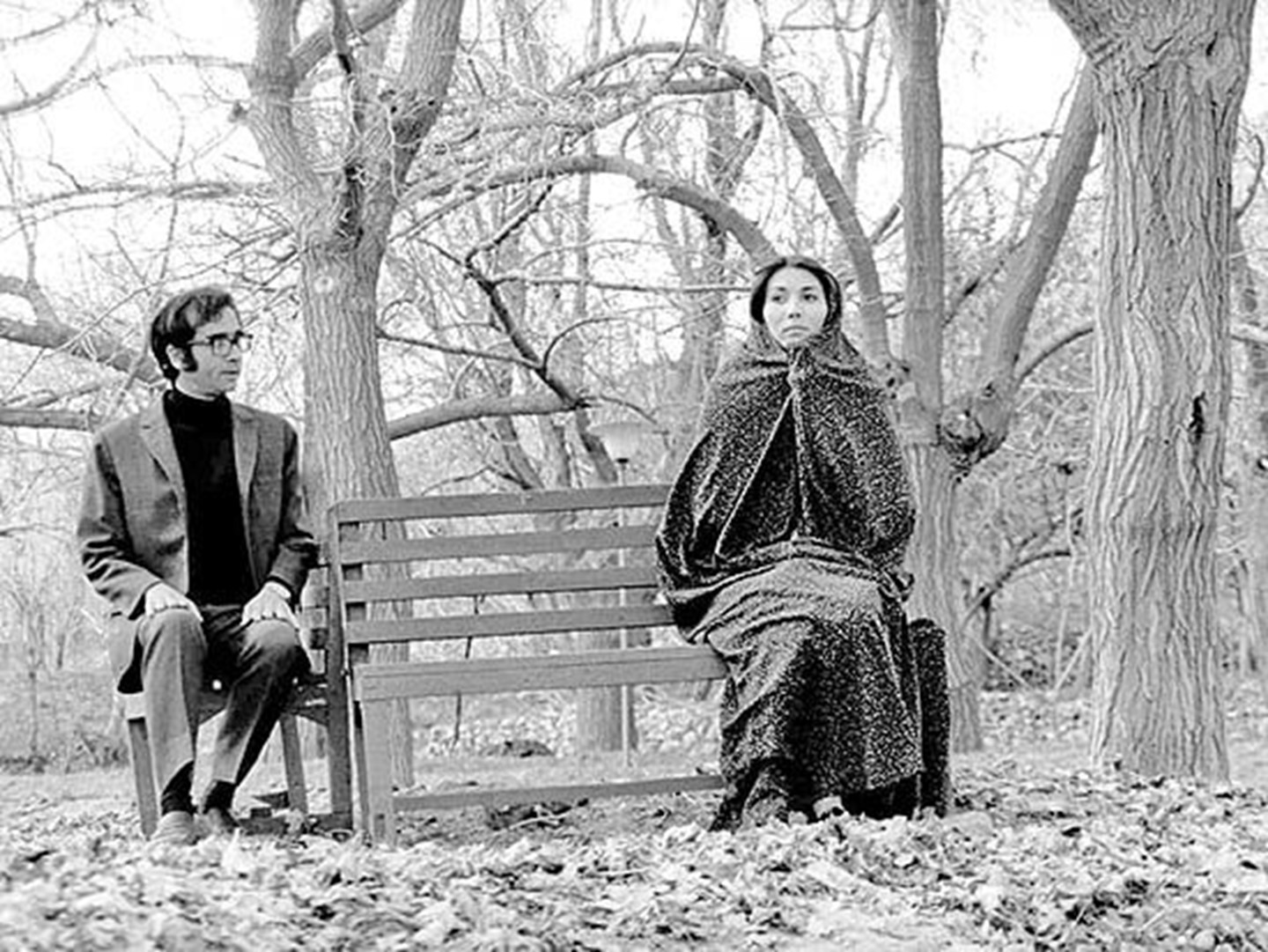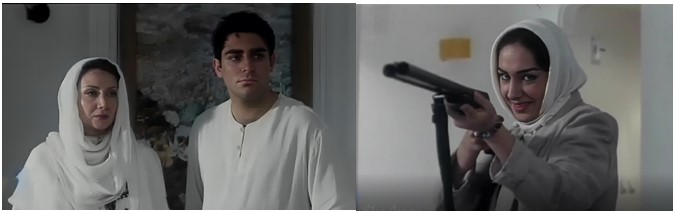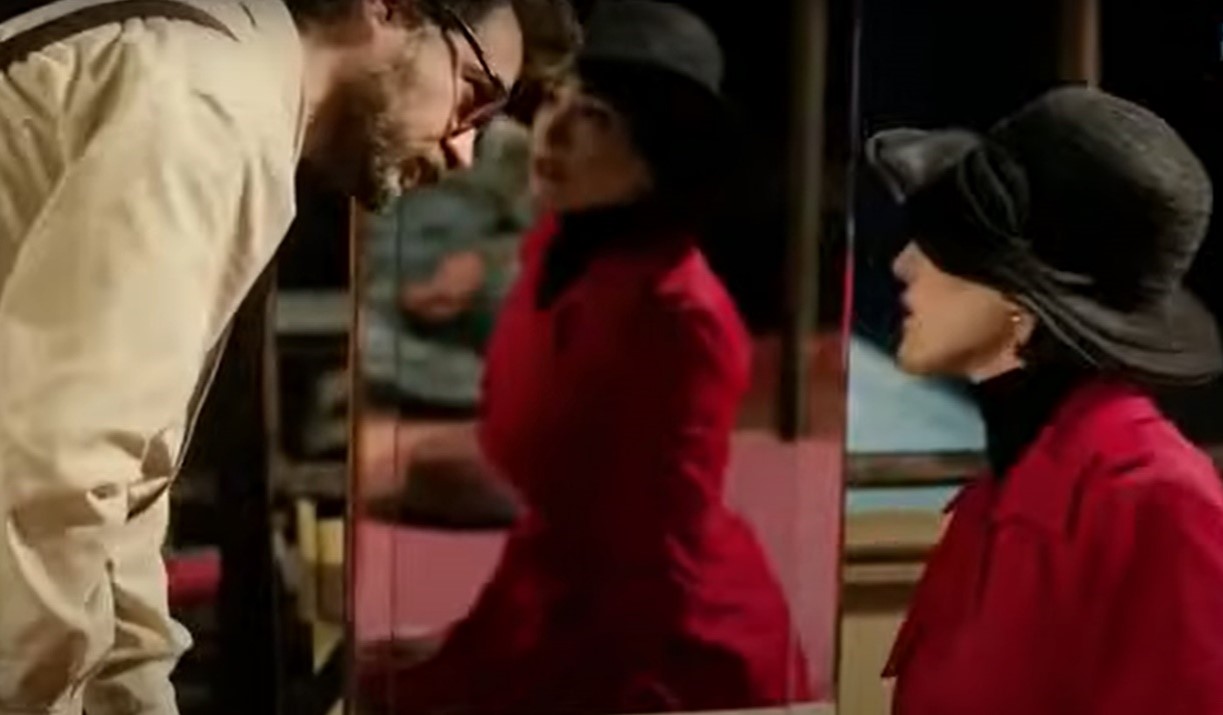
“Drama” in Selected Iranian Cinema Posters: A study in Structuralist Narratology

By

Introduction

The history of movie posters is as old as cinema itself. A movie poster offers us a first glimpse into the world of film. For many viewers, the poster is their first encounter with a movie, and it is often this very image that sparks their interest in watching the film. Posters are essential elements in the movie marketing process, playing a crucial role not only in attracting an audience but also in embedding the film into their visual memory. What makes a movie poster attractive and memorable? How does the relationship between dramatic media (film) and visual media (poster) take shape? What differentiates a movie poster from other advertising posters? The answers to these questions lie in the concepts of “drama” and “narrative.” These two elements contribute to the overall appeal of the movie poster, forge a connection between film and poster, and distinguish movie posters from other forms of commercial visual culture. More than mere marketing tools, movie posters—when infused with narrative and dramatic cues—can extend the world of the film beyond the screen, creating a parallel visual narrative that shapes audience expectations, emotions, and memory.

In this article, I draw on Gérard Genette’s theory of narrative levels and Seymour Chatman’s model of the cinematic narrator to examine the narrative and dramatic structures of selected Iranian movie posters from the 1960s and 1970s. Iranian cinema went through a distinctive period during this time, in terms of style, ideology, and subject matter, encompassing both the commercial cinema known as fīlmfārsī and the more artistic tendencies of the Iranian New Wave. The diversity of form and content in the films of this period has also shaped the visual culture surrounding them, including poster design—a field often overlooked in Iranian cinema studies. By examining a broad selection of Iranian movie posters from these two decades and conducting close readings of selected examples, this article argues that posters from this era should be regarded as visual texts that actively contribute to the cinematic meaning-making process. Through their use of visual drama, character representation, genre cues, and narrative tension, these posters construct a parallel visual narration that not only promotes the film but also becomes part of its broader cultural memory. This analysis highlights the role of poster design as a semi-autonomous artistic and narrative practice within Iranian cinema history.

Movie Posters in Iran

Movie (or film) posters have been used since the earliest public film exhibitions. Initially, they began as outside placards that listed the film program inside the hall or movie theater.1Charles Hiatt, Picture Posters: A Short History of the Illustrated Placard (G. Bell and Sons, 1895), 5. In the early 1900s, movie posters began to feature illustrations that captured scenes from the films. Some posters employed artistic interpretations of scenes or themes, represented through a wide variety of artistic styles. In Iran, the tradition of printing advertisements and notices to promote films began shortly after the first public exhibitions of foreign films. The first public screening of film in Iran took place in September 1904 by Mīrzā Ibrāhīm Sahhāfbāshī Tihrānī (1858–1921). Remarkably, this screening took place without any form of advertisement or public notice and was attended by a limited audience who had been invited. Three years later, in September 1907, Mahdī Īvānuf (also known as Rūsī Khān) initiated the public screening of film in his photography studio and published an advertisement in the second issue of the Habl al-Matīn newspaper to announce the public screening (Figure 1).
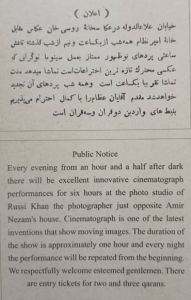
Figure 1: Advertisement for the first film exhibition in Iran, published in the second issue of Habl al-Matīn newspaper, September 1907.[mfn]Mas‛ūd Mihrābī, Sad sāl I‘lān va Pustir-i fīlm dar Īrān (Tehran: Nazar, 2011), 18.[/mfn]

The first movie notices in Iran did not advertise a specific film; instead, they announced the arrival of the cinematograph and promoted this emerging new art form.2Mas‛ūd Mihrābī, Sad sāl I‘lān va Pustir-i fīlm dar Īrān (Tehran: Nazar, 2011), 18-20. In the fall of 1909 movie titles were first used in the advertisements of Fārūs Cinema (established by Rūsī Khān), marking the birth of movie posters in Iran with this very advertisement.3Mas‛ūd Mihrābī, Sad sāl I‘lān va Pustir-i fīlm dar Īrān (Tehran: Nazar, 2011), 22. Interestingly, due to Rūsī Khān’s limited proficiency in Farsi, this advertisement has many spelling and writing errors. Furthermore, it highlights the major challenges of the movable type of that period – both in Farsi typesetting and in the gravure printing of a non-Iranian movie theater. The limitations of lead type in Persian, such as restricted character flexibility, difficulty in typesetting cursive and context-sensitive scripts, and the lack of typographic consistency, often led to poor-quality and error-prone printed texts. Movable type (a printing technology in which individual characters are cast on separate pieces of metal and assembled by hand) was especially problematic for the Persian script due to its connected and context-dependent letterforms (Figure 2).

Figure 2: The first use of movie titles in advertisements for Farūs Cinema, 1909.[mfn]Mas‛ūd Mihrābī, Sad sāl I‘lān va Pustir-i fīlm dar Īrān (Tehran: Nazar, 2011), 22 .[/mfn]

Since 1925, following the resumption of film screenings in Iran (which had been stopped since 1911 due to various reasons, including the Jungle Movement of Gīlān, the fall of the Qājār Dynasty, the First World War, and the 1917 Russian Revolution) lithographic and movable printed posters for foreign films gained popularity, now featuring illustrations from the film. Published in immigrant cities of Iran such as Tehran, Rasht, and Tabriz, these posters were often printed in three languages: Persian, Russian, and French, and sometimes Armenian and English. One interesting example of multilingualism in movie posters is found in the advertisement for the screening of the movie The Birth, the Life and the Death of Christ (Hayāt va Zindaganī-i Hazrat-i Masīh, 1906) at the Grand Cinema of Tehran in 1926. The poster of this film was presented in 5 languages (Figure 3).
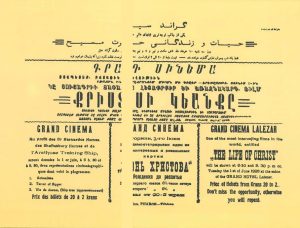
Figure 3: Advertisement for the screening of The Birth, the Life, and the Death of Christ (Hayāt va Zindaganī-i Hazrat-i Masīh,1906) at the Grand Cinema of Tehran in 1926, possibly one of the rare movie posters in the world featuring information in five languages.[mfn]Mas‛ūd Mihrābī, Sad sāl I‘lān va Pustir-i fīlm dar Īrān (Tehran: Nazar, 2011), 31-32.[/mfn]

The poster of the first Iranian film, Ābī va Rābī (Abi and Rabi, 1930), directed by Uvānis Uhāniyān, does not exhibit a significant improvement in the design of movie posters compared to the past (Figure 4-A). Meanwhile, Khān Bahādur Ardashīr Īrānī, who made the first Iranian talkie film, Dukhtar-i Lur (The Lor Girl, 1933) made in India, sent a poster to Iran along with the film. This poster was designed by Chanda Warker, a graphic designer at Bombay’s Imperial Film Company (Figure 4-B). Although it was more sophisticated compared to common Iranian posters, it still looked amateurish in comparison with common American or European posters. Chanda Warker also designed some posters for the first few films of ‘Abd al-Husayn Sipantā, which were produced in India and had a significant impact on poster design of the first Iranian films.4Mas‛ūd Mihrābī, Sad sāl I‘lān va Pustir-i fīlm dar Īrān (Tehran: Nazar, 2011), 6.
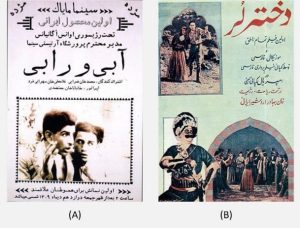
Figure 4: (A) Poster for the first Iranian movie Ābī va Rābī (Abi and Rabi), directed by Uvānis Uhāniyān, 1930. Designer unknown; (B) Poster for the first Iranian talkie Dukhtar-i Lur (The Lor Girl), directed by Ardashīr Īrānī, 1933. Designed by Chanda Warker, graphic designer for Bombay’s Imperial Film Company.[mfn]Mas‛ūd Mihrābī, Sad sāl I‘lān va Pustir-i fīlm dar Īrān (Tehran: Nazar, 2011), 45, 47.[/mfn]

During the Anglo-Soviet invasion of Iran in 1941, film production temporarily halted in Iran. However, the release of non-Iranian films in Iran flourished, and the Persian posters for these films, which were usually collages of the original posters with Persian writings and paintings, were widely published in the press and periodicals (Figure 5). The widespread production of posters for foreign films indicates a single and definite style for film posters, which was used to prepare film posters after the resumption of filmmaking and the wide opening of cinemas in Tehran and other cities in the late 1940s and early 1950s.
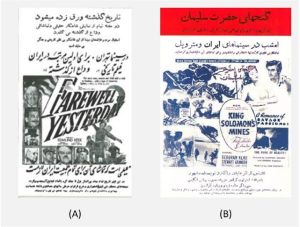
Figure 5: (A) Persian poster for Farewell to Yesterday (Vidā‛ az Guzashtah, 1950). (B) Poster for King Solomon’s Mines (Ganj’hā-yi Hazrat-i Sulaymān, 1950), featuring a mixture of Farsi calligraphy and printed words added to the original poster.[mfn]Mas‛ūd Mihrābī, Sad sāl I‘lān va Pustir-i fīlm dar Īrān (Tehran: Nazar, 2011), 54, 55.[/mfn]

In the years leading up to the 1960s and 1970s, different styles were experimented with to create both commercial and non-commercial Iranian and non-Iranian movie posters. In the mid-1960s, Iranian cinema entered a distinct and passionate period. With the surge of filmmaking by a large number of commercial and non-commercial filmmakers during this period, Iranian cinema witnessed the emergence of some of its most prominent film poster designers, including Muhsin Davallū, Masʿūd Bihnām, Muhammad-ʿAlī Bātinī, Murtazā Kātūziyān, Muhammad-ʿAlī Hidat, Ahmad Masʿūdī, Farshīd Misqālī, Murtazā Mumayyiz, Qubād Shīvā, and many others.

Theoretical Framework

Structuralist narratology is a critical approach that emerged in the mid-20th century, primarily through the work of theorists like Roland Barthes, Gérard Genette, and Tzvetan Todorov. It seeks to analyze the underlying structures that govern narrative forms across media. To analyze the narrative and dramatic qualities of Iranian movie posters from the 1960s and 1970s, this article draws on key concepts from structuralist narratology. Specifically, I use Gérard Genette’s theory of narrative levels and Seymour Chatman’s model of cinematic narration as analytical tools. These frameworks enable us to understand how posters, despite being static visual artifacts, can participate in the multilayered act of storytelling—mirroring or extending the narrative structures of the films they promote. By applying these theories, I aim to demonstrate how certain posters evoke narrative cues, imply temporal sequences, and construct dramatic tension, thereby functioning as visual narratives in their own right.

Structuralist Narratology and Narrative Levels

Narratology, or narrative theory, is the study of narrative and its underlying structures as well as the ways in which they influence human perception. By examining the differences and similarities between the fundamental components of the narrative, narratologists seek to create a model that can be generalized for all types of narratives. Narratology, like any other branch of theoretical sciences, has seen many developments and periods whose theoretical lineage can be traced back to Aristotle. Modern narratology started with Russian formalists, and structuralism is one of its most important branches.

According to Genette, the narrative level constitutes one of three categories forming the narrating situation- the other two being “the time of narration” and “the person”.5Gérard Genette, Narrative Discourse: An Essay in Method (Cornell UP, 1980), 228. Within the category of narrative level itself, Genette identifies three distinct layers that can coexist in a single narrative. These are: the level within the global text at which the telling of the narrator-character’s story occurs; the level at which the primary narrator’s discourse occurs; and the level of the narrative act situated outside the spatiotemporal coordinates of the primary narrator’s discourse. Narrative levels arranged bottom upwards, are extradiegetic (narrative act external to any diegesis), intradiegetic or diegetic (events presented in the primary narrative), and metadiegetic (narrative embedded within the intradiegetic level).

By drawing a strong boundary line between the narrative levels, Genette suggests that “transition between the narrative levels can only be done through the act of narrating… any other form of transfer is impossible, if not impossible, it will always be a kind of slippage from the principles of narration”.6Gérard Genette, Narrative Discourse: An Essay in Method (Cornell UP, 1980), 234. With this definition, the connection between the narrator and the characters is impossible, and not only the narrator cannot communicate with the characters or interfere in the events of the story, but also the characters do not have access to the narrator and the extradiegetic level. As shown in Figure 6, Chatman also follows this leveling and uses the words “story” and “discourse” for the two main levels of narration. Structuralist narratology divides a narrative text into two parts: the story part, which includes the chain of events (actions and happenings) and existents (characters, settings) and the discourse through which the story is conveyed.
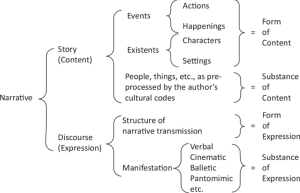
Figure 6: Seymour Chatman’s Elements of Narrative Theory.[mfn]Seymour Chatman, Story and Discourse: Narrative Structure in Fiction and Film (London: Cornell University Press, 1978), 26.[/mfn]

In other words, Chatman states that the story is the “content level” of the narrative while the discourse is its “expressive level”. The discourse determines which events should be narrated and which should not, whether they should be presented in chronological order or through reverse narration. It shapes the overall form of the narration.

 Chatman further divides discourse into two components: “narrative Form” and “appearance in a specific materializing medium”.7Seymour Chatman, Story and Discourse: Narrative Structure in Fiction and Film (London: Cornell University Press, 1978), 22. Narrative form is the structure of narrative transmission and includes effects such as order, frequency, duration, narrator voice, and point of view. The material manifestation of discourse is the media through which the narrative becomes objectified, such as writing, film, ballet, and theater.

Interestingly, the story itself does not exist in an objective form; it is only accessible through the objective manifestations of discourse and the story is deduced from it. In fact, following Genette, discourse can be seen as the signifier and the story as the signified.8Gérard Genette, Narrative Discourse: An Essay in Method (Cornell UP, 1980), 27. This makes it clear that if it is possible to extract the narrative form from the signs within a medium – as a result, extract the narrative discourse- even if that medium is not a narrative or dramatic medium, that medium has transformed into a narrative medium.

Cinematic Narrator

The cinematic narrator is the discourse agent who is in charge of the entire film’s narration. Chatman points out the extent of the narrative tools of the cinematic narrator and introduces these tools by dividing them into two visual and auditory channels.
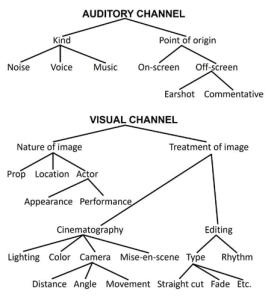
Figure 7: Cinematic narrative tools in auditory and visual channel in films.[mfn]Seymour Chatman, Coming to terms: The Rhetoric of Narrative in Fiction and Film (Cornell University Press, 1990), 135.[/mfn]

As can be seen in Figure 7, all the elements that exist in a movie have a narrative function and a film conveys the story to us by putting aside different visual and audio tools and through its special discourse. It is important to remember that cinema is a dramatic art, and all these tools serve not only the narration but also the drama of the film.

The cinematic narrator presents events, characters, and story elements to the film’s audience using the tools and arrangements at its disposal. It does not interfere with the events and does not even see them. The cinematic narrator only conveys the story. It is a discursive agent: “a mechanism through which the story is presented.”9Seymour Chatman, Coming to terms: The Rhetoric of Narrative in Fiction and Film (Cornell University Press, 1990), 142. It can be said that the narrator presents the story through the images displayed on the screen (including set, actors, and other visual aids) and the sounds broadcast by the speaker (voices, music, and speech), and the audience infers its signifier (i.e., story) from the interpretation of this sign (discourse).

Towards a Methodology: Drama and Narrative in the Movie Poster

Based on the clarified theoretical framework—which draws on Gérard Genette’s concept of narrative levels and Seymour Chatman’s model of cinematic narration—a method can be proposed for analyzing dramatic elements in movie posters. In this approach, the film’s narrative discourse, conveyed through both visual and auditory elements, helps reconstruct the underlying story and its dramatic structure. Subsequently, this story can be re-examined at the level of the poster’s discourse, allowing for an analysis of how the poster presents or translates the drama of the film.

As shown in Figure 8, in this process, we analyze a dramatic story across two mediums: the film and the poster. Drawing on Gérard Genette’s theory of narrative levels and Seymour Chatman’s model of cinematic narration, I approach film and poster as two interrelated narrative systems. In Genette’s terms, the story (histoire) functions as the shared narrative level, while the discourse (discours) or the mode of presentation differs between the two. In the film, the discourse is constructed through cinematic signifiers such as actors, setting, camera movement, editing, music, and sound. In the poster, by contrast, the visual composition—including color, typography, image layout, character expressions, and background elements—serves its own kind of discourse, which may either reinforce or reshape the film’s narrative. Through this approach, I analyze how the poster draws upon or transforms narrative cues from the film to create a dramatic and memorable representation. This methodology allows us to evaluate movie posters not merely as advertising tools, but as condensed narrative artifacts that participate in the construction of meaning and memory for the viewer.

Figure 8: The method of analyzing the drama in movie posters, where the story becomes the common factor in both the movie and the poster’s discourses.

Drama in Selected Iranian Cinema Posters of the 1960s and 1970s

In my analysis of more than 300 movie posters from Iranian cinema during the 1960s and 1970s, I found that over 95% of these posters fall into the subcategory of “star-oriented” posters—where much of the composition is devoted to the image and name of the film stars. The remaining 5% employ a more minimal and iconographic approach to convey the film’s central concept. Notably, these exceptions were typically designed for non-commercial or art-house films, whereas fīlmfārsī productions consistently relied on star-oriented poster design.

By reviewing Iranian movie posters from the 1960s and 1970s, several recurring visual elements emerge. In most of these posters, the written components typically include the film’s title—often rendered in yellow—the names of the leading actors, production company details, and various credits. Alongside these textual features, a number of common non-written elements are frequently present: the prominent display of the film’s stars, images of dancing women or semi-nude women lying down (some of which depict scenes that do not actually appear in the film), and background illustrations that often depict action-oriented scenes such as fighting, horseback riding, dancing, and moments of flight or escape (Figure 9). These visual tropes are not incidental; rather, they reflect a set of stereotypical conventions—particularly gendered ones—used to attract audiences. The recurring depiction of hyper-feminized or sexualized female figures, for example, appeals to the male gaze and reinforces dominant commercial strategies of the time. It appears that poster designers often prioritized these sensational or formulaic elements to ensure the immediate attention of potential viewers. Only after fulfilling this initial function do they turn to more complex tasks, such as incorporating the film’s dramatic and narrative elements into the poster design. That said, not all posters are entirely devoid of drama. In several cases, the dramatic qualities of the film can be perceived through the facial expressions of the characters, the compositional arrangement of figures, and even the typographic treatment of the text—each contributing subtly to the evocation of conflict, emotion, and story.
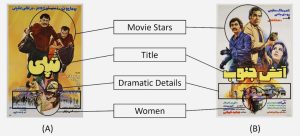
Figure 9: Recurring elements in Iranian cinema posters from the 1960s and 1970s. (A) Tupulī (Chubby), directed by Rizā Mīrluhī, 1972. (B) Ātash-i Junūb (South Fire), directed by Alain Brunet, 1976. Designers are unknown.

Upon close examination of the Iranian commercial film posters from the 1960s and 1970s analyzed in this study—particularly those associated with the fīlmfārsī tradition— it becomes apparent that some elements of drama and narrative can be easily perceived in many of them. For example, in many of these posters, the movie genre can be easily perceived, especially in the comedy and action genres. Considering the same perception of the genre and the lack of variety in themes in commercial cinema and so-called fīlmfārsī, the theme of these works can be readily inferred. By observing these posters, even if we are not familiar with the movie stars of that period, the facial expressions and body gestures of the characters, as well as their composition, reveal the protagonist and antagonist to us. In many cases, these compositions also convey the relationships between the characters, especially if they are lovers or enemies. However, one of the most difficult narrative elements of drama, rarely seen in two-dimensional art such as posters, is the plot—an element that only a very small percentage of posters have managed to depict. In these posters, the designers show a part of the movie’s story to the viewer by representing dramatic action. Of course, it should be kept in mind that the movie poster is made to encourage the audience to see the movie and is not a completely independent art form. More importantly, designers should avoid attempting to convey the film’s entire story through the poster, as this medium is not intended to encapsulate the full narrative. In this context, we will examine the important elements of drama that can lead to the transfer of the narrative and plot in the poster, so that the various degrees of narration in the movie poster can be better understood.

Genre and theme

Genre is one of the central elements of dramatic storytelling and plays an essential role in attracting audiences in commercial cinema. Numerous studies in film marketing and audience research have shown that many viewers base their viewing decisions on genre familiarity and expectations.10Rick Altman, Film/Genre (BFI Publishing, 1999); Steve Neale, Genre and Hollywood (Routledge, 2000). The formation of genre-based fan communities—such as horror aficionados, action-film enthusiasts, or romantic comedy followers—demonstrates how genre not only guides audience preferences but also fosters shared identities and communities around specific cinematic styles and conventions. A genre is essentially a classification that groups thematic and story similarities in dramatic works. It comprises a set of conventions frequently repeated in certain films, categorizing them within a specific genre. In simple words, these conventions define what we are likely to see when watching movies of these genres. Each genre defines what events are acceptable and believable within its framework. The characters don’t suddenly start singing, except in a musical film, and in normal places, a crypt is usually not opened to the other world, except in horror or science-fiction films. Citing Gérard Genette, Jonathan Culler asserts that literature, like any other mental activity, relies on conventions that, except in certain cases, the mind remains unaware of.11Jonathan Culler, Structuralist Poetics: Structuralism, Linguistics, and the Study of Literature (Cornell University Press, 1975), 116. This insight is highly relevant to the analysis of film posters. Posters operate within a shared set of visual and narrative codes—regarding genre, character archetypes, color symbolism, composition, and typographic style—that guide the viewer’s understanding without requiring explicit instruction. These conventions, while often invisible to the audience, function as the scaffolding through which meaning is constructed. By applying this idea to film posters, we can see how certain visual elements resonate with culturally established narrative patterns and expectations, shaping viewers’ interpretations before they even watch the film. Therefore, analyzing a poster’s narrative and dramatic components means uncovering these hidden codes and understanding how they contribute to the poster’s ability to tell a story in a single glance.

Genre cinema never became the mainstream of Iranian cinema; in fact, Iranian cinema is confined to local genres that blend several different genres. For example, the fīlmfārsī genre, reaching its peak of popularity in the 1960s and 1970s, is a combination of comedy-romantic and sometimes musical genres, with some fight scenes that are specific to the action genre or even the martial arts genre. But comedy and action genres hold a special appeal for Iranian audiences across several different periods, and some well-known films are made in these genres. Posters of Parvīz Sayyād’s comedy franchise with the famous character “Samad” introduce us to the concept of transferring the genre and theme of the movie into the movie poster (Figure 10).
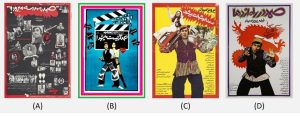
Figure 10: Four posters from the Samad comedy franchise, directed by Parvīz Sayyād: (A) Samad bih Madrasah Mīravad (Samad Goes to the School, 1973). (B) Samad Ārtīst Mīshavad (Samad Becomes an Artist, 1974). (C) Samad Khushbakht Mīshavad (Samad Becomes Fortunate, 1975). (D) Samad dar Rāh-i Izhdahā (Samad in the Way of the Dragon, 1977).

In these posters, all the elements serve to convey genre and theme to the audience; the calligraphy of the title in all of these posters originates from the theme of the movies. The poster of Samad dar Rāh-i Izhdahā (Samad in the Way of the Dragon, 1977), which centers on Samad’s fascination with Bruce Lee’s martial arts films, the title is styled in a manner reminiscent of East Asian calligraphy (Figure 10-D), poster of Ṣamad Khushbakht Mīshavad (Samad Becomes Fortunate, 1975) which is about winning a lottery ticket, the title of the movie is similar to the margin of the newspapers of that period which was used to announce the winner or advertise the lottery (Figure 10-C), the title in poster of Samad bih Madrasah Mīravad (Samad Goes to the School, 1973), which deals with the theme of Samad’s education in adult schools, is similar to the chalk written on a blackboard (Figure 10-A), and in poster of Samad Ārtīst Mīshavad (Samad Becomes an Artist, 1974), which deals with Samad’s efforts to become an actor, the title is designed with the common font of Persian posters for foreign films (Figure 10-B). One of the elements used in these posters to transmit the genre (comedy) is parody. In the designs of many of these posters, you can see their humorous similarity to the poster of a serious movie. The pose of Samad’s character in the poster of Samad in the Way of the Dragon is a contrast to the poster of Bruce Lee’s movies, especially the poster of the Way of the Dragon (Figure 11-A). Similarly, the poster for Samad Becomes an Artist evokes the aesthetic of 1970s American and European action or spy film posters, particularly those of the James Bond series (Figure 11-B).

Figure 11: Posters of foreign movies used as parody sources for the Samad franchise posters: (A) French poster of Bruce Lee’s The Way of the Dragon (1972). (B) Italian poster of the first James Bond movie Dr. No (1962).

The Transmission of genre and theme in the posters of this series of films is not limited to these items, and many items in these posters have contributed to this. For example, the text on the posters of the two movies Samad goes to the school and Samad becomes an artist has made these posters comedic. The text on the poster of Samad becomes an artist introduces this film as “a historical and social film, a romantic and sexy film, an exceptional film, an art film, a karate film, a commercial and war film” and this exaggeration and contradiction have added an attractive comedic aspect to the poster. In the posters of Samad in the Way of the Dragon and Samad Becomes Fortunate, comedy elements such as the image of the dragon or the image of Samad while carrying his dreams have helped bring the genre and theme to these posters.

In addition to comedy films, movies in the crime and action genres have also made deliberate use of poster design to convey their genre and themes. A closer examination of these posters reveals that facial expressions and body gestures of the characters serve as key visual elements in constructing what can be called a thematic scene (Figure 12). By “thematic scene,” I refer to a condensed, emblematic representation of the film’s core emotional and narrative conflict — a moment that does not merely depict an event from the film but symbolically encapsulates its moral atmosphere and dramatic tension. For instance, in the poster for Bih Dādam Biras Rafīq (Help Me Friend, 1978) — a thriller dealing with prostitution and revenge — a woman’s blood-covered body dominates the foreground, while two male figures are positioned behind her with fearful facial expressions and gestures that suggest they are prepared for physical confrontation (Figure 12-A). This visual composition goes beyond mere representation; it evokes a sense of urgency, danger, and unresolved conflict that defines the film’s mood and storyline. Such gestures of readiness for violence, repeated across many posters of crime and action films, are not just aesthetic choices but meaningful signifiers. They communicate the central conflict and emotional intensity of the narrative. The spatial arrangement of figures and their expressions works together to construct a visual shorthand for the film’s world, effectively turning the poster into a narrative and thematic synopsis.
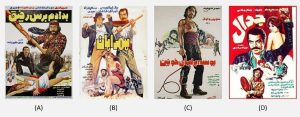
Figure 12: Posters of selected Iranian action and thriller movies from the 1970s: (A) Bih Dādam Biras Rafīq (Help Me, Friend), directed by Mahdī Fakhīmzādah, 1978. (B) Hamrāhān (Entourage), directed by Amīr Shirvān, 1977. (C) Būsah bar Lab’hā-yi Khūnīn (The Kiss on Bloody Lips), directed by Sāmū’il Khāchīkiyān, 1973. (D) Jidāl (The Controversy), directed by ‘Azīzallāh Bahādurī, 1976. Designers are unknown.

In addition to the facial expressions and gestures of the characters in some posters from the 1960s and 1970s, color and composition also play a significant role in conveying the genre and theme of the film (Figure 13). The use of a red background in the poster of the film Shāhreg (Artery, 1975), which deals with the theme of betrayal and friendship, and also the composition of this poster, which emphasizes a hand holding a knife, are elements that heighten the dramatic impact of this poster (Figure 13-A). The composition and color used in the posters of crime and action films of the 1960s and 1970s in Iranian cinema, besides defining the genre, sometimes also hint at the film’s theme.

In fact, the correct transfer of the genre through the poster is one of the first and main steps in the design of narrative posters. Genre is not only one of the important elements of drama, but it also plays an important role in directing the narrative path, and defining the genre in any artistic medium helps to understand the narrative framework of the story. If a poster designed for a comedy movie portrays a dry, cold, and serious atmosphere, subsequent efforts to create a narrative poster will go astray and lead to misimpression among the audience.
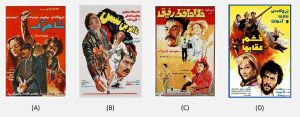
Figure 13: Posters of selected Iranian crime movies from the 1970s: (A) Shāhrag (Artery), directed by ‘Alīrizā Dāvūdnizhād, 1975. (B) Tā Ākharīn Nafas (To the Last Breath), directed by Kāmrān Qadakchiyān, 1978. (C) Khudāhāfiz Rafīq (Goodbye Friend), directed by Amīr Nādirī, 1971. (D) Khashm-i ‘Uqāb’hā (Wrath of Eagles), directed by Īraj Qādirī, 1970. Designer of (D) is Ahmad Masʿūdī; designers of other posters are unknown.

The majority of these posters (about 60%) introduce the genre and theme of the movie, generating anticipation among audiences interested in these genres and themes, who are eager to see these movies. If we consider genre and theme as the first components of the narrative discourse in cinema, noticed by the audience, their representation in the visual narrative discourse of the poster becomes crucial, serving as one of the audience’s first encounters with the film.

Characters and their Relationships

Character is one of the most important elements in the development of the plot and the story. It is the character that decides to act and moves the story forward and the plot is formed by the actions and reactions of the characters. As stated before, the facial expressions and gestures of the characters shown in the posters contribute to creating genre and conveying the theme in these posters. This section examines the representation of film characters in posters, focusing on which character traits are visually communicated and to what extent the relationships between characters are made apparent through poster composition.

Aristotle considers character to be the second essential element of drama after the plot. The actions of these characters drive the story, and in fact, the character serves as a driving force of the narrative. There are various types of characterization in drama, classified according to different criteria. Based on narrative importance, characters can be categorized as main, secondary, or auxiliary. From a functional perspective, we can distinguish between the protagonist or hero—who disrupts the status quo—and the antagonist or anti-hero—who obstructs the hero’s progress. Characters are also categorized by their individual traits: stock characters, who remain unchanged throughout the narrative; clichéd characters, who embody familiar and repetitive traits; and complex characters, who are distinctive, multidimensional, and evolve over the course of the story.

In the commercial films of Iranian cinema in the 1960s and 1970s, i.e. fīlmfārsī, the developed characterization is less common. In these movies, the characters emerge from familiar social types and remain within the bounds of stock character archetypes. The main characters in these films are brave, honorable, powerful, and often poor men who fall in love with a beautiful, witty, and usually wealthy young woman trapped by a corrupt, dishonorable, ugly, anti-hero, often the owner of a cabaret. The hero, after many struggles, accompanied by a friend or a disciple who makes the audience laugh with acrobatics and sometimes with a fake and exaggerated accent, achieves justice and wins the young woman heart as a prize. These hero and anti-hero characters are repeatedly performed by the same actors in some movies and become archetypes from conventional and stock characters, like the famous hero Mahdī Mishkī (Golden Heel), who has been portrayed in several movies by Nāsir Malik Mutī‛ī. These stereotypical characters were seen as a reliable formula for box office success. As shown in Figure 14, it was essential for the poster to clearly highlight the hero as a familiar and beloved figure—one whom audiences often emulated in dress or quoted in everyday life. This visual recognition played a key role in attracting viewers to the film.
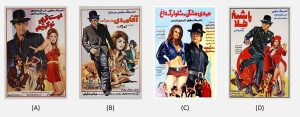
Figure 14: Poster of fīlmfārsī movies featuring Mahdī Mishkī as the main character, portrayed by Nāsir Malik Mutī‛ī: (A) Ūstā Karīm, Nukaritīm (I Owe You One, Ousa Karim), directed by Mahmūd Kūshān 1974. (B) Āqā Mahdī Vārid Mīshavad (Here Comes Mr. Mehdi), directed by Farīdūn Zhūrak, 1975. (C) Mahdī Mishkī va Shalvārak-i Dāgh (Mehdi in Black and Hot Mini Pants), directed by Nizām Fātimī, 1972. (D) Pāshnah Talā (Golden Heel), directed by Nizām Fātimī, 1975.

In the movie posters featuring such characters, we see that the hero of the movie is illustrated with his usual heroic strength, next to his secretive friend and, of course, his beautiful lover. The repetition of these themes and characters eliminates the need to define the characters and their relationship in the film and poster because after seeing the actors together, the characters and relationships between them come alive for the audience. However, Iranian cinema in the 1960s and 1970s was not limited to these stereotyped characters. In both mainstream cinema and beyond, we occasionally come across characters with complex characteristics.

One of the most famous examples is Shīr Mammad, the hero of the 1973 movie Tangsīr, which is based on the novel Tangsīr by Sādiq Chūbak, itself inspired by real events. In this movie, we meet the simple, pure, and family-loving Zā’ir Muhammad Tangsīrī, who is fed up with the oppressive wealthy city elites who have borrowed and squandered his wealth and property. After bidding farewell to his wife and two children, he embarks on a path of revenge, not to recover the money but to protect his integrity, honor, and masculinity. The film portrays the transformation of Zā’ir Muhammad, a simple and calm man from Tangsīr, into the brave Shīr Mammad (Shīr means lion), one of the most iconic characters of Iranian cinema.

In this movie poster (Figure 15) features a simple composition set against a red background. Unlike typical posters of that period, the space in this poster is not fully occupied, and care has been taken to ensure that the text does not disrupt its sense of solitude. The main character of this film is illustrated in full length, walking forward with a gun in hand and a tired and angry face. All these elements have greatly contributed to the dramatic effect of the poster because the forward-moving gesture of Zā’ir Mammad suggests an impending incident. The emptiness and absence of any other character in the poster, except for the half-length image of Shīr Mammad’s wife, intensify the hero’s loneliness and helplessness. Other characters are only illustrated in a small size in the middle of the poster. In essence, this poster appropriately portrays the bravery and chivalry of the main character, and this characterization, which usually exists only in dramatic and narrative art mediums, is well presented in a fixed frame in this poster.
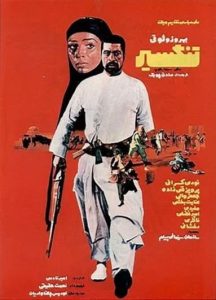
Figure 15: Poster of Tangsīr, directed by Nāsir Taqvā’ī, 1973. Designed by Ahmad Mas‛ūdī.[mfn]Mas‛ūd Mihrābī, Sad sāl I‘lān va Pustir-i fīlm dar Īrān (Tehran: Nazar, 2011), 118.[/mfn]

Character is a fundamental element of narrative, which is important at both the story and discourse levels. In the same way that techniques such as composition, costume and make-up, camera angle, acting, dialogue, and music are used for characterization in a cinematic narrative, techniques such as composition, gesture, color, and other graphic tools can also be used in a visual narrative for characterizing and representing movie characters and their relationships in the poster. Proper characterization in a movie poster becomes a significant step towards creating narration in the poster. In addition to introducing the hero or heroes, it plays an important role in clarifying the relationship between the characters and possible events in the story. Although narrative characterization in the visual arts seems to be a difficult task, examples such as the Tangsīr movie poster demonstrate the importance of this stage of movie poster design to create a narrative and dramatic poster. In fact, it is at the stage of character introduction that the cinematic narrative begins to transform into a graphic narrative. This is the point where the visual language of the poster takes on the task of translating the film’s narrative elements—previously expressed through motion, dialogue, or cinematography—into static yet meaningful visual symbols. Through visual cues such as facial expression, body language, color, and spatial composition, the poster must communicate who the characters are, what roles they play, and how they relate to one another. As such, the successful depiction of characters is not merely a design choice but a narrative strategy that bridges the gap between cinematic storytelling and visual communication in poster art.

Characters and their relationships are not always objectively represented in all the posters. In many cases, they are illustrated in allegorical, symbolic, or abstract forms. In such posters, the characters and the relationships between them are not fully conveyed to the audience, but the audience gets a complete understanding of them after watching the movie, and the questions that arise about the characters and their relationships after seeing the poster will be answered after watching the movie. Murtazā Mumayyiz, renowned for designing some of the most enduring posters of Iranian cinema in the 1970s, is one of the designers who usually employs this method in his movie poster designs (Figure 16). The poster of the movie Malakūt (The Divine One, 1976) abstractly depicts the relationship between the characters of Dr. Hātam and M.L. (Figure 16-A). Similarly, the relationship between the two brothers in the movie Ghazal (1976) is also depicted symbolically in the poster (Figure 16-E). In addition to Mumayyiz’s works, in the posters of Farshīd Misqālī for the movies Pustchī (The Postman, 1972) (Figure 17-A), Gāv (The Cow, 1969) (Figure 17-B), and Shāzdah Ihtijāb (Prince Ehtejab, 1974) (Figure 17-C), some of the posters designed by Muhammad-ʿAlī Hidat’s and Muhammad-ʿAlī Bātinī.

Figure 16: Movie posters designed by Murtazā Mumayyiz: (A) Malakūt (The Divine One), directed by Khusraw Harītāsh, 1976. (B) Mughul’hā (The Mongols), directed by Parvīz Kīmiyāvī, 1973. (C) Gavazn’hā (The Deers), directed by Mas‘ūd Kīmiyā’ī, 1974. (D) Balūch, directed by Mas‘ūd Kīmiyā’ī, 1972. (E) Ghazal, directed by Mas‘ūd Kīmiyā’ī, 1976.[mfn]Mas‛ūd Mihrābī, Sad sāl I‘lān va Pustir-i fīlm dar Īrān (Tehran: Nazar, 2011), 105, 116, 134, 141-42.[/mfn]

Examining movie posters from these two decades shows that the characterization and relationships between the characters are present in less than half of them (about 40%), and many of these posters have limited themselves to a simple image of the movie stars.
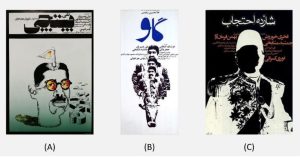
Figure 17: Movie posters designed by Farshīd Misqālī: (A) Pustchī (The Postman), directed by Dāryūsh Mihrjūyī, 1972. (B) Gāv (The Cow), directed by Dāryūsh Mihrjūyī, 1969. (C) Shāzdah Ihtijāb (Prince Ehtejab), directed by Bahman Farmānārā, 1974.

Plot and Dramatic Action

All elements of drama serve to create and convey the plot and story, which may explain why Aristotle considers the plot to be the most important element of tragedy.12Aristotle, Poetics, trans. Malcolm Heath (New York: Penguin Books, 1996), 12. In drama, plot is communicated to us through actions, where action represents the movement or development of plot and story in the dramatic arts. According to the theories of narrative levels and cinematic narrator, the different components of a film convey the story to us by making objective manifestations of the discourse. In a movie poster, an attempt is usually made not to reveal the whole plot but to depict a part of the dramatic action, so that in addition to making the poster dramatic, the story is prevented from being spoiled completely. In dramatic posters, by creating the main action, in addition to introducing the genre, theme, characters, and their relationships, a small part of the story is made visually. To design a dramatic poster that effectively represents a movie plot, it is necessary that the different components of the poster, from the texts, colors, and composition to the characters and the relationships between them, create action in the visual text of the poster.

The main action of Bunbast (Dead End, 1977), based on a story by Anton Chekhov, is a girl watching a strange man through a window. In this film, a young girl who lives with her mother at the end of a dead-end alley looks out the window on a rainy day and notices a man is stalking their house. The man stands in the rain with an umbrella, looking at the girl’s window, and this scene repeats over the next few days. The poster for this movie (Figure 18) illustrates both the scene of the girl behind the window and the man with the umbrella. The image of the man is rendered in a monochromatic contrast of black and white, while the image of the girl features a monochromatic contrast of blue and black. The window frame employs a contrasting combination of green and black. Although this poster may appear calm and low-action at first glance, its tranquility actually stems from the film’s underlying drama. This film, which focuses primarily on the romantic fantasies of the girl character, is filled with images of her and her inner voice, weaving everything into a romantic fantasy. The film’s dreamlike atmosphere is heightened by Hūshang Bahārlū’s distinctive cinematography, the absence of a soundtrack, and the use of the girl’s internal monologue—most notably in a scene where a poem by the renowned Iranian poet Ahmad Shāmlū, recited in his own voice, deepens the sense of reverie. These romantic fantasies, however, are abruptly shattered in the film’s final moments. At the end, when the girl’s brother finally returns home from his travels, the unknown man enters and arrests the girl’s brother. Although this issue is not mentioned in this movie, the man behind the window is an agent of the Bureau for Intelligence and Security of the State (SAVAK), and the girl falls in love with him in her childhood fantasy.
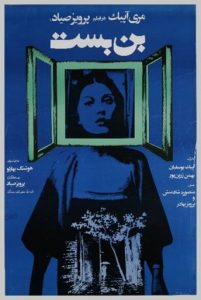
Figure 18: Poster for Bunbast (Dead End), directed by Parvīz Sayyād, 1977. Designed by Murtazā Mumayyiz.[mfn]Mas‛ūd Mihrābī, Sad sāl I‘lān va Pustir-i fīlm dar Īrān (Tehran: Nazar, 2011), 145.[/mfn]

Unlike commercial films that often rely on controversy to attract attention, this poster reinforces the film’s dramatic essence and thoughtfully conveys its central narrative, without resorting to sensationalism. Just as everything in this film—made during the final year of the Pahlavī regime amid the turmoil of the 1979 Revolution—is symbolic, so too is everything symbolic in these posters. While watching this movie, we dream alongside the girl, but by the end, our beautiful imaginations and fantasies are shattered. This poster features a soothing blue background, likely inspired by the poem “Āy Ishq!” (Oh Love!), which includes the line “Your blue face cannot be found.” This poem, heard twice in the film, invites us into a dream, only for the stranger’s final words, “I’m sorry,” to wake us from this mistaken dream by the movie’s end.

Although posters depicting multiple dramatic actions and various scenes from the movie may seem to convey a stronger sense of drama, closer examination reveals that the simultaneity of several narratives in the poster actually diminishes the power of the narration. As a result, they will be ignored and overshadow the drama in the poster. Figure 19 shows posters featuring several actions, and by examining them, it becomes clear that contrary to popular belief, these posters not only fail to convey drama and narration but may also cause confusion. For example, the placement of conflict scenes and numerous characters in the poster for ‛Alī Surchī (1972) (Figure 19-A) as well as the crowded and poorly composed layout of the poster for Tangah-yi Izhdahā (The Dragon’s Gorge, 1968) (Figure 19-D), illustrate attempts at storytelling that ultimately fail due to a lack of visual unity necessary for effective narrative expression. Moreover, in the posters of the films Jabbār, Sarjūkhah-yi Farārī (Jabbar, Runaway Sergeant, 1973) (Figure 19-C), and Gurg-i Bīzār (The Hateful Wolf, 1973) (Figure 19-B), it can be seen that the emphasized element in the poster, which is the face of the lead actors, is the least dramatic element of the poster, which reduces the power of the drama.

Figure 19: Selection of action film posters from the 1960s and 1970s (Part 1): (A) Alī Surchī, directed by Rizā Safāʾī, 1972; (B) Gurg-i Bīzār (The Hateful Wolf), directed by Māziyār Partaw, 1973. Designed by Muhammad-ʿAlī Hidat; (C) Jabbār, Sarjūkhah-yi Farārī (Jabbar, Runaway Sergeant), directed by Amān Mantiqī, 1973; (D) Tangah-yi Izhdahā (The Dragon’s Gorge), directed by Siyāmak Yāsamī, 1968.[mfn]Mas‛ūd Mihrābī, Sad sāl I‘lān va Pustir-i fīlm dar Īrān (Tehran: Nazar, 2011), 121.[/mfn]

Of course, there are also suitable dramatic examples of multi-action posters that have been able to serve the narrative of the poster through appropriate composition, creating focus on its most dramatic element, or by directing the audience’s eyes to multiple actions and dramatizing the poster amid its commotion (Figure 20). The poster of the movie Safar-i Sang (Journey of the Stone, 1978), designed by Muhammad-ʿAlī Bātinī, is an example of this kind of poster where the actors’ facial expressions and bodies are emphasized in a dramatic state, and the other actions depicted in the poster further enhance the power of the poster’s dramatic impact (Figure 20-A).
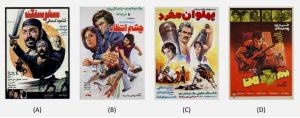
Figure 20: Selection of action film posters from the 1960s and 1970s (Part 2): (A) Safar-i Sang (Journey of the Stone), directed by Masʿūd Kīmiyāʾī, 1978. Designed by Muhammad-ʿAlī Bātinī; (B) Chashm Intizār (Awaiting), directed by Farīdūn Zhūrak, 1975; (C) Pahlivān Mufrad (The Hero Mofrad), directed by Amān Mantiqī, 1971; (D) Jahannam + man (Hell + Me), directed by Muhammad-ʿAlī Fardīn, 1972.[mfn]Mas‛ūd Mihrābī, Sad sāl I‘lān va Pustir-i fīlm dar Īrān (Tehran: Nazar, 2011), 148.[/mfn]

The most powerful movie posters in terms of drama and narrative – as opposed to design aesthetics – are those that directly confront the audience with the core dramatic action. By creating focus and emphasis on the most important action of the film, these posters drew viewers into the heart of the conflict; encountering such posters was equivalent to witnessing one of the film’s most pivotal scenes. An exemplary instance of such a dramatic poster is for the 1972 movie Sādiq Kurdah (Sadegh the Kurd) (Figure 21), directed by Nāsir Taqvā’ī. In this poster we are directly confronted by a character who is wielding his gun with authority and anger, leaving the audience seemingly with no way to escape. While creating curiosity, the other elements of the poster carefully compliment rather than distract from the main character. The sunny background, combined with the way the gun breaks through the frame—perhaps symbolizing a breach of legal or moral boundaries—heightens our curiosity about the film’s underlying lawlessness. A bullet-riddled truck—likely the work of the hero—along with shadowy figures who appear to be the story’s antagonists, and a man lying in a pool of his own blood at the hero’s feet, all serve as visual clues, hinting at a violent confrontation and suggesting the tragic arc of the hero’s journey.
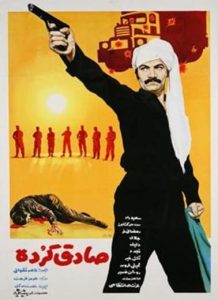
Figure 21: Poster of Sādiq Kurdah (Sadegh the Kurd), directed by Nāsir Taqvā’ī and designed by Bihishtī, 1972.[mfn]Mas‛ūd Mihrābī, Sad sāl I‘lān va Pustir-i fīlm dar Īrān (Tehran: Nazar, 2011), 112.[/mfn]

The poster for Sādiq Kurdah not only raises many questions but also aligns with the film’s drama and story, providing substantial information without contradiction. Watching the movie leaves the same actions imprinted in our minds, as if the poster has presented a visual summary of the plot. The protagonist of this movie is Sādiq, known as “Sādiq the Kurd,” who runs a teahouse with his wife along the road from Andīmishk to Ahvāz. One night, in Sādiq’s absence, one of his friends, who is a truck driver, comes to the teahouse and, after raping Sādiq’s wife, kills her. Sergeant Valī Khan, Sādiq’s father-in-law, tries to arrest the murderer, while Sādiq seeks revenge by killing truck drivers. When Sergeant Valī Khan is assigned by the head of police to handle the case of the drivers’ murderer, he remains silent upon realizing that the killer is none other than his son-in-law. The head of police pressures Valī Khan, and on the day Sādiq plans to visit his house to see his son and borrow money to flee the country, he is surrounded by gendarmes and killed.

By examining this poster, one can see that through a cohesive visual unity—where all elements are drawn from the drama and story—the poster shapes the film’s drama and transforms its narrative from cinematic discourse into visual discourse. By removing details and non-dramatic elements, this poster introduces the audience not only to the genre and theme but also to the characters, going further to assume the role of narrator.

Posters with strong drama are very rare among the reviewed posters (less than 5%). Even posters containing action are usually weak in creating a cohesive plot and story due to the large number of illustrated actions. The poster of the movie Barādar-kushī (Fratricide, 1978) (Figure 22) directed by Īraj Qādirī is also one of the one-act posters that illustrate the drama in the most concise way possible, and this makes it powerful. This film is a story of forbidden love between a girl and a boy from two families that have held grudges against each other for years. The main character of this movie is Ghulām, the lover’s brother, who intends to end the old grudge between these two families by supporting the young lovers. In this poster, by removing secondary actions and additional details, the audience is placed in the middle of the conflict of the film and comes face-to-face with the main character of the film.
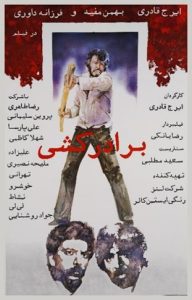
Figure 22: Poster of Barādar-kushī (Fratricide), directed by Īraj Qādirī and designed by B.N, 1978.[mfn]Mas‛ūd Mihrābī, Sad sāl I‘lān va Pustir-i fīlm dar Īrān (Tehran: Nazar, 2011), 157.[/mfn]

Total Posters

Posters representing the genre or theme

Posters representing characters

Posters representing dramatic action

Dramatic Posters (Genre, Theme, Characters, Action and Plot)

307

260

117

97

12

percentage

84

38

31

4

Conclusion

This research, aimed at exploring drama in Iranian cinema posters from the 1960s and 1970s, reveals that by applying the theory of narrative levels, narrative structures can also be identified in non-narrative and non-dramatic art forms. By incorporating the concept of cinematic narration into my analysis, I was able to establish a connection between the two mediums—film and poster—and explore the presence of drama within both. Through this method, the cinematic tools in the film medium convey both the story and drama to the audience. Next, based on the film’s story, the poster is analyzed to determine how the narrative and drama are represented within its visual discourse, and through which techniques this representation is achieved.

Based on the findings of this research, it can be stated that the drama in Iranian cinema posters from the 1960s and 1970s manifests itself on three distinct levels: At the first level, the genre and theme of the movie are represented in the poster; at the second level, the characters and their relationships are displayed; and at the final level, the plot of the drama is conveyed to the audience through the representation of dramatic action. There are examples of movie posters that, by effectively depicting the film’s central action, encapsulate the drama in a compelling way and explicitly convey elements of the story to the audience. By understanding the different levels of drama in these posters, cinema and theater poster designers can create compelling works that stand out from other types and effectively integrate both drama and narrative. To design an effective movie poster, one must first identify the various elements of the cinematic narrative discourse and then use the graphic tools of the poster medium to reconstruct these elements within a visual discourse.
Resistance and Compliance in The Salesman (2016)

By

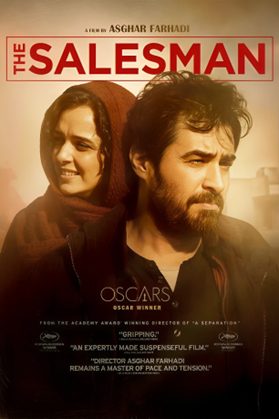
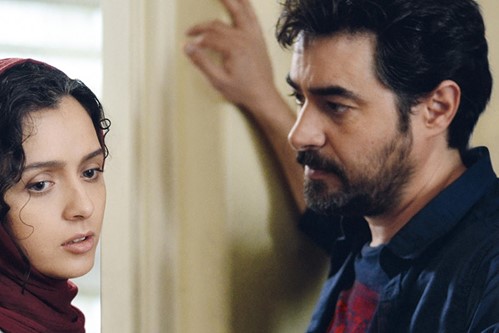
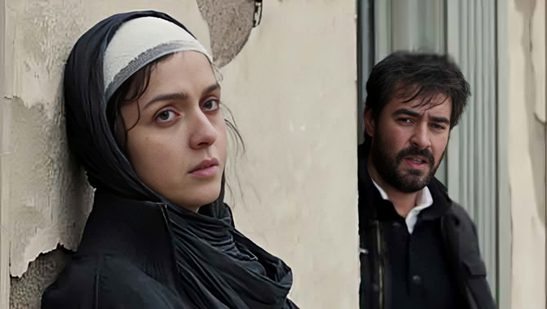
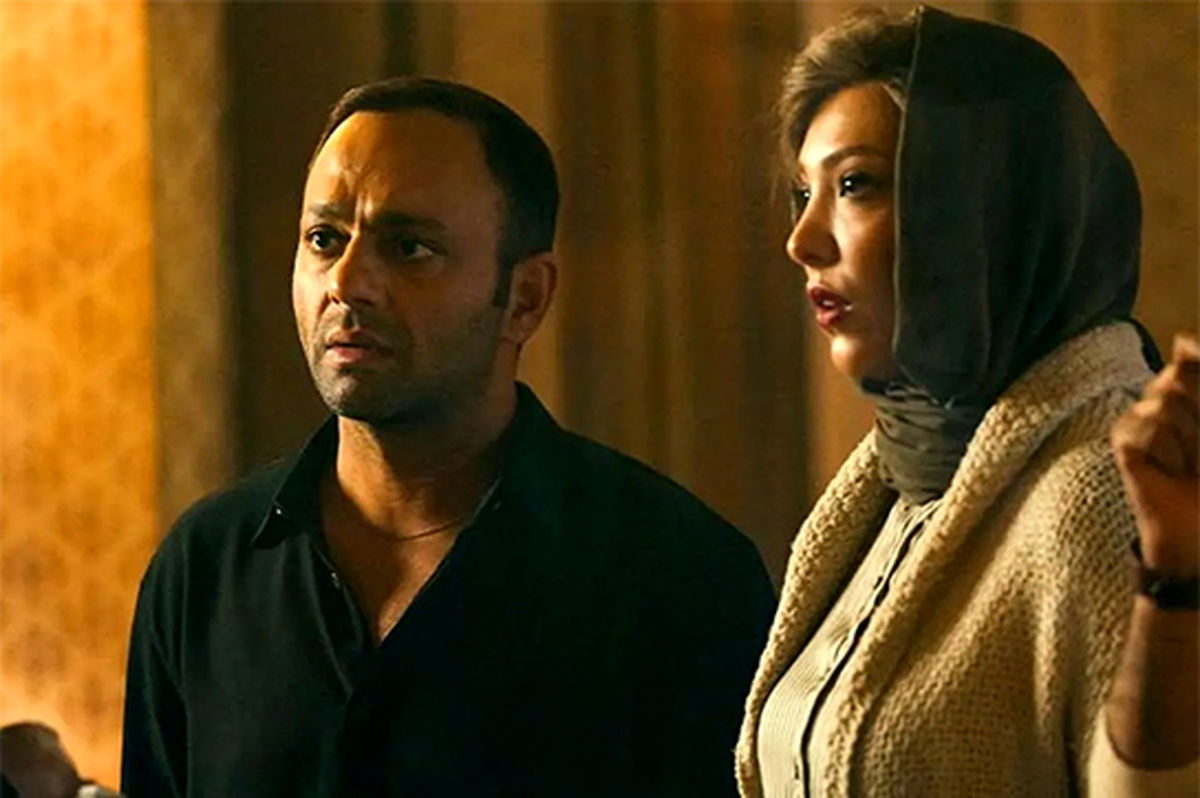
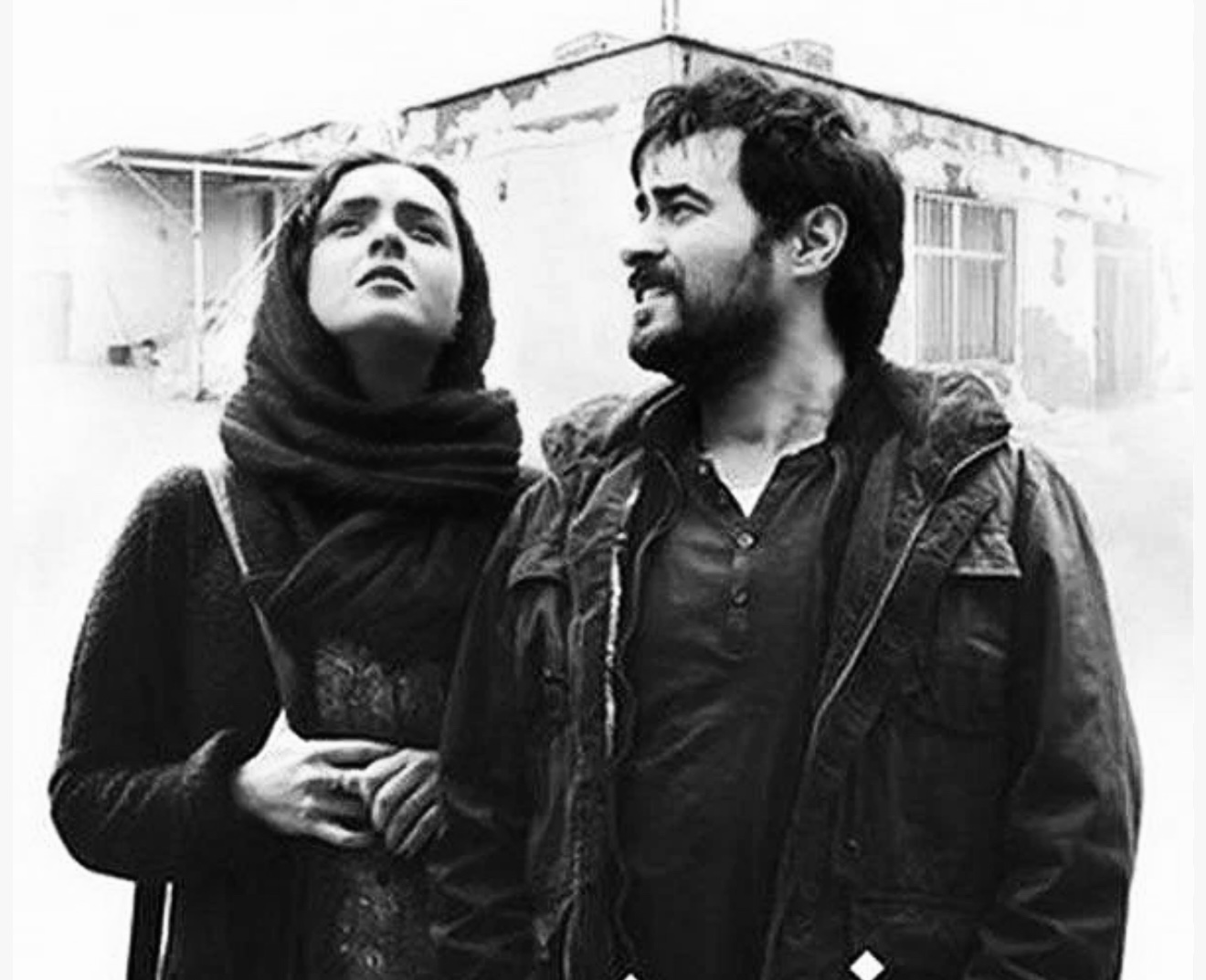
Figure 1: Poster of the film The Salesman, Asghar Farhādī, 2016

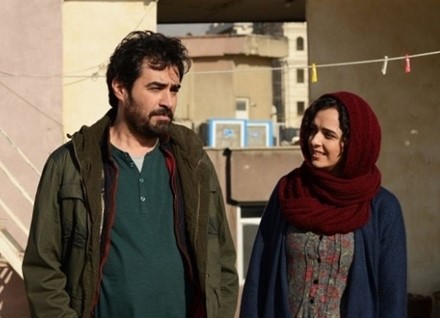
The Salesman (2016) is the seventh feature film of Asghar Farhādī, winning many international awards, including the award for Best Foreign Film at the Oscars and the award for Best Screenplay at Cannes. It was also the highest-grossing film in the domestic market.1For more on the film’s awards, see Academy of Motion Picture Arts and Sciences, “THE 89TH ACADEMY AWARDS | 2017,” Digital Magazine of the Academy Awards, February 26, 2017, https://www.oscars.org/oscars/ceremonies/2017; and “RETROSPECTIVE Year 2016: IN COMPETITION Feature Films,” Cannes Film Festival, https://www.festival-cannes.com/en/retrospective/2016/palmares/. Regarding its take at the box-office, see Zohreh Fathi and Pante’aa Khamooshi Esfehani, Statistical Yearbook of 1395. (Vice President of Technology Development and Cinematic Studies, 2016). Further, it can be argued that The Salesman is one of the most successful films in Iranian cinematic history, attracting both international and domestic markets. In fact, this new phenomenon of appealing to both markets can be attributed to Farhādī’s cinema in general; the reason for this could lie in the  hybridity of his films, combining the aesthetics of Iranian art-house cinema and Hollywood’s more commercially successful melodrama features, as explained by Daniele Rugo.2Daniele Rugo, “Asghar Farhadi: Acknowledging Hybrid Traditions: Iran, Hollywood and Transnational Cinema,” Third Text 30, no. 3-4 (2016): 173-187. https://doi.org/10.1080/09528822.2017.1278876.

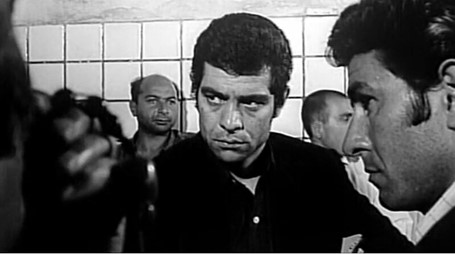
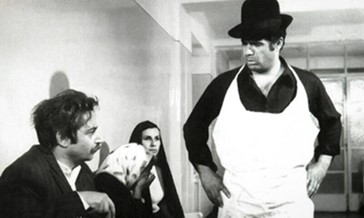
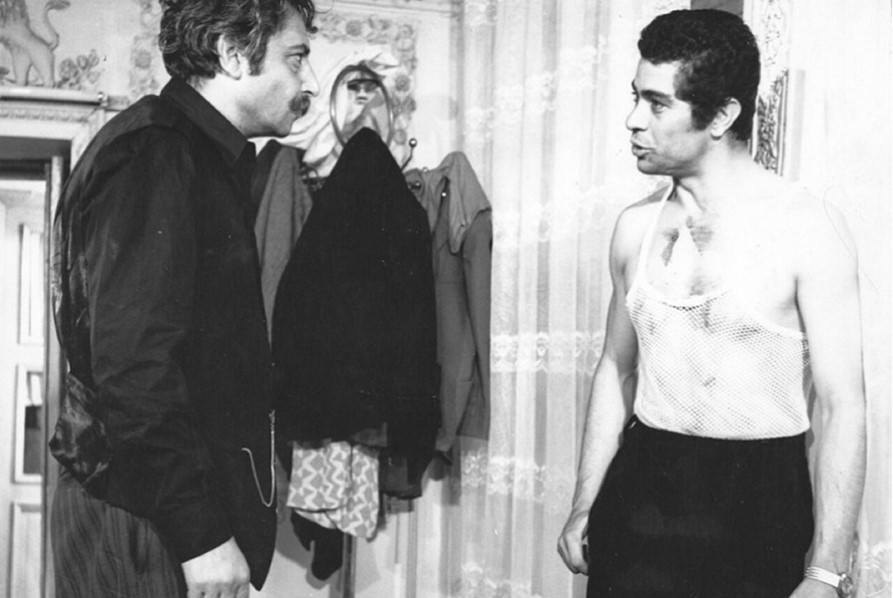
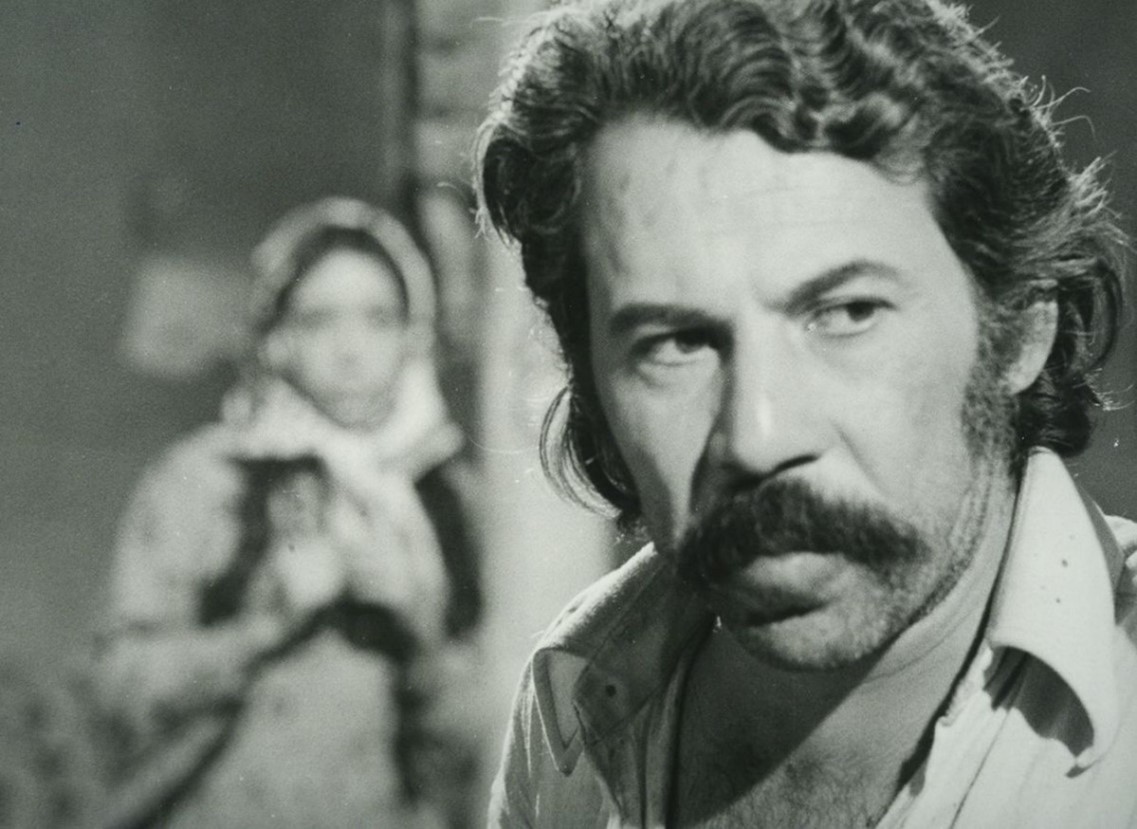
The Salesman is a curious case, however, even in Farhādīan hybrid cinema. On the one hand, the film narrates a ghayrat story—that is, a sexual assault-motivated revenge story—coupled with a mainstream plot line with a long history in an equally mainstream genre of film from pre-revolutionary Iranian cinema known as fīlmfārsī. On the other hand, The Salesman also exhibits a subversive attitude in its depiction of ghayrat and takes a critical tone with the genre. However, the film still carries many genre elements that distort or limit this critical or subversive approach. Moreover, the negotiations the film performs with and within the Islamic Republic censorship environment leaves many traces on the body of the film that prevents The Salesman from being read as entirely a critique or a purely subversive rendition of the genre.

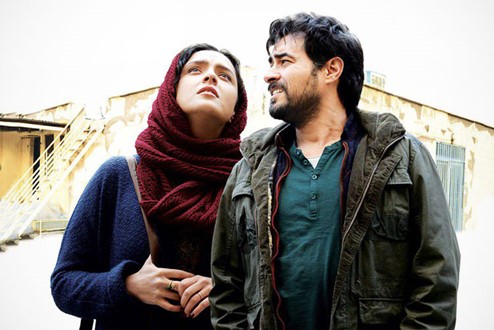
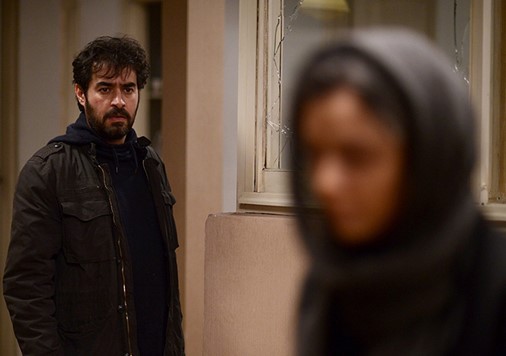
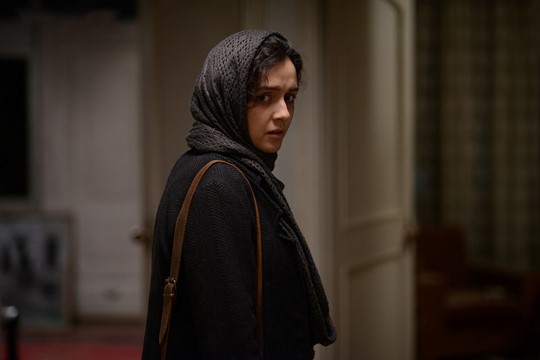
Figure 2: A Screenshot from the film The Salesman, Asghar Farhādī, 2016

In this study, I outline and examine the roots of the hybridity of The Salesman in the ghayrat stories of fīlmfārsī, and discuss how Farhādī simultaneously subverts and reinforces some of the normative notions presented in the genre. Alongside this, I also show how Farhādī’s negotiations with the Islamic Republic of Iran’s censorship systems work against the critique the film presents and reduce the extent of its potentially subversive “resistance.” However, before entering the film analysis, it is essential to discuss what ghayrat is and its significance in Iranian cinema.

Iranian Cinema and Ghayrat

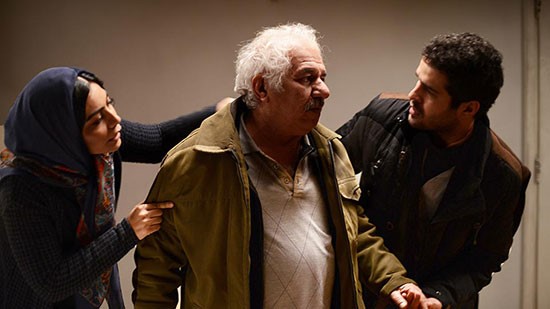
Ghayrat is a broad category in Iranian society that affects Iranian cinema in numerous ways. Ghayrat is usually mistranslated into honour or jealousy but goes far beyond that. Defining ghayrat in all its shapes and forms is no easy task, however, and is out of the scope of this study. In short, “[i]n Iran, gheirat is an important concept in various domains of social life, including romantic relationships, family dynamics, and politics. People often refer to experiencing or expressing gheirat when there is a violation involving people or entities toward whom a person feels a strong connection and a tendency to protect.”3Pooya Razavi, Hadi Shaban-Azad, and Sanjay Srivastava, “Gheirat as a Complex Emotional Reaction to Relational Boundary Violations: A Mixed-Methods Investigation,” Journal of Personality and Social Psychology, . Ghayrat has numerous targets such as family members, religion, and country, and Iranians “have ghayrat over” these targets and “show, express, or elicit ghayrat” when the target is in danger or hurt. For example, a man has ghayrat over his wife, a sense of protectiveness. If his wife is insulted or hurt, he shows or elicits ghayrat to protect or avenge her. Ghayrat is usually accompanied by negative feelings such as anger.

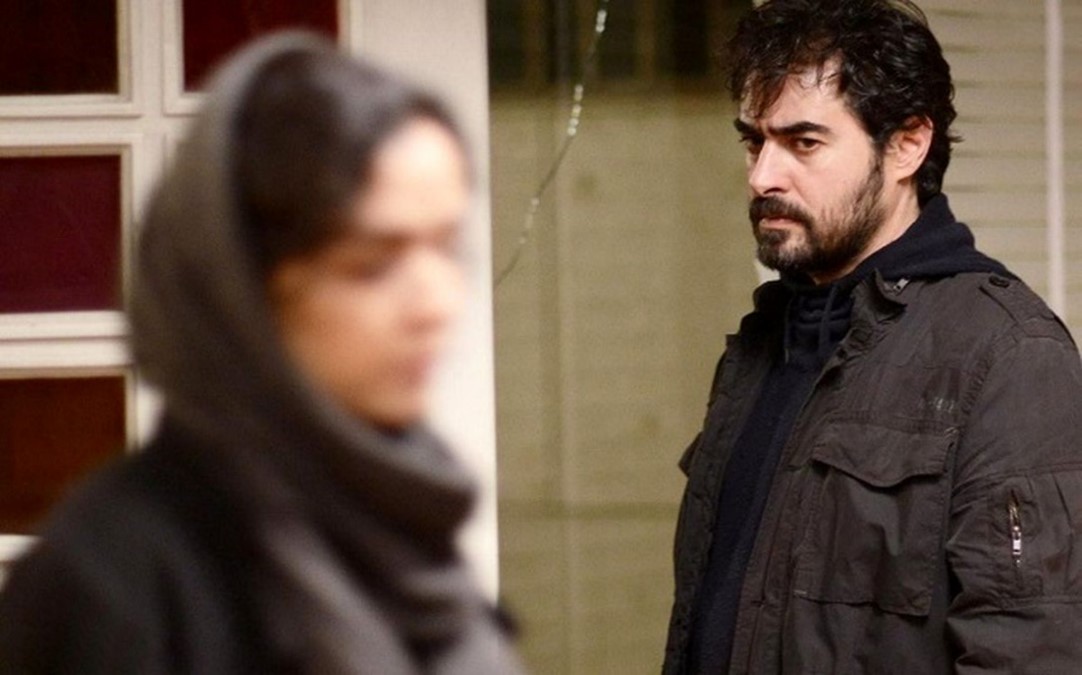
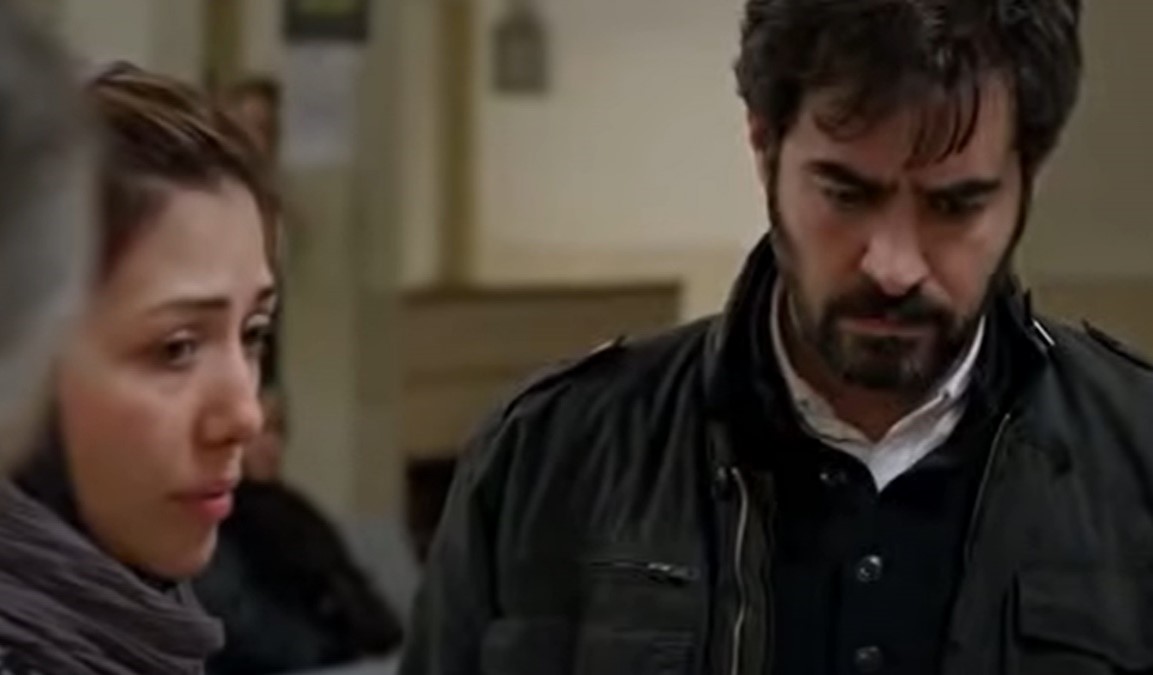
Figure 3: A Screenshot from the film The Salesman, Asghar Farhādī, 2016

For this study, however, distinguishing woman-related ghayrat and other types is important as I seek to narrow down what parts of ghayrat The Salesman comments on.

Following Maryam Falahatpishe Baboli and Farzan Karimi-Malekabadi who proposed modesty as the gendered element of ghayrat, I will specifically consider ghayrat through two of its broadest forms: “modesty ghayrat” and “non-modesty ghayrat.” Modesty ghayrat is the type of ghayrat that is usually aimed at nāmūs (a close female family member such as a mother, sister, or wife) that tries to control and protect her simultaneously. By controlling, a man asks (or demands) his woman family members to follow the rules of modesty and beware of situations in which immodesty can potentially take place. By protecting, the man acts as a bodyguard, fending off mate-poachers or those who would exploit and take advantage of (i.e., assault, often sexually) his women family members, especially in potentially immodest situations. Non-modesty ghayrat, however, is broad and can be elicited in many situations, such as defending the vulnerable, one’s country, religion, etc.

Before the Islamic Revolution, ghayrat, in both its forms, was one of the major, if not the most central, themes of a popular strand of films known as fīlmfārsī. These films emerged in the late 1950s and peaked in popularity in the 1960s and 1970s. The fīlmfārsī protagonists were almost always men, with attributes including javānmardī, an adjective referring to being helpful to others, a willingness to sacrifice one’s self-interests, protecting others, and so forth. Javānmardī can be translated to sportsmanship, and the individual practicing javānmardī is called a javānmard. Fīlmfārsī  films with a major javānmardī theme were usually within the realm of non-modesty ghayrat. Because this type of ghayrat aims to protect the vulnerable in these films, it usually has positive outcomes in the stories, such as saving them.

However, modesty ghayrat was also considered a positive attribute in fīlmfārsī  stories. The films were full of ghayratī men (that is, men with ghayrat) who helped others and restricted their nāmūs, requiring them to have hayā (that is, modesty). Within the subcategory of modesty ghayrat in fīlmfārsī , modesty and non-modesty ghayrat appear more like an indivisible continuum in a character. To some extent, it was and still is highly irregular to encounter an Iranian male character in a film who is protective of the people around him, takes care of the vulnerable, and is a javānmard but does not ask for modesty from his nāmūs.

This value system in fīlmfārsī was in direct opposition to modernism. As Pedram Partovi states, “filmfarsi titles often endorsed ‘traditionalist’ bourgeois interests, alongside the more ‘desirable’ aspects of the Shah-era modernist project, by depicting the protagonist’s willingness to sacrifice himself or his personal happiness to protect ‘honorable’ women and the ‘inviolable’ bonds of family and friends from morally dissolute and superficially Westernised middle-class antagonists.”4Pedram Partovi, “The Salesman (Forushandeh, 2016),” in Lexicon of Global Melodrama, ed. Heike Paul, Sarah Marak, Katharina Gerund, and Marius Henderson (Bielefeld: Transcript Publishing, 2022), 348. One of the reasons Amīr Hūshang Kāvūsī coined fīlmfārsī  as a derogatory term was the genre’s propensity for upholding these values. He also thought these films followed no structure, story, or cinematic form.5Mu‛azizīnīyā, cited in Hamid Naficy, A Social History of Iranian Cinema, Volume 2: The Industrializing Years, 1941–1978 (Durham: Duke University Press, 2011). In many films, ghayrat was defined as the virtue of the poor, who upheld Islamic values against the rich who had forgotten them and become Westernized. Ironically, these films were full of sex and violence, and Muslims and intellectuals such as Kāvūsī opposed them, calling them mubtazal (degrading).

Hamid Naficy categorises fīlmfārsī  into two subgenres: the stewpot movie and the tough guy movie.6Naficy, A Social History of Iranian Cinema, Volume 2. Stewpot films feature the javānmard protagonist who helps and saves people. Regarding ghayrat, these films focused on non-modesty situations. The tough guy subgenre featured the jāhil character who sought revenge to regain honor in woman-centered situations such as sexual assault. This second type was more focused on the modesty ghayrat, and jāhils were considered the emblem of ghayratī men.

The name of the stewpot sub-genre comes from a popular film in the era, Ganj-i Qārūn (Croesus’ Treasure, directed by Sīyāmak Yāsamī, 1965), in which in one memorable scene, Muhammad ‛Alī Fardīn, one of the most significant superstars of fīlmfārsī , ate stewpot while singing with other characters. He was the stereotypical fīlmfārsī javānmard who saves a wealthy man from drowning at the start of the film and teaches him the lifestyle of the poor.

Figure 4: A Screenshot from Ganj-i Qārūn (Croesus’ Treasure), directed by Sīyāmak Yāsamī, 1965

Qaysar (1969, directed by Mas‛ūd Kīmīyā’ī) is the most significant example of the tough guy genre. Although this film shares some characteristics with stewpot films, it introduces the jāhil character type. The ideology of these characters, which can be translated as “chivalry,” consists of a code of behavior that appeared in the first century of Islam (622-722 CE) in the Muslim regions of the Middle East. Some of the Muslims diverged from javānmard ideology and “adopted bravery, vigilantism, adventurism, and pleasure-seeking.”7Naficy, A Social History of Iranian Cinema, Volume 2, 266. Therefore, one of the differences between the two main fīlmfārsī  genres is the difference between the javānmard character type, as symbolized by Fardīn in stewpot films, and the jāhil character type, as symbolized in the character of Ghaisar.

Figure 5: Qaysar (played by Bihrūz Vusūqī) in a screenshot from Qaysar, Mas‛ūd Kīmīyā’ī, 1969

In both these genres, women are portrayed stereotypically and as good women. As Naficy states:

[women] are expected to be self-sacrificing, obedient, decent, and compassionate. In general, they do not have an autonomous identity. Despite their ancillary status, women are the glue that keeps the family together, as they raise the children, manage the household, and forgive their men’s waywardness in the form of drinking, gambling, womanising, and rabble rousing with male buddies. Modernity and individuality, particularly those of women, pose a threat to family integrity, arousing male hysteria and panic.8Naficy, A Social History of Iranian Cinema, Volume 2, 231.

One could argue that fīlmfārsī ’s portrayal of good women was the closest to the ideals of Muslim men in Iran: all sacrifice and no expectations, all submissiveness and no agency. The expectations of the tough guy genre exemplified by the jāhils—radical, male-oriented, honour-bound communities as symbolised in Qaysar—are perhaps as horrifying for women as they ever have been depicted in Iranian cinema to date.

In Qaysar, Fātī, the sister of the eponymous Qaysar, is raped by Mansūr. Mansūr refuses to marry Fātī, and she commits suicide. When Qaysar’s big brother, Farmān (played by Nāsir Malik-Mutī‛ī), comes to learn this, he goes after Mansūr and his brothers for revenge but they kill Farmān instead. Qaysar (played by Bihrūz Vusūqī) returns from a trip, also learns what has happened, and begins to take revenge for his sister and brother (and eventually his mother, too), murdering the three brothers one by one.

Figure 6: Qaysar’s big brother, Farmān (played by Nāsir Malik-Mutī‛ī) in a screenshot from Qaysar, Mas‛ūd Kīmīyā’ī, 1969

What is staggering and reveals its extremes is how modesty ghayrat operates as a justification for the sister’s suicide, considering her death as an act of honor; not because she desired to keep her family’s honor, but because she did not want to force her brother to murder her. In other words, it is normal and expected that if she did not commit suicide, Qaysar was expected to kill her, which would be an added burden to murdering the perpetrators. As Naficy states, “As befits the patriarchal system, the worried mother (Iran Daftari) is less concerned about the fate of her daughter than about the reaction of her sons to the rape, . . . Likewise, after reading the [suicide] letter … [her uncle] implies that had she not committed suicide, the brothers would probably have killed her to remove the dishonor.”9Naficy, A Social History of Iranian Cinema, Volume 2, 186. The positive reactions to the film, not only by general audiences but also by critics, which persist in contemporary Iran today, are a telling indication of how modesty ghayrat continues to influence gender dynamics and operate in Iran. In a recent poll from Iranian film critics, Qaysar ranked as the 11th-best film in Iranian cinema history.10See “Bihtarīn film-hā-yi zindigī-i mā [Best Films of Our Lives],” Māhnāmah-i-Fīlm, https://film-magazine.com/archives/articles.asp?id=74.

Figure 7: A screenshot from Qaysar, Mas‛ūd Kīmīyā’ī, 1969

Further, Qaysar was by no means a single example of this. In fact, Qaysar can be understood as part of a larger, well-established sub-genre of fīlmfārsī  in which “a family member (usually female) is wronged, forcing other members (typically male) to embark on a vengeful adventure.”11Naficy, A Social History of Iranian Cinema, Volume 2, 232. Hamīd Misdāqī’s Rape (Tajāvuz, 1972), Nāsir Taqvā’ī’s Sadegh the Kurd (Sādiq Kurdah, 1972), and Sīyāmak Yāsamī’s Tehran Nights (Shabhā‑yi Tihrān, 1953) are significant examples of such ghayrat films. Most of these films, if not all, also depict modesty ghayrat as a specifically male phenomenon. This attitude persists in contemporary Iranian cinema, regardless of empirical data that show ghayrat as gender neutral.12For example, see Rasavi, Shaban-Azad, and Srivastava “Gheirat as a Complex Emotional Reaction”; Farzan Karimi-Malekabadi and Maryam Falahatpishe Baboli, “Qeirat Values and Victim Blaming in Iran: The Mediating Effect of Culture-Specific Gender Roles,” J. Interpers Violence 38, no. 3-4 (Feb. 2023): 2485-2509; and Mohammad Atari, Jesse Graham, and Morteza Dehghani, “Foundations of Morality in Iran,” Evolution and Human Behaviour 41, no. 5 (2020): 367-384. It was perhaps to some extent acceptable before the Revolution since many women were devoid of a voice in smaller Iranian towns and rural society or the downtown and the ghettos of cosmopolitan cities such as Tehran, where many of the fīlmfārsī  stories took place. However, its persistence is particularly curious in contemporary Iran.

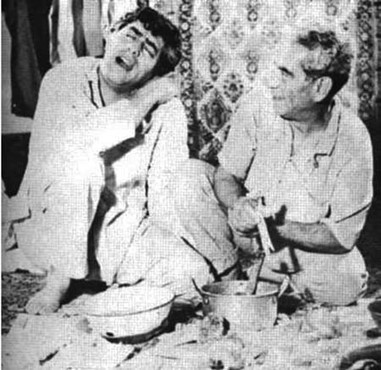
Figure 8: A screenshot from Rape (Tajāvuz), Hamīd Misdāqī, 1972

Since the rise of fīlmfārsī , Iranian cinema has mainly fixated on male characters in ghayrat-related stories. By male fixation, I refer to reserving the main point of view and the film’s main action for male characters in these stories. This fixation has resulted in the representation of women as marginalized in such narratives, relegated in their representation as saints or sinners in the all-too-common and, unfortunately, polarizing Madonna-whore spectrum. In other words, women characters were granted little to no space in the narrative to go beyond stereotypical representations. I importantly also use male fixation here in the sense that Iranian cinema has not evolved and developed in comparison to the increasing and contemporary agency of women in Iranian society. In today’s Iran, 97 percent of the population is literate, higher education has risen in recent years, and women are being granted more degrees than men. Iran is also one of the world’s leading nations regarding women university graduates in science, technology, engineering, and mathematics (STEM).13Atari, Graham, and Dehghani, “Foundations of Morality.” These data provide evidence concerning the increasing extent of women’s agency in Iranian society.

However, it is important to acknowledge that becoming educated and having more agency does not imply a complete break from religious beliefs like modesty ghayrat. In Iranian society, educated women and men might still believe in modesty ghayrat, and these two facts (i.e., education and belief in modesty ghayrat) are not mutually exclusive. In other words, access to higher education in universities granted more agency to women in Iranian society by affording them job opportunities, immigration options, the right to vote, and, consequently, independence; however, it did not necessarily eliminate their own or men’s belief in modesty ghayrat. For example, in the mentioned study about victim blaming and modesty ghayrat, most participants were middle-class (61.6%) and upper-middle-class (27.3%); however, many still believed in modesty ghayrat and blamed the victim in nāmūs killings.14Karimi-Malekabadi and Falahatpishe Baboli, “Qeirat Values.”

Although higher education and agency correlate, modesty ghayrat remains invariant to it. Thus, those with agency are expected to seek to implement and support their beliefs in society. Consequently, women with the belief in modesty ghayrat who did not have the agency to implement their beliefs in the system by finding agency and voice in Iranian society, especially after the Islamic Republic, joined forces with religious men in imposing modesty ghayrat. This might explain the role of women supporters of the Islamic Republic who are usually marginalized in discussions about women in Iran. It is generally assumed that all women are against the restrictions imposed on women in Iranian society. However, this is far from the reality.

In Iranian cinema, however, women are not represented as supporters of modesty ghayrat. Therefore, another issue embedded in the male fixation is that the perpetrators of modesty ghayrat are also mostly men. In this regard, Iranian cinema has, surprisingly and in contrast to its other failures concerning this issue, produced a collectively positive image of Iranian women who take little (if any) part in perpetuating this cultural violence, at least on screen.

After the Revolution, many of the modesty ghayrat storylines of the wronged woman category ceased with the new modesty censorship rules that restricted women’s portrayals. Therefore, considering Naficy’s four phases of the portrayal of women in Iranian cinema, in the first and second phases, ghayrat appeared mostly in non-modesty-related manifestations of it, and significantly in war films about the ongoing Iran-Iraq war where ghayrat was expressed for vatan (the homeland) and Islam. In the third phase, however, directors gradually brought modesty ghayrat back into their stories, specifically in family melodramas.15Naficy, A Social History of Iranian Cinema, Volume 4: The Globalizing Era, 1984–2010 (Durham: Duke University Press, 2012)https://doi.org/10.2307/j.ctv11smr68. The four phases are “structured absence,” “background presence,” “foreground presence,” and “political criticism.”

Many veterans of Iranian cinema that were the remainder of the pre-revolution Iranian New Wave, such as ‛Abbās Kīyārustamī, Dāryūsh Mihrjū’ī and Bahrām Bayzā’ī, began to portray women with agency. These depictions are of women in control of their own lives who work hard to manage and balance their modern lifestyle with the modesty ghayrat orientation of Iranian society. Films such as Sara (1993) and Parī (1995), directed by Mihrjū’ī, Dah (Ten, 2000) by Kīyārustamī, Bāshū gharībah-yi kūchak (Bashu, the Little Stranger, 1989) and Sag Kushī (Killing Mad Dogs, 2001) by Bayzā’ī are among these films.

Bayzā’ī is a curious case among these filmmakers; two of his films, Ragbār (Downpour, 1972) and Sag Kushī, mark significant departures from the portrayal of modesty ghayrat in Iranian cinema. These two, made in pre- and post-revolutionary Iranian cinema, respectively, unveil two significant features of the treatment of modesty ghayrat in Iranian films through their defamiliarisation in story progression compared to other films.

Ragbār narrates the story of a love triangle between an intellectual, a lower-class woman, and a jāhil character type who, as previously discussed, is the symbol of modesty ghayrat in Iranian cinema. The film starts with a battle of modesty ghayrat as the intellectual falls in love with the jāhil’s lover. Initially, the jāhil character follows the stereotypical path and seeks revenge. However, the story develops so that all three become friends and the love triangle is resolved without violence. In fact, the love triangle is forgotten in the face of a broader dramatic event. Both the female character and the jāhil support the intellectual when the community, seeing danger in a man seeking reform, successfully banishes him. This is a radical approach in the history of Iranian cinema as it prioritises humanity and friendship over revenge and sexual concerns regarding nāmūs. In other words, Downpour exists outside the bounds of modesty ghayrat.

Figure 7: A screenshot from Downpour (Ragbār), Bahrām Bayzā’ī, 1972

Moreover, as mentioned, Bayzā’ī made another film in the post-revolutionary era, Killing Mad Dogs, that exhibits another significant departure from Iranian cinema. In simliar Iranian films that narrate a story of assault or sexual misconduct, if a woman is deemed responsible for the modesty ghayrat-eliciting situation, that woman is often eliminated from the narrative. This device differs from mere moral poetic justice as the elimination does not happen at the end of the story but around the time the “immodesty” has been revealed. For example, in Darbārah-yi Ilī (About Elly, 2009) by Asghar Farhādī, Elly cheats on her fiancé and dies in the middle of the narrative, even before the audience is notified of her cheating. Therefore, the narratives of such films structurally and systematically suppress the “immodest” women characters.

In others, especially films directed by men, if a woman is not directly responsible for a grave modesty ghayrat-eliciting situation, such as rape and sexual assault, again, that woman is often swiftly eliminated from the narrative. The reason could potentially be the Madonna-whore complex prevalent in Iran that blames the victim of modesty ghayrat situations, which turns the victim into an abject object. There is, however, a development in Iranian cinema. In many pre-revolution films, such as in Qaysar, the victim is physically removed from the narrative, either by suicide, murder, or by some other story device. In post-revolution Iranian cinema and specifically in the post-Green Movement, the women victims of modesty ghayrat-eliciting situations live throughout the narrative. However, in many of them, such as The Salesman, as I will discuss later in this paper, the women are not given space for their own arc of development or character growth separate from that of the men in the film and are almost entirely disallowed any sense of agency.

However, in Bayzā’ī’s Killing Mad Dogs, we see a powerful woman who wants to save her fiancée from prison. In the process, she is raped by one of her fiancée’s enemies, but the film remains focused on her and how she deals with the issue. Thus, Bayzā’ī stands alone as an exception to the filmmaking trends in Iran. The reason could potentially be his affinities with ancient Iranian religions and customs as opposed to Islam. Although Bayzā’ī lives in exile in the US, he remains a vocal critic of the Islamic Republic.

The new generation of filmmakers, following the previous generation, created two other strands of modesty ghayrat films in Naficy’s “fourth phase.” One strand can be seen in many mainstream commercial films influenced by Hollywood. These include narratives such as Qirmiz (Red, 1999) and Shām-i Ākhar (The Last Supper, 2002), both directed by Farīdūn Jayrānī, and Shukarān (Hemlock, directed by Bihrūz Afkhamī, 1999). These films deploy modesty ghayrat inside the framework of revenge narratives or stories of crimes of passion, full of hints concerning Islamically inappropriate sexual activities. The moral of these films is usually the same: women, and sometimes even men, who do not follow the rules of modesty must be punished, either logically in the story (e.g., revenge of the wronged) or via an accident interpreted as poetic justice. The Last Supper is a particularly curious case since it is one of the few films in which ghayrat is expressed by a woman. The narrative tells the story of a man who falls in love with his girlfriend’s mother. They marry, the girl expresses ghayrat and takes her revenge, murdering both her boyfriend and her mother.

Figure 8-9: Screenshots from The Last Supper (Shām-i Ākhar), Farīdūn Jayrānī, 2002

In the second strand, directors became critical of modesty ghayrat, viewing it as a means of perpetuating violence against women; a violence structurally embedded in Iranian society more broadly and within the religious modesty laws of the Islamic Republic more specifically.16Some of these films were hybrids of festival and commercial films such as those by Tahmīnah Mīlānī. Films like Tahmīnah Mīlānī’s trilogy, including Du Zan (Two Women, 1999), Nīmah-yi Pinhān (The Hidden Half, 2001) and Vākunish-i Panjum (The Fifth Reaction, 2003), and Dāyarah (The Circle, 2000) by Ja‛far Panāhī depict women who are victims of both patriarchal society and their own families. In these films, husbands and close family members, mahrams, are villainized as the main imposers of the widely accepted ghayrat violence against women.

This fourth phase also brought forth a wave of films about modesty ghayrat that altered the usual stories so that the main characters could now be the women victims themselves. For the first time, a body of films was produced in which stories were told from a woman’s point of view; women’s voices, emotions, thoughts, and experiences were shared on the Iranian screen as protagonists, not merely sidekicks. However, although this was a progressive development in portraying women, another issue was created. The reproduction of the victim archetype in many of these films persisted, especially in festival films but not exclusive to them, turning what should have been a positive development against itself. Ultimately, this unfortunate reproduction of the victim archetype transformed an otherwise progressive trait of these films into victim fetishizing.17This goes beyond the representation of women as victims and can be expanded to other topics such as class issues as well (i.e., fetishizing poverty, etc.). Here, I am referring to portrayals of women as mere victims in Iranian society by those who dismiss the fact that the imposition of ghayrat is not a mono-gendered or even gender-neutral phenomenon. As I have discussed already, those who impose modesty ghayrat in Iran are not only men but are, at least in part, also women.

Asghar Farhādī emerged as a director in the atmosphere of this fourth phase in which these two strands were successful in their own markets. His films, however, blended the features of festival and commercial films to create a hybrid cinema. Important to this discussion, the portrayal of women in this hybrid cinema remains one of its most significant features. On the one hand, unlike previous festival films and in line with commercial cinema, Farhādī tries to avoid fetishizing women as victims. On the other hand, following commercial cinema and contrary to festival films of the era, Farhādī follows the norms and morals of modesty ghayrat in Iranian society.18Note that I do not analyze Farhādī’s other films here, choosing instead to restrict this study to The Salesman in which modesty ghayrat is most evident. More could be said of these other films, of course, but I leave that to others. The following analysis of Farhādī’s film consists of two major parts, both explaining how the film aims to resist the imperatives of modesty ghayrat, yet also how its mainstream tropes and unavoidable negotiations with the system imposed by the Islamic Regime weaken the degree to which such resistance remains possible.

The Salesman and the Demasculinization of ‛Imād

The Salesman begins in an alarming situation. The film’s main protagonists, a married couple both working in the theatre industry, must evacuate their apartment after construction next door seriously damages the foundation of their building, threatening its collapse. Following this unfortunate event, the couple, ‛Imād (played by Shahāb Husaynī) and Ra‛nā (played by Tarānah ‛Alīdūstī), must look for a new apartment to stay in while their old one is being repaired. One of their friends and a fellow actor, Bābak (played by Bābak Karīmī), helps them secure a place on short notice. At one point during the first few days at their temporary accommodation while ‛Imād is out buying groceries, Ra‛nā mistakenly opens the door for someone else, believing it to be ‛Imād. When ‛Imād comes back, he sees drops of blood on the staircase. Ra‛nā is not home, and there is evidence of a break-in. He inquires from his neighbors about what has happened and is informed that Ra‛nā is in the hospital. Gradually, he is further informed by neighbors and hospital staff that she might be the victim of a sexual assault. Ra‛nā returns home with a bandage but is in good physical health otherwise, expressing her desire to forget the traumatic event.

Figure 10: ‛Imād and Ra‛nā in their new apartment, A Screenshot from the film The Salesman, Asghar Farhādī, 2016

However, ‛Imād slowly becomes filled with anger connected to modesty ghayrat and ultimately cannot forget about the incident nor can he let it go. After undertaking a semi-detective approach to what occurred, ‛Imād figures out that their new apartment was previously rented by a sex worker named Sharārah (whom the audience never meets), and that the perpetrator of the assault probably knew her and came to her old apartment for a personal matter. ‛Imād eventually discovers the perpetrator: an older man who is, in fact, a regular of Sharārah’s. Ra‛nā, unaware of ‛Imād’s sleuthing, is again faced with her perpetrator. The older man, the eponymous Salesman, has mistaken Ra‛nā in the shower for Sharārah, and figuring out his mistake, he flees the scene. ‛Imād, whose rage has been increasingly built up by ghayrat, is now faced with the prospect of a weak older man and decides to partially seek his revenge by calling the older man’s family. Ra‛nā disagrees with this plan, but ‛Imād goes through with it regardless. However, when ‛Imād encounters the older man’s family and realizes that they perceive him as a saint, he cannot in good conscious ruin the older man’s life. ‛Imād also learns that the older man suffers from a heart condition. Faced with this unappealing and unsatisfying target of his intended revenge, ‛Imād gives up on his original plan. Instead, he asks the older man to accompany him to a separate room and slaps him. The older man comes out and, facing his family’s surprise at the sound they heard, conceals the matter. However, when he descends the stairs with his family, he falls. His heart stops and—in all likelihood though we do not see this—he dies. Thus, ‛Imād inadvertently kills the perpetrator of his nāmūs. His ghayrat is satisfied, but his conscience and relationship with his nāmūs Ra‛nā are in jeopardy.

Figure 11: The older man with his family, A Screenshot from the film The Salesman, Asghar Farhādī, 2016

The Salesman has a classic plot with a three-act structure in which different forms of violence transform and morph into each other. The overall theme at work in the film centers on the conflict between individualism and collectivism in Iranian society regarding modesty ghayrat. In a society full of danger for women and threats to their privacy, dangers that the patriarchal structure does little to control or protect them against, what happens when a situation arises in which the danger becomes personal? How will society react to such a threat? Can a single person like ‛Imād individualize his reaction to the matter?

Three scenes in the first act specifically foreshadow what comes in the second. In the first scene, when the apartment is damaged by the construction next door and threatening collapse, an unmissable crack can be seen in the wall of the couple’s bedroom, foreshadowing the future attack on their privacy. In the second, ‛Imād sits next to a woman in a taxi who indirectly accuses him of abuse. While it is an accusation with no basis, this moment shows the extent of an understandable and pervasive fear of men by Iranian women. Finally in the third scene, ‛Imād’s co-star, an actress named Sanam, plays the role of a naked sex worker during rehearsal but does so fully clothed and also while wearing a hijab. She is laughed at by other members of the play for this and leaves the rehearsal in anger.

This third scene presents a particularly curious case in which the Madonna and whore archetypes of fīlmfārsī  are crystallized together in one character. In ‛Imād’s co-star Sanam, we are shown a modest woman, wearing a hijab and fully clothed, playing the role of a naked sex worker—which sounds absurd to both of the co-stars, especially ‛Imād. This can be considered an indication of the inner psyche of Iranian Muslim men who cannot accept the combination of the whore and the Madonna in one character or person. Thus, if a woman becomes a whore in their eyes, it would be extremely hard for such men to accept her as a Madonna figure again. Importantly, this is exactly what happens to Ra‛nā in later scenes.

Figure 12: Sanam and ‛Imād rehearsing on stage, a screenshot from the film The Salesman, Asghar Farhādī, 2016

In addition to being an actor, ‛Imād is also an intellectual and a teacher. In the film’s first scene, we see him appear as a javānmard as he helps his neighbour’s disabled son out of the apartment building during the evacuation. In the mentioned taxi scene, his attitude is understanding as he explains to his students that women are being poorly treated in Iran and they have a right to be alerted about the possibility of sexual assault. Moreover, in scenes depicting his teaching at the school, he demonstrates his desire for a better type of education for his students by giving them books and films that they might not usually encounter or otherwise have access to in Iran. Finally, he is a radical reformist and tells his friend, Bābak, “I wish they destroyed this city with a loader and rebuilt it all.”19The Salesman, directed by Asghar Farhādī (2016, Filimo) 00:13:58. This and all further quotations from the film a translated by the author. To ‛Imād’s wish, Bābak replies cynically, “They did it once before, and this is the result,” hinting that the Islamic Revolution did nothing for Iran.

Despite all these attributes, after Ra‛nā is assaulted, ‛Imād inevitably—if gradually—becomes ghayrati and takes his revenge, a process thoroughly foreshadowed in the first act as I have described. Alongside his education, radical reformist belifes, and javānmardī attributes, this is also in sharp contrast to his earlier, outward opinions about ghayrat. For instance, when one of his students asks him how a man can become a cow, ‛Imād replies: “Gradually.”20The Salesman, 00:06:06. The student asks this question about the plot line of Gāv (The Cow, 1969) by Dāryūsh Mihrjū’ī, an adaptation of an absurd novella by Ghulām Husayn Sā‛idī wherein this transformation happens. In doing so, Farhādī wants the audience to understand that ‛Imād is saying that a ghayratī person is like a cow—a harsh criticism by the director through his character. Conversely, after the assault, ‛Imād refrains from exhibiting sympathy for his wife, which is unusual for a character introduced to us in the first act as one who helps others, argues for women’s rights, and refers to those who practice ghayrat as cows.21There is only one short scene in which ‛Imād shows sympathy. This is the shifting technique of Farhādī: the director portrays a character with specific characteristics and, in an instant, makes the character do the opposite of what was previously defined.

Figure 13: ‛Imād in his classroom at the school, a screenshot from the film The Salesman, Asghar Farhādī, 2016

In A Separation (2011), for instance, Farhādī introduces Nādir, a husband involved in a divorce and one of the main protagonists, as an honorable, moral person who then lies in the courtroom. The technique is not new; in many melodramas, the good guy turns out to be the bad guy, etc. The difference of Farhādī’s technique, however, is twofold. First, he applies his techniques on his main characters. Second, the shifting does not present itself as a twist in the narrative and begins, instead, as part of a process of moral degradation. To be sure, there is also a cynical undertone to this technique. As many of Farhādī’s protagonists are from an educated middle-class background, this shifting offers a way for Farhādī to critique modern Iranians’ morality as superficial and a sham. Thus, after ‛Imād’s shift in character following the alleged assault, it appears likely that Ra‛nā has become the whore in his eyes. In this way, Farhādī seems to point to a striking difference between theory (i.e., ‛Imād teaching his students that women deserve rights in Iran) and practice (i.e., ‛Imād’s lack of sympathy for Ra‛nā after the assault) among Iranian intellectuals. Although ‛Imād is presented to us at first to be a reasonable person, even a javānmard before Ra‛nā’s assault, afterwards, he gradually becomes filled with ghayrat and forgets his sensitivity. In this way, one could argue that the jāhil archetype of fīlmfārsī  is attempting to take him over.

Moreover, in several scenes, their fellow middle-class neighbors push ‛Imād to express and show his ghayrat. In one scene, ‛Imād decides to forget the matter and begins mopping the floor to clean up the blood left after the assault. A woman neighbor sees him and states that she wanted to ask the cleaner to come take care of it, but thought that ‛Imād would want to call the police and use the blood as evidence. ‛Imād shares his desire to forget about the event and says, “Nothing has happened.”22The Salesman, 00:48:07. The woman neighbor informs him that if he had seen his wife naked on the floor, a sight that one of their male neighbors had seen, he wouldn’t say such a thing. This is a particularly interesting scene in which modesty ghayrat, as I have previously mentioned, is reinforced by a woman.23In many Iranian films, family members such as mothers and sisters expect modesty ghayrat but the difference here is that the woman is just a neighbor. In other scenes, ‛Imād’s male neighbors also push him by being overly supportive, promising him that they will give testimony to the police and to the court. One neighbor even promises to take revenge himself if he sees the guy.

The structural aspect of ghayrat (i.e., as a set of ideologies embedded in culturally specific violence in Islamic societies such as Iran) is mentioned in the film as the primary source of ‛Imād’s behavior. Western film reviewers did not understand this culture. According to Partovi, they “puzzled over the narrative focus on Emad’s ‘irrational shame at what the neighbors will say’ (Bradshaw 2017) rather than on his wife’s reaction to the attack.”24Partovi, “The Salesman,” 349. In a significant scene, Ra‛nā expresses regret, saying that if she had not picked up the intercom, these events would not have happened. ‛Imād responds that if it was that simple, Ra‛nā should go and tell this excuse to every neighbor they have. This emotional scene reveals the extent to which modesty ghayrat culture permeates their lives, a culture that pressures ‛Imād specifically and is the primary source of his obsession with the event. He does not want to be considered ghayrat-less and so finds himself stuck between modernity and tradition.

Figure 14: ‛Imād listens to the neighbors as they recount what happened to Ra‛nā, a screenshot from the film The Salesman, Asghar Farhādī, 2016

On the one hand, he is a modern intellectual who agrees with his wife not to prosecute Ra‛nā’s assailant and to forget the matter. On the other hand, the pressure of tradition and honor culture weighs heavily on his shoulders. In this way, the film seems to suggest that ghayrat itself is something that perpetuates violence in Iranian society, and that a person cannot simply just become “modern” and escape it. Farhādī thus points to two aspects of ghayrat in Iran. First, that ghayrat is undesirable and makes men illogical. Second, that ghayrat is embedded in Iranian society and is thus structural. As Akram Jamshidi and Shahab Esfandiary put it, “Farhadi’s protagonist has consistently been put at the junctures of morals and justice, though the significance of The Salesman is the confrontation of the individual ethics in contrast with the social morals.”25Akram Jamshidi, and Shahab Esfandiary, “Critical Readings of The Salesman in Iran,” Observatorio (OBS*) 12, no. 2 (2018), https://doi.org/10.15847/obsOBS12220181176. Even if ‛Imād wants to forget, as Ra‛nā desires, he cannot. He is expected to express and show his ghayrat.26In one scene, ‛Imād draws a cross as the Christians do but it is not clear if Farhādī is hinting that ‛Imād is not a Muslim, or if ‛Imād is joking since his action is followed by his laughter. Either way, it seems that Farhādī is saying that the problem is not the government and is not Islam; rather, society as a whole is the problem.

This bind is an example of “hegemonic masculinity.” In “Hegemonic Masculinity: Rethinking the Concept,” R. W. Connell and James W. Messerschmidt argue that the concept of “hegemonic masculinity” embodies “the currently most honoured way of being a man,” and it requires “all other men to position themselves in relation to it.”27R. W. Connell and James W. Messerschmidt, “Hegemonic Masculinity: Rethinking the Concept,” Gender & Society 19, no. 6 (2005): 832. Thus in Iranian Islamic culture, ghayrat is one of the most significant factors in being a man and upholding the normative structutres of gendered hegemony. Men have a choice to go against it, but they have to accept the consequences of humiliation and emasculation by the culture should they do so. In this sense, ‛Imād seeks to retain his masculinity by eliciting ghayrat. However, this hegemonic masculinity is combined with the concept of cultural, social, and political “schizophrenia,” introduced by Asfaneh Najmabadi.28Asfaneh Najmabadi, “Hazards of Modernity and Morality: Women, State and Ideology in Contemporary Iran,” in Women, Islam and the State, edited by D. Kandiyoti (Philadelphia, Pennsylvania: Palgrave Macmillan, 1991), 66. Najmabadi defines this schizophrenia as a situation for non-traditional Iranian women that would be labelled ummul (i.e., too traditional and close-minded) if they behaved traditionally, and jilf (i.e., is too loose) if they were modern.

Figure 15: A screenshot from the film The Salesman, Asghar Farhādī, 2016

For male characters that desire a more modern life and set of values such as ‛Imād, this schizophrenia also exists concerning their nāmūs (i.e., close female family members). If men become modern, they will become ghayrat-less. Indeed, “a man without ghayrat” is one of the harshest insults that can be thrown at a man in Iran. And yet, like the schizophrenic extremes for women of being either too closed-minded or too loose, if men uphold the values of tradition instead, they are considered “radicals.” As a result, Iranian men are stuck in the schizophrenic oscilations between tradition and modernity. In the case of the film, ‛Imād desires or must be a conflicted character: he is an actor taking part in a modern play while living in an Islamic culture and upholding its traditional values. This schizophrenia directly influences his doubt and distressed position after Ra‛nā’s assault. As a modern civilised man, should he take revenge as the culture dictates or forget the matter? Ultimately, ‛Imād chooses to be the ghayratī man, not to be modern or forget, and succumbs to hegemonic masculinity—and the film and Ra‛nā critique his actions and his adherence to this tradition. ‛Imād thus “performs” the role of masculine ghayratī to be considered a “man” by the Islamic culture in which he and Ra‛nā live. However, his performance is not convincing to anyone. Not only does he not receive whatever benefit he might have had from the image of being perceived as properly ghayratī because he cannot disclose what happened, but he also loses the respect of his nāmūs. He is not modern or traditional; if he were, one of these communities would respect him. As the Persian proverb goes, he “loses both heaven and earth.”

Figure 16: A screenshot from the film The Salesman, Asghar Farhādī, 2016

While ‛Imād’s predecessors (i.e., Qaysar) gained respect as they expressed and showed ghayrat and became timeless heroes for Iranian audiences when they took their revenge, ‛Imād achieves the opposite. Instead of becoming a hero, ‛Imād finds himself burdened by an accidental assault (and likely the death) of an elderly man; his relationship with his nāmūs is endangered; and his javānmard qualities are seriously questioned. While Qaysar showed his masculine courage by killing those who raped (or failed to prevent the rape of) his sister, ‛Imād is gradually demasculinized in the revenge process as he loses confidence, is unable to satisfy his modern wife, and imposes violence on the weak (such as the elderly man). More importantly, while Qaysar’s news of revenge could make headlines in Iranian Islamic society as a positive act, ‛Imād’s revenge remains a secret. In this way, those who continue to maintain the ideology of the very hegemonic masculinity that drove him to his criminal act in the first place will probably never even know about this traditional “masculine” act, and, consequently, will never accept him as a “man.” In the end, ‛Imād is not a savior but is himself a perpetrator. Thus, in The Salesman, modesty ghayrat as a masculine value is subverted and transformed into a destructive anti-value. In this way specifically, the film can be considered one of the most resistant works to the masculine culture of modesty ghayrat.

There is also another complementary resistance taking place in this film. As Connell and Messerschmidt rightfully state, masculine hegemony “works in part through the production of exemplars of masculinity (e.g., professional sports stars), symbols that have authority.”29Connell and Messerschmidt, “Hegemonic Masculinity,” 846. In Iran, a culture full of war celebrities, masculine sports stars, and cinematic archetypes such as the titular character of Qaysar, The Salesman has found a place in Iranian popular culture with its success in the domestic market. This may explain the anger of the radical right media toward the film. For example, Mas‛ūd Firāsatī, arguably one of the most influential film critics of the right-wing in Iran, attacked the film, stating that “In the final sequence, the camera is looking down [at] the old man (high angle shot), and Emad is standing over him. This means the invader is oppressed and the victim is the oppressor . . . Emad’s slapping on the man’s face makes the audience clap for the movie in Iran and brings Farhadi awards in international festivals because it is a symbol of Iranians’ violence and brutality.”30Mas‛ūd Firāsatī zs quoted in Jamshidi and Esfandiary, “Critical Readings.” From The Salesman onward, the collective cinematic, pop-cultural memory of male youth in Iran continues to carry and transmit modesty ghayrat through two symbols: not only the masculine hero found in Qaysar but also in the demasculinized anti-hero found in ‛Imād.

Figure 17: ‛Imād slaps the old man across the face, causing him to fall to the ground. A screenshot from the film The Salesman, Asghar Farhādī, 2016

The Limits of Resistance: Ra‛nā, Male Fixation, and the Sadomasochism of the Male Gaze

Although Farhādī’s film performs certain acts of resistance concerning the issue of modesty ghayrat, he fails to appreciate or uplift his main woman protagonist in The Salesman. Despite its various modes of resistance, the male gaze that The Salesman adheres to is well-aligned with the Islamic structure of Iran that has been in place since Qaysar. In The Salesman, Farhādī narrates a story of an assault on a woman, yet he does not grant that woman a space independent from her husband, the male and main protagonist. In this way, it is clear that the patriarchal structure of the narrative is chiefly concerned with the husband of the victim and not the victim herself. This is an extreme manifestation of the male fixation in Iranian cinema, which, as I have explained, can be traced back to fīlmfārsī . Ra‛nā’s fears, thoughts, and mixed emotions are only ever mentioned, and only in passing, in the presence of ‛Imād. Her inability to express herself otherwise is structurally limited in the film because she is not given a separate identity or space within the film to do so. ‛Imād and, through their identification with him, the audience, sadistically investigates her through cross-examination in a variety of scenes. Here, sadism can be seen to stem directly from modesty ghayrat, and several sadistic questions abound: Has she been violated? Is she a whore or is she a Madonna?

Ra‛nā hides some facts, is inconsistent in her recollection of events, and exhibits no desire for revenge. Therefore, the gaze that Farhādī exhibits and adheres to in this film is patriarchal, with little regard for Ra‛nā, the victim and the woman character upon whom the entire plot and narrative hinge. Thus, instead of having an active voice in the story, Ra‛nā serves as something more akin to a sidekick in a film that should, by rights, be considered her story. The most significant desire that she manifests is to forget the event—an understandable desire, given her situation. However, even in her desire to forget, she shows little agency. It is also worth noting that she expresses that it is important for her that they move from the apartment in which the assault occurred. However, although she can join the apartment hunting, for some unknown reason, she cannot do so without her husband, and so waits instead for ‛Imād. Between acting and work (and his detective work, hunting down the perpetrator), ‛Imād has little time to attend to the matter, thus lengthening Ra‛nā’s forced occupancy in the retraumatizing space of the apartment.

Figure 18: A Screenshot from the film The Salesman, Asghar Farhādī, 2016

Moreover, in an indirect act to forget the matter—which notably is the only scene when we see her without ‛Imād—Ra‛nā parks the car of her assailant outside their house (which has been kept as something like a hostage). This attempt leads to the perpetrator stealing back his vehicle, which ironically only fuels the modesty ghayrat of ‛Imād and in no way leads to forgetting the assault on Ra‛nā or the ongoing situation. This one, brief scene dedicated to her point of view reminds us that she does not discuss her situation with anyone: not with a friend nor with a close family member. Farhādī has designed the story such that he renders Ra‛nā as both isolated and virtually voiceless in many aspects.

Thus, it seems that the Madonna-whore complex exists here in this film, too, just as in fīlmfārsī. The film treats Ra‛nā as an abject object after the assault, much like Qaysar’s sister Fātī is treated. Although Ra‛nā does not die as Fātī does, her point of view is virtually eliminated from the narrative—a narrative that conceals her point of view from a public male gaze (the male audience). Without a space in the narrative to exhibit her emotions or to offer a rationale for her actions, Ra‛nā’s character is thrown (as opposed to transformed) from a “whore” into a “Madonna.” This can be seen, for instance, during the revenge sequence in which she does nothing to prevent the situation yet seeks to maintain her higher moral ground, judging ‛Imād. While, for example, it would be possible to free the older man or at least attempt to do so, Ra‛nā does nothing and, instead, remains judgmental. The extent to which Farhādī has taken away her agency in a ghayrat-eliciting situation is profoundly striking.

Figure 19: A Screenshot from the film The Salesman, Asghar Farhādī, 2016

This aspect of the portrayal of Ra‛nā that is in line with the male gaze of Iranian Muslims can thus be seen as a negotiation, not only with the Islamic Republic’s radicals but also with the Islamic structure of Iranian society in general. In this way, The Salesman can be viewed as a case of narrative violence, a film aligned, at least regarding Ra‛nā’s portrayal, with the operating sadomasochistic male gaze in Iranian cinema—a gaze that allows women to be touched on screen, but only violently.31For an examination of violence, touch, and gender in Iranian cinema, see Hamid Taheri, “The Pleasure of the Violent Touch in Iranian Narrative Cinema.” Quarterly Review of Film and Video (September 2023): 1-16. The violent Muslim male gaze that is widely in operation and in circulation throughout Iranian audiences that might be dissatisfied with ‛Imād’s actions in the film can thus find satisfaction with the depiction of Ra‛nā.

Cinematic Negotiations with Censorship and the State: The Art of Distancing

In Iranian films, elements of resistance to and compliance with the state—especially with state censorship laws regarding cinema—and the state’s dominant ideology can be found simultaneously. This contradictory presence of resistance and compliance is the result of a number of factors, including censorship notes given to directors and producers by the state, the fear instilled in filmmakers, self-censorship, and so forth.32For more on these factors of censorship in Iranian cinema, see Hamid Taheri, “Censoring Iranian Cinema: Normalisation of the Modest Woman,” Feminist Media Studies (March 2024): 1-14. In negotiations with censors, Farhādī tried to distance the critique of the modesty ghayrat portrayed in the film from controversial and sensitive issues in numerous ways.

First, as discussed, he virtually eliminated Ra‛nā’s, the main woman protagonist’s, point of view, which would have, arguably, made the sexual assault more graphic or at least more tangible. Second, in one scene, ‛Imād draws a cross as the Christians do, but it is not clear whether Farhādī is using this moment to hint that he is not a Muslim or that ‛Imād is joking. Nevertheless, it helps Farhādī to make a case against the claims of the radicals, enabling him to argue that The Salesman does not criticize Islam. Moreover, by avoiding direct depictions of the police and the judicial system throughout the entire narrative, Farhādī also distances the issues presented in the film from those individuals (e.g., police authorities) who embody the Islamic Republic and its laws (an effective but highly unlikely scenario, though it may be).33It must be emphasized how the absence of police and the justice system in the film is highly unlikely. First of all, even if we only examine the “reality” of the film itself, while the main characters may not want to prosecute the assailant, either the neighbors who found Ra‛nā or the hospital staff who treated her—or possibly both—would definitely have informed the police. Second of all, if a similar situation occurred in the real world, the involvement of police and the justice system would also be entirely likely, if not inevitable. Consequently, modesty ghayrat, even in this highly unique situation, is not treated as an issue directly related to the Islamic Republic or Islam. Furthermore, though modesty ghayrat is portrayed as destructive, its destructiveness is restricted to this highly unique situation in which the perpetrator is old and in ill-health (and outwardly respectable to his family and friends). In other words, the film’s approach, especially to modesty ghayrat, cannot be generalized. Finally, Farhādī makes the assault visited upon Ra‛nā so ambiguous that the extent of it is never clarified in the film. Thus, male Muslim censors, or the Iranian audience for that matter, are not provided with enough information to clearly decide whether the extent of pursuing and demanding the consequences of modesty ghayrat by ‛Imād would be acceptable. Taken together, this accumulation of significant and related elements in the film can be considered micro-injections of the Islamic Republic’s ideology into the film, the source of which may be conscious or unconscious on the part of Farhādī.

Figure 20: Asghar Farhādī with Shahab Hosseini behind the scenes of the film The Salesman, Asghar Farhādī, 2016

The combination of these ever-present micro-injections of the Islamic Republic’s ideology in the film, while at the same time maintaining the film’s status as participating in the intellectual cinema of resistance, may well be one of the key factors for The Salesman’s success in both domestic and international markets. However, it’s important to note that Farhādī’s negotiations with the Republic’s censorship system go beyond textual elements and can even be observed in his interviews. For instance, in response to ghayrat-related criticisms, especially by right-wingers (e.g., the Fundamentalists, a political party that Farhādī probably rightfully fears, or at least rightly feared at the time), he stated that “an atmosphere has been created to propose that it seems this film is in defense of not having ghayrat and forgiving a rape. It is not about that at all . . . It is about privacy, and it is discussed many times in the film . . . Here, ‛Imād’s privacy is violated, and ‛Imād tries his best to forget it. Still, he cannot because it is impossible.”34Asghar Farhādī, “Panj Muntaqid – Panj Pāsukh,” [Interview], 1395/2016. Translated by the author. Although, quite understandably, Farhādī clearly had state censors and specific Islamic radicals in mind, his interview is aligned with what is depicted in the film: the assault on Ra‛nā is overwhelmingly presented as a violation of her husband’s “privacy,” not as an attack on Ra‛nā herself as a human being. Interviews such as this one are thus an important part of the negotiations Farhādī had to conduct with and within the larger systems of Islam and the state, a type of negotiation that many festival directors, such as Ja‛far Panāhī and Muhammad Rasūluf, do not usually perform.35Which could potentially explain why their films are censored and they face imprisonment.

Figure 21: Asghar Farhādī with Taraneh Alidousti behind the scenes of the film The Salesman, Asghar Farhādī, 2016

These examples of compliance in the film are significant because numerous Iranian women are victims of modesty ghayrat in real, everyday life as the system and the dominant Islamic culture seek to either eliminate or minimize their presence in Iranian society, much like the male fixation embedded in this film’s narrative that marginalises Ra‛nā. The regime and wider Islamic society attempt to achieve this desire by imposing modesty rules. It thus can be argued that modesty ghayrat is the foundation for the modesty rules that govern women’s lives in Iran. Modesty rules are a set of laws and norms that restrict women’s appearance (e.g., forcing them to wear hijab) and behavior (e.g., expecting them to be good mothers and wives). These rules are so strictly defined that even showing some hair from under the hijab can render an Iranian woman “immodest.” Based on modesty rules, Iranian police and militia members can arrest and fine these “immodest” women. An extreme case in recent years was the murder at the hands of the morality police of Mahsā Amīnī, a twenty-two-year-old woman who showed some of her hair. Notably, this event ignited the Woman Life Freedom movement, which was essentially an uprising calling for Iranian women’s right to be “immodest” and not marginalised. Modesty ghayrat is also responsible for nāmūs killings in Iran (i.e., the killing of close female family members that have engaged in “immodest” acts). Modesty ghayrat culture, as influential as it is, perpetuates violence against women and marginalises them in Iranian society.

Through The Salesman, Farhādī proposes that we consider modesty ghayrat as a destructive set of behaviors and values that are both personal and collective. Yet he demonstrates this through the film without any apparent connection between ghayrat, Islam, and the Islamic Republic. Farhādī also represents this destructiveness of modesty ghayrat to us in a highly unique situation in which the perpetrator is a frail old man near death, the uniqueness of which keeps the narrative from expanding into other ghayrat-eliciting situations and thus keeps the film itself from becoming a commentary on ghayrat in general. Moreover, Farhādī also virtually eliminates the main woman character, emptying her of agency in the process. Taken together, all of these elements and readings of the film can be best understood as an intricate negotiation strategy that allows The Salesman to be considered both a form of resistance in Iranian cinema while at the same time remaining somewhat slippery regarding reactive censorship measures and criticisms of the radical right in Iran.

Poetic Minimalism of Iranian Cinema: Pre-Revolution to New Wave

By

Introduction

Figure 1: A still from the film The Cow (Gāv), directed by Dāryūsh Mihrjū’ī, 1968.

The capacity of Iranian cinema to combine aesthetic minimalism with deep socio-political and philosophical depth has earned it a unique and esteemed position on the international scene. Iranian filmmakers have created a distinctive narrative style that mostly depends on subtlety, lyrical realism, and an immersive depiction of daily life, in contrast to Western mainstream cinematic traditions that frequently place a higher priority on spectacle or linear storytelling. This method is distinguished by its deliberate simplicity, which communicates closeness and authenticity. It frequently uses amateur actors, has little conversation, and uses ordinary surroundings. However, Iranian films often function as multi-layered critiques of social issues, existential quandaries, and cultural identities, revealing a profound social richness underlying this aesthetic simplicity.

In general, Iranian cinema is notable for its inventive use of poetic minimalism, a style that combines metaphor with realism to offer an allegorical viewpoint on contemporary situations. Within the limitations of story and censorship, this technique enables filmmakers to investigate philosophical issues of life, identity, and morality. Many Iranian films use symbolism and allegory in place of direct confrontation, drawing viewers in and revealing the richness of meaning hidden beyond the surface of seemingly straightforward imagery. Directors such as ‛Abbās Kiyārustamī, Suhrāb Shahīd-Sālis, Furūgh Farrukhzād, Muhammadrizā Aslānī, Dāryūsh Mihrjū’ī, Nāsir Taqvā’ī, Ja‛far Panāhī, Asghar Farhādī, Rakhshān Banī-I‛timād, and Muhsin Makhmalbāf have used metaphors to create films that quietly touch the intricacies of Iranian society while encouraging viewers to consider common human experiences. Iranian cinema has gained a distinct character and a devoted following in the global film industry thanks to this combination of depth and simplicity.

From its pre-revolutionary origins in the 1960s and 1970s to its changes after the Islamic Revolution of 1979, this article explores the history of Iranian film. I will examine how filmmakers overcame societal constraints and constrictive political environments to produce a picture that is both local in its concerns and universal in its resonance by following the development of aesthetic minimalism and socio-political depth.

The Early Years of Pre-Revolutionary Filmmaking

Early Iranian mainstream film, before the Islamic Revolution of 1979, was heavily influenced by a complex interplay of social pressures, political constraints, and Western influences. The Iranian film industry started to expand in the 1930s, but it wasn’t until the 1960s that Iranian cinema began to take on a distinct voice. The prevailing trend of commercial and escapist movies defined the era preceding the Revolution. The government’s aim for cultural “modernization,” which frequently involved supporting Western-style films that prioritized amusement over politics, and consumer demand, both contributed to this tendency. Films that mirrored the Western cinematic style, especially in terms of narrative and visual presentation, became increasingly popular in the 1960s and early 1970s. In order to appeal to a broad audience rather than provoking critical thought, several films adopted melodramatic stories, extravagant set designs, and commercial themes that were influenced by American and Indian cinema. These films, which were a kind of escape that let viewers temporarily forget the sociopolitical difficulties they encountered in real life, frequently focused on romance, adventure, and light comedic themes. The tastes of a government that saw films as a means of amusement and social harmony rather than as a platform for philosophical investigation or social critique were also reflected in this trend towards commercialism.

Notwithstanding these limitations, a few filmmakers such as Mihrjū’ī, Ghaffārī, Gulistān, Rahnamā, Sālis, Farrukhzād, Kiyārustamī, started to explore novel formats and subjects, challenging the function of film in Iranian culture. By exploring more intricate stories that mirrored the realities of Iranian life, these directors aimed to depart from the prevailing commercial approach. Thus, even if the mainstream business mostly continued to concentrate on trivial amusement, the first seeds of a socially conscious film were planted. A few trailblazing filmmakers started introducing Iranian viewers to a new kind of filmmaking in this setting, which would later serve as the foundation for a more reflective cinema. The wider socio-political changes in Iranian society were in line with this new cinematic movement. Iran saw substantial economic growth and pronounced social inequality throughout the 1960s as a result of the Shah’s economic policies and fast modernization. Despite urgent problems, poverty, class inequality, and gender inequality were rarely discussed in public because of political persecution and censorship. However, several filmmakers used their skills to quietly address these concerns, employing symbolism and metaphor to avoid censorship.1Hamid Naficy, A Social History of Iranian Cinema, Volume 1: The Artisanal Era, 1897–1941 (Durham: Duke University Press, 2011), 37.

Figure 2: A still from the film The Cow (Gāv), directed by Dāryūsh Mihrjū’ī, 1968.

The Cow (Gāv, 1969), which was directed by Dāryūsh Mihrjū’ī, is a landmark film that perfectly captures this change. The Cow broke with the escapist films of its day, and is widely considered the beginning of the Iranian New Wave of cinema. Hasan, a poor peasant who owns the lone cow in his community, is the protagonist of the movie. The emotional and psychological reliance of the rural poor on their meagre resources is reflected in Hasan’s affection for the cow, which he loves like a child. Hasan’s identity and mental health start to fall apart once the cow dies, sending him into a depressed state that results in a tragic metamorphosis. The Cow stands out for its unique combination of symbolism and realism, which enables it to serve as a social critique as well as a psychological drama. The movie portrays a profoundly human tale of identity and loss on one level. On a deeper level, it offers a potent indictment of the poverty and class inequality that characterized Iranian rural life—problems that were frequently ignored in the government’s official narratives of modernization and growth. Mihrjū’ī avoids censorship by criticizing the Shah’s regime’s economic policies using the metaphor of the cow, which stands for economic dependency, without directly expressing political opinions. As a result, The Cow is not just a seminal film in Iranian cinema, but also a groundbreaking example of a film that uses symbolism and allegory to tackle socio-political concerns in a constrained Political climate. The Cow’s popularity encouraged other filmmakers to explore related subjects, including the cultural limitations experienced by women, the alienation of metropolitan life, and the hardships of the lower classes. For Iranian filmmakers, this new wave of socially conscious filmmaking paved the way by emphasizing socio-political critique, realism, and humanity over the previous commercial formulas. These films concentrated on the lives of common Iranians and their hardships, tapping into the communal consciousness of a population caught between tradition and modernization.

This pre-revolutionary era established the foundation for what would later be referred to as “poetic minimalism” in Iranian cinema. The distinctive form of poetic minimalism, which originated in Iranian cinema, combines realism with allegorical storytelling. Iranian poetic cinema is distinguished by a softer, more reflective style that blends the natural beauty of the Iranian environment with intensely personal, human tales, in contrast to the hard-edged realism present in some Western films. Using characters who are regular individuals in exceptional situations, this approach enables filmmakers to examine existential and philosophical concerns through the prism of daily life. Films that employ poetic minimalism rely on long takes and silences as strategies to fully immerse the audience in the film’s universe. The early work of filmmakers such as Furūgh Farrukhzād, whose 1962 documentary The House is Black (Khānah siyāh ast) is regarded as one of the first instances of Iranian poetic minimalism, demonstrates this aesthetic. The House is Black is a documentary, but it does more than just capture a situation; it paints a vivid, poetic picture of life in a leper colony. The film uses the reality of illness and loneliness as a metaphor for more general existential topics, presenting a brutal yet compassionate portrayal of suffering and resiliency through its poetic narration and striking cinematography.

Figure 3: A still from the film The House is Black (Khānah siyāh ast), directed by Furūgh Farrukhzād, 1962.

The 1974 work Still Life (Tabī‛at-i Bījān) by Suhrāb Shahīd-Sālis is another illustration of poetic minimalism prior to the Islamic Revolution.is an elderly railway worker whose lonely and mundane life turns into a meditation on life, ageing, and the silent dignity of human labor. Silence becomes an expressive instrument that shows the character’s inner life and, symbolically, the existential loneliness inherent in the human condition because of the slow, reflective tempo and lack of language, which foster a sense of silent introspection. By using silence to highlight the character’s unsaid struggle, Sālis encourages viewers to consider more general social and philosophical issues. The work of Sālis and her peers contributed to the development of a cinematic language that would subsequently be improved and expanded by filmmakers like Muhsen Makhmalbāf and ‛Abbās Kiyārustamī. These directors created visually minimalist films that were rich in metaphorical substance by adhering to the ideals of poetic minimalism. By giving New Wave filmmakers the aesthetic and philosophical means to examine the human condition in the face of political repression and cultural change, the pre-revolutionary filmmakers established the groundwork for a cinematic movement that would flourish in the post-revolutionary era. Iranian cinema had already started to establish itself as an art form of reflection, metaphor, and resiliency by the time of the Revolution; this would prove to be a vital basis in the years that followed.

Figure 4: A still from the film Still Life (Tabī‛at-i Bījān), directed by Suhrāb Shahīd-Sālis, 1974.

Post-Revolutionary New Wave Film, Artistic Restrictions, and Censorship

An important turning point in Iranian history, the Islamic Revolution of 1979, drastically altered the country’s sociopolitical environment and, consequently, its creative and artistic output. Iranian film was now subject to intricate new regulations. Wide-ranging changes in a variety of cultural domains resulted from the Revolution’s attempt to restructure Iranian society in line with Islamic precepts. The new administration put stringent rules on filmmakers that limited their ability to depict some issues, especially those that were considered too Western or un-Islamic, such as overt social or political criticism, sexual depictions, and romantic renderings. Women’s representation became especially delicate; new censorship regulations that dictated women’s behavior, dress, and interactions on screen required a level of conservatism that fundamentally changed the way films were made. Iranian filmmakers needed to be creative and resourceful in order to adjust to these developments. They were forced by the censorship regulations to develop a style of filmmaking that used metaphor, symbolism, and allegory to subtly express meaning. Since it was now illegal to criticize the state directly, filmmakers used poetic and complex visual language to subtly address socio-political themes. In addition to being a survival tactic, this adaptation marked a sea change in Iranian filmmaking. The use of metaphor and allegory became crucial for filmmakers who wanted to tackle difficult subjects without drawing attention to themselves. Changing their emphasis from the obviously political to the existential and philosophical was one way in which directors accomplished this. By making this change, they were able to construct stories that subtly alluded to socio-political themes while addressing larger human experiences and moral quandaries. As a result, there were a lot of subtexts in the film, with stories centered upon moral dilemmas and everyday hardships. In methods that seemed apolitical or universal, filmmakers frequently portrayed humans battling personal struggles that mirrored more general societal problems like poverty, gender inequity, and repression. The films of ‛Abbās Kiyārustamī provide an illustration of this adaptive storytelling. Kiyārustamī, who is renowned for his minimalist style, explored issues like personal responsibility, bereavement, and the pursuit of meaning through open-ended storylines, natural landscapes, and scant speech. A young boy’s attempt to return his friend’s notebook in Where is the Friend’s House? (Khānah-yi dūst kujāst? 1987) is a straightforward tale that delicately explores themes of loyalty, social duty, and ethical obligation. Kiyārustamī was able to create art while adhering to post-revolutionary censorship because of his emphasis on such universal topics.

Figure 5: A still from the film Where Is the Friend’s House? (Khānah-yi dūst kujāst?), directed by ‛Abbās Kiyārustamī, 1987.

The measured approach taken by filmmakers to represent women was another crucial element of the new wave era. Due to limitations on the representation of women, filmmakers started creating female characters whose fortitude and tenacity were expressed through nuanced facial expressions and gestures. In post-revolutionary Iranian cinema, female heroines frequently exhibited silent resistance, perseverance, and moral integrity in place of overt conflicts with patriarchal structures. Rakhshān Banī-I‛timād’s 1995 film The Blue-Veiled (Rūsarī Ābī) for example, examines women’s lived experiences inside constrictive social structures, emphasizing their emotional and psychological landscapes in lieu of overt acts of rebellion. With this strategy, filmmakers were able to discuss women’s difficulties without openly questioning social standards.

Figure 6: A still from the film The Blue-Veiled (Rūsarī Ābī), directed by Rakhshān Banī-I‛timād’s, 1995.

In a similar vein, the intellectual and moral conundrums that Iranian society confronted were central to Muhsin Makhmalbāf’s films. The Cyclist (Bāysīkilrān, 1987) by Makhmalbāf examines the tenacity and desperation of an Afghan refugee who competes in an endurance cycling competition to raise money for his wife’s medical care. Despite having a straightforward premise, the movie offers a powerful critique of exploitation, poverty, and the resiliency of the human spirit. By emphasizing the moral and psychological challenges faced by his characters, Makhmalbāf was able to effectively criticize the sociopolitical circumstances that marginalized populations in Iran face. The utilization of naturalistic performances was another characteristic of the Iranian New Wave. Iranian filmmakers frequently use amateur actors in their productions because they think this will result in more realistic and genuine performances. In Iranian New Wave films, this naturalistic aesthetic contributes to a feeling of closeness and immediacy that made it easier for audiences to empathize with the characters. The story of Samīrā Makhmalbāf’s 1998 film The Apple (Sīb) centers on two young sisters who are kept inside their house by their father. Makhmalbāf creates a story that feels genuine and unadulterated by using amateur performers, providing insight into the difficulties women have in traditional cultures. The choice to use amateur actors strengthened the sociological and psychological reality of the characters’ experiences while also giving the movie a starkly realistic foundation.

The Iranian New Wave became known for its philosophical storytelling, with many of its films using allegorical tales to examine existential issues and moral quandaries. Filmmakers created profound narratives by examining larger human and societal themes via the internal struggles of their characters. For example, Kiyārustamī describes a man who drives about Tehran looking for someone who will bury him after he commits suicide in Taste of Cherry (Ta‛m-i Gīlas, 1997). The film’s existential topic and minimalist aesthetic encourage spectators to consider issues of mortality, meaning, and the worth of life. Instead of offering definitive answers, Taste of Cherry lets the protagonist’s trip develop in an ambiguous manner, enabling viewers to interpret the significance of his quest for themselves.

Figure 7: A still from the film Taste of Cherry (Ta‛m-i Gīlas), directed by ‛Abbās Kiyārustamī, 1997.

Following the Islamic revolution, the Iranian New Wave—influenced by the sociopolitical climate of post-revolutionary Iran—developed a unique voice that distinguished it in the world of film. Within this movement, filmmakers used nuanced yet profound cinematic techniques to tackle difficult subjects including gender dynamics, personal identity, and societal roles.

Identity, Gender, and Society in Poetic Minimalism

New Wave films encourage viewers to decipher meaning beyond what is directly depicted by incorporating allegorical themes into realistic settings. Iranian poetic minimalism tries to create a meditative ambiance, focusing on the interior, emotional journeys of characters, in contrast to Western cinematic reality, which frequently emphasizes realistic images of life’s challenges. Iranian New Wave filmmakers frequently employ silence and allegory as potent narrative techniques. This method responds to Iran’s censorship restrictions while also being in line with the philosophical aspects of Islamic mysticism and Persian literature. In this sense, silence is not just the lack of word or sound; rather, it is a purposeful void that allows viewers to decipher hidden conflicts, tensions, or underlying emotions.

The Silence (Sukūt, 1998) by Muhsin Makhmalbāf is a prime example of this method. Khurshīd, a young blind youngster with a special sensitivity to sound, is the subject of the movie. The sounds Khurshīd hears as he moves through his environment influence his perception, making it harder to distinguish between the imagined and the actual. Since Khurshīd finds solace and meaning in rhythms that others might ignore, music itself here becomes a metaphor for his inner world. The film examines topics of perception, fragility, and the fight for independence in a constrictive culture through Khurshīd’s aural sensitivity. Makhmalbāf’s poetic use of sensory elements to communicate emotional landscapes and existential questions is highlighted by the interplay between sound and quiet in The Silence, which symbolizes how people see and internalize the world around them.

Additionally, the Iranian New Wave provides a sophisticated examination of society and personal identity, with a focus on gender roles and family relations. Iranian filmmakers frequently examine and analyze the larger sociocultural issues impacting individuals and groups in Iranian society through intimate character studies and personal storylines. Through these tales, New Wave filmmakers show how people’s lives are shaped by cultural norms, legal constraints, and conventional expectations.2Richard Tapper, ed. The New Iranian Cinema: Politics, Representation and Identity (London: I.B. Tauris, 2002), 91. The Circle (Dāyirah, 2000) by Ja‛far Panāhī is a pioneering illustration of this strategy. The movie tells several interrelated tales of Iranian women who challenge the country’s repressive social and legal systems. The Circle highlights the difficulties women encounter in a culture that limits their freedom and establishes their positions. Panāhī weaves the stories of several female characters together to create a tapestry of survival, resiliency, and subdued resistance to a system of oppression. A metaphor for the cyclical nature of systematic oppression is provided by the narrative framework, which frames each woman’s tale as a part of a broader, cyclical journey. A strong critique of gender discrimination in Iran is provided by the film’s unapologetic depiction of female characters negotiating a constrained culture, which also adds to the rising conversation about women’s rights in Iranian cinema.

Figure 8: A still from the film The Circle (Dāyirah), directed by Ja‛far Panāhī, 2000.

The Blue-Veiled (1995) by Rakhshān Banī-I‛timād offers yet another illustration of how Iranian New Wave filmmakers tackle issues of gender, identity, and society. The protagonist of the movie is a middle-aged male manufacturing owner who develops feelings for a female young, destitute factory worker. Banī-I‛timād examines the connections between love, social expectations, and class inequality through this relationship. The film highlights the emotional complexity of people who, despite social restraints, seek fulfilment and individuality while discreetly criticizing the gender and economic forces that drive Iranian culture. Banī-I‛timād humanizes her characters’ hardships by concentrating on their inner life, creating a sympathetic yet critical portrayal of Iranian society. Furthermore, the New Wave’s emphasis on social and psychological reality is reflected in Asghar Farhādī’s films, especially in About Elly (Darbārah-yi Ilī, 2009). In About Elly, a vacation takes a terrible turn when one of friends on the trip disappears. By analyzing the layers of societal expectations and individual accountability that influence the characters’ behavior, Farhādī uses this premise to investigate themes of truth, guilt, and collective responsibility. The movie offers a microcosm of Iranian culture through its portrayal of human relationships and ethical dilemmas in a collective context, illuminating the ways in which social norms and cultural expectations mold people. Farhādī’s intricate character interactions and meticulous attention to detail help to create a nuanced depiction of the social forces that influence moral decisions and personal identity.

These instances demonstrate how personal narratives are used as vehicles for broader social critique in the Iranian New Wave following the Islamic Revolution. These films give viewers a chance to reflect on the complexities of family responsibilities, social conventions, and personal agency in Iranian society by emphasizing commonplace events and close character analyses. With this method, filmmakers can examine gender, identity, and social expectations in poetic and philosophical ways.

Iranian New Wave Film’s Minimalism Following the Islamic Revolution

One distinctive element of Iranian New Wave filmmaking is minimalism, which heightens realism and establishes a direct line of communication between the viewer and the characters. Iranian filmmakers create a subtle authenticity that captures the simplicity of daily life by eschewing complex narratives, lavish visual effects, and copious amounts of dialogue. Subtle emotional responses are made possible by this minimalist approach, where every gesture, pause, and conversational sentence acquires meaning. ‛Abbās Kiyārustamī’s films are among the best representations of minimalism in Iranian cinema. Kiyārustamī’s use of lengthy takes is a prime example of minimalist filmmaking. The lengthy shots in Close-Up (1990) serve as both stylistic decisions and narrative elements that create a meditative ambiance. These extended moments are used by Kiyārustamī to depict the complex responses of his characters, especially in the courtroom sequences where Sabziyān faces the family he deceived. Long takes transform even the most basic motions into potent representations of vulnerability, regret, and guilt, allowing the viewer to feel the emotional strain uninterrupted. As the movie examines identity and the human yearning for acceptance and understanding, the individuals’ inner lives continue to be the main focus. Here, Kiyārustamī’s minimalist style eliminates superfluous distractions to highlight the unadulterated, emotional core of interpersonal relationships. The sparse use of language is another crucial element of Iranian cinematic minimalism. Kiyārustamī uses quiet and nuanced character interactions in films like The Wind Will Carry Us (Bād mā rā khvāhad burd, 1999), letting the stillness itself convey spoken feelings and ideas. The dialogue in this movie is sometimes brief and disjointed, which illustrates the gap between the protagonist, an urban outsider, and the people of the rural town. Their different worlds and points of view are symbolized by the absence of direct verbal communication. Silence becomes an active narrative technique as a result of this constrained use of words, which compels the spectator to focus on the emotional and physical cues. These films’ constrained speech and economical use of visuals also bring forth the intricacy and beauty of commonplace environments. In order to increase the realism of their stories, Kiyārustamī, Makhmalbāf, and other New Wave filmmakers place a strong emphasis on using natural settings, such as villages, city streets, and ordinary interior spaces. These commonplace locations, which are devoid of ornate lighting effects or set designs, become essential to the narratives and help to anchor the protagonists’ experiences in Iranian society.

Figure 9: A still from the film The Wind Will Carry Us (Bād mā rā khvāhad burd), directed by ‛Abbās Kiyārustamī, 1999.

Iranian New Wave directors frequently use metafictional devices to gently remind viewers that films are manufactured. Ja‛far Panāhī expands on this idea in The Mirror (Āyinah, 1997) by breaching the fourth wall halfway through the movie. By leaving the set, the young actress who is portraying the lead role essentially blurs the line between truth and fiction. Viewers are compelled by this sudden change to reevaluate the nature of narrative and the filmmaker’s influence on reality. Panāhī challenges viewers to consider the artificiality of cinematic traditions and the stories they consume by bringing attention to the production process. Iranian New Wave film’s non-linear and open-ended storytelling promotes a contemplative viewing experience in which viewers actively participate in the meaning-making process rather than being passive recipients of a predetermined narrative.3Hamid Reza Sadr, Iranian Cinema: A Political History (London: I.B. Tauris, 2006), 42. The philosophical foundations of Iranian film, which frequently use Persian poetry and Sufi mysticism to examine themes of self-discovery and the pursuit of truth, are consistent with this participatory approach. These films respect the complexity of the human experience by allowing for interpretation and admitting that there are some questions that cannot be answered with certainty. By highlighting the viewer’s responsibility to interpret and derive meaning from each story, these stylistic choices subvert conventional narrative structures.

The Iranian New Wave’s Legacy Following the Islamic Revolution

Both Iranian and worldwide cinema have been profoundly impacted by the Iranian New Wave, leaving a legacy that continues to influence filmmaking today. This cinematic movement, which arose under stringent political, social, and cultural constraints, demonstrated the potential of minimalism, poetic approach, and philosophical investigation to strike a profound chord with viewers worldwide. Iranian New Wave cinema has influenced filmmakers not just in the Middle East but also in Europe, Asia, and the Americas, demonstrating its cross-border effect. Iranian filmmakers’ minimalist, poetic, and philosophical approach provides a distinctive contrast to the prevalent cinematic languages of European art cinema. Iranian New Wave cinema has influenced filmmakers worldwide to investigate minimalism, character-driven storylines, and the symbolic possibilities of ordinary life by focusing on straightforward yet deep stories.

The presence of Iranian New Wave cinema at important film festivals is among its most noteworthy global accomplishments. ‛Abbās Kiyārustamī, Ja‛far Panāhī, Muhsin Makhmalbāf, and Asghar Farhādī have all received some of the most coveted accolades at cinema festivals like Cannes, Venice, and Berlin. For example, the 1997 Cannes Palme d’Or winner of Kiyārustamī’s Taste of Cherry signaled a shift in the world’s perception of Iranian film. These honors brought the intricacies and complexity of Iranian narratives to a wider worldwide audience while also validating Iranian cinema’s distinctive storytelling style. This recognition paved the way for other Iranian filmmakers and brought attention to a cinema industry that, until the late 20th century, was mainly unknown outside of Iran. Filmmakers in Asia and Europe have been especially impacted by Iranian New Wave cinema, which has inspired them with its emphasis on character-driven narrative, utilization of authentic settings, and use of ambiguity.

Figure 10: A still from the film Close Up, directed by ‛Abbās Kiyārustamī, 1990.

Iranian film has influenced the work of directors like Japan’s Hirokazu Koreeda and Taiwan’s Hou Hsiao-Hsien. Like their Iranian counterparts, they place a strong emphasis on quiet, simplicity, and subtle emotional changes. The realism and emphasis on marginalized lives of the Iranian New Wave have also been incorporated by European filmmakers such as the Belgian Dardenne brothers. A sense of intimacy that appeals to viewers from all cultural backgrounds is produced by the Dardennes’ use of handheld cameras, natural light, and everyday settings, which are stylistic choices reminiscent of Iranian New Wave directors. Academic interest in Iranian cinema’s distinctive stylistic features and philosophical foundations has increased as a result of its widespread recognition. Critics and academics such as Laura Mulvey have examined how Iranian filmmakers employ minimalism to delve into existential topics, transforming seemingly insignificant, ordinary situations into meaningful meditations on freedom, identity, and life. ‛Abbās Kiyārustamī’s Close-Up (1990), for instance, has been the subject of much research due to its creative fusion of fiction and documentary, which examines identity and reality in ways that defy accepted narrative structures. The impact of this film can be observed in the emergence of “hybrid” cinema, a movement that has gained popularity in art-house circles throughout the world and blends fictitious and real-life components to explore deeper realities.

Despite having had a huge influence on international film, Iranian New Wave cinema is still developing in Iran, where modern filmmakers are expanding on the New Wave’s ideas to tackle fresh sociopolitical and cultural issues. The movement’s emphasis on moral ambiguity, realism, and character-centered storytelling has been carried further by these directors, who have modified these approaches to better represent contemporary Iran. They deal with problems including generational disputes, gender inequality, class inequality, and individual liberty under social constraints and despite censorship. One of the most well-known modern Iranian directors, Asghar Farhādī, has built on the New Wave’s tradition by examining difficult moral conundrums within the context of Iranian culture. Internationally acclaimed, his 2011 film A Separation (Judā’ī-i Nādir az Sīmīn) explores the moral and interpersonal tensions in a divorcing family. Farhādī exposes the larger conflicts between tradition and modernity, as well as between individual desire and social duty, that are fundamental to Iranian life by concentrating on the personal struggles of his characters. By winning the Academy Award for Best Foreign Language Film, A Separation strengthened Iranian cinema’s standing internationally and emphasized the potency of narratives grounded in psychological nuance, realism, and ethical analysis. A development in the portrayal of Iranian women is also evident in Farhādī’s work. The female characters in Farhādī’s films are given agency, voice, and complexity, in contrast to the older New Wave films that frequently portrayed them as silent symbols of sorrow or resiliency. For example, Sīmīn, a character in A Separation, is battling for her daughter’s freedom and right to a better life in addition to custody of her daughter. Both Iranian and foreign audiences find resonance in Farhādī’s subtle depiction of women battling with both personal goals and societal expectations, as they recognize themselves mirrored in his characters. The work of female directors like Rakhshān Banī-I‛timād demonstrates another intriguing development in the heritage of the Iranian New Wave. Films by Banī-I‛timād, including Under the Skin of the City (Zīr-i pūst-i shahr, 2001), explore the lives of marginalized Iranians, especially women, as they deal with social pressures and financial difficulties. Banī-I‛timād’s emphasis on common people carries on the New Wave’s dedication to realism while contributing a distinctively female viewpoint to Iran’s sociopolitical environment.4Laura Mulvey, “Visual Pleasure and Narrative Cinema,” Screen 16, no. 3 (1975): 12.

Figure 11: A still from the film A Separation (Judā’ī-i Nādir az Sīmīn), directed by Asghar Farhādī, 2011.

To portray the realities of Iranians living abroad, contemporary Iranian filmmakers also examine problems of migration, exile, and diaspora. Iranian cinema is viewed through a diasporic lens by filmmakers such as Maryam Kishāvarz and Bahman Qubādī, who concentrate on the ways that Iranian identity is reinterpreted internationally. A Time for Drunken Horses (Zamānī barāyi māstī-i asb-hā, 2000) by Qubādī explores the struggles of Kurdish families along the Iran-Iraq border, illustrating the grim reality of Iran’s ethnic minorities. Circumstance (2011) by Kishāvarz, on the other hand, tackles the lives of young Iranians who are struggling with repression and sexuality in a way that is both globally relevant and particular to Iran’s own social fabric. As modern filmmakers tackle the unique problems of the twenty-first century while embracing the movement’s emphasis on lyrical realism, ethical investigation, and narrative innovation, the legacy of Iranian New Wave cinema lives on. These directors have preserved Iran’s impact on international cinema by striking a balance between the New Wave’s methods and their own distinctive voices, proving that the Iranian New Wave’s tenets remain ageless and flexible.

Conclusion: Iranian Film’s Development and Prospects

Iranian cinema has changed dramatically throughout the years due to its distinct cultural, social, and political influences. The 1960s and 1970s pre-revolutionary era was characterized by a separation of popular escapism from a few films that made critical social commentary. Filmmakers like Suhrāb Shahīd Sālis, ‛Abbās Kiyārustamī, Dāryūsh Mihrjū’ī, Nāsir Taqvā’ī, Parvīz Kīmiyāvī, Ibrāhīm Gulistān, Furūgh Farrukhzād, and others started to pave the way for change by defying commercial trends and utilizing a distinctly Iranian visual and narrative style to explore intricate social themes. The foundation for poetic minimalism, a distinctive characteristic of Iranian New Wave film, was established by this early attempt to combine realism with symbolic narrative.

Iranian cinema experienced significant changes after the Islamic Revolution of 1979 as a result of stringent new censorship laws that forbade specific portrayals and stories. Both Iranian and foreign audiences found great resonance in the new, introspective style that was cultivated by such limitations and depended on metaphor and inference. The emergence of the Iranian New Wave was characterized by its emphasis on moral ambiguity, everyday struggles, and the investigation of identity under sociopolitical restrictions. This movement was spearheaded by filmmakers like as ‛Abbās Kiyārustamī, Ja‛far Panāhī, and Muhsin Makhmalbāf, who produced films that not only questioned established narrative frameworks but also encouraged audiences to reflect philosophically on issues of freedom, death, life, and individual choice. Technological and socio-political developments present Iranian film with both opportunities and problems as it develops. A number of possible paths for Iranian cinema’s future are suggested by the rapid development of digital media, changing social environments, and growing interest in a variety of cinematic voices worldwide.

Iran’s sociopolitical environment continues to have a big impact on its filmmaking. Censorship and content restrictions continue to influence the themes and methods used by filmmakers, frequently encouraging them to come up with fresh approaches to sociopolitical criticism. However, as evidenced by the work of younger filmmakers who employ ingenuity and technology to overcome constraints, these difficulties have also fostered an atmosphere that promotes innovation. For example, the covert filmmaking stylistic innovations, which frequently address the status of personal freedom and civil rights, demonstrate the flexibility and tenacity of Iranian filmmakers in the face of political hardship. Iranian filmmakers will probably keep using allegory, metaphor, and other oblique techniques to tackle current concerns in the future. Issues like economic inequality, freedom of speech, and gender equality may gain prominence in Iran due to the country’s growing social consciousness, representing the worries of a younger, more connected generation.

Digital technology’s introduction has drastically changed how films are made and seen, giving Iranian filmmakers new ways to connect with viewers around the world. Iranian filmmakers now have more options than only traditional distribution channels thanks to digital platforms like Netflix, YouTube, and smaller international film streaming services. These platforms give filmmakers the opportunity to get around some government restrictions and present a greater variety of stories that might not otherwise be viewed. Because of its accessibility, Iranian cinema may feature a wider variety of viewpoints and views by promoting innovation with form and substance. Additionally, the cost of filming has decreased due to digital technology, democratizing the Iranian film industry. With the use of inexpensive equipment and digital editing techniques, aspiring filmmakers who might not have access to substantial funding or other resources can now produce and release films. This change could allow for a more varied portrayal of the Iranian experience by introducing new voices to Iranian cinema. Furthermore, the emergence of virtual reality and mobile filmmaking presents intriguing opportunities for fresh storytelling styles that can enhance Iranian cinema’s traditional focus on intimacy and realism.

As more filmmakers consider how the environment and climate affect people’s lives, environmental themes are becoming more prevalent in Iranian filmmaking. Filmmakers now have a new way to examine how individuals interact with their surroundings in light of Iran’s environmental problems, which include desertification, air pollution, and water scarcity. Iranian film is ideally adapted to tackle environmental issues in a complex and powerful manner because of its distinctive emphasis on the natural world as a mirror of human experience. Future Iranian films might potentially start addressing international issues more directly, such as social justice, globalization, and the role of technology in society, adding a new level of significance and resonance with viewers throughout the world. Iranian filmmakers may work with foreign directors more frequently as their reputation grows, producing cross-cultural productions that broaden Iranian cinema’s appeal and impact.

Inspired by digital technology and the Iranian New Wave, younger filmmakers are starting to push the limits of documentary and narrative filmmaking by further experimenting with form. Iranian film is renowned for its hybrid style, which can develop further to include elements of interactive narrative, virtual reality, and avant-garde aesthetics. These developments enable Iranian filmmakers to keep providing viewers with an introspective, engrossing experience that conflates fiction and reality. As Iranian filmmakers experiment with new technologies, experimental cinema—which subverts established storytelling conventions and employs sound and visual symbolism in novel ways—may become increasingly well-known. This strategy would guarantee the ongoing relevance and development of Iran’s cinematic voice by enabling them to explore even more deeply the existential and philosophical topics that have characterized Iranian New Wave cinema.

Iranian film is at a turning point in its history, ready to continue the New Wave’s heritage while negotiating new artistic, technological, and social environments. Its focus on realism, reflection, and philosophical depth has struck a chord with viewers all across the world, inspiring filmmakers from a variety of backgrounds and winning praise from critics at important film festivals. Iranian cinema continues to be a potent voice in global cinema thanks to its tenacity, inventiveness, and dedication to examining the human condition. It tells stories that are both intensely personal and engrossing to all audiences.